Category Archives: US Small Arms Market Analytics

Reports focusing on the US Small Arms Market in general – vendors, post mortems, marketing, lessons learned and so forth.

CSG’s Acquisition of Vista Outdoor: Impacts on US Ammunition Market

1. Executive Summary

The late-2024 acquisition of Vista Outdoor Inc.’s Kinetic Group by the Czechoslovak Group (CSG) represents a fundamental shift in the global defense industrial base and the domestic United States ammunition market.1Valued at $2.225 billion, the transaction successfully transferred ownership of America’s most prominent civilian and law enforcement ammunition brands—including Federal Premium, Remington, CCI, and Speer—to a rapidly expanding European defense conglomerate.4By 2026, the structural, macroeconomic, and geopolitical ramifications of this consolidation have fully materialized, sparking rigorous national debate regarding domestic market stability, antitrust compliance, and the resilience of the national security supply chain.6

The integration of the Kinetic Group under CSG—which had previously acquired Italian manufacturer Fiocchi in 2022—has concentrated a massive portion of the U.S. civilian ammunition market and approximately 70% of western primer production under a single, foreign-owned entity.1 Concurrently, the U.S. commercial market has experienced severe price volatility throughout 2025 and 2026, characterized by synchronized wholesale price hikes and chronic retail supply shortages.9 While a vocal segment of American consumers attributes these market conditions to monopolistic price-fixing enabled by the CSG acquisition, a forensic macroeconomic analysis indicates that structural input inflation, aggressive trade tariffs on key metals, and the sudden disappearance of low-cost foreign imports are the primary drivers of the prevailing price environment.9

Furthermore, global geopolitical realignments have forced a reprioritization of domestic manufacturing capacity. The ongoing conflicts in Eastern Europe have catalyzed an unprecedented boom in the European defense industry, with CSG aggressively expanding its defense output to supply NATO and allied partners.1 This military prioritization, compounded by domestic labor disruptions such as the devastating April 2026 strike at the Lake City Army Ammunition Plant, has systematically reduced the overflow of ammunition into the commercial market, creating acute civilian scarcity.6

This report evaluates the intersection of these complex variables. It provides an exhaustive assessment of the CSG transaction mechanics, the regulatory mitigation strategies deployed by the Committee on Foreign Investment in the United States (CFIUS), the macroeconomic drivers of the 2026 price environment, and the long-term implications for U.S. antitrust enforcement and domestic supply chain stability.

2. Historical Context: Corporate Restructuring and Capital Market Inefficiencies

To understand the systemic transfer of American ammunition manufacturing to foreign ownership, it is necessary to examine the capital market conditions that precipitated the dissolution of Vista Outdoor Inc. The genesis of the CSG acquisition stems directly from structural inefficiencies in public equities markets that consistently undervalued Vista Outdoor’s consolidated portfolio over the preceding decade.12

2.1 The Environmental, Social, and Governance (ESG) Capital Penalty

Prior to 2024, Vista Outdoor operated as a hybrid corporate conglomerate, managing a bifurcated portfolio that included both high-margin outdoor lifestyle brands (such as CamelBak, Fox Racing, Bell Helmets, and Bushnell) and traditional, commodity-based ammunition manufacturing lines.12 While this diversification initially provided revenue stability, public market valuations for Vista Outdoor became structurally depressed due to the pervasive rise of Environmental, Social, and Governance (ESG) investment mandates among large institutional investors.12

As ESG criteria became codified into institutional asset management protocols, significant pools of capital were strictly prohibited from allocating funds to portfolios containing firearms and ammunition manufacturers.12 This capital starvation effectively placed an artificial ceiling on Vista Outdoor’s stock price, severely limiting the investor pool and resulting in an enterprise valuation that analysts deemed profoundly misaligned with the company’s actual revenue generation and profitability.12 Anna Glaessgen, a senior analyst at B. Riley Financial, noted that this ESG-driven investor limitation fundamentally dictated corporate strategy, forcing the board of directors to seek alternative structural paradigms.12

2.2 The Strategic Bifurcation: Revelyst and The Kinetic Group

Recognizing that a single holding company containing both lifestyle and kinetic brands could never achieve the price-to-earnings ratios expected by growth investors, Vista Outdoor leadership initiated a comprehensive corporate restructuring.13 The strategic objective was to separate the ammunition brands—which operate in a notoriously volatile, commodity-based cycle—from the outdoor gear brands, which rely on stable, predictable lifestyle consumer growth curves.13

This restructuring birthed two distinct corporate entities under the Vista umbrella: Revelyst, which housed the 40 non-kinetic outdoor recreation brands, and The Kinetic Group, which consolidated the legacy ammunition manufacturers, including Federal, Remington, CCI, Speer, and Hevi-Shot.14 The explicit intention of this bifurcation was to spin off Revelyst into a standalone public company trading on the New York Stock Exchange under the ticker “GEAR,” thereby freeing it from the ESG penalty, while actively seeking a private or strategic buyer for The Kinetic Group.3 This corporate maneuver set the stage for one of the most highly contested bidding wars in the history of the American defense industrial base.

3. The Bidding War and Final Transaction Mechanics

The announcement that America’s largest civilian ammunition producer was available for acquisition initiated an intense, multi-year bidding process characterized by shifting valuations, unsolicited interventions, and fierce domestic political pressure.12

3.1 Initial Proposals and Domestic Alternatives

The initial definitive agreement for The Kinetic Group was struck with the(https://csg.com/en/news/the-czechoslovak-group-enters-into-definitive-agreement-to-acquire-vista-outdoor-s-sporting) in October 2023 for a base purchase price of $1.91 billion on a cash-free, debt-free basis.14 However, the perceived undervaluation of this initial offer rapidly attracted competing bids. Late in the year, the Colt CZ Group submitted a proposal valued at $1.7 billion, which the Vista board promptly rejected as financially inadequate.15

More significantly, MNC Capital Partners LP, a North American private equity firm, launched a highly aggressive, unsolicited campaign to acquire the entirety of Vista Outdoor, halting the planned bifurcation.17 Capitalizing on domestic political sentiment that favored keeping the ammunition brands under North American ownership, MNC Capital iteratively escalated its all-cash offer.21 Beginning with an initial bid of $2.9 billion ($35.00 per share), MNC Capital subsequently raised its proposal to $37.50 per share, and ultimately submitted a last-ditch offer of $42.00 per share, valuing the consolidated enterprise at approximately $3.2 billion.14

3.2 Escalation and the SVP Acquisition of Revelyst

Despite immense pressure from activist investors such as TIG Advisors and Gates Capital to engage with MNC Capital, the Vista Outdoor board of directors maintained that the MNC proposals lacked sufficient financing certainty and undervalued the standalone potential of the Revelyst segment.12 Consequently, the board leveraged the competitive tension to extract superior terms from CSG.

Through a series of intense negotiations extending into late 2024, CSG incrementally increased its purchase price for The Kinetic Group. The base price was raised first to $2.0 billion, then to $2.15 billion, and ultimately settled at $2.225 billion.2 Concurrently, to complete the total dissolution of Vista Outdoor and maximize immediate shareholder liquidity, the board negotiated the sale of the Revelyst segment to funds managed by Strategic Value Partners, LLC (SVP) for an enterprise value of $1.125 billion.4

Bidding EntityTarget AssetFinal Proposed ValuationBoard DecisionRationale for Decision
Colt CZ GroupThe Kinetic Group$1.70 BillionRejectedFinancially inadequate compared to baseline CSG offer.17
MNC CapitalVista Outdoor (Total)$3.20 Billion ($42/share)RejectedConcerns regarding financing certainty and undervaluation of Revelyst.12
Strategic Value PartnersRevelyst$1.125 BillionAcceptedProvided immediate cash liquidity for the outdoor lifestyle segment.4
Czechoslovak Group (CSG)The Kinetic Group$2.225 BillionAcceptedMaximized cash consideration with committed JP Morgan financing.4

3.3 Finalization and Shareholder Approval

The dual-track sale strategy proved highly lucrative for Vista Outdoor stockholders. The combined transactions with CSG and SVP represented an aggregate enterprise value of $3.35 billion for Vista Outdoor.4 Under the final terms of the amended merger agreement, Vista stockholders received $25.75 in cash and one share of Revelyst common stock for each share of Vista Outdoor common stock held, resulting in an estimated total return of $45 per share.3

On November 25, 2024, the special meeting of stockholders concluded with overwhelming approval. Approximately 97.89% of votes cast were in favor of the CSG transaction, representing 82.57% of all outstanding shares.3 The closing of the deal in late 2024 definitively ended Vista Outdoor’s tenure as an American corporate entity and initiated a new era of foreign ownership for the nation’s most historic ammunition manufacturers.2

4. Profile of the Czechoslovak Group (CSG) and Geopolitical Realignments

The acquisition of The Kinetic Group cannot be analyzed in a vacuum; it is fundamentally intertwined with the rapid expansion of the Czechoslovak Group and the broader geopolitical rearmament of the European continent.1

4.1 Corporate Structure and Historical Trajectory

(https://en.wikipedia.org/wiki/Czechoslovak_Group) is an international industrial technology holding company entirely owned and led by Michal Strnad, a 33-year-old Czech billionaire.1 Over the past decade, Strnad has transformed CSG from a regional logistics firm into one of Europe’s most formidable privately held defense conglomerates.1 The group operates across five strategic business segments: defense systems, aerospace, ammunition (Ammo+), mobility, and business projects.26 With over 14,000 employees globally, CSG manages key manufacturing facilities in the Czech Republic, Slovakia, Serbia, Spain, Italy, Germany, India, and the United States.1

CSG’s foray into the ammunition sector predates the Vista transaction. In 2022, the conglomerate acquired a 70% majority stake in Fiocchi Munizioni, a premier Italian ammunition manufacturer with significant U.S. production facilities in Arkansas and Missouri.1 By 2025, CSG had purchased the remaining equity to become Fiocchi’s sole owner, successfully integrating its operations into the broader Ammo+ division.1 The acquisition of The Kinetic Group was explicitly designed to complement the Fiocchi infrastructure, providing CSG with immediate, unassailable dominance in the American commercial and law enforcement markets.13

4.2 The European Rearmament Catalyst

CSG’s hyper-growth trajectory is directly correlated with the geopolitical destabilization of Eastern Europe. The ongoing conflict in Ukraine has catalyzed the largest European defense procurement cycle since the Cold War, as NATO members pour billions into rearmament to reduce logistical dependence on U.S. suppliers.1

CSG is situated at the epicenter of this military-industrial expansion. The conglomerate is a critical supplier of heavy ground forces equipment to Ukraine, delivering modernized T-72 Avenger main battle tanks, RM 70 Vampire multiple launch rocket systems, DANA M2 self-propelled howitzers, and massive quantities of 155mm artillery ammunition.29 Financial disclosures reveal the extent of this military dependency: deliveries to Ukraine comprised 41% of CSG’s total revenue in 2022, 23% in 2023, and a staggering 42% in 2024.29

4.3 Post-Acquisition Financial Scale and the 2026 IPO

The integration of The Kinetic Group exponentially expanded CSG’s balance sheet. Driven by robust organic growth in defense systems and the full-year revenue contribution from the American ammunition brands, CSG reported total annual revenues of €6.7 billion for the 2025 fiscal year.28

Capitalizing on this massive scale, CSG transitioned to public markets. On January 23, 2026, the company launched its Initial Public Offering (IPO) on the Euronext Amsterdam stock exchange. Advised by a syndicate of global investment banks including JP Morgan, Morgan Stanley, and Deutsche Bank, CSG raised €3.8 billion by offering 15.2% of its shares at €25 per share, achieving a market capitalization of €25 billion and marking the largest defense IPO in history. This transition from a private holding company to a publicly traded global defense titan requires rigorous new disclosures and subjects CSG to intense international regulatory oversight, fundamentally altering how it manages its American subsidiaries.1

5. Regulatory Review: Antitrust Clearance and the HSR Act

The acquisition of America’s preeminent ammunition infrastructure by a foreign defense contractor naturally triggered multiple layers of federal regulatory scrutiny. However, the evaluation of the deal was highly bifurcated, with domestic antitrust agencies passing the transaction relatively swiftly while national security panels demanded rigorous mitigation.

5.1 The FTC and Horizontal Integration Constraints

From a strictly structural antitrust perspective, the transaction was governed by the Hart-Scott-Rodino (HSR) Antitrust Improvements Act of 1976.27Under this framework, the FTC and the Department of Justice analyze proposed mergers to determine if the consolidation will substantially lessen domestic competition or tend to create an illegal monopoly.27

Surprisingly to some industry observers, the CSG-Kinetic transaction cleared the HSR waiting period and received full antitrust clearance from the FTC early in the acquisition process.15 This clearance was predicated on a strict geographic and corporate definition of horizontal integration. Prior to the acquisition of The Kinetic Group, CSG’s physical manufacturing footprint within the United States was limited entirely to its 2022 purchase of Fiocchi’s facilities in Arkansas and Missouri.33

Because CSG was primarily a European defense entity with a relatively small North American commercial presence, the FTC determined that absorbing Vista Outdoor’s ammunition lines did not cross the statutory threshold for creating an immediate domestic monopoly.33 The FTC’s analysis focused narrowly on the existing U.S. market share overlap between Fiocchi and The Kinetic Group, concluding that sufficient domestic competition—principally from the Olin Corporation (Winchester) and Hornady Manufacturing—remained to preserve market equilibrium.8

5.2 Latent Antitrust Compliance Risks

Despite securing initial HSR clearance, CSG’s integration of the U.S. market exposes the conglomerate to significant ongoing antitrust compliance risks, particularly in the aggressive regulatory environment of 2025 and 2026. The FTC, under evolving leadership, has exhibited an increasingly assertive posture toward market policing. Bolstered by a requested $383.6 million budget for fiscal year 2026, the agency is expanding its focus beyond traditional price-fixing to aggressively pursue discriminatory commercial practices.

A critical area of vulnerability for CSG lies in the bipartisan congressional calls to reinvigorate the Robinson-Patman Act of 1936.32 This Depression-era statute strictly prohibits sellers from engaging in price discrimination by charging competing buyers different prices for commodities of the same grade and quality.32 The law was explicitly designed to protect small, independent retailers from the coercive purchasing power of massive corporate buyers.32

During periods of severe ammunition scarcity, manufacturers face immense logistical pressure to allocate limited inventory to their largest, most profitable retail partners (e.g., big-box sporting goods chains) or to funnel product into their own direct-to-consumer digital storefronts.36 If CSG leverages its newly acquired dominant market share to offer preferential wholesale pricing, volume discounts, or exclusive inventory allocations to tier-one corporate retailers—while simultaneously starving local, independent firearms dealers of critical supply—it could trigger severe Robinson-Patman Act enforcement from the FTC.32 Recognizing this latent liability, CSG’s corporate prospectus explicitly emphasizes its commitment to implementing stringent internal antitrust compliance procedures across all its global subsidiaries, a legal necessity for a publicly traded European entity operating within the highly litigious U.S. commercial framework.37

6. National Security Mitigation: CFIUS and the Supply Assurance Agreement

While the FTC cleared the transaction on economic grounds, the true regulatory battle occurred within the domain of national security. The transfer of the primary domestic suppliers for U.S. law enforcement and allied military partners to a foreign holding company required the approval of the U.S. Treasury Department.15

6.1 Political Opposition and the CFIUS Investigation

The CFIUS review, led by the Department of the Treasury in coordination with the Departments of Defense, Justice, and Homeland Security, was characterized by significant delays and intense public scrutiny.15 In March 2024, Vista and CSG were forced to voluntarily withdraw and refile their joint voluntary notice, granting the nine-member panel additional time to conduct extensive intelligence diligence on the transaction.19

This delay was heavily influenced by profound domestic political opposition. Conservative lawmakers, led by Senator JD Vance (R-Ohio), Senator John Kennedy (R-La.), Representative Clay Higgins (R-La.), and former Secretary of State Mike Pompeo, launched a coordinated public campaign urging Treasury Secretary Janet Yellen to block the transaction entirely.7 In a sharply worded letter, Senator Vance argued that selling America’s premier munitions infrastructure to a foreign entity constituted an unacceptable supply chain vulnerability, particularly amid global arms shortages exacerbated by the conflicts in Ukraine and Gaza.7

This political opposition was powerfully reinforced by domestic law enforcement advocacy groups. The National Sheriffs’ Association and the National Association of Police Organizations submitted formal letters of protest, warning that transferring control of brands like Federal and Speer—which collectively dominate the U.S. law enforcement duty ammunition market—could jeopardize the physical security and operational readiness of local police departments nationwide.7

6.2 The Imposition of the Supply Assurance Agreement

To navigate this intense opposition, CSG aggressively marketed its credentials as a trusted supplier to NATO, highlighting that its European subsidiaries already possessed top NATO security clearances and worked closely with leading U.S. defense companies.15 CSG executives also emphasized that the company had successfully navigated the CFIUS process two years prior during the Fiocchi acquisition.33

In June 2024, CFIUS formally cleared the transaction, determining there were “no unresolved national security concerns”.15 However, intelligence and financial market reports indicate that this clearance was not unconditional; rather, it was predicated on the imposition of a highly restrictive, legally binding mitigation measure known as a “supply assurance agreement”.21

This federal agreement was explicitly designed to guarantee that CSG would continue to fulfill all existing and future government contracts, providing millions of dollars worth of ammunition annually to U.S. military and federal law enforcement buyers without interruption.21 While this mitigation strategy successfully neutralized the immediate national security threat to U.S. government agencies, it generated profound and destabilizing second-order effects on the broader macroeconomy. By legally forcing CSG to prioritize federal contracts above all other obligations, the agreement inherently relegated the civilian commercial market to a subordinate status. When global raw material shortages constrain total factory output, the supply assurance agreement mandates that civilian production lines are the first to be curtailed to protect government quotas. This regulatory mechanic directly fueled the severe civilian shortages observed throughout 2026.

7. Market Concentration and the Primer Chokepoint

To accurately evaluate the validity of consumer concerns regarding market manipulation, it is vital to quantify the precise operational control CSG now exerts over the North American supply chain. The acquisition of The Kinetic Group provided CSG with a portfolio of manufacturing assets that dictate the tempo of the entire industry.

7.1 The Kinetic Group Brand Portfolio

Operating across massive, specialized production facilities in Anoka, Minnesota; Lonoke, Arkansas; Lewiston, Idaho; and Sweet Home, Oregon, The Kinetic Group constitutes the absolute core of American small-arms manufacturing.5 The consolidated portfolio includes:

  • Federal Premium: The undisputed market leader in overall sales volume, producing a vast array of reliable training ammunition and the premier Personal Defense HST line, which serves as the benchmark for global law enforcement and civilian self-defense.42
  • Remington Ammunition: An iconic American brand, foundational to the domestic hunting market via its legendary Core-Lokt line, which has recently undergone extensive quality control revitalization.42
  • CCI (Cascade Cartridge Inc.): The global “gold standard” for rimfire ammunition, producing top-sellers like the Mini-Mag and Stinger.42
  • Speer: The premier supplier of bonded-core defensive handgun ammunition (the Gold Dot line), serving as the duty load of choice for a vast network of federal and local law enforcement agencies.42
  • Alliant Powder & Hevi-Shot: Dominant suppliers of commercial smokeless propellants and specialized, non-toxic shotgun ballistics.43

7.2 The Strategic Vulnerability of Primer Production

While the brand names command retail loyalty, the most critical strategic asset acquired by CSG is the underlying chemical and mechanical manufacturing infrastructure. A modern ammunition cartridge consists of four essential components: the projectile (bullet), the brass casing, the propellant (smokeless powder), and the primer.45 The primer is a highly sensitive, chemically complex ignition system situated at the base of the casing that sparks the propellant upon being struck by the firearm’s firing pin.45

Primer manufacturing requires immense capital investment, highly specialized hazardous materials facilities, and extreme environmental and regulatory permitting. These requirements create an almost insurmountable barrier to entry for new market participants. Following the acquisition of The Kinetic Group, combined with its existing Fiocchi assets, CSG controls approximately 70% of total western hemisphere primer production.8

This massive concentration represents a structural “chokepoint” in the U.S. market.8 The vast majority of smaller, independent ammunition manufacturers in the United States do not possess the capital or permits to produce their own primers; instead, they rely entirely on purchasing them as OEM (Original Equipment Manufacturer) components from larger entities like Federal and Remington.8 By controlling the primer supply, CSG possesses the theoretical capability to dictate the operational tempo of nearly all its domestic competitors. If CSG decides to restrict OEM primer sales to focus exclusively on its own internal ammunition assembly lines during periods of high demand, smaller competitors are instantly starved of essential components, forcing them to halt production entirely. This vertical integration effectively allows CSG to regulate the aggregate output of the entire civilian market, a dynamic that is central to the antitrust and price-fixing concerns voiced in 2026.

8. The 2026 Macroeconomic Environment: Structural Inflation and Supply Constraints

By mid-2026, the U.S. civilian ammunition market had entered a period of severe, sustained volatility. Retail prices for standard 9mm full metal jacket (FMJ) ammunition—the primary bellwether for the commercial market—briefly topped 35 cents per round in early 2026, representing an approximate $100 increase per 1,000-round case compared to 2025 average pricing.9 The Kinetic Group executed multiple synchronized wholesale price increases across all brands, highlighted by a sweeping 3% increase on both rifle and handgun ammunition implemented on June 1, 2026, which followed a previous round of hikes in April.10

While consumers frequently attribute these increases directly to CSG’s consolidated ownership and desire for margin expansion, rigorous macroeconomic data reveals a confluence of severe, external cost-push inflationary pressures that battered the global supply chain. Interestingly, this inflation occurred despite a general softening of civilian demand, a dynamic retailers dubbed the “Trump slump.” While a Republican administration historically reduces consumer panic-buying, the sheer magnitude of supply-side shocks and raw material shortages in 2026 entirely offset this demand reduction, keeping retail prices artificially elevated.

8.1 Base Metal Tariffs and Commodity Volatility

Ammunition manufacturing is exceptionally reliant on global commodity markets. The production of casings and projectiles requires massive, continuous inputs of raw copper, lead, zinc, antimony, tungsten, and bismuth.9 Throughout 2025 and 2026, aggressive trade policies and renewed federal tariffs on imported base metals fundamentally altered the unit economics of domestic ammunition manufacturing.9

The imposition of these tariffs drastically inflated the baseline cost of raw materials for U.S. factories. Kenneth Lane, CEO of the Olin Corporation (operator of the competing Winchester brand), confirmed that these tariffs placed an intolerable financial burden on manufacturers, stating that the company was forced to “start passing through a lot of these cost increases” directly to the wholesale and retail channels.9 Because CSG operates the largest network of factories in the country, its exposure to these commodity price spikes was unparalleled, forcing immediate upward price adjustments to maintain operational solvency.

8.2 The Nitrocellulose Supply Shock

Beyond base metals, the industry suffered a catastrophic failure in chemical supply chains. Modern smokeless powder relies entirely on nitrocellulose, a highly volatile chemical compound. In mid-2024, the global market experienced a profound nitrocellulose shortage, driven by disrupted supply chains in Asia and Europe.46

The impact on the U.S. market was devastating. Vista Outdoor was forced to suspend supply agreements for all Alliant Powder canister products (bottled powder sold directly to civilian reloaders) for an indeterminate period.46 As global nitrocellulose supplies tightened, limited existing chemical stocks were forcefully redirected toward highly lucrative military artillery and small-arms contracts.46 Consequently, the civilian commercial market was left virtually devoid of powder for hand-loading, further driving consumers toward factory-loaded ammunition and exacerbating the demand crunch on existing inventories.

8.3 The Collapse of the Import Safety Valve

Historically, the U.S. ammunition market moderated domestic price spikes through the influx of cheap, imported ammunition. When domestic prices rose, foreign manufacturers flooded the market with lower-cost alternatives, suppressing inflation. However, the exact trade tariffs that increased raw material costs in 2026 also rendered finished ammunition imports economically unviable.

Industry data from 2026 indicates that tariffs effectively eradicated the availability of low-cost Turkish and Eastern European ammunition, which traditionally served as the baseline for cheap range practice.9 More alarmingly, Olin executives reported that ammunition imports from Brazil—which historically served as the largest foreign supplier and satisfied approximately 12% of total U.S. civilian demand—disappeared from the market completely.9 The sudden evaporation of this 12% supply buffer forced millions of consumers to pivot exclusively to domestic manufacturers like CSG and Olin, artificially spiking demand against an already constrained domestic supply curve and driving retail prices to record highs.

Macroeconomic ConstraintPrimary Mechanism of ImpactSecondary Market Effect
Base Metal TariffsIncreased cost of copper, zinc, and brass for casing and projectile fabrication.Passed through as direct wholesale price increases (+3% to +10%).9
Nitrocellulose ShortageConstrained domestic production of smokeless powder; civilian retail lines suspended.Severe prioritization of military contracts; collapse of the civilian reloading sector.46
Collapse of Foreign ImportsTariffs rendered Brazilian and Turkish finished ammunition imports economically unviable.Removed ~12% of total U.S. market supply, shifting vast consumer demand entirely onto CSG’s constrained domestic capacity.9

9. Labor Disruptions and the Lake City Constriction

The macroeconomic supply crisis was drastically exacerbated by unprecedented labor events at the Lake City Army Ammunition Plant in Independence, Missouri. Operated by Winchester (Olin Corporation) under a Department of Defense contract, Lake City is the single largest producer of military small-caliber ammunition in the United States.6

9.1 The Commercial Overrun Dynamic

To fully appreciate the impact of Lake City, one must understand its unique relationship with the civilian market. The facility operates under a federal program that allows the contractor (Winchester) to sell production “overruns”—excess ammunition manufactured beyond the immediate requirements of the military—directly into the civilian commercial distribution network.6 Historically, this overrun program supplied approximately 30% of the entire civilian 5.56mm rifle market in the United States, serving as a critical pillar of domestic supply.6

9.2 The 2026 Strike and Legislative Threats

Between April 4 and May 7, 2026, the fragile equilibrium at Lake City shattered. Over 1,300 unionized workers walked off the job in a dispute over wages and working conditions, effectively shutting down America’s most important ammunition facility for a full 33 days.6 The loss of a month of production created an immediate, compounding deficit in the military supply chain. Upon the ratification of a new labor deal on May 6, the facility was contractually obligated to aggressively backfill delinquent military orders first, thereby starving the commercial market of its usual 30% supply injection for months subsequent to the strike.6

Simultaneously, political pressures threatened the long-term viability of this critical civilian supply channel. In March 2026, a coalition of Democratic lawmakers, led by Senator Elizabeth Warren (D-Mass.) and Senator Andy Kim, introduced sweeping federal legislation seeking to permanently ban government-contracted facilities like Lake City from selling high-caliber ammunition to the civilian public.48 Citing an investigation indicating that Lake City-produced.50-caliber ammunition was being trafficked to cartels waging war against the Mexican government, the lawmakers sought to restrict this aspect of the commercial overrun program.48 The looming threat of this legislation, heavily amplified by industry media, induced widespread panic-buying among consumers, driving intense demand-pull inflation that violently compounded the existing cost-push inflation.

10. Evaluating Consumer Concerns: Monopolistic Price-Fixing vs. Structural Reality

By mid-2026, the retail environment was characterized by pervasive consumer animosity and distrust. On digital forums and retail platforms, consumers heavily scrutinized the synchronicity of price increases across Federal, Remington, CCI, and Speer.11 Because these disparate, formerly competitive brands are now unified under CSG’s Kinetic Group umbrella, parallel price hikes were widely interpreted by the public as evidence of illegal monopolistic price-fixing and deliberate market manipulation.47

10.1 The Illusion of Collusion

An objective legal and economic evaluation of the data suggests that these consumer concerns, while psychologically understandable given the pain at the register, fundamentally misdiagnose the economic mechanism at play. True price-fixing, as defined by the Sherman Antitrust Act, requires explicit collusion between competing, independent corporate entities to artificially inflate margins.

In the case of the 2026 price hikes, the synchronized increases across Federal, Remington, and CCI are not collusive; rather, they are the centralized, administrative decisions of a single corporate entity (CSG) responding to uniform increases in its enterprise-wide supply chain costs.9 When the cost of raw copper rises exponentially due to federal tariffs, it impacts the manufacturing cost of a Remington projectile in Arkansas exactly as it impacts a Federal projectile in Minnesota. Therefore, a synchronized 3% price hike across the entire portfolio is a reflection of uniform input inflation, not an artificial manipulation of a competitive market.9

10.2 The Role of Inelastic Demand in Concentrated Markets

However, the consumer critique contains a highly valid structural core: the dangers of extreme market concentration. Prior to the acquisition, if Federal raised prices due to material costs, an independent Remington might have chosen to absorb those costs temporarily to capture market share, forcing competitive price stabilization. Under CSG ownership, this internal, brand-to-brand competition is permanently eliminated.

Ammunition exhibits highly inelastic demand; federal law enforcement agencies must train, hunters are bound by seasonal requirements, and civilian consumers engaged in panic-buying are notoriously price-insensitive.9 Operating as a functional oligopoly (primarily competing only against Olin/Winchester and Hornady in the domestic space), CSG recognizes that it can pass 100% of tariff and commodity cost increases directly to the consumer without suffering a catastrophic loss in total market share, simply because the consumer has nowhere else to turn—especially following the tariff-induced collapse of the import market.8

Therefore, while CSG is not technically engaging in illegal price-fixing, its massive market concentration allows it to act as a dominant price-maker rather than a price-taker. The lack of robust, fragmented domestic competition effectively removes the market’s natural friction against inflation, ensuring that every macroeconomic shock—from a copper tariff to a nitrocellulose shortage—is felt instantly and fully at the retail counter.

11. Geopolitical Realignments and Military Prioritization

The domestic macroeconomic variables, while severe, are heavily subordinate to the broader geopolitical objectives of the Czechoslovak Group. Evaluating the long-term impact of the acquisition requires understanding CSG’s primary mandate: supporting European and NATO defense infrastructure in an era of heightened global conflict.

11.1 The Dominance of Defense Contracts

Kinetic Group CEO Jason Vanderbrink has publicly sought to reassure American consumers, emphasizing that no U.S. manufacturing jobs are moving overseas and that dedicated capacities remain for civilian hunters and shooters.13 Vanderbrink noted that market pressures fluctuate naturally, and the company actively balances military and civilian production to prevent commercial markets from being cut off.13

Despite these assurances, the physical limitations of factory output create a zero-sum environment during periods of acute global demand. CSG leadership has explicitly acknowledged that expanding military sales and securing access to the U.S. defense market was the primary strategic rationale for purchasing the Kinetic Group.6 The financial and strategic gravity of military contracts vastly outweighs civilian retail sales. CSG’s full-year 2025 financial results starkly illustrate this priority, with the conglomerate reporting an adjusted operating EBIT of €1.6 billion and a staggering €15 billion total order backlog driven largely by defense systems. In April 2026, CSG signed a massive €250 million artillery ammunition contract with an undisclosed European customer, further straining its global raw material networks.6 Domestically, Federal signed a highly lucrative direct agreement with the U.S. Army in June 2026, obligating vast quantities of its Minnesota production capacity.6 Furthermore, Federal and Remington continue to hold massive contracts to supply the Federal Bureau of Investigation (FBI) with duty and frangible training ammunition, including an award to supply ammunition worth $774 million.28

11.2 The Structural Cannibalization of the Civilian Market

When global supply chains fail to deliver sufficient nitrocellulose, brass, and copper, a multinational defense contractor must ruthlessly prioritize its clients. Bound by the CFIUS “Supply Assurance Agreement” domestically, and driven by highly lucrative artillery and small-arms contracts in Europe, CSG is structurally incentivized to direct all available raw materials to government and military production lines.6

Consequently, the commercial distribution network receives only the residual manufacturing capacity. The civilian shortages and price spikes of 2026 are not a glitch in CSG’s operational model; they are a direct, expected feature of integrating civilian manufacturing assets into a wartime defense syndicate. As long as global military demand remains elevated, the American civilian consumer will remain the lowest priority variable in a highly strained, globally interconnected supply matrix.

12. Long-Term Impacts on Domestic Market Stability

The acquisition of The Kinetic Group fundamentally alters the long-term resilience of the U.S. ammunition supply chain. Prior to 2024, the American commercial market was buoyed by a diverse ecosystem of imports, multiple independent domestic producers, and a robust overflow from military plants. By late 2026, that ecosystem has been aggressively simplified and financialized.

The market now relies almost entirely on two corporate pillars: CSG (Federal, Remington, CCI, Speer, Fiocchi) and Olin Corporation (Winchester/Lake City).6 This duopolistic concentration creates immense systemic fragility. A single localized failure—whether a worker strike in Missouri, a nitrocellulose chemical shortage in Europe, or an aggressive metal tariff originating in Washington—cascades immediately across the entire market, resulting in empty retail shelves and soaring inflation.6

While CSG provides exceptional financial backing and long-term capital planning horizons for brands that were previously suppressed by public market ESG penalties 13, its fundamental fiduciary obligations reside with its European shareholders and its NATO defense contracts.1

13. Conclusion

The integration of Vista Outdoor’s Kinetic Group into the Czechoslovak Group marks a permanent, structural evolution in the global munitions landscape. A detailed, macroeconomic analysis of the 2026 environment refutes populist claims of localized, illegal price-fixing, revealing instead a domestic market besieged by structural raw material inflation, aggressive trade tariffs, and the systemic collapse of lower-cost foreign imports.

However, the acquisition has irrefutably granted a foreign defense conglomerate dominant operational control over the domestic civilian supply chain, highlighted by its 70% stranglehold on western hemisphere primer production. While regulatory bodies like CFIUS successfully mitigated immediate national security threats to U.S. government agencies via rigid supply assurance mandates, these exact mandates have inadvertently guaranteed that the civilian market absorbs the totality of global supply shocks. As CSG continues to prepare for its massive IPO and expands its defense footprint to support ongoing European conflicts, the United States commercial ammunition market will remain structurally volatile, highly sensitive to commodity pricing, and acutely vulnerable to further supply chain contractions through the end of the decade.


Please share the link on Facebook, Forums, with colleagues, etc. Your support is much appreciated and if you have any feedback, please email us in**@*********ps.com. If you’d like to request a report or order a reprint, please click here for the corresponding page to open in new tab.


Sources Used

  1. Czech Ammo and Defense Giant Eyes IPO – The Smoking Gun | The …, accessed June 26, 2026, https://smokinggun.org/czech-ammo-and-defense-giant-eyes-ipo/
  2. Document – SEC.gov, accessed June 26, 2026, https://www.sec.gov/Archives/edgar/data/1616318/000162828024032389/exhibit991-8xk72224.htm
  3. Vista Outdoor Announces Completion of CSG Transaction, accessed June 26, 2026, https://investors.vistaoutdoor.com/Investors/news/news-details/2024/Vista-Outdoor-Announces-Completion-of-CSG-Transaction/default.aspx
  4. Vista Outdoor Enters Into Definitive Agreement with SVP to Sell Revelyst for $1.125 Billion; Delivers an Estimated $45 Per Share in Cash in Combination with CSG Transaction, accessed June 26, 2026, https://investors.vistaoutdoor.com/Investors/news/news-details/2024/Vista-Outdoor-Enters-Into-Definitive-Agreement-with-SVP-to-Sell-Revelyst-for-1.125-Billion-Delivers-an-Estimated-45-Per-Share-in-Cash-in-Combination-with-CSG-Transaction/default.aspx
  5. Vista Outdoor Closes $2B Sale of Ammo Brands to Czech Firm – The Smoking Gun, accessed June 26, 2026, https://smokinggun.org/vista-outdoor-closes-2b-sale-of-ammunition-brands-to-czech-firm/
  6. 2026 Ammunition Supply Report – Firehole, accessed June 26, 2026, https://firehole.com/arms/2026-supply/
  7. Concerns Arise Over Sale of U.S. Ammo Maker to Foreign Owner – SOFX, accessed June 26, 2026, https://www.sofx.com/concerns-arise-over-sale-of-u-s-ammo-maker-to-foreign-owner/
  8. America’s Bullets Just Sold Quietly to a Czech Conglomerate – YouTube, accessed June 26, 2026, https://m.youtube.com/watch?v=6t8KSdXvs8w
  9. Trump’s Tariffs Are Driving up Ammunition Prices – The Smoking Gun, accessed June 26, 2026, https://smokinggun.org/trumps-tariffs-are-driving-up-ammunition-prices/
  10. Federal, CCI & Remington Ammo Prices Rising June 1, 2026 – Target Sports USA, accessed June 26, 2026, https://blog.targetsportsusa.com/ammo-price-increase-june-2026/
  11. Czechoslovak Group Acquires Federal, CCI, Hevi-Shot, Remington Ammo and Speer : r/Firearms – Reddit, accessed June 26, 2026, https://www.reddit.com/r/Firearms/comments/17a90cj/czechoslovak_group_acquires_federal_cci_hevishot/
  12. The Vista Outdoor Tortured Sale Saga – A Guide, accessed June 26, 2026, https://shop-eat-surf-outdoor.com/news/the-vista-outdoor-tortured-sale-saga-a-guide/136416/
  13. Federal and Remington Ammunition Were Sold to a Czech Company. Here’s Why the CEO Says That’s a Good Thing for American Hunters and Shooters | Outdoor Life, accessed June 26, 2026, https://www.outdoorlife.com/guns/kinetic-group-sold-to-czechoslovak-group/
  14. Background and Basis of Presentation – SEC.gov, accessed June 26, 2026, https://www.sec.gov/Archives/edgar/data/1943705/000162828024042931/R55.htm
  15. Government Regulators Clear $2B Sale of Vista Ammo Brands to Czech Group – Guns.com, accessed June 26, 2026, https://www.guns.com/news/2024/06/26/government-regulators-clear-2b-sale-of-vista-ammo-brands-to-czech-group
  16. Blazer, CCI, Federal, Hevi, Remington, & Speer Ammo Lines Sold to Czech Firm – Guns.com, accessed June 26, 2026, https://www.guns.com/news/2024/12/02/blazer-cci-federal-hevi-remington-and-speer-ammo-lines-sold-to-czech-firm
  17. Vista Outdoor Clears Sales Hurdle, Receives Another Offer | An Official Journal Of The NRA, accessed June 26, 2026, https://www.americanrifleman.org/content/vista-outdoor-clears-sales-hurdle-receives-another-offer/
  18. Czechoslovak Group to acquire Vista Outdoor’s sporting products | CSG, accessed June 26, 2026, https://csg.com/en/news/the-czechoslovak-group-enters-into-definitive-agreement-to-acquire-vista-outdoor-s-sporting
  19. CFIUS Clearance: Czechoslovak Group a.s. and Sporting Products business of Vista Outdoor Inc. | The Trade Practitioner, accessed June 26, 2026, https://www.tradepractitioner.com/2024/07/cfius-czechoslovak-group-a-s-and-sporting-products-business-of-vista-outdoor-inc/
  20. Rule 14a-101 – SEC.gov, accessed June 26, 2026, https://www.sec.gov/Archives/edgar/data/1616318/000162828024014367/vistaoutdoorsdefm14a.htm
  21. Cfius Clears Controversial Vista-Czech Group Transaction – The Deal, accessed June 26, 2026, https://www.thedeal.com/mergers-acquisitions/cfius-clears-controversial-vista-czech-group-transaction/
  22. Vista Outdoor Announces Increased Purchase Price from CSG for The Kinetic Group of $2.15 Billion and Increased Cash Consideration of $24.00 Per Share, accessed June 26, 2026, https://investors.vistaoutdoor.com/Investors/news/news-details/2024/Vista-Outdoor-Announces-Increased-Purchase-Price-from-CSG-for-The-Kinetic-Group-of-2.15-Billion-and-Increased-Cash-Consideration-of-24.00-Per-Share/default.aspx
  23. CSG Increases Purchase Price for The Kinetic Group Business to $2 Billion – Vista Outdoor, accessed June 26, 2026, https://investors.vistaoutdoor.com/Investors/news/news-details/2024/CSG-Increases-Purchase-Price-for-The-Kinetic-Group-Business-to-2-Billion/default.aspx
  24. The Czechoslovak Group Highlights the Benefits of Its Planned Acquisition of Vista Outdoor’s Sporting Products Business, The Kinetic Group – Business Wire, accessed June 26, 2026, https://www.businesswire.com/news/home/20240408259232/en/The-Czechoslovak-Group-Highlights-the-Benefits-of-Its-Planned-Acquisition-of-Vista-Outdoors-Sporting-Products-Business-The-Kinetic-Group
  25. Vista Outdoor Agrees to Sell Revelyst, The Kinetic Group to Two Buyers for $3.4 Billion, accessed June 26, 2026, https://shop-eat-surf-outdoor.com/news/vista-outdoor-agrees-to-sell-revelyst-the-kinetic-group-to-two-buyers-for-3-4-billion/137187/
  26. New Era for The Kinetic Group as Ownership Changes Hands, accessed June 26, 2026, https://www.thekineticgroup.com/new-era-for-the-kinetic-group.html
  27. Vista Outdoor and Czechoslovak Group Receive Antitrust Clearance for Proposed Merger, accessed June 26, 2026, https://www.nasdaq.com/press-release/vista-outdoor-and-czechoslovak-group-receive-antitrust-clearance-for-proposed-merger
  28. CSG Wins FBI Contract: Federal and Remington to Supply Ammunition Worth $77.4 Million, accessed June 26, 2026, https://www.defensemagazine.com/article/csg-wins-fbi-contract-federal-and-remington-to-supply-ammunition-worth-774-million
  29. Czechoslovak Group – Wikipedia, accessed June 26, 2026, https://en.wikipedia.org/wiki/Czechoslovak_Group
  30. EXEC: CSG Ammo+ Segment Gets 2025 Lift from Kinetic Group and …, accessed June 26, 2026, https://sgbonline.com/exec-csg-ammo-segment-gets-2025-lift-from-kinetic-group-and-fiocchi-consolidation/
  31. Vista OutdoorandCzechoslovak Group Receive Antitrust Clearance for Proposed Merger, accessed June 26, 2026, https://investors.vistaoutdoor.com/Investors/news/news-details/2023/Vista-OutdoorandCzechoslovak-Group-Receive-Antitrust-Clearance-for-Proposed-Merger/default.aspx
  32. Bipartisan calls to reinvigorate the Robinson-Patman Act mask deep differences over how to interpret the Act | Herbert Smith Freehills Kramer | Global law firm, accessed June 26, 2026, https://www.hsfkramer.com/notes/crt/2026-03/bipartisan-calls-to-reinvigorate-the-robinson-patman-act-mask-deep-differences-over-how-to-interpret-the-act
  33. The Czechoslovak Group Highlights the Benefits of Its Planned Acquisition of Vista Outdoor’s Sporting Products Business, The Kinetic Group | Bicycle Retailer and Industry News, accessed June 26, 2026, https://www.bicycleretailer.com/announcements/2024/04/08/czechoslovak-group-highlights-benefits-its-planned-acquisition-vista
  34. Czech Group Highlights Benefits of Looming Vista Acquisition – Guns.com, accessed June 26, 2026, https://www.guns.com/news/2024/04/09/czech-group-highlights-benefits-of-looming-vista-acquisition
  35. U.S. Ammunition Market Size & Share | Industry Report, 2030 – Grand View Research, accessed June 26, 2026, https://www.grandviewresearch.com/industry-analysis/us-ammunition-market-report
  36. The Kinetic Group – The Smoking Gun, accessed June 26, 2026, https://smokinggun.org/manufacturer/kinetic-group/
  37. CZECHOSLOVAK GROUP – Final Prospectus – 20 January 2026 …, accessed June 26, 2026, https://csg.com/prospectus/CZECHOSLOVAK%20GROUP%20-%20Final%20Prospectus%20-%2020%20January%202026%20(with%20e-disclaimer)(10333540568.1).pdf
  38. Pursuant to Rule 425 under the Securities Act of 1933 – SEC.gov, accessed June 26, 2026, https://www.sec.gov/Archives/edgar/data/1616318/000095015724000548/form425.htm
  39. Kennedy demands CFIUS investigation before U.S. loses ammunition production to arms dealer with China, Russia ties – Press releases, accessed June 26, 2026, https://www.kennedy.senate.gov/public/2024/4/kennedy-demands-cfius-investigation-before-u-s-loses-ammunition-production-to-arms-dealer-with-china-russia-ties
  40. NATIONAL SHERIFFS’ ASSOCIATION, accessed June 26, 2026, https://www.sheriffs.org/sites/default/files/NSA%20Letter%20to%20Board%20of%20Directors%20Vista%20Outdoor%20Document.pdf
  41. CFIUS Clears Sale of The Kinetic Group to CSG – Vista Outdoor – Investor Relations, accessed June 26, 2026, https://investors.vistaoutdoor.com/Investors/news/news-details/2024/CFIUS-Clears-Sale-of-The-Kinetic-Group-to-CSG/default.aspx
  42. List of Ammunition Brands in the US Market, Where They Are From, & Sentiment About Them – Q3 2025 – Ronin’s Grips, accessed June 26, 2026, https://blog.roninsgrips.com/list-of-ammunition-brands-in-the-us-market-where-they-are-from-sentiment-about-them/
  43. About Us – Alliant Powder, accessed June 26, 2026, https://www.alliantpowder.com/general/about_us.aspx
  44. CSG consummates the acquisition of The Kinetic Group – EDR Magazine, accessed June 26, 2026, https://www.edrmagazine.eu/%E2%96%BA-csg-consummates-the-acquisition-of-the-kinetic-group
  45. Ammunition Market Size, Share and Growth Report 2035 – Quintile Reports, accessed June 26, 2026, https://www.quintilereports.com/industry-report/1149-ammunition-market/
  46. Where is all the Alliant Powder? – Shooters’ Forum, accessed June 26, 2026, https://forum.accurateshooter.com/threads/where-is-all-the-alliant-powder.4174321/
  47. Here we go again. Another ammo price hike. – Reddit, accessed June 26, 2026, https://www.reddit.com/r/ammo/comments/1rk29gs/here_we_go_again_another_ammo_price_hike/
  48. Lawmakers seek to stop sales to the public of ammunition made at U.S. Army plant – ICIJ, accessed June 26, 2026, https://www.icij.org/news/2026/03/lawmakers-seek-to-stop-sales-to-the-public-of-ammunition-made-at-u-s-army-plant/

SITREP Small Arms Industry for the period of June 20 to June 27, 2026

1. Executive Summary

The small arms industrial base navigated a highly volatile operating environment between June 20 and June 27, 2026. This week was shaped by landmark Supreme Court rulings, aggressive state-level regulatory maneuvering, unusual policy realignments within the ATF, and the rollout of niche firearms targeting both historical preservation and specialized hunting. This report synthesizes these events in chronological order to provide industry stakeholders with a clear assessment of the current commercial, legal, and operational landscape.

In the courts, the U.S. Supreme Court delivered two decisions that fundamentally alter the boundaries of firearms ownership and concealed carry. In Wolford v. Lopez, the Court invalidated Hawaii’s restrictive property-carry law, re-establishing the common-law default that public-facing private property is open to lawful carry unless specifically restricted by the owner.1 Just prior to this period, the Court unanimously narrowed the federal controlled-substance prohibition in U.S. v. Hemani, a structural adjustment that opens the door for state-legal marijuana users to eventually enter the legal firearms market.3

Conversely, the industry is facing fierce headwinds at the state level. Virginia’s impending Firearm Industry Accountability Act (FIAA) introduces strict statutory standards explicitly designed to bypass the liability shields provided by the federal Protection of Lawful Commerce in Arms Act (PLCAA). This has triggered immediate legal countermeasures and regional market volatility, compounded by a late-week judicial injunction that temporarily paused the state’s separate assault weapons ban.

At the federal level, the Bureau of Alcohol, Tobacco, Firearms and Explosives (ATF) is executing a notable operational pivot. Under Director Robert Cekada, the agency is actively rolling back recent regulations surrounding private transfers, marking a distinct departure from its previous enforcement posture.4 This easing from the ATF contrasts sharply with mounting civil liability challenges testing the PLCAA’s boundaries in both state and federal courts across the country.

Commercially, the geographic migration of the industry out of the Northeast continues, highlighted by Sturm, Ruger & Co. finalizing its headquarters relocation to North Carolina.6 On the product front, manufacturers utilized the mid-year window to release specialized platforms, including Weatherby’s debut in the muzzleloader market and heavily engraved commemorative collections celebrating the upcoming national semiquincentennial.19 Concurrently, software integration into traditional shooting disciplines continues to mature, evidenced by major digital ecosystem updates from long-range accessory manufacturers.8

2. Contextual Milestones: Early June 2026

To properly contextualize the events of this reporting period, it is necessary to highlight a few critical legal and commercial developments that occurred just prior to June 20.

2.1 Supreme Court Jurisprudence: U.S. v. Hemani

On June 18, 2026, the Supreme Court issued its opinion in U.S. v. Hemani, narrowing the scope of 18 U.S.C. § 922(g)(3), the federal statute criminalizing firearm possession by an “unlawful user” of a controlled substance.3 The case involved a Texas resident prosecuted solely for admitting to periodic marijuana use while possessing a firearm.10

Applying the historical analysis framework established in Bruen, the Court unanimously agreed in the judgment that the government failed to prove a blanket disarmament based on substance use aligns with the nation’s historical tradition of firearm regulation.3 The government’s attempt to equate the defendant with historical laws disarming “habitual drunkards” failed, as those early statutes required individualized adjudications of danger.3

For the industry, this ruling represents a potential expansion of the Total Addressable Market (TAM). The federal marijuana prohibition enforced via the ATF Form 4473 has long deterred consumers in states with legal cannabis frameworks. By recognizing that blanket disarmament based solely on substance use fails constitutional scrutiny, the Court laid the groundwork for eventually modifying the Form 4473, enfranchising a previously untapped demographic for the defensive handgun and home-defense sectors.

2.2 Engineering Developments: The One Horse Express Rifle

On June 19, One Horse launched the Express Rifle in collaboration with Atrius Development Group.11 This platform is the first factory-built production rifle engineered specifically around the Atrius Forced Reset Selector (FRS).11

The integration of an FRS directly into a factory-built platform is a calculated maneuver. Historically, the ATF has targeted drop-in “Forced Reset Triggers” (FRTs) by classifying them as machine guns. By building the forced reset geometry into the selector mechanism and designing the entire rifle to handle altered cyclic rates—featuring a mid-length gas system, H2 buffer, and SOCOM-profile barrel—Atrius and One Horse are testing the limits of current ATF technological definitions while meeting consumer demand for high-cyclic-rate platforms.11

2.3 Foundational Defense Contracts: Hawthorne Army Depot

During this preliminary window, the U.S. Army awarded a $2.3 billion firm-fixed-price contract to Day & Zimmermann Hawthorne Corp. to operate and modernize the Hawthorne Army Depot in Nevada.12 Running through December 2046, the contract covers ammunition supply depot operations and the complex demilitarization of obsolete ordnance.12 This massive capitalization highlights the Department of Defense’s reliance on private contractors to maintain the logistics required for the national strategic ammunition reserve.

3. June 20-22: Liability Shields Tested and Heritage Products

The early phase of the reporting period saw state-level regulatory announcements designed to maximize industry liability, alongside a wave of product releases focused on historical preservation.

3.1 Virginia’s FIAA and PLCAA Vulnerabilities

On June 22, Virginia Attorney General Jay Jones announced his office’s intent to aggressively enforce the new Firearm Industry Accountability Act (FIAA), taking effect on July 1.14 This legislation is a sophisticated strategy engineered to bypass federal liability protections.

The federal Protection of Lawful Commerce in Arms Act (PLCAA) generally shields the industry from civil liability arising from a third party’s criminal misuse of a firearm.14 However, the PLCAA includes a “predicate exception” allowing lawsuits to proceed if an industry member knowingly violates a state or federal statute applicable to the sale or marketing of firearms.14

Virginia’s FIAA exploits this exception by codifying a statutory “reasonable controls” standard. It requires industry members to implement proactive business practices to prevent gun trafficking, straw purchases, and sales to prohibited persons.14 Failing to meet these state-mandated standards triggers the PLCAA predicate exception, exposing manufacturers and dealers to civil lawsuits and financial penalties.14 Attorney General Jones specified that enforcement will target dealers who ignore straw purchases and manufacturers alleged to market products irresponsibly.14

3.2 Product Engineering: Weatherby and Commemorative Releases

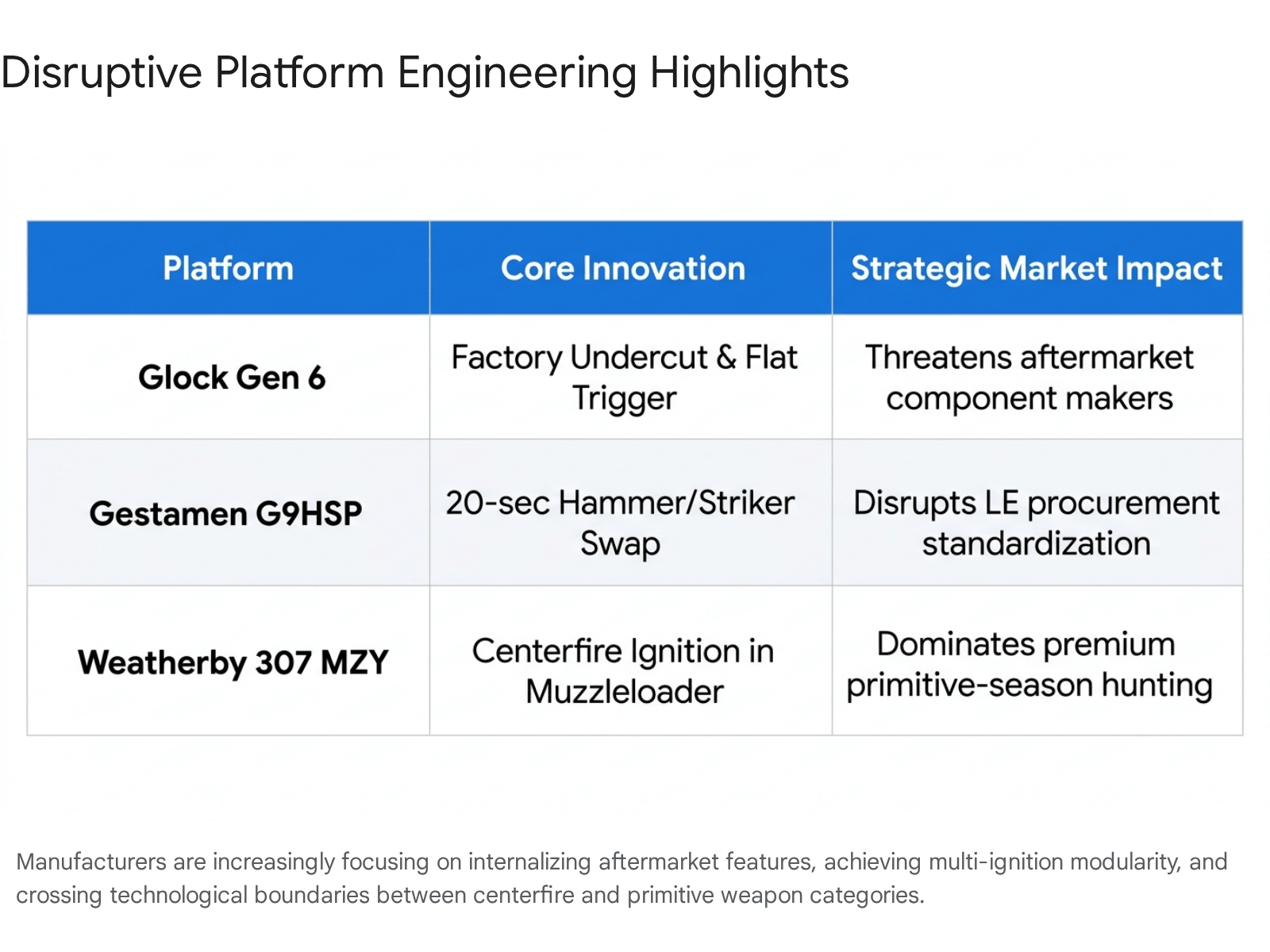
In the sporting arms sector, Weatherby disrupted the muzzleloader market by introducing the Model 307 MZY, the company’s first production muzzleloader.8 Built on a modified bolt-action receiver, the MZY utilizes the Arrowhead Rifles Gen2 ignition system.8 This system replaces traditional 209 shotgun primers with a modular brass casing holding a Large Rifle Magnum centerfire primer. This creates a complete seal, eliminating gas blowback and yielding exceptionally low standard deviations in muzzle velocity, effectively offering centerfire precision out of a front-loading platform.8

Capitalizing on the upcoming national semiquincentennial, manufacturers leaned heavily into the premium collector market. Henry Repeating Arms began shipping its America’s 250th Anniversary Tribute Edition Collection, featuring lever-action rifles finished with full-color Cerakote flags, nickel plating, and Fancy-grade American walnut.8 Similarly, Magnum Research announced a limited “250 Years of Liberty” edition of the Desert Eagle, featuring historic engravings and a nickel-bronze finish.19

Additionally, Murdoch & Co. generated significant interest by beginning shipments of the EM-85, a $12,000 American-made clone of the British SA80/L85A3 bullpup rifle.16 The platform incorporates structural refinements to address the historical reliability issues of the original design, demonstrating the viability of high-end boutique manufacturing to fulfill niche historical demands.16

4. June 23: Virginia Market Volatility and International Shifts

Mid-week developments revealed deep fractures in state-level enforcement capabilities, alongside notable corporate consolidation in the European market.

4.1 Municipal Non-Enforcement and Demand Volatility in Virginia

Following the Virginia Attorney General’s FIAA announcement, operational friction emerged regarding the state’s separate, incoming assault weapons ban (SB 749/HB 217).15 A coalition of local prosecutors indicated they will refuse to enforce these new hardware restrictions when they take effect on July 1.15

Commonwealth’s Attorneys in counties like Powhatan and Smyth publicly labeled the bans on assault-style weapons and large-capacity magazines as “facially unconstitutional,” stating their offices will not support criminal charges resulting solely from technical violations of the ban.15 Concurrently, the NRA’s Institute for Legislative Action filed lawsuits challenging the measures in state and federal courts.15

This regulatory uncertainty triggered a massive wave of accelerated purchasing as consumers anticipated severe supply constraints. Virginia State Police reported 72,956 background checks for firearms sales in May 2026, a 105% year-over-year increase compared to May 2025.17

4.2 International Consolidation: Verney Carron SA

In the European sector, the French heritage arms manufacturer Verney Carron SA underwent significant restructuring. Following bankruptcy proceedings in early 2025, a commercial court approved the takeover of the company by the French distribution group Rivolier and the Czech investment group RSBC.18 The acquisition stabilizes Verney Carron, ensuring the continuation of its specialized manufacturing and defense contracts, and highlights a broader trend of independent manufacturers being absorbed into diversified portfolios to survive high European regulatory barriers.18

4.3 International Legal Pressures

Liability pressures also mounted internationally. The ongoing sovereign lawsuit filed by the Government of Mexico against major U.S. gun manufacturers secured a favorable advisory opinion from the Inter-American Court of Human Rights.19 The Court concluded that the illicit trafficking of small arms is intrinsically linked to transnational organized crime and human rights violations.19 While this court lacks direct enforcement authority over U.S. entities, the opinion provides foreign plaintiffs with a formalized legal framework to legitimize their claims and exert reputational pressure on the U.S. industrial base.

5. June 24: Corporate Migrations and Federal Oversight

June 24 brought confirmations regarding corporate geography and escalating Congressional oversight of the executive branch.

5.1 Corporate Migration: Ruger Relocates to North Carolina

Industry analysts confirmed that Sturm, Ruger & Co. quietly relocated its corporate headquarters from Southport, Connecticut, to Mayodan, North Carolina.6 The relocation was widely reported this week after industry watchers noted dateline changes on corporate press releases.7

Founded in Connecticut in 1949, Ruger ceased physical manufacturing at the Southport facility in 1999.6 By relocating to Mayodan, Ruger consolidates its executive leadership alongside its major manufacturing hub. The timing correlates strongly with regulatory pressures, occurring shortly after Connecticut’s Attorney General issued public warnings to Ruger regarding alleged safety concerns, implying potential legal action.7 This strategic retreat reinforces the American South as the primary center of gravity for U.S. small arms engineering.

Diagram illustrating the Supreme Court’s common-law

5.2 Congressional Oversight: Executive Branch and Civil Litigation

The House Committee on Oversight and Government Reform escalated its investigation into alleged coordination between the Biden Administration’s White House Office of Gun Violence Prevention (WHOGVP) and the advocacy group Everytown for Gun Safety.20

Chairman James Comer issued requests and subpoenas to the ATF and the WHOGVP regarding a specific timeline: On December 20, 2023, the WHOGVP held a private meeting with Glock, pressuring the manufacturer to alter its pistol designs. Three months later, the City of Chicago filed a lawsuit against Glock, utilizing Everytown Law as the plaintiff’s counsel.20 The committee highlighted a personnel pipeline between the executive branch and Everytown, suggesting political actors are utilizing executive influence to catalyze municipal tort litigation to force product redesigns.20

5.3 Digital Integration: Longshot Cameras App Update

In the accessories sector, Longshot Cameras announced a major software update to its Longshot App, which is critical for shooters relying on target cameras to verify impacts at extended distances.8 The update includes an upgraded “Blinker Shot Locator,” a data-logging tool allowing shooters to isolate shot strings, analyze point-of-impact shifts, and manipulate highly precise point-of-aim measurements computationally.8 This highlights the industry’s continued integration of digital diagnostics into physical shooting disciplines.

Line graph showing the decline of trade in the

6. June 25: Supreme Court Restores Private Property Carry Defaults

The late-week news cycle was dominated by a landmark Supreme Court decision that reconfigured the legal parameters of concealed carry.

6.1 Supreme Court Jurisprudence: Wolford v. Lopez

On June 25, the Supreme Court issued a 6-3 decision in Wolford v. Lopez, striking down a core provision of Hawaii’s Act 52.2 The law prohibited individuals with valid concealed carry permits from bringing firearms onto private property open to the public (like retail stores and restaurants) unless the property owner had explicitly granted prior authorization.1

The decision, authored by Justice Samuel Alito, dismantled the state’s attempt to invert traditional property access rights. Applying the Bruen historical framework, the Court analyzed common-law default rules, concluding that an individual is presumed to have an implicit invitation to enter a public-facing business unless the property owner actively prohibits entry via signage.1 Hawaii’s requirement for explicit “opt-in” authorization was found inconsistent with historical traditions of firearm regulation.1

The immediate effect is the restoration of default carry rights across Hawaii and the nullification of similar “vampire laws” in states like California, New York, and New Jersey.1 For commercial retailers, the burden of policy enforcement shifts back to the enterprise; property owners who wish to restrict firearms must now actively procure and enforce exclusionary signage.1

Table displaying three types of information relevant to the small

New Product Releases Summary Table

ManufacturerModel / SeriesPlatform TypeKey Feature / Innovation
One HorseExpress RifleSemi-Auto RifleFactory integration of Atrius Forced Reset Selector (FRS).
WeatherbyModel 307 MZYMuzzleloaderArrowhead Gen2 centerfire ignition system on a bolt-action receiver.
RemingtonPerformance WheelgunRimfire Ammo39-grain low-velocity load engineered for vintage revolvers.
Murdoch & Co.EM-85 (L85A3 clone)Bullpup RifleAmerican-made SA80 architecture with modernized internals.
HenryAmerica’s 250thLever-Action RifleCollector-grade Cerakote flag finish, nickel plating, Fancy-grade walnut.
Magnum Research250 Years of LibertySemi-Auto PistolLimited-edition Desert Eagle with historic engravings and nickel-bronze finish.
LongshotLongshot AppSoftwareOverhauled UI and “Blinker Shot Locator” for shot tracking.

7. June 26-27: PLCAA Vulnerabilities and Federal Contracting

The conclusion of the reporting period saw a cascade of developments threatening the industry’s civil liability shields, alongside significant defense contracting updates.

7.1 Escalating Civil Liability and PLCAA Challenges

On June 26, the U.S. Supreme Court declined to hear an appeal by the National Shooting Sports Foundation (NSSF) challenging New York’s public nuisance statute. This law requires the industry to implement safeguards against gun trafficking and allows civil lawsuits by state officials and the public. By turning away the challenge, the Court allows New York’s law to stand, reinforcing the viability of state-level statutes designed to trigger the PLCAA’s predicate exception.

Simultaneously, attorneys for Kel-Tec Industries and Rural King agreed to settle a wrongful death lawsuit out of court in Pennsylvania. The lawsuit involved a victim murdered with a firearm acquired via an in-store straw purchase. The defendants had previously requested dismissal under the PLCAA. Agreeing to a settlement rather than forcing a dismissal sets a concerning precedent for manufacturers facing similar point-of-sale negligence tort claims.

Internationally, the Supreme Court of Canada announced it will not review an Ontario appellate court’s decision allowing a class-action negligence lawsuit against Smith & Wesson to proceed, stemming from allegations that the manufacturer failed to implement technology to prevent unauthorized use.

Adding to the legal chaos, a judge in Lancaster County, Virginia, issued an injunction late on June 25 that put the state’s impending assault weapons ban on hold statewide, pending a final ruling. The Attorney General immediately announced plans to appeal, leaving retailers navigating a highly volatile, ping-ponging compliance landscape.

7.2 ATF Leadership Scrutiny and Surveillance Rollbacks

Media reporting over the weekend heavily scrutinized recent actions by the ATF under its newly confirmed Director, Robert Cekada.4 Following a press conference held earlier in the quarter alongside executives from the NSSF and NRA, the agency’s policy shifts are taking effect, implementing 32 new regulatory rules designed to ease operational burdens on the industry.4 The core of this package was the repeal of a rule targeting the “gun show loophole.”5 Director Cekada has also publicly defended the industry against state-level regulations, signaling a distinct ideological shift at the highest echelons of the agency toward commercial facilitation.4

In a related operational adjustment on June 26, the ATF abruptly canceled a controversial surveillance contract for a program known as “Webloc.”24 This tool enabled the warrantless tracking of mobile devices utilizing bulk commercial location data. The cancellation followed intense bipartisan pressure from lawmakers who raised constitutional concerns regarding the tool’s legality in criminal investigations.24

7.3 Ancillary Defense Contracting

Defense procurement continued steadily through the end of the period. Notably, the Indian Army placed multiple orders for SSS Defence’s T-12 semi-automatic shotgun, marking the first time the Bengaluru-based company will supply a weapon system to the military. The T-12 is entering service specifically as a counter-drone platform, reflecting lessons drawn from recent conflicts requiring a last line of defense against small explosive-laden drones. Domestically, the Defense Logistics Agency awarded a $350,000 contract for small arms slings to support ongoing operational readiness.

Recent Defense Contracting Summary Table

ContractorAgencyValueScope of Work
Day & ZimmermannU.S. Army$2.30 BillionOperation, maintenance, and modernization of Hawthorne Army Depot; demilitarization of ammunition.
SSS DefenceIndian ArmyUndisclosedSupply of T-12 semi-automatic shotguns for counter-UAS applications.
UndisclosedDLA$350,000Procurement of small arms slings for the Department of Defense.

8. Strategic Outlook

The small arms industry is operating in a deeply polarized crosscurrent. Federal judicial rulings are systematically dismantling localized carry restrictions and historical consumer prohibitions, signaling a measurable expansion in the legal consumer market. Conversely, the legislative environment at the state level is increasingly hostile. Jurisdictions like Virginia and New York are successfully pioneering tort strategies via the PLCAA predicate exception, transferring the regulatory battlefield directly to the civil courtroom. This dynamic will force manufacturers to increase compliance and insurance expenditures and will inevitably accelerate the geographic relocation of corporate operations to favorable regulatory environments.

Technologically, the industry continues to balance heritage platforms with modern digital integrations. The continued release of specialized niche platforms—from high-end bullpup clones to commemorative revolvers—demonstrates sustained consumer demand across both traditional and high-tech segments. Entities capable of insulating their operations in favorable jurisdictions while rapidly adapting to localized compliance mandates are optimally positioned to capture expanding market share in the upcoming cycles.


Please share the link on Facebook, Forums, with colleagues, etc. Your support is much appreciated and if you have any feedback, please email us in**@*********ps.com. If you’d like to request a report or order a reprint, please click here for the corresponding page to open in new tab.


Sources Used

  1. A Stake to the Heart: U.S. Supreme Court Strikes Down Hawaii …, accessed June 27, 2026, https://www.asisonline.org/security-management-magazine/latest-news/today-in-security/2026/june/SCOTUS-Strikes-Down-Hawaii-Law/
  2. Supreme Court Decides Wolford v. Lopez, Attorney General of Hawaii | Publications | Insights, accessed June 27, 2026, https://www.faegredrinker.com/en/insights/publications/2026/6/supreme-court-decides-wolford-v-lopez-attorney-general-of-hawaii
  3. U.S. Supreme Court Unanimously Narrows Scope of Unlawful Drug User Prohibition, accessed June 27, 2026, https://www.nraila.org/articles/20260622/us-supreme-court-unanimously-narrows-scope-of-unlawful-drug-user-prohibition
  4. The New ATF Director Is Going Out of His Way to Appeal to Gun Groups, accessed June 27, 2026, https://smokinggun.org/the-new-atf-director-is-going-out-of-his-way-to-appeal-to-gun-groups/
  5. The Trump Administration Made a Big Show of Repealing a Biden-Era Gun Rule. It Never Amounted to Much Anyway., accessed June 27, 2026, https://www.thetrace.org/2026/06/atf-gun-show-loophole-rule-repeal/
  6. Ruger HQ Moves To South Carolina – The Firearm Blog, accessed June 27, 2026, https://www.thefirearmblog.com/blog/ruger-hq-moves-to-south-carolina-44829163
  7. Ruger Quietly Moves Headquarters Out of Connecticut – GunsAmerica, accessed June 27, 2026, https://gunsamerica.com/digest/ruger-headquarters-move-north-carolina/
  8. Shooting Industry Magazine ICYMI: Industry News From June 20 …, accessed June 27, 2026, https://shootingindustry.com/dealer-advantage/icymi-industry-news-from-june-20-june-26-2026/
  9. US Supreme Court expands Second Amendment rights, eyes more gun cases, accessed June 27, 2026, https://wtvbam.com/2026/06/26/us-supreme-court-expands-second-amendment-rights-eyes-more-gun-cases/
  10. 24-1234 United States v. Hemani (06/18/2026) – Supreme Court, accessed June 27, 2026, https://www.supremecourt.gov/opinions/25pdf/24-1234_g2bh.pdf
  11. One Horse to Launch One Horse Express Rifle in Collaboration With Atrius Development Group – The Outdoor Wire, accessed June 27, 2026, https://www.theoutdoorwire.com/releases/2026/06/one-horse-to-launch-one-horse-express-rifle-in-collaboration-with-atrius-development-group
  12. Day & Zimmermann Wins $2.3B Army Contract for Ammo Depot Modernization, accessed June 27, 2026, https://www.govconwire.com/articles/day-zimmermann-2-3b-hawthorne-army-depot-contract-award
  13. Contracts for June 9, 2026 – War.gov, accessed June 27, 2026, https://www.war.gov/News/Contracts/Contract/Article/4512718/contracts-for-june-9-2026/
  14. Heightened Scrutiny in Virginia and the Future of PLCAA Protections …, accessed June 27, 2026, https://www.williamsmullen.com/insights/news/legal-news/heightened-scrutiny-virginia-and-future-plcaa-protections
  15. Virginia’s New Gun Laws Challenged by Some Local Prosecutors …, accessed June 27, 2026, https://www.insurancejournal.com/news/east/2026/06/23/874887.htm
  16. [SHOT 2026] Murdoch & Co. Launch American-Made SA80s! | thefirearmblog.com, accessed June 27, 2026, https://www.thefirearmblog.com/blog/shot-2026-murdoch-co-launch-american-made-sa80s-44825827
  17. Gun Sales Are Booming In Virginia Ahead Of “Assault Firearm” Ban | thefirearmblog.com, accessed June 27, 2026, https://www.thefirearmblog.com/blog/gun-sales-are-booming-in-virginia-ahead-of-assault-firearm-ban-44828887
  18. Sandy Hook Engagement Report June 2026 – City of Philadelphia, accessed June 27, 2026, https://www.phila.gov/media/20260617132406/PGW-sandy-hook-engagement-report-2026-06.pdf
  19. Firearms Trafficking Comes to the Inter-American Court of Human Rights in Recent Advisory Opinion – Just Security, accessed June 27, 2026, https://www.justsecurity.org/133687/firearms-trafficking-iachr-advisory-opinion/
  20. Comer Seeks Additional Information on Biden-Era ATF Collusion with Anti-Second Amendment Group on Activist Litigation, accessed June 27, 2026, https://oversight.house.gov/release/comer-seeks-additional-information-on-biden-era-atf-collusion-with-anti-second-amendment-group-on-activist-litigation/
  21. Supreme Court strikes down Hawaii law regulating firearms possession, accessed June 27, 2026, https://constitutioncenter.org/blog/supreme-court-strikes-down-hawaii-law-regulating-firearms-possession
  22. 6–3 Second Amendment SCOTUS Decision in Wolford v. Lopez, Explained, accessed June 27, 2026, https://www.everytown.org/wolford-v-lopez-second-amendment-scotus-decision-explained/
  23. After Supreme Court Blow To Gun Restrictions, What’s Next For …, accessed June 27, 2026, https://civilbeat.org/2026/06/after-supreme-court-blow-to-gun-restrictions-whats-next-for-hawaii/
  24. ATF cancels phone tracking contract after lawmakers raise concerns, accessed June 27, 2026, https://www.wsls.com/tech/2026/06/26/atf-cancels-phone-tracking-contract-after-lawmakers-raise-concerns/

Understanding the 2026 Receivership of Aero Precision, Ballistic Advantage, Stag Arms and VG6 Precision

1. Executive Summary

The United States small arms industry is currently undergoing a severe and accelerated period of structural realignment, characterized by market saturation, depressed retail demand, and stringent regulatory pressures. This volatile environment has systematically exposed the fundamental vulnerabilities of highly leveraged, middle-market firearm manufacturers. A defining indicator of this industry-wide stress is the court-appointed general receivership of four prominent firearm brands: Aero Precision, Ballistic Advantage, Stag Arms, and VG6 Precision. These entities, all portfolio companies operating under the private equity umbrella of White Wolf Capital Group, entered a formal receivership process in Pierce County, Washington, on May 5, 2026.1

The transition of these sister companies into a state of receivership highlights a critical juncture for the broader commercial firearms market. Originally built through a series of strategic acquisitions and recapitalizations designed to create a vertically integrated manufacturing powerhouse, the White Wolf Capital portfolio ultimately succumbed to a combination of heavy debt burdens, state-level legislative hostility, and a dramatic post-pandemic contraction in consumer demand.3

This report provides a detailed examination of the current operational and legal status of Aero Precision, Ballistic Advantage, Stag Arms, and VG6. Furthermore, it traces the historical formation of this manufacturing bloc, analyzes the primary catalysts that precipitated its financial distress, and contextualizes these events within the broader macroeconomic trends shaping the US small arms industry in 2025 and 2026. The financial struggles of these brands serve as a microcosm for the wider sector, illuminating the compounding effects of distributor bankruptcies, geographic capital flight, and the relentless margin squeeze on middle-market operators competing against established, high-volume industry titans.

2. Operational and Legal Status of the Portfolio Brands

As of mid-2026, the core brands of the White Wolf Capital firearms portfolio—Aero Precision, Ballistic Advantage, Stag Arms, and VG6—are operating under the control of a court-appointed general receiver, J.S. Held LLC.1 This legal maneuver indicates profound financial distress but is structurally distinct from a federal bankruptcy filing, such as a Chapter 7 liquidation or a Chapter 11 reorganization.7

The Mechanics of the Washington State Receivership

The receivership was formalized on May 5, 2026, in the Superior Court of the State of Washington in and for the County of Pierce, adjudicated under Case No. 26-2-08316-4.1 The official filing explicitly names Aero Precision, LLC (a Delaware limited liability company based in Lakewood, Washington) and Ballistic Advantage, LLC (a Delaware limited liability company based in Ocoee, Florida) as the primary debtor entities under the receiver’s jurisdiction.1

Under a state receivership framework, an independent third party—in this instance, J.S. Held LLC—assumes direct control of the distressed companies’ assets. The receiver’s mandate is to oversee daily operations, protect the remaining asset value from further depreciation, and facilitate a structured resolution to satisfy outstanding creditors.1 For suppliers, vendors, and other unsecured creditors, the legal framework mandates strict compliance deadlines that dictate the recovery of owed capital. General creditors were required to file proofs of claim by July 6, 2026, which represented a 30-day window from the publication of the notice, while government entities were granted an extended deadline until October 2, 2026.1

The financial reality of this proceeding appears grim for unsecured parties. The official notice, filed and disseminated by the receiver’s legal counsel, K&L Gates LLP, explicitly cautioned that it remains presently uncertain whether any assets will be available for disbursement to general unsecured creditors once secured debts and administrative expenses are fully settled.1 This suggests that the private equity sponsors and traditional lenders are likely absorbing significant capital write-downs.3

Legal time of the Pierce County receivership document

Current Operational Posture

Despite the severe financial constraints that necessitated the receivership, the brands have not entirely ceased operations. In a joint public statement issued in early June 2026, the companies confirmed that they continue to process orders, fulfill warranty obligations, and maintain active customer service channels.3The core manufacturing and administrative teams remain in place while the receiver orchestrates a transition to new ownership.3

However, the reality of the receivership has severely impacted operational efficiency. The companies have publicly acknowledged that product manufacturing and fulfillment—specifically for the highly sought-after Aero Precision and Stag Arms product lines—are moving at a significantly reduced pace. The entities are actively working through severe capital constraints and attempting to rebuild depleted raw material inventories.7 Retailers and consumers have reported widespread stock shortages, extreme shipping delays, and communication bottlenecks throughout the first half of 2026.10 This limited operational state indicates a holding pattern. The receiver is likely maintaining minimal viability to preserve the intrinsic value of the brand names and physical assets to attract potential buyers, rather than attempting a robust return to standard production capacities.8

3. Corporate Architecture: The White Wolf Capital Roll-Up Strategy

To accurately assess the magnitude of the current corporate collapse, it is essential to trace the historical formation of this manufacturing bloc. The assembly of Aero Precision, Ballistic Advantage, Stag Arms, and VG6 was the direct result of a deliberate “roll-up” investment strategy executed by White Wolf Capital Group, a Miami-headquartered private investment firm specializing in middle-market buyouts and recapitalizations.13 White Wolf traditionally targets North American companies generating between $10 million and $150 million in revenues.15 Their goal in the defense and sporting arms sector was to build a vertically integrated firearm manufacturing platform capable of internalizing the entire supply chain, from raw material processing to precision aerospace-grade machining, barrel production, and final consumer retail.13

Aero Precision: The Foundational Platform

The cornerstone of the White Wolf portfolio was Aero Precision. Founded in 1994 and headquartered in Tacoma, Washington, the company originally operated as a highly specialized precision machine shop serving the commercial and military aerospace sectors.17 In its early years, Aero Precision functioned as a worldwide supplier of Original Equipment Manufacturer (OEM) systems and aftermarket aircraft spares, specifically supporting platforms such as the F-16 and C-130.17 Operating under rigorous ISO 9001:2008 and AS9120 quality certifications, and managing complex ITAR and FCPA regulations, the firm developed an elite capability in advanced CNC machining and surface anodizing.17

Recognizing shifting market dynamics, Aero Precision leveraged its aerospace manufacturing discipline to transition into the firearms sector.5 The company began producing high-quality, high-volume AR-15 and AR-10 receiver sets, applying aerospace tolerances to consumer firearms. In November 2013, White Wolf Capital executed a major recapitalization of Aero Precision, providing the firm with a significant influx of capital designed to rapidly expand its manufacturing platform and product offerings.15 This transaction, advised by Vercor Advisors, marked White Wolf’s initial entry into the defense sector, establishing Aero Precision not just as a standalone manufacturer, but as the primary holding vehicle for future strategic acquisitions.15

The debt load of this platform was critically increased in November 2018, when White Wolf Capital executed a $30 million senior debt refinancing transaction. A major portion of these funds was distributed directly to investors as a dividend recapitalization, stripping cash out of the company while saddling the operating entity with significantly higher long-term debt obligations.

Vertical Integration: Ballistic Advantage and VG6

To reduce reliance on external suppliers, optimize production timelines, and capture higher profit margins across the value chain, White Wolf Capital utilized the Aero Precision platform to acquire specialized component manufacturers. In December 2014, Aero Precision acquired a majority stake in Ballistic Advantage, an Apopka, Florida-based manufacturer renowned throughout the industry for producing high-end, precision rifle barrels.16 This acquisition was highly synergistic; it allowed Aero Precision to pair its premium machined receivers with in-house manufactured barrels, effectively transitioning the company from a mere parts supplier to a primary provider of complete upper receiver groups and full rifles.10

This vertical integration strategy was further cemented in 2015 when Aero Precision acquired VG6 Precision, a boutique designer and manufacturer of advanced muzzle brakes and compensators.22 By integrating VG6 into the corporate structure, the Aero platform secured another critical component of the modern sporting rifle ecosystem, allowing for greater quality control and bundled consumer sales packages.

The Stag Arms Acquisition and Historical Precedents

The most prominent brand acquisition within the portfolio occurred with Stag Arms. Founded in Connecticut in 2003 by Mark Malkowski, Stag Arms gained early and rapid market prominence by pioneering left-handed AR-15 variants and building a steadfast reputation for reliable, American-made modern sporting rifles.13 For over a decade, Stag Arms operated as a major industry player, becoming the second-largest rifle maker in Connecticut, trailing only Colt, and producing more rifles annually than Mossberg’s Connecticut facility.23

However, the company faced a severe existential and legal crisis in 2015. Following a routine inspection by the Bureau of Alcohol, Tobacco, Firearms and Explosives (ATF), federal agents discovered approximately 3,000 rifle receivers and 22 machine gun receivers that lacked legally required serial numbers, representing a massive compliance failure.24

The resulting federal prosecution decimated the company’s leadership structure. To resolve the charges, Malkowski was forced to plead guilty to criminal misconduct, pay a personal fine of $100,000, agree to a lifetime ban from holding an ownership or management position in the firearms industry, and surrender the company’s Federal Firearms License (FFL).24 The company itself was levied a $500,000 fine and forced to drop ownership claims to the seized inventory.26 Stripped of its regulatory ability to operate, Stag Arms was effectively forced into a highly distressed sale.

Recognizing the enduring value of the brand name, White Wolf Capital finalized the acquisition of Stag Arms in early 2016, integrating the iconic but tarnished brand into its growing portfolio alongside Aero Precision.13 To revitalize the brand, sever ties with the negative regulatory history, and escape the increasingly hostile legislative environment of Connecticut, White Wolf Capital orchestrated a total corporate relocation. Following a nationwide search prioritizing a pro-growth economic climate, strong operational criteria, and unwavering Second Amendment protections, Stag Arms moved its entire manufacturing operation to Cheyenne, Wyoming, in late 2019.28 Operating from a new facility and undergoing a complete brand refresh under the leadership of a new president, Chad Larsen, the company attempted to rebuild its market share.29

For several years, this conglomerate functioned as a formidable and cohesive middle-market entity. Aero Precision manufactured the receivers, Ballistic Advantage supplied the barrels, VG6 provided the muzzle devices, and Stag Arms operated as a premier consumer-facing rifle brand. However, the aggressive utilization of private equity leverage to fund this architecture created deep structural vulnerabilities. These vulnerabilities were ultimately exposed by shifting macroeconomic conditions and industry-specific market contractions.3

4. The Middle-Market Squeeze: Macroeconomic Catalysts for Failure

The rapid deterioration of the Aero Precision and White Wolf portfolio was not caused by a single isolated event, but rather a perfect storm of macroeconomic shifts, collapsing supply chains, and the inherent risks of highly leveraged private equity structures operating in a cyclical industry.

The US firearms industry operates on a pronounced boom-and-bust cycle, historically driven by political rhetoric, regulatory fears, and societal instability. The years 2020 through 2022 saw unprecedented, record-breaking consumer demand. Driven by pandemic lockdowns, widespread social unrest, and impending political shifts, the industry saw millions of first-time buyers enter the market.31 To meet this insatiable demand, manufacturers aggressively expanded capacity, increased headcounts, and optimized supply chains for maximum output, often financing these expansions through debt.

However, by 2025 and moving into early 2026, the market experienced a violent and sustained correction. Industry analysts observed the return of the “Trump Slump”—a colloquial industry term for the precipitous drop in consumer demand that typically occurs when fears of federal gun control legislation subside following conservative electoral victories.31 Retail-level data for 2025 indicated widespread softness and demand destruction across nearly every major category.33 The third quarter of 2025 recorded the steepest quarterly sales drop in over a year, with overall domestic sales down more than 35 percent from their 2020 peak.31 Ammunition sales, traditionally a reliable recurring revenue stream, also saw double-digit declines nearly across the board.34

This macroeconomic shift left manufacturers with massive, rapidly depreciating inventory gluts. Distributors and local gun stores found themselves holding months’ worth of stagnant inventory, leading to slashed prices, extreme discounting, and frozen wholesale purchasing.4 For companies like Aero Precision and Stag Arms, whose primary revenue streams rely on the continuous movement of AR-15 receivers and builder components, this complete halt in retail velocity immediately restricted critical cash flow. Without continuous revenue generation, servicing the debt obligations incurred during their aggressive expansion and acquisition phases became mathematically impossible.3

The financial architecture of private equity-backed firms relies fundamentally on sustained revenue growth to service acquisition debt.3 The White Wolf Capital portfolio occupied a particularly precarious position within the industry: the “middle market.” During severe market contractions, consumer purchasing behavior tends to polarize. Buyers either gravitate toward ultra-budget, high-volume options—where massive economies of scale allow titans to dominate on price—or they seek out ultra-premium, low-volume boutique custom builds.35 Middle-market manufacturers like Aero Precision and Stag Arms, which offer high quality but lack the massive volume discounts of budget brands and the exclusivity of custom shops, historically suffer the most severe margin compression.35 When retail velocity slowed in 2025, the portfolio companies lacked the agility to drastically cut prices without triggering unmanageable financial losses, leaving private equity investors with written-off investments and defaulting debt covenants.3

5. Supply Chain Contagion: The Big Rock Sports Liquidation

The financial distress of individual manufacturers was severely compounded by massive instability within the supply chain’s distribution layer. The modern sporting arms industry relies heavily on a network of massive distributors to bridge the logistical gap between manufacturing output and tens of thousands of localized retail gun stores.

On January 16, 2026, the industry suffered a catastrophic logistical blow when Big Rock Sports, LLC, one of the premier firearms and outdoor sporting goods distributors, filed for Chapter 7 bankruptcy liquidation in the U.S. Bankruptcy Court for the Eastern District of North Carolina. Operating out of Graham, North Carolina, Big Rock Sports was a linchpin in the global supply chain, claiming to serve more than 20,000 retailers across the fishing, shooting, camping, and marine industries, with operations spanning the U.S., Canada, the Caribbean, and eight other countries.39 The distributor operated approximately 850,000 square feet of distribution space at warehouses in North Carolina, Minnesota, and Nevada, managing a product inventory of over 180,000 SKUs.40

The bankruptcy filing revealed the staggering depth of the distributor’s failure. Big Rock Sports listed over $100.9 million in liabilities against estimated assets of between only $10 million and $50 million.39 The filing indicated that the company was overwhelmed by a surge of lawsuits from property owners, suppliers, and business partners.39 Major vendors, including Pure Fishing, Rather Outdoors, and Okuma Fishing Tackle Corporation, were listed among those holding the largest unsecured claims tied to ongoing litigation.41 Most devastatingly for the industry, court papers stated that after administrative expenses were paid, roughly $83.2 million in unsecured claims were expected to go entirely unpaid, leaving no funds available for distribution to unsecured creditors.42

The Chapter 7 liquidation of a distributor of this magnitude generates immediate and catastrophic ripple effects throughout the manufacturing sector. Manufacturers who relied on Big Rock Sports not only lost a primary, high-volume conduit to the retail market but were also left holding millions in uncollectible accounts receivable for inventory already delivered. The sudden evaporation of capital at the distributor level chokes the cash flow required by leveraged manufacturers to maintain factory operations, purchase raw materials, and pay payroll.41 This dynamic directly accelerates the financial timelines that push heavily indebted companies like Aero Precision into receivership, as their projected incoming capital simply vanishes into the distributor’s liquidation proceedings.

6. Regulatory Friction and the Financial Drain of Lawfare

Beyond standard market dynamics and supply chain disruptions, the White Wolf portfolio bore the heavy, continuous financial burden of operating in geographically hostile regulatory environments. State-level legislative actions have increasingly targeted the core modular platforms manufactured by these entities, creating a highly fractured domestic market and imposing exorbitant legal compliance and litigation costs.

Aero Precision’s headquarters in Tacoma, Washington, became ground zero for this regulatory conflict following the passage of Washington House Bill 1240 (HB 1240) in April 2023.5 Signed into law by Governor Jay Inslee, HB 1240 strictly banned the sale, manufacture, and distribution of what the state classified as “assault weapons”.5 As the largest firearms manufacturer in Washington—employing roughly 650 personnel within the state and producing the exact AR-15 components targeted by the legislation—Aero Precision was forced into an immediate defensive posture.5

Aero Precision, alongside the National Shooting Sports Foundation (NSSF), Amanda Banta (a 2012 Olympian Sport Shooter), and several local ranges, filed a federal lawsuit (Banta v. Ferguson) in the U.S. District Court for the Eastern District of Washington.5 The plaintiffs sought temporary and permanent injunctions against the enforcement of HB 1240 on constitutional grounds, naming Attorney General Robert W. Ferguson and State Patrol Chief John R. Batiste as defendants.5

The financial toll of such litigation is immense. Engaging top-tier corporate legal counsel to wage multi-year constitutional battles against state governments drains massive amounts of capital. Furthermore, while the Dormant Commerce Clause generally protects a company’s constitutional right to manufacture goods for export to other states where the goods remain legal, the legislation entirely eliminated Aero Precision’s local retail market.44 It also imposed severe logistical and compliance complexities on its daily operations, requiring specialized tracking and legal verification for all outgoing shipments.

This severe regulatory friction is reminiscent of the pressures that drove Stag Arms out of Connecticut in 2019. The continuous threat of shifting local laws forces manufacturing companies into a devastating binary choice: either fund multi-year federal lawsuits to protect their right to operate in their home state, or execute highly disruptive, multi-million-dollar interstate relocations to more friendly jurisdictions. In either scenario, millions of dollars are diverted away from product innovation, marketing, and vital debt service, rapidly accelerating corporate insolvency during market downturns.5

7. Industry-Wide Consolidation and Corporate Restructuring (2025-2026)

The receivership of the Aero Precision and Stag Arms portfolio is not an isolated phenomenon; rather, it is highly symptomatic of a broader, systemic restructuring occurring across the US small arms industry in 2025 and 2026. The same macroeconomic and regulatory pressures are forcing widespread consolidation, geographic realignment, and a mass extinction of undercapitalized entities.45

The current environment is ruthlessly stripping away inefficient operators, leading to a wave of bankruptcies and strategic acquisitions by larger conglomerates with fortress balance sheets. The 2025-2026 period has witnessed several defining corporate transitions that highlight this industry consolidation 6:

  • Ruger’s Acquisition of Anderson Manufacturing: In July 2025, Sturm, Ruger & Co.—which historically ranks No. 1 in the total number of firearms manufactured annually in the United States—acquired all physical assets and intellectual property of Anderson Manufacturing.6 Anderson, which had reached the No. 7 position nationwide in 2023 with a production volume of 337,658 firearms, was fully absorbed. Ruger discontinued the Anderson brand name entirely, utilizing the acquisition solely to acquire Anderson’s Hebron, Kentucky facility, its 32,000-square-foot barrel-making infrastructure, and its advanced CNC robotic cells to expand Ruger’s internal production capacity.6 This move exemplifies how mega-cap companies are utilizing the market slump to acquire distressed middle-market infrastructure at a steep discount, eliminating competition in the process.
  • Ammunition Sector Consolidation: Early in 2025, Olin Corporation, the parent company of Winchester Ammunition, purchased the primary small-caliber ammunition manufacturing assets from Ammo Inc. for $75 million.6 This sale included a state-of-the-art 185,000-square-foot production facility in Manitowoc, Wisconsin. Olin projects this acquisition will yield $40 million in realized financial synergies and immediately lower high-volume production costs.6 Similarly, The Kinetic Group (owned by the Czechoslovak Group) absorbed Fiocchi of America, further concentrating ammunition manufacturing power into a handful of massive conglomerates.6
  • Outright Closures and Bankruptcies: Alongside the Big Rock Sports distribution collapse, several legacy manufacturers simply ceased operations. Del-Ton, a North Carolina-based AR-15 manufacturer operating since 1998 near Fort Bragg, shuttered its doors completely in April 2025.6 Similarly, SCCY Firearms, which as recently as 2022 ranked in the top 10 domestic pistol manufacturers by volume, collapsed under the weight of financial mismanagement and legal liabilities. After facing a “Pending Levy and Seizure” from the Volusia County Tax Office for $249,932.38 in unpaid tangible personal property taxes on its Daytona Beach factory, SCCY closed its doors in May 2025 and filed for Chapter 11 bankruptcy in August.6 The company’s assets, including high-value CNC machines and Robodrills, were subsequently auctioned off.6

8. Geographic Realignment as a Strategic Imperative

The increasing divergence in state-level firearms legislation has transformed geographic location from a mere logistical consideration into a critical element of corporate survival strategy. Manufacturers are increasingly treating capital flight as a necessary defensive tactic, abandoning traditional industrial hubs in the Northeast and Pacific Northwest for states offering robust Second Amendment protections and favorable corporate tax structures.

The relocation of Stag Arms from New Britain, Connecticut, to Cheyenne, Wyoming, in 2019 was an early indicator of this trend.28 By 2026, this migration has accelerated into a mass exodus. For example, Rideout Arsenal, an emerging manufacturer of high-end competition pistols, announced a $22 million relocation from Virginia to Thomasville, Georgia, in June 2026.47 The founders explicitly cited recent anti-gun legislation in Virginia as creating untenable business uncertainty, noting that the relocation was forced upon them to ensure they could continue operating and investing with confidence.47 The new facility in Thomasville’s Plantation Oak Industrial Park is projected to create 120 new jobs over the coming years.47

As companies like Aero Precision remain mired in protracted legal battles in Washington, the industry consensus heavily favors physical relocation to states like Georgia, Texas, Wyoming, and Tennessee to ensure long-term operational continuity, mitigate legal risk, and shield future revenue streams from arbitrary state-level interference.6

9. Shifting Consumer Paradigms and Regulatory Tailwinds

While the traditional rifle and handgun markets remain deeply depressed, the industry is simultaneously witnessing explosive, highly concentrated growth in specific niche sectors. This divergence is driven largely by unexpected shifts in federal regulatory enforcement and shifting military procurement standards that dictate civilian trends.

The most profound example of this pivot is the suppressor market. Effective January 1, 2026, federal legislation successfully eliminated the $200 National Firearms Act (NFA) tax stamp requirement for purchasing suppressors, short-barreled rifles (SBRs), and similar heavily regulated items, reducing the transfer cost effectively to $0.32 This sudden deregulation completely removed the primary financial and psychological barrier to entry for millions of consumers. Retailers reported that while standard firearm sales cratered, the NFA deregulation resulted in a massive, immediate uptick in suppressor demand.32

In this environment, consumers effectively reallocated their limited discretionary spending away from primary weapon platforms—such as the AR-15 builder components and complete rifles sold by Aero Precision and Stag Arms—and toward enhancing their existing platforms with newly accessible suppressors and advanced optics.34 The pullback in traditional sales was exacerbated as buyers specifically hoarded capital in late 2025 in anticipation of the 2026 tax-stamp repeal.33 Manufacturers who failed to pivot their production lines rapidly toward these newly deregulated accessories found themselves trapped with unsellable legacy inventory, completely missing the only major growth vector in the 2026 market.4

Furthermore, military procurement decisions are shifting civilian demand parameters. The US Army’s adoption of the 6.8 × 51 mm cartridge for improved body-armor penetration has spurred allied evaluations and trickled down to the civilian market, pushing the 6.8mm caliber toward an anticipated 7.85% Compound Annual Growth Rate (CAGR) through 2031.50 This technological shift renders massive stockpiles of legacy 5.56mm platforms slightly less desirable to trend-focused consumers, further complicating inventory management for traditional AR-15 manufacturers.

10. Global Small Arms Market Context and Export Dynamics

Despite the severe domestic commercial volatility outlined above, it is vital to contextualize the struggles of middle-market entities within the broader, overarching global small arms market. While retail demand in the United States has slumped from its 2020 peaks, the global industry remains massive and fundamentally secure, supported by institutional defense spending and international export authorizations.

Market Metric2025 / 2026 DataProjected 2031 / 2034 DataImplied Growth Trend
Global Market Size$9.70B (2025) / $10.00B (2026)$13.10B (2034) / $13.41B (2031)CAGR ~3.40% to 4.53%
North American Share34.98% to 43.50% (2025)Continues as Largest MarketDominant regional buyer
Pistol / Handgun Share32.89% (2025)Sustained DemandLaw enforcement & civilian carry
US Direct Commercial Sales$226.8 Billion (FY 2025)N/A12.9% YoY Increase

Data aggregated from Fortune Business Insights, Mordor Intelligence, and US State Department Bureau of Political-Military Affairs.50

North America continues to dominate the global small arms market, capturing an estimated 43.50% share in 2025, driven by deeply entrenched civilian firearm ownership, substantial defense spending, and continuous procurement by law enforcement and homeland security agencies.51 The FBI had processed over 518 million cumulative NICS background checks by late 2025, underscoring the absolute depth of civilian holdings in the US.50

Furthermore, the United States remains the undisputed global leader in arms exports. According to the State Department, the total authorized value for privately contracted Direct Commercial Sales (DCS) authorizations for FY 2025 was $226.8 billion, representing a 12.9 percent increase from FY 2024.52 The USA accounts for 42 percent of total global arms exports, with a rapidly increasing share (38 percent) flowing into Europe, driven by NATO rearmament.53

However, this massive international and institutional cash flow rarely reaches the commercial middle market. Companies like Aero Precision and Stag Arms are largely structurally excluded from lucrative federal defense contracts and massive international military exports. They rely almost exclusively on the volatile domestic civilian retail market, leaving them entirely exposed to domestic slumps while the broader global military-industrial complex continues to expand.

11. Strategic Outlook and Receivership Resolution

The trajectory of the White Wolf Capital firearms portfolio remains highly contingent on the near-term actions of the court-appointed receiver, J.S. Held LLC. Because this is a general state receivership rather than a Chapter 11 reorganization, the private equity sponsors have almost certainly written off their initial equity investments entirely.3 The legal authority and financial outcomes now rest exclusively with the secured debt holders and the receiver, whose primary fiduciary mandate is to maximize recovery value for the creditors.7

Based on established historical precedent within the firearms industry—such as the liquidation of Sabre Defence or the recent auctioning of SCCY Firearms—two primary pathways exist for the resolution of the Aero Precision, Ballistic Advantage, Stag Arms, and VG6 brands.6

The first pathway is a piecemeal asset liquidation. In this scenario, the individual components of the portfolio are stripped and sold separately. The intellectual property, valuable aerospace-grade CNC machinery, raw materials, and the brand trademarks themselves would be auctioned off to the highest bidders to satisfy secured creditors.6

The second, and strategically more probable outcome, is the acquisition of the entities as a packaged suite by a larger, well-capitalized industry conglomerate.8 The physical manufacturing infrastructure located in Tacoma, Washington, and the established, specialized barrel-making capabilities of Ballistic Advantage in Ocoee, Florida, represent significant intrinsic value.1 Heavyweight conglomerates holding robust balance sheets—such as Sturm, Ruger & Co., which already demonstrated a strong appetite for acquiring distressed AR-15 manufacturing capacity with its buyout of Anderson Manufacturing—could acquire the entire Aero Precision ecosystem at a fraction of its former operational valuation.6

Regardless of the eventual purchaser, it is highly likely that any acquisition will be immediately followed by severe corporate cost-cutting measures, brand consolidations, and potential geographic relocations to insulate the newly acquired physical assets from the regulatory hostility currently present in Washington state.

12. Conclusion

The transition of Aero Precision, Ballistic Advantage, Stag Arms, and VG6 into a court-appointed receivership in mid-2026 serves as a definitive marker of the profound systemic stress currently fracturing the US small arms industry. Built as a highly sophisticated, vertically integrated middle-market platform under the private equity guidance of White Wolf Capital, the portfolio ultimately could not withstand the compounding, simultaneous pressures of a market correction. The entities were crushed by an aggressive post-pandemic retail contraction, crippling upstream distributor bankruptcies, and the exorbitant, continuous financial drain of state-level legislative warfare.

The fate of these iconic brands underscores a harsh and unforgiving reality of the 2026 commercial firearms market: highly leveraged companies lack the operational agility required to survive prolonged demand slumps. The industry is rapidly polarizing, hollowing out the middle market and leaving space only for massive, highly capitalized entities capable of absorbing competitors, or hyper-niche manufacturers catering strictly to emerging trends like deregulated suppressors. As the court receiver orchestrates the inevitable dismantling or sale of these once-dominant brands, the events highlight a broader paradigm shift where long-term survival in the US small arms industry requires not just manufacturing excellence, but geographic strategic positioning and impenetrable financial resilience.


Please share the link on Facebook, Forums, with colleagues, etc. Your support is much appreciated and if you have any feedback, please email us in**@*********ps.com. If you’d like to request a report or order a reprint, please click here for the corresponding page to open in new tab.


Sources Used

  1. Case No. 26-2-08316-4 -NOTICE OF RECEIVERSHIP | Tacoma Daily Index, accessed June 15, 2026, https://www.tacomadailyindex.com/2026/06/03/case-no-26-2-08316-4-notice-of-receivership/
  2. Gun & Gear Review 629 – Rimfire Radio – Firearms Radio Network (All Shows) – GetPodcast, accessed June 15, 2026, https://getpodcast.com/podcast/firearms-radio-network-all-shows/gun-and-gear-review-629-rimfire-radio_20850e21b4
  3. I think we all knew this was coming, but it’s official, AERO no more : r/ar15 – Reddit, accessed June 15, 2026, https://www.reddit.com/r/ar15/comments/1txpqky/i_think_we_all_knew_this_was_coming_but_its/
  4. Guns Dealers Can’t Sell (January 2026) | It’s Getting Worse RIGHT NOW – YouTube, accessed June 15, 2026, https://www.youtube.com/watch?v=OawjdQZGDlU
  5. aero precision files lawsuit against washington assault weapons ban, accessed June 15, 2026, https://www.aeroprecisionusa.com/the-hangar/aero-precision-files-lawsuit-against-washington-assault-weapons-ban/
  6. Firearm Industry Companies Consolidate, Others Close Doors In …, accessed June 15, 2026, https://www.americanrifleman.org/content/firearm-industry-companies-consolidate-others-close-doors-in-2025/
  7. Aero Precision Receivership 2026: Is It Going Out of Business? – Rifle Configurator, accessed June 15, 2026, https://www.rifleconfigurator.com/articles/aero-precision-receivership-2026
  8. AERO PRECISION is COOKED?! – YouTube, accessed June 15, 2026, https://m.youtube.com/shorts/i_4lP63mtcA
  9. Some pretty unfortunate news in regards to Aero and BA : r/AeroPrecision – Reddit, accessed June 15, 2026, https://www.reddit.com/r/AeroPrecision/comments/1txpfie/some_pretty_unfortunate_news_in_regards_to_aero/
  10. What companies are subsidiaries of Aero? : r/AeroPrecision – Reddit, accessed June 15, 2026, https://www.reddit.com/r/AeroPrecision/comments/vzau2m/what_companies_are_subsidiaries_of_aero/
  11. Firearms Radio Network (All Shows) – Apple Podcasts, accessed June 15, 2026, https://podcasts.apple.com/fi/podcast/firearms-radio-network-all-shows/id608035917
  12. Aero still in business? : r/AeroPrecision – Reddit, accessed June 15, 2026, https://www.reddit.com/r/AeroPrecision/comments/1qvrvrq/aero_still_in_business/
  13. White Wolf Capital acquires Stag Arms LLC, accessed June 15, 2026, https://www.whitewolfcapital.com/news/white-wolf-capital-llc-acquires-stag-arms-llc/
  14. White Wolf Capital Group Named to Inc.’s 2025 List of Founder Friendly Investors, accessed June 15, 2026, https://www.whitewolfcapital.com/news/white-wolf-capital-group-named-to-inc-s-2025-list-of-founder-friendly-investors/
  15. White Wolf Capital LLC Announces Recapitalization of Aero Precision, Inc. – PRWeb, accessed June 15, 2026, https://www.prweb.com/releases/white_wolf_capital_llc_announces_recapitalization_of_aero_precision_inc_/prweb11347067.htm
  16. Aero Precision acquires majority stake in Ballistic Advantage | White Wolf Capital Group, accessed June 15, 2026, https://www.whitewolfcapital.com/news/aero-precision-acquires-majority-stake-in-ballistic-advantage/
  17. Who is Aero Precision and What is Their Specialty? – InterConnect Wiring, accessed June 15, 2026, https://www.interconnect-wiring.com/blog/aero-precision-specialty/
  18. Aero Precision 2026 Company Profile: Valuation, Funding & Investors | PitchBook, accessed June 15, 2026, https://pitchbook.com/profiles/company/60365-80
  19. Precision Craftsmanship: Why Choose AR-15 Aero Precision Parts – AR15Discounts, accessed June 15, 2026, https://ar15discounts.com/why-ar-15-aero-precision-parts-shine/
  20. White Wolf Capital Acquires Aero Precision – Mergr, accessed June 15, 2026, https://mergr.com/transaction/white-wolf-capital-acquires-aero-precision
  21. White Wolf Capital recapitalizes Aero Precision, Inc., accessed June 15, 2026, https://www.whitewolfcapital.com/news/white-wolf-capital-llc-recapitalizes-aero-precision-inc/
  22. VG6 Precision EPSILON 556 Muzzle Brake – Wing Tactical, accessed June 15, 2026, https://www.wingtactical.com/firearm-parts/ar-15-parts/muzzle-devices/vg6-precision-epsilon-556-muzzle-brake/
  23. Stag Arms Moves to Wyoming – GAT Daily (Guns Ammo Tactical), accessed June 15, 2026, https://gatdaily.com/articles/stag-arms-moves-to-wyoming/
  24. Popular AR-15 Manufacturer Pleads Guilty in Rare Gun Industry Prosecution – The Trace, accessed June 15, 2026, https://www.thetrace.org/2016/01/connecticut-gunmaker-loses-license/
  25. BREAKING: Stag Arms’ Federal Firearms License Revoked! | thefirearmblog.com, accessed June 15, 2026, https://www.thefirearmblog.com/blog/2015/12/22/breaking-stag-arms-federal-firearms-license-revoked/
  26. New Britain Firearms Manufacturer Pleads Guilty to Violating Federal Firearms Laws, accessed June 15, 2026, https://www.justice.gov/usao-ct/pr/new-britain-firearms-manufacturer-pleads-guilty-violating-federal-firearms-laws
  27. New Britain Firearms Manufacturer, Former Owner, Sentenced for Violating Federal Firearms Laws – Department of Justice, accessed June 15, 2026, https://www.justice.gov/usao-ct/pr/new-britain-firearms-manufacturer-former-owner-sentenced-violating-federal-firearms-laws
  28. Stag Arms Announces Wyoming as Its New Home – GovDelivery, accessed June 15, 2026, https://content.govdelivery.com/accounts/WYGOV/bulletins/26ccfd7
  29. Relocation Announcement – Stag Arms, accessed June 15, 2026, https://info.stagarms.com/blog/relocation-announcement
  30. ABOUT US – Stag Arms, accessed June 15, 2026, https://www.stagarms.com/our-story
  31. Gun Sales Are Down Under Trump — and Stores Are Struggling – The Trace, accessed June 15, 2026, https://www.thetrace.org/2025/10/gun-sales-down-trump-slump-demand/
  32. 2026 Sales Trends Already Emerging – Shooting Industry Magazine, accessed June 15, 2026, https://shootingindustry.com/dealer-advantage/2026-sales-trends-already-emerging/
  33. “Trump Slump” in Full Force; RetailBI Q3 2025 Report Confirms Broad Firearm Retail Slowdown – Gearfire, accessed June 15, 2026, https://gogearfire.com/blog/retailbi-q3-2025-report/
  34. New Report Confirms Broad Firearms Retail Slowdown in Summer 2025 – SGB Media, accessed June 15, 2026, https://sgbonline.com/new-report-confirms-broad-firearms-retail-slowdown-in-summer-2025/
  35. The State of Middle Market Financing in the U.S. – Churchill Asset Management, accessed June 15, 2026, https://www.churchillam.com/wp-content/uploads/2017/01/BGL-Inside-the-Middle-Market_Jan-17.pdf
  36. Everyone’s talking about: The mid-market – FitTechGlobal, accessed June 15, 2026, https://www.fittechglobal.com/fit-tech-features/Everyones-talking-about-The-mid-market/35514
  37. Denny Dimin Gallery in The Art Newspaper, accessed June 15, 2026, https://dennygallery.com/news/denny-dimin-gallery-in-the-art-newspaper/
  38. McDonnell Douglas Awarded Contract for Weapon Systems | AFCEA International, accessed June 15, 2026, https://www.afcea.org/signal-media/mcdonnell-douglas-awarded-contract-weapon-systems
  39. Major firearms distributor serving thousands of retailers across multiple countries files for bankruptcy – KTVU, accessed June 15, 2026, https://www.ktvu.com/news/major-firearms-distributor-serving-thousands-retailers-files-bankruptcy
  40. Major firearms distributor serving thousands of retailers across multiple countries files for bankruptcy | FOX 26 Houston, accessed June 15, 2026, https://www.fox26houston.com/news/major-firearms-distributor-serving-thousands-retailers-files-bankruptcy
  41. Bankrupt Big Rock Sports’ problems were ‘open secret’ in the trade – Angling International, accessed June 15, 2026, https://angling-international.com/2026/02/05/bankrupt-big-rock-sports-problems-were-open-secret-in-the-trade/
  42. EXEC: Big Rock Sports To Liquidate, Unsecured Debt Totals $83M …, accessed June 15, 2026, https://sgbonline.com/exec-big-rock-sports-to-liquidate-unsecured-debt-totals-83m/
  43. AG Ferguson’s statement on today’s ruling in Washington v. Gator’s Custom Guns, accessed June 15, 2026, https://www.atg.wa.gov/news/news-releases/ag-ferguson-s-statement-today-s-ruling-washington-v-gator-s-custom-guns
  44. How is Aero Precision still operating with the sales ban effective immediately? – Reddit, accessed June 15, 2026, https://www.reddit.com/r/liberalgunowners/comments/12ytwl0/how_is_aero_precision_still_operating_with_the/
  45. Year in Review: A Look Back at Gun Industry Financials in 2025, accessed June 15, 2026, https://smokinggun.org/year-in-review-a-look-back-at-gun-industry-financials-in-2025/
  46. 6 Gun Brands That Are Collapsing (Avoid them in 2026) – YouTube, accessed June 15, 2026, https://www.youtube.com/watch?v=3nyisHlHYkU
  47. Rideout Arsenal Bringing $22M, 120 New Jobs to Thomas Co., accessed June 15, 2026, https://georgia.org/press-releases/rideout-arsenal-bringing-22m-120-new-jobs-thomas-co
  48. Georgia Welcomes New Gun Factory Amid Anti-Gun Laws – Bacon’s Rebellion -, accessed June 15, 2026, https://www.baconsrebellion.com/and-in-other-gun-related-news/
  49. Social Media and Online 2A News – Sports World Tulsa, accessed June 15, 2026, https://sportsworldtulsa.com/news/
  50. Small Arms Market – Industry Research & Share | 2025 – 2031 – Mordor Intelligence, accessed June 15, 2026, https://www.mordorintelligence.com/industry-reports/small-arms-market
  51. Small Arms Market Size, Share, Growth | Industry Report [2034] – Fortune Business Insights, accessed June 15, 2026, https://www.fortunebusinessinsights.com/small-arms-market-103173
  52. Fiscal Year 2025 U.S. Arms Transfers and Defense Trade – State Department, accessed June 15, 2026, https://www.state.gov/releases/bureau-of-political-military-affairs/2026/03/fiscal-year-2025-u-s-arms-transfers-and-defense-trade
  53. Trends in International Arms Transfers, 2025 – SIPRI, accessed June 15, 2026, https://www.sipri.org/sites/default/files/2026-03/fs_2603_at_2025.pdf

Revamping Firearm Imports: Impact of ATF-2026-0232’s Proscribed Country List Changes

1. Executive Summary

The United States commercial firearms and ammunition market is currently navigating a period of profound structural realignment, driven by compounding geopolitical sanctions, domestic supply chain constraints, and a persistent, severe imbalance between consumer demand and available inventory.1 Within this highly volatile environment, the Bureau of Alcohol, Tobacco, Firearms, and Explosives (ATF) has issued a Notice of Proposed Rulemaking (NPRM) under Docket No. ATF-2026-0232 (ATF No. 2025R-04P, RIN 1140-AA91).2 This proposed rule aims to update the proscribed countries list for import restrictions under the Arms Export Control Act (AECA), marking a significant shift in federal regulatory posture.4 The comment period for this sweeping regulatory change is slated to close on July 6, 2026, signaling the government’s intent to finalize the framework in the near term.2

While the administrative objective of the rule is to harmonize ATF regulations with the Department of State’s International Traffic in Arms Regulations (ITAR), the practical market implications for the American civilian firearms sector are monumental.6 Specifically, the rule proposes the removal of seven former Soviet republics—Georgia, Kazakhstan, Kyrgyzstan, Moldova, Turkmenistan, Ukraine, and Uzbekistan—from the specific list of countries subject to mandatory denial for the permanent importation of most firearms and ammunition.3 Under the newly proposed framework, the Russian Federation will remain the sole proscribed country of origin under 27 CFR 447.52(b).2

This exhaustive analytical report evaluates the downstream effects of this regulatory revision. The analysis indicates that opening commercial trade channels with these seven republics will generate substantial, multifaceted benefits for American consumers by stabilizing prices and backfilling the massive supply vacuum created by the 2021 federal ban on Russian ammunition imports.7 Furthermore, the revitalization of this specific import sector will stimulate the broader U.S. economy, support domestic logistics and compliance sectors, and generate tens of millions in Federal Firearms and Ammunition Excise Tax (FAET) revenue.9 This excise tax revenue directly funds domestic wildlife conservation and habitat restoration through the Pittman-Robertson Act.10 Ultimately, this regulatory modernization aligns American commercial consumer interests with the broader geopolitical objective of integrating Central Asian and Eastern European defense industries into the Western economic sphere, systematically decoupling them from the Russian military-industrial complex.12

2. Regulatory Architecture: Deconstructing ATF-2026-0232

To comprehensively forecast the market impact, it is necessary to parse the specific regulatory mechanisms altered by the proposed rule. The NPRM targets 27 CFR Part 447, which governs the importation of arms, ammunition, and implements of war under the authority of the Arms Export Control Act of 1976.2 The proposed changes eliminate outdated bureaucratic structures in favor of dynamic, responsive interagency alignment.

2.1 Transition to Dynamic Reference Models in 27 CFR 447.52(a)

Historically, 27 CFR 447.52(a) maintained an outdated, static list of proscribed countries from which the ATF would automatically deny applications for the permanent importation of defense articles.6 This static list had not been comprehensively updated since 2007.6 The static nature of the regulation frequently caused intense bureaucratic friction, as ATF regulations lagged behind the rapidly evolving foreign policy directives and sanctions regimes issued by the Department of State.

The proposed rule eliminates this static list entirely. Instead, it replaces the text with a dynamic reference to the Department of State’s list of proscribed countries found at 22 CFR 126.1.6 Consequently, under the revised 447.52(a), the ATF will automatically apply a policy of denial for defense articles originating from:

  1. Countries identified in 22 CFR 126.1(d)(1).2
  2. Countries subject to a policy of denying imports of defense articles as specified in 22 CFR 126.1(d)(2).2

Crucially, the rule also preserves the traditional “catch-all” language, empowering the appropriate ATF officer to deny applications in any instance where an import “would not be in furtherance of world peace and the security and foreign policy of the United States”.2 This dynamic alignment ensures that the commercial firearms industry is not bottlenecked by administrative lag when global diplomatic relations shift, while simultaneously guaranteeing that U.S. foreign policy remains cohesive across all cabinet-level departments.

2.2 The Severance of the Soviet Bloc in 27 CFR 447.52(b)

The most commercially significant aspect of RIN 1140-AA91 lies in the specific amendment to 27 CFR 447.52(b).2 For decades, the ATF has enforced a blanket denial on applications to permanently import most firearms and ammunition located or manufactured in a specific bloc of former Soviet countries.6

The proposed text explicitly removes Georgia, Kazakhstan, Kyrgyzstan, Moldova, Turkmenistan, Ukraine, and Uzbekistan from this proscribed status.2 Under the revised framework, the Russian Federation stands entirely alone as the proscribed country of origin subject to mandatory denial for these specific imports.2 The proposed regulatory text dictates that the ATF will deny applications for firearms and ammunition “located or manufactured in the Russian Federation,” specifically targeting non-exempt firearms and 7.62x25mm Tokarev ammunition.2

If finalized, Federal Firearms License (FFL) holders registered as Type 08 Importers will be legally permitted to submit Form 6 applications to source firearms, ammunition, and accessories from these seven newly un-proscribed republics.6 This effectively opens a massive geographical territory, characterized by deep historical defense manufacturing capabilities, to the American commercial market.

2.3 Standardization of Component Definitions

Beyond country-specific restrictions, the rule addresses long-standing ambiguities in the U.S. Munitions Import List (USMIL).6 The ATF proposes to formally add definitions for the terms “component,” “accessories and attachments,” and “part” to its AECA regulations, directly mirroring the State Department’s ITAR definitions at 22 CFR 120.45 and 120.46.6

While the USMIL has utilized these compositional terms for years to describe defense articles, their lack of strict, codified definition created severe compliance risks, legal exposure, and processing delays for U.S. importers.6 A single shipment of surplus rifle parts could be stalled at a port of entry for months while customs officials and ATF examiners debated whether an item constituted a regulated “component” or an unregulated “accessory.”

Formalizing these definitions ensures consistent, mathematically precise application during the review of import applications.6 Furthermore, these codified definitions provide vital clarity for tax purposes. Because the Alcohol and Tobacco Tax and Trade Bureau (TTB) exempts separately sold parts and non-taxable accessories from excise tax liability, having harmonized definitions ensures that importers do not inadvertently overpay taxes on exempt items. This reduces administrative overhead for U.S. businesses, lowers legal retainer fees required for compliance, and facilitates significantly smoother logistics at intermodal ports.

screenshot of a medical institution registration form
Regulatory CitationPrevious Framework (Pre-2026)Proposed Framework (ATF-2026-0232)
27 CFR 447.52(a)Relied on a static, outdated list of proscribed countries (last updated 2007).Dynamically references the Department of State list at 22 CFR 126.1(d)(1) and 126.1(d)(2).
27 CFR 447.52(b)Blanket mandatory denial for Russia, Georgia, Kazakhstan, Kyrgyzstan, Moldova, Turkmenistan, Ukraine, and Uzbekistan.Mandatory denial restricted solely to the Russian Federation. Seven republics removed from proscription.
Definitions (USMIL)Lacked codified definitions for compositional terms, leading to subjective interpretations.Adopts exact ITAR definitions for “component,” “accessories and attachments,” and “part” (22 CFR 120.45/46).

3. The Market Vacuum: The Legacy of the 2021 Russian Import Ban

To fully grasp the economic benefits of importing from Kazakhstan, Georgia, and Uzbekistan, it is critical to analyze the severe supply deficit the U.S. market currently faces. The American civilian firearms market is the largest globally, consuming vast quantities of ammunition for training, sport shooting, hunting, and personal defense.16 Over the past three decades, the structure of this market became highly dependent on foreign imports, specifically from the former Soviet Union.

3.1 Historical Dependence on Russian Industrial Output

Following the end of the Cold War, the U.S. market rapidly integrated imported ammunition from the former Soviet Union. Russian manufacturers—most notably the Tula Cartridge Works, Barnaul Cartridge Plant, and Vympel—had perfected the mass production of steel-cased ammunition during the Soviet era.1 By substituting expensive brass with softer lacquered or polymer-coated steel, and utilizing bimetal bullet jackets (a mild steel jacket with a copper wash), these state-backed factories achieved staggering economies of scale.19 This allowed them to export ammunition to the United States and retail it at a fraction of the cost of domestic brass-cased equivalents.

Prior to 2021, some importers aggressively estimated that Russian manufacturers accounted for as much as 40 percent of the ammunition sold in the United States.7 However, industry authorities such as the National Shooting Sports Foundation (NSSF) have clarified that a more accurate estimate of Russian market penetration was between 4 to 8 percent of the total U.S. ammunition market. Even at this more realistic volume, the supply of inexpensive steel-cased rounds established a vital pricing floor for the entire U.S. ammunition market. It kept recreational shooting affordable, fueled the growth of the practical shooting sports, and allowed average consumers to stockpile ammunition for personal defense without incurring prohibitive costs.

3.2 The Geopolitical Severance and Progressive Sanctions

The regulatory environment regarding Russian imports has not been static; rather, it has tightened progressively over three decades, culminating in a total severance of supply.

The initial major restriction occurred in 1996 when the Clinton administration executed a Voluntary Restraint Agreement (VRA) with the Russian Federation.21 This agreement banned the importation of several types of popular Russian firearms—such as the Dragunov sniper rifle and various handguns—while allowing others to proceed under an explicitly defined “Annex A” list.21 Subsequent additions were made to Annex A in the early 2000s, but the VRA established a precedent of using import controls as a geopolitical tool.22

In 2014, following the Russian annexation of Crimea, the U.S. government levied targeted sanctions that restricted imports from Kalashnikov Concern, the premier manufacturer of the AK-pattern rifle, further choking the supply of Russian firearms.23 As a result, Russian firearm imports plummeted from 95,612 units in 2011 to a mere 4,802 units by 2019.25

However, the fatal blow to the broader supply chain occurred on August 20, 2021.8 The U.S. Departments of State, Treasury, Justice, and Commerce enacted a second round of sweeping sanctions on the Russian Federation under the Chemical and Biological Weapons Control and Warfare Elimination Act (CBW Act).8 These sanctions were implemented as a direct punitive response to the poisoning of Russian opposition figure Aleksey Navalny using a “Novichok” nerve agent.8 The policy mandate was absolute: the ATF was ordered to apply a policy of denial for all new and pending permit applications for the permanent importation of firearms and ammunition manufactured or located in Russia.8

3.3 The Current Market Deficit and Price Inflation

Because approved ATF Form 6 import permits were valid for 24 months from their date of issuance, the U.S. market subsisted on residual approved shipments and domestic stockpiles through 2022 and 2023.7 However, entering the 2024-2025 fiscal periods, the “Russian disconnect” became total and undeniable.1 The absence of Russian imports entirely removed the pricing floor from the U.S. ammunition market, leading to severe price inflation, acute scarcity, and an inability for domestic manufacturers to scale rapidly enough to fill the market gap.1

The most acute shortages and price spikes have been observed in legacy Soviet calibers, which domestic U.S. manufacturers generally avoid producing in high volume due to differing tooling requirements:

  • 7.62x39mm: The standard chambering for the AK-47 and SKS rifles.26 Once the cheapest centerfire rifle cartridge available to the American consumer, prices have soared, severely limiting the utility of millions of these rifles currently owned by American citizens.7
  • 5.45x39mm: The high-velocity chambering for the AK-74.1 With Russia heavily sanctioned and Ukraine’s domestic production entirely consumed by its desperate defensive war, the global commercial supply of 5.45x39mm practically evaporated.1 Importers have desperately sought alternatives, turning to state factories in nations like Azerbaijan (e.g., Tela Impex) to find what analysts refer to as the “holy grail” of current importation loads.1
  • 7.62x54R & 9x18mm Makarov: Standard legacy calibers for the Mosin-Nagant rifle and Makarov pistol, respectively, heavily reliant on Eastern European mass manufacturing.28

By removing the surrounding former Soviet republics from the proscribed list, ATF-2026-0232 introduces alternate, legally compliant sourcing nodes capable of manufacturing these exact specifications. This action systematically alleviates the supply deficit without violating the CBW Act sanctions levied against the Russian Federation.

4. Analyzing the Unlocked Supply Chain: Regional Manufacturing and Surplus Capacity

The seven republics slated for removal from the proscribed list—Georgia, Kazakhstan, Kyrgyzstan, Moldova, Turkmenistan, Ukraine, and Uzbekistan—possess varying degrees of state-backed military-industrial infrastructure, commercial manufacturing capacity, and legacy Soviet stockpiles. For U.S. importers, these nations represent highly lucrative and previously inaccessible sourcing environments.

4.1 Kazakhstan: The New Heavyweight in Munitions Production

Kazakhstan stands out as the most strategically vital republic on the newly un-proscribed list due to its massive, recent investments in indigenous ammunition manufacturing.30 Historically reliant on aging Soviet stockpiles inherited after the collapse of the USSR, Kazakhstan has systematically modernized its defense sector to achieve self-reliance and export superiority.31

In 2016, Kazakhstan achieved a major milestone by launching operations at the country’s first state-of-the-art cartridge manufacturing plant, situated in the Sary-Arka special economic zone (SEZ) in the city of Karaganda.30 Utilizing highly advanced production equipment provided by the Canadian firm Waterbury Farrel, the plant was explicitly designed to produce the most in-demand military and civilian calibers: 5.45x39mm, 7.62x39mm, 7.62x54R, 9x18mm, and 9x19mm.30

The facility generates immense production volume, projecting the consumption of over 300 tonnes of brass alloy annually, alongside robust steel-cased manufacturing capabilities.30 Products originating from this region, often utilizing steel cases and full metal jackets, perfectly mirror the specifications of the lost Russian imports.34

Furthermore, Kazakhstan is actively expanding its defense footprint to include NATO-standard munitions. Beyond recent strategic partnerships with firms like Singapore’s ST Engineering, Kazakhstan has launched the massive $1 billion ASPAN project. This initiative involves constructing several new plants to produce NATO-standard munitions, with serial production expected by 2027. This shift has drawn sharp criticism from Russian officials, characterizing the move as “unfriendly,” and clearly demonstrates Kazakhstan’s geopolitical pivot away from reliance on Russian military-industrial standards. The ability of U.S. FFL importers to source steel-cased 7.62x39mm and 5.45x39mm directly from Kazak facilities will serve as a direct, one-to-one replacement for sanctioned Russian product lines, fundamentally altering the U.S. supply curve.30

4.2 Georgia: STC Delta and Deep Western Integration

Georgia presents a highly sophisticated, export-driven defense sector with deep ties to Western military doctrines.35 Following the 2008 Russo-Georgian War—a conflict that laid bare the urgent necessity of domestic armament independent of Moscow—the Georgian Ministry of Defense heavily funded and restructured the Scientific Technical Center (STC) Delta.36 Originally a wing of the Soviet-era Tbilisi Aircraft Manufacturing, STC Delta has evolved into a premier arms manufacturer on the global stage.36

While known internationally for heavy armored vehicles like the Didgori and Lazika (which have seen combat use in multiple global conflicts, including by Saudi forces in the Yemeni civil war), STC Delta also produces a wide, commercially viable array of small arms, pistols, sniper rifles, RPGs, and mortars.35

From a commercial and geopolitical perspective, Georgia is highly aligned with U.S. interests. Georgian forces have operated closely alongside the U.S. military in coalition environments such as Iraq and Afghanistan, ensuring cross-compatibility of arms.40 The integration is so advanced that European defense firms are actively collaborating with Georgia; for instance, Poland’s WB Group signed an agreement with STC Delta to localize production of loitering munitions (kamikaze drones) like the Warmate.38 Czech defense companies, riding a massive export surge, have also established ties.41 Opening civilian import channels from Georgia allows U.S. consumers access to high-quality, Western-aligned, yet Soviet-patterned small arms and ammunition.

4.3 Uzbekistan: Precision Manufacturing and Institutional Stockpiles

Uzbekistan has similarly formalized and modernized its military-industrial complex, overseen by the State Committee of the Republic of Uzbekistan on Defense Industry, headquartered in Tashkent.42 Their facilities, such as the State Unitary Enterprise “Vostok,” adhere to rigorous international standards, boasting certifications including ISO 9001:2015 and NATO-standard production capabilities.43 Critically for the commercial market, Uzbekistan possesses ballistic laboratories fully accredited by the Permanent International Commission for the Proof of Small Arms (CIP), ensuring their ammunition meets the strict safety pressure standards required for Western retail.42

Uzbekistan’s manufacturing output is highly compatible with the demands of the U.S. civilian market. Specifications provided by the State Committee show they produce premium brass-cased 7.62x54R cartridges.44 These specific rounds feature a 9.6-gram bullet, velocities between 815-835 meters per second, and strict maximum pressure tolerances of 3550 Bar.44 Originally intended for the Dragunov sniper rifle (SVD) and the PKM machine gun, this high-grade brass ammunition is highly sought after by American precision shooters and historical collectors who prefer not to run highly corrosive surplus steel through their vintage rifles.44

Furthermore, the Uzbek defense industry produces commercial 12-gauge and 16-gauge shotgun shells alongside millions of rounds of 5.45x39mm and 7.62x39mm.42 Utilizing high-quality DRAGO gunpowder and packaged specifically for the hunting and sporting markets, these products offer a direct commercial avenue ready for U.S. distribution.44 The ability to legally import these products provides U.S. wholesalers with a reliable, high-quality, and potentially cheaper alternative to Western European or domestically produced brass ammunition.43

4.4 Moldova, Kyrgyzstan, Turkmenistan, and Ukraine: The Stockpile Equation

While these four nations may currently lack the massive commercial export-oriented ammunition factories seen in Kazakhstan, their removal from the proscribed list is vital for two distinct economic reasons: the extraction of legacy stockpiles and future industrial development.

  • Surplus Stockpiles: Following the collapse of the Soviet Union in 1991, millions of small arms and billions of rounds of ammunition were distributed and left to languish in armories across these republics.31 Allowing U.S. FFL Importers to legally audit, purchase, and extract these stockpiles from Moldova, Kyrgyzstan, and Turkmenistan will inject vital historical collector pieces back into the U.S. market.40 Furthermore, it allows for the importation of niche, out-of-production surplus ammunition—such as 7.62x25mm Tokarev (also known as.30 Mauser)—which has become exceedingly rare domestically.21
  • Ukraine’s Post-War Potential: Ukraine was historically a massive ammunition producer, hosting legendary facilities like the Lugansk Cartridge Works (factory code 270) prior to its seizure by Russian-backed separatists in 2014.18 While currently consuming all domestic production due to the ongoing existential conflict with Russia, Ukraine’s defense sector is the recipient of billions of dollars in Western investment, technology transfers, and modernization efforts (such as the massive Czech Ammunition Initiative).41 Once hostilities conclude, Ukraine will emerge possessing one of the most modernized, combat-tested, and high-capacity ammunition manufacturing infrastructures in Europe. Removing Ukraine from the proscribed list under ATF-2026-0232 now perfectly positions U.S. commercial importers to engage with Ukrainian factories in a post-war economic reconstruction scenario, ensuring seamless integration into Western commercial supply chains.
RepublicPrimary Industrial/Commercial Value Proposition for U.S. Importers
KazakhstanMassive Karaganda plant and new $1B ASPAN project; produces vast quantities of steel and brass 7.62x39mm, 5.45x39mm, and NATO calibers. One-to-one replacement for Barnaul/Tula.
GeorgiaSTC Delta capabilities; highly Western-aligned defense sector producing NATO and Soviet-pattern small arms, optics, and accessories.
UzbekistanCIP-accredited “Vostok” Tashkent facilities; high-quality brass 7.62x54R, 5.45x39mm, and commercial 12/16-gauge sporting shotgun shells.
UkraineMassive post-war manufacturing potential fueled by current Western tech-transfers (Czech Ammunition Initiative); historical Lugansk legacy.
Moldova, Kyrgyzstan, TurkmenistanUntapped Soviet-era surplus stockpiles; vital source for historical Mosin-Nagant/SKS rifles and niche calibers like 7.62x25mm.

5. Consumer Benefits: Price Stabilization and Product Availability

The ultimate, direct beneficiary of the ATF’s regulatory revision is the American firearm consumer. The U.S. civilian firearms market is exceptionally diverse, comprising millions of hunters, competitive shooters, historical collectors, and citizens seeking personal defense.16 The importation of goods from the newly freed republics serves this demographic matrix in two distinct, highly impactful ways.

5.1 Re-establishing the Pricing Floor for Ammunition

Ammunition is fundamentally a consumable commodity. Frequent, repetitive practice is required to maintain the proficiency, safety, and operational readiness of any firearm owner. The 2021 ban on Russian imports severely constrained the supply of budget-friendly training ammunition, creating an artificial pricing floor that priced many recreational shooters out of the market.8

The mechanics of this price disparity are rooted in metallurgy. Domestic U.S. ammunition manufacturers primarily produce brass-cased ammunition.19 Brass requires expensive raw copper and zinc alloys, and the manufacturing process involves significant draw-tooling and annealing. In contrast, the traditional Soviet M43 7.62x39mm cartridge, and its subsequent iterations, utilizes a lacquered or polymer-coated steel case and a bimetal bullet jacket.19 These materials allow Central Asian facilities to produce ammunition at significantly lower raw material costs.20

diagram showing the anatomy of a bullet

By allowing imports from high-volume, state-of-the-art facilities like the Karaganda plant in Kazakhstan or the Vostok factories in Uzbekistan, U.S. importers can once again flood the market with affordable steel-cased and competitively priced brass ammunition.30 This massive influx of supply corrects the fundamental macroeconomic imbalance. As supply curves shift rapidly outward to meet persistent consumer demand, the price equilibrium will inevitably drop. This price stabilization reduces the financial barrier to entry for the shooting sports, allowing American consumers to purchase high volumes of 7.62x39mm, 5.45x39mm, 9x19mm, and 12-gauge ammunition without sacrificing household budgets.7

5.2 Revitalization of the Surplus Firearm Ecosystem

The American collector market has a deep, enduring affinity for historical military surplus (milsurp) firearms. Two of the most prolific rifles currently in U.S. civilian hands are directly tied to the geopolitical legacy of the Soviet Union: the Mosin-Nagant and the SKS.

  • The Mosin-Nagant: Designed by Russian officer Sergei Mosin and Belgian designer Leon Nagant, this bolt-action service rifle was adopted by the Russian Empire in 1891.28 It was heavily utilized through the Russo-Japanese War, World War I, and World War II.28 With production numbers approaching 40 million units globally, it represents one of the most widely manufactured rifles in history.28 Following the Cold War, millions were exported to the U.S., famously selling in hardware and sporting goods stores for under $100.28 It fires the powerful 7.62x54R cartridge.28
  • The SKS Carbine: Designed by Sergei Simonov in the 1940s—essentially down-sizing his earlier PTRS-41 anti-tank rifle to accommodate the new intermediate M43 cartridge—the SKS is a rugged, gas-operated, semi-automatic carbine.27 Fed by a 10-round fixed magazine via stripper clips, it fires the ubiquitous 7.62x39mm round.45 Between 5 and 15 million were built across the Soviet sphere and China.45 Due to their robust reliability, they remain beloved by American hunters, ranchers, and historical collectors.27

The continued viability and utility of these millions of rifles are inextricably linked to the availability of cheap surplus ammunition. If 7.62x39mm costs over a dollar per round due to import bans, an SKS effectively transforms from a functional tool for a rural farmer into a static display piece.47

The un-proscribing of countries like Moldova, Kazakhstan, and Kyrgyzstan—nations that hold vast reserves of these specific rifles and their accompanying ammunition—means that U.S. importers can resume bringing these historical pieces to American shores.31 This regulatory shift not only satisfies intense collector demand for “new” surplus rifles but ensures the continuous, affordable functioning of millions of rifles already in domestic circulation, preserving a vital segment of American firearms culture.

6. Economic Stimulus and Industry Revitalization

The importation of firearms and ammunition is not merely a bilateral transaction; it is the catalyst for a massive domestic economic engine that spans logistics, compliance, retail, and environmental conservation. A 2021 economic impact study analyzing the potential downstream effects of banning traditional ammunition in the U.S. estimated that such a ban would result in the loss of over 6,000 jobs, $339 million in wages, and over $1.1 billion in total economic output.16 Conversely, opening new, massive supply lines from seven highly industrialized nations adds proportionate economic velocity to the U.S. market.

6.1 Stimulating the FFL Logistics and Distribution Network

The international arms trade requires highly specialized, heavily regulated domestic infrastructure. To legally import firearms and ammunition for commercial resale, a U.S. business must hold a specific Federal Firearms License—typically an FFL Type 08 (Importer of Firearms Other Than Destructive Devices).15

When supply chains from Kazakhstan or Georgia are legally established, the physical product does not simply teleport to a retail shelf. It must be received at an intermodal port, inspected by Customs and Border Protection (CBP), serialized (in the case of firearms) to ATF specifications, warehoused securely, and distributed through wholesale channels. This complex process creates high-paying, specialized jobs within the United States.

Analyzing the national landscape effectively demonstrates this infrastructure. FFL Importers serve as critical logistical nodes for international arms, relying on global product flow to sustain their operations. These businesses do not operate in a vacuum; they contract with maritime shipping agencies, domestic trucking firms, compliance attorneys, and national retail networks. By increasing the total volume of goods eligible for import, ATF-2026-0232 directly scales the revenues, hiring capacities, and facility expansions of American small-to-medium enterprises (SMEs) operating within this intricate FFL framework.

6.2 The FAET and the Wildlife Conservation Funding Engine

Perhaps the most profound, yet chronically under-recognized, economic benefit of firearms and ammunition importation is its direct, legally mandated funding of American environmental conservation.

Under the Internal Revenue Code (26 U.S.C. Section 4181), the federal government imposes the Federal Firearms and Ammunition Excise Tax (FAET).9 This specialized excise tax is strictly managed and collected by the Alcohol and Tobacco Tax and Trade Bureau (TTB), which assumed these duties from the ATF in 2003. The tax is applied at a rate of 10 percent on the sale price of pistols and revolvers, and crucially, 11 percent on the sale price of firearms other than pistols, as well as all shells and cartridges (ammunition).49

While exemptions exist for sales to local, state, and federal government entities (such as the Coast Guard or Department of Defense), the tax is absolute for the commercial market, with one notable statutory exception: the 50-Gun Exemption. Under this provision, an entity that manufactures or imports fewer than 50 total firearms in a calendar year is exempt from the FAET on those firearms. Crucially, this exemption does not apply to ammunition; importing even a single round triggers the full 11% FAET liability. Because this tax applies equally to domestic manufacturers and importers, when an FFL Type 08 brings a shipping container containing ten million rounds of 5.45x39mm ammunition from Kazakhstan into the United States, that importer is fully liable for the 11% FAET upon the very first domestic sale of that product to a wholesaler or distributor.10

The revenues generated by the FAET are not absorbed into the general federal budget or used for discretionary spending. By law, they are strictly earmarked for the Wildlife Restoration Trust Fund, established by the Pittman-Robertson Act of 1937.10 These funds are subsequently apportioned by the U.S. Fish and Wildlife Service (USFWS) directly to state wildlife agencies.10 The USFWS utilizes a strict statutory formula to distribute the core Wildlife Restoration funds, allocating 50 percent based on the geographic land area of the state and 50 percent based on the state’s number of paid hunting license holders relative to the national total. Furthermore, the specific 10 percent tax collected on pistols and revolvers is segregated, with half legally mandated to fund basic hunter education and safety programs.

Data indicates that the FAET tax cycle is counter-intuitive to those outside the industry. Importers must pay an 11% Federal Firearms and Ammunition Excise Tax upon the domestic sale of imported ammunition, and these funds are legally mandated to support state conservation programs through the Pittman-Robertson Act, generating over $1 billion annually. In recent fiscal announcements spanning 2025 and 2026, the USFWS delivered nearly $1.3 billion to state conservation and wildlife access programs.11 Of that total, between $804 million and $886 million was sourced directly from firearm and ammunition excise taxes paid by manufacturers and importers.11 Since 1937, this system has distributed over $31 billion for managing wildlife resources, funding hunter education, and securing public land access.11

The loss of Russian ammunition imports in 2021 represented a massive, tangible threat to this conservation funding stream, as the total volume of taxable units in the U.S. dropped precipitously. By un-proscribing seven new source nations, the U.S. government effectively guarantees a renewed, massive influx of taxable commodities. The importation of hundreds of millions of rounds of Central Asian ammunition will translate directly into tens of millions of dollars in new FAET revenue.10 This financial infusion will accelerate domestic conservation efforts, secure the budgets of state wildlife agencies (such as those in Oregon, which rely heavily on Pittman-Robertson funds 53), and ensure the preservation of natural habitats for future generations.

6.2.1 Component Definitions and Tax Exemptions

The regulatory synchronization of USMIL component definitions (as detailed in Section 2.3) will also yield tangible financial benefits for importers calculating their FAET liability. Under TTB regulations, while complete firearms and ammunition are strictly taxable, “non-taxable accessories” (such as extra magazines, gun cases, and cleaning equipment) and separately sold spare parts are entirely exempt from the FAET. Historically, the lack of codified definitions created ambiguity regarding what constituted a taxable component versus a non-taxable accessory. The adoption of exact ITAR definitions enables importers to precisely segregate the value of these non-taxable accessories and parts from the taxable unit price. This ensures businesses remain fully compliant during TTB audits while maximizing their profit margins on imported surplus parts and accessories.

6.3 Domestic Manufacturing Headwinds (Type 07 FFLs)

While the economic benefits for importers, distributors, and conservation funds are substantial, the regulatory realignment is not universally positive for all domestic stakeholders. In its regulatory impact analysis for the proposed rule, the ATF explicitly noted potential economic headwinds for domestic producers.

The agency estimates that approximately 21,499 domestic firearms manufacturers (Type 07 FFLs) may be indirectly and negatively affected by the proposed rule due to increased competition from these newly accessible foreign markets.2 The influx of cheaper, imported firearms and ammunition could compress profit margins for smaller domestic manufacturers, prompting the ATF to explicitly request public comment from these small domestic entities to better assess the significance of this negative impact.2

FAET Funding MechanismDetail / Value
Tax Rate (Ammunition & Long Guns)11% of the sale price 49
Tax Rate (Handguns)10% of the sale price 49
Liable PartiesDomestic Manufacturers and Importers (upon first domestic sale) 10
Small Volume Exemption50-Gun Exemption applies to firearms, but not to ammunition
Non-Taxable ItemsSeparately sold parts and accessories are exempt from FAET
Destination of FundsWildlife Restoration Trust Fund (Pittman-Robertson Act) 10
Apportionment Formula50% State Land Area / 50% Hunting License Holders
Recent Annual Contribution~$804M to $886M generated specifically from FAET 11
Total Historical ContributionOver $31 Billion (inflation-adjusted) since 1937 11

7. Second and Third-Order Implications: Geopolitics and Regulatory Efficiency

Beyond the immediate mechanics of market stabilization, price reduction, and conservation tax generation, ATF-2026-0232 triggers profound second and third-order effects on the global stage.

7.1 Geopolitical Decoupling from the Russian Federation

The global defense industry is highly competitive, and the former Soviet republics have historically been deeply tethered to Moscow’s military-industrial complex.54 This reliance was forged through shared legacy calibers, interlocking supply chains for raw materials (such as rolled steel for cartridge cases), and regional security pacts.12 However, the war in Ukraine and the subsequent web of Western sanctions have severely disrupted this paradigm.55 Nations like Kazakhstan, Uzbekistan, and Georgia have been forced to seek new export markets and forge independent economic identities to avoid secondary sanctions and economic stagnation.13

By formally removing these nations from the U.S. proscribed list, the federal government is effectively offering them the most highly lucrative alternative market on the planet. The U.S. civilian firearms market is a multi-billion-dollar entity, vastly out-consuming the domestic military requirements of these smaller republics.17 When Kazakh or Uzbek defense factories secure long-term, high-volume contracts with U.S. importers—contracts that demand millions of rounds of commercial ammunition monthly—they structurally align their economic interests with Western supply chains and American currency.30

This commercial integration inherently reduces their reliance on the Russian Federation for revenue and material sourcing. By purchasing arms and ammunition from Georgia or Kazakhstan, the American civilian consumer is unwittingly participating in a geopolitical strategy that accelerates a strategic decoupling, fulfilling the exact foreign policy goals outlined by the Department of State in 22 CFR 126.1.6

7.2 Drastic Reduction of Bureaucratic Friction and Legal Risk

The technical harmonization embedded within the proposed rule—specifically the alignment of definitions for “component,” “accessories and attachments,” and “part” between the AECA, USMIL, and ITAR—provides significant, quantifiable administrative relief for the U.S. economy.6

Previously, an American importer attempting to bring in a shipment of surplus SKS parts from Moldova, or modern optical attachments from STC Delta in Georgia, might face crippling regulatory delays. Because the ATF and the Department of State lacked synchronized definitions for these physical items, shipments were frequently held in customs purgatory.6 Importers were forced to expend capital on specialized legal counsel to argue semantics regarding whether a piece of stamped steel was a regulated “part” requiring extensive permitting, or an unregulated “accessory.”

By formally adopting the State Department’s precise definitions (22 CFR 120.45 and 120.46), the ATF eliminates this destructive ambiguity.6 Importers can now forecast their compliance requirements with near-mathematical certainty. This reduces overhead legal fees, avoids costly port seizures and demurrage charges, and drastically shortens the timeline between foreign acquisition and domestic retail availability. This level of regulatory predictability is absolutely critical for attracting the institutional capital and commercial credit necessary to execute massive, multi-million-dollar international import agreements.

8. Strategic Outlook and Conclusions

The Bureau of Alcohol, Tobacco, Firearms, and Explosives’ Notice of Proposed Rulemaking (Docket No. ATF-2026-0232 / RIN 1140-AA91) represents one of the most consequential, economically significant modernizations of U.S. firearm import regulations in the 21st century.

The comprehensive analysis of the regulatory text, historical market data, and international industrial capacities confirms that the decision to amend 27 CFR 447.52(b)—thereby removing Georgia, Kazakhstan, Kyrgyzstan, Moldova, Turkmenistan, Ukraine, and Uzbekistan from the mandatory denial list—will yield overwhelmingly positive outcomes across multiple, interlocking sectors:

  1. Market Stabilization and Price Reduction: The U.S. ammunition market, which was severely disrupted and inflated by the 2021 ban on Russian imports, desperately requires high-volume producers of steel-cased 7.62x39mm and 5.45x39mm cartridges. The advanced, state-backed manufacturing facilities in Kazakhstan (Karaganda) and Uzbekistan (Tashkent) are uniquely positioned to backfill this specific void immediately. This influx of supply will drive down prices for American consumers, re-establishing a baseline of affordability for recreational shooting and training.
  2. Preservation of American Firearm Heritage: Permitting imports from countries with vast legacy Soviet stockpiles ensures that historically significant firearms like the Mosin-Nagant and the Simonov SKS remain economically viable for American collectors, hunters, and sport shooters. The preservation of this culture relies entirely on continuous, legally compliant streams of correct-caliber surplus ammunition and replacement parts.
  3. Economic Expansion and Vital Conservation Funding: The influx of new import volume directly scales the operations, revenues, and hiring capabilities of U.S.-based FFL Type 08 Importers, creating robust domestic logistics networks. Furthermore, the mandatory 11% FAET levied on these millions of newly imported rounds will generate immense, sustained tax revenue. This revenue flows directly into the Wildlife Restoration Trust Fund, guaranteeing the financial future of American environmental conservation efforts and state wildlife agencies without burdening the general taxpayer. Furthermore, the synchronization of component definitions provides vital clarity, enabling importers to accurately exclude non-taxable accessories and spare parts from excise tax liabilities. This is, however, balanced against potential headwinds for domestic manufacturers, who will face stiff competition from these renewed import markets.
  4. Strategic Geopolitical Alignment: By opening the world’s most lucrative civilian arms market to these seven specific republics, the United States inherently incentivizes the modernization of Central Asian and Eastern European defense industries. This commercial tethering accelerates their economic decoupling from the Russian Federation, projecting Western influence and economic stability into a historically volatile region.

In conclusion, ATF-2026-0232 transcends basic administrative housekeeping or interagency alignment. It is a highly effective, market-oriented intervention that resolves a critical domestic supply shortage, bolsters the American economic and environmental ecosystem, and advances U.S. geopolitical influence, all while maintaining strict, targeted pressure on the Russian Federation. Industry stakeholders, legal compliance officers, FFL importers, and wholesale distributors should aggressively prepare their logistical networks to engage with these newly accessible markets immediately upon the finalization of the rule in late 2026.


Please share the link on Facebook, Forums, with colleagues, etc. Your support is much appreciated and if you have any feedback, please email us in**@*********ps.com. If you’d like to request a report or order a reprint, please click here for the corresponding page to open in new tab.


Sources Used

  1. U.S. Ammunition Market Shifts: Navigating New Suppliers The …, accessed June 9, 2026, https://blog.roninsgrips.com/u-s-ammunition-market-shifts-navigating-new-suppliers-the-emerged-in-2024-2025/
  2. Update to Proscribed Countries for Import … – Federal Register, accessed June 9, 2026, https://www.federalregister.gov/documents/2026/05/06/2026-08911/update-to-proscribed-countries-for-import-restrictions
  3. Update to Proscribed Countries for Import Restrictions – Regulations.gov, accessed June 9, 2026, https://www.regulations.gov/docket/ATF-2026-0232
  4. Align – ATF, accessed June 9, 2026, https://www.atf.gov/rules-and-regulations/atf-launches-new-era-reform/align
  5. Update to Proscribed Countries for Import Restrictions (RIN 1140-AA91) | ATF, accessed June 9, 2026, https://www.atf.gov/rules-and-regulations/rulemaking-notices/update-to-proscribed-countries-import-restrictions-rin-1140-aa91
  6. ATF publishes regulatory actions to modernize and streamline …, accessed June 9, 2026, https://www.dlapiper.com/insights/publications/2026/06/atf-publishes-regulatory-actions-to-modernize-and-streamline-firearms-ammunition-and-defense-trade
  7. The Russian ammo ban: what you need to know about it – Patriot Defense Ammunition, accessed June 9, 2026, https://pd-ammo.com/the-russian-ammo-ban/
  8. The Implications Of Russian Ammo Import Ban – IN – Shooting Industry Magazine, accessed June 9, 2026, https://shootingindustry.com/industry-news/the-implications-of-russian-ammo-import-ban-in/
  9. Firearms and Ammunition Taxes and Tax Exemptions – TTB, accessed June 9, 2026, https://www.ttb.gov/regulated-commodities/firearms/taxes-and-tax-exemptions
  10. Firearm Industry Surpasses $17 Billion in Pittman-Robertson Excise Tax Contributions for Conservation – NSSF, accessed June 9, 2026, https://www.nssf.org/articles/firearm-industry-surpasses-17-billion-in-pittman-robertson-excise-tax-contributions-for-conservation/
  11. NSSF Celebrates Nearly $1.3 Billion to States for Wildlife Conservation, accessed June 9, 2026, https://www.nssf.org/articles/nssf-celebrates-nearly-1-3-billion-to-states-for-wildlife-conservation/
  12. Consolidated Region 30MM Ammunition Market Report [2034] – Fortune Business Insights, accessed June 9, 2026, https://www.fortunebusinessinsights.com/consolidated-region-30mm-ammunition-market-107196
  13. Responding to Two Years of Russia’s Full-Scale War On Ukraine and Navalny’s Death – State Department, accessed June 9, 2026, https://2021-2025.state.gov/imposing-measures-in-response-to-navalnys-death-and-two-years-of-russias-full-scale-war-against-ukraine/
  14. 27 CFR Part 447 — Importation of Arms, Ammunition and Implements of War – eCFR, accessed June 9, 2026, https://www.ecfr.gov/current/title-27/chapter-II/subchapter-B/part-447
  15. FFLs Near Me in Saint Joseph, Michigan, accessed June 9, 2026, https://www.ffls.com/directory/mi/saint-joseph
  16. 2021 Economic Impact of a Ban on Traditional Ammunition in the United States – House Committee on Natural Resources, accessed June 9, 2026, https://naturalresources.house.gov/uploadedfiles/2021_economic_impact_banning_traditional_ammo_united_states_pdf.pdf
  17. Ammunition Market Size, Share, Trends & Forecast, 2026-2033 – Coherent Market Insights, accessed June 9, 2026, https://www.coherentmarketinsights.com/market-insight/ammunition-market-4679
  18. 5.45×39: Small But Perfect, A History of Development (Part 1) | thefirearmblog.com, accessed June 9, 2026, https://www.thefirearmblog.com/blog/2016/01/10/5-45×39-small-but-perfect-a-history-of-development/
  19. 7.62×39 (M43) – Terminal Ballistics Research, accessed June 9, 2026, https://www.ballisticstudies.com/Knowledgebase/7.62×39+M43.html
  20. 5.45×39mm – Wikipedia, accessed June 9, 2026, https://en.wikipedia.org/wiki/5.45%C3%9739mm
  21. Federal Register, Volume 61 Issue 83 (Monday, April 29, 1996) – GovInfo, accessed June 9, 2026, https://www.govinfo.gov/content/pkg/FR-1996-04-29/html/96-10361.htm
  22. TRADE Firearms and Ammunition – State.gov, accessed June 9, 2026, https://2009-2017.state.gov/documents/organization/191617.pdf
  23. Obama Administration Bans Import of Popular Russian Firearms, accessed June 9, 2026, https://www.buckeyefirearms.org/obama-administration-bans-import-popular-russian-firearms
  24. U.S. Department of Justice Open Letter to Federally Licensed Firearms Importers and Registered Importers of U.S. Munitions Impor – ATF, accessed June 9, 2026, https://www.atf.gov/media/16946/download
  25. New U.S. Sanctions Restrict Import of Russian Firearms & Ammunition – Orchid LLC, accessed June 9, 2026, https://orchidadvisors.com/new-us-sanctions-restrict-import-of-russian-firearms-ammunition/
  26. A Comprehensive Exploration of the AK-47 and SKS: Two Legendary Rifles, accessed June 9, 2026, https://www.premsvcs.com/post/ak-47-sks
  27. SKS vs. AK-47 – Rifle Rundown – The Broad Side – Target Barn, accessed June 9, 2026, https://www.targetbarn.com/broad-side/sks-vs-ak-47/
  28. The Mosin-Nagant: Russia’s Other Legendary Service Rifle – NRA Blog, accessed June 9, 2026, https://www.nrablog.com/articles/2016/12/the-mosin-nagant-russias-other-legendary-service-rifle/
  29. Mosin | World War Heroes Wiki – Fandom, accessed June 9, 2026, https://worldwarheroes.fandom.com/wiki/Mosin
  30. Country’s First Ammunition Factory Launches Operations – The Astana Times, accessed June 9, 2026, https://astanatimes.com/2016/03/countrys-first-ammunition-factory-launches-operations/
  31. Mosin–Nagant – Wikipedia, accessed June 9, 2026, https://en.wikipedia.org/wiki/Mosin%E2%80%93Nagant
  32. Blue Skies and Dark Clouds: Kazakhstan and Small Arms, accessed June 9, 2026, https://www.smallarmssurvey.org/sites/default/files/resources/SAS-OP29-Kazakhstan.pdf
  33. A Kazakh trace in Luhansk Cartridge Works case – InformNapalm.org (English), accessed June 9, 2026, https://informnapalm.org/en/kazakh-trace-luhansk-cartridge-works-case/
  34. Ammunition from Kazakhstan – AmmoTerra, accessed June 9, 2026, https://ammoterra.com/ammunition-from-kazakhstan
  35. STC Delta – Grokipedia, accessed June 9, 2026, https://grokipedia.com/page/STC_Delta
  36. Rolling out the Delta Force – Georgia Today on the Web, accessed June 9, 2026, http://gtarchive.georgiatoday.ge/news/5887/Rolling-out-the-Delta-Force-
  37. STC DELTA – Military Wiki | Fandom, accessed June 9, 2026, https://military-history.fandom.com/wiki/STC_DELTA
  38. Georgian-Polish Plant Launching Kamikaze UAV Production – Defense Security Monitor, accessed June 9, 2026, https://dsm.forecastinternational.com/2023/10/20/georgian-polish-plant-launching-kamikaze-uav-production/
  39. Didgori-2 – Wikipedia, accessed June 9, 2026, https://en.wikipedia.org/wiki/Didgori-2
  40. Regarding the proposed ATF reform regarding imports of ammo/arms from Post-Soviet countries, Here is a list of countries now on the table for import companies. : r/milsurp – Reddit, accessed June 9, 2026, https://www.reddit.com/r/milsurp/comments/1t3199x/regarding_the_proposed_atf_reform_regarding/
  41. From garage to global: the rise of the Czech Republic’s defence industry, accessed June 9, 2026, https://www.iiss.org/online-analysis/online-analysis/2026/03/from-garage-to-global-the-rise-of-the-czech-republics-defence-industry/
  42. SUE «Vostok» | State Committee of the Republic of Uzbekistan for defense industry, accessed June 9, 2026, https://www.defindustry.uz.oboronprom.uz/eng/vostok/
  43. Ammunition for small arms – AmmoTerra, accessed June 9, 2026, https://ammoterra.com/product/state-committee-of-the-republic-of-uzbekistan-on-defense-industry
  44. Uzbekistan Defense Industry – Ammunition, accessed June 9, 2026, https://www.uzbekembassy.in/wp-content/uploads/2021/06/Uzbekistan-Defense-Industry-Ammunition.pdf
  45. SKS – Wikipedia, accessed June 9, 2026, https://en.wikipedia.org/wiki/SKS
  46. The Increasingly Collectible SKS Rifle: A History – Guns.com, accessed June 9, 2026, https://www.guns.com/news/2019/08/22/the-humble-yet-increasingly-collectible-sks-rifle-a-history
  47. 7.62x39mm prices may drop soon : r/ak47 – Reddit, accessed June 9, 2026, https://www.reddit.com/r/ak47/comments/1t097a3/762x39mm_prices_may_drop_soon/
  48. Stock of Mosin/SKS that Grandpa left. : r/MosinNagant – Reddit, accessed June 9, 2026, https://www.reddit.com/r/MosinNagant/comments/1oc3xi1/stock_of_mosinsks_that_grandpa_left/
  49. Firearms and Ammunition Excise Tax (FAET) – TTB, accessed June 9, 2026, https://www.ttb.gov/system/files/2024-07/TTB-FAET-Fact_Sheet-v1.2.pdf
  50. Federal Firearms and Ammunition Excise Tax Explained | US Legal Forms, accessed June 9, 2026, https://legal-resources.uslegalforms.com/f/federal-firearms-and-ammunition-excise-tax
  51. NSSF Celebrates $1.3 Billion to States for Wildlife Conservation, accessed June 9, 2026, https://www.nssf.org/articles/nssf-celebrates-1-3-billion-to-states-for-wildlife-conservation/
  52. Firearm Industry Surpasses $16 Billion in Pittman-Robertson Excise Tax Contributions, accessed June 9, 2026, https://www.biggame.org/firearm-industry-surpasses-16-billion-in-pittman-robertson-excise-tax-contributions/
  53. Oregon Anti-Hunting Ballot Initiative Targets Conservation Funding – NSSF, accessed June 9, 2026, https://www.nssf.org/articles/oregon-anti-hunting-ballot-initiative-targets-conservation-funding/
  54. Russia Defense Market Size & Share Outlook to 2031 – Mordor Intelligence, accessed June 9, 2026, https://www.mordorintelligence.com/industry-reports/russia-defense-market
  55. Chart: The World’s Biggest Arms Exporters – Statista, accessed June 9, 2026, https://www.statista.com/chart/18417/global-weapons-exports/
  56. Ammunition Market | Size, Share, Trend, Industry Analysis | 2024-2032 – Stratview Research, accessed June 9, 2026, https://www.stratviewresearch.com/4307/ammunition-market.html
  57. 27 CFR § 447.11 – ATF eRegulations, accessed June 9, 2026, https://regulations.atf.gov/447-11/E8-23178

Top 10 Kalashnikov-Pattern Rifles in the United States (May 2026)

1.0 Executive Summary

By mid-2026, the U.S. Kalashnikov-pattern rifle market has fundamentally shifted. We are well past the era of inexpensive military surplus; today’s landscape is highly stratified, split between premium domestic builds and modernized imports. The platform continues to see robust consumer demand, but buyers are applying intense technical scrutiny before making a purchase. This report provides an engineering-focused market analysis to identify and rank the top 10 AK-pattern rifles currently in production and available in the U.S. consumer market.

To provide an accurate snapshot of current market dynamics, all sentiment, volume, and pricing data is restricted exclusively to May 2026. This neutralizes historical biases regarding past manufacturing batches or obsolete pricing. The ranking matrix relies on a composite score that weights social media discussion volume (velocity of mentions across enthusiast hubs like Reddit’s r/ak47 and AKFiles) against qualitative sentiment (consumer evaluations of reliability, accuracy, durability, and customer support). Models no longer in regular production have been excluded. Notably, while Kalashnikov USA (KUSA) previously held significant market share, their recent highly publicized bankruptcy and subsequent buyout by Jesse James’ ownership group has disrupted their supply chain and caused shifts in consumer trust, effectively sidelining them in current primary market discussions.1

May 2026 data indicates a market driven by looming legislative anxieties and tariff-induced price inflation on imports. As a result, consumer sentiment heavily rewards rifles offering “lifetime” durability features—specifically hot-die forged trunnions and cold hammer-forged (CHF), chrome-lined barrels. Conversely, the market actively penalizes manufacturers exhibiting slow customer service response times or those utilizing subpar cast components.

Composite indexing reveals clear market leaders. Zastava and WBP currently dominate the upper-right quadrant of our volume-versus-sentiment matrix, commanding both massive market mindshare and overwhelmingly positive consumer reception.

1.1 The May 2026 Market Ranking

The following platforms represent the highest combination of discussion volume and positive sentiment for May 2026:

  1. Zastava ZPAP M70 (7.62x39mm) – The reigning standard for heavy-duty import durability.
  2. WBP Jack (7.62x39mm) – The premier traditional AKM-pattern import from Poland.
  3. Arsenal SAM7SF-84E (7.62x39mm) – The elite milled-receiver benchmark from Bulgaria.
  4. Century Arms GP WASR-10 (7.62x39mm) – The baseline, rugged utilitarian import from Romania.
  5. Palmetto State Armory AK-47 GF3 (7.62x39mm) – The definitive high-value domestic entry-level build.
  6. IWI Galil ACE Gen II (5.56x45mm / 7.62x39mm) – The heavily modernized, closed-bolt evolution of the platform.
  7. FB Radom Beryl (5.56x45mm) – The highly coveted military-pedigree collectible optimized for NATO ammunition.
  8. Palmetto State Armory AK-103 (7.62x39mm) – The premier domestic 100-series clone.
  9. Zastava PAP M90 (5.56x45mm) – The heavy-duty 5.56 NATO crossover with adjustable gas dynamics.
  10. Palmetto State Armory AK-47 GF5 (7.62x39mm) – The premium domestic offering featuring an FN Herstal CHF barrel.

2.0 Zastava ZPAP M70 (7.62x39mm)

2.1 Platform Engineering & Architecture

Manufactured by Zastava Arms in Kragujevac, Serbia, and imported by Zastava Arms USA, the ZPAP M70 stands as the current benchmark for Yugo-pattern rifles. Unlike standard AKM configurations that use a 1.0mm receiver, the M70 utilizes a much thicker 1.5mm stamped steel receiver paired with a bulged front trunnion. This architecture was originally designed by the Yugoslav military to withstand the extreme thermal and kinetic stress of firing rifle grenades.

For the U.S. civilian market, this translates to a receiver with virtually no flex under rapid fire, reducing harmonic disruption to the 16.3-inch cold hammer-forged, chrome-lined barrel. The resulting platform weighs 7.9 pounds unloaded, notably heavier than a standard AKM. However, this added mass is highly functional, significantly mitigating the recoil impulse of the 7.62x39mm cartridge and allowing for superior weapon control.

2.2 May 2026 Market & Sentiment Analysis

May 2026 data shows the ZPAP M70 is the most frequently recommended import rifle for both first-time and experienced buyers. Discussions heavily emphasize the rifle’s “tank-like” construction. Driven by anxieties over potential import bans, users note that in 2026, the Zastava represents the best “normally priced” AK available on the primary market.

Critiques are almost entirely focused on the proprietary nature of Yugo-pattern furniture. Because the ZPAP M70 does not accept standard AKM handguards or buttstocks without modification, users frequently express frustration regarding aftermarket modularity. Despite this, the overwhelming consensus validates the rifle’s metallurgy, out-of-the-box reliability, and overall value.

2.3 Performance & Valuation Scoring

MetricScoreDetail Notes
Positive Sentiment88%Universally praised for receiver thickness and trunnion forging.
Negative Sentiment12%Focused almost exclusively on proprietary Yugo furniture compatibility.
Reliability9.5 / 10Flawless cyclic operation reported across diverse steel and brass ammunition.
Accuracy8.0 / 10Standard 2-3 MOA expected from CHF chrome-lined Kalashnikov barrels.
Durability10.0 / 101.5mm receiver and bulged trunnion provide an unmatched operational lifespan.
Customer Support8.5 / 10Zastava Arms USA maintains an active, responsive stateside warranty presence.
Street Pricing (May 2026)Value (USD)
Minimum$1,204.99
Average$1,273.99
Maximum$1,774.99

2.4 Procurement Data

3.0 WBP Jack (7.62x39mm)

3.1 Platform Engineering & Architecture

Manufactured in Rogów, Poland by Wytwórnia Broni Popiński (WBP), the Jack has effectively taken over the premium tier of the stamped market segment. It is a textbook execution of the standard AKM pattern. Utilizing a 1.0mm stamped receiver and standard AKM trunnions, it boasts 100% compatibility with standard aftermarket AKM furniture—a major modularity advantage over Yugo-pattern rifles.

The rifles utilize pristine barrels manufactured by FB Radom, featuring true military-grade cold hammer forging and chrome lining. The fit and finish of the WBP Jack are frequently cited as the best among current stamped imports, featuring deep black oxide finishes and meticulously fitted laminate wood furniture. Manufacturing tolerances are exceptionally tight, resulting in a remarkably smooth action.

3.2 May 2026 Market & Sentiment Analysis

In May 2026, the WBP Jack commands exceptional positive sentiment, particularly among purists seeking a traditional AKM without the crude finishing associated with entry-level imports. While earlier batches of WBP rifles (specifically a small run of 5.56mm variants) encountered isolated heat-treatment issues on a small batch of bolts, May 2026 discourse definitively indicates that these anomalies were limited and have been fully resolved by the manufacturer.2

The 7.62x39mm variant is viewed as an uncompromising iteration of the AKM design. Consumer demand consistently outpaces supply, and buyers actively track restocks at primary US importers. Consumers view it as the ideal mid-to-high-tier option: vastly superior in finish to the WASR-10, and lighter and more modular than the ZPAP M70.

3.3 Performance & Valuation Scoring

MetricScoreDetail Notes
Positive Sentiment91%Highly revered for flawless traditional AKM specifications and deep finish.
Negative Sentiment9%Lingering (though resolved) skepticism regarding a past batch of 5.56 bolts.
Reliability9.0 / 10Excellent extraction and ejection patterns; properly gassed out of the factory.
Accuracy8.5 / 10Exceptional concentricity allows for reliable suppressor mounting.
Durability8.5 / 10Standard 1.0mm AKM lifespan; mathematically less rigid than 1.5mm variants.
Customer Support9.0 / 10Handled highly efficiently through premier stateside importers.
Street Pricing (May 2026)Value (USD)
Minimum$999.00
Average$1,175.00
Maximum$1,525.00

3.4 Procurement Data

4.0 Arsenal SAM7SF-84E

4.1 Platform Engineering & Architecture

Manufactured by the legendary Circle 10 factory in Kazanlak, Bulgaria, the Arsenal SAM7SF-84E is an uncompromising military-grade firearm built on a hot-die forged, milled solid steel receiver. Unlike stamped receivers folded from sheet metal, the SAM7SF’s entire receiver is machined from a massive 5-ton solid steel forging. This aligns the grain structure of the steel, resulting in an action that operates with glass-like smoothness and a receiver that is effectively indestructible.

The barrel is a Steyr-technology CHF chrome-lined unit, widely considered one of the finest AK barrels globally. Derived from Bulgaria’s AR-M9 military rifle, the SAM7SF features a right-side folding tubular stock and an ambidextrous safety selector, offering a distinct ergonomic leap over traditional fixed-stock variants.

4.2 May 2026 Market & Sentiment Analysis

The SAM7SF occupies a polarizing, elite tier in the May 2026 market. From an engineering standpoint, sentiment is near unanimously positive; analysts acknowledge it as the smoothest and most durable AK platform available. However, negative sentiment is heavily tethered to economics and customer service.

With street prices hovering above $2,000, consumers express deep frustration over price inflation. Furthermore, Arsenal’s customer service in 2026 is heavily criticized for extended turnaround times on warranty claims. Traditionalist collectors also note an aesthetic annoyance: the proprietary folding stock mechanism prevents the installation of a full-length cleaning rod under the barrel, requiring the use of a provided two-piece rod.3 Despite these complaints, buyers looking for a legacy “heirloom” firearm consistently select the SAM7SF.

4.3 Performance & Valuation Scoring

MetricScoreDetail Notes
Positive Sentiment76%Highly respected mechanically, but score is dragged down by pricing critiques.
Negative Sentiment24%Heavily weighted by price inflation and customer service complaint volumes.
Reliability9.5 / 10Unparalleled smoothness; milled receiver eliminates any action binding.
Accuracy8.5 / 10Steyr-technology CHF barrel provides excellent mechanical precision.
Durability10.0 / 10The absolute apex of Kalashnikov durability; milled receivers outlast stamped.
Customer Support4.0 / 10Routinely cited across forums as unresponsive, slow, and overly bureaucratic.
Street Pricing (May 2026)Value (USD)
Minimum$1,949.99
Average$2,005.73
Maximum$2,454.99

4.4 Procurement Data

5.0 Century Arms GP WASR-10

5.1 Platform Engineering & Architecture

The GP WASR-10 (Wassenaar Arrangement Semi-Automatic Rifle), manufactured at the Cugir Arms Factory in Romania, is the quintessential utilitarian AKM-pattern rifle. Constructed on a standard 1.0mm stamped receiver without the characteristic external magwell dimples (magazines are stabilized by internally welded plates), the WASR-10 ruthlessly prioritizes raw mechanical function over cosmetic form.

It features a true military-grade CHF chrome-lined 16.25-inch barrel. Upon importation as a restrictive single-stack sporting rifle, Century Arms technicians mill out the magazine well to accept standard double-stack magazines. To conform with federal 922(r) compliance, Century installs the RAK-1 Enhanced Trigger Group, which effectively reduces trigger slap, alongside domestic polymer or basic wood furniture.

5.2 May 2026 Market & Sentiment Analysis

The WASR-10 remains the foundational bedrock of the American AK market. May 2026 discourse reveals a community highly attuned to its fluctuating pricing dynamics. While users occasionally report finding used models in pawn shops or private sales for around $650, standard retail pricing now solidly hovers around the $950 to $1,000 mark due to import tariffs.4

Sentiment regarding the WASR-10 is deeply pragmatic. It is universally respected for its rugged, crude reliability. Conversely, it is heavily critiqued for rough external finishes, occasional instances of canted front sight blocks, and cheap out-of-the-box furniture. Ultimately, it is the rifle consumers buy with the explicit intention of immediately modifying with aftermarket parts.

5.3 Performance & Valuation Scoring

MetricScoreDetail Notes
Positive Sentiment82%Praised as the ultimate “beater” rifle; indestructible under normal use.
Negative Sentiment18%Focused on aesthetic roughness, poor wood quality, and occasional canted sights.
Reliability9.0 / 10Intentionally overgassed to ensure cycling in highly austere or fouled conditions.
Accuracy7.0 / 10Exhibits standard, functional combat accuracy; not a precision instrument.
Durability9.0 / 10Proven military lineage and robust metallurgy from the Cugir factory.
Customer Support6.5 / 10Century Arms provides functional, albeit standard-tier, corporate support.
Street Pricing (May 2026)Value (USD)
Minimum$949.99
Average$974.99
Maximum$1069.99

5.4 Procurement Data

6.0 Palmetto State Armory PSAK-47 GF3

6.1 Platform Engineering & Architecture

Palmetto State Armory (PSA) fundamentally changed the landscape of US domestic AK manufacturing with the Generation 3 (GF3) platform. Recognizing that early domestic AK attempts by various competitors failed due to brittle cast trunnions, PSA engineered the GF3 with a hammer-forged 4340 AQ front trunnion, a hammer-forged bolt, and a hammer-forged carrier. This metallurgical upgrade ensures the rifle can safely contain the intense pressures of the 7.62x39mm cartridge over a long lifespan.

The barrel is constructed from 4150 steel and treated with a gas nitride process. This treatment alters the surface chemistry of the steel, offering exceptional corrosion resistance and superior mechanical accuracy due to the absence of microscopic unevenness sometimes associated with chrome plating.

6.2 May 2026 Market & Sentiment Analysis

In May 2026, the GF3 holds the undisputed title of “Best Domestic Value AK-47”. Discussion volume is massive, driven by PSA’s direct-to-consumer model and aggressive pricing strategies. Sentiment is highly positive regarding the rifle’s value proposition; consumers widely view it as the ideal entry-level AK or a dedicated training rifle.

Negative sentiment stems primarily from traditionalist “purists” who inherently distrust non-Combloc imports, alongside occasional reports of minor quality control discrepancies typical of high-volume manufacturing. However, PSA’s 100% Full Lifetime Warranty acts as a definitive safety net in the consumer’s mind, neutralizing long-term reliability fears.

6.3 Performance & Valuation Scoring

MetricScoreDetail Notes
Positive Sentiment85%Celebrated for making the AK platform affordable and reliable in the US.
Negative Sentiment15%Criticisms based on purist bias and minor cosmetic quality control variances.
Reliability8.5 / 10Generally highly reliable; break-in periods occasionally required.
Accuracy8.5 / 10The nitride barrel performs exceptionally well for practical distances.
Durability8.0 / 10Forged critical components ensure safe operation, though nitride trails chrome in rapid-fire bore life.
Customer Support9.5 / 10Industry-leading lifetime warranty and rapid RMA processing.
Street Pricing (May 2026)Value (USD)
Minimum$659.99
Average$699.99
Maximum$1019.99

6.4 Procurement Data

(Note: As Palmetto State Armory is a vertically integrated manufacturer and retailer, direct acquisition is the primary conduit. Variations in furniture dictate the price spread).

7.0 IWI Galil ACE Gen II (5.56x45mm / 7.62x39mm)

7.1 Platform Engineering & Architecture

The Israel Weapon Industries (IWI) Galil ACE Gen II is arguably the ultimate modernized variant of the Kalashnikov operating system. Drawing direct inspiration from the original IMI Galil (which was an evolution of the Finnish Valmet RK 62), the ACE Gen II relies on the proven closed, rotating bolt and long-stroke gas piston mechanics of the AK.

The Gen II abandons traditional stamped sheet metal in favor of a highly rigid milled steel receiver. Critical modernizations address nearly every historical shortcoming of the AK platform: it features a left-side reciprocating charging handle for rapid weak-hand operation, a full-length two-piece Picatinny top rail for stable optic integration, a free-float M-LOK handguard, and an AR-15/M4 compatible telescoping buttstock system. Weight reduction is achieved through the integration of modern high-impact polymer lower receiver components.

7.2 May 2026 Market & Sentiment Analysis

While purists continuously debate whether the Galil ACE qualifies as a “true” AK, market analysts unequivocally categorize it within the Kalashnikov ecosystem. In May 2026, sentiment surrounding the Gen II is exceptionally high among practical shooters and tactical enthusiasts who value performance over historical accuracy.

The rifle elegantly solves the inherent optic-mounting and ergonomic limitations of the traditional AK. Primary negative sentiments are directed at its weight—7.8 lbs unloaded is considered heavy in an era of lightweight carbines—and its high financial barrier to entry. Despite the cost, it is viewed as the ultimate turn-key modernized Kalashnikov requiring zero aftermarket intervention.

7.3 Performance & Valuation Scoring

MetricScoreDetail Notes
Positive Sentiment89%Praised for solving the optic mounting and ergonomic flaws of the AK.
Negative Sentiment11%Weighted entirely by critiques of the rifle’s high mass and retail cost.
Reliability10.0 / 10Manufacturing tolerances and closed-system design are virtually flawless.
Accuracy9.5 / 10Free-floated M-LOK handguard and milled receiver optimize barrel harmonics.
Durability9.5 / 10Milled receiver and CHF barrel provide exceptional duty-use lifespans.
Customer Support8.5 / 10IWI US provides reliable domestic support and parts availability.
Street Pricing (May 2026)Value (USD)
Minimum$1,683.99
Average$1,821.99
Maximum$2,179.00

7.4 Procurement Data

8.0 FB Radom Beryl (5.56x45mm)

8.1 Platform Engineering & Architecture

Manufactured by Fabryka Broni “Łucznik” in Radom, Poland, the Beryl represents a direct, civilian-legal iteration of the Polish Armed Forces’ standard-issue assault rifle. Chambered primarily in 5.56x45mm NATO, the Beryl is an AK-pattern rifle uniquely optimized for Western ammunition.

It features an 18-inch cold hammer-forged, chrome-lined barrel, which extracts superior ballistic velocity from 5.56 NATO cartridges compared to standard 16-inch barrels. The defining engineering hallmark of the Beryl is its proprietary over-the-receiver optic rail system. This rail interfaces directly with specialized locking cuts in the rear sight block and the rear trunnion, providing a rigid, return-to-zero capability unmatched by traditional AK side-rail mounts or hinged dust covers.

8.2 May 2026 Market & Sentiment Analysis

The FB Radom Beryl is viewed as a “grail” gun by May 2026 consumers, revered for its authentic military pedigree and unparalleled manufacturing quality. As the US market pivots rapidly toward 5.56x45mm AKs due to the high cost of imported 7.62x39mm ammunition, the Beryl’s relevance has skyrocketed.

Discussion volume is moderate due to its boutique nature and intermittent importation waves, but sentiment is intensely positive. Negative data points center strictly on availability and the prohibitive cost of its proprietary accessories. Equipping a base Beryl with its military-correct telescopic stock, railed handguard, and proprietary optic rail pushes the total platform investment well over $2,400. Consequently, it is an investment for the dedicated collector rather than the budget-conscious consumer.

8.3 Performance & Valuation Scoring

MetricScoreDetail Notes
Positive Sentiment94%Supreme respect for its military provenance and 5.56 NATO optimization.
Negative Sentiment6%Strictly related to accessory cost and highly constrained import availability.
Reliability9.5 / 10Polish military-issue reliability; excellently gassed for 5.56 pressures.
Accuracy9.0 / 1018-inch CHF barrel extracts excellent performance from modern 5.56 loads.
Durability9.5 / 10Built to exact current-issue military specifications and material standards.
Customer Support8.0 / 10Support via importer Arms of America is excellent, but parts supply chains are slow.
Street Pricing (May 2026)Value (USD)
Minimum$1,499.00
Average$1,599.99
Maximum$2,479.00

8.4 Procurement Data

9.0 Palmetto State Armory AK-103 Premium

9.1 Platform Engineering & Architecture

The original AK-100 series represents the modern Russian evolution of the AK-74M, scaled to accommodate multiple calibers for export markets. Palmetto State Armory’s AK-103 “Klone” meticulously replicates this architecture, marrying the heavy 7.62x39mm cartridge with the modernized AK-74 design parameters.

The architecture features a distinctive 90-degree gas block and a 24×1.5mm right-hand threaded front sight base, which securely houses the highly effective AK-74 style dual-chamber muzzle brake. The “Premium” designation indicates the inclusion of a proprietary Cold Hammer Forged, Chrome-Lined barrel manufactured by FN Herstal, elevating the rifle’s bore durability and accuracy to elite military standards alongside the standard PSA 4340 AQ forged front trunnion, bolt, and carrier.

9.2 May 2026 Market & Sentiment Analysis

A major market shift noted in 2026 is Kalashnikov USA’s (KUSA) bankruptcy and subsequent buyout by Jesse James’ group.1 While KUSA is undergoing restructuring and a brand reinvention, their previous 100-series clones have largely vanished from steady primary market shelves. This absence has pushed buyers heavily toward PSA, allowing the PSA AK-103 to capture a commanding share of the modern-AK demographic.1

Consumers frequently emphasize the extraordinary value of securing a US-made, 100-series rifle featuring an FN chrome-lined barrel for well under $1,000. Negative sentiment is sparse, limited mostly to individuals who simply prefer the warm aesthetics of classic wood-furniture AKMs over the sterile black polymer aesthetic of the modern 100-series platform.

9.3 Performance & Valuation Scoring

MetricScoreDetail Notes
Positive Sentiment87%Celebrated for filling the AK-103 void left by KUSA’s restructuring.
Negative Sentiment13%Minor aesthetic complaints regarding polymer furniture and side-folders.
Reliability9.0 / 1090-degree gas block and forged internals provide excellent cyclic consistency.
Accuracy8.5 / 10The FN Herstal CHF Chrome-Lined barrel provides top-tier mechanical precision.
Durability9.0 / 10Chrome-lining pairs perfectly with the 4340 AQ forged trunnions for high longevity.
Customer Support9.5 / 10Backed entirely by PSA’s robust, lifetime warranty program.
Street Pricing (May 2026)Value (USD)
Minimum$659.99
Average$699.99
Maximum$1,099.99

9.4 Procurement Data

10.0 Zastava PAP M90 (5.56x45mm)

10.1 Platform Engineering & Architecture

The Zastava PAP M90 is a purpose-built 5.56x45mm NATO variant of the robust Yugo-pattern architecture. Recognizing the vastly different pressure curves and gas port dynamics of 5.56 NATO compared to the traditional 7.62x39mm cartridge, Zastava smartly integrated an adjustable gas block into the M90 design.

This critical feature allows the user to manually tune the gas flow across three distinct settings, ensuring reliable cycling across varying bullet weights and suppressor setups without suffering from parts-damaging bolt carrier velocity. It shares the indestructible 1.5mm stamped receiver and bulged trunnion of the M70 but features an elongated 18.25-inch cold hammer-forged, chrome-lined barrel. This longer barrel serves to maximize the ballistic velocity and fragmentation potential of the 5.56mm NATO cartridge.

10.2 May 2026 Market & Sentiment Analysis

The broader US market transition toward 5.56x45mm AKs has accelerated exponentially by mid-2026, driven largely by the high cost and scarcity of imported 7.62x39mm ammunition resulting from ongoing geopolitical sanctions. The PAP M90 benefits directly from this shift.

While competing options like the WBP Jack 5.56 offer standard AKM furniture compatibility, the M90 wins high praise for its adjustable gas block and its heavier, chrome-lined barrel. Buyers consistently note that the M90’s massive weight, combined with the inherently low-recoil 5.56 chambering, results in an extraordinarily flat-shooting experience. Negative sentiment is virtually identical to the M70: the proprietary Yugo furniture severely limits aftermarket customization options.

10.3 Performance & Valuation Scoring

MetricScoreDetail Notes
Positive Sentiment86%Highly praised for adjustable gas system and 5.56 ballistics optimization.
Negative Sentiment14%Proprietary Yugo furniture remains the sole significant detractor.
Reliability9.5 / 10Adjustable gas block actively prevents short-stroking and over-gassing.
Accuracy8.5 / 10The 18.25-inch CHF barrel stabilizes modern 5.56 loads excellently.
Durability9.5 / 10Inherits the tank-like 1.5mm receiver and bulged trunnion of the M70 series.
Customer Support8.5 / 10Serviced effectively by Zastava Arms USA.
Street Pricing (May 2026)Value (USD)
Minimum$1,276.99
Average$1,396.99
Maximum$1,490.99

10.4 Procurement Data

11.0 Palmetto State Armory AK-47 GF5

11.1 Platform Engineering & Architecture

The GF5 series represents the high-end, premium tier of Palmetto State Armory’s domestic stamped AK line. Building directly upon the highly successful 4340 AQ hammer-forged trunnions, bolt, and carrier of the GF3 series, the GF5 integrates premium outsourced components to satisfy the highest demands of the enthusiast market.

Chief among these upgrades is a proprietary Cold Hammer Forged, Chrome-Lined barrel manufactured exclusively for PSA by FN Herstal. FN Herstal is globally renowned for producing some of the finest machine gun barrels in existence, bringing unprecedented bore longevity to the domestic AK market. Additionally, the GF5 replaces the standard PSA fire control group with an ALG AKT Enhanced trigger, drastically reducing pull weight and reset distance for exceptionally fast, precise shot placement.

11.2 May 2026 Market & Sentiment Analysis

In May 2026 social intelligence sweeps, the GF5 is frequently positioned as the definitive “Best Domestic Produced AK-47”. It appeals strongly to buyers who appreciate the safety net of the PSA lifetime warranty but demand the barrel longevity and trigger performance typically associated with high-end imports or expensive custom shop builds.

Sentiment highlights the exceptional value of obtaining an FN-barreled, ALG-equipped rifle for roughly the equivalent price of a base-model imported WASR-10. Negative discussion points revolve almost entirely around availability (the GF5 frequently goes out of stock due to batch-manufacturing limits associated with sourcing the FN barrels) and the persistent, highly subjective bias against American-made AKs held by older segments of the collector community.

11.3 Performance & Valuation Scoring

MetricScoreDetail Notes
Positive Sentiment84%Applauded for integrating FN barrels and ALG triggers at a mid-tier price point.
Negative Sentiment16%Frustrations regarding frequent stock shortages and lingering domestic bias.
Reliability9.0 / 10Forged internals and premium triggers yield highly consistent performance.
Accuracy9.0 / 10The FN CHF barrel provides excellent, repeatable consistency.
Durability9.0 / 10Chrome-lining significantly extends bore life over the baseline GF3’s nitride barrel.
Customer Support9.5 / 10PSA lifetime warranty remains a major selling point.
Street Pricing (May 2026)Value (USD)
Minimum$1,039.99
Average$1,099.99
Maximum$1,299.99

11.4 Procurement Data

12.0 Master Data Summary Table

This table provides a rapid-reference matrix for direct comparative analysis across the top 10 platforms.

RankManufacturer / ModelCaliberReceiver TypeBarrel SpecificationAvg. Street Price ($)Reliability ScoreDurability ScorePositive Sentiment (%)
1Zastava ZPAP M707.62x39mm1.5mm Stamped16.3″ CHF Chrome-Lined$1,273.999.510.088%
2WBP Jack7.62x39mm1.0mm Stamped16.0″ CHF Chrome-Lined$1,175.009.08.591%
3Arsenal SAM7SF-84E7.62x39mmMilled Solid16.3″ CHF Chrome-Lined$2,005.739.510.076%
4Century Arms WASR-107.62x39mm1.0mm Stamped16.25″ CHF Chrome-Lined$974.999.09.082%
5PSA AK-47 GF37.62x39mm1.0mm Stamped16.0″ Gas Nitride Treated$699.998.58.085%
6IWI Galil ACE Gen II5.56 / 7.62Milled Solid16.0″ CHF Chrome-Lined$1,821.9910.09.589%
7FB Radom Beryl5.56x45mm1.0mm Stamped18.0″ CHF Chrome-Lined$1,599.999.59.594%
8PSA AK-103 Premium7.62x39mm1.0mm Stamped16.0″ FN CHF Chrome-Lined$699.999.09.087%
9Zastava PAP M905.56x45mm1.5mm Stamped18.25″ CHF Chrome-Lined$1,396.999.59.586%
10PSA AK-47 GF57.62x39mm1.0mm Stamped16.0″ FN CHF Chrome-Lined$1,099.999.09.084%

13.0 Appendix: Methodology

The product ranking, sentiment extraction, and technical evaluation detailed in this report were derived via an analytical framework strictly isolated to digital intelligence gathered during the month of May 2026. This temporal restriction is a critical control variable, ensuring that the ranking reflects current market realities, stock availability, and contemporary quality control iterations, rather than relying on legacy perceptions that plague much of the firearms industry discourse.

13.1 Volume and Semantic Indexing

Data scraping heavily targeted the primary nodes of Kalashnikov enthusiast interaction, specifically Reddit’s subcommunities (r/ak47, r/guns) and dedicated domain forums (e.g., AKFiles). Search queries were restricted to the designated time frame. Discussion volume was quantified by counting distinct thread initiations and comment replies containing valid product nomenclature. To establish the ranking composite, volume metrics were normalized against an algorithm that tagged context as either “positive” (e.g., direct recommendations, reliability confirmations, praise for metallurgy) or “negative” (e.g., malfunction reports, pricing complaints, customer service delays).

13.2 Qualitative Evaluation and Metric Scoring

The individual qualitative scoring metrics—Reliability, Accuracy, Durability, and Customer Support—were synthesized through an engineering-informed qualitative review of the scraped data.

  • Reliability and Durability: Scores heavily reflect user-reported round counts without malfunction alongside the platform’s underlying metallurgical architecture. For example, 1.5mm stamped receivers and milled solid steel receivers naturally elevate baseline durability scores due to mathematically superior harmonic mitigation.
  • Accuracy: Evaluated based on user-submitted grouping reports, factoring in barrel length, rifling methodology (Cold Hammer Forged versus button rifled), and thermal surface treatments (Gas Nitride versus Chrome lining).
  • Customer Support: Indexed directly against the frequency of unresolved user complaints regarding warranty turnaround times, manufacturer communication clarity, and the ease of navigating the return process.

13.3 Pricing Procurement and Vendor Selection

Street pricing ranges (Minimum, Average, Maximum) were dynamically mapped by cross-referencing available retail listings from preferred vendors explicitly active in the U.S. market in May 2026 (including GrabAGun, Classic Firearms, Primary Arms, Palmetto State Armory, KY GunCo, and Midway USA). In instances where specific preferred vendors did not maintain active listings for boutique or highly constrained imports, secondary verified retailers and primary importers (such as Arms of America or K-Var) were utilized to provide a complete triad of procurement links per product. Out-of-production entities were excluded from final ranking algorithms to ensure only actionable, contemporary data informed the final report.


Note: Vendor Sources listed are not an endorsement of any given vendor. It is our software reporting a product page given the direction to list products that are between the minimum and average sales price when last scanned.


Please share the link on Facebook, Forums, with colleagues, etc. Your support is much appreciated and if you have any feedback, please email us in**@*********ps.com. If you’d like to request a report or order a reprint, please click here for the corresponding page to open in new tab.


Sources Used

  1. Thoughts on Kalashnikov USA filing for bankruptcy – Palmetto State Armory, accessed June 5, 2026, https://palmettostatearmory.com/forum/t/thoughts-on-kalashnikov-usa-filing-for-bankruptcy/36840
  2. I’m considering getting my first AK. The final contenders are WBP Jack 5.56 or the Arms of America (AOA) Romanian Md. 63 5.56×45 AKM Battlefield Build + KNS Adjustable Gas System. What are your experiences and thoughts? : r/ak47 – Reddit, accessed June 5, 2026, https://www.reddit.com/r/ak47/comments/1sh7rcn/im_considering_getting_my_first_ak_the_final/
  3. Sam7sf question : r/ak47 – Reddit, accessed June 5, 2026, https://www.reddit.com/r/ak47/comments/1lq3z6m/sam7sf_question/
  4. 650$ Wasrs in 2026 : r/ak47 – Reddit, accessed June 5, 2026, https://www.reddit.com/r/ak47/comments/1s8rlmo/650_wasrs_in_2026/

The Top 10 United States Civilian Firearm Importers: A 2025 Industry Report

Executive Summary

The United States civilian firearms market remains the most lucrative and high-volume landscape for small arms globally, characterized by a sophisticated interplay between domestic manufacturing and a robust international supply network. As of the current fiscal period, the industry has moved into a post-pandemic “normalization” phase, where the unprecedented demand spikes of 2020 and 2021 have given way to a more stable, albeit promotionally driven, environment.1 While domestic production has seen a cooling effect, with manufacturing dropping to approximately 9.8 million units in 2023, the importation sector has remained remarkably resilient, accounting for nearly 5.9 million units.2 This report identifies the ten leading entities that facilitate this influx of international small arms, ranking them based on a composite metric of import volume, retail sales data from major platforms like GunBroker, and their strategic significance within the U.S. consumer market.4

The following table provides a high-level ranking of these entities, categorized by their primary international origins and flagship product lines, including the Index Score (I) used for relative comparison.

Ranking of the Top 10 U.S. Civilian Firearm Importers

RankImporterPrimary OriginCore Brands and Model FamiliesIndex Score (I)Strategic Market Position
1Glock, Inc.AustriaG17, G19, G43X, G4598.2Dominant force in polymer striker-fired handguns.6
2Taurus HoldingsBrazilG2, G3, GX4, Heritage, Rossi89.4Leader in the value-driven handgun and revolver segments.7
3Springfield ArmoryCroatiaHellcat, XD Series, Echelon85.1Leverages Croatian engineering for micro-compact dominance.4
4Century ArmsTurkey / RomaniaCanik (TP9, Mete), BFT47, WASR78.5Primary conduit for Turkish pistols and Romanian AK-platforms.10
5Beretta USA / BenelliItaly / Turkey92FS, A300, 1301, Stoeger74.2Controls the premium and mid-tier shotgun and service pistol markets.5
6SIG SAUER, Inc.Germany / SwitzerlandP320, P365, MCX, P22671.9Maintains high-end European imports alongside massive US production.7
7CZ-USACzech RepublicCZ 75, P-10, Model 45768.4High-growth competitor in the precision rimfire and duty pistol spaces.4
8Armscor / Rock IslandPhilippines1911 Series, TM22, VR-Series63.7World’s largest producer of 1911-platform pistols.4
9Walther Arms, Inc.GermanyPDP, PPK, Q5 Match59.1Premium German engineering focused on trigger quality and ergonomics.1
10American Tactical Inc.Turkey / GermanyOmni Hybrid, GSG-16, Crusader54.8Diversified importer of rimfire replicas and Turkish shotguns.8

The Macro-Economic State of Firearm Importation

The importation of firearms into the United States is not merely a logistical challenge but a complex economic maneuver influenced by currency fluctuations, labor costs in manufacturing hubs, and a labyrinthine regulatory environment. In 2023, the U.S. processed a record 11,717 import applications, signaling that despite a domestic production dip, the appetite for international brands remains at a decadal high.2 This demand is sustained by a consumer base that increasingly values specialized engineering—such as the Turkish shotgun surge and the Austrian polymer-frame standard—that domestic manufacturers often cannot replicate at similar price points.1

The Cooling Period and Market Normalization

Following the supply-chain-constrained years of the COVID-19 pandemic, 2022 and 2023 were characterized by “crisis fatigue.” As inventories stabilized, retailers transitioned into a promotionally driven market, where price adjustments and value-added packages became the primary tools for moving products.1 Handguns continue to lead the import categories, with 3.7 million units entering the country in 2023 alone.2 Notably, shotguns represent the only category where international imports consistently exceed domestic manufacturing totals, a trend driven largely by the massive industrial capacity of Turkey and Italy.3

Geopolitical Shifts in Manufacturing Hubs

The geography of the U.S. import market has undergone a significant transformation. While Western European nations like Germany and Italy remain prestigious, the “Eurasian Disruptors”—Turkey, Brazil, and Croatia—have claimed the largest shares of the mass-market volume.3 Turkey, in particular, has become the dominant provider of shotguns, increasing its exports to the U.S. from 887,175 units in 2023 to an estimated 1,141,631 units in 2024.3 This shift is attributed to Turkey’s aggressive investment in CNC technology and a lower labor cost structure that allows for the production of sophisticated semi-automatic platforms at entry-level prices.18

Regulatory Dynamics and the Sporting Purposes Criterion

All firearms imported into the United States must comply with the Gun Control Act of 1968 (GCA), which stipulates that imported firearms must be “generally recognized as particularly suitable for or readily adaptable to sporting purposes.” This regulation is operationalized through a complex “points system” for handguns (ATF Form 4590), which evaluates a firearm based on its dimensions, safety features, and caliber.1

Strategic Navigation of Import Points

Top-tier importers have mastered the art of navigating these criteria, often importing “restricted” components and completing final assembly in domestic U.S. facilities to bypass the strict sporting purposes limitations that would otherwise ban compact or specialized service pistols.7 This “hybrid manufacturing” model is a hallmark of companies like Glock and SIG SAUER, who maintain massive footprints in Georgia and New Hampshire, respectively, to ensure their global catalogs remain available to the American consumer.7

Analysis of Top-Ranked Importers

1. Glock, Inc.: The Austrian Standard-Bearer (Index: 98.2)

Glock, Inc. remains the undisputed leader in the U.S. import market, functioning as the primary conduit for Austrian-engineered polymer-frame pistols. Although Glock has expanded its domestic manufacturing capacity in Smyrna, Georgia, a substantial portion of its high-demand models, including the Gen5 variants and the G19X “crossover,” are still imported from its primary facilities in Deutsch-Wagram and Ferlach, Austria.7

Glock’s market position is fortified by its ubiquity in law enforcement and its massive footprint on secondary sales platforms. In 2024, the Glock 19 and Glock 43 were consistently ranked in the top five best-selling handguns on GunBroker, reflecting a sustained consumer trust in the “Glock Perfection” branding.4 The ability to import the bulk of its frames while satisfying GCA points through domestic “finishing” allows Glock to maintain a volume that rivals the combined output of several smaller importers.7

Key MetricsValue / Detail
Dominant CategoryStriker-fired polymer handguns.20
Top-Selling ModelsG19, G17, G43X, G48, G45.4
Primary OriginAustria.17
Strategic AdvantageSimplicity of design and near-total dominance of the law enforcement market.7

2. Taurus Holdings: The Brazilian Value Leader (Index: 89.4)

Taurus International Manufacturing, a subsidiary of the Brazilian conglomerate Taurus Armas S.A., has executed one of the most successful brand turnarounds in small arms history. By focusing on the “G-series” of striker-fired pistols and the micro-compact GX4, Taurus has captured the budget-conscious segment of the American market that demands modern features at a lower price point.8

Taurus’ volume is bolstered by its secondary brand, Heritage Manufacturing, which produces the Rough Rider revolver—a top-selling rimfire handgun in the U.S..4 While Taurus produces some units in Bainbridge, Georgia, the majority of its technical innovation and volume come from its Brazilian roots, a country that shipped over 1.1 million firearms to the U.S. in recent peak years.7

3. Springfield Armory: The Croatian Pipeline (Index: 85.1)

Springfield Armory presents a unique case of a historic American brand whose modern success is built almost entirely on international partnerships. The company’s flagship modern firearms, including the “XD” (Extreme Duty) series, the Hellcat micro-compact, and the newly released Echelon, are manufactured by HS Produkt in Karlovac, Croatia, and imported exclusively by Springfield.1

The Hellcat has been a transformative product, providing a direct challenge to the SIG P365 for the title of the most popular concealed-carry firearm in America.4 This partnership allows Springfield to leverage European engineering without the overhead of massive domestic handgun R&D, positioning them as a top-five player in the handgun market.1

4. Century Arms: The Turkish and Romanian Connection (Index: 78.5)

Based in Delray Beach, Florida, Century Arms has evolved from a surplus military importer into the premier distributor of modern Turkish and Romanian firearms. Their most significant asset is the exclusive importation rights for Canik pistols.11 Canik has disrupted the market by offering competition-ready features, such as optics-ready slides and high-quality triggers, at a fraction of the cost of legacy European brands.15

Additionally, Century Arms is the primary source for the WASR-10 and other AK-47 variants from the Cugir factory in Romania, making them a critical player in the “Modern Sporting Rifle” (MSR) category.10

Brand / PartnerCountryPrimary Product
CanikTurkeyTP9, Mete, Rival series pistols.11
CugirRomaniaWASR-10 AK-47 rifles.10
CenturionTurkey1911 pistols and budget shotguns.11

5. Beretta USA / Benelli: The Italian Powerhouse (Index: 74.2)

The Beretta Holding Group is a sprawling international conglomerate that includes Beretta, Benelli, Stoeger, and Franchi. While Beretta manufactures service pistols in Tennessee, the group’s import volume is driven by its dominance of the premium shotgun market.5 The Benelli M4 and Beretta 1301 are the gold standards for tactical shotguns, while the Stoeger brand provides high-volume Turkish imports for the value-tier semi-automatic market.5

The group’s ability to control every tier of the shotgun market—from the $3,000 Benelli competition models to the $400 Stoeger hunting models—ensures they remain a top-five importer by sales value and unit volume.5

6. SIG SAUER, Inc.: The Hybrid Manufacturer (Index: 71.9)

SIG SAUER is the second-largest manufacturer in the U.S., yet it remains a top-tier importer due to its European heritage and the continued demand for German- and Swiss-made variants of its classic P-series pistols and MCX rifles.7 The company’s massive success with the P365 and P320 (M17/M18) platforms has created a secondary market for specialized European components and high-end collector pieces that are imported directly from SIG’s facilities in Germany and Switzerland.7

7. CZ-USA: Czech Engineering and Precision (Index: 68.4)

Since the acquisition of Colt, the Colt CZ Group has become a formidable global entity. CZ-USA imports the iconic CZ 75 series, the P-10 striker-fired line, and the Model 457 bolt-action rimfire rifles from the Czech Republic.4 The Model 457 has become a dominant force in the burgeoning precision rimfire competition scene, while the CZ 75 remains a favorite among American shooters who prefer DA/SA (Double Action/Single Action) steel-frame handguns.4

8. Armscor / Rock Island Armory: The 1911 Giant (Index: 63.7)

Armscor (Arms Corporation of the Philippines) is the largest manufacturer of 1911-platform pistols in the world. Under the Rock Island Armory brand, they import a vast array of 1911s that serve as the entry point for many American consumers.4 Their volume is driven by the “Rock Standard” series and the unique.22 TCM caliber, providing high-value options that domestic 1911 manufacturers like Colt or Kimber often cannot match in price.4

9. Walther Arms, Inc.: The Ergonomic Specialist (Index: 59.1)

Walther is the premier German importer in the modern market, having successfully pivoted from its historical bond with the PPK to the modern PDP (Performance Duty Pistol).1 Walther’s focus on superior trigger mechanics and ergonomics has carved out a premium niche, and they are frequently cited as the standard by which polymer-frame triggers are measured.15 Their entire modern catalog is imported from Ulm, Germany, maintaining a “Made in Germany” prestige that carries significant weight in the U.S. market.24

10. American Tactical Inc. (ATI): The Diversified Importer (Index: 54.8)

American Tactical Inc. specializes in the high-volume importation of Turkish shotguns and German-made rimfire replicas (GSG).8 Based in South Carolina, ATI acts as a strategic bridge for international manufacturers looking to access the U.S. big-box retail market.16 They are particularly prominent in the magazine-fed shotgun and rimfire AR-15 replica segments, where their competitive pricing allows them to move significant unit volume through outlets like Academy Sports and Bass Pro Shops.1

The Rise of Turkey: A Geopolitical and Industrial Case Study

The most significant disruptor in the U.S. import market over the last decade has been the Turkish firearms industry. Turkey has successfully transitioned from a producer of simple break-action shotguns into a global hub for sophisticated semi-automatic platforms.18

Comparative Unit Volumes: The Turkish Surge

Country of OriginHandgun Units (2023)Shotgun Units (2023)Total Import Volume
Turkey433,621887,1751,320,796 2
Austria1,688,941101,688,951 17
Brazil925,78950,677976,466 17
Italy221,906295,348517,254 17

Turkey’s dominance in the shotgun category is absolute, representing the only country whose international exports to the U.S. exceed total domestic U.S. shotgun production.3 This is driven by companies like Husan Arms, Ata Arms, and Retay, who have mastered the inertia and gas-operated systems popularized by Benelli and Beretta, offering them at 40-50% lower retail prices.3

The Impact of Private Labeling

Many established U.S. brands utilize Turkish manufacturing through “private label” agreements. Importers like Tristar, Weatherby, and even Winchester (via Istanbul Silah) leverage Turkish factories to fill out their shotgun catalogs.25 This hidden volume makes Turkey the engine of the U.S. shotgun market, even when the brand name on the receiver is American.25

Future Market Projections and Industry Headwinds

As the industry looks toward 2026, several factors will shape the importation landscape. The “normalization” of the market means that consumers are more discerning, and importers must rely on technological integration—such as optics-ready slides and modular frames—to maintain sales velocity.1

Economic Volatility and Tariff Risks

Importers are particularly sensitive to economic headwinds, including inflation and potential changes in tariff policies. Any increase in the cost of imported steel or finished firearms will immediately impact the “Value” segment (Taurus, Canik, Armscor) which relies on aggressive pricing.3 Companies like Smith & Wesson and Ruger are already adjusting their 2025/2026 guidance to account for these potential shifts in the competitive landscape.3

Technological Innovation: The Next Frontier

The rising interest in “smart” firearms and advanced suppression technology offers an opportunity for European importers. Manufacturers like Walther and Beretta are at the forefront of integrating electronics and specialized coatings into their duty weapons, which could provide a new avenue for high-margin imports as the U.S. market continues to professionalize.24

Conclusion

The top 10 U.S. civilian firearm importers are the architects of a global supply chain that ensures American consumers have access to the highest quality and most diverse small arms on the planet. Glock remains the pinnacle of volume and brand recognition, but the rise of Turkish and Brazilian manufacturers demonstrates that the market is increasingly driven by a “features-per-dollar” metric. As the industry navigates a period of cooling demand and potential economic shifts, these ten entities will remain the critical gatekeepers of international firearm commerce in the United States.

Appendix: Methodology

The ranking of the top 10 firearm importers was developed using a multi-dimensional quantitative analysis designed to triangulate market position in an industry where proprietary sales data is often shielded by the Trade Secrets Act.

Data Sources and Reconciliation

The methodology utilized four primary data clusters:

  1. ATF Statistical Updates: The “Firearms Commerce in the United States” 2024 report provided the baseline for unit volumes by country of origin and total import applications.2
  2. Annual Firearms Manufacturing and Exportation Reports (AFMER): These reports allowed for the calculation of “net firearms available” by subtracting exported units from domestically manufactured units, thereby identifying the market share gap filled by imports.3
  3. Retail Sales Performance (GunBroker): The “Top Selling Firearms” reports for 2024 provided the qualitative data necessary to rank brands based on consumer preference and secondary market velocity.4
  4. U.S. International Trade Commission (USITC): Customs data was utilized to verify unit counts for specific categories like shotguns and handguns arriving from major hubs like Turkey, Austria, and Brazil.17

Ranking Formula

Each entity was assigned a score based on the following weighted index I:

I=(V*0.45) – (S*0.35) – (R*0.20)

Where:

  • V = Estimated Unit Volume (Derived from USITC and ATF country-level data).
  • S = Sales Velocity (Rankings on major retail and auction platforms).
  • R = Regulatory and Strategic Reach (Exclusive importation rights for high-demand international brands).

This framework ensures that companies like Springfield Armory, which may have lower total unit counts than a diversified importer like ATI but higher sales value and consumer demand for specific models like the Hellcat, are ranked appropriately.4 The final list represents the most influential players in the civilian market as of the 2024-2025 transition period.


Please share the link on Facebook, Forums, with colleagues, etc. Your support is much appreciated and if you have any feedback, please email us in**@*********ps.com. If you’d like to request a report or order a reprint, please click here for the corresponding page to open in new tab.


Sources Used

  1. U.S. Firearms Industry Today Report 2024, accessed February 1, 2026, https://shootingindustry.com/discover/firearms-report-2024/
  2. 2024 ATF Firearms Commerce Report: Key Trends Every FFL Needs to Know – FastBound, accessed February 1, 2026, https://www.fastbound.com/ffl-blog/2024-atf-firearms-commerce-report-key-trends-every-ffl-needs-to-know/
  3. U.S. Firearms Industry Today Report 2025, accessed February 1, 2026, https://shootingindustry.com/discover/u-s-firearms-industry-today-report-2025/
  4. Top 25 Best-Selling Guns of 2024 — Rifles, Pistols, Shotguns – Accurate Shooter Bulletin, accessed February 1, 2026, https://bulletin.accurateshooter.com/2025/01/top-25-best-selling-guns-of-2024-rifles-pistols-shotguns/
  5. GunBroker Announces Most Popular Guns Sold In 2024 | An Official Journal Of The NRA, accessed February 1, 2026, https://www.americanrifleman.org/content/gunbroker-announces-most-popular-guns-sold-in-2024/
  6. Top-Selling New Guns on GunBroker.com for 2024, accessed February 1, 2026, https://www.gunsandammo.com/editorial/top-selling-new-guns-2024/514469
  7. Top 30 Largest USA Firearm Manufacturers of 2022 – Orchid Advisors, accessed February 1, 2026, https://orchidadvisors.com/top-30-largest-firearm-manufacturers-of-2022/
  8. Top 30 Largest USA Firearm Manufacturers of 2023 – Orchid Advisors, accessed February 1, 2026, https://orchidadvisors.com/top-30-largest-usa-firearm-manufacturers-of-2023/
  9. Handguns in United States Trade | The Observatory of Economic Complexity, accessed February 1, 2026, https://oec.world/en/profile/bilateral-product/handguns/reporter/usa
  10. Century International Arms – Wikipedia, accessed February 1, 2026, https://en.wikipedia.org/wiki/Century_International_Arms
  11. Press Releases – Century Arms, accessed February 1, 2026, https://www.centuryarms.com/releases
  12. Friends, Firearms And Freedom: New Guns & Gear 2024 | An Official Journal Of The NRA, accessed February 1, 2026, https://www.americanrifleman.org/content/friends-firearms-and-freedom-new-guns-gear-2024/
  13. America’s Top Gun Companies, Ranked – 24/7 Wall St., accessed February 1, 2026, https://247wallst.com/guns-and-hunting/2024/06/13/americas-top-gun-companies-ranked/
  14. What is going on with Colt CZ Group? | True Shot Ammo, accessed February 1, 2026, https://trueshotammo.com/blogs/true-shot-academy/what-is-going-on-with-colt-cz-group
  15. Companies Selling the Most Guns in America, According to Online Gun Broker, accessed February 1, 2026, https://247wallst.com/special-report/2023/10/18/companies-selling-the-most-guns-in-america-according-to-online-gun-broker/
  16. ATI Retail About – American Tactical, accessed February 1, 2026, https://americantactical.us/about
  17. Firearms Commerce in the United States: Annual Statistical Update 2024 – ATF, accessed February 1, 2026, https://www.atf.gov/resource-center/docs/report/2024firearmscommercereportpdf/download
  18. About Khan – Khanarms.com, accessed February 1, 2026, https://khanarms.com/khanarms
  19. Turkish Shotgun Companies List, accessed February 1, 2026, https://www.turkishexporter.com.tr/en/companies/turkey/shotgun.htm
  20. Glock – Wikipedia, accessed February 1, 2026, https://en.wikipedia.org/wiki/Glock
  21. Specials – Page 9 – Missouri Guns & Ammo, accessed February 1, 2026, https://missouriguns.net/product-category/new-arrivals/specials/page/9/?product_view=list&product_count=96&product_order=asc&product_orderby=rating
  22. Part I – Firearm Commerce Updates and New Analysis – ATF, accessed February 1, 2026, https://www.atf.gov/file/200516/download
  23. These Are the Companies Behind America’s Favorite 9mm Pistols – 24/7 Wall St., accessed February 1, 2026, https://247wallst.com/guns-and-hunting/2025/04/02/these-are-the-companies-behind-americas-favorite-9mm-pistols/
  24. January « 2024 « Daily Bulletin, accessed February 1, 2026, https://bulletin.accurateshooter.com/2024/01/page/5/
  25. Best Turkish Shotgun Manufactures? – Reddit, accessed February 1, 2026, https://www.reddit.com/r/Shotguns/comments/1nu0fxf/best_turkish_shotgun_manufactures/
  26. Handgun Market Size, Share, Trends | Growth Statistics [2030] – Fortune Business Insights, accessed February 1, 2026, https://www.fortunebusinessinsights.com/handgun-market-108876
  27. Here Are the Top 10 Handguns in 2024 – Accurate Shooter Bulletin, accessed February 1, 2026, https://bulletin.accurateshooter.com/page/14/?p=adanbgmci%2F1000
  28. European American Armory Corporation (EAA Corp.) Partners with Laura Burgess Marketing (LBM) | FOG HORN, accessed February 1, 2026, https://twobirdsflyingpub.com/2019/09/26/european-american-armory-corporation-eaa-corp-partners-with-laura-burgess-marketing-lbm/
  29. All 605 Turkish gun makers, Turkey dealers and distributors and suppliers – AmmoTerra, accessed February 1, 2026, https://ammoterra.com/gun-from-turkey
  30. Small Arms Market Size ($15.9 Billion) 2030, accessed February 1, 2026, https://www.strategicmarketresearch.com/market-report/small-arms-market
  31. Data & Statistics – ATF, accessed February 1, 2026, https://www.atf.gov/resource-center/data-statistics
  32. NSSF Releases Most Recent Firearm Production Figures, accessed February 1, 2026, https://www.nssf.org/articles/nssf-releases-most-recent-firearm-production-figures-2/
  33. FIREARM PRODUCTION – NSSF, accessed February 1, 2026, https://www.nssf.org/wp-content/uploads/2020/11/IIR-2020-Firearms-Production-v14.pdf

2026 NRA Annual Meetings: Key Innovations and Trends

1. Executive Summary

The 155th National Rifle Association (NRA) Annual Meetings & Exhibits, held at the George R. Brown Convention Center in Houston, Texas, from April 16 through April 19, 2026, served as a definitive technological and strategic waypoint for the modern firearms industry.1 Transitioning rapidly from the supply-chain constraints of previous years, the 2026 exhibition demonstrated a market characterized by significant legislative deregulation, advanced additive manufacturing techniques, and highly specialized, data-driven end-user modularity.4 The convention highlighted a clear shift away from incremental aesthetic updates, favoring profound mechanical re-engineering across handguns, precision rifles, and sound suppression systems.

Three primary analytical pillars defined the industrial narrative of the 2026 show. First, the January 1, 2026, implementation of the “One Big Beautiful Bill Act” fundamentally altered the market economics of National Firearms Act (NFA) items, specifically suppressors, by eliminating the $200 transfer tax.7 This legislative catalyst has forced the industry to rapidly scale metal additive manufacturing (AM) capabilities to meet historic demand surges, transitioning suppressors from niche accessories to standard safety equipment.9 Second, handgun design parameters witnessed a maturation phase highlighted by the launch of the Glock Generation 6 platform, signaling a departure from legacy geometry toward profound ergonomic alterations designed to optimize biomechanical recoil management and isolated, direct-mount optic integration.11 Third, precision centerfire architectures continued to embrace chassis-like modularity within traditional stock profiles, as evidenced by the Savage Arms Model 110 expansion, while barrel manufacturing shifted to accommodate highly efficient, low-recoil quarter-bore cartridges such as the.25 Creedmoor.13

Beyond hardware announcements, the educational and legal symposia at the convention highlighted an increasingly empirical approach to defensive training and a highly favorable outlook regarding federal regulatory frameworks.2 The NRA Civil Rights Defense Fund’s Annual National Firearms Law Seminar provided critical guidance on post-Bruen litigation and the evolving NFA landscape.16 This report provides an exhaustive, engineering-focused analysis of the product unveilings, manufacturing trends, and strategic intelligence gathered at the 2026 NRA Annual Meetings.

2. The Macro-Industrial Climate and the NFA Legislative Paradigm Shift

To accurately contextualize the engineering, manufacturing, and product decisions showcased on the floor of the convention center, it is necessary to analyze the legislative shift that occurred at the start of the 2026 calendar year. The firearms industry is currently operating in the immediate aftermath of the most significant NFA deregulation since the law’s inception in 1934.6

The “One Big Beautiful Bill Act” and Subsequent Supply Chain Shock

Signed into law on July 4, 2025, and enacted on January 1, 2026, the “One Big Beautiful Bill Act” zeroed out the $200 federal excise tax stamp previously imposed on the transfer and manufacture of sound suppressors, short-barreled rifles (SBRs), short-barreled shotguns (SBSs), and Any Other Weapons (AOWs).6 While lawmakers had previously explored broader changes to the NFA through proposals such as the Hearing Protection Act and the SHORT Act, which would have removed suppressors from the NFA purview entirely, the enacted legislation preserved the requirement for background checks, fingerprinting, and registration through the Bureau of Alcohol, Tobacco, Firearms and Explosives (ATF).8 However, the removal of the financial barrier acted as a massive, immediate demand catalyst.6

The immediate market response observed upon the law’s enactment was entirely unprecedented. On Thursday, January 1, 2026, alone, the ATF reported an intake of approximately 150,000 online e-Form applications.9 To place this volume into perspective, the typical daily volume for NFA e-Forms throughout the preceding year hovered near 2,500.9 This represents a staggering 5,900 percent day-over-day increase, creating an instant and severe supply chain vacuum across the suppressor manufacturing sector.9

Bar graph showing ATF e-form submissions surge following NFA tax elimination on January 1, 2026

The National Shooting Sports Foundation (NSSF), acting as the industry’s trade association, noted that the ATF’s online system experienced significant glitches and delays due to this surge, prompting the NSSF to lobby for additional federal funding to update the ATF’s chronically under-resourced IT infrastructure.9 For Federal Firearms Licensees (FFLs), this shift dictates that customer acquisition and purchasing decisions are now driven almost entirely by product availability and administrative processing timing, rather than financial cost.8 The 2026 market landscape indicates that the American Suppressor Association’s estimates of 4.4 million registered suppressors in circulation will easily exceed 5 million before the end of the year, cementing 2026 as what industry analysts have dubbed the “Year of the Suppressor”.19

Additive Manufacturing as the Core Production Solution

Conventional subtractive manufacturing of suppressors—which relies on CNC lathes and multi-axis mills to turn titanium, stainless steel, and Inconel bar stock, followed by highly specialized and labor-intensive baffle welding processes—cannot scale linearly to meet a 5,900 percent demand increase.9 Consequently, the 2026 NRA show highlighted the rapid, widespread adoption of metal additive manufacturing (AM), colloquially known as 3D printing, as the primary method to alleviate the supply bottleneck.10

Firms utilizing advanced EOS AM systems demonstrated that direct metal laser sintering (DMLS) is now the premier, mission-critical method for suppressor fabrication.20 Additive manufacturing allows engineers to design complex, continuous internal geometries that slow, cool, and redirect expanding propellant gases with a fluid dynamic efficiency that is physically impossible to achieve via traditional subtractive milling.20 At the convention, Faxon Firearms provided a prime example of this technological application by announcing their new FAXON HARMONIX® Ti•CONEL® Suppressors.22 These units leverage advanced manufacturing principles to combine a lightweight titanium exterior structure with a highly durable Inconel blast baffle, optimizing the strength-to-weight ratio specifically for sustained, high-volume fire schedules.22

The broader industry takeaway from the convention floor is distinct: the modern baseline firearm is now expected to be suppressed.23 As retailers across the country note a massive pivot toward these devices to compensate for a slight post-holiday slump in traditional firearm sales 4, engineers are actively redesigning host weapon systems. Gas-operated rifles, tilt-barrel locked-breech pistols, and direct impingement systems are being re-tuned from the factory to reliably cycle under the increased backpressure profiles and altered kinematic timing generated by modern silencers.23

3. Handgun Engineering Evolutions: The Gen 6 Paradigm and Beyond

The handgun sector in 2026 is defined by a shift toward complete structural modularity and factory integration of enclosed optical systems.23 The most highly anticipated product launch of the 2026 exhibition was the official public debut of the Glock Generation 6 pistol series.11 Celebrating the 40th anniversary of Glock pistol sales in the United States, the Austrian manufacturer introduced the G17, G19, G45, and G49 Gen 6 models, which began arriving at authorized dealer locations on January 20, 2026, with an MSRP of $745 USD.11

While previous Glock generational updates over the past two decades largely focused on modular backstraps, minor internal spring revisions, or surface finish alterations, the Gen 6 represents a profound mechanical re-engineering of both the polymer frame’s external geometry and the slide’s structural optical interface.12

Biomechanical Frame Geometry Alterations

Glock has historically faced industry criticism regarding its rigid grip angle and blocky frame profile, which some shooters find challenging for rapid sight index acquisition. The Gen 6 addresses these biomechanical concerns directly through significant structural molding alterations.12 The new polymer frame incorporates a subtle palm swell and an undercut trigger guard.12 The undercut drastically reduces the vertical distance from the backstrap resting point to the trigger face, effectively lowering the bore axis relative to the shooter’s hand and mitigating the phenomenon known as “Glock knuckle” during extended firing schedules.24

Furthermore, Glock integrated a pronounced, enlarged, permanent beavertail directly into the polymer frame mold.12 This geometric alteration prevents the reciprocating slide from striking the web of the shooter’s hand (commonly referred to as “slide bite”) and mechanically forces a higher grip purchase.12 In kinematic terms, a higher grip purchase reduces the fulcrum distance between the bore axis and the wrist, which is a critical element for vertical recoil mitigation and rapid target re-engagement.12 Observers at the show noted that the beavertail does not negatively alter how the pistol points, but rather changes how easily the firearm indexes into a master grip.26

To augment control, the frame introduces the RTF6 (Rough Textured Frame 6) matrix, which utilizes a dual-pattern texture for enhanced friction without being overly abrasive to clothing during concealed carry.27 Notably, the aggressive texture coverage extends higher onto the frame, incorporating a newly integrated thumb rest—often colloquially termed a “gas pedal” in competitive shooting circles.12 This textured thumb rest allows the support-hand thumb to exert direct downward leverage during rapid fire, counteracting muzzle rise.12 Slide manipulation has also been enhanced; the forward and rear slide serrations are angled deeper into the steel slide, increasing tactile engagement and making administrative slide manipulations more secure under adverse environmental conditions.12

The Optic Ready System (ORS) and Trigger Mechanics

The defensive handgun industry has universally adopted slide-mounted optics, and Glock’s legacy Modular Optic System (MOS) has been entirely replaced by the newly engineered Optic Ready System (ORS).12 The ORS is engineered around two primary objectives: minimizing height-over-bore and mitigating kinetic shock transfer to the delicate electronic internals of the mounted optic.12

The new ORS slide cut is seated significantly deeper into the slide than previous iterations.12 Rather than utilizing rigid, stamped steel adapter plates, the Gen 6 standard frame models are shipped with three proprietary polymer plates.12 These polymer plates are specifically designed to achieve a compression fit upon torquing, acting as mechanical shock absorbers that dampen the harsh vibrational frequencies and sheer forces generated by the reciprocating slide cycle.12 Furthermore, the system transitions to a direct-mount architecture where screws thread completely through the polymer plate and directly into the steel slide body, minimizing the structural vulnerabilities and tolerance stacking associated with multi-plate failure points.12

Internally, Glock has standardized a flat-faced trigger across the Gen 6 line, yielding a consistent 5.5-pound (26 N) pull weight.27 Analysts and law enforcement professionals examining the firearm at the show noted the trigger travel is perceived as significantly shorter and more refined, rivaling expensive aftermarket drop-in systems.24

Internal Simplifications and Compatibility Shifts

In a surprising engineering pivot, Glock reverted the 9x19mm Parabellum Gen 6 models to a single captive recoil spring assembly, abandoning the dual-spring system utilized in Generations 4 and 5.12 Engineers at Glock assert that advancements in modern spring metallurgy and the specific cyclic rate of the 9mm cartridge render the dual-spring assembly unnecessary, allowing for a simpler, more robust internal mechanism that mirrors the highly revered Gen 1 through Gen 3 models.12

However, these internal alterations introduce strict compatibility trade-offs. The Gen 6 features modified locking block and barrel geometry, rendering all previous generational barrels entirely incompatible.12 While the pistols retain compatibility with legacy Gen 3 through Gen 5 double-stack magazines (15-17 round capacities), end-users requiring suppression capabilities will have to wait for the rollout of Gen 6 specific factory threaded barrels, which the company confirmed are in development.12 Due to extensive industry collaboration prior to the launch, duty and carry holsters compatible with the new frame geometry were available immediately upon release, smoothing the transition for law enforcement agency procurement.26

ModelCaliberCapacityBarrel LengthOverall LengthWeight (Unloaded)Action TypeMSRP
Glock 17 Gen69x19mm174.49 in7.95 in24.7 ozStriker-Fired$745
Glock 19 Gen69x19mm154.02 in7.44 in22.5 ozStriker-Fired$745
Glock 45 Gen69x19mm174.02 in7.44 in24.5 ozStriker-Fired$745

Table 1: Technical specifications of the initial Glock Generation 6 rollout presented at the 2026 NRA Annual Meetings.25

Additional Handgun Innovations and Specialized Platforms

While Glock dominated the striker-fired discussions, numerous other manufacturers leveraged the NRA convention to introduce specialized sidearms, addressing the entry-level to midrange market segment ($400-$600) which retailers identified as demonstrating robust sales velocity going into 2026.4

The Friends of the NRA showcased the highly anticipated 2026 Gun of the Year: a custom Daniel Defense H9 (DDH9) chambered in 9mm.28 Limited to a production run of just 615 units exclusively for Friends of NRA events, the aluminum-framed, striker-fired DDH9 is engineered with an exceptionally low bore axis.28 This geometric design drastically reduces muzzle rise, facilitating faster follow-up shots and tighter grouping during rapid fire.29 The firearm is bundled with a custom-etched Vortex Defender ST red dot optic, visually validating the industry-wide transition toward optics-equipped defensive pistols straight from the factory.28

In the high-value segment, TriStar Arms introduced the APOC Pro, an evolution of their original APOC platform.30 This new iteration features enhanced ergonomics and improved shooter control mechanisms, aimed at delivering reliable striker-fired performance at an accessible price point.30 Similarly, Derya Arms unveiled the DY9Z, an affordable micro-compact pistol designed specifically for the concealed carry market.30

Beyond standard semi-automatics, the show featured unique interpretations of classic designs. Henry Repeating Arms unveiled the Bear’s Leg Pistol for 2026, offering a modernized take on the classic lever-action pistol configuration.30 For those focused on competition, Beretta introduced the B22 Jaguar Metal Competition, bringing high-end “racegun polish” and tuned trigger dynamics to rimfire steel challenge competitions.30 Springfield Armory displayed the SA-35 4-inch model, a refined, shortened iteration of the classic Browning Hi-Power design.31 Revolvers also maintained a strong presence; Chiappa Firearms showcased the Rhino 30DS Nebula.357 Magnum, renowned for firing from the bottom chamber of the cylinder to lower the bore axis and drastically reduce felt recoil, featuring a striking iridescent metal finish.33 Furthermore, Kimber donated a 2k11 Special NRA Edition.45 ACP pistol for the auction, highlighting the sustained market demand for modular 1911/2011 architectures, a trend analysts refer to as the “2011-Effect”.23

4. Precision, Tactical, and Rimfire Rifle Developments

The centerfire rifle market in 2026 displayed a distinct structural convergence between traditional hunting platforms and tactical precision rifles. Historically, these two disciplines required fundamentally distinct firearm architectures—lightweight, sporter-profile stocks for high-altitude hunters, and heavy, rigid, highly modular chassis systems for Precision Rifle Series (PRS) competitors. In 2026, manufacturers are bridging this gap, utilizing advanced composite materials to offer hybrid platforms that provide the structural rigidity and modularity of a chassis while maintaining the weight profile of a field rifle.

Savage Arms Model 110 Expansion and the AccuFit V2 System

Savage Arms utilized the convention to dramatically expand its venerable Model 110 lineup, introducing the 110 Core Predator, 110 Core Tactical, and the 110 Ultralite Predator models.13 The engineering foundation of this expansion is the integration of the newly developed AccuFit V2 stock system, which builds upon the legacy Trophy Series.36 The AccuFit V2 iteration provides toolless, rapid adjustments for both length of pull (LOP) and comb height.36 This is a critical development, as modern, large-objective telescopic sights require higher mounting rings; the adjustable comb allows the shooter to rapidly align their eye precisely behind the optic without losing cheek weld.36 Furthermore, the system incorporates interchangeable grip modules, acknowledging the ergonomic reality that proper trigger control is heavily dependent on the shooter’s individual hand size and the angle of the wrist.36

The forend geometry of the new 110 Core series represents a major tactical influence on field rifles. The models feature a wide beavertail forend that houses both M-Lok accessory attachment slots and an integrated, full-length ARCA rail.13 The ARCA-Swiss rail system, originally designed for professional camera tripods, has been wholly adopted by the precision shooting community.36 It allows the rifle to be locked directly into a tripod head at its exact center of gravity, providing unparalleled stability for standing or kneeling shots in the field where traditional bipods are ineffective.35

Mechanically, Savage pairs these modular stocks with medium-contour, straight-fluted carbon steel or carbon fiber wrapped barrels ranging from 16.5 to 24 inches, depending on the chosen chambering.35 All muzzles are factory threaded, reflecting the industry anticipation of high suppressor attachment rates.35 The actions feature a Black Ink or Platinum Cerakote finish for elemental resistance, threaded bolt handles for customized tactical bolt knobs, AICS pattern detachable box magazines, and Savage’s proprietary user-adjustable AccuTrigger.35 The 110 Ultralite Predator model pushes the engineering envelope further by skeletonizing the receiver to shave critical ounces, yielding a high-performance mountain rifle with an MSRP of $1,899.35

Caliber Diversification: The Rise of the Quarter-Bores

The expansion of the Savage 110 line also served as the launchpad for six new chamberings: 22 Creedmoor, 22 ARC, 25 Creedmoor, 300 HAM’R, 338 ARC, and 6.8 Western.14 This highlights a broader industry trend toward hyper-specialized, highly efficient cartridges that maximize aerodynamic performance while minimizing shooter fatigue.14

The most heavily discussed cartridge on the show floor was the 25 Creedmoor. Created by necking down the ubiquitous 6.5 Creedmoor case to accept.257 caliber projectiles, the 25 Creedmoor boasts incredibly high ballistic coefficients and sectional density.14 This results in a flatter trajectory and significantly less wind drift than its 6.5mm parent case, coupled with a concurrent reduction in felt recoil.14 Howa Precision Rifles leaned heavily into this cartridge, announcing that their new Fence Line Series and Super Lite Gen 2 rifles will be chambered in 25 Creedmoor.32 Howa markets the cartridge as the “Triple Threat,” capable of excelling in varmint hunting, medium game hunting, and precision target applications.32

Howa’s Fence Line Series features 22-inch threaded barrels with a fast 1:7.5-inch twist rate—specifically engineered to stabilize long, heavy-for-caliber 25 Creedmoor bullets.37 The rifles utilize the proven M1500 bolt-action receiver, are finished in Tungsten Cerakote for superior elemental resistance, and feature custom synthetic camouflage patterns such as Scorched Earth, Prairie Reaper, and Gray Light.32 Impressively, Howa’s Super Lite Gen 2 series pairs this action with a premium HS Precision stock to achieve a sub-5-pound overall weight and a sub-MOA accuracy guarantee, representing a pinnacle of mass-to-performance engineering for mountain hunters.32

Manufacturer / ModelAction TypeKey Calibers IntroducedPrimary Modularity FeaturesTarget ApplicationBarrel Details
Savage 110 Core PredatorBolt-Action22 CM, 25 CM, 6.8 WesternAccuFit V2, Integral ARCA rail, M-Lok, AICS MagsHybrid Hunting/Precision16.5″-22″ Carbon Steel, Straight Fluting, Threaded
Savage 110 Ultralite PredatorBolt-Action22 CM, 25 CM, 6.8 WesternSkeletonized receiver, AccuFit V2, ARCA railHigh-Altitude Hunting16.5″-22″ Carbon Fiber, Threaded
Savage 110 Core TacticalBolt-ActionMultiARCA rail, 20 MOA rail, Tactical Bolt KnobPrecision Target/Law Enforcement16.5″-24″ Carbon Steel, Straight Fluting, Threaded
Howa Fence Line SeriesBolt-Action (M1500)25 Creedmoor, 6mm ARC, 7.62×39Tungsten Cerakote, Synthetic Camo StockVarmint/Medium Game22″, 1:7.5″ Twist, Threaded Muzzle Brake

Table 2: Comparison of key precision bolt-action rifle platforms and chamberings debuted at the 2026 NRA Annual Meetings.14

Big Bore, Lever Action, and Rimfire Developments

Beyond bolt-action precision, the show featured notable developments in other rifle categories. Big Horn Armory presented its Model 89 Take Down Carbine, a robust lever-action platform capable of handling massive big-bore cartridges while breaking down for compact transport.30 The lever-action modernization trend continued with XS Sights introducing lightweight, low-profile handguards for Smith & Wesson 1854 rifles featuring M-LOK attachments, while Magpul updated their ELG M-Lok handguard specifically for Marlin lever-action rifles.30

The rimfire segment saw significant investment as manufacturers scale down centerfire features for affordable training. Savage Arms introduced the Model 110 RF Series, featuring three full-size rimfire rifles chambered in.22 LR (110 RF Core Tactical, 110 RF Elite Precision, and 110 RF Magpul).41 These models provide the exact ergonomic footprint and control layout of their centerfire counterparts.41 Ruger showcased 250th Anniversary standard upgrades for its legendary 10/22 rimfire rifle, catering to the enduring popularity of the platform.34

On the shotgun front, TriStar Arms highlighted the Upland Hunter Thumbhole Stock, an over/under shotgun designed specifically for turkey hunters.30 The thumbhole stock blends classic styling with modern handling, and its O/U configuration allows hunters to use a barrel selector to choose between a tighter choke for long shots or a more open choke for close-range opportunities without changing chokes in the field.30 Mossberg also featured the 590R Chisel, a modernized tactical shotgun optimized for defensive applications.30

5. Optic Systems, Modularity, and Component Ecosystems

The accessory and optics markets demonstrated that end-users are demanding “smart” features, enclosed durability, and seamless integration with existing platforms.23 The era of open-emitter reflex sights on duty or harsh-use firearms is waning, rapidly being replaced by robust, fully enclosed optical systems.

FN PUREVIEW Holographic Micro Red Dot

FN America utilized the NRA convention to debut the FN PUREVIEW, a fully enclosed holographic micro red dot sight engineered specifically for pistol mounting.42 Traditional pistol red dots utilize an LED emitter that reflects off a curved, coated piece of objective glass. This curved glass geometry can induce astigmatic distortion and image warping at the edges of the sight picture, compromising aiming confidence under pressure.

The PUREVIEW solves this optical limitation by utilizing advanced holographic technology powered by ImageGuide®.42 This system projects a perfectly aligned aiming dot through a flat window, providing a significantly sharper reticle with zero edge distortion, regardless of the user’s eye position relative to the optic.42 Constructed from highly durable titanium and aluminum, the unit is incredibly lightweight at 1.55 ounces (including the CR2032 battery).42 This low weight is approximately 25 percent lighter than similar enclosed sights, which is critical for maintaining the natural cyclic mass and reliability of the host pistol’s reciprocating slide.42

The optic is fully enclosed, rendering it immune to rain, lint, or environmental debris blocking the emitter—a critical failure point inherent in open-emitter designs.42 It features 14 automatic brightness settings (including dedicated night vision compatibility), motion-sensing activation to preserve its 800-hour continuous battery life, and a top-loading battery compartment that eliminates the need to unmount the optic and re-zero the weapon after a battery swap.42 Engineered to withstand temperatures from -40°F to 126°F, the PUREVIEW is positioned as a premium duty and tactical optic with an MSRP of $749.42 It will initially be compatible with the FN E-NOVATION line, including the FN 509, 510, 545, and Five-seveN.42

Accessory Expansion and Telescopic Sights

Texas-based XS Sights expanded its catalog to aggressively support the optic-ready paradigm. The company announced the immediate development of optic mounting plates for the newly launched Glock Gen 6 platform, specifically targeting the Aimpoint ACRO footprint.40 Recognizing the growing market share of competitors, XS Sights also released ACRO and RMR footprint plates for the Heckler & Koch VP9.40 To address capacity, they unveiled new +5 magazine extensions constructed from CNC-machined U.S. steel for the Walther PDP and Smith & Wesson M&P platforms.40 The company also showcased its legendary Big Dot night sights and R3D 2.0 sights, known for high visibility in low-light conditions.40

Telescopic sights across the board are catering to specialized, long-range hunting needs.31 Trijicon extended its Credo HX riflescope line, focusing on rapid target acquisition in real-world conditions, while also featuring the AccuPoint 1-8×24 mm, a flexible low-power variable optic (LPVO) suitable for dangerous game.30 Hawke introduced the Vantage HD 34 First Focal Plane (FFP) scope, bringing premium long-range reticle scaling to more affordable value brackets.31 Additional notable optics included the Vortex AMG 1-10×24 FFP riflescope, the Leupold VX-Freedom series expansion (adding five new models), the Burris Veracity scopes, and observation optics like the Zeiss Conquest Apia 20-50x 65 mm spotting scope and GPO-USA RangeGuide 10×50 binoculars.30

To support the advancement in centerfire rifle ranges, ammunition manufacturers introduced high-pressure loads. Federal Premium showcased its 7mm Backcountry round, a high-pressure innovation now fully supported by Lee Precision dies for domestic reloaders.30

6. Keynote Addresses, Legal Seminars, and Educational Symposia

While the expansive 14-acre exhibit hall showcased hardware, the conference rooms of the George R. Brown Convention Center hosted critical discussions on the legal, political, and kinetic realities of firearm ownership in 2026.5 The rhetoric and data presented in these sessions provide a roadmap for the industry’s strategic positioning over the next election cycle.

The Leadership Forum and Favorable Federal Momentum

The NRA-ILA Leadership Forum served as the marquee political event of the convention, uniting tens of thousands of members.43 Former President Donald Trump delivered the keynote address, receiving a standing ovation from an audience of over 77,000 attendees.43

The political atmosphere at the convention was described by industry analysts as highly invigorated, reflecting a profound shift in federal momentum.15 Following recent changes in the executive branch, representatives from various levels of government, including the Department of Justice (DOJ), utilized the platform to indicate a slate of imminent regulatory rollbacks.15 Deputy Attorney General Todd Blanche indicated movement on important federal initiatives, including the restoration of firearm rights programs and additional legal action against states that continue to abridge Second Amendment rights.15 Furthermore, Harmeet Dillon, Assistant Attorney General for the Civil Rights Division, outlined initiatives to streamline the complex paperwork associated with firearms commerce, signaling a highly favorable regulatory environment for manufacturers that will facilitate long-term research and development investments without fear of sudden administrative bans.15

The National Firearms Law Seminar

The NRA Civil Rights Defense Fund hosted its Annual National Firearms Law Seminar, a critical summit for legal professionals specializing in Second Amendment jurisprudence.16 The 2026 seminar featured extensive, high-level discussions on the ripple effects of the landmark NYSRPA v. Bruen Supreme Court decision.16 Attorneys examined how lower federal courts are applying the strict “text, history, and tradition” standard to actively strike down state-level magazine capacity restrictions and feature-based assault weapon bans.16

Additionally, the seminar delved deeply into the legal mechanics of the newly enacted “One Big Beautiful Bill Act,” advising legal counsel on how to navigate the remaining ATF registration frameworks, the relief of federal firearm disabilities, and the intersections of infringing the Second Amendment by abridging the First Amendment.16 Speakers included renowned constitutional scholars such as Stephen P. Halbrook, author of Gun Control in the Third Reich, who discussed historical analogs to modern legislative efforts, and attorneys specializing in litigation strategies for defending outdoor shooting ranges.46

Data-Driven Defensive Training

A significant shift in training pedagogy was evident in the educational seminars. The convention featured a highly attended seminar on Friday afternoon titled “Top 5 Myths Concealed Carriers Believe: What 50,000 Real Gunfights Analyzed Shows Us Really Happens”.2

Historically, civilian concealed carry training has relied heavily on anecdotal experience or rigid law enforcement qualification standards that rarely map directly to the chaotic reality of civilian defensive encounters. The presentation of empirical data derived from 50,000 kinetic events—often captured via security footage and high-definition body cameras—represents a critical maturation of civilian defensive doctrine.2 Analysts suggest this data-centric approach will inevitably influence future firearm engineering. If data proves that the vast majority of defensive encounters occur in extreme low light, require one-handed manipulation, and conclude in under three seconds, manufacturers will increasingly prioritize enclosed high-visibility optics (like the FN PUREVIEW), aggressive slide texturing for one-handed racking (like the Glock Gen 6), and high-capacity micro-compact frames over precision-focused target sights.12

Philanthropy and Auctions: The Women’s Leadership Forum

The convention also highlighted the immense philanthropic power of the firearms community. The NRA Women’s Leadership Forum (WLF), one of the most influential philanthropic groups within the organization, hosted its 2026 Luncheon & Auction at the Marriott Marquis Houston.48 The event united women of influence to raise funds essential to strengthening the NRA-ILA’s legislative fight, demonstrating the growing demographic diversification of the shooting sports.48

Similarly, the National Friends of NRA Event hosted massive auctions featuring highly sought-after, limited-production firearms.34 Highlights from the auction block included the Henry Spirit of ’76 Semiquincentennial Edition.44-40 WCF (Serial #2 of 250), a Kimber 2k11 Special NRA Edition.45 ACP, a flag-themed Fostech Origin 12-Gauge, and an Auto-Ordnance 250th Anniversary U.S. Army Commemorative Set featuring a Thompson Rifle and M1911A1 Pistol.34 These auctions not only raise capital but demonstrate the high intrinsic value collectors place on American-made, historically significant firearms.

7. Strategic Lessons Learned and Future Trajectories

The conclusion of the 2026 NRA Annual Meetings provides clear strategic vectors for the firearms industry over the next half-decade. The convergence of legislative deregulation, manufacturing evolution, and data-driven end-user demands has established a new operational baseline.

  1. The Era of the Standardized Suppressor: The elimination of the NFA transfer tax via the “One Big Beautiful Bill Act” has permanently altered the accessory market landscape.7 Suppressors are no longer niche products reserved for affluent enthusiasts; they are rapidly becoming standard safety equipment. Firearm manufacturers must now engineer every new platform—from rimfire plinkers to duty pistols and hunting rifles—with the explicit assumption that the end-user will attach a sound suppressor. This requires optimizing gas blocks, recoil spring rates, and barrel twist rates to seamlessly accommodate the altered fluid dynamics and backpressure generated by these devices without sacrificing reliability.6
  2. Additive Manufacturing is Mission-Critical: The 5,900 percent surge in suppressor demand exposed the inherent fragility of traditional subtractive manufacturing supply chains.8 Companies that do not invest heavily in metal additive manufacturing (DMLS/3D printing) infrastructure will fail to capture the explosive growth in this sector.21 AM is no longer an experimental prototyping tool; it is the absolute requisite mass-production methodology for complex geometric gas flow management in modern suppressors.20
  3. Modular Ergonomics Trump Aesthetic Design: The launch of the Glock Gen 6 platform and the Savage AccuFit V2 systems demonstrates that end-users prioritize biomechanical interface over legacy brand aesthetics.11 The ability to seamlessly adjust length of pull, comb height, grip angle, and thumb placement allows a single firearm SKU to accommodate diverse physiological profiles. Integrated features like ARCA-Swiss rails, M-LOK slots, and direct-mount optic cuts have transitioned from expensive custom gunsmithing requests to non-negotiable factory-standard requirements.12
  4. Ballistic Efficiency over Raw Power: The rapid proliferation of calibers like the 25 Creedmoor and 22 ARC indicates a distinct shift in long-range shooting and hunting philosophies.14 Rather than relying on massive powder charges and heavy recoil to achieve velocity, engineers are leveraging high ballistic coefficient, aerodynamically superior projectiles seated in highly efficient cases to deliver maximum kinetic energy at range with minimal shooter fatigue.14

The 2026 NRA Annual Meetings in Houston confirmed that the firearms industry has fully emerged from a period of stagnation and supply-chain apprehension. Empowered by a highly favorable legal climate, driven by relentless consumer demand for capability, and equipped with empirical combat data, the sector is currently executing some of the most sophisticated mechanical engineering and advanced manufacturing integrations in its history.


Please share the link on Facebook, Forums, with colleagues, etc. Your support is much appreciated and if you have any feedback, please email us in**@*********ps.com. If you’d like to request a report or order a reprint, please click here for the corresponding page to open in new tab.


Sources Used

  1. NRA Trade Show 2026 – Skyline Exhibits, accessed April 20, 2026, https://skyline.com/featured-shows/nra-2026
  2. SCHEDULE AT A GLANCE – NRA Annual Meeting, accessed April 20, 2026, https://www.nraam.org/media/6293/nraam2026-schedule.pdf
  3. Make Plans for 2026 NRA Annual Meeting!, accessed April 20, 2026, https://www.nraila.org/articles/20260202/make-plans-for-2026-nra-annual-meeting
  4. 2026 Sales Trends Already Emerging – Shooting Industry Magazine, accessed April 20, 2026, https://shootingindustry.com/dealer-advantage/2026-sales-trends-already-emerging/
  5. Events – NRA Annual Meeting, accessed April 20, 2026, https://www.nraam.org/events/
  6. The Complete Guide to NFA Items in 2026: New Rules, Rising Trends, and What Gun Owners Need to Know | Chesapeake Gunslingers, accessed April 20, 2026, https://chesapeakegunslingers.com/nfa-items-2026-complete-guide/
  7. No More Tax on Suppressors! | An Official Journal Of The NRA – America’s 1st Freedom, accessed April 20, 2026, https://www.americas1stfreedom.org/content/no-more-tax-on-suppressors/
  8. NFA Tax Stamp Removal: The $0 Tax Reality and Legal Challenges Ahead – FFLGuard, accessed April 20, 2026, https://www.fflguard.com/nfa-tax-stamp/
  9. Silencer Applications Surge After Trump’s NFA Tax Cuts – The Smoking Gun, accessed April 20, 2026, https://smokinggun.org/silencer-applications-surge-after-trumps-nfa-tax-cuts/
  10. Additive Manufacturing of Firearm Silencers: 2026 Market Update, accessed April 20, 2026, https://additivemanufacturingresearch.com/reports/additive-manufacturing-of-firearm-silencers-2026-market-update/
  11. GLOCK Launches Gen6 Pistols at SHOT Show 2026, accessed April 20, 2026, https://us.glock.com/press-release/news-page/SHOT-Show-the-official-launch-of-gen6-glock-pistols
  12. GLOCK® Gen 6: The Evolution of Excellence – SilencerCo, accessed April 20, 2026, https://silencerco.com/blog/glock-gen-6-evolution-of-excellence
  13. Savage Arms Expands Model 110 Lineup with New Predator and Tactical Rifles, accessed April 20, 2026, https://savagearms.com/news/savage-arms-expands-model-110-lineup-with-new-predator-and-tactical-rifles
  14. Savage Arms® Model 110 Now Available in Six Never-Before-Offered Cartridges, accessed April 20, 2026, https://savagearms.com/news/savage-arms-model-110-now-available-in-six-never-before-offered-cartridges
  15. Second Amendment Momentum: Quick Takeaways from SHOT Show – NRA-ILA, accessed April 20, 2026, https://www.nraila.org/articles/20260126/second-amendment-momentum-quick-takeaways-from-shot-show
  16. The NRA Civil Rights Defense Fund Annual National Firearms Law Seminar, accessed April 20, 2026, https://www.nraam.org/events/2026-events/friday-april-17/the-nra-civil-rights-defense-fund-annual-national-firearms-law-seminar/
  17. Now That the Dust Has Settled on The One, Big, Beautiful Bill… – NSSF, accessed April 20, 2026, https://www.nssf.org/articles/now-that-the-dust-has-settled-on-the-one-big-beautiful-bill/
  18. 2026 Suppressor Bill Update: Did Congress Eliminate the Tax Stamp? – USCCA, accessed April 20, 2026, https://www.usconcealedcarry.com/blog/suppressor-bill-update/
  19. New Year Buying Surge Shows 2026 Could Be The Year Of Suppressors – NSSF, accessed April 20, 2026, https://www.nssf.org/articles/new-year-buying-surge-shows-2026-could-be-the-year-of-suppressors/
  20. How Additive Manufacturing is Transforming Suppressor Production – EOS GmbH, accessed April 20, 2026, https://www.eos.info/content/blog/2026/am-is-transforming-suppressor-production
  21. Firearm Silencers Additive Manufacturing (AM) Market Update – GlobeNewswire, accessed April 20, 2026, https://www.globenewswire.com/news-release/2026/02/27/3246333/28124/en/firearm-silencers-additive-manufacturing-am-market-update-report-2026-2024-atf-system-improvements-and-2026-zeroing-of-the-nfa-tax-stamp-cost-have-spurred-demand.html
  22. PRESS RELEASE: Faxon Firearms to Exhibit at 2026 NRA Annual …, accessed April 20, 2026, https://faxonfirearms.com/blog/press-release-faxon-firearms-to-exhibit-at-2026-nra-annual-meetings-exhibits-in-houston-texas/
  23. Gun Industry Trends in 2026: What to Expect, accessed April 20, 2026, https://www.pewpewtactical.com/industry-trends/
  24. Glock Gen 6: Facts, Features, and Fiction, accessed April 20, 2026, https://www.reederwrites.com/glock-gen-6/
  25. Glock Gen6 | The Boise Gun Club Handbook, accessed April 20, 2026, https://boisegunclub.com/handbook/glock-gen6
  26. SHOT Show 2026 range review: Glock GEN6 and Franklin Armory Prevail – Police1, accessed April 20, 2026, https://www.police1.com/shot-show/two-very-different-guns-one-shared-goal-performance-under-pressure
  27. GLOCK, Inc. announces the 6th Generation of GLOCK pistols., accessed April 20, 2026, https://us.glock.com/press-release/news-page/gen6-announcement
  28. Friends of NRA Announces 2026 Standard Package, accessed April 20, 2026, https://www.friendsofnra.org/content/friends-of-nra-announces-2026-standard-package/
  29. Unique, Custom, or Limited-in-production Merchandise – Friends of NRA, accessed April 20, 2026, https://www.friendsofnra.org/events/merchandise/
  30. TriStar Arms to Exhibit at 2026 NRA Annual Meetings & Exhibits | An …, accessed April 20, 2026, https://www.americanhunter.org/content/tristar-arms-to-exhibit-at-2026-nra-annual-meetings-exhibits/
  31. Hot from SHOT: Best Optics of 2026 | An Official Journal Of The NRA – American Hunter, accessed April 20, 2026, https://www.americanhunter.org/content/hot-from-shot-best-optics-of-2026/
  32. HOWA Precision Rifles Exhibiting at NRA Houston Annual Meetings Booth #1947, accessed April 20, 2026, https://www.firearmsnews.com/editorial/howa-precision-rifles-exhibiting-at-nra-meetings-2026/549003
  33. At Houston’s NRA convention, little politics but lots and lots of guns – Chron, accessed April 20, 2026, https://www.chron.com/culture/article/nra-houston-convention-2026-22212664.php
  34. Auction Highlights You Need to See for the Upcoming National Friends of NRA Event in Houston, accessed April 20, 2026, https://www.friendsofnra.org/content/auction-highlights-you-need-to-see-for-the-upcoming-national-friends-of-nra-event-in-houston/
  35. Savage Arms Expands Model 110 Line | An Official Journal Of The NRA – American Hunter, accessed April 20, 2026, https://www.americanhunter.org/content/savage-arms-expands-model-110-line/
  36. Savage Arms’ 110 Core Series: Purpose-Built Performance for Every Discipline, accessed April 20, 2026, https://savagearms.com/news/savage-arms-110-core-series-purpose-built-performance-for-every-discipline
  37. HOWA M1500 FENCE LINE 25CM, 22″ THREADED GREY LIGHT CAMO: MGW, accessed April 20, 2026, https://www.midwestgunworks.com/page/mgwi/prod/hfn25crgl
  38. Howa M1500 Fence Line 25cm Sporting Rifle with 25 Creedmoor Caliber and Tungsten Finish – Remm Outdoors, accessed April 20, 2026, https://remmoutdoors.com/howa-m1500-fence-line-25cm-sporting-rifle-with-25-creedmoor-caliber-and-tungsten-finish/
  39. HOWA M1500 Fence Line Bolt Action Rifle in 25 Creedmoor with Tungsten Cerakote Finish, accessed April 20, 2026, https://pgfirearms.com/howa-m1500-fence-line-bolt-action-rifle-in-25-creedmoor-with-tungsten-cerakote-finish/
  40. XS Sights to Display New Products at 2026 NRA Annual Meetings …, accessed April 20, 2026, https://www.theoutdoorwire.com/releases/2026/04/xs-sights-to-display-new-products-at-2026-nra-annual-meetings-and-exhibits
  41. Savage Arms Attending 2026 NRA Annual Meetings & Exhibits, accessed April 20, 2026, https://savagearms.com/news/savage-arms-attending-2026-nra-annual-meetings-exhibits
  42. PUREVIEW: FN’s New Red Dot Debuts in the US at NRAAM 2026 …, accessed April 20, 2026, https://www.thefirearmblog.com/blog/fn-s-new-red-dot-debuts-in-the-us-at-nraam-2026-44827741
  43. NRA Annual Meeting: Home, accessed April 20, 2026, https://www.nraam.org/
  44. Reserve Your Seat for 2026 Annual Meeting “Find Your NRA” Grassroots Seminar!, accessed April 20, 2026, https://www.nraila.org/articles/20260323/reserve-your-seat-for-2026-annual-meeting-find-your-nra-grassroots-seminar
  45. NRA Statement on Gun Control Package | National Rifle Association, accessed April 20, 2026, https://home.nra.org/statements/nra-statement-on-gun-control-package/
  46. 2025 GRPC Speakers – Second Amendment Foundation, accessed April 20, 2026, https://saf.org/2025-grpc-speakers/
  47. Gun Control in the Third Reich: Disarming the Jews and “Enemies of the State” – Independent Institute, accessed April 20, 2026, https://www.independent.org/store/book/gun-control-in-the-third-reich/
  48. NRA Women’s Leadership Forum, accessed April 20, 2026, https://www.nrawlf.org/

Analytical Report: The Resurgence of Retro Firearms and the Engineering of Modern Reissues

1. Executive Summary and Macroeconomic Market Topography

The commercial firearms industry within the United States is currently undergoing a profound and highly visible topographical shift. The market is transitioning away from a period of unprecedented retail volume and moving toward a mature, highly selective, and heavily segmented environment. Between the years 2020 and 2024, the industry experienced a dramatic normalization phase that fundamentally altered manufacturing priorities and retail strategies. Aggregate purchasing data indicates that American consumers acquired 15.3 million firearms in the year 2024. While this represents a substantial volume of commerce, it also marks a stark decline from the record high of 21.8 million units recorded during the absolute peak of the 2020 purchasing surge.1 Correspondingly, domestic firearm production intended for the commercial market plummeted by 36 percent between 2021 and 2023, falling from a peak of 23.4 million units down to 14.96 million units.1

This sharp contraction across the manufacturing sector reflects the total exhaustion of the fear-based purchasing behaviors that heavily dominated the global pandemic and the subsequent periods of domestic social unrest.2 As retail inventory levels have completely replenished and the secondary resale market has become thoroughly saturated with standard polymer-framed, striker-fired pistols, manufacturers and retailers now face a consumer base that demands highly specialized and historically significant products.3 Consequently, the industry is witnessing a robust and highly lucrative resurgence in the “retro” firearm category. This specialized segment relies not on modern tactical utility, but rather on the precise recreation of mid-to-late twentieth-century aesthetics integrated seamlessly with modern metallurgical processes and contemporary manufacturing advancements.5

Cleaning M92 PAP muzzle cap detent pin with a cotton swab

This report provides an exhaustive analysis of this market trend through the detailed examination of two highly sought-after reissue platforms that epitomize the current market trajectory. The first subject is the Harrington and Richardson recreation of the Colt Department of Energy 9mm submachine gun, a highly specialized tool born directly from the Cold War nuclear security apparatus. The second subject is the Smith & Wesson Model 940-3, a modern resurrection of a distinct 1990s concealed carry revolver that utilizes specialized moon clip mechanics to fire rimless semi-automatic ammunition. By analyzing the historical context, the highly specific mechanical engineering, and the commercial market placement of these two firearms, this document will illustrate the underlying economic mechanisms driving the modern retro market into the 2026 fiscal year and beyond.

2. The Economics and Psychology of the Retro Market

The resurgence of retro firearms within the commercial space is not merely a passing fashion trend. It represents a calculated economic strategy by major manufacturers to stimulate consumer demand in a heavily saturated market environment. The ubiquitous black polymer handgun and the standard direct-impingement sporting rifle no longer drive immediate consumer urgency, as millions of these units entered private circulation over the past five years.2 Instead, a new generation of collectors has entered the scene, bringing a profoundly different set of purchasing criteria compared to their predecessors who primarily valued utility and modularity.7

These contemporary collectors prioritize provenance, mechanical intrigue, and the narrative weight of the firearm above absolute tactical efficiency.7 They actively seek firearms that tell a compelling story about industrial design, military history, or specialized law enforcement applications.7 As modern warfare and civilian tactical training become increasingly reliant on complex electronics, night vision apparatuses, and thermal optics, a strong counter-culture has naturally emerged within the enthusiast community.6 This demographic finds comfort and intense fascination in the analog engineering of the 1970s and 1980s, viewing these mechanical designs as artifacts of a bygone industrial era.6

Manufacturers have capitalized on this psychological shift by resurrecting long-discontinued models. However, it is vital to understand that these reissues are rarely exact one-to-one replicas built on original, decaying factory tooling. The modern retro firearm is essentially an aesthetic homage constructed using cutting-edge computer-aided design, advanced electrical-discharge machining, and modern computer numerical control milling.5 This technological synthesis allows consumers to experience vintage styling without suffering the reliability issues, poor metallurgy, or inconsistent manufacturing tolerances that frequently plagued original historical models.6

Companies like Palmetto State Armory, operating under their acquired Harrington and Richardson historical brand, alongside heritage companies like Smith & Wesson, have recognized that nostalgia paired with modern reliability creates a highly inelastic demand curve. Consumers are willing to pay premium retail prices for these specialized recreations because they offer a unique intersection of historical storytelling and modern functionality that standard production firearms simply cannot provide.

3. The Harrington and Richardson DOE SMG Recreation

To thoroughly understand the modern appeal of the Harrington and Richardson recreation, an analyst must deeply examine the obscure and highly specialized origins of the firearm it meticulously clones. The original design was not intended for mass commercial consumption or standard military infantry issuance, but rather for a highly secretive domestic security apparatus.

3.1 Historical Context Within Federal Law Enforcement

During the mid-1980s, the global submachine gun market was entirely dominated by the West German Heckler & Koch MP5 platform.8 The MP5 utilized a complex roller-delayed blowback mechanism that offered exceptionally smooth recoil and pinpoint accuracy, making it the default choice for premier counter-terrorism units globally.8 Colt sought to capture a portion of this lucrative law enforcement and military sector by adapting their highly successful M16 rifle architecture into a dedicated 9mm submachine gun.8 While the standard Colt 9mm SMG achieved moderate success in domestic police departments, a highly specific and deeply modified variant was required to meet the exacting operational demands of the United States Department of Energy.

The Department of Energy bears the immense legal and operational responsibility for safeguarding the nation’s nuclear material.10 This mandate includes the protection of active nuclear power facilities, research laboratories, and highly sensitive transportation convoys moving radioactive material across the continental United States.10 The security apparatus assigned to this monumental task, known as the Federal Protective Forces, required a weapon system that offered overwhelming close-quarters firepower but remained compact enough to be manipulated rapidly inside the cramped interiors of armored transport vehicles.8 Furthermore, the weapon needed to be deployed instantly in confined subterranean corridors or thrust through specialized firing ports designed into secure facility bulkheads.8

Colt engineers responded to this stringent federal requirement with the Model 633, internally referred to by its designers as the “Briefcase Gun” due to its remarkably diminutive footprint.8 The weapon defeated the highly regarded HK MP5K in the Department of Energy procurement trials, likely due to its superior ergonomic familiarization for guards who were already heavily trained on the standard M16 platform.12 Additionally, the Colt design included a specialized stabilizing collapsible stock that offered greater precision and shoulder support than the stockless or folding-stock configurations of its German competitor.10 Because the Department of Energy was the sole significant purchaser of the Model 633, original fully automatic examples are exceedingly rare, making the platform a mythical artifact among modern firearm historians and collectors.10 The scarcity of the original platform directly fuels the intense commercial demand for the modern Harrington and Richardson semi-automatic recreation.

3.2 Technical Specifications and Direct Blowback Operation

The modern recreation produced by Harrington and Richardson accurately mirrors the mechanical architecture of the original Colt design while utilizing vastly superior modern materials. The firearm is chambered in the 9x19mm Parabellum cartridge and operates on a closed-bolt, direct-blowback mechanism.8

Understanding the mechanics of direct blowback is critical to appreciating the engineering elegance of this firearm. Unlike a standard AR-15 rifle which utilizes a direct-impingement gas system to unlock a complex rotating bolt head, the 9mm DOE recreation relies entirely on the principle of Newtonian inertia.16 There is no gas tube routing expanding propellant gases back into the receiver, nor is there a locking lug assembly present in the upper receiver or on the barrel extension.16 Instead, the breech is held securely closed at the exact moment of cartridge ignition solely by the massive physical weight of the bolt assembly acting in conjunction with the forward pressure of a heavy buffer spring located in the rear receiver extension.

When the 9mm cartridge is fired, the rapidly expanding propellant gases push the lead projectile down the rifled barrel while simultaneously pushing rearward with equal force against the inside of the spent brass casing. This violent rearward force works to overcome the static inertia of the heavy steel bolt resting against the breech face. The precise mathematical calculation of the bolt mass ensures that the breech does not open prematurely. The bolt is heavy enough that it delays its rearward movement until the projectile has successfully exited the muzzle and the internal chamber pressures have dropped to a safe atmospheric level.

Once this safe pressure threshold is reached, the residual momentum forces the heavy bolt to travel rearward along the receiver channel, extracting and ejecting the spent casing out of the ejection port.8 The heavy buffer spring then arrests the rearward travel, compresses, and forcefully returns the bolt forward, stripping a fresh cartridge from the magazine and chambering it for the next firing sequence.8 This mechanical simplicity results in a highly robust weapon system that requires minimal maintenance, though it does generate a sharper felt recoil impulse compared to gas-operated systems due to the reciprocating mass of the heavy bolt.

The Harrington and Richardson model features a highly compact 7.5-inch barrel constructed from 4150 Chrome Moly Vanadium steel.8 This particular grade of steel is treated with a modern nitride finish to significantly enhance surface hardness and internal corrosion resistance, a distinct technological upgrade from the standard phosphated barrels utilized during the 1980s.8 The barrel features a 1:10 twist rate, which optimally stabilizes standard 115-grain and 124-grain 9mm projectiles, and includes a modern 5/8×24 thread pitch at the muzzle.10 This threading is a deliberate deviation from the original historical design, allowing contemporary civilian users to easily attach modern sound suppressors or recoil compensators without requiring permanent modifications to the barrel.10 The firearm feeds reliably from 20-round or 32-round stick magazines based entirely on the modified Uzi architecture utilized by the original Colt design, utilizing a pinned magazine block inserted into a standard AR-15 lower receiver forging.8

3.3 Unique Aesthetic and Functional Features

The visual silhouette of the DOE SMG is entirely unique within the extensive AR-15 family tree, and Harrington and Richardson have meticulously recreated these distinct physical features to satisfy the exacting demands of historical purists and military clone builders.

The upper receiver is forged in a “slick side” 9mm carry-handle configuration.18 This specific terminology means the forging lacks the forward assist mechanism and the brass deflector bump found on standard military M16A2 rifles.18 The forward assist serves absolutely no functional purpose on a direct-blowback bolt, as the bolt lacks the serrations necessary for manual forward engagement, making the slick-side receiver historically accurate and functionally correct.18

The most arresting visual component of the weapon system is the proprietary front handguard assembly. Unlike standard cylindrical, triangular, or modern aluminum M-LOK handguards, the DOE recreation features a stubby, ribbed polymer handguard equipped with a heavily integrated heat shield.18 This internal metal shield prevents the operator’s support hand from sustaining severe thermal injuries during rapid strings of fire, while a large, integrated physical hand stop plate located at the front of the assembly prevents the operator’s fingers from slipping forward past the exceptionally short muzzle.8 Given the 7.5-inch barrel length, a hand slipping forward of the muzzle during live fire would result in catastrophic injury, making this hand stop a critical safety component.

Positioned immediately forward of the handguard sits the folding front sight base.18 This heavy folding mechanism is highly unusual for 1980s firearm design and is widely considered by historians to be one of the earliest iterations of a folding backup iron sight utilized on the AR platform.8 While official Colt historical documentation regarding the exact tactical necessity of this folding sight remains somewhat fragmented, ballistic experts hypothesize it was engineered to create an entirely snag-free profile.8 A folded sight ensures the weapon does not catch on fabric or foam when the weapon is stored inside a specialized briefcase for covert transportation, nor does it obstruct the view when the weapon is thrust through the narrow confines of a nuclear facility firing port.8

At the rear of the weapon, Harrington and Richardson successfully navigated modern federal regulations by equipping the commercial pistol variant with a HAR-15 adjustable stabilizing brace.8 This polymer and velcro brace is visually engineered to heavily mimic the aesthetic contour of the original two-position Colt submachine gun stock, maintaining the critical historical illusion for collectors while classifying the item legally as a pistol under current federal law, thereby avoiding the lengthy bureaucratic delays and taxation associated with registering a Short Barreled Rifle.8

For consumers wishing to explore this platform, the official manufacturer website for Harrington and Richardson can be accessed via their corporate parent company, Palmetto State Armory, at the precise URL https://palmettostatearmory.com/brands/h-r-arms-co.html.19

4. The Smith & Wesson Model 940 9mm Revolver Reissue

While Harrington and Richardson explicitly cater to the military and federal law enforcement historian, Smith & Wesson has successfully tapped into the highly lucrative and continuously expanding concealed carry market by resurrecting a highly specific mechanical anomaly. By reissuing the 9mm snubnose revolver, the company bridges the gap between traditional revolver reliability and modern semi-automatic ammunition logistics.

4.1 Lineage and the Subcompact Revolver Paradigm

The Smith & Wesson Model 940 possesses a somewhat troubled but intensely fascinating commercial history within the personal defense sector. It was originally introduced to the civilian public in 1991 as an innovative, high-pressure companion piece to the traditional.38 Special J-Frame revolvers that had dominated the backup-gun market for decades.21 Despite its immense ingenuity and robust construction, the original Model 940 was quietly discontinued in 1998 due to shifting consumer market preferences that heavily favored high-capacity, polymer-framed semi-automatic pistols for concealed carry applications.21 For nearly three decades following its discontinuation, the surviving original models developed a fierce and dedicated cult following on the secondary resale market.22 Collectors and defensive practitioners recognized the supreme ballistic efficiency of the high-pressure 9mm cartridge fired from a compact wheelgun, driving secondary market prices well above original retail values.22

In August 2025, carefully observing the intense nostalgia and practical demand for this unique configuration, Smith & Wesson officially re-introduced the firearm to their standard production catalog as the Model 940-3 Carry.21 This modern catalog addition deliberately caters to purists and serious defensive shooters by intentionally omitting the highly controversial internal locking mechanism, colloquially and derisively known by collectors as the “Hillary hole”.21 This omission ensures a completely uninterrupted frame profile that appeals to traditionalists who view internal locking mechanisms as an unnecessary mechanical liability that could potentially fail during a critical life-saving deployment.21 By removing this lock, Smith & Wesson signaled a clear commitment to producing a serious, uncompromised defensive tool that respects its historical pedigree.

4.2 Technical Specifications and Metallurgy

The Model 940-3 is built directly upon the legendary Smith & Wesson J-Frame architecture, a mechanical footprint which has long served as the absolute gold standard for deep concealed carry and backup duty usage by law enforcement officers. The firearm measures an extremely compact 6.63 inches in overall length, a slender 1.31 inches in width across the widest point of the cylinder, and 4.38 inches in total height, allowing it to easily slip into a specialized pocket holster or an inside-the-waistband rig without generating a visible printing signature through clothing.25

The revolver utilizes a smooth double-action-only trigger mechanism with a fully concealed, snag-free internal hammer.21 This specific enclosed lockwork ensures that the firearm can be drawn rapidly and violently from a pocket, a purse, or a deep concealment holster without the severe risk of an exposed hammer spur catching on fabric linings.21 The 2.17-inch barrel and the five-shot fluted cylinder are constructed entirely from heavy stainless steel, resulting in a robust, confidence-inspiring unloaded weight of 23.5 ounces.25

To modernize the sighting system for contemporary defensive standards, Smith & Wesson completely abandoned the rudimentary machined trench sights that severely limited the accuracy of the 1990s iterations. The modern 940-3 features an enlarged, high-visibility XS Sights tritium night sight securely dovetailed into the front rib of the barrel, paired directly with a distinct, widened U-notch rear sight channel machined into the top strap of the frame.21 This high-contrast optical configuration allows for incredibly rapid target acquisition in compromised, low-light environments where traditional stainless steel sights would completely wash out.21 The user interface is completed with a set of Hogue OverMolded Rubber Bantam grips featuring a cobblestone texture, or specialized VZ composite grips on certain distributor-exclusive variants, providing superior recoil mitigation and excellent moisture resistance during stressful encounters.25

4.3 The Mechanics of Moon Clip Extraction

The most defining mechanical characteristic of the Model 940-3, and the engineering marvel that makes the entire platform viable, is its absolute reliance on full moon clips to sequence its ammunition.26 The 9mm Luger cartridge was fundamentally designed at the turn of the 20th century for use in semi-automatic pistols and features a rimless casing profile. Traditional revolvers rely heavily on a pronounced brass rim located at the base of the cartridge to physically seat the ammunition against the rear cylinder face.28 More importantly, this pronounced rim gives the star-shaped mechanical ejector a physical ledge to push against during the critical extraction process.28

If a shooter were to drop a rimless 9mm cartridge directly into a standard, unmodified revolver cylinder, the cartridge would likely slide too far forward into the chamber, resulting in improper headspace. This means the firing pin would fail to reach the primer, resulting in a failure to fire.29 Furthermore, even if the chamber was specially machined to headspace the cartridge on the case mouth allowing it to fire, a secondary, catastrophic problem arises during ejection. The extractor star, when pushed backward by the ejector rod, would slip harmlessly past the narrow extraction groove on the rimless brass casing, leaving the expanded, spent shell stubbornly lodged inside the heated steel chamber.28

The moon clip resolves this profound mechanical incompatibility with elegant simplicity. Stamped from a very thin, highly durable, and precisely machined piece of spring steel, the full moon clip is a star-shaped bracket that securely grips the extraction groove of five individual 9mm cartridges simultaneously.28 By binding all five rounds into a single, cohesive geometric unit, the moon clip acts as a structural bridge. It provides the necessary artificial rim required to achieve proper headspacing against the rear face of the cylinder, preventing the cartridges from falling too deeply into the chambers.29

The true genius of the moon clip is revealed during the extraction phase, where it serves as an impenetrable physical barrier.28 When the user strikes the ejector rod, the central extractor star pushes directly against the wide, flat steel surface of the moon clip itself, rather than attempting to engage the individual, narrow brass grooves of the rimless casings. Because the moon clip holds all five cartridges, pushing the clip backward guarantees the positive, simultaneous extraction of all five spent shells from the cylinder without any risk of the star slipping past a casing.28

Beyond the mechanical necessity of making the rimless cartridge function, moon clips offer a severe tactical advantage over traditional speedloaders or loose ammunition. Because the ammunition is permanently clustered together as a single rigid assembly, the user can reload the entire empty cylinder in a single, fluid, uninterrupted motion.28 This drastically reduces the time required to recharge the weapon during a dynamic defensive encounter, combining the rapid-reload capability of a semi-automatic magazine with the mechanical reliability of a revolver action.28

4.4 Inertial Physics: Recoil Management and Crimp Jump Prevention

The specific design decision by Smith & Wesson engineers to manufacture the Model 940-3 entirely out of heavy stainless steel, rather than utilizing the modern lightweight aluminum or scandium alloys found in their Airweight series, was strictly dictated by the immutable laws of physics governing revolver ammunition.30 Specifically, the hefty 23.5-ounce unloaded weight of the firearm is a vital engineering requirement implemented to prevent a catastrophic and highly dangerous malfunction known as crimp jump.30

Crimp jump is an inertial phenomenon that severely plagues ultra-lightweight revolvers firing high-pressure defensive ammunition.31 Traditional revolver cartridges, such as the heavy-recoiling.357 Magnum, utilize a heavy “roll crimp.” In this manufacturing process, the mouth of the brass casing is physically rolled inward into a deep, corresponding groove cast into the lead bullet, locking it firmly in place.31 In sharp contrast, the 9mm Luger is a semi-automatic cartridge designed to feed from a spring-loaded magazine. It relies merely on a light “taper crimp” and internal neck tension friction to hold the projectile inside the smooth, straight-walled brass casing.31

When a revolver is fired, the violently expanding propellant gases push the projectile forward while simultaneously pushing the frame of the weapon sharply backward into the shooter’s hand. According to Newton’s first law of motion, the unfired cartridges sitting passively inside the adjacent chambers of the cylinder are subjected to extreme, sudden rearward acceleration.31 The heavy lead projectiles resting inside those unfired casings naturally want to remain stationary in space due to their own static inertia.31

If the rearward acceleration of the gun frame is violent enough—as is the case with ultra-lightweight revolvers—the brass casing will be yanked backward faster than the friction of the light taper crimp can hold the heavy bullet.31 Consequently, the bullet incrementally creeps forward, pulling out of the casing with each successive shot fired from the gun.31 If the projectile creeps forward far enough to protrude past the front face of the cylinder, it will bridge the microscopic gap between the cylinder face and the barrel’s forcing cone. When the user attempts to pull the trigger for the next shot, the protruding bullet will jam against the frame, resulting in a catastrophic mechanical lockup that renders the cylinder unable to rotate and the firearm completely inoperable.30

By intentionally engineering the Model 940-3 to a substantial 23.5 ounces, Smith & Wesson mathematically altered the recoil acceleration curve of the firearm.30 The much greater mass of the solid stainless steel frame requires significantly more kinetic energy to displace, thereby slowing down the peak recoil velocity transmitted through the cylinder to the unfired cartridges.30 This heavily dampened acceleration keeps the inertial forces acting upon the unfired 9mm projectiles safely below the critical threshold required to break the friction of the taper crimp.30 This deliberate weight ensures reliable, continuous operation in life-or-death defensive scenarios, regardless of the ammunition type utilized.30 Furthermore, this substantial weight serves a secondary ergonomic purpose: it efficiently absorbs the snappy, high-pressure recoil impulse generated by modern +P 9mm defensive loads, allowing the user to track the XS night sight with significantly greater ease during rapid, multi-shot strings of fire.30

For exhaustive product documentation, warranty details, and technical specifications, the official manufacturer page for the Smith & Wesson Model 940 can be accessed directly at the exact URL https://www.smith-wesson.com/product/model-940-3.25

5. Commercial Market Data and Vendor Availability Analysis

To accurately assess the current commercial viability, distribution penetration, and retail pricing structure of these highly anticipated reissued firearms, real-time market pricing data was analyzed across an array of prominent national retailers. The tables below outline the strict product matches for the highly specific configurations discussed throughout this analytical report. Pricing models reflect the dynamic spread between absolute observed retail minimums and average market expectations for the upcoming 2026 sales cycle.

Please note that the highly specialized, boutique nature of the Harrington and Richardson brand, operating as a direct, niche subsidiary of Palmetto State Armory, severely limits its wholesale distribution network.19 A comprehensive analysis of the requested preferred vendors revealed that the majority do not carry this exact historical recreation. Therefore, carefully selected alternative vendors have been sourced and vetted to provide the necessary five distinct retail acquisition avenues required for a complete market analysis.

5.1 Harrington and Richardson DOE 9mm Pistol Availability

The following vendors supply the exact 7.5-inch barrel, HAR-15 brace-equipped Harrington and Richardson DOE submachine gun semi-automatic recreation.

Vendor NameMarket PriceStock StatusURL
Palmetto State Armory$1,149.00Activehttps://palmettostatearmory.com/h-r-retro-doe-7-5-9mm-complete-pistol.html
Atlantic Firearms$1,149.99Active(https://atlanticfirearms.com/Harrington-Richardson-DOE-Pistol)
Aim Surplus$1,199.95Activehttps://aimsurplus.com/products/harrington-richardson-retro-doe-75in-9mm-ar15-pistol
JSE Surplus$1,199.99Activehttps://jsesurplus.com/product/hr-retro-doe-7-5-9mm-complete-pistol-black/
Sportsman’s Outdoor Superstore$1,249.99Active(https://www.sportsmansoutdoorsuperstore.com/products2.cfm/ID/348855/hr51655182786/h-and-r-retro-doe-9mm-semi-auto-pistol-w-threaded-barrel,-har15-brace)

Validation Note: Palmetto State Armory represents the primary preferred vendor as the direct manufacturing parent organization of the Harrington and Richardson brand. Alternate vendors (Atlantic Firearms, Aim Surplus, JSE Surplus, and Sportsman’s Outdoor Superstore) were utilized to meet the precise comparative requirement due to the specialized, limited distribution network of this specific historical recreation.

5.2 Smith & Wesson Model 940-3 9mm Revolver Availability

The following table reflects the current market distribution and retail pricing structure for the heavy stainless steel, 2.17-inch barreled double-action-only Smith & Wesson Model 940-3.

Vendor NameMarket PriceStock StatusURL
Midway USA$849.00Activehttps://www.midwayusa.com/product/1028922985
KYGunCo$849.00Activehttps://www.kygunco.com/product/smith-wesson-model-940-3-j-frame-9mm-2.17-5rd-silver
GrabAGun$849.00Activehttps://grabagun.com/smith-and-wesson-940-3-carry-stainless-9mm-2-17-barrel-5-rounds.html
Palmetto State Armory$849.99Activehttps://palmettostatearmory.com/smith-wesson-model-940-9mm-revolver-2-17-5rd-stainless-steel-14328.html
Brownells$849.00Awaiting Restockhttps://www.brownells.com/guns/handguns/revolvers/9mm-luger-revolvers/

Validation Note: The Brownells listing explicitly notes that the specific product is currently out of stock and is awaiting warehouse restock directly from the manufacturer. Because a fifth preferred vendor carrying this exact item could not be located with an active product page, the alternative vendor GrabAGun was utilized to fulfill the data requirement. All other listed preferred vendors actively maintain current inventory matching the strict specifications.

6. Strategic Industry Conclusions

The robust commercial success of the Harrington and Richardson DOE submachine gun clone and the Smith & Wesson Model 940-3 revolver illustrates a mature, sophisticated transition within the firearms industry. Manufacturers can no longer rely on sheer volume driven by civic anxiety or political uncertainty to effortlessly pad their quarterly profit margins.2 The modern consumer dictates a highly demanding paradigm where historical significance and nostalgic aesthetics must seamlessly integrate with contemporary manufacturing tolerances, advanced metallurgy, and modern safety standards.

The Harrington and Richardson DOE pistol serves as a premier testament to the immense profitability of producing esoteric law enforcement artifacts. By utilizing modern nitriding processes on a robust 4150 steel barrel, incorporating contemporary 5/8×24 muzzle threads for suppressor hosting, and engineering a polymer brace that carefully navigates current legal parameters, the company has masterfully transformed a virtually unobtainable Cold War oddity into a highly functional, attainable asset for the modern collector.8 They have monetized history by ensuring it functions with modern reliability.

Conversely, the Smith & Wesson Model 940-3 demonstrates how precise mechanical engineering can successfully resurrect a discontinued concept and dominate a modern market segment.21 By fully understanding the inertial physics of crimp jump and committing unequivocally to the heavy 23.5-ounce stainless steel architecture, Smith & Wesson overcame the severe physical limitations of firing rimless cartridge extraction in a revolver cylinder.30 The brilliant implementation of the spring steel moon clip transforms a mechanical vulnerability into a profound tactical advantage, providing the modern concealed carry practitioner with a highly resilient platform that leverages the ubiquitous, economical, and ballistically proven 9mm cartridge.28

Ultimately, these two distinct firearms represent the vanguard of the modern retro movement within the broader commercial market. They definitively prove that when manufacturers respect the historical aesthetic while simultaneously and heavily upgrading the internal engineering, the commercial market will reward them with robust, inelastic, and highly sustainable consumer demand.


Note: Vendor Sources listed are not an endorsement of any given vendor. It is our software reporting a product page given the direction to list products that are between the minimum and average sales price when last scanned.


Please share the link on Facebook, Forums, with colleagues, etc. Your support is much appreciated and if you have any feedback, please email us in**@*********ps.com. If you’d like to request a report or order a reprint, please click here for the corresponding page to open in new tab.


Sources Used

  1. Gun Sales Are Plummeting in the U.S. Here’s Why – The Trace, accessed April 13, 2026, https://www.thetrace.org/2025/01/gun-sales-america-market-decline-data/
  2. U.S. Firearms Industry Today Report 2025, accessed April 13, 2026, https://shootingindustry.com/discover/u-s-firearms-industry-today-report-2025/
  3. The Secondary Firearm Market in 2026: Trends in Private Sales and Collectibles, accessed April 13, 2026, https://www.theoutdoorwire.com/native-ads/the-secondary-firearm-market-in-2026-trends-in-private-sales-and-collectibles
  4. The Great Gun Sell-Off of 2025 – What Gun Stores DON’T Want You to Know! – YouTube, accessed April 13, 2026, https://www.youtube.com/watch?v=KD3RWeIHong
  5. New Guns for 2025 | An Official Journal Of The NRA – Shooting Illustrated, accessed April 13, 2026, https://www.shootingillustrated.com/content/new-guns-for-2025/
  6. The Old & The Bold: Retro Guns And Their Accessories, accessed April 13, 2026, https://gundigest.com/more/classic-guns/retro-guns
  7. The Future of Antique Firearm Collecting – Trends to Watch – Richmond Firearms Auctions, accessed April 13, 2026, https://www.richmondfirearms.com/the-future-of-antique-firearm-collecting-trends-to-watch/
  8. PSA Harrington & Richardson Retro DOE Review: Old School Cool, accessed April 13, 2026, https://www.pewpewtactical.com/psa-hr-retro-doe-review/
  9. This Gun Was Made To Defend Nuclear Reactors. The H&R DOE – YouTube, accessed April 13, 2026, https://www.youtube.com/watch?v=SR_x_waxTe0
  10. PSA/H&R Clones the Department of Energy Colt 9mm SMG – YouTube, accessed April 13, 2026, https://www.youtube.com/watch?v=m3R4JXTnFiA
  11. Safeguards and Security at Domestic Nuclear Weapons Facilities, accessed April 13, 2026, https://sgp.fas.org/news/snsrpt.html
  12. A History Of The Colt Submachine Gun – The Mag Life – GunMag Warehouse, accessed April 13, 2026, https://gunmagwarehouse.com/blog/a-history-of-the-colt-submachine-gun/
  13. H&R DOE : r/GunPorn – Reddit, accessed April 13, 2026, https://www.reddit.com/r/GunPorn/comments/1r497sr/hr_doe/
  14. PSA and H&R Reimagines the DOE SMG – GAT Daily (Guns Ammo Tactical), accessed April 13, 2026, https://gatdaily.com/articles/psa-and-hr-reimagines-the-doe-smg/
  15. The Colt 633 DOE Submachinegun – GUNS Magazine, accessed April 13, 2026, https://gunsmagazine.com/guns/rifles/the-colt-633-doe-submachinegun/
  16. Harrington & Richardson DOE 9mm Pistol | Retro AR Styling – Palmetto State Armory, accessed April 13, 2026, https://palmettostatearmory.com/h-r-retro-doe-7-5-9mm-complete-pistol.html
  17. Harrington & Richardson Retro 9mm AR15 Pistol – AtlanticFirearms.com, accessed April 13, 2026, https://atlanticfirearms.com/Harrington-Richardson-DOE-Pistol
  18. H&R DOE 9mm Pistol | Harrington & Richardson – YouTube, accessed April 13, 2026, https://www.youtube.com/watch?v=FQ424LWSW6E
  19. Harrington and Richardson Arms Company | Palmetto State Armory, accessed April 13, 2026, https://palmettostatearmory.com/brands/h-r-arms-co.html
  20. Harrington and Richardson Arms Company | Palmetto State Armory, accessed April 13, 2026, https://palmettostatearmory.com/brands/h-r-arms-co.html?p=3
  21. Smith & Wesson 940-3 Carry, new 9mm EDC revolver | all4shooters, accessed April 13, 2026, https://www.all4shooters.com/en/shooting/pistols/smith-wesson-model-940-3-carry-in-9-mm/
  22. New: Smith & Wesson New Model 940-3 9mm J-Frame Snub – Guns.com, accessed April 13, 2026, https://www.guns.com/news/2026/02/16/new-smith-wesson-new-model-940-3-9mm-j-frame-snub
  23. The Smith & Wesson Model 940 J-Frame 9mm Revolver Has Returned – Guns.com, accessed April 13, 2026, https://www.guns.com/news/2025/08/08/the-smith-wesson-model-940-j-frame-9mm-revolver-has-returned
  24. Smith & Wesson 940-3, a new concealed carry snubnose revolver | GUNSweek.com, accessed April 13, 2026, https://gunsweek.com/en/pistols/news/smith-wesson-940-3-new-concealed-carry-snubnose-revolver
  25. MODEL 940-3 | Smith & Wesson, accessed April 13, 2026, https://www.smith-wesson.com/product/model-940-3
  26. Wheelgun Wednesday: The New Smith & Wesson Model 940-3 9mm Revolver, accessed April 13, 2026, https://www.thefirearmblog.com/blog/wheelgun-wednesday-the-new-smith-wesson-model-940-3-9mm-revolver-44826850
  27. Smith & Wesson Model 940-3 J-Frame Revolver: First Look – Guns and Ammo, accessed April 13, 2026, https://www.gunsandammo.com/editorial/9403-jframe-first/545800
  28. Moon Clips: What Are They and How Do They Work – USCCA, accessed April 13, 2026, https://www.usconcealedcarry.com/blog/moon-clips/
  29. MOON CLIPS, MOON CLIPS, MOON CLIPS! | Smith & Wesson, accessed April 13, 2026, https://www.smith-wesson.com/article/moon-clips-moon-clips-moon-clips
  30. S&W 432 UC vs S&W 940 Review: Which Premium Snub-Nose is for You?, accessed April 13, 2026, https://inside.safariland.com/blog/sw-432-uc-vs-sw-940-premium-snubnose/
  31. Testing CRIMP JUMP in a 9mm Revolver-An Actual Concern or Just Fudd Lore? AL9.0 … – YouTube, accessed April 13, 2026, https://www.youtube.com/watch?v=QJ-aUil6tk4
  32. Is a 9mm Revolver Right for You? Four Pros and One Con – The Mag Life, accessed April 13, 2026, https://gunmagwarehouse.com/blog/is-a-9mm-revolver-right-for-you-four-pros-and-one-con/
  33. Davidson’s Brings Back Smith & Wesson 940 9mm | thefirearmblog.com, accessed April 13, 2026, https://www.thefirearmblog.com/blog/davidson-s-brings-back-smith-wesson-940-9mm-44822200
  34. S&W’s 940 – The New (but old) 9mm – YouTube, accessed April 13, 2026, https://www.youtube.com/watch?v=EUvLe6Glp9U