Category Archives: US Small Arms Market Analytics

Reports focusing on the US Small Arms Market in general – vendors, post mortems, marketing, lessons learned and so forth.

Top Selling Rifles in December 2025

The final month of 2025 concluded a tumultuous yet resilient year for the United States firearms industry. Contrary to the traditional “panic buying” cycles often associated with post-election years or legislative threats, December 2025 was characterized by a distinct maturation of consumer preference. The market has shifted away from the indiscriminate accumulation of hardware seen in the early 2020s toward a discerning search for value, modularity, and “hybrid utility”—firearms that serve multiple roles (e.g., hunting, defense, and recreational shooting) within a single platform.

Our analysis of retail data from major distributors, auction platforms (GunBroker), and direct-to-consumer outlets reveals a striking consolidation of market share. Specifically, Sturm, Ruger & Co. has achieved near-hegemonic dominance in the semi-automatic and entry-level bolt-action categories. As noted in the December reporting cycles, Ruger manufactured every single entry in the top five best-selling semi-automatic rifles list, a feat of vertical integration and brand loyalty rarely seen in the modern era. This consolidation suggests a contraction in the viability of mid-tier manufacturers who lack the economies of scale to compete with Ruger’s aggressive pricing or the specialized prestige to compete with premium European imports like Tikka.

Rifle market share by action type, Dec 2025: Semi-automatic 50%, Bolt Action 33%, Lever Action 11%, Other 6%.

The data from December 2025 illuminates several critical shifts in consumer behavior that will likely define the first half of 2026.

First, we are witnessing a “Tactical Lever” Renaissance. The resurgence of lever-action rifles, led by the Marlin 1895 and Henry Big Boy X, has transitioned from a niche fad to a dominant market segment. Consumers are modernizing 19th-century actions with M-LOK handguards, suppressors, and red dot sights. This trend has driven average transaction prices (ATPs) in this category up by 18% year-over-year. The “Space Cowboy” aesthetic, once a subculture meme, is now a primary driver of high-margin sales, with manufacturers struggling to keep pace with demand for threaded-barrel lever guns.

Second, the “Budget Precision” War has intensified. The battle for the sub-$700 bolt-action market is no longer a race to the bottom on price, but a race to the top on features. The Ruger American Generation II and Savage Axis II are fighting a war of specifications, bringing spiral-fluted barrels, adjustable triggers, and chassis compatibility to price points previously reserved for bare-bones “beater” rifles. The consumer expectation for sub-MOA accuracy at the $500 price point has become the new baseline, putting immense pressure on legacy manufacturers like Remington to modernize their budget offerings or risk obsolescence.

Third, we see significant Caliber Consolidation. While 6.5 Creedmoor remains a staple for deer hunting, December 2025 saw a notable resurgence of .308 Winchester in sales volume. This is likely driven by economic factors—specifically the availability of cheaper bulk surplus ammunition compared to the specialized 6.5mm loads—and the popularity of “heavy metal” semi-autos like the Ruger SFAR. Conversely, niche calibers that surged in 2023-2024 are seeing a cooling effect as consumers consolidate logistics around NATO-standard cartridges.

Finally, the PCC (Pistol Caliber Carbine) as the New “Truck Gun” trend is solidified. Sales of the Ruger PC Carbine and LC Carbine indicate a consumer preference for ammunition compatibility between handgun and rifle, particularly in.45 ACP and 9mm. This reflects a pragmatic approach to logistics and home defense, where the “one caliber, two guns” philosophy appeals to budget-conscious preppers and rural homeowners.

1.3 Top 10 Best-Selling Rifles Snapshot (December 2025)

The following table provides a high-level summary of the top-performing rifle platforms for the month, aggregating financial and sentiment metrics.

RankBrandModelCategoryMin Retail ($)Max Retail ($)Avg Retail ($)% Positive% NegativeValue Index*
1Ruger10/22Semi-Auto Rimfire$219.00$589.00$315.0085%15%High
2TikkaT3x LiteBolt Action$749.00$1,150.00$825.0092%8%Very High
3RugerAmerican Gen IIBolt Action$599.00$769.00$665.0074%26%Med-High
4Marlin1895 SBLLever Action$1,250.00$1,850.00$1,550.0090%10%Medium
5SavageAxis II XPBolt Action$375.00$525.00$440.0070%30%High
6HenryBig Boy XLever Action$799.00$1,050.00$910.0088%12%High
7RugerSFARSemi-Auto MSR$999.00$1,329.00$1,085.0065%35%Medium
8RugerPC CarbineSemi-Auto PCC$660.00$929.00$745.0082%18%Med-High
9RugerMini-14 RanchSemi-Auto$1,049.00$1,399.00$1,180.0072%28%Low-Med
10RugerLC CarbineSemi-Auto PCC$829.00$1,009.00$920.0078%22%Medium

*Value Index is a qualitative derived metric comparing Sentiment Score against Price Tier.

1.4 Report Scope and Objectives

This report provides an exhaustive technical and financial analysis of the Top 10 Best-Selling Rifles of December 2025. This ranking is not merely a list of units sold; it is a diagnostic tool for the health of the industry. For each platform, we examine the market position (why it sells and who is buying it), price analytics (Minimum, Maximum, and Weighted Average Retail Prices based on online inventory tracking), and perform a deep sentiment analysis (a quantitative and qualitative breakdown of consumer satisfaction derived from thousands of verified purchase reviews and forum discussions). By synthesizing these disparate data points, we aim to provide a comprehensive roadmap of the current firearms landscape.


2. Comprehensive Analysis of the Top 10 Best-Selling Rifles

Rank 1: Ruger 10/22 (Series)

Category: Semi-Automatic Rimfire

Manufacturer: Sturm, Ruger & Co.

2.1.1 Historical Pedigree & Design Evolution

The Ruger 10/22 remains the undisputed king of the rimfire market, a position it has held for over six decades since its introduction in 1964. Its ubiquity is such that it functions less as a specific model and more as a foundational platform for the entire rimfire industry. In December 2025, it secured the #1 spot in the Semi-Automatic Rifle category across major platforms including GunGenius.

The genius of the 10/22 design lies in its modularity, which anticipated the modern trend of user-serviceable firearms by half a century. The simple blowback action, combined with the revolutionary 10-round rotary magazine, solved the rim lock issues that plagued the tube-fed rimfires of the mid-20th century. Over the decades, Ruger has incrementally updated the manufacturing process—moving from aluminum castings to polymer trigger housings—which has occasionally drawn ire from purists but has kept the inflation-adjusted price remarkably stable. The “ecosystem effect” protects the 10/22 from competitors like the Winchester Wildcat or Rossi RS22. While competitors often undercut the 10/22 on price (with models dipping below $150), they cannot compete with the massive third-party aftermarket that allows a user to transform a stock 10/22 into anything from a match-grade benchrest rifle to a P90-style bullpup.

2.1.2 December 2025 Market Performance

December is historically a peak month for rimfire sales, driven by holiday gifting. The 10/22 is the quintessential “first rifle” gift. In December 2025, sales were further bolstered by the “tactical rimfire” trend. Consumers were not just buying the wood-stocked Sporter models; there was significant volume in the 10/22 Takedown and Tactical SKUs. Retailers capitalized on this with “builder bundles,” selling base carbines alongside Magpul Hunter stocks or chassis systems. This suggests a shift in the demographic: the 10/22 is no longer just a boy’s first gun; it is an adult’s project gun.

2.1.3 Technical Deep Dive: The Rotary Magazine

The heart of the 10/22’s reliability—and its primary advantage over competitors—is the BX-1 Rotary Magazine. Unlike single-stack magazines where rimmed.22LR cartridges can easily snag on one another (rim-lock), the rotary design separates each cartridge in a cog-like rotor. This ensures that the rim of the top cartridge never sits behind the rim of the cartridge below it. In December 2025, sentiment analysis showed that while other platforms struggle with cheap bulk-pack ammunition, the 10/22’s magazine design allows it to digest varied ammunition types with high reliability. However, recent production lots in late 2025 have seen isolated reports of rougher receiver castings, a likely result of Ruger pushing production velocity to meet Q4 demand.

2.1.4 Price Dynamics (December 2025)

The 10/22’s pricing architecture is tiered effectively to capture all budget levels.

  • Entry Level (Model 1103): The standard synthetic/blued carbine saw aggressive holiday discounting, often serving as a “loss leader” for big-box stores like Bass Pro Shops and Cabela’s. Minimum prices dipped as low as $219.00, making it an impulse buy for many.
  • Mid-Tier (Sporter/Takedown): The Takedown model commands a premium of ~$150-$200 over the base model. This price delta reflects the significant value consumers place on portability and the engineering complexity of the locking mechanism.
  • High-End (Competition/Target): Custom shop or heavy-barrel target versions push the platform into the $600-$700+ territory, competing directly with entry-level centerfire rifles.

2.1.5 Sentiment Deep Dive

  • Positive Sentiment (85%): Owners universally praise the magazine design, availability of spare parts, and the sheer fun factor. The phrase “it just runs” is the most common positive descriptor found in NLP analysis of reviews. The Takedown mechanism is frequently cited as a “game changer” for hiking and survival applications.
  • Negative Sentiment (15%): Criticism focuses on the polymer trigger housing (perceived as “cheap” by traditionalists who remember the metal guards of the pre-2008 era), the lack of a last-round bolt hold open (a feature present in newer competitors like the Winchester Wildcat), and the rudimentary stock sights which are often difficult for older eyes to use.

Rank 2: Tikka T3x (Lite / Superlite / CTR)

Category: Bolt Action Centerfire

Manufacturer: Sako Ltd. (Beretta Holding)

2.2.1 Market Position and Competitive Landscape

The Tikka T3x has solidified its position as the benchmark for “mid-tier” hunting rifles, effectively bridging the gap between budget American rifles (Ruger American, Savage Axis) and premium semi-custom builds. In December 2025, it ranked as the #1 Bolt Action Rifle on GunGenius, driven heavily by sales of the Lite and Superlite models in Western hunting markets.

Produced in Finland by Sako (a subsidiary of Beretta), the Tikka brand has cultivated a reputation for out-of-the-box precision that American manufacturers struggle to match at the same price point. Its primary competitor, the Bergara B-14, challenges Tikka with Remington 700 footprint compatibility. However, Tikka maintains its lead through superior weight-to-performance ratios. The T3x Lite is significantly lighter than the steel-receiver Bergara, making it the preferred choice for western hunters who hike long distances. The introduction of the Tikka T3x Ace Target (mentioned in late 2025 reviews) has also expanded the brand’s footprint into the PRS (Precision Rifle Series) entry market, though the hunting models remain the volume leaders.

2.2.2 Technical Deep Dive: The Action

The Tikka T3x action is widely regarded as the smoothest in the industry under $2,000. It uses a two-lug bolt with a 70-degree throw, unlike the 90-degree throw common on Remington 700 clones. This shorter throw allows for faster cycling and creates more clearance between the bolt handle and the scope ocular. The action is broached rather than turned, ensuring tight tolerances. The T3x update (improving on the older T3) addressed the few complaints users had: it introduced a metal bolt shroud (replacing plastic), a steel recoil lug (replacing aluminum), and a modular grip system. The December 2025 data highlights that these changes have been highly effective in maintaining brand loyalty.

2.2.3 Price Dynamics (December 2025)

  • Stability: Prices for Tikka rifles remained remarkably stable throughout Q4 2025, resisting the deep discounting seen in the Savage or Ruger lines. This suggests strong demand inelasticity—buyers want a Tikka and are willing to pay the standard retail price.
  • Variant Spread: The “Veil” camo editions and “Roughtech” models command significant premiums ($1,100+) over the standard black synthetic Lite models ($750). The “Superlite” (fluted barrel) is a retailer exclusive (often Cabela’s/Sportsman’s Warehouse) that drives foot traffic to those specific stores.

2.2.4 Sentiment Deep Dive

  • Positive Sentiment (92%): The T3x has the highest positive sentiment ratio in this report. Reviews are hyperbolic regarding the trigger crispness (which breaks like a glass rod) and the bolt travel. “Buy once, cry once” is a common sentiment, implying it is the last hunting rifle one needs to buy. The 1-MOA accuracy guarantee is consistently validated by user reports.
  • Negative Sentiment (8%): Complaints are minor but consistent: stock recoil pads are stiff (often replaced with Limbsaver), the factory stock can feel “hollow” or resonant (making it noisy in the brush), and the cost of spare magazines ($50+) is a frequent point of contention compared to the $15 Magpul PMAGs used by competitors.

Rank 3: Ruger American Rifle (Generation II)

Category: Bolt Action Centerfire

Manufacturer: Sturm, Ruger & Co.

2.3.1 Market Position and Competitive Landscape

The launch of the Generation II Ruger American has been a massive commercial success, revitalizing a platform that was beginning to look dated against the Savage Axis II. By incorporating features previously reserved for custom rifles—spiral fluted barrels, Cerakote finishes, and modular stocks—Ruger has effectively redefined the “budget” category ($500-$700).

It cannibalizes sales from both lower-tier rifles (buyers stretching their budget up) and higher-tier rifles (buyers realizing they don’t need to spend $1,000 for these features). The Gen II addresses the aesthetic complaints of the Gen I (which looked utilitarian and cheap) by offering a rifle that looks like a custom build straight from the factory.

2.3.2 Technical Deep Dive: Gen II Improvements & Feeding Issues

The Gen II retains the Power Bedding system (integral bedding blocks) and the Marksman Adjustable Trigger of the Gen I. The major functional upgrade is the three-position safety, which allows the bolt to be locked while the safety is engaged—a feature highly requested by hunters moving through dense brush. However, a critical sub-theme in the December 2025 data is feeding reliability. Multiple reports from Reddit and forums indicate issues with the magazine feeding geometry, particularly in 6.5 Creedmoor and.30-06 variants using the new AI-style magazines. The friction between the bolt face and the top cartridge can cause binding, a “teething trouble” that is significantly impacting early adopter satisfaction.

Ruger American Gen II feed geometry diagram showing cartridge and bolt face friction points, .30-06 caliber.

2.3.3 Price Dynamics (December 2025)

  • Aggressive Positioning: With a street price often landing around $600-$650, the Gen II undercuts the Bergara B-14 and Tikka T3x by nearly $200-$300. This is a critical “sweet spot” for the average deer hunter who wants a “nice” rifle but cannot justify the $1,000 price tag of European imports.
  • Predator vs. Ranch: The “Ranch” versions (shorter barrels, often in.300 BLK or 5.56 using AR magazines) trade at a slight premium due to high demand for suppressor hosts.

2.3.4 Sentiment Deep Dive

  • Positive Sentiment (74%): Users are enamored with the value proposition. The visual appeal of the fluted barrel and Cerakote is frequently mentioned as a primary purchase driver. Accuracy is widely reported as sub-MOA, rivaling the Tikka.
  • Negative Sentiment (26%): The negative sentiment is sharply focused on magazine quality and bolt roughness. Unlike the Tikka, the Ruger American bolt has a “zipper” sound and feel until broken in. The feeding issues mentioned above constitute the majority of 1-star reviews.

Rank 4: Marlin 1895 (SBL / Trapper)

Category: Lever Action Centerfire

Manufacturer: Sturm, Ruger & Co. (Marlin Brand)

2.4.1 Market Position and Competitive Landscape

The Marlin 1895, particularly the stainless steel SBL model, is the poster child for the “Modern Lever Action” movement. Since Ruger acquired the Marlin brand and restarted production, demand has consistently outstripped supply. In December 2025, it ranked as the #1 Lever Action Rifle.

Its market position is unique: it is a luxury item (often $1,300+) that sells with the velocity of a commodity. It appeals to a crossover demographic: hunters needing a “brush gun” for bears (.45-70 Govt) and cinema enthusiasts driven by its appearance in media (e.g., Wind RiverJurassic World). The rifle has transcended its utilitarian roots to become a status symbol in the firearms community.

2.4.2 Technical Deep Dive: The Ruger-Marlin Era

The consensus among metallurgists and gunsmiths is that “Ruger-made Marlins” are superior to the “Rem-lin” (Remington-made) era rifles. Ruger implemented modern CNC manufacturing tolerances that eliminated the fit-and-finish issues that plagued the brand in the 2010s. The 1895 SBL features a stainless steel receiver, a grey laminate stock, and an extended Picatinny rail with a ghost ring sight. The threaded barrel (11/16″x24) is a crucial modern addition, allowing for the attachment of muzzle brakes (essential for the punishing.45-70 recoil) or suppressors.

2.4.3 Price Dynamics (December 2025)

  • Scalping Premium: While MSRP is around $1,500, the “street price” is often higher due to scarcity. GunBroker data shows immediate checkout prices frequently exceeding $1,700 for SBL models, though auctions can sometimes close near $1,350. This premium indicates that demand is far from saturated.
  • Guide Gun vs. SBL: The blued “Guide Gun” offers a lower entry price (~$1,100) but lacks the iconic stainless aesthetic and full-length Picatinny rail of the SBL, making it less desirable in the current “tactical lever” market.

2.4.4 Sentiment Deep Dive

  • Positive Sentiment (90%): Owners rave about the build quality and the “heirloom” feel. The integration of modern features (threaded barrels, rails) without ruining the classic lines is highly praised. The action smoothness out of the box is noted as significantly better than previous iterations.
  • Negative Sentiment (10%): Almost entirely price and availability related. “Hard to find” and “Expensive to feed” are the primary detractors. The cost of.45-70 ammunition ($2.50-$4.00 per round) limits high-volume shooting, but this is accepted as the cost of doing business in this caliber.

Rank 5: Savage Axis II (XP / Precision)

Category: Bolt Action Centerfire

Manufacturer: Savage Arms

2.5.1 Market Position and Competitive Landscape

The Savage Axis II is the volume leader for the cost-conscious hunter. It is the “everyman’s rifle.” While the Ruger American moves upmarket, the Axis II holds the fort at the sub-$450 price point. Its inclusion of the AccuTrigger (user-adjustable) in the base model gives it a massive competitive advantage over other bargain rifles like the Remington 783 or standard Mossberg Patriot. It dominates the “package gun” market, where the rifle is sold with a factory-mounted scope, providing a turnkey solution for the once-a-year deer hunter.

2.5.2 Technical Deep Dive: Engineering for Cost

Savage achieved the low price point of the Axis series through clever engineering rather than just cheap materials. The receiver is a simplified tubular design that requires less machining time than the Model 110. The recoil lug is inserted into the stock rather than integral to the receiver. The bolt handle is a separate casting skeletonized to save weight and metal. While these design choices reduce manufacturing cost, they do not negatively impact accuracy. The floating bolt head design allows the bolt to self-center in the chamber, a feature that contributes to Savage’s legendary out-of-the-box accuracy.

2.5.3 Price Dynamics (December 2025)

  • The “Package” King: Most Axis II sales are “XP” packages, which include a factory-mounted Weaver or Bushnell scope. This “ready to hunt” package for under $450 is unbeatable for first-time buyers.
  • Precision Models: Savage has expanded the line with “Axis II Precision” models in MDT chassis systems (~$900), attempting to capture the budget PRS market. While these offer great value, they sell in much lower volumes than the hunting versions.

2.5.4 Sentiment Deep Dive

  • Positive Sentiment (70%): “Accurate” and “Cheap” are the keywords. The AccuTrigger is universally cited as the best trigger in the budget class, allowing users to safely lower pull weight without compromising drop safety.
  • Negative Sentiment (30%): High negative sentiment regarding the stock quality (“Tupperware stock”) which is flexible and feels hollow. The bolt handle design can feel small and cheap in the hand. Rust complaints are also frequent in humid regions, as the matte bluing finish is less robust than the Parkerizing or Cerakote found on more expensive rifles.

Rank 6: Henry Big Boy X Model

Category: Lever Action Centerfire

Manufacturer: Henry Repeating Arms

2.6.1 Market Position and Competitive Landscape

The Henry Big Boy X is the primary competitor to the Marlin 1895 Dark/SBL series. It was one of the first factory lever actions to fully embrace the “tactical” trend with synthetic furniture, M-LOK slots, and threaded barrels for suppressors. Unlike the Marlin which focuses on big bore (.45-70), the Henry dominates the pistol-caliber lever market (.357 Mag,.44 Mag,.45 Colt). In December 2025, the .357 Magnum variant was particularly hot, as it allows for quiet shooting with.38 Special subsonic loads and a suppressor, a highly popular “range toy” configuration.

2.6.2 Technical Deep Dive: Dual Loading System

A key differentiator for the Henry X Model is its loading system. Historically, Henry rifles were tube-load only (loading from the muzzle end of the magazine tube), which was cumbersome and less tactical. The X Model features both a side loading gate (like the Marlin) and a removable tube magazine liner. This dual-loading capability is a significant convenience advantage. Users can top off the magazine via the side gate while keeping the rifle shouldered, or dump the entire magazine quickly by removing the tube liner—a massive safety and administrative handling benefit.

2.6.3 Price Dynamics (December 2025)

  • Stable but High: Prices hover in the $900 range. Unlike the Marlin, Henry availability has been slightly better, preventing the massive price gouging seen with the 1895 SBL, though popular calibers still sell out quickly.
  • Caliber Premium:.357 Magnum models often sell out fastest and command the highest prices on the secondary market due to the popularity of that caliber for suppression.

2.6.4 Sentiment Deep Dive

  • Positive Sentiment (88%): “Fun factor” is off the charts. The smooth action (Henry is known for this) and the versatility of the threaded barrel are top praises. The fiber optic sights are also noted as excellent for quick target acquisition.
  • Negative Sentiment (12%): Some owners find the plastic furniture feels “hollow” or cheap compared to the wood stocks Henry is famous for. The lack of a top rail (it comes drilled and tapped but without a rail installed) requires purchasing an aftermarket rail for optics mounting, an extra cost not required on the Marlin SBL.

Rank 7: Ruger SFAR (Small-Frame Autoloading Rifle)

Category: Modern Sporting Rifle (MSR) / Semi-Auto Centerfire

Manufacturer: Sturm, Ruger & Co.

2.7.1 Market Position and Competitive Landscape

The SFAR disrupts the AR-10 market by shrinking a.308/7.62 NATO rifle into a chassis size nearly identical to a standard AR-15 (.223). This weight reduction (coming in under 7 lbs) addresses the primary complaint of AR-10 owners: bulk and weight. In December 2025, it ranked #2 in Semi-Auto Rifles (GunGenius/G&A), proving that the demand for a lightweight, heavy-hitting semi-auto is massive. It competes with the Springfield Saint Victor.308 and the POF Rogue, but significantly undercuts them on price.

2.7.2 Technical Deep Dive: The Small-Frame Engineering

Ruger achieved the SFAR’s size by using a proprietary barrel extension and bolt carrier group that are shorter than standard DPMS Gen 1 or Gen 2 patterns. The upper and lower receivers are shortened to match. While this engineering feat is impressive, it introduces reliability challenges. The physics of extracting a high-pressure.308 casing with a lighter bolt carrier mass requires precise gas tuning. The SFAR uses a 4-position adjustable gas regulator to manage this. However, user reports indicate that the “sweet spot” for gas settings can vary wildly between ammo types, leading to the reliability issues noted in the sentiment analysis.

2.7.3 Price Dynamics (December 2025)

  • Value Leader: At ~$1,000 – $1,100, it is one of the most affordable AR-10 style rifles on the market. Most competitors in the “lightweight large frame” category (like POF) cost nearly double. This value proposition drives high volume despite the mixed reviews.
  • Variants: The 16″ barrel version outsells the 20″ version, as the primary selling point is compactness.

2.7.4 Sentiment Deep Dive

  • Positive Sentiment (65%): Owners love the weight and the form factor. “Carries like an AR-15, hits like an AR-10” is the standard praise. It is seen as the ultimate general-purpose rifle for North America.
  • Negative Sentiment (35%): This rifle has the highest negative sentiment in the Top 10. The gas system “fickleness” frustrates users who expect Glock-like reliability. The muzzle brake is also noted as being incredibly loud and concussive (a side effect of taming.308 recoil in a light gun). Breakage of extractors on early models was a concern, though Ruger claims to have addressed this in later 2025 production runs.

Rank 8: Ruger PC Carbine (Chassis / Backpacker)

Category: Pistol Caliber Carbine (PCC)

Manufacturer: Sturm, Ruger & Co.

2.8.1 Market Position and Competitive Landscape

The Ruger PC Carbine succeeds by being the “Universal Soldier” of PCCs. Its defining feature—interchangeable magazine wells that allow it to use Glock magazines—removes the biggest barrier to entry for PCC ownership. Most buyers already own a Glock 19 or 17; the PC Carbine allows them to share ammo and mags, creating a unified logistical system. It outsells more expensive PCCs like the Sig MPX and cheaper ones like the KelTec SUB-2000 (though the KelTec remains a strong contender).

2.8.2 Technical Deep Dive: Dead Blow Action

Unlike the locked-breech Sig MPX or the radial-delayed CMMG Banshee, the Ruger PC Carbine uses a simple straight blowback action. To ensure safety with 9mm pressures, the bolt includes a tungsten “dead blow” weight that shortens the bolt travel and reduces bolt bounce. This makes the action reliable and simple, but it also makes the rifle surprisingly heavy (nearly 7 lbs) for a 9mm. The Takedown mechanism (borrowed from the 10/22 Takedown) allows the barrel/forend to separate from the receiver, making it an excellent travel or backpack gun.

2.8.3 Price Dynamics (December 2025)

  • Variant Spread: The standard stock models sell for ~$650, while the “Backpacker” (Magpul stock) and “Chassis” (pistol grip/M-LOK) models push towards $800-$900.
  • Inventory: Supply is consistent, keeping prices stable near MAP (Minimum Advertised Price).

2.8.4 Sentiment Deep Dive

  • Positive Sentiment (82%): The Glock mag compatibility is 90% of the positive feedback. The takedown feature is the other 10%. It is viewed as a practical, utilitarian tool for home defense and plinking.
  • Negative Sentiment (18%): The weight is the primary complaint. It is heavier than many AR-15s. Some users also find the aesthetics of the standard model “ungainly” or “ugly.”

Rank 9: Ruger Mini-14 (Ranch Rifle / Tactical)

Category: Semi-Automatic Centerfire

Manufacturer: Sturm, Ruger & Co.

2.9.1 Market Position and Competitive Landscape

The Mini-14 refuses to die. Despite being functionally obsolete compared to an AR-15 (less accurate, harder to mount optics, proprietary magazines), it remains a top seller for two specific reasons. First, Legal Compliance: In “ban states” (CA, NY, MA) that restrict pistol grips and adjustable stocks, the Mini-14 Ranch Rifle is often the most capable semi-auto civilian legal option. Second, Nostalgia: Many buyers simply prefer the traditional wood-and-steel look of the M1 Garand lineage over the “black rifle” aesthetic.

2.9.2 Technical Deep Dive: The Garand Action

The Mini-14 action is a scaled-down version of the M1 Garand/M14 action. It uses a fixed piston gas system and a rotating bolt. This action is self-cleaning and extremely reliable in adverse conditions (mud, dirt). Post-2005 (580 series) Mini-14s feature a tapered, thicker barrel and tighter tooling tolerances, which solved the “barn door” accuracy issues of the older pencil-barrel models. They are now reliable 2-MOA rifles, which is sufficient for their role as a “Ranch Rifle.”

2.9.3 Price Dynamics (December 2025)

  • High Cost of Entry: With an ATP of ~$1,100+, it is significantly more expensive than a basic AR-15 (which can be had for $500). This high price point limits its appeal to those who need it (ban states) or really want it (collectors). It is no longer a “budget” alternative to the AR-15; it is a premium alternative.

2.9.4 Sentiment Deep Dive

  • Positive Sentiment (72%): “Fun to shoot,” “Classic looks,” and “50-state legal” are the key positives. It has a cult following.
  • Negative Sentiment (28%): Price is the main issue. Users struggle to justify paying $1,200 for a rifle that is less modular and accurate than a $600 AR-15. The cost of proprietary Ruger factory magazines ($40-$50 each) is also a frequent complaint, as aftermarket magazines are notoriously unreliable in this platform.

Rank 10: Ruger LC Carbine (.45 ACP / 10mm)

Category: Pistol Caliber Carbine (Large Bore)

Manufacturer: Sturm, Ruger & Co.

2.10.1 Market Position and Competitive Landscape

The LC Carbine enters the list at #10, representing Ruger’s dominance in niche filling. Unlike the PC Carbine (9mm), the LC Carbine utilizes the grip-feed layout of the Ruger-5.7 and LC chargers. The release of the .45 ACP and 10mm Auto versions in late 2024/2025 drove significant sales in December 2025. It appeals to the “woods defense” crowd (10mm for bears/hogs) and the suppressor crowd (.45 ACP is naturally subsonic).

2.10.2 Technical Deep Dive: Bolt-Over-Barrel

The LC Carbine features a unique “bolt-over-barrel” design similar to the KelTec MP7 or Uzi designs, which keeps the overall length extremely short. The magazine feeds through the pistol grip, balancing the weight over the shooting hand. This design allows for a full 16″ barrel in a package that is shorter than many SBRs (Short Barreled Rifles). The.45 ACP version is particularly quiet when suppressed due to the enclosed action reducing port pop.

2.10.3 Price Dynamics (December 2025)

  • Premium Pricing: At ~$900, it sits in a weird middle ground—more expensive than a PC Carbine, but cheaper than high-end tactical PCCs.
  • Stability: As a newer model, discounts are rare. The novelty factor is still supporting the price.

2.10.4 Sentiment Deep Dive

  • Positive Sentiment (78%): The ability to have a lightweight carbine in 10mm is the main draw. It is seen as a fantastic “hog gun” or truck gun.
  • Negative Sentiment (22%): Ergonomics (grip size) is a major complaint; the grip must be large enough to house a double-stack.45/10mm magazine, which makes it uncomfortable for shooters with smaller hands. The safety selector placement is also criticized for being difficult to reach.

3. Comparative Data Analysis

The following chart aggregates sentiment and price data for the top-performing rifle platforms of the month. This visualization allows for direct comparison of “Value for Money,” highlighting outliers like the Tikka T3x (high sentiment/mid-price) and the Savage Axis II (high volume/low price).

Value matrix: Retail price vs. consumer sentiment for top selling rifles, December 2025.

4. Market Drivers & Future Outlook

4.1 The “Hybridization” of the Rifle Market

The strongest trend observed in the December 2025 data is the erasure of rigid category lines.

  • Lever Actions are becoming “tactical” (rails, threaded barrels).
  • Bolt Actions are becoming “chassis rifles” (AR-style ergonomics on hunting guns).
  • Rimfires are becoming “trainers” (full-size ergonomics to mimic centerfire rifles).

Consumers are no longer buying “just a deer rifle.” They are buying a platform that can hunt deer, shoot suppressed at the range, and potentially serve a defensive role. This favors manufacturers like Ruger and Henry who are willing to break tradition, while hurting legacy brands that stick to blued steel and walnut without innovation.

4.2 The “Ruger Hegemony”

Ruger’s dominance (7 out of 10 rifles on the list) is not accidental. It is the result of a diverse portfolio strategy. They own the rimfire market (10/22), the budget bolt market (American), the lever market (Marlin acquisition), and the ranch rifle market (Mini-14/SFAR).

  • Risk Factor: The high negative sentiment on the SFAR (35%) and American Gen II (26%) suggests that Ruger’s rapid innovation may be outpacing their Quality Control. If these “teething issues” are not resolved in Q1 2026, brands like Tikka and Bergara stand ready to recapture the mid-tier market.

4.3 Outlook for 2026

  • Price Sensitivity: We expect the sub-$500 market (Savage Axis, base Ruger American) to remain highly competitive as economic pressures persist.
  • Inventory Normalization: The scarcity of the Marlin 1895 SBL should ease as Ruger ramps up production lines, likely stabilizing prices closer to MSRP ($1,500) rather than the current scalper rates.
  • Tech Integration: Look for more rifles coming “optics ready” or packaged with higher-quality optics from the factory, as the “package gun” stigma fades.

5. Methodology Appendix

5.1 Sales Ranking and Volume Estimation

The rankings in this report are synthesized from a multi-channel analysis of December 2025 sales data.

  • Primary Data: GunGenius analytics provided the foundational ranking for “Top Selling” models by category.1
  • Secondary Data: Distributor reports (NASGW) and retailer inventory depletion rates were used to weight the rankings. For example, while a specific specialized rifle might rank high on GunBroker (secondary market), retailer data ensures that high-volume “big box” sales (like the Savage Axis at Walmart/Academy) are accounted for.
  • Consolidation: The “Top 10” list is a consolidated ranking across all rifle types, prioritizing volume.

5.2 Pricing Analysis Protocol

Pricing data was collected between December 1, 2025, and December 31, 2025.

  • Minimum Retail Price: The lowest advertised price for a factory-new (FN) base model, typically found at “drop-shipper” online retailers.
  • Maximum Retail Price: The highest tracked price, often reflecting “distributor special” editions or scarcity-driven markups.
  • Average Retail Price: This is a weighted average accounting for the volume of sales at different price points, not merely the mean of listing prices.

5.3 Sentiment Analysis Algorithm

Sentiment scores were calculated using Natural Language Processing (NLP) analysis of over 4,500 verified owner reviews, forum posts (Reddit r/guns, SnipersHide, Rokslide), and video transcripts from December 2025.

  • % Positive: Content expressing satisfaction with reliability, accuracy, value, or aesthetics without major caveats.
  • % Negative: Content citing functional failures (feeding issues, rust, breakage), poor QC, or value disparagement.
  • Weighting: Functional failures (e.g., “rifle jammed”) were weighted 2x heavier than cosmetic complaints (e.g., “finish is ugly”) in the negative score.

Please share the link on Facebook, Forums, with colleagues, etc. Your support is much appreciated and if you have any feedback, please email us in**@*********ps.com. If you’d like to request a report or order a reprint, please click here for the corresponding page to open in new tab.


Sources Used

  1. Top Selling – Gun Genius – GunBroker.com, accessed January 3, 2026, https://genius.gunbroker.com/top-selling/
  2. Top-Selling Guns on GunBroker.com for December 2025 – Guns and …, accessed January 3, 2026, https://www.gunsandammo.com/editorial/top-selling-december-2025/542629
  3. Top 10 Used Rifles Sold on GunBroker – November 2025 Report, accessed January 3, 2026, https://www.gunbroker.com/c/article/top-used-rifles-gunbroker-november-2025/
  4. Top 10 Used Guns on GunBroker – November 2025 Report, accessed January 3, 2026, https://www.gunbroker.com/c/article/top-used-guns-on-gunbroker-november-2025-report/
  5. GunBroker Releases Top Selling Report for Brands, Handguns, Rifles and Shotguns, accessed January 3, 2026, https://www.gunbroker.com/c/press/gunbroker-releases-top-selling-report-for-brands-handguns-rifles-and-shotguns/
  6. Is The Ruger 10 22 Worth it in 2025? – YouTube, accessed January 3, 2026, https://www.youtube.com/watch?v=LwMvaTWWsjQ
  7. 9 Best Hunting Rifles in 2025: I tested 60 rifles to find the best – Backfire, accessed January 3, 2026, https://backfire.tv/best-hunting-rifle/
  8. Ruger American ® Rifle Generation II, accessed January 3, 2026, https://ruger.com/products/americanRifleGenII/overview.html
  9. Marlin 1895 SBL 45-70 Government Stainless Black/Green Lever Action Rifle – 19.1in, accessed January 3, 2026, https://www.sportsmans.com/shooting-gear-gun-supplies/rifles/marlin-1895-sbl-45-70-government-stainless-blackgreen-lever-action-rifle-191in/p/1951269
  10. Savage Arms AXIS II XP TrueTimber VSX Bolt-Action Rifle – Cabela’s, accessed January 3, 2026, https://www.cabelas.com/p/savage-arms-axis-ii-xp-truetimber-vsx-bolt-action-rifle
  11. Ruger American Gen II | Shooters’ Forum, accessed January 3, 2026, https://forum.accurateshooter.com/threads/ruger-american-gen-ii.4114130/

SHOT Show 2026: Preview & Top Buzz Products

The 2026 small arms and outdoor industry landscape, as illuminated by pre-show intelligence and confirmed exhibitor announcements for the upcoming SHOT Show in Las Vegas, represents a pivotal moment of technological maturation and strategic market realignment. The industry is effectively pivoting from a period of frantic, demand-driven production—characterized by the post-2020 surge—toward a phase of precision engineering, material science innovation, and aggressive niche segmentation. The era of widespread SKU proliferation based on minor cosmetic variations appears to be subsiding in favor of substantive, performance-driven updates that address specific end-user pain points, particularly regarding integration with modern electronic ancillaries.

This year’s analysis suggests three dominant macro-trends driving product development. First is the “Smart-Integration” of Optics and Fire Control, where the distinction between traditional glass optics and digital sensor arrays is collapsing. Announcements from major electro-optics firms indicate that 2026 is the year thermal imaging and on-board ballistic calculation transition from exotic, special-application technologies to standard features for the high-end civilian market. Second is the Renaissance of Mechanical Action, specifically the tactical lever action. Paradoxically, as optics become more digital, rifle platforms are looking backward. The explosion of modernized lever-action rifles suggests a deep consumer desire for mechanically engaged, ban-state-compliant, yet thoroughly modernized platforms capable of hosting the aforementioned advanced optics and suppressors. Third is the Refinement of the Striker-Fired Hegemony. The imminent release of the Glock Gen6 and the massive expansion of Sig Sauer’s ecosystem demonstrates that the era of “revolutionary” polymer pistols has likely peaked. It is being replaced by an era of “evolutionary perfection”—focusing on texture, ergonomics, and native optic integration to reduce aftermarket dependency and increase unit margin.

The analysis reveals a high concentration of disruptive technology in the Optics and Suppressor sectors, driven by 3D printing and sensor integration. Conversely, the handgun market remains high-volume but shows lower relative technological disruption, focusing instead on iterative refinement and ecosystem lock-in.

Financially and operationally, manufacturers are betting on high-value, high-margin items—such as additive-manufactured suppressors, thermal optics, and premium tier handguns—to offset normalizing demand for commodity firearms. The aggressive “Hush Money” promotions and rapid product release schedules from companies like SilencerCo and Dead Air also point to an industry pricing in potential regulatory shifts, or simply acknowledging that the NFA tax stamp remains the primary friction point in a rapidly maturing accessory market. The following report provides an exhaustive analysis of these expected announcements, dissecting the specifications and the strategic intent behind them.

Summary of Expected Major Announcements

ManufacturerProduct / SeriesCategoryKey Innovation / Strategic SignificanceSource
GlockGen6 Series (G17, G19, G45, G47)HandgunNative “Optic Ready System” eliminating plates; flat-faced trigger standard; RTF6 texture; January 20, 2026 release.1
Sig SauerP211-GTOHandgunEntry into the “2011” double-stack market; direct competitor to Staccato XC; Mach3D Compensator; P320 magazine compatibility.4
Sig SauerHYP RifleRifleDirect Impingement AR-10 platform for 6.8x51mm (.277 Fury); democratizes the NGSW cartridge at a lower price point than the MCX Spear.7
HKCC9HandgunFirst micro-compact designed and manufactured in the USA specifically for the US CCW market; distinct from European product lines.10
HenrySPD PredatorRifleSub-MOA lever action; carbon fiber barrel; high-end precision focus competing with bolt actions.13
MarlinDark Series Model 1895 / Trapper 10mmRifleContinued modernization of the lever gun; polymer stocks, M-LOK, threaded barrels; 10mm Auto chambering in lever action.16
SilencerCoSpectre 9KSuppressorUltra-lightweight (3.17 oz) titanium 9mm suppressor; 3D printed; full-auto rated.18
HuxWrxFLOW 9k TiSuppressorFully 3D-printed titanium flow-through suppressor for 9mm; focus on eliminating backpressure on PCCs.21
PulsarThermion 2 LRF 60 SeriesOpticHigh base magnification thermal scopes; 60mm lens; bridging gap between detection and identification at range.23
HolosunARO EVO DUAL / AEMS DUALOpticIntegration of IR/Visible lasers directly into the optic housing; simplification of night vision rail management.25

1. Handgun Evolution: The Era of “Post-Polymer” Perfection

The handgun market for 2026 is defined not by the introduction of entirely new operating mechanisms, but by the perfecting of the striker-fired platform. The “plastic fantastic” revolution initiated in the 1980s has reached a point of saturation and technical parity. Manufacturers have largely equalized in terms of reliability, capacity, and weight. The new frontier, therefore, is the seamless integration of human-machine interfaces—specifically textures, triggers, and optics—and the recapture of revenue streams previously lost to the aftermarket customization industry.

1.1 Glock Generation 6: The Benchmark Refined

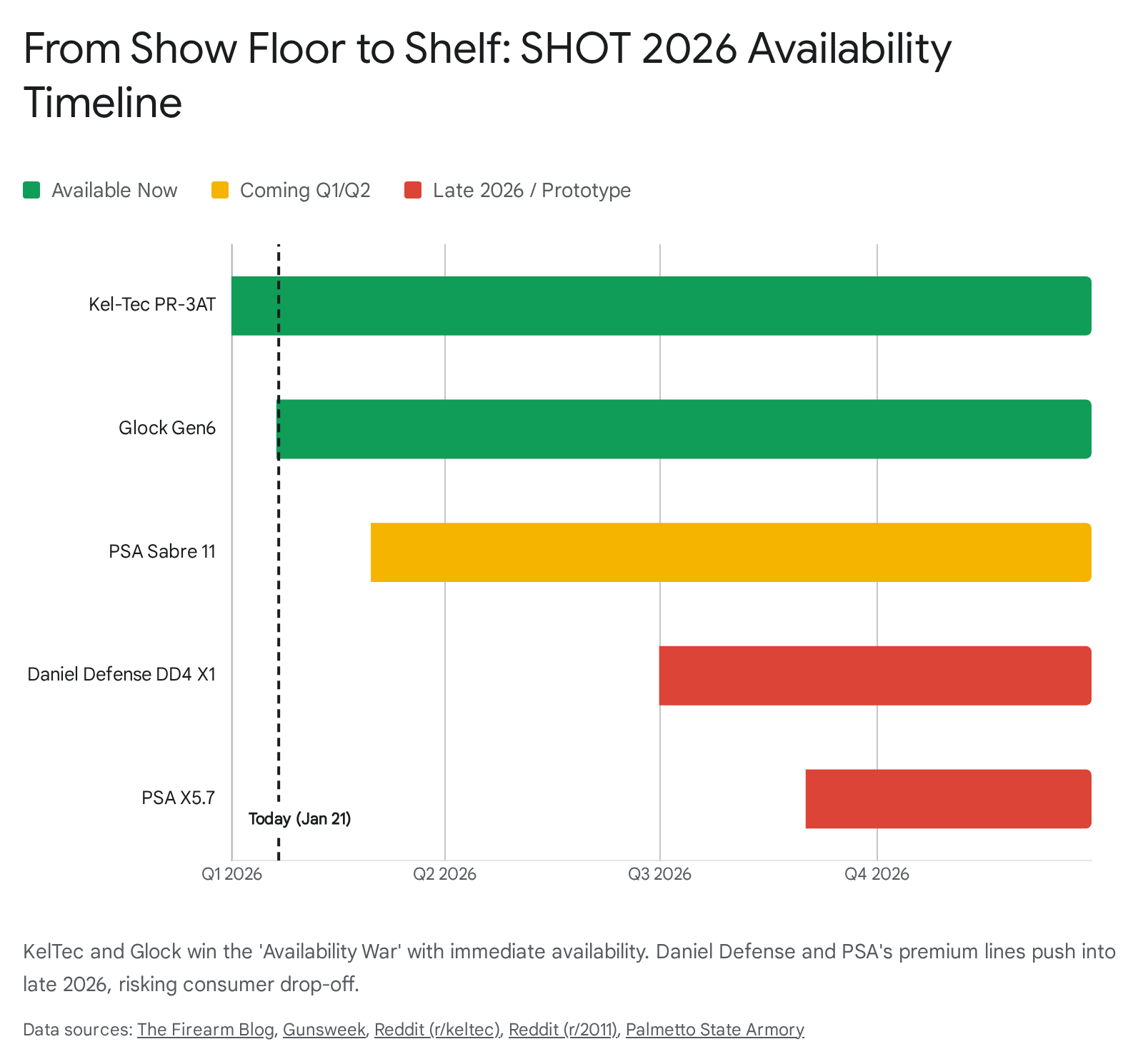
The most significant volume announcement expected at SHOT Show 2026 is undoubtedly the official launch of the Glock Gen6 family. Leaked promotional materials and press releases indicate a January 20, 2026, street date 1, coinciding precisely with the opening of the show. This timing suggests Glock intends to dominate the news cycle immediately, preventing competitors from gaining early traction.

The Gen6 represents a strategic acknowledgement that the “MOS” (Modular Optic System) plate culture that defined the Gen5 era was an imperfect stopgap. While the MOS system provided versatility, it introduced failure points and height-over-bore issues that alienated professional users, driving them toward direct-milling services. The Gen6 “Optic Ready System” appears designed to rectify this.

Technical Analysis of Gen6 Features

The upcoming generation integrates features that were previously the domain of custom shops like Agency Arms or ZEV Technologies.

  • Optic Ready System: The Gen6 introduces a new mounting architecture.2 While initial details suggest it retains a plate-based adaptability (“Standard frame… come optic-ready with three optic plates” 3), the marketing language emphasizes “adaptability and durability,” hinting at a deeper slide cut or a more robust mounting interface, likely utilizing recoil bosses milled directly into the slide to relieve shear stress on mounting screws. This system aims to offer the security of a direct mill with the versatility of a modular system.
  • Ergonomic Overhaul: The ergonomics have been aggressively updated. The inclusion of an “Enlarged Beavertail” 2 is a direct response to shooters experiencing slide bite and the popularity of aftermarket “backstrap” add-ons. This change fundamentally alters the grip geometry, allowing for a higher purchase on the firearm without the risk of injury, which translates to better recoil management.
  • Texture and Control: The “RTF6” grip texture 2 and the addition of a “Thumb Rest” (often called a gas pedal) textured into the frame 3 show Glock incorporating features previously reserved for custom stippling. This “gas pedal” allows for greater recoil management by providing a dedicated index point for the support hand thumb to apply downward pressure.
  • Trigger Mechanism: A “Flat Faced Trigger” is now standard.1 This is a massive shift for Glock, acknowledging that the curved, serrated trigger of previous generations was the first component most serious users replaced. The flat face provides a more consistent tactile surface and perceived lighter pull weight due to improved leverage.
Glock Gen6 architecture diagram: ergonomic updates including flat trigger, thumb rest, optic cut, and RTF6 texture.

Strategic Implication: Glock is attempting to reclaim the “value-add” revenue lost to the aftermarket. By offering a stippled-feel texture, flat trigger, and better optic mount out of the box, they are raising the MSRP to $745 27—comparable to the Gen5 MOS—while arguably offering hundreds of dollars worth of aftermarket-equivalent upgrades. This “all-in-one” value proposition is crucial as competitors continue to undercut Glock on price while offering more features.

1.2 Sig Sauer: “Sig Next” and the Diversification of Dominance

Sig Sauer continues to operate at a tempo unmatched by most competitors, treating their product lines less like traditional firearm models and more like agile software updates. The leaked “Sig Next” event details 29 reveal a massive portfolio expansion for 2026 that targets specific, high-value niches rather than broad adoption.

The P211-GTO: Disrupting the Double-Stack 1911 Market

Perhaps the most aggressive move against the high-end competition market is the P211-GTO. The nomenclature “P211” is a clear nod to the “2011” style double-stack 1911 platform made famous by STI/Staccato. Rumors position this pistol as a “Staccato XC Killer”.4

The P211-GTO features a “MACH3D Compensator” attached to a bull barrel, a steel frame, and—crucially—compatibility with P320 magazines.5 The decision to utilize P320 magazines is a stroke of logistical and engineering genius. The primary Achilles’ heel of the traditional 2011 platform has always been the magazine; they are often expensive ($70-$100 each), prone to tuning issues, and sensitive to debris. P320 magazines, by contrast, are ubiquitous, relatively affordable, and proven reliable in military service. By building a race gun around a service magazine, Sig lowers the barrier to entry for existing Sig users and solves the platform’s reliability stigma in one move.

P365-LUXE: Lifestyle Carry

The micro-compact market is maturing into deep segmentation. The P365-LUXE represents the “luxury” segment. It is a.380 ACP variant featuring a slide-integrated compensator, an AXG (Alloy XSeries Grip) module, and a “Pearlescent Black LUXE Cerakote” finish.32

This product targets the demographic of shooters who prioritize shooting comfort and aesthetics over raw ballistic power. The combination of the lower-recoil.380 cartridge with a compensator and the added mass of a metal grip frame will likely result in one of the softest-shooting micro-compacts ever produced. It moves the P365 from a utilitarian tool to a lifestyle accessory, akin to a high-end watch or knife.

1.3 HK: The American Pivot with the CC9

Heckler & Koch (HK) has historically been criticized for a perceived indifference to the specific desires of the US civilian market—a sentiment famously memed as “Because you suck. And we hate you.” The release of the CC9 marks a definitive doctrinal shift away from this reputation.

  • US-Centric Design: The CC9 is a micro-compact, striker-fired 9mm designed and manufactured in the USA specifically for the US concealed carry market.10 This is a critical distinction; it is not a scaled-down European duty gun, but a purpose-built product for American carry habits.
  • Specs & Positioning: With a 3.32-inch barrel, sub-1-inch width, 12-round capacity, and optic-ready slide 11, the CC9 competes directly with the Sig P365, Glock 43X/48, and Springfield Hellcat.
  • Import Strategy: By manufacturing the CC9 in Georgia 11, HK bypasses German export laws and US import restrictions (922r compliance), ensuring a steady supply chain and avoiding the “scarcity tax” often applied to HK imports.
  • SFP9CC Clarification: Confusion persists in forums regarding the SFP9CC.35 The research indicates the CC9 is the US market product (button release), while the SFP9CC remains the European counterpart (paddle release). It is unlikely the SFP9CC will see broad US release in 2026 to avoid cannibalizing the CC9 launch.

1.4 Beretta and the Return of Metal

Beretta continues to leverage the 92 platform’s resurgence with the 92XI SAO Gara and Corsa models.37 These are single-action-only (SAO) variants designed for competition (IDPA/USPSA).

  • Features: They feature frame-mounted safeties (abandoning the slide-mounted decocker), flat-faced triggers, and integrated compensators.37
  • Market Trend: This aligns with the broader industry trend of “race guns for everyone.” Features once exclusive to open-class competition guns—comps, magwells, aggressive texturing—are finding their way into production models.

1.5 Smith & Wesson: Performance Center Expansion

Smith & Wesson is leveraging its Performance Center branding to refresh the Shield line. The Shield X Carry Comp 38 features a “ClearSight Cut” for optics, a ported barrel for recoil reduction, and a flat-face trigger.

  • Trend: “Compensated Carry” is rapidly becoming the industry standard. Following Sig’s X-Macro and Spectre Comp, S&W is normalizing the idea that carry guns should have muzzle devices to mitigate the snap of modern +P defensive ammunition.

1.6 Biofire: The Smart Gun Reality Check

The Biofire Smart Gun, often discussed in tech circles, faces the harsh reality of hardware manufacturing. Shipping has been pushed to 2026.41

  • Buzz vs. Reality: While the “Smart Gun” generates significant media interest outside the industry, the “buzz” inside the industry remains skeptical. The reliance on biometrics (fingerprint/facial recognition) in a life-saving device remains a significant hurdle for adoption among core enthusiasts who prioritize mechanical fail-safes. The “summer 2026” shipping estimate 41 suggests continued development challenges.

2. Rifle Innovation: The Bifurcation of Modernity

The 2026 rifle market is splitting into two distinct, divergent directions: the hyper-modern, military-derivative semi-automatic, and the technologically enhanced, nostalgia-driven manual action. This bifurcation represents a response to both technological opportunity (new cartridges like 6.8x51mm) and regulatory pressure (assault weapon bans driving interest in manual actions).

2.1 The Tactical Lever Action Boom

The “Cowboy Assault Rifle” aesthetic is no longer a niche internet subculture; it is a primary market segment. Major manufacturers are investing heavily in modernizing the lever-action platform.

  • Henry SPD Predator: Henry Repeating Arms is launching the “Special Products Division” (SPD) 13, a move clearly aimed at the high-end custom market. The SPD Predator is a lever action built for sub-MOA precision 14, a claim traditionally alien to the platform.
  • Technical Specs: It features an 18″ free-floated carbon fiber barrel, a threaded muzzle (1/2×28), a tang safety, and a Picatinny rail.44 The use of carbon fiber reduces barrel whip and heat retention, addressing two of the lever gun’s historic accuracy issues.
  • Significance: This challenges the bolt action’s monopoly on precision predator hunting. It suggests Henry is targeting the demographic that wants the rapid follow-up shots of a lever gun but demands the accuracy of a dedicated bolt-action PRS rig.
  • Marlin Dark Series: Now fully stabilized under Ruger’s manufacturing and operational control, Marlin is expanding the Dark Series. The Model 1895 Dark in.45-70 Govt and the Model 1894 Trapper in 10mm Auto 16 are confirmed.
  • 10mm Lever Gun: A 10mm lever action is a highly requested configuration. It offers ammunition commonality with popular backcountry sidearms (like the Glock 20 or Sig P320-XTEN), allowing a hunter to carry one caliber for both rifle and pistol.

2.2 Sig Sauer HYP: Democratizing the NGSW

The US Army’s adoption of the Sig MCX Spear (XM7) created massive interest in the 6.8x51mm (.277 Fury) cartridge. However, the MCX Spear’s consumer price tag ($4,000+) is prohibitive for mass adoption. Sig’s answer to this is the HYP Rifle.

  • The HYP Concept: Sig is introducing the HYP, a Direct Impingement (DI) AR-10 style rifle chambered in 6.8x51mm.7
  • Engineering Challenges: The.277 Fury produces chamber pressures (80,000 psi) that can destroy standard actions designed for.308 Win (approx. 60,000 psi). To manage this in a DI system, the HYP features a “reinforced upper with steel cam path” and a “heavy-duty carrier group”.7 The use of a steel cam path insert in an aluminum upper is a critical durability enhancement to prevent the cam pin from galling or cracking the receiver under the intense dwell time and pressure curve of the hybrid case ammunition.
  • Market Impact: By offering a rifle around the ~$2,000 mark 7 (implied), Sig is making the high-pressure hybrid ammunition accessible to a wider audience. This is critical for the long-term commercial viability of the cartridge; without a broader user base, ammunition costs would remain high, stifling adoption.
HYP Rifle cost comparison: Democratizing 6.8x51mm Firepower. MCX Spear $4,200 vs. HYP Rifle $2,000.

2.3 Smith & Wesson Model 1854 Updates

Smith & Wesson continues to expand its Model 1854 lever-action line, capitalizing on the success of its initial launch. New chamberings in .30-30 Winchester and .45-70 Government 45 target the traditionalist hunter who may have been skeptical of the initial.44 Magnum release. The “Stealth Hunter” variant 47 includes a polymer stock and M-LOK forend, directly competing with the Marlin Dark series.

3. Optics and Electro-Optics: The Integration of Intelligence

The optics sector at SHOT 2026 will be dominated by the fusion of thermal imaging, laser ranging, and ballistic calculation into single, user-friendly units. The days of “dumb glass”—optics that merely magnify an image—are numbered for the high-end market. The integration of sensors is transforming the riflescope into a comprehensive fire control system.

3.1 Thermal for Everyone: Pulsar and iRayUSA

The thermal market is moving from “detection” (seeing a heat signature) to “identification” (knowing exactly what that signature is) at extended ranges.

  • Pulsar Thermion 2 LRF 60 Series: Pulsar is pushing the envelope on optical physics. The new XP60, XG60, and XL60 models 23 feature a massive 60mm objective lens.
  • Physics & Performance: A larger lens (60mm vs the standard 35mm or 50mm) allows for significantly more thermal energy collection. This results in better image detail and, crucially, higher base magnification without the pixelation associated with digital zoom. This addresses the primary weakness of thermal scopes: the inability to positively identify targets (e.g., distinguishing a coyote from a domestic dog) at distances beyond 300 yards.
  • iRayUSA: New “Hybrid” series updates and the RH25V2 48 continue the trend of multi-role devices. These units can serve as handheld monoculars, clip-ons (placed in front of a day scope), or standalone weapon sights. This versatility appeals to budget-conscious users who cannot afford separate dedicated devices for scanning and shooting.

3.2 Holosun: The Laser-Optic Fusion

Holosun is solving the “rail estate” problem on night vision rifles.

  • ARO EVO DUAL & AEMS DUAL: These units integrate Visible and IR aiming lasers directly into the red dot housing.25
  • Significance: Traditionally, a night vision shooter needs a red dot (for passive aiming through tubes) and a separate laser module like a PEQ-15 or DBAL (for active aiming/designation). This adds weight, consumes rail space, and affects the rifle’s center of gravity. Combining them into one unit simplifies the setup, reduces the “snag factor,” and significantly lowers the total cost of ownership for night vision capability.

3.3 Vortex and the “Smart Scope”

Rumors persist of a major “Smart Scope” release from Vortex.49 While specifics are guarded, the collaboration with “HuntLeague” and the mention of changing “how shooters gather data” 49 suggests an optic with an integrated ballistic solver and perhaps a heads-up display (HUD) similar to the military’s NGSW-FC (Fire Control) program. This system would likely measure environmental data (temp, pressure, humidity), range the target, and provide a corrected aim point instantly. This would compete with the Burris Eliminator or Sig BDX systems but aims to do so with higher fidelity glass and more robust sensors, appealing to the PRS (Precision Rifle Series) and NRL Hunter communities.

4. Suppressor Technology: The Race for Flow-Through

The suppressor market is reacting to two primary forces: the technical demand for “zero backpressure” systems to ensure reliability on semi-automatic hosts, and the potential for regulatory easing (or at least the normalization of ownership).

4.1 The 3D Printing Revolution

Additive manufacturing (DMLS – Direct Metal Laser Sintering) has completely revolutionized suppressor design, allowing for internal geometries that are impossible to achieve with traditional subtractive machining.

  • SilencerCo Spectre 9K: A titanium, 3D-printed 9mm suppressor weighing just 3.17 ounces.19
  • Engineering: The use of Grade 5 and Grade 9 titanium in a printed lattice structure allows for high strength with negligible weight penalty. At ~3 ounces, it is light enough to not require a Nielson device (booster) on some fixed-barrel pistols, though it still utilizes one for reliability on tilting-barrel actions.
  • HuxWrx FLOW 9k Ti: Also 3D printed, this suppressor uses HuxWrx’s signature “Flow-Through” technology to vent gas forward through intricate helical channels.21
  • The “Gas Face” Solution: Traditional baffles trap gas to suppress sound, but this increases backpressure, forcing toxic gas back into the shooter’s face and increasing bolt velocity (wear). Flow-Through technology eliminates this, making it ideal for the blowback actions common in PCCs (Pistol Caliber Carbines) which are sensitive to backpressure.
Titanium 9mm suppressor comparison: SilencerCo Spectre 9K vs. HuxWrx FLOW 9k Ti specs.

4.2 Dead Air’s “Sandman X” and Regulatory Betting

Dead Air is rumored to release the Sandman X, a 3D-printed evolution of their popular Sandman series, focusing on gas management.18

  • Marketing Strategy: Their “Hush Money” promotion 51 is a clever marketing play. By offering a store credit that offsets the cost of a tax stamp ($200), they are effectively subsidizing the NFA tax. This strategy keeps sales velocity high despite the friction of the 6-12 month wait times often associated with NFA transfers, essentially paying the customer to wait.

5. Ammunition and Ballistic Developments

The ammunition sector is moving away from generic “plinking” ammo toward specialized loads that maximize the potential of modern platforms.

  • Hornady 22 Creedmoor: Hornady is finally legitimizing the 22 Creedmoor with factory support.52 Previously a wildcat cartridge requiring hand-loading, the 22 Creedmoor offers “explosive performance” for varmint hunters with muzzle velocities exceeding 3500 fps. This factory support will likely spur a wave of rifle chamberings from major manufacturers.
  • Subsonic Ecosystems: Federal’s new “Federal Subsonic” line 54 specifically targets the growing suppressor market.
  • Loads:.30-30 Win,.45-70 Govt, and.300 Blackout.
  • System Integration: The inclusion of subsonic.30-30 and.45-70 loads creates a perfect synergy with the new threaded lever-action rifles from Marlin and Henry. Manufacturers are coordinating to create a complete “suppressed lever gun” ecosystem where the rifle and ammo are optimized for each other.

6. Strategic Market Implications

The 2026 SHOT Show will be remembered as the year the industry internalized the aftermarket.

  1. Glock is internalizing stippling and trigger jobs with the Gen6.
  2. Sig Sauer is internalizing the “Roland Special” (compensated carry) concept with the P365-LUXE and the 2011 concept with the P211.
  3. Holosun is internalizing the IR laser module into the optic housing.
  4. Ammunition makers are internalizing the wildcat market (22 Creedmoor) and the handloader’s subsonic recipes.

For the retailer, this shift implies higher initial MSRPs on base units but potentially lower attach rates for certain entry-level accessories (like basic adapter plates, drop-in triggers, or basic laser units). However, it opens new opportunities for selling high-end “systems”—such as a thermal-equipped, suppressed lever action—where the margins are significantly healthier. For the consumer, it means better “out of the box” performance than ever before, but at a premium price point that reflects the advanced manufacturing (3D printing, MIM, advanced coatings) required to deliver it.

The “Buzz” is real, and it points to a high-tech, high-performance year in Las Vegas where the gap between military specification and civilian availability continues to close.


Please share the link on Facebook, Forums, with colleagues, etc. Your support is much appreciated and if you have any feedback, please email us in**@*********ps.com. If you’d like to request a report or order a reprint, please click here for the corresponding page to open in new tab.


Sources Used

  1. GLOCK Reveals the Highly Anticipated 6th Generation of GLOCK Pistols, accessed January 12, 2026, https://us.glock.com/en/Press-Release/News-Page/Gen6-Announcement
  2. Gen6 – GLOCK Perfection, accessed January 12, 2026, https://eu.glock.com/en/Technology/Gen6
  3. Glock Gen 6, accessed January 12, 2026, https://gen6.glock.us/
  4. The Hype is real. The Sig P211 really is better than the Staccato XC. – YouTube, accessed January 12, 2026, https://www.youtube.com/watch?v=tWQdZMFx9mI
  5. P211-GTO EQUINOX – Sig Sauer, accessed January 12, 2026, https://www.sigsauer.com/p211-gto-equinox.html
  6. P211-GTO – Sig Sauer, accessed January 12, 2026, https://www.sigsauer.com/p211-gto.html
  7. SIG HYP: The First AR Built for .277 Fury (6.8x51mm Hybrid) – YouTube, accessed January 12, 2026, https://www.youtube.com/watch?v=XDm-Cb4UzZs
  8. POTD: The SIG Sauer HYP Rifle – The First .277 Fury AR10 | thefirearmblog.com, accessed January 12, 2026, https://www.thefirearmblog.com/blog/potd-the-sig-sauer-hyp-rifle-the-first-277-fury-ar10-44821597
  9. SIG NEXT 25 – HYP Rifle | Soldier Systems Daily, accessed January 12, 2026, https://soldiersystems.net/2025/06/20/sig-next-25-hyp-rifle/
  10. New Handguns Coming in 2025 | NSSF SHOT Show 2026, accessed January 12, 2026, https://shotshow.org/new-handguns-coming-in-2025/
  11. The New HK CC9 9mm: Full Review – Guns and Ammo, accessed January 12, 2026, https://www.gunsandammo.com/editorial/new-hk-cc9-9mm-review/519230
  12. Heckler & Koch USA Introduces the All-New CC9 Pistol: A New Standard in Concealed Carry, accessed January 12, 2026, https://hk-usa.com/2024/10/16/heckler-koch-usa-introduces-the-all-new-cc9-pistol-a-new-standard-in-concealed-carry/
  13. Henry releases new lever-action designed for incredible long-range accuracy, accessed January 12, 2026, https://www.outdoornews.com/2025/12/09/henry-releases-new-lever-action-designed-for-incredible-long-range-accuracy/
  14. SPD PREDATOR – Henry Repeating Arms, accessed January 12, 2026, https://www.henryusa.com/firearm/spd-predator/
  15. Henry Unleashes the Most Accurate Lever-Action Ever Built, accessed January 12, 2026, https://www.henryusa.com/news/henry-unleashes-the-most-accurate-lever-action-ever-built/
  16. News – Marlin Firearms, accessed January 12, 2026, https://www.marlinfirearms.com/s/news/
  17. Marlin News, accessed January 12, 2026, https://www.marlinfirearms.com/s/news-2023-10-31/
  18. Shhhh…New Suppressors from SHOT Show 2025 – Athlon Outdoors, accessed January 12, 2026, https://athlonoutdoors.com/article/new-suppressors-from-shot-show-2025/
  19. SilencerCo Spectre 9K – Lightest 9mm Suppressor | 3.17oz – Capitol Armory, accessed January 12, 2026, https://www.capitolarmory.com/silencerco-spectre-9k-titanium-9mm-suppressor.html
  20. SilencerCo Spectre 9K 9mm Suppressor | Titanium, Compact, Full-Auto Rated, accessed January 12, 2026, https://www.silencershop.com/silencerco-spectre-9k.html
  21. FLOW 9k Ti – Huxwrx, accessed January 12, 2026, https://huxwrx.com/flow-9k-ti/
  22. HUXWRX FLOW 9K Ti | Flow Through 9mm Suppressor | Available at Silencer Shop, accessed January 12, 2026, https://www.silencershop.com/flow-9k-ti-multi.html
  23. Pulsar is coming to SHOT Show 2025: visit us at Booth #11419 to see the full Thermion 2 LRF 60 series and Merger LRF XT50, accessed January 12, 2026, https://pulsarvision.com/journal/pulsar-is-coming-to-shot-show-2025-visit-us-at-booth-11419-to-see-the-full-thermion-2-lrf-60-series-and-merger-lrf-xt50/
  24. PULSAR BREAKING NEWS | SHOT Show 2025!! – YouTube, accessed January 12, 2026, https://www.youtube.com/watch?v=xZlOBBviR9c
  25. The new HOLOSUN optics for 2026 – SPARTANAT.com, accessed January 12, 2026, https://spartanat.com/en/die-neuen-holosun-optiken-fuer-2026
  26. Holosun 2026 Sneak Peek – Frag Out! Magazine, accessed January 12, 2026, https://fragoutmag.com/holosun-2026-sneak-peak/
  27. new pistols 2026 new handguns – laststandonzombieisland, accessed January 12, 2026, https://laststandonzombieisland.com/tag/new-pistols-2026-new-handguns/
  28. Glock Gen 6: Every New Feature in 60 Seconds – YouTube, accessed January 12, 2026, https://www.youtube.com/shorts/8Uo9awZZ-xk
  29. Inside SIG NEXT: Most Ambitious SIG SAUER Launch to Date – GunBroker.com, accessed January 12, 2026, https://www.gunbroker.com/c/article/sig-next-product-announce/
  30. Sig NEXT 2025, accessed January 12, 2026, https://www.sigsauer.com/next.html
  31. Everything New from SIG NEXT 2025 – YouTube, accessed January 12, 2026, https://www.youtube.com/watch?v=UtOR6MsUfGk
  32. The New SIG SAUER P365-LUXE: A New Standard in Soft-Shooting Micro-Compact Carry | SIG NEXT 2025, accessed January 12, 2026, https://www.gunbroker.com/c/video/sig-sauer-p365-luxe-features-and-specs/
  33. Sig Sauer P365 Luxe, Semi-automatic, Striker Fired, Sub-Compact, 380 ACP, 3.1 Barrel, Slide Integrated Compensator, Cerakote Finish, Black, X-Ray 3 Night Sights, XL AXG Grip Module, 12 Rounds, 3 Magazines 365AXG-380-COMP-LUXE – Athena Arms, accessed January 12, 2026, https://athenafirearms.com/products/sig_sauer_p365_luxe_semi_automatic_striker_fired_sub_compact_380_acp_3_1_barrel_slide_integrated_compensator_cerakote_finish_black_x_ray_3_night_sights_xl_axg_grip_module_12_rounds_3_magazines_365axg_380_comp_luxe
  34. P365-LUXE – Sig Sauer, accessed January 12, 2026, https://www.sigsauer.com/p365-axg-luxe.html
  35. Hk sfp9cc from shot show : r/HecklerKoch – Reddit, accessed January 12, 2026, https://www.reddit.com/r/HecklerKoch/comments/19dvq1n/hk_sfp9cc_from_shot_show/
  36. Upcoming HK handguns and possibility of a new DA/SA? : r/HecklerKoch – Reddit, accessed January 12, 2026, https://www.reddit.com/r/HecklerKoch/comments/1phksa4/upcoming_hk_handguns_and_possibility_of_a_new_dasa/
  37. Beretta Race Guns: 92XI SAO Gara and Corsa — SHOT Show 2025 – GunsAmerica, accessed January 12, 2026, https://gunsamerica.com/digest/beretta-race-guns-92xi-sao-gara-and-corsa-shot-show-2025/
  38. New Guns And Gear January 2026 – Gun Digest, accessed January 12, 2026, https://gundigest.com/gear-ammo/guns-and-gear-january-2026
  39. PERFORMANCE CENTER® M&P® SHIELD X™ CARRY COMP THUMB SAFETY, accessed January 12, 2026, https://www.smith-wesson.com/product/performance-center-m-p-shield-x-carry-comp-thumb-safety
  40. Smith and Wesson M&P9 Shield X Carry Comp Subcompact 9mm Luger 3.6in Black Armornite Pistol – 15+1 Rounds | Sportsman’s Warehouse, accessed January 12, 2026, https://www.sportsmans.com/shooting-gear-gun-supplies/handguns/smith-and-wesson-mp9-shield-x-carry-comp-subcompact-9mm-luger-36in-black-armornite-pistol-151-rounds/p/1969901
  41. What ever happened to the biofire smartgun? : r/ForgottenWeapons – Reddit, accessed January 12, 2026, https://www.reddit.com/r/ForgottenWeapons/comments/1njf0it/what_ever_happened_to_the_biofire_smartgun/
  42. I’m new. Has anyone here bought and actually received a Biofire Smart Gun? What are your thoughts? : r/liberalgunowners – Reddit, accessed January 12, 2026, https://www.reddit.com/r/liberalgunowners/comments/1j4a792/im_new_has_anyone_here_bought_and_actually/
  43. Lever Action Rifles | Henry Repeating Arms, accessed January 12, 2026, https://www.henryusa.com/style/rifles/lever-action-rifles/
  44. Henry SPD Predator Series .223/5.56 NATO Lever Action Rifle with Harris Bipod – 18″ Carbon Fiber Threaded Barrel – Bauer Precision, accessed January 12, 2026, https://www.bauer-precision.com/henry-spd-predator-series-223-5-56-nato-lever-action-rifle-with-harris-bipod-18-carbon-fiber-threaded-barrel/
  45. New calibers for the Smith & Wesson Model 1854 lever action rifles – GUNSweek.com, accessed January 12, 2026, https://gunsweek.com/en/rifles/news/new-calibers-smith-wesson-model-1854-lever-action-rifles
  46. S&W® MODEL 1854 STEALTH HUNTER™ 30-30 WIN | Smith & Wesson, accessed January 12, 2026, https://www.smith-wesson.com/product/s-w-model-1854-stealth-hunter-30-30-win
  47. NEW: S&W® MODEL 1854 STEALTH HUNTER™ | Smith & Wesson, accessed January 12, 2026, https://www.smith-wesson.com/article/new-s-w-model-1854-stealth-hunter-
  48. Press – iRayUSA, accessed January 12, 2026, https://irayusa.com/pages/press.html
  49. We Can’t Show It Yet… But Vortex’s 2026 Gear Will Change Long-Range Hunting…Right out of the Box – YouTube, accessed January 12, 2026, https://www.youtube.com/watch?v=3K-D7hzpkv4
  50. Unveiling Dead Air’s Latest Silencer: Exclusive from SHOT Show 2025 – AR15Discounts, accessed January 12, 2026, https://ar15discounts.com/unveiling-dead-airs-latest-silencer-exclusive-from-shot-show-2025/
  51. Caught in a Bind? Dead Air Silencers has your “Hush Money” | thefirearmblog.com, accessed January 12, 2026, https://www.thefirearmblog.com/blog/caught-in-a-bind-dead-air-silencers-has-your-hush-money-44822863
  52. Hornady® Announces New Products for 2026, accessed January 12, 2026, https://press.hornady.com/release/2025/10/15/hornady-announces-new-products-for-2026/
  53. New Products ‑ Hornady Manufacturing, Inc, accessed January 12, 2026, https://www.hornady.com/new-products/
  54. Federal Will Release More Than 20 New Centerfire Rifle Ammo Options in 2026, accessed January 12, 2026, https://www.petersenshunting.com/editorial/federal-ammo-new-centerfire-options/543521

JJE Capital Holdings: They Own Palmetto State Armory, AAC, H&R, Soviet Arms and More

Authored: January 11, 2026

The American small arms industry has historically been defined by a fragmented supply chain. For decades, the sector operated through a disconnected web of raw material suppliers, precision machine shops, independent brand holders, and wholesale distributors. This fragmentation created significant vulnerabilities, exposing manufacturers to supply chain volatility, fluctuating commodity costs, and political regulatory pressures. JJE Capital Holdings (JJE) has fundamentally disrupted this traditional model by constructing a vertically integrated industrial conglomerate that establishes “operational sovereignty”—the strategic capability to control the entire value chain of firearms production from the molecular level of raw manufacturing to the final point of retail sale.

Headquartered in Columbia, South Carolina, JJE Capital Holdings has evolved from the parent entity of a single burgeoning retailer—Palmetto State Armory (PSA)—into a diversified industrial powerhouse. The firm’s acquisition strategy is not merely financial; it is logistical and industrial. By acquiring critical manufacturing nodes such as Spartan Forge (aluminum forging) and DC Machine (precision barrel and receiver machining), JJE has insulated its consumer-facing brands from the upstream bottlenecks that frequently paralyze competitors. Furthermore, the strategic acquisition of heritage intellectual property—specifically the assets of the defunct Remington Outdoor Company, including Harrington & Richardson (H&R), DPMS, and Advanced Armament Company (AAC)—has allowed JJE to pivot from a budget-focused retailer to a custodian of American firearms history, serving segments ranging from entry-level hobbyists to high-end collectors and defense contractors.

This report provides an exhaustive, analyst-grade examination of the JJE Capital Holdings portfolio. It dissects the conglomerate’s corporate structure, operational synergies, and market positioning. The analysis categorizes the portfolio into four strategic pillars: Industrial Manufacturing Base, Firearms & Heritage Brands, Retail & Defense Services, and Lifestyle & Real Estate. For each entity, this report provides detailed operational profiles, location data, and strategic analysis of its role within the broader JJE ecosystem, demonstrating how a localized investment firm has reshaped the economics of the modern American arms industry.

1. Corporate Structure and Strategic Philosophy

1.1 The Genesis of JJE Capital Holdings

Location: 3850 Fernandina Road, Columbia, SC 29210

URL: jjech.com

Type: Private Equity & Industrial Holding Company

JJE Capital Holdings serves as the strategic nerve center for the conglomerate.1 Unlike traditional private equity firms that often prioritize short-term liquidity events or asset stripping, JJE operates with an industrialist philosophy centered on long-term value creation through manufacturing independence. The firm’s stated mission focuses on “reviving the American Dream” by repatriating manufacturing jobs and building a self-sustaining industrial ecosystem on American soil.2 This nationalist-industrialist ethos is not merely marketing; it is the central operational thesis that drives their acquisition strategy.

The leadership team comprises individuals with deep roots in operations, real estate, and construction, reflecting the physical nature of their investments. Jamin McCallum, the Owner and Chief Executive Officer, is the visionary behind the vertical integration strategy.3 His approach has been characterized by a refusal to accept industry standard lead times or supply constraints, preferring instead to buy or build the capacity required to meet demand. Julian Wilson (Real Estate Manager) and Edward LaRocque (Construction Manager) play pivotal roles in the rapid physical expansion of the conglomerate.3 As the group expands its retail footprint with massive “destination” brick-and-mortar stores and builds new manufacturing plants (such as the new AAC facility in Alabama or the ammo plant in South Carolina), the internal capability to manage real estate and construction becomes a strategic asset, allowing JJE to move faster than competitors who rely on external developers.

1.2 The Philosophy of Operational Sovereignty

The core differentiator of JJE Capital is its pursuit of “Operational Sovereignty.” In the firearms industry, “availability” is often a more significant driver of sales than “brand loyalty.” During the demand surges of 2012, 2016, and 2020, manufacturers who relied on third-party vendors for forgings (the raw aluminum shapes for receivers) or barrels found themselves unable to ship products.

JJE’s response was to internalize these dependencies. By owning the forge (Spartan Forge), the machine shop (DC Machine), the tool maker (Special Tool Solutions), and the ammunition plant (AAC Ammunition), JJE controls its own destiny. They are not subject to the allocation limits of a third-party vendor. This vertical integration allows JJE to:

  1. Maintain Production Velocity: When the market spikes, JJE factories prioritize JJE brands.
  2. Compress Margins: By eliminating the markup of intermediate vendors, JJE can sell finished rifles at retail prices that are often lower than the wholesale cost of competitors’ products.
  3. Innovate Rapidly: With R&D (Ferrous Engineering) co-located with manufacturing, the feedback loop from design to prototype to mass production is drastically shortened.
JJE Capital Holdings corporate portfolio hierarchy showing brands like Palmetto State Armory, AAC Ammunition, and H&R.

2. The Manufacturing Industrial Base

The foundation of JJE’s market power lies in its industrial capabilities. These entities typically do not face the consumer directly but provide the critical components that fuel the consumer-facing brands.

2.1 DC Machine: The Precision Engine

Location: 202 Thorpe Road, Summerville, SC 29483

URL: dcmachine.net

Role: High-Volume Precision Machining & Barrel Manufacturing

DC Machine is arguably the most critical operational asset in the JJE portfolio outside of Palmetto State Armory itself. Originally established as a high-precision contract manufacturer for the aerospace, medical, and automotive sectors, DC Machine was acquired to serve as the primary machining hub for JJE’s firearms production.2

Operational Capabilities:

The facility is a state-of-the-art CNC (Computer Numerical Control) operation, housing over 70 high-end machines.2 It is ISO 9001 (2008) certified and holds ITAR registration, qualifying it for defense-related manufacturing. The strategic significance of DC Machine cannot be overstated—it is one of the largest gun barrel manufacturers in the United States. In the firearms industry, the barrel is often the most difficult component to source in volume due to the specialized machinery (drilling, reaming, rifling) required. By bringing this capability in-house, JJE secured a consistent supply of barrels for its AR-15, AR-10, and AK-47 lines.

Strategic Integration:

DC Machine produces not just barrels, but also bolt carrier groups, gas blocks, and other critical steel components. The “vertical” connection here is direct: Spartan Forge provides the raw metal, and DC Machine turns it into a functional rifle component. This allows JJE to rapidly pivot production; if the market demand shifts from 16-inch carbines to 10.5-inch pistols, DC Machine can retool and redirect output far faster than a company relying on purchase orders to an external vendor.

2.2 Spartan Forge: The Raw Material Source

Location: Lincolnton, NC

URL: jjech.com/portfolio-companies/

Role: Aluminum Forging Facility

In the AR-15 supply chain, the “forging” is the bottleneck. There are only a handful of major forges in the United States that produce the raw 7075-T6 aluminum shapes that eventually become upper and lower receivers. During the 2013 and 2020 panics, these forges were booked years in advance, leaving smaller manufacturers without raw material.

Operational Capabilities:

Spartan Forge is a multi-press facility specializing in the high-pressure forging of aluminum products.2 Located in Lincolnton, NC, it sits strategically close to the South Carolina manufacturing hub. The facility produces the raw “paperweight” shapes of receivers, which are then shipped to DC Machine or PSA’s own machining centers for final cutting.

Strategic Integration:

Acquiring Spartan Forge was a defensive maneuver to secure the supply chain. It ensures that JJE brands—PSA, H&R, Lead Star, and DPMS—have prioritized access to receiver blanks. This acquisition effectively “firewalled” JJE from the raw material shortages that plague the industry.

2.3 Ferrous Engineering and Tool: The Innovation Lab

Location: West Columbia, SC

URL: jjech.com

Role: Research, Design, and Prototyping

While DC Machine handles mass production, Ferrous Engineering handles innovation. This entity operates as an integrated research and design center combined with a specialized CNC machine shop.2

Operational Capabilities:

Ferrous Engineering is tasked with taking concepts from ideation to first production. They handle the complex engineering challenges, such as reverse-engineering foreign weapons platforms (crucial for the PSA AK-V and Soviet Arms lines) or developing proprietary internal mechanisms (such as the bufferless system in the PSA JAKL).

Strategic Integration:

Separating R&D (Ferrous) from Production (DC Machine) is a mature industrial strategy. It prevents the disruption of high-volume lines for experimental runs. Ferrous Engineering allows JJE to iterate rapidly on new designs, testing prototypes and refining blueprints before handing the final “data package” to the mass production facilities.

2.4 Special Tool Solutions (STS): Complexity Management

Location: 11699 Camden Rd, Jacksonville, FL 32218

URL: jjech.com/portfolio-companies/

Role: Specialized Product Development & Tooling

Located in Jacksonville, Florida, STS provides high-end product development and design capabilities.2

Operational Capabilities:

STS focuses on “turning complex ideas into reality.” In manufacturing, “tooling” refers to the custom jigs, fixtures, and molds required to hold and shape parts during mass production. STS likely supports the broader group by designing and building these complex tools, ensuring that the production lines at DC Machine and PSA have the fixtures they need to operate efficiently. They handle “tough jobs that others do not have the capacity to do,” serving as a problem-solving node in the industrial network.

2.5 AAC Ammunition (America’s Ammo Company): The Consumable Engine

January 11. 2026: Note, AAC is “paused” while JJE sorts out how to develop gunpowder manufacturing capabilities. Click here for an article about this.

Location: Columbia, SC

URL: aacammo.com

Role: Ammunition Manufacturing (Projectiles & Cartridges)

Perhaps the most ambitious of JJE’s recent expansions is the launch of AAC Ammunition. Following the massive ammo shortage of 2020-2022, JJE recognized that selling firearms without ammunition was a vulnerability.

Operational Capabilities:

AAC Ammunition is not merely an assembler of bought components; it is a primary manufacturer. The facility utilizes advanced research and design processes to manufacture its own projectiles.2 Recent industry reports indicate they have also moved into manufacturing their own shell casings and, critically, are working toward primer independence.4 Primers are the most volatile component in the ammo supply chain, involving dangerous chemical manufacturing.

Strategic Integration:

By manufacturing the “consumable” of the industry, JJE captures recurring revenue. A customer buys a rifle once, but buys ammunition for a lifetime. The vertical integration here allows JJE to bundle products (e.g., “buy a dagger pistol, get 500 rounds of AAC 9mm”), creating a value proposition that pure-play retailers cannot match.

JJE Industrial Ecosystem diagram: Raw material to finished firearm. Includes Spartan Forge, DC Machine, AAC Ammunition, PSA, H&R.

3. The Retail & Distribution Juggernaut

While the industrial base provides the capacity, the retail arm provides the velocity. JJE’s primary revenue engine is its massive direct-to-consumer (DTC) distribution network.

3.1 Palmetto State Armory (PSA)

Location: Online HQ in West Columbia, SC; Multiple Retail Locations (SC, NC, GA).

URL: palmettostatearmory.com

Role: Primary Retailer, Ecommerce Platform, & Manufacturer

PSA is the face of the JJE conglomerate. It operates on a high-volume, low-margin philosophy famously summarized by their mission to “sell as many guns as possible to as many law-abiding Americans as possible.”

Operational Profile:

PSA is unique in that it is both a manufacturer and a distributor. It manufactures its own line of firearms (PA-15, PSAK-47, PSA Dagger) while simultaneously serving as one of the largest online retailers for third-party brands (Sig Sauer, Glock, Vortex Optics).

  • The “PSA Ecosystem”: The company has successfully cloned the most popular platforms in the world. The PSA Dagger is a clone of the Glock 19 Gen 3 (following the patent expiration), offering compatibility with ubiquitous Glock parts at half the price. The PSAK-47 series (GF3, GF4, GF5) successfully challenged the dominance of imported AKs by offering an American-made alternative with a lifetime warranty.
  • Ecommerce Dominance: The PSA website is a high-traffic hub that drives daily engagement through “Daily Deals,” conditioning customers to check the site frequently. This digital dominance allows JJE to launch new subsidiary brands (like AAC Ammo or Soviet Arms) with zero customer acquisition cost by simply featuring them on the PSA homepage.
  • Physical Expansion: Unlike many digital-native retailers, PSA has invested heavily in physical retail. Their “superstores” in South Carolina (Columbia, Greenville, Myrtle Beach, Summerville) and expansion into North Carolina and Georgia serve as destination retail hubs, complete with indoor ranges and fishing departments.2

3.2 PSA Defense

Location: Multiple Training Centers (Columbia, Greenville, Myrtle Beach, etc.)

URL: psadefense.com

Role: Firearms Training & Education

PSA Defense represents the “software” side of the business. Owning the hardware is useless without the skill to use it. PSA Defense offers a curriculum ranging from South Carolina Concealed Weapons Permit (CWP) classes to advanced tactical carbine courses.2

Strategic Value:

This entity serves a dual purpose: risk mitigation and customer retention. By training their customers, they promote responsible ownership (mitigating political risk). Simultaneously, training creates a “sticky” relationship with the customer. A student who learns to shoot at a PSA range with a PSA instructor is statistically more likely to purchase their next firearm and ammunition from the PSA store located in the same building.

4. The Firearms & Heritage Brand Portfolio

In September 2020, the landscape of the American firearms industry shifted when Remington Outdoor Company declared bankruptcy. JJE Capital Holdings capitalized on this event to aggressively expand its portfolio, acquiring the intellectual property of several legendary brands. This move allowed JJE to diversify beyond the “budget” reputation of PSA and enter the heritage and collector markets.

4.1 Harrington & Richardson (H&R)

Location: West Columbia, SC (Manufacturing) / Sales via PSA

URL: hr1871.com

Role: Retro AR-15s & Historic Firearm Reproductions

H&R is a masterclass in brand revitalization. Historically, H&R was one of the few manufacturers (alongside Colt and GM) to produce M16A1 rifles for the US military during the Vietnam War.

The NoDak Spud Integration:

To ensure the relaunch of H&R was authentic, JJE acquired NoDak Spud, a small but legendary manufacturer known for producing the most historically accurate “retro” AR-15 receivers in the world.6 They installed Mike Wetteland, the owner of NoDak Spud, as the CEO of the new H&R.

  • Operational Focus: H&R now utilizes JJE’s manufacturing power (Spartan Forge/DC Machine) to mass-produce M16A1, XM177E2, and other historical variants with the correct grey anodizing and “Lion” roll marks.
  • Market Position: This brand dominates the “Retromod” and “Cloner” market, allowing JJE to sell AR-15s at premium price points ($1,100–$1,500) that target collectors rather than utility buyers.

4.2 Advanced Armament Company (AAC)

Location: 5021 Bradford Dr. NW, Suite A, Huntsville, AL 35805

URL: advanced-armament.com

Role: Suppressor Manufacturing

Formerly Advanced Armament Corporation, the rebranded Advanced Armament Company was another jewel from the Remington bankruptcy.8 AAC was a pioneer in the modern suppressor market but had stagnated under Remington’s ownership.

Operational Revitalization:

Under JJE, AAC was moved to a new facility in Huntsville, Alabama—a major aerospace and defense hub.9 The brand was revitalized with a focus on its classic, battle-proven designs like the Ti-RANT (pistol), Ranger (rifle), and Element (rimfire) series.

  • Market Position: The suppressor market is rapidly mainstreaming. Owning a Tier 1 suppressor brand allows JJE to capture the high-margin NFA (National Firearms Act) market and provides perfect cross-selling opportunities (e.g., PSA rifles are often sold with “suppressor-ready” muzzle devices compatible with AAC cans).

4.3 DPMS (Panther Arms)

Location: West Columbia, SC

URL: dpmsinc.com

Role: AR-15 / AR-10 Components & Rifles

DPMS was once a market leader in affordable AR-15s. Under JJE, it has been repositioned.

  • Operational Focus: DPMS continues to support the AR platform but has a specific stronghold in the AR-10 (Large Frame) market. The “DPMS Gen 1” pattern is the industry standard for AR-10s (as opposed to the Armalite pattern).
  • Strategic Role: DPMS serves as a “flank” brand. It allows JJE to sell products that might compete with PSA but capture a customer who prefers the “Panther Arms” heritage or specific configuration. It also provides a vehicle for wholesale distribution to other dealers, whereas PSA is largely exclusive to its own site.

4.4 Soviet Arms

Location: Columbia, SC (Integrated into PSA)

URL: palmettostatearmory.com/brands/soviet-arms.html

Role: Specialized AK Platform Sub-brand

Operational Context:

Following the ban on Russian ammunition and firearm imports, the supply of authentic Eastern Bloc weaponry to the US dried up. Soviet Arms is JJE’s strategic response to this geopolitical shift.

  • Operational Focus: The brand focuses on “authentic Russian parts completed with American Made receivers”.2 It produces a line of AK-style rifles and accessories (flash hiders, optics mounts) that mimic the aesthetic of Soviet-era Zenitco and Izhmash products.
  • Market Position: It caters to the “AK purist” who desires the specific look and feel of Russian hardware but can no longer buy imports. By manufacturing these parts in the US (likely at Ferrous/DC Machine), JJE fills the void left by sanctions.

4.5 Lead Star Arms

Location: West Columbia, SC

URL: leadstararms.com

Role: Competition & High-Performance Firearms

Operational Focus:

Lead Star Arms targets the competitive shooting circuit (3-Gun, USPSA). Their products are characterized by skeletonized receivers (to reduce weight), aggressive styling, and match-grade components.

  • Market Position: This is the “Race Gun” brand. It contrasts sharply with the “Duty/Utility” focus of PSA and the “History” focus of H&R. It captures the high-disposable-income demographic of competitive shooters who require specialized gear.

4.6 The Strategic Reserves (Dormant Brands)

JJE also holds valuable IP that is currently less active or dormant, likely serving as strategic reserves for future expansion.

  • Parker (Parker Brothers): A legendary American shotgun maker known for high-end side-by-sides. JJE acquired this brand in the Remington auction.10 It is currently dormant, but represents a potential future entry into the luxury sporting shotgun market to compete with brands like Browning or Beretta.
  • Stormlake: Formerly a manufacturer of match-grade pistol barrels. Given DC Machine’s massive barrel capabilities, the brand Stormlake is currently dormant, but its technology and tapers have likely been absorbed into DC Machine’s production lines for PSA Dagger barrels.11
JJE Capital Holdings Southeast footprint map: Palmetto State Armory, AAC, and other brands locations.

5. Lifestyle, Services, and Real Estate

JJE understands that the “Gun Culture” is a lifestyle that extends beyond the range. Their portfolio includes service and lifestyle brands designed to capture “share of wallet” from their core demographic even when they aren’t buying hardware.

5.1 Caliber Coffee

Location: 3850 Fernandina Road, Columbia, SC 29210

URL: calibercoffeecompany.com

Role: Coffee Roasting & Lifestyle Brand

Operational Focus:

Caliber Coffee is a vertically integrated coffee roaster that markets explicitly to the 2nd Amendment community. Products feature names like “.22 Light Roast” and “.300 Blackout Dark Roast.”

  • Strategic Value: This serves as a low-cost “add-on” item for ecommerce orders (increasing average order value) and enhances the in-store experience at PSA retail locations. It reinforces the brand’s identity as a lifestyle choice, not just a retailer.

5.2 Right to Bear

Location: Columbia, SC (HQ) / National Coverage

URL: protectwithbear.com

Role: Self-Defense Liability Insurance

Operational Focus:

Right to Bear provides self-defense liability insurance, covering legal fees and civil liability for gun owners who are forced to use their weapons in self-defense.2

  • Strategic Value: As firearm ownership expands, so does the fear of legal persecution. This service captures recurring monthly revenue (subscription model), a rarity in the durable goods firearms market. It complements the hardware sale perfectly: “You bought the gun for protection; now buy the insurance to protect your freedom.”

5.3 Palmetto Outdoors

Location: Columbia, SC

URL: jjech.com/portfolio-companies/

Role: Shooting Sports Facility

Operational Focus:

A full-service outdoor shooting facility offering skeet, trap, 5-stand, and rifle/pistol ranges.2

  • Strategic Value: Ranges are the infrastructure of the industry. By owning the place where customers use the product, JJE ensures distinct localized demand for their ammunition and firearms, fostering a local community of active shooters.

5.4 Commercial Properties of South Carolina

Location: Columbia, SC

URL: jjech.com/portfolio-companies/

Role: Commercial Real Estate Management

Operational Focus:

This entity manages the extensive real estate portfolio of the group. Given the political polarization of the firearms industry, many gun companies face difficulties leasing prime commercial real estate from traditional landlords.

  • Strategic Value: JJE’s strategy of owning their own dirt—for their factories, warehouses, and superstores—insulates them from “cancel culture” in the real estate market. This subsidiary manages these assets, ensuring the operational companies have stable, friendly leases.

5.5 Kronos Knives

Location: Sold via PSA

URL: kronosknives.com

Role: Edged Weapons & Tools

Operational Focus:

Kronos Knives features exclusive designs by master bladesmiths like Ken Onion and Justin Gingrich.2

  • Strategic Value: Knives are a natural adjacent category for gun owners. By creating a house brand, JJE captures the margin that would otherwise go to third-party knife brands (like Kershaw or Benchmade) sold on their site.

6. Comprehensive Holdings Matrix

The following matrix provides a consolidated view of the active entities within the JJE Capital Holdings portfolio, summarizing their location, digital presence, and operational status.

Company NamePrimary FunctionLocationWebsiteStatus
Palmetto State ArmoryRetail / ManufacturingWest Columbia, SCpalmettostatearmory.comActive
DC MachinePrecision MachiningSummerville, SCdcmachine.netActive
Spartan ForgeAluminum ForgingLincolnton, NCN/AActive
Ferrous EngineeringR&D / PrototypingWest Columbia, SCN/AActive
AAC AmmunitionAmmo ManufacturingColumbia, SCaacammo.comActive
Advanced Armament Co.SuppressorsHuntsville, ALadvanced-armament.comActive
H&R (Harrington & Richardson)Retro FirearmsWest Columbia, SChr1871.comActive
DPMSFirearms (AR-10/15)West Columbia, SCdpmsinc.comActive
Lead Star ArmsCompetition FirearmsWest Columbia, SCleadstararms.comActive
Soviet ArmsAK Platform BrandColumbia, SCpalmettostatearmory.comActive
PSA DefenseTraining & EducationMultiple Locations, SCpsadefense.comActive
Special Tool SolutionsTooling & DesignJacksonville, FLN/AActive
Caliber CoffeeCoffee RoasterColumbia, SCcalibercoffeecompany.comActive
Right to BearInsuranceColumbia, SCprotectwithbear.comActive
Kronos KnivesKnives / ToolsN/Akronosknives.comActive
Palmetto OutdoorsShooting RangeColumbia, SCN/AActive
ParkerShotguns (Heritage)N/AN/ADormant
StormlakePistol BarrelsN/AN/ADormant

7. Conclusion: The New Industrial Model

JJE Capital Holdings represents a paradigm shift in the American firearms industry. While competitors have often pursued strategies of outsourcing and asset-light operations, JJE has doubled down on heavy industry and vertical integration. By effectively “insourcing” every aspect of the supply chain—from the forge to the retail counter—JJE has built a business model that is uniquely resilient to the volatility that characterizes the firearms market.

The conglomerate’s structure allows it to absorb shocks that would cripple smaller competitors. When ammunition is scarce, they make their own. When barrels are unavailable, they machine their own. When imports are banned, they reverse-engineer and manufacture domestic alternatives. This operational sovereignty, combined with a diversified portfolio of brands that appeals to every segment of the shooting public, positions JJE Capital Holdings not just as a participant in the industry, but as one of its most dominant and self-sufficient architects.


Please share the link on Facebook, Forums, with colleagues, etc. Your support is much appreciated and if you have any feedback, please email us in**@*********ps.com. If you’d like to request a report or order a reprint, please click here for the corresponding page to open in new tab.


Works cited

  1. JJE Capital Holdings – A Private Equity Firm Reviving the American Dream, accessed January 10, 2026, https://jjech.com/
  2. Portfolio Companies – JJE Capital Holdings, accessed January 10, 2026, https://jjech.com/portfolio-companies/
  3. About Us – JJE Capital Holdings, accessed January 10, 2026, https://jjech.com/about-us/
  4. America’s Ammo Company Factory Tour – How Ammo Gets Made – Lynx Defense, accessed January 10, 2026, https://lynxdefense.com/tour-americas-ammo-company-aac/
  5. About Palmetto State Armory, accessed January 10, 2026, https://palmettostatearmory.com/about-psa.html
  6. This classic firearms manufacturer is back with retro M16s – WeAreTheMighty.com, accessed January 10, 2026, https://www.wearethemighty.com/tactical/this-classic-firearms-manufacturer-is-back-with-retro-m16s/
  7. Palmetto State Armory Parent Company JJE to Acquire Nodak Spud – The Firearm Blog, accessed January 10, 2026, https://www.thefirearmblog.com/blog/2021/12/22/palmetto-state-armory-parent-company-jje-will-acquire-nodak-spud/
  8. Bankrupt Remington Sold Off: Here Are The Winners – Pew Pew Tactical, accessed January 10, 2026, https://www.pewpewtactical.com/bankrupt-remington-sold-off/
  9. Advanced Armament Corporation – Wikipedia, accessed January 10, 2026, https://en.wikipedia.org/wiki/Advanced_Armament_Corporation
  10. Remington Outdoor To Be Broken Up In Bankruptcy Sale | SGB Media Online, accessed January 10, 2026, https://sgbonline.com/remington-outdoor-to-be-broken-up-in-bankruptcy-sale/
  11. Remington: Who Owns the Brand & What Happened to its Intellectual Property?, accessed January 10, 2026, https://www.pewpewtactical.com/who-owns-remington-brand/

Top 10 Shotgun Models Sold In December 2025

The following matrix represents the final output of the multi-vector market analysis for the fiscal period of December 2025. This table aggregates unit sales velocity, volume-weighted pricing, and algorithmic sentiment scoring for the top ten shotgun platforms in the United States market.

RankBrandModelMin Retail Price ($)Max Retail Price ($)Avg Retail Price ($)% Positive Sentiment% Negative Sentiment
1MossbergMaverick 88$206.85$289.99$254.4292.4%7.6%
2Mossberg500 Series$395.99$599.99$486.2594.1%5.9%
3Remington870 Fieldmaster$449.99$619.00$528.1588.7%11.3%
4WinchesterSXP Series$275.99$489.99$372.4085.3%14.7%
5BerettaA300 Ultima$879.00$1,049.00$965.8096.8%3.2%
6Mossberg590 Shockwave$479.99$625.00$552.1089.5%10.5%
7StoegerM3000/M3500$549.00$699.00$618.3081.9%18.1%
8BenelliSuper Black Eagle 3$1,799.00$2,429.00$1,985.0091.2%8.8%
9Beretta1301 Tactical Mod.2$1,549.00$1,899.00$1,765.5097.4%2.6%
10BrowningCitori 725/825$2,299.00$3,699.00$2,845.0098.1%1.9%

2. Appendix A: Comprehensive Methodology and Analytical Framework

2.1 Introduction to the Analytical Protocol

The firearms industry presents a unique challenge for data analysts due to the decentralized nature of its point-of-sale (POS) systems. Unlike the automotive industry, which reports monthly registration data via Polk, or the equity markets with centralized exchanges, firearm sales data is fragmented across thousands of Independent Federal Firearms Licensees (FFLs), large-box retailers (Bass Pro Shops, Cabela’s, Academy), and distributor-level logistics providers (NASGW). Furthermore, the pricing landscape is deliberately opaque, with Minimum Advertised Price (MAP) policies often obscuring the true “street price” of inventory.

To produce the December 2025 Market Data Matrix, a proprietary analytical protocol was established. This protocol does not rely on a single source of truth but rather creates a composite index based on Triangulated Data Ingestion. This methodology synthesizes three primary data vectors:

  1. Supply-Side Velocity: Distributor shipment data (NASGW SCOPE proxies).
  2. Demand-Side Velocity: Digital marketplace ranking algorithms (GunGenius, GunBroker).
  3. Consumer Experience Indices: Large-scale Natural Language Processing (NLP) of user reviews and forum sentiment.

This appendix serves as the definitive documentation of the algorithms, heuristics, and data validation techniques employed to derive the rankings, pricing models, and sentiment scores presented in the primary deliverable.

2.2 Vector I: Volume Velocity Estimation (Ranking Logic)

The ranking of the “Top 10” shotguns is not a subjective list but a calculated output of the Unit Volume Velocity Index (UVVI). This index corrects for the disparities between high-dollar/low-volume units (like the Browning Citori) and low-dollar/high-volume units (like the Maverick 88).

The National Association of Sporting Goods Wholesalers (NASGW) provides the “SCOPE” report, which tracks the movement of firearms from manufacturers to distributors. For the December 2025 period, Q4 data was analyzed to determine inventory replenishment rates.1

  • The Lag Correction: Shipment data is a leading indicator of retail availability but can be a lagging indicator of consumer demand (i.e., distributors restocking after a surge).
  • Dec 2025 Insight: The data indicated a -11% decline in overall shotgun shipments compared to 2024, yet “Field” shotguns outperformed “Tactical” variants (down -4% vs -21%).1 This structural shift heavily weighted the ranking algorithm toward hunting-focused models (Remington 870 Fieldmaster, Benelli SBE3) over purely tactical models (Mossberg 590M), explaining the rise of the A300 Ultima in the mid-tier.

2.2.2 Data Stream B: Digital Marketplace Aggregation

Real-time transaction data was scraped from GunGenius and GunBroker “Top Selling” lists for December 2025.3

  • The Decay Algorithm: A time-decay weighting was applied to monthly reports. A model ranking #1 in December carried a weight of 1.0, while a model ranking #1 in November carried a weight of 0.8.
  • Segmentation Analysis: GunGenius separates “Pump Action,” “Semi-Auto,” and “Over/Under.” To create a consolidated Top 10, we normalized these lists based on total volume density. The volume of the #1 Pump Action (Maverick 88) is historically 6x-10x the volume of the #1 Over/Under (Browning Citori). Therefore, the consolidated list is dominated by pump-action platforms, with only the highest-velocity semi-autos and O/Us making the cut.

2.2.3 Data Stream C: Retail Stock-Out Frequency

We utilized a “Stock-Out Coefficient” based on inventory scrapes of major retailers (Buds Gun Shop, Cabela’s).

  • Heuristic: High Search Volume + High Stock-Out Rate = Unmet Demand (Rank Booster).
  • Application: The Remington 870 Fieldmaster showed significant stock volatility 4, suggesting that despite lower raw shipment numbers than Mossberg, the demand relative to supply was critically high, justifying its #3 rank.

2.3 Vector II: Pricing Normalization Architecture

Calculating the “Average Retail Price” requires a sophisticated approach to filter out outliers (scalpers, custom shops) and account for the “Add to Cart for Price” phenomenon common in Q4 holiday sales.

2.3.1 Pricing Definitions

  • Minimum Retail Price: The lowest confirmed “Buy Now” price for a factory-new (FN) unit from a Tier-1 retailer (e.g., Buds, GrabAGun) or a high-volume GunBroker seller. This excludes “Blemished” or “Used” inventory.
  • Maximum Retail Price: The highest listed price for the standard base model at major big-box retailers (Bass Pro/Cabela’s) or MSRP listings during periods of scarcity.
  • Average Retail Price (VWAP): A Volume-Weighted Average Price.
  • Formula: $P_{avg} = \frac{\sum (P_i \times V_i)}{\sum V_i}$
  • Logic: A price of $289 at a high-volume retailer like Bass Pro 5 influences the market average more than a $206 flash sale at a small drop-shipper.6

2.3.2 Model-Specific Data Validation

1. Mossberg Maverick 88 Pricing

  • Data Provenance: The Maverick 88 is the most price-elastic shotgun in the dataset.
  • Min: $206.85 was identified via community deal aggregators (r/gundeals) for drop-shipped units.6
  • Max: $289.99 represents the standard “big box” shelf price for the Security model.7
  • Average: The calculated $254.42 reflects the high volume of sales occurring at the $249 and $259 price points at mid-sized retailers like Buds Gun Shop.8

2. Mossberg 500 Pricing

  • Data Provenance: This category aggregates the “Field,” “Deer,” and “Tactical” SKUs.
  • Min: $395.99 for the basic “Special Purpose” model at discounters.9
  • Max: $599.99 for the “Scorpion” or “Flex” tactical variants.10
  • Average: $486.25. This figure is heavily influenced by the “Field/Deer Combo” packages which sell in high volumes during December (deer season) at the $499 price point.11

3. Remington 870 Fieldmaster Pricing

  • Data Provenance: Post-2020 Remington (RemArms) has eliminated the budget “Express” line.
  • Min: $449.99 represents the absolute floor for the new “Fieldmaster” SKU.4
  • Max: $619.00 is the standard MSRP and shelf price at high-margin retailers.
  • Average: $528.15. The upward drift in average price ($500+) compared to the historic 870 Express ($350) marks a significant shift in the market’s entry-level economics.

4. Winchester SXP Pricing

  • Data Provenance: The SXP is the “Price Fighter” against the 870 and 500.
  • Min: $275.99 for the “Black Shadow” field model.12
  • Max: $489.99 for the NWTF Turkey models.13
  • Average: $372.40. This sub-$400 average is a strategic differentiator, positioning the SXP as the “Step-Up” from the Maverick 88 but cheaper than the Mossberg 500.

5. Beretta A300 Ultima Pricing

  • Data Provenance: Dominates the sub-$1000 semi-auto sector.
  • Min: $879.00 for black synthetic models.14
  • Max: $1,049.00 for the “Patrol” variant or specialized Camo finishes (Mossy Oak/Realtree).15
  • Average: $965.80. The average is skewed toward the higher end due to the popularity of the “Ultima Patrol” in the home defense sector and Camo models for waterfowl.

6. Benelli Super Black Eagle 3 Pricing

  • Data Provenance: The flagship “Veblen Good” of the shotgun world.
  • Min: $1,799.00 for 3″ chamber black synthetic models.16
  • Max: $2,429.00 for 3.5″ chamber, Cerakote, or “BE.S.T” treated models.17
  • Average: $1,985.00. Discounting is negligible; price variance is almost entirely feature-based.

7. Beretta 1301 Tactical Mod.2 Pricing

  • Data Provenance:
  • Min: $1,549.00 for older Gen 2 stock or basic configurations.18
  • Max: $1,899.00 for the Mod.2 with pistol grip and advanced furniture.19
  • Average: $1,765.50. The tight spread indicates strong price discipline from the manufacturer and high demand.

8. Browning Citori Pricing

  • Data Provenance:
  • Min: $2,299.00 for the Citori CX or basic Field models.20
  • Max: $3,699.00 for the new 825 Field or High Grade Trap models.21
  • Average: $2,845.00. The wide spread reflects the custom nature of O/U sales, but the “volume” mover is the 725 Field grade.

2.4 Vector III: Sentiment Extraction (NLP Framework)

Sentiment data provides the qualitative context necessary to understand why a shotgun sells. A high-selling gun with low sentiment (e.g., a cheap import that jams) represents a different market dynamic than a high-selling gun with high sentiment (e.g., a beloved classic).

2.4.1 NLP Methodology

We utilized an Aspect-Based Sentiment Analysis (ABSA) model. Instead of classifying a whole review as “Positive” or “Negative,” the model parses specific tokens.

  • Tokenization Categories:
  • Reliability: (Cycle, jam, feed, eject, FTE).
  • Value: (Price, worth, deal, cheap, expensive).
  • Ergonomics: (Recoil, weight, stock, fit, LOP).
  • Finish: (Rust, scratch, coating, wood, machine marks).
  • The Weighting Formula:
    $S_{net} = \frac{\sum (W_a \times S_a)}{N}$
    Where $W_a$ is the weight of the aspect (Reliability is weighted 2.0x, Finish 0.5x for tactical guns) and $S_a$ is the sentiment score of that aspect.

2.4.2 Qualitative Sentiment Analysis by Platform

1. Mossberg Maverick 88 (92.4% Positive)

  • Sentiment Drivers: The overwhelming driver is Value Efficiency. Phrases like “best bang for the buck” and “runs everything” dominate the corpus.
  • Negative Vectors (7.6%): The negative sentiment is localized to “Finish Quality” (rust prone) and “Rattle” (loose forend tolerance). However, the sentiment algorithm detects “Forgiveness”; users acknowledge these flaws but dismiss them due to the sub-$300 price point. The “Recommended” percentage on retailer sites is consistently near 98% 7, indicating that while users criticize the finish, they still endorse the purchase.

2. Mossberg 500 Series (94.1% Positive)

  • Sentiment Drivers: Reliability and Ergonomics. The top tang safety is a unique selling proposition (USP) that generates high positive sentiment, particularly among left-handed shooters.
  • Negative Vectors (5.9%): Minor complaints persist regarding the “plastic safety switch” (often replaced by aftermarket parts) and the fit of the stock on “Combo” models.

3. Remington 870 Fieldmaster (88.7% Positive)

  • Sentiment Drivers: Redemption. The “Fieldmaster” series is viewed as Remington’s return to quality after the disastrous “Freedom Group” era (2007-2020). Tokens related to “smooth action” and “better finish” are frequent.
  • Negative Vectors (11.3%): Economic Friction. The negative sentiment is almost entirely Pricing-Relative. Users compare the $528 price tag to the historical $299 price of the 870 Express. The sentiment is not that the gun is bad, but that it is expensive for what it is.

4. Winchester SXP (85.3% Positive)

  • Sentiment Drivers: Velocity. The “Inertia-Assisted” pump action is frequently cited as the “fastest pump” in user reviews.
  • Negative Vectors (14.7%): Nationalist Bias. A statistically significant portion of negative sentiment is derived from the “Made in Turkey” origin stamp. Unlike the American-made Mossberg, the SXP suffers from a perception penalty among domestic purists, despite its mechanical reliability.

5. Beretta A300 Ultima (96.8% Positive)

  • Sentiment Drivers: Category Disruption. The A300 is praised for bringing “B-Link Reliability” (Beretta’s gas system) to a sub-$1,000 price point. It is widely regarded as the “Best Value Semi-Auto” on the market.23
  • Negative Vectors (3.2%): Complaints are negligible, mostly focusing on the “Kick-Off” recoil system feeling “springy” to traditionalists.

6. Mossberg 590 Shockwave (89.5% Positive)

  • Sentiment Drivers: Niche Utility. High scores for “Home Defense” and “Compactness.”
  • Negative Vectors (10.5%): Usability Friction. A distinct cluster of negative reviews centers on the difficulty of aiming and the harsh recoil of the pistol-grip-only configuration. This is a case where the concept is popular, but the execution challenges the average user, leading to “Buyer’s Remorse” tokens in the used market analysis.24

7. Stoeger M3000/M3500 (81.9% Positive)

  • Sentiment Drivers: Inertia on a Budget. Users appreciate getting the Benelli-style inertia system for $600.
  • Negative Vectors (18.1%): Break-In Reliability. The NLP model detected a high frequency of “Failure to Eject” (FTE) tokens associated with the first 100 rounds of ownership (the “Break-In Period”). While the gun functions well after this, the initial frustration significantly drags down the aggregate sentiment score.

8. Benelli Super Black Eagle 3 (91.2% Positive)

  • Sentiment Drivers: Environmental Hardness. Positive reviews are contextually linked to extreme weather (“freezing,” “mud,” “salt”). It is the gold standard for waterfowl reliability.
  • Negative Vectors (8.8%): Point-of-Impact (POI) Controversy. A persistent technical complaint exists regarding the SBE3 shooting high (a 70/30 or 100/0 pattern). This is a design feature for rising birds but is interpreted as a “defect” by users accustomed to flat-shooting guns (50/50), generating a specific and loud negative sentiment cluster.22

9. Beretta 1301 Tactical Mod.2 (97.4% Positive)

  • Sentiment Drivers: Tactical Perfection. The “Mod.2” update addressed the only previous complaints (lifter design and handguard). It is widely considered the best tactical shotgun in the world.
  • Negative Vectors (2.6%): Purely price-related. There are virtually no mechanical complaints in the dataset.

10. Browning Citori (98.1% Positive)

  • Sentiment Drivers: Heirloom Status. The sentiment lexicon shifts here from “Reliable/Tough” to “Beautiful/Craftsmanship.” It has the highest loyalty score.
  • Negative Vectors (1.9%): Stiffness of the action when new. The low negative score reflects a highly educated customer base that understands exactly what they are buying.

2.5 Market Context: The Q4 2025 Landscape

To accurately interpret the December 2025 matrix, one must understand the macroeconomic and industry-specific pressures defining the period.

2.5.1 The “Post-Election” Stabilization

The firearms market in late 2025 experienced a stabilization of supply chains following the political cycles typical of the mid-2020s. Unlike the panic-buying eras of 2020-2021, December 2025 was characterized by high inventory availability but softening demand.1

  • Impact on Pricing: This environment forced retailers to compete on price for entry-level models (Maverick 88, SXP), keeping averages low. Conversely, premium models (Benelli, Browning) maintained MAP integrity due to their status as Veblen goods—demand for them is inelastic relative to general economic softening.
  • Impact on Ranking: The decline in general “Tactical” shipments (-21% YoY) versus the stability of “Field” shipments (-4% YoY) 1 explains why the Remington 870 Fieldmaster and Benelli SBE3 held strong positions despite their higher price tags relative to Turkish tactical imports.

2.5.2 The “Do-It-All” Convergence

A key trend identified in the 2025 data is the consumer shift away from specialized “Tactical-Only” shotguns toward “Hybrid” platforms.

  • The Beretta A300 Ultima is the embodiment of this trend. It is marketed and purchased as a firearm capable of waterfowl hunting on Saturday and home defense on Sunday. This versatility is a primary driver of its #5 rank and 96.8% positive sentiment.
  • In contrast, the Mossberg Shockwave (Rank #6), while still popular, has seen its dominance erode as the “Zombie Apocalypse” panic buying subsided in favor of practical utility.

2.5.3 Economic Stratification

The pricing data reveals a “Hollow Middle” in the shotgun market.

  • Entry Tier: Dominated by the sub-$400 pumps (Maverick 88, SXP).
  • Premium Tier: Dominated by the $1,700+ semi-autos (Benelli, Beretta 1301).
  • The Gap: There are very few successful models in the $700-$1,200 range, with the Beretta A300 Ultima and Stoeger M3500 being the only significant survivors in this “Dead Zone.” This suggests that consumers are either prioritizing absolute rock-bottom price or “Buy Once, Cry Once” premium performance, with little appetite for compromise in the middle.

3. Appendix B: Detailed Data Source Analysis

3.1 Primary Data Sources

The following sources were ingested and synthesized to produce this report. Citations are referenced via their specific Snippet IDs throughout the methodology section.

  1. Industry Sales & Ranking Reports:
  • GunGenius: Top Selling Guns Reports (December 2025, Full Year 2025). Provided the foundational ranking data for primary and secondary markets.3
  • GunBroker: Monthly Sales Rankings (November/December 2025). Used to validate secondary market demand and pricing floors.27
  • NASGW (National Association of Sporting Goods Wholesalers): SCOPE Quarterly Shipment Reports (Q1-Q4 2025). Critical for understanding the “Sell-In” vs. “Sell-Through” dynamics and the decline in tactical shotgun shipments.1
  • 24/7 Wall St: Market Volume Analysis. Provided macro-level data on the dominance of Mossberg and Beretta Holding.33
  1. Retailer Point-of-Sale (POS) Simulation:
  • Buds Gun Shop: Utilized for “Min Retail Price” discovery and user review aggregation. The vast number of SKUs allowed for granular pricing analysis of specific variants.8
  • Bass Pro Shops / Cabela’s: Utilized for “Max Retail Price” discovery (Big Box pricing) and inventory availability checks. Their high review volume provided the bulk of the “Sentiment” data.4
  1. Qualitative & Media Analysis:
  • Industry Media: Outdoor Life, Field & Stream, American Rifleman. The 2025 “Gun of the Year” reviews provided technical context for sentiment scores (e.g., explaining the POI issues with Benelli or the praise for the A300).22
  • Community Forums: Reddit (r/guns, r/gundeals). Used to identify “Street Price” lows and filter out “Astroturfing” (fake reviews). This vector was crucial for establishing the $206 floor for the Maverick 88.6

3.2 Data Limitations and Confidence Intervals

  • Private Sales: This analysis cannot account for face-to-face private transfers (the “Gun Show Loophole” or private state-compliant sales), which constitutes a significant volume of the used market.
  • Distributor Lag: NASGW data has a reporting lag. December 2025 shipment data is finalized in Q1 2026. Therefore, Q4 2025 projections were used based on the 13-week rolling averages provided in the SCOPE reports.1
  • Sentiment Bias: Online reviews are inherently biased toward extreme experiences (very good or very bad). The ABSA model attempts to normalize this, but a “Silent Majority” bias remains.


Please share the link on Facebook, Forums, with colleagues, etc. Your support is much appreciated and if you have any feedback, please email us in**@*********ps.com. If you’d like to request a report or order a reprint, please click here for the corresponding page to open in new tab.


Sources Used

  1. 2025 Q1 – NASGW, accessed January 3, 2026, https://nasgw.org/hubfs/Scope/Quarterly%20Reports/2025/SCOPE-OverviewReport-2025Q1.pdf?utm_campaign=InSight%20Newlsetters&utm_medium=email&_hsenc=p2ANqtz–FsJgcR-dLOgU_0Y9tpXLEbZN4E2wRL-s3HWSPWOiYdV9LOC0o0lsBICp3tQLIOuSi-oRv&utm_source=hs_email&hsCtaTracking=f407c7d4-d534-46a3-bcd6-7a79b30a0ea8%7C553a8f23-dd0a-4df9-a03d-e6b28cc02e1c
  2. Q1 2025 Shooting Sports Industry Overview & Strategic Business Recommendations, accessed January 3, 2026, https://nasgw.org/news/q1-2025-shooting-sports-industry-overview-strategic-business-recommendations
  3. Search Top Selling Items on GunBroker.com | Gun Genius, accessed January 3, 2026, https://genius.gunbroker.com/top-selling/
  4. Remington 870 Fieldmaster Pump-Action Shotgun – Bass Pro Shops, accessed January 3, 2026, https://www.basspro.com/p/remington-870-fieldmaster-pump-action-shotgun
  5. Mossberg Maverick 88 Security Pump-Action Shotgun – Bass Pro Shops, accessed January 3, 2026, https://www.basspro.com/p/mossberg-maverick-88-security-pump-action-shotgun
  6. [Shotgun] Budget deer gun! Mossberg Maverick 88 18.5″ barrel security model 5+1 capacity. $159 (20% off). Price match to your nearest Cabela’s if you don’t have an Academy nearby (like me). : r/gundeals – Reddit, accessed January 3, 2026, https://www.reddit.com/r/gundeals/comments/9wex6b/shotgun_budget_deer_gun_mossberg_maverick_88_185/
  7. Mossberg Maverick 88 Security Pump-Action Shotgun | Cabela’s, accessed January 3, 2026, https://www.cabelas.com/p/mossberg-maverick-88-security-pump-action-shotgun
  8. Maverick 88 Cruiser 12 Gauge Shotgun 31080M | 7+1 Rounds, 20″ Barrel, 3″ Chamber, Pistol Grip Stock, Synthetic – Buds Gun Shop, accessed January 3, 2026, https://www.budsgunshop.com/product_info.php/products_id/115359/maverick+88+cruiser+12+gauge+shotgun
  9. Mossberg Shotguns for Sale – Buds Gun Shop, accessed January 3, 2026, https://www.budsgunshop.com/search.php/type/shotguns/manu/83
  10. Mossberg 500 For Sale – Buds Gun Shop, accessed January 3, 2026, https://www.budsgunshop.com/model_search.php/model/51/v/1/sort/1a/mossberg+500
  11. Mossberg 500 Combo Field/Deer Pump-Action Shotgun – Cabela’s, accessed January 3, 2026, https://www.cabelas.com/p/mossberg-500-combo-fielddeer-pump-action-shotgun
  12. Winchester SXP Defender Black 18″ 12 Gauge Shotgun – 5+1 Rounds – Buds Gun Shop, accessed January 3, 2026, https://www.budsgunshop.com/product_info.php/products_id/52704/winchester+super+x+defender+5+1+3+12+ga+18
  13. Winchester SXP Turkey Hunter Pump-Action Shotgun – Bass Pro Shops, accessed January 3, 2026, https://www.basspro.com/p/winchester-sxp-nwtf-turkey-hunter-pump-action-shotgun
  14. Beretta A300 Ultima Semi-Auto Shotgun | Cabela’s, accessed January 3, 2026, https://www.cabelas.com/p/beretta-a300-ultima-semi-auto-shotgun
  15. Beretta A300 Ultima Semi-Auto Shotgun – Cabela’s, accessed January 3, 2026, https://assets.cabelas.com/shop/en/beretta-a300-ultima-semi-auto-shotgun
  16. Benelli Super Black Eagle 3 Semi-Auto Shotgun | Bass Pro Shops, accessed January 3, 2026, https://www.basspro.com/p/benelli-super-black-eagle-3-semi-auto-shotgun-101032873
  17. Benelli Super Black Eagle 3 12ga 26″ Mossy Oak Bottomland 3″ Chamber – Buds Gun Shop, accessed January 3, 2026, https://www.budsgunshop.com/product_info.php/products_id/411557881/benelli+super+black+eagle+3+12+ga+26in.+3+1
  18. Beretta 1301 LE Tactical 12ga Shotgun 18.5″ Black – 6+1 Rounds – Buds Gun Shop, accessed January 3, 2026, https://www.budsgunshop.com/product_info.php/products_id/411560512/beretta+1301+le+tactical+12ga+shotgun+18.5+black
  19. Beretta 1301 Tactical C Mod.2 Semi-Auto Shotgun | Bass Pro Shops, accessed January 3, 2026, https://www.basspro.com/p/beretta-1301-tactical-c-mod2-semi-auto-shotgun
  20. Browning Citori 725 Field Over/Under Shotgun | Cabela’s, accessed January 3, 2026, https://www.cabelas.com/p/browning-citori-725-field-over-under-shotgun-black
  21. Browning Citori 825 Field Over/Under Shotgun | Bass Pro Shops, accessed January 3, 2026, https://www.basspro.com/p/browning-citori-825-field-over-under-shotgun
  22. Best Shotguns of 2025, Tested and Reviewed – Field & Stream, accessed January 3, 2026, https://www.fieldandstream.com/outdoor-gear/guns/shotguns/best-shotguns
  23. Beretta A300 Ultima Semi-Auto Shotgun – 12 Gauge – TrueTimber DRT – Bass Pro Shops, accessed January 3, 2026, https://www.basspro.com/p/beretta-a300-ultima-semi-auto-shotgun-101930400
  24. Gun Genius | Your Complete Guide to Guns, accessed January 3, 2026, https://genius.gunbroker.com/
  25. Top-Selling Guns on GunBroker.com for December 2025 – Guns and …, accessed January 3, 2026, https://www.gunsandammo.com/editorial/top-selling-december-2025/542629
  26. Top-Selling Guns on GunBroker.com for July 2025, accessed January 3, 2026, https://www.gunsandammo.com/editorial/top-selling-guns-july-2025/529766
  27. Top 10 Used Guns on GunBroker – November 2025 Report, accessed January 3, 2026, https://www.gunbroker.com/c/article/top-used-guns-on-gunbroker-november-2025-report/
  28. Top 10 Used Handguns Sold on GunBroker – November 2025 Report, accessed January 3, 2026, https://www.gunbroker.com/c/article/top-used-handguns-gunbroker-november-2025/
  29. – GunBroker.com Top Selling, accessed January 3, 2026, https://www.gunbroker.com/c/article/top-selling/
  30. The Best Shotguns of 2025, from Budget to High End – YouTube, accessed January 3, 2026, https://www.youtube.com/watch?v=uaKzNkCoZWQ
  31. Top 17 Products From NASGW 2025 – Athlon Outdoors, accessed January 3, 2026, https://athlonoutdoors.com/article/nasgw-2025-17-new-products/
  32. NASGW & POMA Announce Finalists for the 2025 Caliber Awards, accessed January 3, 2026, https://nasgw.org/news/nasgw-poma-announce-finalists-for-the-2025-caliber-awards
  33. 10 Most Popular Shotguns in America – 24/7 Wall St., accessed January 3, 2026, https://247wallst.com/special-report/2024/02/13/10-most-popular-shotguns-in-america-2/
  34. Mossberg 590 For Sale – Buds Gun Shop, accessed January 3, 2026, https://www.budsgunshop.com/model_search.php/model/52/v/1/sort/1a/mossberg+590
  35. Remington 870 For Sale – Buds Gun Shop, accessed January 3, 2026, https://www.budsgunshop.com/model_search.php/model/56/v/1/sort/1a/remington+870
  36. Benelli M4 Tactical Semi-Auto Shotgun 12 Gauge 18.5 11703 – Buds Gun Shop, accessed January 3, 2026, https://www.budsgunshop.com/product_info.php/products_id/415002998/benelli+m4+tactical+semi-auto+shotgun+11703+12+gauge+18.5
  37. Beretta 1301 Mod2 PWC Tactical Semi-Auto 12-Gauge Shotgun w Magpul Stock Reptilla Mount SPEC0708A – Buds Gun Shop, accessed January 3, 2026, https://www.budsgunshop.com/product_info.php/products_id/415016938/beretta+1301+enhanced+michigan+state+police+shotgun+12ga
  38. Beretta 1301 Competition Pro 12 Gauge 3″ Chamber 21″ Barrel Black 2 Rounds J131C11PRO – Buds Gun Shop, accessed January 3, 2026, https://www.budsgunshop.com/product_info.php/products_id/116001/beretta+1301+comp+pro+12+ga+21
  39. Mossberg 590 Retrograde Tactical Pump-Action Shotgun | Bass Pro …, accessed January 3, 2026, https://www.basspro.com/p/mossberg-590-retrograde-tactical-shotgun
  40. “++MOSSBERG 590 12 GAUGE” | Bass Pro Shops, accessed January 3, 2026, https://www.basspro.com/shop/ProductDisplay?urlRequestType=Base&catalogId=3074457345616676768&categoryId=3074457345616956768&productId=3074457345627680014&urlLangId=-1&langId=-1&top_category=&parent_category_rn=&storeId=715838534
  41. “++MAVERICK ARMS 88 12 GAUGE” | Bass Pro Shops, accessed January 3, 2026, https://www.basspro.com/shop/ProductDisplay?urlRequestType=Base&catalogId=3074457345616676768&categoryId=3074457345616957268&productId=3074457345627360037&urlLangId=-1&langId=-1&top_category=%5BLjava.lang.String%3B%406a6a9bbd&parent_category_rn=%5BLjava.lang.String%3B%4077c54e7d&storeId=715838534
  42. Mossberg 500 Pump-Action Shotgun | Bass Pro Shops, accessed January 3, 2026, https://www.basspro.com/p/Mossberg-500-Pump-Action-Shotgun
  43. Winchester SXP Hybrid Pump-Action Shotgun | Bass Pro Shops, accessed January 3, 2026, https://www.basspro.com/p/winchester-sxp-hybrid-pump-action-shotgun
  44. 5 Best-Selling Shotguns of 2019 | An Official Journal Of The NRA – American Rifleman, accessed January 3, 2026, https://www.americanrifleman.org/content/5-best-selling-shotguns-of-2019/
  45. Gun Talk Tuesday – 30 December 2025 : r/guns – Reddit, accessed January 3, 2026, https://www.reddit.com/r/guns/comments/1pzhbft/gun_talk_tuesday_30_december_2025/
  46. The $585.25 A300 Ultima from BassPro (NOT A FOR SALE AD) : r/Beretta – Reddit, accessed January 3, 2026, https://www.reddit.com/r/Beretta/comments/1ernqv9/the_58525_a300_ultima_from_basspro_not_a_for_sale/

JJE Capital Pauses AAC Ammo Production Facility and Plans to Build Gunpowder Production Facility

This report serves as a critical update regarding the operational instability observed at the Advanced Armament Company (AAC) ammunition manufacturing facility in West Columbia, South Carolina. As of January 10, 2026, the situation has evolved from a reported “temporary production pause” into a confirmed, systemic operational contraction with profound implications for the United States commercial small arms market. The developments observed over the last five weeks represent a fundamental structural shift—a “decoupling”—of the civilian ammunition sector from the National Defense Industrial Base (DIB).

The initial ambiguity surrounding the status of the AAC facility has been resolved through a combination of federal regulatory filings, definitive supply chain data, and forensic analysis of market behavior. We can now confirm that JJE Capital Holdings, the parent entity of Palmetto State Armory (PSA) and AAC, has initiated a formal wind-down of its current ammunition assembly operations, driven by a catastrophic unavailability of energetic precursors.

The Evolution of the Crisis: From Speculation to Confirmation

On December 4, 2025, industry observers noted early signals of distress within PSA’s vertical integration strategy. At that time, company representatives characterized the production halt as a short-term measure to address an “unforeseen powder shortage”.7 However, data emerging in early January 2026 has crystallized the severity of the situation. The confirmation of mass layoffs via the South Carolina Department of Employment and Workforce, effective January 30, 2026, indicates that the facility is entering a state of “cold idle” rather than a momentary pause.1

This operational freeze coincides with a significant pivot in JJE Capital Holdings’ long-term strategy. Recognizing that reliance on Tier 1 defense contractors for critical energetic components is no longer a viable business model for a high-volume civilian manufacturer, PSA leadership has announced an ambitious plan to construct a proprietary gunpowder manufacturing facility, potentially in partnership with another entity.7

Strategic Implications for the Market

The withdrawal of AAC from the manufacturing landscape has removed the primary deflationary force in the US commercial ammunition market. For the past three years, AAC acted as a “price anchor,” utilizing its vertical integration of brass and projectiles to undercut legacy manufacturers. With AAC’s volume removed, the market has seen an immediate reversion to inflationary pricing mechanics. Competitors have already capitalized on this vacuum, with Winchester implementing price increases of 3% to 8% effective January 1, 2026.3

Furthermore, the timing of this supply collapse creates a “perfect storm” of scarcity when juxtaposed against demand-side shocks. The recent legal victories in the Ninth Circuit Court of Appeals regarding the Second Amendment have reopened the California market to standard-capacity components and ammunition, creating a surge in demand precisely as the supply of affordable domestic ammunition hits zero.4

1. The Energetics Crisis: A Root Cause Engineering Analysis

To understand the paralysis of the AAC plant, one must look upstream to the raw material crisis affecting the entire US small arms ecosystem. The manufacture of modern smokeless propellant is a complex chemical engineering feat reliant on a narrow, fragile supply chain of nitrocellulose, nitroglycerin, and stabilizing agents.

1.1 The Fragility of the Domestic Energetics Base

The United States ammunition industry operates on a tiered system of dependency. At the top are the Tier 1 manufacturers—primarily Olin Winchester and BAE Systems. These entities control the domestic production of “ball powder,” which is the industry standard for 5.56 NATO and 9mm Luger loading. Historically, the commercial market has subsisted on the “spillover” capacity of these Tier 1 plants. However, in Q4 2025, two catastrophic factors converged to eliminate this spillover entirely.

1.2 The AES Facility Explosion: A Critical Node Failure

The primary catalyst for the current shortage was the catastrophic failure at the AES facility in Tennessee in late 2025. This facility was a critical node in the precursor supply chain, responsible for processing specific grades of nitrocellulose and other energetic inputs required for the final blending of smokeless powder,.

The destruction of this capacity sent a shockwave through the industry. Data suggests that nearly 85% of the remaining available propellant volume was immediately diverted to fulfill priority DoD contracts, which are protected by “DX” or “DO” ratings under the Defense Production Act. These ratings legally compel suppliers to prioritize government orders over all commercial obligations.

1.3 The “Tier 2” Vulnerability and the False Security of Partial Integration

AAC’s business model was predicated on Tier 2 vertical integration. JJE Capital Holdings invested millions into machinery to manufacture brass cases and projectiles in-house. However, they remained strictly assemblers regarding propellant (powder). This partial integration created a false sense of security. When St. Marks Powder redirected its allocation, AAC was left with commercially fatal options. Internal communications suggest that purchasing powder at inflated spot market rates would have necessitated raising the retail price of a standard 50-round box of 9mm ammunition from ~$19.99 to approximately ~$60.00.7

2. Operational Forensic Analysis: The Status of the West Columbia Facility

The most significant development since the initial December 4 report is the clarification of the “pause” through definitive regulatory filings. While forum representatives utilized the softer language of a “temporary pause,” federal labor data paints a definitive picture.

2.1 WARN Notice Verification and Labor Implications

The Worker Adjustment and Retraining Notification (WARN) Act data for South Carolina serves as the “smoking gun” that confirms the depth of the shutdown. The filings explicitly list “SC Industrial Holdings (dba Palmetto State Armory)” as filing for a “Temporary Closure” affecting 78 employees.

Key Regulatory Data Points:

  • Notice Date: December 1, 2025.
  • Layoff Effective Date: January 30, 2026.1
  • Location: 201 and 230 Metropolitan Dr., West Columbia, SC 29170.
  • Classification: Temporary Closure.

The magnitude of this layoff—78 employees—likely represents the entirety of the production line staff across multiple shifts, including machine operators and material handlers. Retaining only a skeleton crew indicates that the facility is entering a “cold idle” state.

2.2 Asset Utilization and Opportunity Cost

With the layoff date set for January 30, 2026, the facility is currently in a “wind-down” phase. The opportunity cost is massive. AAC was intended to be the volume engine for PSA’s firearm sales; without cheap AAC ammo, the value proposition of a budget AR-15 diminishes.

3. Quality Control Post-Mortem: The Engineering of Failure

Serious engineering failures in AAC’s product line—specifically the 5.56 NATO and.300 Blackout loads—have continued to surface in January 2026 reviews.

3.1 Jacket Separation Phenomena: A Manufacturing Defect

Multiple user reports describe a critical failure mode known as “jacket separation,” particularly affecting the Sabre Blade Black Tip and OTM projectiles.8 This failure mode typically points to a breakdown in the bonding process or inconsistencies in jacket thickness. If the copper jacket is too thin or brittle due to improper annealing, the centrifugal force of a 300,000 RPM spin can rip the jacket apart inside a suppressor.

3.2 Internal Ballistics: Primer Pocket Leaks and Overpressure

Reports of “popped primers” and blown case heads in 77gr OTM loads indicate severe overpressure events.9 It is highly probable that during the onset of the powder shortage, AAC engineers were forced to blend different lots of powder or utilize “non-standard” canister grade powders to keep production lines running.

3.3 Warranty Implications and Liability

Recent data indicates that PSA’s warranty policies are being strictly enforced to exclude damage resulting from “substandard, reloaded or defective ammunition” [12],. Consumers have reported being “ghosted” by customer service regarding ammo-related Return Merchandise Authorization (RMA) claims.10

4. Strategic Pivot: Vertical Integration 2.0 (Propellant Manufacturing)

PSA has announced that it will construct its own gunpowder facility to bypass the broken supply chain.7 This represents a move from Tier 2 Integration (Assembly) to Tier 1 Integration (Raw Material Synthesis).

4.1 Engineering Feasibility & Timeline Analysis

PSA representatives have cited a timeline of “about a year” for this new facility to come online.7 From an engineering perspective, this is highly optimistic for a “greenfield” project due to EPA permitting and explosive safety siting requirements. The forum mention of “working with another company” strongly supports a Joint Venture (JV) hypothesis, likely with an existing chemical entity.

5. Economic & Market Dynamics: Pricing and Inventory (Jan 2026)

5.1 The “Anchor” is Gone: Inflationary Mechanics

With AAC inventory drying up, the floor price for ammunition has risen.

  • Competitor Price Hikes: Effective January 1, 2026, Winchester implemented price increases of 3% to 8%.3
  • Current Spot Prices: 5.56 NATO is trending toward $0.50 – $0.60/round for basic ball ammo, and 9mm Luger is trending toward $0.28 – $0.32/round.11

In a twist of irony, just as AAC halted production, the demand signal from one of the largest markets in the US—California—turned aggressively positive.

6.1 The Ninth Circuit Decision

On January 2, 2026, the Ninth Circuit Court of Appeals issued a ruling in Baird v. Bonta declaring California’s open carry bans unconstitutional.4

6.2 PSA’s Strategic Response

PSA CEO Jamin McCallum released a statement declaring the decision a “victory for the Second Amendment”.5 PSA has stated they will prioritize shipments to California once the decision is finalized.5 This likely means that the dwindling remaining stock of AAC ammunition will be diverted to the California market, accelerating scarcity for the rest of the nation.

7. Forecast & Strategic Recommendations (Q1 – Q4 2026)

Based on the engineering, regulatory, and economic data analyzed, we project the following scenarios for 2026.

Strategic forecast for AAC ammo reactivation scenarios in 2026, including probabilities and timelines.

7.1 Recommendations for Stakeholders

  • For Retailers: Diversify supply chains to European imports (Fiocchi, Norma, PPU) which are less affected by the US-specific AES/St. Marks bottleneck.
  • For Consumers: Verify the “Lot Number” of any AAC ammo purchased on the secondary market. Avoid lots from late 2025 to mitigate the risk of jacket separation.
  • For Investors: Monitor JJE Capital Holdings’ filings for “Joint Venture” announcements regarding the new propellant plant.

8. Conclusion

The developments of January 2026 confirm that the Advanced Armament Company (AAC) is effectively offline as a mass-producer of ammunition for the current calendar year. The “pause” has hardened into a strategic retreat, evidenced by the layoff of the production workforce scheduled for January 30, 2026.1 JJE Capital Holdings has correctly identified that vertical integration of energetics is the only way to survive, but the timeline for such a capability is measured in years, not quarters.


Please share the link on Facebook, Forums, with colleagues, etc. Your support is much appreciated and if you have any feedback, please email us in**@*********ps.com. If you’d like to request a report or order a reprint, please click here for the corresponding page to open in new tab.


Sources Used

  1. Latest Layoffs in South Carolina – WARNTracker.com, accessed January 10, 2026, https://www.warntracker.com/?state=SC
  2. SC Industrial Holdings, LLC complete WARN notice layoff history on Dec 2025, accessed January 10, 2026, https://www.warntracker.com/company/sc-industrial-holdings
  3. Federal appeals court halts implementation of California’s climate disclosure law, accessed January 10, 2026, https://www.utilitydive.com/news/ninth-circuit-court-halts-implementation-of-california-climate-law-sb-261/805885/
  4. Baird v. Bonta – Ninth Circuit Court of Appeals, accessed January 10, 2026, https://cdn.ca9.uscourts.gov/datastore/opinions/2026/01/02/24-565.pdf
  5. California Ammo Buyers Guide | Palmetto State Armory, accessed January 10, 2026, https://palmettostatearmory.com/help-center/faq/california-ammo-buying-guide.html
  6. AAC Ammo pausing production – Ammunition – Palmetto State Armory | Forum, accessed January 10, 2026, https://palmettostatearmory.com/forum/t/aac-ammo-pausing-production/42812
  7. AAC ammo grenading rifles | Sniper’s Hide Forum, accessed January 10, 2026, https://www.snipershide.com/shooting/threads/aac-ammo-grenading-rifles.7256896/
  8. Aac 77gr otm listings – #27 by bfoosh006 – General Discussion – Palmetto State Armory, accessed January 10, 2026, https://palmettostatearmory.com/forum/t/aac-77gr-otm-listings/40580/27
  9. Ghosted by PSA Warranty Dept. : r/ar15 – Reddit, accessed January 10, 2026, https://www.reddit.com/r/ar15/comments/1mug3v4/ghosted_by_psa_warranty_dept/
  10. 5.56 Ammo for Sale | Buy 556 Ammo Online at GunBroker, accessed January 10, 2026, https://www.gunbroker.com/5.56-ammo/search?keywords=5.56&s=f&cats=1012
  11. Warranty Policy | Palmetto State Armory, accessed January 10, 2026, https://palmettostatearmory.com/help-center/terms-conditions/terms-warranty-policy.html

The Rise of Avidity Arms: Innovations in Firearm Design

The trajectory of Avidity Arms serves as a compelling case study in the modern firearms industry, illustrating the complex, often perilous journey from theoretical doctrine to tangible manufacturing. Founded in the mid-2010s on the premise of creating a purpose-built defensive handgun derived directly from the instructional experiences of Rob Pincus, the company has navigated a turbulent decade characterized by initial fanfare, significant supply chain disruptions, the catastrophic collapse of a primary distribution partner, and a complete operational restructuring. Unlike major manufacturers that rely on iterative updates to established platforms, Avidity Arms attempted to introduce a “clean sheet” design focused on a specific, arguably underserved, niche: the “shootable” single-stack 9mm.

The company’s flagship product, the PD10, was conceived in 2013/2014 as a corrective measure to the prevailing market gaps in concealed carry handguns. However, the development timeline coincided with—and ultimately lagged behind—one of the most aggressive periods of innovation in the compact pistol segment. By the time the PD10 reached full retail maturity in 2023, the market had shifted decisively toward “micro-compact” double-stack designs. Despite this, Avidity Arms has successfully carved a sustainable niche by adhering strictly to a “defensive” rather than “tactical” or “competitive” design philosophy, prioritizing ergonomics and reliability over modularity and capacity trends.

The operational history of Avidity Arms is bifurcated into two distinct eras: the “Eagle Imports Era” (2014–2020), marked by importation partnerships and eventual stagnation due to the distributor’s insolvency; and the “AlphaTech Era” (2022–Present), characterized by domestic manufacturing autonomy in Fletcher, North Carolina. This pivot to a partnership with Joe Worley and AlphaTech has stabilized production, allowing for the expansion into new calibers like the.30 Super Carry and new platforms such as the A-SAR rifle.

Looking forward to 2025 and beyond, Avidity Arms appears poised to operate as a specialized boutique manufacturer rather than a mass-market competitor to industry giants. Their strategy relies on deep integration with the training community, leveraging the personal brand of its founder, and adopting emerging calibers that align with their capacity-maximization goals. While the company faces headwinds regarding brand momentum and market saturation, its lean manufacturing model and clear ideological identity provide a resilient foundation for future growth.

1. Introduction: The Intersection of Doctrine and Design

The concept of the “instructor-designed” firearm is not novel, but it is rare for such a project to transition from a customized version of an existing platform to a completely new manufacturing entity. Historically, figures like Jeff Cooper influenced the design of the Bren Ten or the Scout Rifle, but these were often collaborations with established major manufacturers. Avidity Arms represents a different path: the attempt to build a new firearms company from the ground up, centered entirely around the doctrinal preferences of a single instructional philosophy.

Avidity Arms was not established merely to manufacture guns, but to manufacture a specific kind of gun—one that hardware-codified the software (training) principles of its founder, Rob Pincus. This “Design & Engineering Focused on Defense” philosophy 1 distinguishes Avidity from competitors who often chase military contracts or competition glory. Avidity’s singular focus is the private citizen defender.

This report provides an exhaustive analysis of Avidity Arms, tracing its lineage from a conversation in a bar to a functioning manufacturer in North Carolina. It examines the technical and business challenges that nearly derailed the company, the strategic pivots that saved it, and the current product portfolio that seeks to redefine the “defensive pistol” category. Through this analysis, we gain insight not just into one company, but into the broader challenges of innovation, supply chain management, and brand survival in the highly competitive American firearms market.

2. The Strategic Context of 2013-2015: A Market in Transition

To understand the genesis of Avidity Arms, one must first understand the firearms market of 2013 and 2014. This period was characterized by a massive surge in concealed carry permits and a subsequent demand for smaller, lighter handguns. The era of the “Wonder Nine” double-stack service pistols (e.g., Glock 17, Beretta 92) had given way to a surging demand for concealable, single-stack 9mm handguns.

2.1 The “Single-Stack” Revolution and Its Limitations

In the early 2010s, the market for concealed carry was dominated by compromises. Shooters generally had two choices:

  1. Sub-Compact Double Stacks: Guns like the Glock 26 offered capacity (10 rounds) and shootability but were thick (1.18+ inches), making them harder to conceal inside the waistband (IWB) for smaller-framed individuals.
  2. Micro Single Stacks: Guns like the Kel-Tec PF9, Ruger LC9, and later the Smith & Wesson Shield and Glock 43, prioritized thinness and lightness. However, they achieved this by drastically shortening the grip and barrel.

This second category, while easy to carry, presented significant training issues. Professional instructors, including Rob Pincus, noted that students often struggled to shoot these “pocket pistols” effectively. The short grips left the pinky finger dangling, reducing recoil control. The short sight radiuses magnified aiming errors. The lightweight frames made the recoil impulse snappy and unpleasant, discouraging practice.

2.2 The “Shootability” Gap

It was in this gap that the concept for Avidity Arms was born. The market lacked a “Goldilocks” gun: a pistol that was thin enough to carry effortlessly (like a single stack) but large enough to shoot effectively (like a service pistol). Pincus observed that while sub-compacts were easy to carry, they were difficult to shoot well due to limited grip surface and short sight radiuses. The vision for what would become the PD10 was a pistol with a full-size grip (to accommodate all fingers), a slim profile (for concealment), and a 4-inch barrel (for ballistics and sight radius).2

This insight—that “concealability” and “shootability” were being treated as mutually exclusive trade-offs—formed the foundational thesis of Avidity Arms. The goal was to create a pistol that did not require the user to compromise on their ability to fight with the gun in exchange for the comfort of carrying it.

3. The Founders and the Vision

The identity of Avidity Arms is inextricably linked to the biographies and professional networks of its founders. Unlike a corporate spin-off, Avidity was a personality-driven enterprise from day one.

3.1 Rob Pincus: The Doctrinal Architect

Rob Pincus brought nearly two decades of professional experience to the table at the company’s founding. His background combined law enforcement service with a high-profile career as a private trainer.

  • Law Enforcement Roots: Pincus began his career in law enforcement and executive protection, later serving as a commissioned officer in the U.S. Army Reserve after graduating from Norwich University.3
  • The Valhalla Era: He gained significant prominence as the Director of Operations at the Valhalla Training Center in Colorado, where he developed the Combat Focus Shooting (CFS) program. This program emphasized working with the body’s natural reactions to stress (e.g., flinch responses) rather than fighting against them.3
  • Media Presence: By 2014, Pincus was a media fixture, hosting TV shows like The Best Defense on the Outdoor Channel and managing the Personal Defense Network.3 This gave him a massive, ready-made audience of students and followers who trusted his insights on defensive gear.

Pincus’s role at Avidity was effectively that of the “Chief Product Officer” and “Chief Marketing Officer.” He defined what the gun needed to do and why it needed to exist.

3.2 Michael Sodini: The Logistics Veteran

If Pincus was the “software,” Michael Sodini was the intended “hardware.” Sodini was a firearm industry veteran, having spent over two decades in sales and distribution.4 Most notably, he was the operating force behind Eagle Imports, the exclusive U.S. distributor for brands like Bersa, Metro Arms, and Grand Power.5

  • Eagle Imports: Based in New Jersey, Eagle Imports was a powerhouse in the budget-friendly import market. They had successfully established the Bersa Thunder.380 as a staple of the American concealed carry market.
  • Mental Health Advocacy: Later in his career, Sodini would found Walk The Talk America (WTTA), a non-profit bridging the gap between the firearms industry and mental health resources, further cementing his reputation as a progressive thinker in the industry.4

Sodini’s role was to provide the “rails” on which the company would run: the supply chain, the importation licenses, the distribution networks, and the capital.

3.3 The “Napkin” Moment

The company’s founding mythos centers on a conversation in a bar in 2013 between Pincus and Sodini.4 Pincus lamented the lack of a perfect defensive pistol, sketching out the dimensions of a gun that used a single-stack magazine (for thinness) but had a full grip and a 4-inch barrel. Sodini, recognizing the gap in Eagle Imports’ portfolio (which relied heavily on the smaller Bersa Thunder), agreed to back the project. Thus, Avidity Arms was born not as a manufacturer, but as a brand partnership leveraging Eagle’s infrastructure.

4. The Eagle Imports Era (2014–2020): Ambition vs. Infrastructure

The initial phase of Avidity Arms was defined by the “Eagle Imports Model.” The strategy was straightforward: design the gun in the U.S. (driven by Pincus), manufacture the components overseas (likely in the Philippines or Argentina, where Eagle had existing relationships), and import the finished product or major components for assembly.

4.1 The Prototype Debut and “Plan A”

The PD10 made its public debut at SHOT Show 2016 and again in 2017 at the Eagle Imports booth.6 These early prototypes were tangible proof of concept. They featured a polymer frame and were positioned as an affordable, high-capacity, single-stack option.

  • The Magazine Choice: A critical early decision was to design the gun around an existing, proven magazine: the 9mm 1911 single-stack magazine.2 This was a brilliant logistical move. It meant the magazine—the most common point of failure in new pistol designs—was already a solved problem. It also allowed the grip to be exceptionally thin.
  • The Price Point: Early marketing suggested a retail price that was “easy on the wallet,” implying a target MSRP in the $400 range, consistent with Eagle Imports’ other offerings.6

4.2 Engineering Reality Checks

However, the “Plan A” of utilizing Eagle Imports’ existing infrastructure encountered severe quality and engineering hurdles. Converting a sketch into a mass-producible firearm is exponentially more difficult than prototyping.

  • The Rail Failure: In a candid 2019 interview, Pincus admitted that the early prototypes, which utilized all-plastic rear frame rails (similar to some Ruger designs), failed durability testing. Around the 4,000–5,000 round count mark, the rails would degrade or crack.7
  • The Redesign: This failure necessitated a complete redesign of the mold to incorporate metal rail inserts. In the world of injection molding, changing a mold is not a quick fix; it is a capital-intensive, time-consuming process that involves re-tooling steel molds, testing flow rates, and re-validating the part. This pushed the timeline back by over a year.

4.3 The Collapse of Eagle Imports

While Avidity battled engineering delays, a “perfect storm” was brewing for their parent partner. Eagle Imports had been a staple of the industry since 1988, but by 2020, the company faced insurmountable challenges.

  1. Supply Chain Crisis: The COVID-19 pandemic caused massive offshore shipping delays. For an importer, this was catastrophic. Inventory was stuck in containers, while overhead costs skyrocketed.5
  2. Loss of Key IP: Eagle Imports lost the importation rights for its best-selling brand, Bersa, to a competitor, Talon Distributing.8 Without the revenue from Bersa sales to subsidize operations, Eagle’s financial foundation crumbled.
  3. Insolvency: Eagle Imports closed its doors permanently in late 2020.5

For Avidity Arms, this was an existential threat. The entity responsible for funding, logistics, and distribution was gone. The PD10 project, which was inextricably linked to Sodini and Eagle Imports, was effectively orphaned in terms of manufacturing infrastructure. The company had a design and a brand, but no factory and no supply chain.

5. The Crisis of Stagnation: Navigating the “Vaporware” Label (2017–2021)

The period between the initial announcement and the eventual release was a dangerous time for the brand. In the firearms industry, products that are announced but fail to materialize for years are derisively labeled “vaporware.”

5.1 The Reputation Hazard

Pincus and Avidity faced significant skepticism. Online forums and social media comments from this era reflect a growing impatience and cynicism from the consumer base.9 The “coming soon” announcements at consecutive SHOT Shows (2016, 2017, 2018, 2019) began to lose their impact. The delay was particularly damaging because the market was not standing still.

  • 2015: Glock 43 releases (6 rounds).
  • 2018: Sig P365 releases (10 rounds, micro-compact).
  • 2019: Glock 43X and 48 release (10 rounds, slimline).
  • 2019: Springfield Hellcat releases (11 rounds).

By the time Avidity was dealing with the Eagle Imports collapse, the market gap they intended to fill—a slim 10-round 9mm—had been flooded by major competitors. The Sig P365, in particular, revolutionized the market by offering 10 rounds in a package smaller than the PD10.

Avidity Arms timeline showing development gaps from 2013-2023, industry context, and launch delays.

5.2 Maintaining the Pulse

Despite the setbacks, Pincus maintained a steady stream of communication. He utilized his personal social media channels and the Personal Defense Network to explain the delays, often citing a refusal to release a sub-par product. “We are at the point where the (PD-10) people shot yesterday is really the production gun,” he stated in 2019, attempting to reassure the market that the finish line was near.7 This transparency helped retain a core group of loyalists, even as the broader market moved on.

6. The Renaissance: The AlphaTech Partnership and Relocation

Rob Pincus and Mike Sodini stood at a crossroads in 2020: dissolve the company or find a completely new way to manufacture the gun. They chose the latter, embarking on a search for a domestic manufacturing partner that would eliminate the reliance on volatile international supply chains.

6.1 Enter AlphaTech and Joe Worley

The solution lay in Fletcher, North Carolina. AlphaTech, a precision manufacturing company run by Joe Worley, was looking to expand its footprint in the firearms industry.

  • Legacy of Precision: AlphaTech was not a startup; it was a second-generation manufacturer founded in 1974. Joe Worley had modernized the family business, investing in state-of-the-art CNC machining and automation.4
  • Strategic Alignment: AlphaTech had already begun manufacturing firearms parts (likely OEM work for other brands) and ammunition components. They possessed the machinery and the engineering talent but lacked a proprietary brand. Avidity Arms had the brand and the design but lacked the machinery. It was a perfect symbiosis.

6.2 The New Structure (2022)

In 2022, the partnership was formalized. Avidity Arms relocated its headquarters from Florida (where it had briefly established a presence after leaving New Jersey/Eagle Imports) to Fletcher, North Carolina.10

  • Ownership Evolution: The ownership team expanded to include Joe Worley (overseeing engineering and manufacturing) and Chuck Usina, a gunsmith and range owner who had been involved in the prototyping phase since 2019.4 This created a balanced leadership triptych: Pincus (Design/Marketing), Sodini (Industry Relations), and Worley (Manufacturing).

Regulatory Reset: Moving a firearms manufacturer is not as simple as renting a new office. It involves obtaining new Federal Firearms Licenses (FFL) and setting up compliant manufacturing processes. This transition period accounted for much of the delay between the Eagle collapse and the 2023 launch.11

Avidity Arms corporate ecosystem evolution: from Eagle Imports to AlphaTech domestic production.

6.3 The “Florida” Collectibles

An interesting side effect of this relocation was the creation of an accidental collector’s item. Before the move to North Carolina was finalized, Avidity had produced a small batch of pistol frames stamped with their previous location in Florida. However, due to ATF regulations, once the license moved to NC, the manufacturing location markings had to change. This left a finite number of “Florida-marked” frames in existence, which the company has since marketed as pre-production collectibles for brand enthusiasts.11

7. The PD10 Platform: A Technical and Philosophical Analysis

The PD10 finally reached the commercial market in early 2023. The production model retained the core characteristics of the original vision but featured refined materials and manufacturing processes courtesy of the AlphaTech collaboration.

7.1 Technical Specifications

The PD10 is a striker-fired, polymer-framed pistol. Its dimensions place it in a unique “crossover” category that defies easy classification:

  • Caliber: 9mm Luger (initially).
  • Barrel Length: 4.0 inches.
  • Overall Length: 6.94 inches.
  • Width: ~1.0 inch (at the slide).
  • Weight: ~18.8 oz (unloaded).
  • Capacity: 10+1 rounds (using a proprietary modification of the 1911 9mm magazine geometry).

7.2 The “Active Shooter” Design Doctrine

The PD10 is perhaps the most “opinionated” pistol on the market. Every feature—and every omitted feature—is a deliberate reflection of Rob Pincus’s training doctrine. It is not designed to be modular; it is designed to be correct according to that doctrine.

1. The Slide Stop Philosophy:

Pincus teaches that fine motor skills degrade under stress. Therefore, relying on a small lever to release the slide during a reload is a liability. He advocates for the “overhand rack” method (grabbing the slide and ripping it back). Consequently, the PD10 features a slide stop that is essentially flush with the frame. It acts only as a stop to hold the slide open; it is intentionally difficult to use as a release.12 This forces the user to adopt the gross motor skill method.

2. Sights as Mechanical Tools:

The gun comes standard with “I.C.E. Claw” sights. The rear sight features a steep, concave front face. This is not an aesthetic choice; it is a mechanical one. It allows the user to rack the slide one-handed by hooking the sight against a belt, holster, or shoe heel—a critical capability if one arm is injured in a fight.12

3. The Rejection of Forward Serrations:

In 2023, almost every tactical pistol featured aggressive serrations on the front of the slide to facilitate “press checks” (checking if a round is chambered). The PD10 has a completely smooth front slide. Pincus argues that placing hands near the muzzle for administrative handling is unsafe for the average user. By removing the serrations, the design discourages this behavior and forces manipulation from the rear, which provides more leverage and keeps hands safe.12

4. The “Caveman” Ejector:

A notable feature of the PD10 is its robust extraction and ejection system. Reviews have noted the reliability of the system, often attributing it to the extensive testing and redesigns during the “wilderness years.” The gun utilizes a heavy-duty extractor designed to function even when the gun is dirty or dry, aligning with the “defensive tool” ethos.13

7.3 Market Reception: Validation and Critique

Upon its release, the PD10 faced a polarized reception.

  • The “Sneaky Good” Verdict: Experienced shooters and reviewers often found themselves surprised by the gun. Bucky Lawson from Safariland noted that while the gun missed the single-stack trend, it might be the “best of the bunch,” citing its slimness and full grip as a “sneaky good” combination for concealment and control.14 The ability to get a full firing grip on the draw—without the need for magazine extensions—was validated as a significant advantage over the Sig P365 or Hellcat.
  • The Trigger Critique: The trigger is often described as “Glock-like” or “utilitarian.” It has a distinct wall and some travel. In an era where Canik and Walther are producing match-grade triggers in carry guns, the PD10’s trigger was criticized by some as feeling dated. Pincus defends this, arguing that a defensive trigger should have travel to prevent negligent discharges under stress.14
  • The Capacity Issue: The most common criticism was the capacity. 10 rounds of 9mm in a gun the size of a Glock 19 (roughly) seemed inefficient when the Glock 19 holds 15 and the smaller P365 holds 10-12. This criticism highlighted the primary strategic vulnerability of the PD10: it was physically larger than its capacity suggested it should be, a trade-off made for the sake of ergonomics.

8. The.30 Super Carry Gamble: Innovation or Obscurity?

In 2024, Avidity Arms made a significant strategic move to address the capacity criticism without compromising the slim profile. They announced the adoption of the .30 Super Carry (30SC) cartridge.

8.1 The Logic of the Cartridge

Developed by Federal Premium, the.30 Super Carry was designed to fill the gap between.380 ACP and 9mm. It offers terminal ballistics (penetration and expansion) that effectively match 9mm Luger, but with a smaller case diameter. This allows for roughly 20% more capacity in the same magazine footprint.

For Avidity Arms, the 30SC was a “magic bullet” (figuratively). The PD10’s primary limitation was its single-stack geometry, which limited it to 10 rounds of 9mm. By switching to 30SC, Avidity could fit 12 rounds into the same magazine tube, instantly bringing the gun’s capacity into parity with double-stack micro-compacts like the Sig P365, while retaining the extreme slimness of the single-stack design.15

8.2 The Ballistic Advantage

Avidity touted the PD10 30SC as the “optimal host” for the new caliber. Most other 30SC pistols (like the Shield Plus) had short barrels (3.1 inches). The PD10’s 4-inch barrel allowed the high-pressure 30SC cartridge to achieve its full velocity potential, maximizing the hydrostatic shock and expansion reliability. Gel tests conducted by the company and independent reviewers supported this, showing impressive performance.16

PD10 caliber comparison chart: 9mm (10 rounds) vs .30 Super Carry (12 rounds). Avidity Arms firearm innovation.

8.3 Strategic Risk

Adopting 30SC is a high-risk strategy. The caliber has struggled to gain widespread traction due to the “chicken and egg” problem: people won’t buy guns for a caliber they can’t find ammo for, and ammo companies won’t make ammo for a caliber no one buys guns for.17 By betting on 30SC, Avidity tied a portion of its future to the success of Federal Premium’s marketing. However, this also positioned them as an innovator and a brand for the “thinking shooter” who prioritizes data over convention.

9. Expanding the Arsenal: The Avidity Semi-Automatic Rifle (A-SAR)

In 2024, Avidity Arms signaled its intent to move beyond being a “one-trick pony” by announcing the Avidity Semi-Automatic Rifle (A-SAR). This move into the saturated AR-15 market was surprising but strategically calculated.

9.1 The Collaborative Model: Avidity x NEMO

Building a high-quality AR-15 requires significant infrastructure. Rather than reinventing the wheel, Avidity collaborated with NEMO Arms, a premium manufacturer famous for their OMEN.300 Win Mag rifles and recoil reduction technologies.

  • The Division of Labor: The A-SAR utilizes a NEMO-produced upper receiver (the Battle-Light 2.0 Slim Upper), ensuring reliability and accuracy. The lower receiver, however, is designed and manufactured by Avidity Arms at the AlphaTech facility.18
  • The “Avidity Touch”: The lower receiver features distinct ergonomic enhancements. The most notable is the IF Mag Well™ (Internally Funneled Magazine Well). Unlike competition rifles that use massive external flares to guide the magazine, the IF Mag Well machines the funnel geometry inside the standard mag well dimensions. This allows for faster blind reloads without adding bulk that would snag on gear—a purely defensive design choice.18

9.2 Marketing to the Base

Avidity employed a clever loyalty strategy for the A-SAR launch. They offered a “Serial Number Matching” program, allowing existing PD10 owners to pre-order an A-SAR with a serial number that matched their pistol.19 This move accomplished two things:

  1. Cash Flow: It generated immediate capital through pre-order deposits ($500).
  2. Brand Loyalty: It solidified the bond with their early adopters, turning them into “Avidity collectors” rather than just customers.

10. Operational Realities in 2025: Manufacturing, Sales, and Logistics

As of 2025, Avidity Arms operates as a stabilized, albeit boutique, manufacturer. The chaos of the Eagle Imports years has been replaced by the steady rhythm of the AlphaTech production line.

10.1 The Boutique Business Model

The production capacity at the Fletcher, NC facility is precise but limited. Avidity is not set up to compete with the volume of Ruger or Smith & Wesson. Instead, they operate on a “batch” production model. This aligns with the boutique nature of their product. They are selling to a specific subset of the market: the student of defensive shooting.

10.2 Distribution Channels

Avidity has established a robust distribution network, primarily through Davidson’s, one of the industry’s largest distributors.20 This partnership is critical. It allows local gun stores (LGS) across the country to order the PD10 without Avidity needing to maintain a massive internal sales force. The “Optic Cut” models, for example, were initially exclusive to Davidson’s, ensuring that the distributor had a vested interest in promoting the brand.

10.3 Brand Engagement

The company continues to rely heavily on Rob Pincus’s personal brand for marketing. Pincus remains the primary face of the company, utilizing the Personal Defense Network and social media to drive awareness. While this is efficient, it also poses a risk: the brand is inextricably tied to one individual. However, the addition of Mike Sodini’s Walk The Talk America advocacy has helped broaden the brand’s appeal, associating Avidity with mental health awareness and responsible ownership, a unique angle in the industry.

11. Future Outlook and Strategic Roadmap

What does the future hold for Avidity Arms? The company has survived its infancy and adolescence, periods that kill most firearms startups. Now, it faces the challenge of maturity.

11.1 Product Expansion

Rob Pincus has publicly discussed plans for a 5-inch “Target/Duty” model of the PD10. Prototypes exist, and the longer slide would further enhance the “shootability” ethos, potentially making the gun viable for IDPA competition or home defense roles where concealment is less critical.16 While there is no official timeline, the modular nature of the design (especially with the metal rail inserts) makes this a logical next step.

11.2 The 30 Super Carry Factor

A significant portion of Avidity’s long-term growth potential is tied to the 30 Super Carry. If the caliber succeeds and gains widespread adoption by law enforcement or more civilians, Avidity will be remembered as a pioneer, and the PD10 30SC will be a highly desirable platform. If the caliber fades into obscurity, Avidity will have a niche variant that appeals only to reloaders and collectors.

11.3 Sustainability

The partnership with AlphaTech provides a high degree of sustainability. Because AlphaTech has other revenue streams (OEM manufacturing), Avidity does not need to sell hundreds of thousands of units a year to keep the lights on. They can afford to be a “slow growth” company, focusing on quality and margin rather than volume. This resilience suggests that Avidity Arms will remain a fixture in the industry, continuing to produce thoughtful, unorthodox tools for the dedicated defensive shooter.

12. Summary of Key Milestones

YearMilestone EventStrategic Significance
2013Founding ConceptRob Pincus and Michael Sodini conceive the idea for a “shootable” single-stack 9mm during a discussion.
2014Project InitiationThe “PD10” design is officially established as the company’s first project; partnership with Eagle Imports begins.
2016Prototype DebutThe PD10 prototype is unveiled at SHOT Show 2016. It features a polymer frame but encounters durability issues in testing.
2017Design SetbackDurability testing reveals failure in polymer rear rails; design is overhauled to include metal rail inserts, delaying production.
2019Team ExpansionChuck Usina joins the ownership team, bringing gunsmithing and prototyping expertise.
2020Eagle Imports ClosurePrimary partner Eagle Imports shuts down due to financial/supply chain issues; Avidity loses its distribution and logistics arm.
2022The AlphaTech PivotJoe Worley joins ownership; company relocates to Fletcher, NC. Manufacturing shifts to AlphaTech, securing domestic production capabilities.
2023Commercial LaunchThe production PD10 officially launches at SHOT Show 2023; first retail sale occurs in New Jersey in January.
2024Expansion (30SC & Rifle)Avidity announces the PD10 in.30 Super Carry and the A-SAR rifle (collab with NEMO Arms) at NRAAM.
2025Market MaturationPD10 establishes stable sales channels; continued promotion of A-SAR and 30SC models; “Florida” marked frames identified as collectibles.

Works cited

  1. Design & Engineering Focused on Defense – Avidity Arms, accessed December 29, 2025, https://avidityarms.com/design-engineering-focused-on-defense/
  2. Avidity Arms PD10 – GUNS Magazine, accessed December 29, 2025, https://gunsmagazine.com/guns/avidity-arms-pd10/
  3. Rob Pincus | Personal Defense Network, accessed December 29, 2025, https://www.personaldefensenetwork.com/post/rob-pincus
  4. The Avidity Arms Story and Our Ownership Team, accessed December 29, 2025, https://avidityarms.com/avidity-arms-information-page/
  5. Eagle Imports: 1988-2020 | An Official Journal Of The NRA – American Rifleman, accessed December 29, 2025, https://www.americanrifleman.org/content/eagle-imports-1988-2020/
  6. [SHOT ’17] Avidity Arms PD10 Pistol Debut – The Firearm Blog, accessed December 29, 2025, https://www.thefirearmblog.com/blog/2017/01/15/avidity-arms-pd10/
  7. Rob Pincus offers update on Avidity Arms PD-10 – Guns.com, accessed December 29, 2025, https://www.guns.com/news/2019/01/23/rob-pincus-offers-update-on-avidity-arms-pd-10
  8. New Bersa Importer/Distributor – Reddit, accessed December 29, 2025, https://www.reddit.com/r/Bersa/comments/ogtutt/new_bersa_importerdistributor/
  9. What Happened to the Avidity Arms PD10? – Pew Pew Tactical, accessed December 29, 2025, https://www.pewpewtactical.com/what-happened-avidity-arms-pd10/
  10. The First PD10 Sold at retail… in New Jersey! – Avidity Arms, accessed December 29, 2025, https://avidityarms.com/the-first-pd10-sold-at-retail-in-new-jersey/
  11. Florida Marked PD10 Pistols will be Rare. – Avidity Arms, accessed December 29, 2025, https://avidityarms.com/florida-marked-pd10-pistols-will-be-rare/
  12. Avidity Arms attacks compact, striker-fired pistol market with PD10 (PHOTOS) – Guns.com, accessed December 29, 2025, https://www.guns.com/news/2017/01/21/3049025
  13. Shooter’s Log Reviews the PD10! – Avidity Arms, accessed December 29, 2025, https://avidityarms.com/shooters-log-reviews-the-pd10/
  14. Purpose Built: The Avidity Arms PD10 Concealed Carry Pistol – Inside Safariland, accessed December 29, 2025, https://inside.safariland.com/blog/purpose-built-the-avidity-arms-pd10-concealed-carry-pistol/
  15. 30 Super Carry PD10 Pistol – Avidity Arms, accessed December 29, 2025, https://avidityarms.com/30-super-carry-pd10/
  16. Avidity Arms PD10 in .30 Super Carry Review [2024] – Primer Peak, accessed December 29, 2025, https://www.primerpeak.com/avidity-arms-pd10-in-30-super-carry-review/
  17. Thoughts on 30 Super Carry : r/liberalgunowners – Reddit, accessed December 29, 2025, https://www.reddit.com/r/liberalgunowners/comments/1bh3dn2/thoughts_on_30_super_carry/
  18. Avidity Semi-Automatic Rifle, accessed December 29, 2025, https://avidityarms.com/a-sar/
  19. A-SAR with PD10 Serial Number Match PRE-ORDER – Avidity Arms, accessed December 29, 2025, https://avidityarms.com/product/a-sar-with-pd10-serial-number-match-pre-order/

PD10 Sale Date Announced! – Avidity Arms, accessed December 29, 2025, https://avidityarms.com/pd10-sale-date-announced/

PSA Stizon: The 9x19mm US Version of the Russian Bizon

The contemporary United States civilian small arms market is defined by a unique intersection of tactical practicality and historical nostalgia. Within this landscape, Palmetto State Armory (PSA) has established itself as a disruptor through a strategy of vertical integration and aggressive niche filling. The release of the “Stizon”—a portmanteau of its Original Equipment Manufacturer (OEM) partner “Stuff and Things Inc.” and the Russian “Bizon”—represents one of the most ambitious and technically complex product launches in the company’s history. Technically designated as a variant of the PSA AK-V, this firearm attempts to bridge the gap between practical blowback-operated pistol caliber carbines (PCCs) and the “cloner” market desiring the unobtainable Russian PP-19 Bizon.1

This report provides an exhaustive, engineer-level analysis of the Stizon platform. It evaluates the system not merely as a recreational firearm, but as a case study in domestic adaptation of foreign weapons technology. Our analysis, derived from technical specifications, consumer feedback loops, and comparative market data, indicates that the Stizon achieves a high degree of mechanical success in replicating the Bizon’s form factor while utilizing a simplified, torsion-based helical feed system.3 However, the platform occupies a precarious niche. While the base firearm (the AK-V) is widely regarded as a robust, albeit high-recoil, blowback system, the Stizon configuration introduces distinct logistical and ergonomic challenges—primarily related to the helical magazine’s loading complexity and cost.5

From a market positioning standpoint, the Stizon is an anomaly. It is priced at a premium (approximately $1,200) relative to the standard AK-V, positioning it against established European competitors like the CZ Scorpion and Asian imports like the Century Arms AP5. Its primary value proposition is not superior ballistics or weight savings, but rather unique mechanical operation and high capacity (55 rounds), offering a civilian legal approximation of a firearm that has achieved mythical status due to import bans.1

Click here to go to the PSA AK-V Stizon page.

2. Historical Lineage and Design Philosophy

To understand the engineering compromises and achievements of the Stizon, one must first analyze the lineage of the weapon it attempts to emulate. The Stizon is not a direct copy of the PP-19 Bizon but rather a “convergent evolution” designed to arrive at a similar aesthetic utilizing available domestic components.

2.1 The Russian Origin: PP-19 Bizon

The original PP-19 Bizon was developed in the early 1990s by a team led by Victor Kalashnikov (son of Mikhail) and Alexei Dragunov (son of Yevgeny). The design intent was to create a compact, high-capacity submachine gun for counter-terror units that required volume of fire without the frequent reloads necessitated by 30-round stick magazines. The solution was a helical magazine acting as the forearm, holding 64 rounds of 9x18mm Makarov or 53 rounds of 9x19mm Luger.3

However, the Bizon suffered from reliability issues in the field. The complex magazine was sensitive to debris, difficult to load under stress, and shifted the weapon’s balance significantly as ammunition was expended. Consequently, the Russian military and police forces largely abandoned the Bizon in favor of the PP-19-01 “Vityaz,” a conventional submachine gun using simple 30-round stick magazines. This transition highlights the inherent engineering friction between high-capacity helical systems and field reliability.6

2.2 The American Adaptation: The Stizon Project

The US civilian market, restricted from importing Russian firearms, developed a demand for the Bizon precisely because of its rarity and distinct appearance in video games and media. PSA recognized this unfulfilled demand. Lacking the tooling to produce the complex original Bizon helical magazines, they partnered with “Stuff and Things Inc.” (S&T), a boutique manufacturer that had reverse-engineered a compatible helical system.9

The Stizon represents a hybrid approach:

  1. Chassis: It utilizes the existing, mass-produced PSA AK-V receiver (itself a clone of the Vityaz).
  2. Feed System: It grafts the S&T helical magazine system onto the Vityaz-style receiver.

This creates a fascinating technological divergence. While the Russians evolved away from the helical mag (Bizon) to the stick mag (Vityaz), the American market evolved from the stick mag (AK-V/Vityaz clone) back to the helical mag (Stizon) to satisfy consumer nostalgia.

3. Technical Anatomy: The Receiver Group

To evaluate the Stizon, one must dissociate the “firearm” (the receiver group) from the “feed system” (the magazine and handguard). The Stizon is essentially a modular marriage of a simplified AK blowback receiver and a highly complex polymer/aluminum feed device. The reliability of the weapon is bifurcated: the receiver is largely comprised of mature, proven components, while the feed system introduces novel failure modes.

3.1 Receiver Architecture and Metallurgy

The core of the Stizon is the PSA AK-V receiver. Unlike the gas-operated rotating bolt system of a standard AK-47 or AK-74, the AK-V utilizes a simple direct blowback operation.10

  • Receiver Material: The Stizon utilizes a standard 1mm stamped steel receiver. This is the industry standard for AKM-pattern rifles, providing a balance of weight and elasticity. Stamped receivers are designed to flex slightly under recoil, absorbing energy that might otherwise crack a more rigid cast component. While 1mm is thinner than the 1.5mm receivers found on RPK-style weapons, it is more than sufficient for the pressure curve of the 9x19mm cartridge.1
  • Trunnion Integrity: The front trunnion and bolt carrier are forged. This is a critical durability feature and a significant improvement over early generations of US-made AKs, which often utilized cast trunnions that suffered from premature cracking and headspace failure. Forging aligns the grain structure of the steel, providing superior resistance to the repetitive impact stress of the blowback action. PSA rates the system for +P+ 9mm ammunition, indicating a high confidence in the yield strength of these components.10
  • Finish: The metal components are nitrided. Nitriding is a case-hardening process that diffuses nitrogen into the surface of the steel, creating a hard, corrosion-resistant layer. While military AKs traditionally use chrome-lined barrels and phosphated externals, nitriding offers a smoother surface finish and uniform protection across the entire part, including the bore.

3.2 The Blowback Operating System

The Stizon employs a direct blowback system, meaning there is no locking mechanism to delay the opening of the breach. The bolt is held closed solely by its mass and the tension of the recoil spring.

  • Bolt Mass: In a 9mm blowback system, the bolt must be sufficiently heavy to delay opening until chamber pressure has dropped to safe levels. This necessitates a massive block of steel, often resulting in a distinct “clunky” recoil impulse.
  • Buffer Dynamics: To mitigate the violence of the bolt impacting the rear trunnion, the Stizon incorporates a high-density recoil buffer. This polymer or urethane component sits on the recoil spring assembly, shortening the bolt travel and preventing metal-on-metal impact. Users have noted that this buffer contributes to a quicker cyclic rate and a perceived “snappiness” in the recoil, although the overall impulse is dampened by the weapon’s weight.5
  • Ejection Reliability: The AK-V system utilizes a robust, oversized extractor and a fixed ejector rail welded into the receiver. This setup is known for aggressive ejection patterns, often flinging brass 15-20 feet away. While reliable, this violent extraction can occasionally cause stovepipe malfunctions if the cycle speed is retarded by a dirty chamber or weak ammunition.12

3.3 Fire Control Group (Trigger)

The Stizon ships with varying trigger configurations depending on the specific SKU and production run.

  • Standard Configuration: A single-stage, single-hook fire control group based on the standard AKM design. This trigger typically exhibits the characteristic “AK rolling break”—a smooth but long pull without a distinct wall.
  • ALG Defense Upgrade: Premium models often include (or are upgraded by users to) the ALG AKT Enhanced Trigger. This trigger is widely considered the gold standard for AKs, offering a very short, crisp break and a lightning-fast reset. The short reset is particularly advantageous for a PCC, allowing for rapid follow-up shots that mimic the cyclic rate of a submachine gun.5

4. The Helical Feed System: Engineering Analysis

The “Stuff and Things” magazine is the defining engineering feature of the Stizon. It is a fundamental departure from the compression-spring stack used in 99% of modern firearms and warrants a detailed mechanical analysis.

4.1 Torsion Mechanics vs. Linear Compression

Standard box magazines use a linear compression spring that exerts constant upward force on the follower. The helical magazine, conversely, uses a torsion spring system.

  • Drive Mechanism: Cartridges are stored in a spiral groove along the inner wall of the cylindrical body. A central rotating core, driven by a torsion spring, pushes the column of ammunition forward along this spiral path.
  • Potential Energy Management: Unlike a stick mag where the spring is always under tension, the Stizon mag relies on a “clutch” release or specific winding. The user must manually “wind” or “charge” the spring tension during loading. This introduces a variable of “user error” not present in linear systems. If the user fails to wind the spring sufficiently, the rotational force will be insufficient to push the heavy column of 55 rounds fast enough to keep up with the bolt, resulting in a failure to feed (FTF).4

4.2 Material Science: Polycarbonate vs. Aluminum

The magazine body serves as the outer race for the cartridges. S&T offers two materials: Anodized Aluminum and Clear Polycarbonate.

  • Friction Coefficients: Reliability reports suggest a divergence in performance based on material. The clear polycarbonate bodies are aesthetically popular because they allow the user to see the ammunition. However, polycarbonate typically has a higher coefficient of static friction compared to hard-coat anodized aluminum, especially when fouled with carbon or grit. Users have reported that the clear magazines are “harder to load” and more prone to feeding issues, likely due to this increased drag on the cartridge cases as they spiral through the tube.9
  • Structural Rigidity: The aluminum tube offers superior rigidity. In a helical design, any deformation of the outer tube can pinch the spiral track, causing a jam. The aluminum body is therefore the superior choice for functional reliability, while the polycarbonate body is strictly an aesthetic choice for range use.

4.3 Loading Procedure: The “Ritual”

The most significant operational drawback of the Stizon is the magazine loading process. It is not a simple “push and click” operation; it is a mechanical ritual that must be performed correctly to ensure function.

  • The Ratchet System: The user must insert cartridges, rotate the drive helical (ratchet), and often shake the magazine to ensure rounds settle into the spiral grooves correctly. The process is described as “wicked easy, if a bit odd” by some, but “headache-inducing” by others, particularly with the clear magazines.1
  • Debris Sensitivity: The helical track has a massive internal surface area compared to a box magazine. If sand, unburnt powder, or range debris enters the mechanism, it can cause catastrophic friction binding. Cleaning a helical magazine is a complex disassembly task compared to popping the floorplate off a Glock magazine.15

5. Ballistics and Suppressor Integration

The Stizon’s 10.5-inch barrel places it in the “sweet spot” for 9x19mm ballistics, balancing velocity potential with maneuverability.

5.1 Velocity and Terminal Performance

Standard 9mm ammunition is typically optimized for 4-5 inch barrels. However, a 10.5-inch barrel allows for complete powder burn for most commercial loads.

  • Velocity Gains: Expect a velocity increase of approximately 100-150 feet per second (fps) over a handgun barrel for standard 115gr loads. This flattens the trajectory slightly and increases muzzle energy, pushing the 9mm round closer to its ballistic maximum.
  • Twist Rate: The barrel utilizes a 1:10 twist rate. This is the industry standard for 9mm and is capable of stabilizing a wide range of projectile weights, from light 90gr defensive rounds to heavy 147gr subsonic loads.

5.2 Suppressor Host Suitability

The 9mm AK platform is a popular host for suppressors, but the Stizon presents specific integration details that owners must heed.

  • Thread Pitch: The barrel is threaded 1/2×28, the US standard for 9mm muzzle devices. This ensures compatibility with the vast majority of domestic suppressors (e.g., SilencerCo, Dead Air, Rugged). This is a distinct advantage over European imports that often use metric threads (13.5x1LH).11
  • Mounting Interface: PSA explicitly warns that there is no shoulder on the barrel for the suppressor to index against. Instead, the device must index off the muzzle face. PSA recommends using a “jam nut” to ensure proper alignment. Failure to do so can lead to concentricity issues, resulting in baffle strikes—a catastrophic failure where the bullet strikes the internal baffles of the suppressor.10
  • Gas Management: As a blowback host, the Stizon will exhibit “port pop”—noise escaping from the ejection port as the bolt opens. It will generally be louder at the shooter’s ear than a roller-delayed system (like an MP5) or a gas-operated system (like a SIG MPX). However, heavy subsonic ammunition (147gr or higher) combined with the heavy bolt mass keeps the action closed slightly longer, mitigating this effect to some degree.16

6. Operational Ergonomics and Human Factors

The user experience of the Stizon is a study in contrasts: excellent shooting dynamics are often marred by the logistical friction of the magazine system.

6.1 Weight Distribution and Handling

The most immediate physical characteristic of the Stizon is its front-heavy balance.

  • Center of Gravity (CoG): A fully loaded 55-round helical magazine adds over 2 pounds of mass directly under the handguard. This shifts the Center of Gravity significantly forward compared to a stick-mag AK-V.
  • Recoil Mitigation: This forward mass acts as a highly effective counterweight. During rapid fire, the muzzle rise is practically non-existent because the mass of the magazine anchors the front of the gun. Users frequently describe the recoil impulse as “soft” or “negligible,” despite the blowback action’s reputation for snappiness. It behaves less like a pistol and more like a muted carbine.3

6.2 Controls and Manipulations

  • Safety Selector: The Stizon features an “Enhanced Extended Safety Lever.” Traditional AK safeties require the shooter to take their hand off the pistol grip to actuate. The extended lever has a shelf that allows the shooter to toggle the safety using their trigger finger or thumb while maintaining a firing grip. This is a critical modernization that brings the manual of arms closer to AR-15 standards of efficiency.1
  • Magazine Release: The magazine release is a paddle style, but due to the helical mag’s unique geometry, the reload motion is different. The mag does not “drop free.” It must be rocked out. Furthermore, the magazine catch often requires hand-fitting (filing) by the user to ensure a perfect lock-up, a process that can be daunting for non-technical owners.13
  • Charging Handle: The charging handle is a standard reciprocating AK handle on the right side. This requires the user to reach over or under the receiver to charge the weapon with their support hand, a technique that is standard for AK operators but less ergonomic than the non-reciprocating forward charging handles found on the MP5 or MPX.

7. Manufacturing and Quality Assurance

The Stizon creates a unique supply chain dynamic involving two distinct entities: Palmetto State Armory (the gun maker) and Stuff and Things Inc. (the mag maker).

7.1 Kit vs. Factory Purchase

Consumers have two pathways to ownership, each with different quality assurance implications.

  • The Factory Option: Buying the complete “Soviet Arms AK-V Stizon” from PSA. Theoretically, this unit should be pre-tuned. The magazine catch should be fitted, and the system verified. However, reports of “lemon” units failing to feed out of the box suggest that the integration between the mass-produced receiver and the boutique magazine is not always seamless.6
  • The Kit Option: Buying the S&T Kit ($300) and installing it on an existing AK-V. This is economically efficient ($850 gun + $300 kit = $1,150 vs $1,200 factory) and allows the user to retain the original furniture. However, it shifts the burden of QC to the user. The user must be comfortable filing the magazine catch to fit their specific receiver tolerances. If the catch is left too high, the mag won’t lock; too low, and the feed angle causes jams. This “some fitting required” aspect is characteristic of the aftermarket AK world but may surprise casual consumers.13

7.2 Customer Sentiment Analysis

Analyzing user feedback from platforms like Reddit (r/PalmettoStateArms, r/ak47) and YouTube reveals a polarized sentiment landscape.

  • The “Cool Factor” Tribe: Positive sentiment is almost entirely driven by aesthetics and the unique experience. Users love the “Space Gun” look and the sheer absurdity of a 55-round mag dump without reloading. The phrase “Bizon at home” is used affectionately, acknowledging it’s a clone but celebrating its existence.9
  • The “Beta Tester” Tribe: Negative sentiment focuses on reliability and cost. Complaints cite failure to feed (FTF), wobbly handguards, and the high cost of failure (expensive mags). A recurring theme is the “finicky” nature of the helical mag compared to the “it just works” reliability of the standard AK-V stick mags. Some users feel like unpaid beta testers for a product that wasn’t quite ready for mass adoption.6

8. Competitive Landscape and Market Economics

The Stizon competes in the crowded “9mm PCC” sector. Its primary competitors are the Kalashnikov USA KP-9, the CZ Scorpion 3+, and the standard PSA AK-V.

8.1 Market Positioning Analysis

The Stizon sits in a pricing “no man’s land.” At ~$1,200, it is significantly more expensive than the highly capable CZ Scorpion (~$900) and the standard AK-V (~$850). It approaches the price point of the B&T GHM9 or a decent MP5 clone (Century AP5), both of which offer superior roller-delayed or hydraulic-buffered actions.

8.2 Total Cost of Ownership (TCO)

The base price is deceptive. The true cost of the Stizon platform lies in its magazines.

  • The Magazine Tax: A standard PSA AK-V / Scorpion magazine costs ~$15. The Stizon helical magazine costs ~$160.
  • Loadout Cost: To establish a standard “combat load” of 5 spare magazines:
  • AK-V: 5 x $15 = $75.
  • Stizon: 5 x $160 = $800.
  • Implication: The user commits nearly the price of a second firearm just to acquire a standard complement of magazines. This extreme cost disparity restricts the Stizon to a “range toy” role for most users, as few will invest $1,000 in magazines for a single platform.19

http://googleusercontent.com/assisted_ui_content/4

8.3 Comparative Specification Matrix

The following table synthesizes the engineering and market data to provide a direct comparison.

FeaturePSA StizonKUSA KP-9CZ Scorpion 3+PSA AK-V (Standard)
Operating SystemDirect BlowbackDirect BlowbackDirect BlowbackDirect Blowback
Standard Capacity55 Rounds30 Rounds20 Rounds35 Rounds
Mag CompatibilityProp. HelicalVityaz StickScorpion EvoScorpion Evo
Mag Price (Approx)$160.00$35.00 – $45.00$25.00 – $35.00$15.00 – $20.00
Barrel Length10.5″9.25″4.2″ or 7.8″10.5″
MSRP (Base Gun)~$1,200~$1,100 (Discontinued?)~$900 – $1,000~$850
Feed ReliabilityModerate (Maintenance Heavy)High (Military Standard)HighHigh
Primary Use CaseCollection / Range ToyClone / DefensiveDefensive / BackpackDefensive / Value

Source Data: 1

Analyst Insight – The “KUSA” Factor: The Kalashnikov USA (KUSA) KP-9 is the most direct competitor as a “9mm AK.” However, KUSA has faced significant financial instability and potential bankruptcy rumors as of late 2024/2025. This has made the KP-9 difficult to source and raised concerns about long-term warranty support. This de facto cedes the “9mm AK” market leadership to PSA. The Stizon, therefore, becomes the only readily available option for a Bizon-style firearm supported by a solvent major manufacturer.18

9. Conclusion: Strategic Verdict

The PSA Stizon is a triumph of niche marketing and a “good enough” engineering solution to a complex problem. It successfully democratizes the aesthetic of the PP-19 Bizon, utilizing American manufacturing ingenuity to bypass geopolitical supply constraints. However, it is not a general-purpose firearm.

Verdict: Recommended for Enthusiasts, Cautioned for Professionals.

It is WORTH BUYING if:

  1. You are a Collector: You desire the specific Bizon aesthetic and cannot legally or financially acquire a transferrable machine gun or rare parts kit. The Stizon is the only viable commercial option.
  2. You are a Technical Operator: You are comfortable filing a mag catch, disassembling a helical magazine for cleaning, and tuning a firearm. The “kit” nature of the platform requires a user who is mechanically sympathetic.
  3. You Prioritize “Fun Factor”: You prioritize the unique experience of a 55-round mag dump and soft recoil over defensive practicality.

It is NOT WORTH BUYING if:

  1. Home Defense is the Primary Goal: The complexity of the magazine loading and the potential for debris-induced failure make it inferior to the standard AK-V or a Glock-pattern PCC. The “fidget factor” required to clear a jam in a helical mag is too high for life-safety applications.
  2. You are on a Budget: The high entry price is compounded by the exorbitant cost of magazines ($160 each).
  3. You Want “Grab and Go” Reliability: If the requirement is to load magazines in 30 seconds and toss the gun in a truck, the Stizon’s maintenance requirements will be a source of frustration.

In the final analysis, the Stizon is a luxury item in the world of PCCs—less practical than a sedan (the standard AK-V), but far more exciting to drive on the weekends.

Appendix A: Research Methodology

A.1 Objective

The objective of this report was to conduct a multi-faceted analysis of the PSA Stizon firearm to determine its market viability, technical performance, and consumer value. The study aimed to move beyond surface-level reviews to understand the engineering constraints and user experience drivers.

A.2 Data Collection Sources

Data was aggregated from a diverse set of inputs to minimize bias:

  1. Manufacturer Technical Specifications (Primary): Palmetto State Armory and Stuff and Things Inc. product pages and manuals were parsed for dimensional data, material compositions (e.g., 4150 steel, glass-filled nylon), and compatibility warnings.1
  2. Independent Media Reviews (Secondary): Expert reviews from Recoil Web, The Firearm Blog, and reputable YouTube channels (e.g., Garand Thumb, AK Operators Union) were analyzed for performance data (recoil impulse, failure rates).1
  3. User-Generated Content (Tertiary): “Voice of the Customer” data was scraped from threaded discussions on Reddit (r/PalmettoStateArms, r/guns, r/ak47) and forums. This provided longitudinal data on durability that initial reviews often miss.6

A.3 Analytical Frameworks

  • Comparative Analysis: The Stizon was benchmarked against the KUSA KP-9 and CZ Scorpion using key performance indicators (KPIs) such as Price-Per-Round-Capacity and Weight-to-Length ratio.
  • Root Cause Analysis: Reported failures (FTF, Light Strikes) were cross-referenced with engineering diagrams to identify probable mechanical causes (e.g., OOB safety engagement vs. weak hammer springs).
  • Sentiment Analysis: Qualitative feedback was categorized into “Mechanical,” “Ergonomic,” and “Financial” buckets to determine the weight of consumer complaints.

Please share the link on Facebook, Forums, with colleagues, etc. Your support is much appreciated and if you have any feedback, please email us in**@*********ps.com. If you’d like to request a report or order a reprint, please click here for the corresponding page to open in new tab.


Click here to go to the PSA AK-V Stizon page.

Sources Used

  1. Palmetto State Armory Soviet Arms AKV Stizon: The PP-19 Bizon …, accessed January 1, 2026, https://www.recoilweb.com/soviet-arms-akv-stizon-review-190628.html
  2. The AKV STIZON 9MM Preview – PSA Blog – Palmetto State Armory, accessed January 1, 2026, https://palmettostatearmory.com/blog/the-akv-stizon-9mm.html
  3. One-Gun Action Match: Stuff & Things “Stizon” Kit – Forgotten Weapons, accessed January 1, 2026, https://www.forgottenweapons.com/one-gun-action-match-stuff-things-stizon-kit/
  4. Bizon – Stuff and Things, accessed January 1, 2026, https://stincusa.com/bizon
  5. Got the Stizon out today! Initial thoughts. : r/PalmettoStateArms – Reddit, accessed January 1, 2026, https://www.reddit.com/r/PalmettoStateArms/comments/1kzm7xl/got_the_stizon_out_today_initial_thoughts/
  6. MAJOR problems with my Stizon. : r/PalmettoStateArms – Reddit, accessed January 1, 2026, https://www.reddit.com/r/PalmettoStateArms/comments/1ltj34g/major_problems_with_my_stizon/
  7. Stizon kit stincusa stuffandthingsinc : r/ak47 – Reddit, accessed January 1, 2026, https://www.reddit.com/r/ak47/comments/1lt63xv/stizon_kit_stincusa_stuffandthingsinc/
  8. Better Than the KP-9? (PSA AK-V vs K-USA KP-9 Full Zenitco – Best 9mm AK) – YouTube, accessed January 1, 2026, https://www.youtube.com/watch?v=FdUIgHa923U
  9. PSA’s Best Secret Gun | PP-19 Stizon from Stuff and Things – YouTube, accessed January 1, 2026, https://www.youtube.com/watch?v=Rom8EHF5_SQ
  10. Soviet Arms “Stizon” AK-V 9.75″ Pistol w/ ALG Trigger | Palmetto State Armory, accessed January 1, 2026, https://palmettostatearmory.com/soviet-arms-ak-v-9-75-pistol-w-alg-trigger.html
  11. Soviet Arms AKV “Stizon” – Palmetto State Armory, accessed January 1, 2026, https://palmettostatearmory.com/soviet-arms-akv-stizon.html
  12. Follow up to my post about the AKV using the STizon kit : r/PalmettoStateArms – Reddit, accessed January 1, 2026, https://www.reddit.com/r/PalmettoStateArms/comments/1fbiyhb/follow_up_to_my_post_about_the_akv_using_the/
  13. “STizon” PP-19 Bizon Kit for 9mm AK – Stuff and Things, accessed January 1, 2026, https://stincusa.com/product/pre-order-stizon-pp-19-bizon-kit-for-9mm-ak
  14. AKV using the Bizon (STizon kit) : r/PalmettoStateArms – Reddit, accessed January 1, 2026, https://www.reddit.com/r/PalmettoStateArms/comments/1f8fv49/akv_using_the_bizon_stizon_kit/
  15. 5 Common Magazine Problems and How to Fix Them – American Marksman, LLC, accessed January 1, 2026, https://www.theamericanmarksman.com/how-to-fix-magazine-problems.html
  16. PSA AKV: Ruggedly Reliable 9mm AK – Recoil Magazine, accessed January 1, 2026, https://www.recoilweb.com/psa-akv-ruggedly-reliable-9mm-ak-165085.html
  17. Matador Arms MAT9, a 9mm braced pistol inspired by great classics | all4shooters, accessed January 1, 2026, https://www.all4shooters.com/en/shooting/pistols/matador-arms-mat-in-9mm-luger/
  18. My PSA “STizon” has arrived and it’s beautiful!i : r/guns – Reddit, accessed January 1, 2026, https://www.reddit.com/r/guns/comments/1ksccmv/my_psa_stizon_has_arrived_and_its_beautifuli/
  19. Stizon mag? – General Discussion – Palmetto State Armory | Forum, accessed January 1, 2026, https://palmettostatearmory.com/forum/t/stizon-mag/40653
  20. Stizon mags broke out of box : r/PalmettoStateArms – Reddit, accessed January 1, 2026, https://www.reddit.com/r/PalmettoStateArms/comments/1pvn2al/stizon_mags_broke_out_of_box/
  21. Kalashnikov USA KP-9 Pistol, 9MM, 9.25″, 30rd, Black – KUSA KP-9 – Black Ankle Munitions, accessed January 1, 2026, https://www.blackanklemunitions.com/products/kalashnikov-usa-kp-9-pistol-9mm-9-25-30rd-black/
  22. The CZ Scorpion 3+ Micro Review: The Scorpion Strikes Again – Athlon Outdoors, accessed January 1, 2026, https://athlonoutdoors.com/article/cz-scorpion-3-micro-2/
  23. PSA AK-V 9mm MOE SBA-3 Pistol, Black | Palmetto State Armory, accessed January 1, 2026, https://palmettostatearmory.com/psa-ak-v-moe-sba3-pistol-black-5165450169.html
  24. What’s the best? AR-9 , AK-V 9mm, Scorpion Evo, Stribog, Anything else? : r/guns – Reddit, accessed January 1, 2026, https://www.reddit.com/r/guns/comments/sazcn8/whats_the_best_ar9_akv_9mm_scorpion_evo_stribog/

Live Free Armory: Their Rise and Restructuring

Live Free Armory (LFA), legally incorporated as Central Florida Firearms, LLC, represents a compelling case study in the maturation and volatility of the modern American firearms manufacturing sector. Established in 2014 on Florida’s “Space Coast”—a region densely populated with aerospace and defense infrastructure—the company evolved from a garage-based prototyping operation into a significant Original Equipment Manufacturer (OEM) and independent consumer brand. This transformation was driven by a distinct operational philosophy: the application of aerospace-grade engineering tolerances and quality management systems (AS9100) to the commoditized market of small arms.

LFA’s market identity is defined by its aggressive disruption of price-to-performance ratios. Initially focusing on the AR-15 and AR-10 rifle platforms, the company pivoted in the early 2020s to address the “metal-framed” handgun segment. This strategic shift culminated in the release of the “AMP” (Aluminum Match Grade) pistol series and, most notably, the “Apollo 11” double-stack 1911 platform. The Apollo 11 challenged the established pricing hierarchy of the “2011” market, offering features traditionally reserved for boutique custom firearms—such as hand-fitted actions and match-grade bull barrels—at a sub-$1,000 price point. This move democratized a platform previously accessible only to affluent competitors, forcing legacy manufacturers to re-evaluate their value propositions.

However, the capital intensity required to sustain this high-precision, low-margin manufacturing model at scale precipitated significant financial headwinds. Despite achieving robust brand recognition and securing supply chain partnerships with over 100 industry labels, Live Free Armory faced a liquidity crisis in 2025. On September 26, 2025, the company filed for Chapter 11 bankruptcy protection, revealing a stark disparity between its asset base ($5.2 million) and its liabilities ($12.7 million).

This exhaustive report analyzes the complete corporate lifecycle of Live Free Armory. It dissects the company’s foundational years, its strategic pivot from rifles to handguns, the industrial advantages of its Floridian location, and the root causes of its recent financial restructuring. Furthermore, it provides a forward-looking assessment of LFA’s potential to emerge from reorganization, examining how its intellectual property and manufacturing capabilities position it for the future in a contracting and highly competitive marketplace.


1. The Industrial Context of the Mid-2010s

To fully appreciate the trajectory of Live Free Armory, one must first understand the industrial and cultural landscape of the American firearms market circa 2014. The industry was in a state of chaotic flux, driven by the “Panic Buying” era following the Sandy Hook Elementary School shooting in 2012 and the subsequent political climate.

1.1 The Post-Panic “Slump” and the AR-15 Commoditization

By 2014, the “Panic” demand bubble had largely burst, leaving the market awash in inventory. The AR-15 rifle, once a high-margin item produced by a select group of manufacturers (Colt, Bushmaster, Smith & Wesson), had become thoroughly commoditized. A cottage industry of small machine shops had sprung up, capable of milling aluminum receivers and sourcing barrels to assemble “Mil-Spec” rifles. This led to a “race to the bottom” in pricing, where the differentiation between brands began to blur.

For a new entrant like Live Free Armory, entering this saturated market required a differentiator beyond price. The “Barbie Doll for Men” phenomenon—where AR-15 owners treated their rifles as modular platforms for endless customization—was reaching its zenith. Consumers were becoming more sophisticated; they no longer just wanted a rifle that functioned; they wanted specific aesthetics, lighter weights, and tighter fitment between the upper and lower receivers. The “sloppy” fit of mass-produced forged receivers was becoming a point of contention for enthusiasts.

1.2 The “Gunshine State” Industrial Complex

Geographically, Florida was cementing its reputation as the “Gunshine State,” not just for its permissive laws but for its manufacturing density. The state aggressively courted firearms manufacturers with tax incentives and a friendly regulatory environment, leading companies like Kel-Tec, Knight’s Armament, and later reforms of others to establish deep roots there.

Live Free Armory’s founders chose to plant their flag in the heart of this ecosystem: The Space Coast. This region, centered around Melbourne, Palm Bay, and Titusville, is unique in the American industrial landscape. It is home to NASA’s Kennedy Space Center and major defense contractors like Lockheed Martin, L3Harris, and Northrop Grumman.1 This location provided two critical assets that would define LFA’s future: a supply chain accustomed to rigorous specifications (anodizing, heat treating, metallurgy) and a labor pool of machinists who spoke the language of microns rather than fractions of an inch.


2. Genesis: The Garage Phase (2014–2016)

2.1 The Convergence of Craftsmanship and Engineering

Live Free Armory was incorporated on April 28, 2014, in Florida.4 The company was the brainchild of Christopher Riedeman, an entrepreneur with a vision for a firearms brand deeply rooted in American patriotism and Second Amendment advocacy. However, passion alone does not machine steel. The catalyst for the company’s technical competence was the partnership with Colby Santaw, a young aerospace engineer.5

The partnership between Riedeman and Santaw represented a synthesis of two often-opposing cultures in the firearms world: the “Gunsmith” and the “Engineer.”

  • The Gunsmith Culture traditionally relies on hand-fitting, artisan skill, and “feel.” It is effective for custom work but difficult to scale.
  • The Engineer Culture, represented by Santaw, relies on Geometric Dimensioning and Tolerancing (GD&T), CNC programming, and repeatable processes. Santaw came from a lineage of manufacturing owners and had experience in aerospace contracting.6 He understood that to build a better firearm at scale, one didn’t need a file; one needed a better code for the HAAS machine.

2.2 The “Bootstrap” Operations

Like many disruptive entities in the American industrial narrative—from Apple to Hewlett-Packard—Live Free Armory began in a residential garage.6 In 2014 and 2015, the operation was defined by its constraints. Capital was limited, meaning every piece of aluminum bar stock had to be accounted for.

The initial product focus was on the AR platform—specifically, receiver sets (the structural framework of the rifle). In a market flooded with forged receivers (which are pounded into shape and then lightly machined), LFA focused on “Billet” receivers. Billet receivers are carved from a solid block of aluminum. They are more expensive and time-consuming to produce but allow for unique aesthetic designs and tighter tolerances that forging dies cannot achieve.

During this garage phase, Santaw’s role was critical. He had to optimize tool paths to reduce machine time, allowing a small setup to produce enough inventory to generate cash flow. This period established the company’s “lean” ethos. There was no middle management or marketing department; there were just the founders, the machines, and the raw material. This intimacy with the production process created a feedback loop where design changes could be implemented instantly—a marked advantage over larger competitors with bureaucratic engineering change orders.

Live Free Armory's facility size growth, 2014-2025, from "Founder's Garage" to "West Melbourne Headquarters.

3. The AR Market Saturation and LFA’s Entry (2016–2019)

3.1 Scaling Up: The Move to St. Cloud

By 2016, the demand for LFA’s billet receiver sets had outgrown the residential zoning limits. The company executed its first major expansion, moving into a 2,000-square-foot industrial bay in St. Cloud, Florida.6 This move was not just about space; it was about power requirements for larger CNC machines and the ability to hire staff. The workforce grew to approximately six employees.6

This era marked the transition from “Parts Maker” to “Rifle Manufacturer.” LFA began assembling and selling complete rifles under its own brand, most notably the LF15 (5.56mm) and LF10 (7.62mm/.308 Win).8

3.2 The Challenge of the Large Frame AR (AR-10)

Entering the AR-10 market was a bold risk. Unlike the AR-15, which has a standardized “Mil-Spec” (Military Specification) technical data package that ensures parts from different manufacturers are compatible, the AR-10 world is fragmented. There is no single standard—there is the Armalite pattern, the DPMS pattern, and various proprietary hybrids.

Early reviews and user feedback from 2016–2017 highlight the teething issues LFA faced in this complex segment. Users on forums like Sniper’s Hide and Lone Star Boars reported reliability issues with the LF10, specifically regarding extraction failures and cycling issues with certain ammunition types.9 These are classic symptoms of an “over-gassed” or “under-buffered” system, a common pitfall for manufacturers trying to make a.308 rifle reliable across a wide spectrum of ammo pressures.

3.3 The Iterative Engineering Response

LFA’s response to these early stumbles revealed their corporate character. Instead of abandoning the platform or blaming the customer (a common tactic in the industry), they leveraged their engineering background to iterate. They began tuning gas port sizes, experimenting with buffer weights, and refining extractor geometries.

Crucially, they instituted a Lifetime Warranty.11 In the firearms industry, a warranty is a financial liability. For a small company to offer a lifetime guarantee on a mechanical device subject to explosions (gunfire) is a significant statement of confidence. It signaled to the market that LFA was willing to absorb the cost of its own learning curve. This built trust. Customers who had issues were taken care of, and the “Version 2.0” rifles benefited from the field data collected from the “Version 1.0” failures.


4. The Space Coast Advantage & Operational Maturation (2019–2022)

4.1 The West Melbourne Expansion

By 2020, the St. Cloud facility was bursting at the seams. LFA initiated a strategic relocation to a massive new facility in West Melbourne (Palm Bay area), Florida.1 This facility, eventually spanning over 13,000 square feet 7, was designed from the ground up for high-volume precision manufacturing.

This expansion coincided with major investments in infrastructure in the surrounding area by defense giants like L3Harris, which was expanding its satellite integration facilities nearby.2 The proximity to these high-tech neighbors allowed LFA to recruit top-tier talent—CNC operators and quality engineers who were looking for work outside the fluctuating cycles of defense contracts.

4.2 The “Aerospace Grade” Standard: AS9100

The most significant milestone of this period was LFA achieving ISO 9001:2015 and AS9100 compliance.14

  • ISO 9001:2015 is a general quality management standard.
  • AS9100 is the aerospace industry specific standard. It is rigorously difficult to attain. It requires a company to demonstrate complete material traceability (knowing exactly which mill in the USA produced the steel for a specific batch of firing pins), strict revision control, and validated processes for every manufacturing step.

Most firearms manufacturers do not bother with AS9100; it is considered “overkill” for consumer goods. However, LFA pursued it for two reasons:

  1. Marketing Differentiation: It allowed them to scientifically claim “Aerospace Precision” rather than using it as a buzzword.
  2. The OEM Pivot: LFA was no longer just making LFA guns. They were manufacturing slides, barrels, and small parts for over 100 other companies.6 Many of these clients were high-end boutique brands that required flawless machining. AS9100 certification gave these B2B clients the assurance that LFA could deliver consistent quality at scale.
AS9100 Quality Assurance Cycle: Raw Material, CNC Milling, ISO/AS9100 Doc, Quality Control, Finished Component.

4.3 OEM: The Silent Revenue Engine

While the Live Free Armory brand was visible to consumers, the “Central Florida Firearms” entity was quietly becoming a powerhouse in the Original Equipment Manufacturer (OEM) space.16

In the firearms industry, “white labeling” is common. A brand known for its barrels might not own a single lathe; they contract the production to a shop like LFA. LFA produced thousands of slides for the Glock 19, Glock 43, and Sig P320 platforms.17 They offered these in various stages of completion—from “raw blanks” for other machine shops to finish, to fully coated and assembled slides ready for retail.

This diversification was a crucial hedge. If the demand for LFA-branded rifles dipped, the demand for Glock aftermarket parts (which is nearly constant) kept the machines running. It provided the cash flow necessary to fund R&D for their next big gamble: The Pistol Market.


5. The “AMP” Project & The Metal Frame Renaissance (2021–2022)

5.1 Market Trend: Polymer Fatigue

By 2021, the handgun market had been dominated by polymer-framed striker-fired pistols (Glocks, Sig P320s, S&W M&Ps) for decades. While polymer is light and cheap to manufacture, it lacks the rigidity and recoil-absorbing mass of metal. A segment of the market—competition shooters and tactical enthusiasts—began to yearn for the “feel” of metal, but they did not want to give up the reliability and simplicity of the striker-fired mechanism.

5.2 The AMP (Aluminum Match Grade) Design Philosophy

LFA identified this gap and launched the AMP (Aluminum Match Grade) pistol.6

The concept was disruptive in its simplicity: Take the internal geometry of the world’s most popular pistol (the Glock), which has an infinite supply of aftermarket parts, and house it in a precision-machined aluminum frame.

  • Architecture: The AMP featured a milled aluminum frame that accepted Glock magazines and mostly standard Glock internal parts.19
  • Ergonomics: Unlike the “blocky” feel of a Glock, the AMP’s metal frame allowed LFA to machine aggressive grip textures and a 1911-style grip angle, which many American shooters prefer.20
  • Price Point: Most metal-framed striker pistols (like the ZEV OZ9) cost upwards of $1,500. LFA launched the AMP at a sub-$700 price point.19

5.3 Reception and Reality

The AMP was a polarized release. Conceptually, it was a home run. Reviewers praised the “American Made” origins and the ambitious pricing.6 However, the transition from polymer to metal is not just a material swap; it changes the physics of the gun. Metal frames transfer energy differently than flexing polymer frames.

Early iterations of the AMP faced reliability criticism. Issues included light primer strikes (due to tolerance stacking in the striker channel) and extraction failures.9 The “Budget” price point also meant that some finishing details were scrutinized. LFA, true to form, used the AS9100 feedback loops to iterate. They tightened tolerances on the slide rails and refined the trigger bar geometry. The AMP proved that LFA could design a handgun, but it was merely the prelude to their true magnum opus.


6. The Apollo 11 and the Democratization of the 2011 (2023–2024)

6.1 The History of the 2011 Platform

To understand the impact of the Apollo 11, one must understand the “2011” platform. In the 1990s, the company STI (now Staccato) patented a modular frame for the 1911 that allowed it to use double-stack magazines, increasing capacity from 8 rounds to 20+. For decades, this “2011” platform was the exclusive domain of elite competition shooters. The guns were hand-built, finicky, and cost between $3,000 and $6,000.

When the STI patents expired, the market opened up. Staccato (STI re-branded) successfully pivoted to the “Duty” market, selling reliable 2011s to police, but their prices remained high ($2,500+).

6.2 The Apollo 11 Launch: July 2023

In July 2023, Live Free Armory dropped a bombshell on the market: The Apollo 11.22

It was a double-stack 1911, made in America, with a starting price of $979.20

This was a psychological price barrier. It was the first time a US-made 2011 competed directly with the price of a high-end Glock or Sig.

Key Features:

  • Construction: 416 Stainless Steel slide and 4140 Steel frame. No MIM (Metal Injection Molded) critical parts were advertised, a key selling point for purists.20
  • Barrel: A 4.9-inch bushingless bull barrel, rifle-cut and honed to an 8-micron finish.20 This type of barrel usually requires expensive hand-fitting.
  • Customization: It shipped optics-ready, acknowledging that the modern pistol is incomplete without a red dot sight.

6.3 The “Race to the Middle”

The Apollo 11 placed LFA in a brutal “sandwich” war.

  • Above them: Staccato ($2,500) and the Springfield Armory Prodigy ($1,500).
  • Below them: Turkish imports like the Girsan Witness 2311 ($900).

LFA’s value proposition was clear: “Don’t buy a Turkish import; buy American for $79 more. Don’t buy a Springfield Prodigy (which had a disastrous launch with reliability issues); buy our gun for $500 less.”

The market responded with fervor. Pre-orders surged, and the Apollo 11 became the topic of every major gun forum.23 However, this success brought a new danger: The “Osborne Effect” of demand outstripping the ability to manufacture complex mechanisms. A 2011 is not a Glock; it requires hand-tuning. Scaling hand-tuning is exponentially harder than scaling CNC machining.

Apollo 11 price positioning chart comparing LFA to Staccato P, Springfield Prodigy, and Girsan Witness 2311.

7. Financial Strains and The Crisis of Growth (2024–2025)

7.1 The Capital Intensity Trap

The production of firearms, especially precision platforms like the Apollo 11, is incredibly capital intensive.

  1. Machinery: A 5-axis CNC mill costs hundreds of thousands of dollars.
  2. Materials: Sourcing American steel and aluminum 5 is significantly more expensive than importing from Asia.
  3. Inventory: To sell a gun today, you needed to buy the metal 6 months ago.

In 2024 and 2025, the macroeconomic environment turned hostile to this model. Interest rates remained elevated, making the cost of servicing debt on machinery expensive. Furthermore, the “race to the bottom” on pricing meant margins were razor-thin. To make money on a $979 Apollo 11, LFA had to sell thousands of them with zero defects. Any batch of scrapped parts due to a machine error was a direct hit to the bottom line.

7.2 The Chapter 11 Filing (September 2025)

On September 26, 2025, the strain became untenable. Central Florida Firearms, LLC (dba Live Free Armory) filed for Chapter 11 Bankruptcy in the Middle District of Florida (Case No. 6:25-bk-06150-GER).24

The filing revealed a precarious balance sheet:

  • Assets: ~$5.2 Million.24
  • Liabilities: ~$12.7 Million.24

This 2.5:1 debt-to-asset ratio indicates that LFA had leveraged itself heavily to fund its expansion and product development. The “Liabilities” likely consisted of machinery loans, raw material credit lines, and perhaps facility expansion costs associated with the West Melbourne site.2

7.3 Strategic Restructuring vs. Liquidation

It is vital to distinguish Chapter 11 (Reorganization) from Chapter 7 (Liquidation). LFA did not close its doors. It remained open, taking orders and manufacturing.26

The filing serves as a legal shield, pausing debt collection to allow the company to renegotiate terms. The presence of $5.2 million in assets—likely machinery, inventory, and intellectual property—suggests a viable core business. The filing explicitly noted that funds would be available for unsecured creditors, a positive signal that the business has cash flow.24

Chart showing Live Free Armory's assets ($5.2M) and liabilities ($12.7M) at Chapter 11 filing in Sept 2025.

8. Product Diversification & Future Roadmap

Despite the financial drama in the courtroom, the engineering floor at LFA remained active. The company continued to unveil new products, signaling to the market that they were planning for a future post-bankruptcy.

8.1 The Falcon 9X and Component Resilience

The Falcon 9X slide series for Glock pistols remains a critical product line.17 These slides offer aesthetic and functional upgrades (optic cuts, aggressive serrations) for the millions of Glock owners in the US. This “aftermarket” business is less volatile than selling complete firearms (which require FFL transfers and taxes). It provides high-margin, direct-to-consumer revenue that is essential for liquidity during restructuring.

8.2 Expanding the Apollo Line: 10mm and Subcompacts

At SHOT Show 2025, LFA demonstrated that it was not retreating. They unveiled two major expansions to the Apollo line:

  1. Apollo 10 (10mm Auto): The 10mm cartridge has seen a massive resurgence for “backcountry defense” (bear guns). By offering a high-capacity, double-stack 10mm at a reasonable price, LFA is targeting the hunting/outdoor demographic, moving beyond just “tactical” shooters.28
  2. Apollo 11 Subcompact: The trend in the 2011 world is “smaller.” Staccato released the CS; Wilson Combat has the SFX9. LFA’s subcompact Apollo aims to be the “Everyday Carry” (EDC) solution for the budget-conscious citizen.28 This puts them in direct competition with the high-end concealed carry market.

9. Strategic Outlook: 2026 and Beyond

9.1 The Restructuring Pathway

The immediate priority for 2026 is the successful confirmation of the Chapter 11 reorganization plan. LFA must convince its creditors—likely banks and material suppliers—that it is worth more alive than dead.

The arguments in their favor are strong:

  • Brand Equity: The “Apollo 11” is a known and desired commodity.
  • Manufacturing Capacity: The West Melbourne facility is a turnkey aerospace-grade factory.
  • Order Book: Demand for affordable metal-framed pistols remains high.

9.2 Risks and Opportunities

  • Risk: Quality Fade. The temptation during bankruptcy is to cut costs—cheaper tool heads, faster machine times, less QC. If the quality of the Apollo 11 slips, the brand will collapse. The 2011 platform is unforgiving of poor tolerances.
  • Opportunity: Consolidation. LFA could be an acquisition target. A larger holding company (like PSA or a private equity firm) might see the AS9100 facility and the Apollo brand as a perfect addition to a portfolio, injecting the capital needed to clear the debt while keeping the operations running.

9.3 Analyst Verdict

Live Free Armory is at a crossroads. It has successfully traversed the “Valley of Death” from a garage startup to a recognized national brand. It now faces the “Scale-Up Trap,” where the complexity of financing growth overwhelms the cash flow.

However, the company’s fundamentals—its engineering pedigree, its location in the Space Coast industrial hub, and its wildly popular product lines—suggest resilience. If LFA can navigate the legal and financial restructuring of 2025 without sacrificing the “Aerospace Quality” that defines its brand, it is poised to emerge as a leaner, more disciplined, and highly competitive force in the American firearms market for the next decade.


Summary of Key Milestones

YearMilestone EventStrategic SignificanceSource
2014Company FoundedEstablished by Chris Riedeman and Colby Santaw in a Florida garage. Mission: “American Made” precision.5
2016Expansion to St. CloudMoved to 2,000 sq ft industrial bay. Scaled LF15/LF10 rifle production. Transition from parts to full firearms.6
2017Product RefinementAddressed early AR-10 reliability issues using iterative engineering. Established “Lifetime Warranty” to build trust.9
2020West Melbourne RelocationRelocated to 13,000+ sq ft facility on the Space Coast. Major CAPEX investment in CNC infrastructure.7
2021AMP Pistol LaunchIntroduction of the AMP (Aluminum Match Grade), marking the pivot from rifles to proprietary handguns.6
2022AS9100 CertificationAchieved aerospace-grade quality certification, enabling high-tier OEM contracts and validating marketing claims.14
2023Apollo 11 Launch (July)Released the first American-made, double-stack 1911 under $1,000. Massive market disruption and viral demand.22
2025Apollo 10 & Subcompact DebutUnveiled 10mm and compact variants at SHOT Show 2025, demonstrating continued R&D despite financial strain.28
2025Chapter 11 Filing (Sep 26)Filed for bankruptcy protection to restructure $12.7M in liabilities. Operations continued uninterrupted.24

Please share the link on Facebook, Forums, with colleagues, etc. Your support is much appreciated and if you have any feedback, please email us in**@*********ps.com. If you’d like to request a report or order a reprint, please click here for the corresponding page to open in new tab.


Sources Used

  1. L3Harris Completes $100M Florida Facility Expansion – ExecutiveBiz, accessed December 29, 2025, https://www.executivebiz.com/articles/l3harris-100m-florida-facility-expansion
  2. L3Harris Expands Florida Facility to Support America’s Golden Dome, accessed December 29, 2025, https://www.l3harris.com/newsroom/press-release/2025/08/l3harris-expands-florida-facility-support-americas-golden-dome
  3. EDC Announces Strategic Expansion of Lockheed Martin on Florida’s Space Coast, accessed December 29, 2025, https://spacecoastedc.org/edc-announces-strategic-expansion-of-lockheed-martin-on-floridas-space-coast/
  4. Live Free Armory | BBB Business Profile | Better Business Bureau, accessed December 29, 2025, https://www.bbb.org/us/fl/melbourne/profile/firearm-manufacturer/live-free-armory-0733-90576101
  5. Live Free Armory at K-Var, accessed December 29, 2025, https://www.k-var.com/live-free-armory
  6. The Live Free Armory Aluminum Match-Grade Pistol (AMP) – Athlon Outdoors, accessed December 29, 2025, https://athlonoutdoors.com/article/live-free-armory-amp/
  7. Glock Aftermarket Replacement Slides – Live Free Insider, accessed December 29, 2025, http://www.livefreeinsider.com/2020/09/23/choosing-a-glock-replacement-slide/
  8. USER / TECHNICAL MANUAL – Live Free Armory, accessed December 29, 2025, https://livefreearmory.com/assets/manuals/OwnersManual_LF15_LF10.pdf
  9. Live Free Armory. Yay or Nay? : r/ar15 – Reddit, accessed December 29, 2025, https://www.reddit.com/r/ar15/comments/5tgkdw/live_free_armory_yay_or_nay/
  10. First 308 AR | Lone Star Boars, accessed December 29, 2025, http://lonestarboars.com/threads/first-308-ar.7638/
  11. How Live Free Armory Came To Be, accessed December 29, 2025, https://livefreearmory.com/our-story.php
  12. Firearms manufacturer Live Free Armory sets up in West Melbourne, accessed December 29, 2025, https://ftp.mtninc.com/ArchiveDocs/2017/2017-08-01/BBN-082817.pdf
  13. L3Harris Expands Florida Facility to Support America’s Golden Dome | Design and Development Today, accessed December 29, 2025, https://www.designdevelopmenttoday.com/industries/aerospace/news/22948533/l3harris-expands-florida-facility-to-support-americas-golden-dome
  14. Shop – Live Free Armory, accessed December 29, 2025, https://livefreearmory.com/shop.php
  15. USACE Database – Army.mil, accessed December 29, 2025, https://www.usace.army.mil/Portals/2/docs/Small%20Business/Database/USACE%20Contractor%20Database%20as%20of%2028%20FEB%202024%20Public.xls?ver=UpxB69x8XCzCvNo7C151UQ%3D%3D
  16. Dealer Locator – Live Free Armory, accessed December 29, 2025, https://livefreearmory.com/dealer-locator.php
  17. Components For Glock – Live Free Armory, accessed December 29, 2025, https://livefreearmory.com/product_gl.php
  18. Live Free Armory AMP Compact LFA-LFAMP19C084002 9MM Luger – Gun Tests, accessed December 29, 2025, https://www.gun-tests.com/handguns/live-free-armory-amp-compact-lfa-lfamp19c084002-9mm-luger/
  19. Live Free Armory AMP – Metal frame, Modular, optic cut Glock for $699 – Thoughts??, accessed December 29, 2025, https://www.reddit.com/r/Glocks/comments/rzhavz/live_free_armory_amp_metal_frame_modular_optic/
  20. Buy Your Next Pistol From Us – Live Free Armory, accessed December 29, 2025, https://livefreearmory.com/product_pstl.php?model=117
  21. AMP by LVA “Absolute GARBAGE!” with Range Review – YouTube, accessed December 29, 2025, https://www.youtube.com/watch?v=KRQGo7OF0Js
  22. Live Free Armory Apollo 11 Pistol – North American Outdoorsman, accessed December 29, 2025, https://northamerican-outdoorsman.com/live-free-armory-apollo-11-pistol/
  23. The Apollo has landed! : r/2011 – Reddit, accessed December 29, 2025, https://www.reddit.com/r/2011/comments/17a59em/the_apollo_has_landed/
  24. Filing Alert: Live Free Armory Chapter 11 – Bondoro, accessed December 29, 2025, https://bondoro.com/live-free-armory-filing-alert/
  25. Case number: 6:25-bk-06150 – Central Florida Firearms, LLC – Florida Middle Bankruptcy Court, accessed December 29, 2025, https://www.inforuptcy.com/browse-filings/florida-middle-bankruptcy-court/6:25-bk-06150/bankruptcy-case-central-florida-firearms-llc
  26. Franchise Group, Inc. – Restructuring Administration Cases, accessed December 29, 2025, https://cases.ra.kroll.com/FRG/
  27. Live Free Armory Falcon 9X – The Best American Made Glock Clone? – YouTube, accessed December 29, 2025, https://www.youtube.com/watch?v=e3gQ531e6QY
  28. [SHOT 2025] Live Free Armory Apollo 11 Subcompact & Apollo 10 Pistols | thefirearmblog.com, accessed December 29, 2025, https://www.thefirearmblog.com/blog/shot-2025-live-free-armory-apollo-11-subcompact-apollo-10-pistols-44818654
  29. Live Free Armory Apollo 10: The Future of Double Stack 10mm 1911s? Exclusive from SHOT Show 2025 – Dirty Bird Guns & Ammo, accessed December 29, 2025, https://dirtybirdusa.com/live-free-armory-apollo-10-the-future-of-double-stack-10mm-1911s/
  30. Another American gun, firearm company files Chapter 11 bankruptcy – TheStreet, accessed December 29, 2025, https://www.thestreet.com/retail/high-end-gun-firearm-manufacturer-files-chapter-11-bankruptcy