
Tag Archives: JJE

PSA Ammo: Navigating the 2026 Ammunition Crisis

Executive Summary

The U.S. commercial ammunition industry is currently undergoing a massive shift, driven by severe supply chain shortages and changing global defense needs. At the center of this transition is Palmetto State Armory (PSA) and its parent company, JJE Capital Holdings. In early 2026, the market was shaken when JJE’s Advanced Armament Company (AAC) facility in South Carolina indefinitely suspended operations, highlighting the hidden risks of relying on external chemical suppliers1.

While many feared the closure was the end of PSA’s ammo manufacturing, those concerns proved premature. By July 2026, the venture returned under a new name and a completely restructured business model: PSA Ammo4. This report breaks down the closure of AAC, the global gunpowder crisis that caused it, and the strategic pivot toward verified quality that defines the new PSA Ammo line. We also look at the broader landscape of foreign buyouts and European expansion currently reshaping the market.

The Fall of AAC: Where Vertical Integration Met Its Match

When AAC production halted in late 2025, JJE Capital Holdings initially called it a temporary pause due to a powder shortage5. However, looking closer at the supply chain reveals that the closure was bound to happen because of a specific weak point in JJE’s strategy2.

Building a Self-Sustaining Ecosystem

JJE Capital Holdings follows a clear philosophy: acquire established brands and bring as much of their manufacturing in-house as possible2. Their companies cover everything from raw forging and precision machining to retail7. In 2020, JJE bought the intellectual property for the AAC brand and launched an ambitious ammo plant in West Columbia, South Carolina8. Their goal was to keep PSA’s shelves stocked and protect firearm sales from the frequent ammo shortages that plague the industry3.

By making their own brass cases, copper jackets, and lead cores, JJE protected themselves from metal shortages8. But this “metal-first” approach had a major flaw: they still depended on outside vendors for the chemical side of the business—the gunpowder and primers3. As the industry often says, the chemist eventually outranks the machinist.

The Chemical Crisis: War and Explosions

This dependency became a disaster in late 2025. The U.S. market for gunpowder is controlled by a very small number of producers2. For example, St. Marks Powder in Florida provides the vast majority of the powder used in high-velocity rifle rounds like 5.56mm. Usually, they sell their surplus to commercial loaders like AAC, but that surplus vanished overnight2.

First, the war in Ukraine created a massive global demand for artillery propellant2. To put it in perspective, a single 155mm artillery shell uses enough powder to load over 7,000 rounds of 5.56mm ammo10. As global stockpiles shrank, European manufacturers began prioritizing NATO contracts, leaving nothing for the civilian market.

Then, tragedy struck closer to home. In October 2025, a massive explosion at the Accurate Energetic Systems (AES) facility in Tennessee killed 16 people and shut down a vital processing hub6. Reports later linked JJE’s AAC brand to this facility, suggesting they relied on AES to blend or process their powder shipments10.

Between federal investigations slowing down production and the U.S. government using the Defense Production Act to prioritize military orders, AAC’s powder supply was cut off2. JJE was forced to close the plant and lay off workers by early 20263.

Diagram showing ammunition manufacturing process, in-house capabilities, and external dependencies.

Quality Control Issues and the Suppressor Community

Even before the powder shortage, AAC was facing a crisis of trust. Many shooters, particularly those using suppressors, reported that the copper jackets on AAC bullets were separating in flight12. This wasn’t just an accuracy problem—it was a recipe for expensive equipment damage.

The Mechanics of Suppressor Baffle Strikes

The failure usually happened with 55-grain 5.56mm loads. If the copper jacket isn’t bonded perfectly to the lead core, the high spin rate from the barrel’s rifling can cause it to tear off13. When this happens inside a suppressor, the fragments hit the internal baffles, causing a “baffle strike” that can permanently ruin a regulated item that costs $200 and months of waiting to replace12.

This phenomenon is severely exacerbated by modern AR-15 barrel twist rates. Many consumers utilize 1:7 or even 1:5 twist barrels to stabilize heavy, long projectiles, such as 77-grain Open Tip Match (OTM) or 220-grain subsonic rounds14. Firing a lighter 55-grain projectile through a 1:5 twist barrel at velocities exceeding 2,800 feet per second results in extreme centrifugal forces15. While premium projectiles manufactured by companies like Hornady or Sierra possess jackets robust enough to withstand this rotational stress, the economy-grade projectiles utilized in AAC’s bulk 55-grain loads routinely failed under the same conditions14.

When a jacket separates in free space, it presents as a minor accuracy issue. However, when it separates inside the confined expansion chambers of a suppressor, the fragments violently impact the internal baffles and the end cap13. This results in a baffle strike, permanently damaging a regulated NFA item that requires extensive waiting periods and a $200 tax stamp to replace12.

The Public Relations Fallout

The prevalence of AAC jacket separation led to widespread warnings across digital platforms, with consumer reports documenting bullet fragments and lead debris exiting suppressors alongside visible damage to muzzle devices and end caps12. Furthermore, suppressor manufacturers reportedly grew fatigued by the influx of warranty claims stemming directly from the use of AAC ammunition17.

PSA’s customer service response initially made things worse. While they were happy to refund the cost of the ammo, they often denied responsibility for the damaged suppressors, blaming poor mounting or other user errors instead12. This friction burned bridges with high-volume shooters. By the time production could resume, the AAC name was too tarnished to save. A clean break was necessary13.

A Fresh Start: The Birth of PSA Ammo

In July 2026, PSA announced that its ammunition operations had been completely rebranded as PSA Ammo4. The AAC name has been moved exclusively to suppressors, creating a clear line between the two products and leaving the quality issues of the past behind4.

The Pivot from Volume to Verified Quality

This rebranding isn’t just about a new sticker on the box. Because gunpowder is still scarce, PSA has shifted away from flooding the market with cheap training ammo4. Instead, they are focusing on specialized, high-quality rounds where they can justify a higher price and ensure better reliability for the customer4.

Under the previous AAC model, the primary objective was to flood the market with high-volume, low-margin commodity ammunition, serving as a value-add to drive sales for their core rifle business4. In the post-2025 reality, allocating scarce, highly expensive powder to cheap plinking ammunition is a severe misallocation of resources. Instead, PSA Ammo is deliberately focusing on lower-volume, specialized, purpose-driven ammunition4. By focusing on high-margin, niche calibers and premium projectile weights, PSA can justify a higher price point per round, effectively monetizing their limited propellant supply while simultaneously rebuilding consumer trust4.

Radical Transparency: No More Guesswork

To fix their reputation, PSA Ammo introduced something rare in the industry: total data transparency4. Usually, ammo boxes only give you rough estimates of speed and performance. Now, every box of PSA Ammo has a lot number that you can look up on their website to see the exact test results for that specific batch4.

Shooters can see actual muzzle velocity, chamber pressure, and how consistent the batch is4. This is vital for long-range precision or for ensuring that subsonic rounds stay quiet and cycle properly. By sharing this data, PSA is proving they care about quality as much as their customers do4.

PSA Ammo Transparency: Verified Lot Metrics table with lot numbers, projectile type, velocity, and spread.

Product Segmentation: The Three Pillars of PSA Ammo

To execute this strategic shift, PSA has divided its ammunition portfolio into three distinct, purpose-built product lines, deliberately moving away from the commodity approach that defined the AAC era4.

The Guardsman, Sabre, and Mixtape Portfolios

Product LineTarget ApplicationCore Engineering PriorityKey FeatureInitial Focus Calibers
GuardsmanHigh-Volume Training & Range UseReliability and consistent point of impactClean-burning performance and reloadable brass cases5.56mm NATO, .300 Blackout (125gr FMJ)
SabrePrecision, PRS/NRL Competition, Long-Range HuntingExtreme consistency at distanceVerified lot ballistics designed to feed directly into ballistic solvers.300 Blackout (110gr V-MAX / Black Tip)
MixtapeSuppressed Platforms & Short-Barreled SetupsSubsonic cycling reliability and acoustic signature reductionComprehensive host-weapon, barrel length, and suppressor validation data9mm (158gr), .300 Blackout (220gr), 8.6 Blackout

The Guardsman line is positioned for high-round-count practical training, specifically utilizing high-quality reloadable brass cases to cater to the domestic reloading market4. This allows shooters to amortize the cost of the ammunition over multiple reloading cycles, which is relevant given current component shortages4. The Sabre line targets precision shooters, offering premium Hornady projectiles and verified lot data that removes the guesswork of chronographing every new case4. The Mixtape line is exclusively engineered for suppressed platforms, directly addressing the core demographic alienated by past quality control issues4.

The Mixtape Launch and the SAAMI Testing Controversy

The PSA Ammo brand officially went live on Friday, July 17, 2026, launching with two heavy subsonic .300 Blackout loads under the Mixtape line: a 220-grain TMJ (Total Metal Jacket) designed for affordable training, and a 220-grain OTM (Open Tip Match) utilizing Hornady projectiles for precision and enhanced terminal performance4.

However, the launch immediately sparked a technical controversy regarding its testing methodology. Although the Mixtape line is clearly marketed for short-barreled, suppressed platforms (like the PSA Sabre 8-inch PDWs), the initial lot data from PSA showed that the ammunition was tested with a 16-inch barrel and an AAC Ranger 7 suppressor. Consumers correctly noted that 16-inch barrels are an extreme anomaly for subsonic .300 Blackout applications, which are typically optimized for 7- to 10-inch barrels due to the cartridge’s rapid powder burn rate24.

PSA representatives defended the data, explaining that the company must follow SAAMI (Sporting Arms and Ammunition Manufacturers’ Institute) procedures, which require a 16-inch test barrel for the .300 Blackout cartridge specification24. This highlighted the friction between outdated laboratory standards and modern tactical applications, where ammunition that works in a 16-inch test barrel may not produce enough gas pressure to cycle a short-barreled platform with a high-flow rate suppressor4. Despite this controversy, the product line continues to expand rapidly, with PSA scheduling the release of a highly anticipated 158-grain 9mm TMJ subsonic load for August 28, 202628. In internal testing, this heavy 9mm load averaged approximately 900 feet per second from handguns and 1,000 feet per second from pistol-caliber carbines (PCCs), keeping both platforms reliably below the supersonic threshold28.

The Drive for Tier 1 Sovereignty: The Organic Powder Plant Initiative

The rebranding and segmentation of PSA Ammo is a sophisticated stop-gap measure designed to maximize revenue while navigating a constrained supply chain. However, JJE Capital Holdings’ ultimate objective is to achieve true Tier 1 operational sovereignty—the complete vertical integration of both metal machining and chemical synthesis6.

To break the oligopolistic hold of the legacy energetic suppliers and insulate themselves from future Defense Production Act prioritizations, JJE Capital announced an ambitious initiative in early 2026: the construction of a proprietary gunpowder manufacturing facility in West Columbia, South Carolina, adjacent to the local airport infrastructure5.

Engineering and Regulatory Realities

Company representatives initially communicated an optimistic timeline, suggesting the new powder plant could be operational within a year6. From an industrial engineering and regulatory standpoint, this timeline is exceptionally aggressive for a greenfield energetics project30.

The production of nitrocellulose and double-base smokeless powder involves highly volatile chemical processes, including nitration, washing, and kettle drying30. Domestic energetic manufacturing is governed by a labyrinth of federal and state regulations. The facility must comply with the Environmental Protection Agency’s (EPA) Explosives Manufacturing Effluent Guidelines (40 CFR Part 457), which strictly regulate the discharge of aqueous wastes, caustic scrubbers, and spill washdowns32. Furthermore, if the facility utilizes open burning or open detonation (OB/OD) for the disposal of hazardous explosive waste, it triggers extreme regulatory scrutiny under RCRA Subpart X (Miscellaneous Units)33. This dictates stringent explosive siting requirements, protective distances, and continuous environmental media monitoring to protect surrounding communities from noise, vibration, and contamination30.

At the state level, the South Carolina Department of Environmental Services (SCDES) requires extensive air quality, wastewater, and construction permitting before ground can be broken35. Given these regulatory hurdles, the vast land requirements (often 50 to 300 hectares to satisfy explosive safety distances), and the complex procurement of chemical processing equipment, industry analysts project that bringing a modern nitrocellulose facility online safely will extend well beyond the initial 12-month estimate, pushing full operational capacity closer to late 2027 or 20286.

The Macroeconomic Landscape: Conglomerate Consolidation and European Expansion

The localized struggles and strategic pivots of Palmetto State Armory are occurring against a backdrop of historic disruption in the broader global ammunition market. As of the third quarter of 2026, the industry is characterized by massive foreign consolidation of U.S. manufacturing assets and unprecedented European capacity expansion.

The Czechoslovak Group (CSG) Acquisition of The Kinetic Group

The most seismic shift in the domestic market is the acquisition of The Kinetic Group by the Czechoslovak Group (CSG)38. The Kinetic Group—formerly the Sporting Products division of Vista Outdoor—controls the absolute lion’s share of the U.S. commercial ammunition market through its ownership of heritage brands, including Federal Premium, CCI, Speer, and Remington39.

Following a protracted, 14-month bidding war that involved unsolicited offers from MNC Capital and the Colt CZ Group, Vista Outdoor stockholders overwhelmingly approved the sale to CSG on November 25, 2024, with 97.89% of votes cast in favor of the transaction40. To secure the deal, CSG increased the base purchase price multiple times, finalizing the transaction at $2.225 billion, which delivered $25.75 in cash per share to Vista stockholders alongside equity in the newly separated Revelyst outdoor brand38. Concurrently, Revelyst was sold to Strategic Value Partners (SVP) in a separate $1.125 billion transaction expected to close in January 202540.

The CSG transaction faced intense political scrutiny from U.S. lawmakers, including Vice President-elect J.D. Vance and Representative Clay Higgins, regarding the potential risks of transferring critical U.S. ammunition manufacturing capabilities to foreign ownership40. However, CSG—owned by Czech billionaire Michael Strnad—emphasized its NATO ties and successfully navigated U.S. regulatory approvals, finalizing the deal and taking control of massive manufacturing facilities in Arkansas, Idaho, Minnesota, and Oregon40. With Olin Winchester (who recently acquired AMMO Inc.’s manufacturing assets) and CSG now controlling nearly the entire domestic market, smaller assemblers like JJE Capital face an increasingly consolidated, duopolistic supply chain that possesses organic energetics capacity2.

European Capacity Expansion and Sovereign Supply

In stark contrast to the constricted U.S. commercial market, the European defense industrial base is undergoing a generational expansion, driven heavily by EU subsidies (such as the ASAP plan) and NATO demands stemming from the Ukraine conflict30.

The German defense conglomerate Rheinmetall is aggressively executing “Project Firepower,” aiming to produce 1.5 million 155mm artillery shells annually by 2030 across its international network48. To support this massive output, Rheinmetall is investing over €650 million to expand its propellant powder capacity to 20,000 tonnes by 203049. In July 2026, the company broke ground on a massive expansion of the Nitrochemie Aschau plant in Bavaria49. This specific site will receive €350 million of the total investment, expanding its footprint from 90 to 110 hectares and doubling its output to add 2,500 tonnes of powder and over 1 million modular propellant charges annually by 202849.

Concurrently, EURENCO—a European leader in energetic materials operating in France, Belgium, and Sweden—has secured nearly €76 million in European Commission grants47. The company is rapidly scaling its operations, laying the foundation stone for expanded facilities in Belgium in July 2025, and aiming to multiply its powder production by ten while doubling its ammunition loading capacity47.

While these European expansions are monumental achievements in industrial capacity, they offer zero immediate relief to the U.S. civilian market. European production is entirely absorbed by NATO replenishment programs and direct supply lines to Ukraine2. Consequently, the traditional pipeline of European commercial powder—from manufacturers such as Bofors, Nitrochemie, and Vihtavuori—flowing into the U.S. reloading market remains functionally closed for the foreseeable future2.

The downstream effect of these upstream chemical shortages, regulatory hurdles, and corporate consolidations is acute price inflation at the retail level. Contrary to common internet narratives blaming consumer panic buying or hoarding, the 2026 price increases are driven entirely by raw material costs (specifically commodity metals like copper), transportation logistics, and the absolute scarcity of nitrocellulose propellant54.

As of August 2026, the pricing for standard training ammunition reflects a market under severe structural strain.

Current Ammunition Pricing and Availability Metrics

CaliberMarket ConditionAugust 2026 Observed PricingRetail Inventory Status
5.56x45mm NATOInflationary$0.614 – $0.775 per roundDepleted; 14% – 22% of normal SKUs available
.300 AAC BlackoutBoutique/Scarcity$0.84 – $1.00+ per roundSeverely Depleted; 0% – 20% of normal SKUs available
9x19mm LugerMild Inflation$0.22 – $0.25 per roundRecovering; Subject to rolling distributor allocations

Prices for 5.56x45mm NATO have surged significantly from their pre-crisis baselines. Current tracking indicates a median observed price of approximately $0.775 per round across broad retail channels, with specialized tracking indexes showing training-grade 5.56mm bottoming out at $0.614 per round58. For context, AAC previously acted as a vital market anchor, keeping 5.56 prices suppressed in the $0.40 to $0.50 range prior to their operational halt2.

The absence of high-volume producers has pushed calibers like .300 Blackout back into boutique pricing territory, frequently exceeding $0.80 to $1.00+ per round, though PSA Ammo’s recent Mixtape drop successfully offered 220-grain subsonics around $0.84 per round25. Distributors report that overall SKU availability for core calibers remains severely depleted, operating between 0% and 22% of normal historical inventory levels, creating a phenomenon of “ghost inventory” where items are listed but functionally unavailable to consumers61.

With major manufacturers—including The Kinetic Group—implementing semi-annual price increases of 3% to 12% across rifle, handgun, and shotshell platforms to offset rising material costs, analysts forecast no significant decline in retail ammunition pricing through the remainder of 202657.

Strategic Forecast and Analyst Conclusions

PSA’s journey from the mass-market AAC label to the specialized PSA Ammo brand is a perfect example of how the U.S. industry is changing in 2026. The days of endless cheap ammo are gone, replaced by a focus on chemical independence and verified performance.

The energetics crisis has definitively proven that ammunition assembly is not true vertical integration. Companies that rely on the broader merchant market for critical chemical components, such as primers and powder, are entirely at the mercy of military procurement priorities and macro-level supply shocks. The failure of the AAC plant demonstrates that without organic energetics capacity, commercial-scale manufacturing is dangerously vulnerable to disruption2.

Furthermore, the jacket separation issues that plagued the AAC brand demonstrated that cutting corners on material bonding to achieve low price points is a false economy, particularly within the highly demanding suppressor market13. PSA’s implementation of lot-specific data transparency is a brilliant, necessary pivot to reclaim consumer trust in an environment where shooters are increasingly technical and data-driven4.

However, the domestic supply of commercial ammunition will not return to pre-2025 stability until global nitrocellulose stocks are replenished and new domestic powder facilities—such as JJE’s planned West Columbia plant—come online. Given the severe regulatory and environmental complexities of explosive manufacturing, this represents a multi-year horizon6.

While prices are higher and shelves are emptier, PSA’s pivot shows that they are willing to adapt to keep their customers shooting. Whether they can truly win back the trust of the community will depend on how well they can deliver on the promise of their new data-driven approach in the years to come2.


Please share the link on Facebook, Forums, with colleagues, etc. Your support is much appreciated and if you have any feedback, please email us in**@*********ps.com. If you’d like to request a report or order a reprint, please click here for the corresponding page to open in new tab.


Sources Used

  1. AAC 77gr OTM Nearly 1/2MOA – Love the performance, when will, https://www.reddit.com/r/PalmettoStateArms/comments/1u0g98d/aac_77gr_otm_nearly_12moa_love_the_performance/
  2. American Ammo Company Out of Businesses?! | Sniper’s Hide Forum, https://www.snipershide.com/shooting/threads/american-ammo-company-out-of-businesses.7279305/
  3. Analysis of the PSA AAC Ammunition Facility Closure, the, https://blog.roninsgrips.com/analysis-of-the-psa-aac-ammunition-facility-closure-the-energetics-crisis-and-the-collapse-of-tier-2-vertical-integration/
  4. AAC Ammo Is Now PSA Ammo: Guardsman, Sabre & Mixtape Lines, https://www.rifleconfigurator.com/articles/psa-ammo-launch
  5. AAC Ammo pausing production – Ammunition – Palmetto State Armory, https://palmettostatearmory.com/forum/t/aac-ammo-pausing-production/42812
  6. JJE Capital Pauses AAC Ammo Production Facility and Plans to, https://blog.roninsgrips.com/jje-capital-pauses-aac-ammo-production-facility-and-plans-to-build-gunpowder-production-facility/
  7. JJE Capital Holdings: They Own Palmetto State Armory, AAC, H&R, https://blog.roninsgrips.com/jje-capital-holdings-revolutionizing-americas-firearms-industry/
  8. Palmetto State Armory’s AAC Ammunition Venture: A Strategic, https://blog.roninsgrips.com/palmetto-state-armorys-aac-ammunition-venture-a-strategic-analysis-of-market-disruption-and-execution/
  9. Alliant Powder Future Distribution Question | Shooters’ Forum, https://forum.accurateshooter.com/threads/alliant-powder-future-distribution-question.4108134/
  10. https://forums.sassnet.com/index.php?/topic/397576-palmetto-state-armory-shutters-ammunition-plant-analysis-of-what-happened-and-other-factors/
  11. This Might Be a Dot…. Got Ammo? – New Jersey Gun Forums, https://njgunforums.net/t/this-might-be-a-dot-got-ammo/3477
  12. Do NOT shoot AAC 55gr 5.56 Suppressed! : r/NFA – Reddit, https://www.reddit.com/r/NFA/comments/15cs36h/do_not_shoot_aac_55gr_556_suppressed/
  13. Do NOT shoot AAC 55gr 5.56 Suppressed! : r/ar15 – Reddit, https://www.reddit.com/r/ar15/comments/15cs0y7/do_not_shoot_aac_55gr_556_suppressed/
  14. My experience with palmetto state 556 55gr jacket separation, has, https://www.reddit.com/r/NFA/comments/16jtifh/my_experience_with_palmetto_state_556_55gr_jacket/
  15. Well, that’s a first for me. Bullet fragments/jacket in my suppressor, https://www.reddit.com/r/NFA/comments/1bgivq9/well_thats_a_first_for_me_bullet_fragmentsjacket/
  16. Baffle strike questions. > Silencers > AR15.COM, https://ar15.com/forums/armory/Baffle-strike-questions-/20-550547/
  17. Can someone from PSA speak to this video? : r/PalmettoStateArms, https://www.reddit.com/r/PalmettoStateArms/comments/1kep099/can_someone_from_psa_speak_to_this_video/
  18. PSA AAC 300bo jacket separation : r/NFA – Reddit, https://www.reddit.com/r/NFA/comments/15e0740/psa_aac_300bo_jacket_separation/
  19. AAC Ammo is Now PSA Ammo – Here’s Everything You Need to Know, https://palmettostatearmory.com/blog/aac-ammo-is-now-psa-ammo—heres-everything-you-need-to-know.html
  20. AAC Ammo Is Now PSA Ammo: What Gun Owners Need To Know, https://www.ammoland.com/2026/07/aac-ammo-is-now-psa-ammo-what-the-rebrand-means-for-gun-owners/
  21. PSA Mixtape .300 Blackout 220 Grain TMJ Bulk Ammo, 250Rds with, https://palmettostatearmory.com/psa-mixtape-300-blackout-220-grain-tmj-bulk-ammo-250rds-with-can.html
  22. New PSA Ammo – .300 Blackout | 220gr TMJ & 220gr OTM, https://ads.palmettostatearmory.com/blog/new-300-blackout–220gr-tmj–220gr-otm-psa-ammo.html
  23. PSA Mixtape .300 Blackout 220 Grain OTM Bulk Ammo, 250Rds, https://palmettostatearmory.com/psa-mixtape-300-blackout-220-grain-otm-bulk-ammo-250rds-with-can.html
  24. PSA Ammo Mixtape 300 Blackout is here! : r/PalmettoStateArms, https://www.reddit.com/r/PalmettoStateArms/comments/1uzb8hx/psa_ammo_mixtape_300_blackout_is_here/
  25. PSA just dropped their 300 blackout ammo : r/300BLK – Reddit, https://www.reddit.com/r/300BLK/comments/1uzbkmq/psa_just_dropped_their_300_blackout_ammo/
  26. PSA Sabre Mixtape Vol 1 Review: 300 BLK Tested – Lynx Defense, https://lynxdefense.com/reviews/psa-sabre-mixtape-vol-1/
  27. Mixtape Trial and Error : r/PalmettoStateArms – Reddit, https://www.reddit.com/r/PalmettoStateArms/comments/1tsbrwv/mixtape_trial_and_error/
  28. PSA Mixtape 9mm Ammo Subsonic 158gr – New Product Launch, https://palmettostatearmory.com/blog/psa-ammo-9mm-subsonic-158gr—new-product-launch.html
  29. Where’s the Ammo Plant Gonna Be Located? – Page 4 – PSA Products, https://palmettostatearmory.com/forum/t/where-s-the-ammo-plant-gonna-be-located/10864?page=4
  30. Rheinmetall expands nitrocellulose production – Defense Magazine, https://www.defensemagazine.com/article/rheinmetall-builds-on-czech-csg-and-expands-nitrocellulose-production
  31. ARMY AMMUNITION PLANT MODERNIZATION PLAN – USAASC, https://asc.army.mil/web/news-army-ammunition-plant-modernization-plan/
  32. Explosives Manufacturing Effluent Guidelines | US EPA, https://www.epa.gov/eg/explosives-manufacturing-effluent-guidelines
  33. Subpart X Hazardous Waste Permits for Treatment of Explosive, https://www.epa.gov/hwpermitting/subpart-x-hazardous-waste-permits-treatment-explosive-wastes
  34. Explosive Hazardous Wastes | US EPA, https://www.epa.gov/hwpermitting/explosive-hazardous-wastes
  35. Permit Central | South Carolina Department of Environmental Services, https://des.sc.gov/permits-regulations/permit-central
  36. ePermitting | South Carolina Department of Environmental Services, https://des.sc.gov/permits-regulations/permit-central/epermitting
  37. All Forms & Applications | South Carolina Department of, https://des.sc.gov/permits-regulations/permit-central/all-forms-applications
  38. Document – SEC.gov, https://www.sec.gov/Archives/edgar/data/1616318/000162828024032389/exhibit991-8xk72224.htm
  39. Vista Outdoor Inc., https://s29.q4cdn.com/177147254/files/doc_financials/2024/q3/Q3-FY24-Webslides_vFINAL.pdf
  40. Vista Outdoor Closes $2B Sale of Ammo Brands to Czech Firm, https://smokinggun.org/vista-outdoor-closes-2b-sale-of-ammunition-brands-to-czech-firm/
  41. CSG has completed the acquisition of The Kinetic Group, https://csg.com/en/news/csg-acquisition-kinetic-group
  42. Vista Outdoor Stockholders Approve CSG Transaction to Acquire, https://investors.vistaoutdoor.com/Investors/news/news-details/2024/Vista-Outdoor-Stockholders-Approve-CSG-Transaction-to-Acquire-The-Kinetic-Group/default.aspx
  43. Vista Outdoor Enters Into Definitive Agreement with SVP to Sell, https://investors.vistaoutdoor.com/Investors/news/news-details/2024/Vista-Outdoor-Enters-Into-Definitive-Agreement-with-SVP-to-Sell-Revelyst-for-1.125-Billion-Delivers-an-Estimated-45-Per-Share-in-Cash-in-Combination-with-CSG-Transaction/default.aspx
  44. Olin Winchester Agrees to Buy Ammunition Business from Ammo Inc., https://smokinggun.org/olin-winchester-agrees-to-buy-ammunition-business-from-ammo-inc/
  45. Olin – Winchester to Acquire Ammunition Assets of AMMO, Inc., https://www.nasdaq.com/press-release/olin-winchester-acquire-ammunition-assets-ammo-inc-2025-01-21
  46. Ammunition Industry 2026: How Production Capacity, Supply, https://www.strategicmarketresearch.com/blogs/ammunition-market-global-production-supply-chain-2026
  47. THE EUROPEAN COMMISSION AWARDS SEVERAL GRANTS TO, https://eurenco.com/the-european-commission-awards-several-grants-to-support-eurencos-capacity-expansion-under-the-asap-plan/
  48. European Ammunition and Energetics Capacity: Plants, Propellants, https://www.grosswald.org/european-ammunition-and-energetics-tracker/
  49. Rheinmetall expands Aschau powder plant to increase German, https://defence-industry.eu/rheinmetall-expands-aschau-powder-plant-to-increase-german-propellant-output-for-artillery-ammunition/
  50. Rheinmetall breaks ground on major German plant to expand, https://seekingalpha.com/news/4617801-rheinmetall-breaks-ground-on-major-german-plant-to-expand-ammunition-output
  51. Rheinmetall supplies artillery ammunition to Ukraine, https://www.rheinmetall.com/en/media/news-watch/news/2026/07/2026-07-07-rheinmetall-is-supplying-artillery-ammunition-to-ukraine-funded-by-a-nato-member-state
  52. Our latest news | Eurenco, https://eurenco.com/category/our-latest-news/page/3/
  53. Our news | Eurenco, https://eurenco.com/our-news/
  54. State of the Ammo Industry Spring 2026, https://blog.ammosquared.com/state-of-the-ammo-industry-spring-2026/
  55. The 2026 Ammo Shortage Explained in 12 Minutes – YouTube, https://www.youtube.com/watch?v=X7B96MghpOQ
  56. 2026 Gunpowder Shortage: What Reloaders Need to Know, https://detroitammoco.com/blog/the-2026-gunpowder-shortage-what-reloaders-need-to-know
  57. Ammo Shortage Tracker: 2026 Prices and Supply, https://popularammo.com/ammo-shortage-tracker/
  58. 5.56 NATO Ammo Prices — Practice Loads $0.54/rd – IronScout, https://www.ironscout.ai/caliber/556-nato
  59. 5.56 NATO Ammo Price Per Round: Monthly History, https://www.rifleconfigurator.com/ammo-prices/556-nato
  60. In Stock 300 BLK Ammo – WikiArms, https://www.wikiarms.com/group/300blk/4
  61. 2026 Ammunition Supply Report – Firehole, https://firehole.com/arms/2026-supply/
  62. Ammunition in 2026: Supply Conditions, Price Pressures, and, https://blog.targetsportsusa.com/2026-ammunition-outlook-supply-pricing-availability/
  63. Ammo prices to have a major price increase due to powder shortage, https://www.reddit.com/r/Firearms/comments/1trdh11/ammo_prices_to_have_a_major_price_increase_due_to/

JJE Capital Holdings: They Own Palmetto State Armory, AAC, H&R, Soviet Arms and More

Authored: January 11, 2026

The American small arms industry has historically been defined by a fragmented supply chain. For decades, the sector operated through a disconnected web of raw material suppliers, precision machine shops, independent brand holders, and wholesale distributors. This fragmentation created significant vulnerabilities, exposing manufacturers to supply chain volatility, fluctuating commodity costs, and political regulatory pressures. JJE Capital Holdings (JJE) has fundamentally disrupted this traditional model by constructing a vertically integrated industrial conglomerate that establishes “operational sovereignty”—the strategic capability to control the entire value chain of firearms production from the molecular level of raw manufacturing to the final point of retail sale.

Headquartered in Columbia, South Carolina, JJE Capital Holdings has evolved from the parent entity of a single burgeoning retailer—Palmetto State Armory (PSA)—into a diversified industrial powerhouse. The firm’s acquisition strategy is not merely financial; it is logistical and industrial. By acquiring critical manufacturing nodes such as Spartan Forge (aluminum forging) and DC Machine (precision barrel and receiver machining), JJE has insulated its consumer-facing brands from the upstream bottlenecks that frequently paralyze competitors. Furthermore, the strategic acquisition of heritage intellectual property—specifically the assets of the defunct Remington Outdoor Company, including Harrington & Richardson (H&R), DPMS, and Advanced Armament Company (AAC)—has allowed JJE to pivot from a budget-focused retailer to a custodian of American firearms history, serving segments ranging from entry-level hobbyists to high-end collectors and defense contractors.

This report provides an exhaustive, analyst-grade examination of the JJE Capital Holdings portfolio. It dissects the conglomerate’s corporate structure, operational synergies, and market positioning. The analysis categorizes the portfolio into four strategic pillars: Industrial Manufacturing Base, Firearms & Heritage Brands, Retail & Defense Services, and Lifestyle & Real Estate. For each entity, this report provides detailed operational profiles, location data, and strategic analysis of its role within the broader JJE ecosystem, demonstrating how a localized investment firm has reshaped the economics of the modern American arms industry.

1. Corporate Structure and Strategic Philosophy

1.1 The Genesis of JJE Capital Holdings

Location: 3850 Fernandina Road, Columbia, SC 29210

URL: jjech.com

Type: Private Equity & Industrial Holding Company

JJE Capital Holdings serves as the strategic nerve center for the conglomerate.1 Unlike traditional private equity firms that often prioritize short-term liquidity events or asset stripping, JJE operates with an industrialist philosophy centered on long-term value creation through manufacturing independence. The firm’s stated mission focuses on “reviving the American Dream” by repatriating manufacturing jobs and building a self-sustaining industrial ecosystem on American soil.2 This nationalist-industrialist ethos is not merely marketing; it is the central operational thesis that drives their acquisition strategy.

The leadership team comprises individuals with deep roots in operations, real estate, and construction, reflecting the physical nature of their investments. Jamin McCallum, the Owner and Chief Executive Officer, is the visionary behind the vertical integration strategy.3 His approach has been characterized by a refusal to accept industry standard lead times or supply constraints, preferring instead to buy or build the capacity required to meet demand. Julian Wilson (Real Estate Manager) and Edward LaRocque (Construction Manager) play pivotal roles in the rapid physical expansion of the conglomerate.3 As the group expands its retail footprint with massive “destination” brick-and-mortar stores and builds new manufacturing plants (such as the new AAC facility in Alabama or the ammo plant in South Carolina), the internal capability to manage real estate and construction becomes a strategic asset, allowing JJE to move faster than competitors who rely on external developers.

1.2 The Philosophy of Operational Sovereignty

The core differentiator of JJE Capital is its pursuit of “Operational Sovereignty.” In the firearms industry, “availability” is often a more significant driver of sales than “brand loyalty.” During the demand surges of 2012, 2016, and 2020, manufacturers who relied on third-party vendors for forgings (the raw aluminum shapes for receivers) or barrels found themselves unable to ship products.

JJE’s response was to internalize these dependencies. By owning the forge (Spartan Forge), the machine shop (DC Machine), the tool maker (Special Tool Solutions), and the ammunition plant (AAC Ammunition), JJE controls its own destiny. They are not subject to the allocation limits of a third-party vendor. This vertical integration allows JJE to:

  1. Maintain Production Velocity: When the market spikes, JJE factories prioritize JJE brands.
  2. Compress Margins: By eliminating the markup of intermediate vendors, JJE can sell finished rifles at retail prices that are often lower than the wholesale cost of competitors’ products.
  3. Innovate Rapidly: With R&D (Ferrous Engineering) co-located with manufacturing, the feedback loop from design to prototype to mass production is drastically shortened.
Ronin's Grips polymer samples showing heat resistance at different temperatures.

2. The Manufacturing Industrial Base

The foundation of JJE’s market power lies in its industrial capabilities. These entities typically do not face the consumer directly but provide the critical components that fuel the consumer-facing brands.

2.1 DC Machine: The Precision Engine

Location: 202 Thorpe Road, Summerville, SC 29483

URL: dcmachine.net

Role: High-Volume Precision Machining & Barrel Manufacturing

DC Machine is arguably the most critical operational asset in the JJE portfolio outside of Palmetto State Armory itself. Originally established as a high-precision contract manufacturer for the aerospace, medical, and automotive sectors, DC Machine was acquired to serve as the primary machining hub for JJE’s firearms production.2

Operational Capabilities:

The facility is a state-of-the-art CNC (Computer Numerical Control) operation, housing over 70 high-end machines.2 It is ISO 9001 (2008) certified and holds ITAR registration, qualifying it for defense-related manufacturing. The strategic significance of DC Machine cannot be overstated—it is one of the largest gun barrel manufacturers in the United States. In the firearms industry, the barrel is often the most difficult component to source in volume due to the specialized machinery (drilling, reaming, rifling) required. By bringing this capability in-house, JJE secured a consistent supply of barrels for its AR-15, AR-10, and AK-47 lines.

Strategic Integration:

DC Machine produces not just barrels, but also bolt carrier groups, gas blocks, and other critical steel components. The “vertical” connection here is direct: Spartan Forge provides the raw metal, and DC Machine turns it into a functional rifle component. This allows JJE to rapidly pivot production; if the market demand shifts from 16-inch carbines to 10.5-inch pistols, DC Machine can retool and redirect output far faster than a company relying on purchase orders to an external vendor.

2.2 Spartan Forge: The Raw Material Source

Location: Lincolnton, NC

URL: jjech.com/portfolio-companies/

Role: Aluminum Forging Facility

In the AR-15 supply chain, the “forging” is the bottleneck. There are only a handful of major forges in the United States that produce the raw 7075-T6 aluminum shapes that eventually become upper and lower receivers. During the 2013 and 2020 panics, these forges were booked years in advance, leaving smaller manufacturers without raw material.

Operational Capabilities:

Spartan Forge is a multi-press facility specializing in the high-pressure forging of aluminum products.2 Located in Lincolnton, NC, it sits strategically close to the South Carolina manufacturing hub. The facility produces the raw “paperweight” shapes of receivers, which are then shipped to DC Machine or PSA’s own machining centers for final cutting.

Strategic Integration:

Acquiring Spartan Forge was a defensive maneuver to secure the supply chain. It ensures that JJE brands—PSA, H&R, Lead Star, and DPMS—have prioritized access to receiver blanks. This acquisition effectively “firewalled” JJE from the raw material shortages that plague the industry.

2.3 Ferrous Engineering and Tool: The Innovation Lab

Location: West Columbia, SC

URL: jjech.com

Role: Research, Design, and Prototyping

While DC Machine handles mass production, Ferrous Engineering handles innovation. This entity operates as an integrated research and design center combined with a specialized CNC machine shop.2

Operational Capabilities:

Ferrous Engineering is tasked with taking concepts from ideation to first production. They handle the complex engineering challenges, such as reverse-engineering foreign weapons platforms (crucial for the PSA AK-V and Soviet Arms lines) or developing proprietary internal mechanisms (such as the bufferless system in the PSA JAKL).

Strategic Integration:

Separating R&D (Ferrous) from Production (DC Machine) is a mature industrial strategy. It prevents the disruption of high-volume lines for experimental runs. Ferrous Engineering allows JJE to iterate rapidly on new designs, testing prototypes and refining blueprints before handing the final “data package” to the mass production facilities.

2.4 Special Tool Solutions (STS): Complexity Management

Location: 11699 Camden Rd, Jacksonville, FL 32218

URL: jjech.com/portfolio-companies/

Role: Specialized Product Development & Tooling

Located in Jacksonville, Florida, STS provides high-end product development and design capabilities.2

Operational Capabilities:

STS focuses on “turning complex ideas into reality.” In manufacturing, “tooling” refers to the custom jigs, fixtures, and molds required to hold and shape parts during mass production. STS likely supports the broader group by designing and building these complex tools, ensuring that the production lines at DC Machine and PSA have the fixtures they need to operate efficiently. They handle “tough jobs that others do not have the capacity to do,” serving as a problem-solving node in the industrial network.

2.5 AAC Ammunition (America’s Ammo Company): The Consumable Engine

January 11. 2026: Note, AAC is “paused” while JJE sorts out how to develop gunpowder manufacturing capabilities. Click here for an article about this.

Location: Columbia, SC

URL: aacammo.com

Role: Ammunition Manufacturing (Projectiles & Cartridges)

Perhaps the most ambitious of JJE’s recent expansions is the launch of AAC Ammunition. Following the massive ammo shortage of 2020-2022, JJE recognized that selling firearms without ammunition was a vulnerability.

Operational Capabilities:

AAC Ammunition is not merely an assembler of bought components; it is a primary manufacturer. The facility utilizes advanced research and design processes to manufacture its own projectiles.2 Recent industry reports indicate they have also moved into manufacturing their own shell casings and, critically, are working toward primer independence.4 Primers are the most volatile component in the ammo supply chain, involving dangerous chemical manufacturing.

Strategic Integration:

By manufacturing the “consumable” of the industry, JJE captures recurring revenue. A customer buys a rifle once, but buys ammunition for a lifetime. The vertical integration here allows JJE to bundle products (e.g., “buy a dagger pistol, get 500 rounds of AAC 9mm”), creating a value proposition that pure-play retailers cannot match.

Ronin's Grips polymer samples showing heat resistance at different temperatures.

3. The Retail & Distribution Juggernaut

While the industrial base provides the capacity, the retail arm provides the velocity. JJE’s primary revenue engine is its massive direct-to-consumer (DTC) distribution network.

3.1 Palmetto State Armory (PSA)

Location: Online HQ in West Columbia, SC; Multiple Retail Locations (SC, NC, GA).

URL: palmettostatearmory.com

Role: Primary Retailer, Ecommerce Platform, & Manufacturer

PSA is the face of the JJE conglomerate. It operates on a high-volume, low-margin philosophy famously summarized by their mission to “sell as many guns as possible to as many law-abiding Americans as possible.”

Operational Profile:

PSA is unique in that it is both a manufacturer and a distributor. It manufactures its own line of firearms (PA-15, PSAK-47, PSA Dagger) while simultaneously serving as one of the largest online retailers for third-party brands (Sig Sauer, Glock, Vortex Optics).

  • The “PSA Ecosystem”: The company has successfully cloned the most popular platforms in the world. The PSA Dagger is a clone of the Glock 19 Gen 3 (following the patent expiration), offering compatibility with ubiquitous Glock parts at half the price. The PSAK-47 series (GF3, GF4, GF5) successfully challenged the dominance of imported AKs by offering an American-made alternative with a lifetime warranty.
  • Ecommerce Dominance: The PSA website is a high-traffic hub that drives daily engagement through “Daily Deals,” conditioning customers to check the site frequently. This digital dominance allows JJE to launch new subsidiary brands (like AAC Ammo or Soviet Arms) with zero customer acquisition cost by simply featuring them on the PSA homepage.
  • Physical Expansion: Unlike many digital-native retailers, PSA has invested heavily in physical retail. Their “superstores” in South Carolina (Columbia, Greenville, Myrtle Beach, Summerville) and expansion into North Carolina and Georgia serve as destination retail hubs, complete with indoor ranges and fishing departments.2

3.2 PSA Defense

Location: Multiple Training Centers (Columbia, Greenville, Myrtle Beach, etc.)

URL: psadefense.com

Role: Firearms Training & Education

PSA Defense represents the “software” side of the business. Owning the hardware is useless without the skill to use it. PSA Defense offers a curriculum ranging from South Carolina Concealed Weapons Permit (CWP) classes to advanced tactical carbine courses.2

Strategic Value:

This entity serves a dual purpose: risk mitigation and customer retention. By training their customers, they promote responsible ownership (mitigating political risk). Simultaneously, training creates a “sticky” relationship with the customer. A student who learns to shoot at a PSA range with a PSA instructor is statistically more likely to purchase their next firearm and ammunition from the PSA store located in the same building.

4. The Firearms & Heritage Brand Portfolio

In September 2020, the landscape of the American firearms industry shifted when Remington Outdoor Company declared bankruptcy. JJE Capital Holdings capitalized on this event to aggressively expand its portfolio, acquiring the intellectual property of several legendary brands. This move allowed JJE to diversify beyond the “budget” reputation of PSA and enter the heritage and collector markets.

4.1 Harrington & Richardson (H&R)

Location: West Columbia, SC (Manufacturing) / Sales via PSA

URL: hr1871.com

Role: Retro AR-15s & Historic Firearm Reproductions

H&R is a masterclass in brand revitalization. Historically, H&R was one of the few manufacturers (alongside Colt and GM) to produce M16A1 rifles for the US military during the Vietnam War.

The NoDak Spud Integration:

To ensure the relaunch of H&R was authentic, JJE acquired NoDak Spud, a small but legendary manufacturer known for producing the most historically accurate “retro” AR-15 receivers in the world.6 They installed Mike Wetteland, the owner of NoDak Spud, as the CEO of the new H&R.

  • Operational Focus: H&R now utilizes JJE’s manufacturing power (Spartan Forge/DC Machine) to mass-produce M16A1, XM177E2, and other historical variants with the correct grey anodizing and “Lion” roll marks.
  • Market Position: This brand dominates the “Retromod” and “Cloner” market, allowing JJE to sell AR-15s at premium price points ($1,100–$1,500) that target collectors rather than utility buyers.

4.2 Advanced Armament Company (AAC)

Location: 5021 Bradford Dr. NW, Suite A, Huntsville, AL 35805

URL: advanced-armament.com

Role: Suppressor Manufacturing

Formerly Advanced Armament Corporation, the rebranded Advanced Armament Company was another jewel from the Remington bankruptcy.8 AAC was a pioneer in the modern suppressor market but had stagnated under Remington’s ownership.

Operational Revitalization:

Under JJE, AAC was moved to a new facility in Huntsville, Alabama—a major aerospace and defense hub.9 The brand was revitalized with a focus on its classic, battle-proven designs like the Ti-RANT (pistol), Ranger (rifle), and Element (rimfire) series.

  • Market Position: The suppressor market is rapidly mainstreaming. Owning a Tier 1 suppressor brand allows JJE to capture the high-margin NFA (National Firearms Act) market and provides perfect cross-selling opportunities (e.g., PSA rifles are often sold with “suppressor-ready” muzzle devices compatible with AAC cans).

4.3 DPMS (Panther Arms)

Location: West Columbia, SC

URL: dpmsinc.com

Role: AR-15 / AR-10 Components & Rifles

DPMS was once a market leader in affordable AR-15s. Under JJE, it has been repositioned.

  • Operational Focus: DPMS continues to support the AR platform but has a specific stronghold in the AR-10 (Large Frame) market. The “DPMS Gen 1” pattern is the industry standard for AR-10s (as opposed to the Armalite pattern).
  • Strategic Role: DPMS serves as a “flank” brand. It allows JJE to sell products that might compete with PSA but capture a customer who prefers the “Panther Arms” heritage or specific configuration. It also provides a vehicle for wholesale distribution to other dealers, whereas PSA is largely exclusive to its own site.

4.4 Soviet Arms

Location: Columbia, SC (Integrated into PSA)

URL: palmettostatearmory.com/brands/soviet-arms.html

Role: Specialized AK Platform Sub-brand

Operational Context:

Following the ban on Russian ammunition and firearm imports, the supply of authentic Eastern Bloc weaponry to the US dried up. Soviet Arms is JJE’s strategic response to this geopolitical shift.

  • Operational Focus: The brand focuses on “authentic Russian parts completed with American Made receivers”.2 It produces a line of AK-style rifles and accessories (flash hiders, optics mounts) that mimic the aesthetic of Soviet-era Zenitco and Izhmash products.
  • Market Position: It caters to the “AK purist” who desires the specific look and feel of Russian hardware but can no longer buy imports. By manufacturing these parts in the US (likely at Ferrous/DC Machine), JJE fills the void left by sanctions.

4.5 Lead Star Arms

Location: West Columbia, SC

URL: leadstararms.com

Role: Competition & High-Performance Firearms

Operational Focus:

Lead Star Arms targets the competitive shooting circuit (3-Gun, USPSA). Their products are characterized by skeletonized receivers (to reduce weight), aggressive styling, and match-grade components.

  • Market Position: This is the “Race Gun” brand. It contrasts sharply with the “Duty/Utility” focus of PSA and the “History” focus of H&R. It captures the high-disposable-income demographic of competitive shooters who require specialized gear.

4.6 The Strategic Reserves (Dormant Brands)

JJE also holds valuable IP that is currently less active or dormant, likely serving as strategic reserves for future expansion.

  • Parker (Parker Brothers): A legendary American shotgun maker known for high-end side-by-sides. JJE acquired this brand in the Remington auction.10 It is currently dormant, but represents a potential future entry into the luxury sporting shotgun market to compete with brands like Browning or Beretta.
  • Stormlake: Formerly a manufacturer of match-grade pistol barrels. Given DC Machine’s massive barrel capabilities, the brand Stormlake is currently dormant, but its technology and tapers have likely been absorbed into DC Machine’s production lines for PSA Dagger barrels.11
Ronin's Grips polymer samples showing heat resistance at different temperatures.

5. Lifestyle, Services, and Real Estate

JJE understands that the “Gun Culture” is a lifestyle that extends beyond the range. Their portfolio includes service and lifestyle brands designed to capture “share of wallet” from their core demographic even when they aren’t buying hardware.

5.1 Caliber Coffee

Location: 3850 Fernandina Road, Columbia, SC 29210

URL: calibercoffeecompany.com

Role: Coffee Roasting & Lifestyle Brand

Operational Focus:

Caliber Coffee is a vertically integrated coffee roaster that markets explicitly to the 2nd Amendment community. Products feature names like “.22 Light Roast” and “.300 Blackout Dark Roast.”

  • Strategic Value: This serves as a low-cost “add-on” item for ecommerce orders (increasing average order value) and enhances the in-store experience at PSA retail locations. It reinforces the brand’s identity as a lifestyle choice, not just a retailer.

5.2 Right to Bear

Location: Columbia, SC (HQ) / National Coverage

URL: protectwithbear.com

Role: Self-Defense Liability Insurance

Operational Focus:

Right to Bear provides self-defense liability insurance, covering legal fees and civil liability for gun owners who are forced to use their weapons in self-defense.2

  • Strategic Value: As firearm ownership expands, so does the fear of legal persecution. This service captures recurring monthly revenue (subscription model), a rarity in the durable goods firearms market. It complements the hardware sale perfectly: “You bought the gun for protection; now buy the insurance to protect your freedom.”

5.3 Palmetto Outdoors

Location: Columbia, SC

URL: jjech.com/portfolio-companies/

Role: Shooting Sports Facility

Operational Focus:

A full-service outdoor shooting facility offering skeet, trap, 5-stand, and rifle/pistol ranges.2

  • Strategic Value: Ranges are the infrastructure of the industry. By owning the place where customers use the product, JJE ensures distinct localized demand for their ammunition and firearms, fostering a local community of active shooters.

5.4 Commercial Properties of South Carolina

Location: Columbia, SC

URL: jjech.com/portfolio-companies/

Role: Commercial Real Estate Management

Operational Focus:

This entity manages the extensive real estate portfolio of the group. Given the political polarization of the firearms industry, many gun companies face difficulties leasing prime commercial real estate from traditional landlords.

  • Strategic Value: JJE’s strategy of owning their own dirt—for their factories, warehouses, and superstores—insulates them from “cancel culture” in the real estate market. This subsidiary manages these assets, ensuring the operational companies have stable, friendly leases.

5.5 Kronos Knives

Location: Sold via PSA

URL: kronosknives.com

Role: Edged Weapons & Tools

Operational Focus:

Kronos Knives features exclusive designs by master bladesmiths like Ken Onion and Justin Gingrich.2

  • Strategic Value: Knives are a natural adjacent category for gun owners. By creating a house brand, JJE captures the margin that would otherwise go to third-party knife brands (like Kershaw or Benchmade) sold on their site.

6. Comprehensive Holdings Matrix

The following matrix provides a consolidated view of the active entities within the JJE Capital Holdings portfolio, summarizing their location, digital presence, and operational status.

Company NamePrimary FunctionLocationWebsiteStatus
Palmetto State ArmoryRetail / ManufacturingWest Columbia, SCpalmettostatearmory.comActive
DC MachinePrecision MachiningSummerville, SCdcmachine.netActive
Spartan ForgeAluminum ForgingLincolnton, NCN/AActive
Ferrous EngineeringR&D / PrototypingWest Columbia, SCN/AActive
AAC AmmunitionAmmo ManufacturingColumbia, SCaacammo.comActive
Advanced Armament Co.SuppressorsHuntsville, ALadvanced-armament.comActive
H&R (Harrington & Richardson)Retro FirearmsWest Columbia, SChr1871.comActive
DPMSFirearms (AR-10/15)West Columbia, SCdpmsinc.comActive
Lead Star ArmsCompetition FirearmsWest Columbia, SCleadstararms.comActive
Soviet ArmsAK Platform BrandColumbia, SCpalmettostatearmory.comActive
PSA DefenseTraining & EducationMultiple Locations, SCpsadefense.comActive
Special Tool SolutionsTooling & DesignJacksonville, FLN/AActive
Caliber CoffeeCoffee RoasterColumbia, SCcalibercoffeecompany.comActive
Right to BearInsuranceColumbia, SCprotectwithbear.comActive
Kronos KnivesKnives / ToolsN/Akronosknives.comActive
Palmetto OutdoorsShooting RangeColumbia, SCN/AActive
ParkerShotguns (Heritage)N/AN/ADormant
StormlakePistol BarrelsN/AN/ADormant

7. Conclusion: The New Industrial Model

JJE Capital Holdings represents a paradigm shift in the American firearms industry. While competitors have often pursued strategies of outsourcing and asset-light operations, JJE has doubled down on heavy industry and vertical integration. By effectively “insourcing” every aspect of the supply chain—from the forge to the retail counter—JJE has built a business model that is uniquely resilient to the volatility that characterizes the firearms market.

The conglomerate’s structure allows it to absorb shocks that would cripple smaller competitors. When ammunition is scarce, they make their own. When barrels are unavailable, they machine their own. When imports are banned, they reverse-engineer and manufacture domestic alternatives. This operational sovereignty, combined with a diversified portfolio of brands that appeals to every segment of the shooting public, positions JJE Capital Holdings not just as a participant in the industry, but as one of its most dominant and self-sufficient architects.


Please share the link on Facebook, Forums, with colleagues, etc. Your support is much appreciated and if you have any feedback, please email us in**@*********ps.com. If you’d like to request a report or order a reprint, please click here for the corresponding page to open in new tab.


Works cited

  1. JJE Capital Holdings – A Private Equity Firm Reviving the American Dream, accessed January 10, 2026, https://jjech.com/
  2. Portfolio Companies – JJE Capital Holdings, accessed January 10, 2026, https://jjech.com/portfolio-companies/
  3. About Us – JJE Capital Holdings, accessed January 10, 2026, https://jjech.com/about-us/
  4. America’s Ammo Company Factory Tour – How Ammo Gets Made – Lynx Defense, accessed January 10, 2026, https://lynxdefense.com/tour-americas-ammo-company-aac/
  5. About Palmetto State Armory, accessed January 10, 2026, https://palmettostatearmory.com/about-psa.html
  6. This classic firearms manufacturer is back with retro M16s – WeAreTheMighty.com, accessed January 10, 2026, https://www.wearethemighty.com/tactical/this-classic-firearms-manufacturer-is-back-with-retro-m16s/
  7. Palmetto State Armory Parent Company JJE to Acquire Nodak Spud – The Firearm Blog, accessed January 10, 2026, https://www.thefirearmblog.com/blog/2021/12/22/palmetto-state-armory-parent-company-jje-will-acquire-nodak-spud/
  8. Bankrupt Remington Sold Off: Here Are The Winners – Pew Pew Tactical, accessed January 10, 2026, https://www.pewpewtactical.com/bankrupt-remington-sold-off/
  9. Advanced Armament Corporation – Wikipedia, accessed January 10, 2026, https://en.wikipedia.org/wiki/Advanced_Armament_Corporation
  10. Remington Outdoor To Be Broken Up In Bankruptcy Sale | SGB Media Online, accessed January 10, 2026, https://sgbonline.com/remington-outdoor-to-be-broken-up-in-bankruptcy-sale/
  11. Remington: Who Owns the Brand & What Happened to its Intellectual Property?, accessed January 10, 2026, https://www.pewpewtactical.com/who-owns-remington-brand/
JJE Capital Pauses AAC Ammo Production Facility and Plans to Build Gunpowder Production Facility

This report serves as a critical update regarding the operational instability observed at the Advanced Armament Company (AAC) ammunition manufacturing facility in West Columbia, South Carolina. As of January 10, 2026, the situation has evolved from a reported “temporary production pause” into a confirmed, systemic operational contraction with profound implications for the United States commercial small arms market. The developments observed over the last five weeks represent a fundamental structural shift—a “decoupling”—of the civilian ammunition sector from the National Defense Industrial Base (DIB).

The initial ambiguity surrounding the status of the AAC facility has been resolved through a combination of federal regulatory filings, definitive supply chain data, and forensic analysis of market behavior. We can now confirm that JJE Capital Holdings, the parent entity of Palmetto State Armory (PSA) and AAC, has initiated a formal wind-down of its current ammunition assembly operations, driven by a catastrophic unavailability of energetic precursors.

The Evolution of the Crisis: From Speculation to Confirmation

On December 4, 2025, industry observers noted early signals of distress within PSA’s vertical integration strategy. At that time, company representatives characterized the production halt as a short-term measure to address an “unforeseen powder shortage”.7 However, data emerging in early January 2026 has crystallized the severity of the situation. The confirmation of mass layoffs via the South Carolina Department of Employment and Workforce, effective January 30, 2026, indicates that the facility is entering a state of “cold idle” rather than a momentary pause.1

This operational freeze coincides with a significant pivot in JJE Capital Holdings’ long-term strategy. Recognizing that reliance on Tier 1 defense contractors for critical energetic components is no longer a viable business model for a high-volume civilian manufacturer, PSA leadership has announced an ambitious plan to construct a proprietary gunpowder manufacturing facility, potentially in partnership with another entity.7

Strategic Implications for the Market

The withdrawal of AAC from the manufacturing landscape has removed the primary deflationary force in the US commercial ammunition market. For the past three years, AAC acted as a “price anchor,” utilizing its vertical integration of brass and projectiles to undercut legacy manufacturers. With AAC’s volume removed, the market has seen an immediate reversion to inflationary pricing mechanics. Competitors have already capitalized on this vacuum, with Winchester implementing price increases of 3% to 8% effective January 1, 2026.3

Furthermore, the timing of this supply collapse creates a “perfect storm” of scarcity when juxtaposed against demand-side shocks. The recent legal victories in the Ninth Circuit Court of Appeals regarding the Second Amendment have reopened the California market to standard-capacity components and ammunition, creating a surge in demand precisely as the supply of affordable domestic ammunition hits zero.4

1. The Energetics Crisis: A Root Cause Engineering Analysis

To understand the paralysis of the AAC plant, one must look upstream to the raw material crisis affecting the entire US small arms ecosystem. The manufacture of modern smokeless propellant is a complex chemical engineering feat reliant on a narrow, fragile supply chain of nitrocellulose, nitroglycerin, and stabilizing agents.

1.1 The Fragility of the Domestic Energetics Base

The United States ammunition industry operates on a tiered system of dependency. At the top are the Tier 1 manufacturers—primarily Olin Winchester and BAE Systems. These entities control the domestic production of “ball powder,” which is the industry standard for 5.56 NATO and 9mm Luger loading. Historically, the commercial market has subsisted on the “spillover” capacity of these Tier 1 plants. However, in Q4 2025, two catastrophic factors converged to eliminate this spillover entirely.

1.2 The AES Facility Explosion: A Critical Node Failure

The primary catalyst for the current shortage was the catastrophic failure at the AES facility in Tennessee in late 2025. This facility was a critical node in the precursor supply chain, responsible for processing specific grades of nitrocellulose and other energetic inputs required for the final blending of smokeless powder,.

The destruction of this capacity sent a shockwave through the industry. Data suggests that nearly 85% of the remaining available propellant volume was immediately diverted to fulfill priority DoD contracts, which are protected by “DX” or “DO” ratings under the Defense Production Act. These ratings legally compel suppliers to prioritize government orders over all commercial obligations.

1.3 The “Tier 2” Vulnerability and the False Security of Partial Integration

AAC’s business model was predicated on Tier 2 vertical integration. JJE Capital Holdings invested millions into machinery to manufacture brass cases and projectiles in-house. However, they remained strictly assemblers regarding propellant (powder). This partial integration created a false sense of security. When St. Marks Powder redirected its allocation, AAC was left with commercially fatal options. Internal communications suggest that purchasing powder at inflated spot market rates would have necessitated raising the retail price of a standard 50-round box of 9mm ammunition from ~$19.99 to approximately ~$60.00.7

2. Operational Forensic Analysis: The Status of the West Columbia Facility

The most significant development since the initial December 4 report is the clarification of the “pause” through definitive regulatory filings. While forum representatives utilized the softer language of a “temporary pause,” federal labor data paints a definitive picture.

2.1 WARN Notice Verification and Labor Implications

The Worker Adjustment and Retraining Notification (WARN) Act data for South Carolina serves as the “smoking gun” that confirms the depth of the shutdown. The filings explicitly list “SC Industrial Holdings (dba Palmetto State Armory)” as filing for a “Temporary Closure” affecting 78 employees.

Key Regulatory Data Points:

  • Notice Date: December 1, 2025.
  • Layoff Effective Date: January 30, 2026.1
  • Location: 201 and 230 Metropolitan Dr., West Columbia, SC 29170.
  • Classification: Temporary Closure.

The magnitude of this layoff—78 employees—likely represents the entirety of the production line staff across multiple shifts, including machine operators and material handlers. Retaining only a skeleton crew indicates that the facility is entering a “cold idle” state.

2.2 Asset Utilization and Opportunity Cost

With the layoff date set for January 30, 2026, the facility is currently in a “wind-down” phase. The opportunity cost is massive. AAC was intended to be the volume engine for PSA’s firearm sales; without cheap AAC ammo, the value proposition of a budget AR-15 diminishes.

3. Quality Control Post-Mortem: The Engineering of Failure

Serious engineering failures in AAC’s product line—specifically the 5.56 NATO and.300 Blackout loads—have continued to surface in January 2026 reviews.

3.1 Jacket Separation Phenomena: A Manufacturing Defect

Multiple user reports describe a critical failure mode known as “jacket separation,” particularly affecting the Sabre Blade Black Tip and OTM projectiles.8 This failure mode typically points to a breakdown in the bonding process or inconsistencies in jacket thickness. If the copper jacket is too thin or brittle due to improper annealing, the centrifugal force of a 300,000 RPM spin can rip the jacket apart inside a suppressor.

3.2 Internal Ballistics: Primer Pocket Leaks and Overpressure

Reports of “popped primers” and blown case heads in 77gr OTM loads indicate severe overpressure events.9 It is highly probable that during the onset of the powder shortage, AAC engineers were forced to blend different lots of powder or utilize “non-standard” canister grade powders to keep production lines running.

3.3 Warranty Implications and Liability

Recent data indicates that PSA’s warranty policies are being strictly enforced to exclude damage resulting from “substandard, reloaded or defective ammunition” [12],. Consumers have reported being “ghosted” by customer service regarding ammo-related Return Merchandise Authorization (RMA) claims.10

4. Strategic Pivot: Vertical Integration 2.0 (Propellant Manufacturing)

PSA has announced that it will construct its own gunpowder facility to bypass the broken supply chain.7 This represents a move from Tier 2 Integration (Assembly) to Tier 1 Integration (Raw Material Synthesis).

4.1 Engineering Feasibility & Timeline Analysis

PSA representatives have cited a timeline of “about a year” for this new facility to come online.7 From an engineering perspective, this is highly optimistic for a “greenfield” project due to EPA permitting and explosive safety siting requirements. The forum mention of “working with another company” strongly supports a Joint Venture (JV) hypothesis, likely with an existing chemical entity.

5. Economic & Market Dynamics: Pricing and Inventory (Jan 2026)

5.1 The “Anchor” is Gone: Inflationary Mechanics

With AAC inventory drying up, the floor price for ammunition has risen.

  • Competitor Price Hikes: Effective January 1, 2026, Winchester implemented price increases of 3% to 8%.3
  • Current Spot Prices: 5.56 NATO is trending toward $0.50 – $0.60/round for basic ball ammo, and 9mm Luger is trending toward $0.28 – $0.32/round.11

In a twist of irony, just as AAC halted production, the demand signal from one of the largest markets in the US—California—turned aggressively positive.

6.1 The Ninth Circuit Decision

On January 2, 2026, the Ninth Circuit Court of Appeals issued a ruling in Baird v. Bonta declaring California’s open carry bans unconstitutional.4

6.2 PSA’s Strategic Response

PSA CEO Jamin McCallum released a statement declaring the decision a “victory for the Second Amendment”.5 PSA has stated they will prioritize shipments to California once the decision is finalized.5 This likely means that the dwindling remaining stock of AAC ammunition will be diverted to the California market, accelerating scarcity for the rest of the nation.

7. Forecast & Strategic Recommendations (Q1 – Q4 2026)

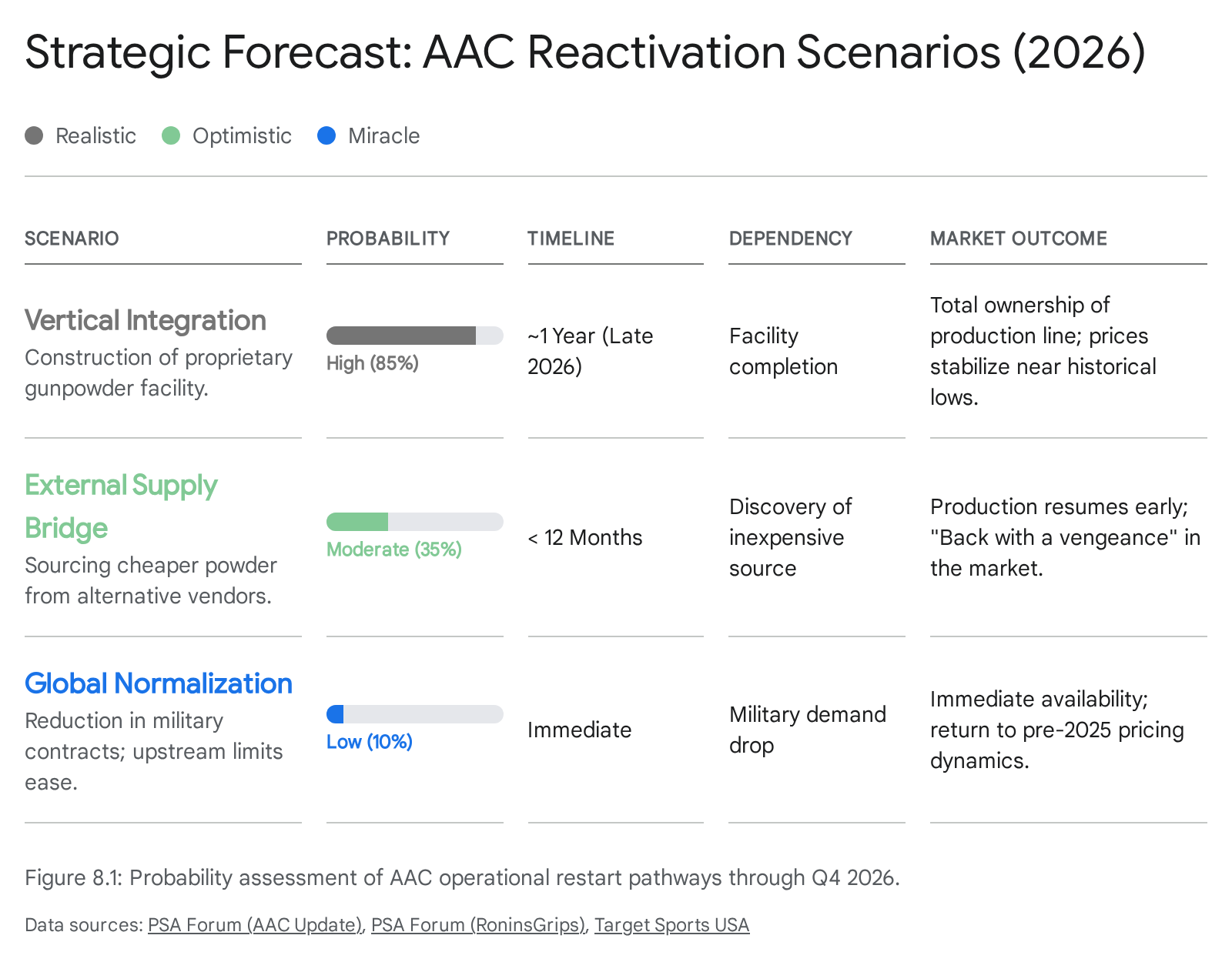
Based on the engineering, regulatory, and economic data analyzed, we project the following scenarios for 2026.

Ronin's Grips polymer samples showing heat resistance at different temperatures.

7.1 Recommendations for Stakeholders

  • For Retailers: Diversify supply chains to European imports (Fiocchi, Norma, PPU) which are less affected by the US-specific AES/St. Marks bottleneck.
  • For Consumers: Verify the “Lot Number” of any AAC ammo purchased on the secondary market. Avoid lots from late 2025 to mitigate the risk of jacket separation.
  • For Investors: Monitor JJE Capital Holdings’ filings for “Joint Venture” announcements regarding the new propellant plant.

8. Conclusion

The developments of January 2026 confirm that the Advanced Armament Company (AAC) is effectively offline as a mass-producer of ammunition for the current calendar year. The “pause” has hardened into a strategic retreat, evidenced by the layoff of the production workforce scheduled for January 30, 2026.1 JJE Capital Holdings has correctly identified that vertical integration of energetics is the only way to survive, but the timeline for such a capability is measured in years, not quarters.


Please share the link on Facebook, Forums, with colleagues, etc. Your support is much appreciated and if you have any feedback, please email us in**@*********ps.com. If you’d like to request a report or order a reprint, please click here for the corresponding page to open in new tab.


Sources Used

  1. Latest Layoffs in South Carolina – WARNTracker.com, accessed January 10, 2026, https://www.warntracker.com/?state=SC
  2. SC Industrial Holdings, LLC complete WARN notice layoff history on Dec 2025, accessed January 10, 2026, https://www.warntracker.com/company/sc-industrial-holdings
  3. Federal appeals court halts implementation of California’s climate disclosure law, accessed January 10, 2026, https://www.utilitydive.com/news/ninth-circuit-court-halts-implementation-of-california-climate-law-sb-261/805885/
  4. Baird v. Bonta – Ninth Circuit Court of Appeals, accessed January 10, 2026, https://cdn.ca9.uscourts.gov/datastore/opinions/2026/01/02/24-565.pdf
  5. California Ammo Buyers Guide | Palmetto State Armory, accessed January 10, 2026, https://palmettostatearmory.com/help-center/faq/california-ammo-buying-guide.html
  6. AAC Ammo pausing production – Ammunition – Palmetto State Armory | Forum, accessed January 10, 2026, https://palmettostatearmory.com/forum/t/aac-ammo-pausing-production/42812
  7. AAC ammo grenading rifles | Sniper’s Hide Forum, accessed January 10, 2026, https://www.snipershide.com/shooting/threads/aac-ammo-grenading-rifles.7256896/
  8. Aac 77gr otm listings – #27 by bfoosh006 – General Discussion – Palmetto State Armory, accessed January 10, 2026, https://palmettostatearmory.com/forum/t/aac-77gr-otm-listings/40580/27
  9. Ghosted by PSA Warranty Dept. : r/ar15 – Reddit, accessed January 10, 2026, https://www.reddit.com/r/ar15/comments/1mug3v4/ghosted_by_psa_warranty_dept/
  10. 5.56 Ammo for Sale | Buy 556 Ammo Online at GunBroker, accessed January 10, 2026, https://www.gunbroker.com/5.56-ammo/search?keywords=5.56&s=f&cats=1012
  11. Warranty Policy | Palmetto State Armory, accessed January 10, 2026, https://palmettostatearmory.com/help-center/terms-conditions/terms-warranty-policy.html