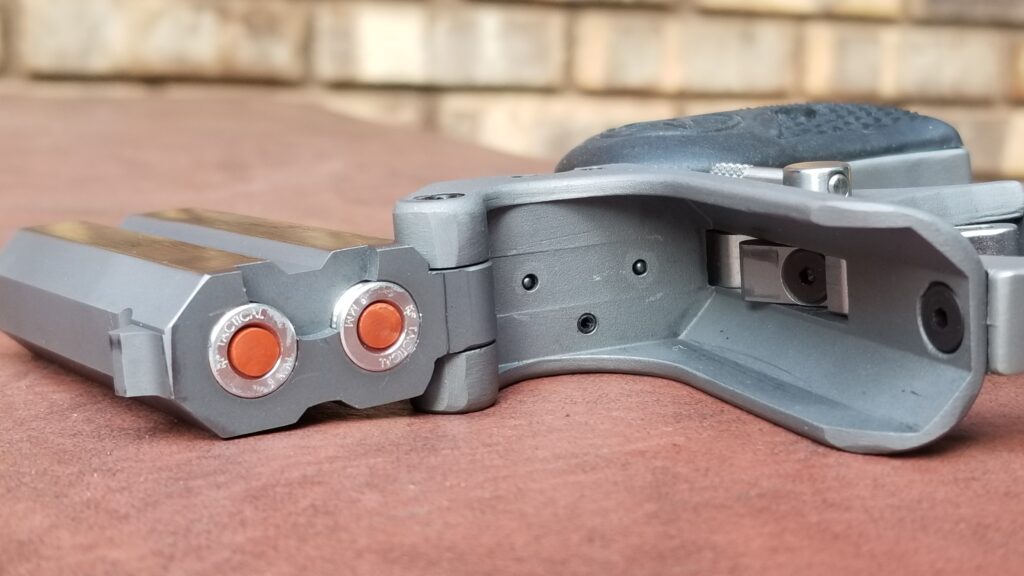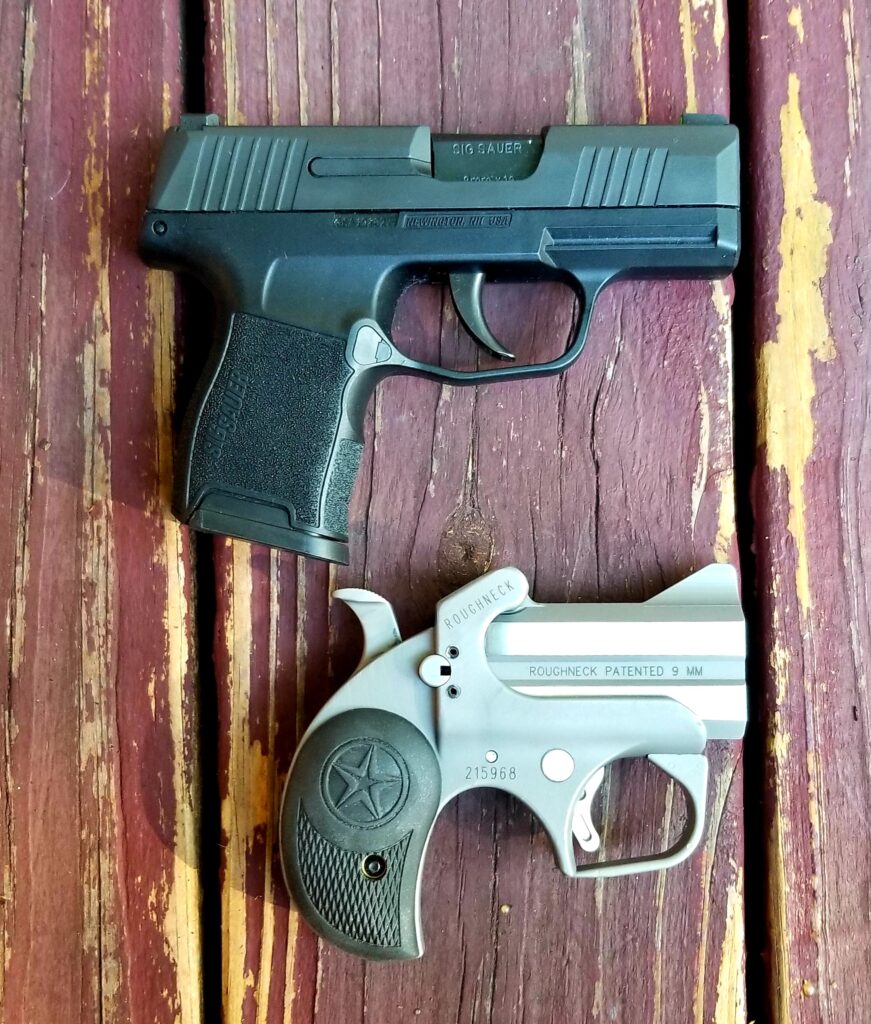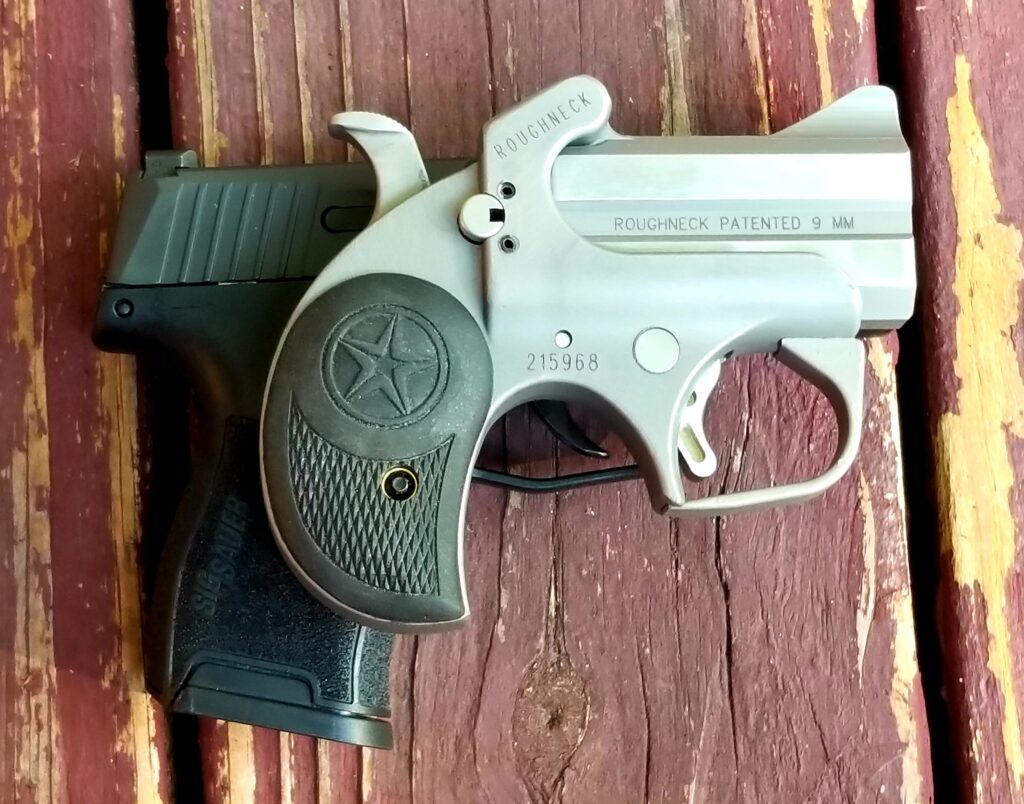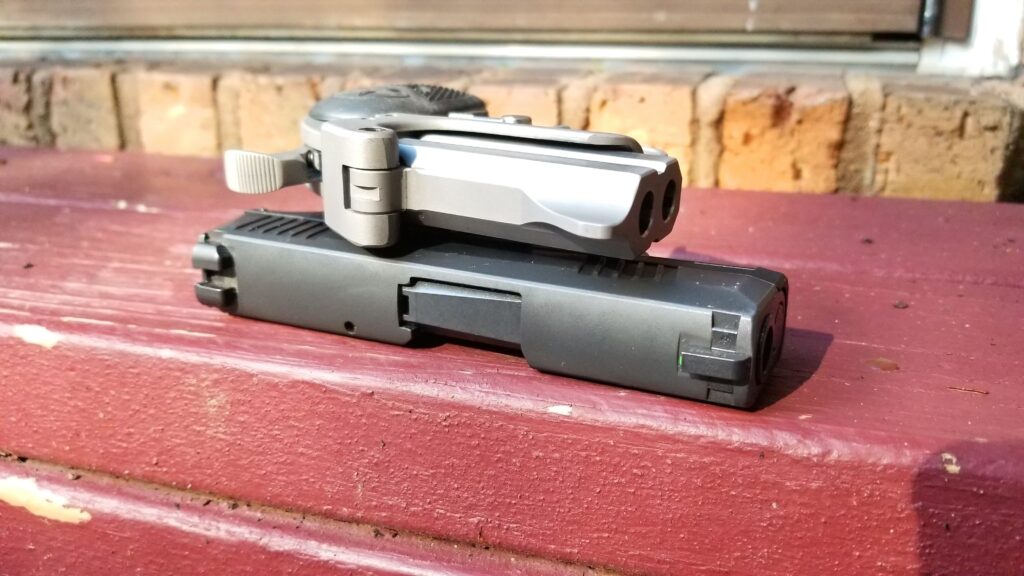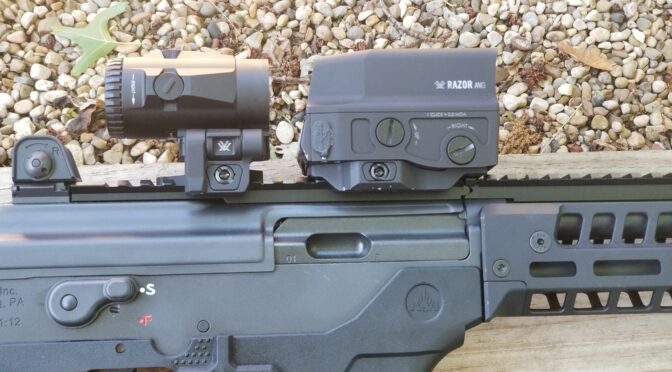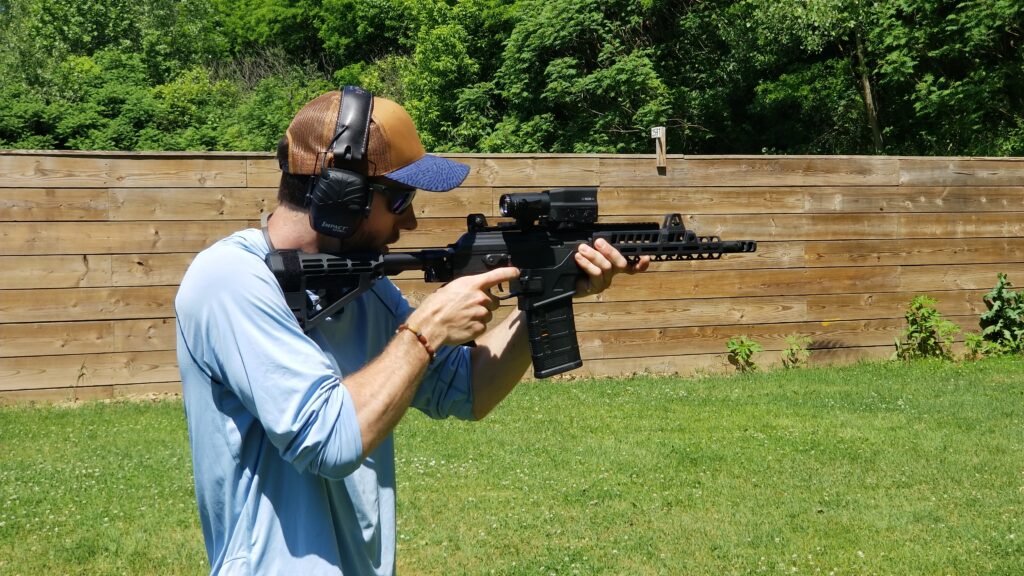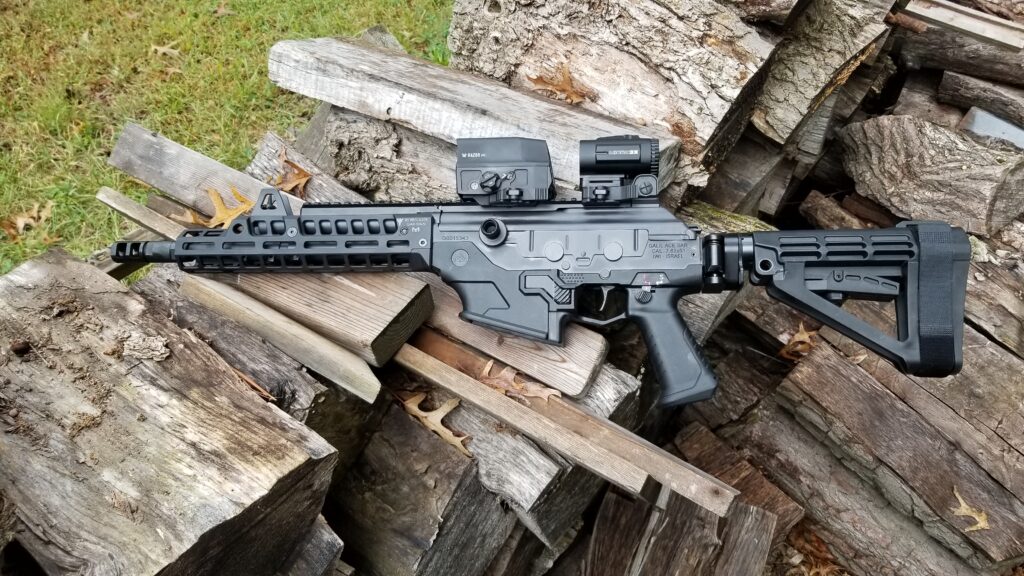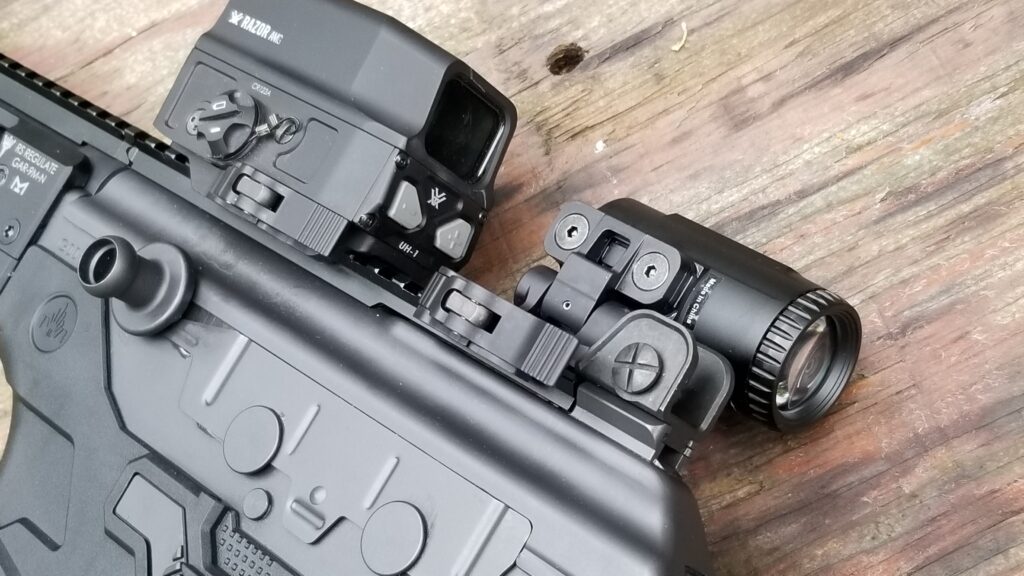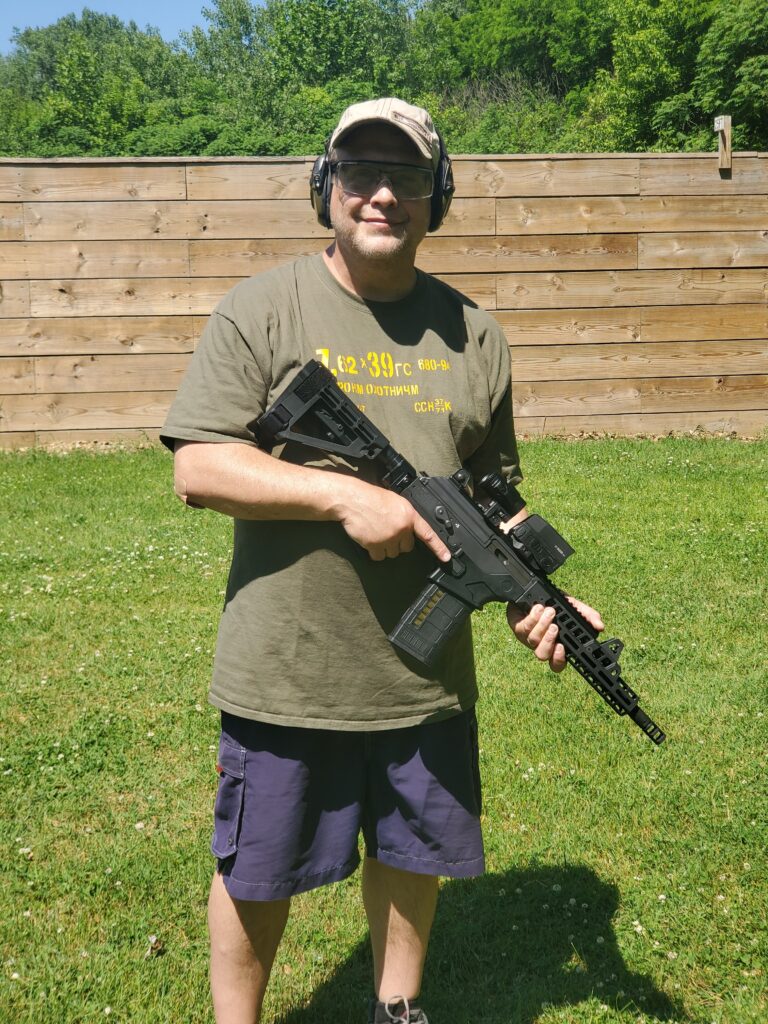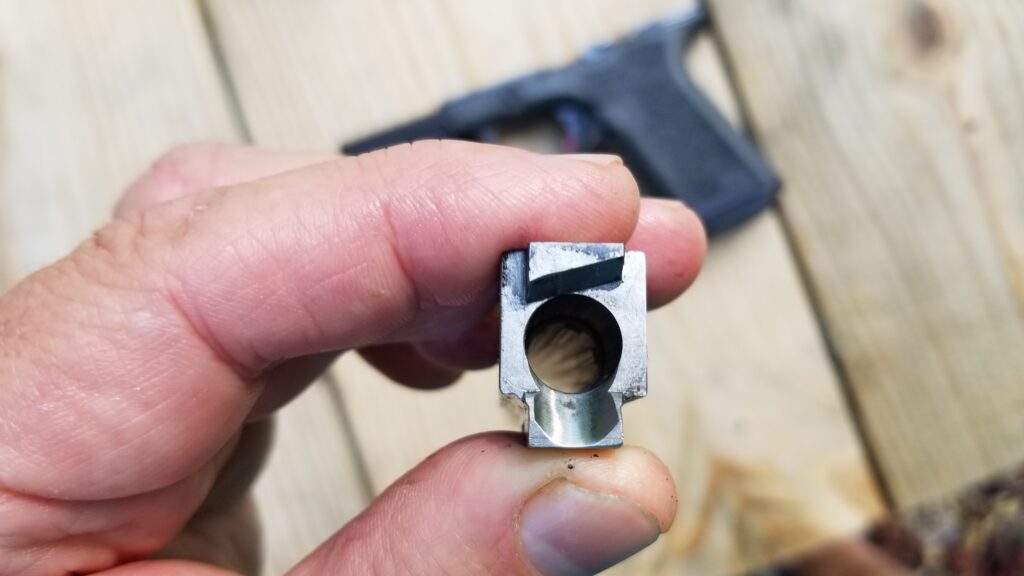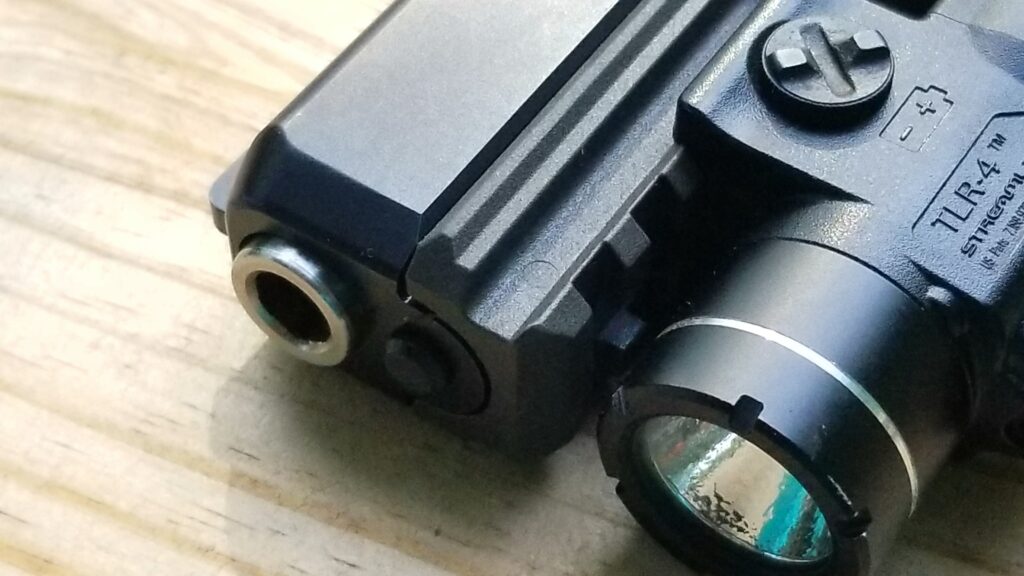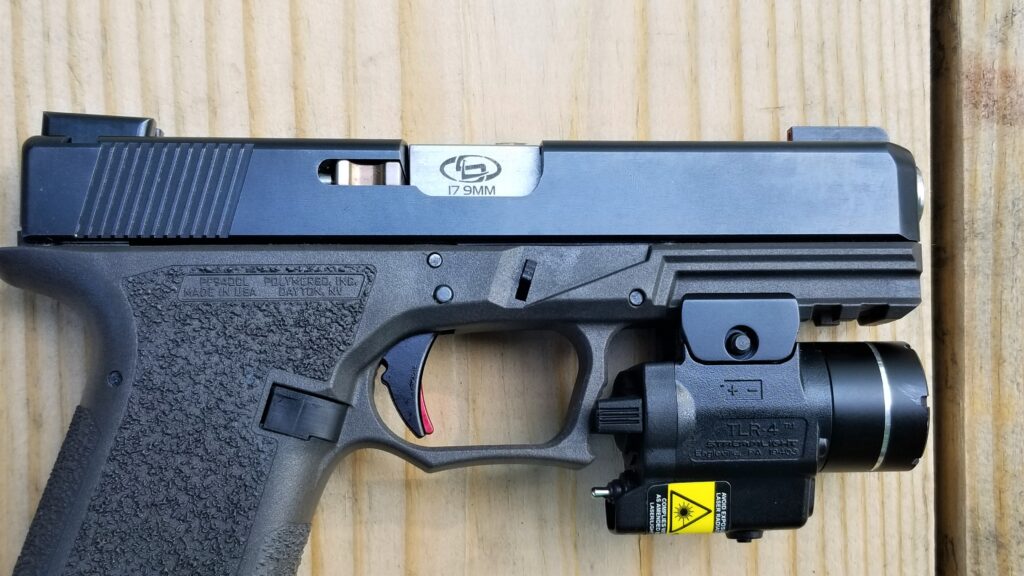
Eric’s build is looking very slick!!
What is a Ferrule on Yugo and AK Rifles?
A ferrule is a metal end cap found on some wood grips and handguards to protect the end grain of the wood from being hammered and splitting open. They were used on different country’s weapons and are usually not interchangeable between countries. For example, Bulgarian and Yugo ferrules are different.
Near and dear to me are the metal ferrules on Yugoslav / Zastava wood lower handguards. The following photo shows a M92 lower and the black metal cap is the ferrule. This ferrule does not fit everything Yugo – just the M70, M85/92, and M77. The M72 and M76 are unique sizes.
You have three options when you need a ferrule: 1) Find a used one and this is real hard – try posting in the Marketplace of http://www.akfiles.com and see if they have one. 2) Buy a replica ferrule from us or 3) Simply pry the old ferrule off, put it on the new handguard and the squeeze the tabs shut again with a pair of pliers.
Note if you are putting it on one of our plastic handguards either just set it on it with the ears closed or glue it in place. Absolutely do not try to squeeze the ears shut — the little metal divots will not dig into our plastic and you risk snapping the handguard tabs. Again, either slide it on or glue it in place with something like rubber glue or Goop that you can later remove if you want. Epoxy works too but it is pretty permanent.
For example, I just slid the ferrule on the M70 bulged handguard in the next photo.
We manufacture ferrules that fit the Yugo/Zastava M70, M77, M85 and M92 lower handguards. Note, they are specific to those models and will not fit other nationalities or models.
Click here to visit our store with the ferrules for sale.
Please share the link on Facebook, Forums, with colleagues, etc. Your support is much appreciated and if you have any feedback, please email us in**@*********ps.com. If you’d like to request a report or order a reprint, please click here for the corresponding page to open in new tab.
What the M92 Looks Like After All the Mods
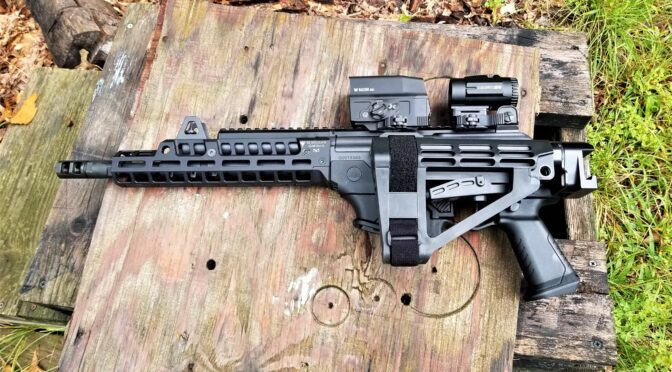
This shows what the M92 looks like today. I haven’t had time to go to the range yet but the “feel” is fantastic in terms of weight, balance and length. CNC Warrior nailed the folding arm brace. Wow – how cool it is!
Here is a list of the modifications made:
- CNC Warrior Folding Arm Brace
- CNC Warrior 4 Piece Brake
- CNC Warrior Detent Pin
- CNC Warrior Picatinny Rail Scope Mount
- Ronin’s Grips M92 Ferrule Cut Handguard Set
- Ronin’s Grips Bulgy ARM-9 Pistol Grip
- Ronin’s Grips M92 Dust Cover Quick Takedown Pin
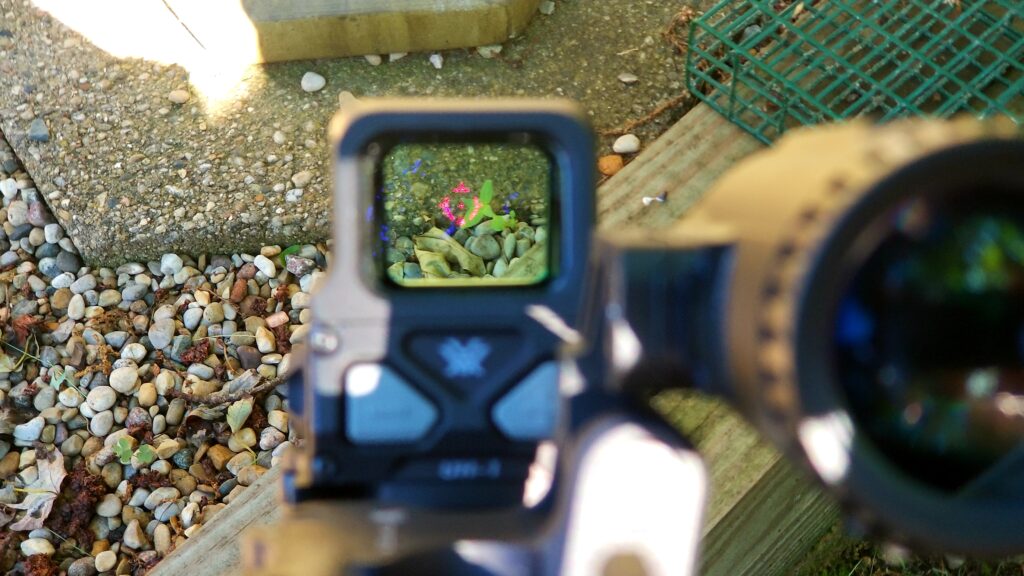
- Vortex Sparc Red Dot with the Low Mount


Please share the link on Facebook, Forums, with colleagues, etc. Your support is much appreciated and if you have any feedback, please email us in**@*********ps.com. If you’d like to request a report or order a reprint, please click here for the corresponding page to open in new tab.
How to Install Ronin’s Grips M92 Handguards
This is another long overdue step by step guide. We have been selling M92 handguards for over two years and people ask about how to install them so let’s try and take this step by step.
SAFETY STEP – MAKE SURE THE WEAPON IS UNLOADED. NEVER ASSUME THAT IT IS – VERIFY IT IS UNLOADED BEFORE YOU BEGIN WORK.
1. Open the dust cover so the gas tube can be removed.
2. Take a look at the upper portion. The gas tube cover is actually a semi circle held in a groove formed by sheet metal. To remove the cover, secure the forged metal end of the tube (NOT THE SHEET METAL END OR IT WILL BEND) in a vise or use an open end wrench. Turn the cover 180 degrees until it faces the opposite way and it will come right out of the retainer.
3. See the metal clip in the gas tube cover? You will want to move that clip to our gas tube cover as it helps secure it in place.
4. Next, look at the lower handguard. In the front of the guard on the left side you will see a small lever that needs to be rotated inward. Once that is done, the handguard retainer can be slid forward.
4. The lower handguard is then pulled forward and down to be removed.
5. I am asked regularly about what a ferrule is. Folks, that black metal cap on the end of the lower is a ferrule. It protects the end grain of the wood from being split open. We sell a handguard that can use a ferrule if you like the looks of it plus we sell a version that does not need the ferrule. It is entirely up to you. I sometimes use the ferrule to accent whatever color handguard I am working with – for example, Dark Olive Drab to Dark Russian Plum.
6. This only applies if you buy one of our handguards that uses the ferrule – you can use your existing ferrule by using a screwdriver to bend the tabs open on the receiver stub and then working the ferrule backward and off the wood lower handguard. You can then glue it to our’s or even leave it loose.
7. When you install our lower handguard, you reverse the above steps. We sell optional shims in case you need to tighten the fit. The example shim here is a special orange material we tested and now we use a special hard black rubber. You can buy our shims or make your own. In either case, your goal is to add just enough material to get the retaining lever to turn down firmly and lock up the lower handguard. Because AKs can vary, you may find that you need to either add or subtract material so take a careful look at your lower retainer and decide which way you need to move before you go sanding, cutting, filing, etc.
So that’s about it. The following are photos of the M92 with the new ferrule cut handguards installed.
If you’d like to learn more or order our handguards, please visit our online store’s Yugo handguard section at: http://shop.roninsgrips.com/Yugoslavian_c14.htm
Note, the following is a video a fellow did showing how he removes and installs M92 handguards in general. I think this might help some of you who want to see the steps in more detail:
Please share the link on Facebook, Forums, with colleagues, etc. Your support is much appreciated and if you have any feedback, please email us in**@*********ps.com. If you’d like to request a report or order a reprint, please click here for the corresponding page to open in new tab.
Installing the CNC Warrior Picatinny Rail Scope Mount for the M92 PAP Pistol
Another great accessory for the Yugo M92 or M85 PAP is the slick picatinny rail kit that CNC Warrior sells. This thing is a breeze to install and is the best means I have seen for adding an optic to the M92. Because the screws are inserted from the rail side, it is superior to other products that require the screws to come in from underneath the dust cover and risk being hit by the bolt carrier.
All you need is the pistol, a drill and some cutting oil to do the installation.
SAFETY STEP – MAKE SURE THE WEAPON IS UNLOADED. NEVER ASSUME THAT IT IS – VERIFY IT IS UNLOADED BEFORE YOU BEGIN WORK.
1. This is the top thick hinge of the M85/M92 dust cover. See the faint circles? Those are the spot welds and they are very hard! Do not drill into them! The new CNC Warrior mount has four holes and you only need to use two of them. The reason there is four is so you can pick the best two that get you around/away from the spot welds. Please note that my rail is only silver because it was a brand new design and they hadn’t applied a finish yet. If you order one, you will get a black rail!
2. Here you can see my fancy high tech tools. My Ryobi drill, Tap Magic cutting oil to lubricate the drills and the taps. Note, you will need to buy a tap handle if you do not have one. Do not take the short cut of trying to start the tap with a regular socket or open end wrench. You really want the tap to be firmly held so you can tap the threads at a right angle to the surface of the hinge. Also, see that little black cylinder? That is a drill guide that you put into the hole you select to guide the drill bit to the right place on the hinge. Be sure to use the cutting oil!
3. As an aside, I blasted the mount and then sprayed on flat black Molyresin and baked it. You’d never know it came to me unfinished.
By the way, pictured above is a cheap Harbor Freight air brush. I used to buy a bunch of them at a time and then throw them away when they hard problems. I now use a Paasche H series air brush and am much happier with it.
4. After you clean up the chips and are ready to do the final screwing of the mount, be sure to apply Blue Loctite so it does not come loose.
That’s it! The mount is solid and it holds my Vortex Sparc red dot just great. Note our quick takedown pin to make it easy to remove the cover and get the optic out of the way.
10/27/18 Note: Vortex discontinued the Sparc red dot. They sell a great 2 MOA red dot called the Crossfire that I really like.
Please share the link on Facebook, Forums, with colleagues, etc. Your support is much appreciated and if you have any feedback, please email us in**@*********ps.com. If you’d like to request a report or order a reprint, please click here for the corresponding page to open in new tab.
Installing the CNC Warrior M92 Folding Arm Brace – So Sweet!!!!!!
Next up on the agenda was to install the CNC Warrior folding M92 arm brace. This thing is wickedly well done and if you get it plus the optional installation kit, just about anyone comfortable with using a drill can do it.
The following is a quick photo of the installation kit – you will need a hand drill and some cutting oil – I like Tap Magic but just about any oil will do vs. running dry and overheating stuff. You do not want to work harden the sheet metal of the receiver — use cutting oil and keep it cool!
SAFETY STEP – MAKE SURE THE WEAPON IS UNLOADED. NEVER ASSUME THAT IT IS – VERIFY IT IS UNLOADED BEFORE YOU BEGIN WORK.
1. Make sure your weapon is securely mounted and that you can have ready access to the rear. The PAP buttstock drill kit has this handy little jig block to help you locate where to drill the small starter hole.
2. With the jig in place, put in some cutting oil and drill the hole. Note, I am just using a plain Ryobi 18volt hand drill. The big bit is 3/8″ and I think 12 volt or better could do the job. The small hole will help you locate and drill with the bigger 3/8″ bit.
3. Be sure to read the instructions and the caution to go real slow with the 3/8″ bit because if you try to go fast, your bit is apt to grab and thread straight into the receiver. If this happens then you can’t drill the hole as the bit is grabbed and goes in like a powered screw with a boatload of torque. Now, I did make this mistake but I knew how to get out – I grabbed a 3/8″ cobalt end mill, checked it in my drill and cut the big offending tabs right out of the hole. If you run into this, you would need to either get an end mill bit or try using various Dremel bits to remove what is left.
Unless you have a milling machine, I would not recommend drilling the hole with the end mill – just use it for clean up if needed. I just used it to clean the bottom of the hole and I used cutting fluid.
The following is a link to a well regarded carbide mill that will work just fine in this situation.
4. My next steps were to use a deburring tool to make sure I didn’t leave anything nasty and sharp in the hole waiting to cut me! I also vacuumed out the inside of the pistol and made sure it was clean.
5. The folder is connected to the receiver via a threaded block that is inserted into the receiver and you then thread the large allen screw into it. Be sure to line things up and apply Blue Loctite so it will not come loose over time.
That’s all there was to it!! This is a very well done piece of gear guys. The folder mechanism is solid and the brace feels great either on the shoulder or on the arm plus you can fold it out the way. Note the quick release sling swivel. I used one of my Troy swivels – the folder has the hole to use one but it is up to you as to whether you want one or not.
One last comment – I am keeping the printed copy of the ATF approval letter (that comes with the brace) in my case with the M92 to show anyone who asks that the brace is not a buttstock and this the M92 is not a SBR. You might want to do the same.
By the way, for any of you wondering why I am using all these CNC Warrior parts on this build – the answer is simple – they make really good stuff and this is my personal M92. I only want solid reliable stuff on it.
Note, I have to buy all of my parts – nothing here was paid for by sponsors, etc. I do make a small amount if you click on an ad and buy something but that is it. You’re getting my real opinion on stuff.
Please share the link on Facebook, Forums, with colleagues, etc. Your support is much appreciated and if you have any feedback, please email us in**@*********ps.com. If you’d like to request a report or order a reprint, please click here for the corresponding page to open in new tab.
Removing the M92 PAP Muzzle Cap and Installing the Detent Pin
The M92 PAP pistol is brought in neutered with a muzzle cap and no detent spring. With some careful Dremel work, some cold blue solution and a bit of patience, it is really easy to restore the pistol back to it’s original threaded muzzle state
SAFETY STEP – MAKE SURE THE WEAPON IS UNLOADED. NEVER ASSUME THAT IT IS – VERIFY IT IS UNLOADED BEFORE YOU BEGIN WORK.
1. Look at the muzzle of the PAP
M92 and you will see a big spot weld that is holding the muzzle cover on. Thankfully it is both small and superficial so it can be cut through.
2. Now the first step is to secure the pistol so it can’t move around. I used a wood jawed woodworking vice but you can use whatever you have handy. If you use a regular vise, be sure to put something over the jaws to protect your M92 from getting all scratched up.
3. I use my Dremel tool all the time. These days I am using one of their cordless jobs with two Lithium batteries and I like the EZ Lock bits that make replacing cutting wheels and other tasks a breeze. Be sure to practice with your Dremel before doing this. Please don’t go buy a Dremel and try and do this fresh out of the box. The secret is to make light cuts and not rush. Let the weight of the tool do the work and carefully guide it and keep it in position.
4. Now, I came in from the front and at a slight angle to protect the front sight & gas block combo. The cap will twist off clock-wise as it is reverse threaded. Cut a bit and test, cut a bit and test over and over. If you have a strap wrench or a pipe wrench, that can help with the removal. Again, remember that this is reverse threaded just like other AKs. It will loosen by turning clockwise.
5. Hidden under that large ugly cap is the big 26 x 1.5mm LH (reverse threaded) muzzle just waiting to have your favorite brake or fake can installed but it would be real cool to get the detent pin working again – wouldn’t it?
5. Use a small sanding drum and smooth the block where the weld was and then use the cold bluing solution you like to color the steel while it is fresh and oil free. I like Brownell’s Oxpho Blue and apply it with a Q-Tip per their instructions.
6. CNC Warrior sells a very small kit with the detent pin, spring and cross pin. The PAP has all the holes there already. You literally slide in the pin and spring, turn it the right way and then drive in the cross pin, which is a small roll pin.
7. I really like the Bulgarian 4 piece Krink brakes and CNC Warrior has great version they have made for the M92. I pretty much knew I had to go with this brake! It does a great job reducing muzzle flash and is real high quality. Now that the detent pin was installed, I just threaded it on until it was where I wanted it and the detent pin engaged fully.
So that’s all it took! I hope this helps you with your project.
Stay tuned for more blog posts about the M92.
Please share the link on Facebook, Forums, with colleagues, etc. Your support is much appreciated and if you have any feedback, please email us in**@*********ps.com. If you’d like to request a report or order a reprint, please click here for the corresponding page to open in new tab.
How to Install a Yugo M85 or M92 Dust Cover Quick Takedown Pin from Ronin’s Grips
Years ago, I bought a barreled M92 kit from AK-Builder.com and assembled it. I then installed a Stormwerkz rail and a Primary Arms M4-style red dot and the dust cover being attached to the rear sight block really got annoying fast. After some careful examination, I figured out a quick release pin with a ball bearing detent to hold it in place would really make things easier. It worked great and I have been selling the pins like crazy for almost two years. I made a mistake though – I didn’t take step by step photos about how to do the installation and people keep asking for a how-to guide. Thus, I recently bought a Yugo M92 PAP pistol imported by Century Arms from my good friend Scott Igert, who owns Modern Antique Firearms in Benton Harbor, MI, so that I could do some step by step how-to instructions with a lot of photos for folks.
The work will be done with a Dremel tool with a cut off wheel, a few small punches, hammer and a rubber gunsmith block.
SAFETY STEP – MAKE SURE THE WEAPON IS UNLOADED. NEVER ASSUME THAT IT IS – VERIFY IT IS UNLOADED BEFORE YOU BEGIN WORK.
1. Look at the hinge pin/rivet. On the side opposite the charging handle, you will see a big rivet head. On the right side, you will see an odd looking head it is actually the rivet just slightly peened over into a concave washer. It is that side that we will grind the peened over portion off with our Dremel. By the way, it is really a pin but it has one end peened over like a rivet. A rivet would swell into the hole and lock everything up – a pin does not.
2. If you don’t use a Dremel tool, take a few minutes and do some practice cutting with a cut off wheel. It has a tendency to scoot around and you need to get a feel for it so you can control it. Please, please, please – do not take your Dremel out of the box and try to do this for the very first time. I like the cordless Dremel as I can work anywhere and lately I have become very fond of the EZ Lock bits. Of course you can use whatever tool you are comfortable with but this step by step explanation should make the work required more clear (I hope).
3. If you are still learning, put a couple of pieces of tape with a slit over the pin’s head that is peened into the washer. With some tape in place, if your hand slips you will be less likely to mar your finish. Folks, the secret tip is to do very light cuts. Let the weight of the tool or even less do the work. Do NOT push down hard or you will snap the bit. I also rest my hands on any surface that I can to have more control. You’ll notice I have a rubber gunsmith block to support the pistol – you could use a piece of pine, a hockey puck, or another non-marring surface. You want the weapon to be stable when you work on it and you will need to lightly tape the hinge pin/rivet free once the head is ground off. I used pieces of wood for years and years before bought the block – the key is to have the support and use something that will not scratch up your finish.
4. You are just removing enough metal get get rid of a small lip on the rivet. The next two photos show you the slightly concave look I put in the rivet and you can barely see the shaft. I then used a small pin punch and a tap from a small hammer to get the pin moving. It will take very little force to get it to move. If it doesn’t readily move, then you may need to grind it a bit more. The only thing holding that rivet shaft in place is the peened edge – it is not swollen in the hole.
5. This is a photo of the removed rivet and the hinge rivet/pin starting to slide backwards. I then used a small punch pin to push it out. The fourth photo shows the original pin and washer so you can see the end result.
6. At this point, the dust cover hole is clear but do not try to push the new pin in. The cover cams shut and it will be needlessly difficult to push the pin in. For comparison, our pin is shown next to the original. The pin with a groove in it is something you do not want to lose! The angled portion is face up towards the dust cover and the round end goes towards the gas tube. When the dust cover closes, the pin slides forward and holds the gas tube is locked in place. It’s very simple and does the job just fine. This locking pin is held in the rear block by the dust cover pin so every time you remove the pin, it can come out. Just keep track of it each time you clean your M85 / M92 as you will need it.
7. Now, to install our quick takedown pin, install the dust cover, lift it up and align the holes. At this point, there is no pressure and our pin will slide easily into the hole. When the dust cover is closed, the resulting pressures lock everything in place. That is why it works so well with hinge mounted picatinny rails. My favorite these days is the hinge mounted frail from CNC Warrior by way and we’ll right up an installation guide for that as well.
So that’s it! Again, the key is to use light pressure when grinding the peened over portion of the original hinge pin/rivet away. Then, install the new pin with the dust cover open so it can readily slide in.
If you are interested in buying a pin, please click on this link to go to our online store.
Please share the link on Facebook, Forums, with colleagues, etc. Your support is much appreciated and if you have any feedback, please email us in**@*********ps.com. If you’d like to request a report or order a reprint, please click here for the corresponding page to open in new tab.