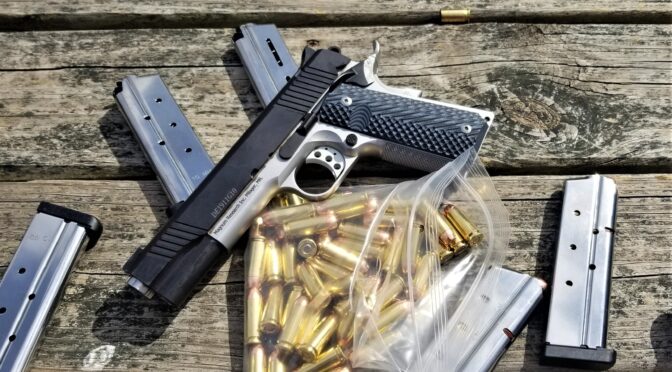
It was brought to my attention that there are owners of high capacity (HC) Rock Island Armory (RIA) Full Size A2 pistols who are in a jam because where they live limits their magazine capacity to 10 rounds (California, Connecticut, Washington DC, Hawaii, Maryland, Massachusetts and New York state to name a few. The problem is that nobody is making 10 round magazines for these “high cap” RIA pistols — until now.
The following are the 15-round 10mm and .40 high cap RIA pistol models that I am aware of:
51994 TAC Ultra MS 10mm
51914 TAC Ultra FS 10mm
56862 TAC Ultra Threaded 10mm
52000 PRO Match Ultra 6″ HC 10mm
52009 Rock Ultra FS HC 10mm
51738 Pro Match Ultra H – 40S&W
3/24/2024 Update: This is an obsolete post and product. We now make 10 and 15 round magazines by blocking and pinning closed our third generation magazines. These new mags have excellent springs and an anti-friction coating. Please click here for the product listings.
How did we make a 10-round magazines?
Okay, good question. The RIA pistols are related to Para Ordnance pistols (Paras) so magazines for those pistols can be adapted. Mec-Gar is a large players in the magazine market and it just so happens they make a number of magazines for the Paras including ones with 10-round limits – the MGP164010B – “B” meaning blued and MGP164010N – “N” meaning nickel plated.
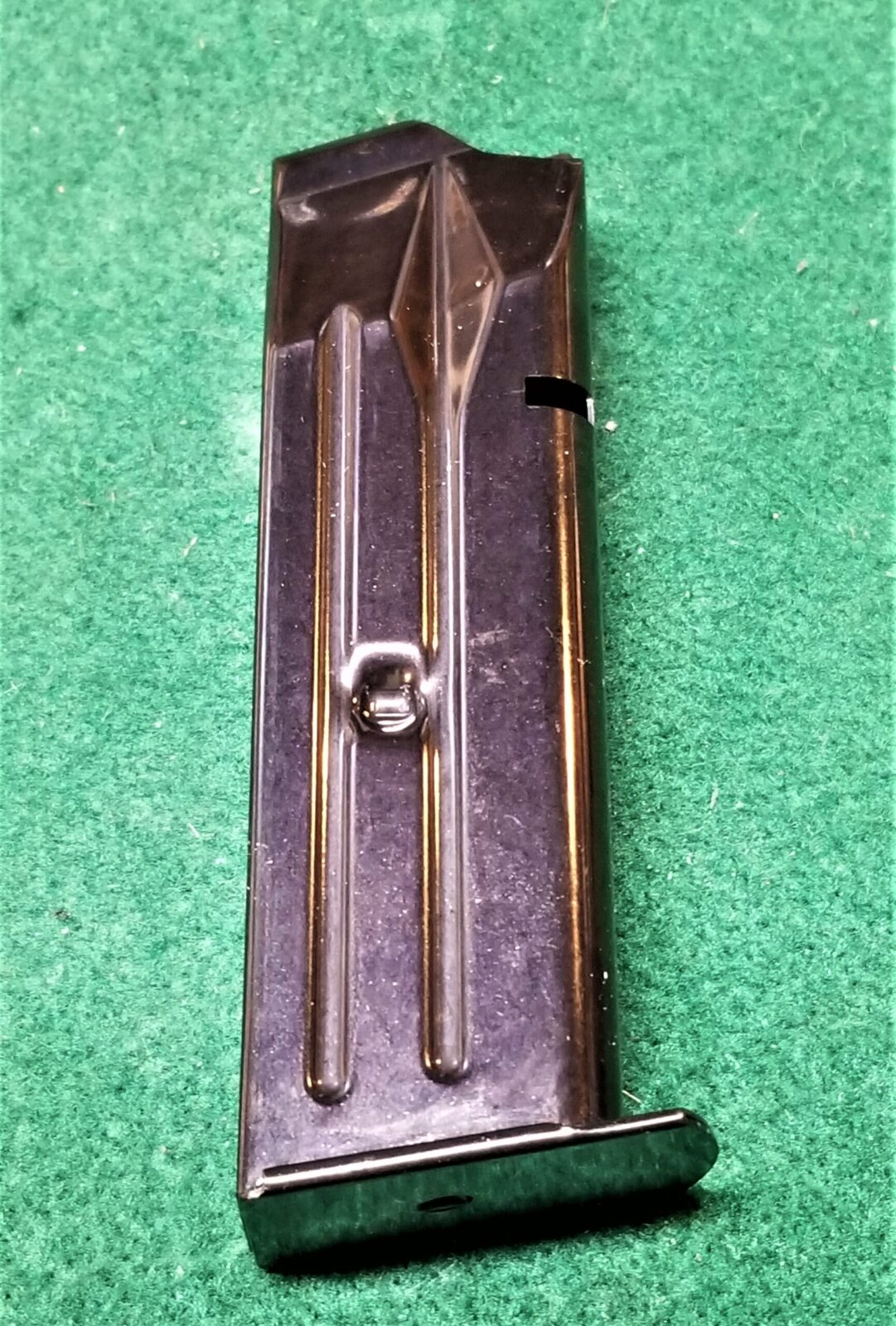
This is the Mec-Gar MGP164010B magazine – the feed lips need to be trimmed and opened up and the baseplate needs to be replaced as the long front tab will not fit in the big mag well funnels that RIA puts on their pistols plus they really need to be longer to allow you to effectively smack that mag into position in a rush. Last comment – that dimple is pressed in with a die and limits the follower from going down to far such that only 10 rounds can be limited.
The above magazines are essentially Mec-Gar’s 15-round Para P16 MGP164015B magazine but with the dimples pressed into each size of the magazine limited the capacity to 10 rounds. So everything I learned about converting the Para 16 mags over for RIA HC use applied here not to mention the jigs I had worked out to do the work.
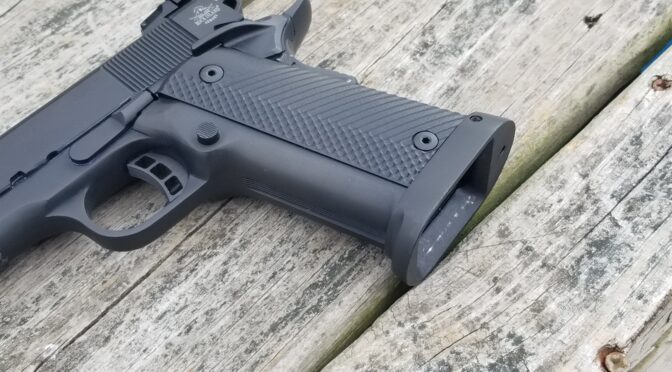
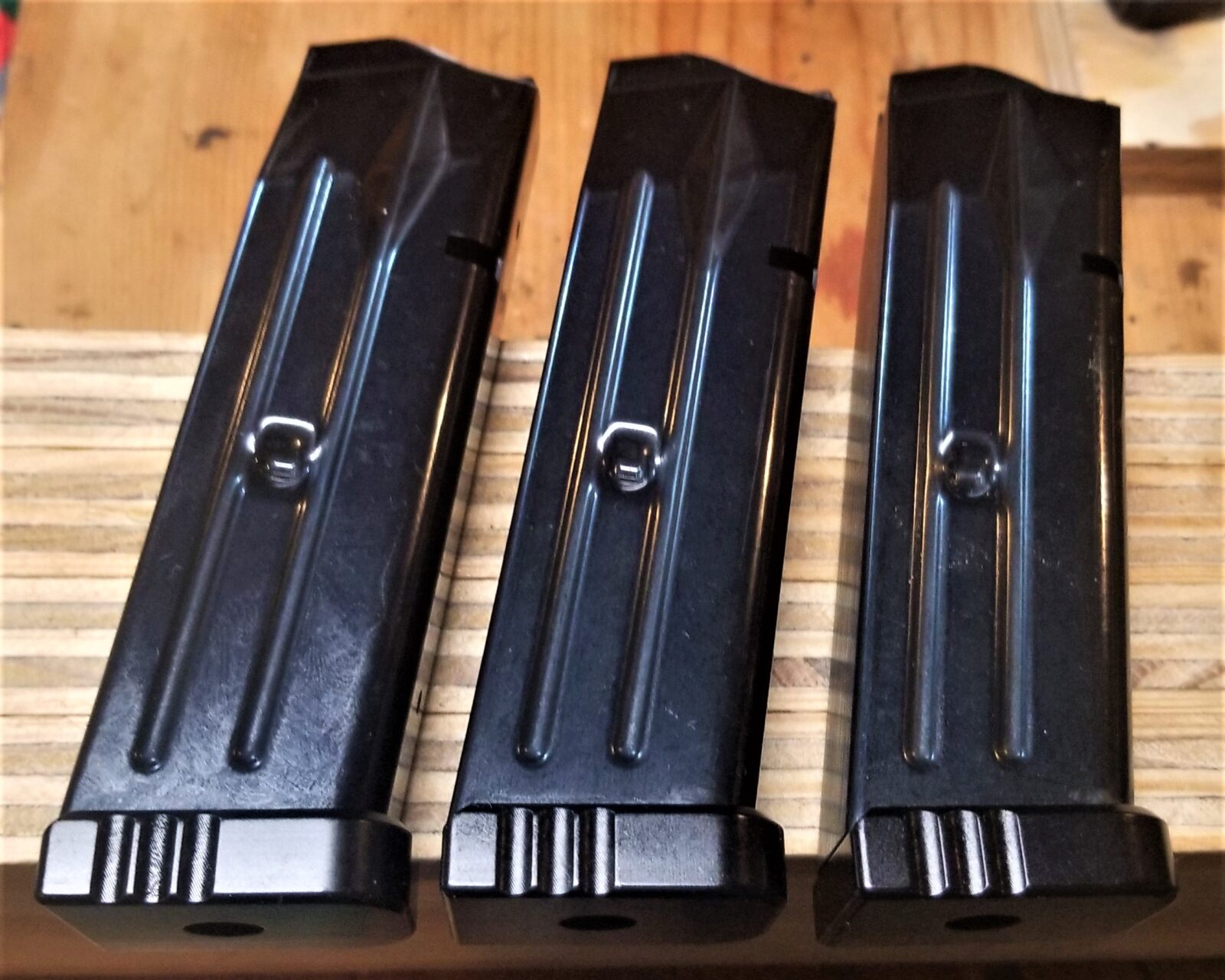
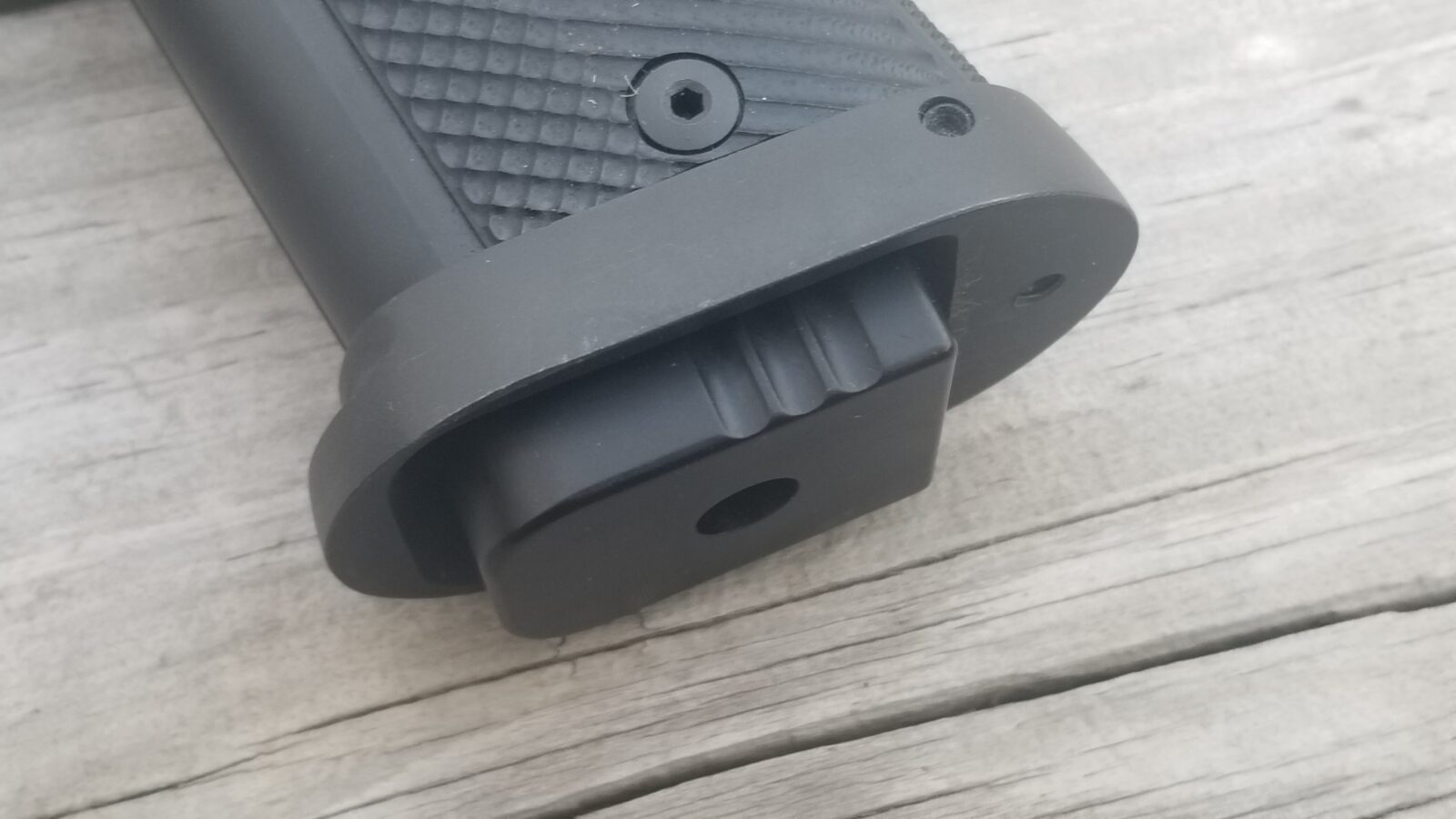
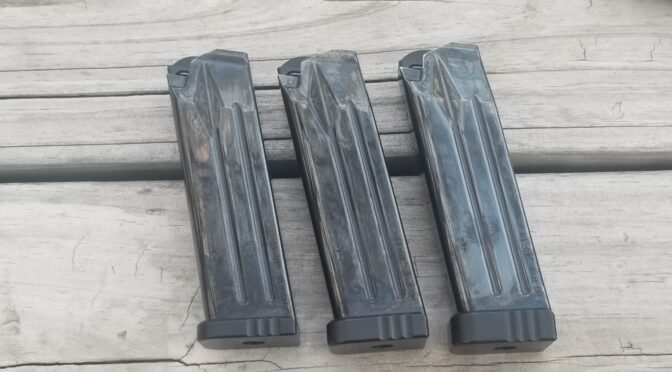
These are three examples of the converted 10-round magazines ready for RIA HC pistol use. The thicker Dawson Precision +200 base plates protrude just a bit from the big RIA funnel and allow for positive seating of the mags (that’s a fancy way to say “slap them in so they seat fully”).
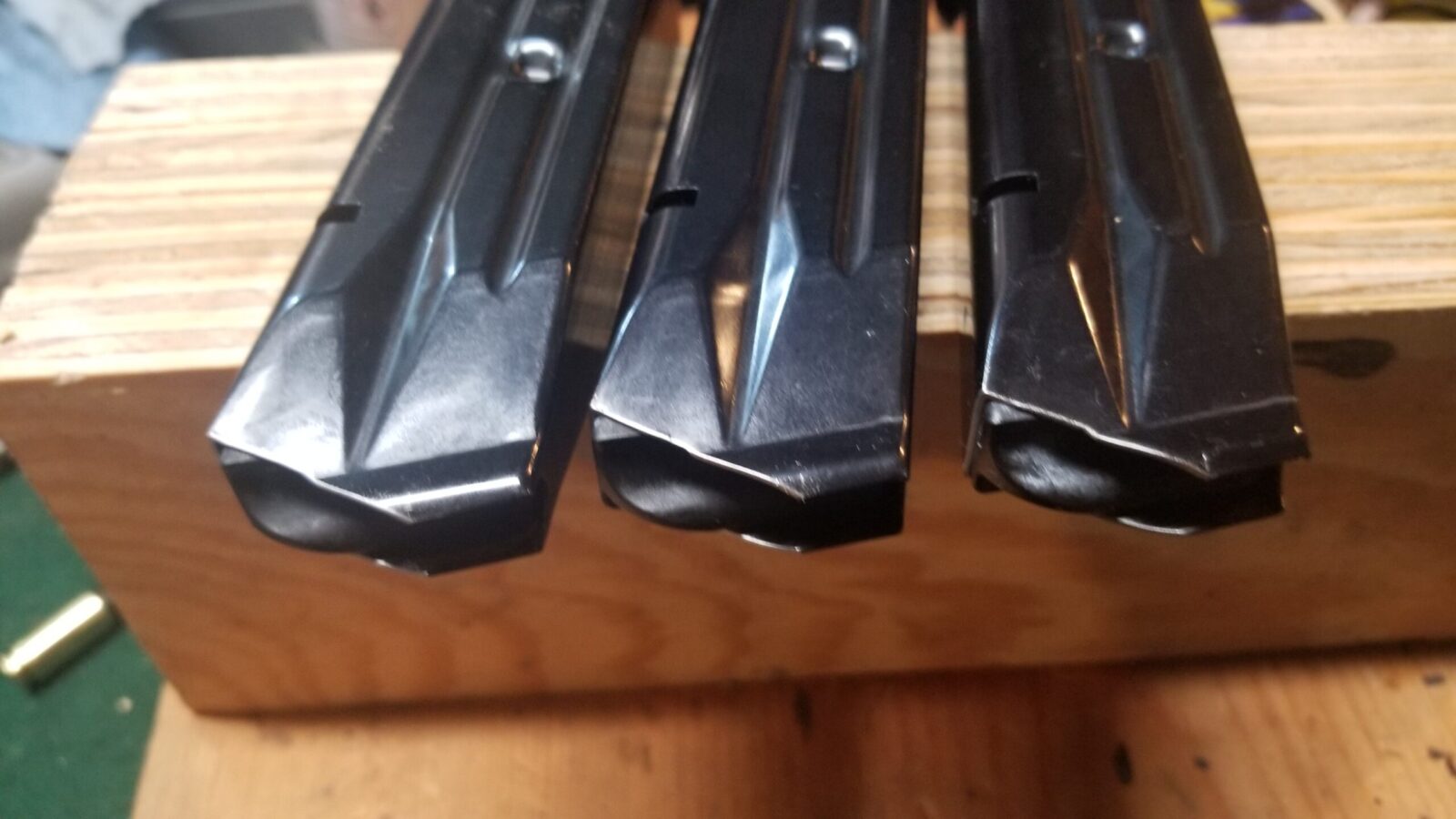
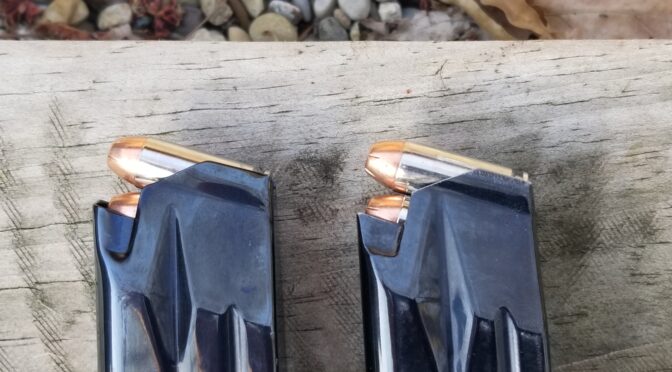
This is a better view of the modified feed lips. The magazines retain their original followers that lock the slides open.
The +200 base plate extends just a bit below the funnel.
Because of pistol and magazine variations, you may find that you need to adjust the feed lips just a bit for your pistol. This sounds daunting but it is actually quite easy. Click here for the blog post on that.
I have an initial batch of magazines ready for sale and have more if the Para mags coming in. I don’t know how secure the supply will be of the Mec-Gar 10 round magazines but I will try to keep them in stock.
3/24/2024 Update: This is an obsolete post and product. We now make 10 and 15 round magazines by blocking and pinning closed our third generation magazines. These new mags have excellent springs and an anti-friction coating. Please click here for the product listings.
I hope this helps you out.
Note, I have to buy all of my parts – nothing here was paid for by sponsors, etc. I do make a small amount if you click on an ad and buy something but that is it. You’re getting my real opinion on stuff.
Well, President Biden caved to pressure and decided to do an executive order. While it hasn’t formally been published in the Federal Register yet the way it is supposed to be, I did create a quick summary of his April 8th, 2021, press conference based on a review of second hand articles:
He told the DOJ they have 30 days to rule on “Ghost Guns” meaning firearms made at home. We’ll have to see what they do here because law abiding citizens have been making firearms at home for the entire history of this country. One leak suggested they may require people to get background checks before building a firearm – but to be clear, there is nothing official.
He gave the DOJ 60 days to decide what to do on pistol braces. Unfortunately the mentally ill shooter in Minneapolis used one and the media keeps bringing that up to support the need to deal with them. All kinds of rumors are floating around – pistols in rifle calibers will require NFA registration, pistols in pistol calibers between a certain range of size and weight will be ok … it’s not clear what they will do but there are millions of these devices out there so they better think this through carefully especially when it comes to the existing owners.
They are going to draft some kind of sample/model “red flag law” legislation that states can then optionally adopt. Note how the guidance is at the Federal level but actual adoption will be up to each state. On the surface one would think that getting guns out of the hands of a dangerous person would be a good idea but the problem is in terms of who gets to deem a person dangerous? Will it be any “concerned” citizen calling in and saying someone is unsafe, will it be a judge, a panel? Will they truly be fair and impartial? There are a ton of problems here to sort out.
The Justice Department will issue a report on firearms trafficking. I expect the findings will be tailored to fit their political narratives vs. being impartial.
The administration will make more investments in community violence prevention programs aimed at reducing gun violence.
He announced David Chipman as his pick to head the ATFE. The was an ATF agent but as been a senior advisor to the anti-gun group founded be Gabrielle Giffords. Whether he can pass the Senate nomination process or not is unknown.
His administration promised that there is more to come. You’ll notice he keeps trying to push this toxic topic back to lawmakers who are divided and nothing has been accomplished since the election.
What this does highlight is that despite campaign rhetoric, Biden has limited options when it comes to gun control otherwise he would have made far more dramatic moves. Gun control tends to damage political campaigns of politicians and I think the President needs to carefully thing through where he will spend his political capital.
Whitehouse Logo Image Source: https://commons.wikimedia.org/wiki/White_House#/media/File:US-WhiteHouse-Logo.svg
In most magazine fed weapons, the angle at which the cartridge feeds into the chamber is critical to reliable functioning. This is certainly the case 1911-style pistols. I wrote up a blog post outlining what I did to modify Mec-Gar Para P16 10mm/.40 magazines over for use in the Rock Island HC-series (High Cap series) pistols such as my 10mm 52009 (click here if you want to read it). I got a few emails from guys asking if I could explain what needs to be done to adjust the cartridge angle.
Okay, so what is controlling the feed angle is in part the shape of the lips, the gap between them and the shape of the follower. Let’s take a look at an ACT-MAG that works for both .40 and 10mm:
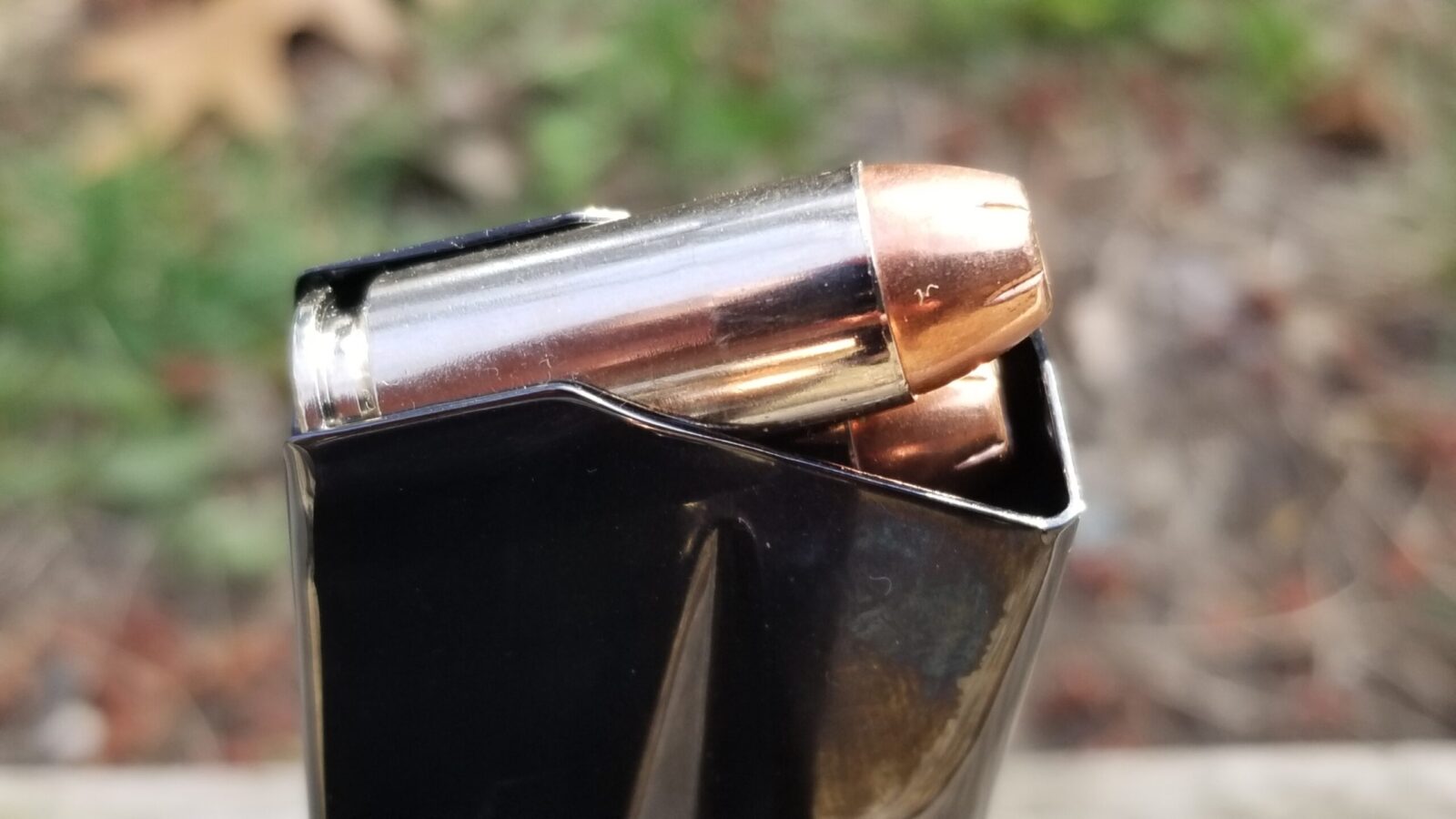
This is a Rock Island Armory 10mm magazine. It’s made by ACT-MAG and is part number OEMP164015B. RIA worked with them to design the angle of the lips, the gap between the lips and the shape of the follower to feed the round at the right angle. The cartridge is a 10mm Underwood with a 155gr XTP JHP bullet. Look at the angle.
There are a whole bunch of reasons why you need to adjust the angle as a consumer. Slight variations in how the pistol or magazine were made, wear over time, etc.
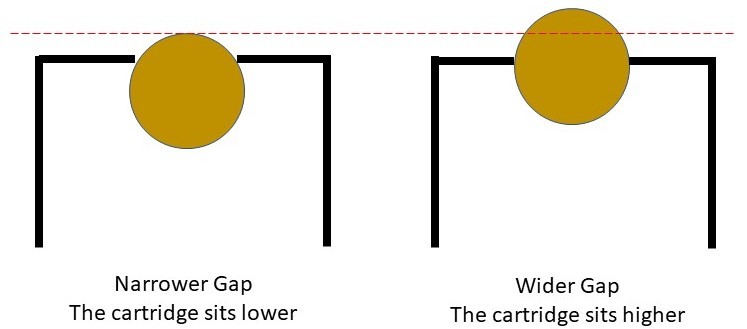
What you can do is to bend the feed lips open or closed in the front to adjust the angle. This works because the cartridge is round and the gap affects how far up that part of the cartridge will rise up.
By changing the gap between the feed lips, the cartridge goes higher or lower. The trick is to adjust parts of the lips – usually just the front portion. Yeah, I can’t draw to save my life but I hope you get the basic idea.
In general, the back of the lips are relatively fixed because of the extra material around them. Now they can get bent out of shape for one reason or another and I would recommend you compare the front and back feed lip caps of a questionable magazine to a good magazine.
Safety Comment – Use Dummy Cartridges / Snap Caps
I said this in the first post and it is so important that I want to reinforce the message – I knew I was going to need to do a ton of cycling of rounds. Using live ammo is risky because you have the very real risk of a negligent discharge. To avoid this, order yourself in a bunch of dummy cartridges. There are sellers on eBay that will sell you 10+ at time. Order yourself in 10-20 rounds. You are going to smash the crap out of them due to the heavy recoil spring a 10mm uses. I trashed at least 10-15 of them. Most were due to the bullet being smashed back into the case, one dented the case pretty bad and one deformed the case right at the mouth.
I can’t even guess how many cycles I did – especially starting out. I’m going to hazard a guess and say I averaged about three cycles per dummy before something failed on the dummy as I worked out the kinks and I would load three rounds per magazine to do the testing.
I can’t stress it enough – get dummies to tune your magazines.
Actually Adjusting The Lips
The goal is for the bullet to point straight into the chamber so that when the slide goes forward, the cartridge is stripped from the magazine and is fed straight into the chamber. We can move the front of the cartridge up and down by changing the gap between the lips.
In general, the gap at the back of the lips tend to be slightly smaller than the front. What happens is the cartridge gets pinched/stopped at the back while the relatively wider front portion allows the cartridge to be pushed farther upwards per the figure above.
Do not rush! If you take your time this goes pretty smooth. Do a little bit of adjustment and test over and over. It gets easier the more you do it.
If you need to close the lips, you can slightly crush them in a soft-jawed vise, use rubber/plastic tipped/non-marring pliers or light taps with a non-marring hammer. Just do a little and test over and over. In general, I use either the vise or pliers depending on how my hands feel as I prefer the control vs. tapping with a hammer. Everyone has their preferences and I know guys who can rock with a hammer. It’s up to you.
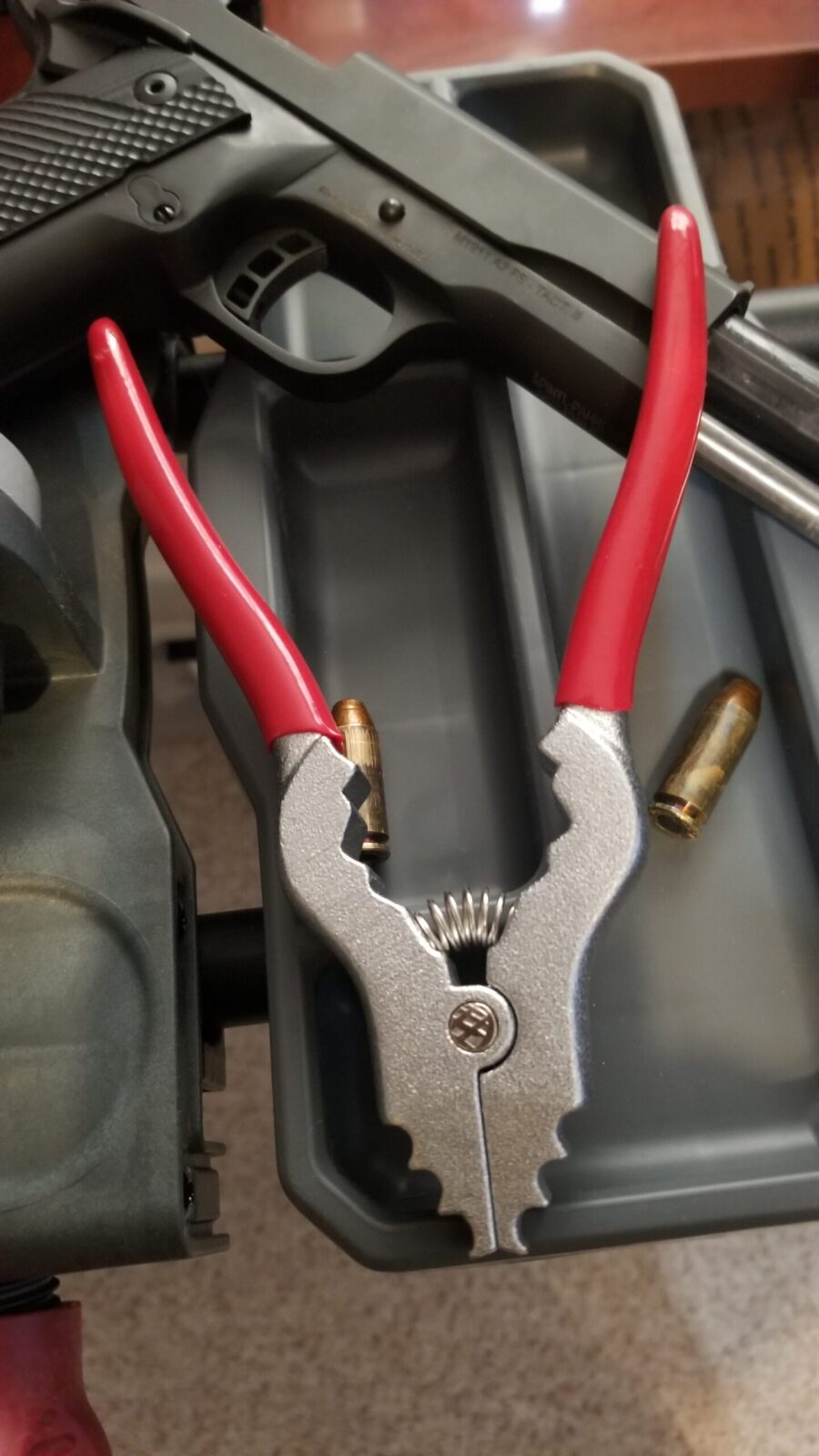
I get it in the ballpark and then I fine tune by spreading the front lips open a bit with malleable chain pliers – these are made for being the links of chain that some hanging light fixtures have. Any plier that opens when you squeeze it, such as external snap ring pliers, can work.
These are malleable ring chain pliers. You can find them readily on Amazon or eBay – plus there are good odds that your local store selling hanging lights might have them as well. Also not the dummy rounds pictured and the odd mottled color. Those are from Realistic Snap Caps and work great.
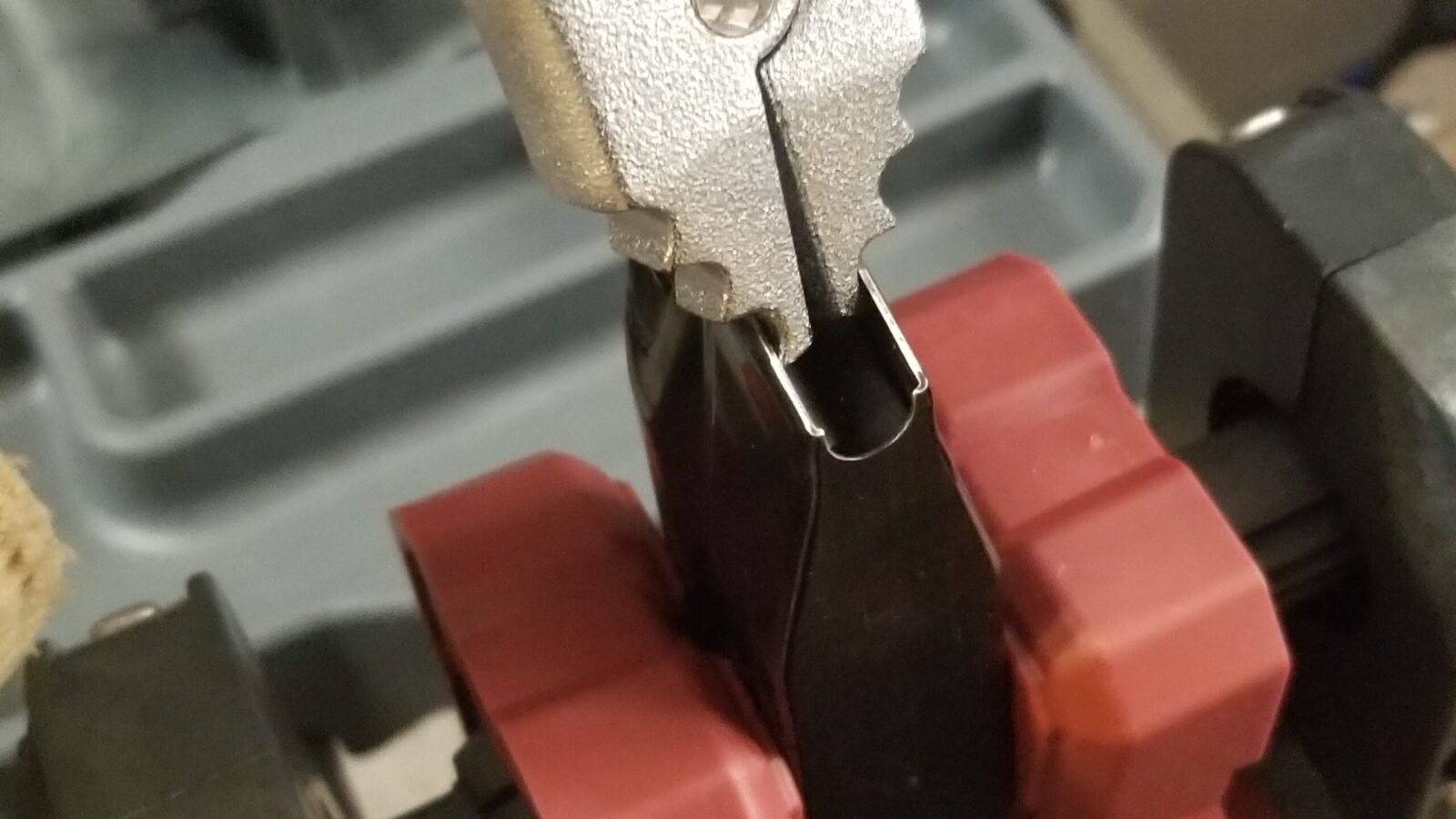
What I do is to put the pliers inside the front edge and open just a tad. I don’t try to do it all at once – it doesn’t take much to open them up a slight bit. So do that and then test with dummy rounds (snap caps) over and over. You will trash a lot of dummy rounds doing this so keep spares around. I absolutely do not recommend doing this with live ammo – it’s an accident waiting to happen.
You just want to open that front part a bit to raise the cartridge up. If you need to close it. I really prefer using a vise or non marring pliers to squeeze the lips shut. Some guys use a rubber tipped hammer and that works for them but I prefer more control.
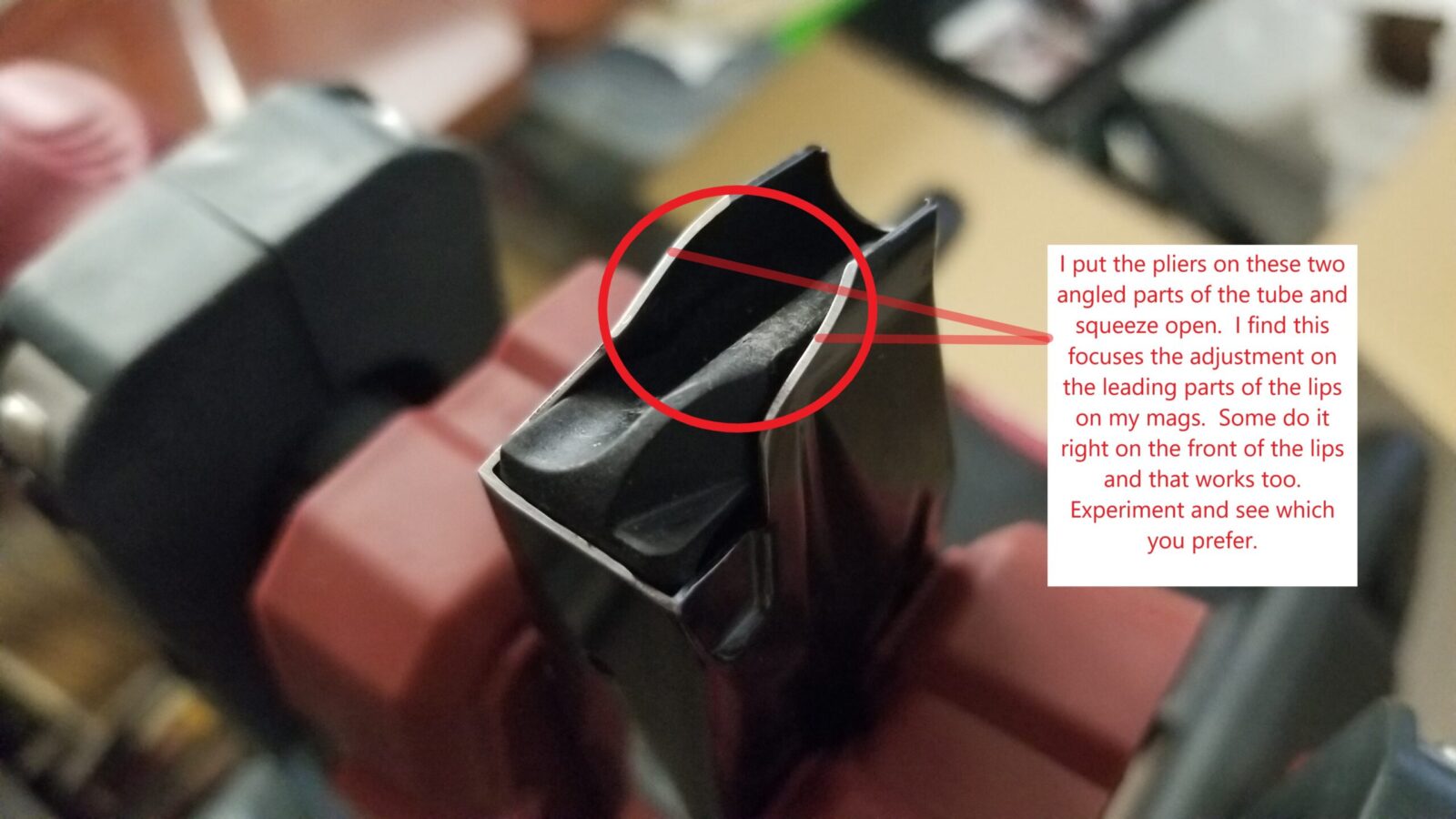
I put my pliers on that angled portion of the magazine tube to spread open the front but there are other approaches also.
You really need to experiment with every mag and fine tune them. I don’t have a set of measures that works perfectly every time. Instead, just remember to aim the bullet at the chamber and tune from there.
Last comment – always take your pistol to the range and make sure a magazine is reliable before you count on it. I like to number my mags to I can keep tabs on ones that are having problems and need adjustment.
Conclusion
This is what I do and it works for me. I know other guys have other approaches so do some searching and decide what works best for you. I hope this helps you out.
Note, I have to buy all of my parts – nothing here was paid for by sponsors, etc. I do make a small amount if you click on an ad and buy something but that is it. You’re getting my real opinion on stuff.
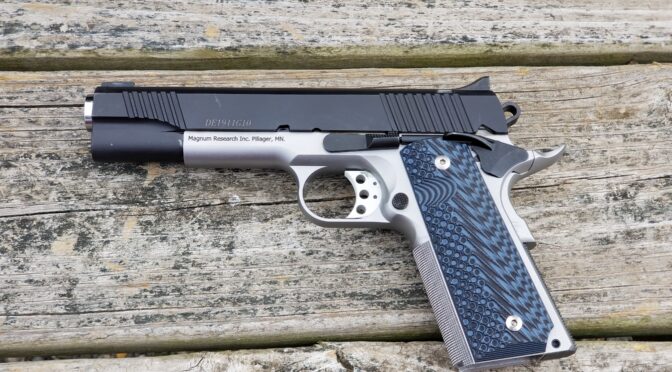
In the previous post I outlined my first impressions, cleaning and lubrication of the Desert Eagle 5″ 1911 in 10mm (model DE1911G10). I finally had a chance to get to the range and I was so impressed.
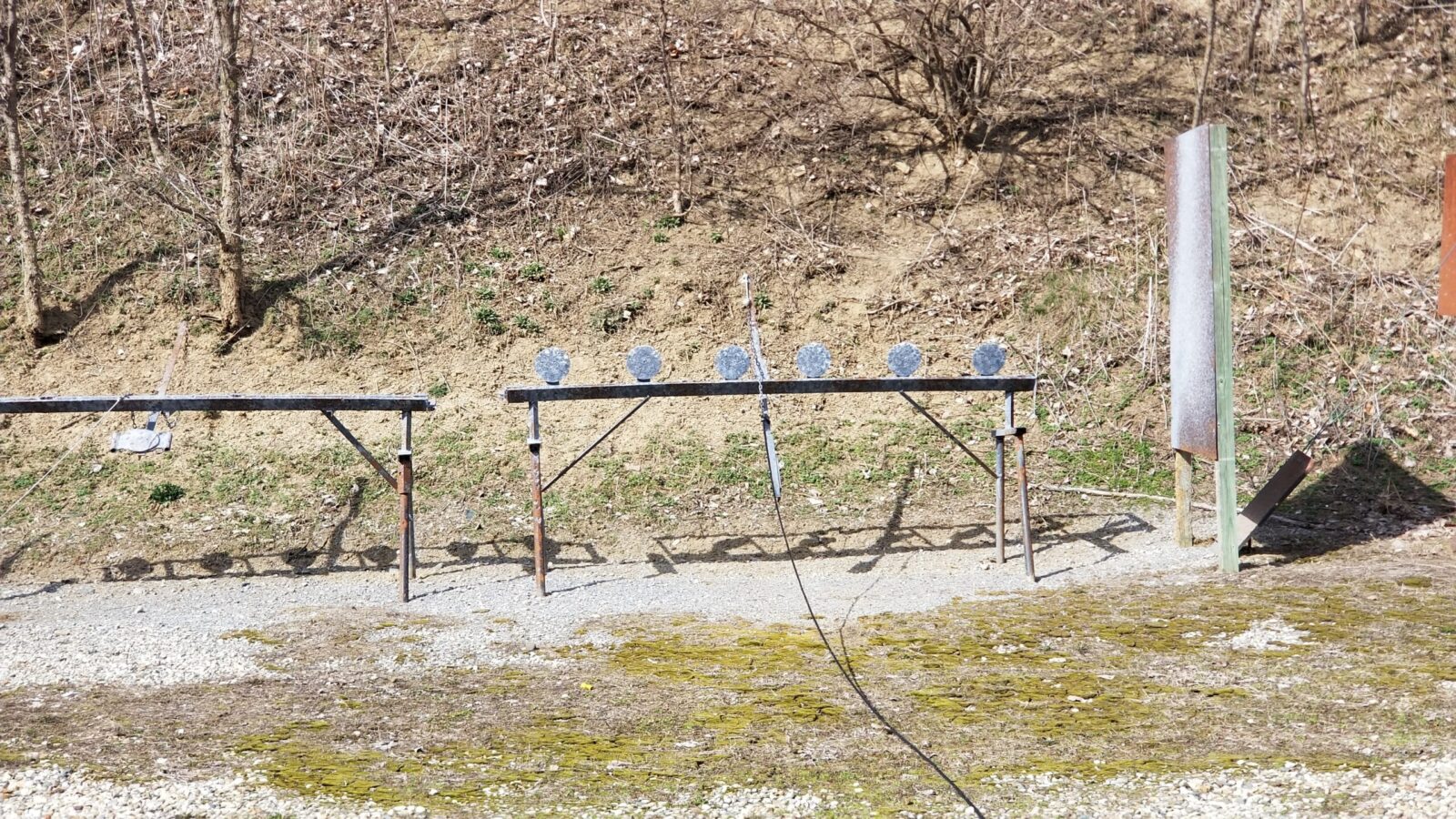
It was a nice Spring day as I set up at the Berrien County Sportsmen’s Club’s pistol range. I have always liked the club in general and I like to use their pistol range with metal plates at about 30 feet when I am testing pistols.
The 10 yard pistol range wih metal plates is great for testing pistols. I like how I can pull the rope and reset the plates for another round.
For testing,I brought some Ammo, Inc. 180 grain TMC rounds that I had bought in bulk from Palmetto State Armory (PSA). I have to confess that before I bought the ammo I had never heard of “TMC” and had to look it up. TMC stands for Total Metal Case where in the entire lead bullet is covered with copper vs. Full Metal Jacket (FMJ) that leaves the lead at the base of the bullet exposed. TMC is not a magic silver bullet though – there are pros and cons with the process but regardless, it is another option for you to explore when you are looking for range ammo.
I also brought with me a variety of other rounds including S&B 180grain FMJ, Underwood 155 and 200 grain XTP hollow points.
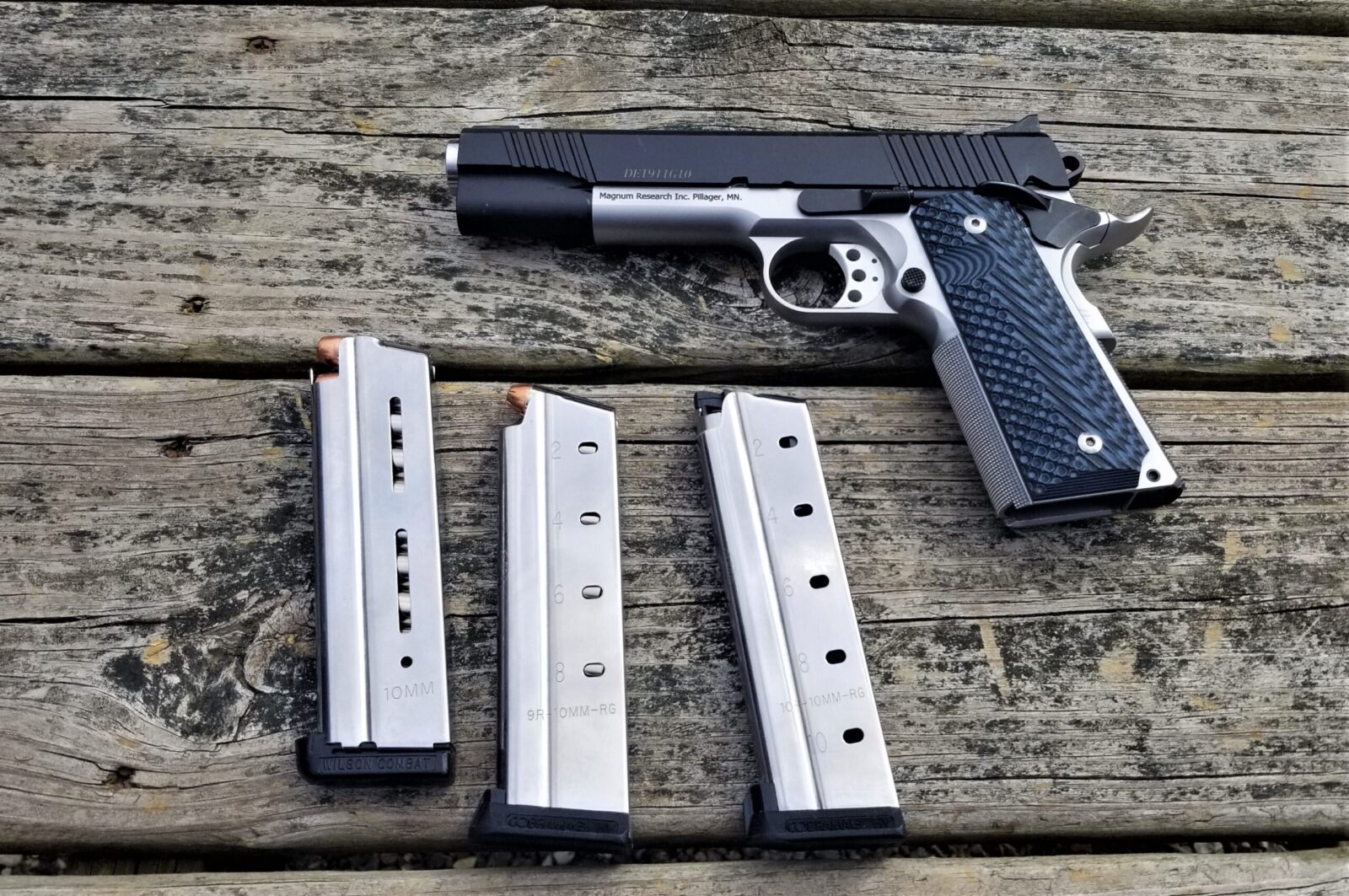
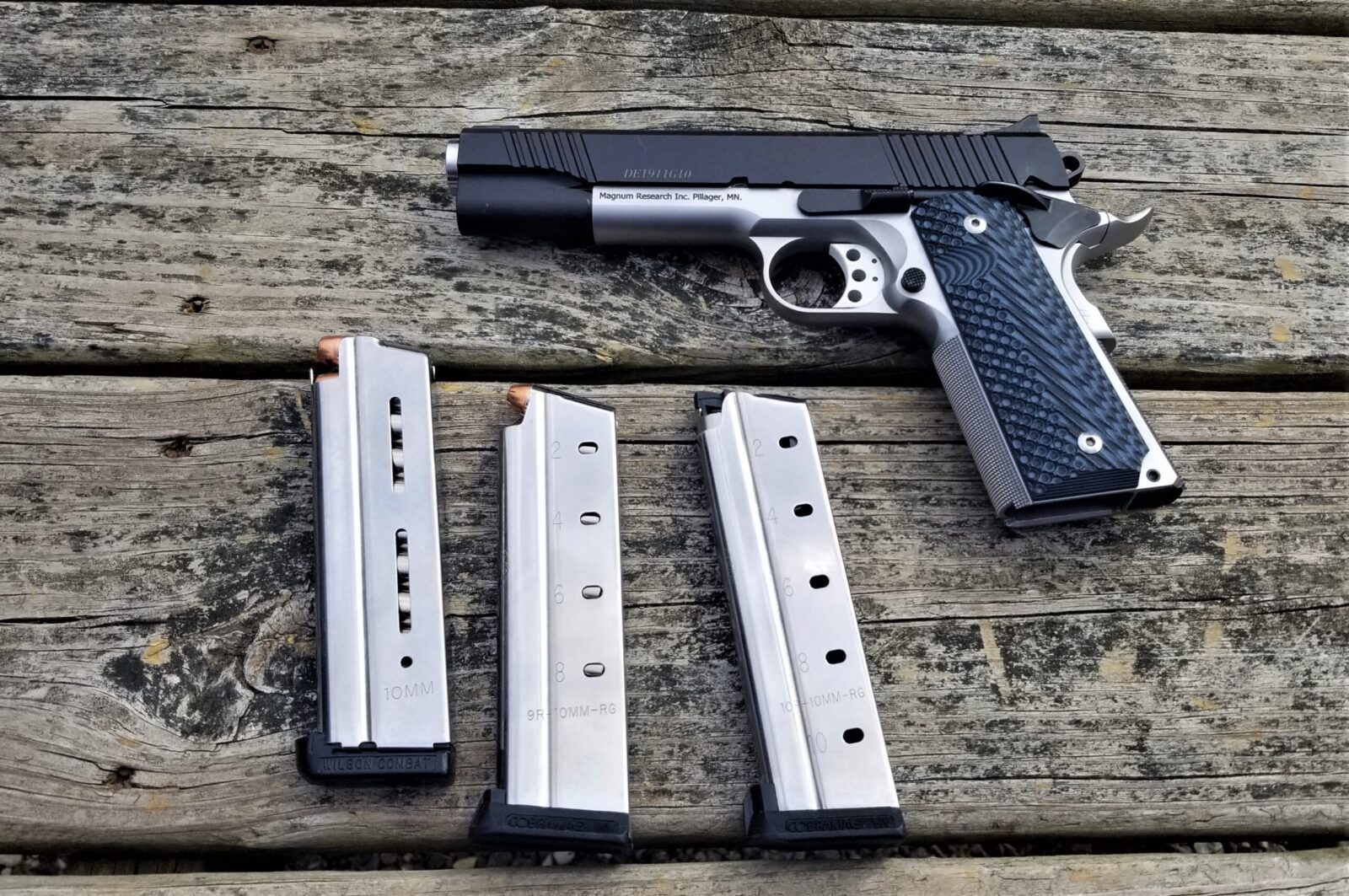
I also brought a number of Wilson Combat and TRP Cobra Mags with me. There are a ton of magazine makers out there and some tend to be better than others. I’ve not had a problem with Wilsom or Cobra 1911 10mm magazines yet.
The left magazine is a 9-round Wilson. The middle magazine is a 9-round Tripp Cobra and the right magazine is a 10-round Cobra.
For safety, I was using my shooting glasses and my Leight Howard electronic hearing protectors.
Looking Over the Pistol
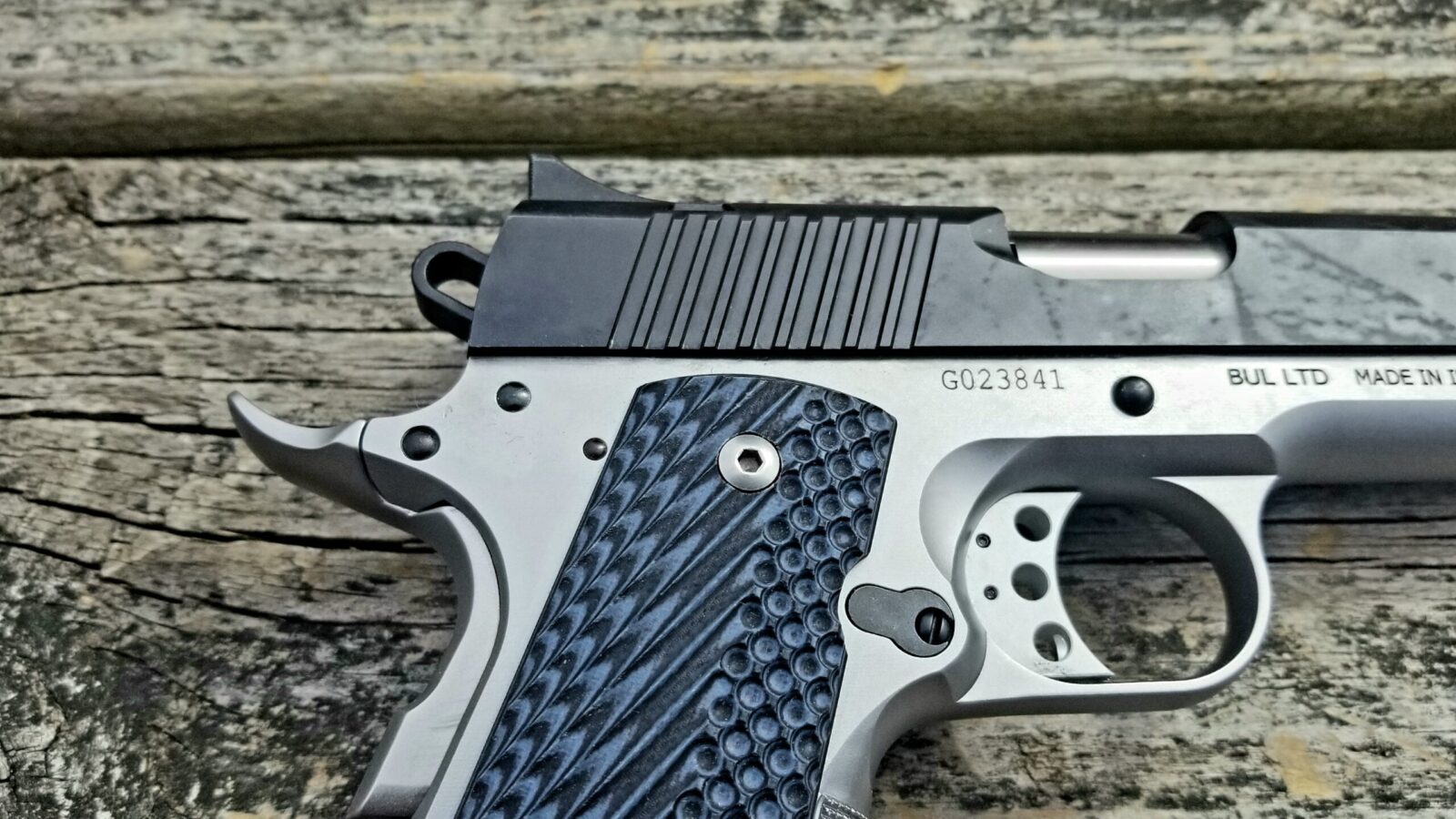
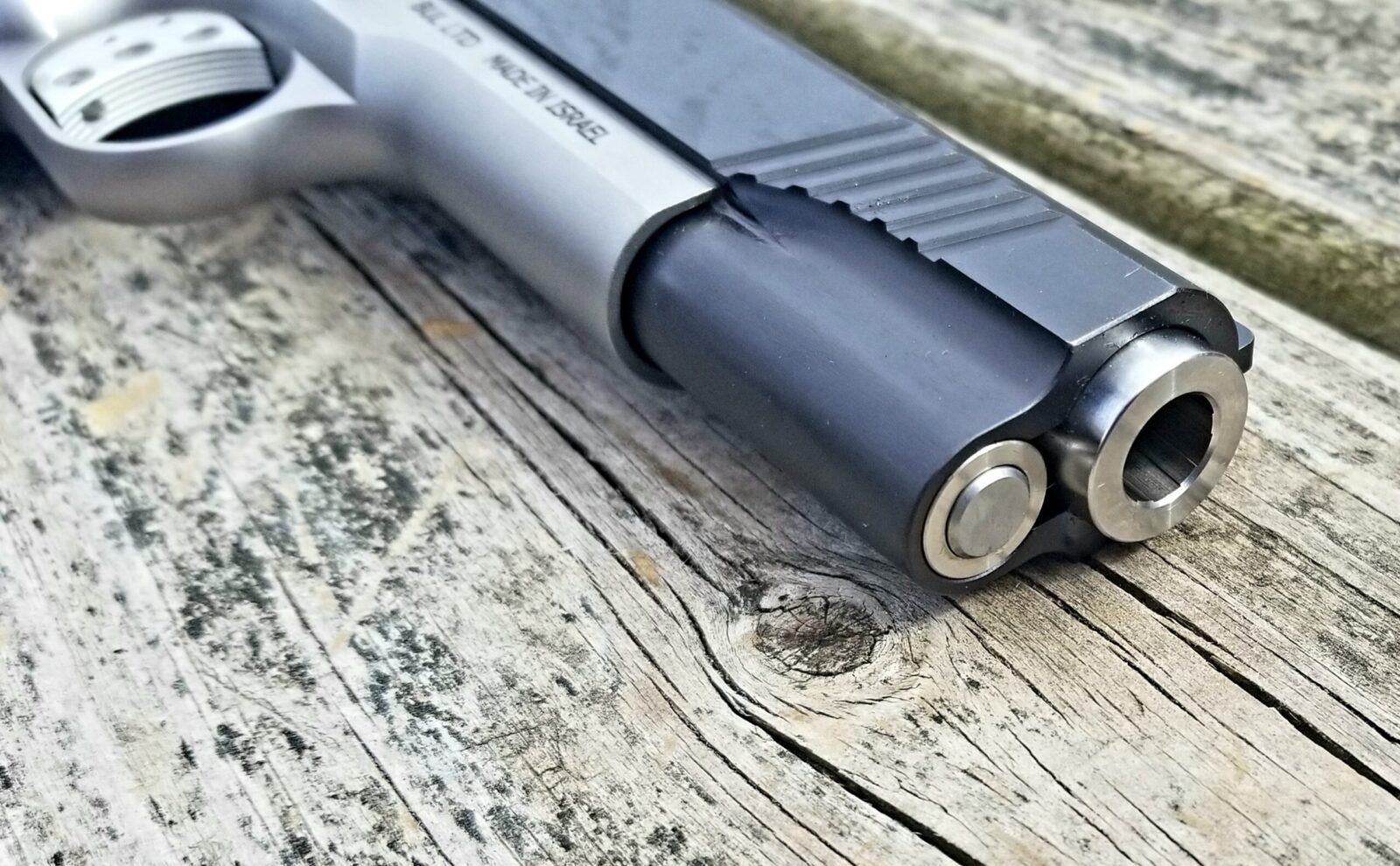
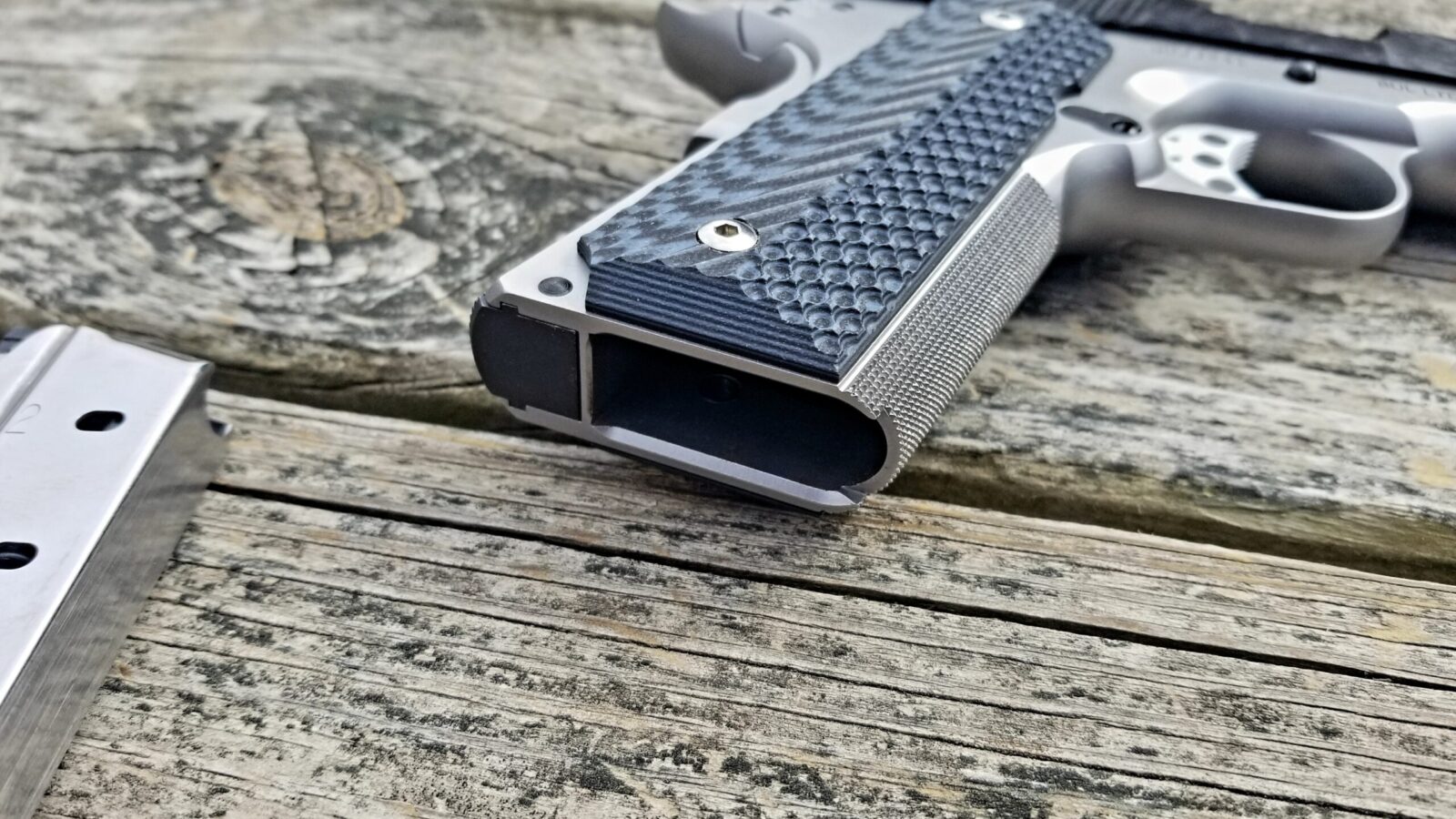
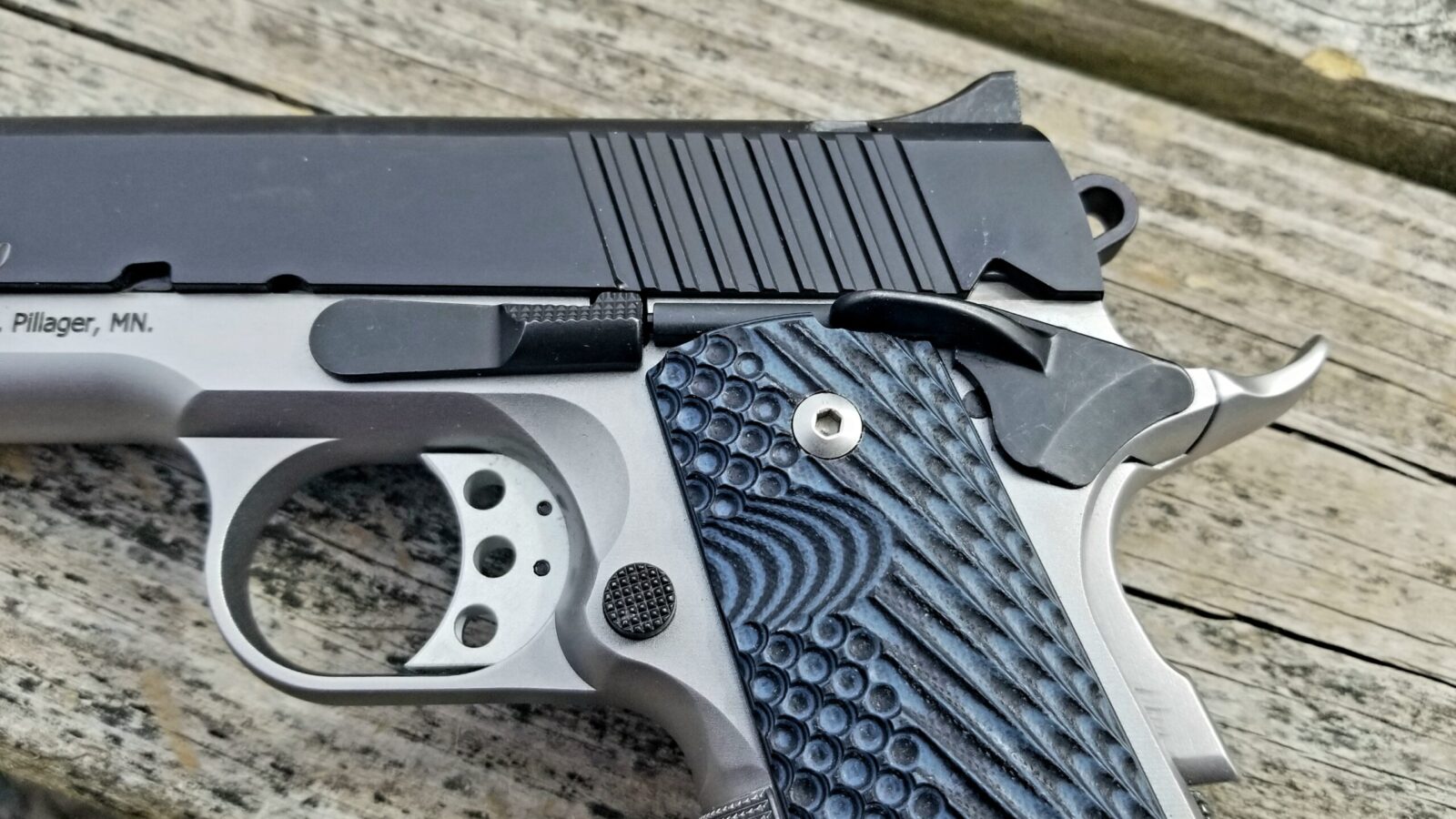
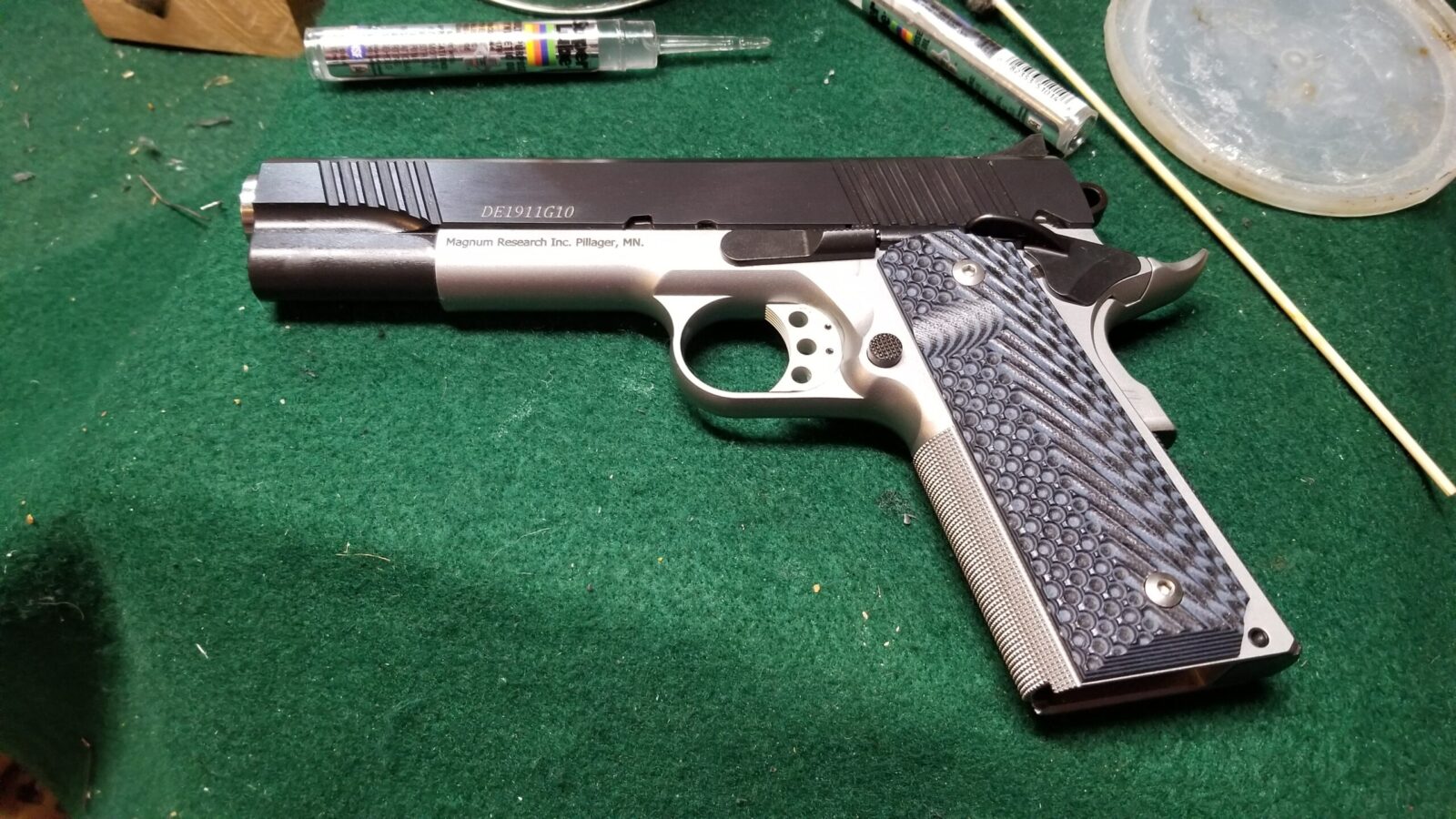
You know, really wasn’t sure if I would like a two tone pistol but it has grown one me. The attention to detail is just remarkable and I wanted to share a few more photos:
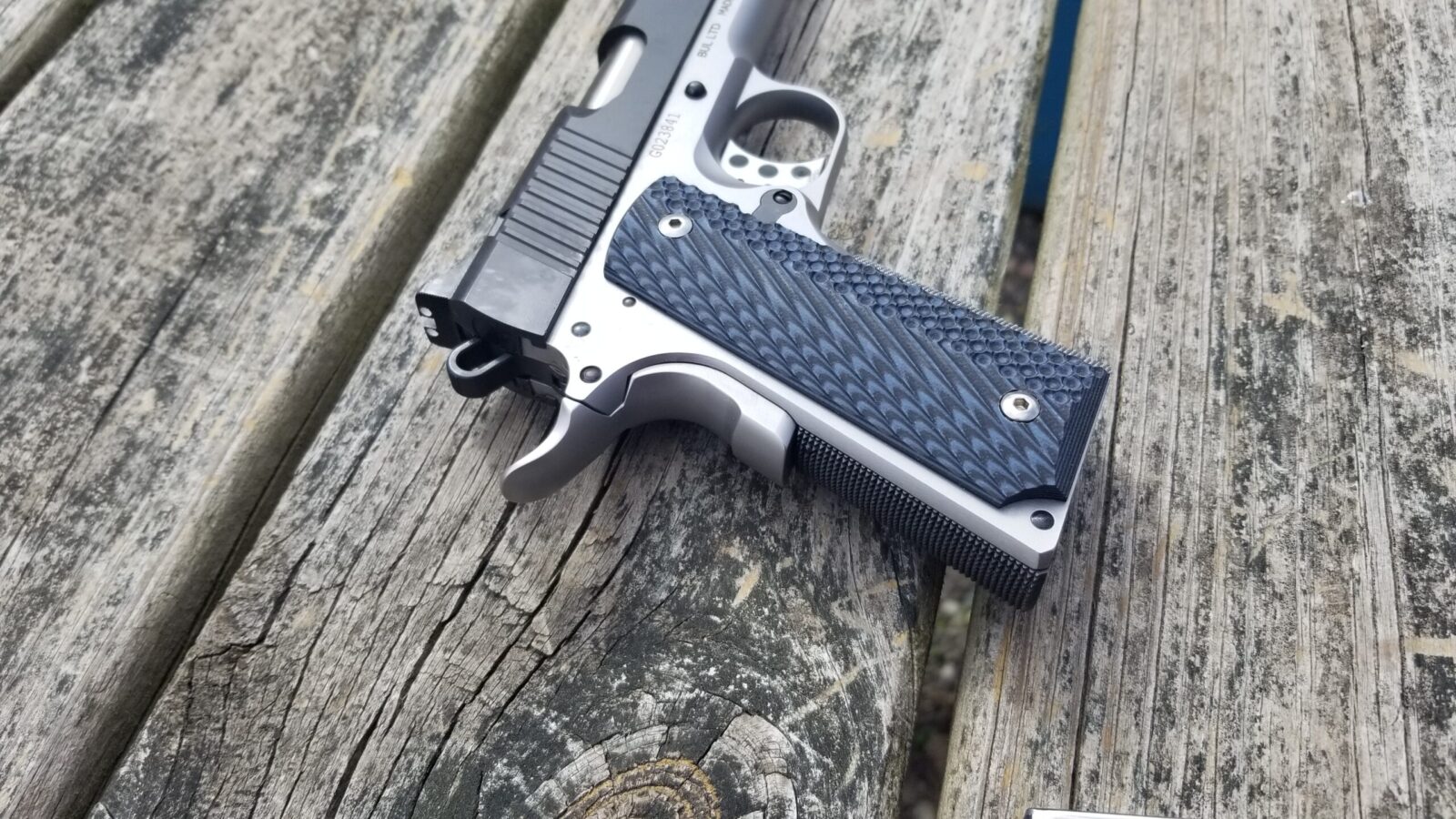
Skeleton hammer, nice beaver tail, checkered backstrap. The G10 handle plates are surprisingly comfortable. Note the safety is not ambidextrous but since I am right handed, it really doesn’t bother me.
It’s a sharp looking pistol. I really wasn’t sure how I would like the two tone finish and blue/black handles but it actually looks really good in person. By the way, it worked just fine with all of the Wilson and Tripp Cobra mags I brought.
I kid you not, I was really surprised about how good the trigger pull was.
You can see the bull barrel and lack of a bushing. I really have grown fond of front serrations on slides in general to aid with getting a good grip to rack the slide. A 10mm 1911 tends to have a pretty stout spring so I like the serrations. My RIA 52009 does not and I can tell you it is not as easy for me to rack from the front.
I really like the attention to detail. Notice how the bottom of the G10 slab is beveled, the front of the grip is checkered and the mag well is beveled to aid in loading? That helps you get an idea of the attention to detail.
All the controls functioned just fine.
Shooting the Pistol
I got up to the line, loaded my first mag, racked the action, took aim and squeezed off a round of the Ammo,Inc 180gr TMC. The first thing I noticed was how smooth it cycled – It’s hard to explain what I am thinking when I test a firearm but the first few rounds are all about function – feed, cycling, ejection, etc.
I proceeded to shoot more magazines and noticed there were no failures to feed (FTFs) or failures to eject (FTEs). Matter of fact, after I shot probably 100-150 rounds of all the different 10mm loads I brought and had zero problems. Folks, that is remarkable right there. So often firearms have to wear in and I am kind of used to having a few problems as stuff gets to know each other. Not here – it ran like a top from start to finish.
In terms of accuracy, I was regularly hitting the plates. I’m good enough with a pistol so I’ll just say the pistol was hitting what I was shooting at reliably. I’ll try it from the bench some time and see.
The ergonomics were all solid. I liked the whole package – the trigger, checking, feel of the grip panels and the serations on the front of the slide. Matter of fact, this is the first 1911 in ages where I think I may well leave the G10 grip panels on it vs. swapping out to the Hogue wrap-around models I usually use.
The grip angle of the 1911 has always appealed to me. It enables me to use a natural point of aim meaning I bring my hands up and I am pointing at the target. With a Glock for example, I have to adjust my aim. Now everyone is different — if you are new to pistols, go down to your local gunstore and try different models. Literally see which one feels best for you.
Conclusion
This pistol is probably going to be one that I keep if I were to make a bet. As my friend Scott can tell you, it’s rare that I keep a gun around – I buy it, try it, learn from the design and move on. Every once in a while some design really strikes me and I keep it aroud. That’s the case with this Desert Eagle. They are hard to find right now and I bought mine off Gunbroker. If you find one, I’d definitely recommend it.
Note, I have to buy all of my parts – nothing here was paid for by sponsors, etc. I do make a small amount if you click on an ad and buy something but that is it. You’re getting my real opinion on stuff.
Ok folks, I’m experimenting with 10mms again. I had a run in with a bear last summer and while nothing happened, it sure made me want to carry a more powerful pistol than a 9mm. Years back, I had a Dan Wesson Bruin and a Rock Island 6″ Ultra that were both in 10mm that I eventually sold and was firmly in the 9mm camp for years.
My first 10mm to try out this time around was a Springfield Armory TRP Operator with a 6″ barrel. Folks, I genuinely was not impressed and reliability sucked out of the box (click here for a blog post about that). So I dug around and ran into the Magnum Research 1911-style pistols. Know what? They get great reviews and guys kept mentioning how well they were made and what great triggers they had.
I ordered a DE1911G10 pistol and it arrived a bit over a week later so I rushed over to my friend Scott Igert’s gun store (Michigan Gun Exchange) and checked it out. I was genuinely impressed by how smoothly the action cycle and the excellent trigger right out of the box. I’m used to things being gritty or really tight from lack of lubrication but this pistol was remarkably smooth. I’ve only encountered one other pistol this way – my Dan Wesson Bruin was slick – but nothing has come with this nice of a trigger right out of the box.
Before going further, let’s take a step back and look at who makes this pistol.
Magnum Research Makes 1911 Pistols?
The short answer is “no” but they do sell them. I owned a Desert Eagle Mk.V .44 magnum way back in the 90s so I was familiar with the Magnum Research (MR) of old but kind of stopped keeping track as the years went by. I did some digging and over the years they worked out deals with other firms to make certain pistols (for example IMI/IWI and Saco) they sold and eventually MR was bought by Kahr Arms in 2010.
The firm that actually makes the MR 1911 pistols is BUL Armory of Tel Aviv, Israel. They were founded in 1990 and make a wide range of CZ, 1911 and 2011-style pistols. Their pistols have s great reputation and are in use all over the world.
My Pistol
It’s a good looking pistol and I am glad it doesn’t have the huge gaudy engraved letters on the side that previous Desert Eagle 1911s had. If you don’t know what I mean, just look at some pre-2020 articles or posts and you’ll see.
I had to wait for some time to take the pistol apart, clean and lube it before going to the range. For those folks new to firearms reading this – you always clean and lubricate a new firearm – even if they come in a bag soaked in oil.
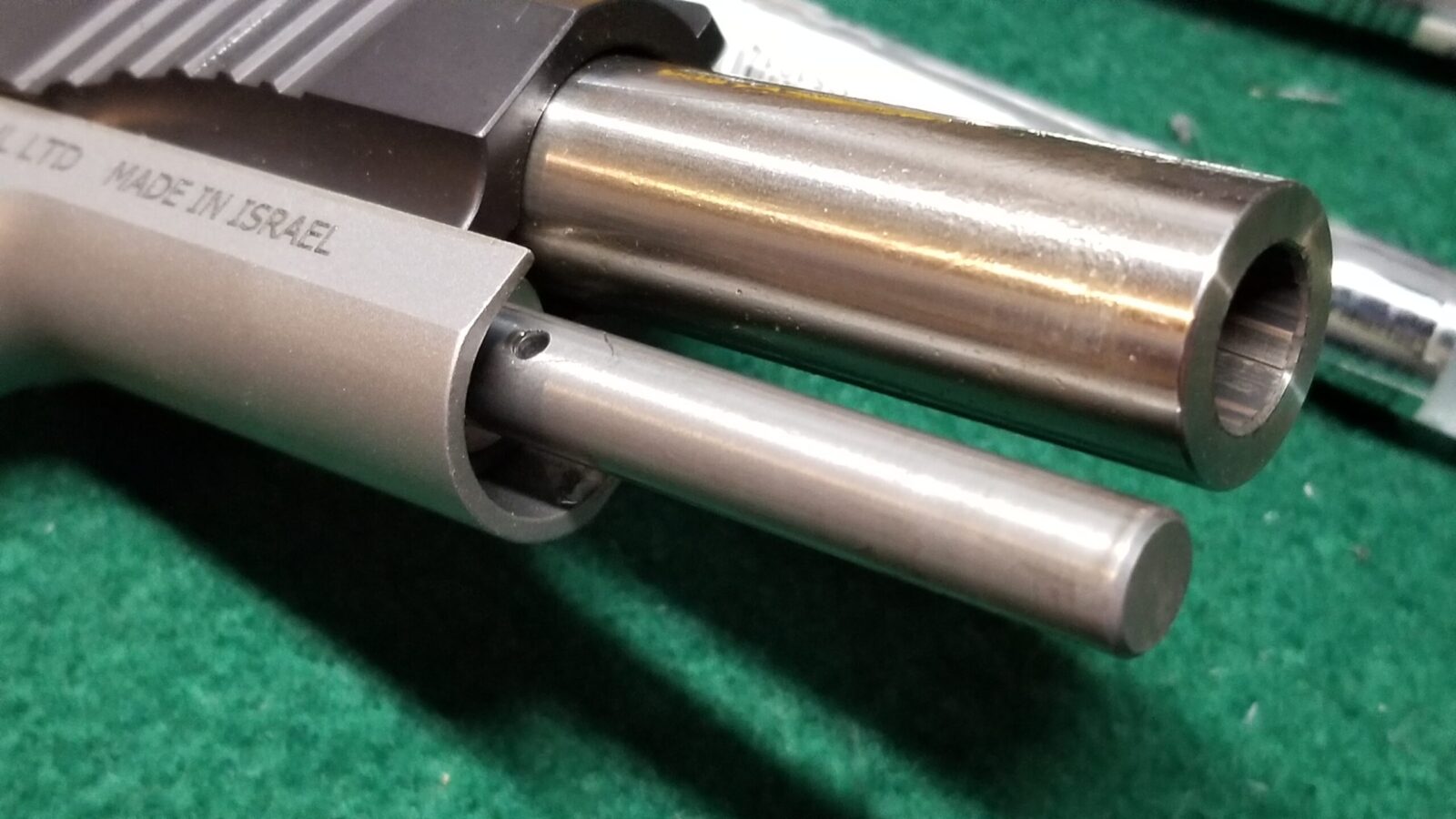
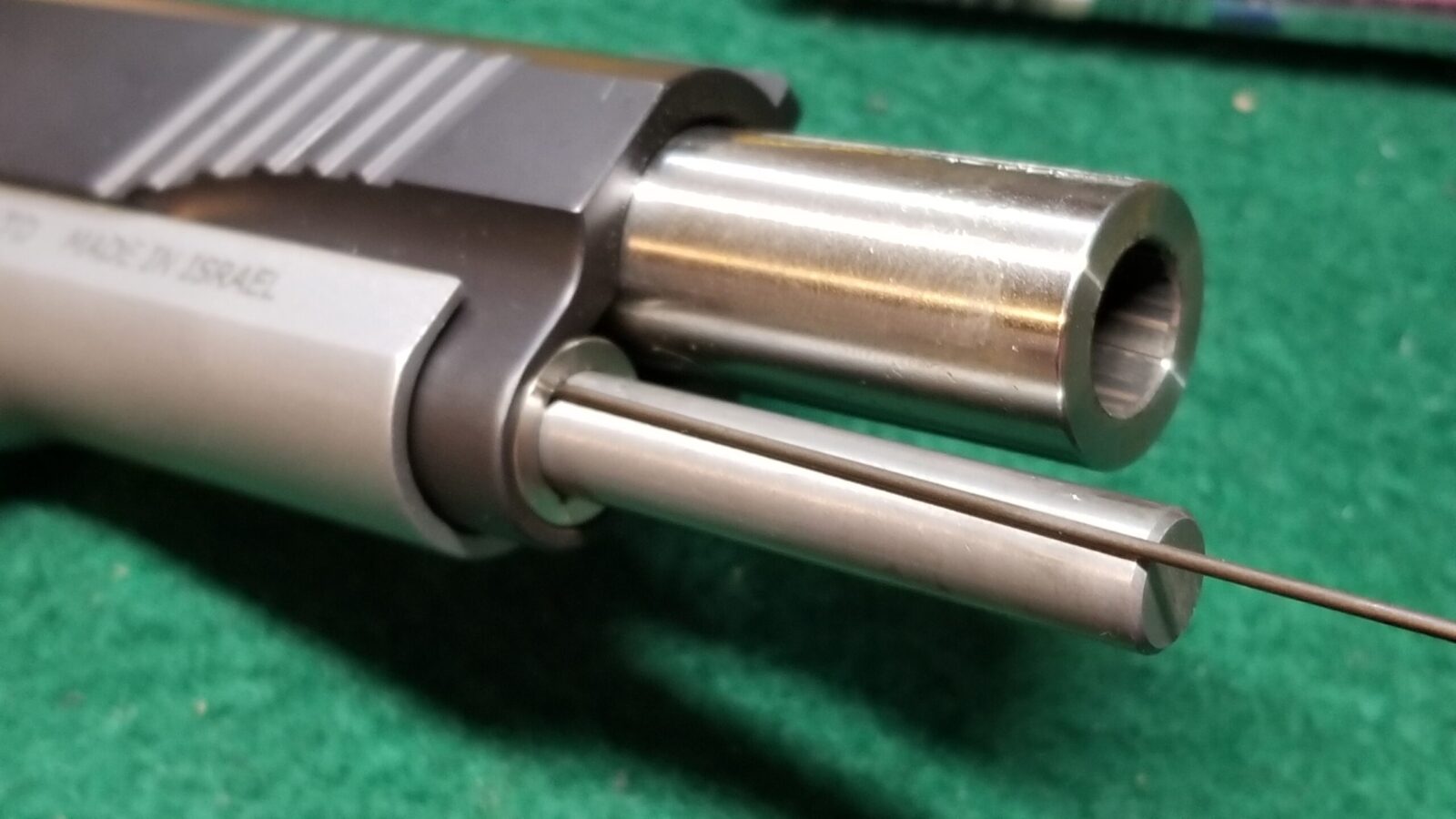
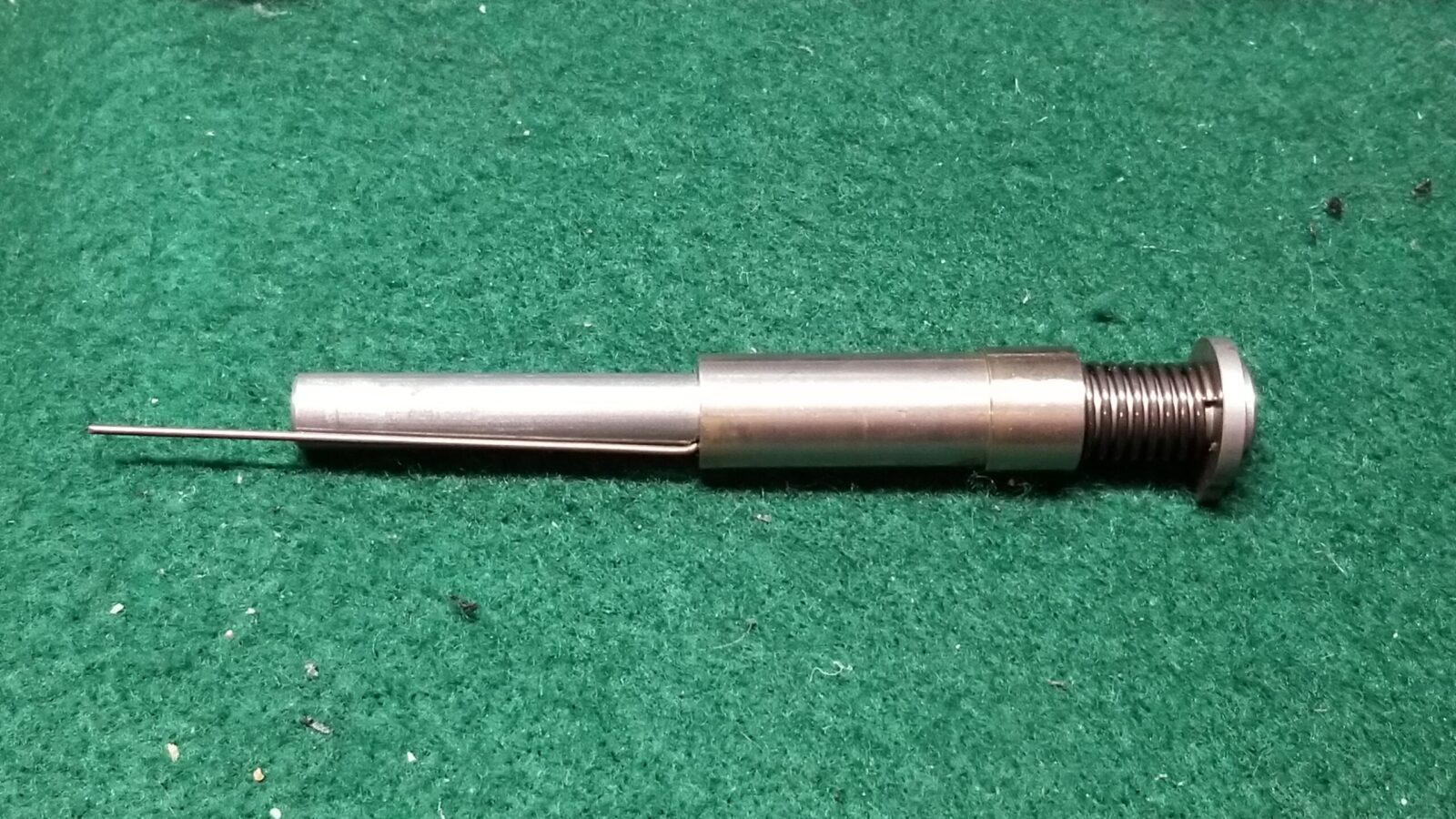
The DE1911G10 disassembles like any 1911 with one big exception – does not have a bushing so to remove the slide assembly requires the insertion of a pin in a hole they machined in the recoil spring guide (the round metal rod that the recoil spring rides around).
It seems like I am seeing fewer pistols with bushings – at least 10mms. The ones with a setup like this make takedown very easy – you lock the slide open, put a bent pin (MR/BUL provides one) into the exposed hole in the recoil spring guide, release the slide and then the recoil spring tension is removed. Everything then strips down real easy – easier than even traditional 1911s in my opinion because you aren’t fighting any spring tension trying to shove the slide forward.
With the pin in place and the slide released, the pin holds the spring in place. Note, I released the slide by gently racking it – not just dropping the slide stop as that will slam the recoil spring parts against the pin unnecessarily. If you don’t have a factory pin, you can bend a small paper clip to have a small 90 degree leg on one end. It doesn’t look very good but it does the job.
You pull the spring assembly straight back and out – including the pin. Just take care not knock the pin out. A 10mm pistol uses a stout spring and it will be a bear to re-assemble. A valve spring compressor is a huge help – click here for a post about it.
Cleaning and Lubricating
For a while now, I’ve been using RamRodz to clean pistol barrels and bought packages for both my 9mm and 10mm pistols. I like how tight they fit and I can really clean out the barrels. I coat them with CLP to do the cleaning, lubrication & protection (hence the acronym CLP).
I wiped everything down to remove any dirt or debris from the factory. Other than the oil that coated the pistol from the factory it was very clean. In looking at the parts, everything was nicely made, fitted and assembled. So far, so good.
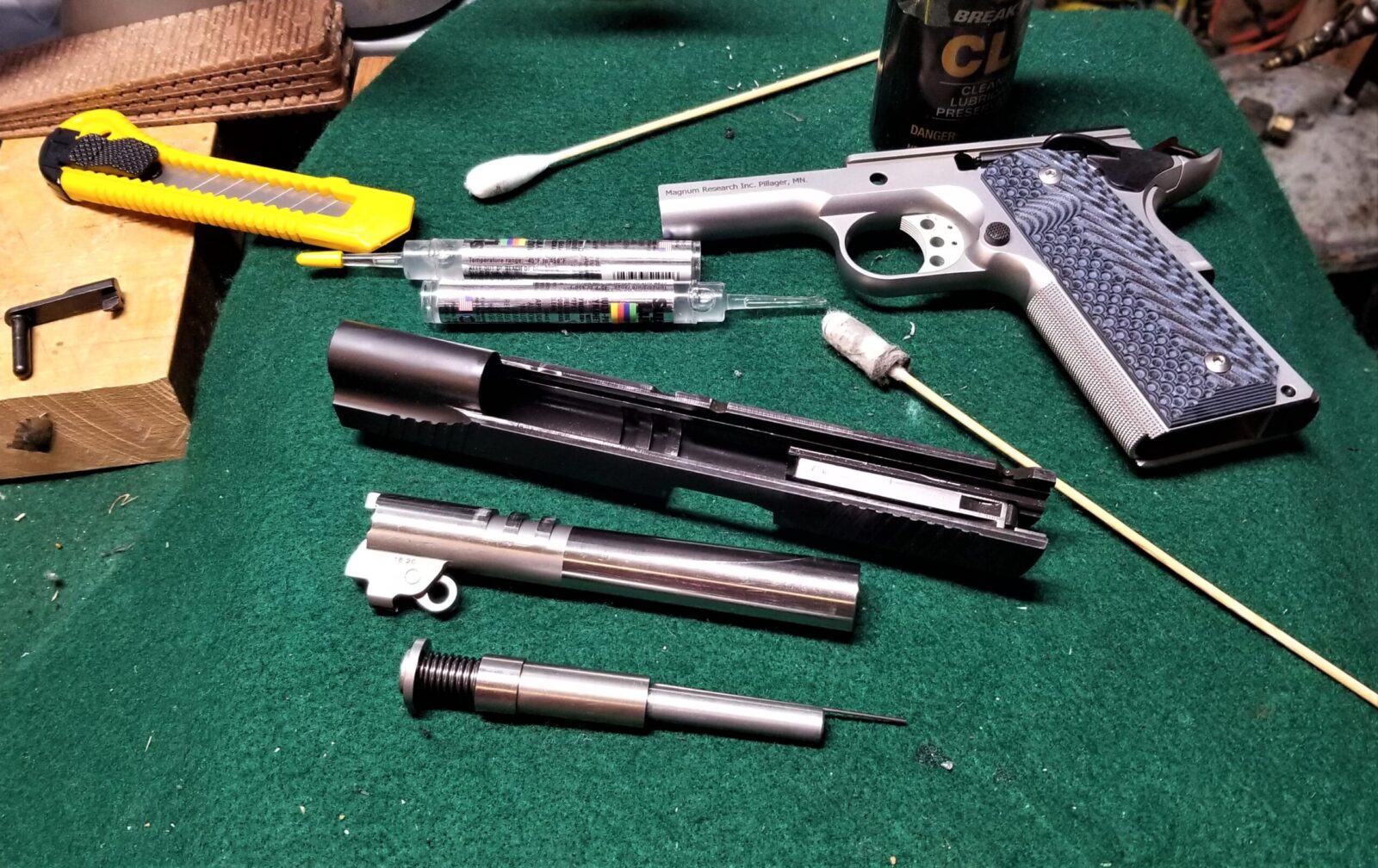
Here’s the field stripped pistol with all of the major parts plus you can see the RamRodz, CLP and my precision SuperLube applicators.
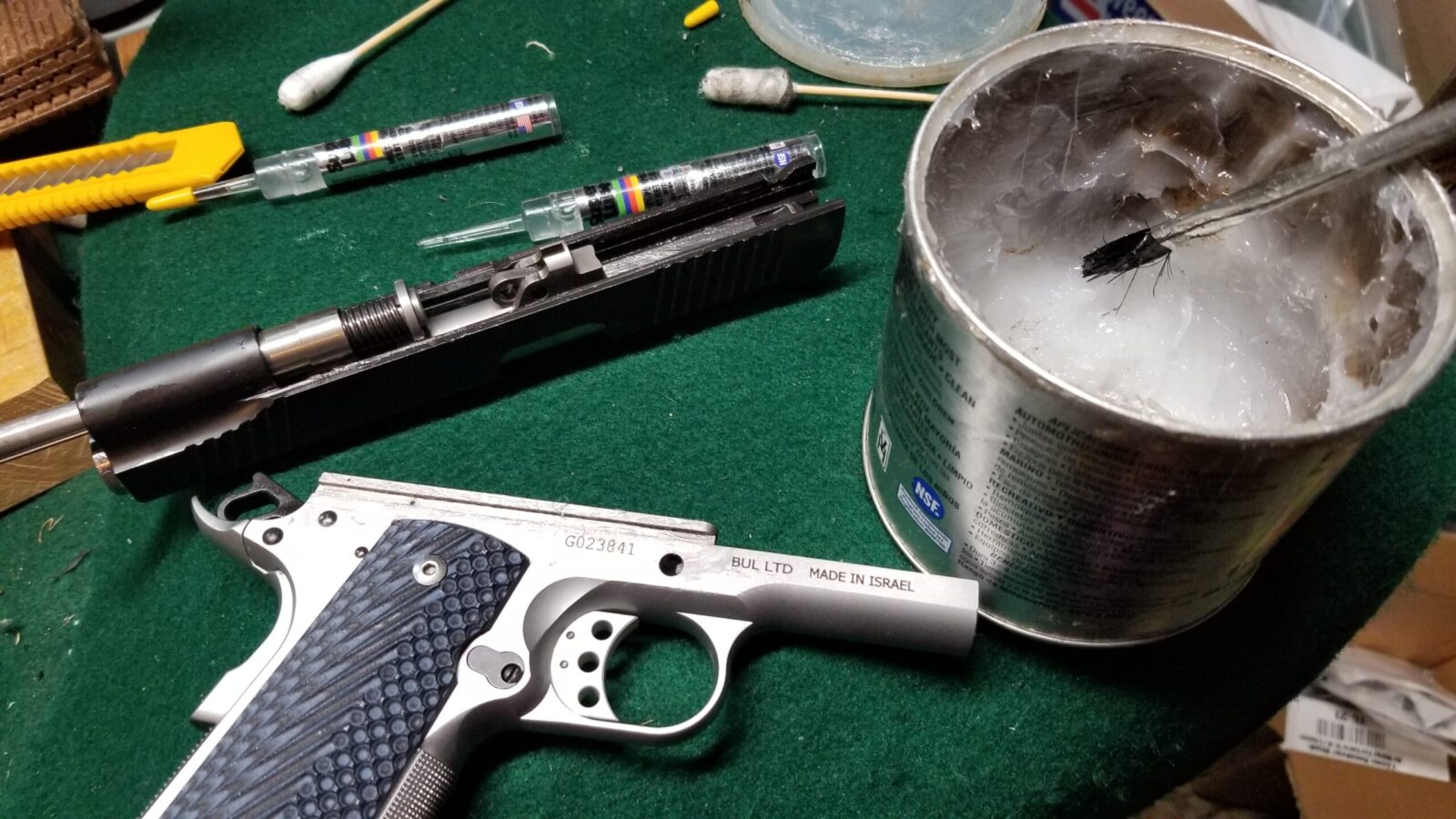
To lubricate the pistol, I use Superlube liquid to get all of the traditional points except for the slide rails and the heavy bull barrel. On those I user SuperLube synthetic grease to make things slick. Folks, when it comes to lubrication you will get a million opinions and get into arguments. It just so happens that I find SuperLube works really well and I use the grease on all of my firearms now where parts slide together. It’s a synthetic grease and it has tiny PTFE (Teflon) particles in it to help with lubrication. I know when you hear “Super” in anything it sounds like a rip off but this stuff really works and I have been using it for a few years now on my pistols and rifles.
I use an acid brush to lightly apply SuperLube grease to all surfaces the slide – the frame rails and the bull barrel because it directly contacts the slide. It makes one heck of a difference folks.
Re-Assembly
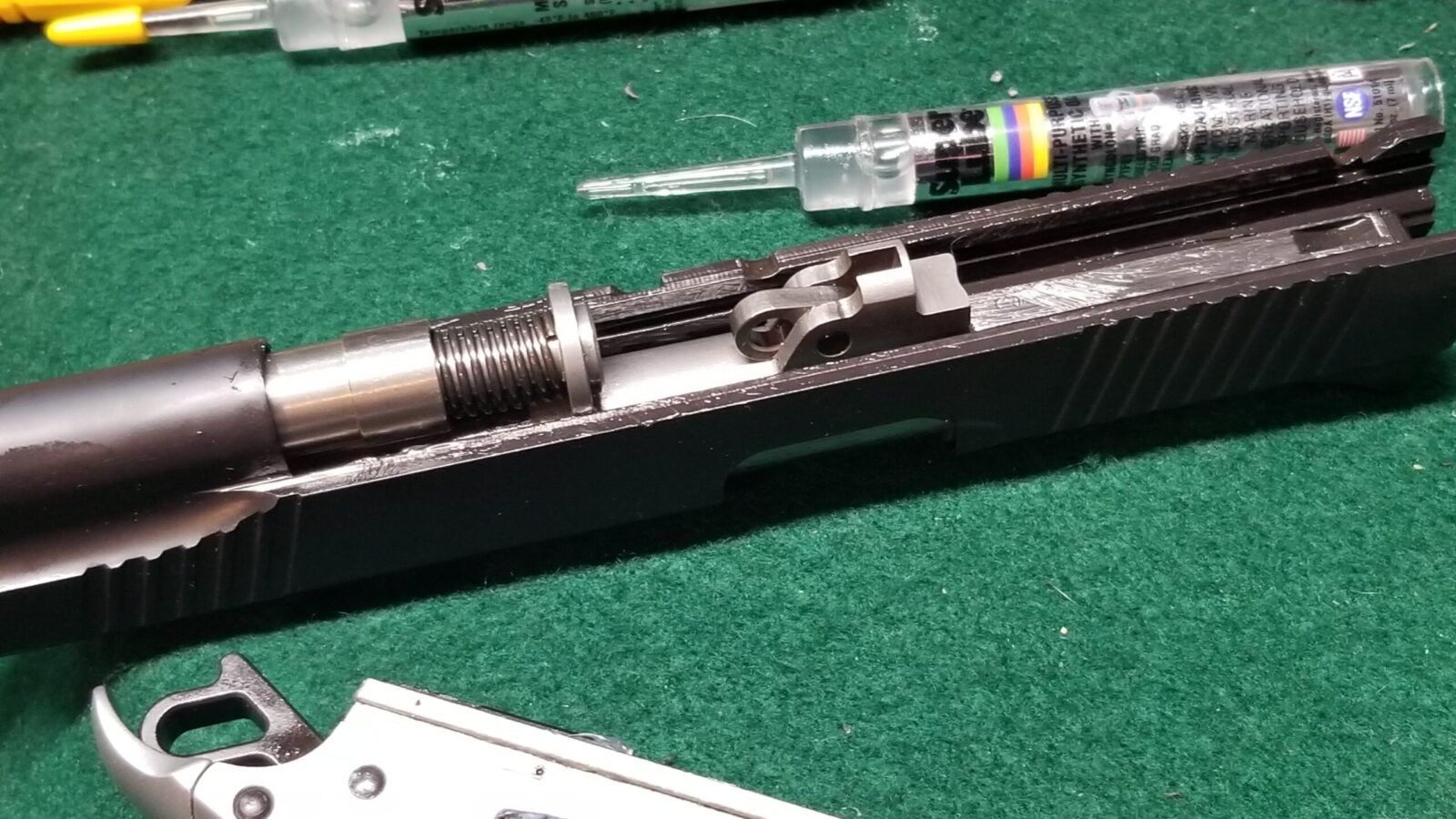
Again, it’s just like a 1911 with the exception of that recoil spring assembly. Just insert the barrel into the spring and then carefully insert the recoil spring assembly so the groove is against the barrel and don’t knock the pin out of the hole.
Re-assembly is easy with no spring to fight. Just don’t knock the retaining pin out of place.
Video For People New to 1911 Pistols
If you are new to 1911s I have great news – there are tons and tons videos, blogs and books about how to clean and care for your 1911. Just remember by comments above about there not being a bushing and the takedown pin you insert in the recoil spring guide — otherwise it is the same.
The following video from Ruger has a very similar bull barrel, no bushing and uses a pin. The person doing the video does a nice job.
This next video covers re-assembly:
These next two videos provide nice overviews of cleaning a 1911:
Conclusion
The action and trigger were so slick at this point! I was deeply impressed. After lubricating, the trigger pull averaged about 4 lbs 2oz using my Lyman digital trigger pull gauge. In general, I like the trigger – I can feel where it is going to break and then can cleanly pull through.
Okay, with this part done and my seriously liking the pistol up to this point, I had to take it the range and that will be the next post.
Note, I have to buy all of my parts – nothing here was paid for by sponsors, etc. I do make a small amount if you click on an ad and buy something but that is it. You’re getting my real opinion on stuff.
Hi folks, I am just trying to get the word out there that we actually have OEMP164015B compatible magazines that the 10mm and 40mm high cap 2011-style RIA pistols use in stock.
The base magazine I used to create these mags are the very well made Mec-Gar magazines for the Para P-16 (mag model MGP164015B). In addition to being close in terms of the required tube design, the Mec-Gar mags are quality and feature:
heat treated tubes
high tensile music wire springs
the follower is made from high impact nylon and locks the slide open
These mags were all converted by me and then hand fit and tuned to my RIA 52009 high cap 10mm pistol. For most shooters they should be good to go. If there is a feed problem then a minor adjustment of the feed lips (perhaps opening them a tad so the round sits higher) should be all that is required.
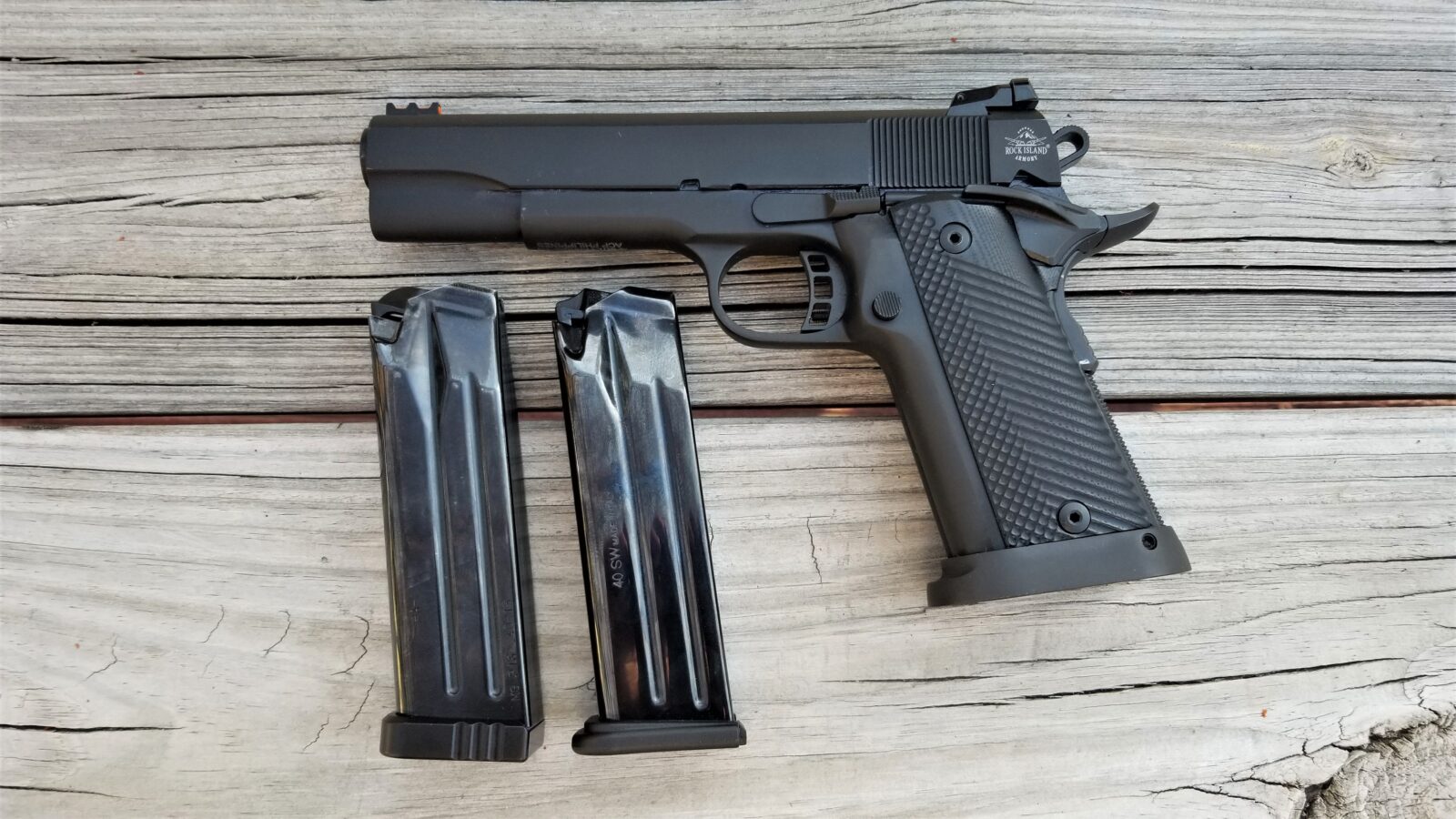
This is my personal 52009 10mm pistol. The magazine on the left is one of mine and has a +100 Dawson baseplate on it. The mag on the right is an original OEMP164015B that is made by ACT-Mag for RIA.
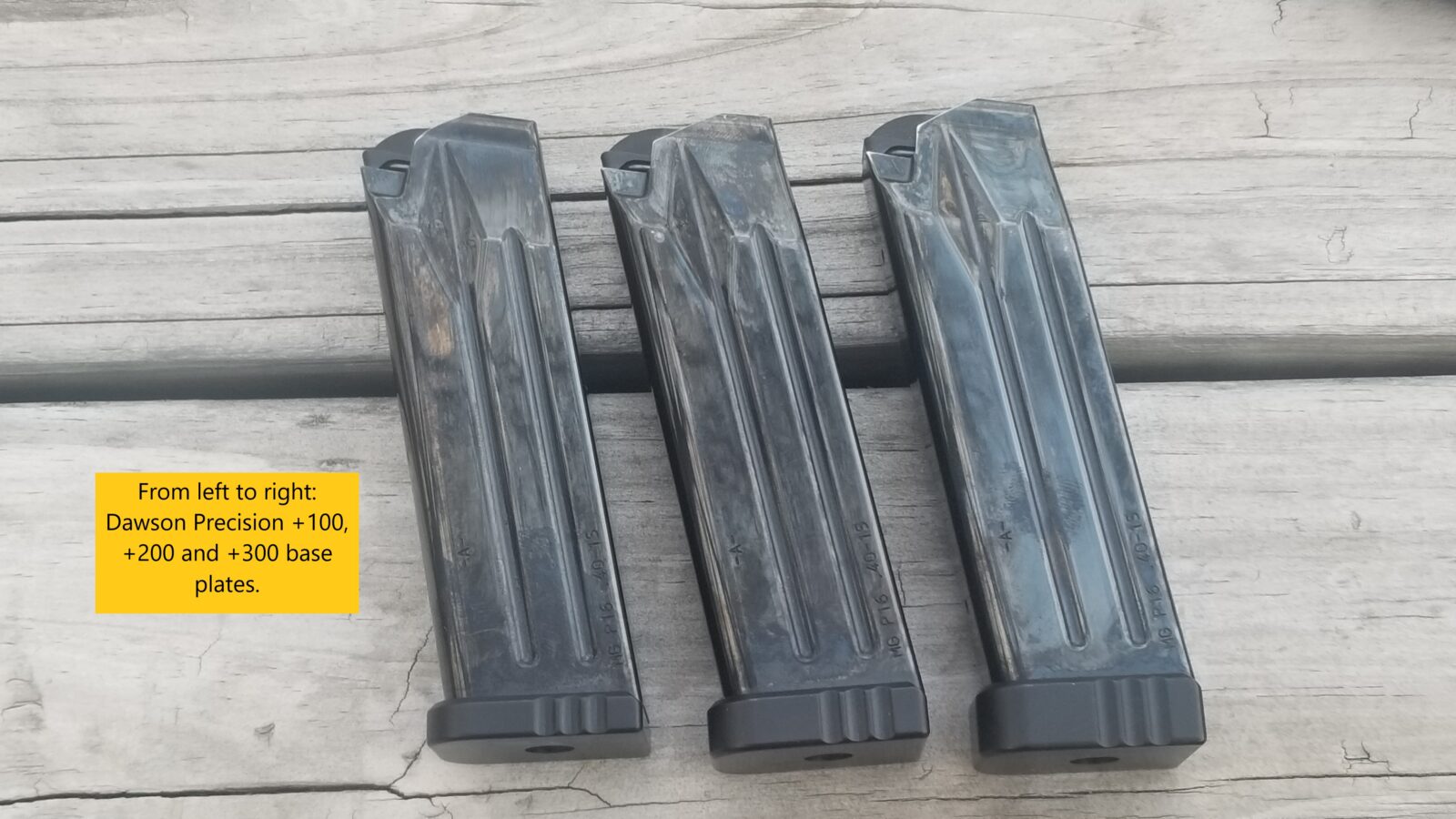
To accommodate the flared mag well that RIA put on these pistols, I used a variety of lengths of Dawson Precision base plates. The +100 Dawson model pretty much is flush with the bottom of the flared mag well, the +200 sits just a bit lower and the +300 is lower still. The number refers to the length (0.100, 0.200 and 0.300 inches).
Here’s a picture of three converted mags. As the text says in the photo, from left to right the Dawson Precision base plates are the +100, +200 and +300 models.
Our prices start at $69.99 and go down (not up) the more you buy. I just saw some of these magazines listed for the first on GunBroker this morning and they start at $80 and go up!
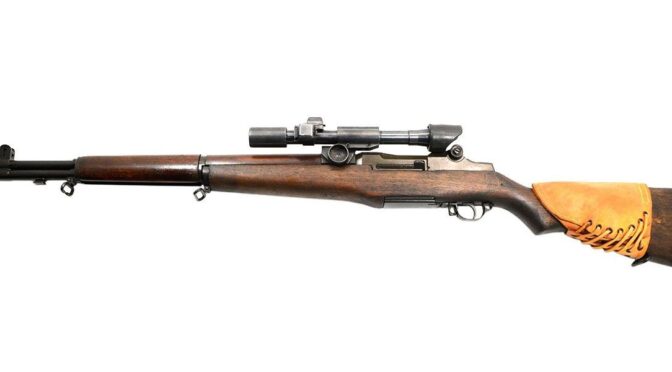
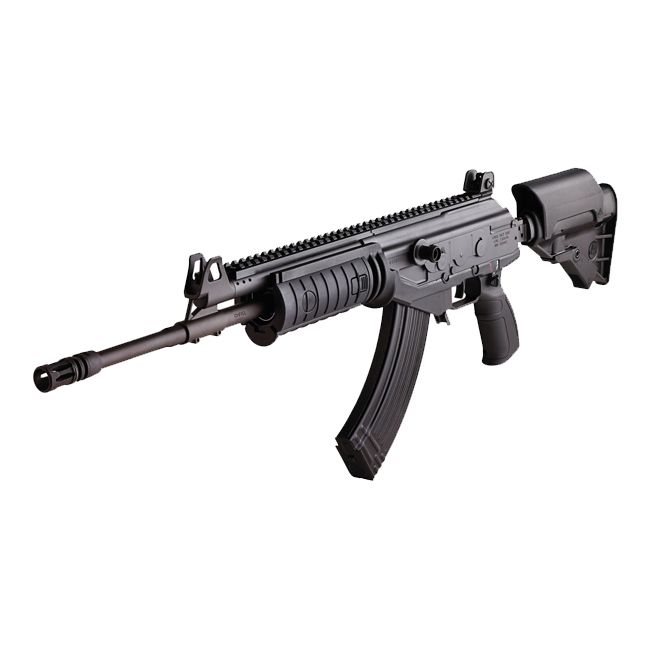
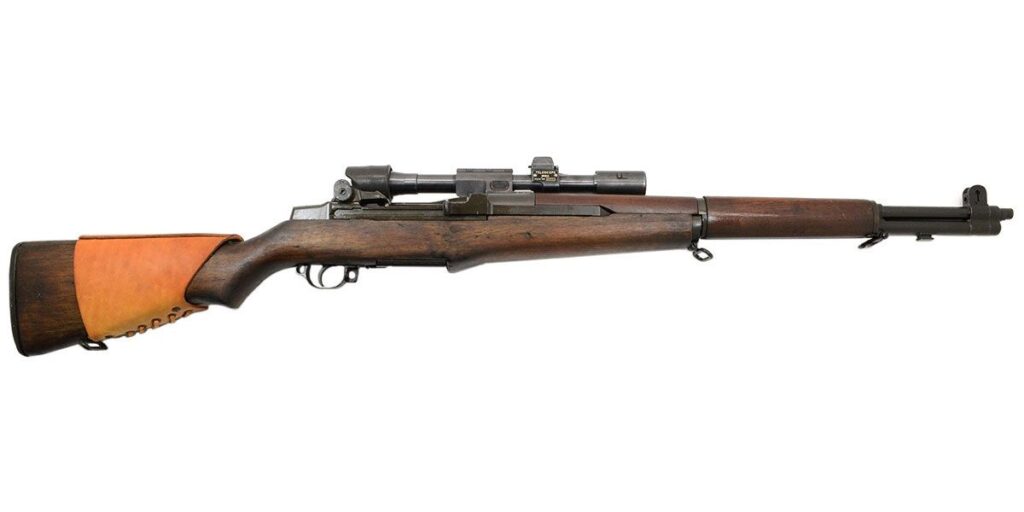
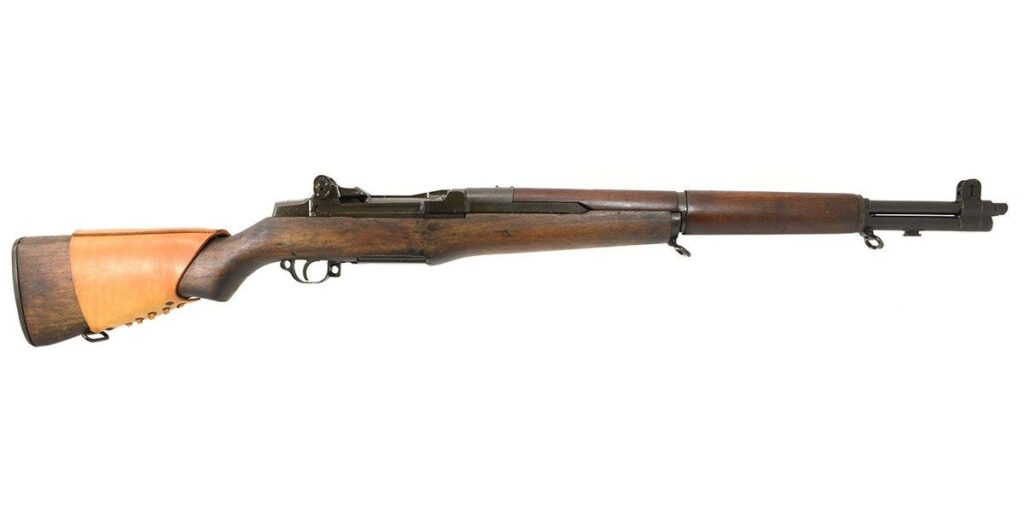
I have and IWI Galil Ace rifle in 7.62×51 NATO and it’s exceptionally well made. I notice that IWI has it in and an Italian version of the Garand known as the “BREDA” in 7.62×51 also. I thought I would spread the word – I sure wish I had the funds to buy both models of the BREDA.
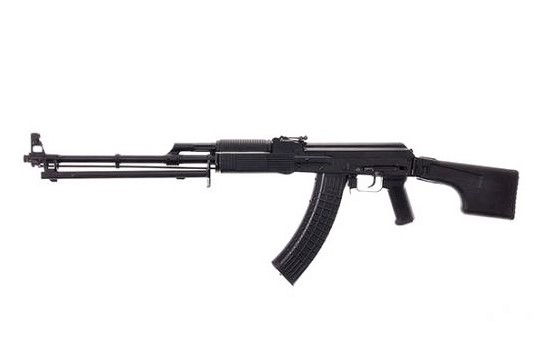
Just to make the lack of funds hurt even more, they have a FIME Molot RPK-74 in stock also. Where these came from, I don’t know but they command a princely price.