1. Executive Summary
The United States Department of Defense (DoD) is executing a profound strategic pivot toward the deployment of attritable, autonomous systems, most notably through the Replicator initiative. The objective is to rapidly field multiple thousands of uncrewed systems across all warfighting domains to counter the mass and scale of adversarial forces, specifically addressing the pacing challenge presented by the People’s Republic of China in the Indo-Pacific. However, while capital allocation and technological development—such as artificial intelligence integration, algorithmic autonomy, and advanced sensor payloads—are heavily prioritized, the defense apparatus risks overlooking the foundational physical requirement of this strategy: the specialized human capital required to physically manufacture these systems at scale.
Hardware scales differently than software. The production of reliable, combat-ready uncrewed aerial systems (UAS) relies on a complex network of physical manufacturing facilities and, crucially, a highly specialized blue-collar workforce. The current defense industrial base (DIB) is severely constrained by critical deficits in roles such as composite technicians, precision solderers, computer numerical control (CNC) machinists, and quality assurance (QA) inspectors. Furthermore, the challenge extends beyond initial recruitment; the sector is facing a severe retention crisis, exacerbated by security clearance delays, International Traffic in Arms Regulations (ITAR) constraints, and direct labor competition from other critical defense sectors, such as nuclear shipbuilding and conventional munitions manufacturing.
To successfully enable warfighters and achieve the strategic goals of the Replicator initiative, DoD leadership must recognize that the limiting factor in drone proliferation is no longer solely sensor capability or software architecture, but rather the availability of cleared, skilled technicians capable of physical assembly and rapid manufacturing iteration. This report details the specific workforce deficits constraining drone manufacturing, analyzes the systemic retention and facility scaling challenges, and provides strategic context to fortify the human capital foundation of the American defense industrial base. The analysis demonstrates that without parallel investments in the blue-collar workforce, the United States risks developing advanced drone architectures that it simply lacks the manpower to build in the volumes required for modern deterrence.
2. The Strategic Context: The Paradigm Shift to Attritable Mass
For decades, the United States defense acquisition system has optimized for “exquisite” platforms: highly capable, highly survivable, and extremely expensive systems produced in low volumes, such as fifth-generation fighter aircraft, advanced destroyers, and strategic bombers.1 The national manufacturing infrastructure and workforce training pipelines were built to support this model, prioritizing perfection, decades-long lifecycles, and exacting military specifications over speed and volume. This paradigm, while effective for maintaining qualitative superiority, presents critical vulnerabilities against adversaries capable of generating quantitative mass.2
The modern battlefield, particularly as observed in the ongoing conflict in Ukraine, has demonstrated a fundamental shift in the character of war. Uncrewed systems are no longer utilized solely as niche enablers or high-altitude surveillance assets operating in uncontested airspace; they are central instruments of kinetic warfare, functioning as primary reconnaissance networks, artillery spotters, and loitering munitions.1 In this environment, the strategic advantage shifts toward the force capable of deploying large volumes of uncrewed assets. Large fleets of low-cost, attritable drones create operational dilemmas for adversaries, forcing them to exhaust expensive air defense interceptors on inexpensive, easily replaceable targets.2
2.1 The Replicator Initiative and Production Realities
In response to these shifting dynamics, the DoD launched the Replicator initiative in August 2023. Unveiled by Deputy Defense Secretary Kathleen Hicks, Replicator aims to rapidly field thousands of attritable autonomous systems across multiple domains within an aggressive 18-to-24-month timeframe.2 The initiative leverages commercial technology, robotics, and artificial intelligence to offset the mass of the People’s Liberation Army (PLA).2 Executed in phases, Replicator 1.1 and 1.2 have focused on the selection of maritime and aerial drones, alongside associated counter-drone assets, for mass domestic manufacturing.8
However, achieving this goal requires a manufacturing base capable of hyperscaling production. The commercial drone production ecosystem, which naturally underwrites military capability through economies of scale, learning effects, and rapid adaptation, is currently dominated by foreign competitors.1 The domestic U.S. drone industrial base remains fragmented, expensive, and constrained by vulnerable supply chains.1 Transitioning from an “exquisite” to an “attritable mass” paradigm requires fundamental changes in how facilities operate and how labor is deployed. The strategic intent of Replicator is sound, but it operates within an industrial base that is currently poorly suited to the mass production of inexpensive, expendable weapons.1
2.2 Cost Economics: Exquisite versus Attritable Systems
The justification for transitioning toward unmanned systems frequently hinges on cost. Conventional wisdom asserts that UAS platforms are inherently cheaper because they eliminate the need for pilot life-support equipment, cabin pressurization, and ejection systems.10 However, evaluating the actual economics of scaling drone fleets requires a nuanced understanding of acquisition versus life-cycle operations and support (O&S) costs.
When comparing exquisite, large-scale systems, the cost advantages of unmanned platforms narrow significantly when recurring life-cycle costs are factored in.10 Data from the Congressional Budget Office illustrates this dynamic when comparing the unmanned RQ-4 Global Hawk to the manned P-8 Poseidon. While the RQ-4 featured a lower average acquisition cost ($239 million per aircraft compared to $307 million for a P-8), its life-cycle costs per flying hour were calculated at roughly $35,200, compared to $42,300 for the P-8.11 This relatively narrow 17 percent difference in life-cycle costs is driven by the RQ-4’s shorter expected lifespan, intensive maintenance requirements, and higher historical attrition rates, which amortize the initial acquisition cost over fewer total flying hours.11 Similarly, the MQ-9 Reaper, often cited as a cost-effective alternative to manned fighters, carries a total unit cost exceeding $120 million when evaluating a complete, operable Combat Air Patrol consisting of four air vehicles and associated ground control stations.13
These figures demonstrate why the Replicator initiative cannot simply rely on scaling existing legacy uncrewed systems. The economics change drastically only when analyzing “attritable mass” systems. The strategic value of small, highly modular drones is not derived from operating them for decades, but from utilizing them as expendable assets that impose disproportionate costs on adversaries.3 However, the primary bottleneck to achieving this economic advantage remains labor. If the human capital required to build these attritable systems is scarce, labor costs will inevitably rise, eroding the cost-per-unit advantage that makes the swarm strategy economically viable.
3. The Paradigm Shift from Legacy Aerospace to Iterative Manufacturing
The production of modern autonomous systems requires a departure from traditional aerospace manufacturing timelines. Traditional manufacturing relies on tooling-based rigidity, characterized by massive upfront investments in injection molds, dies, and static assembly lines.14 This model is designed for platforms that will remain largely unchanged in their physical geometry for years or decades.
Conversely, drones designed for contested environments must iterate rapidly to overcome adversarial countermeasures. Observations from the conflict in Ukraine indicate that drone technology becomes obsolete roughly every six weeks as adversaries adapt their electronic warfare, jamming, and kinetic interception tactics.15 This intense pressure for continuous, rapid design iteration requires a highly agile workforce capable of adapting to new airframes, payloads, and frequencies on a near-monthly basis.
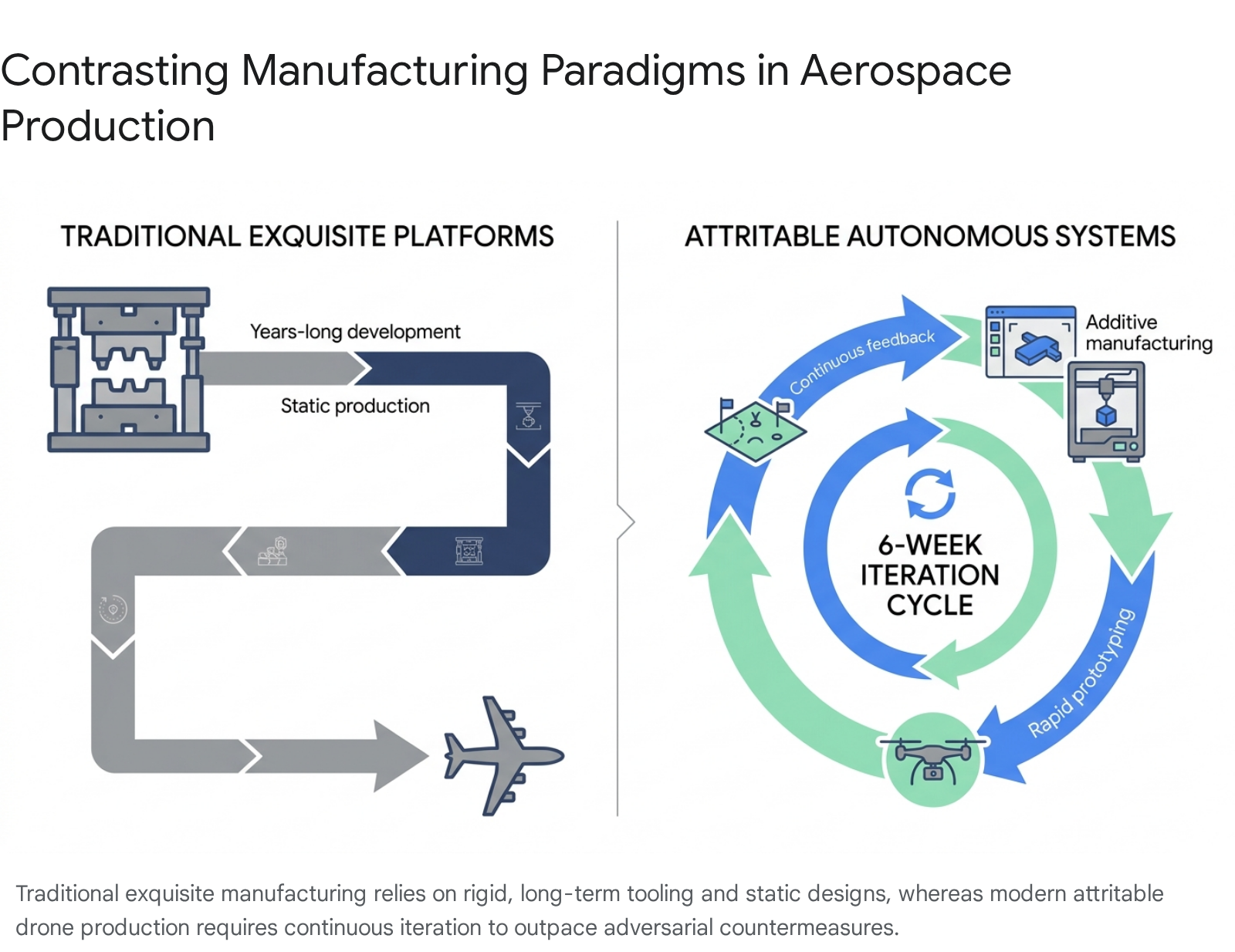
[Image: A comparative workflow diagram showing the linear, multi-year production cycle of traditional aerospace platforms next to the rapid, circular 6-week iterative production loop required for attritable drones.]
To achieve this velocity, hardware manufacturing must evolve from mechanical rigidity to digital-first agility. This evolution leans heavily on additive manufacturing and modular design. Rather than investing up to $50,000 in a single injection mold, manufacturers are utilizing Large Format Additive Manufacturing (LFAM) to process low-cost polymer granulates, enabling the production of diverse drone sizes on the same equipment.15 Companies engaging in the Replicator initiative are demonstrating the ability to print, assemble, and fly long-range uncrewed aircraft with reconfigurable payloads with lead times as short as six weeks.18 This transition significantly alters the human capital requirements; the industry relies less on static assembly line workers and more on technicians who can seamlessly interact with digital warehouses, optimize toolpaths for additive systems, and manage rapid structural bonding processes.14
4. The Blue-Collar Deficit: Critical Bottlenecks in Drone Manufacturing
While artificial intelligence and advanced algorithms dictate the behavior of autonomous systems, the physical platforms must be manufactured, assembled, and inspected by humans. The defense sector is experiencing a massive talent gap in engineering; projections indicate a global shortage of semiconductor engineers exceeding one million by 2030, and the U.S. currently produces only a fraction of the aerospace engineers required to meet demand.19 However, this white-collar engineering deficit cascades downward, heavily impacting the blue-collar trades necessary for physical production. The shortage of specialized manufacturing labor is the most acute constraint on domestic aerospace expansion, directly threatening the ability to meet production targets of 10,000 or more UAS units per month.20
4.1 Composite Technicians and Airframe Fabrication
To maximize flight endurance and payload capacity, drone airframes must achieve an exceptional strength-to-weight ratio. Traditional metal fabrication adds weight that destroys flight efficiency, while small-scale 3D printing often lacks the necessary structural integrity for high-stress maneuvers.17 Consequently, advanced uncrewed systems rely heavily on composite materials, primarily carbon fiber, fiberglass, and Kevlar.22
The fabrication of these materials requires specialized composite technicians. The manufacturing process for composite drone frames is highly complex and manual. Technicians are responsible for preparing molds, performing precise hand layups of carbon fiber sheets, executing vacuum bagging to remove air voids, and managing the thermal curing processes required to solidify the resins.24 Furthermore, post-cure processing involves trimming, sanding, and finishing the parts to meet exacting dimensional tolerances, often involving the integration of metal inserts and couplings for assembly.22
Mistakes in fiber orientation, improper resin ratios, or flawed curing temperatures can lead to structural delamination under the extreme aerodynamic stress of flight.25 Because cured carbon fiber cannot be easily drilled or machined without risking structural compromise or requiring highly specialized milling tools, the initial layup and molding must be executed with near perfection.22 As the industry attempts to scale, the reliance on weeks of skilled manual labor per unit for carbon fiber hand layup becomes a severe production bottleneck.17 Even as the industry adopts Large Format Additive Manufacturing to extrude polymer granulates (such as polypropylene and polyamide compounds) for larger airframes, technicians skilled in managing these advanced robotic systems, optimizing toolpaths, and performing post-processing are essential.17 The talent pipeline for these roles is remarkably narrow, with few vocational programs offering dedicated composite manufacturing training outside of legacy commercial aerospace hubs.26
4.2 Precision Solderers and Electronics Assembly
Drones function fundamentally as highly mobile, flying sensor networks. The integration of flight controllers, electronic speed controllers (ESCs), optical payloads, and radio frequency communication modules relies on intricate printed circuit board (PCB) assembly.28 While high-volume Surface Mount Technology (SMT) handles the automated placement of microchips, hand soldering remains an absolute necessity for through-hole components, heavy-duty battery connectors, mechanical mounts, selective operations, rework, and low-volume rapid prototyping.30
In a combat or tactical environment, an uncrewed system is subjected to massive vibrational forces, rapid thermal cycling, and high-G maneuvers. A single “cold” solder joint or a microscopic fracture in a through-hole connection can result in catastrophic mid-air electrical failure.29 Therefore, precision hand soldering requires far more than basic assembly capability; it requires a mastery of thermodynamics at a micro-scale. Technicians must maintain precise temperature control—often targeting 390°C for smaller joints and up to 450°C for larger battery connections—while managing flux application and dwell time to ensure complete hole fill and strong mechanical bonds without damaging adjacent, sensitive microelectronics.29
The defense standard governing this work is the IPC J-STD-001 certification, which dictates the materials, methods, and stringent verification criteria for producing high-quality solder interconnections, specifically including space and aerospace applications.31 Acquiring and maintaining a workforce of certified precision solderers is exceptionally difficult. The commercial technology and telecommunications sectors heavily recruit individuals with these exact micro-electronics capabilities, often offering superior compensation packages without the restrictive environments, security protocols, or geographic limitations associated with defense contracting.19
4.3 Machinists, Tooling, and Iteration Agility
The rapid, six-week iteration cycle dictated by modern electronic warfare places immense pressure on CNC machinists and tool-and-die makers. In traditional manufacturing, creating an injection mold for a drone chassis component requires metal dies that can cost between $10,000 and $50,000, taking weeks or months to machine.14 If adversarial countermeasures require a change in payload shape, aerodynamic profile, or antenna housing, these expensive tools must be entirely remade.14
To achieve rapid iteration, machinists must transition from traditional long-term tooling to rapid prototyping methodologies. This involves utilizing advanced 5-axis CNC milling, precision sheet metal fabrication, and the creation of temporary molds from high-density milling foam or 3D printed polymers.15 This environment demands a workforce highly proficient in digital-first agility, capable of translating AI-driven Design for Manufacturability (DFM) outputs directly into machine code.14
However, the demographic reality of the machining profession poses a systemic risk. The median age for machinists in the United States is 45.7 years, with over 31 percent of the workforce aged 55 or older.33 This indicates a looming retirement cliff that threatens to hollow out this critical capability precisely as the defense apparatus attempts to scale drone production to multiple thousands of units per month.33
4.4 Quality Assurance and Inspection Personnel
The final critical blue-collar bottleneck resides in Quality Assurance (QA). Defense UAS components must perform reliably, requiring rigorous quality control integrated into every stage of production.32 This necessitates a workforce of trained inspectors capable of identifying microscopic defects in composite materials, utilizing non-destructive testing (NDT) methodologies, conducting electromagnetic interference (EMI) inspections, and verifying the integrity of complex mechanical and electrical assemblies.24
The regulatory framework further complicates this process. DoD acquisitions operate under stringent QA guidelines, such as Federal Acquisition Regulation (FAR) Part 46 and Defense Federal Acquisition Regulation Supplement (DFARS) Part 246.35 These regulations dictate extensive government and contractor inspection systems, ensuring that manufacturing processes, drawings, and engineering changes conform exactly to specified technical requirements.35
While these comprehensive standards are vital for multi-million-dollar, decades-long platforms where human lives are directly at risk, applying the same heavy bureaucratic inspection regimes to $30,000 attritable drones slows production velocity to an unacceptable rate. QA inspectors must be specifically trained to navigate the nuances of verifying “smart and affordable mass.” They must ensure operational reliability without imposing exquisite-level perfectionism and MIL-SPEC rigidity that ultimately ruins the economics of attritability.3
4.5 Material Complexity and Supply Chain Dependencies
The workforce must also navigate highly complex supply chains and specialized raw materials. Drone production relies heavily on specific materials to achieve necessary power-to-weight ratios and endurance limits. For larger uncrewed systems, technicians must work with aluminum-silicon-copper piston alloys, steel or titanium valvetrain parts, and magnesium castings used to save weight.9 On the electronic side, energy storage defines endurance limits; each kilowatt-hour of battery capacity requires substantial amounts of copper, aluminum, graphite, and lithium-ion cells, while advanced radar and communication systems rely heavily on gallium-nitride electronics.9 The ability of the workforce to manage, process, and assemble these highly specific materials is fundamentally linked to the nation’s capacity to scale mass production.9
5. The Systemic Retention Crisis and Demographic Shifts
When defense policymakers and program managers discuss the manufacturing skills gap, the conversation is predominantly focused on recruitment pipelines: the lack of applicants, limited training slots, and poor awareness of manufacturing careers.33 However, systemic federal data reveals that the DIB is suffering from a catastrophic retention problem. Defense manufacturers cannot simply hold onto the talent they spend years recruiting and training.33
5.1 The Collapse of Occupational Tenure
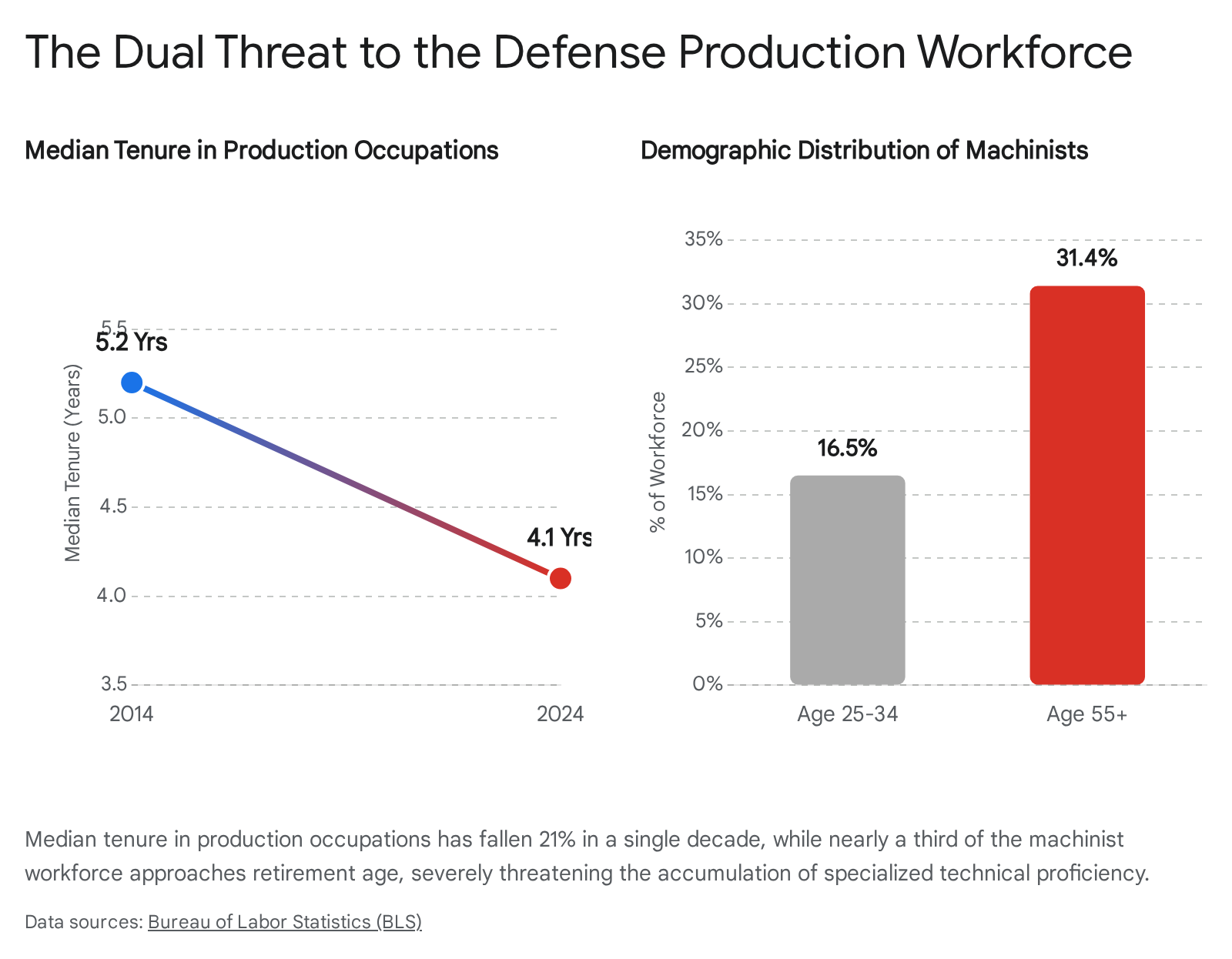
According to Bureau of Labor Statistics (BLS) data, the median tenure in production occupations has suffered a severe decline, falling 21 percent from 5.2 years in 2014 to just 4.1 years in 2024.33 In the specific manufacturing subsectors that feed defense supply chains—such as primary metals, fabricated metal products, and machinery manufacturing—tenure has dropped equally precipitously.33 For machinery manufacturing specifically, median tenure fell from 6.2 years to 5.0 years over the same decade.33
Simultaneously, the demographic distribution of the workforce is dangerously skewed. While over 31.4 percent of the machinist workforce is nearing retirement age, the 25-to-34 age cohort—the demographic essential for mid-career proficiency and transitioning into management or advanced technical roles—accounts for only 16.5 percent of the workforce.33 The defense sector is steadily bleeding its mid-level talent, and data indicates that frontline and middle managers in aerospace and defense are twice as likely to leave their employers as individual contributors.38
5.2 Security Clearances and ITAR Restrictions
The retention problem is exponentially more damaging to the defense industrial base than to the commercial sector due to the structural, regulatory barriers to hiring.33 A commercial drone manufacturer facing turnover can replace a departing technician relatively quickly from the open labor market. A defense contractor producing specialized, export-controlled hardware cannot.
The defense labor pool is artificially restricted by the International Traffic in Arms Regulations (ITAR) and the Export Administration Regulations (EAR). Because drones, their software, and their manufacturing schematics frequently fall under the United States Munitions List (USML) or require strict export compliance, manufacturers are largely compelled to employ U.S. persons and restrict foreign national access entirely.39 Losing a single highly skilled worker from this already small, restricted pool creates an immediate production vacuum.33
Furthermore, workers engaged in sensitive defense programs require security clearances. When a cleared technician leaves, the replacement must undergo comprehensive background investigations, adjudication processes, and program read-ins. This bureaucratic process routinely takes six to twelve months, and sometimes longer.33 During this gap, production lines must either slow down significantly or cannibalize cleared personnel from other critical programs. This introduces cascading schedule risks, particularly threatening to initiatives like Replicator that are operating on rigid, politically mandated 18-to-24-month deadlines.7
5.3 The Loss of Accumulated Technical Proficiency
Defense drone production, unlike mass consumer electronics, involves low-volume, high-complexity systems. Workers do not develop proficiency through the mindless, high-volume repetition of a standard commercial assembly line; they develop essential “muscle memory” through years of accumulated experience with specific composite materials, aerospace tolerances, and rigorous QA regimes.33
When a machinist with 15 years of experience leaves the defense sector for the commercial tech sector, their unique expertise in preventing carbon fiber delamination, executing complex multi-axis CNC operations, or maintaining tight thermal controls during soldering is lost. This specialized proficiency cannot be instantly replaced by a recent community college graduate or a four-month accelerated training program.33 The steady decline in median tenure means that the DIB is continuously operating with a workforce that has not yet reached peak technical maturity, resulting in higher defect rates, slower production times, and increased supply chain fragility.19
6. Facility Scaling and the Hyperscale Model
As the DoD demands production scaling from bespoke prototype quantities to multiple thousands of units per month, the physical footprint of the defense industrial base must radically expand. The transition from small-scale engineering laboratories to hyperscale manufacturing facilities introduces complex logistical and infrastructural hurdles.
6.1 The Transition to Hyperscale Infrastructure
Meeting the demands of affordable mass requires a departure from distributed, fragmented supply chains toward consolidated, massive-scale production hubs. The development of “Arsenal-1” by Anduril Industries in Pickaway County, Ohio, serves as a primary case study for this new industrial model. Designed as a hyperscale manufacturing facility specifically for autonomous systems and weapons, Arsenal-1 is planned to encompass over 1.7 million square feet of production space across multiple buildings, representing an investment of nearly $1 billion and expected to create over 4,000 direct jobs.43
The strategic architecture behind Arsenal-1 emphasizes software-driven manufacturing, modular factory layouts, and staggered capacity scaling.43 Rather than opening an entire campus simultaneously, the facility relies on a 10-year staggered buildout, allowing the company to scale intentionally to meet production demands without overextending capital.43 This model deliberately eschews complex, rigid robotics in favor of deploying human capacity rapidly. As noted by industry executives, the intent is to avoid overly complex automation initially, focusing instead on bringing the workforce online to ramp production as fast as possible, standardizing processes to accommodate a rapid increase in output.47 Efficient space utilization is paramount; modern layouts structure production, logistics, assembly, and testing under single, integrated roofs to accommodate multiple drone variants—such as First Person View (FPV) drones, loitering munitions, and cruise systems—on shared infrastructure.48
6.2 The Burden of ITAR-Compliant Production Environments
While commercial drone manufacturers can scale operations relatively easily in standard light-industrial parks, defense drone manufacturing facilities must be built to withstand intense regulatory scrutiny. Creating a manufacturing environment capable of producing ITAR-controlled systems requires millions of dollars in physical and digital overhead that commercial entities do not face.32
Facilities must implement robust physical safeguards to prevent unauthorized access. This includes segmented production areas, sophisticated visitor management systems, escorted access protocols, and advanced continuous surveillance.49 On the digital front, technical data such as CAD drawings, manufacturing instructions, material specifications, and quality procedures must be held on air-gapped or heavily controlled networks featuring encrypted storage and strict need-to-know access validation.49 Furthermore, achieving Cybersecurity Maturity Model Certification (CMMC) Level 2 physical and digital safeguards are often baseline requirements for handling Controlled Unclassified Information (CUI).49
| Manufacturing Process | Defense Control Constraint | Impact on Scaling Speed & Cost |
| Facility Layout | Physically segregated work areas; escorted visitor protocols; restricted foreign national access. 49 | Prevents the use of shared commercial space; requires dedicated, secure real estate footprint. |
| Component Engineering | Encrypted storage; Computer-Aided Manufacturing (CAM) programming on air-gapped systems. 49 | Slows cross-team collaboration; requires highly specialized IT infrastructure and cleared IT personnel. |
| Shop Floor Operations | Process specifications and instructions require strict document control and physical security. 49 | Limits the use of wireless tablets/IoT devices common in “smart factories” without extreme encryption. |
| Supply Chain Sourcing | Export authorization verification; mandatory supplier ITAR compliance checks. 49 | Limits the vendor pool; prevents rapid sourcing of commercial off-the-shelf (COTS) parts globally. |
These extensive constraints dictate that scaling drone production is not simply a matter of acquiring real estate and installing CNC machines; it requires building highly secure fortresses of compliance. This environment inherently slows operational velocity and creates a massive administrative burden that deters smaller, highly innovative commercial drone startups from transitioning their dual-use technology into the defense sector.32
7. Regulatory Frictions: Airspace, Spectrum, and Testing
Beyond the confines of the factory floor, the workforce is further constrained by domestic regulatory frameworks that complicate the testing and iteration phases of drone development. A drone cannot be effectively iterated every six weeks if the manufacturer cannot rapidly test the integrated systems in real-world conditions.
7.1 Airspace Restrictions and Testing Bottlenecks
The Federal Aviation Administration (FAA) strictly regulates the operation of small uncrewed aircraft systems (weighing less than 55 pounds) under 14 CFR Part 107.51 These regulations stipulate that operators must keep the drone within visual line of sight at all times, limiting the maximum allowable altitude to 400 feet above the ground, and restricting the maximum speed to 100 mph (87 knots).51 Furthermore, operations are generally restricted to daylight or twilight hours, and flights over people not directly participating in the operation are prohibited.51
While these rules are essential for civilian airspace safety, they present massive hurdles for defense manufacturers testing advanced autonomous swarm logic, long-range capabilities, and high-speed maneuvers. Manufacturers must either secure complex waivers from the FAA or transport personnel and equipment to specialized, geographically remote military test ranges. This geographic dislocation separates the engineering and assembly workforce from the testing environment, severely disrupting the rapid feedback loops required for iterative manufacturing.
7.2 Spectrum Allocation Challenges
Compounding the airspace issue is the allocation of radio frequency spectrum. Most domestic drone operations currently rely on unlicensed spectrum—the same frequencies utilized by consumer Wi-Fi routers and other devices, including the 900 MHz band, 2.4 GHz band, and 5.8 GHz band.52 As the DoD seeks to build drone dominance, the Federal Communications Commission (FCC) recognizes that these crowded, unlicensed bands are highly susceptible to interference and may not be viable for the intensive, large-scale UAS operations envisioned by the military.52
The FCC is actively seeking to expand deployment by permitting UAS operations in flexible-use terrestrial bands typically reserved for mobile broadband, such as the 1.4 GHz, 2.3 GHz, and 3.7 GHz bands.52 Concurrently, the emergence of private 5G and LTE networks is providing dedicated connectivity layers for industrial sites, enabling the testing of automated, long-range drone missions with predictable coverage and low latency.53 However, until dedicated spectrum and secure networks are fully integrated and accessible to the defense industrial base, the workforce is limited in its ability to test the electronic resilience of the systems they are assembling.
8. Cross-Sector Competition Within the Defense Industrial Base
A critical oversight in current defense planning is viewing drone workforce deficits in complete isolation. The defense industrial base is a largely closed ecosystem, drawing continuously from the same restricted pool of cleared, U.S. citizen labor. Consequently, the drone sector is engaged in direct, zero-sum competition with other vital national security priorities for the exact same blue-collar workers.54
8.1 The Talent Tug-of-War
The American industrial base is currently strained by massive munitions consumption in Eastern Europe and the strategic imperative to expand the U.S. Navy fleet to maintain deterrence in the Indo-Pacific.54 The scale of this consumption is staggering; at peak intensity, Ukraine’s daily need for 155mm artillery shells could exhaust pre-war U.S. monthly production in just over a day, while their consumption of 10,000 drones per month could deplete the entire U.S. inventory in a matter of weeks.54
To address this, the U.S. government is actively modernizing and expanding its shipyards, armories, and munitions plants.57 However, the production of artillery shells, the construction of Columbia-class nuclear submarines, and the mass manufacturing of attritable UAS all require the exact same core competencies: industrial electricians, master welders, QA inspectors, and CNC machinists.20 When the DoD successfully injects capital to ramp up submarine shipbuilding or warm up munitions production lines, it inadvertently cannibalizes talent from aerospace and drone programs.55 Regional labor markets, particularly in historical manufacturing hubs, cannot organically produce highly skilled tradespeople fast enough to satiate the concurrent, surging demands of all branches of the military.20
8.2 Vocational Pipelines and Accelerated Training
Historical precedents demonstrate that national industrial mobilization requires viewing human capital as a strategic resource. During World War II, the iconic “Rosie the Riveter” campaign was not merely propaganda; it was a deliberate, government-led effort to solve a systemic labor crisis, successfully increasing the proportion of women in the U.S. aircraft industry workforce from 1 percent to 65 percent by 1943.54 The current DIB faces a similar, albeit more technically complex, workforce crisis that requires comparable institutional focus.54
To combat the talent shortage, the DoD has begun investing in accelerated vocational pipelines. The Accelerated Training in Defense Manufacturing (ATDM) pilot project in Danville, Virginia, funded by the DoD’s Industrial Base Analysis and Sustainment (IBAS) program, serves as a vital proof of concept.58 Originally focused on addressing gaps in the submarine shipbuilding sector, the ATDM platform aims to compress traditional 1-to-2-year trade training programs into an intensive 4-month curriculum designed specifically to meet urgent defense maritime production requirements.58
For the uncrewed systems industry to scale, similar regional training centers dedicated specifically to advanced composites, precision soldering, and digital drone fabrication must be established nationwide.26 Educational institutions are beginning to recognize this shift. High school Career and Technical Education (CTE) programs and community colleges are integrating drone operation, maintenance, and composite fabrication into their curricula, utilizing on-campus makerspaces equipped with 3D printers, laser cutters, and CNC machines.27 These programs introduce students to essential skills, from understanding electronic systems to diagnosing circuit faults and interpreting technical documentation.60 However, the scale of these educational initiatives remains vastly inadequate relative to the projected military need for tens of thousands of units per month.21 Furthermore, the DoD’s Human Capital Operating Plan (HCOP) and the newly established Chief Talent Management Officer (CTMO) must ensure that talent acquisition strategies penetrate to the blue-collar, vocational level, rather than focusing solely on white-collar engineering and cyber defense roles.61
9. Strategic Imperatives for DoD Leadership
The tendency to fixate on the technological capabilities of autonomous systems—AI integration, swarm logic, and sensor fidelity—obscures the physical reality that drones are ultimately built by human hands in physical factories. To ensure the success of large-scale manufacturing initiatives like Replicator and maintain strategic deterrence, DoD leadership must address the following imperatives regarding human capital:
- Elevate Human Capital to a Strategic Capability: As articulated by defense policy experts, the DoD must view investments in human capital with the same urgency and scale as investments in research and development, software architecture, or plant equipment.58 The establishment of the CTMO is a positive institutional step, but execution must reach the blue-collar factory floor.61 The DIB cannot fulfill its mandates without a deliberate, national-level campaign to recruit, train, and retain skilled tradespeople.
- Mitigate the Retention Crisis through Contractual Innovation: The DoD must aggressively address the alarming drop in production tenure. Leadership should explore contractual mechanisms that incentivize prime contractors to invest heavily in employee retention, long-term career pathing, and workplace stability. High turnover in defense facilities directly correlates to schedule delays and quality degradation, which are unacceptable under rapid-deployment mandates.33
- Modernize Quality Assurance Regimes for Attritable Mass: Applying exquisite-level FAR and DFARS quality assurance inspection requirements to expendable, attritable drones creates unnecessary labor bottlenecks. The DoD must rapidly establish bifurcated QA standards, allowing for “smart and affordable mass” to be inspected and accepted based on statistical sampling and functional reliability rather than the perfectionist, individual-unit scrutiny historically applied to multi-million-dollar crewed aircraft.3
- Scale Accelerated Vocational Training Nationwide: The IBAS program’s successful investment in accelerated training models must be vastly expanded beyond shipbuilding to encompass aerospace composites, precision electronics assembly, and digital manufacturing. Establishing regional training hubs near planned hyperscale facilities—mirroring the ATDM model—will be essential to generating the localized, highly skilled talent pipelines required to build thousands of drones per month.20
- Address ITAR, Security Clearance, and Testing Frictions: To widen the talent pool and reduce facility overhead, the DoD should work with the State Department and security agencies to streamline clearance adjudications for essential blue-collar production roles. Furthermore, leadership must evaluate whether certain lower-tier components of attritable drones can be carved out of the most restrictive USML and CMMC requirements without compromising national security.33 Concurrently, inter-agency coordination with the FAA and FCC is required to establish dedicated airspace and spectrum for the rapid testing of mass-produced UAS, closing the iterative feedback loop.51
The ultimate success of the United States’ strategy to counter adversarial mass in future conflicts will not be determined solely by the algorithms guiding its weapons, but by the physical capacity of its industrial workforce to build them. Securing the physical supply chain and the specialized labor force that drives it is the immediate, critical prerequisite for unleashing American drone dominance.
Please share the link on Facebook, Forums, with colleagues, etc. Your support is much appreciated and if you have any feedback, please email us in**@*********ps.com. If you’d like to request a report or order a reprint, please click here for the corresponding page to open in new tab.
Works cited
- The Drone Gap: Why the U.S. Industrial Base Continues to Fall …, accessed April 24, 2026, https://www.icitech.org/post/the-drone-gap-why-the-u-s-industrial-base-continues-to-fall-behind-in-a-world-at-war-by-drone
- Replicator: A Bold New Path for DoD | Center for Security and Emerging Technology %, accessed April 24, 2026, https://cset.georgetown.edu/article/replicator-a-bold-new-path-for-dod/
- Smart and affordable mass | Roland Berger, accessed April 24, 2026, https://www.rolandberger.com/en/Insights/Publications/Smart-and-affordable-mass.html
- Drones in Modern Warfare | Australian Army Research Centre (AARC), accessed April 24, 2026, https://researchcentre.army.gov.au/library/occasional-papers/drones-modern-warfare
- Why Replicator is critical for the future of defense – Anduril, accessed April 24, 2026, https://www.anduril.com/news/why-replicator-is-critical-for-the-future-of-defense
- DOD Innovation Official Discusses Progress on Replicator > Department of Defense Manufacturing Technology Program > News Display, accessed April 24, 2026, https://www.dodmantech.mil/News/News-Display/Article/3999474/dod-innovation-official-discusses-progress-on-replicator/
- Scaling the Future: How Replicator Aims to Fast-Track U.S. Defense Capabilities, accessed April 24, 2026, https://warontherocks.com/2023/09/scaling-the-future-how-replicator-aims-to-fast-track-u-s-defense-capabilities/
- DOD touts ‘successful transition’ for Replicator initiative — but questions linger, accessed April 24, 2026, https://defensescoop.com/2025/09/03/dod-replicator-drone-tech-transition-fielding-questions-linger/
- The Drone Supply Chain War: Identifying the Chokepoints to Making a Drone – CSIS, accessed April 24, 2026, https://www.csis.org/analysis/drone-supply-chain-war-identifying-chokepoints-making-drone
- Usage Patterns and Costs of Unmanned Aerial Systems | Congressional Budget Office, accessed April 24, 2026, https://www.cbo.gov/publication/57260
- CBO compares cost of UAS and manned ISR aircraft – Acquisition Talk, accessed April 24, 2026, https://acquisitiontalk.com/2021/06/cbo-compares-cost-of-uas-and-manned-isr-aircraft/
- Usage Patterns and Costs of Unmanned Aerial Systems – Congressional Budget Office, accessed April 24, 2026, https://www.cbo.gov/system/files/2021-06/57090-UAS.pdf
- 2. The MQ-9’s Cost and Performance | TIME.com – U.S., accessed April 24, 2026, https://nation.time.com/2012/02/28/2-the-mq-9s-cost-and-performance/
- Why Drone Innovation Depends on Smarter Manufacturing – Shapeways, accessed April 24, 2026, https://www.shapeways.com/blog/why-drone-innovation-depends-on-smarter-manufacturing
- Drone Manufacturing: Scaling Production and Cutting Costs with Automated 3D Printing, accessed April 24, 2026, https://dhr.is/blog/drone-manufacturing-scaling-production-and-cutting-costs-with-automated-3d-printing
- Unleashing U.S. Military Drone Dominance: What the United States Can Learn from Ukraine, accessed April 24, 2026, https://www.csis.org/analysis/unleashing-us-military-drone-dominance-what-united-states-can-learn-ukraine
- Revolutionary Drone Structure Manufacturing: How LFAM Technology is Transforming UAV Production at Scale – Addcomposite, accessed April 24, 2026, https://www.addcomposites.com/post/revolutionary-drone-structure-manufacturing-how-lfam-technology-is-transforming-uav-production-at-scale
- RapidFlight Tapped for Pentagon’s Plan to Mass Produce Military Drones, accessed April 24, 2026, https://www.designdevelopmenttoday.com/industries/military/news/22893600/rapidflight-tapped-for-pentagons-plan-to-mass-produce-military-drones
- Why the Aerospace and Defense Industry Faces a Million-Person Talent Gap by 2030 – and What It Means for Innovation | ISG, accessed April 24, 2026, https://isg-one.com/articles/why-the-aerospace-and-defense-industry-faces-a-million-person-talent-gap-by-2030—and-what-it-means-for-innovation
- Aerospace & Defense Labor Shortage Solutions for 2026 – madicorp, accessed April 24, 2026, https://www.madicorp.com/blog/aerospace-defense-labor-shortages
- The Army wants to manufacture 10,000 drones per month by 2026 – FedScoop, accessed April 24, 2026, https://fedscoop.com/radio/the-department-expects-it-can-manufacture-at-least-10000-uas-per-month-once-the-first-site-is-up-and-running/
- Carbon Drone Frame Manufacturer – Refitech Composite Solutions, accessed April 24, 2026, https://www.refitech.eu/uav/
- Drone Manufacturing – Everything You Should Know – Custom Precision Component Provider | TOPS, accessed April 24, 2026, https://topsbest-precision.com/blog/drone-manufacturing/
- Delta Black Aerospace Inc – Composite Manufacturing Technician – UAV/Drone Production, accessed April 24, 2026, https://recruiting.paylocity.com/recruiting/jobs/Details/4014439/Delta-Black-Aerospace-Inc/Composite-Manufacturing-Technician—UAVDrone-Production
- CNC Machining Drone Frame Cost Inquiry – Reddit, accessed April 24, 2026, https://www.reddit.com/r/CNC/comments/1sf88k4/cnc_machining_drone_frame_cost_inquiry/
- Composites Technician – Career Training Programs from University of Texas at Arlington, accessed April 24, 2026, https://eeccareertraining.uta.edu/training-programs/composites-technician/
- Stop thinking small: 5 facts proving modern manufacturing is your next high-tech, high-paying career | Edmonds College, accessed April 24, 2026, https://www.edmonds.edu/about-edmonds/news/tritons-blog/manufacturing-sme.html
- Basic Soldering Techniques for Assembling Your Unmanned Aerial Vehicle PCB – ALLPCB, accessed April 24, 2026, https://www.allpcb.com/blog/pcb-knowledge/basic-soldering-techniques-for-assembling-your-unmanned-aerial-vehicle-pcb.html
- A Beginner’s Guide to Soldering for FPV Drones – Oscar Liang, accessed April 24, 2026, https://oscarliang.com/soldering-guide/
- Hand Soldering Standards and Best Practices in EMS, accessed April 24, 2026, https://foxtronicsems.com/through-hole-assembly/hand-soldering-standards-best-practices-in-ems/
- Requirements for Soldered Electrical and Electronic Assemblies IPC Course | MTTC, accessed April 24, 2026, https://mttc.jpl.nasa.gov/catalog/soldered-electrical-and-electronic-assemblies-ipc/
- ITAR Certified UAV and Drone Manufacturing | Protolabs, accessed April 24, 2026, https://www.protolabs.com/resources/blog/how-to-accelerate-defense-uav-prototyping-under-itar-constraints/
- The Retention Problem Nobody’s Talking About: Why Defense …, accessed April 24, 2026, https://www.manufacturingmomentum.org/insight/the-retention-problem-no-one-is-talking-about-why-defense-manufacturing-cant-keep-the-talent-it-trains/
- Composite Technician Jobs, Employment in Texas | Indeed, accessed April 24, 2026, https://www.indeed.com/q-composite-technician-l-texas-jobs.html
- Part 46 – Quality Assurance – Acquisition.GOV, accessed April 24, 2026, https://www.acquisition.gov/far/part-46
- Part 246 – QUALITY ASSURANCE – Acquisition.GOV, accessed April 24, 2026, https://www.acquisition.gov/dfars/part-246-quality-assurance
- The Autonomous Arsenal in Defense of Taiwan: Technology, Law, and Policy of the Replicator Initiative | The Belfer Center for Science and International Affairs, accessed April 24, 2026, https://www.belfercenter.org/replicator-autonomous-weapons-taiwan
- Addressing the U.S. Aerospace Engineering Shortage, accessed April 24, 2026, https://aerospaceamerica.aiaa.org/features/addressing-the-u-s-aerospace-engineering-shortage/
- ITAR Compliance Guide: Requirements, Checklist, & Violations – PreVeil, accessed April 24, 2026, https://www.preveil.com/blog/itar-compliance/
- ITAR Compliance Overview – National Tooling & Machining Association, accessed April 24, 2026, https://ntma.org/wp-content/uploads/2020/03/ITAR-Guidance.pdf
- Unmanned Aircraft Vehicles and Systems | FIU Export Control, accessed April 24, 2026, https://exportcontrol.fiu.edu/export/topics/unmanned-and-autonomous-vehicles/
- AIA and McKinsey Release New Study on Tackling Talent Gaps in Aerospace and Defense Industry, accessed April 24, 2026, https://www.aia-aerospace.org/news/aia-and-mckinsey-release-new-study-on-tackling-talent-gaps-in-aerospace-and-defense-industry/
- Arsenal-1: One Year In – Anduril, accessed April 24, 2026, https://www.anduril.com/news/arsenal-1-one-year-in
- Drone maker Anduril to expand in Long Beach, California | Manufacturing Dive, accessed April 24, 2026, https://www.manufacturingdive.com/news/drone-maker-anduril-expansion-long-beach-california-1-billion/810476/
- Anduril Building Arsenal-1 Hyperscale Manufacturing Facility in Ohio, accessed April 24, 2026, https://www.anduril.com/news/anduril-building-arsenal-1-hyperscale-manufacturing-facility-in-ohio
- Anduril advances Arsenal-1 project in Ohio, confirming planned expansion of U.S. defense production capacity – Defence Industry Europe, accessed April 24, 2026, https://defence-industry.eu/anduril-advances-arsenal-1-project-in-ohio-confirming-planned-expansion-of-u-s-defense-production-capacity/
- Look Inside Anduril’s New Factory as CCA Production Begins, accessed April 24, 2026, https://www.airandspaceforces.com/look-anduril-new-factory-cca-production/
- Results: Designing a Modular Scalable Drone Factory | EFESO Management Consultants, accessed April 24, 2026, https://www.efeso.com/client-results/designing-modular-scalable-drone-factory/
- Defense Radar Manufacturers: ITAR and CMMC Compliance Essentials for Component Suppliers – Modus Advanced, accessed April 24, 2026, https://www.modusadvanced.com/resources/blog/defense-radar-manufacturers
- Strengthening the American Drone Industrial Base – Government Contracts Insights, accessed April 24, 2026, https://govcon.mofo.com/topics/strengthening-the-american-drone-industrial-base
- Small Unmanned Aircraft Systems (UAS) Regulations (Part 107) | Federal Aviation Administration, accessed April 24, 2026, https://www.faa.gov/newsroom/small-unmanned-aircraft-systems-uas-regulations-part-107
- FCC Seeks to Expand Deployment of U.S.-Made Drones and Dedicated Spectrum for Drones – Wiley Rein, accessed April 24, 2026, https://www.wiley.law/alert-FCC-Seeks-to-Expand-Deployment-of-US-Made-Drones-and-Dedicated-Spectrum-for-Drones
- The Drone Industry’s Next Bottleneck Isn’t the Aircraft – Dronelife, accessed April 24, 2026, https://dronelife.com/2026/01/29/the-drone-industrys-next-bottleneck-isnt-the-aircraft/
- Forging America’s 21st Century Defense Industrial Base: Applying Lessons from the Arsenal of Democracy to Modern Great-Power Competition – U.S. Army, accessed April 24, 2026, https://www.army.mil/article/288967/forging_americas_21st_century_defense_industrial_base_applying_lessons_from_the_arsenal_of_democracy_to_modern_great_power_competition
- From Production Lines to Front Lines | CNAS, accessed April 24, 2026, https://www.cnas.org/publications/reports/from-production-lines-to-front-lines
- An Era of Global Rearmament and the U.S. Defense Industrial Base – JPMorgan Chase, accessed April 24, 2026, https://www.jpmorganchase.com/content/dam/jpmorganchase/documents/center-for-geopolitics/jpmc-cfg-us-dib-v4-ada-remediated.pdf
- National Security Advisor Jake Sullivan on Fortifying the U.S. Defense Industrial Base – CSIS, accessed April 24, 2026, https://www.csis.org/analysis/national-security-advisor-jake-sullivan-fortifying-us-defense-industrial-base
- DOD’s Office of Industrial Policy Promotes Defense Industrial Workforce Strategy at Stakeholder Summit – Department of War, accessed April 24, 2026, https://www.war.gov/News/Releases/Release/Article/2753779/dods-office-of-industrial-policy-promotes-defense-industrial-workforce-strategy/
- How Drones Are Transforming Career and Technical Education Paths, accessed April 24, 2026, https://www.fromabovedroneworks.com/how-drones-are-transforming-career-and-technical-education-pathways
- Drone Technician – AgExplorer | National FFA Organization, accessed April 24, 2026, https://agexplorer.ffa.org/career/drone-technician/
- Department of Defense Human Capital Operating Plan FY 2024–2025, accessed April 24, 2026, https://www.dmi-ida.org/knowledge-base-detail/Department-of-Defense-Human-Capital-Operating-Plan-FY-2024%E2%80%932025