Tag Archives: Global

Impact of the 2026 Iran Conflict on the Global Economy

1. Executive Summary

The initiation of Operation Epic Fury on February 28, 2026, by the United States and Israel marked a profound watershed moment in modern Middle Eastern geopolitics and global security architecture. Designed as a decisive, overwhelming military campaign to definitively neutralize Iran’s nuclear infrastructure and decapitate its senior political and military leadership—including the successful assassination of Supreme Leader Ali Khamenei—the operation has achieved significant, albeit narrow, tactical and kinetic objectives. However, the resulting strategic blowback has precipitated an unprecedented, cascading global crisis. Iran’s calculated transition to a multidomain retaliation strategy, most notably the effective weaponization and closure of the Strait of Hormuz, has transformed a regional military conflict into a systemic shock to the foundation of the global economy.

This comprehensive intelligence and diplomatic assessment analyzes the compounding, multifaceted effects of the 2026 Iran conflict on global perceptions of the United States. The analysis indicates that while the United States retains overwhelming conventional military supremacy and strike capability, its global soft power, diplomatic leverage, and alliance cohesion are experiencing a precipitous and potentially irreversible decline. The blockade of the Strait of Hormuz has disrupted approximately 20% of global seaborne energy trade, triggering severe inflationary shocks across global energy, petrochemical, and agricultural markets. Consequently, the United States is increasingly viewed by traditional European allies, Indo-Pacific partners, and the broader Global South not as a reliable guarantor of international stability, but as the primary architect of a disruptive conflict that places disproportionate economic and humanitarian burdens on vulnerable nations.

Furthermore, the ongoing crisis has rapidly accelerated the structural realignment of the international order. The geopolitical vacuum created by U.S. entanglement, coupled with the alienation of key European and Asian allies over economic fallout, has provided an explicit opening for systemic rivals—namely China and Russia—to consolidate their influence. By capitalizing on the global energy squeeze, capturing disrupted supply chains, and offering diplomatic alternatives, this emerging alignment is successfully positioning itself against U.S. unipolar hegemony. Concurrently, Iran has demonstrated a highly effective asymmetric warfare doctrine, leveraging proxy militias across multiple theaters, conducting aggressive cyber-enabled psychological operations, and exploiting the vulnerabilities of global commercial infrastructure to impose unacceptable costs on the U.S. and its partners. This report details the economic, diplomatic, and security dimensions of the crisis, concluding that the 2026 Iran conflict has fundamentally challenged the authority of the United States, forcing a systemic reevaluation of American strategic reach and the durability of its alliance networks in an increasingly fragmented, multipolar world.

2. The Strategic Context and the Architecture of Escalation

The roots of the current crisis are deeply embedded in the collapse of the Joint Comprehensive Plan of Action (JCPOA) and the subsequent years of oscillating U.S. policy, which vacillated between “maximum pressure” containment strategies and direct, albeit limited, military coercion.1 The immediate catalyst for the current conflagration emerged following the failure of mediated, backchannel negotiations in Oman, Rome, and Geneva throughout 2025, a diplomatic breakdown that culminated in the brief but highly destructive Twelve-Day War in June 2025.2 Assessing Iran’s strategic posture as severely weakened by years of crippling economic sanctions, destabilizing domestic unrest, and the steady degradation of its proxy networks during the preceding Israel-Hamas War, the United States and Israel calculated that overwhelming military intervention presented a highly viable mechanism to permanently neutralize Tehran’s nuclear ambitions and regional influence.2

On February 28, 2026, joint U.S. and Israeli forces launched Operation Epic Fury, executing nearly 900 precision airstrikes within the first 12 hours of the conflict.2 The strikes systematically dismantled Iranian air defenses, military infrastructure, and known nuclear sites, whilst successfully targeting the heart of the Iranian regime.2 The assassination of Supreme Leader Ali Khamenei, alongside key figures such as Ali Larijani—who had historically served as a critical backchannel negotiator with the West—was intended to precipitate rapid regime collapse or, at minimum, severe operational paralysis.2 However, the deeply entrenched institutional networks and redundant command structures of the Islamic Republic endured the initial kinetic shock. Rather than capitulating, Tehran opted for a highly calculated, multidomain punishment campaign.7

Recognizing its inherent inability to match U.S. and Israeli conventional firepower or sustain a prolonged conventional war, Tehran operationalized a strategy of asymmetric horizontal escalation. By early March 2026, Iran had executed retaliatory strikes against U.S.-linked energy infrastructure across nine Gulf Cooperation Council (GCC) states and, most consequentially, imposed a near-total blockade on commercial shipping through the Strait of Hormuz.5 This strategic pivot purposefully shifted the center of gravity from the military battlefield to the global economic system, leveraging the inherent structural vulnerabilities of interconnected supply chains to exert massive, decentralized political pressure on Washington.8

3. The Geoeconomic Cascade: The Weaponization of the Strait of Hormuz

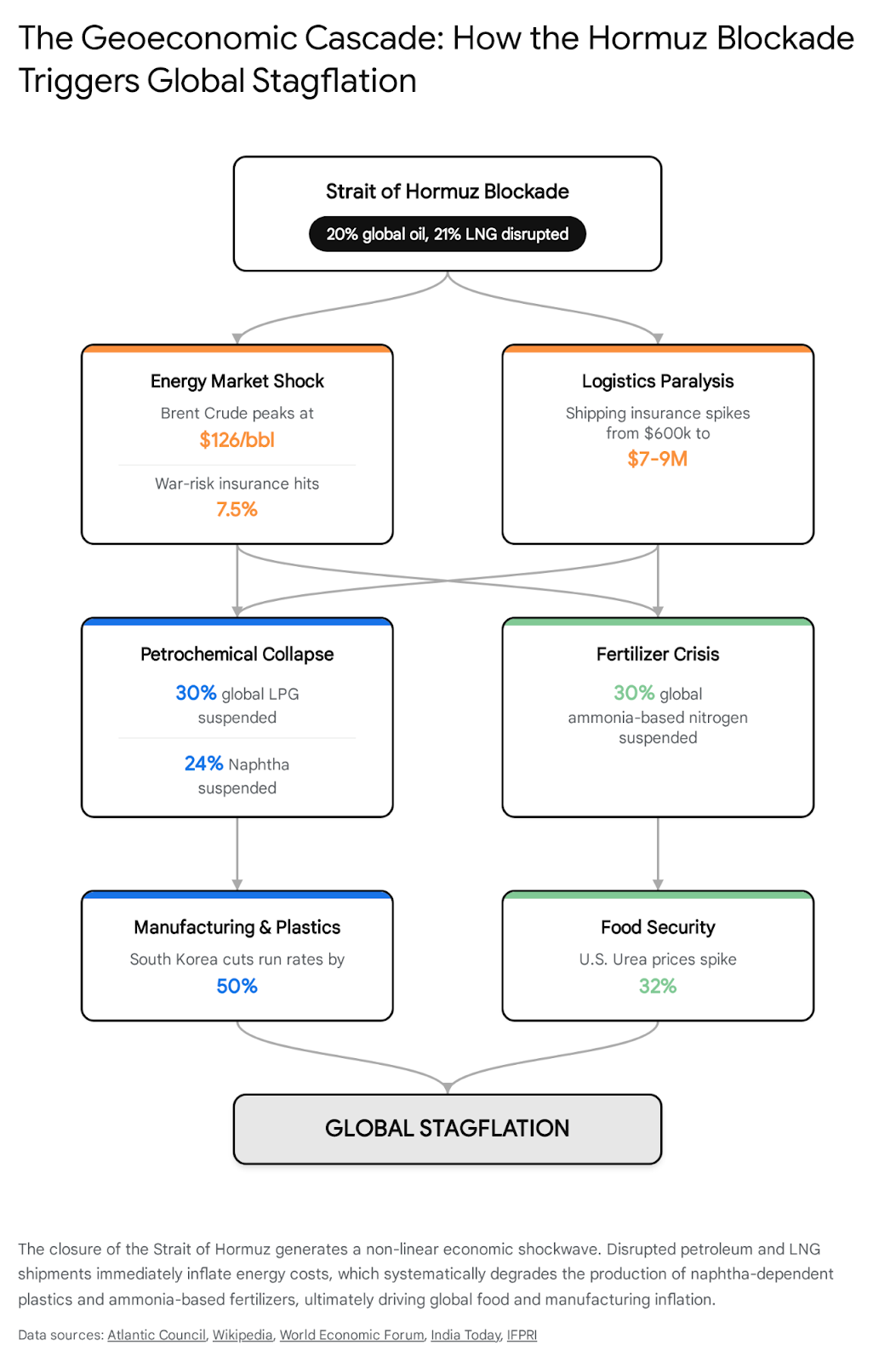
The closure of the Strait of Hormuz represents the single most consequential supply chain disruption in modern economic history, dwarfing both the oil shocks of the 1970s and the energy realignments following the 2022 Russia-Ukraine war.9 By targeting the world’s premier maritime chokepoint, Iran has effectively removed approximately 20 million barrels per day (bpd) of petroleum liquids and 21% of global Liquefied Natural Gas (LNG) supplies from the market.12 International Energy Agency (IEA) Executive Director Fatih Birol has characterized the event as the equivalent of two historical oil crises and one gas crisis occurring simultaneously, representing a catastrophic supply disruption that markets and policymakers have yet to fully internalize.12

3.1. The Energy Core and the Weaponization of Marine Insurance

Following the initiation of hostilities and Iran’s official declaration of a maritime blockade for all “belligerent” nations, energy markets reacted with unprecedented volatility. Brent crude oil prices breached the $100 per barrel threshold within days, ultimately peaking at $126 per barrel by early March, signaling a shift from conflict-driven short-term spikes to real, enduring constraints on global supply.9 While strategic reserves were tapped—including a record 400 million barrel coordinated release coordinated by the IEA—these measures provided only temporary relief against deep structural supply constraints.12 The conflict also resulted in the loss of roughly 140 billion cubic meters (BCM) of natural gas to the global market, nearly double the volume lost to Europe during the onset of the Ukraine conflict.15

The primary mechanism of this economic disruption relies heavily on the weaponization of marine insurance, a paradigm-shifting tactic in irregular warfare that Iran refined after observing Houthi operations in the Red Sea.10 Iran achieved systemic economic disruption without needing to physically sink a vast armada of vessels. Instead, by conducting 21 confirmed kinetic attacks on merchant ships and deploying sea mines, Tehran forced the global insurance industry to radically reprice maritime risk.9 War-risk premiums skyrocketed from standard rates of 0.25% to between 3% and 7.5%.17 For a large oil tanker valued at $200–$300 million, insurance costs per voyage surged from approximately $600,000 to up to $9 million, severely degrading the profitability of the route, pushing freight costs to unsustainable levels, and causing commercial shipping to slow to a trickle.13

3.2. First-Order Industrial Impacts: Petrochemicals and Manufacturing

The energy shock rapidly metastasized into the petrochemical sector, which serves as the foundational feedstock for global plastics and manufacturing. The Middle East traditionally supplies 30% of global seaborne liquefied petroleum gas (LPG) and 24% of seaborne naphtha—both of which are absolutely vital inputs for petrochemical production.11 With these exports cut off from global markets, downstream facilities across Asia faced immediate existential threats. South Korean petrochemical producers, highly reliant on Middle Eastern naphtha, were forced to cut run rates by up to 50% within weeks of the blockade.11

In addition to direct feedstock shortages, the disruption of LNG supplies forced immediate electricity rationing in East Asian democracies, including Japan, South Korea, and Taiwan. Governments in these nations have been compelled to make difficult industrial choices, frequently prioritizing electricity for high-value semiconductor manufacturing and artificial intelligence hardware over energy-intensive petrochemical production, further exacerbating the global plastics shortage.11 This dynamic has triggered broad price increases across virtually every manufactured good. The impact is particularly acute for U.S. consumers, who utilize an average of 255 kilograms of new plastics annually, compared to the global average of 60.1 kilograms, rendering the U.S. domestic market highly vulnerable to packaging and medical supply cost inflation.11

3.3. The Agricultural Crisis: Fertilizers and Global Food Security

Perhaps the most devastating and enduring secondary effect of the Hormuz closure is its impact on global agriculture. The Strait is a vital, irreplaceable conduit for 20% to 30% of globally traded fertilizers, including urea, ammonia, phosphates, and sulfur.14 The blockade immediately suspended roughly 30% of globally traded ammonia-based nitrogen fertilizer, plunging the Northern Hemisphere into profound uncertainty ahead of the spring planting season.11

In the United States, which imports approximately half of its domestic urea, prices at the New Orleans import hub surged 32% in a single week, leaping from $516 to $683 per metric ton.11 For the Global South, the situation is increasingly catastrophic. The United Nations Food and Agriculture Organization (FAO) warned that the disruption threatens global agrifood systems by raising production costs, tightening supply, and ensuring persistent food price volatility.20 Farmers face a dire economic calculus: higher input costs for fertilizer and diesel are directly disincentivizing the planting of nitrogen-intensive crops like corn, which will inevitably lead to lower yields, higher livestock feed costs, and severe food inflation for consumers worldwide.11

In developing nations, the secondary effects are already highly visible. In Tanzania, vital shipping routes for avocado exports to the Gulf are blocked, causing immense financial strain on local horticulture.21 In Mombasa, Kenya, warehouses are overflowing with tea unable to reach markets in Pakistan and the Middle East, forcing smallholder farmers to accept prices 50% below standard rates.21 In India, the Restaurant Association of India reports that severe commercial LPG shortages have forced widespread menu shrinking, altered cooking methods, and reduced operating hours across its half-million member establishments.22

Economic SectorKey Metric of DisruptionPrimary Global Consequence
Crude Oil & LNG20M bpd oil and 21% global LNG suspended. Brent crude peaks at $126/bbl.Systemic energy inflation; electricity rationing in East Asia; increased war-risk insurance premiums up to 7.5%. 9
Petrochemicals30% global seaborne LPG and 24% naphtha disrupted.South Korean run rates cut by 50%; global plastics shortage; massive supply chain cost increases for U.S. consumers. 11
Agriculture30% globally traded ammonia-based nitrogen fertilizer blocked.U.S. urea prices surge 32%; lower global crop yields expected; severe supply chain bottlenecks for African agricultural exports. 11
Hormuz blockade triggers global stagflation: oil disruption, energy shock, fertilizer crisis, and food insecurity.

4. Shifting Global Perceptions: The Decline of American Soft Power and Alliance Cohesion

The profound economic pain radiating from the Middle East has fundamentally altered the global perception of the United States. While Operation Epic Fury was framed by Washington as a necessary defensive measure designed to eliminate a persistent regional threat and curtail a critical nuclear proliferation risk, the international community increasingly views the U.S. action as a reckless strategic miscalculation that has severely endangered global welfare.23 The perception of American leadership is actively transitioning from that of a stabilizing hegemon to an unpredictable actor whose domestic political imperatives and bilateral commitments consistently supersede the economic security of its broader alliance network.24

4.1. The Fracturing of Western Alliances and the “Lonely Superpower” Narrative

The diplomatic rift between the United States and its traditional Western allies has reached historic, debilitating depths. European leaders, facing an energy model still heavily reliant on external imports and critically lacking the spare capacity that mitigated the 2022 energy crisis, are bearing the brunt of the Hormuz closure.25 Gas prices in Europe have nearly doubled, exposing the persistent fragility of the continent’s energy security and forcing uncomfortable debates regarding the continent’s ambitious climate targets versus immediate economic survival.25 Katherina Reiche’s recent public remarks highlighting that Europe may have overestimated sustainability while underestimating affordability reflect a deep, systemic anxiety spreading across European capitals.25

In response to the crisis, the European Union and the United Kingdom have explicitly prioritized diplomatic de-escalation over military solidarity with Washington. The UK offered to host an international security summit to establish a collective plan for reopening the Strait, but the agenda explicitly focused on diplomatic pressure and technical measures—such as deploying minesweeping drones—rather than joining a U.S.-led offensive naval coalition, which many Western nations rejected.27 German Defense Minister Boris Pistorius summarized the continental frustration, stating bluntly, “This is not our war, and we didn’t start it”.24 Furthermore, public reprimands between President Trump and UK Prime Minister Keir Starmer over London’s strict insistence on a “de-escalation first” approach highlight a historic low in transatlantic security cooperation.24 The United States finds itself increasingly isolated from its operational core, earning the diplomatic moniker of the “Lonely Superpower”.24

4.2. The Collapse of U.S. Soft Power: Global and Domestic Polling Metrics

The geopolitical isolation is reflected in a devastating collapse of American soft power globally. Although the 2026 Brand Finance Global Soft Power Index still ranked the United States at number one (narrowly leading China by 1.4 points with a score of 74.9), this metric captures historical momentum rather than the acute, real-time deterioration occurring since the war’s outbreak.28 More immediate public opinion metrics present a starkly different reality that is deeply concerning for U.S. strategic planners.

A landmark Politico/Public First poll released in mid-March 2026 revealed that public sentiment toward the United States has plummeted to historic lows across allied nations. In Germany, trust in American leadership cratered to a mere 24%, while in Canada, a staggering 57% of respondents now view China as a more reliable global partner than the United States.24 When a plurality of citizens in traditional allied capitals—including London and Paris—view U.S. foreign policy as a greater threat to systemic stability than the adversaries Washington claims to deter, the moral authority required to sustain unipolar leadership evaporates.24 Additional Lowy Institute polling confirms that only 25% of Australians hold confidence in the U.S. President to handle international affairs.30

Domestically, the American public exhibits deep skepticism regarding the utility and management of the conflict. An AP-NORC poll found that 59% of Americans believe U.S. military action in Iran has been excessive, and only a quarter of the public trusts the administration’s handling of foreign policy and the use of military force.31 Furthermore, the conflict is highly polarized along partisan lines. According to Pew Research and YouGov polling, 83% of Democrats and 64% of Independents believe the U.S. will suffer from the war, whereas 52% of Republicans (and 65% of MAGA-aligned Republicans) believe the U.S. will benefit.33 Despite partisan divisions regarding the justification for the war, 45% of all Americans are deeply concerned about the rising cost of gasoline, highlighting the severe domestic political vulnerabilities tied to the international energy crisis.32 A Quinnipiac University poll corroborates this, indicating that 54% of voters oppose the U.S. military action, with a vast divide between Republicans (86% support) and Democrats (92% oppose).34

Polling Organization / SourceDemographic / RegionKey Finding on U.S. Action & Leadership (March 2026)
Politico / Public FirstGermany (Public)Trust in American global leadership has fallen to 24%. 24
Politico / Public FirstCanada (Public)57% view China as a more reliable global partner than the U.S. 24
Lowy InstituteAustralia (Public)Only 25% hold confidence in the U.S. President’s international leadership. 30
AP-NORCU.S. (General Public)59% state U.S. military action in Iran has been “excessive.” 32
YouGov / The EconomistU.S. (Democrats)83% assess that the United States will ultimately suffer from the war. 33
Quinnipiac UniversityU.S. (Independents)64% oppose U.S. military action; 49% say it makes the world less safe. 34

4.3. The Global South and Non-Aligned Diplomatic Resistance

The sentiment in the Global South is characterized by acute frustration and a formalization of diplomatic resistance against U.S. actions. During an emergency session of the UN Security Council convened at the request of French President Emmanuel Macron, the international response was starkly divided. While U.S. Ambassador Mike Waltz aggressively defended the operation as a necessary response to long-standing security threats posed by Iran and vital for protecting maritime commerce, the broader Council issued widespread warnings regarding the risk of a catastrophic regional war.23

The Group of 77 (G77) and the Non-Aligned Movement have strongly condemned the breach of sovereignty, framing the conflict through the lens of economic imperialism. The UN adopted Resolution 2817 (2026), heavily co-sponsored by nations of the Global South, calling for an immediate halt to unauthorized military strikes, highlighting a collective conscience that sharply diverges from Washington’s narrative.35 UN experts further denounced the aggression as a flagrant violation of international law that risks setting a precedent for total impunity by military powers.36 For the nations of Africa, Latin America, and South Asia, the war is viewed not as a necessary security operation, but as a wealthy nations’ conflict whose economic fallout—particularly the fertilizer and food security crisis—is being violently outsourced to the developing world.21

5. Strategic Realignments: The Consolidation of the China-Russia-Iran Axis

As the United States expends vast military resources and invaluable diplomatic capital in the Middle East, its systemic global rivals are rapidly maneuvering to exploit the geopolitical vacuum. The conflict has provided a powerful catalyst for the consolidation of an alternative global architecture, driven primarily by China and Russia, who are effectively capitalizing on the non-aligned hedging strategies of the Global South to undermine U.S. influence.

5.1. The Operationalization of the “Axis of Autocracy”

The 2026 crisis has accelerated the practical operationalization of the so-called “Axis of Autocracy”.38 For China and Russia, the U.S. entanglement in Iran is a massive strategic windfall. Beijing and Moscow have highly coordinated their diplomatic messaging, officially condemning the U.S. military strikes, urging an immediate return to diplomacy, and warning against the “vicious cycle” of force that threatens the entire region with chaos.39 Chinese Foreign Ministry spokespersons Lin Jian and Mao Ning have repeatedly stressed that the conflict should never have begun, casting China as the responsible, stabilizing adult in the room relative to an erratic Washington.39

However, behind the public diplomatic rhetoric of restraint, Beijing and Moscow are actively securing tangible geopolitical advantages. Prior to the conflict, China, Russia, and Iran signed a trilateral strategic pact, aligning on issues of military coordination, nuclear sovereignty, and resistance to unilateral Western coercion.43 While China has carefully avoided formal defense treaty commitments that would mandate direct military intervention on Tehran’s behalf—preferring to play a long game—it has provided vital, undeniable dual-use technological support to the Iranian regime.38 Intelligence reports indicate that Chinese ports facilitated the loading of sodium perchlorate—a critical component in solid rocket fuel for ballistic missiles—onto Iranian state-owned vessels shortly after U.S. strikes began.38 Furthermore, China remains Iran’s largest trading partner, purchasing roughly 90% of Iran’s exported oil, providing the financial lifeline necessary for Tehran to sustain its war effort and proxy networks.38

Russia’s involvement is similarly calculated. U.S. intelligence indicates that Moscow is providing Iran with high-resolution satellite imagery and critical intelligence regarding the locations of American warships, aircraft, and allied assets in the region.37 Iranian Foreign Minister Abbas Araghchi has conspicuously declined to deny these reports, indicating a deep level of operational integration between Moscow and Tehran.37

5.2. Economic Windfalls for Beijing and Moscow

Economically, the crisis serves Chinese and Russian strategic interests by fundamentally restructuring global commodity markets in their favor. With the Middle Eastern petrochemical and fertilizer sectors paralyzed by the Hormuz closure, China and Russia are poised to gain immense, enduring leverage.11

China’s domestic polyvinyl chloride (PVC) industry, which relies heavily on a coal-based production process rather than the imported naphtha utilized by Western and allied Asian competitors, is completely insulated from the Hormuz shock.11 Consequently, China, which already accounts for 78% of global incremental PVC capacity additions, is moving rapidly to consolidate and dominate global capacity as its competitors are forced to shut down.11 Concurrently, Russia, as the world’s largest fertilizer exporter, alongside its close ally Belarus (a major potash producer), is massively expanding its geopolitical influence over global agricultural and food supply chains as competing Middle Eastern exports vanish from the market.11 Furthermore, Beijing is accelerating its pivot toward secure, overland energy supplies from Russia, reinvigorating projects such as the Power of Siberia 2 pipeline to permanently insulate its economy from U.S.-controlled or volatile Middle Eastern maritime routes.37

6. The Multipolar Dilemma: BRICS+ Paralysis and the Global South’s Search for Autonomy

The expanded BRICS+ coalition—comprising Brazil, Russia, India, China, South Africa, Egypt, Ethiopia, Iran, Saudi Arabia, and the UAE—finds itself deeply divided by the conflict, a situation that perfectly illustrates both the severe limits and the disruptive potential of the bloc.46

6.1. Internal Divisions and Institutional Paralysis

Iran, aggressively leveraging its recent 2024 accession to the group, actively lobbied India—the 2026 BRICS chair—to issue a unified, forceful condemnation of the U.S.-Israeli military campaign.47 However, the inclusion of Gulf states like the UAE and Saudi Arabia, both of which have been directly targeted by Iranian retaliatory strikes as part of Tehran’s horizontal escalation, has completely paralyzed the bloc’s consensus mechanisms.47 Multiple draft statements condemning the United States and Israel have been vetoed internally by the Gulf states, rendering the institution functionally mute during one of the most significant geopolitical crises of the decade.47 This silence has led to intense criticism from figures like former Indian Foreign Secretary Shivshankar Menon, who labeled the failure to condemn the attacks as “inexplicable” and damaging to the bloc’s credibility.48

6.2. India’s Balancing Act and the “Friendly Nations” Exemption

Despite the institutional paralysis of BRICS+, individual member states are aggressively pursuing strategic autonomy to protect their domestic economies. India faces profound economic and national security risks, importing 40-50% of its crude oil through the Strait of Hormuz.49 Prime Minister Narendra Modi’s government has been forced into a frantic balancing act, scrambling to tap 41 different nations to diversify energy supplies, reduce vulnerabilities, and mitigate domestic fuel inflation ahead of peak summer electricity demand.50

Tellingly, Iranian backchannel diplomacy explicitly exploited this vulnerability by granting a “friendly nations” status to India, China, Russia, Pakistan, and Iraq. Iranian Foreign Minister Abbas Araghchi announced that vessels from these nations would be permitted safe passage through the contested strait, provided they coordinated with the IRGC.52 This calculated move was explicitly designed to drive a wedge between the Global South and Western alliances, rewarding non-alignment while punishing nations that participate in U.S. sanction regimes or military coalitions.52

6.3. Secondary Shocks in Africa and Latin America

The ripple effects of the crisis are devastating emerging economies across the Global South. Sri Lanka, which imports 90% of its oil and gas through Hormuz and is still recovering from its 2022 economic collapse, witnessed an immediate 8% rise in retail fuel prices. The government was forced to declare Wednesdays a public holiday to conserve fuel and reinstituted a stringent QR code rationing system for vehicles.49

In Africa, the power vacuum created by Western distraction in the Middle East has allowed Iran to solidify its presence. Iranian diplomatic “alumni” networks in the Sahel have quickly shifted from soft-power representatives to providing vital logistical support for arms deliveries and safe houses.54 These Iranian personnel, often operating under the guise of engineering contractors, are actively integrating with elite units such as Burkina Faso’s Cobra forces, further destabilizing regions already prone to conflict and diminishing U.S. influence.54 Meanwhile, in Latin America, the U.S. has been forced to reconsider its stance on heavily sanctioned states like Venezuela, with discussions emerging regarding the potential to unlock Venezuelan crude reserves to offset Middle Eastern losses, exposing the contradictions in U.S. global energy strategy.55

7. Indo-Pacific Security: The Extreme Vulnerability of U.S. Asian Allies

The geopolitical shockwaves are perhaps felt most acutely by U.S. allies in the Indo-Pacific, who view the conflict unequivocally as an “Asian crisis” due to their overwhelming structural dependence on Middle Eastern crude.56 In 2025, the Asian continent relied on the Middle East for 59% of its total crude imports, making the Hormuz blockade an existential economic threat.57

7.1. Economic Emergencies in Seoul, Tokyo, and Manila

South Korea, facing severe shortages of the naphtha required to keep its massive industrial base functioning, shifted rapidly into “emergency mode.” President Lee Jae Myung ordered the establishment of dual economic control towers—one at the Presidential Office and another led by Prime Minister Kim Min-seok—to manage supply shocks.58 Seoul instituted drastic fuel rationing measures, including a five-day rotation system for public vehicles based on license plates, and deployed a 100 trillion won ($66.5 billion) market stabilization fund.58

The Philippines was forced to declare a formal national energy emergency, citing an “imminent danger of a critically low energy supply,” authorizing extraordinary procurement measures.27 In Japan, Prime Minister Sanae Takaichi and the Ministry of Economy, Trade, and Industry established specialized task forces to comprehensively review the nation’s entire petroleum supply chain, bracing for severe knock-on effects across the broader economy.56

7.2. U.S. Diplomatic Reassurance and Its Limits

To mitigate the escalating anxiety and prevent strategic decoupling among its Pacific partners, the U.S. State and Commerce Departments rapidly organized the Indo-Pacific Energy Security Ministerial and Business Forum in Tokyo.61 Led by figures such as U.S. Interior Secretary Doug Burgum, the summit successfully generated $57 billion across 22 deals with U.S. companies to secure alternative energy (LNG, coal, nuclear) and critical mineral supplies for Asian allies.61

However, while these long-term investments and purchase commitments signal a strong U.S. desire to maintain alliance cohesion and compete with China’s mineral dominance, they do remarkably little to resolve the immediate, acute shortages currently plaguing Asian economies.63 Regional leaders remain highly skeptical of Washington’s immediate crisis management capabilities, recognizing that the U.S. cannot physically replace 20 million bpd of oil overnight, leaving them exposed to the whims of the Iranian blockade.63

8. The Multidomain Battlespace: Proxy Activation and Cyber-Psychological Operations

Iran’s strategic response to Operation Epic Fury demonstrates a highly sophisticated, evolved understanding of modern multidomain warfare. Unable to defeat the U.S. Navy or Air Force in direct conventional combat, the Islamic Revolutionary Guard Corps (IRGC) has deployed a comprehensive “punishment campaign” designed specifically to hold civilian infrastructure, global commerce, and regional stability at constant risk until the U.S. is forced to capitulate.8

8.1. Reconstitution and Escalation of the Axis of Resistance

Despite suffering severe leadership decapitation and significant infrastructure degradation during the initial U.S.-Israeli bombardment, Iran’s decentralized proxy network—the “Axis of Resistance”—remains a formidable, resilient asymmetric threat capable of inflicting widespread damage.

  • Lebanese Hezbollah: Anticipating the conflict, Israel conducted preemptive strikes on Hezbollah weapons depots, tunnel shafts, and intelligence infrastructure in southern Lebanon on February 28.64 However, Hezbollah fully entered the war on March 2, launching coordinated drone and missile attacks into northern Israel. Crucially, intelligence indicates Hezbollah may have also expanded the theater by launching a drone attack against a British airbase in Cyprus, threatening European assets directly.65
  • The Houthis (Ansar Allah): Operating with a high degree of strategic autonomy, the Houthis immediately resumed attacks on U.S. and Israeli-flagged shipping in the Red Sea and Gulf of Aden within hours of Operation Epic Fury commencing, demonstrating a pre-positioned response that required no command authorization from a paralyzed Tehran.66 Intelligence assessments indicate the Houthis are now preparing to escalate horizontally by targeting Emirati or U.S. military positions in the Horn of Africa if the conflict prolongs.65
  • Popular Mobilization Forces (PMF): In Iraq, Iranian-aligned militias, particularly Kataib Hezbollah—which represents Iran’s deepest structural penetration of a neighboring state—have escalated direct attacks against U.S. forces and diplomatic facilities in the Iraqi Kurdistan Region.65 They have explicitly threatened to expand operations against any regional nation that continues to host U.S. troops, utilizing extortion to fracture the GCC’s cooperation with Washington.65

8.2. Cyber Warfare and Psychological Operations

The kinetic battlefield has been tightly synchronized with an aggressive, highly disruptive Iranian cyber warfare campaign. The U.S. Department of Justice, alongside cybersecurity firms like Resecurity and Palo Alto Networks, report that the conflict immediately transitioned into a multi-domain phase involving sophisticated data wiping, DDoS attacks, and critical infrastructure sabotage.68

Iranian-aligned threat actors, notably the Ministry of Intelligence and Security (MOIS) front known as “Handala Hack,” executed destructive malware attacks against U.S. multinational medical technology firms (such as Stryker) and leaked sensitive PII of Israeli Defense Force personnel.68 In a particularly concerning psychological operation, Handala Hack claimed to have stolen 851 gigabytes of confidential data from members of the Sanzer Hasidic Jewish community, using the data to issue explicit death threats and incite real-world violence.68

Simultaneously, the “Cyber Islamic Resistance”—a pro-Iranian umbrella collective coordinating groups like RipperSec and Cyb3rDrag0nzz—launched synchronized operations targeting Israeli drone defense systems, payment infrastructure, and municipal water facilities.70 Multiple news websites and religious applications, such as the BadeSaba app, were hijacked to display anti-Western propaganda.71 These cyberattacks function primarily as psychological operations, aiming to degrade Western civilian morale, amplify narratives of Israeli and American vulnerability, and stoke domestic opposition to the war by demonstrating that no network is secure.8

Threat Actor / GroupDomainPrimary Targets / Actions (March 2026)Strategic Objective
Lebanese HezbollahKinetic / ProxyNorthern Israel; suspected drone strike on British airbase in Cyprus. 64Horizontal escalation; threatening European assets to force diplomatic intervention.
The HouthisKinetic / MaritimeResumed Red Sea shipping attacks; threatening Horn of Africa U.S. positions. 65Economic disruption; stretching U.S. naval assets across multiple theaters.
Kataib Hezbollah (PMF)Kinetic / ProxyU.S. forces in Iraq; diplomatic facilities in Kurdistan Region. 65Compelling U.S. withdrawal from Iraq; coercing GCC states to deny basing rights.
Handala Hack (MOIS)Cyber / PsyOpsU.S. medical tech firms (Stryker); doxxing IDF personnel; Sanzer Hasidic community data theft. 68Psychological terror; degrading civilian morale; inciting domestic violence.
Cyber Islamic ResistanceCyber / SabotageDrone defense systems; payment infrastructure; website defacements. 70Disrupting civil functionality; projecting Iranian technological reach.

8.3. Homeland Security Implications

The prolongation of the Iran conflict presents severe and rapidly evolving threats to U.S. Homeland Security. The 2026 Annual Threat Assessment (ATA) issued by the Office of the Director of National Intelligence explicitly warns that while the U.S. geographic position and conventional military capability heavily insulate it from traditional foreign attacks, the complex, interconnected nature of the global security environment leaves the homeland highly vulnerable to asymmetric infiltration and terrorism.73

Following the assassination of Khamenei, the Department of Homeland Security significantly elevated threat advisories, anticipating retaliatory actions utilizing Iran’s sophisticated global proxy infrastructure.75 The intelligence community notes that Iran maintains a robust, proven capability for covert operations; over the past five years, 157 cases of Iranian foreign operations were recorded globally, with 27 targeting the United States directly, including the 2024 plot to assassinate President Trump by IRGC asset Farhad Shakeri.75 Iran’s operational methodology increasingly relies on criminal surrogates, such as drug traffickers and organized crime syndicates, to maintain plausible deniability while conducting assassinations and sabotage on Western soil.75

Furthermore, a highly concerning demographic shift has been observed regarding domestic radicalization. Intelligence reports flag that teenage extremists, systematically indoctrinated through social media ecosystems deliberately engineered to provide religious justification for violence, were responsible for a significant portion of U.S.-based plotting in recent years.76 The State Department has issued urgent Worldwide Cautions, advising American citizens overseas of acute risks, particularly in the Middle East, as U.S. diplomatic and commercial facilities face an elevated threat matrix from decentralized Iranian-aligned actors.15

9. Diplomatic Paralysis: The U.S. 15-Point Plan and Iranian Resistance

Facing a rapidly deteriorating global economic landscape, plummeting domestic approval ratings, and mounting diplomatic isolation from traditional allies, the Trump administration initiated a frantic diplomatic push to establish an “offramp” to the conflict.77 Leveraging intermediaries in Pakistan and Oman—building upon the failed talks of 2025—the U.S. State Department, led by figures such as Special Envoy Steve Witkoff and Jared Kushner, delivered a comprehensive 15-point ceasefire and peace proposal to Tehran in mid-March.3

9.1. Structural Components of the 15-Point Proposal

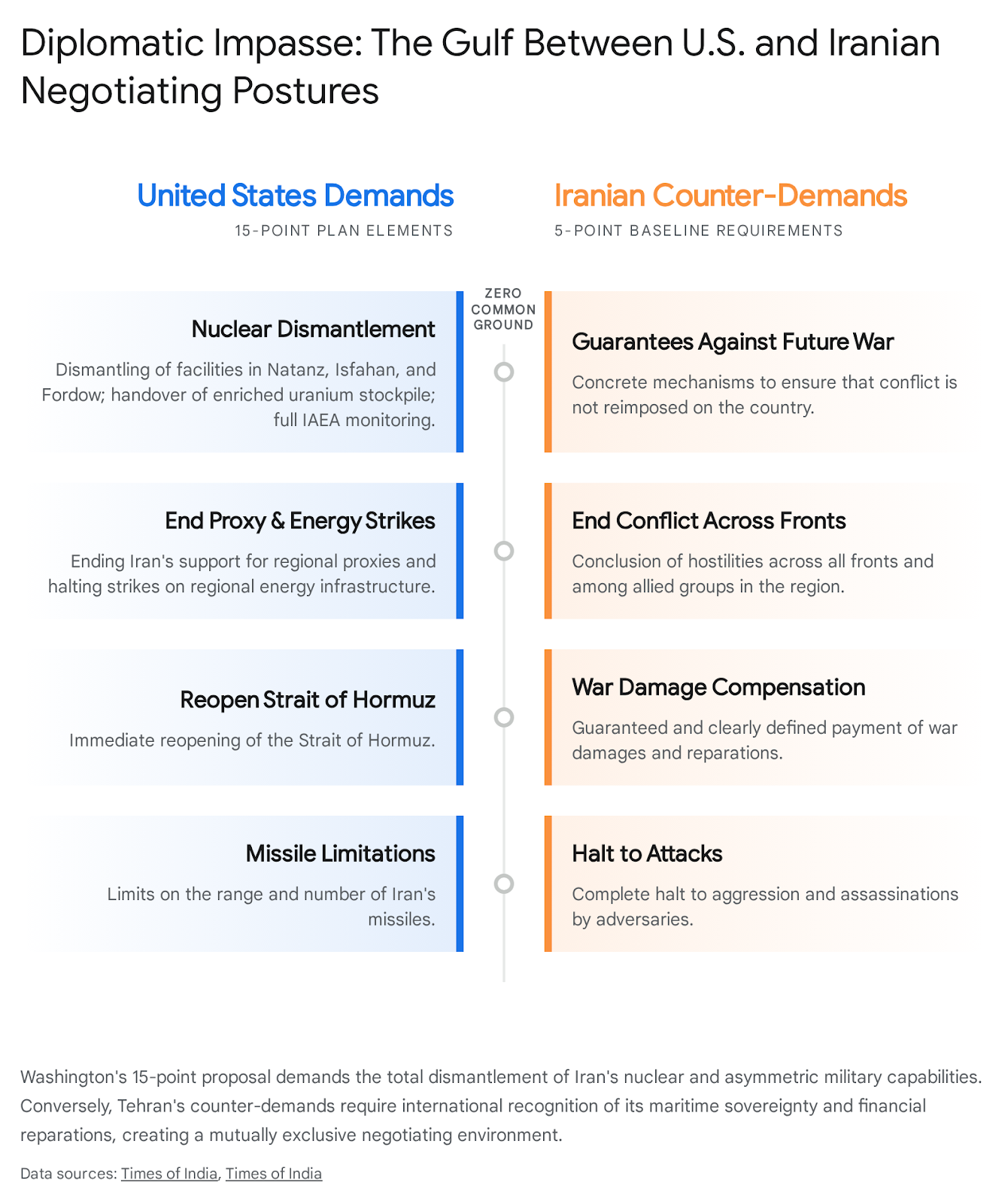
The U.S. framework is highly ambitious, attempting to bundle total nuclear disarmament, regional security guarantees, and maritime freedom into a single, indivisible package.78 Based heavily on negotiation frameworks previously floated in May 2025, the core demands reflect maximalist U.S. strategic objectives that require near-total capitulation from Tehran.82 The plan demands an immediate 30-day ceasefire, the complete dismantling of nuclear facilities at Natanz, Isfahan, and Fordow, and a permanent commitment never to develop nuclear weapons, alongside handing over the entire stockpile of 60% enriched uranium to the IAEA.83 Furthermore, it demands the complete cessation of funding to regional proxies, limits on ballistic missiles, and the immediate reopening of the Strait of Hormuz.83 In exchange, the U.S. offers full sanctions relief, an end to the UN snapback mechanism, and civilian nuclear assistance at Bushehr.77

9.2. Iran’s 5-Point Counter-Demand

Unsurprisingly, Iranian officials view the proposal with deep skepticism, perceiving it as a reiteration of demands that violate Iranian sovereignty, particularly following the highly provocative assassination of their Supreme Leader.80 Through intermediaries, Iran categorically rejected the 15-point plan and countered with its own 5-point demand structure. Tehran requires a complete halt to U.S. and Israeli “aggression and assassinations,” concrete mechanisms to prevent future wars, guaranteed payment of war damages and reparations, the conclusion of hostilities across all proxy fronts, and crucially, international recognition of Iranian sovereignty over the Strait of Hormuz.3

Key DomainUnited States Demands (The 15-Point Plan)Iranian Counter-Demands (The 5-Point Plan)
HostilitiesImmediate 30-day ceasefire to finalize the agreement.Complete halt to U.S./Israeli “aggression and assassinations.”
Nuclear InfrastructureDismantle Natanz, Isfahan, and Fordow facilities; permanent commitment to no nuclear weapons.Not explicitly addressed in the 5-point counter; historically rejected.
Uranium StockpileHand over all 60% enriched uranium to the IAEA; no domestic enrichment allowed.No concessions offered on enrichment or IAEA oversight.
Regional ProxiesEnd all funding, directing, and arming of proxy forces (Axis of Resistance).Any agreement must include the conclusion of hostilities across all fronts/allies.
Maritime SecurityReopen the Strait of Hormuz as a free, unblocked maritime corridor.International recognition of Iranian sovereignty over the Strait of Hormuz.
Missile ProgramLimit range and quantity of ballistic missiles; restrict to self-defense only.Establish concrete guarantees to prevent future wars against Iran.
Concessions / ReliefFull lifting of U.S./UN sanctions; remove “snapback” threat; aid for civilian nuclear power at Bushehr.Guaranteed and clearly defined payment of war damages and reparations by the U.S. and Israel.
U.S. and Iran diplomatic impasse: demands for nuclear dismantlement vs. guarantees against future war.

9.3. The Failure of Backchannel Diplomacy and Public Messaging

The prospect of the 15-point plan succeeding remains exceptionally low. The targeted killings of key moderating figures, such as Ali Larijani—who possessed the diplomatic acumen to navigate complex backchannel negotiations with Europe and Moscow—have heavily empowered hardliners within the IRGC, fundamentally disincentivizing dialogue and ensuring a posture of deep defiance.6 The history of the U.S. breaching diplomatic good faith, notably breaking off the Oman talks in 2025 to launch the Twelve-Day War, has convinced Tehran that negotiations are merely a calculated ruse to pause conflict while the U.S. repositions military assets.4

From an information warfare perspective, the U.S. public diplomacy campaign surrounding the peace plan appears designed as much to sow internal paranoia within Iran’s fractured, hiding leadership as it is to secure an actual agreement. By publicly claiming that a “top person” in Tehran had reached out to Washington, President Trump aimed to generate mutual suspicion among surviving Iranian commanders regarding potential backchannel defections.86 However, this psychological warfare tactic, combined with domestic controversies regarding military commanders allegedly invoking “biblical end-times prophecies” to justify the war, has only further eroded the credibility of the U.S. diplomatic effort on the world stage.87

10. Strategic Conclusions

The 2026 Iran War, triggered by Operation Epic Fury, stands as a critical inflection point in 21st-century geopolitics. The United States successfully demonstrated its unparalleled conventional strike capabilities by degrading Iran’s nuclear infrastructure and decapitating its senior leadership. However, the strategic efficacy of military primacy has been entirely subverted by Iran’s highly effective asymmetric response. By closing the Strait of Hormuz and weaponizing the marine insurance industry, Iran transferred the immense costs of the conflict directly onto the populations of U.S. allies and the vulnerable nations of the Global South.

Consequently, the global perception of the United States has shifted dramatically. Rather than projecting strength and enforcing international order, Washington’s actions have inadvertently projected systemic instability, precipitating a catastrophic global economic shock characterized by energy shortages, manufacturing disruptions, and a burgeoning agricultural crisis. This geoeconomic blowback has severely fractured Western consensus, isolated the U.S. diplomatic corps, paralyzed multilateral institutions like BRICS+, and provided a generational opportunity for China and Russia to consolidate an alternative, anti-Western international architecture. Moving forward, the paramount strategic challenge for the United States is no longer simply managing the military threat posed by Tehran, but rather salvaging its credibility, soft power, and leadership role in a world that increasingly views American military unilateralism as a direct liability to global economic survival.


Please share the link on Facebook, Forums, with colleagues, etc. Your support is much appreciated and if you have any feedback, please email us in**@*********ps.com. If you’d like to request a report or order a reprint, please click here for the corresponding page to open in new tab.


Sources Used

  1. The Iran War and American Foreign Policy, accessed March 26, 2026, https://www.orfonline.org/expert-speak/the-iran-war-and-american-foreign-policy
  2. 2026 Iran War | Explained, United States, Israel, Strait of Hormuz, Map, & Conflict, accessed March 26, 2026, https://www.britannica.com/event/2026-Iran-War
  3. 2025–2026 Iran–United States negotiations – Wikipedia, accessed March 26, 2026, https://en.wikipedia.org/wiki/2025%E2%80%932026_Iran%E2%80%93United_States_negotiations
  4. How the Trump Administration’s Iran Strategy Backfired: A Breach of Diplomatic Trust, accessed March 26, 2026, https://www.jurist.org/commentary/2026/03/how-the-trump-administrations-iran-strategy-backfired-a-breach-of-diplomatic-trust/
  5. The Fault Lines Of A New Middle East: The 2025-2026 US-Israel-Iran War And The Reordering Of Regional Geopolitics – Analysis, accessed March 26, 2026, https://www.eurasiareview.com/23032026-the-fault-lines-of-a-new-middle-east-the-2025-2026-us-israel-iran-war-and-the-reordering-of-regional-geopolitics-analysis/
  6. Why Iran does not appear ready to give in, despite heavy losses, accessed March 26, 2026, https://www.washingtonpost.com/world/2026/03/22/iran-war-talks-trump-strikes-hormuz/
  7. After the strike: The danger of war in Iran – Brookings Institution, accessed March 26, 2026, https://www.brookings.edu/articles/after-the-strike-the-danger-of-war-in-iran/
  8. Iran’s Next Move: How to Counter Tehran’s Multidomain Punishment Campaign, accessed March 26, 2026, https://www.csis.org/analysis/irans-next-move-how-counter-tehrans-multidomain-punishment-campaign
  9. 2026 Strait of Hormuz crisis – Wikipedia, accessed March 26, 2026, https://en.wikipedia.org/wiki/2026_Strait_of_Hormuz_crisis
  10. The Insurance Weapon: How Commercial Risk Logic Became an Irregular Warfare Tool at Hormuz, accessed March 26, 2026, https://irregularwarfare.org/articles/insurance-weapon-irregular-warfare-hormuz/
  11. The Strait of Hormuz crisis will ripple across plastics and food supply …, accessed March 26, 2026, https://www.atlanticcouncil.org/blogs/energysource/the-strait-of-hormuz-crisis-will-ripple-across-plastics-and-food-supply-chains-helping-beijing-and-moscow-hurting-americans/
  12. Discover this week’s must-read finance stories, accessed March 26, 2026, https://www.weforum.org/stories/2026/03/energy-shock-shakes-markets/
  13. Hormuz is a trailer. Malacca is China’s real nightmare — and India knows it, accessed March 26, 2026, https://timesofindia.indiatimes.com/world/rest-of-world/hormuz-is-a-trailer-malacca-is-chinas-real-nightmare-and-india-knows-it/articleshow/129802348.cms
  14. The Iran war: Potential food security impacts | IFPRI, accessed March 26, 2026, https://www.ifpri.org/blog/the-iran-war-potential-food-security-impacts/
  15. US warns Americans worldwide to show ‘increased caution’ – as it happened, accessed March 26, 2026, https://www.theguardian.com/world/live/2026/mar/22/middle-east-crisis-live-iran-war-trump-ultimatum-major-attack-strait-of-hormuz-open-israel-hit-tehran-retaliation
  16. Chokepoint: How the War with Iran Threatens Global Food Security – CSIS, accessed March 26, 2026, https://www.csis.org/analysis/chokepoint-how-war-iran-threatens-global-food-security
  17. Rs 18 crore toll, Iran nod: Why crossing Strait of Hormuz is not so straight, accessed March 26, 2026, https://www.indiatoday.in/world/story/iran-war-strait-of-hormuz-countries-oil-ships-safe-passage-toll-losses-2886784-2026-03-25
  18. How Iran Blocking the Strait of Hormuz Affects the U.S., accessed March 26, 2026, https://www.factcheck.org/2026/03/how-iran-blocking-the-strait-of-hormuz-affects-the-u-s/
  19. Black Sea Shockwaves: Ukraine War Still Impacts Global South, accessed March 26, 2026, https://www.thecairoreview.com/essays/black-sea-shockwaves/
  20. US-Israel war on Iran may increase food prices worldwide: UN, accessed March 26, 2026, https://www.dawn.com/news/1985059
  21. Energy shock talk grabs headlines but the Iran war is also driving the world towards a food crisis | Heather Stewart, accessed March 26, 2026, https://www.theguardian.com/business/2026/mar/22/energy-shock-iran-war-also-driving-world-towards-food-crisis
  22. How the Iran war has sent shocks rippling across the globe, accessed March 26, 2026, https://www.theguardian.com/world/2026/mar/20/iran-war-shocks-across-globe-effects-key-takeaways
  23. UN Security Council Meets in Emergency Session on Crisis in the Middle East, accessed March 26, 2026, https://betterworldcampaign.org/peace-and-security/un-security-council-convenes-emergency-session-on-crisis-in-the-middle-east
  24. The Lonely Superpower: Trump’s Iran War and the End of American Consent, accessed March 26, 2026, https://moderndiplomacy.eu/2026/03/22/the-lonely-superpower-trumps-iran-war-and-the-end-of-american-consent/
  25. Energy Shock Forces Europe to Rethink Climate Ambitions – Modern Diplomacy, accessed March 26, 2026, https://moderndiplomacy.eu/2026/03/26/energy-shock-forces-europe-to-rethink-climate-ambitions/
  26. European leaders debate ETS while the energy crisis burns elsewhere, accessed March 26, 2026, https://www.epc.eu/publication/european-leaders-debate-ets-while-the-energy-crisis-burns-elsewhere/
  27. Governments Declare Emergency Energy Policies in Response to …, accessed March 26, 2026, https://www.cfr.org/articles/governments-declare-emergency-energy-policies-in-response-to-iran-war
  28. Ranked: The World’s Most Powerful Countries by Soft Power in 2026 – Visual Capitalist, accessed March 26, 2026, https://www.visualcapitalist.com/ranked-the-worlds-most-powerful-countries-by-soft-power-in-2026/
  29. Global Soft Power Index 2026 – Brandirectory, accessed March 26, 2026, https://static.brandirectory.com/reports/brand-finance-soft-power-index-2026-digital.pdf
  30. Poll 2025, accessed March 26, 2026, https://poll.lowyinstitute.org/files/lowyinsitutepoll-2025.pdf
  31. Most say the United States’ recent military actions against Iran have gone too far, accessed March 26, 2026, https://apnorc.org/projects/most-say-the-united-states-recent-military-actions-against-iran-have-gone-too-far/
  32. Poll shows most Americans feel war against Iran has gone too far, accessed March 26, 2026, https://www.pbs.org/newshour/nation/poll-shows-most-americans-feel-war-against-iran-has-gone-too-far
  33. Nearly all Americans say the conflict with Iran is raising gas prices, but few expect Trump to back down – YouGov, accessed March 26, 2026, https://yougov.com/en-us/articles/54392-nearly-all-americans-say-conflict-with-iran-is-raising-gas-prices-few-expect-donald-trump-to-back-down-march-20-23-2026-economist-yougov-poll
  34. More Voters Think War With Iran Will Make The World Less Safe, Quinnipiac University National Poll Finds; Healthcare Costs Top List Of Financial Concerns For Voters, accessed March 26, 2026, https://poll.qu.edu/poll-release?releaseid=3953
  35. Security Council Adopts Resolution 2817 (2026) Condemning Iran’s ‘Egregious Attacks’ against Neighbours as Middle East Violence Rapidly Escalates, accessed March 26, 2026, https://press.un.org/en/2026/sc16315.doc.htm
  36. UN experts denounce aggression on Iran and Lebanon, warn of devastating regional escalation | OHCHR, accessed March 26, 2026, https://www.ohchr.org/en/press-releases/2026/03/un-experts-denounce-aggression-iran-and-lebanon-warn-devastating-regional
  37. Iran War Unravels U.S. Strategy and Strengthens Russia China Axis, accessed March 26, 2026, https://toda.org/global-outlook/2026/iran-war-unravels-us-strategy-and-strengthens-russia-china-axis.html
  38. China-Iran Fact Sheet: A Short Primer on the Relationship, accessed March 26, 2026, https://www.uscc.gov/sites/default/files/2026-03/China-Iran_Fact_Sheet_A_Short_Primer_on_the_Relationship.pdf
  39. ‘Vicious Cycle’: China Issues Big Warning As Hormuz Crisis Deepens | US-Israel War On Iran, accessed March 26, 2026, https://timesofindia.indiatimes.com/videos/international/vicious-cycle-china-issues-big-warning-as-hormuz-crisis-deepens-us-israel-war-on-iran/videoshow/129752953.cms
  40. Russia, China urge diplomacy amid Gulf tensions, accessed March 26, 2026, https://dailytimes.com.pk/1467688/russia-china-urge-diplomacy-amid-gulf-tensions/
  41. Russia, China warn of Strait of Hormuz blockade and regional conflict risks, accessed March 26, 2026, https://www.jpost.com/international/article-890870
  42. Foreign Ministry Spokesperson Mao Ning’s Regular Press Conference on March 2, 2026_Ministry of Foreign Affairs of the People’s Republic of China, accessed March 26, 2026, https://www.fmprc.gov.cn/mfa_eng/xw/fyrbt/202603/t20260302_11867202.html
  43. Iran, China and Russia sign trilateral strategic pact – Middle East Monitor, accessed March 26, 2026, https://www.middleeastmonitor.com/20260129-iran-china-and-russia-sign-trilateral-strategic-pact/
  44. China is playing the long game over Iran | Chatham House – International Affairs Think Tank, accessed March 26, 2026, https://www.chathamhouse.org/2026/02/china-playing-long-game-over-iran
  45. China-Iran Fact Sheet: A Short Primer on the Relationship | U.S., accessed March 26, 2026, https://www.uscc.gov/research/china-iran-fact-sheet-short-primer-relationship
  46. US-Israel-Iran war: Congress presses Centre to use its leverage as BRICS+ chair, accessed March 26, 2026, https://www.nationalheraldindia.com/national/us-israel-iran-war-congress-presses-centre-to-fast-track-brics-summit
  47. Iran war shows limits of Brics as India pushed to choose sides – The Business Times, accessed March 26, 2026, https://www.businesstimes.com.sg/international/iran-war-shows-limits-brics-india-pushed-choose-sides
  48. A house divided — BRICS members at odds over Iran war – Daily Maverick, accessed March 26, 2026, https://www.dailymaverick.co.za/article/2026-03-11-a-house-divided-brics-members-at-odds-over-iran-war/
  49. From Hormuz to South Asia: The Energy Crisis Unfolding at Home, accessed March 26, 2026, https://moderndiplomacy.eu/2026/03/26/from-hormuz-to-south-asia-the-energy-crisis-unfolding-at-home/
  50. India taps 41 nations for energy amid Hormuz tensions, PM Modi says – Gulf News, accessed March 26, 2026, https://gulfnews.com/world/asia/india/india-taps-41-nations-for-energy-amid-hormuz-tensions-1.500483489
  51. Disruptions in Strait of Hormuz ‘unacceptable’: India’s Modi – Anadolu Ajansı, accessed March 26, 2026, https://www.aa.com.tr/en/asia-pacific/disruptions-in-strait-of-hormuz-unacceptable-india-s-modi/3875809
  52. India among ‘friendly nations’ listed by Iran for big Strait of Hormuz reprieve | India News, accessed March 26, 2026, https://www.hindustantimes.com/india-news/india-among-friendly-nations-listed-by-iran-for-big-strait-of-hormuz-reprieve-101774492480438.html
  53. South Korean ships can go through Strait of Hormuz after coordination with Iran, envoy tells Seoul, accessed March 26, 2026, https://www.aa.com.tr/en/energy/general/south-korean-ships-can-go-through-strait-of-hormuz-after-coordination-with-iran-envoy-tells-seoul/55866
  54. Africa in Iran’s Broader Geopolitical Strategy, accessed March 26, 2026, https://hornreview.org/2026/03/23/africa-in-irans-broader-geopolitical-strategy/
  55. DeBriefed 9 January 2026: US to exit global climate treaty; Venezuelan oil ‘uncertainty’; ‘Hardest truth’ for Africa’s energy transition – Carbon Brief, accessed March 26, 2026, https://www.carbonbrief.org/debriefed-9-january-2026-us-to-exit-global-climate-treaty-venezuelan-oil-uncertainty-hardest-truth-for-africas-energy-transition/
  56. Asia braces for worst-case energy scenarios as Iran war drags on, accessed March 26, 2026, https://www.japantimes.co.jp/news/2026/03/26/asia-pacific/asia-energy-scenarios-iran-war/
  57. Asia scrambles to confront energy crisis unleashed by Iran war – with no end in sight, accessed March 26, 2026, https://www.theguardian.com/world/2026/mar/12/asia-energy-crisis-iran-war
  58. South Korea launches emergency economic teams amid Middle East crisis, accessed March 26, 2026, https://www.aa.com.tr/en/asia-pacific/south-korea-launches-emergency-economic-teams-amid-middle-east-crisis/3878077
  59. South Korea Enters Emergency Mode as Energy Crisis Intensifies, accessed March 26, 2026, https://impakter.com/south-korea-enters-emergency-mode-as-middle-east-crisis-bites/
  60. What Are the Implications of the Iran Conflict for Japan? – CSIS, accessed March 26, 2026, https://www.csis.org/analysis/what-are-implications-iran-conflict-japan
  61. Asia Set to Pledge $30 Billion in Energy, Mineral Deals With US, accessed March 26, 2026, https://www.energyconnects.com/news/gas-lng/2026/march/asia-set-to-pledge-30-billion-in-energy-mineral-deals-with-us/
  62. US and Japan Organize Indo-Pacific Forum To Alleviate Energy Crisis, accessed March 26, 2026, https://bowergroupasia.com/us-and-japan-organize-indo-pacific-forum-to-alleviate-energy-crisis/
  63. Behind China’s Measured Response to the Middle East Conflict, accessed March 26, 2026, https://globalaffairs.org/commentary/analysis/behind-chinas-measured-response-middle-east-conflict
  64. Middle East Special Issue: March 2026 – ACLED, accessed March 26, 2026, https://acleddata.com/update/middle-east-special-issue-march-2026
  65. Iran Update Evening Special Report, March 2, 2026 | ISW, accessed March 26, 2026, https://understandingwar.org/research/middle-east/iran-update-evening-special-report-march-2-2026/
  66. We Bombed the Wrong Target Iran’s Proxy Network Strategy – Irregular Warfare Initiative, accessed March 26, 2026, https://irregularwarfare.org/articles/iran-proxy-network-strategy/
  67. G7 statement on support to partners in the Middle East. (21.03.26) – France Diplomatie, accessed March 26, 2026, https://www.diplomatie.gouv.fr/en/country-files/iran/news/article/g7-statement-on-support-to-partners-in-the-middle-east-21-03-26
  68. Justice Department Disrupts Iranian Cyber Enabled Psychological Operations, accessed March 26, 2026, https://www.justice.gov/opa/pr/justice-department-disrupts-iranian-cyber-enabled-psychological-operations
  69. Resecurity warns that Iran war enters multi-domain phase as cyber and kinetic operations converge, accessed March 26, 2026, https://industrialcyber.co/critical-infrastructure/resecurity-warns-that-iran-war-enters-multi-domain-phase-as-cyber-and-kinetic-operations-converge/
  70. Threat Brief: March 2026 Escalation of Cyber Risk Related to Iran, accessed March 26, 2026, https://unit42.paloaltonetworks.com/iranian-cyberattacks-2026/
  71. Cyber impact of conflict in the Middle East, and other cybersecurity news, accessed March 26, 2026, https://www.weforum.org/stories/2026/03/cyber-impact-conflict-middle-east-other-cybersecurity-news-march-2026/
  72. Iran’s Strategic Communications in the Campaign: Intimidation, Deterrence, and Resilience, accessed March 26, 2026, https://www.inss.org.il/publication/roaring-lion-media/
  73. 2026 Annual Threat Assessment of the U.S. Intelligence Community – ODNI, accessed March 26, 2026, https://www.dni.gov/files/ODNI/documents/assessments/ATA-2026-Unclassified-Report.pdf
  74. DNI Gabbard Releases 2026 Annual Threat Assessment of the U.S. Intelligence Community, accessed March 26, 2026, https://www.dni.gov/index.php/newsroom/press-releases/press-releases-2026/4142-pr-03-26
  75. How the Iran Conflict Could Drive a New Wave of Terrorism in the West, accessed March 26, 2026, https://www.visionofhumanity.org/how-the-iran-conflict-could-drive-a-new-wave-of-terrorism-in-the-west/
  76. 16,000 missiles, a vengeful Iran, and an AI race America cannot afford to lose: 2026 threat assessment, explained, accessed March 26, 2026, https://timesofindia.indiatimes.com/world/us/16000-missiles-a-vengeful-iran-and-an-ai-race-america-cannot-afford-to-lose-2026-threat-assessment-explained/articleshow/129670507.cms
  77. ‘They cannot have a nuclear weapon’: US pushes 15-point plan to end Iran war, sent via Pakistan, accessed March 26, 2026, https://timesofindia.indiatimes.com/world/us/they-cannot-have-a-nuclear-weapon-us-pushes-15-point-plan-to-end-iran-war-sent-via-pakistan/articleshow/129789762.cms
  78. Trump’s peace plan, Iran’s counter: What’s the endgame? Where things stand in Week 4 of Middle East war, accessed March 26, 2026, https://timesofindia.indiatimes.com/world/middle-east/trumps-peace-plan-irans-counter-whats-the-endgame-where-things-stand-in-week-4-of-middle-east-war/articleshow/129792894.cms
  79. US sent Iran 15-point plan aimed at ending the Middle East war – Al Arabiya, accessed March 26, 2026, https://english.alarabiya.net/News/united-states/2026/03/25/us-has-sent-iran-a-15point-plan-to-end-the-war-in-the-middle-east-report
  80. US 15-point plan reaches Tehran as Iran publicly scoffs at diplomacy, accessed March 26, 2026, https://www.iranintl.com/en/202603254350
  81. U.S. sent Iran 15-point plan aimed at month-long ceasefire: Israeli media – Xinhua, accessed March 26, 2026, https://english.news.cn/20260325/0383eb08ad97467d9017170c5973a7db/c.html
  82. Trump’s rehashed 15-point Iran plan unlikely to appease Tehran, accessed March 26, 2026, https://www.theguardian.com/world/2026/mar/24/trumps-rehashed-15-point-iran-plan-unlikely-to-appease-tehran
  83. What’s inside Trump’s 15-point plan to end war with Iran?, accessed March 26, 2026, https://timesofindia.indiatimes.com/world/us/whats-inside-trumps-15-point-plan-to-end-war-with-iran/articleshow/129802951.cms
  84. US sends 15-point plan to Iran: Nuclear rollback, Hormuz access on table; what else is at stake, accessed March 26, 2026, https://www.businesstoday.in/world/story/us-sends-15-point-plan-to-iran-nuclear-rollback-hormuz-access-on-table-what-else-is-at-stake-522188-2026-03-25
  85. ‘Trump will not dictate end of war’: Iran dismisses US’ 15-point de-escalation proposal, counters with its own 5 demands, accessed March 26, 2026, https://timesofindia.indiatimes.com/world/middle-east/trump-will-not-dictate-end-of-war-iran-rejects-us-15-point-plan-counters-with-its-own-5-demands/articleshow/129804889.cms
  86. Weaponizing ambiguity: how US shadow diplomacy may be fracturing Iran regime, accessed March 26, 2026, https://www.iranintl.com/en/202603234812
  87. Brownley and Colleagues Request Investigation into Alleged Reports that Military Leaders Claim War in Iran Part of Biblical End-Times Prophecies, accessed March 26, 2026, https://juliabrownley.house.gov/brownley-and-colleagues-request-investigation-into-alleged-reports-that-military-leaders-claim-war-in-iran-part-of-biblical-end-times-prophecies/


SITREP Global Conflicts & Disputes – Week Ending February 14, 2026

Executive Summary

The reporting week ending February 14, 2026, marks a pivotal juncture in the systemic reconfiguration of the global security architecture. Based on a comprehensive review of strategic, tactical, and economic indicators, the international community is witnessing a transition from a rules-based multilateral order to a model of “centralized impulsive power” characterized by direct interventionism and the weaponization of economic dependencies.1 The 62nd Munich Security Conference (MSC), themed “Under Destruction,” serves as the primary diplomatic backdrop, where Western leaders have explicitly acknowledged the erosion of post-Cold War norms in favor of highly conditional alliances and regional hegemonies.2

In the European theater, the Russo-Ukrainian War remains a conflict of unprecedented attrition. Russian forces continue to sustain casualties at rates unseen in major power conflicts since World War II, yet they maintain the strategic initiative through a “grinding” offensive that prioritizes incremental territorial gains over personnel preservation.4 Concurrently, the Middle East is on a knife-edge as the United States reinforces its regional naval presence with a second aircraft carrier strike group, backing a thirty-day nuclear ultimatum delivered to the Iranian regime.6 This maritime buildup is inextricably linked to the Western Hemisphere, where the recent ouster of the Venezuelan administration has allowed Washington to secure alternative energy flows, effectively insulating the American economy from potential Persian Gulf disruptions.8

In the Indo-Pacific, the Philippines’ assumption of the ASEAN chairmanship has coincided with an escalation of Chinese “grey-zone” activities in the South China Sea, forcing a recalibration of regional security partnerships.9 Meanwhile, Sub-Saharan Africa faces a worsening humanitarian catastrophe in Sudan, where the fall of El Fasher has triggered mass atrocities and localized famines that the African Union (AU) has thus far been unable to mitigate.11 Global financial markets continue to experience high volatility following the “Black Friday” collapse of gold and cryptocurrency, while US inflation remains “sticky” at 2.4 percent, complicating the transition to a new Federal Reserve leadership.13 Collectively, these developments suggest a world entering a “perilous new normal” where the threshold for military intervention has significantly lowered.8

I. Global Strategic Environment: The Munich Security Conference and the New World Order

The proceedings at the Munich Security Conference (MSC) from February 13–15, 2026, provided the most transparent look to date at the diverging strategic philosophies of the world’s major powers. The overarching sentiment, encapsulated in the annual Munich Security Report, is that the international system is no longer undergoing “careful reform” but is instead “under destruction”.2 This destruction is being driven not only by external adversaries but by a fundamental shift in how established powers, particularly the United States, view their global responsibilities.

The Transatlantic Divergence

US Secretary of State Marco Rubio’s keynote address at the conference signaled a radical departure from the traditional “caretaker” role of the United States in the Western alliance. Rubio articulated a “highly conditional” partnership, warning European allies that the era of the US managing the West’s “managed decline” is over.17 This rhetoric reflects a broader “Trump Corollary” to the Monroe Doctrine, which emphasizes national borders, economic sovereignty, and the rejection of what Rubio termed “postwar delusions” regarding the end of history.8

Strategic Positioning at Munich 2026Primary ObjectiveKey Rhetorical Theme
United States (Rubio)Conditional Alliance“The Old World is Gone” 2
United Kingdom (Starmer)European Rapprochement“Move Closer to the Single Market” 17
Ukraine (Zelenskyy)Sustainable Defense Aid“Our Unity is the Best Interceptor” 17
European Union (von der Leyen)Independent Sovereignty“Security Shock Therapy” 17
France (Macron)Combined Nuclear Strength“Europe Must Defend Its Interests” 17

British Prime Minister Keir Starmer utilized the forum to distance the United Kingdom from the “Brexit years,” emphasizing that European security is now indivisible and that the UK must move closer to the EU Single Market to bolster its industrial defense base.17 This rapprochement is driven by an “urgent” need to address Russian aggression, which Starmer characterized as a “path for Europe’s future” if not checked by a unified response.17 Conversely, French President Emmanuel Macron hinted at a more autonomous European defense strategy, suggesting that European adversaries must be confronted by “combined nuclear strength,” independent of the shifting political winds in Washington.17

The Crisis of Accountability and Impunity

A deeper thematic undercurrent identified in recent geopolitical analyses is the emergence of “centralized impulsive power,” where decision-making is highly personalized and detached from multilateral stabilizing mechanisms.1 The arrest of the Venezuelan president and the threats regarding the acquisition of Greenland are viewed as symptoms of a system where centers of power no longer feel accountable to international law.1 This normalization of impunity among global elites—highlighted by the recurring references to the “Epstein files” and their impact on figures like the former Israeli Prime Minister and the former CEO of DP World—has eroded public trust in institutional legitimacy, further fueling populist movements across the West.1

II. The Eastern Front: High-Intensity Attrition in Ukraine

The war in Ukraine has entered a phase of “grinding” attrition that defies modern military doctrine. As of mid-February 2026, the conflict is characterized by astronomical casualty rates and a slowing of frontline movements to levels reminiscent of World War I.4

Military-Technical Analysis of Russian Performance

Data-driven assessments indicate that the Russian Federation has sustained approximately 1,245,000 casualties since February 2022, with roughly 40,000 occurred in 2026 alone.5 Despite these losses, the Russian Ground Forces continue to attack along multiple axes, though their territorial gains in January 2026 were lower than the averages recorded in late 2025.5 In the most active sectors, Russian advances are currently measured between 15 and 70 meters per day, the slowest rate for any major offensive campaign in the last century.4

Comparative Attrition Data (2022-2026)StatisticImplications
Total Russian Casualties1.2M – 1.245MHighest for a major power since WWII 4
Verified Russian Deaths177,433Mediazona/BBC confirmed count 21
Projected Combined Casualties2,000,000Expected threshold by Spring 2026 4
Russian Advance Rate15-70 m/dayIndicates extreme defensive density 4
Russian GDP Growth (War Economy)0.6% (2025)Signals long-term industrial stagnation 4

The Russian military-industrial complex is showing signs of structural strain. While the economy has shifted to a war footing, growth has slowed to 0.6 percent, and the lack of globally competitive technology firms continues to hamper long-term productivity.4 Furthermore, the Kremlin’s decision to throttle the Telegram messaging application—a primary tool for frontline command and control (C2)—has provoked a backlash among Russian military bloggers, who warn that such censorship efforts are degrading tactical coordination.22

Ukrainian Tactical Resilience and the PURL Initiative

Ukrainian forces have maintained a policy of “active defense,” recently achieving localized advances in the Hulyaipole direction and conducting a successful mid-range strike campaign against Russian assets in occupied Zaporizhia.22 A critical factor in Ukraine’s continued resistance is the “Prioritized Ukrainian Requirements List” (PURL) initiative, which has raised $4.5 billion since the summer of 2025 to fund NATO purchases of US-manufactured weapons.22 Additionally, the UK has announced a $545 million investment in hypersonic weapons, drawing on battlefield lessons from Ukraine to counter the evolving threat from Russian glide bombs and cruise missiles.21

Diplomatic Tracks: The Geneva Trilateral

A significant diplomatic development this week is the confirmation of US-brokered talks between Russia and Ukraine, scheduled for February 17–18 in Geneva.23 This trilateral format will reportedly discuss a 20-point peace plan, with current sticking points including the status of a “free economic zone” in the Donbas and a potential moratorium on energy infrastructure strikes.22 President Trump has publicly urged President Zelenskyy to “get moving” on a deal, warning that the “strategic initiative” remains in Russian hands and that the window for a favorable settlement is closing.4

III. The Middle East: Naval Confrontation and the Iranian Ultimatum

The Middle East has reached a level of tension not seen since the “Tanker Wars” of the 1980s. The region is currently the site of a massive US naval build-up designed to provide the necessary leverage for a high-stakes diplomatic confrontation with the Iranian regime.6

The “Gerald R. Ford” Deployment and the 30-Day Deadline

The US Department of Defense has ordered the aircraft carrier USS Gerald R. Ford to transit from the Caribbean to the Middle East, where it will join the USS Abraham Lincoln.6 This deployment follows President Trump’s February 12 warning that Iran has roughly one month to reach a comprehensive deal on its nuclear and ballistic missile programs, or face “very traumatic” consequences.7 US officials have stated that the presence of two carrier strike groups is essential “in case we don’t make a deal,” providing a credible threat of kinetic action against Iranian nuclear and military infrastructure.6

US Central Command Naval Posture (Feb 2026)Asset TypePrimary Mission
USS Abraham Lincoln (CVN-72)Aircraft CarrierRegional Deterrence / Strike 6
USS Gerald R. Ford (CVN-78)Aircraft CarrierPower Projection / Interdiction 6
Guided-Missile DestroyersSurface CombatantBallistic Missile Defense (BMD) 6
USS Iwo Jima (LHD-7)Amphibious AssaultSpecialized Operations 19

Iranian officials, including Defense Council Secretary Ali Shamkhani, have categorically rejected the ultimatum, stating that the ballistic missile program is a “firmly established” element of the state’s defense doctrine and a “red line” that will not be negotiated.7 Intelligence reports suggest that Iran is attempting to restore its missile stockpile to pre-war levels of 1,800 to 2,000 units, with a production rate of approximately 300 missiles per month.28

Covert Operations and the Internal Iranian Crisis

Parallel to the conventional military buildup, a sophisticated information warfare campaign is underway. The United States has reportedly smuggled over 6,000 Starlink terminals into Iran to assist protesters in circumventing the regime’s nationwide internet shutdown, which was imposed on January 8.7 This effort aims to facilitate the organization of anti-regime demonstrations, which have persisted despite a brutal crackdown that has seen the arrest of university students, doctors, and cultural figures across the country.27

In a significant intelligence development, President Zelenskyy met with exiled Iranian opposition figure Reza Pahlavi on the sidelines of the MSC, signaling an increasing alignment between the Ukrainian defense and Iranian dissident movements.21 This follows verified reports that Iran continues to supply “Shahid-type” drones with jet engines and real-time operator guidance to the Russian military, an activity Zelenskyy says “must be stopped immediately”.17

The Syrian and Iraqi Security Vacuum

The regional stability is further threatened by the ongoing US withdrawal from Syria, including the recent completion of the mission at the Al Tanf Garrison on February 11.7 This withdrawal has created a vacuum that Syrian government forces have struggled to fill. A critical failure occurred at the Al Hol detention camp, where an estimated 5,700 ISIS detainees were transferred to Iraqi custody, but hundreds of others escaped due to the lack of discipline and training among the newly deployed Syrian government guards.7

The Israel-Lebanon-Gaza Nexus

While a ceasefire has been in place since October 2025, the reporting week saw a sharp escalation in tactical strikes. Israel intensified its attacks on Gaza and Lebanon, citing the “rehabilitation” of Hezbollah’s artillery capabilities and the movement of Hamas militants near the “Yellow Line”.30 In Southern Lebanon, the IDF conducted strikes on 20 different locales, utilizing quadcopters, artillery, and drone missions to target Hezbollah personnel both north and south of the Litani River.32

In Gaza, the US has launched “Phase 2” of its peace plan, which involves the establishment of the National Committee for the Administration of Gaza.30 However, the transition is stalled by Hamas’ refusal to disarm and Israel’s insistence on full demilitarization. The humanitarian cost remains staggering; over 492 Palestinians have been killed since the October ceasefire began, and 11 children died of hypothermia in January alone due to substandard shelter conditions.33

Middle East Casualty and Displacement Indicators (Feb 2026)Data Point
Palestinians Killed in Gaza (Oct 2025 – Feb 2026)492 33
Palestinians Injured in Gaza (Oct 2025 – Feb 2026)1,356 33
Palestinians Displaced in West Bank (Jan 2026)694 35
UNRWA Personnel Killed (Total)390 33
ISIS Detainees Transferred to Iraq5,700 7

IV. The Western Hemisphere: Venezuela and the “Donroe Doctrine”

The capture of Venezuelan President Nicolás Maduro on January 3, 2026, in “Operation Absolute Resolve” remains the most consequential geopolitical event in the Western Hemisphere in decades.19 This action marks the practical implementation of the “Donroe Doctrine”—a radical reinterpretation of the 1823 Monroe Doctrine that prioritizes the exclusion of extra-hemispheric powers and the direct management of strategic resources by the United States.8

Geo-Economic Annexation of Energy

Under the new “Trump Corollary” to the National Security Strategy (NSS), Latin America is viewed as both a security perimeter and a vital economic asset.8 The United States has assumed de facto control over Venezuela’s oil industry, which contains roughly 241 billion barrels of recoverable crude—the world’s largest proven reserves.8 By securing this supply, Washington has created a “strategic buffer” that makes military escalation in the Middle East more “affordable,” as alternative supplies can mitigate the economic shock of any Persian Gulf disruption.8

This move specifically targets China, which previously received approximately 80% of Venezuelan oil exports.19 The operation has effectively severed Beijing’s access to a reliable energy lifeline in the Western Hemisphere and anchored the oil trade within dollar-based systems, reinforcing the central role of the petrodollar.8

Regional Fragmentation and Sovereign Erosion

The intervention has deeply divided Latin American states. While the Bukele government in El Salvador has aligned with Washington—securing investment in exchange for permitting the deportation of Venezuelan migrants—other states view the operation as a historic violation of the principle of non-intervention.36 Analysis suggests that “Operation Absolute Resolve” has accelerated the erosion of international law, replacing normative discourse with “Realpolitik” where the effectiveness of the law depends entirely on real power relations.37

Venezuela Transition Metrics (Feb 2026)Indicator
Status of Former PresidentFacing Trial in New York 19
Strategic ControlUS Managed Transition 8
Recoverable Crude Reserves241 Billion Barrels 8
Pre-Intervention Oil Destination80% to China 19
US Naval IncidentsUSS Truxtun/USNS Supply Collision 38

The presence of a massive US naval fleet in the Caribbean has not been without operational hazards. On February 11, the Arleigh Burke-class destroyer USS Truxtun and the supply ship USNS Supply collided during a replenishment-at-sea operation, resulting in minor injuries to two sailors and highlighting the strain on US naval assets currently maintaining a dual presence in the Caribbean and the Persian Gulf.38

V. Indo-Pacific: South China Sea Grey-Zone Tactics

As the Philippines assumes the rotating chair of ASEAN in 2026, the South China Sea has become the primary theater for “assertive transparency”—a strategy where Manila documents and publicizes Chinese maritime aggression to build international pressure.9

Tactical Escalations and the Thitu Island Collision

The reporting week saw a significant spike in maritime incidents. A Chinese coast guard vessel deliberately rammed the Philippine ship BRP Datu Pagbuaya near Thitu (Pag-asa) Island on Sunday morning.39 The incident followed a three-minute water cannon attack that damaged the stern of the Philippine vessel.39 China’s Southern Theater Command defended the action, claiming the Philippine vessel had ignored warnings and was “stirring up trouble” by roping in outside powers for joint air patrols.40

South China Sea Escalation Log (Feb 2026)FeatureAction Taken
Thitu (Pag-asa) IslandSpratlysRamming / Water Cannon 39
Scarborough ShoalEEZUnilateral Nature Reserve Declaration 9
Sabina ShoalEEZWater Cannon / Anchor Line Cutting 41
Sandy Cay ReefSpratlysMaritime Interdiction 39
Luzon CoastMainlandCCG Approach within 30 Nautical Miles 9

Analysts suggest that Beijing is utilizing “grey-zone” methods to provoke Manila into firing the first shot, thereby gaining a pretext for a larger military retaliation.42 Furthermore, the deployment of a new US rotational force in the northern Philippines, intended to support the Typhon missile system, has been characterized by Beijing as a move to “contain China,” further complicating the negotiations for a legally binding Code of Conduct (COC).16

ASEAN Diplomacy and Internal Divisions

The Philippines’ push to finalize the COC is being met with “cautious silence” by several other ASEAN members, who fear that “megaphone diplomacy” will give China an excuse to further escalate.10 Despite agreements to hold monthly in-person meetings, deep-seated disagreements over whether the COC should include third-party dispute resolution mechanisms remain unresolved.9 This diplomatic friction allows Beijing to pursue a “divide-and-conquer” strategy, managing relations with some claimant states while maintaining an escalatory approach toward the Philippines.9

VI. Sub-Saharan Africa: The Sudan Humanitarian Emergency

Sudan is currently experiencing the world’s most severe displacement and hunger crisis. As the conflict between the Sudanese Armed Forces (SAF) and the Rapid Support Forces (RSF) nears its third year, the risk of total state collapse and regional destabilization has reached an acute level.12

Mass Atrocities in El Fasher and Darfur

The capture of El Fasher by the RSF in late 2025 has led to some of the worst documented atrocities of the war. UN human rights officials have confirmed more than 6,000 killings in the first three days of the RSF offensive, with at least 500 people killed in a single incident at Al-Rashid dormitory at El Fasher University.11 Survivors have described “apocalyptic scenes” of bodies piled along exit routes and the use of trucks to crush living civilians.43

Sudan Humanitarian Crisis Metrics (Feb 2026)Statistic
Population Facing Famine2,000,000 45
Internally Displaced Persons9.5 million 12
Refuges in Neighboring Countries3.0 million 12
Child Deaths (Malnutrition)522,000 12
Healthcare Facilities Non-Functional70% in Conflict Zones 12
Cholera Cases (Cumulative)113,000 12

The conflict has increasingly focused on strategic infrastructure. The RSF recently seized the 22nd Division base in Babanusa and the Heglig oil field, halting production and threatening the state’s primary revenue source.12 Furthermore, both sides have integrated advanced drone weaponry into their operations, leading to high civilian casualties, including a December strike on a kindergarten and hospital in Kalogi that killed 114 people.12

The 39th African Union Summit: Institutional Paralysis

The AU Summit in Addis Ababa on February 14–15, 2026, attempted to address the crisis but was overshadowed by institutional divisions. While the Peace and Security Council (PSC) issued a communiqué condemning the RSF’s violations and calling for an immediate humanitarian truce, the organization remains unable to secure a meaningful ceasefire.46 Egypt, currently chairing the PSC, is pushing for the reintegration of Sudan into the AU, a move that critics argue is shaped more by regional power plays than by an adherence to AU norms regarding democratic governance.47

VII. Global Economic Stability: Black Friday Fallout and Inflation

The global economy is currently grappling with the aftermath of a “Black Friday” market shock, which saw the historic collapse of gold, silver, and cryptocurrency valuations.13

The US Inflation Report and the Federal Reserve

The US Consumer Price Index (CPI) for January 2026, released on February 13, showed a monthly increase of 0.2 percent and a 12-month increase of 2.4 percent.14 While this is a decrease from the 2.7 percent recorded in December, “sticky” inflation in the shelter and medical care sectors continues to pressure the Federal Reserve.49

US CPI Sector Breakdown (Jan 2026)12-Month % Change
All Items2.4% 14
Shelter3.0% 14
Food at Home2.1% 14
Energy (Total)-0.1% 14
Gasoline-7.5% 14
Transportation Services1.3% 14
Medical Care Services3.9% 14

The transition of the Federal Reserve chairmanship to Kevin Warsh has led to expectations that interest rate cuts will be postponed until at least June 2026, given the strength of recent labor signals and the persistence of core inflation at 2.5 percent.14

The AI Investment Bubble and Traditional Software

Market analysts are increasingly concerned with the ramifications of the estimated $600 trillion in AI investments announced by mega-tech companies for 2026 alone.15 This massive capital allocation has created uncertainty regarding the long-term viability of traditional software companies and the potential for a technological “collision course” between US and Chinese ambitions in space and cyber domains.15

Safe Haven Assets and the “Black Friday” Shock

Gold, which briefly breached the $5,000 level, is currently consolidating in the $4,600 to $4,900 range following a severe sell-off.13 Bitcoin has also seen a sharp decline, dropping below $80,000 and remaining in a “neutral to bearish” state as investors wait for clearer signals regarding global geopolitical stability.13 The Dow Jones Industrial Average, however, remains near all-time highs, reflecting a market that continues to bet on the resilience of the US corporate sector despite the surrounding global disorder.13

VIII. Tactical and Political Developments in Emerging Theaters

In addition to the major conflict zones, several regional developments have contributed to the general state of global uncertainty.

  • Bangladesh: The Bangladesh Nationalist Party (BNP) has secured a sweeping majority in the February 12 elections, promising a return to stability after years of political dysfunction and religious violence.24
  • Thailand: Following the February 8 general elections, complex coalition discussions are expected to take several months, potentially leaving a governance vacuum in a key Southeast Asian economy.51
  • The Arctic: Tensions are rising over the “Arctic Information Offensive,” with Russia stopping the publication of its officials’ salary data and the US reiterating its intent to acquire strategic resources in Greenland through both diplomatic and potentially military means.19
  • Space: The Space Summit 2026 in Singapore highlighted the growth of the Asia-Pacific space sector and the increasing risk to critical satellite infrastructure as Starlink’s deployment becomes more central to global conflict dynamics.16

IX. Synthesis and Strategic Forecast

The convergence of the reported events for the week ending February 14, 2026, suggests a global environment that has moved beyond the point of “managed competition” into one of “unilateral restructuring.” The “Donroe Doctrine” in the Americas, the “grinding” attrition in Ukraine, and the naval buildup in the Persian Gulf are not isolated incidents but are part of a broader shift toward a world where the primary mechanism for resolving disputes is the application of overwhelming force or the leveraging of absolute economic control.4

The immediate future (Q1-Q2 2026) is likely to be defined by three critical triggers:

  1. The Iran Deadline: The expiration of the US ultimatum in mid-March will determine whether the Middle East descends into a wide-scale regional war or whether the “trauma” of the ultimatum forces a fundamental realignment of the Iranian regime.
  2. The Geneva Negotiations: The outcome of the Geneva talks will indicate whether the Ukraine war will transition into a “frozen conflict” or whether the lack of concessions will lead to a new escalation phase involving hypersonic and AI-driven autonomous systems.
  3. The ASEAN COC: The Philippines’ ability to navigate the internal divisions of ASEAN will determine if a rules-based order can be preserved in the South China Sea or if the “perilous new normal” of grey-zone collisions will eventually spark a direct clash between the PLAN and the US Navy.

The global economy, while showing resilience in the US equity markets, remains vulnerable to the systemic shocks of the “Black Friday” collapse and the weaponization of energy flows. As the world moves toward the Islamic holy month of Ramadan (starting Feb 17), historical patterns suggest a potential uptick in regionalized attacks, particularly in the Sahel and Middle East, which may further strain the international security architecture.51 The “old world” is indeed gone, and the nature of the replacement order remains under violent negotiation.


Please share the link on Facebook, Forums, with colleagues, etc. Your support is much appreciated and if you have any feedback, please email us in**@*********ps.com. If you’d like to request a report or order a reprint, please click here for the corresponding page to open in new tab.


Sources Used

  1. January – February 2026: a chain of geopolitical scandals as a democratic wake-up call | by Hayat Outahar – Medium, accessed February 14, 2026, https://medium.com/@hayatoutahar/january-february-2026-a-chain-of-geopolitical-scandals-as-a-democratic-wake-up-call-b7a3fa26fe8a
  2. Rubio warns Munich Security Conference ‘the old world is gone’ – The National News, accessed February 14, 2026, https://www.thenationalnews.com/news/europe/2026/02/13/rubio-warns-munich-security-conference-the-old-world-is-gone/
  3. Munich Security Conference – Münchner Sicherheitskonferenz, accessed February 14, 2026, https://securityconference.org/en/msc/
  4. Russia’s Grinding War in Ukraine – CSIS, accessed February 14, 2026, https://www.csis.org/analysis/russias-grinding-war-ukraine
  5. British Defence Intelligence Update Ukraine 14 February 2026, accessed February 14, 2026, https://www.kyivpost.com/post/70050
  6. Trump says Iran regime change could be ‘best thing’ as second carrier heads to Middle East, accessed February 14, 2026, https://www.thejakartapost.com/world/2026/02/14/trump-says-iran-regime-change-could-be-best-thing-as-second-carrier-heads-to-middle-east.html
  7. Iran Update, February 13, 2026 | ISW, accessed February 14, 2026, https://understandingwar.org/research/middle-east/iran-update-february-13-2026/
  8. The ‘Donroe Doctrine’: Venezuela Signals a New Phase of US Global Strategy, accessed February 14, 2026, https://www.investing.com/analysis/the-donroe-doctrine-venezuela-signals-a-new-phase-of-us-global-strategy-200673139
  9. The Philippines’ ASEAN chairmanship comes at a perilous time, accessed February 14, 2026, https://www.thinkchina.sg/politics/philippines-asean-chairmanship-comes-perilous-time
  10. Rhetoric vs. Reality: The Philippines, ASEAN, and the South China Sea – CSIS, accessed February 14, 2026, https://www.csis.org/analysis/rhetoric-vs-reality-philippines-asean-and-south-china-sea
  11. Sudan: RSF violations in capture of El Fasher amount to war crimes – ohchr, accessed February 14, 2026, https://www.ohchr.org/en/press-releases/2026/02/sudan-rsf-violations-capture-el-fasher-amount-war-crimes
  12. Sudan Crisis Situation Analysis: Period: 26/01/26 – 01/02/26 – ReliefWeb, accessed February 14, 2026, https://reliefweb.int/report/sudan/sudan-crisis-situation-analysis-period-260126-010226
  13. Weekly Financial Markets Analysis: February 8-14, 2026 – Trendo, accessed February 14, 2026, https://fxtrendo.com/weekly-outlook-february-8-14-2026/
  14. CPI Home : U.S. Bureau of Labor Statistics, accessed February 14, 2026, https://www.bls.gov/cpi/
  15. February 2026 US Inflation report & Japan’s Election Results Take Over the Economic Landscape – CFI, accessed February 14, 2026, https://cfi.trade/en/blog/economic/us-inflation-data-for-february-2026-japans-election-results-take-over-the-economic-landscape
  16. South China Sea: Latest News and Updates, accessed February 14, 2026, https://www.scmp.com/topics/south-china-sea
  17. Munich Security Conference live: Zelenskyy asks leaders if they are …, accessed February 14, 2026, https://www.theguardian.com/world/live/2026/feb/14/munich-security-conference-live-marco-rubio-keir-starmer-eu-europe-ukraine-russia-latest-news-updates
  18. Macron swipes at Trump tariffs and Greenland threats; Zelenskyy has strong words for Russia – as it happened, accessed February 14, 2026, https://www.theguardian.com/world/live/2026/feb/13/munich-security-conference-rubio-flies-in-amid-testing-times-for-us-europe-ties-live?page=with%3Ablock-698f49a18f08a3236d063f4f
  19. The Deadly Mutation of the 2026 Monroe Doctrine – Modern Diplomacy, accessed February 14, 2026, https://moderndiplomacy.eu/2026/01/09/the-deadly-mutation-of-the-2026-monroe-doctrine/
  20. Middle East News | Today’s latest from Al Jazeera, accessed February 14, 2026, https://www.aljazeera.com/middle-east/
  21. At least 5 killed, 13 injured in Russian attacks on Ukraine over past day, accessed February 14, 2026, https://kyivindependent.com/at-least-killed-injured-in-russian-attacks-on-ukraine-over-past-day-3/
  22. Russian Offensive Campaign Assessment, February 11, 2026 | ISW, accessed February 14, 2026, https://understandingwar.org/research/russia-ukraine/russian-offensive-campaign-assessment-february-11-2026/
  23. AP News Summary at 5:46 a.m. EST, accessed February 14, 2026, https://www.wdrb.com/news/national/ap-news-summary-at-5-46-a-m-est/article_10c5d775-5a88-5d66-808b-edc810480758.html
  24. US to broker Russia-Ukraine talks next week – Newspaper – DAWN.COM, accessed February 14, 2026, https://www.dawn.com/news/1973102/us-to-broker-russia-ukraine-talks-next-week
  25. Trump is ‘tearing apart’ transatlantic partnership, warns Ocasio-Cortez – Munich Security Conference live, accessed February 14, 2026, https://www.theguardian.com/world/live/2026/feb/13/munich-security-conference-rubio-flies-in-amid-testing-times-for-us-europe-ties-live?filterKeyEvents=false&page=with%3Ablock-698f46828f0893c883d510ea
  26. U.S. Military Prepares for Possible Weeks-Long Operations Against Iran, accessed February 14, 2026, https://www.jordannews.jo/Section-111/All/U-S-Military-Prepares-for-Possible-Weeks-Long-Operations-Against-Iran-48826
  27. AP News Summary at 3:00 a.m. EST, accessed February 14, 2026, https://www.wdrb.com/news/national/ap-news-summary-at-3-00-a-m-est/article_10c5d775-5a88-5d66-808b-edc810480758.html
  28. Iran Update, February 11, 2026 | ISW, accessed February 14, 2026, https://understandingwar.org/research/middle-east/iran-update-february-11-2026/
  29. Rubio says UN plays ‘no role’ in resolving conflicts: ‘It could not solve the war in Gaza’, accessed February 14, 2026, https://www.timesofisrael.com/liveblog-february-14-2026/
  30. Middle East Overview: February 2026 – ACLED, accessed February 14, 2026, https://acleddata.com/update/middle-east-overview-february-2026
  31. Lebanon 9 February 2026 #2 | International Crisis Group, accessed February 14, 2026, https://www.crisisgroup.org/content/lebanon-9-february-2026-2
  32. Israeli operations in Lebanon against Hezbollah: February 2–8, 2026 – Long War Journal, accessed February 14, 2026, https://www.longwarjournal.org/archives/2026/02/israeli-operations-in-lebanon-against-hezbollah-february-2-8-2026.php
  33. UNRWA Situation Report #207 on the Humanitarian Crisis in the Gaza Strip and the Occupied West Bank, including East, accessed February 14, 2026, https://www.unrwa.org/resources/reports/unrwa-situation-report-207-situation-gaza-strip-and-west-bank-including-east-jerusalem
  34. Palestine in Pictures: January 2026 – The Electronic Intifada, accessed February 14, 2026, https://electronicintifada.net/content/palestine-pictures-january-2026/51218
  35. United Nations Office for the Coordination of Humanitarian Affairs – Occupied Palestinian Territory, accessed February 14, 2026, https://www.ochaopt.org/
  36. The Impact of the Second Trump Administration on Latin American Foreign Policy, accessed February 14, 2026, https://unu.edu/cris/journal-article/impact-second-trump-administration-latin-american-foreign-policy
  37. Regional implications of the United States’ operation in Venezuela. The hurted hemispheric geopolitics. – Ministerio de Defensa, accessed February 14, 2026, https://www.defensa.gob.es/documents/2073105/3332608/eeuu_en_venezuela_2026_dieeea01_eng.pdf/510ce86a-ec46-6fcc-d7da-de0811f3aaba?t=1768219942394
  38. Xinhua world news summary at 1530 GMT, Feb. 12 – China.org.cn, accessed February 14, 2026, http://www.china.org.cn/world/Off_the_Wire/2026-02/12/content_118331712.shtml
  39. New Clash in the South China Sea: Chinese Ship Damages Philippine Vessel, accessed February 14, 2026, https://militarnyi.com/en/news/new-clash-in-the-south-china-sea-chinese-ship-damages-philippine-vessel/
  40. China Conducts Naval, Air Patrols Around Disputed South China Sea, accessed February 14, 2026, https://chinaglobalsouth.com/2026/02/07/china-south-china-sea-patrols/
  41. The Philippines wants to seal South China Sea code of conduct. Can it deliver? | The Star, accessed February 14, 2026, https://www.thestar.com.my/aseanplus/aseanplus-news/2026/02/13/the-philippines-wants-to-seal-south-china-sea-code-of-conduct-can-it-deliver
  42. A Calm Before the Storm: South China Sea Powder Keg, accessed February 14, 2026, https://saisreview.sais.jhu.edu/a-calm-before-the-storm-south-china-sea-powder-keg/
  43. El Fasher massacre – Wikipedia, accessed February 14, 2026, https://en.wikipedia.org/wiki/El_Fasher_massacre
  44. Sudan: UN rights chief says worse is to come without international action – UN News – the United Nations, accessed February 14, 2026, https://news.un.org/en/story/2026/02/1166925
  45. World Report 2026: Sudan | Human Rights Watch, accessed February 14, 2026, https://www.hrw.org/world-report/2026/country-chapters/sudan
  46. Communiqué of the 1330th meeting of the PSC held at Ministerial level, on 12 February 2026 on the situation in Sudan, accessed February 14, 2026, https://www.peaceau.org/en/article/communique-of-the-1330th-meeting-of-the-psc-held-at-ministerial-level-on-12-february-2026-on-the-situation-in-sudan
  47. The AU summit is an opportunity for decisive action to end the war in Sudan, accessed February 14, 2026, https://www.chathamhouse.org/2026/02/au-summit-opportunity-decisive-action-end-war-sudan
  48. Morocco Wins Election to African Union Peace and Security Council, accessed February 14, 2026, https://www.moroccoworldnews.com/2026/02/278376/morocco-wins-election-to-african-union-peace-and-security-council/
  49. Consumer Price Index Summary – 2026 M01 Results – Bureau of Labor Statistics, accessed February 14, 2026, https://www.bls.gov/news.release/cpi.nr0.htm
  50. Consumer Price Index News Release – 2026 M01 Results – Bureau of Labor Statistics, accessed February 14, 2026, https://www.bls.gov/news.release/cpi.htm
  51. Geopolitical Calendar – Control Risks, accessed February 14, 2026, https://www.controlrisks.com/our-thinking/geopolitical-calendar
  52. Russian Strike on Ukraine’s Odesa Kills Woman – Governor – The Moscow Times, accessed February 14, 2026, https://www.themoscowtimes.com/2026/02/14/russian-strike-on-ukraines-odesa-kills-woman-governor-a91951

SITREP Global – Week Ending February 06, 2026

Executive Summary

The global security environment for the week ending February 6, 2026, is characterized by a definitive pivot in the strategic architecture of the 21st century. The expiration of the New Strategic Arms Reduction Treaty (New START) on February 5, 2026, marks the formal end of bilateral nuclear arms control between the United States and the Russian Federation, ushering in an era of unconstrained tri-polar nuclear competition involving a rapidly expanding Chinese arsenal.1 This shift is codified in the unclassified 2026 National Defense Strategy (NDS), which reorients the United States Department of War toward a posture of hemispheric dominance, homeland defense, and the “Golden Dome” missile defense initiative, while mandating a radical shift in burden-sharing that requires European and Asian allies to provide the primary conventional land defense against regional adversaries.3

In the Western Hemisphere, the aftermath of Operation Absolute Resolve continues to reshape the geopolitical landscape following the capture of Venezuelan leader Nicolás Maduro and his wife, Cilia Flores, on January 3, 2026.5 The United States has initiated a complex financial and operational oversight mechanism for the Venezuelan oil sector, utilizing accounts in Qatar to manage petroleum revenues while seeking $100 billion in private sector investment to rebuild the nation’s energy infrastructure.7 This intervention has drawn severe condemnation from Moscow and Beijing, who characterize the move as a subversive blow to the post-World War II international order.9

The Middle East remains a theater of high-stakes diplomatic friction and internal instability. Indirect and direct negotiations in Muscat, Oman, between the United States and Iran have failed to yield a framework for de-escalation, as Tehran maintains rigid “red lines” regarding its uranium enrichment capabilities and regional proxy networks.11 Simultaneously, leaked documents from the Islamic Revolutionary Guard Corps (IRGC) reveal a deepening crisis of legitimacy within the Iranian regime amid violent suppression of nationwide protests.12

In the cyber domain, the revelation of the “Shadow Campaigns” conducted by TGR-STA-1030—an Asia-based state-aligned group—highlights a systemic compromise of global government infrastructure.13 The group has breached the systems of thirty-seven governments, utilizing a sophisticated Linux kernel rootkit to target finance, mining, and telecommunications sectors.14 This disclosure coincides with Norway’s annual threat assessment, which warns of the most serious security situation since 1945, identifying China’s “Salt Typhoon” campaign and Russian sabotage as primary threats to Arctic and energy security.16 Finally, the Sahel remains volatile following a large-scale Islamic State assault on Niamey’s international airport, further straining the relationship between the Alliance of Sahel States (AES) and Western powers.17

Strategic Stability and the Post-Arms Control Era

The expiration of the New Strategic Arms Reduction Treaty (New START) on February 5, 2026, represents the final collapse of the bilateral arms control framework that has governed the strategic relationship between the world’s two largest nuclear powers for over fifteen years.1 The treaty, which limited both nations to 1,550 deployed warheads and 700 deployed missiles and bombers, reached its legal limit for extension, having already been granted a one-time five-year extension in 2021.2 The cessation of these central limits removes the last legally binding restrictions on the nuclear forces of the United States and Russia, signaling a transition toward a more opaque and competitive strategic environment.

The U.S. Department of State, in a formal address to the Conference on Disarmament in Geneva, argued that the 2010 agreement had become increasingly detached from the 2026 security reality.2 The strategic rationale for the U.S. refusal to pursue a replacement bilateral treaty is rooted in the “breakout growth” of the Chinese nuclear arsenal, which is expanding at a scale and pace not seen in over half a century.2 American intelligence assessments indicate that China is on a trajectory to achieve a level of nuclear capability that would create a tri-polar strategic dynamic, rendering any bilateral agreement with Russia alone “simply inappropriate” and potentially dangerous for U.S. security.2

Table 1: Comparative Nuclear Architecture and Treaties (Post-Feb 5, 2026)

Strategic ElementUnited StatesRussian FederationChina
Treaty StatusUnconstrained (New START Expired)Unconstrained (New START Expired)Never Constrained
Modernization FocusNuclear Triad Refurbishment & Sentinel ICBMNovel Systems (Skyfall, Poseidon, Sarmat)Massive Silo Construction & Warhead Expansion
Inspection RegimeTerminatedTerminatedNon-Existent
Novel ThreatsGolden Dome Space-Based DefenseNuclear ASAT & Hypersonic GlidersOpaque Yield-Producing Tests 2
Tactical NukesExpanding Theater Range ForcesMassive Unconstrained ArsenalGrowing Regional Stockpiles

The U.S. administration has specifically cited Russian non-compliance and the development of “novel” delivery systems—such as the Skyfall nuclear-powered cruise missile and the Poseidon transoceanic torpedo—as factors that necessitated the end of unilateral restraint.2 Furthermore, the disclosure that China conducted a yield-producing nuclear test as recently as June 22, 2020, which it allegedly sought to conceal, has reinforced the U.S. position that future arms control must be multilateral and subject to more rigorous verification standards.2

In the absence of a formal treaty, the United States is accelerating its nuclear modernization programs. This includes full funding for the sea-based leg of the triad via the Columbia-class ballistic missile submarine and the development of the Sentinel intercontinental ballistic missile (ICBM).19 The 2026 National Defense Authorization Act (NDAA) prohibits the Department of War from reducing the ICBM fleet below 400 or reducing the alert status of these forces, ensuring a high level of responsiveness in a post-treaty world.19

The 2026 National Defense Strategy: A Continental Reorientation

The 2026 National Defense Strategy (NDS), released by Secretary of War Pete Hegseth on January 23, 2026, marks the most significant shift in American military doctrine in four decades.3 The document formalizes a move away from the “global policeman” model of expeditionary warfare toward a “homeland-first” posture that prioritizes the Western Hemisphere, border security, and technological dominance.21 The NDS identifies China as the primary pacing threat in the Indo-Pacific but treats the security of the American homeland and the Western Hemisphere as the Department’s top mission.21

The Golden Dome for America

The center-of-gravity for the new strategy is the “Golden Dome for America” initiative. This program aims to establish a comprehensive, multi-layered missile defense shield designed to protect the U.S. homeland from ballistic, cruise, and hypersonic missile attacks.19 The strategy allocates approximately $175 billion for the development of this baseline capability, which integrates space-based sensors, terrestrial radars, and next-generation interceptors across the land, sea, and space domains.23

The Golden Dome represents a technical evolution from the previous Ground-Based Midcourse Defense (GMD) system. While GMD was focused on “limited” attacks from rogue states like North Korea, the Golden Dome is intended to provide a more robust defense capable of deterring peer adversaries.3 The FY26 NDAA authorizes the Missile Defense Agency to recapitalize aging range safety vessels and partner with the Department of Transportation to expand the infrastructure necessary for this initiative.19

Table 2: 2026 NDS Strategic Shift and Capability Priorities

CategoryPrior Strategy Focus2026 NDS Focus
Geographic PriorityEurope and Middle EastWestern Hemisphere and Indo-Pacific
Threat PerceptionClimate Change and Peer CompetitionHemispheric Security and “Warrior Ethos”
Force EmploymentLarge-scale Overseas PresenceBurden-Shifting and Ally Empowerment
Key TechnologyConventional Naval DominanceUncrewed Systems and Space-Based Defense
Industrial BaseGlobal Just-in-Time Supply ChainsSecure, Domestic U.S.-Based Manufacturing

Burden-Shifting and Ally Empowerment

A core pillar of the 2026 NDS is the concept of “burden-shifting,” particularly regarding the defense of Europe and the Korean Peninsula.3 The strategy explicitly states that European allies must take the lead on conventional land defense against Russia, with the United States providing high-end technological support—such as the Golden Dome umbrella—rather than massive troop deployments.4 This rebalancing is reflected in the administration’s demand that NATO members increase defense spending to 5 percent of their GDP, with 3.5 percent dedicated to core military capabilities.4

On the Korean Peninsula, the NDS suggests that U.S. forces currently stationed in South Korea might be better utilized elsewhere in the Indo-Pacific to address the China challenge.25 The strategy views North Korea primarily as a threat to Japan and South Korea, with U.S. interests focused on countering missile capabilities that can strike the American homeland.3 This approach signals a move toward a “resource-sustainable” posture that empowers local allies to defend themselves, exemplified by the administration’s praise of Israel as a “model ally” for its self-defense capabilities.25

Defense Industrial Base (DIB) Revitalization

The 2026 NDS places a heavy emphasis on the “industrialization” of the United States as a component of national security.22 The Department of War is reforming its acquisition policies to eliminate long-standing barriers for nontraditional and commercial suppliers.20 The strategy prioritizes contract awards for programs that bolster the domestic manufacturing of critical munitions, uncrewed aerial and maritime systems, and technologies that assist in countering drug trafficking and illegal immigration.26 The goal is to ensure a secure, end-to-end supply chain that can sustain a high-intensity conflict without reliance on adversarial nations for critical components.21

Hemispheric Security and the Venezuelan Transition

The Western Hemisphere has become the primary theater for the practical application of the new American defense posture. On January 3, 2026, more than 200 U.S. special operations forces executed Operation Absolute Resolve in Caracas, successfully capturing Venezuelan leader Nicolás Maduro and his wife, Cilia Flores.5 The raid, which targeted the Fort Tiuna Military Complex and other key bunkers, resulted in the deaths of approximately 75 people, including 32 members of the Cuban special forces serving as Maduro’s personal guard.5

Maduro and Flores were transported to New York, where they were indicted on charges of narco-terrorism conspiracy, cocaine importation, and the possession of machine guns and destructive devices.6 Both pleaded not guilty in a Manhattan federal court on January 5, while the Venezuelan vice president, Delcy Rodríguez, denounced the operation as a “kidnapping” and an act of imperialist aggression.6

Operational Oversight of the Venezuelan Oil Sector

Following the capture of Maduro, President Trump announced that the United States would oversee the management of Venezuela’s oil sector until a “safe, proper and judicious transition” could be achieved.7 The Department of Energy is currently working with interim Venezuelan authorities and private industry to execute an energy deal intended to restore Venezuela as a “prosperous ally”.7

The administration has established a “U.S. Treasury blocked account” system to manage Venezuelan oil revenues.8 Under this mechanism, proceeds from the sale of Venezuelan crude settle in U.S.-controlled accounts at globally recognized banks to ensure the “legitimacy and integrity” of the distribution.7 In the short term, a payment mechanism has been established in Qatar to mitigate the risk of international creditors seizing assets.8

Table 3: Venezuelan Oil Revenue Management and Requirements

ComponentDetailStrategic Rationale
Initial Tranche30 – 50 million barrels marketed immediatelyRestore global supply and stabilize prices 7
Financial CustodianAccounts in Qatar (Short-term) / US Treasury (Long-term)Protect assets from $170B external debt claims 8
Disbursement PolicyUS Discretion (Audit required)Prevent corruption/misuse of funds (Iraq model avoidance)
Investment Goal$100 Billion (Private Sector)Rebuild dilapidated infrastructure/grid 8
Sanctions ReliefSelective rollbacks (General License 46)Enable transport and upgrading of heavy crude 7

The administration’s policy is also designed to impact regional allies of the Maduro regime. President Trump has signed an executive order authorizing tariffs on any country that provides oil to Cuba, declaring a national emergency in response to the Cuban energy crisis and its reliance on subsidized Venezuelan oil.29 This move is intended to accelerate the “fall” of the Cuban regime by severing its primary energy lifeline.29

The intervention has triggered a sharp divide within the international community. Russia and China, along with Iran, have condemned the operation as a “blatant violation” of international law and a “criminal operation” that undermines the rules-based system.9 The Security Council held an emergency meeting on January 5 to discuss the ouster of Maduro, with Russian state media asserting that the U.S. has ushered in the “law of the jungle”.9

Legal experts have raised significant concerns regarding the lawfulness of the raid, noting that capturing a sitting head of state on foreign soil constitutes an act of aggression under traditional interpretations of international law.28 However, the U.S. administration has justified the action as a law-enforcement mission undertaken through the president’s “inherent constitutional authority”.6 Domestic reactions have also been mixed; while the Venezuelan diaspora celebrated the removal of Maduro, some members of the U.S. Congress have criticized the administration’s dismissal of opposition leader María Corina Machado as lacking sufficient support to lead the country.6

Middle Eastern Dynamics: Muscat Talks and Internal Unrest

Diplomatic efforts to address the Iranian nuclear program and regional tensions reached a critical juncture on February 6, 2026, as high-level delegations from the United States and Iran convened in Muscat, Oman.11 The talks, facilitated by the Omani Ministry of Foreign Affairs, were led by Iranian Foreign Minister Abbas Araghchi and U.S. Special Envoy Steve Witkoff, with the notable attendance of U.S. Central Command Commander Admiral Brad Cooper.11

The Muscat Framework and “Red Lines”

The primary objective of the session was to establish a framework for future negotiations and create the “right conditions” for the resumption of diplomatic and technical talks.11 While Minister Araghchi described the atmosphere as a “good start,” reports from both sides indicate that significant disagreement remains on the core tenets of any potential deal.11 Iran continues to maintain several non-negotiable “red lines,” including its right to uranium enrichment, the retention of its ballistic missile program, and continued support for its “Axis of Resistance” proxies.11

The United States has signaled that it expects “tangible and significant concessions” regarding the nuclear program in the next round of talks, which is scheduled to occur in the coming days.11 A particular point of contention is the U.S. demand that Iran curb its energy exports to the People’s Republic of China.11 The complexity of these negotiations is amplified by the risk premiums currently embedded in global energy markets. The Strait of Hormuz, through which 21% of global oil consumption transits, remains a primary chokepoint that amplifies price sensitivity to regional political developments.31

Table 4: Energy Market Indicators and Geopolitical Risk (Feb 1-6, 2026)

CommodityPrice (USD)Weekly Change (%)Risk Driver
Brent Crude$68.05+0.74%Muscat Negotiation Uncertainty 31
WTI Crude$63.55+0.41%US-Iran Diplomatic Volatility 31
Uranium (Spot)VariableHigh VolatilityCompliance/Oversight Concerns 32
US Dollar IndexTwo-week HighN/ASafe-haven Inflow during Crisis 33

Internal Instability and Leaked Documents

The Iranian regime is also facing its most significant internal crisis in years. Nationwide protests have been met with an exceptionally violent crackdown that is estimated to have killed thousands of civilians.34 On February 2, 2026, leaked documents from the IRGC were released, exposing the command-and-control structure behind the suppression of these protests and detailing the regime’s “hidden suppression machine”.12

In response to these developments, the European Union has moved to designate the IRGC as a terrorist organization, while the U.S. has threatened direct military intervention unless a diplomatic off-ramp is established.12 Russia has attempted to mitigate the risk of regional war by offering to store Iran’s enriched weapons-grade uranium, though the success of this proposal depends on the outcome of subsequent rounds of negotiations in Oman.12

Global Cyber Espionage: The Shadow Campaigns

The global cyber threat landscape in February 2026 is dominated by the revelation of the “Shadow Campaigns” conducted by a state-aligned group tracked as TGR-STA-1030 (also known as UNC6619).13 A comprehensive report from Palo Alto Networks’ Unit 42 details a campaign of extraordinary scale, with at least 70 organizations in 37 countries compromised over the past year.14

TGR-STA-1030: Scope and Methodology

The group is assessed with high confidence to be operating out of Asia, likely China, based on linguistic indicators, regional tooling, and activity aligned with the GMT+8 time zone.14 The hackers have demonstrated exceptional speed and agility, often carrying out compromises within days of major geopolitical events.36 For instance, following the U.S. capture of Nicolás Maduro, the group targeted 140 Venezuelan government-owned IP addresses.15

A key technical finding is the group’s use of a previously undocumented Linux kernel rootkit named “ShadowGuard”.36 This rootkit intercepts system calls and hides specific process IDs (PIDs), enabling the attackers to remain invisible to standard monitoring and forensic tools.35

Table 5: TGR-STA-1030 Victimology and Target Profiles

Target CategorySpecific InstitutionsGeopolitical/Economic Focus
National Security5 National Law Enforcement/Border AgenciesImmigration & Internal Security Data 14
Finance & Trade3 Ministries of Finance; Australian TreasuryEconomic Partnerships & Trade Negotiations 13
Natural ResourcesBrazil & Bolivia Mining MinistriesRare Earth Mineral Supply Chains 13
LegislativeNational Parliament (Unnamed Country)Senior Elected Official Surveillance 14
TechnologyTelecommunications & Software (Notepad++)Supply Chain Interdiction & Data Theft 14

The campaign’s focus on mining entities in Latin America is particularly notable. In Bolivia, the group compromised entities tied to rare earth minerals during the 2025 presidential election.13 In Brazil, the breach of the Ministry of Mines and Energy occurred as the country emerged as a strategic alternative to Chinese rare earth supplies, following a $465 million investment in a Brazilian producer.13 These actions suggest that the group’s objectives are tightly aligned with China’s broader economic statecraft and the securing of critical mineral dominance.

Salt Typhoon and Northern European Security

In Northern Europe, Norway’s domestic security agency (PST) has confirmed that the Chinese state-sponsored campaign “Salt Typhoon” successfully compromised network devices in several Norwegian organizations.16 The disclosure, made in the 2026 annual threat assessment, describes Norway as facing its “most serious security situation since World War II”.16

While China represents the primary threat in the cyber domain, Russia is identified as the “principal overall threat” to Norwegian security.16 The PST warns that Russian intelligence is closely monitoring military targets and allied activities in the High North and the Arctic region, utilizing civilian vessels to map critical energy infrastructure for potential sabotage.16 The erosion of the post-Cold War international order is viewed by Oslo as a direct threat to the foundations of Norwegian security, exacerbated by rising tensions between the West and the China-Russia-Iran axis.40

Regional Volatility and Conflict Risks

As the first quarter of 2026 progresses, several regions are experiencing a significant deterioration in their security environment, with potential implications for global stability.

The Sahel: IS Assault on Niamey

On the night of January 28-29, 2026, Islamic State (IS) Sahel Province militants launched a high-profile, coordinated assault on the Diori Hamani International Airport and the adjacent Air Base 101 in Niamey, Niger.17 The attack involved over 30 gunmen using motorcycles, mortars, and armed drones to infiltrate one of the military regime’s most sensitive security sites.17

The facility hosts foreign troops, including Russian Africa Corps mercenaries and Italian forces, and reportedly serves as a storage site for stockpiles of uranium concentrate.41 While the attack was repelled, it resulted in the death of 20 assailants and the destruction of at least five military aircraft.18 In the aftermath, Nigerien President Gen. Abdourahamane Tiani accused the leaders of France, Benin, and Côte d’Ivoire of sponsoring the attack—allegations that have heightened regional tensions and highlighted the growing insecurity in the central Sahel.41

South Asia: The Bangladesh Election Crisis

Bangladesh is approaching a landmark national election on February 12, 2026, amid extreme political violence and religious unrest.43 This marks the first general election since the country’s August 2024 “Monsoon Revolution,” but the interim government has struggled to protect human rights.45

Risk FactorCurrent AssessmentPotential Impact
Political ViolenceRising sharply since Dec 2025; Osman Hadi assassinationDisruption of polling and street rioting 44
Minority Rights51 incidents against Hindus; 10 killingsLarge-scale communal violence/refugee flows 45
Regional RelationsStrained with India; anti-Indian sentiment risingCross-border unrest affecting West Bengal 44
Political StructureEntrenched elites vs. New youth-led parties (NCP)Long-term instability if outcome is disputed 46

The assassination of youth activist Osman Hadi on December 12 and the subsequent targeting of the National Citizen Party (NCP) have put the country on edge.44 There is a significant risk that the election outcome will be disputed, potentially spiraling into a political crisis that would affect regional security, particularly concerning the “Siliguri Corridor” connecting India’s mainland to its northeastern states.34

Ethiopia and Northern Africa

In East Africa, the risk of a return to full-scale war in Northern Ethiopia has increased following clashes between the Tigray Defence Forces and federal troops.34 This development, combined with the expiration of the mandate for Haiti’s transitional government on February 7, suggests a widening vacuum of stability that criminal gangs and non-state actors are poised to exploit.34

Geoeconomic Statecraft and Emerging Technology

The week ending February 6 also saw significant developments in international economic cooperation and the regulation of emerging technologies. At the United Nations, the Fourth Session of the Intergovernmental Negotiating Committee (INC) convened to review the Zero Draft of a new Framework Convention on International Tax Cooperation.47 The convention aims to build a more inclusive global tax system, specifically targeting the mobilization of resources for sustainable development in the Global South.47

India and the AI Impact Summit

India is preparing to host the fourth AI Impact Summit on February 19-20, 2026.1 This event marks a shift in global focus from purely governmental concerns about AI safety toward the practical implementation of technology in the Global South.1 India’s 2026–27 Union Budget, presented on February 1, 2026, further reflects this geoeconomic statecraft, treating expenditure as a tool of fiscal statecraft to navigate a world where supply chains are used as instruments of power.48

Table 6: Global Geopolitical Calendar – Q1 2026 Key Events

DateEventLocationSignificance
Feb 6-22Olympic Winter GamesMilano Cortina, ItalyMajor international sporting/security event 1
Feb 11-1539th African Union SummitAddis Ababa, EthiopiaContinental priorities on security & integration 1
Feb 12General ElectionsBangladeshPivotal moment for South Asian stability 1
Feb 13-17Munich Security ConferenceMunich, GermanyFocus on common European defense strategy 1
Feb 17Start of RamadanGlobalHistorical uptick in extremist activity 1

Strategic Forecast and Implications

The convergence of the New START expiration and the release of the 2026 NDS indicates that the United States is moving toward a “denial-based” deterrent posture that relies on technological supremacy rather than traditional arms control agreements. The Golden Dome initiative, while promising a new era of homeland defense, also necessitates a period of increased investment and industrial revitalization that will define American economic policy for the remainder of the decade.

The situation in Venezuela will likely remain the primary test of the administration’s hemispheric focus. The success of the “Qatar mechanism” for oil revenue will determine whether the U.S. can successfully stabilize the country without repeating the failures of the Iraq Oil-for-Food program. However, the presence of sophisticated cyber actors like TGR-STA-1030 suggests that the primary threat to this stability may come not from conventional military forces, but from the systemic exploitation of digital and resource-based vulnerabilities.

Finally, the upcoming Islamic holy month of Ramadan, beginning February 17, is expected to coincide with an uptick in extremist propaganda and attacks from Al-Qaeda and Islamic State affiliates, particularly in the Sahel and South Asia.1 National security agencies should remain at a heightened state of alert for hybrid tactics that combine physical sabotage with cyber espionage and influence operations designed to undermine democratic processes and critical infrastructure. The erosion of the post-war international order, as warned by Norwegian intelligence, is no longer a distant prospect but a current reality that requires a fundamental reassessment of national and collective resilience.


Please share the link on Facebook, Forums, with colleagues, etc. Your support is much appreciated and if you have any feedback, please email us in**@*********ps.com. If you’d like to request a report or order a reprint, please click here for the corresponding page to open in new tab.


Sources Used

  1. Geopolitical Calendar – Control Risks, accessed February 7, 2026, https://www.controlrisks.com/our-thinking/geopolitical-calendar
  2. Statement to the Conference on Disarmament – United States …, accessed February 7, 2026, https://www.state.gov/releases/2026/02/statement-to-the-conference-on-disarmament/
  3. The 2026 National Defense Strategy by the Numbers: Radical Changes, Moderate Changes, and Some Continuities – CSIS, accessed February 7, 2026, https://www.csis.org/analysis/2026-national-defense-strategy-numbers-radical-changes-moderate-changes-and-some
  4. National Defense Strategy Prioritizes the Western Hemisphere, Shifts Burden-Sharing to Allies, accessed February 7, 2026, https://dsm.forecastinternational.com/2026/01/27/national-defense-strategy-prioritizes-the-western-hemisphere-shifts-burden-sharing-to-allies/
  5. Imagery from Venezuela Shows a Surgical Strike, Not Shock and Awe – CSIS, accessed February 7, 2026, https://www.csis.org/analysis/imagery-venezuela-shows-surgical-strike-not-shock-and-awe
  6. 2026 United States intervention in Venezuela – Wikipedia, accessed February 7, 2026, https://en.wikipedia.org/wiki/2026_United_States_intervention_in_Venezuela
  7. FACT SHEET: President Trump is Restoring Prosperity, Safety and Security for the United States and Venezuela | Department of Energy, accessed February 7, 2026, https://www.energy.gov/articles/fact-sheet-president-trump-restoring-prosperity-safety-and-security-united-states-and
  8. Trump’s Venezuela Policy Isn’t Any Clearer a Month After Maduro’s Capture, accessed February 7, 2026, https://www.cfr.org/articles/trumps-venezuela-policy-isnt-any-clearer-a-month-after-maduros-capture
  9. Hostile state responses to US action in Venezuela – Institute for Strategic Dialogue, accessed February 7, 2026, https://www.isdglobal.org/digital-dispatch/united-in-opposition-hostile-state-responses-to-us-action-in-venezuela/
  10. Russia, China Condemn U.S. Action, Demand UN Meeting, accessed February 7, 2026, https://www.chosun.com/english/world-en/2026/01/03/QNMWVLGDMBFYBPVMY3ESNBB5AM/
  11. Iran Update, February 6, 2026 | ISW, accessed February 7, 2026, https://understandingwar.org/research/middle-east/iran-update-february-6-2026/
  12. February 2026 – National Security News, accessed February 7, 2026, https://nationalsecuritynews.com/2026/02/
  13. Unit 42 identifies TGR-STA-1030 cyber espionage group targeting critical infrastructure, government networks, accessed February 7, 2026, https://industrialcyber.co/ransomware/unit-42-identifies-tgr-sta-1030-cyber-espionage-group-targeting-critical-infrastructure-government-networks/
  14. The Shadow Campaigns: Uncovering Global Espionage – Unit 42, accessed February 7, 2026, https://unit42.paloaltonetworks.com/shadow-campaigns-uncovering-global-espionage/
  15. Researchers uncover vast cyberespionage operation targeting …, accessed February 7, 2026, https://therecord.media/research-cyber-espionage-targeting-dozens-worldwide
  16. Norwegian intelligence discloses country hit by Salt Typhoon …, accessed February 7, 2026, https://therecord.media/norawy-intelligence-discloses-salt-typhoon-attacks
  17. Islamic State claims assault on airport in Niger’s capital – FDD, accessed February 7, 2026, https://www.fdd.org/analysis/2026/02/01/islamic-state-claims-assault-on-airport-in-nigers-capital/
  18. Diori Hamani International Airport attack – Wikipedia, accessed February 7, 2026, https://en.wikipedia.org/wiki/Diori_Hamani_International_Airport_attack
  19. STRENGTHENING STRATEGIC DETERRENCE, MISSILE DEFENSE, & NATIONAL DEFENSE SPACE CAPABILITIES – House Armed Services Committee, accessed February 7, 2026, https://armedservices.house.gov/uploadedfiles/strategic_deterrence_legislative_summary.pdf
  20. The 2026 National Defense Strategy Signals Increased DIB Contracting and Investment Opportunities | Goodwin – JD Supra, accessed February 7, 2026, https://www.jdsupra.com/legalnews/the-2026-national-defense-strategy-5573815/
  21. 2026 National Defense Strategy | Small Wars Journal by Arizona State University, accessed February 7, 2026, https://smallwarsjournal.com/2026/01/24/2026-national-defense-strategy/
  22. The Trump Administration’s New National Defense Strategy Expands the US ‘Homeland’, accessed February 7, 2026, https://globalaffairs.org/commentary/analysis/trump-administrations-new-national-defense-strategy-expands-us-homeland
  23. Why Golden Dome for America: The Case the Administration Should Make – CSIS, accessed February 7, 2026, https://www.csis.org/analysis/why-golden-dome-america-case-administration-should-make
  24. Russian Federation Hybrid Operations and Kinetic Escalation in the Ukrainian Theater and Suwalki Gap, accessed February 7, 2026, https://debuglies.com/2026/02/06/russian-federation-hybrid-operations-and-kinetic-escalation-in-the-ukrainian-theater-and-suwalki-gap/
  25. Restoring Strategic Coherence: The 2026 National Defense Strategy as Industrial and Operational Realism, accessed February 7, 2026, https://defense.info/re-thinking-strategy/2026/01/restoring-strategic-coherence-the-2026-national-defense-strategy-as-industrial-and-operational-realism/
  26. The 2026 National Defense Strategy Signals Increased DIB Contracting and Investment Opportunities, accessed February 7, 2026, https://www.goodwinlaw.com/en/insights/publications/2026/02/alerts-otherindustries-2026-national-defense-strategy-increased-dib-contracting
  27. The US capture of Nicolás Maduro – The House of Commons Library, accessed February 7, 2026, https://commonslibrary.parliament.uk/research-briefings/cbp-10452/
  28. The new age of aggression | International Bar Association, accessed February 7, 2026, https://www.ibanet.org/The-new-age-of-aggression
  29. New Executive Order Opens Door to Tariffs on Countries Selling or Supplying Oil to Cuba, accessed February 7, 2026, https://www.hklaw.com/en/insights/publications/2026/02/new-executive-order-opens-door-to-tariffs-on-countries
  30. In Hindsight: The Security Council’s Muted Response to the Venezuela Crisis, February 2026 Monthly Forecast, accessed February 7, 2026, https://www.securitycouncilreport.org/monthly-forecast/2026-02/in-hindsight-the-security-councils-muted-response-to-the-venezuela-crisis.php
  31. Iran-US Conflict Impact on Oil Prices & Market Volatility, accessed February 7, 2026, https://discoveryalert.com.au/geopolitical-oil-premium-framework-iran-us-conflict-2026/
  32. U.S.-Iran Nuclear Talks: Market Impact & Energy Security, accessed February 7, 2026, https://discoveryalert.com.au/nuclear-negotiations-strategic-framework-2026/
  33. U.S.-Iran Oil Diplomacy: Market Impact & Price Volatility, accessed February 7, 2026, https://discoveryalert.com.au/petroleum-chessboard-iran-strategic-market-position-2026/
  34. CrisisWatch: January Trends and February Alerts 2026, accessed February 7, 2026, https://www.crisisgroup.org/crisiswatch/january-trends-and-february-alerts-2026
  35. Asian State-Backed Group TGR-STA-1030 Breaches 70 Government, Infrastructure Entities, accessed February 7, 2026, https://thehackernews.com/2026/02/asian-state-backed-group-tgr-sta-1030.html
  36. State-aligned cyber campaign targeting national security, economic and diplomatic institutions, accessed February 7, 2026, https://australiancybersecuritymagazine.com.au/state-aligned-cyber-campaign-targeting-national-security-economic-and-diplomatic-institutions/
  37. The Shadow Campaigns: Uncovering Global Espionage – Palo Alto Networks Unit 42, accessed February 7, 2026, https://unit42.paloaltonetworks.com/shadow-campaigns-uncovering-global-espionage/?pdf=download&lg=en&_wpnonce=b5f05dffea
  38. China-based espionage group compromised Notepad++ for six – CyberScoop, accessed February 7, 2026, https://cyberscoop.com/china-espionage-group-lotus-blossom-attacks-notepad/
  39. Norway’s security service sees stepped-up Russian espionage in Arctic, accessed February 7, 2026, https://www.straitstimes.com/world/europe/norways-security-service-sees-stepped-up-russian-espionage-in-arctic
  40. Norway warns weakening postwar order threatens security, points to Russia as top threat, accessed February 7, 2026, https://en.yenisafak.com/world/norway-warns-weakening-postwar-order-threatens-security-points-to-russia-as-top-threat-3714265
  41. Islamic State Assault on Niger Airport Tests Military Rulers | International Crisis Group, accessed February 7, 2026, https://www.crisisgroup.org/anb/africa/niger/islamic-state-assault-niger-airport-tests-military-rulers
  42. Nigerien forces thwart terror plot at Niamey international airport – Peoples Dispatch, accessed February 7, 2026, https://peoplesdispatch.org/2026/02/04/nigerien-forces-thwart-terror-plot-at-niamey-international-airport/
  43. Travel advice and advisories for Bangladesh – Travel.gc.ca, accessed February 7, 2026, https://travel.gc.ca/destinations/bangladesh
  44. Bangladesh’s 2026 election: What you need to know – Healix, accessed February 7, 2026, https://healix.com/international/insights/blog/bangladeshs-2026-election-briefing
  45. Bangladeshi Women, Girls, Minorities Face Rising Violence | Human Rights Watch, accessed February 7, 2026, https://www.hrw.org/news/2026/01/14/bangladeshi-women-girls-minorities-face-rising-violence
  46. Why Bangladesh’s elections will echo far beyond its borders – Atlantic Council, accessed February 7, 2026, https://www.atlanticcouncil.org/dispatches/why-bangladeshs-elections-will-echo-far-beyond-its-borders/
  47. UN negotiations enter key phase for fairer global tax system – the United Nations, accessed February 7, 2026, https://www.un.org/id/node/239425
  48. Union Budget 2026–27: India’s Geoeconomics as Fiscal Statecraft, accessed February 7, 2026, https://www.orfonline.org/expert-speak/union-budget-2026-27-india-s-geoeconomics-as-fiscal-statecraft

Global SITREP – Week Ending January 31, 2026

Executive Summary

The global security environment for the week ending January 31, 2026, is characterized by a radical departure from traditional multilateralism toward a transactional, privatized international order. This transition is underscored by the release of the 2026 National Defense Strategy (NDS), which formalizes the doctrine of “Restoring Peace Through Strength” and prioritizes hemispheric security and industrial capacity over integrated deterrence with long-standing allies.1 The aftermath of the January 3 abduction of Venezuelan President Nicolás Maduro continues to dominate the Western Hemisphere, as the interim government of Delcy Rodríguez navigates a precarious path between domestic military-intelligence hardliners and the economic imperatives of a U.S.-managed oil sector.3 In the Middle East, the launch of the “Board of Peace” (BoP) at Davos has introduced a corporate-led peace architecture for Gaza, overseen by Donald Trump as permanent chairman, effectively bypassing United Nations structures in favor of a membership-for-fee model.5

In the Eurasian theater, a fragile energy strike moratorium has provided temporary relief to the Ukrainian civilian population, though Russian forces have strategically reoriented their kinetic operations toward rail junctions and logistical hubs to degrade defensive sustainability ahead of the winter’s final months.7 Simultaneously, the geoeconomic landscape has been reshaped by the signing of the EU-India Free Trade Agreement, a $24 trillion trade bloc designed as a strategic hedge against both American protectionism and Chinese supply chain dominance.8 However, this economic integration is challenged by an unprecedented Russian cyber-offensive targeting the Polish power grid, marking the first major weaponization of distributed energy resources (DER) in hybrid warfare.10 As the week concludes, the “Simultaneity Problem” identified in the NDS remains the primary concern for intelligence analysts, as state and non-state actors exploit the current global transition to test the thresholds of a new, highly transactional international system.1

Strategic Posture: The 2026 National Defense Strategy

The formal release of the 2026 National Defense Strategy (NDS), entitled “Restoring Peace Through Strength for a New Golden Age of America,” represents a tectonic shift in U.S. military doctrine. The document, dated January 23, moves away from the “Integrated Deterrence” framework of the 2022 NDS, opting instead for a hierarchy of priorities that elevates homeland defense and hemispheric security to the highest strategic level.1 Central to this doctrine is the “Simultaneity Problem,” which assesses that adversaries—primarily China, Russia, Iran, and North Korea—may act in a coordinated or opportunistic fashion across multiple theaters to overwhelm U.S. responses.1 To counter this, the strategy mandates a fundamental redistribution of the burden of collective defense, demanding that allies and partners shoulder the primary responsibility for regional security while the U.S. focuses on high-end strategic assets and the defense of the American homeland.1

The NDS is notable for its reduction in emphasis on warfighting technology in favor of industrial production capacity. While previous strategies focused on the tactical adoption of artificial intelligence and emerging technologies, the 2026 NDS prioritizes “supercharging” the defense industrial base to out-produce adversaries.12 The strategy views manufacturing as a core deterrent, positing that the ability to scale production of commercially available capabilities is more critical than maintaining a technological lead that can be rapidly eroded.12 This shift is accompanied by the “Golden Dome” initiative, a massive expansion of missile and cyber defenses intended to shield U.S. territory and critical infrastructure from the evolving kinetic and digital threats posed by near-peer competitors and rogue actors.2

Table 1: Comparative Analysis of NDS Strategic Pillars

Strategic PillarObjectiveImplementation MechanismShift from 2022 Baseline
Homeland DefenseNeutralize domestic/hemispheric threats.Golden Dome; Border-to-Battlefield coordination.Elevated to Tier 1 priority over regional expeditionary goals.
Indo-Pacific DeterrencePrevent Chinese hegemony via “Strength, Not Confrontation.”Joint drone/counter-drone programs with Taiwan.Shift from integrated alliances to U.S.-led “Forward Strength.”
Burden-SharingForce allies to lead regional defense efforts.Mandatory GDP spending targets; Privatized security paths.Move away from U.S.-subsidized security umbrellas in Europe/Asia.
Industrial BaseRestore U.S. manufacturing dominance.Deregulation; Factory-level AI integration.Prioritization of production scale over boutique technological R&D.

The geostrategic implications of this posture are already manifesting in the North Atlantic and the Middle East. The deployment of a French aircraft carrier to the North Atlantic-Arctic corridor, alongside the arrival of a U.S. carrier strike group in the Middle East, underscores the “presence-based” signaling that now replaces long-term institutional commitments.13 Analysts suggest that the NDS’s emphasis on “reasonably conceived interests” over global democratic promotion signifies a period where the U.S. will remain willing to engage in short, decisive engagements with clear endpoints, as seen in recent operations in Venezuela, rather than protracted nation-building efforts.4

The Western Hemisphere: Venezuela and Regional Security Transitions

The situation in Venezuela remains the most volatile component of the U.S. “Homeland and Hemisphere” priority. Following the January 3 military operation that resulted in the abduction of President Nicolás Maduro and First Lady Cilia Flores, the country has entered a state of dual governance.3 Delcy Rodríguez, formerly the Vice President, has been sworn in as Interim President, a move that has temporarily stabilized the civilian administration but has also exposed significant rifts within the “Madurismo” power structure.4 While Rodríguez has publicly condemned the U.S. “aggression” and characterized Maduro as a “hostage” held in New York, her administration has quietly accepted a $300 million injection from oil sales managed under U.S. oversight to shore up the failing bolivar.3

This pragmatic economic cooperation has alienated the hardline military and intelligence factions led by Diosdado Cabello and Vladimir López Padrino, who view any engagement with the U.S. as a capitulation.4 The U.S. naval blockade of Venezuelan oil, initiated in December, has already shuttered an estimated 70% of the country’s production, creating a humanitarian crisis that threatens to trigger mass migration or famine if not resolved.3 The Trump administration has signaled that it will “run” the country’s oil infrastructure indefinitely to ensure the flow of energy to global markets, a stance that has been criticized as a violation of international law but defended by the White House as an anti-narcotics and security necessity.3

Table 2: Venezuela Crisis Metrics and Leadership Rifts

Entity/MetricStatusStrategic AlignmentEconomic/Security Impact
Delcy Rodríguez (Interim Pres.)Operating from Caracas.Pragmatic “Madurismo”; Economic survival.Received $300M in U.S.-managed oil funds for bolivar stability.
Military/Intelligence (Cabello/Padrino)Active in security apparatus.Hardline Sovereignty; Anti-U.S. Resistance.Opposed to civilian-led cooperation; Risk of internal coup.
U.S. Naval Blockade70% Production cut.“Maximum Pressure” via Hemispheric Security.Dominant revenue source wiped out; Famine/Migration risk.
Oil InfrastructureU.S. Corporate Oversight.Strategic Resource Control.Indefinite management by U.S. firms; First tranche of 50M barrels.

Simultaneously, the U.S. has expanded its definition of national security threats within the hemisphere to include transnational criminal organizations like Tren de Aragua (TdA). The Department of Justice recently unsealed indictments against 87 members of TdA, charging them with a sophisticated “ATM jackpotting” scheme that utilized malware to drain millions from U.S. financial institutions to fund their global operations.17 These groups are now classified as “terrorist cartels,” allowing for the application of broad counter-terrorism authorities both at the border and within the U.S. interior.17 DHS reports that daily average southwest border encounters have dropped by over 1,900% compared to the previous administration, as the U.S. implements a “zero release” policy and moves quickly to obligate $46.5 billion in funding for border wall construction and waterborne barriers.19

The Eurasian Theater: The Ukraine-Russia Conflict and Energy Security

As the conflict in Ukraine approaches the four-year mark, the battlefield has reached a state of logistical deadlock punctuated by a significant, though fragile, diplomatic intervention. On Friday, January 30, a temporary moratorium on energy infrastructure strikes went into effect following a direct request from U.S. President Donald Trump.7 The Kremlin accepted the request to create “favorable conditions” for peace talks in Abu Dhabi, though the timeframe for the moratorium remains a point of contention; Moscow indicated the measure would end on February 1, while Kyiv suggested a one-week duration.7

Despite the halt on power grid targets, Russian forces have reoriented their kinetic strategy toward the destruction of rail junctions and logistical nodes.7 Ukrainian officials report a surge in drone and missile attacks targeting railway facilities, intended to paralyze the movement of troops and Western-supplied munitions.7 On the frontlines, Russian forces continue to execute a grinding advance in the Donetsk region, capturing the village of Lukianivske and advancing near Lyman and Kupiansk.21 The cost of these minimal territorial gains remains extraordinary, with combined Russian and Ukrainian casualties projected to reach 2 million by the spring of 2026.22

Table 3: Ukraine Conflict Logistical and Battlefield Status (Week Ending Jan 31)

Theater/SectorStatusTactical DevelopmentOperational Impact
Energy InfrastructureFragile Moratorium.U.S.-requested halt on grid strikes.Temporary respite from blackouts; Resilience remains low.
Logistics/RailActive Targeting.7 drone attacks on rail junctions in 24 hours.Paralysis of internal lines of communication; Resupply delays.
Donetsk (Lyman/Kupiansk)Russian Advance.Capture of Lukianivske; Infiltration of Petropavlivka.Incremental gains at high casualty cost; Eastern front pressure.
Kharkiv (Logistics)Kinetic Strikes.Ballistic missile damage to warehouses/hubs.Degradation of storage and distribution capability.

The sustainability of the Ukrainian defense is increasingly threatened by delays in the PURL weapons purchase program, as European allies struggle to finalize payments to the U.S..7 This has led to a depletion of Patriot air defense missiles, leaving major cities vulnerable to the reorientation of Russian strikes.7 Furthermore, the Kremlin has rejected the U.S. position that territorial control of Donetsk is the only unresolved issue, signaling that Moscow’s objectives still encompass a broader surrender of Ukrainian sovereignty and neutrality.20

Middle East Realignment: The Board of Peace and Iranian Instability

The launch of the Board of Peace (BoP) at the World Economic Forum in Davos represents the most significant shift in Middle Eastern diplomacy in decades. Chaired by Donald Trump for life, the BoP is designed to oversee the reconstruction and governance of Gaza while serving as a broader global alternative to the UN Security Council.5 The organization’s charter outlines a $30 billion development plan for “New Gaza,” which includes the construction of a skyscraper-lined coastline and the transition of governance to a technocratic National Committee for the Administration of Gaza (NCAG).6 Permanent seats on the board are available for a $1 billion fee, reflecting a transactional approach to international stabilization that favors wealthy state actors and private investment firms.6

In Gaza, the second phase of the ceasefire has stalled as Israel maintains control over more than half the territory, including the “Yellow Zone,” where demographics and residential structures are being reshaped.26 The Board of Peace is intended to oversee the decommissioning of Hamas weapons and the deployment of an International Stabilization Force (ISF), comprising troops from countries like Turkey, Azerbaijan, and Indonesia.25 However, Hamas continues to oppose “total decommissioning,” and the humanitarian situation is worsened by Israel’s recent blacklisting of dozens of international aid organizations.27

Table 4: Board of Peace Executive Leadership and Gaza Governance

NamePositionPrimary Mandate
Donald J. TrumpPermanent Chairman.Veto power; Global peace-building oversight.
Nickolay MladenovHigh Representative for Gaza.Head of Gaza Executive Board; NCAG coordination.
Jared KushnerExecutive Board Member.Oversight of $30B “New Gaza” Development Plan.
Marc Rowan (CEO, Apollo)Executive Board Member.Managing BoP investment funds and real estate.
Tony BlairExecutive Board Member.International diplomatic coordination.

Internal instability in Iran has reached a critical juncture. A dramatic collapse in the value of the rial sparked the most widespread protests since the “Women, Life, Freedom” movement of 2022, leading to government-ordered internet shutdowns and violent repression.27 Intelligence reports indicate that Supreme Leader Ali Khamenei has relocated to a fortified underground shelter amid fears of a U.S. or Israeli strike on Iran’s nuclear and missile facilities.14 The “maximum pressure” campaign has been tightened, with the U.S. threatening 25% tariffs on any nation doing business with Tehran, further isolating the regime as its regional proxy network, including Hezbollah and the Houthis, faces continued attrition.30

Cyber Warfare: The Polish Grid Offensive

The late-December 2025 cyberattack on the Polish power grid, attributed to the Russian-linked Sandworm group (also tracked as Electrum), has set a new precedent for the targeting of renewable energy infrastructure.10 This multi-stage offensive focused on Distributed Energy Resources (DER), including more than 30 wind and solar farms, as well as combined heat and power (CHP) plants.10 While defensive mechanisms prevented a national blackout, the attackers successfully “bricked” numerous remote terminal units (RTUs)—devices that interface between physical equipment and control systems—causing irreparable damage that required hardware replacement.10

The attackers utilized a sophisticated suite of malware, including “DynoWiper” for disrupting communication between facilities and operators, and “LazyWiper” for corrupting system files within manufacturing IT environments.11 Analysts at Dragos and ESET note that this operation lacked the coordinated sequencing of the 2015-2016 Ukraine attacks, appearing instead as a rushed, opportunistic probe of grid resilience in the dead of winter.10 The event serves as a critical warning for nations modernizing their grids with decentralized renewables, which expand the digital attack surface and often lack the centralized security protocols of traditional power plants.33

Table 5: Malware Toolkit Analysis: Polish Grid Attack

Malware CodeTarget EnvironmentFunction/MechanismOperational Status
DynoWiperOT/Control Systems.Disrupts RTU-to-Operator communication; Erases firmware.Thwarted prior to outage; Bricked hardware at 30+ sites.
LazyWiperIT/Manufacturing.PowerShell-based file corruption via pseudorandom sequences.Used in secondary attacks on manufacturing sector.
Mersenne TwisterPRNG Seeding.Initializing PRNG for file corruption in industrial controllers.Integrated into wiper initialization phase.
Static TundraNetwork Recon.Lateral movement within substation internal networks.Successful infiltration of substation networks.

Geoeconomics: The EU-India FTA and Monetary Realignment

The signing of the EU-India Free Trade Agreement (FTA) on January 27, widely referred to as the “Mother of All Deals,” marks a strategic recalibration of the global economic order.9 By bringing together economies representing 25% of global GDP and 2 billion people, the pact is designed to provide “strategic autonomy” for both Brussels and New Delhi.9 For the EU, the deal is a hedge against the increasingly transactional trade policy of the United States, particularly following threats of tariffs over Greenland and disputes regarding the phase-out of Russian energy.9 For India, the FTA offers a stable alternative to the “America First” agenda, which recently imposed combined duties of 50% on Indian refined oil exports.9

The FTA eliminates tariffs on 99% of Indian exports by trade value, with immediate duty removal for labor-intensive sectors like textiles, leather, and gems and jewelry.8 In return, India has opened its market to European carmakers, alcohol producers, and high-tech manufacturers, with 92.1% of tariff lines subject to elimination or phased reduction.8 The agreement is projected to double EU exports to India by 2032 and save European exporters €4 billion per year in duties.36

Table 6: EU-India FTA Sectoral Impact and Market Access

Industry SectorMarket Access StatusProjected Export GrowthPrimary Regional Hubs
Apparel & TextilesImmediate Zero Duty.+$4.5B annually (Indian share to 9%).Gujarat, Tamil Nadu, Uttar Pradesh.
Leather & Footwear17% Tariff to Zero.Opening $100B EU market.Agra, Kanpur, Ranipet.
Engineering GoodsPreferential Access.Target $300B exports by 2030.Maharashtra, Karnataka, Tamil Nadu.
European AutomotivePhased Duty Reductions.Enhanced access to expanding 1.5B market.EU-wide manufacturing hubs.
Spirits & Agri-foodTariffs cut to 40%.Significant savings on fruit, oils, and wine.Mediterranean agriculture; Northern spirits.

Parallel to these trade shifts, global markets were roiled by the U.S. Federal Reserve’s nomination of Kevin Warsh as next chair.40 The announcement contributed to an 11% drop in gold prices, ending a 10-week rally as investors anticipated a stronger dollar and a “higher for longer” interest rate environment.40 This monetary shift is particularly acute for developing nations and commodity-importing countries, as the U.S. continues to use its currency and tariff policy as a primary tool of national security enforcement.13

Frontier Technology: AI and the Industrial Arms Race

The 2026 World Economic Forum in Davos has highlighted a deepening anxiety among Western technology leaders regarding China’s rapid closure of the artificial intelligence gap.43 While the U.S. remains the leader in large language models and creative AI (AIGC), China has pioneered “Small-Data AI” for industrial manufacturing.44 This approach allows for high-accuracy AI deployment on factory floors with minimal initial datasets, turning a traditional constraint into a competitive advantage for precision machining and robotics.44 In the Greater Bay Area, CNC machines are now utilizing “acoustic AI” to detect micro-fractures and tool breakage that vision-based systems miss, significantly improving yield and efficiency.44

To counter this, the Trump administration has implemented a 25% tariff on advanced AI chips, including Nvidia’s H200 and AMD’s rival models, to incentivize domestic production.42 However, the Commerce Department has maintained broad discretion to allow limited chip sales to China in exchange for a share of the revenue—a move criticized by some as providing an authoritarian regime with “capabilities akin to nuclear weapons”.42 As Davos concluded, the consensus among tech CEOs is that AI has become inseparable from geopolitics, and the six-month gap separating Western and Chinese capabilities is a “narrowing window that may soon close”.43

Table 7: U.S.-China AI Competition Matrix (January 2026)

Competitive DomainU.S. AdvantageChina AdvantageStrategic Implication
Computing PowerAccess to high-end Nvidia/AMD silicon.Mastery of massive “gray-market” clusters.Smuggling networks bypass U.S. export controls.
Model DevelopmentDominance in LLMs and AIGC (OpenAI/Anthropic).Leadership in “Small-Data” Industrial AI.China solidifies lead in hardware-integrated AI.
Funding StructureVast venture capital; Private debt.$912B Government-backed VC funds.China approach offers stability; U.S. faces “bubble” risks.
Policy FocusCreative frontiers and general intelligence.Systematic deployment in EV/Manufacturing.China generates immediate economic value from AI.

Regional Security: Somalia and the South China Sea

In Africa, the U.S. has intensified its counter-terrorism campaign, conducting a “wave of strikes” in Somalia targeting al-Shabab and ISIS-Somalia.46 AFRICOM reports that 38 strikes have been carried out since February 1, 2025, a significant rise attributed to the Trump administration’s expanded authorities.46 These operations, centered in the Golis Mountains and the Lower Juba River Valley, are designed to degrade the groups’ ability to threaten the U.S. homeland as they expand their footprint across the continent.46

In the South China Sea, the Chinese military conducted “combat readiness” drills near Scarborough Shoal, deploying H-6K bombers armed with YJ-12 anti-ship missiles and Type 055 destroyers.48 The drills follow the Philippines’ declaration of the Chinese Ambassador as persona non grata in parts of Palawan, signaling a sharp escalation in diplomatic and maritime friction.49 While China conducted search-and-rescue operations for the crew of the capsized Devon Bay, the presence of high-end naval assets suggests that Beijing is prepared to enforce its “Huangyan Dao” claims through increased surveillance and vigilance.50

Conclusion

The global landscape at the end of January 2026 is defined by the erosion of institutional internationalism in favor of a “New Golden Age” of transactional power. The U.S. 2026 National Defense Strategy sets the stage for a period of intensive burden-sharing, prioritizing domestic industrial strength and hemispheric security over global presence. The abduction of Nicolás Maduro, the launch of the Board of Peace, and the signing of the EU-India FTA are not isolated events but interconnected components of a world where economic and military security are increasingly fused. The emergence of distributed energy resources as a primary target for cyber warfare, alongside the divergence in U.S. and Chinese AI development, suggests that the next phase of global competition will be fought as much in the factory and the server room as on the traditional battlefield. For the international community, the challenge of the “Simultaneity Problem” will require a move away from long-standing alliances toward more fluid, tactical partnerships focused on immediate security and economic outcomes.


Please share the link on Facebook, Forums, with colleagues, etc. Your support is much appreciated and if you have any feedback, please email us in**@*********ps.com. If you’d like to request a report or order a reprint, please click here for the corresponding page to open in new tab.


Sources Used

  1. Trump Administration Releases 2026 National Defense Strategy …, accessed January 31, 2026, https://www.lawfaremedia.org/article/trump-administration-releases-2026-national-defense-strategy
  2. The 2026 National Defense Strategy by the Numbers: Radical Changes, Moderate Changes, and Some Continuities – CSIS, accessed January 31, 2026, https://www.csis.org/analysis/2026-national-defense-strategy-numbers-radical-changes-moderate-changes-and-some
  3. CEPR Sanctions Watch January 2026, accessed January 31, 2026, https://cepr.net/publications/cepr-sanctions-watch-january-2026/
  4. US to ‘run’ Venezuela after Maduro captured, says Trump: Early analysis from Chatham House experts, accessed January 31, 2026, https://www.chathamhouse.org/2026/01/us-attacks-venezuela-and-maduro-captured-early-analysis-chatham-house-experts
  5. Board of Peace – Wikipedia, accessed January 31, 2026, https://en.wikipedia.org/wiki/Board_of_Peace
  6. Welcome to the jungle: Trump’s Board of Peace goes global, accessed January 31, 2026, https://ecfr.eu/article/welcome-to-the-jungle-trumps-board-of-peace-goes-global/
  7. Russia and Ukraine halt energy strikes, but differences emerge on …, accessed January 31, 2026, https://www.japantimes.co.jp/news/2026/01/31/world/russia-ukraine-moratorium/
  8. FACTSHEET * INDIA AND EUROPEAN UNION TRADE AGREEMENT “MOTHER OF ALL DEALS” UNLOCKING OPPORTUNITIES EMPOWERING INDIA@2047 Ind, accessed January 31, 2026, https://www.commerce.gov.in/wp-content/uploads/2026/01/Factsheet-on-India-EU-trade-deal-27.1.2026.pdf
  9. Why geopolitics, not just trade, finally sealed the EU–India deal – European Policy Centre, accessed January 31, 2026, https://www.epc.eu/publication/why-geopolitics-not-just-trade-finally-sealed-the-euindia-deal/
  10. ICS Devices Bricked Following Russia-Linked Intrusion Into Polish Power Grid – SecurityWeek, accessed January 31, 2026, https://www.securityweek.com/ics-devices-bricked-in-russia-linked-strike-on-polish-power-grid/
  11. Sandworm blamed for cyberattack against Poland’s energy grid. – CyberWire, accessed January 31, 2026, https://thecyberwire.com/newsletters/week-that-was/10/4
  12. New U.S. defense strategy ‘barely mentions technology’ – DefenseScoop, accessed January 31, 2026, https://defensescoop.com/2026/01/26/2026-national-defense-strategy-trump-hegseth-nds/
  13. Weekly Geopolitical News Bulletin: January 24-30, 2026, accessed January 31, 2026, https://mackinderforum.org/geopolitical-newsletter/weekly-geopolitical-news-bulletin-january-24-30-2026
  14. Iran Update, January 24, 2026 | ISW, accessed January 31, 2026, https://understandingwar.org/research/middle-east/iran-update-january-24-2026/
  15. The expert conversation: Should Trump strike Iran? What happens next if he does?, accessed January 31, 2026, https://www.atlanticcouncil.org/dispatches/the-expert-conversation-should-trump-strike-iran-what-happens-next-if-he-does/
  16. With Maduro Held ‘Hostage’ As US Prisoner, Delcy Rodriguez Becomes Venezuela’s Interim President, accessed January 31, 2026, https://www.youtube.com/watch?v=TuGyZ6R6RW8
  17. Justice Department Highlights Nationwide Crackdown on Tren de Aragua, accessed January 31, 2026, https://www.justice.gov/opa/pr/justice-department-highlights-nationwide-crackdown-tren-de-aragua
  18. Investigation into International “ATM Jackpotting” Scheme and Tren de Aragua results in Additional Indictment and 87 Total Charged Defendants – Department of Justice, accessed January 31, 2026, https://www.justice.gov/opa/pr/investigation-international-atm-jackpotting-scheme-and-tren-de-aragua-results-additional
  19. DHS Sets the Stage for Another Historic, Record-Breaking Year Under President Trump, accessed January 31, 2026, https://www.dhs.gov/news/2026/01/20/dhs-sets-stage-another-historic-record-breaking-year-under-president-trump
  20. Russian Offensive Campaign Assessment, January 30, 2026, accessed January 31, 2026, https://understandingwar.org/research/russia-ukraine/russian-offensive-campaign-assessment-january-30-2026/
  21. ISW reports Russian advances in three Ukrainian oblasts, accessed January 31, 2026, https://english.nv.ua/russian-war/isw-reports-russian-advances-near-lyman-kupiansk-and-in-zaporizhzhya-50579945.html
  22. Russia’s Grinding War in Ukraine – CSIS, accessed January 31, 2026, https://www.csis.org/analysis/russias-grinding-war-ukraine
  23. Ukraine hit by mass blackouts after grid disruption, accessed January 31, 2026, https://kyivindependent.com/ukraine-hit-by-mass-blackouts-after-grid-disruption/
  24. 5 Things to Know About Trump’s Board of Peace | AJC – American Jewish Committee, accessed January 31, 2026, https://www.ajc.org/news/5-things-to-know-about-trumps-board-of-peace
  25. The Middle East, including the Palestinian Question: Quarterly Open Debate, accessed January 31, 2026, https://www.securitycouncilreport.org/whatsinblue/2026/01/the-middle-east-including-the-palestinian-question-quarterly-open-debate-6.php
  26. Middle East Overview: January 2026 – ACLED, accessed January 31, 2026, https://acleddata.com/update/middle-east-overview-january-2026
  27. More Spasms of Violence Await the Middle East in 2026 • Stimson …, accessed January 31, 2026, https://www.stimson.org/2026/more-spasms-of-violence-await-the-middle-east-in-2026/
  28. The Middle East, including the Palestinian Question, January 2026 Monthly Forecast, accessed January 31, 2026, https://www.securitycouncilreport.org/monthly-forecast/2026-01/the-middle-east-including-the-palestinian-question-23.php
  29. What to know about Trump’s “Board of Peace” as world leaders sign founding charter in Davos – CBS News, accessed January 31, 2026, https://www.cbsnews.com/news/trump-board-of-peace-what-to-know/
  30. Iran’s Conflict With Israel and the United States – Council on Foreign Relations, accessed January 31, 2026, https://www.cfr.org/global-conflict-tracker/conflict/confrontation-between-united-states-and-iran
  31. Iran Update, January 24, 2026 | Critical Threats, accessed January 31, 2026, https://www.criticalthreats.org/analysis/iran-update-january-24-2026
  32. Weekly crude prices edge 5% higher amid geopolitical risks, US supply disruptions, accessed January 31, 2026, https://www.aa.com.tr/en/energy/oil/weekly-crude-prices-edge-5-higher-amid-geopolitical-risks-us-supply-disruptions/54400
  33. Attack Against Poland’s Grid Disrupted Communication Devices at About 30 Sites, accessed January 31, 2026, https://www.zetter-zeroday.com/attack-against-polands-grid-disrupted-communication-devices-at-about-30-sites/
  34. Poland Attributes December Cyber Attacks on Energy Sites to Static Tundra Group, accessed January 31, 2026, https://thehackernews.com/2026/01/poland-attributes-december-cyber.html
  35. Polish Electricity Grid targeted in Cyber Attack – Cybersplice, accessed January 31, 2026, https://cybersplice.com/polish-electricity-grid-targeted-in-cyber-attack/
  36. India-EU FTA: European beer, cars and food products set to get cheaper — details of the trade deal & what we know so far, accessed January 31, 2026, https://timesofindia.indiatimes.com/business/india-business/india-eu-fta-european-beer-cars-and-food-products-set-to-get-cheaper-details-of-the-trade-deal-what-we-know-so-far/articleshow/127593301.cms
  37. The EU-India trade agreement – European Commission, accessed January 31, 2026, https://commission.europa.eu/topics/trade/eu-india-trade-agreement_en
  38. India–EU FTA: Top winners and losers of the ‘mother of all trade deals’, accessed January 31, 2026, https://timesofindia.indiatimes.com/business/india-business/indiaeu-fta-top-winners-and-losers-of-the-mother-of-all-trade-deals/articleshow/127641711.cms
  39. FTA benefit to India: EU markets open exports worth Rs 6.4 lakh crore from various states, says Piyush Goyal, accessed January 31, 2026, https://timesofindia.indiatimes.com/business/india-business/fta-benefit-to-india-eu-markets-open-exports-worth-rs-6-4-lakh-crore-from-various-states-says-piyush-goyal/articleshow/127618156.cms
  40. Gold prices drop sharply after 10-week rally, silver also plunges amid Fed nomination news, accessed January 31, 2026, https://en.yenisafak.com/world/gold-prices-drop-sharply-after-10-week-rally-silver-also-plunges-amid-fed-nomination-news-3713971
  41. Why is gold price nosediving by over 12% and will it go below $4,724 or rise again? Gold crash explained., accessed January 31, 2026, https://m.economictimes.com/news/international/us/why-is-gold-price-nosediving-by-over-12-and-will-it-go-below-4724-or-rise-again-gold-crash-explained-heres-what-should-investors-do-now/articleshow/127809491.cms
  42. U.S.-China AI arms race increasingly becoming national security issue, Wolfe says, accessed January 31, 2026, https://www.investing.com/news/economy-news/uschina-ai-arms-race-increasingly-becoming-national-security-issue-wolfe-says-4455666
  43. China narrows AI gap as Western tech leaders sound alarm at Davos 2026 – Ynetnews, accessed January 31, 2026, https://www.ynetnews.com/tech-and-digital/article/bjmolexubl
  44. China’s Small Data AI Gains Edge in Manufacturing, as Industry Experts Debate U.S.-China AI Competition – PR Newswire, accessed January 31, 2026, https://www.prnewswire.com/news-releases/chinas-small-data-ai-gains-edge-in-manufacturing-as-industry-experts-debate-us-china-ai-competition-302668811.html
  45. AI Starts off 2026 Strong – Don’t Forget China | Schwab Network, accessed January 31, 2026, https://schwabnetwork.com/articles/ai-starts-off-2026-strong-dont-forget-china
  46. US launches wave of strikes in Somalia targeting ISIS, al-Shabab terror threats – Fox News, accessed January 31, 2026, https://www.foxnews.com/world/us-launches-wave-strikes-somalia-targeting-isis-al-shabab-terror-threats
  47. U.S. Forces Conduct Strike Targeting ISIS-Somalia – Africom, accessed January 31, 2026, https://www.africom.mil/pressrelease/36169/us-forces-conduct-strike-targeting-isis-somalia
  48. Chinese military holds ‘combat readiness’ drills in disputed South China Sea – Anadolu, accessed January 31, 2026, https://www.aa.com.tr/en/asia-pacific/chinese-military-holds-combat-readiness-drills-in-disputed-south-china-sea/3816153
  49. Tip of the iceberg: Analysts see possible economic impact, security concerns amid ‘word war’ between PH, China | ABS-CBN News, accessed January 31, 2026, https://www.abs-cbn.com/news/nation/2026/1/31/analysts-warn-of-possible-security-economic-impact-of-ph-china-word-war-1402
  50. China Ups Military Surveillance Around South China Sea – BusinessToday Malaysia, accessed January 31, 2026, https://www.businesstoday.com.my/2026/01/31/china-ups-military-surveillance-around-south-china-sea/
  51. Chinese military conducts combat readiness patrols around Huangyan Dao – People’s Daily, accessed January 31, 2026, https://en.people.cn/n3/2026/0131/c90000-20421295.html
  52. At least 2 sailors dead after cargo ship sinks in disputed South China Sea – Al Jazeera, accessed January 31, 2026, https://www.aljazeera.com/news/2026/1/23/cargo-ship-capsizes-in-disputed-area-of-south-china-sea

Glock Global Perception Analysis: A Comprehensive Synthesis of Technical Specifications and Social Media Sentiment – Q3 2025

11/5/25: Special note – this was run before the “V” series announcement.

This report presents a comprehensive global analysis of social media sentiment and market perception for the entire Glock firearms portfolio. By synthesizing technical product data with extensive qualitative and quantitative analysis of online discourse across North America and Europe, this document provides actionable intelligence for strategic decision-making. The findings reveal a brand at a critical juncture, where its foundational reputation for reliability is no longer a unique selling proposition but the expected standard in a crowded market.

The analysis identifies four overarching findings that define Glock’s current market position. First is the Hegemony of the 9mm Platform. Global conversations are overwhelmingly dominated by 9mm Luger models, particularly the G19, G17, and the Slimline series (G43X/G48). These pistols form the core of the Glock brand identity and serve as the benchmark against which all other products, both internal and external, are measured.

Second, the North American Concealed Carry Market is the primary engine of discourse. The specific needs of the everyday carry (EDC) and concealed carry weapon (CCW) consumer in the United States dictate the terms of debate for ergonomics, capacity, and aftermarket support. This single, powerful use case shapes the perception and commercial success of a significant portion of the Glock catalog.

Third, the European discussion operates within a fundamentally different context. Framed by the legal requirements of sport shooting disciplines like IPSC and the complexities of firearm acquisition, the European conversation is focused on performance, competition suitability, and regulatory compliance. The concept of personal defense, which is central to the North American market, is largely absent, leading to a divergent valuation of product features.

Finally, the analysis reveals a critical co-dependency between Glock and the aftermarket industry. While the vast ecosystem of third-party parts is a major driver of brand loyalty and user engagement, it also highlights perceived deficiencies in factory offerings. This is most acute with the Slimline series, where the market has turned to aftermarket solutions to address capacity limitations, creating both a vibrant sub-economy and a potential risk to Glock’s core brand promise of out-of-the-box reliability.

The primary strategic takeaway is that Glock’s brand equity, historically built on “perfection” and unparalleled reliability, is now table stakes in the modern polymer striker-fired pistol market. Competitors have largely closed the reliability gap. Consequently, future market share and brand loyalty will be determined by Glock’s ability to innovate and compete on ergonomics, factory-included features like optics-mounting solutions and competitive magazine capacity, and a more nuanced adaptation to distinct regional market demands.

2.0 Introduction: The Glock Ecosystem in the Digital Age

To understand Glock’s position in the contemporary firearms market is to understand an entire ecosystem. The company is not merely a manufacturer of products; it is the center of a vast and interconnected network of users, aftermarket suppliers, trainers, and competitors, all of whom engage in a constant, global dialogue on digital platforms. This report analyzes that dialogue to map the contours of the brand’s perception.

The most persistent and accurate analogy for the Glock brand found in online discussions is that of the “Toyota of Handguns”.1 This single phrase encapsulates the core of its public perception: it is seen as ubiquitous, legendarily reliable, utilitarian to the point of being unexciting, and the de facto standard by which all competitors are judged. Glock was the first to commercialize the polymer-framed, striker-fired pistol so successfully that it forced the rest of the industry to follow its template, a historical fact that continues to shape its reputation today.1

The global conversation around the Glock platform is built upon three foundational pillars, which form the structure of this analysis:

Reliability and Simplicity: This is the bedrock of the Glock legend. The simple, declarative statement “it just works” is a recurring theme across nearly every model and discussion forum.2 This perception of unfailing reliability is the brand’s most valuable asset. The mechanical simplicity of the design is also a key selling point, with users frequently praising the ease of performing a complete disassembly and maintenance with a single, simple tool.1

Modularity and Aftermarket: The design’s “LEGO-like construction” 3 has inadvertently fostered the largest and most vibrant aftermarket in the firearms industry. This ecosystem is a powerful driver of user engagement and a significant contributor to positive sentiment, allowing owners to customize and personalize their firearms to an unparalleled degree. However, this strength is also a potential weakness. The existence of a massive market for replacement parts is, in part, driven by perceived shortcomings in the factory configuration, most notably the plastic sights that are almost universally regarded as needing immediate replacement.1

Generational Evolution: The progression from the early generations to the current Gen5 provides a constant and dynamic source of debate among enthusiasts. Key points of discussion revolve around ergonomic changes, such as the presence of finger grooves on Gen3 and Gen4 models versus their absence on Gen5, the introduction of ambidextrous controls, and the performance of internal upgrades like the Glock Marksman Barrel (GMB).5 This evolutionary path allows the brand to remain a topic of fresh conversation, even decades after its introduction.

3.0 Market Sentiment Analysis by Model Family

This section provides a detailed breakdown of the Glock portfolio, organized into functional families. Each analysis integrates technical specifications with a summary of online user sentiment to provide a holistic view of the model’s position in the market.

3.1 The 9mm Double-Stack Foundation: G17, G19, G26

These three models form the cornerstone of the Glock brand, representing the Standard, Compact, and Subcompact archetypes that defined the modern semi-automatic pistol market. Their most significant shared feature, and a key driver of their ecosystem’s strength, is magazine compatibility. This allows a user carrying the subcompact G26 to utilize magazines from the G19 or G17 as spares, offering unparalleled versatility.8

Glock 17

The G17 is the original, the pistol that launched the polymer revolution. In online discourse, it is revered as the quintessential full-size duty pistol, often referred to with affectionate monikers like “Combat Tupperware”.2 Its reputation is built on a foundation of “to-hell-and-back reliability,” a sentiment echoed in countless user testimonials and long-term reviews, some of which document flawless performance over tens of thousands of rounds.3 It is consistently recommended for home defense, open carry, and as a general-purpose range pistol due to its soft-shooting nature, high capacity, and long sight radius.11 The introduction of the Gen5 model is viewed as a solid, if incremental, improvement. The most frequently discussed change is the removal of the finger grooves from the grip, a feature that polarizes users but is generally seen as a positive step toward accommodating a wider range of hand sizes.13 Negative commentary is minimal and typically centers on its size, which makes it a challenging option for concealed carry for most individuals.14

Glock 19

The G19 is, without exaggeration, the “best-selling Glock in history” and arguably the most popular and influential handgun in the world.8 It is the undisputed king of the online conversation, serving as the default firearm against which all others are measured. The G19 is lauded for being the perfect “do-it-all” pistol, striking an ideal balance between the shootability of a full-size gun and the concealability of a compact.4 Across innumerable forums and social media threads, the G19 is the default recommendation for anyone asking, “What should my first gun be?” Its combination of manageable size, 15-round standard capacity, immense aftermarket support, and proven reliability makes it a near-perfect entry point into firearm ownership. Criticisms are rare and almost formulaic, focusing on two long-standing Glock traits: the grip angle, which some users find less natural than competitors like the HK VP9 or Walther PDP, and the stock plastic sights, which are widely considered a mandatory upgrade.1

Glock 26

Known colloquially as the “Baby Glock,” the G26 maintains a fiercely loyal following, particularly among experienced concealed carriers who prioritize its shooting characteristics over the thinner profiles of newer models. The core of the G26’s appeal is that it “shoots like a much larger gun”.9 Its double-stack width, while making it thicker than single-stack competitors, provides more surface area for the hand and more mass to absorb recoil, resulting in a softer and more controllable shooting experience. Its “killer feature,” mentioned in nearly every discussion, is its ability to accept the higher-capacity magazines from the G19 and G17, making it a uniquely versatile subcompact pistol.9 The primary, and indeed only significant, criticism leveled against the G26 is its thickness, which makes it less comfortable for some users to carry compared to modern single-stack designs like the Sig Sauer P365 or Glock’s own G43X.

The persistent and passionate loyalty to the G26, even in the face of the market’s overwhelming trend toward thinner “micro-compacts,” reveals a critical segmentation within the concealed carry community. The prevailing industry narrative has been that “thinner is always better” for a carry pistol. The G26’s continued relevance and the specific arguments made in its favor demonstrate that this is an oversimplification. While one segment of the market does prioritize absolute minimum width for maximum comfort and concealability, another significant segment values shootability and recoil control more highly. These users understand that a slightly thicker grip can dramatically improve their ability to shoot the gun quickly and accurately. The G26’s enduring popularity suggests that Glock’s recent product development, which has heavily focused on the “Slimline” concept, may have inadvertently left a core group of its own customers underserved—those who desire a modern, optics-ready subcompact that retains the soft-shooting characteristics of a thicker, double-stack frame.

3.2 The Crossover Configuration: G19X, G45, G47 & G49

The “Crossover” family represents one of Glock’s most successful recent innovations. The primary configuration combines a compact-length slide and barrel (from the G19) with a full-size frame and grip (from the G17). This originated with the G19X, Glock’s entry for the U.S. Army’s Modular Handgun System (MHS) competition.8 The G45 followed as a civilian-focused model, essentially a black Gen5 version of the G19X with front slide serrations and a flared magwell.17 The G47, developed for U.S. Customs and Border Protection, introduces further modularity by allowing its G17-length slide to be mounted on a G19 frame.18 A more recent, though now discontinued, addition was the G49, which offered a “reverse crossover” with a G19-sized frame and a G17-length slide.44

Online sentiment for this configuration is overwhelmingly positive. Users consistently report that the combination of a full-size grip and a shorter slide creates a pistol that is exceptionally well-balanced, comfortable, and easy to shoot.8 The longer grip allows for a full, secure purchase for shooters with larger hands, who may find their pinky finger hanging off the bottom of a standard G19 grip. This improved grip provides better recoil control, making the pistol feel softer-shooting and allowing for faster follow-up shots. The G19X’s distinctive coyote tan color is a major aesthetic talking point and has a strong following of its own. The G45 is often described as the “perfected” version for general use, offering the same ergonomic benefits in a more conventional black finish with the full suite of Gen5 features. The only notable criticism specific to this family is directed at the G19X’s frame, which has a small protruding “lip” at the front of the magazine well that prevents it from being compatible with newer Gen5 magazines that have a slightly larger baseplate.

The immediate and widespread commercial success of the Crossover models serves as a powerful market commentary on the iconic G19. For decades, the G19 was hailed as the “perfect” compromise in size, but the popularity of the G45 and G19X reveals that for a large segment of the shooting public, the G19’s grip represents a significant ergonomic compromise. The only substantial difference between a G19 and a G45 is the length of the grip; the slide, barrel, and sight radius are identical. The flood of positive reviews for the Crossover models consistently centers on how much better the gun “feels” and “shoots” because the user can acquire a full, comfortable grip without compromise. This market behavior strongly suggests that consumers are willing to sacrifice a degree of concealability—as the grip is the most difficult part of a pistol to hide—for a dramatic improvement in shootability and comfort. The Crossover is not merely a new product configuration; it is the market’s preferred solution to a long-standing, unaddressed ergonomic limitation of Glock’s most popular pistol.

3.3 The Slimline Concealed Carry Arena: G42, G43, G43X, G48

The Slimline series is Glock’s answer to the booming market for thin pistols designed for deep concealment. This family includes models in both.380 ACP and 9mm.

Glock 43X & G48 (9mm)

The G43X and, to a lesser extent, the G48, are at the absolute epicenter of the modern concealed carry conversation. They share a common, slightly larger frame that increases the standard capacity to 10 rounds. The G43X uses a short slide, while the G48 features a longer slide and barrel, roughly equivalent in length to the G19.7 They are praised almost universally for their excellent ergonomics and comfort. The slim frame makes them significantly easier to carry, especially inside the waistband, than their double-stack counterparts.23 However, nearly every positive discussion of these models is immediately qualified by their single greatest perceived weakness: the standard 10-round magazine capacity. In a market where competitors like the Sig Sauer P365 and Smith & Wesson Shield Plus offer 12, 13, or even 15 rounds in a similarly sized package, Glock’s 10-round limit is seen as a major competitive disadvantage.

This has led to the widespread popularity of aftermarket 15-round magazines from Shield Arms. These magazines are so prevalent in discussions that they are often treated as a “must-have” or “essential” upgrade to make the platform viable.7 This reliance on a third-party component, however, also introduces a significant point of contention regarding reliability, with many users expressing hesitation to trust a non-OEM magazine in a life-saving defensive tool. Another common, though less critical, complaint is that the lighter, slimmer frames of the G43X and G48 result in a “snappier” felt recoil compared to the softer-shooting G26 or G19.26

Glock 43 (9mm)

The G43 was Glock’s original entry into the single-stack 9mm market. It is still valued by some for its absolute minimal size, making it one of the most concealable 9mm pistols available. However, its utility has been largely superseded by the G43X for a majority of users. Many shooters, especially those with medium to large hands, find the G43’s short grip difficult to control, with their pinky finger having no purchase on the frame.7 Furthermore, its standard 6-round capacity is now considered severely inadequate by modern concealed carry standards.

Glock 42 (.380 ACP)

The G42 is Glock’s smallest pistol, offering an ultra-compact and easy-to-shoot package in the.380 ACP caliber.46 It is lauded as one of the best-shooting micro pistols available, with a soft recoil impulse that makes it pleasant to practice with.47 This makes it a popular choice for deep concealment or for users who are sensitive to recoil. However, its primary drawbacks are its low 6-round capacity and a reputation for being sensitive to certain types of ammunition, which is a significant concern for a defensive firearm.49

The market dynamics surrounding the Slimline series present a serious challenge to Glock’s most fundamental brand promise: ultimate reliability. By offering a product with a capacity that the market deems uncompetitive (in the case of the G43X/G48), Glock has created a situation where its customers feel compelled to seek a solution from a third-party manufacturer. This forces the consumer into an uncomfortable dilemma: either adhere to Glock’s famously reliable but low-capacity OEM magazines and accept being potentially under-equipped compared to users of competing pistols, or switch to higher-capacity aftermarket magazines and introduce a potential point of failure into their defensive firearm. This debate is a constant feature of online discussions, with users detailing the need to replace the polymer magazine catch with a metal one and conduct extensive, expensive testing to validate the reliability of the aftermarket magazines.24 This predicament directly undermines the “Glock Perfection” ethos. For the first time in a major market segment, the user must actively take steps—and assume risks—to bring the Glock platform up to the standards set by its primary competitors, creating a crack in the armor of the brand’s core identity.

3.4 The.40 S&W Lineup: G22, G23, G27

The G22, G23, and G27 are the.40 S&W caliber counterparts to the foundational 9mm models (G17, G19, G26). For years, they were the dominant sidearms in American law enforcement. The latest Gen5 versions of these pistols incorporate a significant design change: a slightly wider and heavier slide (27.5mm vs. 25.5mm on the 9mm models) designed to better manage the recoil of the more powerful cartridge and increase service life.27

Online discussion of these models is less about the firearms themselves and more a referendum on the.40 S&W cartridge. The user base is largely split into two camps. Proponents, many of whom have a law enforcement background or began shooting in the 1990s and 2000s, praise the caliber for its perceived superior “stopping power” and barrier penetration capabilities.30 Detractors, who represent a growing majority, argue that advances in modern 9mm defensive ammunition have rendered the.40 S&W obsolete. They contend that the 9mm now offers comparable terminal performance with the benefits of lower recoil, higher magazine capacity, and lower ammunition cost, making it the more logical choice.32

Beyond the caliber debate, a specific point of negative sentiment has emerged around the Gen5 models. The decision to increase the slide width, while technically sound from an engineering perspective, has created a significant practical problem for the platform’s core user base: holster incompatibility. A user wishing to upgrade from a Gen3 or Gen4 G23 to a new Gen5 G23 will find that their existing collection of custom-molded Kydex holsters no longer fits.30 This seemingly minor change introduces a significant point of friction and added expense for the very customers most likely to purchase the new models.

This design choice appears to be misaligned with the reality of the market. The.40 S&W platform is a mature market, with its user base primarily composed of existing loyalists and agency trade-ins, not new shooters. For this demographic, the promise of the Glock ecosystem has always included a high degree of cross-generational compatibility for key accessories like holsters and magazines. By breaking this compatibility, Glock has erected a barrier to upgrading for its most dedicated.40 caliber customers. In a market segment that is already steadily losing ground to 9mm, creating self-inflicted friction that discourages repeat purchases is a questionable strategic decision that could accelerate the migration of users away from the.40 S&W platform altogether.

3.5 Power Calibers (10mm Auto &.45 ACP)

This category encompasses Glock’s large-frame pistols chambered in the powerful 10mm Auto and the classic.45 ACP cartridges. These models often come in “Short Frame” (SF) variants, which reduce the trigger reach to better accommodate a wider range of hand sizes.51

10mm Auto Models (G20, G29, G40)

The 10mm Glock models command a dedicated, almost cult-like following online. The discourse surrounding these pistols is distinct from that of other calibers. The G20 is widely lauded as the definitive semi-automatic pistol for backcountry and wilderness defense, offering “magnum force” performance in a reliable, high-capacity platform suitable for protection against large predators like bears and mountain lions.18 The G40 MOS builds on this reputation, offering a long-slide configuration with optics-mounting capability that is popular among hunters. The G29 is praised for its ability to pack this immense power into a concealable package, though it is acknowledged as being challenging to shoot well. The recent release of the Gen5 G20 was a highly anticipated event within this community and has been met with very positive reviews.

.45 ACP Models (G21, G30, G36, G41)

Glock’s.45 ACP pistols appeal to a more traditionalist segment of the market that values the history and perceived stopping power of the caliber. The G21 is respected for offering a high magazine capacity (13 rounds) in a.45 ACP platform, a significant advantage over the traditional 7- or 8-round capacity of 1911-style pistols.18 The G30 is a popular choice for those seeking a compact carry gun with the power of the.45 cartridge. The G36 is an interesting outlier; as a slim, single-stack.45, it has a niche following among those who want a very thin big-bore pistol, but its low capacity (6 rounds) and the market’s shift toward 9mm have limited its mainstream appeal. The G41 serves the competition market, offering a long-slide.45 ACP option analogous to the G34.

While the 10mm models represent a relatively small portion of Glock’s overall sales, they generate a disproportionately positive and passionate response online. The discussions surrounding them are not about typical urban self-defense scenarios but about survival in extreme environments. This positions the G20, G29, and G40 as tools for the most demanding circumstances imaginable, which in turn casts a “halo effect” of ultimate toughness and durability over the entire Glock brand. Even a consumer purchasing a 9mm G19 for suburban home defense is subconsciously reassured by the knowledge that the same company produces a pistol trusted by Alaskan hunting guides and forestry professionals. In this way, the 10mm line functions as a powerful, if indirect, marketing asset that reinforces the core brand message of reliability and indestructibility for the entire portfolio.

3.6 Niche Calibers:.357 SIG and.45 GAP

Glock has historically produced full families of pistols in niche calibers that, while technically excellent, have struggled to gain widespread market acceptance.

The.357 SIG Lineup (G31, G32, G33)

The G31 (Standard), G32 (Compact), and G33 (Subcompact) are chambered in the high-velocity.357 SIG cartridge.53 This round has a dedicated following who praise its flat trajectory, accuracy, and superior performance against barriers like auto glass.56 However, the online consensus is that.357 SIG is a “dying cartridge”.58 The primary driver of negative sentiment is the high cost and limited availability of ammunition, which is often double the price of 9mm.59 A key selling point for enthusiasts is the ability to easily convert these pistols to shoot the more common and affordable.40 S&W with a simple barrel swap.56

The.45 G.A.P. Experiment (G37, G38, G39)

The Glock 37 (Standard), G38 (Compact), and G39 (Subcompact) were designed for the.45 G.A.P. (Glock Auto Pistol) cartridge.62 This round was engineered to provide the performance of the venerable.45 ACP in a shorter case, allowing it to fit in a standard-sized 9mm/.40 S&W frame.65 While users who own them report low recoil and good accuracy, the caliber is widely considered “dead” and “completely obsolete” due to a failure to gain market traction.66 As with.357 SIG, the primary complaint is the scarcity and high cost of ammunition, making these models largely a novelty for collectors and enthusiasts.65

3.7 Competition & Specialized Models: G17L, G18, G24, G34, G35, G44

This group includes models designed for specific use cases outside of the mainstream duty and concealed carry roles, from top-tier competition to training and restricted law enforcement applications.

G34 & G35

The G34 (9mm) and G35 (.40 S&W) are long-slide pistols highly respected within the practical shooting community, particularly in sports like USPSA, IPSC, and Steel Challenge. They are widely praised as an excellent and affordable “out-of-the-box” solution for someone looking to get into competitive shooting.18 The primary advantages cited are the extended barrel and slide, which provide a longer sight radius for improved precision and added weight to help mitigate recoil.35 The Gen5 MOS versions are especially popular, as the Modular Optic System facilitates the mounting of red dot sights, which are now dominant in many competition divisions. The most common negative feedback comes from new shooters, who sometimes report issues with accuracy, typically shooting low and to the left. This is a well-known phenomenon related to mastering the Glock trigger pull, and the longer sight radius of the G34/G35 makes these small errors in technique more apparent on the target.36

G17L & G24

The G17L (9mm) and G24 (.40 S&W) are Glock’s original “Long Slide” models, featuring even longer barrels and slides than the G34/G35.68 These are pure competition and range pistols, praised for their extremely long sight radius and soft-shooting characteristics.70 However, their extreme length makes them ineligible for many popular competition divisions like USPSA Production, limiting their appeal compared to the G34/G35.72 The G17L, particularly the Gen5 version, has also developed a reputation for being ammunition sensitive, sometimes requiring higher-pressure NATO or +P ammunition to cycle reliably, especially when an optic is mounted.73

Glock 44

The G44, a G19-sized pistol chambered in.22 LR, occupies a unique and somewhat contentious space in the lineup. It receives widespread praise as an excellent training tool. Its dimensions and ergonomics are nearly identical to the ubiquitous G19, allowing new shooters to learn the platform and experienced shooters to practice fundamentals with much cheaper.22 LR ammunition.37 However, the G44 has been plagued by a significant amount of criticism regarding its reliability—a critical blow for a product bearing the Glock name. Users frequently report that the pistol is sensitive to ammunition, with failures to feed and eject being common with certain brands or bullet weights. This stands in stark contrast to the “it eats anything” reputation of its centerfire siblings. The pistol’s hybrid steel-polymer slide, necessary for the reliable cycling of the low-powered.22 LR cartridge, is also a point of contention for some users who find its light weight and feel to be uncharacteristic of a Glock.

Glock 18

The G18 is a select-fire machine pistol variant of the G17, capable of fully automatic fire at a rate of over 1,100 rounds per minute.74 Developed for Austrian counter-terrorism units, it is not available for civilian ownership in the United States due to federal laws passed in 1986.75 Its existence is a frequent topic of online discussion, largely due to its “forbidden fruit” status. While functionally a novelty outside of very specific tactical applications, its reputation as a controllable, high-firepower machine pistol adds to the overall Glock mystique.77

The reliability issues of the G44 represent a significant strategic misstep. This pistol is, for many people, their very first interaction with the Glock brand. New shooters and parents buying a first pistol for their children are a key target demographic. By releasing a product that is known to be less reliable than the centerfire pistols on which the brand’s reputation was built, Glock risks creating a negative first impression with the next generation of firearms consumers. A new shooter whose first experience with “Glock Perfection” involves frustrating malfunctions is likely to conclude that the brand’s reputation is overstated. This could easily lead them to choose a competitor’s product when they are ready to purchase their first centerfire pistol, thus undermining decades of marketing and brand-building at the most crucial point in the customer journey.

3.8 The International Models: G25 & G28

The Glock 25 (Compact) and Glock 28 (Subcompact) are chambered in.380 ACP and are dimensionally equivalent to the G19 and G26, respectively.78 These models were developed primarily for international markets, such as in South America, where civilian ownership of “military” calibers like 9mm is restricted.80 Due to their simple blowback operation, they did not meet the criteria for importation into the US for civilian sale under the Gun Control Act of 1968, making them a rare sight in the North American market.81

Online sentiment from users who have shot them is generally positive, focusing on the extremely low recoil, which makes them a “delight to shoot” and an excellent option for recoil-sensitive individuals.80 However, some users report reliability issues with lower-powered ammunition, a common trait of blowback designs.82 Their primary appeal in the US is their novelty and rarity.

4.0 Regional Analysis: Contrasting North American and European Perspectives

A global analysis of online discourse reveals a profound chasm between the firearms cultures of North America and Europe. This divide, shaped by vastly different legal frameworks and societal norms, fundamentally alters how Glock pistols are discussed, evaluated, and utilized.

North America: The Gun as a Tool for Defense

In the United States and Canada, the conversation is overwhelmingly driven by the concept of the firearm as a tool for personal protection. The language and priorities of the community reflect this focus.

  • Dominant Themes: The discourse is saturated with terms like Concealed Carry (CCW), Everyday Carry (EDC), and the legal framework of the Second Amendment. Discussions revolve around personal protection, home defense, and the practicalities of carrying a firearm daily.1
  • Model Focus: Consequently, there is an intense focus on compact and subcompact models that are suitable for concealment. The G19, G43X, G48, and G26 generate the highest volume of discussion.
  • Key Vocabulary: The lexicon includes acronyms for carry methods (AIWB – Appendix Inside the Waistband), technical attributes valued for defensive use (“stopping power”), and the ecosystem of accessories geared toward this purpose (red dot sights for carry, aftermarket triggers).

Europe: The Gun as Equipment for Sport

In European countries like Germany, France, and Spain, civilian firearm ownership is almost exclusively tied to participation in organized shooting sports. The conversation mirrors this regulated and sport-focused environment.

  • Dominant Themes: A significant portion of online discussion is dedicated to navigating the legal and bureaucratic processes of firearm acquisition. This includes obtaining the necessary licenses (like the German Waffenbesitzkarte or WBK), maintaining membership in a registered shooting club, and complying with strict storage and transport laws.39 The use case is almost always sport, with frequent references to specific disciplines like the International Practical Shooting Confederation (IPSC).
  • Model Focus: The emphasis on competition means that full-size and long-slide models receive the most attention. The G17 and G34 are frequently discussed as ideal platforms for the IPSC Production division, where their reliability and simple manual of arms are highly valued.42
  • Key Vocabulary: The terminology is that of regulation and competition: “shooting club,” “license,” “IPSC rig,” and “legal requirements.” The concept of carrying a firearm for self-defense is virtually absent from mainstream civilian discussions.

This deep cultural divergence reveals a key component of Glock’s global success. The brand’s dominance stems from its unique ability to be the “default choice” in two radically different contexts. Most firearms brands carry strong cultural baggage that ties them to a specific use case; a classic 1911 is quintessentially American and linked to self-defense, while a brand like CZ is heavily associated with the world of European competition shooting. Glock, however, is a cultural blank slate. Its stark, utilitarian design and focus on core mechanical function allow it to transcend these divides. In North America, its simplicity is interpreted as reliability under the stress of a defensive encounter. In Europe, that same simplicity makes it an ideal, no-frills platform for the timed and rule-based stages of a competition. “Reliability” is paramount whether one’s life is on the line or a championship title is. A “simple manual of arms” is an advantage for both a panicked draw and a timed reload on the clock. This unique, almost “opinion-free” design philosophy is Glock’s greatest international strength, allowing two disparate cultures to project their own specific needs and values onto the same platform, making it universally acceptable in a way that few other products have achieved.

5.0 Strategic Insights and Forward Outlook

The analysis of global online sentiment reveals a brand that, while still dominant, faces significant strategic challenges and vulnerabilities. Glock’s market leadership is no longer guaranteed by its historical reputation alone; it is now being tested by more agile competitors who are quicker to adapt to evolving consumer demands.

Market Winners

  • Glock 19: Remains the undisputed king of versatility and the benchmark for the entire industry. Its position as the “do-it-all” handgun is secure.
  • Glock 45/Crossover Platform: This is the brand’s fastest-growing star. Its success signals a clear market demand for the improved shootability offered by a full-size grip, even at the expense of some concealability.
  • Glock 43X: The volume leader in the critical concealed carry segment. However, its success is heavily caveated by its primary vulnerability.

Key Vulnerabilities

  1. The Slimline Capacity Gap: Glock’s decision to limit its Slimline pistols to a 10-round capacity is its single greatest strategic vulnerability. In a market where 12- to 15-round capacities are the new standard for micro-compacts, Glock is ceding significant ground to competitors like Sig Sauer and Smith & Wesson. This forces loyal customers to rely on the aftermarket, which erodes Glock’s core brand promise of out-of-the-box reliability and perfection. This is not a minor issue; it is an existential threat to Glock’s dominance in the most profitable and fastest-growing segment of the civilian market.
  2. Ergonomic Stagnation: While the removal of finger grooves in Gen5 was a welcome change for many, the fundamental Glock grip angle and blocky ergonomics remain a persistent point of criticism. Competitors, particularly Walther and Heckler & Koch, are consistently praised for offering superior ergonomics that feel more natural to a wider range of shooters. For new buyers without pre-existing brand loyalty, ergonomics is a primary decision-making factor where Glock is often at a disadvantage.
  3. Lagging Factory Features: Glock has historically been slow to adopt features that the market has come to expect as standard. The company was late to offer factory optics-ready (MOS) pistols, and its MOS system is often criticized as being less robust than direct-milling or competing plate systems. Furthermore, the continued practice of shipping the majority of its pistols with disposable plastic sights, while competitors increasingly offer quality steel or night sights as standard, reinforces a perception that a “stock” Glock is an incomplete product that requires immediate additional investment.

Forward Outlook & Recommendations

To maintain its market leadership and address these vulnerabilities, a strategic realignment is necessary. The following recommendations are based on the key findings of this report:

  • Recommendation 1 (Product Development): Prioritize an OEM High-Capacity Slimline Solution. The development of a 100% reliable, factory-produced magazine with a capacity of 12 to 15 rounds for the G43X and G48 platform should be the company’s number one research and development priority. Failure to address this gap directly will result in continued erosion of market share and brand equity in the concealed carry segment.
  • Recommendation 2 (Marketing): Aggressively Segment by Region. Marketing messaging should be tailored to the distinct cultural contexts of its key markets. In North America, marketing should pivot to emphasize the superior shootability and control of the Crossover models (G45/G47) as the ideal platform for personal defense. In Europe, marketing should continue to highlight the success of the G17 and G34 in competitive shooting sports, reinforcing their status as the dominant tools for IPSC and other disciplines.
  • Recommendation 3 (Brand Management): Mitigate the G44’s Impact on New Buyers. The reliability perception of the G44 must be addressed to avoid tarnishing the “Glock Perfection” slogan for first-time customers. This could involve engineering improvements to make the pistol less sensitive to ammunition variations or, failing that, a marketing and communications strategy that more effectively manages customer expectations about the inherent limitations of the.22 LR platform. Protecting the brand experience for new entrants is critical for long-term loyalty.

6.0 Appendices

Appendix I: Glock Models Technical Specifications Table

The following table provides a consolidated reference for the technical specifications of the primary Glock models discussed in this report. Data is sourced from official Glock publications and reflects the latest available generation for each model.43

ModelCaliberCategoryLength (mm)Barrel (mm)Width (mm)Height (mm)Weight (g)*Capacity
G17 Gen59x19mmStandard2041143213970517
G17L9x19mmLong Slide2421533313975517
G189x19mmSelect Fire2041143415570519
G19 Gen59x19mmCompact1851023412867015
G19X9x19mmCrossover1891023313970417
G20 Gen5 MOS10mm AutoStandard2051173514084515
G21 Gen5 MOS.45 AutoStandard2051173514082513
G22 Gen5.40 S&WStandard2021143414080615
G23 Gen5.40 S&WCompact1851023412975613
G24.40 S&WLong Slide2431533313984015
G25.380 AutoCompact1741023012764515
G26 Gen59x19mmSubcompact163873310661510
G27 Gen5.40 S&WSubcompact16387331076769
G28.380 AutoSubcompact165873210658510
G29 Gen510mm AutoSubcompact176963511576010
G30 Gen5.45 AutoSubcompact177963512274510
G31 Gen4.357 SIGStandard2021143213974015
G32 Gen4.357 SIGCompact1851023212869013
G33 Gen4.357 SIGSubcompact16387321076209
G34 Gen5 MOS9x19mmCompetition2221353413974317
G35 Gen5 MOS.40 S&WCompetition22213534139N/A15
G36.45 AutoSlimline Sub17796301206356
G37.45 GAPStandard2041143313981510
G38.45 GAPCompact187102331287558
G39.45 GAPSubcompact16587331066856
G40 Gen4 MOS10mm AutoLong Slide24115334139100515
G41 Gen4 MOS.45 AutoCompetition2231353413975513
G42.380 AutoSlimline Sub15182.5251053906
G439x19mmSlimline Sub15986.5271085106
G43X9x19mmSlimline Sub165872812852610
G44.22 LRCompact1851023212841510
G459x19mmCrossover1891023413969417
G47 MOS9x19mmStandard20411432139N/A17
G489x19mmSlimline Comp1851062812858810
G49 MOS9x19mmCrossoverN/A114N/AN/AN/A15
The weight is with an empty magazine in grams.

Click on the below to download an Excel file with the above data.

Appendix II: Social Media Sentiment Scorecard

The following table quantifies the online discourse surrounding key Glock models. The Total Mentions Index (TMI) provides a relative measure of discussion volume, with the G19 set as the baseline of 100. Positive and Negative sentiment percentages are calculated based on the methodology outlined in Appendix III.

ModelTMI% Positive% NegativeKey Positive DriversKey Negative Drivers
G1910092%8%Reliability, versatility, aftermarketStock sights, grip angle
G178594%6%Reliability, shootability, capacitySize for concealment
G43X8175%25%Concealability, ergonomics, slimnessLow capacity, snappy recoil
G457296%4%Ergonomics, shootability, balanceSlightly less concealable than G19
G266588%12%Shootability, mag compatibilityThickness/width for carry
G485878%22%Concealability, G19 sight radiusLow capacity, non-MOS lacks rail
G19X5595%5%Ergonomics, aesthetics (FDE)Gen5 mag incompatibility
G344591%9%Accuracy, competition-readyTrigger learning curve, size
G204197%3%Power (10mm), woods defenseRecoil, size, ammo cost
G433565%35%Ultimate concealabilityLow capacity (6rds), small grip
G22/G233070%30%Stopping power (.40), LE historyRecoil, capacity vs 9mm, ammo cost
G212589%11%High capacity for.45, reliabilityLarge grip/frame size
G442260%40%Training tool, low ammo costReliability issues, ammo sensitive
G31/G32/G331565%35%High velocity, barrier penetrationAmmo cost & availability, noise
G421270%30%Soft shooting, deep concealmentLow capacity, ammo sensitive
G37/G38/G39555%45%Novelty, low recoil for caliberObsolete caliber, ammo scarcity
G17L/G24560%40%Long sight radius, soft shootingReliability issues (G17L), niche

Click on the below to download an Excel file with the above data.

Appendix III: Analysis Methodology

The findings in this report are the result of a rigorous, multi-stage analysis process designed to capture and quantify global online sentiment. The methodology provides a transparent framework for the data presented.

1. Data Sourcing

A comprehensive scan of publicly available data was conducted across multiple platforms and languages to ensure a global perspective.

  • Platforms Scanned: The primary data sources included Reddit (specifically the subreddits r/Glocks, r/CCW, r/guns, and r/EuropeGuns for regional contrast), YouTube (analysis of comment sections on review videos from major firearms channels), and prominent regional firearms forums, including waffen-online.de (Germany).
  • Timeframe: The analysis covers posts, comments, and threads generated over the preceding 36-month period. This timeframe was selected to ensure relevance to the current product lineup, with a focus on Gen5 models, the Slimline series, and recent Crossover releases.

2. Keyword Strategy & Data Collection

A multi-layered keyword strategy was employed to collect a relevant and comprehensive dataset.

  • Primary Keywords: Searches were initiated using specific model designators (e.g., “Glock 19”, “G43X”, “G17 Gen 5”, “Glock 45”).
  • Secondary Keywords (Sentiment Indicators): To filter for sentiment-rich content, primary searches were combined with a lexicon of qualitative terms, including “reliable,” “accurate,” “conceals well,” “love,” “hate,” “jammed,” “failure to feed,” “snappy,” and “uncomfortable.”
  • Multi-lingual Search: To capture European sentiment, searches were replicated using common terms in German (e.g., “erfahrungen” [experiences], “zuverlässigkeit” [reliability]), French (e.g., “avis” [opinion], “problème” [problem]), and Spanish (e.g., “opiniones” [opinions], “fiabilidad” [reliability]). All non-English results were machine-translated to English for standardized analysis.

3. Sentiment Analysis Model

A custom lexicon-based model was used to score each relevant post and comment for sentiment. This manual-style coding allows for a nuanced understanding of context that automated tools often miss.

  • Positive Score (+1): A comment was scored as positive if it contained explicit praise for one of the platform’s core attributes, such as reliability, accuracy, ergonomics, concealability, or overall value. An example would be, “My G19 has never had a single malfunction in 8,000 rounds”.3
  • Negative Score (-1): A comment was scored as negative if it contained explicit criticism of performance, features, or ergonomics. This includes complaints about reliability, the 10-round capacity of Slimline models, the quality of stock sights, or excessive felt recoil. An example would be, “The Glock 43x is snappy af… also Glock triggers suck”.26
  • Neutral Score (0): Posts or comments that were purely technical inquiries, news announcements, or statements of fact without emotional or qualitative language were scored as neutral and excluded from the percentage calculations.

4. Calculation of Metrics

The raw sentiment scores were used to calculate the final metrics presented in the Social Media Sentiment Scorecard.

  • Total Mentions (TM): The absolute raw count of all relevant (positive, negative, and neutral) posts and comments identified for a specific model.
  • Total Mentions Index (TMI): To create a simple, comparable measure of discussion volume or “buzz,” the Glock 19 was assigned a baseline TMI of 100, as it was the most frequently mentioned model. The TMI for all other models was calculated using the formula: TMImodel​=(TMG19​TMmodel​​)×100.
  • % Positive Sentiment: This metric represents the proportion of valenced comments that were positive, calculated as: %Positive=(Total MentionsCount of Positive Mentions​)×100.
  • % Negative Sentiment: This metric represents the proportion of valenced comments that were negative, calculated as: %Negative=(Total MentionsCount of Negative Mentions​)×100.

Please share the link on Facebook, Forums, with colleagues, etc. Your support is much appreciated and if you have any feedback, please email us in**@*********ps.com. If you’d like to request a report or order a reprint, please click here for the corresponding page to open in new tab.


Sources Used

  1. Why do we still chose Glock? : r/CCW – Reddit, accessed September 13, 2025, https://www.reddit.com/r/CCW/comments/1ea89zt/why_do_we_still_chose_glock/
  2. Asked a LE friend for a rec on a cheap(ish) pistol that is reliable, easy to service, accurate, and easy to use. They threw out Glock-17. Are they right? : r/liberalgunowners – Reddit, accessed September 13, 2025, https://www.reddit.com/r/liberalgunowners/comments/1mm8jd3/asked_a_le_friend_for_a_rec_on_a_cheapish_pistol/
  3. Are glocks as reliable as they say? – Reddit, accessed September 13, 2025, https://www.reddit.com/r/Glocks/comments/il9s0i/are_glocks_as_reliable_as_they_say/
  4. Glock 19 Gen 5 Review: Navy SEAL’s 5,000+ Round Report – YouTube, accessed September 13, 2025, https://www.youtube.com/watch?v=_7cdOcyqcFI
  5. What Gen Is My Glock – A Brief History of Glock Firearms Aimed at …, accessed September 13, 2025, https://glockhistory.com/what-gen-is-my-glock/
  6. What are the Glock Generations? Glock Gen Differences – Alien Gear Holsters, accessed September 13, 2025, https://aliengearholsters.com/blogs/news/glock-generations
  7. Glock 43x Review: A Premier Carry Gun Contender – Tactical Hyve, accessed September 13, 2025, https://tacticalhyve.com/glock-43x-review/
  8. Complete Guide to 9mm Glocks | Models, Capacity and Intended Use – Liberty Safe, accessed September 13, 2025, https://www.libertysafe.com/blogs/the-vault/complete-guide-9mm-glocks
  9. The Glock 26 is what I was looking for. : r/CCW – Reddit, accessed September 13, 2025, https://www.reddit.com/r/CCW/comments/1dxjx9g/the_glock_26_is_what_i_was_looking_for/
  10. Two Years Later – Umarex Glock 17 Gen 5! – YouTube, accessed September 13, 2025, https://www.youtube.com/watch?v=wh289RmQ3as
  11. Glock 17 Gen5 | Gun Review – YouTube, accessed September 13, 2025, https://www.youtube.com/watch?v=rfOiyuD8GP8
  12. Perfection? So They Say | The Glock 17 Gen. 5 – YouTube, accessed September 13, 2025, https://www.youtube.com/watch?v=N_T1jJJInD0
  13. My Reaction to the Glock gen5 Reaction – YouTube, accessed September 13, 2025, https://www.youtube.com/watch?v=Law83hBvsOA
  14. New Glock 17L Gen 5 First Shots: Now This Is Interesting – YouTube, accessed September 13, 2025, https://www.youtube.com/watch?v=VNdDISkNGkE
  15. Controversial take: The Glock 26 is the better sub-compact if you’re looking for speed and accuracy. : r/CCW – Reddit, accessed September 13, 2025, https://www.reddit.com/r/CCW/comments/13tnilw/controversial_take_the_glock_26_is_the_better/
  16. GLOCK 19X – G19X – Crossover Pistol, accessed September 13, 2025, https://us.glock.com/en/pistols/g19x
  17. Glock 45 – GLOCK Inc. | GLOCK Polymer-Framed Pistols and Firearms, accessed September 13, 2025, https://us.glock.com/en/pistols/g45
  18. The One Glock Chart To Rule Them All – Ammunition1, accessed September 13, 2025, https://www.ammunition1.com/pages/the-one-glock-chart-to-rule-them-all
  19. The Glock 43X: Why It Makes Sense – Inside Safariland, accessed September 13, 2025, https://inside.safariland.com/blog/the-glock-43x-why-it-makes-sense/
  20. The Glock 43X History, Fun Facts, and More. – SecureIt Gun Storage, accessed September 13, 2025, https://www.secureitgunstorage.com/the-glock-43x-history-fun-facts-and-more/
  21. Glock 48 Review [2025!] Worthy CCW? – Gun University, accessed September 13, 2025, https://gununiversity.com/glock-48/
  22. Glock 48 Review: Specification, Performance, and Price – Craft Holsters, accessed September 13, 2025, https://www.craftholsters.com/glock/guides/48
  23. Why the Glock 43x is the best Glock to conceal carry : r/CCW – Reddit, accessed September 13, 2025, https://www.reddit.com/r/CCW/comments/ufq3x2/why_the_glock_43x_is_the_best_glock_to_conceal/
  24. Glock guys. Thoughts on the G48 as an EDC? : r/CCW – Reddit, accessed September 13, 2025, https://www.reddit.com/r/CCW/comments/16wepks/glock_guys_thoughts_on_the_g48_as_an_edc/
  25. What are yall opinions on critical defense v.s critical duty? : r/CCW – Reddit, accessed September 13, 2025, https://www.reddit.com/r/CCW/comments/1bmxq9h/what_are_yall_opinions_on_critical_defense_vs/
  26. First thoughts 43x : r/CCW – Reddit, accessed September 13, 2025, https://www.reddit.com/r/CCW/comments/1lm17kl/first_thoughts_43x/
  27. GLOCK 22 Gen5 – GLOCK Inc. | GLOCK Polymer-Framed Pistols …, accessed September 13, 2025, https://us.glock.com/en/pistols/g22-gen5
  28. GLOCK 27 Gen5 – GLOCK Inc. | GLOCK Polymer-Framed Pistols …, accessed September 13, 2025, https://us.glock.com/en/pistols/g27-gen5
  29. G23 Gen5 – GLOCK Perfection, accessed September 13, 2025, https://eu.glock.com/en/products/pistols/g23-gen5
  30. Just got my first Glock, a Glock 23 gen 5. Don’t see many of these here – Reddit, accessed September 13, 2025, https://www.reddit.com/r/Glocks/comments/zonizn/just_got_my_first_glock_a_glock_23_gen_5_dont_see/
  31. The Only 3 Glock Accessories You Really Need… – Reddit, accessed September 13, 2025, https://www.reddit.com/r/Glocks/comments/1cgiips/the_only_3_glock_accessories_you_really_need/
  32. Just brought a Glock 22 gen 5 – Reddit, accessed September 13, 2025, https://www.reddit.com/r/Glocks/comments/148xaae/just_brought_a_glock_22_gen_5/
  33. Rotating carry pieces, or always carrying the same gun? : r/CCW – Reddit, accessed September 13, 2025, https://www.reddit.com/r/CCW/comments/102f068/rotating_carry_pieces_or_always_carrying_the_same/
  34. Glock 34 Gen 5 MOS Ownership Day 1 – Confessions of a CZ Fanboy – Reddit, accessed September 13, 2025, https://www.reddit.com/r/Glocks/comments/r73ysy/glock_34_gen_5_mos_ownership_day_1_confessions_of/
  35. GLOCK 34 Gen5 in MOS Configuration with Front Serrations, accessed September 13, 2025, https://us.glock.com/en/pistols/g34-gen5-mos-fs
  36. Glock 34 gen 5 mos – Reddit, accessed September 13, 2025, https://www.reddit.com/r/Glocks/comments/14fmb2a/glock_34_gen_5_mos/
  37. All About Pistols – Glock, accessed September 13, 2025, https://us.glock.com/en/about/resources/all-about-pistols
  38. G44 – GLOCK 44 – 22LR, accessed September 13, 2025, https://us.glock.com/en/pistols/g44
  39. german gun owners group : r/EuropeGuns – Reddit, accessed September 13, 2025, https://www.reddit.com/r/EuropeGuns/comments/18z54ov/german_gun_owners_group/
  40. Gun-Forum.de , dem zentralen Treffpunkt für Waffenbesitzer und Berufswaffenträger Hier finden Sie eine engagierte Community, die sich für alles rund um das Thema Waffen interessiert von rechtlichen Aspekten über technische Diskussionen bis hin zu persönlichen Erfahrungen. In unserem Waffenforum können Sie, accessed September 13, 2025, https://waffenforum.gun-forum.de/gun-forum/
  41. French civilian shooter here – Ask me anything about guns in France/Europe! – Reddit, accessed September 13, 2025, https://www.reddit.com/r/guns/comments/1igochr/french_civilian_shooter_here_ask_me_anything/
  42. Einsteiger sucht IPSC RIG (Gürtel, Holster, Magazinhalter) – Forum – WAFFEN-online, accessed September 13, 2025, https://forum.waffen-online.de/topic/463357-einsteiger-sucht-ipsc-rig-g%C3%BCrtel-holster-magazinhalter/
  43. IPSC Production 2019 – IPSC – WAFFEN-online Foren, accessed September 13, 2025, https://forum.waffen-online.de/topic/456786-ipsc-production-2019/
  44. Glock 49 Gen5 MOS 9mm – GlockStore.com, accessed September 13, 2025, https://www.glockstore.com/Glock-49-Gen5-MOS-9mm-15rd
  45. GLOCK G49 MOS Semi-Auto Pistol – Bass Pro Shops, accessed September 13, 2025, https://www.basspro.com/p/glock-g49-mos-semi-auto-pistol
  46. GLOCK G42 .380 Auto Pistol, accessed September 13, 2025, https://us.glock.com/en/pistols/g42
  47. Glock 42 looks like a 43x in my hands lmao. Say what you want about .380, but that’ll be my next buy. 19 still for most days, but 42 for light carry occasions. Both targets at 21′, blue target head was all the .380 shots. Not too bad for my first – Reddit, accessed September 13, 2025, https://www.reddit.com/r/CCW/comments/1arwnbi/glock_42_looks_like_a_43x_in_my_hands_lmao_say/
  48. G42 vs LCP for micro .380 : r/CCW – Reddit, accessed September 13, 2025, https://www.reddit.com/r/CCW/comments/1ad7cv6/g42_vs_lcp_for_micro_380/
  49. Glock 42 Review: A Good Self Defense Pistol? – Gun University, accessed September 13, 2025, https://gununiversity.com/glock-42-review/
  50. Glock 42 : r/CCW – Reddit, accessed September 13, 2025, https://www.reddit.com/r/CCW/comments/1ddarz5/glock_42/
  51. GLOCK 30 SF – G30 SF – Compact Design, accessed September 13, 2025, https://us.glock.com/en/pistols/g30-sf
  52. GLOCK 29 SF (Short Frame), accessed September 13, 2025, https://us.glock.com/en/products/law-enforcement/pistols/g29-sf
  53. GLOCK 32 Gen4 – G32 Gen4 – Learn More, accessed September 13, 2025, https://us.glock.com/en/pistols/g32-gen4
  54. GLOCK 33 Gen4 – G33 Gen4 – Buy from an Authorized Dealer, accessed September 13, 2025, https://us.glock.com/en/pistols/g33-gen4
  55. G31 Gen4 – GLOCK Perfection, accessed September 13, 2025, https://eu.glock.com/en/products/pistols/g31-gen4
  56. First glock G31 Gen 4 .357 sig – Reddit, accessed September 13, 2025, https://www.reddit.com/r/Glocks/comments/18d9t6r/first_glock_g31_gen_4_357_sig/
  57. G32 for concealed carry? : r/CCW – Reddit, accessed September 13, 2025, https://www.reddit.com/r/CCW/comments/e0xq52/g32_for_concealed_carry/
  58. Thoughts on Glock 32 Gen 4? – Reddit, accessed September 13, 2025, https://www.reddit.com/r/Glocks/comments/1aww56d/thoughts_on_glock_32_gen_4/
  59. .357 SIG – Wikipedia, accessed September 13, 2025, https://en.wikipedia.org/wiki/.357_SIG
  60. Glock 31 Gen4 – Reddit, accessed September 13, 2025, https://www.reddit.com/r/Glocks/comments/5hsuhm/glock_31_gen4/
  61. Why are the G31-33 so rare? : r/Glocks – Reddit, accessed September 13, 2025, https://www.reddit.com/r/Glocks/comments/5reh9a/why_are_the_g3133_so_rare/
  62. Glock 37 Review: Specification, Performance, and Price – Craft Holsters, accessed September 13, 2025, https://www.craftholsters.com/glock/guides/37
  63. G38 – GLOCK Perfection, accessed September 13, 2025, https://eu.glock.com/en/products/pistols/g38
  64. GLOCK 39 – G39 – Find a Dealer, accessed September 13, 2025, https://us.glock.com/en/pistols/g39
  65. Question about Glock 37 – Reddit, accessed September 13, 2025, https://www.reddit.com/r/Glocks/comments/13rryr0/question_about_glock_37/
  66. 45 GAP thoughts : r/Glocks – Reddit, accessed September 13, 2025, https://www.reddit.com/r/Glocks/comments/1lccnsl/45_gap_thoughts/
  67. Glock 37 – Worth it? : r/Glocks – Reddit, accessed September 13, 2025, https://www.reddit.com/r/Glocks/comments/db0vlu/glock_37_worth_it/
  68. GLOCK 17L – G17L – 9mm Competition Pistol, accessed September 13, 2025, https://us.glock.com/en/pistols/g17l
  69. GLOCK 24 – G24 – Long Slide Pistol, accessed September 13, 2025, https://us.glock.com/en/pistols/g24
  70. Never thought a glock 17L Would be my first pistol but here we are – Reddit, accessed September 13, 2025, https://www.reddit.com/r/Glocks/comments/1iqqa06/never_thought_a_glock_17l_would_be_my_first/
  71. Glock 24 hardly seen : r/Glocks – Reddit, accessed September 13, 2025, https://www.reddit.com/r/Glocks/comments/1avps90/glock_24_hardly_seen/
  72. Glock 17 vs. Glock 17L : r/CompetitionShooting – Reddit, accessed September 13, 2025, https://www.reddit.com/r/CompetitionShooting/comments/1le4fr8/glock_17_vs_glock_17l/
  73. The Worst Handgun I’ve ever owned: Glock 17L – Reddit, accessed September 13, 2025, https://www.reddit.com/r/Glocks/comments/1mayg88/the_worst_handgun_ive_ever_owned_glock_17l/
  74. Glock 18 | Weaponsystems.net, accessed September 13, 2025, https://weaponsystems.net/system/842-Glock+18
  75. Why Is the Glock 18 Illegal in the United States? – Ghost Inc., accessed September 13, 2025, https://ghostinc.com/ghost-inc-blog/why-is-the-glock-18-illegal-in-the-united-states/
  76. The Great Tease: Glocks We Want but Civilians Can’t Own – Athlon Outdoors, accessed September 13, 2025, https://athlonoutdoors.com/article/glocks-we-want/
  77. The Glock 18 Is a ‘Machine Pistol’ The Fires 1,200 Rounds Per Minute – The National Interest, accessed September 13, 2025, https://nationalinterest.org/blog/buzz/glock-18-machine-pistol-fires-1200-rounds-minute-95596
  78. Glock 25 Review: Specification, Performance, and Price | Craft Holsters®, accessed September 13, 2025, https://www.craftholsters.com/glock/guides/25
  79. Glock 28 Review: Specification, Performance, and Price – Craft Holsters, accessed September 13, 2025, https://www.craftholsters.com/glock/guides/28
  80. Don’t sleep on the Glock 25 – Reddit, accessed September 13, 2025, https://www.reddit.com/r/Glocks/comments/1fd3z0f/dont_sleep_on_the_glock_25/
  81. Banned: Why Can’t You Buy the Glock 18 or Glock 25? – The National Interest, accessed September 13, 2025, https://nationalinterest.org/blog/reboot/banned-why-cant-you-buy-glock-18-or-glock-25-181438
  82. Glock 25 1000 round review – Reddit, accessed September 13, 2025, https://www.reddit.com/r/Glocks/comments/1ah2uc0/glock_25_1000_round_review/
  83. G37 – GLOCK Perfection, accessed September 13, 2025, https://eu.glock.com/en/products/pistols/g37
  84. G28 – GLOCK Perfection, accessed September 13, 2025, https://eu.glock.com/en/products/pistols/g28