Tag Archives: Drones

Military Drone Evolution: Top 10 Nations of 2026

Executive Summary

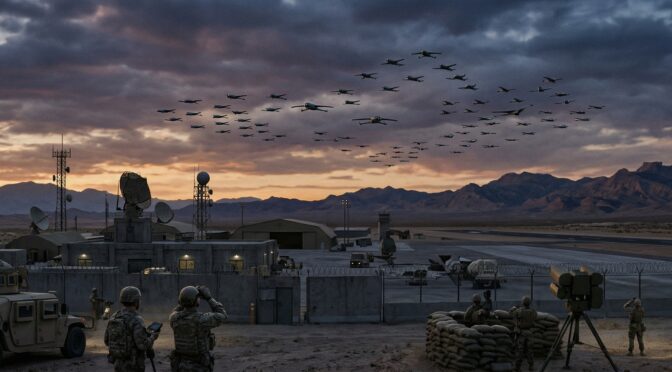
The character of modern warfare has undergone a structural transformation, driven by the rapid maturation and proliferation of unmanned aerial systems. By 2026, the military drone sector is no longer a niche domain reserved for high-end intelligence, surveillance, and reconnaissance operations. Instead, it has evolved into a central pillar of global defense strategy, fundamentally altering the economics of combat, force generation, and deterrence. World military expenditure reached $2.7 trillion in 2024, representing a 9.4 percent year-on-year increase, with an estimated global military burden of 2.5 percent of world gross domestic product.1 Within this expanding financial envelope, the global drone market is forecast to reach $209.91 billion by 2025 and continue its upward trajectory, fueled by urgent procurement signals and shifting tactical doctrines.1

This report provides an objective analysis of the top ten nations leading the military application of drone technology in 2026. The ranking methodology departs from traditional assessments that prioritize exquisite, high-cost platforms. Instead, it embraces a multidimensional framework that weighs theoretical doctrine, research and development investment, and demonstrated battlefield outcomes. As recent conflicts in Eastern Europe and the Middle East have proven, a higher unit cost does not equate to superior capability. Operational success is increasingly dictated by cost-imposition ratios, replacement speed, and the ability to field attritable mass alongside intelligent, autonomous swarms.

The United States retains the top position through sheer investment scale and its recent operational successes in Operation Epic Fury, leveraging both high-end platforms and low-cost swarm technologies.4 Ukraine occupies the second position, having practically rewritten the doctrine of unmanned warfare through its mastery of attrition economics and high-volume interceptor production.6 Russia and China follow closely, leveraging massive industrial capacity and rapid physical integration of artificial intelligence.8 Iran, despite recent strategic setbacks, remains a critical force due to its pioneering of low-cost, highly effective loitering munitions.10 The latter half of the ranking includes Turkey, South Korea, India, Taiwan, and Poland, each demonstrating highly specialized approaches to unmanned systems, ranging from drone training initiatives for half a million troops to sophisticated multi-layered anti-drone defense networks.12

The analysis underscores a critical strategic reality, which is that the exposed human warfighter is operating at a growing economic disadvantage relative to low-cost, rapidly replaceable machine systems.15 Future military dominance will belong to nations that can successfully integrate advanced artificial intelligence, secure robust supply chains, and master the brutal economics of sustained attrition.

1.0 Theoretical Frameworks of Modern Drone Warfare

To accurately assess and rank national drone capabilities, it is necessary to establish the theoretical frameworks governing modern unmanned combat. The proliferation of cheap, precise drones has challenged traditional principles of force concentration and maneuverability, requiring a reassessment of how militaries achieve mass and saturation effects.16 The fundamentals of land warfare rely on holding and occupying territory, an endeavor that centers of gravity traditionally placed on armies and capitals.17 However, the methods of protecting or attacking these centers have fundamentally shifted.

1.1 Attrition Economics and the Cost-Imposition Asymmetry

Recent global conflicts have demonstrated a structural inversion in the economics of warfare. Historically, military effectiveness was closely tied to platform sophistication and the extensive training of the human operator. In 2026, the battlefield is increasingly governed by logistics, replacement dynamics, and cost asymmetry.15

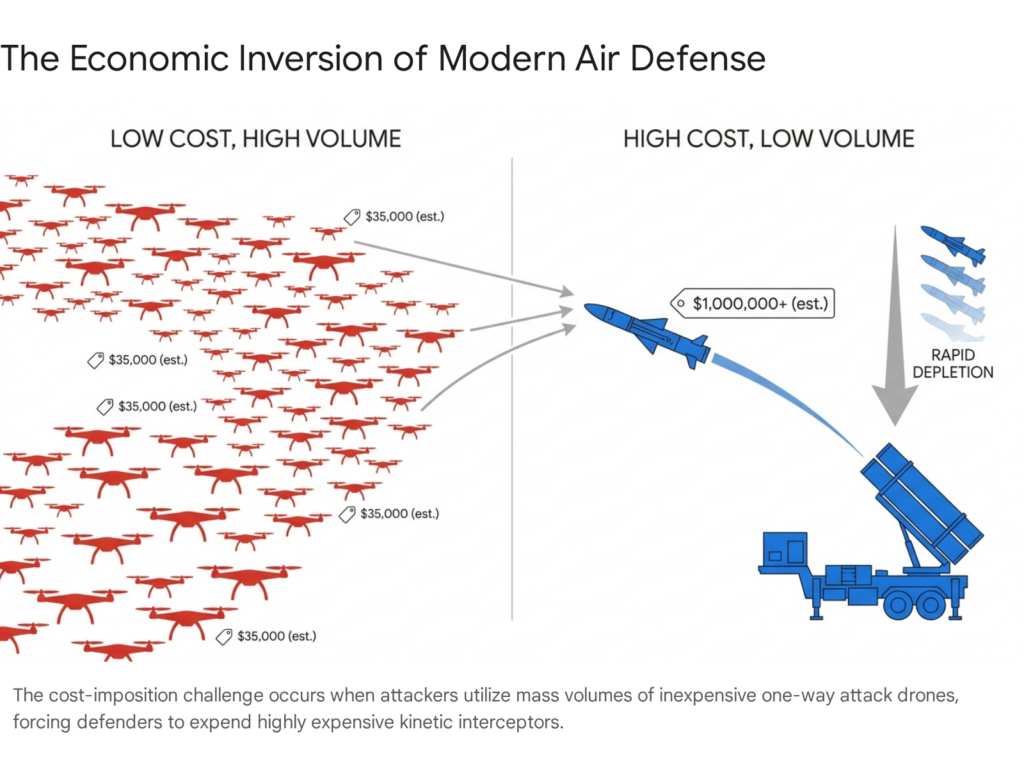
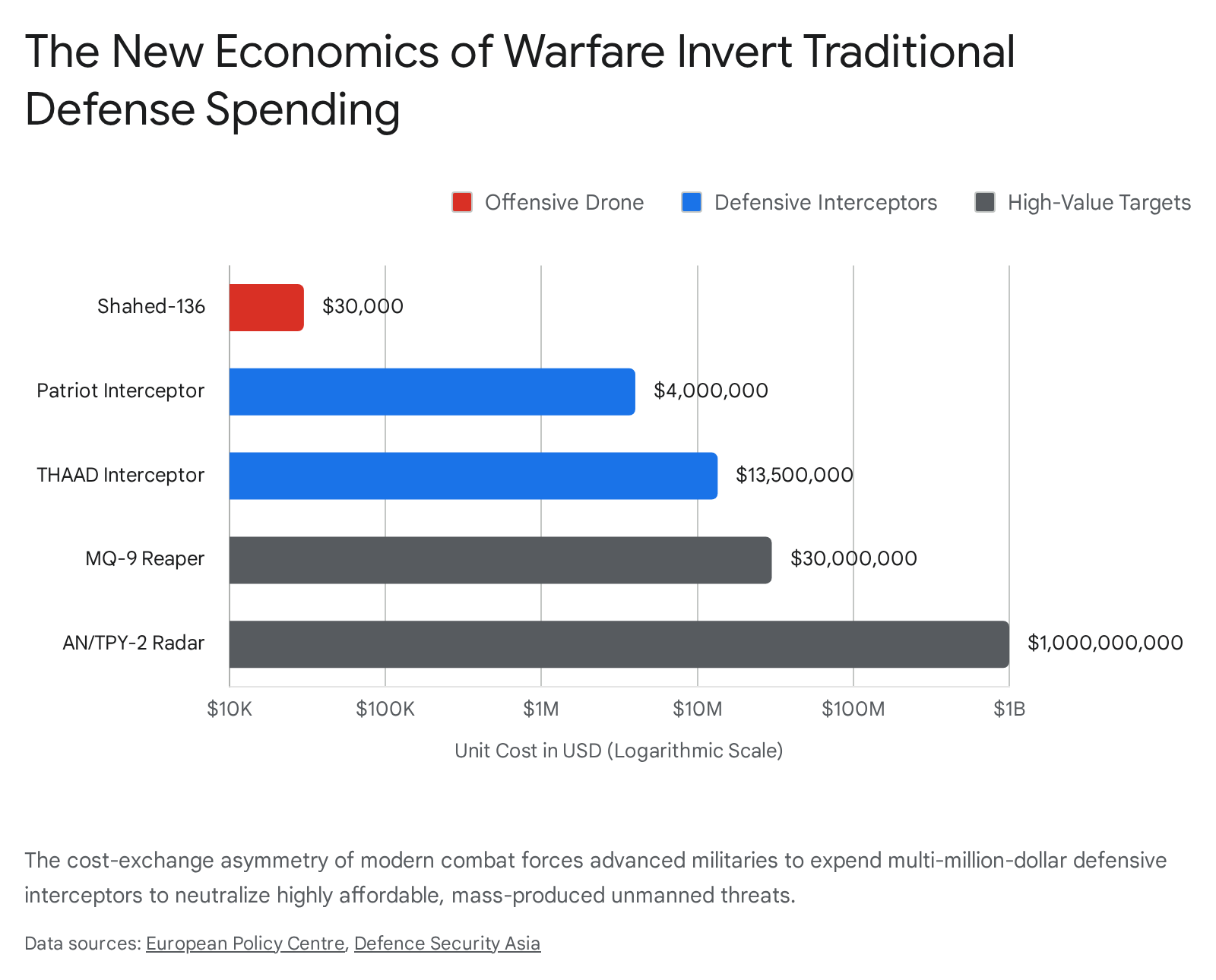
The concept of attrition economics centers on the cost-exchange ratio between an offensive weapon and the defensive countermeasure required to defeat it. In several recent theaters, low-cost unmanned aerial systems have successfully targeted air defense networks worth millions of dollars, creating an unsustainable cost-imposition challenge for advanced military forces.6 The production cost of an Iranian Shahed-136 one-way attack drone is estimated at $20,000 to $35,000.6 When defending nations utilize traditional kinetic interceptors, such as the Patriot missile system which costs over $1 million per shot, the economic advantage shifts decisively to the attacker.6 This asymmetry is a deliberate strategy. By launching large numbers of inexpensive drones alongside more advanced weapons, attackers force defenders to expend costly interceptors and draw down stockpiles that cannot be replenished quickly.18

This dynamic is further explained by Jevons’s Paradox, which posits that as technological progress increases the efficiency with which a resource is used, the rate of consumption of that resource rises due to increasing demand.16 In military terms, as precision strike capabilities become cheaper and more efficient through drone technology, their usage proliferates exponentially, demanding an unprecedented mass of production. Simultaneously, the Red Queen Effect dictates that adversaries must constantly adapt just to maintain parity, leading to rapid cycles of countermeasure and counter-countermeasure development.16 Lanchester’s Laws and Hughes’s Salvo Equations further illustrate how numerical superiority in a salvo of autonomous weapons will predictably overwhelm a technologically superior but numerically inferior defense system.16 In environments characterized by sustained attrition, the human warfighter becomes economically non-viable in the highest-attrition exposure layers, accelerating the push toward attritable unmanned platforms.15

Economic inversion of air defense: low-cost drones vs. high-cost interceptors. "Global Military Drone Applications 2026

1.2 Intelligentized Warfare and Artificial Intelligence Integration

While attrition economics favors cheap mass, the concept of intelligentized warfare focuses on maximizing the effectiveness of those assets through artificial intelligence and autonomous networking. Intelligentized warfare is a concept deeply embedded in modern defense white papers, envisioning combat where artificial intelligence enables machine-speed decision-making, target recognition, and swarm coordination.19

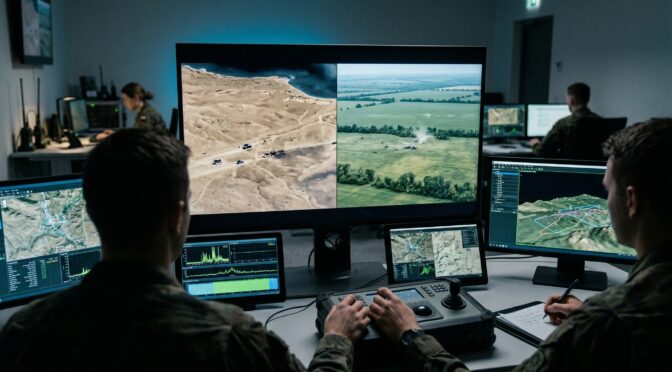
The integration of artificial intelligence addresses the primary vulnerabilities of remotely piloted systems, specifically their reliance on continuous data links and global navigation satellite systems. In heavily contested electronic warfare environments, traditional command links are routinely jammed. Next-generation platforms mitigate this through onboard edge computing, visual terrain navigation, and algorithmic swarm logic.20 Furthermore, artificial intelligence enables the shift from a single-operator paradigm to a framework where one soldier manages a coordinated swarm of hundreds of autonomous vehicles.19 This intelligent synergy allows platforms to split into sub-swarms, dynamically assign targets, and maintain formation without human intervention, thereby exponentially increasing the lethality of a strike package.21

2.0 Evaluation Methodology

The ranking of the top ten nations in military drone usage relies on a strict methodology designed to look past pure procurement numbers and theoretical unit costs. Better capability is evaluated as a judgment based on total system cost relative to targets destroyed, overall effectiveness, resilience in contested environments, and the ability to scale operations rapidly under pressure. The evaluation utilizes three primary dimensions.

The first dimension is the Theoretical Foundation and Doctrine of the assessed nation. This evaluates how deeply a nation has integrated unmanned systems into its core military strategy, assessing whether drones are treated as auxiliary assets or as central components of combined arms operations and force structure.

The second dimension is the Investment in Research and Development. This metric analyzes capital expenditure and institutional focus on next-generation capabilities, specifically artificial intelligence, swarm networking, domestic industrial base expansion, and the development of cost-effective platforms designed for mass production.

The third dimension relies on Demonstrated Operational Outcomes. This measures actual battlefield performance utilizing open-source intelligence. Key metrics include verified kill-to-loss ratios, success in cost-imposition strategies, and the ability to rapidly iterate countermeasures in response to adversary adaptations in active theaters of conflict.

The detailed data points for these criteria were sourced from national defense budgets, operational reports from conflicts such as the war in Ukraine and Operation Epic Fury, and authoritative defense industry analysis updated through April 2026. A detailed breakdown of the source parameters and analytical frameworks is located in the Appendix of this report.

3.0 Summary Ranking of the Top 10 Nations

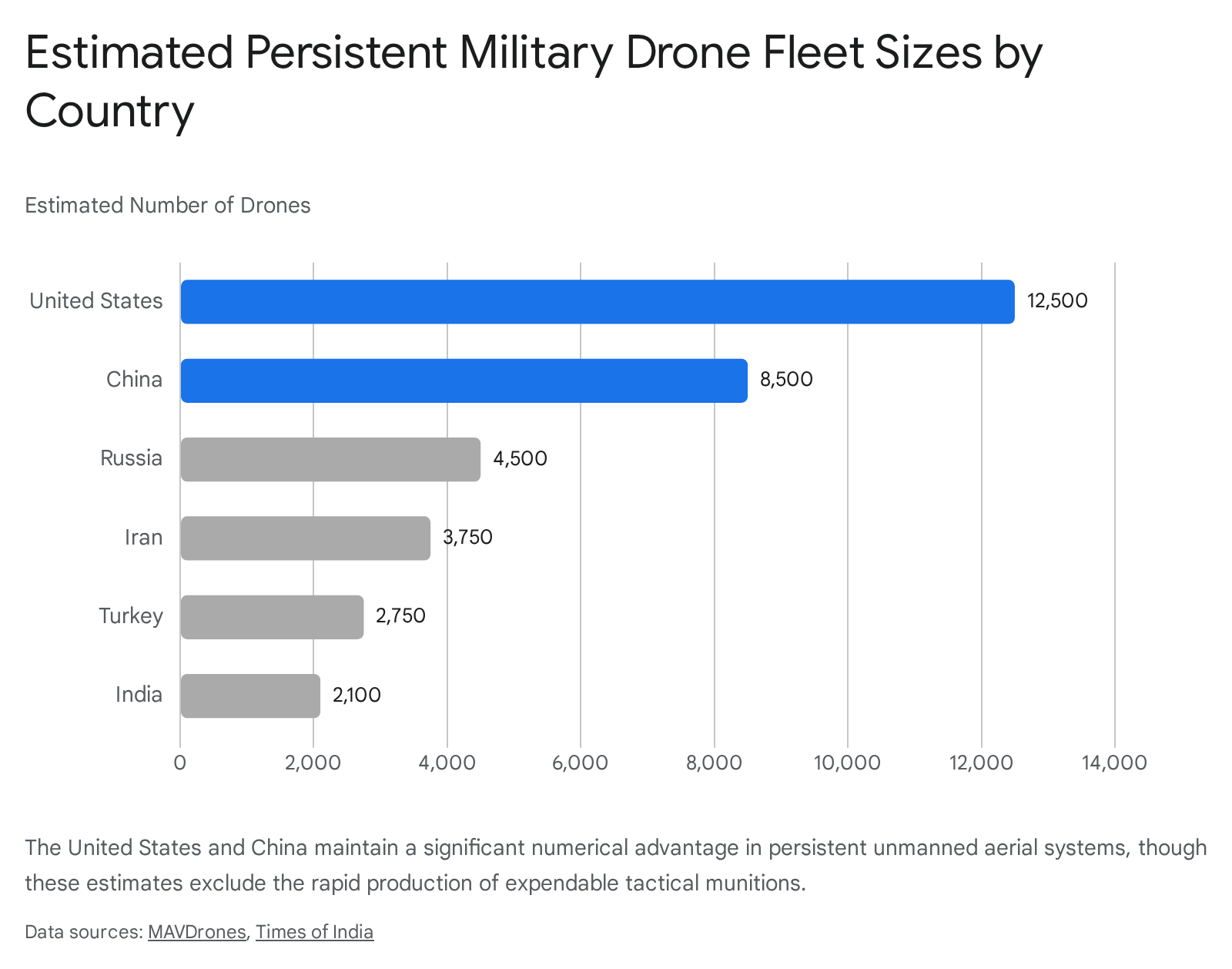
The following table summarizes the top ten countries leading the global application of military drone technology, highlighting their estimated inventory scale and primary doctrinal focus. These estimates account for persistent operational fleets but do not fully capture the rapid churn rate of highly expendable tactical munitions utilized on active frontlines.

RankCountryEstimated Unmanned Fleet SizePrimary Doctrinal FocusKey Platforms and Initiatives
1United States12,000 to 13,000High-end ISR, Attritable Mass, AI IntegrationMQ-9A Reaper, Switchblade 600, LUCAS, Replicator
2Ukraine1,500 to 2,000 (Excludes millions of expendables)Attrition Economics, High-Volume Domestic ProductionMagura-7, Interceptor Drones, FPV Dominance
3Russia4,000 to 5,000Mass Scale, Deep Strike, Decoy OperationsShahed/Geran-2, Lancet-3, Molniya
4China8,000 to 9,000Export Dominance, Intelligentized WarfareWing Loong II/III, Swarm AI
5Islamic Republic of Iran3,500 to 4,000Asymmetric Cost-Imposition, Regional ProliferationShahed 131/136
6Turkey2,500 to 3,000Cost-Effective Strike, GNSS-Denied SwarmsBaykar K2, STM Kargu, TB2/TB3
7South Korea800 to 1,000 (Targeting 60,000)Mass Infantry Training, Border Surveillance500k Drone Warrior Initiative, LIG Nex1 Swarms
8India2,000 to 2,200Border Monitoring, Collaborative SwarmsShield AI V-BAT, Sheshnaag-150
9Taiwan (ROC)Rapidly GrowingMulti-Layered Defense, Porcupine StrategyT-Dome Network, Chien Hsiang
10Poland1,000 to 1,200Eastern Border Security, Rapid ProcurementEU SAFE Anti-Drone Wall
Close-up of WBP AK receiver with Polish eagle crest and barrel assembly.

4.0 Detailed Country Analysis and Justification

4.1 United States

The United States secures the top ranking through an unmatched combination of legacy high-end platforms, massive capital allocation for future autonomy, and recent operational validation of its shifting doctrines. Recognizing the need to balance exquisite platforms with attritable mass, the Department of Defense requested a $13.4 billion autonomy line in its fiscal year 2026 budget.1 This funding includes $9.4 billion specifically allocated for unmanned and remotely operated aerial vehicles, alongside a $3.1 billion request for counter-unmanned aircraft system efforts.1 Furthermore, the United States Army allocated $803.9 million in the 2026 fiscal year to institutionalize small drones as standard equipment across its formations, allocating $747.9 million for procurement and $56 million for research and development.1 The Replicator initiative, designed to field large numbers of low-cost drones, received a $300 million reprogramming request in fiscal year 2023, $200 million in appropriations for 2024, and a $500 million request for 2025, although fielding thousands of systems has faced operational delays, resulting in only hundreds deployed by summer 2025.1

The United States continues to operate the world’s largest and most advanced legacy drone fleet, counting approximately 12,000 to 13,000 active persistent platforms.22 This fleet is anchored by systems like the General Atomics MQ-9A Reaper. The Reaper boasts an endurance of over 27 hours, a 50,000-foot operational altitude, and a payload capacity of 3,850 pounds, making it a premier intelligence collection and precision strike asset.24 It carries a fault-tolerant flight control system and is powered by a Honeywell TPE331-10 turboprop engine, delivering high performance and reliability.25 However, the cost dynamics of modern warfare have forced an evolution. During the 2026 Operation Epic Fury against Iran, the United States lost over a dozen MQ-9 Reapers, valued at $16 million each, highlighting the vulnerability of high-value assets in contested airspace.6

In response to these vulnerabilities, the United States demonstrated a profound strategic pivot during the same conflict. United States Central Command integrated hundreds of Low-cost Uncrewed Combat Attack Systems into offensive operations.5 These platforms, featuring autonomy, anti-jamming capabilities, and a unit cost under $55,000, proved highly effective in saturating enemy defenses.5 The success of Operation Epic Fury, which saw over 13,000 targets struck in just 38 days, relied heavily on this layered approach of high-end command platforms and low-cost attritable swarms.4 Additionally, the United States Army recently placed a $186 million order for AeroVironment’s Switchblade 600 Block 2 loitering munitions.27 This next-generation munition, capable of autonomous target recognition and boasting an extended endurance of over 50 minutes and a range exceeding 110 kilometers, confirms a firm commitment to long-range, anti-armor precision at the tactical edge.27

4.2 Ukraine

Ukraine ranks second due to its unprecedented role as the global laboratory for modern drone warfare. Lacking the massive defense budgets of global superpowers, Ukraine has achieved remarkable success through ruthless innovation and a mastery of attrition economics. The Ukrainian government allocated approximately $2.6 billion for drone procurement in 2025, aiming to purchase 4.5 million first-person view drones, an increase from 1.5 million purchased in 2024, with 96 percent sourced directly from domestic manufacturers.1 This massive domestic production scale ensures that the nation maintains operational persistence despite extreme battlefield attrition.

The operational outcomes are staggering. In March 2026, the Ukrainian armed forces reported that drones accounted for 96 percent of all Russian casualties, with a monthly total exceeding 35,000 casualties.29 The strategic integration of drones has allowed Ukraine to maintain a 1:5 kill-to-loss ratio against Russian forces, inflicting roughly 150 to 157 casualties per square kilometer captured by the adversary.7 The sheer volume of drone strikes, which constitute an estimated 80 to 90 percent of all successful target destructions, demonstrates a complete doctrinal shift toward unmanned mass.7

Ukraine has also excelled in developing low-cost countermeasures against asymmetric threats. Facing saturation attacks from Russian Shahed drones, Ukraine produced over 100,000 interceptor drones in 2025.6 Costing only $3,000 to $5,000 apiece, these interceptors rely on the tactic of manually ramming incoming threats, a method that accounts for downing one in three Russian aerial targets and vastly improving the economic exchange ratio compared to firing million-dollar Patriot missiles.6 The ingenuity of Ukrainian operators extends into the maritime and ground domains. Networked unmanned ground vehicles have transitioned from experimentation to active fielding for logistics and fire support missions, while AI-powered Magura-7 surface drones equipped with air-to-air missiles successfully recorded the world’s first shootdown of fighter aircraft, downing two Russian Sukhoi Su-30 jets over Novorossiysk and Crimea in May 2025.6 Ukraine’s decentralized communications model, utilizing dispersed radio nodes, further protects these operations from electronic jamming.30 This relentless, cost-effective innovation secures Ukraine’s position at the forefront of applied unmanned warfare.

4.3 Russia

Russia commands the third position driven by its immense industrial capacity, its deep integration of drone logistics, and its commitment to large-scale, deep-strike drone operations. While initially reliant on imports, Russia has aggressively localized its production capabilities, most notably at the Alabuga Special Economic Zone in the Republic of Tatarstan.9 This facility has undergone rapid expansion, featuring domed structures of 2,200 square meters and 900 square meters constructed specifically to shield manufacturing activities.32 This localized capacity is central to the domestic manufacturing of the Geran-2, a variant of the Iranian Shahed-136, enabling Russia to produce over 6,000 one-way attack drones in 2024, with goals to increase production significantly through 2025.9

Russia’s operational strategy heavily emphasizes cost-imposition and the exhaustion of adversary defenses. To maximize the economic drain on Ukrainian air defense systems, Russia has evolved its tactics to include a high percentage of decoys.33 Systems like the polystyrene and plywood Gerbera and Parodya decoys cost approximately $10,000 each and currently represent roughly 40 percent of all Russian drone launches.33 By mixing these decoys with armed Geran-2s in synchronized waves, Russian forces force defenders to expend scarce and expensive interceptors, acting as combat reconnaissance to pave the way for subsequent ballistic and cruise missile strikes.33 In April 2026, Russia launched a coordinated strike involving 324 drones and multiple Iskander-M ballistic missiles, underscoring this saturation strategy.35

On the tactical front, Russia has utilized the ZALA Lancet-3 loitering munition against high-value targets, requiring specialized operators and target designation from reconnaissance assets.36 However, the Lancet highlights the constraints of modern drone economics. Its $35,000 unit cost and the requirement for highly specialized operators have limited its scalable deployment compared to cheaper alternatives.31 Consequently, Russian forces have increasingly pivoted to cheaper alternatives like the Molniya strike drone to maintain mass on the frontlines.31 Despite challenges in high-tech component acquisition and personnel generation, Russia’s sheer volume of production and brutal application of attrition warfare keep it firmly near the top of the global hierarchy.

4.4 China

China ranks fourth, combining vast manufacturing supremacy with a highly focused strategy on intelligentized warfare and export dominance. Chinese policymakers approach artificial intelligence not merely as an auxiliary tool but as a general-purpose technology meant for deep physical integration across all military and civilian platforms.8 The nation operates a massive fleet of 8,000 to 9,000 estimated persistent drones.22 While open-source analysis suggests China maintains a cautious posture regarding achieving short-term overall parity with the United States in frontier artificial intelligence models, its military is aggressively testing autonomous swarm capabilities, demonstrating exercises where a single soldier manages 200 autonomous vehicles simultaneously.8 Furthermore, the Chinese navy has integrated artificial intelligence algorithms into guided-missile frigates like the Qinzhou to illuminate blind spots during air defense engagements.19

China’s influence is profoundly felt through its export of the Wing Loong series, developed by the Aviation Industry Corporation of China and the Chengdu Aircraft Design Institute.37 The Wing Loong II, a medium-altitude long-endurance platform with satellite link capability, has seen extensive use globally and has recently been deployed by the Chinese Coast Guard for maritime patrols.38 This deployment marks a critical escalation in projecting state power and utilizing advanced surveillance platforms for paramilitary operations in contested waters around Taiwan.39

The scope of China’s strategic ambitions was firmly underscored by a monumental $5 billion agreement signed in 2026 with Saudi Arabia’s General Authority for Military Industries.40 This deal establishes a full assembly line in Jeddah capable of producing 48 Wing Loong-3 unmanned combat aerial vehicles annually, shifting Riyadh’s procurement strategy amid regional conflict.40 The Wing Loong-3 is a massive platform capable of flying 10,000 kilometers with a maximum take-off weight of 6,200 kilograms, integrating intelligent recognition systems capable of locking onto targets in 0.3 seconds.41 This industrial partnership represents a significant transfer of technology, comprehensive training pipelines, and a calculated move by Beijing to embed its aerospace manufacturing capabilities within the strategic infrastructure of key regional powers, effectively altering the drone power balance in the Middle East.43

4.5 Islamic Republic of Iran

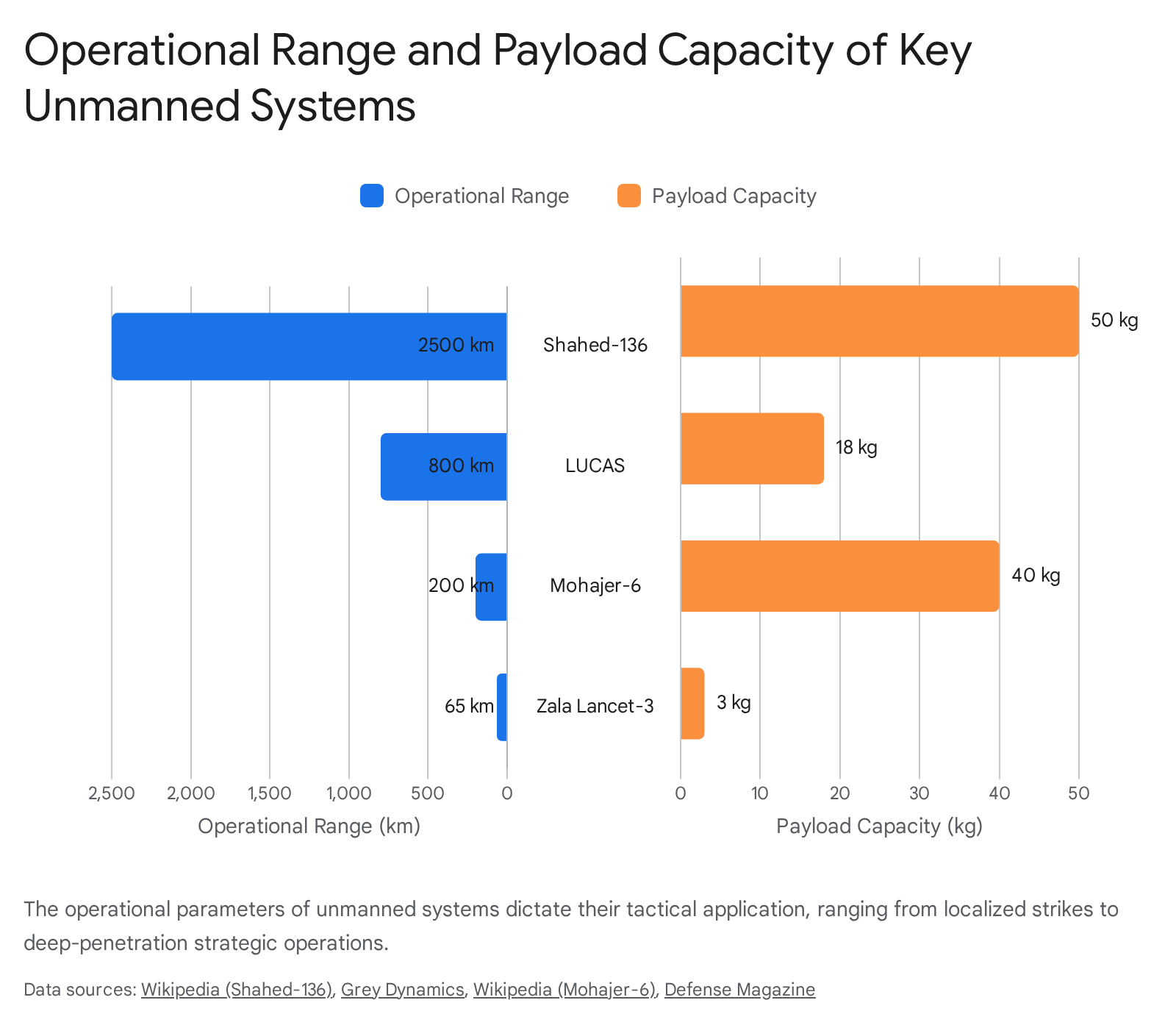
Iran occupies the fifth position, recognized primarily as the architect of the low-cost, high-impact drone warfare model that currently defines global conflict. The cornerstone of Iran’s influence is the Shahed series of loitering munitions, particularly the Shahed-136 and Shahed-131.9 Produced at an estimated unit cost of $20,000 to $35,000, these platforms lack the exquisite sensors and survivability of Western systems, but they compensate through sheer volume, simple pre-programmed navigation, and undeniable cost-effectiveness.6 The Shahed-136, carrying a 50-kilogram warhead, has forced militaries globally to rethink air defense architecture.33

Iran’s strategic doctrine leverages these platforms to project power asymmetrically, creating severe sustainment crises for adversaries forced to intercept them with multimillion-dollar munitions.18 This approach proved highly disruptive globally, fueled by extensive proliferation and technology transfers to state and non-state actors alike, including large-scale technology transfers to Russia for domestic Geran-2 production.9

However, Iran’s ranking reflects a recent and severe degradation of its domestic capabilities. During the 2026 Operation Epic Fury, coordinated strikes shattered Iran’s defense industrial base.4 Open-source reports indicate that over 10,200 total air sorties systematically dismantled more than two-thirds of Iran’s drone and missile production facilities.4 The campaign involved strikes on over 1,450 defense and industrial base targets and approximately 800 attack drone targets.4 Furthermore, United States and allied integrated air defense systems successfully intercepted over 1,000 incoming attack drones and 700 ballistic missiles during the 38-day conflict, achieving interception rates between 80 percent and 90 percent.4 While Iran’s theoretical model of attrition warfare remains highly influential, its physical capacity to generate and deploy mass has been critically compromised, halting its upward momentum in the global rankings.

4.6 Turkey

Turkey secures the sixth spot by successfully merging cost-effective manufacturing with cutting-edge artificial intelligence, creating highly exportable platforms that have proven decisive in multiple theaters. Operating a fleet of 2,500 to 3,000 drones, Turkish defense contractors, notably Baykar and STM, have pioneered the development of autonomous systems designed to operate in highly contested environments.22

In early 2026, STM announced the successful execution of Turkey’s first live-fire drone swarm attack using 20 KARGU rotary-wing loitering munitions.21 The KARGU swarm operated autonomously, utilizing distributed intelligence to navigate, split into sub-swarms, and strike targets simultaneously without reliance on global navigation satellite systems.21 The system features electronic warfare resistance and mission continuity algorithms despite attrition.21

Concurrently, Baykar unveiled the K2 Kamikaze unmanned aerial vehicle, a fixed-wing loitering munition with a range exceeding 2,000 kilometers, a 200-kilogram warhead, and a maximum take-off weight of 800 kilograms.20 During multi-sortie tests over the Gulf of Saros in March 2026, a swarm of five K2 platforms demonstrated advanced artificial intelligence synergy, executing complex formation flights alongside an AKINCI unmanned combat aerial vehicle.49 The K2 embodies Turkey’s strategic intent, which is to field high-impact platforms that deliver cruise missile-like effects at a fraction of the cost, utilizing terrain-referenced visual navigation to bypass severe electronic warfare jamming.20 Supported by the continued global demand for systems like the Bayraktar TB2 and the recent successful operational demonstration of the Bayraktar TB3 aboard the TCG ANADOLU during NATO’s Steadfast Dart 2026 exercise, Turkey maintains a highly robust and innovative drone industrial base.52

4.7 South Korea

South Korea is ranked seventh, driven by an urgent national mandate to integrate unmanned mass into its ground forces to counter regional asymmetric threats. Facing demographic challenges and a rapidly evolving threat landscape, the Ministry of National Defense approved a $44.7 billion defense budget, or 65.86 trillion Korean Won, for 2026, heavily emphasizing force modernization and the three-axis defense system.54

The cornerstone of South Korea’s strategy is the initiative to foster 500,000 drone warriors.14 This policy aims to embed drone operating skills across all ranks, ensuring that piloting an unmanned system becomes as routine as handling a standard-issue K2 rifle.56 To achieve this, the defense ministry expanded its training budget to $22 million, or 33 billion Korean Won, in 2026, facilitating the rapid procurement of 11,000 to 17,000 commercial training drones, with a goal of acquiring 60,000 units by 2029.55 The Republic of Korea Army’s 36th Infantry Division in Wonju serves as the central test bed for these pilot programs.14

Beyond mass infantry training, South Korean defense contractors are developing highly sophisticated platforms to enhance intelligence and strike capabilities. At the 2026 Drone Show Korea, LIG Nex1 showcased advanced artificial intelligence-driven swarm drones, the Block-I small unmanned aerial vehicle response system, and autonomous surface vehicles like the Sea Sword.59 The Block-I system acts as a soft-kill jammer capable of emitting signals to deviate paths or induce crashes of enemy drones.61 South Korea’s ranking reflects its aggressive, society-wide integration of drone technology, prioritizing rapid commercial acquisition to build an immediate, scalable capability.14

4.8 India

India holds the eighth position, characterized by a rapid acceleration in domestic innovation and the strategic procurement of advanced autonomous systems to secure its contested borders. Operating a fleet of 2,000 to 2,200 systems, the Indian military has recognized the necessity of bridging the capability gap with regional competitors by prioritizing cross-service integration and asymmetric tools.22 The Indian armed forces have integrated artificial intelligence across command-and-control systems, predictive maintenance, and targeting, ensuring that ultimate command responsibility remains with humans.62

The Indian Army has aggressively expanded its tactical footprint, establishing 19 dedicated drone training centers in 2026 and inaugurating a state-of-the-art laboratory at the Madras Regimental Centre.64 Operationally, India has demonstrated a commitment to kinetic and non-kinetic measures. Following the Pahalgam terror attack in 2025, India launched Operation Sindoor, a tri-services mission employing indigenous unmanned aerial systems to execute precision strikes on nine terrorist camps and neutralize enemy radar units.65 Additionally, India has advanced its collaborative swarm technology. In early 2026, startup Newspace Research Technologies successfully flight-tested the Sheshnaag-150, a long-range collaborative attack swarming system.66 Designed for saturation attacks, the Sheshnaag-150 boasts an operational range of over 1,000 kilometers, a five-hour endurance, and the ability to autonomously identify and engage targets with a 25 to 40 kilogram warhead, signifying a major leap in indigenous software development.66

Furthermore, India has bolstered its intelligence and surveillance capabilities through strategic international partnerships. In January 2026, India selected Shield AI to supply the Indian Army with V-BAT unmanned aircraft systems, uniquely integrating Shield AI’s Hivemind autonomy software.67 This allows Indian forces to deploy long-endurance platforms in contested environments without relying on runways or continuous communication links, essential for intelligence, surveillance, and reconnaissance operations in challenging terrains like the Himalayas.67

4.9 Taiwan (Republic of China)

Taiwan occupies the ninth rank, driven by an existential imperative to develop an asymmetric porcupine strategy against the overwhelming numerical superiority of the People’s Liberation Army. Recognizing that traditional air defense missiles could be rapidly depleted by millions of low-cost Chinese drone swarms, Taiwan is heavily investing in affordable interception methods and counter-drone measures.12

Central to this defense posture is the development of the T-Dome, a $32 billion integrated, multi-layered air defense network inspired by Israel’s Iron Dome and the United States’ Golden Dome.12 First announced in October 2025, the T-Dome aims to unify various defense assets, including incoming United States-supplied systems and domestic interception units, to detect, track, and intercept missiles, aircraft, and drones across multiple altitudes while ignoring harmless decoys.12

In the offensive and deterrent domain, the National Chung-Shan Institute of Science and Technology has developed the Chien Hsiang anti-radiation loitering munition.71 Measuring 1.2 meters long with a 2-meter wingspan, the Chien Hsiang has a loiter time of 100 hours, a top speed of 185 kilometers per hour, and a range of 1,000 kilometers.71 It is specifically designed to autonomously hunt and destroy enemy radar installations using an anti-radiation seeker, providing a critical deterrent capability against adversary air defense networks.71 The institute is also planning to develop low-cost munitions domestically to counter enemy rockets, with test flights expected soon.68 Taiwan’s approach illustrates how smaller nations must prioritize specialized, defensive unmanned integration over broad force projection.

4.10 Poland

Poland rounds out the top ten, distinguished by its massive and rapid capital deployment to secure its eastern borders following incursions by Russian unmanned systems.73 Operating a fleet of 1,000 to 1,200 systems, Poland does not possess the massive indigenous drone manufacturing base of a nation like Turkey, but its strategic positioning, integration with NATO standards, and purchasing power make it a formidable actor.22

In early 2026, the Polish government announced the allocation of a massive $51.6 billion loan via the European Union’s Security Action for Europe program, dedicating a significant portion to defense modernization between 2026 and 2030.13 The centerpiece of this effort is the San program, which aims to establish a comprehensive anti-drone wall along its borders to intercept cross-border drone activity.13 Utilizing the Kongsberg-PGZ consortium, Poland plans to deploy a dozen anti-drone batteries rapidly, with the first units scheduled to enter service as early as 2026 and the final battery expected by 2027.13 Poland is also balancing its maritime capabilities, evaluating the procurement of Swedish Saab A26 submarines under the Orka program, though debate continues over the exclusion of cruise missile armaments in favor of classical torpedo configurations.76 Poland’s ranking underscores the critical importance of massive, rapid procurement and the implementation of robust defensive drone architectures in high-threat geopolitical environments.

5.0 Global Industrial Base and Vendor Ecosystem

The capabilities demonstrated by the top ten nations are underpinned by a robust and highly competitive global industrial base. The ecosystem includes legacy defense contractors transitioning to autonomy, alongside agile technology firms specializing in artificial intelligence and edge computing. The market dynamics reflect a shift toward companies that can produce scalable, interoperable, and attritable systems.

The following table summarizes key vendors, their flagship products, and their production availability status based on current market intelligence.

VendorFlagship PlatformPrimary FunctionProduction and Stock StatusVendor Official URL
General AtomicsMQ-9A Reaper / SkyGuardianHigh-altitude long-endurance intelligence and strikeIn active production; 575 units built as of 2026.ga-asi.com
AeroVironmentSwitchblade 600 Block 2Precision tactical loitering munitionIn active production; fulfilling $186M US Army order.avinc.com
BaykarBayraktar TB2 / K2 Kamikaze / AKINCIMedium-altitude strike and AI swarm munitionsIn active mass production; extensive export fulfillment.baykartech.com
Shield AIV-BAT (with Hivemind autonomy)Vertical takeoff, GNSS-denied reconnaissanceIn active production; deployed by Indian Army and Netherlands Navy.shield.ai
STMKARGU Rotary-Wing UAVPrecision attack and autonomous swarm operationsIn active production; exported to over 15 countries.stm.com.tr
LIG Nex1Sea Sword / Block-I JammerUnmanned surface operations and counter-drone systemsIn active production; integrated into South Korean defense infrastructure.lignex1.com

Note: Vendor apparel and civilian merchandise availability varies independently of military hardware. For example, the Baykar store lists the Bayraktar KIZILELMA Patch and AKINCI Pin as out of stock, while the TB2 Pin remains available, but this does not reflect the robust production lines of their actual combat aircraft.77

The financial markets further validate the immense growth in this sector. Major public defense companies involved in unmanned systems carry massive market capitalizations, indicating strong institutional confidence. Airbus SE leads with a market capitalization of approximately $176.48 billion, followed by Lockheed Martin at $140.17 billion, and Northrop Grumman at nearly $100.05 billion.79 Pure-play drone operators and specialized defense technology firms also show robust valuations, with Kratos Defense and Security Solutions valued at nearly $15.42 billion and AeroVironment at $11.82 billion.79 The inclusion of these companies in thematic exchange-traded funds, such as the ARK Autonomous Technology and Robotics ETF, signals ongoing interest in scalable, artificial intelligence-enabled uncrewed systems.80

6.0 Strategic Conclusions and Future Outlook

The landscape of military drone application in 2026 confirms a definitive shift away from a paradigm dominated solely by high-cost, multi-role platforms. While systems like the MQ-9 Reaper maintain utility in permissive environments, maritime surveillance, or specialized command roles, the vanguard of modern warfare belongs to attritable mass, intelligent swarms, and brutal cost-imposition strategies.

Nations that fail to adapt their procurement structures will find their expensive interceptor magazines rapidly depleted by swarms of low-cost munitions. Future tactical overmatch will require a delicate balance. Militaries must maintain high-end platforms for coordination while rapidly generating massive volumes of inexpensive, artificial intelligence-enabled tactical drones. Furthermore, as global navigation satellite systems become increasingly contested through spoofing and jamming, the integration of edge-computing, artificial intelligence, and visual terrain navigation will be the defining technical differentiator between operational success and catastrophic failure.

The rapid industrial expansion seen in countries like China, Russia, and Turkey, contrasted with the agile, decentralized innovation in Ukraine and the massive scale adjustments in the United States and South Korea, sets the stage for a highly volatile and technologically accelerated future. The economic logic of the battlefield has permanently changed, dictating that victory relies not just on who has the best technology, but who can produce good enough technology in overwhelming quantities.

7.0 Appendix: Methodology Documentation

The research methodology utilized for this report relied on a qualitative and quantitative synthesis of open-source intelligence and authoritative defense industry reporting updated through April 2026.

The analytical process involved aggregating data from major defense budgets, specialized market research forecasts, and combat outcome reports from recent conflicts, including the war in Ukraine and Operation Epic Fury. Fleet size estimations were derived from compiled defense analyses and triangulated against known production capacities of major manufacturing hubs, such as the Alabuga Special Economic Zone in Russia and Aviation Industry Corporation of China facilities.9

To establish the rankings, data points were categorized into three primary dimensions: Theoretical Foundation, Research and Development Investment, and Demonstrated Outcomes. Countries were evaluated not merely on gross spending, but on the efficiency of their capital deployment regarding cost-imposition economics. Success was measured by a nation’s ability to inflict disproportionate costs on adversaries, maintain high kill-to-loss ratios through unmanned systems, and successfully integrate autonomous networking software into their tactical doctrine.

All vendor status updates and product availabilities were verified against contemporary defense procurement announcements and open-source validation to ensure that listed products are actively deployed or in stated production pipelines. Stock valuations and market capitalizations were sourced from public financial indices relevant to aerospace and defense equities in 2026.


Please share the link on Facebook, Forums, with colleagues, etc. Your support is much appreciated and if you have any feedback, please email us in**@*********ps.com. If you’d like to request a report or order a reprint, please click here for the corresponding page to open in new tab.


Sources Used

  1. Military Drones Report 2026 [Free PDF] | StartUs Insights, accessed April 18, 2026, https://www.startus-insights.com/innovators-guide/military-drones-report/
  2. Global Ai In Drone Market Research Report: Forecast (2026-2032) – MarkNtel Advisors, accessed April 18, 2026, https://www.marknteladvisors.com/research-library/ai-in-drone-market.html
  3. Why 2026 will be a big year for drones | VettaFi, accessed April 18, 2026, https://www.vettafi.com/insights/indexing-article-why-2026-will-be-a-big-year-for-drones
  4. Peace Through Strength: Operation Epic Fury Crushes Iranian Threat as Ceasefire Takes Hold – The White House, accessed April 18, 2026, https://www.whitehouse.gov/releases/2026/04/peace-through-strength-operation-epic-fury-crushes-iranian-threat-as-ceasefire-takes-hold/
  5. Centcom commander says ‘hundreds’ of U.S. drones are involved in Iran war, accessed April 18, 2026, https://defensescoop.com/2026/04/07/us-launches-more-attack-drones-iran-epic-fury-adm-cooper-centcom/
  6. Monthly Drone Report – March 2026 | SOF News, accessed April 18, 2026, https://sof.news/drones/march-2026/
  7. 1:5 kill ratio: Ukraine inflicts heavy Russian losses using drones, says Finnish president, accessed April 18, 2026, https://breakingdefense.com/2026/04/15-kill-ratio-ukraine-inflicts-heavy-russian-losses-using-drones-says-finnish-president/
  8. Competing AI strategies for the US and China | Brookings, accessed April 18, 2026, https://www.brookings.edu/articles/competing-ai-strategies-for-the-us-and-china/
  9. Russia doubles down on the Shahed – The International Institute for Strategic Studies, accessed April 18, 2026, https://www.iiss.org/online-analysis/military-balance/2025/04/russia-doubles-down-on-the-shahed/
  10. Asymmetric Warfare and the Rise of Low-Tech Defense: Lessons …, accessed April 18, 2026, https://atlasinstitute.org/asymmetric-warfare-and-the-rise-of-low-tech-defense-lessons-and-opportunities-for-europe-to-enhance-strategic-autonomy/
  11. Epic Fury Reveals Vulnerabilities in the Axis Behind Iran, accessed April 18, 2026, https://jinsa.org/jinsa_report/epic-fury-reveals-vulnerabilities-in-the-axis-behind-iran/
  12. The Perfect Swarm: Taiwan’s T-Dome in the Era of Drone Warfare – Small Wars Journal, accessed April 18, 2026, https://smallwarsjournal.com/2026/03/17/taiwan-t-dome-drone-warfare/
  13. Poland picks Kongsberg-PGZ consortium to build anti-drone ‘wall’ – Defense News, accessed April 18, 2026, https://www.defensenews.com/global/europe/2026/02/02/poland-picks-kongsberg-pgz-consortium-to-build-anti-drone-wall/
  14. S. Korean military to boost unmanned capabilities by training 500000 ‘drone warriors’, accessed April 18, 2026, https://www.koreaherald.com/article/10568760
  15. The End of the Exposed Warfighter—Cost Asymmetry and Attrition Economics in Modern Combat – Preprints.org, accessed April 18, 2026, https://www.preprints.org/manuscript/202601.0190
  16. Drones and the Changing Character of War – USAWC Press, accessed April 18, 2026, https://press.armywarcollege.edu/cgi/viewcontent.cgi?article=3369&context=parameters
  17. Drones Are Game-Changing, But They Are Not the Answer to the Inherent Challenges of Land War, accessed April 18, 2026, https://smallwarsjournal.com/2025/08/06/drones-are-game-changing/
  18. The dangerous economics of drone warfare – Resilience Media, accessed April 18, 2026, https://resiliencemedia.co/the-dangerous-economics-of-drone-warfare/
  19. Outpaced by the US, China’s military places selective bets on artificial intelligence, accessed April 18, 2026, https://www.defensenews.com/global/asia-pacific/2026/04/07/outpaced-by-the-us-chinas-military-places-selective-bets-on-artificial-intelligence/
  20. Turkey’s Baykar tests swarm behavior of its K2 one-way attack drone – Defense News, accessed April 18, 2026, https://www.defensenews.com/global/europe/2026/03/16/turkeys-baykar-tests-swarm-behavior-of-its-k2-one-way-attack-drone/
  21. Türkiye Just Launched Its First Live-Fire KARGU Drone Swarm – YouTube, accessed April 18, 2026, https://www.youtube.com/shorts/2ssthO09Nzk
  22. 10 Countries Leading The Way In Military Drones – Mavdrones, accessed April 18, 2026, https://www.mavdrones.com/top-10-country-leading-military-drones-drone-news/
  23. Top 10 countries with most military drones in the world – The Times of India, accessed April 18, 2026, https://timesofindia.indiatimes.com/world/top-10-countries-with-most-military-drones-in-the-world/articleshow/113983550.cms
  24. Top 10 Most Advanced Military Drones in the World Right Now – insideFPV, accessed April 18, 2026, https://insidefpv.com/blogs/blogs/top-10-most-advanced-military-drones-in-the-world-right-now
  25. MQ-9A Reaper (Predator B) | General Atomics Aeronautical Systems Inc., accessed April 18, 2026, https://www.ga-asi.com/remotely-piloted-aircraft/mq-9a
  26. MQ-9 Reaper > Air Force > Fact Sheet Display, accessed April 18, 2026, https://www.af.mil/About-Us/Fact-Sheets/Display/Article/104470/mq-9-reaper/
  27. AV Receives $186 Million U.S. Army Delivery Order for Next-Generation Switchblade Systems – Investor Relations | AeroVironment, Inc., accessed April 18, 2026, https://investor.avinc.com/news-releases/news-release-details/av-receives-186-million-us-army-delivery-order-next-generation
  28. Switchblade 600 Block 2 – AeroVironment, Inc., accessed April 18, 2026, https://www.avinc.com/lms/switchblade-600-block2
  29. Russia suffers ‘record’ soldier casualties as Ukraine ups drone production, accessed April 18, 2026, https://www.aljazeera.com/news/2026/4/10/ukraine-says-russia-suffers-record-losses-of-soldiers
  30. Technological Evolution on the Battlefield – CSIS, accessed April 18, 2026, https://www.csis.org/analysis/chapter-9-technological-evolution-battlefield
  31. Russian Force Generation and Technological Adaptations Update July 25, 2025, accessed April 18, 2026, https://understandingwar.org/research/russia-ukraine/russian-force-generation-and-technological-adaptations-update-july-25-2025/
  32. A Closer Look at the Yelabuga UAV Factory – Beyond Parallel – CSIS, accessed April 18, 2026, https://beyondparallel.csis.org/a-closer-look-at-the-yelabuga-uav-factory/
  33. Shahed is evolving threat that will keep haunting Ukraine. And rest of us, accessed April 18, 2026, https://kyivindependent.com/the-shahed-is-an-evolving-threat-that-will-keep-haunting-ukraine-and-the-rest-of-us/
  34. Russian Offensive Campaign Assessment, April 16, 2026, accessed April 18, 2026, https://understandingwar.org/research/russia-ukraine/russian-offensive-campaign-assessment-april-16-2026/
  35. Russian Offensive Campaign Assessment, April 15, 2026, accessed April 18, 2026, https://understandingwar.org/research/russia-ukraine/russian-offensive-campaign-assessment-april-15-2026/
  36. ZALA Lancet – Wikipedia, accessed April 18, 2026, https://en.wikipedia.org/wiki/ZALA_Lancet
  37. CAIG Wing Loong – Wikipedia, accessed April 18, 2026, https://en.wikipedia.org/wiki/CAIG_Wing_Loong
  38. CAIG Wing Loong II – Wikipedia, accessed April 18, 2026, https://en.wikipedia.org/wiki/CAIG_Wing_Loong_II
  39. China Deploys Wing Loong II Drones for Coast Guard Patrols Around Taiwan, accessed April 18, 2026, https://www.armyrecognition.com/news/navy-news/2026/china-deploys-wing-loong-ii-drones-for-coast-guard-patrols-around-taiwan
  40. Saudi Arabia Signs $5B Deal for Chinese Wing Loong-3 Drones – House of Saud, accessed April 18, 2026, https://houseofsaud.com/saudi-arabia-china-5-billion-wing-loong-3-drone-factory-jeddah/
  41. Rs 459667500000: Bad news for US as Saudi Arabia inks deal with… for drones amid Iran war tensions, advanced UAV capable of… – News24, accessed April 18, 2026, https://news24online.com/world/rs-459667500000-bad-news-for-us-as-saudi-arabia-inks-deal-with-china-for-drones-amid-iran-war-tensions-advanced-uav-capable-of-lightning-fast-attacks/768177/
  42. Chengdu Wing Loong-3 – Wikipedia, accessed April 18, 2026, https://en.wikipedia.org/wiki/Chengdu_Wing_Loong-3
  43. China–Saudi $5 Billion Wing Loong-3 Drone Factory Deal Signals Major Shift in Middle East Military Power Balance – Defence Security Asia, accessed April 18, 2026, https://defencesecurityasia.com/en/china-saudi-5-billion-wing-loong-3-drone-factory-middle-east-uav-power-balance/
  44. U.S. military to continue dispatching counter-drone capabilities to the Middle East | DefenseScoop, accessed April 18, 2026, https://defensescoop.com/2026/04/10/drone-defense-middle-east-centcom-jiatf-401/
  45. Background on Iran and Operation Epic Fury – Republican Policy Committee |, accessed April 18, 2026, https://republicanpolicy.house.gov/sites/evo-subsites/republicanpolicy.house.gov/files/evo-media-document/rpc-iran-operation-epic-fury-memo.pdf
  46. The proliferation of AI-enabled military technology in the Middle East, accessed April 18, 2026, https://www.iiss.org/online-analysis/charting-middle-east/2026/04/the-proliferation-of-ai-enabled-military-technology-in-the-middle-east/
  47. STM – KARGU Combat Proven Rotary Wing Loitering Munition System, accessed April 18, 2026, https://www.stm.com.tr/en/kargu-autonomous-tactical-multi-rotor-attack-uav
  48. Baykar Unveils K2: A Cruise Missile That Costs Like A Drone, accessed April 18, 2026, https://dronexl.co/2026/03/22/baykar-k2-cruise-missile-drone/
  49. K2 KAMIKAZE UAV TAKES THE FIELD – Baykar, accessed April 18, 2026, https://baykartech.com/en/press/k2-kamikaze-uav-takes-the-field/
  50. Baykar’s K2 Kamikaze UAV Completes Swarm Test with AKINCI – TURDEF, accessed April 18, 2026, https://turdef.com/article/baykar-s-k2-kamikaze-uav-completes-swarm-test-with-akinci
  51. Baykar’s K2 Kamikaze UAV completes autonomous swarm flight tests, accessed April 18, 2026, https://www.airforce-technology.com/news/baykar-k2-kamikaze-uav-flight/
  52. Turkey’s first tech company to develop indigenous UAVs – BAYKAR Technology, accessed April 18, 2026, https://baykartech.com/en/
  53. Unmanned Aerial Vehicle Systems – BAYKAR Technology, accessed April 18, 2026, https://baykartech.com/en/unmanned-aerial-vehicle-systems/
  54. Military’s 2026 plan features 3-axis system, 500K war drones – Korea.net, accessed April 18, 2026, https://www.korea.net/NewsFocus/policies/view?articleId=284412
  55. South Korea approves defense budget increase – The Defence Blog, accessed April 18, 2026, https://defence-blog.com/south-korea-approves-defense-budget-increase/
  56. South Korea expands drone training to equip every squad by 2029 – CHOSUNBIZ, accessed April 18, 2026, https://biz.chosun.com/en/en-policy/2026/04/16/HPSAW77X7ZCBXC3VFZ4COON53E/
  57. South Korea to Train 500000 ‘Drone Warriors’ as Military Expands Unmanned Capabilities, accessed April 18, 2026, http://koreabizwire.com/south-korea-to-train-500000-drone-warriors-as-military-expands-unmanned-capabilities/332147
  58. South Korea to Acquire 11,000 Drones for Military Training – GuruFocus, accessed April 18, 2026, https://www.gurufocus.com/news/8791422/south-korea-to-acquire-11000-drones-for-military-training?mobile=true%3Fmobile%3Dtrue&mobile=true%3Fmobile%3Dtrue%3Fmobile%3Dtrue&mobile=true&mobile=true
  59. Unmanned Systems & Future Warfare – LIG Defense&Aerospace, accessed April 18, 2026, https://www.ligdefenseaerospace.com/eng/business/unmnFtrwList.do
  60. LIG Nex1 Unveils AI Swarm Drone at DSK 2026 – Businesskorea, accessed April 18, 2026, https://www.businesskorea.co.kr/news/articleView.html?idxno=263808
  61. News – LIG Defense&Aerospace, accessed April 18, 2026, https://www.ligdefenseaerospace.com/eng/news/nex1newsNewView.do?bbs_no=7104
  62. AI in Modern Warfare: India’s Strategic Challenges and Opportunities, accessed April 18, 2026, https://www.orfonline.org/english/expert-speak/ai-in-modern-warfare-india-s-strategic-challenges-and-opportunities
  63. India’s Approach to Military AI – CSDR, accessed April 18, 2026, https://csdronline.com/wp-content/uploads/2026/02/CSDR_Feb-26_Indias-Approach-to-Military-AI-1.pdf
  64. Indian Army Soars into the Future: Every Soldier to be a Drone Operator by 2027, accessed April 18, 2026, https://markets.financialcontent.com/wral/article/tokenring-2025-11-5-indian-army-soars-into-the-future-every-soldier-to-be-a-drone-operator-by-2027
  65. Operation Sindoor: The Emergence of India’s Drone Doctrine, accessed April 18, 2026, https://www.dronefederation.in/media-hub/operation-sindoor-the-emergence-of-india’s-drone-doctrine
  66. India’s Own Long-Range Swarming Killer Drone Flies – Livefist, accessed April 18, 2026, https://www.livefistdefence.com/indian-own-long-range-swarming-killer-drone-flies/
  67. Shield AI selected to provide V-BAT unmanned aircraft systems and Hivemind autonomy software to the Indian Army, accessed April 18, 2026, https://shield.ai/shield-ai-selected-to-provide-v-bat-unmanned-aircraft-systems-and-hivemind-autonomy-software-to-the-indian-army/
  68. NCSIST plans low-cost munitions to counter China’s potential attack – OCAC.R.O.C.(TAIWAN) – News, accessed April 18, 2026, https://www.ocac.gov.tw/OCAC/Pages/Detail.aspx?nodeid=329&pid=84595313
  69. T-Dome: political instrument or operational solution? | Taiwan Security and Diplomacy Program | Foundation for Strategic Research | FRS, accessed April 18, 2026, https://www.frstrategie.org/en/programs/taiwan-security-and-diplomacy-program/t-dome-political-instrument-or-operational-solution-2026
  70. to enhance Taiwan’s multi-layer air defense capabilities – OCAC.R.O.C.(TAIWAN) – News, accessed April 18, 2026, https://www.ocac.gov.tw/OCAC/Pages/Detail.aspx?nodeid=329&pid=80273032
  71. NCSIST Chien Hsiang – Wikipedia, accessed April 18, 2026, https://en.wikipedia.org/wiki/NCSIST_Chien_Hsiang
  72. Loitering munition – Wikipedia, accessed April 18, 2026, https://en.wikipedia.org/wiki/Loitering_munition
  73. Poland signs contract for anti-drone system in wake of Russian incursions, accessed April 18, 2026, https://www.globaldefensecorp.com/2026/02/03/poland-signs-contract-for-anti-drone-system-in-wake-of-russian-incursions/
  74. A major anti-drone program is being introduced in the [Polish] military. : r/europe – Reddit, accessed April 18, 2026, https://www.reddit.com/r/europe/comments/1qkwa56/a_major_antidrone_program_is_being_introduced_in/
  75. Poland unveils detailed defense spending for $51B in EU SAFE loans, accessed April 18, 2026, https://breakingdefense.com/2026/02/poland-unveils-detailed-defense-spending-for-51b-in-eu-safe-loans/
  76. Poland Expresses Concern Over Lack of Cruise Missiles on Future Orka Submarines, accessed April 18, 2026, https://militarnyi.com/en/news/poland-concern-cruise-missiles-submarines/
  77. Bayraktar Kızılelma – Wikipedia, accessed April 18, 2026, https://en.wikipedia.org/wiki/Bayraktar_K%C4%B1z%C4%B1lelma
  78. BAYKAR Store | Products, accessed April 18, 2026, https://baykarmagaza.com/en/product/product-list/
  79. Top 10 Public Drone Companies in 2026 Ranked by Market Cap – FOREX.com, accessed April 18, 2026, https://www.forex.com/ie/news-and-analysis/top-10-public-drone-companies-in-2026-ranked-by-market-cap/
  80. Best Drone Stocks to Buy in 2026 and How to Invest | The Motley Fool, accessed April 18, 2026, https://www.fool.com/investing/stock-market/market-sectors/industrials/drone-stocks/
  81. What Is the Best Drone Stock to Buy in 2026? RCAT Stock, DPRO Stock or the Others? – TradingKey, accessed April 18, 2026, https://www.tradingkey.com/analysis/stocks/us-stocks/261694603-drone-stock-2026-rcat-dpro-tradingkey

Analysis of Drones vs. Heavy Armor

Executive Summary

The proliferation of uncrewed aerial systems has fundamentally altered the calculus of modern mechanized warfare. Over the past three years, the battlefield has transformed into a highly transparent, sensor-saturated environment where precise, low-cost kinetic effectors have challenged the historical dominance of heavy armor. First-Person View drones and loitering munitions now act as the primary nodes for intelligence, surveillance, reconnaissance, and indirect fire. This shift has precipitated an asymmetric cost-per-effect dynamic, wherein commercially derived aerial systems costing less than a thousand dollars routinely neutralize multimillion-dollar main battle tanks.

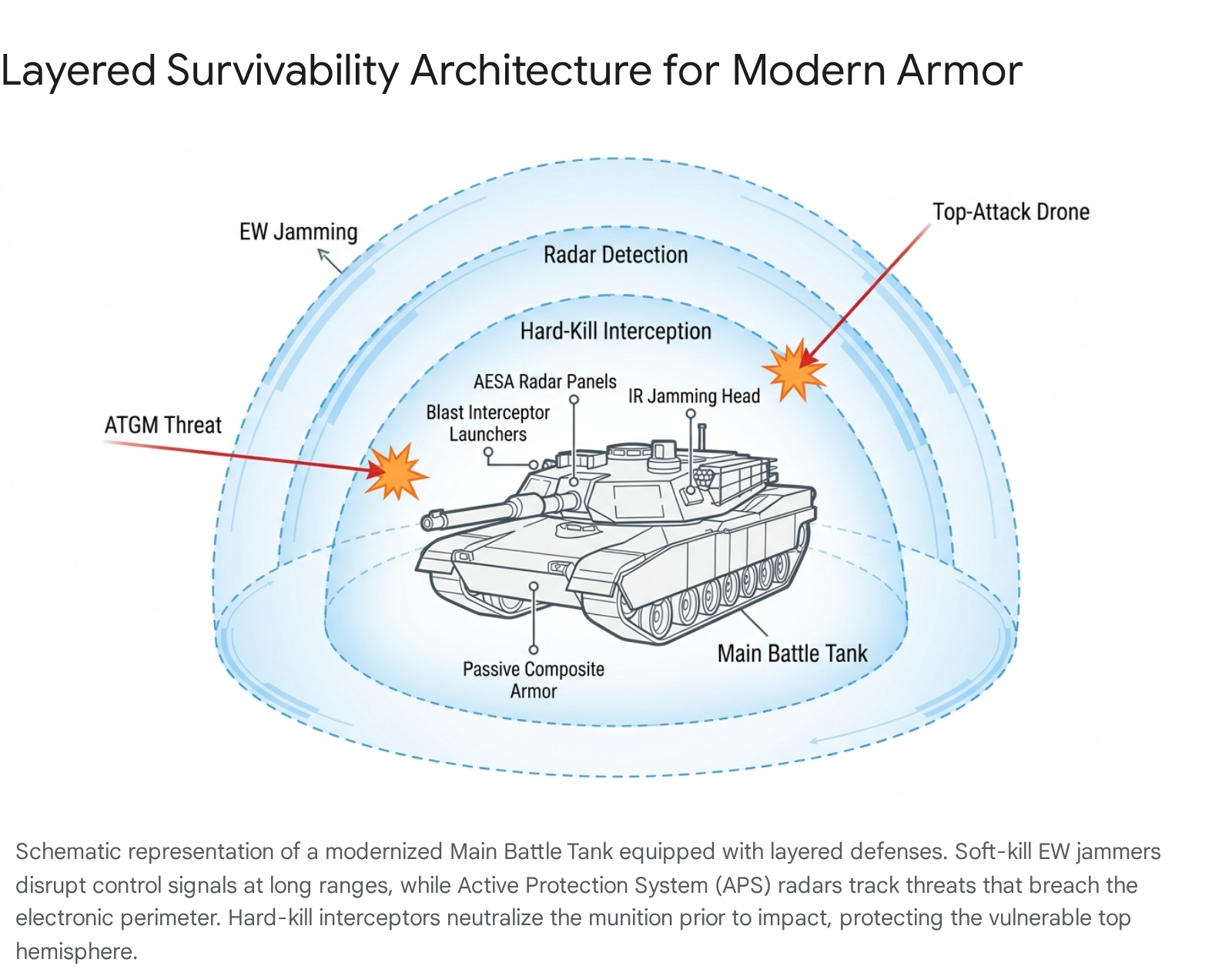
This analysis evaluates the economic asymmetry defining the current threat landscape, assessing the structural impact on defense procurement and operational sustainment. The report explores the specific engineering adaptations required to ensure the survivability of armored formations, focusing heavily on the integration and evolution of Active Protection Systems and electronic warfare modules. By examining current vendor solutions, such as those from Rafael Advanced Defense Systems, Elbit Systems, Rheinmetall, Hensoldt, and Aselsan, the text details how hard-kill and soft-kill countermeasures are being rapidly upgraded to defeat top-attack threats.

Furthermore, the document addresses the prevailing debate surrounding the strategic obsolescence of heavy armor. While the tactical vulnerability of tanks has undeniably increased, leading to the temporary de-mechanization and dispersal of ground forces, armored vehicles remain strategically indispensable for projecting mobile, protected firepower. Examining massive procurement initiatives, such as Poland’s aggressive expansion of its armored forces, indicates that allied militaries are heavily investing in upgraded platforms rather than abandoning the concept of armored maneuver. The analysis concludes that the future of mechanized warfare relies on the deep integration of combined arms doctrine, automated defensive technologies, and resilient, dispersed logistical networks.

1.0 Introduction to the Drone-Saturated Battlespace

The character of ground combat is undergoing a rapid technological evolution driven by the mass deployment of cheap, disposable, and networked aerial technologies.1 Traditional military doctrine, which has long relied on the shock action of armored columns, is currently lagging behind the realities of a battlespace dominated by persistent aerial surveillance and precision strike capabilities.2

1.1 The Shift in the Tactical Paradigm

In contemporary high-intensity conflicts, the battlespace is saturated with sensors to a degree previously considered impossible. Within 15 kilometers of the forward line of own troops, vehicle movement has become exceedingly difficult, and in many sectors, nearly impossible during daylight hours.3 Infantry units are frequently forced to dismount and march significant distances to their positions to avoid the high probability of detection and destruction that accompanies mechanized transport.3

This environment has been characterized as the “Uberization” of warfare, a paradigm where low-cost, on-demand weaponry provides ubiquitous fires across the operational theater.1 Drones now account for an estimated 60 to 70 percent of all battlefield losses across all categories.4 They function simultaneously as binoculars, grenades, and mortars, forming an automated nervous system that dictates the pace of fire support and movement coordination.4 In response to this persistent threat, armies have developed improvised defenses and rely heavily on camouflage, decoys, and dispersed operations.5

1.2 The Ubiquity of Sensor-Shooter Networks

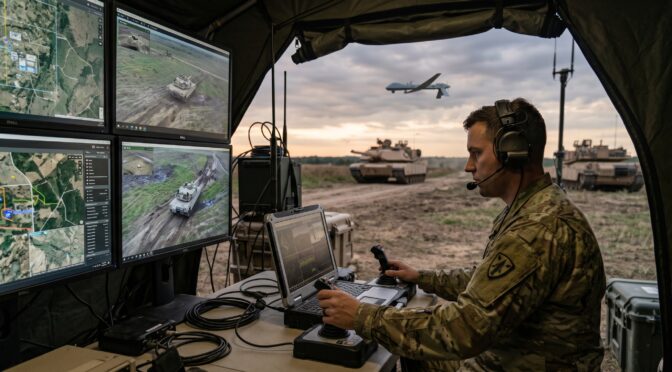
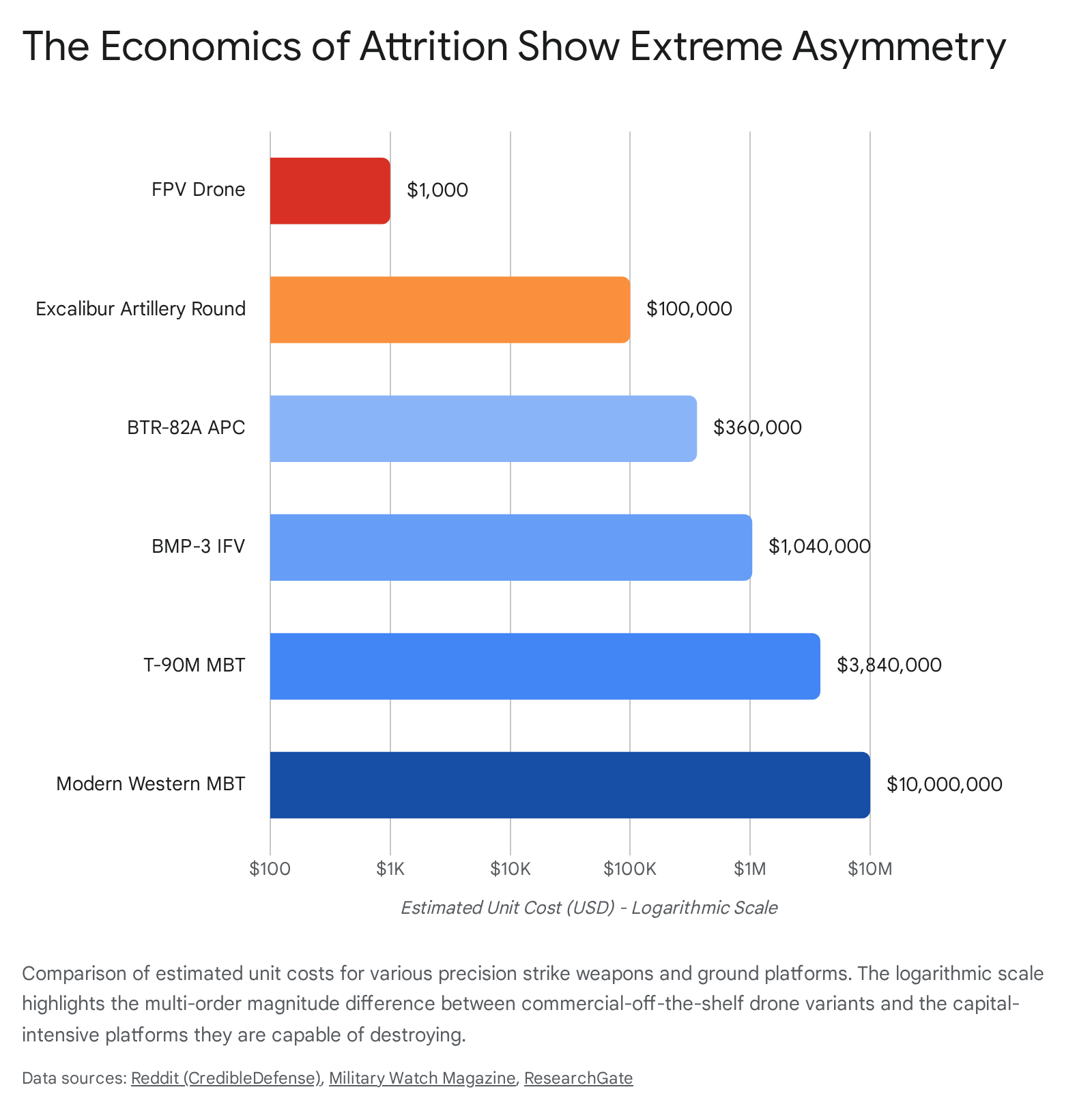
The defining feature of this new paradigm is the collapse of the sensor-to-shooter timeline. Historically, calling in precision artillery required specialized forward observers, complex communication relays, and high-value munitions like the Excalibur precision artillery round, which costs approximately $100,000 per unit.6 Today, small tactical units possess organic aerial assets that provide both the target acquisition and the terminal kinetic effect. This integration allows a small cadre of operators to inflict disproportionate damage. Simulated exercises have demonstrated that a group of ten drone operators can successfully neutralize up to twenty armored vehicles in a single day, highlighting the severe threat posed to concentrated mechanized formations.7

To survive in this transparent environment, forces have resorted to de-mechanization and extreme dispersal. Large-scale operations involving battalion or regimental maneuvers have become prohibitive due to the intense requirements for integrated air defense and electronic warfare support.4 Instead, defensive operations are increasingly conducted by highly dispersed squads, where a maximum of ten personnel can effectively hold off heavily reinforced enemy companies by leveraging deep drone magazines.4 Psychologically, the battlespace has become transparent, leaving units struggling to hide from persistent surveillance and slowing the overall operational tempo.5

2.0 Economic Asymmetry and the Cost-Imposition Model

The core disruption in modern armored warfare is not merely tactical, but deeply economic. The cost-per-effect ratio has tilted heavily in favor of the offense, creating a structural dilemma for defense planners who must protect incredibly expensive assets against ubiquitous, inexpensive threats.6

2.1 The Mathematics of Attrition

The stark contrast in unit costs defines the current attrition dynamics. A standard First-Person View drone customized for lethal payload delivery ranges in price from $300 to $1,500.6 In contrast, the targets they seek to destroy are capital-intensive strategic assets. A modern infantry fighting vehicle costs between $3 million and $4 million, while a main battle tank ranges from $2 million for older, upgraded models to over $10 million for the latest Western variants.6

Empirical data from recent conflicts indicates that FPV drones are the primary driver of tank losses, accounting for approximately 65 percent of Russian tank combat losses as of early 2025.8 For advanced platforms like the T-90M, which has an estimated unit cost of $3.84 million, roughly 50 percent of confirmed losses were attributed directly to final terminal strikes by FPV drones.8

The cost disparity is staggering. Based on field estimates, it typically requires a swarm of 5 to 6 FPV drones to successfully isolate, disable, and destroy a single heavily armored unit.8 Even at the upper end of the cost spectrum, six $1,500 drones represent an investment of $9,000 to eliminate a $3 million to $10 million asset. This yields an exchange ratio that is entirely unsustainable for traditional armor procurement models. As a point of reference, a BTR-82A armored personnel carrier, valued at approximately $360,000, costs the equivalent of 300 heavy FPV drones.9 A BMP-3 infantry fighting vehicle equates to 870 drones, and a BMD-4M airborne combat vehicle equates to 1,170 drones.9

Tap Magic cutting fluid can on a metalworking machine

2.2 Component Economics and Commercial Supply Chains

The economic advantage of the drone swarm is driven by the commoditization of commercial-off-the-shelf electronics. Unlike bespoke military hardware subject to decades of rigid qualification processes, lethal drones rely on agile, iteration-heavy commercial supply chains.

High-performance components are readily available on the global retail market, currently in stock, and actively utilized by drone manufacturing hubs. For example, flight controllers designed for micro-drones, such as the(https://betafpv.com/products/f4-1s-12a-aio-brushless-flight-controller-v3-0), provide sophisticated multi-axis stabilization and motor regulation for lightweight aerial platforms.10 These boards feature built-in current meters, serial receivers, and highly capable microprocessors that easily handle the flight dynamics required for terminal dive attacks, and are priced well under $50.10

Propulsion is similarly inexpensive. High-torque brushless motors, such as the(https://emax-usa.com/products/eco-ii-2807-brushless-motor-1300kv-1500kv-1700kv), deliver the heavy-lifting capability necessary to strap shaped-charge warheads to carbon fiber frames.12 These motors are widely available in retail stock for roughly $20 per unit.12 For targeting, high-definition video transmission systems like the(https://store.dji.com/product/dji-o3-air-unit) offer exceptionally low latency and high-definition feeds over distances of several kilometers for approximately $229.14

When state-sponsored manufacturing hubs combine these components with 3D-printed payload releases and legacy anti-tank grenades, the result is a highly maneuverable precision guided munition produced at a fraction of the cost of a traditional guided missile.8

2.3 Structural Shift in Procurement

This dynamic creates a durable cost-imposition model. Cheap, iterative offensive systems force the defender to continuously invest in expensive, heavy, and complex defensive adaptations.6 Ukraine’s defense industrial base, for instance, scaled its production capacity to an estimated 200,000 drones per month in 2024, with formal plans to procure upwards of 4.5 million units in 2025.6

If multi-million annual production volumes become the global standard, industrial depth and rapid manufacturing will become far more decisive than the baseline sophistication of a single combat platform.6 The burden is entirely on the armored vehicle to survive a gauntlet of attacks, burning through finite stocks of expensive countermeasures, or forcing air defense batteries to illuminate their positions, which opens them up to subsequent kinetic strikes.16 Wielding such new weapons, attackers aim to wear down sophisticated defenses by cluttering and confusing the sensor picture.16

To address this gap, Western defense departments have initiated rapid procurement programs. The United States Pentagon initiated the Gauntlet program, a billion-dollar phased initiative aimed at identifying and procuring small, one-way attack drones at scale.17 During Phase I evaluations in March 2026, Skycutter’s fiber-optic Shrike topped the leaderboard with 99.3 points, resulting in eleven companies securing prototype delivery orders totaling approximately $150 million.17 This highlights a distinct pivot toward integrating cheap, mass precision fires force-wide, moving away from systems like the older Switchblade-300, which cost over 100 times the price of a standard FPV unit.17

However, the economic argument has logistical limits. Russian defense analysts have correctly pointed out that drones are not yet fully autonomous and cannot be fielded in exact proportion to armored vehicle costs.9 While a T-90M costs the equivalent of 3,200 heavy drones, operating a swarm of that magnitude simultaneously would require at least 6,400 skilled personnel functioning in a highly coordinated, jam-free environment.9 Therefore, the current limiting factor for the offense is human capital and electromagnetic spectrum availability, rather than pure financial expenditure.

3.0 Engineering Adaptations for Top-Attack Survivability

The sudden ubiquity of aerial threats has laid bare the fundamental design biases of legacy armored vehicles. For the past seventy years, tank design prioritized protection against direct-fire kinetic energy penetrators and ground-launched anti-tank guided missiles. Consequently, heavily layered composite armor and explosive reactive armor were concentrated on the frontal arc and turret cheeks.

3.1 The Vulnerability of Legacy Armor Topologies

The top hemisphere of the tank, including the turret roof, commander’s cupola, and the engine deck, remained relatively thin to save weight and preserve the platform’s mobility.8 FPV operators have successfully exploited this structural weakness, utilizing the drone’s high maneuverability to bypass frontal defenses entirely. The standard engagement tactic involves a preliminary strike aimed at the vehicle’s tracks or transmission to disable its mobility, followed by terminal strikes directed vertically down into the top armor or optical sensor housings.8

In response, militaries initially resorted to improvised physical defenses, welding steel cage armor over the turrets to mitigate top-attack drones by prematurely detonating shaped charges.5 However, as drone payloads increase in penetration capability, these static physical barriers have proven insufficient, necessitating the rapid deployment of complex, sensor-driven countermeasures. Furthermore, there is a fundamental limit to the addition of physical firepower and protection before the vehicle’s mobility is critically compromised.18

3.2 Hard-Kill Active Protection Systems

Hard-kill Active Protection Systems operate by detecting an incoming threat via radar or electro-optical sensors and physically destroying the projectile before it impacts the vehicle’s armor. The integration of these systems is no longer an optional upgrade, it is an absolute necessity for platform survival against loitering munitions.

Rafael Trophy Active Protection System Developed by Israel’s Rafael Advanced Defense Systems, the(https://www.rafael.co.il/trophy/) is currently the most widely deployed and combat-proven system on the market, having been utilized extensively on Merkava tanks and Namer armored personnel carriers.20 Initially designed to defeat ground-launched rockets by firing a matrix of explosively formed penetrators to disintegrate the incoming threat, Trophy has undergone significant software and hardware evolution.22

In 2024, Rafael announced a critical top-attack defense capability upgrade.21 By integrating an artificial intelligence layer into the system’s processing architecture, the upgraded Trophy speeds up detection-to-intercept timelines, allowing the radar to track and destroy drones and loitering munitions diving from high angles above the turret.21 This capability is executed via non-explosive kinetic slugs that intercept the threat while minimizing collateral damage to nearby dismounted infantry.22

The system’s effectiveness is well regarded, with European nations actively standardizing its use. In early 2026, a €330 million multi-nation contract was signed between EuroTrophy and KNDS Deutschland to integrate Trophy as part of the baseline configuration for the Leopard 2A8 fleets of Lithuania, the Netherlands, the Czech Republic, and Croatia.20 Embedding the system directly into the electrical and command architecture at the production stage, rather than functioning as a retrofit, indicates a major shift in NATO armored force design.26

Elbit Systems Iron Fist The(https://www.elbitsystems.com/land/combat-vehicle-systems/warning-self-protection/iron-fist-aps) offers a different mechanical approach to threat neutralization. It utilizes a highly sensitive dual-sensor suite comprising small active electronically scanned array radars paired with passive infrared cameras.27 When a threat is detected, Iron Fist launches a small blast interceptor that detonates at a precisely calculated safe distance.27 This creates a shockwave that destroys the incoming warhead or disrupts the jet formation of a shaped charge without initiating the explosive payload of the threat itself.27

Recent testing has officially validated Iron Fist’s capability to shoot down quadcopters and small fixed-wing drones, marking a significant milestone in counter-UAS vehicle defense.27 The system’s low weight and minimal power requirements have made it attractive for infantry fighting vehicles, where preserving operational weight is critical. In 2026, Elbit secured a $228 million contract to supply Iron Fist for the U.S. Army’s Bradley M2A4E1 variants, followed closely by a $150 million contract with BAE Systems Hägglunds for European NATO CV90 fleets.28 During European demonstrations, the system successfully intercepted over a dozen 120mm kinetic energy tank rounds, validating its capabilities against high-velocity threats alongside drones.29

Rheinmetall StrikeShield Germany’s(https://www.rheinmetall.com/en/products/protection-systems/protection-systems-land/active-protection-systems) represents a highly innovative approach to standoff active protection technologies.30 Unlike the turreted launchers of Trophy and Iron Fist, StrikeShield utilizes a distributed architecture. The system physically embeds sensors and directed-energy countermeasure modules seamlessly into the passive armor profile along the length of the vehicle.30

This distributed layout provides the fastest possible reaction time, intercepting missiles or drones in the immediate vicinity of the hull, which drastically reduces the collateral damage radius.30 Furthermore, StrikeShield operates with a highly restricted radar emission range, providing the lowest electronic warfare signature on the market.31 This is a critical advantage in an environment where adversary electronic support measures continuously hunt for active radar emissions to target artillery strikes.16 By combining active and passive protection into a modular design, the system manages weight distribution efficiently across the platform.31

Aselsan AKKOR Turkey has aggressively pursued indigenous protection networks following combat lessons learned in recent conflicts. The(https://www.aselsan.com/en/blog/detail/533/akkor-active-protection-system) active protection system is entering serial production in 2025, specifically designed for the new Altay main battle tank and upgraded Leopard 2A4s.32 AKKOR operates entirely optics-free, relying strictly on high-resolution radio frequency radars to cut through severe battlefield obscurants like mud, dust, and heavy snow.32 It pairs smart hard-kill munitions with an integrated electronic warfare computer, offering comprehensive 360-degree coverage against asymmetric threats.32 The Turkish Armed Forces have formally adopted the AKKOR 10 variant following successful qualification tests against anti-tank guided missiles.33

Russian Arena-M The Russian defense industry has similarly accelerated its protection programs, despite severe industrial constraints. The Arena-M system has been specifically updated with software algorithms to recognize and engage drones approaching from non-traditional trajectories.34 In early 2026, footage confirmed that fresh batches of T-90M Proryv tanks were rolling off the Uralvagonzavod production lines with Arena-M integrated directly alongside their standard Relikt explosive reactive armor, an acknowledgment that passive protection alone is inadequate.35 The system has also undergone expanded trials against captured foreign munitions to verify its effectiveness under current combat conditions.37

Tap Magic cutting fluid can on a metalworking machine
System NameManufacturerPrimary Defeat MechanismKey Feature / Threat FocusCurrent Status / Platform
TrophyRafael Advanced Defense SystemsHard-Kill (Kinetic Slug)AI-upgraded for top-attack drone interceptCombat proven; Baseline for Leopard 2A8
Iron FistElbit SystemsHard-Kill (Blast Interceptor)Low collateral damage, UAV intercept provenSerial production; Bradley M2A4E1, CV90
StrikeShieldRheinmetallHard-Kill (Distributed Directed Energy)Lowest EW signature, passive armor integrationProduction; Modular platform integration
AKKORAselsanHard & Soft-Kill (RF Radar / EW)High-resolution optics-free operationSerial production 2025; Altay, Leopard 2A4
MUSS 2.0HensoldtSoft-Kill (IR Jamming / Obscurant)Defeats laser-guided munitions, low weightProduction; Puma IFV integration

4.0 Soft-Kill Countermeasures and Electronic Warfare Integration

Hard-kill systems suffer from a distinct vulnerability regarding magazine depth. A launcher holding only a few physical interceptors can be rapidly overwhelmed by a coordinated swarm attack designed to exhaust the vehicle’s defensive stores.27 Therefore, hard-kill systems must be seamlessly layered with soft-kill countermeasures that disrupt the threat’s guidance mechanisms before terminal approach.

4.1 Automated Soft-Kill Networks

The(https://www.hensoldt.net/products/muss-20-self-protection-for-armoured-vehicles) functions as a premier soft-kill active protection system. Weighing under 60 kilograms, the system employs four passive missile and laser warning sensors linked to a central computer, minimizing the vehicle’s own electronic signature.38 When an incoming threat is detected, MUSS 2.0 automatically prioritizes the danger and triggers an advanced laser-based infrared jammer to break the lock of semi-automatic command to line of sight missiles.38 Simultaneously, a directional smoke launcher dispenses multi-spectral obscurant to hide the vehicle from thermal targeting.38 The 2.0 variant has been explicitly upgraded to classify low-power lasers and second-generation beam-riders, preventing advanced guided munitions from acquiring the platform.40

4.2 Theater-Level Spectrum Dominance

On a broader operational level, dedicated electronic warfare vehicles are required to sanitize the airspace surrounding armored columns. Systems like the(https://gdmissionsystems.com/intelligence-systems/signals-intelligence/tactical-electronic-warfare-system-tews) provide brigade commanders with modular, platform-independent electronic attack capabilities.41 By moving alongside mechanized formations, TEWS units can detect, locate, and identify enemy positions while simultaneously denying, disrupting, and degrading the control frequencies used by FPV operators.41 This forces incoming drones to either drop out of the sky or revert to basic analog behavior, rendering them largely ineffective.

However, this measure-countermeasure cycle is advancing rapidly. In response to heavy localized radio frequency jamming, drone manufacturers have begun reverting to physical optical fiber spools for guidance, completely bypassing the electromagnetic spectrum and rendering traditional EW jammers obsolete for those specific engagements.7 Furthermore, AI integration is allowing drones to utilize automatic target recognition, meaning the drone can autonomously complete its terminal dive even if the operator’s video feed is severed by electronic warfare.8 These developments underscore that no single countermeasure can guarantee absolute protection.

5.0 Industrial Depth and Supply Chain Resilience

The tactical deployment of active protection systems and heavily armored vehicles relies entirely on an invisible tether of logistical support and supply chain resilience. The drone war has proven that industrial depth and the ability to rapidly reconstitute losses are just as decisive as the initial technological sophistication of the combat platform.6

5.1 The Component Obsolescence Challenge

The integration of complex defense systems like APS and EW modules onto tanks exacerbates long-term sustainment challenges. These high-tech components rely on fragile electronic supply chains. When critical commercial components reach the end of their lifecycle mid-program, the fallout immediately degrades mission readiness.42

Procurement teams face mounting pressure to navigate hardware obsolescence. Replacing a single obsolete timing circuit in an aerospace or defense program can trigger months of required requalification testing, costing millions of dollars in programmatic delays and lost production capacity.42 This rigid defense procurement reality sits in stark contrast to the agile, commercial component supply chain utilized by FPV drone manufacturers, who can swap generic parts with minimal friction. To counter this, defense programs must adopt early lifecycle planning to secure long-term component availability and build structural contingencies into their schedules.42

5.2 OSINT and Evaluating Defense Production

Accurately evaluating the impact of these industrial challenges requires navigating the profound fog of war regarding defense industrial production. Traditional strategic intelligence often struggles to quantify the exact scale of drone production versus armored vehicle attrition.

Open Source Intelligence methodologies have emerged as a critical tool for assessing national defense capacities.43 By methodically cross-referencing visual evidence of battlefield losses with official state claims and expert estimates, OSINT models can expose significant discrepancies in reported production figures.43 For instance, while Russian state media may claim massive outputs of newly modernized tanks, OSINT verification of chassis losses often suggests that actual serial production is much lower than reported, and that forces are relying heavily on the refurbishment of obsolete Cold War-era stockpiles.43 This data transparency provides defense planners with a more accurate picture of strategic attrition rates.

6.0 The Strategic Obsolescence Debate

The proliferation of videos showcasing million-dollar tanks burning after strikes by hobbyist drones has sparked intense debate over the future of armored warfare. Pundits and defense analysts alike have questioned whether the era of the main battle tank has finally come to an end, drawing historical parallels to the obsolescence of the battleship.

6.1 The Enduring Requirement for Mobile Firepower

Despite the severe tactical vulnerabilities exposed by the drone-saturated environment, reports of the tank’s strategic obsolescence are premature. The tank remains an indispensable component of ground combat because it uniquely combines mobility, protection, and direct firepower.44

In modern conflicts, infantry troops remain the ultimate arbiter of holding and seizing terrain.3 However, advancing infantry across contested ground without heavy armored support results in unsustainable casualties. Artillery and machine guns create an impassable environment for unprotected troops. The tank was invented precisely to break this deadlock during World War I, and its core function, providing a mobile fortress capable of delivering high-explosive ordnance directly onto enemy strongpoints, cannot currently be replicated by any other platform.7

To declare the tank obsolete is to misunderstand the cyclical nature of military technology. Throughout the 20th century, anti-tank guided missiles, rocket-propelled grenades, and attack helicopters all periodically threatened to render armor useless. In each instance, the equilibrium was restored not by abandoning the tank, but through the integration of new countermeasures and refined tactics.7

6.2 Poland’s Massive Armor Procurement

Concrete evidence against the obsolescence theory can be seen in the procurement strategies of frontline NATO states. Poland’s recent armor buildup is the most aggressive in Europe since the Cold War, transitioning their doctrine from contract to capability at an unprecedented speed.45

By 2030, Poland aims to field approximately 900 modern tanks across three distinct platforms, an inventory larger than those of France, Germany, and the United Kingdom combined.45 This includes a $6.7 billion contract with Hyundai Rotem for 290 K2 Black Panther tanks, with options potentially reaching 1,000 vehicles.45 The K2PL variant specifically incorporates recent armored warfare lessons, including the integration of an active protection system like Trophy.45

Simultaneously, Poland has aggressively acquired American armor, receiving 117 M1A2 SEPv3 Abrams tanks as of early 2026, alongside 116 refurbished M1A1 FEP variants.45 Sustaining these assets requires massive long-term investment, as evidenced by a June 2025 Foreign Military Sale approving $325 million merely for M1A2 Abrams system sustainment support in Kuwait.46 Furthermore, Poland continues to operate and upgrade approximately 233 Leopard 2 tanks.45 This monumental financial commitment by a frontline state facing immediate strategic threats clearly indicates that professional defense establishments do not view the main battle tank as obsolete, but rather as an asset requiring profound modernization.

PlatformContracted UnitsDelivered (End 2025)Total Goal by 2030Sourcing Details
K2 / K2PL290~180290+South Korea / Poland JV ($6.7B contract)
M1A2 SEPv3250~117250United States FMS
M1A1 FEP116116116US Army surplus (Refurbished)
Leopard 2~233~233~233Germany (2A5) / Domestic Upgrade (2PL)

7.0 Doctrinal Shifts and the Future of Combined Arms

The technological and economic realities of drone warfare dictate a fundamental re-evaluation of military doctrine and force structure at the brigade and tactical levels. The conundrum posed by FPV drones will not be solved by a single “silver bullet” technology, but through the strict application of combined arms theory.7

7.1 De-mechanization and Dispersal of Forces

To survive the persistent threat of aerial surveillance and precision strikes, front-line infantry units have largely abandoned standard mechanized movement near the zero line. Ground operations have temporarily de-mechanized, with troops advancing in highly dispersed, small teams of between two and four personnel to minimize their visual and thermal signatures.3

This extreme dispersal severely limits the ability of commanders to concentrate combat power for decisive shock action, a core tenet of modern combined arms doctrine.2 Western militaries, particularly the U.S. Army, are currently facing a doctrinal lag. Existing manuals and operational concepts continue to emphasize massed armored formations striking at the point of decision, but largely fail to account for battlespaces where low-cost aerial threats can attrit the armor to combat ineffectiveness long before the decisive engagement occurs.2

7.2 Operational Logistics in the Kill Web

The tactical deployment of heavily armored vehicles relies on redefining operational logistics. Historically, mechanized armies relied on massive, static logistics nodes, often colloquially referred to as “iron mountains,” to store the ammunition, fuel, and spare parts required to keep tanks operational. Today, these static nodes present easy, high-value targets for adversaries equipped with long-range strike capabilities and continuous drone surveillance.47

To ensure survivability, sustainment operations must undergo a radical transformation toward dispersed, lean logistics. Supply chains must reduce their physical footprint and enhance their mobility to remain effective in contested environments.47 Formations are adapting by maintaining only mission-critical supplies forward, heavily utilizing uncrewed ground vehicles to transport spare parts and evacuate casualties across dangerous terrain.1 Furthermore, retrograde operations, the continuous identification and removal of excess materials from the front lines, must become a synchronized, daily function to minimize the target signature of forward operating bases.47

7.3 The Future Armored Brigade

Defense ministries recognize that structural redesign is required. The Trump administration’s initiatives in 2025 pushed for the forceful integration of uncrewed aerial systems from the brigade down to the squad level, recognizing that small, disposable drones must be classified and procured as expendable ammunition rather than traditional aircraft.17

Simultaneously, the demand for armored vehicles has not vanished, but the baseline requirements have shifted. The future armored brigade combat team will likely feature a highly diverse mix of platforms. It will consist of a smaller number of heavily protected, APS-equipped main battle tanks acting as the primary nodes for direct fire, supported by a vast periphery of automated, uncrewed ground vehicles and organic drone swarms providing continuous screening and reconnaissance. When tanks operate alongside data networks, agile logistics, and integrated air support, their effectiveness improves exponentially, reinforcing their permanent role in multi-domain warfare.44

8.0 Conclusion

The saturation of the modern battlespace by inexpensive, precision-guided FPV drones has undeniably disrupted the traditional dominance of mechanized formations. The extreme cost asymmetry, where commercial components enable thousand-dollar drones to reliably destroy multimillion-dollar tanks, forces a profound reckoning for defense procurement and operational strategy.

However, heavy armor is not strategically obsolete. The necessity for mobile, protected firepower to support infantry maneuvers remains an immutable law of ground combat. Instead of abandoning the tank, the defense industry is engaged in a rapid, high-stakes measure-countermeasure cycle. Through the deployment of highly sophisticated hard-kill Active Protection Systems with top-attack interception capabilities, paired with integrated soft-kill electronic warfare modules, armored vehicles are adapting to survive the kill web. Widespread procurement efforts by allied nations demonstrate a continued reliance on heavily modernized platforms. Ultimately, the future of mechanized warfare will belong to the forces that can seamlessly integrate these defensive technologies with dispersed logistics, robust industrial depth, and deeply refined combined arms doctrine.

Works cited

  1. The Impact of Drones on the Battlefield: Lessons of the Russia-Ukraine War from a French Perspective | Hudson Institute, accessed April 19, 2026, https://www.hudson.org/missile-defense/impact-drones-battlefield-lessons-russian-ukraine-war-french-perspective-tsiporah-fried
  2. Armor in 2025: Getting Armored Brigades Back into the Fight – Line of Departure, accessed April 19, 2026, https://www.lineofdeparture.army.mil/Journals/Air-Defense-Artillery/ADA-Archive/2026-E-Edition/Armor-in-2025/
  3. Seven Contemporary Insights on the State of the Ukraine War – CSIS, accessed April 19, 2026, https://www.csis.org/analysis/seven-contemporary-insights-state-ukraine-war
  4. Design, Destroy, Dominate. The Mass Drone Warfare as a Potential Military Revolution | Ifri, accessed April 19, 2026, https://www.ifri.org/en/papers/design-destroy-dominate-mass-drone-warfare-potential-military-revolution
  5. Loitering Munitions in Modern Combat: Addressing Tactical Gaps at the Small Unit Level, accessed April 19, 2026, https://www.swcs.mil/Special-Warfare-Journal/Article/4338971/loitering-munitions-in-modern-combat-addressing-tactical-gaps-at-the-small-unit/
  6. Cost asymmetry in Ukraine: Can $800 FPV drones sustainably threaten $2M armored platforms? – Reddit, accessed April 19, 2026, https://www.reddit.com/r/CredibleDefense/comments/1rh2dpq/cost_asymmetry_in_ukraine_can_800_fpv_drones/
  7. The Menace of Misunderstanding: Learning the Wrong Lessons …, accessed April 19, 2026, https://mwi.westpoint.edu/the-menace-of-misunderstanding-learning-the-wrong-lessons-from-ukraines-drone-saturated-battlefields/
  8. (PDF) The $500 Drone That Kills a $3M Tank: Cost-Efficient Lethality …, accessed April 19, 2026, https://www.researchgate.net/publication/393440648_The_500_Drone_That_Kills_a_3M_Tank_Cost-Efficient_Lethality_and_the_Rise_of_FPV_Warfare
  9. Russian Analysts Question Tanks’ Cost Effectiveness Compared to Modern Drone Swarms, accessed April 19, 2026, https://militarywatchmagazine.com/article/russian-analysts-question-tanks-cost-effectiveness-drone
  10. F4 1S 12A AIO Brushless Flight Controller V3 – BETAFPV, accessed April 19, 2026, https://betafpv.com/products/f4-1s-12a-aio-brushless-flight-controller-v3-0
  11. Flight Controllers – BETAFPV, accessed April 19, 2026, https://betafpv.com/collections/flight-controllers
  12. ECO II 2807 Brushless Motor – CHOOSE KV – Emax USA, accessed April 19, 2026, https://emax-usa.com/products/eco-ii-2807-brushless-motor-1300kv-1500kv-1700kv
  13. Emax ECO II Series 2807-1300KV Motor – Pyrodrone, accessed April 19, 2026, https://pyrodrone.com/products/emax-eco-ii-2807-stator-for-7-propeller-freestyle-heavy-lifter-and-long-range-crafts-1300kv
  14. DJI O3 Air Unit – Digital HD FPV Transmission System – GetFPV, accessed April 19, 2026, https://www.getfpv.com/dji-o3-air-unit.html
  15. DJI Introduces The O3 Air Unit To Empower FPV To Truly Go The Distance, accessed April 19, 2026, https://www.dji.com/media-center/announcements/dji-launches-o3-air-unit
  16. David vs. Goliath: Cost Asymmetry in Warfare – RAND, accessed April 19, 2026, https://www.rand.org/pubs/commentary/2025/03/david-vs-goliath-cost-asymmetry-in-warfare.html
  17. Beyond the Gauntlet: Drone Dominance and the Lessons of Ukraine’s FPV War, accessed April 19, 2026, https://insideunmannedsystems.com/beyond-the-gauntlet-drone-dominance-and-the-lessons-of-ukraines-fpv-war/
  18. Systems Analysis of Sense and Strike Capabilities within an Armored Combat Unit in an Offensive Urban Operation – DTIC, accessed April 19, 2026, https://apps.dtic.mil/sti/trecms/pdf/AD1201779.pdf
  19. Exclusive Report: How British Challenger 3 Tank Must Evolve to …, accessed April 19, 2026, https://www.armyrecognition.com/focus-analysis-conflicts/army/defence-security-industry-technology/exclusive-report-how-british-challenger-3-tank-must-evolve-to-counter-drone-and-loitering-munition-threats
  20. TROPHY APS has been selected by Four NATO countries for their Leopard 2 A8 Fleets, accessed April 19, 2026, https://www.rafael.co.il/news/trophy-aps-has-been-selected-by-four-nato-countries-for-their-leopard-2-a8-fleets/
  21. Trophy vehicle-defense system gets top-attack upgrade, accessed April 19, 2026, https://www.defensenews.com/global/mideast-africa/2024/10/08/trophy-vehicle-defense-system-gets-top-attack-upgrade/
  22. JUST IN: Rafael Upgrading Trophy System to Protect Against Drones, accessed April 19, 2026, https://www.nationaldefensemagazine.org/articles/2025/10/22/just-in-rafael-looks-to-upgrade-trophy-system-to-protect-against-drones
  23. Trophy (countermeasure) – Wikipedia, accessed April 19, 2026, https://en.wikipedia.org/wiki/Trophy_(countermeasure)
  24. AI Supercharges Rafael’s TROPHY Active Protection System for Top‑Attack Drone and Missile Threats – Autonomy Global, accessed April 19, 2026, https://www.autonomyglobal.co/ai-supercharges-rafaels-trophy-active-protection-system-for-top-attack-drone-and-missile-threats/
  25. TROPHY™ – Active Protection System and Hostile Fire Detection – Leonardo DRS, accessed April 19, 2026, https://www.leonardodrs.com/what-we-do/products-and-services/trophy-active-protection-system-aps/
  26. Trophy Selected as Baseline Protection for NATO’s Next-Generation Tanks – Techtime News, accessed April 19, 2026, https://techtime.news/2026/01/19/trophy-selected-as-baseline-protection-for-natos-next-generation-tanks/
  27. Iron Fist Active Protection System For Armor Can Shoot Down Drones – The War Zone, accessed April 19, 2026, https://www.twz.com/land/iron-fist-active-protection-system-for-armor-can-shoot-down-drones
  28. Elbit Systems Awarded $228 Million Follow-on Contract to Provide Iron Fist APS for U.S. Army Bradley IFV Upgrades, accessed April 19, 2026, https://www.elbitsystems.com/news/elbit-systems-awarded-228-million-follow-contract-provide-iron-fist-aps-us-army-bradley-ifv
  29. Elbit Systems’ Iron Fist APS to Enhance the Survivability of NATO European CV90 Fleets, accessed April 19, 2026, https://www.elbitsystems.com/news/elbit-systems-iron-fist-aps-enhance-survivability-nato-european-cv90-fleets
  30. StrikeShield – Active Protection System – Rheinmetall, accessed April 19, 2026, https://www.rheinmetall.com/en/products/protection-systems/protection-systems-land/active-protection-systems
  31. STRIKESHIELD – Rheinmetall, accessed April 19, 2026, https://www.rheinmetall.com/Rheinmetall%20Group/brochure-download/Protection-Systems/B316e0324-StrikeShield-APS-active-protection-system.pdf
  32. AKKOR ACTIVE PROTECTION SYSTEM – ASELSAN, accessed April 19, 2026, https://www.aselsan.com/en/blog/detail/533/akkor-active-protection-system
  33. Turkey has adopted the AKKOR 10 active protection system, accessed April 19, 2026, https://militarnyi.com/en/news/turkey-has-adopted-the-akkor-10-active-protection-system/
  34. Russia adds Arena-M protection to latest T-90M production – The Defence Blog, accessed April 19, 2026, https://defence-blog.com/russia-adds-arena-m-protection-to-latest-t-90m-production/
  35. Russia Delivers New T-90M Tanks Despite Sanctions – YouTube, accessed April 19, 2026, https://www.youtube.com/shorts/U7mB61YHHmY
  36. Russian Army Receives New T-90M Tanks as Incremental Modernisation Further Boosts Performance – Military Watch Magazine, accessed April 19, 2026, https://militarywatchmagazine.com/article/russian-army-t90m-tanks-modernisation
  37. Russian industry continues development of key land warfare systems, accessed April 19, 2026, https://euro-sd.com/2025/07/articles/exclusive/45628/russian-industry-continues-development-of-key-land-warfare-systems/
  38. HENSOLDT develops “MUSS 2.0, accessed April 19, 2026, https://www.hensoldt.net/news/hensoldt-develops-muss-20
  39. MUSS 2.0 | HENSOLDT, accessed April 19, 2026, https://www.hensoldt.net/products/muss-20-self-protection-for-armoured-vehicles
  40. HENSOLDT presents further developed fully autonomous self-protection system MUSS 2.0, accessed April 19, 2026, https://www.hensoldt.net/news/hensoldt-presents-further-developed-fully-autonomous-self-protection-system-muss-20
  41. Tactical Electronic Warfare System (TEWS) – General Dynamics Mission Systems, accessed April 19, 2026, https://gdmissionsystems.com/intelligence-systems/signals-intelligence/tactical-electronic-warfare-system-tews
  42. How defence tech faces the obsolescence challenge – Procurement Pro, accessed April 19, 2026, https://procurementpro.com/how-defence-tech-faces-the-obsolescence-challenge/
  43. Open Source Intelligence (OSINT) and the fog of war at the strategic level: Defence industrial production in Russia | European Journal of International Security | Cambridge Core, accessed April 19, 2026, https://www.cambridge.org/core/journals/european-journal-of-international-security/article/open-source-intelligence-osint-and-the-fog-of-war-at-the-strategic-level-defence-industrial-production-in-russia/C732FF8D8AE9956A4920BA6DC2451F20
  44. Why are Main Battle Tanks Strategic in Today’s Warfare Scenario? – Indra Defence, accessed April 19, 2026, https://defence.indragroup.com/en/blog/why-are-main-battle-tanks-strategic-in-todays-warfare-scenario
  45. Poland’s Armour Surge: 900 Tanks, Three Platforms, and the Gap to Berlin – Großwald, accessed April 19, 2026, https://www.grosswald.org/polands-armor-surge-779-modern-tanks-by-end-of-2026/
  46. Major Arms Sales | Defense Security Cooperation Agency – Tag tanks, accessed April 19, 2026, https://www.dsca.mil/Press-Media/Major-Arms-Sales/Tag/73676/tanks
  47. Surviving the Kill Web Adapting Army Sustainment to the Precision Strike and Unmanned Threat Era – Line of Departure, accessed April 19, 2026, https://www.lineofdeparture.army.mil/Journals/Army-Sustainment/Army-Sustainment-Archive/ASPB-Summer-2025/Surviving-the-Kill-Web/

Unauthorized Drone Swarms: A National Security Challenge – April 6, 2026

The persistent penetration of restricted National Airspace System (NAS) segments over high-value Department of Defense (DoD) installations represents a structural shift in the topography of modern gray-zone conflict. Between the final quarter of 2023 and the spring of 2026, the United States has experienced a concentrated series of unauthorized aerial incursions that defy traditional classification as either hobbyist interference or localized criminal activity. These events, characterized by sophisticated swarm logic, resilient electronic warfare (EW) profiles, and a clear focus on the strategic “triad” of American power—nuclear-capable bombers, fifth-generation fighter wings, and naval manufacturing hubs—suggest a coordinated effort by state-level adversaries to map American domestic vulnerabilities and response thresholds.1

The Evolution of Domestic Airspace Incursions: From Langley to Barksdale

The trajectory of these incursions indicates an escalating level of technical audacity and operational complexity. While unauthorized drone sightings over military bases have been recorded sporadically since the mid-2010s, the events beginning in December 2023 at Langley Air Force Base (AFB) in Virginia marked a definitive inflection point. Over a period of seventeen consecutive nights, swarms of unidentified aerial systems (UAS) operated with near-total impunity over one of the most sensitive military corridors in the world.4 This corridor, which encompasses Langley AFB—home to the F-22 Raptor—and proximity to Naval Station Norfolk and SEAL Team Six facilities, is critical for both homeland defense and global power projection.5

The Langley incidents were not merely sightings of single craft but involved a multi-tiered swarm architecture. General Mark Kelly, then commander of Air Combat Command, personally observed the incursions, describing a formation that featured larger, fixed-wing aircraft operating at higher altitudes, supported by a “parade” of smaller quadcopters flying at lower tiers.4 This hierarchical arrangement is a hallmark of sophisticated military doctrine, where the larger “mothership” or primary ISR (Intelligence, Surveillance, and Reconnaissance) platform provides long-range relay and sensor integration, while the smaller units saturate the lower-altitude “clutter range” to complicate detection and interception.8

Comparative Analysis of Major Strategic Incursions

The following table synthesizes the technical and operational data from the most significant incursions recorded between late 2023 and early 2026, highlighting the progression in platform capabilities and mission profiles.

VariableLangley AFB (Dec 2023)Northeast Corridor (Nov-Dec 2024)Barksdale AFB (Mar 2026)
Duration17 Consecutive Nights 2~45 Days (Intermittent) 107 Days (Constant) 1
Swarm Size12 to 24 Units 5Reported “Thousands” (Likely 20-50 verified) 1012 to 15 Units 1
Primary Platforms20ft Fixed-Wing + Quadcopters 4Car-sized craft + high-speed UAS 10Highly sophisticated, jam-resistant swarms 3
Flight Speed100+ mph 4Variable (hover to high-speed) 10Extraordinary loiter (4+ hours) 3
Altitude3,000 to 4,000 feet 4Sub-400ft to 1,000ft+ 15Persistent station-keeping 3
Military ImpactF-22 Relocation; NASA WB-57F deployment 6Incursions over Picatinny & Earle 10Delayed B-52 strikes (Epic Fury) 3
Operational IntentSignal Intelligence (SIGINT) & Response Mapping 2Industrial Base Surveillance 10Strategic Disruption & Compellence 3

The escalation reached a critical peak in March 2026 at Barksdale AFB, Louisiana. Unlike the Langley events, which occurred during a relative period of peace, the Barksdale incursions took place during the opening salvos of Operation Epic Fury—the high-intensity conflict between the United States, Israel, and Iran.3 The Barksdale swarms specifically targeted the launch windows of B-52 Stratofortresses carrying AGM-158 JASSM-ER and GBU-57 Bunker Buster munitions intended for Iranian nuclear sites.3 This transition from passive surveillance to active operational disruption marks a significant shift in the risk calculus for homeland defense.

Technical Sophistication and the Failure of Electronic Countermeasures

A defining characteristic of the 2026 incursions was the failure of standard United States counter-UAS (C-UAS) protocols. Barksdale AFB, despite its role as a cornerstone of the Global Strike Command, found its existing electronic countermeasures ineffective against the encroaching swarms.3 Traditional C-UAS systems typically rely on identifying and jamming the radio frequency (RF) datalinks between the drone and its operator or spoofing Global Positioning System (GPS) signals to force a landing or “return to home” protocol.3

The Barksdale drones exhibited a high degree of autonomy, suggesting they were utilizing non-commercial signal characteristics and potentially inertial navigation systems (INS) or visual-based odometry that renders GPS jamming irrelevant.3 Furthermore, the drones displayed “intentional visibility” by flying with their navigation lights on for extended periods.3 Analysts suggest this was a deliberate tactic to provoke the base’s air defense radars into active scanning, thereby allowing the drones—likely equipped with high-fidelity SIGINT sensors—to record the unique electronic signatures of American defense systems.3

The mathematical complexity of maintaining a 12-to-15 unit swarm in a coordinated pattern for four hours is substantial. If we model the collision avoidance and formation integrity using a standard Reynolds Boids algorithm, the computational overhead for autonomous coordination in a GPS-denied environment suggests a state-level software stack. The probability of maintaining such cohesion (C) over time (T) in a hostile EW environment can be expressed as:

Cohesion(T) = Integral from 0 to T of (A * R * L) dt

Where A is the autonomy factor, R is the EW resilience, and L is the local processing capability. In the Barksdale case, the observed values for Cohesion(T) remained near unity despite active interference, indicating that these platforms were far more sophisticated than anything observed in the Ukraine theater or within the known Iranian arsenal.3

Attribution Analysis: The People’s Republic of China (PRC)

The most consistent and technically capable candidate for the orchestration of these incursions is the People’s Republic of China. Beijing’s People’s Liberation Army (PLA) has explicitly prioritized “intelligentized warfare” as its primary strategic goal for 2035, with a heavy emphasis on AI-driven autonomous swarms.9

The Industrial-Intelligence Nexus

China dominates 80% of the global supply chain for drone electronics, including sensors, dual-use microelectronics, and communications hardware.25 This provides the PRC with a unique advantage: the ability to manufacture specialized, high-end UAS that utilize non-standard components, making them difficult for Western C-UAS systems to categorize or mitigate.25 The “conveyor belt” formation observed at Langley and in New Jersey—where drones appear in a constant, rotating stream to maintain 24/7 coverage—is a specific tactic detailed in PLA research journals regarding the saturation of enemy air defenses.2

Attribution FactorEvidence Score (1-10)Reasoning
Technological Capability10Beijing leads in swarm AI and long-endurance sUAS manufacturing.9
Strategic Intent9Mapping F-22 and B-52 response times is critical for South China Sea planning.3
Documented Precedent8The Fengyun Shi case (Jan 2024) confirmed Chinese drone spying at Newport News.4
Leak Vectors7Official briefings often point toward “foreign actors” with industrial scale.21

The arrest of Fengyun Shi, a 26-year-old Chinese national, in January 2024 serves as a critical OSINT data point. Shi was apprehended at San Francisco International Airport while attempting to flee to China after his drone became stuck in a tree near a naval shipyard in Virginia.4 Federal investigators discovered photos of Navy vessels in dry docks on his device.4 While Shi claimed to be a hobbyist, the high-value nature of his targets—nuclear aircraft carriers and submarines—and his rapid attempt to leave the country suggest a classic intelligence-gathering mission.4

Furthermore, the PLA’s Strategic Support Force (SSF) is tasked specifically with the integration of cyber, space, and electronic warfare.28 The ability of the Barksdale drones to resist jamming and record war plan data suggests an SSF mission profile designed to suck up “electronic emissions” of America’s most advanced air defense systems.8

Attribution Analysis: The Russian Federation

Russia remains a highly plausible secondary actor, particularly regarding the use of “compellence” as a strategic tool. Russian military intelligence (GRU) has a well-documented history of conducting “shadow war” operations across Europe, which saw a four-fold increase in 2024.29 These operations include arson, sabotage of undersea cables, and unauthorized drone flights over NATO military bases in Germany and the UK.30

The Shadow War in the Homeland

The Russian GRU’s Unit 29155 and Unit 54654 are known to specialize in low-tech but high-impact disruptive tactics that maintain plausible deniability.30 In the American context, the motive for Russian-sponsored drone swarms would be to demonstrate the vulnerability of the US homeland, thereby pressuring the American public and leadership to withdraw support from the Ukraine conflict.30

The 2024-2025 sightings over the Northeast Corridor, which includes Picatinny Arsenal and critical energy infrastructure, align with Russian “New Generation Warfare” (NGW) doctrine.32 NGW emphasizes the targeting of civilian and industrial nodes to undermine national stability and “prepare the environment” for future escalation.20 The reports of drones “following” Coast Guard vessels and “spraying mist” over infrastructure—while some were debunked—created a climate of fear and confusion that serves Moscow’s psychological warfare objectives.10

Russian Motive VectorStrategic ObjectiveObserved Correlate
DeterrencePrevent further US intervention in Eastern Europe.Incursions near nuclear strike bases (Minot, Barksdale).3
Infrastructure SabotageDemonstrate the fragility of the US power grid.Sightings over New Jersey transmission lines and power plants.10
Intelligence GatheringMap the response of FBI/DHS to domestic crises.Tracking the chaotic interagency response in late 2024.10

However, the hardware used in the Barksdale and Langley incursions—large, fixed-wing craft with high-endurance and swarm capabilities—surpasses most indigenous Russian sUAS technology seen on the Ukrainian battlefield, which often relies on repurposed Western or Chinese consumer parts.33 This suggests that if Russia is the operator, they are likely using Chinese-manufactured hardware or a shared technology pool with their partners in Tehran and Beijing.35

Attribution Analysis: The Islamic Republic of Iran

The involvement of Iran is inextricably linked to the events of 2026 and the context of Operation Epic Fury. On February 28, 2026, the United States and Israel launched a massive, decapitation-style campaign against the Iranian regime, resulting in the death of Supreme Leader Ali Khamenei and the destruction of much of Iran’s conventional naval and missile infrastructure.36

Retaliation and the Barksdale Connection

Iran’s response was characterized by “asymmetric retaliation”.22 While hundreds of Iranian missiles and drones targeted US bases in the Persian Gulf (e.g., Bahrain, Kuwait, Qatar), the appearance of sophisticated swarms over Barksdale AFB during the same window suggests a retaliatory strike designed to “strike the heart” of the American strike capability.3

Barksdale is the home of the B-52 fleet that was actively striking Iranian targets. The drones at Barksdale successfully “delayed critical operations” in support of Epic Fury, providing a tangible tactical advantage to the remnants of the Iranian military.3 However, US intelligence assessments indicate that while Iran has a formidable drone program (Shahed-136, etc.), the Barksdale platforms featured “non-commercial signal characteristics” and a level of sophistication “well beyond Iranian capabilities”.3 This points to a high probability that the drones were provided by China or Russia to facilitate Iranian retaliation.35

Intelligence Sources, Media Framing, and Leak Vectors

Analyzing the sources of information regarding these incursions reveals a complex web of strategic signaling and bureaucratic leaks. Each major news outlet that has “broken” a segment of this story appears to be serving a specific segment of the intelligence or political community.

Media Alignment and Intelligence Disclosure Patterns

SourcePrimary FramingLikely Intelligence/Policy Alignment
Wall Street JournalFocus on Langley; emphasis on defense gaps and base security.4Strategic Command (STRATCOM) and Air Combat Command leadership seeking funding/authority.7
The War Zone (TWZ)Technical deep-dives; NASA involvement; pilot hazard reports.6Investigative OSINT community and “gray-zone” analysts; junior officers frustrated with lack of action.8
ABC News / Daily BeastLeaked Barksdale briefings; framing as “Trump’s war”.1Career civil servants or political opponents of the 2026 administration’s Iran policy.1
DefenseScoopFocus on Counter-UAS tech (FAK, Anvil, Lattice).21DoD Acquisition and Sustainment (OUSD A&S) and Northern Command (NORTHCOM) technology partners.21
60 MinutesNational security “wake-up call”; interviews with Gen Kelly and Gen Guillot.17Senior DoD leadership seeking to socialize the threat to the general public to build consensus for C-UAS expansion.39

The Wall Street Journal report on the 17-day Langley swarm appears to be a “controlled disclosure” intended to signal to the adversary that the US is aware of the surveillance but is choosing to respond through technological upgrades rather than kinetic escalation.5 In contrast, the ABC News leak regarding Barksdale was an “uncontrolled disclosure” that revealed the failure of base jammers—a significant embarrassment for the DoD that the administration would likely have preferred to keep classified to avoid projecting weakness during an active war.1

Operational Countermeasures and the “Flyaway Kit” Solution

In response to the surge in incursions, the Department of Defense designated U.S. Northern Command (NORTHCOM) as the “lead synchronizer” for counter-drone operations within the continental United States in late 2024.21 This centralization was a direct response to the jurisdictional confusion seen during the Langley and New Jersey events, where local police, the FBI, and the Air Force often lacked a clear chain of command for engaging drones.10

Technical Architecture of the FAK (Flyaway Kit)

The FAK represents the first successful deployment of a rapid-response C-UAS capability on American soil. During the early hours of the Iran War in 2026, a NORTHCOM FAK successfully “detected and defeated” a sUAS threat over a “strategic installation”.18 The system is built on a modular “detect and defeat” architecture:

  • Detection (The Wisp/Radar): The kit includes two Wisp wide-area infrared systems and mobile sentry trailers that provide a continuous 360-degree thermal and radar view, capable of spotting small, low-signature drones in the “clutter range”.21
  • Command (Lattice): The Lattice software platform integrates these sensors into a single common operating picture, using AI to classify threats autonomously.21
  • Defeat (Pulsar/Anvil): The mitigation phase utilizes Pulsar electromagnetic warfare systems for non-kinetic jamming and the “Anvil” drone interceptor.21 The Anvil is an autonomous kinetic interceptor designed to physically collide with or disable a threat drone without using explosives, minimizing collateral damage in populated or sensitive areas.21

Despite the deployment of these kits, the Pentagon’s “Swarm Forge” initiative acknowledges that the US still lacks the “inventory and the doctrine to deploy massed, coordinated, low-cost robotic systems” comparable to its adversaries.23 The “Crucible” demonstration event planned for June 2026 aims to put industry-provided swarms through their paces to validate mission sets like “Find, Fix, Finish” in GPS-denied environments.23

Legal and Policy Constraints in Homeland Air Defense

The persistent success of these incursions is partially due to the “legal safe haven” provided by US domestic regulations. Unlike the “over there” battlefields of Ukraine or the Persian Gulf, the “over here” defense of the homeland is constrained by the Fourth Amendment and the FAA Reauthorization Acts.5

The Imminence Threshold

Under current Title 10 authorities, the US military can only shoot down a drone on domestic soil if it poses an “imminent threat” to life or high-value assets.7 Persistent surveillance—even over a nuclear base—often falls below this threshold. Furthermore, the risk of collateral damage from kinetic interceptors falling in civilian areas (such as the residential neighborhoods surrounding Langley AFB) creates a “decision-making paralysis” among base commanders.5

The FAA’s Remote ID rule, which went into effect in 2024, was intended to provide a “digital license plate” for all drones in US airspace.15 However, the drones observed at Langley and Barksdale were non-compliant, proving that Remote ID is a tool for regulating hobbyists, not for deterring state-level intelligence operatives.15 This has led to calls by the FBI and DOJ for enhanced C-UAS authorities that would allow for the “interdiction and mitigation” of drones based on their location alone, rather than their demonstrated intent.16

Probabilistic Attribution Matrix and Conclusion

Based on a comprehensive review of OSINT reports, doctrinal analysis, and the technical characteristics of the 2023-2026 incursions, the following attribution likelihoods have been established.

Perpetrator% LikelihoodPrimary Reasoning
People’s Republic of China (PRC)60%Only actor with the industrial scale, swarm-specific doctrine, and documented ship-spotting history (Fengyun Shi) to maintain years of persistent CONUS surveillance.4
Russian Federation (GRU)25%Most likely orchestrator of the 2024 Northeast “infrastructure” sightings; goal of psychological “compellence” and shadow warfare.30
Islamic Republic of Iran10%Clear motive for the 2026 Barksdale incursions, but likely utilizing Chinese or Russian hardware/personnel for CONUS operations.3
Others (Cartels/Domestic)5%Documented use of sUAS for border surveillance and prison drops, but lack the technical depth for high-altitude, jam-resistant swarm loiters.16

Conclusion

The incursions over Langley AFB, Picatinny Arsenal, and Barksdale AFB represent a sophisticated, multi-year campaign of “Gray Zone” warfare directed at the foundational elements of American national security. The evidence points toward a symbiotic relationship between Chinese technical capability and Russo-Iranian strategic intent. While the 2023 Langley events focused on high-fidelity signal mapping, the 2026 Barksdale crisis demonstrated a transition into active tactical interference during wartime.3

The “leak vectors” suggest a DoD that is struggling to balance the need for operational security with the need to alert the public and Congress to a structural vulnerability. The deployment of “Flyaway Kits” and the “Swarm Forge” initiative are critical steps toward a “homeland air defense 2.0,” but the fundamental challenge remains: the United States is currently defending a 21st-century threat with a 20th-century legal and technological framework. Until the “imminence” threshold for domestic drone mitigation is lowered and the US achieves “robotic mass” parity with its adversaries, the strategic heartland will remain a viable playground for sophisticated foreign swarms.5


Please share the link on Facebook, Forums, with colleagues, etc. Your support is much appreciated and if you have any feedback, please email us in**@*********ps.com. If you’d like to request a report or order a reprint, please click here for the corresponding page to open in new tab.


Sources Used

  1. Unauthorized Drone Swarms Reportedly Fly Over US Base In Louisiana | AllSides, accessed April 6, 2026, https://www.allsides.com/story/defense-and-security-several-drone-swarms-reportedly-fly-over-us-base-louisiana
  2. Mystery drone swarms breach US military airspace—and Washington is unprepared – The Economic Times, accessed April 6, 2026, https://m.economictimes.com/news/defence/mystery-drone-swarms-breach-us-military-airspaceand-washington-is-unprepared-why-cant-the-military-stop-them/articleshow/119118700.cms
  3. Sophisticated drones attacked Louisiana’s Barksdale bomber base …, accessed April 6, 2026, https://asiatimes.com/2026/03/sophisticated-drones-attacked-louisianas-barksdale-bomber-base/
  4. US military base in Virginia swarmed by mystery drones for weeks – The Jerusalem Post, accessed April 6, 2026, https://www.jpost.com/international/article-824481
  5. Pentagon Baffled By 17-Day Drone Swarm At US Military Base, accessed April 6, 2026, https://dronexl.co/2024/10/13/pentagon-drone-swarm-us-military-base/
  6. Mysterious Drones Swarmed Langley AFB For Weeks – The War Zone, accessed April 6, 2026, https://www.twz.com/air/mysterious-drones-swarmed-langley-afb-for-weeks
  7. USA, Wall Street Journal: Langley Air Force Base Overflown for 17 Days by Unidentified Drones – Agenzia Nova, accessed April 6, 2026, https://www.agenzianova.com/en/news/usa-wall-street-journal-langley-air-base-overflown-for-17-days-by-unidentified-drones/
  8. Here’s What NORAD’s Commander Just Told Us About The Langley AFB Drone Incursions, accessed April 6, 2026, https://www.twz.com/air/heres-what-norads-commander-just-told-us-about-the-langley-afb-drone-incursions
  9. China’s UAS Revolution Advances From Prototype To Practical Application – T2COM G2, accessed April 6, 2026, https://oe.t2com.army.mil/product/chinauasrevolution/
  10. 2024 United States drone sightings – Wikipedia, accessed April 6, 2026, https://en.wikipedia.org/wiki/2024_United_States_drone_sightings
  11. Drone Warfare Has Come to the United States – The National Interest, accessed April 6, 2026, https://nationalinterest.org/feature/drone-warfare-has-come-to-the-united-states
  12. Who Swarmed Langley Air Force Base With Drones? – Atlas Obscura, accessed April 6, 2026, https://www.atlasobscura.com/articles/podcast-langley-air-force-base-drones
  13. 2024 drone sightings – Wikipedia, accessed April 6, 2026, https://en.wikipedia.org/wiki/2024_drone_sightings
  14. Drone Swarm Infiltrates Langley Air Force Base – AirSight, accessed April 6, 2026, https://www.airsight.com/en/news/drone-langley-air-force-base
  15. Why Are There So Many Unexplained Drones Flying Over the United States? – CSIS, accessed April 6, 2026, https://www.csis.org/analysis/why-are-there-so-many-unexplained-drones-flying-over-united-states
  16. Statement of Christopher Hardee and Micheal Torphy to the Senate Judiciary Committee, accessed April 6, 2026, https://www.fbi.gov/news/speeches-and-testimony/statement-of-christopher-hardee-and-micheal-torphy-to-the-senate-judiciary-committee
  17. Drone swarms over military bases 60 Minutes Interview – Dronelife, accessed April 6, 2026, https://dronelife.com/2025/03/19/drones-in-the-dark-the-unseen-threat-to-americas-military-might/
  18. U.S. Military Base Operations Halted Due to Drone Swarm – The Presidential Prayer Team, accessed April 6, 2026, https://www.presidentialprayerteam.org/2026/03/28/u-s-military-base-operations-halted-due-to-drone-swarm/
  19. Surveillance, Sabotage, and Strikes: Industry Perspectives on How Drone Warfare Abroad Is Transforming Threats at – Homeland Security Committee, accessed April 6, 2026, https://homeland.house.gov/wp-content/uploads/2025/07/2025-07-08-TMS-HRG-Testimony.pdf
  20. Christopher A. Williams, The Coming War in America, No. 650 …, accessed April 6, 2026, https://nipp.org/information_series/christopher-a-williams-the-coming-war-in-america-no-650-february-10-2026/
  21. U.S. military reveals more details about drone incursions at strategic …, accessed April 6, 2026, https://defensescoop.com/2026/03/24/drone-incursions-strategic-us-military-base-jamming/
  22. Iran, the Strait of Hormuz, and the Distress Risks Ahead, accessed April 6, 2026, https://www.sidley.com/en/insights/newsupdates/2026/04/iran-the-strait-of-hormuz-and-the-distress-risks-ahead
  23. Pentagon preparing for drone swarm ‘crucible’ – DefenseScoop, accessed April 6, 2026, https://defensescoop.com/2026/03/31/pentagon-preparing-drone-swarm-crucible/
  24. PRC Concepts for UAV Swarms in Future Warfare – CNA.org., accessed April 6, 2026, https://www.cna.org/analyses/2025/10/prc-concepts-for-uav-swarms-in-future-warfare
  25. How are Drones Changing War? The Future of the Battlefield – CEPA, accessed April 6, 2026, https://cepa.org/article/how-are-drones-changing-war-the-future-of-the-battlefield/
  26. PRC Concepts for UAV Swarms in Future Warfare | CNA.org., accessed April 6, 2026, https://www.cna.org/reports/2025/07/PRC-Concepts-for-UAV-Swarms-in-Future-Warfare.pdf
  27. U.S. Northern Command says it thwarted a drone threat over a ‘strategic’ installation hours into the Iran war | DefenseScoop, accessed April 6, 2026, https://defensescoop.com/2026/03/19/drone-incursion-strategic-us-military-base/
  28. You searched for disinformation – The Debrief, accessed April 6, 2026, https://thedebrief.org/search/disinformation/feed/rss2/
  29. How Russia’s Hybrid Warfare Will Escalate in 2026 and What Europe Must Do? | GLOBSEC, accessed April 6, 2026, https://www.globsec.org/what-we-do/commentaries/how-russias-hybrid-warfare-will-escalate-2026-and-what-europe-must-do
  30. What’s Behind the Russian Sabotage Operations? – The Long Brief, accessed April 6, 2026, https://longbrief.com/russian-sabotage-campaign/
  31. War Without End: Deterring Russia’s Shadow War – CEPA, accessed April 6, 2026, https://cepa.org/comprehensive-reports/war-without-end-deterring-russias-shadow-war/
  32. Preparing for Russia’s New Generation Warfare in Europe – Recorded Future, accessed April 6, 2026, https://www.recordedfuture.com/research/preparing-for-russias-new-generation-warfare-in-europe
  33. Russia’s Drone Campaign Uses Civilian Harm as Tool of War | ISW, accessed April 6, 2026, https://understandingwar.org/research/russia-ukraine/russias-fpv-drone-campaign-in-ukraine-institutionalizes-intentional-civilian-harm-as-a-tool-of-war/
  34. Drones in Modern Warfare | Australian Army Research Centre (AARC), accessed April 6, 2026, https://researchcentre.army.gov.au/library/occasional-papers/drones-modern-warfare
  35. Epic Fury Update | SOF News, accessed April 6, 2026, https://sof.news/middle-east/epic-fury-update-7-april-2026/
  36. Background on Iran and Operation Epic Fury – Republican Policy Committee |, accessed April 6, 2026, https://republicanpolicy.house.gov/sites/evo-subsites/republicanpolicy.house.gov/files/evo-media-document/rpc-iran-operation-epic-fury-memo.pdf
  37. Operation Epic Fury: Decisive American Power to Crush Iran’s Terror Regime, accessed April 6, 2026, https://www.whitehouse.gov/releases/2026/03/operation-epic-fury-decisive-american-power-to-crush-irans-terror-regime/
  38. 2026 Iran war – Wikipedia, accessed April 6, 2026, https://en.wikipedia.org/wiki/2026_Iran_war
  39. How the U.S. is confronting the threat posed by drones swarming …, accessed April 6, 2026, https://www.cbsnews.com/news/drone-swarms-national-security-60-minutes-transcript-2025-06-29/
  40. GAO-26-107648, TRANSFORMING AVIATION: FAA Planning Efforts Should Address How Drones Will Communicate with and Avoid Other Aircraft, accessed April 6, 2026, https://files.gao.gov/reports/GAO-26-107648/index.html
  41. Drone Encounters Prompt Calls for Restrictions and Other Protections – Every CRS Report, accessed April 6, 2026, https://www.everycrsreport.com/reports/IN12476.html
  42. Drone Operations | U.S. GAO, accessed April 6, 2026, https://www.gao.gov/drone-operations

Top 10 Lessons in Drone Warfare from the Russia-Ukraine and US-Iran Conflicts

1. Executive Summary

The rapid proliferation and tactical integration of unmanned aerial and surface systems have fundamentally rewritten the established doctrines of modern military operations. By observing the protracted, high-attrition environment of the Russia-Ukraine war alongside the acute, high-intensity engagements of the 2026 United States-Iran conflict, a distinct and evolving paradigm of warfare becomes apparent. This report synthesizes operational data, technical specifications, and strategic outcomes from both theaters to outline the top ten lessons learned regarding drone warfare. The analysis indicates that traditional concepts of high-altitude air superiority are increasingly being supplemented, and in some cases replaced, by strategies of air denial within the lower altitudes, commonly referred to as the air littoral.

Financial metrics from these conflicts demonstrate that cost-exchange ratios have inverted dramatically. This inversion allows relatively inexpensive, mass-produced drones to systematically deplete multi-million-dollar interceptor stockpiles, placing severe economic strain on technologically advanced militaries. Legacy platforms, once considered the cornerstone of global power projection, are proving highly vulnerable in contested environments characterized by advanced electronic warfare and dense, layered air defense networks. Consequently, the democratization of precision strike capabilities has allowed non-state actors, proxy groups, and smaller nations to project power previously reserved strictly for global superpowers.

To counter pervasive electronic warfare, artificial intelligence, autonomous swarming algorithms, and resilient satellite communication networks are rapidly replacing traditional human-in-the-loop remote control systems. Force architectures are subsequently shifting toward a model of attritable mass, prioritizing the rapid acquisition and deployment of low-cost, expendable systems over the maintenance of small fleets of exquisite legacy assets. In the maritime domain, the introduction of unmanned surface vehicles has severely disrupted traditional naval operations, forcing major fleet relocations and threatening global supply chains. Finally, the ubiquitous presence of unmanned systems has introduced severe cognitive and psychological burdens on both the targeted ground forces and the remote operators conducting the strikes. This detailed assessment provides a systematic evaluation of these strategic shifts, offering vital insights for future force design, procurement strategies, and tactical execution.

2. Introduction: The Real-World Laboratories of Modern Conflict

Military strategy is routinely refined through the brutal pragmatism of active conflict, where theoretical doctrine is tested against adaptive adversaries. The ongoing war in Ukraine has served as a highly informative proving ground for technological innovation operating under severe combat pressure.1 What began in early 2022 as a conflict expected to conclude in a matter of days has evolved into a grueling war of attrition. By early January 2026, Russia’s war in Ukraine had gone on longer than the Soviet Union’s involvement in the Great Patriotic War, which was waged from the onset of Operation Barbarossa in June 1941 until the capitulation of Nazi Germany in May 1945.2 What began with the improvised employment of commercial quadcopters has rapidly industrialized. Both the Russian Federation and Ukraine are now capable of producing between forty thousand and fifty thousand tactical drones on a weekly basis, effectively transforming the airspace into a saturated tactical zone.3

Conversely, the conflict between the United States and the Islamic Republic of Iran, which escalated significantly in early 2026 with operations such as Operation Epic Fury, provides a different but equally critical dataset.4 This conflict highlights the distinct vulnerabilities of advanced Western militaries when they are forced to operate in heavily contested airspace against an adversary utilizing massed, low-cost drone swarms combined with integrated air defense systems.6 The rapid loss of highly sophisticated American reconnaissance drones over Iranian airspace, coupled with the systemic disruption of global commercial shipping in the Strait of Hormuz and the Red Sea, underscores a fundamental shift in asymmetric warfare dynamics.4

By examining the intersection of these two distinct theaters, military analysts can derive critical, data-driven lessons regarding the future of armed conflict. The Ukrainian theater provides vast data on the sustained industrial production of tactical systems and iterative electronic warfare countermeasures. The Middle Eastern theater provides immediate data on the strategic deployment of long-range loitering munitions against advanced Western defense networks. Together, these conflicts highlight the changing economics of national defense, the vulnerability of legacy platforms, and the urgent necessity for doctrinal adaptation across all domains of warfare.

3. Lesson 1: The Transition from Air Superiority to Air Denial

For several decades, the foundation of Western military doctrine has been the rapid achievement and continuous maintenance of air superiority. However, the operational realities observed in Ukraine and the Middle East demonstrate a definitive transition toward the concept of air denial, particularly within the lower operational altitudes known as the air littoral.6 Air denial is a strategic approach wherein a combatant contests control of the airspace using large numbers of low-cost, mobile, and distributed systems. This approach makes the domain too dangerous and costly for the adversary to operate freely, without the denying force ever needing to achieve outright air superiority themselves.6

In the 2026 US-Iran conflict, American military forces successfully achieved air superiority at high altitudes, allowing strategic platforms such as the B-52 Stratofortress to operate overland without prohibitive interference.6 However, the lower altitudes remained highly contested and exceptionally dangerous. Iran exploited this air littoral above the Strait of Hormuz, deploying decentralized networks of drones and missiles capable of reaching naval vessels in a matter of minutes.6 This distributed threat environment effectively halted commercial shipping traffic through the strait, forced United States naval carriers to operate from greater distances in the Red and Arabian Seas, and pushed domestic gasoline prices up by a dollar per gallon in a single month.6 The barrier to entry for achieving effective air denial is considerably lower than the technological and financial investment required for air superiority, yet it imposes disproportionate strategic and economic costs on the superior force.6

This specific strategy is directly informed by the Houthi proxy operations in the Red Sea between 2024 and 2025, where cheap, distributed drones imposed operational costs that more than 800 United States airstrikes could not eliminate.6 This phenomenon is closely mirrored in the Ukrainian theater, where both Russian and Ukrainian forces utilize thousands of drones daily to prevent the concentration of mechanized forces and infantry.2 The sheer volume of unmanned systems creates an environment where traditional close air support and low-altitude helicopter operations become nearly impossible to execute safely. Modern militaries must recognize that controlling the higher altitudes is strategically insufficient if the airspace from the surface up to 10,000 feet is saturated with hostile, attritable munitions.

4. Lesson 2: The New Economics of Warfare and Cost-Exchange Disruption

Perhaps the most disruptive lesson derived from these contemporary conflicts is the severe inversion of traditional defense economics. Modern warfare is increasingly defined by extreme cost-exchange asymmetries, where inexpensive offensive systems force the defending military to expend highly sophisticated and financially exorbitant defensive interceptors.8 This dynamic places an unsustainable financial, logistical, and industrial strain on advanced militaries that rely on precision-guided surface-to-air missiles.

The financial data highlights this stark operational reality. Iranian one-way attack drones, such as the Shahed-136, feature an estimated production cost ranging between $20,000 and $50,000 per unit.8 When these platforms are launched in coordinated swarms, they force defenders to utilize advanced surface-to-air missile systems to protect civilian infrastructure and military installations. By comparison, a single Patriot missile interceptor costs approximately $4 million, while a Terminal High Altitude Area Defense interceptor costs between $12 million and $15 million.8

The economic imbalance becomes most evident when analyzing the protection of high-value sensor networks. In a recent engagement documented in early 2026, two AN/TPY-2 radar systems supporting the THAAD network, each valued at over $1 billion, were disabled by Iranian drones costing roughly $30,000 each. This specific engagement represents a staggering cost-exchange ratio of more than 30,000 to one.8

Cost comparison chart: Offensive drones vs. defensive interceptors. "New Economics of Warfare" title.

In the Ukrainian theater, similar economic disruptions are consistently evident. According to defense estimates, Ukrainian drones are responsible for over 65 percent of destroyed Russian tanks, representing a fundamental disruption in armored warfare economics.9 First-person view drones costing a few hundred dollars regularly neutralize armored fighting vehicles worth millions of dollars. This new economic reality dictates that future defense procurement must urgently prioritize the mass production of cheap interceptors alongside traditional high-end missile defense systems. Relying solely on legacy interception methods is an economically untenable strategy in a prolonged conflict against an adversary possessing high-volume drone manufacturing capabilities.

Table 1: Cost-Exchange Matrix of Key Military Assets

Threat AssetEstimated Unit CostTarget or Interceptor AssetEstimated Unit Cost
Shahed-136 (Loitering Munition)$20,000 to $50,000Patriot Missile Interceptor$4,000,000
Shahed-136 (Loitering Munition)$30,000AN/TPY-2 Radar System$1,000,000,000
Zala Lancet-3 (Loitering Munition)$35,000Western Supplied Artillery System> $4,000,000
Magura V5 (Unmanned Surface Vehicle)$273,000Sergey Kotov Patrol Ship$65,000,000
U.S. LUCAS Drone$35,000Advanced Radar InstallationsHighly Variable

Data compiled from defense reporting, cost estimates, and open-source intelligence.5 Costs reflect general procurement estimates and vary based on exact payload and component configurations.

5. Lesson 3: The Obsolescence of Legacy High-Value Platforms in Contested Environments

The widespread proliferation of advanced drone networks and layered air defenses has rendered certain legacy platforms highly vulnerable. This shift is forcing a significant reassessment of their operational viability in near-peer conflicts. Systems explicitly designed during periods of undisputed air superiority, or primarily engineered for counterinsurgency operations in permissive environments, struggle to survive in heavily contested airspaces defined by radar density and surface-to-air missile threats.

The operational history of the MQ-9 Reaper during the 2026 US-Iran conflict serves as a primary example of this vulnerability. During Operation Epic Fury, MQ-9 Reapers were deployed as the backbone of the intelligence apparatus to provide persistent surveillance and targeting across the Persian Gulf, the Strait of Hormuz, and western Iran.4 However, the airspace over strategic locations, notably the heavily defended region of Isfahan, proved highly lethal. Isfahan features a dense concentration of nuclear-related facilities, mobile missile batteries, and radar cueing networks.4 The United States lost at least 16 MQ-9 Reapers in a matter of weeks, resulting in an equipment loss exceeding $480 million.4

The MQ-9 Reaper features a 20-meter wingspan, a maximum takeoff weight of 4,760 kilograms, and a slow cruising speed of approximately 482 kilometers per hour.4 When equipped with satellite communications, synthetic-aperture radar, and precision-strike systems, each unit has a flyaway cost exceeding $30 million.4 The platform’s large radar cross-section and slow operational speed make it highly susceptible to integrated air defense systems.4 The attrition suffered during this operation highlights that utilizing small fleets of expensive, high-endurance platforms is a severe liability against a capable adversary.

Similarly, the Russian Navy’s Black Sea Fleet experienced devastating losses from relatively inexpensive Ukrainian unmanned surface vehicles. The traditional operational model of concentrating naval power in large, expensive, and heavily crewed warships is fundamentally challenged when those ships are continuously hunted by coordinated swarms of low-riding, explosive-laden drones.14 The failure of these legacy platforms highlights the strict necessity for militaries to distribute capabilities across smaller, cheaper, and more numerous nodes to ensure survivability in high-intensity combat zones.

6. Lesson 4: The Democratization of Precision Strike Capabilities

Historically, the ability to execute long-range precision strikes was a strategic capability reserved strictly for global superpowers possessing advanced cruise missiles, sophisticated navigation satellites, and stealth bomber fleets. The advent of long-range loitering munitions has democratized this capability, allowing smaller states, proxy forces, and non-state actors to project power deep into enemy territory.9 Air power is no longer the exclusive domain of wealthy nations with expensive aircraft and highly specialized pilot training programs.9

The Iranian defense industrial base has actively facilitated this democratization by supplying proxy forces with versatile and easily deployed drone platforms. For instance, the Houthi movement in Yemen utilized the Samad-3 drone to execute long-range operations. The Samad-3 features a wingspan of 4.5 meters, a range of up to 1,800 kilometers, and a maximum speed of 250 kilometers per hour, allowing it to strike infrastructure in Saudi Arabia, the United Arab Emirates, and Israel.15 Similarly, the Lebanese Hezbollah organization has employed the Ababil-2 and Ababil-3 platforms for both surveillance and loitering munition operations.16 The Ababil-3 operates at altitudes up to 5,000 meters with a top speed of 200 kilometers per hour, while the newer Saegheh combat variant can reach operational altitudes of 7,620 meters.18

In Eastern Europe, Ukraine transformed its strategic defense posture by establishing a massive domestic drone manufacturing sector.19 Starting with modified commercial drones utilized for artillery correction, Ukrainian forces evolved to utilize long-range platforms capable of flying hundreds of kilometers to strike strategic oil refineries deep within the Russian Federation. This sustained campaign significantly impacted Russian energy logistics, prompting domestic gasoline export bans in early 2026 to stabilize internal consumer markets.20

The ease with which commercial components can be integrated into lethal weapons has permanently lowered the strategic barriers to entry for long-range warfare.9 Essential drone hardware, including batteries, lightweight computing modules, and airframe materials, is readily available through standard commercial supply chains.9 For example, the Shahed-131 relies on a rotary engine reverse-engineered from a commercial civilian model originally developed for aviation enthusiasts.21 This reliance on dual-use commercial technology ensures that production can scale rapidly, bypassing traditional military procurement bottlenecks.

Operational range and payload capacity comparison of Shahed-136, LUCAS, Mohajer-6, and Zala Lancet-3 drones.

Table 2: Technical Specifications of Key Unmanned Aerial Systems

System NameCountry of OriginPrimary RoleService Ceiling / Operational AltitudeMax Speed (km/h)Operational Range (km)Payload (kg)
Shahed-136IranOWA Loitering MunitionLow Altitude Profile1852,50050 to 90
Orlan-10RussiaReconnaissance & Relay5,000 meters150120 (Link Range)6 to 12
Zala Lancet-3RussiaLoitering MunitionApprox. 5,000 meters300 (Dive)30 to 653
Mohajer-6IranMultirole ISR & Strike4,876 to 5,486 meters200200 to 50040
Ababil-3IranISR & Target Designation5,000 meters200100Undisclosed
SaeghehIranCombat UCAV7,620 meters3501,500Undisclosed

Note: Data aggregated from multiple defense analysis reports and technical specifications.17 Range and altitude specifications represent maximum theoretical parameters and may vary significantly based on specific operational configurations, environmental conditions, and payload weights.

7. Lesson 5: Electronic Warfare as the Center of Gravity for Counter-UAS

As the volume of drones deployed on the modern battlefield scales exponentially, kinetic interception using traditional surface-to-air missiles or anti-aircraft artillery becomes mathematically and economically impossible. Consequently, electronic warfare has emerged as the primary, and often most effective, method of neutralizing unmanned threats across all domains.1 The interaction between drone operations and electronic warfare is now the defining characteristic of tactical engagements in both Ukraine and the Middle East.9

The Russian military possesses significant electronic warfare capabilities, deploying highly mobile systems such as the Borisoglebsk-2 to disrupt communications and GPS networks across the front lines.27 The Borisoglebsk-2 is a multi-functional system mounted on MT-LBu tracked vehicles, capable of controlling four types of jamming units from a single centralized point to suppress satellite communications and radio navigation.27 This system is highly responsive, requiring only 15 minutes to deploy upon arriving at a designated site.28 This persistent jamming environment degrades the effectiveness of basic commercial drones, reducing operational success rates drastically. Defense reports note that during periods of intense electronic suppression, sometimes only 20 percent of deployed remote-controlled drones remain operational.29

To counteract this dense electronic suppression, engineers and frontline operators have been forced into a rapid, continuous innovation cycle. Ukrainian forces quickly adopted frequency-hopping radios, redundant communication channels, and mesh networking to evade Russian jamming operations.1 When facing successful jamming, operators utilize frequency agility to create brief windows of operational opportunity.9 Furthermore, the introduction of aerial relay drones, which hover at safe distances between the operator and the strike drone to amplify signal strength, has become a standard tactical procedure.30 The electromagnetic spectrum is now a highly contested domain, and a military’s ability to seamlessly transition between frequencies and operate within spoofing environments strictly dictates its success in utilizing unmanned assets.

8. Lesson 6: The Imperative of Autonomy and Artificial Intelligence

The escalating intensity and sophistication of electronic warfare have exposed the inherent vulnerability of drones that rely heavily on continuous telemetry and communication with a human operator. The logical countermeasure, and the next necessary evolution in drone warfare, is the integration of onboard artificial intelligence and autonomous targeting capabilities.1 As electronic jamming devices are implemented throughout the front lines to interfere with traditional remote-control links, platforms must be capable of completing their missions independently.29

When a drone is subjected to severe GPS spoofing or radio frequency jamming, human-in-the-loop control is effectively severed. To ensure mission success despite this disconnection, modern systems are being equipped with optical-electronic guidance, sensor fusion, and offline-capable predictive navigation.1 Emerging technologies such as the Hivemind AI system allow drones to operate autonomously in GPS-denied and communication-degraded environments.31 By integrating advanced computer vision and localized onboard processing, these drones can independently identify, track, and engage designated targets without requiring continuous telemetric feedback to a remote ground station.1

Moreover, advanced autonomy enables the deployment of coordinated drone swarms. Single human operators can transition from piloting individual first-person view drones to commanding entire networks of interconnected unmanned aerial vehicles.31 These swarms use resilient mesh networks to coordinate attack vectors, share real-time targeting data, and adapt to defensive measures dynamically. Systems like the American LUCAS drone are designed specifically with advanced networking capabilities, utilizing satellite datalinks to support autonomous target hunting and cooperative swarm tactics.32 Satellite networks adapted for military use, such as Starshield, provide encrypted, anti-jam capabilities to facilitate command operations until the final autonomous attack phase is initiated.33 This strategic shift toward autonomy ensures that even if communication links are intentionally severed by electronic warfare, the munitions retain the capability to complete their intended operational objectives with high precision.

9. Lesson 7: The Evolution of Force Architecture Toward Attritable Mass

The traditional categorization of military assets clearly separated expendable ammunition from survivable, high-value platforms.9 The proliferation of drone technology has shattered this binary model, forcing militaries to adopt high-low mix strategies that heavily incorporate a new category known as attritable mass.9 Defense planners universally recognize that relying exclusively on small numbers of exquisite, technologically superior platforms is a severe strategic liability in conflicts where daily attrition rates are extraordinarily high.

The United States Department of Defense has actively adjusted its procurement strategies to reflect this new reality. Following the loss of multiple expensive MQ-9 Reapers, United States Central Command officially activated Task Force Scorpion Strike, marking the military’s first dedicated one-way kamikaze drone squadron deployed in the Middle East.32 The core asset of this specialized task force is the Low-cost Uncrewed Combat Attack System, commonly known by the acronym LUCAS.35 Developed rapidly by SpektreWorks and reverse-engineered from the Iranian Shahed-136, the LUCAS drone measures 3 meters in length with a 2.4-meter wingspan, carries an 18-kilogram explosive payload, and possesses an operational range of approximately 800 kilometers.5

Most crucially, the LUCAS platform is priced at approximately $35,000 per unit, allowing for genuine mass production and high-volume deployment.5 The system is specifically designed to prioritize modularity and sophisticated networking for coordinated swarm operations.32 In December 2025, the United States Navy successfully launched a LUCAS drone from the flight deck of the USS Santa Barbara, demonstrating the platform’s versatile launch capabilities which include catapults, rocket-assisted takeoff, and mobile ground systems.32 This development aligns directly with broader military initiatives, such as the Drone Dominance program, which aims to acquire 300,000 low-cost drones starting in early 2026 by establishing a resilient supply chain utilizing multiple commercial vendors to drive unit costs down further.32 The strategic goal is to overwhelm adversary air defenses through sheer numerical superiority, achieving tactical objectives through expendable, mass-produced systems rather than relying on multi-million-dollar precision cruise missiles like the Tomahawk.

10. Lesson 8: Naval Asymmetry and the Rise of Unmanned Surface Vehicles

While aerial drones have received the majority of public attention, the rapid development and deployment of unmanned surface vehicles has profoundly altered maritime warfare doctrine. The operations in the Black Sea explicitly demonstrate that a nation operating without a functional conventional navy can systematically degrade and neutralize a superior naval fleet using asymmetric tactics heavily reliant on unmanned surface vehicles.12

Ukraine’s deployment of the MAGURA V5 and Sea Baby maritime drones illustrates the devastating potential of these systems. The MAGURA V5 measures 5.5 meters in length, cruises at 22 knots, and can reach a maximum speed of 42 knots while carrying a 320-kilogram explosive payload over an operational range of 833 kilometers.37 These vessels maintain a minimal physical profile, sitting only 0.5 meters above the waterline, making them exceptionally difficult to detect via traditional marine radar systems until they are within close proximity to their targets.37 The vessels utilize resilient mesh radio networks combined with aerial repeaters and satellite communication links, such as Starlink, to maintain connectivity and command authority over vast distances.37 The larger Sea Baby variant boasts an even greater payload capacity, capable of carrying explosive warheads weighing up to 850 kilograms over distances of at least 1,000 kilometers.40

The strategic impact of these unmanned surface vehicles is undeniable. Operating in highly coordinated flocks, these systems systematically targeted Russian warships, landing craft, and intelligence vessels.12 The successful destruction of high-value targets, such as the $65 million Sergey Kotov patrol ship, utilizing USVs costing approximately $273,000, validates the extraordinary return on investment these asymmetric systems offer.11 Consequently, the Russian Black Sea Fleet was forced to relocate from the western Black Sea and the Crimean Peninsula to safer, more distant harbors in Novorossiysk, effectively breaking the naval blockade and allowing critical Ukrainian agricultural exports to resume.12

Table 3: Specifications of Primary Unmanned Surface Vehicles

CharacteristicMAGURA V5Sea Baby
Length5.5 metersUndisclosed
Height Above Waterline0.5 meters0.6 meters
Maximum Speed78 km/h (42 knots)90 km/h (56 mph)
Operational RangeUp to 833 km (450 nautical miles)At least 1,000 km
Payload / Armament320 kg explosive chargeUp to 850 kg explosive charge
Guidance SystemGNSS, inertial, visualSatellite, visual
Estimated Unit Cost$273,000Approx. $250,000

Data aggregated from naval warfare analysis, defense intelligence briefs, and technical reports.11

The success of unmanned surface vehicles extends far beyond targeting military vessels. They are increasingly utilized to strike economic infrastructure, including shadow fleet oil tankers utilized to evade Western sanctions, and coastal energy facilities located deep within hostile territory.12 Navies worldwide must now urgently rethink fleet protection methodologies, realizing that massive, heavily crewed surface combatants face existential threats from low-cost, semi-submersible drone swarms.

11. Lesson 9: The Urgent Need for Layered and Low-Cost Defense Networks

The sheer volume of drone attacks observed in contemporary conflicts proves conclusively that relying solely on high-end surface-to-air missiles is a failing strategy. Adversaries intentionally combine cruise missiles, ballistic missiles, and hundreds of cheap loitering munitions in coordinated waves designed explicitly to probe, saturate, and exhaust advanced air-defense systems.42 To survive this volume of fire, militaries must construct layered, redundant, and economically sustainable defensive networks.

Faced with severe shortages of intercepting tools and operating against an adversary capable of launching waves of over 800 Shahed-type drones in a single night, Ukraine has pioneered several cost-effective defensive paradigms out of sheer necessity.42 Initially, Ukrainian forces integrated highly mobile fire groups utilizing heavy machine guns aided by acoustic detection networks and high-powered searchlights.42 More recently, the rapid development and deployment of first-person view interceptor drones has provided a highly effective kinetic countermeasure. Ukrainian manufacturers produced specialized interceptors designed specifically to hunt reconnaissance UAVs like the Zala series, which provide targeting data for the Lancet loitering munitions. This specific tactic reduced successful Russian Lancet strikes by up to 90 percent.44 Advanced interceptors, such as the Sting system, are quadcopters capable of reaching altitudes up to 3,000 meters to engage high-flying threats like the Shahed series directly in the air littoral.39

In the Middle East, the heavy reliance on multi-million-dollar interceptors to neutralize cheap drones highlighted a critical fragility in Western defense stockpiles, prompting urgent calls for industrial scaling such as the European ASAP program to boost missile manufacturing.9 Consequently, defense contractors and regional partners are actively exploring and deploying integrated counter-UAS solutions. Systems like the MBDA SKY WARDEN offer a comprehensive multi-layered approach, incorporating directed energy weapons such as the CILAS HELMA-P laser system, omni-directional and directional jammers, and hit-to-kill interceptor drones to neutralize threats without depleting strategic missile reserves.45 Establishing these deep, multi-tiered defensive architectures, combining kinetic, electronic, and directed-energy effectors, is strictly mandatory to protect critical military nodes and civilian population centers from saturation attacks.

12. Lesson 10: The Psychological Toll of Persistent Unmanned Surveillance

While technological parameters, payload capacities, and economic cost-exchange ratios dominate professional discussions of drone warfare, the profound psychological impact on the human element of combat must not be ignored. The battlefield ubiquity of unmanned systems has introduced unique, severe mental stressors that differ significantly from previous eras of warfare, resulting in a psychological phenomenon that medical researchers equate to a modern iteration of WWI-era shell shock or WWII-era battle fatigue.46

For soldiers deployed on the ground, the constant acoustic presence of overhead drones creates an environment of intense anticipatory anxiety and perpetual paranoia.46 The definitive knowledge that they are under persistent, high-resolution surveillance, combined with the distinctive, unnerving sounds of loitering munitions, severely impacts routine behavior and overall operational effectiveness. Populations and soldiers subjected to constant drone activity exhibit exaggerated startle responses, chronic insomnia, psychosomatic symptoms, and acute stress reactions resulting in fleeing behaviors at the mere sound of a propeller.46 In Ukraine, military medical personnel report a sharp, drastic increase in psychological trauma directly related to drone warfare, with 70 percent of patients displaying signs of severe burnout, 38 percent suffering from post-traumatic stress disorder, and 11 percent reporting suicidal ideation.47

Conversely, the operators piloting these systems face a different, yet equally damaging, psychological burden. Operating remote systems is mentally taxing due to the continuous cognitive load required for real-time decision-making, target acquisition, and data analysis.48 Furthermore, remote warfare requires an unsettling level of voyeuristic intimacy with the target. Operators may track specific individuals for weeks or months, learning their daily routines and observing their private lives through high-definition optics, only to subsequently receive definitive orders to eliminate them.49 This jarring juxtaposition of long-term observation followed by sudden, remote lethality contributes to high rates of psychiatric symptoms and vicarious trauma among drone crews, frequently exceeding the trauma rates observed in traditional manned aircraft pilots.49 The military medical community must urgently develop specialized training, rotation schedules, and psychological support structures tailored to address the unique mental health challenges associated with both operating and evading unmanned aerial systems.

13. Strategic Outlook and Conclusions

The comparative analysis of the ongoing Russia-Ukraine conflict and the high-intensity United States-Iran conflict reveals that the fundamental character of war has undergone a rapid, technology-driven evolution. The integration of mass-produced unmanned systems across all domains has irrevocably altered tactical planning, disrupted traditional defense economics, and forced an immediate restructuring of military force architecture.

The primary conclusion drawn from these operational environments is that attritable mass and financial affordability now hold equal, if not greater, strategic value than exquisite technological superiority in isolation. Militaries that fail to adapt their procurement systems to match the rapid innovation cycles and low-cost production models observed in these conflicts will find themselves rapidly outpaced and economically exhausted. Defense industrial bases must prioritize the rapid scaling of attritable systems, such as the LUCAS platform and the MAGURA surface vessels, to ensure sufficient volume for sustained, high-intensity operations.

Simultaneously, the development and deployment of robust, layered counter-drone networks is an immediate strategic necessity. Traditional air defense systems, while still necessary for high-altitude threats, must be heavily augmented with directed energy weapons, sophisticated electronic warfare suites, and low-cost interceptor drones to prevent the financial exhaustion of strategic missile stockpiles. Furthermore, as electronic warfare capabilities expand to saturate the electromagnetic spectrum, the integration of artificial intelligence for autonomous navigation, sensor fusion, and target acquisition is no longer merely an enhancement, but an absolute operational prerequisite for mission success.

Finally, strategic planning and force generation models must account for the severe psychological realities of modern combat. The pervasive, unyielding nature of drone warfare subjects both ground forces and remote operators to unprecedented cognitive stress, necessitating modernized approaches to combat readiness, troop rotation, and psychological care. The era of undisputed air and naval dominance defined by a small number of large, highly crewed platforms has concluded. The future of warfare belongs definitively to the forces capable of rapidly fielding, intelligently networking, and economically sustaining vast, distributed arrays of autonomous unmanned systems.


Please share the link on Facebook, Forums, with colleagues, etc. Your support is much appreciated and if you have any feedback, please email us in**@*********ps.com. If you’d like to request a report or order a reprint, please click here for the corresponding page to open in new tab.


Sources Used

  1. Lessons from Ukraine: Battlefield Drone Innovation Redefines Modern Defense, accessed April 4, 2026, https://defenseopinion.com/lessons-from-ukraine-battlefield-drone-innovation-redefines-modern-defense/1137/
  2. Four Years On – Ten Lessons from Russia’s War in Ukraine | Royal …, accessed April 4, 2026, https://my.rusi.org/resource/four-years-on-ten-lessons-from-russias-war-in-ukraine.html
  3. Red Skies Ahead: Russia Planning for Its Drone-Driven Army of Tomorrow, accessed April 4, 2026, https://www.armyupress.army.mil/Journals/Military-Review/English-Edition-Archives/January-February-2026/Red-Skies-Ahead/
  4. US Loses 16 MQ-9 Reapers Over Iran as USD480 Million Drone …, accessed April 4, 2026, https://defencesecurityasia.com/en/us-mq-9-reaper-losses-iran-operation-epic-fury-isfahan-usd480-million/
  5. LUCAS: America’s €32,000 Shahed Clone Strikes Back – U.S. Turns Iranian Tech Against Tehran in Epic Fury | DEFENSEMAGAZINE.com – World of defense and security, accessed April 4, 2026, https://www.defensemagazine.com/article/lucas-americas-eur32000-shahed-clone-strikes-back-us-turns-iranian-tech-against-tehran-in-epic-fury
  6. The Strait of Hormuz offers a lesson in air denial – Defense News, accessed April 4, 2026, https://www.defensenews.com/opinion/2026/04/01/the-strait-of-hormuz-offers-a-lesson-in-air-denial/
  7. After first combat appearance, LUCAS drones ‘remain ready’ for future Epic Fury strikes against Iran | DefenseScoop, accessed April 4, 2026, https://defensescoop.com/2026/03/02/lucas-drones-operation-epic-fury-iran-strikes/
  8. The new economics of warfare – European Policy Centre (EPC), accessed April 4, 2026, https://www.epc.eu/publication/the-new-economics-of-warfare/
  9. Lessons from the Ukraine Conflict: Modern Warfare in the Age of …, accessed April 4, 2026, https://www.csis.org/analysis/lessons-ukraine-conflict-modern-warfare-age-autonomy-information-and-resilience
  10. ZALA Lancet – Wikipedia, accessed April 4, 2026, https://en.wikipedia.org/wiki/ZALA_Lancet
  11. MAGURA V5 – Wikipedia, accessed April 4, 2026, https://en.wikipedia.org/wiki/MAGURA_V5
  12. Ukraine’s $50000 naval drones are hunting Russia’s Black Sea fleet—and winning, accessed April 4, 2026, https://euromaidanpress.com/2025/12/24/ukraine-naval-drones-black-sea-fleet-group-13/
  13. TRUMP SWEATS? $300 Million MQ-9 Reapers Downed By Iran, US To Deploy LUCAS Drones, Why? – YouTube, accessed April 4, 2026, https://www.youtube.com/watch?v=x1BnYRG20fU
  14. Small Craft, Big Impact: Ukraine’s War and the Rise of New-Tech Warships, accessed April 4, 2026, https://maritime-executive.com/editorials/small-craft-big-impact-ukraine-s-war-and-the-rise-of-new-tech-warships
  15. UAVs/UCAVs – MISP galaxy, accessed April 4, 2026, https://misp-galaxy.org/uavs/
  16. HESA Ababil – Wikipedia, accessed April 4, 2026, https://en.wikipedia.org/wiki/HESA_Ababil
  17. Iran’s Wide Variety of Unmanned Aerial Vehicle (UAV … – JINSA, accessed April 4, 2026, https://jinsa.org/wp-content/uploads/2024/02/Iran-Drones-9-14-22.pdf
  18. Ababil-3 vs Saegheh: Specs, Speed & Range Compared – GlobalMilitary.net, accessed April 4, 2026, https://www.globalmilitary.net/compare/aircraft/ababil-3-vs-saegheh/
  19. Ukraine’s Way of War is Coming to the Persian Gulf | Washington Monthly, accessed April 4, 2026, https://washingtonmonthly.com/2026/04/02/ukraines-way-of-war-is-coming-to-the-persian-gulf/
  20. Russian Offensive Campaign Assessment, March 28, 2026 | ISW, accessed April 4, 2026, https://understandingwar.org/research/russia-ukraine/russian-offensive-campaign-assessment-march-28-2026/
  21. Russia’s Iranian-Made UAVs: A Technical Profile | Royal United Services Institute – RUSI, accessed April 4, 2026, https://www.rusi.org/explore-our-research/publications/commentary/russias-iranian-made-uavs-technical-profile
  22. HESA Shahed 136 – Wikipedia, accessed April 4, 2026, https://en.wikipedia.org/wiki/HESA_Shahed_136
  23. Lancet 3: Russia’s Spear in the Sky – Grey Dynamics, accessed April 4, 2026, https://greydynamics.com/lancet-3-russias-spear-in-the-sky/
  24. Russian Orlan-10 Drone – Full Specifications | TheDefenseWatch.com, accessed April 4, 2026, https://thedefensewatch.com/product/russian-orlan-10-drone/
  25. Qods Mohajer-6 – Wikipedia, accessed April 4, 2026, https://en.wikipedia.org/wiki/Qods_Mohajer-6
  26. Evolution Not Revolution – CNAS, accessed April 4, 2026, https://www.cnas.org/publications/reports/evolution-not-revolution
  27. Borisoglebsk-2 – Wikipedia, accessed April 4, 2026, https://en.wikipedia.org/wiki/Borisoglebsk-2
  28. Analysis: Russia’s Electronic Warfare Equipment – Kyiv Post, accessed April 4, 2026, https://www.kyivpost.com/analysis/32435
  29. Advancements in Drone Warfare Create New Challenges in Fielding Lethal Autonomous Weapons System – The Federalist Society, accessed April 4, 2026, https://fedsoc.org/commentary/fedsoc-blog/advancements-in-drone-warfare-create-new-challenges-in-fielding-lethal-autonomous-weapons-system
  30. I Fought in Ukraine and Here’s Why FPV Drones Kind of Suck – War on the Rocks, accessed April 4, 2026, https://warontherocks.com/2025/06/i-fought-in-ukraine-and-heres-why-fpv-drones-kind-of-suck/
  31. Ukraine Just Flipped Drone Warfare | Russia’s Jamming Doesn’t Matter Anymore – YouTube, accessed April 4, 2026, https://www.youtube.com/watch?v=ABwk3AAyd4g
  32. LUCAS: Scaling the Drone War – Defense Security Monitor – Forecast International, accessed April 4, 2026, https://dsm.forecastinternational.com/2025/12/22/lucas-scaling-the-drone-war/
  33. Starlink in the Russo-Ukrainian war – Wikipedia, accessed April 4, 2026, https://en.wikipedia.org/wiki/Starlink_in_the_Russo-Ukrainian_war
  34. U.S. Launches One-Way-Attack Drone Force in the Middle East – centcom, accessed April 4, 2026, https://www.centcom.mil/MEDIA/PRESS-RELEASES/Press-Release-View/Article/4347030/us-launches-one-way-attack-drone-force-in-the-middle-east/
  35. US reveals it is using new suicide drone, emulating Iran | The Jerusalem Post, accessed April 4, 2026, https://www.jpost.com/middle-east/iran-news/article-888801
  36. The LUCAS Drone: The American Response to the Iranian Shahed – AeroMorning, accessed April 4, 2026, https://aeromorning.com/en/the-lucas-drone-the-american-response-to-the-iranian-shahed/
  37. Overview Of Maritime Drones (USVs) Of The Russo-Ukrainian War, 2022-24 | Covert Shores, accessed April 4, 2026, https://www.hisutton.com/Russia-Ukraine-USVs-2024.html
  38. Analysis: The Magura-V5 Sea Drone – Scourge of Russia’s Black Sea Operations, accessed April 4, 2026, https://www.kyivpost.com/analysis/29068
  39. The Russia-Ukraine Drone War: Innovation on the Frontlines and Beyond – CSIS, accessed April 4, 2026, https://www.csis.org/analysis/russia-ukraine-drone-war-innovation-frontlines-and-beyond
  40. Sea Baby – Wikipedia, accessed April 4, 2026, https://en.wikipedia.org/wiki/Sea_Baby
  41. Ukraine’s Magura V5: Military innovation washed up on Turkish coast – Daily Sabah, accessed April 4, 2026, https://www.dailysabah.com/opinion/op-ed/ukraines-magura-v5-military-innovation-washed-up-on-turkish-coast
  42. Lessons from Ukraine for Defending Gulf Airspace from Shaheds – War on the Rocks, accessed April 4, 2026, https://warontherocks.com/2026/03/lessons-from-ukraine-for-defending-gulf-airspace-from-shaheds/
  43. U.S. and Mideast countries seek Kyiv’s drone expertise as Russia-Ukraine talks delayed, accessed April 4, 2026, https://www.pbs.org/newshour/world/u-s-and-mideast-countries-seek-kyivs-drone-expertise-as-russia-ukraine-talks-delayed
  44. Analysis of the power of drones and limitations of the anti-drone solutions on the Russian-Ukrainian battlefield – Security and Defence Quarterly, accessed April 4, 2026, https://securityanddefence.pl/Analysis-of-the-power-of-drones-and-limitations-of-the-anti-drone-solutions-on-the,208347,0,2.html
  45. With War in the Middle East, Counter-Drone Responds – Defense Security Monitor, accessed April 4, 2026, https://dsm.forecastinternational.com/2026/03/27/with-war-in-the-middle-east-counter-drone-responds/
  46. Drones Having Psychological Impact On Soldiers | T2COM G2 Operational Environment Enterprise, accessed April 4, 2026, https://oe.t2com.army.mil/product/drones-having-psychological-impact-on-soldiers/
  47. Beyond the battlefield: Drone warfare’s impact on health — from amputations to PTSD, accessed April 4, 2026, https://health.mil/News/Dvids-Articles/2025/09/16/news548331
  48. The Impact of Drones on the Battlefield: Lessons of the Russia-Ukraine War from a French Perspective | Hudson Institute, accessed April 4, 2026, https://www.hudson.org/missile-defense/impact-drones-battlefield-lessons-russian-ukraine-war-french-perspective-tsiporah-fried
  49. DOD ordered to study mental health impacts among military drone pilots, accessed April 4, 2026, https://www.militarytimes.com/news/your-military/2026/01/30/dod-ordered-to-study-mental-health-impacts-among-military-drone-pilots/