1.0 Executive Summary
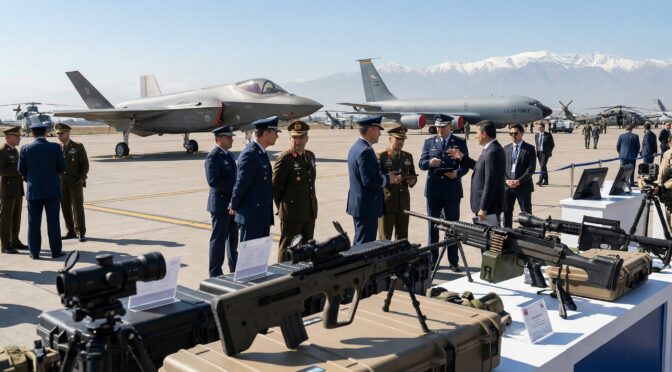
The 24th iteration of the Feria Internacional del Aire y del Espacio (FIDAE), held from April 7 to April 12, 2026, at the Arturo Merino Benítez International Airport in Santiago, Chile, convened at a critical inflection point in global military doctrine.1 Universally recognized as Latin America’s premier aerospace, defense, and security exhibition, the 2026 event hosted over 350 exhibitors from 33 countries and attracted an estimated 100,000 attendees, alongside hundreds of official military, commercial, and diplomatic delegations.1 Approaching nearly half a century of operation, FIDAE 2026 expanded its scope significantly, covering civil and commercial aviation, defense, homeland security, and space technology.3
However, the atmosphere, strategic dialogues, and procurement priorities at this year’s exhibition were heavily overshadowed by the geopolitical and tactical realities emerging from the ongoing “Operation Epic Fury” in the Middle East, as well as the protracted conflict in Eastern Europe.5 The lessons extracted from these modern high-intensity conflicts—specifically the vulnerability of traditional mechanized forces to unmanned aerial systems (UAS) and the fundamentally unsustainable cost-exchange ratios of legacy air and missile defense networks—dictated the technological offerings on the show floor.5 Exhibitors across all domains pivoted aggressively away from exquisite, single-role platforms toward modularity, multi-domain integration, attritable mass, and cost-effective precision.
In the small arms and infantry weapon sector, regional manufacturing champion Fábricas y Maestranzas del Ejército (FAMAE), celebrating its 215th anniversary, demonstrated localized self-sufficiency by launching a highly advanced multi-caliber precision sniper system and modernized submachine gun platforms designed specifically for the rigorous Andean theater.8 Concurrently, European giants such as FN Herstal introduced next-generation squad automatic weapons, such as the 7.62mm MINIMI and the EVOLYS, that bridge the gap between maneuverability and terminal ballistics.10
In the armored maneuver domain, a landmark memorandum of understanding (MOU) was signed between South Korea’s Hanwha Aerospace and Spain’s Indra Group to jointly pursue the Chilean Army’s wheeled armored vehicle replacement program, seamlessly marrying Asian heavy manufacturing with European sensor fusion.12 Furthermore, Turkey’s Aselsan showcased extensive modernization packages for Chile’s Leopard 2A4 main battle tanks, directly addressing vulnerabilities exposed by recent top-attack loitering munitions.13
The airspace and static displays were dominated not just by legacy fighters, but by an expansive array of UAS, ranging from the Airbus “Mastering Extremes” tactical trio to EDGE Group’s debut of long-endurance drones and localized loitering munitions.15 The United States utilized the exhibition to demonstrate profound hemispheric interoperability, highlighted by a historic mid-air refueling of U.S. Air Force F-35s by a Chilean KC-135E.17
This report provides an exhaustive, expert-level analysis of the new product announcements, strategic realignments, and doctrinal lessons learned at FIDAE 2026. The assessment synthesizes equipment specifications, industrial partnerships, and the overarching shift toward attritable mass and smart munitions, offering a definitive overview of the trajectory of Latin American defense procurement.
2.0 Doctrinal Context and “Lessons Learned”: The Shadow of Epic Fury
To accurately interpret the product showcases, defense investments, and strategic dialogues at FIDAE 2026, one must fundamentally analyze the contemporary conflicts that dominated the “Lessons Learned” seminars, bilateral meetings, and the overarching Dual Hub Summit. Specifically, Operation Epic Fury—the joint U.S.-Israeli military campaign against Iranian infrastructure initiated on February 28, 2026—served as a brutal, real-time proving ground for the realities of modern multidomain warfare.5
2.1 The Asymmetric Cost-Exchange Paradigm and Economic Volatility
The primary doctrinal shockwave reverberating through the halls of FIDAE 2026 was the catastrophic financial mismatch inherent in current integrated air and missile defense (IAMD) architectures. Analytical reviews of the opening phases of Epic Fury, heavily discussed by analysts and defense officials at the exhibition, revealed that U.S. and Gulf partner air defenses were rapidly overwhelmed by massive, synchronized salvos of low-cost, one-way attack drones (such as the Iranian-designed Shahed series) alongside ballistic missiles.5
The tactical failure observed in the Middle East was not one of interception capability, but of economic sustainability and stockpile depth. Defending forces routinely utilized high-end interceptors to defeat highly attritable unmanned threats. Data indicates a profound cost disparity: forces were forced to launch PAC-3 Patriot missiles, valued at approximately $4,000,000 per unit, to eliminate offensive Shahed drones that cost a mere $30,000 to manufacture.5 This staggering 133-to-1 negative cost-exchange ratio led to a rapid, unsustainable depletion of interceptor stockpiles, forcing the Pentagon to expend an estimated $5.6 billion on munitions in merely the first 48 hours of the assault.5
The strategic implications of this munitions exhaustion were severe. With defensive magazines depleted, critical infrastructure was left vulnerable. Following an Israeli strike on the South Pars gas field, Iranian retaliatory strikes devastated energy infrastructure in the Gulf States, including severe damage to the Ras Laffan liquefied natural gas (LNG) terminal in Qatar, which accounts for twenty percent of global LNG exports.18 The resulting economic shock sent Brent crude fluctuating wildly between $108 and $119 per barrel, demonstrating how the failure of cost-effective localized air defense can trigger global macroeconomic crises.18 For defense ministries attending FIDAE, the lesson was absolute: traditional air defense economics are broken, and procurement must shift immediately toward cheaper kinetic countermeasures, directed energy, and electronic warfare.
2.2 Reversing the Paradigm: The Ukrainian Playbook and Air Superiority
Compounding the strategic anxiety at FIDAE was the revelation that months prior to the outbreak of Epic Fury, Ukrainian President Volodymyr Zelenskyy had offered the U.S. and its partners detailed, combat-proven blueprints for defeating these exact drone swarms.5 Relying on their hard-won experience, Ukraine proposed sharing methods utilizing low-cost interceptor drones, specialized acoustic and electronic sensors, adaptive software, and the establishment of dedicated “drone combat centers” across the Middle East.5
These methods, forged in the crucible of the Eastern European theater, were initially viewed with skepticism and largely ignored by planners.5 It was only after Gulf partner nations suffered heavy casualties—including seven U.S. service members killed and 140 injured, alongside casualties in the UAE, Saudi Arabia, Bahrain, Kuwait, and Oman—that defense officials retroactively sought Ukrainian expertise.5 By March 2026, Ukrainian specialists were hastily deployed to U.S. bases in Jordan, Qatar, and the UAE to implement these asymmetric defense networks.5
Furthermore, the conflict highlighted the distinct operational divergence of advanced airframes. Analysts at FIDAE noted the complementary but distinct roles of the F-22 Raptor and the F-35 Lightning II during Epic Fury. The F-22 operated strictly as an unmatched air superiority specialist, keeping Iranian fighter aircraft out of the contested airspace, while the F-35 functioned as a highly networked, multi-role “quarterback,” utilizing its advanced sensor fusion to manage the complex battlespace, locate hidden air defense nodes, and execute deep precision strikes.20
For Latin American defense planners, these lessons dictate a clear path forward. Relying exclusively on exquisite, expensive platforms for base defense is obsolete. The regional demand signal has definitively shifted toward layered defenses, electronic warfare (EW), localized short-range air defense (SHORAD), and most importantly, scalable smart munitions that allow militaries to project precision power without bankrupting their defense budgets.7
3.0 Small Arms and Infantry Weapons: Precision, Modularity, and Ergonomics
While aerospace and strategic platforms historically dominate the static displays of FIDAE, the 2026 exhibition featured remarkably robust developments in the small arms and infantry weapons sector. As military doctrine increasingly emphasizes the survivability, autonomy, and lethality of the dismounted infantry squad in complex, multi-domain environments, global and regional manufacturers focused heavily on modularity, ergonomic integration, and multi-caliber capabilities.
3.1 FAMAE’s 215th Anniversary Product Line: Indigenous Lethality
Chile’s state-owned defense manufacturer, Fábricas y Maestranzas del Ejército (FAMAE), utilized FIDAE 2026 as a premier platform to commemorate its 215th anniversary.9 Founded in 1811, FAMAE solidified its status as the oldest continuously operating defense enterprise in Chile and the fifth oldest in Latin America.9 FAMAE’s comprehensive showcase served as a masterclass in localized defense industrial base capability, demonstrating unequivocally that South American armed forces can design, test, and field top-tier infantry systems independent of extended global supply chains.
The Multi-Caliber Precision Sniper Rifle
The undisputed centerpiece of FAMAE’s infantry portfolio at FIDAE 2026 was the debut of its new multi-caliber precision sniper rifle.8 This system was engineered explicitly for the extreme topographical and meteorological conditions inherent to the Andes mountains, where high-altitude, high-angle, and extreme long-range engagements are standard operational requirements for regional military and border security units.
Unlike traditional sniper systems that are factory-chambered for a single, fixed cartridge, the new FAMAE system offers profound modularity. It allows operators to alternate between the.338 Lapua Magnum and the.308 Winchester (7.62x51mm NATO) calibers depending entirely on the specific mission profile.8 The.308 Winchester configuration allows for highly cost-effective garrison training and ensures logistical interoperability with standard infantry platoons. Conversely, the.338 Lapua Magnum configuration provides the terminal ballistics necessary to defeat advanced body armor and penetrate light materiel targets at extreme distances, engaging objectives reliably between 1.5 and 1.8 kilometers.8
A critical engineering choice by FAMAE was the implementation of a straight-pull (rectilíneo) manual bolt action, departing from traditional turn-bolt designs.8 In high-stress combat environments, the straight-pull mechanism eliminates the upward and downward rotational movement required by legacy Mauser-style bolt actions. This allows the sniper to cycle the weapon significantly faster, chambering a new round while maintaining a continuous cheek weld and uninterrupted target observation through the optic.
| Specification | Detail / Operational Capability |
| Manufacturer | FAMAE (Fábricas y Maestranzas del Ejército, Chile) |
| Action Type | Manual straight-pull (rectilíneo) bolt system for rapid cycling |
| Caliber Options | Modular:.338 Lapua Magnum /.308 Winchester |
| Effective Range | 1,500 to 1,800 meters |
| Overall Length | 1,300 mm |
| System Weight | Approximately 10.4 kg |
| Barrel Profile | Heavy “bull barrel” with multi-radial rifling (22” to 26” options) |
| Trigger System | Match-grade, fully adjustable weight (from 800 g) and travel |
| Feed System | Detachable metallic box magazine (5 or 10 round capacities) |
| Ergonomics & Mounting | Fully adjustable/folding tactical stock, monolithic top Picatinny rail, factory bipod and monopod included |
| Durability Finish | Matte Cerakote treatment for extreme weather and corrosion resistance |
Table 1: Technical specifications of the FAMAE Multi-Caliber Sniper Rifle showcased at FIDAE 2026.8
Submachine Gun Modernization and Handgun Developments
In the close-quarters combat (CQB) and law enforcement domains, FAMAE unveiled the highly anticipated 2026 modernized variant of its legacy SAF submachine gun.8 Chambered in 9x19mm, the SAF has long been a rugged staple of Chilean security forces. The modernized version integrates contemporary tactical requirements, completely replacing legacy polymer handguards with a lightweight aluminum M-LOK system.9 This crucial upgrade allows operators to directly mount modular accessories such as infrared laser designators, tactical illuminators, and vertical foregrips without adding the unnecessary bulk and weight associated with older quad-rail systems. Furthermore, the inclusion of a modernized folding stock with an adjustable buttpad and a refined selective fire lever (capable of semi-automatic and automatic fire) vastly enhances the weapon’s ergonomics for vehicle-borne operations and dynamic urban room clearing.9
Expanding its sidearm portfolio, FAMAE displayed 11 specific models of pistols developed through an enduring industrial partnership with Italy’s Tanfoglio.9 These weapons undergo nationalized machining, advanced surface treatments, and rigorous quality control at FAMAE’s domestic facilities before delivery.9 Notably, the catalog included the F1811, a compact, striker-fired (launched needle) 9x19mm pistol set for widespread military and police release.22 Featuring a 16+1 magazine capacity, a 92mm barrel, and an unloaded weight of 780g, the F1811 positions FAMAE as a direct competitor to ubiquitous polymer-framed sidearms heavily imported into the region.22 The robust Tifon family (Tifon-F, Tifon-FD, Tifon-FD1) was also prominently displayed, offering varied magazine capacities (13 or 16 rounds) and ergonomic profiles to suit varying institutional client requirements.22
To support the testing and certification of these indigenous weapons and ammunition lines, FAMAE highlighted its mobile ballistic resistance laboratory.23 Furthermore, the company showcased a telemetry drone utilized to identify the exact coordinates of artillery impacts, providing a high degree of safety and data fidelity for live-fire testing protocols.23
3.2 FN Herstal: Redefining Squad Automatic Firepower
Belgium-based FN Herstal, an undisputed global heavyweight in small arms manufacturing, leveraged its presence at FIDAE 2026 (Booth E-117) to reinforce its dominance in the Latin American market.24 FN’s approach demonstrated a clear doctrinal understanding of modern infantry operations, prioritizing weight reduction, sustained suppressive fire capability, and operator ergonomics.
The 7.62mm MINIMI Light Machine Gun
A paramount challenge for modern light infantry is balancing the necessity for suppressive firepower with the physical burden placed on the operator. Standard 5.56x45mm weapons often lack the terminal ballistics necessary to penetrate modern Level IV body armor or light foliage at extended ranges. At FIDAE 2026, FN Herstal showcased the 7.62x51mm NATO variant of its globally recognized MINIMI Light Machine Gun (LMG).10 FN engineers explicitly designed this weapon to fulfill a specific combat requirement: delivering “the power of 7.62 ammunition in the weight of a 5.56 machine gun”.10
By maintaining the exact ergonomic profile, manual of arms, and operating procedures of the ubiquitous 5.56mm MINIMI—which has already been adopted by over 45 nations—FN Herstal allows militaries to drastically upgrade their squad-level terminal ballistics and effective range without incurring massive retraining costs or completely overhauling their existing logistics chains.10 Additionally, the display featured the MINIMI MK3 Long Rail Feed Cover variant.24 This extended rail provides the necessary real estate to mount in-line thermal or night-vision clip-on optics ahead of a primary day sight, a critical capability for modern night-fighting operations.24
The FN EVOLYS and Aviation Armament
Further pushing the boundaries of machine gun design, FN Herstal exhibited the FN EVOLYS chambered in 5.56mm.11 The EVOLYS represents a radical departure from traditional belt-fed weapon systems by incorporating an innovative lateral feed mechanism. Historically, the hinged feed cover on standard machine guns made the mounting of zero-sensitive optics highly problematic, as opening the cover to load the weapon could shift the optic’s zero. The EVOLYS solves this entirely; the lateral feed allows the weapon to feature a continuous, monolithic top rail, enabling the precise and permanent mounting of advanced fire control systems and laser rangefinders.
In the rotary-wing domain, FN expanded its portfolio of integrated weapon systems. Drawing upon decades of combat experience mounting the heavy M3M.50 caliber machine gun on helicopter floors and windows, FN Herstal debuted a new mounting configuration tailored specifically for the rear ramp of transport helicopters.10 This development directly responds to the operational requirement for heavy, suppressed rear-arc defensive fire during high-risk extraction and insertion missions—a highly common scenario in counter-narcotics and special operations deep within the jungles of Latin America.10
Sidearm Innovation: The FN HiPer
For individual defense, FN showcased the FN HiPer, a 9x19mm pistol designed from the ground up to establish a new benchmark for armed forces and law enforcement agencies.11 The HiPer intentionally abandons legacy pistol geometries in favor of radical ergonomic optimization. It features an extremely low bore axis designed to mitigate muzzle flip for faster follow-up shots, fully ambidextrous controls integrated seamlessly into the frame rather than protruding awkwardly, and enhanced reliability mechanisms intended to function flawlessly in the high-humidity, high-debris environments endemic to South America.11
3.3 Regional Competitors and Geopolitical Market Dynamics
While FAMAE and FN Herstal commanded significant attention, the broader Latin American and global small arms ecosystem was well represented, facilitating intense commercial diplomacy. Brazilian defense conglomerates Taurus and IMBEL maintained a strong presence, utilizing the exhibition to conduct high-level bilateral meetings. Notably, representatives from IMBEL engaged in strategic discussions with officials from Turkey’s Mechanical and Chemical Industry Corporation (MKE), alongside the Turkish Ambassador to Chile and the General Manager of FAMAE.25
These high-level meetings indicate potential cross-hemispheric technology transfers and joint ventures in ammunition and small arms production. This aligns perfectly with a broader geopolitical trend observed throughout FIDAE 2026: South American defense industries are actively seeking partnerships and technology sharing beyond traditional Western European and North American suppliers, looking toward ascending defense powers like Turkey and South Korea to secure sovereign manufacturing capabilities.25
4.0 Armored Vehicles and Ground Systems: The Chilean Modernization Push
The diverse topography of Latin America—ranging from dense, triple-canopy jungles to high-altitude deserts and rugged mountain passes—dictates highly unique requirements for armored maneuver forces. At FIDAE 2026, the focus shifted sharply from the acquisition of entirely new, heavy tracked platforms toward the sophisticated modernization of existing main battle tanks (MBTs) and the procurement of highly mobile, mine-resistant wheeled infantry fighting vehicles (IFVs).
4.1 The Hanwha-Indra Consortium: Replacing the Mowag Piranha
One of the most consequential industrial developments of the exhibition, drawing intense scrutiny from defense analysts, was the signing of a Memorandum of Understanding (MOU) between South Korea’s Hanwha Aerospace and Spain’s Indra Group.12 Signed on April 8 at the FIDAE grounds in the presence of senior corporate executives, land systems directors, and the Republic of Korea’s Ambassador to Chile, the MOU establishes a joint consortium to aggressively bid on the Chilean Army’s next-generation armored vehicle program.12
The Chilean Army is actively seeking to replace its aging fleet of over 200 Mowag Piranha wheeled armored personnel carriers, with an initial tranche requirement set for 45 vehicles.28 The Hanwha-Indra consortium offers a synergistic, turnkey solution that perfectly encapsulates modern defense procurement strategies: marrying rugged, proven Asian heavy manufacturing with highly sophisticated European electronic warfare and command systems.
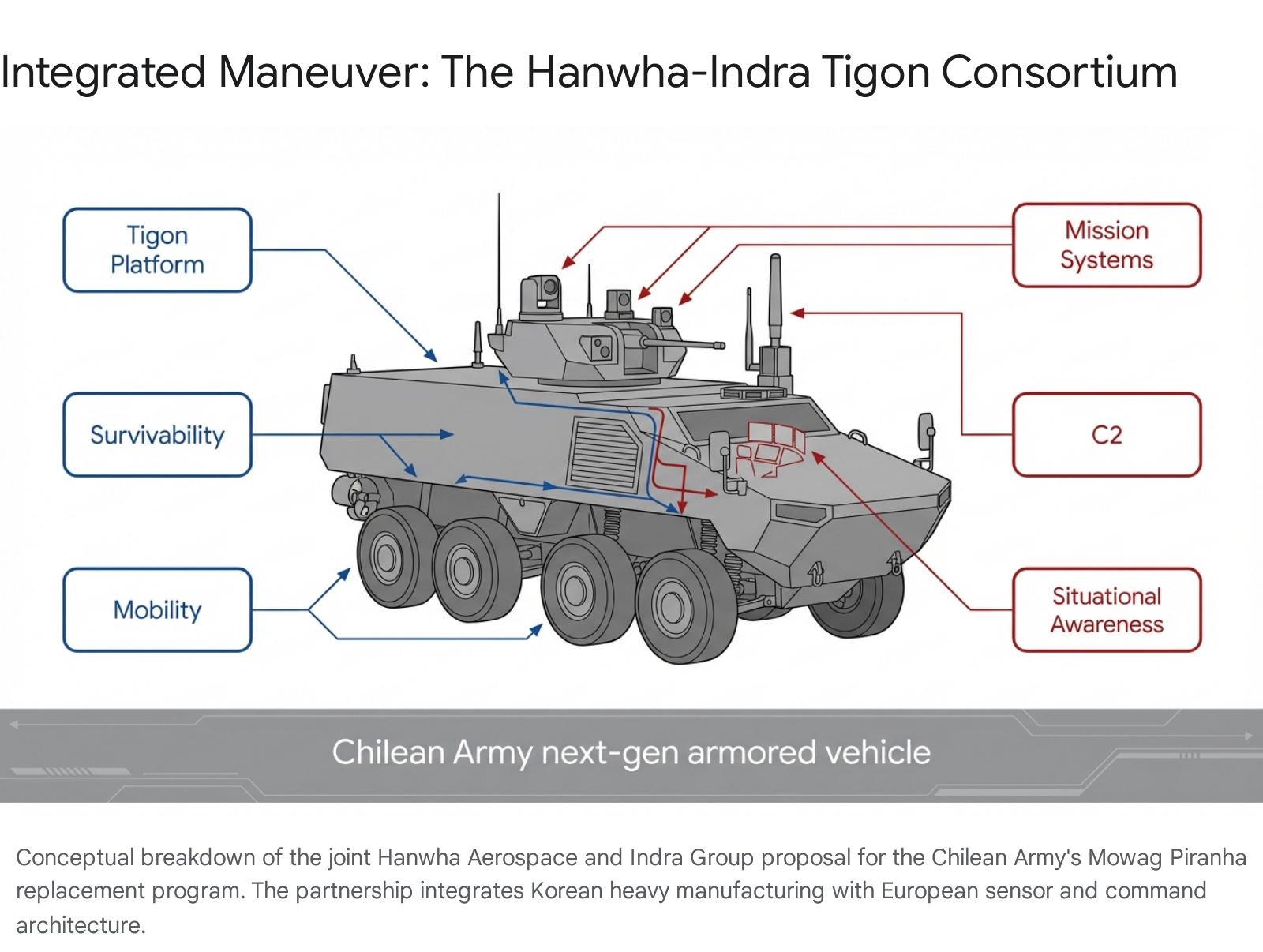
Hanwha Aerospace will serve as the primary platform provider, offering its advanced Tigon wheeled armored vehicle.12 The Tigon represents a monumental leap over the legacy Piranha in terms of modular ballistic protection, underbelly mine blast resistance (featuring a distinct V-hull design to deflect explosive force), and overall off-road mobility.12 Indra Group, acting as the regional coordination lead and technology integrator, will provide the Mission System Equipment.12 This complex electronic suite includes state-of-the-art C2 (Command and Control) architecture, battlefield management networks, and advanced situational awareness sensors, ensuring the Tigon functions not merely as a troop transport, but as a fully interconnected node within a digitized battlespace.12
The strategic intent of this MOU extends far beyond the borders of Chile. Both Hanwha and Indra executives explicitly noted that the Chilean procurement serves as an optimal gateway; the consortium intends to leverage this integrated platform to aggressively target ground defense modernization programs across the broader Latin American region, positioning their turnkey solution as a highly competitive, state-of-the-art product capable of meeting high regional demand.12
4.2 Aselsan’s Leopard 2A4 Modernization: Enhancing Heavy Survivability
Chile currently operates one of the most capable heavy armored forces in South America, spearheaded by its fleet of Leopard 2A4 main battle tanks. However, the rapid proliferation of top-attack loitering munitions and advanced anti-tank guided missiles (ATGMs) observed in Ukraine and the Middle East has rendered baseline legacy armor highly vulnerable. Turkey’s defense electronics powerhouse, Aselsan, utilized FIDAE 2026 to showcase its comprehensive modernization package designed specifically for the Chilean Leopard 2A4 fleet.13
The Aselsan upgrade is a system-of-systems approach focused on vastly improving the tank’s sensor capabilities, situational awareness, and active survivability without requiring a fundamental, cost-prohibitive redesign of the vehicle’s base composite armor.13 Key components of the modernization package include:
- Next-Generation Optics and Fire Control: Implementation of advanced gunner and commander panoramic sights, coupled with an entirely overhauled Fire Control System (FCS).13 This allows for rapid target acquisition in all weather conditions, higher first-round hit probability, and advanced hunter-killer capabilities, enabling the commander to search for targets independently while the gunner engages.
- Electric Turret Drives: Replacing the legacy, highly volatile hydraulic turret traverse mechanisms with fully electric drives.13 This not only increases the speed and precision of turret movement but drastically reduces the risk of catastrophic internal fires and crew casualties if the armor is penetrated and the hydraulic lines are ruptured.
- Battlefield Management System (BMS): Integration of Aselsan’s KOCATEPE BMS, which networks the tank with accompanying infantry, UAS, and higher command nodes, providing real-time situational awareness and coordinated operational planning.13
- Defensive Suite and 360-Degree Vision: The installation of high-resolution 360-degree close-in camera systems effectively eliminates the tank’s operational blind spots.13 This vision system is integrated with an advanced Laser Warning System (LWS) and Identification Friend or Foe (IFF) protocols that instantly alert the crew if they are being painted by an enemy laser rangefinder or ATGM designator.13 Crucially, the modernization pathway allows for the future integration of an Active Protection System (APS), such as the Pulat or Akkor, capable of physically intercepting incoming kinetic and chemical energy projectiles before they strike the armor.13
4.3 KNDS and EDGE Group: Mobile Artillery and Light Armor
The Franco-German defense consortium KNDS also reinforced its South American footprint at FIDAE. Recognizing the topographical challenges of the region, KNDS highlighted its mastery of the 155mm artillery value chain, specifically the CAESAR self-propelled howitzer.33 As a highly mobile wheeled, truck-mounted system, the CAESAR offers strategic mobility and rapid “shoot-and-scoot” capabilities that traditional heavy tracked howitzers simply cannot match. This makes it highly relevant for Latin American forces prioritizing rapid deployment and counter-battery evasion over heavy armor. KNDS also noted its ongoing logistical support for the region, including the supply of 105mm 105LG howitzers to Colombia and 76mm naval ammunition to Chile, emphasizing long-term operational partnerships.33
Simultaneously, EDGE Group presented its AJBAN MK2 and HAFEET MK2 armored vehicles.16 Engineered for exceptional mobility, enhanced ballistic protection, and operational effectiveness across diverse terrains, these vehicles offer Latin American militaries a highly resilient platform for border patrol, reconnaissance, and internal security missions where mine and IED threats are prevalent.16
5.0 Unmanned Aerial Systems (UAS) and Loitering Munitions: The New Maneuver Force
If there was a single technological domain that utterly dominated the airspace, static displays, and commercial discussions of FIDAE 2026, it was the explosive proliferation of Unmanned Aerial Systems (UAS) and loitering munitions. The operational data derived from conflicts in Eastern Europe and the Middle East has cemented the drone as an indispensable, attritable asset capable of conducting Intelligence, Surveillance, and Reconnaissance (ISR), deep kinetic strikes, and localized tactical disruption.
5.1 The Airbus UAS Trio: Mastering Extreme Environments
European aerospace conglomerate Airbus presented a highly specialized portfolio of UAS designed explicitly to conquer the varied and unforgiving topography of Latin America, a concept they marketed effectively as “Mastering Extremes”.15 Latin American border security, disaster response, and counter-narcotics missions frequently require persistent operations in the thin air of the high Andes or over the vast, dense canopy of the Amazon basin—environments that routinely push standard commercial-off-the-shelf drones beyond their operational envelopes.
The Airbus display highlighted three distinct platforms, each tailored to specific mission profiles and operational tiers:
- Sirtap: Serving as the heavy-duty tier, Sirtap is an advanced, high-performance tactical UAS designed for demanding ISR missions along remote frontiers. Its robust design allows for prolonged loiter times in adverse weather conditions, carrying sophisticated sensor payloads.15
- Flexrotor: Demonstrating its capabilities with live demonstration flights during the initial days of the exhibition (April 8 and 9), the Flexrotor is a highly versatile Vertical Take-Off and Landing (VTOL) system.15 Its VTOL capability completely removes the logistical footprint of prepared runways or bulky pneumatic catapult launchers, making it ideal for expeditionary forces, remote outposts, and maritime patrol vessels operating in constrained deck spaces.15
- Aliaca: Representing the tactical tier, the Aliaca is a lightweight, highly portable system optimized for rapid deployment and versatile surveillance operations, providing immediate “over-the-hill” intelligence to localized tactical commanders without requiring higher-echelon clearance.15
5.2 EDGE Group’s Strategic Debut and the Indra Joint Venture
The United Arab Emirates-based advanced technology and defense group, EDGE, marked its official debut at FIDAE 2026, signaling a massive, well-capitalized push into the Latin American market.16 EDGE’s showcase was a direct reflection of the multi-domain, attritable warfare paradigm.
In the aerial domain, EDGE displayed the HT-100 unmanned helicopter, capable of vertical heavy-lift logistics and sustained ISR, alongside the REACH-S, a Medium-Altitude Long-Endurance (MALE) UAS designed for persistent theater-level surveillance and strike capabilities.16 However, the most strategically significant aspect of EDGE’s presence was its aggressive focus on loitering munitions and the infrastructure to build them.
Just days prior to FIDAE, EDGE and Spain’s Indra Group announced a landmark agreement to launch a new loitering munition manufacturing company based in Europe.36 This joint venture aims to seamlessly combine EDGE’s advanced weapons technology and payload designs with Indra’s large-scale manufacturing capacity. The goal is to meet the explosive global demand for sovereign, export-ready kamikaze drones, a capability EDGE is aggressively marketing to South American defense ministries seeking to build domestic stockpiles.36
5.3 Tactical Swarms and High-Speed Drones
Turkish defense contractor STM further underscored the dominance of loitering munitions at FIDAE by exhibiting its combat-proven tactical UAS portfolio.37 STM’s centerpiece was the KARGU, a national rotary-wing loitering munition system that has achieved significant global success, boasting exports to 15 countries across four continents.37 The KARGU operates effectively in swarm configurations, allowing infantry units to deploy localized, precision kinetic strikes against entrenched personnel or light vehicles without calling upon centralized artillery or exposing themselves to return fire. STM also featured the TOGAN surveillance drone and the BOYGA ammunition-drop UAV, highly tactical systems that provide squad-level commanders with organic, immediate precision strike capabilities.37
In the high-speed reconnaissance domain, attention was drawn to the FLARIS SINYAR-LAR3P.38 This rapid-deployable unmanned aerial vehicle boasts a remarkable 30m/sec climb rate, allowing it to quickly reach observation altitude, where it can reduce speed for extended loitering missions lasting up to 18 hours, providing both combat and persistent ISR capabilities.38
6.0 Precision-Guided Munitions, Air Defense, and Retrofit Economics
While fifth-generation stealth fighters generate public headlines, the strategic reality for most Latin American air forces is the absolute necessity to maximize the lethality and survivability of their existing fourth-generation fleets. The sheer replacement cost of modern airframes necessitates that they deploy standoff, precision-guided munitions (PGMs) to strike targets while remaining safely outside the engagement envelopes of modern air defense networks.
6.1 Aselsan’s Retrofit Economics: The Smart Munition Revolution
Addressing the urgent, region-wide demand for cost-effective precision, Turkey’s Aselsan presented an extensive portfolio of smart munition guidance kits.7 As explicitly noted by Aselsan executives at the exhibition, the brutal lessons learned from recent conflicts—specifically the unsustainable cost of using high-end interceptors against cheap threats—have driven a massive, global demand for affordable strike capabilities.7
Aselsan’s engineering philosophy revolves around the concept of “retrofit economics.” Rather than purchasing entirely new, prohibitively expensive smart missiles, air forces can acquire Aselsan’s modular guidance kits to convert their massive existing stockpiles of unguided, “dumb” iron bombs into highly precise, standoff weapons.7 This approach drastically reduces acquisition and lifecycle costs while instantly upgrading the strike capability of the air fleet, allowing air forces to leverage existing inventories.7
| Munition Kit | Base Munition Compatibility | Guidance Mechanism | Operational Advantage |
| LGK 82 | 500 lb class (Mk-82, QFAB-250T) | Semi-Active Laser (SAL) Seeker | Near-precision strike, highly effective against moving targets, low collateral damage.39 |
| LGK 83 | 1000 lb class (Mk-83, BETAB-500) | Semi-Active Laser (SAL) Seeker | Deep-strike capability against high-value targets, maintains stability in challenging environments.39 |
| HGK | General Purpose Bombs (500 lb / 1000 lb) | GPS/INS | All-weather precision strike capabilities, autonomous guidance.7 |
| KGK | General Purpose Bombs | GPS/INS with Fold-out Wings | Extended standoff glide range; allows launch aircraft to remain safely outside enemy terminal air defenses.7 |
Table 2: Overview of Aselsan’s Smart Munition Retrofit Kits displayed at FIDAE 2026.7
In addition to retrofit kits, Aselsan displayed purpose-built smart munitions like the TOLUN and GÖZDE, designed specifically for high-precision effects against hardened targets with exceptionally low collateral damage, a critical requirement for operations in densely populated urban environments.7
6.2 Counter-UAS and Multi-Domain Radar Integration
To counter the exact attritable drone threats that plagued defenders during Epic Fury, companies showcased specialized detection and interception hardware. UK-based Blighter Surveillance Systems debuted its A400 series micro-Doppler radars at the UK Pavilion.41 These ultra-reliable, low-power electronic scanning array antennas utilize advanced AI-driven processing to detect, classify, and track people, vehicles, and near-ground airborne threats at ranges of up to 32 km.41 Blighter’s patented technology excels at identifying small, covert targets—like loitering munitions—in complex environments, integrating seamlessly via the AI-assisted BlighterNexus software to reduce the cognitive burden on radar operators.41
BAE Systems augmented this defensive posture by presenting its comprehensive air defense and naval solutions, including the Commander SL Long Range Tactical Air Defence Radar, the TRIDON Mk2 system, and its highly lethal 3P Programmable Ammunition.42 Furthermore, BAE showcased its 40 Mk4 and 57 Mk3 Naval Guns, systems increasingly tasked with providing point defense against drone swarms targeting maritime assets.42
EDGE Group also recognized that modern warfare occurs heavily in the electromagnetic spectrum. Acknowledging that GPS-denied environments are now the standard baseline in modern conflicts, EDGE showcased its GPS PROTECT 2 and GPS PROTECT 4 anti-jamming solutions, alongside the BORDERSHIELD autonomous border security network, designed to protect operations in highly contested electromagnetic environments.16
7.0 Aerospace Platforms and Hemispheric Interoperability
Despite the rise of unmanned systems, manned aviation remains the cornerstone of strategic power projection and logistics. At FIDAE 2026, the contrast between massive tactical airlifters, agile rotary-wing platforms, and fifth-generation fighters provided a comprehensive view of hemispheric airpower.
7.1 U.S. Airpower and Strategic Deterrence
While the hardware on display signaled a growing Latin American openness toward European and Asian suppliers, the United States maintained a formidable, highly visible presence at FIDAE 2026 to emphasize hemispheric security, deep operational interoperability, and the unmatched capabilities of its airpower.17
The U.S. Air Force and newly reorganized Space Force deployment, coordinated under Air Forces Southern, featured a diverse spectrum of strategic and tactical assets. This included C-130 Hercules tactical airlifters, MQ-9 Reaper drones from the Texas Air National Guard, the Wings of Blue parachute team, and maritime patrol support from a U.S. Navy P-8 Poseidon.17
The undisputed highlight of the U.S. presence, however, was the participation of the F-35A Lightning II Demonstration Team.17 The arrival of the F-35s in Santiago was deeply symbolic of the strategic defense partnership between the U.S. and Chile. In a historic first, the F-35s were sustained en route to the exhibition by a Chilean Air Force (FACh) KC-135E Stratotanker, which successfully conducted mid-air refueling operations in international airspace at an altitude of approximately 26,000 feet.17 This seamless logistical and operational interoperability between a fifth-generation U.S. fighter platform and a South American logistical asset sends a powerful deterrent message regarding the combined operational reach and integrated readiness of allied forces in the Western Hemisphere.17
This integration aligns directly with the U.S. Department of the Air Force’s broader mandate, highlighted at the show, regarding “Reoptimization for Great Power Competition.” Recognizing that the space and air domains are no longer benign but highly congested and contested, the U.S. stressed the need to enhance capabilities and project power alongside regional allies to thrive in high-intensity conflicts.45
7.2 Tactical Airlift and Vertical Aviation
Airbus maintained its status as a foundational partner to Latin American militaries, showcasing platforms built to master extreme altitudes and remote frontiers.15 In the fixed-wing logistics domain, Airbus featured the A400M, a high-performance, versatile military transport aircraft capable of tactical low-level flights and austere runway operations.15 Additionally, Airbus highlighted the C295, firmly recognized as Latin America’s leading tactical multi-mission aircraft, ideal for maritime patrol, transport, and medical evacuation across the continent.15
The rotary-wing sector received unprecedented attention at FIDAE 2026. For the first time in its 46-year history, the exhibition featured dedicated, comprehensive programming focused entirely on the future of vertical aviation.1 Spearheaded by Vertical Aviation International (VAI) and the Chilean Association of Vertical Flight (ACHAV), a series of high-level panel sessions addressed the rapidly evolving role of helicopters and emerging VTOL technologies in civil and military operations.1 The inclusion of this track underscores the unique, heavy reliance of South American logistics, medical evacuation, and internal security forces on rotorcraft, given the severe lack of contiguous road infrastructure in many rural and mountainous regions.
Airbus demonstrated its dominance in this sector by showcasing its modern helicopter fleet. This included the H125, specifically noted for its incredible life-saving capabilities and performance in the Andes at altitudes exceeding 6,000 meters, alongside the modern H135 and H160 platforms.15 The H145 was also highlighted for its critical role in “Golden Hour” life-saving medical missions, specifically utilized by the Minas Gerais fleets in Brazil.15 Bell Flight also participated robustly, displaying the Bell 505 and emphasizing its Global Customer Solutions and Bell Training Academy, focusing on operational readiness for public safety and military training.46
8.0 Cyber, Space, and the Geopolitics of Defense Innovation
FIDAE 2026 transcended traditional kinetic platforms by dedicating substantial programming to the strategic enablers that will define future conflicts: space infrastructure, cybersecurity protocols, and the rapid integration of dual-use technologies.
8.1 Dual-Use Innovation and the Cyber Domain
The blurring lines between civilian technology and military application were addressed directly by the Dual Hub Summit, hosted for the first time at FIDAE.47 Launched by Know Hub Chile, Dual Hub is the first permanent dual-use innovation platform in Latin America. It brings together academia, the defense sector, government, and private entrepreneurship to accelerate the development of technologies with both commercial and strategic applications.47 Initiatives championed at the summit, like the “Avante Challenge” (an open innovation project connecting startups with the naval sector), represent a paradigm shift away from slow, closed-door military R&D toward agile, startup-driven defense innovation, mimicking technology incubation models successfully employed in the United States and Israel.47
Protecting this interconnected, digitized military and civilian infrastructure was the primary focus of the FIDAE Cyber Summit.48 With highly technical sessions detailing frontier technologies in cybersecurity and the absolute necessity of strengthening public-private security alliances, defense officials widely acknowledged that advanced platforms—whether the Hanwha Tigon, the F-35, or a swarm of EDGE loitering munitions—are operationally useless if the data links connecting them are compromised, jammed, or spoofed by hostile state actors.48
8.2 The Space Domain and Sovereign Infrastructure
Concurrently, the space domain was recognized not merely as a scientific frontier, but as critical, contestable national infrastructure. FIDAE hosted the Space Summit, focusing heavily on “Driving Space Capabilities for Development and National Sovereignty”.48 The exhibition also partnered with the Secure World Foundation (SWF) to host the 10th South American Space Generation Workshop, convening young professionals and industry leaders to strengthen regional space collaboration and sustainable space governance.50 These summits aimed to consolidate Chile’s National Space System, fostering civil-military cooperation and ensuring technological autonomy in satellite communication, Earth observation, and secure navigation—capabilities deemed essential for modern military operations.3
8.3 Geopolitical Shifts: Israel’s Commercial Return
The geopolitical undercurrents shaping the global defense industry were clearly visible in the organizational structure of FIDAE 2026. A notable shift from previous exhibitions was the status of Israeli defense contractors. While Israel has historically been a key supplier of advanced defense technology to Chile, the Chilean government had excluded Israel from institutional participation at FIDAE 2024 amidst the intense political fallout of the Gaza conflict.51
For the 2026 exhibition, a delicate diplomatic compromise was reached. Israeli companies—including heavyweights such as Israel Aerospace Industries (IAI), Rafael, Elbit Systems, Aeronautics, and UVision—returned to FIDAE and participated vigorously.51 However, their participation was strictly on a commercial, company-by-company basis; there was no official Israeli national pavilion, nor was there formal government representation through the Israeli Ministry of Defense (SIBAT).51 This arrangement allowed Latin American militaries to continue accessing cutting-edge Israeli drone, radar, and missile technology while allowing the host nation to navigate complex domestic and international political sensitivities.
9.0 Conclusion: The Trajectory of Latin American Defense
The 24th Feria Internacional del Aire y del Espacio (FIDAE) 2026 provided an unprecedented, highly detailed window into the rapidly evolving mindset of Latin American defense planners. Observing the brutal, attritional realities of Operation Epic Fury and the protracted war in Ukraine, regional militaries are decisively pivoting away from the slow acquisition of scarce, ultra-expensive legacy platforms that cannot survive in a drone-saturated, electronically contested battlespace.
The procurement trends, industrial consortiums, and technological showcases solidified at FIDAE 2026 indicate three defining trajectories for the future of regional defense:
- The Supremacy of Cost-Effective Mass and Retrofit Economics: Defense budgets are shifting toward affordable precision. The massive interest in Aselsan’s retrofit guidance kits (LGK, KGK) and the proliferation of loitering munitions from EDGE Group and STM demonstrate a realization that volume, sustainable cost-exchange ratios, and financial sustainability are just as vital as technological sophistication. Militaries can no longer afford to shoot down $30,000 drones with $4,000,000 missiles.
- Sovereign Production and Transnational Consortiums: Nations are aggressively pursuing technology transfers and local manufacturing to insulate themselves from global supply chain shocks and political embargoes. FAMAE’s indigenous sniper and pistol production, coupled with the Hanwha-Indra consortium’s willingness to build turnkey, localized armored solutions in Chile, represents a firm rejection of the traditional client-state arms purchasing model. Latin America is demanding domestic production capabilities.
- Survivability Through Sensor Fusion and Modernization: Rather than replacing entire fleets of heavy armor or legacy aircraft, militaries are focusing on sensor-fusion, electronic warfare, and active defense retrofits. The comprehensive upgrading of the Chilean Leopard 2A4 fleet with Aselsan electronics, electric drives, and defensive suites provides a concrete blueprint for how legacy armor can remain relevant and survivable against modern, asymmetric top-attack threats.
Ultimately, FIDAE 2026 signaled a maturing, highly pragmatic Latin American defense sector—one that is highly observant of global tactical shifts, fiercely protective of its strategic industrial autonomy, and increasingly defined by the rapid integration of multi-domain, attritable, and precision technologies.
Please share the link on Facebook, Forums, with colleagues, etc. Your support is much appreciated and if you have any feedback, please email us in**@*********ps.com. If you’d like to request a report or order a reprint, please click here for the corresponding page to open in new tab.
Sources Used
- This week: FIDAE 2026 spotlights vertical aviation, accessed April 11, 2026, https://verticalavi.org/vai-daily/this-week-fidae-2026-spotlights-vertical-aviation/
- FIDAE 2026 spotlights vertical aviation, accessed April 11, 2026, https://verticalavi.org/vai-daily/fidae-2026-spotlights-vertical-aviation/
- DIGITALEDITION 1 – Fidae, accessed April 11, 2026, https://www.fidae.cl/fidae/site/docs/20260218/20260218144637/fidaenewsdig_eng.pdf
- Chile FIDAE – Advocacy – California Chamber of Commerce, accessed April 11, 2026, https://advocacy.calchamber.com/events/chile-fidae/
- Epic Fury: las lecciones de Ucrania omitidas – Pucará Defensa, accessed April 11, 2026, https://www.pucara.org/post/epic-fury-las-lecciones-de-ucrania-omitidas
- Tomahawks Keep War at a Distance — Until Stocks Run Out – TURDEF, accessed April 11, 2026, https://turdef.com/article/tomahawks-keep-war-at-a-distance-until-stocks-run-out
- ZM at FIDAE 2026 – ASELSAN seeks to expand its presence in Latin America with a focus on industrial cooperation and military modernization – Zona Militar, accessed April 11, 2026, https://www.zona-militar.com/en/2026/04/08/zm-at-fidae-2026-aselsan-seeks-to-expand-its-presence-in-latin-america-with-a-focus-on-industrial-cooperation-and-military-modernization/
- FAMAE presenta su nuevo fusil “Sniper” multicalibre en FIDAE 2026 …, accessed April 11, 2026, http://www.famae.cl/famae-presenta-su-nuevo-fusil-sniper-multicalibre-en-fidae-2026
- ZM en FIDAE 2026 – En vísperas de su 215° aniversario, FAMAE presenta su cartera de productos y soluciones de modernización, accessed April 11, 2026, https://www.zona-militar.com/2026/04/10/zm-en-fidae-2026-en-visperas-de-su-215-aniversario-famae-presenta-su-cartera-de-productos-y-soluciones-de-modernizacion/
- New FN Herstal’s Products Introduced at FIDAE – Army Technology, accessed April 11, 2026, https://www.army-technology.com/contractors/civil-defence-security-and-law-enforcement/fnherstal/pressreleases/press3-3/
- Defence Solutions – FN Herstal, accessed April 11, 2026, https://fnherstal.com/en/defence/
- Hanwha Aerospace partners with Indra for defense cooperation, accessed April 11, 2026, https://www.hanwha.com/newsroom/news/press-releases/hanwha-aerospace-signs-mou-with-indra-group-for-latin-american-defense-cooperation.do
- Turkey’s Aselsan Showcases Modernization Package for Chilean Leopard 2 Tanks, accessed April 11, 2026, https://defensemirror.com/news/36540/Turkey___s_Aselsan_Showcases_Modernization_Package_for_Chilean_Leopard_2_Tanks
- Chilean Leopard 2A4s are getting modernized by Turkish firm ASELSAN [album] – Reddit, accessed April 11, 2026, https://www.reddit.com/r/TankPorn/comments/1c1fe96/chilean_leopard_2a4s_are_getting_modernized_by/
- FIDAE 2026 | Airbus, accessed April 11, 2026, https://www.airbus.com/en/fidae
- EDGE Group Debuts Advanced UAS and Multi-Domain Defence Solutions at FIDAE 2026, accessed April 11, 2026, https://uasweekly.com/2026/04/02/edge-group-debuts-advanced-uas-and-multi-domain-defence-solutions-at-fidae-2026/
- FIDAE 2026 kicks-off highlights U.S.-Chile airpower, partnership – DVIDS, accessed April 11, 2026, https://www.dvidshub.net/news/562207/fidae-2026-kicks-off-highlights-us-chile-airpower-partnership
- Gustavo de Arístegui: Geopolitical Analysis, 20 March – Atalayar, accessed April 11, 2026, https://www.atalayar.com/en/articulo/gustavo-aristegui/gustavo-aristegui-geopolitical-analysis-20-march/20260320210000224180.html
- Publicaciones | Pucará Defensa, accessed April 11, 2026, https://www.pucara.org/publicaciones
- America Has Both the F-22 Raptor and F-35 Lightning II Fighting in the Iran War — One Is Keeping Iranian Aircraft Away While the Other Finds and Destroys Targets – 19FortyFive, accessed April 11, 2026, https://www.19fortyfive.com/2026/03/america-has-both-the-f-22-raptor-and-f-35-lightning-ii-fighting-in-the-iran-war-one-is-keeping-iranian-aircraft-away-while-the-other-finds-and-destroys-targets/
- FAMAE, accessed April 11, 2026, http://www.famae.cl/
- Chilean company FAMAE to launch production of five 9mm pistols in 2024, accessed April 11, 2026, https://www.armyrecognition.com/archives/archives-land-defense/land-defense-2024/chilean-company-famae-to-launch-five-9mm-pistols-in-2024
- Chilean Army at FIDAE 2026: Technology and capabilities at the service of the country, accessed April 11, 2026, https://www.youtube.com/watch?v=PZpeFJPfOuw
- Welcome – FN HERSTAL, accessed April 11, 2026, https://fnherstal.com/en/
- MKE showcases defence products and holds meetings at FIDAE 2026 – Defensehere, accessed April 11, 2026, https://defensehere.com/en/mke-showcases-defence-products-and-holds-meetings-at-fidae-2026/
- Hanwha Aerospace, Indra Partner on Latin American Defense Projects, accessed April 11, 2026, https://www.thelec.net/news/articleView.html?idxno=6461
- Hanwha Aerospace signs MOU with Indra Group for Latin American defense cooperation, accessed April 11, 2026, https://www.koreatimes.co.kr/amp/business/companies/20260409/hanwha-aerospace-signs-mou-with-indra-group-for-latin-american-defense-cooperation
- Hanwha And Indra Launch Defense Partnership In Chile – Evrim Ağacı, accessed April 11, 2026, https://evrimagaci.org/gpt/hanwha-and-indra-launch-defense-partnership-in-chile-537315
- Korean Hanwha, Spanish Indra Join up to Propose Armored Vehicle for Chile, accessed April 11, 2026, https://www.defensemirror.com/news/41437
- Hanwha Aerospace partners with Indra Group – The Korea News Plus, accessed April 11, 2026, https://www.newsarticleinsiders.com/news/articleView.html?idxno=3814
- Leopard 2 A4 News – TURDEF, accessed April 11, 2026, https://turdef.com/tag/leopard-2-a4
- ASELSAN Strengthens Latin America Presence at FIDAE 2026, accessed April 11, 2026, https://www.aselsan.com/en/news/detail/309/aselsan-strengthens-latin-america-presence-at-fidae-2026
- KNDS strengthens its presence in South America and announces its participation in the FIDAE 2026 exhibition in Santiago, Chile, accessed April 11, 2026, https://knds.com/en/press-releases/knds-strengthens-its-presence-in-south-america-and-announces-its-participation-in-the-fidae-2026-exhibition-in-santiago-chile
- EDGE Debuts Multi-Domain Defence Solutions at FIDAE 2026, accessed April 11, 2026, https://edgegroup.ae/news/edge-debuts-multi-domain-defence-solutions-fidae-2026
- EDGE Group to Showcase Advanced Defence Solutions at FIDAE 2026 Marking Expansion in Latin America, accessed April 11, 2026, https://latingulf.ae/2026/04/03/edge-group-to-showcase-advanced-defence-solutions-at-fidae-2026-marking-expansion-in-latin-america/
- Indra Group and EDGE to launch new loitering munitions manufacturing company in Spain, accessed April 11, 2026, https://www.smgconferences.com/editors-corner/6498-news–indra-group-and-edge-to-launch-new-loitering-munitions-manufacturing-company-in-spain
- STM to Showcase Cutting-Edge Naval Platforms and Unmanned Technologies at FIDAE 2026, accessed April 11, 2026, https://www.stm.com.tr/en/press-releases/stm-showcase-cutting-edge-naval-platforms-and-unmanned-technologies-fidae-2026
- editorial – Fidae, accessed April 11, 2026, https://www.fidae.cl/fidae/site/docs/20260407/20260407172100/fidae_news_daily_n4_2026.pdf
- ASELSAN’s Guidance Kits: Precision-Driven Solutions for Modern Air Forces – GBP, accessed April 11, 2026, https://gbp.com.sg/stories/aselsans-guidance-kits-precision-driven-solutions-for-modern-air-forces/
- Guidance and Seeker Systems Technologies – ASELSAN, accessed April 11, 2026, https://www.aselsan.com/en/our-solutions/401/guidance-and-seeker-systems
- Blighter Targets Latin American Growth with Debut at FIDAE 2026 in Chile, accessed April 11, 2026, https://blighter.com/blighter-targets-latin-american-growth-with-debut-at-fidae-2026-in-chile/
- FIDAE 2026 – BAE Systems, accessed April 11, 2026, https://www.baesystems.com/en-us/event/fidae
- FIDAE 2026 – BAE Systems, accessed April 11, 2026, https://www.baesystems.com/en/event/fidae
- FIDAE 2026 kicks-off highlights U.S.-Chile airpower, partnership – DVIDS, accessed April 11, 2026, https://www.dvidshub.net/news/printable/562207
- Reoptimization for Great Power Competition – Space Force, accessed April 11, 2026, https://www.spaceforce.mil/Reoptimization-for-Great-Power-Competition/videoid/1001986/dvpmoduleid/1290/dvpTag/air/
- Bell at FIDAE 2026, accessed April 11, 2026, https://www.bellflight.com/company/events/event/2026/april/fidae
- fidae summit 2026 – Dual Hub, accessed April 11, 2026, https://dualhub.cl/en/
- tuesday wednesday 08 – Fidae, accessed April 11, 2026, https://www.fidae.cl/fidae/site/docs/20260326/20260326092604/official_program__en_.pdf
- Coronavirus (COVID-19): Government Contracts Resource Center – PubKGroup, accessed April 11, 2026, https://pubkgroup.com/covid19-government-contracts-resource-center/
- FIDAE 2026 & 10th South American Space Generation Workshop, accessed April 11, 2026, https://www.swfound.org/events/fidae-2026-10th-south-american-space-generation-workshop
- Israel returns to FIDAE 2026, but without a flag: companies to attend without an official pavilion – Aviacionline, accessed April 11, 2026, https://www.aviacionline.com/english/israel-returns-to-fidae-2026–but-without-a-flag–companies-to-attend-without-an-official-pavilion_a69a1c3be39ac6aa06ce79852