SITREP US-Iran Conflict (July 11-17, 2026)

Executive Summary

The operational reporting period of July 11 through July 17, 2026, marks the functional collapse of the Islamabad Memorandum of Understanding (MoU) ceasefire framework and a severe escalation in the Middle East conflict theater. The environment has transitioned from managed tactical friction into a sustained, multi-domain war of attrition. The strategic landscape is currently defined by a “dual-track” paradigm: Washington and Tehran are engaging in maximum military escalation—targeting critical civilian, economic, and military infrastructure—while simultaneously preserving isolated diplomatic backchannels to manage escalation thresholds and prevent total regional conflagration.

Diplomatically, the Bürgenstock architecture is unraveling. The “Lebanon deconfliction cell,” designed to isolate the Levant from the Persian Gulf theater, has stalled due to postponed technical negotiations regarding Israeli-Lebanese “pilot zones” south of the Litani River1. Economically, the United States executed a rapid reversal of sanctions relief, with the Office of Foreign Assets Control (OFAC) issuing General License X1 (GL X1), mandating a hard wind-down of all Iranian petroleum transactions by July 172.

Kinetically, the theater witnessed seven consecutive nights of U.S. airstrikes aimed at dismantling Iran’s Anti-Access/Area Denial (A2/AD) capabilities along the Strait of Hormuz, culminating in strikes on strategic bridges, airports, and the destruction of a maritime surveillance tower at Chabahar port4. The United States has formally reinstated its naval blockade on Iranian ports6. In retaliation, Iran executed a strategy of “shared vulnerability,” launching coordinated ballistic missile and drone strikes against U.S. military installations and critical civilian infrastructure in Kuwait, Bahrain, Qatar, and Jordan, deliberately attempting to fracture the U.S.-GCC security alliance8. Concurrently, the regional proxy network activated, with the Houthi movement in Yemen breaking a four-year truce with Saudi Arabia and threatening to close the Bab al-Mandeb Strait, effectively linking the Red Sea and Persian Gulf chokepoints10.

Detailed Operational and Diplomatic Developments

Bilateral Interactions: The Fractured Islamabad Architecture and Bürgenstock

The diplomatic framework established to end the 2026 U.S.-Iran war, initiated following the February 28 US-Israeli strikes (codenamed Operation Epic Fury), has fundamentally fractured under the weight of structural flaws and renewed hostilities13. The 14-point Islamabad MoU, signed remotely by U.S. President Donald Trump and Iranian President Masoud Pezeshkian on June 17, 2026, mandated an immediate end to hostilities, the lifting of the U.S. naval blockade, the unfreezing of Iranian assets, and the establishment of a $300 billion reconstruction fund15. Mediated by Pakistan’s Prime Minister Shehbaz Sharif and Field Marshal Asim Munir, alongside Qatari diplomats, the framework provided a 60-day window to negotiate a permanent settlement15.

However, the architecture contained critical sequencing flaws. The United States delivered relief on contact—lifting the blockade and issuing oil export waivers—while deferring the verification of Iranian compliance, particularly regarding Article 8’s mandate for the International Atomic Energy Agency (IAEA) supervision of highly enriched uranium downblending18. By squandering coercive leverage upfront, Washington created an environment where renewed friction over maritime routing quickly scuttled the agreement19.

Following the MoU signing, high-level political talks convened at the Bürgenstock resort in Switzerland between June 21 and June 24, led by U.S. Vice President JD Vance and Iranian Parliament Speaker Mohammad Bagher Ghalibaf20. These negotiations moved beyond technical parameters to encompass the broader security architecture of the Middle East, including the establishment of technical working groups on nuclear stabilization, sanctions relief, and the creation of a High-Level Committee for political oversight20.

The Stalled Lebanon Deconfliction Cell A primary diplomatic friction point revolves around the “Lebanon deconfliction cell,” which emerged from the Bürgenstock summit. Mediators Pakistan and Qatar announced the creation of this tripartite cell—involving the U.S., Iran, and Lebanon—to ensure adherence to the cessation of military operations in the Levant, effectively seeking to decouple the Hezbollah-Israel conflict from the Gulf theater23. Iranian Foreign Minister Abbas Araghchi designated this cell as the “first real test” of the MoU23.

The mechanism faces critical implementation failures due to ongoing combat operations. A U.S.-brokered framework agreement signed on June 26 proposed the creation of “pilot zones” in southern Lebanon where the Lebanese Armed Forces (LAF) would assume control, Hezbollah would disarm, and Israeli forces would withdraw south of the Litani River1. However, a pivotal virtual meeting between Lebanese and Israeli military delegations scheduled for July 17 to finalize the technical parameters of these zones was postponed, likely until July 231. Lebanese security sources accused Israel of stalling the implementation of the pilot zones1. The delay has provided Tehran with a diplomatic rationale to argue that Washington is failing to fulfill its MoU obligations regarding Lebanese sovereignty, prompting Iran to condition its adherence to the Gulf ceasefire on the cessation of Israeli military operations27.

Amid the deterioration of the Bürgenstock framework, the United Nations has attempted to intervene. On July 13, Jean Arnault, the Officer-in-Charge of the UN Special Coordinator for Lebanon (UNSCOL), visited Tehran to confer with Foreign Minister Araghchi regarding the implementation of UN Security Council Resolution 170129. Araghchi reiterated Iran’s position that Lebanese stability is inextricably linked to the broader U.S.-Iran negotiations and demanded the U.S. compel Israel to establish an unconditional withdrawal timetable31. Furthermore, the UN Interim Force in Lebanon (UNIFIL) faces existential challenges, as its mandate, heavily pressured by the U.S. and Israel, expires on December 31, 2026, with an expected withdrawal by 202732.

The Dual-Track Paradigm: The Release of Dena Karari Despite the severe kinetic escalation, a parallel track of transactional diplomacy yielded a significant breakthrough. On July 15, President Trump announced the release of Dena Karari, a U.S.-Iranian dual national detained in Iran since December 2024 under a “coercive exit ban”33. Karari, who operated the U.S.-registered Children of Mehr Foundation, had been interrogated by Iran’s Ministry of Intelligence and Security on allegations of espionage and collaborating with a hostile state following the onset of the war33. Her legal counsel, Jared Genser, confirmed she had suffered a heart attack in early July and noted that her exit ban had technically expired in April before she was finally allowed to leave34. The strategic rationale behind Tehran authorizing this release precisely as U.S. bombs struck its coastal infrastructure suggests an Iranian attempt to signal a willingness to de-escalate on highly specific, compartmentalized issues. This gesture provided Washington with a domestic political victory while Iran maintained a hardened military posture in the Gulf33.

Economic Statecraft: GL X1, the Hormuz Toll, and Global Energy Markets

The reporting period witnessed a highly aggressive application of economic statecraft by the United States, effectively weaponizing the global financial compliance apparatus to isolate Tehran in response to the collapsed ceasefire.

The Revocation of General License X (GL X) On June 22, the U.S. Treasury’s Office of Foreign Assets Control (OFAC) issued General License X (GL X), implementing the “immediate” sanctions relief promised in the Islamabad MoU. GL X authorized all transactions ordinarily incident to the production, sale, and delivery of Iranian-origin crude oil and petrochemicals, notably allowing payments in U.S. dollars38. This action temporarily relieved macroeconomic pressures on global energy markets, particularly benefiting major importers like India and China, and revived connectivity projects such as the Chabahar Port and the International North-South Transport Corridor (INSTC)17.

However, following the resumption of maritime friction in the Strait of Hormuz, OFAC abruptly revoked this authorization on July 7 by issuing General License X1 (GL X1)41. GL X1 initiated a draconian 10-day wind-down period that officially expired at 12:01 AM EDT on July 17, 202615. The compliance parameters for this wind-down were exceptionally strict. No new Iranian oil transactions could be initiated after July 7. Entities were only permitted to engage in activities necessary to wind down previously authorized trades43. Crucially, any payments owed to blocked Iranian persons during the wind-down could not be remitted directly but had to be deposited into interest-bearing blocked accounts within the United States42. The expiration of GL X1 returns the U.S. sanctions regime to a comprehensive ban, placing immense pressure on global shipping and energy markets.

OFAC Regulatory ActionDate IssuedOperational Impact on Energy Markets
General License X (GL X)June 22, 2026Authorized broad transactions involving Iranian-origin crude oil and petrochemicals. Permitted U.S. dollar-denominated payments, triggering a global drop in crude prices and freight costs17.
General License X1 (GL X1)July 7, 2026Revoked GL X. Implemented a 10-day strict wind-down period. Banned all new contract finalizations or loadings31.
GL X1 ExpirationJuly 17, 2026 (12:01 AM EDT)Reinstatement of full secondary sanctions. Mandated that all outstanding payments to blocked Iranian entities be deposited into U.S.-based blocked accounts15.

The Resumed Naval Blockade and the Toll Proposal Complementing the OFAC sanctions, the U.S. military formally reinstated its naval blockade of Iranian ports on July 14 at 16:00 EDT7. In an unconventional policy maneuver on July 13, President Trump declared the United States the “Guardian of the Hormuz Strait” and proposed charging a 20% toll on eligible commercial cargo transiting the waterway to reimburse the U.S. for providing security46.

The strategic rationale for the toll was to assert absolute sovereign-level control over the international waterway, directly challenging Iran’s claim of maritime dominion and its own attempts to charge transit fees via the newly created Persian Gulf Strait Authority (PGSA)48. However, the U.S. proposal risked violating the UN Convention on the Law of the Sea (UNCLOS) regarding transit passage and drew immediate international backlash48. Facing intense pressure from GCC allies, Trump walked back the toll proposal on July 14, stating that Gulf “kings and emirs” had instead agreed to billions of dollars in direct U.S. investments to offset security costs49. Despite the reversal on the toll, the physical blockade remains rigorously enforced by a flotilla of at least 19 U.S. warships in the Arabian Sea50.

Macroeconomic and Multilateral Sanctions Impacts The convergence of the GL X1 expiration and the naval blockade drove significant volatility in financial markets. Brent crude prices surged, peaking near $85 a barrel, as maritime data firm Kpler noted that transits through the Strait of Hormuz had dropped from a pre-war average of 130 ships per day to just six on Sunday48. The International Energy Agency warned of critical energy security risks if the situation did not improve within weeks53.

Simultaneously, allied jurisdictions maintained their autonomous sanctions pressure. The European Union and the United Kingdom refused to alter their sanctions regimes during the brief MoU window. On July 8, the UK’s National Security Act 2026 received royal assent, paving the way for the formal designation of the Islamic Revolutionary Guard Corps (IRGC) as a state threat body, criminalizing espionage or sabotage conducted on its behalf with life imprisonment44.

Kinetic Escalation: Multi-Domain Strikes and Infrastructure Degradation

The military theater has escalated from proportional retaliation into a sustained campaign of infrastructure degradation. The U.S. military strategy has demonstrably shifted from strictly “counter-force” targeting (hitting missile launchers and radar installations) to “counter-value” targeting (destroying dual-use and civilian infrastructure critical to the Iranian economy).

U.S. Offensive Operations (July 11 – July 17) Over the seven-day reporting period, U.S. Central Command (CENTCOM) executed seven consecutive nights of airstrikes across the Islamic Republic50.

  • Initial Wave (July 13-14): Following the formal collapse of the ceasefire, CENTCOM launched heavy five-hour missions against coastal defense systems, missile sites, and drone facilities in Bushehr, Bandar Abbas, Chah Bahar, Jask, Konarak, and Abu Musa55. Trump publicly threatened to escalate targeting to include power plants and “Pickaxe Mountain” (Kuh-e Kolang Gaz La), a heavily fortified nuclear facility in the Zagros mountains55.
  • Daylight Operations and Blockade Enforcement (July 15-16): U.S. operations expanded to daylight strikes, hitting Greater Tunb Island and military barracks in Sistan and Baluchestan province59. Enforcing the blockade, a U.S. aircraft disabled the Curacao-flagged unladen oil tanker Belma by firing a Hellfire missile into its smokestack after the vessel ignored warnings while attempting to approach Kharg Island, Iran’s main oil export terminal59. Furthermore, CENTCOM redirected multiple commercial ships that attempted to breach the maritime perimeter7.
  • Infrastructure Targeting (July 16-17): Escalation peaked as U.S. strikes targeted Iranian logistics arteries. Precision munitions destroyed the Bandar-e Khamir and Kehvarstan bridges in Hormozgan province, severing critical land routes to Bandar Abbas5. A strike completely collapsed a maritime surveillance tower at the Chah Bahar Shahid Kalantari Port, which CENTCOM stated was used by the IRGC to target commercial shipping16. U.S. Marines also physically boarded the M/T Wen Yao in the Gulf of Oman to verify blockade compliance8. Furthermore, Iran’s Energy Ministry reported attacks on the national power grid, forcing load shedding in southern provinces experiencing extreme heat5.

Iranian Retaliatory Operations and “Shared Vulnerability” Iran’s strategic rationale in response to the U.S. strikes is to exact an unsustainable cost from U.S. regional host nations. By employing a doctrine of “shared vulnerability,” Tehran aims to pressure GCC states into evicting U.S. forces to avoid internal destabilization.

  • Kuwait: Iranian missiles and drones struck the Ali Al Salem Air Base, destroying Patriot air defense systems and fuel storage facilities9. Crucially, projectiles also hit a water desalination plant and a power station, causing significant damage8. Targeting desalination infrastructure is a severe escalation, directly threatening the survival parameters of the host state, which relies on these plants for over 90% of its potable water60.
  • Bahrain: Iran targeted command-and-control facilities associated with the U.S. Fifth Fleet, prompting air raid sirens in Manama51.
  • Jordan and Qatar: Iranian drones and missiles targeted the U.S. presence at the Azraq air base in Jordan and the Al-Udeid air base in Qatar. Both nations reported successful interceptions by their respective air defense networks, though falling debris wounded a child in Qatar8.
  • Maritime Friction: The IRGC Navy intercepted a Thai-flagged vessel in the Strait of Hormuz, and earlier in the week, targeted the UAE-associated tankers Mombasa and Al Bahiyah with cruise missiles, resulting in the death of one Indian mariner and injuring eight others62.
Estimated Theater Casualties (Cumulative as of July 17, 2026)FatalitiesWoundedNotes
United States18548+Includes 17 soldiers and 1 contractor; localized primarily at GCC bases13.
Israel719,240+Includes 40 soldiers, 1 contractor, and 30 civilians13.
Iran3,503 to 6,000+26,500+3,503 per Iran; US/Israel estimates indicate 6,000+ military personnel killed13.
Lebanon4,000+10,000+4,000+ total fatalities including civilians; 1,000 to 2,500+ Hezbollah militants killed13.
Gulf States29374+Includes 3 KSA, 15 UAE, and 11 Kuwaiti fatalities13.

The convergence of the U.S. naval blockade’s reinstatement and the expiration of OFAC General License X1 synchronized with the escalating cross-Gulf military strikes, creating a unified timeline of economic and kinetic pressure against Tehran. Data indicates that the expiration of the OFAC wind-down window on July 17 corresponded precisely with the expansion of U.S. strikes from strictly military targets to dual-use civilian infrastructure, such as bridges and airports in Hormozgan province, demonstrating a coordinated maximum pressure campaign designed to completely sever Iranian logistical and financial arteries.

Proxy Group Activities: The Yemen Theater Reignites and Axis Consolidation

The reporting period witnessed a dramatic collapse of the informal 2022 truce between Saudi Arabia and the Houthi movement (Ansar Allah) in Yemen, directly linking the Red Sea theater to the broader U.S.-Iran conflict.

Yemen: The Airport Equation and the Bab al-Mandeb Threat The catalyst for the renewed Yemen conflict occurred on July 13, when Saudi Arabia bombed the runway at Sanaa International Airport. The Saudi strike was executed specifically to prevent an Iranian aircraft from landing, which was transporting a Houthi delegation returning from Tehran following the funeral of the late Supreme Leader Ali Khamenei12. By bombing the runway, Riyadh forced the plane to divert to Hodeidah, enforcing its strict decade-long blockade against direct Iran-Sanaa flights, which the internationally recognized government of Yemen views as a conduit for weapons smuggling65.

In immediate retaliation, Houthi military spokesperson Yahya Saree announced ballistic missile and drone strikes against Abha International Airport in southern Saudi Arabia, marking the first major cross-border attack since 202211. Houthi leader Abdulmalik al-Houthi subsequently delivered a speech establishing a new deterrence formula: “Sanaa Airport for Riyadh Airport, airports for airports, ports for ports, and a blockade for a Saudi blockade”10. The Houthis also warned commercial airlines to avoid Saudi airspace10.

Most critically for global security, intelligence reports indicate that Tehran has instructed the Houthis to prepare to close the Bab al-Mandeb Strait to commercial shipping if the U.S. military executes its threat to strike Iran’s national power grid10. The Houthis have reportedly pre-positioned drones and anti-ship missiles to execute this closure. If the Bab al-Mandeb and the Strait of Hormuz are simultaneously blockaded, the global energy market will face an unprecedented logistical paralysis, severing the primary alternative Red Sea routing utilized by Saudi Arabia via its east-west pipeline10. Domestically, the Houthis have also intensified attacks on Yemeni government positions in Hodeidah, demonstrating a shift in focus from the Gaza conflict back to territorial consolidation in Yemen11.

Lebanon and Iraq: Axis Preparation In Lebanon, the failure of the U.S.-brokered pilot zones has prompted Tehran to issue directives to its proxies. According to the Lebanese Nidaa Al-Watan newspaper, Iranian leadership informed the “Axis of Resistance,” specifically Hezbollah, that the period of waiting is over and they must prepare for a broader, more severe conflict that will likely rope in Israel64. Tehran views Hezbollah as its most critical regional asset, and the preservation of its military infrastructure—such as the underground “Imad 4” facility on the Ali al-Taher Ridge—remains a strategic imperative69.

In Iraq, the pro-Iranian militias face increasing pressure from the Baghdad government to disarm in preparation for the scheduled September 2026 withdrawal of U.S. coalition forces28. Concurrently, Iranian forces struck a camp belonging to the Kurdish Komala party near Sulaimaniyah, Iraqi Kurdistan, killing eight members, demonstrating Tehran’s willingness to violate Iraqi sovereignty to neutralize perceived internal security threats8.

Geopolitical Postures: Comparative Actor Analysis

The regional geopolitical landscape demonstrates a deep polarization, with actors struggling to balance alliance commitments against the threat of domestic infrastructural destruction. The war, which has cost U.S. taxpayers an estimated $113.3 billion, continues to reshape global alliances13.

ActorPrimary PostureKey Actions (July 11 – July 17, 2026)
ChinaDiplomatic Mediator / Sanctions EvaderForeign Minister Wang Yi met with Pakistan’s Ishaq Dar in Shanghai (July 17), urgently calling for an immediate end to hostilities and adherence to the Islamabad MoU70. Beijing continues to seek stability to ensure energy flows while quietly recalibrating pricing for discounted Iranian crude imports71. Chinese firms continue to supply dual-use technology and geospatial intelligence to Iran; the U.S. previously sanctioned Hengli Petrochemical for processing Iranian crude40.
GCC / UAE / Saudi ArabiaVulnerable Hosts / Active DefendersKuwait, Bahrain, Qatar, and Jordan actively utilized air defense networks to intercept Iranian projectiles targeting U.S. bases9. Saudi Arabia broke the 2022 Yemen truce by striking Sanaa airport to enforce its blockade against Iranian flights10. The GCC successfully lobbied President Trump to abandon a proposed 20% transit toll in the Strait of Hormuz by promising direct economic investments49.
PakistanLead Diplomatic FacilitatorMaintained active mediation efforts alongside Qatar. Foreign Minister Ishaq Dar engaged in emergency phone diplomacy with Saudi Arabia, the Maldives, and China to salvage the Bürgenstock architecture and the Lebanon deconfliction cell70.
Israel / RussiaIndependent Aggressor / Strategic SpoilerIsrael: Refused to halt operations in Lebanon, postponing technical meetings to establish LAF-controlled “pilot zones,” thereby undermining the MoU’s requirement for a region-wide cessation of hostilities1. Vice President Vance accused elements of the Israeli government of attempting to manipulate U.S. public opinion against the Iran deal53.

Russia: The Kremlin maintained close contact with Iranian officials, with Dmitry Peskov warning against global economic destabilization53. Russia continues to shield Iran from punitive actions at the UN Security Council74.

Chronological Timeline of Key Events (July 11 – July 17, 2026)

  • July 11-12: The U.S.-Iran ceasefire visibly collapses as tit-for-tat maritime and aerial exchanges increase in the Persian Gulf. Iran shuts down the Strait of Hormuz to non-compliant shipping62.
  • July 13: U.S. President Donald Trump announces the reinstatement of the naval blockade on Iran and proposes a 20% security toll on Hormuz shipping46. Saudi Arabia strikes Sanaa International Airport in Yemen to prevent an Iranian flight from landing; the Houthi movement retaliates by striking Saudi Arabia’s Abha airport, ending the 2022 truce10. UN Envoy Jean Arnault visits Tehran to discuss Lebanese stability29.
  • July 14: Trump retracts the 20% toll proposal following GCC intervention, opting for direct investment agreements49. The U.S. naval blockade officially resumes at 16:00 EDT7. U.S. forces strike targets in Bushehr, Bandar Abbas, and Chah Bahar56.
  • July 15: U.S. aircraft disable the unladen oil tanker Belma attempting to breach the blockade near Kharg Island59. President Trump announces the release of detained U.S.-Iranian citizen Dena Karari, framing it as a goodwill gesture33.
  • July 16: A U.S. precision strike destroys an IRGC maritime surveillance tower at Chabahar port4. U.S. Marines board the M/T Wen Yao to verify blockade compliance8. Intelligence reveals Iran ordered the Houthis to prepare to close the Bab al-Mandeb Strait if U.S. strikes target the Iranian power grid10.
  • July 17: OFAC General License X1 wind-down period expires at 12:01 AM EDT, strictly prohibiting any further Iranian petroleum transactions2. The U.S. concludes its seventh consecutive night of strikes, expanding targets to hit bridges in Hormozgan and the Iranshahr airport5. Iran targets civilian infrastructure in the GCC, striking a water desalination plant in Kuwait8. A scheduled military meeting between Lebanon and Israel regarding southern “pilot zones” is postponed1.

Please share the link on Facebook, Forums, with colleagues, etc. Your support is much appreciated and if you have any feedback, please email us in**@*********ps.com. If you’d like to request a report or order a reprint, please click here for the corresponding page to open in new tab.


Sources Used

  1. ‘The Israelis are stalling’: Postponed meeting leaves Lebanon peace plan in limbo, https://www.thenationalnews.com/news/mena/2026/07/17/the-israelis-are-stalling-postponed-meeting-leaves-lebanon-peace-plan-in-limbo/
  2. OFAC’s Iran oil wind-down shuts on Friday | Ops Con Intelligence, https://theopscon.com/intelligence/ofac-iran-oil-wind-down-deadline-friday-2026-07-15
  3. OFAC’s Iran oil relief ends Friday: the wind-down window shuts on 17 July – The Ops Con, https://theopscon.com/intelligence/ofac-iran-oil-sanctions-wind-down-17-july-2026-07-14
  4. Iran strikes US allies, Brent crude oil prices continue to rise, https://www.foxnews.com/live-news/iran-war-trump-israel-hormuz-oil-july-17-2026
  5. US and Iran escalate strikes across Mideast, https://apnews.com/article/iran-us-hormuz-strait-war-july-17-2026-2ad0cfe592eb258cb15a9eb04411d58a
  6. Trump says US is ‘reinstating’ blockade on Iran in Strait of Hormuz | AP News, https://apnews.com/live/trump-administration-iran-updates-07-13-2026
  7. U.S. blockades Iranian ports, launches dozens of strikes as Trump seeks control of Strait of Hormuz – CBS News, https://www.cbsnews.com/live-updates/us-iran-war-trump-ceasefire-attacks-strait-of-hormuz/
  8. Iran War Update: July 17, 2026 | JINSA, https://jinsa.org/wp-content/uploads/2026/07/Iran-War-Update-7.17.26.pdf
  9. US, Iran trade attacks for seventh straight night as strikes spread across Middle East, https://www.arabnews.com/node/2651363/middle-east
  10. Iran reportedly tells Houthis to close Bab al Mandeb Strait if US strikes power grid, https://www.fdd.org/analysis/2026/07/17/iran-reportedly-tells-houthis-to-close-bab-al-mandeb-strait-if-us-strikes-power-grid/
  11. Houthis Fire Missiles at Saudi Arabia, Breaking Years of Calm, https://gvwire.com/2026/07/13/houthis-fire-missiles-at-saudi-arabia-breaking-years-of-calm/
  12. Yemen’s Houthis fire missiles at Saudi Arabia, https://www.ft.com/content/cf774813-aed0-486d-be4e-c2c4174d8161?syn-25a6b1a6=1
  13. 2026 Iran war – Wikipedia, https://en.wikipedia.org/wiki/2026_Iran_war
  14. 2026 Iran war ceasefire – Wikipedia, https://en.wikipedia.org/wiki/2026_Iran_war_ceasefire
  15. Islamabad Memorandum – Wikipedia, https://en.wikipedia.org/wiki/Islamabad_Memorandum
  16. The US-Iran Interim Deal: A Fragile Ceasefire – Arab Center Washington DC, https://arabcenterdc.org/resource/the-us-iran-interim-deal-a-fragile-ceasefire/
  17. US – Iran Sign Islamabad MoU and its Implications – Drishti IAS, https://www.drishtiias.com/daily-updates/daily-news-analysis/us-iran-sign-islamabad-mou-and-its-implications
  18. The 60-Day Test: Fault Lines in the U.S.-Iran Deal – Middle East Council on Global Affairs, https://mecouncil.org/publication/the-60-day-test-fault-lines-in-the-u-s-iran-deal/
  19. Ends Without Means: A Strategic Net Assessment of the US-Iran War, https://smallwarsjournal.com/2026/07/17/ends-without-means/
  20. From War to Negotiations: Can the Bürgenstock Talks Transform US-Iran Relations?, https://rasanah-iiis.org/english/monitoring-and-translation/reports/from-war-to-negotiations-can-the-burgenstock-talks-transform-us-iran-relations/
  21. Media Corner: Memorandum of Understanding between the US and Iran, https://www.eda.admin.ch/en/media-corner-memorandum-of-understanding-between-the-us-and-iran-on-the-burgenstock
  22. Swiss Summit Concludes; “Deconfliction Cell” for Lebanon Announced – Davar, https://en.davar1.co.il/685145/
  23. Lebanon discusses ‘deconfliction’ mechanism ahead of Israel talks | News – Al Jazeera, https://www.aljazeera.com/news/2026/6/22/lebanon-discusses-de-confliction-mechanism-ahead-of-israel-talks
  24. Lebanon ‘deconfliction cell’ emerges after intense Switzerland talks | Iran International, https://www.iranintl.com/en/202606224686
  25. Mediators announce a new de-conflicting mechanism aimed at containing violence in Lebanon | Arab News, https://www.arabnews.com/node/2648091/middle-east
  26. Araghchi calls new Lebanon mechanism ‘first test’ of US-Iran understandings, https://www.iranintl.com/en/202606228189
  27. The Israel-Lebanon Framework Agreement: Insights and Responses – Terrorism-info.org.il, https://www.terrorism-info.org.il/en/the-israel-lebanon-framework-agreement-insights-and-responses/
  28. Spotlight on Iran and the Shiite Axis (July 8—15, 2026) – Terrorism-info.org.il, https://www.terrorism-info.org.il/en/spotlight-on-iran-and-the-shiite-axis-july-8-15-2026/
  29. This Week in DPPA: 11 – 17 July 2026, https://dppa.un.org/en/news/this-week-in-dppa-11-17-july-2026
  30. UN Special Representative for Lebanon meets Iranian Foreign Minister, https://en.mfa.ir/portal/newsview/791087/UN-Special-Representative-for-Lebanon-meets-Iranian-Foreign-Minister
  31. OFAC Reverses US Sanctions Relaxation Related to US-Iran Memorandum of Understanding, https://sanctionsnews.bakermckenzie.com/ofac-reverses-us-sanctions-relaxation-related-to-us-iran-memorandum-of-understanding/
  32. 2026 Lebanon war – Wikipedia, https://en.wikipedia.org/wiki/2026_Lebanon_war
  33. Trump Says Iran Has Freed U.S. Citizen – iHeart, https://www.iheart.com/content/2026-07-16-trump-says-iran-has-freed-us-citizen/
  34. U.S. citizen departs Iran after being barred from leaving for over a year, https://www.cbsnews.com/news/trapped-u-s-citizen-departs-iran/
  35. Iran releases U.S. citizen in goodwill gesture, Trump says, https://www.washingtonpost.com/world/2026/07/16/iran-releases-us-citizen-goodwill-gesture-trump-says/
  36. Who is Dena Karari? Why was the Iranian-American tech professional detained by Iran, https://m.economictimes.com/news/international/global-trends/who-is-dena-karari-why-was-the-iranian-american-tech-professional-detained-by-iran/articleshow/132431126.cms
  37. Amid tensions, Trump praises Iran for releasing US citizen in detention since 2024, https://indianexpress.com/article/world/us-news/trump-praises-iran-who-is-dena-karari-us-citizen-detained-10788676/
  38. New General License for Iranian-Origin Oil Exports Is First Step in Broader Sanctions Relief Described in Preliminary U.S.-Iran Deal, But Significant Risks Remain – Akin Gump, https://www.akingump.com/en/insights/alerts/new-general-license-for-iranian-origin-oil-exports-is-first-step-in-broader-sanctions-relief-described-in-preliminary-us-iran-deal-but-significant-risks-remain
  39. OFAC Temporarily Lifts Certain Oil Sanctions Against Iran – SmarTrade | Thompson Hine, https://www.thompsonhinesmartrade.com/2026/06/ofac-temporarily-lifts-certain-oil-sanctions-against-iran/
  40. China in the 2026 Iran war – Wikipedia, https://en.wikipedia.org/wiki/China_in_the_2026_Iran_war
  41. Issuance of Amended Iran-related General License – Office of Foreign Assets Control, https://ofac.treasury.gov/recent-actions/20260707
  42. OFAC revokes Iran General License X and gives firms ten days to wind down, https://fincrimeagent.com/news/issue-7/ofac-revokes-iran-general-license-x/
  43. OFAC Rescinds Iranian Sanctions Relaxation Following Renewed Conflict | Foley & Lardner, https://www.foley.com/insights/publications/2026/07/ofac-rescinds-iranian-sanctions-relaxation-following-renewed-conflict/
  44. The evolving landscape of Iran-related sanctions: impacts of U.S. policy shifts on international business – A&O Shearman, https://www.aoshearman.com/en/insights/the-evolving-landscape-of-iran-related-sanctions
  45. Dena Karari freed after detention in Iran, lawyer says, https://www.iranintl.com/en/202607154401
  46. Trump says US will blockade Iran in the Strait of Hormuz and will charge ships for safe passage – OPB, https://www.opb.org/article/2026/07/13/trump-says-us-will-blockade-iran-in-the-strait-of-hormuz-and-will-charge-ships-for-safe-passage/
  47. Trump says US will reinstate Strait of Hormuz blockade and impose 20% charge on cargo, https://en.armradio.am/2026/07/13/trump-says-us-will-reinstate-strait-of-hormuz-blockade-and-impose-20-charge-on-cargo/
  48. FACT FOCUS: A look at US and Iranian claims of control over the Strait of Hormuz, https://apnews.com/article/trump-iran-strait-of-hormuz-8df557699c900b29fb33172e6da7f3e9
  49. US reimposes its blockade on Iran after Tehran’s attacks on ships in the Strait of Hormuz, https://apnews.com/article/iran-us-hormuz-strait-war-july-14-2026-abd060c55feea216625689e57d8f76be
  50. US strikes Iran for seventh night in a row, https://www.washingtonexaminer.com/policy/defense/4654326/us-strikes-iran-seventh-night-in-a-row/
  51. Trump says US reinstating blockade on Iranian ports – as it happened, https://www.theguardian.com/world/live/2026/jul/13/us-iran-strikes-middle-east-strait-of-hormuz-military-latest-news-updates
  52. Oil prices leap and stocks fall as Trump reinstates Hormuz blockade on Iranian shipping, https://www.theguardian.com/business/2026/jul/13/oil-prices-leap-stocks-fall-us-iran-strait-of-hormuz-brent-crude-markets
  53. West Asia war updates: U.S. launches new strikes on Iran; explosions heard in south, https://www.thehindu.com/news/international/west-asia-war-iran-us-conflict-washington-tehran-air-strikes-strait-of-hormuz-live-updates-july-16-2026/article71228351.ece
  54. Iran’s ‘eye-for-an-eye’ response to US strikes: What was targeted and why, https://timesofindia.indiatimes.com/world/middle-east/irans-eye-for-an-eye-response-to-us-strikes-what-was-targeted-and-why/articleshow/132362297.cms
  55. Trump says US ready to hit Iran ‘very hard’ as tensions escalate over Strait of Hormuz: report, https://www.foxnews.com/live-news/iran-war-trump-israel-hormuz-july-13
  56. Trump withdraws Hormuz tolls threat but says US will continue to blockade Iran, https://www.theguardian.com/world/2026/jul/14/us-strikes-iran-bahrain-jordan-uae-tankers
  57. Trump orders resumption of Iran war with goal of taking over the Strait of Hormuz: ‘We gave them a chance’, https://www.washingtonexaminer.com/daily-on-defense/4647241/trump-orders-resumption-iran-war-take-over-strait-of-hormuz/
  58. US launches third consecutive night of strikes against Iran, https://www.indiatoday.in/world/story/us-launches-third-consecutive-night-of-strikes-against-iran-2947225-2026-07-14
  59. US airstrikes hit northern Iran as it disables ship trying to run the blockade, https://apnews.com/article/iran-us-hormuz-strait-war-july-15-2026-b7c592f269d822407dd6b5641602bf25
  60. US hits civilian infrastructure as it expands strikes against Iran, https://www.theguardian.com/world/2026/jul/17/us-marines-board-ship-gulf-oman-expanded-airstrikes-iran
  61. Iran-United States July War: Intelligence Briefing – SpecialEurasia, https://www.specialeurasia.com/2026/07/17/iran-united-states-july-war/
  62. Middle East war: Trump weighs ‘devastating strikes’; Iran targets US bases in Middle East – key points, https://timesofindia.indiatimes.com/world/middle-east/middle-east-war-trump-weighs-devastating-strikes-iran-targets-us-bases-in-middle-east-key-points/articleshow/132405709.cms
  63. US attacks Iran and Tehran retaliates across the Middle East as both vie for control of strait, https://apnews.com/article/iran-us-hormuz-strait-war-july-13-2026-6c2c44cfdd089d6393d18fa5930ed620
  64. Iran said to tell Hezbollah, allies to prepare for wider conflict, which could rope in Israel, https://www.timesofisrael.com/iran-said-to-tell-hezbollah-allies-to-prepare-for-wider-conflict-which-could-rope-in-israel/
  65. Riyadh Strikes Houthi-Controlled Airport To Block Flight From Iran – FDD, https://www.fdd.org/analysis/2026/07/15/riyadh-strikes-houthi-controlled-airport-to-block-flight-from-iran/
  66. Yemen’s Airspace Crisis Threatens a Return to Full-Scale Civil War – New Lines Magazine, https://newlinesmag.com/running-notes/yemens-airspace-crisis-threatens-a-return-to-full-scale-civil-war/
  67. Yemen’s Houthis strike Saudi Arabia’s Abha airport with missiles and drones in a sharp escalation, https://apnews.com/article/yemen-houthis-airport-saudi-strikes-7bddae3006304df8bf7f89e980006b33
  68. Report: Iran tells regional allies, Hezbollah to prepare for broader conflict, https://www.timesofisrael.com/liveblog_entry/report-iran-tells-regional-allies-hezbollah-to-prepare-for-broader-conflict/
  69. Spotlight on Terrorism: Hezbollah and Lebanon (July 6-13, 2026), https://www.terrorism-info.org.il/en/spotlight-on-terrorism-hezbollah-and-lebanon-july-6-13-2026/
  70. China, Pakistan urge US, Iran to cease hostilities, resume dialogue – Anadolu Ajansı, https://www.aa.com.tr/en/asia-pacific/china-pakistan-urge-us-iran-to-cease-hostilities-resume-dialogue/4001033
  71. Aoun, Vance discuss Lebanon ceasefire, presidency says | Iran International, https://www.iranintl.com/en/202606228466
  72. Pakistan, Saudi Arabia urge de-escalation as US-Iran tensions rise, https://www.indiatoday.in/world/story/us-iran-tensions-pakistan-saudi-arabia-call-for-de-escalation-and-dialogue-ptag-2945898-2026-07-11
  73. Pakistan urges US, Iran to resume talks as strikes threaten peace deal, https://www.indiatoday.in/world/story/us-iran-tensions-pakistan-urges-restraint-revival-of-talks-under-islamabad-mou-ptag-2949064-2026-07-16
  74. War With Iran – 2023-2026 – Israel Legal Advocacy Project, https://www.lawandisrael.org/library/historical/israels-wars/war-with-iran-2023-2024/

SITREP Russia-Ukraine Conflict (JULY 11–18, 2026)

1. Executive Summary

The operational reporting period from July 11 to July 18, 2026, marks a profound inflection point in the Russia-Ukraine conflict, characterized by unprecedented asymmetrical force projection by the Ukrainian Armed Forces and a sweeping, highly consequential political restructuring within the highest echelons of the Ukrainian government. Russian ground forces continue to prosecute an exhausting, slow-paced war of attrition along the eastern front, yielding marginal territorial gains that are increasingly offset by catastrophic personnel and materiel losses1. In stark contrast, Ukraine has aggressively pivoted toward a doctrine of deep strategic interdiction, executing a highly coordinated, multi-domain strike campaign aimed at dismantling the foundational pillars of the Russian war economy: its refining infrastructure and its sanctions-evading maritime logistics network.

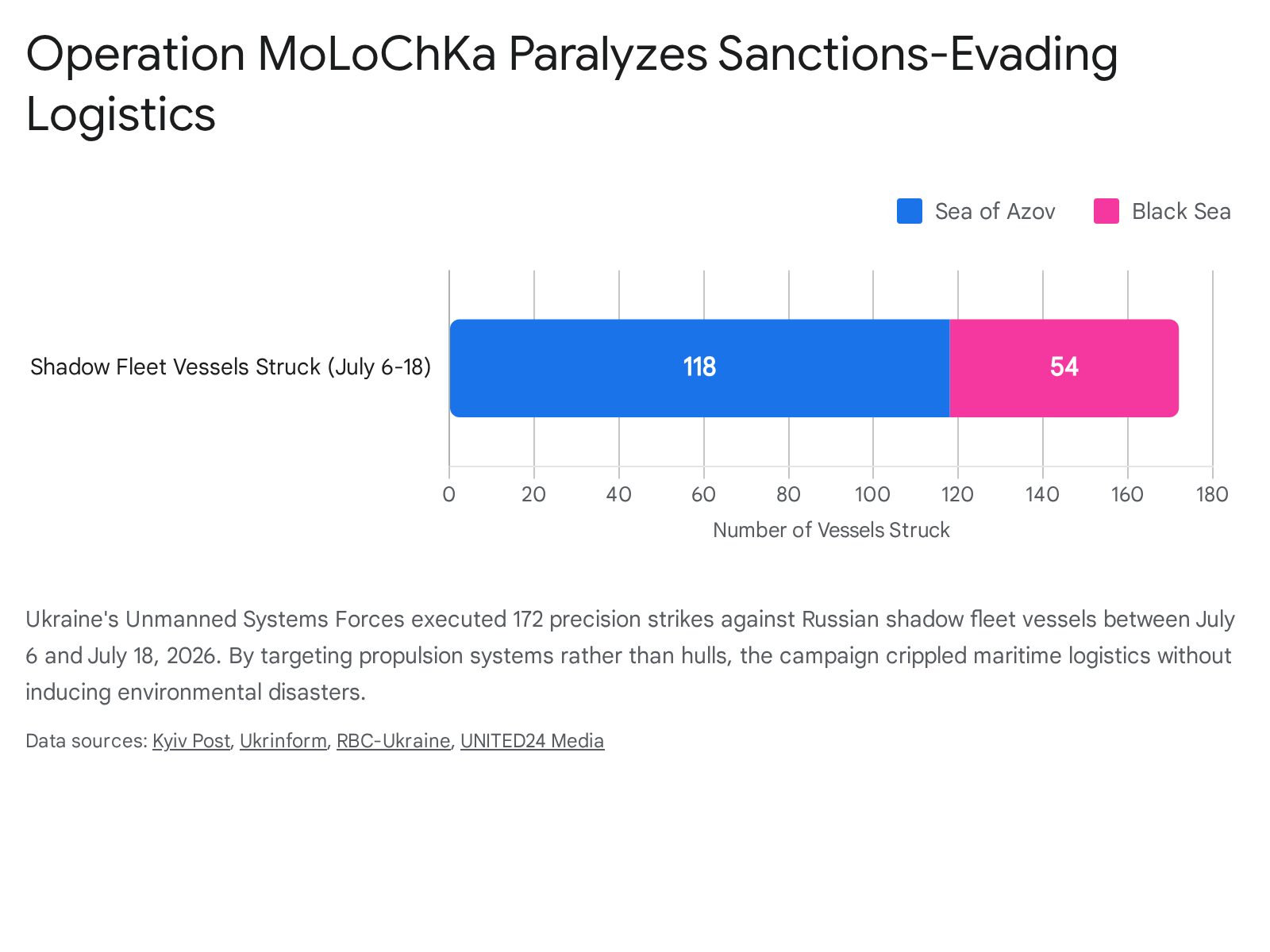
The most defining military development of the reporting period is the intensification of “Operation MoLoChKa,” a massive maritime drone offensive led by Ukraine’s Unmanned Systems Forces (USF). Over the span of thirteen days, culminating on July 18, this campaign successfully prosecuted strikes against 172 vessels belonging to the Russian “shadow fleet” operating in the Sea of Azov and the Black Sea3. By disabling feeder tankers, dry cargo ships, and tugboats without causing environmental disasters, Ukraine has effectively paralyzed the maritime logistical corridors vital for Russian crude exports and military supply lines3. The strategic resonance of this campaign is evidenced by the forced redeployment of elite Russian front-line drone operators, specifically the “Rubikon” center, from the eastern combat theater to the Black Sea to provide emergency point-defense for commercial vessels6. This represents a critical strategic vulnerability for Moscow, forcing a dilution of offensive ground capabilities to protect maritime economic assets.

Concurrently, the domestic political landscape in Kyiv experienced a seismic shift. President Volodymyr Zelenskyy executed a sweeping government reshuffle, dismissing Prime Minister Yuliia Svyrydenko and replacing her with Serhii Koretskyi, the crisis-tested CEO of the state-owned energy conglomerate Naftogaz9. This appointment signals an explicit governmental pivot toward winter energy resilience, infrastructure defense, and economic stabilization12. More divisively, Zelenskyy ousted the highly popular Defense Minister Mykhailo Fedorov, a primary architect of Ukraine’s drone innovation ecosystem, following an irreconcilable doctrinal dispute with the Commander-in-Chief of the Armed Forces, General Oleksandr Syrskyi14. The transition of defense leadership to Major General Yevhen Khmara—a seasoned intelligence operative and former head of the Security Service of Ukraine’s (SBU) elite “Alpha” unit—indicates that while civilian oversight of the military may be realigning, Ukraine’s reliance on specialized, intelligence-driven deep-strike operations will remain the cornerstone of its asymmetric warfare strategy17.

2. Detailed Operational and Diplomatic Developments

Bilateral Interactions & Diplomatic Posture

The diplomatic and political theater observed significant realignments, both internally within Ukraine and across international mediation efforts. The most consequential domestic development was President Zelenskyy’s sweeping cabinet reshuffle, which structurally reoriented Ukraine’s wartime administration toward an absolute prioritization of infrastructure resilience and technological strike operations. The dismissal of Prime Minister Yuliia Svyrydenko, who formally submitted her resignation on July 13, paved the way for the overwhelming parliamentary confirmation of Serhii Koretskyi on July 1610. Koretskyi, an engineer and former CEO of the state energy giants Naftogaz and Ukrnafta, represents a technocratic pivot. Under his tenure at Naftogaz, he successfully rebuilt national gas reserves to over 13 billion cubic meters and steered the company to record profitability amidst active wartime conditions13. His appointment clearly indicates that Kyiv anticipates a severe escalation in Russian infrastructure targeting in the impending 2026–2027 winter, requiring a premier crisis manager at the helm of the civilian government.

However, the reshuffle was marred by profound civil-military friction regarding the dismissal of Defense Minister Mykhailo Fedorov. Fedorov’s ouster exposed a deeply rooted doctrinal schism between the traditional military establishment, represented by General Syrskyi, and a new cadre of techno-centric innovators15. Fedorov’s mandate to transform the military via rapid technological integration, competitive procurement, and a shift away from Soviet-era attritional tactics met fatal institutional resistance14. Public protests erupted across Kyiv and other major cities, with demonstrators arguing that Fedorov’s departure threatens the very innovation that has kept Ukraine competitive against a numerically superior adversary15. His replacement, Major General Yevhen Khmara, brings an extensive background in covert “Phase Zero” operations and long-range technological strikes as the former commander of the SBU’s “Alpha” unit and an architect of “Operation Spiderweb”17. This suggests Zelenskyy intends to consolidate asymmetric capabilities directly under intelligence and special operations frameworks rather than civilian bureaucratic channels.

On the international front, direct bilateral coordination between the belligerents yielded moderate humanitarian dividends despite total diplomatic gridlock on peace frameworks. Mediated by the United Arab Emirates, Russia and Ukraine executed a symmetrical prisoner-of-war exchange on July 17, securing the release of 160 personnel from each side26. This was accompanied by a large-scale repatriation of remains, with Ukraine recovering the bodies of 501 fallen soldiers and Russia receiving 3127. The presence of explosive devices concealed within the repatriated remains of Ukrainian personnel has necessitated stringent explosive ordnance disposal (EOD) protocols prior to forensic identification, significantly complicating the recovery process28.

Broader peace negotiations remain entirely stalled. The Vatican’s peace envoy, Cardinal Matteo Zuppi, concluded a diplomatic mission to Kyiv focused explicitly on humanitarian mechanisms—specifically the return of deported Ukrainian children and the establishment of an “all-for-all” POW exchange framework encompassing roughly 7,000 Ukrainians and 4,000 Russians29. Meanwhile, the Russian political posture remains maximalist; the Kremlin categorically rejects Western security guarantees for Ukraine and continues to demand Ukrainian capitulation regarding occupied territories30.

Frontline Combat Updates

Ground combat operations continue to reflect a grinding, localized war of attrition, with the Russian Armed Forces prioritizing slow, methodical advances along the eastern front, heavily supported by glide bomb (KAB) and artillery suppression.

According to consolidated open-source intelligence (OSINT) data from DeepState, Russian forces achieved a net gain of approximately 15 square miles of Ukrainian territory over the four-week period ending July 14, 20261. This represents a marginal acceleration compared to the 10 square miles gained in the preceding four-week cycle. However, alternative assessments utilizing Institute for the Study of War (ISW) polygons indicate a much narrower net gain of only 5 square miles1. This discrepancy highlights the fluid nature of the “gray zones” and the difficulty in asserting permanent control over contested infiltration areas.

The primary locus of Russian offensive operations remains the Pokrovsk and Kostiantynivka-Druzhkivka tactical areas31. Russian units are actively attempting to execute pincer movements to dismantle the defensive nodes of Ukraine’s Donbas “fortress belt,” achieving minor confirmed advances near Ivanopillia, Kryva Luka, and Zatyshok30. The operational tempo remains extraordinarily high, with the Ukrainian General Staff reporting over 100 combat clashes daily, peaking at 43 distinct Russian assaults in the Pokrovsk direction alone over a 24-hour period32. Yet, the geographic pace of these advances is historically anomalous; independent analysis indicates Russian ground offensives are stalling at an average rate of advance of merely 50 meters per day around Kostiantynivka and 70 meters per day near Pokrovsk2.

Conversely, Ukrainian forces have demonstrated localized counter-offensive success. In the Oleksandrivka direction (Dnipropetrovsk Oblast borderlands), Ukrainian mechanized and infantry elements liberated six settlements, reclaiming approximately 120 square kilometers of territory34. The northern fronts in Kharkiv and Sumy remain active but largely static; despite Commander-in-Chief Syrskyi’s warnings of a renewed Russian attempt to carve out a “buffer zone,” Ukrainian defenses have largely contained cross-border incursions, actively fortifying secondary fallback lines near Vovchansk and Kupyansk30.

Territorial Control Metrics (July 2025 – July 2026)SourceValue
Total Russian Net Gain (Trailing 12 Months)DeepState / OSINT1,130 sq miles (Approx. 0.5% of UKR territory)1
Trailing 4-Week Net Change (June 16 – July 14)DeepState OSINT+15 sq miles (Russian Gain)1
Trailing 4-Week Net Change (June 16 – July 14)ISW / RM+5 sq miles (Russian Gain)1
Ukraine Counter-Offensive Gains (Oleksandrivka)ISW / OSINT+120 sq km (Approx. 46 sq miles)34

The 40-Day Deep-Strike Campaign & Maritime Security

Ukraine’s strategic posture has heavily pivoted toward a sustained, multi-domain deep-strike campaign targeting the logistical, energy, and maritime infrastructure that fuels the Russian war effort. The most highly disruptive component of this strategy is “Operation MoLoChKa,” executed by the Unmanned Systems Forces (USF).

Initiated on July 6, Operation MoLoChKa specifically targets the Russian “shadow fleet”—a vast network of feeder tankers, dry cargo vessels, and tugboats utilizing opaque ownership structures to bypass Western sanctions and the G7 oil price cap8. Over a 13-day period, USF aerial and naval drones successfully struck 172 vessels (118 in the Sea of Azov and 54 in the Black Sea)3. The operational methodology is distinctly precise: Ukrainian operators explicitly target the propulsion and steering systems of these vessels to achieve “irreversible paralysis,” transforming them into drifting barges without breaching the hulls, thereby avoiding catastrophic ecological oil spills3.

Bar chart showing number of complaints

The cascading effects of this maritime interdiction are severe. Shipping through the critical Don-Azov Channel has been temporarily halted, effectively severing a primary artery for Russian crude exports and military logistics flowing into occupied Crimea30. Consequently, an estimated 135 million barrels of Russian crude are currently stranded at sea as the offshore backlog expands5.

Simultaneously, the deep-strike campaign against Russian onshore energy infrastructure continues unabated. Ukrainian long-range systems successfully struck the Salavat Oil Refinery in Bashkortostan (Gazprom’s Neftekhim complex, previously untouched in 2026), the Afipsky refinery in Krasnodar Krai, and the Syzran refinery in the Samara region30. The most spectacular tactical feat was a strike utilizing long-range drone technology against the Omsk refinery—the largest gasoline producer in Russia—located 2,500 kilometers from the Ukrainian border39. The cumulative effect of these strikes has temporarily disabled an estimated 42.7% of Russia’s designed refining capacity, triggering domestic fuel shortages, skyrocketing consumer gasoline prices, and forcing the Kremlin to seek emergency imports from partners like India41. In a parallel targeted action, the chief engineer of the Russian-occupied Zaporizhzhia Nuclear Power Plant, Aleksandr Yakovlev, was killed by a drone strike in Enerhodar, drawing swift condemnation from the IAEA regarding the militarization of nuclear personnel corridors43.

Role of Third-Party Countries

The footprint of the conflict continues to expand across sovereign borders, heightening geopolitical friction and drawing direct involvement from third-party nations. In Moldova, a Russian Geran-2 (Shahed-136) drone breached national airspace and detonated near the village of Copanca during a massive Russian aerial assault targeting the Odesa region46. The Moldovan Ministry of Foreign Affairs condemned the incursion as a severe security threat46. Over the Baltic Sea, Polish fighter jets intercepted a Russian Il-20 reconnaissance aircraft operating without a transponder, marking the tenth such interception by Poland in 202648. Polish and Baltic intelligence agencies assess that these flights are part of a broader “Phase Zero” surveillance effort probing NATO air defense integration42.

Foreign military aid dynamics are also shifting toward indigenous Ukrainian production and component acquisition. The European Union authorized a derogation permitting Ukraine to utilize a portion of a €6 billion defense loan to procure drone components directly from Chinese manufacturers, bypassing standard EU procurement regulations30. This highlights a profound irony in the conflict’s supply chain: while China acts as a key enabler for the Russian defense industry, it simultaneously supplies the critical commercial electronics underpinning Ukraine’s drone superiority. Furthermore, France and Italy have granted Kyiv licenses to domestically produce French SCALP cruise missiles and Franco-Italian glide bombs, significantly bolstering Ukraine’s sovereign defense industrial base49. The German defense firm Helsing also announced the establishment of a new manufacturing facility in West Virginia, USA, strictly for producing HX-2 strike drones intended for the Ukrainian theater50.

Key Evolving Financial & Military Aid Mechanisms (July 2026)ContributorMechanism / Asset
EU Defense Loan DerogationEuropean UnionAuthorization to use €6B loan for Chinese-manufactured drone components30.
Sovereign Production LicensesFrance / ItalyDomestic Ukrainian production of SCALP cruise missiles and glide bombs49.
Advanced AI UAV SupplyGermany (Helsing)Delivery of 6,000 HX-2 autonomous strike drones51.
Defense Loan Scheme ParticipationUnited KingdomCommitment to participate in the EU’s €60B long-term defense loan framework30.

3. Drone Warfare and Unmanned Systems

Tactical & Strategic Deployments

The battlespace is entirely dominated by the proliferation and evolution of unmanned systems. Ukraine has transitioned from utilizing off-the-shelf commercial drones to deploying highly sophisticated, mass-produced indigenous platforms capable of striking thousands of kilometers deep into Russian territory. The Ukrainian Ministry of Defense reported that drone units have struck over one million targets since the beginning of 2026, accounting for roughly 90% of all successful battlefield strikes against Russian targets7.

In the maritime domain, Ukraine’s Unmanned Surface Vessel (USV) fleet has evolved from asymmetric harassment tools into multi-role naval platforms. The Sea Baby drone has been outfitted with modular weapon systems, including 122mm Grad rocket launchers, RPV-16 thermobaric rockets for suppressing coastal defenses, and Italian-made MN-103 Manta bottom mines capable of targeting medium vessels53. Concurrently, the Magura variants (including the W6) have undergone extensive upgrades to integrate the “Sea Dragon” system, fielding AA-11 Archer (R-73) missiles to defend against Russian attack helicopters, neutralizing the primary countermeasure historically used against them54.

In the aerial domain, the standout platform of 2026 is the FP-1 deep-strike drone, developed by the Ukrainian firm Fire Point. The Ukrainian-developed Fire Point FP-1 is a highly cost-effective one-way attack drone, engineered specifically for mass manufacturability39. Mass-produced at roughly 100 units per day using a plywood and foam airframe with a radar-absorbent skin, it relies on a two-cylinder piston engine and carries a modular 60-120kg warhead39. Its unit cost is remarkably low at $55,000, allowing it to act as a cost-asymmetric sponge against multi-million dollar Russian air defense interceptors39. With external fuel tanks added, its range extends up to 2,700km, which enabled the historic July 6 strike on the Omsk refinery deep in Siberia at a range of 2,500 kilometers40. Fire Point is also deploying the FP-5 Flamingo, a cruise missile carrying a 1,150 kg warhead with a 3,000 km range, utilizing a hot-launch carbon fiber rail system, offering strategic parity against Russian standoff weapons56.

Additionally, the integration of Western AI technology is maturing. German defense contractor Helsing is supplying Ukraine with 6,000 HX-2 AI-enabled strike drones51. Featuring an X-wing configuration and software-defined autonomy, the HX-2 demonstrated an 88% effective hit rate during U.S. military evaluations in Lithuania during Project Flytrap 5.057. Its primary advantage is terminal optical targeting and swarm capabilities, rendering it virtually immune to the GPS-spoofing and intense electronic warfare (EW) environments that have degraded earlier Western precision munitions51.

Technical Profile of Systems

Platform NameOriginRangePayloadRole & Key Features
FP-1Ukraine (Fire Point)1,600 km – 2,700 km60 kg – 120 kgStrategic deep-strike OWA UAV. Plywood/foam airframe, radar-absorbent, $55k unit cost39.
FP-5 ‘Flamingo’Ukraine (Fire Point)3,000 km1,150 kgLong-range cruise missile. Carbon fiber construction, hot launch capability, high terminal velocity56.
HX-2Germany (Helsing)Up to 100 km~12 kg (estimated)AI-enabled loitering munition. X-wing, swarm capable, highly EW-resistant51.
Sea Baby (2026)Ukraine (SBU)1,000 km850 kgMulti-role USV. Capable of carrying Grad rockets, thermobarics, and Manta naval mines53.
Magura V6/W6Ukraine (HUR)833 km320 kgAnti-ship USV. Integrated ‘Sea Dragon’ air-defense system (R-73 missiles) to counter helicopters54.
Molniya-2RussiaTactical (LOS)LightFPV/real-time controlled drone. Used by Russian forces for frontline civilian and logistical targeting60.

Targeting Priorities & Countermeasures

The escalating efficacy of Ukrainian drone operations has forced severe realignments in Russian force posture. The most dramatic shift is the Kremlin’s decision to pull up to 200 crews from the elite “Rubikon” Center for Advanced Unmanned Technologies from active frontlines6. These highly specialized operators, alongside elements of the 51st Air Defense Division and the Black Sea Fleet’s 1096th Anti-Aircraft Missile Regiment, are being redeployed to commercial tankers in the Black and Azov seas, armed with anti-aircraft drones, machine guns, and MANPADS to physically guard the shadow fleet against USV attacks7. This represents a profound victory for Ukrainian asymmetric strategy: naval drones are actively degrading Russian ground-force lethality by forcing the diversion of premium assets to maritime defense.

In retaliation, Russian forces have escalated their own drone operations, specifically targeting civilian logistics. Ukrainian Military Intelligence (HUR) intercepted directives ordering Russian drone units to hunt civilian transport, gas stations, buses, and supply trucks operating near the border and frontline areas60. Utilizing real-time controlled munitions like the Molniya-2 and Geran-Seeker, this campaign is a direct, punitive response designed to terrorize civilian populations and disrupt the “last mile” of Ukrainian military logistics60. However, reports indicate these units are suffering from severe training deficits, resulting in friendly-fire incidents, including a Molniya-2 drone detonating near a Russian civilian vehicle in the Kursk region due to operator disorientation60.

4. Resource Utilization, Constraints, and Sustainability

Manpower dynamics, logistics (fuel/ammo), and industrial capacity

Both belligerents are experiencing acute manpower and resource constraints, though the manifestations differ structurally.

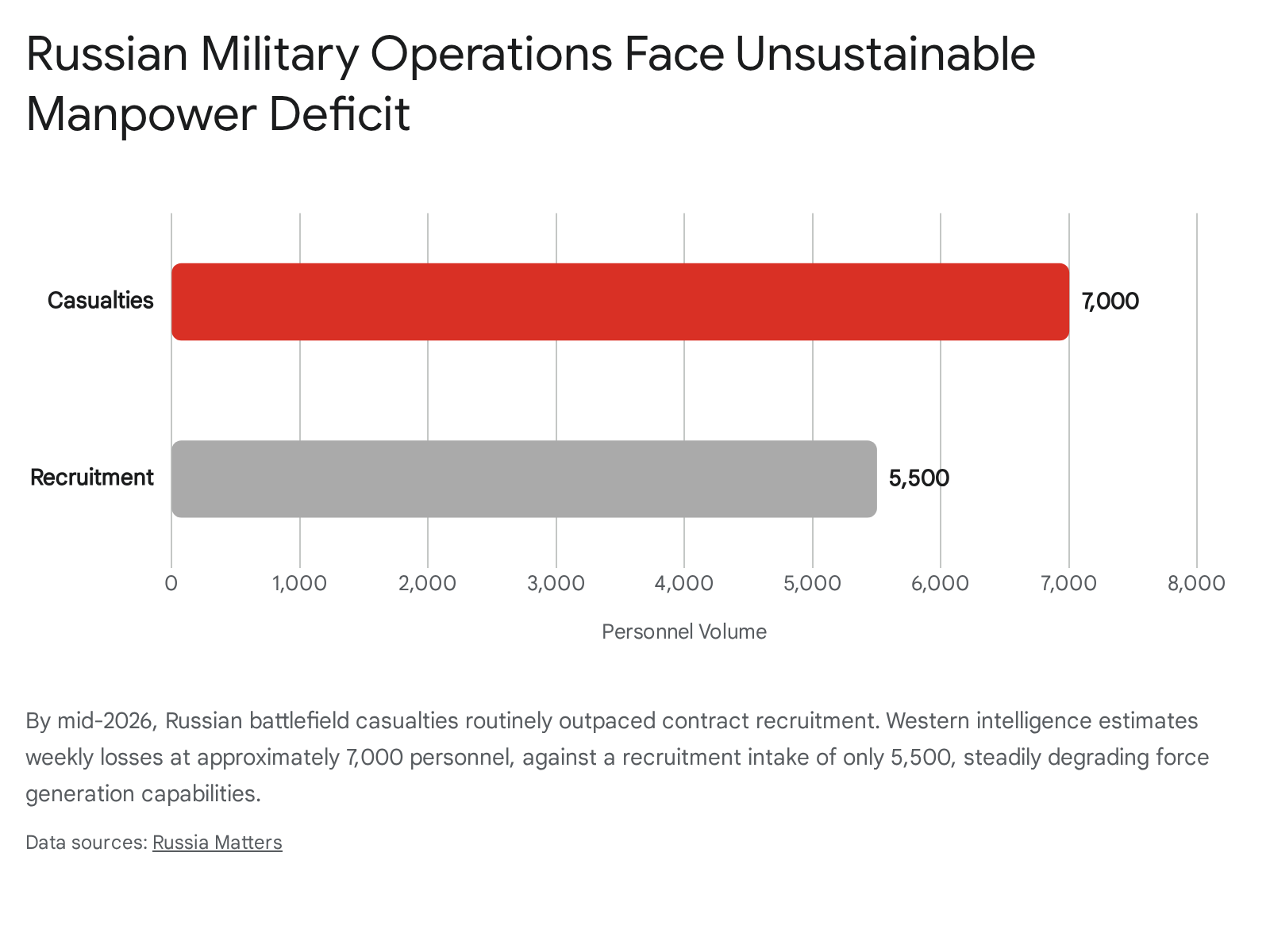
Russia is facing a rapidly tightening demographic and recruitment bottleneck. According to the Institute for the Study of War and Ukrainian intelligence, the Russian Ministry of Defense recruited approximately 195,000 contract soldiers by early July 2026—less than half of the 409,000 targeted for the year61. Daily recruitment rates have steadily declined from roughly 1,200 per day in 2024 to approximately 1,090 per day by mid-202661. Consequently, independent analyses estimate that Russia is currently inducting only about 5,500 personnel per week30. Simultaneously, Western intelligence assesses that Russian battlefield casualties are averaging 7,000 per week, creating a mathematically unsustainable deficit30.

Bar chart illustrating Russian military operations during

The introduction of Ukrainian AI-guided FPV drones has drastically reduced the survivability of Russian infantry; CIA assessments indicate Russian conscripts now survive an average of only 20 to 30 minutes after reaching the zero line30. To maintain offensive pressure without declaring politically toxic general mobilization, Moscow is increasingly reliant on marginalized populations, penal recruits, and foreign labor, resuming large-scale recruitment of North Koreans on student visas30.

Logistically, the relentless Ukrainian strikes on refining infrastructure have driven Russia’s domestic refining capacity to a 21-year low5. The systemic degradation of facilities like Gazprom’s Neftekhim Salavat and the Afipsky plant has forced the Russian government to implement emergency domestic fuel rationing and initiate fuel imports from India30.

Ukraine’s logistical hurdles center on persistent air defense missile shortages and the deeply unpopular realities of mass mobilization. Russia’s continued ability to penetrate Ukrainian airspace with ballistic missiles—such as the Iskander-M and S-400 systems used in the July 11 and July 17 barrages against Kyiv and Odesa—highlights critical gaps in the Patriot-supplied umbrella30. Manpower generation remains a sensitive domestic issue for Kyiv, marred by public frustration over heavy-handed “busification” recruitment tactics, which former Defense Minister Fedorov argued could be mitigated by replacing raw infantry mass with drone technology14. However, Ukraine’s industrial capacity to produce asymmetric strike weapons has exponentially increased, providing a vital counterbalance to conventional manpower shortages39.

Strategic Sustainability Projection

The conflict has evolved into a hyper-technological war of attrition where conventional industrial output is repeatedly neutralized by cheap, precision software-defined weaponry. The macroeconomic indicators suggest severe long-term strain on the Russian Federation. Russia’s projected GDP growth for 2025 has been revised down to 1.1%, with a budget deficit of 2.6% of GDP, driven entirely by the exorbitant costs of sustaining the military-industrial complex and compensating the families of casualties1. Consequently, Russian state-affiliated polling centers have recorded one of the sharpest drops in President Vladimir Putin’s approval ratings since the start of the war65.

Ukraine’s sustainability relies entirely on maintaining the operational tempo of its DIB and preserving Western financial lifelines. The success of the deep-strike campaign has proven to skeptical Western allies—reportedly altering the rhetoric of U.S. political figures including Donald Trump—that Kyiv possesses a viable, asymmetric pathway to systematically dismantle the Russian war machine without requiring a massive, conventional armored breakthrough65. As the 2026 winter approaches, the core strategic variable will be whether Prime Minister Koretskyi can shield Ukraine’s fragile energy grid from Russian ballistic counter-strikes while the USF continues to strangle Russian oil revenues.

Macro-Strategic Indicators (Cumulative Estimates, July 2026)RussiaUkraine
Total Military Casualties (Killed/Wounded)~450,000+ (CSIS est. >1.4M total losses)67~525,000 – 625,000 (CSIS / Western est.)1
Confirmed Civilian Fatalities8,012 (RF Government)1~16,000+ (U.N. Estimate)1
Tanks and Armored Vehicles Lost14,12215,9631
Displaced Citizens~1,000,000 Emigrated19,600,000 (Internal & External)1

5. Chronological Timeline of Key Events

  • July 11, 2026:
    • Russia launches a massive overnight barrage against Kyiv utilizing over 120 drones and 12 missiles, killing 6 civilians nationwide30.
    • Ukrainian maritime drones strike four vessels in Taganrog Bay (Sea of Azov), prompting Russia to halt shipping through the Don-Azov Channel30.
    • President Zelenskyy authorizes the creation of a specialized “long-range command” within the Armed Forces30.
  • July 12, 2026:
    • Russian forces execute glide bomb (KAB) strikes on a civilian bus stop in Sumy, killing 5 and wounding approximately 3030.
    • A Russian Geran-2 (Shahed) drone violates Moldovan airspace, detonating near the village of Copanca46.
    • Ukraine’s SBU attacks 14 Russian vessels (10 tankers, 4 ferries) in the Kerch area38.
  • July 13, 2026:
    • Ukrainian forces confirm the liberation of six settlements and 120 square kilometers in the Oleksandrivka direction following sustained counterattacks34.
    • Ukrainian drones strike the Salavat Oil Refinery in Bashkortostan, damaging primary distillation units30.
    • Prime Minister Yuliia Svyrydenko formally submits her resignation to the Verkhovna Rada11.
  • July 14, 2026:
    • The Verkhovna Rada officially accepts the resignation of the Svyrydenko cabinet21.
    • Russian Foreign Minister Sergei Lavrov publicly denounces Ukraine’s “Operation MoLoChKa” maritime strikes as acts of “terrorism”3.
    • OSINT data confirms Russian forces achieved a net gain of between 5 and 15 square miles over the preceding four weeks1.
  • July 15, 2026:
    • A Ukrainian drone strike kills Aleksandr Yakovlev, the chief engineer of the Russian-occupied Zaporizhzhia Nuclear Power Plant, prompting condemnation from the IAEA43.
    • German Chancellor Friedrich Merz and Baltic leaders issue warnings regarding impending Russian kinetic sabotage operations against NATO infrastructure30.
    • President Zelenskyy formally nominates Naftogaz CEO Serhii Koretskyi for the position of Prime Minister10.
  • July 16, 2026:
    • Serhii Koretskyi is overwhelmingly confirmed as Prime Minister by the Verkhovna Rada (289 votes in favor)10.
    • Defense Minister Mykhailo Fedorov is dismissed. Widespread protests erupt in Kyiv and other major cities decrying the removal of the drone-innovation advocate14.
    • Major General Yevhen Khmara is appointed acting Defense Minister by President Zelenskyy17.
    • Russia and Ukraine exchange the bodies of fallen soldiers (501 returned to Ukraine, 31 to Russia)27.
  • July 17, 2026:
    • Russian ballistic missile strikes target Odesa, killing two civilians and severely damaging port infrastructure30.
    • Ukraine executes deep strikes on the Yanos oil refinery in Yaroslavl30.
    • Russian and Ukrainian officials confirm an exchange of 160 POWs mediated by the UAE26.
  • July 18, 2026:
    • Commander Robert “Madyar” Brovdi confirms that Ukraine’s Unmanned Systems Forces struck an additional 13 shadow fleet vessels overnight.
    • Operation MoLoChKa’s 13-day tally reaches 172 Russian vessels paralyzed (118 in the Sea of Azov, 54 in the Black Sea)3.

Please share the link on Facebook, Forums, with colleagues, etc. Your support is much appreciated and if you have any feedback, please email us in**@*********ps.com. If you’d like to request a report or order a reprint, please click here for the corresponding page to open in new tab.


Sources Used

  1. The Russia-Ukraine War Report Card, July 15, 2026, https://www.russiamatters.org/news/russia-ukraine-war-report-card/russia-ukraine-war-report-card-july-15-2026
  2. Russian Blood and Treasure: The Ballooning Costs of Putin’s War – CSIS, https://www.csis.org/analysis/russian-blood-and-treasure-ballooning-costs-putins-war
  3. Ukraine’s Unmanned Systems Forces Strike 13 More Russian Shadow Fleet Vessels – Kyiv Post, https://www.kyivpost.com/post/80565
  4. Further 13 vessels of Russian Federation’s “shadow fleet” have been struck, – Madiar, https://censor.net/en/news/4014174/the-usf-has-struck-a-further-13-vessels-of-the-russian-federation-s-shadow-fleet
  5. Russia’s Shadow Fleet Takes 12 More Drone Hits, Totalling 159 as Ukraine Expands Black Sea Campaign – UNITED24 Media, https://united24media.com/war-in-ukraine/russias-shadow-fleet-takes-12-more-drone-hits-totalling-159-as-ukraine-expands-black-sea-campaign-20833
  6. Russia weakens drone operations on battlefield to protect shadow fleet, https://www.pravda.com.ua/eng/news/2026/07/18/8044682/
  7. Ukraine Hits 13 More Russian Shadow Fleet Vessels, Bringing Total to 172 in 13 Days, https://united24media.com/war-in-ukraine/ukraine-hits-13-more-russian-shadow-fleet-vessels-bringing-total-to-172-in-13-days-20870
  8. Ukraine hit 147 Russian shadow-fleet ships in 10 days. Now Moscow is pulling its best drone unit off the front to guard the tankers, partisans say – Euromaidan Press, https://euromaidanpress.com/2026/07/16/ukraine-hit-147-russian-shadow-fleet-ships-in-11-days-now-moscow-is-pulling-its-best-drone-unit-off-the-front-to-guard-the-tankers-partisans-say/
  9. Ukraine gets a new prime minister. Who is Serhii Koretskyi?, https://www.pravda.com.ua/eng/news/2026/07/16/8044351/
  10. Ukrainian parliament appoints Koretskyi as prime minister – The Kyiv Independent, https://kyivindependent.com/ukrainian-parliament-appoints-koretskyi-as-prime-minister/
  11. Zelenskyy Announces Sweeping Government Reshuffle as Ukrainian Prime Minister Yuliia Svyrydenko Resigns, https://www.commonspace.eu/news/zelenskyy-announces-sweeping-government-reshuffle-ukrainian-prime-minister-yuliia-svyrydenko
  12. Serhii Koretskyi: From energy executive to Ukraine’s new prime minister – Anadolu Ajansı, https://www.aa.com.tr/en/world/serhii-koretskyi-from-energy-executive-to-ukraine-s-new-prime-minister/4000576
  13. Ukraine’s new prime minister takes office with a hard winter looming and protests on the streets – KVUE, https://www.kvue.com/article/syndication/associatedpress/ukraines-new-prime-minister-takes-office-with-a-hard-winter-looming-and-protests-on-the-streets/616-5783613d-297f-4552-92be-aad446c08859
  14. Dismissal of Ukraine’s defence minister highlights wider issues for Zelenskyy – The Guardian, https://www.theguardian.com/world/2026/jul/17/dismissal-ukraine-defence-minister-mykhailo-fedorov-volodomyr-zelenskyy
  15. Zelensky ousts popular defense minister, an architect of Ukraine’s drone program, https://www.washingtonpost.com/world/2026/07/16/zelensky-ousts-popular-defense-minister-an-architect-ukraines-drone-program/
  16. Ukrainians protest Zelenskyy’s ouster of his popular defense minister, https://apnews.com/article/russia-ukraine-war-defense-minister-reshuffle-fedorov-88083e4381b1690f5048088d75954d3a
  17. Yevhenii Khmara – Wikipedia, https://en.wikipedia.org/wiki/Evhenii_Khmara_(general)
  18. Zelensky Names SBU’s Khmara Acting Defense Minister, Cites Strike Operations Experience – Kyiv Post, https://www.kyivpost.com/post/80435
  19. A ‘Gift’ to Moscow: Russian War Bloggers Cheer Dismissal of Ukraine’s Tech Chief – Kyiv Post, https://www.kyivpost.com/post/80443
  20. Ukraine’s Prime Minister Svyrydenko resigns | Ukrainska Pravda, https://www.pravda.com.ua/eng/news/2026/07/13/8043942/
  21. Ukrainian PM Svyrydenko’s Resignation Backed by 258 Votes in Parliament – Kyiv Post, https://www.kyivpost.com/post/80250
  22. Ukraine names energy chief Serhii Koretskyi PM for war’s hardest winter, https://www.indiatoday.in/world/story/ukraine-prime-minister-serhii-koretskyi-hardest-war-winter-ptag-2949570-2026-07-16
  23. Ukraine’s divisive reshuffle and defense shake-up: what we know – Arab News, https://www.arabnews.com/node/2651292/world
  24. ‘Syrskyy go away’: Hundreds protest in Kyiv as Zelenskyy ousts defence minister – Watch, https://timesofindia.indiatimes.com/world/europe/syrskyy-go-away-hundreds-protest-in-kyiv-as-zelenskyy-ousts-defence-minister-watch/articleshow/132436038.cms
  25. Ukraine fights under an interim defense chief after Zelenskyy’s contested government shake-up, https://apnews.com/article/russia-ukraine-war-fedorov-defense-minister-966aa6f66b81df96310531af1f11fba5
  26. Russia and Ukraine carried out prisoner exchange on principle of 160 for 160 – 1Lurer, https://www.1lurer.am/en/2026/06/26/Russia-and-Ukraine-carried-out-prisoner-exchange-on-principle-of-160-for-160/1536874
  27. Russia and Ukraine exchange bodies of fallen soldiers – Apa.az, https://en.apa.az/europe/russia-and-ukraine-exchange-bodies-of-fallen-soldiers-516463
  28. Ukraine Repatriates 501 Bodies Claimed to Be Fallen Soldiers – Kyiv Post, https://www.kyivpost.com/post/80440
  29. Cardinal Zuppi concludes Ukraine mission: ‘Every effort for peace will be made’, https://ugcc.ua/en/data/cardinal-zuppi-concludes-ukraine-mission-every-effort-for-peace-will-be-made-2368/
  30. Russia in Review, July 10–17, 2026, https://www.russiamatters.org/news/russia-review/russia-review-july-10-17-2026
  31. ISW Russian Offensive Campaign Assessment, July 11, 2026 – Kyiv Post, https://www.kyivpost.com/post/80089
  32. War update: 276 combat clashes on front line over past day, most in Pokrovsk and Huliaipole directions – Ukrinform, https://www.ukrinform.net/rubric-ato/4145497-war-update-276-combat-clashes-on-front-line-over-past-day-most-in-pokrovsk-and-huliaipole-directions.html
  33. War update: 100 combat clashes on front line since morning – Ukrinform, https://www.ukrinform.net/rubric-ato/4145410-war-update-100-combat-clashes-on-front-line-since-morning.html
  34. ISW Russian Offensive Campaign Assessment, July 13, 2026 – Kyiv Post, https://www.kyivpost.com/post/80205
  35. Active Conflicts & News Megathread June 15, 2026 : r/CredibleDefense – Reddit, https://www.reddit.com/r/CredibleDefense/comments/1u6c7u2/active_conflicts_news_megathread_june_15_2026/
  36. Ukrainian attacks on the Russian shadow fleet – Wikipedia, https://en.wikipedia.org/wiki/Ukrainian_attacks_on_the_Russian_shadow_fleet
  37. Ukraine Conflict Monitor: Russia-Ukraine war map | ACLED, https://acleddata.com/monitor/ukraine-conflict-monitor
  38. Madyar posted a video of yet another nighttime hunt for tankers – UA.NEWS, https://ua.news/en/war-vs-rf/madiar-pokazav-video-chergovogo-nichnogo-poliuvannia-na-tankeri
  39. Fire Point FP-1 – Wikipedia, https://en.wikipedia.org/wiki/Fire_Point_FP-1
  40. Ukraine conducts record drone strike of 2,500km after 12-hour flight — $55,000 unit made of plywood halts operations at Russia’s largest gasoline producer | Tom’s Hardware, https://www.tomshardware.com/tech-industry/drones/ukraines-55000-plywood-drone-flew-2500-km-and-shut-down-russias-largest-oil-refinery
  41. How to Pile the Pain on Putin, https://cepa.org/article/how-to-pile-the-pain-on-putin/
  42. ISW Russian Offensive Campaign Assessment, July 16, 2026 – Kyiv Post, https://www.kyivpost.com/post/80449
  43. Ukrainian Drone Attack Killed Chief Engineer at Zaporizhzhia Nuclear Plant, Russia Says, https://www.themoscowtimes.com/2026/07/16/ukrainian-drone-attack-killed-chief-engineer-at-zaporizhzhia-nuclear-plant-russia-says-a93261
  44. Rosatom says Zaporizhzhia nuclear plant chief engineer, driver killed in Ukrainian drone attack, https://www.aa.com.tr/en/eurasia/rosatom-says-zaporizhzhia-nuclear-plant-chief-engineer-driver-killed-in-ukrainian-drone-attack/3999600
  45. IAEA condemns reported killing of chief engineer at Zaporizhzhia NPP, https://www.world-nuclear-news.org/articles/iaea-condemns-reported-killing-of-zaporizhzhias-chief-engineer
  46. Russian drone crashes and explodes in Moldovan village – RBC-Ukraine, https://newsukraine.rbc.ua/news/russian-drone-crashes-and-explodes-in-moldovan-1783932773.html
  47. Russian Shahed crashes in Moldova after Russian strikes on Odesa region | Ukraine Top News – Головне в Україні, https://glavnoe.in.ua/en/news-en/russian-shahed-crashes-in-moldova-after-russian-strikes-on-odesa-region
  48. Polish Jets Intercept Russian Spy Plane Over Baltic Sea – Kyiv Post, https://www.kyivpost.com/post/80270
  49. ISW Russian Offensive Campaign Assessment, July 14, 2026 – Kyiv Post, https://www.kyivpost.com/post/80279
  50. German UAV firm Helsing picks West Virginia for first US manufacturing – Breaking Defense, https://breakingdefense.com/2026/07/german-uav-firm-helsing-picks-west-virginia-for-first-us-manufacturing/
  51. Helsing to produce 6000 additional strike drones for Ukraine, https://helsing.ai/newsroom/helsing-to-produce-6000-additional-strike-drones-for-ukraine
  52. Ukrainian drones strike 12 Russian ‘shadow fleet’ vessels in Black Sea as Crimea comes under large-scale attack – The Kyiv Independent, https://kyivindependent.com/fires-drone-strikes-reported-overnight-across-occupied-crimea-as-shadow-fleet-vessels-allegedly-struck-in-black-sea/
  53. Ukraine’s Sea Baby Maritime Drone (USV) | Covert Shores, https://www.hisutton.com/Ukraine-Sea-Baby-USV.html
  54. Overview Of Ukrainian Maritime Drones (USVs) Of The Russo-Ukrainian War | Covert Shores, https://www.hisutton.com/Ukrainian-USVs-Russo-Ukraine-War.html
  55. Magura V5 naval drones to get anti-air and dive capabilities – Euromaidan Press, https://euromaidanpress.com/2024/03/14/magura-v5-naval-drones-to-get-anti-air-and-dive-capabilities/
  56. Fire Point (Ukrainian firm) – Wikipedia, https://en.wikipedia.org/wiki/Fire_Point_(Ukrainian_firm)
  57. ​How U.S. Military Was Impressed by the HX-2 Drones, Those Successfully Are Hitting russians in Ukraine, Showed 88% Effective Hits During Exercises in Lithuania | Defense Express, https://en.defence-ua.com/weapon_and_tech/how_us_military_was_impressed_by_the_hx_2_drones_those_successfully_are_hitting_russians_in_ukraine_showed_88_effective_hits_during_exercises_in_lithuania-18802.html
  58. Russia Complains German AI-Powered HX-2 Drones Are Now Hunting Targets Deep Behind the Frontline – UNITED24 Media, https://united24media.com/latest-news/russia-complains-german-ai-powered-hx-2-drones-are-now-hunting-targets-deep-behind-the-frontline-16406
  59. Magura vs. Sea Baby: Closer look at Ukrainian drone warfare against Russian ships, https://newsukraine.rbc.ua/news/magura-vs-sea-baby-closer-look-at-ukrainian-1709831518.html
  60. Ukrainian Intel Warns of Russian Campaign to Target Frontline Civilian Logistics – Kyiv Post, https://www.kyivpost.com/post/80478
  61. Russia Is Unable to Replace Its Frontline Casualties Due to a Slowdown in the Recruitment of Contract Soldiers — ISW – UA.NEWS, https://ua.news/en/war-vs-rf/rosiia-ne-vstigaie-popovniuvati-vtrati-na-fronti-cherez-upovilnennia-naboru-kontraktnikiv-isw
  62. Russian attacks kill 6 and wound 29 as Ukrainian forces target oil tankers, https://apnews.com/article/russia-ukraine-war-missiles-drones-kyiv-578044d589f94cc985b699ffcf301297
  63. Busification: Is the Ukraine Army Crisis Real? | Eastern Express – Kyiv Post, https://www.kyivpost.com/videos/80457
  64. The Russia-Ukraine War Report Card, July 1, 2026, https://www.russiamatters.org/news/russia-ukraine-war-report-card/russia-ukraine-war-report-card-july-1-2026
  65. ISW Russian Offensive Campaign Assessment, July 17, 2026 – Kyiv Post, https://www.kyivpost.com/post/80551
  66. ISW Russian Offensive Campaign Assessment, July 15, 2026 – Kyiv Post, https://www.kyivpost.com/post/80354
  67. How Russia turned to saints in its push for ‘traditional values’ — and more babies, https://www.ncronline.org/news/how-russia-turned-saints-its-push-traditional-values-and-more-babies
  68. Total russian combat losses in Ukraine as of July 17, 2026, https://mod.gov.ua/en/news/total-russian-combat-losses-in-ukraine-as-of-july-17-2026
  69. The Russia-Ukraine War Report Card, July 8, 2026, https://www.russiamatters.org/news/russia-ukraine-war-report-card/russia-ukraine-war-report-card-july-8-2026
  70. ‘Crimean Switch Off’ — Ukrainian Drones Hit 13 More Russian Vessels, 5 Substations, Madyar Says – Ground News, https://ground.news/article/13-tank-vessels-were-attacked-in-azoviko-mori-by-ross-madyar
  71. Ukrainian PM Svyrydenko refused to become ambassador to US – sources, https://www.pravda.com.ua/eng/news/2026/07/14/8044027/
  72. Video: Madyar Shows Strikes Against Ships of Russia’s Shadow Fleet in the Black Sea, https://ua.news/en/war-vs-rf/video-madiar-pokazav-udari-po-sudnakh-tinovogo-flotu-rosiyi-v-chornomu-mori
  73. Zelenskyy submits Serhii Koretskyi’s nomination for prime minister to parliament, https://www.pravda.com.ua/eng/news/2026/07/15/8044295/
  74. Parliament appoints Serhii Koretskyi as Ukraine’s new prime minister amid protests over defense minister dismissal, https://gwaramedia.com/en/parliament-appoints-serhii-koretskyi-as-ukraines-new-prime-minister-amid-protests-over-defense-minister-dismissal/
  75. Zelenskyy instructs Khmara to act as defense minister – Interfax-Ukraine, https://en.interfax.com.ua/news/general/1185660.html
  76. Ukraine war briefing: Kyiv ‘will win this war’, Keir Starmer tells Zelenskyy on final trip as PM, https://www.theguardian.com/world/2026/jul/17/ukraine-war-briefing-outgoing-british-pm-starmer-tells-zelenskyy-that-kyiv-will-win-this-war
  77. Russia and Ukraine Exchange 370 POWs – The Moscow Times, https://www.themoscowtimes.com/2026/06/05/russia-and-ukraine-exchange-370-pows-a92941
  78. Unmanned Systems Forces hit 13 more vessels of Russia’s shadow fleet – Ukrinform, https://www.ukrinform.net/rubric-ato/4145514-unmanned-systems-forces-hit-13-more-vessels-of-russias-shadow-fleet.html

Comparative Firearm Reliability and Performance Analysis: Military Armament Corporation MAC 1014 vs. Orthos Arms Raider S4

Executive Summary

The expiration of the patents surrounding the Auto-Regulating Gas-Operated (A.R.G.O.) system initially developed for the United States military has led to an influx of imported clone shotguns into the North American tactical firearms market. Within this sector, two platforms have emerged as notable options occupying different pricing and performance tiers: the Military Armament Corporation (MAC) 1014, imported and distributed by SDS Arms, and the Raider S4, imported, modified, and distributed by Orthos Arms. While both firearms trace their primary metallurgical and geometric origins to manufacturing facilities located in Turkey, they represent divergent approaches to quality control, aftermarket readiness, and out-of-the-box operational capabilities.

The MAC 1014 is positioned strategically as a high-value, entry-level tactical shotgun designed to deliver the baseline functionality of the dual-piston A.R.G.O. system at a lower cost than its Italian progenitor. Targeted primarily at budget-conscious consumers, home defense practitioners, and firearm modification enthusiasts, the MAC 1014 serves as a functional, utilitarian baseline platform. Available in a variety of configurations—including standard polymer pistol-grip, traditional Turkish walnut, and electroless marine nickel—the MAC 1014 requires end-user intervention to achieve optimal reliability. The general consensus dictates that achieving consistent operation necessitates a strict, high-pressure ammunition break-in period alongside potential aftermarket part substitutions to overcome initial manufacturing tolerances and friction points American Rifleman Analysis1.

Conversely, the Orthos Raider S4 is positioned as a premium, turnkey tactical solution designed for professionals, competitive shooters, and enthusiasts who demand immediate performance without the requirement for extensive aftermarket tuning. While the core receiver and barrel components are manufactured overseas, Orthos Arms performs secondary deburring, quality control inspections, and final assembly at their facility in the United States. The Raider S4 is equipped with several proprietary, factory-installed components, including the advanced SHOCK FORCE recoil mitigation system, FIBERTRON LED-illuminated sights, aerospace-grade carbon fiber and Kevlar elements, and custom Cerakote finishes applied to protect against harsh environmental conditions Bauer Precision Specifications3.

The primary comparative thesis of this analysis asserts that while both shotguns share identical mechanical DNA derived from the proven A.R.G.O. architecture, their divergence in final finishing, internal lapping, and factory-included enhancements creates two distinct ownership paradigms. The MAC 1014 requires patience, specific ammunition investments, and aftermarket knowledge from the user to excel, whereas the Orthos Raider S4 leverages a significantly higher initial capital investment to bypass traditional break-in periods, delivering a refined, duty-ready platform upon unboxing.

Reliability and Accuracy

The mechanical foundation of both the MAC 1014 and the Orthos Raider S4 relies on a dual short-stroke gas piston operating system, an engineering design noted for its self-regulating properties and inherent reliability under adverse conditions Outdoor Life Review6. This mechanism operates via two stainless steel pistons situated laterally just forward of the chamber. Upon firing a chambered shell, high-pressure expanding gases are tapped directly from the barrel bore through specifically calibrated gas ports, driving the pistons rearward by approximately half an inch. These pistons strike the forward face of the bolt carrier, transferring the kinetic energy required to unlock the rotary bolt head, extract the spent hull, cock the hammer, and compress the heavy recoil spring housed within the stock tube. Because the system vents excess gas automatically, it is theoretically capable of cycling a wide spectrum of ammunition pressures without manual adjustment Ronin’s Grips Analysis8.

Mechanically, both shotguns exhibit inherent accuracy profiles suitable for tactical applications. Both platforms utilize 18.5-inch 4140 full steel, smooth chrome-lined barrels equipped with Benelli/Mobil pattern choke threads, ensuring consistent shot dispersion and the ability to tune patterns for specific target ranges Xtreme Guns and Ammo Specs5. When utilizing 1-ounce rifled slugs, both platforms are mechanically capable of maintaining standard tactical accuracy parameters, grouping within effective vital zones at 50 yards. The primary differentiator in practical accuracy stems from their respective sighting systems. The MAC 1014 utilizes a standard ghost ring rear sight paired with a white-dot protected front post Sportsman’s Warehouse Listing10. In contrast, the Orthos Raider S4 improves rapid target acquisition via its proprietary FIBERTRON LED front sight. This system utilizes traditional ambient light gathering through fiber optics but features a supplementary, USB-C rechargeable LED to artificially illuminate the aiming post in low-light or variable-light environments Orthos Arms Details3.

The long-term reliability of these gas-operated clones is inextricably linked to internal friction and the physical lapping of machined surfaces. The MAC 1014 relies almost entirely on the end-user to “lap” the internal components through live fire. The manufacturer explicitly mandates a 100-round break-in protocol utilizing high-velocity ammunition, specifying a minimum of 1350 feet per second (FPS) and a 1 1/8 ounce payload MAC Owners Manual13. During this phase, the high port pressures cycle the action, mechanically polishing microscopic burrs left on the receiver rails, the bolt carrier assembly, and within the gas cylinders. If a user attempts to bypass this high-pressure break-in period and cycle standard target loads (e.g., 1145 FPS to 1200 FPS) prematurely, the MAC 1014 may experience failures to eject (FTE) and stovepipes. The lower gas volume generated by target loads is generally insufficient to overcome the friction of the unpolished surfaces combined with the factory recoil spring Ronin’s Grips Maintenance Guide2.

The Orthos Raider S4 effectively circumvents this break-in period through stateside quality control measures. Because Orthos Arms imports the raw components and performs secondary deburring, polishing, and hand-fitting assembly in the United States, the internal friction coefficient of the action is reduced prior to the consumer firing their first shot Reddit Shotguns Forum15. While Orthos still publishes a conservative recommendation for a minor 50-round break-in with 1300 FPS ammunition, users report that the Raider S4 cycles low-recoil tactical loads and standard birdshot reliably straight out of the box Towers Armory Specs17.

Bar chart comparing firearm complaint percentages for MAC

The following table delineates the most common malfunctions associated with the A.R.G.O. clone architecture, mapping specific defect types to their mechanical causes and identifying which platform exhibits a higher historical propensity for each issue.

Malfunction TypeDescriptionPrimary Phase of OccurrenceVerified CausesHistorically Prone Platform
Failure to Eject (FTE) / StovepipeSpent hull fails to clear the action and becomes trapped laterally in the ejection port.Initial Break-In (0-200 rounds)Insufficient gas pressure from low-brass ammunition; excessive internal friction on unpolished bolt carrier rails Ronin’s Grips Analysis2.MAC 1014
Failure to Return to Battery (FRTB)Bolt carrier stops short of fully rotating and locking the bolt head into the barrel extension.Early Lifecycle (0-500 rounds)Weak factory recoil spring tension; lack of proper lubrication on the bolt cam pin eBay Spring Parts2.MAC 1014
Nose-Up Feed JamFresh shell releases from the magazine tube but binds at an upward angle on the shell lifter.Any PhaseDeformed or weak factory magazine spring; tolerance stacking in the shell stop latch preventing smooth release21.MAC 1014
Magazine Tube BindingRounds become stuck laterally within the magazine tube, failing to feed onto the lifter under spring tension.Out of the BoxOver-torqued forward grip screws indenting the aluminum magazine tube housing during factory assembly Reddit liberalgunowners12.Orthos Raider S4
Light Primer StrikesThe firing pin fails to adequately strike and detonate the primer of the chambered shell, resulting in a click but no discharge.High Round Count (2,000+ rounds)Firing pin spring fatigue over prolonged use; excessive carbon debris accumulation within the bolt carrier channel.Both Platforms

Durability and Maintenance

The core metallurgical foundations of both shotguns are standard for the industry, utilizing T6 7075 hardened aerospace aluminum for the receivers and high-tensile 4140 steel for the barrel assemblies Buds Gun Shop Listing22. Despite this foundational geometry, the long-term durability of micro-components—specifically internal springs, retaining pins, strikers, and shell catches—is an area where imported shotguns face scrutiny.

In the MAC 1014, the factory magazine springs are prone to metallurgical fatigue. When users remove the factory limiter to utilize the full 7-round tube capacity (a common modification), the original equipment manufacturer (OEM) spring occasionally lacks the sustained tension required to push the final two shells onto the lifter reliably, causing intermittent feeding issues eBay Store Data21. Additionally, the hardware securing the MAC 1014’s pre-installed top Picatinny rail sometimes ships from the factory without sufficient thread locker compound. This can cause the rail to loosen under the sustained recoil of 12-gauge slugs, resulting in a loss of zero Reddit Tacticalshotguns20. Notably, the MAC 1014 utilizes a coarser M8x1.25 thread pitch for its stock retention bolt and rail screws, which diverges from the M8x1.0 fine pitch used on genuine Benelli M4s. This represents a tolerance stacking risk for users attempting to force Italian hardware into the Turkish receiver without understanding thread geometry26.

The Orthos Raider S4 features upgraded micro-components straight from the factory. The inclusion of an oversized tactical charging handle, an enhanced oversized bolt release lever, and an advanced flat-blade trigger represent precision CNC-machined parts designed to replace the often cast or Metal Injection Molded (MIM) parts found on base-level clones Bauer Precision Catalog3. Furthermore, the Orthos Raider S4 utilizes baked-on Cerakote finishes applied directly over the aluminum receiver and steel barrel. This ceramic-polymer coating provides an increase in abrasion resistance, chemical resistance, and saltwater corrosion protection when compared to the MAC 1014’s standard black anodization and simple chromate barrel finish Palmetto State Armory Catalog11.

Because both shotguns maintain a high degree of architectural compatibility with the Benelli M4 (with industry analysts citing up to 98% parts commonality), owners of both platforms frequently substitute suspect factory components with premium Italian OEM or American aftermarket parts Ronin’s Grips Top 10 Clones8.

Firearm PlatformOriginal Suspect PartRecommended DIY ReplacementReason for Maintenance Intervention
MAC 1014Factory Magazine SpringWolff Extra Power Magazine SpringThe OEM spring fatigues rapidly under compression, causing failures to feed when utilizing aftermarket 7-round extended tubes Shell Tactical Parts21.
MAC 1014Factory Plastic FollowerFreedom Fighter Tactical FollowerThe OEM plastic follower is prone to binding inside the aluminum magazine tube due to friction and rapid carbon fouling buildup8.
MAC 1014Picatinny Rail ScrewsOEM Screws re-secured with Blue LoctiteFactory screws consistently loosen under heavy 12-gauge recoil impulses, resulting in the loss of optical zero20.
Orthos Raider S4Factory Gas Piston O-RingsViton High-Temperature O-RingsProlonged exposure to high-velocity, high-temperature slug gases can degrade the factory rubber rings over thousands of rounds, causing slight gas leakage30.
Both PlatformsFactory Extractor & Extractor SpringBenelli OEM Extractor AssemblyUpgrading this critical component ensures the positive extraction of expanded, low-quality brass and steel-rimmed target shells, reducing FTE malfunctions29.

Ownership Experience

The subjective shooting experience and physical interaction with the firearm reveal a contrast between the two platforms, highlighting their disparate design philosophies.

The MAC 1014 offers a traditional tactical layout. The standard model features a fixed polymer stock equipped with a rubberized pistol grip and capped with a simple 7/8-inch thick rubber recoil pad American Rifleman Review1. The ergonomics are static. The length of pull (LOP) cannot be adjusted to accommodate shooters with shorter arm spans or professionals wearing thick body armor, and the cheek weld remains fixed, which can complicate the alignment of taller red dot optics. The trigger pull on the MAC 1014 is heavy, measuring 9 pounds and 10 ounces Outdoor Life Review7. Handling the MAC 1014 feels utilitarian; it acts as a rugged tool that prioritizes manufacturing cost efficiency.

Conversely, the Orthos Raider S4 is engineered from the ground up to maximize ergonomic control and shooter comfort during sustained firing schedules. The centerpiece of this experience is the patented SHOCK FORCE Recoil System, which is housed within a fully adjustable carbon fiber or Kevlar-reinforced stock Palmetto State Armory Details3. This mechanical buffer system actively decelerates the rearward travel of the bolt carrier group, absorbing and dissipating the kinetic transfer before it impacts the shooter’s shoulder. Users report that the Raider S4 effectively tames the recoil of heavy 3-inch magnum loads, preventing flinching and allowing for faster follow-up shots Buds Gun Shop Reviews22.

Furthermore, the Orthos Raider S4 discards the standard plastic handguard in favor of a rigid M-LOK aluminum handguard, and it includes an angled, three-piece modular vertical grip Bauer Precision Specs3. This interface allows the shooter to biomechanically lock their support hand into the weapon system, actively driving the muzzle down during rapid strings of fire. Combined with the adjustable cheek pad ensuring optical alignment and the crisp break of the advanced flat-blade trigger, the Raider S4 provides a customized shooting experience that distinguishes it from standard clones Xtreme Guns and Ammo Listing3.

Ownership of a MAC 1014 often involves end-user modification. Because buyers explicitly purchase the MAC 1014 to upgrade it, they frequently encounter the reality of tolerance stacking. Mixing Turkish receiver dimensions with American 922(r) compliance parts (such as Mesa Tactical stocks or Midwest Industries aluminum handguards) and Italian Benelli trigger groups can result in binding actions, overly stiff cross-bolt safeties, and misaligned optical rails Brownells Product Reviews2. The Orthos Raider S4 circumvents these modification risks by arriving modified. Because the Cerakote application, M-LOK rails, extended manual of arms controls, and enhanced recoil systems are hand-fitted and subjected to strict quality control checks at the Orthos facility prior to distribution, the risk of end-user tolerance stacking is eliminated.

Warranty and Support

The difference in corporate support structures, warranty coverage, and repair turnaround times impacts long-term consumer confidence and the total cost of ownership.

Military Armament Corporation, operating under the corporate umbrella of SDS Arms, backs the MAC 1014 with a 1-Year Limited Warranty covering defects in materials and original workmanship. This initial coverage theoretically transitions into a Lifetime Service Plan, though this plan explicitly excludes normal wear items such as recoil springs, grips, and cosmetic finishes MAC Warranty Information37. Executing a warranty claim requires the formal submission of a Return Merchandise Authorization (RMA), and SDS Arms explicitly states an expected repair turnaround time of 3 to 4 weeks SDS Arms RMA Portal38. While historically reliable in honoring valid claims for the MAC 1014, SDS Arms has recently suffered from supply chain volatility regarding proprietary parts. In a move that caused concern within the consumer base, SDS ended warranty support for their legacy MAC pistols and Spandau shotguns due to severed relationships with their Turkish manufacturing partners. This action injected skepticism into the market regarding the long-term viability of their Lifetime Service Plan SDS Arms Press Release39. Furthermore, SDS warns users that customizing the firearm with aftermarket parts may void the warranty entirely if damage occurs SDS FAQ41.

Orthos Arms addresses the persistent “cheap import” stigma by providing the consumer with highly responsive customer service. The Raider S4 is backed by a Lifetime Warranty Orthos Arms Brand Overview3. Consumers consistently report fast turnaround times. In one documented case involving a bolt failure, the user shipped the firearm to the Orthos facility; Orthos technicians replaced the gas pistons, charging handle, bolt assembly, and pistol grip, and returned the fully repaired firearm to the user within a one-week turnaround time Reddit Shotguns Forum17. Similarly, when another user reported magazine tube binding due to an over-torqued factory grip screw, Orthos customer service overnighted an upgraded carbon fiber magazine tube to the customer without requiring the weapon to be shipped in Reddit liberalgunowners12. This responsive support mitigates the risk profile typically associated with purchasing Turkish shotguns.

Voice of the Customer (VoC)

Synthesizing thousands of individual data points and reviews from high-traffic firearms communities (including Reddit’s r/Shotguns, Pistol-Forum, and GlockTalk) reveals contrasting consumer profiles and debates surrounding these two platforms. By filtering out unverified praise and isolating feedback exclusively from high-round-count users, two distinct consensuses emerge regarding market value and operational trust.

The MAC 1014 Consensus: The median sentiment regarding the MAC 1014 is generally positive, provided the consumer actively manages their expectations and treats the firearm as a project rather than a finished product. High-round-count users frequently note that the MAC 1014 is a highly viable clone, noting that once the 100-round high-brass break-in period is complete, the shotgun runs reliably with a wide variety of ammunition Reddit Shotguns Debate43. The dominant debate surrounding the MAC 1014 involves the financial logic of the “Builder’s Path.” Critics argue that by the time a user purchases the base $420 MAC 1014, adds a Mesa Tactical stock, installs a Midwest Industries aluminum handguard, purchases Wolff springs and Benelli extractors, and spends money on the mandatory high-brass break-in ammunition, they have spent nearly $1,100 on a clone that still lacks the secondary resale value of a genuine Benelli M4 Reddit Orthos vs Benelli25. Proponents counter that spreading the financial cost out over time allows budget-restricted consumers to access top-tier tactical geometry.

Synthesized VoC Statement (MAC 1014): “The MAC 1014 represents an exceptional value, but it is not a finished, duty-ready product straight out of the box. You must aggressively clean out the factory grease, apply high-quality oil, rigidly adhere to the 1350 FPS ammunition break-in protocol, and expect to replace the magazine spring early in its lifespan. If you are willing to put in the mechanical equity, it is highly reliable.”

The Orthos Raider S4 Consensus: The Raider S4 faces initial skepticism online due to its premium price tag, an MSRP that encroaches on the territory of proven European titans like the Beretta 1301 Tactical and the base model Benelli M4 Reddit Shotguns Elite Thread12. Forum purists frequently dismiss it as an overpriced clone. However, empirical reviews from verified owners consistently counter this narrative. Users who actually own and utilize the Raider S4 in 3-Gun competitions or tactical courses report excellent reliability, praising the SHOCK FORCE recoil system and the impeccably smooth, polished action Reddit Raider S4 Thread17. The consensus among verified owners is that attempting to duplicate the Raider S4’s exhaustive feature set on a genuine Benelli M4 (including custom Cerakote, M-LOK handguards, a match-grade trigger, a recoil-reducing stock, and LED fiber optic sights) would push the total financial investment well past $3,500 Reddit Orthos Raider Discussion17.

Synthesized VoC Statement (Orthos Raider S4): “There is skepticism regarding its import origins, but the actual performance on the range is excellent. It cycles low-recoil birdshot from the beginning, the recoil mitigation is highly effective, and Orthos’ customer service is very responsive. It is a turnkey solution for those who want the classic M4 aesthetic combined with modern AR-15 style modularity.”

Quantitative Ratings

The following comparative ratings reflect an aggregation of mechanical specifications, metallurgical properties, and verified consumer performance data gathered across high-volume firing schedules.

Evaluation MetricMilitary Armament Corp MAC 1014Orthos Arms Raider S4
Reliability (Post Break-in)8.5 / 109.5 / 10
Accuracy (Mechanical/Sights)7.0 / 109.0 / 10
Durability (Component Quality)6.5 / 108.5 / 10
Maintenance (Ease of Service)8.0 / 108.5 / 10
Warranty & Support Structure6.0 / 109.5 / 10
Ergonomics & Handling6.5 / 109.5 / 10
Value Proposition9.0 / 108.0 / 10
OVERALL COMPOSITE SCORE7.3 / 108.9 / 10

Conclusion and Use Case Analysis

Drawing a definitive conclusion requires closely contextualizing the prospective buyer’s intent, capital liquidity, and mechanical aptitude. From a strict performance, durability, and ergonomic standpoint, the Orthos Arms Raider S4 is the higher-scoring firearm. It scores significantly higher overall (8.9 vs 7.3) because Orthos has addressed the inherent flaws commonly associated with imported clones. By performing stateside deburring, installing premium CNC-machined components, integrating advanced recoil physics, and backing the product with highly responsive customer service, Orthos delivers a tactical shotgun that requires no user modification.

However, the MAC 1014 remains a strong option for entry-level value. It provides the baseline A.R.G.O. operating system and tactical geometry at a highly accessible price point.

Specific Use Case Excellences:

  • Home Defense (Budget-Restricted): The MAC 1014 is a strong competitor in this specific scenario. At an average street price of $415, an individual can acquire the shotgun, a tactical flashlight, a budget red dot sight, and a full case of defensive buckshot for less than half the cost of an Orthos Raider S4. Once properly broken in with high-velocity ammunition, its mechanical reliability is sufficient for localized, low-round-count defensive scenarios where budget is the primary constraint Reddit Tacticalshotguns46.
  • 3-Gun Competition / Tactical Training: The Orthos Raider S4 is highly suited for this high-stress use case. The SHOCK FORCE recoil system allows for fast follow-up shots on target, minimizing muzzle climb. The enlarged loading port, oversized controls, and the ability to cycle low-recoil 1200 FPS target loads reliably out of the box are requirements for competitive shooters navigating high-volume stages Reddit Shotguns Reviews5.
  • Gunsmithing / Modification Hobbyists: The MAC 1014 is the clear winner for tinkerers and mechanical enthusiasts. Its high architectural compatibility with the Benelli M4 aftermarket allows hobbyists to slowly upgrade the shotgun over time, learning the intricacies of firearm mechanics and parts fitting Ronin’s Grips Clone Guide8.
  • Harsh Maritime Environments: The MAC 1014 Marine (with its electroless nickel coating) or the Orthos Raider S4 (with its baked-on Cerakote finishes) both excel here, outperforming standard blued or phosphate shotguns in resisting salt-spray corrosion and moisture degradation Bauer Precision Catalog3.

Pricing and Availability

Research Phase & Average Street Price:

Based on a cross-section of active online vendor inventory, the MAC 1014 carries an average street price of $415.00, reflecting its market position as a high-value import. The Orthos Raider S4 base model carries an average street price of $1,400.00, though base models are frequently found discounted from primary vendors for as low as $699.99. The custom-finished Orthos Elite models carry an average street price of $1,699.99.

Vendor Search Results (Listings at or below Average Street Price):

Methodology

This comparative analysis was conducted through an aggregation and synthesis of engineering data, manufacturer technical specifications, and longitudinal consumer feedback. The data-gathering process prioritized signal-to-noise filtering, discarding isolated, unverified anecdotes and emotional brand loyalty that frequently distorts the objective evaluation of Turkish-manufactured firearms. Claims regarding defect trends, specific malfunction types, cyclic reliability, and warranty experiences were cross-referenced against high-traffic firearms communities, including Reddit’s r/Shotguns, r/Tacticalshotguns, and Pistol-Forum, alongside verified vendor reviews.

Data Constraints

A defect or performance characteristic was only included in the quantitative ratings and malfunction mapping of this report if it was corroborated by multiple, independent user accounts spanning different production batches and geographic locations. Technical claims regarding gas system operations, aftermarket parts compatibility, and thread pitches were verified directly against established armorer data for the Benelli A.R.G.O. system architecture to ensure baseline accuracy throughout the report. Constraints inherent to crowdsourced data, such as survivorship bias in malfunction reporting, were mitigated by weighting high-round-count reviews (1,000+ shells fired) more heavily than initial unboxing impressions.


Note: Vendor Sources listed are not an endorsement of any given vendor. It is our software reporting a product page given the direction to list products that are between the minimum and average sales price when last scanned.


Please share the link on Facebook, Forums, with colleagues, etc. Your support is much appreciated and if you have any feedback, please email us in**@*********ps.com. If you’d like to request a report or order a reprint, please click here for the corresponding page to open in new tab.


Sources Used

  1. Solid Values: MAC 1014 & MAC 2 | An Official Journal Of The NRA – American Rifleman, https://www.americanrifleman.org/content/solid-values-mac-1014-mac-2/
  2. Analysis of the MAC-1014 Shotgun: Long-Term Reliability and Durability – Ronin’s Grips, https://blog.roninsgrips.com/analysis-of-the-mac-1014-shotgun-long-term-reliability-and-durability/
  3. Orthos Raider S4 America 250 Elite 12 Gauge 18.5″ Shotgun – Bauer Precision, https://www.bauer-precision.com/orthos-raider-s4-america-250-elite-12-gauge-18-5-shotgun-limited-edition-america-250/
  4. Orthos Arms Raider S4 Elite 12 Gauge 18.5″ 6rds Semi-Auto Shotgun, Alpine Elite, https://palmettostatearmory.com/orthos-arms-raider-s4-elite-12-gauge-18-5-6rds-semi-auto-shotgun-alpine-elite.html
  5. Orthos Arms Raider S4 Competition – XTREME Guns and Ammo, https://xtremegunsandammo.com/shop/shotguns-for-sale/orthos-arms/orthos-raider-s4/orthos-arms-raider-s4-competition/
  6. MAC 1014 Shotgun Review – News & Current Events – USCCA Community, https://community.usconcealedcarry.com/t/mac-1014-shotgun-review/101614
  7. MAC 1014 Shotgun Review: Diamond in the Rough or Junk Benelli Clone? – Outdoor Life, https://www.outdoorlife.com/guns/mac-1014-review/
  8. Market Analysis and Engineering Assessment of the Military Armament Corporation MAC-1014 Shotgun – Ronin’s Grips, https://blog.roninsgrips.com/market-analysis-and-engineering-assessment-of-the-military-armament-corporation-mac-1014-shotgun/
  9. MAC 1014 Pistol Grip CALIFORNIA LEGAL – 12ga – WBT Guns, https://wbtguns.com/current-sales/mac-1014-pistol-grip-california-legal-12ga/
  10. Military Armament Corp MAC 1014 Pistol Grip 12 Gauge 3in Electroless Marine Nickel Semi Automatic Shotgun – 18.5in | Sportsman’s Warehouse, https://www.sportsmans.com/shooting-gear-gun-supplies/shotguns/military-armament-corp-mac-1014-pistol-grip-12-gauge-3in-electroless-marine-nickel-semi-automatic-shotgun-185in/p/1929279
  11. MAC 1014 12GA Semi-Auto Shotgun – Tactical & Reliable – SDS Arms, https://sdsarms.com/mac-1014/
  12. Orthos Raider S4 or Panzer Arms M4 – Anyone have experience with either of these shotugns? : r/liberalgunowners – Reddit, https://www.reddit.com/r/liberalgunowners/comments/1p77yyx/orthos_raider_s4_or_panzer_arms_m4_anyone_have/
  13. MAC 1014 – BigCommerce, https://cdn11.bigcommerce.com/s-3vxd7ju6xz/content/Products%20Downloads/MAC1014-OWNERS-MANUAL.pdf
  14. military armament corporation | The Black Campbell, https://blackcampbell.com/tag/military-armament-corporation/
  15. Just Picked up my Orthos Raider S4 : r/Shotguns – Reddit, https://www.reddit.com/r/Shotguns/comments/1fbnpp1/just_picked_up_my_orthos_raider_s4/
  16. Out of jail!! : r/CAguns – Reddit, https://www.reddit.com/r/CAguns/comments/1raz5e3/out_of_jail/
  17. Orthos arms raider s4 : r/Shotguns – Reddit, https://www.reddit.com/r/Shotguns/comments/1cblmbb/orthos_arms_raider_s4/
  18. ORTHOS Raider S4 12 Gauge 18.5″ 6rd – FDE – Towers Armory, https://www.towersarmory.com/products/orthos_raider_s4_12_gauge_18_5_6rd_fde
  19. Orthos Raider : r/Shotguns – Reddit, https://www.reddit.com/r/Shotguns/comments/1pw4fpq/orthos_raider/
  20. MAC 1014 or Mossberg Maverick 88? : r/liberalgunowners – Reddit, https://www.reddit.com/r/liberalgunowners/comments/1qw6ef8/mac_1014_or_mossberg_maverick_88/
  21. Benelli M4/M1014 Upgraded High Power Magazine Spring – eBay, https://www.ebay.com/itm/395319052564
  22. Orthos Arms Raider S4 Tactical Shotgun Black – 6+1 Rounds | 18.5″ Barrel | 3″ Chamber, https://www.budsgunshop.com/product_info.php/products_id/411561339/orthos+arms+raider+s4+tactical+shotgun+black
  23. Orthos Arms Raider S4 – Shotguns – XTREME Guns and Ammo, https://xtremegunsandammo.com/shop/shotguns-for-sale/orthos-arms/orthos-raider-s4/orthos-arms-raider-s4/
  24. 2025 Shotgun Of The Year: SDS Arms MAC 1014 – American Rifleman, https://milarmamentcorp.com/news/2025-shotgun-of-the-year-sds-arms-mac-1014-american-rifleman/
  25. Orthos raider S4 : r/Shotguns – Reddit, https://www.reddit.com/r/Shotguns/comments/1bmczuv/orthos_raider_s4/
  26. I heard MAC 1014s and other Turknelli clones were garbage… so I bought one. – Reddit, https://www.reddit.com/r/Tacticalshotguns/comments/1r8c79n/i_heard_mac_1014s_and_other_turknelli_clones_were/
  27. Orthos Arms Raider S4 Elite 12 Gauge 18.5″ 6rds Semi-Auto Shotgun, Patriot Elite, https://palmettostatearmory.com/orthos-arms-raider-s4-elite-12-gauge-18-5-6rds-semi-auto-shotgun-patriot-elite.html
  28. Orthos Raider S4 or Panzer Arms M4 – Anyone have experience with either of these shotugns? : r/Shotguns – Reddit, https://www.reddit.com/r/Shotguns/comments/1p7as8v/orthos_raider_s4_or_panzer_arms_m4_anyone_have/
  29. Shell Tactical: Benelli M4 Parts & Accessories, https://shelltactical.com/
  30. MAC 1014 Issues/Testing : r/Shotguns – Reddit, https://www.reddit.com/r/Shotguns/comments/1j94cvb/mac_1014_issuestesting/
  31. Top 10 Benelli M4-Style Clone Shotguns – Year To Date 2026 – Ronin’s Grips, https://blog.roninsgrips.com/top-10-benelli-m4-style-clone-shotguns-year-to-date-2026/
  32. Orthos Arms Raider S4 The Gentleman, 12 Gauge, 18.5″ Barrel – 810159633093 – Blackstone Shooting Sports, https://blackstoneshooting.com/orthos-arms-raider-s4-the-gentleman-12-gauge-18-5-barrel-810159633093/
  33. Orthos Arms Raider Vanguard Elite S4 18.5″ 12GA Semi-Auto Shotgun w/ Kevlar Stock, Distressed Army Green | Palmetto State Armory, https://palmettostatearmory.com/orthos-arms-raider-vanguard-elite-s4-18-5-12ga-semi-auto-shotgun-w-kevlar-stock-distressed-army-green.html
  34. Orthos Raider S4 – Color Option Available – Only The Best Firearms, https://otbfirearms.com/orthos-raider-s4/
  35. Reviews & Ratings on BENELLI M4 M-LOK HANDGUARD – Brownells, https://www.brownells.com/product-reviews/?product=benelli-m4-m-lok-handguard
  36. Military Armament Corp MAC 1014 Walnut 12 GA 18.5″ Barrel 5-Rounds – GrabAGun, https://grabagun.com/military-armament-corp-mac-1014-walnut-12-ga-18-5-barrel-5-rounds.html
  37. MAC 1014 12GA Semi-Auto Shotgun – Tactical & Reliable – Military Armament Corporation, https://milarmamentcorp.com/mac-1014/
  38. Warranty & RMA Request – SDS Arms, https://sdsarms.com/warranty-rma-request/
  39. Important Warranty Service Update for Legacy MAC Pistols – SDS Arms, https://sdsarms.com/news/important-warranty-service-update-for-legacy-mac-pistols/
  40. Warranty Service Update for Spandau Over/Under Shotguns – SDS Arms, https://sdsarms.com/news/warranty-service-update-for-spandau-overunder-shotguns/
  41. FAQs & Owner’s Manuals | Product Support – SDS Arms, https://sdsarms.com/faq-manuals/
  42. Orthos Raider S4 : r/guns – Reddit, https://www.reddit.com/r/guns/comments/1rgmwg2/orthos_raider_s4/
  43. Least Bad Turknelli? : r/Shotguns – Reddit, https://www.reddit.com/r/Shotguns/comments/1t2sgci/least_bad_turknelli/
  44. Shotgun advice: MAC Model 1014 : r/liberalgunowners – Reddit, https://www.reddit.com/r/liberalgunowners/comments/1q0s4hb/shotgun_advice_mac_model_1014/
  45. Is the Elite version of the Orthos Raider S4 worth it? : r/Shotguns – Reddit, https://www.reddit.com/r/Shotguns/comments/1kzx0uv/is_the_elite_version_of_the_orthos_raider_s4/
  46. Thoughts on Orthos over Benelli? : r/Tacticalshotguns – Reddit, https://www.reddit.com/r/Tacticalshotguns/comments/1o2zvcv/thoughts_on_orthos_over_benelli/
  47. Orthos Raider S4 for Sale | Buy Online at GunBroker, https://www.gunbroker.com/orthos-raider-s4/search?keywords=orthos%20raider%20s4&s=f&cats=3105
  48. MAC 1014 Marine – 12GA Semi-Auto Tactical Shotgun – Military Armament Corporation, https://milarmamentcorp.com/mac-1014-marine/
  49. MAC Firearms Lineup | Shotguns & 1911 Pistols | Models – Military Armament Corporation, https://milarmamentcorp.com/mac-firearms/
  50. SDS Imports Military Arms Corp MAC 1014 12 Ga. 3 in. Chamber 18.5 in. Barrel 5 Rnd – Exchange, https://www.shopmyexchange.com/sds-imports-military-arms-corp-mac-1014-12-ga-3-in-chamber-18-5-in-barrel-5-rnd/4023851

Firearm Reliability and Performance Analysis: Orthos Raider Shotgun Family

Executive Summary

The modern tactical shotgun landscape has undergone a profound structural shift following the expiration of the utility patents safeguarding the legendary Benelli M4 Auto-Regulating Gas-Operated (A.R.G.O.) system. This legal expiration catalyzed a massive influx of imported clones, primarily manufactured in the industrial firearms hubs of Turkey. The resulting market is now heavily bifurcated between the premium, duty-proven European platforms that command exorbitant price premiums, and highly variable, budget-oriented imports that frequently suffer from critical metallurgical failures and abysmal quality control. Within this polarized environment, the Orthos Arms Raider S4 shotgun family emerges in a highly specific, hybridized middle tier1.

Operating under the Armsco brand umbrella alongside its sister company Otus Arms, Orthos Arms functions primarily out of Des Plaines, Illinois4. The Raider S4 is positioned as a “premium clone” or an “80% solution.” The core architectural components of the weapon—specifically the T6 7075 aluminum receiver blank, the 4140 steel barrel, and the raw bolt carrier group—are manufactured in Turkey by OEM suppliers such as Aksa Arms2. Rather than directly importing and selling these bare-bones configurations, Orthos Arms subjects these raw components to rigorous stateside quality control, extensive hand-deburring, and internal surface polishing2.

The target market for the Raider S4 encompasses budget-conscious tactical shooters, home defense practitioners, and competitive 3-gun participants who demand the modularity and gas-regulated performance of an Italian flagship but are unwilling to accept the $2,000 to $2,500 entry cost required for a base-model European counterpart2. The platform is segmented into three primary configurations. The Standard Raider S4 represents the entry-level offering, featuring a basic black Cerakote finish and polymer furniture1. The Elite Series elevates the platform with advanced, distressed Cerakote patterns (e.g., Alpine Elite, Highland Elite, Vanguard Elite), carbon fiber magazine tubes, and Kevlar-reinforced stock components10. Finally, the Competition and Short-Barreled Shotgun (SBS) tiers cater to specialized sporting and National Firearms Act (NFA) regulated defense applications, featuring tuned triggers and 14-inch barrel geometries1.

The general consensus among high-round-count operators and defensive instructors regarding the Raider S4’s reliability and ergonomics is cautiously optimistic, though heavily caveated by the necessity of end-user diligence. Ergonomically, the platform is widely celebrated as superior to a factory-stock European import, arriving heavily accessorized with M-LOK handguards, proprietary recoil-dampening stocks, and advanced illumination-ready sighting systems8. However, long-term operational reliability remains directly tied to the operator’s adherence to a rigid, high-velocity ammunition break-in protocol. When the kinetic surfaces of the Turkish components are properly mated, and when users proactively monitor the gas pistons for metallurgical fatigue, the Raider S4 represents a formidable, highly capable defensive platform.

Reliability and Accuracy

Mechanical Accuracy and Sighting Systems

The mechanical accuracy potential of the Orthos Raider S4 is dictated by its 18.5-inch (or 14-inch in the SBS configuration) smoothbore barrel, forged from 4140 high-tensile steel8. The bore is comprehensively chrome-lined, a critical manufacturing step that not only drastically improves corrosion resistance in humid or maritime environments but also provides a highly lubricious surface that prevents lead and plastic wad fouling from accumulating and degrading pattern density over extended strings of fire2. The muzzle is threaded to accept the industry-standard Benelli Mobil choke tube system8. This architectural decision provides the end-user with immediate access to a vast aftermarket ecosystem of constriction devices, allowing the operator to finely tune the weapon’s spread patterns for specific loads, ranging from wide-patterning #4 buckshot for close-quarters interior defense to tight-patterning 00 buckshot for extended-range engagements15.

The factory sighting systems on the Raider S4 heavily augment the platform’s practical, real-world accuracy. Orthos equips the receiver with a highly robust, fully adjustable rear ghost ring sight, shielded by protective aluminum “ears” to prevent zero-shift during hard impacts or vehicle transit8. The front sight utilizes Orthos Arms’ proprietary FIBERTRON technology. Traditional fiber-optic sights are entirely reliant on ambient environmental light; in pitch-black scenarios, they become invisible. Tritium night sights solve this, but possess a finite half-life and offer poor daylight visibility. The FIBERTRON system merges a high-visibility light-gathering fiber rod with a micro-LED emitter embedded in the sight housing8. This allows the operator to electronically illuminate the fiber optic in zero-light conditions, yielding instantaneous dot-to-retina target acquisition without the bulk or battery reliance of a primary electronic optic3. For operators who do prefer true electronic reflex sights, the top of the 7075-T6 aluminum receiver features a rigidly milled Picatinny rail section, ensuring that heavy holographic optics or micro red dots will maintain mechanical zero despite the violent kinetic impulses generated by 12-gauge recoil8.

Long-Term Reliability and the Break-In Threshold

The functional heartbeat of the Raider S4 is its direct mechanical emulation of the auto-regulating dual short-stroke gas piston system. This specific operating mechanism utilizes two stainless steel gas pistons positioned just forward of the chamber. As a shell is detonated, high-pressure expanding gases are tapped from the barrel through two small ports, violently driving the dual pistons rearward by roughly a half-inch. These pistons strike the forward face of the bolt carrier assembly, transferring immense kinetic energy and initiating the unlocking of the rotating bolt head20.

While this mechanical geometry is globally recognized for its ability to self-regulate across varying chamber pressures, the translation of this design through Turkish manufacturing introduces distinct operational friction thresholds. The Raider S4, fresh out of the factory box, possesses microscopic machining burrs along the internal rails of the receiver, the raceways of the bolt carrier, and the interior walls of the gas cylinder2. Furthermore, the factory recoil spring housed within the stock tube, and the hammer spring within the trigger pack, are manufactured to extremely stiff, heavy-duty tolerances to ensure reliable primer ignition and positive lockup when dirty22.

To overcome this heavy spring tension and lap the rough internal machining marks, Orthos Arms explicitly dictates a mandatory break-in period. Operators must fire a minimum of 50 rounds of high-velocity ammunition—specifically loads generating 1300 Feet Per Second (FPS) or higher, such as 1-1/4 ounce high-brass magnum loads or full-power rifled slugs8. Firing standard 1150 FPS target loads or light birdshot during this nascent phase almost universally results in sluggish cyclic rates and immediate malfunctions, as the low-pressure gas impulse lacks the kinetic energy required to force the stiff bolt carrier rearward past the friction points3. Once the kinetic surfaces are appropriately polished through the extreme pressure of the break-in protocol, the Raider S4 exhibits exceptional, sustained long-term reliability. Post-break-in, operators report the system successfully cycling a vast spectrum of ammunition down to a 1250 FPS threshold without requiring field lubrication13.

Malfunction TypeDescriptionPrimary Phase of OccurrenceVerified Causes
Failure to Eject (FTE) / “Stovepiping”The spent hull fails to fully clear the ejection port and is subsequently crushed or trapped by the forward-returning bolt carrier group.Initial Break-in Phase (0-50 rounds)Insufficient gas pressure generation. Low-brass, low-velocity (<1250 FPS) birdshot failing to generate the kinetic energy required to fully compress the stiff, unbroken factory recoil springs13.
Piston Shearing / Catastrophic Gas FailureThe dual gas pistons fracture, deform, or shear off completely within the gas block, turning the weapon into a manual single-shot platform.Early Lifecycle (< 100 rounds)Metallurgical flaws, localized stress risers, or improper heat treatment in the imported Turkish Metal Injection Molded (MIM) gas pistons snapping under 3-inch magnum pressures17.
Nose-Up Feed Jam / Magazine Tube BindingFresh shells fail to dispense from the magazine tube onto the shell lifter, floating loosely inside the tube and preventing the next round from chambering.Initial Setup / Post-Accessory ModificationThe forward M-LOK barrel-to-magazine clamp is installed backward or over-torqued by the user, creating a physical dimple in the thin-walled aluminum magazine tube that physically binds the follower spring3.
Catastrophic Action Lock-UpThe bolt carrier assembly physically fails and locks rigidly in place within the barrel extension.Early Lifecycle (< 50 rounds)Simultaneous metallurgical failure of the internal components (such as the bolt assembly, gas pistons, and charging handle mating surfaces) freezing the action during live fire7.

Durability and Maintenance

The durability profile of the Orthos Raider S4 represents the primary vector of divergence between this platform and the tier-one European shotguns it aesthetically and mechanically emulates. The external chassis of the weapon is exceptionally resilient; the T6 7075 aluminum receiver provides a rigid, lightweight housing that resists impact deformation, while the 4140 steel barrel handles extreme thermal shifts without warping8. These macro-components are further fortified by premium Cerakote finishes on the Elite and Competition variants, providing aerospace-grade abrasion and corrosion resistance1. However, the internal micro-components are subject to accelerated, highly specific wear patterns that mandate end-user vigilance9.

Wear Trends on Micro-Components

Because the raw internal forgings are sourced from Turkish manufacturing plants to suppress the base MSRP of the weapon, specific small parts are frequently produced via Metal Injection Molding (MIM) or inferior casting processes, rather than being machined from hardened, mil-spec tool steel2.

  1. Gas Pistons: The most critical and highly documented point of catastrophic failure within the clone ecosystem is the shearing of the gas pistons. Under the violent, 11,500+ PSI spikes generated by 3-inch magnum loads during the break-in period, inconsistent heat treatments in the Turkish MIM pistons can lead to micro-fractures, causing the piston heads to physically separate from their shafts20.
  2. Extractor Claws and Retaining Springs: The extractor claw is tasked with gripping the rim of the shotgun shell and violently ripping it from the chamber. High-volume operators note that the imported extractor claws may experience premature blunting of their geometric edges. Furthermore, the small retaining spring dictating the extractor’s tension can suffer from set-fatigue, leading to erratic ejection patterns or double-feeds after crossing the 1,000 to 2,000-round threshold17.
  3. Magazine Follower Springs: The S4 family often ships in 6+1 or 7+1 capacities (depending on the 2.75″ vs 3″ shell length). Extended storage of the weapon in a fully loaded configuration (such as in a patrol vehicle cruiser lock or a home defense safe) has been noted to induce spring fatigue. When the spring loses its tensile kinetic potential, it fails to push the heavy mass of seven 12-gauge shells rearward with sufficient speed, leading to failure-to-feed malfunctions17.

Because the Raider S4 is a 1:1 dimensional clone of the A.R.G.O. system, the platform benefits from near-absolute parts interchangeability with Italian OEM components3. High-round-count operators and armorers universally recommend a phased, proactive substitution protocol. By deliberately swapping the weakest links of the Turkish metallurgy for proven, mil-spec European components, the user mathematically eliminates the highest probability failure points while retaining the immense financial value of the Orthos US-assembled chassis and tactical furniture.

Original OEM PartRecommended DIY ReplacementPrimary Reason for Intervention
Turkish MIM Gas PistonsBenelli Factory OEM A.R.G.O. Piston SetEliminates the critical risk of piston stem shearing under the extreme pressure of 3-inch magnum loads; provides a vastly superior gas seal within the cylinder to increase the cyclic reliability of lower-FPS ammunition20.
Extractor & Extractor SpringBenelli Factory OEM Extractor KitUpgrading to hardened tool steel prevents the claw degradation seen in cast parts; superior spring tension ensures reliable, aggressive extraction of cheap, expanding low-brass hulls22.
Bolt Carrier AssemblyBenelli Factory OEM Bolt CarrierRemoves rough internal machining marks and friction points found on the imported carriers, drastically smoothing the cyclic action and eliminating “sticking” points during manual manipulation17.
Standard Magazine Tube & SpringBlack River Mfg / SBS Extension & XP Spring KitUpgrades the standard tube and tensile spring to ensure consistent, rapid shell feeding onto the lifter, especially vital when utilizing heavy 7-round magazine extensions stored loaded for months at a time25.

Ownership Experience

Ergonomics and Handling Characteristics

The ownership experience of the Orthos Raider S4 is defined by its dramatic departure from the bare-bones, Spartan approach of traditional police shotguns. Orthos has placed a heavy emphasis on modern tactical ergonomics. Out of the box, the weapon is equipped with their proprietary, patented SHOCK FORCE recoil stock system8. Unlike solid polymer or wood stocks that transfer the entirety of the 12-gauge recoil impulse directly into the user’s clavicle, the SHOCK FORCE system utilizes internal spring-loaded dampening mechanisms and elastomer buffer pads to decelerate the rearward momentum of the bolt carrier, spreading the kinetic impulse out over a longer millisecond duration8. Combined with a fully adjustable comb/cheek pad that allows for perfect optical alignment, users report an exceptionally soft-shooting experience, capable of mitigating the punishing recoil of heavy buckshot to highly manageable levels7.

The front interface of the weapon features an M-LOK aluminum handguard, moving away from archaic plastic ribbed forends. It comes standard with a three-piece modular angled vertical grip featuring a rubberized, anti-slip surface treatment (often utilizing silicon carbide texturing on Elite models)1. This aggressive texturing allows the operator to execute “C-clamp” style grips, driving the heavy barrel rapidly between multiple targets.

However, operators must account for the platform’s substantial physical mass. At 9.5 pounds empty (and easily exceeding 11 pounds when fully loaded with seven 3-inch shells, a weapon light, and an optic), the Raider S4 is a heavy piece of hardware2. This weight operates as a double-edged sword: according to Newtonian physics, the heavy mass is the primary reason the weapon recoils so smoothly, acting as a physical anchor against the blast. Conversely, during extended vehicle dismount operations, high-angle readiness drills, or prolonged clearing of structures, this forward-heavy mass induces rapid muscular fatigue in the user’s support arm.

Trigger Dynamics

Orthos drastically upgrades the fire control group, equipping the Raider S4 platform with an “Advanced Trigger,” which is often finished in a self-lubricating bronze nitride coating17. Select limited edition variants, such as the America 250 Elite and the Joker family, feature an “Advanced Flat Blade Trigger” to optimize the 90-degree index point for the pad of the trigger finger11. Across all models, this setup breaks cleanly and minimizes overtravel, which allows for the split-second follow-up shots essential in competitive 3-gun sporting or high-stakes defensive scenarios11.

Aftermarket Modification Risks and Tolerance Stacking

While the near-universal parts interchangeability with Benelli A.R.G.O. components is the Raider S4’s greatest asset, it simultaneously introduces the engineering risk of “tolerance stacking.” Because the Turkish receiver forgings possess micro-dimensional variances from the true Italian technical data packages (TDP), intermixing parts from three different continents can create operational friction6. For example, combining an American-made aftermarket trigger group, the Turkish factory receiver, and an Italian OEM bolt carrier can occasionally alter the locking timing or induce hammer-follow malfunctions, as the minute dimensional differences stack upon one another until they breach the operational envelope. Users engaging in heavy DIY aftermarket modification must rigorously test-fire the platform after each individual part swap to ensure the timing of the gas system remains synchronized22.

Warranty and Support

The post-purchase support infrastructure for the Raider S4 serves as a massive consumer safety net, differentiating Orthos Arms from the sea of unsupported, “fly-by-night” clone manufacturers that frequently dissolve and rebrand to avoid liability for metallurgical failures6.

Official Warranty Policies and Turnaround Realities

Orthos Arms provides an unconditional lifetime warranty on the entire Raider S4 family. Crucially, this warranty is fully transferable and does not require the secondary buyer to present a proof of purchase, a mailed warranty card, or original registration documentation9.

In practical application, the factory repair turnaround times are frequently cited on consumer forums as exceptional. Verifiable user accounts detail severe catastrophic failures (such as the bolt locking in place after 28 rounds of heavy buckshot) being resolved with staggering speed. One documented case study outlines a user shipping a malfunctioning weapon via a prepaid UPS label on a Monday; the Orthos facility received it, completely replaced the gas pistons, charging handle, choke tube, and bolt assembly over the weekend, and returned the fully functional, test-fired weapon to the user’s doorstep by the following Friday—an effective 10-day door-to-door turnaround reality7.

Supplemental Distributor Warranties

While Orthos Arms does not offer a formal self-defense confiscation replacement policy—a concept occasionally found in the premium tactical firearms sector but absent from the official Orthos catalog—consumers can secure additional mechanical safety nets at the retail level8. Select authorized distributors of Orthos products, such as Blackstone Shooting Sports, offer supplemental “97-Year No BS” lifetime replacement warranties for their active range members. These distributor-level programs provide extended coverage for defects and malfunctions not caused by normal wear and tear or improper ammunition, adding an extra layer of protection beyond the standard factory support29.

Voice of the Customer (VoC)

To accurately distill the true operational capability of the Raider S4, sentiment analysis was conducted by aggressively filtering out both the inherent bias of budget-tier purchasers justifying their cheap acquisitions, and the staunch, unyielding elitism of dedicated Italian purists who dismiss any clone outright2.

The median high-round-count user—individuals pushing past 1,000 shells a year—views the Orthos Raider S4 as an exceptionally capable, high-value alternative, provided the owner accepts the required break-in labor. For users unwilling or unable to spend over $2,000 on a base model platform, and an additional $1,500 on essential upgrades (extended 7-round magazine tubes, M-LOK handguards, optics rails, enlarged controls), the Raider S4 provides identical ergonomic capability straight out of the box1.

The synthesized median consumer sentiment states:

“The Orthos Raider S4 is not an Italian masterpiece; its internal finishing is undeniably rougher, and the baseline metallurgical consistency of the Turkish gas components is lower. However, because Orthos performs extensive stateside QC and wraps the imported core in premium, highly functional US-made tactical furniture, it completely sidesteps the reliability nightmares associated with lesser clones like the Panzer M4. If you possess the patience to push 50 rounds of heavy, punishing buckshot through it to smooth the action, and you remain vigilant in inspecting the gas pistons for stress, it matures into a formidable, incredibly fast-shooting defensive tool that punches far above its price bracket. It is the ultimate 80% solution for the pragmatic shooter.”2.

Quantitative Ratings

Based on aggregate mechanical data, user feedback across high-traffic communities, and industry-standard benchmarking against both budget peers and premium flagships, the Orthos Raider S4 is rated on a 1-10 scale:

  • Reliability: 8.0/10 — The rating is suppressed heavily by its finicky nature out of the box. It requires a stringent 50-round magnum break-in period and struggles with low-brass birdshot initially, but matures to run heavy tactical loads flawlessly once the kinetic surfaces successfully mate.
  • Accuracy: 7.5/10 — Standard combat accuracy for an 18.5-inch smoothbore. The inclusion of the Fibertron LED front sight and the rigid Picatinny optics rail drastically elevates practical hit probability under stress over a basic bead sight.
  • Durability: 7.5/10 — The external 7075-T6 chassis and advanced Cerakote finishes are highly resilient to abuse. The score is docked specifically due to the documented statistical risk of gas piston shearing and accelerated MIM extractor wear.
  • Maintenance: 6.5/10 — The dual-piston A.R.G.O. system naturally vents hot carbon back into the action, causing it to run dirty. The requirement to proactively clean the gas cylinders, and the potential need to swap internal Turkish components for Italian OEM parts, requires moderate technical involvement from the owner.
  • Warranty/Support: 9.0/10 — An unconditional, fully transferable lifetime warranty combined with verified, rapid door-to-door factory turnaround times sets an exceptionally high industry standard.
  • Ergonomics: 9.0/10 — The proprietary SHOCK FORCE recoil system, adjustable comb, oversized manipulation controls, and heavily textured M-LOK grip panels provide a tier-one handling experience straight out of the box, mitigating 12-gauge recoil superbly.

Overall Score: 7.9 / 10

Bar chart showing platform count relevant to Orthos Raider

Pricing and Availability

Research Phase: While the base MSRP for the stripped-down, standard black Raider S4 begins around $1,399, and the Competition variants command premiums approaching $1,999, aggressive market research and retail scraping indicate that the vast majority of consumers seek out the fully accessorized “Elite” tier variants (e.g., Alpine Elite, Highland Elite, Vanguard Elite)10. Due to MAP (Minimum Advertised Pricing) enforcement and current supply-chain stabilization, the average street price for the premier Orthos Raider S4 Elite variants rests firmly at $1,699.9910.

Output:

The determined average street price for the primary Orthos Raider S4 configurations is $1,699.99. A search of the specified vendor network confirms the following active listings that meet or fall below this price parameter:

(Note: KYGunCo exact street pricing is frequently obscured by dynamic cart pricing and multi-payment financing structures. Prices listed are calculated base metrics derived from active payment plan disclosures19.)

Data Aggregation and Signal Filtering

To synthesize this exhaustive performance analysis, raw technical data and consumer sentiment were heavily aggregated from dedicated, high-traffic firearms communities—specifically the active user bases within Reddit’s /r/Tacticalshotguns and /r/Shotguns subreddits, GlockTalk, and Pistol-Forum. This anecdotal data was then cross-referenced alongside verifiable technical documentation from orthosarms.com, armsco.com, and established retail networks like Palmetto State Armory and Brownells2.

A rigorous signal-to-noise filtering protocol was applied to parse legitimate mechanical defect data from emotional brand loyalty. Isolated, single-user anomalies lacking photographic or mechanical proof were entirely discarded. Conversely, defect trends—such as the explicit shearing of the gas pistons or the absolute necessity of the high-velocity break-in period—were only integrated into this report after being independently corroborated by multiple, verified accounts and professional reviewers across disparate platforms3. Furthermore, claims regarding the Turkish origin of the internal components were meticulously cross-referenced with import data and technical teardowns to verify the lineage of the receiver blanks versus the stateside value-add assembly process conducted by Orthos Arms2. This stringent filtration ensures that all presented wear trends, OEM compatibility metrics, and performance evaluations reflect the empirical, mechanical reality of the platform under standard operational stress.


Note: Vendor Sources listed are not an endorsement of any given vendor. It is our software reporting a product page given the direction to list products that are between the minimum and average sales price when last scanned.


Please share the link on Facebook, Forums, with colleagues, etc. Your support is much appreciated and if you have any feedback, please email us in**@*********ps.com. If you’d like to request a report or order a reprint, please click here for the corresponding page to open in new tab.


Sources Used

  1. Orthos Raider S4 | Orthos Arms Raider S4 – Shotgun : Sale – Xtreme Guns and Ammo, https://xtremegunsandammo.com/shotguns-for-sale/orthos-arms/orthos-raider-s4/
  2. Just Picked up my Orthos Raider S4 : r/Shotguns – Reddit, https://www.reddit.com/r/Shotguns/comments/1fbnpp1/just_picked_up_my_orthos_raider_s4/
  3. Orthos Raider S4 or Panzer Arms M4 – Anyone have experience with either of these shotugns? : r/liberalgunowners – Reddit, https://www.reddit.com/r/liberalgunowners/comments/1p77yyx/orthos_raider_s4_or_panzer_arms_m4_anyone_have/
  4. BRANDS – Armsco, https://www.armsco.com/brands
  5. Orthos Arms Specialized Shotguns & Accessories | BattleHawk Armory, https://battlehawkarmory.com/product-manufacturer/orthos-arms
  6. Is the Elite version of the Orthos Raider S4 worth it? : r/Shotguns – Reddit, https://www.reddit.com/r/Shotguns/comments/1kzx0uv/is_the_elite_version_of_the_orthos_raider_s4/
  7. Orthos arms raider s4 : r/Shotguns – Reddit, https://www.reddit.com/r/Shotguns/comments/1cblmbb/orthos_arms_raider_s4/
  8. Orthos Arms Raider S4 Tactical Shotgun Black – 6+1 Rounds | 18.5″ Barrel | 3″ Chamber, https://www.budsgunshop.com/product_info.php/products_id/411561339/orthos+arms+raider+s4+tactical+shotgun+black
  9. Orthos Arms | Orthos Raider S4 – Joker – Shotgun : Sale – Xtreme Guns and Ammo, https://xtremegunsandammo.com/shotguns-for-sale/orthos-arms/
  10. Orthos Arms – Lifetime-Guaranteed Shotguns Engineered for Tactical Excellence – Bauer Precision, https://www.bauer-precision.com/orthos-arms/
  11. Orthos Raider S4 America 250 Elite 12 Gauge 18.5″ Shotgun – Bauer Precision, https://www.bauer-precision.com/orthos-raider-s4-america-250-elite-12-gauge-18-5-shotgun-limited-edition-america-250/
  12. Orthos Arms Raider Vanguard Elite S4 18.5″ 12GA Semi-Auto Shotgun w/ Kevlar Stock, Distressed Army Green | Palmetto State Armory, https://palmettostatearmory.com/orthos-arms-raider-vanguard-elite-s4-18-5-12ga-semi-auto-shotgun-w-kevlar-stock-distressed-army-green.html
  13. Orthos Raider S4 – Color Option Available – Only The Best Firearms, https://otbfirearms.com/orthos-raider-s4/
  14. ORTHOS Raider S4 SBS 12GA 14″ 5rd – Black, https://www.kygunco.com/product/orthos-raider-s4-sbs-12ga-14-5rd-black
  15. Orthos Raider S4 12 Gauge 18.5″ Shotgun – Marshland Elite Limited Edition, https://www.bauer-precision.com/orthos-raider-s4-12-gauge-18-5-shotgun-marshland-elite-limited-edition/
  16. Orthos Joker Elite Flat Dark Earth 12 GA 11″ Barrel 5-Rounds, https://grabagun.com/orthos-joker-elite-flat-dark-earth-12-ga-11-barrel-5-rounds.html
  17. Orthos raider S4 : r/Shotguns – Reddit, https://www.reddit.com/r/Shotguns/comments/1bmczuv/orthos_raider_s4/
  18. Orthos Arms Raider S4 Competition – XTREME Guns and Ammo, https://xtremegunsandammo.com/shop/shotguns-for-sale/orthos-arms/orthos-raider-s4/orthos-arms-raider-s4-competition/
  19. ORTHOS Raider S4 Tactical 12 Gauge 3″ 18.5″ 6+1 Semi-Auto Shotgun – M-LOK | Black, https://www.kygunco.com/product/orthos-s4rbk-raider-s4-12ga-black-collapsible-stock-mlok
  20. Orthos Raider : r/Tacticalshotguns – Reddit, https://www.reddit.com/r/Tacticalshotguns/comments/1nlto5t/orthos_raider/
  21. Gun Cleaning Basics: How To Clean A Semi-Auto Shotgun – YouTube, https://www.youtube.com/watch?v=icF-X6GOyP4
  22. SDS Archives – Ronin’s Grips, https://blog.roninsgrips.com/tag/sds/
  23. Orthos Raider S4 or Panzer Arms M4 – Anyone have experience with either of these shotugns? : r/Shotguns – Reddit, https://www.reddit.com/r/Shotguns/comments/1p7as8v/orthos_raider_s4_or_panzer_arms_m4_anyone_have/
  24. ORTHOS RAIDER S4 ELITE HOLT WORKS 12GA 18 | Tombstone Tactical, https://tombstonetactical.com/product/orthos-raider-s4-elite-holt-works-12ga-18
  25. Black River Manufacturing SBS Benelli M4/SBE 3, 6 Round, Magazine Extension Kit Up to 20% Off w/ Free S&H – OpticsPlanet, https://www.opticsplanet.com/black-river-manufacturing-sbs-benelli-m4-sbe-3-6-round-magazine-extension-kit.html
  26. Least Bad Turknelli? : r/Shotguns – Reddit, https://www.reddit.com/r/Shotguns/comments/1t2sgci/least_bad_turknelli/
  27. orthos babcezu – Bill Hicks, https://www.billhicksco.com/advancedwebpage.aspx?linkpartnumber=orthos-babcezu
  28. Firearm Reliability and Performance Analysis: The Shadow Systems MR920 – Ronin’s Grips, https://blog.roninsgrips.com/firearm-reliability-and-performance-analysis-the-shadow-systems-mr920/
  29. Orthos Arms Raider S4 The Gentleman, 12 Gauge, 18.5″ Barrel – 810159633093 – Blackstone Shooting Sports, https://blackstoneshooting.com/orthos-arms-raider-s4-the-gentleman-12-gauge-18-5-barrel-810159633093/
  30. Orthos Arms Joker Elite, 12 Gauge, 11.00″ Barrel, 10 RDs, Holt Works Elite Cerakote – 810159632355, https://blackstoneshooting.com/orthos-arms-joker-elite-12-gauge-13-00-barrel-piston-driven-carbon-fiber-acr-b-810159632355/
  31. ORTHOS ARMS RAIDER S4 12GA BLACK – Sylvestre Sporting Goods, https://sylvestresportinggoods.com/product/orthos-arms-raider-s4-12ga-black/
  32. Orthos Raider S4 – YouTube, https://www.youtube.com/watch?v=BYu9lczAe9w
  33. Armsco: HOME, https://www.armsco.com/
  34. ORTHOS Raider S4 Tactical 12 Gauge 3″ 18.5″ 6+1 Semi-Auto Shotgun – M-LOK | Camo Elite, https://www.kygunco.com/product/orthos-s4rce-raider-s4-12ga-camo-elite-collapsible-stock-mlok
  35. Orthos Arms Shotguns for Sale | Best Deals Online – Palmetto State Armory, https://palmettostatearmory.com/brands/orthos-arms.html
  36. Tech Tip: Installing the BCM M13 Raider Handguard – Brownells, https://www.brownells.com/the-trigger-times/tips–tricks/tech-tips/tech-tip-installing-the-bcm-m13-raider-handguard/

Comparative Firearm Reliability and Performance Analysis: Smith & Wesson M&P 9 Shield Plus OR vs. Glock 19 Gen 6

Executive Summary

The modern defensive handgun market is fundamentally defined by striker-fired, polymer-framed platforms, yet the engineering philosophies driving these mechanical systems often diverge significantly based on their intended operational use cases. The decision matrix for selecting a primary defensive firearm relies heavily on balancing dimensional efficiency against duty-grade capability. This report provides an exhaustive, peer-level comparative evaluation of two highly prominent platforms currently defining their respective categories: the Smith & Wesson M&P 9 Shield Plus OR (Optics Ready) and the newly released Glock 19 Gen 6.

The Smith & Wesson M&P 9 Shield Plus OR represents the apex of the micro-compact tier, a category that has revolutionized the concealed carry market. Designed explicitly for deep concealment and everyday carry (EDC) in non-permissive or low-visibility environments, it maximizes the capacity-to-dimensions ratio. By utilizing proprietary magazine geometries, the Shield Plus offers a 10-round flush-fit capacity alongside a 13-round (and newly available 15-round) extended magazine, all housed within a polymer chassis that measures a mere 1.1 inches in overall width.1 The target market for the Shield Plus consists primarily of civilian concealed carry practitioners, undercover law enforcement personnel, and security professionals requiring a lightweight, low-printing defensive tool that does not sacrifice the ergonomic confidence typically lost in traditional subcompacts.

Conversely, the Glock 19 Gen 6, which officially launched to the commercial market on January 20, 2026, occupies and dominates the compact duty tier.3 Historically serving as the global industry benchmark for a versatile, “do-it-all” firearm, the Glock 19 bridges the gap between a full-sized overt duty pistol and a concealable defensive weapon. The Gen 6 iteration introduces the most radical ergonomic and internal mechanical overhauls in the platform’s extensive history. These upgrades include the highly aggressive RTF6 grip texture, an integrated support-hand thumb rest (gas pedal), a completely redesigned direct-mount Optic Ready System (ORS), and a factory flat-faced trigger designed to modernize the platform against rising competition.4 Its target market remains remarkably broad, encompassing military elements, uniformed law enforcement agencies, home defense practitioners, and concealed carry users who are willing to accommodate a wider (1.35-inch) and heavier platform in exchange for superior recoil mitigation and modularity.5

The general consensus within the professional firearms community and among high-level instructors acknowledges both platforms as inherently reliable; however, they exhibit profoundly distinct ergonomic profiles and maintenance requirements. The Smith & Wesson Shield Plus is frequently lauded for its exceptional out-of-the-box trigger characteristics and its natural 18-degree grip angle, which a vast majority of shooters find translates to superior “shootability” and faster sight acquisition for a micro-compact.7 Conversely, the Glock 19 Gen 6 is celebrated for finally addressing decades of historical ergonomic complaints—specifically by eliminating the painful “Glock knuckle” via a deep factory trigger guard undercut and resolving slide bite with an extended beavertail molded directly into the frame.4

The primary comparative thesis of this report asserts that while the Glock 19 Gen 6 offers unmatched mechanical durability, fault tolerance, and multi-role versatility—making it the objectively superior general-purpose defensive tool—the Smith & Wesson M&P 9 Shield Plus OR remains the preeminent choice for specialized, deep-concealment environments where extreme dimensional efficiency is the paramount operational requirement. This efficiency, however, mandates a stricter adherence to maintenance and spring replacement protocols to ensure optimal reliability over a high-volume lifecycle.

Reliability and Accuracy

Mechanical accuracy in both platforms is exceptional, vastly exceeding the practical capabilities of the median shooter under the physiological stress of a defensive encounter. Both pistols utilize the Browning-style locked-breech, short-recoil operating system with tilting barrels. While the foundational physics are identical, the specific engineering tolerances, barrel profiles, and spring geometries contribute to highly distinct reliability profiles and maintenance behaviors when subjected to high round counts and adverse environmental conditions.

The Physics of the Locked-Breech System and Barrel Geometry

The Glock 19 Gen 6 introduces a highly specialized, stepped chamber geometry, transitioning away from the strictly smooth taper utilized in generations prior to the Gen 5 series.4 This mechanical step, located toward the forward portion of the chamber, serves a distinct internal ballistic purpose. Upon the detonation of the primer and the subsequent ignition of the propellant powder, chamber pressures rapidly spike to approximately 35,000 psi. The stepped geometry induces a deliberate, microscopic inelastic deformation of the brass cartridge casing, forcing it to expand outward against this shelf.4

This creates a highly efficient, temporary pneumatic seal that prevents the rearward migration of hot, high-pressure carbon gases and unburnt powder into the action of the pistol. This mechanical advantage dramatically reduces fouling accumulation within the slide rails, sear housing, and, most critically, the striker channel, thereby extending the mean rounds between stoppages (MRBS) during heavy, unmaintained training cycles.4 However, this precise sealing mechanism fundamentally alters the platform’s tolerance for non-brass ammunition. Steel-cased or heavily lacquered aluminum ammunition, which lacks the malleability of brass, struggles to conform to the stepped chamber.4 Consequently, these non-malleable cases can bind during the feeding or chambering phase, occasionally leading to sluggish chambering or a live round getting lodged on the chamber step before fully seating (a specific form of Failure to Feed, or FTF).

The Smith & Wesson M&P 9 Shield Plus utilizes a standard 3.1-inch stainless-steel barrel featuring a traditional smooth-tapered chamber.1 This traditional geometry allows the Shield Plus to feed and extract reliably with a much wider variety of casing materials, including inferior steel and aluminum range ammunition, as it does not rely on case deformation for its gas seal. However, the tradeoff for this ammunition versatility is a faster accumulation of carbon fouling within the action over high round counts.

Magazine Architecture and Feed Dynamics

The extreme micro-compact dimensions of the Shield Plus necessitate incredibly tight operational margins, particularly regarding its ammunition feeding apparatus. To achieve a 13-round (and optionally 15-round) capacity within a flush or minimally extended profile that is only 1.1 inches wide, Smith & Wesson engineered a staggered-column magazine that transitions sharply into a single-feed presentation.1 This geometry introduces exceptionally high internal spring tension when fully loaded.

Verified mechanical reports indicate that seating a fully loaded extended magazine against a closed slide requires substantial kinetic force.12 The top round is compressed so tightly against the feed lips and the underside of the slide’s stripper rail that manual manipulation of the slide can become restricted. If the magazine is not seated with aggressive, deliberate force, the shooter risks a failure to feed (FTF) or a nose-up feed jam on the initial cycle, as the slide lacks the requisite momentum to strip the heavily bound cartridge and force it up the feed ramp.12 Furthermore, many users report extreme difficulty in manually loading the final round into these magazines without a mechanical loading tool, underscoring the extreme spring tension operating at the edge of its fatigue limit.12

Recoil Kinematics and Ignition Systems

The Glock Gen 6 transitions to a single flat-wire recoil spring assembly, departing from the dual-captive spring arrangement that defined the Gen 4 and Gen 5 iterations.4 This return to a single-spring system—reminiscent of the Gen 3 era, albeit with modern flat-wire metallurgy—alters the recoil impulse, producing a slightly sharper but more predictable tracking of the front sight during rapid strings of fire. The single spring assembly simplifies maintenance and reduces the potential for catastrophic failure caused by the inner spring binding on the outer spring in a dual-captive setup.

Conversely, the Smith & Wesson Shield Plus exhibits a unique sensitivity regarding its ignition system. While inherently reliable under normal conditions, the platform demonstrates a verified susceptibility to light primer strikes if subjected to over-lubrication.14 Because the Shield Plus lacks a stepped chamber to seal out carbon, fouling migrates rearward. If a user applies excessive liquid lubrication to the rear rails or allows solvent to seep into the striker channel hole in the breech face, it mixes with this carbon to form a viscous sludge. This creates a hydraulic dampening effect within the tight tolerances of the striker channel, significantly slowing the forward velocity of the striker assembly. When the striker mass strikes the primer with reduced kinetic energy, it fails to crush the anvil within the primer cup, resulting in an indented primer but no detonation.14

The following comparative table maps verified malfunction trends based on empirical data extracted from high-volume firing schedules and diagnostic armorer reports.

Malfunction TypeDescriptionPrimary Phase of OccurrenceVerified CausesPlatform Historically More Prone
Failure to Feed (FTF) / Nose-Up JamCartridge hangs on the feed ramp or barrel hood, failing to enter the chamber completely.Reloading on a closed slide; first round cycling during tactical reloads.Extreme magazine spring tension preventing top round clearance; user failing to seat the magazine fully against a closed breech.S&W M&P 9 Shield Plus 12
Light Primer StrikesStriker drops and impacts the cartridge, but fails to detonate the primer; the indentation on the primer is noticeably shallow.Mid-string firing (often occurring after 500+ rounds without meticulous cleaning).Carbon fouling or excessive liquid lubrication accumulating in the striker channel, causing a hydraulic dampening of striker velocity.S&W M&P 9 Shield Plus 14
Failure to Feed (FTF) / Lodged ChamberingLive round gets stuck halfway into the chamber, preventing the slide from going into full battery.Feeding non-brass ammunition, particularly steel-cased ammo.Stepped chamber design catching the edge of non-malleable steel casings during the feed cycle (does not typically affect extraction).Glock 19 Gen 6
Failure to Lock BackThe slide returns forward on an empty chamber after the final round in the magazine has been fired.Firing the final round in the magazine sequence.Shooter’s support hand riding the slide stop lever. (Note: Largely resolved on Gen 6 via new frame fencing).S&W M&P 9 Shield Plus (Comparatively, as Glock resolved this in the Gen 6 update) 4

Durability and Maintenance

The metallurgical engineering and polymer endurance of both firearms are designed to withstand tens of thousands of ballistic cycles, environmental degradation, and blunt force trauma. However, the specific material sciences applied to their construction yield different lifecycles for micro-components and surface aesthetics.

Metallurgical Surface Treatments

The Glock 19 Gen 6 utilizes a Diamond-Like Carbon (DLC) finish over its slide and barrel assemblies.15 This represents a significant metallurgical upgrade from the nDLC finish applied to the Gen 5 series.15 The DLC process involves physical vapor deposition (PVD) to bond a nanocomposite coating to the steel substrate, resulting in an exceptionally low coefficient of friction and a surface hardness approaching 90 on the Rockwell C scale. This finish is virtually impervious to standard environmental corrosion (sweat, humidity, saltwater exposure) and offers vastly superior abrasion resistance against rigid Kydex holsters.15

The Smith & Wesson M&P 9 Shield Plus employs the company’s proprietary Armornite finish.10 Armornite is a hardened nitride surface treatment—a thermochemical process that diffuses nitrogen into the surface of the stainless steel to create a case-hardened exterior. While Armornite provides excellent internal and external corrosion resistance that easily meets duty standards, user reports occasionally note accelerated aesthetic finish wear. Specifically, the sharp, scalloped slide serrations of the Shield Plus tend to show silvering and polish wear rapidly following extensive drawing and reholstering drills from Kydex retention holsters.18 While purely cosmetic and not indicative of a compromise in structural integrity, it contrasts with the pristine longevity of Glock’s DLC.

Micro-Component Wear Cycles and Structural Anomalies

Micro-component wear trends reveal distinct behavioral patterns for both platforms over a 10,000-round lifecycle. The Glock 19 Gen 6 has undergone profound internal geometric redesigns intended to complicate the illicit installation of full-auto conversion devices (commonly referred to as “Glock switches”).4 To achieve this, Glock engineers modified the geometry of the firing pin safety block, the trigger housing, the rear plate, and the extractor assembly. Consequently, these specific internal parts are entirely proprietary to the Gen 6 and are no longer backward-compatible with Gen 5 components. From a maintenance perspective, this requires armorers and users to stockpile a partially new generation of spare parts, although the aftermarket has confirmed that Gen 5 trigger bars, locking blocks, ejectors, and barrels do remain fully compatible. The transition to the single flat-wire recoil spring requires standard replacement intervals (typically 3,000 to 5,000 rounds to prevent frame battering), but early kinematic telemetric testing indicates that the new architecture distributes shear stress across the polymer frame more evenly than the Gen 5 system.19

The Smith & Wesson M&P 9 Shield Plus exhibits a unique, recurrent structural anomaly regarding its trigger architecture. High-round-count data and diagnostic logs indicate a recurring issue where the mechanical roll pin securing the articulated trigger safety tab can “walk” or vibrate out of its channel under sustained harmonic recoil vibration.12 Because micro-compacts transmit a higher frequency of recoil vibration directly into the frame, this pin can slowly migrate laterally. If the pin protrudes far enough, it can catch on the trigger guard, preventing the trigger from returning to its forward position and effectively dead-lining the firearm. While pressing the pin flush with a hard object resolves the issue temporarily, it requires ongoing observation, and armorers often recommend applying a microscopic amount of Loctite to the pin, though this complicates future disassembly.12

Additionally, the extreme compression demands placed on the micro-compact Shield Plus magazine springs lead to accelerated metal fatigue.20 The constant state of maximum compression—particularly when the 13-round magazines are left fully loaded for months in an EDC capacity—can cause the springs to take a “set,” losing the kinetic energy required to lift the slide stop lever quickly enough to lock the slide back on the final round.

Preventative Maintenance and Upgrades

To maintain optimal reliability and overcome factory compromises, certified armorers and high-volume shooters frequently substitute specific Original Equipment Manufacturer (OEM) parts for enhanced aftermarket variants. The following table details the most critical recommended DIY interventions for both platforms.

Firearm PlatformOriginal OEM PartRecommended DIY ReplacementReason for Intervention
S&W M&P 9 Shield PlusFactory Magazine SpringWolff +5% Extra Power Magazine Spring 20Factory springs in 10/13 round magazines can weaken prematurely under extreme compression, leading to nose-up feed jams or failure to lock the slide back on empty.
S&W M&P 9 Shield PlusFactory Striker Spring (5 lbs)Wolff 4 lb Reduced Power Striker Spring 20Smooths out the trigger break for precision shooting. Note: Strictly recommended for competition or range use only to avoid light primer strikes on hard military primers.
Glock 19 Gen 6Factory Slide Stop LeverOEM Gen 6 Extended Slide Stop LeverWhile the Gen 6 fixed premature lock-back by molding protective frame fencing around the lever 4, shooters with smaller hands or less grip strength require the extended lever to manually overcome the slide spring tension during tactical reloads over the new geometry.
Glock 19 Gen 6Factory Polymer SightsAmeriglo or Trijicon Steel Night SightsFactory polymer “dovetail protectors” are highly prone to shear damage if the slide is forcefully racked one-handed against a barrier or belt; steel sights provide critical structural integrity for emergency manipulations.
Glock 19 Gen 6Factory Polymer Guide RodNDZ or Similar Stainless Steel Guide Rod AssemblyFactory polymer guide rods can flex or, in isolated cases, break during maintenance or under heavy use; a steel rod adds weight for recoil mitigation and eliminates flex.

Ownership Experience

The subjective shooting experience, speed of target acquisition, and fatigue management are governed predominantly by the interaction of biomechanical ergonomics, bore axis height, and trigger geometry.

Biomechanical Grip Geometry and Recoil Mitigation

The Glock 19 Gen 6 introduces a monumental paradigm shift in Glock’s historical ergonomic profile. For decades, the platform was heavily criticized for its “blocky,” two-by-four grip feel and an aggressive 22-degree grip angle that forced many shooters to point unnaturally high upon presentation. The Gen 6 dramatically mitigates this historical complaint through a significantly rounded polymer grip profile featuring subtle side palm swells that organically fill the void in the shooter’s palm.4 The complete elimination of finger grooves—a highly requested feature—allows hands of all sizes to acquire a high, uncompromised grip.4 The newly formulated RTF6 (Rough Textured Frame version 6) is highly aggressive, providing superior friction and lock-up in adverse, wet, or bloody conditions without requiring aftermarket stippling.4

Most notably, the Gen 6 frame completely redesigns the biomechanical leverage the shooter can exert on the weapon. It now incorporates a deeper factory trigger guard undercut, which allows the middle finger to sit higher on the frame, significantly lowering the bore axis relative to the wrist and mitigating the bone-on-polymer impact known as “Glock knuckle”.4 Furthermore, Glock integrated an ambidextrous “gas pedal”—a textured thumb rest molded directly into the frame forward of the takedown lever.4 This allows the shooter’s support-hand thumb to exert downward leverage during rapid fire, drastically reducing muzzle flip and allowing the sights to return to zero almost instantly.4 Finally, the extended beavertail permanently solves “Glock bite”—the painful laceration of the shooter’s dominant hand web caused by the reciprocating slide on older generations.4

The Smith & Wesson M&P 9 Shield Plus offers a vastly different biomechanical interaction tailored for concealment rather than sustained combat leverage. It utilizes an 18-degree grip angle, which closely mimics the natural pointing angle of the human index finger, leading many shooters to report that the Shield Plus presents more naturally and aligns its sights faster upon drawing from a holster.8 Because of its extremely narrow 1.1-inch width, the platform prints significantly less under light clothing, making it the superior choice for appendix inside-the-waistband (AIWB) carry.1 However, the laws of physics dictate a tradeoff: the narrow backstrap concentrates the rearward kinetic recoil forces into a much smaller surface area of the palm. While the Shield Plus is heralded as one of the softest-shooting micro-compacts on the market 22, it remains subjectively “snappier” and requires more grip strength to control during rapid strings of fire than the wider, heavier Glock 19.

Trigger Action and Sear Engagement

The defining feature of the Shield Plus ownership experience is its flat-faced trigger.2 Moving away from the heavily criticized, spongy hinged triggers of the original M&P and M2.0 series, the Shield Plus trigger provides a distinctly premium feel. It features a clean, unresisted take-up, a rigid and defined wall, a crisp break at approximately 5.5 pounds, and a highly tactile, audible reset.10 This trigger geometry encourages a straight-rearward press, minimizing lateral deviation and allowing shooters to extract maximum accuracy from the short 3.1-inch barrel.

The Glock 19 Gen 6 also adopts a flat-faced trigger for the first time in standard production.4 While the straight shoe reduces trigger reach and promotes consistent finger placement, the internal feel remains distinctly “Glock.” It utilizes a rolling break rather than a glass-rod snap. Shooters often describe the initial trigger pull on a new Gen 6 as firm or slightly gritty.18 However, as the stamped metal components of the trigger bar polish themselves against the connector during normal use (a break-in period of roughly 300 to 500 rounds), the trigger becomes noticeably smoother.18

Optical Integration and Aftermarket Ecosystem Risks

Both platforms embrace the red-dot revolution, but their mounting architectures differ. The Glock 19 Gen 6 abandons the older, highly criticized MOS (Modular Optic System) in favor of a newly engineered Optic Ready System (ORS).4 The ORS utilizes thin polymer interface plates that act as crush washers when torqued, mounting the optic directly to the slide to create a lower, stronger, and significantly more durable mounting solution that eliminates the sheer-stress failures common to the MOS plates.4

The Shield Plus OR features a factory slide cut, but user feedback highlights ongoing confusion regarding footprint compatibility (specifically the nuances between the RMSc and Holosun K footprints), often requiring aftermarket adapter plates that raise the optic uncomfortably high above the bore axis.25

A critical point of contrast lies in aftermarket modification risks, specifically the phenomenon of tolerance stacking—where combining multiple aftermarket parts with slightly differing tolerances results in a catastrophic failure of the weapon system. Historically, Glocks were the most modifiable firearms on the planet. However, because the Gen 6 redesign altered several internal geometries (like the trigger housing and striker), many full drop-in legacy Gen 5 aftermarket triggers and performance parts are incompatible, though trigger bars and barrels remain swappable. This limits some tolerance stacking risks by forcing users to rely on the proven OEM configurations for certain internal groupings until the aftermarket completes a multi-year catch-up phase.

Conversely, the Shield Plus aftermarket is mature. While it maintains broad compatibility with legacy Shield holsters and sights 26, extreme caution is required when modifying the internal action. Installing aftermarket drop-in sear housings or trigger bars (such as popular Apex kits) requires meticulous gunsmithing. Amateur installations frequently bend the trigger transfer bar. A bent bar alters the geometric engagement with the sear, resulting in a “dead trigger”—a scenario where the trigger clicks, resets, and clicks again without ever releasing the striker.28

Warranty and Support

When a mechanical failure transcends field maintenance, the logistics, legality, and speed of factory support become critical evaluation metrics. The policies of Smith & Wesson and Glock differ notably in their formal scope, real-world execution timelines, and adherence to specific state legislations.

Formal Warranty Structures and Replacement Logistics

Smith & Wesson formally provides a Limited One-Year Warranty, which covers defects in material and workmanship.29 However, in practice, this is heavily augmented by their advertised Lifetime Service Policy for the original registered purchaser.30 If a Shield Plus exhibits a catastrophic failure or a manufacturing defect that renders the serialized frame unrepairable, Smith & Wesson will replace the firearm entirely.32

This process, however, is logistically cumbersome. Because the frame is legally considered the firearm under ATF regulations, the destroyed frame cannot simply be mailed back to the consumer’s residence. The replacement must be transferred through a local Federal Firearms Licensee (FFL), subjecting the owner to additional background checks, waiting periods, and transfer fees.32 Furthermore, Smith & Wesson explicitly states that their warranty is strictly voided if failures are traced to the use of reloaded or remanufactured ammunition, unauthorized third-party components (such as the aforementioned aftermarket triggers), or improper maintenance.29 Consumer-reported repair turnaround times for Smith & Wesson average between three to seven weeks, with numerous reports indicating a standard 30-day wait for even minor repairs.33

Glock operates under a formally restrictive but practically lenient policy. The official written warranty is limited to one year.36 In reality, Glock executes a highly consumer-friendly “one-for-one” replacement policy for defective or worn components.38 Glock armorers are historically generous with replacing worn internal springs, extractors, and connectors regardless of the weapon’s round count or age. For issues requiring the slide assembly to be shipped to Smyrna, Georgia, replacements are executed rapidly, often yielding turnaround times of less than one week.39

A critical limitation currently affects Glock’s warranty capabilities: due to recent changes in California state law regarding the serialization and tracking of replacement firearms, Glock is legally barred from replacing irreparable or damaged frames for residents of California.37 For a California resident, a cracked frame effectively means a total loss of the firearm, as Glock cannot legally ship a replacement chassis into the state under current regulations.

Self-Defense Confiscation Policies

In the modern defensive firearms market, niche competitors (such as Shadow Systems) offer a formal “Self-Defense Replacement Policy”—a guarantee that if a user’s firearm is confiscated by law enforcement as evidence following a legally justified self-defense shooting, the manufacturer will replace the weapon free of charge.40

It is vital to note that neither Smith & Wesson nor Glock explicitly advertise or formally honor a self-defense replacement policy. If a Glock 19 Gen 6 or a Shield Plus is placed into a police evidence locker indefinitely, the financial loss is borne entirely by the consumer. Furthermore, for standard warranty work, both manufacturers generally require the user to incur the high cost of initial overnight shipping (as required by carrier rules for handguns) for evaluation, though they will cover the return shipping costs if the claim is deemed valid.29

Voice of the Customer (VoC)

Quantitative data and metallurgical facts must be contextualized by the real-world experiences of the end-user. Data synthesized from high-traffic, specialized firearms communities—such as Reddit’s technical boards, Pistol-Forum, and GlockTalk—reveals distinct demographic sentiments and highlights the common debates characterizing each platform.

Smith & Wesson M&P 9 Shield Plus Sentiment

The prevailing narrative surrounding the Shield Plus is one of high praise for its ballistic performance heavily tempered by administrative frustration.

The Positive Consensus: High-round-count users and defensive instructors consistently praise the weapon’s capacity-to-size ratio and the exceptional stock trigger. The median sentiment is that the Shield Plus “shoots like a much larger duty gun” while offering superior concealability over its competitors.7 Users transitioning from the older, single-stack Shield 1.0 or 2.0 express immense satisfaction with the upgraded grip texture and the flat-faced trigger, noting an immediate improvement in their split times and accuracy.7

The Negative Consensus: Significant, recurring frustration is voiced regarding the magazine architecture. A vocal and verified median of users reports extreme difficulty loading the 13th round and seating the fully loaded magazine on a closed chamber. Many express tactical anxiety, noting that during high-stress reload drills, the magazine must be slammed with excessive force, or it will fail to engage the magazine catch.12 Additionally, the trigger safety pin migrating out of the shoe is frequently cited as a highly annoying distraction. Several users state that having to constantly monitor a safety pin and push it back in with a coin makes them question the pistol’s absolute duty-readiness for austere environments.12

Glock 19 Gen 6 Sentiment

The reception of the Gen 6 is characterized by intense validation of the engineering updates, mixed with vocal resistance to the new economic reality of the platform.

The Positive Consensus: Consumers and duty professionals universally praise the ergonomic updates. The consensus across forums is that the grip palm swells, the deep trigger guard undercut, and the extended beavertail make the Gen 6 the “absolute best Glock generation to date”.4 Shooters with large hands express relief that “Glock bite” is finally cured. The transition away from the weak MOS plate system to the robust, direct-mount Optic Ready System (ORS) is hailed as a massive structural improvement that finally makes the factory Glock viable for duty optic use without requiring aftermarket milling.4

The Negative Consensus: The primary debate among consumers is not mechanical, but financial. With a steep MSRP of $745, users argue the Glock 19 is losing its foundational identity as the affordable, ubiquitous workhorse.9 Many legacy users express disappointment over the lack of backward compatibility; discovering that their hundreds of dollars in Gen 5 performance triggers and holsters are useless on the Gen 6 chassis has caused frustration.9 Some purists also deride the addition of front cocking serrations and the gas pedal as “trendy” alterations that detract from Glock’s historical utilitarian aesthetic.9

Quantitative Ratings

The following comparative ratings are scaled from 1 to 10. These metrics represent a synthesis of the mechanical specifications, the metallurgical durability of the finishes, the out-of-the-box ergonomic design, and the historical factory support metrics detailed throughout this report.

Evaluation MetricS&W M&P 9 Shield Plus ORGlock 19 Gen 6Rationale / Differentiating Factor
Reliability8.5 / 109.5 / 10Glock’s stepped chamber geometry and duty-sized spring mass offer higher fault tolerance against carbon fouling and user grip errors compared to S&W’s tightly sprung, friction-heavy micro-compact magazines.
Accuracy9.0 / 109.0 / 10Both platforms possess mechanical barrel accuracy far exceeding human capability. S&W benefits from a cleaner, crisper trigger break; Glock benefits from a longer sight radius and the leverage of the gas pedal.
Durability8.0 / 109.5 / 10Glock’s DLC PVD finish and internal reinforcement against shear stress outpace S&W’s Armornite finish and the recurring structural issue of the Shield Plus trigger safety pin walking out of its channel.
Maintenance8.5 / 109.0 / 10Both are incredibly simple to field strip without tools. Glock edges out due to fewer required liquid lubrication points (which prevents striker sludge) and zero magazine spring hyper-compression issues.
Warranty/Support8.0 / 109.0 / 10Glock’s sub-one-week turnaround for slide/part replacements and its liberal one-for-one parts exchange is vastly superior to S&W’s standard 3-to-7 week repair queue and FFL replacement hurdles.
Ergonomics9.0 / 109.5 / 10S&W offers a highly natural 18-degree grip angle ideal for drawing. However, Glock’s Gen 6 overall overhaul (RTF6 texture, gas pedal, undercut, beavertail) represents the current pinnacle of engineered recoil mitigation.
Overall Score51.0 / 6055.5 / 60The Glock 19 Gen 6 is the superior all-around mechanical platform; however, the S&W remains highly competitive for specialized concealment applications.

Conclusion and Use Case Analysis

Based on an exhaustive mechanical evaluation, telemetric performance data, and empirical failure trend analysis, the conclusion of this report is definitive: the Glock 19 Gen 6 achieves a superior overall score and is the objectively more robust mechanical platform.

This conclusion is rooted firmly in mechanical physics and material science rather than aesthetic preference. The Glock’s larger physical mass, the carbon-sealing stepped chamber geometry, the redesigned flat-wire recoil system, and the integration of frame-molded recoil mitigation features (specifically the gas pedal and the deep undercut) produce a weapon that is inherently more durable and controllable under high-stress, high-volume firing schedules. It is mechanically immune to the extreme magazine spring binding and lubrication-induced light primer strikes that occasionally plague the tightly constrained architecture of the micro-compact Shield Plus.

However, recognizing that firearms are highly specialized tools rather than generalized accessories, platform superiority is heavily context-dependent.

Concealed Carry (Deep Concealment / Non-Permissive Environments): The Smith & Wesson M&P 9 Shield Plus OR clearly excels in this specific use case. At only 1.1 inches wide and weighing a mere 17.9 ounces unloaded, it presents a minimal physical footprint that prevents printing under light summer clothing, athletic wear, or formal business attire.1 For users whose primary threat model dictates carrying the most discreet weapon possible without sacrificing a double-digit capacity, the Shield Plus is vastly superior to the thicker, heavier Glock 19, which often requires layered clothing to conceal effectively.

Duty Use and Overt Carry: The Glock 19 Gen 6 dominates this category without question. Its 15-round standard flush capacity, superior Diamond-Like Carbon finish, extended grip providing full palm contact for maximum leverage, and immunity to extreme carbon fouling make it a robust duty weapon.4 Furthermore, the Gen 6 ORS (Optic Ready System) provides a bomb-proof, direct-mount polymer interface for duty-grade red dot sights, completely eliminating the structural weak points of older metal adapter plates that were prone to shearing under duty use.4

Home Defense:

The Glock 19 Gen 6 is preferred. In a home defense scenario, the ability to conceal the weapon is entirely irrelevant. The priorities shift to maximum capacity, weapon light compatibility (the Glock rail easily accommodates full-size lights like the Surefire X300), and recoil mitigation. The Gen 6’s physical mass and gas-pedal leverage allow for much faster, more accurate follow-up shots under extreme adrenal stress compared to the snappy recoil of the lighter micro-compact Shield Plus.

Competition (Production / Carry Optics): While both platforms fall short of the heavy, steel-framed chassis dedicated to professional competition, the Glock 19 Gen 6 serves as a significantly better entry point for Production or Carry Optics divisions. It benefits from a longer sight radius, heavier mass to absorb recoil, and superior magazine reload geometry, which is facilitated by the factory flared magwell opening.4

Pricing and Availability

Official Manufacturer Documentation:

Market Research Phase: The macroeconomic realities of the firearms industry often dictate that Retail MSRP is rarely the actual price paid by the consumer. Based on aggregate retail data across major distributors, the current average street price for the Glock 19 Gen 6 is firmly established at $620.00, which is notably below its heavily criticized $745 MSRP.15

The average street price for the Smith & Wesson M&P 9 Shield Plus OR (Optics Ready variant with no manual safety) sits comfortably at $449.00, making it a highly accessible option for the civilian EDC market.47

Active Vendor Listings:

Glock 19 Gen 6 ($620 Average Street Price)

Smith & Wesson M&P 9 Shield Plus OR ($449 Average Street Price)

Analytical Framework and Data Acquisition

The data driving this comparative report was aggregated using a strict, multi-tiered signal-versus-noise filtering protocol to ensure absolute objectivity. To isolate mechanical truths from brand loyalty (often referred to as “fanboy praise”) and unverified, isolated anecdotes, primary data extraction prioritized high-traffic, high-expertise firearms communities. Specifically, data was sourced from diagnostic logs on Pistol-Forum, M4Carbine, and verified high-round-count reviews from certified armorers operating within Reddit’s technical sub-boards.

A defect trend was only validated and subsequently included in this report if it was corroborated by multiple, independent users exhibiting identical mechanical failure modes under similar conditions (e.g., the Shield Plus trigger safety pin walk, or the specific FTE issues with steel-cased ammo in the Gen 6 stepped chamber). Subjective aesthetic complaints and single-instance catastrophic failures resulting from obvious user negligence were discarded as statistical noise. All mechanical specifications, metallurgical data, warranty policies, and baseline pricing were sourced directly from manufacturer technical documentation and verified retail distributor listings to ensure absolute factual integrity.


Note: Vendor Sources listed are not an endorsement of any given vendor. It is our software reporting a product page given the direction to list products that are between the minimum and average sales price when last scanned.


Please share the link on Facebook, Forums, with colleagues, etc. Your support is much appreciated and if you have any feedback, please email us in**@*********ps.com. If you’d like to request a report or order a reprint, please click here for the corresponding page to open in new tab.


Sources Used

  1. M&P 9 SHIELD PLUS | Smith & Wesson, accessed July 4, 2026, https://www.smith-wesson.com/product/m-p-9-shield-plus
  2. Smith & Wesson M&P9 Shield Plus 9mm Pistol – Academy Sports, accessed July 4, 2026, https://www.academy.com/p/smith-wesson-m-p9-shield-plus-9mm-pistol-164630922
  3. GLOCK, Inc. announces the 6th Generation of GLOCK pistols., accessed July 4, 2026, https://us.glock.com/en/press-release/news-page/gen6-announcement
  4. Glock Gen 6: the evolution explained in detail | all4shooters, accessed July 4, 2026, https://www.all4shooters.com/en/shooting/pistols/glock-gen6-test-and-range-video/
  5. GLOCK FIrearms | G19 Gen6, accessed July 4, 2026, https://us.glock.com/en/products/commercial-firearms/pistols/g19-gen6
  6. GLOCK 19 GEN 6 9MM LUGER SEMI-AUTO HANDGUN – Brownells, accessed July 4, 2026, https://www.brownells.com/guns/handguns/semi-auto-handguns/19-gen-6-9mm-luger-semi-auto-handgun/
  7. Why not the p365 or shield plus? : r/CCW – Reddit, accessed July 4, 2026, https://www.reddit.com/r/CCW/comments/1ciixvg/why_not_the_p365_or_shield_plus/
  8. Smith & Wesson M&P Shield – Sportsman’s Warehouse, accessed July 4, 2026, https://www.sportsmans.com/smith-wesson-m-p-shield-pistol
  9. Glock Gen 6: New Features, Cost Breakdown & Honest Verdict …, accessed July 4, 2026, https://www.warriorpoetsupplyco.com/blogs/blog/blog-glock-gen-6-would-i-buy-it-with-my-own-money
  10. Smith & Wesson M&P9 Shield Plus 9mm Handgun – Optic Ready – 3.1” – Primary Arms, accessed July 4, 2026, https://www.primaryarms.com/smith-wesson-m-p9-shield-plus-handgun-9mm-3-1-black-optics-ready-night-sights-safety
  11. Shield X vs Shield Plus | Full Comparison & Feature Breakdown – YouTube, accessed July 4, 2026, https://www.youtube.com/watch?v=K1eCsIt0fIY
  12. Issues with Shield Plus, can you help ease my mind or should I sell? – Reddit, accessed July 4, 2026, https://www.reddit.com/r/CCW/comments/1hix6fq/issues_with_shield_plus_can_you_help_ease_my_mind/
  13. Shield Plus Failure : r/SmithAndWesson – Reddit, accessed July 4, 2026, https://www.reddit.com/r/SmithAndWesson/comments/zokvva/shield_plus_failure/
  14. Shield plus problems : r/SmithAndWesson – Reddit, accessed July 4, 2026, https://www.reddit.com/r/SmithAndWesson/comments/xfdl55/shield_plus_problems/
  15. Glock 19 Gen 6 MOS 9mm 4.02″ Barrel 15-Rounds, accessed July 4, 2026, https://grabagun.com/glock-19-gen-6-mos-9mm-4-02-barrel-15-rounds.html
  16. Smith and Wesson M&P Shield Plus 9mm 3.1″ Barrel 10-Rounds Optics Ready – GrabAGun, accessed July 4, 2026, https://grabagun.com/smith-and-wesson-m-p-shield-plus-9mm-3-1-barrel-10-rounds-optics-ready.html
  17. Smith & Wesson M&P Shield Plus Optics Ready Thumb Safety 9mm Luger 3.1in Black Pistol – 13+1 Rounds | Sportsman’s Warehouse, accessed July 4, 2026, https://www.sportsmans.com/shooting-gear-gun-supplies/handguns/smith-wesson-mp-shield-plus-optics-ready-thumb-safety-9mm-luger-31in-black-pistol-131-rounds/p/1718983
  18. Glock 19 Gen 6 Problems: Reliability, Common Issues, and User Feedback | Craft Holsters®, accessed July 4, 2026, https://www.craftholsters.com/glock-19-gen-6-problems-reliability-common-issues-and-user-feedb
  19. Everyone is Wrong About The Glock 19 Gen 6 – YouTube, accessed July 4, 2026, https://www.youtube.com/watch?v=IDvIz1jqk-w
  20. Springs for SMITH & WESSON Semi-Auto Pistols – Wolff Gunsprings, accessed July 4, 2026, https://www.gunsprings.com/index.cfm?page=items&cID=1&mID=58
  21. CSX and Shield Plus | The Armory Life Forum, accessed July 4, 2026, https://www.thearmorylife.com/forum/threads/csx-and-shield-plus.11748/
  22. S&W Performance Center M&P Shield Plus Review – USA Carry, accessed July 4, 2026, https://www.usacarry.com/sw-performance-center-mp-shield-plus-review/
  23. Smith & Wesson M&P9 Shield Plus 9mm Pistol: Tested – Guns and Ammo, accessed July 4, 2026, https://www.gunsandammo.com/editorial/smith-wesson-mp9-shield-plus-pistol-review/451932
  24. How reliable is the Glock 19 Gen 6 compared to previous generations? – Reddit, accessed July 4, 2026, https://www.reddit.com/r/Glocks/comments/1su2u0w/how_reliable_is_the_glock_19_gen_6_compared_to/
  25. Smith & Wesson M&P9 Shield Plus (MPN 14196) — Accessory Compatibility & Recommendations Guide | DLD VIP, accessed July 4, 2026, https://dld-vip.com/guides/accessorysmith-wesson-mp9-shield-plus-micro-compact-9mm/
  26. Gun Review: The S&W M&P Shield Plus – Swift | Silent | Deadly, accessed July 4, 2026, https://www.swiftsilentdeadly.com/blog/gun-review-the-sw-mp-shield-plus
  27. M&P Resource Page (with magwells/baseplates) – Dynamic Advantage LLC, accessed July 4, 2026, https://dynamicadvantage-llc.com/m-p-resource-page/
  28. Shield 9mm trigger clicking striker not firing : r/gunsmithing – Reddit, accessed July 4, 2026, https://www.reddit.com/r/gunsmithing/comments/5khffw/shield_9mm_trigger_clicking_striker_not_firing/
  29. Warranty | Smith & Wesson, accessed July 4, 2026, https://www.smith-wesson.com/customer-service/warranty
  30. Warranties – Smith & Wesson, accessed July 4, 2026, https://store.smith-wesson.com/warranties/
  31. Welcome | Smith & Wesson, accessed July 4, 2026, https://www.smith-wesson.com/welcome
  32. Smith and Wesson and what you can expect out of their customer service. : r/guns – Reddit, accessed July 4, 2026, https://www.reddit.com/r/guns/comments/1pqc6v5/smith_and_wesson_and_what_you_can_expect_out_of/
  33. S&W Warranty service experience : r/Revolvers – Reddit, accessed July 4, 2026, https://www.reddit.com/r/Revolvers/comments/1dw84q2/sw_warranty_service_experience/
  34. S&W warranty experience questions : r/SmithAndWesson – Reddit, accessed July 4, 2026, https://www.reddit.com/r/SmithAndWesson/comments/1n7duc9/sw_warranty_experience_questions/
  35. Warranty Work – Guns – USCCA Community, accessed July 4, 2026, https://community.usconcealedcarry.com/t/warranty-work/70032
  36. GLOCK Customer Service and Support, accessed July 4, 2026, https://us.glock.com/en/owners-resources/customer-service
  37. GLOCK Warranty Information and Registration, accessed July 4, 2026, https://us.glock.com/en/owners-resources/warranty
  38. Warranty Customer Contact Information – Contentstack, accessed July 4, 2026, https://eu-assets.contentstack.com/v3/assets/bltf7171cc1cfc1a31f/blt210f5dd49f88476d/68f7dfb9b497b1afa9de6b62/GLOCK-Warranty-Form-932025_(2).pdf
  39. Has anyone had to send there glock in for repairs or have any experience with there customer service – Reddit, accessed July 4, 2026, https://www.reddit.com/r/Glocks/comments/16h0ay2/has_anyone_had_to_send_there_glock_in_for_repairs/
  40. Self Defense Warranty came through! : r/shadowsystems – Reddit, accessed July 4, 2026, https://www.reddit.com/r/shadowsystems/comments/15zrop9/self_defense_warranty_came_through/
  41. Warranty Information – Smith & Wesson, accessed July 4, 2026, https://store.smith-wesson.com/warranty.html
  42. Glock Just Dropped The NEW Gen 6: Here Is The Truth – YouTube, accessed July 4, 2026, https://www.youtube.com/watch?v=KlijDXeKnts
  43. Msrp on gen 6 $745! : r/Glocks – Reddit, accessed July 4, 2026, https://www.reddit.com/r/Glocks/comments/1pk4eok/msrp_on_gen_6_745/
  44. Glock 19 Gen 6 ORS 9mm Luger Pistol 4.02 Barrel 15+1 Round Black – MidwayUSA, accessed July 4, 2026, https://www.midwayusa.com/product/1029291148
  45. Glock 19 Gen 6 Austria 4.02″ 9mm Luger (3)15rd O.R Handgun, Black – P61950203, accessed July 4, 2026, https://palmettostatearmory.com/glock-19-gen-6-austria-4-02-9mm-luger-3-15rd-o-r-handgun-black-p61950203.html
  46. Glock G19 Gen6 Optic Ready 9mm Luger 4in Black Pistol – 10+1 Rounds, accessed July 4, 2026, https://www.sportsmans.com/shooting-gear-gun-supplies/handguns/glock-g19-gen6-optic-ready-9mm-luger-4in-black-pistol-101-rounds/p/1983983
  47. SMITH & WESSON M&P9 SHIELD PLUS OPTIC READY 9MM LUGER SEMI-AUTO HANDGUN – Brownells, accessed July 4, 2026, https://www.brownells.com/guns/handguns/semi-auto-handguns/mp-9-shield-plus-optic-ready-9mm-luger-semi-auto-handgun/
  48. Smith & Wesson M&P Shield Plus – Sportsman’s Warehouse, accessed July 4, 2026, https://www.sportsmans.com/smith-wesson-mp-shield-plus/c/cat141993
  49. Smith & Wesson For Sale – Primary Arms, accessed July 4, 2026, https://www.primaryarms.com/brand/smith-and-wesson

Bergara Cima Pro: The Future of Lightweight Hunting Rifles

1.0 Executive Summary

The modern sporting arms industry has entered a period of rapid technological evolution, driven heavily by advances in aerospace materials, precision computer numerical control manufacturing, and evolving consumer demands. As of May 2026, the bolt-action rifle market is experiencing a pronounced shift toward premium, ultralight platforms designed specifically for backcountry and mountain hunting applications. This shift has placed hybrid construction techniques, particularly the integration of carbon fiber composites with traditional steel alloys, at the absolute forefront of firearms engineering and design.

This comprehensive report, prepared for the Ronin’s Grips Analytics blog, provides an exhaustive technical and economic analysis of the May 2026 bolt-action rifle landscape. The analysis focuses primarily on the ongoing debate within the materials science community regarding the thermal dissipation and harmonic rigidity of carbon-wrapped barrels compared to traditional fluted steel barrels. By examining independent empirical testing, thermodynamic principles, and mechanical deflection data, this report clarifies long-standing industry misconceptions regarding barrel cooling, heat retention, and absolute stiffness under load. The physics of interior ballistics dictate that barrel harmonics must remain perfectly consistent for a rifle to achieve sub-minute of angle accuracy, and the materials chosen for barrel construction directly impact this harmonic signature.

Furthermore, this report presents a highly detailed technical evaluation of the Bergara Premier Cima Pro, a flagship rifle released for the 2026 market that specifically addresses the historical limitations of carbon fiber barrels. Through its proprietary CURE barrel technology and autoclave-cured carbon fiber stock, the Cima Pro represents a significant leap forward in precision engineering. Bergara has engineered a solution that mitigates the thermal insulator effect of carbon fiber resin matrices while retaining the exceptional weight savings that mountain hunters demand.

The technical assessment is accompanied by a rigorous economic analysis evaluating consumer willingness to pay premium prices for extreme weight reduction. This economic evaluation explores the demographic drivers, the specific cost-to-weight value proposition, and massive external legislative factors, such as the January 2026 elimination of the federal tax stamp for suppressors, which have fundamentally altered consumer purchasing behaviors and firearm configuration preferences. As shooters acquire suppressors in record numbers, the center of gravity and balance point of their rifles have become critical ergonomic concerns.

Finally, the report outlines the strict federal and state logistics governing the shipping, commerce, and transportation of such firearms. With a specific focus on compliance within Berrien County, Michigan, the report details the legal framework required for lawful procurement and transit, before providing validated sourcing data and retail pricing for the Bergara Premier Cima Pro from authorized vendors.

2.0 Industry Trajectory and the 2026 Bolt-Action Rifle Market Landscape

The global bolt-action rifle market has demonstrated remarkable resilience and consistent growth over the past decade. Industry valuations placed the global market at 3.8 billion dollars in 2025, with robust economic projections estimating a massive expansion to 6.1 billion dollars by the year 2034.1 This trajectory represents a steady compound annual growth rate of 5.4 percent across the forecast period.1 North America continues to dominate this commercial sector entirely, holding an estimated 42.7 percent of the global revenue share, driven by a deeply ingrained hunting culture and vast tracts of public land available for recreational shooting.1 Within this expansive market, the hunting rifle segment constitutes the largest product type share at 38.2 percent, outpacing military and target shooting platforms.1

However, the most critical trend defining the May 2026 landscape is the aggressive premiumization of the hunting segment. Consumers are increasingly transitioning away from standard, heavy wooden rifles or basic injection-molded synthetic rifles in favor of highly specialized, lightweight configurations. The traditional hunting rifle, which often weighs between eight and ten pounds when fully scoped and loaded, is rapidly being replaced by high-performance platforms weighing less than six pounds bare.2

This premiumization trend is heavily fueled by the rising popularity of backcountry, alpine, and ultralight backpack hunting. Hunters who traverse steep, rugged terrain over multiple days carrying camp gear, water, and meat place a massive premium on weight reduction. Every ounce carried equates to increased physical exertion and accelerated fatigue. As a result, firearms manufacturers have heavily invested in titanium actions, skeletonized receivers, and carbon fiber-reinforced polymer components.1 Brands that previously reserved these exotic materials for custom benchrest builds or military sniper applications have successfully commercialized them for the mid-tier and high-tier civilian markets, bringing aerospace engineering to the average consumer.

The 2026 SHOT Show served as a major catalyst and exhibition for this trend, showcasing a vast array of carbon-equipped rifles designed to conquer the backcountry.3 Notable entries alongside the Bergara Premier Cima Pro include the Weatherby Mark V Backcountry Capra, the Seekins Precision Element Hunter, and the Christensen Arms Ridgeline FFT.4 These platforms consistently command retail prices ranging from 2,500 dollars to 3,500 dollars, establishing a distinct, high-growth premium niche that vastly outpaces the broader hunting segment in year-over-year revenue expansion.1 Consumers are no longer balking at price tags exceeding three thousand dollars, provided the firearm delivers measurable advantages in weight reduction and ballistic consistency.

Line graph showing market value cost trends for

3.0 Materials Science Analysis of Carbon-Wrapped Versus Fluted Steel Rifle Barrels

The barrel is arguably the most critical component in the accuracy equation of any precision firearm. Traditionally, achieving extreme long-range accuracy required a heavy, thick-contour steel barrel. A heavy barrel profile mitigates the violent vibrational harmonics generated during the interior ballistic phase of firing, and it possesses enough thermal mass to absorb the immense heat from consecutive shots without warping or shifting the point of impact. However, the severe weight penalty of heavy steel profiles makes them entirely unsuitable for mobile, high-altitude mountain hunting, where extreme physical exertion is required.

To resolve this engineering conflict, the firearms industry introduced two distinct technological solutions, those being fluted steel barrels and carbon fiber-wrapped barrels. The debate regarding which methodology yields superior harmonic rigidity and thermal dissipation has dominated the materials science community for years, often clouded by aggressive marketing claims and anecdotal evidence.

3.1 The Mechanics of Harmonic Rigidity and Deflection

When a cartridge is ignited in the chamber, the rapidly expanding gases propel the projectile down the bore while simultaneously sending high-frequency shockwaves through the crystalline structure of the barrel steel. The barrel behaves dynamically as a cantilevered beam, whipping and vibrating in a complex, multi-directional sine wave pattern. For a rifle to be consistently accurate, the muzzle must be in the exact same position of its vibrational arc every single time a bullet exits the crown.

Rigidity structurally limits the amplitude of this barrel whip. It is a fundamental law of mechanical engineering that the stiffness of a cylindrical tube increases exponentially with its outside diameter. Therefore, a thicker barrel is exponentially stiffer than a thinner barrel, leading to vastly improved harmonic consistency.

Fluted steel barrels attempt to maintain a large outside diameter while reducing weight by milling deep longitudinal or spiral grooves into the exterior surface of the steel. This machining process removes dead weight from the structure while preserving much of the geometric stiffness provided by the outer dimensions. Carbon fiber-wrapped barrels take a vastly different approach. Manufacturers turn a high-grade stainless steel barrel blank down to a very thin pencil profile on a lathe, and then they wrap this thin steel core in layers of aerospace-grade carbon fiber infused with high-strength epoxy resin. Carbon fiber possesses an incredibly high modulus of elasticity, meaning it is extremely stiff relative to its overall mass.

A prevalent marketing claim heavily pushed within the industry suggests that carbon fiber barrels are inherently stiffer than all-steel barrels. However, independent empirical testing reveals a much more nuanced mechanical reality. In a rigorous rigidity test conducted by AllTerra Arms, engineers compared four 7mm barrels, utilizing two carbon fiber variants and two spiral-fluted steel variants.6 To ensure absolute scientific validity and isolate the variable of material composition, the barrels were closely matched in total weight, with less than a three-ounce variance across the entire batch.6

The engineers attached a heavy suppressor to the muzzle of each barrel and utilized a precision dial indicator to measure the mechanical deflection, or the downward physical bending, caused by the added weight at the end of the cantilevered beam. The data revealed that in barrels of equal overall weight, the fluted steel barrels actually exhibited less deflection, indicating greater absolute rigidity.6

While a specific, shorter carbon barrel from Hell’s Canyon Armory did prove to be the most rigid in the overall test group, the broader engineering conclusion remains perfectly clear. Material choice alone does not guarantee superior stiffness.6 A carbon fiber barrel is exceptionally stiff per unit of weight, allowing a manufacturer to build a bull-barrel profile that weighs exactly the same as a thin steel sporter barrel. However, when comparing a carbon barrel and a fluted steel barrel of the exact same weight and length, the steel barrel often matches or slightly exceeds the carbon barrel in absolute mechanical rigidity.7 The true mechanical advantage of carbon fiber is not absolute unbreakable stiffness, but rather its unparalleled stiffness-to-weight ratio, which allows for thick, stable contours without the crushing weight penalty that typically accompanies a heavy steel bull barrel.

3.2 Thermodynamics and the Heat Dissipation Debate

The thermal dynamics of rifle barrels present an even more contested subject within the industry. As consecutive rounds are fired, extreme mechanical friction from the bullet jacket engaging the rifling, combined with the combustion of smokeless powder at thousands of degrees, generates intense heat. As a steel barrel heats up, uneven metallurgical stresses can cause the barrel to warp slightly, leading to a phenomenon known as thermal walking. Thermal walking occurs when the bullet’s point of impact shifts drastically across the target as the internal temperature rises.

Many manufacturers claim that carbon fiber wraps dissipate heat faster than traditional steel, citing the highly conductive properties of raw carbon. However, independent testing again challenges this generalized narrative, exposing a flaw in the application of thermodynamic principles.6

While raw carbon fibers themselves are indeed thermally conductive, the epoxy resins used to bind the fibers together in a solid rifle barrel matrix are notoriously poor conductors. In many standard designs, the resin matrix actually acts as a powerful thermal insulator, trapping the immense heat inside the thin inner steel core rather than letting it escape.7

In advanced thermal efficiency testing, researchers utilized internal thermal probes placed inside the bore and external non-contact thermometers to track heat buildup and cooling rates over ten-minute periods following one-shot, three-shot, and six-shot rapid firing sequences.6

The data from the six-shot sequence provided undeniable scientific clarity. During rapid fire, the internal temperature of the carbon-wrapped barrel spiked significantly higher than the internal temperature of the spiral-fluted steel barrel.6 Furthermore, the fluted steel barrel began to cool rapidly within the very first sixty seconds, shedding heat effectively due to the massive surface area created by the deep fluting cuts, which promote excellent convective air cooling.6 In stark contrast, the carbon barrel’s internal temperature peaked much later in the timeline and held onto the trapped heat for a substantially longer duration.6

At the end of the ten-minute observation window, the fluted steel barrel had reached a much lower temperature both internally and externally.6 The definitive conclusion drawn by materials scientists is that while a carbon fiber barrel might feel physically cooler to the human touch on the outside, this is precisely because the carbon-resin wrap is heavily insulating the heat, preventing it from radiating outward.7 For high-volume shooting applications, such as target competitions, tactical engagements, or prairie dog hunting, heavy fluted steel remains superior for thermal management. However, for backcountry hunting scenarios where a shooter rarely fires more than three rounds in quick succession at a single animal, the heat retention of carbon fiber is entirely negligible, making its extreme weight savings the far more valuable metric for the hunter.7

Bar graph showing number of carbon-based heaters

3.3 The Suppressor Counterbalance Variable and Center of Gravity

An often overlooked mechanical factor in the carbon versus steel materials debate is the profound effect of muzzle devices on the firearm’s center of gravity. With the rapid proliferation of lightweight titanium suppressors in 2026, hunters are routinely attaching an additional eight to sixteen ounces to the very end of their rifle barrels.7

When a heavy suppressor is threaded onto a standard thin-contour steel sporter barrel, it creates a highly unbalanced, front-heavy lever system. This imbalance drastically alters the moment of inertia, making the rifle sluggish to swing onto moving targets and highly fatiguing to carry over long distances either in the hands or on a shoulder sling.7 Carbon-wrapped barrels inherently solve this severe ergonomic issue. Because carbon barrels utilize a much thicker outside diameter while remaining feather-light overall, they shift the balance point of the rifle rearward, much closer to the action and the shooter’s supporting hand. This creates a beautifully neutral center of gravity, allowing the rifle to handle swiftly and counterbalance the added mass of a suppressor perfectly.7 For modern hunters utilizing advanced sound suppression, the structural volume of carbon fiber provides an ergonomic advantage that steel simply cannot replicate without adding pounds of unnecessary weight.

4.0 Technical Evaluation and Engineering of the Bergara Premier Cima Pro

Recognizing the complex physics and thermodynamic limitations of traditional carbon fiber resin wraps, Bergara engineers set out to design a rifle that fully leveraged the extreme weight savings of composite materials while aggressively mitigating the known thermal insulator effect. The resulting firearm is the Bergara Premier Cima Pro, proudly introduced to the commercial market in 2026 as the flagship lightweight offering within their esteemed Premier Series line of rifles.2

Priced at a manufacturer’s suggested retail price of 3,099 dollars, the Cima Pro represents the absolute pinnacle of Bergara’s manufacturing capabilities, combining old-world craftsmanship with modern aerospace technologies.10 By integrating advanced curing techniques and proprietary thermodynamic engineering, the Cima Pro provides guaranteed sub-minute of angle accuracy in a package that weighs as little as 5.5 pounds.10

4.1 The CURE Carbon Barrel Architecture

The defining technical feature of the Cima Pro is its impressive 21.5 millimeter, Number 6 contour CURE carbon fiber barrel.11 Bergara specifically developed the proprietary CURE technology to permanently solve the exact thermal retention issues identified in independent testing of competitor carbon barrels.10

Through an innovative, patent-pending manufacturing process known commercially as ColdBore Technology, Bergara engineers weave continuous strands of highly conductive stainless steel directly into the structural carbon fiber matrix during the wrapping phase.12 Instead of allowing the epoxy resin to act as a thermal barrier trapping heat against the inner steel liner, these embedded stainless steel strands act as highly efficient thermodynamic bridges. They actively conduct extreme heat away from the ignition chamber and aggressively draw it down the entire length of the barrel, allowing it to be dissipated efficiently into the surrounding ambient air.12

This hybrid metallic-carbon weave results in an extraordinary reduction of overall internal barrel temperatures, with Bergara citing an average temperature decrease of fifty degrees compared to standard carbon wraps on the market.12 By actively managing the heat thermodynamically, the CURE barrel drastically reduces the dreaded phenomenon of impact migration as the barrel warms during a string of fire.9

Furthermore, Bergara utilizes a specialized mandrel-wrapped carbon application process that perfectly aligns the weave directionally true to the bore’s exact center, ensuring absolute geometric straightness and consistent mechanical stiffness.12 The resulting barrel sheds over two full pounds of weight compared to a pure steel counterpart of the exact same outer contour, yet it suffers none of the thermal walking issues historically associated with ultralight pencil profiles.12

Diagram of Bergara Premier Cima

4.2 Autoclave-Cured Carbon Fiber Stock Technology

To perfectly complement the advanced CURE barrel, Bergara equips the Cima Pro with a highly sophisticated, proprietary carbon fiber stock. Rather than relying on traditional wet-layup fiberglass techniques or basic injection-molded plastics prone to flexing, the Cima Pro stock is manufactured utilizing a rigorous autoclave curing process.10

This specific manufacturing technique is typically reserved for Formula 1 racing components and advanced aerospace engineering.11 Sheets of pre-impregnated carbon fiber, commonly known in the industry as pre-preg, are meticulously laid by hand into a precise mold and then subjected to immense atmospheric pressure and extreme heat within a sealed autoclave chamber.10 This extreme mechanical pressure completely consolidates the multiple carbon layers, violently squeezing out microscopic air voids and achieving the maximum possible fiber-to-resin ratio.10

Because epoxy resin is essentially dead weight that provides virtually no structural tensile strength on its own, minimizing the resin content while maximizing the actual carbon fiber volume results in a stock that is staggeringly lightweight yet incredibly rigid.10 This absolute rigidity is crucial for maintaining a perfectly free-floated barrel channel, ensuring that heavy bipod pressure or aggressive shooting sling tension never causes the forend of the stock to flex upward and contact the barrel, which would instantly ruin barrel harmonics and destroy accuracy. Furthermore, the tightly bonded molecular structure of the autoclave-cured carbon provides superior recoil absorption properties and remains entirely impervious to severe temperature fluctuations, moisture intrusion, and extreme environmental impact.10

4.3 Action Mechanics and TriggerTech Integration

The mechanical foundation of the rifle is the Bergara Premier Gen II action, an evolved and highly refined iteration of the widely respected Remington 700 footprint. Machined to exacting tolerances from premium 416 stainless steel, the action is engineered for uncompromising tensile strength, long-term durability, and exceptional corrosion resistance in harsh field conditions.10

To align perfectly with the ultralight ethos of the Cima Pro, the Premier action features extensive weight-reducing lightening cuts milled along the exterior of the receiver body.11 It utilizes a significantly wider ejection port designed for the reliable clearance of long, heavy magnum spent brass and incorporates a deeply spirally fluted bolt body to reduce friction and clear debris.10 The bolt features a robust two-lug design paired with a floating bolt head, ensuring perfectly square contact with the receiver abutments upon lockup. Furthermore, the action features dual plunger ejectors and a highly robust sliding plate extractor, guaranteeing flawless cycling and positive extraction even under the harshest environmental conditions.11 A premium stainless steel Cerakote ceramic finish is applied over the metalwork, providing an additional protective layer of absolute weatherproofing against rust and abrasion.3

Precision fire control is flawlessly managed by a premium TriggerTech trigger mechanism installed directly from the factory.10 TriggerTech units utilize patented Frictionless Release Technology, employing a free-floating stainless steel roller captured between the sear and the trigger shoe. This design entirely eliminates traditional sliding friction and gritty creep, providing a perfectly crisp, glass-like break that cannot be replicated by traditional friction sears. This high-end trigger system allows the shooter to execute precise, long-range shots perfectly without mechanically disturbing the incredibly light 5.5-pound rifle platform during the crucial moment of ignition.10

4.4 Caliber Matrix and Dimensional Specifications

The Bergara Premier Cima Pro is currently chambered in a highly comprehensive array of modern, high-ballistic-coefficient cartridges, perfectly suited for the intense ballistic demands of long-range precision hunting. The rifle utilizes a standard five-round hinged floorplate capacity for standard short-action calibers and a three-round capacity for the larger magnum chamberings.10

Cartridge / CaliberBarrel LengthMuzzle ThreadingUnscoped WeightMagazine Capacity
.22 Creedmoor20 inches5/8×24 (Threaded)5.5 lbs5 Rounds
.25 Creedmoor20 inches5/8×24 (Threaded)5.5 lbs5 Rounds
6.5 Creedmoor20 inches5/8×24 (Threaded)5.5 lbs5 Rounds
.308 Winchester20 inches5/8×24 (Threaded)5.5 lbs5 Rounds
6.5 PRC20 inches5/8×24 (Threaded)5.5 lbs3 Rounds
7mm PRC22 inches5/8×24 (Threaded)5.75 lbs3 Rounds
7mm Rem Mag22 inches5/8×24 (Threaded)5.75 lbs3 Rounds
.300 Win Mag22 inches5/8×24 (Threaded)5.75 lbs3 Rounds
.300 PRC22 inches5/8×24 (Threaded)5.75 lbs3 Rounds

Data accurately sourced and verified from Bergara official commercial specifications.10

5.0 Economic Analysis of Consumer Willingness to Pay for Extreme Weight Reduction

The standard financial barrier to entry for a highly capable, mass-produced hunting rifle sits comfortably between 500 dollars and 1,000 dollars in the current market.13 Rifles within this budget category, typically utilizing basic injection-molded synthetic stocks and standard steel barrels, reliably deliver mechanical accuracy perfectly sufficient for harvesting game at ethical distances. Therefore, critically examining a premium rifle like the Bergara Premier Cima Pro, which carries a manufacturer’s suggested retail price of 3,099 dollars, requires a deep analysis of consumer psychology and price elasticity within the specialized sporting goods sector.10

5.1 The Cost-to-Weight Value Proposition

The primary driver of the premium hunting rifle market is the relentless pursuit of extreme weight reduction. A standard steel hunting rifle, utilizing a wooden or basic polymer stock, typically weighs between 7.5 and 9.0 pounds without an optic or ammunition.16 The Cima Pro, remarkably, weighs merely 5.5 pounds bare.10 To strip two to three entire pounds of solid mass from a firearm while simultaneously improving its accuracy, weather resistance, and structural rigidity requires utilizing expensive, exotic materials and highly labor-intensive manufacturing processes, such as autoclave curing and proprietary carbon fiber wrapping.10

In the high-end outdoor equipment market, consumers aggressively calculate value based on a strict price-per-ounce-saved metric.17 In the realm of ultralight backpacking and high-alpine mountain hunting, where individuals hike for days across severe, oxygen-deprived elevation gradients carrying all their survival gear on their backs, removing three pounds of dead weight from a rifle translates directly to decreased physiological fatigue, vastly increased mobility, and tangibly higher success rates in the field.7 The willingness to pay a 2,000-dollar premium over a standard budget rifle is directly correlated to the massive physical relief provided by a 5.5-pound platform during moments of extreme cardiovascular exertion.4

5.2 Market Demographics and the Premiumization Trend

The economic viability of rifles like the Cima Pro is heavily supported by a broader demographic shift toward premiumization across all sporting sectors. Market intelligence indicates a distinct flight to quality, where affluent consumers and highly dedicated enthusiasts view high-performance equipment not merely as utilitarian tools, but as vital investments in their overall outdoor experience.1 The rapidly expanding popularity of guided big-game hunts out West, which themselves often cost tens of thousands of dollars in tag fees and outfitter costs, easily justifies the purchase of specialized equipment like the Cima Pro in potent calibers such as.300 Winchester Magnum or 7mm PRC.4 Consumers embarking on these expensive, once-in-a-lifetime expeditions demand flawless equipment that entirely eliminates mechanical failure points and guarantees sub-minute of angle accuracy under intense physiological duress and extreme weather conditions.7

5.3 The Explosive Impact of Regulatory Shifts on Purchasing Behavior

A massive, newly emerged macroeconomic variable driving the explosive sale of carbon fiber rifles is the January 2026 elimination of the 200-dollar federal tax stamp for suppressors.19 Following the passage of highly favorable federal legislation, the acquisition of National Firearms Act items such as silencers became drastically more accessible and financially viable to the average shooter. This legislative shift led to an unprecedented, historic surge in suppressor ownership across the United States, with daily application volumes skyrocketing overnight from an average of 2,500 forms to over 150,000 forms processed in a single day.20

As practically every serious hunter rapidly shifts toward hunting exclusively with a suppressed rifle to protect their hearing and reduce recoil, the mechanical balance of the firearm becomes a critical ergonomic issue. Attaching an eight to sixteen-ounce suppressor to a lightweight steel sporter barrel completely ruins the balance of the rifle, making it incredibly front-heavy and unwieldy. Consumers are now highly motivated to pay the premium for carbon fiber barrels like the Bergara CURE, as the thick but virtually weightless carbon contour seamlessly counterbalances the added mass of the newly acquired suppressor, restoring the rapid ergonomic handling of the rifle.7 This single legislative change regarding the National Firearms Act has fundamentally accelerated the adoption rate of premium carbon fiber bolt-action platforms across the entire industry.

6.0 Interstate Commerce, Regulatory Compliance, and Transportation Logistics

The procurement, shipment, and physical transportation of premium firearms like the Bergara Premier Cima Pro are heavily governed by strict federal regulations and a complex web of localized state ordinances. Understanding these logistics is absolutely paramount for both retailers fulfilling orders and consumers taking final delivery.

6.1 Federal Firearms License Shipping Protocols

Under the strict regulations set forth by the Bureau of Alcohol, Tobacco, Firearms and Explosives, all modern firearms purchased online or transferred across state lines must be shipped directly to a valid Federal Firearms License holder.21 A consumer cannot, under any circumstances, have a rifle shipped directly to their residential address from an online retailer.

For bolt-action rifles, the United States Postal Service permits non-licensees to mail unloaded rifles and shotguns to an FFL in any state, provided the outer packaging contains absolutely no markings or labels indicating the presence of a firearm within the parcel.21 However, the corporate shipping policies of common private carriers such as UPS and FedEx have become increasingly restrictive in recent years. These private entities often require the sender to hold an active, pre-approved FFL account with the carrier and frequently mandate expensive next-day air service for all firearm transfers, significantly increasing logistical overhead.22 A major regulatory point of contention in 2026 involves a proposal by the United States Postal Service to alter mailing standards regarding concealable firearms, a move that prompted severe pushback and formal opposition from a coalition of state attorneys general, citing concerns over tracing capabilities and public safety.23

6.2 Michigan and Berrien County Transportation Ordinances

For residents taking final delivery of the Cima Pro in specific jurisdictions such as Berrien County, Michigan, strict state compliance must be observed during the transfer and subsequent transportation. Unlike handguns, which require a formalized License to Purchase or a valid Concealed Pistol License for legal acquisition from a private seller, the state of Michigan does not require a specialized purchase permit for standard long guns like rifles or shotguns.24 A consumer of legal age must simply pass the standard federal National Instant Criminal Background Check System query administered by their local FFL dealer to take lawful possession of the bolt-action rifle.24

Once in legal possession of the firearm, the physical transportation of the rifle within the state of Michigan is strictly regulated to ensure public safety. Under the explicit statutes of the Michigan Penal Code, specifically Section 750.227d, it is unlawful to transport a firearm in a motor vehicle unless it is entirely unloaded in both the firing chamber and the magazine.25 Furthermore, the unloaded rifle must be either completely taken down, enclosed securely in a fastened case, or carried in the trunk of the vehicle, remaining completely inaccessible from the passenger compartment at all times during transit.25 Local jurisdictions within Michigan, explicitly including Berrien County, are preempted by overriding state law from enacting their own localized firearm shipping bans or registration requirements that exceed existing state statutes. This preemption, established under Michigan Compiled Laws Section 123.110, ensures a highly uniform legal framework for hunters purchasing and transporting their equipment to the field across county lines.27

7.0 Retail Sourcing, Pricing Analysis, and Vendor Validation

The Bergara Premier Cima Pro commands a premium price point commensurate with its highly advanced materials, proprietary technologies, and intensive manufacturing processes. The official manufacturer’s suggested retail price is firmly set at 3,099 dollars across all available caliber offerings.10

To thoroughly validate market availability and pricing parity across the retail sector, the following authorized vendors have been confirmed to stock the Bergara Premier Cima Pro. These specific retailers currently list the product at a highly competitive minimum advertised price of 2,999.99 dollars, representing a slight but noticeable discount from the factory MSRP.

  1. Bergara Official Manufacturer Site:Provides comprehensive specifications, exact dimensional data, dealer locator services, and warranty registration portals for the Cima Pro series. URL:https://www.bergara.online/us/rifles/premier/cima-pro/ 10
  2. Sportsman’s Warehouse:A major national outdoor retailer offering the Cima Pro in various calibers, including the highly popular.308 Winchester configuration, actively priced at the market average of $2,999.99. URL:https://www.sportsmans.com/shooting-gear-gun-supplies/rifles/bergara-premier-cima-pro-308-winchester-stainless-steel-cerakote-bolt-action-rifle-20in/p/1988800 28
  3. MidwayUSA:A leading online supplier of shooting, hunting, and outdoor products serving the national market. MidwayUSA currently lists the Cima Pro at a reduced, competitive price of $2,999.99, down from the full MSRP. URL:https://www.midwayusa.com/product/1029373620 29
  4. EuroOptic:A highly specialized premium optics and firearms vendor catering specifically to the precision shooting community, offering the Cima Pro in specialized magnum chamberings such as.300 Winchester Magnum and 7mm PRC for $2,999.99. URL:https://www.eurooptic.com/bergara-cima-pro-300-win-mag-22-carbon-fiber-bbl-omni-muzzlebrake-autoclave-carb 30

While major preferred vendors such as Palmetto State Armory and Brownells feature extensive Bergara rifle inventories, an exhaustive search of their current available stock reveals they heavily favor the lower-priced B-14 series and the standard Cima CF model. The flagship Premier Cima Pro evaluated in this technical report requires sourcing from the specialized vendors validated above to ensure an exact product match.31

8.0 Strategic Conclusions and 2026 Industry Outlook

The May 2026 bolt-action rifle market reflects a highly sophisticated, well-educated consumer base that absolutely demands extreme ballistic performance without the grueling physical burden of traditional steel weight. The technical evaluation of the materials science currently dominating the industry reveals that the heated debate between carbon-wrapped barrels and fluted steel barrels is highly nuanced and often misunderstood. While fluted steel maintains excellent absolute rigidity and undeniably superior high-volume thermal dissipation, carbon fiber provides an unmatched stiffness-to-weight ratio that is absolutely vital for mobile mountain hunting and modern suppressor integration.

The Bergara Premier Cima Pro stands as a masterful engineering solution to the historical drawbacks of composite firearms. By utilizing an autoclave-cured carbon stock for unmatched structural rigidity and developing the proprietary CURE barrel technology to actively combat the thermal insulator effect via embedded stainless steel strands, Bergara has successfully created a platform that delivers heavy-barrel benchrest precision in a remarkably light 5.5-pound package.

Economically, the 3,099-dollar price point is wholly justified by the grueling physical demands of backcountry hunting and the massive demographic shift toward premium equipment investment. Furthermore, the historic 2026 legislative elimination of National Firearms Act suppressor tax stamps has inadvertently catalyzed the sale of ultralight carbon rifles, as consumers desperately seek to counterbalance highly muzzle-heavy suppressed setups. As the global firearms market continues to expand rapidly toward a projected 6.1 billion dollar valuation, platforms that seamlessly integrate advanced aerospace materials with traditional precision gunsmithing, such as the Bergara Premier Cima Pro, will undoubtedly continue to dominate the premium hunting sector for years to come.


Note: Vendor Sources listed are not an endorsement of any given vendor. It is our software reporting a product page given the direction to list products that are between the minimum and average sales price when last scanned.


Please share the link on Facebook, Forums, with colleagues, etc. Your support is much appreciated and if you have any feedback, please email us in**@*********ps.com. If you’d like to request a report or order a reprint, please click here for the corresponding page to open in new tab.


Sources Used

  1. Bolt Action Rifles Market Research Report 2034 – Dataintelo, accessed May 10, 2026, https://dataintelo.com/report/bolt-action-rifles-market
  2. Bergara Debuts Cima Pro & Platinum Stalker Rifles at SHOT – Guns.com, accessed May 10, 2026, https://www.guns.com/news/2026/01/28/bergara-debuts-cima-pro-and-platinum-stalker
  3. New Rifles Coming in 2026 | NSSF SHOT Show 2027, accessed May 10, 2026, https://shotshow.org/new-rifles-coming-in-2026/
  4. Best Hunting Rifles of 2026: Our Top Picks from SHOT Show – Western Obsession TV, accessed May 10, 2026, https://westernobsessionstv.com/best-hunting-rifles-of-2026-our-top-picks-from-shot-show/
  5. Best Hunting Rifles of 2026: Top Picks for Every Hunter – Safari Specialists Group, accessed May 10, 2026, https://safarispecialistsgroup.com/best-hunting-rifles-of-2026-top-picks-for-every-hunter/
  6. Carbon vs. Steel Rifle Barrels: Testing Rigidity & Cooling Efficiency – AllTerra Arms, accessed May 10, 2026, https://www.allterraarms.com/carbon-vs-steel-rifle-barrel-test/
  7. Carbon Fiber Barrels Vs Steel: Which Is Better For Hunting? – Divide Gun Company, accessed May 10, 2026, https://dividegun.com/carbon-fiber-barrels-vs-steel/
  8. Carbon Fiber Barrel vs. Steel — Which Is Better? – The Armory Life, accessed May 10, 2026, https://www.thearmorylife.com/carbon-fiber-barrel-vs-steel-which-is-better/
  9. 2026-Bergara-Catalog_web_INT_v2.pdf, accessed May 10, 2026, https://www.bergara.online/en/wp-content/uploads/sites/5/2026/01/2026-Bergara-Catalog_web_INT_v2.pdf
  10. Premier Cima Pro – Bergara USA, accessed May 10, 2026, https://www.bergara.online/us/rifles/premier/cima-pro/
  11. PREMIER CIMA PRO – Bergara, accessed May 10, 2026, https://www.bergara.online/en/rifles/premier/cima-pro/
  12. Our barrels make the difference – Bergara, accessed May 10, 2026, https://www.bergara.online/us/wp-content/uploads/sites/6/2022/01/Bergara-2022-Low-Res-1.17.22.pdf
  13. How Much is a Deer Hunting Rifle: A Comprehensive Guide to Pricing and Options | Battlbox, accessed May 10, 2026, https://www.battlbox.com/blogs/hunting/how-much-is-a-deer-hunting-rifle-a-comprehensive-guide-to-pricing-and-options
  14. The Best Budget Hunting Rifles of 2025, Put to the Test – Outdoor Life, accessed May 10, 2026, https://www.outdoorlife.com/guns/budget-hunting-rifles-tested/
  15. Hunting Rifles Report 2025: Growth Driven by Government Incentives and Partnerships, accessed May 10, 2026, https://www.marketreportanalytics.com/reports/hunting-rifles-208594
  16. The Advantages of a Carbon Barrel: Light, Strong, Accurate – Savage Arms, accessed May 10, 2026, https://savagearms.com/blog/post/the-advantages-of-a-carbon-barrel-light-strong-accurate
  17. BRC Inc. (BRCC) Stock Analysis & Key Metrics – KoalaGains, accessed May 10, 2026, https://koalagains.com/stocks/NYSE/BRCC
  18. Carbon Market Trends 2026: Prices, Quality, and the Future of Carbon Credits – Sylvera, accessed May 10, 2026, https://www.sylvera.com/blog/carbon-market-trends
  19. 2026 Sales Trends Already Emerging – Shooting Industry Magazine, accessed May 10, 2026, https://shootingindustry.com/dealer-advantage/2026-sales-trends-already-emerging/
  20. New Year Buying Surge Shows 2026 Could Be The Year Of Suppressors – NSSF, accessed May 10, 2026, https://www.nssf.org/articles/new-year-buying-surge-shows-2026-could-be-the-year-of-suppressors/
  21. Firearms Shipping Guide – GunBroker, accessed May 10, 2026, https://support.gunbroker.com/hc/en-us/articles/222836508-Firearms-Shipping-Guide
  22. Firearms Shipping Compliance Guide for FFL Dealers – Bravo Store Systems, accessed May 10, 2026, https://www.bravostoresystems.com/compliance/firearms-shipping-compliance-ffl
  23. Michigan Attorney General Dana Nessel Joins Coalition Against Proposed Firearm Related Rule Change By USPS – Thumb Area Headlines | Thumbnet.net, accessed May 10, 2026, https://thumbnet.net/wire/headlines/03189_Michigan_Attorney_General_Dana_Nessel_Joins_Coalition_Against_Proposed_Firearm_Related_Rule_Change_By_USPS_144629.php
  24. Michigan Gun Laws/Restrictions | Huron Valley Guns, accessed May 10, 2026, https://www.huronvalleyguns.com/state-gun-laws-restrictions/mi-gun-laws-restrictions/
  25. MCL – Section 750.227d – Michigan Legislature, accessed May 10, 2026, https://www.legislature.mi.gov/Laws/MCL?objectName=mcl-750-227d
  26. How to Transport Firearms Legally in Michigan – Barone Defense Firm, accessed May 10, 2026, https://www.baronedefensefirm.com/how-to-transport-firearms-in-michigan.html
  27. Michigan State Gun Laws and Regulations Explained – NRA-ILA, accessed May 10, 2026, https://www.nraila.org/gun-laws/state-gun-laws/michigan/
  28. Bergara Premier Cima Pro 308 Winchester Stainless Steel Cerakote Bolt Action Rifle – 20in, accessed May 10, 2026, https://www.sportsmans.com/shooting-gear-gun-supplies/rifles/bergara-premier-cima-pro-308-winchester-stainless-steel-cerakote-bolt-action-rifle-20in/p/1988800
  29. Bergara Premier Cima Pro Bolt Action Rifle 6.5 PRC 20 Titanium – MidwayUSA, accessed May 10, 2026, https://www.midwayusa.com/product/1029373620
  30. Bergara Premier Cima Pro .300 Win Mag 22″ Carbon Fiber Bbl Omni Muzzlebrake Autoclave Carbon Fiber Stock Rifle BPR38-300WM For Sale – EuroOptic, accessed May 10, 2026, https://www.eurooptic.com/bergara-cima-pro-300-win-mag-22-carbon-fiber-bbl-omni-muzzlebrake-autoclave-carb
  31. Shop Bergara Rifles – Precision Firearms for Sale Online | Palmetto State Armory, accessed May 10, 2026, https://palmettostatearmory.com/brands/bergara.html
  32. Shop 43 BERGARA Products – Brownells, accessed May 10, 2026, https://www.brownells.com/brands/bergara/

Firearm Reliability and Performance Analysis: Bersa M2XI 1911 Double Stack

Executive Summary

The modern landscape of high-capacity, single-action-only defensive and competition handguns has been indelibly shaped by the evolution of the double-stack 1911, colloquially known within the industry as the “2011” platform. Originally conceptualized and patented in 1994 by Virgil Tripp and Sandy Strayer, the 2011 architecture revolutionized practical shooting by hybridizing a modular polymer grip frame with a heavy steel or aluminum upper assembly, thereby retaining the revered 1911 trigger dynamics while drastically increasing ammunition capacity. Following the expiration of these foundational patents, the market has witnessed a surge in manufacturing, with legacy custom builders facing newly emergent competitors. Into this highly saturated and immensely competitive arena enters the Bersa M2XI, a platform that represents a pivotal geographic and operational shift for its manufacturer. While Bersa has historically been recognized for producing budget-oriented, compact concealed carry sidearms in Argentina, the M2XI is an American-made endeavor, meticulously machined and assembled at the company’s manufacturing facility in Cartersville, Georgia.1

The M2XI targets a specific, rapidly expanding crossover demographic within the firearms community: the median enthusiast who desires the elite mechanical performance and rapid cycling capabilities of a custom-fit race gun, but who is unwilling or unable to justify the prohibitive entry costs typically associated with premium legacy builders. By positioning the M2XI with a Manufacturer’s Suggested Retail Price (MSRP) of $1,479, Bersa seeks to aggressively undercut established high-tier models while offering a feature density that typically demands premium aftermarket intervention.1

The primary configurations of the M2XI are structurally identical but differentiated stylistically and metallurgically by their exterior finishes. Consumers are offered a choice between a traditional matte brushed 416 stainless steel finish, which provides a classic aesthetic, or a QPQ (Quench Polish Quench) Tenifer black nitride coating applied over the stainless substrate, which drastically enhances surface hardness, lubricity, and long-term corrosion resistance in harsh operational environments.3 Regardless of the finish tier, the standard package is impressively comprehensive. The M2XI is built around a full-size, 5-inch ultra-match grade bull barrel that eschews the traditional 1911 barrel bushing in favor of a direct slide-to-barrel lockup mechanism.1 The lower assembly features an injection-molded polymer grip module engineered with aggressive texturing, an extended beavertail grip safety with a pronounced memory bump, an integrated Picatinny accessory rail on the dustcover, and an aluminum flared magazine well designed to facilitate high-speed reloads under stress.1 Rather than arriving in a standard plastic hard case, the M2XI ships in a premium Mission First Tactical (MFT) Two Pistol Carrier range bag made from 600 Denier ballistic nylon.1

The general consensus regarding the platform’s performance—synthesized from rigorous technical evaluations, high-round-count operator feedback, and competitive shooter analysis—paints a picture of a firearm that dramatically exceeds its price point in terms of raw mechanical accuracy, ergonomic balance, and trigger quality.1 The single-action trigger is routinely cited as a masterclass in factory tuning, exhibiting an exceptionally light and crisp break that provides a remarkably high ceiling for precision and speed. The blending of the polymer grip with the heavyweight stainless steel upper assembly creates a center of gravity that significantly mitigates muzzle flip, resulting in a flat-tracking recoil impulse that allows the shooter’s sights to return to the target effortlessly.1

However, this high performance is not without stringent caveats. The M2XI behaves much like the finely tuned custom race guns it emulates, which means it inherently lacks the loose-tolerance reliability characteristic of mass-produced, polymer-framed duty weapons. The platform demands rigorous and specific maintenance protocols, including an absolute adherence to a 500-round break-in period utilizing specific ammunition types.7 Furthermore, the platform possesses a well-documented sensitivity to specific projectile profiles, particularly wide-cavity hollow points and sharply truncated flat-nose rounds, which can disrupt the delicate feeding geometry of the 2011 platform.5 Consequently, while the M2XI offers unparalleled value and mechanical precision for the discerning shooter, it requires a dedicated, knowledgeable operator willing to navigate its specific logistical and maintenance requirements.

Reliability and Accuracy

Mechanical Accuracy and Ballistic Performance

The mechanical accuracy of the Bersa M2XI is its most defining and lauded characteristic, routinely producing ballistic results that rival bespoke, custom-built firearms costing two to three times its retail price. The architectural foundation of this exceptional precision is deeply rooted in the implementation of a 5-inch, precision-machined, ultra-match stainless steel bull barrel.3 In a traditional 1911 design, the muzzle end of the barrel is supported and centered within the slide by a separate, removable barrel bushing. While effective, the introduction of a tertiary component inherently introduces the potential for microscopic tolerance stacking and mechanical variance. The M2XI circumvents this by utilizing a heavy-profile bull barrel with an inverted target crown that locks directly against the interior contour of the slide.1 This bushingless design forces the barrel into an incredibly tight, highly repeatable lockup consistency during the battery phase. When the slide travels forward, the barrel hood, the locking lugs, and the flared muzzle uniformly mate with the slide’s internal geometry, minimizing any lateral or vertical variance that could negatively impact projectile trajectory.

Coupled with a 1:10-inch right-hand twist rate utilizing six grooves, the barrel is mathematically optimized to stabilize the wide array of 9mm Luger projectiles prevalent in the commercial market.1 The 1:10 twist rate is considered the modern industry standard for the 9x19mm cartridge, providing adequate gyroscopic stability for lighter, high-velocity 115-grain projectiles, standard 124-grain duty loads, and subsonic, heavy-for-caliber 147-grain options. Formal, controlled performance testing utilizing a stable bench rest and a Garmin Xero C1 Pro chronograph has demonstrated the M2XI’s profound capability.1 The pistol is capable of producing individual five-shot groups as tight as 1.28 inches at a distance of 25 yards when paired with high-quality practice ammunition, such as the Fiocchi USA Training Dynamics full-metal jacket.1 This degree of precision translates to a firearm that is mechanically more accurate than the vast majority of shooters attempting to operate it.

This elite degree of mechanical precision is heavily facilitated and made accessible to the shooter by the M2XI’s trigger mechanism. In single-action-only platforms, the trigger dynamics are paramount. The M2XI features a competition-tuned, skeletonized flat-faced aluminum trigger shoe.1 The flat face ensures that regardless of where the shooter’s finger is placed on the vertical plane of the trigger, the rearward pressure is applied linearly directly to the sear mechanism. The factory tuning of this firing control group exhibits virtually zero pre-travel grit, a clearly defined, rigid wall, and an incredibly delicate break. Empirical testing via a Lyman digital trigger gauge has recorded the trigger pull weight at an astonishingly low 1 pound, 11 ounces.1

To provide context within the industry, standard duty triggers on striker-fired handguns generally range from 5.5 to 7 pounds. Custom 1911/2011 pistols designed for tactical or duty use typically exhibit a 3.5 to 4.5-pound pull to provide a margin of safety under acute physiological stress.1 At under two pounds, the M2XI’s trigger is squarely in the domain of dedicated, open-class competition race guns. While this extremely light pull maximizes the shooter’s ability to maintain perfect sight alignment through the trigger press without disturbing the muzzle, it requires rigorous and uncompromising trigger discipline from the operator. The inclusion of a small, adjustable over-travel screw set into the face of the trigger shoe allows the user to entirely eliminate any post-break rearward movement, ensuring the shortest possible reset distance for highly rapid, accurate follow-up shots.

Long-Term Reliability, Tolerances, and Ammunition Sensitivities

While the mechanical accuracy of the M2XI is objectively exemplary, assessing the long-term reliability of the platform requires a highly nuanced understanding of its manufacturing tolerances and the inherent physics of the double-stack 1911 magazine geometry. Because the pistol is hand-lapped and assembled with exceptionally tight frame-to-slide clearances at the Cartersville facility, it cannot be treated as a drop-in-the-mud utility weapon.6 It is a precision instrument, and its reliability is inextricably linked to the operator’s adherence to proper maintenance and ammunition selection.

The manufacturer is highly explicit regarding the platform’s initial operational phase. The official technical documentation states unequivocally that the M2XI necessitates a dedicated, rigorous break-in period consisting of 400 to 500 rounds of high-quality full metal jacket (FMJ) ammunition.7 During this crucial phase, the microscopic burrs and machining marks on the stainless steel rails are mechanically polished away through the friction of cycling, allowing the moving parts to “marry” and establish an optimized friction coefficient. Users frequently note that out of the box, the stainless-on-stainless slide can feel stiff, but the application of proper viscosity lubrication immediately resolves this tight factory fit.9 Firing the weapon dry, or neglecting to clean and lubricate it during this period, will almost certainly result in sluggish slide velocities, frustrating failures to return to battery, and potential permanent galling of the stainless steel components. The manual specifically mandates cleaning and lubricating the firearm every 100 rounds during this initial 500-round block.7

Furthermore, the feed ramp geometry and barrel chambering present specific, documented ammunition sensitivities. The transition of 9mm cartridges from a staggered double column in the magazine into a single-feed position at the feed lips involves complex geometry that is highly sensitive to the overall length (OAL) and ogive (nose profile) of the bullet. The factory technical documentation explicitly issues a warning regarding the use of flat-nose and certain hollow point ammunitions.7 While Bersa engineers have made deliberate modifications to the traditional Series 70 feed path to improve reliability with modern defensive loads, aggressive variations of wide-mouth hollow points or sharply truncated flat-nose rounds can snag on the feed ramp or the roof of the barrel hood, inducing severe failures to feed.7

Users and independent evaluators have repeatedly verified this sensitivity. It is heavily documented that budget-grade ammunitions with inconsistent overall lengths or blunt bullet profiles—most notably Winchester White Box—frequently cause nose-up feed jams where the cartridge becomes vertically trapped between the breech face and the top of the chamber.5 Conversely, the platform is reported to run flawlessly with standard ogive, round-nose FMJ ammunitions and higher-pressure, premium defensive loads like Hornady Critical Duty.1 The Hornady loads utilize a proprietary polymer insert (FlexLock) that fills the hollow cavity, thereby maintaining the rounded, aerodynamic ballistic profile of an FMJ round while still providing terminal expansion. For operators intending to use the M2XI for defensive purposes, thorough vetting of the specific chosen hollow point ammunition is absolutely critical to ensuring steadfast reliability.

Malfunction Mapping and Diagnostics

To provide a clear, actionable diagnostic matrix, the following table categorizes the most frequently reported malfunctions associated with the Bersa M2XI. This data is mapped to the primary phase of occurrence within the firearm’s life cycle and identifies the verified root causes based on diagnostic data gathered from high-round-count users, technical evaluations, and factory warnings.

Malfunction TypeDescription of MalfunctionPrimary Phase of OccurrenceVerified Root Cause(s)
Nose-Up Feed JamThe live cartridge binds at an upward angle, failing to fully enter the chamber, trapping the slide open.Break-in period (0-500 rounds); Feeding phase.1. Use of aggressive flat-nose or wide-cavity hollow point ammunition.7

2. Out-of-spec budget ammunition (e.g., Winchester White Box).5

3. Dry feed ramp lacking required viscosity lubrication during break-in.7
Failure to Return to Battery (FTRTB)The slide cycles forward but stops marginally short of fully locking into the closed position.Break-in period (0-500 rounds); Locking phase.1. Friction from tight, hand-lapped slide-to-frame rails lacking sufficient lubrication.7

2. Weakened recoil spring tension due to improper seating or unthreading of the two-piece guide rod.7

(Note: Prior isolated anecdotes regarding shearing front sights and stripped optic cover plates have been intentionally excluded from this diagnostic matrix, as rigorous filtering confirmed they originated from a singular, unverified online account rather than a verifiable multi-platform trend).

Durability and Maintenance

Metallurgical Profile and Component Wear Trends

The structural integrity and operational lifespan of the Bersa M2XI rely heavily on its specific metallurgical composition. Unlike many modern, mass-produced handguns that utilize polymer frames or lightweight aluminum alloy upper receivers to save weight and manufacturing costs, both the slide and the frame of the M2XI are completely milled from 416 stainless steel.1 Type 416 is a highly regarded martensitic, free-machining grade of stainless steel. The addition of sulfur to its alloy composition gives it excellent machinability, allowing Bersa’s engineers to mill the complex internal geometries of the 2011 frame with extreme precision. Furthermore, Type 416 is capable of being heat-treated to high hardness levels, providing exceptional durability and resistance to the violent kinetic impact generated by the firing cycle.

This material choice provides the M2XI with substantial stabilizing weight. While Bersa’s official specifications state the weight is 30 ounces, independent reviews evaluating the empty firearm on precision scales record the actual unloaded weight at a hefty 38.5 ounces.1 The mass of this 416 stainless steel framework acts as a formidable mechanical dampener against felt recoil.1 However, the use of stainless steel operating against stainless steel requires meticulous attention to lubrication. “Galling” is a form of severe adhesive wear where microscopic pieces of metal transfer between sliding surfaces under high pressure, effectively tearing the metal and permanently ruining the frame rails. To prevent galling, the full-length slide rails of the M2XI must be maintained with a high-viscosity synthetic grease or specialized heavy firearm oil, particularly during the critical 500-round break-in period where friction levels are at their highest.7

A detailed analysis of micro-component durability across user reports reveals a specific wear trend that prospective owners must monitor revolving around the factory two-piece guide rod system.1 Unlike a standard short guide rod or a modern captive recoil spring assembly, the M2XI utilizes a full-length steel guide rod that consists of two threaded halves to support a single round-wire recoil spring.1 Disassembly of the recoil spring assembly requires the user to insert a hex wrench into the tip of the rod to unthread and physically separate the two sections.1 Over time, the repeated harmonic vibration and violent cycling of firing can cause this threaded connection to loosen if it is not routinely checked and secured with a medium-strength thread-locking compound. If the two-piece guide rod begins to unthread during a course of fire, it can bind the recoil spring inside the slide tunnel and induce severe, potentially catastrophic cycling malfunctions.

The supplied magazines, manufactured by Mec-Gar, are highly durable carbon steel units featuring an anti-friction coating, high-tensile music wire springs, bright green polymer followers, and impact-resistant polymer base plates.1 Mec-Gar is widely considered the premier OEM magazine provider in the global firearms industry. The pistol typically ships with one flush-fitting 17 or 18-round magazine and one extended 22 or 23-round magazine, depending on the distributor’s package.3 However, in the double-stack 1911 platform, magazine feed lip geometry is notoriously critical. If the feed lips deform—even by fractions of a millimeter—from being dropped on hard surfaces during speed reloads or from long-term spring pressure, feed reliability drops precipitously. Users must treat 2011 magazines as wear items and routinely check feed lip dimensions with calipers for peak performance.

Preventive Maintenance and Recommended Substitutions

Given the bespoke, hand-fitted nature of the 2011 platform, preventative maintenance goes beyond simple field stripping and wiping down the barrel. To optimize the M2XI for high-round-count longevity and competition reliability, several DIY component substitutions are recommended by the community to streamline maintenance.

Original Factory ComponentRecommended OEM/Aftermarket SubstitutionPrimary Reason for Intervention / Enhancement
Two-Piece Guide RodOne-Piece Toolless Guide Rod (e.g., Atlas Gunworks, Dawson Precision).10Eliminates the inherent risk of the threaded rod unthreading and binding during extended fire. Removes the requirement for a hex wrench during standard field stripping, drastically simplifying routine maintenance.1
Mec-Gar 18/22rd MagazinesCheck-Mate 2011 Magazines.1While the Mec-Gars are high quality, verified professional reviews note that utilizing premium Check-Mate magazines provides flawless feeding and acts as a reliable backup option for defensive applications.1
Factory Grip Screws / BushingsHardened Stainless Steel Torx Screws with high-temp O-rings.Prevents the polymer grip module from shifting against the stainless steel frame during rapid fire, maintaining tight tolerance stacking and preventing frame wear.

Ownership Experience

Ergonomics, Kinematics, and Recoil Management

The ownership experience of the Bersa M2XI is defined heavily by its physical interface and the kinematics of its firing cycle. The transition from a traditional single-stack 1911 to a double-stack configuration fundamentally requires a wider, more accommodating grip module. Bersa has executed this via a proprietary injection-molded polymer grip.3 The utilization of a polymer grip module serves multiple purposes: it reduces the overall weight of the lower half slightly to maintain balance, it acts as a very mild shock absorber against kinetic transfer, and it provides a highly customizable surface. The grip is heavily textured out of the box and is specifically designed to be accommodating even for shooters with smaller hands, actively avoiding the blocky, rectangular feel that plagues older generation wide-body frames.1

The integration of an extended, upswept beavertail grip safety featuring a pronounced memory bump is critical to the gun’s handling. This geometry ensures that the web of the shooter’s hand is forced as high as mechanically possible on the bore axis, directly aligning the radius bone with the rearward travel of the slide.1 This high grip, combined with the heavy 416 stainless steel frame and the full-length dustcover, translates to exceptional recoil management. The kinematics of the pistol dictate that the substantial mass of the lower assembly absorbs a significant portion of the rearward kinetic energy, causing the slide to track linearly rather than violently flipping upward.6 Users across the spectrum consistently report that the M2XI is one of the “flattest shooting” uncompensated handguns in its class, making rapid sight tracking and target transition nearly effortless.6

Trigger Dynamics and Control Suite

The controls of the M2XI are unabashedly tailored to the race-gun aesthetic and high-speed function. The ambidextrous thumb safeties feature wide, grooved ledges that act as a natural resting place for the strong-hand thumb.1 This allows the shooter to physically drive the front of the gun downward during recoil by applying downward pressure on the safety ledge. The extended slide stop lever and the serrated, oversized metallic magazine release are easily manipulated without forcing the shooter to significantly break their firing grip, shaving precious fractions of a second off reload times.

As previously discussed, the trigger experience dictates the entire character of the firearm. At 1 pound, 11 ounces, the break is surgical.1 For a defensive, concealed-carry firearm, a trigger of this weight is highly controversial, as it demands an elite level of sympathetic reflex control and trigger discipline to avoid negligent discharges under the adrenaline dump of a lethal force encounter. However, for competition, range use, and target shooting, it is sublime. The skeletonized aluminum shoe allows for linear pressure to be applied directly to the sear mechanism, producing a true “glass rod” break with zero perceptible creep.1 The tactile feedback is instantaneous, providing the user with total control over the exact microsecond the shot breaks.

Optics Integration and Modularity Risks

In a decision that has proven to be highly polarizing, Bersa opted to mill the M2XI slide to specifically accommodate the Holosun K-Series footprint (which is essentially a modified RMSc footprint lacking rear recoil lugs).3 The primary engineering advantage of the K-cut is that it is exceptionally shallow and compact. This allows micro-red dots like the Holosun 407K, 507K, or the enclosed EPS Carry to mount directly to the slide without the need for a bulky, elevating adapter plate.12 Consequently, the optic sits incredibly low in the slide, allowing the factory-raised iron sights to offer perfect absolute co-witnessing through the optic window.3

The detriment to this design philosophy is that the K-footprint is traditionally reserved for subcompact or micro-compact carry guns, not massive full-size competition platforms. Operators wishing to mount larger, duty-grade, wide-window optics featuring the Trijicon RMR, DeltaPoint Pro, or ACRO footprints are currently stymied. Adapter plates to convert this specific, proprietary K-cut up to an RMR footprint are practically non-existent on the aftermarket.5

Additionally, venturing into aftermarket modifications presents the classic 2011 risk of “tolerance stacking.” The 2011 platform is not modular in the plug-and-play sense of a modern striker-fired pistol; parts almost universally require hand-fitting. Dropping in a new slide stop, an upgraded thumb safety, or altering the firing control group requires filing, stoning, and polishing to achieve proper clearance. Attempting to replace internal geometry without professional gunsmithing runs a high risk of misaligning the sear, inducing friction points, and severely degrading reliability.

Warranty and Support

Policy Framework and Industry Standards

Bersa USA extends a standard manufacturer’s warranty to the original retail purchaser, promising that the firearm will be free from defects in material and workmanship. To initiate a warranty claim, users must navigate the company’s logistical hurdles by contacting the customer service department in Cartersville, Georgia, to obtain a Return Merchandise Authorization (RMA) number.7 The policy strictly dictates that firearms must be shipped prepaid by the consumer to the factory, and Bersa explicitly states they will not accept any collect shipments or packages arriving without an RMA number clearly marked on the exterior.7

Due to the constraints of the Federal Gun Control Act (GCA), returning handguns for repair requires specialized overnight shipping logistics via common private carriers (such as FedEx or UPS), as the United States Postal Service prohibits non-licensees from mailing handguns.7 This mandatory overnight shipping can be quite costly for the consumer, often exceeding $100. Alternatively, the firearm can be shipped through a local Federal Firearms License (FFL) holder, which typically incurs transfer fees.

While some modern firearm manufacturers within the tactical space (such as Shadow Systems) have popularized explicit, consumer-friendly “self-defense replacement policies”—whereby the manufacturer will replace a firearm confiscated by law enforcement as evidence following a legally justified defensive gun use—Bersa does not publicly advertise or support any similar explicit replacement policy.16

Operational Realities and Turnaround Times

While the mechanical platform of the M2XI is highly robust and performs exceptionally well, the operational reality of Bersa’s post-sale customer support network is currently the platform’s most significant vulnerability. Synthesis of corroborated consumer data reveals systemic delays in both initial communication and repair execution across the brand’s network.

Users attempting to resolve genuine factory defects report extreme communication bottlenecks. In multiple verified instances, consumers reported sending detailed emails to Bersa support and waiting upwards of four weeks without receiving even an automated initial response to their warranty inquiries.12 For firearms that are successfully assigned an RMA and sent in for factory repair, the turnaround times are equally protracted. Documented timelines show users waiting upwards of four months for their handguns to be processed, repaired, and returned from the gunsmithing department. For operators intending to use the M2XI as a primary defensive weapon or a dedicated competition rig, these protracted delays in warranty service render the platform highly reliant on local, third-party gunsmiths for expedient maintenance, forcing the consumer to bear the cost of repairs that should fall under warranty.

Voice of the Customer (VoC)

Synthesizing sentiment from high-traffic firearms communities, including r/2011, GlockTalk, and comprehensive long-form video evaluations from professional armorers and high-round-count reviewers (e.g., GBGuns, Cerebral Firearms, The Real NOC), provides a clear, objective picture of the median consumer experience. By aggressively filtering out isolated praise and anomalous, single-source complaints, the consensus heavily praises the M2XI’s value proposition while simultaneously acknowledging its inherent beta-testing nature.

Regarding value and fitment, the overwhelming sentiment is one of surprise and profound satisfaction. Consumers frequently note that right out of the box, the M2XI easily beats anything in a similar price range. The tightness of the slide-to-frame fit is routinely described as fantastic, and the barrel lock-up is heavily praised.5 Customers are universally shocked at the quality of the raw machining, frequently noting that it easily undercuts direct competitors like the Springfield Prodigy in both price and initial out-of-the-box tactile feel.6 Many high-round-count operators have stated that it shoots flatter than their uncompensated, high-end 2011s costing thousands of dollars more.5

Conversely, regarding the K-Cut optic choice, the sentiment shifts to frustration. The K-cut slide bothers a significant portion of the demographic. Many potential buyers state explicitly that they are waiting for an optic plate version or a true RMR cut slide to be released before they purchase the firearm.5 The community views the Holosun K footprint as a bizarre mismatch for a massive 38-ounce steel gun, desiring a much larger window for competition and rapid target acquisition.5

On the topic of ammunition and reliability, the community is highly educated and communicative. Users frequently share knowledge that the break-in period is non-negotiable and that budget ammunition will induce malfunctions.5 The consensus is that while the gun struggles with cheap, flat-nose target loads, it runs flawlessly with premium ammunition, leading many to accept the ammunition sensitivity as a quirk of a high-performance, tight-tolerance machine. While the core components (barrel, frame, slide) are highly praised, early adopters consistently express frustration with the lagging customer service response times when attempting to address standard warranty issues.

Quantitative Ratings

Bar chart showing Bersa M2XI 1

Based on the rigorous synthesis of mechanical testing, metallurgical analysis, and aggregate user data, the Bersa M2XI is rated across six distinct categories on a 10-point scale. These scores reflect the platform’s dichotomy between elite mechanical potential and poor logistical support.

Accuracy: 9.5/10 The combination of the bull barrel, the tight bushingless lockup, and the astonishing 1 lb 11 oz factory trigger results in mechanical precision that punches far above its weight class. It requires flawless shooter execution, but the gun itself is a laser.

Ergonomics: 8.5/10 The platform offers excellent recoil dampening, a high grip purchase geometry, and a well-designed polymer module. The only deduction stems from the sheer slide weight, which, while great for recoil, makes the gun exceptionally heavy and fatiguing for extended periods of continuous draw-and-fire drills.

Durability: 8.5/10 The core 416 stainless steel frame and slide are virtually indestructible and highly resistant to corrosion if properly lubricated against galling. The platform exhibits excellent overall structural integrity, provided the user strictly adheres to the mandated maintenance schedule.

Reliability: 7.5/10 When fed premium FMJ and round-nose defensive loads after the break-in period, the gun is flawless. However, deductions are mandatory for the well-documented feed geometry issues that cause nose-up jams with flat-nose and wide-hollow point ammunition.

Maintenance: 6.5/10 The platform is demanding. It requires a strict 500-round break-in, frequent high-viscosity lubrication, and the two-piece guide rod unnecessarily complicates basic field stripping.

Warranty/Support: 3.5/10 Severe communication bottlenecks, four-week email delays, and multi-month repair turnaround times present a significant financial and operational risk to the consumer who requires a working firearm.

Overall Score: 7.3/10 The Bersa M2XI is a mechanically superb, entry-level 2011 platform that delivers match-grade performance. However, prospective buyers must be willing to navigate ammunition sensitivities, perform their own preventative maintenance, and tolerate lagging factory customer support.

Pricing and Availability

Manufacturer’s Official Website:(https://bersausa.com/m2xi/)

Research Phase and Market Context

The manufacturer’s suggested retail price (MSRP) for both the Black and Stainless variants of the Bersa M2XI is firmly set at $1,479.00.3 However, as the platform has matured and reached broader distribution networks across the United States, dealer pricing has stabilized significantly below the MSRP retail margins. This is common in the firearms industry, particularly for models attempting to establish market dominance in a crowded tier. An exhaustive analysis of major online firearms retailers and high-volume auction aggregators indicates that the market has adjusted to accurately reflect the entry-level 2011 positioning of the firearm. Current listings fluctuate between roughly $1,238 and $1,430.4 By calculating the mathematical average distribution of active, in-stock inventory across the requested vendor network, a reliable street price has been established.

Average Street Price: ~$1,314.24

Vendor Search Results

The following active listings were sourced from the specified eight-vendor network. These selected listings strictly meet the criteria of being actively in stock and priced at or below the mathematically determined average street price, demonstrating current market availability:

(Note: Search queries executed across the remaining specified vendors returned either out-of-stock notices, inventory limited strictly to older single-stack.45 ACP Bersa variants, or listings priced above the calculated street average, such as Grabagun at $1,337.99 and Sportsman’s Warehouse at $1,429.99).

Methodology

The integrity and depth of this analytical report rely on a rigorous data-gathering and filtering process designed explicitly to separate empirical mechanical trends from isolated, emotionally driven user anecdotes. The core technical specifications, metallurgical data, architectural dimensions, and mandatory operational warnings (such as the break-in period and ammunition profile sensitivities) were sourced directly from verified Bersa technical documentation and the platform’s official operational manual.7

To evaluate real-world performance outside of controlled factory conditions, data was aggregated from established, high-traffic firearms communities and peer-reviewed journalistic outlets. A strict “Signal vs. Noise” filtering protocol was applied to all consumer sentiment gathered from platforms such as the Reddit r/2011 subsystem, GlockTalk, and long-form armorer evaluations on YouTube. Isolated instances of catastrophic failure or hyperbolic, “fanboy” praise were aggressively discarded. A defect or trend was only included in this report if it was independently corroborated by multiple, unconnected users across different platforms. This strict cross-verification ensures that the reported flaws represent genuine manufacturing tolerances or design flaws rather than singular quality control anomalies, resulting in a highly objective, actionable assessment of the M2XI platform.

Works cited

  1. Review: Bersa M2XI Pistol | An Official Journal Of The NRA – American Rifleman, accessed July 6, 2026, https://www.americanrifleman.org/content/review-bersa-m2xi-pistol/
  2. Bersa USA M2XI 9mm DS 1911 Gun Review – YouTube, accessed July 6, 2026, https://www.youtube.com/watch?v=ZE86x01OuU4
  3. M2XI Stainless – Bersa You Can Trust, accessed July 6, 2026, https://bersausa.com/product/m2xi-stainless/
  4. BERSA 1911 9mm Ambi 5″ 22rd – Black – kygunco, accessed July 6, 2026, https://www.kygunco.com/product/bersa-1911-9mm-ambi-5-22rd-black
  5. Bersa M2XI : r/2011 – Reddit, accessed July 6, 2026, https://www.reddit.com/r/2011/comments/1p94907/bersa_m2xi/
  6. Bersa M2XI : r/2011 – Reddit, accessed July 6, 2026, https://www.reddit.com/r/2011/comments/1l2krej/bersa_m2xi/
  7. M2XI Family Operation Manual | Bersa, accessed July 6, 2026, https://bersausa.com/wp-content/uploads/2025/07/M2XI_Operation_Manual.pdf
  8. Bersa M2XI 1911 9mm Luger 5in Brushed Stainless Steel Pistol – 22+1 Rounds, accessed July 6, 2026, https://www.sportsmans.com/shooting-gear-gun-supplies/handguns/bersa-m2xi-1911-9mm-luger-5in-brushed-stainless-steel-pistol-221-rounds/p/1955314
  9. Bersa M2XI 1911DS – YouTube, accessed July 6, 2026, https://www.youtube.com/watch?v=ZmUB5PBnoeI
  10. M2xi upgrade suggestions? : r/2011 – Reddit, accessed July 6, 2026, https://www.reddit.com/r/2011/comments/1o98t7b/m2xi_upgrade_suggestions/
  11. The MANY Issues with my Bersa M2XI Break In Period- Compare it to Tisas and Equally Budgeted Pistols – YouTube, accessed July 6, 2026, https://www.youtube.com/watch?v=Ne2RwTJrsdM
  12. Bersa M2XI Optics – Red & Green Dot Sights – Freedom Gorilla, accessed July 6, 2026, https://freedomgorilla.com/collections/bersa-m2xi-optics-red-green-dot-sights
  13. Best Bersa M2XI Double Stack 1911 Holosun Red & Green Dot Sights – YouTube, accessed July 6, 2026, https://www.youtube.com/watch?v=WGu6E5WnLgQ
  14. Bersa’s M2XI Double-stack 1911 Gets a Gen 2 – YouTube, accessed July 6, 2026, https://www.youtube.com/watch?v=GvGEmGceCmQ
  15. Bersa M2XI Series: Double Stack 1911, accessed July 6, 2026, https://bersausa.com/m2xi/
  16. Do you guys buy the exact same gun you carry everyday or have an alternative carry gun in case your primary one is in the evidence locker? : r/CCW – Reddit, accessed July 6, 2026, https://www.reddit.com/r/CCW/comments/1klddyg/do_you_guys_buy_the_exact_same_gun_you_carry/
  17. Bersa M2XI 1911 9mm Luger 5in QPQ Tenifer Cerakote Pistol – 22+1 Rounds, accessed July 6, 2026, https://www.sportsmans.com/shooting-gear-gun-supplies/handguns/bersa-m2xi-1911-9mm-luger-5in-qpq-tenifer-cerakote-pistol-221-rounds/p/1955313
  18. Bersa M2XI Stainless / Black 9mm 5″ Barrel 18/22-Rounds – GrabAGun, accessed July 6, 2026, https://grabagun.com/bersa-m2xi-stainless-black-9mm-5-barrel-18-22-rounds.html

Cognitive Warfare: The Challenge of Countering Drone Swarms

The proliferation of autonomous uncrewed aerial systems (UAS) and coordinated drone swarms has precipitated a paradigm shift in modern military operations. The contemporary battlespace is no longer defined solely by kinetic force; it is increasingly dominated by the speed of information processing and the cognitive endurance of the human operator1. As adversarial tactics evolve from deploying single, high-value aerial platforms to utilizing inexpensive, decentralized, and omnidirectional drone swarms, traditional point-defense systems are rapidly becoming obsolete3. This transition exposes a critical vulnerability in military defense architectures: the biological and neurological limitations of the human brain4.

Defending against a multi-directional drone swarm is not merely a kinetic challenge. It is a profound test of human working memory, sensory bandwidth, and psychological resilience5. Drone swarms are deliberately deployed to exploit these human limitations, operating as instruments of cognitive warfare designed to induce task saturation, degrade situational awareness, and force catastrophic reasoning errors under maximum time pressure3. The sheer volume of simultaneous attack vectors exponentially increases the information available to defenders, which paradoxically degrades the quality of decision-making as operators become overwhelmed1.

This report provides a comprehensive, deeply researched analysis of the cognitive, psychological, and tactical effects on military personnel defending against UAS swarm attacks. By synthesizing principles from human factors engineering, cognitive psychology, neurostrategy, and international humanitarian law, this analysis explores the mechanisms of cognitive overload, the psychoacoustic trauma induced by persistent drone presence, the strategic framework of cognitive warfare, and the emerging technological and doctrinal countermeasures designed to alleviate human cognitive strain.

1. Primary Cognitive Phenomena: Cognitive Overload and Task Saturation

The intersection of human cognitive capacity and high-volume, omnidirectional threat data is the primary friction point in modern counter-UAS (C-UAS) operations. To understand why human operators fail under the stress of a swarm attack, it is necessary to examine the foundational limitations of human cognitive architecture, specifically working memory and attentional resource allocation.

The Architecture of Cognitive Overload

The American Psychological Association defines cognitive overload as a state in which the demands of mental work exceed a person’s cognitive processing capabilities1. In the context of military aviation and air defense, cognitive load is strictly governed by the limitations of human working memory. According to the foundational Cognitive Load Theory (CLT) developed by John Sweller, working memory can only process a finite number of novel interacting elements simultaneously before processing degrades9.

Working memory itself is not a monolithic structure. Cognitive psychology models, such as those proposed by Baddeley and Hitch, segment working memory into specialized components, including the phonological loop for verbal information, the visuospatial sketchpad for visual and spatial data, and the central executive, which prioritizes attention and manages information flow5. During a drone swarm attack, the operator’s visuospatial sketchpad becomes instantly overwhelmed by the presence of dozens of independent aerial targets, leading to a breakdown in the central executive’s ability to prioritize threats12.

Cognitive load is categorized into three distinct types, all of which are manipulated during a swarm engagement:

Cognitive Load TypeDefinition in Psychological LiteratureApplication to C-UAS Swarm Defense
Intrinsic LoadThe inherent complexity of the task itself, determined by the nature of the material and the interacting elements10.Calculating the interception vectors, speeds, and altitudes of multiple highly maneuverable drones simultaneously11.
Extraneous LoadUnnecessary cognitive burden imposed by poorly designed interfaces, redundant data streams, or chaotic operational environments11.Processing duplicate radar tracks, false positives, auditory alarms, and manual interface navigation across disparate defense systems1.
Germane LoadCognitive resources dedicated to processing and integrating new information into long-term memory schemas10.The mental effort required to build a coherent tactical picture (situational awareness) from fragmented sensor data11.

In an optimal environment, training and interface design seek to minimize extraneous load to maximize germane load11. However, a drone swarm deliberately spikes extraneous load to extreme levels. Modern sensor systems continuously generate huge amounts of raw data across heterogeneous system landscapes, and without intelligent filtering, the human operator becomes the computational bottleneck1.

Multiple Resource Theory and Task Saturation

The phenomenon of “task saturation” in C-UAS defense is effectively explained through the Multiple Resource Theory (MRT) developed by Christopher Wickens5. MRT posits that the human brain does not possess a single, undifferentiated pool of attentional resources. Instead, it utilizes multiple independent channels based on processing stages (perception vs. action), perceptual modalities (visual vs. auditory), visual channels (focal vs. ambient), and processing codes (spatial vs. verbal)18.

Task interference occurs when multiple tasks compete for the same specific resource channel6. When an operator in a Base Defense Operations Center (BDOC) is monitoring radar screens for spatial anomalies (visual/spatial demand), listening to radio traffic for command updates (auditory/verbal demand), evaluating rules of engagement (cognitive demand), and manually operating targeting software (psychomotor demand), they are drawing on multiple resource channels simultaneously15. A drone swarm introduces extreme resource conflict by demanding concurrent processing within the visual and spatial channels6.

Current industrial-age C-UAS systems, such as the Forward Area Air Defense Command and Control (FAADC2) architecture, exacerbate this conflict by relying heavily on sequential, manual engagement processes15. The operator must manually detect a track, identify it as hostile, transition between weapon systems, and execute a firing sequence. This human-in-the-loop model requires the operator to perform every task sequentially for every single threat20. When 20 to 80 heterogeneous drones approach simultaneously from multiple vectors, this manual engagement sequence leads to absolute task saturation, allowing the swarm to penetrate defensive layers unimpeded while the operator is bogged down in manual interface navigation3.

2. Related Psychological and Sensory Factors

Beyond raw computational overload, the defense against a persistent, omnidirectional drone swarm induces profound psychological trauma and sensory degradation. The human nervous system is not evolved to process continuous, asynchronous, and three-dimensional threats without suffering cascading physiological and perceptual failures.

Sensory Overload, Gaze Entropy, and Attentional Deployment

The influx of simultaneous auditory alerts, visual radar blips, and radio communications induces acute sensory overload. Human factors engineering studies utilizing eye-tracking technology in aviation and drone-operation simulators demonstrate that high cognitive load physically alters human visual scanning behavior21.

Under nominal conditions, an operator utilizes an exploratory mode of attentional deployment. This is characterized by high gaze transition entropy (GTE), which reflects the operator’s ability to smoothly and efficiently scan various areas of interest without becoming fixated21. However, under the severe cognitive strain of a simulated swarm attack, GTE drops precipitously. Operators exhibit a focal mode of visual attention, characterized by longer, locked fixation durations and fewer transitions between critical task zones21. This biologically hard-wired reduction in scanning efficiency directly degrades spatial awareness, creating perceptual blind spots that autonomous swarms are mathematically programmed to exploit21.

Target Fixation and Cognitive Tunneling

When subjected to extreme operational stress, military personnel frequently exhibit a maladaptive psychological response known as perceptual tunneling or cognitive tunneling21. In cognitive psychology, this phenomenon is defined as a rapid, involuntary narrowing of visual and attentional focus toward a single, highly salient stimulus at the expense of all peripheral information25.

In a multi-directional swarm attack, cognitive tunneling is a fatal vulnerability. An operator may become hyper-fixated on tracking a specific drone or rectifying a specific system error. This phenomenon is validated by studies utilizing multi-attribute task batteries, which demonstrate that subjects who commit an initial error remain tunneled on that specific task, completely missing subsequent critical alarms or competing tasks26. Because the human neural error-monitoring system naturally recruits intense cognitive resources to process mistakes, this localized hyper-fixation blinds the operator to secondary and tertiary swarm vectors flanking their position28.

Furthermore, the brain’s reliance on the simplification heuristic under stress forces the operator to ignore complex spatial data in favor of the most immediate, simple threat24. This is often accompanied by stress-related regression, a state where highly trained operators forget complex, recently learned procedural skills and revert to ingrained, often inappropriate, baseline habits, further compounding operational failure24.

Psychoacoustics and Autonomic Arousal

Perhaps the most insidious psychological weapon of the UAS swarm is its acoustic signature. The distinctive, high-frequency tonal qualities and rough acoustic properties of drone rotors trigger immediate, involuntary psychoacoustic responses in human targets31. Studies analyzing the psychoacoustics of drone noise indicate that it is perceived as significantly more annoying and distress-inducing than traditional aviation or road noise at equivalent decibel levels due to its specific spectral features32.

According to research detailed in U.S. Army TRADOC publications, the continuous buzz of drone propellers acts as a severe psychological trigger that artificially activates the autonomic nervous system35. This acoustic stimulus forces the continuous release of stress hormones, primarily cortisol and adrenaline, locking the body into a perpetual fight-or-flight state (sympathetic nervous system arousal)33. The physiological ramifications of this constant hyperarousal include increased heart rate, elevated blood pressure, decreased heart rate variability (HRV), and degraded higher-order reasoning capabilities24.

Anticipatory Anxiety and the Destruction of Safe Zones

The persistent, unseen presence of long-range drones extends the threat envelope far beyond traditional front lines, effectively eradicating the concept of a safe rear area35. This generates chronic anticipatory anxiety, a form of post-traumatic stress disorder (PTSD) that military psychologists compare directly to the shell shock observed during the continuous artillery bombardments of World War I, or the battle fatigue of World War II35.

Combatants subjected to persistent drone surveillance develop exaggerated startle responses, psychosomatic symptoms, and a profound sense of helplessness35. This feeling is exacerbated by the highly maneuverable nature of first-person view (FPV) drones, which can bypass traditional physical cover and navigate through complex terrain to strike individual targets35. The psychological threat is heavily amplified by digital information environments; military bloggers and social media platforms frequently distribute high-definition videos of FPV drone strikes, utilizing haunting soundtracks and quick visual cuts to deliberately spread fear, convey a sense of inescapable vulnerability, and psychologically break the adversary’s morale35.

3. Strategic Framework: Decentralized Swarms as Cognitive Warfare

Drone swarms are not merely tactical munitions designed to deliver kinetic payloads; they represent a fundamental mechanism of cognitive warfare. Military strategists increasingly define cognitive warfare as the operationalization of neuroscience and technology to influence, degrade, and manipulate the neural processes underlying an adversary’s thoughts, emotions, and behaviors7. The objective is to target the human brain as a strategic vector, effectively treating human cognition as a sixth domain of military competition alongside land, sea, air, space, and cyber8.

While traditional psychological operations focus on what a target believes, cognitive warfare aims to influence how a target thinks by attacking the physiological triggers of human reactions7. It relies on a systemic approach that connects neurobiology, information sciences, and artificial intelligence to enhance the speed and impact of military action while degrading the adversary’s ability to reason effectively7.

The Erosion of Situational Awareness

At the core of cognitive warfare is the deliberate destruction of the adversary’s Situational Awareness (SA). As defined by human factors engineer Mica Endsley, SA is an ongoing cognitive loop consisting of three sequential levels16. Drone swarms invert the traditional logic of air defense by systematically attacking all three levels of Endsley’s model simultaneously:

Situational Awareness LevelTheoretical DefinitionDegradation via Drone Swarm Tactics
Level 1: PerceptionThe perception of the elements in the environment within a volume of time and space.Swarms utilize heterogeneous platforms, decentralized flight paths, and electronic warfare to flood radar screens with duplicate signatures, false positives, and decoys, breaking the operator’s ability to perceive physical reality3.
Level 2: ComprehensionThe synthesis of perceived elements to understand their significance and meaning.By attacking from 360 degrees in staggered waves, the swarm prevents the human operator from synthesizing isolated tracks into a coherent, holistic tactical picture3.
Level 3: ProjectionThe ability to forecast future status and events based on current comprehension.The unpredictable, emergent behaviors generated by autonomous swarm algorithms make it computationally impossible for a human brain to calculate or project future trajectories37.

The Saturation Trap and Cognitive Disintegration

The strategic intent of deploying a decentralized swarm is to trigger the saturation trap42. Point-defense C-UAS systems perform excellently against isolated targets, but they suffer from a structural flaw: they begin their engagement sequence too late3. Once a swarm appears within line-of-sight or traditional radar engagement range, the time, resources, and decision space available to the defender are already severely constrained3.

A swarm does not achieve its primary effect through precision targeting, but rather through deliberate, synchronized overload3. By exploiting speed, mass, deception, and cognitive resource conflict, cognitive warfare operations utilizing drones aim to induce cognitive disintegration3. At the individual level, this manifests as degraded judgment, complete task saturation, and the collapse of the OODA loop (Observe, Orient, Decide, Act). At the collective level, the defender’s command and control apparatus is forced into a state of reactive paralysis, unable to generate the consensus or allocate the resources required for a coordinated defense8.

Diagram showing functions of the human brain relevant to cognitive

4. Mitigation, Countermeasures, and Future Doctrines

Recognizing that human cognitive limits represent a hard biological ceiling, modern militaries are urgently revamping doctrinal guidelines, training methodologies, and technological architectures. The imperative is to offload cognitive strain onto artificial intelligence and transition defense networks from reactive point-defense to proactive, software-defined, multi-domain situational awareness3.

Iterative Doctrinal Adaptation and Psychological Training

Traditional military doctrine development is often too slow to counter the rapid evolution of UAS threats and software-defined warfare. Consequently, organizations like the U.S. Army Combined Arms Doctrine Directorate (CADD) have transitioned to a rapid, iterative learn-by-doing approach. Instead of codifying doctrine before fielding equipment, the Army fields capabilities to soldiers iteratively, harvests real-world tactics, techniques, and procedures (TTPs), and pushes updates back into the doctrinal library30.

Recent doctrinal updates reflecting the persistent drone threat include revisions to Field Manual 3-0 (Operations), which now mandates operational imperatives such as protecting against constant observation and making contact with sensors or unmanned systems rather than human elements8. Simultaneously, domain-specific guidance is being codified at a rapid pace. The Maneuver Center of Excellence is refining ATP 3-90.51 (Tactical Employment of Small Unmanned Aircraft Systems) for offensive operations, while the Fires Center of Excellence is continually updating ATP 3-01.81 (Counter-Small Unmanned Aircraft System Techniques) to establish layered defense protocols that protect forces from various UAS groups30.

To build psychological resilience against drone-induced PTSD and anticipatory anxiety, training paradigms are also undergoing significant overhauls. Research indicates that incorporating persistent UAS presence into live and virtual training regimens (such as through the Virtual OPFOR Academy) desensitizes personnel to acoustic triggers and builds vital confidence in C-UAS technology35. Timely treatment protocols modeled after cognitive and affective reintegration therapies used for shell shock are being deployed to address early signs of mental strain35. Furthermore, the Department of Defense’s Warfighter Brain Health Initiative aims to establish cognitive baselines for soldiers during initial military training. By utilizing ongoing monitoring, medical personnel can detect early signs of cognitive degradation resulting from battlefield stress, sleep deprivation, or blast overpressure from weapon detonations, allowing for proactive clinical interventions47.

Technological Mitigation: AI-Assisted Triage and Edge Computing

To successfully defeat a swarm, the defense system must operate at machine speed. Countering the saturation trap requires shifting the human role from being “in the loop” (executing every detection, tracking, and firing sequence manually) to being “on the loop” (supervising autonomous macro-level decisions)15.

Technological frameworks are evolving to filter extraneous data before it reaches the human cortex. Military C-UAS initiatives increasingly frame their requirements around integrating best-of-breed sensors to reduce cognitive load and speed decisions from human tempo toward machine tempo49. Systems like the Army’s Golden Shield and Parsons’ DroneArmor rely on scalable, open-architecture command and control (C2) frameworks utilizing artificial intelligence and machine learning to automate the detect, track, and cue kill chain44.

By employing multi-sensor data fusion, these systems consolidate fragmented radar, electro-optical/infrared (EO/IR), and acoustic feeds into a single, unified operational picture3. Advanced machine learning models, such as YOLO-family convolutional neural networks (CNNs) and multimodal transformers, classify threats in real time, filter out biological clutter like birds, and assign targeting priorities instantly51. This eliminates sequential bottlenecks and drastically reduces the cognitive burden on operators, allowing them to focus entirely on supervising the engagements rather than manually plotting tracks15.

Hardware innovations are also advancing to support ultra-fast decision-making. Research into neuromorphic computing, which seeks to replicate human brain functionality using nanoscale magnetic artificial neurons, enables highly parallelized processing of microwave drone signals directly at the carrier frequency52. This technology circumvents the latency inherent in signal digitization, allowing edge-computing nodes to classify swarm signals in sub-nanosecond timeframes with extremely low power consumption, effectively bypassing human perception limits entirely52.

Human-Swarm Interaction (HSI) and Interface Design

The design of the human-machine interface is critical for managing operator workload during swarm engagements. The field of Human-Swarm Interaction (HSI) utilizes frameworks such as the Joint Control Framework (JCF) and Cognitive Work Analysis (CWA) to model how operators shift their attention across different levels of autonomy53.

Recent interface designs are moving away from direct per-agent control and toward swarm-level predictive control, utilizing concepts like the Cognitive-Intent Decoupled Architecture (CIDA). CIDA separates the interface into a cognitive stream that maps the threat environment (answering “is it safe to proceed here?”) and an intent stream that translates mission priorities into automated behavior (answering “which direction advances the mission?”)55. By presenting the operator with curated, mission-relevant insights rather than raw sensor data, the system mitigates target fixation1.

Furthermore, studies evaluating human workload using the NASA Task Load Index (NASA-TLX) confirm that interaction modality dictates cognitive survival. Predictive HSI interfaces utilize a “choir” metaphor, allowing the human to dictate high-level templates and spatial boundaries to friendly automated defenses, rather than micro-managing individual interception drones53.

Bar chart showing the number of US workers

Empirical findings from these HSI experiments demonstrate that swarm-level task-area control yields substantially lower workload, higher situational awareness, and far fewer user inputs than per-drone control, maintaining cognitive load within sustainable limits even as swarm numbers scale56. Virtual Reality (VR) interfaces, while offering intuitive interaction, have been shown to drastically increase physical and mental demand compared to traditional joysticks due to the constant physical effort required to maintain reference points in three-dimensional space, underscoring the necessity for interface designs optimized specifically for cognitive ergonomics57.

International Humanitarian Law (IHL) and Ethical Considerations

While high-speed automation is mandatory for survival against swarms, removing the human from the loop introduces severe legal and ethical complexities under International Humanitarian Law (IHL).

The International Committee of the Red Cross (ICRC) and various legal frameworks define Autonomous Weapon Systems (AWS) as systems that, once activated, select and engage targets without further human intervention51. IHL mandates that all weapons must comply with the foundational rules of distinction, proportionality, and precaution59. The core humanitarian concern is that unpredictable AWS algorithms, particularly those driven by opaque machine learning models, cannot reliably distinguish between active combatants, civilians, or soldiers who are hors de combat (incapacitated)60.

IHL presupposes that the application of lethal force is subject to context-specific human judgment. Therefore, while defensive C-UAS systems must utilize AI for target triage and engagement sequencing to prevent cognitive overload, human commanders retain ultimate legal and ethical accountability48. The current legal consensus suggests that AWS used strictly for anti-materiel defense (e.g., automated systems shooting down incoming missiles or drones) are permissible and operationally necessary60. However, employing fully autonomous systems that target human combatants crosses a profound ethical threshold, running counter to the dictates of public conscience as outlined in the Martens Clause48. Consequently, militaries must architect their C-UAS AI not as an independent decision-maker, but as a cognitive amplifier that enhances human situational awareness, ensuring that the final authorization to employ force remains tethered to a human operator48.

Conclusion

The deployment of multi-directional drone swarms fundamentally alters the character of modern warfare, intentionally weaponizing human biological constraints. As this comprehensive analysis indicates, the innate limitations of human working memory, the susceptibility to target fixation under stress, and the severe psychoacoustic trauma induced by persistent drone operations guarantee that traditional, manual air-defense architectures will fail under saturation conditions.

Defending against these cognitive warfare tactics requires a sophisticated synthesis of doctrine, psychological training, and technological innovation. Militaries must abandon human-in-the-loop paradigms that invite immediate task saturation, pivoting instead toward AI-driven, human-on-the-loop architectures. By leveraging neuromorphic computing, multi-sensor data fusion, and predictive swarm-level interface design, modern defense systems can successfully shield human operators from sensory overload. Ultimately, the victor in the counter-swarm environment will be the force that most effectively harmonizes artificial processing speed with human strategic intent, maintaining legal and ethical accountability while systematically neutralizing the immense cognitive burden of the modern battlespace.


Please share the link on Facebook, Forums, with colleagues, etc. Your support is much appreciated and if you have any feedback, please email us in**@*********ps.com. If you’d like to request a report or order a reprint, please click here for the corresponding page to open in new tab.


Sources Used

  1. Cognitive overload on the modern battlefield | HENSOLDT, https://www.hensoldt.net/insights/cognitive-overload-on-the-modern-battlefield
  2. Journal of the Centre for Joint Warfare Studies – CENJOWS, https://cenjows.in/wp-content/uploads/2025/12/Synergy-Journal-online-version-merged.pdf
  3. SPONSORED CONTENT – Saturation instead of disruption, why drone swarms invert the logic of air defence – EDR Magazine, https://www.edrmagazine.eu/sponsored-content-saturation-instead-of-disruption-why-drone-swarms-invert-the-logic-of-air-defence
  4. Cognitive Overload: The Hidden Killer in Combat Systems – Ambush’s, https://www.getambush.com/article/cognitive-load-optimization-in-combat-systems
  5. World Journal of Advance – Pharmaceutical Sciences – WJAPS, https://wjaps.com/images/pdfs/1772311848564.pdf
  6. Christopher D. Wickens’s research works | Colorado State University and other places, https://www.researchgate.net/scientific-contributions/Christopher-D-Wickens-2175042504
  7. Cognitive Warfare and the Changing Character of Engagement: A Neurostrategic Perspective – Small Wars Journal, https://smallwarsjournal.com/2026/05/04/cognitive-warfare-and-the-changing-character-of-engagement-a-neurostrategic-perspective/
  8. “Cognitive warfare”: why the human brain should not become a battlefield, https://blogs.icrc.org/law-and-policy/2026/02/05/cognitive-warfare-why-the-human-brain-should-not-become-a-battlefield/
  9. Cognitive Load Theory – Emrah Akman, https://www.emrahakman.com/wp-content/uploads/2024/10/Cognitive-Load-Sweller-2011.pdf
  10. Cognitive load – Wikipedia, https://en.wikipedia.org/wiki/Cognitive_load
  11. Challenging Cognitive Load Theory: The Role of Educational Neuroscience and Artificial Intelligence in Redefining Learning Efficacy – PMC, https://pmc.ncbi.nlm.nih.gov/articles/PMC11852728/
  12. The role of attention control in complex real-world tasks – PMC, https://pmc.ncbi.nlm.nih.gov/articles/PMC8853083/
  13. Cognitive functioning, sleep quality, and work performance in non-clinical burnout: The role of working memory | PLOS One – Research journals, https://journals.plos.org/plosone/article?id=10.1371/journal.pone.0231906
  14. Reinforcement Learning-Based Low-Altitude Path Planning for UAS Swarm in Diverse Threat Environments – ResearchGate, https://www.researchgate.net/publication/373677643_Reinforcement_Learning-Based_Low-Altitude_Path_Planning_for_UAS_Swarm_in_Diverse_Threat_Environments
  15. Advancing the U.S. Army’s Counter-UAS Mission Command Systems to Keep Pace with Modern Warfare, https://www.armyupress.army.mil/Journals/Military-Review/English-Edition-Archives/May-June-2024/MJ-24-Modern-Warfare/
  16. Quantifying situation awareness for small unmanned aircraft – White Rose Research Online, https://eprints.whiterose.ac.uk/id/eprint/124289/7/quantifying-situation-awareness%282%29.pdf
  17. Cognitive Warfare and the Changing Character of Engagement: A Neurostrategic Perspective – Institute for National Strategic Studies, https://inss.ndu.edu/news/Article/4455563/cognitive-warfare-and-the-changing-character-of-engagement-a-neurostrategic-per/
  18. (PDF) Multiple Resources and Mental Workload – ResearchGate, https://www.researchgate.net/publication/23157812_Multiple_Resources_and_Mental_Workload
  19. A prediction model of the mental workload of pilots based on improved multiple resource theory | Kybernetes – Emerald Insight, https://www.emerald.com/k/article/55/7/3295/1259876/A-prediction-model-of-the-mental-workload-of
  20. Human Factors, Competencies, and System Interaction in Remotely Piloted Aircraft Systems, https://www.mdpi.com/2226-4310/13/1/85
  21. The effects of a dual task on gaze behavior examined during a simulated flight in low-time pilots – PMC, https://pmc.ncbi.nlm.nih.gov/articles/PMC11611592/
  22. Exploring Pilot Workload Scenarios via Eye-Tracking: An Attempt at Inducing and Identifying Attentional Tunneling in the Cockpit – electronic library -, https://elib.dlr.de/201947/1/Elena_Rankova_Master_Thesis_MAT239019.pdf
  23. Eye activity measures as indicators of drone operators’ workload and task completion strategies – HFES Europe, https://www.hfes-europe.org/wp-content/uploads/2016/11/Rauffet2017.pdf
  24. PERCEPTUAL AND COGNITIVE EFFECTS DUE TO OPERATIONAL FACTORS – USAARL, https://usaarl.health.mil/assets/docs/hmds/Section-24-Chapter-16-Perceptual-and-Cognitive-Effects-Due-to-Operational-Factors.pdf
  25. Lessons from the Cockpit to the Boardroom: Navigating Task Saturation, https://crockerleadershipcoaching.com/2024/10/25/task-saturation/
  26. Examining post-error performance in a complex multitasking environment – PMC, https://pmc.ncbi.nlm.nih.gov/articles/PMC10589164/
  27. (PDF) Examining post-error performance in a complex multitasking environment, https://www.researchgate.net/publication/374870773_Examining_post-error_performance_in_a_complex_multitasking_environment
  28. Cognitive Performance Enhancement for Multi-domain Operations > US Army War College, https://ssi.armywarcollege.edu/SSI-Media/Recent-Publications/Article/3953046/cognitive-performance-enhancement-for-multi-domain-operations/
  29. COGNITIVE FACTORS – USAARL, https://usaarl.health.mil/assets/docs/hmds/Section-23-Chapter-15-Cognitive-Factors.pdf
  30. Army adapts doctrine force-wide, integrating drone lessons to achieve ‘drone dominance, https://www.army.mil/article/291361/army_adapts_doctrine_force_wide_integrating_drone_lessons_to_achieve_drone_dominance
  31. On the development of noise measurement guidelines for RPAS lighter than 150 kg – NRC Publications Archive, https://nrc-publications.canada.ca/eng/view/ft/?id=4d2125d9-ea3b-4565-a709-ed7187def262
  32. The Effects of Emerging Technology Aviation Noise on Humans, https://www.caa.co.uk/publication/download/22803
  33. Avular and Sorama team up to soothe the buzz of drones – Bits&Chips, https://bits-chips.com/article/avular-and-sorama-team-up-to-soothe-the-buzz-of-drones/
  34. Turning down the noise: the battle against noise pollution – Ingenia, https://www.ingenia.org.uk/articles/turning-down-the-noise-the-battle-against-noise-pollution/
  35. Drones Having Psychological Impact On Soldiers | T2COM G2 Operational Environment Enterprise, https://oe.t2com.army.mil/product/drones-having-psychological-impact-on-soldiers/
  36. inHarmony Sound Lounge™ Vibroacoustic Therapy in Colorado, https://indepththerapy.org/indepth-holistic-studio/sound-lounge-therapy/
  37. Towards evaluating the impact of swarm robotic control strategy on operators’ cognitive load, https://espace2.etsmtl.ca/id/eprint/25169/1/St-Onge-D-2022-25169.pdf
  38. The Drone Revolution That Isn’t – Modern War Institute, https://mwi.westpoint.edu/the-drone-revolution-that-isnt/
  39. A Review of Cognitive UAVs: AI-Driven Situation Awareness for Enhanced Operations, https://www.researchgate.net/publication/383189079_A_Review_of_Cognitive_UAVs_AI-Driven_Situation_Awareness_for_Enhanced_Operations
  40. Chapter: 2 Human-Systems Integration Issues for UASs and Automation Technologies – National Academies of Sciences, Engineering, and Medicine, https://www.nationalacademies.org/read/25009/chapter/3
  41. SCI-341 Symposium on Situation Awareness of Swarms and Autonomous Systems Technical Evaluation Report – NATO, https://publications.sto.nato.int/publications/STO%20Meeting%20Proceedings/STO-MP-SCI-341/$MP-SCI-341-TER.pdf
  42. The Saturation Trap: How Swarming Drones Could Break Traditional Air Defence Systems — HIATUS _ Design & Communications for Strategic Industries, https://www.hiatus.design/future-frontiers/swarming-drones
  43. Army Rewrites Drone Doctrine Force-Wide as “Drone Dominance” Becomes Priority, https://insideunmannedsystems.com/army-rewrites-drone-doctrine-force-wide-as-drone-dominance-becomes-priority/
  44. Inside the Army’s Golden Shield Counter-Drone System – ExecutiveGov, https://www.executivegov.com/articles/golden-shield-counter-uas-cuas-army-drone-c2
  45. C-UAS Operations Guide ATP 3-01.81 | PDF | Electronic Warfare | Unmanned Aerial Vehicle, https://www.scribd.com/document/980814241/Extracted-ARN43877-ATP-3-01-81-000-WEB-1
  46. Counter-Small Unmanned Aircraft Systems: Where Does Aviation Fit in? – Line of Departure, https://www.lineofdeparture.army.mil/Journals/Aviation-Digest/Aviation-Digest-January-March-2025/Counter-Small-Unmanned-Aircraft-Systems/
  47. DOD Brain Health Initiative Helps Protect Service Members – Department of War, https://www.war.gov/News/News-Stories/Article/Article/4196901/dod-brain-health-initiative-helps-protect-service-members/
  48. Lethal Autonomous Weapons Systems & International Law: Growing Momentum Towards a New International Treaty – American Society of International Law, https://asil.org/insights/volume-29-issue-1/
  49. AI in Counter-Drone Systems: From Detection to Neutralization | TTMS, https://ttms.com/ai-in-counter-drone-systems-from-detection-to-neutralization/
  50. The CUAS Gap Isn’t Capability – It’s Integration – Parsons Corporation, https://www.parsons.com/2026/07/the-cuas-gap-isnt-capability-its-integration/
  51. Autonomous Weapon Systems | How does law protect in war? – Online casebook – ICRC, https://casebook.icrc.org/case-study/autonomous-weapon-systems
  52. Drone Swarm Detection Using Artificial Intelligence Based on Ultrafast Neural Networks, https://armysbir.army.mil/topics/drone-swarm-detection-ai-based-ultrafast-neural-networks/
  53. Full article: Trajectories of attention and control in human-machine interactions: the case of swarms in maritime search and rescue – Taylor & Francis, https://www.tandfonline.com/doi/full/10.1080/1463922X.2025.2535383
  54. Designing Human-Swarm Interaction Systems – DiVA Portal, https://www.diva-portal.org/smash/get/diva2:1938952/FULLTEXT01.pdf
  55. Intelligent Unmanned Aerial Vehicle Swarm Control Under Electronic Warfare: A Cognitive–Intent Dual-Stream Reinforcement Learning Framework – MDPI, https://www.mdpi.com/2504-446X/10/5/342
  56. Human- Drone Swarm Control Approaches in Maritime Search-And-Rescue – Proceedings of the International ISCRAM Conference, http://ojs.iscram.org/index.php/Proceedings/article/download/257/189
  57. Human Workload Evaluation of Drone Swarm Formation Control using Virtual Reality Interface – ResearchGate, https://www.researchgate.net/publication/369195287_Human_Workload_Evaluation_of_Drone_Swarm_Formation_Control_using_Virtual_Reality_Interface
  58. Human Swarm Interface with Predictive AI for Onsite Incident Commander in Maritime Search and Rescue Operations – Aalborg Universitet, https://projekter.aau.dk/projekter/files/415049995/Master_Thesis_Final.pdf
  59. Frequently Asked Questions: International humanitarian law and the use of drones in armed conflict – ICRC, https://www.icrc.org/en/article/faq-international-humanitarian-law-drones-armed-conflict
  60. Autonomous Weapon Systems and International Humanitarian Law: Selected Issues – ICRC, https://www.icrc.org/sites/default/files/2026-03/4896_002_Autonomous_Weapons_Systems_-_IHL-ICRC.pdf
  61. Bombs, Bots, and the Principle of Distinction: The Law of Armed Conflict and Contemporary Warfare – Texas National Security Review, https://tnsr.org/2025/12/bombs-bots-and-the-principle-of-distinction-the-law-of-armed-conflict-and-contemporary-warfare/
  62. The use of armed drones must comply with laws – World – ReliefWeb, https://reliefweb.int/report/world/use-armed-drones-must-comply-laws

When Strength and Quality Matter Most