Cold Dead Hands Ambidextrous Charging Handle Left Me Cold – Don’t Buy It

Folks, I saw the Cold Dead Hands (CDH) ambidextrous charging handle ad on Facebook and figured for $34.94 delivered I might as well give it a try so I ordered it on 6/22/17.  The first thing I noticed after I placed my order was that it was shipping from China but was hopeful that wasn’t a bad thing.  Well, it arrived today (6/28/17) in a brown cushion mailer and I immediately noticed the bare bones generic packaging it was in and was still hopeful because it looked pretty good.

Ohhunt ambidextrous charging handle in packaging  Ohhunt ambidextrous charging handle in packaging

Ambidextrous charging handle, part of a firearm accessory review  Ambidextrous charging handle for AR-15, black metal, T-shape

Here it is next to my favorite model of charging handle, the BCM Gunfighter Mod 3 Large Latch.

BCM Gunfighter and Vltor charging handles, side-by-side comparison  Two black ambidextrous charging handles for AR-15 style rifles

It fit just fine in terms of installation and locking in place.

AR-15 ambidextrous charging handle with T2 marking

The problem is the unlocking.  It is a tad rough from the left side (the non op side looking down from the top where the normal handle release is) but it works.

From the right side (where the ejection port is), if you pull back slow using the right tab the handle’s catch hook pretty much digs in and locks the handle in place.  If I yanked hard and fast from the right, it would release.  If I went slow, it would not release.  This pretty well defeats the ambidextrous function claim.

There’s nothing odd about the upper – just a normal Palmetto State Armory upper.  In the next photo, I stopped the handle short on purpose to take the photo of the locking area on the upper.

Cold Dead Hands Ambidextrous Charging Handle close-up

So, the CDH handle was gritty on the left and unpredictable on the right.  Out it went and the BCM Mod 3 went in.   By the way, a Mil-Spec charging handle worked just fine as does the BCM.  I had a Mil-Spec handle in there before trying the CDH unit.

Bottom line, based on my experience, I would recommend against buying the Cold Dead Hands model.  Stick with Mil-Spec or a name brand charging handle.


Please share the link on Facebook, Forums, with colleagues, etc. Your support is much appreciated and if you have any feedback, please email us in**@*********ps.com. If you’d like to request a report or order a reprint, please click here for the corresponding page to open in new tab.


Assembling an AR Lower – Step 4 of 11: Installing the Pivot Pin Assembly

AR lower receiver parts for pivot pin installation.

The AR is a modular rifle system wherein the upper half connects to the lower half via two pins.  The front pin is known as the “pivot pin” because when the rear pin is opened, the upper half can pivot up allowing for maintenance or to allow the operator to open the pivot pin also and entirely remove the upper for a different model thus allowing tremendous versatility.  This is why AR owners can readily swap calibers, barrels, etc. to really tailor their weapon to the task at hand.

Now, when it comes to assembling the lower, there is one big headache when installing the front pivot pin.  To keep it from falling out, there is a spring and a tiny detent pin in front of it that will want to launch like a rocket across the room if you aren’t careful.  This is one step where I would tell you to wear eye protection – you may think this is a joke but it honestly is not.  That detent is tiny and it seriously can come flying out.  Some day if I clean out my shop, I will find a handful of these springs and detents hidden from when the flew across the room.

Let me give you a big tip – detent springs and pins are very cheap.  Buy spares for those “where the heck did it just go” moments that inevitably happen.  You get tired, your mind wanders and then it’s Houston we have a launch!  I keep spares – plural – of all small AR parts in my AR parts bin.

Don’t even think about trying to install that pin without a tool to help. I am going to give you a real strong recommendation – buy a pivot pin assembly tool or at least buy a 1/4″ universal clevis pin if you are just doing a single build.  The purpose-built tools are dirt cheap and you can find them everywhere – Amazon, Brownells, Primary Arms, Midway USA, etc.  I think I bought my first off eBay but I have several because several armorer’s kits I have bought over the years included one.  They all basically look like this:

AR lower assembly: pivot pin tool and pin
I’ve used this on a ton of builds. It’s aluminum and I’ve since switched to a tool made from steel. I don’t recommend plastic.

If you don’t want to spend the money on the tool, a 1/4″ clevis pin works just fine.  A regular 1/4″ clevis pin is $0.95/ea and a universal pin is a $1.50 at my local Ace Hardware & either will work just fine.  You then use a punch or an allen/hex wrench to push the detent and spring down.  Some of the commercial tools on the market are nothing more than a clevis pin with an allen key so it is up to you as to which to use.  Note, if you go the clevis pin route, just go to your local hardware store and get one.  They are a fortune on Amazon unless you are buying in bulk.  For example, $6 for one from some sellers or $13.50 for 10 from others.

AR lower parts and tools for pivot pin installation

There are two sizes to reflect the two types of receivers that are out there and most AR receivers will use the smaller 1/4″ end.  The bigger pin was a Colt ban-era move they did to try and prevent a M16 upper from being put on a sporting lower.  For anyone doing a build today with a current upper and lower – it will be the 1/4″ size.  You will see there are two pins with your lower build kit,  The relatively flat one is for the rear and the one with the large shoulder is the front pivot pin.  So in the next photo, the pivot pin is the lower pin.  You can also see the small double ended detent – either end can be first down the hole – and one of the detent springs.  Both takedown pins use the same detent and spring.  By the way, I recommend buying one of the reputable spare parts kits and throw it in your tool box just in case. I can’t tell you how many springs, pins and small parts I have dropped and lost over the years.

AR lower parts kit for pivot pin installation: pins, spring, and tools.
The top pin is for the rear, the middle pin with the large head that is flat on one side is the pivot pin and they use the same springs and detents.
AR lower parts: pivot pin assembly tool and pivot pin
That tiny thing is a detent pin that hasn’t decided to launch into orbit yet.

To make life interesting, a detent spring is inserted into this receiver hole followed by a detent pin on top of it.  The detent pin is what actually makes contact the pivot pin.  This is always the case with AR rifles and it makes sense.  If the spring contacted a rotating pin directly it would break down over time.  In terms of pins, I prefer enlarged takedown pins.  The ones I use the most are Yankee Hill Machine (YHM) pins that I get at Brownells.  They just make it easier for me to disassemble whatever rifle or pistol I am working on.

Close-up of an AR lower receiver pivot pin assembly being installed.
The spring goes in first and then the detent. If the two will not easily go down, use a small drill bit by hand to clean out the hole. Sometimes there can be debris in there.
AR lower receiver pivot pin assembly installation.
The detent will slide into the small recesses at either end of the slot. Grease the channel for smooth movement. This is a Yankee Hill Machine pivot pin with an oversize head.
AR-15 pivot pin assembly components for lower receiver build
Front and rear Yankee Hill Machine (YHM) pins with their oversize heads to make them easier to grab.


The actual installation is very straight forward if you have tool or clevis pin.  Push the tool in so the hole of the tool is over the hole in the receiver and then insert the spring and the detent pin.  The pin will stick up some so you then push it down with the little plunger tool.  Simply rotate the tool and the spring and pin are adequately captured – now leave the tool there for the next step. Note, in the photo with the spring, it is at an angle just for the photo.  To drop in, everything is straight up and down the axis of the receiver.   Also, wear eye protection – if that detent pin comes flying out, you don’t want it to hit you in the eye!

Installing AR lower pivot pin assembly with tool
All tools work the same. Insert them from left to right so the hole in the tool can line up with the hole in the receiver.
Installing AR lower pivot pin assembly with a tool and spring.
When the holes are lined up vertically, drop in the spring. I turned the tool just a hair so you can see the spring. Normally it drops in out of sight. If not, the hole needs to be cleared/chased with a bit.
Close-up of AR lower pivot pin assembly during installation.
Now the pin will go in part way and you need to use the plunger of your tool, 3/32″ hex key or something to push the pin in far enough that you can rotate the body of the tool thus trapping the spring and detent in place.
Installing AR lower pivot pin assembly with a tool.
The nice thing about purpose-built tools is that everything fits and works as intended.
Installing AR lower pivot pin assembly using a tool.
With the detent pushed down, slide the plunger out just barely enough to rotate the body of the tool. With most tools, the plunger can enter the receiver hole and you can’t turn the tool until you withdraw the plunger just a tad.

I always grease the channel in the pivot and rear takedown pin so they can slide easier.  I like Tetra Gun Grease so that is what you see in the photo but you could use whatever grease you prefer.  Always keep the old saying in mind – if it slides, grease it.  If it rotates, oil it.

Tetra Gun grease and AR pivot pin assembly during firearm maintenance.
Grease the channel for smoother operation.

Now this is the only tricky part left.  If you have not done so already, remove the plunger so the tool can slide back out but leave the main part of the tool in place with the spring and detent pin captured.  Take the pivot pin with the channel facing up (so the pin will not engage it), carefully line it up with the tool, push down and forward to slide the tool out and replace it with the pivot pin.  You need the slight downward pressure to keep the detent pin and spring from flying out.  Once you see the pivot pin coming through the left lobe/hump, you can remove the tool and rotate the pivot pin into final position with the detent pin riding in the channel.

Installing AR lower pivot pin assembly with tool
You need to carefully line up the pivot pin with the tool and slide the pin in while the tool is being pulled out. Honestly, this takes practice. As soon as you withdraw the tool enough, you will feel the detent and spring try to push the pivot pin out of the way. I just go slow and apply even pressure with the pin carefully butted right against the tool.
Black and silver tool in a vise, installing AR lower pivot pin assembly
At this point, the pin is being held in place by the receiver. I can then push the tool out the rest of the way and rotate the pin around such that the detent will snap into the channel – you can hear and feel it when it does.
Installing AR lower pivot pin assembly in a vise during firearm build.
Done

That’s it!  The pivot pin should slide open and closed with the detent catching at either end.  Note, this may be a tight fit as the parts wear in.  I would not recommend sanding the pin or reaming the hole unless you know for sure the hole is out of spec.  Grease the pin and work it in and out.  It should loosen up with time as the parts get to know each other.

AR lower pivot pin assembly being installed in a vise.
I do like to grease the pin. It will likely be a very tight fit initially until the parts get to know each other a bit more.

For folks who choose to do this with a clevis pin, it is the same procedure but with the clevis pin and a punch or allen key to do the work.  These next photos are just so you can get an idea of how it works.  I simply grab whatever punch or allen key that will fit down the hole of the clevis pin to serve as the plunger.  I didn’t grease the mil-spec pin as I just did this to take photos.  Here I am just using a plain $0.95 clovis pin and a small punch to serve as the plunger.  If I had rotated the pivot pin at the end, it would have been a done deal but I took it back apart as I will use the YHM pin when I decide how I want to build this next lower.

Installing AR lower pivot pin assembly with tools in a vise.
See, a dirt cheap 1/4″ clovis pin will work just fine.
Installing AR lower pivot pin assembly with tool
Installing AR lower pivot pin assembly with tools
Installing AR lower pivot pin assembly in jig
Done – I just need to grease the pin and rotate it.

So this step is done!  I hope it helps.  In the next step I’ll install the trigger assembly.


Please share the link on Facebook, Forums, with colleagues, etc. Your support is much appreciated and if you have any feedback, please email us in**@*********ps.com. If you’d like to request a report or order a reprint, please click here for the corresponding page to open in new tab.


AR Parts Sources

There are a lot of reputable AR parts vendors online but beware of eBay and bargain basement dealers that sell airsoft parts and tell you they will stand up to firearm use – they will not. At any rate, here are my top sources of AR parts:


Remembering My Dad – Carroll Spafford & The M1 Garand Story

Camp Chef two-burner stove with a large pot, propane tank, and accessories

Well folks, yesterday was my dad’s birthday and he would have been 91 years old.  I owe him a lot and often think of him.   The pain of losing him is less but I miss him.  He started me shooting when I was so little that he had to hold the .22 rifles and BB Guns and help me aim.  He taught me the basics of shooting rifles and shotguns along with a very heavy dose of how to keep them clean and oiled plus firearms safety.

At any rate, I want to share a special story with you – how a great bunch of guys on AKFiles cared in amazing way and helped me get a Garand for my dad.  It’s a very, very special memory for me so I am combining two posts I did back in 2011 telling the guys there how things went with the purchase and the first trip to the range.  I’ve wanted to do this for a long time just in case something ever happened to the original posts.  So, here they are in memory of my dad.

This first part of the story is from a post I did on AKfiles on February 15, 2011, telling guys how things went — I can’t believe it’s been over six years:

Well gentlemen,

The Garand arrived today via FedEx from CMP and was in fantastic shape. The finish is great, fittment seems solid, action is smooth and the wood is in pretty good shape. I’d say the CMP outdid themselves. You know what, they shipped it FedEx Priority Overnight because they knew why I had ordered this rifle from the very start. I am so very impressed by the staff I talked to there.

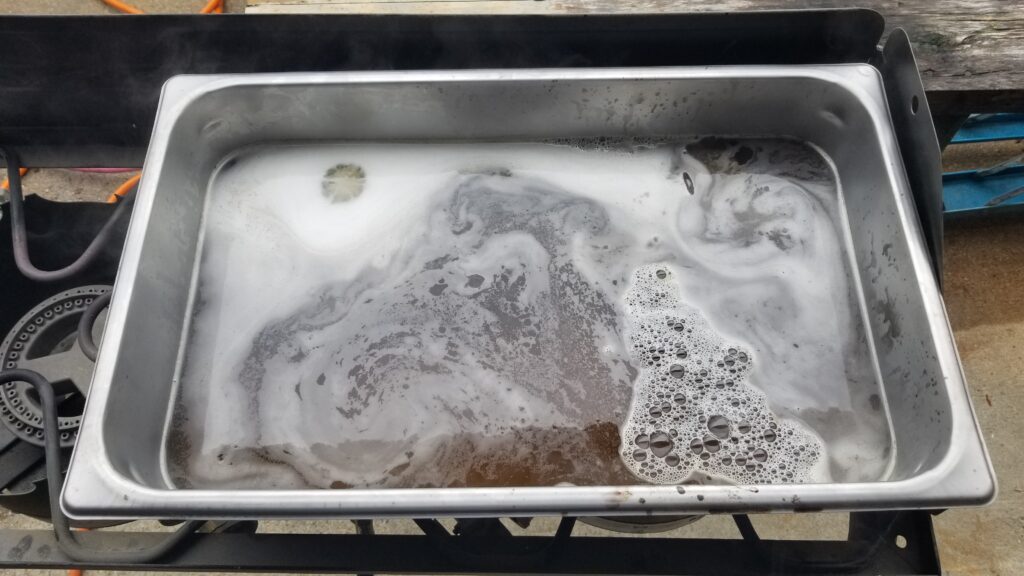
Black wool being boiled in a pot on a camping stove for home parkerizing.

So, after looking the rifle over around 9:30am this morning, I called my parents to come over for lunch. My dad had no idea what was going on. I had them sit down on the couch and gave my dad a 1960s Garand tech manual I told I had found and let him read it while my wife and I finished getting things ready.

Camp Chef two-burner stove with a large pot, propane tank, and accessories

So he’s looking at the manual and my mom and wife are in the room and I ask him – “Isn’t that the rifle you had in the Army but could never afford?” My dad said “Yes” and was thumbing the pages of the manual while I went downstairs. He really had no idea.

So I went downstairs, got the rifle in its CMP case and came up to them without my dad seeing what was in the case and he really didn’t pay it any mind. So I told him “I think its about time you have one” and at first it didn’t really hit him what I said. He even took the rifle from me without really saying anything.

Camp Chef two-burner stove with a large pot, propane tank, and accessories

I told him “Dad, this is your rifle and we are going to enjoy it together this summer.” At that point, I think it registered and he asked “It’s mine?” and I told him it was and that it was a real Springfield Armory M1 and not a reproduction. The government Springfield Armory has always been special to him because he grew up in Massachusetts and New Hampshire and I guess because it was close to home.

Black wool being boiled in a pot on a camping stove for home parkerizing.

He was looking it over and while he did that I told him about all of you and what you did to help. The prayers, the well wishes, guys wanting to send money, the stories of their fathers, what the CMP did to help and at that point, the only time in my life I have ever seen it, my father started to cry. He told me he never thought he would hold one again.

Black wool being boiled in a pot on a camping stove for home parkerizing.

Black wool being boiled in a pot on a camping stove for home parkerizing.

After a few minutes, we got ourselves together and he started really looking the rifle over. He pushed down the follower assembly, or whatever you call it, in the magazine well and carefully pushed the bolt closed saying he didn’t want to get “Garand thumb” and he explained what that meant to us and then the stories began.

Black wool being boiled in a pot on a camping stove for home parkerizing.

Black wool being boiled in a pot on a camping stove for home parkerizing.

Towards the end, he looked at the rifle again and tears started one last time.

Black wool being boiled in a pot on a camping stove for home parkerizing.

Black wool being boiled in a pot on a camping stove for home parkerizing.

Guys, thank you so much for all you have done. He was so excited – so happy. It was amazing and I am not a good enough writer to tell you how he looked other than to say he was profoundly touched by all that you guys did to help, what the CMP did and so on.

I have a lot to learn about M1 Garands, that’s for sure and I look forward to learning about this one with my dad.

Tomorrow we go to find the results of his bone marrow tests and I told him that no matter what he and I have the Spring and Summer to look forward to so we can take his new Garand out and test it.

Never take your loved ones for granted and do whatever it takes to be able to spend some time with them. Life is precious and time is short.

Thank you my dear, dear friends. You are all amazing.

The second part of the story is from July 27, 2011 when my dad I finally were able to take the Garand to the range:

It’s funny how fast time flies by. As you know, I bought an M1 Garand for my dad and gave it to him. Getting to the range with him was always on the “to do” list but never quite made it to the top due to job conflicts, health, kid stuff, and so on. Before I knew it, time flew by. You don’t realize how fast time slips by until you look back.

On June 27th, my father in law fell over a small 18″ tall dog fence, cracked a neck vertabra hitting a couch and compressed his spinal cord. He will not recover from the injury and subsequent complications caused by kidney and heart disease. It was such a freak accident because he was only 75 and full of energy. Now, he is sedated and kept alive by machines in ICU but still able to think and move his eyes. Calls and well wishes from you guys really, really helped. Bubbazan, Elkaholic, Ding … you guys are great. I can not thank you enough.

I told my wife that it really showed me that we can’t take loved ones for granted or leave loose ends undone. I told her I absolutely had to take my dad to the range with the new Garand. We are home this week catching up on bills and work while my wife’s family takes turns watching my father in law. Thus, I got an opportunity and seized it. Sometimes, and this was one of them, you need to make things happen and that’s what I did.

It’s been real dry and hot here which, for my dad, is perfect because there are fewer mosquitos – when they bite him he swells up huge because his compromised immune system goes nuts. Monday night I had a crash course in M1 Garand disassembly, cleaning and lubrication. Youtube videos and some web pages people had sent me helped tremendously. The CMP armorer knew about the situation with my dad and other than cosmoline in the stock, the rifle was immaculate. The trigger group was gun metal grey and lightly oiled inside. If I didn’t know better, I would have sworn I was looking at a new rifle based on the quality of the parts, lack of wear and cleanliness.

I used Mobile synthetic grease to lubricate the rifle. It really made the rifle nice and slick. I was very concerned about recoil hurting my dad so I installed a medium Limbsaver Slip-On Pad just to be safe. It fit great and really cushioned the butt. So, I packed it up and made sure I had the ammo, targets, hearing protection, and so on for the range.

On Tuesday, my dad arrived and we loaded his van up and headed to the sportsman’s club for an afternoon of shooting. When we got there we had the range to ourselves as it was 3pm. It was sunny, hot and no mosquito in sight – things were looking great.

We set up on the range. My dad was definitely excited – he’s always been a big one to understate things but I could tell. Bear in mind an 85 year old man doesn’t move too fast and he was clipping right along. We set up on the 50 yard line to do our testing.

Black wool being boiled in a pot on a camping stove for home parkerizing.

Now I had cleaned and inspected the rifle as best I could. Even so, we installed it in a stand and fired a test round with 25′ of string. Of course, my dad had the honor of pulling the cord and doing the first test firing.

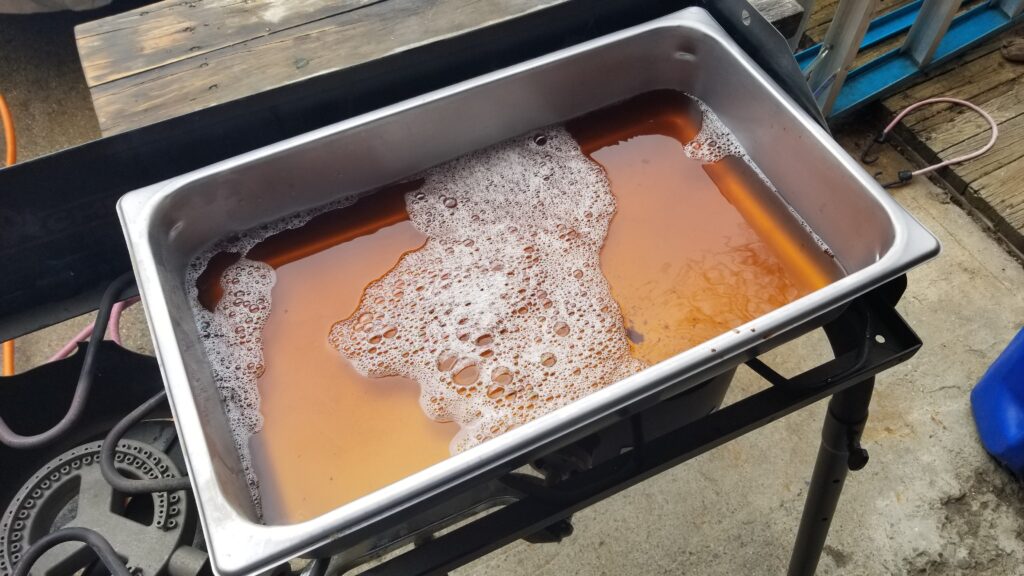
Manganese parkerizing tank with water and bubbling solution

The rifle functioned flawlessly on Greek M2 ball ammo. No bulges, primer looked great – the cartridge looked just fine. We inspected the rifle and everything looked great. My dad had this huge grin on his face.

Manganese parkerizing tank with water and bubbling solution

Of course, the next thing to do was to fire for effect! The old man got down on the bench and lined up. He did it so smoothly that you just knew he and Garands knew each other. I was running around taking photos.

Manganese parkerizing tank with water and bubbling solution

Manganese parkerizing tank with water and bubbling solution

He squeezed off his first shot from an M1 Garand since the last time he fired one in Korea in 1945 – literally 65 years ago. Now bear in mind this was round #2 from the rifle – no changes to the sights plus my dad hasn’t been shooting for almost a year.

Manganese parkerizing tank with water and bubbling solution

That definitely excited both of us so he got down to business

Manganese parkerizing tank with water and bubbling solution

Manganese parkerizing tank with water and bubbling solution

He fired 7 rounds – each time we’d unload the rifle and walk down to look at the target (I forgot my spotting scope). He was happy and talking about the rifle, how to adjust the sights, it was great. My dad got tired and asked that I shoot the rifle. I went on to fire 9 rounds realtively quickly from 50 and 100 yards before we had to leave. Not one single failure or problem of any kind – not one. The rifle functioned perfectly. I got a real nice note from the lead armorer at CMP wishing my dad well and I think they are an awesome group – all of them.

After shooting the rifle I was amazed at how little recoil there was. More of a push than a slam plus the recoil pad made it a joy. My dad said it didn’t hurt at all. We were able to spend about two and a half hours at the range and just had a great time. I’m definitely going to take him more this summer. We have a checkup on his cancer at the end of August and we’ll need to decide whether to keep watching, or just what. When we were packing up, I told him that I couldn’t afford the fishing boat but at least I could get him a Garand and that brought out a big smile. It was a great day – I was so happy and he was too.

Again, I want to thank all of you for your awesome support. We all have our own personal trials but having people go out of their way to help is an amazing thing. I feel very lucky to have a wonderful family and to count so many of you as friends.

God bless all of you and your families.

Sincerely,

George

In closing

Never miss a chance to spend time with your families.  Just before my dad passed away on September 20, 2014, we were planning on taking the Garand out to the range.  The day we were to go he decided against it as he didn’t feel up to it.  A day or two later he passed away in his sleep.  I really wish we had that one last shooting session but I do have some great memories and they outweigh the regrets.

We miss you dad.


In case you are wondering, here’s a bit about my dad:

Carroll Spafford, 88, of Stevensville, formerly of Battle Creek, MI, passed away peacefully on Saturday, September 20, 2014, at the Hanson Hospice Center.

Born in Boston, MA on June 26, 1926, to George RH Spafford and Hazel Holmes (Mr. & Mrs. Spafford) of Everett, MA.  His parents, older brother (George Kendall) and younger sister (Phyllis) moved to a farm his parents bought in Derry, NH, when he was a young teenager.  While there, he attended Pinkerton Academy in Derry and graduated in 1945.

On March 30, 1945, Carroll enlisted in the US Army and was sent to Korea to join the 6th infantry division guarding against any attempts by the Japanese to retake Korea.  While there he rose to Corporal overseeing a seven man heavy machinegun squad.  He was honorably discharged on December 30, 1946, and returned home.

As part of the GI Bill, he attended the Wentworth Institute of Technology and obtained his MC&TD degree in 1949.  After several years working, he then attended Ohio State University and received his MBA in 1955.

Carroll’s career took him to Detroit and Ford Motor.  While in Detroit he met and married Alpha Lee Turman on November 26, 1964.  Following a brief stint working in research at the University of Michigan he then accepted a rewarding position at Kellogg Community College in Battle Creek, MI, where he taught business management and economics/

In 1967 he and Alpha had a baby boy, George, who was joined by his sister, Rebecca, in 1971.  They had a small farm North of Battle Creek with a collection of dogs, cats, horses and gardens plus summer car trips all over the US that occupied their time.

In 1986, he retired from KCC and he and Alpha volunteered at Junior Achievement in Battle Creek.  In 2002, he and Alpha moved to Stevensville, MI, in order to be closer to their grandchildren.

In 2012, Alpha passed on and Carroll continued on with the help of many talented and much appreciated care givers.  He is survived by his son, daughter, three grandchildren (Paolo, Alyssa, and Erika), his sister (Phyllis) and a very large extended family who all love and miss him greatly.

Assembling an AR Lower – Step 3 of 11: Installing the Bolt Catch Assembly

In this step, I’ll install the bolt catch.  This is the part that catches the bolt when the magazine is empty or the operator wants to lock the weapon open.  In terms of risk, this step has probably caused more blemished receivers than any other.  What I hope to show you is a method to minimize that.

The assembly is made up of the catch itself, a cross pin that secures it in the receiver, a spring and the bolt catch buffer.  In this post, I am actually installing a Strike Industries bolt catch.  I like to have a slightly larger paddle to operate the catch and Strike model is a nice size.  If you ever want a giant paddle, Wilson makes one but it is just too big for my taste.

AK rifle with Galil furniture and custom grip. Serial number HM 15 1237 visible.
Here is the catch, it’s roll pin directly underneath and then the spring and detent to the right.


AK rifle with Galil furniture and custom grip. Serial number HM 15 1237 visible.

Where we are working on the receiver is right here – just above the mag catch:

AK rifle with Galil furniture and custom grip
The spring followed by the detent go down in the hole just above the magazine catch. The bolt catch is then inserted in the slot and the pin secures it. This is when you wonder if a third arm is needed 🙂

Now, this step is really risky.  One slip and you will mar your receiver so take a minute and put some duct tape on just in case.  I like duct tape because it is thick and sticks really well.  I’ve used other types of tape in the past and it really is just cheap insurance.  If you do this and what you use is up to you.  You are mainly worried about the receiver, to the right of the humps/lobes where the catch is going to be installed.

AK rifle with Galil furniture and custom grip
If you want to lower your risk of scratching your receiver, put a heavy tape around the assembly for protection. I’d recommend a duct tape – I’m using Gorilla Tape in this photo.

Now I use three punches for this.  I bought two rubber coated mag catch punches from Wheeler.  They work but I wish they were longer and you still need a third to make it easy.  Let me explain a bit more.  The Wheeler punches are half circle designs which gives you better clearance but I still use my long Astro Pneumatics 1/8″ punch to reach down and drive the pin the rest of the way in. Like I said though, you do need three punches for this.

AK rifle with Galil furniture and custom grip. Serial number HM 15 1237 visible.
The two black punches make up the Wheeler 710906 bolt catch tools and I literally use them with every build. Above them is a longer roll pin punch that I use to finish the install. I wish the Wheeler punches were about an inch longer and they would be perfect for me but note I do use them on every build.
Close-up of AR bolt catch pin and punch tool for lower assembly.
The Wheeler punches are must haves for three reasons – they are flat on one side to let you get in closer to the receiver, they are rubber coated to protect the finish and you have both the 3/32″

Ok, so first take the roll pin starter punch and install the pin on the right side part way.  By getting it started you have less to try and mess with as the assembly comes together.  See how the punch is right next to the receiver?  You need to lightly tap this with a small hammer to drive it in while not hitting your receiver – this is why the tape is cheap insurance.

AK rifle with Galil furniture and custom grip
The Wheeler starter punch lets you easily begin the pin with zero drama and swearing.

I like to put a dab of grease in the hole to hold everything gently in place.  This is not a normal step and just something I do.  You then insert the spring first and the buffer on top.  You’ll notice with the AR design that a spring always has a detent or buffer between it and a moving surface to protect the spring.

AK rifle with Galil furniture and custom grip
I put a dab of grease in the hole to hold the spring and detent in place.

  Next, I use the roll pin punch from Wheeler to align bolt catch and hold it in place so the roll pin can be driven further in.  If you do not use something to align the catch holes for the pin you will drive yourself nuts.  Another option is to use a 3/32 drill bit’s smooth end to help line things up by inserting it through the front hump.

AK rifle with Galil furniture and custom grip
Use the pin punch to keep the catch properly positioned as you drive the roll pin through. Just short of bottoming out the starter punch, use a pin punch to drive the pin in the rest of the way.

Next, you need to use the roll pin punch and a small hammer to drive the pin the rest of the way in.  You can use the Wheeler block to hold the receiver or whatever works for you. Having a firm support makes it much easier.  My Astro Pneumatic roll ping punches are long.  My 1/8″ punch is 7″ long so I would recommend looking for something like that so you can clear the receiver when you are hammering the pin all the way in.  I don’t think the Astro set I have is made any longer because I could not find it on Google to share with you.  I use my Tekton punches.

AK rifle with Galil furniture and custom gripSee how much longer the Astro Pneumatics roll pin punch is? This lets me reach in and easily drive the roll pin in the final bit of the way. I can do the same with my Tekton gunsmith set’s punches.

AK rifle with Galil furniture and custom grip

With that you are done.  You can function test the unit by pushing on the top paddle.  You should feel the spring compress and release as you rock the catch back and forth.

AK rifle with Galil furniture and custom grip. Serial number HM 15 1237 visible.


Please share the link on Facebook, Forums, with colleagues, etc. Your support is much appreciated and if you have any feedback, please email us in**@*********ps.com. If you’d like to request a report or order a reprint, please click here for the corresponding page to open in new tab.


AR Parts Sources

There are a lot of reputable AR parts vendors online but beware of eBay and bargain basement dealers that sell airsoft parts and tell you they will stand up to firearm use – they will not. At any rate, here are my top sources of AR parts:


Assembling an AR Lower – Step 2 of 11: Installing the Trigger Guard Assembly

The second step is to install the trigger guard.  Now I do not use the kind with a detent that allows you to open the trigger guard.  I prefer aluminum trigger guards from either Magpul or Brownells.  The one you see here is from Brownells and is made from billet 7075 aluminum.  I like how it is slightly oversized for gloves and Brownells prices it quite reasonably at $8.47. The front is threaded with a set screw and the rear has a roll pin – they include both in the package.  A polymer Magpul unit came with the lower build kit and I just put it in my box of spare parts.

Dark US Plum first-gen Molot grip on AK rifle in case with magazines

Take a minute and check the fit.  The threaded part goes forward and the hole that goes all the way through to the rear.   Just ensure it is going to line up appropriately.

Dark US Plum first-gen Molot grip on AK rifle in case with magazines

I like to first install the front set screw to help line everything up.  Just use a quality allen wrench – I have been burned with cheap allen wrenches that round the socket so now I pretty much stick with Bondhus and Eklind though there are probably many other good enough brands out there.  I snug the set screw down but do not go crazy torquing it in.  Bear in mind you are threading a small screw into aluminum and that allen key is giving you quite a bit of leverage.

Dark US Plum first-gen Molot grip on AK rifle in case with magazines
AR lower receiver with trigger guard assembly installed during firearm assembly.

Once that front screw is in and the trigger guard is better held in position, it is time to install the rear roll pin.  Now you have a number of options to install the rear pin and I am going to tell you about the two I use:

Option one, use a starter and roll pin punch to drive in the roll pin.  Now there is a real important thing you need to do – be sure you use a block to support the lower “ear” of the receiver or you may snap it off.  If it breaks off, you just ruined the receiver – game over.  I use a Wheeler block to support the receiver and you can use just about anything – over the years I have used generic gunsmithing blocks and even pieces of wood. For the last 2-3 years I’ve used the Wheeler block and like it.

Don’t try to use a generic punch.  I like to use a Squirrel Daddy roll pin starter to get the first part of the pin installed and then an Astro Pneumatics 1/8″ roll pin punch to hammer it in the rest of the way.  Of course you can use whatever brands you want but the bottom line is that you need to line the pin up vertically to drive it straight in and you must be careful not to slip and mar your receiver.  This is why using the correct punches matter.  The starter punch gives you a lot of control and by using the roll pin punch, you can keep your punch on the pin.  Because of my tremor, I am not very good with hammers and punches but can do this provided I use the two types of punches mentioned.

Dark US Plum first-gen Molot grip on AK rifle in case with magazines

The Wheeler 156945 bench block does a good job helping you both hold and support work.  You want the “ears” on the receiver to be supported.  There are plenty of stories of guys not supporting the ears, trying to tap in the roll pin that holds the trigger guard in place and then breaking off an ear.  Whether you use the Wheeler block or even a piece of wood – be sure to support the ears.

Dark US Plum first-gen Molot grip on AK rifle in case with magazines
Note how nicely the Wheeler 156945 bench block supports the AR lower.
Dark US Plum first-gen Molot grip on AK rifle in case with magazines
This is a roll pin starter punch. This one is made by Squirrel Daddy.
Astro punch tool and hardware for AR lower assembly

Option two:  Wheeler Engineering makes a nice simple tool to install or remove that roll pin.  Boy does it make it easy and this is my preferred method.  The little tool is super simple – it has two pins that fit into the end of the screw.  A long one for removing the pin and a short one for installing the roll pin.  You just line things up and then tighten the screw.  The pin goes into the hole in a very controlled manner and your finish is protected.  Stop once your pin is flush with the receiver.

Wheeler AR Trigger Guard Installation Tool and parts on green table
Tool for installing AR trigger guard assembly, with instructions.
Trigger guard assembly clamped in a vice for assembly
AR lower assembly: Installing the trigger guard with a knob screw.
Trigger guard assembly with hole on green surface for AR Lower installation

Other options:  I have seen guys use pliers with the jaws wrapped in tape, modified C-clamps, and more.  You can Google around or search on Youtube to see a variety of approaches.


Please share the link on Facebook, Forums, with colleagues, etc. Your support is much appreciated and if you have any feedback, please email us in**@*********ps.com. If you’d like to request a report or order a reprint, please click here for the corresponding page to open in new tab.


AR Parts Sources

There are a lot of reputable AR parts vendors online but beware of eBay and bargain basement dealers that sell airsoft parts and tell you they will stand up to firearm use – they will not. At any rate, here are my top sources of AR parts:


Assembling an AR Lower – Step 1 of 11: Installing the Magazine Catch Assembly

Just a quick note – when you get a bare receiver, you are literally getting a chunk of aluminum with nothing installed.  I really like Palmetto State Armory (PSA) lower build kits and they sell them with different types of components such as just the basics for rifles, for pistols, Magpul furniture, etc.  What I like is that the machining is very good and I think they have some of the best Mil-Spec basic triggers that aren’t gritty.  I’ve used Anderson and other brands of build kits and just think the PSA kits are superior.  Bear in mind that I say this as a customer – nobody paid me to tell you this.

Palmetto State Armory AR lower receiver build kit box with receiver
Palmetto State Armory magazine catch assembly kit for AR lower receiver
AR lower parts, including magazine catch assembly, in plastic bags

With that said, let’s start building.  You’ll notice on any AR magazine on the right side there is a rectangular notch.  This is where the magazine catch engages to hold it in place.  Okay, so the first step is to install the magazine catch assembly.  It’s made up of the “L” shaped catch itself, the mag catch spring and the magazine button.

AR-15 magazine with 5.56x45 marking and 07 date code
AR lower parts: magazine catch, spring, and button for assembly.

Now I grease everything that slides with Tetra Gun Grease.  Tetra has worked well for me but I also know guys who use all kinds of greases.  As a rule of thumb, if it slides, apply grease.  It it rotates  then apply oil.  So grease the shaft and insert it into the round hole on the right end of the recessed area for it on the right side of the receiver.  Note, be careful when installing the catch or you may scratch your receiver.

AR lower receiver, lube, and spring during magazine catch assembly.

When you turn it over you will see the threaded end of the shaft and you put the spring down over it.

AR lower receiver with installed magazine catch assembly screw.
Installing AR lower magazine catch spring during assembly

Next, you will screw the magazine button onto the threaded shaft.  Before you do, look at the button.  You should see that one end is smooth (that is the bottom) and the other has grooves (that is the top).  Carefully start screwing the button on but stop before you get near the receiver so you don’t scratch anything. Push the button in, and then turn the long lever arm to continue threading the shaft into the button.  Now stop before the lever arm scratches the receiver.

AR lower receiver with magazine catch assembly installed
AR lower receiver with magazine catch assembly installed during build

To screw the catch in the rest of the way you need to push the bullet button in all the way so the catch sticks out as far as it can on the other side so the lever arm can clear the parts of the receiver as the button is screwed on.  At this point, I use a small pusher tool made from plastic to push the button in even further so I can keep turning the lever arm until the screw is relatively flush with the top of the button.  Note, before I had the tool I would use a wood dowel.  Just use something non-metallic to protect the finish.  There is a model of the tool shaped just like the oval button but I don’t know where mine went so I used a takedown tool and got the job done 🙂

Magazine catch assembly for AR lower receiver installation
Installing AR lower magazine catch assembly: hand holding lower receiver.
AR-15 lower receiver with magazine catch assembly installed, ready for build

The catch is now installed.  To function test, push the magazine button.  You should feel spring resistance and see the magazine catch’s lever arm push out.  When you ease off the button, the lever arm should smoothly go back into place.


Please share the link on Facebook, Forums, with colleagues, etc. Your support is much appreciated and if you have any feedback, please email us in**@*********ps.com. If you’d like to request a report or order a reprint, please click here for the corresponding page to open in new tab.


AR Parts Sources

There are a lot of reputable AR parts vendors online but beware of eBay and bargain basement dealers that sell airsoft parts and tell you they will stand up to firearm use – they will not. At any rate, here are my top sources of AR parts:


News: Vepr rifles now on the banned list – June 20, 2017

Molot logo, the manufacturer of Vepr rifles

Well, this sucks – Molot, the maker of Vepr rifles and shotguns has been added to the treasury’s list of people and organizations US businesses can’t engage in commerce with.

Here’s the website source:  https://www.treasury.gov/resource-center/sanctions/OFAC-Enforcement/Pages/20170620.aspx

MOLOT-ORUZHIE, OOO (a.k.a. OBSHCHESTVO S OGRANICHENNOI OTVETSTVENNOSTYU ‘MOLOT-ORUZHIE’; f.k.a. OBSHCHESTVO S OGRANICHENNOI OTVETSTVENNOSTYU PROIZVODSTVENNO INSTRUMENT KACHESTVO), 135 ul. Lenina, Vyatskie Polyany, Kirov Obl. 612960, Russia; Registration ID 1094307000633 (Russia); Tax ID No. 4307012765 (Russia); Government Gazette Number 60615883 (Russia) [UKRAINE-EO13661] (Linked To: KALASHNIKOV CONCERN).

Kalashnikov Group logo

Notice the part I set in bold black – linked to Kalashnikov Concern.  It may be because Molot was bankrupt and the speculation was that only Kalashnikov Concern was in a position to buy them.

FIME has not commented yet – they are the importer and their website is at:  http://www.fimegroup.com/home.php

So, we’ll see what happens next but do expect supplies of Vepr rifles to be limited/run out on the primary market and prices to rise.

Assembling an AR Lower – Like Legos for Men with Special Comments on Pistol Builds

Two AR-15 lower receivers and an upper receiver on a green surface
Two AR-15 lower receivers and upper receiver assembly on a green surface.
Two AR-15 style rifles with pistol grips and scopes on a wooden background

I have to admit that I like a lot of different firearms including both AK and AR platforms.  So I am not purely an AK fan though my business is largely built around that.  I have owned many, many different ARs over the years including tactical, DMR, snipers, pistols and flat out range toys.  I don’t have much free time any longer so the AR platform gives me a chance to tinker with different combinations and see what I like.

At the heart of the AR is a lower-receiver that can be made by just about anyone as long as it is Mil-Spec.  Now this is critical. Not all receivers are as accurate as they claim to be with their tolerances, hole positions and what not so ask around.  I’ve had very good luck with Anderson (my go to brand for several years now), Palmetto State Armory (PSA), Spikes and Del-ton.  I’ve not had a single problem with any of these brands.  You may not have as much luck with “Uncle Bob’s Lowers made in Podunk Nowhere” so just start with a good foundation.

For the two AR pistols that I will be assembling for the upcoming blog posts, I will be using Anderson lower receivers.

Assembling an AR for a rifle or a pistol is almost identical until you get to the gas tube.  At that point a pistol must use a pistol tube and a rifle will use whatever tube you wish.  I’ll point that out again in post #9.

I am not a lawyer and the following should not be construed as legal advice.  I’m just trying to explain my understanding on how to build an AR pistol legally:

One important item for guys making pistols, to be legal, the receivers must be transferred to use as receivers.  Your FFL must NOT transfer the receiver as a rifle.  There is an FFL notice that once a receiver is built as a rifle, it is a rifle.  If you change it into a pistol, then you are making a short-barreled rifle (SBR) that must be registered.  Oddly enough, you can build a receiver as a pistol and then convert it to a rifle.  [Click here for a link to the ATF letter]

My recommendation is to always take photos of the pistols built appropriately so you can show the paper trail of a receiver transfer from your FFL through to a built pistol.

Also, there is another issue to avoid – do not buy pistol-length uppers (meaning uppers with barrels shorter than 16″) and having them sit around without a pistol receiver waiting.  Buy the receiver first, then corresponding upper and put them together.  Why you might ask?  The concern is something known as “constructive intent”.  You do not want the ATF or others in law enforcement to assume you only have that SBR/pistol upper to put on one of your rifles.  That requires paper work and fees in order to have a legal SBR.  You absolutely can’t just put a sub-16″ barrel on a regular rifle – it will be illegal.  [Click here for the ATF letter about SBRs]

The ATF has ruled that braces do not make a pistol into a rifle.  I have carpal tunnel and can’t hold a heavy pistol so this is good news for me.  So, I bought my Anderson lowers first, my lower pistol build kits from PSA and then an 7.5″ upper from PSA and a 10.5″ upper from Ghost Rifles.  The blog posts that follow document my journey building these two AR pistols.


Please share the link on Facebook, Forums, with colleagues, etc. Your support is much appreciated and if you have any feedback, please email us in**@*********ps.com. If you’d like to request a report or order a reprint, please click here for the corresponding page to open in new tab.


AR Parts Sources

There are a lot of reputable AR parts vendors online but beware of eBay and bargain basement dealers that sell airsoft parts and tell you they will stand up to firearm use – they will not. At any rate, here are my top sources of AR parts:


When Strength and Quality Matter Most