
1. Executive Summary
The strategic landscape of modern conflict is undergoing a structural realignment. Recent military engagements, notably the United States operations against Iranian proxies in the Red Sea and the subsequent Operation Epic Fury against Iran, have exposed a critical vulnerability in traditional defense paradigms. Initiating conventional military attacks using highly complex and exquisite weaponry against an adversary deploying massed, low-cost unmanned systems results in an unsustainable cost-exchange ratio.1 The United States military has historically relied on technological overmatch, utilizing multi-million-dollar interceptors and strike platforms to counter threats.1 However, adversaries have successfully weaponized this reliance, employing a strategy of cost-imposition and magazine depletion to strain logistics networks, exhaust defense budgets, and limit operational agility.1
To improve its ability to fight smart and hard, the United States military must systematically change its operational concepts, procurement methodologies, and logistical frameworks. The necessary transformation requires a shift from an overwhelming reliance on small quantities of exquisite platforms to the deployment of smart, affordable mass.5 This transition demands a strict, phased order of operations to ensure lasting institutional change.
First, the foundational budgeting and requirements processes must be reformed to allow for agile funding in the year of execution, moving away from rigid prediction models.6 Second, procurement must transition to an iterative, building-block approach utilizing Other Transaction Authorities and Commercial Solutions Openings to acquire commercial technology rapidly.8 Third, a Modular Open Systems Architecture must be strictly enforced by statute to decouple hardware from software, preventing vendor lock-in and allowing for rapid field upgrades.10 Fourth, the military must shift its operational architecture from fragile, linear kill chains to resilient, dynamic kill webs that achieve convergence across all domains.12 Finally, the logistical tail must be radically decentralized, moving toward point-of-need manufacturing and distributed maritime operations to sustain forces actively engaged in contested environments.14 This report details the precise mechanisms required to achieve these strategic imperatives, identifying the specific technological and procedural adaptations necessary to secure a decisive warfighting edge.
2. The Strategic Context: Asymmetry and the New Cost Curve of War
For several decades, the standard doctrine of advanced militaries focused on developing highly sophisticated, survivable, and multi-role platforms. This approach operated on the historical assumption that qualitative superiority would inevitably overwhelm quantitative advantages.1 The current conflicts in the Middle East have severely tested this assumption, revealing a new cost curve of war where weaker militaries utilize commercially available and highly prolific technologies to offset the advantages of stronger adversaries.1
2.1 The Unsustainable Economics of Defensive Attrition
The initial phases of the conflict in the Red Sea against Houthi forces, heavily backed and supplied by Iran, served as a stark demonstration of this new operational reality. United States naval destroyers, operating under Operation Prosperity Guardian, successfully defended commercial shipping lanes against continuous barrages of incoming anti-ship ballistic missiles and one-way attack drones.3 While tactically successful in kinetic terms, the strategic arithmetic presented a severe crisis for military logisticians and planners.2
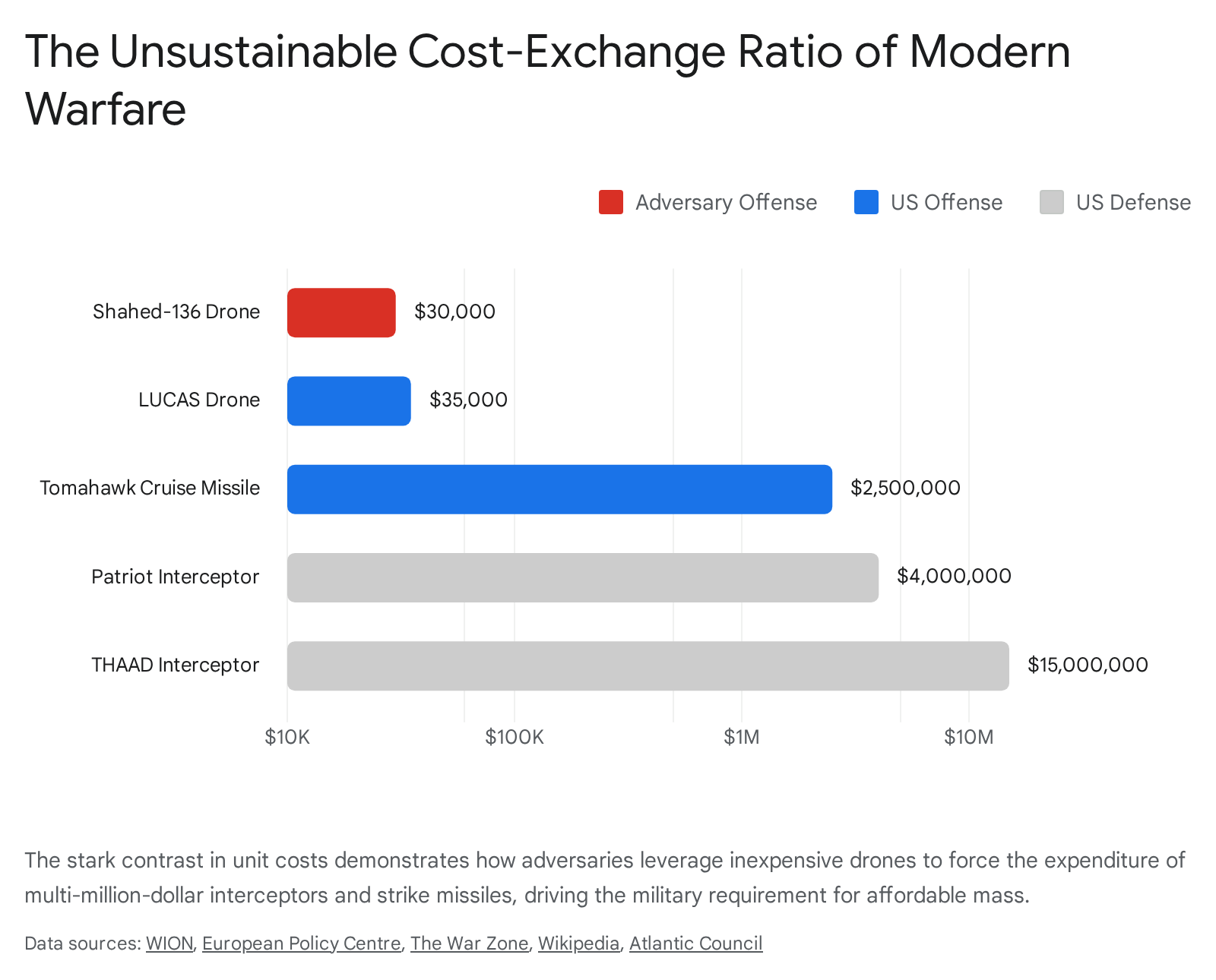
Adversaries deployed systems such as the Shahed-136 drone, which carries an estimated unit cost of between $20,000 and $50,000.1 In stark contrast, the defensive architecture of Aegis-equipped destroyers relies heavily on advanced interceptors such as the Standard Missile-2, Standard Missile-6, and the Evolved SeaSparrow Missile.2 The cost of these interceptors ranges from $1.5 million to over $4.3 million per shot.3 Furthermore, land-based defense systems like the Terminal High Altitude Area Defense interceptors can cost between $12 million and $15 million each, supported by radar systems like the AN/TPY-2 that cost upward of $1 billion.4 When Iranian forces successfully disabled these highly expensive sensor networks using swarms of inexpensive drones, the resulting cost-exchange ratio exceeded 30,000 to one in favor of the adversary.4
The total financial burden of this conventional approach is immense. Estimates regarding the costs of United States military activities in the wider Middle East since October 2023 place the expenditure between $9.65 billion and $12.07 billion through September 2025, with an additional $21.7 billion allocated for military aid to Israel.17 During the initial direct engagement with Iran, the Department of Defense informed Congress that the first six days of the conflict alone resulted in $11.3 billion in unbudgeted costs.18
This asymmetry extends far beyond immediate financial outlays. Every high-end interceptor expended on a low-end drone represents a depletion of finite magazine depth.2 Because advanced interceptors take years to manufacture and rely on complex, slow-moving defense industrial bases, utilizing them against cheap drones degrades the readiness of the military for high-end contingencies involving peer competitors.2 The strategy of the adversary relies on launching large numbers of relatively cheap drones and missiles in mixed salvos to stretch defensive systems, consume interceptor inventories, and impose economic costs that far outweigh the investment required to launch the attack.1
| System Type | Specific Platform | Primary Role | Estimated Unit Cost (USD) |
| Adversary Asymmetric | Shahed-136 Drone | Offensive Strike / Swarm | $20,000 – $50,000 4 |
| US Conventional | Tomahawk Cruise Missile | Offensive Strike | $2,000,000 – $2,500,000 19 |
| US Conventional | Patriot Interceptor | Air Defense | $1,500,000 – $4,000,000 4 |
| US Conventional | SM-2 / SM-6 Interceptor | Naval Air Defense | $1,000,000 – $4,300,000 2 |
| US Conventional | THAAD Interceptor | Ballistic Missile Defense | $12,000,000 – $15,000,000 4 |
| US Iterative | LUCAS Drone | Offensive Strike / Swarm | $30,000 – $40,000 2 |
2.2 The Shift to Offensive Cost-Imposition: Operation Epic Fury
Recognizing the unsustainability of absorbing this painful asymmetry indefinitely, military leadership initiated a structural pivot to alter the operational calculus. The objective shifted from purely defensive interception to offensive cost-imposition, aiming to weaponize asymmetry against the adversary rather than suffering its effects.2 This shift was fully realized during Operation Epic Fury, a military operation targeting Iranian leadership, missile assets, and critical infrastructure.21
Instead of relying solely on expensive cruise missiles that can cost upward of two million dollars each, United States Central Command integrated hundreds of Low-Cost Uncrewed Combat Attack Systems into its offensive architecture.19 Known as the LUCAS, this system represents a rare instance of rapid military adaptation through reverse-engineering.1 Originally modeled after the Iranian Shahed-136 drone, the LUCAS was designed and built for the military by the Arizona-based company SpektreWorks.20
The technical specifications of the LUCAS directly address the need for affordable mass. The drone costs approximately $35,000 per unit, features an 8-foot wingspan, measures roughly 10 feet in length, and possesses an operational range of 500 miles powered by a commercial-grade 215cc carbureted internal-combustion engine.19 First utilized operationally in January 2026 during Operation Absolute Resolve in Venezuela, the system saw its first officially confirmed use against Iranian targets in late February 2026.20
By launching these attritable drones in massed waves, the military actively flips the cost equation. The drones, utilizing commercial-grade components and open-architecture guidance systems potentially linked to military networks like SpaceX Starshield, navigate autonomously to saturate adversary air defense networks.2 This saturation forces the enemy to expend their own expensive surface-to-air missiles and reveal the geographical locations of their radar emitters and command nodes.2 Once the defense network is depleted and exposed by the low-cost drones, higher-end exquisite assets can safely follow to strike critical nodes, thereby preserving expensive United States capacity for decisive effects.2 This transition from a defensive posture to an offensive cost-imposition strategy demonstrates the precise operational shift required for future conflicts.
3. Redesigning the Acquisition Architecture: What Must Change and In What Order
Recognizing the tactical need for affordable mass is only the first step in military modernization. The acquisition, deployment, and sustainment of systems like LUCAS cannot be managed through the traditional defense apparatus. The legacy system relies on linear requirements processes and bureaucratic layers that take five to ten years to deliver a capability.2 In contrast, commercial drone innovation cycles in active conflict zones are currently measured in weeks rather than years.5 To fight smart and hard, the military must overhaul its entire development lifecycle. This transformation must occur in a specific, sequenced order to prevent localized innovations from being stifled by broader systemic inertia.
3.1 Phase One: Reforming the Budgeting and Requirements Foundation
The most critical bottleneck hindering military agility is not a lack of available technology, but rather the extreme rigidity of the resource allocation system. The Planning, Programming, Budgeting, and Execution process has served as the bedrock of defense resourcing for over sixty years.6 However, this system requires planners to predict technological requirements and secure funding years in advance of the actual deployment of those funds. In an era where the commercial technology sector dictates the pace of innovation, predicting the required specifications for an autonomous drone or artificial intelligence software suite two years ahead is an exercise in futility.7
The mandatory first change is the structural reform of the Planning, Programming, Budgeting, and Execution process to allow for high agility in the year of execution.7 The Commission on PPBE Reform has highlighted that the current interfaces with Congress do not provide the flexibility required to adopt commercial technological advances at the speed of relevance.7 The Commission published a final report containing 28 recommendations critical to reforming this structure, emphasizing the need for much-needed changes to the period of availability of funds, account structures, and reprogramming processes.7 Without the ability to dynamically reprogram funds toward successful rapid prototypes mid-year, innovative systems inevitably fall into the “valley of death” between initial prototype demonstration and full-scale production.7
Coupled with budgetary reform is the absolute necessity to bypass the traditional Joint Capabilities Integration and Development System for urgent technological needs. Traditional requirements generation relies on highly complex, predictive analysis to forecast future military challenges.27 A modern, agile approach requires adaptation in contact, where requirements are driven iteratively by continuous feedback from operators actively engaging adversaries in the field.27 Legislative initiatives, such as the Streamlining Procurement for Effective Execution and Delivery Act, aim to tackle defense acquisition challenges head-on by cutting red tape, accelerating timelines, and creating alternative pathways that are significantly more comfortable for commercial technology entities to navigate.28 Establishing this flexible financial and regulatory foundation is the necessary first step, without which all subsequent technological innovations will stall in bureaucratic gridlock.
3.2 Phase Two: Implementing Iterative Procurement and Commercial Adoption
Once flexible funding mechanisms and appropriate authorities are established, the military must formally abandon the traditional bespoke development model in favor of an iterative, building-block approach. The commercial sector now drives the bulk of global technology development, leading progress in eleven of the fourteen critical technology areas designated by the Department of Defense, including artificial intelligence, autonomy, and cyber capabilities.30 The military must harness this existing commercial engine rather than attempt to replicate it at a higher cost and slower speed.
The Defense Innovation Unit serves as the primary conduit for this vital transformation. Through its recent evolution into the DIU 3.0 model, the organization’s focus has shifted from simply demonstrating the feasibility of commercial technology to aggressively scaling those technologies for strategic effect across the joint force.8 The operational flow of DIU 3.0 is organized into eight mutually reinforcing lines of effort, which include focusing on the most critical capability gaps by embedding directly with the warfighter, partnering with the engines of scale within the military, and taking partnerships with the commercial tech sector to an unprecedented level.31
This scaling process is heavily reliant on the use of Commercial Solutions Openings and the leveraging of Other Transaction Authorities.9 Other Transaction Authorities, operating pursuant to Title 10 U.S.C. Section 4022, provide critical exemptions from standard federal procurement regulations.8 This drastically reduces the bureaucratic burden for non-traditional defense contractors, eliminating the need for government-unique cost accounting systems and significantly accelerating the time to award.8 Instead of issuing highly rigid and outdated technical specifications, the military publishes a broad statement of the problem, allowing commercial firms to pitch innovative solutions.8
This procurement process is intrinsically iterative and repeatable. It begins with a problem curation stage lasting 30 to 60 days, where military partners clarify core needs and determine the feasibility of meeting those needs through commercial technology.8 This is followed by a solicitation phase lasting approximately 30 days. The selection process involves rapid evaluation and negotiation, culminating in prototype execution agreements that typically last 12 to 24 months.8 Between fiscal years 2016 and 2023, this flexible award process yielded more than 450 prototype agreements, with 51 percent of completed prototypes successfully transitioning into full production.8
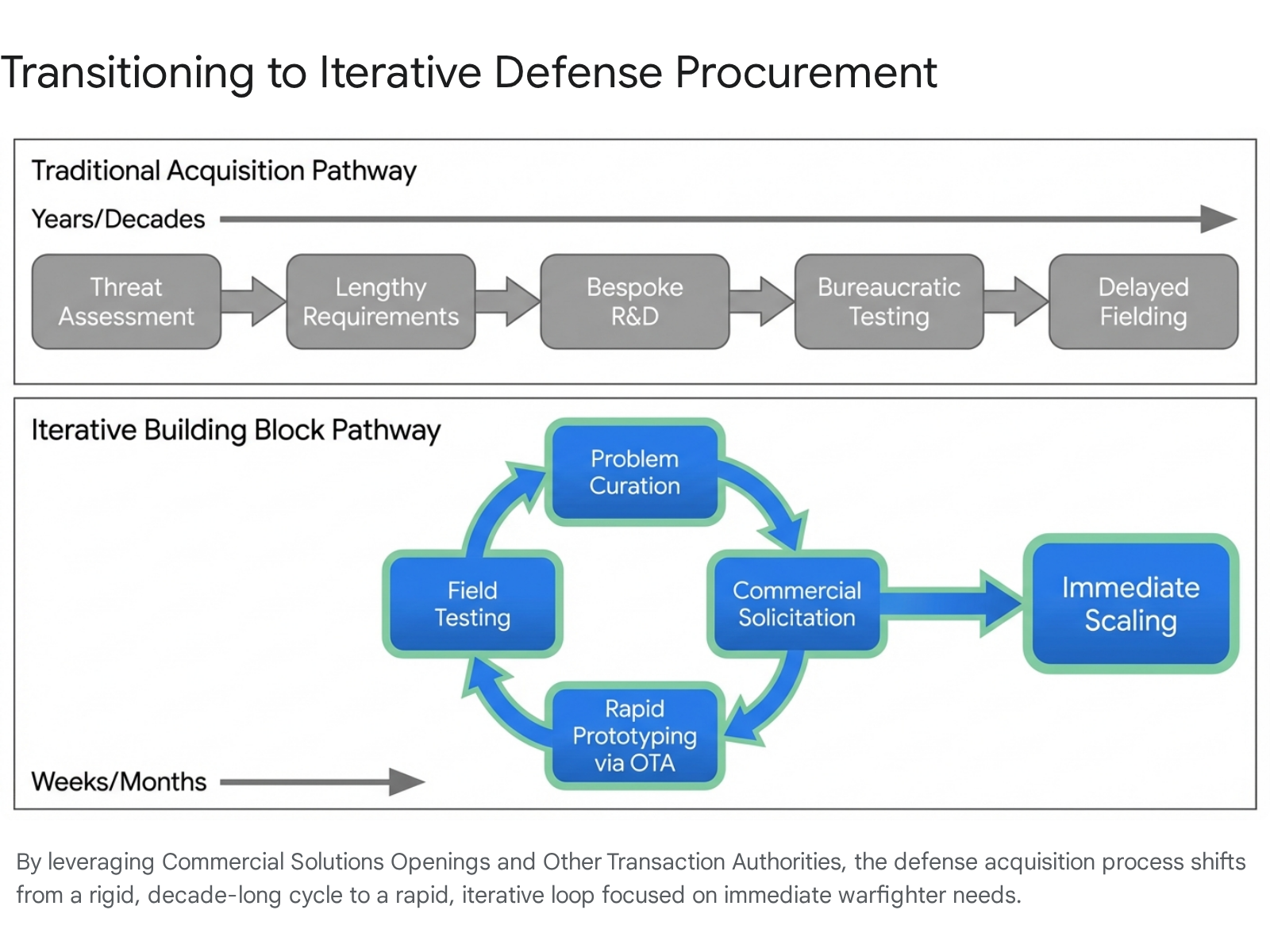
In addition to the Commercial Solutions Openings, the military must increasingly utilize Middle Tier Acquisition pathways, authorized under Section 804 of the National Defense Authorization Act.8 This pathway specifically seeks to provide capabilities rapidly by bypassing the traditional acquisition system. It is divided into two primary objectives: rapid prototyping, which requires fielding a prototype that can be demonstrated in an operational environment within five years of an approved requirement, and rapid fielding, which requires beginning production within six months and completing fielding within five years.35 By utilizing these iterative pathways, the military prioritizes speed, adaptability, and residual operational capability over the pursuit of perfect but outdated systems.36
| Acquisition Pathway | Primary Objective | Key Timeline Metric | Statutory Authority |
| Commercial Solutions Opening | Rapidly evaluate commercial technology against warfighter problems. | 60-90 days to prototype award. | 10 U.S.C. § 4022 (OTAs) 8 |
| Middle Tier – Rapid Prototyping | Demonstrate fieldable prototypes in an operational environment. | Residual capability within 5 years. | Section 804 NDAA 35 |
| Middle Tier – Rapid Fielding | Field production quantities of proven technologies. | Begin production within 6 months. | Section 804 NDAA 35 |
3.3 The Replicator Initiative: Scaling Attritable Autonomy
The Replicator initiative serves as the clearest strategic manifestation of this new iterative procurement doctrine. Announced by the Deputy Secretary of Defense, Replicator is designed to accelerate the delivery of innovative capabilities to warfighters at unprecedented speed and scale, specifically to counter the asymmetric advantages of peer competitors.26 The initiative is managed by the Defense Innovation Unit and the Deputy’s Innovation Steering Group, focusing on leveraging existing congressional authorities to bypass traditional bottlenecks.8
The first iteration, known as Replicator 1, focused heavily on fielding all-domain attritable autonomous systems at a scale of multiple thousands within an 18-to-24 month timeframe.38 Following the success of this initial push, the Department of Defense announced Replicator 2, which tackles the urgent warfighter priority of countering the threat posed by small uncrewed aerial systems to critical military installations and force concentrations.8 The expectation for Replicator 2 is to deliver meaningfully improved protection within 24 months of Congress approving funding, thereby forcing the broader defense bureaucracy to adopt the rapid timelines characteristic of the commercial sector.40
3.4 Phase Three: Enforcing Modular Open Systems Architecture
Acquiring commercial technology rapidly is insufficient if those newly procured systems operate in closed, proprietary silos. The third vital change required to fight smart is the strict enforcement of a Modular Open Systems Approach across all new acquisitions and major legacy upgrades.10 Historically, defense contractors have utilized proprietary interfaces, resulting in severe vendor lock-in where the military must return to the original manufacturer, at exorbitant costs, for every minor software update or hardware modification. This legacy business model is antithetical to operational agility.
A Modular Open Systems Approach is defined as an integrated business and technical strategy that outlines system architectures using widely supported, consensus-based standards.11 Required by United States law under Title 10 U.S.C. Section 4401(b), this approach ensures that major defense acquisition programs employ modular designs where major system components are severable.10 By intentionally decoupling hardware from software, the military can incrementally add, remove, or replace specific components throughout the entire lifecycle of a platform to afford opportunities for enhanced competition and innovation.10
The implementation of a Modular Open Systems Architecture involves several highly specific functional steps.11 Program managers must partition systems into functional modules, define the interfaces between these modules, and standardize those interfaces using non-proprietary rules.11 This requires the delivery of software-defined interface syntax and properties in machine-readable formats, conveying the semantic meaning of interface elements so that third-party developers can build compatible upgrades seamlessly.10 Interface Control Working Groups are established to expose design drivers and ensure compliance across different organizations.11
The strategic value of this approach is immense. For example, if a specific low-cost drone requires an updated artificial intelligence targeting algorithm to counter a newly deployed adversary jamming technique, the military must be able to swap the software module immediately without requiring the original drone manufacturer to physically redesign the hardware. This modularity allows the military to utilize the best-in-class commercial software from an innovative startup, mount it on the hardware of a separate manufacturer, and integrate it with the sensor payload of a third. Considering that sixty to seventy percent of a system’s lifecycle cost occurs in sustainment, enforcing these open standards allows the military to continually upgrade warfighting capabilities with maximum flexibility and minimum cost.43
4. Transforming Operational Doctrine: From Linear Chains to Dynamic Webs
The implementation of agile procurement and open technical architectures provides the necessary foundation for a massive shift in warfighting doctrine. If the United States is to maximize the utility of its newly acquired attritable mass, the military must transition its tactical operations from linear, domain-specific kill chains to dynamic, multi-domain kill webs.12
4.1 The Vulnerability of the Traditional Kill Chain
The traditional military kill chain model operates sequentially through the Observe, Orient, Decide, and Act loop.12 Historically, these chains were tightly stovepiped within specific military branches. The Army maintained the sensors, decision networks, and weapons for land-based problems, while the Navy and Air Force maintained entirely separate architectures for their respective domains.12
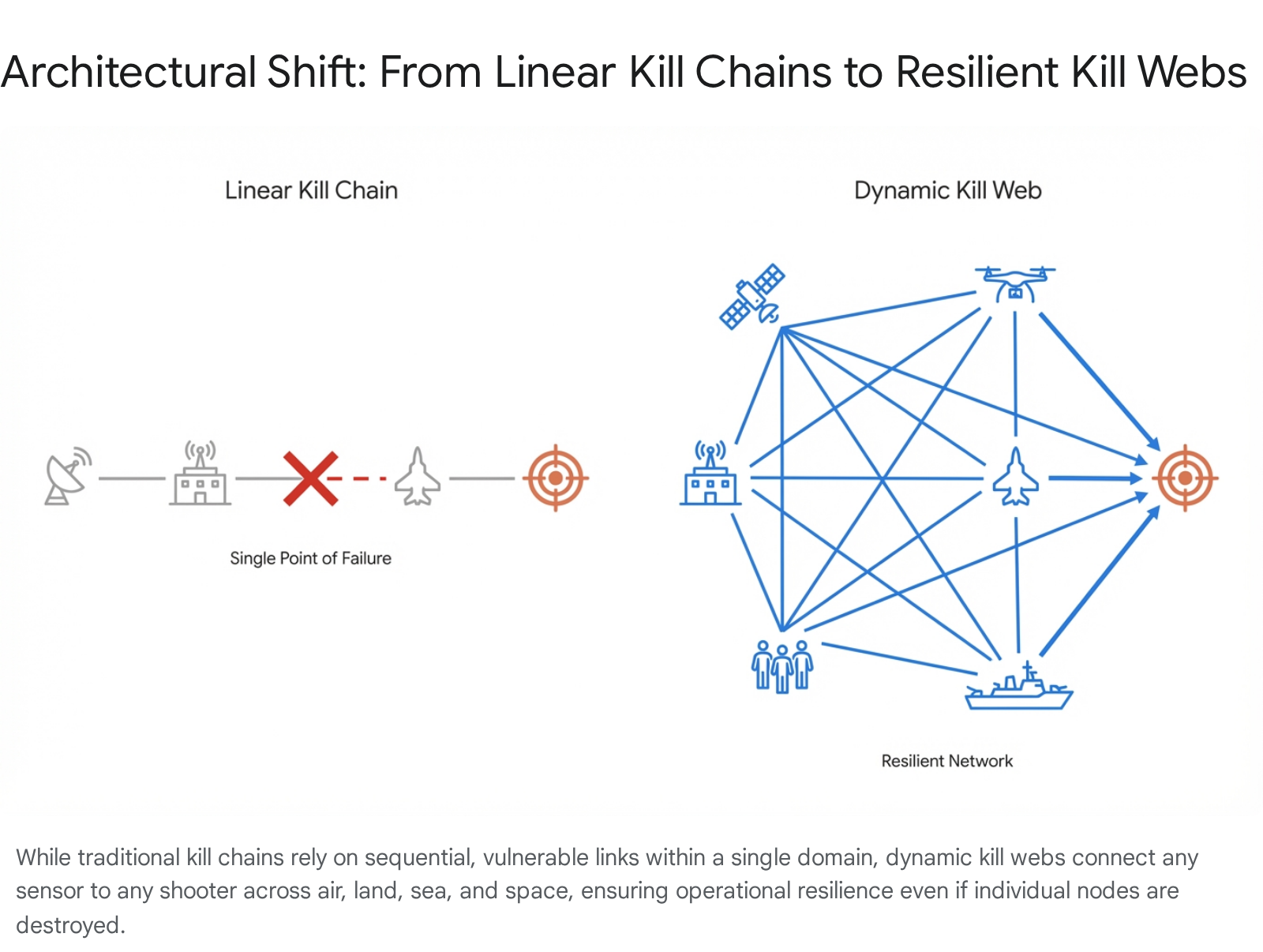
A linear kill chain is inherently fragile and highly vulnerable to disruption. In a conventional setup, a radar system observes a threat, passes the data to a specific command center for orientation and decision, which then tasks a specific fighter jet to act.12 If a sophisticated adversary disables or jams a single critical functional node in that sequence, such as the airborne warning and control system or a low-earth orbit satellite, the entire chain collapses.44 The associated shooters are rendered completely blind and tactically useless. Furthermore, a sequential chain can only operate as fast as its slowest link, an operational reality that is unacceptable when defending against hypersonic missiles or reacting to rapidly maneuvering drone swarms.12
4.2 Convergence and the Joint All-Domain Command and Control Kill Web
To fight smart and hard, the military must replace these two-dimensional static sequences with a six-dimensional, dynamic network.13 This concept, known as convergence, is the driving force behind the Joint All-Domain Command and Control framework.13 A kill web seamlessly links any sensor to any shooter across all domains, including air, land, maritime, space, cyberspace, and the electromagnetic spectrum.13
In a fully realized kill web, every asset on the battlefield acts as both a sensor and a potential relay node. A commercial observation satellite in space, an autonomous underwater vehicle, or a specialized infantry unit on the ground can detect a target and instantly share that telemetry across a unified data architecture.13 Artificial intelligence systems process this data in real-time, discerning the important information and autonomously matching the threat to the most optimal available shooter, whether that is a naval destroyer, an artillery battery, or a loitering munition.2
This networked approach creates immense operational resilience. If one sensor is destroyed by enemy action, the web seamlessly routes data through alternative nodes without a loss of situational awareness. This resilient architecture is what makes the deployment of cheap, attritable mass so highly lethal. A swarm of low-cost drones like the LUCAS does not need exquisite, heavy, and expensive radar equipment onboard if it can securely tap into the high-fidelity targeting data provided by a stealth aircraft or satellite operating hundreds of miles away.2
To successfully support this kill web, the Department of the Navy has begun establishing entities like the Navy Rapid Capabilities Office, which is designed to serve as an engine for enterprise-level adaptation.27 Rather than focusing on legacy platforms, this office focuses on deploying tailored forces and managing the continuous adaptation cycle required to keep kill webs operational in the face of rapidly evolving adversary countermeasures.27 This includes shifting significant investment away from the crewed platforms of the general-purpose force toward Robotics and Autonomous Systems, proposing to spend up to five percent of the Total Obligational Authority, roughly $10 billion, to ensure these tailored forces have the necessary technical support to function within the broader web.27
5. Decentralizing and Securing Contested Logistics
The final structural change involves completely overhauling the logistical tail required to sustain modern operations. The United States military has historically benefited from uncontested logistics, relying on massive, centralized depots and complex global supply chains that ship replacement parts thousands of miles across relatively secure oceans. In future conflicts against sophisticated adversaries, these traditional supply lines will be actively targeted, disrupted, and severed. Mastering the concept of contested logistics is a primary requirement for the future of combat, fundamentally altering military strategy by emphasizing the need for flexibility and advanced technological planning.46
5.1 The Challenge of Distributed Maritime Operations
The tactical shift toward Distributed Maritime Operations perfectly illustrates this logistical challenge.15 To counter adversary long-range anti-access and area-denial systems, the military is dispersing its offensive combat power away from concentrated, highly vulnerable carrier strike groups. Instead, forces are pushing smaller surface combatants, frigates, and autonomous vessels across vast geographic expanses to complicate the targeting calculus of the adversary.15
While this dispersion increases survivability and creates offensive dilemmas for the enemy, it creates a logistical nightmare for sustainment planners. Resupplying thousands of distributed, disconnected units with fuel, food, munitions, and highly specific repair parts using traditional, slow-moving cargo ships is practically impossible when those ships are highly vulnerable to long-range missile attack.15
5.2 Vulnerabilities in the Uncrewed Systems Supply Chain
The solution to sustaining distributed forces requires securing the components necessary to maintain affordable mass. Currently, the supply chain for uncrewed systems is fraught with vulnerabilities.50 Modern drone warfare relies heavily on specific raw materials and components, many of which are dominated by foreign supply chains controlled by strategic competitors.50 Every drone involved in modern conflicts, from palm-sized quadcopters to long-range loitering munitions, depends on materials such as carbon fiber, rare-earth neodymium magnets, lithium-ion battery cells, and gallium-nitride semiconductor chips.50
The ability to sustain mass production of these systems translates directly into a geopolitical battle for the raw materials needed to employ drones at scale.50 Mitigating these five strategic vulnerabilities across structural materials, propulsion, power, sensors, and logistics requires the integration of commercial off-the-shelf components that can be sourced globally and manufactured at high volume.50 By utilizing civilian-defense production lines, the military avoids the fragile, highly specialized, and slow-moving supply chains of traditional defense contractors.2 If one manufacturing facility is compromised, multiple secondary commercial vendors can rapidly surge production to meet battlefield demands, ensuring that the supply of attritable drones remains uninterrupted.
5.3 Point-of-Need Manufacturing and Fabrication at the Tactical Edge
To further secure contested logistics, the military must push production capabilities directly to the front lines through an operational paradigm known as Fabrication at the Tactical Edge.52 By leveraging advanced additive manufacturing, commonly known as 3D printing, combined with artificial intelligence, the military can produce vital spare parts on demand directly in the theater of operations, drastically reducing lead times and logistics burdens.14
This decentralized manufacturing capability fundamentally reshapes sustainment. For example, if an autonomous system or a mobile artillery launcher experiences a critical mechanical fault in a remote, contested island environment, traditional logistics would dictate aborting the mission to await a replacement part shipped via vulnerable maritime routes from a centralized depot.54 Under a decentralized model, troops connect to a secure tele-maintenance network where remote engineers identify the failure visually.54 The necessary component is then manufactured on-site using portable additive manufacturing systems, or printed at a nearby allied facility and delivered rapidly via a cargo uncrewed aerial system.14 The system comes back online rapidly, strikes the target, and restores operational tempo without relying on vulnerable supply ships.54
The cost and time savings associated with this point-of-need manufacturing are substantial and proven. In documented instances, the Navy Southeast Regional Maintenance Center successfully utilized additive manufacturing to reverse-engineer and print a critical six-blade rotor for a chilled-water pump aboard an Arleigh Burke-class destroyer.14 The conventional alternative would have cost approximately $316,544, but the final printed part cost only $131, and it was installed in a fraction of the time.14 When dealing with large fleets of attritable mass, the ability to print replacement drone wings, payload mounts, or battery housings at the edge of the battlefield ensures continuous combat effectiveness.
| Sustainment Model | Procurement Method | Logistics Geography | Expected Cost / Speed |
| Traditional Logistics | Centralized defense contracting. | Global supply chains via vulnerable cargo ships. | High cost, slow delivery (months). |
| Contested Logistics | Additive manufacturing (3D printing). | Point-of-need fabrication at the tactical edge. | Low cost, rapid delivery (hours/days). 14 |
6. Strategic Conclusion
The hard lessons drawn from recent operations in the Red Sea and operations against Iran clearly indicate that the fundamental character of warfare has irrevocably changed. A strategy reliant exclusively on expensive, exquisite, and slow-to-produce defense systems is highly vulnerable to exhaustion and economic defeat by adversaries leveraging low-cost, commercially derived mass. The cost-exchange ratio of using multi-million-dollar interceptors to defeat twenty-thousand-dollar drones is a path to strategic failure.
To restore its warfighting edge and improve its ability to fight smart and hard, the United States military must execute a comprehensive structural transformation, abandoning the slug-fest mentality of conventional warfare. This transformation requires initiating the following specific changes in a strict, sequential order:
First, enact comprehensive budgetary and policy reform by overhauling the Planning, Programming, Budgeting, and Execution process to allow for flexible funding in the year of execution, enabling the rapid capitalization of successful technological prototypes. Second, accelerate iterative procurement by utilizing Commercial Solutions Openings and Other Transaction Authorities to aggressively integrate civilian innovation into the defense ecosystem, prioritizing the rapid fielding of affordable mass over the slow perfection of complex platforms. Third, mandate Modular Open Systems Architecture by enforcing strict open standards for all hardware and software interfaces to prevent vendor lock-in, enabling continuous adaptation in contact. Fourth, deploy dynamic kill webs, transitioning away from vulnerable linear kill chains toward resilient, multi-domain command and control networks that seamlessly connect disparate sensors to autonomous shooters. Finally, decentralize logistics by developing robust sustainment capabilities for contested environments, integrating point-of-need additive manufacturing, tele-maintenance, and autonomous supply delivery systems.
By embracing this iterative, building-block approach across acquisition, operations, and logistics, the military can successfully invert the cost curve of modern conflict. Transitioning from a posture of defensive attrition to one of offensive cost-imposition ensures that the force remains agile, economically resilient, and fully capable of maintaining deterrence in an era defined by rapid technological disruption and asymmetric threats.
Please share the link on Facebook, Forums, with colleagues, etc. Your support is much appreciated and if you have any feedback, please email us in**@*********ps.com. If you’d like to request a report or order a reprint, please click here for the corresponding page to open in new tab.
Sources Used
- The Iran conflict exposes the new cost curve of war – Atlantic Council, accessed April 13, 2026, https://www.atlanticcouncil.org/blogs/menasource/the-iran-conflict-exposes-the-new-cost-curve-of-war/
- From Red Sea Defense to Epic Fury: How the U.S. Flipped the …, accessed April 13, 2026, https://defense.info/re-shaping-defense-security/2026/03/from-red-sea-defense-to-epic-fury-how-the-u-s-flipped-the-drone-cost-equation/
- The cost of US fighting Houthis in the Red Sea just went up | Responsible Statecraft, accessed April 13, 2026, https://responsiblestatecraft.org/operation-prosperity-guardian/
- The new economics of warfare – European Policy Centre (EPC), accessed April 13, 2026, https://www.epc.eu/publication/the-new-economics-of-warfare/
- Smart and affordable mass | Roland Berger, accessed April 13, 2026, https://www.rolandberger.com/en/Insights/Publications/Smart-and-affordable-mass.html
- DoD PPBE Reform Implementation Plan – Department of War, accessed April 13, 2026, https://media.defense.gov/2025/Jan/17/2003629812/-1/-1/1/DOD-PPBE-REFORM-IMPLEMENTATION-PLAN.pdf
- Commission-on-PPBE-Reform_Full-Report_6-March-2024_FINAL.pdf, accessed April 13, 2026, https://ppbereform.senate.gov/wp-content/uploads/2024/03/Commission-on-PPBE-Reform_Full-Report_6-March-2024_FINAL.pdf
- Defense Innovation Unit: Actions Needed to Assess Progress and …, accessed April 13, 2026, https://www.gao.gov/products/gao-25-106856
- Defense Innovation Unit FY23 Annual Report | DIU, accessed April 13, 2026, https://www.diu.mil/fy23
- DSP :: MOSA – Defense Standardization Program, accessed April 13, 2026, https://www.dsp.dla.mil/Programs/MOSA/
- Implementing a Modular Open Systems Approach in … – USD(R&E), accessed April 13, 2026, https://www.cto.mil/wp-content/uploads/2025/03/MOSA-Implementation-Guidebook-27Feb2025-Cleared.pdf
- Transitioning from the kill chain to the kill web – Military Embedded Systems, accessed April 13, 2026, https://militaryembedded.com/comms/communications/transitioning-from-the-kill-chain-to-the-kill-web
- Joint All-Domain Kill Webs – Marine Corps Association, accessed April 13, 2026, https://www.mca-marines.org/wp-content/uploads/Pavlak-Oct23.pdf
- Reshaping Military Logistics Through Additive Manufacturing, accessed April 13, 2026, https://www.military.com/daily-news/2025/10/25/additive-manufacturing-could-reshape-military-logistics.html
- Naval Logistics in Contested Environments: Examination of Stockpiles and Industrial Base Issues | RAND, accessed April 13, 2026, https://www.rand.org/pubs/research_reports/RRA1921-1.html
- Is The US Running Out Of Missiles? $20000 Drones vs $1.5 Million Interceptors – YouTube, accessed April 13, 2026, https://www.youtube.com/watch?v=-C-ma3aoltw
- 1 Costs of United States Military Activities in the Wider Middle East Since October 7, 2023 Linda J. Bilmes1 October 7, 2025 – Costs of War, accessed April 13, 2026, https://costsofwar.watson.brown.edu/sites/default/files/2025-10/Wider-Middle-East-Costs_Costs-of-War_Bilmes_10.7.25.pdf
- Iran War Cost Estimate Update: $11.3 Billion at Day 6, $16.5 Billion at Day 12 – CSIS, accessed April 13, 2026, https://www.csis.org/analysis/iran-war-cost-estimate-update-113-billion-day-6-165-billion-day-12
- LUCAS Kamikaze Drones Lauded As “Indispensable” By U.S. Admiral In Charge Of Iran War, accessed April 13, 2026, https://www.twz.com/news-features/lucas-kamikaze-drones-lauded-as-indispensable-by-u-s-admiral-in-charge-of-iran-war
- Low-cost Uncrewed Combat Attack System – Wikipedia, accessed April 13, 2026, https://en.wikipedia.org/wiki/Low-cost_Uncrewed_Combat_Attack_System
- Centcom commander says ‘hundreds’ of U.S. drones are involved in Iran war, accessed April 13, 2026, https://defensescoop.com/2026/04/07/us-launches-more-attack-drones-iran-epic-fury-adm-cooper-centcom/
- DOD’s arsenal of LUCAS drones ‘in the dozens’ amid their combat debut, accessed April 13, 2026, https://defensescoop.com/2026/03/17/lucas-drone-production-emil-michael-operation-epic-fury/
- Low-Cost Unmanned Combat Attack System (LUCAS): Future of Warfare Strategy, accessed April 13, 2026, https://straitsresearch.com/article/lucas-new-age-warfare-strategy
- Modernizing and Simplifying Defense Resourcing: Updated and Expanded PPBE Reform Report Released – Department of War, accessed April 13, 2026, https://www.war.gov/News/Releases/Release/Article/4032945/modernizing-and-simplifying-defense-resourcing-updated-and-expanded-ppbe-reform/
- Final Report – PPBE Reform Commission – Senate.gov, accessed April 13, 2026, https://ppbereform.senate.gov/finalreport/
- Implementing DoD Replicator Initiative at Speed and Scale – Defense Innovation Unit, accessed April 13, 2026, https://www.diu.mil/latest/implementing-the-department-of-defense-replicator-initiative-to-accelerate
- Adapting to Win | Hudson Institute, accessed April 13, 2026, https://www.hudson.org/defense-strategy/adapting-win-us-navy-rapid-capabilities-office-nrco-new-approach-military-acquisition-bryan-clark-dan-patt
- The Need for Speed: Transforming Defense Procurement for a Dangerous World – YouTube, accessed April 13, 2026, https://www.youtube.com/watch?v=xOpIMY80NDo
- The Need for Speed: Transforming Defense Procurement for a Dangerous World | Hudson Institute, accessed April 13, 2026, https://www.hudson.org/events/need-speed-transforming-defense-procurement-dangerous-world
- “DIU 3.0” | CNAS, accessed April 13, 2026, https://www.cnas.org/publications/reports/diu-3-0
- DIU 3.0: Scaling Defense Innovation for Strategic Impact, accessed April 13, 2026, https://www.diu.mil/latest/diu-3-0-scaling-defense-innovation-for-strategic-impact
- FY 2023 ANNUAL REPORT THE DEFENSE INNOVATION UNIT – Amazon S3, accessed April 13, 2026, https://s3.us-gov-west-1.amazonaws.com/publicdocs.diu.mil/DIU_Annual_Report_FY2023.pdf
- Government Contracting Trends | Focus Areas – CSIS, accessed April 13, 2026, https://www.csis.org/programs/center-industrial-base/focus-areas/government-contracting-trends
- Advancing DoD Operations With Software Acquisition Reform – Defense Innovation Unit, accessed April 13, 2026, https://www.diu.mil/latest/advancing-dod-operational-capabilities-with-software-acquisition-reform
- Middle Tier of Acquisition (Section 804) – AiDA – Mitre, accessed April 13, 2026, https://aida.mitre.org/middle-tier/
- Rapid Acquisition – The Challenge to Accelerate – National Defense Industrial Association, accessed April 13, 2026, https://www.ndia.org/-/media/sites/ndia/divisions/ipmd/2019/2019-04-meeting/207-middle-tier-of-acquisition-lacamera-190508215620.pdf
- DoD Instruction 5000.80, “Operation of the Middle Tier of Acquisition,” December 30, 2019 – Executive Services Directorate, accessed April 13, 2026, https://www.esd.whs.mil/Portals/54/Documents/DD/issuances/dodi/500080p.PDF
- The Replicator initiative is key to the Army’s modernization – Brookings Institution, accessed April 13, 2026, https://www.brookings.edu/articles/the-replicator-initiative-is-key-to-the-armys-modernization/
- Is Replicator Replicable? | The Belfer Center for Science and International Affairs, accessed April 13, 2026, https://www.belfercenter.org/research-analysis/replicator-replicable
- Secretary of Defense Memorandum: Replicator 2 Direction and Execution, accessed April 13, 2026, https://media.defense.gov/2024/Sep/30/2003555473/-1/-1/0/REPLICATOR-2-MEMO-SD-SIGNED.PDF
- Modular Open Systems Approach – DoW Research & Engineering, OUSW(R&E), accessed April 13, 2026, https://www.cto.mil/sea/mosa/
- mosa-pocket-guide.pdf, accessed April 13, 2026, https://api.army.mil/e2/c/downloads/2022/03/29/59226bed/mosa-pocket-guide.pdf
- Modular Open Systems Approach – Implementation Challenges and Opportunities – National Defense Industrial Association, accessed April 13, 2026, https://www.ndia.org/-/media/sites/ndia/divisions/systems-engineering/studies-and-reports/mosa-implementation-challenges-and-opportunities–ndia-v1-20231016.pdf
- Winning the Kill Chain Competition – Mitchell Institute for Aerospace Studies, accessed April 13, 2026, https://www.mitchellaerospacepower.org/app/uploads/2023/05/Scale_Scope_Speed_Survivability_-KillChain_-Policy_Paper_40-New.pdf
- Battle Networks and the Future Force – CSIS, accessed April 13, 2026, https://www.csis.org/analysis/battle-networks-and-future-force
- The Future of Combat: Exploring the Need for Contested Logistics and Its Impact on the Military – New Jersey Innovation Institute, accessed April 13, 2026, https://www.njii.com/2024/07/contested-logistics-impact-on-military/
- CNO Navigation Plan 2024 – Navy.mil, accessed April 13, 2026, https://www.navy.mil/leadership/chief-of-naval-operations/cno-navplan-2024/
- U.S. Navy’s Distributed Maritime Operations Concept: Something for NATO to Consider?, accessed April 13, 2026, https://www.cjoscoe.org/post/u-s-navy-s-distributed-maritime-operations-concept-something-for-nato-to-consider
- Distributed Maritime Operations, Logistics, Industry, and American Strategy in Asia, accessed April 13, 2026, https://www.militarystrategymagazine.com/article/distributed-maritime-operations-logistics-industry-and-american-strategy-in-asia/
- The Drone Supply Chain War: Identifying the Chokepoints to Making a Drone – CSIS, accessed April 13, 2026, https://www.csis.org/analysis/drone-supply-chain-war-identifying-chokepoints-making-drone
- Affordable Drones and Civilian Supply Chains are Transforming Warfare | Small Wars Journal by Arizona State University, accessed April 13, 2026, https://smallwarsjournal.com/2024/11/26/affordable-drones-and-civilian-supply-chains-are-transforming-warfare/
- Fabrication at the Tactical Edge – National Defense University, accessed April 13, 2026, https://www.ndu.edu/News/Article-View/Article/4445402/fabrication-at-the-tactical-edge/
- DoD Additive Manufacturing Strategy – DoW Research & Engineering, OUSW(R&E), accessed April 13, 2026, https://www.cto.mil/dod-ams/
- Army Adopting New Approaches, Tech to Sustain Dispersed Units, accessed April 13, 2026, https://www.nationaldefensemagazine.org/articles/2025/5/2/army-adopting-new-approaches-tech-to–sustain-dispersed-units