Executive Summary
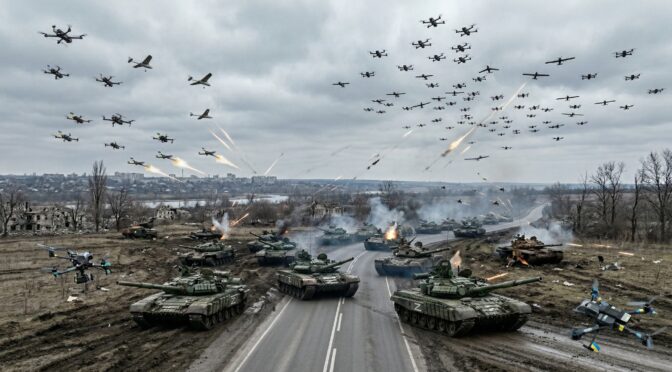
In late March 2026, the fundamental nature of mechanized maneuver warfare underwent a catastrophic and irreversible shift. During a stalled Russian armored offensive in the Kupiansk sector, the Ukrainian Unmanned Systems Forces (USF) executed the first fully documented, combat-effective “coordinated swarm” attack in modern military history. Confirmed through frontline telemetry and official USF post-action reports released on April 9, 2026, this engagement violently exposed the obsolescence of mid-20th-century combined arms doctrine.1
In an engagement lasting precisely 142 seconds, a decentralized mesh network of 40 autonomous unmanned aerial vehicles (UAVs) identified, prioritized, and systematically eradicated an entire Russian armored platoon, including its command T-90M main battle tank and supporting infantry fighting vehicles (IFVs). The entire terminal phase of this engagement occurred without human operator input. This incident represents the maturation of “Swarm Intelligence” from a theoretical laboratory concept into a lethal, combat-ready reality.4
Traditional short-range air defenses (SHORAD) and electronic warfare (EW) umbrellas, long relied upon to provide an “Iron Ceiling” for advancing armor, were bypassed and rendered mechanically and economically irrelevant.5 The reduction of a $120 million armored column by a drone swarm costing under $150,000 establishes a profound economic asymmetry that breaks existing defense procurement models. This report provides an exhaustive open-source intelligence (OSINT) analysis of the tactical execution, hardware and software architectures, and the global doctrinal implications of the March 2026 Kupiansk strike.
The Strategic and Operational Context: Spring 2026
The Macro-Operational Environment
Entering the spring of 2026, the operational environment in eastern Ukraine was defined by intense, attritional warfare, heavily shaped by the deployment of unmanned systems and loitering munitions. Russian forces, seeking to exploit early spring conditions ahead of the Rasputitsa (mud season), initiated a series of localized mechanized assaults aimed at pushing Ukrainian forces back from the international border and crossing the Oskil River in the Kupiansk direction.7 These operations were intended to create a defensible buffer zone and open operational vectors toward the Slovyansk-Kramatorsk agglomeration.9
Russian elements, notably including the 1st Guards Tank Army and the 47th Tank Division, repeatedly attempted to breach Ukrainian lines using traditional concentrated armored columns.3 These columns were ostensibly protected by organic EW and SHORAD assets, adhering to standard Russian ground forces doctrine that relies on mass and localized fire superiority.
Concurrently, the Armed Forces of Ukraine (AFU) had fundamentally restructured its force posture to accommodate the realities of the modern battlefield. The establishment of the Unmanned Systems Forces (USF) as a dedicated military branch in 2024 marked a pivotal institutional adaptation.11 Under the command of Major General Robert “Magyar” Brovdi, the USF rapidly scaled from tactical ad-hoc units to a highly integrated, strategic force responsible for significant percentages of confirmed enemy attrition.11 Throughout March and April 2026, the USF intensified its mid-range and deep-strike campaigns, systemically degrading Russian logistics hubs, oil infrastructure, and air defense networks.1
| Strategic Force Posture | Russian Federation Forces | Ukrainian Armed Forces (AFU) |
| Primary Effort Area | Oskil River crossing, Kupiansk-Lyman axis.8 | Deep strike interdiction, algorithmic attrition, Kupiansk defense.9 |
| Key Units | 1st Guards Tank Army, 47th Tank Division, VDV Airborne elements, Rubicon Drone Unit.3 | Unmanned Systems Forces (USF), 3rd Assault Brigade, 414th Marine Strike UAV Battalion.13 |
| Tactical Doctrine | Massed armor, linear SHORAD umbrellas, heavy artillery preparation.1 | Tactical dispersion, decentralized mesh networking, autonomous swarm strikes.20 |
The Evolution of the Threat: From Mass to Swarm
Prior to March 2026, UAV operations heavily relied on “mass” attacks. In a mass attack, dozens of drones (such as FPV quadcopters or fixed-wing loitering munitions) are launched simultaneously to saturate air defenses, but each unit requires an individual human operator maintaining a continuous radio frequency (RF) control link.21 While highly effective at increasing the volume of fire, this hub-and-spoke architecture is vulnerable to broad-spectrum EW jamming and requires significant human capital. If the pilot’s control signal is severed, or if the pilot is incapacitated by counter-battery fire, the drone is rendered inert.
The March engagement near Kupiansk marked the definitive transition to a “true swarm.” Unlike mass attacks, a true swarm is a singular, cohesive entity comprised of multiple individual nodes. It utilizes decentralized mesh networking and edge-processing artificial intelligence to communicate, negotiate, and execute complex tactical behaviors autonomously.22 The USF, supported heavily by Ukraine’s Brave1 defense technology cluster, spent late 2025 and early 2026 integrating autonomous target allocation algorithms into highly mobile, low-cost platforms.24
The convergence of these technologies in the Kupiansk sector culminated in an engagement that permanently altered battlefield calculus. As Russian forces attempted a mechanized push, they encountered a defensive capability that operated outside the parameters of human reaction time and traditional electronic countermeasures.
Anatomy of the March 2026 Kupiansk Engagement
The destruction of the Russian armored column was not a conventional skirmish; it was a highly synchronized algorithmic execution. Telemetry data, visual confirmation, and OSINT analysis indicate that the 142-second engagement was broken down into distinct, machine-speed phases that completely neutralized the attacking force.
Phase I: Detection and Autonomous Target Allocation
The engagement commenced when the Russian tank platoon, advancing along a localized axis toward the Kupiansk-Lyman line, was detected by Ukrainian wide-area surveillance and reconnaissance drones operating at high altitudes. Upon detection and verification of the threat vector, a swarm of 40 UAVs was deployed from dispersed, concealed positions.
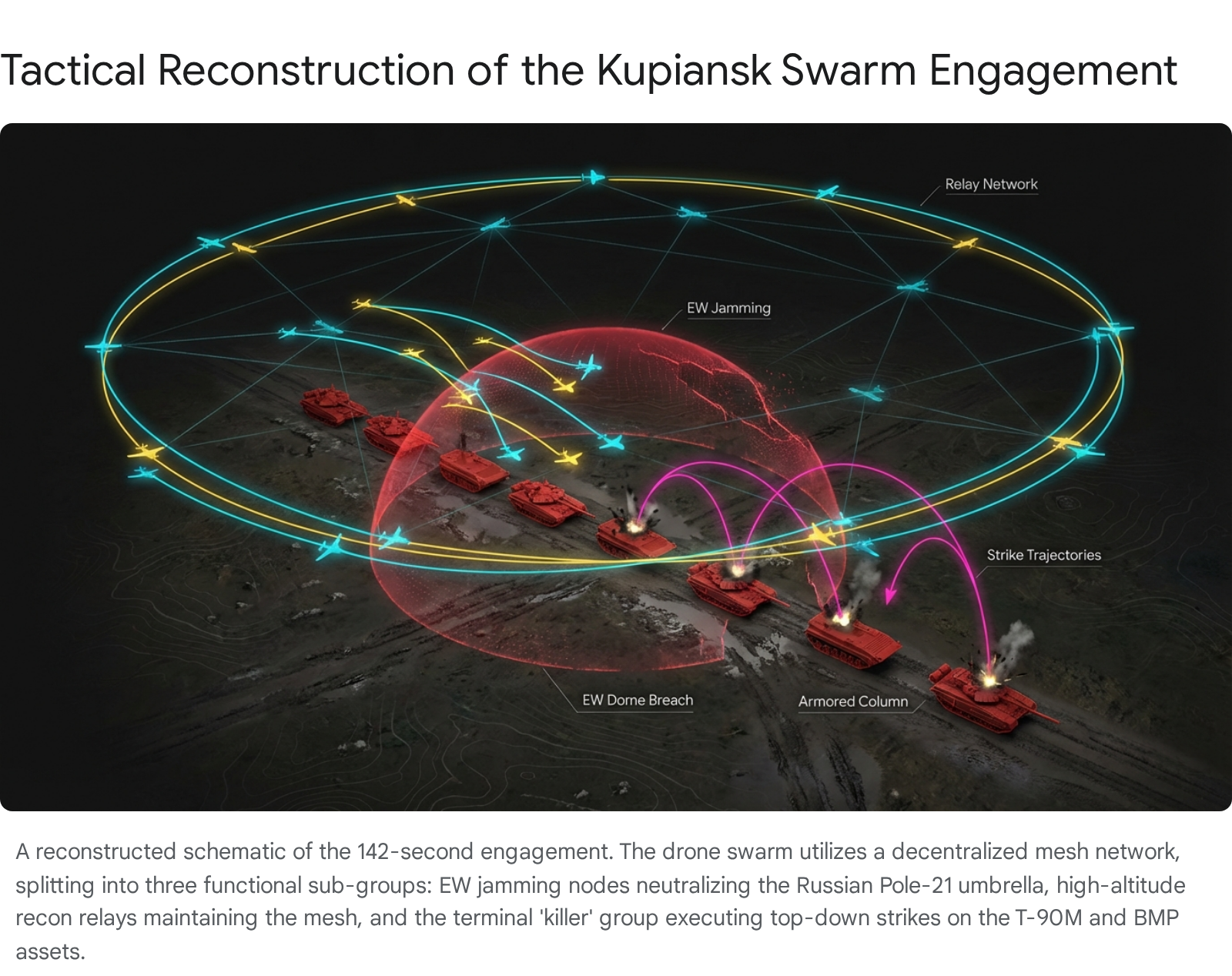
Crucially, once the swarm reached the operational grid and acquired visual confirmation of the targets, operators severed the manual control link, handing full tactical authority over to the swarm’s onboard AI. This transition to full autonomy was a tactical necessity designed to bypass the Russian Pole-21 EW systems, which were establishing a localized jamming dome over the advancing column to sever traditional RF control links.
Operating on a decentralized “mesh” network, the 40 drones shared sensor data in real-time.27 When the optical sensors of the lead drone identified the thermal and visual signature of the Russian command T-90M tank, the data was instantaneously broadcast across the entire swarm network. The swarm’s internal algorithm subsequently executed an autonomous target allocation protocol.28
Recognizing the T-90M as a high-value target (HVT) and the primary node of Russian tactical command and control (C2), the network automatically assigned six drones to prosecute the tank. The remaining 34 units simultaneously identified, mapped, and locked onto the supporting BMP infantry fighting vehicles, MT-LB personnel carriers, and logistical supply trucks. This entire triage, prioritization, and allocation process occurred in milliseconds, completely without any human-in-the-loop (HITL) authorization for the terminal phase.
Phase II: The “Blind Spot” Maneuver
The tactical brilliance of the March engagement lay in the swarm’s ability to dynamically restructure its formation based on the immediate threat environment. Telemetry analysis reveals that the 40-drone cluster executed a coordinated separation tactic, unofficially designated by analysts as the “Blind Spot” maneuver.29 The swarm divided into three highly specialized sub-groups, each serving a distinct function in the algorithmic kill chain:
- The Suppression Element (EW/Decoy Group): A subset of the swarm dove rapidly toward the column, emitting localized RF noise and acting as kinetic decoys. Their primary function was to saturate the local Russian radar environment and force the automated targeting systems of the Russian SHORAD into a processing feedback loop, effectively blinding them to the true threat vectors.
- The Reconnaissance and Relay Node: A second group hovered at a higher altitude, remaining outside the immediate kinetic engagement envelope of the Russian column. These units acted as airborne routers. Using configurations similar to the domestically produced “Bucha” fixed-wing platform—which can substitute a warhead for extended battery and relay equipment—they maintained the integrity of the mesh network.27 This ensured that even if terminal strike drones were destroyed by kinetic countermeasures, the swarm’s collective intelligence, targeting data, and spatial mapping remained intact.
- The “Killer” Group: The largest contingent of the swarm approached the column from the vehicles’ literal and electronic blind spots. Striking from a high-angle, top-down trajectory, these munitions bypassed the heavy frontal glacis and side armor of the T-90M and BMPs. Instead, they targeted the notoriously thin turret roofs and engine decking, maximizing the probability of catastrophic catastrophic ammunition cook-offs and mobility kills.
| Swarm Sub-Group Classification | Estimated Quantity | Altitude Profile | Primary Tactical Objective |
| Suppression (EW / Decoy) | 4 – 6 | Low / Variable | Radar saturation; localized EW jamming; target distraction. |
| Reconnaissance / Relay | 2 – 4 | High / Loitering | Maintain mesh network integrity; real-time BDA (Battle Damage Assessment). |
| Terminal “Killer” (Strike) | 30 – 34 | High-Angle Dive | Kinetic strike execution via autonomous target allocation. |
Phase III: Saturation Speed and the 142-Second Kill Chain
The concept of “saturation speed” dictates that a defense system—whether mechanical or biological—can only process and react to a finite number of threats within a given timeframe. The Kupiansk swarm attack weaponized time. From the exact moment the swarm algorithm detected the column to the final munition detonating, precisely 142 seconds elapsed.31
In a conventional combined arms attack, sequential missile launches or artillery barrages give a well-trained tank crew time to deploy smoke screens, activate hard-kill active protection systems (APS), or traverse their turrets to return fire. In this engagement, the Russian crews were overwhelmed by a 360-degree volume of simultaneous, highly coordinated threats. Six drones struck the command T-90M in rapid succession. The initial strikes systematically stripped away the Explosive Reactive Armor (ERA) blocks and triggered any passive defenses, while the subsequent drones exploited the newly exposed base armor. The human operators inside the vehicles were physically, cognitively, and mechanically incapable of assessing the threat, let alone engaging it, before the column was entirely reduced to burning wreckage.
Hardware and Software Architecture of the Swarm
The success of the March 2026 strike was heavily predicated on advancements in both off-the-shelf hardware integration and bespoke, military-grade software developed rapidly under wartime conditions. The synergy between these components represents a masterclass in decentralized military innovation, spearheaded by organizations like the Brave1 defense-tech cluster.25
Platform Agnosticism and Hybrid Airframes
OSINT analysis suggests that the swarm deployed in Kupiansk was not monolithic in its hardware profile. Rather than relying on a single, expensive, and difficult-to-procure platform, the USF utilized a heterogeneous mix of airframes designed to maximize operational flexibility and minimize per-unit costs.
The relay nodes likely utilized small, fixed-wing designs engineered for endurance and extended loiter times. Technologies analogous to the “Bucha” drone, developed by UFORCE, fit this mission profile perfectly. The Bucha operates in coordinated groups using a mesh-network approach and configures specific aircraft as relay nodes to extend communication ranges up to 200 kilometers.27
Conversely, the terminal strike elements were almost certainly highly maneuverable rotary-wing FPV drones, heavily modified for autonomous flight. Companies within the Brave1 ecosystem, such as Vyriy and Wild Hornets, had already pioneered small FPV drones (like the “Molfar” and “Sting” interceptors) capable of swarm functioning and evading Russian jamming.33 These airframes, built largely from commercially available components but heavily modified with domestic flight controllers and optical targeting modules, cost roughly $3,000 each. They carry shaped-charge anti-tank munitions capable of penetrating over 200mm of rolled homogeneous armor (RHA) when striking perpendicularly.
The Nervous System: Wireless Mesh Networking
The core enabler of the swarm is its communication architecture. Traditional military drones operate on a hub-and-spoke model; if the hub (the pilot’s radio or the command center) is jammed by EW, the drone is lost or forced to return to base. The Kupiansk swarm utilized a highly resilient wireless mesh network.
In a mesh configuration, every drone acts as both a client and a router. If one drone’s communication is degraded by localized RF interference, or if a drone is destroyed, data packets seamlessly route through adjacent surviving drones. This system allows the swarm to maintain tactical cohesion over highly contested airspace. The integration of advanced communication data links, potentially leveraging localized edge computing and directional antennas, ensures that the swarm can coordinate attack timings down to the millisecond. This network elasticity is what permitted the “Blind Spot” maneuver to be executed flawlessly; as drones shifted positions and altered altitudes, the network dynamically healed itself, maintaining the continuous flow of targeting telemetry across the battlefield.22
The Brain: Edge-Processing AI and Autonomous Algorithms
The most profound and destabilizing aspect of the March engagement for global military planners is the high degree of autonomy achieved by the Ukrainian systems. The drones utilized “edge-processing AI.” This signifies that the massive computational power required for machine vision, target recognition, and dynamic flight path calculation was housed directly on the drone’s onboard microprocessors, rather than relying on a continuous uplink to a remote server or human operator.24
Using advanced Convolutional Neural Networks (CNNs) trained on vast, real-world datasets of Russian armored vehicles, the drones’ optical sensors could instantly differentiate between a high-value T-90M, a standard BMP-2, and a logistical Ural truck. The swarm intelligence algorithms—likely inspired by biological models of flocking and foraging—allowed the drones to negotiate target assignments among themselves. If two drones locked onto the same weak point of a BMP, the algorithm instantly de-conflicted their paths, redirecting one to an alternate target to prevent overkill and optimize munition distribution.28 This edge-processing capability fundamentally breaks the traditional electronic warfare kill chain, which relies almost entirely on severing the link between pilot and machine.
The Collapse of Traditional Defense: The “Iron Ceiling” Problem
For roughly a century, the tank has dominated terrestrial warfare, acting as the apex predator of the battlefield. Its survival, however, has always been contingent on a combined arms umbrella—an “Iron Ceiling” provided by infantry screens and mobile air defense systems. The March 2026 swarm attack definitively shredded this doctrine, exposing three critical vulnerabilities in Russian, and by extension global, mechanized defense architectures.
1. Mechanical Incapability of SHORAD
Russian short-range air defense systems, such as the Pantsir-S1 and the Tor-M2, represent some of the most capable kinetic defense platforms globally. However, their design philosophy is rooted in Cold War operational requirements, optimized to track and destroy linear, high-velocity threats like cruise missiles, or singular, high-radar-cross-section (RCS) targets like fighter jets and attack helicopters.
A Tor-M2 system can simultaneously track dozens of targets but has a severely limited number of engagement channels (typically 4 to 8 missiles guided simultaneously). When confronted with 40 independent, highly maneuverable, bird-sized objects converging simultaneously from multiple vectors, the radar and fire control systems undergo massive task saturation. They are mechanically and computationally incapable of slewing their turrets, acquiring radar locks, and launching interceptors fast enough to stem the tide. Even if the SHORAD system operates flawlessly within its design parameters, the math is unforgiving: successfully intercepting 8 drones leaves 32 free to prosecute the column.
2. The Obsolescence of Traditional Electronic Warfare
Russian tactical doctrine relies heavily on layered, deep electronic warfare. Systems like the Pole-21 are designed to create a dome of RF interference, jamming GPS signals and severing the command and control links of incoming drones. Against first-generation FPV drones piloted by humans, this tactic proved highly effective in the attrition battles of 2023 and 2024.
However, the advent of edge-processing AI has rendered these multi-million-dollar EW systems obsolete in the face of a true autonomous swarm. Because the drones rely on internal optical navigation (machine vision matching terrain features to pre-loaded maps) and edge-computed target recognition, they simply do not require GPS or a continuous pilot RF uplink during the terminal engagement phase.33 The swarm effectively ignores the EW jamming, flying through the electronic noise as easily as a kinetic projectile flies through a smoke screen. The Pole-21, designed to break a digital tether, is useless against a machine that has severed its own tether by design.
3. Profound Economic Asymmetry
Perhaps the most destabilizing strategic implication of the Kupiansk attack is the financial calculus it imposes. Historically, warfare has favored the state actor that can out-produce its rival in heavy industry, steel, and complex machinery. Today, microchips, open-source algorithms, and injection-molded plastics have aggressively subverted heavy steel.
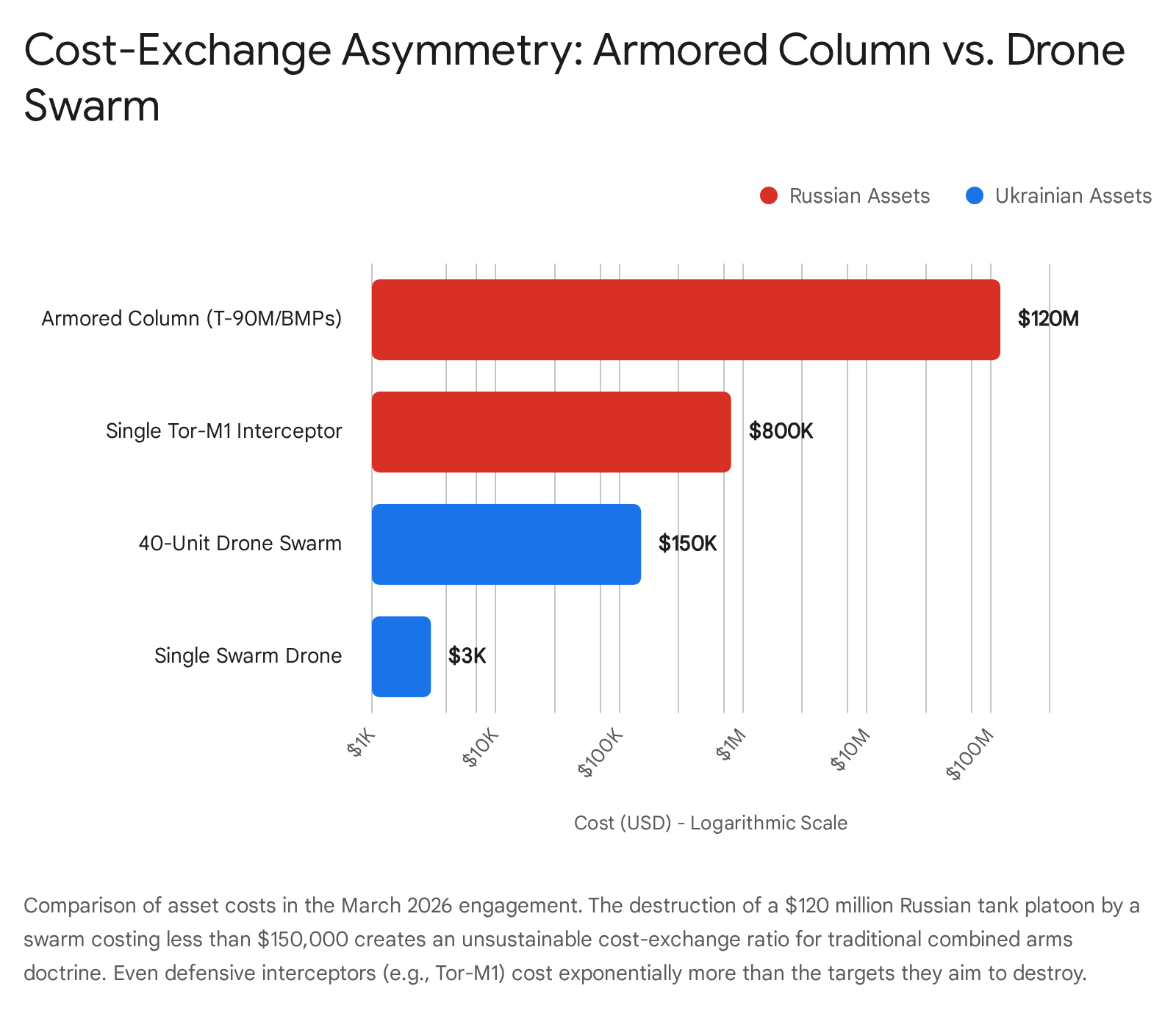
The Russian armored column destroyed in the March engagement was valued at an estimated $120 million. The 40-unit swarm that systematically dismantled it cost less than $150,000—representing an unsustainable cost-exchange ratio of roughly 800:1.
Furthermore, attempting to defend against these swarms using traditional kinetic means is a losing financial proposition. A single interceptor missile for a Tor-M1 system costs roughly $800,000. Firing an $800,000 missile to destroy a $3,000 plastic drone is economically ruinous over a prolonged campaign. The military force employing massed autonomous swarms can simply exhaust and bankrupt the defender’s air defense magazines long before their own drone stockpiles are depleted.
Doctrinal Shift: The End of Concentrated Armor
Military planners globally are currently facing a profound “triage” moment for armored warfare. For decades, the concentration of mass—grouping tanks, mechanized infantry, and self-propelled artillery into tightly packed divisions or Battalion Tactical Groups (BTGs)—was the fundamental key to achieving an operational breakthrough. The March 2026 engagement proves that a concentrated mass of steel is no longer a spearhead; it is merely a high-value, target-rich environment waiting to be processed by an algorithm.
Tactical Dispersion and Mosaic Warfare
As Major General Brovdi noted following the engagement, the very concept of a traditional tank division is now a liability.20 Survival on the modern, sensor-saturated battlefield dictates a doctrine of “tactical dispersion,” aligning closely with the emerging concepts of Mosaic Warfare. Units must spread out significantly, minimizing their visual, thermal, and electromagnetic signatures. They must operate as small, highly mobile, and semi-independent nodes that assemble rapidly only at the precise point of attack, execute the mission, and disperse again before an algorithmic swarm can be routed to their coordinates. The battlefield is becoming highly transparent, and any concentrated force will trigger a devastating autonomous response.
The Vulnerability of Hard-Kill Active Protection Systems (APS)
If external SHORAD systems cannot protect armor from swarms, conventional wisdom dictates that the armor must protect itself. Global militaries are currently scrambling to retrofit Hard-Kill Active Protection Systems (APS), such as the Israeli Trophy or the U.S. Iron Fist, onto their main battle tanks.6
However, as demonstrated in Kupiansk, current APS technology is severely limited by physical reload speeds, limited traverse rates, and shallow magazine depths. A swarm of 40 drones will simply bait the APS to expend its kinetic charges, depleting the defense in seconds, and systematically kill the tank with the remaining munitions. APS is designed to defeat a single RPG or ATGM, not a coordinated multi-vector saturation attack.
The “Carrier” Concept and Defensive Swarms
This glaring vulnerability has given rise to the “Carrier Concept” in forward-looking military analysis. Analysts project that the future main battle tank cannot rely on passive armor or slow-to-reload kinetic interceptors. Instead, armored vehicles must evolve into “drone carriers”—essentially mobile armored hives equipped with their own AI-driven defensive swarms.26
When an offensive swarm is detected, the carrier vehicle would autonomously launch dozens of micro-interceptor drones. These interceptors, functioning like an airborne digital immune system, would engage the incoming threat in a decentralized, high-speed dogfight 40, re-establishing a dynamic and fluid “Iron Ceiling” above the dispersed tactical unit. Ukraine is already pioneering this concept with the rapid development of autonomous interceptor swarms designed to hunt down incoming threats with minimal human input, moving toward a 1:1 intercept ratio.35
Strategic Horizon: The Scaling of Algorithmic Warfare
The March 2026 Kupiansk strike was not an anomaly; it was a lethal proof of concept that is rapidly moving into mass production. The technological innovations that enabled this strike were incubated within Ukraine’s Brave1 defense tech cluster, a government-backed platform that has gamified and exponentially accelerated the procurement and R&D cycle.25 By creating an open ecosystem where frontline telemetry directly informs immediate software patches and hardware iterations, Ukraine has decoupled defense innovation from the sluggish, decades-long procurement cycles typical of Western militaries.37
The strategic implications extend far beyond the steppes of eastern Europe. The proliferation of low-cost, edge-processing AI modules, combined with commercially available drone components, means that the barrier to entry for possessing an autonomous precision-strike air force has plummeted. Non-state actors, proxy forces, and smaller nations can now procure swarm capabilities that threaten the multi-billion-dollar expeditionary forces of major superpowers.
As Ukraine scales the production of true swarms, integrating them deeply into their operational planning for 2026 and beyond, Russian forces will be forced into a frantic cycle of adaptation. The Russian deployment of the “Rubikon” elite drone unit and the formal establishment of their own Unmanned Systems Forces—a direct mirror of Ukraine’s USF—indicates that Moscow recognizes the existential threat posed by algorithmic warfare.17 However, successfully countering a decentralized, autonomous mesh network requires a level of advanced software engineering, rapid iteration, and micro-electronic supply chain integrity that Russia currently struggles to maintain under global sanctions.45
Conclusion
The March 2026 Kupiansk drone swarm attack represents a paradigm shift equivalent to the introduction of the machine gun in World War I or the aircraft carrier in World War II. The Unmanned Systems Forces of Ukraine have unequivocally demonstrated that a decentralized network of autonomous, low-cost UAVs can dismantle a state-of-the-art armored platoon in a matter of seconds. By circumventing traditional electronic warfare, overwhelming kinetic air defenses through saturation speed, and enforcing an unsustainable economic asymmetry, the swarm has deposed the tank as the king of the battlefield.
Military institutions worldwide must urgently reevaluate their procurement priorities and doctrinal assumptions. Investments heavily skewed toward concentrated heavy armor and legacy air defense systems risk outfitting armies for a war that no longer exists. The “Iron Ceiling” of defense is no longer forged from steel plates and radar-guided missiles; it is woven from adaptive mesh networks, edge-processing artificial intelligence, and algorithmic swarms. In the rapidly evolving landscape of modern conflict, survival relies not on the thickness of armor, but on the speed and autonomy of the algorithm.
Please share the link on Facebook, Forums, with colleagues, etc. Your support is much appreciated and if you have any feedback, please email us in**@*********ps.com. If you’d like to request a report or order a reprint, please click here for the corresponding page to open in new tab.
Sources Used
- Russian Offensive Campaign Assessment, March 14, 2026 | ISW, accessed April 12, 2026, https://understandingwar.org/research/russia-ukraine/russian-offensive-campaign-assessment-march-14-2026/
- Russian Offensive Campaign Assessment, April 8, 2026, accessed April 12, 2026, https://understandingwar.org/research/russia-ukraine/russian-offensive-campaign-assessment-april-8-2026/
- Russian Offensive Campaign Assessment, April 9, 2026 | ISW, accessed April 12, 2026, https://understandingwar.org/research/russia-ukraine/russian-offensive-campaign-assessment-april-9-2026/
- 6 predictions for defence in 2026 – Resilience Media, accessed April 12, 2026, https://resiliencemedia.co/resilience-medias-predictions-for-2026/
- Design, Control, and Motion-Planning for a Root-Perching Rotor-Distributed Manipulator | Request PDF – ResearchGate, accessed April 12, 2026, https://www.researchgate.net/publication/374996654_Design_Control_and_Motion-Planning_for_a_Root-Perching_Rotor-Distributed_Manipulator
- The Future of Minefield Breaching – European Security & Defence, accessed April 12, 2026, https://euro-sd.com/wp-content/uploads/2026/01/ESD_02_2026_WEB.pdf
- Russian Offensive Campaign Assessment, March 19, 2026 | ISW, accessed April 12, 2026, https://understandingwar.org/research/russia-ukraine/russian-offensive-campaign-assessment-march-19-2026/
- Russia’s Battlefield Woes in Ukraine – CSIS, accessed April 12, 2026, https://www.csis.org/analysis/russias-battlefield-woes-ukraine
- Russian Offensive Campaign Assessment, March 17, 2026 | ISW, accessed April 12, 2026, https://understandingwar.org/research/russia-ukraine/russian-offensive-campaign-assessment-march-17-2026/
- Ukraine war situation update | 14 – 20 March 2026 – ReliefWeb, accessed April 12, 2026, https://reliefweb.int/report/ukraine/ukraine-war-situation-update-14-20-march-2026
- Drone Warfare in Ukraine: From Myths to Operational Reality – Part 1, accessed April 12, 2026, https://researchcentre.army.gov.au/library/land-power-forum/drone-warfare-ukraine-myths-operational-reality-part-1
- Unmanned Aircraft and the Revolution in Operational Warfare – Army University Press, accessed April 12, 2026, https://www.armyupress.army.mil/Journals/Military-Review/English-Edition-Archives/July-August-2025/Unmanned-Aircraft-Revolution/
- Opinion: Pokrovsk Revisited Again – Deadlier Drone Wars – Laughing at Luna – Kyiv Post, accessed April 12, 2026, https://www.kyivpost.com/opinion/63546
- Russia Opens ‘Terrorism’ Case Against Ukraine’s Top Drone Commander – Kyiv Post, accessed April 12, 2026, https://www.kyivpost.com/post/65828
- Ukrainian drones destroy ninth Russian air defense system in nine days of April – The New Voice of Ukraine, accessed April 12, 2026, https://english.nv.ua/nation/unmanned-aerial-systems-have-destroyed-9-russian-air-defense-systems-since-early-april-video-50599013.html
- Active Conflicts & News Megathread February 24, 2026 : r/CredibleDefense – Reddit, accessed April 12, 2026, https://www.reddit.com/r/CredibleDefense/comments/1rdcp7w/active_conflicts_news_megathread_february_24_2026/
- November 14 2025 — Day 1359 — Drones Over Pokrovsk, Kyiv Takes a Shot, Neptunes and Flamingos | by Stefan Korshak | Medium, accessed April 12, 2026, https://medium.com/@Stefan.Korshak/november-14-2025-day-1359-drones-over-pokrovsk-kyiv-takes-a-shot-neptunes-and-flamingos-24e79d15896b
- Ukrainian drone units damaged 54 units of Russian military equipment over winter, accessed April 12, 2026, https://gwaramedia.com/en/ukrainian-drone-units-damaged-54-units-of-russian-military-equipment-over-winter/
- Video: Russia Deployed Heavy Armor on the Lyman Direction, but the Column Was Destroyed | UA.NEWS, accessed April 12, 2026, https://ua.news/en/war-vs-rf/video-rf-kinula-vazhku-bronetekhniku-na-limanskomu-napriamku-ale-kolonu-rozgromili
- Mosaic Warfare In Ukraine – The Defence Horizon Journal, accessed April 12, 2026, https://tdhj.org/blog/post/mosaic-warfare-ukraine/
- How are Drones Changing Modern Warfare? | Australian Army Research Centre (AARC), accessed April 12, 2026, https://researchcentre.army.gov.au/library/land-power-forum/how-are-drones-changing-modern-warfare
- Technological Evolution on the Battlefield – CSIS, accessed April 12, 2026, https://www.csis.org/analysis/chapter-9-technological-evolution-battlefield
- Drones in Modern Warfare: Lessons Learnt from the War in Ukraine – Australian Army Research Centre, accessed April 12, 2026, https://researchcentre.army.gov.au/sites/default/files/241022-Occasional-Paper-29-Lessons-Learnt-from-Ukraine_2.pdf
- What Tech Will Define Warfare in 2026? Here’s What Insiders Say, accessed April 12, 2026, https://united24media.com/war-in-ukraine/what-tech-will-define-warfare-in-2026-heres-what-insiders-say-14123
- Brave1 Defense Tech Valley 2026: Ukraine is shaping a new global standard for defense solutions | MoD News, accessed April 12, 2026, https://mod.gov.ua/en/news/brave1-defense-tech-valley-2026-ukraine-is-shaping-a-new-global-standard-for-defense-solutions
- information about the project Brave1 – Digital State UA, accessed April 12, 2026, https://digitalstate.gov.ua/projects/tech/brave1
- Ukrainian Firm Unveils ‘Bucha’ Kamikaze Drone With 200 km Range …, accessed April 12, 2026, https://www.kyivpost.com/post/72062
- Drone Swarm System Market Research Report 2034 – Dataintelo, accessed April 12, 2026, https://dataintelo.com/report/drone-swarm-system-market
- MCU Insights, vol. 16, no. 4 – Marine Corps University, accessed April 12, 2026, https://www.usmcu.edu/Outreach/Marine-Corps-University-Press/MES-Publications/MES-Insights/MCU-Insights-vol-16-no-4/
- PRC Concepts for UAV Swarms in Future Warfare | CNA.org., accessed April 12, 2026, https://www.cna.org/reports/2025/07/PRC-Concepts-for-UAV-Swarms-in-Future-Warfare.pdf
- The Greatest Adventure: A History of Human Space Exploration 9781789144604, accessed April 12, 2026, https://dokumen.pub/the-greatest-adventure-a-history-of-human-space-exploration-9781789144604.html
- Innovation under tough circumstances: Ukraine’s AI strategy in times of war – Oxford Insights, accessed April 12, 2026, https://oxfordinsights.com/insights/innovation-under-tough-circumstances-ukraines-ai-strategy-in-times-of-war/
- Lessons from Ukraine’s ‘First World Drone War’ | Opinion – The Philadelphia Inquirer, accessed April 12, 2026, https://www.inquirer.com/opinion/inq2/first-world-drone-war-ukraine-russia-20250824.html
- Can Interceptor Drones Protect Ukraine’s Skies? – VGI-9, accessed April 12, 2026, https://vgi.com.ua/en/interceptor-drones-ukraine-russia-war/
- Ukraine Developing AI-Driven Drone Swarms to Counter Russian Shaheds – Kyiv Post, accessed April 12, 2026, https://www.kyivpost.com/post/72994
- IoT and Edge Computing impact on Beyond 5G: enabling technologies and challenges Release 3.0 AIOTI WG Standardisation 30 Novembe, accessed April 12, 2026, https://aioti.eu/wp-content/uploads/2023/11/AIOTI-Report-IoT-and-Edge-impact-on-Beyond-5G-R3-Final.pdf
- Opinion: US Blind Spot in the Drone War: Why Ukraine Holds the Key to America’s AI Supremacy – Kyiv Post, accessed April 12, 2026, https://www.kyivpost.com/opinion/51165
- M W J – Modern War Institute -, accessed April 12, 2026, https://mwi.westpoint.edu/wp-content/uploads/2026/03/Modern-War-Journal-MWJ-second-edition-final-draft-as-of-12MAR26-pdf-1.pdf
- The significant decrease in T-90M tank losses in Ukraine masks a more complex reality., accessed April 12, 2026, https://meta-defense.fr/en/2026/03/16/t-90m-baisse-pertes-chars-russes/
- Evolution Not Revolution – Amazon S3, accessed April 12, 2026, https://s3.us-east-1.amazonaws.com/files.cnas.org/documents/CNAS-Report-Defense-Ukraine-Drones-Final.pdf
- Ukraine’s $1,200 drone is getting an upgrade: swarm mode – Euromaidan Press, accessed April 12, 2026, https://euromaidanpress.com/2026/04/01/ukraines-1200-drone-is-getting-an-upgrade-swarm-mode/
- Commercial Equipment is Reshaping the Battlefield – Defense Opinion, accessed April 12, 2026, https://defenseopinion.com/commercial-equipment-is-reshaping-the-battlefield/1121/
- Red Skies Ahead: Russia Planning for Its Drone-Driven Army of Tomorrow, accessed April 12, 2026, https://www.armyupress.army.mil/Journals/Military-Review/English-Edition-Archives/January-February-2026/Red-Skies-Ahead/
- Russia in Review, Dec. 19, 2025–Jan. 9, 2026, accessed April 12, 2026, https://www.russiamatters.org/news/russia-review/russia-review-dec-19-2025-jan-9-2026
- Russia Analytical Report, Oct. 27–Nov. 3, 2025, accessed April 12, 2026, https://www.russiamatters.org/news/russia-analytical-report/russia-analytical-report-oct-27-nov-3-2025