1. Executive Summary
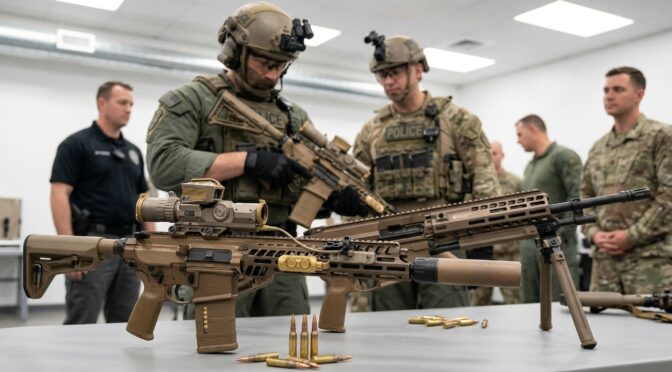
The landscape of tactical small arms and infantry deployment doctrine is currently undergoing a profound transformation, driven predominantly by the United States Army Next Generation Squad Weapon (NGSW) program. This military initiative represents the most significant shift in standard-issue infantry rifle doctrine in over half a century, deliberately replacing the legacy 5.56x45mm NATO cartridge with the proprietary 6.8x51mm hybrid cartridge, which is commercially designated as the.277 SIG FURY.1 Engineered specifically to restore infantry overmatch against peer adversaries equipped with advanced body armor, the NGSW program prioritizes extended long-range kinetic energy, high-pressure internal ballistics, and the integration of advanced computerized fire control optics.3 The resulting weapon platforms, namely the XM7 rifle and the XM250 automatic rifle manufactured by SIG Sauer, deliver ballistic performance previously reserved for specialized magnum sniper weapon systems.2
However, the operational requirements of military infantry combat diverge sharply from the constraints and liability frameworks of domestic law enforcement. While military entities require target penetration and terminal ballistics at ranges exceeding 500 meters, law enforcement personnel and Special Weapons and Tactics (SWAT) units operate primarily in high-density urban environments where engagement distances rarely exceed 50 meters.1 Consequently, the extreme ballistic properties of the 6.8x51mm cartridge present critical operational challenges for domestic policing. These challenges specifically center around severe overpenetration risks, collateral damage liability, auditory health hazards, and overall weapon controllability during rapid close-quarters engagements.7
This research report provides an exhaustive technical analysis of the 6.8x51mm cartridge and its associated SIG Sauer weapon platforms. The analysis evaluates the internal and external ballistic capabilities, armor-defeating properties, mechanical reliability, and overall tactical integration of the XM7 system.2 Furthermore, the report examines current law enforcement tactical rifle procurement trends for the 2024 to 2026 fiscal cycles, utilizing the Berrien County Sheriff Tactical Response Unit as a specific operational case study.10 The objective is to provide procurement officials, tactical commanders, and firearms industry executives with actionable intelligence regarding equipment integration, the inherent limitations of military-grade hardware in civilian environments, and the strategic direction of police tactical gear acquisition.
2. The Next Generation Squad Weapon Program Paradigm
To accurately understand the future trajectory of tactical small arms procurement, it is necessary to examine the origins, engineering objectives, and deployment parameters of the NGSW program. The program was not initiated merely to update aging hardware, but rather to fundamentally alter the physics of modern infantry engagements.3
2.1 Contextual Threat Matrix and the 5.56mm Limitation
The genesis of the NGSW program traces back to the 2017 Small Arms Ammunition Configuration Study conducted by the United States military.1 During congressional testimony in 2017, military leadership identified a critical operational capability gap regarding standard infantry armaments. The 5.56x45mm NATO cartridge, which had functioned as the bedrock of Western military interoperability since 1980, inherently lacked the kinetic energy required to defeat modern Level III and Level IV body armor utilized by peer adversaries.1
Furthermore, combat reports from expansive theaters of operation indicated that the maximum effective range of the 5.56mm platform (traditionally cited as approximately 300 to 400 meters for standard infantry) placed American forces at a distinct disadvantage against adversaries utilizing medium machine guns and designated marksman rifles chambered in the potent 7.62x54mmR cartridge.12 The military concluded that engaging targets at 500 meters and beyond with the 5.56x45mm round resulted in insufficient retained energy to reliably incapacitate enemy combatants.1
2.2 Procurement History and Program Directives
The official military requirement for the NGSW program demanded a new intermediate cartridge capable of bridging the ballistic gap between the lightweight 5.56x45mm and the heavier 7.62x51mm NATO round.13 The explicit directive specified that the new cartridge must reliably defeat near-peer body armor at a range of 500 meters, while simultaneously increasing the overall hit probability of the average rifleman through the integration of computerized fire control optics.1
Following a rigorous 27-month prototyping and evaluation phase involving multiple defense contractors, the U.S. Army awarded a comprehensive ten-year contract to SIG Sauer in April 2022.15 This contract encompassed the production of the XM7 rifle to replace the M4 carbine, the XM250 automatic rifle to replace the M249 Squad Automatic Weapon, and the proprietary 6.8x51mm hybrid ammunition necessary to achieve the desired ballistic overmatch.16 Recent updates indicate the military has removed the experimental “X” designation, formally classifying the platforms as the M7 and M250.17
3. Internal Ballistics and Ammunition Architecture
The defining technological breakthrough of the NGSW program is the architecture of the 6.8x51mm cartridge itself. Achieving magnum-level ballistic performance from a standard infantry rifle required a total redesign of cartridge metallurgy and pressure containment.
3.1 Hybrid Case Technology and Chamber Pressures
Traditional centerfire rifle cartridges utilize a uniform brass casing. Brass is highly favored in ammunition manufacturing for its malleability, which allows the case to rapidly expand and seal the rifle chamber upon firing (a process known as obturation) before shrinking slightly to allow for reliable extraction.3 However, brass features inherent metallurgical limits regarding the internal chamber pressures it can safely contain before the case head ruptures, deforms, or causes primer pocket expansion.3
To achieve the military target velocities necessary to defeat body armor at 500 meters using a relatively short combat barrel, SIG Sauer engineers were required to push chamber pressures far beyond historical small arms norms. The engineering solution was a three-piece hybrid cartridge case.9 The hybrid design consists of a traditional brass body connected to a stainless steel base (the case head) via an internal aluminum locking washer.9 The steel base possesses significantly higher tensile strength than standard brass, allowing the cartridge to safely contain pressures that would cause catastrophic failures in conventional ammunition.3
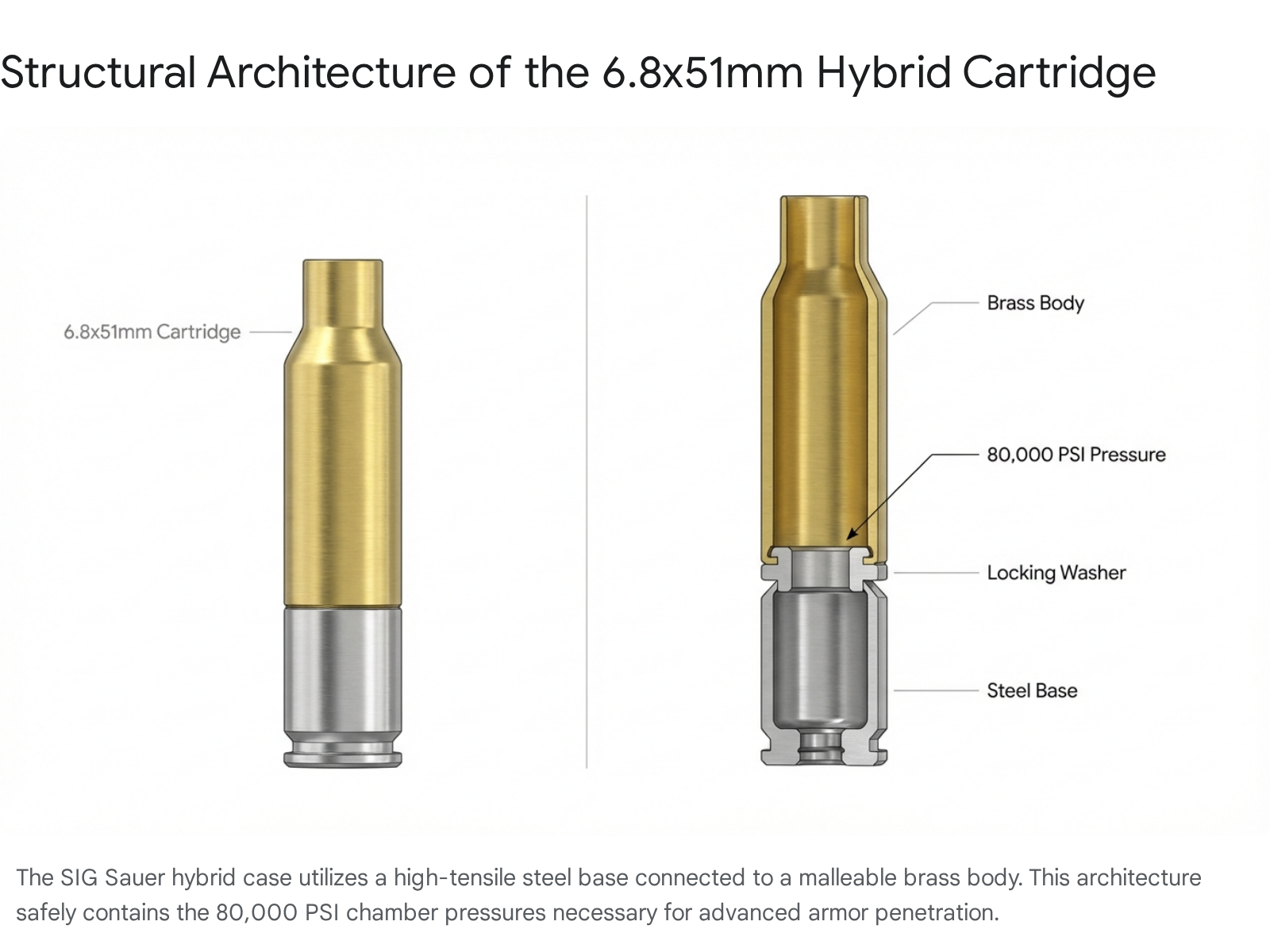
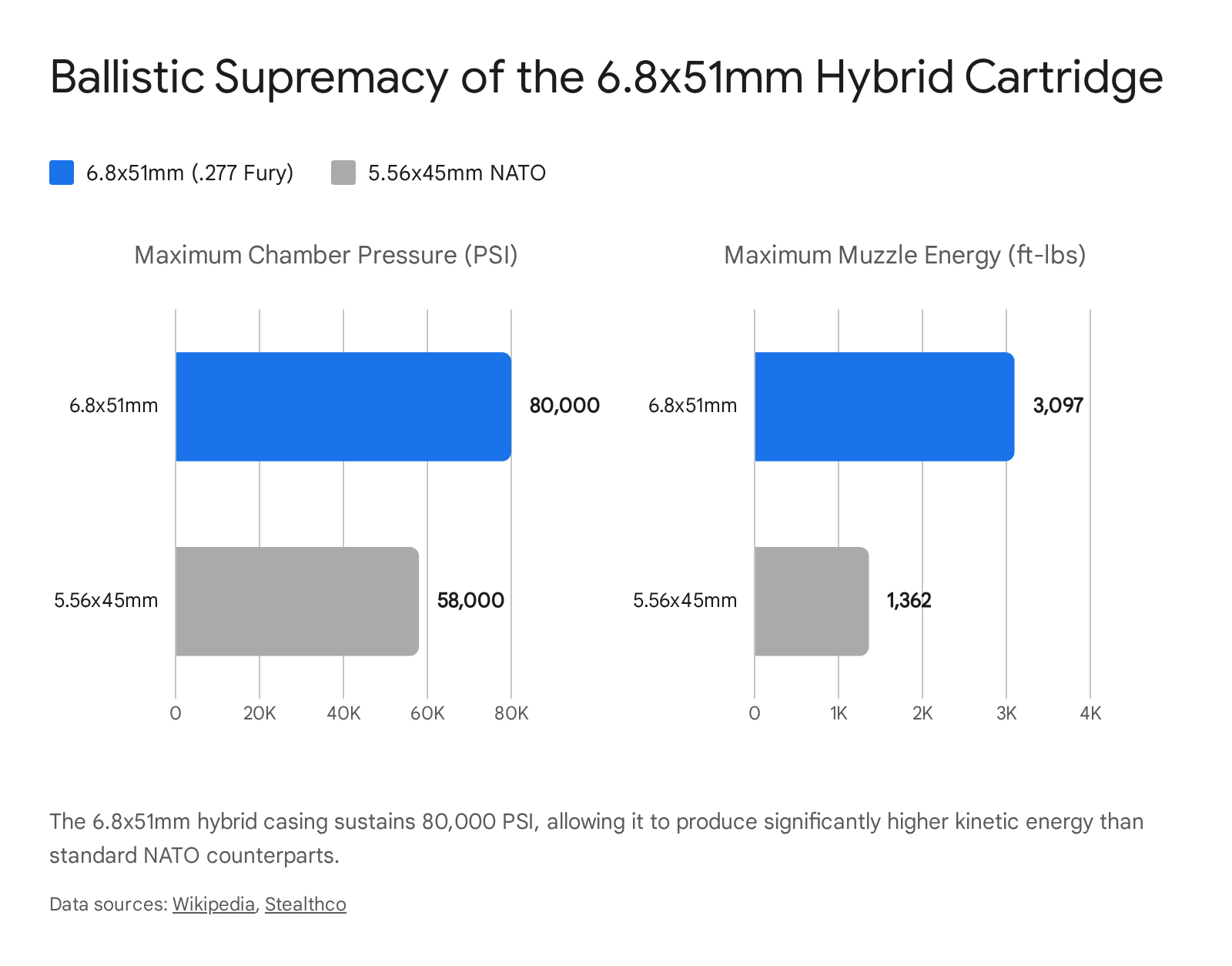
The Sporting Arms and Ammunition Manufacturers Institute (SAAMI) officially approved the civilian variant of this cartridge (the.277 SIG FURY) with a maximum average pressure of 80,000 pounds per square inch (PSI).3 To contextualize this extreme metric, the standard 5.56x45mm NATO cartridge operates at approximately 62,000 PSI, and the formidable.338 Lapua Magnum operates at approximately 61,000 PSI.18 Operating at 80,000 PSI is a historic milestone in small arms engineering, representing an approximate 20 to 25 percent increase in barrel pressure over legacy infantry systems.19
3.2 Mechanical Degradation and System Wear
The fundamental engineering trade-off of the 6.8x51mm cartridge is the extreme thermal and mechanical strain placed on the weapon’s internal components. Igniting powder charges designed to generate 80,000 PSI results in internal temperatures estimated to exceed 4,750 degrees Fahrenheit.20 The combination of this extreme heat and the abrasive physical force of high-pressure gases passing through a short 13-inch barrel results in severe throat erosion and accelerated barrel wear.20
Early professional reviews and field reports from military testing phases indicated instances of rapidly degrading internal components, ruptured cartridge cases, and excessive wear to the suppressor baffles.21 While SIG Sauer continues to refine the metallurgy and weapon design to mitigate these issues, the laws of thermodynamics remain absolute.23 A rifle operating at 80,000 PSI will inherently require barrel replacements and bolt maintenance at much shorter intervals than a traditional 5.56mm rifle operating at standard pressures.24 For law enforcement armorers managing strict municipal budgets, the increased maintenance cadence and part replacement costs associated with extreme-pressure systems are highly undesirable.
4. NGSW Weapon Platforms: Mechanical and Tactical Integration
The primary delivery systems for the 6.8x51mm cartridge within infantry squads are the M7 rifle and the M250 automatic rifle. Both systems represent significant departures from the lightweight carbine philosophy that has dominated the last several decades of tactical planning.
4.1 The M7 Rifle System Specifications
The M7 rifle is a heavily modified, militarized variant of the SIG Sauer MCX-SPEAR.2 The weapon utilizes a short-stroke gas piston operating mechanism with a rotating bolt.2 Unlike direct impingement systems (such as the ubiquitous AR-15 family), the gas piston prevents hot, carbon-fouled expanding gases from entering the receiver. This mechanism is highly beneficial when operating the weapon with a sound suppressor, as it substantially reduces noxious gas blowback directly into the face of the operator.21
The physical specifications of the M7 underscore its role as a heavy battle rifle rather than a lightweight assault carbine. The M7 weighs 8.38 pounds unloaded and reaches 9.84 pounds when equipped with its proprietary SLX sound suppressor.2 The weapon features a relatively short 13-inch barrel, which is an unusual specification for a cartridge designed for 500-meter precision engagements, but the extreme 80,000 PSI chamber pressure compensates for the short barrel length to achieve the necessary muzzle velocities.2
Tactically, the weapon feeds from SR-25 pattern 20-round detachable box magazines, representing a functional reduction in standard combat capacity compared to the 30-round magazines used with the 5.56mm M4.2 The rifle is equipped with fully ambidextrous controls and features a non-reciprocating side charging handle in addition to a standard AR-style rear charging handle.25
4.2 The M250 Automatic Rifle Subsystem
The squad automatic weapon variant, the M250, is a belt-fed, gas-operated light machine gun weighing 13 pounds (increasing to 14.5 pounds with a bipod and suppressor).26 The M250 is functionally derived from the SIG Sauer MG 338 architecture.26 Impressively, the M250 is significantly lighter than the legacy M249 SAW, which weighs over 20 pounds unloaded.4 The 6.8x51mm ammunition is fed via 50-round, 100-round, or 200-round semi-rigid pouches attached directly to the weapon.26
4.3 The XM157 Fire Control System
A critical component of the NGSW capability overmatch is the XM157 Fire Control System, manufactured by Vortex Optics. The XM157 integrates a 1-8x variable magnification optic with a sophisticated suite of digital targeting enhancements.14 The unit houses a laser rangefinder, atmospheric sensors, a digital compass, and an onboard ballistic calculator.27 Upon ranging a target, the ballistic calculator processes the environmental data and projects an adjusted point of aim directly onto the reticle overlay, allowing the shooter to engage targets without manually calculating bullet drop or windage holds.14
5. Comparative Ballistics and Armor-Defeating Capabilities
To accurately evaluate the utility of the 6.8x51mm cartridge for specialized tactical applications, an objective ballistic comparison against the 5.56x45mm NATO and 7.62x51mm NATO cartridges is necessary. The performance metrics demonstrate a massive leap in kinetic energy delivery.
5.1 Muzzle Velocity and Kinetic Energy Profiles
The performance of the military 6.8x51mm and the commercial.277 SIG FURY relies entirely on high-velocity impact physics. According to technical data published by SIG Sauer, the 135-grain hybrid match projectile achieves a muzzle velocity of 3,000 feet per second (fps) from a 16-inch test barrel, generating 2,694 foot-pounds (ft-lbs) of muzzle energy.9 A heavier 150-grain variant achieves 3,000 fps, producing 3,097 ft-lbs of muzzle energy.28
In stark contrast, a standard 5.56x45mm NATO round (such as the 62-grain M855) generates approximately 1,300 ft-lbs of muzzle energy.15 The 6.8x51mm effectively doubles the raw kinetic energy output of the current infantry standard.18 Even when compared to the larger 7.62x51mm NATO cartridge (such as the M80 ball), which generates approximately 2,500 ft-lbs of energy, the 6.8x51mm maintains a distinct advantage due to superior ballistic coefficients.29 The 6.8mm projectile is aerodynamically narrower than a.308 caliber bullet, allowing it to cut through the atmosphere with less drag. Consequently, at 500 yards, the 6.8x51mm round retains approximately 1,400 ft-lbs of energy, which is more kinetic energy than the 5.56mm cartridge possesses directly at the muzzle.1
5.2 Penetration Mechanics against NIJ Level III and Level IV Armor
The primary operational mandate of the NGSW program was defeating near-peer body armor. In the context of modern ballistic protection, National Institute of Justice (NIJ) Level III armor is designed specifically to defeat standard 7.62x51mm NATO (M80 ball) lead-core rifle ammunition.30 NIJ Level IV armor is specifically constructed with hardened ceramic composite plates to defeat.30 caliber armor-piercing ammunition featuring hardened steel or tungsten cores (such as the M2 AP round).30
The 6.8x51mm hybrid cartridge achieves its armor-defeating capabilities primarily through extreme velocity.3 However, kinetic energy alone is an imperfect metric for armor penetration (as heavy, slow-moving projectiles transfer massive energy but fail to pierce hard ceramic plates).29 Instead, successfully penetrating modern armor requires combining high velocity with a dense, hardened penetrator core that forces the ceramic strike face of the armor to shatter, allowing the remainder of the projectile to pass through the Kevlar or polyethylene backing material.
Independent ballistic gelatin and barrier testing reveals nuanced limitations regarding the base military ammunition. Tests conducted with the XM1186 General Purpose 6.8mm round demonstrate that while the cartridge effortlessly defeats Level III and III+ armor, it struggles to consistently penetrate modern, high-quality Level IV ceramic plates with a single shot.24 To achieve reliable penetration against Level IV threats, especially at extended combat distances, the military relies on specialized ammunition variants featuring tungsten penetrators (similar to the legacy M993 or XM1158 rounds).24 These specialized armor-piercing variants are strictly controlled items and are entirely unavailable to civilian or standard law enforcement entities.7
To consolidate these distinct capability metrics, the following table details the ballistic profiles and primary target applications for the three main tactical cartridges currently in circulation.
| Cartridge Specification | Projectile Mass | Muzzle Velocity | Chamber Pressure | Primary Target Profile |
| 5.56x45mm NATO | 62 grain | ~3,100 fps | 62,000 PSI | Unarmored / Soft Armor |
| 7.62x51mm NATO | 147 grain | ~2,780 fps | 60,200 PSI | NIJ Level III Hard Armor |
| 6.8x51mm Hybrid | 135 grain | 3,000 fps | 80,000 PSI | NIJ Level IV (with AP core) |
5.3 Recoil Management and Follow-Up Shot Cadence
A critical consequence of launching heavy projectiles at magnum velocities is a substantial increase in recoil energy. Physics dictates that every ballistic action yields an equal and opposite reaction. The estimated recoil energy for a standard 5.56x45mm rifle is approximately 6.2 ft-lbs.1 In contrast, the 6.8x51mm cartridge generates nearly 19 ft-lbs of recoil energy.1
While the M7 mitigates some of this recoil impulse through its heavy physical weight (approaching 10 pounds suppressed) and its proprietary SLX sound suppressor acting as a forward baffle system, the rearward impulse is still sharply felt by the operator. Increased recoil fundamentally alters the mechanics of close-quarters battle (CQB).33 Higher recoil requires greater physical strength to control the muzzle during rapid strings of fire, increases the time required between shots (split times) to reacquire the optical sight picture, and leads to accelerated shooter fatigue during prolonged training sessions or operational deployments.34
6. Domestic Law Enforcement Applicability and Operational Risks
The tactical environment for domestic law enforcement is fundamentally different from a foreign military battlefield. Military infantry doctrine prioritizes long-range lethality, armor penetration, and establishing volume of fire (fire superiority).35 Conversely, law enforcement doctrine prioritizes strict target isolation, public safety, de-escalation, and absolute legal accountability for every fired projectile. The adoption of the 6.8x51mm cartridge presents severe operational and legal risks for police agencies.
6.1 The Overpenetration Dilemma and the FBI Ballistic Protocol
The primary operational hazard associated with deploying the 6.8x51mm cartridge in a domestic setting is extreme overpenetration. When SWAT teams or standard patrol officers deploy tactical rifles, they are typically operating in densely populated urban or suburban environments.36 Typical building materials such as interior drywall, exterior plywood, automotive safety glass, and residential hollow-core doors offer minimal ballistic resistance to high-powered rifle cartridges.
The Federal Bureau of Investigation (FBI) established a rigorous ballistic gelatin testing protocol following the 1986 Miami shootout to ensure ammunition performed safely in civilian environments.37 The FBI protocol demands that law enforcement duty ammunition penetrate at least 12 inches into 10% ordnance gelatin (to ensure it reaches vital organs from various angles) but no more than 18 inches.37 Projectiles that penetrate beyond 18 inches pose a significant risk of completely exiting the suspect and striking innocent bystanders.8
The 6.8x51mm cartridge vastly exceeds the parameters of the FBI protocol. Ammunition specifically designed to pierce engine blocks and shatter ceramic plates at 300 meters will effortlessly pass completely through a human target at typical room distances, carrying lethal kinetic energy into surrounding structures and adjoining rooms.25 Even specialized hollow-point or polymer-tipped expanding ammunition in the 6.8x51mm caliber carries too much kinetic energy to reliably stop within standard parameters in a close-quarters environment.7
6.2 Liability Frameworks and Target Isolation
The legal landscape surrounding law enforcement use of force requires strict adherence to minimizing collateral damage. Every single bullet fired by an officer carries immense legal liability for the agency. Historically, law enforcement agencies transition away from high-penetration cartridges for general issue precisely to mitigate this liability.7 For example, the powerful 7.62x51mm (.308 Winchester) cartridge is rarely issued to standard patrol officers; instead, it is restricted strictly to highly trained SWAT snipers who have the time, magnified optics, and elevated positioning to guarantee a safe backstop before taking a shot.7
Deploying a weapon with the terminal ballistics of the M7 as a standard patrol rifle invites catastrophic legal and public relations consequences in the event of an overpenetration incident resulting in bystander injury.8 The military’s stated operational requirement to turn “cover into concealment” directly contradicts the fundamental law enforcement requirement to isolate the threat without endangering the surrounding civilian community.25
6.3 Ergonomics, Vehicle Deployment, and Cruiser Rack Fitment
Practical logistical hurdles also severely limit the utility of the NGSW platforms for daily police work. Standard law enforcement patrol cruisers are outfitted with specific electronic locking racks designed to hold the dimensions of an M4-style carbine (typically a 16-inch barrel without a suppressor) or an 870-pattern shotgun.38
The M7, while featuring a relatively short 13-inch barrel, is intended to be operated continuously with its heavy SLX suppressor, pushing its overall length to 36 inches.2 This extended length, combined with its bulky profile and heavy physical weight, makes rapid deployment from a vehicle rack highly cumbersome in emergency situations. Furthermore, firing an 80,000 PSI cartridge indoors or from within the confined space of a patrol vehicle without a suppressor attached would cause immediate and permanent auditory damage to the officer.7 Therefore, the suppressor is virtually mandatory, solidifying the weapon’s unwieldy physical footprint for rapid response scenarios.
7. Aggregated End-User Sentiment and Tactical Community Feedback
Assessing the viability of new tactical equipment requires analyzing feedback from the operators tasked with utilizing the hardware. Sentiment regarding the M7 and the 6.8x51mm cartridge reveals a sharp divide between military strategic goals and the practical realities of individual law enforcement officers.
7.1 Military Evaluator Critiques and Operator Feedback
Early feedback from military evaluators has highlighted several operational concerns. A notable critique surfaced from Army Captain Braden Trent, who authored a monograph outlining specific issues observed with the XM7 during field use.21 The report noted severe reliability concerns, including unusual rifling wear, rapid bolt degradation, and charging handle interference with the stock.22 Furthermore, military personnel have expressed concern regarding the reduced ammunition capacity. Operating with 20-round magazines instead of the standard 30-round M4 magazines forces operators to reload more frequently, and testing showed that soldiers depleted their basic combat load of ammunition significantly faster during sustained suppressive fire.39
7.2 Law Enforcement and SWAT Community Consensus
Within the law enforcement and SWAT communities, sentiment heavily favors maintaining the existing 5.56x45mm ecosystem. Aggregated discussions from verified tactical training forums (such as r/QualityTacticalGear and r/tacticalgear) indicate that LE operators prioritize lightweight, highly maneuverable weapon systems that integrate seamlessly with their required body armor and plate carriers.40
Law enforcement professionals routinely note that the “latest and greatest” military gear does not necessarily translate to effective domestic policing tools.42 The general consensus indicates that adopting a heavy battle rifle chambered in a high-recoil caliber is counterproductive for officers who primarily conduct building entries, execute search warrants, and manage domestic disputes. The prevailing sentiment is that agencies are better served investing their budgets in upgrading their existing AR-15 platforms with better optics, improved triggers, and specialized barrier-blind 5.56mm ammunition rather than adopting an entirely new and unproven caliber.7
8. Current Law Enforcement Tactical Procurement Trends (2024-2026)
Despite the military’s strategic pivot toward the 6.8x51mm cartridge, law enforcement procurement trends for the 2024 to 2026 fiscal cycles indicate a strong, continued commitment to maintaining and upgrading the existing 5.56x45mm NATO ecosystem.43 Rather than adopting entirely new calibers, agencies are heavily investing in modularity, enhanced optical systems, and technology integration to improve the effectiveness of their current platforms.45
8.1 Weapon Modularity and Optical Enhancements
The current law enforcement procurement cycle shows a distinct preference for highly modular weapon platforms. Agencies are selecting traditional gas-operated and piston-driven AR-15 variants that feature free-floating reinforced M-LOK handguards.2 These systems allow individual officers or department armorers to rapidly attach and reposition mission-critical accessories, including weapon-mounted white lights, infrared laser aiming modules, and specialized vertical grips, without altering the underlying zero of the rifle.45
Modularity allows a single weapon platform to be customized for diverse operational roles. A standard patrol officer may run a lightweight setup with a simple non-magnified red dot sight, while a tactical response team member can utilize the exact same lower receiver paired with a magnified optic and a heavier barrel profile for perimeter control.48 This cross-platform standardization streamlines department training, simplifies armorer maintenance, and substantially reduces overall inventory costs.
Simultaneously, agencies are transitioning away from basic iron sights and standard red dots toward advanced optical systems. Low Power Variable Optics (LPVOs), which offer magnification ranges from true 1x up to 6x or 8x, are rapidly becoming standard issue for specialized units. These optics provide the rapid target acquisition necessary for close-quarters engagements on the 1x setting, while offering the magnification required to positively identify threats and assess suspect behavior at a distance, aiding in de-escalation protocols.46
8.2 Suppressor Integration for Occupational Health
A major tactical trend cascading from military special operations down to local law enforcement is the widespread adoption of sound suppressors.46
Historically, suppressors were viewed as specialized equipment reserved exclusively for hostage rescue teams. However, in the 2025 and 2026 budget cycles, police departments are increasingly allocating funds (up to 28 percent of new equipment budgets in some sectors) to equip standard patrol rifles with suppressors.49 This paradigm shift is driven by a profound focus on occupational health (specifically preventing permanent hearing loss during indoor engagements) and operational safety. Suppressors drastically reduce the concussive overpressure blast in confined residential spaces, allowing officers to maintain clear verbal communication and critical situational awareness during chaotic incidents.49
8.3 Budgetary Constraints and the Economics of Ammunition
Financial constraints play a defining role in municipal and county-level police procurement. The economic reality of transitioning an entire police force to a new caliber is prohibitive.7
The 5.56x45mm cartridge benefits from decades of global mass production, resulting in highly affordable practice ammunition (historically ranging from $0.40 to $0.60 per round depending on market fluctuations).7 In stark contrast, the intricate manufacturing process required to produce the hybrid casing of the 6.8x51mm cartridge makes it significantly more expensive to procure.7 While federal military budgets can absorb the high cost of advanced munitions to achieve geopolitical overmatch, local law enforcement budgets cannot justify the expense for a capability (armor defeat at 500 meters) that serves no practical purpose in domestic policing.7 Agencies are instead optimizing their budgets by procuring premium 5.56x45mm duty ammunition engineered with bonded soft points or specialized barrier-blind projectiles that meet the strict FBI protocol without risking overpenetration.7
9. Procurement Case Study: Berrien County Sheriff Tactical Response Unit
To ground these macroeconomic and tactical trends in operational reality, an analysis of the Berrien County (Michigan) Sheriff’s Office Tactical Response Unit (TRU) provides an excellent, verifiable case study of contemporary law enforcement tactical procurement and organization.
9.1 Historical Evolution of the Specialized Unit
Established in 1974 under the direction of Sheriff Forest Jewell, the Berrien County SWAT team was originally modeled directly after the pioneering tactical units of the Los Angeles Police Department.10 The original five team members received specialized training at the FBI Academy in Quantico, Virginia.10 In the mid-1990s, the unit was rebranded as the Tactical Response Unit (TRU) to better reflect its expanding mission parameters and shift away from pure assault terminology.10
Today, the TRU maintains an authorized strength of 22 members and handles high-risk incidents, including hostage rescues, barricaded gunmen, high-risk warrant service, and civil unrest mitigation.10 The unit’s evolution perfectly mirrors the national trend of SWAT teams taking on a broader array of responsibilities, shifting from pure dynamic assault tactics to complex conflict resolution and crisis negotiation.6
9.2 Recent Acquisition Strategies and Equipment Standardization
An analysis of Berrien County’s public bidding documents reveals a calculated approach to tactical procurement that prioritizes versatile, proven technologies over experimental military hardware.
In late 2019, the Sheriff’s Office issued a requisition (Bid # 2019-065) for the purchase of 25 Spike’s Tactical Rifles, totaling $39,750.50 Spike’s Tactical is a manufacturer renowned for producing reliable, mil-spec AR-15 pattern rifles. This acquisition highlights the department’s firm commitment to the established 5.56x45mm platform, securing highly modular, gas-operated rifles that serve effectively in both CQB and perimeter containment roles. At approximately $1,590 per rifle, the acquisition represents a highly cost-effective investment in robust technology, avoiding the exorbitant costs associated with next-generation platforms like the SIG MCX-SPEAR (which retails commercially for nearly $8,000).51
Furthermore, in early 2026, the Berrien County Sheriff’s Department opened a solicitation (Bid No. 2026-048) for the procurement of Defense Technology 40mm Tactical 4-Shot Launchers.11 This procurement is highly indicative of modern law enforcement priorities. The 40mm launcher is utilized to deploy less-lethal impact munitions (such as sponge rounds), chemical irritants, and smoke.52 Rather than seeking lethal overmatch against body armor with heavy rifles, the TRU is actively expanding its capacity for intermediate force options, prioritizing tools that aid in suspect control and threat de-escalation.52
The table below outlines the timeline of these specific procurement initiatives, demonstrating a sustained focus on practical law enforcement tools over military-style armaments.
| Procurement Year | Equipment Type | Manufacturer/Vendor | Primary Tactical Function | Financial Scope |
| 2019 | 25 Tactical Rifles (AR-15 Pattern) | Spike’s Tactical LLC | Standard lethal force capability and perimeter security | $39,750.00 |
| 2021 | General Firearms Procurement | Various (Bid 2021-007) | General department armament modernization | N/A (Closed Bid) |
| 2026 | 40mm Tactical 4-Shot Launchers | Defense Technology (Bid 2026-048) | Deployment of less-lethal munitions and chemical agents | Pending Award |
9.3 Regionalization as a Force Multiplier
A notable structural aspect of the Berrien County TRU is its highly integrated organizational structure. The team incorporates members from various other local police agencies within Berrien County through a cooperative memorandum of understanding.10 Additionally, the unit regularly trains and conducts joint tactical operations with the FBI and Michigan State Police Tactical Teams.10
This regionalized approach is a crucial strategy for overcoming the severe staffing shortages and budgetary crises currently impacting law enforcement nationwide.53 By pooling resources across multiple municipal agencies, Berrien County can sustain a highly trained, 22-man tactical element that no single small municipality could afford to equip or staff independently. This model ensures that high-end tactical gear (such as the armored rescue vehicles previously acquired by the county) and specialized training regimens are available region-wide, maximizing the return on investment for taxpayers while ensuring robust operational readiness.54
10. Strategic Conclusions and Actionable Insights
The U.S. Army’s Next Generation Squad Weapon program and the 6.8x51mm hybrid cartridge represent a phenomenal achievement in ballistics engineering and materials science. By successfully containing 80,000 PSI chamber pressures, SIG Sauer has delivered a platform that successfully restores long-range kinetic overmatch and armor-defeating capabilities to the military infantry squad. However, the exact attributes that make the M7 a superior battlefield implement, namely extreme velocity, heavy projectiles, and high kinetic energy, render it highly problematic for domestic law enforcement applications.
Based on an exhaustive review of the ballistic data, operational safety requirements, and current municipal procurement trends, the following conclusions and actionable insights are evident for tactical commanders and procurement officials:
- Overpenetration Liability Precludes General Adoption: The 6.8x51mm cartridge’s inherent capacity to pierce intermediate barriers and retain lethal kinetic energy well beyond 500 meters introduces unacceptable liability risks in populated urban environments. It will not replace the 5.56x45mm NATO cartridge as the standard law enforcement patrol rifle.
- Specialized Tactical Niche Applicability: If adopted at all by domestic law enforcement, the.277 SIG FURY will likely be restricted strictly to specialized SWAT sniper roles, serving as a modern, high-velocity alternative to the.308 Winchester for engaging hardened targets from static, highly controlled positions where a safe backstop is guaranteed.
- Continued Dominance of the 5.56mm Platform: Law enforcement agencies, as demonstrated by the verified procurement activities of units like the Berrien County TRU, will continue to rely heavily on the proven 5.56x45mm AR-15 platform. The 5.56mm cartridge offers the optimal operational balance of low recoil, adequate close-quarters terminal ballistics, manageable overpenetration risk, and budget-friendly training costs.
- Strategic Investment in Peripheral Enhancements: Rather than investing in new, high-pressure calibers, forward-leaning police departments are correctly allocating budgets toward tactical capability multipliers. Procurement strategies for 2025 and 2026 are heavily focused on integrating sound suppressors to protect auditory health, advanced Low Power Variable Optics (LPVOs) to improve threat identification, less-lethal 40mm launchers to aid in de-escalation, and regionalized training consortiums to maximize operational efficiency within restricted municipal budgets.
In the final analysis, while the military prepares for long-range kinetic engagements against armored near-peer adversaries, law enforcement must remain absolutely focused on precision, legal accountability, and public safety in civilian environments. Consequently, the tactical gear industry supporting law enforcement will continue to refine and optimize existing, lower-pressure weapon systems rather than chasing the extreme ballistics of the Next Generation Squad Weapon program.
Please share the link on Facebook, Forums, with colleagues, etc. Your support is much appreciated and if you have any feedback, please email us in**@*********ps.com. If you’d like to request a report or order a reprint, please click here for the corresponding page to open in new tab.
Sources Used
- 277 Sig Fury (6.8 x51): Ballistics, Vs. 5.56 and .308, and The Future – Bear Creek Arsenal, accessed March 19, 2026, https://www.bearcreekarsenal.com/blog/277-sig-fury-6-8-51-guide.html
- M7 rifle – Wikipedia, accessed March 19, 2026, https://en.wikipedia.org/wiki/M7_rifle
- SIG Sauer’s 6.8x51mm Cartridge Explained – SOFREP, accessed March 19, 2026, https://sofrep.com/news/sig-sauers-6-8x51mm-cartridge-explained/
- NATO and the Next Generation Squad Weapon- NGSW – Wavell Room, accessed March 19, 2026, https://wavellroom.com/2024/09/17/nato-and-the-next-generation-squad-weapon-ngsw/
- .277 SIG Fury Cartridge: Everything You Need to Know – Guns and Ammo, accessed March 19, 2026, https://www.gunsandammo.com/editorial/277-sig-fury-cartridge/457153
- National Special Weapons and Tactics (SWAT) Study, accessed March 19, 2026, https://www.theiacp.org/resources/document/national-special-weapons-and-tactics-swat-study
- 5.56 or 6.8? Dad V. Son debate. Winner gets 1911 : r/Firearms – Reddit, accessed March 19, 2026, https://www.reddit.com/r/Firearms/comments/1eddj98/556_or_68_dad_v_son_debate_winner_gets_1911/
- IN THE UNITED STATES DISTRICT COURT FOR THE SOUTHERN DISTRICT OF ILLINOIS CALEB BARNETT, et al., Plaintiffs, vs. KWAME RAOUL, e – Michel & Associates, P.C., accessed March 19, 2026, https://michellawyers.com/wp-content/uploads/2024/10/2024-10-21-State-Defendants-Proposed-Findings-of-Fact-13.pdf
- .277 Fury – Wikipedia, accessed March 19, 2026, https://en.wikipedia.org/wiki/.277_Fury
- Tactical Response Unit | Berrien County, MI, accessed March 19, 2026, https://www.berriencounty.org/486/Tactical-Response-Unit
- Weapons (25-185) – HigherGov, accessed March 19, 2026, https://www.highergov.com/sl/contract-opportunity/ne-weapons-56938720/
- Return Of The Rifleman: The Next Generation Squad Weapons Program | An Official Journal Of The NRA, accessed March 19, 2026, https://www.americanrifleman.org/content/return-of-the-rifleman-the-next-generation-squad-weapons-program/
- 6.8x51mm (.277 Fury): Why did the U.S. Army Choose It? – Armed in Michigan, accessed March 19, 2026, https://armedinmichigan.com/6-8x51mm-277-fury-why-did-the-u-s-army-choose-it/
- New Army X7, XM250 Next-Gen Squad Weapons Bring Massive Lethality Breakthrough, accessed March 19, 2026, https://warriormaven.com/news/land/new-army-x7-xm250-next-gen-squad-weapons-bring-massive-lethality-breakthrough
- A New Paradigm in Lethality: An Analysis of the .277 Fury Round and SIG MCX-SPEAR Rifle – Stealth Co, accessed March 19, 2026, https://www.stealthco.co/intel/a-new-paradigm-in-lethality-an-analysis-of-the-277-fury-round-and-sig-mcx-spear-rifle/
- U.S. Army Selects SIG SAUER Next Generation Squad Weapons System, accessed March 19, 2026, https://www.sigsauer.com/blog/us-army-selects-sig-sauer-next-generation-squad-weapons-system
- Choices of a Higher Caliber: NATO, the US Army’s New Service Rifle, and Visions of Future Warfare – Small Wars Journal, accessed March 19, 2026, https://smallwarsjournal.com/2025/11/04/choices-of-a-higher-caliber/
- Sig .277 Fury (6.8x51mm) Ballistics Chart – Velocity, Energy & Drop Comparison | M*CARBO, accessed March 19, 2026, https://www.mcarbo.com/Sig-277-Fury-6-8x51mm-Ballistics-Chart
- The Army’s new Rifle, and what it means for body armor., accessed March 19, 2026, https://acelinkarmor.com/the-armys-new-rifle-and-what-it-means-for-body-armor
- SIG NEXT 25 – 10” NGSW M7 | Soldier Systems Daily, accessed March 19, 2026, https://soldiersystems.net/2025/06/19/sig-next-25-10-ngsw-m7/
- Army Captain Slams New XM7 Rifle As “Unfit,” Sig Sauer Says Otherwise (Updated), accessed March 19, 2026, https://www.twz.com/land/army-captain-slams-new-xm7-rifle-as-unfit-sig-sauer-says-otherwise
- Army Captain’s Report Outlines Problems with NGSW XM-7 | thefirearmblog.com, accessed March 19, 2026, https://www.thefirearmblog.com/blog/army-captain-s-report-outlines-problems-with-ngsw-xm-7-44820967
- Sig Sauer’s M7 Rifle For The Army Is Now Lighter After Controversy – The War Zone, accessed March 19, 2026, https://www.twz.com/land/sig-sauers-m7-rifle-for-the-army-is-now-lighter-after-controversy
- Is there any real evidence that 6.8×51 can defeat LVL4 ceramic? : r/tacticalgear – Reddit, accessed March 19, 2026, https://www.reddit.com/r/tacticalgear/comments/upwn5m/is_there_any_real_evidence_that_68x51_can_defeat/
- What’s the firepower like for the Army’s new rifle? – Army Times, accessed March 19, 2026, https://www.armytimes.com/news/your-army/2023/10/06/whats-the-firepower-like-for-the-armys-new-rifle-automatic-rifle/
- M250 light machine gun – Wikipedia, accessed March 19, 2026, https://en.wikipedia.org/wiki/M250_light_machine_gun
- US Army Begins Fielding Next Generation Squad Weapons | Soldier Systems Daily, accessed March 19, 2026, https://soldiersystems.net/2023/09/21/us-army-begins-fielding-next-generation-squad-weapons/
- 277 FURY Hybrid SIG SAUER, accessed March 19, 2026, https://www.sigsauer.com/277-sig-fury-150-hybrid-hunter.html
- Can 6.8×51 (.277 Fury) pen LV III armor? : r/QualityTacticalGear – Reddit, accessed March 19, 2026, https://www.reddit.com/r/QualityTacticalGear/comments/142hxgw/can_68x51_277_fury_pen_lv_iii_armor/
- Understanding NIJ 0101.06 Armor Protection Levels – Office of Justice Programs, accessed March 19, 2026, https://www.ojp.gov/pdffiles1/nij/nlectc/250144.pdf
- Key Differences Between Level III and Level IV Body Armor – Chase Tactical, accessed March 19, 2026, https://www.chasetactical.com/guides/level-iii-and-level-iv-body-armor
- 6.8x51mm, XM1186 (General Purpose) vs Body Armor #277fury #68x51mm #shorts #XM7, accessed March 19, 2026, https://youtu.be/mLBD2ISTzlw?si=zSWCwm7XEr9g5Mno
- Why the obsession of defeating body armor, on the mass issue service rifle level is an uphill battle? – Reddit, accessed March 19, 2026, https://www.reddit.com/r/InRangeTV/comments/1rga1ih/why_the_obsession_of_defeating_body_armor_on_the/
- XM7 worries from the field. | Sniper’s Hide Forum, accessed March 19, 2026, https://www.snipershide.com/shooting/threads/xm7-worries-from-the-field.7256352/
- Trent NGSW EWS Fellowship Project Final | PDF | Rifle | Firearms – Scribd, accessed March 19, 2026, https://www.scribd.com/document/865447332/Trent-NGSW-EWS-Fellowship-Project-Final
- Evolution Of The Assault Rifle » In Depth Analysis – DefenceXP, accessed March 19, 2026, https://www.defencexp.com/evolution-of-the-assault-rifle/
- Uncategorized – Bad Moon Armory, accessed March 19, 2026, https://badmoonarmory.com/category/uncategorized/
- Tactical Response | Police Magazine, accessed March 19, 2026, https://www.policemag.com/articles/tactical-response
- Army Captain shreds New experimental XM7 rifle, says its “unfit for modern service” – Reddit, accessed March 19, 2026, https://www.reddit.com/r/Firearms/comments/1kjijxs/army_captain_shreds_new_experimental_xm7_rifle/
- Law Enforcement Gear : r/QualityTacticalGear – Reddit, accessed March 19, 2026, https://www.reddit.com/r/QualityTacticalGear/comments/1fj0ate/law_enforcement_gear/
- Plate Carrier suggestion for SWAT : r/QualityTacticalGear – Reddit, accessed March 19, 2026, https://www.reddit.com/r/QualityTacticalGear/comments/1gfaa3m/plate_carrier_suggestion_for_swat/
- Duty Belt Breakdown – Veteran SWAT Officer & Civilian : r/QualityTacticalGear – Reddit, accessed March 19, 2026, https://www.reddit.com/r/QualityTacticalGear/comments/1ig9avl/duty_belt_breakdown_veteran_swat_officer_civilian/
- Firearms Market Size, Share & Global Forecast Report 2034 – IMARC, accessed March 19, 2026, https://www.imarcgroup.com/firearms-market-report
- Tactical Products M&A Update – October 2025 – Capstone Partners, accessed March 19, 2026, https://www.capstonepartners.com/insights/report-tactical-products-ma-update/
- Assault Rifles Market Size, Share & Forecast Report [2034] – Fortune Business Insights, accessed March 19, 2026, https://www.fortunebusinessinsights.com/assault-rifles-market-113833
- Tactical Optics Market Size, Share, Global Growth, Report, 2034, accessed March 19, 2026, https://www.fortunebusinessinsights.com/tactical-optics-market-110774
- MCX-SPEAR – Sig Sauer, accessed March 19, 2026, https://www.sigsauer.com/spear.html
- defense – Sig Sauer, accessed March 19, 2026, https://www.sigsauer.com/media/sigsauer/resources/FULL_DEFENSE_CAT_26_PRINT.pdf
- Gun Silencers Market Trends & Forecast 2026-2035 – Global Growth Insights, accessed March 19, 2026, https://www.globalgrowthinsights.com/market-reports/gun-silencers-market-115412
- Berrien County, accessed March 19, 2026, https://www.berriencounty.org/AgendaCenter/ViewFile/Agenda/_09052019-3155
- SIG MCX Spear (XM7 / M7): America’s Next Generation Squad Weapon – Boise Gun Club, accessed March 19, 2026, https://boisegunclub.com/handbook/sig-mcx-spear-xm7-m7-next-generation-squad-weapon
- SWAT Weapons & Equipment Guide: Firearms, Gear & More – Uniform blvd., accessed March 19, 2026, https://uniformblvd.com/blogs/guides/swat-weapons-equipment-guide
- The SWAT dilemma: How to make specialized units sustainable – Police1, accessed March 19, 2026, https://www.police1.com/swat/the-swat-dilemma-how-to-make-specialized-units-sustainable
- Does your Michigan police force have Army surplus gear? (Check our database), accessed March 19, 2026, https://bridgemi.com/michigan-government/does-your-michigan-police-force-have-army-surplus-gear-check-our-database/
- FBI operations in Berrien County Wednesday lead to arrests, seizure of drugs – WSJM, accessed March 19, 2026, https://www.wsjm.com/2025/11/20/fbi-operations-in-berrien-county-wednesday-lead-to-arrests-seizure-of-drugs/