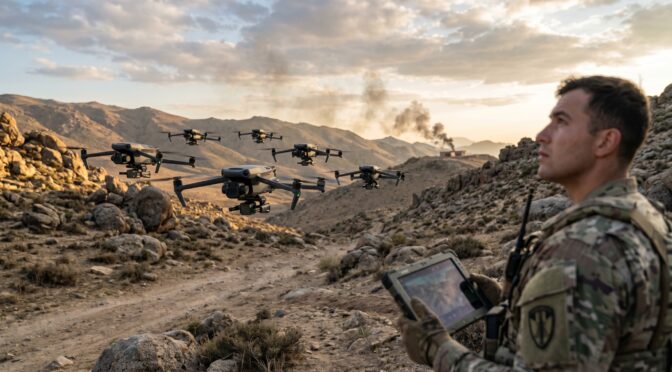
The following are reports creating using specialized tools to analyze websites and analyze the sentiment of social media posts relating to drone use in militaries
If you have questions, comments, suggestions for a report or wish to fund a report, please email us.
- SITREP Drones in the Russia:Ukraine Conflict – April 25 – May 1, 2026 May 2, 20261. Executive Summary The reporting period spanning April 25 through May 1, 2026, represents a critical inflection point in the technological and operational trajectories of the ongoing Russia-Ukraine conflict. Across the air, land, sea, and space domains, both belligerents have radically accelerated the deployment of autonomous systems, effectively shifting the paradigm of engagement from exquisite scarcity ...
- RCA17: Advancements in Military Special Operations Technology May 2, 20261. Executive Summary The 17th Rapid Capability Assessment (RCA17), convened in Chantilly, Virginia, from April 20 through April 24, 2026, represents a critical inflection point in the convergence of military special operations and intelligence community acquisition strategies.1 Hosted collaboratively by(https://events.sofwerx.org/rca17) and ICWERX, in direct partnership with the U.S. Special Operations Command (USSOCOM) Directorate of Science & ...
- Modifying Commercial Drones for Tactical Warfare May 1, 20261.0 Executive Summary The rapid adaptation of commercial off-the-shelf unmanned aerial systems for tactical deployment represents a profound shift in modern military operations and asymmetrical engagements. The period between 2022 and 2026 has provided empirical evidence that the integration of relatively inexpensive platforms, such as First Person View quadcopters and modified consumer drones, has fundamentally compressed ...
- Addressing the Drone Munitions Supply Chain Crisis May 1, 20261. Executive Summary The United States Department of Defense (DoD) is undertaking a structural pivot in its force posture, moving toward the integration of autonomous and uncrewed systems (UxS) at a transformative scale. Fiscal planning reflects this transition, with extensive capital allocated toward reshaping the battlefield. Recent budget requests demonstrate a prioritization of drone warfare and ...
- Transforming Drone Operations: The Role of Human-Machine Interface May 1, 20261. Executive Summary The Department of Defense (DoD) is entering a critical, transformative juncture in its acquisition, deployment, and tactical integration of unmanned aerial systems (UAS). Driven by executive mandates and rapid acquisition initiatives such as Swarm Forge and the strategic push to field upwards of 300,000 low-cost, attritable drones, the United States military is proposing ...
- SITREP Military Drones – April 24 to May 1, 2026 May 1, 20261. Executive Summary During the reporting period of April 24 to May 1, 2026, the global operational environment witnessed a profound acceleration in the integration, deployment, and kinetic application of unmanned systems across the air, land, sea, and space domains. Open-source intelligence from this trailing seven-day period indicates a definitive transition from the conceptual testing of ...
- Modernizing UAS Training for Future Warfare April 30, 20261. Executive Summary The United States Department of Defense (DoD) is currently executing a historic recapitalization of its tactical and strategic forces, pivoting heavily toward unmanned aircraft systems (UAS), attritable autonomous platforms, and multi-domain drone swarms. Initiatives such as the Replicator program aim to field autonomous systems at a scale of multiple thousands across various domains ...
- Revolutionizing Military Drones: The Shift to Edge Computing April 30, 20261. Executive Summary The United States Department of Defense is currently executing a historical and structural expansion of its unmanned aerial systems capabilities. Driven by strategic initiatives such as Replicator 1, which focuses on fielding thousands of autonomous systems, and Replicator 2, which aims to counter adversary small uncrewed aerial systems, the department is committing substantial ...
- Drone Warfare Vulnerabilities: Protecting Operators April 29, 20261. Executive Summary As the United States Department of Defense accelerates the procurement and deployment of unmanned aerial systems through massive capital investments such as the Replicator initiatives, a critical vulnerability paradigm has emerged that threatens to undermine these technological advancements. While strategic focus and procurement efforts remain heavily weighted toward the autonomous platforms, payload capabilities, ...
- Navigating Challenges: UAS Resilience in GPS-Denied Environments April 29, 20261. Executive Summary The United States Department of Defense (DoD) is engaged in a profound transformation of its force structure, orchestrating a massive expansion of its unmanned aerial systems (UAS) and autonomous drone fleets. Driven by the stark realities of modern peer-to-peer conflict and shifting global threat paradigms, rapid acquisition initiatives such as the T-REX program ...
- Mitigating Fratricide in Autonomous Drone Operations April 28, 20261. Executive Summary The Department of Defense (DoD) is actively shifting its force structure to counter near-peer adversaries through the deployment of autonomous systems at an unprecedented scale. High-profile programs, notably the Replicator initiative, aim to rapidly field thousands of attritable, multidomain platforms to overcome the massed advantages of strategic competitors, particularly in the Indo-Pacific theater.1 ...
- Adapting to the Future of Drone Warfare April 28, 20261. Executive Summary The character of modern warfare is undergoing a profound transformation driven by the rapid proliferation, integration, and continuous evolution of uncrewed aerial systems (UAS). As the United States Department of Defense (DoD) prepares for massive investments in drone technology, a critical strategic vulnerability remains under-addressed by military and defense planners: the speed at ...
- 2026 Defense Strategy: Autonomous Systems and Modern Warfare April 28, 2026I. Macro-Strategic Overview: The Transparent Battlefield and the 2026 Paradigm The global operational environment in April 2026 is defined by a fundamental and irreversible restructuring of United States military doctrine, procurement strategies, and forward force posture. The assumptions that governed the post-Cold War era—specifically the reliance on exquisite, highly expensive, and centralized weapons platforms—have been systematically ...
- Transforming Military AI: Legal and Ethical Dimensions April 27, 20261. Executive Summary The United States Department of Defense (DoD) is actively pursuing a fundamental transformation in its force structure, transitioning from a reliance on exquisite, manned, high-cost platforms toward the mass deployment of small, attritable, autonomous systems. Initiatives such as the Replicator program mandate the fielding of thousands of these systems across multiple domains within ...
- Transforming Military Operations with Manned-Unmanned Teaming April 27, 20261. Executive Summary The United States Department of Defense (DoD) is currently engaged in a historic capitalization of advanced robotics, autonomous systems, and collaborative combat platforms. This technological trajectory is defined by aggressive procurement strategies, headlined by the U.S. Air Force’s planned $8.9 billion investment in the Collaborative Combat Aircraft (CCA) program between fiscal years 2025 ...
- Understanding the Economics of Drone Warfare April 26, 20261. Executive Summary The character of modern warfare is undergoing a structural economic shift, driven by the proliferation and mass deployment of uncrewed aerial systems (UAS). As the United States Department of Defense (DoD) initiates historic investments to rapidly scale the production and integration of drone technology—evidenced by the “Drone Dominance” initiative targeting the procurement of ...
- Strategic Evaluation of Tactical Edge Energy Logistics for Massed Unmanned Aerial Systems April 26, 20261. Executive Summary The Department of Defense is currently executing a historic modernization and procurement cycle centered on autonomous systems, driven by the operational imperatives of peer-to-peer competition and the changing character of modern warfare. Initiatives such as the Replicator program intend to rapidly field thousands of all-domain attritable autonomous (ADA2) systems, fundamentally altering the calculus ...
- The Evolution of Rotary-Wing Aviation in Modern Warfare April 26, 20261. Executive Summary A prevailing observation in modern military analysis asserts that the contemporary airspace, particularly the low-altitude tier extending from the surface to 10,000 feet, is now saturated with precision-guided interceptors to such a degree that the deployment of traditional close air support via rotary assets is viewed as tactically obsolete against a peer adversary. ...
- Securing COTS Drone Technology for Military Use April 25, 20261. Executive Summary The transition toward the widespread adoption of Commercial Off-The-Shelf (COTS) Unmanned Aerial Systems (UAS) represents a profound paradigm shift in modern military operations and acquisition strategies. Driven by the necessity for rapid procurement, reduced unit costs, and the urgent need to match the highly accelerated innovation cycles observed in contemporary conflicts, the United ...
- Reforming DoD Drone Acquisitions: Overcoming Vendor Lock-In April 25, 20261. Executive Summary The United States Department of Defense (DoD) is entering a transformative era of warfare characterized by the rapid deployment of uncrewed, autonomous, and attritable mass. As the DoD executes massive investments in drone technology—exemplified by high-profile efforts such as the Replicator initiative and the Army’s Project SkyFoundry—there is a critical need to evaluate ...