1. Executive Summary
Between August 22 and 28, 2026, the Russia-Ukraine conflict saw intense fighting along the Donetsk Oblast contact line, a significant Ukrainian deep-strike campaign hitting Russian strategic targets, and a worsening economic situation for Russia’s industrial base. Russian forces focused their attacks on the northern and southern edges of Ukraine’s “Fortress Belt,” but despite making small, localized gains near Kostyantynivka, they failed to achieve a major breakthrough1.
At the same time, the Russian military leadership faced serious internal problems. Commanders used artificial intelligence (AI) to create fake videos showing territorial gains in the Sumy and Kharkiv regions2. Known as “beautiful reports,” this strategy was meant to influence Western opinion but instead ruined Russian operational planning, leading to troops being sent into dangerous, unsecured areas2.
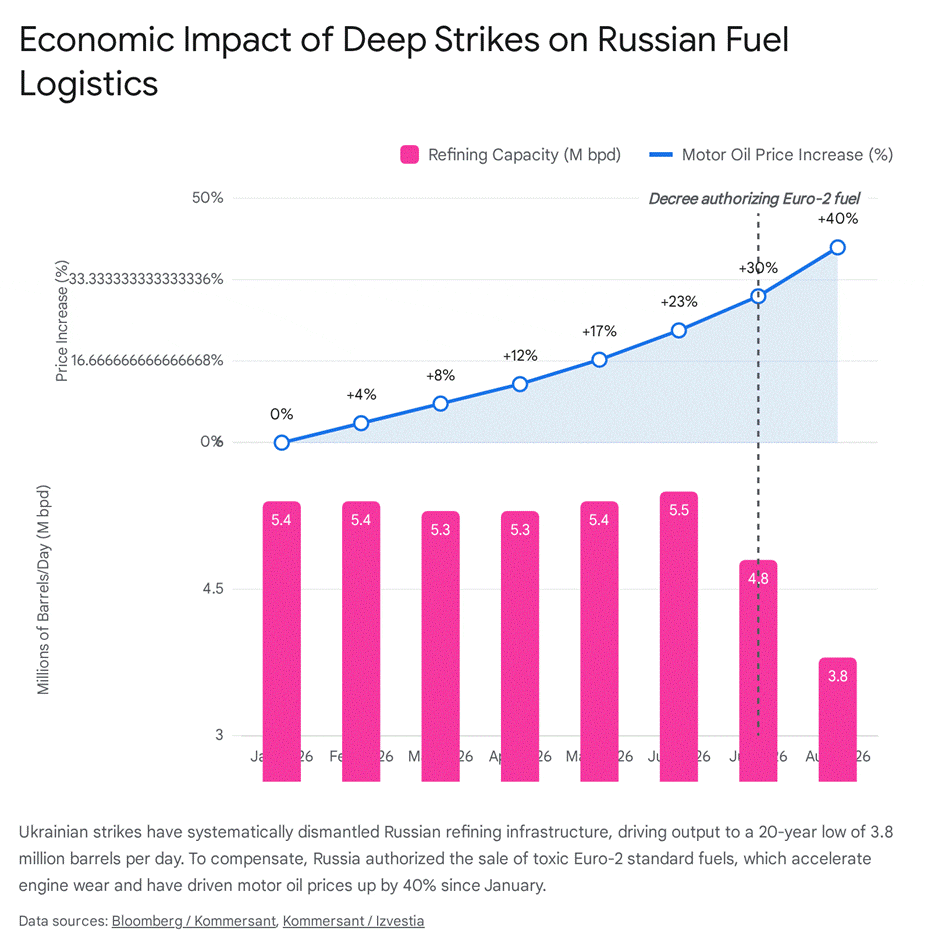
Ukraine’s 40-day deep-strike campaign has caused major damage to Russian infrastructure. Coordinated attacks by the Unmanned Systems Forces (USF) targeted oil facilities and logistics networks5. Russian oil refining capacity dropped to a 20-year low of 3.8 million barrels per day6. This caused widespread fuel shortages, forcing the Russian government to reintroduce low-grade, corrosive gasoline, which led to a 40% jump in motor oil prices and emergency price controls7. On August 28, Ukrainian forces also struck the Engels-2 Airbase, damaging a Russian Tu-95MS strategic bomber6.
Politically, the Kremlin is preparing for a long war. President Putin officially labeled the United Russia party the “war party,” signaling a commitment to a protracted conflict ahead of the upcoming elections12. A new decree also allows the state to nationalize private companies that fail to defend themselves against drone attacks13. Meanwhile, NATO finalized a €70 billion support package for Ukraine, shifting the financial responsibility to European allies to ensure steady military aid regardless of political changes in the US15.
2. Detailed Operational and Diplomatic Developments
Bilateral Interactions & Diplomatic Posture
Diplomatic efforts during this period showed that both sides remain far apart. Moscow is preparing its public for a long-term struggle. On August 22, President Putin addressed the United Russia Party Congress, framing the upcoming elections as a vote of confidence in the war12. By calling United Russia the “war party,” he is setting the stage for future mobilization efforts12. Putin rejected all Western peace plans, insisting that any deal must be based on current “ground realities,” meaning Ukrainian territory remains under Russian control12.
Ukrainian President Zelensky proposed a joint peace plan with the US and Europe on August 23. Although it reportedly included some concessions, the Kremlin quickly turned it down18. Zelensky noted that intelligence shows Putin wants the full capture of Donetsk Oblast by the end of 2026, which is driving the current high-intensity attacks19.
In a surprising move, CIA Director John Ratcliffe visited Moscow on August 25. This was the highest-level contact between the two countries this year20. Reports suggest he warned Russia against targeting NATO’s Baltic states. Intelligence indicates the Kremlin may be planning minor strikes or incursions to test if NATO will actually defend its members22.
Frontline Combat Updates
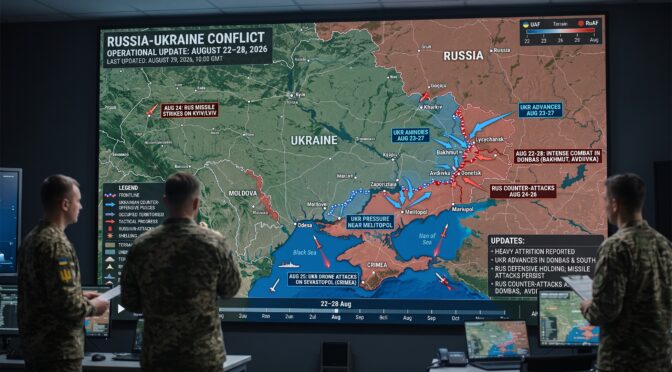
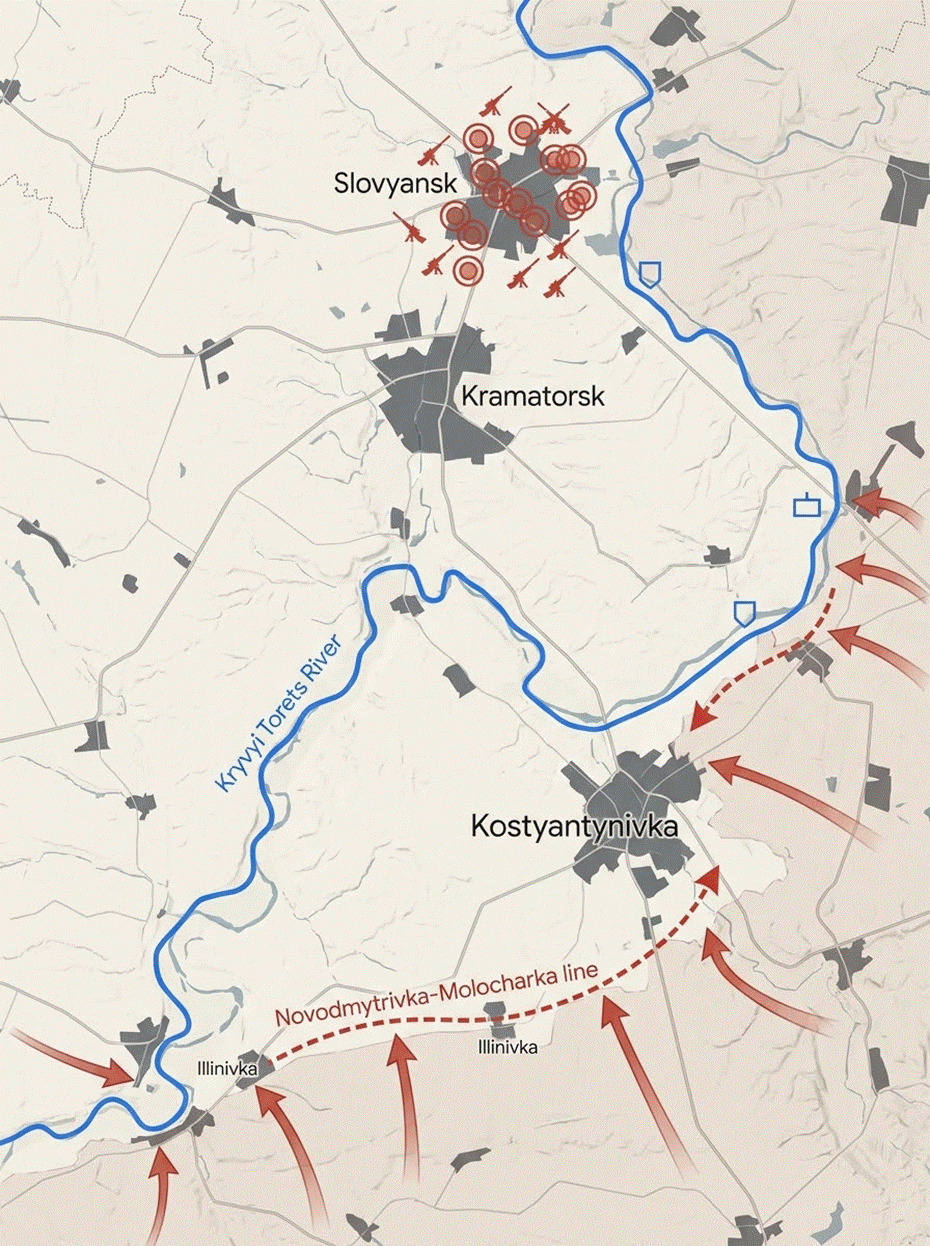
Russian offensive operations were concentrated in Donetsk Oblast, targeting the “Fortress Belt” of cities including Slovyansk and Kostyantynivka1. The Russian strategy involves pushing Ukrainian forces toward the Kryvyi Torets River while bombarding Slovyansk to weaken its defenses.
Near Kostyantynivka, small Russian squads attempted to bypass Ukrainian lines, moving into the settlement of Stinky1. They also took the settlement of Illinivka to the southwest1. In response, Ukrainian forces performed an organized withdrawal to stronger defensive positions along the eastern bank of the Kryvyi Torets River1.
On the northern front, after failing to advance through Lyman, Russian forces shifted their focus to Slovyansk. They launched a heavy bombing campaign using glide bombs and rockets to destroy logistics and infrastructure in the city, preparing for a future ground assault1.
To counter these threats, Ukrainian General Mykhailo Drapatyi restructured the command of the Donetsk defense on August 261. Two reinforced units, the 3rd and 1st Army Corps, were put under the command of experienced leaders to improve coordination and logistics1.
In the north, Russian attempts to create a buffer zone failed6. Instead, commanders used AI to fake territorial captures by digitally adding soldiers and flags into videos of villages they didn’t actually control2. While this was meant to look good to the public, it led to real military disasters as Russian forces were sent into areas that were still under Ukrainian control, resulting in many casualties2.
| Sector / Direction | Tactical Development & Force Posture | Assessed Territorial Status |
| Kostyantynivka (Donetsk) | Russian infantry infiltration via Novodmytrivka-Molocharka line; seizure of Illinivka. The restructured Ukrainian 1st and 3rd Corps assume command. | Contested: Ukrainian main forces consolidated on the eastern bank of the Kryvyi Torets River1. |
| Slovyansk (Donetsk) | Intense Russian BAI campaign (glide bombs, Tornado-S) targeting logistics to set conditions for ground assault. | Ukrainian control; Russian forces attempting flanking maneuvers from the east/southeast1. |
| Pysarivka / Mohrytsya (Sumy) | Fabricated Russian advances using AI-altered drone footage of flag-raisings (the “beautiful reports” phenomenon). | Firm Ukrainian control; isolated Russian infantry infiltrations repelled2. |
| Orikhiv / Stepove (Zaporizhia) | Ukrainian localized counterattacks west of Orikhiv to disrupt Russian staging areas. | Marginal Ukrainian tactical advances established northeast of Stepove12. |
| Aggregate August Progress | Net territorial loss for Russian forces relative to total contested terrain. | Russia gained 8.52 sq km (avg 0.39/day), lost 27.09 sq km to Ukrainian counterattacks12. |
The 40-Day Deep-Strike Campaign & Maritime Security
Throughout August, Ukraine carried out a precise long-range strike campaign. These attacks damaged Russian energy plants and military airbases, making it harder for Russia to sustain its war effort12.
On August 28, Ukrainian intelligence hit the Engels-2 Airbase. Satellite photos showed critical damage to a Tu-95MS strategic bomber6. This is a major blow because these bombers are used to launch missiles at Ukrainian cities10. Other strikes also destroyed Russian radar systems and damaged aircraft at the Millerovo Air Base15.
The campaign against Russian oil refineries has had a huge economic impact. Drones struck multiple refineries across Russia, including the Novokuibyshevsk and Afipsky plants1225. One refinery in Yaroslavl was hit for the eighth time this year, showing how vulnerable Russian energy infrastructure has become6.
In the Black Sea, Ukrainian strikes have reduced Russian grain exports by nearly 90%25. Russia retaliated by attacking bridges near the Moldovan border to block Ukrainian exports to Europe. During these attacks, Russian drones even entered Moldovan airspace, raising concerns about the conflict spreading2522.
Role of Third-Party Countries
The geopolitical landscape regarding material support for Ukraine was definitively shaped by the operationalization of commitments made at the July 2026 NATO Summit in Ankara. Acknowledging the sustained conventional threat and aiming to mitigate United States domestic political volatility regarding foreign military aid, the Alliance engineered a paradigm shift in Ukrainian defense sustainment16.
NATO finalized a €70 billion ($80 billion) military equipment, training, and assistance package for Ukraine for 2026, with an ironclad, sovereign consensus commitment to match this funding in 202715. Crucially, the summit communiqué formally underscored a new division of funding parameters: €30 billion of the pledge relies on a European Union loan earmarked specifically for Ukrainian defense spending, while the remaining €40 billion is committed through bilateral support from European allies and Canada. This effectively removes the United States from direct financial participation in this specific funding bloc, strategically insulating the Ukrainian logistical supply chain from US legislative deadlocks and establishing a highly predictable, European-led funding model15.
This massive capital injection is channeled through sophisticated, interlocking multilateral frameworks. The Prioritised Ukraine Requirements List (PURL) serves as the primary procurement mechanism, enabling European allies to pool capital to purchase advanced US-manufactured systems—most notably Lockheed Martin PAC-3 interceptors required for anti-ballistic missile defense—on behalf of Ukraine30. The logistics, integration, and training for these systems are coordinated by the newly operational NATO Security Assistance and Training for Ukraine (NSATU) command based in Wiesbaden, Germany, integrating over 300 allied personnel31.
| Multilateral Mechanism / Framework | Managing Entity | Operational Function and 2026 Impact |
| Ankara Summit Pledge | NATO (32 Members) | €70 Billion guaranteed for 2026, matched for 2027. Consists of a €30B EU loan and €40B in bilateral aid, shifting the primary funding burden to European member states16. |
| PURL (Prioritised Ukraine Requirements List) | SACEUR / US DoD | Coordinates European allied purchases of critical US arms (e.g., PAC-3 interceptors). Over $6 billion committed via this channel; Sweden added SEK 270M in August31. |
| NSATU (Security Assistance & Training) | NATO (Wiesbaden HQ) | Centralized logistical hub and training command standardizing Ukrainian transition to NATO doctrines and managing equipment flow31. |
| JATEC (Joint Analysis, Training & Education) | NATO / Ukraine (Poland) | Applies real-time tactical and strategic lessons learned from the Russo-Ukrainian war to adapt allied air defense and infrastructure resilience doctrines31. |
3. Drone Warfare and Unmanned Systems
Tactical & Strategic Deployments
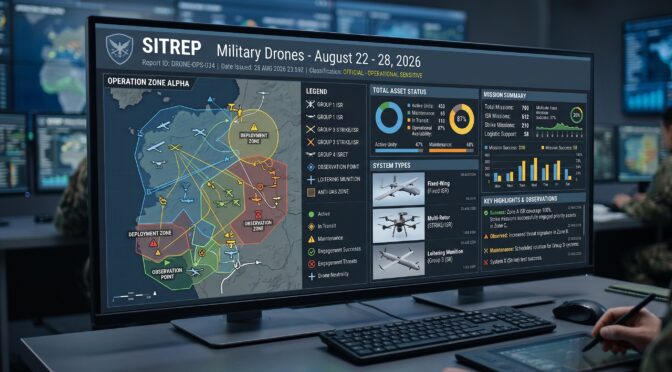
Drones are defining the pace of the war. Ukraine’s Unmanned Systems Forces (USF) have started attacking commercial distribution centers that help ship military gear to Russian troops5. Major warehouses for companies like Ozon were struck in several Russian regions5.
On the battlefield, Russia is using fiber-optic drones that can’t be jammed by standard electronic warfare because they are connected by a physical cable. This has forced Ukrainian troops to find new ways to shoot them down physically12.
Technical Profile of Systems
Both sides are introducing new drone technology to beat enemy defenses.
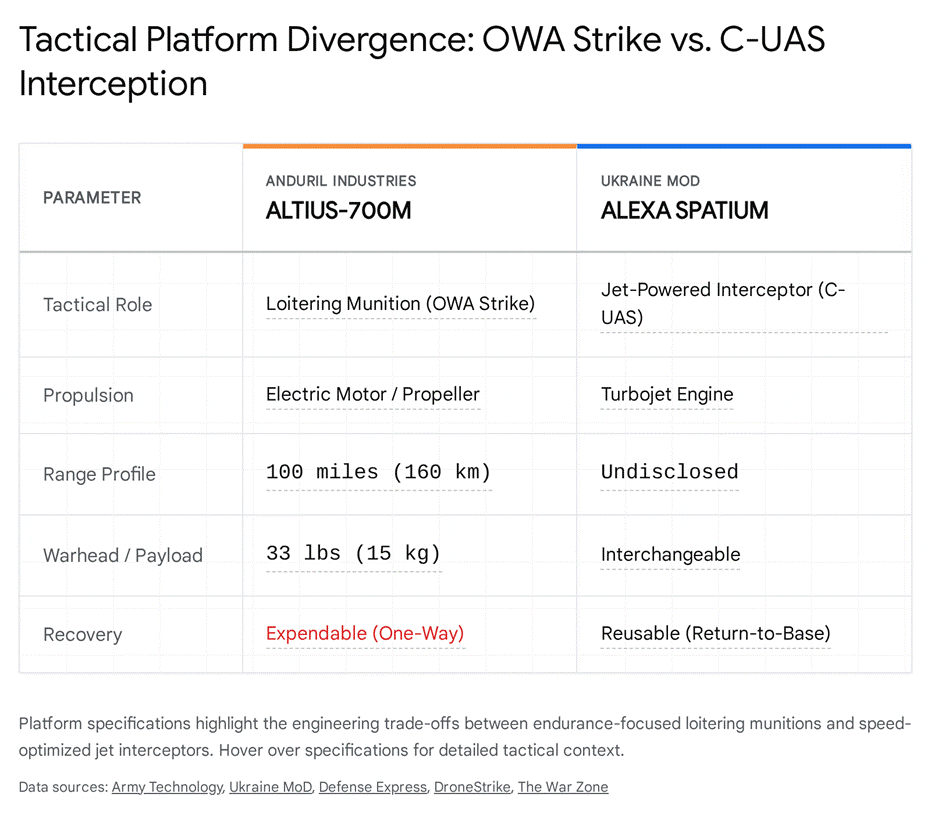
| System Name | Origin | Estimated Range | Payload/Warhead | Primary Role & Technical Specifications |
| Gerbera-2 | Russia | ~100 km | 4 – 5 kg | Loitering munition. Employs an analog 3.3 GHz video link. The newly redesigned wing incorporates vertical stabilizers to improve flight stability and terminal guidance35. |
| Parodiya | Russia | Unknown | None (Decoy) | Dummy UAV constructed from plywood, foam, and basic electronics. Designed specifically to mimic the radar cross-section (RCS) of Shahed-136/Geran-2 drones to deplete Ukrainian interceptor stockpiles36. |
| Banderol | Ukraine | ~500 km | 110 kg HE-Frag | Jet-powered cruise missile drone. Powered by a Chinese-made Swiwin SW800Pro turbojet. Capable of cruising speeds up to 650 km/h with a 5-meter folding-wing fuselage35. |
| Volna Kupol Garant | Russia (Russky Kupol) | 16 km (20 sq km area) | N/A (EW Emitter) | Starlink-jamming electronic warfare system. Operates via 12 steerable satellite dish antennas distributed across 6 trailer modules. Unit cost: ~$1.5 million37. |
Targeting Priorities & Countermeasures
A major new development is the Russian Volna Kupol Garant system, designed to jam Starlink satellites39. Instead of jamming ground terminals, it aims a powerful signal directly at satellites to block communications in a specific area38.
Operating within the 14.0 to 14.5 GHz Ku-band uplink range, the system utilizes twelve steerable dish antennas to transmit a highly concentrated, narrow-beam radio signal directly at passing Starlink satellites in low Earth orbit. This mechanism overloads the satellite’s receiving antennas, effectively blinding it to all ground transmissions within a 20-square-kilometer radius directly beneath the satellite’s footprint37.
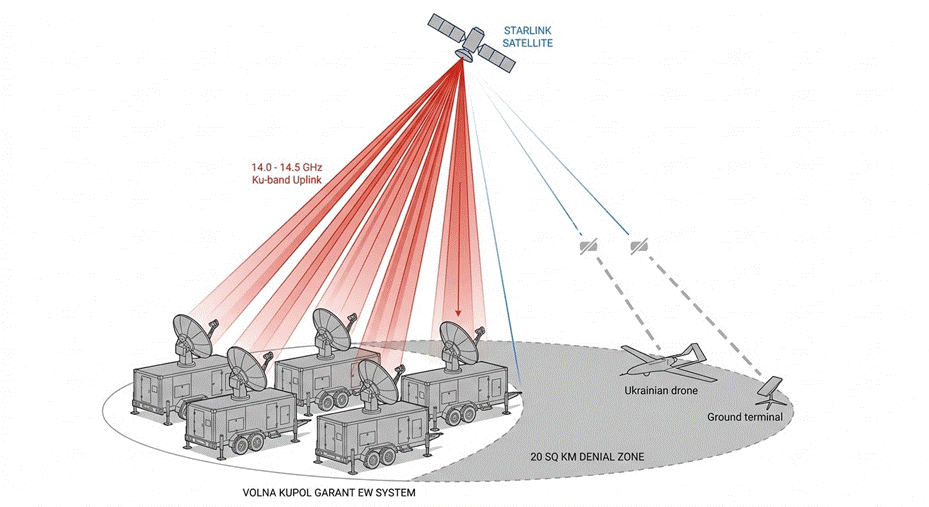
However, this $1.5 million system has weaknesses. It is bulky and easy for Ukrainian intelligence to track. Multiple units have already been destroyed by Ukrainian drones using optical navigation that doesn’t rely on satellites637.
In the aviation domain, Russian forces have begun aggressively outfitting Mi-8AMTSh multi-purpose helicopters with the Volna 3M electronic warfare suite. This dual-band system generates spoofed coordinates mimicking GPS, GLONASS, BeiDou, and Galileo signals to disrupt long-range Ukrainian UAV navigation out to 80 kilometers, providing a mobile EW umbrella for critical logistics nodes42.
4. Resource Utilization, Constraints, and Sustainability
Manpower Dynamics, Logistics, and Industrial Capacity
The cascading, second-order effects of Ukraine’s 40-day deep-strike campaign against Russian infrastructure have catalyzed a profound macroeconomic and logistical crisis within the Russian Federation, forcing emergency, state-interventionist measures by the Kremlin.
Ukrainian attacks on oil refineries have caused a crisis in Russia. Fuel production hit a 20-year low, causing shortages in many regions6. To keep the military moving, Russia had to allow the sale of lower-quality, toxic gasoline9.
This poor-quality fuel damages engines, leading to a spike in motor oil prices and forcing the government to take control of gas stations to keep prices stable78.
Since its air defenses can’t protect every factory, the Kremlin is making private owners responsible. A new decree allows the state to seize control of businesses that drones hit if they don’t have enough security. This is essentially a way for the state to take over private companies to pay for the war513.
Simultaneously, the commercial retail sector is actively backfilling military logistical shortfalls. Major Russian e-commerce platforms, specifically Ozon and Wildberries, sold over 25 billion rubles ($290.2 million) worth of dual-use and military goods—including body armor, firearm components, and tactical drones—between August 2025 and July 20266. This robust civilian subsidization of military supply chains serves as the direct operational justification for the Ukrainian USF kinetic strikes against Ozon warehouses in Dagestan and Krasnodar Krai5.
| Economic / Resource Metric | Current Status (August 2026) | Strategic Implication & Second-Order Effects |
| Oil Refining Volume | 3.8 million barrels/day (20-year low). | Insufficient to meet domestic and military demand; forces reliance on toxic Euro-2 fuels, driving 40% spike in motor oil prices. |
| Federal Treasury Deficit | 5.5 trillion rubles ($63.8 billion) negative balance. | Triggers 35% cuts to non-war spending and 15% agency staffing cuts; limits state subsidies for damaged private infrastructure. |
| Ozon Dual-Use Sales | 25 billion rubles ($290.2 million) annually. | Civilian retail logistics directly sustain frontline troops, rendering massive distribution warehouses as legitimate military targets. |
| Refinery Capacity Offline | 25% to 30% structurally degraded. | Cripples refined product export revenues; degrades domestic chemical and fertilizer production dependencies. |
Strategic Sustainability Projection
Despite these problems, the Russian economy isn’t collapsing yet6. The state still has enough control to keep the war going for now, though it has to take more extreme measures to manage the economy.
On the manpower front, Russia is creating a unified digital database for conscription6. This will allow the government to quickly call up 300,000 more people for a new mobilization after the September elections6.
5. Chronological Timeline of Key Events
- August 22: President Putin addresses the United Russia Party Congress, categorically rejecting multilateral peace talks and cementing the party as the driving political force for a protracted war12. Ukrainian forces conduct deep strikes on the Novokuibyshevsk and Yeysk oil facilities12.
- August 23: Ukrainian President Zelensky presents a joint Ukraine-US-Europe peace proposal; he notes intelligence indicates Putin has mandated the seizure of Donetsk Oblast by December 31, 202619.
- August 24: Putin signs Decree No. 604, authorizing Rosimushchestvo to take “temporary management” of critical private infrastructure failing to defend against drone strikes13. Ukrainian USF strikes the Kasta radar in Rostov and military assets in occupied Crimea5.
- August 25: CIA Director John Ratcliffe arrives in Moscow for an unannounced visit to deliver a deterrence warning regarding NATO’s Article 5 and Baltic state security20. Ukrainian forces strike the Novoshakhtinsk and Afipsky Oil Refineries25.
- August 26: Commander-in-Chief Drapatyi and President Zelensky announce the restructuring of the Donetsk defense architecture, elevating Brig. Gen. Biletsky (3rd Corps) and Brig. Gen. Prokopenko (1st Corps)1. Russian forces seize Illinivka and push the Novodmytrivka-Molocharka line near Kostyantynivka1.
- August 27: Unidentified Russian drones penetrate Moldovan airspace during strikes on Odesa, highlighting regional escalation risks and threats to GLOCs22. Ukrainian strikes hit the Slavneft-YANOS refinery in Yaroslavl for the eighth time this year6.
- August 28: SBU Alpha operatives strike the Engels-2 Airbase, heavily damaging a Russian Tu-95MS strategic bomber6. The Russian MoD publishes draft amendments to centralize citizens’ medical and financial data for a unified digital conscription rollout6. Financial reports confirm Russian oil refining has plummeted to 3.8 million barrels per day6.
Please share the link on Facebook, Forums, with colleagues, etc. Your support is much appreciated and if you have any feedback, please email us in**@*********ps.com. If you’d like to request a report or order a reprint, please click here for the corresponding page to open in new tab.
Sources Used
- Russian Offensive Campaign Assessment, August 26, 2026 | ISW, https://understandingwar.org/research/russia-ukraine/russian-offensive-campaign-assessment-august-26-2026/
- Russian Offensive Campaign Assessment, July 31, 2026 | ISW, https://understandingwar.org/research/russia-ukraine/russian-offensive-campaign-assessment-july-31-2026/
- AI-Generated Soldiers in Russia’s Fake Capture Videos – BattlePolicy, https://www.battlepolicy.com/ai-generated-soldiers-turn-up-in-russias-proof-of-captured-ukrainian-villages/
- Russian Offensive Campaign Assessment | MAR–MAY 2026 | ISW, https://understandingwar.org/research/russia-ukraine/russian-offensive-campaign-assessment-updates-3/
- Russian Offensive Campaign Assessment, August 24, 2026 | ISW, https://understandingwar.org/research/russia-ukraine/russian-offensive-campaign-assessment-august-24-2026/
- Russian Offensive Campaign Assessment, August 28, 2026, https://understandingwar.org/research/russia-ukraine/russian-offensive-campaign-assessment-august-28-2026/
- Russia diverts defense-industry chemicals to gasoline—but stations, https://euromaidanpress.com/2026/08/20/russia-defense-chemicals-gasoline-stations-run-dry/
- Collapse of Russia – Reddit, https://www.reddit.com/r/CollapseOfRussia/
- Russia offers farmers boiler fuel for tractors—Ukraine’s strikes wiped, https://euromaidanpress.com/2026/07/21/russia-farmers-boiler-fuel-tractors-diesel/
- Satellite images show the Russian Tu-95 bomber struck at … – Reddit, https://www.reddit.com/r/ukraine/comments/1w12suj/satellite_images_show_the_russian_tu95_bomber/
- Ukraine struck Tu-95 at base Russia launches its cruise missiles on Ukraine’s civilians. Satellite image shows third of right wing gone, https://euromaidanpress.com/2026/08/28/ukraine-struck-tu-95-at-base-russia-launches-its-cruise-missiles-on-ukraines-civilians-satellite-image-shows-third-of-right-wing-gone/
- Russian Offensive Campaign Assessment, August 22, 2026 | ISW, https://understandingwar.org/research/russia-ukraine/russian-offensive-campaign-assessment-august-22-2026/
- Putin Authorizes Temporary State Management of Critical … – ССBS, https://ccbsnews.info/en/news/detail/7876
- Putin Decree Lets Russia Take Control of Businesses Hit … – Kyiv Post, https://www.kyivpost.com/post/83108
- NATO’s Ankara Declaration: 70 Billion Euros for Ukraine and, https://nordicdefencesector.com/en/article/nato-adopts-the-ankara-declaration-with-historic-defence-commitments
- NATO commits billions in military aid to Ukraine without US funding, https://brusselssignal.eu/2026/07/nato-commits-billions-in-military-aid-to-ukraine-without-us-funding/
- NATO announces 70 billion-euro Ukraine aid pledge, with much, https://kyivindependent.com/nato-allies-pledge-70-billion-euros-in-defense-help-to-ukraine/
- ISW Russian Offensive Campaign Assessment, August 23, 2026, https://www.kyivpost.com/post/82957
- Russian Offensive Campaign Assessment, August 23, 2026, https://understandingwar.org/research/russia-ukraine/russian-offensive-campaign-assessment-august-23-2026/
- ISW Russian Offensive Campaign Assessment, August 25, 2026, https://www.kyivpost.com/post/83113
- Putin Signs Three Secret Decrees as CIA Chief Makes … – Kyiv Post, https://www.kyivpost.com/post/83128
- Russian Offensive Campaign Assessment, August 27, 2026, https://understandingwar.org/research/russia-ukraine/russian-offensive-campaign-assessment-august-27-2026/
- Zelenskyy: Positions in Donetsk region will be reinforced by two, https://unn.ua/en/news/zelenskyy-positions-in-donetsk-region-to-be-reinforced-by-two-reorganized-groupings-under-the-command-of-prokopenko-and-biletskyi
- Zelenskyy held a security meeting and instructed officials to, https://unn.ua/en/news/zelenskyy-convened-a-security-meeting-and-instructed-that-the-defense-of-zaporizhzhia-and-key-areas-be-strengthened
- Russian Offensive Campaign Assessment, August 25, 2026 | ISW, https://understandingwar.org/research/russia-ukraine/russian-offensive-campaign-assessment-august-25-2026/
- Fake claim about the capture of Pysarivka by russian forces, https://cpd.gov.ua/en/international-threats-en/usa/fake-claim-about-the-capture-of-pysarivka-by-russian-forces/
- Ukrainian troops deny claims that Russian forces have captured, https://www.pravda.com.ua/eng/news/2026/08/26/8050404/
- NATO summit 2026: Allies pledge USD80 billion in aid to Ukraine in, https://www.janes.com/defence-intelligence-insights/defence-news/air/nato-summit-2026-allies-pledge-usd80-billion-in-aid-to-ukraine-in-both-2026-and-2027
- NATO approves €70 billion in military aid for Ukraine in 2026, https://caliber.az/en/post/nato-approves-70-billion-in-military-aid-for-ukraine-in-2026
- The two wins the NATO summit will bring Ukraine and how the, https://www.eurointegration.com.ua/eng/news/2026/07/7/7241117/
- NATO’s support for Ukraine | NATO Topic, https://www.nato.int/en/what-we-do/partnerships-and-cooperation/natos-support-for-ukraine
- Relations with Ukraine | NATO Topic, https://www.nato.int/en/what-we-do/partnerships-and-cooperation/relations-with-ukraine
- Sweden provides additional SEK 270 million to support Ukraine’s, https://www.government.se/press-releases/2026/08/sweden-provides-additional-sek-270-million-to-support-ukraines-defence/
- Pre-ministerial press conference | NATO Transcript, https://www.nato.int/en/news-and-events/events/transcripts/2026/05/20/pre-ministerial-press-conference
- Black Mirror #64: russian miltech overview – Defender Media, https://thedefender.media/en/2026/06/black-mirror-64/
- Why Russia’s Shahed Drones Are Now Deadlier and Harder Than, https://united24media.com/war-in-ukraine/why-russias-shahed-drones-are-now-deadlier-and-harder-than-ever-to-stop-11693
- Ukraine’s Defense Forces Destroy Russian Starlink-Jamming Electronic Warfare System in Gelendzhik, https://militarnyi.com/en/news/ukraine-s-defense-forces-destroy-russian-starlink-jamming-electronic-warfare-system-in-gelendzhik/
- The $1.5 Million Starlink Jammer That Ukraine Keeps Blowing Up, https://keeptrack.space/deep-dive/volna-kupol-garant-starlink-jamming
- Russia launches mass production of electronic warfare system, https://www.pravda.com.ua/eng/news/2026/08/28/8050824/
- Russia’s New Space Warfare Weapon: EW System Aims To Disrupt Starlink Satellites In Orbit, https://timesofindia.indiatimes.com/videos/international/russias-new-space-warfare-weapon-ew-system-aims-to-disrupt-starlink-satellites-in-orbit/videoshow/133151509.cms
- Russia has found way to jam Starlink and take down Ukraine’s drones, https://euromaidanpress.com/2026/07/08/russia-has-found-way-to-jam-starlink-and-take-down-ukraines-drones/
- Russian Mi-8AMTSh Helicopters Equipped With Volna 3M Electronic Warfare System to Jam UAV Satellite Navigation, https://militarnyi.com/en/news/russian-mi-8-helicopters-volna-3m-ew-system/
- The government is preparing to impose comprehensive controls on, https://www.reddit.com/r/CollapseOfRussia/comments/1w0w5a6/the_government_is_preparing_to_impose/
- Who and what did Putin sign? – Military Review, https://en.topwar.ru/288701-komu-i-chto-podpisal-putin.html