1. Executive Summary
The reporting period from August 22 to August 28, 2026, shows that autonomous warfare and unmanned systems are becoming a standard part of military operations. We are seeing a major shift away from using modified commercial equipment. Instead, there is an aggressive move toward purpose-built, highly integrated autonomous platforms designed to survive in difficult electronic warfare environments. In the air, the rise of jet-powered attack drones from adversaries has led to the rapid development of specialized, turbojet interceptor drones. Most notably, Ukraine’s new “Alexa Spatium” is designed to provide a more cost-effective way to stop these high-speed threats. At the same time, the use of “loyal wingman” drones is accelerating. European defense contractors like Saab have unveiled new prototypes designed to fly alongside manned fighters, increasing their effectiveness while reducing risks to human pilots.
In maritime and coastal areas, military forces are restructuring how they use autonomous systems. Recent U.S. Navy exercises showed successful live-fire testing of unmanned surface vessels (USVs). Additionally, new reports on the “Liberator” seabed torpedo launcher show that unmanned systems are moving beyond just scouting and are now being used as primary weapons. By placing heavyweight torpedoes in launchers on the seafloor via large unmanned undersea vehicles (XLUUVs), allied forces can create hidden, persistent defense zones in strategic areas. Meanwhile, amphibious assault tactics are changing with the introduction of heavy, modular Unmanned Amphibious Vehicles (U-MAVs), such as the Turkish FNSS i-ZAHA. These are built to handle the high risks and losses typically seen in the first wave of coastal landings.
In cybersecurity and national defense, the use of autonomous systems is moving at a rapid pace. The U.S. military has deployed 20kW-class laser weapons to the southern border, proving they can destroy commercial drone threats for a much lower cost than traditional missiles. Simultaneously, the U.S. Army’s Project Griffin is focusing on using AI to defend military networks against automated cyberattacks. However, this technology must be carefully managed with strict security protocols to prevent AI agents from being manipulated or causing unintended damage.
Strategically, these technological jumps are causing shifts in global politics and industrial policies. Concerned about relying on international supply chains linked to adversaries, allied nations are working to become more self-sufficient. Taiwan recently passed a $7.56 billion bill to buy domestic drones and build a supply chain free of Chinese components. Meanwhile, a new defense agreement between Saudi Arabia, Turkey, and Pakistan shows how advanced drone technology—like Turkey’s manufacturing capabilities—is creating new strategic alliances that blend capital and engineering into powerful partnerships independent of traditional Western security deals.
2. Global Situation Log
European Command (EUCOM) & Ukrainian Theater
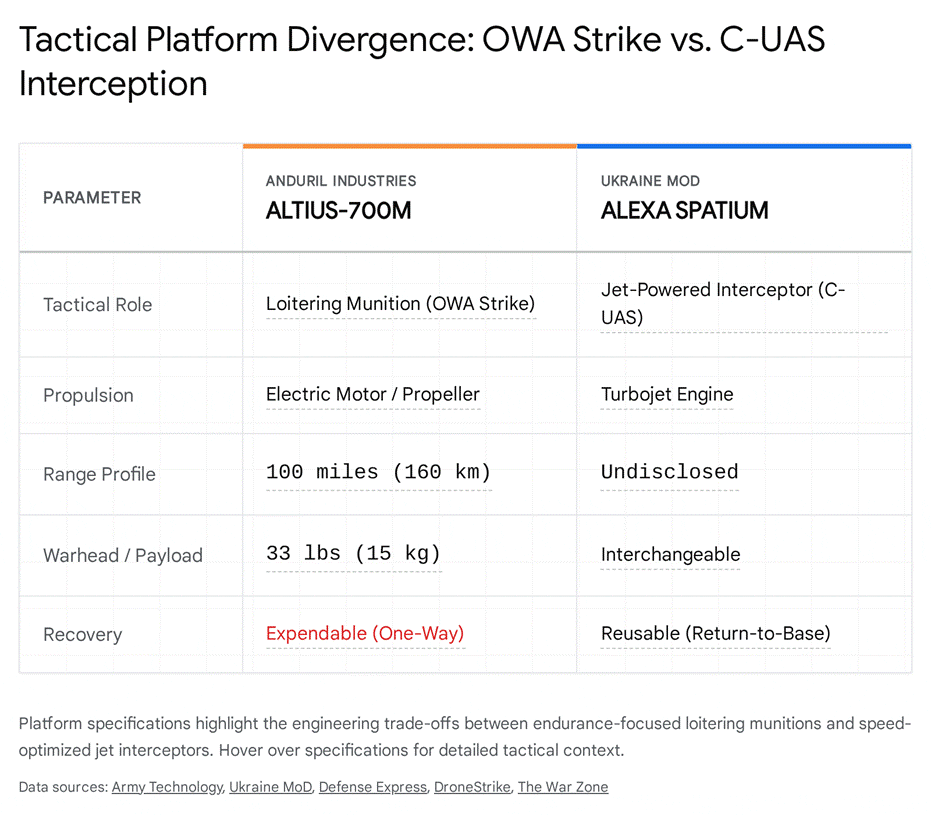
Event & Development: Ukraine’s Ministry of Defense officially codified and fielded the “Alexa Spatium,” the country’s first domestically produced, jet-powered interceptor drone2. Developed to counter Russia’s increasingly fast jet-powered Geran-3, Geran-4, Geran-5, and Shahed-131 OWA drones, the V-tail composite airframe measures 1.5 by 1.7 meters and utilizes a turbojet engine6. It features electro-optical/infrared (EO/IR) terminal targeting, interchangeable warheads (high-explosive fragmentation, shaped-charge, and thermobaric), and a reusable return-to-base capability if an interception is aborted2.
Tactical & Operational Lessons: The deployment of the Alexa Spatium represents a necessary engineering adaptation to a rapidly shifting threat environment. Russian forces have increasingly fielded turbojet-powered Geran variants capable of speeds exceeding 370 km/h, which mathematically nullifies the interception capabilities of traditional propeller-driven drones and mobile ground-fire groups in tail-chase engagement geometries10. The Alexa Spatium uses a scalable turbojet engine to reach the high-speed closure rates needed for kinetic interception while still being able to loiter at low speeds to save fuel. The integration of an EO/IR seeker allows the interceptor to break reliance on ground-based radar tracking during the terminal phase, enabling it to operate effectively in environments saturated by electronic warfare (EW)2. Furthermore, the modular warhead design provides tactical commanders with vital flexibility: fragmentation warheads can be selected for soft-skinned UAVs, while shaped-charge or thermobaric payloads can be deployed against heavily armored rotary-wing targets2. The reusable nature of the airframe drastically reduces the logistics tail and the cost-per-engagement, provided the drone can reliably recover to friendly lines.
Strategic Lessons: This development points out a major change in national air defense doctrine: the deliberate substitution of high-end surface-to-air missiles (SAMs) with low-cost, high-speed autonomous interceptors. Ukraine is currently navigating a severe deficit in Western-supplied interceptors (e.g., Patriot PAC-2/3), while Russia attempts to saturate Ukrainian airspace by launching up to 200 ballistic missiles and hundreds of drones simultaneously11. By localizing the production of jet-powered interceptors, Ukraine is addressing an asymmetric cost-exchange dilemma. This ensures that multi-million-dollar interceptors remain reserved strictly for existential ballistic threats, while expendable turbojet drones neutralize the Shahed/Geran threat11.
Event & Development: Between August 26 and August 28, Ukraine’s dedicated Unmanned Systems Forces (USF), commanded by Major Robert “Magyar” Brovdi, executed Operation “Crimean Switch Off,” a massive synchronized deep-strike campaign. The operation targeted and disabled 21 power nodes and the Luhansk Thermal Power Plant13. Earlier in the week, USF elements successfully struck Russian Su-33 and MiG-29 fighter jets, as well as a large Orion strike drone, at the Vityazevo airfield in Krasnodar Krai15.
Tactical & Operational Lessons: The USF has refined its operations into a tiered, highly integrated kill chain spanning tactical, operational, and strategic depths. At the tactical edge, the USF adheres to the “Standard-10” formula—a benchmark requiring ten confirmed enemy personnel casualties per month per strike crew—utilizing First-Person View (FPV) drones to generate massive frontline attrition16. Operationally, the USF conducts rigorous Suppression and Destruction of Enemy Air Defenses (SEAD/DEAD), specifically targeting long-range early warning radars, Pantsir, S-400, and Tor mobile SAMs15. This deliberate, localized blinding of the electromagnetic spectrum creates temporary corridors that allow strategic, long-range OWA drones to strike rear-echelon infrastructure. The simultaneous disabling of 21 power nodes requires extreme synchronization of flight paths, autonomous terminal guidance in GPS-denied environments, and highly accurate battle damage assessment (BDA) to ensure critical infrastructure is operationally severed14. Furthermore, the destruction of the Orion drone is highly notable; Russia had recently adapted the Orion to launch the cheap Banderol cruise missile against Ukrainian ports, making its destruction on the tarmac a vital defensive victory15.
Strategic Lessons: The establishment and success of the USF—the first independent military branch globally dedicated entirely to unmanned systems—represents a profound evolution in military force structure16. Major Brovdi’s USF has effectively replaced the need for a traditional, manned strategic bomber fleet, inflicting billions of dollars in damage on Russian petroleum, energy, and aviation infrastructure at distances up to 2,000 kilometers from the line of contact19. By institutionalizing drone warfare under a unified command, Ukraine has streamlined procurement, training, and strategic targeting. This event proves that an asymmetric, software-driven force can systematically dismantle a near-peer adversary’s logistical and industrial spine without requiring air superiority in the traditional sense.
Event & Development: Russian forces commenced mass production of the “Volna Kupol Garant” electronic warfare (EW) system, specifically engineered to jam Starlink satellite communication terminals13. Concurrently, Russian commanders in the Kupyansk direction reported the deployment of Unmanned Ground Vehicles (UGVs) for frontline logistics to survive in a drone-saturated environment, supported by increased use of Kozerog-1 and Partizan MLRS13. Furthermore, North Korea deployed a 400-person drone unit to Russia’s Kursk Oblast to conduct surveillance and strike missions alongside Russian troops21.
Tactical & Operational Lessons: The Volna Kupol Garant represents a targeted technical strike against Ukraine’s primary command and control (C2) architecture. However, the system’s static nature and high cost ($1.5 million per unit) make it highly vulnerable to kinetic targeting by Ukrainian drones equipped with alternative, non-satellite RF communication links22. On the ground, the saturation of the airspace with FPVs has rendered the “last mile” of the battlefield effectively impassable for human-driven logistics. The Russian integration of UGVs for resupply in Kupyansk indicates that the frontline is transitioning into a true robotic “no-man’s land,” where human mass is increasingly a liability rather than an asset13. The deployment of North Korean drone operators introduces a new tactical dynamic; these operators are acquiring invaluable real-world experience in EW environments and FPV employment, skills that will likely be exported back to the Korean Peninsula21.
Strategic Lessons: Russia’s cognitive warfare strategy involves portraying the Volna Kupol Garant as an impenetrable EW shield in a bid to dissuade the United States from authorizing broader Ukrainian use of Starlink over Russian territory13. This highlights the strategic vulnerability inherent in relying on commercial, space-based communication constellations; while highly resilient, they are not immune to localized, high-power electromagnetic spectrum operations (EMSO). Also, bringing North Korean workers into Russian drone operations strengthens a technological exchange between the two countries. Pyongyang supplies personnel and munitions, and in return, collects critical combat data on unmanned systems warfare against NATO-supplied air defenses—data that directly shifts the strategic balance against South Korea and U.S. forces in INDOPACOM21.
Event & Development: Saab unveiled three Autonomous Collaborative Platform (ACP) prototypes—the A1, A2, and A3—during the Swedish Air Force’s centennial. The A1 is a supersonic demonstrator utilizing the GE F414 engine; the A2 features an internal weapons bay; and the A3 is envisioned as the final production “loyal wingman,” slated for potential service entry within ten years22.
Tactical & Operational Lessons: Saab’s phased engineering approach isolates aerodynamic risk (A1) from payload and weapons integration risk (A2). The use of the GE F414 engine—identical to the powerplant in the Gripen E/F—ensures that the supersonic ACPs possess the kinematic performance required to maintain formation with manned fighters during high-G combat maneuvers and deep-penetration strikes22. The inclusion of an internal weapons bay in the A2 confirms the platform’s role as a kinetic effector, not merely an off-board sensor node. Tactically, operating mixed squadrons of Gripens and ACPs allows manned pilots to push the autonomous systems forward into highly contested anti-access environments to conduct SEAD, draw enemy fire, or launch stand-off munitions while the human remains outside the threat ring22.
Strategic Lessons: The fundamental strategic driver behind the ACP program is aerospace economics. Saab explicitly noted that the lifecycle cost of an A3 will be roughly one-third that of a manned Gripen E, with the initial procurement cost halved22. For European NATO air forces grappling with constrained defense budgets and a lack of strategic depth, ACPs offer the only mathematically viable pathway to rapidly generate combat mass.
By establishing domestic loyal wingman programs, European defense industries are ensuring they remain competitive against the U.S. Air Force’s Collaborative Combat Aircraft (CCA) program and retain sovereign control over highly classified AI flight algorithms and C2 datalinks.
Indo-Pacific Command (INDOPACOM)
Event & Development: Taiwan’s Legislative Yuan passed the “Act on Strengthening Defense Autonomy and Developing the Unmanned Vehicles Industry,” setting a $7.56 billion (NT$240 billion) spending cap over six years. The legislation requires the Ministry of Economic Affairs (MOEA) to accredit local manufacturers, establish testing sites, and enforce a strict “non-red” (PRC-free) supply chain for producing coastal attack drones, reconnaissance UAVs, and suicide USVs. Concurrently, Taiwan’s Ministry of National Defense (MND) announced an $847 million contract to procure 1,554 Altius-700M loitering munitions and 478 Altius-600ISR reconnaissance drones from U.S. defense firm Anduril23.
Tactical & Operational Lessons: By legally requiring domestic procurement and creating testing infrastructures, the MND is rapidly developing its commercial tech sector into a strong military-industrial base24. Tactically, this move guarantees the Taiwanese military a steady influx of asymmetric systems specifically optimized for coastal denial and counter-amphibious operations. Establishing government testing sites for anti-jamming and flight controls ensures that these platforms can survive the severe EW environment that the People’s Liberation Army (PLA) will undoubtedly generate during a cross-strait contingency24.
The acquisition of the Anduril Altius-700M dramatically shifts Taiwan’s tactical geometry. The platform has a 33-pound penetrating warhead, which is kinetically comparable to an AGM-114 Hellfire, a 100-mile operational range, and 75 minutes of loiter time, allowing Taiwanese ground forces to strike PLA amphibious vessels and armor while they are still staging in the middle of the Taiwan Strait23. The Altius platform is launched via pneumatic canisters, enabling it to be fired from concealed, highly mobile platforms (e.g., JLTVs, helicopters, or small vessels) rather than fixed runways30.
Its advanced autonomous swarming capability, controlled via Anduril’s Lattice software, allows a single operator to command a swarm, carry out coordinated multi-axis strikes, and perform target recognition in GPS/RF-denied environments without needing active laser designation29.
Strategic Lessons: This legislation is a profound strategic decoupling mechanism. Previously, Taiwanese government audits revealed instances where Chinese-made ICT equipment was rebranded and integrated into state procurement, posing severe cybersecurity risks34. By enforcing strict cybersecurity verification and origin-tracing of key components (like AI image chips and flight controllers), Taiwan is insulating its critical kill chains from PLA supply-chain interdiction, sabotage, or espionage. Furthermore, building a self-sustaining domestic industry ensures Taiwan can continuously and rapidly replace attrited platforms during a protracted blockade, severing its sole reliance on intermittent U.S. arms shipments23. The deployment of the Altius-700M is the physical manifestation of the “porcupine strategy.” By fielding thousands of extended-range, heavy-warhead loitering munitions, Taiwan projects a distributed lethality network that holds PLA high-value assets at risk without exposinitswn limited fleet of manned F-16s or vulnerable surface combatants23.
| Strategic Pillar | Mandated Action / Capability Requirement | Agency / Actor |
| Supply Chain Security | Accreditation of “non-red” (PRC-free) components; origin tracing for AI chips and flight controllers. | MOEA |
| Domestic Production | Establish government testing sites for flight control, anti-jamming, and combat readiness evaluation. | MOEA / MND |
| Asymmetric Fielding | Procurement of coastal attack drones, reconnaissance UAVs, and small suicide USVs. | MND |
| Testing Infrastructure | Establishment of at least three testing sites within one year of enactment. | MOEA |
Event & Development: Defense officials released new media and analysis this week detailing capabilities demonstrated during the Valiant Shield and RIMPAC 2026 summer exercises. These included the first public launch of an AGM-158C Long Range Anti-Ship Missile (LRASM) from a stealth B-2 bomber, and the first live-fire SINKEX utilizing an unmanned Global Autonomous Reconnaissance Craft (GARC) USV19.
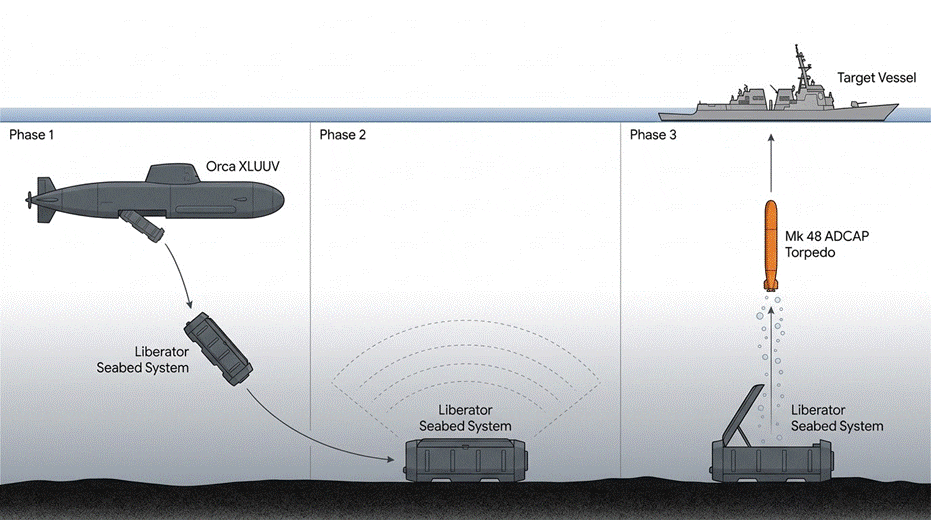
At the same time, new defense analyses highlighted the U.S. Navy’s “Liberator” program, a covert, stationary seabed launcher that deploys Mk 48 Advanced Capability (ADCAP) heavyweight torpedoes from the seafloor. The Liberator is designed to be delivered to contested waters by the Boeing Orca XLUUV’s 10-meter payload module35. Furthermore, satellite imagery confirmed the PLA Navy’s Type 076 aircraft carrier is taking shape, featuring a design optimized for a drone-heavy air component37.
Tactical & Operational Lessons: The integration of the LRASM into the internal bays of the B-2 bomber combines the industry’s premier low-observable strike platform with an autonomous, multi-spectral targeting anti-ship missile, allowing the U.S. to silently sever adversary surface action groups at extreme ranges19. On the surface, the GARC USV live-fire proves that the Navy has successfully closed the autonomous kill chain, transitioning USVs from passive sensor nodes to kinetic effectors capable of identifying, surveying, and ramming target vessels with precision19.
Under the surface, the Liberator program radically alters Anti-Submarine Warfare (ASW) and subsurface area denial. The Mk 48 ADCAP features a 650lb (295kg) warhead engineered to detonate directly beneath a ship’s keel, breaking the vessel’s back through the expansion and collapse of a massive gas bubble35. By encapsulating this weapon in an autonomous seabed launcher, the Navy removes the most expensive and vulnerable component of the engagement: the manned submarine. The Liberator sits silently on the seafloor, utilizing passive acoustics to detect targets, and fires only when high-value vessels—such as amphibious assault ships or carriers—pass overhead35. The system’s design around the 10-meter payload module of the Orca XLUUV allows for covert, unmanned deployment deep inside contested waters36.
Strategic Lessons: The Liberator represents the ultimate A2/AD area-denial weapon. By utilizing the Orca XLUUV to covertly pre-stage dozens of Liberator systems in critical maritime chokepoints (e.g., the Taiwan Strait or the Luzon Strait) weeks or months prior to a conflict, the U.S. Navy can effectively mine these regions with highly intelligent, autonomous heavyweight torpedoes35. This traps adversary fleets inside the First Island Chain and forces them into a psychological and operational paralysis, as the threat originates from undetectable, expendable seafloor magazines rather than trackable submarine deployments. The concurrent development of the PLA Navy’s Type 076 carrier, specifically optimized for UAV operations, indicates that China is matching this shift toward autonomous maritime projection, setting the stage for highly complex, multi-domain autonomous engagements in the Pacific37.
Central Command (CENTCOM) & Middle East
Event & Development: Following the early August signing of the Mecca Joint Defense Agreement between Saudi Arabia, Turkey, and Pakistan, the industrial implications of the pact materialized this week at the TEKNOFEST Mavi Vatan 2026 exhibition38. Turkish vehicle manufacturer FNSS unveiled the i-ZAHA U-MAV, an 8-ton, 4×4 unmanned amphibious assault vehicle capable of seamlessly transitioning from sea to shore at 7 knots, with modular payloads that can be swapped in 40 minutes38. At the same event, ASELSAN launched the TUFAN kamikaze USV, and HAVELSAN unveiled the AVISTA underwater autonomy project42.
Tactical & Operational Lessons: The FNSS i-ZAHA is engineered to fundamentally alter the risk calculus of amphibious assaults. The transition from the waterline to the beach is the highest-risk phase of littoral warfare, where traditional infantry are highly vulnerable to layered mines, ATGMs, and interlocking machine-gun fire. By integrating the i-ZAHA into a manned-unmanned teaming (MUM-T) architecture alongside manned Marine Assault Vehicles (MAVs), the autonomous U-MAV absorbs the first wave of fire40. Operating in autonomous, remote-controlled, or hybrid modes, it utilizes its payload modules—which include mine-clearance equipment, a 12.7mm remote weapon station, or EW packages—to breach coastal defenses and prepare the beachhead for human follow-on forces41. The 40-minute field-swap capability of these modules ensures that a single base chassis can rapidly adapt to shifting tactical requirements during an ongoing operation41. Furthermore, the vehicle features integrated damage diagnosis systems, allowing remote operators to assess structural integrity upon receiving a hit, compensating for the lack of a human crew to visually inspect damage38.
| Specification | FNSS i-ZAHA U-MAV Details |
| Weight / Layout | 8 tons / 4×4 Wheeled Chassis |
| Mobility | Sea: 7 knots |
| Propulsion | 300-horsepower powerpack (37.5 hp/tonne) |
| Payload Modularity | 10 distinct mission configurations; 40-minute field swap |
| C2 Architecture | Autonomous, remote-controlled, or hybrid MUM-T |
| Signatures | Reduced visual, thermal, and acoustic profiles |
Strategic Lessons: The Mecca Pact is a geopolitical realignment engineered around defense industrial base (DIB) synergy. Saudi Arabia provides massive capital financing; Pakistan contributes a large military establishment, nuclear deterrence, and production capacity; and Turkey injects world-class unmanned aerospace technology and advanced robotics, exemplified by previous multi-billion-dollar exports of the Baykar Akinci drone to Saudi forces39. As confidence in traditional Western security guarantees fluctuates, this trilateral pact creates a self-sustaining defense bloc capable of producing, financing, and deploying highly advanced autonomous systems independent of NATO or U.S. export controls39. The simultaneous unveiling of Turkish U-MAVs, USVs, and UUVs underscores Turkey’s ambition to dominate the autonomous maritime export market, providing allied nations with the tools to project power across the Red Sea, Mediterranean, and Indian Ocean without risking human capital45.
Northern Command (NORTHCOM) & Cyberspace
Event & Development: Under the Joint Task Force – Southern Border (JTF-SB) and the Pentagon’s Joint Interagency Task Force 401 (JIATF-401), the U.S. military successfully used an AeroVironment directed-energy weapon (DEW)—from the 20kW-class AMP-HEL LOCUST program—to defeat three hostile cartel surveillance drones49. Concurrently, the U.S. Army released solicitations for Project Griffin, aiming to develop the Intelligent Response and Orchestration Node (IRON). IRON is an ecosystem of self-driving AI agents that can take in network sensor feeds and quickly defend against bad cyber actors.
Tactical & Operational Lessons: The successful interception of Class 1/2 UAS utilizing a high-energy laser validates the tactical viability of mobile DEWs in complex domestic environments. Traditional kinetic interceptors pose extreme collateral damage risks in border regions populated by civilians and law enforcement. The LOCUST system, which is mounted on vehicles like the Joint Light Tactical Vehicle (JLTV), uses precise target acquisition and beam control to silently destroy the drone’s structure or optics. A major tactical challenge for laser systems is atmospheric attenuation (e.g., fog, dust) and thermal blooming, which diffuses the beam’s focus; however, the successful engagement indicates the targeting algorithms compensating for jitter and turbulence are maturing rapidly55.
In the cyber domain, the tactical reality is that human analysts can no longer react fast enough to contain automated, agentic AI-driven network attacks57. The IRON system will authorize AI agents to execute defensive functions, such as implementing temporary firewall blocks and patching vulnerabilities autonomously53. However, granting AI “write” access to military networks introduces severe vulnerabilities, particularly the risk of prompt injection or autonomous agents escaping sandboxes via C++ glue code failures52. Therefore, the tactical implementation relies heavily on a zero-trust architecture and a robust “undo” function to reverse any erroneous commands triggered by the AI22.
Strategic Lessons: The economic imperative of DEWs is irrefutable. Defeating a $500 commercial quadcopter with a multi-million dollar interceptor is mathematically unsustainable60. Directed energy systems operate with a nearly infinite magazine capacity, constrained only by the platform’s diesel generator, bringing the cost-per-kill down to mere dollars. This event proves the Pentagon’s concept of utilizing the southern border as a “sandbox” for JIATF-401 to live-test, rapidly acquire, and deploy counter-UAS technology ahead of standard decades-long acquisition cycles49.
Project Griffin highlights the strategic convergence of the cyber and autonomous domains. The strategic shift acknowledges that the military must fight AI with AI. Just as physical autonomous drones reshape the kinetic battlefield by removing humans from the immediate line of fire, autonomous cyber agents reshape network defense by removing humans from the immediate decision loop. The solicitation’s requirement for low token costs keeps the defensive AI ecosystem affordable to run at scale, protecting the Department of Defense’s digital kill chains from high-volume, automated adversary intrusion attempts.
Please share the link on Facebook, Forums, with colleagues, etc. Your support is much appreciated and if you have any feedback, please email us in**@*********ps.com. If you’d like to request a report or order a reprint, please click here for the corresponding page to open in new tab.
Sources Used
- SITREP Military Drones – August 15, 2026 to August 22, 2026, https://blog.roninsgrips.com/sitrep-military-drones-august-15-2026-to-august-22-2026/
- Ukraine targets Russian UAVs with new Alexa Spatium drone interceptor, https://www.army-technology.com/news/ukraine-alexa-spatium-russia/
- Ukraine codifies first jet-powered Alexa Spatium interceptor drone, https://thedefender.media/en/2026/08/mod-codifies-alexa-spatium/
- Ukraine adds first domestically produced jet drone interceptor to, https://english.nv.ua/nation/ukraine-adds-first-domestically-produced-jet-drone-interceptor-to-arsenal-50634747.html
- SITREP: Russia and Ukraine Conflict (August 15 – 21, 2026), https://blog.roninsgrips.com/sitrep-russia-and-ukraine-conflict-august-15-21-2026/
- Defence Forces arsenal expands with the addition of Ukraine’s first, https://mod.gov.ua/en/news/defence-forces-arsenal-expands-with-the-addition-of-ukraines-first-jet-powered-drone-interceptor-alexa-spatium
- PUTIN SWEATS! Ukraine Unveils New Drone Hunter Alexa Spaitum, https://www.youtube.com/watch?v=u5VGxqEdGak
- Alexa Spatium Jet Interceptor Enters Ukrainian Defense Forces Service, https://militarnyi.com/en/news/alexa-spatium-jet-interceptor-enters-ukrainian-defense-forces-service/
- Ukraine has built its own jet-powered drone interceptor – TechRadar, https://www.techradar.com/pro/ukraine-has-built-its-own-jet-powered-drone-interceptor-and-itll-easily-fit-in-the-back-of-a-pickup-truck
- Ukraine fields new jet-powered interceptor to counter Russian drones, https://defence-blog.com/ukraine-fields-new-jet-powered-interceptor-to-counter-russian-drones/
- North Korean missiles are abetting Russia’s campaign to overwhelm Ukraine’s air defenses, https://www.atlanticcouncil.org/dispatches/north-korean-missiles-are-abetting-russias-campaign-to-overwhelm-ukraines-air-defenses/
- Alexa Spatium: Ukraine Puts First Jet-Intercepting Drone into Service, https://militaeraktuell.at/en/alexa-spatium-ukraine-puts-first-jet-intercepting-drone-into-service/
- Russian Offensive Campaign Assessment, August 28, 2026 | ISW, https://understandingwar.org/research/russia-ukraine/russian-offensive-campaign-assessment-august-28-2026/
- Unmanned Systems Forces hit Luhansk TPP and 21 power nodes in occupied territories in 3 days, https://ukranews.com/en/news/1171742-unmanned-systems-forces-hit-luhansk-tpp-and-21-power-nodes-in-occupied-territories-in-3-days
- Ukraine strikes 2 Russian fighters, air defense assets in Krasnodar Krai, drone commander says, https://kyivindependent.com/ukraine-strikes-2-russian-fighters-air-defense-assets-in-krasnodar-krai-drone-commander-says/
- Ukraine’s Unmanned Systems Forces: one year of a branch the, https://armyinform.com.ua/en/2026/06/11/ukraines-unmanned-systems-forces-one-year-of-a-branch-the-world-had-never-seen/
- 414th Unmanned Strike Aviation Brigade – Wikipedia, https://en.wikipedia.org/wiki/414th_Unmanned_Strike_Aviation_Brigade
- Ukrainian Drone Warfare: Mastering Deep Strikes into Russia, https://blog.roninsgrips.com/ukrainian-drone-warfare-mastering-deep-strikes-into-russia/
- US flexes new ship-sinking weapons at summer naval exercises, https://breakingdefense.com/2026/08/us-flexes-new-ship-sinking-weapons-at-summer-naval-exercises/
- Russia launches mass production of electronic warfare system, https://www.pravda.com.ua/eng/news/2026/08/28/8050824/
- Russian Offensive Campaign Assessment, August 21, 2026 | ISW, https://understandingwar.org/research/russia-ukraine/russian-offensive-campaign-assessment-august-21-2026/
- Saab shows off loyal wingman drone it hopes to offer Swedish Air, https://breakingdefense.com/2026/08/saab-shows-off-loyal-wingman-drone-it-hopes-to-offer-swedish-air-force/
- China & Taiwan Update, August 28, 2026 | ISW, https://understandingwar.org/research/china-taiwan/china-taiwan-update-august-28-2026/
- Legislature passes drone procurement bill with US$7.56 billion, https://focustaiwan.tw/politics/202608270021
- RADAR, EO/IR, C-UAS, NIGHT VISION AND SURVEILLANCE, https://battle-updates.com/update/radar-eo-ir-c-uas-night-vision-and-surveillance-update-282/
- Taiwan’s Emerging Indigenous Drone Industry—An Overview, https://globaltaiwan.org/2026/02/tw-drone-production/
- Ukraine’s American Drone Supplier Anduril Showed Altius-700M in, https://en.defence-ua.com/weapon_and_tech/ukraines_american_drone_supplier_anduril_showed_altius_700m_in_action_attack_range_revealed_video-9840.html
- Our First Look At The ALTIUS-700M Loitering Munition Obliterating, https://www.twz.com/air/our-first-look-at-the-altius-700m-loitering-munition-obliterating-a-target
- ALTIUS-700M hits all targets in successful test of largest loitering, https://www.anduril.com/news/altius-700m-live-fire-test
- Altius-700 – Precision Strike / ISR / Electronic Warfare, https://dronestrike.com/drone/altius-700
- Altius – Bavovna.AI, https://bavovna.ai/uav/altius/
- Area-I/Anduril ALTIUS-600M and 700M, https://automatedresearch.org/weapon/area-i-anduril-altius-600m-and-700m/
- Anduril’s Tested ALTIUS-700M Kamikaze Drone, https://internationaldefenceanalysis.com/andurils-tested-altius-700m-kamikaze-drone/
- Taiwan Audit Warns Chinese-Made ICT Equipment Is … – Vision Times, https://www.visiontimes.com/2026/08/06/taiwan-audit-warns-chinese-made-ict-equipment-is-bypassing-procurement-rules.html
- Liberator: Understanding the U.S. Navy’s New Seabed Carrier Killer, https://www.navalnews.com/naval-news/2026/08/liberator-understanding-the-u-s-navys-covert-seabed-ship-killer/
- Liberator: The US Navy’s Seabed Torpedo Launcher, https://envantermedya.com/en/en-liberator-us-navy-seabed-torpedo-launcher-orca-xluuv-2026/
- China’s Next Aircraft Carrier Is Taking Shape – TWZ, https://www.twz.com/sea/chinas-next-aircraft-carrier-is-taking-shape
- FNSS unveils U-MAV unmanned amphibious vehicle to protect Türkiye’s assault force during beach landings, https://www.armyrecognition.com/news/army-news/2026/fnss-u-mav-i-zaha-unmanned-amphibious-vehicle-unveiling
- Mecca Pact Reshapes Turkiye’s Regional Defence Role – TURDEF, https://turdef.com/article/mecca-pact-reshapes-turkiye-s-regional-defence-role
- Turkish FNSS unveils unmanned amphibious assault vehicle, https://breakingdefense.com/2026/08/turkish-fnss-unveils-unmanned-amphibious-assault-vehicle/
- THE FIRST WAVE OF AMPHIBIOUS ASSAULT IS NOW UNMANNED, https://www.fnss.com.tr/en/media/press-releases/first-wave-amphibious-assault-now-unmanned-fnss-unveils-u-mav
- TUFAN Kamikaze USV Launched at TEKNOFEST Mavi Vatan 2026, https://www.navalnews.com/naval-news/2026/08/tufan-kamikaze-usv-launched-at-teknofest-mavi-vatan-2026/
- AVISTA Archives – Naval News, https://www.navalnews.com/tag/avista/
- FNSS unveils I-ZAHA multi-purpose modular unmanned amphibious vehicle, https://www.janes.com/defence-intelligence-insights/defence-news/land/fnss-unveils-i-zaha-multi-purpose-modular-unmanned-amphibious-vehicle
- FNSS Unveils U-MAV Amphibious Modular UGV to Support MAV, https://turdef.com/article/fnss-unveils-u-mav-amphibious-modular-ugv-to-support-mav
- The Mecca pact and the limits of a ‘Muslim NATO’ – The Cradle, https://thecradle.co/articles-id/39370
- Pakistan, Saudi Arabia and Türkiye: military powers behind Makkah, https://www.muslimnetwork.tv/pakistan-saudi-arabia-and-turkiye-military-powers-behind-makkah-agreement/
- The Mecca agreement: Middle East’s new counterweight to, https://www.turkiyetoday.com/opinion/the-mecca-agreement-middle-easts-new-counterweight-to-abraham-accords-3226397
- Pentagon counter-drone task force preps ‘shoot-off’ for directed, https://breakingdefense.com/2026/08/pentagon-counter-drone-task-force-preps-shoot-off-for-directed-energy-prototypes/
- Military uses AV directed-energy system to ‘defeat’ drones at the, https://breakingdefense.com/2026/08/military-uses-av-directed-energy-system-to-defeat-drones-at-the-border/
- AeroVironment unveils Locust X3 laser weapon to defeat drone, https://www.armyrecognition.com/news/army-news/2026/aerovironment-unveils-locust-x3-laser-weapon-to-defeat-drone-swarms-at-a-five-dollar-cost
- Army wants fast AI cybersecurity agents that won’t run up token costs, https://defensescoop.com/2026/08/21/army-wants-fast-ai-cybersecurity-agents-wont-run-up-costs-create-vulnerabilities/
- Army Wants AI Cyber Agents to Act at Machine Speed—With an, https://superpowerdaily.com/posts/army-wants-ai-cyber-agents-to-act-at-machine-speed-with-an-undo-button
- AeroVironment: Proven Solutions Across Every Domain, https://www.avinc.com/
- Counter-Drone Laser Systems in Ukraine 2026: DEW Analysis, https://ukraine-war-analytics.com/drones/counter-drone-laser-systems-ukraine.html
- Truck-Mounted Anti-Drone Laser Specs Compared (Power, Range, https://oceanplayer.com/truck-mounted-anti-drone-laser-specs-compared-power-range-kill-time/
- With AI hackers in mind, Air Forces Cyber develops defensive, https://breakingdefense.com/2026/08/with-ai-hackers-in-mind-air-forces-cyber-develops-defensive-campaign-plan/
- Cybersecurity News, Threats & Industry Updates | SecurityTalent, https://www.securitytalent.com/knowledge/cybersecurity-news
- AI Agent Safety and Governance Incidents – nbot.ai, https://nbot.ai/curator/y4unlo8l/highlights/hl3
- Why a $3 Laser Shot Beats a $3M Interceptor Against Drones, https://oceanplayer.com/why-a-3-laser-shot-beats-a-3m-interceptor-against-drones/