
Tag Archives: Defense of Japan

Comparative Textual Audit: Structural and Linguistic Divergences Between ‘Nihon no Bōei’ and ‘Defense of Japan’

Executive Summary: The Structural Delta

A significant functional divide exists between the primary Japanese edition of Japan’s Defense White Paper, Nihon no Bōei (日本の防衛), and its official English translation, Defense of Japan, published by the Ministry of Defense (JMOD)1. Defense policy planners and intelligence teams relying solely on the English translation risk misinterpreting Japan’s statutory constraints, operational readiness, and force projection capabilities2.

The Japanese edition serves as a legally constrained, Diet-mandated accountability document1. Designed to withstand parliamentary debate and reviewed by the Cabinet Legislation Bureau (Naikaku Hōseikyoku), it targets a domestic audience of lawmakers, municipal hosts, and legal scholars1. As such, the text prioritizes statutory precision, Article 9 constitutional alignment, and administrative precedents.

In contrast, the English translation acts as an international Strategic Communication (StratCom) asset5. It projects alliance integration and regional deterrence to foreign militaries and media—a posture explored in deeper analyses of Japan’s Strategic Shift in Indo-Pacific Security5 and Japan’s Defense Revolution and Policy Transformation6.

This operational divide creates three primary risks for international analysts:

  1. Lexicon Smoothing: English translations often replace technical statutory terms—like Sonritsu Kiki Jitai (Survival-Threatening Situation)—with generic phrases like “critical security situations”2,3. This obscures the legal triggers that dictate when the Self-Defense Forces (SDF) can legally employ force2.
  2. Data Truncation in Reference Annexes: The English edition features severe data truncation, specifically in the reference data appendices (Shiryō-hen / 資料編)1. The original Japanese text contains exhaustive line-item data regarding procurement contract structures, Acquisition, Technology & Logistics Agency (ATLA) research milestones, municipal host-nation subsidy distribution, base lease litigation, and personnel recruitment shortfalls1. The omission or aggregation of these appendices in the English version conceals major force generation, sustainment, and infrastructure bottlenecks1.
  3. Publication Latency Asymmetry: A persistent publication delay creates analytical asymmetry. The Japanese edition is approved by the Cabinet and released in mid-summer (typically July), whereas the full English translation is published months later, often in late autumn or winter5. Analysts relying exclusively on official English releases operate on outdated baselines, missing key post-Cabinet policy refinements, Diet testimony clarifications, and budget adjustments made during the interim period1.

Statutory Precision vs. Linguistic Smoothing

Counterstrike Capability vs. Strike Conceptions

A major divergence appears in the framing of long-range strike capabilities. The Japanese text uses Hangeki Nōryoku (反撃能力), which literally means “Capability for Counterattack,” though JMOD translates it as “Counterstrike Capability.”

In Japanese statutory prose, Hangeki Nōryoku is strictly defined to maintain constitutional alignment with Article 9 and the Senshu Bōei (専守防衛 / Exclusively Defense-Oriented Policy) doctrine2. The Japanese text mandates that counterstrike capabilities can only be exercised when an adversary has initiated an armed attack against Japan or a closely related state in a survival-threatening situation, meeting the strict “Three Conditions for the Use of Force” (武力行使の三要件 / Buryoku Kōshi no San-Yōken)2.

Western defense discourse frequently interprets Hangeki Nōryoku through the lens of offensive strike concepts, such as “preemptive strike,” “deep strike,” or “offensive counter-force.” The English White Paper aligns Hangeki Nōryoku with Western operational terminology to project offensive deterrence.

Crucially, the Japanese text explicitly excludes preemptive strikes (Sensei Kōgeki). Any strike conducted before a verifiable attack initiation (Buryoku Kōgeki no Hassei) is deemed unconstitutional2. Analysts reading the English version as standard offensive doctrine may miss these legal constraints on launch authority and target selection. For more on the units enabling these capabilities, see Tokushusakusengun: Japan’s Special Forces Group Capabilities7.

Statutory Contingency Classifications and Operational Escalation

The Japanese legal framework governing national security relies on explicit statutory triggers established under the 2003 Armed Attack Situation Response Act and the 2015 Security Legislation2:

  • Armed Attack Situation (武力攻撃事態 / Buryoku Kōgeki Jitai): Defined under Article 2(1) of the Response Act as a direct, ongoing, or imminent armed attack against Japan2. The literal translation is “Armed Attack Situation.” This trigger authorizes a Defense Operation Order (防衛出動 / Bōei Shudō) under Article 76 of the SDF Act, permitting the full use of force under international law to defend the nation2.
  • Survival-Threatening Situation (存立危機事態 / Sonritsu Kiki Jitai): Defined under Article 2(3) as an armed attack against a foreign country in a close relationship with Japan that threatens Japan’s existence and poses a clear danger to its national rights2. The literal translation is “Existence-Threatening Situation.” This permits limited collective self-defense, provided no other legal means exist to repel the threat2.
  • Important Influence Situation (重要影響事態 / Jūyō Eikyō Jitai): Replaced the legacy “Surrounding Situations” (周辺事態 / Shūhen Jitai) framework3. The literal translation is “Situation with Important Impact.” It defines situations that, if unaddressed, could escalate to a direct armed attack on Japan3. Under this classification, the SDF is restricted to non-combat rear-area support (後方支援 / Kōhō Shien)—such as logistics, search and rescue, and ISR—and is strictly prohibited from engaging in operations integrated with the use of force (武力行使と一体化しない / Buryoku Kōshi to Ittaika Shinai)3.
  • Gray-Zone Situation (グレーゾーンの事態 / Gurē Zōn no Jitai): Situations that are neither full peacetime nor armed attack contingencies2. The SDF cannot automatically deploy military force; operations are restricted to police actions, such as Maritime Security Operations (海上警備行動 / Kaijō Keibi Kōdō) under SDF Act Article 82, leaving primary authority with the Japan Coast Guard (JCG / 海上保安庁)2.
Statutory ClassificationJapanese Legal MandateEnglish Translation Smoothing
Buryoku Kōgeki Jitai (武力攻撃事態)2SDF Act Art. 76; Full defense operations authorized under national self-defense2.The generic term “Armed Attack Contingency” obscures the internal administrative legal triggers2.
Sonritsu Kiki Jitai (存立危機事態)2Response Act Art. 2(3); Limited collective self-defense under strict 3-condition rule2.Rendered as “Crisis Threatening Survival”; omits statutory limits on operational zones3.
Jūyō Eikyō Jitai (重要影響事態)3Important Influence Act; Non-combat rear logistics; force employment prohibited3.Translated as “Situations with Important Impact”; conceals an absolute ban on combat integration3.
Gurē Zōn no Jitai (グレーゾーンの事態)2Police action; primary JCG jurisdiction; SDF restricted to Art. 82 operations2.Rendered as “Gray-Zone Incidents,” this term overstates the seamless military escalation mechanisms2.

The English edition of Defense of Japan translates these distinct statutory triggers into continuous narrative terms such as “contingency responses,” “support to allied operations,” or “crisis management frameworks.” This linguistic smoothing hides the legal limits on what the SDF can do2. For example, during a Taiwan Strait contingency categorized by Japan as an Important Influence Situation, foreign planners expecting direct JSDF fire support would find the JSDF legally restricted to non-combat logistical support outside active combat zones3.

Cross-Domain and Command Authorities

In cross-domain operations—specifically Space (宇宙 / Uchū), Cyber (サイバー / Saibā), and Electronic Warfare (電子戦 / Denshisen)—the original Japanese text details institutional boundaries. System operations in the Japanese White Paper delineate legal authorities between the JSDF Joint Staff (統合幕僚監部 / Tōgō Bakuryō Kanbu), the Cabinet Cybersecurity Center (NISC), the Ministry of Internal Affairs and Communications (MIC), and the Japan Coast Guard1.

In Japanese legal text, defensive cyber operations (サイバー防衛動員 / Saibā Bōei Dōin) require specific Cabinet approval and administrative mandates, particularly when civilian critical infrastructure (重要インフラ / Jūyō Infura) is affected. The original text highlights statutory prohibitions against JSDF active cyber defense (アクティブ・サイバー・ディフェンス) measures that may impinge on the constitutional secrecy of communications (通信の秘密 / Tsūshin no Himitsu, Article 21) without dedicated legislative amendments.

The English edition often streamlines these into broad statements about “integrated cross-domain defense,” contrasting with the granular evaluations found in Japan’s SHIELD Architecture and Modern Air Defense Posture8.

Category 2: The Reference Data Gap (資料編 / Shiryō-hen Audit)

The most notable empirical discrepancy between Nihon no Bōei and Defense of Japan resides in the reference data annexes (資料編 / Shiryō-hen)1. The original Japanese White Paper published by JMOD contains hundreds of pages of detailed tables, contract structures, legal opinions, and personnel statistics1. The English version condenses or excludes major portions of these annexes1.

Reference Section (Shiryō-hen)Japanese Edition CoverageEnglish Translation Status
Procurement & ATLA R&D (装備品調達・技術開発)1Exhaustive line-item unit costs, contract types, delivery delays, and vendor choices1.These costs are aggregated into macro-budget charts, but specific program cost inflation is omitted.
Base Subsidies & Host Nation Burden (基地対策費・SACO/UFC)1Municipal breakdown of noise abatement, land lease lawsuits, and realignment grants1.Summarized into generic “Alliance Burden Sharing” figures; excludes local pushback data1.
Civil-Military Infrastructure Access (特定利用空港・港湾)1Specific airport/port designations (Tokutei Riyō); local government refusal logs1.Abstract statements on “improving joint infrastructure utilization”9.
Personnel, Recruitment, & Resignations (隊員充足率・離職率)1Detailed quota deficits, enlistment shortfalls by rank, and reserve usage statistics1.High-level mentions of “human resource optimization” omit raw shortfall figures1.
Diet Legal Interpellations (国会答弁・内閣法制局解釈)1Full transcripts of Cabinet Legislation Bureau interpretations1.Completely omitted, stripping legal context of Article 9 limits1.

Procurement and Acquisition Line Items

Within the procurement sections, the Japanese Shiryō-hen details line-item expenditures overseen by the Acquisition, Technology & Logistics Agency (ATLA / 防衛装備庁)1. The Japanese text provides itemized unit costs, primary defense contractors (e.g., Mitsubishi Heavy Industries, Kawasaki Heavy Industries), contracting formats (single-source vs. competitive bidding), multi-year contract liability balances (後年度負担 / Kōnendo Futan), and development delay indicators1.

The English translation replaces these comprehensive tables with generalized, aggregated charts. Consequently, analysts reviewing only the English text miss operational indicators such as:

  • Cost inflation on imported U.S. Foreign Military Sales (FMS) acquisitions.
  • Production bottlenecks and supply chain vulnerabilities in domestic munition production lines.
  • Multi-year financial commitments (Kōnendo Futan) that restrict fiscal flexibility for emerging technology integration1.

Base Realignment, Host Nation Support, and Municipal Subsidies

The Japanese edition includes municipal-level financial breakdowns related to host-nation support and base realignment, particularly concerning the Special Action Committee on Okinawa (SACO) agreements and U.S. Force Realignment Initiatives. The Japanese text details:

  • Specific realignment grants (再編交付金 / Saihen Kōfukin) allocated to local governments near bases1.
  • Funding for noise abatement compensation (防音工事補助金)1.
  • Land lease compensation payments (地代・無償使用損害金) and ongoing land dispute litigations in Okinawa and the Nansei Islands1.

This level of detail exposes domestic political friction and the actual cost of securing municipal consent for SDF/U.S. military base operations1. The English edition condenses these entries into broad summaries of Japan’s contributions to the alliance. This framing conceals how local municipal vetoes and land disputes can disrupt operational readiness and infrastructure expansion during a crisis1.

Diet Records and Administrative Precedents

The original Japanese White Paper includes an archive of parliamentary debates (国会審議 / Kokkai Shin’gi), Cabinet interpretations, and administrative guidance notes1. These records outline the legal parameters imposed on JSDF commanders1.

For example, when detailing the limits of weapon usage (武器使用 / Buki Shiyō) under SDF Act Article 95-2 (Protection of U.S. and Allied Weapons and Equipment), the Japanese reference text cites specific Diet testimony from the Director-General of the Cabinet Legislation Bureau1. This testimony establishes that SDF protection of foreign military assets cannot occur in areas where combat operations are actively occurring1. The English edition omits these legal caveats, leading foreign analysts to overestimate the geographic and operational flexibility of JSDF unit engagements1.

Category 3: Regional Threat Calibration and Diplomatic Nuance

China (PRC) and the Taiwan Strait

The Japanese original and English translation feature semantic differences in their characterization of the People’s Liberation Army (PLA) and China Coast Guard (CCG) operations2. In the Japanese text, statements regarding PLA activity around the Nansei Islands and the Taiwan Strait are constructed with specific linguistic markers to maintain legal precision and manage diplomatic escalation risk2.

Characterization AreaJapanese Formulation (Kanji / Rōmaji)English Translation
PRC Military Posture強烈な懸念 / 過去最大の戦略的挑戦 (Kyōretsu na Kenen / Kako Saidai no Senryakuteki Chōsen)5“An unprecedented strategic challenge” (Adopts sharper, declarative posture)
CCG Senkaku Operations独自主張に基づく活動 / 領海侵入 (Dokuji Shuchō ni Motozuku Katsudō / Ryōkai Shinnyū)2“Intrusions into Japanese territorial waters” (Conceals administrative jurisdictional qualifiers)2
Taiwan Strait Stability台湾海峡の平和と安定は…極めて重要 (Taiwan Kaikyō no Heiwa to Antei wa… Kiwamete Jūyō)10“Peace and stability across the Taiwan Strait is critical…” (Smooths over explicit legal non-commitment to direct intervention)

The Japanese original uses calibrated syntax (懸念される / Kenen Sareru – “is a matter of concern,” or 慎重な監視が必要である / Shinchō na Kanshi ga Hitsuyō de aru – “requires careful monitoring”) to balance military vigilance against diplomatic posturing2. The official English text frequently translates these phrases into direct assertions, such as “presents an unprecedented strategic challenge” or “poses a grave threat to international order.”

While this alignment brings the English text closer to Western strategic messaging (such as the U.S. National Defense Strategy), it obscures internal Japanese policy debates2. The Japanese phrasing reflects a legal position that avoids prematurely categorizing PRC gray-zone actions as an “armed attack,” which would require formal SDF mobilization under Japanese law2.

North Korea (DPRK) and Russia

Regarding North Korea, the Japanese text maintains legal terms for missile trajectory and warhead classification2. Missiles launched on lofted trajectories are analyzed in Japanese using precise operational language (変則軌道 / Hensoku Kidō – Irregular Trajectories) paired with statutory assessments of whether they violate United Nations Security Council Resolutions or Japanese territorial airspace2.

In discussions on Russia, the Japanese edition uses explicit legal terminology regarding the Northern Territories (北方領土 / Hoppō Ryōdo), identifying them as “an inherent part of Japan’s territory currently under illegal occupation by Russia” (我が国固有の領土であり、ロシアによって不法占拠されている)2.

The English text occasionally simplifies these territorial descriptions to “disputed islands” or “the Southern Kurils,” stripping away the explicit constitutional and sovereign legal positions asserted in the original Japanese text. Furthermore, descriptions of joint Sino-Russian bomber patrols (中露共同飛行 / Chūro Kyōdō Hikō) in Japanese explicitly cite airspace proximity and interception rules under JSDF Air Defense Identification Zone (ADIZ) administrative regulations2. The English edition abstracts these into broad statements regarding strategic threat convergence2.

Audience Calibration: Entrapment vs. Alignment

A major framing divergence occurs around allied integration versus national autonomy. The White Paper manages two distinct target audiences:

  • Domestic Audience: The primary objective is statutory accountability and addressing anxieties over entrapment (巻き込まれ / Makikomare). The text emphasizes constitutional limits under Article 9, highlights strict legal conditions governing SDF engagement, and details local burden relief and compensation programs1.
  • International Audience: The primary objective is Strategic Communication (StratCom) and alliance alignment. The English edition emphasizes combined operational readiness, projects integrated deterrence capabilities, and highlights involvement in multilateral frameworks such as the Quad, AUKUS Pillar II, and bilateral initiatives like the Japan-Philippines Military Alliance and RAA Framework10. Analysts relying solely on the English translation risk mistaking international StratCom alignment for domestic political consensus2.

Category 4: Internal Force Friction and Structural Bottlenecks

Demographic Decline and SDF Recruiting Deficits

Japan’s demographic contraction presents an operational challenge for the JSDF5. The original Japanese White Paper documents this crisis across its personnel and readiness chapters1.

Demographic / Force MetricOriginal Japanese Data DisclosureEnglish Translation Presentation
Enlistment Target Deficits (自衛官候補生採用率)1Explicit raw counts showing shortfalls exceeding 50% in enlisted recruitment categories1.Softened to general “recruitment challenges” alongside mitigation narratives.
Mid-Career Resignations (中途退職者の推移)1Detailed breakdowns of mid-career officer and NCO attrition rates1.Framed as general “human resource mobility” or workforce management.
Reserve Mobilization Readiness (即応予備自衛官充足率)1Granular fill rates for Sokuō Yobi Jieikan reserve forces1.Summarized as “effective reserve force integration.”

The Japanese edition publishes detailed tables of enlistment target quotas versus actual recruitment results1. These figures highlight severe shortfalls in Lower-Term Enlisted (自衛官候補生 / Jieikan Kōhosei) recruitment, where fill rates have dropped substantially below official target levels1. The Japanese text also details attrition among mid-career NCOs and junior officers, alongside low fill rates for Ready Reserve Personnel (即応予備自衛官 / Sokuō Yobi Jieikan)1.

The English translation condenses these personnel statistics into narrative summaries about “human resource management reforms,” “utilizing civilian contractors,” and “improving workplace conditions.” Consequently, international analysts reading the English text miss the extent to which labor shortages impact JSDF unit readiness, platform maintenance, and multi-domain force generation schedules—a driver accelerating Japan’s Shift to Drones11 and the integration of Autonomous Systems in Modern Defense Strategy9.

Civil-Military Infrastructure Access

To support Nansei Islands contingency planning, JMOD established the “Specified Civilian Airports and Ports” (特定利用空港・港湾 / Tokutei Riyō Kūkō・Kōwan) framework9. This initiative aims to upgrade civilian infrastructure in southwestern Japan to allow routine training and operational use by JSDF and U.S. military assets9.

The original Japanese text details the legal negotiations required between JMOD, the Ministry of Land, Infrastructure, Transport and Tourism (MLIT), and local municipal governors1. Local authorities retain legal jurisdiction over civilian ports and airports under the Local Autonomy Act1. The Japanese text notes instances of local mayoral pushback, restrictions on military aircraft weight thresholds, and local resistance to dual-use designation1.

The English White Paper abstracts these localized legal frictions, framing the initiative as a fully operationalized infrastructure expansion program9. This gap can lead allied operational planners to assume guaranteed access to key civilian transport hubs during a regional crisis, overlooking the local legal approvals required under peacetime and gray-zone statutory frameworks1.

Comparative Matrix of Critical Discrepancies

Domain / SectionOriginal Japanese Formulation (Kanji / Rōmaji)Official English TranslationLiteral Military-Linguistic TranslationIntelligence Delta / Operational Implication for Allies
Legal Doctrine & Targeting反撃能力 (Hangeki Nōryoku)7Counterstrike CapabilityCapability for CounterattackEnglish text aligns with Western offensive strike concepts; masks legal constraint requiring prior enemy attack initiation (Buryoku Kōgeki)2.
Contingency Trigger存立危機事態 (Sonritsu Kiki Jitai)2Survival-Threatening Situation3Existence-Threatening SituationEnglish smooths over statutory 3-conditions required for limited collective self-defense authorization2.
Rear-Area Operations重要影響事態 (Jūyō Eikyō Jitai)3Situations with an Important Impact3Important Influence SituationOmits absolute legal prohibition on combat integration (Ittaika Shinai); JSDF limited to non-combat logistics3.
Asset Protection Authority武器等防護 (Buki Tō Hōgo – SDF Act Art. 95-2)1Protection of Weapons and Equipment1Protection of Weapons and Related ItemsConceals legal boundary prohibiting protection of allied assets in active combat zones1.
Threat Assessment: China (PRC)これまでにない最大の戦略的挑戦 (Kore madeni nai Saidai no Senryakuteki Chōsen)5An unprecedented strategic challengeGreatest strategic challenge unprecedented hithertoTranslates subtle administrative risk management language into sharp strategic messaging2.
Territorial Disputes我が国固有の領土…不法占拠されている (Wagakuni Koyū no Ryōdo… Fuhō Senkyo)2Disputed territory / Occupied islandsInherent territory of our nation… illegally occupiedEnglish text occasionally simplifies explicit sovereign legal positions asserted in Japanese2.
Defense Procurement & Budget後年度負担 / 装備品等調達資料 (Kōnendo Futan / Sōbi-hin Tō Chōtatsu Shiryō)1Budget / Equipment Acquisition OverviewFuture-Year Burden / Equipment Procurement Data1English excludes detailed multi-year liability data and program-level cost inflation1.
Force Readiness & Personnel自衛官候補生採用不振・離職率 (Jieikan Kōhosei Saiyō Fushin / Rishoku)1Human Resource Optimization InitiativesRecruitment slump of SDF candidates / Turnover rate1English obscures recruit fill-rate deficits (>50% shortfalls) and structural personnel shortages1.
Infrastructure Access特定利用空港・港湾の指定交渉 (Tokutei Riyō Kūkō・Kōwan no Shitei Kōshō)9Airport and Port Utilization EnhancementsDesignation negotiations for specified usable airports and ports9Masks local municipal pushback and statutory access limits under civilian transport law1.
Cyber Defense Authorityアクティブ・サイバー・ディフェンスの制約 (Akutibu Saibā Difensu no Seiyaku)Active Cyber Defense PromotionConstraints on Active Cyber DefenseSmooths over constitutional privacy barriers (Tsūshin no Himitsu) governing network interdiction.

Actionable Recommendations for the Defense & Intelligence Communities

OSINT and Open-Source Exploitation Protocols

  • Mandate Primary Native-Text Exploitation: Defense intelligence agencies and allied policy shops must establish standard operating procedures requiring primary analysis of Japanese defense posture to be conducted directly from the original Japanese text (Nihon no Bōei) rather than relying on official JMOD English translations1.
  • Deploy Automated Structural Delta Extraction: Intelligence collection architectures should integrate automated textual parsing tools designed to flag structural omissions between the Japanese edition and English releases, specifically targeting the reference data annexes (Shiryō-hen)1.
  • Integrate Diet Security Committee Transcripts: Analytical assessments derived from White Paper disclosures must be systematically cross-referenced with official transcripts from the National Diet’s Committees on Security (安全保障委員会 / Anzen Hoshō Iinkai). Parliamentary interpellations provide the legal interpretation for vague statutory triggers presented in the White Paper1.

Priority Exploitation Areas for Japanese Text Extraction

  • ATLA Procurement and Contract Annexes (Shiryō-hen): Extract unit-cost fluctuations, contractor selections, multi-year obligations (Kōnendo Futan), and development delay metrics from the Japanese reference annexes to establish accurate weapons delivery timelines1.
  • Municipal Base Compensation Grants: Track realignment grant distributions (Saihen Kōfukin) and noise abatement allocations (Bōon Kōji Hojokin) across Southwestern municipalities to identify local political friction points impacting JSDF footprint expansion1.
  • Raw Personnel and Recruitment Statistics: Extract lower-term enlisted candidate fill rates (Jieikan Kōhosei) and Ready Reserve mobilization metrics (Sokuō Yobi Jieikan) to evaluate operational unit readiness1.
  • Civilian Transport Facility Agreements: Monitor bilateral negotiations between JMOD, MLIT, and prefectural governors regarding “Specified Civilian Airport and Port” designations (Tokutei Riyō Kūkō・Kōwan) to confirm actual facility access rights during crisis scenarios1.

Tracking Publication Latency and Post-Cabinet Adjustments

Timeline of Publication and Intelligence Exploitation Windows:

  • July: Cabinet Approval & Release of Japanese White Paper (Nihon no Bōei)1.
  • July–August: Primary OSINT Exploitation Window (Japanese Text Extraction & Reference Annex Audit)1.
  • August–October: Diet Interpellations & Cabinet Legislation Bureau Clarifications1.
  • Late Autumn / Winter: Release of Official English Translation (Defense of Japan).

Intelligence collection schedules must explicitly account for the 3-to-5-month publication latency gap between the mid-summer release of Nihon no Bōei and the late autumn/winter release of Defense of Japan1. Direct exploitation of the primary Japanese source text must commence immediately upon Cabinet approval in July1. Furthermore, analysts must track parliamentary debate transcripts occurring between August and November, as Diet testimony given by JMOD officials and the Cabinet Legislation Bureau frequently refines or restricts statutory definitions prior to the publication of the English edition1.

Comprehensive Bilingual Glossary

Japanese Term / Acronym (Kanji / Rōmaji)Official English Term (Official Translation)Literal / Operational Definition for Intelligence Analysts
日本の防衛 (Nihon no Bōei)1Defense of JapanPrimary JMOD annual White Paper; legally constrained domestic accountability document1.
資料編 (Shiryō-hen)1Reference Annex / Reference Data1Comprehensive Japanese reference appendix containing detailed budget and procurement line items1.
反撃能力 (Hangeki Nōryoku)7Counterstrike CapabilityDefensive standoff strike authority triggered only post-attack initiation2.
専守防衛 (Senshu Bōei)2Exclusively Defense-Oriented PolicyConstitutional restraint limiting military force to response actions2.
武力攻撃事態 (Buryoku Kōgeki Jitai)2Armed Attack Situation4Direct attack trigger authorizing Defense Operation Orders under SDF Act Art. 762.
存立危機事態 (Sonritsu Kiki Jitai)2Survival-Threatening Situation3Third-party attack trigger authorizing limited collective self-defense2.
重要影響事態 (Jūyō Eikyō Jitai)3Situation with an Important Impact3Security trigger authorizing non-combat JSDF rear-area logistics support3.
グレーゾーンの事態 (Gurē Zōn no Jitai)2Gray-Zone Situation2Non-peace, non-war regional friction; handled via policing authorities2.
防衛出動 (Bōei Shudō)2Defense Operation OrderExecutive Cabinet authorization deploying JSDF for combat operations2.
武器等防護 (Buki Tō Hōgo)1Protection of Weapons and Equipment1Authority under SDF Act Art. 95-2 to protect allied operational assets1.
防衛装備庁 (Bōei Sōbi Chō / ATLA)1Acquisition, Technology & Logistics AgencyJMOD agency overseeing equipment procurement and defense tech R&D1.
内閣法制局 (Naikaku Hōseikyoku)1Cabinet Legislation BureauExecutive legal agency vetting all statutory definitions and legal interpretations1.
特定利用空港・港湾 (Tokutei Riyō Kūkō・Kōwan)9Specified Civilian Airports and Ports9Dual-use civil infrastructure designated for JSDF/U.S. military crisis operations9.
自衛官候補生 (Jieikan Kōhosei)1Self-Defense Official Candidates (Lower-Term Enlisted)1Enlisted recruit classification experiencing major recruitment shortfalls1.
即応予備自衛官 (Sokuō Yobi Jieikan)1Ready Reserve Personnel1Rapid-mobilization reserve force subjected to operational fill-rate constraints1.
後年度負担 (Kōnendo Futan)1Future-Year Burden / Multi-Year Obligation1Financial commitments for defense procurement impacting future fiscal flexibility1.
北方領土 (Hoppō Ryōdo)2Northern TerritoriesFour disputed island territories identified as illegally occupied by Russia2.
再編交付金 (Saihen Kōfukin)1Realignment Grants1Financial compensation to local municipalities hosting base infrastructure1.
通信の秘密 (Tsūshin no Himitsu)Secrecy of CommunicationsConstitutional privacy rights restricting active cyber defense interdiction operations.
統合幕僚監部 (Tōgō Bakuryō Kanbu / JSO)1Joint StaffHighest operational JSDF command authority executing multi-domain operations1.

Please share the link on Facebook, Forums, with colleagues, etc. Your support is much appreciated and if you have any feedback, please email us in**@*********ps.com. If you’d like to request a report or order a reprint, please click here for the corresponding page to open in new tab.


Sources Used

  1. 平和安全法制施行後の自衛隊の活動状況など, https://www.mod.go.jp/j/publication/wp/wp2021/pdf/R03030105.pdf
  2. Japanese Maritime Security and Law of the Sea (International Law in Japanese Perspective, 14) 9004470069, 9789004470064 – DOKUMEN.PUB, https://dokumen.pub/japanese-maritime-security-and-law-of-the-sea-international-law-in-japanese-perspective-14-9004470069-9789004470064.html
  3. Fighting Abroad from an Ally’s Land: Challenges and Opportunities for U.S. Forces in the Indo-Pacific – RAND Corporation, https://www.rand.org/content/dam/rand/pubs/research_reports/RRA1900/RRA1985-1/RAND_RRA1985-1.pdf
  4. Civil Defense in Japan; Issues and Challenges, https://api.pageplace.de/preview/DT0400.9781003817215_A47280996/preview-9781003817215_A47280996.pdf
  5. Japan’s Strategic Shift: Evolving Roles in Indo-Pacific Security – Ronin’s Grips, https://blog.roninsgrips.com/japans-strategic-shift-evolving-roles-in-indo-pacific-security/
  6. Japan’s Defense Revolution: Takaichi’s Strategic Shift in 2026 – Ronin’s Grips, https://blog.roninsgrips.com/japans-defense-revolution-takaichis-strategic-shift-in-2026/
  7. Tokushusakusengun: An Analysis of the Japan Special Forces Group’s Evolution, Capabilities, and Future Trajectory – Ronin’s Grips, https://blog.roninsgrips.com/tokushusakusengun-an-analysis-of-the-japan-special-forces-groups-evolution-capabilities-and-future-trajectory/
  8. An Analysis of Japan’s SHIELD Architecture and Modern Air, https://blog.roninsgrips.com/the-strategic-posture-and-the-evolving-threat-environment-an-analysis-of-japans-shield-architecture-and-modern-air-defense-lessons/
  9. 2026 Defense Strategy: Autonomous Systems and Modern Warfare – Ronin’s Grips, https://blog.roninsgrips.com/2026-defense-strategy-autonomous-systems-and-modern-warfare/
  10. Japan-Philippines Military Alliance: Strategic Impact and Future Outlook – Ronin’s Grips, https://blog.roninsgrips.com/japan-philippines-military-alliance-strategic-impact-and-future-outlook/
  11. Japan’s Shift to Drones: A New Era in Defense Strategy – Ronin’s Grips, https://blog.roninsgrips.com/japans-shift-to-drones-a-new-era-in-defense-strategy/
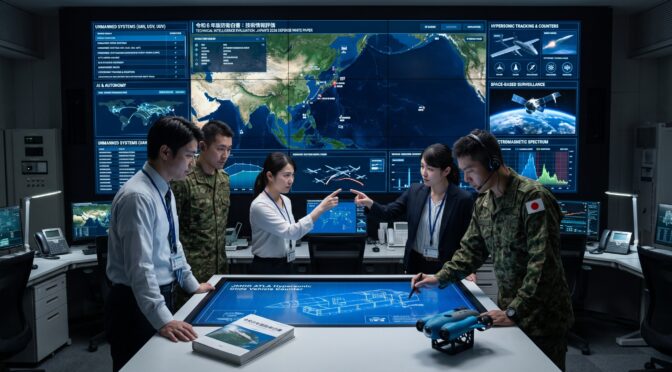
Technical Intelligence Evaluation: Japan’s 2026 Defense White Paper

Executive Summary

The Defense of Japan 2026 (日本の防衛 令和8年版), released by the Ministry of Defense under Prime Minister Sanae Takaichi and Defense Minister Shinjiro Koizumi, represents a significant shift in Japan’s post-WWII strategy1. Moving beyond the minor updates of previous years, this 2026 White Paper formalizes a shift from a strictly defensive stance (Senshu Boei) toward a strategy built on multi-domain deterrence and the ability to launch offensive counterstrikes1.

The nearly 600-page document describes today’s security environment as a “new era of crisis”1. The Ministry warns that the international order is facing its toughest test since 1945, largely due to the coordinated military activities of China, North Korea, and Russia3. In response, Tokyo is halfway through its five-year defense plan, investing approximately 43 trillion yen (over $300 billion USD) to rebuild its military strength7. This commitment to spending 2% of GDP led to a record 9.04 trillion yen budget for FY2026, totaling roughly $60 billion USD9.

The 2026 report also shows a new approach to public outreach. To tackle recruitment challenges and build public support, the White Paper features an anime-style cover illustrated by Hitomi Kariya titled “Security For The Future”13. This imagery links national defense to high-tech prosperity, reflecting Prime Minister Takaichi’s “Sanaenomics” doctrine, which suggests that defense innovation can drive national economic growth2. This document sets the stage for a full update of Japan’s core security strategies later this year13.

Part I: Assessment of the Regional & Global Security Environment

The White Paper analyzes the military capabilities and strategic goals of regional powers in detail. Japan has moved away from diplomatic ambiguity, now viewing China, Russia, and North Korea as an interconnected “CRINK” alignment that poses a multi-theater threat3.

1. The PRC: An Unprecedented Strategic Challenge

China is identified as the “greatest strategic challenge” to both Japan and global stability2. The Ministry of Defense is closely monitoring the People’s Liberation Army (PLA) as it projects power across the Taiwan Strait and into the waters near Japan’s Southwestern (Nansei) Islands3.

The report notes frequent Chinese naval and air incursions in the East China Sea, particularly around the Senkaku Islands and the Miyako Strait3. In August 2024, a Chinese intelligence aircraft violated Japanese airspace for the first time18, and by December 2025, Chinese jets were locking their fire-control radars onto Japanese interceptors3. Japan views these aggressive actions as a sign that China is more willing to risk a military confrontation2.

Japan now explicitly links its security to the stability of Taiwan, describing a conflict there as a “survival-threatening situation” (Sonritsu Kiki Jitai)2. The White Paper argues that China’s rapid military growth is aimed at preventing U.S. and allied forces from intervening in regional crises2. China has dismissed these assessments as “false narratives” used to justify Japan’s remilitarization1.

2. The DPRK: Accelerated Proliferation and Technical Leapfrogging

North Korea’s threat has evolved from a regional nuisance into a major strategic danger. The White Paper highlights Pyongyang’s move toward solid-fueled missiles, which are much faster to launch and harder to detect than older liquid-fueled systems1, 3.

The report focuses on North Korea’s new hypersonic and multi-warhead technologies, designed to overwhelm missile defenses6. Most concerning is the partnership between North Korea and Russia; in exchange for munitions used in Ukraine, North Korea is likely receiving advanced Russian tech for satellites and submarines3. This cooperation is helping Pyongyang build a more survivable nuclear arsenal much faster than expected3.

3. The Russian Federation: Attrition Warfare and the Far East Posture

Japan is studying the war in Ukraine to learn about the “new ways of warfare” that will shape its defense strategy3. Key lessons include the vital importance of low-cost drones, electronic warfare, and the need for massive stockpiles of supplies2.

While Russian ground forces remain tied down in Europe, their Pacific Fleet and strategic bombers continue to pose a major threat near Japan2. The report says that joint Chinese-Russian patrols are a threat to stability. Coordinated bomber flights over the Sea of Japan and near Alaska are used to signal strength, forcing Japan’s air force to monitor multiple areas at once13.

Part II: Seven Key Defense Capabilities & Force Modernization

To counter the rapidly deteriorating security environment and offset demographic constraints, the 43 trillion yen Defense Buildup Program dictates a fundamental modernization across seven key operational fields. The 2026 White Paper provides an exhaustive, line-item audit of Tokyo’s progress in fielding these capabilities3.

1. Stand-off Defense & Counterstrike Capabilities

In a historic shift, Japan is acquiring counterstrike capabilities to hit enemy targets deep within their territory to prevent incoming attacks3. The 2026 White Paper confirms that these assets are already being deployed to the Southwestern islands28.

The center of this new capability is the upgraded Type 12 missile, now known as the Type 25 Surface-to-Ship Missile. It is stealthy, highly accurate, and has an extended range of 1,000 kilometers22. These launchers were quietly deployed to Kyushu in early 2026, putting the entire Chinese coast within Japan’s reach29, 11. Air-launched versions are being tested on F-2 fighters, and a submarine version is expected by 202724, 11.

To bridge the gap while indigenous production scales, Japan is actively integrating U.S.-manufactured Tomahawk Land Attack Missiles (TLAMs) onto its existing fleet of Aegis destroyers23. Additionally, the JMOD is quickly advancing research and operational fielding of the Hyper Velocity Gliding Projectile (HVGP), a ground-launched boost-glide weapon designed for rapid, unpredictable strikes against high-value maritime and land targets3.

2. Integrated Air and Missile Defense (IAMD)

To defend the archipelago against saturating ballistic, cruise, and hypersonic threats, Japan is restructuring its IAMD network into a highly distributed, multi-layered shield3. Following the political cancellation of the land-based Aegis Ashore program in 2020, capital was pivoted toward the construction of two massive Aegis System Equipped Vessels (ASEV)3. These 14,000-ton, 190-meter cruisers will act as mobile, offshore air-defense fortresses powered by Rolls-Royce MT30 gas turbines34. The 2026 White Paper notes the successful delivery of the Lockheed Martin AN/SPY-7(V)1 radar shipsets, with the vessels on track for commissioning in 2027 and 2028 at an estimated combined cost of 1 trillion yen ($7.1 billion USD)23.

At the terminal interception phase, the JMOD is upgrading its ground-based capabilities, deploying Patriot PAC-3 MSE batteries and the indigenous Chu-SAM (Upgraded Type-03 Medium-Range Surface-to-Air Missile) to critical chokepoints along the first island chain, including Yonaguni, Ishigaki, and Miyako islands3. Crucially, to defeat hypersonic glide vehicles that maneuver below traditional ballistic trajectories, the White Paper details the joint U.S.-Japan development of the Glide Phase Interceptor (GPI), which is designed to neutralize hypersonic threats in the upper atmosphere before they execute evasive terminal maneuvers3.

3. Unmanned Defense Capabilities (The SHIELD Architecture)

Drawing direct, bloody lessons from the battlefields of Ukraine, the 2026 White Paper places extraordinary emphasis on mass, autonomy, and asymmetric warfare2. The culmination of this philosophy is the SHIELD program: Synchronized, Hybrid, Integrated and Enhanced Littoral Defense17.

Backed by an initial FY2026 budget allocation of 128.7 billion yen (approximately $850-$875 million USD), SHIELD is designed to knit together a vast, multi-domain network of unmanned aerial vehicles (UAVs), unmanned surface vessels (USVs), and unmanned underwater vehicles (UUVs) by March 202811. Should an adversary launch an amphibious invasion against the Japanese archipelago, SHIELD is designed to deploy swarms of low-cost, kamikaze “Small Attack UAVs” and autonomous surveillance platforms to intercept naval vessels and landing craft long before they reach the shore17. Specifically, initial procurement plans emphasize acquiring four MQ-9 Sea Guardian drones, six coastal surveillance UAVs, and five long-range maritime UAVs to aggressively track surface ships and obstacles26.

The architecture uses AI algorithms to process real-time sensor data, coordinating reconnaissance and precision strikes while significantly reducing the cognitive load on human operators and offsetting the JSDF’s severe demographic and recruitment shortfalls33. The Japan Maritime Self-Defense Force (JMSDF) is currently integrating MQ-9B SeaGuardian drones for wide-area maritime surveillance and is actively testing the Shield AI V-BAT for shipborne ISR aboard the upcoming Upgraded Mogami-class frigates (New FFM)17. Furthermore, the JMOD has issued rapid acquisition requests for autonomous, “fire-and-forget” interceptor drones designed to loiter and protect critical, static early-warning radar sites from saturation attacks by long-range suicide drones33.

4. Cross-Domain Operations (Space, Cyber, and EW)

Recognizing that future conflicts will be won or lost in the electromagnetic spectrum and the orbital domain, the JMOD has fundamentally reorganized its force structure. The 2026 White Paper highlights the historic renaming of the Japan Air Self-Defense Force to the Japan Aerospace Self-Defense Force3. Within this newly minted branch, the former Space Operations Squadron is being aggressively upgraded to a full Space Operations Command (SpOC) based at Fuchu Air Base, boasting an expanded roster of nearly 880 specialized personnel3. This command is tasked with Space Domain Awareness (SDA), protecting vital satellite navigation architectures, and countering orbital threats in tight integration with the United States Space Force1.

In the cyber domain, following the recent enactment of the Cyber Response Capability Strengthening Act, Japan is actively transitioning from a strictly passive firewall posture to an active cyber defense doctrine3. This legal and operational shift theoretically enables JSDF cyber authorities to preemptively penetrate and neutralize hostile servers, botnets, and disinformation campaigns orchestrating cognitive warfare against the Japanese public3.

5. Command and Control (C2) & Rapid Deployment

The rigid, heavily siloed command structure that historically plagued joint JSDF operations has been completely overhauled to meet the speed of modern combat. In March 2025, Japan activated the Japan Joint Operations Command (JJOC) in Ichigaya, Tokyo36. Commanded by a dedicated lieutenant general, the JJOC centralized real-time operational command of the Ground, Maritime, and Aerospace forces under a single, unified headquarters47. This restructuring deliberately separates field-level execution from the high-level strategic advising provided by the 4-star Chief of Staff, Joint Staff (currently General Hiroaki Uchikura)47. This centralization allows for instantaneous cross-domain planning and the rapid mobilization of deployment units, such as the GSDF 15th Brigade in Okinawa (which is currently being upgraded to a full division), ensuring a faster, more cohesive response to gray-zone coercion or sudden island seizures3.

6. Sustainment, Resilience, & Munitions Stockpiling

Decades of underinvestment and a focus on high-end platform acquisition left Japan with highly advanced weapons systems but perilously shallow magazines. The 2026 White Paper prioritizes correcting this acute vulnerability3. The JMOD is heavily investing in the decentralization, concealment, and physical hardening of logistics nodes across the archipelago2. This effort includes the construction of deep underground ammunition bunkers, the accelerated procurement of interceptor missiles, precision-guided munitions, and standard artillery shells, and the strengthening of civilian infrastructure (commercial ports and regional airfields) in the Nansei islands to support sustained military operations during a protracted conflict3.

7. Defense Production & Technological Base

The domestic defense industrial base, previously treated as a secondary logistical concern, is now explicitly recognized by the JMOD as a “virtually integral part of defense capability itself”13. Reflecting this paradigm shift, the 2026 White Paper elevates this topic from a single sub-chapter to an entire, dedicated “Part” of the document13.

A critical enabler of this industrial revitalization was the April 21, 2026, revision by the Takaichi Cabinet of the Three Principles on Transfer of Defense Equipment and Technology and their Implementation Guidelines13. Overriding significant domestic political resistance, this sweeping policy change officially scrapped the 1976 near-total ban on lethal weapons exports15. The new framework divides equipment into “weapons” and “non-weapons,” allowing Japan to export fighter jets, destroyers, and missiles to partnered nations with which it holds Equipment and Technology Transfer Agreements (ETTAs)13.

Furthermore, under specific national security exceptions set by the National Security Council, transfers to parties in active conflict are now allowed—a clause widely seen as a latent deterrence tool regarding the arming of Taiwan during a crisis51. This regulatory unshackling is designed to unlock economies of scale for domestic prime contractors like Mitsubishi Heavy Industries (MHI) and Kawasaki Heavy Industries (KHI), mitigating the alarming trend of sub-contractors (such as Komatsu and Mitsui) abandoning the defense sector due to abysmal profit margins6.

At the forefront of aerospace R&D, the JMOD is heavily invested in the Global Combat Air Programme (GCAP), an initiative to field a sixth-generation stealth air superiority fighter alongside the UK and Italy by 203555. The White Paper highlights the July 2026 signing of a £4.6 billion ($6.1 billion USD) contract with Edgewing—a trilateral joint venture of BAE Systems, Leonardo, and Japan Aircraft Industrial Enhancement Co.—to move the aircraft from the concept phase to detailed design, rigorous wind tunnel testing (including scale models at BAE’s Warton facility), the use of a modified Boeing 757 “Excalibur” flight testbed for integrated sensing, and the preparation of a crewed demonstrator set to fly in 2027.

Part III: Alliance Architecture, Multilateral Partnerships, & Defense Diplomacy

1. The U.S.-Japan Alliance: A Unified Warfighting Front

The U.S.-Japan alliance remains the foundation of Japan’s security, but it has evolved into a more equal partnership3. To match Japan’s new joint command, the U.S. is upgrading its own forces in Japan (USFJ) to a Joint Force Headquarters (JFHQ)36. This allows commanders from both nations to plan side-by-side for rapid crisis response36. The two countries are also starting to produce critical missiles together to solve supply chain issues23.

2. Multilateral Alignment and Minilateralism

Recognizing that bilateral treaties are insufficient to balance against Beijing’s mass, Japan is actively constructing a lattice-work of overlapping security partnerships. The 2026 White Paper emphasizes the deepening of several key minilateral frameworks:

  • PIPIR (Partnership for Indo-Pacific Industrial Resilience): A rapidly expanding U.S.-led framework launched in May 2024 and expanded in 2026. Involving 15 nations, PIPIR aims to co-produce weapons (such as missile motors and drone swarms in Asia) and fundamentally decouple allied defense supply chains from Chinese dependencies3.
  • AUKUS Pillar II: Japan’s ongoing integration into the advanced technology-sharing agreements of the Australia-UK-US pact, focusing specifically on AI, quantum computing, and hypersonic weapon development13.
  • NATO IP4 & Trilateral Pacts: Heightened engagement with European powers, cementing the strategic concept that the Euro-Atlantic and Indo-Pacific theaters are inextricably linked following the invasion of Ukraine3. Regionally, Japan continues to operationalize Trilateral Frameworks with the US-ROK and US-Philippines, standardizing data sharing and joint exercises3.

3. Regional Defense Diplomacy: The Pacific Islands

To counter Beijing’s aggressive diplomatic and economic encroachment into Oceania—typified by the Belt and Road Initiative and secretive security pacts—Japan has fully operationalized its “Pacific leadership” vision64. In early 2026, the JMOD hosted the third Japan-Pacific Island Defense Dialogue (JPIDD) in Tokyo42. Defense Minister Koizumi convened defense ministers and senior representatives from 14 Pacific island nations (including Fiji, Tonga, and Papua New Guinea) alongside allied partners42. Moving beyond rhetorical support for the Free and Open Indo-Pacific (FOIP), Tokyo committed to tangible security deliverables, including the launch of the “Next-Generation Leadership Security Program” to train defense officials at Japan’s National Defense Academy, the establishment of an integrated crisis response system for cyber threats, the provision of uncrewed aerial vehicles, coastal surveillance systems, and undersea cable protection64.

Comparative & Progress Evaluation: 2022 Baseline vs. 2026 Reality

The strategic pivot initiated by the 2022 National Security Strategy required a massive bureaucratic, military, and industrial mobilization. The table below evaluates the realized milestones documented in the 2026 White Paper against the initial 2022 baselines, exposing areas of rapid success alongside persistent, structural bottlenecks that threaten to undermine the broader strategy.

Capability / Strategic Goal2022 NDS / DBP Baseline (Intent)2026 White Paper Reality (Execution & Milestones)Ongoing Bottlenecks & Strategic Risks
Defense ExpenditureTarget 2% of GDP via a 43 Trillion Yen 5-year budget package (FY23-FY27).On Track: FY2026 budget request exceeds 9 trillion yen. Historic capital injections realized.General economic stagnation and severe currency fluctuations (a historically weak yen) are deeply eroding the purchasing power for FMS (Foreign Military Sales) from the U.S.
Command & ControlEstablish a permanent joint command to unify the GSDF, MSDF, and ASDF.Achieved: JJOC activated in March 2025 under the command of a dedicated lieutenant general. USFJ upgraded to JFHQ to match.Integrating disparate, legacy communication networks across the JSDF services and achieving seamless, cyber-secure real-time data sharing with US INDOPACOM remains a friction point.
Stand-off CounterstrikeProcure foreign cruise missiles to bridge the gap while upgrading indigenous systems.Achieved/Operational: Tomahawks procured. Type 12 upgraded to Type 25 (1,000km range, stealth) and deployed to Camp Kengun in Kyushu.Over-reliance on U.S. satellite ISR for mid-course guidance, targeting, and battle damage assessment (BDA) deep within hostile territory limits true autonomy.
Defense Industrial BaseStem the exodus of domestic contractors; increase exports to sustain industry scale.Major Shift: April 2026 revision of Three Principles allows lethal weapons exports. GCAP Edgewing £4.6B contract signed.Decades of isolation have left Japanese firms without global marketing experience and supply chain agility, and they have scaled production capacity only for limited, bespoke JSDF orders.
Force Structure & PersonnelTransition to uncrewed systems to offset severe demographic decline (aging population).In Progress: SHIELD program initiated with ~$875M FY26 budget for swarming UAVs/USVs. ASDF reorganized to Aerospace SDF.Severe Risk: Chronic recruitment shortfalls persist across all JSDF branches. A unique personnel compensation revision is underway, but hardware acquisition is vastly outpacing human capital generation.

Comprehensive Glossary of Acronyms & Specialized Terms

Acronym / Japanese Term (Kanji / Rōmaji)Full English TermSuccinct Operational Definition
A2/ADAnti-Access / Area DenialA military strategy (heavily utilized by the PLA) combining long-range sensors and precision strike weapons to prevent an adversary from entering or operating within a specific theater.
ASEVAegis System Equipped VesselNext-generation 14,000-ton guided-missile cruisers designed for the JMSDF, equipped with SPY-7 radar to replace the canceled Aegis Ashore land-based BMD system.
ATLAAcquisition, Technology & Logistics AgencyAn agency within the JMOD responsible for defense procurement, R&D, and the integration of civil-commercial dual-use technologies.
CCACollaborative Combat AircraftAutonomous or semi-autonomous uncrewed aircraft designed to fly in tethered “loyal wingman” formations alongside crewed fighters like the F-35 or the upcoming GCAP.
Chu-SAMUpgraded Type-03 Medium-Range Surface-to-Air MissileA highly mobile, domestically produced air defense missile system used by the GSDF to intercept cruise missiles and aircraft.
CRINKChina, Russia, Iran, North KoreaAn acronym used by security analysts to describe the emerging, coordinated autocratic alignment threatening the rules-based international order.
FOIPFree and Open Indo-PacificJapan’s overarching geopolitical and diplomatic strategy, emphasizing the rule of law, freedom of navigation, and economic prosperity unhindered by coercion.
GCAPGlobal Combat Air ProgrammeA multinational initiative between Japan, the UK, and Italy to develop a 6th-generation stealth air superiority fighter by 2035 (managed by the Edgewing joint venture).
GPIGlide Phase InterceptorA US-Japan jointly developed missile defense interceptor designed to track and destroy hypersonic weapons during their stratospheric glide phase.
HVGPHyper Velocity Gliding ProjectileA Japanese ground-launched boost-glide weapon that detaches from a rocket booster and glides at hypersonic speeds, making terminal interception highly difficult.
IAMDIntegrated Air and Missile DefenseA unified, multi-layered defensive network designed to track and intercept aircraft, cruise missiles, ballistic missiles, and hypersonic threats simultaneously.
JFHQJoint Force HeadquartersThe upgraded operational command structure of U.S. Forces Japan (USFJ), moving from a purely administrative role to a warfighting command integrated with INDOPACOM.
JJOC / 統合作戦司令部Japan Joint Operations CommandActivated in March 2025, the central command authority (led by a dedicated lieutenant general) responsible for the integrated operation of Japan’s Ground, Maritime, and Aerospace forces.
JMODJapan Ministry of DefenseThe cabinet-level executive department of the Government of Japan responsible for the military defense of the nation.
JPIDDJapan-Pacific Island Defense DialogueA defense diplomacy framework hosted by Japan to coordinate maritime security and capacity building with Pacific Island nations, countering PRC influence in Oceania.
NSS / NDS / DBPNational Security Strategy / National Defense Strategy / Defense Buildup ProgramThe “Three Strategic Documents” published in 2022 that fundamentally rewrote Japan’s defense posture, scheduled for an early revision in late 2026.
PIPIRPartnership for Indo-Pacific Industrial ResilienceA US-led multilateral framework aimed at integrating defense industrial bases, co-producing munitions, and securing supply chains among allied nations.
Senshu Boei / 専守防衛Exclusively Defense-Oriented PolicyJapan’s post-WWII constitutional principle mandating that military force be kept to an absolute minimum and only mobilized if Japan comes under direct attack.
SHIELDSynchronized, Hybrid, Integrated and Enhanced Littoral DefenseJapan’s multi-domain, AI-driven asymmetric defense architecture utilizing swarms of UAVs, USVs, and UUVs to protect the coastline and island chains.
Sonritsu Kiki Jitai / 存立危機事態Survival-Threatening SituationA strict legal threshold allowing the JSDF to exercise the right of collective self-defense if an armed attack against a foreign country (e.g., USA or Taiwan) threatens Japan’s survival.
Type 25 SSM / 12式地対艦誘導弾(能力向上型)Type 25 Surface-to-Ship MissileThe heavily upgraded derivative of the Type 12 missile, featuring stealth characteristics and a 1,000km range, serving as Japan’s primary stand-off counterstrike weapon.

Please share the link on Facebook, Forums, with colleagues, etc. Your support is much appreciated and if you have any feedback, please email us in**@*********ps.com. If you’d like to request a report or order a reprint, please click here for the corresponding page to open in new tab.


Sources Used

  1. Japan’s new defense white paper only about ambition, lies – People’s Daily Online, https://en.people.cn/n3/2026/0814/c90000-20488569.html
  2. Japan casts defense buildup as path to economic prosperity, https://ipdefenseforum.com/2026/08/japan-casts-defense-buildup-as-path-to-economic-prosperity/
  3. Pamphlet, https://www.mod.go.jp/j/press/wp/wp2026/pdf/DOJ2026_Digest_EN.pdf
  4. Civil-Military Relations: Control and Effectiveness Across Regimes 9781626378209, https://dokumen.pub/civil-military-relations-control-and-effectiveness-across-regimes-9781626378209.html
  5. China and CRINK: Implications for Japan and the United States – CSIS, https://www.csis.org/analysis/china-and-crink-implications-japan-and-united-states
  6. Japan’s 2026 defense white paper highlights ‘new era of crisis’ in Indo-Pacific, https://www.defensenews.com/global/asia-pacific/2026/08/10/japans-2026-defense-white-paper-highlights-new-era-of-crisis-in-indo-pacific/
  7. January 24, 2023 Cabinet Office, Government of Japan Economic and Fiscal Projections for Medium to Long Term Analysis, https://www5.cao.go.jp/keizai3/econome/projection202301.pdf
  8. Board of Audit of Japan – 会計検査院, https://www.jbaudit.go.jp/english/pdf/board_of_audit_year_2025.pdf
  9. Japanese Public Finance Fact Sheet, https://www.mof.go.jp/english/policy/budget/budget/fy2026/02.pdf
  10. Provisional Translation – Cabinet Office, Government of Japan, https://www5.cao.go.jp/keizai3/econome/projection202307.pdf
  11. Japan’s $60B defense budget request seeks funding for coastal defense network, more F-35s, https://breakingdefense.com/2025/08/japans-60-billion-defense-budget-request-seeks-funding-for-multilayered-coastal-defense-network-more-f-35s/
  12. Japan’s record defense budget for 2026 speeds its shift to a war-capable state, posing deep risks to regional security: expert – Global Times, https://www.globaltimes.cn/page/202512/1351582.shtml
  13. Dissecting Japan’s Defence White Paper 2026 – Analysis – Eurasia Review, https://www.eurasiareview.com/08082026-dissecting-japans-defence-white-paper-2026-analysis/
  14. Strengthened Indo-Pacific, Sanaenomics and Defence Expansion: Is Japan Back?, https://prfworld.org/strengthened-indo-pacific-sanaenomics-and-defence-expansion-is-japan-back/
  15. Japan loosens the reins on defence exports – The International Institute for Strategic Studies, https://www.iiss.org/online-analysis/online-analysis/2026/04/japan-loosens-the-reins-on-defence-exports/
  16. Japan’s 2026 defense white paper – Taipei Times, https://www.taipeitimes.com/News/editorials/archives/2026/08/13/2003862395
  17. Japan’s Self-Defense Forces plan the development of drones for their synchronized, hybrid, integrated, and enhanced coastal defense – Zona Militar, https://www.zona-militar.com/en/2025/11/07/japans-self-defense-forces-plan-the-development-of-drones-for-their-synchronized-hybrid-integrated-and-enhanced-coastal-defense/
  18. Japan – China Archives – Comparative Connections, http://cc.pacforum.org/relations/japan-china/?pt=date
  19. Japan Releases Defense White Paper: Preparing for a Protracted Conflict Scenario, https://moderndiplomacy.eu/2026/08/15/japan-releases-defense-white-paper-preparing-for-a-protracted-conflict-scenario/
  20. Embracing Arms: Securing Japan in a “New Era of Crisis” | International Crisis Group, https://www.crisisgroup.org/rpt/asia-pacific/japan-united-states-china/351-embracing-arms-securing-japan-new-era-crisis
  21. Strategic Annual Report 2022, https://www.jiia.or.jp/eng/upload/eng/StrategicAnnualReport2022en.pdf
  22. How Japan’s long-range Type-12 missiles could force Beijing to rethink Taiwan and regional strategy – The Times of India, https://timesofindia.indiatimes.com/defence/international/how-japans-long-range-type-12-missiles-could-force-beijing-to-rethink-taiwan-and-regional-strategy/articleshow/129586464.cms
  23. Japan requests largest-ever defense budget for fiscal year 2026 – Naval News, https://www.navalnews.com/naval-news/2025/08/japan-requests-largest-ever-defense-budget-for-fiscal-year-2026/
  24. Japan’s Type 12 SSM-2 Cruise Missile Enters Flight Testing on F-2 Fighter, Air-Launched Variant Keeps Entire – Defense Express, https://en.defence-ua.com/analysis/japans_type_12_ssm_2_cruise_missile_enters_flight_testing_on_f_2_fighter_air_launched_variant_keeps_entire_chinese_east_coast_in_crosshairs_at_1000km-19313.html
  25. News / Archive | Japan Ministry of Defense, https://www.mod.go.jp/en/archive/
  26. Japan to Build $875M Multi-Domain Coastal Defense Drone Network, https://www.govconexec.com/2025/09/japan-coastal-defense-drone-budget/
  27. Japan rethinks defense strategy as Ukraine drone war redefines deterrence, https://japantoday.com/category/national/focus-japan-rethinks-defense-strategy-as-ukraine-drone-war-redefines-deterrence?comment-order=latest
  28. Japan Deploys New Type 25 Long-Range Anti-Ship Missiles Extending Strike Reach Beyond 1000 km – Reddit, https://www.reddit.com/r/WorldDefenseNews/comments/1s8k2pc/japan_deploys_new_type_25_longrange_antiship/
  29. Midnight missiles: Japan quietly deploys 1,000 km Type-12 launchers, China now within reach | – The Times of India, https://timesofindia.indiatimes.com/defence/international/midnight-missiles-japan-quietly-deploys-1000-km-type-12-launchers-china-now-within-reach/articleshow/129343642.cms
  30. Japan Has Officially Joined The Tomahawk Cruise Missile Club – TWZ, https://www.twz.com/sea/japan-has-officially-joined-the-tomahawk-cruise-missile-club
  31. Type 12 surface-to-ship missile – Wikipedia, https://en.wikipedia.org/wiki/Type_12_surface-to-ship_missile
  32. [Comprehensive Analysis] Decoding Mitsubishi Heavy Industries, https://note.com/leo_fire/n/naef2c6d38506?hl=en
  33. Japan wants fire-and-forget interceptor drones to guard radar sites, and air defense is moving closer to automation – OkDiario, https://okdiario.com/techy/en/japan-wants-fire-and-forget-interceptor-drones-to-guard-radar-sites-and-air-defense-is-moving-closer-to-automation/5142/
  34. Aegis system equipped vessels (ASEV) – Wikipedia, https://en.wikipedia.org/wiki/Aegis_system_equipped_vessels_(ASEV)
  35. Lockheed Martin delivers new AN/SPY-7(V)1 radar equipment to Japan – Naval Today, https://www.navaltoday.com/2026/03/16/lockheed-martin-delivers-new-an-spy-7v1-radar-equipment-to-japan
  36. Navigating US-Japan Ties From an Indian Perspective, https://japan-forward.com/navigating-us-japan-ties-from-an-indian-perspective/
  37. Glide Phase Interceptor – Wikipedia, https://en.wikipedia.org/wiki/Glide_Phase_Interceptor
  38. Japan Restructures Defense Strategy to Accelerate Combat Drones and Artificial Intelligence Integration – Aviation News, https://aviationnews.eu/news/2026/08/japan-restructures-defense-strategy-to-accelerate-combat-drones-and-artificial-intelligence-integration/
  39. DEFENSE OF JAPAN (Annual White Paper), https://www.mod.go.jp/en/publ/w_paper/index.html
  40. Chinese Defense Ministry criticizes Japan’s space militarization as genuine threat, https://www.chinadaily.com.cn/a/202607/09/WS6a4f6241a310986e2b4646de.html
  41. Space Operations Group – Wikipedia, https://en.wikipedia.org/wiki/Space_Operations_Group
  42. The 2nd Japan Pacific Islands Defense Dialogue, https://www.mod.go.jp/en/article/2024/04/133b72b88bef1421b1f5394f6ae75693291492db.html
  43. Let the real work on Japan’s defense modernization begin – The Japan Times, https://www.japantimes.co.jp/commentary/2024/05/14/japan/japan-defense-modernization/
  44. The U.S. and Japan: The Alliance That Shapes the Pacific | MyBaseGuide, https://mybaseguide.com/us-japan-alliance
  45. Joint Force – Indo-Pacific Defense FORUM, https://ipdefenseforum.com/2025/07/joint-force/
  46. “Japan First” in the Indo-Pacific: Takaichi’s Shift from Pacifist Constraint to Allied Mobilization, https://smallwarsjournal.com/2026/04/01/japan-first-in-the-indo-pacific-takaichis-shift-from-pacifist-constraint-to-allied-mobilization/
  47. Chief of Staff, Joint Staff – Grokipedia, https://grokipedia.com/page/Chief_of_Staff,_Joint_Staff
  48. This aspect of the Biden-Kishida summit will define the military response to an Indo-Pacific crisis – Atlantic Council, https://www.atlanticcouncil.org/blogs/new-atlanticist/this-aspect-of-the-biden-kishida-summit-will-define-the-military-response-to-an-indo-pacific-crisis/
  49. 統合幕僚監部の出来事(TOPICS), https://www.mod.go.jp/js/about/topics-en.html
  50. An Analysis of Japan’s SHIELD Architecture and Modern Air, https://blog.roninsgrips.com/the-strategic-posture-and-the-evolving-threat-environment-an-analysis-of-japans-shield-architecture-and-modern-air-defense-lessons/
  51. Are Japan Weapons Exports to Taiwan Conceivable in a Future Strait War?, https://globaltaiwan.org/2026/07/are-japan-weapons-exports-to-taiwan-conceivable-in-a-future-strait-war/
  52. Japan officially eases arms export rules to allow weapons sales despite protests – Xinhua, https://english.news.cn/20260421/58c6aabafbde4048992d4532453d0e00/c.html
  53. news | Defense Equipment Transfer Partnership-DETRAP, https://www.detrap-portal.jp/en/news/20260430.html
  54. Media Split Over Japan’s Loosening of Arms Export Rules | JAPAN Forward, https://japan-forward.com/media-reaction-defense-export-rules/
  55. Global Combat Air Programme (GCAP / Tempest) – At a Glance – UK Defence Tech, https://ukdefencetech.com/global-combat-air-programme-gcap-tempest-at-a-glance/
  56. Next stage of trinational fighter jet programme takes off with £4.6bn contract – Edgewing, https://www.edgewing.com/article/gcap-contract-edgewing0
  57. Signing of a Contract between the Global Combat Air Programme (GCAP) International Government Organization (GIGO) and the Joint Venture “Edgewing” | Japan Ministry of Defense, https://www.mod.go.jp/en/article/2026/07/360352ae2dd8287ab36dc581668419fb417f99dc.html
  58. Edgewing awarded £4.6bn to push GCAP fighter into detailed design and test phase, https://www.aerospacetestinginternational.com/news/edgewing-awarded-4-6bn-to-push-gcap-fighter-into-detailed-design-and-test-phase.html
  59. A Vital Next Step for the U.S.-Japan Alliance: Command and Control Modernization – CSIS, https://www.csis.org/analysis/vital-next-step-us-japan-alliance-command-and-control-modernization
  60. Japan’s Defense Reforms under Abe (Chapter 16) – The Political Economy of the Abe Government and Abenomics Reforms – Cambridge University Press & Assessment, https://www.cambridge.org/core/books/political-economy-of-the-abe-government-and-abenomics-reforms/japans-defense-reforms-under-abe/58E192B970AAA1C1AD8DB884349DBE22
  61. Defense Secretary Announces U.S. Forces Japan’s Upgrade to Joint Force Command, https://www.war.gov/News/News-Stories/Article/Article/4139213/defense-secretary-announces-us-forces-japans-upgrade-to-joint-force-command/
  62. US and allies move to build missiles and drones closer to Asia’s flashpoints, https://www.tbsnews.net/worldbiz/usa/us-and-allies-move-build-missiles-and-drones-closer-asias-flashpoints-1391616
  63. Beyond alignment: Moving the NATO–IP4 partnership forward, https://www.ussc.edu.au/beyond-alignment-moving-the-nato-ip4-partnership-forward
  64. Japan Bolsters Pacific Security Against Chinese Expansion, https://www.chosun.com/english/world-en/2026/02/25/XKL5SVLVD5E3ZDBE6ETB3MG2ZE/
  65. Japan, Pacific island countries agree to enhance defence co-operation – Janes, https://www.janes.com/defence-intelligence-insights/defence-news/japan-pacific-island-countries-agree-to-enhance-defence-co-operation
  66. Together, Australia and Japan are Stepping Up in the Pacific, https://www.internationalaffairs.org.au/australianoutlook/together-australia-and-japan-are-stepping-up-in-the-pacific/