1. Executive Summary
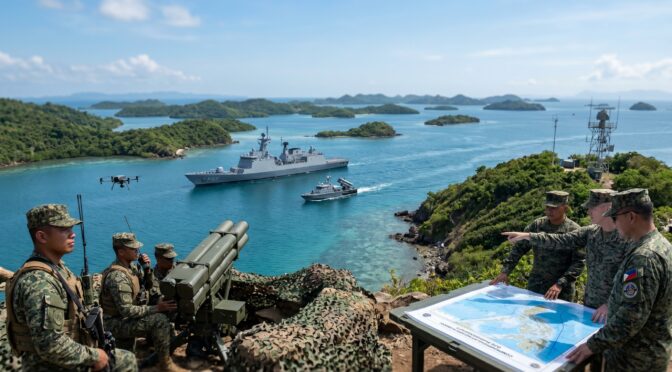
The geopolitical landscape of the Indo-Pacific is undergoing a structural realignment characterized by overlapping maritime entitlements, resource competition, and the rapid modernization of naval forces. At the focal point of this regional friction lies the Philippines, an archipelagic nation that has historically directed its military apparatus toward internal security and counter-insurgency operations. In response to persistent gray-zone coercion and conventional naval posturing within its maritime periphery, the Marcos Jr. administration has initiated the Comprehensive Archipelagic Defense Concept (CADC). This doctrinal shift mandates a fundamental transformation of the Armed Forces of the Philippines (AFP) from an internally focused organization to a modern force optimized for external territorial defense and sea denial. The CADC prioritizes distributed basing, advanced maritime domain awareness, ranged kinetic strike capabilities, and the tactical exploitation of archipelagic geography to secure the nation’s Exclusive Economic Zone (EEZ) and vital sea lanes of communication.
However, modernizing a military through the acquisition of conventional platforms alone is inherently insufficient when tasked with countering a numerically and technologically superior adversary. Military planners must extract combat-validated operational blueprints from contemporary theaters of conflict to inform structural and tactical realignments. The ongoing Russo-Ukrainian War and the sustained maritime interdiction campaigns orchestrated by Iran and the Houthi movement in the Middle East provide highly relevant case studies in asymmetric naval warfare. Ukraine’s success in establishing sea denial in the Black Sea without a traditional surface fleet—achieved through the deployment of unmanned surface vehicles (USVs), decentralized tactical command structures, and land-based anti-ship missiles—offers a proven template for cost-imposing strategies. Similarly, Iran’s “mosaic defense” doctrine, which leverages swarms of advanced fast attack craft, reverse-engineered cruise missiles, and one-way attack unmanned aerial vehicles (OWA-UAVs) in the constrained littoral environments of the Persian Gulf and the Red Sea, demonstrates how asymmetric capabilities can effectively degrade and paralyze superior naval armadas.
This analysis systematically evaluates the foundational tenets, capability acquisitions, and strategic trajectories of the Philippine CADC. It subsequently disaggregates the tactical, operational, and strategic lessons derived from the Ukrainian and Middle Eastern theaters. By synthesizing these insights, the report forecasts how the AFP can optimize its transition toward a resilient, distributed, and lethal archipelagic defense network, thereby establishing a credible and sustainable deterrent against coercive maritime expansionism.
2. The Strategic Context of the Archipelagic Defense Mandate
2.1 Geographic Realities and Resource Imperatives
The formulation and execution of the CADC are intrinsically tied to the geographic and demographic realities of the Philippines. As an archipelagic state comprising 7,641 islands, the nation possesses a highly fragmented landmass alongside an exponentially growing population.1 This mounting demographic pressure necessitates secure access to the natural resources situated within the country’s 200-nautical-mile EEZ. Access to these maritime zones is fundamental to guaranteeing long-term food and energy security, as well as maintaining unhindered access to international trade routes upon which the national economy relies.1
The primary catalyst for the operationalization of the CADC is the strategic imperative to counter expansionist maneuvers in the South China Sea, particularly actions based on expansive territorial claims that disregard the United Nations Convention on the Law of the Sea (UNCLOS) and established international legal frameworks.1 The AFP’s push for force modernization is premised on a deeply entrenched institutional view that capability-building must serve as a central pillar of the Philippines’ overall strategy to counterbalance expansionist state actors.1
2.2 Public Mandate and Political Capital
The execution of a massive military modernization program requires sustained political capital and public support. Recent demographic data indicates that public sentiment strongly underpins this strategic realignment. According to an OCTA Research Survey conducted in early 2024, 76 percent of adult Filipinos firmly support the government’s commitment to defending national territory, specifically highlighting the strategic importance of the West Philippine Sea.3 Within the sample of 1,200 adult respondents, only 17 percent were undecided, and a mere seven percent strongly disagreed with the territorial defense mandate.3
This overwhelming public mandate provides the necessary political momentum for the AFP to accelerate its force modernization and adopt a forward-leaning defensive posture.3 Military leadership views this data as a fortification of their resolve to resist coercive and illegal actions within Philippine waters, framing the defense of sovereign rights and maritime entitlements as a collective national duty.3
2.3 Institutional Pivot: From Counter-Insurgency to External Defense
Historically, the AFP—and particularly its largest branch, the Philippine Army—has been structured, trained, and deployed primarily to counter domestic insurgencies and asymmetric internal threats. The CADC marks a definitive break from this historical posture, mandating a holistic national approach that pivots the military’s focus entirely toward external territorial defense.4 Under the parameters of the CADC, the military is legally and operationally required to defend the mainland, held island territories, and maritime features across its vast EEZ.5
This pivot alters the operational mandates of all service branches. While the Philippine Navy and Air Force serve as the primary instruments of maritime projection and air interdiction, the Philippine Army is undergoing a fundamental reorientation. Land maneuver forces are now designated as critical components of the archipelagic defense network, responsible for securing dispersed naval and air bases, protecting coastal defense assets, and providing the sustainment infrastructure necessary to keep maritime assets operational during protracted conflicts.4 Army leadership has explicitly noted that naval ships, aircraft, and their crews require secure bases to return to for maintenance and reprovisioning; thus, the Army’s primary function within the CADC is to provide the critical protection and logistical sustainment required to maintain operational tempo.5
[Image: Map depicting the Philippine archipelago, highlighting the 200-nautical-mile Exclusive Economic Zone, major military installations, and strategic maritime choke points.]
3. Force Restructuring and the Re-Horizon 3 Modernization Program
The modernization of the Philippine military has been executed in distinct phases. Horizon 1 focused on the acquisition of basic operational assets, such as light transport aircraft (e.g., Bell 412 helicopters), the upgrading of small arms, and improvements to communication centers.2 Horizon 2, spanning from 2018 to 2022, initiated a more enhanced modernization effort aimed at addressing growing regional threats, notably through the acquisition of missile-capable frigates.2 However, a 2024 executive decision restructured the procurement pipeline, moving many projects into a new phase known as “Re-Horizon 3,” which is specifically tailored to enable the implementation of the CADC.2
3.1 The Five Pillars of Archipelagic Defense
To effectively operationalize the CADC, Re-Horizon 3 concentrates resources on developing five major defensive capabilities 5:
| Defensive Capability Pillar | Strategic Objective within the CADC Framework | Operational Requirements |
| Cyber Systems | Protect critical national infrastructure and military command networks from digital disruption. | Integration of robust cyber defensive protocols to defend against advanced state-sponsored intrusions and electronic warfare. |
| Air Interdiction | Deny hostile aerial platforms the ability to operate freely over Philippine territory and the EEZ. | Procurement of multi-role fighters (MRFs), comprehensive radar coverage, and advanced localized air defense systems. |
| Surface and Sub-Surface | Assert maritime sovereignty and conduct continuous patrols across internal waterways and the EEZ. | Acquisition of purpose-built corvettes, offshore patrol vessels (OPVs), and the integration of a submarine force. |
| Missile Defense Systems | Deter maritime incursions and protect coastal nodes through ranged kinetic strike capabilities. | Deployment of land-based anti-ship cruise missiles (ASCMs) and mobile coastal defense batteries. |
| Support Systems | Ensure the endurance, repair, and sustainment of deployed forces in a distributed operational environment. | Establishment of submarine bases, rapid repair facilities, robust logistics networks, and credible, highly trained reserve forces. |
3.2 Surface Fleet Modernization: The Corvette vs. Frigate Strategic Calculus
The Philippine Navy is undergoing a rapid transition from a reactive posture heavily reliant on decommissioned World War II-era and former US Coast Guard vessels to a modern fleet of purpose-built warships.4 South Korea has emerged as the premier defense partner in this modernization effort, becoming the largest arms supplier to the Philippines between 2019 and 2023.8 South Korean defense contractors, notably Hyundai Heavy Industries (HHI), have secured pivotal contracts to deliver multiple corvettes and offshore patrol vessels scheduled for delivery through 2028.8 This strategic partnership provides the AFP with a high degree of logistical commonality and operational familiarity across its fleet.2
A critical strategic debate within the Re-Horizon 3 program involved calculating the optimal balance between procuring larger, more heavily armed frigates versus a higher quantity of smaller corvettes. The Philippine Navy ultimately opted to acquire four HDC-2000 class corvettes rather than two larger HDF-4000 class frigates.9 This decision was heavily influenced by the specific operational environment of the West Philippine Sea.
The primary threat vector in these waters consists of “gray zone” tactics—the coordinated use of state-sponsored coast guard and maritime militia vessels to persistently harass domestic shipping and block resupply missions.9 Countering these tactics requires continuous physical presence rather than singular, high-end engagements. A fleet of four corvettes allows the Navy to maintain at least two vessels on constant patrol while the others undergo necessary maintenance and replenishment.9 Conversely, two larger frigates cannot cover the requisite geographic area simultaneously.9 Furthermore, the shallow waters, coral reefs, and narrow channels characteristic of the South China Sea heavily favor the maneuverability and shallow draft of specialized littoral corvettes over deep-water frigates.9 The HDC-2000 offers an optimal balance of anti-ship missile armament and maneuverability, providing higher total firepower (eight surface-to-surface missile launchers across four ships) and superior area coverage within the budgetary constraints of the government.9
While the 4,000-ton HDF-4000 frigate offers superior endurance, sea-keeping in rough deep waters, and advanced Area Air Defense (AAD) and Anti-Submarine Warfare (ASW) capabilities (often viewed as a “mini-Aegis” platform), the immediate tactical requirement for high-volume littoral patrols dictated the procurement of corvettes.9
3.3 Submarine Integration and Logistical Prerequisites
Beyond surface combatants, the CADC envisions the integration of sub-surface capabilities to establish genuine sea denial. Exploratory efforts have highlighted the French Scorpène-class submarine as a platform that fits the requirements of the Philippine Navy.10 However, military analysts emphasize that acquiring submarines is only a fraction of the necessary investment; the Philippines must concurrently invest heavily in developing a robust naval support system, including specialized submarine bases, complex repair facilities, and highly trained personnel to operate and maintain these advanced platforms safely.2
4. Shore-Based Strike Capabilities and Anti-Access/Area Denial (A2/AD)
A cornerstone of the CADC is the integration of land-based, ranged kinetic strike capabilities. This effort is spearheaded by the Philippine Marine Corps’ newly established Coastal Defense Regiment (CDR), which achieved a historic milestone with the acquisition and deployment of the Indian-manufactured BrahMos supersonic cruise missile system.5
4.1 The BrahMos Supersonic Missile System
The deployment of the BrahMos system marks the first overseas induction of the platform and signals a deepening defense architecture between New Delhi and Manila.2 With an operational range of 290 kilometers, the BrahMos system introduces a highly potent anti-access/area denial (A2/AD) capability capable of directly threatening hostile vessels operating near contested maritime features, such as Scarborough Shoal.12
The deployment architecture of the BrahMos system reveals a commitment to distributed lethality. The CDR is structured to operate three distinct missile batteries. Each battery comprises a self-contained combat unit including at least two mobile launchers (each equipped with two missiles), a dedicated radar vehicle, a transport-loader holding four additional rounds, and a command-and-control vehicle.14 This modular design allows for rapid coastal deployment and engagement of surface targets at extended ranges.15
Strategic placement of these systems maximizes their deterrent effect. The primary battery is based in Western Luzon, directly facing the South China Sea.12 However, local officials have also donated land for coastal defense purposes in strategic choke points such as Lubang and Calayan.11 Defense analysts suggest that relocating these mobile batteries across Northern Luzon, including potential deployments at Cape Bojeador or within the Batanes island chain, creates overlapping zones of kinetic threat across the vital Luzon Strait.14 The extreme speed and precision of the supersonic BrahMos missile make it exceptionally difficult for current naval air defense systems to intercept, thereby serving as a formidable psychological and tactical deterrent against coercive maneuvers.5
4.2 Joint Force Strike Simulation and Air Defense
The integration of these capabilities is actively tested through multinational exercises. During the Balikatan military exercises, the CDR’s BrahMos units participated in simulated firing within a joint maritime strike environment in Northern Luzon.16 Simulation firing involves activating all sensors and fire control systems to track targets as if in an actual combat scenario, ensuring that targeting telemetry and command structures are fully operational.16
These exercises also facilitate interoperability with advanced allied assets, such as the deployment of the US Navy-Marine Corps Expeditionary Ship Interdiction System (NMESIS), a mobile anti-ship missile platform with a 100-nautical-mile range, and the Typhon Mid-Range Capability (MRC) platform, capable of firing Tomahawk Land Attack Missiles and Standard Missile-6 (SM-6) variants out to 1,000 nautical miles.16
To protect these high-value coastal defense assets from aerial interdiction, Manila is concurrently negotiating with New Delhi for the procurement of the Akash short-range air defense system. The Akash system is capable of intercepting high-speed aerial threats at ranges up to 30 kilometers and altitudes of 18 kilometers, providing the necessary localized air defense umbrella for the dispersed missile batteries.15 Furthermore, the Philippine Navy is evaluating the advanced K-SAAM Haegung missile system for its future Miguel Malvar-class frigates. Capable of speeds above Mach 2 and an engagement range of 20 kilometers, the K-SAAM features a dual-seeker guidance system optimized specifically to defeat fast, low-flying “sea-skimming” anti-ship missiles.18
5. Autonomous Littoral Warfare and the Development of USVs
Recognizing that conventional surface combatants remain vulnerable, crew-intensive, and expensive to replace, the AFP is actively pursuing autonomous maritime capabilities to augment its sea denial strategy.19 The shift toward unmanned systems aligns with a global “dronification” trend, offering a mechanism to maintain continuous intelligence, surveillance, and reconnaissance (ISR) without risking personnel.20
5.1 Indigenous Development: The PALID Program
The development of the Philippine Autonomous Littoral Interdiction Drone (PALID) represents a significant leap toward indigenous asymmetric warfare capabilities.21 Spearheaded by local Filipino engineers from Mindanao State University under a research grant from the Department of Economy, Planning, and Development, the PALID aims to reduce reliance on foreign imports and build a sovereign defense technology base.21
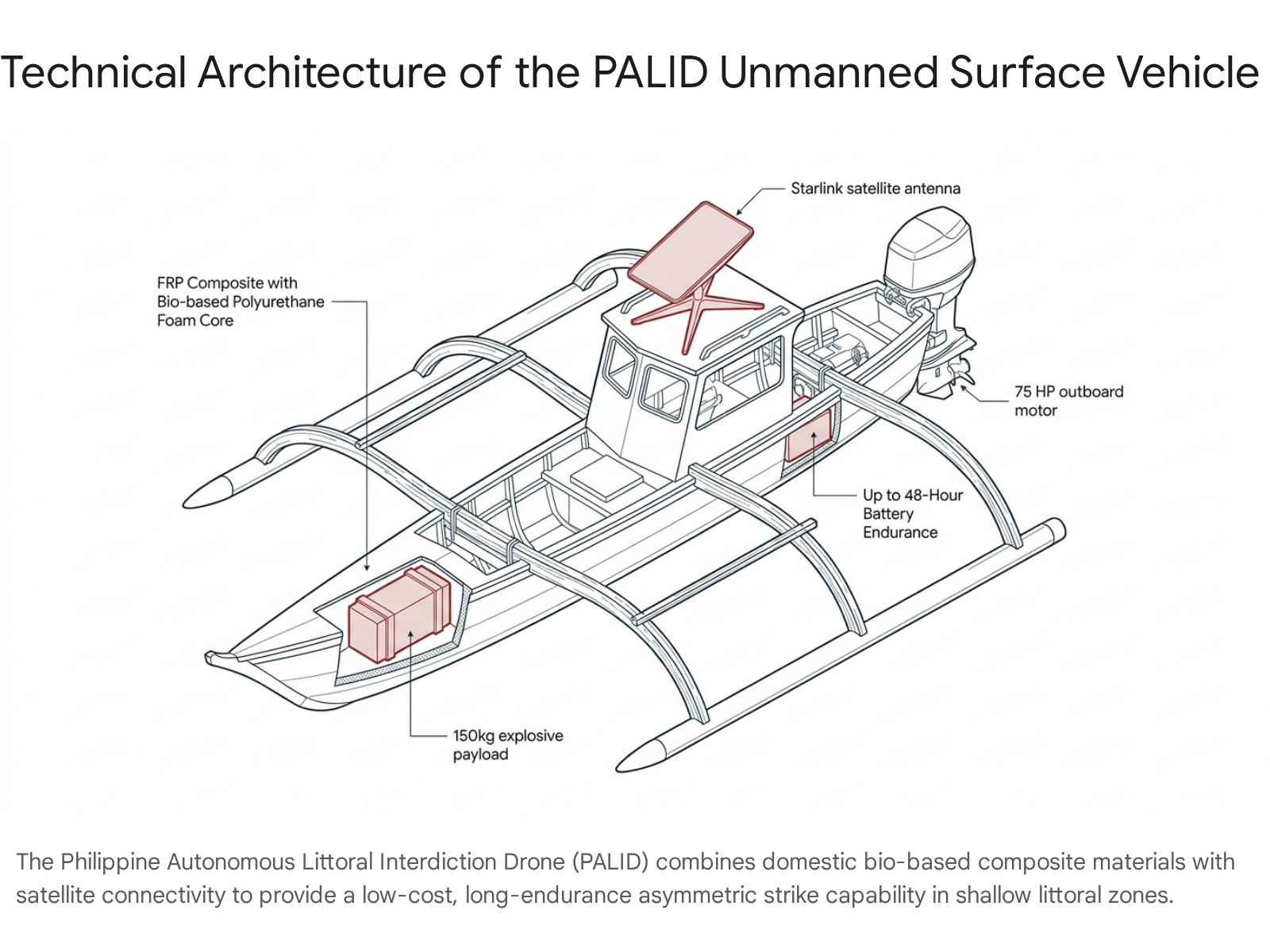
The PALID is uniquely designed for covert operations. It is visually disguised as a traditional civilian “banca” outrigger boat, an unassuming aesthetic intended to mask its military utility and make it virtually indistinguishable from civilian fishing vessels in littoral zones.21 Beneath this disguise, the vessel features an advanced composite hull structure. The hull utilizes lightweight Fiber-Reinforced Polymer (FRP) sandwich composites, primarily consisting of carbon fiber reinforced with fiberglass components.22 This structure is integrated with a locally sourced, bio-based polyurethane foam core developed by the Center for Sustainable Polymers at the Mindanao State University-Iligan Institute of Technology (MSU-IIT).22 The use of this sustainable foam core significantly enhances the vessel’s corrosion resistance and structural durability in harsh saltwater environments.22
Measuring approximately 3.6 meters in length, the USV features a modular design that allows for size scaling based on mission requirements.22 Powered by a 75-horsepower outboard motor, the PALID is projected to reach speeds of 76 km/h (41 knots), facilitating rapid interception and evasion.22 The vessel boasts a payload capacity of 200 kilograms.22 In its offensive configuration, it functions as a kamikaze drone armed with a 150-kilogram unguided explosive payload.21 The tactical objective is to execute a high-speed strike against the critical propulsion or sensor systems of a high-value enemy warship, utilizing a low-cost asset to render a billion-dollar platform inoperable.21
For operations requiring extended range, the PALID is equipped with satellite-based communication systems via Starlink, ensuring low-latency, over-the-horizon connectivity.21 The vessel can carry up to 120 liters of gasoline and features onboard batteries that allow it to operate silently without fuel for up to 48 hours, providing a projected operational range of 300 kilometers.21 This combination of speed, stealth, and lethal payload makes it an ideal platform for archipelagic sea denial.
5.2 Integration of Foreign Autonomous Systems
While indigenous projects like PALID mature, the Philippine Navy is accelerating its USV operational experience by integrating advanced American systems. Personnel are actively training on US-made T-12 Mantas semi-submersible USVs acquired through a $500 million foreign military financing program.21 Furthermore, high-end AI-powered vessels such as the SELKIE and the Devil Ray T-38 are slated for deployment and potential co-production on Philippine soil.24 To support these operations, Washington and Manila are constructing specialized facilities at a Philippine Navy base in Western Palawan, directly bordering the South China Sea, explicitly designed to support and sustain long-endurance drone operations.25
6. Operational Blueprints from the Ukrainian Theater
To maximize the effectiveness of its new capabilities, the AFP must look to modern theaters of conflict where smaller nations are successfully countering naval hegemons. The Russo-Ukrainian War has fundamentally shattered established paradigms regarding naval supremacy, demonstrating that asymmetric innovation can neutralize massive conventional advantages.
6.1 The Mechanics of Sea Denial in the Black Sea
At the onset of the conflict, the Russian Federation maintained overwhelming naval superiority in the Black Sea, threatening amphibious assaults and launching devastating cruise missile strikes from the sea.26 Ukraine systematically dismantled this advantage through a textbook application of sea denial—restricting the adversary’s freedom of maneuver without attempting to establish traditional sea control.27
The kinetic foundation of this strategy was established with the sinking of the Moskva, a guided-missile cruiser and the flagship of the Russian Black Sea Fleet, utilizing domestically produced land-based anti-ship missiles.27 This engagement proved that a nation entirely lacking a functional navy could project lethal force from its coastline, forcing hostile vessels to operate at significantly extended distances.27
To address the increased standoff distances of the Russian fleet, Ukraine innovated by modifying civilian recreational watercraft and purpose-built drone hulls into explosive-laden USVs, notably the “Sea Babies” and the MAGURA V5.27 By integrating explosive payloads and advanced navigation systems, Ukraine orchestrated coordinated swarm attacks that overwhelmed complex Russian shipborne defenses.27 This tactic achieved highly favorable cost-exchange ratios, leading to the decisive sinking of heavily defended, high-value vessels such as the Ivanovets missile corvette in January 2024 and the Caesar Kunikov landing ship in February 2024.28 The persistent threat of these low-cost USVs ultimately forced the Russian fleet to retreat from its forward operating bases in the occupied Crimean Peninsula, severely degrading its operational reach.27
6.2 Decentralization of Command and AI-Driven Targeting
A crucial factor enabling Ukraine’s asymmetric success is a sweeping cultural and doctrinal shift regarding command and control. The proliferation of inexpensive, rapidly adaptable technology has driven a profound decentralization of leadership across fires, electronic warfare, and air defense.29 Tasks that traditionally required coordination from higher-echelon headquarters are now executed organically at the platoon and squad levels, allowing for extreme speed and responsiveness in a constantly contested environment.29
This decentralized operational model is supported by advanced digital battle management systems, most notably the Delta software platform.29 Originally created by the tech volunteer group Aerorozvidka, Delta functions as a fully digitized, real-time command-and-control interface that integrates live feeds from ubiquitous reconnaissance drones directly into a Common Operating Picture (COP).29
Within the Delta ecosystem, operators utilize the Vezha video sub-system to aggregate multiple live drone feeds, placing markers directly onto the battlefield map almost instantly.29 This process is dramatically accelerated by the Avengers AI platform, which analyzes drone and camera footage within Delta to automatically identify up to 12,000 pieces of Russian equipment every week.29 This seamless integration of AI and decentralized drone operations radically shortens the “kill chain,” allowing junior leaders to detect, relay, and authorize strikes before the target can relocate.29
6.3 The Capability Gap and Logistics
The potency of this decentralized, highly agile system was starkly demonstrated during the Hedgehog 2025 exercise in Estonia. A small group of just 10 Ukrainian drone specialists, acting as the opposing force (OPFOR), completely neutralized two NATO battalions in half a day.29 Utilizing commercial drones and digital battle management, the Ukrainian contingent simulated the destruction of 17 armored vehicles and conducted 30 successful strikes, prompting an observing NATO commander to declare, “We are finished”.29 This exercise exposed a massive systemic agility gap, highlighting that legacy, highly centralized, peacetime procurement ecosystems are vulnerable to combat-hardened, technologically agile forces.29
Furthermore, the logistical lessons from Ukraine indicate that changes to logistics delivery in modern conflict are evolutionary, not revolutionary.30 Unmanned ground vehicles are increasingly used for resupply to isolated units under direct fire, directly enhancing the generation of operational tempo without risking logistics personnel.31
7. Electronic Warfare and Signature Management Tactics
The Ukrainian theater demonstrates that the electromagnetic spectrum is a primary domain of active combat. Managing electromagnetic signatures is no longer a specialized function handled by dedicated electronic warfare (EW) battalions; it is a baseline survival skill for all combat personnel.29 Failing to manage electronic emissions results in rapid detection and subsequent destruction by loitering munitions or precision artillery.29
7.1 Tactical Detection and Countermeasure Systems
To survive this environment, Ukrainian forces have pioneered the widespread distribution of tactical detection and countermeasure systems down to the individual soldier. Junior leaders actively manage the spectrum using man-portable signal intelligence (SIGINT) devices, such as the Tsukorok (Sugar Cube) detector.29 Costing approximately $52 per unit, the Tsukorok passively scans major frequency bands (865–885 MHz, 902–928 MHz, and 970–1020 MHz) to detect incoming reconnaissance drones (e.g., Orlan-10, Zala) and loitering munitions (e.g., Lancet) at ranges of 8 to 16 kilometers, providing vital early warning.29 Notably, the production of this device highlights the vulnerabilities of modern supply chains, as a reliance on a single Chinese component factory forced Ukrainian engineers to rapidly establish domestic manufacturing capabilities to meet frontline demands.29
Concurrently, nearly all frontline logistical and combat vehicles are equipped with localized EW jammers, such as the Shield X SkyBlock system.29 Mounted directly onto vehicles, this system creates a protective 250-meter radio-frequency dome.29 Utilizing passive cooling and powered by an independent LiFePo4 battery, the system disrupts the control links and navigation signals (GPS/GLONASS) of incoming FPV drones across multiple frequency bands (300–1020 MHz and 2380–5850 MHz), neutralizing threats while the vehicle is in motion.29
7.2 The Action-Reaction Cycle of Unmanned Systems
The reliance on EW has sparked rapid technological adaptation. As jamming becomes ubiquitous, Ukrainian and Russian forces are modifying their drone platforms to ensure strike completion. Drones are increasingly equipped with autonomous terminal guidance systems, allowing them to hit targets even after losing connection with the operator.29 More significantly, forces are employing physical workarounds, such as outfitting FPV drones with wire spools or fiber-optic cables.29 While trailing a physical wire degrades flight performance and limits operational range to approximately 10 kilometers, it renders the drone entirely impervious to radio frequency and GPS jamming, highlighting the relentless action-reaction cycle of modern asymmetric warfare.29
To counter drones that slip through electronic defenses, forces rely on localized kinetic systems. The deployment of mobile counter-UAS platforms, such as the M-LIDS (Mobile-Low, Slow, Small Unmanned Aircraft Integrated Defeat System), which pairs a 30mm chain gun with KuRFS precision targeting radar and expendable Coyote interceptors, represents the integration of hard-kill solutions into mobile maneuver forces.29
8. Littoral Warfare and Asymmetric Tactics: Iran and the Houthis
While Ukraine provides a blueprint for high-intensity, digitally networked sea denial, the maritime strategies employed by Iran and its proxy forces, particularly the Houthis in Yemen, offer critical lessons in exploiting littoral geography and leveraging low-cost munitions to disrupt global maritime traffic in strategic choke points.
8.1 The “Mosaic Defense” and Fast Attack Craft Swarms
Following severe losses to its conventional deep-water fleet in previous conflicts, Iran fundamentally reoriented its naval strategy around the Islamic Revolutionary Guard Corps Navy (IRGCN).32 The IRGCN is optimized specifically for irregular warfare in the shallow, constrained, and highly congested waters of the Persian Gulf and the Strait of Hormuz, an environment that restricts the maneuverability of large, blue-water enemy vessels.32
The core of this strategy is the “mosaic defense” concept—a highly decentralized command structure that grants local commanders immense operational autonomy.32 The Iranian coastline is divided into five distinct naval districts, extending from Mahshahr to Bandar Abbas, each supported by a dense network of concealed shore-based missile batteries, dispersed weapons depots, and forward outposts located on strategically positioned islands, such as Farsi Island.32 This structure ensures that even if central command nodes are degraded by airstrikes, individual units retain the tactical capacity and logistical support to sustain combat operations independently.32
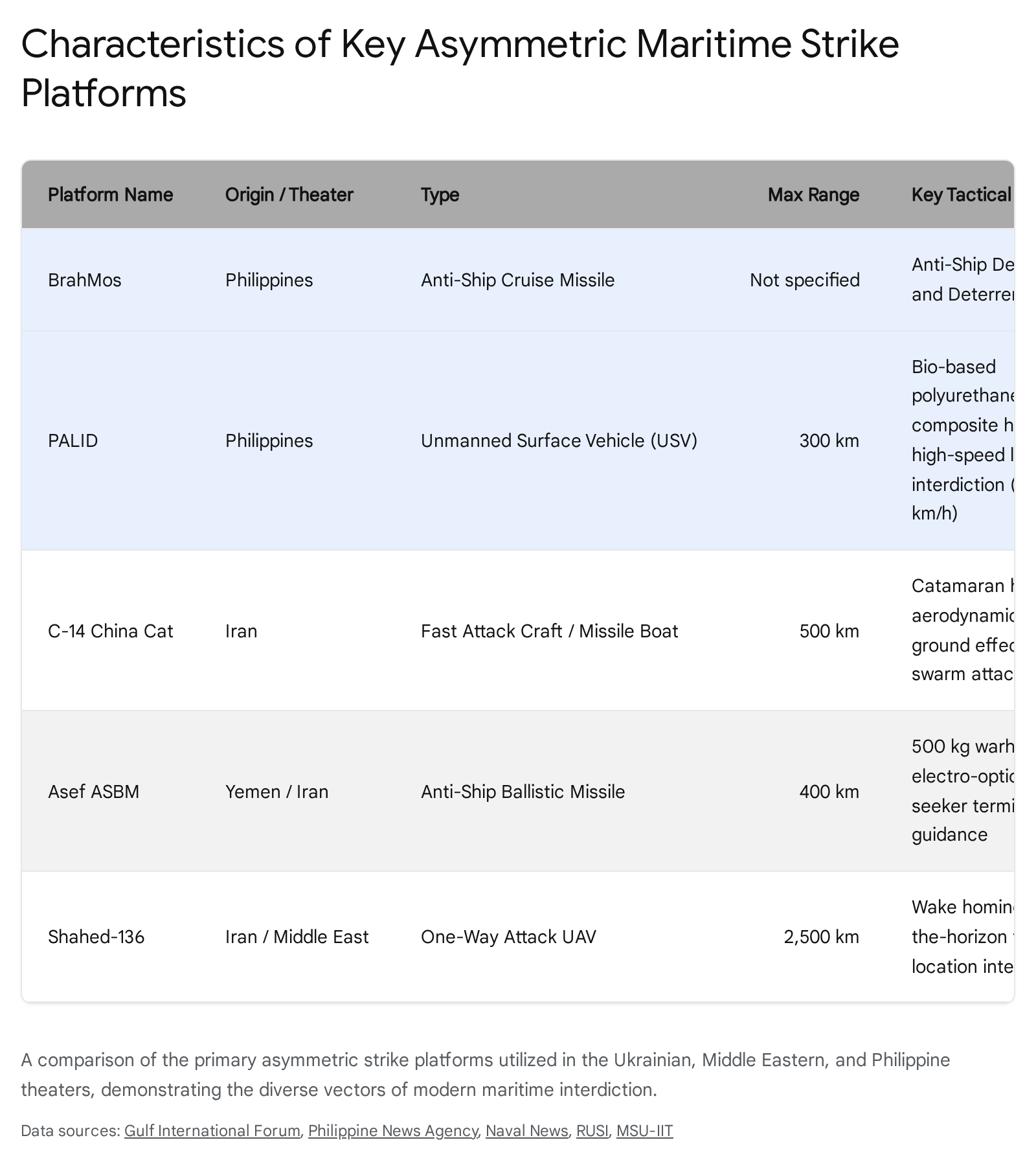
To project force, the IRGCN avoids crew-intensive platforms, relying instead on heavily armed, highly maneuverable fast attack craft (FAC).32 A prime example is the C-14 China Cat patrol boat. Measuring roughly 23 meters with a light displacement of 20 tons, the C-14 utilizes an advanced catamaran hull design.32 This design features a center tunnel that traps air as the vessel moves, creating aerodynamic lift (ground effect) that reduces water displacement.32 This allows the craft to achieve maximum speeds of 50 knots (93 km/h) and a range of 500 kilometers while providing an exceptionally stable platform for firing its complement of C-701 anti-ship cruise missiles in rough seas.32 These small vessels are easily concealed within the natural bays of the coastline and can be rapidly deployed to execute coordinated swarm attacks against larger, less maneuverable warships, overwhelming their point defenses.32
8.2 Proliferation of Low-Cost Missiles and OWA-UAVs in the Red Sea
The ongoing crisis in the Red Sea highlights the strategic impact of proliferating low-cost precision strike capabilities to non-state or proxy actors. The Houthi movement has executed an unprecedented campaign against commercial shipping and naval armadas utilizing Iranian-designed weaponry.34
A hallmark of this campaign is the combat debut of anti-ship ballistic missiles (ASBMs). Iran successfully modified legacy ballistic missiles, such as the Fatah-110, by integrating electro-optical/infrared seekers into the nose cones, creating dedicated maritime strike variants like the Asef and Raad-500 (Tankil).35 While these ASBMs may lack the sophisticated maneuverable re-entry vehicles (MARVs) required for pinpoint accuracy against highly maneuverable warships, their sheer speed and kinetic energy pose a severe threat, particularly to large commercial vessels operating in the tight engagement spaces of the Red Sea.37
Furthermore, the deployment of cheap, reverse-engineered cruise missiles—such as the Al-Mandeb 2, a close copy of the Chinese C-802/Iranian Noor with a 120-kilometer range, and scaled-down versions of the Russian Kh-55 utilizing commercial turbojet engines—provides a highly cost-effective means of striking vessels from easily concealed, truck-mounted launchers.35
Simultaneously, the use of one-way attack drones (OWA-UAVs), particularly the Shahed series, has revolutionized over-the-horizon targeting. Boasting an operational range of up to 2,500 kilometers, these drones can threaten shipping far out into the Arabian Sea.37 Because hitting a moving vessel in the vastness of the ocean is inherently difficult, operators rely on target location intelligence to guide the drone. This intelligence is gathered by exploiting a vessel’s Automated Information System (AIS) broadcasts or through visual identification provided by Iranian surveillance cargo ships, such as the MV Saviz and its successor the MV Behshad, which loiter in international waters to provide signal intelligence (SIGINT).37 In the terminal phase, these drones employ advanced tactics such as “wake homing,” where the UAV descends to a sea-skimming altitude and flies directly up the wake of the moving ship to strike the vulnerable stern, maximizing the probability of a hit.37
8.3 Economic Disruption and Magazine Depletion
The strategic objective of the Houthi maritime campaign is not necessarily the absolute destruction of superior naval forces, but rather the creation of unsustainable operational costs and severe economic disruption. By executing sustained, multi-vector attacks utilizing drones, cruise missiles, and ASBMs, the Houthis force defending warships (such as the USS Gravely, USS Laboon, USS Mason, and HMS Diamond) to continuously expend highly sophisticated and expensive surface-to-air interceptors (like the SM-2) to defeat relatively cheap incoming threats.35
This strategy rapidly depletes the ammunition magazines of naval vessels. Because vertical launch systems cannot be easily reloaded at sea, these multi-million-dollar warships are eventually forced to withdraw to friendly ports for replenishment, temporarily exposing the vital shipping lanes they were tasked to protect.37 Furthermore, the persistent threat environment—characterized by sudden attacks and floating tactical minefields—forces maritime insurance companies to exponentially increase or completely suspend war-risk coverage.32 This financial pressure effectively strands hundreds of merchant vessels and forces global logistics companies to reroute supply chains away from critical waterways, granting the asymmetric actor outsized geopolitical leverage.32
9. Synthesizing Global Lessons for the Armed Forces of the Philippines
The convergence of the Philippine CADC with the tactical realities observed in Ukraine and the Middle East provides a clear roadmap for constructing an impenetrable archipelagic defense network. By internalizing these lessons, the AFP can optimize its capability acquisitions and refine its doctrinal deployment.
9.1 Integrating Autonomous USVs into Archipelagic Defense
The Philippine archipelago, much like the constrained littoral waters of the Persian Gulf and the Black Sea, provides an ideal operating environment for Unmanned Surface Vehicles. The successful development of the PALID program indicates that the Philippines possesses the engineering acumen to produce cost-effective, domestic unmanned systems that leverage locally sourced materials.21
Drawing upon the operational lessons of the Ukrainian MAGURA V5 and Sea Babies, the AFP should prioritize the mass production of these systems to execute coordinated drone swarms.27 Strategically, these USV swarms can be forward-deployed from concealed coastal inlets to interdict hostile vessels attempting to transit critical maritime choke points, such as the Balintang Channel, the Mindoro Strait, or the approaches to Palawan. Furthermore, by adopting the Iranian methodology of utilizing civilian vessels or decentralized forward outposts for target sighting and SIGINT collection, the Philippine Navy can partially offset its current deficits in expensive over-the-horizon radar coverage, effectively cueing autonomous USVs and cruise missiles to their targets.38
9.2 Developing an Archipelago-Wide Anti-Access/Area Denial Network
The CADC’s emphasis on ranged strike capabilities must be closely coupled with the operational principles of the Iranian mosaic defense. The deployment of the BrahMos Coastal Defense Regiment must not rely on static, centralized bases that are vulnerable to preemptive decapitation strikes.5 Instead, the AFP must leverage the vast geography of its 7,641 islands to create a fluid, highly mobile, and redundant missile network.
By establishing a network of pre-surveyed launch sites, dispersed munitions depots, and hardened shelters across Western Luzon, Palawan, and the Batanes island chain, the AFP can ensure the survivability of its BrahMos batteries.14 Much like the Houthi deployment of mobile truck-mounted ASCMs, Philippine Marine units must be trained to rapidly deploy from concealment, execute a firing mission against targets in the South China Sea, and immediately relocate to avoid counter-battery fire.35 This highly distributed A2/AD network guarantees that any hostile force entering the Philippine EEZ is subjected to persistent, overlapping fields of supersonic missile threat.12
9.3 The Necessity of Tactical Decentralization and EW Resilience
The transition of the Philippine Army from internal counter-insurgency to external territorial defense necessitates a total reevaluation of tactical command structures. Drawing directly from the Ukrainian experience, the AFP must empower junior officers and non-commissioned officers with the autonomy to execute decentralized operations.29 The defense of critical coastal nodes, logistical hubs, and mobile missile batteries cannot be micromanaged by higher headquarters in an environment characterized by disrupted communications and rapid operational tempos.
Furthermore, the AFP must rapidly integrate tactical electronic warfare and counter-UAS capabilities down to the squad and vehicle level. The proliferation of localized jammers—analogous to the Ukrainian Shield X SkyBlock systems—and passive signal detectors must become standard issue for motorized infantry and coastal defense units.29 Establishing spectrum awareness as a core tactical competency will ensure that Philippine maneuver forces can survive, reposition, and strike under the persistent aerial surveillance expected in a high-intensity maritime conflict.29
10. Strategic Implications and Final Assessment
The operationalization of the Comprehensive Archipelagic Defense Concept marks a definitive and irreversible turning point in the strategic posture of the Philippines. By transitioning from an internally focused, conventionally minded military toward a modernized force explicitly designed for archipelagic sea denial, Manila is actively raising the kinetic and economic costs of maritime coercion within its sovereign waters.
However, the implementation of the CADC carries inherent strategic risks. As noted by defense analysts, the deliberate construction of an archipelagic defense network, characterized by the deployment of advanced missile batteries and assertive, continuous naval patrols, will highly likely precipitate sharper military confrontations with regional adversaries in the near term.6 Expansionist powers interpret the deepening security cooperation between the Philippines, the United States, and Japan—coupled with the integration of advanced kinetic systems like BrahMos and Typhon—as a direct challenge to their freedom of maneuver in the South China Sea.6
To ensure the long-term viability of the CADC, the Armed Forces of the Philippines must meticulously balance the acquisition of high-end foreign hardware with the rapid expansion of its indigenous Self-Reliance Defense Posture (SRDP).21 While South Korean corvettes and Indian supersonic missiles provide immediate conventional deterrence, the true resilience of the Philippine defense network will rely on the mass production of low-cost, asymmetrical systems like the PALID USV and the institutionalization of tactical electronic warfare.21
Ultimately, the empirical evidence from the Black Sea and the Middle East demonstrates that control of the maritime domain is no longer the exclusive purview of massive, multi-billion-dollar blue-water navies. By combining the geographic advantages of its vast archipelago with decentralized command structures, localized electronic resilience, and a lethal mixture of asymmetric strike capabilities, the Philippines is uniquely positioned to establish a formidable, cost-imposing, and enduring maritime deterrent.
Please share the link on Facebook, Forums, with colleagues, etc. Your support is much appreciated and if you have any feedback, please email us in**@*********ps.com. If you’d like to request a report or order a reprint, please click here for the corresponding page to open in new tab.
Sources Used
- Defense Security Brief, accessed May 26, 2026, https://www.indsr.org.tw/en/respublicationcon?uid=15&resid=3040&pid=5707
- The Philippines’ Horizon 3 Military Modernisation Programme – MP-IDSA, accessed May 26, 2026, https://idsa.in/publisher/issuebrief/the-philippines-horizon-3-military-modernisation-programme
- AFP, Filipinos more committed to defending PH territories, accessed May 26, 2026, https://www.pna.gov.ph/articles/1275771
- Riding Unruly Waves: The Philippines’ Military Modernisation Effort, accessed May 26, 2026, https://www.crisisgroup.org/rpt/asia-pacific/south-east-asia/philippines-china-united-states/349-riding-unruly-waves-philippines-military-modernisation-effort
- PH Army to secure naval, air bases under new defense concept …, accessed May 26, 2026, https://www.pna.gov.ph/articles/1225362
- Forward and Seaward: Archipelagic Defence as a Military Strategy for the Philippines – The International Institute for Strategic Studies, accessed May 26, 2026, https://www.iiss.org/globalassets/media-library—content–migration/files/research-papers/2025/12/phillipines-maritime-strategy/archipelagic-defence-as-a-military-strategy-for-the-philippines.pdf
- HD HHI Pitches Horizon 3 Frigates, Corvettes and White Hulls to Manila – Naval News, accessed May 26, 2026, https://www.navalnews.com/naval-news/2024/11/hd-hhi-pitches-horizon-3-frigates-corvettes-and-white-hulls-to-manila/
- “COMPREHENSIVE ARCHIPELAGIC DEFENCE CONCEPT” (CADC) OF THE PHILIPPINES AND OPPORTUNITIES FOR INDIA ARISING THEREFROM – National Maritime Foundation, accessed May 26, 2026, https://maritimeindia.org/comprehensive-archipelagic-defence-concept-cadc-of-the-philippines-and-opportunities-for-india-arising-therefrom/
- Philippine Navy’s Next Warships: Horizon 3 Corvette Aquisition Project – YouTube, accessed May 26, 2026, https://www.youtube.com/watch?v=B4GevJUjYhs
- AFP Modernization Act – Wikipedia, accessed May 26, 2026, https://en.wikipedia.org/wiki/AFP_Modernization_Act
- Philippines Builds First BrahMos Anti-Ship Missile Base Facing South China Sea, accessed May 26, 2026, https://www.navalnews.com/naval-news/2024/06/philippines-builds-first-brahmos-anti-ship-missile-base-facing-south-china-sea/
- BrahMos in Philippine Sea Turns China Anxious – YouTube, accessed May 26, 2026, https://www.youtube.com/watch?v=xcIFCYcTSrc
- Philippines debuts anti-ship missile batteries as Marine Corps marks 75 years, accessed May 26, 2026, https://ipdefenseforum.com/2025/11/philippines-debuts-anti-ship-missile-batteries-as-marine-corps-marks-75-years/
- Philippine Marine BrahMos Force Stands Up Northern Luzon Unit …, accessed May 26, 2026, https://www.navalnews.com/naval-news/2026/03/philippine-marine-brahmos-force-stands-up-northern-luzon-unit/
- Philippine Marines Deploy First Indian BrahMos Missile Battery near Disputed Waters, accessed May 26, 2026, https://defensemirror.com/news/40500/Philippine_Marines_Deploy_First_Indian_BrahMos_Missile_Battery_near_Disputed_Waters
- BrahMos missile system to undergo ‘simulation firing’ in ‘Balikatan’ – Philippine News Agency, accessed May 26, 2026, https://www.pna.gov.ph/articles/1273289
- China & Taiwan Update, May 1, 2026 | ISW, accessed May 26, 2026, https://understandingwar.org/research/china-taiwan/china-taiwan-update-may-1-2026/
- 16 VLS Cells or Hybrid Loadout? PH Navy’s Next Frigate Upgrade – YouTube, accessed May 26, 2026, https://www.youtube.com/watch?v=9wJsHIagF5E
- Philippine Navy develops prototypes of autonomous logistics drones – Naval News, accessed May 26, 2026, https://www.navalnews.com/naval-news/2026/04/philippine-navy-develops-prototypes-of-autonomous-logistics-drones/
- The Drone Potential: Exploring PN’s Prospects for Unmanned ISR in the Philippine Rise, accessed May 26, 2026, https://onsssm.navy.mil.ph/home_page3.php
- Filipino engineers develop prototype of suicide drone boat, accessed May 26, 2026, https://globalnation.inquirer.net/286642/filipino-engineers-developing-a-prototype-of-suicide-drone-boat
- Sidlak Kanaway – RICE Laboratory, accessed May 26, 2026, https://ricelab.msuiit.edu.ph/defense-applications/sidlak-kanaway
- Filipino engineers unveil new kamikaze USV – Baird Maritime, accessed May 26, 2026, https://www.bairdmaritime.com/security/naval/unmanned-naval-systems/filipino-engineers-unveil-new-kamikaze-usv
- New Filipino Drone Powered by U.S. Military Sparks Panic in Beijing! – YouTube, accessed May 26, 2026, https://www.youtube.com/watch?v=OTaAZKn4TvQ
- Sea Machines Deploys SELKIE USV to the Philippines – Naval News, accessed May 26, 2026, https://www.navalnews.com/naval-news/2025/06/sea-machines-deploys-selkie-usv-to-the-philippines/
- Lawfare Daily: Ukraine’s Asymmetric Blueprint in the Black Sea, accessed May 26, 2026, https://www.lawfaremedia.org/article/lawfare-daily–ukraine-s-asymmetric-blueprint-in-the-black-sea
- Ukraine Has Innovated Naval Warfare – Center for Maritime Strategy, accessed May 26, 2026, https://centerformaritimestrategy.org/publications/ukraine-has-innovated-naval-warfare/
- The Black Sea’s Asymmetric Blueprint – Snake Island Institute, accessed May 26, 2026, https://www.snakeisland.org/reports/68e5709c540bf2aab76cec85
- Distributed Combat Power: How Ukraine is Redefining Warfare, accessed May 26, 2026, https://smallwarsjournal.com/2026/05/21/distributed-combat-power-how-ukraine-is-redefining-fires-electronic-warfare-and-air-defense-at-the-tactical-level/
- Logistics Lessons Learned from ‘The War’ in Ukraine – The Cove – Australian Army, accessed May 26, 2026, https://cove.army.gov.au/article/logistics-lessons-learned-war-ukraine
- Lessons from the Ukraine Conflict: Modern Warfare in the Age of Autonomy, Information, and Resilience – CSIS, accessed May 26, 2026, https://www.csis.org/analysis/lessons-ukraine-conflict-modern-warfare-age-autonomy-information-and-resilience
- Iran’s Asymmetric Naval Threat Debilitated, Not Annihilated – Gulf …, accessed May 26, 2026, https://gulfif.org/irans-asymmetric-naval-threat-debilitated-not-annihilated/
- Iran’s Fast Attack Boats Strategy – YouTube, accessed May 26, 2026, https://www.youtube.com/watch?v=akHLae8rF9E
- Houthi Motivations Driving the Red Sea Crisis – Marine Corps University, accessed May 26, 2026, https://www.usmcu.edu/Outreach/Marine-Corps-University-Press/MCU-Journal/JAMS-vol-15-no-2/Houthi-Motivations-Driving-the-Red-Sea-Crisis/
- Securing the Red Sea: How Can Houthi Maritime Strikes be Countered? – RUSI, accessed May 26, 2026, https://www.rusi.org/explore-our-research/publications/commentary/securing-red-sea-how-can-houthi-maritime-strikes-be-countered
- Assessing the Houthi War Effort Since October 2023 – Combating Terrorism Center, accessed May 26, 2026, https://ctc.westpoint.edu/assessing-the-houthi-war-effort-since-october-2023/
- 9 Lessons from Iranian and Houthi Attacks on Ships in the Red Sea …, accessed May 26, 2026, https://www.navalnews.com/naval-news/2024/01/lessons-from-iranian-houthi-attacks-on-ships-in-the-red-sea/
- Securing the Red Sea: How Can Houthi Maritime Strikes be … – RUSI, accessed May 26, 2026, https://rusi.org/explore-our-research/publications/commentary/securing-red-sea-how-can-houthi-maritime-strikes-be-countered