Category Archives: Small Arms Design & Manufacturing Analytics

Accuracy Revolution in Factory Rifles 2000-2025

The twenty-five-year period between 2000 and 2025 represents the most significant paradigm shift in the history of consumer small arms performance. At the turn of the millennium, the concept of a “factory precision rifle” was largely an oxymoron. The industry standard for a production hunting rifle was colloquially termed “minute of deer”—a grouping capability of roughly 2 to 3 inches at 100 yards. Sub-Minute of Angle (MOA) performance, defined as a grouping of roughly 1.047 inches or less at 100 yards, was almost exclusively the domain of custom gunsmithing, requiring expensive labor-intensive processes such as action truing, glass bedding, and hand-lapped barrels.

By 2025, this landscape has inverted. Sub-MOA performance is no longer an aspirational goal for the elite; it is the baseline entry requirement for even budget-tier rifles. This report investigates the hypothesis that the roster of factory rifles claiming and delivering MOA or better accuracy has grown consistently year-over-year. The analysis confirms this hypothesis, identifying a distinct upward trend driven not by a single “magic bullet” but by a convergence of advanced manufacturing technologies, material sciences, and a fundamental shift in engineering philosophy.

From the perspective of a small arms analyst, this transformation is driven by three primary vectors:

  1. The CNC & Automation Revolution: The shift from manual machining to multi-axis Computer Numerical Control (CNC) and Electrical Discharge Machining (EDM) allowed “blueprinted” tolerances to be achieved on assembly lines.1
  2. The “Barrel Nut” and Chassis Paradigm: The widespread adoption of modular headspacing systems (the barrel nut) and chassis-based bedding eliminated the two largest sources of inaccuracy: human error in assembly and environmental warping of wooden stocks.3
  3. The Ballistic Renaissance: The symbiosis between rifle manufacturers and ammunition makers, specifically regarding cartridge designs like the 6.5 Creedmoor that were engineered for concentricity rather than legacy feeding geometry.5

This report provides an exhaustive, year-by-year documentation of this evolution, analyzing the specific factory rifles that drove this change and the engineering causalities behind their performance.


1.0 The Engineering Baseline: The State of the Art (Pre-2000)

To understand the magnitude of the 2000–2025 evolution, one must first dissect the technological limitations of the late 20th century. In 1999, the “Big Three” American manufacturers—Remington, Winchester, and Ruger—dominated the bolt-action market. Their manufacturing processes were rooted in mid-century tooling.

1.1 The “Craft” Barrier

In the pre-2000 era, accuracy was a function of labor. A receiver forged from steel often warped slightly during heat treatment. To make it accurate, a gunsmith had to “true” it—mounting it in a lathe and re-cutting the face, threads, and locking lugs to ensure they were perfectly perpendicular to the bore. Factory rifles, produced on manual or early automated lines, simply could not hold these tolerances cost-effectively. Consequently, a Remington Model 700 from 1998 might shoot 0.75 MOA, or it might shoot 2.5 MOA, depending entirely on the stack-up of tolerances on that specific Monday morning.7

1.2 The Bedding Problem

Most rifles utilized wooden stocks. While aesthetically pleasing, wood is hygroscopic; it absorbs and releases moisture, expanding and contracting. This movement exerted inconsistent pressure on the barrel, altering the harmonic vibration nodes shot-to-shot. “Glass bedding”—the manual application of epoxy to create a stable interface—was a custom aftermarket procedure, not a factory standard.8

1.3 The Liability Trigger

Perhaps the greatest hindrance to practical accuracy was the trigger. Following decades of litigation, factory triggers in the 1990s were notoriously heavy (often 6–8 lbs) and possessed significant “creep” (gritty travel before the break). While a heavy trigger does not mechanically degrade the rifle’s intrinsic precision, it drastically degrades the shooter’s ability to extract that precision by introducing muscle tremors and torque during the long, heavy pull.9


2.0 Phase I: The Trigger Revolution and Global Influence (2000–2005)

The early 2000s did not see an immediate explosion of new models, but rather the introduction of two specific platforms that would eventually force the entire industry to pivot.

2000–2002: The Calm Before the Storm

In these opening years, the market remained largely stagnant. The precision shooter’s primary option was still the Remington 700 Varmint Synthetic (VS) or Police (PSS) models. These featured heavy barrels and aluminum bedding blocks within H-S Precision stocks, offering a glimpse of what was to come. However, the pricing ($800+) placed them out of reach for the average hunter.

The Savage Sleeper

The Savage Model 10/110 FP (Law Enforcement) existed during this time as a budget alternative. It utilized a floating bolt head design. Unlike a Mauser-style bolt, which is a single rigid piece that requires perfect receiver alignment, the Savage bolt head was pinned loosely to the bolt body. This allowed the lugs to “float” and self-center in the receiver recesses, essentially self-correcting for minor misalignment. While crude, it was effective, often out-shooting rifles twice the price.10

YearBrandModelCaliberAvg Street Price (Adj.)Accuracy Sentiment
2000Remington700 VS.308 Win$750The benchmark. Required trigger work.
2001Savage110FP.308 Win$450The “ugly duckling” that could shoot.
2002WinchesterModel 70 Stealth.22-250$800Heavy, controlled feed, accurate.

2003: The Watershed Moment

The year 2003 stands as the single most critical inflection point in modern factory rifle history due to two releases: the Savage AccuTrigger and the Tikka T3.

The Savage AccuTrigger

Savage Arms CEO Ron Coburn challenged his engineers to solve the liability trigger problem. The result was the AccuTrigger.

  • Mechanism: The system utilized a secondary “safety blade” (the AccuRelease) embedded within the trigger shoe. This blade blocked the sear from disengaging unless the shooter’s finger was centrally placed and depressing the trigger.
  • Implication: This mechanical safety allowed Savage to lower the sear engagement weight safely. If the rifle was dropped or the sear jarred loose, the safety blade would catch the firing mechanism. Savage demonstrated this by dropping rifles from 20 feet onto concrete without discharge.13
  • Market Impact: Suddenly, a $400 factory rifle had a crisp, user-adjustable 2.5 lb trigger. This destroyed the excuse that “factory rifles need heavy triggers for safety,” forcing every competitor to develop a similar “bladed” trigger system within the decade.

The Tikka T3

Simultaneously, Sako of Finland (under Beretta ownership) introduced the Tikka T3 to the US market.

  • Manufacturing Philosophy: The T3 was designed for manufacture (DFM). It utilized a broached receiver (extremely smooth raceways) and a two-lug bolt. Crucially, it used Cold Hammer Forged (CHF) barrels produced on the same machinery as the high-end Sako 85 rifles.
  • The Guarantee: Tikka offered a written 1 MOA guarantee (3 shots at 100 yards). At a price point of roughly $450–$500, this was unheard of.
  • Reception: While American traditionalists mocked the extensive use of polymer (the “plastic” trigger guard and magazine), the accuracy was undeniable. The rigid receiver (small ejection port) and high-quality barrel made sub-MOA performance routine.
YearBrandModelCaliberAvg Street PriceAccuracy Sentiment
2003SavageModel 10 w/ AccuTriggerVarious$500Revolutionary. User-adjustable safety.
2003TikkaT3 LiteVarious$480The new standard for lightweight precision.

2004–2005: The “Binning” Strategy

Following 2003, manufacturers began to recognize that accuracy was a marketable commodity. Weatherby, a company famous for velocity over precision, adapted its strategy with the Vanguard line.

Weatherby Vanguard Sub-MOA

The Vanguard was manufactured by Howa in Japan. Howa’s cold hammer forging process produced barrels with excellent consistency. Weatherby began testing barreled actions at the factory. Those that shot particularly tight groups (0.99″ or less) were segregated, placed in upgraded stocks, and sold as “Range Certified” or “Sub-MOA” models with a signed target.

  • Insight: This “binning” strategy admitted that while their manufacturing was good, it wasn’t yet consistent enough to guarantee every rifle. It monetized the statistical outliers of the production curve.
YearBrandModelCaliberAvg Street PriceAccuracy Sentiment
2004Howa1500 Varminter.223 Rem$550“Japanese Weatherby.” Heavy and stable.
2005WeatherbyVanguard Sub-MOA.257 Wby$750Verified accuracy with factory target.

3.0 Phase II: The Bedding Block and Rifling Evolution (2006–2010)

As the trigger issue was resolved (with competitors scrambling to copy Savage), engineering attention shifted to the interface between the metal action and the stock. The era of pillar bedding and proprietary rifling began.

2006–2007: 5R Rifling and Integral Bedding

Thompson Center Icon

In 2007, Thompson Center (T/C) released the Icon, a rifle that failed commercially but was an engineering triumph.

  • 5R Rifling: T/C brought 5R rifling to mass production. Unlike standard 4- or 6-groove rifling with 90-degree corners, 5R uses 5 lands with angled sides. This reduces jacket deformation and powder fouling, typically resulting in higher consistency and velocity. Previously, this was the domain of custom barrel makers like Boots Obermeyer.
  • Interlok Bedding: The Icon featured an integral aluminum bedding block machined into the stock, creating a rigid platform that mimicked custom glass bedding.

Remington 700 SPS (Special Purpose Synthetic)

Replacing the ADL/BDL hierarchy, the SPS became the ubiquitous “base model” 700. While the stock was a flimsy injection-molded piece that often touched the barrel (destroying harmonics), the “barreled action” remained a favorite for builders. The Varmint models, despite the cheap stock, often shot well due to the stiffness of the heavy barrel profile.

YearBrandModelCaliberAvg Street PriceAccuracy Sentiment
2006Remington700 SPS Varmint.308 Win$600Great action, terrible stock.
2007Thompson CenterIcon.30 TC$800Advanced engineering (5R), proprietary caliber failed.

2008: The Economic Crunch and Design Innovation

The 2008 financial crisis forced a bifurcation in the market: premium rifles had to offer more value, and budget rifles had to cut costs without losing performance.

Marlin XL7: The “Franken-Rifle” Success

Marlin, a lever-action company, introduced the XL7 bolt action. It was a masterclass in “borrowed” engineering:

  • The Barrel Nut: Like Savage, Marlin used a barrel nut. This allowed them to set headspace perfectly on the assembly line without precision machining the barrel shoulder.
  • The Pro-Fire Trigger: A direct clone of the AccuTrigger.
  • The Result: A $300 rifle that consistently shot MOA, embarrassing rifles costing three times as much. It proved that the “barrel nut” system was the secret to cheap accuracy.

Browning X-Bolt

Browning replaced the A-Bolt with the X-Bolt. To justify its premium price ($800+), Browning glass-bedded the action at the recoil lug and tang at the factory. This was a manual process usually reserved for custom smiths. They also introduced the “Feather Trigger,” a three-lever design that eliminated creep.

Winchester Model 70 (FN Production)

After a hiatus, the Model 70 returned, manufactured by FN Herstal in South Carolina. These rifles benefited from FN’s military-grade Cold Hammer Forging (CHF) technology. The new “MOA Trigger” was an enclosed, single-stage unit with zero take-up, replacing the open design of the pre-64 style.

YearBrandModelCaliberAvg Street PriceAccuracy Sentiment
2008MarlinXL7.30-06$326The “Savage Killer.” Unbeatable value.
2008BrowningX-Bolt Hunter.270 Win$800Glass bedded factory precision.
2008WinchesterModel 70 Extreme Weather.300 Win Mag$1,100CHF durability with sub-MOA potential.

2009–2010: The Budget Precision Explosion

Savage Axis (The Edge)

Savage stripped the Model 110 down to its bare essentials to create the Axis. They removed the AccuTrigger (initially) but kept the floating bolt head and barrel nut. The result was a rifle with a terrible trigger but a barrel/action interface that was mechanically perfect. Shooters realized that with a $100 aftermarket trigger, the $300 Axis was a tack driver.

YearBrandModelCaliberAvg Street PriceAccuracy Sentiment
2009Savage10 BAS-K.308 Win$1,200Early mainstream chassis attempt. Heavy.
2010SavageAxis.223 Rem$300Poor ergonomics, stellar barrel/action.

4.0 Phase III: The “Creedmoor” Effect and the V-Block (2011–2015)

This period is defined by the introduction of the 6.5 Creedmoor cartridge and the Ruger American Rifle. These two factors democratized long-range ballistics and receiver bedding, respectively.

2011–2012: Universal Guarantees

Weatherby Vanguard Series 2 (S2)

In 2011, Weatherby updated the Vanguard. No longer were “Sub-MOA” rifles a special bin; every Vanguard Series 2 came with a Sub-MOA guarantee (0.99″ or less).

  • Changes: An improved two-stage match trigger and a stiffer “Griptonite” stock with rubberized inserts. The underlying Howa 1500 CHF barrel remained the core accuracy driver.

Ruger American Rifle

Ruger launched the American Rifle to compete with the Savage Axis, but they innovated on the bedding system.

  • Power Bedding: Instead of a recoil lug sandwiched between the barrel and action (which requires a notch in the stock that can deform), Ruger used two stainless steel V-blocks molded into the stock. The round receiver sat in these V-blocks, and the action screws pulled it down tight.
  • Insight: This created a repeatable, stress-free steel-on-steel bedding interface in a $350 rifle. It eliminated the “polymer squish” that plagued other budget guns.
YearBrandModelCaliberAvg Street PriceAccuracy Sentiment
2011WeatherbyVanguard S2.257 Wby$489Guaranteed Sub-MOA for <$500.
2012RugerAmerican Rifle.308 Win$350V-Block bedding changed the game.

2013–2014: The Race to the Bottom

Remington 783

Remington’s delayed response to the Savage/Ruger dominance was the Model 783.

  • Design: It utilized a barrel nut and a floating bolt head.
  • Analysis: This was a tacit admission by Remington that the Savage design (floating bolt head + nut) was superior for mass-producing accuracy than the classic Model 700 design. While aesthetically criticized (“ugly,” “cheap feel”), reviewers consistently reported sub-MOA performance.

Ruger American Predator

Ruger expanded the American line with the Predator model. It featured a heavier tapered barrel threaded for suppressors. This model became the standard-bearer for “budget precision,” especially when chambered in the rising star cartridge: 6.5 Creedmoor.

YearBrandModelCaliberAvg Street PriceAccuracy Sentiment
2013Remington783.270 Win$300Accurate, but failed to save the brand.
2014SavageAxis II XP6.5 CM$400Added AccuTrigger. Best value package.
2014RugerAmerican Predator6.5 CM$420The “everyman’s” long-range rifle.

2015: The Paradigm Shift – Ruger Precision Rifle

If 2003 was the Trigger Revolution, 2015 was the Chassis Revolution.

Ruger Precision Rifle (RPR)

Ruger launched the RPR, a dedicated chassis rifle that accepted AICS magazines and AR-15 handguards.

  • Straight-Line Recoil: The RPR was designed so the stock, action, and barrel were in a straight line. This directed recoil energy straight back into the shoulder, virtually eliminating muzzle rise (jump). This allowed shooters to spot their own impacts—a critical capability for long-range shooting previously restricted to AR-15s or custom chassis builds.
  • The 6.5 Creedmoor Synergy: The RPR legitimized the 6.5 Creedmoor cartridge. The cartridge’s SAAMI specs required a tight chamber throat and a 30-degree shoulder (aiding concentricity). A cheap rifle chambered in 6.5 CM often out-shot an expensive rifle chambered in.308 simply because the cartridge design was ballistically superior and machined to tighter standards.5

Bergara B-14 Series

Bergara, a Spanish barrel maker, began producing full rifles.

  • The Honing Advantage: Bergara barrels are button rifled, but they introduced a distinct step: honing. After deep-hole drilling and before rifling, the bore is honed with diamond-tipped bits to a mirror finish. This removes the circumferential tool marks left by the drill, which cause fouling and inconsistency in other button-rifled barrels.
YearBrandModelCaliberAvg Street PriceAccuracy Sentiment
2015RugerPrecision Rifle (Gen 1)6.5 CM$1,000Sub-0.75 MOA. Created the “PRS” production class.
2015BergaraB-14 Hunter.308 Win$700“Custom” barrel quality at factory price.

5.0 Phase IV: The Hybrid Era and Manufacturing Refinement (2016–2020)

By 2016, the “tactical” benefits of chassis systems (adjustability, rigidity) began to merge with “hunting” rifle weights.

2016–2017: The Hybrid Stock

Tikka T3x

Tikka updated the T3 to the T3x.

  • Improvements: The ejection port was widened for easier loading, but the receiver rigidity was maintained. The recoil lug was upgraded from aluminum (which could deform over thousands of rounds) to steel. The plastic bolt shroud, a point of contention, was replaced with metal.
  • Guarantee: The 1 MOA guarantee remained, but independent testing frequently showed T3x Varmint models shooting into the 0.5 MOA range with match ammo.

Bergara B-14 HMR (Hunting Match Rifle)

The HMR was the defining rifle of 2017. It featured a polymer stock with an integrated aluminum mini-chassis molded into it. This provided the bedding rigidity of a full chassis system but the warmth and ergonomics of a traditional stock. It bridged the gap between the heavy Ruger Precision Rifle and the light Tikka T3x.

Howa HCR (Howa Chassis Rifle)

Howa entered the chassis market by mating their 1500 barreled action (CHF) with an aluminum chassis. While heavy, the Howa action’s integral recoil lug and flat-bottom receiver made it exceptionally stable in a chassis environment.

YearBrandModelCaliberAvg Street PriceAccuracy Sentiment
2016TikkaT3x LiteVarious$750The refined standard.
2016BrowningX-Bolt Hell’s Canyon6.5 CM$1,100Premium hunting accuracy.
2017BergaraB-14 HMR6.5 CM$950The “Goldilocks” rifle. Best crossover.
2017HowaHCR6mm Creedmoor$1,000Heavy, reliable, CHF accuracy.

2018–2019: Factory Custom Features

Daniel Defense Delta 5

Daniel Defense entered the bolt gun market with a 0.75 MOA guarantee. The Delta 5 featured a mechanically bedded stainless action and a user-interchangeable barrel system using a barrel nut. This brought the modularity of the AR-15 to the bolt gun.

Seekins Precision Havak Bravo

Seekins utilized the “Havak” action, which features a unique lug geometry (four lugs) and is hand-bedded into a KRG Bravo chassis at the factory. This rifle essentially blurred the line between a “production” rifle and a “custom” rifle, offering features like 20 MOA rails and spiral fluted bolts as standard.

Sig Sauer Cross

Sig Sauer launched the Cross, a lightweight (6.5 lb) precision hunting rifle.

  • Design: It used a one-piece receiver (no separate stock bedding required) and a barrel nut system. The design was reminiscent of the high-end “The Fix” by Q, bringing ultra-compact, folding-stock precision to a sub-$1800 price point.
YearBrandModelCaliberAvg Street PriceAccuracy Sentiment
2018Savage110 with AccuFitVarious$600Adjustable stock fit geometry.
2019Daniel DefenseDelta 5.308 Win$2,2000.75 MOA Guaranteed.
2019SeekinsHavak Bravo6.5 PRC$1,900“Production” class dominator.
2019Sig SauerCross.277 Fury/6.5$1,600Backcountry precision redefined.

2020: Material Science—Carbon and Cryo

Springfield Model 2020 Waypoint

Springfield Armory re-entered the bolt gun market with a 0.75 MOA guarantee.

  • Carbon Fiber: The Waypoint featured an optional carbon-fiber wrapped barrel (made by BSF) which used a “roll-wrapped” sleeve that was tensioned but not fully bonded to the barrel, allowing for air gaps to aid cooling.
  • EDM Manufacturing: The receiver raceways were cut using Electrical Discharge Machining, preventing the warping associated with traditional broaching or milling.

Benelli Lupo

Benelli applied shotgun technology to rifles. The Lupo featured the “Perfect Fitting” system (shims for drop and cast) and a cryogenically treated barrel (CRIO System) to relieve manufacturing stresses. It carried a 3-shot Sub-MOA guarantee.

YearBrandModelCaliberAvg Street PriceAccuracy Sentiment
2020Springfield2020 Waypoint6.5 PRC$2,2000.75 MOA verified.
2020BenelliLupo.30-06$1,699Advanced ergonomics + Cryo accuracy.

6.0 Phase V: The New Standard and ELR Expansion (2021–2025)

In the post-2020 era, the “accuracy race” has essentially been won. Almost all reputable manufacturers now offer MOA guarantees. The frontier has shifted to Extreme Long Range (ELR) calibers and further integration of carbon fiber to reduce weight.

2021–2022: Supply Chain and Refinement

New model introductions slowed, but variations expanded. Christensen Arms, leveraging their carbon fiber expertise, expanded the Mesa and Ridgeline series, normalizing the $1,200 “semi-custom” lightweight rifle.73 The focus shifted to cartridge innovation, with the 7mm PRC and 300 PRC gaining factory support.

2023–2025: The Next Generation Actions

Weatherby Model 307 (2023)

For the first time in 50 years, Weatherby released a new action. The Model 307 abandoned the proprietary Mark V footprint for a Remington 700 footprint.

  • Why? This allowed Weatherby owners to access the massive aftermarket of triggers, stocks, and rails designed for the Rem 700. It features a tool-less bolt takedown and M16-style extraction, blending modern convenience with the 700’s modularity.

Ruger American Gen II (2024)

Ruger updated the American rifle.

  • Upgrades: A 3-position safety (locking the bolt), a spiral fluted barrel (cold hammer forged), and a “splatter” finish stock that felt more rigid and premium than the Gen 1. The sub-MOA reputation was maintained, but the aesthetics and tactile feel were elevated to match the performance.

Tikka Ace (2025)

Tikka expanded into the “Ace” line, a dedicated precision platform designed to dominate PRS Production divisions. It features an even heavier barrel profile, integrated ARCA rails on the forend, and compatibility with T3x accessories.

YearBrandModelCaliberAvg Street PriceAccuracy Sentiment
2023WeatherbyModel 3077mm PRC$1,200Modernized 700 footprint.
2024RugerAmerican Gen IIVarious$600Premium feel, budget price.
2025TikkaT3x AceVariousTBDCompetition ready.
2025ChristensenEvokeVarious$900Budget premium.

7.0 Causal Factor Analysis: The Triad of Precision

The data confirms the hypothesis: the list of MOA rifles has grown exponentially. This was driven by three interconnected factors.

7.1 Manufacturing Methodologies: Hammer vs. Button vs. Nut

  • The Barrel Nut Revolution: First seen on Savages, then adopted by Marlin, Remington (783), Mossberg (Patriot), Ruger (American), and Sig (Cross). This system decouples the chambering accuracy from the receiver machining. It allows “perfect” headspace to be set by a technician with a Go-Gauge rather than a CNC machine, lowering costs while increasing consistency.3
  • Cold Hammer Forging (CHF): Utilized by Ruger, Tikka, Sako, Howa, and FN/Winchester. A mandrel with the rifling negative is inserted into a blank, and massive hammers forge the steel around it.
  • Pros: Work-hardens the bore (longer life), extremely consistent internal dimensions, smooth finish.83
  • Cons: High initial tooling cost ($1M+ per machine). Induces stress that must be relieved via heat treatment or cryo (Benelli).
  • Button Rifling + Honing: Utilized by Bergara and Savage. A carbide button is pulled through the bore.
  • Innovation: Bergara’s addition of honing (polishing) before rifling was a breakthrough, bringing custom-barrel smoothness to mass production.52

7.2 The Ballistic Enabler: Ammunition

The rifle cannot be separated from the ammo. The rise of the 6.5 Creedmoor (2007) and 6.5 PRC (2018) was critical. These cartridges were designed with:

  • Faster Twist Rates: (e.g., 1:8″) to stabilize long, aerodynamic bullets.
  • Tight Tolerances: SAAMI specs for these cartridges mandate tighter throat dimensions than legacy rounds like.30-06.
  • Match Factory Ammo: Hornady’s ELD-X 6 and Federal’s Terminal Ascent 85 provide match-grade consistency (low standard deviation in velocity) in hunting loads. A sub-MOA rifle is useless without sub-MOA ammo; the availability of this ammo justified the engineering of the rifles.

7.3 The “Myth” and Reality

While the capability of rifles has increased, the consistency of the claim is nuanced. As noted in research 86, a “Sub-MOA guarantee” often means “three shots, one time, with specific ammo.” However, the mechanical floor has undeniably raised. A “bad” factory rifle in 2025 shoots 1.5 MOA. A “bad” factory rifle in 2000 shot 4.0 MOA. The elimination of the “lemon” is the true engineering victory.


8.0 Master Summary Tables

8.1 Timeline of Key MOA Platforms (2000–2025)

EraKey Rifle ReleasesPrimary Engineering DriverCount of New Platforms
2000-2002Savage 10FP, Rem 700 VSFloating Bolt Head2
2003Savage AccuTrigger, Tikka T3Trigger Safety, Global Mfg4
2004-2005Weatherby Vanguard Sub-MOABinning/Testing Barrels5
2006-2007T/C Icon, Rem 700 SPS5R Rifling, Bedding Blocks7
2008Marlin XL7, Browning X-Bolt, Win 70 (FN)Barrel Nuts, Glass Bedding10
2009-2010Savage Axis, Savage ChassisBudget Accuracy Engineering12
2011-2012Ruger American, Weatherby S2V-Block Bedding, Guarantees15
2013-2014Rem 783, Savage Axis II, Ruger PredatorBudget Triggers/Heavy Barrels18
2015Ruger Precision Rifle, Bergara B-14Chassis Systems, Honed Barrels22
2016-2017Tikka T3x, Howa HCR, Bergara HMRCrossover Stocks (Hybrid)26
2018-2019Daniel Defense Delta 5, Sig Cross, SeekinsCustom Features in Factory Guns30
2020Springfield Waypoint, Benelli LupoCarbon Fiber, Cryo Treatment33
2021-2022Christensen Mesa/Ridgeline (Mainstream)Carbon Accessibility35
2023-2025Weatherby 307, Ruger American Gen II, Tikka AceModernized Actions, ELR Calibers39

8.2 Total Market Growth Analysis

Year RangeTotal Count of distinct Factory MOA PlatformsTrend Analysis
2000–2005~5Emerging: Driven by outliers (Savage/Tikka).
2006–2010~12Accelerating: Driven by bedding innovations & trigger copies.
2011–2015~22Exploding: Driven by chassis systems & budget engineering.
2016–2020~33Diversifying: Driven by hybrid stocks & manufacturing tech.
2021–2025~39+Saturation: Accuracy is now a standard, not a feature.

Conclusion

The trajectory of factory rifle accuracy from 2000 to 2025 confirms the hypothesis of continuous growth. The rise was not linear but punctuated by technological shocks: the Trigger Shock of 2003 (Savage), the Budget Shock of 2012 (Ruger American), and the Chassis Shock of 2015 (RPR).

Today, accuracy is a commodity. The engineering challenges of the past—bedding, trigger weight, and receiver concentricity—have been solved through V-blocks, bladed triggers, and CNC manufacturing. The future of the industry, as indicated by the 2020–2025 trends, lies not in making rifles more accurate (as the human shooter is now the limiting factor), but in making them lighter, more modular, and capable of handling the extreme pressures of next-generation ballistics.


Please share the link on Facebook, Forums, with colleagues, etc. Your support is much appreciated and if you have any feedback, please email us in**@*********ps.com. If you’d like to request a report or order a reprint, please click here for the corresponding page to open in new tab.


Sources Used

  1. The Evolution of Precision Rifle Building: From Actions to Triggers, accessed November 22, 2025, https://wallsrifles.com/evolution-precision-rifle-building/
  2. Springfield 2020 Waypoint Bolt-Action Repeater Rifle in .308 – RifleShooter, accessed November 22, 2025, https://www.rifleshootermag.com/editorial/springfield-2020-waypoint-bolt-action-repeater-rifle/477381
  3. Barrel Nuts for Shoulderless Prefit Barrels – X-Caliber, accessed November 22, 2025, http://www.x-caliber.net/savageremage783-barrel-nuts
  4. “REMAGE” Remake — Converting Remington to Barrel Nut System « Daily Bulletin, accessed November 22, 2025, https://bulletin.accurateshooter.com/2018/09/remage-remake-converting-remington-to-barrel-nut-system/
  5. The Golden Age of Precision Rifle: Have We Peaked? – MDT, accessed November 22, 2025, https://mdttac.com/us/blog/the-golden-age-of-precision-rifle-have-we-peaked
  6. 6.5 PRC 143 gr ELD‑X® Precision Hunter® ‑ Hornady Manufacturing, Inc, accessed November 22, 2025, https://www.hornady.com/ammunition/rifle/6.5-prc-143-gr-eld-x-precision-hunter#!/
  7. Remington Model 700 – Wikipedia, accessed November 22, 2025, https://en.wikipedia.org/wiki/Remington_Model_700
  8. Weatherby Vanguard Series 2 Synthetic Rifle | An Official Journal Of The NRA, accessed November 22, 2025, https://www.americanrifleman.org/content/weatherby-vanguard-series-2-synthetic-rifle/
  9. Innovative, Remarkable, Reliable. . .Getting Inside Savage’s Accutrigger – Shooting Times, accessed November 22, 2025, https://www.shootingtimes.com/editorial/longgun_reviews_savage_0813/100476
  10. Introduction to Savage 10fp line – Precise Shooter, accessed November 22, 2025, https://www.preciseshooter.com/blog/IntroToSavage10.aspx
  11. 10 FCP McMillan – Sniper Central, accessed November 22, 2025, https://snipercentral.com/sav10fcpmcm.htm
  12. AccuTrigger | Performance Innovation – Savage Arms, accessed November 22, 2025, https://savagearms.com/blog/post/accutrigger-performance-innovation
  13. AccuTrigger Anniversary: Celebrating 20 Years – Savage Arms, accessed November 22, 2025, https://savagearms.com/blog/post/accutrigger-anniversary-celebrating-20-years
  14. What is a Savage AccuTrigger? – Optics Trade Blog, accessed November 22, 2025, https://www.optics-trade.eu/blog/what-is-a-savage-accutrigger/
  15. The Spark of Savage Innovation | AccuTrigger 20th Anniversary – YouTube, accessed November 22, 2025, https://www.youtube.com/watch?v=jyeeU5A-IYI
  16. Tikka T3X Lite Tested and Reviewed – Outdoor Life, accessed November 22, 2025, https://www.outdoorlife.com/guns/tikka-t3x-lite-review/
  17. Tikka T3x Review – County Deer Stalking, accessed November 22, 2025, https://www.countydeerstalking.co.uk/blog/tikka-t3x-review
  18. Tikka T3 – Wikipedia, accessed November 22, 2025, https://en.wikipedia.org/wiki/Tikka_T3
  19. The One-Millionth Tikka T3x Rifle – The Firearm Blog, accessed November 22, 2025, https://www.thefirearmblog.com/blog/2020/03/27/the-one-millionth-tikka-t3x/
  20. Tikka T3 Lite Review – The Hunting Gear Guy, accessed November 22, 2025, https://www.huntinggearguy.com/rifle-reviews/tikka-t3-lite-review/
  21. SUB MOA history — hype ot tested performance? – Weatherby Nation, accessed November 22, 2025, https://weatherbynation.com/index.php?topic=17839.0
  22. Accuracy Guarantee – Weatherby, Inc., accessed November 22, 2025, https://weatherby.com/accuracy/
  23. Weatherby Vanguard Series 2 Review | An Official Journal Of The NRA – American Hunter, accessed November 22, 2025, https://www.americanhunter.org/content/weatherby-vanguard-series-2-review/
  24. Thompson/Center ICON Precision Hunter | An Official Journal Of The NRA, accessed November 22, 2025, https://www.americanrifleman.org/content/thompson-center-icon-precision-hunter/
  25. New in equipment: The Icon rifle | TribLIVE.com, accessed November 22, 2025, https://archive.triblive.com/news/new-in-equipment-the-icon-rifle/
  26. Model 700 SPS | Remington, accessed November 22, 2025, https://www.remarms.com/rifles/bolt-action/model-700/model-700-sps
  27. Bargain Beauty: Marlin’s XL7 Rifle – Shooting Times, accessed November 22, 2025, https://www.shootingtimes.com/editorial/longgun_reviews_st_marlinxl7_200804/100307
  28. The Marlin X7 | An Official Journal Of The NRA – American Rifleman, accessed November 22, 2025, https://www.americanrifleman.org/content/the-marlin-x7/
  29. Marlin xl7 – The Stalking Directory, accessed November 22, 2025, https://www.thestalkingdirectory.co.uk/threads/marlin-xl7.123791/
  30. Browning’s X-Bolt 2 Review: A Quick Handling Next Generation Rifle – RifleShooter, accessed November 22, 2025, https://www.rifleshootermag.com/editorial/browning-xbolt-two-speed-rifle/501930
  31. X-Bolt: The Tradition Continues – RifleShooter, accessed November 22, 2025, https://www.rifleshootermag.com/editorial/featured_rifles_rs_xbolt_200902/84269
  32. Browning X-Bolts – Custom Rifle Accuracy Right Out of the Box, accessed November 22, 2025, https://www.browning.com/news/articles/rifles/x-bolt-custom-rifle-accuracy-right-out-of-the-box.html
  33. Winchester model 70 MOA Trigger | Shooters’ Forum, accessed November 22, 2025, https://forum.accurateshooter.com/threads/winchester-model-70-moa-trigger.4053385/
  34. Winchester Model 70 – Wikipedia, accessed November 22, 2025, https://en.wikipedia.org/wiki/Winchester_Model_70
  35. Winchester Model 70 ReIntroduced – Western Outdoor News, accessed November 22, 2025, https://wonews.com/a-test-column-post/
  36. Warranty Registration – Savage Arms, accessed November 22, 2025, https://savagearms.com/content/warranty
  37. The History of the Savage Axis, accessed November 22, 2025, https://savagearms.com/blog/post/the-history-of-the-savage-axis
  38. Vanguard® Synthetic – Weatherby, Inc., accessed November 22, 2025, https://weatherby.com/store/vanguard-synthetic/
  39. How to tell a series 2 Vanguard from a legacy Vanguard? – Weatherby Nation, accessed November 22, 2025, https://weatherbynation.com/index.php?topic=7445.0
  40. Vanguard Series 2 – Weatherby Nation, accessed November 22, 2025, https://weatherbynation.com/index.php?topic=11868.0
  41. Ruger American Rifle – Wikipedia, accessed November 22, 2025, https://en.wikipedia.org/wiki/Ruger_American_Rifle
  42. Ruger American® Rifle Bolt-Action Rifles, accessed November 22, 2025, https://www.ruger.com/products/americanRifle/overview.html
  43. Natural Selection: Remington Model 783 Review – RifleShooter, accessed November 22, 2025, https://www.rifleshootermag.com/editorial/natural-selection-remington-model-783-review/83396
  44. Remington 783 Review | The Hunting Gear Guy, accessed November 22, 2025, https://huntinggearguy.com/rifle-reviews/remington-783-review/
  45. Remington 783 Rifle Review: It’s accurate, but don’t buy it. – Backfire, accessed November 22, 2025, https://backfire.tv/remington-783-review/
  46. 2 Minute Review: The Remington 783 Rifle Hits the Mark at a Great Price – 19FortyFive, accessed November 22, 2025, https://www.19fortyfive.com/2021/12/2-minute-review-the-remington-783-rifle-hits-the-mark-at-a-great-price/
  47. The Popular Ruger American Rifle is Now Available in Predator Models, accessed November 22, 2025, https://ruger.com/news/2014-05-15.html
  48. Ruger Precision Rifle, accessed November 22, 2025, https://www.ruger.com/products/precisionRifle/models.html
  49. Trying Out The Ruger Precision Rifle (RPR) In 6.5 Creedmoor – YouTube, accessed November 22, 2025, https://www.youtube.com/watch?v=jG5coQQkVuE
  50. Ruger’s NEXT GENERATION Precision Rifle! WOWSER! – YouTube, accessed November 22, 2025, https://www.youtube.com/watch?v=tqs20T7FrGs
  51. Bergara releases B14 hunting/match rifle | Tyler Morning Telegraph, accessed November 22, 2025, https://tylerpaper.com/2017/01/04/bergara-releases-b14-hunting-match-rifle/
  52. every rifle starts with a precision barrel – Bergara, accessed November 22, 2025, http://www.bergarausa.com/Bergara-Full-Catalog-2016.pdf
  53. Bergara Barrels Factory Tour Part 1 – YouTube, accessed November 22, 2025, https://www.youtube.com/watch?v=0XSkhtcAL1w
  54. Tactical, Ultralight & Compact Tikka T3x Rifles – EuroOptic.com, accessed November 22, 2025, https://www.eurooptic.com/tikka-t3x-rifles
  55. Tikka T3x – The ultimate tool for accuracy – Sako, accessed November 22, 2025, https://www.sako.global/series/tikka-t3x
  56. Bergara Rifles Introduces B14 Series Hunting and Match Rifle – Outdoor Wire, accessed November 22, 2025, https://www.theoutdoorwire.com/story/1483518188087aa0xq5p9
  57. Gun Review: Howa HCR Chassis Rifle, accessed November 22, 2025, https://gundigest.com/gun-reviews/rifles-reviews/gun-review-howa-hcr
  58. HOWA Chassis Rifle (HCR) review – rifleshooter.com, accessed November 22, 2025, https://rifleshooter.com/2017/02/howa-chassis-rifle-hcr-review/
  59. Daniel Defense, Bolt Action Rifle, DELTA 5, 308, accessed November 22, 2025, https://danieldefense.com/delta5-boltactionrifle-308.html
  60. Daniel Defense Delta 5 Pro Review – Warrior Poet Supply Co, accessed November 22, 2025, https://warriorpoetsupplyco.com/blog/daniel-defense-delta-5-pro-review/
  61. 6MM CREEDMOOR MEETS DELTA 5 PRO – Daniel Defense, accessed November 22, 2025, https://danieldefense.com/wire/6mm-creedmoor-meets-delta-5-pro
  62. New for 2019: Seekins Precision HAVAK Bravo Rifle | An Official Journal Of The NRA, accessed November 22, 2025, https://www.shootingillustrated.com/content/new-for-2019-seekins-precision-havak-bravo-rifle/
  63. NEW Seekins Precision Havak BRAVO Bolt-Action Rifle | thefirearmblog.com, accessed November 22, 2025, https://www.thefirearmblog.com/blog/2019/01/02/new-seekins-precision-havak-bravo-bolt-action-rifle/
  64. Sig Cross Bolt Action Rifle Review [2025 ] – Gun University, accessed November 22, 2025, https://gununiversity.com/sig-cross-bolt-rifle-review/
  65. SIG Sauer CROSS – Wikipedia, accessed November 22, 2025, https://en.wikipedia.org/wiki/SIG_Sauer_CROSS
  66. SIG Cross Rifle: SIG Returns to the Bolt Action Market – Recoil Magazine, accessed November 22, 2025, https://www.recoilweb.com/sig-cross-rifle-sig-returns-to-the-bolt-action-market-155231.html
  67. Model 2020 Waypoint Rifles – Springfield Armory, accessed November 22, 2025, https://www.springfield-armory.com/model-2020-series-rifles/model-2020-waypoint-rifles/
  68. Springfield Armory Model 2020 Waypoint: Full Review – Guns and Ammo, accessed November 22, 2025, https://www.gunsandammo.com/editorial/springfield-armory-model-2020-waypoint-full-review/479545
  69. BE.S.T. LUPO Bolt-Action Rifles | Benelli Shotguns and Rifles, accessed November 22, 2025, https://www.benelliusa.com/rifles/best-lupo-bolt-action-rifles
  70. LUPO HPR Bolt-Action Rifle | Benelli Shotguns and Rifles, accessed November 22, 2025, https://www.benelliusa.com/rifles/lupo-hpr-bolt-action-rifle
  71. LUPO Bolt-Action Rifles | Benelli Shotguns and Rifles, accessed November 22, 2025, https://www.benelliusa.com/rifles/lupo-bolt-action-rifles
  72. Benelli Lupo HPR: Full Review – Guns and Ammo, accessed November 22, 2025, https://www.gunsandammo.com/editorial/benelli-lupo-hpr-full-review/493844
  73. Mesa – Christensen Arms, accessed November 22, 2025, https://christensenarms.com/product/mesa/
  74. Christensen Arms Celebrates 30 Years with New Chambering and Colors – Guns.com, accessed November 22, 2025, https://www.guns.com/news/2025/02/05/christensen-arms-shot-show-2025
  75. Model 307™ Alpine™ CT – Weatherby, Inc., accessed November 22, 2025, https://weatherby.com/store/model-307-alpine-ct/
  76. Model 307 – Weatherby, Inc., accessed November 22, 2025, https://weatherby.com/rifles/model-307/
  77. Full Review: Weatherby Model 307 Alpine CT – Petersen’s Hunting, accessed November 22, 2025, https://www.petersenshunting.com/editorial/full-review-weatherby-model-307-alpine-ct/498553
  78. Introducing The Ruger American Rifle Generation II Prairie Models – Ruger News, accessed November 22, 2025, https://ruger.com/news/2025-10-22.html
  79. Ruger American Primer: Original vs. Gen II – Guns.com, accessed November 22, 2025, https://www.guns.com/news/2024/09/18/ruger-american-original-vs-gen-ii
  80. Introducing the Ruger American Rifle Generation II Predator Models and Expansion of Existing Lines, accessed November 22, 2025, https://ruger.com/news/2024-03-12.html
  81. T3x Ace Game Rifle for – Sako, accessed November 22, 2025, https://www.sako.global/rifle/t3x-ace-game
  82. Tikka Throws Down Trump Card: New Ace-Series Precision Rimfire, Centerfire Rifles, accessed November 22, 2025, https://www.guns.com/news/2025/01/22/tikka-ace-precision-rifle
  83. Cut Rifling vs Button Rifling and Cold Hammer Forged Barrels – 80 Percent Arms, accessed November 22, 2025, https://www.80percentarms.com/blog/cut-rifling-vs-button-rifling-and-cold-hammer-forged-barrels/
  84. Popular Rifling Types: Advantages & Disadvantages | An Official Journal Of The NRA, accessed November 22, 2025, https://www.americanrifleman.org/content/popular-rifling-types-advantages-disadvantages/
  85. Federal Ammunition Introduces New Terminal Ascent, The Best Choice for All-Range Hunting Loads, accessed November 22, 2025, https://www.federalpremium.com/news/introduces-new-terminal-ascent.html
  86. The Myth of the Sub-MOA Rifle | MeatEater Hunting, accessed November 22, 2025, https://www.themeateater.com/hunt/firearm-hunting/the-myth-of-the-sub-moa-rifle
Technical Assessment of Component Wear and Longevity in 7.62x39mm AK-47 Systems

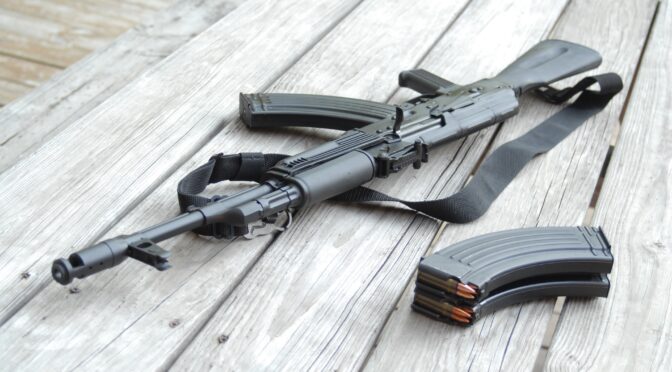
The 7.62x39mm AK-47 platform is engineered upon a design philosophy that prioritizes unconditional reliability in adverse conditions over precision or component-level finesse. This is achieved through the use of loose mechanical tolerances, a simplified component layout, and an “over-gassed” long-stroke piston operating system. This robust system is frequently misinterpreted by end-users as “indestructible.” While the design is exceptionally durable, it is not immune to wear and fatigue. This analysis will demonstrate that the service life of an AK-47 is not monolithic but is, instead, fundamentally dependent on the manufacturing methods and metallurgical quality of its key components.

B. Core Analytical Thesis: Metallurgical Variance vs. Design Flaw

A collective analysis of high-round-count testing data reveals a profound bifurcation in AK-47 longevity. The platform’s service life and primary failure points are not uniform across all models. The data clearly delineates between two distinct categories of firearm:

  1. Milspec (Forged/Milled) Components: Firearms built to original “com-bloc” (e.g., Soviet, Bulgarian, Polish, Romanian) military specifications, which utilize forged and heat-treated critical components. These rifles exhibit predictable, high-round-count fatigue failures.1
  2. Sub-par Commercial (Cast) Components: Firearms, primarily certain U.S.-manufactured commercial variants, that substitute cast components for critical, high-stress parts (trunnions, bolts). These rifles exhibit premature, often catastrophic, failures at a small fraction of the milspec service life.3

Data from high-volume, full-auto range testing at Battlefield Vegas (BFV) provides a clear baseline for the service life of properly constructed AKs (including Romanian WASR models), establishing a fatigue life benchmark for receivers at 80,000-100,000 rounds.1 Conversely, structured 5,000-round tests by groups like AK Operators Union (AKOU) on rifles like the Century Arms RAS47 (which uses cast components) resulted in “Game Over” failures due to catastrophic component deformation well before 5,000 rounds.3

Given that the design (the physical geometry of the parts) is nearly identical, the only significant variable is the material (cast vs. forged) and the heat treatment. Therefore, any competent analysis of “common wear parts” must be bifurcated along this critical quality line.

C. Clarification of Report Scope (OEM vs. Aftermarket)

The user query referenced “Benelli” parts. This is interpreted as a typographical error for “aftermarket” parts. This analysis will proceed by comparing the service life of Original Equipment Manufacturer (OEM) or milspec components against the modern, burgeoning U.S. and international aftermarket. This aftermarket, once a small “cottage industry” 5, is now populated by major manufacturers such as Magpul, Midwest Industries 6, Krebs Custom 7, and KNS Precision 8, reflecting a significant shift in the platform’s user base and modular potential.

II. Analysis of Primary Structural and Pressure-Bearing Components

This section details the catastrophic failure points that define the rifle’s absolute service life. These components are, for the end-user, non-replaceable.

A. Component 1: Stamped Receiver and Guide Rails

  • Failure Mode: Fatigue cracking of the receiver, specifically the sheet metal guide rails that the bolt carrier rides on, or at the high-stress interface where the trunnion is riveted to the receiver.
  • Service Life (Milspec): 80,000 – 100,000 rounds. This is a definitive, data-backed figure from the BFV test environment.1 The data explicitly notes, “AK’s get to about the 100,000+ round count and rails on the receiver will start to crack”.1
  • Service Life (Sub-par): Not applicable. On sub-par rifles, other critical components (trunnion, bolt) will fail catastrophically long before the receiver sheet metal reaches its fatigue life.
  • Analysis: High-volume test data presents a counter-intuitive finding regarding stamped vs. milled receivers. BFV data indicates that milled-receiver RPDs (a related platform) last “about half the life (if that) of a Romanian WASR” 9, which is a stamped AK. This suggests the inherent flex of the stamped sheet metal receiver is a feature, not a bug. This flex allows the receiver to absorb and distribute the violent, repetitive impact of the bolt carrier more effectively than a rigid milled receiver, which tends to concentrate stress and develop fatigue cracks sooner.
  • Replacement Analysis: This is a terminal failure. While BFV notes it is an “easy fix with tig welding” 1, this is a depot-level repair requiring specialized skills and tooling. For an end-user, a cracked receiver or guide rail signifies the end of the firearm’s life.

B. Component 2: Trunnion (Front)

  • Failure Mode: Catastrophic failure due to improper metallurgy (“soft” metal). In cast trunnions, this manifests as deformation or “smearing” of the bolt lug locking surfaces. This “setback” of the lug seats physically increases the distance between the bolt face and the chamber (the headspace), leading to a high risk of case rupture and catastrophic failure.
  • Service Life (Milspec/Forged): >100,000 rounds. The BFV data implies the forged front trunnion is not a primary failure point and outlasts the receiver.2
  • Service Life (Sub-par/Cast): <5,000 rounds. This is the central finding of AKOU’s 5,000-round tests on sub-par U.S. commercial rifles.3 The RAS47 test was concluded precisely because of component failure (bolt, carrier, and trunnion) leading to a dangerous growth in headspace.3 Other user reports confirm concerns, such as “a small amount of cracking” on other cast-trunnion rifles.10
  • Analysis: The front trunnion is the single most critical component for determining the safety and longevity of a commercial AK. It is the heart of the rifle, bearing the full force of chamber pressure. A “soft” trunnion initiates a cascade failure: the bolt lugs impact the soft trunnion seats, deforming them. This deformation allows the bolt to move rearward, increasing headspace until the rifle becomes unsafe.
  • Replacement Analysis: This is the definition of a non-replaceable part. It is permanently riveted to the receiver. Failure requires the destruction and scrapping of the firearm. This is why expert builders, such as Jim Fuller of Rifle Dynamics, focus so heavily on the proper riveting and build process, which is centered on a high-quality (forged) trunnion.11

III. Analysis of the Bolt Carrier Group (BCG) and Recoil Mechanism

This section analyzes the primary moving assembly, which is subject to high-impact, high-friction wear.

A. Component 3: Bolt Assembly (Lugs and Bolt Body)

  • Failure Mode: Similar to the trunnion, failure is bifurcated. On sub-par cast bolts, this manifests as spalling, chipping, or deformation (peening) of the locking lugs, or cracking of the bolt stem.
  • Service Life (Milspec/Forged): >100,000 rounds. The BFV data is notable for what it omits. The logs detail M4 bolt failures (lug cracking, bolt skipping) at approximately 20,000 rounds, but never mention AK bolt failure.1 This implies the milspec, forged AK bolt is a “life of the receiver” part that is not a standard wear item.
  • Service Life (Sub-par/Cast): <5,000 rounds. The AKOU RAS47 test explicitly identified the “bolt, and carrier” as “junk”.3 This, in conjunction with the soft trunnion, was the direct cause of the dangerous headspace failure.
  • Replacement Analysis: On a milspec gun, the bolt is generally not replaced. On a failed commercial gun, the rifle is destroyed. Aftermarket carriers are available 12, but bolts are less common as they are a critical, headspace-dependent component. A user cannot simply “drop in” a new bolt; it must be checked with Go/No-Go/Field headspace gauges.3

B. Component 4: Extractor

  • Failure Mode: Brittle fracture of the extractor claw, or fatigue of the small extractor spring, leading to failures to extract (FTE).
  • Service Life (Milspec): 15,000 – 30,000 rounds. This service life is an inferred estimate, as no source provides a hard number. The inference is based on its function as a small, high-stress component and the extreme duty cycle of extracting steel-cased 7.62×39 ammunition, which is significantly harder on extractor claws than brass-cased ammunition.
  • Analysis: The existence of aftermarket “EDM machined, hardened extractor” assemblies is a direct response to this known wear point.12 This implies that OEM extractors, particularly on commercial guns, are a known potential failure point that the aftermarket is actively trying to solve.
  • Replacement Analysis: This is a common, inexpensive, and expected armorer-level maintenance part. It is most often replaced with an OEM/milspec surplus part.

C. Component 5: Recoil Spring Assembly

  • Failure Mode: Spring fatigue, specifically the loss of its spring constant (or k-value), or, less commonly, a fracture of the spring wire.
  • Service Life (Milspec): 15,000 – 25,000 rounds (for replacement).
  • Analysis: This is the most critical hidden wear part. A fatigued recoil spring is a wear accelerant for the #1 terminal failure part (the receiver). The recoil spring’s primary function is to absorb the kinetic energy of the bolt carrier group. Over 15,000-25,000 cycles, the spring will weaken. A weaker spring results in less energy being absorbed by the spring and more energy being transferred to the bolt carrier. This causes the bolt carrier to strike the rear trunnion and receiver with significantly higher velocity and force. This impact directly accelerates the fatigue cracking that BFV identified as the platform’s ultimate 80,000-100,000 round failure point.1
  • Replacement Analysis: Universally replaced with OEM/milspec surplus assemblies. The failure to replace this inexpensive component accelerates the destruction of the firearm.

IV. Analysis of the Fire Control Group (FCG) and Retainers

This section covers parts that fail due to an inefficient original design or high cycle counts.

A. Component 6: FCG Axis Pin Retainer (“Shepherd’s Crook”)

  • Failure Mode: Failure by design. This simple wire clip, which is designed to retain the hammer and trigger axis pins, is prone to “walking” or shifting, which can allow the pins to walk out, disabling the rifle. It is also notoriously difficult to re-install during cleaning or maintenance.
  • Service Life (Milspec): N/A. It does not “wear out” in a traditional sense. It is a known quality-of-life and reliability deficiency.
  • Analysis: The existence of a specific aftermarket part, the “AK-47 Trigger Pin Retainer Plate” 13, is direct evidence of this component’s common failure.
  • Replacement Analysis: This is one of the single most common proactive replacements on the AK platform. Users do not wait for it to fail; they replace it immediately upon acquiring the rifle. It is never replaced with another OEM “shepherd’s crook.” It is always replaced with a solid, one-piece aftermarket retainer plate, which is a “fire and forget” solution.13

B. Component 7: Hammer/Trigger Assembly (Sear Surfaces)

  • Failure Mode: Wear, chipping, or deformation of the sear engagement surfaces (on the hammer and trigger). This can lead to a gritty pull, “trigger slap” (an uncomfortable sensation on the trigger finger as the sear resets), or, most dangerously, “hammer follow” (where the hammer follows the bolt carrier, failing to reset and potentially causing an out-of-battery detonation or an unintended full-auto burst).
  • Service Life (Milspec): >50,000 rounds. Milspec FCGs are exceptionally durable.
  • Service Life (Sub-par/Cast): <10,000 rounds. Cast FCGs are known to wear quickly, developing the issues above.
  • Analysis: The primary driver for FCG replacement is not wear, but ergonomics. The “bad old days” 5 of few parts are gone. The modern AK owner is often a general firearm “consumer” 14 who chooses to replace the FCG to improve the trigger pull, not because the original broke.
  • Replacement Analysis: This is a massive aftermarket. While OEM/milspec triggers are reliable, the market is dominated by aftermarket “drop-in” triggers (e.g., from ALG, CMC, or Tapco) that offer improved performance.

V. Analysis of Ancillary and Sacrificial Components

These components are exposed, sacrificial, or subject to high thermal and pressure loads.

A. Component 8: Muzzle Device (Muzzle Brake)

  • Failure Mode: Catastrophic splitting.
  • Service Life (Milspec): <20,000 rounds (under full-auto fire).
  • Analysis: This is a direct, empirical finding from BFV 1: “The muzzle brakes will literally split in half, looking a like bird with his beak open and go flying down range.” This source provides a crucial A/B comparison: “We have yet to lose a single flash hider as compared to muzzle brakes on an AK-47”.1 This implies that the complexity and internal baffles of a muzzle brake (designed to redirect gas) create stress risers and trap extreme heat. This leads to rapid fatigue failure under the thermal and pressure loads of full-auto fire. A simple “flash hider” (like the classic AKM “slant” brake) does not have this issue.
  • Replacement Analysis: This failure is specific to the extreme BFV environment (full-auto). It is a non-issue for 99.9% of semi-auto users.

B. Component 9: Firing Pin

  • Failure Mode: Brittle fracture (tip snapping off) or deformation (peening) from repeated hammer impact.
  • Service Life (Milspec): 20,000 – 40,000 rounds.
  • Analysis: The AK’s free-floating firing pin (which taps the primer via inertia) is subject to extreme impact cycles. The existence of an aftermarket “titanium firing pin” 12 designed to “prevent binding and misfires” is a direct response to this known, albeit high-round-count, failure mode.
  • Replacement Analysis: A standard, expected armorer-level replacement part. Most users replace it with an inexpensive OEM/milspec pin.

C. Component 10: Wood Furniture (Stock and Handguards)

  • Failure Mode: Cracking, splitting, or delamination due to heat (from the barrel/gas tube) and impact.12
  • Service Life (Milspec): Varies with use, not round count.
  • Analysis: This is the #1 replaced part on the platform, but not for wear. The entire modern AK aftermarket is built on replacing the furniture. This represents a fundamental shift in the user base. The original wood furniture is not “failing” mechanically, but philosophically. It fails to meet the modern U.S. consumer’s desire for the “modularity of an AR-15”.6 Companies like Midwest Industries 6, Magpul 5, Bonesteel 7, and Krebs 7 have a massive market based on allowing users to add optics, lights, and foregrips.
  • Replacement Analysis: Overwhelmingly replaced by aftermarket polymer (Magpul) or aluminum (Midwest Industries, Krebs) systems.5

VI. Summary of Findings: Component Service Life and Replacement

The following table synthesizes the analysis, providing a clear overview of component longevity and replacement priorities.

Table 1: AK-47 Component Service Life and Replacement Analysis

ComponentPrimary Failure ModeService Life (Milspec/Forged)Service Life (Sub-par/Cast)Replacement & Analysis (OEM vs. Aftermarket)
1. Receiver / Guide RailsFatigue Cracking (at rails/trunnion)80,000 – 100,000 roundsN/A (Other parts fail first)Terminal Failure. Not a user-replaceable part. BFV data 1 confirms this is the rifle’s ultimate fatigue life.
2. Front TrunnionCatastrophic Deformation / Cracking>100,000 rounds<5,000 roundsTerminal Failure. The key differentiator. Milspec forged trunnions last the receiver’s life. Cast trunnions fail dangerously fast.3
3. Bolt AssemblyLug Deformation / Cracking>100,000 rounds<5,000 roundsMilspec: A “life-of-receiver” part.1 Sub-par: A primary cause of headspace failure.3 Not a simple “drop-in” replacement.
4. Extractor & SpringBrittle Fracture (Claw) / Spring Fatigue15,000 – 30,000 rounds15,000 – 30,000 roundsOEM/Milspec. A standard maintenance part. High wear from steel-cased ammo. Aftermarket 12 offers “hardened” options.
5. Recoil Spring AssemblySpring Fatigue (Loss of $k$-value)15,000 – 25,000 rounds15,000 – 25,000 roundsOEM/Milspec. A critical wear accelerant. Failure to replace hastens receiver cracking (based on 1).
6. FCG Pin RetainerDesign Failure (“Walking” out)N/A (Fails by design)N/A (Fails by design)Aftermarket. OEM “Shepherd’s Crook” is universally rejected by users for an aftermarket “Retainer Plate”.13
7. Hammer / Trigger (FCG)Sear Surface Wear / Chipping>50,000 rounds<10,000 roundsAftermarket. While milspec FCGs are durable, this is a top ergonomic upgrade 5, not a wear replacement.
8. Muzzle BrakeCatastrophic Splitting<20,000 rounds (Full Auto)<20,000 rounds (Full Auto)OEM/Aftermarket. A fatigue failure only seen in high-volume, full-auto fire.1 A non-issue for semi-auto.
9. Firing PinBrittle Fracture (Tip)20,000 – 40,000 rounds20,000 – 40,000 roundsOEM/Milspec. A standard armorer-level maintenance part. Aftermarket (e.g., titanium12) exists but is uncommon.
10. Wood FurnitureCracking (Heat/Impact)N/A (Fails by environment)N/A (Fails by environment)Aftermarket. The #1 replaced part, but for modularity 5, not wear. This reflects a shift in user philosophy.

VII. Concluding Analysis: Wear Patterns of Milspec vs. Commercial AK-47s

The analysis of wear patterns in the 7.62x39mm AK-47 reveals a stark, bifurcated reality.

  • The Milspec Reality: The AK-47, when built to its original “com-bloc” standards using forged trunnions and properly heat-treated components, is a “100,000-round” platform.1 Its failure is predictable, based on structural fatigue of the receiver, and its ancillary parts (extractors, firing pins, recoil springs) are part of a simple, expected maintenance schedule.
  • The Commercial Reality: The “American AK” experiment of the 2010s, which relied on cast trunnions and bolts to reduce cost, was a catastrophic failure. This is proven by structured testing, which shows these rifles failing in under 5,000 rounds due to critical, unsafe deformation of pressure-bearing components.3 These rifles are not “AK-47s” in a functional or engineering sense and do not share the platform’s legendary reliability.
  • The Aftermarket Reality: The modern aftermarket 5 is not focused on fixing the milspec design’s (largely non-existent) wear failures. It is focused on enhancing the platform to meet modern AR-15-level expectations of modularity. This, as noted by industry experts 5, was once a cottage industry but is now mainstream, indicating the platform’s full acceptance and integration by the modern U.S. consumer.

Appendix A: Methodology for Social Media Data Triangulation

A. Inapplicability of Provided Methodologies

The provided research snippets on methodology 16 offer models for sociological or marketing analysis. These include social network analysis of gun violence 16, demographic prediction 17, tracking firearm mortality statistics 18, and analyzing advertising/influencer marketing.19 These methodologies are not applicable for a technical, engineering-based failure analysis of mechanical components.

B. Proposed Methodology: Expert-Node Triangulation (ENT)

The methodology used to produce this report is Expert-Node Triangulation (ENT). ENT is a qualitative analysis method designed to extract high-fidelity technical data from unstructured “social media” sources (forums, video platforms, blogs) by vetting and prioritizing the sources. This method filters anecdotal “noise” to find empirical “signal.”

C. The ENT Process

  1. Step 1: Data Curation & Source Vetting: The first step is to filter “social media” into “authoritative nodes.” Noise (e.g., discussions in gaming or 3D modeling subreddits 21) is discarded. Authoritative nodes are sources with verifiable, high-value data.
  2. Step 2: Data Hierarchy (Tiered Prioritization): The vetted nodes are weighted based on the quality and objectivity of their data.
  • Tier 1 (Empirical/Quantitative): High-volume, controlled test logs. This is the gold standard for Mean Time Between Failure (MTBF) data. (e.g., Battlefield Vegas, which logs round counts in the hundreds of thousands 1).
  • Tier 2 (Applied/Qualitative): Structured, reviewer-driven destructive/longevity tests. (e.g., AK Operators Union 5,000-round tests 3). This data is excellent for identifying premature failure modes.
  • Tier 3 (Expert/Anecdotal): Armorer and builder expertise. (e.g., Jim Fuller/Rifle Dynamics 5; Larry Vickers 28). This provides the context and “why” for the Tier 1 and 2 data.
  • Tier 4 (User-Level/Crowdsourced): General forum/Reddit discussions. (e.g., r/CAguns 29; SASSNET 30; Nosler 31). This is used to identify commonality of perception (e.g., the universal dislike of the “shepherd’s crook” 13) and aftermarket trends.6
  1. Step 3: Synthesis and Triangulation: The final step is to cross-reference the tiers to build a complete picture. This process allows for the creation of high-confidence service life estimates from unstructured data.
  • Example Triangulation: “Trunnion Failure”:
  • Tier 4 discussions show user concern about cracking on cast trunnions.10
  • Tier 2 tests prove this failure at $<5,000$ rounds, resulting in unsafe headspace.3
  • Tier 3 experts explain the critical importance of proper builds using forged parts.11
  • Tier 1 data proves that a proper, forged trunnion is not a failure point and lasts $>80,000$ rounds.2
  • Result: A complete, nuanced conclusion that trunnion failure is a manufacturing defect, not a design flaw.
  • Example Triangulation: “Furniture Replacement”:
  • Tier 4 discussions show users refinishing or discussing wood.30
  • Tier 3 experts discuss the “bad old days” when aftermarket parts were rare.5
  • Tier 1/2 data logs wood cracking under hard use.
  • Result: This confirms the market driver for the aftermarket products seen in manufacturer posts 6, which are solving a modularity problem, not a wear problem.

Please share the link on Facebook, Forums, with colleagues, etc. Your support is much appreciated and if you have any feedback, please email us in**@*********ps.com. If you’d like to request a report or order a reprint, please click here for the corresponding page to open in new tab.


Sources Used

  1. Guy who runs a high volume shooting range discusses durability of firearms and parts : r/guns – Reddit, accessed November 9, 2025, https://www.reddit.com/r/guns/comments/3hpxr3/guy_who_runs_a_high_volume_shooting_range/
  2. Milled vs. Stamped Receivers – AK-47 Buyers Guide, accessed November 9, 2025, https://howtobuyanak47.com/2016/11/09/milled-versus-stamped-receivers/
  3. RAS47 5000rds Later – Game Over! – AK Operators Union, Local 47-74, accessed November 9, 2025, https://www.akoperatorsunionlocal4774.com/2016/04/ras47-5000rds-later-game/
  4. AK-47 vs. AR-15: The Great Debate Finally Settled – Bear Creek Arsenal, accessed November 9, 2025, https://www.bearcreekarsenal.com/blog/ak-47-vs-ar-15.html
  5. Uncategorized Archives – Page 6 of 7 – AK-47 Buyers Guide, accessed November 9, 2025, https://howtobuyanak47.com/category/uncategorized/page/6/
  6. Do These AK47 Accessories Make It Better Than The AR-15? – YouTube, accessed November 9, 2025, https://www.youtube.com/watch?v=Gg7pvENQl0M
  7. Best AK-47 Parts to upgrade your rifle – AK-47 Buyers Guide, accessed November 9, 2025, https://howtobuyanak47.com/2016/10/14/chapter-3-adding-aftermarket-parts/
  8. Ethan’s Review of KNS Precision AK Adjustable Rear Peep Sight – OpticsPlanet, accessed November 9, 2025, https://www.opticsplanet.com/reviews/reviews-kns-precision-ak-adjustable-rear-peep-sight/b6299a62-9165-11ee-8932-02a83afc3e35.html
  9. How many rounds can an AK fire before it breaks down …, accessed November 9, 2025, https://www.thefirearmblog.com/blog/2015/06/03/how-many-rounds-can-an-ak-fire-before-it-breaks-down/
  10. AKs with Cast Trunnions Drama, accessed November 9, 2025, https://www.akoperatorsunionlocal4774.com/2015/10/aks-with-cast-trunnions-drama/
  11. Rifle Dynamics Factory Tour | thefirearmblog.com, accessed November 9, 2025, https://www.thefirearmblog.com/blog/2015/04/27/rifle-dynamics-factory-tour/
  12. Office/Tech: 641-623-5401 – Brownells, accessed November 9, 2025, https://www.brownells.com/userdocs/Miscellaneous/catalog2018/pdfs/71-Rifle-P154-197.pdf
  13. AKARS – Крышка под оптику для АК, ДТК Lantac 7.62×39, обвес Hogue, Krebs Customs, Vltor, MI и др. | REIBERT.info, accessed November 9, 2025, https://reibert.info/threads/akars-kryshka-pod-optiku-dlja-ak-dtk-lantac-7-62×39-obves-hogue-krebs-customs-vltor-mi-i-dr.646845/
  14. Best AK-47 Buyer’s Guide [Field Tested] – Gun Digest, accessed November 9, 2025, https://gundigest.com/rifles/the-best-ak-47-rifles-you-can-find-in-the-u-s
  15. AK-47 Rifle Shootout: Finding the Right Kalash for You | American Firearms, accessed November 9, 2025, https://www.americanfirearms.org/best-ak-47-rifles/
  16. Using social network analysis to examine gun violence | Bureau of Justice Assistance, accessed November 9, 2025, https://bja.ojp.gov/library/publications/using-social-network-analysis-examine-gun-violence
  17. Social Media Data for Firearms Research: Promise and Perils – ResearchGate, accessed November 9, 2025, https://www.researchgate.net/publication/371749536_Social_Media_Data_for_Firearms_Research_Promise_and_Perils
  18. Assessing Social Media Data as a Resource for Firearm Research: Analysis of Tweets Pertaining to Firearm Deaths – NIH, accessed November 9, 2025, https://pmc.ncbi.nlm.nih.gov/articles/PMC9459834/
  19. Characteristics of Gun Advertisements on Social Media: Systematic Search and Content Analysis of Twitter and YouTube Posts, accessed November 9, 2025, https://www.jmir.org/2020/3/e15736/
  20. Characteristics of Gun Advertisements on Social Media: Systematic Search and Content Analysis of Twitter and YouTube Posts – PubMed Central, accessed November 9, 2025, https://pmc.ncbi.nlm.nih.gov/articles/PMC7148552/
  21. AK-47 : r/Blockbench – Reddit, accessed November 9, 2025, https://www.reddit.com/r/Blockbench/comments/1one4xm/ak47/
  22. Ultimate Weapon Guide : AK 47 : r/blackopscoldwar – Reddit, accessed November 9, 2025, https://www.reddit.com/r/blackopscoldwar/comments/k53w9v/ultimate_weapon_guide_ak_47/
  23. How an AK-47 works : r/woahdude – Reddit, accessed November 9, 2025, https://www.reddit.com/r/woahdude/comments/1qwj92/how_an_ak47_works/
  24. What are your thoughts on this kit? : r/ar15 – Reddit, accessed November 9, 2025, https://www.reddit.com/r/ar15/comments/r0q0kr/what_are_your_thoughts_on_this_kit/
  25. Palmetto State Armory AK47 – PSAK47 Gen 2: 1000rds later – AK Operators Union, Local 47-74, accessed November 9, 2025, https://www.akoperatorsunionlocal4774.com/2016/08/palmetto-state-armory-ak47-psak47-gen-2-1000rds-later/
  26. Jim Fuller Talks Rifle Dynamics Beginnings, State of the AK Industry and New Products for 2018 – YouTube, accessed November 9, 2025, https://www.youtube.com/watch?v=2mO5usy8lMo
  27. How to Build the Best AK-47: A Rifle Dynamics Factory Tour – YouTube, accessed November 9, 2025, https://www.youtube.com/watch?v=HHdzAP6yz0g
  28. BCM Training Tip – AK Vol 1 – YouTube, accessed November 9, 2025, https://www.youtube.com/watch?v=H1psvCdwvLg
  29. Good Ak brands/models? : r/CAguns – Reddit, accessed November 9, 2025, https://www.reddit.com/r/CAguns/comments/16xi2ac/good_ak_brandsmodels/
  30. AK 47 Which one to buy? – SASS Wire Forum, accessed November 9, 2025, https://forums.sassnet.com/index.php?/topic/241702-ak-47-which-one-to-buy/
  31. AK47???? – Nosler Reloading Forum, accessed November 9, 2025, https://forum.nosler.com/threads/ak47.12846/

An Engineer’s Analysis of Forging, Casting, and MIM in Modern Small Arms Manufacturing: Properties, Applications, and Future Trajectories

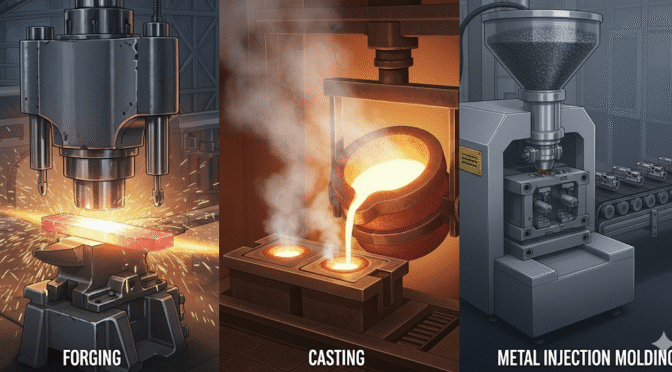
The selection of a manufacturing process for any firearm component is a critical engineering decision that dictates not only the part’s final geometry but, more importantly, its internal microstructure and subsequent mechanical performance. The three dominant methods for producing near-net-shape metal parts—forging, investment casting, and metal injection molding (MIM)—represent distinct pathways to a final product, each with a unique set of advantages and inherent limitations. A thorough understanding of these processes, from the flow of metal under a press to the fusion of powder in a furnace, is essential for designing reliable, safe, and cost-effective firearms. The fundamental difference between these methods lies in how they control the metal’s internal crystalline structure. Forging is a process of refining an existing solid structure, whereas casting and MIM involve creating a new solid structure from a liquid or particulate state. This distinction is the root cause of the hierarchy of mechanical properties observed in the final components.

1.1 Forging: The Gold Standard for Strength and Durability

Forging is a manufacturing process that shapes metal in its solid state through the application of localized compressive forces, delivered via hammering or pressing.1 This ancient technique, modernized with industrial power, remains the benchmark for components requiring maximum strength, impact toughness, and fatigue resistance.4 The process is typically categorized by the temperature at which it is performed: hot forging occurs above the metal’s recrystallization temperature, while cold forging is performed at or near room temperature.3

In firearms manufacturing, the most relevant technique is closed-die forging, also known as impression-die forging.3 In this process, a metal billet, heated to a plastic state, is placed in the lower half of a precision-machined steel die. A power hammer or press then drives the upper die onto the billet, forcing the metal to flow and fill the die cavities, taking on the shape of the final part.3 Excess metal is squeezed out between the die faces, forming “flash,” which is later trimmed off. This method is used to produce the rough forms of critical, high-stress components like pistol slides, revolver frames, and rifle receivers.5

The paramount engineering advantage of forging lies in its effect on the metal’s metallurgical structure. The process does not simply reshape the part; it fundamentally refines its internal grain structure. As the metal is compressed and forced to flow, the cast grain structure of the original billet is broken down and recrystallized into a much finer, more uniform grain structure.1 Critically, these grains are forced to align with the contours of the part, creating a continuous, directional grain flow.4 This is analogous to the grain in a piece of wood, which is strongest when stress is applied along its length. This controlled deformation eliminates the internal voids and porosity that can be found in cast metals, resulting in a component of superior metallurgical soundness, exceptional strength, and unparalleled resistance to fatigue and impact.1

A specialized application of this principle is the cold hammer forging (CHF) of barrels, a process utilized by manufacturers like Glock and SIG Sauer for high-performance firearms.10 In CHF, a barrel blank is impacted thousands of times by industrial hammers at room temperature, forming it around a hardened mandrel that has the inverse pattern of the rifling.12 This intense process simultaneously forms the external contour of the barrel and impresses the lands and grooves of the rifling into the bore. The constant pounding unifies the molecular structure of the steel, creating an exceptionally dense, hard, and smooth surface that is highly resistant to wear. The result is a barrel with superior longevity that does not require a “break-in” period to achieve optimal accuracy.12

1.2 Investment Casting: The Path to Geometric Complexity

Investment casting, colloquially known as the “lost wax” process, is a manufacturing method prized for its ability to produce parts with a high degree of geometric complexity and a superior surface finish.13 Though its principles are ancient, modern investment casting is a highly controlled, multi-step industrial process.15

The process begins with the creation of a precise wax pattern, an exact replica of the final part, which is produced by injecting wax into a reusable metal mold.13 Multiple wax patterns are then attached to a central wax runner system, forming a “tree” or cluster.13 This tree is then dipped repeatedly into a ceramic slurry and coated with sand, building up a layered ceramic shell—the “investment.” After the shell has dried and hardened, it is placed in a high-pressure steam autoclave, where the wax is rapidly melted and drained away, leaving a hollow, one-piece ceramic mold. This is the “lost wax” step.13 The empty ceramic mold is then fired in a high-temperature oven (approximately 1000 °C) to cure it and burn out any residual wax. Finally, molten metal is poured into the hot ceramic mold. Once the metal has solidified, the ceramic shell is broken away, and the individual parts are cut from the tree.13

The primary advantage of investment casting is its design freedom. Because the molten metal can flow into nearly any shape defined by the wax pattern, the process can create highly intricate components with undercuts, internal passages, and fine details that would be extremely difficult, expensive, or impossible to produce via forging or machining from solid stock.13 It is also compatible with a vast range of alloys, including stainless steels, aluminum, and nickel-based alloys, making it a versatile choice for many firearm components.13

However, the engineering vulnerability of casting lies in the physics of molten metal solidification. As the liquid metal is poured into the mold, turbulence can trap gases, and shrinkage during cooling can create voids, resulting in microscopic defects known as porosity.1 Furthermore, any impurities in the melt can become trapped in the final part as inclusions.19 While modern foundries employ stringent controls like vacuum casting to minimize these issues, the risk is inherent to the process. The resulting grain structure of a cast part is typically equiaxed and random, meaning the grains have no preferred orientation. This isotropic structure provides uniform mechanical properties in all directions, but it lacks the directionally optimized strength and fatigue resistance of a forging.8 Consequently, cast parts generally exhibit good compressive strength but are weaker in tension and more susceptible to failure under repeated bending or high-cycle fatigue loads.1

1.3 Metal Injection Molding (MIM): Precision and Volume for Intricate Components

Metal Injection Molding (MIM) is a relatively modern, highly advanced manufacturing process that synergizes the design complexity of plastic injection molding with the material properties of powder metallurgy.21 It is the process of choice for producing enormous quantities of small, geometrically complex, high-precision metal parts.22 The MIM process consists of four distinct stages 21:

  1. Feedstock Preparation: The process begins by combining extremely fine metal powders with a proprietary blend of polymer binders, such as wax and polypropylene, which act as a temporary medium to carry the metal powder.21 This mixture is heated and compounded to create a homogenous, sludge-like “feedstock” with rheological properties that allow it to be injected like a plastic.21
  2. Injection Molding: Using standard plastic injection molding machines, the feedstock is heated and injected under high pressure into a precision-machined, multi-cavity steel mold.21 Due to equipment limitations, the “shot” of material is typically 100 grams or less, which can be distributed across multiple cavities to produce several parts at once.21 The part cools and solidifies into a “green part,” which is an oversized replica of the final component; the mold is intentionally made larger to account for the significant shrinkage that will occur later in the process.21
  3. Debinding: The “green part” is then subjected to a debinding process to remove the majority of the polymer binder. This is a critical step, and several methods can be employed, including solvent extraction, thermal furnaces, or catalytic processes; often, a combination of methods is used.21 The result is a fragile, porous “brown part,” which consists of metal particles held together by a small amount of remaining binder and is approximately 40% “air” by volume.21
  4. Sintering: Finally, the “brown part” is placed in a high-temperature, precisely controlled-atmosphere furnace for sintering. It is heated to a temperature just below the melting point of the metal alloy (e.g., 1,350-1,400 °C for stainless steel).21 At this temperature, capillary forces and solid-state diffusion cause the metal particles to fuse and bond together.21 This process, often a form of liquid phase sintering where partial melting occurs, causes the part to shrink significantly—typically by 15-20% in each dimension—to its final, precise dimensions.21 The final component is densified to typically 96-99% of its theoretical solid density, resulting in mechanical properties comparable to annealed parts made by traditional methods.21

MIM’s core strength is its ability to mass-produce small (usually under 100 grams), extremely complex parts to very tight dimensional tolerances (±0.3% is common) with an excellent surface finish, often completely eliminating the need for secondary machining.4 This makes it exceptionally cost-effective for high-volume components like triggers, hammers, sears, safeties, and magazine catches.26 The primary engineering weakness of MIM is the presence of residual porosity. Even with optimal sintering, the final part is not 100% dense. These microscopic, albeit uniformly distributed, voids can act as stress risers, providing initiation points for fatigue cracks under high-cycle or high-impact loading conditions.18 Like a casting, the resulting grain structure is fine and isotropic, lacking the aligned, fatigue-resistant grain flow of a forging.18 The term “near-net-shape” is often used to describe all three processes, but its practical meaning varies. A forged part requires machining of critical surfaces and flash removal.1 An investment cast part may need machining to correct for shrinkage or surface defects.16 MIM, for small, intricate components, is the truest to the “near-net-shape” promise, often being ready for assembly directly from the sintering furnace.21 This elimination of post-processing is a massive driver of its overall cost-effectiveness.

Section 2: Comparative Analysis of Material and Part Properties

A direct comparison of parts made by forging, casting, and MIM reveals a clear hierarchy of mechanical performance, directly attributable to the underlying microstructures created by each process. This analysis quantifies the engineering trade-offs between ultimate strength, fatigue life, geometric complexity, and production cost, providing a data-driven basis for component design and material selection. The central engineering dilemma is the inverse relationship between a process’s ability to create complex shapes and the ultimate strength of the resulting part. Forging maximizes strength by working solid metal, but this limits complexity. Casting and MIM achieve complexity with fluid-like materials but at the cost of potential microstructural flaws and a less optimal grain structure.

2.1 Structural Integrity: Grain Structure and Its Implications

The internal grain structure is the single most important determinant of a metal part’s strength and durability.

  • Forging: The defining characteristic of a forged part is its continuous, directional grain structure that is deliberately aligned with the part’s geometry.1 This anisotropic structure is engineered to place the strongest orientation of the metal’s grains along the paths of highest stress. This refined, compressed grain flow dramatically increases resistance to fatigue and impact by inhibiting the initiation and propagation of micro-cracks.1 Properly executed, the forging process also compresses and closes any internal voids that may have existed in the initial billet, resulting in the highest possible material density and metallurgical soundness.1
  • Casting & MIM: Both casting and MIM produce an isotropic, equiaxed grain structure, meaning the grains are randomly oriented and of roughly equal size in all directions.18 This results in uniform mechanical properties regardless of the direction of applied force. While this can be advantageous for components subjected to complex, multi-directional stress fields, it means the part lacks the peak directional strength that can be achieved with forging.20
  • Inherent Defects: Each process has a characteristic potential for defects. Casting is the most susceptible to significant, randomly located defects like porosity (from trapped gas or shrinkage) and inclusions (non-metallic impurities).1 These defects can act as major stress concentrators and are a primary cause of unexpected part failure. MIM’s characteristic flaw is
    residual porosity, microscopic voids left over from the sintering process where the metal particles did not fully fuse.20 While far smaller and more uniformly distributed than casting defects, these pores still reduce the cross-sectional area and can serve as initiation sites for fatigue cracks. Forging stands apart as the process that actively works to eliminate such defects, yielding the most structurally sound component.

2.2 Mechanical Properties: A Quantitative Comparison

The differences in microstructure translate directly into measurable differences in mechanical performance.

  • Tensile & Yield Strength: For any given alloy, forging produces the highest tensile strength (the maximum stress a material can withstand before breaking) and yield strength (the stress at which it begins to deform permanently).1 Independent testing has shown that forged steel parts can exhibit
    26% higher tensile strength and 34% higher yield strength than identical parts made from cast steel.9 MIM parts, when produced to high standards, can achieve mechanical properties approaching those of wrought (forged) metals, but are generally understood to reach approximately
    90% of the strength of a comparable forged component.4 For a common firearm steel like AISI 4140, the baseline annealed tensile strength is 655 MPa (95,000 psi), a value that is significantly enhanced by the work hardening and grain refinement of the forging process and subsequent heat treatment.29
  • Fatigue Resistance: Fatigue is failure under repeated or cyclic loading, even at stresses well below the material’s ultimate tensile strength. This is where forging demonstrates its most profound superiority. The aligned grain flow makes it difficult for fatigue cracks to cross grain boundaries, drastically slowing their propagation. As a result, forged parts have been shown to possess 37% higher fatigue strength, translating into a fatigue life that is a staggering six times longer than that of cast parts.9 The residual porosity inherent to MIM parts makes them inherently more susceptible to fatigue failure than forged parts. Each microscopic pore is a potential stress riser and a point where a fatigue crack can begin, giving forged components a definitive edge in applications involving millions of high-stress cycles, such as a pistol slide or rifle bolt.20
  • Ductility & Toughness: Ductility, the ability to deform plastically before fracturing, is a critical measure of a material’s toughness and its failure mode. A ductile material provides warning before failure, while a brittle material fails suddenly and catastrophically. Forged parts exhibit vastly superior ductility. In destructive pull-to-failure tests, forged steel parts demonstrated a 58% reduction in cross-sectional area before breaking, compared to only a 6% reduction for cast parts.8 This data highlights a crucial safety consideration: under extreme overload, a forged part will bend, stretch, and deform significantly, likely rendering the firearm inoperable but contained. A less ductile cast or MIM part is more prone to a sudden, brittle fracture, which in a pressure-bearing component could lead to a catastrophic containment failure and potential injury to the shooter. This “graceful” versus “catastrophic” failure mode is a compelling reason for the mandatory use of forgings in the most critical components.

2.3 Design and Production Tolerances

While forging excels in mechanical properties, MIM and casting offer significant advantages in precision and the ability to create complex geometries.

  • Dimensional Accuracy: MIM is the undisputed leader for producing small, complex parts to extremely tight tolerances. A typical MIM tolerance is ±0.3% of the dimension, with tolerances as tight as ±0.01 mm being achievable for certain features.4 Investment casting follows, offering good precision with typical tolerances around
    ±0.005 inches per inch.14 Forging produces a near-net shape but has the loosest tolerances of the three, typically in the range of
    ±0.5 mm, necessitating subsequent machining operations for any critical mating surfaces or interfaces.4
  • Surface Finish: The processes follow the same hierarchy for surface finish. MIM can produce an exceptionally smooth finish, around 1 µm Ra, which is often suitable for use without any polishing.21 Investment casting yields a good surface finish of about
    3.2 µm Ra.24 Forged parts have a comparatively rough surface texture due to scale from heating and contact with the die, always requiring machining or other finishing for smooth operation or cosmetic appearance.
  • Geometric Complexity: MIM provides the greatest design freedom, enabling the creation of highly intricate features like thin walls, sharp corners, undercuts, cross-holes, and fine surface textures in a single step.4 Investment casting is also excellent for complex shapes that would be difficult to forge.13 Forging is the most restrictive process, generally limited to shapes without undercuts that can be readily extracted from a two-part die.1

The following table provides a summary of these comparative properties, offering an at-a-glance reference for preliminary process selection.

PropertyForgingInvestment CastingMetal Injection Molding (MIM)
Tensile StrengthHighest (100%) 9Good (~70% of Forged) 8High (~90% of Forged) 4
Fatigue LifeHighest (up to 6x Cast) 28Good 4High (Lower than Forged) 20
Ductility / ToughnessHighest 8Low 8Good (Lower than Forged)
Microstructural IntegrityHighest (Refined Grain Flow) 1Good (Risk of Porosity) 1High (Risk of Micro-porosity) 20
Geometric ComplexityLow 1High 13Highest (for small parts) 4
Dimensional Tolerance±0.5 mm 4±0.005″/inch 14±0.01 mm to ±0.3% 4
Surface Finish (Ra)Rough (Requires Machining)Good (~3.2 µm) 24Excellent (~1 µm) 24
Tooling CostHigh 16Medium 16Highest 24
Per-Unit Cost (High Vol.)Low 16Medium 16Lowest (for small parts) 24
Ideal Part SizeGrams to Tons 4Grams to Kilograms 13< 250 grams 4

Section 3: Application in Small Arms Design: A Component-by-Component Breakdown

The theoretical properties of each manufacturing process translate into a well-defined and logical distribution of their use across the components of a modern firearm. The selection of forging, casting, or MIM for a specific part is not arbitrary; it is a deliberate engineering decision based on a tiered system of component criticality. This hierarchy is determined by the consequence of a part’s failure, from a catastrophic breach of pressure containment to a minor functional inconvenience. The following matrix provides a practical overview of common manufacturing methods for key firearm components, which will be elaborated upon in the subsequent sections.

ComponentPrimary MethodSecondary/Alternate Method(s)Rationale / Key Engineering Considerations
BarrelForged (CHF) 12Machined from Bar StockMust contain 50k-65k+ psi; requires highest strength, fatigue life, and wear resistance.
Bolt / Bolt LugsForged 5Machined from Bar StockLugs under extreme shear/tensile stress; failure is catastrophic. Requires maximum strength and fatigue resistance.
Bolt Carrier (AR-15)Forged 5Machined from Bar StockHigh-impact, high-cycle component. Forging provides durability. Machining offers precision and custom features.
Slide (Pistol)Forged 5Investment Cast 14, Machined from BilletPrimary pressure-bearing structure in many designs. Forging is premium standard. Casting is a proven, cost-effective alternative.
Receiver (AR-15 Lower)Forged 5Investment Cast 33, Machined from Billet 34Not a pressure-bearing part. Strength differences are less critical. Choice driven by cost, features, and aesthetics.
Frame (1911 / Revolver)Forged 5Investment Cast 14Complex shape. Casting is ideal for geometry and cost. Forging is the premium, higher-strength option.
HammerMIM 26Investment Cast 17, Machined from Bar StockComplex geometry, primarily under compressive/impact stress. MIM provides precision and cost-effectiveness for mass production.
TriggerMIM 26Investment Cast 17, Machined from Bar StockComplex geometry, low stress. MIM excels at providing consistent, precise engagement surfaces at low cost.
Sear / DisconnectorMIM 26Machined from Bar StockVery small, complex, high-precision parts. Primarily under compressive/frictional stress. Ideal MIM application.
Safety LeverMIM 26Investment Cast 17Complex shape, low stress in normal use. MIM is cost-effective. Torsional stress can be a failure point.
Magazine CatchMIM 26Investment Cast 14Intricate geometry, low stress. Perfect for high-volume, low-cost MIM production.
Gas Block (AR-15)Forged 5Machined from Bar Stock, Cast 17Simple shape, moderate stress. Forging or machining are common.
SightsMIM 26Investment Cast 17, Machined from Bar StockComplex shapes, low stress. MIM or casting are common for production sights. Machining for high-end adjustable sights.

3.1 The Unforgivable Components: Where Forging is Mandatory

Certain components within a firearm are subjected to such extreme forces that their failure would be catastrophic, presenting a direct and immediate danger to the operator. These are the parts that form the pressure vessel, containing and directing the explosive energy of a detonating cartridge. For these Tier 1 critical components, the superior strength, ductility, and fatigue resistance of forging are not a luxury but an absolute engineering necessity.

  • Barrels: The barrel must reliably contain chamber pressures that routinely exceed 50,000 to 65,000 psi for modern rifle cartridges. A barrel rupture is one of the most dangerous possible firearm failures. Forging, particularly cold hammer forging, provides the highest possible hoop strength and fatigue resistance to withstand tens of thousands of these pressure cycles without failure.5
  • Bolts and Bolt Lugs: The bolt is the gatekeeper of the breech. Its locking lugs engage with the barrel extension or receiver and must withstand the full rearward thrust of the cartridge case upon firing. This places the lugs under immense tensile and shear stress. A failure of the locking lugs would allow the bolt to be violently propelled rearward into the receiver and potentially towards the shooter. Forging is the only process that can provide the requisite shear strength and fatigue life to prevent this. This is why Mil-Spec AR-15 bolts are required to be made from specific high-strength steels like Carpenter 158 or 9310, which are then forged and heat-treated.5
  • High-Pressure Receivers and Slides: In many firearm designs, such as most semi-automatic pistols (e.g., 1911, Glock) and some rifles (e.g., M1 Garand), the slide or receiver directly contains the bolt and serves as the primary load-bearing structure. It must absorb the full impact of the recoiling bolt and barrel assembly on every shot. Forging ensures the highest strength-to-weight ratio and the necessary resistance to fatigue cracking after countless cycles of violent impact and stress.5 This is why premium firearm manufacturers explicitly market their slides and frames as being “CNC machined from forgings,” emphasizing that the part started as a superior forged blank before being precision machined to its final dimensions.7

3.2 The Case for Casting: Frames, Receivers, and Structural Parts

Where the absolute peak of mechanical properties is not a strict requirement, but geometric complexity and production cost are significant drivers, investment casting becomes a highly viable and proven engineering solution. These Tier 2 components are structurally critical, but they typically hold the pressure-bearing parts rather than directly containing the peak pressure themselves.

  • Frames and Lower Receivers: The frame of a pistol or the lower receiver of an AR-15 is a classic example. These parts have highly complex internal and external geometries to house the fire control group, magazine well, and grip. Investment casting is an excellent method for producing these intricate shapes to near-net dimensions, significantly reducing the amount of costly machining required.14 The famous durability of Ruger firearms is a direct testament to the potential of high-quality investment casting. Bill Ruger founded Pine Tree Castings specifically to produce investment cast frames and receivers for his firearms, creating parts renowned for their strength and toughness, proving that a well-engineered casting can be more than sufficient for the application.19
  • The AR-15 Receiver Debate: The AR-15 lower receiver is a frequent subject of debate regarding forged versus cast versus billet manufacturing.19 From a purely structural standpoint, the AR-15 lower is not a high-stress part; the pressure is contained by the bolt, barrel extension, and upper receiver. Therefore, while a forged lower is measurably stronger than a cast lower of the same dimensions, the strength of the cast version is still far in excess of the loads it will ever experience in normal use.33 For many users and manufacturers, the debate becomes less about strength and more about other factors: forged receivers are valued for their adherence to the Mil-Spec standard and low cost, while billet receivers (machined from a solid block of aluminum) are prized for their sharp aesthetic, custom features (like integrated trigger guards), and tighter tolerances, albeit at a higher price.34
  • Other Cast Parts: Many other firearm components with complex shapes but lower stress loads are also commonly produced via investment casting. These include trigger guards, sight bases, scope mounts, and gas blocks.14

A separate but related category is parts machined from billet or bar stock. This subtractive process starts with a solid block of pre-treated metal and carves away material to create the final part. It offers excellent material properties and the highest possible precision, but at the cost of significant material waste (up to 90%) and long, expensive machining cycles.30 It is therefore not a mass-production method but is reserved for low-volume custom firearms where tooling costs for forging or casting are prohibitive, or for high-end “premium” products where the sharp lines and perfect tolerances of a fully machined part are a key selling point.19

3.3 The Strategic Role of MIM: The Ecosystem of Small Parts

For the vast ecosystem of small, intricate, non-critical components within a firearm, Metal Injection Molding is the dominant and most logical manufacturing choice. For these Tier 3 parts, failure typically results in a malfunction rather than a safety hazard. Here, the unparalleled ability of MIM to produce massive quantities of highly precise, complex parts at a very low per-unit cost outweighs the slight reduction in ultimate strength compared to forging.

  • Fire Control Group: The hammer, trigger, sear, and disconnector are the classic applications for MIM.26 These parts have complex engagement surfaces that must be held to tight tolerances to ensure a safe and consistent trigger pull. The stresses they endure are primarily compressive and frictional, not high-impact or tensile. MIM is perfectly suited to create these geometries with exceptional repeatability and an excellent surface finish that requires no secondary polishing, making it the ideal choice for mass production.10
  • Other Common MIM Parts: The economic and precision advantages of MIM have led to its adoption for a wide range of other small parts. These include safety levers, magazine catches, slide stops, and ejectors.26 The complex shapes of these components make them expensive to machine, and the volumes required for modern firearm production make MIM the clear economic winner. While some of these parts, like the slide stop, do experience impact stress, modern MIM engineering has largely overcome the early issues, producing parts that are reliable for their intended service life.

Section 4: Economic Realities and Production Scaling

The choice between forging, casting, and MIM is as much an economic decision as it is an engineering one. Each process has a distinct cost structure, driven by tooling investment, material and labor efficiency, and production volume. Understanding these economic realities is crucial to comprehending why a manufacturer like Glock builds firearms differently from a custom shop like Standard Manufacturing. The “true cost” of a component is not its raw material price but the total cost to produce a finished, in-spec part ready for assembly.

4.1 The Cost of Entry: Tooling and Capital Investment

The upfront investment required to begin production varies dramatically between the three processes and is a primary determinant of their suitability for different production scales.

  • Forging: This process demands the highest capital investment in heavy machinery. Large hydraulic presses or power hammers capable of exerting thousands of tons of force are required, representing a significant factory footprint and cost.31 The tooling itself—hardened steel dies precision-machined with the negative impression of the part—is also extremely expensive to design and create. However, these dies are very durable and can last for long production runs.16
  • Investment Casting: The tooling for investment casting consists of the reusable metal molds used to create the wax patterns. These molds are complex but do not have to withstand the extreme forces of forging, making them significantly less expensive than forging dies.16 The associated equipment, such as wax injectors, slurry tanks, and autoclaves, represents a more moderate capital investment than a forging press, making casting more accessible for lower-volume or more complex parts.16
  • Metal Injection Molding (MIM): MIM has the highest initial tooling cost for a given part. The steel molds must be machined to exceptionally high precision to account for material flow and predictable shrinkage, and a single multi-cavity mold can easily cost upwards of $30,000.24 Furthermore, a complete MIM production line, including specialized injection machines, debinding stations, and computer-controlled sintering furnaces, represents a multi-million-dollar capital investment.30 This makes MIM a technology reserved for very high-volume production where these costs can be justified.

4.2 The Volume Equation: Per-Unit Cost Analysis

The relationship between production volume and per-unit cost is the key to the economic model of these processes.

  • Crossover Points: For very low quantities (prototypes or small custom runs), machining from billet is often the most economical choice as it requires no part-specific tooling. As production volume increases into the hundreds or low thousands, the lower tooling cost of investment casting makes it more cost-effective than forging or MIM.16 However, as production runs climb into the tens or hundreds of thousands, the high upfront tooling costs of forging and MIM become amortized over a vast number of parts. This, combined with their high-speed, automated nature, causes their per-unit cost to plummet, eventually becoming significantly cheaper than casting.25
  • MIM’s Sweet Spot: MIM is fundamentally an “economy of scale” technology.24 Due to its extremely high tooling and capital costs, it is almost never cost-effective for low-volume production. The process is ideal for annual production volumes exceeding 10,000 pieces and becomes exceptionally efficient at runs of 200,000 or more.30 For the small, complex parts it is designed to make, MIM offers the lowest possible per-unit cost at mass-production volumes.

4.3 Material and Labor Efficiency

The efficiency of material and labor usage is a critical component of the finished part cost.

  • Material Utilization: While forging and casting are considered “near-net-shape” processes, they both generate material waste. Forging produces flash that must be trimmed, and casting produces the gates, runners, and sprues of the “tree” that must be cut off and recycled.3 MIM is the most efficient process in terms of raw material, as the feedstock fills the mold cavity with virtually no waste.21 However, the most significant factor is often the waste from
    post-processing. Cast parts frequently require the most machining to meet final tolerances, generating significant subtractive waste.16 Forged parts require less machining, while MIM parts often require none at all. This is why a manufacturer might choose MIM for a trigger even though the raw MIM feedstock can be ten times more expensive than conventional powdered metal or raw steel.30 The savings from eliminating all machining steps—including the time, labor, and capital cost of CNC machines—can far outweigh the higher initial material cost.
  • Labor Costs: Forging is a physically demanding, labor-intensive process that requires skilled operators for the presses and for handling hot metal.16 Investment casting can be highly automated, but the finishing and gate-removal processes can be manual. MIM is a largely automated process, from injection to sintering, which dramatically reduces the labor cost per part.30 This high level of automation is a major contributor to MIM’s low per-unit cost at high volumes.

This analysis reveals that the manufacturing process is a direct reflection of a company’s business model. A premium, low-volume manufacturer will choose methods like machining from forged billets to justify a high price point and market superior quality.7 A mass-market leader will leverage the economies of scale of MIM and polymer injection molding to produce millions of reliable, affordable firearms.10 The engineering choice is inseparable from the market strategy.

Section 5: Industry Lessons Learned: The MIM Saga and the Primacy of Quality Control

The history of Metal Injection Molding in the firearms industry is a powerful case study in the challenges of adopting new manufacturing technologies. It demonstrates the collision of engineering capabilities, economic pressures, and persistent consumer perception. The lessons learned from the “MIM saga” are crucial for any engineer working in the field today, as they underscore the paramount importance of proper application, rigorous quality control, and managing user expectations.

5.1 The “MIMber” Effect: A History of Early Failures and Lasting Perceptions

MIM was introduced to the firearms industry in the 1980s and saw wider adoption in the 1990s as a cost-saving measure to produce complex parts.22 However, this early adoption was fraught with problems. Some manufacturers, in a rush to cut costs, sourced MIM parts from vendors who had not yet perfected the complex, multi-stage process. This resulted in a wave of well-publicized part failures, particularly in 1911-style pistols from brands like Kimber.18 Reports of broken slide stops, fractured thumb safeties, and failed sears became common in the shooting community.

These early failures created a powerful and enduring negative perception, coining the pejorative term “MIMber” for manufacturers who used the process extensively. This stigma has proven incredibly difficult to overcome, even decades after the initial quality control issues were resolved.18 To this day, “MIM is bad” remains a common refrain in online forums and among a segment of shooters, often based on anecdotal evidence or outdated information from the 1990s.18 This perception is so powerful that high-end and custom firearm makers continue to use “100% machined from bar stock” or “MIM-free” as a primary marketing tool to signify premium quality and justify a higher price point.7

5.2 Engineering for the Application: Understanding Stress and Failure Modes

A critical lesson from the history of MIM failures is the importance of applying the technology correctly. MIM is not a universal substitute for forging or machining; it has specific strengths and weaknesses that must be respected in the design process. Many early failures were the result of misapplication.

A classic example is the 1911 extractor. This is a long, thin component that must function as a leaf spring, flexing with every cycle of the slide while maintaining tension on the cartridge rim. This subjects the part to high-cycle bending and tensile stresses. MIM, with its isotropic grain structure and inherent micro-porosity, has lower fatigue resistance than a properly heat-treated spring steel part machined from bar stock. Consequently, MIM extractors were prone to breaking. Colt, after a brief period of using them, learned this lesson and reverted to using machined steel extractors, a practice that continues in quality 1911s today.39

The engineering analysis shows that MIM parts perform exceptionally well under compressive and frictional stress, making them ideal for sears and disconnectors.39 However, they are less suited for applications involving high impact, shear, or torsional stress. This is why MIM hammers (impact), slide stops (impact/shear), and thumb safeties (torsion) have historically been the most common points of failure.18 A modern, well-designed MIM hammer or slide stop from a reputable manufacturer is engineered to withstand these forces for a normal service life, but for extreme high-volume competition use, the higher failure probability still leads serious shooters to upgrade to machined tool steel parts.39

5.3 The Critical Role of Process Control: Not All MIM is Created Equal

Perhaps the most crucial lesson learned by the industry is that MIM is a process, not a material grade. The quality of the final part is not guaranteed by the name of the process but is entirely dependent on the rigor with which that process is executed.42 There is a vast quality spectrum, from cheap, poorly controlled MIM to the high-density, defect-free MIM used in the aerospace, medical, and automotive industries.18

The final properties of a MIM part are dictated by the quality of the initial metal powder, the proprietary binder formulation, the precision of the molding process, and, most critically, the exact time, temperature, and atmospheric controls of the debinding and sintering cycles.42 A small deviation in any of these steps can result in a part with excessive porosity, poor particle fusion, and drastically reduced strength.

Today, major manufacturers like Smith & Wesson, Ruger, SIG Sauer, and Glock have invested heavily in perfecting their MIM supply chains, either through trusted, high-quality vendors or by bringing the capability in-house.11 The result is that modern, high-quality MIM parts are exceptionally reliable for their intended applications. The failure rate for MIM parts from a reputable contemporary manufacturer is statistically very low; one source for Tisas firearms cites a warranty return rate of less than 2% for MIM part failures.45 For the vast majority of firearm owners, a well-made MIM part in a Tier 3 application will last the lifetime of the firearm and will likely outlast the barrel.18

This reality has led to a calculated business decision by manufacturers: the “lifetime warranty”.41 A manufacturer knows the statistical failure rate of their components. They have calculated that the cost of replacing the very small percentage of MIM parts that fail prematurely under warranty is infinitesimal compared to the immense cost savings of using MIM for millions of components instead of more expensive methods. The warranty effectively allows the manufacturer to reap the economic benefits of MIM while assuring the consumer that the small statistical risk of a part failure will be covered.

5.4 A Deeper Dive into MIM Variables: From Powder to Final Part

The final quality of a MIM component is not determined by a single factor but is the result of a chain of critical variables, starting with the raw material and extending through every stage of manufacturing and post-processing. Understanding these variables is key to appreciating the difference between a standard MIM part and a high-performance one.

Feedstock Selection and Formulation

The process begins with the selection of a metal alloy powder, and the choice is vast, including stainless steels (17-4 PH, 316L), low-alloy steels, tool steels (S7, M2), and even titanium or superalloys for extreme applications. The engineer’s selection is a methodical process based on a hierarchy of criteria:

  • Mechanical Performance: The primary consideration is the load the part will endure. The engineer analyzes the application to determine the required tensile strength, impact strength, fatigue life, hardness, and wear resistance.46 A trigger sear, for example, requires high hardness, making a tool steel or a hardenable stainless steel a good candidate.46
  • Operating Environment: The conditions the part will face are critical. If it will be exposed to moisture or chemicals, corrosion resistance becomes a key factor, pointing toward stainless steels like 316L or titanium.46
  • Cost vs. Performance: There is always a balance between ideal properties and a target cost. Low-alloy steels offer excellent strength for their price, while titanium and superalloys provide ultimate performance at a premium.46 The engineer must select the most economical material that still meets all necessary safety and performance specifications.

Beyond the alloy, the characteristics of the powder itself are crucial. Finer powders (typically under 20 microns) with a narrow and consistent particle size distribution pack more tightly, leading to higher final part density and better mechanical properties.9 This powder is then mixed with a proprietary binder system to create the feedstock. The powder-to-binder ratio affects the feedstock’s viscosity, which is critical for ensuring the mold fills completely and uniformly. Some advanced MIM producers create custom, in-house feedstocks to achieve properties that exceed industry standards. For example, by tailoring the metal particle size and binder composition, it is possible to produce a 17-4 PH stainless steel part with up to 19% greater strength and 125% higher ductility than the industry standard.19

Process Control and Part Design

Strict adherence to “Design for Manufacturability” (DFM) principles is non-negotiable for producing high-quality MIM parts. This includes:

  • Uniform Wall Thickness: Designing parts with consistent wall thickness is crucial to ensure uniform shrinkage and prevent defects like warping, sinks, or cracks during the high-temperature sintering phase.30
  • Tooling Design: The design of the steel mold is a science in itself. The placement of the gate (where material is injected) must be in the thickest section of the part to promote balanced flow. Witness marks from parting lines and ejector pins must be placed on non-critical or hidden surfaces to avoid affecting function or aesthetics.30
  • Process Parameter Control: During molding, variables like injection pressure, temperature, and cooling rates must be precisely controlled to ensure the mold cavity fills completely and uniformly.9 Likewise, the sintering phase requires exact control over the furnace type, atmospheric conditions (e.g., hydrogen, nitrogen), and the temperature-time profile to achieve proper densification and the desired final microstructure.9

Post-Sintering Enhancements

Even after a part is successfully sintered, its properties can be further enhanced through secondary operations to meet the most demanding requirements.

  • Heat Treatment: Just like their forged or machined counterparts, MIM parts can be heat-treated to significantly improve strength, hardness, and toughness. Martensitic stainless steels like 440C, for instance, are often heat-treated to achieve the high hardness required for wear-resistant components.
  • Hot Isostatic Pressing (HIP): For the most critical applications, HIP is a transformative post-processing step. After sintering, the part is placed in a high-pressure vessel and subjected to high temperatures (up to 2,000°C) and extreme isostatic gas pressure (up to 45,000 psi). This process physically collapses any remaining internal microscopic voids, achieving up to 100% of the metal’s theoretical density. The elimination of this residual porosity dramatically improves dynamic properties like fatigue life and impact strength, which are highly sensitive to internal defects. The HIP process is used to ensure that certain firearm components meet the highest possible mechanical requirements.

In summary, the term “MIM” encompasses a wide spectrum of quality and performance. A part’s final integrity is a direct result of deliberate engineering choices made at every step, from the selection and formulation of the raw feedstock to the precision of the process controls and the application of advanced post-processing treatments.

Section 6: The Next Frontier: Additive Manufacturing in Firearms

While forging, casting, and MIM represent the established pillars of firearms manufacturing, a new technology is emerging that promises to revolutionize certain aspects of firearm design and production: industrial additive manufacturing, or 3D printing. This technology is not a direct replacement for traditional methods but rather a supplementary tool that offers unprecedented design freedom, enabling the creation of components that were previously impossible to make.

6.1 From Polymer Prints to Sintered Steel: The Evolution of Additive Manufacturing

It is crucial to differentiate between the hobbyist-level fused deposition modeling (FDM) polymer printing associated with the political debate around “ghost guns” like the Liberator pistol or FGC-9 carbine, and industrial-grade metal additive manufacturing.48 While polymer printing has enabled the creation of functional receivers and frames for homemade firearms, the technology relevant to industrial production is Direct Metal Laser Sintering (DMLS), a type of powder bed fusion.50

In the DMLS process, a high-power laser is precisely guided by a CAD file to melt and fuse microscopic layers of metal powder in a sealed chamber.50 The build platform lowers, a new layer of powder is spread, and the process repeats, building a fully dense metal part layer by layer. DMLS can be used with a wide range of high-performance alloys, including 17-4 stainless steel, titanium, and nickel-chromium superalloys like Inconel—materials common in aerospace and firearms.51

6.2 DMLS: Unprecedented Design Freedom and Its Engineering Implications

The paradigm shift offered by DMLS is the liberation of the engineer from the traditional constraints of “design for manufacturability.” A part does not need to be extractable from a die (like forging) or a mold (like casting), nor does it need to be accessible to a cutting tool (like machining). This allows for the creation of parts with staggering geometric complexity, such as:

  • Internal Lattice Structures: Components can be designed with internal honeycomb or gyroid structures that drastically reduce weight while maintaining structural integrity in key areas.
  • Optimized Internal Channels: Parts can have curved, optimized internal passages for gas or fluid flow that cannot be drilled or cast.
  • Part Consolidation: Multiple individual components can be redesigned and printed as a single, monolithic part, eliminating joints, fasteners, and assembly steps, thereby increasing strength and reducing weight.53

The viability of DMLS for producing robust firearm components was proven in 2013 with the Solid Concepts 1911.51 This was the world’s first fully functional metal firearm created almost entirely with DMLS, including the slide, frame, and even the rifled barrel. The pistol successfully fired thousands of rounds, demonstrating that the mechanical properties of DMLS parts were sufficient to withstand the violent forces of the.45 ACP cartridge.51 While the cost was prohibitive for production (the DMLS machine alone cost over $500,000), it was a landmark proof of concept.51

6.3 Current Industry Adoption and Future Outlook

While DMLS is not yet being used to print entire firearms for commercial sale, it has established a significant beachhead in one specific, high-value area: firearm suppressors.55

The complex internal geometry of suppressor baffles is designed to disrupt and slow the flow of hot gas exiting the muzzle. DMLS allows for the creation of incredibly intricate baffle designs that are far more effective at reducing sound and muzzle flash than traditional designs made from machined components. Furthermore, materials like titanium and Inconel can be used to create suppressors that are simultaneously lighter and more durable than their conventional counterparts. Leading companies like SIG Sauer, Daniel Defense, HUXWRX, and CGS Group are now marketing and selling DMLS-produced suppressors, which are prized for their superior performance, albeit at a premium price.55

Looking forward, DMLS is unlikely to replace forging for barrels or MIM for small parts in the near future due to its high cost and relatively slow production speed.50 Its trajectory in the firearms industry will likely focus on three key areas:

  1. Rapid Prototyping: DMLS is an unparalleled tool for quickly creating and testing functional metal prototypes, dramatically shortening the R&D cycle for new designs.57
  2. High-Value, Complex Components: It will be used for parts where the performance gains from complex geometry justify the high cost. This could include skeletonized, lightweight bolt carriers; triggers with optimized internal mechanics; or custom parts for elite competition firearms.
  3. Mass Customization: In the long term, as costs decrease, DMLS holds the potential to shift the industry from mass production to mass customization. Because the process requires no hard tooling, the cost to produce one unique part is the same as producing one part in a large batch. This opens the door to a future where components like grips, frames, or stocks could be printed on demand, perfectly tailored to an individual user’s biometrics or preferences.58

Additive manufacturing should not be seen as a direct competitor to traditional methods across the board. Instead, it is a powerful new tool that competes on complexity, opening up a new design space for creating higher-performing components that were previously impossible to manufacture.

Section 7: Conclusion and Final Engineering Recommendations

The selection of a manufacturing process in small arms design is a complex equation of trade-offs between mechanical performance, geometric complexity, and production cost. There is no single “best” process; rather, there is an optimal process for each specific component based on its role within the firearm system. Forging remains the undisputed choice for ultimate strength and fatigue life, casting offers a cost-effective route to complex structural parts, and Metal Injection Molding provides unparalleled precision and economy for small, intricate components in high-volume production.

The analysis yields a clear hierarchy of material properties, with forged parts exhibiting the highest strength and durability due to their refined, directional grain flow. Cast and MIM parts, while possessing excellent properties for many applications, are fundamentally limited by their isotropic grain structures and the inherent risk of porosity, which reduces their ultimate strength and fatigue resistance compared to forgings. Emerging technologies like Direct Metal Laser Sintering are not yet replacing these established methods but are creating new possibilities by enabling the production of parts with a level of complexity previously unattainable.

Based on this comprehensive analysis, the following decision-making framework is recommended for the design engineer selecting a manufacturing process for a firearm component:

  1. Analyze the Component’s Criticality and Stress Loads: First, classify the component based on the consequence of its failure.
  • Tier 1 (Catastrophic Failure): Is it a primary pressure-bearing component like a barrel, bolt, or locking lugs? These parts are subjected to extreme tensile, shear, and impact stresses. Failure is not an option. Forging is mandatory.
  • Tier 2 (Major Functional Failure): Is it a major structural part like a slide or frame that contains the action? These parts see high-cycle fatigue and impact loads. Forging is the premium standard. High-quality investment casting is a proven and acceptable alternative.
  • Tier 3 (Minor Functional Failure): Is it a small part within the fire control group or a user interface component like a safety or magazine catch? These parts are primarily under compressive or low-impact loads. MIM is the most logical and cost-effective choice for mass production. Investment casting or machining are alternatives.
  1. Define Performance and Geometric Requirements: Quantify the necessary strength, fatigue life, and precision. Is the geometry simple and robust, or is it small and highly intricate? Use the comparative data in this report to match the requirements to the process capabilities.
  2. Project Production Volume and Cost Targets: Is this a one-off prototype, a low-volume custom run, or a mass-market product with a target retail price? The economic analysis clearly shows that the optimal choice is heavily dependent on volume. MIM is only viable at high volumes, while machining from billet is only viable at very low volumes.

Ultimately, the most critical lesson for the firearms engineer is that the name of the process is secondary to the quality with which it is executed. A well-designed and meticulously controlled MIM part from a world-class vendor is vastly superior to a poorly executed forging with internal defects. The engineer’s responsibility extends beyond simply selecting a process on a drawing; it includes specifying the material, the heat treatment, the required testing, and the quality control standards that ensure the final component is safe, reliable, and fit for its purpose. The integrity of the final product and the safety of the end-user depend on this rigorous and informed approach to manufacturing.

Appendix: Methodology

This report was compiled to provide a comprehensive engineering analysis of the primary manufacturing methods used in the modern small arms industry. The methodology involved a multi-stage process of information gathering, synthesis, and structured analysis to ensure a thorough and balanced perspective suitable for an industry professional.

1. Information Gathering:

A wide-ranging survey of publicly available information was conducted to build a foundational understanding of each manufacturing process and its application in the firearms sector. The sources consulted can be categorized as follows:

  • Industry and Technical Publications: Data from manufacturing and metallurgical sources, including the Forging Industry Association, were used to establish quantitative benchmarks for material properties like tensile strength and fatigue life.
  • Manufacturer-Specific Information: Technical specifications, product descriptions, and educational materials from firearm manufacturers (e.g., SIG Sauer, Glock, Standard Manufacturing) and component forges (e.g., Cornell Forge) were reviewed to identify which processes are used for specific components and how these choices are marketed.
  • Process Specialist Documentation: In-depth explanations of investment casting, MIM, and forging were sourced from companies specializing in these technologies (e.g., Aero Metals, JHMIM) to ensure accurate and detailed process descriptions.
  • Firearms-Focused Media and Community Forums: Articles from specialized publications (e.g., GunMag Warehouse) and discussions among experienced shooters and gunsmiths on public forums were analyzed to gather insights into the historical context, real-world performance, user perceptions, and industry lessons learned, particularly regarding the adoption of MIM technology.
  • Emerging Technology Reports: Information on additive manufacturing (DMLS) was gathered from industry analysis reports and news articles covering its adoption in the firearms and aerospace sectors, including the landmark Solid Concepts 1911 project.

2. Analysis and Synthesis:

The collected data was systematically organized, cross-referenced, and synthesized to build a coherent analytical framework. This involved:

  • Establishing a Technical Baseline: The report begins by detailing the fundamental steps of each manufacturing process to provide the necessary context for subsequent analysis.
  • Quantitative and Qualitative Comparison: Data points on mechanical properties, tolerances, and costs were collated into comparative tables to provide a clear, at-a-glance summary of the trade-offs between the methods.
  • Application Mapping: The inherent properties of each process were mapped to specific firearm components, creating a logical hierarchy of applications based on stress loads and the consequence of failure.
  • Thematic Analysis: Information regarding the history of MIM, user debates (e.g., forged vs. billet receivers), and economic factors was analyzed thematically to provide a nuanced understanding of the non-technical forces that influence manufacturing decisions.

3. Report Structuring and Composition:

The report was structured to follow a logical progression, moving from foundational principles to specific applications, economic considerations, historical lessons, and future trends. The content was written from the perspective of a small arms industry engineer, employing appropriate technical terminology while maintaining clarity and focus. The final document aims to serve as a practical and data-driven reference for engineers, designers, and decision-makers within the firearms industry.


Please share the link on Facebook, Forums, with colleagues, etc. Your support is much appreciated and if you have any feedback, please email us in**@*********ps.com. If you’d like to request a report or order a reprint, please click here for the corresponding page to open in new tab.


Works cited

  1. Forging vs. Casting, Machining, Powder Metal and Additive, accessed August 11, 2025, https://www.qcforge.com/forging-innovations-blog/forging-versus-casting-versus-machining-versus-powder-metal-versus-additive-which-is-best/
  2. www.reliance-foundry.com, accessed August 11, 2025, https://www.reliance-foundry.com/blog/forging#:~:text=Forging%20is%20a%20manufacturing%20process,of%20metals%20can%20be%20forged.
  3. Forging – Wikipedia, accessed August 11, 2025, https://en.wikipedia.org/wiki/Forging
  4. Metal Injection Molding vs Forging – ZCMIM, accessed August 11, 2025, https://www.zcmim.com/mim-vs-forging/
  5. Firearms and Defense – Cornell Forge Co., accessed August 11, 2025, https://www.cornellforge.com/markets/firearms-and-defense/
  6. Firearms – Trinity Forge, accessed August 11, 2025, https://trinityforge.com/industries/firearms/
  7. 1911 – Standard Manufacturing LLC., accessed August 11, 2025, https://stdgun.com/1911/
  8. Forged vs. Cast – What’s the Difference? – Milwaukee Forge, accessed August 11, 2025, https://www.milwaukeeforge.com/forged-vs-cast-whats-the-difference/
  9. www.cmco.com, accessed August 11, 2025, https://www.cmco.com/en-us/resources/blog/forging-vs-casting-which-is-better/#:~:text=Forged%20parts%20had%20a%2026,is%20going%20to%20last%20longer.
  10. www.designlife-cycle.com, accessed August 11, 2025, http://www.designlife-cycle.com/new-page-53#:~:text=These%20include%20hammer%20forging%20to,the%20testing%20of%20the%20gun.
  11. Advanced manufacturing – GLOCK Perfection, accessed August 11, 2025, https://eu.glock.com/en/explore-glock/advanced-manufacturing
  12. Cold Hammer Forged – SIG Sauer, accessed August 11, 2025, https://www.sigsauer.com/glossary/cold-hammer-forged/
  13. Investment Casting Process | Investment Casting Methods, accessed August 11, 2025, https://www.aerometals.com/metal-casting-101/casting-process
  14. Investment Casting Services | Firearm Parts & Components – Aero Metals, Inc., accessed August 11, 2025, https://www.aerometals.com/casting-industries/firearms
  15. How to Make a Gun – Springfield Armory National Historic Site (U.S. National Park Service), accessed August 11, 2025, https://www.nps.gov/spar/learn/historyculture/making-guns.htm
  16. Forging vs Casting: Which Manufacturing Method is More Cost-Effective? – RPPL, accessed August 11, 2025, https://rpplindustries.com/forging-vs-casting-which-manufacturing-method-is-more-cost-effective/
  17. Firearms Investment Casting & Component Casting Foundry, accessed August 11, 2025, https://kicastings.com/industries/firearms-casting/
  18. What’s so bad about cast and MIM parts? : r/1911 – Reddit, accessed August 11, 2025, https://www.reddit.com/r/1911/comments/1ap5z82/whats_so_bad_about_cast_and_mim_parts/
  19. Cast or Forged Receivers ? | Shooters’ Forum, accessed August 11, 2025, https://forum.accurateshooter.com/threads/cast-or-forged-receivers.3894010/
  20. How MIM Work – Economical Metalworking Technology- ZCMIM, accessed August 11, 2025, https://www.zcmim.com/how-mim-work/
  21. Metal injection molding – Wikipedia, accessed August 11, 2025, https://en.wikipedia.org/wiki/Metal_injection_molding
  22. Gun Manufacturing: Secrets of MIM | NRA Family, accessed August 11, 2025, https://www.nrafamily.org/content/gun-manufacturing-secrets-of-mim/
  23. Metal Injection Molding Vs Die Casting: In-depth Comparison, accessed August 11, 2025, https://www.zetwerk.com/en-us/resources/knowledge-base/metal-injection-molding/metal-injection-molding-mim-vs-die-casting-key-differences/
  24. MIM or Investment Casting? – AmTech OEM, accessed August 11, 2025, https://www.amtechinternational.com/mim-or-investment-casting/
  25. Metal Injection Molding vs Forging: Analyzing the Pros and Cons, accessed August 11, 2025, https://www.sigmatechnik.com/injection-molding/metal-injection-molding-vs-forging-analyzing-the-pros-and-cons
  26. what are mim gun parts​?- JHMIM, accessed August 11, 2025, https://jhmim.com/what-are-mim-gun-parts/
  27. Why are MIM parts to avoid ? : r/Firearms – Reddit, accessed August 11, 2025, https://www.reddit.com/r/Firearms/comments/1jdwdlg/why_are_mim_parts_to_avoid/
  28. Forging vs. Casting: Which is Better for Shackles? | Columbus …, accessed August 11, 2025, https://www.cmco.com/en-us/resources/blog/forging-vs-casting-which-is-better/
  29. AISI 4140 Alloy Steel (UNS G41400) – AZoM, accessed August 11, 2025, https://www.azom.com/article.aspx?ArticleID=6769
  30. Can MIM Replace Traditional Casting or Machining for Small Parts? -, accessed August 11, 2025, https://jhmim.com/can-mim-replace-traditional-casting-or-machining-for-small-parts/
  31. casting vs forging cost – MULAN Casting, accessed August 11, 2025, https://www.mulanmetal.com/casting-vs-forging-cost/
  32. The Full Guide to the AR-15 Bolt Carrier Group – Gun Builders Depot, accessed August 11, 2025, https://www.gunbuilders.com/blog/the-full-guide-to-the-ar15-bolt-carrier-group/
  33. Billet vs cast Lower Receivers | TacticalSkeleton.com, accessed August 11, 2025, https://tacticalskeleton.com/blog/3/billet-vs-cast-lower-receivers
  34. AR-15 Receiver: Forged vs. Billet – The Mag Life, accessed August 11, 2025, https://gunmagwarehouse.com/blog/ar-15-receiver-forged-vs-billet/
  35. The Anatomy of the MD Enhanced Bolt Carrier Group, accessed August 11, 2025, https://www.mitchelldefense.com/md-enhanced-bolt-carrier-group/
  36. WHAT IS THE BEST AR-15 RECEIVER? FORGED, CAST, AND BILLET ALUMINUM, accessed August 11, 2025, https://jacobgreyfirearms.com/blog/grey-books-1/what-is-the-best-ar-15-receiver-forged-cast-and-billet-aluminum-6
  37. Let’s sort this out. Lowers: Polymer vs. Cast vs. Forged vs. Milled : r/ar15 – Reddit, accessed August 11, 2025, https://www.reddit.com/r/ar15/comments/1ahl46/lets_sort_this_out_lowers_polymer_vs_cast_vs/
  38. Are forged receivers lighter weight than cast? Also, here’s my M1A! : r/M1Rifles – Reddit, accessed August 11, 2025, https://www.reddit.com/r/M1Rifles/comments/h9pfuy/are_forged_receivers_lighter_weight_than_cast/
  39. The MIM in 1911 – RangeHot, accessed August 11, 2025, https://rangehot.com/mim-1911-bugaboo/
  40. Metal Injection Molding Showdown | Advanced Powder Products, Inc, accessed August 11, 2025, https://advancedpowderproducts.com/blog/post/metal-injection-molding-showdown
  41. Why do people think MIM parts are no good? | The Armory Life Forum, accessed August 11, 2025, https://www.thearmorylife.com/forum/threads/why-do-people-think-mim-parts-are-no-good.16510/
  42. MiM parts better than I thought. : r/gunsmithing – Reddit, accessed August 11, 2025, https://www.reddit.com/r/gunsmithing/comments/k7hd9x/mim_parts_better_than_i_thought/
  43. LPKs, MIM=Casting : r/ar15 – Reddit, accessed August 11, 2025, https://www.reddit.com/r/ar15/comments/fxm31g/lpks_mimcasting/
  44. The Great MIM Debate – Bunker Arms, accessed August 11, 2025, https://www.bunkerarms.com/post/the-great-mim-debate
  45. MIM parts? : r/Tisas – Reddit, accessed August 11, 2025, https://www.reddit.com/r/Tisas/comments/16x6vmb/mim_parts/
  46. Metal Injection Molding (MIM) – Hiperbaric, accessed August 31, 2025, https://www.hiperbaric.com/en/hip-technology/hip-techniques/metal-injection-molding/
  47. The Escalating Threat of 3D-Printed ‘Ghost Guns’ – Governing Magazine, accessed August 11, 2025, https://www.governing.com/policy/the-escalating-threat-of-3d-printed-ghost-guns
  48. 3D-printed firearm – Wikipedia, accessed August 11, 2025, https://en.wikipedia.org/wiki/3D-printed_firearm
  49. 3D printing site bans guns designs, hobbyists undeterred – The Register, accessed August 11, 2025, https://www.theregister.com/2025/07/23/thingiverse_drops_3d_gun_designs/
  50. DMLS Metal Powder Bed Fusion Technology – NYU, accessed August 11, 2025, https://www.nyu.edu/life/information-technology/research-computing-services/additive-manufacturing-3d-digitization/laguardia-studio-3d-scanning-3d-printing/laguardia-studio-resources/3d-printing/dmls-metal-powder-bed-fusion-technology.html
  51. Solid Concepts 1911 DMLS – Wikipedia, accessed August 11, 2025, https://en.wikipedia.org/wiki/Solid_Concepts_1911_DMLS
  52. Solid Concepts 1911 DMLS – AmmoTerra, accessed August 11, 2025, https://ammoterra.com/product/solid-concepts-1911-dmls
  53. Metal 3D Printing in Aerospace – Forge Labs, accessed August 11, 2025, https://forgelabs.ca/metal-3d-printing-in-aerospace/
  54. The First Metal Gun from a 3D Printer – Engineering.com, accessed August 11, 2025, https://www.engineering.com/the-first-metal-gun-from-a-3d-printer/
  55. Metal Additive Manufacturing and Firearms—An Intersecting …, accessed August 11, 2025, https://additivemanufacturingresearch.com/wp-content/uploads/2017/09/20171114054910FAAM.pdf
  56. A Guide to Additive Manufacturing for Firearm Suppressors, accessed August 11, 2025, https://www.phillipscorp.com/usa/guide-to-additive-manufacturing-firearm-suppressors/
  57. 3D Printing Components for Firearms Manufacturing – ExOne, accessed August 11, 2025, https://www.exone.com/zh-CN/About/industries/firearms-3d-printing-applications
  58. hammy3dprints: On Demand 3D Printed Gun Accessories | SHOT Show 2025 – YouTube, accessed August 11, 2025, https://www.youtube.com/watch?v=CtQD8dpJByM