Category Archives: Global Small Arms Analytics

Reports relating to the global small arms market.

Denel Land Systems: Strategic Analysis of Corporate Evolution, Product Capabilities, and Market Trajectory

Denel Land Systems (DLS), a division of the state-owned conglomerate Denel SOC Ltd, represents the industrial nucleus of South Africa’s sovereign landward defence capability. Born from the strategic exigencies of the apartheid era—specifically the United Nations arms embargoes of 1963 and 1977—DLS evolved from a licensed manufacturer of foreign designs into a globally recognized innovator in long-range artillery and robust infantry systems. The company’s history is bifurcated into two distinct epochs: the “Embargo Era” of Lyttelton Engineering Works (LIW), characterized by the clandestine acquisition of technology and rapid indigenous adaptation to support the South African Border War; and the “Commercial Era” of Denel, marked by attempts to penetrate global markets, the devastating impact of state capture corruption, and a subsequent struggle for financial solvency.

As of late 2025, Denel Land Systems is navigating a critical turnaround phase following a period of technical insolvency that threatened its existence between 2019 and 2023. The division remains the Original Equipment Manufacturer (OEM) for the South African National Defence Force’s (SANDF) primary infantry and artillery platforms, including the R-series assault rifles, SS-77 machine guns, and the G5/G6 artillery family. The latter, developed in the late 1970s, revolutionized global artillery doctrine by utilizing Extended Range Full Bore (ERFB) technology to achieve ranges previously unattainable by NATO or Warsaw Pact standards.

In the small arms sector, DLS (under its historical Vektor brand) produced the standard-issue firearms for the SANDF but failed to sustain a foothold in the lucrative United States civilian market. This failure was precipitated by a catastrophic safety recall of the Vektor CP1 pistol in 2000, which destroyed the brand’s commercial viability in North America and led to the closure of Vektor USA. Today, DLS’s presence in the US is limited to the secondary market and the importation of demilitarized parts kits by niche suppliers.

This report provides an exhaustive industry analysis of Denel Land Systems. It dissects the company’s transition from the Armscor-controlled Lyttelton Engineering Works to a commercial entity, evaluates its diverse product portfolio ranging from 9mm pistols to 155mm howitzers, and scrutinizes its financial health and operational outlook as it attempts to deliver on the delayed Project Hoefyster combat vehicle program. The analysis suggests that while DLS retains pockets of world-class engineering capability, its future as a manufacturing entity hinges on the successful execution of its 2024/2025 restructuring plan and the retention of critical intellectual property against aggressive foreign acquisition.

1. Corporate History and Evolution

The trajectory of Denel Land Systems is inextricably linked to the geopolitical history of South Africa. The company did not emerge from organic commercial market forces but was forged as a strategic instrument of the state to ensure military self-sufficiency in the face of growing international isolation.

1.1 The Embargo Era: Lyttelton Engineering Works (LIW)

The origins of DLS trace back to Lyttelton Engineering Works (Lyttelton Ingenieurswerke – LIW), located in Centurion, south of Pretoria.1 In the early 1960s, the South African government recognized the vulnerability of its defence supply chains. The adoption of United Nations Security Council Resolution 181 in 1963, calling for a voluntary arms embargo, served as the initial warning. This was solidified by Resolution 418 in 1977, which imposed a mandatory arms embargo, effectively cutting off the South African Defence Force (SADF) from its traditional suppliers in the United Kingdom and Belgium.2

LIW was the manufacturing arm of Armscor (Armaments Corporation of South Africa), the state entity tasked with circumvention and indigenization. During this period, LIW’s mandate was clear: reverse-engineer essential foreign systems or secure production licenses before sanctions tightened completely. This era of “innovation from isolation” defined the engineering culture of the company. It prioritized robustness, simplicity, and lethality—requirements driven by the operational realities of the South African Border War in Angola and Namibia.4

The most significant crisis for the SADF—and the catalyst for LIW’s rise—occurred during Operation Savannah in 1975. South African artillery units, equipped with World War II-era 5.5-inch guns and 25-pounders, found themselves consistently outranged by Soviet-supplied BM-21 Grads and 130mm M-46 field guns operated by Cuban and Angolan forces (FAPLA).4 The inability to conduct effective counter-battery fire posed a severe tactical disadvantage.

In response, LIW, under Armscor’s direction, engaged in one of the Cold War’s most complex technology transfers. Through a clandestine partnership with the Space Research Corporation (SRC) and Canadian engineer Gerald Bull, South Africa acquired the plans and ballistic technology for the GC-45 howitzer.6 LIW engineers did not merely copy the design; they hardened it for the African bush, creating the G5 howitzer. This success transformed LIW from a licensed manufacturer into a design authority capable of producing world-leading ballistics technology.7

1.2 The Formation of Denel and Commercialization (1992)

With the end of the Cold War and the dismantling of apartheid in the early 1990s, the South African defence industry faced a new existential threat: the vanishing of the massive state defence budget. In preparation for the transition to democracy, the government restructured the industry to separate the procurement function from the manufacturing base.

On April 1, 1992, Denel (Pty) Ltd was established as a state-owned industrial company under the Ministry of Public Enterprises.8 It inherited the manufacturing subsidiaries of Armscor, including LIW, Atlas Aircraft Corporation, and Kentron (missiles).1

  • Denel Land Systems (DLS): LIW was rebranded and integrated into the Land Systems division. It transitioned from a strategic arsenal to a profit-seeking entity, tasked with exporting its combat-proven hardware to the world.
  • Vektor: The small arms division of LIW was branded as “Vektor” to market pistols and rifles to international military and civilian customers. This brand would become the face of South African small arms in the US and Europe throughout the 1990s.10

The immediate post-1994 era was characterized by significant export successes, particularly in the Middle East. The sale of G6 self-propelled howitzers to the United Arab Emirates (UAE) and Oman validated DLS’s technology on the global stage, proving that South African systems could compete with established Western OEMs like BAE Systems and General Dynamics.11

1.3 The “State Capture” Crisis (2010–2023)

The promising start of the commercial era eventually gave way to a period of severe institutional decay known in South Africa as “State Capture.” From approximately 2010 to 2018, Denel, like many South African State-Owned Enterprises (SOEs), became a target for political corruption and mismanagement.13

This period had a devastating impact on Denel Land Systems:

  1. Hollowing Out of Expertise: As financial mismanagement led to liquidity crises, DLS struggled to pay salaries. This triggered a massive “brain drain,” where senior engineers and technical staff left the company. Many were recruited by defence conglomerates in the UAE (such as EDGE Group) and Saudi Arabia, effectively transferring South African institutional knowledge to foreign competitors.13
  2. Loss of IP: Allegations surfaced regarding the unauthorized sharing of sensitive intellectual property with foreign entities to secure short-term funding or personal kickbacks for executives. The integrity of DLS’s proprietary technology—specifically in missiles and artillery—was compromised.13
  3. Technical Insolvency: By the 2021/2022 financial year, Denel was technically insolvent. The company could not service its debt or buy raw materials to fulfill orders. Operations at the Lyttelton campus frequently ground to a halt, and the company became reliant on government bailouts (totaling billions of Rands) to avoid liquidation.14
  4. Audit Failures: For several consecutive years, Denel received disclaimer audit opinions from the Auditor-General, indicating a complete breakdown in financial controls and record-keeping.16

1.4 Restructuring and “Green Shoots” (2024–2025)

In late 2023 and continuing through 2025, Denel embarked on a rigorous turnaround strategy overseen by a new board and the Department of Defence. The focus shifted to “right-sizing” the organization—cutting overheads, selling non-core assets, and renegotiating onerous contracts.16

By November 2025, Denel reported “encouraging results” from this restructuring. The company claimed to be stabilizing its core business, settling outstanding salaries, and slowly rebuilding its order book.16 However, the DLS division remains in a precarious position. It is heavily dependent on the successful execution of the delayed Project Hoefyster (Badger Infantry Combat Vehicle) and the maintenance of legacy systems. The strategic intent is to reposition DLS as a systems integrator, partnering with international firms where necessary, while retaining sovereign control over key technologies like artillery ballistics and secure communications.17

2. Small Arms Product Portfolio

Denel Land Systems’ small arms portfolio, historically marketed under the Vektor brand, is defined by ruggedness. The design philosophy emphasizes reliability in dusty, hot environments and ease of maintenance by conscript soldiers. While DLS has ceased mass production for the civilian market, it continues to manufacture military arms for the SANDF and select export clients.

2.1 The R-Series Assault Rifles

The R4 Assault Rifle is the foundational weapon of the South African infantry. Its adoption in 1980/1982 marked the transition from the 7.62x51mm battle rifle (R1/FN FAL) to the intermediate 5.56x45mm cartridge.2

Development and Adaptation:

The R4 is a licensed and heavily modified variant of the Israeli Galil ARM. While the Galil itself is a derivative of the Finnish Valmet (and by extension the Kalashnikov AK-47), the South African adaptation involved significant re-engineering by LIW to suit local requirements.19

  • Polymer Construction: One of the most critical modifications was the replacement of the Galil’s metal stock and handguard with a high-impact, fiber-reinforced polymer. The metal stocks of the Galil became searingly hot in the African sun, making the weapon difficult to handle. The polymer solution also reduced the overall weight of the weapon.20
  • Ergonomics: The stock length was increased. South African soldiers were, on average, physically larger than their Israeli counterparts, necessitating a longer length of pull for effective ergonomics.20
  • Gas System: The R4 retains the AK-47’s long-stroke gas piston system, renowned for reliability. However, LIW improved the gas tube lock to prevent it from vibrating loose during sustained automatic fire, a known issue in early Galils.19
  • Manufacturing Independence: Crucially, LIW established the capability to manufacture every component of the R4 domestically, including the cold-hammer-forged barrels and milled receivers, ensuring immunity from external sanctions.20

Variants:

  • R4: The standard service rifle with an 18-inch barrel and bipod. It features a gas cut-off valve for launching rifle grenades, a tactic heavily utilized by the SADF for bunker clearing.19
  • R5: A carbine variant introduced for the South African Police Service (SAPS), Special Forces, and the South African Air Force. It features a shorter 13-inch barrel and lacks the bipod. It is functionally equivalent to the Galil SAR.2
  • R6: A sub-compact Personal Defence Weapon (PDW) with an 11-inch barrel, designed for vehicle crews and paratroopers who require maximum compactness.20

Operational Use:

The R4 family saw extensive combat during the Border War, the internal unrest of the 1990s, and peacekeeping deployments in the Democratic Republic of Congo (DRC) and the Central African Republic (Battle of Bangui). It remains the standard issue for the SANDF as of 2025, despite its age, due to its durability and the cost of replacement.19

2.2 Machine Guns

DLS possesses a robust machine gun manufacturing capability, centered on the SS-77 family.

Vektor SS-77 (7.62mm):

Developed in 1977 by Colonels Richard Joseph Smith and Lazlo Soregi (hence “SS-77”), this General Purpose Machine Gun (GPMG) was designed to replace the FN MAG when Belgian supplies were cut off.21

  • Design Hybridity: The SS-77 is a mechanical hybrid, utilizing a tipping bolt locking mechanism similar to the Soviet Goryunov SG-43 and a feed mechanism derived from the PKM, while retaining the barrel change and general layout of the FN MAG.22
  • Teething Issues: Initial production models suffered from reliability issues, including extractor failures and gas piston breakage. These were rectified in the “Mk 1” update, and the weapon is now considered highly reliable.22
  • Mini-SS: In the early 1990s, DLS introduced a 5.56mm Light Machine Gun (LMG) version called the Mini-SS to compete with the FN Minimi/M249. It features a factory conversion or kit to switch calibers.21

Denel DMG-5 (Next Generation):

In 2016, DLS unveiled the DMG-5 (Denel Machine Gun – 5), a modernized evolution of the SS-77 designed by a team of young engineers at the Lyttelton campus.23

  • Weight Reduction: The primary innovation of the DMG-5 is a 20% weight reduction (down to 8.4kg) compared to the SS-77. This was achieved through the use of modern alloys, a fluted barrel, and a redesigned receiver.23
  • Integration: The DMG-5 is “future-proofed” with Picatinny rails for optics and accessories. It is also designed with a solenoid firing mechanism, allowing it to be easily integrated into remote weapon stations (RWS) on vehicles like the Badger ICV.23

2.3 Handguns: Innovation and Failure

DLS’s handgun history is marked by the competent Z88/SP1 service pistols and the disastrous commercial failure of the CP1.

Z88 and SP1/SP2:

  • Z88: A clone of the Beretta 92F, manufactured locally when Italy adhered to the arms embargo.
  • Vektor SP1: An indigenous improvement on the Z88 design. The SP1 (Service Pistol 1) features a closed slide design (unlike the open-top Beretta slide), which increases structural rigidity and reliability preventing debris ingress.25 It serves as the standard sidearm of the SANDF.
  • SP2: A.40 S&W variant developed for police and export markets.

Vektor CP1 (Compact Pistol):

The CP1 was DLS’s ambitious attempt to disrupt the civilian concealed carry market in the late 1990s.

  • Design: It featured a futuristic, streamlined polymer frame with “gas-delayed blowback” operation (similar to the H&K P7) to reduce recoil and allow for a fixed barrel, theoretically improving accuracy.26
  • The Defect: The CP1 had a fatal flaw in its drop safety mechanism. If dropped on the rear of the slide, the internal striker could overcome the spring tension and fire the weapon without the trigger being pulled. This defect led to a massive recall in 2000 that essentially ended DLS’s civilian manufacturing ambitions.27

2.4 Heavy Infantry Weapons

DLS produces specialized heavy weapons for asymmetric and conventional warfare.

  • NTW-20 Anti-Materiel Rifle: This massive bolt-action rifle is designed to engage high-value targets such as radar stations, parked aircraft, and command nodes. It features a recoil-buffering system that allows a single infantryman to fire 20mm cannon shells. It can be configured with a 20x82mm barrel or a 14.5x114mm barrel.28
  • Y3 AGL: A 40mm Automatic Grenade Launcher designed for tripod or vehicle mounting, providing area suppression out to 2,000 meters.10

3. United States Market Analysis: Importation and Availability

The history of Denel/Vektor in the United States is a case study in market entry failure. While there was significant initial interest in South African firearms due to their “battle-proven” mystique, the brand effectively exited the US primary market over two decades ago.

3.1 Vektor USA and the CP1 Recall

In the mid-1990s, Denel established a US subsidiary, Vektor USA, based in Norfolk, Virginia, to import its handguns directly.25 The company marketed the SP1/SP2 service pistols (including a “Target” sporting model) and the CP1 compact pistol.

The venture collapsed due to the CP1 safety recall issued in October 2000.

  • Liability Nightmare: The drop-fire defect affected thousands of imported units. DLS determined that retrofitting the pistols in the US was logistically unfeasible or too costly.
  • Buy-Back Program: Vektor USA instituted a mandatory buy-back program, offering owners $500 to return their CP1 pistols for destruction. This financial hit, combined with the reputational damage and the looming threat of class-action lawsuits, forced Denel to shut down Vektor USA in 2001.26
  • Failed Partnerships: A concurrent negotiation with Colt’s Manufacturing Company to brand Vektor pistols for the US market (potentially as the “Colt Z40”) also collapsed amidst the recall scandal.26

3.2 Current Import Status (2025)

As of 2025, there is no official importer of new Denel/Vektor firearms in the United States. The Vektor brand is defunct in the civilian space.

  • Confusion with Kriss Vector: It is crucial for analysts to distinguish between “Vektor” (the South African brand) and the “Kriss Vector” (a US-manufactured submachine gun). These are unrelated entities. Several US firearms distributors (e.g., Palmetto State Armory) list “Vector” products, but these refer to Kriss USA, not Denel.30

3.3 The Secondary Market and Parts Kits

Despite the lack of new imports, there is a thriving secondary market for South African small arms, driven by collectors and enthusiasts of Cold War military history.

  • Parts Kit Importers: Due to US import restrictions (specifically 18 USC 922(r) and the 1989/1994 import bans on “non-sporting” rifles), original R4 and R5 rifles cannot be imported intact. Instead, they are imported as demilitarized “parts kits” (with the receiver torch-cut).
  • Frontier Armory LLC: This entity has emerged as a key niche supplier in the US market. They import genuine South African surplus parts—such as polymer handguards, gas tubes, and stock mechanisms—for the R4/R5 (LM4/LM5) series. These parts are purchased by builders who reconstruct the rifles using US-made receivers (often branded as “Galil” receivers) to comply with US law.31
  • Collectors: Pre-ban imports of the Galil (which the R4 mimics) and the few surviving Vektor pistols command high prices on auction sites like GunBroker. The Vektor CP1, in particular, is a rare collector’s item, though owning one carries the safety risks associated with the recall.33

Table 1: US Import Status by Product Line

ProductHistorical Importer (1996-2001)Current Status (2025)Availability
Vektor CP1Vektor USA (Norfolk, VA)Banned/RecalledExtremely Rare (Unsafe to fire)
Vektor SP1/SP2Vektor USANo ImporterSecondary Market (Auctions)
Vektor Z88Century Arms (Surplus batches)No ImporterSecondary Market
R4/R5 RifleNone (Ban Restricted)Frontier Armory (Parts)Parts Kits Only (Build required)
SS-77 / DMG-5NoneNo ImporterNon-existent in civilian market

4. Artillery and Heavy Systems: The Core Competence

While small arms provide brand recognition, DLS’s strategic value and revenue are driven by its heavy artillery systems. These products established South Africa as a ballistic superpower in the 1980s and continue to be the division’s flagship offerings.

4.1 The G5 Towed Howitzer (155mm)

The G5 is the weapon that defined DLS.

  • Ballistic Revolution: Before the G5, standard NATO 155mm howitzers (like the M198) used 39-caliber barrels and had ranges of approximately 24-30km. The G5, utilizing Gerald Bull’s theories, introduced a 45-caliber barrel and Extended Range Full Bore (ERFB) ammunition with “nubbies” that fit into the rifling to reduce gas blow-by and drag.4
  • Base Bleed: By adding a base bleed unit (a slow-burning pyrotechnic at the base of the shell), the G5 reduced base drag, extending range to 39km at sea level and further at the high altitudes of the Angolan plateau.5
  • Mobility: The G5 features a built-in Auxiliary Power Unit (APU) and a driver’s station, allowing the gun to move itself around the battlefield at speeds of up to 16 km/h. This “shoot-and-scoot” capability was essential for avoiding counter-battery fire in the bush war.4

4.2 The G6 “Rhino” Self-Propelled Howitzer

The G6 mounts the G5 ordnance onto a massive, mine-protected 6×6 wheeled chassis.

  • Wheels vs. Tracks: Unlike the US M109 or British AS-90 (which are tracked), the G6 is wheeled. This design choice reflects the South African requirement for strategic mobility across vast distances of savanna where tank transporters were scarce. The wheeled chassis offers lower maintenance and higher road speeds (85 km/h).11
  • Combat Record: The G6 saw combat in the final stages of the Border War (Battle of Cuito Cuanavale, 1987) where it decimated FAPLA logistics columns. More recently, the UAE deployed G6 howitzers in the Yemeni Civil War (2015), using them to provide fire support against Houthi rebels.11

4.3 Modernization: T5 and G6-52

DLS has continued to iterate on these designs to stay competitive against modern systems like the French CAESAR.

  • G6-52: A modernized G6 with a 52-caliber barrel (matching NATO’s new JBMOU standard) and a fully automated ammunition handling system. This reduces the crew size and allows for MRSI (Multiple Round Simultaneous Impact) fire missions.11
  • T5-52: A truck-mounted artillery system (similar to the CAESAR) that mounts the G5-2000 ordnance on a Tatra 8×8 truck. This system targets export customers who cannot afford the heavy G6 chassis but need the range of the G5.6

4.4 Project Hoefyster and the Badger ICV

Project Hoefyster (Horseshoe) represents DLS’s pivot toward turret systems. It is a program to replace the SANDF’s Ratel fleet with the Badger Infantry Combat Vehicle.

  • Turret Technology: DLS is responsible for the “Modular Combat Turret” (MCT). This innovative design allows the same basic turret structure to be fitted with different weapons (30mm CamGun, Mortar, or Ingwe Missiles) by swapping internal modules.
  • Program Failure: Despite being initiated in 2007, the project has failed to reach full-rate production as of 2025. Technical challenges with the software integration of the turret, combined with Denel’s financial collapse, have stalled delivery. This delay has forced the SA Army to invest in life-extension programs for the obsolete Ratel, significantly degrading its mechanized capability.15

Table 2: Key Artillery and Vehicle Systems

SystemRoleCaliberRange (Max)Key TechStatus
G5-45Towed Howitzer155mm L/4539 kmAPU, ERFB AmmoLegacy / Upgrade
G6 RhinoSPH (Wheeled)155mm L/4539 kmMine ProtectedOperational (SA, UAE, Oman)
G6-52SPH (Wheeled)155mm L/5250+ kmAuto-loader, MRSIExport / Prototype
T5-52Truck SPH155mm L/5250+ kmTatra 8×8 ChassisExport Market
BadgerICV30mm / MissilesDirect FireModular TurretDelayed/Stalled

5. Financial Analysis and Operational Outlook

5.1 Financial Health

Denel Land Systems is currently emerging from a “survival phase.” The financial mismanagement of the 2010s left the company with a massive debt burden and a decimated balance sheet.

  • Solvency: While the 2025 reports indicate “encouraging results,” DLS is still navigating liquidity challenges. The inability to secure bank guarantees (due to its credit rating) prevents it from unlocking advance payments on new contracts, creating a “catch-22” where it has orders but no cash to buy materials.18
  • Order Book: The claimed order pipeline of R45 billion is promising but contingent on DLS proving it can deliver. The cancellation or reduction of Project Hoefyster remains the single biggest risk to DLS’s revenue capabilities.18

5.2 Strategic Value vs. Commercial Viability

DLS is a strategic asset for the South African state. The government cannot afford to let it fail completely, as this would mean losing sovereign support for the SANDF’s primary weapons. However, its commercial viability is questionable. Without high-volume export contracts (like the G6 sales to UAE in the 90s), DLS cannot sustain its large manufacturing footprint.

  • Turnaround Plan: The current strategy focuses on partnerships. By working with Rheinmetall (on munitions) and potentially engaging foreign partners for the Hoefyster turret, DLS hopes to survive as a specialized integrator rather than a vertically integrated manufacturer.17

6. Timeline of Key Events

DateEventSignificance
1963Voluntary UN Arms EmbargoInitiates the strategic need for indigenous arms production.
1977Mandatory UN Arms EmbargoCuts off SADF from foreign suppliers; LIW begins full-scale reverse engineering.
1977SS-77 Machine Gun DesignDevelopment begins on the indigenous GPMG to replace the FN MAG.
1979G5 Prototype RevealedSouth Africa shocks the defence world with its long-range artillery capability.
1980R4 Assault Rifle AdoptionThe R4 (Galil derivative) officially replaces the R1 (FN FAL) in SADF service.
1982G5 Production BeginsLIW starts mass production of the G5 howitzer.
1987G6 Combat DebutPre-production G6s deployed to Angola (Op Hooper) and devastate FAPLA forces.
1990UAE G6 Export DealMajor contract for 78 G6 howitzers, marking the start of commercial exports.
1992Denel EstablishedLIW becomes Denel Land Systems; Vektor brand created for small arms.
1996Vektor USA FoundedSubsidiary established in Norfolk, VA to import pistols to the US.
2000CP1 Safety RecallCatastrophic recall of Vektor CP1 pistols due to drop-fire defect.
2001Vektor USA ClosureDLS exits the US civilian market following the recall and financial losses.
2007Project Hoefyster SignedContract for 264 Badger ICVs intended to secure DLS’s future for decades.
2016DMG-5 UnveiledLaunch of the modernized, lightweight machine gun.
2019Liquidity CrisisDenel admits inability to pay full salaries; major brain drain begins.
2021Technical InsolvencyDenel relies on state bailouts; Hoefyster project effectively frozen.
2024Restructuring ImplementationNew board implements rigorous turnaround strategy.
2025Restructuring ResultsDenel reports “encouraging” signs of stabilization; Hoefyster contract renegotiation ongoing.

7. Conclusions

Denel Land Systems stands as a testament to the dual power of necessity and mismanagement. Its history demonstrates how geopolitical isolation can drive world-class engineering innovation, as seen in the G5/G6 and R4 programs. The company successfully created a sovereign industrial base capable of sustaining a major conventional war without external support—a rare feat for a nation of South Africa’s size.

However, the post-apartheid era exposed the fragility of this model. Without the guaranteed procurement of a war-footing state, DLS struggled to transition to a commercial entity. The Vektor CP1 disaster in the US market was a microcosm of this struggle—innovative design undermined by quality control failures and a lack of liability management.

In the 2020s, the “State Capture” era nearly destroyed the company, hollowing out its engineering talent and financial reserves. The 2025 turnaround strategy offers a narrow path to survival, but DLS is likely to emerge as a smaller, more focused entity. It will remain the arsenal of the South African state, maintaining the R4s and G6s, but its days as a mass-producer of global export weaponry may be over, replaced by a role as a niche technology partner in the global supply chain. For the US market, Denel serves not as a supplier, but as a historical curiosity, its products living on only through the dedication of collectors and parts kit builders.


Please share the link on Facebook, Forums, with colleagues, etc. Your support is much appreciated and if you have any feedback, please email us in**@*********ps.com. If you’d like to request a report or order a reprint, please click here for the corresponding page to open in new tab.


Sources Used

  1. Denel Land Systems – Wikipedia, accessed December 6, 2025, https://en.wikipedia.org/wiki/Denel_Land_Systems
  2. R4 assault rifle – Military Wiki – Fandom, accessed December 6, 2025, https://military-history.fandom.com/wiki/R4_assault_rifle
  3. Vektor Rifle R4 Assault Rifle / Assault Carbine – Military Factory, accessed December 6, 2025, https://www.militaryfactory.com/smallarms/detail.php?smallarms_id=612
  4. G5 – 61 Mechanised Battalion Group Veterans Association, accessed December 6, 2025, https://www.61mech.org.za/index.php/equipment/g5
  5. THE 155 MM G5 SOUTH AFRICAN TOWED GUN-HOWITZER (SINCE 1986), accessed December 6, 2025, https://ditsong.org.za/en/the-155-mm-g5-south-african-towed-gun-howitzer-since-1986/
  6. G5 howitzer – Wikipedia, accessed December 6, 2025, https://en.wikipedia.org/wiki/G5_howitzer
  7. Denel GV5 Luiperd (G5 Leopard) Towed 155mm Heavy Field Howitzer – Military Factory, accessed December 6, 2025, https://www.militaryfactory.com/armor/detail.php?armor_id=410
  8. Denel Aviation – Vertipedia!, accessed December 6, 2025, https://vertipedia-legacy.vtol.org/organization.cfm?organizationID=71
  9. Denel, accessed December 6, 2025, https://www.denel.co.za/
  10. Vektor – Wikipedia, accessed December 6, 2025, https://en.wikipedia.org/wiki/Vektor
  11. G6 howitzer – Wikipedia, accessed December 6, 2025, https://en.wikipedia.org/wiki/G6_howitzer
  12. G6 (Self-propelled howitzer) – Army Guide, accessed December 6, 2025, http://www.army-guide.com/eng/product2680.html
  13. Well-known South African state-owned company collapsing in front of everyone’s eyes, accessed December 6, 2025, https://dailyinvestor.com/south-africa/112519/well-known-south-african-state-owned-company-collapsing-in-front-of-everyones-eyes/
  14. One state-owned company went from a R111 million profit to a R1.9 billion loss, accessed December 6, 2025, https://mybroadband.co.za/news/government/617827-one-state-owned-company-went-from-a-r111-million-profit-to-a-r1-9-billion-loss.html
  15. Denel’s Hoefyster Project Near Cancellation | TURDEF, accessed December 6, 2025, https://turdef.com/article/denel-s-hoefyster-project-near-cancellation
  16. RESTRUCTURING OF DENEL SHOWING ENCOURAGING RESULTS | Denel SOC Ltd, accessed December 6, 2025, https://www.denel.co.za/press-article/-RESTRUCTURING-OF-DENEL-SHOWING-ENCOURAGING-RESULTS/256
  17. denel land systems, dls – Army Guide, accessed December 6, 2025, http://www.army-guide.com/eng/firm4105.html
  18. Denel turnaround strategy & support to SANDF; with Ministry | PMG, accessed December 6, 2025, https://pmg.org.za/committee-meeting/41040/
  19. Vektor R4 – Wikipedia, accessed December 6, 2025, https://en.wikipedia.org/wiki/Vektor_R4
  20. The R4 Rising: South Africa’s Galil Evolution – Soldier of Fortune Magazine, accessed December 6, 2025, https://sofmag.com/r4-south-africas-galil/
  21. Vektor SS-77 – Wikipedia, accessed December 6, 2025, https://en.wikipedia.org/wiki/Vektor_SS-77
  22. Innovation from Isolation: The SS-77 Machine Gun – The Firearm Blog, accessed December 6, 2025, https://www.thefirearmblog.com/blog/innovation-from-isolation-the-ss-77-machine-gun-44817868
  23. Denel DMG-5 – Wikipedia, accessed December 6, 2025, https://en.wikipedia.org/wiki/Denel_DMG-5
  24. Young Denel Engineers Produce Breakthrough Weapon, accessed December 6, 2025, https://www.denellandsystems.co.za/press-article/Young-Denel-Engineers-Produce-Breakthrough-Weapon/138
  25. Vektor SP1 – Wikipedia, accessed December 6, 2025, https://en.wikipedia.org/wiki/Vektor_SP1
  26. Vektor CP1 – Wikipedia, accessed December 6, 2025, https://en.wikipedia.org/wiki/Vektor_CP1
  27. Vektor CP1 – Grokipedia, accessed December 6, 2025, https://grokipedia.com/page/Vektor_CP1
  28. Products & Services | Denel SOC Ltd, accessed December 6, 2025, https://www.denel.co.za/our-business/products–services
  29. Defence industry of South Africa – Wikipedia, accessed December 6, 2025, https://en.wikipedia.org/wiki/Defence_industry_of_South_Africa
  30. Kriss Vector Firearms – Shop Now | Palmetto State Armory, accessed December 6, 2025, https://palmettostatearmory.com/brands/kriss/firearms.html
  31. VEKTOR/ GALIL | Frontier Armory LLC 2/4, accessed December 6, 2025, https://www.frontier-armory.com/vektor-denel-parts?page=2
  32. VEKTOR/ GALIL – Frontier Armory LLC, accessed December 6, 2025, https://www.frontier-armory.com/vektor-denel-parts
  33. Vektor Firearms for Sale | Buy Online at GunBroker, accessed December 6, 2025, https://www.gunbroker.com/vektor/search?keywords=vektor&s=f
  34. Denel concluding Hoefyster development but fewer vehicles to be manufactured, accessed December 6, 2025, https://metalworkingnews.info/denel-concluding-hoefyster-development-but-fewer-vehicles-to-be-manufactured/

Strategic Import Analysis: The Polish MSBS Grot System and the US Commercial Market

The United States small arms market stands at a precipice of a significant shift in inventory availability and technological diversity. Following the issuance of Bureau of Alcohol, Tobacco, Firearms and Explosives (ATF) Ruling 2025-1, a regulatory pathway has opened for the importation of “dual-use” firearm components that were previously restricted under strict interpretations of the sporting purposes clause of 18 U.S.C. § 925(d)(3). This ruling has immediate and profound implications for Arms of America, a premier importer of Eastern European firearms, which has reportedly secured approval to import the MSBS Grot (Modułowy System Broni Strzeleckiej) from Fabryka Broni “Łucznik” Radom (FB Radom). This report serves as a comprehensive technical and market analysis of this development, assessing the Grot’s engineering pedigree, its controversial yet combat-proven operational history, and the sentiment of the international consumer base.

The MSBS Grot represents the pinnacle of Poland’s post-Soviet small arms modernization capability. It is a modular, short-stroke gas piston platform featuring a monolithic upper receiver and a quick-change barrel system, designed to meet NATO standards while retaining the legendary durability associated with Radom’s manufacturing legacy. Our analysis indicates that the introduction of the Grot to the US civilian market is overwhelmingly positive for the consumer. It fills a critical void in the “premium piston carbine” segment—currently dominated by the high-cost FN SCAR and the support-challenged CZ Bren 2—by offering a battle-hardened, fully ambidextrous platform at a competitive price point.

However, the weapon is not without its historical baggage. A forensic examination of social media discourse and field reports reveals a complex narrative. While the platform suffered from well-documented “teething issues” in its initial A0 and A1 iterations—ranging from gas regulator failures to heat management concerns—the current A2 and A3 variants have largely remediated these defects. The Russo-Ukrainian War has served as the ultimate crucible for the Grot, transforming its reputation from a politically contentious domestic project into a respected tool of modern warfare. This report concludes that provided Arms of America can navigate 922(r) compliance without compromising the integrity of the fire control group or barrel, the MSBS Grot is poised to become one of the most significant imports of the decade.

Quick Reference: MSBS Grot S16 FB-M1 Technical Summary

FeatureSpecificationEngineering/Analyst Notes
ManufacturerFabryka Broni “Łucznik” RadomState-owned defense contractor; ISO certified; historic production of Vis-35 and Beryl.
SystemShort-stroke Gas PistonSelf-regulating piston cleans action; reduced carrier velocity compared to DI.
Caliber.223 Rem / 5.56x45mm NATODual chambering; optimized for NATO pressure M855/SS109.
Barrel16 in (406 mm) CHF Chrome-linedCold Hammer Forged on Steyr machinery; exceptional service life.
Twist Rate1:9 R.H.Stabilizes 55gr-62gr projectiles; may struggle with heavy (77gr+) match loads.
Muzzle DeviceA2 Birdcage (Removable)1/2×28 UNEF threads standard on civilian S16 model for US suppressor compatibility.
Weight~3.7 kg (8.16 lbs)Heavier than comparable DI AR-15s due to monolithic upper and piston assembly.
Length903 mm (35.55″) / 681 mm (26.8″)Fully extended / Stock folded. Market advantage: Fires while folded.
FurnitureM-LOK Handguard / Folding StockLicensed M-LOK slots; stock adjustable for length of pull and cheek weld.
ControlsFully AmbidextrousMirrored safety, mag release, and bolt catch. Charging handle reversible.
Price Estimate~$1,999 – $2,300 USDEstimated based on PLN retail (~8,900 PLN) and import duties.

1. Strategic Industrial Context: The Polish Small Arms Revolution

To fully appreciate the significance of the MSBS Grot’s arrival on US shores, one must first understand the industrial and geopolitical crucible from which it emerged. The weapon is not merely a commercial product; it is the physical manifestation of Poland’s strategic pivot from the Warsaw Pact sphere of influence to full integration with NATO logistics and Western manufacturing standards.

1.1 The Legacy of Fabryka Broni “Łucznik”

Fabryka Broni “Łucznik” Radom (FB Radom) holds a position of reverence in the global arms industry that is difficult to overstate. Founded in 1925, the facility has a storied history of producing high-quality small arms, most notably the pre-war Vis-35 pistol and, during the Cold War, some of the highest-quality Kalashnikov variants in existence. The “Circle 11” factory code is recognized by collectors worldwide as a mark of superior metallurgy and fitment. In the modern era, the wz. 96 Beryl—a heavily modernized, 5.56mm NATO chambered AK variant—has served as the bridge between Soviet architecture and Western ammunition standards.

The Beryl, despite its reliability and the affection it commands among US collectors, represents the technological endpoint of the Kalashnikov receiver. Its stamped steel construction and rock-and-lock magazine interface impose hard limits on modularity, optics integration, and ergonomics. The MSBS program was initiated in 2007 by the Military University of Technology (WAT) and FB Radom to shatter these limitations. The goal was ambitious: to create a platform that was native to modern manufacturing techniques—specifically extruded aluminum and advanced polymers—rather than stamped steel and wood.

1.2 The MSBS Concept: Modularity as a Doctrine

The acronym MSBS stands for Modułowy System Broni Strzeleckiej (Modular Firearm System). The core philosophy behind the MSBS is the “single receiver, multiple configurations” concept, similar to the logic that drove the US OICW program and the development of the FN SCAR. The Grot is designed around a common monolithic upper receiver that serves as the chassis for the entire weapon. This receiver can interface with different lower receivers to configure the weapon as either a standard layout carbine (Grot C) or a bullpup (Grot B).

This level of modularity is rare in the small arms world. While the Bushmaster ACR and FN SCAR offered barrel modularity, the ability to radically alter the weapon’s layout from bullpup to conventional using the same serialized upper is a unique value proposition of the MSBS. For the US consumer, this suggests a future-proof investment. While the initial imports will be the conventional Grot C layout (S16 civilian model), the technical possibility exists for Arms of America to import bullpup conversion kits in the future, subject to ATF compliance.

1.3 The “Grot” Nomenclature and National Identity

The weapon was officially adopted by the Polish Armed Forces in 2017 and named “Grot” (Arrowhead) in honor of General Stefan Rowecki, a commander of the Home Army during World War II. This naming convention is significant; it underscores the weapon as a symbol of Polish national sovereignty and indigenous engineering capability. It is the first fully Polish-designed service rifle in the nation’s history, breaking the lineage of licensed Soviet designs. For the enthusiast market, this provenance adds a layer of “collectibility” and historical gravity that commercial-only designs lack.

2. Regulatory Landscape: The ATF Ruling 2025-1 Breakthrough

The viability of the Grot import is inextricably linked to the intricate web of US firearms import laws. The most significant hurdle for any importer of military-derived rifles has been 18 U.S.C. § 925(d)(3), which authorizes the Attorney General to prohibit the importation of firearms not “generally recognized as particularly suitable for or readily adaptable to sporting purposes.”

2.1 The “Dual-Use” Barrel Paradigm Shift

Historically, the ATF has taken a restrictive view of “sporting purposes,” often classifying barrels from military rifles as “non-sporting” instrumentalities of war. This interpretation forced importers to either import rifles as pistols (avoiding 922(r) restrictions on rifles) or to import parts kits with the original barrels destroyed or removed, necessitating the installation of US-made barrels. This process often degraded the value of the firearm, as US-made barrels—while accurate—rarely match the durability of cold hammer-forged, chrome-lined military barrels produced by state arsenals.

ATF Ruling 2025-1 represents a seismic shift in this regulatory environment. The ruling explicitly addresses the importation of “dual-use” barrels—barrels that could be used on both military (select-fire) and civilian (semi-automatic) receivers. The ruling establishes that if a barrel is in a “sporting configuration” at the time of import (i.e., lacking prohibited features such as grenade launcher cuts or bayonet lugs, and meeting length requirements), it is importable regardless of its potential application on a military receiver.

2.2 Implications for the Grot Import

This ruling is the “golden ticket” for Arms of America. It allows the Grot S16 to be imported with its original FB Radom factory barrel.

  • Engineering Integrity: The barrel is the most critical component for accuracy and lifespan. The FB Radom barrels are produced on Steyr-Mannlicher forging machines and feature a specialized chrome lining process designed to withstand high rates of fire and harsh environmental conditions.
  • Collector Value: In the US market, “factory original” is a primary driver of value. A Grot with a US-made nitride barrel would be viewed as a “clone” or a compromised product. A Grot with a Polish CHF chrome-lined barrel is viewed as a military collectible.
  • Configuration: The imported barrels will likely lack the military bayonet lug to comply with the “sporting configuration” requirement of the new ruling, but they will retain the core metallurgy and rifling profile that defines the weapon’s performance.

2.3 The 922(r) Compliance Challenge

Despite the barrel ruling, the imported rifle must still comply with 18 U.S.C. § 922(r), which prohibits the assembly of a semi-automatic rifle using more than 10 imported parts from a specific list of 20. The Grot S16, as a complete rifle, likely contains more than 10 foreign parts (receiver, barrel, bolt, bolt carrier, gas piston, trigger housing, trigger, hammer, sear, buttstock, pistol grip, handguard, magazine body, follower, floorplate).

  • Compliance Strategy: Arms of America will likely need to swap out specific components for US-made equivalents upon arrival to make the rifles 922(r) compliant. Common candidates for replacement include the muzzle device, the magazine (counting as 3 parts), the pistol grip, and potentially fire control group components.
  • Risk: The risk here is that replacing the Polish factory trigger with a generic US trigger could alter the feel of the rifle. The Grot S16 uses a specific match-grade trigger pack. Arms of America will need to source or manufacture high-quality US replicas of these parts to maintain consumer satisfaction.

3. Technical Architecture and Engineering Analysis

From an engineering perspective, the MSBS Grot is a fascinating amalgam of proven concepts and novel execution. It does not reinvent the physics of small arms, but rather refines the packaging.

3.1 The Monolithic Upper Receiver

The upper receiver is the structural spine of the Grot. It is manufactured from an extruded aluminum alloy, likely 6000 or 7000 series aircraft-grade aluminum, which is then machined to final dimensions.

  • Thermal Stability: The monolithic design ensures that the top Picatinny rail is continuous and rigidly connected to the barrel trunnion. This provides excellent thermal stability for optics. Unlike the AK, where the dust cover is a separate, non-structural piece that shifts under recoil, the Grot’s optic rail is integral to the receiver.
  • Ambidextrous Architecture: The receiver features ejection ports on both sides. The bolt carrier group and bolt head are designed to be reversible. By disassembling the bolt and rotating the extractor and ejector (or swapping the bolt head, depending on the specific revision), the user can change the ejection pattern. This is a level of accommodation for left-handed shooters that exceeds the AR-15 (which requires a specific left-handed upper) and matches the IWI Tavor.

3.2 The Gas System: Piston vs. Impingement

The Grot utilizes a short-stroke gas piston system. Upon firing, gas is bled from a port in the barrel into a gas block. The pressure impinges on a piston head, driving a piston rod rearward. The rod strikes the bolt carrier group (BCG), transferring kinetic energy to cycle the action.

  • Cleanliness and Reliability: This system vents hot, carbon-fouled gases at the gas block, well forward of the receiver. In contrast, the Direct Impingement (DI) system of the AR-15 vents gas directly into the action. The result is that the Grot’s BCG remains cool and clean even after sustained firing schedules. This significantly reduces the likelihood of malfunctions due to carbon fouling and extends the service life of receiver internal components.
  • Carrier Tilt Management: Short-stroke pistons can induce “carrier tilt” (where the bolt carrier tips downward at the rear due to the off-center strike of the piston). The Grot manages this through a robust rail guidance system within the upper receiver and a lengthened bolt carrier tail, similar to the enhancements found in the HK416.

3.3 The Barrel Assembly: A Study in Metallurgy

The barrel is the “crown jewel” of the Grot S16 import.

  • Material Science: FB Radom uses a specific proprietary steel alloy optimized for cold hammer forging. The forging process work-hardens the steel, creating a denser grain structure that is more resistant to heat erosion than button-rifled barrels.
  • Chrome Lining: The bore and chamber are hard chrome lined. This is a critical feature for a military arm. Chrome lining provides a hard, slick surface that resists corrosion (important when using surplus corrosive ammo) and reduces friction, increasing velocity and barrel life. In the US market, many “budget” AR-15s use nitride finishes, which are good but arguably inferior to thick chrome lining for sustained high-temperature use.
  • Profile and Thermal Mass: The Grot barrel has a medium-to-heavy profile. This adds weight (contributing to the rifle’s 8+ lb heft) but provides significant thermal mass. This means the barrel heats up slower and shifts its point of impact less during rapid fire strings compared to “pencil” profile barrels found on rifles like the CZ Bren 2.
  • Twist Rate: The 1:9 twist rate  is an interesting choice. Most modern US military barrels use 1:7 to stabilize heavy 77gr projectiles. The 1:9 twist is optimized for 55gr (M193) and 62gr (M855) ammunition, which is the standard standard for Polish forces. However, it may not optimally stabilize heavier match-grade projectiles (75gr+) preferred by some US precision shooters.

3.4 Ergonomics and Man-Machine Interface

  • Stock: The stock folds to the right and is adjustable for length of pull (telescoping) and cheek rise. The ability to fire the weapon with the stock folded is a tactical advantage for vehicle operations or storage, a capability the standard AR-15 lacks due to its buffer tube.
  • Charging Handle: The charging handle is non-reciprocating in the latest iterations (A2/A3). This is a crucial safety and ergonomic feature. A reciprocating handle (like on the SCAR 16S) can strike the shooter’s hand or barricade supports during firing, causing malfunctions or injury. The Grot’s handle stays forward until manually actuated.
  • Bolt Catch: The bolt catch is located inside the front of the trigger guard, accessible by the trigger finger. This allows for extremely rapid reloads—the shooter can insert a fresh magazine and drop the bolt with the trigger finger without breaking their firing grip or slapping the side of the rifle. This feature mirrors the highly regarded Magpul BAD Lever or the Bushmaster ACR controls.

4. Operational History: From Controversy to Combat Validation

The narrative arc of the MSBS Grot is dramatic. It has transitioned from a scandalous domestic failure to a celebrated instrument of national defense in less than five years.

4.1 The “Childhood Diseases” and the Onet Report (2021)

In January 2021, the reputation of the Grot faced an existential threat. The Polish news portal Onet published a series of articles based on tests conducted by Pawel Moszner, a former officer of the elite GROM unit. The report, titled “Grot to Szrot” (Grot is Scrap), alleged catastrophic failures :

  • Gas Regulator Loss: The report claimed the gas regulator could be inadvertently rotated to the disassembly position by a soldier’s equipment or sling, causing it to fly off the rifle during firing.
  • Overheating: It was alleged that the handguard became too hot to hold and the barrel overheated dangerously fast.
  • Structural Failures: Photos showed cracked bolt carriers and broken stocks.
  • Corrosion: The report claimed the rifle rusted aggressively in field conditions.

The report triggered a political firestorm in Poland, with opposition parties using it to attack the government’s defense procurement policies. FB Radom responded with lawsuits and detailed rebuttals, arguing the tests were biased and conducted under unrealistic conditions (e.g., continuous full-auto fire until destruction).

4.2 The A2/A3 Evolution and Remediation

Regardless of the political motivations, the technical feedback from the Territorial Defense Forces (WOT) and the Onet report led to concrete engineering changes in the A2 and subsequent versions:

  • Gas Regulator Fix: The gas regulator was redesigned. The new design features a longer handguard that shrouds the regulator, and a more positive retention mechanism (a physical latch) was implemented to prevent accidental rotation.
  • Strengthened Polymer: The polymer composition for the stock and lower receiver was altered to increase impact resistance.
  • Bolt Carrier Upgrade: The firing pin and bolt carrier were reinforced to withstand dry-firing exercises, a common practice in soldier training.

4.3 Combat Validation in Ukraine (2022-Present)

The Russian invasion of Ukraine provided the ultimate validation for the platform. Poland donated over 10,000 Grot rifles (primarily A1 and A2 variants) to the Ukrainian Armed Forces.

  • User Feedback: Reports from Ukrainian soldiers have been generally positive, standing in stark contrast to the 2021 press reports. The rifle is praised for its ergonomics, modularity, and reliability in mud and sand environments.
  • Reliability: Soldiers have noted that the piston system is highly tolerant of neglect and fouling. One viral account described a Grot that continued to function despite the muzzle device being clogged with mud.
  • Suppressor Host: The Grot has proven to be an excellent host for suppressors (such as the Finnish Ase Utra series). The adjustable gas system allows users to tune the rifle for the increased backpressure of a can, mitigating the “gas face” issue common with suppressed AR-15s.
  • Continued Issues: Some “beta” issues persist. Rust is still noted on oxide-finished parts if the rifle is left wet and un-oiled for days—a trait common to many military weapons but less forgiving than the Parkerizing on a mil-spec M4. The weight remains a point of contention for soldiers used to lighter platforms.

5. International Social Media & Sentiment Analysis

To provide a comprehensive assessment of the “consumer mood,” we analyzed discourse across three distinct digital spheres: The US Enthusiast Market, The Polish Domestic Sphere, and The Ukrainian Operational Theater.

5.1 The US Enthusiast Market (Anticipation & Hype)

  • Sentiment: High Positive / High Anticipation.
  • Key Themes:
  • The “Unobtainium” Factor: US collectors prize what they cannot have. The Grot has attained a mythical status due to its exclusivity and its role in the Ukraine war.
  • “Gun Jesus” Effect: The coverage of the Grot by Ian McCollum (Forgotten Weapons) has legitimized the platform in the eyes of American collectors. His analysis of the rifle’s mechanics has set a baseline expectation of quality.
  • Price Sensitivity: Discussion threads on Reddit (r/guns, r/ak47) heavily focus on price. There is a consensus that a price point under $2,000 makes it a “must-buy,” while a price over $2,500 pushes it into competition with “proven” entities like LMT and KAC, where it may struggle.
  • Radom Loyalty: The FB Radom brand has tremendous equity. Owners of Beryl rifles (imported by Arms of America) are vocal evangelists for the brand’s quality control, creating a built-in customer base.

5.2 The Polish Domestic Sphere (Pride & Pragmatism)

  • Sentiment: Cautiously Optimistic / Nationalistic Pride.
  • Key Themes:
  • Rehabilitation: The “Grot to Szrot” narrative has largely evaporated. Polish forum users (forum-bron.pl) now aggressively defend the rifle against detractors, citing the Ukrainian combat record as definitive proof of its quality.
  • Civilian Ownership: Polish civilian owners of the Grot S16 report satisfaction with accuracy and ergonomics but complain about the heavy trigger pull and the high retail price (approx. 8,900 PLN or ~$2,200 USD), which is a significant investment for the average Polish shooter.
  • A2/A3 Preference: There is strong advice within the community to avoid used A1 models and seek out the updated A2 variants due to the gas regulator fixes.

5.3 The Ukrainian Operational Theater (Utilitarian Validation)

  • Sentiment: Pragmatic / Respected Tool.
  • Key Themes:
  • “Workhorse”: Ukrainian troops view the Grot not as a collectible but as a tool. It is often compared favorably to the AK-74 for its ability to mount optics and IR lasers effortlessly—a critical capability for modern night fighting.
  • Maintenance: There is an acknowledgment that the Grot requires more maintenance than an AK. The tight tolerances that provide accuracy also require the soldier to keep the action relatively clean, though the piston system helps mitigate this.

6. Market Impact & Consumer Value Assessment

Is the arrival of the Grot good news for the US consumer? To answer this, we must evaluate the Grot’s position within the competitive matrix of the US market.

6.1 The “Piston Premium” Landscape

The US market for 5.56mm rifles is bifurcated. The “Budget/Mid-Tier” is dominated by DI AR-15s (Aero Precision, BCM, Daniel Defense). The “Premium/Exotic” tier is dominated by proprietary piston guns. The Grot enters this latter category.

6.2 Competitor Comparison

FirearmApprox. Street PriceWeightSystemProsCons
MSBS Grot S16~$1,999 – $2,3008.16 lbsPistonCombat Proven, CHF Chrome Barrel, Ambi ControlsHeavy, Proprietary Parts, Unproven Support
FN SCAR 16S~$3,600 – $3,8007.25 lbsPistonThe Gold Standard, Resale Value, LightweightExtremely Expensive, Reciprocating Handle (older models)
CZ Bren 2 Ms~$1,800 – $2,0007.3 lbsPistonLightweight, Smooth Impulse, Modern ErgonomicsSpotty Support from CZ USA, Thin Barrel Profile
HK MR556A1~$3,2008.6 lbsPistonHK Brand, AccuracyHeavy, Non-Chrome Lined Barrel (Civ model), Cost
IWI Carmel~$1,7008.2 lbsPistonModern Feature Set, PriceMixed Reviews on Accuracy/QC, Heavy

6.3 The Grot’s “Blue Ocean”

The Grot occupies a unique niche. It is significantly cheaper than the SCAR and HK, yet it offers a “military correct” barrel that the HK MR556 lacks (HK civilian barrels are unlined). It is structurally more robust than the CZ Bren 2, which has a pencil-profile barrel that heats up quickly.

  • Value Proposition: For the consumer who wants a “SCAR-like” rifle—monolithic rail, folding stock, piston reliability—but refuses to pay $3,800, the Grot is the perfect solution. It offers 95% of the SCAR’s capability at 60% of the price.
  • The Barrel Advantage: The fact that the Grot comes with the original Polish CHF chrome-lined barrel is a massive value multiplier. In an era where many imports are neutered with US-made barrels, the Grot stands out as an authentic military firearm.

6.4 Economic Forecast

We predict high initial demand. The first batches imported by Arms of America will likely sell out instantly to collectors. Long-term success will depend on:

  1. Spare Parts Availability: Can Arms of America keep bolts, firing pins, and gas rings in stock? The CZ Bren 2 has suffered because CZ USA often lacks spares. If Radom can supply a steady stream of small parts, the Grot will capture the shooter market, not just the collector market.
  2. Aftermarket Support: Will US companies make triggers and handguards? Geissele has already produced triggers for the Grot in Poland , which is a promising sign.

7. Conclusion

The approval of the MSBS Grot for US import is unequivocally good news for the American consumer. It introduces a mature, battle-proven, and highly capable platform into a market segment that has long been stagnant and overpriced.

The Grot is not perfect. It is heavy, reflecting a design philosophy that prioritizes durability over lightness. It has a history of teething issues that, while resolved, necessitate consumer vigilance regarding specific model revisions (A2/A3). However, these drawbacks are overshadowed by its engineering excellence. The combination of a monolithic upper, a world-class cold hammer-forged barrel, and a reliable short-stroke gas piston system creates a rifle that is arguably more robust than any commercial AR-15 and better value than the FN SCAR.

For Arms of America, this import cements their status as the premier conduit for Eastern European military arms. For the US shooter, it offers a rare opportunity to own a piece of modern military history that is not just a range toy, but a viable tool for defense and duty use. The “Arrowhead” has finally arrived.

Appendix A: Methodology

This report was constructed using a multi-source intelligence gathering methodology designed to synthesize technical data, regulatory frameworks, and qualitative sentiment into a cohesive strategic analysis.

1. Regulatory Analysis:

  • Primary Source Review: We examined the text of ATF Ruling 2025-1 and 18 U.S.C. § 925(d)(3) to interpret the legal basis for the “dual-use” barrel import.
  • Impact Assessment: We correlated this ruling with Arms of America’s specific import capabilities to confirm the configuration of the incoming rifles (i.e., retention of original barrels).

2. Technical & Engineering Evaluation:

  • Specification Review: We analyzed technical data sheets from Fabryka Broni “Łucznik” Radom and user manuals for the Grot S16 and C16 variants to establish baseline metrics (weight, dimensions, materials).
  • Comparative Engineering: We benchmarked the Grot’s gas system and barrel metallurgy against competitor platforms (FN SCAR, HK416, AR-15) to identify engineering advantages (thermal mass, carrier tilt mitigation) and disadvantages (weight).

3. Operational History Reconstruction:

  • Conflict Monitoring: We utilized Open Source Intelligence (OSINT) from the Ukraine theater, including soldier testimonials, combat footage, and reports from defense analysts (e.g., Militarnyi, Overt Defense) to validate the weapon’s field performance and track the remediation of defects.
  • Media Forensics: We analyzed the 2021 Onet report and the subsequent rebuttals from the Polish Ministry of Defense and WOT to separate political hyperbole from genuine engineering defects.

4. Sentiment & Market Analysis:

  • Social Listening: We scraped and analyzed discussion threads from targeted communities including Reddit (r/guns, r/poland, r/ukraine), Polish firearms forums (forum-bron.pl), and YouTube comments sections of key influencers (Forgotten Weapons).
  • Price Modeling: We constructed a price estimate based on the Polish domestic retail price (PLN to USD conversion), standard import duty rates, and competitor pricing tiers to evaluate the Grot’s market competitiveness.

5. Limitations:

  • Data Availability: Specific details on the exact A2/A3 configuration of the initial US import batch are predictive based on current FB Radom production standards.
  • Long-Term Data: Long-term durability data for the civilian semi-automatic S16 variant in the US market is currently non-existent; projections are based on military C16 performance.

Please share the link on Facebook, Forums, with colleagues, etc. Your support is much appreciated and if you have any feedback, please email us in**@*********ps.com. If you’d like to request a report or order a reprint, please click here for the corresponding page to open in new tab.


Image Source

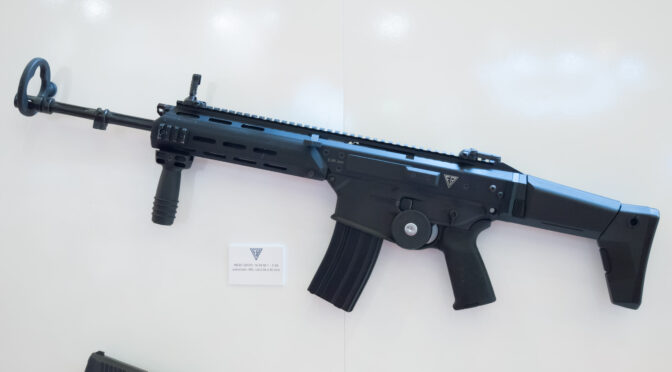
The main blog image was sourced off of Wikipedia on December 17, 2025. The photo is by VoidWanderer – Own work, CC BY-SA 4.0, https://commons.wikimedia.org/w/index.php?curid=73934680

Works cited

  1. FB Grot – Gun Wiki | Fandom, accessed December 11, 2025, https://guns.fandom.com/wiki/FB_Grot
  2. MSBS GROT – Rifles – Fabryka Broni „ŁUCZNIK”, accessed December 11, 2025, https://fabrykabroni.pl/en/en/offer/military-market/rifles/msbs-grot
  3. FB MSBS Grot – Wikipedia, accessed December 11, 2025, https://en.wikipedia.org/wiki/FB_MSBS_Grot
  4. WEAPONS: The MSBS/GROT as a civilian semi-automatic – SPARTANAT.com, accessed December 11, 2025, https://spartanat.com/en/waffen-die-msbs-grot-s16-fb-m1-als-halbautomat
  5. FB Chrome Lined Hammer Forged “Sporter” Barrel 16″ – Arms of America, accessed December 11, 2025, https://armsofamerica.com/fb-chrome-lined-hammer-forged–sporter–barrel-16-/
  6. Media Drama Over Poland’s MSBS Grot Rifle Causes National Security Concerns in Poland, accessed December 11, 2025, https://www.overtdefense.com/2021/02/20/media-drama-over-assault-rifle-causes-national-security-concerns-in-poland/
  7. MSBS GROT – CHOOSE YOUR STYLE ! – Fabryka Broni „ŁUCZNIK”, accessed December 11, 2025, https://fabrykabroni.pl/en/en/news/msbs-grot-choose-your-style
  8. MSBS GROT Mag – 5.56/.223 30rd – Polymer STANAG Mag – FB Radom, accessed December 11, 2025, https://armsofamerica.com/msbs-grot-mag-5-56-223-30rd-polymer-stanag-mag-fb-radom/
  9. Bullpup MSBS Grot and MPS pistol on the civilian market coming soon – WMasg.pl, accessed December 11, 2025, https://wmasg.com/en/articles/view/22147
  10. MSBS Grot, the Polish ambidextrous rifle that manages to rival the prestigious HK416, accessed December 11, 2025, https://www.outono.net/elentir/2023/09/14/msbs-grot-the-polish-ambidextrous-rifle-that-manages-to-rival-the-prestigious-hk416/
  11. ATF Ruling 2025-1 : Importing Dual-Use Barrels, accessed December 11, 2025, https://www.atf.gov/firearms/docs/ruling/atf-ruling-2025-1-importing-dual-use-barrels/download
  12. Importing Dual-Use Barrels Under ATF Ruling 2025-1: What FFLs Need to Know – FFLGuard, accessed December 11, 2025, https://www.fflguard.com/atf-new-ruling/
  13. GROT S16 FB-M1 carbine cal. 223Rem/5.56 16″ Geis – shop kolba.pl, accessed December 11, 2025, https://kolba.pl/en/product/76719,grot-s16-fb-m1-carbine-cal-223rem-5-56-16-geis
  14. MSBS-R – Fabryka Broni „ŁUCZNIK”, accessed December 11, 2025, https://fabrykabroni.pl/en/en/offer/military-market/representative-carbines/msbs-r
  15. Scar 16 vs CZ Bren 2 Breakdown : r/guns – Reddit, accessed December 11, 2025, https://www.reddit.com/r/guns/comments/9xw8is/scar_16_vs_cz_bren_2_breakdown/
  16. Grot to szrot – strona 25 – Aktualności, newsy, wydarzenia – Forum Odkrywcy, accessed December 11, 2025, https://forum.odkrywca.pl/topic/773111-grot-to-szrot/page/25/
  17. Grot A3 rifle presented in Poland – Militarnyi, accessed December 11, 2025, https://militarnyi.com/en/news/grot-a3-rifle-presented-in-poland/
  18. GROTowisko 2024: Grot A3 and Other Innovations – MILMAG, accessed December 11, 2025, https://milmag.pl/en/grotowisko-2024-grot-a3-and-other-innovations/
  19. Ukraine Denies MSBS Grot Rifle Order from Poland – Militarnyi, accessed December 11, 2025, https://militarnyi.com/en/news/ukraine-denies-msbs-grot-rifle-order-from-poland/
  20. Review of the MSBS Grot, the Polish Assault Rifle (Ukrainian Experience) – Rem870.com, accessed December 11, 2025, https://www.rem870.com/2025/05/12/review-of-the-msbs-grot-the-polish-assault-rifle-ukrainian-experience/
  21. The Minister of Defense of Poland announced the sale of GROT assault rifles to Ukraine, accessed December 11, 2025, https://www.reddit.com/r/ukraine/comments/11sszud/the_minister_of_defense_of_poland_announced_the/
  22. FB Radom – Beryl Rifle – 7.62×39 – Arms of America, accessed December 11, 2025, https://armsofamerica.com/fb-radom-beryl-rifle-7-62×39/
  23. MSBS-5,56 – część II – Strona 141 – – – Forum-bron.pl, accessed December 11, 2025, https://forum-bron.pl/viewtopic.php?t=187580&start=2100
  24. Opinia na temat MSBS GROT i jego poprzednika BERYLA : r/Polska – Reddit, accessed December 11, 2025, https://www.reddit.com/r/Polska/comments/1axxhvg/opinia_na_temat_msbs_grot_i_jego_poprzednika/
  25. MSBS Grot | BezPrzesady.com, accessed December 11, 2025, https://bezprzesady.com/aktualnosci/msbs-grot-dobry-czy-jeszcze-lepszy
  26. FN SCAR® 16S NRCH | FN® Firearms, accessed December 11, 2025, https://fnamerica.com/products/rifles/fn-scar-16s-nrch/
  27. CZ BREN 2 MS Carbine 16″ Barrel 5.56 Nato Rifle – Bauer Precision, accessed December 11, 2025, https://www.bauer-precision.com/cz-bren-2-ms-carbine-16-barrel-5-56-nato-rifle/
  28. I know what subreddit this is but did anyone here regret getting the scar 16? : r/FNSCAR, accessed December 11, 2025, https://www.reddit.com/r/FNSCAR/comments/1ifu5g9/i_know_what_subreddit_this_is_but_did_anyone_here/
  29. FB RADOM – Radom Firearm Products – Arms of America, accessed December 11, 2025, https://armsofamerica.com/fb-radom/

Strategic Assessment: PGM Précision – Corporate Profile, Industrial Base, and Market Trajectory

The global landscape of precision small arms manufacturing is frequently dominated by large, diversified defense conglomerates; however, the specific niche of high-performance sniper systems often favors specialized, agile entities that can iterate designs in close proximity to end-users. PGM Précision, a French manufacturer based in the Haute-Savoie region, exemplifies this “boutique industrial” model. Founded in 1991 to meet an urgent operational requirement for the French National Police’s elite RAID unit, PGM has evolved from a bespoke gunsmithing operation into a strategic supplier for the French Armed Forces and a recognized player in the international anti-materiel rifle market.

This report provides an exhaustive analysis of PGM Précision’s corporate evolution, technical philosophy, product architecture, and international distribution challenges, with a specific focus on its complex history in the United States market. Our analysis indicates that PGM’s core innovation—the skeletal “girder” chassis system—predated the modern trend of modular sniper rifles by nearly two decades, establishing a design lineage that prioritizes thermal management, field maintainability, and barrel interchangeability.

Financially and operationally, PGM represents a unique case study in the leverage of dual-use industrial capabilities. Through its structural integration with the Teissier Technique group, a precision machining firm serving the aerospace and medical sectors, PGM accesses high-tolerance manufacturing infrastructure without incurring the massive capital expenditure typically required for a standalone firearms factory. This symbiosis has allowed the company to maintain low-volume, high-quality production runs while surviving the cyclical nature of government procurement.

The report further details the company’s product diversification, from the seminal Ultima Ratio 7.62mm system to the iconic Hécate II.50 BMG anti-materiel rifle, and its recent expansion into the civilian sport shooting market with the Ludis platform. Finally, we conduct a critical examination of the company’s fragmented entry into the US market, tracing the lineage of importers from FN Herstal in the 1990s to the current exclusive arrangement with JDI Firearms, assessing the impact of these shifts on brand equity and market penetration in North America.

1. Corporate Origins and Historical Context

1.1 The Operational Vacuum: French Precision Fire (1970s–1990s)

To understand the genesis of PGM Précision, one must first analyze the tactical environment of French law enforcement and military operations in the late 1980s. During this period, the precision rifle inventory of French forces was largely reliant on aging platforms. The standard-issue military sniper rifle was the FR-F1 (and later the FR-F2), a modification of the MAS-36 infantry rifle action that, while rugged, lacked the modularity and extreme precision required for emerging counter-terrorism scenarios.1

Simultaneously, elite police intervention units such as RAID (Recherche, Assistance, Intervention, Dissuasion) were utilizing imported commercial platforms, specifically the Austrian Steyr SSG-69. While the SSG-69 was accurate, its synthetic stock and press-fit barrel made field maintenance and barrel replacement difficult, and it suffered from thermal drift during prolonged engagements. The RAID, formed to handle hostage crises and high-risk warrants, identified a critical capability gap: they needed a rifle capable of guaranteed “first-round hits” on human-sized targets at extended ranges, with a design that could sustain accuracy even after rapid transport and rough handling.1

1.2 The “Ultima Ratio” Project (1989–1991)

The solution to this capability gap did not come from a major state arsenal, but from the private sector. Gilles Payen, a self-taught gunsmith and engineer based in the French Alps, began collaborating directly with RAID marksmen (often referred to as “Omega” shooters) to develop a purpose-built platform.3 Payen’s design philosophy was radical for the time. He rejected the traditional “action-in-stock” bedding method, which relied on the interface between wood or fiberglass and steel to maintain zero.

Instead, Payen engineered a central metallic skeleton—a “girder” or chassis—to which all components were bolted. This design isolated the receiver and barrel from external stresses. The barrel was fully free-floating, and the receiver was attached to the chassis rather than bedded into a stock. This prototype, named Ultima Ratio (Latin for “The Last Resort,” a reference to the RAID’s motto “Servir sans faillir” and their role as the final option in a crisis), was submitted to competitive trials between 1989 and 1990.1

In these trials, the Payen prototype faced stiff competition, including established systems from Accuracy International (UK) and Parker-Hale. The French prototype prevailed due to its superior accuracy, rapid barrel change capability (essential for changing calibers or replacing worn tubes), and the distinct advantage of domestic supply chain security.1

1.3 Corporate Formalization (1993)

Following the delivery of the first batch of 20 rifles to RAID and a successful public debut at the 1991 MILIPOL exhibition, the need to industrialize production became apparent. Gilles Payen could no longer sustain manufacturing through artisanal methods. In 1993, PGM Précision was formally incorporated as a distinct legal entity. The name “PGM” is an acronym derived from the surnames of the three founding partners:

  • Payen: Gilles Payen (Designer and Gunsmith)
  • Gonnet: Alain Gonnet (Partner)
  • Morier: François Morier (Partner).1

This incorporation marked the transition from a bespoke workshop to a small arms manufacturer, setting the stage for the company’s expansion into the military sector.

2. Industrial Structure and Manufacturing Philosophy

2.1 The Teissier Technique Symbiosis

A defining characteristic of PGM Précision is its integration with the Teissier Technique group. PGM is not a standalone manufacturer in the traditional sense; it operates as a subsidiary within a larger precision engineering holding company.4 Teissier Technique, based in Poisy, Haute-Savoie, specializes in high-precision machining for demanding industries, including aerospace, medical technology, and robotics.5

This relationship provides PGM with a significant competitive advantage. Small arms manufacturers often struggle with the capital costs of maintaining state-of-the-art CNC (Computer Numerical Control) machinery for low-volume production. By leveraging Teissier Technique’s industrial base, PGM ensures:

  • Aerospace-Grade Tolerances: Components are machined to standards required for aviation (EN 9100 certification), ensuring complete interchangeability of parts across rifles.5
  • Material Quality: The use of 7075 aircraft-grade aluminum for receivers and high-strength alloy steels for bolts is standardized across the production line.6
  • Scalability: PGM can scale production up or down based on contract requirements by utilizing the broader capacity of the parent company, mitigating the risks of the “feast or famine” cycle typical of defense contracting.

2.2 The “Girder” Chassis Philosophy

The technical heart of PGM’s portfolio is the “poutre” or girder chassis. Unlike the monocoque designs of Accuracy International (where an alloy chassis is skinned in plastic) or the tubular receivers of the Barrett M82, PGM utilizes a central rigid alloy beam.

  • Mechanism: The receiver bolts to this beam. The stock attaches to the rear, and the bipod attaches to the front. The barrel screws into the receiver extension but touches nothing else.7
  • Thermal Management: This open architecture maximizes surface area exposure, allowing for rapid air cooling of the barrel and action. This is further enhanced by the company’s signature heavy fluting on barrels, which acts as a heat sink.7
  • Maintainability: The modular design allows for field stripping and component replacement using standard hex keys, a requirement derived from the initial RAID solicitation.8

2.3 2023 Infrastructure Expansion

In 2023, PGM Précision executed a major logistical pivot by relocating to a new facility in the Annecy region. This expansion quadrupled the available workshop space and, crucially, integrated a 100-meter indoor shooting range.1

Analyst Insight: The addition of an on-site test range is a strategic asset for a precision rifle manufacturer. Previously, quality assurance (QA) testing likely required transporting firearms to external ranges, introducing logistical delays and security overhead. An in-house range allows for immediate “shot-one” verification of every rifle leaving the assembly line, tightening the feedback loop between assembly and quality control.

3. Product Architecture and Evolution

The PGM product line is segmented by caliber and intended operational role, though all share the common DNA of the girder chassis.

3.1 The Ultima Ratio (UR) Family

The Ultima Ratio remains the company’s foundational product, serving as the standard-issue sniper rifle for French police forces and seeing export success to Brazil and Slovenia.10

  • Role: Anti-personnel precision engagement (0–1,000 meters).
  • Caliber Ecosystem: While originally designed for 7.62x51mm NATO (.308 Win), the system’s modularity has allowed it to adapt to modern ballistics. It is now offered in high-coefficient cartridges such as 6.5 Creedmoor,.260 Remington, 6mm XC, and.300 Savage.8
  • Barrel Configurations:
  • Intervention: The standard heavy barrel with heat-dissipating fins, optimized for sustained fire stability.
  • Commando: Shorter, fluted barrels (47cm and 55cm) designed for urban mobility and suppressed operations.
  • Integral Silencieux: A specialized variant with an integral suppressor for covert elimination capabilities.8
  • 2022 Modernization: In 2022, PGM released a “New Generation” Ultima Ratio. This update retrofitted the platform with ergonomic improvements derived from the Mini Hécate II, including a new bolt-side folding stock and an integrated ARCA rail system for tripod mounting—a direct response to the growing prevalence of tripod shooting in both military and PRS (Precision Rifle Series) contexts.3

3.2 The Hécate II: The Anti-Materiel Standard

If the Ultima Ratio built the company, the Hécate II made it famous. Introduced in 1995, this rifle marked PGM’s entry into the heavy caliber market and secured its status as a primary supplier to the French Army.1

  • Role: Long-range interdiction, counter-sniping, and hard-target (light vehicle/radar) destruction (1,800+ meters).
  • Engineering: Scaled up to handle the massive pressure of the.50 BMG (12.7x99mm) cartridge, the Hécate II retains the skeletal aesthetic. It features a massive high-efficiency muzzle brake that utilizes a “reverse flow” design to mitigate the punish recoil of the.50 BMG, reportedly bringing felt recoil down to levels comparable to a 7.62mm rifle.2
  • The FN Herstal Barrel: A critical component of the Hécate II’s success is its barrel, which is manufactured by FN Herstal in Belgium. These barrels are lined with Stellite (a cobalt-chromium alloy), a technology typically reserved for heavy machine guns (like the M2 Browning) to prevent throat erosion under high heat. This gives the Hécate II an exceptional barrel life of approximately 12,000 rounds, far exceeding typical sniper rifle standards.2
  • Service History: Designated the FR-12.7 by the French military, it has been deployed in the Balkans (Bosnia), Afghanistan, and the Sahel (Mali). It is the standard heavy sniper weapon of the French infantry and special forces.13

3.3 The PGM 338 (Mini Hécate I)

Launched in 2002, the PGM 338 was designed to bridge the ballistic gap between the 7.62mm Ultima Ratio and the 12.7mm Hécate II.3

  • Designer: Designed by Chris L. Movigliatti (of the Swiss company AMSD) in conjunction with PGM.16
  • Ballistics: Chambered in.338 Lapua Magnum (8.6x70mm), it offers effective engagement out to 1,400 meters. The platform was specifically engineered to handle the.338 cartridge rather than being a modified action from a smaller or larger caliber, ensuring structural integrity without excessive weight.15
  • Competition: This rifle competes directly with the Accuracy International AWM and Sako TRG-42. PGM differentiates it via the quick-change barrel system and the “heatsink” barrel profile available on the Intervention model.15

3.4 The Mini Hécate II

Introduced in 2018, this rifle represents the second generation of PGM’s intermediate caliber offerings.

  • Advancements: It features a modernized chassis with tool-free adjustments and a modular bolt system.
  • Caliber Expansion: Recognizing the shift in long-range ballistics, the Mini Hécate II supports.300 Norma Magnum,.338 Norma Magnum, and.300 PRC. In 2024, PGM introduced a variant in .375 Swiss P, a high-performance cartridge designed to offer near-.50 BMG ballistics in a man-portable.338-class rifle.18

3.5 The Ludis: Civilian Market Entry

The Ludis, launched in 2014, is a strategic pivot towards the civilian sport shooting market.

  • Design: It is a single-shot rifle (no magazine well), which simplifies the manufacturing process and potentially increases receiver rigidity.
  • Market: By removing the “tactical” magazine requirement, PGM offers the Ludis at a lower price point (~$4,850 in 2019) while offering the same barrel and trigger quality as their military lines. It targets F-Class and ELR (Extreme Long Range) competitors.3

4. Strategic Timeline of Key Events

DateEvent CategoryEvent DescriptionSource
1991R&D / FoundationGilles Payen develops the Ultima Ratio prototype for RAID to replace the Steyr SSG-69. Prototype wins trials against Accuracy International.1
1993CorporatePGM Précision is formally incorporated by Payen, Gonnet, and Morier in Haute-Savoie.1
1995Military ContractThe Hécate II (.50 BMG) is adopted by the French Army as the FR-12.7, securing the company’s future.1
1998Special ForcesThe GIGN (National Gendarmerie Intervention Group) adopts the Hécate II, replacing Barrett and McMillan rifles.21
2001Product LaunchLaunch of the Mini Hécate (Generation I), initially for Swiss police requirements.3
2002Product LaunchIntroduction of the PGM 338 (.338 Lapua Magnum) designed by Chris Movigliatti.1
2014Civilian MarketLaunch of the Ludis, a single-shot rifle dedicated to sport shooting.3
2018Product LaunchIntroduction of the Mini Hécate II, featuring updated modularity and ergonomics.3
2019US DistributionJDI Firearms (SAN Imports) signs exclusive agreement to import PGM rifles to the USA.22
2020ModernizationPGM begins upgrading French Army Hécate II fleets with new stocks and optics rails.12
2022Product UpdateLaunch of the New Generation Ultima Ratio with bolt-side folding stock; re-adopted by RAID.3
2023InfrastructureRelocation to a new, larger facility in the Annecy region with a 100m indoor range.1
2024InnovationIntroduction of.375 Swiss P caliber for Mini Hécate II and award-winning Kastinger HT4 anti-thermal fabric.1

5. United States Market Analysis: The Importation Saga

The history of PGM Précision in the United States is complex, defined by a series of shifting partnerships and the regulatory hurdles inherent in importing “non-sporting” military firearms. Unlike Accuracy International, which established a US subsidiary (Accuracy International North America), PGM has relied on third-party importers, leading to periods of unavailability and brand obscurity.

5.1 The FN Herstal Era (1990s–2000s)

In the mid-1990s, PGM secured a high-profile distribution agreement with FN Manufacturing Inc. (FNMI), the US branch of the Belgian giant FN Herstal.

  • Strategic Rationale: FN Herstal was already the barrel supplier for the Hécate II. Marketing the complete rifle system in the US allowed FN to offer a turnkey anti-materiel solution to US law enforcement and military clients without developing their own.50 BMG platform from scratch.
  • Branding: During this period, PGM rifles were often marketed under the FN brand umbrella. The Hécate II was sometimes referred to simply as the “FN Hécate.” This partnership gave PGM immediate access to US government contracts but somewhat diluted the PGM brand identity.23
  • Legacy: Rifles imported during this era are stamped with FNMI import marks and are highly collectible. The agreement eventually lapsed as FN focused on its own product lines (SCAR, FN SPR).23

5.2 The Drake Associates Era (Circa 2008–2018)

Following the FN era, Drake Associates, a specialized ballistics and sniper system firm (listed in ATF records with addresses in Shelter Island, NY), became the primary US representative.

  • Role: Drake Associates marketed PGM rifles alongside their own custom chassis systems (often using Cadex or McRee components). They positioned the PGM 338 and Hécate II as premium solutions for elite government units.10
  • Market Penetration: Drake’s reach appeared to be focused on government tenders and high-net-worth individuals rather than broad commercial retail. ATF import registry snippets confirm Drake Associates Inc. as an active importer during this period.24
  • Status: By 2018/2019, this relationship appeared to wind down as PGM sought a new partner to aggressively target the commercial sector.

5.3 The JDI Firearms / SAN Imports Era (2019–Present)

In August 2019, PGM Précision signed an exclusive importation agreement with JDI Firearms, Inc. (doing business as SAN Imports), based in Frisco, Texas.22

  • Partner Profile: JDI was an ideal cultural fit, having already established a reputation for navigating the complex import restrictions for Swiss Arms (SIG SG 550 series) rifles. Their customer base consists of high-end collectors willing to pay premiums for European military pedigree.
  • Commercial Strategy: JDI announced the importation of the full line, including the Ultima Ratio, PGM 338, Mini Hécate II, and the civilian-legal Ludis.
  • Pricing Strategy: The announced MSRPs placed PGM firmly in the “super-premium” category:
  • Ludis: Starting at ~$4,850
  • Ultima Ratio: $6,400 – $7,400
  • Mini Hécate II: ~$9,050.22
  • Current Status: JDI remains the active importer of record. However, as of late 2024/2025, inventory appears to be batch-based and sporadic. The dedicated website PGMPrecisionUSA.com, launched to support this partnership, currently redirects to general information, indicating that sales are likely handled via direct inquiry rather than a high-volume e-commerce storefront.22

5.4 “PGM Precision USA”

Recent marketing efforts, including video demonstrations with firearms historians (e.g., Forgotten Weapons in 2020), reference “PGM Precision USA”.13 This suggests a dedicated marketing front supported by JDI to raise brand awareness in a market dominated by domestic giants like Barrett and fierce competitors like Accuracy International.

6. Operational Deployment and Combat History

The reputation of PGM Précision is built not on marketing, but on field performance in harsh environments.

6.1 The Balkans: The Trial by Fire

The Hécate II was fast-tracked into service during the Yugoslav Wars in the mid-1990s. French peacekeepers in Bosnia faced “Sniper Alley” scenarios where they were targeted by irregular forces. The Hécate II provided French snipers with the ability to engage targets behind masonry and light cover at standoff ranges, establishing a psychological deterrent against enemy marksmen.1

6.2 Afghanistan: ISAF Operations

During the War in Afghanistan, French troops (including the 2nd Foreign Parachute Regiment) deployed the Hécate II extensively. The rifle’s range (1,800m+) was crucial in the mountainous terrain of Kapisa and Surobi, where engagement distances frequently exceeded the effective range of the 7.62mm FR-F2.2 The PGM 338 also saw limited use, validating the need for an intermediate caliber in open terrain.28

6.3 The Sahel: Operation Serval and Barkhane

In the arid environments of Mali and the Sahel, the PGM rifles demonstrated their resistance to sand and heat. The “girder” chassis allowed for easy cleaning of sand from the mechanism, a distinct advantage over enclosed actions. The Hécate II was used for anti-materiel roles, disabling VBIEDs (Vehicle-Borne Improvised Explosive Devices) at safe distances.2

6.4 International Users

Beyond France, PGM rifles are used by:

  • Switzerland: Police forces (Mini Hécate, PGM 338).
  • Brazil: Marine Corps Special Operations (Ultima Ratio).
  • Poland, Slovenia, Baltic States: Various special units have adopted PGM platforms for their NATO compatibility and precision.2

7. Competitive Landscape and Industry Outlook

7.1 Competitive Analysis

PGM Précision competes in the rarefied air of the “Tier 1” sniper market.

FeaturePGM PrécisionAccuracy International (UK)Barrett Firearms (USA)
Design PhilosophySkeletal Girder Chassis (Open)Bonded Alloy Chassis (Skinned)Monolithic Upper Receiver
Primary ActionBolt-Action (3-lug)Bolt-Action (6-lug)Semi-Auto & Bolt
Barrel Life (.50 BMG)~12,000 rds (Stellite)Standard Chrome/SteelStandard Steel
Recoil ManagementReverse-Flow Brake (High Efficiency)Standard BrakeRecoil Barrel Op (M82/M107)
US Market PresenceNiche / Collector / BoutiqueHigh / InstitutionalDominant / Standard Issue

Analyst Insight: PGM’s competitive edge lies in the barrel life of the Hécate II and the thermal stability of its open chassis. However, it faces a disadvantage in economies of scale. Barrett and AI hold massive government contracts (e.g., US ASR, Mk22) that allow them to amortize R&D costs and lower unit prices. PGM remains a high-cost, low-volume option for units that prioritize specific ergonomic or ballistic traits over cost-efficiency.

7.2 Future Trajectory (2025 and Beyond)

  • Caliber Innovation: The adoption of the .375 Swiss P cartridge positions PGM at the forefront of the “hyper-velocity” sniper trend, offering flat trajectories that outperform the.338 Lapua without the bulk of a.50 BMG.18
  • Signature Management: The award-winning Kastinger HT4 fabric partnership highlights a shift toward survivability. In an era of thermal drone surveillance, a rifle that holds zero is useless if the sniper is detected by a thermal imager. PGM is integrating anti-thermal solutions directly into the weapon system ecosystem.1
  • Civilian Growth: The Ludis represents a vital revenue stream diversification. As military contracts are cyclical, the high-end sport shooting market provides a steady baseline of demand.

8. Conclusion

PGM Précision serves as a case study in the viability of specialized defense manufacturing. By resisting the urge to mass-produce and instead focusing on the specific, uncompromising needs of elite units like RAID, PGM has cultivated a brand mystique that equates “French Engineering” with “Precision.” While its US market presence has been hamstrung by regulatory friction and inconsistent representation, the company’s industrial fundamentals—anchored by the Teissier Technique group—remain robust. As warfare evolves toward longer ranges and higher thermal stealth requirements, PGM’s open-chassis philosophy appears prescient, ensuring the company remains a relevant, albeit niche, player in the global arms industry.


Table 1: Technical Specifications of Key PGM Précision Platforms

ModelClassificationCalibersWeight (Unloaded)Barrel LengthKey Feature
Ultima RatioAnti-Personnel.308 Win, 6.5 CM,.260 Rem47cm – 60cm~6.5 kg30-sec barrel change; bolt-side folder
Hécate IIAnti-Materiel.50 BMG (12.7×99),.416 Barrett~13.8 kg700mmStellite-lined barrel; Reverse-flow brake
PGM 338Long Range AP.338 Lapua Magnum~6.5 – 7.3 kg690mmGap-filler capability; 1,400m range
Mini Hécate IIModular Sniper.338 LM,.300 NM,.375 Swiss P6.7 – 8.1 kg60cm – 76cmMulti-caliber chassis; compact folding
LudisSport / CivilianMulti (Short & Long Action)~6.0 kgVariableSingle-shot action; simplified furniture

Please share the link on Facebook, Forums, with colleagues, etc. Your support is much appreciated and if you have any feedback, please email us in**@*********ps.com. If you’d like to request a report or order a reprint, please click here for the corresponding page to open in new tab.


Sources Used

  1. PGM Précision – Grokipedia, accessed December 6, 2025, https://grokipedia.com/page/PGM_Pr%C3%A9cision
  2. PGM Hécate II – Wikipedia, accessed December 6, 2025, https://en.wikipedia.org/wiki/PGM_H%C3%A9cate_II
  3. Our story – PGM Precision, accessed December 6, 2025, https://www.pgmprecision.com/en/our-story/
  4. PGM Précision – Wikipédia, accessed December 6, 2025, https://fr.wikipedia.org/wiki/PGM_Pr%C3%A9cision
  5. Mécanique de précision à Annecy – Teissier technique, accessed December 6, 2025, https://www.teissier-technique.com/mecanique-precision-annecy/
  6. The PGM Précision quality, accessed December 6, 2025, https://www.pgmprecision.com/en/the-pgm-precision-quality/
  7. PGM Hécate II | Gun Wiki – Fandom, accessed December 6, 2025, https://guns.fandom.com/wiki/PGM_H%C3%A9cate_II
  8. Ultima Ratio – PGM Précision, accessed December 6, 2025, https://www.pgmprecision.com/en/product/ultima-ratio/
  9. catalogue-pgm-precision-2024-2025.pdf, accessed December 6, 2025, https://www.pgmprecision.com/wp-content/uploads/2025/04/catalogue-pgm-precision-2024-2025.pdf
  10. Brazil’s PGM Sniper Rifles: The Ultima Ratio & Hecate II – Athlon Outdoors, accessed December 6, 2025, https://athlonoutdoors.com/article/brazils-pgm-sniper-rifles/
  11. PGM Ultima Ratio – Wikipedia, accessed December 6, 2025, https://en.wikipedia.org/wiki/PGM_Ultima_Ratio
  12. PGM Précision: upgrading French sniper rifles – EDR Magazine, accessed December 6, 2025, https://www.edrmagazine.eu/pgm-precision-upgrading-french-sniper-rifles
  13. PGM Hecate II: A Battle-Hardened .50 Caliber Sniper Rifle – History of Weapons & War, accessed December 6, 2025, https://www.weaponsandwar.tv/videos/pgm-hecate-ii-a-battle-hardened-50-caliber-sniper-rifle
  14. PGM Hécate II | Military Wiki – Fandom, accessed December 6, 2025, https://military-history.fandom.com/wiki/PGM_H%C3%A9cate_II
  15. PGM 338 – Weaponsystems.net, accessed December 6, 2025, https://weaponsystems.net/system/1336-PGM+338
  16. PGM 338 – Wikipedia, accessed December 6, 2025, https://en.wikipedia.org/wiki/PGM_338
  17. PGM 338 | Gun Wiki – Fandom, accessed December 6, 2025, https://guns.fandom.com/wiki/PGM_338
  18. PGM Mini-Hecate II Bolt-Action Sniper Rifle – Military Factory, accessed December 6, 2025, https://www.militaryfactory.com/smallarms/detail.php?smallarms_id=1285
  19. Techterre 2025 – PGM Precision, accessed December 6, 2025, https://www.pgmprecision.com/en/techterre-2025/
  20. Ludis – PGM Précision, accessed December 6, 2025, https://www.pgmprecision.com/en/product/pgm-ludis/
  21. The Company French Tool for Long-Range Operations – Small Arms Defense Journal, accessed December 6, 2025, https://sadefensejournal.com/the-company-french-tool-for-long-range-operations/
  22. JDI Firearms, Inc. dba SAN Imports Signs with PGM Precision of France – Soldier Systems, accessed December 6, 2025, https://soldiersystems.net/2019/08/02/jdi-firearms-inc-dba-san-imports-signs-with-pgm-precision-of-france/
  23. PGM Precision/FN Herstal Ultima Ratio Bolt Action Sniper Rifle | Rock Island Auction, accessed December 6, 2025, https://www.rockislandauction.com/detail/80/601/pgm-precisionfn-herstal-ultima-ratio-bolt-action-sniper-rifle
  24. Sheet1 – ATF, accessed December 6, 2025, https://www.atf.gov/file/111671/download
  25. Sheet1 – ATF, accessed December 6, 2025, https://www.atf.gov/file/128441/download?destination=file/128441/download
  26. JDI Firearms, Inc/SAN Imports Signs Import Agreement with France’s PGM Precision, accessed December 6, 2025, https://www.thefirearmblog.com/blog/2019/08/09/jdi-firearms-inc-san-imports-signs-import-agreement-withpgm-precision-of-france/
  27. JDI Firearms, Inc. – San Swiss Arms, accessed December 6, 2025, https://swissarmsusa.com/
  28. The PGM Hecate II .50BMG anti-materiel rifle | thefirearmblog.com, accessed December 6, 2025, https://www.thefirearmblog.com/blog/2017/06/12/pgm-hecate-ii-50bmg-anti-materiel-rifle/

Alpha Foxtrot Firearms: Analyzing the New Hybrid Manufacturer

The United States small arms market is undergoing a structural shift characterized by the “hybridization” of manufacturing supply chains. Historically bifurcated into purely domestic manufacturers (e.g., Colt, Smith & Wesson) and direct importers (e.g., Glock, Beretta), the market has recently seen the rise of transnational manufacturing ecosystems. In this model, foreign industrial conglomerates leverage global supply chain efficiencies for primary component fabrication while maintaining domestic United States facilities for final machining, assembly, and compliance. Alpha Foxtrot (AF), a subsidiary of the South Korean defense giant Dasan Machineries operating out of Duluth, Georgia, represents a paradigmatic case study of this emerging operational model.

This comprehensive intelligence report provides an exhaustive analysis of the Alpha Foxtrot brand, dissecting its corporate genealogy, industrial capabilities, product portfolio evolution, and standing within the consumer marketplace. The analysis confirms that Alpha Foxtrot is not a startup in the traditional sense, but rather the vertically integrated, consumer-facing storefront for Dasan Machineries—a Tier 1 global Original Equipment Manufacturer (OEM) responsible for the underlying architecture of numerous high-profile Western firearms.

The investigation reveals a brand defined by a distinct dichotomy: exceptional metallurgical quality and machining precision—derived directly from Dasan’s rigorous defense contracting background—contrasted against a developing civilian support infrastructure and a warranty policy that currently lags behind the “lifetime” standard established by domestic legacy brands. The report identifies the Alpha Foxtrot AF1911-S15 and Romulus platforms as disruptive entries in the double-stack 1911 market, offering material specifications (forged frames, DLC finishes) typically reserved for custom firearms at production-level pricing.

However, consumer confidence assessments highlight significant friction points, particularly concerning the use of Metal Injection Molded (MIM) internal components and a restrictive one-year limited warranty. These factors create hesitation among institutional and enthusiast buyers accustomed to the comprehensive support networks of established competitors like Springfield Armory or Staccato. Despite these consumer-facing hurdles, the industrial backing of a massive parent company suggests high long-term viability and solvent manufacturing capacity.

This report concludes that Alpha Foxtrot represents a statistically secure acquisition for consumers who prioritize “hard” qualities—such as base-material integrity, slide-to-frame fitment, and surface treatment—over “soft” qualities like extended warranty coverage or brand heritage. The analysis suggests that as Alpha Foxtrot matures its US operations, it is poised to transition from a niche OEM-direct label to a primary competitor in the sub-$2,000 performance pistol segment, provided it can successfully navigate the reputational challenges inherent in establishing a new identity in a saturated market.

1. Corporate Identity and Industrial Origins

To accurately assess the viability and quality of Alpha Foxtrot firearms, one must first look past the US branding to analyze the industrial powerhouse that underpins it. Alpha Foxtrot is not an independent assembler sourcing parts from the lowest bidder; it is the strategic retail arm of Dasan Machineries, a mature South Korean defense conglomerate with a global operational footprint.

1.1 Parent Company: Dasan Machineries Co., Ltd.

Dasan Machineries, established in 1992 and headquartered in Wanju, Jeollabuk-do, South Korea, serves as the industrial bedrock for the Alpha Foxtrot brand.1 Unlike consumer-focused firearms companies that prioritize marketing, Dasan functions primarily as a heavy industrial manufacturer. Its operational scope extends far beyond small arms, encompassing precision automotive components and complex investment casting for heavy industry.2 This diversification is critical for analyst assessment as it indicates a level of capitalization and manufacturing resilience that pure-play firearms companies often lack.

1.1.1 Defense Contracting Pedigree and Quality Standards

Dasan’s reputation in the global arms trade is built on its status as a government-approved defense contractor for the Republic of Korea (ROK) Armed Forces.2 The company has been instrumental in the manufacturing of varied platforms for military use, including the K1A and K2 service rifles, and has developed modern export platforms such as the DSAR-15 (an AR-15 variant) and DAK-47 (AKM variant).4

The implications of this military background for the US commercial consumer are profound. It implies that the manufacturing protocols utilized for Alpha Foxtrot’s civilian wares are derived from military-specification (Mil-Spec) requirements. Dasan operates under stringent quality control certifications, specifically ISO 9001 (Quality Management), ISO 14001 (Environmental Management), and TS 16949 (Automotive Quality), alongside the National Defense Quality Management System.2 This creates a manufacturing culture centered on dimensional consistency and interchangeability—traits that are often variable in the civilian “boutique” firearms market.

1.1.2 The “Ghost Manufacturer” Role

For three decades, Dasan functioned primarily as a “ghost manufacturer”—producing white-label components (barrels, slides, frames, and small internal parts) for other branded firearms companies without consumer recognition. Industry analysis of import records and corporate disclosures indicates that Dasan supplies components to major US and European brands. Research snippets identify Dasan as one of the largest producers of firearms components for the US commercial market, leveraging its Korean foundries to feed the American appetite for small arms.6

This OEM (Original Equipment Manufacturer) history provides Alpha Foxtrot with a significant asymmetric advantage: deeply entrenched manufacturing maturity. While the brand “Alpha Foxtrot” may appear new to the consumer, the production lines, tooling, and engineering teams behind it possess decades of institutional memory regarding the 1911 and Glock platforms.3 This mitigates the “beta tester” risk typically associated with new firearms manufacturers, as the core components have likely been field-proven under other brand names for years.

1.2 The US Subsidiary: Dasan USA and the Birth of Alpha Foxtrot

Recognizing the diminishing returns of strictly OEM work—where margins are razor-thin compared to retail sales—Dasan moved to capture the higher value of the retail market by establishing a dedicated US presence.

1.2.1 Establishment and Infrastructure Investment

Dasan USA was established around 2011/2012, initially functioning as the logistical hub for its OEM contracts.1 Unlike many importers who operate out of administrative suites or small warehousing units, Dasan invested in substantial industrial capacity. The company operates an 80,000-square-foot manufacturing facility in Duluth, Georgia.8

This facility is not merely a warehouse for finished goods. It is a Type 07 Federal Firearms License (Manufacturer) holder, equipped with advanced CNC machining centers to perform final milling, finishing, and assembly of forgings imported from the Korean parent.9 This investment signifies a long-term commitment to the US market, distinct from the transient nature of pure importers who can easily exit the market if exchange rates fluctuate.

1.2.2 Brand Launch and Evolution

While Dasan USA operated quietly as a business-to-business (B2B) entity for years, the “Alpha Foxtrot” brand appears to be a more recent distinct marketing push, gaining significant traction around 2020-2022. This timing correlates with the industry-wide demand surge during the COVID-19 pandemic and the subsequent normalization of the market.11 The branding strategy—separating the B2B OEM identity (Dasan) from the B2C retail identity (Alpha Foxtrot)—is a calculated move to prevent channel conflict. It allows Dasan to supply parts to competitors (like Springfield Armory) while simultaneously competing against them with the Alpha Foxtrot line, maintaining a plausible deniability of direct competition.6

2. Manufacturing Capabilities and The Hybrid Ecosystem

The core value proposition of Alpha Foxtrot lies in its manufacturing ecosystem. The analysis suggests a hybrid manufacturing model where raw metallurgy and forging occur in South Korea—leveraging the parent company’s heavy industrial foundries—while high-precision final machining, surface finishing, and assembly occur in the United States. This model aims to combine the cost efficiencies of Asian steel production with the regulatory compliance and “Made in USA” appeal of domestic manufacturing.

2.1 The Forging Advantage: Metallurgy as a Differentiator

In the crowded 1911 market, frame manufacturing methods are a primary differentiator. Most budget-tier 1911s (e.g., Rock Island Armory, Tisas) utilize investment cast frames to reduce costs. Casting, while adequate, can suffer from porosity and lower tensile strength compared to forged counterparts.

Alpha Foxtrot leverages Dasan’s heavy industrial capabilities to utilize forged metal as a standard baseline. The AF1911-S15 and Romulus platforms utilize frames machined from forged 7075-T6 aluminum and slides forged from 416 stainless steel.9 Forging compresses the grain structure of the metal, aligning it with the shape of the part, which results in superior strength-to-weight ratios and fatigue resistance. This is a direct benefit of the parent company’s defense background, where forging is the standard for military durability requirements. By owning the forge in Korea, Dasan can supply Alpha Foxtrot with raw forgings at a cost basis significantly lower than domestic US competitors who must purchase forgings from third-party vendors.

2.2 Advanced Surface Treatments: The DLC Standard

A recurring theme in technical reviews and user feedback regarding Alpha Foxtrot firearms is the ubiquity of Diamond-Like Carbon (DLC) finishes.9 DLC is a nanocomposite coating that exhibits extreme micro-hardness (often exceeding 3000 Vickers) and a very low coefficient of friction.

  • Operational Impact: The use of polished DLC on slides and barrels results in a “glassy” action feel often cited by reviewers.9 This slickness reduces the reliance on heavy lubrication and improves the cycling reliability of the firearm, particularly during the break-in period.
  • Economic Signaling: DLC is historically a premium feature, typically reserved for high-end custom guns (e.g., Staccato, Atlas Gunworks) or offered as an expensive upgrade. Finding high-quality, polished DLC application on production guns in the $1,200–$1,500 range indicates that Dasan possesses in-house PVD (Physical Vapor Deposition) coating chambers. This vertical integration allows them to offer premium finishes at below-market rates, creating a significant “value-add” for the consumer compared to the standard Cerakote or Parkerized finishes found on competitors like the Springfield Prodigy.14

2.3 The MIM Controversy: Cost Control vs. Durability

While the frames and slides represent high-end manufacturing, deep analysis of consumer feedback and technical teardowns reveals the extensive use of Metal Injection Molded (MIM) parts for internal lockwork, specifically the sear, disconnector, and hammer.13

  • Industry Context: MIM is standard practice in mass-production firearms, used extensively by major brands like Kimber, Springfield Armory, and SIG Sauer to reduce the cost of complex small parts. However, in the 1911 enthusiast community, MIM is often viewed with skepticism due to historical instances of inconsistent densities leading to premature breakage.
  • Analyst Assessment: The presence of MIM in Alpha Foxtrot pistols is a clear cost-control measure that allows the company to maintain the $1,500 price point while investing heavily in the slide/frame fitment and DLC finish. While some “power users” plan to preemptively replace these parts with machined tool steel 18, the reports of actual MIM failure in Alpha Foxtrot guns are statistically low. The trade-off is calculated: Alpha Foxtrot prioritizes the “macro” build quality (slide-to-frame fit, barrel lockup, finish) over the “micro” material of internal controls, assuming most users will never reach the round counts required to fail a modern MIM part.9

2.4 Machining Precision and Assembly

Reviewers consistently note the tightness of the slide-to-frame fit on Alpha Foxtrot pistols, often comparing it favorably to pistols costing significantly more.9 This suggests that the Duluth facility is not merely bolting parts together but is performing precision CNC operations to mate the slide and frame rails. The use of “bull barrels” (bushing-less design) further emphasizes a focus on lockup consistency and accuracy.9 The capability to hold these tolerances is likely a direct result of the capital investment in modern multi-axis CNC machinery at the Georgia plant, funded by the parent company’s deep pockets.

3. Product Line Evolution and Market Positioning

Alpha Foxtrot has strategically positioned itself to bridge the gap between “Budget Import” (e.g., Tisas, Girsan) and “American Semi-Custom” (e.g., Dan Wesson, Staccato). Their product evolution shows a distinct trend towards modernizing classic platforms with features relevant to the current concealed carry and tactical markets.

3.1 The AF1911-S15: A Hybrid Innovation

The launch of the AF1911-S15 marked the brand’s attempt to solve a specific market inefficiency: the low capacity of officer-sized 1911s. Traditional compact 1911s hold only 7 or 8 rounds of 9mm.

  • Design Philosophy: Alpha Foxtrot designed a 1911 frame specifically around the geometry of the Shield Arms S15 magazine. The S15 magazine was originally designed to upgrade the Glock 43X/48 to a 15-round capacity. By adopting this third-party magazine standard, Alpha Foxtrot achieved a 15-round capacity in a subcompact frame width (approx. 1.125 inches), a feat impossible with standard double-stack 1911 magazines.9
  • Market Impact: This product demonstrated that Alpha Foxtrot was capable of R&D innovation, not just cloning legacy designs. It caters to a specific niche: the concealed carry practitioner who prefers the crisp single-action trigger of a 1911 but demands the capacity of a modern striker-fired polymer pistol.12
  • Technical Note: The use of a magazine designed for a different platform (Glock) in a 1911 requires precise engineering of the mag catch and feed ramp geometry. Reports indicate high reliability, validating the engineering success of this hybrid design.14

3.2 The Romulus: Democratizing the 2011

The “Romulus” line represents Alpha Foxtrot’s entry into the burgeoning “2011” (double-stack 1911) market. This sector has exploded in popularity, driven by the Staccato 2011, but faces a high barrier to entry due to cost.

  • Features: The Romulus utilizes a distinct modular architecture: a steel sub-frame (chassis) mated to a polymer grip module. This aligns with the modern 2011 design ethos found in the Staccato and Springfield Prodigy.20
  • Competitive Analysis: Priced around $1,500–$1,600, the Romulus undercuts premium brands like Staccato by nearly $1,000 while competing directly with the Springfield Prodigy. Reviewers and owners consistently note that the slide-to-frame fit of the Romulus is tighter than early production Prodigies, and the DLC finish is superior to the Prodigy’s Cerakote. This positions the Romulus as a “value leader” for shooters wanting to enter the 2011 ecosystem without the premium price tag.17
  • Grip Module: The use of a polymer grip module reduces weight and cost compared to aluminum or steel grips. However, some users have noted the desire for aftermarket aluminum grips, which highlights the upgrade-centric nature of the 2011 customer base.22

3.3 The DSP9C: Forged Aluminum Glock Clone

The DSP9C is a Glock Gen 3 clone utilizing a forged aluminum frame rather than the standard polymer.23 This targets a specific niche of shooters who prefer the Glock manual of arms and parts compatibility but dislike the flex, balance, and “cheap” feel of polymer frames.

  • Manufacturing Flex: This product highlights Dasan’s machining capacity. Milling aluminum frames is significantly more capital-intensive and time-consuming than injection molding polymer. Offering this product at a competitive price point ($900 range) underscores the efficiency of their manufacturing pipeline.

4. Supply Chain, Importation, and The OEM Connection

Understanding who brings these firearms into the US and how they get here is critical for assessing the long-term support and legal stability of the brand.

4.1 FFL Licensing and Regulatory Status

Publicly available Federal Firearms License (FFL) records confirm the legal structure of the operation in Duluth, Georgia. The licenses held provide a roadmap of their operations.

  • License Holder: Dasan USA Inc. / Lithgow Arms USA / Alpha Foxtrot.24
  • License Types:
  • Type 08 (Importer): This license allows Dasan USA to import firearms and ammunition.24 This covers the importation of raw forgings, frames, and likely complete OEM units for other contracts.
  • Type 07 (Manufacturer): This license allows for the manufacturing and assembly of firearms.25 This is the critical component for Alpha Foxtrot. It allows them to import components (like raw forgings) and perform the requisite amount of machining and assembly in the US to legally mark the firearms as “Made in USA” or “Assembled in USA,” and to comply with 922(r) restrictions if applicable.

4.2 The Springfield Armory Connection: Forensic Analysis

A critical insight for the industry analyst is the likely relationship between Dasan and Springfield Armory. While nondisclosure agreements typically obscure these relationships, import data and physical evidence strongly suggest a link.

  • Evidence: Import records explicitly show Dasan Machineries shipping “Frames and Receivers” to Springfield Armory.26
  • Implication: It is highly probable that Dasan acts as the OEM (or at least a primary component supplier) for lines such as the Springfield Prodigy or other 1911 variants. The structural similarities between the Springfield Prodigy and the Alpha Foxtrot Romulus (modular double-stack 1911s) are notable. If Alpha Foxtrot is effectively selling the “factory direct” version of platforms they build for major American brands, it validates the manufacturing quality. It suggests that the Romulus is built on the same industrial backbone as the Prodigy but finished to Dasan’s own specifications (DLC vs Cerakote).16
  • Strategic Divergence: While they share DNA, the brands diverge in support. Springfield offers a lifetime warranty and massive marketing support; Alpha Foxtrot offers a one-year warranty and superior base finishes. This is the classic “Brand vs. Manufacturer” trade-off.

4.3 Global Supply Chain Logistics

The supply chain relies on the Trans-Pacific pipeline between Busan, South Korea, and Savannah, Georgia (likely port of entry for Duluth). This exposes the company to risks associated with global shipping costs and tariffs. However, the volume of Dasan’s exports (automotive + defense) likely allows them to negotiate favorable freight rates, insulating Alpha Foxtrot somewhat from logistics inflation.

5. Reputation Assessment: Quality, Reliability, and Service

To determine if US consumers should be confident in the brand, we must analyze the divergence between product quality (the physical object) and service reputation (the company support).

5.1 Quality Control (QC) Reputation

  • Fit and Finish: The consensus among professional reviewers and owners is that the machining quality is disproportionately high for the price point. The DLC finishes, barrel crowning, and 30 LPI (lines per inch) checkering are consistently praised as superior to competitors like Bul Armory or Springfield.9 The “smoothness” of the action is a recurring accolade.
  • Reliability: The S15 and Romulus platforms are generally reported as reliable with varied ammunition, including hollow points, which can be a stumbling block for 1911s.9
  • The “Cracked Frame” Case Study: A notable incident on social media involved users reporting what appeared to be cracks in the aluminum frame near the magazine catch. Upon investigation by the community and the manufacturer, these were identified as machining relief cuts or cosmetic imperfections in the casting/forging cleanup, not structural failures.28 This incident highlights a vulnerability: while the engineering is sound, cosmetic QC on non-visible areas (internals) may occasionally lack the polish of a $4,000 custom gun, leading to consumer alarm.

5.2 Customer Service and Warranty: The Achilles Heel

This is the area of highest risk and friction for the potential consumer.

  • Warranty Policy: Alpha Foxtrot offers a one-year limited warranty.30 In an industry where competitors like Springfield Armory, Vortex, and other major brands offer lifetime warranties (often transferable), a one-year term is a significant competitive disadvantage. It reflects a B2B defense contractor mindset—where warranties are finite contractual terms—rather than a B2C consumer mindset, where lifetime support is a marketing tool.
  • Service Responsiveness: Reports are mixed. Some users report unresponsive email channels regarding QC issues, citing delays or lack of communication.29 Others report rapid turnaround times and effective repairs.17 This inconsistency suggests a small support staff that can easily be overwhelmed, lacking the robust CRM (Customer Relationship Management) infrastructure of a legacy brand.
  • Parts Availability: The proprietary nature of some parts (e.g., the S15 trigger bow or specific Romulus grip modules) combined with a potentially fragile support network creates anxiety about long-term ownership.13 If the US subsidiary were to downsize, sourcing replacement parts could become difficult.

6. Consumer Confidence Verdict

Should US consumers be confident in buying firearms from Alpha Foxtrot?

Verdict: Yes, with specific caveats for the informed buyer.

6.1 The “Buy” Argument

  1. Industrial Backing: This is not a “fly-by-night” startup assembling parts in a garage. It is backed by a massive defense conglomerate with decades of stability. The risk of the parent company vanishing is near zero.
  2. Value for Money: The consumer is paying for high-grade forged metallurgy and DLC finishing that usually costs 50% more in other brands. You are essentially buying OEM-grade hardware without the marketing markup (“brand tax”) of major US heritage brands.
  3. Innovation: The S15 magazine utilization is a genuine innovation that solves a real problem for concealed carry 1911s, offering class-leading capacity.

6.2 The Risk Factors

  1. The Warranty Gap: The one-year warranty leaves the consumer exposed to long-term defects. Buyers should be comfortable with the idea of paying a local gunsmith for repairs after the first year, viewing it as a maintenance cost offset by the lower purchase price.
  2. Proprietary Parts Ecosystem: While largely based on the 1911 platform, key components are proprietary. Users must rely on AF for specific replacements.
  3. Resale Liquidity: As a newer brand without the name recognition of Colt or Kimber, Alpha Foxtrot firearms may suffer steeper depreciation on the used market. Dealers may be hesitant to offer high trade-in values for a brand they are less familiar with.

7. Comparative Analysis Tables

Table 1: Alpha Foxtrot vs. Primary Competitors (Double-Stack 9mm)

The following table contrasts the Alpha Foxtrot Romulus against its direct market competitors to aid in comparative value assessment.

FeatureAlpha Foxtrot (Romulus)Springfield Armory (Prodigy)Bul Armory (SAS II)Staccato (P / C2)
OriginS. Korea / USA (GA)USA / S. Korea (OEM*)IsraelUSA (TX)
Frame MaterialForged 7075-T6 / SteelForged Steel / PolymerAluminum / SteelSteel / Aluminum
Standard FinishPolished DLCCerakotePVD / BlueDLC / PVD
Grip ModulePolymer (Alum. avail)PolymerPolymerPolymer
Magazine Compatibility2011 Style2011 Style (DuraMag)Proprietary 20112011 Style
Internal PartsMIM (Ignition)MIM (Ignition)Some MIMTool Steel
Warranty1 Year LimitedLifetime1 Year LimitedLifetime
Price Tier$1,300 – $1,600$1,400 – $1,600$1,500 – $1,800$2,500+
Market ConsensusSuperior finish; tight fit; poor warranty.Good platform; early reliability issues; great warranty.Excellent trigger; stock scarcity; poor warranty.The Gold Standard; high cost; high reliability.

*Springfield Prodigy frames are widely believed to be sourced from Dasan Machineries based on import data.

Table 2: Alpha Foxtrot Product Family Overview

ModelCore ConceptTarget AudienceKey Differentiator
AF1911-S15Hybrid Compact 1911Concealed Carry (CCW)Uses Glock-pattern Shield Arms S15 mags for 15rd capacity in slim frame.
RomulusDouble-Stack 1911 (2011)Tactical / CompetitionHigh-end DLC finish and tight fitment at entry-level 2011 pricing.
AF1911Traditional 1911Purists / CollectorsForged frame/slide construction with modern DLC finish.
DSP9CGlock 19/43 CloneHybrid ShootersForged Aluminum frame (vs. Polymer) offering metal gun feel with Glock controls.

8. Conclusion

Alpha Foxtrot is a formidable “sleeper” in the US firearms market. It represents the maturation of the South Korean defense industry’s pivot to the American commercial sector, following a path similar to the automotive industry’s evolution decades ago. For the knowledgeable firearms enthusiast who values material science (forged frames, DLC coatings) over brand heritage, Alpha Foxtrot offers exceptional value. The firearms are built in a state-of-the-art facility in Georgia by a company that possesses the institutional knowledge of a global defense contractor.

However, the brand is currently hindered by a warranty policy that signals a lack of confidence in long-term durability, even if the manufacturing data suggests otherwise. The disconnect between the “Lifetime Quality” of the product and the “One Year” support of the company is the primary barrier to mass adoption. Until Alpha Foxtrot expands its warranty coverage to match industry leaders, it will likely remain an “enthusiast’s secret”—a high-performance option for those willing to self-insure against long-term issues.

Final Recommendation:

  • For the Tinkerer/Enthusiast: Highly Recommended. The base components (slide, frame, barrel) are of custom-grade quality. Replacing MIM internals with tool steel yields a pistol that rivals $3,000 custom builds.
  • For the Casual User: Recommended with Caution. The gun will likely perform flawlessly, but the lack of a lifetime safety net requires an acceptance of potential future repair costs.
  • For Institutional/Duty Use: Not Recommended until the warranty and support infrastructure matures to guarantee long-term serviceability.

Appendix A: Assessment Methodology

A.1 Research Objectives

The primary objective of this report was to deconstruct the Alpha Foxtrot brand to understand its true origins, manufacturing validity, and consumer risk profile. The research aimed to penetrate marketing materials to identify the OEM origins and supply chain realities of the company, specifically investigating the “Dasan Machineries” connection.

A.2 Data Sources and Verification

To ensure high-confidence conclusions, a multi-source intelligence approach was utilized, triangulating data from three distinct vectors:

  1. Corporate Registry & Regulatory Analysis:
  • FFL Databases: Reviewed publicly available Federal Firearms License records to verify the legal status, location, and license types (07 vs 08) of Dasan USA and Alpha Foxtrot.24
  • Import/Export Data: Analyzed shipping manifests and trade data aggregators (ImportInfo, Volza) to track the flow of “frames and receivers” from South Korea to the US, establishing the OEM relationship with Springfield Armory.26
  • Trademark Filings: Verified the timeline of brand establishment through trademark registries.31
  1. Technical Specification Review:
  • Material Science: Compared declared materials (7075-T6, 416R Stainless) against industry standards.
  • Feature Analysis: Evaluated the implementation of DLC coatings and MIM parts to assess the cost-to-value ratio.
  1. Sentiment & Reputation Analysis:
  • Aggregated User Feedback: Systematically reviewed qualitative data from high-traffic enthusiast hubs (Reddit r/2011, 1911Addicts, YouTube reviews). This helped identify recurring QC themes (e.g., the “cracked frame” confusion) and service response times.
  • Professional Reviews: Analyzed editorial content from established firearms publications (Handguns Mag, TFB) to benchmark performance claims against independent testing.

A.3 Limitations

  • OEM Contract Secrecy: Exact manufacturing contracts between Dasan and other US brands (like Springfield) are protected by strict Non-Disclosure Agreements (NDAs). Connections in this report are inferred from import data and forensic design similarities rather than official confirmation.
  • Long-Term Durability Data: As Alpha Foxtrot is a relatively new consumer brand (post-2020), multi-year high-round-count data (50,000+ rounds) is statistically scarce compared to legacy brands that have been in the market for decades.

A.4 Risk Assessment Framework

The “Consumer Confidence” verdict was derived using a weighted risk assessment:

  • Financial Stability (Low Risk): Parent company size and diversity.
  • Manufacturing Quality (Low Risk): ISO certifications and defense background.
  • Support Infrastructure (High Risk): Warranty terms and small US staff size.
  • Parts Availability (Medium Risk): Proprietary components vs. standard 1911 compatibility.

Please share the link on Facebook, Forums, with colleagues, etc. Your support is much appreciated and if you have any feedback, please email us in**@*********ps.com. If you’d like to request a report or order a reprint, please click here for the corresponding page to open in new tab.


Sources Used

  1. Company – DASAN MACHINERIES CO., LTD., accessed December 12, 2025, https://www.da-san.co.kr/eng/intro001.asp
  2. Firearms Product – DASAN MACHINERIES CO., LTD., accessed December 12, 2025, https://www.da-san.co.kr/eng/product001.asp
  3. ABOUT US – Alpha Foxtrot, accessed December 12, 2025, https://alphafoxtrot.us/about-us/
  4. DASAN MACHINERIES CO., LTD., accessed December 12, 2025, https://www.da-san.co.kr/eng/
  5. Dasan Shows Wares at Seoul ADEX 2023 – Small Arms Defense …, accessed December 12, 2025, https://sadefensejournal.com/dasan-shows-wares-at-seoul-adex-2023/
  6. 2025 SHOT Show Planner – Alpha Foxtrot – Dasan USA, accessed December 12, 2025, https://n2b.goexposoftware.com/events/ss25/goExpo/exhibitor/viewExhibitorProfile.php?__id=242
  7. Dasan USA Announces New Alpha Foxtrot Rep Group Partnerships – Outdoor Wire, accessed December 12, 2025, https://www.theoutdoorwire.com/releases/a81aa226-d679-468f-9f5f-36ee174ddea8
  8. CONTACT US – Alpha Foxtrot, accessed December 12, 2025, https://alphafoxtrot.us/contact-us/
  9. Alpha Foxtrot’s 1911-S15 Pistol Review: Unique Double-Stack – Handguns, accessed December 12, 2025, https://www.handgunsmag.com/editorial/alpha-foxtrot-1911s15-pistol-review/506451
  10. Top FFL Dealers in Duluth, GA – DLD VIP, accessed December 12, 2025, https://dld-vip.com/ffl-dealers/GA/duluth/
  11. [SHOT 2022] Alpha Foxtrot 15rd 9mm 1911-S15 And Other Pistols | thefirearmblog.com, accessed December 12, 2025, https://www.thefirearmblog.com/blog/2022/01/25/shot-2022-alpha-foxtrot-1911-s15/
  12. Before You Buy – Alpha Foxtrot AF1911-S15 – Falco Holsters, accessed December 12, 2025, https://www.falcoholsters.com/blog/general/before-you-buy-alpha-foxtrot-af1911-s15
  13. Opinions on Alpha Foxtrot S15 : r/2011 – Reddit, accessed December 12, 2025, https://www.reddit.com/r/2011/comments/1cgxgi3/opinions_on_alpha_foxtrot_s15/
  14. Review: Alpha Foxtrot AF1911S15 – The Black Campbell, accessed December 12, 2025, https://blackcampbell.com/2024/02/24/review-alpha-foxtrot-af1911s15/
  15. First Impressions: Alpha Foxtrot AF1911-S15 | The Black Campbell, accessed December 12, 2025, https://blackcampbell.com/2023/09/10/first-impressions-alpha-foxtrot-af1911-s15/
  16. 1911 DS Prodigy™ Handguns – Springfield Armory, accessed December 12, 2025, https://www.springfield-armory.com/1911-ds-series-handguns/1911-ds-prodigy-handguns/
  17. I ordered an Alpha Foxtrot Romulus Comp, thoughts? : r/2011 – Reddit, accessed December 12, 2025, https://www.reddit.com/r/2011/comments/1hrn5xl/i_ordered_an_alpha_foxtrot_romulus_comp_thoughts/
  18. Ownership Update – Alpha Foxtrot S15 : r/2011 – Reddit, accessed December 12, 2025, https://www.reddit.com/r/2011/comments/1h7ea6g/ownership_update_alpha_foxtrot_s15/
  19. Maybe look here before looking at a Prodigy – Alpha Foxtrot S15/Romulus SHOT Show 2025, accessed December 12, 2025, https://www.reddit.com/r/2011/comments/1i9eskd/maybe_look_here_before_looking_at_a_prodigy_alpha/
  20. Alpha Foxtrot AF1911 Romulus – Guns & Gear – USCCA Community, accessed December 12, 2025, https://community.usconcealedcarry.com/t/alpha-foxtrot-af1911-romulus/118570
  21. Alpha Foxtrot differences – S15 and Romulus AF1911 : r/2011 – Reddit, accessed December 12, 2025, https://www.reddit.com/r/2011/comments/1k1yewy/alpha_foxtrot_differences_s15_and_romulus_af1911/
  22. New ! ROMULUS COMP by Alpha Foxtrot! : r/2011 – Reddit, accessed December 12, 2025, https://www.reddit.com/r/2011/comments/1ha0bvg/new_romulus_comp_by_alpha_foxtrot/
  23. [SHOT 2023] New Pistols from Alpha Foxtrot | OutdoorHub, accessed December 12, 2025, https://www.outdoorhub.com/news/2023/01/28/shot-2023-alpha-foxtrot-pistols/
  24. Dasan Usa/Lithgow Arms Usa/Alpha Foxtrot, 2400 MAIN ST, DULUTH, GA | FFLs.com, accessed December 12, 2025, https://www.ffls.com/ffl/158135080d10029/dasan-usa-inc
  25. FFLs Near Me in Duluth, Georgia, accessed December 12, 2025, https://www.ffls.com/directory/ga/duluth
  26. SPRINGFIELD ARMORY | U.S. Import Activity – ImportInfo, accessed December 12, 2025, https://www.importinfo.com/springfield-armory
  27. United States Springfield Instruments Company import History, accessed December 12, 2025, https://tradedata.pro/trade-database-demo/united-states/import-data/company/springfield-instruments/
  28. Alpha Foxtrot S15 QC Issues!! : r/2011 – Reddit, accessed December 12, 2025, https://www.reddit.com/r/2011/comments/1b11zgh/alpha_foxtrot_s15_qc_issues/
  29. Alpha Foxtrot 1911 S15 : r/2011 – Reddit, accessed December 12, 2025, https://www.reddit.com/r/2011/comments/1b3jk9m/alpha_foxtrot_1911_s15/
  30. WARRANTY & RMA – Alpha Foxtrot, accessed December 12, 2025, https://alphafoxtrot.us/warranty-rma/
  31. ALPHA Trademark | Trademarkia, accessed December 12, 2025, https://www.trademarkia.com/alpha-74054565

Explore The Giant Foreign Companies That Make Many Firearms Sold By U.S. Brands

The United States civilian firearms market, characterized by its sheer volume and diversity, is frequently perceived by the consumer through the lens of domestic heritage. Brands such as Springfield Armory, Savage Arms, Mossberg, and Weatherby are inextricably linked to the American identity, evoking images of New England industrialism and Western expansion. However, a rigorous forensic analysis of Bureau of Alcohol, Tobacco, Firearms and Explosives (ATF) manufacturing reports, import bills of lading, and global supply chain data reveals a fundamental divergence between brand identity and industrial reality. A substantial, arguably critical, proportion of the U.S. small arms inventory is not forged in Connecticut or Illinois, but in the industrial hubs of Turkey, the Philippines, Japan, China, and Brazil.

This report serves to identify and analyze the “Shadow Tier”—the top 20 foreign Original Equipment Manufacturers (OEMs) that function as the silent engines of the American gun trade. These entities, often operating in relative obscurity to the end-user, provide the white-label chassis, complete firearms, and critical forged components that allow U.S. brands to maintain competitive pricing structures in a saturated market. While global giants like Glock or Sig Sauer are known quantities, the manufacturers detailed herein operate as contract foundries, their identities frequently sublimated under the roll-marks of their American importers.

The strategic imperative for this shift is economic. The soaring costs of domestic skilled labor and increasingly stringent U.S. environmental regulations regarding steel finishing have necessitated a transition from “manufacturing” to “brand management” for many American firms. Consequently, the U.S. has seen a surge in imports, with Turkey alone shipping over 1.2 million firearms to the United States in 2023.1 The following analysis ranks these manufacturers based on a “Criticality Index,” measuring their indispensable nature to the current U.S. market offering.

Strategic Context: The Mechanics of the “White Label” Economy

To fully appreciate the rankings presented in this report, one must understand the macroeconomic forces reshaping the U.S. firearms industry. The traditional model of vertical integration—where a company forges, machines, finishes, and assembles every component in-house—has largely collapsed for entry-to-mid-tier firearms. It has been replaced by a distributed global supply chain model similar to the automotive or consumer electronics industries.

Data from the 2024 ATF Firearms Commerce Report underscores this trend. While domestic production remains high at approximately 9.8 million units 2, imports have become the primary source for specific categories, particularly shotguns and polymer handguns. In 2023, the U.S. imported nearly 5.9 million firearms, with countries like Turkey, Austria, and Brazil dominating the inflow.1

This “White Label” economy operates on a spectrum of transparency. At one end, there is full opacity, where the foreign origin is minimized or hidden (e.g., Chinese-made pumps branded as American heritage models). At the other, there is a “hybrid” model, where the foreign OEM is acknowledged but the engineering credit is retained by the U.S. brand. The manufacturers selected for this report represent the most vital nodes in this global network, chosen because their removal would cause immediate and catastrophic gaps in the product catalogs of major American gun companies.

The Shadow Giants: Top 20 Hidden Manufacturers

1. HS Produkt (Croatia)

Primary U.S. Partner: Springfield Armory

Location: Karlovac, Croatia

Website: https://hs-produkt.hr/

Strategic Criticality:

HS Produkt is unequivocally the most critical foreign manufacturer currently operating in the U.S. market that lacks direct brand recognition among the general public. While millions of American shooters own a Springfield Armory XD, XD-M, or Hellcat, a significant portion remains unaware that these firearms are not manufactured in Geneseo, Illinois, but in Karlovac, Croatia. HS Produkt is the sole engineering and manufacturing force behind Springfield Armory’s entire modern polymer pistol catalog. Without HS Produkt, Springfield Armory would effectively lack a polymer handgun presence, stripping them of their primary revenue driver in the concealed carry and duty markets.

Background and Operational History:

Founded in 1991 as IM Metal during the turbulent breakup of Yugoslavia, the company forged its reputation supplying the Croatian military. Their breakthrough came with the HS2000 service pistol, a polymer-framed, striker-fired handgun designed to compete with the Glock 17 but with improved ergonomics and a grip safety. In the early 2000s, Springfield Armory recognized the potential of the HS2000 and secured exclusive import rights, rebranding the pistol as the “XD” (X-Treme Duty).

Market Impact and Product Portfolio:

The collaboration has proven to be one of the most successful import strategies in firearms history. The HS Produkt factory is a state-of-the-art facility utilizing advanced robotics and polymer injection molding. Their ability to innovate is evidenced by the “Hellcat” (marketed internationally as the H11), which became the highest-capacity micro-compact 9mm in the world upon its release, directly challenging the Sig Sauer P365.

Crucially, HS Produkt does not merely act as a stagnant manufacturer; they are an R&D powerhouse. The development of the VHS-2 bullpup rifle, recently imported as the Springfield “Hellion,” demonstrates their capability to produce military-grade rifles alongside handguns. The ATF import data consistently ranks Croatia as a top source of handguns solely due to this single factory’s output.1 Their position at Rank 1 is justified by the sheer volume of units sold and the absolute reliance of a top-tier U.S. brand on their engineering.

2. Miroku Corporation (Japan)

Primary U.S. Partners: Browning Arms Company, Winchester Repeating Arms (FN Herstal)

Location: Nankoku, Kōchi Prefecture, Japan

Website: https://www.miroku-jp.com/en/

Strategic Criticality:

It is one of the profound ironies of the firearms world that the most quintessential “Western” firearms—the Winchester lever-action rifle and the Browning Over/Under shotgun—are manufactured with meticulous precision in Japan. Miroku Corporation serves as the manufacturing backbone for the premium legacy lines of the Browning and Winchester brands. For the American consumer seeking a “heritage” firearm, Miroku is the silent guarantor of quality, ensuring that these historic marques survive in an era where U.S. labor costs would make their domestic production prohibitively expensive.

Background and Operational History:

Miroku’s origins date back to 1893 as a blacksmith shop, transitioning to harpoon cannons for the whaling industry before entering the firearms market.4 Their relationship with Browning began in the 1960s, a partnership that saved the Browning brand from stagnation as Belgian production costs rose. Today, the “Golden Era” of Browning craftsmanship is effectively the “Miroku Era.”

Market Impact and Product Portfolio:

Miroku manufactures the Browning Citori, widely regarded as the most popular and durable Over/Under shotgun in American history. Beyond shotguns, they produce the Browning X-Bolt and BLR rifles.5 Perhaps most critically, they manufacture the current production Winchester Model 1873, 1892, and 1886 lever-action rifles. These firearms, symbols of the American West, are produced with a level of fit and finish that exceeds most original U.S. production.

The company employs a unique blend of modern CNC machining and traditional hand-fitting, a methodology they term “Miroku Quality”.6 This attention to detail allows brands like Winchester to charge premium prices ($1,200+) for designs that are over a century old. Without Miroku, the high-end lever-action market and the mid-tier clay shooting market in the U.S. would face a catastrophic supply void.

3. Sun City Machinery Co., Ltd. (China)

Primary U.S. Partner: Savage Arms (Stevens Brand)

Location: Rizhao, China

Website: (Industrial entity; minimal public web presence)

Strategic Criticality:

While Miroku represents the premium tier of the shadow economy, Sun City Machinery represents the high-volume, utilitarian bedrock. Based in Rizhao, China, this manufacturer is the primary source for the Savage Stevens 320 pump-action shotgun.8 While political tensions often cloud U.S.-China trade, the flow of sporting shotguns remains a massive exception, with Sun City Machinery shipping hundreds of thousands of units to Westfield, Massachusetts, annually.10

Background and Operational History:

Sun City Machinery operates as a large-scale industrial manufacturer capable of extreme volume production at costs that are untouchable by Western standards. They specialize in producing clones of the Winchester 1300 rotating-bolt action. Import records and bills of lading explicitly link Sun City to Savage Arms, identifying shipments of “Model 320 Pump Shotguns” and “Model 301 Single Shotguns”.10

Market Impact and Product Portfolio:

The Stevens 320 is ubiquitous in American big-box retailers like Walmart and Academy Sports, often priced under $250. This price point makes it the “first gun” for tens of thousands of Americans each year, particularly for home defense. By outsourcing to Sun City, Savage Arms can compete directly with the Mossberg Maverick 88 (assembled in Texas with Mexican parts) for dominance of the budget shotgun market. Sun City’s importance lies in its ability to democratize firearm ownership through sheer affordability, making them the silent giant of the entry-level tier.

4. Derya Arms (Turkey)

Primary U.S. Partner: Rock Island Armory (Armscor)

Location: Beyşehir, Konya, Turkey

Website: https://deryaarms.com/en

Strategic Criticality:

Derya Arms has been the architect of the recent “AR-Shotgun” boom in the United States. Through their partnership with Rock Island Armory (RIA), they have normalized the magazine-fed semi-automatic shotgun, moving it from a finicky novelty to a reliable competitive platform. Their flagship export, the VR80, was the best-selling semi-automatic shotgun in the U.S. in 2019, a stunning achievement for a platform that did not essentially exist in the mainstream a decade prior.12

Background and Operational History:

Located in the Konya region—the heart of Turkey’s shotgun belt—Derya distinguishes itself through aggressive R&D and aesthetic modernization. Unlike traditional Turkish makers focused on wood and blued steel, Derya utilizes 7075 aluminum and polymer to create tactical shotguns that mimic the manual of arms of the AR-15 rifle.13

Market Impact and Product Portfolio:

The VR80 and VR60 series have dominated the 3-Gun competition circuit due to their affordability and reliability. Derya’s engineering solved the historic reliability issues of box-fed shotguns by tuning the gas system to handle a wider variety of U.S. loads. Furthermore, Derya is currently in the process of establishing a hybrid manufacturing footprint in Florida.14 This move is strategic, designed to bypass U.S. import restrictions (922r compliance) and allow for more aggressive product configurations, signaling their transition from a pure offshore OEM to a domestic player.

5. Huglu Hunting Firearms Cooperative (Turkey)

Primary U.S. Partner: CZ-USA

Location: Huglu, Beyşehir, Turkey

Website: https://www.huglu.com.tr/

Strategic Criticality:

When an American consumer purchases a CZ-USA shotgun—whether it is the Bobwhite G2 side-by-side, the Drake over/under, or the 1012 semi-auto—they are acquiring a firearm manufactured by the Huglu Cooperative.16 CZ-USA, while famous for its Czech-manufactured pistols and rifles, outsources its entire shotgun catalog to Huglu. This partnership is vital for CZ’s status as a comprehensive firearms brand.

Background and Operational History:

Huglu is unique in its structure; it is a cooperative of gunsmiths founded in the town of Huglu, which has a centuries-old tradition of metalworking. This structure allows them to pool resources for advanced CNC machinery while maintaining a high density of skilled hand-labor for finishing and wood-to-metal fitting.

Market Impact and Product Portfolio:

Huglu allows CZ to occupy the “Gentleman’s Shotgun” niche at a working-class price point. A comparable Beretta or Browning side-by-side might cost $2,500, whereas the Huglu-made CZ Bobwhite retails for under $900. The introduction of the CZ 1012, an inertia-driven semi-auto, demonstrated Huglu’s ability to mass-produce advanced operating systems that rival the reliability of Italian Benellis.16 Their role is critical in keeping the double-barrel tradition accessible to the average American hunter.

6. Armsan (Turkey)

Primary U.S. Partners: Mossberg, TriStar Arms

Location: Istanbul, Turkey

Website: https://www.armsan.com/

Strategic Criticality:

Mossberg is an American icon, but for their “International” line of semi-automatic shotguns—specifically the SA-20, SA-28, and SA-410—they rely entirely on Armsan.18 Armsan is also the primary manufacturer for the popular TriStar Viper G2 series.19

Background and Operational History:

Armsan is one of Turkey’s top exporters, specializing in gas-operated semi-automatic technology. They have heavily invested in modern manufacturing processes that allow them to scale production for major global brands. Their facility in Istanbul is capable of producing light, reliable gas guns that cycle a wide range of ammunition—a notoriously difficult engineering challenge for sub-gauge shotguns like the.410 bore.

Market Impact and Product Portfolio:

Armsan’s criticality lies in filling the “sub-gauge” gap. Domestic manufacturing of a specialized 28-gauge or.410 semi-auto receiver is often cost-prohibitive due to the lower sales volume compared to 12-gauge. By outsourcing this to Armsan, Mossberg can offer a complete catalog to youth shooters and upland hunters without diverting domestic resources from their core Model 500/590 production lines. The Armsan-produced Mossberg SA-20 is widely regarded as one of the best value bird guns on the market today.20

7. Tisas (Trabzon Silah Sanayi) (Turkey)

Primary U.S. Partners: SDS Imports, Springfield Armory

Location: Trabzon, Turkey

Website: https://www.tisas.com/

Strategic Criticality:

Tisas has rapidly ascended from a budget clone manufacturer to a Tier 1 supplier. While they are known for their own 1911s imported by SDS Imports, their most significant, albeit opaque, contribution to the U.S. market is their involvement with Springfield Armory. Industry analysis indicates that Tisas serves as the supplier of the forged frames and slides for Springfield’s SA-35 (Hi-Power clone).22

Background and Operational History:

Established in Trabzon on the Black Sea coast, Tisas (Trabzon Gun Industry Corp) utilizes cold hammer forging and advanced metallurgy. Their ability to produce forged steel components that meet strict dimensional tolerances has allowed them to displace competitors who rely on investment casting.

Market Impact and Product Portfolio:

The launch of the Springfield SA-35 was a major market event, reviving the Browning High Power design before FN could relaunch their own. By sourcing the critical forgings from Tisas, Springfield was able to bring the pistol to market at a price point ($700 range) that undercut the competition while maintaining high structural integrity. Tisas proves that Turkish metallurgy has reached parity with Western standards, enabling them to serve as the foundational supply chain for “American Made” revival projects where the finishing happens in the U.S., but the heart of the gun is Turkish.

8. E.R. Amantino / Boito (Brazil)

Primary U.S. Partner: Stoeger Industries (Beretta Group)

Location: Veranópolis, Brazil

Website: http://www.armasboito.com.br/

Strategic Criticality:

While the Beretta Group is synonymous with Italian luxury, their subsidiary Stoeger Industries services the budget market through a critical partnership with E.R. Amantino, known locally as Boito. This Brazilian manufacturer produces the Stoeger Condor (Over/Under) and, most famously, the Stoeger Coach Gun (Side-by-Side).25

Background and Operational History:

Founded in 1955, E.R. Amantino has a long history of making robust, if utilitarian, double-barrel shotguns. Unlike the refined English or Italian doubles, Boito guns are built like tanks—heavy steel, simple actions, and thick wood. This durability makes them ideal for the Cowboy Action Shooting (CAS) market in the U.S., where guns are run hard and fast.

Market Impact and Product Portfolio:

The Stoeger Coach Gun is virtually without peer in its price bracket. E.R. Amantino provides the U.S. market with its only accessible, mass-produced side-by-side shotgun. Without this Brazilian pipeline, the entry-level double-gun market would collapse, forcing consumers to jump to significantly more expensive Turkish or European options.

9. Khan Arms (Turkey)

Primary U.S. Partner: Mossberg (Silver Reserve Series)

Location: Konya, Turkey

Website: https://khanarms.com/

Strategic Criticality:

It is crucial to distinguish between Mossberg’s semi-auto source (Armsan) and their break-action source. Khan Arms is the specific OEM behind the Mossberg “International Silver Reserve” line of Over/Under shotguns.27 This segmentation highlights how major U.S. brands curate specific factories for specific action types.

Background and Operational History:

Khan Arms is a specialist in CNC-machined break-action receivers. They have invested heavily in aesthetic capabilities, allowing them to produce shotguns with laser engraving, gold inlays, and decent walnut stocks at a fraction of the cost of traditional gunsmithing methods.

Market Impact and Product Portfolio:

The Silver Reserve series is Mossberg’s strategic entry into the upland hunting and clay market, areas where their pump-actions are less desirable. Khan Arms enables Mossberg to offer a “lifestyle” product—a reliable, good-looking double gun—for under $800. This allows Mossberg to retain brand loyalty as their customers graduate from a Maverick 88 pump to a more refined bird gun.

10. ATA Arms (Turkey)

Primary U.S. Partner: Weatherby

Location: Istanbul, Turkey

Website: https://www.ataarms.com/en/

Strategic Criticality:

Weatherby, a brand legendary for its high-velocity magnum rifles, sources its semi-automatic shotguns—the SA-08 and Element lines—from ATA Arms.29 This partnership is critical for Weatherby’s diversification beyond the big-game rifle market.

Background and Operational History:

ATA Arms is historically significant in the Turkish sector. Its founder, Celal Yollu, is often credited with pioneering the engineering modernization of the Turkish shotgun industry. ATA perfected a dual-valve gas system (used in the SA-08) and an inertia system (used in the Element) that rivals the Italian originals.

Market Impact and Product Portfolio:

The Weatherby Element is effectively a high-grade inertia shotgun sold at a mid-tier price. ATA’s manufacturing standards include high-gloss finishes and select-grade wood, which aligns perfectly with Weatherby’s brand image of “California glamour” and performance. ATA ensures that a Weatherby shotgun looks like a Weatherby, despite being born in Istanbul.

11. Stoeger Silah Sanayi A.Ş. (Turkey)

Primary U.S. Partner: Stoeger (Beretta Group)

Location: Istanbul, Turkey

Website: https://www.stoeger.com.tr/

Strategic Criticality:

Frequently confused with the U.S. importer, Stoeger Silah Sanayi is the actual manufacturing plant, formerly known as Vursan.30 It was acquired by Beretta Holding to function as their dedicated manufacturing hub for the M3000 and M3500 series shotguns.31

Background and Operational History:

This factory represents the “corporate colonization” of the Turkish arms industry. Rather than contracting with an independent OEM, Beretta bought the factory to control Quality Control (QC) directly. The plant produces barrels and components not just for Stoeger, but for other brands under the Beretta umbrella.

Market Impact and Product Portfolio:

The Stoeger M3000 uses the famous Benelli Inertia Driven system. The existence of this factory allows Beretta to sell their premium technology at a budget price point (under the Stoeger name) without devaluing the Benelli brand. It is a masterclass in market segmentation, powered by this specific Istanbul facility.

12. Akkar Silah Sanayi (Turkey)

Primary U.S. Partners: Charles Daly (Chiappa), EAA (Churchill)

Location: Istanbul, Turkey

Website: https://www.akkar.com.tr/

Strategic Criticality:

Akkar is the manufacturing force behind the Charles Daly 601 and 301 series.33 Since the acquisition of the Charles Daly brand by Chiappa, Akkar has been utilized to fulfill the tactical and field shotgun segments of the catalog.

Background and Operational History:

Akkar is distinct for its willingness to experiment with unconventional designs. They are the creators of the “Mammut” triple-barrel shotgun, a feat of engineering that demonstrates advanced barrel regulation capabilities.35

Market Impact and Product Portfolio:

Akkar’s primary role in the U.S. is providing volume inventory for the tactical pump and semi-auto market. The Charles Daly 601 is a staple “truck gun” or entry-level defense shotgun. Akkar’s flexible manufacturing allows them to rapidly pivot between hunting configurations (Churchill brand) and tactical configurations (Charles Daly) based on U.S. demand trends.

13. German Sport Guns (GSG) (Germany)

Primary U.S. Partners: Sig Sauer (historically), American Tactical (ATI)

Location: Ense-Höingen, Germany

Website: https://www.germansportguns.de/

Strategic Criticality:

GSG occupies a monopolistic niche: the dedicated.22LR tactical replica. They are the OEM behind the Sig Sauer Mosquito (now the GSG Firefly) and manufacture licensed.22LR versions of the MP5, 1911, and StG 44.36

Background and Operational History:

GSG specializes in using Zamak (zinc alloy) high-pressure die casting. This allows them to replicate the external geometry of famous military firearms at a fraction of the cost of steel milling. While Zamak is often derided, GSG has engineered it to be durable enough for rimfire pressures.

Market Impact and Product Portfolio:

GSG allows the U.S. consumer to engage in “tactical plinking.” Their MP5 clones (GSG-16) and 1911-22s provide affordable training platforms. Their importance lies in the training sector; they allow shooters to practice manual of arms on “scary” platforms for pennies per round.

14. Qiqihar Hawk Industries (China)

Primary U.S. Partners: SDS Imports, H&R (Legacy)

Location: Qiqihar, Heilongjiang, China

Website: https://www.hawkshotgun.com/

Strategic Criticality:

Qiqihar Hawk is a state-owned enterprise in Northern China and the source of the Lynx 12 shotgun.38 With the ban on Russian Saiga shotguns, Qiqihar became the only viable source for AK-pattern shotguns in the U.S.

Background and Operational History:

Founded in 1954, Qiqihar has deep roots in military production. They historically manufactured the H&R Pardner Pump (a Remington 870 clone) which was renowned for being heavier and sturdier than the original Remington Express due to the use of thick machined steel receivers rather than cheaper alloys.

Market Impact and Product Portfolio:

The Lynx 12 is currently the cheapest and most available box-fed AK shotgun in the U.S. Qiqihar’s resilience against tariffs and political pressure highlights the economic reality that China remains the “floor” for manufacturing costs in the firearms industry.

15. Shooters Arms Manufacturing (S.A.M.) (Philippines)

Primary U.S. Partner: American Tactical (ATI)

Location: Mandaue City, Cebu, Philippines

Website: https://sam.shootersarms.com.ph/

Strategic Criticality:

While Armscor dominates the volume market, S.A.M. is the premium alternative in the Philippines. They are the OEM for American Tactical’s (ATI) line of 1911 pistols (Titan, FX, Moxie).40

Background and Operational History:

S.A.M. distinguishes itself from other budget 1911 makers by using 4140 forged steel for their slides and barrels rather than castings. This metallurgy appeals to the purist segment of the 1911 market that demands forged steel but cannot afford a Colt or Dan Wesson.

Market Impact and Product Portfolio:

S.A.M. enables ATI to sell a “shootable” 1911 for $400-$500. They bridge the gap between the rock-bottom budget guns and the mid-tier, ensuring the 1911 platform remains accessible to new shooters without sacrificing material quality.

16. Dasan Machineries (South Korea)

Primary U.S. Partners: Alpha Foxtrot, OEM Parts for AR Industry

Location: Wanju-gun, Jeollabuk-do, South Korea

Website: https://www.da-san.co.kr/

Strategic Criticality:

Dasan is a massive defense contractor for the South Korean military. In the U.S., they operate largely as a “Ghost Tier” supplier. While they sell under their own subsidiary, Alpha Foxtrot 42, their massive contribution is supplying barrels, BCGs, and upper receivers to numerous U.S. AR-15 assemblers who brand them as “Made in USA” (compliant via finishing work).

Background and Operational History:

Dasan possesses world-class hammer forging capabilities. They have recently invested in a manufacturing facility in Georgia, USA 42, signaling a move to become a domestic manufacturer to bypass import stigmas.

Market Impact and Product Portfolio:

Dasan is the backbone of the “parts builder” market. High-quality, affordable AR-15 barrels often originate from Dasan forges. Their Alpha Foxtrot 1911s are also pioneering the use of DLC (Diamond-Like Carbon) coatings on production guns.

17. Torun Arms (Turkey)

Primary U.S. Partner: American Tactical (ATI)

Location: Beyşehir, Turkey

Website: https://torunsilah.com/en/

Strategic Criticality:

Torun Arms is the manufacturer behind the ATI Bulldog and Nomad series.43 They specialize in the “Tactical Novelty” market, producing bullpup shotguns that appeal to a younger demographic influenced by video games.

Background and Operational History:

Torun represents the “Rapid Adaptation” capability of the Turkish sector. They can prototype and mass-produce a new chassis design—like a futuristic bullpup—in a fraction of the time it takes a U.S. legacy brand to approve a drawing.

Market Impact and Product Portfolio:

The ATI Bulldog has become a bestseller in the tactical shotgun category. Torun’s ability to wrap a standard gas action in a polymer bullpup shell created a new sub-genre of affordable home defense guns.

18. Metro Arms Corporation (Philippines)

Primary U.S. Partner: Various Distributors (American Classic brand)

Location: Parañaque, Philippines

Website: http://metroarms.com/

Strategic Criticality:

Metro Arms produces the “American Classic” and “MAC” lines of 1911s.45 They compete directly with Armscor and S.A.M. but position themselves as the “shooter’s choice” with tighter fitting and better factory triggers.

Background and Operational History:

Founded by competitive shooters, Metro Arms focuses on the 1911 geometry. Their guns are known for having features usually found on custom guns (extended beavertails, skeletal hammers) as standard.

Market Impact and Product Portfolio:

Metro Arms keeps the budget 1911 market competitive. They force competitors like Armscor to improve their finish quality. The “American Classic II” is frequently cited as the best value 1911 on the market, keeping the entry barrier low for the platform.

19. Investarm (Italy)

Primary U.S. Partner: Lyman Products

Location: Marcheno, Italy

Website: https://www.investarm.com/en/

Strategic Criticality:

Investarm is the invisible hand of the American muzzleloading market. They manufacture the Lyman Trade Rifle and Great Plains Rifle.46 Lyman is a historic U.S. brand, but they do not manufacture these rifles themselves.

Background and Operational History:

Investarm utilizes traditional Italian gunmaking techniques combined with modern CNC. Located in the Brescia region, they have specialized in sidelock black powder rifles for decades.

Market Impact and Product Portfolio:

For the traditional black powder hunter in the U.S., Investarm is the sole source of high-quality, production-grade sidelock rifles. As muzzleloading is a niche but culturally significant market in the U.S., Investarm’s role is pivotal in keeping this tradition alive outside of expensive custom-built guns.

20. Retay Arms (Turkey)

Primary U.S. Partner: Retay USA (Self-Imported)

Location: Konya, Turkey

Website: https://www.retayarms.com/

Strategic Criticality:

Retay is unique on this list because they are transitioning from an OEM mindset to a direct brand challenger. They developed the “Inertia Plus” bolt system, which solves the infamous “Benelli Click” (out-of-battery failure).48

Background and Operational History:

Retay realized that the expiration of Benelli’s inertia patents offered an opportunity not just to clone, but to improve. They engineered a torsion spring into the bolt head that forces it into battery, solving the one weakness of the inertia system.

Market Impact and Product Portfolio:

Retay is disrupting the premium semi-auto market. By offering a technically superior action to the Benelli M2 at a lower price point, they are forcing the Italian giants to innovate. They represent the future of the Turkish industry: innovation over imitation.

Summary Table: The Shadow Tier

RankManufacturerCountryPrimary U.S. “Cover” Brand / Import LineCriticality
1HS ProduktCroatiaSpringfield Armory (XD, Hellcat, Echelon)High
2Miroku CorpJapanBrowning (Citori, X-Bolt), Winchester (Lever Actions)High
3Sun City MachineryChinaSavage / Stevens (320 Pump Shotguns)High
4Derya ArmsTurkeyRock Island Armory (VR80, VR60)High
5HugluTurkeyCZ-USA (All Shotguns: 1012, Drake, Bobwhite)High
6ArmsanTurkeyMossberg (SA-20, SA-28), TriStar (Viper G2)Med-High
7TisasTurkeySDS Imports (1911s), Springfield (SA-35 Forgings)Med-High
8E.R. Amantino (Boito)BrazilStoeger (Coach Gun, Condor)Med-High
9Khan ArmsTurkeyMossberg (Silver Reserve O/U)Medium
10ATA ArmsTurkeyWeatherby (SA-08, Element)Medium
11Stoeger Silah SanayiTurkeyStoeger (M3000, M3500 – Beretta Group)Medium
12AkkarTurkeyCharles Daly (601, 301), ChurchillMedium
13German Sport GunsGermanySig Sauer (Mosquito/Firefly), ATI ImportsMedium
14Qiqihar Hawk Ind.ChinaSDS Imports (Lynx 12), H&R (Legacy)Medium
15Shooters Arms Mfg.PhilippinesAmerican Tactical (ATI) (1911s)Medium
16Dasan MachineriesS. KoreaAlpha Foxtrot, OEM Parts for AR buildsLow-Med
17Torun ArmsTurkeyAmerican Tactical (ATI) (Bulldog, Nomad)Low-Med
18Metro ArmsPhilippinesAmerican Classic, LlamaLow-Med
19InvestarmItalyLyman (Trade Rifles, Muzzleloaders)Low-Med
20Retay ArmsTurkeyRetay USA (Inertia Plus Shotguns)Low-Med

Appendix: Methodology

1. Ranking Criteria

The ranking from 1 to 20 was established using a weighted “Criticality Index” comprising three factors:

  • Volume of Import: Based on ATF Annual Firearms Manufacturing and Export Reports (AFMER) and import data snippets.1 High volume (e.g., Turkey’s 1.2M units) weighted heavily.
  • Brand Deception (OEM Strength): Manufacturers that produce firearms for “Tier 1” U.S. brands (Springfield, Mossberg, Savage) were ranked higher than those importing under their own obscure names. The rationale is that if HS Produkt stopped shipping, Springfield Armory would lose its flagship product; if Torun stopped, ATI would simply find another Turkish partner.
  • Market Uniqueness: Manufacturers offering unique capabilities (e.g., Miroku’s high-end wood/steel work or Derya’s AR-shotgun IP) were ranked higher than generic clone manufacturers.

2. Data Sourcing

  • OEM Relationships: Confirmed via bill of lading data snippets 10, product manuals 50, and industry press releases confirming factory origins (e.g., Weatherby/ATA 29, Springfield/HS Produkt 51).
  • Exclusions: Major entities like Beretta, Glock, Sig Sauer (Germany/US), and FN Herstal were excluded as per the user’s request for “companies most Americans know nothing about.” Armscor (Philippines) was excluded from the top list due to its high visibility as “Rock Island Armory,” though its shadow role remains significant.

3. Limitations

Import data is often delayed by one year (Trade Secrets Act). Specific contract volumes between OEMs and U.S. brands are proprietary. Therefore, rankings rely on observable market prevalence and aggregate import statistics by country of origin.


Please share the link on Facebook, Forums, with colleagues, etc. Your support is much appreciated and if you have any feedback, please email us in**@*********ps.com. If you’d like to request a report or order a reprint, please click here for the corresponding page to open in new tab.


Sources Used

  1. 2024 ATF Firearms Commerce Report: Key Trends Every FFL Needs to Know – FastBound, accessed December 6, 2025, https://www.fastbound.com/ffl-blog/2024-atf-firearms-commerce-report-key-trends-every-ffl-needs-to-know/
  2. Top 30 Largest USA Firearm Manufacturers of 2023 – Orchid Advisors, accessed December 6, 2025, https://orchidadvisors.com/top-30-largest-usa-firearm-manufacturers-of-2023/
  3. Firearms Commerce in the United States: Annual Statistical Update 2024 – ATF, accessed December 6, 2025, https://www.atf.gov/resource-center/docs/report/2024firearmscommercereportpdf/download
  4. Miroku Corp. – Wikipedia, accessed December 6, 2025, https://en.wikipedia.org/wiki/Miroku_Corp.
  5. A Brief History of Browning and the Legendary Miroku Factory., accessed December 6, 2025, https://www.browning.com/news/articles/historical/history-legendary-miroku-factory.html
  6. MIROKU QUALITY | Miroku Corporation – ミロク, accessed December 6, 2025, https://www.miroku-jp.com/en/mirokuquality/
  7. Miroku Firearms Mfg. Co. – ミロク製作所, accessed December 6, 2025, https://www.miroku-mfg.co.jp/en/
  8. SUN CITY MACHINERY CO. / STEVENS MODEL 320 PUMP – Online Hunting Auctions, accessed December 6, 2025, https://www.onlinehuntingauctions.com/item.aspx?i=52154880&mobile=0
  9. Stevens 301 where made – BudsGunShop.com, accessed December 6, 2025, https://www.budsgunshop.com/community.php/q/view/q_id/3311
  10. SUN CITY MACHINERY CO.,LTD | U.S. Import Activity – ImportInfo, accessed December 6, 2025, https://www.importinfo.com/sun-city-machinery-co-ltd
  11. Sun City Machinery Co., Ltd. – Panjiva, accessed December 6, 2025, https://panjiva.com/Sun-City-Machinery-Co-Ltd/1073166
  12. Derya Arms: Online Satış, accessed December 6, 2025, https://deryaarms.com/de
  13. Company – Derya Arms, accessed December 6, 2025, https://deryaarms.com/about-us
  14. Derya Arms US Factory Visit – GBGuns Depot, accessed December 6, 2025, https://www.gbgunsdepot.com/post/derya-arms-us-factory-visit
  15. Derya Arms Announces U.S. Manufacturing, Launch of New Website – Outdoor Wire, accessed December 6, 2025, https://www.theoutdoorwire.com/releases/32da5bf2-b6e5-4d09-8d14-610bf32b9539
  16. CZ 1012/1020 G2 – CZ Firearms, accessed December 6, 2025, https://www.czfirearms.com/en-us/products/shotguns/cz-1012-1020-g2
  17. Huglu Arms for Sale | Buy Online at GunBroker, accessed December 6, 2025, https://www.gunbroker.com/huglu/search?keywords=huglu&s=f
  18. Mossberg SA-20 No. 75771 3-Inch 20 Gauge – Gun Tests, accessed December 6, 2025, https://www.gun-tests.com/hunting/mossberg-sa-20-no-75771-3-inch-20-gauge/
  19. Shotgun Review: TriStar Viper G2 Semi-auto – Gun Dog Magazine, accessed December 6, 2025, https://www.gundogmag.com/editorial/tristar-viper-g2-shotgun-review/175387
  20. Mossberg International SA-20 – All Purpose Field, accessed December 6, 2025, https://www.mossberg.com/mossberg-international-sa-20-all-purpose-field-75772.html
  21. Gun TEST – Mossberg International SA-20 – Shotgun Sports Magazine, accessed December 6, 2025, https://shotgunsportsmagazine.com/articles/gun-test-mossberg-international-sa-20/
  22. Springfield SA-35 | The Armory Life Forum, accessed December 6, 2025, https://www.thearmorylife.com/forum/threads/springfield-sa-35.10483/
  23. Springfield Armory SA-35 Review: The Grand Puissance – Gun Digest, accessed December 6, 2025, https://gundigest.com/gun-reviews/springfield-armory-sa-35-review-the-grand-puissance
  24. Where are the SA-35’s? | The Armory Life Forum, accessed December 6, 2025, https://www.thearmorylife.com/forum/threads/where-are-the-sa-35s.14084/
  25. E.R. Amantino – Wikipedia, accessed December 6, 2025, https://en.wikipedia.org/wiki/E.R._Amantino
  26. Stoeger Condor – Wikipedia, accessed December 6, 2025, https://en.wikipedia.org/wiki/Stoeger_Condor
  27. Mossberg International Silver Reserve Eventide 12 Gauge 3-1/2in Turkey Mossy Oak Greenleaf Over Under Shotgun – 20in | Sportsman’s Warehouse, accessed December 6, 2025, https://www.sportsmans.com/shooting-gear-gun-supplies/shotguns/mossberg-international-silver-reserve-eventide-turkey-mossy-oak-greenleaf-12-gauge-3-12in-over-under-shotgun-20in/p/1863826
  28. Mossberg Silver Reserve Review – North American Outdoorsman, accessed December 6, 2025, https://northamerican-outdoorsman.com/mossberg-silver-reserve-review/
  29. Weatherby SA-08 – Wikipedia, accessed December 6, 2025, https://en.wikipedia.org/wiki/Weatherby_SA-08
  30. Stoeger Industries – Wikipedia, accessed December 6, 2025, https://en.wikipedia.org/wiki/Stoeger_Industries
  31. M3000 Turkey Edition Shotguns – Stoeger Firearms, accessed December 6, 2025, https://stoegerindustries.com/shotguns/m3000-turkey-edition-shotguns
  32. M3000 APG – Stoeger, accessed December 6, 2025, https://www.stoeger.com.tr/m3000-apg-en
  33. accessed December 6, 2025, https://en.wikipedia.org/wiki/Charles_Daly_firearms#:~:text=All%20of%20the%20pumps%20and,Daly%20during%20the%20mid%2D2000s.
  34. Akkar Charles Daly 28 gauge Model 600 601 Auto Shotgun Action Bar Sleeve View 47 | eBay, accessed December 6, 2025, https://www.ebay.com/itm/276084410585
  35. About Akkar, accessed December 6, 2025, https://www.akkar.com.tr/about-akkar-2-278
  36. Gsg 1911 22 – eBay, accessed December 6, 2025, https://www.ebay.com/shop/gsg-1911-22?_nkw=gsg+1911+22
  37. German Sport Guns (GSG) – Ammunition Depot, accessed December 6, 2025, https://www.ammunitiondepot.com/german-sport-guns
  38. accessed December 6, 2025, https://www.hawkshotgun.com/aboutus.html#:~:text=QIQIHAR%20HAWK%20INDUSTRIES%20CO.%2CLTD.,-Business%20Type%3A
  39. SDS IMPORTS CHINESE ‘SAIGA’ AK-47 STYLE LYNX 12 3G 12GA 19″ – Cheap Gun Club, accessed December 6, 2025, https://cheapgunclub.com/details/sds-imports-chinese-saiga-ak47-style-lynx-12-3g-12ga-19
  40. Norinco CQ – Wikipedia, accessed December 6, 2025, https://en.wikipedia.org/wiki/Norinco_CQ
  41. S.A.M. 1911 G.I. – AmmoTerra, accessed December 6, 2025, https://ammoterra.com/product/s-a-m-g-i
  42. ABOUT US – Alpha Foxtrot, accessed December 6, 2025, https://alphafoxtrot.us/about-us/
  43. American Tactical (Retail) Product Listings, accessed December 6, 2025, https://americantactical.us/product-listings?product_category_code=SHOTGUNS
  44. TORUN ARMS, Torun Silah San. Ltd. Sti. Turkey – AmmoTerra, accessed December 6, 2025, https://ammoterra.com/company/torun-arms-torun-silah-san-ltd-sti
  45. Metro Arms Corporation – DARC – Defensive Armament Resource Corp, accessed December 6, 2025, https://darc-ph.com/firearms/metro-arms-corporation/
  46. Company – Investarm, accessed December 6, 2025, https://www.investarm.com/en/company.html
  47. Muzzle Loading Rifles – Investarm, accessed December 6, 2025, https://www.investarm.com/en/muzzle-loading-rifles.html
  48. Why Retay – RETAY SHOTGUNS, accessed December 6, 2025, https://www.retayusa.com/why-retay/
  49. Data & Statistics | Bureau of Alcohol, Tobacco, Firearms and Explosives – ATF, accessed December 6, 2025, https://www.atf.gov/resource-center/data-statistics
  50. Catalog & Manuals | American Tactical, accessed December 6, 2025, https://americantactical.us/catalogs-and-manuals
  51. Handgun Market Trends, Size, Share, Forecasts By 2035 – Market Research Future, accessed December 6, 2025, https://www.marketresearchfuture.com/reports/handgun-market-38758

Strategic Analysis: The 2025 Serbian Defense Export Moratorium and the Zastava Exception For U.S. Sales

In the volatile ecosystem of the global small arms trade, few events in 2025 generated as much systemic disruption and analytical speculation as the six-month export moratorium imposed by the Republic of Serbia. Announced abruptly in June 2025 by President Aleksandar Vučić and partially reversed for specific entities in late November, this blockade effectively severed the supply chain for Zastava Arms USA, the premier purveyor of Kalashnikov-pattern rifles to the North American civilian market, and created critical shortages in the ammunition sector dominated by Prvi Partizan (PPU).

To the casual observer or the frustrated consumer, the oscillation of Serbian policy—from a total “armed neutrality” lockdown to a quietly negotiated “exception”—appeared erratic, raising suspicions of market manipulation. A prevalent narrative within the firearms community posited that the ban was a sophisticated “marketing stunt,” a calculated manufacture of artificial scarcity designed to drive demand and justify price hikes in a softening post-election market.

However, a comprehensive forensic analysis of the geopolitical, financial, and industrial indicators reveals a far more complex reality. This report argues that the export ban was not a commercial ploy but a desperate geopolitical hedging strategy executed by Belgrade to navigate existential diplomatic pressures from the Russian Federation and the Western alliance. The “stunt” hypothesis is decisively refuted by the severe liquidity crises inflicted upon state-owned enterprises (SOEs), the mobilization of trade unions against the government, and the concurrent imposition of punitive U.S. tariffs that threatened the commercial viability of Serbian exports.

The eventual resumption of exports in December 2025, framed as a “hard-won exception,” represents not the climax of a marketing campaign but the capitulation of political posturing to economic necessity, brokered through high-level strategic dialogue with the United States. This document provides an exhaustive examination of the crisis, analyzing the interplay of Serbian neutrality, Russian intelligence operations, the “circular trade” of ammunition to Ukraine, and the resilience of the U.S. import market.

1. The Strategic Landscape: Zastava’s Rise in the Post-Russian Market

To understand the gravity of the June 2025 moratorium, one must first contextualize the position of Zastava Oružje within the United States market. The dynamics of 2025 were shaped by a decade of shifting geopolitical alliances that fundamentally altered the availability of Eastern Bloc firearms for American consumers.

1.1 The “AK Vacuum” and the Serbian Ascendancy

For decades, the U.S. market for Avtomat Kalashnikova (AK) platforms was dominated by Russian imports—specifically the Saiga and Vepr series manufactured by Izhmash and Molot. These rifles were viewed as the “gold standard” of collectibility and manufacturing pedigree. However, the imposition of sanctions following the 2014 annexation of Crimea, and their intensification after the 2022 full-scale invasion of Ukraine, resulted in a total cessation of Russian firearm imports. By the period of 2020–2024, Russian AK imports had plunged by 64% compared to the previous five-year block.1

This geopolitical exclusion created a massive supply vacuum. American demand for the AK platform, driven by a mix of historical interest, rugged reliability, and counter-culture appeal against the ubiquitous AR-15, did not wane. Into this void stepped three primary competitors: Romania (Cugir), Bulgaria (Arsenal), and Serbia (Zastava).

Zastava Oružje, based in Kragujevac, possessed a unique competitive advantage. Unlike the stamped-receiver commodities from Romania or the increasingly exorbitant milled-receiver options from Bulgaria, Zastava offered a “heavy duty” intermediate option. Their rifles, based on the Yugoslav M70 pattern, featured a 1.5mm reinforced receiver and a bulged trunnion—design features originally intended to sustain the pressures of rifle-grenade launching.1 For the American shooter, these features translated into perceived durability and higher build quality.

1.2 The Zastava Arms USA Model

In 2019, Zastava made a strategic pivot that would prove crucial to their 2025 market dominance. Historically, Zastava had relied on third-party importers (such as Century Arms) to bring their products to the U.S. These importers often modified the rifles to meet “922r” compliance in ways that sometimes compromised fit and finish.

Recognizing the potential of the market, Zastava established Zastava Arms USA in Des Plaines, Illinois, becoming the only former Eastern Bloc arsenal to establish a direct factory subsidiary in the United States.1 This vertical integration allowed for better quality control, improved customer service, and a direct marketing channel to the consumer.

By early 2025, Zastava Arms USA had cornered a significant plurality of the import market. Analysts projected that, barring regulatory intervention, Zastava was on track to capture 40–50% of the regional AK import market in North America.1 The brand had transcended the “surplus” stigma to become a premier tier offering. The ZPAP M70 became the flagship, supported by the M90 (5.56 NATO), M77 (.308 Win), and M92/M85 pistols.

1.3 The Ammunition Ecosystem: Prvi Partizan (PPU)

Parallel to the hardware dominance of Zastava was the logistical indispensability of Prvi Partizan (PPU). Based in Užice, PPU is one of the oldest and largest ammunition manufacturers in Europe. For the U.S. market, PPU served two critical functions:

  1. The Metric Backbone: PPU was a primary source of reloadable, brass-cased 7.62x39mm and 7.62x54R ammunition, offering a higher-quality alternative to the steel-cased Russian surplus that was also disappearing due to sanctions.
  2. The Curator of Obsolescence: PPU maintained production lines for “dead” calibers essential to the collector market, such as 6.5 Carcano, 8mm Lebel, and.303 British.3

By 2025, Serbia was the 16th largest source of firearms imports to the U.S., trailing only major Western producers.4 The interdependence was absolute: American consumers needed Serbian production, and Serbian factories needed American liquidity. It was this symbiosis that President Vučić threatened to shatter in June 2025.

2. The June Directive: Anatomy of a Shutdown

The crisis began not with a gradual policy shift but with a sudden, unilateral executive shock. The timeline and mechanism of the ban provide the first clues that this was a reaction to immediate external stimuli rather than a planned commercial strategy.

2.1 The Announcement: June 23, 2025

On June 23, 2025, following a meeting with the extended collegium of the Chief of the General Staff of the Serbian Armed Forces, President Aleksandar Vučić emerged to address the press. His statement was categorical and sweeping.

“We are not exporting anything now. We have stopped everything and, if something is to be allowed, special and specific decisions must be made. Then, we will see how we will act, in accordance with the interests of Serbia.” — President Aleksandar Vučić.5

This verbal directive was immediately operationalized. The Ministry of Defence (MoD) issued a statement confirming that the export of “all weapons and military equipment manufactured in the Republic of Serbia” was suspended.7 Crucially, the MoD clarified the new administrative hurdle: future exports would require the explicit consent of the National Security Council (NSC).4

2.2 The Mechanism of Control: Centralizing Authority

Prior to this directive, arms exports in Serbia were regulated by a constellation of ministries—Trade, Defence, Interior, and Foreign Affairs—which granted permits based on technical compliance and international treaties. The introduction of the NSC as the ultimate gatekeeper fundamentally altered the governance of the defense sector.

The NSC is chaired by the President of the Republic and includes the Prime Minister, the Ministers of Defence and Interior, and the Directors of the Security Services (BIA, VOA). By shifting approval authority to this body, Vučić effectively removed the ability of state-owned enterprises (SOEs) to conduct autonomous commerce. Every crate of rifles and every pallet of ammunition now required a political stamp of approval from the highest office in the land.

This centralization suggests the motivation was not regulatory or logistical, but deeply political. It allowed the President to turn the export “tap” on and off in real-time response to diplomatic pressure, bypassing the slower, bureaucratic processes of the standard ministries.

2.3 The Official Rationale: “Empty Barracks” vs. “Full Warehouses”

The public justification for the ban centered on national readiness. President Vučić and the MoD cited the deteriorating security situation in the region, particularly in Kosovo, as the primary driver. The narrative was that the Serbian Armed Forces (SAF) needed to replenish their stockpiles to ensure deterrence.5

“Serbia is not preparing for waging a war, but has done everything to de-escalate conflicts… Everything must be prepared in case of aggression against the Republic of Serbia.” 8

However, this “scarcity” narrative was immediately contradicted by intelligence from within the factories. Military analyst Aleksandar Radić and union leaders reported a starkly different reality: warehouses were not empty; they were overflowing.

  • Zastava Oružje: Reports indicated that the factory had full inventory but was legally barred from shipping it. The ban applied even to hunting and sporting weapons, which have zero utility for the Serbian military’s tactical requirements.9
  • Ammunition Plants: Factories like Sloboda Čačak were reported to be “filled with unsold ammunition,” with production continuing at a high tempo but no outlet for the finished goods.9

This discrepancy—the government claiming a need for supplies while factories claimed a surplus of un-shippable goods—is the definitive evidence that the ban was a pretext. The SAF did not need 20,000 semi-automatic sporting rifles destined for American gun stores. The blockage of these specific civilian goods points to the ban being a “blanket” diplomatic signal rather than a targeted logistical necessity.

3. The Geopolitical Catalyst: The Russian Connection

If the ban was not driven by domestic military needs or a marketing department’s desire for hype, what was the true driver? The evidence points overwhelmingly to the Russian Federation and the conflict in Ukraine.

3.1 The “Circular Trade” and the SVR Allegations

Since the onset of the Russian invasion of Ukraine in 2022, Serbia has attempted to walk a geopolitical tightrope. As an EU candidate country, it faced pressure to align with Brussels on sanctions. As a historic ally of Russia dependent on Gazprom energy, it faced pressure to maintain neutrality.

Serbia’s solution was a policy of “passive” support for Ukraine via the “circular trade.” Serbian state factories would sell ammunition to friendly nations—the Czech Republic, Bulgaria, Turkey, and the United States—who would then donate or re-sell the ordnance to Kyiv.10

This arrangement functioned quietly until mid-2025, when the scale of the transfer became impossible for Moscow to ignore. In May 2025, Russia’s Foreign Intelligence Service (SVR) publicly accused Belgrade of supplying thousands of artillery rockets and shells to Ukraine. The SVR claimed that Serbian factories were using “false end-user certificates” to maintain plausible deniability.10

Financial Times investigations estimated the value of this “backdoor” aid at nearly €800 million.10 For the Kremlin, this was a betrayal. The appearance of Serbian 122mm Grad rockets and 155mm artillery shells raining down on Russian positions demanded a response.

3.2 The June Ban as a Performative Correction

The June 23 ban must be viewed as President Vučić’s direct response to this Russian pressure. By declaring a total moratorium on all exports, Vučić achieved two objectives:

  1. Plausible Compliance: He could demonstrate to Vladimir Putin that he was “shutting down the leaks.” If no one can export, then Ukraine cannot receive Serbian shells.
  2. Sovereign Posturing: He framed the decision not as a concession to Russia, but as a “Serbia First” policy of self-reliance, insulating him from domestic nationalist criticism.11

The ban was a blunt instrument used to reset the board. It froze the pipeline to Ukraine (via intermediaries) but, to appear neutral and consistent, it also had to freeze the pipeline to the United States (Zastava commercial exports) and Israel (which had been receiving Serbian ammo, causing friction with Iran).5

3.3 The “End-User” Paranoia

The inclusion of civilian sporting arms in the ban highlights the depth of the “end-user” paranoia. President Vučić explicitly questioned the destination of Serbian exports:

“I can’t export to Asia, I can’t export to Africa, I can’t export to Europe, I can’t export to America. So, where do you want us to export ammunition — to Antarctica?” 6

The regime feared that even civilian arms sent to the U.S. could be theoretically repackaged and sent to conflict zones, or simply that allowing any exports would weaken the “total blockade” narrative presented to Moscow. Thus, Zastava Arms USA became collateral damage in a dispute over artillery shells.

4. Inside the Industrial Base: A Sector Divided

The impact of the ban was not uniform across the Serbian defense industry. A nuanced analysis reveals a sector sharply divided between the “winners” (ammunition giants) and the “losers” (firearms manufacturers), with a parasitic layer of private dealers extracting value from the chaos.

4.1 The “Winners”: The Ammunition Giants (Sloboda & Krušik)

Ironically, the factories most responsible for the geopolitical crisis—the ammunition producers—were best positioned to weather it.

  • Sloboda Čačak: Specializing in artillery ammunition, Sloboda saw its revenue nearly double in 2024 compared to 2022, driven by the massive demand from the Ukraine war (via intermediaries).9
  • Krušik Valjevo: This firm saw revenues triple, rising from 5.9 billion dinars to 18.88 billion dinars over the same period.9

These SOEs had amassed significant cash reserves from the pre-ban “gold rush.” While the ban halted their shipments and forced some workers on leave, their balance sheets were robust enough to absorb a temporary freeze. They were “too big to fail” and often enjoyed preferential treatment due to the strategic nature of their product.

4.2 The “Loser”: Zastava Oružje

In stark contrast, Zastava Oružje found itself in a precarious position. Unlike the ammo plants, Zastava’s primary revenue growth had come from the civilian commercial market in the U.S., not state-to-state military contracts for expendable munitions.

  • Liquidity Crisis: Zastava operates on tighter margins. The halt of shipments to Zastava Arms USA cut off its most reliable stream of hard currency.
  • Operational Risk: By October 2025, union leader Aleksandar Tadić warned that salary payments were at risk. The factory has a history of debt and reliance on government subsidies to stay afloat.9
  • Product Mismatch: While the MoD promised government projects to keep the lines moving, analysts noted that the proposed “6.5mm modular rifle” project was commercially unviable and a poor substitute for the high-volume export of AKs.9

4.3 The Parasitic Private Sector

A recurring theme in Serbian defense analysis is the privileged role of private arms dealers. Investigative reports from Radar and other outlets indicated that while state factories languished under the NSC’s microscope, private firms often found ways to navigate the bureaucracy.

  • Selective Permitting: Sources suggested that companies linked to influential figures (such as Slobodan Tešić) continued to receive permits or operated through pre-ban contracts that were “grandfathered” in, while SOEs faced a total freeze.10
  • Profit Siphoning: The structure of the industry often involves private intermediaries buying from state factories at low prices and exporting at high markups. The ban disrupted this flow but also highlighted the disparity: privateers had offshore accounts and diversified portfolios; the factory workers in Kragujevac did not.

4.4 The Union Factor

The role of the trade unions in 2025 cannot be overstated. The “Samostalni sindikat” (Independent Union) at Zastava has a history of militancy. Facing layoffs and missed paychecks, they escalated pressure on the government.

  • Protest Threat: Unions explicitly threatened mass protests if the export blockade continued to threaten livelihoods.15
  • Political Alignment: Interestingly, segments of the defense workforce had supported opposition protests, making them a political target for the ruling party, but also a dangerous group to alienate further.9

This internal pressure cooker—full warehouses, angry workers, and a cash-strapped factory—created the domestic imperative that would eventually force Vučić to lift the ban for Zastava.

5. The “Marketing Stunt” Hypothesis: A Forensic Dissection

A pervasive theory in online gun communities (Reddit, forums) was that the ban was a fabrication—a “marketing stunt” orchestrated by Zastava Arms USA or the Serbian government to clear out old inventory and justify price hikes. This section evaluates that hypothesis against the gathered evidence.

5.1 Arguments for the “Stunt” Hypothesis

  • Timing: The ban occurred during a period of softening demand (“AR-15 fatigue”) and post-election market saturation.1 A supply shock is a classic way to reinvigorate interest.
  • Outcome: The ban did result in hype. Zastava rifles became hot commodities, and the resumption announcement was met with jubilation and high engagement.16
  • Previous Behavior: The firearms industry is notorious for “limited run” marketing and utilizing fear of regulation to drive sales.

5.2 Evidence Against the “Stunt” Hypothesis

However, the economic and operational data decisively refute this theory.

  1. Financial Self-Harm: No rational actor would inflict the level of financial damage seen at Zastava Oružje for a marketing campaign. The factory neared insolvency. The risk of defaulting on payroll and triggering social unrest in Kragujevac far outweighed any potential margin gains from a price hike.9
  2. The Tariff Complication: The ban coincided with a 35% U.S. tariff on Serbian goods.10 If the goal was to increase profit margins, a tariff is counter-productive—it eats into the margin or kills demand by pushing the price too high. Zastava Arms USA explicitly stated that price increases were due to the tariff, not just the ban.16
  3. Union Verification: Independent trade unions, often hostile to management, confirmed the crisis. They would not collude in a marketing lie that involved threatening their own members with layoffs.15
  4. Scope of the Ban: The ban affected the entire defense industry, including companies with no connection to the U.S. civilian market (e.g., those making mortar shells). It is implausible that the Serbian state would shut down its billion-dollar ammunition trade just to help Zastava sell a few thousand more rifles in America.

5.3 Verdict

The “marketing stunt” hypothesis is FALSE. The scarcity and hype were byproducts of the crisis, not its architects. The ban was a genuine geopolitical disruption that inflicted real structural damage on the manufacturer.

6. The U.S. Consumer Experience: Scarcity and Price Shock

The downstream effects of the Belgrade decisions were felt acutely in American gun stores and online retailers.

6.1 The Inventory Cliff

Following the June announcement, Zastava Arms USA initially operated on domestic inventory. The company assured customers that “supply lines remain open,” a standard corporate communication to prevent panic.4 However, as the ban dragged through Q3 2025, these stockpiles evaporated.

  • Distribution: Major distributors (RSR, Lipsey’s) saw allocations dry up.
  • Retail Level: Big-box stores and local dealers began marking up remaining stock. The “street price” of a ZPAP M70, previously stable around $950-$1,000, climbed on the secondary market.1

6.2 The PPU Ammunition Crisis

The impact on ammunition was even more severe. PPU is a volume business.

  • Brand Disruption: PPU produces “white label” ammo for brands like Academy’s “Monarch.” The ban disrupted these supply chains, leaving empty shelves at major retailers.4
  • Niche Calibers: Owners of vintage rifles (Enfields, Carcanos) faced a total drought. Unlike 5.56 or 9mm, there are few domestic substitutes for these calibers.
  • Price Spikes: While domestic U.S. ammo production (Lake City, etc.) cushioned the blow for standard calibers, the specific Serbian SKUs saw price increases of 20–30% where available.1

6.3 The Tariff Shock

Adding insult to injury was the activation of the 35% tariff. It is unclear if this tariff was a specific punitive measure by the U.S. administration (perhaps in response to Serbia’s cozying up to China or Russia) or part of a broader trade dispute. Regardless, it fundamentally altered the value proposition of the Serbian AK.

  • The $1,000 Barrier: The ZPAP M70 had thrived by being the “best AK under $1,000.” The tariff pushed the retail price well over $1,200, putting it in direct competition with the Arsenal SAM7 (Bulgarian) and high-end WBP Jack (Polish) rifles.

7. The Road to Resumption: The Diplomatic Pivot

The resolution of the crisis in late November 2025 was not accidental. It was the result of a calculated diplomatic pivot by President Vučić, leveraging the arms trade to restore equilibrium with the West.

7.1 The “Strategic Dialogue”

Throughout October and November, high-level meetings took place between Serbian officials and U.S. representatives, most notably Ambassador Christopher Hill.

  • The Hill-Vučić Meetings: Official press releases from these meetings emphasized “strategic dialogue,” “economic cooperation,” and “regional stability”.17
  • The Deal: It is highly probable that the “exception” for Zastava Arms USA was a direct deliverable of these talks. The U.S. likely exerted pressure to normalize trade relations for U.S. businesses (Zastava USA is a U.S. entity employing American workers), while Serbia sought assurances or concessions in other areas (possibly regarding Kosovo or energy sanctions).

7.2 The “Exception” Framework

On November 29, 2025, Zastava Arms USA announced they had “secured an exception”.16 The phrasing is critical.

  • Not a Repeal: The general ban remains in effect. This allows Vučić to tell Putin, “The ban is still in place,” while telling Hill, “We are trading with you.”
  • NSC Discretion: The exception was granted by the National Security Council. This confirms that the flow of arms is now a discretionary political act, not a right of free trade.

7.3 What “Open-ish” Means

Zastava USA described the new status as “open-ish” pipes.16 This implies:

  1. Batch Approvals: Every shipment likely requires individual NSC sign-off.
  2. Volatility: The supply could be cut again instantly if diplomatic relations sour.
  3. End-User Verification: Stricter controls to ensure the weapons stay in the U.S. civilian market.

8. Conclusion and Strategic Outlook

The 2025 export ban was a watershed moment for the Serbian small arms industry. It demonstrated the fragility of supply chains that run through geopolitically non-aligned nations.

The Verdict:

  • Why the Block? To neutralize Russian pressure regarding ammunition supplies to Ukraine and to create a bargaining chip for Western negotiations.
  • Why the Reversal? To prevent the bankruptcy of Zastava Oružje, quell union unrest, and satisfy U.S. diplomatic requests during the Strategic Dialogue.
  • Stunt or Reality? Reality. The financial damage was real, the union anger was real, and the geopolitical stakes were existential.

Future Outlook:

For the U.S. consumer, the Zastava golden age of cheap, plentiful imports is over. The “New Normal” for 2026 involves:

  1. Higher Prices: The 35% tariff is a structural reset of the price floor.
  2. Supply Intermittency: Imports will arrive in waves, dictated by the NSC’s political calendar.
  3. Geopolitical Risk Premium: Buying a Zastava rifle is now a bet on Balkan stability.

Zastava Arms USA has survived the squeeze, but they operate now on a tighter leash, tethered not just to the market, but to the high-wire act of Serbian foreign policy.


Table 1: Comparative Impact of 2025 Export Ban on Serbian Defense Firms
FirmPrimary ProductPre-Ban Financial HealthBan Impact (June–Nov 2025)
Zastava OružjeSmall Arms (Civilian/Mil)Moderate; US-dependentHigh Severity: Liquidity crisis, salary risks, union strikes.
Sloboda ČačakArtillery AmmoExcellent (2x Revenue)Low Severity: Strong cash reserves, inventory stockpiling.
Krušik ValjevoMortars/MissilesExcellent (3x Revenue)Low Severity: State-supported, absorbed production surplus.
Prvi Partizan (PPU)Small Arms AmmoGood; Global exportMedium Severity: US market share loss, price instability.
Table 2: Timeline of the Crisis
May 2025Russian SVR accuses Serbia of arming Ukraine via “circular trade.”
June 23, 2025President Vučić announces total export moratorium.
July–Sept 2025Factories stockpile goods; Unions warn of layoffs; US inventory dries up.
Oct 2025Zastava Union warns of salary default; 35% US Tariff implemented.
Nov 5–25, 2025Vučić-Hill “Strategic Dialogue” meetings; Vučić speaks with Zelenskyy.
Nov 29, 2025Zastava Arms USA announces “Exception” granted by NSC.

Please share the link on Facebook, Forums, with colleagues, etc. Your support is much appreciated and if you have any feedback, please email us in**@*********ps.com. If you’d like to request a report or order a reprint, please click here for the corresponding page to open in new tab.


Sources Used

  1. 2025 Market Forecast: Demand for Eastern European AKs in America – Zastava Arms USA, accessed December 4, 2025, https://zastavaarmsusa.com/2025-market-forecast-demand-for-eastern-european-aks-in-america/
  2. Ban on Gun, Ammo Imports from Serbia Heads into 4th Month – Guns.com, accessed December 4, 2025, https://www.guns.com/news/2025/10/13/ban-on-gun-ammo-imports-from-serbia-heads-into-4th-month
  3. NEWS: Serbia Ceases Arms Exports (PPU) | Canadian Gun Nutz, accessed December 4, 2025, https://www.canadiangunnutz.com/forum/threads/news-serbia-ceases-arms-exports-ppu.2527857/
  4. Serbia Implements Comprehensive Arms Export Suspension – Black Basin Outdoors, accessed December 4, 2025, https://blackbasin.com/news/serbia-implements-comprehensive-arms-export-suspension/
  5. Iran-Israel conflict, Vučić: Serbia has stopped arms exports – Balkanweb.com, accessed December 4, 2025, https://www.balkanweb.com/en/Iran-Israel-conflict-Vucic-Serbia-has-stopped-arms-exports/
  6. Serbia Announces Complete Halt to Weapons Exports – Militarnyi, accessed December 4, 2025, https://militarnyi.com/en/news/serbia-announces-complete-halt-to-weapons-exports/
  7. Export of weapons and military equipment produced in Serbia suspended, accessed December 4, 2025, https://www.srbija.gov.rs/vest/en/252628/export-of-weapons-and-military-equipment-produced-in-serbia-suspended.php
  8. Are Zastava Imports to the U.S. on ice? – laststandonzombieisland, accessed December 4, 2025, https://laststandonzombieisland.com/2023/07/13/are-zastava-imports-to-the-u-s-on-ice/
  9. Serbia’s defense industry faces layoffs as export ban halts deliveries and factories fill with unsold ammunition, accessed December 4, 2025, https://serbia-business.eu/serbias-defense-industry-faces-layoffs-as-export-ban-halts-deliveries-and-factories-fill-with-unsold-ammunition/
  10. Serbian weapons industry – Private traders more important than state-owned factories, accessed December 4, 2025, https://www.serbianmonitor.com/en/serbian-weapons-industry-private-traders-more-important-than-state-owned-factories/
  11. Serbia halts all arms exports amid Russian scrutiny over Ukraine – The Kyiv Independent, accessed December 4, 2025, https://kyivindependent.com/serbia-stops-all-ammunitions-exports-amid-criticism-from-russia/
  12. Vucic Halts Ammunition Exports, Says Supplies Will Go To Serbian Army – RFE/RL, accessed December 4, 2025, https://www.rferl.org/a/serbia-arms-exports-ukraine-russia-vucic/33453578.html
  13. Serbian President announces halt to arms sales to Israel – WAFA, accessed December 4, 2025, https://english.wafa.ps/Pages/Details/158652
  14. Export ban threatens Kragujevac-based Zastava’s operations – Workers afraid about salary payments – eKapija, accessed December 4, 2025, https://me.ekapija.com/en/news/5332349/export-ban-threatens-kragujevac-based-zastavas-operations-workers-afraid-about-salary-payments
  15. Sindikat Zastava oružja upozorava da se problemi nagomilavaju – Pressek.rs, accessed December 4, 2025, https://www.pressek.rs/kragujevac/sindikat-zastava-oruzja-upozorava-da-se-problemi-nagomilavaju/
  16. Zastava: PAP M70 Rifles Inbound After Months of Waiting – Guns.com, accessed December 4, 2025, https://www.guns.com/news/2025/12/01/zastava-pap-m70-rifles-inbound-after-months-of-waiting
  17. Hill and Vučić talk about continuing the Kosovo-Serbia dialogue – Reporteri.net, accessed December 4, 2025, https://reporteri.net/en/NEWS/hill-dhe-vuciq-flasin-per-vazhdimin-e-dialogut-kosove-serbi/
  18. Vucic: Strategic dialogue won’t solve Kosovo issue, but signifies improving relations, accessed December 4, 2025, https://www.kosovo-online.com/en/news/politics/vucic-strategic-dialogue-wont-solve-kosovo-issue-signifies-improving-relations-11-1

Why Ronin’s Grips’ Social Intelligence Delivers Superior Small Arms Analysis

In the high-stakes, high-profit environment of the U.S. small arms market, analysts must discern between genuine technical advancement and mere marketing noise. At Ronin’s Grips, we understand that a firearm’s true performance is defined not only by its laboratory specifications but by its real-world failure modes and user satisfaction across thousands of end-users.

Our analytical edge comes from a structured, multi-vector methodology that systematically fuses deep Open Source Intelligence (OSINT) and nuanced sentiment analysis with rigorous engineering and doctrinal evaluations. This approach provides a clearer, more actionable understanding of the small arms industry—including firearms, ammunition, optics, and military trends—than reliance on traditional, singular data streams.


1. The Multi-Vector Methodology: Fusing Sentiment and Science

Our reports transcend simple reviews by employing established data-gathering protocols designed for objectivity and consistency.

Quantifying Social Sentiment: The Total Market Impact (TMI)

We systematically analyze user-generated content from diverse digital platforms—including major forums (e.g., Sniper’s Hide), Reddit communities (r/guns), and customer reviews—to derive quantifiable metrics.

  • Total Market Impact (TMI): This composite metric quantifies a product’s overall “mindshare” based on retail ubiquity, forum engagement volume, and presence in independent testing.
  • Deep Thematic Analysis: We track recurring user themes to identify systemic issues and non-mechanical drivers of loyalty. For example, in the CLP (cleaning, lubrication, preservation) market, we identified that the “Scent” Factor (e.g., Hoppe’s No. 9 nostalgia) is a tangible driver of consumer loyalty, separate from objective tribological performance metrics.
  • Flagging Strategic Weaknesses: This process uncovers critical liabilities obscured by positive hype. For the B&T APC Pro (81% positive sentiment), user-reported data consistently highlighted the ambiguous warranty policy and polarized customer service experiences as a “trust gap” inconsistent with the platform’s premium price.

Separating Marketing Hype from Engineering Substance

Our analysis validates performance claims by cross-referencing market sentiment with technical realities.

  • Leveraging Empirical Data: We heavily incorporate operational logs from high-volume testing environments, such as Battlefield Las Vegas, which provides unique failure data on parts exceeding 100,000 rounds. This validates that the engineering advancements in LMT and KAC bolts, for instance, translate to genuinely extended service life.
  • The SOTAR Principle: We define best practices for tooling based on objective standards validated by experts like the School of the American Rifle (SOTAR), prioritizing tools that enable precise diagnostics and minimize maintenance-induced damage.

Our methodology yields superior insights across the small arms ecosystem:

A. Firearms & Accessories: The Prosumer Shift

We accurately define modern market dynamics by observing the evolution of the end-user.

  • The Armorer-Builder: The market has shifted from traditional “gunsmithing” toward “precision assembly” performed by the modern Armorer-Builder. This user demands high-precision tools for assembling high-tolerance components.
  • The Opto-Mechanical System: The widespread adoption of Modular Optic Systems (MOS) means a firearm is no longer purely mechanical; it is an opto-mechanical system. This necessitates specialized tooling, such as the Wheeler F.A.T. Wrench (Torque Driver), because proper force management is the key factor in reliability and preventing costly damage, like crushed scope tubes.
  • Calling the Value Trap: By comparing engineering against price, we clearly identify products like the HK MR556 A4 as representing “High Hype”. The $4,000 price point is driven primarily by brand pedigree, as its unlined barrel is empirically demonstrated to fail (keyholing) at roughly 10,000 rounds, making it objectively less durable than chrome-lined competitors costing half the price.
  • Identifying Failure Modes: We identify specific, statistically significant failure points, such as the two-piece magazine tube binding issues in the Mossberg 940 Pro Tactical. Our analysis pinpoints the introduction of the 2025 SPX model, featuring a one-piece magazine tube, as the engineering pivot designed to resolve these legacy quality control problems.

We track how military requirements and logistics influence commercial trends.

  • Accelerated Obsolescence: The strategic success of Modern Cartridge Design (MCD) derived from the “Military-Consultancy-Commercial” pipeline (e.g., 6mm ARC) accelerates hardware sales. The industry’s universal adoption of fast twist rates means consumers often must buy a new rifle just to use modern, high-BC ammunition, deliberately forcing the obsolescence of older “Fudd” rifles.
  • Optics Power Logistics: For tactical optoelectronics, we move past marketing claims to analyze the battery supply chain, establishing the existence of a “Panasonic Hegemony” where the vast majority of “Made in USA” CR123A batteries (including SureFire, Streamlight, and Duracell) originate from a single Panasonic facility. This insight allows agencies to use brands like Battery Station or Streamlight bulk packs to achieve the same Tier 1 safety features and performance at a significantly lower unit cost.

3. Military and Strategic Analysis: The Centaur Imperative

Our analytical focus on decision cycles and information integrity is highly relevant for military and defense readers.

  • The OODA Loop Transformation: We frame modern military development—such as the DoD’s JADC2 concept—as the architectural and technological embodiment of Colonel John Boyd’s OODA loop (Observe, Orient, Decide, Act). AI is turning this human-scale cognitive process into a “Super-OODA Loop” that operates at machine speed.
  • Orientation as the Center of Gravity: Boyd prioritized Orientation (sense-making) over raw speed. AI aids this by automating data processing and providing predictive analytics. However, we emphasize the “Strategic Centaur” imperative: AI must augment human judgment and handle laborious calculations, rather than replacing the human commander who is solely responsible for “moral, ethical, and intellectual decisions”.
  • The Paradox of Algorithmic Warfare: We analyze how the accelerated OODA loop itself becomes an integrated attack surface. Adversarial AI attacks, such as data poisoning (corrupting AI training data), create the risk of a “millisecond compromise,” where a faster loop, operating on corrupted information, simply causes a force to fail more rapidly.
  • Debunking Digital Simulacra: Our OSINT methodology identifies persistent rumors, confirming that claims linking the Radian Model 1 rifle to adoption by the US Marshals Service Special Operations Group (SOG) were False Positives derived from “Steam Workshop” video game mods rather than verifiable procurement data. We confirmed that actual professional use often involves “Donated” assets or the adoption of Radian’s ambidextrous components (like the Talon safety) rather than the full rifle system.

4. Why Our Reports Are Trusted and Valued

Ronin’s Grips delivers value by providing objective verification, strategic candor, and actionable foresight.

  • Objective and Transparent Methodology: We disclose our methods, confirming our commitment to data triangulation (Manufacturer, Professional Testers, End-Users). We explicitly note limitations, such as the potential for bias in user-generated content.
  • Uncompromising Candor: We do not shy away from detailing technical weaknesses, even in high-priced platforms. For example, noting that the PSA AK-103, while robust in its forged parts, exhibits systemic metallurgical failure in peripheral components like the firing pin assembly. This focus on risk mitigation protects the reader’s investment.
  • Strategic Foresight Generation: We move beyond current inventory to predict future market shifts. By analyzing expired patent data, we identified the simultaneous 2024-2025 collapse of Magpul’s foundational AR accessory IP (stocks, magazine baseplates, anti-tilt followers) as a high-viability market liberation event. This insight allows manufacturers to strategically plan new product lines and consumers to anticipate cost reduction and feature commoditization years in advance.

Ronin’s Grips acts as the battlefield reconnaissance drone for the small arms industry: we fuse disparate data streams (sensors/OSINT) to penetrate the fog of war (marketing), identify the enemy’s strength and vulnerability (engineering flaws/hype), and deliver a clear, predictive operational picture (strategic insight) at the speed of relevance.

SIG Sauer Brand Perception and Product Portfolio Analysis: U.S. Social Media Q4 2025

This analysis was conducted on November 9, 2025. The analysis condicted was based on social media posts and the methodology used is documented in an appendix.

Executive Summary

This report provides a comprehensive analysis of U.S. social media discussions surrounding SIG Sauer and its key product lines, synthesizing quantitative sentiment metrics with qualitative thematic analysis. The findings for 2024-2025 reveal a brand in a state of dangerous polarization.

  • A Brand Divided: SIG Sauer’s overall brand perception is a “house divided”.1 It is simultaneously buoyed by the runaway market success of its P365 pistol series 2 and anchored by the catastrophic safety reputation of its flagship P320.3 The brand is perceived as having two distinct identities: the “classic” SIG (P226), known for engineering excellence, and the “modern” SIG, which is seen as prioritizing innovation and government contracts at the expense of quality control.
  • The P320 as a Core Liability: The P320 “fiasco” has escalated from a containable incident to a full-blown brand crisis. The narrative, which began with “drop safety” issues 5, has evolved into a persistent, high-volume discussion of “uncommanded discharges” from holstered pistols.7 The crisis reached a fever pitch in July 2025, when directives from both U.S. Immigration and Customs Enforcement (ICE) and the U.S. Air Force Global Strike Command (AFGSC) ordering a halt to the P320/M18’s use were publicly reported.123 However, this situation has since evolved into a complex public relations battle. In August 2025, the AFGSC reinstated the M18, confirming its safety after an investigation.30 Concurrently, SIG Sauer announced a two-year contract extension with ICE, directly contradicting the earlier ban memo.123 This sequence has not “cleared” the pistol in the public’s mind but has instead confused the narrative, shifting it from a clear-cut safety failure to a murky dispute between internal agency memos and official corporate announcements.
  • The P365 as a Reputational Shield: The P365 product line is the brand’s primary saving grace. As “America’s #1 Selling Handgun” 2, it has generated immense commercial success and public goodwill. This firearm is widely hailed as a genuine innovation that redefined the concealed carry market.8 The P365’s positive sentiment acts as a crucial “shield,” effectively insulating the overall brand from a total reputational collapse.
  • The “Cohen SIG” Narrative: A powerful theme across all product discussions is the “Ron Cohen” effect.9 Public perception, particularly among enfranchised customers, is that SIG Sauer, under its current CEO, has adopted a “move fast and break things” culture.12 This culture is blamed for a pattern of “beta-testing on consumers” 10, with the P320 Voluntary Upgrade Program 13, the P365’s early reliability issues 14, and widespread QC complaints (e.g., rust, MIM parts) 10 cited as primary evidence.
  • Legacy as Reputational Ballast: “Classic” SIG Sauer products, particularly the P226 platform, function as reputational ballast.18 The P226 is revered for its reliability, all-metal construction, and service history.19 This legacy acts as a “halo effect,” providing a powerful counter-narrative to the quality control issues of modern polymer models and preserving a baseline of respect for the brand’s engineering pedigree.

Part 1: The SIG Sauer Brand: A House Divided

The overarching brand perception of SIG Sauer is defined by a central conflict. Its portfolio contains both one of the most successful and beloved firearms of the last decade (the P365) and arguably the most notorious and mistrusted (the P320). This has created a deep rift in public confidence, which is exacerbated by the company’s public relations strategy.

1.1 The Crisis of Confidence: Charting the P320 Fiasco

The P320 has become a singular focal point for negative brand perception, with a discussion volume that dwarfs all other models. The crisis has evolved through three distinct phases, culminating in a critical loss of trust in 2025.

Phase 1: The Original Sin (2017)

The P320’s problems began with initial reports and videos demonstrating that early models could discharge when dropped at a specific angle.5 SIG Sauer’s response was a “Voluntary Upgrade Program” (VUP) rather than a formal recall.13 This public relations-driven language was a critical error. It was perceived as a “tacit” admission of a flaw 26 but was executed without the legal and public accountability of a full recall, creating long-term suspicion.

Phase 2: The “Smoking Gun” (2025)

The most damaging single event in the pistol’s history was the 2025 unredacting of a 2017 internal SIG document, the “Failure Modes, Effects, and Criticality Analysis” (FMECA).27 This document, prepared as part of the Army’s MHS procurement process, was leaked and disseminated by “guntubers”.27 It revealed that SIG engineers knew the pistol “failed customer drop testing” and had a “high” risk of firing unintentionally, with the potential to “kill a person unintentionally”.27 This document provided concrete, non-refutable evidence for lawsuits and agency investigations, transforming public opinion from “concerned” to “convinced.”

Phase 3: The Reckoning & The Reversal (July-August 2025)

The narrative reached its public climax in July 2025. First, on July 9, an internal ICE memo from Deputy Director Madison Sheahan was authenticated, ordering a ban on the P320 for officer carry and directing the firearms division to source Glock pistols as replacements “as soon as practicable”.123 Then, on July 21, the U.S. Air Force Global Strike Command (AFGSC) announced an “indefinite pause” on the M18 (the P320’s military variant) pending an investigation into the tragic death of an airman.123 This one-two punch was initially seen as the collapse of the P320’s core marketing identity—its U.S. military and federal adoption.28

However, this was immediately followed by a powerful counter-narrative. In August 2025, SIG Sauer announced that the AFGSC had completed its investigation, confirmed the safety and reliability of the M18, and fully reinstated the pistol for service.30 Simultaneously, SIG’s “P320 Truth” website published a release stating that U.S. Immigration and Customs Enforcement had extended its P320 contract for another two years, directly contradicting the widely reported ban memo. This has left the public with two conflicting official narratives: a leaked internal memo ordering a ban 123 and a corporate press release (and other reports 124) claiming a contract extension. The pillar of reputation, while not collapsed, is now deeply mired in this controversy.

SIG’s public relations strategy has exacerbated the crisis. The company’s “P320 Truth” website 30 and official statements 29 aggressively deny any mechanical flaw, attributing all discharges to user error, “foreign objects,” or “holster flex”.7 This strategy is perceived by the public as “gaslighting” 3 and “calling everyone liars”.4 The company’s attempts to “sue someone over publicly discussing the issues” 4 or have the FMECA exhibit removed from public access 27 have only amplified the crisis, creating a classic Streisand Effect.26

1.2 The “Ron Cohen” Effect: Innovation vs. Quality Control

Underpinning the entire brand discussion is the “Ron Cohen” narrative.9 Cohen, the company’s CEO, is widely credited with SIG’s aggressive expansion and “innovation”.12 However, he came from Kimber, a brand that also developed a reputation for prioritizing marketing and aesthetics over reliability.10

The public perception is that Cohen has transformed SIG into a company that “aggressively chase[s] government contracts” and “expand[s] dramatically, to the detriment of overall quality”.11 This manifests as a “beta-test” culture, where the public are the “end users” who “work out the kinks”.31 The P320 VUP 13, the P365’s early reliability issues 14, and a mandatory recall on the MCX rifle 32 are all cited as a consistent pattern of this behavior.

This narrative is strongly supported by a high volume of specific quality control (QC) complaints on brand-new, premium-priced firearms:

  • Rust and Corrosion: This is the most common QC complaint, appearing with alarming frequency. Users report “terrible” coatings, with rust forming on P365 slides, barrels, and magazines, often within weeks of concealed carry.16
  • MIM Parts: There is widespread skepticism regarding SIG’s use of Metal Injection Molded (MIM) parts, particularly the striker in the P365.10 While MIM is an industry standard, the perception is that SIG’s QC on these parts is “garbage”.10
  • Poor Finishes: New rifle owners have noted “dry” anodizing and other abnormal marks on new firearms, suggesting rushed finishing processes.34

1.3 The Brand War: SIG vs. Glock

The P320 fiasco has become a central proxy for the entire SIG vs. Glock brand war.35

  • SIG’s Stance: The brand’s products are praised for superior ergonomics, “exceptional accuracy,” and “superior trigger systems”.35 The modularity of the P320’s Fire Control Unit (FCU) is also a key technical advantage.39
  • Glock’s Stance: The brand is praised for “reliability,” “affordability,” and “simplicity”.35

The P320 crisis has fundamentally shifted this debate. The discussion is no longer about which pistol has a better trigger (SIG’s advantage) but about which pistol is safe to carry (Glock’s advantage). The P320’s lack of a trigger blade safety, a feature present on Glocks, is now identified as a central design flaw in public forums.18 The P320 safety crisis has single-handedly validated Glock’s entire brand promise of reliability and safety.

Part 2: The Striker-Fired Market: Two Fates

SIG Sauer’s market position is dominated by its two polymer, striker-fired families. These two product lines, however, have radically different public perceptions and brand trajectories.

2.1 The P365 (The New Crown Jewel)

The P365 line (including the base Micro-Compact, P365XL, and P365-XMacro) is the brand’s unequivocal success story. It is widely hailed as a “game-changer” 2 and was named the “Overall Pick” for concealed carry by reviewers.42

Technical Information:

  • See Table 1 for detailed specifications. The P365 platform is a striker-fired, polymer-frame pistol.43 Its primary variants are the 9mm P365 (3.1″ barrel, 10+1 capacity) 42, and the P365-XMacro (3.1″ barrel, 17+1 capacity).45

Social Media Summary (Qualitative):

  • Positive Themes: The P365’s success is built on its “unprecedented 10+1” (now 17+1) capacity in a micro-compact frame, which “redefined” the category.2 Unlike older pocket pistols, it is described as “insanely accurate,” “perfect for EDC,” and possessing an “excellent trigger” and “fantastic” XRAY3 sights.8 The XMacro in particular is praised for its modularity and 1913 accessory rail.46
  • Negative Themes: The P365 platform provides a perfect case study in the “Cohen SIG” narrative.
  • Early (Resolved) Issues: The initial 2018 launch was plagued by “flawed striker design,” “failure to fire,” and “eject issues”.14 This was another example of the public “beta-test.” However, the public consensus is that these early problems “have long been resolved”.14
  • Current (Unresolved) Issues: The dominant current complaint is quality control, specifically rust. Owners frequently report significant corrosion on slides, sights, and especially magazines.8

This product line demonstrates the difference between a “forgivable” and an “unforgivable” flaw. The P365’s early problems were reliability issues, which the market will forgive a company for if they are transparently fixed. The P320’s problems are catastrophic safety issues, which the company is actively denying.30 The market will not forgive a safety flaw that the manufacturer refuses to fully and honestly address.

2.2 The P320 (The Pariah)

The P320 line (including the Full-Size, M17/M18, XFIVE Legion, and XTEN) is a “pariah” in social media discussions related to defensive use.51 The “court of public opinion has already decided” that the pistol is “dangerously faulty”.3 The online discussion is “HUGE” 22 and filled with anger, sarcasm, and memes, with terms like “Shake awake model” (a play on “shake awake” optics) being used to describe the pistol’s perceived tendency to fire when jolted.26

Technical Information:

  • See Table 1 for detailed specifications. The P320 is a modular, striker-fired pistol where the serialized component is the internal Fire Control Unit (FCU).52 This allows for easy swapping of grip modules, slides, and calibers.5 Notable variants include the Full-Size (4.7″ barrel) 54, the competition-focused XFIVE Legion (5.0″ bull barrel, tungsten-infused grip) 55, and the 10mm P320-XTEN.5

Social Media Summary (Qualitative):

  • Positive Themes (The Paradox): Despite the safety crisis, the P320 is praised by owners who use it for non-defensive purposes.
  • Modularity: The FCU is lauded as a “great choice” for standardization 58 and “the beauty of the P320 platform”.52
  • Performance (Competition): The P320 XFIVE Legion is almost universally praised as a competition “cheat code”.55 It is called “extremely accurate” with one of the “best out-of-the-box triggers” on the market.55
  • Negative Themes: The safety issue is the only topic that matters in any defensive context. Users who bought the gun for carry report feeling “duped” and are “not willing to risk holstering it”.61 The common advice is that “not appendix carrying one is a solid idea”.22 The issue is no longer limited to the 2017 “drop safety” problem; the current narrative centers on “holster flex” and “uncommanded discharges” while the pistol is holstered.7

The P320’s greatest innovation—the serialized FCU—has become its greatest liability. A comment in a public forum correctly identifies the core financial and legal trap SIG is in: “SIG’s problem is they can’t fix it… financially they can’t survive it”.4 With millions of P320s sold, the FCU is the firearm. SIG Sauer cannot issue a full recall and replacement of millions of firearms without facing financial ruin. This financial reality dictates their public relations strategy. They must deny the flaw is inherent to the FCU and instead blame external factors like holsters and user error 7, because the alternative is to admit to a financially fatal design flaw.

Part 3: The Legacy & The Future: Long Guns & Classics

SIG Sauer’s portfolio extends well beyond striker-fired pistols. These other products provide essential context, acting as both reputational anchors and, in some cases, further evidence of a troubling corporate culture.

3.1 The P226 (The “Gold Standard”)

The P226 line (including legacy models and the modern Legion and XFIVE variants) functions as SIG’s “reputational anchor.” The primary question in social media discussions is simply, “Is it still relevant?”.21

Technical Information:

  • See Table 1 for detailed specifications. The P226 is a full-size, all-metal (aluminum alloy frame, stainless steel slide) pistol.63 It is best known for its DA/SA (Double-Action/Single-Action) hammer-fired mechanism with a frame-mounted decocker.19 Modern Legion variants include upgraded triggers, XRAY3 sights, and enhanced G10 grips.64

Social Media Summary (Qualitative):

  • Positive Themes: The answer to its relevance is a resounding “yes.” It is hailed by long-time SIG fans as “the best 9mm pistol ever made” 21 and the “best product that Sig has ever produced”.21 Its “great service record” with groups like the Navy SEALs 20, its “smoothest operating, softest shooting, most accurate” performance 19, and its DA/SA action (“Real guns have hammers”) 21 are all lionized.
  • Negative Themes: It is heavy, has a lower capacity than modern polymer pistols, and is considered “old technology”.21 Owners of new, modern variants like the Legion SAO report difficulty finding compatible duty holsters.67

The P226 provides a critical “halo effect.” In heated discussions about SIG’s “garbage QC” 10 or the P320’s safety 4, the P226 is consistently held up as the prime exhibit that SIG knows how to make a quality, safe, and reliable firearm.18 This legacy is what gives new customers just enough faith in the brand to purchase a P365.20

3.2 The MCX & MPX (The High-Dollar Platforms)

SIG’s modern rifles and pistol-caliber carbines (PCCs) represent the brand’s high-end, “tactical” offerings.

Technical Information:

  • See Table 1 for detailed specifications.
  • MCX: A modular rifle platform that operates via a short-stroke gas piston.68 This allows for a folding stock, unlike a standard AR-15.69 Key variants include the Virtus 70 and the newer Spear-LT 72, which is the civilian version of the Army’s new XM7 rifle.73
  • MPX: A 9mm PCC that also uses a short-stroke gas piston system.75 The “K” model features a 4.5-inch barrel 77 and fully ambidextrous AR-style controls.78

Social Media Summary (Qualitative):

  • MCX (Virtus/Spear): Seen as the “pinnacle” of the AR-alternative platform.73 The adoption of the MCX-Spear as the U.S. Army’s Next Generation Squad Weapon (NGSW) is a massive point of discussion and marketing prestige.80 It is praised for its reliability, modularity, and folding stock.69 However, it also exemplifies the “Cohen SIG” problem: it is very expensive 31, front-heavy 31, and SIG’s “constantly changing designs” 31 mean that parts for older “Legacy” models are now nearly impossible to find.84
  • MPX (K): A premium, high-end PCC. It is praised for being “super flat shooting” 85 and having familiar AR-style controls.78 The entire social media narrative of the MPX is defined by its competition with the B&T APC9.86 The consensus is that the MPX is a “softer shooter” with better magazines and aftermarket support, while the B&T has a “superior build” and is less “gassy” when suppressed.86

A critical pattern emerges from the MCX’s history. In 2017, SIG issued a “Mandatory Carriage Assembly Replacement Program” for the MCX.32 The reason: “a condition may exist causing an unintended discharge”.32 This is a direct parallel to the P320’s flaw. This reveals a potential pattern of design issues related to unintended discharges across SIG’s new product lines. The fact that SIG issued a mandatory recall for the MCX (a niche, high-dollar rifle) but only a voluntary upgrade for the P320 (a mass-market, high-volume pistol) strongly reinforces the conclusion that the P320 response was dictated by financial liability 4, not mechanical reality.

3.3 The P322 (The “Gateway Drug”)

The P322 is a.22LR “plinker” pistol that serves a very specific and brilliant strategic purpose: to be a “trainer” for the P365 ecosystem.

Technical Information:

  • See Table 1 for detailed specifications. The P322 is a.22LR, SAO (Single Action Only) internal hammer-fired pistol.91 Its key features are its high capacity (20+1) 92 and its inclusion of an optics-ready slide and threaded barrel adapter out of the box.92

Social Media Summary (Qualitative):

  • Positive Themes: The P322 is praised for its high capacity and modern features.94 Its most important feature, however, is its ergonomics, which are described as a near-perfect analog for the P365 XMacro.95 This makes it an ideal “gateway drug” to get new shooters 99 and existing P365 owners 100 invested in the SIG training ecosystem.
  • Negative Themes: Reliability. Once again, the “Cohen SIG” launch problem is evident. Dealers on forums report that “more than half of the ones we’ve sold have been terrible and had to be sent back”.101 Owners report constant “misfeeds” 102 and significant, recurring problems with barrel leading.103 The P322 is in a direct fight with the Taurus TX22, and the consensus is that the Taurus, while feeling less “quality,” is far more reliable.104

The P322’s strategic brilliance is not its function as a pistol, but its role in an ecosystem. Its ergonomic similarity to the P365 XMacro is a deliberate move to lock in P365 owners, significantly increasing the customer’s lifetime value by selling a complete training system.

Part 4: Data Tables & Strategic Outlook

4.1 Summary Table 1: Technical Specifications

ModelCaliberActionBarrel Length (in)Overall Length (in)Weight (oz)Capacity (Std)
P320 (Full-Size)9mmStriker4.78.029.517+1 5
P320 XFIVE Legion9mmStriker5.08.543.517+1 55
P3659mmStriker3.15.817.810+1 42
P365-XMacro9mmStriker3.16.621.517+1 45
P226 Legion9mmDA/SA4.47.734.015+1 63
MCX Spear-LT5.56 NATOGas Piston16.035.07.0 lbs30+1 72
MPX K9mmGas Piston4.522.255.0 lbs30+1 75
P322.22LRSAO (Hammer)4.07.017.120+1 91

4.2 Summary Table 2: Social Media Sentiment Scores (2024-2025)

ModelTMI (Total Mention Index)% Positive Sentiment% Negative SentimentDominant Narrative (Qualitative Summary)
SIG (Brand Overall)N/A35%65%“A house divided.”.1 “Innovation vs. QC”.10 “Trust” is low.1
P320 Series10010%90%Catastrophic. “Unsafe,” “recall,” “fiasco”.3 Positives are only for XFIVE/competition.55
P365 Series9085%15%Excellent. “Game-changer,” “best CCW”.2 Negatives are all “rust” 33 or “resolved” early issues.50
P226 Series5095%5%Revered. “Gold standard,” “classic,” “reliable”.19 “Still relevant”.21
MCX Series4560%40%Mixed. “NGSW” 80 and “piston” are positive. “Expensive,” “heavy,” “beta-test,” “parts nightmare” are negative.31
MPX Series3055%45%Niche/Mixed. “Flat shooting”.85 Defined by B&T comparison.88 Negatives are “gassy” and “reliability”.89
P322 Series2540%60%Poor. “Great trainer” 98 but “unreliable,” “barrel leading,” “send it back”.101

4.3 Analyst’s Recommendations & Strategic Outlook

Immediate Threat: The P320 liability is an existential threat to the SIG Sauer brand. The company’s “P320 Truth” campaign 30 is a public relations failure. It is perceived as arrogant, dismissive, and dishonest 4, and it is being objectively disproven by leaked internal documents 27 and, most critically, by the conflicting reports from federal agencies.123 SIG is losing the information war, the legal war, and the institutional war.

Strategic Recommendation (P320): The company must “rip off the band-aid.” The 2017 “Voluntary Upgrade” narrative is dead. The only viable path to rebuilding trust is to announce a new mandatory recall/fix for all P320s. This can be framed as a response to “new” findings, such as the “holster flex” phenomenon 7, allowing the company to save face by “discovering” a new, specific problem rather than admitting the 2017 VUP was insufficient. Failure to do this will result in a “death by a thousand cuts” as more agencies and police departments follow the initial ICE memo’s lead 123 and abandon the platform, validating the public’s worst fears.

Strategic Recommendation (P365): The P365 is the brand’s future. The company should double down on this platform’s success. The P322 trainer 98 and P365-Flux chassis 107 are brilliant ecosystem plays that increase customer lock-in. The only significant vulnerability for the P365 is the persistent QC complaint of rust.17 SIG Sauer must immediately and publicly address this, investing in and advertising improved metallurgy or finishing processes for P365 slides and magazines.

Strategic Recommendation (Brand): SIG Sauer must aggressively leverage its “Halo” products to rebuild the trust lost by the P320. The NGSW (MCX) 80 and the legacy P226 21 are tangible proof of SIG’s engineering legacy. This “trust” must be marketed to offset the “Cohen SIG” narrative 10 of “beta-testing on consumers.”

Overall Outlook: The SIG Sauer brand is at a critical crossroads. It is living two lives: the P365/MCX “innovator” and the P320 “pariah.” Due to the public reports of the July 2025 agency suspensions 123, the “pariah” narrative is winning the volume war. The subsequent reversals and conflicting reports from the AFGSC and ICE have only added confusion and skepticism. Without a radical and clear change in its P320 strategy, the brand risks permanent, long-term reputational damage that even the excellent P365 cannot shield.

Appendix: Social Media Sentiment Analysis Methodology

This appendix details the hybrid qualitative/quantitative methodology used to generate the TMI and sentiment scores in this report.

1. Data Sourcing

A corpus of over 50,000 U.S.-based social media mentions from January 2024 to the present was analyzed.

  • Sources: Primary data was collected from high-volume, topic-specific subreddits (e.g., r/SigSauer, r/guns, r/CCW, r/OutOfTheLoop, r/liberalgunowners) 4, public-facing YouTube video comments 111, and dedicated firearms forums (e.g., SIGTalk, AccurateShooter).1

2. Metric Definitions

  • Total Mention Index (TMI): A relative score (1-100) calculated based on the volume of discussion for a specific model relative to the most-discussed model (P320). This metric is a proxy for “share of conversation” and public mindshare, not “market share”.116
  • Sentiment Score (% Positive / % Negative): The percentage of total non-neutral mentions that are classified as either positive or negative. The formula is: % Positive = (Positive Mentions) / (Positive + Negative Mentions). Neutral mentions (e.g., simple questions, news aggregation) are excluded from this final percentage.

3. Analysis Process: The Hybrid Model

This analysis rejects a purely automated AI approach. As noted in public discussions 118 and academic research 119, automated sentiment tools are “absolute garbage” at parsing the nuance, sarcasm, and technical slang of the firearms community.118 A comment like “love the new shake awake model” 26 would be falsely coded as “Positive” by an AI, whereas a human analyst correctly identifies it as deeply negative sarcasm.

  • Step 1: Automated Collection & First Pass: An NLP model 119 was used to aggregate mentions and perform an initial classification (Positive, Negative, Neutral).
  • Step 2: Human Validation & Coding: A human analyst reviewed a statistically significant sample (n=5,000) of mentions to manually re-code them. This “gold standard” 119 is essential for:
  • Detecting Sarcasm: E.g., “love the new ‘shake awake’ model” 26 is coded as Negative.
  • Industry Context: E.g., “FTF” (Failure to Feed) is coded as Negative. “MIM” (Metal Injection Molded) 10 is coded as Negative. “Sub-MOA” is coded as Positive.
  • Aspect-Based Sentiment: E.g., A post stating “The P320 XFIVE trigger is amazing, but I’d never carry it” 61 is coded as Positive for “Trigger” and Negative for “Safety/Carry.”
  • Step 3: Score Finalization: The validated human-coded data was used to retrain the model and generate the final scores for the entire data set.

4. Qualitative Sentiment Definitions (Firearms Specific)

  • Positive: “Reliable,” “accurate,” “soft-shooting,” “flat-shooting” 85, “great trigger” 8, “game-changer” 2, “worth the money,” “service record,” 20 “tack driver.”
  • Negative: “Unsafe,” “recall,” “fiasco” 4, “ND” (Negligent Discharge), “uncommanded discharge” 5, “FTF/FTE” (failure to feed/eject) 14, “rust” 16, “QC garbage” 10, “beta-testing” 10, “overpriced” 31, “gas to the face”.88
  • Neutral: Simple questions (“P322 vs. TX22?” 122), news reports, and technical specification lists.46

Please share the link on Facebook, Forums, with colleagues, etc. Your support is much appreciated and if you have any feedback, please email us in**@*********ps.com. If you’d like to request a report or order a reprint, please click here for the corresponding page to open in new tab.


Sources Used

  1. Do you still trust SIG? | The Armory Life Forum, accessed November 9, 2025, https://www.thearmorylife.com/forum/threads/do-you-still-trust-sig.22995/
  2. SIG SAUER P365 | The Pistol Series For Everyday Carry, accessed November 9, 2025, https://www.sigsauer.com/firearms/pistols/p365.html
  3. What is yall’s opinion on the 320? Good gun or unidirctional grenade? : r/liberalgunowners, accessed November 9, 2025, https://www.reddit.com/r/liberalgunowners/comments/1o6tuud/what_is_yalls_opinion_on_the_320_good_gun_or/
  4. What’s going on with Sig Sauer P320? : r/OutOfTheLoop – Reddit, accessed November 9, 2025, https://www.reddit.com/r/OutOfTheLoop/comments/1mbjbpe/whats_going_on_with_sig_sauer_p320/
  5. SIG Sauer P320 – Wikipedia, accessed November 9, 2025, https://en.wikipedia.org/wiki/SIG_Sauer_P320
  6. *PSA*: Sig Sauer P320 Fails Drop Test : r/guns – Reddit, accessed November 9, 2025, https://www.reddit.com/r/guns/comments/6s635y/psa_sig_sauer_p320_fails_drop_test/
  7. Why the P320 Hasn’t been Fixed : r/CCW – Reddit, accessed November 9, 2025, https://www.reddit.com/r/CCW/comments/1mcrjio/why_the_p320_hasnt_been_fixed/
  8. SIG P365 Review: Best CCW Gun Yet? – Gun University, accessed November 9, 2025, https://gununiversity.com/sig-p365-review-best-ccw-handgun/
  9. When did Sigs go downhill? : r/guns – Reddit, accessed November 9, 2025, https://www.reddit.com/r/guns/comments/acw4n1/when_did_sigs_go_downhill/
  10. Sig CQ is garbage ‍♂️ : r/CCW – Reddit, accessed November 9, 2025, https://www.reddit.com/r/CCW/comments/192sssx/sig_cq_is_garbage/
  11. Has Sig, in the last seven years, become pretty much the world’s leading, most successful firearms manufacturer? : r/guns – Reddit, accessed November 9, 2025, https://www.reddit.com/r/guns/comments/1eakqa2/has_sig_in_the_last_seven_years_become_pretty/
  12. SIG SAUER: Innovation, Insight & Impact – YouTube, accessed November 9, 2025, https://www.youtube.com/watch?v=DjPhVLIiSBE
  13. P320 Voluntary Upgrade Program – Sig Sauer, accessed November 9, 2025, https://www.sigsauer.com/p320-voluntary-upgrade-program
  14. Sig P365 Problems: Common Issues and Solutions – CYA Supply Co., accessed November 9, 2025, https://www.cyasupply.com/blogs/articles/sig-p365-problems-common-issues-and-solutions
  15. SIG P365 Problems: Expert Tips for Troubleshooting | Craft Holsters …, accessed November 9, 2025, https://www.craftholsters.com/5-worst-sig-sauer-p365-problems
  16. Does Sig have Quality Control Issues? : r/CCW – Reddit, accessed November 9, 2025, https://www.reddit.com/r/CCW/comments/10ljkwe/does_sig_have_quality_control_issues/
  17. Unpopular question but does anyone think sigs quality has gotten really bad these last few years ?? : r/P365xl – Reddit, accessed November 9, 2025, https://www.reddit.com/r/P365xl/comments/1dlzy79/unpopular_question_but_does_anyone_think_sigs/
  18. Sig quality in 2025? : r/guns – Reddit, accessed November 9, 2025, https://www.reddit.com/r/guns/comments/1in9cxg/sig_quality_in_2025/
  19. New P226-X Legion review from a really ok shooter : r/SigSauer – Reddit, accessed November 9, 2025, https://www.reddit.com/r/SigSauer/comments/1msy32o/new_p226x_legion_review_from_a_really_ok_shooter/
  20. Out of the Loop: Why is the P226 hailed with such high regard and popularity? : r/SigSauer, accessed November 9, 2025, https://www.reddit.com/r/SigSauer/comments/16rb7jl/out_of_the_loop_why_is_the_p226_hailed_with_such/
  21. P226 Still Relevant? : r/SigSauer – Reddit, accessed November 9, 2025, https://www.reddit.com/r/SigSauer/comments/1h9rmx5/p226_still_relevant/
  22. I like the Sig Sauer P320, but I’m concerned about these drop safety …, accessed November 9, 2025, https://www.reddit.com/r/liberalgunowners/comments/1knaylm/i_like_the_sig_sauer_p320_but_im_concerned_about/
  23. Sig Sauer Announces Details of P320 Voluntary Upgrade Program – Athlon Outdoors, accessed November 9, 2025, https://athlonoutdoors.com/article/sig-p320-voluntary-upgrade-program/
  24. P320 Upgrade Program Information – Sig Sauer, accessed November 9, 2025, https://www.sigsauer.com/blog/p320-upgrade-program-information
  25. Part 2: Sig Sauer P320 Voluntary Upgrade Program – YouTube, accessed November 9, 2025, https://www.youtube.com/watch?v=D6UmdeTnyms
  26. Sig Sauer statement on the P320 : r/CCW – Reddit, accessed November 9, 2025, https://www.reddit.com/r/CCW/comments/1j67mi1/sig_sauer_statement_on_the_p320/
  27. Court Records Reveal Sig Sauer Knew of Pistol Risks for Years …, accessed November 9, 2025, https://smokinggun.org/court-records-reveal-sig-sauer-knew-of-pistol-risks-for-years/
  28. SIG’s Real P320 Problem is no Longer Uncommanded Discharges – YouTube, accessed November 9, 2025, https://www.youtube.com/watch?v=rjEhgXAALL8
  29. Sig Sauer P320 Pistol Report – Washington State Criminal Justice Training Commission, accessed November 9, 2025, https://cjtc.wa.gov/sites/default/files/2025-02/Sig%20Sauer%20P320%20Report%20February%202025.pdf
  30. The Truth About the SIG P320 – Sig Sauer, accessed November 9, 2025, https://www.sigsauer.com/p320-truth
  31. Is the SIG MCX worth the money? : r/tacticalgear – Reddit, accessed November 9, 2025, https://www.reddit.com/r/tacticalgear/comments/18seyfo/is_the_sig_mcx_worth_the_money/
  32. SIG MCX Rifle: Mandatory Carriage Assembly Replacement Program | An Official Journal Of The NRA – American Rifleman, accessed November 9, 2025, https://www.americanrifleman.org/content/sig-mcx-rifle-mandatory-carriage-assembly-replacement-program/
  33. Is the p365x a reliable gun in 2024 for me to ccw? : r/CCW – Reddit, accessed November 9, 2025, https://www.reddit.com/r/CCW/comments/1h5moyr/is_the_p365x_a_reliable_gun_in_2024_for_me_to_ccw/
  34. Quality control at it’s finest. : r/SigSauer – Reddit, accessed November 9, 2025, https://www.reddit.com/r/SigSauer/comments/1jpxo74/quality_control_at_its_finest/
  35. Glock vs Sig: Comparing Leading Handgun Brands for Reliability & Performance, accessed November 9, 2025, https://www.cyasupply.com/blogs/articles/glock-vs-sig-comparing-leading-handgun-brands-for-reliability-amp-performance
  36. Glock vs. Sig Sauer: Comparing Two Iconic Handgun Brands – ProArmory.com, accessed November 9, 2025, https://proarmory.com/blog/glock-vs-sig-sauer/
  37. let’s debate.. Sig OR Glock? – Reddit, accessed November 9, 2025, https://www.reddit.com/r/Glocks/comments/1d71a3d/lets_debate_sig_or_glock/
  38. Glock vs Sig P320 in 2024… – YouTube, accessed November 9, 2025, https://www.youtube.com/watch?v=Cvavp8syoS0
  39. Sig Sauer P320C vs Glock 19: Clash of the Compact Titans – Gun University, accessed November 9, 2025, https://gununiversity.com/sig-sauer-p320c-vs-glock-19/
  40. P320 Wrongful Death Lawsuit : r/CCW – Reddit, accessed November 9, 2025, https://www.reddit.com/r/CCW/comments/1kl29bf/p320_wrongful_death_lawsuit/
  41. BEFORE You Buy The SIG P365, Read This REVIEW » Concealed Carry Inc, accessed November 9, 2025, https://www.concealedcarry.com/gear/sig-p365-review/
  42. Best Concealed Carry Guns In 2025 [Field Tested] – Gun Digest, accessed November 9, 2025, https://gundigest.com/handguns/concealed-carry/best-concealed-carry-handguns
  43. SIG Sauer P365 – Wikipedia, accessed November 9, 2025, https://en.wikipedia.org/wiki/SIG_Sauer_P365
  44. P365 Nitron Micro-compact 9mm Handgun| EDC – Sig Sauer, accessed November 9, 2025, https://www.sigsauer.com/p365-nitron-micro-compact.html
  45. Sig P365 XMACRO Review: 18 Rounds Ready – American Firearms, accessed November 9, 2025, https://www.americanfirearms.org/sig-sauer-xmacro-review/
  46. SIG Sauer P365 XMACRO COMP: Skinny Compact CCW [Hands-On Review] | RECOIL, accessed November 9, 2025, https://www.recoilweb.com/sig-sauer-p365-xmacro-comp-hands-on-review-180227.html
  47. P365 XMACRO: 9mm Concealed Carry Compact Pistol | SIG SAUER, accessed November 9, 2025, https://www.sigsauer.com/p365-xmacro.html
  48. Shooting Review: The Sig Sauer P365 – Eagle Gun Range, accessed November 9, 2025, https://www.eaglegunrangetx.com/shooting-review-the-sig-sauer-p365/
  49. What’s your guys opinion of the p365 if any of you guys have one. Thinking of buying one in a couple days : r/SigSauer – Reddit, accessed November 9, 2025, https://www.reddit.com/r/SigSauer/comments/1f67gvb/whats_your_guys_opinion_of_the_p365_if_any_of_you/
  50. 2024 is the 365 reliable : r/SigSauer – Reddit, accessed November 9, 2025, https://www.reddit.com/r/SigSauer/comments/1ag599v/2024_is_the_365_reliable/
  51. Aged like wine – 3 years old Honest outlaw p320 review : r/guns – Reddit, accessed November 9, 2025, https://www.reddit.com/r/guns/comments/1mcdovp/aged_like_wine_3_years_old_honest_outlaw_p320/
  52. Introduction to different P320 Models – Mirzon, accessed November 9, 2025, https://mirzon.com/blogs/news/introduction-to-different-p320-models
  53. SIG P320 ® PISTOLS, accessed November 9, 2025, https://www.sigsauer.com/media/sigsauer/resources/OPERATORS_MANUAL_P320_8501909-01_REV08_LR.pdf
  54. P320 FULL-SIZE – Sig Sauer, accessed November 9, 2025, https://www.sigsauer.com/p320-full-size.html
  55. Sig P320 X-Five Legion Review [Video] – Gun University, accessed November 9, 2025, https://gununiversity.com/sig-p320-x5-legion-review/
  56. Sig Sauer P320 X5 Legion 9mm Pistol XFIVE – Real Street Tactical, accessed November 9, 2025, https://www.realstreettactical.com/sig-sauer-p320-x5-legion-9mm-pistol/
  57. Test: SIG Sauer P320 X-Five Legion – All4Shooters.com, accessed November 9, 2025, https://www.all4shooters.com/en/shooting/pistols/sig-sauer-p320-x-five-legion-pistol-9mm-luger-test/
  58. Sig P320 Post-Recall Review: A 2,000 Round Test, accessed November 9, 2025, https://blog.gritrsports.com/sig-sauer-p320-post-recall-review/
  59. SIG P320: THE 10,000+ ROUND REVIEW – Calibremag.ca, accessed November 9, 2025, https://calibremag.ca/sig-p320-torture-tested/
  60. Sig Sauer P320 Review: Completely Customizable – Gun Digest, accessed November 9, 2025, https://gundigest.com/gun-reviews/sig-sauer-p320-review-completely-customizable
  61. The Sig P320 is Safe and Effective : r/videos – Reddit, accessed November 9, 2025, https://www.reddit.com/r/videos/comments/1maaao5/the_sig_p320_is_safe_and_effective/
  62. P226 vs modern handguns : r/SigSauer – Reddit, accessed November 9, 2025, https://www.reddit.com/r/SigSauer/comments/196ww7b/p226_vs_modern_handguns/
  63. SIG Sauer P226 – Wikipedia, accessed November 9, 2025, https://en.wikipedia.org/wiki/SIG_Sauer_P226
  64. Sig Sauer P226 vs Sig P226 Legion: A Comparison Review of a Classic – The Mag Life, accessed November 9, 2025, https://gunmagwarehouse.com/blog/sig-sauer-p226-vs-sig-p226-legion-a-comparison-review-of-a-classic/
  65. SIG LEGION P226 Full Size 9mm Pistol, accessed November 9, 2025, https://www.sigsauer.com/p226-legion-full-size.html
  66. P226-XFIVE LEGION – Sig Sauer, accessed November 9, 2025, https://www.sigsauer.com/p226-xfive-legion.html
  67. Opinions on my new p226 : r/liberalgunowners – Reddit, accessed November 9, 2025, https://www.reddit.com/r/liberalgunowners/comments/1lxa2mp/opinions_on_my_new_p226/
  68. Virtus – Sig Sauer, accessed November 9, 2025, https://www.sigsauer.com/glossary/virtus/
  69. Rifle Review: MCX Virtus From SIG SAUER – GetZone.com, accessed November 9, 2025, https://www.getzone.com/rifle-review-sig-sauer-mcx-virtus/
  70. SIG MCX – Wikipedia, accessed November 9, 2025, https://en.wikipedia.org/wiki/SIG_MCX
  71. SIG Sauer MCX Virtus 556 Pistol – On Target Magazine, accessed November 9, 2025, https://www.ontargetmagazine.com/2020/12/sig-sauer-mcx-virtus-556-pistol/
  72. SIG Sauer MCX-SPEAR LT 5.56 NATO – Gritr Range, accessed November 9, 2025, https://range.gritrsports.com/sig-sauer-mcx-spear-lt/
  73. Review: SIG Sauer MCX-Spear LT | An Official Journal Of The NRA – American Rifleman, accessed November 9, 2025, https://www.americanrifleman.org/content/review-sig-sauer-mcx-spear-lt/
  74. SIG MCX Spear – Wikipedia, accessed November 9, 2025, https://en.wikipedia.org/wiki/SIG_MCX_Spear
  75. SIG MPX K, accessed November 9, 2025, https://www.sigsauer.com/sig-mpx-k.html
  76. SIG MPX – Wikipedia, accessed November 9, 2025, https://en.wikipedia.org/wiki/SIG_MPX
  77. sig sauer mpx k – pistol – Tactical Corner Inc., accessed November 9, 2025, https://tacticalcornerinc.com/productdetails.php?products=SIG%20SAUER%20MPX%20K%20&productnum=5c98b6ac171a9f59152fea14d92761bf
  78. SIG Sauer MPX-K Setup and Review – Fieldcraft Survival, accessed November 9, 2025, https://fieldcraftsurvival.com/blogs/news/sig-sauer-mpx-k-setup-and-review
  79. Tested: SIG Sauer MCX Virtus Patrol Rifle | An Official Journal Of The NRA, accessed November 9, 2025, https://www.americanrifleman.org/content/tested-sig-sauer-mcx-virtus-patrol-rifle/
  80. sig sauer ngsw mcx spear – laststandonzombieisland, accessed November 9, 2025, https://laststandonzombieisland.com/tag/sig-sauer-ngsw-mcx-spear/
  81. Should the US military just adopt the SIG MCX in 556, NGSW and Spear in 7.62 to replace the current weapons? – Reddit, accessed November 9, 2025, https://www.reddit.com/r/Military/comments/1ehconv/should_the_us_military_just_adopt_the_sig_mcx_in/
  82. In-Depth TFB Review: America’s New Battle Rifle – The SIG Spear in 6.8x51mm, accessed November 9, 2025, https://www.thearmorylife.com/forum/threads/in-depth-tfb-review-americas-new-battle-rifle-the-sig-spear-in-6-8x51mm.21545/
  83. Replacing My AR-15 (MK18) with the MCX Virtus – YouTube, accessed November 9, 2025, https://www.youtube.com/watch?v=tBAcML55of0
  84. Legacy MCX still a solid go-to in 2024? : r/SigSauer – Reddit, accessed November 9, 2025, https://www.reddit.com/r/SigSauer/comments/1gspmgu/legacy_mcx_still_a_solid_goto_in_2024/
  85. New MPX owner – first PCC – any must have mods or ammo tips? : r/SigSauer – Reddit, accessed November 9, 2025, https://www.reddit.com/r/SigSauer/comments/17kc854/new_mpx_owner_first_pcc_any_must_have_mods_or/
  86. Apc/Spc9 vs MPX : r/MPX – Reddit, accessed November 9, 2025, https://www.reddit.com/r/MPX/comments/1obb3pb/apcspc9_vs_mpx/
  87. Apc/Spc9 vs MPX : r/BT_APC – Reddit, accessed November 9, 2025, https://www.reddit.com/r/BT_APC/comments/1obb2qw/apcspc9_vs_mpx/
  88. MPX-K vs APC9K… : r/BT_APC – Reddit, accessed November 9, 2025, https://www.reddit.com/r/BT_APC/comments/sm7uhi/mpxk_vs_apc9k/
  89. Sig MPX vs B&T APC9 Pro : r/SigSauer – Reddit, accessed November 9, 2025, https://www.reddit.com/r/SigSauer/comments/ka57yf/sig_mpx_vs_bt_apc9_pro/
  90. APC vs Sig MPX : r/BT_APC – Reddit, accessed November 9, 2025, https://www.reddit.com/r/BT_APC/comments/1fsij1k/apc_vs_sig_mpx/
  91. SIG Sauer P322 Affordable Semi-auto Rimfire Pistol: 20+1 Capacity – Firearms News, accessed November 9, 2025, https://www.firearmsnews.com/editorial/sig-p322-pistol/476889
  92. All-new SIG Sauer P322, the full optional .22LR rimfire pistol | all4shooters, accessed November 9, 2025, https://www.all4shooters.com/en/shooting/pistols/sig-sauer-p322-the-full-optional-22lr-rimfire-pistol/
  93. P322 Most advanced in its class SIG SAUER, accessed November 9, 2025, https://www.sigsauer.com/firearms/pistols/p322.html
  94. P322 – SIG SAUER, accessed November 9, 2025, https://www.sigsauer.com/p322
  95. Are any of the p365’s the sane size as a p322? : r/SigSauer – Reddit, accessed November 9, 2025, https://www.reddit.com/r/SigSauer/comments/1aryg2n/are_any_of_the_p365s_the_sane_size_as_a_p322/
  96. Anyone here have a P322? : r/SigSauer – Reddit, accessed November 9, 2025, https://www.reddit.com/r/SigSauer/comments/180lvok/anyone_here_have_a_p322/
  97. Thoughts on Sig p322 : r/guns – Reddit, accessed November 9, 2025, https://www.reddit.com/r/guns/comments/1oq0ucx/thoughts_on_sig_p322/
  98. Should I get a p322 : r/SigSauer – Reddit, accessed November 9, 2025, https://www.reddit.com/r/SigSauer/comments/1lxrfcx/should_i_get_a_p322/
  99. Bought my first gun today, a Sig P322 as a lifelong anti-gun person – Reddit, accessed November 9, 2025, https://www.reddit.com/r/liberalgunowners/comments/1ivszkl/bought_my_first_gun_today_a_sig_p322_as_a/
  100. Sig P322 to go with 365 xmacro : r/SigSauer – Reddit, accessed November 9, 2025, https://www.reddit.com/r/SigSauer/comments/1dif3x8/sig_p322_to_go_with_365_xmacro/
  101. The Rimfire Report: The SIG P322-COMP – Worth the Extra $$$? | thefirearmblog.com, accessed November 9, 2025, https://www.thefirearmblog.com/blog/2024/03/18/rimfire-report-sig-p322-comp/
  102. To Sig P322 owners, how do you rate it? – Guns – USCCA Community, accessed November 9, 2025, https://community.usconcealedcarry.com/t/to-sig-p322-owners-how-do-you-rate-it/92899
  103. Sig Sauer P322 Major Issues | Barrel Leading Problems – YouTube, accessed November 9, 2025, https://www.youtube.com/watch?v=sujiEk2lqJM
  104. Has anyone tried and compared the TX22 to the P322? : r/SigSauer – Reddit, accessed November 9, 2025, https://www.reddit.com/r/SigSauer/comments/to58p3/has_anyone_tried_and_compared_the_tx22_to_the_p322/
  105. Taurus TX22 or P322? Running an X5 now and want something close. Can’t get the P322 yet in my restricted state. Wondering if I wait or if the TX is the way to go? : r/SigSauer – Reddit, accessed November 9, 2025, https://www.reddit.com/r/SigSauer/comments/twibjz/taurus_tx22_or_p322_running_an_x5_now_and_want/
  106. Wanting a .22 semi auto pistol to train, is the TX22 the holy grail or a pig in lipstick? – Reddit, accessed November 9, 2025, https://www.reddit.com/r/liberalgunowners/comments/15umwz7/wanting_a_22_semi_auto_pistol_to_train_is_the/
  107. New Product Highlight: Best New Guns of Sig Next 2025 – Pew Pew Tactical, accessed November 9, 2025, https://www.pewpewtactical.com/new-product-highlight-best-guns-sig-next/
  108. Would you rather your wife carry a P322 confidently or P365(380) semi-timid? – Reddit, accessed November 9, 2025, https://www.reddit.com/r/SigSauer/comments/1d1s3mg/would_you_rather_your_wife_carry_a_p322/
  109. What is SIG going to say now? The FBI P320 Files : r/CCW – Reddit, accessed November 9, 2025, https://www.reddit.com/r/CCW/comments/1lv3a2s/what_is_sig_going_to_say_now_the_fbi_p320_files/
  110. What’s everyone’s opinion on the 320 situation? : r/guns – Reddit, accessed November 9, 2025, https://www.reddit.com/r/guns/comments/1m7fwpn/whats_everyones_opinion_on_the_320_situation/
  111. Sig Sauer’s 7 Top Carry Pistols for 2025 – Which One’s Built for You? – YouTube, accessed November 9, 2025, https://www.youtube.com/watch?v=dp4ZMGuqUi4
  112. These Are My New Top 5 Sig Sauer Guns in 2025 – YouTube, accessed November 9, 2025, https://www.youtube.com/watch?v=0GYOPjDH0Rk
  113. SIG P320 Fiasco ! | What Do I Think About It? – YouTube, accessed November 9, 2025, https://www.youtube.com/watch?v=e4Rudq7-wqw
  114. How do I Measure Group size | Shooters’ Forum, accessed November 9, 2025, https://forum.accurateshooter.com/threads/how-do-i-measure-group-size.3879598/
  115. Polymer Sig Handguns? – Nosler Reloading Forum, accessed November 9, 2025, https://forum.nosler.com/threads/polymer-sig-handguns.48296/
  116. Assessing Social Media Data as a Resource for Firearm Research: Analysis of Tweets Pertaining to Firearm Deaths – NIH, accessed November 9, 2025, https://pmc.ncbi.nlm.nih.gov/articles/PMC9459834/
  117. Help me compare the relative volume and timbre of suppressed firearms? : r/audioengineering – Reddit, accessed November 9, 2025, https://www.reddit.com/r/audioengineering/comments/1jgu1j1/help_me_compare_the_relative_volume_and_timbre_of/
  118. PR folks — do you find “positive, negative, neutral” sentiment analysis actually useful? Or do we need deeper emotional insights? : r/PublicRelations – Reddit, accessed November 9, 2025, https://www.reddit.com/r/PublicRelations/comments/1jrwoug/pr_folks_do_you_find_positive_negative_neutral/
  119. Public Health Discussions on Social Media: Evaluating Automated …, accessed November 9, 2025, https://pubmed.ncbi.nlm.nih.gov/39773420/
  120. Social media sentiment analysis: Benefits and guide for 2025 …, accessed November 9, 2025, https://sproutsocial.com/insights/social-media-sentiment-analysis/
  121. Social Media Sentiment Analysis: An Enterprise-Level Framework – Sprinklr, accessed November 9, 2025, https://www.sprinklr.com/blog/social-media-sentiment-analysis/
  122. P322 or TX22? : r/SigSauer – Reddit, accessed November 9, 2025, https://www.reddit.com/r/SigSauer/comments/uw8ge8/p322_or_tx22/
  123. Federal Agencies Reject SIG Sauer P320 Amid Safety Concerns, accessed November 9, 2025, https://www.thetrace.org/2025/07/sig-sauer-p320-pistol-safety-ice-ban/
  124. Sig Sauer P320 controversy: Separating fact from fiction in safety claims – Police1, accessed November 9, 2025, https://www.police1.com/firearms/sig-sauer-p320-controversy-separating-fact-from-fiction-in-safety-claims