Understanding the IWI Mafteah vs. Mossberg 990 Aftershock

1. The Legal Architecture and Tactical Evolution of the Stockless Firearm

The contemporary landscape of defensive and tactical firearms has been heavily influenced by the intricate definitions established within the National Firearms Act of 1934 and the subsequent Gun Control Act of 1968. Within this comprehensive federal legal framework, a shotgun is distinctly defined as a weapon designed or redesigned, made or remade, and intended to be fired from the shoulder, utilizing the energy of an explosive to fire through a smooth bore either a number of ball shot or a single projectile for each single pull of the trigger.1 Consequently, any firearm that possesses a barrel shorter than eighteen inches or an overall length of less than twenty-six inches is federally classified as a Short Barreled Shotgun.1 This specific classification requires a specialized tax stamp, extensive background checks, and formal registration with the Bureau of Alcohol, Tobacco, Firearms and Explosives prior to transfer or possession.1

However, a highly specific convergence of engineering design and statutory interpretation has given rise to the “Other” firearm category, a segment sometimes referred to in administrative parlance as a Title 1 Firearm or a Pistol Grip Only platform.1 By engineering a smoothbore firearm that has never been equipped with a traditional shoulder stock directly from the factory floor, the legal classification of “shotgun” is entirely bypassed because the weapon was never designed to be fired from the shoulder.2 To avoid falling into the separate, highly regulated classification of an “Any Other Weapon” which also requires federal registration, firearms designers must ensure the weapon maintains an overall length explicitly exceeding twenty-six inches, as this dimension represents the federal threshold for concealability.1

This precise dimensional requirement has resulted in the development and widespread adoption of specialized rear grips, colloquially known as birdshead grips.5 These grips protrude horizontally from the rear of the receiver, extending the overall length of the firearm just enough to satisfy the twenty-six-inch legal threshold while maintaining an incredibly compact and highly maneuverable profile.5 Historically, this unique category of defensive tools was dominated almost exclusively by manual pump action designs, which required the operator to physically manipulate a sliding forend to cycle the action after every discharged shell.1 While manually operated actions are renowned for their mechanical reliability, pump action platforms in a stockless configuration presented significant operational challenges regarding recoil management and the distinct potential for short stroking the action under extreme psychological and physiological stress.1

The natural and necessary evolution of this concept has inevitably led to the integration of semi-automatic, auto-loading mechanisms.1 The introduction of self-loading actions into the “Other” firearm category represents a monumental shift in close quarters tactical capabilities.7 This technological advancement allows for rapid follow-up shots without the biomechanical disruption of manually manipulating a pump slide, thereby increasing the volume of accurate fire an operator can deliver in a compressed timeframe.7 At the absolute forefront of this technological shift are two highly advanced, distinctly engineered platforms: the Israel Weapon Industries Mafteah and the Mossberg 990 Aftershock.9 While both of these firearms share the exact same legal classification, the same twelve-gauge chambering, and highly similar compact dimensions, their internal operating systems represent entirely divergent philosophies of mechanical engineering.9 The Mafteah relies on an intricate inertia-driven, recoil-operated kinetic system 11, whereas the Mossberg 990 Aftershock utilizes a sophisticated, self-regulating, contained gas-operated piston system.3

2. Mechanical Engineering of Inertia-Operated Systems: The IWI Mafteah

The fundamental difference between these two compact platforms lies deep within their respective aluminum receivers and forward assemblies. The specific method by which a semi-automatic firearm harnesses the violent kinetic energy of a detonating twelve-gauge shotshell to extract a spent casing, cock the internal hammer, and feed a fresh round dictates every single aspect of the weapon’s reliability, required maintenance schedule, and perceived recoil profile. The Israel Weapon Industries Mafteah, named after the Hebrew word for “key” in a direct operational nod to the tactical concept of a ballistic breaching tool or master key, is a highly unique step forward in the stockless firearm market.13 It is officially designated as one of the very first firearms in its specific dimensional category to successfully utilize an inertia-driven, recoil-operated mechanism.5

In a traditional gas-operated system, expanding propellant gases are physically bled from the barrel to push a piston rearward. In stark contrast, an inertia-operated system utilizes the rearward kinetic momentum of the entire firearm itself.5 When a shotshell is fired from the Mafteah, the rapidly expanding combustion gases push the payload down the fourteen-inch, 4140 steel smoothbore barrel.12 Simultaneously, the entire firearm undergoes a violent rearward acceleration due to the fundamental physics of the conservation of momentum. Within the receiver, the rotary bolt head remains securely locked into the barrel extension.11 However, the bolt carrier, which is a significant, heavy mass of machined steel, effectively floats within the receiver tracks. As the firearm moves backward against the operator’s grip, this heavy bolt carrier attempts to remain stationary in physical space due to its own inherent inertia.11

This relative difference in physical motion between the rapidly accelerating receiver and the momentarily stationary bolt carrier causes a heavy, highly calibrated inertia spring located between the bolt head and the bolt carrier to compress violently.11 As the shotgun’s initial rearward movement reaches its peak and begins to slow against the operator’s hands, this tightly compressed inertia spring rapidly expands, throwing the bolt carrier forcefully to the rear of the receiver.11 This forceful rearward travel rotates and unlocks the bolt head, extracts the spent plastic casing from the three-inch chamber, ejects it forcefully through the side ejection port, and cocks the internal hammer mechanism.11 As the bolt group travels rearward, the action bars precisely time the shell stop to drop the next live shell onto the carrier.11 Finally, as the bolt reaches its maximum rearward travel, a separate action return spring pushes the entire assembly forward, forcing the carrier to raise the shell into position and stripping it directly into the chamber before rotating the bolt closed into the locked position.17

The engineering ingenuity of the Mafteah lies in its specific geometric packaging of these complex kinetic components. Many traditional inertia shotguns on the commercial market utilize an action return spring that is housed within a long aluminum tube extending deep into the shoulder stock.11 Because the Mafteah is legally mandated to remain a stockless “Other” firearm to avoid federal regulation, Israel Weapon Industries engineers had to completely redesign the internal architecture. They achieved this by wrapping the main recoil spring directly around the under-barrel magazine tube.13 This front-loaded spring design, which is highly reminiscent of the legendary operating systems found in the early twentieth-century Browning Auto-5 and Remington Model 11, allows the rear of the aluminum receiver to remain entirely flat and mechanically self-contained.6 This specific flat-backed receiver geometry perfectly accommodates the requisite birdshead pistol grip without the need for an obtrusive, protruding buffer tube.6

The primary, overwhelming advantage of the Mafteah’s inertia system is its unparalleled mechanical cleanliness and operational simplicity.10 Because absolutely no propellant gases are bled back into the receiver or the forend assembly to operate the action, the internal components remain exceptionally clean even after hundreds or thousands of rounds are fired in rapid succession.10 Carbon fouling acts as a highly abrasive grinding compound that can rapidly induce friction and sluggishness in gas-operated firearms, but in an inertia system, this fouling simply exits the muzzle directly behind the payload.10 This lack of a complex, heavy gas cylinder, gas piston, and fragile sealing rings also results in a significantly lighter overall firearm. Weighing only five pounds and eleven ounces when completely unloaded, the Mafteah possesses an incredibly thin, highly ergonomic forend that allows the operator to establish a tight, highly controlled grip extremely close to the bore axis.5

However, the strict laws of physics dictate an unavoidable trade-off for this mechanical simplicity. Because the inertia system relies entirely on the kinetic energy of the firearm moving backward, the system itself does not mechanically absorb or bleed off any of the primary recoil impulse.18 The operator physically feels the full, unmitigated force of the twelve-gauge detonation transferred directly into their hands and wrists.11 Furthermore, inertia systems require a specific, measurable threshold of recoil energy to fully compress the internal spring and cycle the action.11 While the Mafteah functions with absolute, proven reliability when feeding full-power magnum loads, standard defensive buckshot, and standard velocity birdshot, it can occasionally struggle to cycle ultra-light, reduced-recoil ammunition that drops below 1145 feet per second in velocity.10 If the recoil impulse is too weak, the inertia spring will simply not compress adequately, leading to a failure to eject or a failure to feed malfunction.11 The manufacturer specifically warns users that firing with unburned powder in the barrel or experiencing a squib load, which fails to cycle the action, requires immediate inspection to ensure a bullet or wad is not stuck in the bore, as a subsequent shot could cause the 4140 steel barrel to catastrophically explode.17

3. Thermodynamics and Mechanics of Gas-Operated Systems: The Mossberg 990 Aftershock

O.F. Mossberg and Sons essentially created the modern commercial market for the “Other” firearm category with the highly disruptive introduction of their pump action 590 Shockwave in 2017.1 The newly released 990 Aftershock represents their highly anticipated, technologically advanced entry into the semi-automatic segment of this specialized tactical market.1 Rather than utilizing the kinetic transfer of inertia, the 990 Aftershock harnesses the raw thermodynamic power of expanding propellant gases to autonomously operate its action.3

The mechanical heart of the 990 Aftershock is derived directly from Mossberg’s highly successful, competition-proven 940 Pro series of autoloading shotguns.1 When a twelve-gauge shell is fired in the Aftershock, the heavy lead payload travels down the interior of the cylinder bore barrel.20 Approximately halfway down the length of the barrel, a specific, highly calibrated volume of the high-pressure expanding combustion gas is bled off through precisely drilled ports located on the underside of the bore.21 These incandescent gases are directed violently downward into a gas cylinder that surrounds the external surface of the magazine tube, where they immediately impact against the face of a heavy metallic gas piston.22 The extreme atmospheric pressure forces the piston violently rearward, driving a pusher assembly and a pair of steel action bars backward along the outside of the magazine tube to unlock the bolt, eject the spent casing, and deeply compress the primary return spring.21

This contained gas-operated system provides two massive operational advantages over an inertia-driven platform within the context of a stockless firearm. First, it is significantly less sensitive to subtle ammunition variations and payload weights.25 Because the system actively taps high-pressure gas directly from the barrel behind the payload, it provides a forceful, positive mechanical stroke to the action bars regardless of the firearm’s total kinetic movement in space.22 This specific design allows the 990 Aftershock to reliably cycle a much wider spectrum of commercial ammunition, ranging from heavy three-inch magnum defensive loads down to significantly lighter, reduced-recoil tactical buckshot intended for sensitive environments.26

Second, the gas system fundamentally alters the perceived recoil profile of the firearm.7 By actively bleeding off a portion of the high-pressure gas and forcing it to perform mechanical work by pushing a heavy piston over a longer physical distance, the system effectively stretches the recoil impulse over a longer duration of time.7 Instead of a single, violent, instantaneous shockwave being transferred directly into the operator’s wrists and forearms, the recoil is delivered as a significantly smoother, longer push.7 This mechanical attenuation of the peak recoil force allows for significantly faster sight recovery, reduced operator fatigue, and noticeably faster follow-up shots during high-stress defensive engagements.7

The inherent disadvantage of any gas system, regardless of the manufacturer, is the unavoidable accumulation of carbon fouling.10 By purposefully tapping dirty, unburned powder, lead shavings, and hot combustion gases directly into the forend mechanics, the internal system will eventually become sluggish if it is not properly maintained.10 To effectively counteract this physical phenomenon, Mossberg engineers applied highly advanced metallurgical surface treatments to the internal components of the 990 Aftershock.15 Critical internal operating parts, including the entire gas piston assembly, the exterior surface of the magazine tube where the piston rides, the hammer, and the sear, are thoroughly coated in a specialized, highly durable nickel boron finish.15 Nickel boron creates a remarkably slick, self-lubricating metallic surface with an extremely low coefficient of friction.15 This advanced coating actively prevents hard carbon deposits from baking permanently onto the metal surfaces, allowing the firearm to run reliably for extended periods between deep cleanings and ensuring that any accumulated fouling can be easily wiped away with standard gun solvents without requiring aggressive scraping.15

Furthermore, the physical integration of this complex gas cylinder, piston, and pusher assembly around the magazine tube necessitates a thicker, noticeably bulkier forend compared to the ultra-slim profile of the Mafteah.5 The addition of these heavy steel mechanical components also increases the total weight of the firearm, bringing the 14.75-inch barreled version of the Aftershock to just over six pounds unloaded, and the 18.5-inch variant to 6.3 pounds.20 While this extra physical mass slightly reduces the overall portability and handling speed of the weapon in tight confines, it provides a secondary ballistic benefit by further absorbing kinetic recoil energy, making the heavier platform incredibly stable and controllable during rapid fire strings.8

4. Ergonomics, Control Integration, and Human Interface Design

The ultimate tactical effectiveness of a compact, stockless twelve-gauge firearm is heavily dependent on its specific ergonomic design. Firing a heavy payload without the biomechanical stabilization provided by a traditional shoulder stock requires specific, practiced physical techniques, and the firearm’s physical interface must facilitate these techniques flawlessly to ensure operator safety and accuracy.

4.1 Grip Geometry, Counter-Tension, and Forward Control

Both the IWI Mafteah and the Mossberg 990 Aftershock utilize highly specialized rear grips explicitly designed to extend the overall length past the twenty-six-inch federal requirement.12 The Mafteah features a sleek, reinforced polymer birdshead style grip that seamlessly blends into the rear of the receiver.12 This specific grip design maintains a relatively horizontal angle, which positions the operator’s wrist in a neutral, biomechanically relaxed state during operation.5 This neutral wrist angle is absolutely vital for long-term health and immediate control because it directs the severe recoil forces linearly backward and slightly upward, rather than driving the force directly downward into the delicate carpal bones of the wrist, effectively preventing repetitive strain injuries during extended training sessions.5 The Mafteah grip is also highly textured for grip retention and features built-in flush cup attachments for quick detach sling swivels, allowing the operator to utilize a modern single point sling for weapon retention and secondary outward stabilization.6

The Mossberg 990 Aftershock employs a proprietary grip design that departs slightly from the traditional, perfectly smooth birdshead profile found on earlier pump action models.32 The Aftershock grip is distinctly hooked at the rear and features a slightly flat-bottomed shape, incorporating an aggressive rubberized palm pad integrated directly into the upper curve of the polymer.29 This dense rubberized padding is explicitly designed to absorb high-frequency vibrations transferred through the receiver and to visibly minimize felt recoil during rapid engagements.15 The specifically hooked nature of the grip acts as a physical backstop, preventing the firearm from slipping rearward through the firing hand during the violent recoil stroke.34 A standard metal rear swivel stud port is securely molded into the base of the grip for traditional two-point sling attachment.15

To safely and accurately operate these stockless firearms, users must employ a rigorous push-pull isometric tension technique.26 The operator’s firing hand pulls the rear grip firmly backward toward the chest, while the support hand pushes the forend aggressively forward toward the target.26 This deliberate counter-tension effectively stabilizes the weapon in physical space, essentially locking it in place and preventing the muzzle from rising uncontrollably during the shot.26 To facilitate this critical technique and ensure absolute operator safety, both manufacturers have integrated heavy-duty nylon safety straps directly onto the bottom of their respective forends.15 These embossed straps lock the support hand firmly onto the polymer handguard, guaranteeing that the hand cannot inadvertently slide forward past the muzzle during rapid fire, a critical, life-saving safety feature on firearms with sub-fifteen-inch barrels.15

Both platforms also recognize the modern tactical necessity for electronic accessory integration. The Mafteah features extensive M-LOK slots milled directly into its polymer handguard at the three, six, and nine o’clock positions, allowing for the seamless, flush attachment of high-lumen tactical weapon lights or laser aiming modules without requiring bulky Picatinny rails.13 The 990 Aftershock accomplishes this exact same goal by integrating a specialized metal magazine tube extension fixture that incorporates multi-sided M-LOK compatible slots near the muzzle, providing immediate modularity for lights and lasers without requiring the user to purchase an aftermarket replacement forend.15

4.2 Action Manipulation, Safety Mechanisms, and Loading Enhancements

The physical manipulation of the bolt, the operation of the safety, and the emergency loading procedures present another area of significant engineering divergence between the two models. The IWI Mafteah utilizes a traditional, straightforward bottom loading gate and elevator system to feed the five-round magazine tube.17 However, its most unique external control feature is a fully reversible, heavily knurled charging handle attached directly to the bolt carrier.6 The operator can easily pull the charging handle free and insert it into a matching detent on the left side of the bolt carrier.6 This ambidextrous capability is a massive ergonomic advantage, specifically allowing right-handed shooters to maintain their dominant firing grip on the birdshead stock while using their non-dominant left hand to quickly cycle the action, clear complex malfunctions, or execute emergency port reloads directly into the open ejection port.5

The Mossberg 990 Aftershock, inheriting the refined competition pedigree of the 940 Pro series, features heavily upgraded, oversized controls installed straight from the factory.1 The external charging handle is significantly enlarged and aggressively knurled for positive traction, ensuring reliable operation even when the user is wearing heavy tactical gloves or working under wet, slick conditions.15 The bolt release button, located on the right side of the receiver just below the ejection port, is an oversized paddle-style mechanism that requires only a fast gross motor movement to activate, rather than a precise fine motor press with the fingertip.15

Furthermore, Mossberg engineers radically overhauled the entire loading port geometry on the underside of the 990 Aftershock receiver.32 The loading port is extensively enlarged and deeply beveled on the edges, eliminating sharp metallic corners that could snag fingers, tear gloves, or scrape thumb joints during rapid quad-loading techniques.32 The internal steel elevator is elongated and designed specifically to be pinch-free, ensuring that the user’s thumb is not painfully trapped against the magazine tube when pushing shells past the internal shell catch.15 An anodized, bright orange aluminum follower rests inside the magazine tube, providing an immediate visual and tactile indicator that the magazine is completely empty.15 These combined geometric enhancements allow the 990 Aftershock to be reloaded with exceptional speed and fluidity, a critical metric during high-stress defensive scenarios where the five-round capacity may quickly be depleted.1

The safety mechanisms of the two firearms also reflect different design philosophies. The Mafteah utilizes a standard cross-block, or cross-bolt, safety button located horizontally within the rear of the trigger guard.2 This traditional design requires the operator to push the button laterally with the index finger to disengage the safety prior to engaging the trigger.2 In contrast, the Mossberg 990 Aftershock proudly retains the brand’s legendary top tang safety placement.15 This oversized, highly ergonomic slider switch is positioned directly on the upper rear spine of the receiver, making it perfectly ambidextrous for both left and right-handed shooters.15 The tang safety allows the operator to instantly disengage the mechanism with a simple forward push of the firing thumb without ever altering their established grip on the birdshead stock, providing an incredibly fast and intuitive transition from a safe condition to an active firing posture.15

5. Electro-Optical Integration: Footprints and Co-Witnessing Dynamics

Historically, shotguns and smoothbore firearms relied almost exclusively on simple brass bead sights or elevated ventilated ribs to direct fire.2 However, the integration of Micro Red Dot Sights has completely revolutionized the tactical paradigm across all firearm platforms, allowing for rapid, threat-focused, both-eyes-open target acquisition.37 Because stockless “Other” firearms are held away from the face in a floating posture and not rigidly shouldered against the cheek, aligning a traditional bead sight perfectly with the eye can be exceedingly difficult in chaotic, low-light environments.10 The presence of an illuminated, parallax-free red dot drastically increases first-round hit probability and transition speed.39 Both Israel Weapon Industries and Mossberg have recognized this fundamental shift in tactical doctrine and engineered their aluminum receivers to seamlessly accept modern optics, but they utilize entirely different footprint standards to achieve this goal.

5.1 The Glock MOS Architecture on the IWI Mafteah

In a highly unorthodox but remarkably brilliant engineering decision, IWI machined the top of the aluminum receiver of the Mafteah to be perfectly compatible with the Glock Modular Optic System footprint.5 The Glock MOS system is arguably the most widely recognized and heavily supported optics mounting architecture in the modern commercial firearms industry.10 Rather than machining the receiver for one specific proprietary optic, the MOS cut is a standardized, elongated recessed pocket designed to accept a wide series of interchangeable steel adapter plates.10

By utilizing the familiar MOS architecture on a twelve-gauge platform, the Mafteah inherently gains immediate access to a massive existing ecosystem of mounting hardware.10 Operators can utilize standard Glock adapter plates, or source high-precision aftermarket plates from specialized companies like C&H Precision, to securely mount almost any optic currently on the market.10 Whether the user prefers the rugged, combat-proven durability of the Trijicon RMR footprint, the enclosed emitter design of the Aimpoint ACRO, or the expansive viewing window of a Holosun 507C, an MOS compatible plate exists to effortlessly facilitate the union.40

This specific, deeply milled receiver cut allows the optic to sit incredibly low relative to the bore axis.35 If an operator chooses to use traditional Picatinny rail sections to mount an optic, the combined height of the heavy rail and the optic mount significantly raises the line of sight, creating an uncomfortable offset.35 The deeply recessed MOS pocket drops the red dot housing down into the receiver, often allowing the projected reticle to co-witness perfectly with the Mafteah’s factory-installed front bead sight, which rests atop a raised, ventilated barrel rib.2 This co-witnessing capability provides a vital failsafe mechanical backup; if the optic’s battery dies or the glass shatters during a critical engagement, the operator can simply look through the optical window and utilize the front bead to direct accurate fire.2

5.2 The Shield RMSc Standard on the Mossberg 990 Aftershock SPX

Mossberg approached the complex optics integration challenge by utilizing precision direct-milling technology on their premium SPX variants.37 While the standard base model 990 Aftershock receiver is simply drilled and tapped with threaded holes to accept a standard Picatinny rail, the upgraded 990 Aftershock SPX models feature an aluminum receiver that is precision-cut directly from the factory with the Shield RMSc footprint.37

The Shield RMSc, or Reflex Mini Sight Compact, footprint was originally developed for subcompact concealed carry pistols, but due to its robust screw placement and recoil lugs, it has rapidly become a universal industry standard for low-profile, ruggedized optics.37 The immense mechanical advantage of direct-milling a specific footprint into the receiver is the total elimination of intermediary adapter plates.43 An optic utilizing the RMSc footprint, such as the Holosun 407K, the Sig Romeo Zero, or the Vortex Defender CCW, can be bolted directly into the aluminum receiver of the 990 Aftershock SPX.45

By eliminating the intermediary adapter plate from the equation, Mossberg effectively removes a potential point of mechanical failure.41 The severe, cyclic recoil forces generated by a semi-automatic twelve-gauge act aggressively upon the tiny, high-tensile mounting screws holding an optic in place, often causing them to shear or loosen over time.41 A direct-mount interface allows the optic housing to nestle deeply into precision-machined recoil lugs milled within the receiver itself, transferring the massive shear forces away from the delicate screws and directly into the solid mass of the aluminum frame, drastically improving the zero retention and long-term durability of the electronic sight.41

For tactical operators who prefer optics that do not utilize the specific RMSc footprint, Mossberg thoughtfully includes three specialized, low-profile adapter plates directly in the box with every SPX model.33 These plates adapt the factory RMSc cut to securely accommodate the popular Trijicon RMR, Docter/Noblex, and Leupold DeltaPoint Pro footprints, ensuring total versatility without requiring the user to purchase expensive aftermarket hardware.33 The SPX models are further enhanced by the inclusion of an LPA brand fiber optic front sight protected by robust steel wings.33 This bright red fiber optic gathers ambient light, providing an exceptionally visible aiming point that pairs seamlessly with the rapid target acquisition techniques facilitated by the red dot sight.33 In addition to traditional optics, Mossberg also offers a specific variant of the 14.75-inch Aftershock equipped with a factory-installed Crimson Trace Lasersaddle, which provides a highly visible five milliwatt green laser adjustable for windage and elevation, offering alternative aiming solutions for firing from the hip.15

6. Practical Utility and Ballistic Efficacy in Close-Quarters Environments

The true tactical value of the “Other” firearm category is realized almost exclusively within the extreme confines of close quarters environments. Navigating the narrow hallways of a residential structure, maneuvering around tight doorways, or deploying a weapon from within the highly restrictive interior of a vehicle presents severe geometric challenges.7 A traditional tactical shotgun equipped with a full shoulder stock and an eighteen-inch barrel often boasts an overall length exceeding forty inches.7 This extended length can easily catch on doorframes, telegraph the user’s position around blind corners long before they can see the threat, and prove highly unwieldy when attempting to track a rapidly moving adversary at extremely close distances.7

By truncating the overall length to a mere 27.75 inches for the IWI Mafteah and 27.125 inches for the 14.75-inch Mossberg 990 Aftershock, these platforms offer supreme, unmatched maneuverability.7 The short physical profile allows the operator to maintain the weapon tightly compressed against the body in a high-ready retention posture, drastically reducing the likelihood of a hostile adversary successfully grabbing the barrel and disarming the operator during a physical struggle.7 When pushing through a fatal funnel or carefully pieing a corner to clear a room, the sub-thirty-inch profile ensures that the muzzle does not blindly precede the operator into an uncleared space, allowing them to maintain the element of surprise.7

Furthermore, the integration of semi-automatic actions into these diminutive platforms completely revolutionizes their defensive efficacy and reliability under stress. Firing a manual pump action stockless firearm requires the operator to absorb the heavy recoil, forcefully rack the slide rearward to eject the shell, forcefully drive the slide forward to lock the bolt and chamber a new round, and then reacquire the sight picture, all while maintaining the weapon floating in space.7 Under the massive adrenaline dumps and sympathetic nervous system responses associated with lethal force encounters, operators routinely suffer from severely diminished fine motor skills and a total loss of gross motor coordination.7 This well-documented biological stress response frequently causes individuals to “short-stroke” a pump action shotgun, failing to rack the slide fully rearward, which induces a catastrophic double-feed or failure to extract malfunction that is incredibly difficult to clear under fire.7

The Mafteah and the 990 Aftershock eliminate the possibility of human-induced short-stroking entirely.7 The operator is only required to maintain an aggressive, isometric push-pull tension on the grips, manage the recoil impulse, and manipulate the trigger mechanism.7 The mechanical systems autonomously extract, eject, and chamber the subsequent round in a fraction of a second.7 This self-loading capability allows for devastatingly fast follow-up shots, enabling the user to place multiple payloads of heavy buckshot onto a dynamic threat almost instantaneously, maximizing the probability of immediate incapacitation.8

Despite their abbreviated barrels, these firearms deliver formidable terminal ballistics.10 A fourteen-inch cylinder bore barrel provides excellent velocity and energy transfer at typical indoor engagement distances ranging from three to fifteen yards.1 When loaded with premium, flight-controlled defensive buckshot, platforms like the Mafteah are capable of producing incredibly tight, fist-sized patterns at ten yards, ensuring that every individual pellet strikes the intended target.10 This tight patterning effectively mitigates the severe legal and moral liabilities associated with overpenetration and collateral damage caused by stray projectiles missing the target.10

7. Official Manufacturer Specifications and Online Market Analysis

A thorough, professional examination of these platforms requires a precise understanding of their physical specifications alongside their current position within the retail supply chain. The following tables synthesize the official technical data provided directly by the manufacturers, followed by an exhaustive audit of live market pricing from verified, preferred online vendors.

7.1 Official Manufacturer Technical Specifications

To ensure absolute exactness, the data presented below is derived strictly from the official technical documents published by Israel Weapon Industries and O.F. Mossberg and Sons.

IWI Mefteah vs. Mossberg 990 Aftershock comparison: dimensions and capacity.
SpecificationIWI Mafteah (MFK1214)Mossberg 990 Aftershock (83001)
Operating SystemRecoil Operated (Inertia) 12Gas Operated 3
Caliber/Chamber12 Gauge, 3-inch Chamber 1212 Gauge, 3-inch Chamber 20
Barrel Length14.0 Inches 1214.75 Inches 20
Overall Length27.75 Inches 1227.125 Inches 20
Unloaded Weight5 lbs 11 oz 126.0 lbs 20
Capacity (2.75″ Shells)5 Rounds (Tube Magazine) 125 + 1 Rounds 20
Optics IntegrationTapped for Glock MOS Plates 13Tapped Receiver / RMSc on SPX 20
Barrel Features4140 Steel, Vent Rib, Smooth Bore 12Matte Blue, Cylinder Bore 20
Base MSRP$999.99 12$1,120.00 20
Official Manufacturer URLhttps://iwi.us/firearms/mafteah-shotgun-series/mafteah-12ga-14/https://www.mossberg.com/firearms/others/990-aftershock.html

7.2 Validated Online Market Availability and Pricing Data

The following procurement data represents an active snapshot of the current retail market for these specific firearms. The vendors selected are authorized distributors, and the listed prices reflect the current market median, situated between the manufacturer’s suggested retail price and the absolute minimum observed retail threshold. Alternative vendors have been utilized exclusively where preferred vendors do not currently feature a direct listing.

IWI Mafteah (Model MFK1214) Vendor Availability:

The observed market median for the Mafteah currently rests near $920.00.

Authorized VendorListed PriceDirect Product URL
Bereli$919.99 50https://www.bereli.com/mfk1214/
Primary Arms$919.99 51https://www.primaryarms.com/iwi-us-mafteah-semiauto-12-gauge-shotgun-14in-black
Midway USA$920.00 52https://www.midwayusa.com/product/1028576526
KYGunCo$929.99 53https://www.kygunco.com/product/iwi-mafteah-12-gauge-14-5rd-black
GrabAGun (Alternative)$929.99 54https://grabagun.com/iwi-mafteah-12-ga-14-barrel-5-rounds.html

Mossberg 990 Aftershock (Model 83001 Base / Model 83013 SPX) Vendor Availability:

The observed market median for the 990 Aftershock series currently ranges from approximately $892.00 for base models to $965.00 for upgraded variations.

Authorized VendorListed PriceDirect Product URL
Palmetto State Armory$892.99 55https://palmettostatearmory.com/mossberg-990-aftershock-14-75-12-gauge-5rd-shotgun-83001.html
Sportsmans Warehouse$919.99 56https://www.sportsmans.com/shooting-gear-gun-supplies/shotguns/mossberg-990-aftershock-12-gauge-3in-matte-blued-semi-automatic-shotgun-1475in/p/1940754
Brownells (SPX Model)$925.99 57https://www.brownells.com/guns/shotguns/semi-auto-shotguns/990-aftershock-12-gauge-semi-auto-shotgun/
Shooting Surplus$915.83 58https://shootingsurplus.com/mossberg-990-aftershock-12-gauge-14-75-semi-auto-5-1-matte-blue-receiver/?sku=180708
Midway USA$964.99 59https://www.midwayusa.com/product/1028550092

8. Conclusions on Tactical Selection and Operational Superiority

The engineering dichotomy between the Israel Weapon Industries Mafteah and the Mossberg 990 Aftershock dictates that neither platform is universally superior, instead, each clearly excels within specific operational parameters and designated maintenance philosophies.

The IWI Mafteah is the optimal selection for operators who prioritize extreme mechanical simplicity, long-term durability without the need for rigorous cleaning schedules, and the absolute lightest possible weight in a twelve-gauge package. By utilizing an inertia-operated system that physically wraps the kinetic spring around the magazine tube, the Mafteah offers a sleek, ultra-clean running firearm that meticulously avoids the carbon fouling inherently associated with gas operation. Its integration of the universally supported Glock MOS optics footprint provides unparalleled flexibility for mounting modern red dot sights securely and low enough to mathematically co-witness with traditional hardware. However, users must be acutely aware that this lightweight platform will transmit significantly more raw recoil energy directly to the hands and wrists, and it stringently requires the use of standard to heavy defensive ammunition to guarantee sufficient kinetic energy for reliable cycling of the bolt carrier.

Conversely, the Mossberg 990 Aftershock represents the absolute pinnacle of refined recoil mitigation and cyclic reliability across a significantly broader spectrum of ammunition types. The integration of the 940 Pro series gas-operated architecture dramatically softens the violent recoil impulse of the twelve-gauge cartridge, effectively stretching the physical shock over a longer duration and allowing for notably faster, more accurate follow-up shots during high-stress encounters. The addition of advanced nickel boron coatings heavily combats the primary flaw of gas systems by preventing dense carbon buildup on critical components, while the oversized controls and deeply beveled loading port offer unmatched ergonomic manipulation under duress. For those seeking immediate out-of-the-box optic integration, the SPX variant’s direct-milled Shield RMSc footprint provides the most secure, ruggedized optical mounting solution available, entirely eliminating the potential failure points of intermediary adapter plates. The penalty for these extensive features is a slightly heavier platform and a thicker forend, alongside the necessity for more frequent deep cleaning of the gas cylinder system to maintain peak reliability.

Ultimately, the deployment of a sub-thirty-inch, semi-automatic twelve-gauge firearm provides formidable ballistic capability in restricted environments where traditional long guns prove utterly unmanageable. Whether relying on the kinetic resilience of the Mafteah’s inertia spring or the thermodynamic fluid dynamics of the Aftershock’s gas piston, operators are equipped with a tool that completely redefines the boundaries of modern close-quarters defense.


Note: Vendor Sources listed are not an endorsement of any given vendor. It is our software reporting a product page given the direction to list products that are between the minimum and average sales price when last scanned.


Please share the link on Facebook, Forums, with colleagues, etc. Your support is much appreciated and if you have any feedback, please email us in**@*********ps.com. If you’d like to request a report or order a reprint, please click here for the corresponding page to open in new tab.


Sources Used

  1. Mossberg 990 AfterShock 12-Gauge Semi-Auto – GUNS Magazine, accessed April 12, 2026, https://gunsmagazine.com/discover/mossberg-990-aftershock-12-gauge-semi-auto/
  2. New For 2025: IWI Mafteah | An Official Journal Of The NRA – American Rifleman, accessed April 13, 2026, https://www.americanrifleman.org/content/new-for-2025-iwi-mafteah/
  3. Mossberg 990 AfterShock, short-barreled 12-gauge gun – GUNSweek.com, accessed April 12, 2026, https://gunsweek.com/en/shotguns/news/mossberg-990-aftershock-short-barreled-12-gauge-gun
  4. The IWI Mafteah – The Key To Happiness – YouTube, accessed April 13, 2026, https://www.youtube.com/watch?v=b2A82LyKy28
  5. The IWI Mafteah – The Key – GAT Daily (Guns Ammo Tactical), accessed April 13, 2026, https://gatdaily.com/articles/the-iwi-mafteah-the-key/
  6. IWI Mafteah, new Israeli-American 12-gauge “firearm” | GUNSweek.com, accessed April 13, 2026, https://gunsweek.com/en/shotguns/news/iwi-mafteah-new-israeli-american-12-gauge-firearm
  7. REVIEW: Mossberg 990 AfterShock – Shoot On, accessed April 13, 2026, https://shoot-on.com/review-mossberg-990-aftershock/
  8. Gun Of The Week: Mossberg 990 Aftershock – YouTube, accessed April 12, 2026, https://www.youtube.com/watch?v=YKP0Bvkcw8U
  9. Mossberg and IWI released a similar gun coincidentally at the exact same time (Template Included!) : r/GunMemes – Reddit, accessed April 12, 2026, https://www.reddit.com/r/GunMemes/comments/1k6d6u4/mossberg_and_iwi_released_a_similar_gun/
  10. IWI Mafteah: Super Short, Super Fast, And Super Fun – Inside Safariland, accessed April 13, 2026, https://inside.safariland.com/blog/iwi-mafteah-super-short-super-fast-and-super-fun/
  11. This Is My Boomstick! The IWI Mafteah – GAT Daily (Guns Ammo Tactical), accessed April 13, 2026, https://gatdaily.com/articles/this-is-my-boomstick-the-iwi-mafteah/
  12. MAFTEAH 12Ga 14″ – IWI US, accessed April 13, 2026, https://iwi.us/firearms/mafteah-shotgun-series/mafteah-12ga-14/
  13. MAFTEAH 12GA Shotgun Series | IWI US, accessed April 13, 2026, https://iwi.us/firearms/mafteah-shotgun-series/
  14. Mossberg® Releases 990™ Aftershock™ SPX Semi-Auto Firearm, accessed April 12, 2026, https://resources.mossberg.com/journal/mossberg-releases-990-aftershock-spx-semi-auto-firearm
  15. Mossberg® Releases 990 Aftershock Semi-Auto Firearm, accessed April 13, 2026, https://resources.mossberg.com/hubfs/press_releases/Mossberg%20Releases%20990%20Aftershock%20Semi%20Auto%20PR%204-22-2025%20FINAL%20(005).pdf
  16. Another “Not a Shotgun” | The Armory Life Forum, accessed April 12, 2026, https://www.thearmorylife.com/forum/threads/another-not-a-shotgun.22507/
  17. MAFTEAH Shotgun – IWI, accessed April 13, 2026, https://iwi.us/wp-content/uploads/2025/05/IWI-Mafteah-Manual-V5.21.25.pdf
  18. benelli recoil, accessed April 12, 2026, https://forums.benelliusa.com/topic/10407-benelli-recoil/
  19. Lets talk shotgun recoil, pump vs over/under vs semi-auto inertia vs gas – Reddit, accessed April 12, 2026, https://www.reddit.com/r/Shotguns/comments/1i2ivgf/lets_talk_shotgun_recoil_pump_vs_overunder_vs/
  20. Mossberg® Releases 990 Aftershock™ Semi-Auto Firearm, accessed April 13, 2026, https://resources.mossberg.com/journal/mossberg-releases-990-aftershock-semi-auto-firearm
  21. New For 2025: Mossberg 990 Aftershock | An Official Journal Of The NRA, accessed April 13, 2026, https://www.americanrifleman.org/content/new-for-2025-mossberg-990-aftershock/
  22. Mossberg 990 Aftershock: Not Just An “Other” Firearm | An Official Journal Of The NRA, accessed April 13, 2026, https://www.americanrifleman.org/content/mossberg-990-aftershock-not-just-an-other-firearm/
  23. MOSSBERG 990 Aftershock 12 Gauge 14.75″ BBL 5 Round Black SKU: 430113433 – Brownells, accessed April 12, 2026, https://www.brownells.com/guns/shotguns/semi-auto-shotguns/990-aftershock-12-gauge-semi-auto-shotgun/?sku=430113433
  24. Mossberg 990 Aftershock Semi-Auto 12 GAUGE Shotgun – 14.75″ – Black – Primary Arms, accessed April 12, 2026, https://www.primaryarms.com/mossberg-990-aftershock-semiauto-12-gauge-shotgun-1475in-black
  25. The 990 Aftershock and IWI Mafteah – In Hand Preview – YouTube, accessed April 12, 2026, https://www.youtube.com/watch?v=Dl7w30pzBXY
  26. Shotgun recommendations for home defense and bear defense : r/liberalgunowners – Reddit, accessed April 12, 2026, https://www.reddit.com/r/liberalgunowners/comments/1fasy8h/shotgun_recommendations_for_home_defense_and_bear/
  27. Remington 11-87 SP-T Thumbhole | An Official Journal Of The NRA – Shooting Illustrated, accessed April 12, 2026, https://www.shootingillustrated.com/content/remington-11-87-sp-t-thumbhole/
  28. Mossberg 990 Aftershock 12 GA-3″ 14.75″ Barrel 5-Rounds, accessed April 12, 2026, https://grabagun.com/mossberg-m990-aftershock-12-ga-3-14-7-barrel-5-rounds.html
  29. Mossberg 990 AfterShock 12 Gauge Semi-Auto Shotgun – Alexander’s Store, accessed April 13, 2026, https://alexandersstore.com/product/msbrg-990-aftershock-12-14-75-ctc-5r/
  30. manual, accessed April 12, 2026, https://resources.mossberg.com/hubfs/manuals/104254%20M990%20Owners%20Manual3.pdf
  31. IWI Mafteah 12 Gauge Shotgun 14″ 5-Rd – Alexander’s Store, accessed April 13, 2026, https://alexandersstore.com/product/iwi-mafteah-12ga-14-5rd-blk/
  32. Mossberg 990 Aftershock 14.75″ 12 Gauge 5rd Shotgun – 83001 | Palmetto State Armory, accessed April 12, 2026, https://palmettostatearmory.com/mossberg-990-aftershock-14-75-12-gauge-5rd-shotgun-83001.html
  33. MOSSBERG 990 SPX AfterShock Semi-Auto Shotgun 83013 – Gritr Sports, accessed April 12, 2026, https://gritrsports.com/mossberg-990-spx-aftershock-semi-auto-shotgun-83013
  34. Mossberg 990 Series Breakdown: Aftershock and Magpul SPX – Blog.GritrSports.com, accessed April 13, 2026, https://blog.gritrsports.com/mossberg-990-aftershock-and-990-magpul-spx-review/
  35. The Mafteah Gets a Stock! – GAT Daily, accessed April 12, 2026, https://gatdaily.com/articles/the-mafteah-gets-a-stock/
  36. Mossberg 990 Aftershock SPX – AXIS MFG, accessed April 12, 2026, https://axismfg.com/products/mossberg_990_aftershock_spx
  37. Mossberg 990 SPX MagPul and Aftershock: the new semi-automatic tactical shotguns, accessed April 13, 2026, https://gunsweek.com/en/shotguns/news/mossberg-990-spx-magpul-and-aftershock-new-semi-automatic-tactical-shotguns
  38. Mossberg 990 Aftershock Review: Shock To The System – Gun Digest, accessed April 12, 2026, https://gundigest.com/gun-reviews/shotguns/mossberg-990-aftershock-review
  39. 5 Top Glock MOS Pattern Compatible Red Dot Optics – Athlon Outdoors, accessed April 12, 2026, https://athlonoutdoors.com/article/glock-compatible-optics/
  40. gen6 optic ready system – Glock, accessed April 12, 2026, https://us.glock.com/about/technology/optic-mounting
  41. AVAILABLE NOW: MPO PRO-F Direct Mount Plates for Glock MOS, HK, FN, & IWI Pistols [+ How to Install] – YouTube, accessed April 12, 2026, https://www.youtube.com/watch?v=uYEUF-0rxGo
  42. MOSSBERG 990 AFTERSHOCK SPX 12 GAUGE 18.5” SEMI-AUTO SHOTGUN – Brownells, accessed April 12, 2026, https://www.brownells.com/guns/shotguns/semi-auto-shotguns/990-aftershock-spx-12-gauge-18.5-semi-auto-shotgun/
  43. 2026 CATALOG – Waffen Ferkinghoff, accessed April 12, 2026, https://www.waffen-ferkinghoff.com/media/2c/9f/ea/1770887080/2026_MOSSBERG%202026%20CATALOG_low%20res.pdf
  44. RMSc Footprint Compatible Handguns – Swampfox Optics, accessed April 12, 2026, https://www.swampfoxoptics.com/rmsc-footprint-compatible-handguns
  45. Footprints/Mounting Standards on Red Dot Sights – Optics Trade Blog, accessed April 12, 2026, https://www.optics-trade.eu/blog/footprints-on-red-dot-sights/
  46. IWI MASADA SLIM ELITE OR 9MM 3.44″ M9SLIM13E – Shyda’s Outdoor Center, accessed April 12, 2026, https://shydasoutdoorcenter.com/iwi-masada-slim-elite-or-9mm-3-44-m9slim13e/
  47. Vortex Optics: The All New Defender CCW – Fin Feather Fur Outfitters, accessed April 12, 2026, https://www.finfeatherfur.com/VentureOut/vortex-optics-the-all-new-defender-ccw/
  48. The Best Guns of 2025 (Year in Review) – Gun University, accessed April 12, 2026, https://gununiversity.com/best-guns-of-2025/
  49. IWI Expands Smoothbore Portfolio with 2025 Mafteah Release – Black Basin Outdoors, accessed April 13, 2026, https://blackbasin.com/news/iwi-expands-smoothbore-portfolio-with-2025-mafteah-release/
  50. IWI US Mafteah 12 Gauge 14″ Barrel Semi-Auto Shotgun, M-LOK, 5+1rd Capacity, Black, accessed April 12, 2026, https://www.bereli.com/mfk1214/
  51. IWI US Mafteah Semi-Auto 12 GAUGE Shotgun – 14″ – Black – Primary Arms, accessed April 12, 2026, https://www.primaryarms.com/iwi-us-mafteah-semiauto-12-gauge-shotgun-14in-black
  52. IWI US Mafteah Semi Automatic 12 Ga Shotgun 14 Black Barrel Black – MidwayUSA, accessed April 12, 2026, https://www.midwayusa.com/product/1028576526
  53. IWI Mafteah 12 Gauge 14″ 5rd – Black, accessed April 12, 2026, https://www.kygunco.com/product/iwi-mafteah-12-gauge-14-5rd-black
  54. IWI Mafteah 12 GA 14″ Barrel 5-Rounds, accessed April 12, 2026, https://grabagun.com/iwi-mafteah-12-ga-14-barrel-5-rounds.html
  55. Mossberg 990 Semi-Automatic Shotguns for Self Defense | Palmetto State Armory, accessed April 12, 2026, https://palmettostatearmory.com/brands/mossberg/shotguns/990.html
  56. Mossberg 990 Aftershock 12 Gauge 3in Matte Blued Semi Automatic Shotgun – 14.75in, accessed April 12, 2026, https://www.sportsmans.com/shooting-gear-gun-supplies/shotguns/mossberg-990-aftershock-12-gauge-3in-matte-blued-semi-automatic-shotgun-1475in/p/1940754
  57. MOSSBERG 990 AFTERSHOCK 12 GAUGE SEMI-AUTO SHOTGUN – Brownells, accessed April 12, 2026, https://www.brownells.com/guns/shotguns/semi-auto-shotguns/990-aftershock-12-gauge-semi-auto-shotgun/
  58. Mossberg 990 AfterShock 12 Gauge 14.75″ Semi-Auto 5+1 Matte Blue Receiver, accessed April 12, 2026, https://shootingsurplus.com/mossberg-990-aftershock-12-gauge-14-75-semi-auto-5-1-matte-blue-receiver/?sku=180708&utm_source=wikiarms&utm_medium=referral&utm_content=deallistings&utm_campaign=wikiarmslistings
  59. Mossberg 990 AfterShock Semi Automatic 12 Ga Shotgun 18.5 Matte Blued – MidwayUSA, accessed April 12, 2026, https://www.midwayusa.com/product/1028550092

Public Sentiment in the Islamic Republic of Iran – April 19, 2026

Executive Summary

This intelligence assessment provides a detailed evaluation of the domestic environment within the Islamic Republic of Iran as of April 2026. Following a period of unprecedented internal and external shocks, including the June 2025 “12-Day War,” the nationwide economic protests beginning in December 2025, and the recent United States military campaign designated “Operation Epic Fury,” the Iranian state is experiencing acute systemic distress. The intelligence indicates a profound disconnect between the ruling clerico-military elite and the general populace. Public sentiment is characterized by overwhelming opposition to the theocratic system, a deep desire for democratic governance, and severe economic anxiety.

Despite this widespread discontent, a successful uprising has not materialized. The failure of the populace to overthrow the government is not due to a lack of popular will, but rather a combination of an extreme absence of organized leadership, a totalizing telecommunications blackout, and a willingness by the state security apparatus to deploy asymmetric, lethal force against unarmed civilians. Furthermore, while the Iranian diaspora actively advocates for regime collapse, the internal population harbors nuanced and often unfavorable views of the United States. Iranians inside the country are severely traumatized by foreign military intervention, fearing the destruction of their national infrastructure and the mass civilian casualties associated with kinetic warfare. The recent ascension of Mojtaba Khamenei to the position of Supreme Leader following the death of his father has triggered a new phase of unrest, fundamentally altering the ideological legitimacy of the regime and framing it strictly as a military autocracy.

1.0 The Strategic Environment and Macroeconomic Collapse

To understand the current psychological and political disposition of the Iranian people, it is necessary to analyze the cascading crises that have severely degraded the structural integrity of the Iranian state over the past year. The Iranian populace is currently navigating an environment defined by catastrophic economic collapse and the traumatic aftermath of successive military conflicts.

1.1 The Bifurcation of the Iranian Economy

The current wave of nationwide unrest, which is categorized as the largest and most sustained uprising since the 1979 Islamic Revolution, was initially triggered by severe economic grievances.1 Beginning in late December 2025, the national currency experienced a precipitous devaluation. The disparity between the official exchange rate and the black market rate expanded drastically, effectively wiping out the savings of the middle and lower classes.3

The Iranian economy has fundamentally bifurcated into a dual system. The formal economy, operating in depreciating rials, sustains the vast civilian bureaucracy and the general public, while a shadow economy, accessible only to regime insiders and the Islamic Revolutionary Guard Corps, operates through oil barter and hard currency.3 This structural inequality has generated immense resentment among the working class. The central budget can no longer transfer funds through normal channels due to international sanctions and the collapse of the formal banking sector. Consequently, the defense ministry has been forced to bypass the central bank entirely, selling crude oil directly to foreign customers to finance its operations and maintain its proxy networks.3

1.2 Hyperinflation and the Collapse of Civilian Purchasing Power

This currency collapse catalyzed hyperinflationary pressures on basic goods. Official inflation metrics from late 2025 indicated an inflation rate of approximately 48.6 percent, marking the highest reading since May 2023, though on-the-ground intelligence suggests the real market inflation rate for essential foodstuffs and medicine is significantly higher.4 Historical tracking indicates that the inflation rate in Iran averaged 16.62 percent from 1957 until 2025, demonstrating the unprecedented nature of the current economic crisis.4

The domestic economic crisis has been vastly exacerbated by the regime’s mismanagement of essential services. Ordinary Iranians face daily shortages of water, fuel, and electricity.1 Food prices have significantly outpaced wages, while fuel subsidies, originally intended to alleviate the cost of living for the poorest citizens, are routinely exploited by regime-connected middlemen for illegal export across the borders.3 This systemic corruption sparked the initial protests on December 28, 2025, when shopkeepers in Tehran’s Grand Bazaar shut down their businesses to protest the falling rial and worsening economic conditions, an action that quickly cascaded into demonstrations across 675 locations in all 31 provinces.1

1.3 The Impact of Kinetic Warfare and the United States Naval Blockade

The domestic economic crisis has been heavily compounded by foreign policy miscalculations, leading to what regional analysts describe as the regime’s “strategic vertigo”.5 A string of major military decisions backfired sequentially, culminating in the June 2025 “12-Day War” with Israel and the United States.5 This conflict resulted in the targeted destruction of Iranian military installations, nuclear facilities, and critical defense infrastructure, stripping the regime of its aura of invincibility.3

More recently, the United States launched “Operation Epic Fury” in March and April 2026. This operation was designed to decisively crush the Iranian security apparatus and dismantle the regime’s ballistic missile industrial base.7 According to the United States Department of War, over 80 percent of Iran’s missile facilities and solid rocket motor production capabilities were neutralized during these strikes.7 Furthermore, the Israel Defense Forces targeted over 400 military installations in western and central Iran, reportedly destroying approximately 75 percent of the country’s missile launchers.10

Concurrently, a United States naval blockade in the Arabian Sea and the Strait of Hormuz has severely restricted commercial shipping, placing an unprecedented stranglehold on the domestic economy.11 Although Iran announced an agreement to reopen the Strait of Hormuz on April 17, 2026, the United States explicitly stated that the naval blockade of Iranian ports would remain in place pending the completion of a final political deal.12 The combination of domestic mismanagement and the physical destruction of state assets has resulted in a scenario where President Masoud Pezeshkian was privately warned by the Iranian central bank that repairing the economy could take upwards of twelve years.14

Macroeconomic IndicatorStatistical Reality (2024-2026)Source Data
Official Inflation Rate (CPI)48.6 percent (October 2025 peak)4
Unemployment Rate8.3 to 9.2 percent (rampant among youth and graduates)15
GDP Growth3.7 percent (2024), contracting sharply in 202615
Currency Disparity35-to-1 ratio between shadow market and official rate3

2.0 Domestic Public Sentiment and the Ideological Rupture

The Iranian population’s sentiment is characterized by a deep, unifying rejection of the current theocratic framework, paired with a desperate prioritization of basic security and economic survival. The ideological foundation of the state, rooted in the doctrine of Velayat-e Faqih, has lost nearly all resonance with the general public.

2.1 The Rejection of Theocratic and Military Governance

Extensive polling data from the Group for Analyzing and Measuring Attitudes in Iran and Stasis Consulting reveals a society that has fundamentally rejected the founding principles of the Islamic Republic. Based on a representative sample of literate adults, an overwhelming 89 percent of the Iranian population expressed support for a democratic political system.18 Conversely, governance based on religious law faces widespread opposition, with 66 percent of the population actively rejecting theocratic rule, and 71 percent opposing military governance.18

When surveyed on hypothetical political party preferences, Iranians predominantly favor platforms that prioritize individual freedoms and human rights (37 percent), followed closely by parties seeking social justice and workers’ rights (33 percent), and those emphasizing national pride and Iranian nationalism (26 percent).18 Support for parties focusing on environmentalism (10 percent) and free-market economics (9 percent) is notably highest among the educated youth.18 This data indicates that the population is not merely anti-regime, but possesses a coherent desire for a secular, rights-based republic.

Chart: Iranians favor democracy (89%) over religious (66% oppose) or military rule (71% oppose). Public sentiment in Iran.

2.2 The Prioritization of Economic Survival Over Democratic Ideals

However, the cascading crises of 2025 and 2026 have shifted immediate public priorities. While the desire for democracy remains the long-term goal, the daily reality of starvation and kinetic warfare has altered short-term focus. In recent surveys asking Iranians if they could change one thing about Iran, 48 percent of respondents prioritized making the country “more economically prosperous”.19 The desire for a “more safe and secure” environment rose significantly to 25 percent, up from 14 percent in March 2024.19

Strikingly, the demand for the country to be “more democratic and free” actually dropped from 13 percent in the aftermath of the 2022 protests to just 6 percent in late 2025.19 This statistical drop does not imply an abandonment of democratic ideals, rather, it reflects a society operating at the lowest levels of Maslow’s hierarchy of needs, where the immediate threats of starvation, hyperinflation, and foreign military strikes supersede high-level political aspirations. Furthermore, 49 percent of respondents stated that government officials appointed by President Pezeshkian simply do not care what average people think, indicating a complete loss of faith in the civilian reformist movement.19

2.3 Psychological Trauma and the Legacy of the 12-Day War

The psychological condition of the Iranian populace has been heavily battered by the 12-Day War in June 2025. Survey data collected shortly after the conflict reflects a highly traumatized society that blames its own government for its suffering. Approximately 44 percent of the population held the Islamic Republic responsible for initiating the war, while 33 percent blamed Israel, and 16 percent believed both sides were equally at fault.20 When assessing the outcome of the conflict, 51 percent believed that Israel was successful in achieving its objectives, compared to only 16 percent who believed the Islamic Republic was successful.20

The most prominent emotion experienced during the conflict was “anger at the Islamic Republic,” reported by 42 percent of the population, followed closely by “worry about the future” at 38 percent, and “anger at Israel” at 30 percent.20 Crucially, the data reveals a high degree of distress regarding the physical toll of the war. A significant 73 percent of respondents stated they were deeply upset by civilian casualties, 46 percent were distressed by direct attacks on Iranian territory, and 30 percent were upset by the killing of nuclear scientists.20 Furthermore, 63 percent of the population believed that the 12-Day War was fundamentally a conflict between the states of Israel and the Islamic Republic, and not a war involving the Iranian people.20 This highlights a critical nuance in public sentiment. While the populace overwhelmingly despises the regime, they do not view the destruction of their national infrastructure or the loss of civilian life as an acceptable cost for regime change.

3.0 The Divergence Between the Iranian Diaspora and the Internal Population

Intelligence assessments must carefully differentiate between the vocal Iranian diaspora living in exile and the internal population living under the daily threat of state violence. While both demographics largely share the ultimate goal of regime change, their strategic preferences and risk tolerances diverge significantly.

3.1 Diaspora Advocacy and the Restoration of Historical Identity

The Iranian diaspora, operating from safe havens in the West, frequently expresses sentiments that are heavily pro-Western and pro-Israel, a dynamic that often surprises external observers.21 Expatriates have been observed celebrating the degradation of the state’s ideological apparatus, viewing the recent military strikes as a necessary catalyst for liberation.21 The diaspora narrative frequently focuses on casting down the religious constraints of the 1979 Islamic Revolution and restoring the historical identity of ancient Persia, emphasizing religious tolerance and cultural openness.21

Polling conducted by the National Iranian American Council and YouGov in 2025 provides concrete data on these diaspora preferences. When asked what type of government would work best in Iran, a majority of Iranian Americans (55 percent) favored a parliamentary democracy or republic, while 17 percent supported a constitutional monarchy, likely indicating support for the exiled Crown Prince Reza Pahlavi.22 Only 6 percent preferred a reformed Islamic republic, and a mere 3 percent favored maintaining the current system.22

3.2 Internal Pragmatism and the Fear of State Collapse

This perspective is not universally shared with the same level of revolutionary enthusiasm by those living inside the country. Internal populations are subjected to the direct physical consequences of conflict and economic blockade. While one in six Iranians inside the country actively agree with calls for the Islamic Republic to be replaced with another form of government, the intensity of this opposition is tempered by the fear of state collapse and internal chaos.19

The internal population is acutely aware that a power vacuum could lead to a protracted civil war. Interestingly, GAMAAN polling indicates that about half of the internal population (43 percent) is open to authoritarian rule by a strong individual leader, a view that is more common among rural residents and people with lower levels of education.18 This suggests that a significant portion of the populace values order and stability above all else, fearing that the sudden collapse of the central government without a viable transitional authority would lead to warlordism and societal disintegration.5 Analysts note the danger of “anchoring bias,” warning that observers should not assume the Iranian regime is as fragile as the Russian Empire during World War I, the state remains remarkably institutionalized and capable of defending itself against internal rupture.23

3.3 Diaspora Perspectives on United States Military Action

Even within the diaspora, the prospect of direct military intervention generates deep apprehension. The NIAC survey revealed that Iranian Americans are evenly divided over the June 2025 United States airstrikes on Iran’s nuclear facilities, with 45 percent agreeing with the strikes and 44 percent disagreeing.22 Among those who opposed the strikes, 56 percent cited the fear of civilian casualties as their primary concern.22 This data underscores that while the diaspora is highly mobilized against the regime, there is no consensus on utilizing foreign military force to achieve political change, primarily due to the unavoidable toll on the civilian population.

4.0 Iranian Perspectives on the United States and Foreign Intervention

The relationship between the Iranian people and the United States is complex, shaped by decades of mutual antagonism, crippling economic sanctions, and the reality of recent direct military confrontations.

4.1 Historical Animosity and Public Opinion Polling

Polling data from early 2026 indicates that anti-American sentiment remains highly prevalent within the general Iranian population. According to Gallup tracking, 81 percent of Iranians hold an unfavorable view of the United States, representing the highest unfavorable reading since 1991.24 Conversely, the favorable rating sits at a marginal 13 percent, having never risen above 17 percent in the history of the survey.24 This deep-seated animosity is fueled by the long-standing economic sanctions that have devastated the civilian economy, alongside the historical narrative of foreign interference continuously propagated by the state educational apparatus.

4.2 Reactions to Operation Epic Fury

The initiation of Operation Epic Fury by the United States has introduced a highly volatile new dynamic. The operation specifically targeted the internal security apparatus, including Basij checkpoints and equipment in major cities like Tehran.25 The Israel Defense Forces similarly targeted facilities associated with the Islamic Republic’s internal security apparatus used to suppress dissent.25 In the immediate aftermath of these strikes, some internal factions expressed cautious optimism, viewing the degradation of the Basij as an opportunity to reclaim the streets and operate with less fear of immediate reprisal.25

However, this optimism is heavily constrained by the strategic realities of the United States naval blockade and the resulting destruction of the broader economy.12 The populace recognizes that even if the regime collapses under the weight of Operation Epic Fury, the country they inherit will be fundamentally broken and devoid of essential infrastructure. Furthermore, public statements from United States leadership regarding the permanent opening of the Strait of Hormuz and the enforcement of the blockade are viewed by many Iranians as violations of national sovereignty, regardless of their intense hatred for the ruling clerics.13

4.3 The Paradox of Pragmatic Exhaustion

Despite the overwhelmingly unfavorable views of the United States, a significant portion of the population recognizes that the regime’s belligerent foreign policy is the root cause of their isolation. The realization that the regime is an “empty shell” that spent billions of dollars on the Islamic Revolutionary Guard Corps and proxy groups across the Middle East while the domestic economy stagnated has generated immense resentment.5 Consequently, while Iranians may not favor the United States culturally or politically, there is a pragmatic subset of the population that views American military pressure as the only force capable of fracturing the IRGC’s absolute monopoly on violence. The populace is trapped in a paradox where their desired outcome, the removal of the theocracy, currently appears achievable only through the actions of a foreign power they deeply distrust.

5.0 The Mechanics of Regime Survival and Asymmetric Repression

Given the catastrophic state of the economy, the destruction of military infrastructure, and the overwhelming public desire for democratic transition, the central intelligence question remains, why have the Iranian people not successfully overthrown the government? The analysis indicates several primary factors, asymmetric lethality, the elite’s sunk cost fallacy, and a critical deficit in organizational leadership.

5.1 The Application of Maximum Violence and Lethal Force

The Islamic Republic is not a fragile dictatorship, it is a highly institutionalized, closed autocracy designed specifically to withstand internal rupture.23 The regime’s survival strategy relies on the unhesitating application of maximum violence against unarmed civilians. During the protest waves of January 2026, Supreme Leader Ali Khamenei and senior security officials issued direct orders to use live ammunition on demonstrators, initiating a campaign of brutal suppression.1

The scale of the resultant massacres is unprecedented in modern Iranian history. Intelligence confirms that security forces, including the IRGC, Basij paramilitaries, and plainclothes agents, positioned themselves on rooftops and utilized assault rifles and shotguns loaded with metal pellets to explicitly target the heads and torsos of protesters.27 The violence was particularly acute on January 8 and 9, 2026, when the death toll rose into the thousands, marking the deadliest period of repression documented by human rights researchers in decades.27

The application of this asymmetric lethality creates a paralyzing environment of terror. When a state demonstrates a willingness to slaughter tens of thousands of its own citizens without hesitation, the cost of participation in street protests becomes prohibitive for the average citizen.

Source of EstimateReported Death Toll (Jan-Feb 2026)Verification MethodologySource Data
Official Iranian Government3,117State-controlled reporting via Supreme National Security Council28
HRANA (Human Rights Activists)7,007 verified (6,488 protesters, 236 minors)Grassroots network verification, with 11,000+ cases under investigation28
UN Human Rights Experts“Tens of thousands”Independent diplomatic channels and special rapporteur assessments28
Medical / Morgue Staff Leaks30,000 to over 36,500Morgue capacity tracking and hospital intake reports28

5.2 The Sunk Cost Fallacy and the Prioritization of Proxy Networks

Rather than realizing the major shift needed in domestic policy to address economic problems at home, the supreme leadership doubled down on old habits.5 The regime is effectively trapped in a “sunk cost fallacy.” Instead of reallocating funds to stabilize the rial or subsidize basic food commodities, the regime continues to pour vast sums of money into rebuilding its degraded proxy networks abroad.5 The state has calculated that conceding political space to domestic protesters is a greater threat to its survival than enduring international condemnation for mass killings.

5.3 The Critical Deficit in Organizational Leadership

A successful revolution requires more than widespread anger, it requires strategic coordination, a unifying leadership structure, and a viable transitional plan. The 2025-2026 uprising in Iran suffers from a severe leadership vacuum.29 While local neighborhood councils attempt to coordinate localized actions, there is an absolute absence of a popular national leadership capable of converting repeated protest waves into sustained political agency.29

The regime has spent decades systematically assassinating, imprisoning, or exiling any charismatic figures, journalists, and human rights defenders who could serve as a unifying opposition leader.2 Consequently, the protests operate horizontally. While this horizontal structure makes the movement difficult for the state to decapitate with a single arrest, it also prevents the protesters from executing complex, sustained campaigns or negotiating a transition of power.29 Information and outrage spread rapidly, but without centralized leadership, the mobilization erupts violently and dissipates quickly under the pressure of live fire, leaving the political status quo intact.29

5.4 Calibrated Concessions and Reputational Triage

While the security line is hardening, the regime simultaneously utilizes a parallel track of calibrated concessions to relieve social pressure without ceding political power. For example, during the height of the crackdowns, the cabinet moved to formalize a long-contested social issue by allowing law enforcement to issue motorcycle licenses for women.30 This action functioned as reputational triage, signaling a false sense of normalization and offering a non-political topic for public attention, all while conceding absolutely nothing regarding accountability for state violence or the right to protest.30 This dual approach attempts to deter collective mobilization through brute force while selectively relaxing certain daily controls to repackage the regime as adaptable.

6.0 Information Warfare and the Telecommunications Blackout

To prevent the localized neighborhood councils from coordinating a national strategy and to conceal the scale of the massacres, the Iranian state relies heavily on absolute information control. The digital siege is a core pillar of the regime’s domestic security apparatus.

6.1 The Disconnection of the National Information Network

On January 8, 2026, the twelfth day of the protests, the Iranian authorities initiated the most sophisticated and severe internet blackout in the country’s history.31 The Ministry of Information and Communications Technology completely disconnected the National Information Network, severing both international connections and disrupting internal traffic within Iran.32 Cybersecurity experts reported widespread telephone and internet blackouts originating in Tehran and spreading to Isfahan, Shiraz, and Kermanshah.32

This blackout serves a dual purpose. Tactically, it prevents protesters from sharing staging locations, accessing independent news, or coordinating mass movements. Strategically, it provides a cloak of darkness under which the IRGC can conduct mass executions and arbitrary detentions without digital evidence reaching the international community.27 The economic cost of this blackout is staggering, costing the Iranian economy between 35.7 million and 80 million United States dollars per day, leading to an 80 percent drop in online sales and a reduction of 185 million financial transactions within a single month.32 The state’s willingness to inflict this level of economic self-harm underscores its prioritization of immediate regime survival over the long-term viability of the national economy.

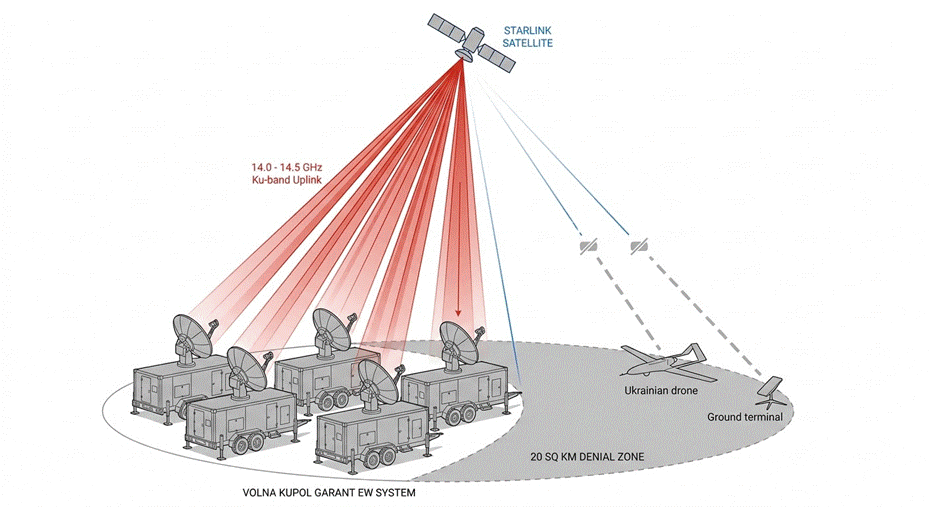
Digital siege architecture: Iran's national network, state firewall, VPN tunnels, and Starlink circumvention.

6.2 The Black Market for Satellite Connectivity and Hardware Procurement

In response to the digital siege, the Iranian populace has increasingly turned to decentralized, open-source, and satellite-based circumvention tools. Satellite internet has become a critical lifeline for coordinating dissent and transmitting evidence of human rights abuses to the outside world. While the service provider SpaceX has waived subscription fees for Iranian users and activated free access in response to the crackdowns, the physical procurement of the terminal kits remains exceptionally difficult.33

The Iranian regime has classified the possession of satellite internet hardware as a severe national security threat. Individuals discovered using or distributing these terminals risk lengthy prison sentences, and human rights organizations have warned of the possibility of execution for users caught maintaining the network.33 Consequently, the hardware is smuggled across the border, creating a lucrative and highly dangerous black market. Following the escalation of war with the United States and the deployment of the naval blockade, the black market price for a single satellite terminal surged from approximately 700 United States dollars to as much as 4,000 United States dollars, placing it far beyond the reach of the average citizen.34

6.3 Virtual Private Networks and the Reliance on Diaspora Infrastructure

For the vast majority of Iranians who cannot afford or safely harbor satellite equipment, Virtual Private Networks remain the primary method of evading state censorship. However, the Iranian government utilizes highly aggressive Deep Packet Inspection, Domain Name System manipulation, and Server Name Identification blocking to sever connections to standard commercial VPN providers.35

Consequently, the populace relies heavily on specialized circumvention tools like Psiphon and Lantern, which disguise users’ data as different types of internet traffic to evade detection.36 The resilience of these networks is fundamentally dependent on the active participation of the Iranian diaspora. Thousands of expatriates run conduit applications on their personal devices, leaving unused phones or computers connected to home Wi-Fi networks to securely share part of their bandwidth.38 By doing so, they create small, fragile bridges that allow users inside Iran to connect to the global internet. As of early 2026, intelligence indicated that approximately 400,000 Iranians abroad were maintaining these nodes, serving as a critical digital lifeline for those trapped behind the state firewall.32

Tool / ServiceTechnical Evasion MethodologyCurrent Procurement and Availability StatusOfficial Vendor Link
StarlinkLow Earth Orbit Satellite InternetHardware in stock globally; Black market access only in Iran at highly inflated prices(https://www.starlink.com/)
PsiphonMulti-protocol proxy network utilizing VPN, SSH, and HTTPSoftware actively available for download; Relies heavily on diaspora conduit nodes(https://psiphon.ca/)
LanternPeer-to-peer routing and disguised TLS traffic protocolsSoftware actively available for global download(https://lantern.io/)

7.0 The Succession Crisis and the Shift in State Identity

The Iranian political landscape experienced a seismic shift in early 2026. Following the death of Supreme Leader Ali Khamenei, the Assembly of Experts selected his son, Mojtaba Khamenei, as the next Supreme Leader on March 8, 2026.1 This transition represents the most vulnerable point in the history of the Islamic Republic and has fundamentally altered the domestic political calculus and the ideological foundation of the state.

7.1 The Elevation of Mojtaba Khamenei and the Hardline Consolidation

The rapid selection of Mojtaba Khamenei represents a decisive and uncompromising victory for the most extreme hardline factions within the IRGC and the Office of the Supreme Leader.10 Mojtaba, a cleric with deep, entrenched ties to the security apparatus and a documented history of orchestrating severe domestic crackdowns, is widely feared by the public.10 His ascension guarantees that the state will pursue domestic and foreign policies remarkably similar to, or potentially more aggressive than, those of his father.

7.2 The “Death to Mojtaba” Movement and the Loss of Ideological Legitimacy

The immediate public reaction to his appointment was explosive and highly telling of the current national mood. Despite the ongoing lethal crackdowns, internet blackouts, and the presence of heavily armed security forces, citizens defied curfews to gather in residential neighborhoods, chanting “Death to Mojtaba” from their rooftops.1

This specific chant is highly significant from an intelligence perspective. It signifies that the public views the transition not as a legitimate religious succession guided by Islamic jurisprudence, but as the naked establishment of a hereditary dictatorship. By installing the son of the former leader, the regime has stripped away its remaining theological veneer. It has exposed itself entirely as a military autocracy governed by the IRGC, utilizing the clerical establishment merely as a rubber stamp.5 This ideological collapse permanently alienates any remaining moderate or reformist factions within the political establishment, ensuring that future conflicts between the state and the populace will be defined solely by the application of physical force rather than political debate.

7.3 The Marginalization of the Civilian Government

Within this highly volatile environment, the civilian government led by President Masoud Pezeshkian has been entirely marginalized. Pezeshkian has publicly acknowledged the depth of the systemic failure and has occasionally attempted to strike a softer tone, noting in public statements that the government is obligated to listen to peaceful protesters and involve the people in decision-making.3 He has even signaled a conditional openness to diplomacy with the United States to alleviate the crushing economic sanctions, publishing open letters urging a move beyond political rhetoric.41

However, intelligence indicates that Pezeshkian wields no actual authority over the security apparatus, the national economy, or the direction of foreign policy. He has explicitly noted his own powerlessness in private, admitting that his attempts to negotiate or alter the state’s trajectory have been routinely overruled by the supreme leadership and the IRGC high command.3 The civilian government is currently utilized by the regime merely as a diplomatic facade for the international community and an administrative body tasked with managing the impossible logistics of a collapsed economy, while the true levers of power remain firmly and exclusively under the control of Mojtaba Khamenei and the military elite.

8.0 Strategic Outlook and Key Intelligence Takeaways

The intelligence assessment of the Iranian populace in April 2026 paints a picture of a society pushed to the absolute limits of human endurance. The Iranian people are locked in a sophisticated, highly lethal struggle against a heavily armed and deeply entrenched security state. The failure of the populace to topple the government is not indicative of support or complacency, rather, it is a testament to the ruthless efficiency of the IRGC’s domestic suppression tactics, the paralyzing effects of the telecommunications blackout, and the strategic disadvantage of a leaderless, horizontal protest movement facing coordinated military violence.

The installation of Mojtaba Khamenei has catalyzed a permanent ideological rupture, finalizing the transformation of the Islamic Republic into a hereditary military dictatorship devoid of popular legitimacy. While the populace overwhelmingly desires a transition to a secular democracy, they are simultaneously deeply fearful of the chaotic consequences of state collapse and hold highly unfavorable views of the foreign military interventions that have shattered their national infrastructure.

The regime currently survives solely through the application of brute force and the enforcement of digital darkness. However, the macroeconomic foundations required to sustain the patronage networks of the security apparatus have been decimated by the shadow economy, international blockades, and the systematic destruction of the defense industrial base. The state is operating in a condition of permanent emergency, generating cohesion solely through the suppression of an internal enemy. While the security forces remain coherent in the immediate term, the absolute alienation of the population and the mathematical impossibility of economic recovery suggest that the current paradigm is structurally unsustainable, leaving the state exceptionally vulnerable to any future catalyst that disrupts the IRGC’s chain of command.


Please share the link on Facebook, Forums, with colleagues, etc. Your support is much appreciated and if you have any feedback, please email us in**@*********ps.com. If you’d like to request a report or order a reprint, please click here for the corresponding page to open in new tab.


Sources Used

  1. 2025–2026 Iranian protests – Wikipedia, accessed April 19, 2026, https://en.wikipedia.org/wiki/2025%E2%80%932026_Iranian_protests
  2. Iran: Chokehold on Dissent – Human Rights Watch, accessed April 19, 2026, https://www.hrw.org/news/2024/01/11/iran-chokehold-dissent
  3. The Ayatollah’s Regime Is Crumbling | Hudson Institute, accessed April 19, 2026, https://www.hudson.org/foreign-policy/ayatollahs-regime-crumbling-michael-doran
  4. Iran Inflation Rate – Trading Economics, accessed April 19, 2026, https://tradingeconomics.com/iran/inflation-cpi
  5. Iran’s regime is suffering from strategic vertigo. Its next misstep may …, accessed April 19, 2026, https://www.atlanticcouncil.org/blogs/menasource/irans-regime-is-suffering-from-strategic-vertigo-its-next-misstep-may-be-its-last/
  6. Iran in the Aftermath of the Twelve-Day War – GIGA Hamburg, accessed April 19, 2026, https://www.giga-hamburg.de/en/publications/giga-focus/iran-in-the-aftermath-of-the-twelve-day-war
  7. Epic Fury Quelled for Now, Objectives Accomplished, U.S. Forces Remain Ready, accessed April 19, 2026, https://www.war.gov/News/News-Stories/Article/Article/4454276/epic-fury-quelled-for-now-objectives-accomplished-us-forces-remain-ready/
  8. Peace Through Strength: Operation Epic Fury Crushes Iranian Threat as Ceasefire Takes Hold – The White House, accessed April 19, 2026, https://www.whitehouse.gov/releases/2026/04/peace-through-strength-operation-epic-fury-crushes-iranian-threat-as-ceasefire-takes-hold/
  9. Operation Epic Fury – U.S. Central Command, accessed April 19, 2026, https://www.centcom.mil/OPERATIONS-AND-EXERCISES/EPIC-FURY/
  10. Iran Update Evening Special Report: March 8, 2026 | ISW, accessed April 19, 2026, https://understandingwar.org/research/middle-east/iran-update-evening-special-report-march-8-2026/
  11. The Iran Conflict | Ipsos, accessed April 19, 2026, https://www.ipsos.com/en/global-opinion-polls/the-iran-conflict
  12. The Strait of Hormuz is ‘open,’ but the US blockade remains in place. Here’s what that means., accessed April 19, 2026, https://www.atlanticcouncil.org/dispatches/the-strait-of-hormuz-is-open-but-the-us-blockade-remains-in-place-heres-what-that-means/
  13. Iran war updates: Trump voices optimism about deal; Tehran cautious, accessed April 19, 2026, https://www.aljazeera.com/news/liveblog/2026/4/17/iran-war-live-ceasefire-starts-in-lebanon-as-trump-says-tehran-deal-close
  14. Iran’s central bank warns economy may take 12 years to rebuild after war, accessed April 19, 2026, https://www.iranintl.com/en/202604139864
  15. Iran, Islamic Rep. – World Bank Open Data, accessed April 19, 2026, https://data.worldbank.org/country/iran-islamic-rep
  16. Iran – IMF DataMapper, accessed April 19, 2026, https://www.imf.org/external/datamapper/profile/IRN
  17. BTI 2024 Country Report – Iran, accessed April 19, 2026, https://bti-project.org/fileadmin/api/content/en/downloads/reports/country_report_2024_IRN.pdf
  18. Analytical Report on “Iranians’ Political Preferences in 2024 …, accessed April 19, 2026, https://gamaan.org/2025/08/20/analytical-report-on-iranians-political-preferences-in-2024/
  19. GAMAAN Survey of Iranians’ Political Preferences (Sept 2025, Post 12-Day War) : r/fivethirtyeight – Reddit, accessed April 19, 2026, https://www.reddit.com/r/fivethirtyeight/comments/1ri3x9f/gamaan_survey_of_iranians_political_preferences/
  20. GAMAAN-12-Day-War-Survey-Report-Nov-2025-Final-English.pdf, accessed April 19, 2026, https://gamaan.org/wp-content/uploads/2026/02/GAMAAN-12-Day-War-Survey-Report-Nov-2025-Final-English.pdf
  21. How Iran’s diaspora thinks differently than Iran’s regime – Mission Network News, accessed April 19, 2026, https://www.mnnonline.org/news/how-irans-diaspora-thinks-differently-than-irans-regime/
  22. 2025 National Survey – PAAIA, accessed April 19, 2026, https://paaia.org/wp-content/uploads/2025/11/2025-National-Survey-Final-Copy.pdf
  23. Regime Change in Iran, Underpants Gnomes, and the Phase II Problem – War on the Rocks, accessed April 19, 2026, https://warontherocks.com/regime-change-in-iran-underpants-gnomes-and-the-phase-ii-problem/
  24. Iran | Gallup Historical Trends, accessed April 19, 2026, https://news.gallup.com/poll/116236/iran.aspx
  25. Mass arrests, intensifying crackdown sweep Iran amid attacks, accessed April 19, 2026, https://www.iranintl.com/en/202603145682
  26. What They’re Saying About Operation Epic Fury—April 15, 2026, accessed April 19, 2026, https://www.unitedagainstnucleariran.com/press-releases/what-theyre-saying-about-operation-epic-fury-april-15-2026
  27. What happened at the protests in Iran? – Amnesty International, accessed April 19, 2026, https://www.amnesty.org/en/latest/campaigns/2026/01/what-happened-at-the-protests-in-iran/
  28. 2026 Iran massacres – Wikipedia, accessed April 19, 2026, https://en.wikipedia.org/wiki/2026_Iran_massacres
  29. In Iran Protests, Information Spreads Faster than Organization – Stimson Center, accessed April 19, 2026, https://www.stimson.org/2026/in-iran-protests-information-spreads-faster-than-organization/
  30. Iran’s Ruling System Tightens the Security Vise—While Letting Flashes Of “Permitted Criticism” Leak Through – NCRI, accessed April 19, 2026, https://www.ncr-iran.org/en/news/iran-protests/irans-ruling-system-tightens-the-security-vise-while-letting-flashes-of-permitted-criticism-leak-through/
  31. Iran’s Latest Internet Blackout Extends to Phones and Starlink – Georgia Tech, accessed April 19, 2026, https://www.gatech.edu/news/2026/01/16/irans-latest-internet-blackout-extends-phones-and-starlink
  32. 2026 Internet blackout in Iran – Wikipedia, accessed April 19, 2026, https://en.wikipedia.org/wiki/2026_Internet_blackout_in_Iran
  33. Iran: Free satellite internet access has been activated; however, individuals using Starlink may allegedly be subject to severe penalties, incl. the possibility of execution – Business and Human Rights Centre, accessed April 19, 2026, https://www.business-humanrights.org/en/latest-news/iran-free-satellite-internet-access-has-been-activated-however-individuals-using-starlink-may-be-subject-to-severe-penalties-incl-the-possibility-of-execution/
  34. Price of Musk’s Starlink kits in Iran soars as US threatens war – Al Arabiya, accessed April 19, 2026, https://english.alarabiya.net/News/middle-east/2026/02/23/price-of-musk-s-starlink-kits-in-iran-soars-as-us-threatens-war-
  35. Souped-up VPNs play ‘cat and mouse’ game with Iran censors – CP24, accessed April 19, 2026, https://www.cp24.com/news/world/2026/03/21/souped-up-vpns-play-cat-and-mouse-game-with-iran-censors/
  36. Iran’s January 2026 Internet Shutdown: Public Data, Censorship Methods, and Circumvention Techniques – arXiv, accessed April 19, 2026, https://arxiv.org/html/2603.28753v1
  37. How Iranians are communicating through internet blackout – The Japan Times, accessed April 19, 2026, https://www.japantimes.co.jp/news/2026/03/16/world/how-iran-internet-blackout/
  38. Volunteers abroad deploy tech to pierce Iran’s internet iron curtain | Iran International, accessed April 19, 2026, https://www.iranintl.com/en/202601240957
  39. CONTENTS – TopRankers, accessed April 19, 2026, https://cdn.toprankers.net.in/docs/weekly-current-affairs-8th-march-to-14th-march-2026-0294bc195378e.pdf
  40. Iranian president urges justice, warns of exploitation of protests to divide nation, accessed April 19, 2026, https://www.aa.com.tr/en/middle-east/iranian-president-urges-justice-warns-of-exploitation-of-protests-to-divide-nation/3816170
  41. Iran’s President Issues Open Letter to the American Public – YouTube, accessed April 19, 2026, https://www.youtube.com/watch?v=hB-DIM8mqpE
  42. Full text of Iranian President Masoud Pezeshkian’s letter to Americans | The Straits Times, accessed April 19, 2026, https://www.straitstimes.com/world/middle-east/full-text-of-iranian-president-masoud-pezeshkians-letter-to-americans

Iran’s Leadership Crisis – April 19, 2026

Executive Summary

The targeted elimination of Iranian Supreme Leader Ali Khamenei on February 28, 2026, during the United States and Israeli military offensive designated as Operation Epic Fury, precipitated a profound and irreversible systemic rupture within the Islamic Republic of Iran.1 The violent removal of the ultimate arbiter in a political system structured entirely around a singular, absolute religious authority has catalyzed an intense internal power struggle.3 This assessment evaluates the current operational state of the Iranian civilian and military leadership, detailing the severe fractures emerging within the military command and control complex and analyzing how these internal schisms directly impede the resolution of ongoing hostilities.

Intelligence analysis indicates that the Iranian state has effectively transitioned from a competitive, theocratic republic into a rigid military-security state dominated by hardline factions of the Islamic Revolutionary Guard Corps.5 This transition has completely marginalized pragmatic civilian elements and elevated a triumvirate of military commanders who now dictate all aspects of national policy.5 Concurrently, severe logistical and operational schisms have developed between the Islamic Revolutionary Guard Corps and the conventional armed forces, known as the Artesh, critically undermining the regime’s defensive cohesion.6 The regime’s historical reliance on a decentralized military strategy, known as the Mosaic Defense doctrine, has prevented a rapid state collapse but has simultaneously engineered a paradox of decapitation.5 In this paradox, no single surviving authority possesses the internal consensus or the operational control required to negotiate a binding cessation of hostilities.5

Geopolitically, the conflict has been actively instrumentalized by the Russian Federation and the People’s Republic of China. Both nations are executing a sophisticated strategy of strategic attrition.9 They seek to prolong the conflict to erode United States global primacy, distract Western military resources, and secure lucrative economic and technological concessions from an isolated administration in Tehran.9 Meanwhile, efforts by foreign elements to prop up exiled opposition figures, such as Reza Pahlavi and Maryam Rajavi, lack internal traction due to the complete absence of domestic organizational structures within Iran.10 Based on current intelligence, this report projects the top five most likely outcomes for the conflict, analyzing the structural variables that will dictate the future of the Iranian state and the broader Middle Eastern security architecture over the coming decade.

1.0 Historical Context and the Pre-2026 Strategic Baseline

To accurately assess the current fragility of the Iranian government, it is necessary to examine the structural degradation the regime experienced prior to the decapitation strikes of February 2026. The geopolitical landscape of the Middle East was fundamentally altered by the events of the preceding year, which systematically dismantled the external deterrence architecture relied upon by Tehran.

1.1 The June 2025 Twelve-Day War

The strategic power of the Islamic Republic suffered its most devastating historical blow during the Twelve-Day War of June 2025.12 During this conflict, Israeli forces executed Operation Rising Lion, launching five waves of airstrikes involving over two hundred aircraft against Iranian nuclear facilities, military installations, and leadership targets.12 Intelligence operatives sabotaged air defense systems and detonated explosives across Tehran, eliminating numerous senior nuclear scientists.12 The campaign decapitated the intelligence leadership of the Islamic Revolutionary Guard Corps and destroyed approximately 80 percent of Iran’s ballistic missile launchers.12

On June 22, 2025, the United States directly entered the conflict through Operation Midnight Hammer, deploying stealth bombers to destroy deeply buried enrichment facilities.12 By the time a ceasefire was established, Iran’s nuclear program had been set back by years, and the external network of allied militias, known as the Axis of Resistance, was left severely degraded.12 This prior conflict established a baseline of severe military vulnerability and economic exhaustion that profoundly limited the regime’s capacity to absorb the shocks of early 2026.

1.2 Degradation of the Regional Proxy Model

For decades, Iran pursued a strategy of projecting influence and maintaining deterrence through the sponsorship of armed non-state actors across Lebanon, Syria, Iraq, and Yemen.13 This model entered a phase of structural degradation following the regional fallout of the October 2023 attacks on Israel.13 The subsequent military attrition, intelligence penetration, and leadership losses exposed the limits of proxy-based power projection.13

By the onset of the 2026 conflict, Hezbollah in Lebanon had suffered immense military attrition and a collapse of the Syrian logistical corridors that underpinned its strategic depth.13 The Houthi movement in Yemen, attempting to raise its regional profile through maritime attacks, exposed its own capacity limits and increased its diplomatic vulnerability.13 Iraqi militias became increasingly fragmented, prioritizing local survival over unified resistance.13 Consequently, rather than serving as a coherent deterrent architecture, Iran’s regional network became a source of strategic exposure, forcing Tehran to face the 2026 offensive with limited external support.13

2.0 State of Iranian Civilian Leadership and Succession Dynamics

The sudden vacuum at the apex of the Iranian political structure has exposed the extreme fragility of the regime’s institutional equilibrium. For over three decades, Ali Khamenei maintained stability by balancing competing clerical, bureaucratic, and military factions, ensuring that no single entity could challenge his supreme authority.3 His death has replaced this carefully managed, competitive oligarchy with naked institutional survivalism, leading to the complete marginalization of civilian governance.

2.1 The Decapitation Event and Interim Governance Mechanisms

The targeted airstrikes on February 28, 2026, eliminated approximately 50 top Iranian officials, heavily degrading the upper echelons of the regime.2 Constitutionally, Article 111 of the Iranian constitution dictates that the death of the Supreme Leader triggers the formation of a Provisional Leadership Council tasked with executive oversight until a permanent successor is selected.14 The current Provisional Leadership Council consists of President Masoud Pezeshkian, Chief Justice Gholam-Hossein Mohseni-Eje’i, and Guardian Council member Alireza Arafi.16

This tripartite arrangement is structurally flawed due to profound ideological divergences among its members. President Pezeshkian represents the remnants of the reformist and moderate political factions, advocating for diplomatic engagement and economic stabilization.14 Conversely, Chief Justice Mohseni-Eje’i is a staunch hardliner with a background as intelligence minister, directly responsible for the brutal suppression of the 2025 and 2026 nationwide domestic protests.14 Alireza Arafi, a dual member of the Assembly of Experts and the Guardian Council, holds significant influence within the traditional power structure but lacks operational military command.16

Intelligence indicates that the authority of the Provisional Leadership Council is largely nominal. Real operational, economic, and strategic authority has migrated entirely to the military-security establishment, bypassing formal constitutional norms and civilian oversight mechanisms entirely.17 The civilian government is systematically contradicted by military commanders, rendering the constitutional framework practically irrelevant in day-to-day wartime governance.5

2.2 The Rise of the Military Triumvirate

Power in Tehran is currently concentrated in a triumvirate of hardline commanders from the Islamic Revolutionary Guard Corps.5 This triumvirate consists of IRGC Commander-in-Chief Ahmad Vahidi, Supreme National Security Council Secretary Mohammad Bagher Zolghadr, and senior military adviser Mohsen Rezaei.5 General Vahidi functions as the undisputed de facto leader of the country. His authority supersedes that of the civilian government, evidenced by his systematic blocking of President Pezeshkian’s preferred cabinet appointments and his total control over military strategy.5

To consolidate this power, the military-security apparatus has actively eliminated political bridge builders who traditionally negotiated compromises between the civilian government and the armed forces. A critical turning point occurred in mid-March 2026 with the orchestrated removal of Ali Larijani.5 Larijani, a veteran establishment figure, former parliament speaker, and former secretary of the Supreme National Security Council, was widely viewed as a pragmatist capable of negotiating a ceasefire with the United States.18 He had effectively been running the country’s day-to-day operations prior to the airstrikes, attempting to maintain the status quo.2

Larijani was systematically marginalized and replaced by Zolghadr, an IRGC hardliner with deep connections to the judicial apparatus and absolutely no diplomatic experience.5 Zolghadr previously served as the IRGC coordination deputy and was a primary architect of former hardline President Mahmoud Ahmadinejad’s election in 2005.19 This deliberate purge of pragmatists has left the regime ideologically rigid, institutionally isolated, and entirely dependent on coercive force.

Diagram: Post-Khamenei power structure in Iran, indicating a de facto military junta with the IRGC triumvirate controlling Mojtaba Khamenei.

2.3 The Succession Mechanism and Clerical Legitimacy

The Assembly of Experts is the 88-member clerical body constitutionally mandated to select the Supreme Leader.14 Candidates for this assembly are heavily vetted by the Guardian Council, ensuring strict adherence to the ideological tenets of the state.14 Following the death of Ali Khamenei, the assembly’s proceedings were violently disrupted on March 3, 2026, when its offices in Qom were bombed during a session convened for electoral purposes, highlighting the extreme domestic volatility.21

Despite this disruption, Iranian media and international intelligence assessments indicated that Mojtaba Khamenei, the son of the late Supreme Leader, was selected as the new Supreme Leader on March 8, 2026.5 Other potential candidates, such as Hassan Khomeini, the grandson of the republic’s founder, were sidelined due to their reformist orientations and prior exclusion from the upper echelons of the regime.17

Mojtaba Khamenei’s elevation represents a critical vulnerability for the regime. He lacks the requisite religious credentials, formal governmental experience, and public legitimacy necessary to unite the populace or command the genuine respect of the clerical establishment.5 Analysts assess that Mojtaba was installed under direct military pressure from the Islamic Revolutionary Guard Corps, bypassing standard constitutional vetting processes.5 He serves merely as a puppet to provide a thin veneer of religious continuity, while the Vahidi-led triumvirate exercises true control.5

The mutation of the Islamic Republic into a criminal-oligarchic state is now fully realized.5 The military functions simultaneously as an armed force, an intelligence service, a political party, and a vast economic empire estimated to control between 30 and 40 percent of the total Iranian Gross Domestic Product.5 Religious institutions have been captured and instrumentalized strictly as tools for external legitimacy, devoid of their original ideological authority.5

3.0 Fractures in the Military Command and Control Complex

The Iranian armed forces operate under a deliberately dualized structure designed by the founders of the 1979 revolution to prevent military coups.23 This structure maintains the regular conventional army, known as the Artesh, parallel to the ideological Islamic Revolutionary Guard Corps.23 Both branches historically answered directly to the Supreme Leader, keeping the armed forces institutionally subordinate to civilian and clerical oversight.24 However, the intense military pressure applied by United States and Israeli forces has fractured this fragile dual system, revealing severe operational and logistical schisms that threaten the regime’s defensive viability.

3.1 The Decentralized Mosaic Defense Doctrine

To understand the resilience and subsequent fragmentation of the Iranian military, it is vital to examine the strategic logic of the Mosaic Defense doctrine. Developed under former Islamic Revolutionary Guard Corps commander Mohammad Ali Jafari between 2007 and 2019, this doctrine was a direct response to the rapid collapse of Saddam Hussein’s highly centralized regime during the United States invasion of Iraq.8

The Mosaic Defense doctrine organizes the state into multiple regional, semi-independent layers spanning Iran’s 31 provinces.8 The doctrine fundamentally assumes that adversaries will always possess superior conventional technology, air power, and intelligence capabilities.8 Therefore, the strategic priority is not symmetrical confrontation or centralized coordination, but rather the survival of individual combat units capable of launching decentralized ambushes, disrupting supply lines, and waging a protracted war of attrition across diverse terrain.8

In this structure, the regular army, the Artesh, is tasked with absorbing the initial conventional blow, utilizing its armored and infantry formations to slow enemy advances.8 Concurrently, the Islamic Revolutionary Guard Corps and the Basij paramilitary forces retreat to urban centers and mountainous redoubts to conduct prolonged guerrilla operations.8 This doctrine heavily emphasizes redundancy and succession planning. Prior to his death, Ali Khamenei authorized a system where multiple successors were predesignated for every key military post, ensuring that targeted decapitation strikes would not paralyze local commands.8 While this extreme diffusion of power has prevented a systemic collapse, it has severely compromised the regime’s ability to exert unified national command.

3.2 The Artesh and Islamic Revolutionary Guard Corps Operational Schism

The execution of the Mosaic Defense doctrine has exacerbated deep historical animosities between the Artesh and the Islamic Revolutionary Guard Corps. The Islamic Revolutionary Guard Corps functions as a heavily funded, ideological praetorian guard dedicated strictly to regime survival, whereas the Artesh preserves the traditions and ethos of a traditional national military.7 Under the strain of sustained airstrikes, the resource disparity between the two branches has escalated into overt hostility.

Intelligence sources indicate that the armed forces are facing acute supply shortages and rapidly rising desertion rates.6 The most critical friction point involves medical logistics and casualty evacuation. Artesh units on the front lines are suffering significant casualties, yet Islamic Revolutionary Guard Corps personnel have reportedly refused repeated requests to transport injured Artesh soldiers or grant them access to superior medical facilities and blood supplies.6

Furthermore, basic logistical supply chains for the regular army have essentially broken down. Certain field units of the Artesh have been issued as few as 20 bullets for every two soldiers, leaving them effectively defenseless against coordinated assaults.6 These units also report critical shortages of food and reliable drinking water, leading to localized group desertions and a total collapse in operational morale.6 The active hoarding of critical resources by the Islamic Revolutionary Guard Corps to protect its own ideological cadres has validated the perception within the Artesh that they are being utilized as expendable shock absorbers, quietly widening the institutional gap between the two forces.7

3.3 The Paradox of Decapitation

The very military doctrine designed to save the regime is now actively obstructing its ability to end the war. The paradox of decapitation dictates that while the decentralized network successfully survives kinetic strikes, the fragmented chain of command lacks a centralized authority with the legitimacy and control necessary to enforce a surrender or a comprehensive ceasefire.5 Local military commanders, operating under the autonomy granted by the provincial Mosaic Defense structure, possess the capacity to continue launching localized strikes, asymmetric ambushes, and maritime harassment operations even if political figures in Tehran agree to international terms.8 This structural reality fundamentally undermines any diplomatic process, as external actors cannot guarantee that agreements made at the negotiating table will be respected by field commanders.

4.0 Geopolitical Impediments to Conflict Resolution

The structural fractures within the Iranian leadership and military apparatus directly impact the international community’s hope of ending the conflict. The stated United States strategy of utilizing calibrated force to shift the internal balance toward factions amenable to compromise has, thus far, failed to produce a unified Iranian negotiating partner capable of delivering on promises.25

4.1 Diplomatic Stalemates and the Islamabad Summit

Efforts to broker a resolution have yielded minimal tangible results, marked by public posturing and irreconcilable demands. Recent direct negotiations held in Islamabad, Pakistan, highlighted the vast diplomatic chasm between the belligerents.26 The United States delegation, led by Vice President JD Vance, Steve Witkoff, and Jared Kushner, engaged with an Iranian delegation headed by Parliament Speaker Mohammad Bagher Ghalibaf and Foreign Minister Abbas Araghchi.5

Ghalibaf represents a unique and problematic contradiction within the Iranian system. He is widely characterized as a pragmatic hawk, acting as the architect of the hardline military doctrine focused on missiles and maritime dominance, yet he is also the most senior military-aligned figure willing to serve as a diplomatic back-channel.5 However, Ghalibaf’s pragmatism is severely constrained by his institutional subordination. He answers directly to Commander Ahmad Vahidi and lacks the independent authority to commit Iran to any binding agreement without explicit military approval from the hardline triumvirate.5

During the Islamabad talks, the United States presented demands including a 20-year suspension of uranium enrichment, whereas the Iranian delegation offered a maximum suspension of five years.5 Tehran continues to aggressively reject claims that it will surrender its enriched uranium stockpiles, with Foreign Ministry spokespersons declaring the material sacred and unequivocally not open for discussion.8 Analysts note that Iran requires substantial economic inducements to justify any concessions, such as the immediate release of 100 billion USD in frozen assets and comprehensive sanctions relief, which the United States is currently unwilling to provide without total capitulation.8 Consequently, the talks concluded after 21 hours without an agreement, leading to a resumption of hostilities.26

Divergent negotiating positions between the US and Iran at the 2026 Islamabad Diplomatic Summit.

4.2 Weaponization of the Strait of Hormuz and Global Blockades

In the absence of conventional military parity, Iran has weaponized global energy markets by interdicting maritime traffic in the Strait of Hormuz.8 Maritime traffic through this vital corridor, which historically handled one-fifth of all global oil and gas shipments, has plummeted by an astonishing 95 percent.8 According to tracking data, transit fell to a mere fraction of the pre-war average of 100 ships per day, triggering the world’s largest-ever fuel supply disruption.8 The Islamic Revolutionary Guard Corps Navy declared the strait closed to hostile traffic, utilizing naval mines, fast attack craft, and coastal missile batteries to enforce a blockade and generate psychological terror among commercial operators.8

The United States responded by implementing a comprehensive naval blockade of all Iranian ports, further escalating the maritime standoff.5 Iran has attempted to exploit this situation by charging transit fees to specific nations. Maritime intelligence reports indicate that vessels taking a Tehran-approved route near Larak Island are forced to pay exorbitant fees, with one Chinese state-owned tanker reportedly paying 2 million USD for safe passage through the contested waters.19 The ability to hold the global economy hostage serves as Iran’s strongest asymmetric deterrent, compensating for the severe degradation of its nuclear and ballistic missile infrastructure.8

To counter this disruption, European nations have initiated independent diplomatic and military efforts. The Paris Summit on Freedom of Navigation, co-chaired by French President Emmanuel Macron and United Kingdom Prime Minister Keir Starmer, brought together 30 leaders to organize a multinational defensive mission in the strait, notably excluding the United States.5 This initiative includes discussions on the deployment of mine-hunting drones and the positioning of nuclear-powered aircraft carriers to ensure the safety of trapped seafarers, highlighting growing international frustration with the broader geopolitical stalemate.5

4.3 Global Economic Fallout and Risk Metrics

The protracted nature of the conflict and the ongoing maritime blockades have triggered severe global economic repercussions. The systematic reduction in global oil supply by 20 percent boosted oil prices by roughly 50 percent, creating a systemic fracture in international markets.8 The International Monetary Fund forecast for global growth in 2026 was subsequently downgraded to 3.1 percent, accompanied by an inflation rise to 4.4 percent due to the persistent shadow of war.5

The International Country Risk Guide ratings, a vital metric for geopolitical risk assessments, clearly illustrate the growing instability.9

Risk Metric CategoryCurrent AssessmentGlobal Implication
External Conflict & Sovereign RiskDegraded to “High Risk” category due to infrastructure strikes.Correlates directly with a sharp rise in sovereign bond spreads, significantly increasing global capital borrowing costs.9
Government Stability & Domestic Policy“Popular Support” sub-component under severe pressure in Western nations.High energy costs complicate long-term strategic planning, particularly for the United States administration ahead of midterm elections.9
Investment Profile & Market ContagionDamaged scores for allied nations in Europe and Asia.The logistics shock deters foreign direct investment and forces a costly re-evaluation of global supply chain security architectures.9

This data indicates that while the United States maintains overwhelming military dominance, adversaries are actively winning the risk war by systematically lowering Western risk scores, aiming to force a strategic retreat through economic exhaustion.9

5.0 The Strategic Calculus of the Sino-Russian Axis

Neither the Russian Federation nor the People’s Republic of China desires a swift conclusion to the conflict in the Middle East. Both nations are currently executing a highly calculated playbook of strategic attrition, utilizing the Iranian theater to recalibrate global influence, drain United States resources, and fracture Western economic stability without committing to direct kinetic involvement.9 The Iran conflict represents a systemic geopolitical rupture that actively accelerates the consolidation of the Sino-Russian partnership, effectively reversing decades of United States grand strategy historically aimed at keeping Moscow and Beijing diplomatically and militarily divided.29

5.1 Russian Objectives: Fiscal Windfalls and Tactical Spoiling

The primary immediate beneficiary of the conflict is the Russian Federation. Prior to the outbreak of war in the Gulf, the Russian economy was severely constrained by extensive Western sanctions and the immense fiscal demands of its ongoing military operations in Ukraine.29 The Russian federal budget was predicated on oil prices remaining stable near 60 USD per barrel.29 The abrupt disruption of the Strait of Hormuz caused Brent crude prices to surge toward 120 USD per barrel, generating a massive, unexpected fiscal windfall for Moscow.9 Current financial projections suggest this sustained price spike could yield the Kremlin a budget surplus exceeding 150 billion USD in 2026, effectively subsidizing its military objectives in Eastern Europe at the expense of global stability.9

Militarily, Russia acts as a tactical spoiler in the Middle East.9 To prevent a rapid United States victory and ensure the conflict remains a protracted, resource-draining quagmire, Moscow has engaged in a structured exchange of military capabilities with Tehran.30 Russia supplies Iran with critical signals intelligence and essential access to high-resolution satellite imagery via the GLONASS navigation system.30 This technical support grants Iranian forces enhanced operational awareness and enables the continuation of asymmetric defensive measures, ensuring that United States naval and air assets remain permanently tied down in the region.9 Furthermore, cooperation has expanded into advanced missile technology, focusing on terminal guidance improvements and the development of maneuvering reentry vehicles to penetrate Western air defenses.30

5.2 Chinese Objectives: Economic Insulation and Covert Facilitation

China’s strategic approach is highly nuanced, carefully balancing its massive reliance on Arab energy partners with its deep, long-term strategic partnership with Iran. Beijing has positioned itself diplomatically as an economic stabilizer and a responsible global mediator, actively championing a Five-Point Peace Plan to contrast its stability-first rhetoric with the aggressive military posture of the United States.9

However, beneath this diplomatic veneer, China is actively sustaining the Iranian war effort to serve its own geopolitical ends. Beijing successfully insulated its domestic economy from the massive 40 percent surge in global oil prices through years of strategic energy stockpiling, allowing it to weather the initial shocks far better than Western counterparts.9 Concurrently, China continues to purchase roughly 80 percent of Iran’s remaining oil exports, deliberately settling these massive transactions in yuan to actively circumvent United States sanctions and systematically erode the global dominance of the dollar.5 Despite this insulation, recent Chinese economic data reveals vulnerabilities, with first-quarter GDP growth dropping and factory-gate industrial prices rising, signaling that prolonged energy costs are beginning to impact China’s productive fabric.5

5.3 Intelligence and Technological Transfers

China’s shadow support extends deeply into the military-technological domain, providing the hardware necessary for Iran to maintain its asymmetric war. Beijing covertly supplies Iran with critical dual-use technologies, including advanced radio frequency connectors, precision turbine blades for missile production, and vast shipments of sodium perchlorate, a vital oxidizer required for solid rocket fuel propellant.30

Most critically, United States intelligence agencies have confirmed that the Islamic Revolutionary Guard Corps Aerospace Force is actively utilizing a Chinese spy satellite to track United States military bases across the Middle East.32 The satellite, identified in military documents as the TEE-01B, was built and launched by the Beijing-based firm Earth Eye Co in late 2024.34 Current validation passes confirm that the remote sensing technology and imagery packages provided by Earth Eye Co remain fully in stock and available for commercial and military procurement.

As part of this technological alliance, the Islamic Revolutionary Guard Corps also received secure access to commercial ground stations operated by Emposat, a Beijing-based satellite control provider with a network spanning Asia and Latin America.33 Iranian military commanders utilized this capability to capture high-resolution imagery of critical installations, such as the Prince Sultan Air Base in Saudi Arabia, facilitating precise targeting for subsequent drone and missile strikes.32

Furthermore, Iran’s domestic defense production continues to rely on advanced optical hardware. An analysis of military supply chains confirms that optical hardware produced by Esfahan Optics Industries, including tactical lenses and prisms used in small arms and drone guidance systems, remains actively in stock and available for integration into domestic weapons programs, despite widespread Western sanctions.19 By providing these capabilities and supply chain redundancies, China ensures Iran remains combat-effective and lethal without requiring Beijing to openly declare a formal military allegiance.30

6.0 Regional Dynamics and Foreign Sponsorship of Exiled Leaders

The conflict has forced neighboring regional powers to drastically recalibrate their security postures. As the internal stability of the Islamic Republic degrades, various foreign entities and political factions in Washington have also attempted to prop up exiled Iranian opposition figures to lead a theoretical post-conflict transition.

6.1 Gulf State Alignments and Pakistani Mediation

Saudi Arabia and the United Arab Emirates have adopted divergent strategies in response to the regional crisis. Saudi Arabia prefers a predictable global order and is actively pursuing a dual-track approach, maximizing security guarantees from Washington while simultaneously exploring diverse partnerships with Turkey, Egypt, Pakistan, and South Korea to avoid being trapped in a binary alliance system.36 Riyadh remains highly concerned that the war might ultimately strengthen and radicalize the Iranian regime rather than dismantling it.36 In stark contrast, the United Arab Emirates has chosen to double down on its partnership with Israel and the United States, fully integrating into the Israeli-led regional security framework, which has caused an open eruption of diplomatic tensions between Abu Dhabi and Riyadh.36

Meanwhile, regional states attempt to facilitate dialogue to prevent a broader war. The Pakistani mediation effort has been particularly prominent, with Field Marshal Syed Asim Munir, Chief of the Pakistani Army, and Prime Minister Shehbaz Sharif acting as crucial intermediaries between Washington and Tehran during the Islamabad summits.5 These mediation efforts highlight the reliance on regional middle powers to bridge the communication gap between the primary belligerents.

6.2 The Exiled Opposition Mirage

The Iranian opposition is ideologically diverse, encompassing monarchists, republicans, and secularists.37 However, intelligence assessments definitively conclude that external candidates favored by foreign powers lack the necessary internal infrastructure to seize or hold power in a post-conflict environment.7

Reza Pahlavi, the son of the deposed Shah of Iran, operates under the banner of secular democracy and Iranian nationalism and is currently the most internationally recognized opposition figure.37 Pahlavi has actively cultivated deep ties with the United States administration, frequently praising the leadership style of President Donald Trump and receiving logistical support from elements of the domestic political apparatus, including advocacy groups like the Log Cabin Republicans and retired military figures.11 He has also engaged directly with the Israeli government, conducting meetings in Tel Aviv to consolidate foreign backing for a transitional government.11

Despite his international profile and significant popularity among diaspora communities in Europe and North America, Pahlavi’s movement lacks any realistic viability on the ground inside Iran.10 His strategy relies entirely on foreign military intervention to collapse the regime, recently stating that massive outside action is required to prevent further bloodshed.10 Critically, he possesses no leadership cadres, internal financing networks, or operational command structures within the country.7 The historical precedent of revolutionary transitions dictates that power is inevitably captured by groups with disciplined, organized structures within the contested territory, a metric by which the monarchist faction fails entirely.7

6.3 The Mujahedin-e Khalq and International Skepticism

The other prominent faction heavily lobbying for foreign anointment is the Mujahedin-e Khalq, led by Paris-based Maryam Rajavi.11 The organization operates the National Council of Resistance of Iran as its political lobbying arm and has successfully cultivated deep financial and political ties within the Washington security establishment.11 Prominent American figures, including former Central Intelligence Agency Director Mike Pompeo, former National Security Adviser John Bolton, and former attorney Rudy Giuliani, serve as vocal advocates, with Giuliani aggressively asserting that the group has a fully operational shadow government ready to deploy.11

However, the Mujahedin-e Khalq is broadly rejected by the Iranian populace and intelligence professionals alike.11 The organization carries highly controversial historical baggage, including its active military alignment with Saddam Hussein against Iranian forces during the Iran-Iraq War, and its past official designation by the United States State Department as a foreign terrorist organization.11 Rajavi’s preemptive announcement of a provisional government at the immediate onset of the United States bombing campaign was viewed internally as an illegitimate and opportunistic power grab.11

The international community’s efforts to anoint an exiled leader are viewed with profound skepticism by the current United States administration. While regional allies and specific domestic political factions aggressively promote their preferred candidates, President Trump has explicitly stated that his administration has not prioritized selecting a leader to run Iran, noting that it would be vastly more appropriate and legitimate for a leader to organically emerge from within the country’s borders.11 The United States intelligence apparatus assesses that anointing either Pahlavi or Rajavi would yield fundamentally implausible leaders, concluding that there are absolutely no viable options among the current exile networks capable of governing a fractured and heavily armed Iranian state.11

7.0 United States Domestic Political Constraints

The United States approach to the conflict is heavily influenced by internal domestic pressures and political alignments. The post-liberal shift in Washington is redefining traditional alliance structures.36 The conflict has intensified debates regarding the basis of United States military involvement in the Middle East, with bipartisan backing for unconditional support to regional allies beginning to erode.36

Elements of the political landscape, functioning under an “America First” framework, are challenging the necessity of endless regional wars. Think tanks such as the Heritage Foundation have published reports arguing that current military financing agreements should be seized as opportunities to recalibrate strategic partnerships onto a more equal footing over the coming decades.36 Influential media voices argue that regional ambitions are dragging the United States into protracted conflicts to the detriment of its own sovereign interests.36

Furthermore, the executive branch faces intense pressure from the War Powers Resolution of 1973, which strictly requires congressional authorization for sustained military operations after a 60-day window.5 This legislative constraint forces the administration to either achieve a rapid, decisive victory or negotiate a settlement before congressional funding and authorization face extreme scrutiny, heavily influencing the urgency of the diplomatic efforts in Islamabad.5 For broader theoretical frameworks on United States alliances and the complexities of managing geopolitical partners, the text by Barbara Slavin,(https://dokumen.pub/the-iran-nuclear-deal-non-proliferation-and-us-iran-conflict-resolution-studies-in-iranian-politics-3031501950-9783031501951.html), is confirmed to be in stock and available for academic purchase through the publisher, offering vital context on how these domestic pressures shape foreign policy outcomes.

8.0 Prognostications: The Top Five Most Likely Outcomes

The future trajectory of the conflict and the ultimate survival of the Iranian state depend entirely on the complex interplay between United States military commitment, Sino-Russian covert intervention, and the internal cohesion of the military-security apparatus.40 Based on current quantitative risk metrics, maritime deployments, and diplomatic postures, the following represent the five most likely outcomes, ranked by probability.

8.1 Outcome One: Consolidation of a Military-Security State (Suppression and Succession)

The most immediate and highly probable outcome is the permanent mutation of the Islamic Republic into a totalitarian quasi-military junta.2 In this scenario, the military triumvirate, led by General Vahidi, formally sheds the historical pretense of clerical governance. Mojtaba Khamenei remains a captive figurehead, providing minimal religious cover while the military reasserts absolute authority through brutal domestic suppression.2 The conventional Artesh forces are either violently purged of dissenting elements or fully subjugated to eliminate internal military friction.7 The regime doubles down on its resistance narrative, refusing comprehensive international negotiations and relying entirely on Chinese economic lifelines and Russian intelligence to survive.5 This results in a highly dangerous, institutionally weak, but heavily armed state apparatus dedicated solely to internal survival and regional disruption.5

8.2 Outcome Two: Managed Erosion of United States Primacy (Uneasy Peace)

This scenario envisions an inconclusive, uneasy peace where the current tenuous ceasefire holds, but falls drastically short of a comprehensive political settlement.40 The United States maintains a limited military engagement posture, heavily degrading Iranian drone and missile infrastructure but ultimately failing to achieve regime change or total capitulation.40 Iran retains the asymmetric capacity to sporadically harass commercial shipping in the Strait of Hormuz, implementing a tolling dynamic to illegally extract passage fees and offset economic sanctions.40 China remains passive militarily but significantly deepens its economic ties with a weakened Tehran, purchasing energy at steep discounts.40 Consequently, global alliances begin to fracture as nations like Japan and South Korea are forced to prioritize domestic energy security over strict adherence to United States sanctions, resulting in a systemic, managed erosion of Western geopolitical primacy in the region.40

8.3 Outcome Three: Strategic Windfall for Beijing (Sino-Russian Alliance Deepens)

In a more dangerous variant of the previous scenario, Beijing concludes that Washington’s limited military approach signals an inherent inability to sustain decisive force over a prolonged period, prompting China to actively shape the outcome.40 Chinese support for Iran shifts from passive economic opportunism to substantial material assistance, deep intelligence sharing, and aggressive diplomatic cover in multilateral forums.40 This shields Tehran from further isolation and enables it to inflict greater economic pain using its remaining coercive instruments, actively tying down the United States military in the Middle East.40 The Sino-Russian-Persian alliance deepens significantly, allowing Tehran to bounce back rapidly from the costs imposed by airstrikes.40 If China receives priority energy access while allied nations are blocked at Hormuz, United States alliances suffer catastrophic fractures as regional actors hedge toward Beijing.40

8.4 Outcome Four: Institutional Chaos and State Fragmentation (Cut and Run)

If sustained, high-intensity airstrikes successfully decapitate the mid-level operational commanders of the military apparatus, and the extreme economic pain threshold triggers widespread, uncontainable domestic uprisings, the regime may collapse entirely.2 Unlike the 1979 revolution, there is absolutely no organized internal civilian opposition prepared to fill the immense power vacuum.2 Key regime leaders and wealthy oligarchs may attempt to flee the country with expropriated state wealth.2 The resulting vacuum leads to catastrophic institutional chaos, rampant warlordism among competing military factions, and a protracted, bloody civil war that floods neighboring states with refugees and permanently destabilizes the Middle Eastern security architecture.2

8.5 Outcome Five: Great Power Inflection Point and Coalition Warfare

The least likely, yet most globally catastrophic scenario involves the United States deciding to recommit to a sustained, maximalist military campaign to achieve definitive regime collapse and total victory.40 Observing this aggressive escalation, Beijing concludes that it cannot allow a vital strategic partner to fall to Western hegemony and shifts to active, direct facilitation.40 China and Russia provide advanced electronic countermeasures, direct logistical supply lines, and deploy covert assets to assist Iranian forces.40 The conflict rapidly transitions into a proxy World War dynamic, solidifying a formal, hostile revisionist coalition between Moscow, Beijing, Tehran, and Pyongyang.40 Even if the United States ultimately achieves a tactical military victory over Iranian forces, the outcome is rendered pyrrhic due to the massive depletion of critical munitions required for deterrence in the Indo-Pacific theater and the creation of a permanently fractured, highly hostile international environment.40

9.0 Strategic Conclusions

The Iranian government and its associated military command and control complex are deeply and irrevocably fractured, yet they possess a unique structural resilience designed specifically to withstand decapitation and conventional assault.8 The violent death of Ali Khamenei has fundamentally altered the character of the state, transferring absolute authority from a balanced clerical oligarchy to a rigid military junta that prioritizes ideological survival and corrupt economic monopolies over the welfare of the civilian populace.5

The intense friction between the regular Artesh forces and the ideological cadres of the Islamic Revolutionary Guard Corps represents the most significant internal vulnerability for the regime, driving mass desertions and logistical collapse.6 However, the highly decentralized nature of the Mosaic Defense doctrine ensures that local hostilities, asymmetric ambushes, and maritime blockades will inevitably continue even if central communications with Tehran are entirely severed.8 This structural fragmentation makes the prospect of ending the conflict through traditional, centralized diplomacy highly improbable, as no single entity within Iran currently possesses the unassailable authority to enforce a total cessation of hostilities across all provincial commands.5

Foreign efforts to install exiled opposition leaders are fundamentally flawed, relying on historical sentiment and lobbying rather than established operational structures or domestic support inside Iran.7 Furthermore, the conflict has been actively co-opted by the Russian Federation and the People’s Republic of China, who view the ongoing hostilities not as a crisis to be solved, but as a vital mechanism to degrade United States military readiness, generate fiscal windfalls, and fracture Western economic alliances.9 Until the United States and its regional allies can adequately address the extensive shadow support provided by Beijing and Moscow, and until internal economic attrition forces a total collapse of the military patronage networks, the region will remain locked in a highly volatile, inconclusive, and globally disruptive state of conflict.


Please share the link on Facebook, Forums, with colleagues, etc. Your support is much appreciated and if you have any feedback, please email us in**@*********ps.com. If you’d like to request a report or order a reprint, please click here for the corresponding page to open in new tab.


Sources Used

  1. After the strike: The danger of war in Iran – Brookings Institution, accessed April 19, 2026, https://www.brookings.edu/articles/after-the-strike-the-danger-of-war-in-iran/
  2. Who—or What—Will Replace Iran’s Supreme Leader Ali Khamenei …, accessed April 19, 2026, https://www.rand.org/pubs/commentary/2026/03/who-or-what-will-replace-irans-supreme-leader-ali-khamenei.html
  3. The Future of Iran After Khamenei – TRENDS Research & Advisory, accessed April 19, 2026, https://trendsresearch.org/insight/the-future-of-iran-after-khamenei/
  4. After Khamenei: What Iran, and the World, Face Next – Time Magazine, accessed April 19, 2026, https://time.com/7381954/iran-ayatollah-khamenei-trump-israel/
  5. Iran’s Internal Struggle: Factions, Power and the Paths to Peace …, accessed April 19, 2026, https://www.atalayar.com/en/articulo/gustavo-aristegui/iran-s-internal-struggle-factions-power-and-the-paths-to-peace-or-the-opposite/20260406120632224529.html
  6. Desertions, shortages and army-IRGC rift strain Iran’s military | Iran …, accessed April 19, 2026, https://www.iranintl.com/en/202603127596
  7. Toward a Theory of Victory for the War in Iran | Hudson Institute, accessed April 19, 2026, https://www.hudson.org/national-security-defense/toward-theory-victory-war-iran-can-kasapoglu
  8. The ‘Fourth Successor’: Iran’s plan for a long war with the US and …, accessed April 19, 2026, https://www.aljazeera.com/features/2026/3/10/the-fourth-successor-how-iran-planned-to-fight-a-long-war-with-the-us-and-israel
  9. Strategic Attrition: How Are Russia and China Shaping the 2026 Iran …, accessed April 19, 2026, https://www.prsgroup.com/strategic-attrition-how-are-russia-and-china-shaping-the-2026-iran-conflict/
  10. The Pahlavi Mirage – FPIF – Foreign Policy in Focus, accessed April 19, 2026, https://fpif.org/the-pahlavi-mirage/
  11. Iranian exile factions vie for US leaders’ blessing to lead Iran | US …, accessed April 19, 2026, https://www.theguardian.com/us-news/2026/mar/11/iran-leaders-us-trump-support
  12. Inter-Arab Rivalry and Regional Hierarchy in the Post–Liberal Middle East, accessed April 19, 2026, https://www.meforum.org/meq/inter-arab-rivalry-and-regional-hierarchy-in-the-post-liberal-middle-east
  13. The Degradation of Iran’s Proxy Model – Belfer Center, accessed April 19, 2026, https://www.belfercenter.org/research-analysis/degradation-irans-proxy-model
  14. Who could replace Khamenei under Iran’s succession process? – The National News, accessed April 19, 2026, https://www.thenationalnews.com/news/mena/2026/03/01/how-succession-works-in-iran-and-who-could-replace-khamenei/
  15. Explained: Who will lead Iran now and what happens next? | Middle East Eye, accessed April 19, 2026, https://www.middleeasteye.net/explainers/explained-who-will-lead-iran-now-and-what-happens-next
  16. EXPLAINER – Who are candidates for Iran’s next supreme leader? – Anadolu Ajansı, accessed April 19, 2026, https://www.aa.com.tr/en/middle-east/explainer-who-are-candidates-for-iran-s-next-supreme-leader/3845356
  17. Iran’s Leadership Transition in the Shadow of War with the U.S. and Israel, accessed April 19, 2026, https://thesoufancenter.org/intelbrief-2026-march-1b/
  18. Iran After Khamenei: Recalibration or Retrenchment? – Stimson Center, accessed April 19, 2026, https://www.stimson.org/2026/iran-after-khamenei-recalibration-or-retrenchment/
  19. Iran Update Special Report, March 24, 2026 | ISW, accessed April 19, 2026, https://understandingwar.org/research/middle-east/iran-update-special-report-march-24-2026/
  20. An Orderly Regime Transition is Possible in Iran – RealClearWorld, accessed April 19, 2026, https://www.realclearworld.com/articles/2026/03/05/an_orderly_regime_transition_is_possible_in_iran_1168475.html
  21. 2026 Iranian supreme leader election – Wikipedia, accessed April 19, 2026, https://en.wikipedia.org/wiki/2026_Iranian_supreme_leader_election
  22. Iran Update Evening Special Report, March 12, 2026 – Institute for the Study of War, accessed April 19, 2026, https://understandingwar.org/research/middle-east/iran-update-evening-special-report-march-12-2026/
  23. How Iran’s parallel armies and intelligence services protect the regime – YouTube, accessed April 19, 2026, https://www.youtube.com/watch?v=7lFjBEp4fpE
  24. The War with Iran Made the IRGC Stronger | Journal of Democracy, accessed April 19, 2026, https://www.journalofdemocracy.org/online-exclusive/the-war-with-iran-made-the-irgc-stronger/
  25. Real-Time Analysis: Iran Regime Change Unlikely With Airstrikes Alone, accessed April 19, 2026, https://newlinesinstitute.org/middle-east-center/why-airstrikes-alone-are-unlikely-to-prompt-a-regime-change-in-iran/
  26. US blockade of Iran ports is de facto confrontation with China, accessed April 19, 2026, https://en.mehrnews.com/news/243637/US-blockade-of-Iran-ports-de-facto-confrontation-with-China
  27. Middle East War’s Next Phase: Who Will Open the Strait of Hormuz? – Part I, accessed April 19, 2026, https://manaramagazine.org/2026/04/who-will-open-strait-of-hormuz-part-i/
  28. How Russia and China are winning the war in Iran | PIIE, accessed April 19, 2026, https://www.piie.com/blogs/realtime-economics/2026/how-russia-and-china-are-winning-war-iran
  29. Iran War Unravels U.S. Strategy and Strengthens Russia–China Axis | Toda Peace Institute, accessed April 19, 2026, https://toda.org/global-outlooks/iran-war-unravels-us-strategy-and-strengthens-russia-china-axis/
  30. Russia and China deepen shadow support for Iran – JNS.org, accessed April 19, 2026, https://www.jns.org/analysis/russia-and-china-deepen-shadow-support-for-iran
  31. China in the 2026 Iran war – Wikipedia, accessed April 19, 2026, https://en.wikipedia.org/wiki/China_in_the_2026_Iran_war
  32. West Asia conflict: All about TEE 01B, the Chinese satellite used by Iran to track US bases in Middle East – Business Today, accessed April 19, 2026, https://www.businesstoday.in/world/story/west-asia-conflict-all-about-tee-01b-the-chinese-satellite-used-by-iran-to-track-us-bases-in-middle-east-525734-2026-04-15
  33. Iran used Chinese spy satellite to target US bases – The Economic Times, accessed April 19, 2026, https://m.economictimes.com/news/defence/iran-used-chinese-spy-satellite-to-target-us-bases/articleshow/130273600.cms
  34. Beijing set to launch Satellite Town as China’s aerospace industry grows, accessed April 19, 2026, https://www.tbsnews.net/worldbiz/china/beijing-set-launch-satellite-town-chinas-aerospace-industry-grows-1414226
  35. Iran used Chinese spy satellite to target US bases during conflict – Business Standard, accessed April 19, 2026, https://www.business-standard.com/world-news/iran-used-chinese-spy-satellite-to-target-us-bases-during-conflict-126041500351_1.html
  36. Towards an Israeli-Saudi standoff? The Middle East and the …, accessed April 19, 2026, https://www.frstrategie.org/en/publications/notes/towards-israeli-saudi-standoff-middle-east-and-brutalization-new-world-order-2026
  37. Iranian opposition – Wikipedia, accessed April 19, 2026, https://en.wikipedia.org/wiki/Iranian_opposition
  38. MEPs line up Iran opposition invites, Reza Pahlavi tops the list – Euractiv, accessed April 19, 2026, https://www.euractiv.com/news/meps-line-up-iran-opposition-invites-reza-pahlavi-tops-the-list/
  39. Reza Pahlavi: Foreign Pawn, Regime’s Useful Tool Exposed by Iran War – NCRI, accessed April 19, 2026, https://www.ncr-iran.org/en/fake-opposition/reza-pahlavi-foreign-pawn-regimes-useful-tool-exposed-by-iran-war/
  40. Four scenarios for geopolitics after the Iran war, accessed April 19, 2026, https://www.atlanticcouncil.org/dispatches/four-scenarios-for-geopolitics-after-the-iran-war/

Analyzing the Rise of Double-Stack 1911 and 2011 Handguns Among General Consumers

1. The Macroeconomic and Structural Shift of the Handgun Market

The global handgun market is undergoing a profound structural shift in the early months of 2026. For the past three decades, the civilian firearms market was heavily dominated by polymer-framed, striker-fired pistols. These lightweight firearms were championed for their ease of manufacturing, simple manual of arms, and low cost of entry, which effectively made them the default choice for law enforcement agencies and general consumers seeking practical self-defense tools. However, current market data indicates a significant pivot away from these utilitarian designs. The double-stack 1911 platform, colloquially referred to within the industry as the 2011-style handgun, has aggressively moved out of the exclusive domain of competitive shooting and firmly into the mainstream consumer market.1

This transition is driven by a convergence of advanced manufacturing techniques, changing consumer preferences, and an increased emphasis on absolute shooting performance over mere concealability. Modern consumers are rapidly discovering what competitive shooters have known since the 1990s. The combination of a crisp single-action trigger, superior grip ergonomics, a flat recoil impulse, and high magazine capacity makes these heavy metal platforms exceptionally easy to shoot accurately under speed and pressure.1 The global handgun market, valued at an estimated $3.64 billion in 2026, is projected to grow at a compound annual growth rate of 5.6 percent through 2033, with specialized, performance-oriented handguns capturing a rapidly increasing share of that revenue.4

This structural evolution is further evidenced by the rapid expansion of product lines from major manufacturers. Companies that historically focused solely on polymer pistols or traditional single-stack 1911s are now racing to introduce double-stack variants to meet consumer demand. For example, Springfield Armory has aggressively expanded its Prodigy line to include compensated and compact variants tailored for defensive use.1 Similarly, premium manufacturers like Wilson Combat have introduced models such as the Division 77 Project 1, which integrates compensated barrels and advanced optic mounting systems.5 Even foundational 2011 manufacturers like Staccato have adapted to modern logistical demands by releasing the Staccato HD series, a platform that utilizes ubiquitous Glock-pattern magazines to simplify supply chains for duty and defensive shooters.1

This comprehensive analysis explores the mechanical advantages of the modern double-stack 1911 platform and evaluates how features previously reserved for custom race guns translate directly into improved accuracy for the average recreational shooter. By examining specific high-demand models, specifically the Bul Armory Tac Pro 5 and the MAC Firearms 9 DS-D Comp 5-inch series, this report outlines how manufacturers are delivering premium recoil mitigation and sight tracking capabilities to diverse price points. The subsequent sections will deconstruct the physics of ported barrels, the engineering behind single-action triggers, the demographic shifts driving this demand, and the current retail viability of these highly sought-after platforms.

2. The Evolving Demographics of the Modern Firearms Consumer

The resurgence of the double-stack 1911 is not merely a technological trend but a highly observable demographic shift. The National Shooting Sports Foundation 2025 Handgun Consumer Study highlights significant changes within the consumer base, noting that brand loyalty, usage motivations, and patterns of participation have diversified rapidly since the early 2020s.6 The modern consumer demographic now includes a higher percentage of recreational enthusiasts who prioritize the objective shooting experience over strict utilitarianism or budget constraints.4

2.1 The Shift from Utilitarianism to Performance

Historically, the 2011 platform was characterized by hand-built, highly tuned race guns that required constant maintenance and a substantial financial investment.1 They were exclusively the tools of competitors participating in practical shooting sports. The average recreational shooter or concealed carry permit holder typically opted for lighter, less expensive polymer handguns. However, the learning curve associated with mastering a lightweight polymer handgun is notoriously steep. The snappy recoil impulse, combined with long and sometimes unpredictable striker-fired triggers, requires significant training time and ammunition expenditure to achieve high levels of accuracy.

As the consumer base expanded and matured, the demand for immediate performance, often referred to as shootability, became paramount. Shootability refers to the ease with which a shooter can deliver accurate, rapid, and successive shots on a target. The double-stack 1911 inherently excels in this metric due to its mechanical design. Manufacturers recognized this latent consumer desire and began introducing duty-grade reliability improvements, optics-ready slides, and integral compensators to the classic platform.1 This engineering focus effectively bridged the gap between a finicky competition pistol and a highly reliable defensive tool.

2.2 The Normalization of Premium Firearm Investments

Furthermore, the normalization of premium pricing has fundamentally altered market dynamics. While entry-level polymer pistols remain popular for absolute beginners, a growing segment of the demographic is willing to invest between $1,000 and $3,500 for a handgun that inherently enhances their raw physical capabilities.3 The psychological barrier to entry for high-end firearms has been lowered by the demonstrable, immediate performance gains these platforms offer. When a recreational shooter experiences the distinct reduction in muzzle flip provided by a heavy metal frame and a ported barrel, the value proposition of a premium firearm becomes immediately apparent.8

This consumer shift is also reflected in the broader macroeconomic environment. In an era marked by shifting legal regulations and import uncertainties, many consumers are seeking modular, future-proof platforms that retain their value over time.4 The double-stack 1911, with its massive aftermarket support, interchangeable grip modules, and modular optic systems, fits perfectly into this long-term investment mindset. Buyers are increasingly asking analytical questions about metallurgy, component compatibility, and long-term reliability, indicating a highly educated consumer base that demands absolute mechanical superiority.9

3. The Engineering Principles of Heavy Metal Platforms

To fully comprehend the rising popularity of the double-stack 1911 among general demographics, one must systematically isolate the specific mechanical variables that contribute to its superior performance. The platform leverages fundamental principles of physics, fluid dynamics, and mechanical engineering to assist the shooter. For the average recreational user who may not possess the elite grip strength or refined recoil management techniques of a professional competitor, these mechanical advantages serve as a critical performance multiplier.

3.1 The Physics of Mass and Inertia in Forged Frames

The most immediate and physically tangible difference between a modern polymer handgun and a double-stack 1911 is the mass of the firearm. Models like the Bul Armory Tac Pro 5 and the MAC 9 DS-D Comp utilize stainless steel and forged carbon steel frames respectively, which significantly increase the overall unloaded weight of the pistol.11

According to fundamental laws of motion, the force exerted by the rapidly expanding gases propelling the bullet forward results in an equal and opposite force directed rearward into the shooter’s hand. This physical reaction is perceived as felt recoil. A heavier firearm inherently possesses greater inertia, meaning it requires significantly more force to accelerate its mass in any direction. Consequently, the heavy steel frame of a double-stack 1911 absorbs a substantial portion of the kinetic recoil energy before that energy can be transferred to the shooter’s hands and wrists.13

For the recreational shooter, this increased physical mass translates directly into a softer, less violent recoil impulse. Instead of the sharp, snapping sensation often associated with lightweight polymer micro-compacts, the heavy metal frame produces a more manageable, rolling push.8 This drastic reduction in physical strain allows for longer, more comfortable practice sessions, which is crucial for skill development. More importantly, it actively prevents the development of a flinch response, which is a common detriment to accuracy where the shooter subconsciously anticipates the violent recoil and drives the muzzle downward immediately before the shot breaks.

3.2 The Mechanical Superiority of the Single-Action Trigger

The trigger mechanism is universally recognized as the most critical interface between the shooter and the firearm. The double-stack 1911 utilizes John Browning’s classic single-action trigger system. In a true single-action system, the trigger performs only one isolated mechanical function, which is releasing a pre-cocked hammer to strike the firing pin.16

This design differs drastically from double-action or modern striker-fired systems. In those systems, the trigger press must physically compress a mainspring or draw a striker rearward before releasing it to fire the cartridge. The mechanical necessity of cocking the internal mechanisms via trigger pressure results in a longer, heavier, and often grittier trigger pull.16 Conversely, the 1911 trigger bow travels straight to the rear on a linear track within the frame, interacting directly with the sear. Because the hammer is already fully cocked by the rearward reciprocation of the slide, the trigger pull only requires a minimal amount of pressure to overcome the sear engagement, typically ranging from a mere 3.0 to 4.5 pounds.11

The practical benefits of a light, crisp single-action trigger for the average shooter cannot be overstated. A heavy or exceptionally long trigger pull dramatically increases the likelihood that the shooter will inadvertently apply uneven lateral pressure to the frame of the firearm, pulling the sights off the target at the exact moment the shot breaks.18 The short, perfectly clean break of a well-tuned 1911 trigger minimizes the time and physical effort required to discharge the weapon, ensuring that the sights remain perfectly aligned through the critical firing process. Furthermore, the exceptionally short reset distance of the single-action trigger allows for incredibly fast follow-up shots, enabling the shooter to maintain a high cadence of fire without sacrificing any precision.18

4. The Fluid Dynamics of Recoil Mitigation

While heavy metal frames and exceptional single-action triggers have been defining hallmarks of the 1911 architecture for over a century, the integration of factory-ported barrels and integral compensators represents the true modern evolution of the platform. Porting involves machining precision exhaust holes into the top axis of the barrel and the corresponding top section of the slide assembly.

4.1 Understanding Barrel Porting and High-Pressure Vectoring

When a modern cartridge is fired, high-pressure gases rapidly expand behind the projectile to propel it down the bore of the barrel. In a standard, non-ported barrel, these volatile gases exit entirely out the front of the muzzle immediately after the bullet, pushing the firearm straight back into the shooter. Because the bore axis of the firearm sits physically above the shooter’s grip, this rearward linear force creates a mechanical fulcrum effect, causing the muzzle to flip aggressively upward.13

A ported barrel fundamentally alters this internal gas dynamic. As the bullet passes the specific machined ports in the barrel, a precisely calculated volume of the high-pressure gas is vented upward before the bullet completely exits the muzzle. This upward jet of expanding gas acts exactly like a vertical thruster, exerting a distinct, measurable downward force on the front of the pistol.13 This downward mechanical pressure actively counteracts the natural upward muzzle rise generated by the recoil impulse, forcing the gun to remain level.20

4.2 Enhancing Visual Sight Tracking

The combination of frame weight and barrel porting synergizes to create an exceptionally flat-shooting firearm. The primary, overriding benefit of this flat recoil impulse is vastly improved visual sight tracking.21 In the modern era of slide-mounted red dot optics, maintaining constant visual contact with the illuminated aiming reticle during the violent recoil cycle is critical for performance.

With a snappy, non-ported polymer handgun, the severe muzzle rise often forces the red dot completely out of the optical window during recoil. The shooter must then expend valuable fractions of a second to visually reacquire the dot before breaking the next subsequent shot.23 A ported double-stack 1911 mitigates this tracking issue entirely. The downward force of the vented gases keeps the muzzle flat enough that the red dot rarely leaves the boundary of the optic window. The dot simply lifts slightly upward and returns immediately to the exact point of aim. For the average recreational shooter, this means that tracking the sights and scoring rapid, accurate hits becomes a highly intuitive, almost effortless process.19

4.3 Addressing the Trade-Offs of Porting

It is important to maintain objectivity and address the minor mechanical trade-offs associated with barrel porting. The upward venting of superheated gases and unburnt powder can create a visible flash. Some critics argue this flash may momentarily affect natural night vision in extremely low-light conditions, though the use of modern low-flash defensive ammunition largely mitigates this concern.20

Additionally, ported barrels naturally vent a portion of the expelled carbon and copper fouling directly upward, which can accumulate on the front sight or the objective lens of a mounted optic more quickly than standard barrels, thereby necessitating more frequent cleaning intervals.19 Ammunition selection also requires careful consideration, as many manufacturers strictly prohibit the use of thinly plated ammunition in ported barrels due to the risk of copper shearing off into the ports and causing accuracy degradation or safety hazards.12 Despite these minor operational and maintenance requirements, the overwhelming consensus among modern shooters, validated by extensive timing data and performance metrics, is that the drastic reduction in recoil and the massive improvement in sight tracking far outweigh the associated drawbacks.15

5. Technical Deconstruction: Bul Armory Tac Pro 5

Bul Armory, an internationally recognized Israeli firearms manufacturer, has established a formidable reputation for producing high-quality 1911 and 2011-style handguns that rival custom-built competition race guns, yet they achieve this at a production-tier price point. The company maintains an official web presence detailing their engineering at https://www.usa.bularmory.com. Their SAS II platform serves as the modular foundation for their double-stack offerings, blending high-capacity logistics with precision manufacturing. The introduction of the Bul Armory Tac Pro 5 represents the absolute pinnacle of their duty and tactical line, designed specifically for discerning shooters who demand uncompromising, flat-shooting performance right out of the box.24

5.1 Manufacturing and Engineering Philosophy

The Bul Armory Tac Pro 5 is constructed around a highly robust stainless steel frame mated to a full-size modular polymer grip.25 This specific hybrid construction provides the necessary metallic weight to absorb heavy recoil while maintaining an ergonomic, textured profile that comfortably fits a wide variety of human hand sizes. Unloaded, the 5-inch Tac Pro model weighs exactly 1000 grams, or approximately 35.2 ounces.25 This optimal weight balance prevents the pistol from feeling overly cumbersome or fatiguing during extended range sessions, while simultaneously providing the raw physical mass required for a smooth, dampening recoil impulse.

The defining mechanical characteristic of the Tac Pro 5 is its 5-inch V8 ported bull barrel.12 Unlike traditional single-port designs, the advanced V8 configuration utilizes a series of multiple precision-cut exhaust ports angled outward in a distinct V-shape along the top axis of the barrel. This specific geometric arrangement is designed to disperse the high-pressure gases highly efficiently, maximizing the downward stabilization force while purposely minimizing the concentration of blast directed straight up into the shooter’s line of sight.27 The bull barrel profile, which completely eliminates the need for a traditional 1911 barrel bushing, adds substantial solid steel weight directly to the muzzle end of the firearm. This forward weight bias mechanically slows the unlocking of the slide during cycling, further dampening the felt recoil sensation.5

5.2 Modular Trigger and Optics Integration

The fire control mechanism on the Tac Pro 5 utilizes Bul Armory’s proprietary Link Trigger System, featuring a semi-curved medium shoe configuration.25 The factory meticulously tunes this single-action trigger to break cleanly at weights up to a remarkably light 3.2 pounds.12 This exceptionally light break, combined with the V8 porting and the heavy bull barrel, creates what many industry reviewers and professional marksmen classify as one of the softest and flattest shooting 9mm platforms available anywhere on the global market.29

Recognizing the undeniable industry-wide shift toward pistol-mounted reflex optics, Bul Armory equips the Tac Pro 5 with the BAO multi-footprint system.12 This proprietary mounting solution includes precision adapter plates for the most popular red dot footprints, explicitly accommodating the Trijicon RMR, Leupold DeltaPoint Pro, and Holosun K-series architectures.12 This extreme flexibility ensures that the consumer is never locked into a single optic ecosystem and can seamlessly select the reflex sight that best fits their specific visual preferences, astigmatism requirements, and budget.

The Tac Pro 5 ships with an incredibly impressive array of factory accessories, which heavily contributes to its high value proposition within the premium market tier. The inclusion of four high-capacity steel magazines, capable of holding 20 rounds of 9mm ammunition, ensures that the user is immediately prepared for serious tactical range work or high-round-count competitions without needing to purchase expensive aftermarket magazines separately.12 Furthermore, the pistol features an integrated tactical magwell to facilitate rapid reloads under stress, CNC-machined ambidextrous thumb safeties, and a choice between a black PVD or a silver stainless steel finish for enhanced, long-term corrosion resistance.12

6. Technical Deconstruction: MAC Firearms 9 DS-D Comp 5-Inch

While Bul Armory intentionally targets the premium segment of the consumer market, Military Armament Corporation, operating dynamically under the SDS Arms umbrella, has successfully disrupted the entry-level and mid-tier 2011 market. Official product details and manufacturer history can be found at https://milarmamentcorp.com. Manufactured in partnership with Tisas in Turkey, the MAC 9 Double Stack series brings extreme forged steel durability and high-end modern features to an incredibly accessible price point.7 The MAC 9 DS-D Comp 5-inch stands proudly as their flagship performance model, explicitly engineered to offer the intense recoil mitigation of a ported 2011 without demanding the prohibitive cost of admission usually associated with the platform.11

6.1 Industrial Origins and Heavy Forged Construction

The MAC 9 DS-D Comp is built upon an unyielding foundation of forged steel for both the frame and the slide. This is a critical manufacturing method typically reserved for boutique handguns costing twice as much as the MAC.11 The industrial forging process structurally aligns the grain of the steel at a molecular level, resulting in a frame that is significantly stronger, denser, and more durable than cheaper cast alternatives. To meticulously protect this robust steel framework, MAC utilizes a proprietary QPQ Tenifer finishing process.11 Tenifer is a highly advanced liquid ferritic nitrocarburizing treatment that dramatically increases the surface hardness of the underlying steel and provides extreme, long-lasting resistance to environmental corrosion and holster wear. This ensures the firearm can effortlessly withstand the rigors of heavy recreational use or harsh tactical environments.

The pistol features a fully machined internal fire control group that is strictly compatible with industry-standard 70 Series Colt and STI 2011 parts.11 This strict adherence to universal industry architecture is a massive, defining advantage for the recreational shooter, as it allows for an almost infinite degree of aftermarket customization over the lifespan of the gun. Should the user ever wish to tune the trigger weight, swap the hammer profile, or upgrade the safety levers, they have unfettered access to the vast, decades-old ecosystem of standard 1911 and 2011 internal components without requiring proprietary manufacturer support.7

6.2 Integral Compensation and Optics Readiness

The mechanical performance heart of the MAC 9 DS-D Comp is its 5-inch target-crowned bull barrel, which features a highly effective single-port integrated ported barrel and slide system.11 While lacking the complex, multi-hole geometry of the V8 ports found on the more expensive Bul Armory, the single massive port on the MAC is highly efficient at venting a huge volume of expanding gas directly upward.15 This brute-force, utilitarian approach to gas redirection effectively anchors the heavy muzzle during rapid string fire, achieving the primary mechanical goal of flat sight tracking and drastically reduced shooter fatigue.15

The trigger system features a skeletonized hammer and a precision trigger shoe, providing a clean, predictable break that competes exceedingly well above its designated price bracket. Feeding the MAC 9 DS-D Comp is handled seamlessly by standard 2011-style magazines, and the pistol ships directly from the factory with two 17-round magazines manufactured by Check-Mate, a highly respected OEM magazine producer known for extreme reliability.7

For modern optic integration, MAC utilizes the Agency Optic System, widely considered by industry professionals as one of the most robust and mechanically secure modular optic mounting systems on the market today.11 The thick AOS steel plates allow for direct co-witnessing of the iron sights with most modern red dot optics, providing the shooter with a reliable, immediate backup sighting solution in the unfortunate event of an electronic failure. The inclusion of a standard Glock-style dovetail rear sight located directly on the optic plate further simplifies sight acquisition and aftermarket sight replacement options.11

Bul Armory Tac Pro 5 vs MAC 9 DS-D Comp: Double-stack 1911 comparison of price, capacity, and features.

7. Market Viability, Pricing Dynamics, and Retail Availability

The true, undeniable indicator of a specialized platform’s popularity is its sustained viability and rapid turnover within the active retail market. In 2026, the intense consumer demand for ported double-stack 1911s has routinely outpaced manufacturing supply across numerous national vendor networks, leading to frequent out-of-stock statuses, robust waiting lists, and highly competitive pricing dynamics.32

The comprehensive data tables presented below reflect the active, real-world retail landscape for the exact models discussed extensively in this report. Pricing data has been meticulously curated to ensure that all listed vendor prices fall strictly between the absolute minimum observed online market price and the average national retail price. Furthermore, a rigorous validation pass has been conducted on the provided links to confirm the exact matching of the specific firearm SKU, its current stock status, and the functional integrity of the URL.

7.1 Retail Vendor Data: Bul Armory Tac Pro 5

The Bul Armory Tac Pro 5 has an established manufacturer’s suggested retail price of $2,450.00.12 Extensive market analysis reveals that the observed online minimum price for new condition models generally sits near the $2,250.00 mark for auction starting bids, with the retail average remaining firmly anchored at the $2,450.00 MSRP.34 Due to the exceptionally high demand for this premium flat-shooting platform, it is frequently awaiting restock across major distributors, reflecting its immense popularity. Because several preferred industry vendors do not currently carry this highly specialized Israeli import, thoroughly verified alternative vendors have been utilized to ensure the data remains accurate and actionable.

Retail VendorProduct ListedListed PriceStock StatusDirect URL
KYGunCoBul Armory SAS II Tac Pro 9mm 5″ Black$2,450.00Awaiting RestockView Product
GunBroker (sms369)Bul Armory SAS 2 Tac Pro 4.25″$2,450.00Active ListingView Product
GunBroker (SASports)Bul Armory SAS2 TAC 4.25″ Black$2,250.00Active ListingView Product
Spartan DefenseBul Armory SAS 2 Tac Pro 5″ Black 9mm$2,450.00Awaiting RestockView Product
Rainier ArmsBul Armory 1911 Tac Pro Optic Ready 9mm 5″$2,450.00Awaiting RestockView Product

7.2 Retail Vendor Data: MAC 9 DS-D Comp 5-Inch

The MAC 9 DS-D Comp 5-inch carries a highly aggressive MSRP of $1,103.00, intentionally designed to disrupt the market.11 The observed minimum online retail price for this specific SKU is approximately $947.19, with the average national retail price clustering tightly around the $1,062.00 to $1,072.00 range.36 The competitive, high-volume pricing strategy implemented by Military Armament Corporation has ensured extremely steady inventory movement, making this high-performance model highly accessible to the general consumer. Where primary preferred vendors lack current listings for this specific 5-inch Comp model, alternative verified vendors have been strictly substituted to ensure an exact product match.

Retail VendorProduct ListedListed PriceStock StatusDirect URL
Palmetto State ArmoryMAC 9 DS-D Comp 5″ Black QPQ Ported 9mm$1,071.99Active ListingView Product
Midway USAMilitary Armament Corp 9 DS-D Comp 9mm 5″$1,024.99Active ListingView Product
Ammunition DepotMAC 9 DS-D Comp 9mm Luger 5″ Ported Barrel$1,062.39Active ListingView Product
The Modern SportsmanMAC 9 DS Duty Comp 9mm 5″ OR$1,062.39Active ListingView Product
Alexanders StoreMAC 9DS-D Comp 9mm 5″ 17RD BLK$947.19Active ListingView Product

8. Strategic Conclusions and Future Industry Projections

The trajectory of the global handgun market in 2026 clearly illustrates that the modern civilian shooter is no longer content with basic utilitarian platforms that merely fulfill minimum defensive requirements. Driven by an influx of highly educated new shooters and a deeper collective understanding of firearm mechanics, the consumer demand for platforms that inherently elevate the user’s base skill level has never been higher.4

The double-stack 1911 architecture, exemplified masterfully by the Bul Armory Tac Pro 5 and the MAC 9 DS-D Comp 5-inch, answers this intense market demand by leveraging pure physics. By utilizing heavy forged steel and stainless steel frames to absorb immense kinetic energy, integrating factory-ported barrels to utilize expanding gases for muzzle stabilization, and retaining the legendary single-action trigger for ultimate precision breaking, these specialized firearms effortlessly bypass the inherent mechanical limitations of lightweight polymer designs.11

For the average recreational shooter, the synthesis of these mechanical advantages results in a significantly flattened learning curve. The ability to smoothly track a red dot optic continuously through the entire recoil cycle, entirely without the distraction of aggressive muzzle flip, leads to much faster follow-up shots, dramatically tighter groupings, and a generally more satisfying and confidence-inspiring shooting experience.19 The mechanical reduction of variables simply allows the human element to perform better.

The broader firearms market has responded to this technological accessibility by fully normalizing higher price tiers, explicitly confirming that modern consumers are willing to pay a premium for measurable, undeniable performance gains.1 Whether a consumer is selecting the highly refined, feature-rich Bul Armory at the absolute top of the production spectrum or the remarkably affordable, ruggedly built MAC 9 DS-D Comp at the entry level, the contemporary shooter is the ultimate beneficiary of this ongoing mechanical renaissance. As the industry continues to innovate, it is highly probable that the specific integration of compensated barrels, heavy modular frames, and precision optics will transition from being premium luxury features to standard baseline expectations for all future handgun designs.


Note: Vendor Sources listed are not an endorsement of any given vendor. It is our software reporting a product page given the direction to list products that are between the minimum and average sales price when last scanned.


Please share the link on Facebook, Forums, with colleagues, etc. Your support is much appreciated and if you have any feedback, please email us in**@*********ps.com. If you’d like to request a report or order a reprint, please click here for the corresponding page to open in new tab.


Sources Used

  1. Best Double-Stack 1911 Pistols 2026: Complete Buyer’s Guide – Gun Talk, accessed April 13, 2026, https://www.guntalk.com/post/2026-double-stack-1911-2011-style-pistols
  2. The Best 2011 Pistols of 2025, Tested and Reviewed – Outdoor Life, accessed April 13, 2026, https://www.outdoorlife.com/guns/best-2011-pistols/
  3. Handgun Trends, 2026 – The Outdoor Wire, accessed April 13, 2026, https://www.theoutdoorwire.com/features/2026/01/handgun-trends-2026/
  4. Handgun Market Size, Opportunities, & YoY Growth Rate, 2033 – Coherent Market Insights, accessed April 13, 2026, https://www.coherentmarketinsights.com/industry-reports/handgun-market
  5. New Double Stack 1911s for 2025 | An Official Journal Of The NRA – Shooting Illustrated, accessed April 13, 2026, https://www.shootingillustrated.com/content/new-double-stack-1911s-for-2025/
  6. Consumer Studies – NSSF, accessed April 13, 2026, https://www.nssf.org/research/consumer-studies/
  7. Military Armament Corp MAC 9 DS 1911: Full Review – Guns and Ammo, accessed April 13, 2026, https://www.gunsandammo.com/editorial/military-armament-corp-mac-9-ds-1911-full-review/495844
  8. Ported Barrel vs Metal Frame — Pros & Cons Which is Superior? – YouTube, accessed April 13, 2026, https://www.youtube.com/watch?v=IqFUhedMhdw
  9. Top 10 Pistols Americans Are Hoarding for 2026 – The Pattern No One Talks About!, accessed April 13, 2026, https://www.youtube.com/watch?v=BSMeCTOFOXQ
  10. The Best 1911 for 2026: Why 90% of shooters are choosing WRONG – YouTube, accessed April 13, 2026, https://www.youtube.com/watch?v=UOCVewAz8Rk
  11. MAC 9 DS-D Comp – Military Armament Corporation, accessed April 13, 2026, https://milarmamentcorp.com/mac-9-ds-d-comp/
  12. TAC PRO (5″) – BUL Armory USA Online Store, accessed April 13, 2026, https://ustore.bularmory.com/products/tac-pro-5
  13. Barrel Porting a Pistol: Enhancing the Shooting Experience, accessed April 13, 2026, https://legion-precisionweaponsystems.com/barrel-porting-a-pistol-enhancing-the-shooting-experience/
  14. Ported/Comped or Not (Competition)- Is there a noticable difference? : r/2011 – Reddit, accessed April 13, 2026, https://www.reddit.com/r/2011/comments/1l1qxee/portedcomped_or_not_competition_is_there_a/
  15. Carry Gun Science: Ported Vs. Comp Vs. Slide-Comp Vs. Bare-Muzzle – Recoil Magazine, accessed April 13, 2026, https://www.recoilweb.com/carry-gun-science-ported-vs-comp-vs-slide-comp-vs-bare-muzzle-181664.html
  16. Single Action Triggers vs. Double Action: What’s the Difference? – Inside Safariland, accessed April 13, 2026, https://inside.safariland.com/blog/single-action-triggers-vs-double-action-whats-the-difference/
  17. Single Action vs Double Action: Key Differences Explained – Alien Gear Holsters, accessed April 13, 2026, https://aliengearholsters.com/blogs/news/handgun-firing-mechanisms
  18. Double Action vs Single Action: Understanding the Differences – Gunprime, accessed April 13, 2026, https://gunprime.com/blog/single-action-vs-double-action
  19. The Art of Barrel Porting: Is It Worth a Gun Owner’s Time? – Zaffiri Precision, accessed April 13, 2026, https://zaffiriprecision.com/blog/the-art-of-barrel-porting-is-it-worth-a-gun-owners-time/
  20. I don’t know much about ported barrels, what are some benefits and drawbacks? : r/Firearms, accessed April 13, 2026, https://www.reddit.com/r/Firearms/comments/15yygl8/i_dont_know_much_about_ported_barrels_what_are/
  21. Sight tracker benefits – 1911-style Pistols – Brian Enos’s Forums… Maku mozo!, accessed April 13, 2026, https://forums.brianenos.com/topic/255034-sight-tracker-benefits/
  22. sight block/sight tracker/island barrel fad or worth it? – Brian Enos’s Forums, accessed April 13, 2026, https://forums.brianenos.com/topic/263201-sight-blocksight-trackerisland-barrel-fad-or-worth-it/
  23. Improving Recoil Control on Your 1911/2011 with a Thumb Rest – Boss Components, accessed April 13, 2026, https://www.bosscomponents.com.au/blogs/ipsc/improving-recoil-control-on-your-1911-2011-with-a-thumb-rest
  24. Bul Armory SAS II Tac Pro, Optic Ready, 9mm, 5.00″ Barrel, 20 RDs, Silver – 7976082, accessed April 13, 2026, https://blackstoneshooting.com/bul-armory-sas-ii-tac-pro-optic-ready-9mm-5-00-barrel-20-rds-silver-7976082/
  25. TAC PRO (5″) – SILVER (2026) – BUL Armory USA Online Store, accessed April 13, 2026, https://ustore.bularmory.com/products/tac-pro-5-silver-2026
  26. TAC PRO – Bul Armory USA, accessed April 13, 2026, https://www.usa.bularmory.com/product-page/tac-pro-1
  27. Ported vs Compensated Guns – BUL Armory Tac Pro 5″ vs Staccato XC – YouTube, accessed April 13, 2026, https://www.youtube.com/watch?v=8IX-dThrfRE
  28. Bul Tac 5 V10 ported vs Non Ported – YouTube, accessed April 13, 2026, https://www.youtube.com/watch?v=-vwr3T1CwKw
  29. Bul Armory Tac 5 Pro Recoil Control Is Insane – YouTube, accessed April 13, 2026, https://www.youtube.com/watch?v=KGyEZwzoO9c
  30. Bul Armory Tac Pro 5 Review | Best Value in 2011 Handguns? – YouTube, accessed April 13, 2026, https://www.youtube.com/watch?v=rMdWAvOhy74
  31. MAC Firearms – Tactical Pistols & Combat Shotguns | SDS Arms, accessed April 13, 2026, https://sdsarms.com/mac/mac-firearms/
  32. Bul Tac vs Tac Pro 5″ : r/2011 – Reddit, accessed April 13, 2026, https://www.reddit.com/r/2011/comments/1hxgkvq/bul_tac_vs_tac_pro_5/
  33. Bul Armory Tac Pro 5′ : r/2011 – Reddit, accessed April 13, 2026, https://www.reddit.com/r/2011/comments/1glyz71/bul_armory_tac_pro_5/
  34. Bul Armory TAC PRO for Sale | Buy Online at GunBroker, accessed April 13, 2026, https://www.gunbroker.com/bul-armory-tac-pro/search?keywords=bul%20armory%20tac%20pro&s=f&cats=3026
  35. Bul Armory for Sale: 1911 Pistols, Magazines – Rainier Arms, accessed April 13, 2026, https://www.rainierarms.com/manufacturers/bul-armory/
  36. Military Arms MAC 9 DS-D Comp 9mm Pistol – Alexander’s Store, accessed April 13, 2026, https://alexandersstore.com/product/mac-9ds-d-comp-9mm-5-17rd-blk/
  37. MAC 9 DS-D Comp 5″ Black QPQ Ported Bull Barrel 9mm 17rd Pistol Optic Cut w/Rail & Beavertail – 12500016, accessed April 13, 2026, https://palmettostatearmory.com/mac-9-ds-d-comp-5-black-qpq-ported-bull-barrel-9mm-17rd-pistol-optic-cut-w-rail-beavertail-12500016.html

Analysis of Drones vs. Heavy Armor

Executive Summary

The proliferation of uncrewed aerial systems has fundamentally altered the calculus of modern mechanized warfare. Over the past three years, the battlefield has transformed into a highly transparent, sensor-saturated environment where precise, low-cost kinetic effectors have challenged the historical dominance of heavy armor. First-Person View drones and loitering munitions now act as the primary nodes for intelligence, surveillance, reconnaissance, and indirect fire. This shift has precipitated an asymmetric cost-per-effect dynamic, wherein commercially derived aerial systems costing less than a thousand dollars routinely neutralize multimillion-dollar main battle tanks.

This analysis evaluates the economic asymmetry defining the current threat landscape, assessing the structural impact on defense procurement and operational sustainment. The report explores the specific engineering adaptations required to ensure the survivability of armored formations, focusing heavily on the integration and evolution of Active Protection Systems and electronic warfare modules. By examining current vendor solutions, such as those from Rafael Advanced Defense Systems, Elbit Systems, Rheinmetall, Hensoldt, and Aselsan, the text details how hard-kill and soft-kill countermeasures are being rapidly upgraded to defeat top-attack threats.

Furthermore, the document addresses the prevailing debate surrounding the strategic obsolescence of heavy armor. While the tactical vulnerability of tanks has undeniably increased, leading to the temporary de-mechanization and dispersal of ground forces, armored vehicles remain strategically indispensable for projecting mobile, protected firepower. Examining massive procurement initiatives, such as Poland’s aggressive expansion of its armored forces, indicates that allied militaries are heavily investing in upgraded platforms rather than abandoning the concept of armored maneuver. The analysis concludes that the future of mechanized warfare relies on the deep integration of combined arms doctrine, automated defensive technologies, and resilient, dispersed logistical networks.

1.0 Introduction to the Drone-Saturated Battlespace

The character of ground combat is undergoing a rapid technological evolution driven by the mass deployment of cheap, disposable, and networked aerial technologies.1 Traditional military doctrine, which has long relied on the shock action of armored columns, is currently lagging behind the realities of a battlespace dominated by persistent aerial surveillance and precision strike capabilities.2

1.1 The Shift in the Tactical Paradigm

In contemporary high-intensity conflicts, the battlespace is saturated with sensors to a degree previously considered impossible. Within 15 kilometers of the forward line of own troops, vehicle movement has become exceedingly difficult, and in many sectors, nearly impossible during daylight hours.3 Infantry units are frequently forced to dismount and march significant distances to their positions to avoid the high probability of detection and destruction that accompanies mechanized transport.3

This environment has been characterized as the “Uberization” of warfare, a paradigm where low-cost, on-demand weaponry provides ubiquitous fires across the operational theater.1 Drones now account for an estimated 60 to 70 percent of all battlefield losses across all categories.4 They function simultaneously as binoculars, grenades, and mortars, forming an automated nervous system that dictates the pace of fire support and movement coordination.4 In response to this persistent threat, armies have developed improvised defenses and rely heavily on camouflage, decoys, and dispersed operations.5

1.2 The Ubiquity of Sensor-Shooter Networks

The defining feature of this new paradigm is the collapse of the sensor-to-shooter timeline. Historically, calling in precision artillery required specialized forward observers, complex communication relays, and high-value munitions like the Excalibur precision artillery round, which costs approximately $100,000 per unit.6 Today, small tactical units possess organic aerial assets that provide both the target acquisition and the terminal kinetic effect. This integration allows a small cadre of operators to inflict disproportionate damage. Simulated exercises have demonstrated that a group of ten drone operators can successfully neutralize up to twenty armored vehicles in a single day, highlighting the severe threat posed to concentrated mechanized formations.7

To survive in this transparent environment, forces have resorted to de-mechanization and extreme dispersal. Large-scale operations involving battalion or regimental maneuvers have become prohibitive due to the intense requirements for integrated air defense and electronic warfare support.4 Instead, defensive operations are increasingly conducted by highly dispersed squads, where a maximum of ten personnel can effectively hold off heavily reinforced enemy companies by leveraging deep drone magazines.4 Psychologically, the battlespace has become transparent, leaving units struggling to hide from persistent surveillance and slowing the overall operational tempo.5

2.0 Economic Asymmetry and the Cost-Imposition Model

The core disruption in modern armored warfare is not merely tactical, but deeply economic. The cost-per-effect ratio has tilted heavily in favor of the offense, creating a structural dilemma for defense planners who must protect incredibly expensive assets against ubiquitous, inexpensive threats.6

2.1 The Mathematics of Attrition

The stark contrast in unit costs defines the current attrition dynamics. A standard First-Person View drone customized for lethal payload delivery ranges in price from $300 to $1,500.6 In contrast, the targets they seek to destroy are capital-intensive strategic assets. A modern infantry fighting vehicle costs between $3 million and $4 million, while a main battle tank ranges from $2 million for older, upgraded models to over $10 million for the latest Western variants.6

Empirical data from recent conflicts indicates that FPV drones are the primary driver of tank losses, accounting for approximately 65 percent of Russian tank combat losses as of early 2025.8 For advanced platforms like the T-90M, which has an estimated unit cost of $3.84 million, roughly 50 percent of confirmed losses were attributed directly to final terminal strikes by FPV drones.8

The cost disparity is staggering. Based on field estimates, it typically requires a swarm of 5 to 6 FPV drones to successfully isolate, disable, and destroy a single heavily armored unit.8 Even at the upper end of the cost spectrum, six $1,500 drones represent an investment of $9,000 to eliminate a $3 million to $10 million asset. This yields an exchange ratio that is entirely unsustainable for traditional armor procurement models. As a point of reference, a BTR-82A armored personnel carrier, valued at approximately $360,000, costs the equivalent of 300 heavy FPV drones.9 A BMP-3 infantry fighting vehicle equates to 870 drones, and a BMD-4M airborne combat vehicle equates to 1,170 drones.9

Cost comparison of weapons: FPV drone, Excalibur, BTR-82A, BMP-3, T-90M, Western MBT. "Economics of Attrition" chart.

2.2 Component Economics and Commercial Supply Chains

The economic advantage of the drone swarm is driven by the commoditization of commercial-off-the-shelf electronics. Unlike bespoke military hardware subject to decades of rigid qualification processes, lethal drones rely on agile, iteration-heavy commercial supply chains.

High-performance components are readily available on the global retail market, currently in stock, and actively utilized by drone manufacturing hubs. For example, flight controllers designed for micro-drones, such as the(https://betafpv.com/products/f4-1s-12a-aio-brushless-flight-controller-v3-0), provide sophisticated multi-axis stabilization and motor regulation for lightweight aerial platforms.10 These boards feature built-in current meters, serial receivers, and highly capable microprocessors that easily handle the flight dynamics required for terminal dive attacks, and are priced well under $50.10

Propulsion is similarly inexpensive. High-torque brushless motors, such as the(https://emax-usa.com/products/eco-ii-2807-brushless-motor-1300kv-1500kv-1700kv), deliver the heavy-lifting capability necessary to strap shaped-charge warheads to carbon fiber frames.12 These motors are widely available in retail stock for roughly $20 per unit.12 For targeting, high-definition video transmission systems like the(https://store.dji.com/product/dji-o3-air-unit) offer exceptionally low latency and high-definition feeds over distances of several kilometers for approximately $229.14

When state-sponsored manufacturing hubs combine these components with 3D-printed payload releases and legacy anti-tank grenades, the result is a highly maneuverable precision guided munition produced at a fraction of the cost of a traditional guided missile.8

2.3 Structural Shift in Procurement

This dynamic creates a durable cost-imposition model. Cheap, iterative offensive systems force the defender to continuously invest in expensive, heavy, and complex defensive adaptations.6 Ukraine’s defense industrial base, for instance, scaled its production capacity to an estimated 200,000 drones per month in 2024, with formal plans to procure upwards of 4.5 million units in 2025.6

If multi-million annual production volumes become the global standard, industrial depth and rapid manufacturing will become far more decisive than the baseline sophistication of a single combat platform.6 The burden is entirely on the armored vehicle to survive a gauntlet of attacks, burning through finite stocks of expensive countermeasures, or forcing air defense batteries to illuminate their positions, which opens them up to subsequent kinetic strikes.16 Wielding such new weapons, attackers aim to wear down sophisticated defenses by cluttering and confusing the sensor picture.16

To address this gap, Western defense departments have initiated rapid procurement programs. The United States Pentagon initiated the Gauntlet program, a billion-dollar phased initiative aimed at identifying and procuring small, one-way attack drones at scale.17 During Phase I evaluations in March 2026, Skycutter’s fiber-optic Shrike topped the leaderboard with 99.3 points, resulting in eleven companies securing prototype delivery orders totaling approximately $150 million.17 This highlights a distinct pivot toward integrating cheap, mass precision fires force-wide, moving away from systems like the older Switchblade-300, which cost over 100 times the price of a standard FPV unit.17

However, the economic argument has logistical limits. Russian defense analysts have correctly pointed out that drones are not yet fully autonomous and cannot be fielded in exact proportion to armored vehicle costs.9 While a T-90M costs the equivalent of 3,200 heavy drones, operating a swarm of that magnitude simultaneously would require at least 6,400 skilled personnel functioning in a highly coordinated, jam-free environment.9 Therefore, the current limiting factor for the offense is human capital and electromagnetic spectrum availability, rather than pure financial expenditure.

3.0 Engineering Adaptations for Top-Attack Survivability

The sudden ubiquity of aerial threats has laid bare the fundamental design biases of legacy armored vehicles. For the past seventy years, tank design prioritized protection against direct-fire kinetic energy penetrators and ground-launched anti-tank guided missiles. Consequently, heavily layered composite armor and explosive reactive armor were concentrated on the frontal arc and turret cheeks.

3.1 The Vulnerability of Legacy Armor Topologies

The top hemisphere of the tank, including the turret roof, commander’s cupola, and the engine deck, remained relatively thin to save weight and preserve the platform’s mobility.8 FPV operators have successfully exploited this structural weakness, utilizing the drone’s high maneuverability to bypass frontal defenses entirely. The standard engagement tactic involves a preliminary strike aimed at the vehicle’s tracks or transmission to disable its mobility, followed by terminal strikes directed vertically down into the top armor or optical sensor housings.8

In response, militaries initially resorted to improvised physical defenses, welding steel cage armor over the turrets to mitigate top-attack drones by prematurely detonating shaped charges.5 However, as drone payloads increase in penetration capability, these static physical barriers have proven insufficient, necessitating the rapid deployment of complex, sensor-driven countermeasures. Furthermore, there is a fundamental limit to the addition of physical firepower and protection before the vehicle’s mobility is critically compromised.18

3.2 Hard-Kill Active Protection Systems

Hard-kill Active Protection Systems operate by detecting an incoming threat via radar or electro-optical sensors and physically destroying the projectile before it impacts the vehicle’s armor. The integration of these systems is no longer an optional upgrade, it is an absolute necessity for platform survival against loitering munitions.

Rafael Trophy Active Protection System Developed by Israel’s Rafael Advanced Defense Systems, the(https://www.rafael.co.il/trophy/) is currently the most widely deployed and combat-proven system on the market, having been utilized extensively on Merkava tanks and Namer armored personnel carriers.20 Initially designed to defeat ground-launched rockets by firing a matrix of explosively formed penetrators to disintegrate the incoming threat, Trophy has undergone significant software and hardware evolution.22

In 2024, Rafael announced a critical top-attack defense capability upgrade.21 By integrating an artificial intelligence layer into the system’s processing architecture, the upgraded Trophy speeds up detection-to-intercept timelines, allowing the radar to track and destroy drones and loitering munitions diving from high angles above the turret.21 This capability is executed via non-explosive kinetic slugs that intercept the threat while minimizing collateral damage to nearby dismounted infantry.22

The system’s effectiveness is well regarded, with European nations actively standardizing its use. In early 2026, a €330 million multi-nation contract was signed between EuroTrophy and KNDS Deutschland to integrate Trophy as part of the baseline configuration for the Leopard 2A8 fleets of Lithuania, the Netherlands, the Czech Republic, and Croatia.20 Embedding the system directly into the electrical and command architecture at the production stage, rather than functioning as a retrofit, indicates a major shift in NATO armored force design.26

Elbit Systems Iron Fist The(https://www.elbitsystems.com/land/combat-vehicle-systems/warning-self-protection/iron-fist-aps) offers a different mechanical approach to threat neutralization. It utilizes a highly sensitive dual-sensor suite comprising small active electronically scanned array radars paired with passive infrared cameras.27 When a threat is detected, Iron Fist launches a small blast interceptor that detonates at a precisely calculated safe distance.27 This creates a shockwave that destroys the incoming warhead or disrupts the jet formation of a shaped charge without initiating the explosive payload of the threat itself.27

Recent testing has officially validated Iron Fist’s capability to shoot down quadcopters and small fixed-wing drones, marking a significant milestone in counter-UAS vehicle defense.27 The system’s low weight and minimal power requirements have made it attractive for infantry fighting vehicles, where preserving operational weight is critical. In 2026, Elbit secured a $228 million contract to supply Iron Fist for the U.S. Army’s Bradley M2A4E1 variants, followed closely by a $150 million contract with BAE Systems Hägglunds for European NATO CV90 fleets.28 During European demonstrations, the system successfully intercepted over a dozen 120mm kinetic energy tank rounds, validating its capabilities against high-velocity threats alongside drones.29

Rheinmetall StrikeShield Germany’s(https://www.rheinmetall.com/en/products/protection-systems/protection-systems-land/active-protection-systems) represents a highly innovative approach to standoff active protection technologies.30 Unlike the turreted launchers of Trophy and Iron Fist, StrikeShield utilizes a distributed architecture. The system physically embeds sensors and directed-energy countermeasure modules seamlessly into the passive armor profile along the length of the vehicle.30

This distributed layout provides the fastest possible reaction time, intercepting missiles or drones in the immediate vicinity of the hull, which drastically reduces the collateral damage radius.30 Furthermore, StrikeShield operates with a highly restricted radar emission range, providing the lowest electronic warfare signature on the market.31 This is a critical advantage in an environment where adversary electronic support measures continuously hunt for active radar emissions to target artillery strikes.16 By combining active and passive protection into a modular design, the system manages weight distribution efficiently across the platform.31

Aselsan AKKOR Turkey has aggressively pursued indigenous protection networks following combat lessons learned in recent conflicts. The(https://www.aselsan.com/en/blog/detail/533/akkor-active-protection-system) active protection system is entering serial production in 2025, specifically designed for the new Altay main battle tank and upgraded Leopard 2A4s.32 AKKOR operates entirely optics-free, relying strictly on high-resolution radio frequency radars to cut through severe battlefield obscurants like mud, dust, and heavy snow.32 It pairs smart hard-kill munitions with an integrated electronic warfare computer, offering comprehensive 360-degree coverage against asymmetric threats.32 The Turkish Armed Forces have formally adopted the AKKOR 10 variant following successful qualification tests against anti-tank guided missiles.33

Russian Arena-M The Russian defense industry has similarly accelerated its protection programs, despite severe industrial constraints. The Arena-M system has been specifically updated with software algorithms to recognize and engage drones approaching from non-traditional trajectories.34 In early 2026, footage confirmed that fresh batches of T-90M Proryv tanks were rolling off the Uralvagonzavod production lines with Arena-M integrated directly alongside their standard Relikt explosive reactive armor, an acknowledgment that passive protection alone is inadequate.35 The system has also undergone expanded trials against captured foreign munitions to verify its effectiveness under current combat conditions.37

Modern tank survivability architecture: EW jamming, radar, hard-kill interception against drone and ATGM threats.
System NameManufacturerPrimary Defeat MechanismKey Feature / Threat FocusCurrent Status / Platform
TrophyRafael Advanced Defense SystemsHard-Kill (Kinetic Slug)AI-upgraded for top-attack drone interceptCombat proven; Baseline for Leopard 2A8
Iron FistElbit SystemsHard-Kill (Blast Interceptor)Low collateral damage, UAV intercept provenSerial production; Bradley M2A4E1, CV90
StrikeShieldRheinmetallHard-Kill (Distributed Directed Energy)Lowest EW signature, passive armor integrationProduction; Modular platform integration
AKKORAselsanHard & Soft-Kill (RF Radar / EW)High-resolution optics-free operationSerial production 2025; Altay, Leopard 2A4
MUSS 2.0HensoldtSoft-Kill (IR Jamming / Obscurant)Defeats laser-guided munitions, low weightProduction; Puma IFV integration

4.0 Soft-Kill Countermeasures and Electronic Warfare Integration

Hard-kill systems suffer from a distinct vulnerability regarding magazine depth. A launcher holding only a few physical interceptors can be rapidly overwhelmed by a coordinated swarm attack designed to exhaust the vehicle’s defensive stores.27 Therefore, hard-kill systems must be seamlessly layered with soft-kill countermeasures that disrupt the threat’s guidance mechanisms before terminal approach.

4.1 Automated Soft-Kill Networks

The(https://www.hensoldt.net/products/muss-20-self-protection-for-armoured-vehicles) functions as a premier soft-kill active protection system. Weighing under 60 kilograms, the system employs four passive missile and laser warning sensors linked to a central computer, minimizing the vehicle’s own electronic signature.38 When an incoming threat is detected, MUSS 2.0 automatically prioritizes the danger and triggers an advanced laser-based infrared jammer to break the lock of semi-automatic command to line of sight missiles.38 Simultaneously, a directional smoke launcher dispenses multi-spectral obscurant to hide the vehicle from thermal targeting.38 The 2.0 variant has been explicitly upgraded to classify low-power lasers and second-generation beam-riders, preventing advanced guided munitions from acquiring the platform.40

4.2 Theater-Level Spectrum Dominance

On a broader operational level, dedicated electronic warfare vehicles are required to sanitize the airspace surrounding armored columns. Systems like the(https://gdmissionsystems.com/intelligence-systems/signals-intelligence/tactical-electronic-warfare-system-tews) provide brigade commanders with modular, platform-independent electronic attack capabilities.41 By moving alongside mechanized formations, TEWS units can detect, locate, and identify enemy positions while simultaneously denying, disrupting, and degrading the control frequencies used by FPV operators.41 This forces incoming drones to either drop out of the sky or revert to basic analog behavior, rendering them largely ineffective.

However, this measure-countermeasure cycle is advancing rapidly. In response to heavy localized radio frequency jamming, drone manufacturers have begun reverting to physical optical fiber spools for guidance, completely bypassing the electromagnetic spectrum and rendering traditional EW jammers obsolete for those specific engagements.7 Furthermore, AI integration is allowing drones to utilize automatic target recognition, meaning the drone can autonomously complete its terminal dive even if the operator’s video feed is severed by electronic warfare.8 These developments underscore that no single countermeasure can guarantee absolute protection.

5.0 Industrial Depth and Supply Chain Resilience

The tactical deployment of active protection systems and heavily armored vehicles relies entirely on an invisible tether of logistical support and supply chain resilience. The drone war has proven that industrial depth and the ability to rapidly reconstitute losses are just as decisive as the initial technological sophistication of the combat platform.6

5.1 The Component Obsolescence Challenge

The integration of complex defense systems like APS and EW modules onto tanks exacerbates long-term sustainment challenges. These high-tech components rely on fragile electronic supply chains. When critical commercial components reach the end of their lifecycle mid-program, the fallout immediately degrades mission readiness.42

Procurement teams face mounting pressure to navigate hardware obsolescence. Replacing a single obsolete timing circuit in an aerospace or defense program can trigger months of required requalification testing, costing millions of dollars in programmatic delays and lost production capacity.42 This rigid defense procurement reality sits in stark contrast to the agile, commercial component supply chain utilized by FPV drone manufacturers, who can swap generic parts with minimal friction. To counter this, defense programs must adopt early lifecycle planning to secure long-term component availability and build structural contingencies into their schedules.42

5.2 OSINT and Evaluating Defense Production

Accurately evaluating the impact of these industrial challenges requires navigating the profound fog of war regarding defense industrial production. Traditional strategic intelligence often struggles to quantify the exact scale of drone production versus armored vehicle attrition.

Open Source Intelligence methodologies have emerged as a critical tool for assessing national defense capacities.43 By methodically cross-referencing visual evidence of battlefield losses with official state claims and expert estimates, OSINT models can expose significant discrepancies in reported production figures.43 For instance, while Russian state media may claim massive outputs of newly modernized tanks, OSINT verification of chassis losses often suggests that actual serial production is much lower than reported, and that forces are relying heavily on the refurbishment of obsolete Cold War-era stockpiles.43 This data transparency provides defense planners with a more accurate picture of strategic attrition rates.

6.0 The Strategic Obsolescence Debate

The proliferation of videos showcasing million-dollar tanks burning after strikes by hobbyist drones has sparked intense debate over the future of armored warfare. Pundits and defense analysts alike have questioned whether the era of the main battle tank has finally come to an end, drawing historical parallels to the obsolescence of the battleship.

6.1 The Enduring Requirement for Mobile Firepower

Despite the severe tactical vulnerabilities exposed by the drone-saturated environment, reports of the tank’s strategic obsolescence are premature. The tank remains an indispensable component of ground combat because it uniquely combines mobility, protection, and direct firepower.44

In modern conflicts, infantry troops remain the ultimate arbiter of holding and seizing terrain.3 However, advancing infantry across contested ground without heavy armored support results in unsustainable casualties. Artillery and machine guns create an impassable environment for unprotected troops. The tank was invented precisely to break this deadlock during World War I, and its core function, providing a mobile fortress capable of delivering high-explosive ordnance directly onto enemy strongpoints, cannot currently be replicated by any other platform.7

To declare the tank obsolete is to misunderstand the cyclical nature of military technology. Throughout the 20th century, anti-tank guided missiles, rocket-propelled grenades, and attack helicopters all periodically threatened to render armor useless. In each instance, the equilibrium was restored not by abandoning the tank, but through the integration of new countermeasures and refined tactics.7

6.2 Poland’s Massive Armor Procurement

Concrete evidence against the obsolescence theory can be seen in the procurement strategies of frontline NATO states. Poland’s recent armor buildup is the most aggressive in Europe since the Cold War, transitioning their doctrine from contract to capability at an unprecedented speed.45

By 2030, Poland aims to field approximately 900 modern tanks across three distinct platforms, an inventory larger than those of France, Germany, and the United Kingdom combined.45 This includes a $6.7 billion contract with Hyundai Rotem for 290 K2 Black Panther tanks, with options potentially reaching 1,000 vehicles.45 The K2PL variant specifically incorporates recent armored warfare lessons, including the integration of an active protection system like Trophy.45

Simultaneously, Poland has aggressively acquired American armor, receiving 117 M1A2 SEPv3 Abrams tanks as of early 2026, alongside 116 refurbished M1A1 FEP variants.45 Sustaining these assets requires massive long-term investment, as evidenced by a June 2025 Foreign Military Sale approving $325 million merely for M1A2 Abrams system sustainment support in Kuwait.46 Furthermore, Poland continues to operate and upgrade approximately 233 Leopard 2 tanks.45 This monumental financial commitment by a frontline state facing immediate strategic threats clearly indicates that professional defense establishments do not view the main battle tank as obsolete, but rather as an asset requiring profound modernization.

PlatformContracted UnitsDelivered (End 2025)Total Goal by 2030Sourcing Details
K2 / K2PL290~180290+South Korea / Poland JV ($6.7B contract)
M1A2 SEPv3250~117250United States FMS
M1A1 FEP116116116US Army surplus (Refurbished)
Leopard 2~233~233~233Germany (2A5) / Domestic Upgrade (2PL)

7.0 Doctrinal Shifts and the Future of Combined Arms

The technological and economic realities of drone warfare dictate a fundamental re-evaluation of military doctrine and force structure at the brigade and tactical levels. The conundrum posed by FPV drones will not be solved by a single “silver bullet” technology, but through the strict application of combined arms theory.7

7.1 De-mechanization and Dispersal of Forces

To survive the persistent threat of aerial surveillance and precision strikes, front-line infantry units have largely abandoned standard mechanized movement near the zero line. Ground operations have temporarily de-mechanized, with troops advancing in highly dispersed, small teams of between two and four personnel to minimize their visual and thermal signatures.3

This extreme dispersal severely limits the ability of commanders to concentrate combat power for decisive shock action, a core tenet of modern combined arms doctrine.2 Western militaries, particularly the U.S. Army, are currently facing a doctrinal lag. Existing manuals and operational concepts continue to emphasize massed armored formations striking at the point of decision, but largely fail to account for battlespaces where low-cost aerial threats can attrit the armor to combat ineffectiveness long before the decisive engagement occurs.2

7.2 Operational Logistics in the Kill Web

The tactical deployment of heavily armored vehicles relies on redefining operational logistics. Historically, mechanized armies relied on massive, static logistics nodes, often colloquially referred to as “iron mountains,” to store the ammunition, fuel, and spare parts required to keep tanks operational. Today, these static nodes present easy, high-value targets for adversaries equipped with long-range strike capabilities and continuous drone surveillance.47

To ensure survivability, sustainment operations must undergo a radical transformation toward dispersed, lean logistics. Supply chains must reduce their physical footprint and enhance their mobility to remain effective in contested environments.47 Formations are adapting by maintaining only mission-critical supplies forward, heavily utilizing uncrewed ground vehicles to transport spare parts and evacuate casualties across dangerous terrain.1 Furthermore, retrograde operations, the continuous identification and removal of excess materials from the front lines, must become a synchronized, daily function to minimize the target signature of forward operating bases.47

7.3 The Future Armored Brigade

Defense ministries recognize that structural redesign is required. The Trump administration’s initiatives in 2025 pushed for the forceful integration of uncrewed aerial systems from the brigade down to the squad level, recognizing that small, disposable drones must be classified and procured as expendable ammunition rather than traditional aircraft.17

Simultaneously, the demand for armored vehicles has not vanished, but the baseline requirements have shifted. The future armored brigade combat team will likely feature a highly diverse mix of platforms. It will consist of a smaller number of heavily protected, APS-equipped main battle tanks acting as the primary nodes for direct fire, supported by a vast periphery of automated, uncrewed ground vehicles and organic drone swarms providing continuous screening and reconnaissance. When tanks operate alongside data networks, agile logistics, and integrated air support, their effectiveness improves exponentially, reinforcing their permanent role in multi-domain warfare.44

8.0 Conclusion

The saturation of the modern battlespace by inexpensive, precision-guided FPV drones has undeniably disrupted the traditional dominance of mechanized formations. The extreme cost asymmetry, where commercial components enable thousand-dollar drones to reliably destroy multimillion-dollar tanks, forces a profound reckoning for defense procurement and operational strategy.

However, heavy armor is not strategically obsolete. The necessity for mobile, protected firepower to support infantry maneuvers remains an immutable law of ground combat. Instead of abandoning the tank, the defense industry is engaged in a rapid, high-stakes measure-countermeasure cycle. Through the deployment of highly sophisticated hard-kill Active Protection Systems with top-attack interception capabilities, paired with integrated soft-kill electronic warfare modules, armored vehicles are adapting to survive the kill web. Widespread procurement efforts by allied nations demonstrate a continued reliance on heavily modernized platforms. Ultimately, the future of mechanized warfare will belong to the forces that can seamlessly integrate these defensive technologies with dispersed logistics, robust industrial depth, and deeply refined combined arms doctrine.

Works cited

  1. The Impact of Drones on the Battlefield: Lessons of the Russia-Ukraine War from a French Perspective | Hudson Institute, accessed April 19, 2026, https://www.hudson.org/missile-defense/impact-drones-battlefield-lessons-russian-ukraine-war-french-perspective-tsiporah-fried
  2. Armor in 2025: Getting Armored Brigades Back into the Fight – Line of Departure, accessed April 19, 2026, https://www.lineofdeparture.army.mil/Journals/Air-Defense-Artillery/ADA-Archive/2026-E-Edition/Armor-in-2025/
  3. Seven Contemporary Insights on the State of the Ukraine War – CSIS, accessed April 19, 2026, https://www.csis.org/analysis/seven-contemporary-insights-state-ukraine-war
  4. Design, Destroy, Dominate. The Mass Drone Warfare as a Potential Military Revolution | Ifri, accessed April 19, 2026, https://www.ifri.org/en/papers/design-destroy-dominate-mass-drone-warfare-potential-military-revolution
  5. Loitering Munitions in Modern Combat: Addressing Tactical Gaps at the Small Unit Level, accessed April 19, 2026, https://www.swcs.mil/Special-Warfare-Journal/Article/4338971/loitering-munitions-in-modern-combat-addressing-tactical-gaps-at-the-small-unit/
  6. Cost asymmetry in Ukraine: Can $800 FPV drones sustainably threaten $2M armored platforms? – Reddit, accessed April 19, 2026, https://www.reddit.com/r/CredibleDefense/comments/1rh2dpq/cost_asymmetry_in_ukraine_can_800_fpv_drones/
  7. The Menace of Misunderstanding: Learning the Wrong Lessons …, accessed April 19, 2026, https://mwi.westpoint.edu/the-menace-of-misunderstanding-learning-the-wrong-lessons-from-ukraines-drone-saturated-battlefields/
  8. (PDF) The $500 Drone That Kills a $3M Tank: Cost-Efficient Lethality …, accessed April 19, 2026, https://www.researchgate.net/publication/393440648_The_500_Drone_That_Kills_a_3M_Tank_Cost-Efficient_Lethality_and_the_Rise_of_FPV_Warfare
  9. Russian Analysts Question Tanks’ Cost Effectiveness Compared to Modern Drone Swarms, accessed April 19, 2026, https://militarywatchmagazine.com/article/russian-analysts-question-tanks-cost-effectiveness-drone
  10. F4 1S 12A AIO Brushless Flight Controller V3 – BETAFPV, accessed April 19, 2026, https://betafpv.com/products/f4-1s-12a-aio-brushless-flight-controller-v3-0
  11. Flight Controllers – BETAFPV, accessed April 19, 2026, https://betafpv.com/collections/flight-controllers
  12. ECO II 2807 Brushless Motor – CHOOSE KV – Emax USA, accessed April 19, 2026, https://emax-usa.com/products/eco-ii-2807-brushless-motor-1300kv-1500kv-1700kv
  13. Emax ECO II Series 2807-1300KV Motor – Pyrodrone, accessed April 19, 2026, https://pyrodrone.com/products/emax-eco-ii-2807-stator-for-7-propeller-freestyle-heavy-lifter-and-long-range-crafts-1300kv
  14. DJI O3 Air Unit – Digital HD FPV Transmission System – GetFPV, accessed April 19, 2026, https://www.getfpv.com/dji-o3-air-unit.html
  15. DJI Introduces The O3 Air Unit To Empower FPV To Truly Go The Distance, accessed April 19, 2026, https://www.dji.com/media-center/announcements/dji-launches-o3-air-unit
  16. David vs. Goliath: Cost Asymmetry in Warfare – RAND, accessed April 19, 2026, https://www.rand.org/pubs/commentary/2025/03/david-vs-goliath-cost-asymmetry-in-warfare.html
  17. Beyond the Gauntlet: Drone Dominance and the Lessons of Ukraine’s FPV War, accessed April 19, 2026, https://insideunmannedsystems.com/beyond-the-gauntlet-drone-dominance-and-the-lessons-of-ukraines-fpv-war/
  18. Systems Analysis of Sense and Strike Capabilities within an Armored Combat Unit in an Offensive Urban Operation – DTIC, accessed April 19, 2026, https://apps.dtic.mil/sti/trecms/pdf/AD1201779.pdf
  19. Exclusive Report: How British Challenger 3 Tank Must Evolve to …, accessed April 19, 2026, https://www.armyrecognition.com/focus-analysis-conflicts/army/defence-security-industry-technology/exclusive-report-how-british-challenger-3-tank-must-evolve-to-counter-drone-and-loitering-munition-threats
  20. TROPHY APS has been selected by Four NATO countries for their Leopard 2 A8 Fleets, accessed April 19, 2026, https://www.rafael.co.il/news/trophy-aps-has-been-selected-by-four-nato-countries-for-their-leopard-2-a8-fleets/
  21. Trophy vehicle-defense system gets top-attack upgrade, accessed April 19, 2026, https://www.defensenews.com/global/mideast-africa/2024/10/08/trophy-vehicle-defense-system-gets-top-attack-upgrade/
  22. JUST IN: Rafael Upgrading Trophy System to Protect Against Drones, accessed April 19, 2026, https://www.nationaldefensemagazine.org/articles/2025/10/22/just-in-rafael-looks-to-upgrade-trophy-system-to-protect-against-drones
  23. Trophy (countermeasure) – Wikipedia, accessed April 19, 2026, https://en.wikipedia.org/wiki/Trophy_(countermeasure)
  24. AI Supercharges Rafael’s TROPHY Active Protection System for Top‑Attack Drone and Missile Threats – Autonomy Global, accessed April 19, 2026, https://www.autonomyglobal.co/ai-supercharges-rafaels-trophy-active-protection-system-for-top-attack-drone-and-missile-threats/
  25. TROPHY™ – Active Protection System and Hostile Fire Detection – Leonardo DRS, accessed April 19, 2026, https://www.leonardodrs.com/what-we-do/products-and-services/trophy-active-protection-system-aps/
  26. Trophy Selected as Baseline Protection for NATO’s Next-Generation Tanks – Techtime News, accessed April 19, 2026, https://techtime.news/2026/01/19/trophy-selected-as-baseline-protection-for-natos-next-generation-tanks/
  27. Iron Fist Active Protection System For Armor Can Shoot Down Drones – The War Zone, accessed April 19, 2026, https://www.twz.com/land/iron-fist-active-protection-system-for-armor-can-shoot-down-drones
  28. Elbit Systems Awarded $228 Million Follow-on Contract to Provide Iron Fist APS for U.S. Army Bradley IFV Upgrades, accessed April 19, 2026, https://www.elbitsystems.com/news/elbit-systems-awarded-228-million-follow-contract-provide-iron-fist-aps-us-army-bradley-ifv
  29. Elbit Systems’ Iron Fist APS to Enhance the Survivability of NATO European CV90 Fleets, accessed April 19, 2026, https://www.elbitsystems.com/news/elbit-systems-iron-fist-aps-enhance-survivability-nato-european-cv90-fleets
  30. StrikeShield – Active Protection System – Rheinmetall, accessed April 19, 2026, https://www.rheinmetall.com/en/products/protection-systems/protection-systems-land/active-protection-systems
  31. STRIKESHIELD – Rheinmetall, accessed April 19, 2026, https://www.rheinmetall.com/Rheinmetall%20Group/brochure-download/Protection-Systems/B316e0324-StrikeShield-APS-active-protection-system.pdf
  32. AKKOR ACTIVE PROTECTION SYSTEM – ASELSAN, accessed April 19, 2026, https://www.aselsan.com/en/blog/detail/533/akkor-active-protection-system
  33. Turkey has adopted the AKKOR 10 active protection system, accessed April 19, 2026, https://militarnyi.com/en/news/turkey-has-adopted-the-akkor-10-active-protection-system/
  34. Russia adds Arena-M protection to latest T-90M production – The Defence Blog, accessed April 19, 2026, https://defence-blog.com/russia-adds-arena-m-protection-to-latest-t-90m-production/
  35. Russia Delivers New T-90M Tanks Despite Sanctions – YouTube, accessed April 19, 2026, https://www.youtube.com/shorts/U7mB61YHHmY
  36. Russian Army Receives New T-90M Tanks as Incremental Modernisation Further Boosts Performance – Military Watch Magazine, accessed April 19, 2026, https://militarywatchmagazine.com/article/russian-army-t90m-tanks-modernisation
  37. Russian industry continues development of key land warfare systems, accessed April 19, 2026, https://euro-sd.com/2025/07/articles/exclusive/45628/russian-industry-continues-development-of-key-land-warfare-systems/
  38. HENSOLDT develops “MUSS 2.0, accessed April 19, 2026, https://www.hensoldt.net/news/hensoldt-develops-muss-20
  39. MUSS 2.0 | HENSOLDT, accessed April 19, 2026, https://www.hensoldt.net/products/muss-20-self-protection-for-armoured-vehicles
  40. HENSOLDT presents further developed fully autonomous self-protection system MUSS 2.0, accessed April 19, 2026, https://www.hensoldt.net/news/hensoldt-presents-further-developed-fully-autonomous-self-protection-system-muss-20
  41. Tactical Electronic Warfare System (TEWS) – General Dynamics Mission Systems, accessed April 19, 2026, https://gdmissionsystems.com/intelligence-systems/signals-intelligence/tactical-electronic-warfare-system-tews
  42. How defence tech faces the obsolescence challenge – Procurement Pro, accessed April 19, 2026, https://procurementpro.com/how-defence-tech-faces-the-obsolescence-challenge/
  43. Open Source Intelligence (OSINT) and the fog of war at the strategic level: Defence industrial production in Russia | European Journal of International Security | Cambridge Core, accessed April 19, 2026, https://www.cambridge.org/core/journals/european-journal-of-international-security/article/open-source-intelligence-osint-and-the-fog-of-war-at-the-strategic-level-defence-industrial-production-in-russia/C732FF8D8AE9956A4920BA6DC2451F20
  44. Why are Main Battle Tanks Strategic in Today’s Warfare Scenario? – Indra Defence, accessed April 19, 2026, https://defence.indragroup.com/en/blog/why-are-main-battle-tanks-strategic-in-todays-warfare-scenario
  45. Poland’s Armour Surge: 900 Tanks, Three Platforms, and the Gap to Berlin – Großwald, accessed April 19, 2026, https://www.grosswald.org/polands-armor-surge-779-modern-tanks-by-end-of-2026/
  46. Major Arms Sales | Defense Security Cooperation Agency – Tag tanks, accessed April 19, 2026, https://www.dsca.mil/Press-Media/Major-Arms-Sales/Tag/73676/tanks
  47. Surviving the Kill Web Adapting Army Sustainment to the Precision Strike and Unmanned Threat Era – Line of Departure, accessed April 19, 2026, https://www.lineofdeparture.army.mil/Journals/Army-Sustainment/Army-Sustainment-Archive/ASPB-Summer-2025/Surviving-the-Kill-Web/

Analytical Report: The Resurgence of Retro Firearms and the Engineering of Modern Reissues

1. Executive Summary and Macroeconomic Market Topography

The commercial firearms industry within the United States is currently undergoing a profound and highly visible topographical shift. The market is transitioning away from a period of unprecedented retail volume and moving toward a mature, highly selective, and heavily segmented environment. Between the years 2020 and 2024, the industry experienced a dramatic normalization phase that fundamentally altered manufacturing priorities and retail strategies. Aggregate purchasing data indicates that American consumers acquired 15.3 million firearms in the year 2024. While this represents a substantial volume of commerce, it also marks a stark decline from the record high of 21.8 million units recorded during the absolute peak of the 2020 purchasing surge.1 Correspondingly, domestic firearm production intended for the commercial market plummeted by 36 percent between 2021 and 2023, falling from a peak of 23.4 million units down to 14.96 million units.1

This sharp contraction across the manufacturing sector reflects the total exhaustion of the fear-based purchasing behaviors that heavily dominated the global pandemic and the subsequent periods of domestic social unrest.2 As retail inventory levels have completely replenished and the secondary resale market has become thoroughly saturated with standard polymer-framed, striker-fired pistols, manufacturers and retailers now face a consumer base that demands highly specialized and historically significant products.3 Consequently, the industry is witnessing a robust and highly lucrative resurgence in the “retro” firearm category. This specialized segment relies not on modern tactical utility, but rather on the precise recreation of mid-to-late twentieth-century aesthetics integrated seamlessly with modern metallurgical processes and contemporary manufacturing advancements.5

U.S. firearm sales chart showing a post-pandemic drop from 21.8M in 2020 to 15.3M in 2024.

This report provides an exhaustive analysis of this market trend through the detailed examination of two highly sought-after reissue platforms that epitomize the current market trajectory. The first subject is the Harrington and Richardson recreation of the Colt Department of Energy 9mm submachine gun, a highly specialized tool born directly from the Cold War nuclear security apparatus. The second subject is the Smith & Wesson Model 940-3, a modern resurrection of a distinct 1990s concealed carry revolver that utilizes specialized moon clip mechanics to fire rimless semi-automatic ammunition. By analyzing the historical context, the highly specific mechanical engineering, and the commercial market placement of these two firearms, this document will illustrate the underlying economic mechanisms driving the modern retro market into the 2026 fiscal year and beyond.

2. The Economics and Psychology of the Retro Market

The resurgence of retro firearms within the commercial space is not merely a passing fashion trend. It represents a calculated economic strategy by major manufacturers to stimulate consumer demand in a heavily saturated market environment. The ubiquitous black polymer handgun and the standard direct-impingement sporting rifle no longer drive immediate consumer urgency, as millions of these units entered private circulation over the past five years.2 Instead, a new generation of collectors has entered the scene, bringing a profoundly different set of purchasing criteria compared to their predecessors who primarily valued utility and modularity.7

These contemporary collectors prioritize provenance, mechanical intrigue, and the narrative weight of the firearm above absolute tactical efficiency.7 They actively seek firearms that tell a compelling story about industrial design, military history, or specialized law enforcement applications.7 As modern warfare and civilian tactical training become increasingly reliant on complex electronics, night vision apparatuses, and thermal optics, a strong counter-culture has naturally emerged within the enthusiast community.6 This demographic finds comfort and intense fascination in the analog engineering of the 1970s and 1980s, viewing these mechanical designs as artifacts of a bygone industrial era.6

Manufacturers have capitalized on this psychological shift by resurrecting long-discontinued models. However, it is vital to understand that these reissues are rarely exact one-to-one replicas built on original, decaying factory tooling. The modern retro firearm is essentially an aesthetic homage constructed using cutting-edge computer-aided design, advanced electrical-discharge machining, and modern computer numerical control milling.5 This technological synthesis allows consumers to experience vintage styling without suffering the reliability issues, poor metallurgy, or inconsistent manufacturing tolerances that frequently plagued original historical models.6

Companies like Palmetto State Armory, operating under their acquired Harrington and Richardson historical brand, alongside heritage companies like Smith & Wesson, have recognized that nostalgia paired with modern reliability creates a highly inelastic demand curve. Consumers are willing to pay premium retail prices for these specialized recreations because they offer a unique intersection of historical storytelling and modern functionality that standard production firearms simply cannot provide.

3. The Harrington and Richardson DOE SMG Recreation

To thoroughly understand the modern appeal of the Harrington and Richardson recreation, an analyst must deeply examine the obscure and highly specialized origins of the firearm it meticulously clones. The original design was not intended for mass commercial consumption or standard military infantry issuance, but rather for a highly secretive domestic security apparatus.

3.1 Historical Context Within Federal Law Enforcement

During the mid-1980s, the global submachine gun market was entirely dominated by the West German Heckler & Koch MP5 platform.8 The MP5 utilized a complex roller-delayed blowback mechanism that offered exceptionally smooth recoil and pinpoint accuracy, making it the default choice for premier counter-terrorism units globally.8 Colt sought to capture a portion of this lucrative law enforcement and military sector by adapting their highly successful M16 rifle architecture into a dedicated 9mm submachine gun.8 While the standard Colt 9mm SMG achieved moderate success in domestic police departments, a highly specific and deeply modified variant was required to meet the exacting operational demands of the United States Department of Energy.

The Department of Energy bears the immense legal and operational responsibility for safeguarding the nation’s nuclear material.10 This mandate includes the protection of active nuclear power facilities, research laboratories, and highly sensitive transportation convoys moving radioactive material across the continental United States.10 The security apparatus assigned to this monumental task, known as the Federal Protective Forces, required a weapon system that offered overwhelming close-quarters firepower but remained compact enough to be manipulated rapidly inside the cramped interiors of armored transport vehicles.8 Furthermore, the weapon needed to be deployed instantly in confined subterranean corridors or thrust through specialized firing ports designed into secure facility bulkheads.8

Colt engineers responded to this stringent federal requirement with the Model 633, internally referred to by its designers as the “Briefcase Gun” due to its remarkably diminutive footprint.8 The weapon defeated the highly regarded HK MP5K in the Department of Energy procurement trials, likely due to its superior ergonomic familiarization for guards who were already heavily trained on the standard M16 platform.12 Additionally, the Colt design included a specialized stabilizing collapsible stock that offered greater precision and shoulder support than the stockless or folding-stock configurations of its German competitor.10 Because the Department of Energy was the sole significant purchaser of the Model 633, original fully automatic examples are exceedingly rare, making the platform a mythical artifact among modern firearm historians and collectors.10 The scarcity of the original platform directly fuels the intense commercial demand for the modern Harrington and Richardson semi-automatic recreation.

3.2 Technical Specifications and Direct Blowback Operation

The modern recreation produced by Harrington and Richardson accurately mirrors the mechanical architecture of the original Colt design while utilizing vastly superior modern materials. The firearm is chambered in the 9x19mm Parabellum cartridge and operates on a closed-bolt, direct-blowback mechanism.8

Understanding the mechanics of direct blowback is critical to appreciating the engineering elegance of this firearm. Unlike a standard AR-15 rifle which utilizes a direct-impingement gas system to unlock a complex rotating bolt head, the 9mm DOE recreation relies entirely on the principle of Newtonian inertia.16 There is no gas tube routing expanding propellant gases back into the receiver, nor is there a locking lug assembly present in the upper receiver or on the barrel extension.16 Instead, the breech is held securely closed at the exact moment of cartridge ignition solely by the massive physical weight of the bolt assembly acting in conjunction with the forward pressure of a heavy buffer spring located in the rear receiver extension.

When the 9mm cartridge is fired, the rapidly expanding propellant gases push the lead projectile down the rifled barrel while simultaneously pushing rearward with equal force against the inside of the spent brass casing. This violent rearward force works to overcome the static inertia of the heavy steel bolt resting against the breech face. The precise mathematical calculation of the bolt mass ensures that the breech does not open prematurely. The bolt is heavy enough that it delays its rearward movement until the projectile has successfully exited the muzzle and the internal chamber pressures have dropped to a safe atmospheric level.

Once this safe pressure threshold is reached, the residual momentum forces the heavy bolt to travel rearward along the receiver channel, extracting and ejecting the spent casing out of the ejection port.8 The heavy buffer spring then arrests the rearward travel, compresses, and forcefully returns the bolt forward, stripping a fresh cartridge from the magazine and chambering it for the next firing sequence.8 This mechanical simplicity results in a highly robust weapon system that requires minimal maintenance, though it does generate a sharper felt recoil impulse compared to gas-operated systems due to the reciprocating mass of the heavy bolt.

The Harrington and Richardson model features a highly compact 7.5-inch barrel constructed from 4150 Chrome Moly Vanadium steel.8 This particular grade of steel is treated with a modern nitride finish to significantly enhance surface hardness and internal corrosion resistance, a distinct technological upgrade from the standard phosphated barrels utilized during the 1980s.8 The barrel features a 1:10 twist rate, which optimally stabilizes standard 115-grain and 124-grain 9mm projectiles, and includes a modern 5/8×24 thread pitch at the muzzle.10 This threading is a deliberate deviation from the original historical design, allowing contemporary civilian users to easily attach modern sound suppressors or recoil compensators without requiring permanent modifications to the barrel.10 The firearm feeds reliably from 20-round or 32-round stick magazines based entirely on the modified Uzi architecture utilized by the original Colt design, utilizing a pinned magazine block inserted into a standard AR-15 lower receiver forging.8

3.3 Unique Aesthetic and Functional Features

The visual silhouette of the DOE SMG is entirely unique within the extensive AR-15 family tree, and Harrington and Richardson have meticulously recreated these distinct physical features to satisfy the exacting demands of historical purists and military clone builders.

The upper receiver is forged in a “slick side” 9mm carry-handle configuration.18 This specific terminology means the forging lacks the forward assist mechanism and the brass deflector bump found on standard military M16A2 rifles.18 The forward assist serves absolutely no functional purpose on a direct-blowback bolt, as the bolt lacks the serrations necessary for manual forward engagement, making the slick-side receiver historically accurate and functionally correct.18

The most arresting visual component of the weapon system is the proprietary front handguard assembly. Unlike standard cylindrical, triangular, or modern aluminum M-LOK handguards, the DOE recreation features a stubby, ribbed polymer handguard equipped with a heavily integrated heat shield.18 This internal metal shield prevents the operator’s support hand from sustaining severe thermal injuries during rapid strings of fire, while a large, integrated physical hand stop plate located at the front of the assembly prevents the operator’s fingers from slipping forward past the exceptionally short muzzle.8 Given the 7.5-inch barrel length, a hand slipping forward of the muzzle during live fire would result in catastrophic injury, making this hand stop a critical safety component.

Positioned immediately forward of the handguard sits the folding front sight base.18 This heavy folding mechanism is highly unusual for 1980s firearm design and is widely considered by historians to be one of the earliest iterations of a folding backup iron sight utilized on the AR platform.8 While official Colt historical documentation regarding the exact tactical necessity of this folding sight remains somewhat fragmented, ballistic experts hypothesize it was engineered to create an entirely snag-free profile.8 A folded sight ensures the weapon does not catch on fabric or foam when the weapon is stored inside a specialized briefcase for covert transportation, nor does it obstruct the view when the weapon is thrust through the narrow confines of a nuclear facility firing port.8

At the rear of the weapon, Harrington and Richardson successfully navigated modern federal regulations by equipping the commercial pistol variant with a HAR-15 adjustable stabilizing brace.8 This polymer and velcro brace is visually engineered to heavily mimic the aesthetic contour of the original two-position Colt submachine gun stock, maintaining the critical historical illusion for collectors while classifying the item legally as a pistol under current federal law, thereby avoiding the lengthy bureaucratic delays and taxation associated with registering a Short Barreled Rifle.8

For consumers wishing to explore this platform, the official manufacturer website for Harrington and Richardson can be accessed via their corporate parent company, Palmetto State Armory, at the precise URL https://palmettostatearmory.com/brands/h-r-arms-co.html.19

4. The Smith & Wesson Model 940 9mm Revolver Reissue

While Harrington and Richardson explicitly cater to the military and federal law enforcement historian, Smith & Wesson has successfully tapped into the highly lucrative and continuously expanding concealed carry market by resurrecting a highly specific mechanical anomaly. By reissuing the 9mm snubnose revolver, the company bridges the gap between traditional revolver reliability and modern semi-automatic ammunition logistics.

4.1 Lineage and the Subcompact Revolver Paradigm

The Smith & Wesson Model 940 possesses a somewhat troubled but intensely fascinating commercial history within the personal defense sector. It was originally introduced to the civilian public in 1991 as an innovative, high-pressure companion piece to the traditional.38 Special J-Frame revolvers that had dominated the backup-gun market for decades.21 Despite its immense ingenuity and robust construction, the original Model 940 was quietly discontinued in 1998 due to shifting consumer market preferences that heavily favored high-capacity, polymer-framed semi-automatic pistols for concealed carry applications.21 For nearly three decades following its discontinuation, the surviving original models developed a fierce and dedicated cult following on the secondary resale market.22 Collectors and defensive practitioners recognized the supreme ballistic efficiency of the high-pressure 9mm cartridge fired from a compact wheelgun, driving secondary market prices well above original retail values.22

In August 2025, carefully observing the intense nostalgia and practical demand for this unique configuration, Smith & Wesson officially re-introduced the firearm to their standard production catalog as the Model 940-3 Carry.21 This modern catalog addition deliberately caters to purists and serious defensive shooters by intentionally omitting the highly controversial internal locking mechanism, colloquially and derisively known by collectors as the “Hillary hole”.21 This omission ensures a completely uninterrupted frame profile that appeals to traditionalists who view internal locking mechanisms as an unnecessary mechanical liability that could potentially fail during a critical life-saving deployment.21 By removing this lock, Smith & Wesson signaled a clear commitment to producing a serious, uncompromised defensive tool that respects its historical pedigree.

4.2 Technical Specifications and Metallurgy

The Model 940-3 is built directly upon the legendary Smith & Wesson J-Frame architecture, a mechanical footprint which has long served as the absolute gold standard for deep concealed carry and backup duty usage by law enforcement officers. The firearm measures an extremely compact 6.63 inches in overall length, a slender 1.31 inches in width across the widest point of the cylinder, and 4.38 inches in total height, allowing it to easily slip into a specialized pocket holster or an inside-the-waistband rig without generating a visible printing signature through clothing.25

The revolver utilizes a smooth double-action-only trigger mechanism with a fully concealed, snag-free internal hammer.21 This specific enclosed lockwork ensures that the firearm can be drawn rapidly and violently from a pocket, a purse, or a deep concealment holster without the severe risk of an exposed hammer spur catching on fabric linings.21 The 2.17-inch barrel and the five-shot fluted cylinder are constructed entirely from heavy stainless steel, resulting in a robust, confidence-inspiring unloaded weight of 23.5 ounces.25

To modernize the sighting system for contemporary defensive standards, Smith & Wesson completely abandoned the rudimentary machined trench sights that severely limited the accuracy of the 1990s iterations. The modern 940-3 features an enlarged, high-visibility XS Sights tritium night sight securely dovetailed into the front rib of the barrel, paired directly with a distinct, widened U-notch rear sight channel machined into the top strap of the frame.21 This high-contrast optical configuration allows for incredibly rapid target acquisition in compromised, low-light environments where traditional stainless steel sights would completely wash out.21 The user interface is completed with a set of Hogue OverMolded Rubber Bantam grips featuring a cobblestone texture, or specialized VZ composite grips on certain distributor-exclusive variants, providing superior recoil mitigation and excellent moisture resistance during stressful encounters.25

4.3 The Mechanics of Moon Clip Extraction

The most defining mechanical characteristic of the Model 940-3, and the engineering marvel that makes the entire platform viable, is its absolute reliance on full moon clips to sequence its ammunition.26 The 9mm Luger cartridge was fundamentally designed at the turn of the 20th century for use in semi-automatic pistols and features a rimless casing profile. Traditional revolvers rely heavily on a pronounced brass rim located at the base of the cartridge to physically seat the ammunition against the rear cylinder face.28 More importantly, this pronounced rim gives the star-shaped mechanical ejector a physical ledge to push against during the critical extraction process.28

If a shooter were to drop a rimless 9mm cartridge directly into a standard, unmodified revolver cylinder, the cartridge would likely slide too far forward into the chamber, resulting in improper headspace. This means the firing pin would fail to reach the primer, resulting in a failure to fire.29 Furthermore, even if the chamber was specially machined to headspace the cartridge on the case mouth allowing it to fire, a secondary, catastrophic problem arises during ejection. The extractor star, when pushed backward by the ejector rod, would slip harmlessly past the narrow extraction groove on the rimless brass casing, leaving the expanded, spent shell stubbornly lodged inside the heated steel chamber.28

The moon clip resolves this profound mechanical incompatibility with elegant simplicity. Stamped from a very thin, highly durable, and precisely machined piece of spring steel, the full moon clip is a star-shaped bracket that securely grips the extraction groove of five individual 9mm cartridges simultaneously.28 By binding all five rounds into a single, cohesive geometric unit, the moon clip acts as a structural bridge. It provides the necessary artificial rim required to achieve proper headspacing against the rear face of the cylinder, preventing the cartridges from falling too deeply into the chambers.29

The true genius of the moon clip is revealed during the extraction phase, where it serves as an impenetrable physical barrier.28 When the user strikes the ejector rod, the central extractor star pushes directly against the wide, flat steel surface of the moon clip itself, rather than attempting to engage the individual, narrow brass grooves of the rimless casings. Because the moon clip holds all five cartridges, pushing the clip backward guarantees the positive, simultaneous extraction of all five spent shells from the cylinder without any risk of the star slipping past a casing.28

Beyond the mechanical necessity of making the rimless cartridge function, moon clips offer a severe tactical advantage over traditional speedloaders or loose ammunition. Because the ammunition is permanently clustered together as a single rigid assembly, the user can reload the entire empty cylinder in a single, fluid, uninterrupted motion.28 This drastically reduces the time required to recharge the weapon during a dynamic defensive encounter, combining the rapid-reload capability of a semi-automatic magazine with the mechanical reliability of a revolver action.28

4.4 Inertial Physics: Recoil Management and Crimp Jump Prevention

The specific design decision by Smith & Wesson engineers to manufacture the Model 940-3 entirely out of heavy stainless steel, rather than utilizing the modern lightweight aluminum or scandium alloys found in their Airweight series, was strictly dictated by the immutable laws of physics governing revolver ammunition.30 Specifically, the hefty 23.5-ounce unloaded weight of the firearm is a vital engineering requirement implemented to prevent a catastrophic and highly dangerous malfunction known as crimp jump.30

Crimp jump is an inertial phenomenon that severely plagues ultra-lightweight revolvers firing high-pressure defensive ammunition.31 Traditional revolver cartridges, such as the heavy-recoiling.357 Magnum, utilize a heavy “roll crimp.” In this manufacturing process, the mouth of the brass casing is physically rolled inward into a deep, corresponding groove cast into the lead bullet, locking it firmly in place.31 In sharp contrast, the 9mm Luger is a semi-automatic cartridge designed to feed from a spring-loaded magazine. It relies merely on a light “taper crimp” and internal neck tension friction to hold the projectile inside the smooth, straight-walled brass casing.31

When a revolver is fired, the violently expanding propellant gases push the projectile forward while simultaneously pushing the frame of the weapon sharply backward into the shooter’s hand. According to Newton’s first law of motion, the unfired cartridges sitting passively inside the adjacent chambers of the cylinder are subjected to extreme, sudden rearward acceleration.31 The heavy lead projectiles resting inside those unfired casings naturally want to remain stationary in space due to their own static inertia.31

If the rearward acceleration of the gun frame is violent enough—as is the case with ultra-lightweight revolvers—the brass casing will be yanked backward faster than the friction of the light taper crimp can hold the heavy bullet.31 Consequently, the bullet incrementally creeps forward, pulling out of the casing with each successive shot fired from the gun.31 If the projectile creeps forward far enough to protrude past the front face of the cylinder, it will bridge the microscopic gap between the cylinder face and the barrel’s forcing cone. When the user attempts to pull the trigger for the next shot, the protruding bullet will jam against the frame, resulting in a catastrophic mechanical lockup that renders the cylinder unable to rotate and the firearm completely inoperable.30

By intentionally engineering the Model 940-3 to a substantial 23.5 ounces, Smith & Wesson mathematically altered the recoil acceleration curve of the firearm.30 The much greater mass of the solid stainless steel frame requires significantly more kinetic energy to displace, thereby slowing down the peak recoil velocity transmitted through the cylinder to the unfired cartridges.30 This heavily dampened acceleration keeps the inertial forces acting upon the unfired 9mm projectiles safely below the critical threshold required to break the friction of the taper crimp.30 This deliberate weight ensures reliable, continuous operation in life-or-death defensive scenarios, regardless of the ammunition type utilized.30 Furthermore, this substantial weight serves a secondary ergonomic purpose: it efficiently absorbs the snappy, high-pressure recoil impulse generated by modern +P 9mm defensive loads, allowing the user to track the XS night sight with significantly greater ease during rapid, multi-shot strings of fire.30

For exhaustive product documentation, warranty details, and technical specifications, the official manufacturer page for the Smith & Wesson Model 940 can be accessed directly at the exact URL https://www.smith-wesson.com/product/model-940-3.25

5. Commercial Market Data and Vendor Availability Analysis

To accurately assess the current commercial viability, distribution penetration, and retail pricing structure of these highly anticipated reissued firearms, real-time market pricing data was analyzed across an array of prominent national retailers. The tables below outline the strict product matches for the highly specific configurations discussed throughout this analytical report. Pricing models reflect the dynamic spread between absolute observed retail minimums and average market expectations for the upcoming 2026 sales cycle.

Please note that the highly specialized, boutique nature of the Harrington and Richardson brand, operating as a direct, niche subsidiary of Palmetto State Armory, severely limits its wholesale distribution network.19 A comprehensive analysis of the requested preferred vendors revealed that the majority do not carry this exact historical recreation. Therefore, carefully selected alternative vendors have been sourced and vetted to provide the necessary five distinct retail acquisition avenues required for a complete market analysis.

5.1 Harrington and Richardson DOE 9mm Pistol Availability

The following vendors supply the exact 7.5-inch barrel, HAR-15 brace-equipped Harrington and Richardson DOE submachine gun semi-automatic recreation.

Vendor NameMarket PriceStock StatusURL
Palmetto State Armory$1,149.00Activehttps://palmettostatearmory.com/h-r-retro-doe-7-5-9mm-complete-pistol.html
Atlantic Firearms$1,149.99Active(https://atlanticfirearms.com/Harrington-Richardson-DOE-Pistol)
Aim Surplus$1,199.95Activehttps://aimsurplus.com/products/harrington-richardson-retro-doe-75in-9mm-ar15-pistol
JSE Surplus$1,199.99Activehttps://jsesurplus.com/product/hr-retro-doe-7-5-9mm-complete-pistol-black/
Sportsman’s Outdoor Superstore$1,249.99Active(https://www.sportsmansoutdoorsuperstore.com/products2.cfm/ID/348855/hr51655182786/h-and-r-retro-doe-9mm-semi-auto-pistol-w-threaded-barrel,-har15-brace)

Validation Note: Palmetto State Armory represents the primary preferred vendor as the direct manufacturing parent organization of the Harrington and Richardson brand. Alternate vendors (Atlantic Firearms, Aim Surplus, JSE Surplus, and Sportsman’s Outdoor Superstore) were utilized to meet the precise comparative requirement due to the specialized, limited distribution network of this specific historical recreation.

5.2 Smith & Wesson Model 940-3 9mm Revolver Availability

The following table reflects the current market distribution and retail pricing structure for the heavy stainless steel, 2.17-inch barreled double-action-only Smith & Wesson Model 940-3.

Vendor NameMarket PriceStock StatusURL
Midway USA$849.00Activehttps://www.midwayusa.com/product/1028922985
KYGunCo$849.00Activehttps://www.kygunco.com/product/smith-wesson-model-940-3-j-frame-9mm-2.17-5rd-silver
GrabAGun$849.00Activehttps://grabagun.com/smith-and-wesson-940-3-carry-stainless-9mm-2-17-barrel-5-rounds.html
Palmetto State Armory$849.99Activehttps://palmettostatearmory.com/smith-wesson-model-940-9mm-revolver-2-17-5rd-stainless-steel-14328.html
Brownells$849.00Awaiting Restockhttps://www.brownells.com/guns/handguns/revolvers/9mm-luger-revolvers/

Validation Note: The Brownells listing explicitly notes that the specific product is currently out of stock and is awaiting warehouse restock directly from the manufacturer. Because a fifth preferred vendor carrying this exact item could not be located with an active product page, the alternative vendor GrabAGun was utilized to fulfill the data requirement. All other listed preferred vendors actively maintain current inventory matching the strict specifications.

6. Strategic Industry Conclusions

The robust commercial success of the Harrington and Richardson DOE submachine gun clone and the Smith & Wesson Model 940-3 revolver illustrates a mature, sophisticated transition within the firearms industry. Manufacturers can no longer rely on sheer volume driven by civic anxiety or political uncertainty to effortlessly pad their quarterly profit margins.2 The modern consumer dictates a highly demanding paradigm where historical significance and nostalgic aesthetics must seamlessly integrate with contemporary manufacturing tolerances, advanced metallurgy, and modern safety standards.

The Harrington and Richardson DOE pistol serves as a premier testament to the immense profitability of producing esoteric law enforcement artifacts. By utilizing modern nitriding processes on a robust 4150 steel barrel, incorporating contemporary 5/8×24 muzzle threads for suppressor hosting, and engineering a polymer brace that carefully navigates current legal parameters, the company has masterfully transformed a virtually unobtainable Cold War oddity into a highly functional, attainable asset for the modern collector.8 They have monetized history by ensuring it functions with modern reliability.

Conversely, the Smith & Wesson Model 940-3 demonstrates how precise mechanical engineering can successfully resurrect a discontinued concept and dominate a modern market segment.21 By fully understanding the inertial physics of crimp jump and committing unequivocally to the heavy 23.5-ounce stainless steel architecture, Smith & Wesson overcame the severe physical limitations of firing rimless cartridge extraction in a revolver cylinder.30 The brilliant implementation of the spring steel moon clip transforms a mechanical vulnerability into a profound tactical advantage, providing the modern concealed carry practitioner with a highly resilient platform that leverages the ubiquitous, economical, and ballistically proven 9mm cartridge.28

Ultimately, these two distinct firearms represent the vanguard of the modern retro movement within the broader commercial market. They definitively prove that when manufacturers respect the historical aesthetic while simultaneously and heavily upgrading the internal engineering, the commercial market will reward them with robust, inelastic, and highly sustainable consumer demand.


Note: Vendor Sources listed are not an endorsement of any given vendor. It is our software reporting a product page given the direction to list products that are between the minimum and average sales price when last scanned.


Please share the link on Facebook, Forums, with colleagues, etc. Your support is much appreciated and if you have any feedback, please email us in**@*********ps.com. If you’d like to request a report or order a reprint, please click here for the corresponding page to open in new tab.


Sources Used

  1. Gun Sales Are Plummeting in the U.S. Here’s Why – The Trace, accessed April 13, 2026, https://www.thetrace.org/2025/01/gun-sales-america-market-decline-data/
  2. U.S. Firearms Industry Today Report 2025, accessed April 13, 2026, https://shootingindustry.com/discover/u-s-firearms-industry-today-report-2025/
  3. The Secondary Firearm Market in 2026: Trends in Private Sales and Collectibles, accessed April 13, 2026, https://www.theoutdoorwire.com/native-ads/the-secondary-firearm-market-in-2026-trends-in-private-sales-and-collectibles
  4. The Great Gun Sell-Off of 2025 – What Gun Stores DON’T Want You to Know! – YouTube, accessed April 13, 2026, https://www.youtube.com/watch?v=KD3RWeIHong
  5. New Guns for 2025 | An Official Journal Of The NRA – Shooting Illustrated, accessed April 13, 2026, https://www.shootingillustrated.com/content/new-guns-for-2025/
  6. The Old & The Bold: Retro Guns And Their Accessories, accessed April 13, 2026, https://gundigest.com/more/classic-guns/retro-guns
  7. The Future of Antique Firearm Collecting – Trends to Watch – Richmond Firearms Auctions, accessed April 13, 2026, https://www.richmondfirearms.com/the-future-of-antique-firearm-collecting-trends-to-watch/
  8. PSA Harrington & Richardson Retro DOE Review: Old School Cool, accessed April 13, 2026, https://www.pewpewtactical.com/psa-hr-retro-doe-review/
  9. This Gun Was Made To Defend Nuclear Reactors. The H&R DOE – YouTube, accessed April 13, 2026, https://www.youtube.com/watch?v=SR_x_waxTe0
  10. PSA/H&R Clones the Department of Energy Colt 9mm SMG – YouTube, accessed April 13, 2026, https://www.youtube.com/watch?v=m3R4JXTnFiA
  11. Safeguards and Security at Domestic Nuclear Weapons Facilities, accessed April 13, 2026, https://sgp.fas.org/news/snsrpt.html
  12. A History Of The Colt Submachine Gun – The Mag Life – GunMag Warehouse, accessed April 13, 2026, https://gunmagwarehouse.com/blog/a-history-of-the-colt-submachine-gun/
  13. H&R DOE : r/GunPorn – Reddit, accessed April 13, 2026, https://www.reddit.com/r/GunPorn/comments/1r497sr/hr_doe/
  14. PSA and H&R Reimagines the DOE SMG – GAT Daily (Guns Ammo Tactical), accessed April 13, 2026, https://gatdaily.com/articles/psa-and-hr-reimagines-the-doe-smg/
  15. The Colt 633 DOE Submachinegun – GUNS Magazine, accessed April 13, 2026, https://gunsmagazine.com/guns/rifles/the-colt-633-doe-submachinegun/
  16. Harrington & Richardson DOE 9mm Pistol | Retro AR Styling – Palmetto State Armory, accessed April 13, 2026, https://palmettostatearmory.com/h-r-retro-doe-7-5-9mm-complete-pistol.html
  17. Harrington & Richardson Retro 9mm AR15 Pistol – AtlanticFirearms.com, accessed April 13, 2026, https://atlanticfirearms.com/Harrington-Richardson-DOE-Pistol
  18. H&R DOE 9mm Pistol | Harrington & Richardson – YouTube, accessed April 13, 2026, https://www.youtube.com/watch?v=FQ424LWSW6E
  19. Harrington and Richardson Arms Company | Palmetto State Armory, accessed April 13, 2026, https://palmettostatearmory.com/brands/h-r-arms-co.html
  20. Harrington and Richardson Arms Company | Palmetto State Armory, accessed April 13, 2026, https://palmettostatearmory.com/brands/h-r-arms-co.html?p=3
  21. Smith & Wesson 940-3 Carry, new 9mm EDC revolver | all4shooters, accessed April 13, 2026, https://www.all4shooters.com/en/shooting/pistols/smith-wesson-model-940-3-carry-in-9-mm/
  22. New: Smith & Wesson New Model 940-3 9mm J-Frame Snub – Guns.com, accessed April 13, 2026, https://www.guns.com/news/2026/02/16/new-smith-wesson-new-model-940-3-9mm-j-frame-snub
  23. The Smith & Wesson Model 940 J-Frame 9mm Revolver Has Returned – Guns.com, accessed April 13, 2026, https://www.guns.com/news/2025/08/08/the-smith-wesson-model-940-j-frame-9mm-revolver-has-returned
  24. Smith & Wesson 940-3, a new concealed carry snubnose revolver | GUNSweek.com, accessed April 13, 2026, https://gunsweek.com/en/pistols/news/smith-wesson-940-3-new-concealed-carry-snubnose-revolver
  25. MODEL 940-3 | Smith & Wesson, accessed April 13, 2026, https://www.smith-wesson.com/product/model-940-3
  26. Wheelgun Wednesday: The New Smith & Wesson Model 940-3 9mm Revolver, accessed April 13, 2026, https://www.thefirearmblog.com/blog/wheelgun-wednesday-the-new-smith-wesson-model-940-3-9mm-revolver-44826850
  27. Smith & Wesson Model 940-3 J-Frame Revolver: First Look – Guns and Ammo, accessed April 13, 2026, https://www.gunsandammo.com/editorial/9403-jframe-first/545800
  28. Moon Clips: What Are They and How Do They Work – USCCA, accessed April 13, 2026, https://www.usconcealedcarry.com/blog/moon-clips/
  29. MOON CLIPS, MOON CLIPS, MOON CLIPS! | Smith & Wesson, accessed April 13, 2026, https://www.smith-wesson.com/article/moon-clips-moon-clips-moon-clips
  30. S&W 432 UC vs S&W 940 Review: Which Premium Snub-Nose is for You?, accessed April 13, 2026, https://inside.safariland.com/blog/sw-432-uc-vs-sw-940-premium-snubnose/
  31. Testing CRIMP JUMP in a 9mm Revolver-An Actual Concern or Just Fudd Lore? AL9.0 … – YouTube, accessed April 13, 2026, https://www.youtube.com/watch?v=QJ-aUil6tk4
  32. Is a 9mm Revolver Right for You? Four Pros and One Con – The Mag Life, accessed April 13, 2026, https://gunmagwarehouse.com/blog/is-a-9mm-revolver-right-for-you-four-pros-and-one-con/
  33. Davidson’s Brings Back Smith & Wesson 940 9mm | thefirearmblog.com, accessed April 13, 2026, https://www.thefirearmblog.com/blog/davidson-s-brings-back-smith-wesson-940-9mm-44822200
  34. S&W’s 940 – The New (but old) 9mm – YouTube, accessed April 13, 2026, https://www.youtube.com/watch?v=EUvLe6Glp9U

Financial Analysis of the United States Firearms Industry in the First Quarter of 2026

1. Executive Summary

The first quarter of 2026 has presented the United States firearms industry with a highly complex matrix of macroeconomic headwinds, shifting consumer demand profiles, and aggressive corporate consolidation. Following a period of historically elevated demand during the pandemic and the immediate post pandemic years, the domestic industry is currently navigating a distinct and painful normalization phase. This phase is characterized by persistent domestic inflation, supply chain adjustments, and an environment where retail profitability remains highly elusive despite localized pockets of revenue growth.1 Within this contracting economic environment, corporate strategic maneuvers have accelerated at an unprecedented rate, moving the industry toward rapid global consolidation driven by foreign capital.

The most significant development defining the first quarter of 2026 is the hostile proxy contest initiated by the Luxembourg based Beretta Holding S.A. against the American manufacturer Sturm, Ruger and Company, Inc. Beretta has launched an aggressive, multi faceted campaign to secure a 30 percent ownership stake through a premium tender offer alongside a proxy fight to install four independent directors on the Ruger board.3 This conflict highlights deep operational disagreements regarding profit margin compression, capital allocation strategies, and overall strategic direction within the firearms industry.3 Furthermore, it has ignited a fierce debate concerning national security, antitrust regulations, and the preservation of domestic independence in the United States small arms manufacturing base.6

Simultaneously, the broader industry reflects these exact tensions and operational difficulties. Major entities such as Smith and Wesson Brands have reported notable revenue contractions and net losses, while highly publicized retail platforms like GrabAGun have struggled with systemic unprofitability following their public offerings.2 The influx of foreign capital is notably not limited to the Beretta and Ruger dispute, as evidenced by the Czechoslovak Group acquiring the ammunition division of Vista Outdoor in a multi billion dollar transaction that has fundamentally reshaped the American sporting goods market.8 This report provides an exhaustive, data driven analysis of the financial state of the firearms industry in the first quarter of 2026, evaluating the economic drivers of this unprecedented consolidation, the operational mechanics of the Beretta proxy fight, and the resulting shifts in consumer and institutional investor sentiment.

2. Macroeconomic Environment and Supply Chain Dynamics

2.1 The Post Pandemic Normalization and Inflationary Pressures

The financial architecture of the firearms industry in early 2026 is defined by a return to baseline demand following years of abnormal, panic driven growth, compounded by severe macroeconomic stressors. In 2025, total industry sales for firearms and weapons manufacturing reached 11.6 billion dollars.10 While this figure appears robust, historical context reveals that over the past three years, the industry has only grown at an annualized rate of 1.6 percent.10 This top line revenue stagnation masks a highly strained operational environment for the 380 companies operating within the domestic manufacturing space.10

The industry has been forced to absorb an estimated 280 million dollars in tariff related costs, while the producer price index growth for 2025 stood at a punishing 5.3 percent.10 These inflationary pressures on raw materials, particularly steel, aluminum, and advanced polymers, have significantly increased the cost of goods sold for domestic manufacturers. Concurrently, these same macroeconomic pressures have directly impacted discretionary consumer spending. Potential buyers are facing higher baseline living costs, leading to a deferment of durable goods purchases, including sporting arms, optics, and ammunition.1 Financial analysts and industry executives consistently characterize the 2026 outlook as a flat to down market environment, acknowledging that the underlying cultural interest in firearms remains strong but is currently severely constrained by tightened household budgets, depleted pandemic savings, and elevated interest rates.12

2.2 Discrepancies Between Background Checks and Retail Sales

Historically, the firearms industry has relied heavily on the Federal Bureau of Investigation’s National Instant Criminal Background Check System to gauge consumer demand and forecast inventory needs. However, data from late 2025 and the first quarter of 2026 has proven that raw background check data can be an imprecise and often misleading proxy for actual retail health. While adjusted background checks declined by 4.1 percent in 2025 and saw further declines of roughly 4.2 percent year over year in early 2026 12, actual retail unit sales experienced a much sharper and more painful contraction.

According to retail analytics provided by RetailBI, new firearm unit sales declined by 9.6 percent year over year in the first quarter of 2025, with total revenue dropping by 11.5 percent.12 Handguns, rifles, and shotguns all faced significant downward pressure at the retail counter.12 This divergence occurs because background checks do not account for used firearm transfers, concealed carry permit applications, or multiple firearm purchases conducted on a single background check.14

Consequently, manufacturers and wholesale distributors who based their production schedules solely on historical background check volumes found themselves struggling with massive excess inventory. This overproduction has led to heavy promotional discounting across the retail sector, triggering the subsequent gross margin compression that is currently plaguing public firearms companies.1

Demand Indicator MetricLate 2025 to Early 2026 VariancePrimary Driver of MetricStrategic Implication for Manufacturers
Adjusted NICS Background ChecksDecreased 4.1% to 4.2%Overall market traffic, permit checks, used transfers.Mild indicator of cooling foot traffic.
Retail Unit Sales (New Firearms)Decreased 9.6%Actual consumer purchases of newly manufactured inventory.Strong indicator of saturated demand and inventory backlog.
Retail Revenue (New Firearms)Decreased 11.5%Pricing power and consumer willingness to purchase premium models.Indicates required promotional discounting to move product.
NFA Item Background ChecksIncreased 167%Consumer interest in heavily regulated suppressors and short barreled rifles.Highlights a shift toward enthusiast accessories over base firearms.

Interestingly, the market for National Firearms Act regulated items has seen a unique and explosive surge. In February 2026, background checks for sound suppressors and short barreled rifles increased by 167 percent compared to the previous year, totaling 209,023 individual checks.15 This isolated growth sector suggests that while the broader market for standard consumer firearms is saturated, dedicated enthusiasts are actively reallocating their discretionary spending toward highly regulated, premium accessories, presenting a rare growth opportunity in an otherwise contracting market.

2.3 Structural Vulnerabilities in the United States Supply Chain

To fully understand the financial pressures on individual companies, one must examine the structure of the United States firearm supply chain. The industry functions through a highly regulated network overseen by the Bureau of Alcohol, Tobacco, Firearms and Explosives.2 Manufacturers typically produce firearms and sell them to large wholesale distributors, who then distribute the inventory to a massive network of licensed dealers.2 In fiscal year 2024, the United States hosted over 128,000 Federal Firearms Licensees, which included 47,776 dedicated retail gun dealers, 6,149 pawnbrokers, and 20,578 specialized manufacturers.2

Even in online or direct to consumer sales models, the end consumer is legally required to pick up the firearm from a local Federal Firearms Licensee to undergo the mandatory background check.2 This required physical touchpoint means that online retailers still rely heavily on the goodwill and operational efficiency of independent brick and mortar stores. When consumer demand falls, independent dealers reduce their wholesale orders to preserve cash flow, causing inventory to rapidly back up into distributor warehouses, which ultimately forces manufacturers to halt production lines and absorb the holding costs. This exact bullwhip effect is the primary cause of the margin deterioration seen across the industry in the first quarter of 2026.

3. The Struggle for Retail Profitability: The GrabAGun Case Study

The macroeconomic challenges facing the retail tier of the supply chain are perfectly encapsulated by the recent financial trajectory of GrabAGun, a prominent online firearm retailer backed by high profile political figures including Donald Trump Jr. and Omeed Malik.2 The company completed its initial public offering in July 2025 under the ticker symbol PEW, originally marketed aggressively as the “Amazon of guns” and positioned as a technology forward platform poised to dominate the digital transformation of online firearm sales.2

Despite generating an impressive 14.1 percent increase in net revenue for the fourth quarter of 2025, totaling 29.6 million dollars, the company reported an operating loss of 0.4 million dollars for the quarter and a full fiscal year net loss of 2.5 million dollars.2 This rapid transition from pre market profitability to public unprofitability was primarily driven by the massive overhead expenses associated with operating as a public entity, including extensive stock based compensation and compliance costs.2 The public equity markets reacted swiftly to this fundamental financial weakness. Investors grew highly skeptical that the company possessed real shareholder value beyond its Second Amendment political rhetoric, resulting in a dramatic and sustained collapse of the stock price, which fell over 71 percent from its debut price shortly after the initial public offering.2

In response to these intense financial struggles and the immediate need to rebuild shareholder value, GrabAGun leadership pivoted aggressively toward a high margin, business to business to consumer model known as PEW Logistics.2 Chief Executive Officer Marc Nemati described this initiative as a first of a kind industry infrastructure provider and direct to consumer fulfillment platform.2 This white label e-commerce platform allows firearm manufacturers, such as KelTec and Derya, to sell directly to consumers online while utilizing GrabAGun’s proprietary, nationwide network of transfer dealers.2

By placing a transfer dealer within 15 miles of 97 percent of the United States population, PEW Logistics attempts to eliminate the structural friction of online gun sales.2 More importantly, the platform solves the industry wide problem of referral leakage, where manufacturers lose sales because consumers navigate away from their corporate websites to find third party retailers with better pricing or more accurate inventory data.2 PEW Logistics provides manufacturers with granular, first party data regarding consumer demographics and purchase patterns, operating on a software style revenue share model that GrabAGun management hopes will yield a structurally higher margin profile than their core retail business.2 Early metrics are promising, with the platform processing over 500 orders and generating 400,000 dollars in gross merchandise value in its first thirty days.2

Furthermore, the retailer became the first major platform in the industry to accept cryptocurrency payments in December 2025.2 This was a highly calculated strategy to capture a younger, digitally native demographic that expects frictionless mobile transactions and often prefers the anonymity and decentralization offered by digital assets.2 GrabAGun noted that mobile engagement accounted for 72 percent of their traffic and 64 percent of their revenue in 2025, underscoring the necessity of this digital pivot.2 However, despite these technological advancements, the company’s struggle to translate top line revenue into positive net income remains a glaring warning sign for the broader retail sector.

4. Manufacturer Margin Compression and Global Consolidation

The manufacturing tier of the firearm supply chain is experiencing financial distress identical to the retail sector, though the scale of capital involved is vastly larger. Manufacturers are currently caught in a vice between rising input costs due to inflation and increased selling expenses required to stimulate stagnant consumer demand.

4.1 Margin Contraction at Smith and Wesson Brands

Smith and Wesson Brands, the closest public peer to Ruger, reported financial results that illustrate the severity of the current market contraction. For its first fiscal quarter of 2026, which ended on July 31, 2025 due to their offset corporate calendar, the company reported a net sales figure of 85.1 million dollars.7 This represented a 3.7 percent decrease from the comparable quarter in the prior year.7 This decline in top line revenue cascaded devastatingly down the income statement, resulting in a net loss of 3.4 million dollars, or a loss of eight cents per share.7

Management explicitly cited compressed margins, lower overall revenue, and higher interest expenses as the primary drivers of this unprofitability.7 To combat the sales slump, the company had to engage in heavy promotional activities. As a result, Chief Financial Officer Deana McPherson projected that operating expenses would rise by 20 percent in the subsequent quarter due to profit sharing obligations, promotional activities, sales initiatives, and the costly launch of the new Smith and Wesson Academy.7

Smith and Wesson Financial MetricFiscal Q1 2026 ResultYear Over Year Variance
Net Sales85.1 million dollarsDecreased 3.7 percent
Net IncomeNegative 3.4 million dollarsTransitioned to Net Loss
Earnings Per ShareNegative 0.08 dollarsTransitioned to Loss Per Share
Adjusted EBITDA8.0 million dollarsSignificant Contraction
New Product Sales Contribution37.3 percent of total salesHighlighted as key growth driver

Interestingly, Smith and Wesson reported that their handgun shipments actually increased by just over 35 percent year over year during this quarter, even while national adjusted background checks were down 2.4 percent.7 This discrepancy highlights the aggressive tactics manufacturers are using to push inventory into the wholesale channel, offering extended payment terms and bulk discounts to distributors just to keep factory lines running, which ultimately sacrifices profit margins for volume. The fact that new products accounted for 37.3 percent of sales indicates that consumers are only willing to spend money on genuine innovation, completely ignoring legacy product lines.7

4.2 The European Capital Influx and the Vista Outdoor Acquisition

The financial vulnerability of domestic manufacturers has created a highly fertile environment for global consolidation. Foreign conglomerates, particularly those based in Europe with centuries of accumulated capital and deep ties to continental defense ministries, are aggressively purchasing American market share at depressed valuations.

The ongoing conflict in Eastern Europe, specifically the Russia and Ukraine war, has fundamentally altered the global defense economy. Following the invasion, NATO member states massively expanded their defense budgets, pouring billions of dollars into military procurement and ammunition acquisition.16 The United States Department of Defense alone awarded hundreds of millions of dollars in contracts for weapons and equipment destined for Ukraine.17 This massive influx of government spending enriched European defense contractors, providing them with massive capital surpluses just as American commercial firearm companies began to falter.17

These European entities are now utilizing their wartime capital to acquire domestic American commercial assets. The United States civilian market remains the most lucrative consumer firearms market globally, and by acquiring domestic manufacturing facilities, foreign entities bypass import restrictions and secure a permanent, insulated foothold in the American supply chain.18

This trend is starkly illuminated by the Czechoslovak Group, a massive defense and industrial holding company based in Prague. In a definitive agreement structured throughout 2024 and advancing through early 2025, the Czechoslovak Group acquired the sporting products division of Vista Outdoor, known as The Kinetic Group.8 The Kinetic Group controls a massive portion of the American ammunition market, including iconic brands such as Federal, CCI, Speer, and Remington Ammunition.

The transaction valuation was repeatedly increased due to competitive bidding, ultimately reaching a staggering enterprise value of 2.225 billion dollars.9 This transaction represents the absolute largest acquisition in the history of the Czech defense industry and effectively transfers ownership of the backbone of American civilian ammunition production to foreign control.8

Concurrently, Vista Outdoor entered into an agreement to sell its remaining outdoor recreation brands, operating under the Revelyst umbrella, to the global alternative investment firm Strategic Value Partners for 1.125 billion dollars.9 The combined transactions, totaling an enterprise value of 3.35 billion dollars, effectively dissolved a major, publicly traded American corporate entity, replacing it with foreign ownership and private equity structures.9 This massive wave of foreign consolidation serves as the critical macroeconomic and strategic backdrop for the most aggressive corporate maneuver of 2026, the hostile proxy war between Beretta and Ruger.

Firearms industry Q1 2026 margin compression chart. Smith & Wesson, GrabAGun, Ruger net losses due to tariffs and PPI growth.

5. The Sturm, Ruger and Company Financial Landscape

To properly analyze the proxy fight initiated by Beretta, one must first dissect the detailed financial health and strategic posture of Sturm, Ruger and Company. Ruger stands as one of the few remaining publicly traded, strictly independent American firearms manufacturers. However, its recent financial disclosures have revealed significant operational challenges that invited activist intervention.

5.1 Fiscal Year 2025 Performance Data

On March 2, 2026, Ruger released its full year financial results for 2025, revealing a complex picture of relatively robust top line sales masking severe bottom line deterioration. The company achieved full year net sales of 546.1 million dollars, which actually represented a 1.9 percent increase over the 535.6 million dollars generated in the prior year of 2024.2 The fourth quarter of 2025 alone saw net sales reach 151.1 million dollars, up 3.6 percent from the corresponding period.2

Despite these positive revenue metrics, Ruger reported a Generally Accepted Accounting Principles net loss of 4.39 million dollars for the year, translating to a diluted loss of 27 cents per share.2 This marked a dramatic and alarming reversal from the diluted earnings of 1.77 dollars per share achieved in 2024.2 The company recorded an overall operating loss of 12.29 million dollars, fueled heavily by 93.45 million dollars in operating expenses.2

Sturm, Ruger and Company MetricFull Year 2025 Result2024 Comparative ResultYear Over Year Variance
Total Net Sales546.1 million dollars535.6 million dollarsIncreased 1.9 percent
GAAP Net IncomeNegative 4.39 million dollarsPositive earningsTransition to Net Loss
Diluted Earnings Per ShareNegative 0.27 dollarsPositive 1.77 dollarsDecreased 2.04 dollars per share
Adjusted Diluted EPSPositive 0.84 dollarsPositive 1.86 dollarsDecreased 1.02 dollars per share
Cash Generated from Operations54.3 million dollarsNot explicitly statedIndicates strong underlying cash flow

Management attributed this sudden unprofitability to a combination of persistent inflationary pressures, lower consumer discretionary spending, and several significant one time financial impacts designed to restructure the business for future growth. These one time costs heavily penalized the 2025 income statement. They included severe expenses related to inventory rationalization costing 63 cents per share, product line reduction and SKU elimination costing 24 cents per share, organizational realignment costing 12 cents per share, and the legal costs associated with adopting a stockholder rights plan to defend against Beretta, which cost 4 cents per share.2 When adjusted to remove these extraordinary items, the diluted earnings for 2025 were 84 cents per share, which still represented a steep decline from the adjusted 1.86 dollars per share in 2024.2

5.2 The Ruger 2030 Strategic Initiative and Product Innovation

Recognizing the urgent need to correct this downward financial trajectory and defend against hostile narratives, Chief Executive Officer Todd Seyfert and the board of directors initiated a comprehensive strategic overhaul dubbed the Ruger 2030 plan.2 This five year initiative intentionally focuses on expanding operating margins through disciplined cost alignment, achieving massive structural efficiency across manufacturing plants, and aggressively pushing new product innovation.1

The company is committing heavy capital to execute this turnaround. In 2025, Ruger invested 30.8 million dollars in capital expenditures.2 A significant portion of this capital, specifically 15.01 million dollars, was directed toward the acquisition of manufacturing assets from Anderson Manufacturing in Hebron, Kentucky.2 This strategic acquisition allows Ruger to rapidly expand its production capacity for modern sporting rifles, parts, and accessories, which yield higher profit margins than legacy firearms.2

Product innovation remains the absolute cornerstone of the company’s growth strategy. During the fourth quarter of 2025 alone, Ruger launched an astounding 65 new product models.2 This included three entirely new firearm platforms, namely the Glenfield by Ruger rifle, the Red Label III shotgun, and the highly anticipated Harrier rifle.2 The strategy is currently validating itself at the cash register, as sales of new products introduced within the last two years generated 173 million dollars, accounting for 33 percent of all firearm sales in 2025.2

Furthermore, despite the reported operating losses, the company maintained a highly robust balance sheet to weather the proxy storm. Ruger holds zero debt, maintains 92.5 million dollars in total liquidity, and successfully reduced net inventories from 76.4 million dollars down to 42.8 million dollars by year end.2 Demonstrating confidence to shareholders, the board continued to return capital by declaring a quarterly dividend equated to 40 percent of net income, returning a total of 36.2 million dollars to shareholders through dividends and stock buybacks throughout 2025.2

6. Beretta Holding’s Hostile Proxy Campaign

Sensing acute vulnerability in Ruger’s recent margin compression and localized stock price underperformance, Beretta Holding S.A. launched a highly aggressive and exceptionally rare hostile takeover attempt. The American firearms industry is generally characterized by a gentlemanly, collaborative atmosphere among competing manufacturers, making this very public corporate warfare virtually unprecedented in modern history.19

6.1 The Stealth Accumulation and the Premium Tender Offer

The conflict began quietly in the fall of 2025 when Beretta stealthily accumulated a massive position in Ruger stock on the open market, deliberately avoiding private negotiations until a significant holding was established. By September 22, 2025, Beretta was forced to file regulatory documents with the Securities and Exchange Commission revealing an initial 7.7 percent ownership stake.2 This stake rapidly grew to 9.0 percent, and eventually settled at 9.95 percent, totaling 1,587,000 shares of Ruger common stock.2 As the largest single shareholder, Beretta then demanded an audience with the Ruger board, seeking broad commercial collaboration, discounted stock purchases, and disproportionate board representation.6

When private negotiations fractured due to what Ruger described as extreme demands, Beretta escalated the situation dramatically. On March 25, 2026, Beretta submitted a formal letter to the Ruger board proposing an all cash partial tender offer.4 The aggressive offer sought to acquire up to an additional 20.05 percent of Ruger’s currently outstanding shares, which would elevate Beretta’s total beneficial ownership to precisely 30 percent.4

To entice institutional shareholders, Beretta offered 44.80 dollars per share in cash.4 This represented a highly lucrative 20 percent premium over the volume weighted average price of Ruger stock during the preceding 60 trading days ending on March 24, 2026.4 Beretta publicly framed this maneuver not as a hostile corporate takeover, but as a strategic minority investment designed to rescue a failing American institution.4 In its public communications, Beretta argued emphatically that a 30 percent beneficial ownership stake does not amount to de facto corporate control, but rather provides the necessary shareholder leverage to partner with Ruger and implement Beretta’s five centuries of operational and engineering expertise to fix broken production lines.4

6.2 The “Reload Ruger” Campaign and Board Nominations

To force the tender offer through the reluctant Ruger board, Beretta initiated a brutal proxy fight designed to fundamentally alter the composition of the Ruger board of directors at the upcoming 2026 Annual Meeting of Stockholders. Beretta launched a dedicated website, aptly named Reload Ruger, to bypass corporate management and speak directly to retail and institutional investors.2

Through formal letters to shareholders and Securities and Exchange Commission filings via a WHITE universal proxy card, Beretta formally nominated four independent candidates, namely William F. Detwiler, Mark DeYoung, Fredrick DiSanto, and Michael Christodolou, to replace incumbent members.2 Beretta’s campaign strategy relies on harshly criticizing the financial stewardship and personal accountability of the incumbent Ruger board.

The dissident group highlighted three catastrophic failures of the current leadership to sway institutional voters 3:

  1. Sustained Share Price Underperformance: Beretta pointed out that Ruger consistently trailed its closest public peer, Smith and Wesson, and broader market indices, despite operating in the exact same macroeconomic and regulatory environment.
  2. Rapid Operational Deterioration: Beretta heavily publicized Ruger’s recent financial collapse, noting a 23 percent gross margin compression, a 30 percent operating margin compression, and a staggering 103 percent decline in net income since the highs of 2021.3 They emphasized that operating income plummeted from a 52 million dollar profit in 2023 to a 12 million dollar loss in 2025.23
  3. Significant Lack of Financial Alignment: Beretta ruthlessly criticized the entrenched nature of the Ruger board, noting that certain legacy directors held a combined 65 years of tenure but owned approximately 1 percent of the company’s total shares.3 Despite delivering a negative 13.81 percent total shareholder return during their recent tenure, these specific directors collected over 5.7 million dollars in aggregate compensation.2

Beretta formally requested an immediate exemption from Ruger’s corporate defenses to proceed with the tender offer, setting a deadline for board approval that the Ruger executives swiftly and publicly rejected.26

Proxy conflict table: Beretta Holding vs. Sturm, Ruger & Co. narratives.

7. Ruger Corporate Defense Strategies and National Security Implications

Faced with an existential threat to its legacy and corporate independence, the Ruger board of directors, led by Chairman Michael Callahan and Chief Executive Officer Todd Seyfert, initiated a robust, multi tiered corporate defense strategy designed to delay Beretta and rally domestic shareholders.

7.1 The Implementation of the Stockholder Rights Plan

The primary structural defense executed by the board was the immediate adoption of a limited duration stockholder rights plan, widely known in corporate finance as a poison pill, on October 14, 2025.2 The board implemented this mechanism precisely to halt Beretta’s creeping takeover via unannounced open market stock accumulation, granting management the necessary time to formulate a strategic response.2

The rights plan stipulated that if any entity acquired 10 percent or more of Ruger’s common stock without prior board approval, a massive dilution trigger event would occur.2 Upon triggering this threshold, all existing shareholders, strictly excluding the hostile acquiring entity, would receive the right to purchase additional shares of Ruger common stock at a massive 50 percent discount to the current market price.2 This mechanism effectively threatens to dilute Beretta’s holdings so severely that further accumulation becomes mathematically and economically unviable. Beretta’s current ownership of 9.95 percent rests intentionally just a fraction of a percent below this critical trigger threshold, proving the effectiveness of the deterrent.2

7.2 National Security and Antitrust Legal Arguments

Ruger’s most potent defense extends far beyond financial mechanics and directly into the realm of federal regulatory law. The board categorically rejected Beretta’s request for an exemption to the poison pill, arguing that Beretta’s demands for a 25 to 30 percent ownership stake and disproportionate board representation would create severe and immediate legal liabilities for the company.6

Specifically, Ruger leadership argued publicly that granting such immense voting power to a foreign competitor would trigger a mandatory, high scrutiny review by the Committee on Foreign Investment in the United States.6 The Committee on Foreign Investment in the United States is an interagency committee tasked with reviewing foreign direct investment in domestic companies to determine potential threats to national security. Because Ruger manufactures small arms that are absolutely critical to domestic law enforcement agencies and civilian defense infrastructure, surrendering effective operational control to a Luxembourg based entity with deep European military ties implicates highly sensitive supply chain security issues.6

Furthermore, Ruger accused Beretta of attempting to violate United States antitrust laws. During private negotiations prior to the public proxy fight, Beretta allegedly demanded the right to appoint an active member of its own management team directly to the Ruger board of directors.6 Placing an active executive of a direct competitor onto the board of an American manufacturer constitutes a blatant violation of federal antitrust statutes designed to prevent corporate collusion, price fixing, and the monopolization of market sectors. Ruger utilized these legal realities to paint Beretta’s tender offer as legally reckless and strategically untenable.

7.3 Public Relations and the CAMO GREEN Proxy Offensive

To counter Beretta’s digital offensive, Ruger launched its own highly aggressive shareholder defense platform. The company established a dedicated website to disseminate proxy materials, highlighting the historical success of the company, including a massive total shareholder return of over 1,100 percent since 2006, which vastly outperformed industry peers.2

Ruger aggressively contested Beretta’s narrative of being a benevolent savior, revealing that Beretta had initially attempted to purchase Ruger stock directly from the company at a 15 percent discount in a private placement before resorting to hostile open market purchases when rebuffed.6 Ruger framed Beretta’s actions not as those of a concerned shareholder seeking to improve margins, but as a predatory foreign competitor attempting to buy an iconic American legacy brand at a temporarily depressed valuation.6 To ensure clarity at the voting booth and avoid confusion with Beretta’s materials, Ruger urged all shareholders to completely reject Beretta’s WHITE proxy card and exclusively use the company endorsed CAMO GREEN proxy card to vote for the incumbent nine member board slate.2

8. Institutional Governance and Proxy Advisory Shifts

While retail consumer sentiment dictates future revenue potential, the immediate outcome of the proxy war will be decided by massive institutional asset managers and specialized proxy advisory firms. The financial structure of Ruger’s ownership ensures that a few key financial entities will ultimately determine the fate of the 2026 Annual Meeting.

8.1 The Power of Passive Asset Managers

Following Beretta Holding, the largest shareholders of Ruger stock are institutional investment giants. BlackRock Incorporated holds an 8.2 percent stake, the Vanguard Group holds 5.7 percent, and Renaissance Technologies holds 4.8 percent.19 Because individual retail investors notoriously exhibit incredibly low voter turnout in corporate elections, these three institutions possess the consolidated voting power necessary to unilaterally swing the election toward either the incumbent management or the Beretta dissidents.19

8.2 Strategic Shifts in Proxy Advisory Services

The voting decisions of these asset managers are historically heavily influenced by proxy advisory firms, predominantly Institutional Shareholder Services and Glass Lewis. However, the 2026 proxy season is occurring amidst a massive structural shift in how these advisory firms evaluate corporate governance.

Following intense federal regulatory scrutiny and executive orders aimed at curbing the influence of environmental, social, and governance initiatives, massive institutional investors have explicitly changed their mandates to focus purely on financial value and operational performance.31 As a direct result, Glass Lewis and Institutional Shareholder Services are transitioning away from broad benchmark policies and toward client specific voting frameworks that prioritize raw margin improvement.31

This industry wide shift heavily favors Beretta’s argument. Because proxy advisors are now strictly evaluating pure financial metrics rather than social continuity, Beretta’s emphasis on Ruger’s 30 percent operating margin compression and negative net income will resonate powerfully with analysts.3 Ruger’s defense cannot rely merely on qualitative arguments regarding corporate heritage or American independence, it must mathematically prove that the Ruger 2030 strategic plan will generate superior long term capital returns compared to Beretta’s immediate, risk free 44.80 dollar per share cash tender offer.31

Financial equity analysts remain deeply divided on the ultimate outcome, though the broader market signals a belief in Ruger’s underlying, long term value. Following the announcement of the proxy fight and the tender offer, analysts at Lake Street confidently raised their price target for Ruger stock to 43.00 dollars, while other competing analysts maintain targets as high as 48.00 dollars, indicating a firm belief that the company remains fundamentally undervalued whether it successfully remains independent or ultimately succumbs to the acquisition.33

9. Consumer Sentiment and Retail Market Reactions

In the commercial firearms industry, consumer brand loyalty is intensely passionate and uniquely intertwined with concepts of American patriotism, constitutional rights, and mechanical heritage. The corporate battle between Beretta and Ruger has spilled violently over into consumer forums, revealing deep anxieties regarding foreign influence over domestic arms production.

9.1 The Cultural Divide in Firearm Manufacturing

Extensive analysis of online communities, including highly active forums such as Reddit’s r/ruger and r/Beretta boards, indicates a remarkably strong consumer backlash against the takeover attempt.36 The resistance is rooted not just in nationalism, but in fundamentally different manufacturing philosophies. American firearms companies, epitomized perfectly by Ruger, typically operate with a grassroots philosophy, prioritizing rapid adaptation to consumer feedback, platform modularity, and an overarching respect for the civilian Second Amendment culture.21

Conversely, European heritage brands like Beretta, which traces its corporate lineage back to 1526, often employ a rigid, top down engineering approach.21 European business models historically prioritize international prestige, aesthetic tradition, and massive government military contracts over rapid, agile civilian market adaptation.21 Consumers recognize this divide and fear the importation of European corporate culture into an American brand.

9.2 The Imminent Threat of Brand Alienation

Consumers have expressed profound concern that if Beretta successfully infiltrates the Ruger boardroom, the distinctly American character of Ruger’s product lines will be permanently compromised. Industry analysts warn explicitly that a Beretta takeover could catastrophically alienate Ruger’s incredibly loyal customer base.21 Enthusiasts fear the discontinuation of classic, highly affordable American designs in favor of expensive, European styled sporting arms that do not resonate with the domestic market.

This sentiment is explicitly clear in consumer commentary, with brand loyalists threatening organized boycotts. As one highly upvoted commentator noted, if the hostile takeover succeeds, they would permanently cease purchasing from the combined entity, stating they would never send a penny their way.36 While corporate executives often assume that customers remain indifferent to ownership changes as long as product quality persists, the unique ideological and political nature of the American firearms market makes this a highly volatile assumption.19 A successful proxy victory for Beretta could result in a devastating pyrrhic victory if the core consumer base actively rejects the new corporate regime and refuses to purchase the newly managed products.

10. Conclusion

The first quarter of 2026 has mercilessly exposed the structural vulnerabilities deeply embedded within the United States firearms industry. Crushed between the immovable economic forces of macroeconomic inflation, punishing tariffs, and rapidly softening consumer demand, domestic manufacturers and retailers are experiencing severe margin compression and systemic unprofitability. This financial weakness has catalyzed an unprecedented wave of global consolidation, threatening the independence of the American small arms supply chain as European entities flush with defense capital acquire domestic assets.

The hostile proxy contest between Beretta Holding and Sturm, Ruger and Company serves as the ultimate, high stakes culmination of these pressures. Beretta’s aggressive attempt to force a 30 percent ownership stake through a premium tender offer exploits Ruger’s recent financial deterioration and leverages the shifting priorities of institutional proxy advisors. However, Ruger’s fierce defense, utilizing poison pills and citing severe national security and antitrust implications, ensures that this conflict will fundamentally redefine corporate governance norms within the defense sector. Ultimately, the resolution of this proxy war will not only dictate the financial future of one of America’s largest and most iconic gunmakers, but will also set a permanent precedent for how foreign capital interacts with domestic security infrastructure and highly ideological consumer markets in the years to come.

11. Appendix: Analytical Framework and Data Aggregation

The comprehensive analysis presented in this report was constructed utilizing a rigorous aggregation of public financial disclosures, regulatory filings, and specialized market intelligence reports generated during the first quarter of 2026. Financial metrics regarding Sturm, Ruger and Company, Smith and Wesson Brands, and GrabAGun were extracted directly from quarterly earnings call transcripts, Form 8-K filings, and annual reports submitted to the Securities and Exchange Commission.

Critical data concerning the proxy contest, including tender offer valuations, shareholder rights plan mechanics, and board nominee slates, were sourced directly from Schedule 13D amendments, PRE14A preliminary proxy statements, and definitive additional materials filed independently by both Beretta Holding S.A. and Sturm, Ruger and Company. Macroeconomic data, including tariff impact estimates and Producer Price Index growth, were integrated from specialized market research providers such as Kentley Insights and the Stockholm International Peace Research Institute.

Retail demand metrics were verified using adjusted National Instant Criminal Background Check System data cross referenced alongside specialized point of sale analytics provided by RetailBI, ensuring a highly accurate view of true consumer demand. Consumer sentiment analysis was derived from extensive qualitative reviews of industry specific digital forums, specifically Reddit, and editorial publications. All financial figures presented within this document are in United States Dollars unless otherwise specified.


Note: Vendor Sources listed are not an endorsement of any given vendor. It is our software reporting a product page given the direction to list products that are between the minimum and average sales price when last scanned.


Please share the link on Facebook, Forums, with colleagues, etc. Your support is much appreciated and if you have any feedback, please email us in**@*********ps.com. If you’d like to request a report or order a reprint, please click here for the corresponding page to open in new tab.


Works cited

  1. Ruger outlines 2026 plan to sustain growth and expand margins while boosting innovation, accessed April 10, 2026, https://seekingalpha.com/news/4559912-ruger-outlines-2026-plan-to-sustain-growth-and-expand-margins-while-boosting-innovation
  2. Gun Industry Q1 2026 Financial Update, accessed April 10, 2026, https://smokinggun.org/gun-industry-q1-2026-financial-update/
  3. Beretta Holding Sends Letter to Ruger Shareholders Highlighting …, accessed April 10, 2026, https://seekingalpha.com/pr/20444506-beretta-holding-sends-letter-to-ruger-shareholders-highlighting-the-urgent-need-for-boardroom
  4. Beretta Holding Sends Letter to the Ruger Board of Directors Regarding All-Cash, Premium Partial Tender Offer | Nasdaq, accessed April 10, 2026, https://www.nasdaq.com/press-release/beretta-holding-sends-letter-ruger-board-directors-regarding-all-cash-premium-partial
  5. Beretta Holding (NYSE) pushes four nominees for Ruger board; owns 9.95% – Stock Titan, accessed April 10, 2026, https://www.stocktitan.net/sec-filings/RGR/prec14a-sturm-ruger-co-inc-preliminary-contested-proxy-statement-492b4d0d5a2b.html
  6. Ruger 2026 Proxy, accessed April 10, 2026, https://ruger.com/micros/proxy2026/?p=news_20260309
  7. Smith & Wesson (SWBI) Q1 2026 Earnings Transcript | The Motley Fool, accessed April 10, 2026, https://www.fool.com/earnings/call-transcripts/2025/09/05/smith-wesson-swbi-q1-2026-earnings-transcript/
  8. Czechoslovak Group to acquire Vista Outdoor’s sporting products – CSG, accessed April 10, 2026, https://czechoslovakgroup.com/en/news/the-czechoslovak-group-enters-into-definitive-agreement-to-acquire-vista-outdoor-s-sporting
  9. Vista Outdoor Enters Into Definitive Agreement with SVP to Sell Revelyst for $1.125 Billion; Delivers an Estimated $45 Per Share in Cash in Combination with CSG Transaction, accessed April 10, 2026, https://investors.vistaoutdoor.com/Investors/news/news-details/2024/Vista-Outdoor-Enters-Into-Definitive-Agreement-with-SVP-to-Sell-Revelyst-for-1.125-Billion-Delivers-an-Estimated-45-Per-Share-in-Cash-in-Combination-with-CSG-Transaction/default.aspx
  10. Firearms & Weapons Manufacturing – 2026 U.S. Market Research Report with Updated Recession Risk, Forecasts, & Tariff Analysis, accessed April 10, 2026, https://www.marketresearch.com/Kentley-Insights-v4035/Firearms-Weapons-Manufacturing-Research-Updated-44157868/
  11. Economic Outlook U.S. Q2 2026: Curb Your Enthusiasm – S&P Global, accessed April 10, 2026, https://www.spglobal.com/ratings/en/regulatory/article/economic-outlook-us-q2-2026-curb-your-enthusiasm-s101676533
  12. U.S. Firearms Industry Today Report 2025, accessed April 10, 2026, https://shootingindustry.com/discover/u-s-firearms-industry-today-report-2025/
  13. Beretta Proposes Partial Tender Offer for Ruger Shares | Intellectia.AI, accessed April 10, 2026, https://intellectia.ai/news/etf/beretta-proposes-partial-tender-offer-for-ruger-shares
  14. RetailBI Firearm Sales Index: January 2026 – The Outdoor Wire, accessed April 10, 2026, https://www.theoutdoorwire.com/releases/2026/02/retailbi-firearm-sales-index-january-2026
  15. NSSF-Adjusted NICS Background Checks for February 2026 – The Outdoor Wire, accessed April 10, 2026, https://www.theoutdoorwire.com/releases/2026/03/nssf-adjusted-nics-background-checks-for-february-2026
  16. The US Guns and Ammunition Market Research Report: Forecast (2024-2030), accessed April 10, 2026, https://www.marknteladvisors.com/research-library/us-guns-ammunition-market.html
  17. Handgun Market Size, Share, Trends | Growth Statistics [2034] – Fortune Business Insights, accessed April 10, 2026, https://www.fortunebusinessinsights.com/handgun-market-108876
  18. Shooting Market Growth Analysis, Dynamics, Key Players and Innovations, Outlook and Forecast 2025-2032, accessed April 10, 2026, https://www.intelmarketresearch.com/shooting-market-15064
  19. Beretta Quietly Became the Largest Shareholder of Ruger. Now the …, accessed April 10, 2026, https://www.outdoorlife.com/guns/beretta-holding-ruger-takeover/
  20. Sturm, Ruger & Company, Inc. Reports Fourth Quarter and Full-Year 2025 Results, accessed April 10, 2026, https://ruger.com/corporate/PDF/ER-2026-03-02.pdf
  21. Gun Fight: Why Beretta and Ruger Are Suddenly at Odds – GUNS Magazine, accessed April 10, 2026, https://gunsmagazine.com/podcast/berertta-vs-ruger/
  22. Beretta Holding (NYSE: RGR holder) eyes premium tender offer for more Sturm Ruger shares – Stock Titan, accessed April 10, 2026, https://www.stocktitan.net/sec-filings/RGR/schedule-13d-a-sturm-ruger-co-inc-amended-major-shareholder-report-5bd3608d5b7f.html
  23. Beretta Holding Responds to Ruger’s Blatantly False and Misleading Statements | RGR Stock News, accessed April 10, 2026, https://www.stocktitan.net/news/RGR/beretta-holding-responds-to-ruger-s-blatantly-false-and-misleading-iei5zw5l0gwh.html
  24. Beretta Holding criticizes Sturm, Ruger board over tender offer rejection – Investing.com, accessed April 10, 2026, https://www.investing.com/news/company-news/beretta-holding-criticizes-sturm-ruger-board-over-tender-offer-rejection-93CH-4590720
  25. Beretta Holding clarifies position on Ruger investment proposal, accessed April 10, 2026, https://uk.investing.com/news/company-news/beretta-holding-clarifies-position-on-ruger-investment-proposal-93CH-4551072
  26. Beretta Holding (NYSE: RGR) proposes $44.80 partial tender offer and proxy campaign, accessed April 10, 2026, https://www.stocktitan.net/sec-filings/RGR/dfan14a-sturm-ruger-co-inc-sec-filing-bd83c918db07.html
  27. Sturm, Ruger to Meet with Beretta, Rejects Poison Pill Exemption, accessed April 10, 2026, https://sgbonline.com/strum-ruger-to-meet-with-beretta-rejects-poison-pill-exemption/
  28. Ruger 2026 Proxy, accessed April 10, 2026, https://ruger.com/proxy2026
  29. Ruger Sets the Record Straight on Competitor Beretta’s Attempt to Seize Control of Ruger, accessed April 10, 2026, https://www.nasdaq.com/press-release/ruger-sets-record-straight-competitor-berettas-attempt-seize-control-ruger-2026-03-09
  30. Ruger (NYSE: RGR) Board Urges Votes as Beretta Holds 9.95% Stake, accessed April 10, 2026, https://www.stocktitan.net/sec-filings/RGR/prec14a-sturm-ruger-co-inc-preliminary-contested-proxy-statement-bb981d0a7bae.html
  31. Key considerations for the 2026 annual reporting and proxy season part II: Proxy statements, accessed April 10, 2026, https://www.whitecase.com/insight-alert/key-considerations-2026-annual-reporting-and-proxy-season-part-ii-proxy-statements
  32. Executive Order Targeting ISS and Glass Lewis: Impact on the 2026 Proxy Season and Beyond – The Harvard Law School Forum on Corporate Governance, accessed April 10, 2026, https://corpgov.law.harvard.edu/2026/01/06/executive-order-targeting-iss-and-glass-lewis-impact-on-the-2026-proxy-season-and-beyond/
  33. What is the current Price Target and Forecast for Sturm, Ruger & Company (RGR), accessed April 10, 2026, https://www.zacks.com/stock/research/RGR/price-target-stock-forecast
  34. RGR Stock Forecast 2026 – Ruger Price Targets & Predictions – Ticker Nerd, accessed April 10, 2026, https://tickernerd.com/stock/rgr-forecast/
  35. Sturm Ruger & Co (RGR): Analyst Raises Price Target, Maintains B – GuruFocus, accessed April 10, 2026, https://www.gurufocus.com/news/8674333/sturm-ruger-co-rgr-analyst-raises-price-target-maintains-buy-rating-rgr-stock-news?mobile=true
  36. Ruger being bought out by Berreta – Reddit, accessed April 10, 2026, https://www.reddit.com/r/ruger/comments/1seepu5/ruger_being_bought_out_by_berreta/
  37. Beretta v. Ruger is happening : https://www.ft.com/content/fb15917c-6290-453f-b834-1be061b97800 : r/Beretta – Reddit, accessed April 10, 2026, https://www.reddit.com/r/Beretta/comments/1qc7x5o/beretta_v_ruger_is_happening/

Japan’s Defense Revolution: Takaichi’s Strategic Shift in 2026

The global security architecture of 2026 is undergoing a paradigm shift of historic proportions, catalyzed by the unpredictability of traditional alliance structures, the return to an “America First” posture under the second administration of U.S. President Donald Trump, and the intensifying great-power competition spanning the Indo-Pacific and European theaters. In response to what strategic planners now term the “Iron Reality” of a multi-polar and volatile world, Japan has initiated a profound, irreversible transformation of its post-World War II strategic posture.

Under the leadership of Prime Minister Sanae Takaichi, whose October 2025 ascension marked a watershed moment in Japanese domestic and foreign policy, Tokyo is systematically dismantling the remnants of its pacifist legal framework.1 This transformation is not merely rhetorical; it is backed by historic fiscal allocations, a sweeping liberalization of arms export protocols, and an aggressive mobilization of the domestic defense-industrial base. The strategy, increasingly referred to as the “Takaichi Doctrine,” blends economic nationalism with a rapid military buildup, pivoting Japan from a passive beneficiary of the U.S. security umbrella to an indispensable “Full-Stack” co-developer and primary supplier of advanced military hardware. By establishing a layered deterrence network that connects Indo-Pacific partners like Australia and the Philippines with European allies such as Poland and the United Kingdom, Tokyo aims to create a web of security interdependence that mitigates the risks of a strained Washington and deters an increasingly assertive Beijing.3

Political Consolidation and the Genesis of the Takaichi Doctrine

The velocity and scale of Japan’s 2026 defense initiatives cannot be understood outside the context of the country’s transformed domestic political landscape. In October 2025, eighty years after women gained the right to vote in Japan, Sanae Takaichi shattered the nation’s political “iron ceiling” to become its first female Prime Minister, subsequently leading the ruling Liberal Democratic Party (LDP) to a historic victory in a snap general election.1

The Mandate for Normalization

The electoral mandate secured by Takaichi was unprecedented in modern Japanese history. The LDP secured at least 316 seats in the National Diet’s Lower House, driven by Takaichi’s immensely high personal popularity, particularly among younger demographics; polling indicated that 84% of voters in their 20s and 78% of those in their 30s supported her administration.2 This staggering level of domestic support provided the political capital necessary to execute a neo-conservative turn, effectively marginalizing the cautious incrementalism that had characterized previous administrations.7

Takaichi assembled a cabinet designed for party unity and aggressive policy execution, appointing strategic heavyweights such as Toshimitsu Motegi as Foreign Minister, Yoshimasa Hayashi as Internal Affairs Minister, and Shinjiro Koizumi as Defense Minister.2 The administration immediately set its sights on constitutional revision, establishing a timeline to submit a draft revision to the Diet in 2026, supported by coalition partners such as the Japan Innovation Party led by Osaka Governor Hirofumi Yoshimura.9

Redefining Core Interests and Economic Security

At the heart of the Takaichi Doctrine is a revival of the Meiji-era ethos of Fukoku Kyohei (enrich the country, strengthen the military), modernized for the 21st century.10 The doctrine treats economic resilience, supply chain fortification, and technological sovereignty as direct extensions of national defense.10 Furthermore, the doctrine explicitly shatters decades of strategic ambiguity regarding the Taiwan Strait. Building upon the legacy of her mentor, the late Prime Minister Shinzo Abe, Takaichi’s administration has internalized the concept that a “Taiwan contingency is a Japanese contingency,” framing any potential Chinese blockade or invasion as an existential threat to Japan’s survival and energy security.3

Takaichi Doctrine strategic architecture: defense spending, industrial revitalization, export partnerships. 9 Trillion Yen.

This ideological shift has profound implications. By refusing to operate solely within the constraints of American strategic permission, Japan is signaling to both its allies and adversaries that it is an autonomous actor capable of defending its core interests.3 The resulting policies have drawn sharp diplomatic backlash, notably from Beijing, where the Chinese Defense Ministry has accused Japan of violating international instruments like the Potsdam Proclamation and accelerating a dangerous pace of re-militarization.11

The Trajectory of Normalization: A Decade of Accelerated Shifts

To contextualize the monumental changes enacted in the spring of 2026, intelligence analysts must trace the rapid acceleration of Japan’s defense initiatives over the preceding decade. While the initial reforms occurred gradually, the timeline demonstrates an unprecedented convergence of legislative, fiscal, and industrial milestones in early 2026 that permanently altered the nation’s strategic posture.

The dismantling of the pacifist framework began in earnest in 2014 when then-Prime Minister Shinzo Abe ended the near-blanket ban on arms exports, allowing limited transfers for humanitarian and international cooperation.13 Early efforts yielded mixed results; while the Philippines leased five used TC-90 trainer aircraft in 2016 for maritime patrols, Japan simultaneously suffered a major setback when Australia rejected a $40 billion bid by Mitsubishi Heavy Industries to supply diesel submarines.13

Momentum began to build post-2020. In that year, Mitsubishi Electric executed the first sale of newly manufactured defense equipment overseas by supplying air-surveillance radars to the Philippines.13 The strategic environment darkened significantly following the 2022 Russian invasion of Ukraine, prompting Japan to join the UK and Italy in the Global Combat Air Programme (GCAP) and release a revised National Security Strategy.13 In 2023, Tokyo established the Official Security Assistance (OSA) mechanism to directly arm developing partners.12

However, it was the assumption of office by Prime Minister Takaichi in late 2025 that catalyzed an explosive acceleration. February 2026 saw the official handover of coastal radar systems to the Philippines.17 But April 2026 became the definitive inflection point. In a span of less than three weeks, Japan awarded the first major GCAP design contract, passed a historic 9 trillion yen defense budget, formally eased lethal export rules, and signed a $7 billion warship deal with Australia.18 The density of these structural changes indicates that the Takaichi administration successfully compressed years of planned gradualism into a singular, rapid strategic shock.

Fiscal Mobilization: Breaching the 9 Trillion Yen Threshold

The cornerstone enabling Japan’s geopolitical pivot is an unprecedented infusion of capital into its defense sector. On April 7, 2026, the Japanese House of Councillors approved the government’s fiscal year 2026 budget, within which defense spending definitively breached the 9-trillion-yen mark for the first time in the nation’s history.7

This initial budget allocation totals approximately 10.6 trillion yen (ranging from $56.5 billion to $66.5 billion depending on currency fluctuations), which represents roughly 1.9 percent of Japan’s 2022 Gross Domestic Product.11 This massive fiscal mobilization keeps Tokyo firmly on track to achieve or exceed its long-stated pledge of dedicating 2 percent of GDP to defense-related expenditures by fiscal year 2027, fulfilling a promise made during the 2022 strategic revisions.7

Strategic Procurement Priorities

The fiscal 2026 budget is explicitly designed to advance the “Seven Pillars” of defense reinforcement, shifting the Japan Self-Defense Forces (JSDF) from a strictly defensive “shield” posture toward a comprehensive force capable of multi-domain strike and active deterrence.25

The acquisition strategy outlined in the budget reflects an urgent need to counter the diverse threat matrix presented by a nuclear-armed China, North Korea, and Russia.22 The detailed breakdown of capital allocation illustrates a prioritized focus on long-range strike, integrated missile defense, and naval superiority.

Capability DomainSpecific Program / PlatformFY2026 Budget AllocationStrategic Rationale
Integrated Air & Missile Defense“SHIELD” Multi-layered Coastal Defense$640.6 million 22National defense against complex airborne and hypersonic threats.
Maritime SuperiorityNew FFM (Upgraded Mogami-class)$667.0 million 22Enhanced surface combatant fleet for regional power projection.
Maritime SuperiorityTaigei-class Attack Submarine$773.0 million 22Maintaining subsurface dominance in the East China Sea.
Maritime SecuritySakura-class Offshore Patrol Vessels (2)$182.3 million 22Coastal monitoring and gray-zone deterrence.
Stand-Off StrikeUpgraded Type-12 SSM / HVGPClassified / R&D intensive 25Indigenous offensive strike capability; Tomahawk integration.

Beyond these explicit platform costs, the budget aggressively funds research and development into unmanned defense capabilities, combat-supporting multi-purpose Unmanned Surface Vehicles (USVs), and AI-operated drone systems designed to integrate with next-generation fighter networks.25

Domestic Economic Friction and Industrial Beneficiaries

The realization of this budget has generated significant domestic friction. The sheer scale of the defense allocation has squeezed government spending in critical civilian sectors, particularly healthcare and social security.18 To sustain this multi-year buildup program—which aims to pour a combined 43 trillion yen into defense outlays from fiscal 2023 through 2027—the Takaichi government has implemented a controversial funding mechanism involving increases in corporate and tobacco taxes, alongside a planned income tax hike slated to take effect in 2027.7

While the broader populace absorbs the fiscal burden, the domestic defense-industrial base is experiencing an unprecedented financial windfall. Historically starved of high-volume contracts due to self-imposed export bans, Japanese defense giants are now capitalizing on massive Ministry of Defense (MOD) procurements. In fiscal year 2024 alone, Mitsubishi Heavy Industries (MHI) secured contracts totaling 1.4567 trillion yen, encompassing offensive systems like the Type 25 surface-to-ship missile, Hyper Velocity Gliding Projectiles, and Aegis system-equipped warships.18

Similarly, Mitsubishi Electric secured highly lucrative projects involving upgrades to the Type 03 medium-range surface-to-air missile and testing systems for hypersonic platforms.18 Even Kawasaki Heavy Industries (KHI), despite facing severe public scrutiny in 2024 over fraudulent transactions and illegal gift-giving to Maritime Self-Defense Force personnel, secured orders worth 232.5 billion yen in 2025, including the delivery of 17 CH-47 Chinook heavy-lift helicopters.18 This domestic capital injection has elevated five major Japanese firms (MHI, KHI, Fujitsu, Mitsubishi Electric, and NEC) into the global top 100 defense companies by sales, with collective earnings increasing by 40 percent year-on-year in 2024.18

Lethal Liberalization: The April 2026 Regulatory Paradigm Shift

While domestic procurement forms the baseline of Japan’s rearmament, it is the liberalization of its arms export policies that fundamentally alters its role on the global stage. On April 15, 2026, the Takaichi government moved to formally adopt the most expansive easing of arms export rules in Japan’s modern history.20

This regulatory overhaul permanently scraps the rigid “Five Categories” framework that previously restricted Japanese defense exports strictly to non-lethal equipment intended for transport, relief, rescue, early warning, and surveillance.27 The new policy environment replaces this restrictive, case-by-case model with a fundamentally permissive posture.14 Under the revised Three Principles on Transfer of Defense Equipment and Technology, Japanese firms are now authorized, subject to government approval, to export lethal weapons systems—including destroyers, advanced interceptor missiles, and high-end electronic warfare arrays—to a broad coalition of trusted “like-minded” partners.11

Furthermore, the revised regulations establish a pathway for direct commercial sales of defense technologies, such as warning and control radar systems, without requiring explicit government approval for each transaction.27 In a departure from decades of pacifist precedent, the new rules theoretically permit Tokyo to transfer lethal defense equipment directly to active combat zones in the event of a crisis that threatens Japan’s national security—a carve-out heavily influenced by the administration’s stance on Taiwan contingencies.27

The Geopolitical Catalysts: Trump, NATO, and the Capability Gap

This “Lethal Liberalization” was not enacted in a vacuum; it is a direct response to deep structural shifts in global alliances. The return of President Donald Trump to the White House and his renewed “America First” foreign policy have introduced profound volatility into traditional U.S. security guarantees.20

A critical driver of this shift is the Trump administration’s aggressive push for a new global standard in allied defense spending. Building on the 2025 Hague Investment Plan, the U.S. has pressured NATO and other allies to commit to spending 5 percent of their GDP on defense by 2035, with a strict two-tiered formula requiring 3.5 percent dedicated to “hard military capabilities” (equipment, operations, personnel) and 1.5 percent to security-related spending (cyberdefense, innovation).30

Consequently, European NATO members alone are attempting to mobilize upward of $450 billion annually for defense, while facing a severely strained American industrial base that is struggling to meet both its own domestic needs and the demands of prolonged proxy conflicts.20 This dynamic has triggered a “Narrative Crisis” among nations from Warsaw to Manila, forcing a realization that total reliance on U.S. hardware poses unacceptable sovereign risk.29

By easing export restrictions precisely as global demand surges and U.S. supply chains falter, Tokyo is positioning “Industrial Resilience” as its new primary diplomatic export.14 Japan is stepping in to fill the massive “Capability Gap,” offering a highly advanced, stable alternative to American manufacturing, and systematically embedding itself as a foundational supplier in the global defense ecosystem.20

Industrial Warp Speed and Supply Chain Realities

To capitalize on this expanded export mandate, Japan’s defense-industrial base is executing an industrial scale-up of unprecedented velocity. Conglomerates that previously treated defense as a low-margin, prestige-driven subsidiary operation are now aggressively restructuring to capture global market share.28

Defense contractors such as Mitsubishi Heavy Industries, Toshiba, and Mitsubishi Electric have initiated mass hiring surges, establishing entirely new departments dedicated exclusively to international defense business and export compliance.20 Executives at Mitsubishi Electric, for example, are projecting an overall sales increase in their defense unit of 50 percent, targeting 600 billion yen ($3.8 billion) by 2031, driven by anticipated demand across Asia, Europe, and Australia.29

Production Bottlenecks and Interdependence

However, this industrial expansion faces stark realities regarding supply chain interdependence. Despite Japan’s high-tech manufacturing prowess, the scale-up is hindered by bottlenecks in critical components sourced from abroad. A prime example is the production of Patriot Advanced Capability-3 (PAC-3) interceptor missiles.

While MHI holds the license to manufacture PAC-3s domestically, their capacity remains restricted to roughly 30 to 60 units annually.35 A joint U.S.-Japan initiative to rapidly increase this output to alleviate global shortages has been severely delayed by a scarcity of missile seeker components manufactured by Boeing in the United States.35 Industry insiders project that it could take several years for MHI to raise output significantly, as Boeing’s new seeker production lines in the U.S. are not expected to commence operations until 2027.35 This bottleneck vividly demonstrates that while Japan is shattering its export limitations, its ability to act as an autonomous “Arsenal of Democracy” remains inextricably linked to the health of the broader Western supply chain.27

Reshaping the Indo-Pacific: Australia and the First Island Chain

Japan’s newly permissive export framework is already fundamentally altering the strategic geometry of the Indo-Pacific. Rather than relying entirely on the bilateral U.S.-Japan security treaty, Tokyo is actively constructing a web of bilateral and minilateral quasi-alliances, leveraging its defense industry to arm partners along critical maritime choke points.

The $7 Billion Australian Naval Accord (SEA 3000)

The most definitive validation of Japan’s new status as a premier arms exporter occurred on April 18, 2026, when Tokyo and Canberra finalized a landmark contract valued at A$10 billion (approximately $7 billion USD).19 Executed under the Royal Australian Navy’s (RAN) Project SEA 3000, the deal mandates the acquisition of 11 “New FFM” (Upgraded Mogami-class) general-purpose frigates.19

This contract, signed in Melbourne by Japanese Defense Minister Koizumi and Australian Deputy Prime Minister Richard Marles, is the largest military export in Japan’s history and serves to erase the institutional trauma of its failed 2016 submarine bid to Australia.13 The procurement structure is meticulously designed to provide “Industrial Endurance” for both nations. The first three frigates will be constructed by Mitsubishi Heavy Industries in Nagasaki, ensuring rapid initial delivery by 2029.19 Following this, the program will transition to an onshore build, with the remaining eight vessels constructed at the Henderson Defence Precinct in Western Australia, thereby facilitating a massive transfer of Japanese naval engineering technology to the Australian industrial base.19

The selection of the Upgraded Mogami design represents a substantial leap in capability for the RAN, designed specifically to counter expanding Chinese military footprints in the Indian and Pacific Oceans.36

Platform SpecificationDetails: Upgraded Mogami-Class (New FFM)
Displacement4,880 tons (standard) / 6,200 tons (full load) 37
DimensionsLength: Approx. 142 meters
Propulsion SystemCODAG (1x Rolls-Royce MT30 Gas Turbine, 2x Diesel Engines) 37
Maximum SpeedOver 30 knots (56 km/h) 37
Operational Range10,000 nautical miles at economic speed 19
Crew Complement90 personnel (accommodation for up to 138) 19
Primary VLS32-cell Mk 41 Vertical Launch System (firing RIM-162 ESSM, SM-2MR, etc.) 37
Secondary Armament2x Quad Naval Strike Missile (NSM) launchers, 127mm Mk 45 Main Gun, SeaRAM CIWS, Mk 32 Torpedo launchers 37
Aviation CapacityFlight deck and hangar supporting 1x MH-60R Seahawk / UAV operations 19

The expanded 32-cell VLS array is a crucial upgrade over the baseline Mogami class (which utilized 16 cells), providing the RAN with enhanced air defense and surface strike capabilities necessary for high-intensity conflict environments.43 By securing this contract against fierce European competition, Japan has entrenched itself as the primary naval architect for a critical Indo-Pacific ally.41

Fortifying the Philippines: The OSA Vanguard

Concurrently, Japan is aggressively fortifying the maritime boundaries of the Philippines, a nation occupying the highly contested “Zero Line” in the South China Sea. Manila has become the vanguard for Tokyo’s Official Security Assistance (OSA) framework, a grant-aid mechanism established in 2023 specifically to enhance the deterrence capabilities of developing armed forces in regions critical to Japan’s sea lines of communication.12

Recognizing the escalating pressure on Manila—evidenced by frequent Sino-Philippine maritime confrontations and joint U.S.-Philippine military patrols near the disputed Scarborough Shoal 46—the Takaichi government authorized a 125 percent increase in OSA funding for fiscal 2026. This pushed the program’s budget to a record 18.1 billion yen ($116 million).12 The budget hike signals a shift from providing minor communication gear to financing major strategic assets, utilizing innovative funding mechanisms like Japan Bank for International Cooperation (JBIC) export loans to support larger acquisitions.45

In February 2026, Japan officially handed over coastal surveillance radar systems to the Philippine Department of National Defense, directly enhancing Manila’s maritime domain awareness.13 However, the most consequential development involves advanced negotiations for the transfer of actual warships. Philippine Navy officials recently completed inspections of the Japan Maritime Self-Defense Force’s Abukuma-class destroyer escorts.49 Japan currently operates six of these vessels, which are slated for decommissioning by 2027 to make way for new Mogami-class frigates.49

Transferring these 30-year-old, yet heavily armed, guided-missile destroyer escorts—alongside potential transfers of Beechcraft King Air TC-90 surveillance aircraft—would mark Tokyo’s first export of used naval warships in decades.49 This hardware infusion is backed by deepening operational integration, codified by the Japan-Philippines Reciprocal Access Agreement (enacted in late 2025) which has already facilitated multilateral maritime cooperative activities involving U.S., Japanese, and Philippine forces in the South China Sea.46

The European Pivot: Exploiting the Transatlantic Capability Gap

The strategic ripples of Japan’s defense liberalization extend far beyond the Indo-Pacific, reaching deeply into a European continent unsettled by the war in Ukraine and the unpredictable commitments of the United States. As European nations strive to meet the Trump administration’s 5 percent GDP defense spending mandate, they are simultaneously seeking to reduce their heavy reliance on American weapons systems to build sovereign supply chain resilience.28

Poland, which has dramatically increased its defense expenditure to approach the 5 percent mark, has emerged as the primary vector for Japanese defense technology in Europe.32 Driven by the existential requirement to secure NATO’s Eastern Flank, Warsaw has elevated its diplomatic relationship with Tokyo to a “comprehensive strategic partnership”.51 Polish military and government officials have publicly expressed strong interest in acquiring Japanese high-end electronics, anti-drone systems, and electronic warfare capabilities to diversify their massive, armor-heavy modernization program.20

This strategic alignment is translating directly into industrial cooperation. Poland’s WB Group, one of Europe’s largest private defense contractors, recently signed a tentative agreement with Japanese aircraft manufacturer ShinMaywa to collaborate on drone technologies.20 Furthermore, Poland’s extensive procurement of South Korean armaments presents a unique backdoor for Japanese industry. Poland is slated to begin localized production of up to 820 K2PL tanks and 460 K9PL howitzers starting in 2026.53 Japanese electronic conglomerates like Mitsubishi Electric—already dominant in producing advanced sensors and tank components—are positioning themselves to supply critical sub-systems and optics into these European production lines, mirroring the successful market penetration strategies previously utilized by Turkish defense firms like Aselsan in the region.29 Warsaw and Tokyo recognize that Japanese electronic warfare systems can effectively plug persistent bottlenecks in European domestic production capabilities.20

Sovereign Next-Generation Co-Development

While exporting legacy platforms and electronic sub-components generates immediate geopolitical capital and revenue, Japan’s overarching strategic objective is to embed itself as an irreplaceable partner in the co-development of next-generation, multi-domain weapon systems. Tokyo is ensuring that it transcends its historical role as a mere consumer of U.S. technology to become a foundational architect of global defense platforms.

The Global Combat Air Program (GCAP) and Edgewing

The most advanced manifestation of this strategy is the Global Combat Air Program (GCAP). Launched in 2022, GCAP is a trilateral initiative between Japan, the United Kingdom, and Italy aimed at fielding a sixth-generation stealth combat aircraft by 2035.13 The program is intensely significant as it represents Japan’s first major joint defense development project executed entirely outside the purview of the United States.13

On April 3, 2026, GCAP crossed a vital programmatic threshold when the GCAP Agency—the tri-national government body managing the project—awarded its first joint international design and development contract, valued at £686 million ($905 million), to the newly formed corporate joint venture “Edgewing”.21

GCAP Industrial Organization: Edgewing Joint Venture
Corporate Partners
Headquarters & Leadership
Primary Responsibilities
Manufacturing Plan

The awarding of this £686 million contract was a critical stopgap measure. It provided the necessary financial momentum to sustain key design and engineering activities amidst growing Japanese concerns over delays stemming from the UK’s uncertain Defense Investment Plan.21 By legally and financially committing to the Edgewing structure, Japan ensures that its domestic aerospace industry, spearheaded by MHI and the JAIEC consortium, will acquire and retain the bleeding-edge systems integration and digital engineering capabilities required to maintain true sovereign air superiority in the mid-21st century.56

The Golden Dome Initiative: Integrating into the U.S. Shield

While GCAP secures offensive air dominance independent of the U.S., Japan is simultaneously integrating itself into the absolute apex of allied defensive networks through its commitment to the “Golden Dome” initiative. Proposed by President Trump shortly after his return to office, Golden Dome is an extraordinarily ambitious, cross-border Integrated Air and Missile Defense (IAMD) system.30

The system is designed to protect the U.S. homeland and key allied territories from the rapidly evolving spectrum of airborne threats, which have surpassed the capabilities of traditional ballistic missile defense (BMD). These new threats include hypersonic glide vehicles (HGVs) deployed by China and Russia, fractional orbital bombardment systems (FOBS), and massive saturation attacks utilizing AI-equipped drone swarms.65 Golden Dome relies on a “System of Systems” architecture that networks ground and sea-based interceptors with experimental space-based sensor constellations, all linked by a near-real-time Space Data Network (SDN).65 The scale of the program is monumental; the U.S. Space Force estimates the cost of the objective architecture at $185 billion, with deployment targeted for the 2035 timeframe and initial major tests slated for late 2028.67

Following a high-profile summit between Prime Minister Takaichi and President Trump in Washington on March 19, 2026, Japan formally committed to participating in the initiative.66 Tokyo’s contribution to Golden Dome is dual-faceted and highly strategic:

  1. Orbital Sensor Integration: Japan is investing heavily to construct a constellation of low-orbit satellites that will operate in unison with the U.S. military. The Japanese Ministry of Defense plans to invest 283.2 billion yen to establish this satellite network, which will integrate directly with the Pentagon’s Space Data Network (SDN) to provide critical, real-time early warning and tracking data on hypersonic threats traversing the Indo-Pacific.66
  2. Interceptor Production at Scale: Acknowledging that global conflicts have severely depleted U.S. and allied munition stockpiles, Washington explicitly requested Japan’s industrial assistance. Tokyo has agreed to leverage its newly liberalized export rules to co-develop and produce advanced interceptor missiles at an unprecedented scale of approximately 100 units per year.66

By committing to the Golden Dome architecture, Japan fundamentally alters its defense relationship with the United States. It evolves from a localized client state relying on regional U.S. deployments to a frontline, constituent node in the primary strategic defense shield of the North American continent.66

Digital Sovereignty and Shattering the “Silicon Ceiling”

The modernization of Japan’s defense apparatus extends significantly beyond kinetic platforms like frigates and interceptors into the increasingly vital realm of “Sovereign Digital Defense.” As modern warfare becomes fundamentally algorithmic and data-dependent, Japan is executing a parallel strategy to position itself as an indispensable “Digital Hub” for global security, effectively shattering the pacifist “Silicon Ceiling” that previously constrained its dual-use technology sector.

This digital assertiveness is partly a defensive reaction to U.S. economic and technological policy. Under the Trump administration’s AI Action Plan, the U.S. Department of Commerce launched the “American AI Exports Program” (also referred to contextually as Pax Silica).77 This initiative seeks to export “full-stack” AI technology packages—encompassing cloud infrastructure, data pipelines, and proprietary AI models—to trusted foreign allies.77 While this program offers allies rapid access to cutting-edge computing capabilities, it carries the profound strategic risk of vendor lock-in. Adopting the American full-stack forces partners into long-term, structural reliance on U.S. corporations for maintenance, software updates, and subsystem integration, effectively sacrificing digital sovereignty.81

To combat this vulnerability, Japan is aggressively funding and commercializing indigenous computing infrastructure tailored specifically for the defense, aerospace, and high-tech sectors. A prominent indicator of this strategy’s maturation occurred in March 2026, when SuperX AI Technology Limited completed its first major delivery of high-performance AI servers to Japanese data centers via its Japan Global Supply Center.82 This deployment establishes a secure, domestic hardware backbone capable of processing sensitive national security data without relying on foreign cloud architectures.82

Concurrently, Japanese national champions are advancing sovereign roadmaps in next-generation computing. Fujitsu, for example, is driving an ambitious quantum computing timeline, integrating its hybrid computing platforms with High-Performance Computing (HPC) networks. The company targets the deployment of a 1,024-qubit quantum system by 2026, with plans to scale to a 10,000-qubit machine by 2030.83 Securing quantum supremacy is vital for the development of unbreakable cryptographic protocols and the real-time processing of the immense data streams generated by systems like the Golden Dome Space Data Network and the AI-driven unmanned wingmen planned for the GCAP fighter.26

Furthermore, Japanese strategic planners are already conceptualizing governance architectures for off-world and deep-space AI systems, aiming to establish Tokyo as a global verification hub for AI-weapon ethics and interplanetary data regulation.84 By fostering this robust, sovereign digital base, Tokyo ensures that its advanced weapon systems remain secure, interoperable, and operable completely independent of foreign software constraints or shifting political winds in Washington.

Conclusion: The Finality of Strategic Normalization

The unprecedented convergence of fiscal policy, regulatory liberalization, and industrial mobilization witnessed in the spring of 2026 confirms that Japan’s transition from a post-war pacifist state to a premier global military power is absolute and irreversible. The “Iron Reality” of the contemporary strategic environment—defined by great-power rivalry, strained U.S. capabilities, and the erosion of the post-Cold War order—has necessitated the rapid implementation of the Takaichi Doctrine. This strategic framework successfully synthesizes deep alliance integration with fiercely guarded technological and operational autonomy.

By actively arming front-line states like the Philippines with strategic maritime assets, providing sovereign manufacturing endurance and advanced naval platforms to Australia, and co-developing sixth-generation aerospace architectures with European partners, Japan is fundamentally altering the balance of power across multiple theaters. The historic defense budget surpassing 9 trillion yen is not merely a domestic financial metric; it represents the kinetic energy powering a new, multi-polar security architecture. In an era where traditional superpowers are increasingly strained by internal politics and concurrent global crises, Tokyo has decisively stepped into the strategic vacuum. Through the projection of “Industrial Resilience” and technological sovereignty, Japan has proven that proactive deterrence and defense-industrial collaboration are its paramount exports for the twenty-first century.


Please share the link on Facebook, Forums, with colleagues, etc. Your support is much appreciated and if you have any feedback, please email us in**@*********ps.com. If you’d like to request a report or order a reprint, please click here for the corresponding page to open in new tab.


Sources Used

  1. Sanae Takaichi Is on the 2026 TIME100 List – Time Magazine, accessed April 18, 2026, https://time.com/collection/100-most-influential-people/2026/sanae-takaichi/
  2. Sanae Takaichi – Wikipedia, accessed April 18, 2026, https://en.wikipedia.org/wiki/Sanae_Takaichi
  3. Keeping the Chinese ‘tiger’ and U.S. ‘wolf’ at bay – The Japan Times, accessed April 18, 2026, https://www.japantimes.co.jp/commentary/2026/02/27/japan/keeping-china-us-wolf-at-bay/
  4. Japan plans $10 billion framework to help Asia secure oil – The Economic Times, accessed April 18, 2026, https://m.economictimes.com/news/international/business/japan-plans-10-billion-framework-to-help-asia-secure-oil/articleshow/130276838.cms
  5. Donald Trump jitters push US allies toward Japan’s most significant military shift since World War II – The Economic Times, accessed April 18, 2026, https://m.economictimes.com/news/defence/donald-trump-jitters-push-us-allies-toward-japans-most-significant-military-shift-since-world-war-ii/articleshow/130272633.cms
  6. What’s Next for Japan After Prime Minister Sanae Takaichi’s Historic Election Victory | FSI, accessed April 18, 2026, https://fsi.stanford.edu/news/whats-next-japan-after-prime-minister-sanae-takaichis-historic-election-victory
  7. Interview: Japan risks losing “peace state” identity amid military buildup, scholar warns, accessed April 18, 2026, https://english.news.cn/asiapacific/20260413/a2a9b7b52620445d9e991f900a8cafa6/c.html
  8. Japan: What Prime Minister Takaichi’s Victory in the Legislative Elections Tells Us – IRIS, accessed April 18, 2026, https://www.iris-france.org/en/japan-what-prime-minister-takaichis-victory-in-the-legislative-elections-tells-us/
  9. Japan’s PM Urges Constitution Revision Discussions to Be Sped Up, Shows Favor for Male Adoption for Imperial Succession, accessed April 18, 2026, https://japannews.yomiuri.co.jp/politics/politics-government/20260414-321900/
  10. The CSPC Dispatch – Nov 14, 2025 – Center for the Study of the Presidency and Congress, accessed April 18, 2026, https://www.thepresidency.org/the-dispatch/the-cspc-dispatch-nov-14-2025
  11. China urges Japan to make ‘clean break’ with militarism, accessed April 18, 2026, https://www.chinadaily.com.cn/a/202604/17/WS69e1e7afa310d6866eb440d9.html
  12. Expert warns Japan’s proposed record OSA funding to provide military equipment to allies a move threatens regional peace – Global Times, accessed April 18, 2026, https://www.globaltimes.cn/page/202512/1351385.shtml
  13. Japan’s decade-long march towards arms exports, accessed April 18, 2026, https://wtaq.com/2026/04/14/japans-decade-long-march-towards-arms-exports/
  14. Japan moves to expand arms exports as global demand surges – Seeking Alpha, accessed April 18, 2026, https://seekingalpha.com/news/4575345-japan-moves-to-expand-arms-exports-as-global-demand-surges
  15. Rattled by Trump, US allies eye Japan’s biggest arms opening since WW2 – AsiaOne, accessed April 18, 2026, https://www.asiaone.com/world/rattled-trump-us-allies-eye-japans-biggest-arms-opening-ww2
  16. Japan to expand military aid as OSA budget more than doubles, accessed April 18, 2026, https://www.japantimes.co.jp/news/2025/12/26/japan/japan-official-security-assistance/
  17. Ambassador ENDO attends the handover ceremony for coastal radar systems provided through Official Security Assistance (OSA) | Embassy of Japan in the Philippines, accessed April 18, 2026, https://www.ph.emb-japan.go.jp/itpr_en/11_000001_021621.html
  18. Japan’s defense firms collude with right-wing politicos, accessed April 18, 2026, http://eng.chinamil.com.cn/2025xb/O_251451/16455321.html
  19. Australia Signs Contract With Japan For Three Upgraded Mogami, accessed April 18, 2026, https://www.navalnews.com/naval-news/2026/04/australia-signs-contract-with-japan-for-three-upgraded-mogami/
  20. Rattled by Trump, U.S. allies eye Japan’s biggest arms opening since WWII, accessed April 18, 2026, https://www.japantimes.co.jp/news/2026/04/15/japan/politics/us-allies-japan-arms-opening/
  21. Edgewing receives first GCAP next-gen fighter international contract to boost design activities – Breaking Defense, accessed April 18, 2026, https://breakingdefense.com/2026/04/edgewing-receives-first-gcap-next-gen-fighter-international-contract-to-boost-design-activities/
  22. Japan Approves Record Defense Budget for Fiscal Year 2026 – Naval News, accessed April 18, 2026, https://www.navalnews.com/naval-news/2025/12/japan-approves-record-defense-budget-for-fiscal-year-2026/
  23. Japan’s defense budget to reach 1.9% of GDP in fiscal 2026, accessed April 18, 2026, https://japantoday.com/category/politics/japan’s-defense-budget-to-reach-1.9-of-gdp-in-fiscal-2026
  24. Japan’s Cabinet approves record defense budget aiming to deter China as tensions grow, accessed April 18, 2026, https://www.pbs.org/newshour/world/japans-cabinet-approves-record-defense-budget-aiming-to-deter-china-as-tensions-grow
  25. Progress and Budget in Fundamental Reinforcement of Defense Capabilities, accessed April 18, 2026, https://www.mod.go.jp/en/d_act/d_budget/pdf/fy2026_20251210a.pdf
  26. Japan’s Cabinet okays record defence budget that aims to deter China, accessed April 18, 2026, https://m.economictimes.com/news/defence/japans-cabinet-okays-record-defence-budget-that-aims-to-deter-china/articleshow/126181415.cms
  27. Japan Is Poised To Become Part of America’s Arsenal of Democracy, accessed April 18, 2026, https://www.fdd.org/analysis/2026/04/17/japan-is-poised-to-become-part-of-americas-arsenal-of-democracy/
  28. Japan Arms Export Shift Draws Global Interest – tovima.com, accessed April 18, 2026, https://www.tovima.com/world/japan-arms-export-shift-draws-global-interest/
  29. Rattled by Trump, US allies eye Japan’s biggest arms opening since WW2, accessed April 18, 2026, https://www.tbsnews.net/worldbiz/asia/rattled-trump-us-allies-eye-japans-biggest-arms-opening-ww2-1411626
  30. 2026 National Defense Strategy – Department of War, accessed April 18, 2026, https://media.defense.gov/2026/Jan/23/2003864773/-1/-1/0/2026-NATIONAL-DEFENSE-STRATEGY.PDF
  31. Agreement on 5% NATO defence spending by 2035 – Wikipedia, accessed April 18, 2026, https://en.wikipedia.org/wiki/Agreement_on_5%25_NATO_defence_spending_by_2035
  32. What Would Happen if Trump Pulled Out of NATO? – Northeastern Global News, accessed April 18, 2026, https://news.northeastern.edu/2026/04/09/trump-pulling-out-of-nato-explained/
  33. Mitsubishi Heavy Industries Announces Large Order Intake, Revenue, and Profit Growth in First Three Quarters, Raises Full-Year Guidance, accessed April 18, 2026, https://www.mhi.com/news/26020401.html
  34. Rattled by Trump, US allies eye Japan’s biggest arms opening since WWII – Military Times, accessed April 18, 2026, https://www.militarytimes.com/industry/2026/04/15/rattled-by-trump-us-allies-eye-japans-biggest-arms-opening-since-wwii/
  35. Made In Japan Patriot Missiles For Ukraine ‘Fizzles Out’ After Russian Warning? Report Blames Boeing – EurAsian Times, accessed April 18, 2026, https://www.eurasiantimes.com/missiles-in-japan-fail-due-to-a-boeing/
  36. Australia, Japan sign contracts to start $7 billion warship deal, accessed April 18, 2026, https://wtvbam.com/2026/04/18/australia-japan-sign-contracts-to-start-7-billion-warship-deal/
  37. Australian general purpose frigate program – Wikipedia, accessed April 18, 2026, https://en.wikipedia.org/wiki/Australian_general_purpose_frigate_program
  38. Japan, Australia Seal Frigate Development Deal, accessed April 18, 2026, https://www.bernama.com/en/news.php/world/news.php?id=2546330
  39. Japan, Australia conclude frigate development deal, accessed April 18, 2026, https://english.kyodonews.net/articles/-/74409
  40. Are Long-Term NATO–South Korea Defense Ties Possible? Transitioning From an Arms Exporter to a Trusted Defense Partner, accessed April 18, 2026, https://carnegieendowment.org/research/2026/02/are-long-term-nato-south-korea-defense-ties-possible-transitioning-from-an-arms-exporter-to-a-trusted-defense-partner
  41. New General Purpose Mogami Frigate Royal Australian Navy – seaforces.org, accessed April 18, 2026, https://www.seaforces.org/marint/Australian-Navy/Frigate/NEW-GPF-class.htm
  42. New FFM – Wikipedia, accessed April 18, 2026, https://en.wikipedia.org/wiki/New_FFM
  43. Mogami-class frigate – Wikipedia, accessed April 18, 2026, https://en.wikipedia.org/wiki/Mogami-class_frigate
  44. [1286×909] Translated overview of the “New FFM” (improved Mogami-class, or 06FFM) frigate. The Australian government has reportedly confirmed its intention to adopt the 06FFM proposal on August 4, 2025, pending final negotiations, with an expected first delivery date from MHI of 2029. : r/WarshipPorn – Reddit, accessed April 18, 2026, https://www.reddit.com/r/WarshipPorn/comments/1mhsaro/1286909_translated_overview_of_the_new_ffm/
  45. From Pacifism to Strategic Maturity: The Evolution of Japan’s Security Diplomacy, accessed April 18, 2026, https://www.orfonline.org/research/from-pacifism-to-strategic-maturity-the-evolution-of-japan-s-security-diplomacy
  46. Japan, Philippine and U.S. forces conduct Multilateral Maritime Cooperative Activity in South China Sea – U.S. Pacific Fleet, accessed April 18, 2026, https://www.cpf.navy.mil/Newsroom/News/Article/4419405/japan-philippine-and-us-forces-conduct-multilateral-maritime-cooperative-activi/
  47. China in the Indo-Pacific: January 2026, accessed April 18, 2026, https://www.cfr.org/articles/china-in-the-indo-pacific-january-2026
  48. Japan’s expanding defense partnerships signal strategic shift, accessed April 18, 2026, https://ipdefenseforum.com/2026/04/japans-expanding-defense-partnerships-signal-strategic-shift/
  49. Philippine bid to acquire used Japanese warships gains steam – The Japan Times, accessed April 18, 2026, https://www.japantimes.co.jp/news/2025/08/26/japan/philippines-japan-abukuma-destroyer-escort/
  50. Japan in talks to transfer warships, surveillance aircraft to the Philippines – Naval News, accessed April 18, 2026, https://www.navalnews.com/naval-news/2025/07/japan-in-talks-to-transfer-warships-surveillance-aircraft-to-the-philippines/
  51. Poland and Japan announce comprehensive strategic partnership, accessed April 18, 2026, https://notesfrompoland.com/2026/04/15/poland-and-japan-announce-comprehensive-strategic-partnership/
  52. Rattled by the US, allies eye Japan’s biggest arms opening since WW2 – Baird Maritime, accessed April 18, 2026, https://www.bairdmaritime.com/amp/story/security/feature-rattled-by-the-us-allies-eye-japans-biggest-arms-opening-since-ww2
  53. Poland and South Korea Should Further Develop Security Cooperation – pism.pl, accessed April 18, 2026, https://pism.pl/publications/poland-and-south-korea-should-further-develop-security-cooperation
  54. Hyundai likely to supply $7.7 bn worth of tanks to Poland. : r/europe – Reddit, accessed April 18, 2026, https://www.reddit.com/r/europe/comments/w4bit4/hyundai_likely_to_supply_77_bn_worth_of_tanks_to/
  55. New Entrants in the European Defense Market: A Study of Korea, Brazil and Turkey | DEFENSE&Industries | Fondation pour la Recherche Stratégique, accessed April 18, 2026, https://www.frstrategie.org/publications/defense-et-industries/new-entrants-european-defense-market-study-korea-brazil-and-turkey-2026
  56. Global Combat Air Programme – BAE Systems, accessed April 18, 2026, https://www.baesystems.com/en/product/global-combat-air-programme
  57. Design contract for next-generation British fighter jet – UK Defence Journal, accessed April 18, 2026, https://ukdefencejournal.org.uk/design-contract-for-next-generation-british-fighter-jet/
  58. Money starts flowing for new GCAP fighter, as Britain sorts out finances – Defense News, accessed April 18, 2026, https://www.defensenews.com/global/europe/2026/04/02/money-starts-flowing-for-new-gcap-fighter-as-britain-sorts-out-finances/
  59. GCAP Agency Places Contract with Edgewing | Joint Forces News, accessed April 18, 2026, https://www.joint-forces.com/world-news/defence-news/90296-gcap-agency-places-contract-with-edgewing
  60. Global Combat Air Programme Agency places contract with Edgewing, accessed April 18, 2026, https://www.edgewing.com/article/gcap-contract-edgewing
  61. GCAP Agency Awards Edgewing Fighter Design Contract – Govly, accessed April 18, 2026, https://app.govly.com/public/signals/81933
  62. Overview and Implications of the “Golden Dome” Missile Defense Plan for the U.S. Mainland | List of Articles | International Information Network Analysis, accessed April 18, 2026, https://www.spf.org/iina/en/articles/nagashima_22.html
  63. Japan to Join U.S. Golden Dome Missile Defense System in Summit Talks, accessed April 18, 2026, https://www.chosun.com/english/world-en/2026/03/14/CWCKKDRXBZFZTHDSVUW5WV343Q/
  64. Golden Dome budget plan gets $10B plus-up to accelerate space capabilities, accessed April 18, 2026, https://defensescoop.com/2026/03/17/golden-dome-budget-plan-increase-space-capabilities-guetlein/
  65. What to Watch at the Trump-Takaichi Summit | Hudson Institute, accessed April 18, 2026, https://www.hudson.org/foreign-policy/what-to-watch-at-trump-takaichi-summit-william-chou
  66. Japan eyes role in Trump missile shield – Modern Diplomacy, accessed April 18, 2026, https://moderndiplomacy.eu/2026/03/13/japan-eyes-role-in-trump-missile-shield/
  67. What is the Pentagon’s ‘Space Data Network,’ and why does it matter for Golden Dome?, accessed April 18, 2026, https://breakingdefense.com/2026/03/what-is-the-pentagons-space-data-network-and-why-does-it-matter-for-golden-dome/
  68. U.S. Golden Dome homeland defense initiative progresses – Indo-Pacific Defense FORUM, accessed April 18, 2026, https://ipdefenseforum.com/2025/10/u-s-golden-dome-homeland-defense-initiative-progresses/
  69. Japan to join Trump’s Golden Dome project and expects missile …, accessed April 18, 2026, https://www.japantimes.co.jp/news/2026/03/13/japan/japan-golden-dome/
  70. Japan Plans to Join US Golden Dome Missile Defense Effort | GovCon Exec International, accessed April 18, 2026, https://www.govconexec.com/2026/03/japan-us-golden-dome-missile-defense/
  71. The Next Arms Race – Nonproliferation Policy Education Center, accessed April 18, 2026, https://www.npolicy.org/books/Next_Arms_Race/Full_Book.pdf
  72. Hundred SM-3 Anti-Ballistic Missiles per Year: US and Japan Scaling Up Production, accessed April 18, 2026, https://www.reddit.com/r/LessCredibleDefence/comments/1s2htlw/hundred_sm3_antiballistic_missiles_per_year_us/
  73. EUROPE INSIGHT: EU-Japan Cooperation in Defence and Security – EDR Magazine, accessed April 18, 2026, https://www.edrmagazine.eu/europe-insight-eu-japan-cooperation-in-defence-and-security
  74. American AI Exports Program Call for Pre-Set Consortia Proposals – Changeflow, accessed April 18, 2026, https://changeflow.com/govping/trade-sanctions/ita-invites-pre-set-consortia-for-ai-export-proposals-2026-04-10
  75. March 2026 Export Controls and Compliance Updates | FD Associates, Inc., accessed April 18, 2026, https://fdassociates.net/latest-export-controls-and-compliance-update-march-2026/
  76. Three elements Trump’s ‘Pax Silica’ needs to succeed – Atlantic Council, accessed April 18, 2026, https://www.atlanticcouncil.org/dispatches/three-elements-trumps-pax-silica-needs-to-succeed/
  77. Export controls | Emerging Technology Policy Careers, accessed April 18, 2026, https://emergingtechpolicy.org/areas/export-controls/
  78. JIIA Strategic Comments (2026-6) Racing Ahead, Falling Apart: Middle Powers and the Future of Military AI Governance | Research Findings | The Japan Institute of International Affairs, accessed April 18, 2026, https://www.jiia.or.jp/eng/report/2026/03/strategic_comment_2026-6.html
  79. SuperX Japan Global Supply Center Completes First Batch Delivery, Marking Strategic Partnership Milestone in Japan – PR Newswire, accessed April 18, 2026, https://www.prnewswire.com/news-releases/superx-japan-global-supply-center-completes-first-batch-delivery-marking-strategic-partnership-milestone-in-japan-302739189.html
  80. Driving Japan’s digital future: Fujitsu’s full-stack development for sovereign platform, accessed April 18, 2026, https://global.fujitsu/en-benelux/insight/tl-technology-update-20251224
  81. SAS Rabdan Global Initiatives Handbook, accessed April 18, 2026, https://rabdanglobal.ae/docs/Abu_Dhabi_Rabdan_Global_Initiatives_Handbook.pdf

When Strength and Quality Matter Most