1. Executive Summary
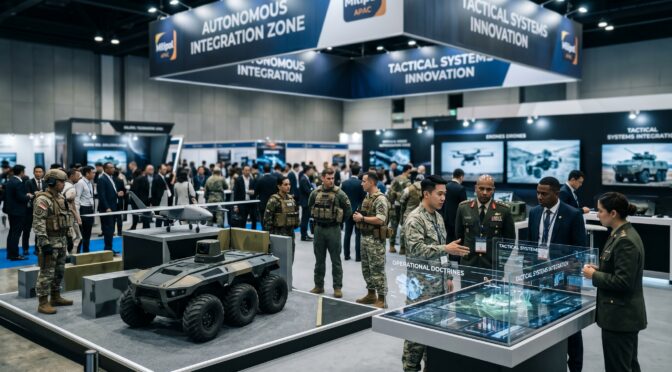
The Milipol TechX (MTX) Summit APAC 2026, held from April 28 to 30 at the Sands Expo and Convention Centre in Singapore, represents a critical inflection point in the evolution of regional security, public safety, and infantry operations.1 Jointly organized by Singapore’s Home Team Science and Technology Agency (HTX), France’s Civipol, TechX Ventures, and Comexposium, the summit hosted over 21,000 visitors and 270 curated exhibitors.2 The event firmly positioned itself as the premier nexus for public safety and homeland security technology in the Asia-Pacific (APAC) theater, transitioning from a traditional hardware exhibition into a working environment for evaluating the intersection of technology, policy, and field operations.1
The defining characteristic of the 2026 iteration was the decisive pivot away from purely kinetic solutions—such as traditional small arms and static armor—toward a comprehensive cyber-physical convergence. While the exhibition floor featured significant material advancements in personal protection and lethal enablers, the core narrative focused heavily on how physical defense assets are now subordinate to, or heavily integrated with, overriding digital architectures. Key product announcements in the tactical and hardware space included Mehler Protection’s Modular Universal Scalable Technology (M.U.S.T.) and the ExoM Exoskeleton, alongside ST Engineering’s ARIELE 2nd Generation personal protection suite and Manned-Unmanned Teaming Operations System (MUMTOS).5
However, the paramount strategic lessons learned from MTX 2026 centered on the weaponization, deployment, and defense of artificial intelligence (AI). Recognizing that the modern operational environment is defined by unprecedented speed, complex urbanization, and interconnected risks, regional state actors are urgently pursuing sovereign compute capabilities. Singapore’s announcement of “NGINE,” a sovereign GPU-powered AI infrastructure, and the deployment of the indigenous “Phoenix” Large Language Model (LLM) family underscore a new strategic reality.7 Future tactical superiority will rely as much on proprietary, air-gapped algorithms and secure data pipelines as it does on ballistic superiority and rapid deployment forces.
This comprehensive research report provides a meticulous analysis of the tactical gear, small arms developments, autonomous platforms, directed energy systems, and strategic AI doctrines unveiled at MTX 2026. It evaluates their underlying technological mechanisms and their overarching operational impact on modern military and public safety deployments in the Asia-Pacific region and beyond.
2. The Asia-Pacific Operational Context and Doctrinal Shifts
To accurately contextualize the technological announcements and product launches at MTX 2026, it is necessary to thoroughly examine the specific operational environment of the Asia-Pacific region. Security dynamics in this theater are distinctly defined by vast maritime distances, rapid urban development, high-density critical infrastructure, and deeply digitally integrated civic systems.1
2.1. The Interconnected and Autonomous Risk Environment
During the opening panel of MTX 2026, titled “New Frontlines: Emerging Threats Shaping the Future of Public Safety,” intelligence analysts and operational commanders emphasized that regional threats have become diffuse, decentralized, and exceedingly difficult to predict.8 Singapore’s Immigration & Checkpoints Authority (ICA) Commissioner Lian Ghim Hua articulated that the accelerating pace of technological change serves as both the primary enabler for state security forces and the principal vulnerability against asymmetric actors.8
The digitization of physical security has eroded the traditional border between cyber and kinetic warfare. Threat actors are increasingly utilizing AI not merely to generate sophisticated synthetic media and deepfakes for misinformation campaigns—which jeopardize citizen trust and suppress democratic functions—but to execute rapid, automated cyberattacks against critical national infrastructure.9 Advanced, autonomous AI models are now capable of identifying zero-day vulnerabilities in state networks and chaining them into complex exploits with minimal human oversight.7 This hyper-automation cuts the timeline between vulnerability discovery and exploitation from months to mere hours, leaving human defenders effectively blind and unable to react in time.7
The operational reality of this threat was evidenced by the prolonged “Operation Cyber Guardian” mounted by Singapore to counter a highly sophisticated threat actor, designated UNC3886, which actively targeted the nation’s telecommunications infrastructure in a sustained eleven-month campaign.7 Traditional reactive cybersecurity is no longer sufficient; security operations must become as automated, predictive, and AI-driven as the threats they face.
2.2. Near-Peer Ballistic Parity and Force Dispersal
While the MTX summit focuses heavily on public safety and homeland security, the overarching military balance inherently dictates the tier of technology required by state actors and domestic response units. The proliferation of advanced ballistic systems across the region has fundamentally altered the Anti-Access/Area Denial (A2/AD) calculus. Military analysis concurrently highlights the deployment of platforms such as China’s conventional DF-27 intercontinental ballistic missile, which features both land-attack and anti-ship capabilities at intercontinental ranges.10 Furthermore, the fielding of highly maneuverable hypersonic payloads capable of exploiting gaps in traditional radar and interceptor coverage necessitates a distributed, highly autonomous, and resilient force structure across the Pacific.10
Because large, concentrated force deployments and static command centers are highly vulnerable to these advanced standoff weapons, military and civil defense doctrines are shifting toward dispersed, highly lethal small-unit operations. These dismounted units must carry organic intelligence, surveillance, and reconnaissance (ISR) capabilities, relying heavily on the precise manned-unmanned teaming concepts and localized AI processing that dominated the exhibition halls at MTX 2026.
3. Advancements in Infantry Armor and Load Mitigation
The traditional paradigm of infantry armor has consistently struggled against the inverse relationship between ballistic protection and user mobility. At MTX 2026, leading defense contractors demonstrated a matured approach to material science and biomechanical engineering, seeking to break this historical compromise through modularity, load redistribution, and advanced molecular composites.
3.1. Modular and Scalable Protection Frameworks
Germany-based Mehler Protection utilized MTX 2026 to launch a robust portfolio of scalable armor systems tailored for the diverse operational profiles of the APAC region.5 The centerpiece of their exhibition was the Modular Universal Scalable Technology (M.U.S.T.).5
The M.U.S.T. system deliberately abandons the rigid, one-size-fits-all approach of legacy plate carriers utilized in the early Global War on Terror. Instead, it utilizes an architecture that allows operators to rapidly reconfigure their ballistic baseline depending on immediate mission requirements and evolving threat intelligence.5 For low-visibility operations, such as covert intelligence gathering or close protection details, the system can be stripped to minimal soft-armor configurations. Conversely, it can be scaled up with hard ballistic plates, deltoid (shoulder) protectors, groin guards, and neck collars for high-threat kinetic raids.5
Similarly, Mehler exhibited the MOBAST programme, showcasing their capacity for large-scale, standardized modular vest deployments, alongside the Protec Flex system.5 The Protec Flex is a complete riot gear setup providing comprehensive coverage across the torso, arms, groin, and legs, integrated with specialized gloves, helmets, and shields. It is engineered specifically to maintain joint articulation and operator agility in volatile, high-density public order scenarios.5
3.2. Load Mitigation: The ExoM Exoskeleton and Biomechanical Enhancement
One of the most operationally significant hardware debuts at MTX 2026 was Mehler’s ExoM Exoskeleton.5 The physical burden placed on modern dismounted operators is immense. Combining Level IV ceramic plates, primary and secondary weapon systems, ammunition, water, encrypted radios, and increasingly, drone control units and auxiliary batteries, the typical loadout frequently exceeds 45 kilograms. This weight induces severe musculoskeletal fatigue, which directly degrades cognitive function, situational awareness, and marksmanship during extended patrols.
The ExoM system is designed to passively transfer the load of the operator’s gear directly to the ground, bypassing the spine, hips, and knees entirely.5 By supporting load carriage and reducing physical strain during extended use, the exoskeleton allows infantry and special operations forces to arrive at the objective with a lower resting heart rate and a higher cognitive baseline.5 The integration of such systems indicates a profound strategic shift: rather than merely attempting to lighten the gear, defense manufacturers are now actively enhancing the human platform’s biomechanical capacity to carry it.
[Image: Conceptual rendering of an exoskeleton-equipped operator]
3.3. Next-Generation Armor Materials and Strategic Sovereignty
Singapore’s indigenous defense prime, ST Engineering (Land Systems), utilized MTX 2026 to showcase the second generation of their ARIELE Personal Protection System.6 The ARIELE suite (Army Individual Eco-lightweight Equipment) is engineered with an acute focus on mass reduction without compromising NATO STANAG protection levels.11
The system introduces advanced material sciences, most notably CleArmour transparent ceramic technology. Traditional transparent armor relies on thick, heavy layers of laminated glass and polycarbonate. This legacy approach adds immense top-weight to vehicles and tactical riot shields, negatively impacting the center of gravity, accelerating mechanical wear, and limiting maneuverability. ST Engineering’s transparent ceramic technology slashes this mass, rendering it up to 50% lighter than conventional glass armor while maintaining superior optical clarity even post-impact.12 Furthermore, ARIELE’s proprietary Armour Glass reduces weight by more than 20% across STANAG Levels 1 through 3.12 In the context of dismounted mobility and vehicle endurance in rugged terrain, these margins of weight reduction translate directly to increased fuel efficiency, extended loiter times, and prolonged operational endurance.
Simultaneously, the geopolitical necessity of securing domestic supply chains for these advanced materials was evident. Aksa Akrilik, the world’s largest acrylic fiber producer based in Turkey, presented MITHRA, their first domestically produced high-performance Ultra-High-Molecular-Weight Polyethylene (UHMWPE) fiber.13 Developed with an entirely in-house research and engineering infrastructure, MITHRA represents a fully integrated production process from raw fiber to Unidirectional (UD) fabric.13 The ability to produce UHMWPE—the foundational material for modern body armor, ballistic composite systems, and vehicle spall liners—domestically insulates defense forces from global supply chain shocks and export controls, marking a strategic step toward self-reliance in defense manufacturing.
4. Small Arms, Enablers, and Ammunition Evolution
While MTX 2026 was overwhelmingly oriented toward software, sensors, and platform integration, advancements in the physical delivery of kinetic force remain foundational to homeland security and military operations. Exhibitors showcased a range of evolutionary steps in small arms technology, optics, and ammunition design.
4.1. Polymer-Cased Ammunition Innovations
ST Engineering highlighted continuous innovations within their lethal solutions portfolio, specifically addressing the core logistical and physiological issue of ammunition weight. A standout component is the 5.56mm PluS ammunition.11 By replacing the traditional heavy brass cartridge case with a high-strength polymer, the manufacturer achieves a 30% reduction in weight compared to conventional 5.56x45mm NATO ammunition.11
The operational implications of transitioning to polymer-cased ammunition are profound and multi-faceted. An infantryman carrying a standard combat load of seven 30-round magazines experiences a substantial decrease in physical burden. This weight dividend allows for the carriage of additional medical supplies, communications batteries, or specialized munitions without increasing the total gross weight of the loadout. Furthermore, polymer behaves differently under thermal stress than brass. While brass acts as a thermal conductor, transferring chamber heat into the weapon system during cyclic fire, polymer acts as an insulator. The heat is largely extracted from the weapon along with the ejected casing, keeping the rifle’s chamber significantly cooler during sustained engagements. ST Engineering notes that the 5.56mm PluS is fully compatible with standard 5.56mm rifles and is heavily optimized for urban operations, where mobility and rapid target transition are paramount.11
The international presence at the summit further underscored the demand for premium small-caliber munitions. Germany’s MEN (Metallwerk Elisenhütte) and Hungary’s MFS Defense both exhibited their high-quality infantry ammunition portfolios, emphasizing reliable function across military, law enforcement, and special forces applications globally.13
4.2. Global Context in Optics and Tactical Firearms
The trends observed at MTX 2026 must be analyzed within the broader global context of the small arms industry, particularly the developments concurrently emerging from major international exhibitions like the 2026 SHOT Show in the United States. The global tactical market is currently undergoing a rapid standardizing of enclosed emitter pistol optics, direct-mount solutions, and advanced rangefinding technologies.14
A critical vulnerability of red dot optics on service handguns has historically been the fragility of intermediary mounting plates, which are prone to shearing under the immense reciprocating G-forces of the slide. The industry has moved decisively toward direct-mount solutions, exemplified by Aimpoint’s A-CUT system. This integrated mounting system mechanically locks the optic directly to the slide without plates, offering unprecedented durability and consistency for law enforcement and military end-users.15
Furthermore, electro-optics are becoming highly computational. Devices such as the newly announced Leupold BX-6 Range HD binoculars represent a serious leap forward.14 These systems integrate onboard ballistics processors powered by Hornady, featuring customizable in-glass data displays and extreme long-range performance.14 Operators can switch environmental and ballistic profiles instantaneously via mobile applications, merging the roles of observation and firing solution calculation.14
In the realm of firearms hardware, manufacturers like Rise are introducing tool-less, quick-install trigger systems that reduce installation time to under 60 seconds while providing interchangeable trigger faces and crisp breaks.14 Concurrently, there is an operational shift back toward heavier service weapons for specific tactical roles. The introduction of all-steel, hammer-fired 9mm pistol lineups from manufacturers like SAR highlights this trend.14 By increasing the mass of the firearm, operators experience significantly mitigated recoil impulses, allowing for faster and more accurate follow-up shots in high-stress, close-quarters environments compared to lighter polymer-framed alternatives.14
5. Manned-Unmanned Teaming (MUM-T) and Swarm Integration
The rapid proliferation of unmanned aerial vehicles (UAVs) and unmanned ground vehicles (UGVs) has saturated the modern battlespace and urban operational environments. However, the operational bottleneck has shifted from platform acquisition to cognitive overload; human operators cannot effectively manage multiple disparate drones while simultaneously engaging in kinetic combat, communicating with command, and maintaining situational awareness. MTX 2026 highlighted software architectures and platforms specifically designed to bridge this gap through advanced Manned-Unmanned Teaming (MUM-T).
5.1. Open Architecture and Autonomous Orchestration
ST Engineering unveiled its Manned-Unmanned Teaming Operations System (MUMTOS), an advanced, open-architecture platform designed to orchestrate seamless coordination between manned assets and a wide variety of unmanned systems, including aerial drones, surface vessels, and ground robots.6
MUMTOS leverages AI-driven Command, Control, and Communications (C3) logic to enable sophisticated swarm capabilities.6 Instead of a linear, one-to-one ratio where a human operator must manually pilot a single drone via a remote control, MUMTOS allows a tactical commander to issue macro-level objectives to the system. For instance, a commander can command the swarm to “secure a specific perimeter” or “search a grid coordinate for thermal signatures.” The underlying AI architecture then autonomously delegates flight paths, coordinates search patterns, manages battery life across the swarm, and executes de-confliction protocols to prevent mid-air collisions.
This technological integration transitions traditional tactical vehicles from simple troop transports into highly capable mobile intelligence hubs.12 The TERREX s5 infantry carrier, for example, is envisioned as a forward energy and command hub capable of launching micro UAVs like the ARES platform. The ARES micro drone provides real-time, high-definition imagery directly to dismounted troops, drastically shortening the OODA (Observe, Orient, Decide, Act) loop and granting critical early situational awareness before physical contact is initiated.12
| Unmanned Platform / Software | Manufacturer | Core Capability Demonstrated | Tactical Application |
| MUMTOS Architecture | ST Engineering | AI-driven C3, open architecture swarm logic.6 | Orchestrating multi-domain assets (air, land, sea) from a unified interface without overwhelming the human operator. |
| ARES Micro UAV | ST Engineering | Real-time aerial imagery, rapid tactical deployment.12 | Enhancing dismounted infantry situational awareness; shortening engagement decision cycles. |
| RIPSAW M1 UGV | Textron Systems | Advanced UGV technology demonstrator.16 | Providing autonomous breaching, fire support, and logistics in advanced littoral and contested environments. |
| Kazhan UAV | Reactive Drone | Multi-channel communication upgrades.16 | Ensuring resilient drone operations in electronically contested or jammed environments. |
| SkyLance Platform | Rotron | Autonomous long-range OWE platform.16 | Executing long-range reconnaissance or strike missions autonomously following a firing trial demonstration. |
5.2. Navigating Denied Environments and Advanced Sensors
The effectiveness of unmanned systems relies heavily on their ability to navigate when standard signals are degraded or actively jammed. Acknowledging the reality of electronic warfare in modern conflict, UAV Navigation unveiled a new autopilot system specifically engineered for contested and GNSS-denied (Global Navigation Satellite System) environments.16 This allows UAVs to maintain course and execute missions even when adversaries spoof or block GPS signals.
Simultaneously, the sensor payloads attached to these platforms are achieving unprecedented resolution. Advancements such as the Applanix POSPac next-generation hybrid aerial mapping system by Trimble Applanix, the cutting-edge LiDAR solutions presented by YellowScan, and the Eyeonic Vista Ultra-Long-Range 4D Vision System by SiLC Technologies are transforming raw data collection.16 These sensors allow drones to map complex topography, identify camouflaged assets, and provide highly accurate targeting coordinates in real-time. Furthermore, addressing the critical limitation of drone loiter time, Natrion introduced new advanced battery product lines specifically designed for uncrewed systems, significantly increasing energy density and extending operational range.16
6. Counter-UAS (C-UAS) and Directed Energy Systems
The asymmetric advantage provided by low-cost commercial drones utilized for dropping munitions or conducting surveillance has forced a rapid acceleration in Counter-Unmanned Aerial Systems (C-UAS) technology. Traditional kinetic interceptors, such as surface-to-air missiles, present a highly unfavorable cost-per-kill ratio when used against inexpensive quadcopters. MTX 2026 highlighted the shift toward electronic warfare and directed energy as the primary defensive layers.
6.1. Directed Energy and Artificial Intelligence
A prominent showcase at the HTX Pavilion was the BlueHalo LOCUST Laser Weapon System (LWS), also known as the P-HEL system, presented in collaboration with HENSOLDT Singapore.17 The LOCUST system represents the maturation of directed energy weapons for tactical deployment. It combines precision optical and laser hardware with advanced software processing and artificial intelligence.17
The integration of AI is critical for directed energy systems. Tracking a small, highly maneuverable drone at long ranges requires predictive algorithms to calculate lead and maintain the laser’s focal point on a specific, vulnerable component of the target (e.g., the battery or flight controller) long enough to achieve a thermal kill. By utilizing directed energy, the LOCUST system provides defenders with an effectively “infinite magazine,” limited only by the platform’s electrical power generation capabilities, fundamentally altering the economics of drone defense.17
6.2. Spectrum Dominance and Simulation
Securing the airspace begins with dominating the electromagnetic spectrum. Rohde & Schwarz exhibited their comprehensive suite of C-UAS and SIGINT/EW (Signals Intelligence / Electronic Warfare) systems.18 These systems provide real-time spectrum monitoring, allowing operators to detect, localize, and classify the radio frequency signatures of incoming drones or hostile communications before the physical threat is visible.18 Their hardware is designed to be highly scalable, offering stationary, mobile, and transportable configurations ready for deployment across air, land, and sea domains to protect essential frequencies and ensure communications reliability.18
Furthermore, ST Engineering presented the AGIL Counter Drone solution alongside an advanced CUAS Simulation System.6 Recognizing that C-UAS tactics must be constantly refined, the simulation system allows operators to wargame various swarm attack scenarios and test defensive algorithms in a virtual environment before deploying them to the physical AGIL Counter Drone hardware.
7. Tactical Robotics and Autonomous Platforms
The concept of removing the human operator from the immediate line of fire was heavily emphasized in the Robotics Zone at MTX 2026. Agencies are increasingly viewing robotic platforms not just as tools, but as expendable forward extensions of human officers.
7.1. Humanoid Proxies and Whole-Body Control
HTX demonstrated how robotics engineers are developing remote extensions of human officers through advanced telepresence and humanoid whole-body control.19 During live experiential sessions, attendees were able to operate cutting-edge humanoid robots capable of navigating complex, human-centric environments, such as stairwells and standard doorways.20 By utilizing advanced teleoperation, these platforms allow front-line personnel to interact with highly hazardous environments—such as post-blast investigation sites, chemical spills, or active hostage situations. The human operator maintains full situational awareness, tactical judgment, and manual dexterity while remaining physically shielded from harm at a remote command station.19
7.2. Autonomous Mapping and Digital Twins
Autonomous navigation was vividly demonstrated by FieldAI’s quadruped robots, which navigated the MTX exhibition hall in real-time.20 Quadrupedal locomotion offers distinct advantages over tracked or wheeled UGVs in urban environments, allowing the robot to step over debris, climb stairs, and traverse the uneven terrain typical of post-blast or disaster zones. As the FieldAI robot moves, its onboard sensors create a high-fidelity digital twin (a real-time 3D map) of the environment.20 This capability allows command centers to generate highly accurate layouts of contested or disaster-stricken environments autonomously, paving the way for safer, intelligence-led human interventions.
Similarly, the creation of digital twins was explored by Vizzio and Polytron.AI in the Science Zone.20 Their systems utilize 720-degree omnidirectional cameras and autonomous drone swarms to simulate evacuations, calculate blast zones, and analyze crowd flows.20 This data is fused into a unified AI command center, enabling security forces to harden sites and protect major events with a level of predictive modeling previously unavailable.20
These robotic mapping concepts are synthesized in the PINPOINT system developed by HTX. Demonstrated via live operations, PINPOINT is designed for search and rescue operations, highlighting how emergency responders can seamlessly switch between autonomous robotic intelligence and human-guided operations. Utilizing collaborative mapping and advanced human-robot interfaces, PINPOINT promises to revolutionize indoor emergency response by mapping structurally unsound environments before human personnel are committed.20
8. Sovereign AI, Cyber-Physical Security, and Infrastructure
The most critical strategic dialogues at MTX 2026 did not revolve around calibers, armor plating, or hardware, but rather the integrity, speed, and sovereignty of the data networks that control them. As Singapore’s Coordinating Minister for National Security and Minister for Home Affairs K. Shanmugam noted, AI has unequivocally become the most important force multiplier for state security.7
8.1. Sovereign Compute Infrastructure: Project NGINE
A profound lesson articulated at the summit is that serious, national-level AI capability requires sovereign infrastructure.7 Relying on commercial, foreign-hosted cloud environments for defense and public safety AI models introduces unacceptable risks regarding data privacy, model poisoning, and strategic dependency. If a state does not physically control the hardware computing the intelligence, its sovereignty is fundamentally compromised.7
To address this critical vulnerability, Singapore’s HTX established strategic partnerships with ST Engineering, Google, NVIDIA, and Nutanix to construct “NGINE”.7 NGINE is the Ministry of Home Affairs’ first fully sovereign, GPU-powered AI infrastructure.7 Utilizing NVIDIA B200 DGX SuperPODs, this infrastructure securely computes classified and operational data entirely under domestic control.21 The MoU signed with NVIDIA ensures that Singapore remains at the forefront of AI research, talent development, and gains early access to advanced development kits, securing a vital technological advantage in the region.7
8.2. Large Language Models in Tactical Roles: The Phoenix Family
Hardware sovereignty is only half of the equation; security agencies must also control the algorithms. In collaboration with the prominent French AI firm Mistral AI—whose Co-founder and CEO Arthur Mensch delivered a keynote address on advancing strategic AI and safeguarding public trust—HTX has pre-trained an indigenous family of large language models designated “Phoenix”.7
The Phoenix family operates on multiple tiers:
- Phoenix Small: Already fully operational, this model is designed to assist intelligence officers and analysts in synthesizing vast amounts of complex, unstructured information rapidly within a secure, air-gapped digital sandbox.7
- Phoenix Medium: Officially unveiled during MTX 2026, this more robust iteration possesses multi-modal capabilities, including the ability to analyze images and complex documents.7
Crucially, Phoenix Medium is engineered to execute advanced agentic tasks.7 Unlike standard generative AI, which merely outputs text in response to a prompt, agentic AI acts autonomously within defined parameters. Agentic systems can continuously monitor intelligence feeds, verify cross-border documents against databases, trigger automated alerts, and orchestrate security protocols based on predefined operational boundaries. This transition from AI as a passive consultant to AI as an active, decision-making agent is poised to redefine public safety workflows.
[Image: Layered architecture diagram of sovereign AI framework]
8.3. Governance, Cybersecurity, and Ecosystem Integration
Deploying AI in mission-critical environments carries profound operational and political risks. When an AI makes a faulty decision in a high-stakes kinetic or intelligence environment, the consequences can be catastrophic. Consequently, MTX highlighted the vital necessity of AI validation and transparency. Through partnerships like the Strategic Partnership for Innovation (SPI) agreement between HTX and Resaro, the assurance and transparency of AI are moving from ad hoc principles to structured, scalable, and mathematically verifiable practices.9 Similarly, companies like CodexScribe were recognized at the Milipol Innovation Awards for redefining AI reliability through formal mathematical verification for critical environments.23 To safely test these systems, governance frameworks such as the AI Verify Sandbox and the GenAI Eval Sandbox have been established to allow enterprises to experiment with AI within controlled legal and operational boundaries.21
The integration of hacker culture into state security apparatuses was another prominent theme. Jeff Moss, the Founder of the renowned Black Hat and DEF CON conferences, conducted a highly anticipated fireside chat titled “AI Agents in Cybersecurity: Redefining the Role of Hackers”.22 Furthermore, the alignment of the DEFCONSG 2026 event alongside MTX illustrates a strategic imperative: public safety agencies must actively collaborate with the cybersecurity research community to defend the very systems they are building.7
This ecosystem approach is further evidenced by NCS, a leading technology services firm, which deepened its collaboration with HTX while simultaneously establishing new partnership milestones with Mistral AI, VAST Data, Lian Xin, AGIBOT, and Huazhi Tiancheng.24 These alliances aim to build mission-critical AI solutions, spanning from Physical AI and autonomous systems to high-level data architecture, ensuring that frontline responses are deployed with absolute trust, security, and intent.24 Additionally, Akidaia showcased the first sovereign, internationally distinguished dynamic authentication system, providing robust identity verification for defense and corporate networks.13
9. Cross-Domain Operations: Space, Maritime, and Border Integration
The technological integration showcased at MTX 2026 extended far beyond terrestrial boundaries, reflecting a modern force modernization doctrine where the traditional dividing lines between military branches, domestic security agencies, and domain operations are entirely dissolved.
9.1. Orbital Infrastructure and Environmental Overwatch
Reflecting this cross-domain trend, HTX and ST Engineering announced a five-year Memorandum of Understanding (MoU) to establish a comprehensive new space technology program.25 The primary objective is to co-develop space-based science and technology capabilities specifically tailored to strengthen domestic public safety operations.25
A critical application of this orbital infrastructure involves utilizing Earth observation satellites for precise environmental monitoring and early-warning systems. Satellite constellations can provide persistent, unblinking overwatch to detect and monitor hazardous gas plumes, chemical spills, or large-scale fires originating from offshore industrial facilities.25 By providing high-fidelity, real-time geospatial telemetry from space, these systems act as an ultimate strategic force multiplier. They grant first responders, Coast Guard units, and civil defense teams crucial lead time to enact evacuation protocols, deploy specialized CBRNE (Chemical, Biological, Radiological, Nuclear, and Explosive) teams, and ultimately mitigate casualty rates effectively.25 This MoU signifies a maturation of homeland security doctrine, demonstrating that domestic public safety is no longer confined to local police forces and localized sensors, but increasingly relies on the macro-level intelligence-gathering capabilities traditionally reserved for national defense intelligence agencies.
9.2. Maritime Security and Frictionless Borders
In the maritime domain, ST Engineering displayed extensive advancements aimed at securing coastlines and territorial waters. Key exhibits included the 2nd Generation Heavy Fire Vessel, engineered for large-scale maritime emergency response, alongside the 5th Generation PT Class Patrol Boat, advanced Unmanned Surface Vessels (USVs), and Autonomous Underwater Vehicles (AUVs).6 These autonomous maritime assets integrate directly into broader command systems like the AGIL Ops Hub and AGIL Cloud Weave, creating a seamless net of maritime awareness capable of detecting smuggling, illegal fishing, or hostile incursions without risking human patrols.6
On land, the concept of border security is being revolutionized by AI. Lightning talks at MTX 2026 explored how a holistic approach to intelligent borders can combine frictionless traveler processing with AI-powered decision-making.20 By integrating digital pre-registration, contactless biometrics, automated vehicle clearance, and advanced document verification, security agencies can enable seamless identity verification throughout the traveler journey.20 Behind these operational innovations, sophisticated AI-powered risk analysis and modern border management systems provide authorities with the continuous intelligence needed to support rapid, risk-based decisions, ensuring that borders remain both highly secure and economically efficient.20
10. Strategic Conclusions
The Milipol TechX Summit APAC 2026 offered a definitive, comprehensive blueprint for the immediate future of combat, law enforcement, and public safety. The era where tactical superiority was determined primarily by the terminal ballistics of a service rifle or the raw thickness of steel vehicle armor has definitively concluded. As demonstrated comprehensively in Singapore, the modern operator—whether a dismounted infantryman or a border security agent—is now merely a single node within a vastly larger, highly integrated cyber-physical network.
Three overarching conclusions dictate the immediate future of the sector based on the announcements and lessons learned at MTX 2026:
First, physical infantry equipment must relentlessly prioritize load mitigation, biomechanical enhancement, and modularity. Innovations such as the Mehler ExoM Exoskeleton, ST Engineering’s polymer-cased 5.56mm PluS ammunition, and CleArmour transparent ceramics are no longer luxury items.5 They are essential operational requirements needed not merely for operator comfort, but to preserve the vital cognitive stamina required to interface with complex battlefield networks, interpret augmented reality data, and manage drone swarms under fire. Furthermore, the domestic production of critical materials, such as Aksa Akrilik’s UHMWPE fiber, is essential to maintain supply chain sovereignty.13
Second, Manned-Unmanned Teaming (MUM-T) is rapidly transitioning from a conceptual, asymmetric advantage to a baseline operational necessity. The deployment of open-architecture orchestration systems like MUMTOS will enable small, highly dispersed units to wield the ISR, electronic warfare, and kinetic capabilities that previously required company-sized elements.6 Human operators will increasingly step back from the direct line of fire, relying on humanoid proxies, quadruped UGVs, and micro UAVs to map, assess, and neutralize threats in high-risk zones.19 Countering adversary deployment of similar systems requires the fielding of directed energy weapons, like the LOCUST system, which alter the cost-exchange ratio of drone defense.17
Finally, the absolute bedrock of all future tactical capability is Sovereign Artificial Intelligence. The speed of autonomous cyber threats and the complexity of modern multi-domain intelligence dictate that security agencies must possess their own localized, heavily secured GPU infrastructure, exemplified by Singapore’s NGINE.7 Indigenous algorithms, such as the Phoenix Medium LLM, will rapidly evolve from passive analytical tools into active, agentic participants in public safety workflows.7 However, this necessitates rigorous, mathematically verifiable validation protocols to ensure the “black box” of artificial intelligence can be explicitly trusted when human lives and national stability are at stake.9 Nations that fail to secure their computational infrastructure, validate their models, and integrate their systems across space, maritime, and cyber domains will find themselves outmaneuvered not on the physical battlefield, but within the neural networks that now control it.
Please share the link on Facebook, Forums, with colleagues, etc. Your support is much appreciated and if you have any feedback, please email us in**@*********ps.com. If you’d like to request a report or order a reprint, please click here for the corresponding page to open in new tab.
Sources Used
- MTX (Milipol TechX) 2026: Advancing Public Safety in Asia-Pacific, accessed May 18, 2026, https://www.milipol.com/en/newsroom-milipolparis/milipol-techx
- MTX 2026 – HTX, accessed May 18, 2026, https://www.htx.gov.sg/whats-happening/mtx-2026
- MTX 2026 closes on a high – HTX, accessed May 18, 2026, https://www.htx.gov.sg/whats-happening/all-news—events/all-news/2026/mtx-2026-closes-on-a-high
- Milipol TechX 2026 wraps up in Singapore with strong turnout – Defensehere, accessed May 18, 2026, https://defensehere.com/en/milipol-techx-2026-wraps-up-in-singapore/
- DSA and Milipol TechX Recap – Mehler Systems, accessed May 18, 2026, https://mehler-systems.com/company-news/dsa-and-milipol-techx-asia-recap-2026/
- MTX 2026 – Singapore – INNOVD – ST Engineering, accessed May 18, 2026, https://innovd.stengg.com/event/mtx-2026/
- Opening ceremony of the Milipol Tech X Summit 2026 – Speech by Mr K Shanmugam, Coordinating Minister for National Security and Minister for Home Affairs, accessed May 18, 2026, https://www.mha.gov.sg/media-room/newsroom/opening-ceremony-of-the-milipol-tech-x-summit-2026/
- Innovation supercharged: MTX 2026 opens with a roar – HTX, accessed May 18, 2026, https://www.htx.gov.sg/whats-happening/all-news—events/all-news/2026/innovation-supercharged-mtx-2026-opens-with-a-roar
- AI for the frontline must be validated, not just deployed – GovInsider, accessed May 18, 2026, https://govinsider.asia/intl-en/article/ai-for-the-frontline-must-be-validated-not-just-deployed
- Quoted in Asian Military Review: “Pentagon Outlines the Growing Threat Posed by the PLA”, accessed May 18, 2026, https://www.andrewerickson.com/2026/01/quoted-in-asian-military-review-pentagon-outlines-the-growing-threat-posed-by-the-pla/
- ST Engineering – Annual Report 2016 – Singapore Exchange, accessed May 18, 2026, https://links.sgx.com/1.0.0/corporate-announcements/4E6KN92M2OAG7BUI/444494_ST%20Engineering%20-%20Annual%20Report%202016.pdf
- Military Systems & Technology Magazine – Edition 1 – 2026 – Issuu, accessed May 18, 2026, https://issuu.com/military-systems/docs/military_systems_technology_magazine_-_edition_1
- List of Exhibitors | Milipol Paris, accessed May 18, 2026, https://www.milipol.com/en/catalogue
- The HOTTEST New Guns and Gear at SHOT Show 2026 – Opening Day! – YouTube, accessed May 18, 2026, https://www.youtube.com/watch?v=r2BBjVkGi4Q
- New Guns and Gear for 2026 – Police and Security News, accessed May 18, 2026, https://policeandsecuritynews.com/2026/03/26/new-guns-and-gear-for-2026/
- Milipol TechX Summit 2026 | April 28–30, 2026 | Sands Expo, Singapore, accessed May 18, 2026, https://www.unmannedsystemstechnology.com/events/milipol-techx-summit/
- Jajati Mohanty – Drones World Magazine, accessed May 18, 2026, https://www.dronesworldmag.com/wp-content/uploads/2024/05/Drones-World_E-Magazine-May-2024.pdf
- MILIPOL TECHX Summit – Rohde & Schwarz, accessed May 18, 2026, https://www.rohde-schwarz.com/us/about/trade-shows/milipol-techx-summit_229402-1601044.html
- Must-see tech exhibits across MTX 2026 zones – HTX, accessed May 18, 2026, https://www.htx.gov.sg/whats-happening/all-news—events/all-news/2026/must-see-tech-exhibits-across-mtx-2026-zones
- Lightning Talk Agenda – MTX (Milipol TechX) 2026, accessed May 18, 2026, https://www.mtx.sg/lightning-talk-agenda
- From 50 People to 5700000 — One AI-native Architecture, Two Scales, accessed May 18, 2026, https://sgai.md/singapore-ai-native-companies-vs-nations/
- Home | MTX (Milipol TechX) 2026, accessed May 18, 2026, https://www.mtx.sg/home
- Official Newsroom – Milipol Paris, accessed May 18, 2026, https://www.milipol.com/en/newsroom-milipolparis
- Milipol TechX 2026 Highlights – YouTube, accessed May 18, 2026, https://www.youtube.com/watch?v=KjdPq4ygstY
- HTX and ST Engineering to Partner on New Space Tech Programme to Enhance Public Safety Operations, accessed May 18, 2026, https://www.stengg.com/en/newsroom/news-releases/htx-st-engineering-partner-on-new-space-tech-programme/