Executive Summary
The security, diplomatic, and economic architecture of Southeast Asia during the week ending February 21, 2026, was defined by a convergence of intense kinetic escalations and sweeping diplomatic realignments. Across the region, middle powers are actively recalibrating their strategic postures in response to an increasingly aggressive United States economic statecraft and a highly coercive maritime strategy executed by the People’s Republic of China. This reporting period highlights a profound acceleration in regional fragmentation, where multilateral institutions like the Association of Southeast Asian Nations (ASEAN) are increasingly bypassed in favor of transactional, bilateral security and trade pacts.
In the maritime domain, the South China Sea remains the primary flashpoint for great power competition. A severe, unintended collision between a Chinese Coast Guard vessel and a People’s Liberation Army Navy destroyer near the contested Scarborough Shoal exposed critical command and control vulnerabilities within China’s maritime apparatus. This tactical failure occurred synchronously with the 12th United States-Philippines Bilateral Strategic Dialogue in Manila, where both nations explicitly codified the application of their Mutual Defense Treaty to coast guard vessels, thereby signaling a robust hardening of deterrence mechanisms against Beijing’s gray-zone tactics. The Philippines, leveraging its 2026 ASEAN Chairmanship, continues to aggressively push for a United Nations Convention on the Law of the Sea (UNCLOS)-based Code of Conduct, a framework China remains structurally opposed to accepting.
On the mainland, conventional state-on-state warfare has erupted with devastating consequences along the Thailand-Cambodia border. Now entering its eleventh consecutive day following the collapse of a tenuous December ceasefire, the conflict has normalized the use of heavy artillery and internationally prohibited landmines. The humanitarian fallout is catastrophic, resulting in over 100 fatalities and the internal displacement of upwards of 700,000 civilians. Crucially, the border war has fundamentally altered the domestic political equilibrium in Bangkok. The Royal Thai Armed Forces have utilized the crisis to circumvent civilian authority, fueling a wave of ethnonationalism that directly precipitated the landslide victory of the conservative, military-aligned Bhumjaithai Party in the February 8 general elections.
Simultaneously, the geopolitical center of gravity temporarily shifted to Washington, D.C., during the inaugural meeting of the Gaza Board of Peace. The United States masterfully utilized this global security forum as a lever for regional economic statecraft. Indonesia, departing from its historical non-aligned doctrine, committed up to 8,000 troops to a U.S.-backed International Stabilization Force in Gaza. In immediate exchange, Jakarta secured a monumental reciprocal trade agreement, eliminating tariffs on 99 percent of its exports to the U.S. and finalizing $38.4 billion in corporate memoranda of understanding. Vietnam engaged in a parallel execution of “Bamboo Diplomacy,” dispatching its highest leadership to Washington to negotiate tariff exemptions while attempting to insulate its export-driven economy from the friction of the U.S.-China strategic rivalry.
Finally, the systemic collapse of Myanmar constitutes a persistent, radiating threat to the entire Indo-Pacific. Nearing the five-year anniversary of the 2021 military coup, the State Administration Council controls a mere 21 percent of the national territory. A compound humanitarian crisis, exacerbated by the catastrophic March 2025 earthquake, has left over 16 million citizens requiring urgent assistance. The vacuum of state authority has transformed Myanmar’s periphery into an undisputed haven for transnational organized crime, generating secondary security threats that the paralyzed international community remains entirely unequipped to mitigate.
1. Regional Strategic Overview: The U.S.-China Competition Matrix
The geopolitical dynamics governing the Asia-Pacific in early 2026 are overwhelmingly dictated by the structural and intensifying rivalry between the United States and the People’s Republic of China (PRC). Both superpowers are actively operationalizing competing geostrategic frameworks designed to secure vital maritime trade routes, dominate critical mineral supply chains, and project sustained military power across the First Island Chain.1 The resulting landscape is a highly fragmented Southeast Asia, where middle powers are forced into constant, tactical hedging to extract economic and security concessions from both Washington and Beijing while attempting to avoid irreversible strategic entanglement.
The United States has adopted a highly transactional, integrated approach to the region, explicitly linking defense cooperation, punitive trade tariffs, and global security initiatives.2 The Trump administration’s 2026 National Security Strategy unequivocally identifies the PRC as its foremost competitor, precipitating an aggressive regional posture aimed at “tying down” Chinese resources in the Pacific theater to prevent Beijing’s expansion into other global theaters.2 Washington is actively utilizing its immense economic leverage—specifically the pervasive threat of a baseline 19 percent universal import tariff—to compel Southeast Asian nations into deeper bilateral alignments.5 This paradigm was vividly demonstrated this week as both Indonesia and Vietnam dispatched their heads of state and top diplomats to Washington for the Gaza Board of Peace summit, utilizing the Middle Eastern security forum as a vehicle to negotiate bilateral trade exemptions and secure foreign direct investment.5
Conversely, Beijing views the expanding network of U.S. alliances—particularly the tightening operational defense coordination between the U.S., Japan, South Korea, and the Philippines—as a direct, existential threat to its territorial integrity and long-term economic security.1 To mitigate the persistent “Malacca Dilemma”—its critical strategic vulnerability to a hypothetical naval blockade of the Strait of Malacca and the Strait of Luzon—China is heavily subsidizing dual-use infrastructure and cultivating deep political patronage networks throughout mainland Southeast Asia, explicitly targeting Myanmar, Cambodia, and Thailand.1
However, regional instability poses a severe and compounding risk to Chinese strategic investments. The escalating Thailand-Cambodia border war, alongside the total state collapse in Myanmar, severely complicates Beijing’s efforts to project a unified, China-centric economic and security sphere in the region.1 Consequently, Beijing is frequently forced into a reactive posture, attempting to manage peripheral crises that threaten to invite further United States intervention into its immediate sphere of influence.
2. South China Sea Theater and the Philippine-U.S. Alliance
The South China Sea remains the most volatile maritime flashpoint in the Indo-Pacific, characterized during this reporting period by a severe operational failure by Chinese maritime forces and a corresponding, robust reinforcement of the U.S.-Philippine mutual defense architecture. The strategic waterway, through which an estimated $3.36 trillion worth of global trade and 80 percent of China’s energy imports transit annually, is the epicenter of overlapping territorial claims involving Brunei, Indonesia, Malaysia, the Philippines, Taiwan, and Vietnam.8
2.1 The Scarborough Shoal Collision Incident
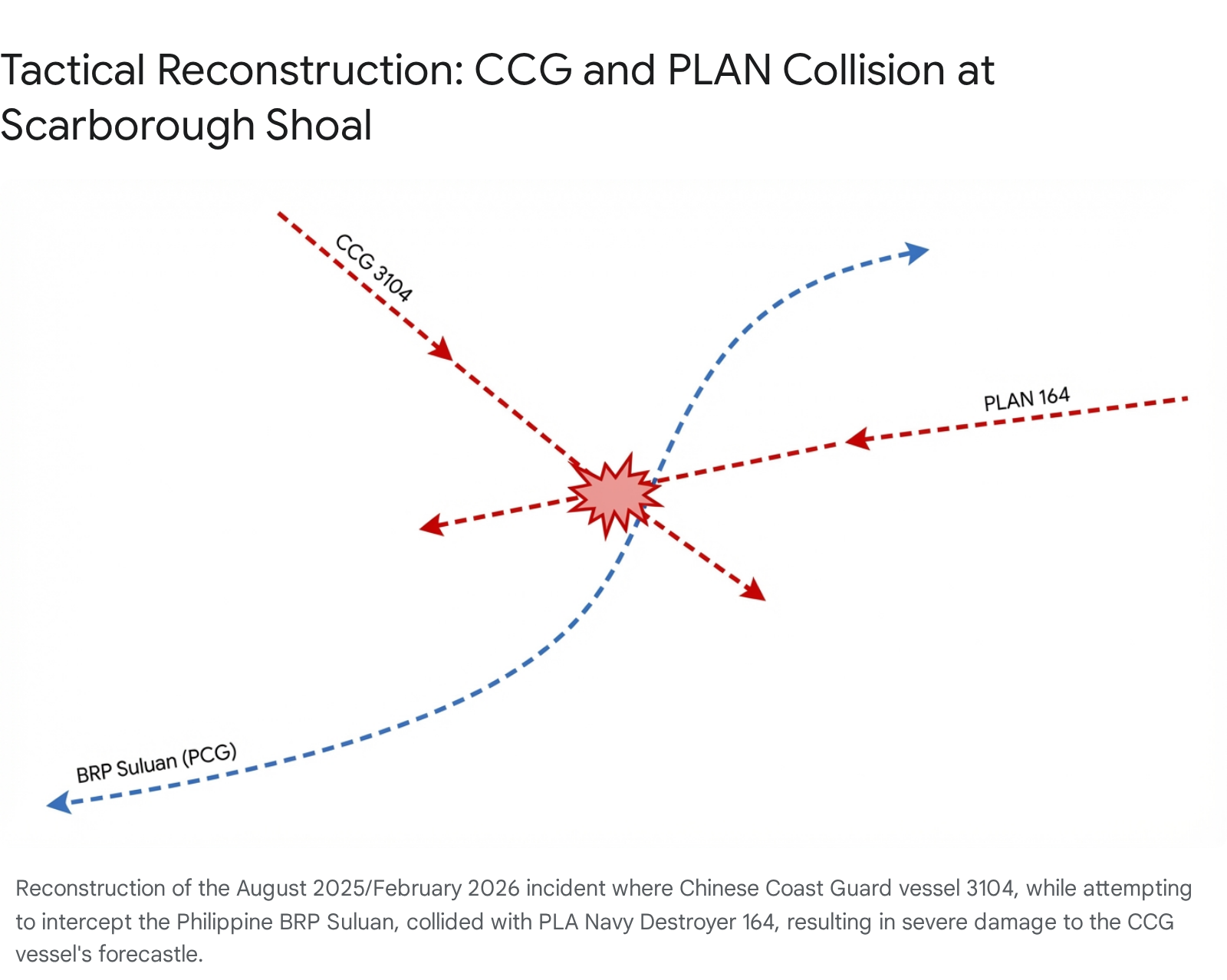
In a highly anomalous and strategically significant event, a severe collision occurred near the contested Scarborough Shoal involving two Chinese state vessels. Video footage, recently released by the Philippine Coast Guard (PCG) as part of Manila’s ongoing “assertive transparency” campaign, captured Chinese Coast Guard (CCG) vessel 3104 aggressively pursuing a much smaller Philippine patrol boat, the BRP Suluan.9 The BRP Suluan was conducting routine operations to escort civilian maritime vessels delivering humanitarian aid and supplies to local Filipino fishermen operating within the Philippine Exclusive Economic Zone (EEZ).10
During this high-speed, coercive pursuit, the BRP Suluan successfully executed evasive maneuvers to avoid both a targeted water cannon attack and a deliberate ramming attempt by the Chinese vessel.10 In the course of executing these aggressive, high-risk maneuvers, CCG 3104 lost positional awareness and collided directly with a larger People’s Liberation Army Navy (PLAN) destroyer, identified by the hull number 164, which was operating in close proximity to the interdiction.10 The kinetic impact caused severe structural damage to the forecastle of the CCG vessel, rendering it immediately unseaworthy.10 In accordance with international maritime law, the Philippine Coast Guard immediately broadcast offers for search and rescue operations, man-overboard recovery, and medical assistance; these offers were uniformly ignored by the Chinese crews.10
This “friendly fire” collision provides vital intelligence regarding the current operational state of China’s maritime forces. The physical presence of a PLAN destroyer in the immediate vicinity of a Coast Guard interdiction operation violates the spirit, if not the letter, of the 2012 bilateral agreement regarding the demilitarization of the Scarborough Shoal dispute.12 More critically, the collision indicates severe command, control, and communications (C3) friction between the CCG and the PLAN. The institutional culture of aggressive, high-risk maneuvers mandated by Beijing’s political leadership appears to be rapidly degrading basic seamanship, safety protocols, and inter-agency coordination among Chinese maritime crews.12
The fallout from the Scarborough Shoal incident underscores a broader pattern of Chinese territorial expansionism. By 2015, the PRC had established 8 highly militarized artificial outposts in the region, fundamentally altering the strategic geography of the South China Sea.8 This aggressive posture contrasts with the defensive occupations maintained by other claimant states.
| Claimant State | Primary Strategic Features Occupied | Key Areas of Dispute / Historical Claims |
| People’s Republic of China | 8 highly militarized artificial island outposts | Claims 90%+ of the SCS via the “nine-dash line” (historically the 11-dash line drawn in 1947 by the Nationalist party).8 |
| Vietnam | 48 defensive features and outposts | Claims the Paracel Islands (seized by China in 1974) and Spratly Islands.8 |
| Philippines | 8 features | Claims portions of the Spratly Islands and Scarborough Shoal; relies heavily on the 2016 international arbitral ruling.8 |
| Taiwan (ROC) | 1 major feature (Taiping Island) | Maintains historical claims mirroring the PRC’s, occupying the largest natural feature in the Spratlys.8 |
| Malaysia | 5 features | Claims features within its continental shelf in the southern Spratly chain.8 |
Data compiled from historical maritime occupation records and current South China Sea strategic posture assessments.8
2.2 The 12th U.S.-Philippines Bilateral Strategic Dialogue
As the diplomatic fallout from the incident at Scarborough Shoal reverberated through the region, senior defense, intelligence, and diplomatic officials from the United States and the Philippines convened the 12th Bilateral Strategic Dialogue (BSD) in Manila on February 16, 2026.15 The dialogue served to explicitly codify the strategic parameters of the alliance in direct response to China’s escalating maritime coercion.
A comprehensive joint statement released by the U.S. Department of State and the Philippine Department of Foreign Affairs strongly condemned China’s “illegal, coercive, aggressive, and deceptive activities” within the Philippine EEZ.15 Crucially, both sovereign nations reaffirmed that the 1951 Mutual Defense Treaty (MDT) extends unconditionally to armed attacks against either country’s armed forces, public vessels, or aircraft—explicitly and deliberately including their respective Coast Guards—anywhere in the Pacific, including the entirety of the South China Sea.15 This specific, publicized inclusion of Coast Guard assets is a direct deterrent signal to Beijing, intended to permanently close the perceived gray-zone loophole that China has historically exploited by utilizing its Coast Guard and maritime militia rather than the PLAN for territorial coercion.
The strategic dialogue also produced highly actionable, near-term commitments for 2026. Militarily, the allies committed to hosting the fifth “2+2” Ministerial Dialogue in the United States, accelerating the implementation of the Philippines Security Sector Assistance Roadmap, and expanding intelligence sharing to disrupt transnational threats.18 The alliance is also prioritizing modernization programs for the Armed Forces of the Philippines and the PCG, focusing heavily on interoperability under realistic contingency conditions.17
Economically, the alliance is pivoting toward deep integration to reduce Manila’s vulnerability to Chinese economic statecraft. The two nations announced the first Luzon Economic Corridor (LEC) Investment Forum, designed to catalyze massive private sector development in transport, logistics, and semiconductors, heavily backed by coordinated U.S. and Japanese capital.18 Furthermore, the United States announced a historic $250 million investment to support the health security of the Philippine population, alongside bilateral agreements to establish secure, standards-based critical mineral supply chains outside of Chinese influence.18
2.3 Philippine ASEAN Chairmanship and the Code of Conduct
The Philippine strategic posture is currently executing a sophisticated dual-track approach: strengthening hard-power deterrence and military interoperability through the U.S. alliance while concurrently utilizing its 2026 Chairmanship of the Association of Southeast Asian Nations (ASEAN) to shape the regional diplomatic and legal architecture. Philippine President Ferdinand “Bongbong” Marcos Jr. has publicly identified the finalization of the long-stalled Code of Conduct (COC) for the South China Sea as the paramount priority of his nation’s chairmanship.19
However, the Philippine diplomatic corps is adopting an uncompromising, highly legalistic stance regarding the negotiations, which have languished in uncertainty since the early 1990s.20 Foreign Affairs Secretary Ma. Theresa Lazaro, speaking at the Munich Security Conference, publicly stated that the Philippines will only accept a legally binding COC that is explicitly and irrevocably anchored on the 1982 United Nations Convention on the Law of the Sea (UNCLOS).20 She emphatically noted, “Our main objective here is to have a COC that is UNCLOS-based. We will not accept any other regimes and we have conveyed this to China”.20
Given China’s historical and fundamental rejection of the 2016 international arbitral tribunal ruling—which invalidated Beijing’s “nine-dash line” under international law—the PRC is highly unlikely to accede to an UNCLOS-based framework.14 At the recent ASEAN Summit in Malaysia, Malaysian Prime Minister Anwar Ibrahim cautioned that disputes should be resolved internally without the involvement of “outside forces”.19 While President Marcos publicly agreed with the sentiment of ASEAN centrality, his administration continues to pursue aggressive external partnerships.19 Consequently, the Philippine emphasis on the COC appears to be a highly calculated rhetorical and diplomatic strategy. By establishing an UNCLOS-based benchmark that Beijing is guaranteed to reject, Manila aims to demonstrate diplomatic goodwill to the international community while simultaneously exposing Chinese intransigence. This diplomatic maneuvering provides the necessary geopolitical justification for Manila to bypass the paralyzing consensus model of ASEAN and pursue deeper, minilateral defense cooperation with extra-regional powers like the United States, Japan, and Australia.19
3. Mainland Security Crisis: The Thailand-Cambodia Border War
The most acute conventional security crisis in Southeast Asia is the rapidly deteriorating and highly lethal border conflict between Thailand and Cambodia. What originated as localized skirmishes in May 2025 over non-demarcated areas and ancient cultural sites—specifically the contested temples of Preah Vihear and Ta Muen Thom—has metastasized into sustained, multi-domain state-on-state warfare resulting in mass civilian displacement.21 The roots of this conflict stretch back centuries to the cultural and territorial rivalries between the Khmer empire and the Siamese kingdom of Ayutthaya, but the modern iteration is driven by contemporary political and economic friction.22
3.1 Tactical Escalation and the Violation of International Law
As of mid-February 2026, the conflict has entered its eleventh consecutive day of heavy kinetic engagement following the total collapse of a tenuous December 27, 2025, ceasefire.23 The fighting is currently characterized by intense, sustained artillery duels, rocket exchanges, and localized infantry and border police assaults across multiple strategic border provinces, most notably Preah Vihear, Oddar Meanchey, and Banteay Meanchey.21
A critical, highly controversial, and alarming element of the recent tactical escalation is the widespread deployment of new anti-personnel landmines and the alleged use of cluster munitions. The Thai Ministry of Defense, supported by independent assessments from third-party observers including Malaysian foreign minister Mohamad Hasan, has presented compelling physical evidence that Cambodian military forces are actively planting new anti-personnel mines along the contested border zones.26 These new deployments have resulted in severe, maiming casualties among Thai border patrols and military personnel.26
The government in Phnom Penh vehemently denies these allegations, asserting that the explosives are remnants of historical Indochina conflicts.26 In counter-claims, Cambodia has formally accused Thailand of unprovoked military aggression and the active battlefield use of internationally prohibited cluster munitions against Cambodian positions.27 Both Thailand and Cambodia have previously ratified the 1997 Mine Ban Treaty, which comprehensively prohibits any production, transfer, stockpiling, or use of anti-personnel mines, rendering these battlefield developments severe, actionable violations of international humanitarian law.27
3.2 Humanitarian Catastrophe and the Displacement Crisis
The human cost of the renewed border war has been catastrophic and continues to escalate. Official reports and independent assessments indicate that well over 100 individuals—including dozens of non-combatant civilians—have been killed in the crossfire.22 The Thai government has reported the deaths of at least 26 soldiers and multiple civilians, alongside the loss of significant military hardware, including the destruction of multiple T-55 tanks.22 Cambodia has acknowledged the deaths of at least 30 civilians with over 90 injured, while independent intelligence analysis suggests that over 160 military and border police personnel have been killed across both sides.22
The kinetic operations have triggered a massive, compounding humanitarian emergency. Intelligence estimates indicate that over 700,000 civilians have been internally displaced across both nations as they flee the artillery barrages.25 The Cambodian National Committee for Disaster Management explicitly reported that over 151,000 families—encompassing more than 490,000 individuals, including over 260,000 women and 158,000 children—have been evacuated from border districts.21
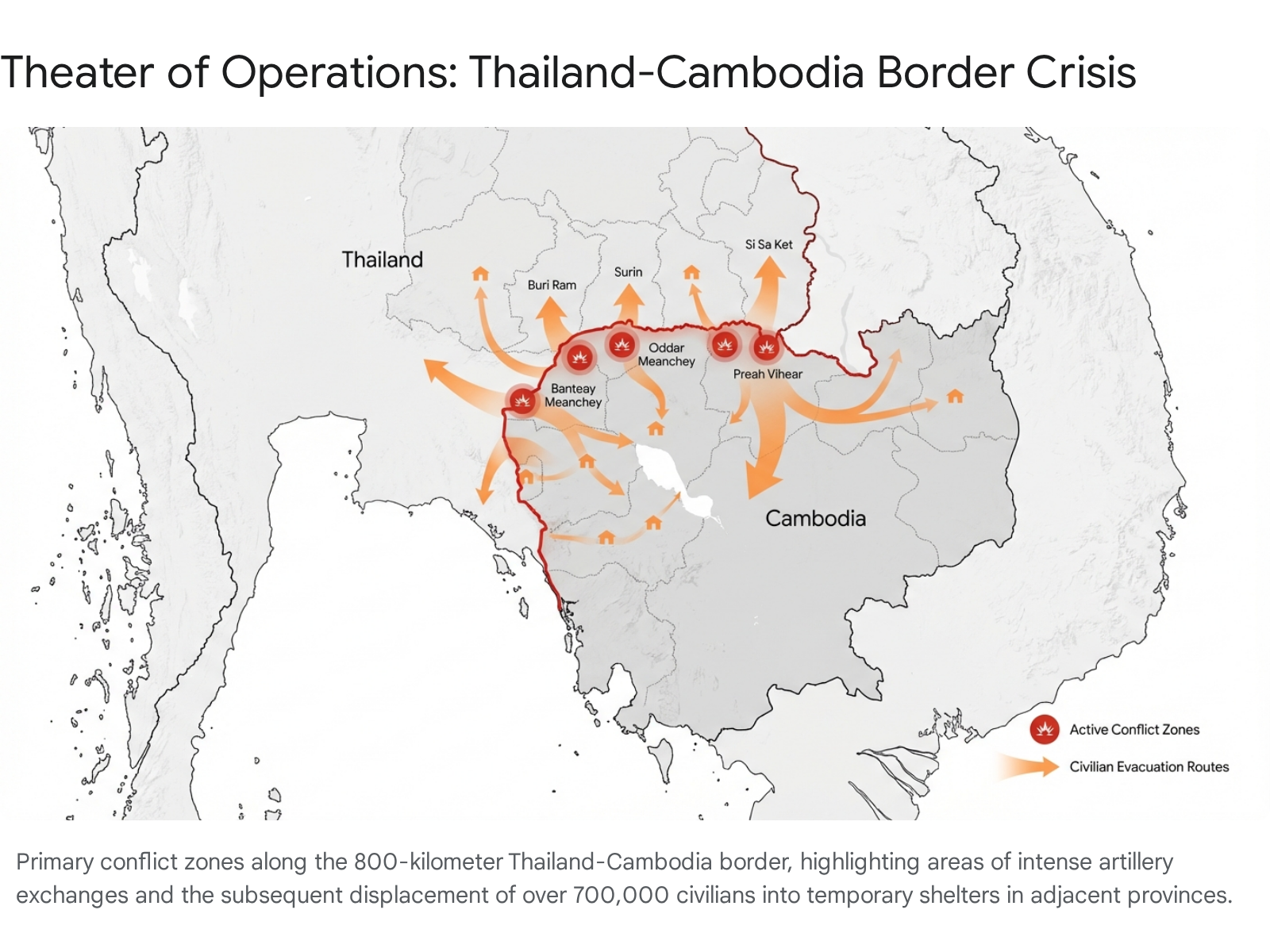
In parallel, Thai authorities have executed extensive civilian evacuations from border districts, moving populations into government-managed shelters.21 The economic infrastructure of the border region has been entirely shattered; cross-border trade has ceased, agricultural cycles have been disrupted by landmine contamination, and the vital tourism industry has collapsed, severely hurting Cambodia’s broader economic recovery.21
3.3 Strategic Drivers and Civil-Military Ramifications
The strategic drivers of the current crisis extend far beyond historical territorial disputes over ancient temples. The rapid escalation in early 2025 was fundamentally catalyzed by a severe deterioration in bilateral relations between the civilian Thai government (then led by the Pheu Thai party under Prime Minister Paetongtarn Shinawatra) and the Cambodian leadership apparatus under the influence of strongman Hun Sen and Prime Minister Hun Manet.28 Primary friction points included Thailand’s highly controversial decision to legalize domestic gambling—which posed an existential economic threat to Cambodia’s lucrative border casino industry—and aggressive, unilateral Thai law enforcement operations against transnational scam centers operating on Cambodian soil with alleged financial ties to Cambodian political elites.28
Crucially, the border conflict has fundamentally and perhaps irrevocably altered civil-military relations within the Kingdom of Thailand. The Royal Thai Armed Forces, specifically the Second Army Region command headed by General Boonsin Padklang, have aggressively utilized the border crisis to reassert institutional autonomy from civilian oversight.28 General Boonsin routinely defied civilian directives regarding border closures and the implementation of de-escalation protocols, operating independently to secure territorial objectives.28
The military’s uncompromising, kinetic stance against Cambodia generated a massive surge in domestic nationalist support. By successfully framing themselves as the sole defenders of Thai sovereignty against a hostile neighbor, the military engineered a resurrection of its political autonomy.28 The United States attempted to leverage its economic power to force a de-escalation, going so far as to temporarily suspend bilateral tariff negotiations with Thailand in mid-November 2025 to exert maximum pressure on Bangkok.26 However, the deeply resilient nature of the conflict, and the immense domestic political utility it provides to the Thai military establishment, have largely insulated the combatants from external diplomatic coercion.
4. Domestic Upheaval: Thailand’s 2026 General Election
The domestic political landscape of Thailand underwent a decisive, structural transformation following the general election held on February 8, 2026. The election results mark a profound consolidation of conservative, nationalist, and military-aligned political forces, effectively ending a tumultuous period of civilian political fragmentation and neutralizing the progressive reform movement.
4.1 Electoral Mechanics and the Conservative Landslide
The conservative Bhumjaithai Party, led by incumbent Prime Minister Anutin Charnvirakul, secured a staggering, near-landslide victory that wildly exceeded all pre-election polling and international expectations.29 Operating in a 500-member House of Representatives (comprising 400 direct constituency seats and 100 proportional party-list seats), Bhumjaithai captured an estimated 194 seats.32
| Political Party | Political Alignment | Estimated Seats (500 Total) | Party Leadership |
| Bhumjaithai Party | Conservative / Nationalist / Royalist | 194 | Anutin Charnvirakul |
| People’s Party | Progressive / Reformist | 116 – 118 | Natthaphong Ruengpanyawut |
| Pheu Thai Party | Populist / Centrist | 74 – 76 | Yodchanan Wongsawat |
| Kla Tham | Peripheral Populist / Patronage | 58 | Thammanat Prompoa |
Data compiled from preliminary, unofficial Election Commission of Thailand reporting as of mid-February 2026.32
The progressive People’s Party (the institutional successor to the dissolved Move Forward Party, which won the 2023 election) finished in a distant second place with an estimated 116 to 118 seats, despite dominating the popular vote on the proportional party-list ballots by a margin of 3.7 million over Bhumjaithai.31 The once-dominant Pheu Thai Party, representing the entrenched political machinery of former Prime Minister Thaksin Shinawatra, suffered a catastrophic collapse, falling to third place with roughly 74 to 76 seats.32
Anutin’s victory was meticulously engineered through a sophisticated integration of hardline ethnonationalism, catalyzed by the ongoing war with Cambodia, and the aggressive, systematic mobilization of traditional “Baan Yai” (Big House) patronage networks across rural provinces.30 By adopting a staunchly pro-military and pro-monarchy stance, Bhumjaithai effectively captured the conservative establishment vote, neutralizing class consciousness through performative welfare policies and localized division.30 The election was notably characterized by profound voter apathy regarding the democratic process, with turnout among the 53 million registered voters plummeting by a massive 10.47 percentage points compared to the previous election cycle.32
4.2 Peripheral Politics: The Rise of Kla Tham
A defining feature of the 2026 election was the unexpected and highly disruptive rise of the Kla Tham party, which captured 58 seats to become the fourth-largest faction in the legislature.34 Directed by the highly controversial power-broker Thammanat Prompoa—whose political profile is deeply shaped by past criminal convictions related to international drug trafficking and a homicide case—Kla Tham successfully executed a ruthless campaign of political brokerage.34
Kla Tham successfully dismantled traditional Pheu Thai strongholds in the Isan (Northeastern) region, an area that has historically anchored pro-Thaksin electoral support.34 Furthermore, Kla Tham capitalized on deep-seated, historical grievances in the Patani region (the three southernmost provinces), where the Patani-Malay separatist insurgency continues and resentment over Thaksin’s heavy-handed security policies during the Tak Bai and Kruesae incidents remains potent.34 The success of Kla Tham indicates a fundamental structural evolution in Thai peripheral politics, where transactional, localized patronage networks are entirely superseding national, ideologically cohesive political platforms.34
4.3 Strategic Implications for Governance and Foreign Policy
The magnitude of Bhumjaithai’s victory—increasing its overall vote share by nearly 300 percent in just three years—has generated severe, widespread allegations of electoral malfeasance and systemic interference.30 Progressive opposition groups and independent observers point to statistically implausible discrepancies between constituency and party-list ballot totals, alongside allegations of mass voter coercion orchestrated by elite networks in the outer provinces.30 Prior to the general election, Bhumjaithai was already facing formal investigations for blatant election rigging during the Senate elections; analysts assess that these charges are now highly likely to be dismissed or buried by the newly empowered government apparatus.30
The strategic implications of this electoral outcome are sweeping. Prime Minister Anutin now possesses a powerful, virtually unassailable mandate to construct a stable, highly conservative coalition government, effectively ending the institutional crisis that has plagued Bangkok.1 Domestically, this signals the neutralization of the progressive reform movement and the deep entrenchment of military influence within civilian governance.28 Internationally, the Anutin administration is virtually guaranteed to maintain a belligerent, uncompromising posture regarding the Cambodian border conflict, viewing military action as a vital source of domestic political legitimacy.38
Economically, the new government is prioritizing a highly ambitious “new era of national rise” agenda. The administration is targeting an aggressive 10 percent annual GDP growth rate between 2026 and 2030, seeking to elevate Thailand to a high-middle-income economy with a per capita income of $8,500.39 This will require massive infrastructure expansion, deep integration into global supply chains, and a delicate balancing act to manage high household debt and the threat of U.S. tariffs.38
5. Geopolitical Hedging and Economic Statecraft: Indonesia and Vietnam
The week ending February 21, 2026, highlighted the increasing, inseparable intersection of global security initiatives and bilateral economic negotiations. The United States masterfully leveraged the inaugural meeting of the Gaza Board of Peace in Washington, D.C., to secure critical strategic alignments from key Southeast Asian middle powers, utilizing the explicit specter of protectionist trade policies as a mechanism for diplomatic coercion.
5.1 Indonesia’s Gamble: The Gaza Board of Peace and U.S. Trade Deals
Indonesian President Prabowo Subianto’s high-profile visit to Washington represents a masterclass in realist geopolitical hedging. In a highly controversial departure from Jakarta’s traditional, foundational foreign policy doctrine of non-alignment (“bebas aktif”), Prabowo formally committed up to 8,000 Indonesian military personnel to the International Stabilization Force (ISF) in Gaza, operating under the direct auspices of the U.S.-backed Board of Peace.5
The Board of Peace, an international organization founded and chaired by U.S. President Donald Trump, is designed specifically to bypass the paralyzed United Nations Security Council.5 Ratified in Davos, Switzerland on January 22, 2026, the organization requires a staggering $1 billion membership fee and focuses heavily on a 20-point roadmap for demilitarization and post-conflict reconstruction in Gaza, notably excluding Palestine as a member and sidelining immediate demands for an independent Palestinian state.5
Under the command of U.S. Army Major General Jasper Jeffers, the ISF plans to deploy 20,000 international troops and 12,000 vetted local police (trained by Egypt and Jordan) to restore order, beginning in Rafah.41 Indonesia’s decision to commit forces—joining nations like Morocco, Kazakhstan, Kosovo, and Albania—has drawn intense domestic criticism.41 Analysts and civil society groups in Jakarta question the undefined operational mandate of the ISF and express profound fear that Indonesian forces may be perceived as implicitly supporting Israeli military objectives in a conflict that has resulted in over 75,000 Palestinian deaths.5 Middle East expert Muhammad Zulfikar Rakhmat explicitly warned, “We need to be careful to ensure that our military personnel are not supporting the Israeli military forces”.42
However, the Prabowo administration views this unprecedented military participation as a necessary, highly pragmatic concession to maintain influence within the U.S.-led global architecture and, most importantly, to secure vital economic exemptions from Washington. The immediate geopolitical dividend of this military commitment was the finalization of the landmark U.S.-Indonesia Reciprocal Trade Agreement on February 19.4
Operating under the looming threat of a universal 19 percent U.S. import tariff, Jakarta successfully negotiated highly favorable terms. The United States agreed to eliminate tariff barriers on over 99 percent of Indonesian exports across all major sectors, including agriculture, health products, seafood, and crucial textile exports.4 Concurrently, U.S. and Indonesian corporations signed 11 massive memoranda of understanding (MoUs) valued at approximately $38.4 billion during a gala dinner hosted by the U.S. Chamber of Commerce.48
Strategic Corporate Agreements: U.S.-Indonesia Trade Pacts (Feb 2026):
| Sector / Domain | Estimated Value | Key Corporate / State Actors | Strategic Implication |
| Energy Commodities | $15.0 Billion | U.S. Exporters, Indonesian State Entities | Massive procurement of U.S. energy to heavily reduce the bilateral trade deficit.4 |
| Commercial Aviation | $13.5 Billion | Boeing, Indonesian Aviation Sector | Major aerospace procurement and integration of aviation services.4 |
| Critical Minerals | $10.0 Billion (Annual Rev.) | Freeport-McMoRan, Indonesian Ministry of Investment | Extension of Grasberg copper/gold mine license beyond 2041; 12% share transfer to Indonesia by 2041; secures U.S. mineral supply chains.4 |
| Agriculture Procurement | $4.5 Billion | Cargill, Arena Agro Andalan | Procurement of millions of tonnes of U.S. soybeans, corn, cotton, and up to 5M tonnes of wheat by 2030.4 |
| Energy Infrastructure | Undisclosed | Pertamina, Halliburton | Joint ventures in advanced oil field recovery technology and modernization.48 |
| Semiconductors | Undisclosed | Galang Bumi Industri, Tynergy Tech Group | Development of semiconductor manufacturing capabilities within Indonesian free trade zones.49 |
Data synthesized from U.S. Chamber of Commerce, White House Fact Sheets, and Indonesian state media.4 Note: Discrepancies exist in reporting, with the White House citing $33 billion in direct investments, while the Indonesian government cites $38.4 billion in total MoU value.4
This massive economic package effectively binds Indonesian industrial development directly to U.S. capital and supply chains. It fulfills Washington’s strategic objective of limiting China’s economic monopoly in the archipelago while providing Jakarta with the massive capital and technology necessary to fuel its domestic industrialization agenda.
5.2 Vietnam’s Bamboo Diplomacy at the Washington Summit
Vietnam executed a parallel, albeit less militarized, diplomatic maneuver in Washington. General Secretary of the Communist Party of Vietnam, To Lam, attended the Gaza Board of Peace inaugural meeting, marking the nation’s most significant high-level multilateral engagement since the 14th National Congress of the Communist Party.50 Vietnam’s attendance was framed domestically as a demonstration of its proactive responsibility toward global peace and its steadfast support for the fundamental national rights of the Palestinian people.50 President Trump publicly praised To Lam’s participation, noting his “deep respect for Vietnam” and acknowledging its increasingly significant role on the global stage.52
However, the primary strategic value of the visit lay in the bilateral engagements conducted on the sidelines. On February 19, Vietnamese Minister of Foreign Affairs Le Hoai Trung held extensive, closed-door talks with U.S. Secretary of State Marco Rubio.7 The dialogue focused heavily on accelerating “reciprocal tariff negotiations” to protect Vietnam’s highly vulnerable, export-driven economy from protectionist U.S. trade policies.7 Secretary Rubio explicitly voiced U.S. support for a “strong, independent, self-reliant and prosperous Viet Nam,” commending Hanoi’s socio-economic achievements and suggesting that Vietnam’s development model is highly applicable to other developing nations.7
This high-level engagement exemplifies the accelerated implementation of Vietnam’s “Bamboo Diplomacy.” By deliberately deepening political trust, defense-security cooperation, and economic integration with the United States, Hanoi is attempting to counterbalance its heavy, historic reliance on the PRC.7 However, this expansive multi-aligned strategy is fraught with deep internal and external risks. Domestically, while the 14th Party Congress pushed for rapid economic reform and high-income status by 2045, the concurrent empowerment of security and police forces under To Lam’s leadership threatens to weaken institutional checks and balances.39 Externally, as Vietnam deepens its engagement with both Washington and Beijing, it exponentially increases its vulnerability to the coercive economic statecraft and security demands of both competing superpowers, placing the nation at a precarious strategic crossroads in 2026.54
6. The Collapse of Myanmar: Civil War and Regional Security Vacuum
Approaching the devastating five-year anniversary of the February 1, 2021, military coup led by Senior General Min Aung Hlaing, the sovereign state of Myanmar has functionally collapsed. The military junta, operating as the State Administration Council (SAC), has suffered catastrophic, irreversible territorial and operational losses, proving entirely incapable of suppressing the nationwide armed resistance movement.55
6.1 Territorial Fragmentation and Junta Attrition
Current intelligence estimates, corroborated by independent investigations, indicate that the SAC now controls a mere 21 percent of Myanmar’s territory, largely confined to major urban centers, military bases, and the central Bamar heartland.55 Conversely, a vast, complex coalition of powerful ethnic armed organizations (EAOs) and the National Unity Government’s (NUG) People’s Defense Forces (PDF) now control roughly 42 percent of the country.55
The resistance forces, including the Kachin Independence Army, the Karen National Liberation Army, and the Chinland Council allies, are steadily advancing toward strategic targets, putting the junta strictly on the defensive even in areas traditionally considered safe, such as the approach to Mandalay.55 The Arakan Army has been particularly lethal and effective, consolidating administrative and military control over 14 of Rakhine State’s 17 townships, severely compromising the junta’s access to the strategic Bay of Bengal and crippling its naval resupply capabilities.57 The military has responded to its ground-level attrition by intensifying a brutal campaign of airstrikes against civilian targets, with the UN reporting that civilian deaths from airstrikes nearly doubled from 2023 to 2024.59
6.2 The Compound Humanitarian Crisis
The unrelenting kinetic reality has generated one of the most severe, complex humanitarian crises globally. The United Nations’ 2026 Humanitarian Needs and Response Plan projects that an astonishing 16 million people—nearly one-third of the total population—will require urgent, life-saving humanitarian assistance this year.56 Over 3.6 million individuals are currently internally displaced across the country, a dramatic increase from the roughly 300,000 displaced prior to the 2021 coup.56 Displacement is projected to reach 4 million by the end of 2026 due to intensified junta ground and air offensives launched ahead of the internationally condemned, military-run sham elections slated to begin in late December 2025.58
The humanitarian crisis is compounded by the persistent, unmitigated devastation of the magnitude 7.7 earthquake that struck the region on March 28, 2025.56 The disaster officially killed 3,745 people (with actual numbers likely much higher), injured over 5,000, and affected 3.2 million individuals across the Sagaing Region, Mandalay Region, and Nay Pyi Taw.56 The physical destruction is immense: over 24,200 houses were damaged (24 percent completely destroyed), and 132 vital health facilities were crippled, half of them in Mandalay alone.56 Recovery efforts are functionally non-existent, paralyzed by ongoing combat operations and critical logistical shortfalls, including a 43 percent shortage of heavy machinery and a 40 percent shortage of labor.58 Consequently, an estimated 3.5 million tonnes of earthquake debris remain uncleared, leaving affected communities living in temporary, unsanitary shelters with severely disrupted essential services.58
The economic collapse is total. The United Nations Development Programme (UNDP) reports that 49.7 percent of the population was living under the national poverty line in 2023, and by mid-2025, nearly half of the population in Yangon, the country’s commercial hub, had fallen into severe poverty.60 Since the coup, over 116,800 houses have been deliberately burned down by junta forces.60 Furthermore, the Assistance Association for Political Prisoners (AAPP) has documented that at least 6,486 civilians have been killed by the military, including 1,494 women and 751 children, with an additional 3,300 individuals missing or disappeared.59
6.3 Transnational Crime and Regional Security Implications
The total vacuum of legitimate governance has transformed Myanmar’s expansive border regions into unregulated, highly lucrative havens for transnational organized crime. The complete dismantling of the rule of law by the SAC has facilitated the explosive proliferation of online cyber-scam syndicates, industrial-scale narcotics production, and human trafficking networks.60 These illicit enterprises operate with near impunity, often in collusion with corrupt military or border guard officials, generating severe secondary security implications for neighboring states, particularly Thailand, China, and India, and serving as a major destabilizing force across the broader Indo-Pacific.26
Furthermore, the conflict has generated a massive regional refugee crisis, placing immense economic and social strain on neighboring nations that lack the infrastructure to support the influx.
Regional Dispersal of Myanmar Refugees and Asylum Seekers (As of Dec 2025):
| Host Country | Total Registered Refugees / Asylum Seekers | Primary Demographic |
| Bangladesh | 1,178,000 | Rohingya refugees from Rakhine State |
| Malaysia | 192,700 | Diverse ethnic groups, Rohingya |
| Thailand | 136,100 | Karen, Chin, and political dissidents |
| India | 87,000 | Chin refugees fleeing across the western border |
| Indonesia | 2,800 | Maritime arrivals (mostly Rohingya) |
Data sourced from the United Nations High Commissioner for Refugees (UNHCR) Operational Data Portal.61 Note: Figures reflect only officially registered individuals; the actual number of undocumented refugees is assessed to be significantly higher.
The international community, heavily preoccupied with the security crises in the Middle East and the overarching U.S.-China strategic rivalry, possesses neither the diplomatic bandwidth nor the political will to intervene effectively in Myanmar. Consequently, the trajectory for the state in 2026 is one of continued violent fragmentation, catastrophic civilian suffering, and the further entrenchment of heavily armed transnational criminal networks that will severely degrade the security environment of Southeast Asia for the foreseeable future.
Please share the link on Facebook, Forums, with colleagues, etc. Your support is much appreciated and if you have any feedback, please email us in**@*********ps.com. If you’d like to request a report or order a reprint, please click here for the corresponding page to open in new tab.
Sources Used
- Asia-Pacific Geopolitical Risk 2026 – SpecialEurasia, accessed February 21, 2026, https://www.specialeurasia.com/2026/01/07/asia-pacific-risk-2026/
- Asia in 2026: Conflict Continues to Dominate – Modern Diplomacy, accessed February 21, 2026, https://moderndiplomacy.eu/2025/12/30/asia-in-2026-conflict-continues-to-dominate/
- Indonesia’s president reaches a trade deal with US while in Washington for Trump’s Board of Peace, accessed February 21, 2026, https://www.kiro7.com/news/business/indonesian-leader/ZLY5OJE2JM4UDDAFCRCD6275SU/
- Fact Sheet: Trump Administration Finalizes Trade Deal with Indonesia, accessed February 21, 2026, https://www.whitehouse.gov/fact-sheets/2026/02/fact-sheet-trump-administration-finalizes-trade-deal-with-indonesia/
- Indonesia at The Board of Peace: Realistic Choice or Subtle …, accessed February 21, 2026, https://moderndiplomacy.eu/2026/02/20/indonesia-at-the-board-of-peace-realistic-choice-or-subtle-coercion/
- Indonesia, US remove tariffs on 99 percent of US goods, accessed February 21, 2026, https://en.antaranews.com/news/405190/indonesia-us-remove-tariffs-on-99-percent-of-us-goods
- Viet Nam, US seek ways to deepen all-round ties | Nhan Dan Online, accessed February 21, 2026, https://en.nhandan.vn/viet-nam-us-seek-ways-to-deepen-all-round-ties-post159252.html
- Territorial disputes in the South China Sea – Wikipedia, accessed February 21, 2026, https://en.wikipedia.org/wiki/Territorial_disputes_in_the_South_China_Sea
- South China Sea: Latest News and Updates, accessed February 21, 2026, https://www.scmp.com/topics/south-china-sea
- Chinese Vessels Collide While Chasing Philippine Boat in South China Sea, accessed February 21, 2026, https://maritimefairtrade.org/chinese-vessels-collide-while-chasing-philippine-boat-in-south-china-sea/
- Philippines and China Dispute Over South China Sea Incident Escalates – Marine Link, accessed February 21, 2026, https://www.marinelink.com/news/philippines-china-dispute-south-china-sea-519898
- South China Sea crash underscores China’s unprofessional military culture, accessed February 21, 2026, https://ipdefenseforum.com/2025/08/south-china-sea-crash-underscores-chinas-unprofessional-military-culture/
- The Dragon and South China Sea Conflict: The Unseen Dimension, accessed February 21, 2026, https://trendsresearch.org/insight/the-dragon-and-south-china-sea-conflict-the-unseen-dimension/
- South China Sea | International Crisis Group, accessed February 21, 2026, https://www.crisisgroup.org/asia-pacific/south-east-asia/south-china-sea
- Joint Statement on the Philippines-United States Bilateral Strategic Dialogue – U.S. Embassy Manila, accessed February 21, 2026, https://ph.usembassy.gov/joint-statement-on-the-philippines-united-states-bilateral-strategic-dialogue-2/
- US, Manila tout importance of security in Strait – Taipei Times, accessed February 21, 2026, https://www.taipeitimes.com/News/front/archives/2026/02/18/2003852488
- U.S., Philippines reiterate importance of Taiwan Strait peace, accessed February 21, 2026, https://focustaiwan.tw/politics/202602170007
- Joint Statement on the Philippines-United States Bilateral Strategic Dialogue, accessed February 21, 2026, https://www.state.gov/releases/office-of-the-spokesperson/2026/02/joint-statement-on-the-philippines-united-states-bilateral-strategic-dialogue
- Rhetoric vs. Reality: The Philippines, ASEAN, and the South China Sea – CSIS, accessed February 21, 2026, https://www.csis.org/analysis/rhetoric-vs-reality-philippines-asean-and-south-china-sea
- ‘Philippines will accept only UNCLOS-based COC’ | Philstar.com, accessed February 21, 2026, https://www.philstar.com/headlines/2026/02/19/2508971/philippines-will-accept-only-unclos-based-coc
- Public Health Situation Analysis – Cambodia – Thailand border conflict, accessed February 21, 2026, https://www.who.int/publications/m/item/public-health-situation-analysis—cambodia—thailand-border-conflict
- Thailand-Cambodia Border Conflict 2025 | Background, Escalation, Map, & Ceasefire, accessed February 21, 2026, https://www.britannica.com/event/Thailand-Cambodia-Conflict
- 2025 Cambodian–Thai border crisis – Wikipedia, accessed February 21, 2026, https://en.wikipedia.org/wiki/2025_Cambodian%E2%80%93Thai_border_crisis
- The Latest on Southeast Asia: The 2nd Cambodia-Thailand Ceasefire – CSIS, accessed February 21, 2026, https://www.csis.org/blogs/latest-southeast-asia/latest-southeast-asia-2nd-cambodia-thailand-ceasefire
- Thai-Cambodia border clashes rage on with rising death toll – Yeni Safak English, accessed February 21, 2026, https://en.yenisafak.com/world/thai-cambodia-border-clashes-rage-on-with-rising-death-toll-3711992
- The Latest on Southeast Asia: Thailand-Cambodia Tensions Continue – CSIS, accessed February 21, 2026, https://www.csis.org/blogs/latest-southeast-asia/latest-southeast-asia-thailand-cambodia-tensions-continue
- World Report 2026: Thailand | Human Rights Watch, accessed February 21, 2026, https://www.hrw.org/world-report/2026/country-chapters/thailand
- Thai military leverages the border crisis to reassert its political influence | East Asia Forum, accessed February 21, 2026, https://eastasiaforum.org/2025/12/21/thai-military-leverages-the-border-crisis-to-reassert-its-political-influence/
- Pausing the Cycle: Conservative Bhumjaithai Party’s Win Alters the Script of Thai Politics, accessed February 21, 2026, https://www.asiapacific.ca/publication/conservative-bhumjaithai-party-suprise-win-thai-elections-feb-2026
- Thailand’s ultra-right storms into power – Peoples Dispatch, accessed February 21, 2026, https://peoplesdispatch.org/2026/02/20/thailands-ultra-right-storms-into-power/
- Why Bhumjaithai won, accessed February 21, 2026, https://asialink.unimelb.edu.au/diplomacy/insights/why-bhumjaithai-won/
- Thailand’s conservative Bhumjaithai party tops polls but will need partners to form government – KIRO 7 News Seattle, accessed February 21, 2026, https://www.kiro7.com/news/world/thailand-votes-early/2GQO2TNNIY2FBNKWBGXAA6DPBI/
- 2026 Thai general election – Wikipedia, accessed February 21, 2026, https://en.wikipedia.org/wiki/2026_Thai_general_election
- Kla Tham in Thailand’s 2026 Election: Dark Horse or Greenhorn?, accessed February 21, 2026, https://fulcrum.sg/kla-tham-in-thailands-2026-election-dark-horse-or-greenhorn/
- Thailand | International Crisis Group, accessed February 21, 2026, https://www.crisisgroup.org/asia-pacific/south-east-asia/thailand
- Thailand PM Anutin consolidates power with dominating election win – YouTube, accessed February 21, 2026, https://www.youtube.com/watch?v=xCVWm6kxn0o
- Thailand Approves Constitutional Reform, Re-Elects Conservative Party, accessed February 21, 2026, https://worldview.stratfor.com/article/thailand-approves-constitutional-reform-re-elects-conservative-party
- Thailand ahead of the February 2026 general election – European Parliament, accessed February 21, 2026, https://www.europarl.europa.eu/RegData/etudes/BRIE/2026/782627/EPRS_BRI(2026)782627_EN.pdf
- Vietnam’s Party Congress Endorses Ambitious Growth Agenda – Stimson Center, accessed February 21, 2026, https://www.stimson.org/2026/vietnams-party-congress-endorses-ambitious-growth-agenda/
- Indonesia readies up to 8,000 troops in first firm commitment to Gaza peacekeeping force – ClickOrlando, accessed February 21, 2026, https://www.clickorlando.com/news/world/2026/02/13/indonesia-readies-up-to-8000-troops-in-first-firm-commitment-to-gaza-peacekeeping-force/
- Prabowo confirms Indonesian troop deployment to Gaza within 2 months, accessed February 21, 2026, https://en.antaranews.com/news/405202/prabowo-confirms-indonesian-troop-deployment-to-gaza-within-2-months
- Indonesia prepares up to 8,000 troops in first firm commitment to Gaza peacekeeping force, accessed February 21, 2026, https://www.pbs.org/newshour/politics/indonesia-prepares-up-to-8000-troops-in-first-firm-commitment-to-gaza-peacekeeping-force
- President Trump Ratifies Board of Peace in Historic Ceremony, Opening Path to Hope and Dignity for Gazans – The White House, accessed February 21, 2026, https://www.whitehouse.gov/articles/2026/01/president-trump-ratifies-board-of-peace-in-historic-ceremony-opening-path-to-hope-and-dignity-for-gazans/
- Stabilization force and funding pledged for Gaza at Board of Peace meeting, accessed February 21, 2026, https://www.fdd.org/analysis/2026/02/20/stabilization-force-and-funding-pledged-for-gaza-at-board-of-peace-meeting/
- Five Countries Commit Troops To Gaza International Security Force – Commander – Voice of Nigeria Broadcasting Service, accessed February 21, 2026, https://von.gov.ng/five-countries-commit-troops-to-gaza-international-security-force-commander/
- Gaza stabilization force takes shape at inaugural Board of Peace meeting – The New Region, accessed February 21, 2026, https://thenewregion.com/posts/4630
- Indonesia, US finalize trade pact; deals worth $38.4 billion signed, accessed February 21, 2026, https://www.icis.com/explore/resources/news/2026/02/20/11181215/indonesia-us-finalize-trade-pact-deals-worth-38-4-billion-signed
- Indonesia, US firms sign trade, investment deals worth $48.7 billion, accessed February 21, 2026, https://www.straitstimes.com/asia/se-asia/indonesia-us-firms-sign-48-7-billion-in-trade-investment-deals
- Indonesian, US Firms Ink $38.4 Billion MoUs as Tariff Deal Nears – Jakarta Globe, accessed February 21, 2026, https://jakartaglobe.id/business/indonesian-us-firms-ink-384-billion-mous-as-tariff-deal-nears
- Party chief’s US trip marks milestone in high-level multilateral diplomacy, accessed February 21, 2026, https://dtinews.dantri.com.vn/vietnam-today/party-chiefs-us-trip-marks-milestone-in-high-level-multilateral-diplomacy-20260221140934617.htm
- Party chief’s US trip marks milestone in high-level multilateral diplomacy: FM, accessed February 21, 2026, https://english.vov.vn/en/politics/party-chiefs-us-trip-marks-milestone-in-high-level-multilateral-diplomacy-fm-post1270202.vov
- General Secretary To Lam concludes his participation in the Opening Meeting of the Peace Council on Gaza. – Vietnam.vn, accessed February 21, 2026, https://www.vietnam.vn/en/tong-bi-thu-to-lam-ket-thuc-chuyen-tham-du-cuoc-hop-khai-mac-hoi-dong-hoa-binh-ve-gaza
- Vietnam, US seek ways to deepen all-round ties, accessed February 21, 2026, https://dtinews.dantri.com.vn/vietnam-today/vietnam-us-seek-ways-to-deepen-all-round-ties-20260220102851059.htm
- Vietnam faces a strategic crossroads in 2026 | East Asia Forum, accessed February 21, 2026, https://eastasiaforum.org/2026/01/10/vietnam-faces-a-strategic-crossroads-in-2026/
- Civil War in Myanmar | Global Conflict Tracker – Council on Foreign Relations, accessed February 21, 2026, https://www.cfr.org/global-conflict-tracker/conflict/rohingya-crisis-myanmar
- Myanmar Crisis Situation Analysis: 15/12/25 – 21/12/25 – ReliefWeb, accessed February 21, 2026, https://reliefweb.int/report/myanmar/myanmar-crisis-situation-analysis-151225-211225
- Myanmar civil war (2021–present) – Wikipedia, accessed February 21, 2026, https://en.wikipedia.org/wiki/Myanmar_civil_war_(2021%E2%80%93present)
- Myanmar Crisis Situation Analysis: 22/12/25 – 28/12/25 – ReliefWeb, accessed February 21, 2026, https://reliefweb.int/report/myanmar/myanmar-crisis-situation-analysis-221225-281225
- Myanmar’s civil war – UK Parliament, accessed February 21, 2026, https://researchbriefings.files.parliament.uk/documents/CDP-2026-0001/CBP10227.pdf
- Bi-weekly Update on the Current Situation in Myanmar (01-01-2026 to 15-01-2026), accessed February 21, 2026, https://www.myanmarmissionnewyork.org/post/bi-weekly-update-on-the-current-situation-in-myanmar-01-01-2026-to-15-01-2026
- Situation Myanmar Situation – Operational Data Portal – UNHCR, accessed February 21, 2026, https://data.unhcr.org/en/situations/myanmar