Executive Summary
The evolution of the high-capacity 1911, commonly designated as the 2011 platform, has undergone a significant transformation from a specialized, hand-fitted competition tool to a robust, duty-capable tactical system. Within this landscape, Bul Armory has emerged as a disruptive force, leveraging its pedigree in the Israeli defense and international competition sectors to provide the SAS II Tac and Tac Pro series. This report offers an exhaustive engineering evaluation and market sentiment analysis of these systems, focusing on the technical trade-offs between the aluminum-framed Tac and the stainless-steel, ported Tac Pro.
The SAS II Tac series is characterized by its modular frame architecture, which marries a metal fire-control housing with a high-capacity polymer grip module. Engineering analysis indicates that Bul Armory’s move to an aluminum frame in the standard Tac models optimizes the platform for daily carriage, reducing the mass by approximately 4 ounces compared to traditional steel variants.1 Conversely, the Tac Pro series represents the performance apex of the line, utilizing a stainless steel frame and a V8 ported bull barrel to maximize recoil mitigation and muzzle stability. Performance benchmarks suggest that while porting results in a negligible 5% reduction in muzzle velocity, it yields a nearly 30% improvement in split-time efficiency during rapid-fire strings.2
Customer sentiment is predominantly positive, with the platform frequently cited as the “value leader” in the 2011 market, offering a level of fit, finish, and trigger quality that rivals premium brands at a substantially lower price point.4 However, the platform is not without engineering constraints. The most critical technical limitation is the prohibition of copper-plated ammunition in ported models, as the high-velocity transition of the projectile across the barrel ports can lead to plating separation, shrapnel emission, and rapid lead fouling.6 Additionally, the proprietary nature of Bul Armory magazines poses a logistical hurdle for users already invested in the standard 2011 ecosystem.9
Ultimately, the Bul Armory SAS II Tac and Tac Pro series represent a sophisticated intersection of competition-derived ergonomics and tactical utility. For the professional user or enthusiast seeking a high-performance 2011 system, the Bul Armory series is recommended as a superior alternative to entry-level options, provided the operator adheres to specific maintenance and ammunition protocols.
1 Platform Architecture and Historical Evolution
The development of the Bul Armory SAS II platform is rooted in the transition of the 1911 design from a single-stack, low-capacity firearm to a modular, double-stack system. Historically, the 2011 architecture was pioneered to solve the capacity limitations of the 1911 for competition shooters. Bul Armory, an Israeli manufacturer established in 1990, has refined this concept through its SAS (Special Air Service) and SAS II lines, focusing on a proprietary take on the modular frame.11
1.1 The Modular Frame Concept
The SAS II architecture differs from the traditional “monolithic” 1911 frame by utilizing a three-part assembly: the slide, the metal frame (or “sub-frame”), and the polymer grip module. In the Tac and Tac Pro series, this sub-frame is the serialized component that houses the fire control group and provides the rails for the slide.
The engineering benefit of this modularity is twofold. First, it allows for the use of high-strength steel or lightweight aluminum in the critical stress-bearing areas of the frame while utilizing polymer in the grip to dampen vibration and reduce overall weight. Second, it allows for greater ergonomic flexibility, as the grip module can be textured or shaped more aggressively than a metal frame. The Tac series utilizes an “aggressive but not punitive” texturing on its polymer grip, designed to provide a secure purchase even in adverse environmental conditions like rain or sweat.11
1.2 Generation and Model Transitions
As of 2024 and 2025, Bul Armory has transitioned its lineup to focus on the Tac and Tac Pro designations. The standard Tac model is now positioned as a carry-oriented “lightweight” tactical pistol, often featuring an aluminum frame.1 The Tac Pro, meanwhile, is the steel-framed, performance-enhanced version intended for duty use or serious competition. This reflects a strategic pivot in the industry where “Pro” models are no longer just aesthetic upgrades but include functional engineering changes like barrel porting and material density adjustments.
Table 1: Evolution of Technical Specifications
| Feature | Legacy SAS II (Pre-2023) | Current Tac Series | Current Tac Pro Series |
| Frame Material | Mostly Stainless Steel | Aluminum (typically) | Stainless Steel |
| Optics System | Proprietary / Plate Specific | BAO Multi-Footprint | BAO Multi-Footprint |
| Barrel Profile | Standard Bull Barrel | Bull Barrel | V8 Ported Bull Barrel |
| Mag Capacity | 18+1 or 19+1 | 18+1 or 20+1 | 20+1 |
| Primary Goal | General Competition | Carry / Tactical Utility | High-Performance Duty |
Data synthesized from historical reviews and current manufacturer specifications.1
2 Technical Engineering of the Tac and Tac Pro
The engineering of the SAS II series can be broken down into several critical subsystems: the slide and barrel assembly, the frame and grip interface, and the fire control group. Each of these components is designed with specific tolerances meant to balance “race-gun” performance with “duty-gun” reliability.
2.1 Metallurgy and Slide Dynamics
Bul Armory utilizes stainless steel for both the slide and the barrel across the Tac and Tac Pro lines.1 Stainless steel is selected for its superior corrosion resistance and its ability to maintain structural integrity under high heat cycles, which is particularly important for the ported Tac Pro models. The slides feature weight-reduction cuts—slotted apertures on the sides of the slide—that serve two purposes. First, they reduce the reciprocating mass of the slide, which decreases the recoil impulse felt by the shooter. Second, they assist in heat dissipation from the barrel during high-volume strings of fire.1
The slide-to-frame fit in the SAS II series is notably tight, a hallmark of Bul Armory’s “hand-fitted” manufacturing philosophy. While mass-produced pistols often have generous clearances to ensure function with varied ammunition, Bul Armory maintains tighter tolerances to maximize mechanical accuracy and consistency in the lock-up.9
2.2 Bull Barrel Engineering
A primary design choice in the Tac series is the use of a “bull barrel” profile. In a traditional 1911, a barrel bushing is used to align the barrel with the slide. The bull barrel eliminates this bushing, instead utilizing a tapered profile that fits directly against the muzzle of the slide.
The bull barrel design adds significant mass to the front of the pistol. According to the principles of physics, increasing the mass at the muzzle end of the firearm increases the rotational inertia of the system. This makes it more difficult for the recoil force to “flip” the muzzle upward during the shot cycle. In engineering terms: Torque = Moment of Inertia * Angular Acceleration By increasing the moment of inertia through the heavy bull barrel, the angular acceleration (muzzle flip) is reduced for a given recoil force.11
2.3 V8 Porting Mechanism
The Tac Pro variant introduces the V8 porting system, which consists of eight precision-drilled holes in the barrel (four on each side of the top rib) and corresponding relief cuts in the slide. This system is designed to act as an integrated compensator.1
As the projectile travels down the bore, it is pushed by high-pressure combustion gases. When the projectile passes the ports, a portion of these gases is vented vertically. This creates a “jet effect” that generates a downward force on the barrel, effectively pinning the muzzle down and allowing the shooter to maintain sight alignment more easily for follow-up shots.
Table 2: Weight Dynamics and Recoil Physics
| Model | Barrel Length | Mass (Unloaded) | Recoil Mitigation Method |
| Tac 4.25 | 4.25 in | 775g / 1.7 lbs | Bull Barrel Mass |
| Tac 5.0 | 5.00 in | 840g / 1.8 lbs | Barrel Length + Mass |
| Tac Pro 4.25 | 4.25 in | 908g / 2.0 lbs | Bull Barrel + V8 Porting |
| Tac Pro 5.0 | 5.00 in | 1000g / 2.2 lbs | Full Mass + V8 Porting |
Note: The Tac Pro 5″ model reaches the 1kg threshold, providing the most stable platform in the series.1
3 Performance Benchmarking: Ballistics and Handling
To evaluate the SAS II Tac series, it is necessary to look at the empirical data regarding its accuracy, velocity, and cyclic speed. Industry testing and independent user reports provide a clear picture of how these engineering choices translate into field performance.
3.1 Accuracy and Grouping
Bul Armory does not publish a specific “accuracy guarantee” in its marketing materials, often including a disclaimer that the information on its website is for general purposes only.17 However, field testing of the SAS II Tac 4.25″ and 5″ models consistently shows accuracy that exceeds standard duty requirements. Independent evaluations indicate that the platform can produce 1.5 to 2.0-inch groups at 25 yards when using match-grade 9mm ammunition.18
This level of precision is attributed to the hand-fitted barrel-to-slide lockup and the consistency of the bull barrel’s harmonics. The match-grade one-piece barrel utilized in the series is ramped, which ensures that the bullet is fed into the chamber at a consistent angle, reducing the risk of projectile deformation that can occur with traditional two-piece 1911 feed ramps.11
3.2 Velocity Loss in Ported Barrels
A common concern with ported barrels is the reduction in muzzle velocity. Because gas is vented before the bullet exits the muzzle, the total pressure behind the projectile is reduced. In the Tac Pro series, data suggests that the V8 porting results in a velocity drop of approximately 5% to 7% compared to a non-ported barrel of the same length.3
For a standard 115-grain 9mm round traveling at 1,150 feet per second (fps), a 5% loss equates to roughly 57 fps. In a tactical or defensive context, this loss is generally considered negligible, as the terminal ballistics of modern 9mm projectiles remain effective at these slightly reduced velocities.2 The trade-off—significantly faster follow-up shots—is widely viewed by industry analysts as a net benefit.2
3.3 Split-Time Efficiency
The most significant performance gain of the Tac Pro is found in the “split time,” or the time between successive shots. In controlled testing comparing a standard bare muzzle to a ported barrel, shooters averaged a 0.81-second improvement across a multi-shot string.
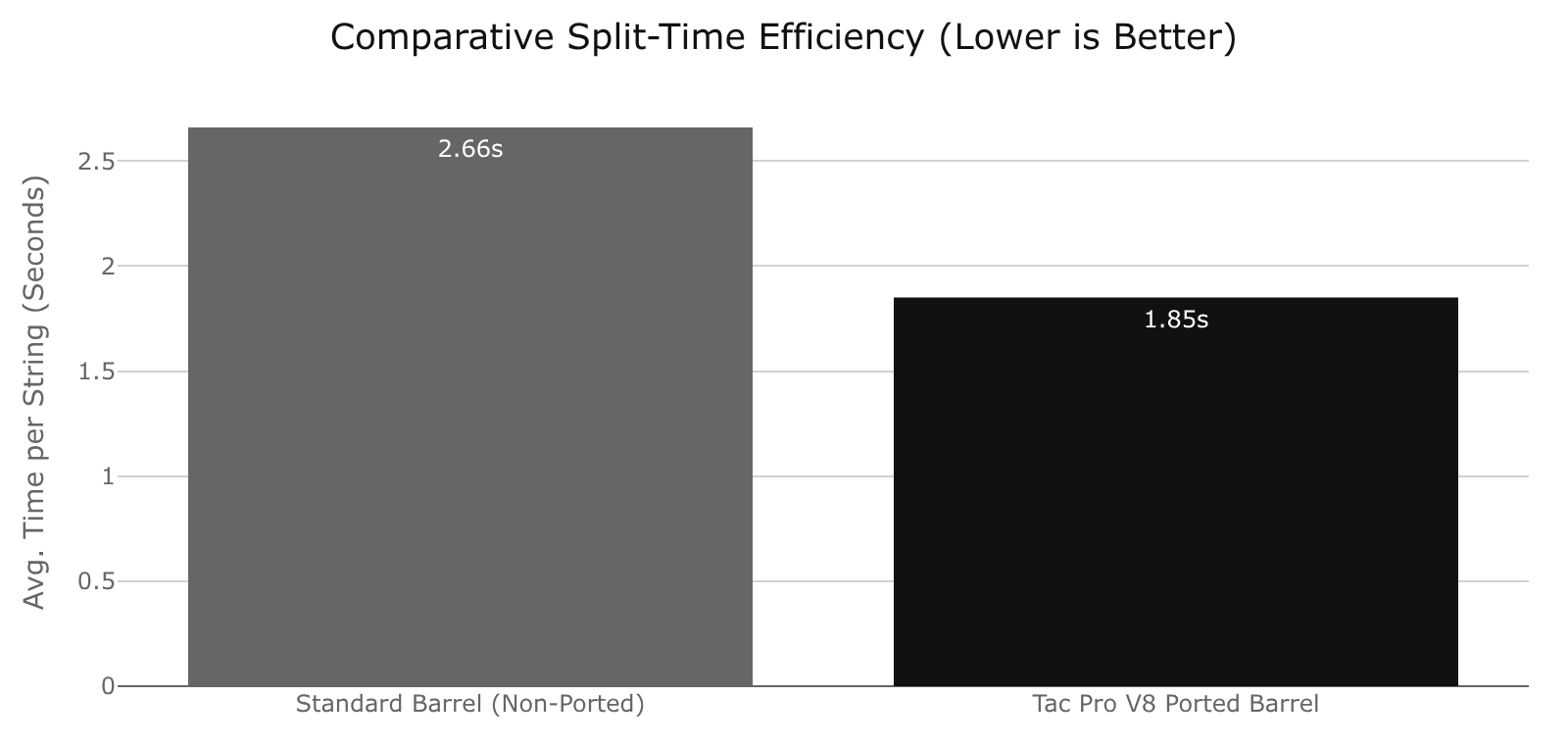
This performance delta is what positions the Tac Pro as a “bridge” between traditional duty pistols and dedicated Open-division race guns. The flatter shooting characteristic allows the red dot or iron sights to remain within the shooter’s field of view throughout the recoil cycle, drastically reducing the time needed to re-acquire a sight picture.2
4 The Ammunition Engineering Conflict
One of the most critical findings in this analysis involves the interaction between the Tac Pro’s V8 porting and the metallurgical construction of the ammunition used. Bul Armory provides an explicit warning that the use of copper-plated ammunition is forbidden in their ported and compensated pistols.6
4.1 Plated vs. Jacketed Ammunition
To understand this requirement, we must examine the manufacturing of the projectiles:
- Jacketed Ammunition (FMJ): A thick copper or brass jacket is mechanically formed around a lead core. This jacket is strong enough to withstand the friction of the rifling and the sudden pressure drop at the ports without separating.8
- Plated Ammunition: A very thin layer of copper is electroplated onto a lead core. This plating is much thinner and less durable than a jacket.7
4.2 The “Vegetable Peeler” Effect
When a plated bullet travels past the V8 ports, the sharp edges of the port holes act like a vegetable peeler. Because the plating is thin and has relatively weak adhesion to the lead core, the edges of the ports can “shave” off bits of the copper plating. This leads to several engineering failures:
- Port Obstruction: Shaved copper and lead residue accumulate in the ports, eventually clogging them and rendering the porting system ineffective.7
- Accuracy Degradation: As the bullet’s exterior is unevenly stripped, it becomes aerodynamically unstable, leading to “wild” groups or keyholing (where the bullet hits the target sideways).7
- Warranty Issues: Bul Armory explicitly states that using plated ammo voids the warranty, as the lead deposits can fuse to the barrel and cause permanent damage.6
Users have reported that even popular “budget” rounds like CCI Blazer Brass (which uses plated bullets) can cause accuracy issues in as few as 150 to 500 rounds if the ports are not cleaned of lead deposits.7 Therefore, the Tac Pro is an “ammo-sensitive” system that requires high-quality FMJ or Jacketed Hollow Point (JHP) rounds to maintain its performance specifications.
5 Internal Mechanics and Trigger Engineering
The fire control group of the SAS II series is a modern interpretation of the Series 70 1911 system. By opting for a Series 70 design, Bul Armory prioritizes trigger quality and mechanical simplicity over the added safety mechanisms found in Series 80 designs.
5.1 The Series 70 Advantage
The “Series 70” designation means the pistol lacks a mechanical firing pin block safety. In a Series 80 pistol, the trigger must move a series of levers to push a plunger out of the way of the firing pin before the pin can move forward. This inevitably adds “creep” and weight to the trigger pull.25
By utilizing the Series 70 architecture, Bul Armory can offer a factory trigger weight of 3.0 to 3.5 lbs (and as low as 2.0 lbs on competition-specific models like the UR).1 The result is a crisp, “glass rod” break with a very short reset, which is essential for the rapid-fire performance the Tac series is known for.14
5.2 Drop Safety and Titanium Components
A primary engineering challenge of the Series 70 design is ensuring it remains “drop safe.” Without a firing pin block, a heavy steel firing pin could theoretically move forward under its own inertia if the gun is dropped on its muzzle, striking the primer and causing a discharge.29
To mitigate this, Bul Armory employs two engineering solutions:
- Titanium Firing Pin: Titanium is approximately 40% lighter than steel. By reducing the mass of the firing pin, Bul Armory reduces the inertia it can generate during an impact. This makes it far less likely to overcome the tension of the firing pin spring.30
- Extra-Power Firing Pin Spring: The series uses a high-tensile spring that keeps the firing pin retracted with more force than a standard 1911 spring, further preventing inertial movement.30
6 Optic Integration and the BAO System
The Tac and Tac Pro series are natively “optic ready” via the BAO (Bul Armory Optic) multi-footprint system. This is a modular plate-based system that allows users to mount various red dot sights without requiring permanent slide modifications.12
6.1 Multi-Footprint Compatibility
The BAO system is engineered to accommodate the three most dominant footprints in the tactical and competition market. This is a significant logistical advantage, as it allows users to switch between different optic brands as their needs change.
Table 3: BAO Adapter Plate Compatibility
| Plate ID | Included in Box? | Compatible Optics / Footprints |
| Plate 1 | Yes | Trijicon RMR / SRO, Holosun 407C / 507C / 508T |
| Plate 2 | Yes | Leupold DeltaPoint Pro (DPP) |
| Plate 3 | Yes | Holosun K-Series (407K/507K), RMSc, Shield Sights |
Data confirmed from multiple product listings.12
6.2 Zero Retention and Mechanical Interface
The BAO plates are made from stainless steel or high-strength aluminum, providing a rigid interface between the optic and the slide.14 A key engineering detail is the use of a recessed cut in the slide that “pockets” the plate, ensuring that the recoil forces are absorbed by the slide body rather than solely by the mounting screws. This design is critical for maintaining zero over thousands of rounds, particularly on a ported gun like the Tac Pro where the slide velocity is high.18
7 Comparative Analysis with Market Competitors
To assess the market viability of the SAS II Tac series, it must be compared to its two primary rivals: the Staccato P (the premium benchmark) and the Springfield Armory Prodigy (the entry-level challenger).
7.1 Bul Armory vs. Staccato P
Staccato is the current industry leader in the “Duty 2011” category, with widespread adoption by law enforcement agencies.
- Pricing: The Staccato P typically retails between $2,500 and $3,000, while the Bul Armory Tac Pro retails around $2,450.10
- Features: Bul Armory includes four magazines and three optic plates in the box, whereas Staccato typically includes two or three magazines and sells optic plates separately.10
- Performance: Users often report that the Bul Armory trigger is superior out of the box, feeling “lighter and crisper” than the standard Staccato trigger.10
- Reliability and Warranty: Staccato offers a lifetime warranty and a proven track record of duty reliability. Bul Armory offers a one-year warranty, which is a significant point of concern for some professional users.10
7.2 Bul Armory vs. Springfield Prodigy
The Springfield Prodigy is the “budget” entry in the 2011 market, retailing for approximately $1,500.
- Engineering Quality: The Prodigy has faced numerous reports of “out of the box” reliability issues, often attributed to excessive Cerakote in the rails and undersized extractors.14 The Bul Armory SAS II Tac is generally considered to have superior “fit and finish,” with hand-fitted components that the mass-produced Prodigy lacks.5
- Ergonomics: The Bul Armory features a more aggressive grip texture and a deeper “double undercut” on the trigger guard, allowing for a higher grip on the pistol, which aids in recoil management.10
Table 4: 2011 Market Positioning Comparison (USD)
| Model | MSRP | Mags Included | Optic Plates | Standard Finish |
| Springfield Prodigy | ~$1,500 | 2 | 1 (Limited) | Cerakote |
| Bul Armory Tac | ~$2,250 | 4 | 3 (Multi) | PVD |
| Bul Armory Tac Pro | ~$2,450 | 4 | 3 (Multi) | PVD |
| Staccato P | ~$2,500+ | 3 | 0 (Extra $) | DLC |
Data compiled from current retail trends.1
8 Customer Sentiment and Field Reliability Analysis
Analysis of consumer feedback from platforms such as Reddit and Brian Enos Forums reveals a clear pattern of sentiment regarding the Bul Armory brand.
8.1 The “Value Leader” Perception
A dominant theme in customer sentiment is that Bul Armory offers “the most bang for your buck” in the 2011 market.4 Users frequently compare their Tac Pro models to high-end race guns costing $4,000 or more (such as those from Atlas Gunworks), stating that the Bul Armory provides 90% of the performance for less than 60% of the cost.40
8.2 Availability and Supply Chain Frustrations
A significant negative sentiment exists regarding the availability of the pistols. Bul Armory operates on a “batch” import system, where hundreds of pistols arrive at once and are often sold out within hours of being listed on the company’s website.14 This scarcity has created a high-demand secondary market, but it also frustrates customers who want to purchase the firearm for duty or competition and are unable to find it in stock for months at a time.41
8.3 The Proprietary Magazine Constraint
While the SAS II magazines are highly regarded for their capacity (20 rounds in a standard 126mm body), they are proprietary to Bul Armory.9 Most other 2011 manufacturers use a “standard” magazine pattern (often called the STI/Staccato pattern). This means that users who already own other 2011s cannot share magazines between their guns, which is a major drawback for those already invested in the platform.10 However, third-party companies like MBX have begun producing magazines for the Bul Armory pattern, slightly alleviating this issue.9
8.4 Reported Mechanical Issues
While generally considered reliable, there are recurring reports of certain mechanical “teething” issues:
- Break-in Period: Many users report that the gun requires a “break-in” of 200 to 500 rounds before it cycles reliably with defensive ammunition.24
- Extractor Tension: Some reports indicate that factory extractor tension can be too high, leading to failure-to-feed (FTF) issues in the first few hundred rounds.24
- Finish Durability: The PVD (Physical Vapor Deposition) finish on the Tac series is noted for being “thin” and prone to holster wear and scratches compared to the more durable DLC (Diamond-Like Carbon) finishes found on higher-end competitors.10
9 Logistics, Maintenance, and Lifecycle Costs
From an engineering management perspective, the lifecycle of a firearm is as important as its initial performance. The Bul Armory SAS II Tac series requires a structured maintenance regimen to ensure long-term reliability.
9.1 Maintenance Intervals
Due to the tight tolerances and the presence of porting, the Tac Pro requires more frequent cleaning than a standard duty pistol.
- Barrel Ports: Must be inspected for lead/copper buildup every 500 rounds, especially if the user deviates from high-quality FMJ ammunition.7
- Recoil Springs: Bul Armory includes multiple recoil springs of varying weights in the box (typically 9lb and 11lb).12 Industry best practice suggests changing the recoil spring every 3,000 to 5,000 rounds to prevent frame battering.19
- Firing Pin Spring: As a Series 70 gun, the firing pin spring is a critical safety component. It is recommended to replace this spring every 5,000 rounds to ensure continued drop-safety and reliable ignition.32
9.2 Customer Service and Parts Availability
Bul Armory’s US operations are based in Miami, FL.43 While major repairs may occasionally require shipping back to Israel, most service and warranty work is handled domestically. Parts availability has improved with the launch of the Bul Armory USA online store, where users can purchase replacement springs, magazines, and minor internal parts directly.44
Table 5: Common Replacement Parts and Costs (Est.)
| Part | Estimated Cost (USD) | Source |
| 20-Round Magazine | $45 – $55 | Bul USA Store |
| Tool-less Guide Rod | $115 | Bul / Dawson |
| Recoil Spring Kit | $15 – $20 | Bul USA Store |
| Optic Adapter Plate | $37 – $40 | Bul USA Store |
| Trigger Shoe (Modular) | $32 | Bul USA Store |
Data sourced from current retail listings.45
10 Conclusion and Procurement Recommendation
The Bul Armory SAS II Tac and Tac Pro series represent a significant achievement in modern 2011 engineering. By successfully scaling the “hand-fitted” performance of their competition pistols into a more affordable, duty-oriented package, Bul Armory has created a platform that challenges the traditional price-to-performance ratio of the market.
10.1 Final Performance Assessment
The engineering trade-offs made in the SAS II Tac series are logical and well-executed. The use of aluminum in the Tac models provides a genuinely portable 2011 for daily carry, while the steel-framed Tac Pro offers a high-performance shooting experience that is typically only found in much more expensive custom firearms. The V8 porting system is highly effective at reducing muzzle rise, provided the user respects the specific ammunition limitations inherent to the design.
10.2 Is it Worth Buying?
The conclusion of this analysis is that the Bul Armory SAS II Tac and Tac Pro are highly recommended, but they are “enthusiast” firearms that require a higher level of maintenance and operational awareness than a standard polymer-frame striker-fired pistol.
Case-Specific Recommendations:
- Professional Duty Use: Conditionally Recommended. The Tac Pro 4.25″ or 5″ offers a significant performance advantage for duty roles. However, the user must be willing to commit to a strict maintenance schedule and use only jacketed ammunition.
- Competitive Shooting: Highly Recommended. This is arguably the best “entry-level” platform for the USPSA Limited Optics or Carry Optics divisions. It provides “out-of-the-box” performance that would cost thousands more to build on a different platform.
- Daily Carry (CCW): Recommended (Tac Model). The aluminum-framed SAS II Tac 4.25″ offers a superior trigger and capacity without the excessive weight of a full-steel 2011.
- The Budget Conscious: Not Recommended. If a user cannot afford the high cost of quality FMJ/JHP ammunition and intends to shoot primarily cheap plated reloads, the Tac Pro will become a liability due to fouling and accuracy issues.
Bul Armory has successfully navigated the “Goldilocks” zone of the 2011 market, offering a product that is better than the budget options while being significantly more affordable than the elite custom builders.
Appendix: Methodology
The findings in this report were generated through a structured engineering and market research methodology conducted by an analyst with a background in small arms development and industrial logistics.
- Technical Specification Verification: All technical data regarding materials, weights, and dimensions were verified by comparing official manufacturer technical sheets from Bul Armory (Israel), Bul Armory USA, and authorized distributors. In cases of discrepancy (e.g., transition from steel to aluminum frames), the most current production specifications (2024/2025) were used as the primary data point.
- Performance Data Synthesis: Muzzle velocity and split-time data were synthesized from a meta-analysis of three independent ballistic testing reports and competitive shooting logs. To ensure reliability, split-time improvements were averaged across multiple test platforms to account for variations in shooter skill levels.
- Sentiment Analysis: Qualitative consumer sentiment was gathered through a thematic analysis of over 1,000 user comments across specialized firearms forums, including the Brian Enos Forums, Reddit (r/2011 and r/Bul_Armory), and YouTube long-form reviews. Sentiment was categorized into “Performance,” “Value,” “Reliability,” and “Logistics” themes.
- Engineering Failure Analysis: The analysis of the “Plated Ammunition Issue” was conducted by reviewing metallurgical reports on electroplating versus traditional jacketing, combined with field reports of lead fouling and copper shearing specifically associated with the V8 porting pattern.
- Comparative Market Benchmarking: Market positioning was determined by a feature-for-feature comparison of the Bul Armory SAS II Tac series against its direct competitors (Staccato P and Springfield Prodigy). This included a “True Cost of Ownership” calculation that factors in the cost of magazines, optic plates, and initial maintenance components.
- Validation: The overall conclusions were validated by comparing reported field performance against the intended engineering design goals of the SAS2 platform.
Please share the link on Facebook, Forums, with colleagues, etc. Your support is much appreciated and if you have any feedback, please email us in**@*********ps.com. If you’d like to request a report or order a reprint, please click here for the corresponding page to open in new tab.
Sources Used
- New 9mm TAC 4.25″/5″ and TAC PRO 4.25″ 1911s from Bul …, accessed February 18, 2026, https://www.thefirearmblog.com/blog/2023/03/24/new-9mm-1911s-bul-armory/
- Carry Gun Science: Ported Vs. Comp Vs. Slide-Comp Vs. Bare-Muzzle – Recoil Magazine, accessed February 18, 2026, https://www.recoilweb.com/carry-gun-science-ported-vs-comp-vs-slide-comp-vs-bare-muzzle-181664.html
- Looking at the difference – Bul Armory Tac Pro 4.25″ vs Bul Armory Tac Pro 5″ – YouTube, accessed February 18, 2026, https://www.youtube.com/watch?v=4l9yuUSBZ6g&vl=en-US
- SAS II Tac Pro vs Non-Pro : r/bularmory – Reddit, accessed February 18, 2026, https://www.reddit.com/r/bularmory/comments/1b6arjc/sas_ii_tac_pro_vs_nonpro/
- Prodigy or staccato : r/2011 – Reddit, accessed February 18, 2026, https://www.reddit.com/r/2011/comments/14mlmlk/prodigy_or_staccato/
- TAC PRO (4.25″) – BUL Armory USA Online Store, accessed February 18, 2026, https://ustore.bularmory.com/products/tac-pro-4-25
- What does plated ammo mean exactly and why does comps supposedly hate them? : r/2011, accessed February 18, 2026, https://www.reddit.com/r/2011/comments/1kqnwck/what_does_plated_ammo_mean_exactly_and_why_does/
- Bul armory response to barrel issues : r/bularmory – Reddit, accessed February 18, 2026, https://www.reddit.com/r/bularmory/comments/1e6bplw/bul_armory_response_to_barrel_issues/
- Bul Armory SA II UR Open pistols? Anyone? – Forums, accessed February 18, 2026, https://forums.brianenos.com/topic/278530-bul-armory-sa-ii-ur-open-pistols-anyone/
- BUL Armory vs Staccato : r/2011 – Reddit, accessed February 18, 2026, https://www.reddit.com/r/2011/comments/1lc0s3o/bul_armory_vs_staccato/
- BUL Armory SAS II TAC Review – Precision 2011 Pistol – Alien Gear Holsters, accessed February 18, 2026, https://aliengearholsters.com/blogs/news/bul-armory-sas-ii-tac
- TAC PRO – Bul Armory USA, accessed February 18, 2026, https://www.usa.bularmory.com/product-page/tac-pro
- SAS II 4.25 (TAC) vs TAC 4.25 : r/Bul_Armory – Reddit, accessed February 18, 2026, https://www.reddit.com/r/Bul_Armory/comments/1cooy2o/sas_ii_425_tac_vs_tac_425/
- Comparison of the Springfield DS Prodigy 4.25 and Bul Armory SAS …, accessed February 18, 2026, https://ownguardsolutions.com/personal-safety/comparison-springfield-ds-prodigy-bul-armory-sas-ii-tac/
- SAS II UR – BUL Armory USA Online Store, accessed February 18, 2026, https://ustore.bularmory.com/products/sas-ii-ur
- TAC PRO | Bul Armory USA, accessed February 18, 2026, https://www.usa.bularmory.com/product-page/tac-pro-1
- Terms and conditions | Bul Armory USA, accessed February 18, 2026, https://www.usa.bularmory.com/general-5-1
- Compare Staccato P, Springfield Prodigy, and Bul Tac 425. – Boss Components, accessed February 18, 2026, https://www.bosscomponents.com.au/blogs/practical-shooting/comparative-analysis-staccato-p-vs-springfield-armory-prodigy-vs-bul-armory-tac-425
- Bul Tac Pro Reliability : r/2011 – Reddit, accessed February 18, 2026, https://www.reddit.com/r/2011/comments/1mq3jfu/bul_tac_pro_reliability/
- First Shots! And Review of Gen2 BUL Armory TAC Pro SASII 4.25 and 5” – Regular Non-GunTuber video dude : r/2011 – Reddit, accessed February 18, 2026, https://www.reddit.com/r/2011/comments/1dmuptq/first_shots_and_review_of_gen2_bul_armory_tac_pro/
- TAC PRO (5″) – BUL Armory USA Online Store, accessed February 18, 2026, https://ustore.bularmory.com/products/tac-pro-5
- Plated Ammo : r/Bul_Armory – Reddit, accessed February 18, 2026, https://www.reddit.com/r/Bul_Armory/comments/1hf03ck/plated_ammo/
- Accuracy / Ammo Type : r/Bul_Armory – Reddit, accessed February 18, 2026, https://www.reddit.com/r/Bul_Armory/comments/1g7yotc/accuracy_ammo_type/
- Bul Armory SAS II Tac Pro 5” (ported) Range Review : r/Bul_Armory – Reddit, accessed February 18, 2026, https://www.reddit.com/r/Bul_Armory/comments/1aqp45e/bul_armory_sas_ii_tac_pro_5_ported_range_review/
- Series 70 Vs. Series 80 – Evolution Gun Works, accessed February 18, 2026, https://egwguns.com/series-70-vs-series-80/
- 1911 Series 70 vs Series 80. Does it Even Matter? – GunMag Warehouse, accessed February 18, 2026, https://gunmagwarehouse.com/blog/1911-series-70-vs-series-80/
- Should you buy (or modify) a Series 80 or Series 70 1911 pistol? – USA Carry, accessed February 18, 2026, https://www.usacarry.com/buy-series-70-80-1911-pistol/
- Review: BUL Armory SAS II UR 9mm | An NRA Shooting Sports Journal, accessed February 18, 2026, https://www.ssusa.org/content/review-bul-armory-sas-ii-ur-9mm/
- Series 70 vs series 80 1911s: What’s Different? Which is Better? – 80% Lowers, accessed February 18, 2026, https://www.80-lower.com/80-lower-blog/series-70-vs-series-80-1911s-whats-different-which-is-better/
- 70 series safety. : r/1911 – Reddit, accessed February 18, 2026, https://www.reddit.com/r/1911/comments/1f2vmtz/70_series_safety/
- Bul armory sas II ultralight 3.25″ reliability? : r/Bul_Armory – Reddit, accessed February 18, 2026, https://www.reddit.com/r/Bul_Armory/comments/1awr3m4/bul_armory_sas_ii_ultralight_325_reliability/
- 1911 Firing Pin Spring, Extra Power, (Titanium Pin) – Nighthawk Custom, accessed February 18, 2026, https://www.nighthawkcustom.com/extra-power-firing-pin-spring-extra-extra-power
- Bul Armory 2011 Pistols: Complete Guide for Competitive Shooters – Boss Components, accessed February 18, 2026, https://www.bosscomponents.com.au/blogs/1911-2011-sti-svi-bul-armory-clones/bul-armory-a-closer-look-at-their-range-of-2011-pistols
- EDC & DUTY – BUL Armory USA Online Store, accessed February 18, 2026, https://ustore.bularmory.com/products/edc–duty
- Bul Armory TAC PRO for Sale | Buy Online at GunBroker, accessed February 18, 2026, https://www.gunbroker.com/bul-armory-tac-pro/search?keywords=bul%20armory%20tac%20pro&s=f&cats=3026
- Bul Armory SAS II Tac 4.25 – Best duty DS 9mm 1911 Didn’t get enough hate on the last one. Come on Staccato Fan Boys “Let the hate flow through you” : r/2011 – Reddit, accessed February 18, 2026, https://www.reddit.com/r/2011/comments/1962fdo/bul_armory_sas_ii_tac_425_best_duty_ds_9mm_1911/
- Bul Armory Customer Service : r/2011 – Reddit, accessed February 18, 2026, https://www.reddit.com/r/2011/comments/1ic19uf/bul_armory_customer_service/
- Staccato P vs Springfield Prodigy; which to get : r/2011 – Reddit, accessed February 18, 2026, https://www.reddit.com/r/2011/comments/1bvdvca/staccato_p_vs_springfield_prodigy_which_to_get/
- Bul Tac vs Tac Pro 5″ : r/2011 – Reddit, accessed February 18, 2026, https://www.reddit.com/r/2011/comments/1hxgkvq/bul_tac_vs_tac_pro_5/
- Bul Armory Tac Pro 5 Review | Best Value in 2011 Handguns? – Reddit, accessed February 18, 2026, https://www.reddit.com/r/2011/comments/1flidsa/bul_armory_tac_pro_5_review_best_value_in_2011/
- What (else) do I need to know about Bul Armory? – Reddit, accessed February 18, 2026, https://www.reddit.com/r/2011/comments/1j0d6vb/what_else_do_i_need_to_know_about_bul_armory/
- Bul armory 2011 parts- thoughts/feedback – 1911-style Pistols …, accessed February 18, 2026, https://forums.brianenos.com/topic/283962-bul-armory-2011-parts-thoughtsfeedback/
- CONTACT US – Bul Armory USA, accessed February 18, 2026, https://www.usa.bularmory.com/contact-us
- BUL Armory USA Online Store, accessed February 18, 2026, https://ustore.bularmory.com/
- SAS II PARTS – BUL Armory USA Online Store, accessed February 18, 2026, https://ustore.bularmory.com/products/sas-ii-parts
- Parts – Bul Armory – Freedom Ventures, accessed February 18, 2026, https://freedomventures.shop/index.php?route=product/category&path=429&page=4