
Executive Summary
The small arms industry in the United States is currently navigating a complex transitional phase defined by shifting regulatory frameworks, volatile geopolitical supply chains, and dynamic consumer behavior. Following a protracted period of sluggish sales often referred to colloquially as the “Trump Slump,” the market demonstrated a definitive rebound in the first quarter of 2026. The primary indicator of this resurgence is the National Instant Criminal Background Check System (NICS) data for March 2026, which revealed a mathematically significant 1.9 percent year-over-year increase in adjusted background checks, totaling 1,412,917 transactions.
This report provides an exhaustive, expert-level analysis of the primary catalysts driving this sales increase. The most disruptive positive catalyst is the implementation of the zero-dollar National Firearms Act (NFA) tax stamp, authorized under the One Big Beautiful Bill Act (OBBBA). This legislative change has effectively removed a substantial financial barrier for consumers, resulting in an unprecedented 121.2 percent year-over-year surge in NFA specific background checks during March 2026. Furthermore, aggressive state-level firearm legislation, particularly looming bans on specific semi-automatic platforms in Virginia, Colorado, and Rhode Island, has triggered localized waves of precautionary purchasing.
Conversely, the industry faces severe headwinds in the ammunition sector. Sweeping federal tariffs on imported steel, aluminum, copper, and general goods, compounded by severe shipping disruptions resulting from the 2026 conflict in the Middle East, have dramatically increased the cost of raw materials. Consequently, manufacturers are passing these inflated production costs directly to consumers, elevating the average price of standard 9mm ammunition to concerning levels.
By evaluating discussions from prominent firearm retailers, analyzing corporate earnings reports from industry stakeholders, and tracking consumer sentiment across digital forums, this report projects market trends for the remainder of the year. The findings suggest a bifurcated market health outlook. Firearm hardware sales will likely remain robust through the third quarter as consumers rush to beat state-level legislative deadlines and acquire newly accessible NFA items. Conversely, the ammunition sector will experience sustained margin compression and demand destruction due to unrelenting inflationary pressures.
1. Introduction to the 2026 Small Arms Market Landscape
The domestic firearms market is inherently cyclical, historically reacting with acute sensitivity to national elections, macroeconomic indicators, and legislative threats. To understand the significance of the March 2026 sales rebound, it is absolutely essential to contextualize the preceding years of industry contraction. From the unprecedented demand surges of the 2020 pandemic era to the gradual normalization of 2024 and 2025, the industry has constantly been forced to recalibrate its production and inventory strategies.
In 2024, the industry recorded its fourth consecutive annual decline in background checks, culminating in a 3.5 percent year-over-year decrease to 15.2 million adjusted checks.1 This downward trajectory continued into late 2025, characterized by retailers struggling to move excess inventory of standard, non-differentiated firearms. Despite these consecutive declines, the underlying foundation of the industry remained robust. The economic footprint of the firearm and ammunition sector in 2024 was staggering. The industry generated nearly 383,000 well-paying jobs nationwide and contributed an estimated $886 million to the Wildlife Restoration Trust Fund through Pittman-Robertson excise taxes.2 Furthermore, the market absorbed an estimated 3.9 million new, first-time gun owners in 2024, expanding the total addressable consumer base significantly.3
To illustrate the sheer scale of the industry prior to the 2026 rebound, it is helpful to examine the state-by-state economic impact data compiled by the National Shooting Sports Foundation (NSSF) for the 2024 calendar year. The data demonstrates that even during a period of declining sales, the industry served as a massive economic engine for state and federal governments.
| State | Total Jobs (FTE) | Total Wages Paid | Total Economic Output |
| Texas | 31,569 | $1,805,432,600 | $5,660,154,200 |
| California | 13,086 | $850,093,500 | $2,641,549,700 |
| Florida | 9,393 | $528,747,000 | $2,013,708,000 |
| Illinois | 5,521 | $363,035,800 | $1,537,255,600 |
| Arizona | 5,088 | $432,422,400 | $1,589,618,600 |
| Georgia | 3,662 | $209,061,100 | $956,860,600 |
| Arkansas | 3,514 | $179,497,000 | $1,073,646,900 |
Table 1: Select State Economic Impact of the Firearm and Ammunition Industry in 2024. 4
However, the opening months of 2026 have signaled a sharp reversal of the multi-year downward trend. The market is no longer driven by the broad, generalized panic buying of previous years. Instead, the current demand is highly targeted and structurally fragmented. Consumers are directing their capital toward specific product categories, primarily modular and suppressor-ready platforms, while simultaneously stockpiling specific categories of firearms facing imminent restriction in key geographic regions. This targeted demand is further complicated by a volatile macroeconomic environment. While certain consumer segments are flush with disposable income resulting from massive tax refunds associated with recent federal legislation, their purchasing power is actively being eroded by aggressive new tariff structures. To accurately project the health and trajectory of the firearms market for the remainder of 2026, it is imperative to dissect the specific data points from the March 2026 NICS report and contextualize them within the broader legislative and economic environment.
2. Quantitative Analysis of March 2026 Background Check Data
The most reliable proxy for consumer demand within the firearms industry is the National Instant Criminal Background Check System. However, because raw NICS data includes administrative checks, such as concealed carry permit applications and routine monthly renewals conducted by certain states, industry analysts rely on the adjusted figures provided by the NSSF. These adjusted figures strip away administrative anomalies to reflect true point-of-sale retail transactions, providing a much clearer picture of actual commercial health.
2.1 The March 2026 NICS Rebound
In March 2026, the NSSF-adjusted NICS figure reached 1,412,917. This represents a 1.9 percent increase compared to the March 2025 adjusted figure of 1,386,724.5 This positive year-over-year growth is highly significant, as it confirms a trend that began earlier in the quarter. For instance, January 2026 saw a 5.5 percent increase in adjusted checks, interrupting a long string of consecutive monthly declines throughout 2025.6 Furthermore, the sequential growth is also notable, with the FBI reporting that March firearm background checks rose 13.9 percent on a month-over-month sequential basis to 2,450,414 total raw checks, surpassing the volumes recorded in January.7
Interestingly, the unadjusted raw FBI NICS figure for March 2026 was 2,212,094, which actually reflects a 10.5 percent decrease from the raw figure of 2,470,705 in March 2025.5 This divergence between the unadjusted decline and the adjusted increase is a critical market indicator. It suggests that while bureaucratic administrative checks are slowing down across various states, the actual commercial transfer of firearms at the retail counter is experiencing solid, measurable growth.
When analyzing the distribution of these standard retail checks, specific states continue to dominate the volume charts. Based on NICS Reporting and Analysis data from GunBroker, the top five states for adjusted NICS checks in March 2026 were Texas, Florida, California, Pennsylvania, and Colorado.5 The handgun market specifically was driven by Texas, Florida, Pennsylvania, California, and Virginia, while long gun checks were highest in Texas, Virginia, Pennsylvania, Florida, and California.5
2.2 The Explosion of NFA Transactions
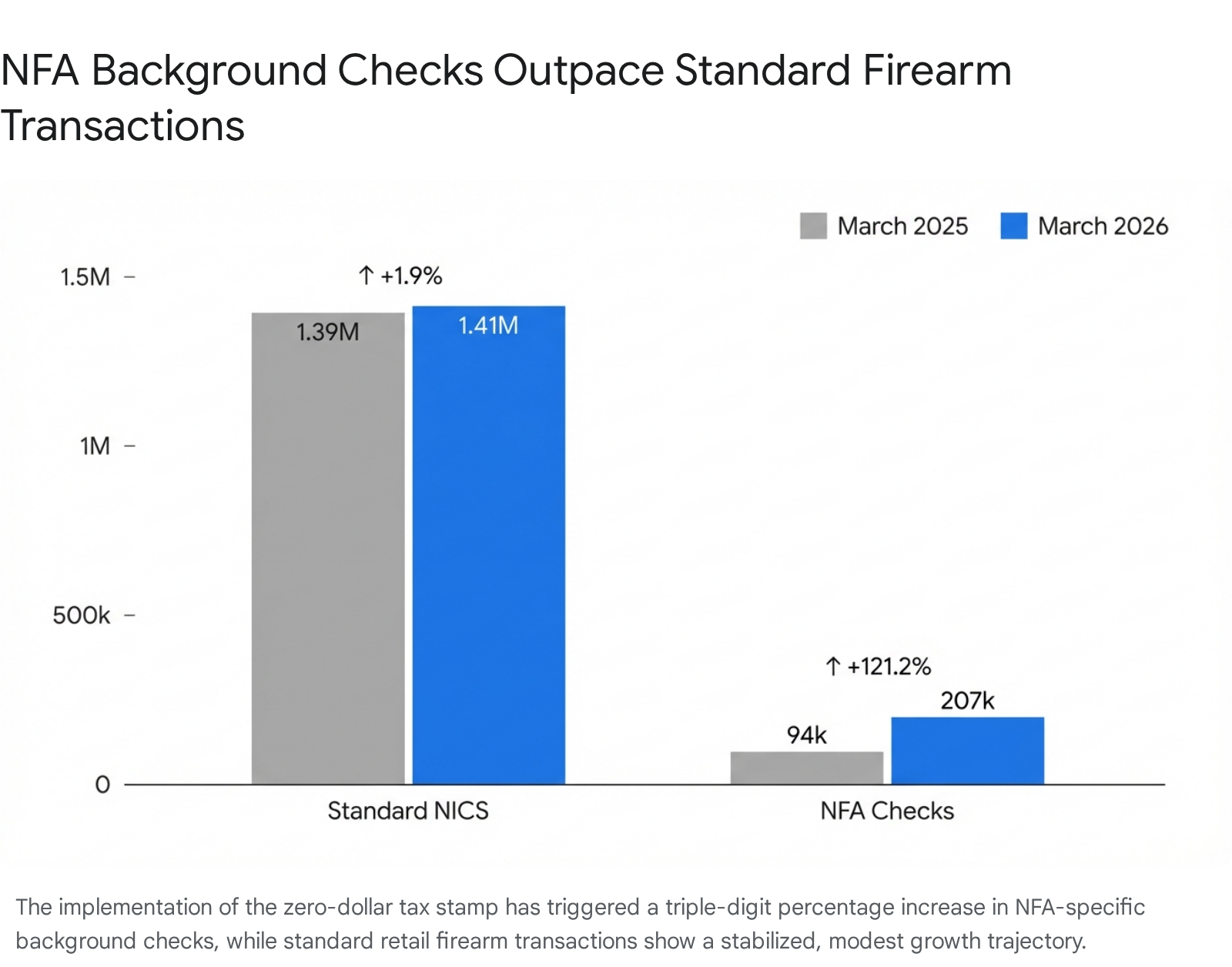
While the 1.9 percent growth in standard retail transactions is positive news for the industry, the most staggering data point emerging from the March 2026 statistics is the volume of National Firearms Act checks. These checks primarily encompass ATF Form 1 (application to make and register a firearm) and Form 4 (application for tax-exempt transfer and registration of a firearm) submissions.
The March 2026 NFA figure reached an astounding 206,871 transactions. This represents a massive 121.2 percent increase compared to the March 2025 figure of 93,518.5 This triple-digit growth curve was not an isolated event. February 2026 recorded 209,023 NFA checks, marking a 167 percent increase over the prior year’s figure of 78,295.8
The geographic distribution of these NFA transactions heavily favors states with permissive firearm cultures and massive existing owner bases, though states facing impending legislative bans are also climbing the ranks.
| Rank | State | March 2026 NFA Checks | February 2026 NFA Checks |
| 1 | Texas | 26,248 | 27,986 |
| 2 | Florida | 14,364 | 14,629 |
| 3 | Virginia | 8,874 | 14,230 |
| 4 | North Carolina | 8,831 | 8,128 |
| 5 | Georgia | 8,661 | 8,806 |
Table 2: Top 5 States for NFA Background Checks in March and February 2026. 58
This targeted explosion in NFA transactions is fundamentally reshaping retail inventory strategies. Local store owners report that standard rifles and shotguns are sitting on the racks longer than anticipated, while suppressors and short-barreled rifles are turning over almost instantly upon delivery. Retailers are being forced to pivot away from traditional long guns and toward specialized, suppressor-ready platforms to capture this sudden surge in highly specific consumer demand.
3. The Zero-Dollar NFA Tax Stamp Revolution
The stabilization and subsequent growth of the firearms market in the first quarter of 2026 did not occur in a vacuum. It is the direct mathematical result of three intersecting catalysts. The first and most profound of these catalysts is the federal deregulation regarding National Firearms Act items.
For nearly a century, the National Firearms Act of 1934 imposed a strict $200 transfer tax on specific items, most notably sound suppressors and short-barreled rifles (SBRs). Adjusted for inflation since 1934, this tax was originally designed to be a prohibitive barrier to entry for the working class. While the nominal value remained $200 over the subsequent decades, it still represented a significant psychological and financial hurdle for the average consumer, often adding a 20 to 30 percent premium to the final retail cost of a standard suppressor.
This landscape was fundamentally altered by the passage of the One Big Beautiful Bill Act (OBBBA) in 2025.9 Effective January 1, 2026, the federal tax stamp fee for eligible NFA items, which include suppressors, short-barreled rifles, short-barreled shotguns, and Any Other Weapon (AOW) configurations, was reduced from $200 to exactly $0.10 It is vital to note that this legislation did not remove the underlying regulatory framework. Consumers are still legally required to register the item with the Bureau of Alcohol, Tobacco, Firearms and Explosives (ATF), submit fingerprints, provide passport-style photographs, and pass an exhaustive background check.11 The core change is purely financial, transforming the regulatory burden from a prohibitive tax into a mere administrative process.
The elimination of the $200 fee released a massive backlog of pent-up demand. Throughout late 2025, countless consumers deliberately delayed their purchases, waiting for the January 1 enactment date to capitalize on the savings.11 Major manufacturers like SIG Sauer immediately recognized this paradigm shift, communicating to their customer base that a traditional “Two-Stamp” setup (requiring $400 in combined taxes for an SBR and a suppressor) now costs nothing in government fees, radically improving the value proposition for the consumer.12
A critical secondary factor amplifying this catalyst is the unexpected efficiency of the ATF’s eForms system. Prior to 2026, industry analysts and retailers warned consumers of impending administrative doom, predicting that the surge in zero-dollar applications would crash the ATF systems and result in wait times extending well beyond a year.13 Many commentators on internet forums believed that the federal government would intentionally throttle processing times to punish consumers utilizing the new tax-free system.14
However, real-world data aggregated from consumer forums and major processors like Silencer Shop paints a vastly different picture. The implementation of modern software architecture and streamlined FBI background check protocols has resulted in unprecedented approval speeds.
| Form Type | Application Entity | Wait Range | Median Wait Time |
| Form 4 (eForm) | Trust | 2 days to 58 days | 24 days |
| Form 4 (eForm) | Individual | 1 day to 35 days | 5 days |
| Form 4 (eForm) | Corporate | 7 days to 41 days | 19 days |
| Form 3 (eForm) | Dealer to Dealer | 28 mins to 6 days | 20 hours |
Table 3: ATF eForm Wait Times as of April 9, 2026. 15
Consumer reports on popular digital forums like Reddit’s NFA community corroborate these statistics, showcasing the reality of the new zero-dollar era. Users regularly post approvals that shatter historical norms.
| Control Number | State | Entity Type | Submission Date | Approval Date | Total Wait Time |
| 20262274XXX | Colorado | Trust (2RP) | March 8, 2026 | April 9, 2026 | 32 Days |
| 20262318862 | Washington | Trust | March 12, 2026 | April 8, 2026 | 26 Days |
| 202625195XX | Florida | Individual | April 3, 2026 | April 8, 2026 | 5 Days |
| 20262498619 | Nevada | Individual | April 1, 2026 | April 8, 2026 | 7 Days |
| 20262253100 | Georgia | Trust | March 5, 2026 | April 8, 2026 | 34 Days |
Table 4: Empirical Consumer Reports of Form 4 Approvals in Q1 2026. 16
This combination of zero financial friction and rapid bureaucratic processing has created a euphoric buying environment. Consumers are purchasing multiple NFA items simultaneously, driving the 121.2 percent NFA check increase observed in March. Retailers are reporting that suppressors are currently the sole driver of foot traffic in many regions. Furthermore, the trend is forcing a macro shift in manufacturing. Prominent brands like FN have even modified their warranty policies, ensuring that the latest iterations of flagship rifles like the SCAR 16S are fully capable of using suppressors without voiding factory protections.17
4. Looming State-Level Firearm Bans as Demand Accelerators
While federal deregulation is driving the NFA market, aggressive state-level regulation is driving the standard hardware market. The year 2026 has witnessed several state legislatures advancing severe restrictions on the manufacture, sale, and possession of specific firearms. These legislative actions create strict statutory deadlines that inevitably compel consumers to purchase inventory defensively before the laws take effect.
The most prominent and impactful example is currently occurring in the Commonwealth of Virginia. Following a shift in political power, the Virginia General Assembly passed a sweeping slate of over thirty gun control bills during the recent session. If signed by the Governor, the most significant of these, House Bill 217 and Senate Bill 749, will take effect on July 1, 2026. This legislation entirely prohibits the manufacture, sale, transfer, and importation of defined “assault firearms” and large-capacity ammunition feeding devices.18 Violations of this law will be classified as Class 1 misdemeanors and carry harsh secondary penalties, including a three-year prohibition on purchasing or possessing any firearms following a conviction.19
The legislative package in Virginia extends far beyond basic platform bans. House Bill 1525 makes it a Class 1 misdemeanor for individuals under the age of 21 to purchase a handgun or an assault firearm anywhere in the state.19 Additionally, strict new storage requirements mandate that firearms left in unattended vehicles must be secured in locked, hard-sided containers (HB 110 and SB 496), while residential storage laws demand locked cabinets if a minor is present (HB 871 and SB 348).19 Furthermore, the state is expanding sensitive location bans, prohibiting the possession of firearms within 100 feet of polling places and within hospitals providing mental health services.19 The consumer reaction to this regulatory avalanche has been swift and easily quantifiable. In March 2026 alone, Virginia initiated 79,846 firearm background checks, marking one of the highest monthly totals the state has seen since the pandemic and civil unrest surges of 2020.18
Similar dynamics are unfolding in other regions across the country, creating localized pockets of hyper-demand. In Colorado, Senate Bill 25-003 institutes a strict Permit-to-Purchase requirement taking effect on August 1, 2026. This complex law dictates that individuals attempting to purchase most specified semi-automatic firearms (including certain rifles and gas-operated handguns with detachable magazines) must first complete an approved training course, submit to an enhanced background check, and obtain a Firearms Safety Course Eligibility Card from the state’s Department of Revenue.20 Furthermore, a separate provision taking effect on July 1, 2026, raises the minimum age to purchase any ammunition to 21 and forces retail stores to place all ammunition behind secure counters, requiring employee assistance for access.19
In the Northeast, Rhode Island is preparing for the implementation of the Assault Weapons Ban Act of 2025 (S 359), which restricts the manufacture, sale, purchase, and possession of firearms classified as assault weapons starting July 1, 2026, though it includes limited exemptions for firearms lawfully owned prior to that date.19 Meanwhile, Maine voters recently approved Question 2, a sweeping “Red Flag” Extreme Risk Protection Order law that took effect in 2026, allowing family members and law enforcement to petition courts to temporarily prohibit individuals from purchasing firearms prior to a full hearing.19
Historically, the introduction of sweeping bans triggers a massive, temporary spike in retail sales as citizens rush to acquire grandfathered inventory. The psychological fear of missing out, combined with the real threat of permanent market exclusion, drives consumers who were otherwise on the fence to execute purchases immediately. The March NICS data confirms that this phenomenon is actively contributing to the national sales rebound, serving as a powerful counterweight to the broader economic headwinds facing the average consumer.
5. The Macroeconomic Stimulus of 2026 Tax Refunds
The third, often underreported catalyst driving the Q1 2026 firearm sales rebound is the influx of unseasonably large federal tax refunds, which function as a massive, localized economic stimulus. When the One Big Beautiful Bill Act (OBBBA) was enacted by Congress, it contained a highly strategic and politically astute provision. Seven major individual income tax cuts were applied retroactively to take effect on January 1, 2025.21 These sweeping provisions included the elimination of income tax on tips, overtime pay, and auto loan interest, alongside a substantial new bonus deduction for taxpayers over the age of 65 and an increase in allowable SALT (State and Local Tax) deductions.21
Because the Internal Revenue Service did not immediately adjust the complex income tax withholding schedules during the 2025 calendar year, millions of American workers had excessive portions of their paychecks withheld by the federal government. The mechanical result of this bureaucratic delay was entirely predictable. The 2026 tax filing season generated a bumper crop of refunds, returning a massive wave of capital directly into the checking accounts of consumers.
By March 20, 2026, data tracked by the Bipartisan Policy Center revealed that the average federal tax refund had surged to a staggering $3,571.22 Financial analysts at institutions like Morgan Stanley correctly predicted that these elevated refunds, driven by the targeted OBBBA tax cuts, would temporarily raise disposable income, help households reduce debt, and lead to significantly higher demand in durable goods, hardline retail, and discretionary sectors.23
For the firearms industry, the timing of this capital injection was perfect. The arrival of $3,500 tax refunds coincided exactly with the moment the $200 NFA tax was eliminated. Consumers utilized this unexpected liquidity to purchase premium firearms, sophisticated optical sights, and newly accessible zero-fee suppressors. In an industry where the average transaction value easily exceeds $1,000, the psychological effect of “found money” cannot be overstated. These massive refunds served as a powerful macroeconomic tailwind, providing the necessary capital for consumers to execute the purchases driven by the federal NFA deregulation and the state-level ban fears.
6. The Ammunition Market Crisis: Tariffs and Supply Chain Disruptions
While the hardware side of the firearms industry is currently enjoying a regulatory and tax-driven renaissance, the consumable side of the industry is facing a severe, multi-faceted crisis. The domestic ammunition market is currently trapped between aggressive protectionist trade policies and severe geopolitical supply chain shocks. This combination is resulting in rapidly escalating retail prices, volatile inventory availability, and compressed profit margins for manufacturers of all sizes.
6.1 The Trump Administration Tariffs on Metals and Precursors
On April 2, 2026, the Trump administration issued a presidential proclamation implementing sweeping modifications to Section 232 tariffs, a policy lever designed to protect domestic industries by targeting imported metals crucial to industrial manufacturing. The directive established a massive flat 50 percent tariff on the full value of imported steel, aluminum, and copper products.24 Additionally, the proclamation levied a 25 percent tariff on derivative articles substantially made from those metals.24 Parallel to this, broader Section 122 tariffs instituted a 10 percent flat rate across a wide array of general imported goods.25
The macroeconomic impact of these policies is staggering. Analysts project that the US average effective tariff rate has climbed to 11.0 percent, the highest level recorded since 1943, ultimately costing the average American household between $1,130 and $1,338 in lost real income post-substitution.25
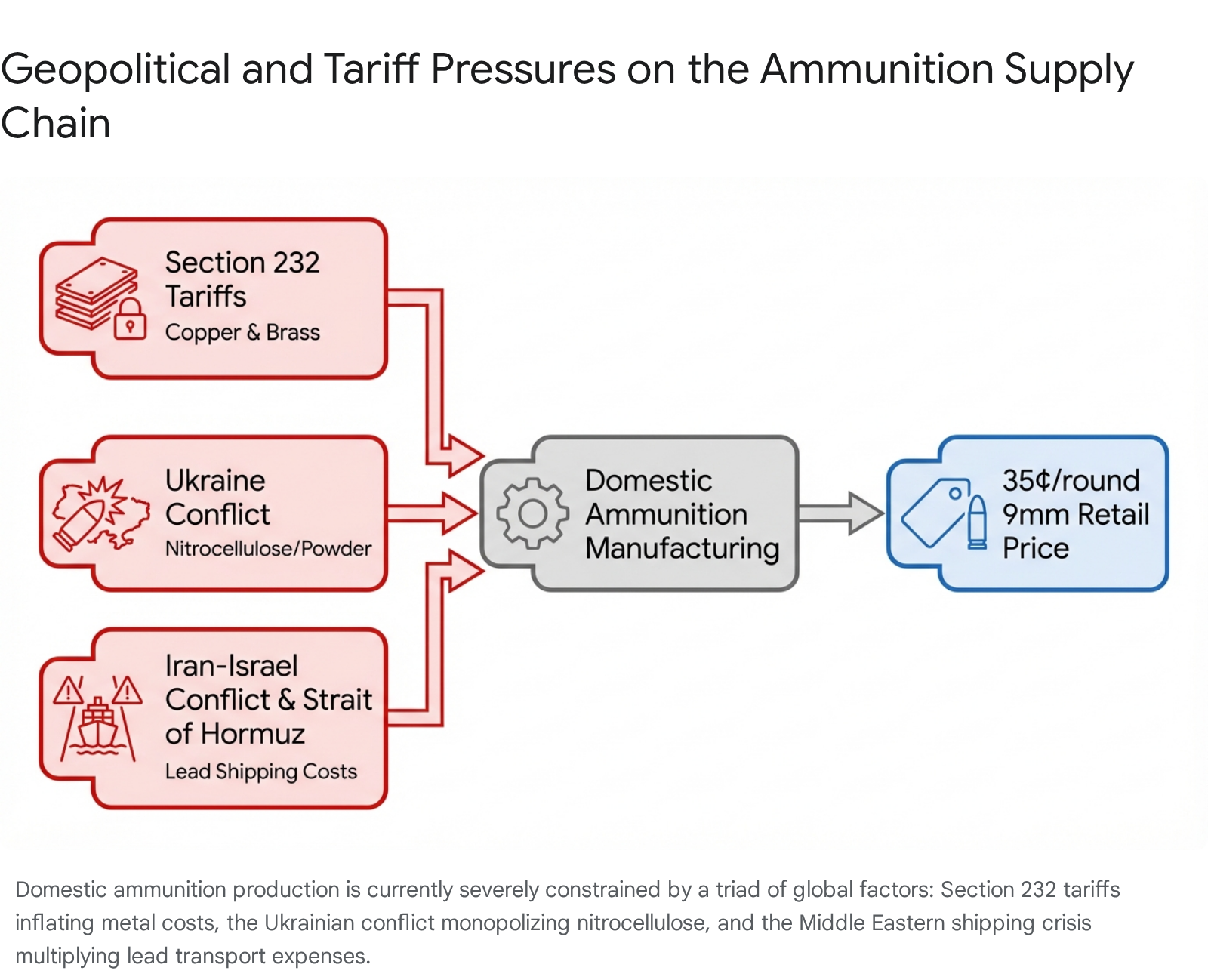
These levies have devastated the cost structure of ammunition production. A standard cartridge requires brass (an alloy of copper and zinc) for the casing, lead and copper for the projectile, and highly specific chemical precursors for the primer and smokeless powder. The domestic industry is heavily reliant on foreign supply chains for these exact materials. For example, Poongsan Corporation, the South Korean parent company of PMC Ammunition, supplies a massive portion of the copper strip used by domestic manufacturers across the United States.26 Under the new tariff regime, PMC was hit with a 25 percent tariff, forcing the company to raise the wholesale cost of 1,000 rounds of 5.56mm ammunition by approximately $100, and 9mm by $50, effectively pricing them out of competitive retail viability against remaining domestic stockpiles.26
The financial impact on corporate manufacturers has been brutal. Kenneth Lane, the CEO of Olin Corporation, the parent entity of the iconic Winchester ammunition brand, reported that the combination of shrinking demand from the 2025 slump and skyrocketing raw material costs caused the company’s fourth-quarter earnings to collapse by an astonishing 98 percent.27 During a recent earnings call, Lane explicitly blamed the tariffs for choking off imports and jacking up the price of brass and copper, warning investors that the company would be forced to pass these severe cost increases directly to the consumer throughout 2026.28
The pain of these tariffs is not isolated to the commercial firearms sector. Earnings reports from Firan Technology Group (FTG), an aerospace and defense contractor, highlight that US administration tariffs are universally increasing input costs by multi-million dollar amounts across the broader defense industry in 2026, forcing executives to plan extensive mitigations, customer pass-through pricing, and geographic diversification to survive the near-term cost pressures.29
6.2 Geopolitical Shocks and the Strait of Hormuz
The tariff crisis has been critically exacerbated by the outbreak of direct conflict in the Middle East. On February 28, 2026, the United States and Israel engaged in targeted military strikes against Iranian facilities, escalating regional tensions and immediately destabilizing global shipping networks.30 The conflict has severely compromised the security of the Strait of Hormuz, forcing major maritime logistics companies to declare force majeure and reroute their cargo vessels on vastly longer, more expensive transits.31 The International Monetary Fund notes that this asymmetric shock disproportionately burdens energy importers and supply chains heavily dependent on Asian manufacturing, leading to elevated prices and reduced global growth prospects.32
For the ammunition industry, the logistical fallout is severe. Bill Bizak, an industry retailer, noted that the cost of bulk lead shipments has skyrocketed by an astonishing 150 percent, jumping from roughly $28 a box to over $72, driven almost entirely by the inflated cost of oceanic shipping and oil required to move heavy commodities.28 Furthermore, the ongoing war in Ukraine continues to siphon off global supplies of nitrocellulose, the critical chemical backbone of modern smokeless gunpowder. With European supplies diverted to the artillery requirements of the Ukrainian military, and the Trump tariffs restricting vital chemical imports from China, domestic commercial ammunition manufacturers are facing an unprecedented scarcity of powder precursors.28
6.3 Consumer Reactions and “Panic Buying” Dynamics
The synthesis of these macroeconomic and geopolitical shocks is hitting the retail counter with extreme velocity. By early 2026, the average daily price of a single round of 9mm full metal jacket ammunition, the undisputed volume leader of the domestic market, steadily climbed to over 35 cents per round.28 This represents a painful 10-cent increase over the market averages established in late 2024 and 2025. Smaller, independent manufacturers, such as the Detroit Ammunition Company, have reported being forced to raise their wholesale prices by 8 to 15 percent compared to early 2024, noting that they have exhausted all ability to absorb the costs internally and remain viable.28
The consumer reaction to this highly inflationary environment is predictable but detrimental to long-term market stability. Rather than exhibiting rational purchasing behavior by steadily acquiring inventory during periods of stability, the consumer base remains highly reactionary. Retailers report that despite clear, repeated warnings regarding impending price hikes due to tariff implementation, customers rarely choose to stockpile in advance. Instead, the consumer base tends to engage in sudden, irrational “panic buying” only after the price shocks have already materialized on the shelves.28
Discussions on digital forums illustrate a growing resignation and frustration among consumers. Market observers and forum participants note that the combination of copper tariffs, nitrocellulose shortages, and Middle Eastern logistics failures is steadily eroding the purchasing power of the average shooter. Many local gun store owners who operate with traditionally thin margins express deep concern that their customer base simply will not tolerate the necessary 14 to 20 percent retail price increases required to keep the brick-and-mortar businesses solvent, fearing significant demand destruction in the quarters ahead.33
7. Firearm Retailer Earnings and Shifting Consumer Behavior
To fully understand the health of the industry, one must look beyond macro background check volumes and analyze the actual financial performance and strategic pivots of the corporate entities operating within the space. The first quarter of 2026 has provided deeply mixed signals from publicly traded retailers and manufacturers, highlighting a market that heavily rewards digital innovation while aggressively punishing bloated legacy operating expenses.
7.1 Public Market Performance and Corporate Restructuring
The financial earnings reports from the first quarter of 2026 reveal a challenging operating environment for many traditional corporations attempting to scale operations. Byrna Technologies, a prominent player in the less-lethal self-defense market, reported a significant miss in both earnings per share (EPS) and overall revenue compared to Wall Street forecasts. The company posted an EPS of $0.03, missing the $0.09 projection by a stark 66.6 percent, while revenue hit $29.05 million against an expected $30.1 million.34 This performance triggered a steep 16.7 percent drop in pre-market stock valuation. Management attributed the miss to lower e-commerce conversion rates following the holidays, alongside spiraling marketing, legal, and professional expenditures required to support their aggressive retail distribution expansion into 250 new physical locations.35
Similarly, GrabAGun, a major online retailer that executed a highly publicized initial public offering in July 2025, reported a difficult transition. Despite witnessing a 14.1 percent increase in net revenue to $29.6 million for the fourth quarter of 2025, the company shifted from profitability to a net operating loss of $0.4 million for the quarter, culminating in a net loss of $2.5 million for the full fiscal year.36 The unprofitability was primarily driven by the massive administrative expenses and stock-based compensation requirements associated with operating as a newly minted public entity, reflecting profound investor skepticism regarding legacy retail scaling models.
However, beneath the surface of these corporate losses, these companies are aggressively executing strategic pivots designed to capture the modern consumer. GrabAGun recently launched “PEW Logistics,” a sophisticated white-label e-commerce platform that empowers traditional gun manufacturers (such as KelTec) to sell directly online and utilize GrabAGun’s vast localized dealer network for fulfillment, offering real-time visibility into consumer purchase patterns.36 In a calculated move to capture a younger, digitally affluent demographic that traditionally operates outside legacy retail channels, GrabAGun also became the first major firearms retailer to accept cryptocurrency payments late last year.36
Other major players are choosing to shrink to profitability. GunBroker.com, under the leadership of CEO Steve Urvan, completed the divestiture of its ammunition manufacturing business to Olin Corporation, streamlining its cost structure to focus exclusively on operating its highly profitable digital marketplace platform.36
7.2 Inventory Adjustments and the Digital Aggregator Shift
The independent, brick-and-mortar dealer network is currently undergoing a massive digital transformation, relying heavily on aggregator platforms to survive in an increasingly margin-compressed environment. Guns.com, the industry’s leading digital marketplace, reported a massive 46 percent year-over-year surge in local dealer sales through its platform during February 2026, marking the strongest performance the company has ever recorded.37
This staggering growth on digital platforms outpaces the broader physical market forecasts, which project a 7 to 12 percent decline in general firearm sales for the year.37 It underscores a permanent shift in consumer behavior. The modern firearm consumer demands vast selection, absolute price transparency, and seamless logistics, preferring to purchase specialized items online and utilize their local dealer merely as an administrative transfer agent. Guns.com noted that more than one million new consumers utilized their platform for the first time in 2025, driving overall sales growth of 16 percent for the year and funneling massive revenue directly to local FFL dealers.38
Furthermore, local dealers are actively recalibrating their physical inventory to align with the post-surge market realities. Industry analysts observe that the standard, “hype” firearms that dominated the panic buying of the pandemic era are currently languishing in display cases, forcing dealers to aggressively discount stagnant inventory to free up operating capital.39 That capital is being rapidly reallocated away from basic entry-level platforms and heavily reinvested into modular handguns, precision optics, and the rapidly expanding suppressor market, perfectly aligning with the consumer demand unlocked by the zero-dollar tax stamp.
8. The Ongoing Threat of Machine Gun Conversion Devices
An emerging variable that demands close monitoring for the remainder of the year is the aggressive legislative crusade against specific handgun architectures, a movement driven by the rampant proliferation of illicit Machinegun Conversion Devices (MCDs). Commonly referred to on the street as “Glock switches,” these easily acquired, often 3D-printed devices can be attached to the rear slide cover plate of a semiautomatic pistol, illegally converting it to fire automatically at rates exceeding 20 rounds per second.40
It is important to clarify that the devices themselves are highly illegal under existing federal law. The ATF classifies MCDs as machineguns under the National Firearms Act, rendering their possession or transfer a severe federal felony.41 Glock Corporation does not manufacture, market, or sell these devices; they are entirely aftermarket parts produced through the black market.40
However, state legislatures and municipal governments are increasingly attempting to bypass federal enforcement by holding the original manufacturers civilly and criminally accountable for the mechanical susceptibility of their historical designs. In Maryland, lawmakers have successfully fast-tracked legislation (SB0334/HB0577) that specifically targets the sale or transfer of “machine gun convertible pistols.” The bill defines these firearms mechanically, identifying them as semiautomatic handguns utilizing a cruciform trigger bar, which is the defining internal safety mechanism of the industry-leading Glock pistol.42 State legislators argue that manufacturers must change the core design of their guns if they wish to continue doing business within the state.42
Illinois has introduced similar, highly aggressive legislation dubbed the “Responsible Gun Manufacturers Act.” This bill aims to entirely prohibit the manufacturing and sale of pistols that can be easily converted into illegal machine guns through the use of an auto sear.43 This legislative push is supported by medical professionals who note that the clinical reality of treating gunshot victims has drastically worsened, as converted firearms inflict multiple wounds in fractions of a second.43 Furthermore, the City of Chicago previously filed a massive lawsuit against Glock in 2024, alleging that the company’s conduct endangers the public under the Firearms Industry Responsibility Act, citing a 15-fold increase in machine gun conversion device recoveries since 2019.43
If these bills successfully become law, they will trigger a massive structural shock within the industry. Banning the sale of the most popular self-defense handgun architecture in major American markets will force immediate, incredibly costly mechanical redesigns from major manufacturers. Furthermore, it will create a massive power vacuum in the retail handgun sector, prompting competitors utilizing traditional hammer-fired or alternative striker-fired mechanisms to aggressively capture market share in those restricted states. This legislative battleground represents the most volatile long-term risk to hardware manufacturers heading into the late stages of 2026.
9. Market Projections for the Remainder of 2026
Synthesizing the raw background check data, legislative timelines, and macroeconomic pressures provides a clear, bifurcated framework for projecting the health and trajectory of the small arms market through the third and fourth quarters of 2026.
9.1 The Negation of the Summer Slump
The second and third quarters of the year represent historically the slowest period for the firearms industry, often referred to as the “summer slump.” However, this traditional seasonal downturn is expected to be severely mitigated, if not entirely negated, in 2026. The impending effective dates of major state-level firearm bans will function as highly efficient, localized demand accelerators. Because the Virginia assault weapons ban and the Rhode Island restrictions both take effect on July 1, 2026, and the Colorado permit-to-purchase requirement takes effect on August 1, 2026, retailers in these heavily populated regions will experience intense buying frenzies extending deep into the summer months.
Nationally, the market is projected to return to a standard, albeit elevated, seasonal cadence by Q4 2026. Hardware sales will remain exceptionally robust, perpetually sustained by the sheer efficiency of the ATF eForms system and the ongoing consumer transition toward suppressed platforms and specialized optics. The $3,500 tax refunds injected into the economy early in the year will continue to support the purchase of these high-margin, luxury items through the holiday season.
9.2 The Consumable Market Warning
However, the true threat to the industry’s sustained health lies in the ammunition sector. The Section 232 metal tariffs and the severe logistics disruptions resulting from the conflict in the Middle East show no signs of immediate resolution. Consequently, manufacturers will be forced to continue escalating wholesale ammunition prices to maintain basic solvency. The analysis projects a high probability of severe demand destruction in the consumable sector by the fourth quarter. As the cost of a single 9mm training round approaches 40 cents, recreational shooters will drastically reduce their volume of fire. This reduction in range time will inevitably starve physical retailers and shooting facilities of the vital recurring revenue required to survive the winter months.
10. Conclusion
The small arms industry in 2026 is a study in intense market fragmentation. The analysis concludes that the overall health of the market remains fundamentally strong, supported by the historic 1.9 percent rebound in adjusted March NICS checks and the explosive, triple-digit growth of the National Firearms Act sector. The strategic elimination of the $200 tax stamp under the OBBBA, combined with surprisingly efficient federal processing systems, has successfully revitalized consumer interest and redirected immense capital toward premium, high-margin accessories. Furthermore, aggressive state legislation continues to reliably generate localized demand spikes, ensuring steady inventory turnover for regional dealers who utilize digital aggregator platforms like Guns.com.
However, this hardware prosperity is deeply compromised by an impending crisis in consumables. The relentless inflationary pressures driven by federal tariff policies and catastrophic geopolitical logistics failures in the Middle East have fundamentally broken the ammunition supply chain. As the cost of raw copper, brass, and lead continues to soar under the weight of 50 percent tariffs and 150 percent shipping increases, the retail price of ammunition will rapidly outpace the purchasing power of the average consumer. Therefore, the strategic recommendation for industry stakeholders is to pivot aggressively toward the digitized, NFA-focused hardware market, while maintaining extreme caution and lean inventory management regarding bulk ammunition procurement for the remainder of the year.
Appendix: Methodology
The insights formulated in this report are derived from a comprehensive synthesis of multiple disparate data sources, analyzed through the lens of a small arms industry expert. The primary quantitative foundation relies upon the analysis of March 2026 and historical background check data provided by the Federal Bureau of Investigation’s National Instant Criminal Background Check System (NICS), specifically isolating the adjusted figures compiled by the National Shooting Sports Foundation (NSSF) to accurately gauge point-of-sale retail health.
To contextualize the raw volume data, the analysis cross-referenced legislative documentation regarding the federal One Big Beautiful Bill Act (OBBBA) and pending state-level firearm statutes (e.g., Virginia HB 217, Colorado SB 25-003, Maryland SB0334). Macroeconomic and supply chain insights were drawn from primary corporate earnings transcripts (including Byrna Technologies, Firan Technology Group, and Olin Corporation), federal tariff proclamations from the Executive Branch detailing Section 232 and Section 122 levies, and supply chain logistics reports tracking the impact of the 2026 Middle East conflict on maritime shipping routes. Finally, real-time consumer sentiment and processing metrics were evaluated by aggregating qualitative discussions and empirical wait-time data from prominent digital forums (such as Reddit) and e-commerce platforms like Guns.com and Silencer Shop.
Note: Vendor Sources listed are not an endorsement of any given vendor. It is our software reporting a product page given the direction to list products that are between the minimum and average sales price when last scanned.
Please share the link on Facebook, Forums, with colleagues, etc. Your support is much appreciated and if you have any feedback, please email us in**@*********ps.com. If you’d like to request a report or order a reprint, please click here for the corresponding page to open in new tab.
Sources Used
- NSSF: 2024 NICS Background Checks Fall Again to Lowest Level Since 2019 – SGB Media, accessed April 10, 2026, https://sgbonline.com/nssf-nics-background-checks-fall-again-in-2024-for-fourth-consecutive-annual-decline/
- Firearm and Ammunition Industry Economic Impact – NSSF, accessed April 10, 2026, https://www.nssf.org/government-relations/impact/
- 2025 NSSF Firearm & Ammunition Industry Economic Impact, accessed April 10, 2026, https://www.nssf.org/download/2025-nssf-firearm-ammunition-industry-economic-impact/
- 2025 NSSF Firearm & Ammunition Industry Economic Impact Report, accessed April 10, 2026, https://www.nssf.org/economic-impact-report
- NSSF-Adjusted NICS Background Checks for March 2026 – The …, accessed April 10, 2026, https://www.theoutdoorwire.com/releases/2026/04/nssf-adjusted-nics-background-checks-for-march-2026
- NSSF: Adjusted NICS Background Checks Positive for Second Straight Month – SGB Media, accessed April 10, 2026, https://sgbonline.com/nssf-adjusted-nics-background-checks-positive-for-second-straight-month/
- Firearm background checks rise sequentially in March (SWBI:NASDAQ), accessed April 10, 2026, https://seekingalpha.com/news/4571950-firearm-background-checks-rise-sequentially-in-march
- NSSF-Adjusted NICS Background Checks for February 2026 – The Outdoor Wire, accessed April 10, 2026, https://www.theoutdoorwire.com/releases/2026/03/nssf-adjusted-nics-background-checks-for-february-2026
- Congress Passes the “One Big Beautiful Bill,” Now Headed to President Trump – NRA-ILA, accessed April 10, 2026, https://www.nraila.org/articles/20250703/congress-passes-the-one-big-beautiful-bill-now-headed-to-president-trump
- NFA Tax Stamp Eliminated January 2026 | Capitol Armory, accessed April 10, 2026, https://www.capitolarmory.com/articles/nfa-tax-stamp-eliminated-2026
- 2026 NFA Tax Stamp Changes: $0 Tax & Dealer Guidance, accessed April 10, 2026, https://orchidadvisors.com/2026-nfa-tax-stamp-changes/
- The Era of the $0 Tax Stamp: What the Fee Elimination Means for SIG SAUER Owners, accessed April 10, 2026, https://www.sigsauer.com/blog/the-era-of-the-0-tax-stamp-what-the-fee-elimination-means-for-sig-sauer-owners
- NFA Items (Cans/SBR) Processing Times. Jan 2026. Just incase you are wonder if there’s a rush : r/guns – Reddit, accessed April 10, 2026, https://www.reddit.com/r/guns/comments/1qkxtom/nfa_items_canssbr_processing_times_jan_2026_just/
- 1/1/2026 : r/NFA – Reddit, accessed April 10, 2026, https://www.reddit.com/r/NFA/comments/1q0eily/112026/
- ATF eForm Wait Times – Silencer Shop, accessed April 10, 2026, https://www.silencershop.com/atf-wait-times
- 2026 1st Quarter Approval Megathread. : r/NFA – Reddit, accessed April 10, 2026, https://www.reddit.com/r/NFA/comments/1q3bnqs/2026_1st_quarter_approval_megathread/
- Gun Industry Trends in 2026: What to Expect, accessed April 10, 2026, https://www.pewpewtactical.com/industry-trends/
- Key Gun Control Bills Advance in Virginia as Firearm Sales Surge, accessed April 10, 2026, https://rvamag.com/politics/virginia-politics/key-gun-control-bills-advance-in-virginia-as-firearm-sales-surge.html
- Gun Bills to Watch in 2026: Federal and State Firearm Laws | USCCA, accessed April 10, 2026, https://www.usconcealedcarry.com/blog/gun-laws-2026-bills-to-watch/
- Specified Semiautomatic Firearms – Colorado Parks and Wildlife, accessed April 10, 2026, https://cpw.state.co.us/specified-semiautomatic-firearms
- The Investment Implications of the Refund Surge | J.P. Morgan Asset Management, accessed April 10, 2026, https://am.jpmorgan.com/us/en/asset-management/adv/insights/market-insights/market-updates/notes-on-the-week-ahead/the-investment-implications-of-the-refund-surge/
- What’s Driving Higher Tax Refunds in 2026? – Bipartisan Policy Center, accessed April 10, 2026, https://bipartisanpolicy.org/explainer/whats-driving-higher-tax-refunds-in-2026/
- How 2026 Tax Refund Increases Could Boost Consumer Finance – Morgan Stanley, accessed April 10, 2026, https://www.morganstanley.com/insights/articles/federal-tax-returns-increase-impact-2026
- Fact Sheet: President Donald J. Trump Strengthens Tariffs on Steel, Aluminum, and Copper Imports – The White House, accessed April 10, 2026, https://www.whitehouse.gov/fact-sheets/2026/04/fact-sheet-president-donald-j-trump-strengthens-tariffs-on-steel-aluminum-and-copper-imports/
- State of U.S. Tariffs: April 2, 2026 | The Budget Lab at Yale, accessed April 10, 2026, https://budgetlab.yale.edu/research/state-us-tariffs-april-2-2026
- How Tariffs Will Likely Drive Up Your Ammo Prices – Gun Tests, accessed April 10, 2026, https://www.gun-tests.com/ammo/how-tariffs-will-likely-drive-up-your-ammo-prices/
- Ammo Prices Rising as Costs Squeeze Manufacturers | The Boise Gun Club Handbook, accessed April 10, 2026, https://boisegunclub.com/handbook/ammo-prices-rising-as-costs-squeeze-manufacturers
- Trump’s Tariffs Are Driving Up Ammo Prices – The Trace, accessed April 10, 2026, https://www.thetrace.org/2026/03/trump-tariffs-ammunition-prices/
- Firan Technology Group Q1 2026 Earnings Call Transcript, accessed April 10, 2026, https://www.marketbeat.com/earnings/reports/2026-4-9-firan-technology-group-co-ftgto-stock/
- The 2026 Iran War and Its Global Impact on Construction Supply Chains | Baker Donelson, accessed April 10, 2026, https://www.bakerdonelson.com/the-2026-iran-war-and-its-global-impact-on-construction-supply-chains
- Middle East Conflict Disrupts Materials and Logistics, accessed April 10, 2026, https://www.ismworld.org/supply-management-news-and-reports/news-publications/inside-supply-management-magazine/blog/2026/2026-03/middle-east-conflict-disrupts-materials-and-logistics/
- How the War in the Middle East Is Affecting Energy, Trade, and Finance, accessed April 10, 2026, https://www.imf.org/en/blogs/articles/2026/03/30/how-the-war-in-the-middle-east-is-affecting-energy-trade-and-finance
- Real story how tariffs are affecting gun/ammo prices in our community : r/CTguns – Reddit, accessed April 10, 2026, https://www.reddit.com/r/CTguns/comments/1n2c115/real_story_how_tariffs_are_affecting_gunammo/
- Earnings call transcript: Byrna Technologies Q1 2026 results miss expectations, accessed April 10, 2026, https://www.investing.com/news/transcripts/earnings-call-transcript-byrna-technologies-q1-2026-results-miss-expectations-93CH-4606034
- New CEO takes over as Byrna adds 50 stores and flags a softer Q2, accessed April 10, 2026, https://www.stocktitan.net/news/BYRN/byrna-technologies-reports-fiscal-first-quarter-2026-n86v7ufekz0d.html
- Gun Industry Q1 2026 Financial Update, accessed April 10, 2026, https://smokinggun.org/gun-industry-q1-2026-financial-update/
- Local Gun Shops Nationwide See Record 46% Sales Increase on Guns.com, accessed April 10, 2026, https://www.theoutdoorwire.com/releases/2026/03/local-gun-shops-nationwide-see-record-46-sales-increase-on-gunscom
- Surging Momentum Carries Guns.com and Partners Into 2026 – Dummer’s Grain Service, accessed April 10, 2026, https://www.dummersgrain.com/markets/stocks.php?article=gnwcq-2026-1-19-surging-momentum-carries-gunscom-and-partners-into-2026
- 7 Guns Nobody Is Buying In 2026 (The Real Reasons) – YouTube, accessed April 10, 2026, https://www.youtube.com/watch?v=5mRq6SjO_Q4
- Maryland lawmakers on course to ban sale of Glocks and ‘machine gun convertible pistols’, accessed April 10, 2026, https://www.wypr.org/wypr-news/2026-04-07/maryland-lawmakers-on-course-to-ban-sale-of-glocks-and-machine-gun-convertible-pistols
- Machinegun Conversion Devices – Department of Justice, accessed April 10, 2026, https://www.justice.gov/usao-wdok/media/1366621/dl?inline
- Maryland lawmakers fast-track bill targeting Glock-style handguns, accessed April 10, 2026, https://www.wboc.com/news/maryland-lawmakers-fast-track-bill-targeting-glock-style-handguns/article_60a2f8f6-67df-4483-af2e-aa8852ea4c05.html
- Illinois Lawmakers Seek to Outlaw Handguns That Are Able to Be Converted Into ‘Machine Guns’, accessed April 10, 2026, https://news.wttw.com/2026/04/02/illinois-lawmakers-seek-outlaw-handguns-are-able-be-converted-machine-guns