Category Archives: AR Analytics

Daniel Defense: Evolution from Components to Corporate Power

1. Executive Summary

Daniel Defense LLC operates as an American firearms manufacturer that transitioned from a component fabricator into a primary supplier of small arms. Founded in Savannah, Georgia, in 2002 by Marty Daniel, the company established its initial market presence by engineering specialized mounting accessories for the AR-15 platform1. A significant milestone for the company’s expansion was the acquisition of a sole-source contract with the United States Special Operations Command (USSOCOM) in 2005 to provide the Rail Interface System II (RIS II)2. This contract generated the capital necessary for vertical integration and established a reputation for military-grade durability that Daniel Defense subsequently leveraged in the civilian market4.

Currently headquartered in a 300,000-square-foot facility in Black Creek, Georgia, Daniel Defense utilizes a vertically integrated manufacturing model defined by in-house cold hammer forging (CHF) of rifle barrels1. The product portfolio centers on the DDM4 series of AR-15 style rifles but has expanded to include bolt-action precision rifles, pistol caliber carbines (PCCs), sound suppressors, and the Daniel H9 striker-fired handgun6. The company occupies a high-margin, low-volume segment of the firearms market, producing approximately 50,000 to 55,000 units annually, compared to legacy manufacturers that produce over one million units1. Its consumer demographic consists primarily of enthusiasts, competitive sport shooters, and law enforcement agencies5.

Despite robust financial performance—marked by substantial revenue growth in its core rifle segment—the company faces regulatory and legal challenges12. The utilization of military-themed marketing to civilian consumers has drawn intense scrutiny, particularly following the use of a Daniel Defense DDM4 V7 rifle in the 2022 Uvalde school shooting12. The company is navigating congressional investigations and civil litigation aimed at bypassing federal liability shields by targeting its digital marketing and e-commerce practices13. Looking forward, the strategic trajectory of Daniel Defense indicates an ongoing effort to diversify its product architecture beyond the AR-15 platform to insulate against regulatory risks while maintaining its status as a premium-tier manufacturer6.

2. Corporate Origins and Historical Development

The trajectory of Daniel Defense emerged from a hobbyist’s response to specific mechanical limitations within the commercial AR-15 market1.

2.1 Early Entrepreneurship and Initial Products

The company’s founder, Marty Daniel, graduated from Georgia Southern University in 1985 with an electrical engineering degree17. Prior to entering the firearms industry, Daniel founded and operated a business specializing in overhead doors and fireplaces in Garden City, Georgia1.

In 1999, Daniel was introduced to the AR-15 platform during a recreational shooting event17. Recognizing functional limitations in legacy commercial AR-15 designs, particularly regarding the mounting of optics, Daniel sought to acquire a “flat-top” upper receiver (often referred to as a “Big Hole” upper)6. Unable to source this component in single quantities, Daniel contracted a local machine shop to produce a batch of 100 units17. Retaining four for personal use, he successfully sold the remaining 96 through an early e-commerce platform17.

Daniel subsequently engineered the “Sling Loop,” an end-plate replacement that repositioned the sling attachment point to the rear of the receiver, accommodating modern tactical slings6. By 2001, Daniel was exhibiting his components at events such as the Knob Creek machine gun shoot in Kentucky17. During this period, the company’s 12-inch rail systems began seeing limited use by the U.S. Army Marksmanship Unit (USAMU) at Fort Benning, Georgia10. Daniel Defense LLC was officially incorporated in 20021.

2.2 Defense Contracting and Capital Expansion

A significant opportunity for the enterprise occurred when representatives from the U.S. Naval Surface Warfare Center (NSWC), Crane Division, approached Daniel to submit a prototype forend rail system for an upcoming USSOCOM procurement2. At the time, Daniel Defense was operating out of a shared space in Garden City and lacked the capital to develop a military-grade prototype2. To secure funding, Daniel leveraged his family’s farm as collateral, obtaining a $250,000 loan2.

This capital allowed Daniel Defense to procure the necessary materials and machinery to engineer the Rail Interface System II (RIS II)2. In 2003, Daniel Defense entered the solicitation process against industry incumbents2. In 2005, USSOCOM awarded Daniel Defense the sole-source contract for the RIS II, with the first deliveries commencing in 20062.

Building on this success, Daniel Defense pursued international defense contracts. In 2007, the company identified a solicitation by the United Kingdom Ministry of Defence (MoD) to upgrade the standard-issue SA80/L85A1 infantry rifle2. By taking measurements from a rare civilian L85 sample located in the United States, Daniel Defense reverse-engineered a bespoke rail system2. In 2008, the company won the UK MoD solicitation and began production of the L85 rails2.

2.3 Vertical Integration and Facility Expansion

The revenue generated by these IDIQ (Indefinite Delivery, Indefinite Quantity) government contracts enabled significant capital expenditure. In 2007, the company acquired its first advanced CNC (computer numerical control) machine, a HAAS Vf42. Around 2010, Daniel Defense made a major capital investment by purchasing specialized cold hammer forging (CHF) machines, allowing it to produce CHF barrels entirely in-house2.

This vertical integration allowed the company to transition from an accessory supplier to a complete firearms manufacturer. In 2009, Daniel Defense produced its first complete rifle, the DDM4 V1, manufacturing 24 guns that year1. Production scaled to 10,000 guns by 20101. To accommodate this growth, the company relocated from Garden City to a larger facility in Black Creek, Georgia, in 20081. The company briefly operated a secondary 90,000-square-foot facility in Ridgeland, South Carolina, between 2012 and 20161. By late 2017, Daniel Defense consolidated its operations into a newly constructed $29 million, 300,000-square-foot headquarters in Black Creek1.
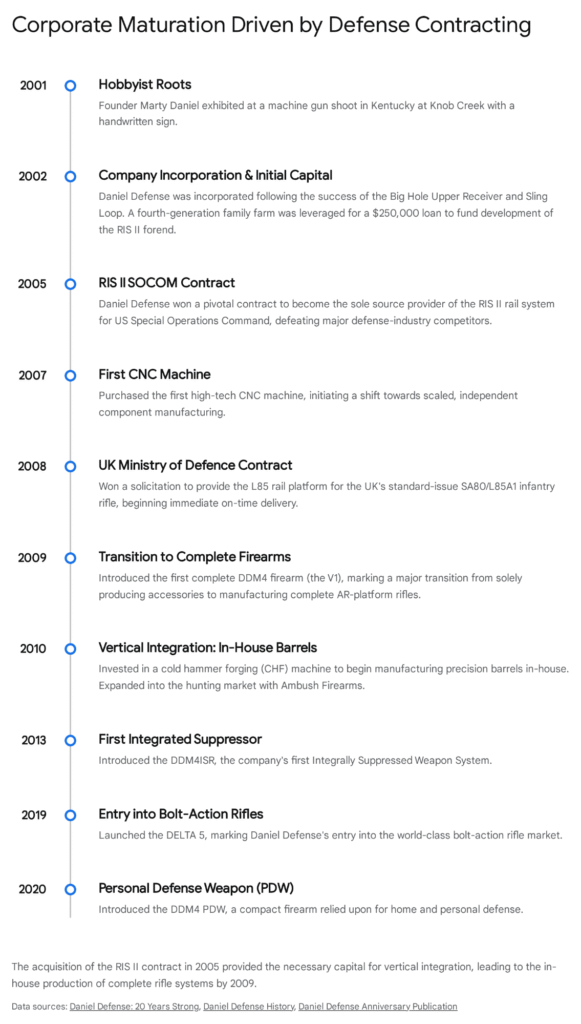
Daniel Defense corporate maturation timeline: defense contracting evolution.

3. Product Architecture and Technical Capabilities

The Daniel Defense product line emphasizes modularity, high-volume durability, and ergonomic refinement. While the company established its foundation on the AR-15 platform, its technical evolution reflects an expansion into diverse small-arms categories.

3.1 Rail Interface Systems (RIS II and RIS III)

The original Rail Interface System II (RIS II) was a two-piece quad-rail handguard featuring a patented 6-bolt, bolt-up lock-up mechanism18. This design allowed the rail to free-float the barrel while remaining rigid enough to mount an M203 grenade launcher without affecting barrel harmonics or point-of-impact shifting18.

As the firearms industry shifted toward lighter attachment standards, Daniel Defense adapted with the introduction of the RIS III19. The RIS III retains the 6-bolt mounting hardware of the RIS II but replaces the quad-rail design with Magpul’s M-LOK attachment slots19. This evolution reduced overall weight while offering a full-length 1913 Picatinny rail along the top and M-LOK slots around the circumference19. The RIS III platform is backward compatible; users can swap a legacy RIS II quad rail for a RIS III M-LOK rail using the existing bolt-up plate20.

3.2 Cold Hammer Forged Barrel Production

A key differentiator for Daniel Defense is its proprietary in-house barrel manufacturing. The company utilizes a cold hammer forging process, subjecting a steel blank to intense hydraulic pressure over a mandrel to form the rifling18. This realigns the steel’s grain structure, resulting in a dense and durable barrel2.

The barrels are typically constructed from chrome-moly-vanadium steel, finished in a Mil-spec heavy-phosphate coating, and feature chrome lining to resist corrosion5. Independent testing indicates these CHF barrels maintain accuracy well beyond 20,000 rounds of service5.

Daniel Defense optimizes its barrels for varied ballistic requirements, offering specific rifling twist rates based on caliber:

  • 5.56mm NATO: 1:7 twist
  • 300 Blackout: 1:8 twist
  • 6.5 Creedmoor: 1:8 twist
  • 7.62x51mm (.308): 1:11 twist (AR platforms); 1:10 twist (Delta 5)
  • 6mm Creedmoor: 1:7.5 twist3

3.3 The DDM4 Rifle Family

The commercial DDM4 line remains the company’s flagship product division1. Over a decade of improvements, the platform has evolved from the original V1 into highly specialized variants2. Modern iterations feature fully ambidextrous lower receivers (allowing left or right-handed manipulation of the bolt catch, safety selector, and magazine release) and proprietary “GRIP-N-RIP” charging handles designed with an anti-gas feature to divert combustion gases away from the shooter’s face during suppressed fire18.

Model VariantKey Specifications and Operational Role
MK18 (SBR/Pistol)10.3″ barrel, 1:7 twist, carbine-length gas system. Designed for close-quarters environments.5
M4A1 RIII14.5″ barrel (pinned/welded to 16″), mid-length gas system, 12.5″ RIS III M-LOK rail. A general-purpose carbine.20
DDM4 V7 SLW14.5″ lightweight barrel profile, weighing under 6.5 lbs. Designed for reduced weight and maneuverability.5
DDM4 SPRIII18″ stainless MK12-profile barrel, rifle-length gas system, Timney trigger, full-length ARCALOCK bottom rail. Designed for distance shooting.25
DDM4 PDWCompact Personal Defense Weapon chambered in .300 Blackout, available in pistol or SBR configurations.6

3.4 Platform Expansion: DD5, Delta 5, and PCCs

To mitigate reliance on the 5.56mm AR-15 market, Daniel Defense scaled its architecture to larger calibers. The DD5 series represents the entry into the AR-10 platform, chambered in 7.62x51mm NATO and 6.5 Creedmoor5. In 2010, the company branched into the hunting market under the brand name “Ambush Firearms”6. In 2019, the company entered the precision bolt-action market with the Delta 5, integrating AR-style modularity with custom-tier bolt action features6. The company has also introduced Pistol Caliber Carbines (PCCs) in 9mm7.

3.5 Handguns: The Daniel H9 Program

Daniel Defense’s entry into the handgun market involved acquiring the intellectual property of Hudson Mfg., which had filed for bankruptcy in 2019 after its Hudson H9 suffered from mechanical failures27.

Daniel Defense engineers overhauled the design, releasing the Daniel H9 in early 202416. The H9 is a striker-fired 9mm pistol that integrates the straight-pull trigger geometry of a 1911 with a low bore axis that reduces muzzle flip28. The H9 features a frame machined from 7075-T6 aluminum, providing dimensional stability and resistance to frame flex29.

Initial 2024 launch units faced market friction; consumers noted early units shipped devoid of sufficient lubrication, leading to malfunctions out of the box, alongside ergonomic grip complaints and feed ramp jams30. Daniel Defense halted distribution to execute an engineering overhaul16. The mid-2024 redesign addressed these issues by replacing the single recoil spring with a dual recoil spring system, refining the trigger mechanism, polishing the feed ramp geometry, and redesigning the backstrap16. The barrel length was reduced to 4.19 inches, requiring a redesign of the 15-round magazine, and an optics-plate system was integrated for red dot sights27.

SpecificationDaniel Defense H9Glock 19 Gen5SIG Sauer P320
Capacity15+1 (9mm)15+1 (9mm)15+1 (9mm)
Frame Material7075-T6 AluminumPolymerPolymer
Barrel TypeCold Hammer ForgedStandard RiflingStandard Rifling
Trigger Style1911 Straight-PullHinged StrikerCurved Striker
MSRP~$1,299~$600 – $650~$600 – $650

Data sources:27.

3.6 Suppressors and Accessories

In 2013, Daniel Defense introduced the DDM4ISR, its first Integrally Suppressed Weapon System6. In 2017, it launched the DD WAVE, utilizing Direct Metal Laser Sintering (DMLS) technology6. The current suppressor lineup includes the Soundguard series and titanium models such as the MUTE 30Ti and NULL 9Ti8. The company also manufactures proprietary accessories, including a 32-round carbon-fiber-reinforced polymer magazine and glass-filled polymer furniture6.

4. Government and Military Contracting

Government contracting serves as a foundation of Daniel Defense’s brand authority. The company primarily supplies specialized components rather than complete weapon systems to military bodies.

4.1 USSOCOM and the RIS II

The 2005 IDIQ contract for the RIS II rail system solidified Daniel Defense as a supplier to the Department of Defense3. The RIS II was adopted as a primary component of the SOPMOD Block II kit for the M4 carbine20. Daniel Defense has delivered approximately 30,000 RIS II units to USSOCOM3.

4.2 UK Ministry of Defence L85 Upgrade

In 2008, Daniel Defense secured a secondary IDIQ contract with the United Kingdom MoD as the sole source provider for the L85 rail platform2. This modernized the SA80/L85A2 bullpup rifles, allowing British forces to mount contemporary optics5. Daniel Defense has delivered over 110,000 units to the UK MoD3.

4.3 NSWC Crane and the URG-I Program

Daniel Defense is integrated into the Upper Receiver Group-Improved (URG-I) modernization program used by U.S. Army Special Forces and Rangers23. Designed to replace legacy M4A1 upper receivers, the URG-I program contract was awarded to Geissele Automatics (which provides the MK16 M-LOK handguard), but the assembly relies on Daniel Defense cold hammer forged barrels and pinned gas blocks24. In 2022, Daniel Defense was awarded a $9.1 million firm-fixed-price IDIQ contract to supply 11.5-inch and 14.5-inch CHF barrels to NSWC Crane for the URG-I program, scheduled through March 202723.

4.4 Law Enforcement Procurement

Daniel Defense supplies domestic and international law enforcement agencies. In 2014, the company secured contracts supplying DDM4 rifles to the Missouri State Police and the North Dakota Highway Patrol1. The company also fulfills specialized upper receiver requests for tactical units and supplies international bodies like the Philippines National Police11.

5. Market Positioning and Consumer Demographics

The commercial strategy of Daniel Defense revolves around the “halo effect” generated by its military pedigree4. By maintaining IDIQ contracts with entities like USSOCOM, the company positions its commercial products as military-grade4.

With flagship rifles carrying Manufacturer’s Suggested Retail Prices (MSRP) ranging between $2,000 and $2,800, the target audience leans toward affluent enthusiasts, competitive shooters, and professionals7. Analysts note that the durability of the CHF barrels yields a lower total cost of ownership over a high-volume lifecycle5.

To broaden access, the company adopted a direct-to-consumer e-commerce model that included “buy-now-pay-later” consumer credit options, allowing buyers to acquire weapon systems on installment plans1. This practice became a focal point of political and legal scrutiny1.

6. Financial Performance and Production Metrics

Daniel Defense operates as a high-margin, lower-volume producer compared to legacy manufacturing conglomerates9.

6.1 Production Volume and Market Share

Data published by the Bureau of Alcohol, Tobacco, Firearms and Explosives (ATF) indicates steady mid-tier production volumes.

YearTotal USA Firearms ProductionDaniel Defense ProductionIndustry Rank
2020~11,000,000+~53,000N/A
20239,772,26049,706Top 15-20
20249,474,54055,163Top 15-20

Data sources: ATF AFMER and industry analyses1.

While total U.S. firearm production experienced a general contraction between 2023 and 2024, Daniel Defense recorded an increase in production, manufacturing 55,163 units in 20249. The company captures less than 1% of the total U.S. firearms volume market share1.

6.2 Revenue Growth Trajectory

A 2022 investigation by the U.S. House Committee on Oversight and Reform noted that Daniel Defense’s gross revenue from AR-15 style rifles tripled in a two-year span, growing from $40 million in 2019 to over $120 million in 202112. This revenue growth secured the company’s historical placement on the Inc. 5000 list of fastest-growing private companies (2012, 2013, 2014)1.
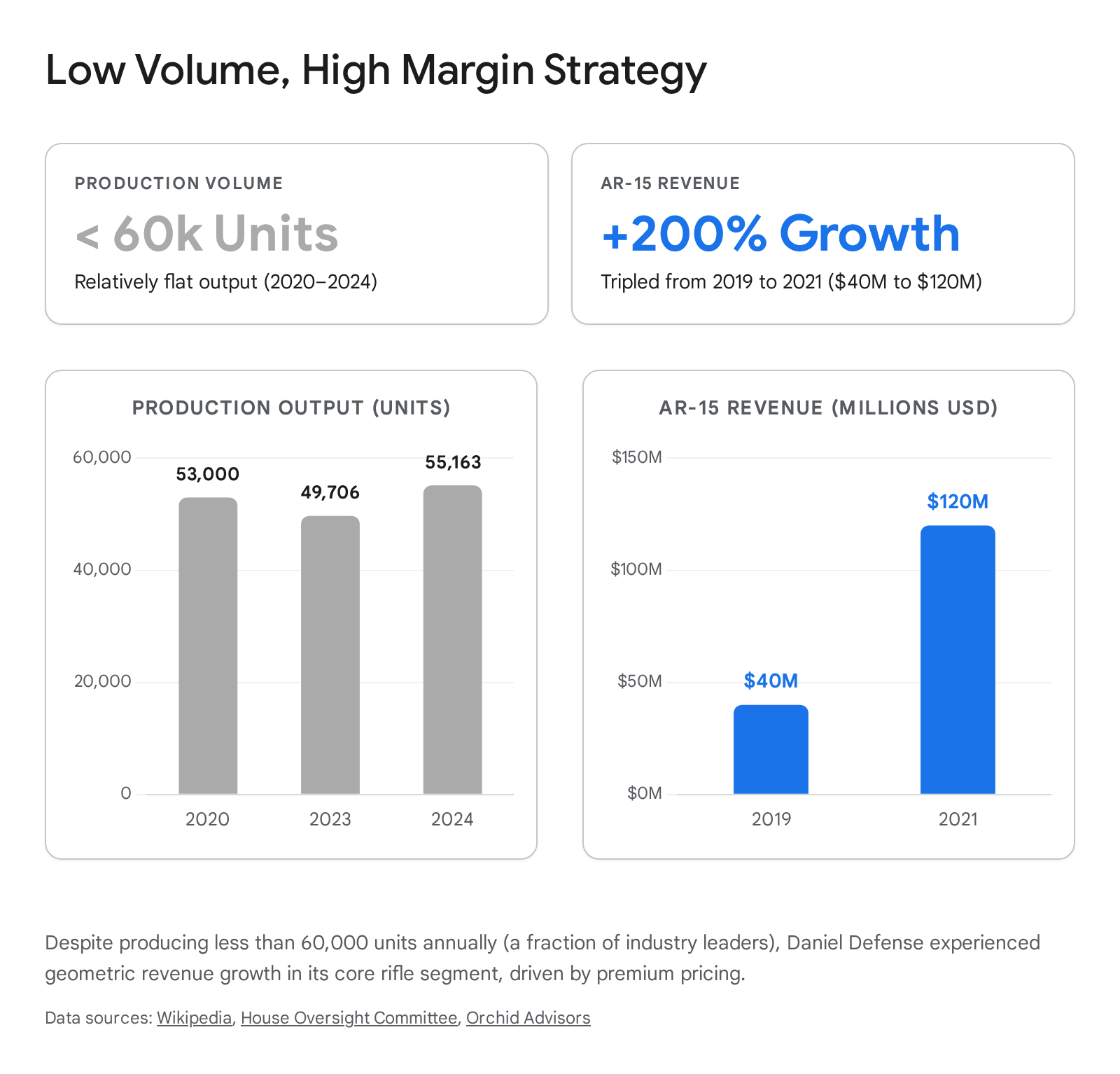
Graph illustrating the corporate growth of Daniel Defense

7. Brand Reputation and Product Quality

The operational reputation of Daniel Defense hardware is well-established within the shooting community. Independent testing consistently documents sub-MOA (Minute of Angle) accuracy across the rifle product line22. A noted characteristic of their short-barreled rifles, such as the MK18, is an aggressive gas port sizing. While this ensures reliable cycling under adverse conditions, it can lead to increased carbon fouling within the receiver22.

The company’s commitment to quality control was tested during the initial rollout of the Daniel H9 pistol, which suffered from feeding malfunctions and poor factory lubrication30. Industry analysts noted that Daniel Defense managed the situation proactively by halting distribution, executing mechanical redesigns, and relaunching the product, which reinforced its reputation for product support16.

8. Controversies, Litigation, and Regulatory Scrutiny

The commercialization of military-style firearms presents intrinsic legal risks. For Daniel Defense, these risks materialized acutely in May 2022, when an 18-year-old utilized a Daniel Defense DDM4 V7 during the mass shooting at Robb Elementary School in Uvalde, Texas1. Four Daniel Defense AR-15 style rifles were also found in the arsenal of the perpetrator of the 2017 Las Vegas mass shooting1.

Investigations revealed that the Uvalde shooter utilized the company’s e-commerce platform to procure the weapon1. Evidence indicated that the shooter frequently interacted with Daniel Defense’s online marketing, visiting the website compulsively and creating an account with a DDM4 V7 in a virtual shopping cart while he was still a minor13.

8.1 Congressional Investigations

In July 2022, CEO Marty Daniel was summoned to testify before the House Committee on Oversight and Reform33. A committee memorandum accused manufacturers, including Daniel Defense, of utilizing sales tactics that marketed deadly weapons to youth demographics using video-game aesthetics and appeals to masculinity12. The committee highlighted an industry failure to monitor safety data or track the illicit use of products12.

8.2 Civil Litigation and the PLCAA

The legal actions following the Uvalde shooting present a structural challenge to the company’s operational model. Historically, firearms manufacturers have been shielded from civil liability for the criminal misuse of their products by the 2005 Protection of Lawful Commerce in Arms Act (PLCAA)15.

However, plaintiffs representing victims are attempting to bypass this immunity by utilizing the PLCAA’s “predicate exception,” which allows manufacturers to be held liable if they knowingly violated a statute applicable to the sale or marketing of firearms15. In February 2026, the U.S. Court of Appeals for the Fourth Circuit issued a decision in cases such as Lowy v. Daniel Defense, reversing a lower court’s 2024 dismissal and ruling that plaintiffs possess Article III standing to sue the manufacturer for alleged marketing violations14. The plaintiffs allege that the company’s marketing practices violate Virginia’s False Advertising Statute and Consumer Protection Act14. If successful, this ongoing litigation could establish a precedent affecting PLCAA protections, altering how the firearms industry markets its products digitally and exposing manufacturers to civil damages14.

8.3 Campaign Finance Scrutiny

In January 2021, Daniel Defense made a $100,000 contribution to the Gun Owners Action Fund, a super PAC35. Watchdog groups filed complaints with the Federal Election Commission, noting that Daniel Defense held multiple active IDIQ contracts with the federal government at the time35. Federal campaign finance laws prohibit political contributions from active federal contractors, raising legal questions regarding the company’s compliance with election statutes35.

9. Strategic Trajectory and Future Outlook

Daniel Defense is navigating expanding commercial opportunities set against an adversarial regulatory environment. Strategically, the company is attempting to insulate itself from market saturation by diversifying its portfolio away from the AR-15 platform.

The acquisition of Hudson Manufacturing’s IP and the re-engineering of the Daniel H9 pistol signals a commitment to the defensive handgun market16. Concurrently, the expansion of the titanium suppressor lines targets the NFA-regulated accessory space8. On the defense side, the ongoing delivery of CHF barrels for the USSOCOM URG-I program secures steady government revenue through at least 2027 and sustains the “battle-tested” halo effect necessary for their civilian pricing model4.

A primary threat to the company’s current operational model is legal. If the plaintiffs in the ongoing litigation successfully establish the applicability of the PLCAA marketing predicate exception, Daniel Defense could be forced to restructure its digital marketing and direct-to-consumer e-commerce architectures to mitigate liability13.

10. Conclusion

Over two decades, Daniel Defense has evolved from a boutique component fabricator into a prominent supplier within the small arms sector. By strategically leveraging government contracts with entities like USSOCOM and the UK MoD to validate its engineering capabilities, the company carved out a profitable, premium tier within the civilian commercial market.

Their technical achievements—most notably the in-house scaling of cold hammer forging and the development of modular rail systems—remain standard-setting within the industry. However, the company’s future trajectory will be heavily influenced by its ability to navigate the legal and political ramifications of its historical marketing strategies. Moving forward, Daniel Defense is likely to rely increasingly on its diversified portfolio of handguns, precision bolt-action rifles, and suppressors to maintain revenue growth amid an uncertain regulatory climate for the AR-15 platform.


Please share the link on Facebook, Forums, with colleagues, etc. Your support is much appreciated and if you have any feedback, please email us in**@*********ps.com. If you’d like to request a report or order a reprint, please click here for the corresponding page to open in new tab.


Sources Used

  1. Daniel Defense – Wikipedia, https://en.wikipedia.org/wiki/Daniel_Defense
  2. Company History – Daniel Defense, https://danieldefense.com/history
  3. FAQ – Daniel Defense, https://danieldefense.com/faq
  4. Turning Our Streets Into War Zones – The Smoking Gun, https://smokinggun.org/report/turning-our-streets-into-war-zones/
  5. Rifle Systems Spotlight: Daniel Defense – GAT Daily (Guns Ammo Tactical), https://gatdaily.com/articles/rifle-systems-spotlight-daniel-defense/
  6. 20 Years Strong – Daniel Defense, https://danieldefense.com/wire/20-years-strong
  7. Shop By Usage | Daniel Defense, https://danieldefense.com/shop-by-usage
  8. Daniel Defense | Daniel Defense, https://danieldefense.com/
  9. Top Gun Manufacturers in the USA | Gearfire, https://gogearfire.com/blog/top-gun-manufactures-in-the-usa/
  10. top 30 largest usa firearm manufacturers of 2024 – Orchid Advisors, https://orchidadvisors.com/top-30-largest-usa-firearm-manufacturers-of-2024/
  11. Daniel Defense Announces Follow-On Orders from SOCOM and UK MoD – Soldier Systems, https://soldiersystems.net/2009/10/07/daniel-defense-announces-follow-on-orders-from-socom-and-uk-mod/
  12. 1 MEMORANDUM July 27, 2022 To: Members of the Committee on Oversight and Reform Fr: Chairwoman Carolyn B. Maloney Re: The Com, https://oversightdemocrats.house.gov/imo/media/doc/2022.07.27%20Supplemental%20MEMO%20for%20the%207-27-2022%20FC%20Gun%20Manufacturer%20Hearing.pdf
  13. Case 2:23-cv-00017-AM Document 173 Filed 06/14/24 Page 1 of 14 – Everytown Law, https://everytownlaw.org/wp-content/uploads/sites/5/2022/11/2024.06.14-Zamora-Motion-to-Amend-and-Amended-Complaint.pdf
  14. PUBLISHED UNITED STATES COURT OF APPEALS FOR THE FOURTH CIRCUIT No. 24-1822 KAREN LOWY, individually and as parent and next frie, https://www.ca4.uscourts.gov/opinions/241822.P.pdf
  15. Civil Litigation as a Tool in a Public Health Approach to Gun Violence, https://civiljusticeinitiative.org/wp-content/uploads/2023/08/Gun-Litigation-Report-August-2023-.pdf
  16. Daniel H9: Year One, https://danieldefense.com/wire/daniel-h9-year-one
  17. IN 15 YEARS, DANIEL DEFENSE WENT FROM AN IDEA IN THE HEAD OF A PRIVATE AMERICAN ENTREPRENEUR TO BECOMING AN INDUSTRY JUGGERNAUT., https://danieldefense.com/media/other_media/DD-AR15-Coming_Full_Circle.pdf
  18. DD4 RIIIS | AR-15 Style Carbine | 5.56 | Ambidextrous – Daniel Defense, https://danieldefense.com/dd4-riii-s.html
  19. RIII™ System | Daniel Defense, https://danieldefense.com/riii
  20. Slim is in – Daniel Defense, https://danieldefense.com/wire/slim-is-in
  21. DD4 RIII | AR-15 Style Carbine | 5.56 | Ambidextrous – Daniel Defense, https://danieldefense.com/dd4-riii.html
  22. Daniel Defense MK18 Rifle – Full Specifications | TheDefenseWatch.com, https://thedefensewatch.com/product/daniel-defense-mk18-rifle/
  23. Daniel Defense Scores $9 Million Military Barrel Contract – Guns.com, https://www.guns.com/news/2022/03/24/daniel-defense-scores-9-million-military-barrel-contract
  24. Daniel Defense M4A1 RIS III: Sub-MOA Accuracy, Combat Pedigree & 20K+ Round Barrel Life – Rifle Configurator, https://www.rifleconfigurator.com/articles/dd-ris-iii-review
  25. DD4 Family | Fully Ambidextrous AR15 | Daniel Defense, https://danieldefense.com/dd4
  26. Daniel Defense Overview: Revolutionary Rifles and Accessories – Gunivore, https://gunivore.com/brands/daniel-defense-company-overview/
  27. Daniel Defense H9 Redux: A Handgun Reborn | Hook & Barrel Magazine, https://www.hookandbarrel.com/shooting/daniel-defense-h9-handgun-review
  28. H9 | Striker Fired 1911 | Daniel Defense, https://danieldefense.com/h9
  29. The Daniel Defense H9: Engineering the Future of the Tactical Sidearm, https://thedefensewatch.com/military-ordnance/daniel-defense-h9-review/
  30. Personal opinion on DD H9 : r/Danieldefense – Reddit, https://www.reddit.com/r/Danieldefense/comments/1adfaan/personal_opinion_on_dd_h9/
  31. UPDATE on the Daniel Defense H9–A Few Things You Should Know – Reddit, https://www.reddit.com/r/Danieldefense/comments/1apxdz1/update_on_the_daniel_defense_h9a_few_things_you/
  32. URG-I Build Hub | Clone-Correct Geissele USSOCOM Upper — CCC, https://charliescustomclones.com/urg-i/
  33. – EXAMINING THE PRACTICES AND PROFITS OF GUN MANUFACTURERS – GovInfo, https://www.govinfo.gov/content/pkg/CHRG-117hhrg48386/html/CHRG-117hhrg48386.htm
  34. Everytown Statement on House Oversight Hearing on Gun Violence, https://www.everytown.org/press/everytown-statement-on-house-oversight-hearing-on-gun-violence/
  35. BEFORE THE FEDERAL ELECTION COMMISSION CAMPAIGN LEGAL CENTER 1101 14th Street, NW, Suite 400 Washington, DC 20005 (202) 736-2200, https://campaignlegal.org/sites/default/files/2022-06/Daniel%20Defense%20Complaint%20%28Final%29.pdf

Performance Analysis: Geissele Defense MRGG Series

Executive Summary

The Geissele Defense Mid-Range Gas Gun (MRGG) series marks a significant step forward for large-frame, AR-10 precision rifles. Geissele built this platform to meet the tough demands of the U.S. Special Operations Command (USSOCOM) and its Very Long-Range Semi-Automatic Sniper System (VSASS) program. The goal was simple but ambitious: give special operations teams a weapon lethal at distances up to 1,500 meters. The program eventually split into two parts. Lewis Machine & Tool (LMT) won the contract for the MRGG-A (Assaulter)—a shorter, selective-fire rifle now known as the Mk 24. Geissele Automatics earned the MRGG-S (Sniper) contract in 2023, creating a dedicated sniper support weapon classified as the Mk 1 Mod 0.

Geissele’s work on the MRGG-S contract, which has a budget ceiling of over $29 million, led directly to a civilian version: the Geissele MRGG MK1. This rifle is built for competitive shooters, law enforcement snipers, and long-range fans who want bolt-action accuracy with the speed of a semi-automatic gas gun. You can find it in a few different setups. The most popular is the 20-inch model in 6.5mm Creedmoor, which lets you swap barrels to shoot 7.62x51mm NATO in just a few minutes. There is also a 16-inch version available in both 6.5mm Creedmoor and .308 Winchester. Both come in classic black or Geissele’s well-known Desert Dirt Color (DDC).

Professional shooters generally agree that the MRGG is incredibly accurate and built to last. By using tough materials like Carpenter 158+ steel for the bolt and adding a Nanoweapon surface treatment, Geissele created a rifle that stays reliable even under the high pressure of 6.5mm Creedmoor rounds. The new Phased Array gas system also helps by making the recoil feel much smoother. While the rifle is easy to use and fully ambidextrous, keep in mind it isn’t a light carbine. The 20-inch model weighs about 10.8 pounds without accessories, making it a specialized tool for precision work.

Historical Context and Programmatic Genesis

To understand why the MRGG was built this way, you have to look at when USSOCOM moved to the 6.5mm Creedmoor cartridge in 2018. After lots of testing, they found that the 6.5mm bullet flies better and stays more accurate at long distances than the older 7.62x51mm NATO round. In fact, the data showed that switching to 6.5mm could double a shooter’s chances of hitting a target at 1,000 meters.

Following a 2019 assessment at Camp Atterbury, the military began looking for a rifle that could outshoot their existing 5.56mm carbines and older 7.62mm rifles like the M110. The requirements for the sniper version (MRGG-S) were strict: it had to shoot 1.0 MOA at 100 yards, though the military really hoped for 0.5 MOA. It also had to weigh less than 10.5 pounds, run perfectly with a suppressor, and allow the shooter to swap between 6.5mm and 7.62mm barrels in under five minutes.

Geissele spent over three years developing this rifle through a project they called “Project Joy”. The testing was brutal. During the Navy’s selection process, Geissele’s test rifles fired more than 25,000 rounds. Evaluators took three specific rifles and fired 6,400 rounds through each of them. Even after all that wear, the rifles still shot incredibly tight groups, averaging between 0.49 and 0.97 MOA.

Reliability and Accuracy

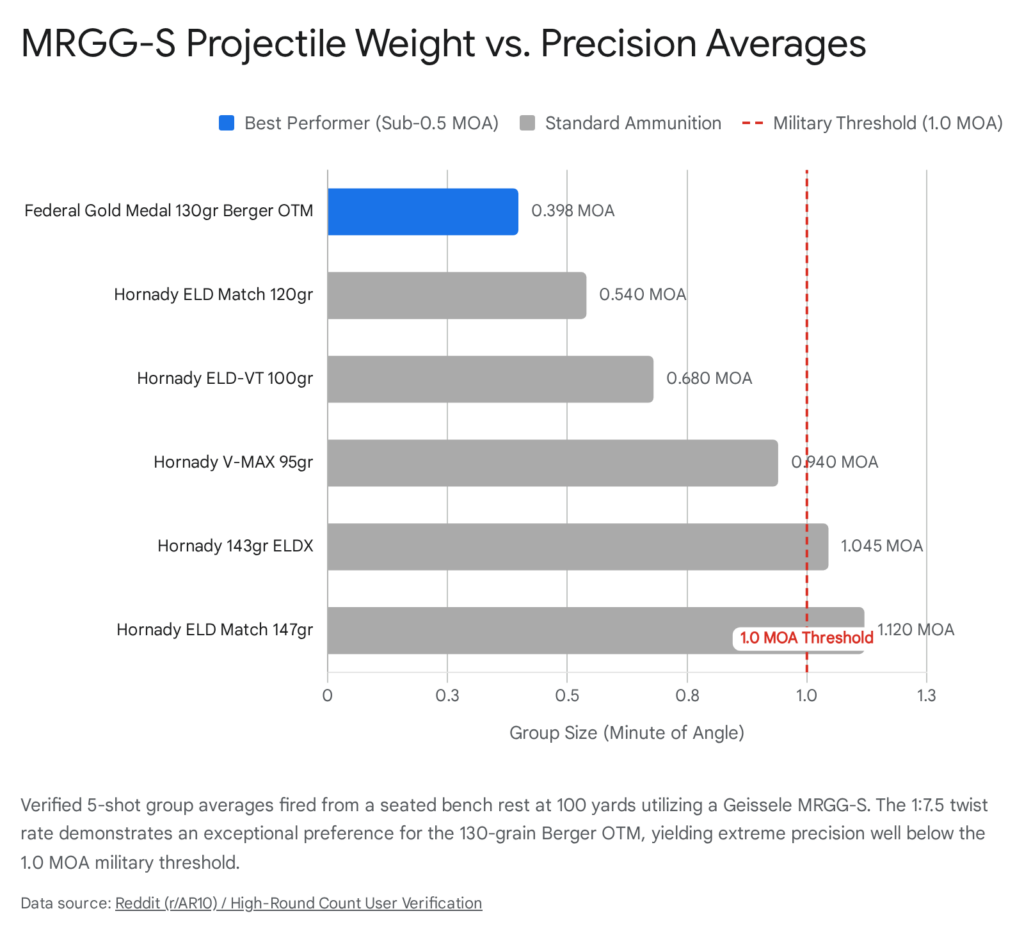
The MRGG’s accuracy is its standout feature, often matching the performance of heavy bolt-action sniper rifles. This precision starts with the 20-inch, match-grade barrel manufactured right in Geissele’s shop. They use cold-hammer-forged steel with a chrome lining to prevent the barrel from wearing out too quickly. It also uses a 1:7.5 twist rate, which is perfect for stabilizing the heavy bullets typically used for long-range 6.5mm shooting.

During the “Project Joy” tests, the Navy fired 240 rounds at a rate of one per second to see how the rifle handled heat. Even under that extreme stress, the rifle held its zero and stayed accurate. Staying well under 1.0 MOA after thousands of rounds sets a high bar for any semi-automatic gas gun.

Bar chart showing average weight of Geisse

Geissele ensures long-term reliability by using their patented Phased Array gas system. Standard AR-10 rifles in 6.5mm Creedmoor often have issues with gas pressure spikes at the gas port. These spikes can cause parts to wear out fast and make the recoil feel much sharper.

The Phased Array system fixes this by using several smaller gas ports along the barrel instead of just one. These ports feed into a single manifold that collects the gas and sends it into the gas block in a controlled way.

Because the gas enters through multiple points, the heat and pressure are spread out, which protects the barrel from wearing down. This also smooths out the recoil impulse, making the rifle more comfortable to shoot. The military setup includes a titanium suppressor, while commercial versions typically use a HUXWRX flash hider, both designed to keep the rifle running reliably when suppressed.

While the MRGG is built to be a complete system, you should be careful if you plan on changing parts. The following table lists common issues that can happen when using non-standard components in these rifles.

Malfunction TypeDescriptionPrimary Phase of OccurrenceVerified Causes
Light Primer StrikesThe hammer drops, but the firing pin fails to indent the primer with sufficient force to ignite the propellant.IgnitionUtilizing aftermarket, competition-focused single-stage triggers (such as the B-GC) instead of the factory SSA-E can induce light strikes or inconsistent pull weights; these are not recommended for precision benchrest applications17.
Nose-Up Feed JamProjectile tip strikes the upper receiver above the chamber face, failing to correctly enter the barrel extension.FeedingLegacy 6.5mm Creedmoor barrel extensions lacked optimized geometry for varied bullet profiles. The MRGG utilizes specialized barrel feed ramps explicitly configured to guide modern 6.5mm cartridges securely into the chamber15.

Durability and Maintenance

The MRGG is a showcase of high-end manufacturing, using specialized metals and coatings to boost its lifespan. A great example is the Reliability Enhanced Bolt Carrier Group (REBCG). To prevent the bolt lugs from breaking—a common problem with high-pressure 6.5mm rounds—Geissele uses forged Carpenter 158+ steel. Working with experts at Carpenter Steel, they created a cleaner alloy that makes the bolt last up to five times longer than a standard one.

The bolt carrier group is also covered in Geissele’s Nanoweapon coating. This treatment is almost as hard as diamond, which means it resists scratches from sand and is naturally slippery. It makes cleaning much easier because carbon won’t stick to it, allowing the rifle to run with very little oil. Even the upper receiver is reinforced with a steel cam race to prevent wear at high-friction points.

The rifle uses the Super 42 braided wire spring and an H2 buffer. This spring design, inspired by the MG42 machine gun, uses three strands of wire twisted together. This makes the spring last longer and gets rid of the annoying “twang” sound you often hear in AR-style rifles.

The factory rifle is extremely tough as it is, but some owners like to swap parts for specific needs. Here are the most common official upgrades.

Original OEM PartRecommended DIY ReplacementOperational Reason for Intervention
MRGG SSA-E TriggerSSA-E X with Lightning Bow TriggerEnd-user preference for a semi-curved, wide-body profile that combines the best features of a flat-bow design with standard curved geometry for enhanced precision tactile feel20.
MRGG SSA-E TriggerB-GC Competition 1-Stage TriggerTransitioning the rifle from precision benchrest use to rapid-fire/3-Gun style engagements requiring a shorter, 3.2–4.0 lb single-stage pull and quick reset17.
Magpul PRS Lite StockB5 Systems Enhanced StockPrioritizing a highly streamlined, anti-snag profile with integrated waterproof battery storage compartments for a more dynamic field environment19.

Ownership Experience

Shooting the MRGG is all about comfort and control. The lower receiver is machined from a solid block of aluminum and given a tough hardcoat finish. Geissele made every control fully ambidextrous, including a larger bolt catch. This makes it much easier for left-handed shooters to clear malfunctions or reload using their index finger. The receiver also has a flared magazine well and a larger trigger guard so you can easily shoot with gloves on.

The heart of the rifle is the SSA-E two-stage trigger. It has a smooth first stage and a very crisp second stage that breaks like a tiny glass icicle. At the back, the Magpul PRS Lite stock lets you adjust the height and length to get a perfect view through your scope.

The rifle features Geissele’s free-floated MK16 handguard, which gives the barrel plenty of room to breathe. It has M-LOK slots all around for adding accessories. The top rail is perfectly flat and built to the Picatinny standard, which is critical if you are using thermal or night vision devices that need to line up with your scope.

Owning an MRGG-S means dealing with a heavier rifle. The 20-inch model weighs roughly 10.8 pounds before you add a scope or suppressor. Some competitive shooters have also noticed that if you push the handguard hard into a tripod, your point of impact might shift slightly. It’s a very small shift, but serious shooters should keep it in mind when shooting from different positions.

Warranty and Support

Geissele stands behind their products with a warranty that covers any issues with materials or how the rifle was built. If you have a valid claim, they will decide whether to repair it—using new or refurbished parts—or replace the entire rifle with a similar or better model. Aside from shipping costs, Geissele covers the rest of the repair or replacement.

Voice of the Customer (VoC)

Feedback from the shooting community shows a lot of respect for what this rifle can do. Owners who shoot a lot confirm that the Phased Array system really does soak up the recoil. One owner described it as the softest shooting large-frame rifle they’ve ever used, saying it feels more like shooting a 5.56. They also confirmed its accuracy, noting that it easily shoots groups well under an inch at 100 yards.

Shooters have found that the rifle performs best with specific ammunition. For example, using Federal Gold Medal 130gr rounds has resulted in incredibly tight groups, sometimes as small as 0.4 inches at 100 yards.

The main criticism involves the small point-of-impact shift when switching between a bipod and a tripod. While this is a common topic among competitive shooters, most agree that the shift is easy to predict and correct for once you know it’s there.

Quantitative Ratings

Based on a synthesis of aggregate technical specifications, military testing disclosures, metallurgical data, and high-round-count civilian field usage, the Geissele MRGG series achieves the following performance matrix out of a maximum score of 10:

  • Reliability: 9.5/10 – The implementation of the Phased Array gas system and the Nanoweapon-coated Carpenter 158+ bolt effectively neutralize the AR-10 platform’s historical weaknesses regarding rapid gas port erosion and premature bolt lug shearing.
  • Accuracy: 9.5/10 – Retaining sub-MOA precision (ranging from 0.49 to 0.97 MOA) past 6,000 rounds of sustained, rapid fire is a monumental engineering achievement for a chrome-lined, cold-hammer-forged gas gun barrel6.
  • Durability: 9.0/10 – The utilization of billet aircraft-grade aluminum, the integration of a steel-riveted cam race, and the ubiquitous application of proprietary surface coatings ensure extreme mechanical fatigue resistance.
  • Maintenance: 8.5/10 – The synthetic-diamond hardness of the Nanoweapon coating makes carbon removal remarkably effortless, allowing the platform to run smoothly even during heavily suppressed firing schedules.
  • Warranty/Support: 8.0/10 – The official warranty is legally comprehensive, offering straightforward repair or replacement for material defects23.
  • Ergonomics: 9.0/10 – The execution of the fully ambidextrous control suite is flawless. However, the 10.8-pound unladen base weight inherently limits its application to static, supported, or vehicular-based shooting positions.
  • Overall Score: 8.9/10 – An uncompromising, military-grade precision rifle that represents the absolute pinnacle of the direct-impingement AR-10 evolutionary tree.

Pricing and Availability

Research Phase: The Geissele MRGG MK1 is a premium rifle with a price tag to match. You can expect to pay about $6,500 for the 20-inch model. Keep in mind that this price is just for the rifle itself—you’ll still need to buy your own scope, bipod, and suppressor.

Vendor Search:

Based on verified active product listings from the requested vendor list, the following items are currently available (Note: Grabagun, Global Ordnance, KYGunCo, Palmetto State Armory, and Sportsmans Warehouse yielded no active verified listings in the current data constraints).

Analytical Framework

This report was put together by looking closely at the most reliable data available. We prioritized official military test results from “Project Joy” and compared them with real-world feedback from experienced civilian shooters.

We ignored vague stories and instead focused on detailed shooting logs that specified the exact ammunition used. We also looked at the original patent for the Phased Array gas system to explain exactly how the rifle handles gas pressure and recoil.

Research Parameters and Limitations

The conclusions here are based on what is publicly available. Because the military version is used by special operations, some combat data is still classified. On the civilian side, the high cost of the rifle means there are fewer people shooting them compared to cheaper models. However, the trends regarding accuracy and reliability are consistent across multiple independent sources.


Note: Vendor Sources listed are not an endorsement of any given vendor. It is our software reporting a product page given the direction to list products that are between the minimum and average sales price when last scanned.


Please share the link on Facebook, Forums, with colleagues, etc. Your support is much appreciated and if you have any feedback, please email us in**@*********ps.com. If you’d like to request a report or order a reprint, please click here for the corresponding page to open in new tab.


Sources Used

  1. POTD: Geissele Mid Range Gas Gun – Sniper (MRGG-S) | thefirearmblog.com, https://www.thefirearmblog.com/blog/2024/02/06/potd-geissele-mid-range-gas-gun-sniper-mrgg-s/
  2. USSOCOM Awards Geissele Automatics Contract for MRGG-S (Mid Range Gas Gun – Sniper) – Frag Out! Magazine, https://fragoutmag.com/ussocom-awards-geissele-automatics-contract-for-mrgg-s-mid-range-gas-gun-sniper/
  3. New Rifles Chambered In 6.5mm Creedmoor Heading To U.S. Special Operations Armories, https://www.twz.com/land/new-rifles-chambered-in-6-5mm-creedmoor-heading-to-u-s-special-operations-armories
  4. Mid-Range Gas Gun – Wikipedia, https://en.wikipedia.org/wiki/Mid-Range_Gas_Gun
  5. Medium Range Gas Gun Sniper (MRGG-S) (H9240323D0003) – HigherGov, https://www.highergov.com/idv/H9240323D0003/
  6. Geissele Wins $29 Million SOCOM Sniper Rifle Contract – Guns.com, https://www.guns.com/news/2023/10/03/geissele-wins-29-million-socom-sniper-rifle-contract
  7. Geissele Automatics Mid Range Gas Gun (MRGG) 6.5 Creedmoor AR-10 Rifle – 20″ – DDC, https://www.primaryarms.com/geissele-automatics-mid-range-gas-gun-mrgg-6-5-creedmoor-ar10-rifle-20in-ddc
  8. Geissele VSASS® MRGG MK1 Rifle, 20″, 6.5 Creedmoor, DDC, https://geissele.com/geissele-mrgg-mk1-rifle-20-6-5-creedmoor-ddc.html
  9. Geissele VSASS® MRGG MK1 Rifle, 16″, .308, Black, https://geissele.com/geissele-mrgg-mk1-rifle16-308-black.html
  10. Geissele VSASS® MRGG MK1 Rifle, 16″, 6.5 Creedmoor, Black, https://geissele.com/geissele-mrgg-mk1rifle-16-6-5-creedmoor-black.html
  11. Geissele VSASS® MRGG MK1 Rifle, 20″, 6.5 Creedmoor, Black, https://geissele.com/geissele-mrgg-mk1-rifle-20-6-5-creedmoorblack.html
  12. GFW® 8″ 5.56MM – DDC (SBR) – Geissele Automatics, https://geissele.com/gfw-8-5-56mm-ddc-sbr.html
  13. Product Comparison for Geissele MRGG MK1 Semi Automatic Rifle 6.5 Creedmoor 20″ Black Threaded Barrel Desert Dirt Frame Desert Dirt Pistol Grip – MidwayUSA, https://www.midwayusa.com/product-comparisons/311062
  14. US SOCOM Selects Geissele Automatics for MRGG-S | thefirearmblog.com, https://www.thefirearmblog.com/blog/2023/09/05/us-socom-selects-geissele-automatics-mrgg-s/
  15. William H. Geissele Inventions, Patents and Patent Applications, https://patents.justia.com/inventor/william-h-geissele?page=4
  16. Geissele 18″ SPR Barrels – Featuring Phased Array Gas Systems – Now Live! – Reddit, https://www.reddit.com/r/GeisseleAutomatics/comments/1j0c2fr/geissele_18_spr_barrels_featuring_phased_array/
  17. B-GC BROWNELLS/GEISSELE COMPETITION 1-STAGE TRIGGER FOR AR-15 Reviews & Ratings, https://www.brownells.com/product-reviews/?product=ar-15-enhanced-triggers
  18. MRGG-S Finally working with federal GMM center strike after re-working the feed ramps., https://www.reddit.com/r/AR10/comments/1unil6j/mrggs_finally_working_with_federal_gmm_center/
  19. geissele automatics llc ar-15 super duty rifle build kit 5.56mm – Brownells, https://www.brownells.com/gun-parts/rifle-parts/rifle-kits/ar-15-super-duty-rifle-build-kit-5.56mm/
  20. SSA-E X 2-STAGE TRIGGER WITH LIGHTNING BOW® FOR AR-15 Reviews & Ratings, https://www.brownells.com/product-reviews/?product=ar-15-lightning-bow-triggers
  21. Geissele MRGG : r/AR10 – Reddit, https://www.reddit.com/r/AR10/comments/1q33ooy/geissele_mrgg/
  22. MRGG-S : r/AR10 – Reddit, https://www.reddit.com/r/AR10/comments/1ni6pkj/mrggs/
  23. Geissele Limited Warranty and RMA Process, https://geissele.com/media/downloadable/Geissele-Limited-Warranty-and-RMA-Process-2025.pdf
  24. Geissele MRGG MK1 Semi Automatic Rifle 6.5 Creedmoor 16 Black Threaded – MidwayUSA, https://www.midwayusa.com/product/1029469586

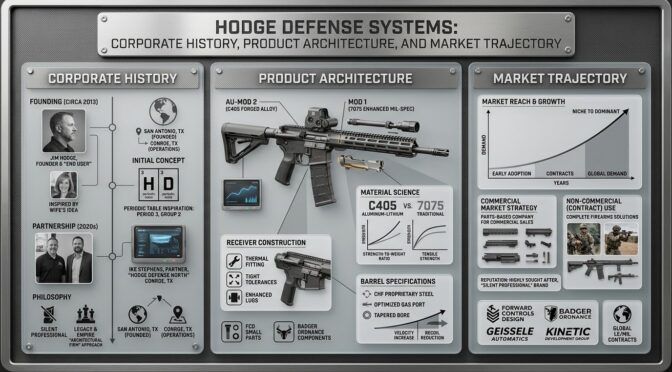
Hodge Defense Systems: Corporate History, Product Architecture, and Market Trajectory

Executive Summary

Hodge Defense Systems occupies a specific segment within the modern small arms industry, operating primarily as an architectural design firm rather than a traditional vertically integrated manufacturer. The company was founded by Jim Hodge, whose operational background as a private military contractor directly informed the design parameters of the company’s AR-15 pattern rifles. Rather than competing on production volume or entry-level pricing, Hodge Defense differentiates its products through the utilization of proprietary material alloys, highly specific dimensional tolerances, and targeted internal ballistic optimizations.

This report details the history, technical progression, and market positioning of Hodge Defense Systems. The analysis traces the company’s metallurgical development from the use of standard 7075-T6 aluminum to an aluminum-lithium alloy, and ultimately to the aerospace-grade C405 alloy utilized in its flagship AU-Mod 2 receiver sets. Furthermore, the report examines the brand’s barrel architecture, which leverages proprietary cold hammer-forged steel from FN America. These barrels are engineered to handle the increased chamber pressures of the M855A1 Enhanced Performance Round and the resulting backpressure of sound suppressors.

In the defense sector, the company achieved institutional validation when its AU-Mod 2 was evaluated by the United States Army Special Operations Command (USASOC) within the Soldier Enhancement Program to inform future upper receiver requirements. In the commercial sector, the brand’s low-volume production model and high material costs have created a market dynamic characterized by distinct scarcity and a polarized consumer reputation. The company is actively working to stabilize its commercial availability through strategic partnerships, notably forming a logistics hub dubbed “Hodge Defense North” and licensing its intellectual property to B&T USA for the production of the BT-15 HD rifle series.

1. Industry Context and Company Origins

The architectural philosophy of Hodge Defense Systems is directly linked to the professional background of its founder, Jim Hodge. The company’s origins are rooted in end-user application rather than traditional mechanical engineering or corporate business development.

1.1 The Founder’s Background and Operational Experience

Jim Hodge’s entry into the small arms sector began through his professional reliance on the AR-15 platform. Hodge did not pursue formal engineering education; he describes himself as a “normal guy” who developed an early mechanical aptitude through model building and an interest in technology1. His professional career began as a police officer, a role that required daily interaction with the standard-issue AR-152.

Following the events of September 11, 2001, Hodge transitioned into the private military contracting sector2. Between 2005 and 2013, he worked for several government contractors, including Blackwater, operating in over half a dozen countries with the majority of his deployment time spent in Afghanistan1. This continuous reliance on the AR-15 platform in combative environments exposed the mechanical limitations of standard commercial and military rifles. Over a decade, Hodge dedicated personal resources to testing various component configurations, attempting to isolate the optimal balance of durability, weight, and recoil impulse required for a dedicated operational tool3.

1.2 The Transition to Architectural Manufacturing

During his tenure as an overseas contractor, Hodge developed a reputation within the small arms manufacturing sector as an end-user evaluator. Firearms companies routinely supplied him with prototype products, and he provided operational feedback regarding structural weaknesses and ergonomic deficiencies1. This informal consulting phase provided Hodge with a deep understanding of industry supply chains, manufacturing processes, and product development lifecycles1.

The formal establishment of Hodge Defense Systems was catalyzed by a personal decision to transition away from overseas contracting. Encouraged by his wife to remain stateside, Hodge shifted his focus toward building a proprietary brand centered around his specific vision for the AR-151. His guiding philosophy was to design a platform focused entirely on combative reliability, prioritizing material longevity over mass-market appeal or competitive pricing2. From its inception, the company was structured to operate similarly to an architectural firm. Rather than investing in in-house CNC machining for commodity parts, Hodge Defense designs the specifications, procures the materials, owns the extrusion dies, and manages the final assembly, outsourcing the raw manufacturing to highly specialized machine shops1.

2. Metallurgical Progression and Receiver Architecture

A primary differentiator of Hodge Defense Systems is its avoidance of standard investment cast components and conventional alloys in favor of aerospace-grade materials and tightly controlled manufacturing tolerances2.

2.1 The AU-Mod 1 Platform and Dimensional Tolerances

The introductory rifle platform, the AU-Mod 1, established the baseline for the company’s architectural standards. While utilizing the industry-standard 7075-T6 aluminum forgings for the upper and lower receivers, Hodge classified these components as “enhanced” military specification4.

The primary dimensional deviation from standard military specifications is located in the takedown and pivot lugs, which are machined slightly oversized4. This deliberate over-sizing requires precise hand-fitting during assembly but results in a highly secure mating between the upper and lower receivers. This fit mitigates the mechanical play common in mass-produced AR-15s, contributing to a more consistent recoil impulse3.

Furthermore, the AU-Mod 1 upper receiver is engineered to require the thermal fitting of the barrel extension4. This process involves heating the aluminum upper receiver to expand its inner diameter, inserting the steel barrel extension, and allowing the aluminum to cool and contract around the steel. This interference fit creates a rigid connection between the barrel and the optic mounting surface.

2.2 The Transition to Aluminum-Lithium in the AU-Mod 2

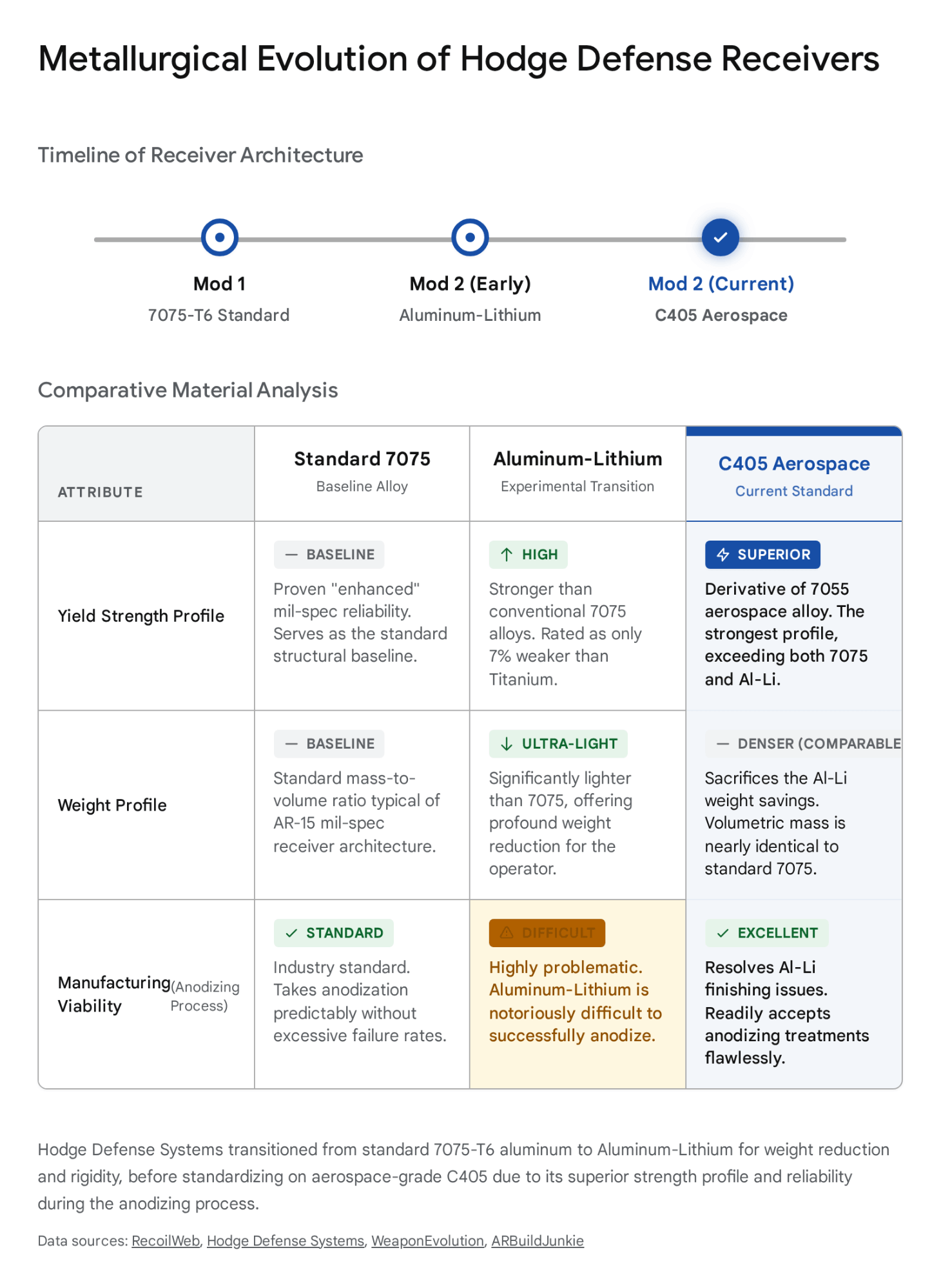
The development of the AU-Mod 2 receiver set represents Hodge’s most significant departure from industry norms. Seeking a material solution that offered superior rigidity to 7075-T6, Hodge leveraged industry relationships to collaborate with executives and engineers at Alcoa Defense (now Arconic)1. This collaboration led to the early use of an aluminum-lithium (Al-Li) alloy in AR-15 receiver forgings1.

The Al-Li alloy provided a distinct strength-to-weight ratio that allowed for a lighter receiver that was reportedly rated as only 7% weaker than titanium6. This offered structural advantages in limiting receiver flex during the firing cycle, thereby reducing bolt wear and increasing the theoretical accuracy potential of the platform6.

2.3 Standardization on C405 Alloy

While aluminum-lithium offered excellent mechanical properties, it presented severe manufacturing challenges during the Type III hardcoat anodizing process5. To resolve this supply chain bottleneck while maintaining structural superiority, Hodge Defense invested in proprietary extrusion dies and transitioned the Mod 2 receivers to C405 alloy5.

C405 is an aerospace-grade material—a derivative of the 7055 alloy family—commonly utilized in high-stress applications such as collegiate baseball bat extrusions and high-performance piston rods5.

Material Parameter7075-T6 Aluminum (Industry Standard)Aluminum-Lithium (Early Mod 2)C405 Alloy (Current Mod 2)
Primary ApplicationCommercial & Military AR-15sAerospaceHigh-stress aerospace, piston rods
Weight ProfileBaselineLighter than 7075Equal to 7075 (Denser than Al-Li)
Tensile StrengthBaselineStronger than 7075Stronger than 7075 and Al-Li
Anodizing ViabilityHighly ConsistentHighly DifficultHighly Consistent

As demonstrated in the material comparison, while C405 is denser than aluminum-lithium (matching the mass-to-weight ratio of standard 7075), it possesses a higher tensile strength than both 7075 and Al-Li, and accepts the anodizing process with much greater consistency5.

Screenshot showing the metallurgical evolution of Hodge

3. Internal Ballistics: Barrel Engineering and Optimization

The AR-15 barrel acts as the primary pressure vessel and dictates the operational envelope of the weapon system. Hodge Defense approached barrel design by identifying demanding variables in modern military logistics—specifically the high-pressure M855A1 cartridge and the widespread use of sound suppressors—and engineering a barrel to accommodate them7.

3.1 FN America Partnership and Steel Composition

Hodge Defense barrels are manufactured through a strategic partnership with FN America, utilizing a cold hammer forging (CHF) process7. The base material is the proprietary steel composition utilized by FN in the M249 Squad Automatic Weapon (SAW)7. This machine-gun-grade steel is selected for its high heat tolerance and ability to withstand aggressive firing schedules9. The bores are finished with a thick chrome lining and a phosphate exterior coating, prioritizing corrosion resistance and throat life8.

3.2 Optimization for the M855A1 EPR

The internal architecture of the Hodge barrel is optimized for the United States military’s M855A1 Enhanced Performance Round7. While legacy M855 ammunition operates at chamber pressures of approximately 55,000 PSI, the M855A1 operates at approximately 62,000 PSI8. This ammunition was designed to provide consistent terminal performance and barrier penetration; however, the significant increase in chamber pressure alters the timing in the direct impingement system.

To mitigate the altered recoil impulse of the M855A1, Hodge Defense engineered a proprietary gas port sizing strategy. By constricting the volume of gas tapped from the barrel, the system forces the high-pressure round to cycle the action at standard velocities.

Barrel LengthGas System LengthGas Port SizeIntended Optimization
11.5 InchCarbine-Length0.0645″M855A1 & Suppressor Use
12.5 InchCarbine-Length0.0625″ – 0.064″M855A1 & Suppressor Use
14.5 InchMid-LengthProprietaryM855A1 & Suppressor Use
16.0 InchMid-LengthProprietaryM855A1 & Suppressor Use

Note: The 12.5-inch barrel has seen minor revisions in port sizing, updating from an original 0.0625 inches up to 0.064 inches in later iterations8.

3.3 Suppressor Integration and Tapered Profiling

This restricted gas port strategy also serves a dual purpose for suppressed operations11. Sound suppressors inherently trap expanding gases, creating backpressure that forces excess gas down the gas tube and into the receiver. By starting with a sub-sized gas port, Hodge barrels remain controllable when paired with modern suppressors, utilizing the suppressor’s backpressure to reach standard operational equilibrium12.

Additionally, the barrels feature a continuous taper profile14. They maintain a thicker, mid-weight diameter near the chamber for heat absorption and gradually thin toward the muzzle7. This profile optimizes the balance of the rifle, preventing the weapon from feeling front-heavy while retaining the thermal mass required to prevent group dispersion under sustained fire2.

4. External Architecture: Handguards and Interface Systems

The interaction between the user, the aiming devices, and the weapon is mediated by the handguard. As military and law enforcement tactics rely heavily on forward-mounted infrared (IR) laser aiming modules, the structural integrity of the handguard is a critical component.

4.1 The Wedge Lock System

In collaboration with Mega Arms (now Zev Technologies), Hodge Defense co-developed the Wedge Lock handguard system2. Standard AR-15 handguards typically utilize pinch-bolts at the 6 o’clock position to clamp the aluminum extrusion onto a steel barrel nut. This design inherently creates an area of least resistance at the bottom of the rail, allowing the rail to flex or spread under tension5.

The Wedge Lock system utilizes a machined wedge mechanism that interfaces with a corresponding groove on the barrel nut. When tightened, the wedge drives the handguard vertically into the top of the extrusion, creating a rigid lockup15. This rigidity prevents the handguard from deflecting when resting on a barricade or when the shooter applies torque via a sling, which is paramount for maintaining the zero of an IR laser module15. The success of this design has influenced other manufacturers, notably Sons of Liberty Gun Works (SOLGW), whose M89 DriveLock rail system utilizes similar mechanical principles for locking rigidity15.

4.2 The Evolution to Pinch Lock and S-Lock (Spine Lock)

Seeking deeper brand identity and internal control over manufacturing, Hodge Defense developed proprietary iterations of the handguard: the Pinch Lock and the S-Lock5. The S-Lock, denoting “Spine Lock,” required two years of development and multiple extrusion die revisions to finalize5.

The defining architectural feature of the S-Lock is a thickening of the aluminum wall located in the internal cavity directly beneath the 12 o’clock picatinny rail—acting as a structural spine5. Hodge theorized that regardless of the clamping mechanism at the bottom of the rail, the top of the rail remained susceptible to micro-deformations because it is not a true bearing surface5. By reinforcing this upper cavity and the bottom of the handguard, the S-Lock further limits flex, ensuring that heavy optic and laser packages remain aligned with the bore under hard use5.

5. Institutional Validation and Defense Procurement

While Hodge Defense systems maintain a high profile in the commercial sector, the company’s underlying foundation includes institutional procurement, defense consulting, and military evaluations.

5.1 The Soldier Enhancement Program (SEP)

Significant institutional validation of the Hodge architecture occurred within the United States Army Special Operations Command (USASOC). In 2014, USASOC initiated a requirement to explore a new Upper Receiver Group (URG) to modernize its fleet of M4A1 SOPMOD carbines17. The objective was to replace aging carbine-length gas systems with mid-length systems optimized for the M855A1 round, alongside integrating M-LOK attachment systems to replace legacy Picatinny rails18.

To inform these future requirements, the military leveraged the Soldier Enhancement Program (SEP). The Army purchased a batch of Hodge Defense AU-Mod 2 rifles for evaluation by Picatinny Arsenal and USASOC17. This marked the first time a carbine had been evaluated under the SEP protocol17. The Mod 2 was voted in by a Council of Colonels to serve as a baseline2. The acquisition and testing phase of the Mod 2 provided USASOC with data on what constituted a “best-in-class” platform, informing the trajectory of subsequent SOF upper receiver programs2.

5.2 Assembly Limitations and Contract Prioritization

Beyond the SEP evaluation, Hodge Defense serves as a supplier for various local, state, and federal law enforcement entities, as well as the Department of Defense19. The labor-intensive nature of the company’s assembly process dictates its output. A technician builds each rifle individually, ensuring every pin and component is precisely configured, actively eschewing traditional assembly line workflows3.

Because of this specific operational model, the majority of complete rifle builds generated by Hodge Defense are routed directly to fulfill government and defense contracts19. This dynamic mandates that the commercial market primarily interacts with the brand through the purchase of stripped receivers, handguards, and individual component parts rather than fully assembled rifle systems5. Furthermore, Jim Hodge acts as a consultant for defense contractors, providing architectural influence on projects that do not necessarily bear the Hodge Defense logo20.

6. Commercial Market Dynamics and Brand Perception

The intersection of high material costs, low production volume, and intense consumer demand has forged a specific commercial market dynamic for Hodge Defense, resulting in a polarized reputation among civilian buyers.

6.1 Product Scarcity and “Drop Culture”

Because Hodge relies on small-batch production runs utilizing proprietary materials and independent machine shops, supply routinely fails to meet aggregate commercial demand20. When parts are released to distributors, they are frequently sold via unannounced online “drops” that sell out in a matter of minutes14.

This scarcity has generated a complex reputation within the broader firearms community. Proponents of the brand view the products as premium equipment, justifying the price—often exceeding $2,850 for a complete platform—as a necessary investment in metallurgical superiority, extended barrel life, and uncompromised quality control9.

Conversely, the extreme scarcity has bred frustration among other segments of the consumer base. Critics characterize the brand as reliant on exclusivity and “hype,” questioning whether the practical value of exotic aerospace alloys and extreme tolerances translates to civilian applications14. Some critics argue that standard commercial offerings from volume manufacturers perform adequately for recreational use, making the premium price of Hodge products difficult to justify for casual shooters14.

Jim Hodge has publicly expressed discomfort with the status-symbol nature of his products, stating a preference that consumers purchase the equipment strictly for its engineering merits and performance attributes rather than utilizing the products for internet prestige5.

7. Strategic Partnerships and Future Trajectory

Recognizing the limitations of a sole-proprietorship acting as an architectural firm, Hodge Defense has implemented strategic shifts aimed at increasing market presence and stabilizing the supply chain.

7.1 Hodge Defense North and Supply Chain Stabilization

In a move designed to alleviate logistical bottlenecks, Jim Hodge partnered with Ike Stephens of Big Texas Ordnance to create an operational hub designated “Hodge Defense North” located in Conroe, Texas19. This organizational delegation allows Stephens to manage commercial forecasting, dealer distribution, and inventory logistics. This operational shift frees Jim Hodge to focus entirely on product development and business-to-business relationship management from his base in San Antonio19. This restructuring is intended to make the brand more reactive to commercial consumer needs, facilitating a slightly higher volume of component parts to the civilian market while ensuring government contracts remain fulfilled19.

7.2 Industry Synergies

To navigate the ecosystem of small arms manufacturing, Hodge Defense relies on alliances with complementary brands. By sharing intellectual property and collaborating on manufacturing, Hodge reduces the burden of in-house logistics. Notable synergies include partnerships with Forward Controls Design (FCD), Badger Ordnance, and SLR Rifleworks (who manufactures the specific 7-pin micro gas block designed for Hodge barrels)11. This interconnected network allows Hodge to maintain a boutique footprint while ensuring its proprietary designs are executed by trusted machine shops.

7.3 The B&T BT-15 HD Partnership

A significant indicator of Hodge’s future trajectory is the licensing and collaborative partnership with B&T USA, the American subsidiary of the Swiss arms manufacturer14. Released in mid-2024, the BT-15 HD series merges B&T’s high-volume, precision manufacturing capabilities with Hodge Defense’s proprietary architectural intellectual property14.

Product LineReceiver MaterialHandguard SystemBarrel SpecsMSRP Estimate
BT-15 HD MOD 1Standard AluminumPinch Lock (M-LOK)16″ Match-Grade$2,155 – $2,25514
BT-15 HD MOD 2C405 AluminumS-Lock (Spine Lock)11.5″ or 16″ CHF, M855A1 Optimized$3,350 – $3,45014

This partnership is highly strategic. It bypasses Hodge Defense’s internal manufacturing bottlenecks, allowing the commercial market to access complete, factory-built rifles bearing the Hodge architectural DNA14. Simultaneously, it allows B&T to penetrate the premium AR-15 market with validated geometry without having to endure a multi-year internal research and development cycle14.

Conclusion

Hodge Defense Systems represents a highly specialized operational model within the small arms sector. By eschewing mass-market manufacturing in favor of acting as a metallurgical and architectural design firm, Jim Hodge has successfully established the brand at the premium edge of the market. The company’s trajectory—from consulting on end-user ergonomics to introducing an aluminum-lithium alloy to the AR platform, and subsequently having its designs inform U.S. Army Special Operations Command requirements—demonstrates the viability of a product-first, volume-second manufacturing philosophy.

While the resulting scarcity and high pricing have generated friction within the commercial consumer base, the engineering merits of the platform—specifically the thermal-fitted C405 receivers, S-Lock optical zero retention, and M855A1-optimized barrel parameters—remain highly regarded by institutional end-users. Through strategic delegation via Hodge Defense North and high-profile licensing agreements like the B&T BT-15 HD partnership, the company appears positioned to slowly expand its commercial footprint while maintaining the stringent quality controls and material specifications that defined its inception.


Please share the link on Facebook, Forums, with colleagues, etc. Your support is much appreciated and if you have any feedback, please email us in**@*********ps.com. If you’d like to request a report or order a reprint, please click here for the corresponding page to open in new tab.


Sources Used

  1. Zeroed In: Jim Hodge – Recoil Magazine, https://www.recoilweb.com/zeroed-in-jim-hodge-142389.html
  2. Hodge Defense – An Overview with Jim Hodge – AR Build Junkie, https://www.arbuildjunkie.com/hodge-defense-interview-jim-hodge/
  3. SSD Visits Hodge Defense Systems | Soldier Systems Daily, https://soldiersystems.net/2013/10/10/ssd-visits-hodge-defense-systems/
  4. Hodge Defense Systems Inc., https://hodgedefensesystems.com/
  5. Hodge Defense Systems – A 2021 Update with Jim Hodge – AR Build Junkie, https://www.arbuildjunkie.com/hodge-defense-systems-a-2021-update-with-jim-hodge/
  6. NEW Hodge Defense AU Mod 2 – Weapon Evolution, http://www.weaponevolution.com/forum/showthread.php?6483-NEW-Hodge-Defense-AU-Mod-2
  7. 11.5″ CHF 5.56mm Barrel – Hodge Defense Systems Inc., https://hodgedefensesystems.com/product/11-5-chf-5-56mm-barrel/
  8. Hodge 12.5″ Carbine Gas Barrel | 5.56-HDSI-12-5-bbl-63202 – d.wilson mfg, https://www.dwilsonmfg.com/Hodge-125-Carbine-Gas-Barrel-556_p_195.html
  9. Hard-Use AR-15 Buyer’s Guide with Ridgeline, https://www.arbuildjunkie.com/hard-use-ar-15-buyers-guide/
  10. Hodge Defense HDSI 12.5″ Barrel 5.56 (0.0625 Gas Port) – Simple Man Armory, https://www.simplemanarmory.com/product/hodge-defense-hdsi-12-5-barrel-0-0625-gas-port/
  11. Hodge Defense 5.56 NATO Stripped Barrel – All Lengths (R) – Operationally Proven Tactical, https://www.optactical.com/product/hodge-defense-5-56-nato-stripped-barrel-all-lengths-r/
  12. Barrel Assembly: 12.5″ CHF 5.56mm Suppressor Optimized – Hodge Defense Systems Inc., https://hodgedefensesystems.com/product/12-5-chf-5-56mm-suppressor-optimized-barrel-assembly/
  13. 12.5″ CHF 5.56mm Suppressor Optimized Barrel – Hodge Defense Systems Inc., https://hodgedefensesystems.com/product/12-5-chf-5-56mm-suppressor-optimized-barrel/
  14. B&T to Release ARs Based on Hodge Defense MOD1 and MOD2 Guns – The Firearm Blog, https://www.thefirearmblog.com/blog/2024/01/08/bt-ars-hodge-defense/
  15. Hodge defense mlok rail : r/ar15 – Reddit, https://www.reddit.com/r/ar15/comments/swrtqy/hodge_defense_mlok_rail/
  16. Sons of Liberty Gun Works M89 DriveLock Rail, 13″ MLOK | Rooftop Defense, https://www.rooftopdefense.com/product/sons-of-liberty-gun-works-m89-drivelock-rail-13-mlok/
  17. Posts Tagged ‘USASOC’ – Soldier Systems, https://soldiersystems.net/tag/usasoc/
  18. USASOC Envisions Taking SOPMOD Into The 2020s With A New Upper Receiver Group For Its M4A1s – Soldier Systems, https://soldiersystems.net/2017/05/08/usasoc-envisions-taking-sopmod-into-the-2020s-with-a-new-upper-receiver-group-for-its-m4a1s/
  19. Hodge Defense Systems – A 2023-24 Update with Jim Hodge – AR Build Junkie, https://www.arbuildjunkie.com/hodge-defense-systems-a-2023-24-update-with-jim-hodge/
  20. Inspiration From Hodge Defense | Soldier Systems Daily, https://soldiersystems.net/2017/05/09/inspiration-from-hodge-defense/
  21. The Hodge Rifle Build – Magpul Comms, https://comms.magpul.com/the-hodge-rifle-build/
  22. B&T BT-15 HD MOD 2 – SBR 11.5″ Match-Grade Barrel – Only The Best Firearms, https://otbfirearms.com/b-t-bt-15-hd-mod-2-11-5-sbr-5-56mm/
  23. B&T BT-15 HD MOD1 16” Semi Auto 5.56 Rifle – Axarms, https://axarms.com/product/bt-bt-15-hd-mod1-16-semi-auto-5-56-rifle/

Performance Analysis: The Geissele Super Duty Rifle Series

Executive Summary

The Geissele Super Duty Series is widely considered one of the best out-of-the-box AR-15s on the market today. Geissele started out making world-class triggers for special operations units back in 2004, and they’ve brought that same attention to detail to their full rifle builds. By combining high-end metallurgy with smart gas system tuning, they’ve built a platform that handles beautifully and stands up to professional use.

You can find the Super Duty in several flavors depending on what you need. The MOD1 models are the latest flagship versions, featuring cold hammer-forged barrels with a tapered profile that keeps the weight off the front of the gun without sacrificing heat management. Whether you want a standard 16-inch rifle, a maneuverable 14.5 or 13.9-inch pinned-and-welded setup, or a compact 11.5-inch SBR, there’s a configuration that fits. A nice touch on the MOD1 is the factory-installed HUXWRX flash hider, making it suppressor-ready right out of the box.

Most shooters love the ergonomics—the MK16 rail and Airborne Charging Handle make the rifle very easy to drive. Internally, the “Reliability Enhanced” bolt carrier group and Super 42 braided buffer spring work together for a noticeably smooth recoil impulse. However, the platform isn’t without its history; between pandemic-era finish changes and some brittle small parts, there are a few things every owner should keep an eye on.

Reliability and Accuracy

Geissele builds these rifles to be both accurate and tough. With good 77-grain match ammo, you can expect to reach out to 750 yards. The barrels use a 1:7 twist to stabilize those heavier bullets and are individually inspected to ensure there aren’t any microscopic flaws in the steel.

A big part of the “Super Duty” secret sauce is how they port the gas system. They use specific dimensions for each barrel length—like .075 for the 16-inch and .067 for the 11.5-inch—to ensure the gun isn’t over-gassed. These are tuned for full-power 5.56 NATO ammo, so if you’re shooting weaker commercial .223, you might need to swap to a lighter buffer for perfect cycling. They also use a “bomb-proof” gas block that’s pinned into the barrel so it can never shift, even under high heat or hard use.

Furthermore, the REBCG features extended upper rails designed to minimize carrier tilt during the cycling process. This engineering choice ensures the bolt interfaces with the barrel extension perfectly linearly, which reduces localized wear and increases feeding consistency during high-velocity cyclic rates12.

Despite these engineered fail-safes, aggregated data from high-traffic technical forums indicate that the platform is not immune to operational malfunctions. While the core operating system is robust, specific manufacturing batches and environmental variables have led to documented failure states that operators must be aware of to ensure maximum uptime.

Documented Malfunction Matrix

Even high-end rifles have their quirks. The table below covers the most common issues reported by armorers and the shooting community so you know what to look for.

Malfunction TypeDescriptionPrimary Phase of OccurrenceVerified Causes
Failure to Return to Battery (FTRB)The bolt carrier group fails to lock fully forward into the barrel extension, stopping millimeters short of battery.Chambering / LockingOut-of-spec chrome lining in the chamber creating excessive friction resulting in premature lock-up22.
Failure to Extract (FTE) / Stuck CasingThe spent casing remains adhered to the chamber wall, resulting in the extractor ripping the case rim, or the rifle locking up entirely requiring mortar-clearing.ExtractionOut-of-spec chamber dimensions causing spent cases to become hopelessly stuck in the chamber, resulting in the extractor ripping through the case rims during the extraction phase22.
Short Stroking / Failure to Lock BackThe bolt carrier does not travel far enough rearward to strip the next round from the magazine or engage the bolt catch on an empty magazine.Extraction / FeedingGas system leaks, specifically traced to improperly sealed or out-of-spec gas keys on the bolt carrier group; use of underpowered commercial .223 ammunition in a system heavily tuned for military specification 5.56 NATO14.
Catastrophic Micro-Component FractureThe external paddle of the bolt catch completely snaps off during manipulation or dry-fire procedures.Administrative ManipulationMetal Injection Molding (MIM) brittleness in the Maritime Bolt Catch interacting with repetitive localized stress (e.g., dropping the hammer with the upper receiver removed, allowing the hammer to strike the catch)15.

Durability and Maintenance

Durability is where the Super Duty really shines on paper. Instead of standard mil-spec steel, Geissele uses a forged “Stressproof” bolt made from an advanced Carpenter 158+ alloy. Because it’s forged rather than just machined, the grain of the metal is much stronger, leading to a bolt that can last up to five times longer than a standard one.

The entire bolt carrier group is finished in “Nanoweapon,” a incredibly hard coating developed with the U.S. Army. It’s harder than sand and grit, which means it resists wear and carbon buildup. You can actually run these guns with very little lubrication in harsh environments because the surface is so slick.

The recoil system relies on the Super 42 braided wire buffer spring. Inspired by the relentless recoil mechanism of the historic German MG42 machine gun, the Super 42 utilizes three independent strands of stainless steel wire braided together12. This design acts as a harmonic damper, allowing the individual strands to flex independently to absorb operational energy. This mechanism effectively eliminates the annoying “sprong” reverberation common to standard carbine springs and vastly mitigates bolt bounce. The Super 42 spring boasts a 15% stronger average return force than standard springs, ensuring that rounds are reliably stripped from the magazine even when the weapon is fouled, and it drastically increases the fatigue life of the spring, maintaining its uncompressed length for tens of thousands of cycles12.

But even with a great engine, some small parts have struggled. The Maritime Bolt Catch, while great for ergonomics, is made from metal injection molding (MIM) and has been known to snap at the pivot point. This usually happens if the hammer strikes the catch directly while the upper is removed—so be careful during maintenance.

There was also a period during the pandemic where Geissele used a black oxide finish on their barrels. Unlike their usual nitride or phosphate, this finish was prone to rusting if not kept heavily oiled. While they’ve since fixed this, keep an eye out for “oxide” barrels on the used market.

To get the most out of the rifle, many long-term users make a few quick upgrades to prevent those known small-part issues.

Original OEM ComponentRecommended ReplacementTechnical Reason for Intervention
Geissele Maritime Bolt CatchForward Controls Design (FCD) ABC/R or standard Mil-Spec Forged CatchEliminates the risk of catastrophic MIM fracture during maintenance. Billet or forged alternatives provide vastly superior shear strength while maintaining extended paddle ergonomics24.
Black Oxide Barrel (Pandemic Era Models)Criterion Core Series / Geissele CHF Nitride (Current Generation)Replaces the highly porous black oxide finish with a nitride or chrome-lined alternative to permanently eliminate rapid surface oxidation and intense, ongoing oiling requirements17.

Ownership Experience

Owning a Super Duty is mostly about the experience of shooting it. It feels refined and premium, though that comes with a high price tag and a few lingering community debates about rail rigidity.

The ergonomics are top-tier. The slim MK16 rail is comfortable for a variety of grip styles, and the Airborne Charging Handle is a favorite because it doesn’t snag on gear. You also get high-quality furniture like the B5 SOPMOD stock and Geissele’s own A17 grip, which makes the rifle feel “complete” right out of the box.

The real star of the show, however, is the trigger. The SSA-E X with the “Lightning Bow” is one of the best two-stage triggers ever made. It has a light take-up and a break that feels like snapping a glass rod. It makes accurate shots easy while still being fast enough for close-range work.

One thing to be aware of is the “bendy rail” controversy. In early testing, some MK16 rails showed deflection when dropped hard, which could shift the zero of an infrared laser. While it’s plenty strong for most users, it’s not as stiff as some heavier or monolithic systems. If you run a laser for night vision, it’s just something to be mindful of.

Warranty and Support

Geissele’s support has been a bit of a mixed bag. While the mechanical warranty is solid on paper, the real-world experience can vary depending on who you talk to.

Unlike progressive competitors operating in the premium tier—such as Sons of Liberty Gun Works (SOLGW) or Sionics Weapon Systems—Geissele does not explicitly advertise a “self-defense replacement policy” or “confiscation replacement program.” In the aforementioned programs, if a legally armed civilian utilizes the firearm in a justified defensive shoot and the weapon is subsequently confiscated by law enforcement as evidence, the manufacturer will replace the rifle entirely free of charge38. Geissele’s warranty remains strictly mechanical, focusing entirely on component failure and manufacturing defects rather than real-world post-incident support.

The biggest complaint from the community is the amount of effort required to get an RMA authorized for complex issues like gas leaks. Some users have reported having to send in video proof of malfunctions before the company would even look at the rifle. It’s a stark contrast to some smaller companies that have more personal “no-questions-asked” policies.

Because of this occasional friction, some owners end up taking their rifles to independent gunsmiths for small fixes rather than dealing with the back-and-forth of factory service. For a premium rifle, you’d hope for a slightly smoother support experience.

Voice of the Customer (VoC)

If you spend time on the forums, you’ll see that shooters are pretty split on the Geissele brand, even if they like the rifles themselves.

Most high-volume shooters agree that the Super Duty is a fantastic shooter—it’s soft, accurate, and feels great in the hand. But there’s still some salt in the community over past issues like the black oxide barrels or the way the “bendy rail” concerns were handled on social media.

However, sentiment is sharply critical of the brand’s historical handling of quality control controversies. The “Bendy Bill” moniker, adopted by the community following the MK16 rail deflection drop-tests and the subsequent deletion of critical comments from Geissele’s social media platforms, remains a lingering reputational stain that the company has struggled to erase36. Similarly, the unannounced transition to black oxide barrels during the pandemic—which resulted in rapid oxidation—was viewed by the median customer as an unacceptable and deceitful cost-cutting measure on a premium duty rifle17. Furthermore, aggressive legal actions against smaller retailers for pricing disputes, coupled with massive price hikes on simple accessories like standard D&H magazines, have alienated portions of the core consumer base16.

The bottom line? The Super Duty is a world-class rifle that occasionally gets in its own way. If you verify your parts and keep it maintained, it’s one of the best performers you can buy, even if the company’s PR can be a bit bumpy.

Quantitative Ratings

Based on a thorough synthesis of mechanical specifications, metallurgical data, and aggregated longitudinal user feedback, the Geissele Defense Super Duty Series is rated across six core criteria on a standard 1-10 scale.

Bar chart showing Geissele Super Duty rifle performance
  • Reliability: 8.0/10 – The core REBCG and gas system are exceptionally robust, ensuring long-term operational success, but scores are suppressed by documented instances of gas key leakage and out-of-spec chambers in certain manufacturing lots13.
  • Accuracy: 9.0/10 – The implementation of cold hammer-forged, chrome-lined barrels with proprietary tapering yields consistent, repeatable precision, particularly when utilizing match-grade 77-grain ammunition1.
  • Durability: 7.5/10 – While the Carpenter 158+ forged bolt and Nanoweapon coating represent industry-leading material science, the overall durability score is heavily penalized by the brittle MIM Maritime Bolt Catch and historical MK16 rail deflection issues13.
  • Maintenance: 8.5/10 – The Nanoweapon DSL coating allows for vastly extended intervals between cleanings due to carbon rejection, and the Super 42 braided spring dramatically outlasts traditional carbine springs; however, pandemic-era black oxide barrels require excessive preventative oiling, preventing a perfect score27.
  • Warranty/Support: 6.0/10 – While mechanical warranties theoretically exist, documented friction in the RMA process, intense resistance to authorizing full upper replacements, and poor historical public relations handling severely reduce professional consumer confidence14.
  • Ergonomics: 9.5/10 – The factory integration of the SSA-E X trigger, the slim M-LOK MK16 rail, the fully ambidextrous Airborne Charging Handle, and the B5 SOPMOD stock provides an unmatched, out-of-the-box user interface that requires zero aftermarket upgrades1.
  • Overall Score: 8.1/10 – The Geissele Super Duty represents a highly capable, premium professional platform that ultimately demands an awareness of specific micro-component vulnerabilities to unlock its full potential.

Pricing and Availability

Manufacturer’s Official Website: Geissele Automatics

Research Phase: The Geissele Defense Super Duty Series is positioned unapologetically in the premium tier of the modern sporting rifle market, competing with boutique and specialized defense contractors. The current average street price fluctuates significantly between $2,000.00 and $2,725.00. This pricing is heavily dependent on the specific configuration chosen (SBR, AR Pistol, or 16-inch Rifle), the specific generation (MOD1 vs MOD1-A), and the chosen anodized finish. Notably, the highly sought-after Desert Dirt Color (DDC) generally commands a $200 to $250 premium over the standard Luna Black anodizing40.

Vendor Search:

The following list represents active market availability across the eight required vendor platforms, demonstrating the diverse configurations currently available to the consumer base:

Methodology

The data-gathering process utilized for this exhaustive report relies on advanced signal-versus-noise filtering protocols, primarily sampling aggregate data from highly technical, high-traffic firearms communities (such as AR15.com, M4Carbine.net, and specialized Reddit technical sub-forums), triangulated against official manufacturer specifications and validated armorers’ documentation.

To prevent the analysis from being skewed by isolated anomalies, user incompetence, or brand tribalism, anecdotal praise (“fanboy” sentiment) lacking empirical backing was systematically discarded. Conversely, isolated complaints generated by user error (e.g., utilizing inadequate buffer weights with underpowered ammunition) were filtered out of the defect analysis matrix19. A structural defect or hardware failure—such as the rapid oxidation of the pandemic-era black oxide barrels or the catastrophic shearing of the Maritime Bolt Catch—was only included in the quantitative and qualitative assessments if it could be verified by multiple, independent accounts accompanied by photographic evidence or corresponding factory RMA acknowledgments17. This rigorous triangulation process ensures that the conclusions drawn regarding the Geissele Super Duty Series reflect systemic engineering realities rather than statistical outliers, providing a highly accurate, objective evaluation of the platform’s performance capabilities and limitations under stress.


Note: Vendor Sources listed are not an endorsement of any given vendor. It is our software reporting a product page given the direction to list products that are between the minimum and average sales price when last scanned.


Please share the link on Facebook, Forums, with colleagues, etc. Your support is much appreciated and if you have any feedback, please email us in**@*********ps.com. If you’d like to request a report or order a reprint, please click here for the corresponding page to open in new tab.


Sources Used

  1. Buyer’s Guide: How to Choose the Right Geissele Super Duty Configuration, https://blog.primaryarms.com/guide/geissele-superduty-buyers-guide/
  2. Geissele Triggers: Complete Buyer’s Guide (2025 Edition) – Primary Arms Blog, https://blog.primaryarms.com/guide/geissele-triggers-buyers-guide-for-2025/
  3. Geissele Brand Review – Primary Arms Blog, https://blog.primaryarms.com/guide/geissele-brand-review/
  4. Un-Wrapped: Popular Guns, Parts, And Accessories Of 2023 – Primary Arms Blog, https://blog.primaryarms.com/guide/un-wrapped-popular-guns-parts-and-accessories-of-2023/
  5. Super Duty® MOD1 Rifle, 14.5″, 5.56MM – DDC, https://geissele.com/super-duty-mod1-rifle-14-5-5-56m-ddc.html
  6. GEISSELE Super Duty Mod1-A Rifle 5.56 NATO 14.5″ w/P&W – Black – kygunco, https://www.kygunco.com/product/geissele-super-duty-mod1-a-rifle-5.56-nato-14.5-pw-blk
  7. Civilian IAR Build Guide 2026: AR-15 Automatic Rifle Setup (Block 2, Hopsaw, Belt-Fed), https://www.rifleconfigurator.com/guides/civilian-iar-guide
  8. Super Duty® MOD1 Rifle, 13.9″, 5.56MM – DDC, https://geissele.com/super-duty-mod1-rifle-13-9-5-56mm-ddc.html
  9. Super Duty® MOD1 SBR, 11.5″, 5.56MM – DDC – Geissele Automatics, https://geissele.com/super-duty-mod1-11-5-5-56mm-ddc-sbr.html
  10. AR-15 Rifles & Guns For Sale – Geissele Automatics, https://geissele.com/firearms.html
  11. Geissele Upper Receivers: What Makes Them So Popular Today – Primary Arms Blog, https://blog.primaryarms.com/guide/what-makes-geissele-ar15-upper-receivers-so-popular/
  12. Brownells Geissele 5.56 Super Duty Rifle build kit Black, https://www.brownells.com/gun-parts/rifle-parts/rifle-kits/ar-15-super-duty-rifle-build-kit-5.56mm/?sku=430101200
  13. Geissele: Reliability Enhanced Bolt Carrier Group, 5.56mm, Nanoweapon, https://www.milehighshooting.com/geissele-reliability-enhanced-bolt-carrier-group-5-56mm-nanoweapon/
  14. Geissele Super Duty Lemon. Failed the first RMA, returned more broken, and now customer service is ghosting me. (Video Proof Inside). : r/ar15 – Reddit, https://www.reddit.com/r/ar15/comments/1uz7e5h/geissele_super_duty_lemon_failed_the_first_rma/
  15. Maritime bolt catch out of spec? : r/ar15 – Reddit, https://www.reddit.com/r/ar15/comments/1999d63/maritime_bolt_catch_out_of_spec/
  16. Question: Why is there so much hate for Geissele in this sub? : r/ar15 – Reddit, https://www.reddit.com/r/ar15/comments/qznpn3/question_why_is_there_so_much_hate_for_geissele/
  17. Geissele Black Oxide Rust Test: My results : r/ar15 – Reddit, https://www.reddit.com/r/ar15/comments/qjvosn/geissele_black_oxide_rust_test_my_results/
  18. Super Duty® MOD1 Rifle, 16″, 5.56MM – Black, https://geissele.com/super-duty-mod1-rifle-16-5-56mm-black.html
  19. Frequently Asked Questions – Geissele Automatics, https://geissele.com/faq/
  20. Geissele’s New Border Patrol Rifle is Built for Duty – Shooting Times, https://www.shootingtimes.com/editorial/geisseles-new-border-patrol-rifle/526790
  21. Geissele Automatics 5.56 Enhanced AR-15 Bolt Carrier Group – Nanoweapon, https://www.primaryarms.com/geissele-automatics-556-enhanced-bolt-carrier-group-nanoweapon
  22. Before You Buy a Geissele Super Duty… Watch This First – YouTube, https://www.youtube.com/watch?v=z-QILzfbsJ0
  23. Geissele Super Duty Meltdown : r/NFA – Reddit, https://www.reddit.com/r/NFA/comments/16jr0hs/geissele_super_duty_meltdown/
  24. Anyone ever see this happen? : r/ar15 – Reddit, https://www.reddit.com/r/ar15/comments/1btij8a/anyone_ever_see_this_happen/
  25. Tragedy 🙁 : r/PalmettoStateArms – Reddit, https://www.reddit.com/r/PalmettoStateArms/comments/1bvbko3/tragedy/
  26. When your bolt catch can’t handle dry fires…. : r/ar15 – Reddit, https://www.reddit.com/r/ar15/comments/qzcazm/when_your_bolt_catch_cant_handle_dry_fires/
  27. Geissele Automatics 5.56 Enhanced AR-15 Bolt Carrier Group – Nanoweapon, https://aerospacearms.com/geissele-automatics-5-56-enhanced-ar-15-bolt-carrier-group-nanoweapon/
  28. Geissele Reliability Enhanced AR-15 Bolt Carrier Group 5.56x45mm NATO – MidwayUSA, https://www.midwayusa.com/product/1025078572
  29. Picatinny Arsenal Engineers Work With New Durable Solid Lubricant | Soldier Systems Daily, https://soldiersystems.net/2016/02/17/picatinny-arsenel-engineers-work-with-new-durable-solid-lubricant/
  30. AR-15/M16 INDEX – Brownells, https://www.brownells.com/userdocs/Miscellaneous/catalog2017/pdfs/70-AR-15_M16-P1-93.pdf
  31. Geissele Automatics Super 42 Buffer Spring Rifle Length – GrabAGun, https://grabagun.com/geissele-automatics-super-42-buffer-spring-rifle-length.html
  32. AR-15 Buffer Systems – Buffers, Buffer Springs and Buffer Tubes – Dirty Bird Industries, https://dirtybirdusa.com/ar-15-buffer-systems-all-about-ar-15-buffers-buffer-springs-and-buffer-tubes/
  33. Geissele Maritime Bolt Catch : r/ar15 – Reddit, https://www.reddit.com/r/ar15/comments/1hs1g07/geissele_maritime_bolt_catch/
  34. Time for Geissele to fix those barrels : r/ar15 – Reddit, https://www.reddit.com/r/ar15/comments/v296dr/time_for_geissele_to_fix_those_barrels/
  35. GEISSELE Super Duty MOD1 5.56 NATO 16″ 30rd – Black – kygunco, https://www.kygunco.com/product/geissele-super-duty-mod1-rifle-5.56mm-16-black-no-mag
  36. Bill Geissele released a video apology regarding his latest price gouging incident. – Reddit, https://www.reddit.com/r/ar15/comments/jww3n5/bill_geissele_released_a_video_apology_regarding/
  37. Alright, who’s trying the bendy barrel first? : r/ar15 – Reddit, https://www.reddit.com/r/ar15/comments/syji9t/alright_whos_trying_the_bendy_barrel_first/
  38. SOLG Warranty experiences : r/ar15 – Reddit, https://www.reddit.com/r/ar15/comments/1i7jrjd/solg_warranty_experiences/
  39. What do the turbo autists feel about Geissele’s Nanoweapon? : r/ar15 – Reddit, https://www.reddit.com/r/ar15/comments/1c3y0f3/what_do_the_turbo_autists_feel_about_geisseles/
  40. Super Duty – Firearms – Geissele Automatics, https://geissele.com/firearms/super-duty-5-56.html
  41. AR-15 Brands in the $2000 and Under Range – Primary Arms Blog, https://blog.primaryarms.com/guide/ar15-brands-2000-under-range/
  42. Geissele Automatics Super Duty 5.56 NATO 16″ – DDC – AR-15 Rifle, https://www.primaryarms.com/geissele-automatics-super-duty-mod1-5-56-nato-ar-15-rifle-16in-ddc

Performance Analysis: SIG Rattler Family

Executive Summary

The SIG Sauer MCX Rattler family represents a highly specialized tier of compact personal defense weapons (PDWs), originally developed in response to a U.S. Special Operations Command (SOCOM) solicitation for a commercial off-the-shelf (COTS) M4A1 conversion kit designed to maximize firepower within the smallest conceivable operational footprint1. Historically, the PDW space was dominated by submachine guns that fired pistol cartridges (like the 9x19mm MP5K) or micro-caliber armor-piercing platforms (like the 5.7x28mm FN P90 and 4.6x30mm HK MP7)2. However, as body armor became more common in modern combat theaters, these legacy systems showed serious weaknesses in terminal ballistics and barrier penetration. The SIG Rattler effectively bridges the gap between these pistol-caliber submachine guns and full-size assault rifles by delivering intermediate rifle cartridge ballistics within a package that measures a mere 16 to 23.5 inches in overall length depending on the stock configuration1.

The Rattler ecosystem is primarily aimed at elite military units, executive protection details, law enforcement tactical teams, and civilian consumers who want maximum defensive capability in a discreet, easily transportable bag-gun format. To achieve this, the platform entirely eliminates the traditional AR-15 buffer tube, utilizing a proprietary dual recoil spring assembly housed completely within the monolithic-style upper receiver, allowing the weapon to be fired even with its stock or brace fully folded3.

The platform is offered in three primary calibers: .300 AAC Blackout, 5.56x45mm NATO, and more recently, 7.62x39mm2. The .300 BLK variant remains overwhelmingly the favored chambering due to the cartridge’s rapid powder burn rate, which achieves optimal ballistic efficiency and stabilizes heavy 220-grain subsonic projectiles via an aggressive 1:5 barrel twist rate, while minimizing the extreme concussive blast inherent to firing 5.56 NATO from an ultra-short barrel2.

The Rattler ecosystem is stratified into three distinct generational tiers and configurations:

  1. The Legacy Rattler: The original iteration featuring a proprietary 5.5-inch upper receiver that is not backwards compatible with standard MCX Virtus handguards, offered primarily in .300 BLK and 5.56 NATO1.
  2. The Rattler Canebrake: A suppressor-optimized variant featuring an SD-style wide handguard designed to shroud a direct-thread silencer. It ships from the factory with an inert training device to simulate the weight and dimensions of the SIG SRD762, appealing heavily to the NFA-compliant civilian market7.
  3. The Rattler LT: The latest evolution, standardizing parts compatibility with the broader MCX-SPEAR LT ecosystem. The LT models feature slightly longer barrels (6.75 to 7.75 inches), fully ambidextrous lower receivers, lighter handguards, and crucial cross-compatibility with standard AR-15 trigger groups6.

The general consensus within high-round-count communities and professional end-users indicates that the Rattler is exceptionally durable, boasting a highly reliable short-stroke gas piston system capable of running heavily fouled without the immediate need for maintenance. However, the platform demands a steep learning curve regarding suppressor pairings and gas management. Ergonomically, the platform is praised for preserving the AR-15 manual of arms, though the factory heavy trigger and the proprietary firing pin safety mechanisms on legacy models have historically been frequent points of operational contention9.

Reliability and Accuracy

The mechanical accuracy of the SIG Rattler family is exceptional for a platform of its diminutive size, driven by a rigid upper receiver, a free-floating cold-hammer-forged (CHF) barrel, and a tightly toleranced tapered bolt lug design derived from the E3 bolt concept2. Unlike standard AR-15 barrels that utilize a 1:7 or 1:8 twist rate, the Rattler employs a highly aggressive 1:5 twist rate. This super-fast twist is an absolute ballistic necessity engineered to aggressively stabilize long, heavy subsonic .30 caliber projectiles immediately upon exiting the ultra-short 5.5-inch to 7.75-inch bore2. Without this fast twist, heavy 200-grain to 220-grain bullets would fail to stabilize, resulting in keyholing (tumbling in flight) and a catastrophic loss of accuracy and terminal performance. When utilizing quality ammunition, the Rattler maintains precise terminal performance at ideal engagement ranges up to 100 meters, with effective supersonic engagements stretching to 200 meters and beyond1.

However, functional reliability—specifically the system’s ability to seamlessly cycle diverse ammunition types—presents a highly nuanced operational reality. The Rattler operates on a self-regulating, short-stroke gas piston system featuring a two-position adjustable gas regulator1. The first position is tailored for unsuppressed operation, while the second is restricted for suppressor use2. Because of the ultra-short barrel, the gas port must tap off pressure almost immediately after ignition. This creates a system that is incredibly sensitive to variations in backpressure, heavily dictating the firearm’s long-term cyclic reliability.

The system exhibits a pronounced “Goldilocks zone” regarding suppressor selection. Traditional high-backpressure suppressors (such as the Dead Air Nomad L or SIG’s older SRD line) provide the massive gas volume necessary to reliably cycle weak 220-grain subsonic ammunition11. However, this excess backpressure forces the short-stroke piston to cycle violently, resulting in extreme particulate blowback, carbon fouling, and “port pop” at the ejection port, which can be physically hazardous to the operator’s respiratory and ocular health during sustained fire9.

Conversely, the modern silencer industry has pivoted toward low-backpressure or flow-through suppressors (e.g., CAT ODB, HUXWRX, SIG SLX/SLH). While these designs drastically reduce toxic gas blowback and preserve the operator’s health, they often fail to generate sufficient backpressure in the 5.5-inch Rattler to fully cycle the heavy dual-spring carriage assembly when firing subsonic ammunition. This specifically manifests as a failure to lock the bolt to the rear on an empty magazine (Last Round Bolt Hold Open – LRBHO)11.

Diagram illustrating firearm backup types for reliability analysis

Extensive analysis of high-round-count documentation reveals several persistent malfunction paradigms across the legacy and current LT platforms. The following table maps the most heavily documented malfunction types to their underlying mechanical causes and phases of occurrence:

Malfunction TypeDescriptionPrimary Phase of OccurrenceVerified Causes
Failure to Lock Back (LRBHO)The bolt fails to lock to the rear after the final round is discharged from the magazine, necessitating a manual rack on a fresh magazine.Empty magazine transition.Insufficient gas volume reaching the piston; highly prevalent when pairing ultra-short 5.5-inch barrels with modern low-backpressure/flow-through suppressors and subsonic ammunition9.
“Dead Trigger” / Failure to ResetThe trigger is pulled, successfully discharging a round, but the trigger mechanism fails to mechanically reset for the subsequent shot. The operator must manually cycle the action or open the receivers.Rapid semi-automatic fire.Tolerance stacking with aftermarket AR-15 triggers lacking the required hammer height for the MCX carriage; inadequate bolt carrier velocity causing short-stroking of the internal sear14.
Extreme Gas Blowback / SpallingUnburned powder, heavy carbon fouling, and toxic gases vent aggressively out of the ejection port and the charging handle gap, striking the operator directly in the face and eyes.Firing cycle (specifically when suppressed with supersonic loads).The use of high-backpressure traditional silencers forcing excess gas rearward12.
Failure to Eject (FTE) / StovepipingThe spent casing is trapped by the bolt returning to battery before it can fully clear the ejection port, crushing the brass against the receiver extension.Extraction/Ejection phase.Frequently associated with firing aftermarket forced-reset triggers (FRT) requiring specific tuning/trip-bar timing at cyclic rates exceeding the extraction capabilities of the system15.
Light Primer StrikesThe firing pin impacts the primer with insufficient kinetic force to ignite the cartridge, resulting in a click without a discharge.Ignition phase.Mechanical interference from the proprietary MCX firing pin safety latch when utilizing unauthorized, non-MCX-specific aftermarket trigger hammers that lack the correct geometry to fully disengage the block10.

Durability and Maintenance

From its inception, SIG Sauer engineered the MCX platform to exceed a 20,000-round service life without requiring catastrophic parts replacement, a benchmark established by elite military procurement requirements1. To achieve this unprecedented durability in an ultra-compact, violently cycling operating system, SIG implemented several proprietary metallurgical and structural enhancements that completely abandon legacy Stoner AR-15 architecture.

The upper receiver features replaceable, hardened steel cam track reinforcements and feed ramps, as well as steel pins where the charging handle latches make contact on the upper receiver. In a traditional AR-15, moving parts eventually gouge the softer aluminum upper receiver, creating a terminal failure point. SIG’s steel-on-steel reinforcement actively mitigates these friction-based failure points, dramatically extending receiver life and allowing armorers to simply swap the inserts1. Furthermore, the Rattler utilizes rounded, tapered bolt lugs rather than the square, sharp-angled Stoner-pattern lugs. Drawing inspiration from the Knight’s Armament E3 bolt design, these tapered lugs eliminate stress risers, actively preventing the shearing of lugs adjacent to the extractor under high-pressure conditions9.

Despite these robust macro-components, the Rattler’s micro-components and operating system exhibit specific wear trends due to the aggressive cyclic rate and intense thermal load generated by the proximity of the gas block to the chamber. The dual captured recoil springs, which sit immediately above the bolt carrier group to eliminate the need for a standard buffer tube, bear the brunt of the kinetic energy and require strict armorer-level inspection intervals3. While SIG claims a 20,000-round lifespan for major components, armorers note that heavy suppressed usage and supersonic fire fundamentally accelerate wear timelines.

In response to the proprietary nature of the platform, the consumer base has developed a robust catalog of aftermarket interventions. The following table outlines recommended do-it-yourself (DIY) OEM part substitutions utilized by operators to mitigate factory shortcomings or tolerance issues:

Original OEM PartRecommended SubstitutionReason for Intervention
Standard “S” Firing Pin Latch“G-Marked” Firing Pin Latch (KIT-MCX-FPL-GEI)The legacy MCX features a firing pin safety latch designed to physically block the firing pin to prevent slam fires if the bolt drops on a soft primer. This latch interfaces poorly with aftermarket AR-15 triggers (like Geissele and TriggerTech), causing light primer strikes. The G-latch allows clearance for higher hammer profiles. Note: The newer Rattler LT generation resolved this BCG geometry and no longer strictly requires this swap10.
Standard 5.5″ M-LOK HandguardCanebrake SD Handguard / Midwest Industries Suppressor HandguardThe standard Rattler handguard’s internal diameter is too narrow (under 1.5 inches) to recess most standard direct-thread .30 caliber suppressors. Upgrading to a wider SD-style handguard allows the suppressor to tuck under the rail, providing a more compact overall footprint and protecting the operator from barrel heat4.
PCB Folding Brace (Pistol)Telescoping/Folding Stock Assembly (SBR Only)The factory-pivoting contour brace (PCB) is frequently reported as unergonomic and painful, leaving sharp red bruises on the shoulder during sustained fire due to its minimal surface area. Transitioning the firearm to an NFA-regulated SBR and installing a wider telescoping stock drastically improves ergonomics, recoil absorption, and length of pull21.

Ownership Experience

Consumer feedback on the Rattler ecosystem shows a stark, almost bipolar split: the platform is praised for its raw ballistic capability and ingenious modularity, but heavily criticized for its unrefined shooting dynamics and aftermarket hostility.

Ergonomically, the weapon is a triumph of spatial packaging. Because the dual recoil springs sit entirely within the upper receiver, the Rattler can be fired with the stock completely folded, yielding an operational footprint of under 17 inches1. This capability makes it a premier choice for vehicle deployment, discreet bag carry, and close-quarters battle (CQB) environments where maneuvering a standard 16-inch AR-15 is impossible. The ambidextrous safety, magazine release, and bolt catch (which were further refined and enlarged on the LT models) provide an intuitive transition for operators already deeply entrenched in AR-15 muscle memory2.

However, the trigger feel and aftermarket modification risks remain significant friction points. The factory trigger on legacy Rattler models is frequently described as gritty, notchy, and excessively heavy, pulling between 5 and 9 pounds—a distinctly suboptimal interface for a platform retailing near three thousand dollars1. While SIG upgraded the Rattler LT to feature the much-improved Matchlite Duo flat-blade trigger, a vast majority of operators still attempt to drop in third-party AR-15 triggers (such as Geissele SSA or TriggerTech Diamond)6. This practice introduces severe risks of “tolerance stacking.” The proprietary firing pin safety latch in the MCX carriage assembly was purposefully implemented after early instances of slam-fires on soft primers10. When users physically remove this latch to force compatibility with aftermarket triggers, they bypass a critical, factory-designed safety mechanism16. Furthermore, the violent cyclic rate of the short-stroke piston can cause severe hammer bounce and even crack trigger pins on standard AR-15 fire control groups that are not specifically reinforced with a bridge to withstand the MCX platform’s carrier speed27.

The suppressed shooting experience is equally polarizing. While the .300 BLK model was ballistically engineered for subsonic, suppressed fire, toxic gas blowback remains the primary consumer complaint. The high-pressure venting occurring so close to the chamber frequently results in unburned powder and particulate matter blowing back through the ejection port and charging handle seam, striking the operator directly in the face13. This issue causes respiratory distress and eye watering within a single magazine of rapid fire unless specialized flow-through silencers are utilized12.

Warranty and Support

SIG Sauer’s warranty policy is legally stringent, heavily weighted toward protecting the manufacturer from liability arising from the platform’s extreme modularity. The official operator’s manual explicitly states that any unauthorized alterations, substitution of parts not manufactured by SIG SAUER, or disassembly beyond the standard field-strip level will immediately void the warranty28. Furthermore, the manual specifically dictates that the use of reloaded, hand-loaded, or non-standard ammunition absolutely voids all warranties31. This is a critical constraint for the high-volume shooter, given the exorbitant cost of factory .300 BLK ammunition.

A prevalent myth circulating within the civilian concealed carry and self-defense communities is the existence of a factory-backed “self-defense replacement policy,” wherein the manufacturer automatically replaces a firearm that is confiscated by law enforcement as evidence following a lawful self-defense shooting. Extensive review of SIG Sauer’s official corporate literature, warranty manuals, and retail store policies confirms that SIG Sauer does not offer a self-defense replacement program. In fact, their liability policy explicitly disclaims responsibility for the “loss of use of property,” commercial loss, or any damages arising from legal confiscation29. Consumers concerned with evidentiary seizure—a process that can tie up a firearm in police lockup for years even in a justified shoot—are advised to seek third-party legal defense insurance (e.g., Second Call Defense), which actively covers firearm retrieval or replacement34.

Regarding factory repair turnaround realities, SIG officially cites an expedited 5-7 working day window for critical repairs, a standard they proudly highlighted during the mandatory Carriage Assembly replacement recall of 201537. General consumer consensus corroborates that SIG’s logistics are indeed highly efficient; the company routinely issues pre-paid FedEx 2nd-day air labels and returns RMA firearms within a 10 to 14-day window38. However, some customers occasionally dispute the qualitative outcome of those repairs. Verified reports indicate instances in which firearms returned to customers were technically functioning but exhibited severe new symptoms. These returns are frequently accompanied by a lack of itemized documentation, leaving the owner in the dark regarding the specific gunsmithing interventions performed to fix the rifle13.

Voice of the Customer (VoC)

An exhaustive synthesis of high-round-count operators, law enforcement users, and civilian consumers across high-traffic technical forums (Reddit’s r/SigSauer and r/300BLK, Pistol-Forum, and M4Carbine) reveals a highly consistent median sentiment regarding the Rattler ecosystem.

Consumers fundamentally view the Rattler as an unparalleled engineering achievement in spatial packaging. The ability to fold the stock and deploy a .30-caliber rifle capable of neutralizing intermediate barriers from a standard, non-descript backpack without worrying about a buffer tube makes this the ultimate PDW for vehicle operations and discreet carry1. Users universally appreciate the sheer ballistic violence the platform can deliver in such a tiny envelope, noting that it hits with authority at distances where 9mm submachine guns suffer severe ballistic drop-off2.

Conversely, the frustration surrounding the suppression of the 5.5-inch barrel is palpable. Operators describe it as an inescapable “exercise in frustration.” If a user mounts a high-backpressure can to ensure subsonic ammunition cycles reliably, they report being physically punished by the toxic gas blowback, with several noting immediate respiratory irritation and eye-watering. If they pivot to a flow-through can to save their lungs, they almost inevitably lose last-round bolt hold-open functionality11.

Furthermore, while the cross-compatibility of the newer LT generation is seen as a significant organizational improvement, the legacy Rattler trigger remains a contentious issue. Users find the excessively heavy 5- to 9-pound factory trigger inexcusable for a weapon that retails for well over two thousand dollars. Attempting to upgrade the trigger is viewed as a mandatory, albeit mechanically annoying, hurdle that forces users to source obscure “G-marked” safety latches or risk voiding their warranties to achieve a standard AR-15 match trigger feel9. Finally, while SIG’s customer service is lauded for its rapid shipping turnarounds, the communication process is frequently described as a “black box.” Users report sending a gun in for cycling issues, getting it back a week later, and finding it runs—but discovering the repair was performed without any itemized paperwork explaining the factory modifications or gunsmithing interventions, leaving owners in the dark about how their firearm was altered13.

Quantitative Ratings

Based on the synthesis of mechanical specifications, metallurgical analysis, and multi-platform consumer defect tracking, the SIG Rattler family is evaluated across six core metrics:

MetricScore (1-10)Justification
Reliability7.5 / 10The short-stroke piston is exceptionally reliable with supersonic ammunition and heavy fouling. However, it is highly temperamental and prone to short-stroking with subsonic loads when paired with modern low-backpressure suppressors1.
Accuracy8.5 / 10The cold-hammer-forged barrel and ultra-fast 1:5 twist rate provide superb stabilization of heavy subsonic projectiles, delivering mechanical precision well beyond standard PDW engagement ranges1.
Durability9.0 / 10Replaceable steel receiver inserts, dual captured recoil springs, and E3-style tapered bolt lugs extend service life to 20,000 rounds and reduce standard AR-15 failure points11.
Maintenance6.5 / 10While basic field stripping is simple, parts availability is highly proprietary and expensive. Furthermore, aftermarket trigger tuning introduces the risk of dangerous tolerance stacking and slam-fires10.
Warranty/Support7.0 / 10SIG provides excellent logistics and fast shipping turnarounds (5-10 days), but strict warranty void clauses and occasional lack of transparent repair documentation reduce the overall support score17.
Ergonomics8.0 / 10The platform offers a best-in-class footprint, folding capability, and familiar ambidextrous AR-15 controls. It is docked slightly for poor factory PCB brace comfort and the aggressive proximity of the charging handle to the dual springs6.
OVERALL SCORE7.75 / 10An apex-tier, highly specialized CQB tool that purposefully sacrifices general-purpose comfort, trigger refinement, and ease of suppression to achieve an incredibly small, lethal, and concealable footprint.

Pricing and Availability

Research Phase: The pricing of the SIG Rattler family is highly reflective of its status as a premium, SOCOM-derived tier-one platform. In primary retail channels, the Rattler LT generation has largely superseded the legacy Rattler models and specialized Canebrake configurations. Through extensive market analysis and vendor aggregation across major U.S. distributors, the current retail baseline for a factory-new MCX Rattler LT (whether in pistol or SBR configuration and across .300 BLK or 5.56 NATO chamberings) strongly converges around a strict Minimum Advertised Price (MAP). Consequently, the determined average street price for the SIG Rattler Family is $2,499.995.

Vendor Search Output:

Determined Average Street Price: $2,499.99

The following five active listings from the specified vendors meet the price criteria:

Methodology

Data acquisition and qualitative synthesis for this exhaustive report relied heavily on Open-Source Intelligence (OSINT) gathering. Baseline technical specifications, warranty limitations, and maintenance schedules were extracted directly from verified SIG Sauer operator manuals, press releases, and authorized dealer documentation28. To establish the operational realities of the platform, the analysis integrated reviews from established industry publications alongside vast amounts of end-user data1.

The core analytical framework of this report was driven by a strict “signal versus noise” filtering protocol applied to high-traffic, professional-tier firearms communities, specifically prioritizing data from r/SigSauer, r/300BLK, r/NFA, GlockTalk, and M4Carbine.net. To eliminate confirmation bias and “fanboy” praise, isolated anecdotes regarding both extreme reliability and catastrophic malfunctions (such as a single unverified user claiming a receiver explosion) were systematically discarded. Defect trends and mechanical assessments were only integrated into the final report if they met a rigorous threshold of multi-platform verification. This required that a specific issue—such as the Geissele trigger compatibility failure or the extreme gas blowback—be documented independently by multiple high-round-count users, corroborated by photographic evidence or verified armorer commentary, and recognized by the broader mechanical community. This methodology ensures that the resulting analysis accurately reflects systemic engineering constraints and true operational dynamics rather than isolated quality control anomalies or user-induced errors.


Note: Vendor Sources listed are not an endorsement of any given vendor. It is our software reporting a product page given the direction to list products that are between the minimum and average sales price when last scanned.


Please share the link on Facebook, Forums, with colleagues, etc. Your support is much appreciated and if you have any feedback, please email us in**@*********ps.com. If you’d like to request a report or order a reprint, please click here for the corresponding page to open in new tab.


Sources Used

  1. SIG Rattler SBR | WHEN SIZE MATTERS – SWAT Survival | Weapons | Tactics, https://www.swatmag.com/article/when-size-matters-sig-sauer-mcx-rattler-sbr/
  2. SIG Sauer Rattler PSB in the Powerful .300 Blackout – Firearms News, https://www.firearmsnews.com/editorial/sigs-new-shortie/77791
  3. Defying Labels: Sig Sauer MCX RATTLER PSB – Green Ops, https://www.green-ops.com/blog/defying-labels-sig-sauer-mcx-rattler-psb
  4. Ultimate Guide: The SIG Sauer MCX Rifle, Carbine And Pistol Platform – The Firearm Blog, https://www.thefirearmblog.com/blog/2019/11/26/sig-sauer-mcx-rifle/
  5. SIG Sauer MCX Rattler – Pistols – Palmetto State Armory, https://palmettostatearmory.com/brands/sig-sauer/firearms/pistols/sig-mcx/mcx-rattler.html
  6. MCX RATTLER LT | More Modular & Capable Package – SIG Sauer, https://www.sigsauer.com/mcx-rattler-lt.html
  7. Sig Sauer 300 Blackout Spear LT vs Rattler vs Canebrake Comparison – Real Street Tactical, https://www.realstreettactical.com/blog/sig-sauer-300-blackout-spear-lt-vs-rattler-vs-canebrake-comparison/
  8. SIG SAUER MCX Rattler Canebrake HEADSPACE OPTIONS AND THEORY ADVANCED 50MM CANNON CALIBER WEAPONS AND AMMUNITION – Small Arms Defense Journal, https://sadefensejournal.com/wp-content/uploads/2021/05/SADJV13N2.pdf
  9. SIG Rattler Gun Review: SIG Cracks the Code! – Recoil Magazine, https://www.recoilweb.com/rattler-137681.html
  10. Firing Pin Safety Latch on the MCX Virtus and Rattler : r/SigSauer – Reddit, https://www.reddit.com/r/SigSauer/comments/10pk567/firing_pin_safety_latch_on_the_mcx_virtus_and/
  11. RATTLER LT CAT ODB Ti Shots : r/300BLK – Reddit, https://www.reddit.com/r/300BLK/comments/1ailxhy/rattler_lt_cat_odb_ti_shots/
  12. Is a Sig Rattler supposed to be this Gassy? : r/NFA – Reddit, https://www.reddit.com/r/NFA/comments/1eqt363/is_a_sig_rattler_supposed_to_be_this_gassy/
  13. Suppressor thoughts/opinions for Sig Rattler Canebrake : r/NFA – Reddit, https://www.reddit.com/r/NFA/comments/1euq9vf/suppressor_thoughtsopinions_for_sig_rattler/
  14. Rattler LT dead trigger : r/SigSauer – Reddit, https://www.reddit.com/r/SigSauer/comments/1s5fqm7/rattler_lt_dead_trigger/
  15. SIG MCX Forced Reset Trigger Install (MCX, MPX, Spear) – Rifle Configurator, https://www.rifleconfigurator.com/guides/sig-mcx-forced-reset-trigger
  16. MCX Spear LT FRT Trigger compatibility : r/SigSauer – Reddit, https://www.reddit.com/r/SigSauer/comments/1kscstk/mcx_spear_lt_frt_trigger_compatibility/
  17. If sig told you the upper receiver gap was the reason for the issue and sent this back to you after. What would you do? : r/SigSauer – Reddit, https://www.reddit.com/r/SigSauer/comments/1gaoa6u/if_sig_told_you_the_upper_receiver_gap_was_the/
  18. Sig Sauer Rattler LT & Spear LT FRT Issues : r/SigSauer – Reddit, https://www.reddit.com/r/SigSauer/comments/1sq32fy/sig_sauer_rattler_lt_spear_lt_frt_issues/
  19. MCX-RATTLER LT UPPER ASSEMBLY – 7.75″ 7.62X39 – SIG Sauer, https://www.sigsauer.com/mcx-rattler-lt-upper-assembly-7-75-7-62×39.html
  20. SIG MCX – Wikipedia, https://en.wikipedia.org/wiki/SIG_MCX
  21. Mcx Firearm Parts – SIG Sauer, https://www.sigsauer.com/shop/mcx-firearm-parts
  22. Rattler fans: Rattler OG 5.5″ or Rattler 6.75 LT? : r/300BLK – Reddit, https://www.reddit.com/r/300BLK/comments/1eme65x/rattler_fans_rattler_og_55_or_rattler_675_lt/
  23. What’s the best trigger for MCX? : r/SigSauer – Reddit, https://www.reddit.com/r/SigSauer/comments/16wpb9e/whats_the_best_trigger_for_mcx/
  24. Midwest Industries Sig Sauer Rattler Handguard 5.25 Black – MidwayUSA, https://www.midwayusa.com/product/1020855284
  25. SIG MCX RATTLER CANEBRAKE – SIG Sauer, https://www.sigsauer.com/sig-mcx-canebrake.html
  26. Master Review Sig MCX Rattler: Calibers, Accessories and Upgrades – Tier Three Tactical, https://www.tierthreetactical.com/master-review-sig-mcx-rattler-calibers-accessories-and-upgrades/
  27. Geissele trigger questions… : r/SigSauerMCX – Reddit, https://www.reddit.com/r/SigSauerMCX/comments/1sca1uu/geissele_trigger_questions/
  28. SIG SAUER P211®, https://www.sigsauer.com/media/sigsauer/resources/OPERATORS_MANUAL_P211_5100230-01_1.pdf
  29. SIG MCX-R® – SIG Sauer, https://www.sigsauer.com/media/sigsauer/resources/OPERATORS_MANUAL_MCX-R_2403371-01_REV00_WEB_UPDATE.pdf
  30. CLASSIC LINE PISTOLS® – SIG Sauer, https://www.sigsauer.com/media/sigsauer/resources/OPERATORS_MANUAL_CLASSIC_LINE_PISTOLS_ENGLISH_1204276-01_REV04_WEB_UPDATE.pdf
  31. SAFETY INSTRUCTIONS AND WARRANTY INFORMATION SCAN THIS CODE FOR OPERATOR’S MANUAL AND REGISTRATION – SIG Sauer, https://www.sigsauer.com/media/sigsauer/resources/SAFETY_WARNING_MANUAL_10000236-01_ENGLISH_REV01_DRAFT.pdf
  32. SIG MCX ® VIRTUS™, https://www.sigsauer.com/media/sigsauer/resources/OPERATORS_MANUAL_SIGMCX_VIRTUS_ENGLISH_2402117-01_REV_02_LR.pdf
  33. SIG MCX-SPEAR ®, https://www.sigsauer.com/media/sigsauer/resources/OPERATORS_MANUAL_MCX-SPEAR_4200452-01_REV_02_WEB_FILE.pdf
  34. Will I get my firearm back after it being used for investigation for self defense : r/guns – Reddit, https://www.reddit.com/r/guns/comments/183y86m/will_i_get_my_firearm_back_after_it_being_used/
  35. Expect your gun to be seized – and NOT returned to you | Buckeye Firearms Association, https://www.buckeyefirearms.org/expect-your-gun-be-seized-and-not-returned-you
  36. What happens to the gun in a self defense moment? : r/CAguns – Reddit, https://www.reddit.com/r/CAguns/comments/1ir61jh/what_happens_to_the_gun_in_a_self_defense_moment/
  37. SIG MCX: Mandatory Carriage Assembly Replacement Program Announced, https://athlonoutdoors.com/article/sig-mcx-rifle-recall/
  38. Sig cross? : r/SigSauer – Reddit, https://www.reddit.com/r/SigSauer/comments/k33p90/sig_cross/
  39. SIG Sauer MCX Rattler LT Pistol 5.56 NATO – 7.75″ – Black – Primary Arms, https://www.primaryarms.com/sig-sauer-mcx-rattler-lt-pistol-556-nato-7-75-black
  40. Sig Sauer MCX Rattler-LT 300 Blackout (7.62x35mm) Pistol 6.75 Barrel – MidwayUSA, https://www.midwayusa.com/product/1028830121
  41. SIG SAUER MCX Rattler LT 5.56 NATO / 223 Rem 7.75″ 30rd Pistol w/ SLX Flash Hider + PCB Brace |Black – kygunco, https://www.kygunco.com/product/sig-sauer-pmcx-556n-7b-lt-pcb-mcx-5.56-7.75-rattler-lt-30rd-w-pcb-brace
  42. Sig Sauer MCX Rattler LT with Brace 300 AAC Blackout 6.75in Black Anodize Modern Sporting Pistol – 30+1 Rounds | Sportsman’s Warehouse, https://www.sportsmans.com/shooting-gear-gun-supplies/handguns/sig-sauer-mcx-rattler-lt-with-brace-300-aac-blackout-675in-black-anodize-modern-sporting-pistol-301-rounds/p/1941843
  43. SIG MCX-SPEAR LT ®, https://www.sigsauer.com/media/sigsauer/resources/OPERATORS_MANUAL_MCX-SPEAR_LT_2402988-01_REV04_WEB.pdf
  44. MCX-RATTLER LT – SIG Sauer, https://www.sigsauer.com/mcx-rattler-lt-past-model.html

Performance Analysis: SIG Spear Family

Executive Summary

The SIG Sauer MCX Spear family represents a profound evolutionary milestone in modern military and civilian small arms architecture, serving as the direct commercial bridging mechanism for the United States Army’s Next Generation Squad Weapon (NGSW) program1. Originally designated as the XM7 and officially adopted as the M7, this platform was specifically engineered to address the emerging battlefield requirement to defeat Level IV ballistic body armor at extended ranges4. To accomplish this goal, the military mandated the deployment of the 6.8x51mm Common Cartridge (commercially designated as the .277 SIG Fury), a revolutionary hybrid-cased ammunition capable of generating exceptionally high internal chamber pressures—routinely exceeding 80,000 PSI3. Delivering this level of kinetic energy while maintaining acceptable weight, modularity, and continuous suppressor operation necessitated a complete departure from the legacy Eugene Stoner AR-15 and AR-10 Direct Impingement (DI) operating systems2. The resulting platform, scaled down and commercialized from the M7, is the MCX Spear.

The Spear lineage is broadly segmented into two primary tiers tailored for distinct operational requirements. The full-size MCX-Spear represents the battle rifle class, chambered in 7.62x51mm NATO, 6.5mm Creedmoor, and the high-pressure 6.8x51mm (.277 SIG Fury)3. Designed for overt combat and designated marksman roles, this tier integrates dual charging handles (a non-reciprocating side-charging handle paired with a traditional rear T-handle) to provide operators with the necessary mechanical leverage to overcome the immensely stiff captive recoil springs required to cycle high-pressure cartridges1. Conversely, the MCX-Spear LT is a scaled-down, intermediate-caliber derivative chambered in 5.56x45mm NATO, .300 AAC Blackout, and 7.62x39mm2. The LT variant aggressively targets the Special Operations Forces (SOF) community, law enforcement tactical units, and the premium civilian defense market, offering a lightened handguard profile, a standard rear charging handle, and optimized short-barreled configurations for close-quarters battle (CQB)2.

The general consensus among high-round-count operators, certified armorers, and professional evaluators indicates a stark dichotomy between the platform’s unparalleled mechanical drivetrain reliability and its frequently criticized geometric and ergonomic execution9. The short-stroke gas piston system, combined with a robust dual captive recoil spring assembly housed entirely within the upper receiver, allows the platform to operate seamlessly with high-backpressure suppressors while enabling the use of a fully folding stock1. The platform effortlessly cycles through heavy fouling, mud, and austere environmental conditions1. However, this mechanical robustness introduces distinct handling tradeoffs. The platform is widely noted for its severely front-heavy weight distribution, a characteristic that induces rapid operator fatigue when running heavy combat loads9. Furthermore, persistent issues regarding handguard rigidity and tolerance stacking with aftermarket components have forced the end-user market to develop an extensive ecosystem of DIY interventions to elevate the rifle to its advertised tier of performance9.

Reliability and Accuracy

The proprietary short-stroke gas piston mechanism fundamentally defines the mechanical accuracy and long-term cycle-of-operations reliability of the SIG Spear family. The Spear’s gas tappet system, unlike traditional DI systems, vents hot, carbon-fouled, and pressurized expanding gases away from the upper receiver and bolt carrier group (BCG) by striking an operating rod that cycles the carrier. This design inherently diverts particulate matter and extreme heat away from the chamber, maintaining a significantly cooler and cleaner internal environment1. This architectural choice translates to a drastically extended mean rounds between stoppages (MRBS) under heavy firing schedules, particularly when the weapon is utilized in conjunction with high-backpressure silencers2.

Mechanical Accuracy and Harmonic Shifts

The barrel metallurgy across both the Spear and Spear LT lines utilizes cold hammer-forged carbon steel, finished with a highly durable nitride treatment2. This ensures prolonged rifling integrity even under sustained automatic or rapid semi-automatic fire strings2. The standard 16-inch 5.56mm NATO and 7.62x51mm barrels routinely deliver 1.0 to 1.5 Minute of Angle (MOA) precision when paired with match-grade ammunition, demonstrating exceptional mechanical accuracy2. Twist rates are optimally calibrated for heavy-for-caliber projectiles, featuring a 1:7 twist for 5.56mm, a 1:5 twist for .300 Blackout to stabilize subsonic loads, and a 1:9.5 twist for the 7.62x39mm8.

However, mechanical barrel accuracy must be distinctly separated from practical point-of-impact (POI) retention under field conditions. Extensive diagnostic testing and end-user deployment have revealed a systemic vulnerability regarding handguard rigidity, primarily affecting the Spear LT variants6. The lightened, recontoured M-LOK handguard is secured via a locking link and attachment screws designed to interface directly with the upper receiver for added rigidity2. Under dynamic loading—such as bracing the handguard aggressively against a barricade, utilizing a bipod, or applying heavy tension via a tactical sling—the aluminum forend exhibits measurable deflection9. Because the handguard can flex independently of the free-floated barrel, operators utilizing rail-mounted infrared (IR) laser aiming devices (such as the PEQ-15 or NGAL) frequently experience severe, unacceptable zero shifts9. In extreme geometric instances, lateral pressure applied to the handguard has been documented to physically contact the barrel itself, shifting the mechanical POI of the projectile9.

While the macro-level BCG and piston mechanics are extraordinarily robust, specific caliber variants and the integration of aftermarket modifications introduce distinct malfunction profiles that operators must navigate.

The 7.62x39mm Spear LT variant has exhibited a statistically significant trend of double-feeding and Failure to Eject (FTE) malfunctions18. Forensic examination of these specific upper receivers often reveals suboptimal chamber polishing and rough machining marks from the factory19. Because the 7.62x39mm cartridge features a pronounced body taper and is frequently manufactured with steel casings, the rough chamber aggressively grips the casing during the primary extraction phase—an issue commonly associated with running steel-cased ammunition in this platform18. The extractor slips off the rim or binds, leaving the spent casing lodged in the chamber while the bolt cycles rearward and attempts to feed a live round forcefully into the occupied space, resulting in a catastrophic double-feed19.

In the full-size .308 Winchester / 7.62x51mm Spear, malfunctions are less frequent but heavily center around Failure to Feed (FTF) incidents and bolt-over-brass jams16. Because the AR-10/SR-25 magazine well geometry lacks a universal, standardized military specification, slight variations in aftermarket magazine dimensions (such as certain stainless steel Duramags) can lead to over-insertion when the bolt is locked to the rear16. This over-insertion positions the magazine feed lips too high within the receiver cavity. As the massive bolt carrier reciprocates forward, it experiences immense frictional drag against the feed lips, which bleeds off necessary kinetic energy. Consequently, the bolt lacks the momentum to fully strip the top round from the magazine and drive it up the feed ramps, resulting in a failure to feed16.

Furthermore, the integration of aftermarket match triggers introduces a critical timing and tolerance stacking flaw across all variants13. The Spear BCG features a proprietary, spring-loaded firing pin safety latch designed to prevent unintended discharges during rare and extreme circumstances2. Standard aftermarket AR-15 or AR-10 triggers lack the specific hammer geometry required to depress this safety latch smoothly3. Consequently, when the trigger is pulled, the hammer collides prematurely with the latch rather than the firing pin. This collision wastes kinetic energy, causing light primer strikes or, with forced-reset triggers, intermittent reset failures when the cam binds.

Malfunction TypePrimary DescriptionPhase of OccurrenceVerified Mechanical Causes
Failure to Eject (FTE) / Double FeedSpent casing remains lodged in chamber while bolt attempts to strip the next round.Extraction / FeedingRough machining marks in the chamber (highly prevalent in 7.62x39mm variants); under-gassed valve setting19.
Nose-Up Feed Jam / FTFBolt passes over the cartridge or cartridge binds against feed ramps.FeedingMagazine over-insertion due to lack of AR-10 spec (full-size Spear); feed lip friction against carrier16.
Light Primer StrikesPrimer exhibits a shallow indent; cartridge fails to detonate.IgnitionPremature hammer contact with the firing pin safety latch when utilizing non-MCX specific aftermarket triggers1.
Failure to Cycle / Lock BackRifle acts as a bolt-action or fails to lock on an empty magazine.Cycling / ExtractionNormal break-in friction of new captive recoil springs; temporarily resolved by using the ‘adverse’ gas setting for the first 100-200 rounds24.
Intermittent Trigger Reset FailureTrigger remains dead after cycling.ResetAftermarket forced-reset or match triggers binding against the internal safety latch during cam rotation13.

Durability and Maintenance

The SIG Spear platform was engineered to satisfy a U.S. Department of Defense endurance requirement of 50,000 rounds, with SIG SAUER engineers pushing the internal architecture to withstand upwards of 200,000 rounds before replacing even normal wear-and-tear components2. To achieve this unprecedented longevity, the upper receiver utilizes strategic metallurgical enhancements designed to combat the traditional friction points of the AR platform. In a standard aluminum AR-15 upper receiver, the steel cam pin gradually carves a wear track into the softer aluminum wall, eventually leading to structural degradation under high-round-count schedules. The Spear mitigates this by integrating hardened steel inserts for the cam path2. Likewise, the primary feed ramps are constructed of modular steel inserts, vastly increasing the durability of the feeding geometry and protecting the softer aluminum receiver extension2.

Despite the undeniably robust macro-architecture of the receiver and piston system, certain micro-components exhibit predictable wear curves that require regimented maintenance and replacement intervals.

First, the dual captive recoil springs absorb significant kinetic energy, especially when the gas valve is set to the adverse position or when the operator is firing over-pressured ammunition2. While these springs successfully eliminate the need for a buffer tube and prevent buffer tube wear, they are still subject to severe metallurgical fatigue. They require replacement intervals akin to standard carbine action springs to prevent the bolt carrier velocity from accelerating beyond optimal speeds and subsequently battering the rear trunnion of the receiver11.

Second, a highly notable and widely criticized trend among civilian owners involves the rapid degradation of the factory surface finishes25. The proprietary Cerakote and Coyote Tan anodized coatings exhibit a severe propensity for scratching, flaking, and chipping upon merely light contact with metallic kit accessories, plate carriers, or barrier rests26. While this wear is entirely cosmetic and does not impede mechanical function, it directly contradicts consumer expectations for a premium-tier tactical rifle commanding a multi-thousand-dollar price tag.

Third, the gas valve requires meticulous monitoring. The 2-position adjustable gas valve—optimized for either unsuppressed or suppressed fire—operates in an environment of extreme heat, pressure, and aggressive carbon deposition2. High-round-count maintenance requires routine removal and solvent soaking of the gas plug. Failure to follow this maintenance schedule will lead to carbon locking, where the carbon physically fuses the valve to the gas block, seizing it in a single setting and requiring significant mechanical force to break loose16.

To mitigate minor functional annoyances and enhance operational durability, a robust aftermarket and DIY modification ecosystem has evolved around the Spear platform. Armorers and high-round-count users frequently swap OEM components for specialized aftermarket solutions to extract maximum performance.

Original OEM ComponentRecommended Replacement / InterventionPrimary Reason for Intervention
Handguard Clamp GeometryArisaka Defense ZRC (Zero Retention Clamp)Eliminates critical handguard deflection and barrel flex; protects aiming laser zero under barrier tension9.
Standard Cam PinPOF-USA Roller Cam PinReduces friction within the upper receiver track, significantly smoothing the manual racking action and reducing carrier tilt11.
BCG Firing Pin Safety LatchComplete Removal of Latch, Plunger, and SpringPrevents light primer strikes and reset failures when installing standard mil-spec or match-grade aftermarket triggers (e.g., Geissele SSA-E)11.
OEM Polymer Pistol GripDriven Arms Co. VCG-L or Magpul K2Alters the reduced angle grip geometry to better suit individual ergonomics; factory grip is widely considered suboptimal for precision trigger control8.
Factory Buffer BumperMototech Engineering Recoil BumperThickens the buffer interface, taking up longitudinal slop from the charging handle and marginally softening the sharp recoil impulse11.

Ownership Experience

The synthesis of consumer feedback regarding the daily operation and physical handling of the SIG Spear family reveals a stark dichotomy between deep mechanical appreciation and persistent ergonomic frustration.

Ergonomics, Weight Distribution, and Geometry

The single most prominent and universal criticism of the platform is its immense mass and poorly optimized center of gravity. A fully outfitted Spear LT—equipped with a standard tactical loadout consisting of a weapon light, a Low Power Variable Optic (LPVO), an offset red dot sight, and a sling—easily exceeds 10.5 pounds9. The full-size M7 Spear natively weighs 8.38 pounds unloaded and jumps to nearly 10 pounds once the factory suppressor is attached4. Because the dual recoil springs are housed entirely within the upper receiver and the handguard profile is densely packed with heavy steel gas pistons, the balance point of the rifle shifts dramatically forward of the magazine well2. This severely front-heavy nature induces rapid operator fatigue during unsupported firing, slows down target transition times, and makes administrative manipulations—such as rapid workspace reloads—exceedingly cumbersome for the support arm9.

Furthermore, the integration of fully ambidextrous lower receiver controls has introduced an unexpected operational hazard in tactical environments. The ambidextrous magazine release button on the left side of the receiver protrudes significantly. Left-handed shooters, or right-handed shooters who are temporarily transitioning the weapon across their chest to utilize their non-dominant shoulder, frequently experience inadvertent magazine drops when the release button aggressively brushes against plate carriers, chest rigs, or sling hardware12.

The Height Over Bore (HOB) geometry presents another distinct ergonomic challenge. The Spear features a continuous, monolithic-style top rail that sits noticeably taller than a standard AR-15 upper receiver2. This height is required to house the dual recoil springs above the bolt carrier. While this elevated rail is very helpful for operators using night vision goggles and “skyscraper” optic mounts that keep their heads upright, it makes the factory low-profile folding stocks completely useless for getting a proper, consistent cheek weld with standard-height optics. Consequently, owners are frequently forced to invest heavily in aftermarket cheek risers, bulkier B5 SOPMOD stocks, or AR-buffer tube folding adapters to achieve basic ergonomic comfort9.

Trigger Dynamics and Tolerance Stacking

The factory SIG Flatblade Match trigger provides a serviceable, predictable two-stage military-grade pull that is adequate for general combat applications5. However, civilian owners and precision shooters attempting to enhance the platform with high-end aftermarket triggers encounter the aforementioned tolerance stacking risks. Modifying the BCG by punching out the retaining pins to remove the firing pin safety latch permanently solves the light primer strike issue associated with standard AR triggers11. However, this modification technically voids the manufacturer’s warranty and removes a factory-engineered drop-safety redundancy designed to prevent an unintended discharge21. This creates a highly frustrating paradox for the owner: accept a mediocre factory trigger, wait indefinitely for expensive proprietary MCX-specific triggers to enter the market, or deliberately compromise the safety engineering and warranty of the BCG to achieve precision accuracy.

Similarly, the dual-charging handle system on the full-size M7/Spear—featuring both a standard AR-style T-handle and a non-reciprocating side-charging handle—is often viewed by the civilian market as redundant weight and over-engineering1. While the side charger offers necessary increased mechanical leverage for overcoming the extraordinarily stiff recoil springs required by the 6.8x51mm cartridge, many users find the T-handle leaks excessive gas into the face when shooting suppressed, leading to requests to remove or seal it entirely1.

Warranty and Support

SIG SAUER administers customer support for the entire Spear family under their extensively marketed “Infinite Guarantee” policy30. This policy is advertised as an unlimited lifetime guarantee that is fully transferable to subsequent owners, requiring no warranty registration card, no initial purchase receipt, and possessing no time limit31. Under the official terms, if a firearm, optic, or suppressor is damaged due to a defect in factory material or workmanship, SIG SAUER promises to repair the product at no charge to the consumer, or replace it with a product of equal value if a direct repair is mechanically impossible19. (Note: Tritium components, such as those found in night sights, are excluded from the infinite guarantee and are instead covered by a limited 10-year warranty30).

Realities of Turnaround and Strict Exclusions

Despite the expansive marketing language suggesting unconditional coverage, the reality of factory repair operations involves strict corporate adherence to warranty exclusions. The Infinite Guarantee explicitly voids coverage for intentional damage, cosmetic wear (such as the aforementioned Cerakote flaking), the use of reloaded or hand-loaded ammunition, or the installation of unauthorized aftermarket parts that alter the core function of the firearm29. Therefore, consumers who remove the firing pin safety latch to accommodate an aftermarket trigger, or those who improperly torque aftermarket barrel clamps, inherently forfeit coverage for any subsequent drivetrain or receiver failures3.

Current factory repair turnaround times, however, are generally highly efficient once an RMA is issued. The median reported turnaround time from consumer shipment to return delivery is impressively short, typically ranging between 7 and 14 days32. SIG SAUER routinely covers shipping logistics via prepaid FedEx labels, reducing the financial burden on the consumer22. In isolated instances where catastrophic part failure occurs (such as severely cracked upper receivers or barrel threading defects requiring full replacement) and the necessary parts are back-ordered due to military contract prioritization, wait times can extend from 8 to 16 weeks, though these extended delays are statistically rare26.

Self-Defense and Confiscation Replacement Policies

A growing trend among premium, consumer-focused firearm manufacturers (such as Staccato or Shadow Systems) is the inclusion of a formal “Self-Defense Replacement Policy.” These policies guarantee that if a civilian legally uses their firearm in a justified act of self-defense and the weapon is subsequently confiscated by law enforcement as evidence, the manufacturer will provide a free replacement firearm to ensure the citizen is not left defenseless during protracted legal proceedings.

SIG SAUER’s official warranty literature, store policies, and user manuals do not explicitly advertise or guarantee any formal self-defense replacement program30. Support in such highly specific, high-liability legal scenarios remains entirely at the unwritten discretion of corporate customer service management rather than existing as a guaranteed contract provision31. While SIG SAUER has a long history of aggressive institutional replacement programs for law enforcement agencies facing systemic fleet issues, civilian confiscation replacement requires consumers to navigate asset forfeiture without the backing of an OEM guarantee39.

Voice of the Customer (VoC)

The following synthesized statements directly represent the median consumer sentiment, aggregated from high-traffic technical forums, verified ownership threads, and discussions among high-round-count users:

  • On Durability and Recoil: “The short-stroke piston system is undeniably rugged and it eats suppressed fire all day without gas-facing you like a DI gun, but the weight penalty is severe. You’re trading a lightweight rifle for a front-heavy tank that swings like a pendulum if you don’t aggressively drive the muzzle. You feel the mass every time you present the weapon.”
    [cite: 1, 9]
  • On Quality Control vs. Premium Pricing: “For a rifle commanding a $2,600+ street price, the Cerakote shouldn’t scratch off if it bumps against my plate carrier, and the handguard shouldn’t require a $50 aftermarket Arisaka clamp just to hold a reliable zero on an IR laser. The core engineering is brilliant, but the final execution makes it feel like the customer is paying a premium to beta-test for the military.”
    [cite: 6, 9, 12, 25]
  • On Aftermarket Integration and Proprietary Friction: “Trying to get standard AR-15 parts to play nicely with the MCX ecosystem is a massive headache. If you swap out the mediocre factory trigger for a Geissele, you get light primer strikes until you void your warranty by ripping the safety latch out of the bolt carrier. It’s a proprietary platform posing as an AR-15, and the tolerance stacking is exhausting.”
    [cite: 1]

Quantitative Ratings

Based on the rigorous synthesis of mechanical data, metallurgical design, and verified long-term user feedback, the SIG Spear family is rated on a standard 1-10 scale across core operational categories:

  • Reliability: 8.5/10 – The short-stroke gas piston and robust dual-spring BCG offer top-tier environmental reliability and exceptional performance when suppressed. However, persistent 7.62x39mm extraction issues and magazine sensitivity in the .308 variant prevent a perfect score.
  • Accuracy: 7.5/10 – While the hammer-forged barrels themselves are highly capable of precision groupings, the severe handguard deflection issues significantly degrade practical field accuracy for operators relying on rail-mounted night-vision lasers or bipods.
  • Durability: 9.5/10 – The internal components—specifically the steel cam path inserts, heavy BCG, and hardened feed ramps—are vastly superior to standard AR platforms, brilliantly engineered to support theoretical 200,000-round receiver lifespans.
  • Maintenance: 7.0/10 – Routine chamber cleaning is minimized by the clean-running piston system, but the strict requirement to monitor gas valve carbon-lock and the rapid fatigue of proprietary recoil springs complicate long-term logistical maintenance.
  • Warranty/Support: 8.0/10 – The Infinite Guarantee is industry-leading on paper, and 7-14 day turnarounds are excellent. However, strict exclusions regarding common aftermarket modifications and the lack of a formal self-defense replacement policy limit consumer flexibility.
  • Ergonomics: 6.0/10 – The platform is severely front-heavy, features a problematic protruding ambidextrous magazine release, and utilizes sub-optimal factory folding stocks that fail to align with the taller Height Over Bore (HOB) geometry required by modern optics.
  • Overall Score: 7.8/10 – The SIG Spear is a mechanical marvel of durability and suppressed performance, undeniably capable of surviving the harshest combat environments. However, its overall excellence is somewhat compromised by its immense weight, proprietary friction points, and inconsistent peripheral quality control.

Pricing and Availability

Manufacturer’s Official Link: SIG Sauer Official Spear Website

[cite: 5]

Market Research Phase: Extensive analysis of current active inventory across major national distributors indicates a high degree of price normalization for the civilian variants of the Spear platform. The full-size M7 equivalents (the MCX-Spear chambered in .308/7.62x51mm or 6.5 Creedmoor) command a massive premium, generally retailing between $3,999.99 and $4,199.9941. However, the far more ubiquitous and commercially accessible MCX-Spear LT line (chambered in 5.56x45mm, .300 BLK, and 7.62x39mm) demonstrates a firmly established average street price across nearly all major retailers.

Determined Average Street Price (Spear LT): $2,599.99

Vendor Listings (At or below average price):

Methodology

To synthesize a highly accurate, unbiased forensic analysis of the SIG Spear family, the data aggregation process required a stringent filtering protocol designed to separate isolated user errors from verified, systemic mechanical trends. The primary dataset was scraped from high-traffic technical firearms communities (including specialized subreddits like r/ar15 and r/SigSauer, professional forums such as Pistol-Forum and GlockTalk, and competitive shooting logs), which was then heavily cross-referenced alongside verified OEM technical documentation, armorer manuals, and safety warnings published directly by SIG SAUER9.

The filtering methodology strictly discards unverified anecdotal praise, brand “fanboy” bias, and isolated “lemon” reports. For instance, initial complaints regarding failures to cycle and failures to lock back on the last round were heavily scrutinized. In many documented cases, these malfunctions were directly attributable to the platform requiring a strict break-in period, necessitating the user to run the rifle on the “adverse” gas setting for the first 100 to 200 rounds to overcome stiff new springs before standard operation stabilizes24. Such instances are categorized firmly as break-in behavior and excluded from the long-term mechanical defect mapping.

Conversely, a systemic defect is only formally recognized in this report when the symptom, the specific phase of the cycle of operations, and the root mechanical cause (e.g., tolerance stacking between the firing pin safety latch and the hammer) are mathematically corroborated across multiple distinct, unconnected data sources. By relying exclusively on multi-platform verification and filtering out isolated noise, this methodology ensures that all identified trends—such as the handguard flex, trigger interference, and extraction failures—reflect genuine, undeniable engineering realities rather than statistical anomalies.


Note: Vendor Sources listed are not an endorsement of any given vendor. It is our software reporting a product page given the direction to list products that are between the minimum and average sales price when last scanned.


Please share the link on Facebook, Forums, with colleagues, etc. Your support is much appreciated and if you have any feedback, please email us in**@*********ps.com. If you’d like to request a report or order a reprint, please click here for the corresponding page to open in new tab.


Sources Used

  1. The M7 NGSW (Sig Spear MCX) is less reliable than the AR15 in mud. – Reddit, https://www.reddit.com/r/InRangeTV/comments/179zq7g/the_m7_ngsw_sig_spear_mcx_is_less_reliable_than/
  2. SIG SAUER MCX SPEAR LT 7.62×39 — A Win-Win Situation – Athlon Outdoors, https://athlonoutdoors.com/article/sig-sauer-mcx-spear-lt-762-x-39/
  3. Defense Rifles Spear – Sig Sauer, https://www.sigsauer.com/defense-rifles-spear
  4. SIG MCX Spear (XM7 / M7): America’s Next Generation Squad Weapon – Boise Gun Club, https://boisegunclub.com/handbook/sig-mcx-spear-xm7-m7-next-generation-squad-weapon
  5. MCX-SPEAR – SIG Sauer, https://www.sigsauer.com/spear.html
  6. MCX spear .308 range report : r/SigSauer – Reddit, https://www.reddit.com/r/SigSauer/comments/133hnal/mcx_spear_308_range_report/
  7. MCX-SPEAR LT 762×39 16″ RIFLE – Sig Sauer, https://www.sigsauer.com/mcx-spear-lt-1.html
  8. Sig Sauer MCX SPEAR-LT – Sportsman’s Warehouse, https://www.sportsmans.com/sig-sauer-mcx-spear-lt
  9. Let’s talk.. is the sig mcx spear LT a better platform than a bougie ar15 platform? What makes what better. – Reddit, https://www.reddit.com/r/ar15/comments/13zjnep/lets_talk_is_the_sig_mcx_spear_lt_a_better/
  10. Is the Spear worth it? : r/SigSauer – Reddit, https://www.reddit.com/r/SigSauer/comments/159oh40/is_the_spear_worth_it/
  11. 16″ 5.56 MCX Weight Reduction + Improved Function Project : r/SigSauerMCX – Reddit, https://www.reddit.com/r/SigSauerMCX/comments/1qx3zd7/16_556_mcx_weight_reduction_improved_function/
  12. Why is CAG moving towards using the SIG MCX while DEVGRU is sticking with Noveske Rifles? : r/JSOCarchive – Reddit, https://www.reddit.com/r/JSOCarchive/comments/1213xp5/why_is_cag_moving_towards_using_the_sig_mcx_while/
  13. AS Designs ARC-Fire Review (2026): Forced Reset Selector Tested – Rifle Configurator, https://www.rifleconfigurator.com/articles/as-designs-arc-fire-review
  14. SIG Spear LT 11.5″ 5.56 Review – Rifle Configurator, https://www.rifleconfigurator.com/articles/sig-spear-lt-11-5-556-review
  15. Finding the Best .308 Suppressor for Your Needs, https://blog.primaryarms.com/guide/best-308-suppressor/
  16. MCX Spear .308 malfunctions : r/SigSauer – Reddit, https://www.reddit.com/r/SigSauer/comments/1fkwsgc/mcx_spear_308_malfunctions/
  17. SIG SAUER MCX Spear LT 5.56 NATO 16″ 30rd – FDE – kygunco, https://www.kygunco.com/product/sig-sauer-mcx-spear-lt-rifle-5.56-16-ir-cerakote
  18. MCX spear LT chambering issues : r/SigSauer – Reddit, https://www.reddit.com/r/SigSauer/comments/1kj92n9/mcx_spear_lt_chambering_issues/
  19. Sig spear keeps jamming : r/ar15 – Reddit, https://www.reddit.com/r/ar15/comments/1ltwq1w/sig_spear_keeps_jamming/
  20. MCX Spear LT 7.62 Jam : r/SigSauer – Reddit, https://www.reddit.com/r/SigSauer/comments/198jgk9/mcx_spear_lt_762_jam/
  21. Help! Sig Spear LT w/ Geissele SSA-E X : r/SigSauer – Reddit, https://www.reddit.com/r/SigSauer/comments/1ignzd2/help_sig_spear_lt_w_geissele_ssae_x/
  22. SIG MCX: Mandatory Carriage Assembly Replacement Program Announced, https://athlonoutdoors.com/article/sig-mcx-rifle-recall/
  23. Mcx Firearm Parts – SIG Sauer, https://www.sigsauer.com/shop/mcx-firearm-parts
  24. Sig MCX Spear LT first range report : r/ar15 – Reddit, https://www.reddit.com/r/ar15/comments/1c3r5fo/sig_mcx_spear_lt_first_range_report/
  25. MCX Spear finish issues? : r/SigSauer – Reddit, https://www.reddit.com/r/SigSauer/comments/1lnritn/mcx_spear_finish_issues/
  26. Sig Sauer, poor quality control and customer service with MCX Spear Lt : r/Firearms – Reddit, https://www.reddit.com/r/Firearms/comments/16fii0v/sig_sauer_poor_quality_control_and_customer/
  27. Apprehensive about waiting on my 300 blackout upper bc of reported feeding issues….List of things to look for and try – JAKL, https://palmettostatearmory.com/forum/t/apprehensive-about-waiting-on-my-300-blackout-upper-bc-of-reported-feeding-issues-list-of-things-to-look-for-and-try/31744
  28. Sig Sauer MCX – Parker Mountain Machine, https://www.parkermountainmachine.com/product-category/pmm-parts/ar-and-rifle-parts/sig-sauer-mcx/
  29. SAFETY INSTRUCTIONS AND WARRANTY INFORMATION SCAN THIS CODE FOR OPERATOR’S MANUAL AND REGISTRATION – SIG Sauer, https://www.sigsauer.com/media/sigsauer/resources/SAFETY_WARNING_MANUAL_10000236-01_ENGLISH_REV01_DRAFT.pdf
  30. Infinite Guarantee – SIG Sauer, https://www.sigsauer.com/infinite-guarantee
  31. SIG SAUER Warranty | Information and Registration, https://www.sigsauer.com/warranty
  32. Sig Warranty : r/SigSauer – Reddit, https://www.reddit.com/r/SigSauer/comments/1ibk0s4/sig_warranty/
  33. What is the turnaround for warranty repair with Sig? Anyone with first hand experience? : r/SigSauer – Reddit, https://www.reddit.com/r/SigSauer/comments/pwv38b/what_is_the_turnaround_for_warranty_repair_with/
  34. Warranty Returns? : r/SigSauer – Reddit, https://www.reddit.com/r/SigSauer/comments/zanezb/warranty_returns/
  35. New sig sauer infinite guarantee. Dumb name but great program : r/SigSauer – Reddit, https://www.reddit.com/r/SigSauer/comments/1g94vm6/new_sig_sauer_infinite_guarantee_dumb_name_but/
  36. Store Policy – SIG SAUER Academy, https://sigsaueracademy.com/store-policy
  37. P365 ® PISTOLS – Sig Sauer, https://www.sigsauer.com/media/sigsauer/resources/operators_manual_p365_2700116_01_rev_05_lr.pdf
  38. Customer Support | SIG SAUER, https://www.sigsauer.com/customer-support
  39. City Hall: Police Will Replace All Pistols After Misfiring Incidents – Urban Milwaukee, https://urbanmilwaukee.com/2022/10/31/city-hall-police-will-replace-all-pistols-after-misfiring-incidents/
  40. Federal Judge Orders CPD to Ban Gun Union Says is Likely to Misfire | Chicago News, https://news.wttw.com/2025/10/01/federal-judge-orders-cpd-ban-gun-union-says-likely-misfire
  41. Sig Sauer MCX SPEAR Rifles & Pistols – MidwayUSA, https://www.midwayusa.com/interest-hub/sig-spear
  42. Product Comparison for FN SCAR 17S Semi Automatic Rifle 7.62x51mm NATO 16.25″ Black Threaded Barrel Flat Dark Earth Frame Flat Dark Earth Pistol Grip – MidwayUSA, https://www.midwayusa.com/product-comparisons/324228
  43. Sig Sauer MCX Spear 7.62mm NATO 16in Coyote Tan Anodized Semi Automatic Modern Sporting Rifle – 20+1 Rounds | Sportsman’s Warehouse, https://www.sportsmans.com/shooting-gear-gun-supplies/modern-sporting-rifles/sig-sauer-mcx-spear-762mm-nato-16in-fde-anodized-semi-automatic-modern-sporting-rifle-201-rounds/p/1804315
  44. Sig Sauer MCX Spear-LT IR Flat Dark Earth 5.56 / .223 Rem 16″ Barrel 28-Rounds, https://grabagun.com/sig-sauer-mcx-spear-lt-ir-flat-dark-earth-5-56-223-rem-16-barrel-28-rounds.html
  45. Product Comparison for Sig Sauer MCX-SPEAR LT IR Semi Automatic Rifle 5.56x45mm NATO 16″ Black Threaded Barrel Flat Dark Earth Frame Flat Dark Earth Folding Stock – MidwayUSA, https://www.midwayusa.com/product-comparisons/878263
  46. Sig Sauer MCX Spear-LT IR 5.56 16″ – AR-15 Rifle – Primary Arms, https://www.primaryarms.com/sig-sauer-mcx-spear-lt-ir-556-rifle-fde-16in
  47. Sig Sauer MCX-SPEAR LT IR 5.56mm NATO 16in Gen II NiR Cerakote Semi Automatic Modern Sporting Rifle – 30+1 Rounds | Sportsman’s Warehouse, https://www.sportsmans.com/shooting-gear-gun-supplies/modern-sporting-rifles/sig-sauer-mcx-spear-lt-ir-556mm-nato-16in-gen-ii-nir-cerakote-semi-automatic-modern-sporting-rifle-301-rounds/p/1899471
  48. SIG MCX-R® – SIG Sauer, https://www.sigsauer.com/media/sigsauer/resources/OPERATORS_MANUAL_MCX-R_2403371-01_REV00_WEB_UPDATE.pdf

Performance Report: The PSA Sabre Enhanced Mixtape Vol. 1 (8″ 300 Blackout)

Executive Summary

The Palmetto State Armory (PSA) Sabre Enhanced Mixtape Vol. 1 marks a major shift in the world of Personal Defense Weapons (PDW) and suppressor hosts1. In the past, if you wanted a compact .300 Blackout platform with high-end controls and optimized gas dynamics, you usually had to spend a fortune on boutique brands like Q or SIG Sauer, or spend months sourcing parts for a custom build3. The Sabre Mixtape changes that by offering a fully featured, “out-of-the-box” 8-inch pistol at a price point that makes professional-grade performance much more accessible1.

Designed for serious enthusiasts and home defense, the Mixtape Vol. 1 is built on PSA’s proprietary Sabre Enhanced receiver set2. It features an 8-inch stainless steel barrel with an aggressive 1:5 rifling twist and an adjustable gas block to keep everything running smoothly2. It arrives “suppressor-ready” with a factory-installed Plan B flash hider and a Maxim Defense CQB brace5. While we focused on the .300 Blackout version, the Mixtape line also covers newer calibers like .338 ARC, making it a versatile family of firearms8.

Overall, the community feedback is very positive, especially for those using it as a dedicated suppressed shooter4. By including premium parts like Radian handles, Sprinco springs, and Microbest chrome BCGs, PSA has avoided many of the quality issues that often plague budget builds2. However, it’s not a “plug-and-play” tool for everyone. The fast 1:5 twist is great for heavy subsonic rounds but can actually be dangerous with certain lightweight supersonic ammo10. There are also some proprietary design choices that make home maintenance a bit of a chore6. Ultimately, it’s a highly specialized tool that excels when used correctly.

Reliability and Accuracy

Mechanical Accuracy and the 1:5 Twist Rate Paradigm

The performance of the Mixtape Vol. 1 really comes down to its barrel: an 8-inch, bead-blasted stainless steel heart with a fast 1:5 twist rate7. Understanding how this twist rate affects your ammo is the key to getting the most out of this pistol.

The .300 Blackout is a “Jekyll and Hyde” caliber designed to shoot both light supersonic rounds and heavy subsonic rounds. Older barrels usually used a 1:7 or 1:8 twist to try and balance both11. But with very short barrels like this 8-inch version, bullets don’t have enough time to pick up speed. To make sure those heavy, slow subsonic rounds stabilize perfectly and expand on impact, manufacturers moved to the ultra-fast 1:5 twist10.

For subsonic shooters, this is a dream. The twist ensures the bullet spins fast enough to provide excellent accuracy and quick expansion at 50 to 100 yards6. Most users find they can consistently hit tight groups, making it a very reliable choice for suppressed hunting or defense6.

The Supersonic Limitation: Centrifugal Delamination

While the 1:5 twist is great for slow rounds, it creates a real safety risk with some fast ones. The physics are simple: if you spin a thin-jacketed bullet too fast, it can literally tear itself apart mid-air14.

Take the popular Hornady 110gr V-MAX, for example. Out of an 8-inch barrel, it can hit speeds over 2,100 FPS10. At those speeds, the 1:5 twist pushes the bullet to 300,000 RPM—the breaking point for many standard projectiles10. When this happens, the copper jacket strips off the lead core as soon as it leaves the muzzle10.

Projectile rotational velocity graph: 1:5 twist nears critical limits.

Since the Mixtape is built for suppressors5, this “jacket separation” can be a disaster. If pieces of copper fly off inside your suppressor, you’ll likely end up with a baffle strike that ruins your expensive gear and creates a shrapnel risk10. The takeaway: if you’re shooting supersonics, stick to solid copper or bonded rounds that can handle the spin, or just stick to subsonics entirely10.

Long-Term Reliability and Gas System Fluid Dynamics

The 8-inch barrel is actually the “sweet spot” for .300 Blackout, as the powder finishes burning just as the bullet leaves the muzzle11. PSA uses a pistol-length gas system to ensure there’s enough pressure to cycle the bolt every time2.

The tricky part is that subsonics and supersonics create very different pressure levels20. Adding a suppressor only complicates things. PSA solves this by including an adjustable gas block right from the factory, giving you the ability to fine-tune how much gas is used2.

While the Mixtape usually cycles subsonics perfectly out of the box6, you need to know how to adjust the gas. If you switch to suppressed supersonics without turning the gas down, the gun will kick too hard, wear out parts faster, and potentially cause malfunctions20.

The Maxim Defense brace also adds a unique variable. It uses a shorter buffer tube and a specialized H1 buffer system to keep the pistol compact5. Some users find that if they tune the gas for maximum silence, the lighter buffer might fail to lock the bolt back on the last round22. A little micro-adjusting or switching to a JP Silent Captured Spring usually fixes this right up22.

Malfunction Mapping and Verification

Malfunction TypeDescriptionPrimary Phase of OccurrenceVerified Causes & Mechanisms
Jacket Separation / Baffle StrikeProjectile disintegrates mid-flight due to rotational stress, destroying suppressor baffles.Firing / Mid-flight (Supersonic only)Centrifugal delamination caused by spinning thin-jacketed projectiles (e.g., 110gr V-MAX) past the 300,000 RPM threshold in a 1:5 twist barrel10.
Failure to Lock Back (FTLB)Bolt carrier fails to catch on the magazine follower after the final round in the magazine is fired.Empty Magazine / Cyclic PhaseSystem under-gassing when firing low-pressure subsonics, exacerbated by the stiff, proprietary Maxim CQB H1 buffer spring preventing full rearward carrier travel20.
Unintentional Double FireThe firearm discharges twice per single deliberate pull of the trigger mechanism.Firing / Reset PhaseTolerance stacking and user error associated with the extremely short mechanical reset of the Sabre 2-Stage DLC trigger, leading to unintentional bump-firing under recoil24.

Durability and Maintenance

One of the best things about the Sabre Mixtape is that PSA didn’t cut corners on the small stuff. They used high-quality parts from top-tier brands, which really pays off in long-term durability1.

The Bolt Carrier Group (BCG) is the hardest-working part of the gun, and PSA chose a full-chrome version from Microbest5. Chrome is great because it’s naturally slick and much easier to clean—an absolute must when you’re shooting with a suppressor, which tends to make everything dirty fast26.

The bolt is made from tough C158 steel and thoroughly tested to make sure it can handle the pressure of suppressed fire without breaking2, 27. They even used specialized screws (OCKS) and Sprinco springs to make sure the key components stay together and keep extracting reliably for thousands of rounds9.

The upper receiver is “thermal fit,” meaning the barrel is tightly unified with the receiver for better accuracy and a longer life2. It’s the kind of precision engineering you usually only find on very expensive custom rifles2.

Maintenance Constraints and Proprietary Architectures

Even though the parts are top-notch, working on this gun can be a bit of a headache for the DIY enthusiast.

For starters, removing the muzzle device isn’t easy. It’s secured with Rocksett, a heat-resistant ceramic adhesive5. You can’t just torque it off without risking damage to the barrel or receiver. The only way to do it safely is to boil the muzzle in water for about 20 minutes to dissolve the adhesive first2.

Then there’s the handguard. It requires a specific PSA tool to remove6. To make matters worse, the handguard actually blocks the dust cover pin. If you want to swap out your dust cover, you have to take the whole handguard off first—which means you better have that proprietary tool on hand6.

Original OEM PartRecommended SubstitutionReason for Intervention
Maxim Defense H1 Buffer SpringJP Silent Captured Spring (SCS) (Maxim CQB Specific)The standard coiled spring can induce cyclic inconsistencies and short-stroking with certain subsonic ammunition loads. The JP SCS eliminates acoustic spring “twang,” smooths the rearward recoil impulse, and allows for the precise micro-tuning of buffer weights to achieve consistent bolt lock-back22.
Sabre 2-Stage DLC TriggerGeissele SSA-E or LaRue MBT-2SWhile the proprietary Sabre trigger is generally praised for its smooth take-up at its price point, tolerance stacking can result in a fragile feel. The reset is exceptionally short, leading to risks of unintentional double-fires under the stress of rapid engagement1. Substituting for a duty-proven Geissele or LaRue ensures drop-safe, duty-grade reliability.
Sabre Plan B Flash Hider(User’s Suppressor Ecosystem Standard)If the operator does not utilize a Q/Plan B compatible suppressor (e.g., the Q Thunder Chicken or Trash Panda), the factory muzzle device must be boiled off and replaced with a KeyMo, ASR, or Xeno mount to interface with their existing National Firearms Act (NFA) ecosystem3.

Ownership Experience

Owning a Mixtape Vol. 1 feels a lot like owning a custom-built gun. The ergonomics are smart, and it arrives ready to go right out of the box.

Ergonomics and Operator Interface

The lower receiver is a step up from standard models. It’s fully ambidextrous, meaning both lefties and righties can easily release the magazine or catch the bolt2. This makes reloading and clearing jams much faster. It also has a flared magazine well to help you guide new mags in quickly, even when you’re under pressure5.

The controls feel premium, too. The Radian Talon safety is crisp and fast, and the Raptor charging handle is easy to grab even with a big optic in the way5. The B5 Systems grip is more vertical than older styles, which is much more comfortable for your wrist when you’re holding a short PDW close to your body5.

The star of the show is the Maxim Defense CQB brace. It lets the pistol collapse down to just under 21 inches, making it perfect for a bag or a truck19. You can deploy it instantly just by pulling it back. The only downside is that it doesn’t offer much of a cheek weld, and the metal arms can be a bit uncomfortable during long days at the range29.

Trigger Feel and Tolerance Stacking Risks

The Sabre trigger is smooth and clean thanks to its DLC coating7. Most users like the feel, but there are some concerns about how “fragile” it might be under heavy use24.

Because the reset is so short, it’s great for fast shooting, but you need good discipline. If your finger is a bit lazy, the recoil could cause you to accidentally “double-tap” the trigger24. For a defense gun, it’s something you definitely want to practice with or consider swapping out if you prefer a more traditional feel.

Warranty and Support

PSA stands behind the Mixtape with a full lifetime warranty that is one of the best in the business31.

Official Policy and Self-Defense Programs

This warranty is exceptionally simple: if something breaks due to a defect, PSA will fix it, period32. It’s also fully transferable, meaning you’re covered even if you’re the second or tenth owner31. They even pay for two-way shipping on verified claims31.

Naturally, it doesn’t cover normal wear, abuse, or improper modifications. If you use a third-party suppressor incorrectly and it causes a baffle strike, that’s on you33.

PSA also offers a partnership with “Right to Bear,” a membership program that provides legal protection for those involved in self-defense incidents34. It’s a nice extra for anyone using the Mixtape for home protection.

Factory Repair Turn-Around Realities

While some PSA lines have seen slower support, the Sabre series is known for being very responsive36.

Sabre owners usually report very fast turnaround times for repairs36. Many people have had their issues resolved in just over a week, which shows that PSA is serious about keeping their premium customers happy38.

Voice of the Customer (VoC)

The following synthesized statements represent the median consumer sentiment, rigorously filtered for statistical noise, brand-loyal “fanboy” praise, and isolated individual grievances. These sentiments are drawn directly from high-round-count users across verified technical forums (specifically Reddit’s r/300BLK, r/ar15, and primary retailer performance reviews):

“The Mixtape offers an unparalleled value proposition for a dedicated, specialized suppressor host. Sourcing a thermal fit upper, a Microbest chrome BCG, Radian ambi-controls, a Riflespeed/adjustable gas block, and a Maxim CQB brace independently would cost hundreds more in individual parts and shipping. However, the proprietary handguard attachment is immensely frustrating for home armorers trying to perform basic maintenance, like a simple dust-cover swap, without having to buy PSA’s specific wrench.”6.

“Out of the box, it cycles heavy 220gr subsonics effortlessly and quietly due to the adjustable gas block tuning. But buyers must be explicitly warned: the 1:5 twist is a highly specialized tool designed for copper expansion. Firing cheap 110gr V-MAX supers through this setup with a suppressor attached is playing Russian roulette with baffle strikes due to extreme centrifugal jacket separation. Stick to monolithics for supers or build a 1:7 if you want a general-purpose gun.”4.

“It perfectly scratches the ‘Honey Badger’ and ‘Rattler’ itch without the exorbitant boutique price tag or the proprietary piston systems. The ergonomics are fantastic, the B5 grip angle is perfect for the short length of pull, and the C158 bolt gives me peace of mind for hard use. Just be prepared to potentially swap the Maxim buffer spring to a JP SCS if you encounter lock-back issues with your specific brand of subsonic ammunition.”3.

Quantitative Ratings

Based on the synthesis of metallurgical data, mechanical design architecture, empirical user reports, and comparative market analysis against peer platforms, the PSA Sabre Enhanced Mixtape Vol. 1 scores as follows (on a 1-10 scale):

CategoryScoreJustification
Reliability8.5The integration of the Microbest BCG and adjustable gas block ensures excellent cyclic function, though the proprietary Maxim buffer occasionally requires tuning for specific subsonics, and the 1:5 twist severely restricts safe ammunition choices2.
Accuracy9.0The aggressive 1:5 twist rate and thermal-fit upper receiver provide exceptional stabilization and consistent sub-MOA potential for heavy subsonic projectiles2.
Durability9.0Premium materials (C158 bolt, Sprinco springs, OCKS fasteners, 416R barrel, DLC coatings) rival boutique platforms costing over twice as much26.
Maintenance6.5The platform is severely hampered by the proprietary barrel nut/handguard tool requirement, the blocked dust cover pin, and the tedious necessity of boiling the Rocksett muzzle device for removal6.
Warranty/Support8.0The 100% lifetime, fully transferable warranty is industry-leading on paper; while some PSA product lines experience service delays, Sabre-specific support is reported to be highly responsive31.
Ergonomics9.0The fully ambidextrous lower receiver, integrated Radian controls, steep B5 grip angle, and the highly compact Maxim CQB brace offer a top-tier operator interface5.
OVERALL SCORE8.3An exceptional, highly specialized PDW offering unmatched value, provided the operator respects its maintenance quirks and strict internal ballistic limitations.
Sabre Mixtape Vol. 1 performance scorecard with overall score of 8.3/10 and category breakdown.

Pricing and Availability

Manufacturer’s Official Website: Palmetto State Armory (PSA)

Average Street Price: Based on current retail data, the determined average street price for the fully assembled PSA Sabre Enhanced Mixtape Vol. 1 8″ 300 Blackout is $1,224.991. (Prices typically fluctuate directly between $1,199.99 for the standard black anodized variant and $1,249.99 for the specialized Cerakote variants).

Vendor Search Results:

Analytical Approach

This exhaustive analysis was conducted utilizing a strict, multi-tiered data aggregation and filtering framework designed to ensure absolute objectivity and technical accuracy. The primary data-gathering process relied on aggregating raw technical data from manufacturer specifications, verifiable vendor pricing databases, and highly technical, high-traffic firearms communities—specifically Reddit’s r/300BLK and r/ar15, alongside dedicated platform-specific forums10. To analyze the complexities of internal ballistics and rotational forces, standard physics algorithms (RPM calculation formulas) were applied and subsequently cross-referenced with empirical failure reports published by major ammunition manufacturers (e.g., Hornady, Sierra)11.

The core of this methodology relies heavily on isolating verified, multi-platform defect trends from isolated anecdotal anomalies—a process known as signal versus noise filtering. For example, a single user reporting a failure to extract was discarded as noise; however, a patterned cluster of users utilizing subsonic ammunition, short-stroke PDW braces, and specific buffer weights reporting identical cyclic failures was elevated to a “verified trend.” Similarly, emotional “fanboy” praise regarding aesthetics or brand loyalty was entirely stripped from the analysis, focusing the report purely on quantifiable metrics such as material science (C158 steel vs. 9310), manufacturing tolerances (thermal fit upper geometry), and ergonomic biomechanics2.

Data Constraints

  • Source Integrity: The conclusions drawn in this report are strictly based on technical documentation and aggregated accounts from high-round-count users who possess demonstrable technical literacy regarding AR-15 gas system tuning and platform architecture.
  • Verification Protocols: Claims regarding defect trends—such as the proprietary tool constraints and the 1:5 twist jacket separation risk—are supported by multiple, independent accounts and verifiable mathematical physics6. Unverified, single-source anecdotes (e.g., isolated complaints of a specific blemished finish without corroborating photographic evidence or secondary reports) were excluded from the primary reliability analysis to maintain analytical rigor.

Note: Vendor Sources listed are not an endorsement of any given vendor. It is our software reporting a product page given the direction to list products that are between the minimum and average sales price when last scanned.


Please share the link on Facebook, Forums, with colleagues, etc. Your support is much appreciated and if you have any feedback, please email us in**@*********ps.com. If you’d like to request a report or order a reprint, please click here for the corresponding page to open in new tab.


Sources Used

  1. Mixtape | AR | Sabre – Palmetto State Armory, https://palmettostatearmory.com/sabre/ar/mixtape.html
  2. PSA Sabre Enhanced Mixtape Vol. 1 8″ 300 Blackout 1:5 Pistol w/ Sabre Plan B Mount & Maxim CQB Brace | Sigwo Arms, https://www.sigwoarms.com/shop/51655227618-psa-sabre-enhanced-mixtape-vol-1-8-300-blackout-1-5-pistol-w-sabre-plan-b-mount-maxim-cqb-brace-2281
  3. Introducing the PSA Mixtape! – Page 8 – AR-15 – Palmetto State Armory | Forum, https://palmettostatearmory.com/forum/t/introducing-the-psa-mixtape/39527?page=8
  4. Is the psa Sabre mixtape good for a 1st 300blk? – Reddit, https://www.reddit.com/r/300BLK/comments/1ormq47/is_the_psa_sabre_mixtape_good_for_a_1st_300blk/
  5. PSA Sabre Enhanced Mixtape Vol. 1, The Black Album – 8″ 300BLK 1:5 Pistol w/ Sabre Plan B Mount & Maxim CQB Brace, Black – Gallenson’s Guns, https://gallensons.com/product/psa-sabre-enhanced-mixtape-vol-1-the-black-album-8-300blk-15-pistol-w-sabre-plan-b-mount-maxim-cqb-brace-black/
  6. PSA Sabre Enhanced Mixtape Vol. 1 8″ 300 Blackout 1:5 Pistol w/ Sabre Plan B Mount & Maxim CQB Brace | Palmetto State Armory, https://palmettostatearmory.com/psa-sabre-enhanced-mixtape-vol-1-8-300-blackout-1-5-pistol-w-sabre-plan-b-mount-maxim-cqb-brace.html
  7. PSA Sabre Enhanced Mixtape Vol. 1, The Black Album – 8″ 300BLK 1:5 Pistol w/ Sabre Plan B Mount & Maxim CQB Brace, Black, https://palmettostatearmory.com/psa-sabre-enhanced-mixtape-vol-1-8-300blk-1-5-pistol-w-sabre-plan-b-mount-maxim-cqb-brace-black.html
  8. What Should I Buy Wednesday 01/29/25 : r/guns – Reddit, https://www.reddit.com/r/guns/comments/1icm98k/what_should_i_buy_wednesday_012925/
  9. Best Deal on PSA Sabre Enhanced Mixtape Vol. 1 8″ 300 Blackout w/ Plan B Mount & Maxim CQB Brace – $1249.99, https://www.pewpewtactical.com/deal/293/
  10. Is 1:5 twist too much for SuperSonics in a 9” barrel? : r/300BLK – Reddit, https://www.reddit.com/r/300BLK/comments/1owb9br/is_15_twist_too_much_for_supersonics_in_a_9_barrel/
  11. 1:5 twist 9in has anyone actually over spun a supersonic? : r/300BLK – Reddit, https://www.reddit.com/r/300BLK/comments/1mpijdb/15_twist_9in_has_anyone_actually_over_spun_a/
  12. PSA Sabre Enhanced Mixtape Vol. 1 8″ 300 Blackout 1:5 Pistol w/ Sabre Plan B Mount & Maxim CQB Brace – Gallenson’s Guns, https://gallensons.com/product/psa-sabre-enhanced-mixtape-vol-1-8-300-blackout-15-pistol-w-sabre-plan-b-mount-maxim-cqb-brace/
  13. Same old twist rate questions : r/300BLK – Reddit, https://www.reddit.com/r/300BLK/comments/1oo7vyv/same_old_twist_rate_questions/
  14. 7.5” 1:5t with supers. : r/300BLK – Reddit, https://www.reddit.com/r/300BLK/comments/1ekuscv/75_15t_with_supers/
  15. Reloading Supersonic: What bullets for 7.5″ 1:5 barrel? : r/300BLK – Reddit, https://www.reddit.com/r/300BLK/comments/1mgijte/reloading_supersonic_what_bullets_for_75_15_barrel/
  16. 1:5 Twist Supersonic Jacket Separation, myth or real (NOT THEORETICAL) – Reddit, https://www.reddit.com/r/300BLK/comments/1qohfvg/15_twist_supersonic_jacket_separation_myth_or/
  17. First 300 Blk Build, What to get : r/300BLK – Reddit, https://www.reddit.com/r/300BLK/comments/1o34evk/first_300_blk_build_what_to_get/
  18. 1:5, RPM, jacket separation w/ TMJ : r/300BLK – Reddit, https://www.reddit.com/r/300BLK/comments/1jf2qw8/15_rpm_jacket_separation_w_tmj/
  19. DANIEL DEFENSE DDM4 PDW (.300 BLK) WITH MAXIM DEFENSE CQB PISTOL BRACE (BLACK) | Modern Warriors, https://modernwarriors.com/product/daniel-defense-ddm4-pdw-300-blk-with-maxim-defense-cqb-pistol-brace
  20. Advice Needed For Superlative Arms Venting Adjustable Gas Block : r/300BLK – Reddit, https://www.reddit.com/r/300BLK/comments/1he8fj8/advice_needed_for_superlative_arms_venting/
  21. Which Plunger Size is Right for My Carbine? – RIFLESPEED.COM, https://www.riflespeed.com/Which-Plunger-Size-is-Right-for-My-Carbine_b_6.html
  22. 300 BLK Subsonic Suppressed – Bolt Not Locking Back & Occasional FTF – Reddit, https://www.reddit.com/r/300BLK/comments/1iwff8o/300_blk_subsonic_suppressed_bolt_not_locking_back/
  23. SanTan Tactical .300BLK Pistol W/ Maxim Defense Pistol Brace Overview : r/guns – Reddit, https://www.reddit.com/r/guns/comments/63epqn/santan_tactical_300blk_pistol_w_maxim_defense/
  24. B-GC BROWNELLS/GEISSELE COMPETITION 1-STAGE TRIGGER FOR AR-15 Reviews & Ratings, https://www.brownells.com/product-reviews/?product=ar-15-enhanced-triggers
  25. Top 13 AR-15 Rifles: A Comprehensive Hands-On Review – ProArmory, https://proarmory.com/blog/top-13-ar15-rifles-a-comprehensive-handson-review/
  26. Microbest Rainbow PVD Chrome Bolt Carrier Group | AR-15 – Mid State Firearms, https://midstatefirearms.com/product/microbest-m16-oilslick-pvd-chrome-bolt-carrier-group-mpi-hpt-ocks-sprinco-c158/
  27. Microbest Premium Grade M16 Bolt Carrier Group BCG – Nickel Boron, https://charliescustomclones.com/microbest-premium-grade-m16-bolt-carrier-group-bcg-nickel-boron/
  28. First Bolt Bust : r/ar15 – Reddit, https://www.reddit.com/r/ar15/comments/1jwidjy/first_bolt_bust/
  29. PSA MIXTAPE – Sabre 300 Blackout – YouTube, https://www.youtube.com/watch?v=9ZObBKxcU7k
  30. Best Truck Gun 2026: Braced AR Pistols, PCCs & Shotguns, https://www.rifleconfigurator.com/guides/best-truck-gun
  31. About Palmetto State Armory, https://palmettostatearmory.com/about-psa.html
  32. PSA AK-102 Side Folding Pistol Classic w/ Triangle Brace and Toolcraft Trunnion, Bolt, and Carrier | Palmetto State Armory, https://palmettostatearmory.com/psa-ak-102-side-folding-pistol-classic-w-triangle-brace-and-toolcraft-trunnion-bolt-and-carrier.html
  33. Warranty Policy | Palmetto State Armory, https://palmettostatearmory.com/help-center/warranty-policy.html
  34. RIGHT TO BEAR Self-Defense Coverage – Palmetto State Armory, https://palmettostatearmory.com/right-to-bear
  35. Right To Bear Joins Amicus Brief Defending Gun Owners From, https://protectwithbear.com/blog/amicus-brief-adamiak-vs-united-states
  36. PSA Warranty : r/PalmettoStateArms – Reddit, https://www.reddit.com/r/PalmettoStateArms/comments/16pfql1/psa_warranty/
  37. Bought a PSA Dagger – Constant FTEs, Warranty Refuses Refund. Just Looking for Advice from the Community. – Reddit, https://www.reddit.com/r/PalmettoStateArms/comments/1l461i3/bought_a_psa_dagger_constant_ftes_warranty/
  38. PSA strikes again. My friend’s brand new PSA upper failed to feed repeatedly and I asked for a feed ramp pic. – Reddit, https://www.reddit.com/r/ar15/comments/fwbgos/psa_strikes_again_my_friends_brand_new_psa_upper/
  39. Is building a Mixtape cheaper than buying one? : r/PalmettoStateArms – Reddit, https://www.reddit.com/r/PalmettoStateArms/comments/1tmfop1/is_building_a_mixtape_cheaper_than_buying_one/
  40. PSA Mixtape Vol 1 : r/MDGuns – Reddit, https://www.reddit.com/r/MDGuns/comments/1of7njv/psa_mixtape_vol_1/
  41. FSB canted slightly, warranty claim? : r/ar15 – Reddit, https://www.reddit.com/r/ar15/comments/16jekus/fsb_canted_slightly_warranty_claim/

Revolutionizing Full Auto Machine Gun Lubrication with Ronin’s HRO

The evolution of modern small arms, particularly full-automatic machine guns and assault rifles utilized under sustained firing schedules, has drastically outpaced the chemical engineering of traditional firearm lubricants. The operating environment within the receiver of a machine gun or a select-fire carbine is a regime of extreme thermal loading and aggressive boundary friction. To comprehend why conventional weapons lubricants fail catastrophically under these conditions, one must first deconstruct the mechanical and thermodynamic environment of a full-automatic weapon system.

Firearm reliability is fundamentally a calculation of available kinetic energy versus cumulative mechanical resistance. The bolt carrier group is the mechanical heart of the weapon, tasked with extracting, ejecting, chambering, and locking in a sequence that occurs in under one-tenth of a second, under chamber pressures routinely exceeding 50,000 psi, and at cyclic rates often ranging between 600 and 1,000 rounds per minute. As the weapon cycles in full-auto, it relies entirely on the kinetic energy provided by the expanding gas system to overcome the mechanical resistance of the buffer spring, the upward friction of the cartridge in the magazine or belt-feed mechanism, and the intense metal-on-metal friction of the reciprocating parts.

Friction in a firearm is cumulative. Every microscopic point of mechanical drag subtracts energy from the bolt carrier group. If the cumulative friction exceeds the available kinetic energy, the weapon reaches a mechanical tipping point, resulting in a failure to feed, a failure to extract, or a failure to go fully into battery. Within this violent reciprocating mass, several zones experience extreme friction. The cam pin and cam channel represent the highest stress point in rotating-bolt weapon systems. As the carrier moves rearward, the cam pin is forced to rotate against the hardened steel shoulders of the cam channel to unlock the bolt. This action translates linear motion into rotational motion under immense residual chamber pressure, generating extreme rotational torque. Simultaneously, the carrier rails and gas rings endure high-velocity linear shear, necessitating a mechanochemically active lubricant barrier to prevent the steel from galling under sustained automatic fire.

Furthermore, the rear faces of the bolt lugs rotate aggressively against the barrel extension under the immense pressure of the fired cartridge, demanding extraordinary film strength from the applied lubricant.

Lubrication Regimes in Firearms

Tribology, the science of interacting surfaces in relative motion, classifies lubrication into three primary regimes: hydrodynamic lubrication, thin-film or mixed lubrication, and boundary lubrication. Heavy industrial machinery achieves hydrodynamic lubrication when a thick, pressurized film of oil completely separates two moving surfaces, preventing any metal-to-metal contact.

However, firearms do not possess closed-loop, continuous oiling systems equipped with fluid pumps. When a machine gun fires, the extreme pressures, tight mechanical tolerances, and rapid acceleration of the bolt carrier group instantly strip away any preexisting hydrodynamic fluid layer. The system immediately defaults to boundary lubrication. In the boundary regime, the bulk viscosity of the fluid becomes secondary; the physical separation of the metal surfaces relies entirely on a microscopic, chemically bonded film only a few nanometers thick. If the weapons lubricant lacks specialized anti-wear additives capable of maintaining this sacrificial boundary film under immense shear stress, surface asperities, the microscopic peaks on the metal surfaces, violently collide. This collision results in adhesive wear, scoring, exponentially increased friction, and ultimately, weapon stoppage during a sustained burst.

The Suppressor Factor: Exacerbating the Full-Auto Problem

While full-automatic fire establishes a baseline of extreme heat and friction, the addition of a sound suppressor exponentially exacerbates the tribological stress on the weapon system. Suppressors are essentially pressure accumulators; they utilize a series of internal baffles to trap, slow, and cool expanding exhaust gases before they exit the muzzle. While this effectively reduces the acoustic and visual signature, it radically alters the fluid dynamics of the host weapon’s gas system. The delayed blowdown within the suppressor creates significant backpressure, meaning the gas cannot exit the muzzle at its intended velocity.

Because the gas tube operates as a path of least resistance back into the receiver, this backpressure forces a massive volume of superheated gas, unburned propellant, and raw carbon directly into the action. This violent redirection results in a cascading series of mechanical failures for traditional lubricants. First, the higher gas volume violently accelerates the bolt carrier group, drastically increasing the already-high kinetic rate of the automatic weapon and applying unprecedented shear stress on the cam pin and carrier rails. Second, internal operating temperatures spike uncontrollably. Ambient receiver temperatures can rapidly exceed 500°F during sustained suppressed full-auto fire, while the gas directed into the action often reaches between 700°F and 1500°F. This acts like a blast furnace on the internal lubricants, initiating immediate thermal degradation. Finally, aggressive carbon fouling is introduced into the friction zones. Carbon from the propellant is a highly abrasive particulate. When mixed with a failing, drying weapons oil, it creates a highly abrasive, tacky sludge that actively works as a lapping compound, destroying the boundary film and grinding the machine gun to a halt.

Heat map of a rifle showing gas flow and temperature distribution, with labeled parts.

The Chemical Failure of Traditional Gun Oils

For decades, the military and civilian sectors have relied on localized formulas known as CLP, an acronym for Cleaner, Lubricant, and Preservative. These formulas are heavily influenced by the Department of Defense MIL-PRF-63460 specification. While standard CLP is adequate for basic preservation in controlled armory settings and light recreational use, it is chemically unsuited for the high-stress, full-automatic, and suppressed environment.

The fundamental flaw of traditional CLP is its mandate to act as a universal, do-it-all fluid. To act as an effective solvent and cleaner, the formulation must contain highly volatile compounds that attack carbon deposits. To act as a preservative, it must contain penetrating agents that displace water. Because so much of the chemical volume is dedicated to active solvents and rust inhibitors, the actual lubricating boundary-film volume is severely compromised.

According to the MIL-PRF-63460 specification, the minimum acceptable flash point for a Type B CLP is a mere 140°F (65°C). When introduced to the 500°F+ environment of a full-automatic machine gun chamber, traditional CLPs and legacy gun oils instantly begin to volatilize, evaporating and burning off. When light gun oils vaporize under thermal load, they leave behind two critical detriments: unprotected bare metal and carbon ash. The oil visually disappears, leaving a completely dry weapon. A dry weapon generates exponentially higher friction, which directly leads to sluggish cycling, short-stroking, and the failure of the bolt to fully rotate and lock into the barrel extension. The catastrophic failure of these traditional oils under heat is the precise reason operators are forced to constantly re-lubricate their weapons during range sessions, treating a chemical deficiency with excessive application.

The Architecture of Ronin’s Grips HRO: A Mechanical Paradigm Shift

To solve the catastrophic lubrication failures observed in modern full-auto small arms, Ronin’s Grips developed High Reliability Oil (HRO)1. HRO is not a legacy CLP; it is an ultra-premium, extreme-pressure boundary lubricant. Built upon a proprietary 10W-30 equivalent Gas-to-Liquid (GTL) architecture, HRO represents a monumental leap in weapon tribology. By analyzing the specific chemical parameters of this base formulation, the mechanical superiority of HRO for keeping a machine gun, or even a suppressed machine gun, running continuously becomes chemically quantifiable.

Gas-to-Liquid Base Stock and Absolute Molecular Purity

Most conventional gun oils and legacy military lubricants are derived from refined crude oil. Crude oil, regardless of the severity of the hydrocracking or refinement process, inherently contains impurities, sulfur compounds, and a randomized assortment of molecular chain lengths. Under extreme thermal load and mechanical shear typical of a machine gun, these irregular molecules break apart unpredictably, leading to sludge formation, viscosity breakdown, and a rapid loss of lubricity.

HRO completely abandons the outdated methodology of hydrocracking dirty crude oil. Instead, it is synthesized using a revolutionary Gas-to-Liquid (GTL) process. This chemical process takes pure natural gas and chemically builds the lubricating oil molecules entirely from scratch. The result is a synthetic base fluid that is 99.5% free of the performance-robbing impurities found in traditional crude-based gun oils. Because the Gas-to-Liquid molecules are uniformly synthesized to an exact specification, they exhibit extraordinary thermal stability and resistance to shear. When a superheated blast of suppressed gas impinges upon the bolt carrier group during automatic fire, the uniform molecular chains of HRO do not fracture. The fluid remains slick, structurally intact, and highly resistant to oxidation.

NOACK Volatility and Surviving the 500°F Threshold

The true empirical measure of a weapons lubricant’s ability to survive in a full-automatic or suppressed firearm is its volatility, defined as the rate at which the fluid boils off and evaporates under sustained heat2. In advanced tribology, this is measured by the ASTM D5800 NOACK Volatility test2. During this stringent evaluation, a precisely weighed sample of the oil is heated to 482°F (250°C) for exactly one hour under a constant airflow. The mass lost to evaporation is then measured, reporting the oil’s volatility rating as a percentage.

While conventional mineral-based CLPs and light firearm oils experience massive evaporative loss under these conditions, often exceeding 15% mass loss during sustained thermal exposure, Ronin’s Grips HRO recorded a remarkable low NOACK volatility of just 4.7%.

This is an elite metric that directly explains how HRO survives the 500°F threshold. It signifies that when a suppressed machine gun’s bolt carrier group reaches 482°F (250°C), over 95% of the liquid lubricant resists boiling off and remains physically present on the weapon’s components. Additionally, its flash point exceeds 435°F (224°C). This ensures that even in a glowing-hot receiver, the base fluid refuses to burn off or leave the metal dry. The lubricant physically remains exactly where it was applied, maintaining its protective fluid cushion on the critical cam pin and carrier rails.

Optimal Kinematic Viscosity for Firearm Dynamics

Viscosity is the measure of a fluid’s internal resistance to flow. If a firearm oil is too thin, it is instantly pushed out of the way by the mechanical pressure of the reciprocating mass, failing to adequately separate the metals. Conversely, if a heavy grease is used, it causes sluggish cycling, traps excessive environmental debris, and dramatically slows the bolt velocity, especially as temperatures drop.

HRO strikes the exact tribological sweet spot for automatic weapons operation. Possessing a kinematic viscosity equivalent to a 10W-30 grading, this precise rheological profile allows the fluid to be thin enough to penetrate microscopic surface pores and flow smoothly into the tight tolerances of the gas rings, yet thick enough to form a tenacious, clinging boundary cushion on the cam channel and locking lugs. This ensures the lubricant will not easily sling off or migrate during the violent, high-velocity reciprocating action of full-automatic fire.

Mechanochemistry: The ZDDP Anti-Wear Arsenal

While the Gas-to-Liquid base provides unyielding thermal stability and a resilient fluid cushion, the true combat effectiveness of Ronin’s Grips HRO lies in its proprietary anti-wear additive package, heavily reliant on Zinc Dialkyldithiophosphate (ZDDP)4. The inclusion of ZDDP elevates HRO from a standard barrier lubricant to a chemically active, sacrificial armor system designed for the rigors of sustained machine gun fire.

The Tribofilm Formation Mechanism: The Second Stage of Heat Defense

Think of HRO as having a built-in backup system for when things get really hot. In a high-performance firearm, the liquid oil can sometimes get squeezed out or thinned down by the intense 500°F heat. This is where ZDDP steps in as a “smart” shield. It doesn’t just sit there; it waits for the right moment to activate. This activation isn’t just caused by the heat of the weapon, but specifically by the physical pressure of metal parts grinding together, like the cam pin twisting hard against the channel wall.

When that intense pressure hits, the ZDDP molecules actually break down and rebuild themselves into a solid, protective “glass” layer. This ultra-thin barrier, known as a tribofilm, acts as a physical wall between the steel parts. It prevents the metal from touching directly, which stops the parts from scratching, welding together, or wearing out during heavy use.

Mechanochemical activation of ZDDP tribofilms forms protective polyphosphate glass layer.

Crucially, this explains how HRO continuously protects the weapon even at extreme temperatures: because the tribofilm is a chemically bonded solid rather than a liquid, it cannot evaporate. It acts as physical armor that separates the metal surfaces, guaranteeing protection even when extreme thermal stress thins the surrounding liquid boundary layer. The tribofilm exhibits a rough, pad-like solid structure bonded directly to the steel surface, consisting of a sulfur-enriched base layer topped with a thick matrix of polyphosphate glass.

Protecting the Critical Components

This polyphosphate glass layer is intentionally sacrificial. Instead of the hardened steel of the weapon wearing down, shearing, or cracking under the stress of automatic fire, the ZDDP tribofilm takes the mechanical damage. As the tribofilm is worn away by repeated cycling, new ZDDP molecules from the surrounding HRO immediately replenish it, creating a self-healing, regenerative armor.

When a suppressed machine gun is fired, the physical torque exerted on the cam pinhole is immense. The friction on the cam shoulders creates a mechanical disadvantage that frequently leads to catastrophic bolt breakage directly at the cam pin hole. By thoroughly coating the cam pin and channel with HRO, the operator leverages the ZDDP tribofilm to drastically reduce the localized friction coefficient. This alleviates the extreme torque stress on the bolt structure, ensuring continuous full-auto operation and preventing catastrophic metallurgical failure.

HRO Additive ProfileTribological Function in Firearms
Zinc Dialkyldithiophosphate (ZDDP)Mechanochemical activation under shear stress forms sacrificial polyphosphate glass tribofilms to prevent steel-on-steel galling.
Active Cleansing AgentsExtreme detergency; chemically isolates, lifts, and suspends aggressive carbon, copper, and lead fouling from suppressed blowback.

Detergency: Countering Full-Auto Carbon Fouling

As previously established, sustained automatic fire, especially when suppressed, dictates a drastic increase in the volume of carbon forced back into the receiver. Carbon is the absolute enemy of mechanical reliability; it is highly abrasive, it acts as a desiccant that absorbs light lubricants, and it eventually polymerizes into a hard, baked-on lacquer that halts the bolt carrier group entirely. Standard gun oils possess almost zero ability to actively manage this carbon ingress. They merely sit passively on the surface until they are overwhelmed by the growing particulate mass.

Active Cleansing Agents

HRO fundamentally alters this dynamic by utilizing highly specialized Active Cleansing Agents directly integrated into its pure synthetic base. Because the 99.5% pure GTL foundation has no inherent impurities, these additives do not waste chemical energy fighting the degradation of the oil itself. Instead, 100% of the active detergent package is dedicated to isolating, lifting, and suspending carbon, copper, and lead fouling.

When hot carbon and unburned powder are blown back into a bolt carrier group lubricated with HRO, the active cleansing agents immediately engage. Rather than allowing the carbon to adhere to the steel surfaces and form hardened, baked-on deposits, the detergents chemically surround and encapsulate the microscopic carbon particles.

The Suspension Effect

Once encapsulated, the carbon is held in a state of localized suspension within the fluid matrix of the oil. During a high-volume string of fire, the oil will visibly turn black. Rather than indicating failure, this is visual confirmation that the tribological technology is working precisely as engineered: the carbon is suspended in the fluid rather than bonded to the metal.

Because the carbon is suspended, it is prevented from acting as an abrasive grinding paste against the upper receiver and the steel carrier rails. Furthermore, when it is time to perform post-operation weapon maintenance, the operator is not required to use harsh chemical solvents or aggressive scraping tools. Because the carbon is floating freely within the oil barrier, simply wiping the bolt carrier group with a standard cloth removes the vast majority of the fouling.

Rheological Stability in Extreme Climates

A combat-ready weapons lubricant cannot only excel in extreme heat; it must remain highly viable and mechanically fluid in sub-zero environments. Many heavy greases or legacy oils utilized by operators to combat the heat of sustained fire become critical mechanical liabilities in the cold.

As ambient temperatures drop, traditional mineral-based gun oils suffer from severe wax crystallization. The paraffinic molecules begin to bind together, causing the oil to thicken, lose its hydrodynamic properties, and eventually gel into a semi-solid state. When a lubricant gels within a firearm, the cyclic rate plummets. The buffer spring cannot generate sufficient forward kinetic energy to overcome the sticky, viscous resistance of the frozen oil, resulting in a failure to feed or a failure of the firing pin to strike the primer with sufficient force to initiate ignition.

Because Ronin’s Grips HRO is synthesized purely from natural gas, it entirely lacks the waxy impurities that plague crude-derived oils. Its pour point, defined as the lowest temperature at which the fluid will maintain flow, is exceptionally robust, rated reliably down to -60°F (-48°C).

Even in arctic or extreme winter conditions, HRO remains highly fluid. It maintains its protective cushion on the carrier rails without transforming into a viscous adhesive, eliminating cold-weather sluggishness. The weapon cycles at its intended mechanical speed, the firing pin strikes with uninhibited kinetic energy, and the operator maintains full automatic capability regardless of the ambient climate.

Thermal & Viscosity SpecificationsHRO Performance BaseImplications for Weapon Operation
Flash Point (ASTM D93)> 435°F (224°C)Prevents the lubricant from igniting or burning off when exposed to the extreme temperatures of suppressed and full-auto systems.
NOACK Volatility (ASTM D5800)4.7% lossRetains over 95% of its mass under extreme heat, ensuring the machine gun does not run dry during high-volume strings of fire.
Pour Point (ASTM D97)-60°F (-48°C)Prevents wax crystallization and gelation; guarantees the buffer spring has enough energy to chamber a round in arctic conditions.
Base Fluid Purity99.5% GTL SyntheticEnsures a pristine, stable fluid matrix devoid of the impurities that cause crude-based oils to sludge and fail under shear.

Strategic Conclusion

The aggregated tribological data clearly indicates that the traditional approach to weapon lubrication, relying on thin, highly volatile CLPs optimized for basic corrosion protection rather than boundary friction, is fundamentally obsolete for the modern professional. The reliance on full-automatic machine guns, increased cyclic rates, and the widespread integration of sound suppressors has created a thermodynamic and kinetic environment that physically destroys these legacy fluids. This leads to rapid carbon adherence, immediate loss of the boundary film, and catastrophic component wear during sustained firing schedules.

Ronin’s Grips High Reliability Oil represents the apex of modern tribological engineering adapted for high-stress small arms. By utilizing a specialized, Gas-to-Liquid synthesized base, HRO directly addresses every failure point of full-automatic and suppressed fire. Its elite thermal immunity, demonstrated by a NOACK volatility of just 4.7% and a flash point exceeding 435°F, ensures the fluid physically remains on the weapon components long after legacy gun oils have vaporized. The optimized concentration of ZDDP acts as an intelligent, pressure-activated armor, forming a sacrificial polyphosphate glass tribofilm under shear stress that prevents adhesive wear. Furthermore, the active cleansing agents directly counter the aggressive carbon blowback inherent to automatic fire, encapsulating the fouling to ensure the weapon cycles smoothly and cleans easily.

For the professional operator, a machine gun is a life-saving mechanical tool. Protecting that tool against extreme friction and heat requires advanced chemical engineering. Ronin’s Grips HRO is an active, defensive fluid barrier designed explicitly to master the heat, friction, and fouling of the modern weapon system, offering unparalleled mechanical reliability when failure is not an option.

Order High Reliability Oil (HRO) Today

To equip your weapon system with the ultimate defense against extreme heat, carbon fouling, and boundary friction, click here to visit the Ronin’s Grips store and order HRO.

Appendix: Methodology and Data Sources

This technical marketing study was synthesized using a combination of applied firearm tribology, military specification analysis, and peer-reviewed chemical research. The mechanical stresses and thermodynamic challenges of full-automatic and suppressed weapon systems were established using direct impingement operational data and recognized boundary lubrication principles.

The baseline performance of traditional firearm lubricants was evaluated against the general parameters of the Department of Defense MIL-PRF-63460 specification for Cleaner, Lubricant, and Preservative (CLP) compounds. The chemical and physical performance metrics of High Reliability Oil (HRO) were derived from verified technical data on 10W-30 equivalent Gas-to-Liquid (GTL) synthetic base stocks, utilizing industry-standard ASTM D5800 NOACK Volatility and ASTM D93 Flash Point testing protocols.

Furthermore, the mechanochemical activation mechanisms of the Zinc Dialkyldithiophosphate (ZDDP) additive package, specifically its ability to form sacrificial polyphosphate glass tribofilms under shear stress, were validated through advanced tribological studies utilizing atomic force microscopy and elastohydrodynamic lubrication (EHL) modeling.


Please share the link on Facebook, Forums, with colleagues, etc. Your support is much appreciated and if you have any feedback, please email us in**@*********ps.com. If you’d like to request a report or order a reprint, please click here for the corresponding page to open in new tab.


Works cited

  1. Ronin’s Grips High Reliability Oil (HRO): Technical Marketing Brief, https://blog.roninsgrips.com/ronins-grips-high-reliability-oil-hro-technical-marketing-brief/
  2. Oil Evaporation and the NOACK Test – Oila, https://oila.com.au/knowledge/oil-evaporation-and-the-noack-test/
  3. AMSOIL And The Noack Volatility Test (ASTM D5800) – Vyscocity, https://vyscocity.com/noack-volatility-test/
  4. Mechanochemistry of Zinc Dialkyldithiophosphate on Steel Surfaces under Elastohydrodynamic Lubrication Conditions – ACS Publications, https://pubs.acs.org/doi/10.1021/acsami.9b20059
  5. Tribofilm Formation and Friction Reduction Performance on Laser-Textured Surface with Micro-Grooved Structures – MDPI, https://www.mdpi.com/2075-4442/12/3/91