Executive Summary
The SIG Sauer MCX Rattler family represents a highly specialized tier of compact personal defense weapons (PDWs), originally developed in response to a U.S. Special Operations Command (SOCOM) solicitation for a commercial off-the-shelf (COTS) M4A1 conversion kit designed to maximize firepower within the smallest conceivable operational footprint1. Historically, the PDW space was dominated by submachine guns that fired pistol cartridges (like the 9x19mm MP5K) or micro-caliber armor-piercing platforms (like the 5.7x28mm FN P90 and 4.6x30mm HK MP7)2. However, as body armor became more common in modern combat theaters, these legacy systems showed serious weaknesses in terminal ballistics and barrier penetration. The SIG Rattler effectively bridges the gap between these pistol-caliber submachine guns and full-size assault rifles by delivering intermediate rifle cartridge ballistics within a package that measures a mere 16 to 23.5 inches in overall length depending on the stock configuration1.
The Rattler ecosystem is primarily aimed at elite military units, executive protection details, law enforcement tactical teams, and civilian consumers who want maximum defensive capability in a discreet, easily transportable bag-gun format. To achieve this, the platform entirely eliminates the traditional AR-15 buffer tube, utilizing a proprietary dual recoil spring assembly housed completely within the monolithic-style upper receiver, allowing the weapon to be fired even with its stock or brace fully folded3.
The platform is offered in three primary calibers: .300 AAC Blackout, 5.56x45mm NATO, and more recently, 7.62x39mm2. The .300 BLK variant remains overwhelmingly the favored chambering due to the cartridge’s rapid powder burn rate, which achieves optimal ballistic efficiency and stabilizes heavy 220-grain subsonic projectiles via an aggressive 1:5 barrel twist rate, while minimizing the extreme concussive blast inherent to firing 5.56 NATO from an ultra-short barrel2.
The Rattler ecosystem is stratified into three distinct generational tiers and configurations:
- The Legacy Rattler: The original iteration featuring a proprietary 5.5-inch upper receiver that is not backwards compatible with standard MCX Virtus handguards, offered primarily in .300 BLK and 5.56 NATO1.
- The Rattler Canebrake: A suppressor-optimized variant featuring an SD-style wide handguard designed to shroud a direct-thread silencer. It ships from the factory with an inert training device to simulate the weight and dimensions of the SIG SRD762, appealing heavily to the NFA-compliant civilian market7.
- The Rattler LT: The latest evolution, standardizing parts compatibility with the broader MCX-SPEAR LT ecosystem. The LT models feature slightly longer barrels (6.75 to 7.75 inches), fully ambidextrous lower receivers, lighter handguards, and crucial cross-compatibility with standard AR-15 trigger groups6.
The general consensus within high-round-count communities and professional end-users indicates that the Rattler is exceptionally durable, boasting a highly reliable short-stroke gas piston system capable of running heavily fouled without the immediate need for maintenance. However, the platform demands a steep learning curve regarding suppressor pairings and gas management. Ergonomically, the platform is praised for preserving the AR-15 manual of arms, though the factory heavy trigger and the proprietary firing pin safety mechanisms on legacy models have historically been frequent points of operational contention9.
Reliability and Accuracy
The mechanical accuracy of the SIG Rattler family is exceptional for a platform of its diminutive size, driven by a rigid upper receiver, a free-floating cold-hammer-forged (CHF) barrel, and a tightly toleranced tapered bolt lug design derived from the E3 bolt concept2. Unlike standard AR-15 barrels that utilize a 1:7 or 1:8 twist rate, the Rattler employs a highly aggressive 1:5 twist rate. This super-fast twist is an absolute ballistic necessity engineered to aggressively stabilize long, heavy subsonic .30 caliber projectiles immediately upon exiting the ultra-short 5.5-inch to 7.75-inch bore2. Without this fast twist, heavy 200-grain to 220-grain bullets would fail to stabilize, resulting in keyholing (tumbling in flight) and a catastrophic loss of accuracy and terminal performance. When utilizing quality ammunition, the Rattler maintains precise terminal performance at ideal engagement ranges up to 100 meters, with effective supersonic engagements stretching to 200 meters and beyond1.
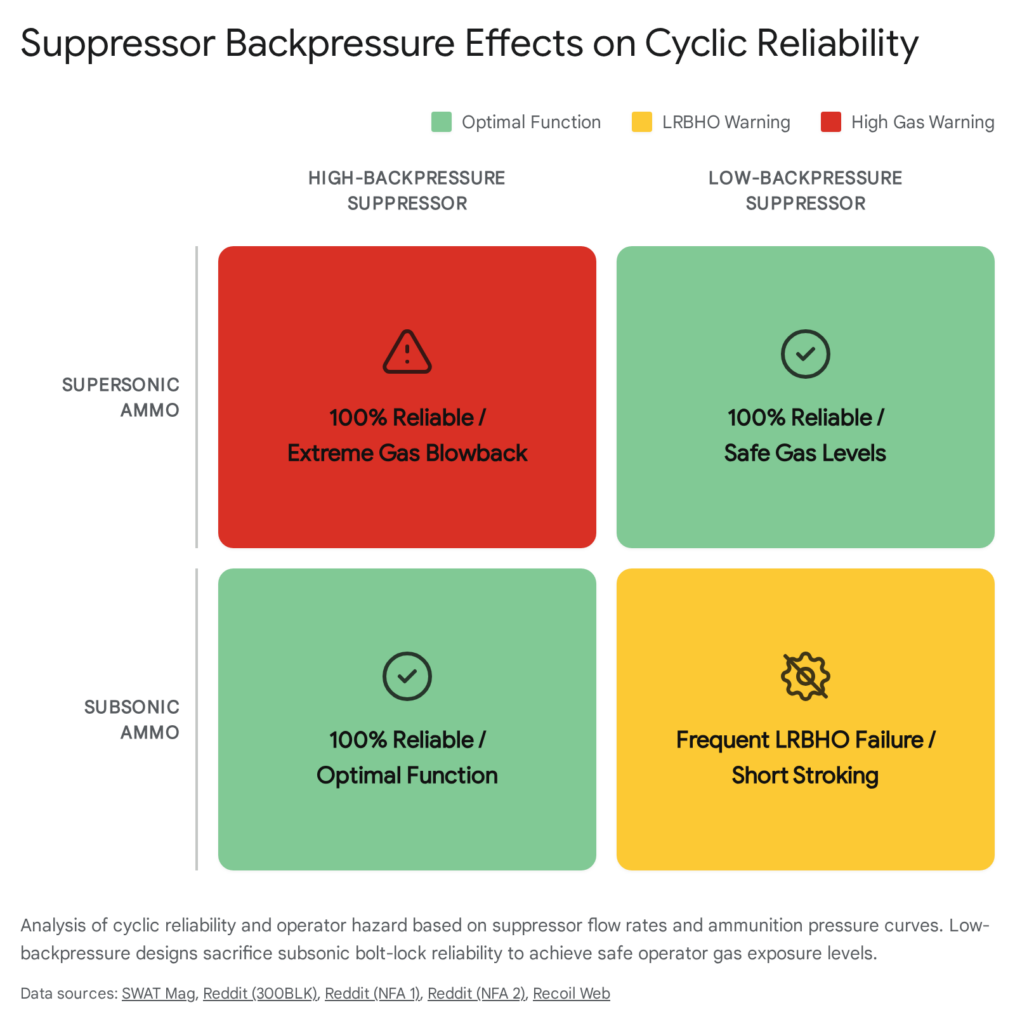
However, functional reliability—specifically the system’s ability to seamlessly cycle diverse ammunition types—presents a highly nuanced operational reality. The Rattler operates on a self-regulating, short-stroke gas piston system featuring a two-position adjustable gas regulator1. The first position is tailored for unsuppressed operation, while the second is restricted for suppressor use2. Because of the ultra-short barrel, the gas port must tap off pressure almost immediately after ignition. This creates a system that is incredibly sensitive to variations in backpressure, heavily dictating the firearm’s long-term cyclic reliability.
The system exhibits a pronounced “Goldilocks zone” regarding suppressor selection. Traditional high-backpressure suppressors (such as the Dead Air Nomad L or SIG’s older SRD line) provide the massive gas volume necessary to reliably cycle weak 220-grain subsonic ammunition11. However, this excess backpressure forces the short-stroke piston to cycle violently, resulting in extreme particulate blowback, carbon fouling, and “port pop” at the ejection port, which can be physically hazardous to the operator’s respiratory and ocular health during sustained fire9.
Conversely, the modern silencer industry has pivoted toward low-backpressure or flow-through suppressors (e.g., CAT ODB, HUXWRX, SIG SLX/SLH). While these designs drastically reduce toxic gas blowback and preserve the operator’s health, they often fail to generate sufficient backpressure in the 5.5-inch Rattler to fully cycle the heavy dual-spring carriage assembly when firing subsonic ammunition. This specifically manifests as a failure to lock the bolt to the rear on an empty magazine (Last Round Bolt Hold Open – LRBHO)11.
Extensive analysis of high-round-count documentation reveals several persistent malfunction paradigms across the legacy and current LT platforms. The following table maps the most heavily documented malfunction types to their underlying mechanical causes and phases of occurrence:
| Malfunction Type | Description | Primary Phase of Occurrence | Verified Causes |
| Failure to Lock Back (LRBHO) | The bolt fails to lock to the rear after the final round is discharged from the magazine, necessitating a manual rack on a fresh magazine. | Empty magazine transition. | Insufficient gas volume reaching the piston; highly prevalent when pairing ultra-short 5.5-inch barrels with modern low-backpressure/flow-through suppressors and subsonic ammunition9. |
| “Dead Trigger” / Failure to Reset | The trigger is pulled, successfully discharging a round, but the trigger mechanism fails to mechanically reset for the subsequent shot. The operator must manually cycle the action or open the receivers. | Rapid semi-automatic fire. | Tolerance stacking with aftermarket AR-15 triggers lacking the required hammer height for the MCX carriage; inadequate bolt carrier velocity causing short-stroking of the internal sear14. |
| Extreme Gas Blowback / Spalling | Unburned powder, heavy carbon fouling, and toxic gases vent aggressively out of the ejection port and the charging handle gap, striking the operator directly in the face and eyes. | Firing cycle (specifically when suppressed with supersonic loads). | The use of high-backpressure traditional silencers forcing excess gas rearward12. |
| Failure to Eject (FTE) / Stovepiping | The spent casing is trapped by the bolt returning to battery before it can fully clear the ejection port, crushing the brass against the receiver extension. | Extraction/Ejection phase. | Frequently associated with firing aftermarket forced-reset triggers (FRT) requiring specific tuning/trip-bar timing at cyclic rates exceeding the extraction capabilities of the system15. |
| Light Primer Strikes | The firing pin impacts the primer with insufficient kinetic force to ignite the cartridge, resulting in a click without a discharge. | Ignition phase. | Mechanical interference from the proprietary MCX firing pin safety latch when utilizing unauthorized, non-MCX-specific aftermarket trigger hammers that lack the correct geometry to fully disengage the block10. |
Durability and Maintenance
From its inception, SIG Sauer engineered the MCX platform to exceed a 20,000-round service life without requiring catastrophic parts replacement, a benchmark established by elite military procurement requirements1. To achieve this unprecedented durability in an ultra-compact, violently cycling operating system, SIG implemented several proprietary metallurgical and structural enhancements that completely abandon legacy Stoner AR-15 architecture.
The upper receiver features replaceable, hardened steel cam track reinforcements and feed ramps, as well as steel pins where the charging handle latches make contact on the upper receiver. In a traditional AR-15, moving parts eventually gouge the softer aluminum upper receiver, creating a terminal failure point. SIG’s steel-on-steel reinforcement actively mitigates these friction-based failure points, dramatically extending receiver life and allowing armorers to simply swap the inserts1. Furthermore, the Rattler utilizes rounded, tapered bolt lugs rather than the square, sharp-angled Stoner-pattern lugs. Drawing inspiration from the Knight’s Armament E3 bolt design, these tapered lugs eliminate stress risers, actively preventing the shearing of lugs adjacent to the extractor under high-pressure conditions9.
Despite these robust macro-components, the Rattler’s micro-components and operating system exhibit specific wear trends due to the aggressive cyclic rate and intense thermal load generated by the proximity of the gas block to the chamber. The dual captured recoil springs, which sit immediately above the bolt carrier group to eliminate the need for a standard buffer tube, bear the brunt of the kinetic energy and require strict armorer-level inspection intervals3. While SIG claims a 20,000-round lifespan for major components, armorers note that heavy suppressed usage and supersonic fire fundamentally accelerate wear timelines.
In response to the proprietary nature of the platform, the consumer base has developed a robust catalog of aftermarket interventions. The following table outlines recommended do-it-yourself (DIY) OEM part substitutions utilized by operators to mitigate factory shortcomings or tolerance issues:
| Original OEM Part | Recommended Substitution | Reason for Intervention |
| Standard “S” Firing Pin Latch | “G-Marked” Firing Pin Latch (KIT-MCX-FPL-GEI) | The legacy MCX features a firing pin safety latch designed to physically block the firing pin to prevent slam fires if the bolt drops on a soft primer. This latch interfaces poorly with aftermarket AR-15 triggers (like Geissele and TriggerTech), causing light primer strikes. The G-latch allows clearance for higher hammer profiles. Note: The newer Rattler LT generation resolved this BCG geometry and no longer strictly requires this swap10. |
| Standard 5.5″ M-LOK Handguard | Canebrake SD Handguard / Midwest Industries Suppressor Handguard | The standard Rattler handguard’s internal diameter is too narrow (under 1.5 inches) to recess most standard direct-thread .30 caliber suppressors. Upgrading to a wider SD-style handguard allows the suppressor to tuck under the rail, providing a more compact overall footprint and protecting the operator from barrel heat4. |
| PCB Folding Brace (Pistol) | Telescoping/Folding Stock Assembly (SBR Only) | The factory-pivoting contour brace (PCB) is frequently reported as unergonomic and painful, leaving sharp red bruises on the shoulder during sustained fire due to its minimal surface area. Transitioning the firearm to an NFA-regulated SBR and installing a wider telescoping stock drastically improves ergonomics, recoil absorption, and length of pull21. |
Ownership Experience
Consumer feedback on the Rattler ecosystem shows a stark, almost bipolar split: the platform is praised for its raw ballistic capability and ingenious modularity, but heavily criticized for its unrefined shooting dynamics and aftermarket hostility.
Ergonomically, the weapon is a triumph of spatial packaging. Because the dual recoil springs sit entirely within the upper receiver, the Rattler can be fired with the stock completely folded, yielding an operational footprint of under 17 inches1. This capability makes it a premier choice for vehicle deployment, discreet bag carry, and close-quarters battle (CQB) environments where maneuvering a standard 16-inch AR-15 is impossible. The ambidextrous safety, magazine release, and bolt catch (which were further refined and enlarged on the LT models) provide an intuitive transition for operators already deeply entrenched in AR-15 muscle memory2.
However, the trigger feel and aftermarket modification risks remain significant friction points. The factory trigger on legacy Rattler models is frequently described as gritty, notchy, and excessively heavy, pulling between 5 and 9 pounds—a distinctly suboptimal interface for a platform retailing near three thousand dollars1. While SIG upgraded the Rattler LT to feature the much-improved Matchlite Duo flat-blade trigger, a vast majority of operators still attempt to drop in third-party AR-15 triggers (such as Geissele SSA or TriggerTech Diamond)6. This practice introduces severe risks of “tolerance stacking.” The proprietary firing pin safety latch in the MCX carriage assembly was purposefully implemented after early instances of slam-fires on soft primers10. When users physically remove this latch to force compatibility with aftermarket triggers, they bypass a critical, factory-designed safety mechanism16. Furthermore, the violent cyclic rate of the short-stroke piston can cause severe hammer bounce and even crack trigger pins on standard AR-15 fire control groups that are not specifically reinforced with a bridge to withstand the MCX platform’s carrier speed27.
The suppressed shooting experience is equally polarizing. While the .300 BLK model was ballistically engineered for subsonic, suppressed fire, toxic gas blowback remains the primary consumer complaint. The high-pressure venting occurring so close to the chamber frequently results in unburned powder and particulate matter blowing back through the ejection port and charging handle seam, striking the operator directly in the face13. This issue causes respiratory distress and eye watering within a single magazine of rapid fire unless specialized flow-through silencers are utilized12.
Warranty and Support
SIG Sauer’s warranty policy is legally stringent, heavily weighted toward protecting the manufacturer from liability arising from the platform’s extreme modularity. The official operator’s manual explicitly states that any unauthorized alterations, substitution of parts not manufactured by SIG SAUER, or disassembly beyond the standard field-strip level will immediately void the warranty28. Furthermore, the manual specifically dictates that the use of reloaded, hand-loaded, or non-standard ammunition absolutely voids all warranties31. This is a critical constraint for the high-volume shooter, given the exorbitant cost of factory .300 BLK ammunition.
A prevalent myth circulating within the civilian concealed carry and self-defense communities is the existence of a factory-backed “self-defense replacement policy,” wherein the manufacturer automatically replaces a firearm that is confiscated by law enforcement as evidence following a lawful self-defense shooting. Extensive review of SIG Sauer’s official corporate literature, warranty manuals, and retail store policies confirms that SIG Sauer does not offer a self-defense replacement program. In fact, their liability policy explicitly disclaims responsibility for the “loss of use of property,” commercial loss, or any damages arising from legal confiscation29. Consumers concerned with evidentiary seizure—a process that can tie up a firearm in police lockup for years even in a justified shoot—are advised to seek third-party legal defense insurance (e.g., Second Call Defense), which actively covers firearm retrieval or replacement34.
Regarding factory repair turnaround realities, SIG officially cites an expedited 5-7 working day window for critical repairs, a standard they proudly highlighted during the mandatory Carriage Assembly replacement recall of 201537. General consumer consensus corroborates that SIG’s logistics are indeed highly efficient; the company routinely issues pre-paid FedEx 2nd-day air labels and returns RMA firearms within a 10 to 14-day window38. However, some customers occasionally dispute the qualitative outcome of those repairs. Verified reports indicate instances in which firearms returned to customers were technically functioning but exhibited severe new symptoms. These returns are frequently accompanied by a lack of itemized documentation, leaving the owner in the dark regarding the specific gunsmithing interventions performed to fix the rifle13.
Voice of the Customer (VoC)
An exhaustive synthesis of high-round-count operators, law enforcement users, and civilian consumers across high-traffic technical forums (Reddit’s r/SigSauer and r/300BLK, Pistol-Forum, and M4Carbine) reveals a highly consistent median sentiment regarding the Rattler ecosystem.
Consumers fundamentally view the Rattler as an unparalleled engineering achievement in spatial packaging. The ability to fold the stock and deploy a .30-caliber rifle capable of neutralizing intermediate barriers from a standard, non-descript backpack without worrying about a buffer tube makes this the ultimate PDW for vehicle operations and discreet carry1. Users universally appreciate the sheer ballistic violence the platform can deliver in such a tiny envelope, noting that it hits with authority at distances where 9mm submachine guns suffer severe ballistic drop-off2.
Conversely, the frustration surrounding the suppression of the 5.5-inch barrel is palpable. Operators describe it as an inescapable “exercise in frustration.” If a user mounts a high-backpressure can to ensure subsonic ammunition cycles reliably, they report being physically punished by the toxic gas blowback, with several noting immediate respiratory irritation and eye-watering. If they pivot to a flow-through can to save their lungs, they almost inevitably lose last-round bolt hold-open functionality11.
Furthermore, while the cross-compatibility of the newer LT generation is seen as a significant organizational improvement, the legacy Rattler trigger remains a contentious issue. Users find the excessively heavy 5- to 9-pound factory trigger inexcusable for a weapon that retails for well over two thousand dollars. Attempting to upgrade the trigger is viewed as a mandatory, albeit mechanically annoying, hurdle that forces users to source obscure “G-marked” safety latches or risk voiding their warranties to achieve a standard AR-15 match trigger feel9. Finally, while SIG’s customer service is lauded for its rapid shipping turnarounds, the communication process is frequently described as a “black box.” Users report sending a gun in for cycling issues, getting it back a week later, and finding it runs—but discovering the repair was performed without any itemized paperwork explaining the factory modifications or gunsmithing interventions, leaving owners in the dark about how their firearm was altered13.
Quantitative Ratings
Based on the synthesis of mechanical specifications, metallurgical analysis, and multi-platform consumer defect tracking, the SIG Rattler family is evaluated across six core metrics:
| Metric | Score (1-10) | Justification |
| Reliability | 7.5 / 10 | The short-stroke piston is exceptionally reliable with supersonic ammunition and heavy fouling. However, it is highly temperamental and prone to short-stroking with subsonic loads when paired with modern low-backpressure suppressors1. |
| Accuracy | 8.5 / 10 | The cold-hammer-forged barrel and ultra-fast 1:5 twist rate provide superb stabilization of heavy subsonic projectiles, delivering mechanical precision well beyond standard PDW engagement ranges1. |
| Durability | 9.0 / 10 | Replaceable steel receiver inserts, dual captured recoil springs, and E3-style tapered bolt lugs extend service life to 20,000 rounds and reduce standard AR-15 failure points11. |
| Maintenance | 6.5 / 10 | While basic field stripping is simple, parts availability is highly proprietary and expensive. Furthermore, aftermarket trigger tuning introduces the risk of dangerous tolerance stacking and slam-fires10. |
| Warranty/Support | 7.0 / 10 | SIG provides excellent logistics and fast shipping turnarounds (5-10 days), but strict warranty void clauses and occasional lack of transparent repair documentation reduce the overall support score17. |
| Ergonomics | 8.0 / 10 | The platform offers a best-in-class footprint, folding capability, and familiar ambidextrous AR-15 controls. It is docked slightly for poor factory PCB brace comfort and the aggressive proximity of the charging handle to the dual springs6. |
| OVERALL SCORE | 7.75 / 10 | An apex-tier, highly specialized CQB tool that purposefully sacrifices general-purpose comfort, trigger refinement, and ease of suppression to achieve an incredibly small, lethal, and concealable footprint. |
Pricing and Availability
Research Phase: The pricing of the SIG Rattler family is highly reflective of its status as a premium, SOCOM-derived tier-one platform. In primary retail channels, the Rattler LT generation has largely superseded the legacy Rattler models and specialized Canebrake configurations. Through extensive market analysis and vendor aggregation across major U.S. distributors, the current retail baseline for a factory-new MCX Rattler LT (whether in pistol or SBR configuration and across .300 BLK or 5.56 NATO chamberings) strongly converges around a strict Minimum Advertised Price (MAP). Consequently, the determined average street price for the SIG Rattler Family is $2,499.995.
Vendor Search Output:
Determined Average Street Price: $2,499.99
The following five active listings from the specified vendors meet the price criteria:
- Palmetto State Armory: Sig Sauer MCX Rattler LT Pistol 5.56 7.75″ Barrel 30-Rounds – $2,499.995
- Primary Arms: SIG Sauer MCX Rattler LT Pistol 5.56 NATO – 7.75″ – Black – $2,499.9939
- Midway USA: Sig Sauer MCX Rattler-LT Pistol Threaded Barrel with Pistol Brace – $2,499.9940
- Sportsmans Warehouse: Sig Sauer MCX Rattler LT with Brace 300 AAC Blackout 6.75in Black Anodize Modern Sporting Pistol – $2,499.9942
- KYGunCo: SIG SAUER MCX Rattler LT 5.56 NATO / 223 Rem 7.75″ 30rd Pistol w/ SLX Flash Hider + PCB Brace – $2,499.9941
Methodology
Data acquisition and qualitative synthesis for this exhaustive report relied heavily on Open-Source Intelligence (OSINT) gathering. Baseline technical specifications, warranty limitations, and maintenance schedules were extracted directly from verified SIG Sauer operator manuals, press releases, and authorized dealer documentation28. To establish the operational realities of the platform, the analysis integrated reviews from established industry publications alongside vast amounts of end-user data1.
The core analytical framework of this report was driven by a strict “signal versus noise” filtering protocol applied to high-traffic, professional-tier firearms communities, specifically prioritizing data from r/SigSauer, r/300BLK, r/NFA, GlockTalk, and M4Carbine.net. To eliminate confirmation bias and “fanboy” praise, isolated anecdotes regarding both extreme reliability and catastrophic malfunctions (such as a single unverified user claiming a receiver explosion) were systematically discarded. Defect trends and mechanical assessments were only integrated into the final report if they met a rigorous threshold of multi-platform verification. This required that a specific issue—such as the Geissele trigger compatibility failure or the extreme gas blowback—be documented independently by multiple high-round-count users, corroborated by photographic evidence or verified armorer commentary, and recognized by the broader mechanical community. This methodology ensures that the resulting analysis accurately reflects systemic engineering constraints and true operational dynamics rather than isolated quality control anomalies or user-induced errors.
Note: Vendor Sources listed are not an endorsement of any given vendor. It is our software reporting a product page given the direction to list products that are between the minimum and average sales price when last scanned.
Please share the link on Facebook, Forums, with colleagues, etc. Your support is much appreciated and if you have any feedback, please email us in**@*********ps.com. If you’d like to request a report or order a reprint, please click here for the corresponding page to open in new tab.
Sources Used
- SIG Rattler SBR | WHEN SIZE MATTERS – SWAT Survival | Weapons | Tactics, https://www.swatmag.com/article/when-size-matters-sig-sauer-mcx-rattler-sbr/
- SIG Sauer Rattler PSB in the Powerful .300 Blackout – Firearms News, https://www.firearmsnews.com/editorial/sigs-new-shortie/77791
- Defying Labels: Sig Sauer MCX RATTLER PSB – Green Ops, https://www.green-ops.com/blog/defying-labels-sig-sauer-mcx-rattler-psb
- Ultimate Guide: The SIG Sauer MCX Rifle, Carbine And Pistol Platform – The Firearm Blog, https://www.thefirearmblog.com/blog/2019/11/26/sig-sauer-mcx-rifle/
- SIG Sauer MCX Rattler – Pistols – Palmetto State Armory, https://palmettostatearmory.com/brands/sig-sauer/firearms/pistols/sig-mcx/mcx-rattler.html
- MCX RATTLER LT | More Modular & Capable Package – SIG Sauer, https://www.sigsauer.com/mcx-rattler-lt.html
- Sig Sauer 300 Blackout Spear LT vs Rattler vs Canebrake Comparison – Real Street Tactical, https://www.realstreettactical.com/blog/sig-sauer-300-blackout-spear-lt-vs-rattler-vs-canebrake-comparison/
- SIG SAUER MCX Rattler Canebrake HEADSPACE OPTIONS AND THEORY ADVANCED 50MM CANNON CALIBER WEAPONS AND AMMUNITION – Small Arms Defense Journal, https://sadefensejournal.com/wp-content/uploads/2021/05/SADJV13N2.pdf
- SIG Rattler Gun Review: SIG Cracks the Code! – Recoil Magazine, https://www.recoilweb.com/rattler-137681.html
- Firing Pin Safety Latch on the MCX Virtus and Rattler : r/SigSauer – Reddit, https://www.reddit.com/r/SigSauer/comments/10pk567/firing_pin_safety_latch_on_the_mcx_virtus_and/
- RATTLER LT CAT ODB Ti Shots : r/300BLK – Reddit, https://www.reddit.com/r/300BLK/comments/1ailxhy/rattler_lt_cat_odb_ti_shots/
- Is a Sig Rattler supposed to be this Gassy? : r/NFA – Reddit, https://www.reddit.com/r/NFA/comments/1eqt363/is_a_sig_rattler_supposed_to_be_this_gassy/
- Suppressor thoughts/opinions for Sig Rattler Canebrake : r/NFA – Reddit, https://www.reddit.com/r/NFA/comments/1euq9vf/suppressor_thoughtsopinions_for_sig_rattler/
- Rattler LT dead trigger : r/SigSauer – Reddit, https://www.reddit.com/r/SigSauer/comments/1s5fqm7/rattler_lt_dead_trigger/
- SIG MCX Forced Reset Trigger Install (MCX, MPX, Spear) – Rifle Configurator, https://www.rifleconfigurator.com/guides/sig-mcx-forced-reset-trigger
- MCX Spear LT FRT Trigger compatibility : r/SigSauer – Reddit, https://www.reddit.com/r/SigSauer/comments/1kscstk/mcx_spear_lt_frt_trigger_compatibility/
- If sig told you the upper receiver gap was the reason for the issue and sent this back to you after. What would you do? : r/SigSauer – Reddit, https://www.reddit.com/r/SigSauer/comments/1gaoa6u/if_sig_told_you_the_upper_receiver_gap_was_the/
- Sig Sauer Rattler LT & Spear LT FRT Issues : r/SigSauer – Reddit, https://www.reddit.com/r/SigSauer/comments/1sq32fy/sig_sauer_rattler_lt_spear_lt_frt_issues/
- MCX-RATTLER LT UPPER ASSEMBLY – 7.75″ 7.62X39 – SIG Sauer, https://www.sigsauer.com/mcx-rattler-lt-upper-assembly-7-75-7-62×39.html
- SIG MCX – Wikipedia, https://en.wikipedia.org/wiki/SIG_MCX
- Mcx Firearm Parts – SIG Sauer, https://www.sigsauer.com/shop/mcx-firearm-parts
- Rattler fans: Rattler OG 5.5″ or Rattler 6.75 LT? : r/300BLK – Reddit, https://www.reddit.com/r/300BLK/comments/1eme65x/rattler_fans_rattler_og_55_or_rattler_675_lt/
- What’s the best trigger for MCX? : r/SigSauer – Reddit, https://www.reddit.com/r/SigSauer/comments/16wpb9e/whats_the_best_trigger_for_mcx/
- Midwest Industries Sig Sauer Rattler Handguard 5.25 Black – MidwayUSA, https://www.midwayusa.com/product/1020855284
- SIG MCX RATTLER CANEBRAKE – SIG Sauer, https://www.sigsauer.com/sig-mcx-canebrake.html
- Master Review Sig MCX Rattler: Calibers, Accessories and Upgrades – Tier Three Tactical, https://www.tierthreetactical.com/master-review-sig-mcx-rattler-calibers-accessories-and-upgrades/
- Geissele trigger questions… : r/SigSauerMCX – Reddit, https://www.reddit.com/r/SigSauerMCX/comments/1sca1uu/geissele_trigger_questions/
- SIG SAUER P211®, https://www.sigsauer.com/media/sigsauer/resources/OPERATORS_MANUAL_P211_5100230-01_1.pdf
- SIG MCX-R® – SIG Sauer, https://www.sigsauer.com/media/sigsauer/resources/OPERATORS_MANUAL_MCX-R_2403371-01_REV00_WEB_UPDATE.pdf
- CLASSIC LINE PISTOLS® – SIG Sauer, https://www.sigsauer.com/media/sigsauer/resources/OPERATORS_MANUAL_CLASSIC_LINE_PISTOLS_ENGLISH_1204276-01_REV04_WEB_UPDATE.pdf
- SAFETY INSTRUCTIONS AND WARRANTY INFORMATION SCAN THIS CODE FOR OPERATOR’S MANUAL AND REGISTRATION – SIG Sauer, https://www.sigsauer.com/media/sigsauer/resources/SAFETY_WARNING_MANUAL_10000236-01_ENGLISH_REV01_DRAFT.pdf
- SIG MCX ® VIRTUS™, https://www.sigsauer.com/media/sigsauer/resources/OPERATORS_MANUAL_SIGMCX_VIRTUS_ENGLISH_2402117-01_REV_02_LR.pdf
- SIG MCX-SPEAR ®, https://www.sigsauer.com/media/sigsauer/resources/OPERATORS_MANUAL_MCX-SPEAR_4200452-01_REV_02_WEB_FILE.pdf
- Will I get my firearm back after it being used for investigation for self defense : r/guns – Reddit, https://www.reddit.com/r/guns/comments/183y86m/will_i_get_my_firearm_back_after_it_being_used/
- Expect your gun to be seized – and NOT returned to you | Buckeye Firearms Association, https://www.buckeyefirearms.org/expect-your-gun-be-seized-and-not-returned-you
- What happens to the gun in a self defense moment? : r/CAguns – Reddit, https://www.reddit.com/r/CAguns/comments/1ir61jh/what_happens_to_the_gun_in_a_self_defense_moment/
- SIG MCX: Mandatory Carriage Assembly Replacement Program Announced, https://athlonoutdoors.com/article/sig-mcx-rifle-recall/
- Sig cross? : r/SigSauer – Reddit, https://www.reddit.com/r/SigSauer/comments/k33p90/sig_cross/
- SIG Sauer MCX Rattler LT Pistol 5.56 NATO – 7.75″ – Black – Primary Arms, https://www.primaryarms.com/sig-sauer-mcx-rattler-lt-pistol-556-nato-7-75-black
- Sig Sauer MCX Rattler-LT 300 Blackout (7.62x35mm) Pistol 6.75 Barrel – MidwayUSA, https://www.midwayusa.com/product/1028830121
- SIG SAUER MCX Rattler LT 5.56 NATO / 223 Rem 7.75″ 30rd Pistol w/ SLX Flash Hider + PCB Brace |Black – kygunco, https://www.kygunco.com/product/sig-sauer-pmcx-556n-7b-lt-pcb-mcx-5.56-7.75-rattler-lt-30rd-w-pcb-brace
- Sig Sauer MCX Rattler LT with Brace 300 AAC Blackout 6.75in Black Anodize Modern Sporting Pistol – 30+1 Rounds | Sportsman’s Warehouse, https://www.sportsmans.com/shooting-gear-gun-supplies/handguns/sig-sauer-mcx-rattler-lt-with-brace-300-aac-blackout-675in-black-anodize-modern-sporting-pistol-301-rounds/p/1941843
- SIG MCX-SPEAR LT ®, https://www.sigsauer.com/media/sigsauer/resources/OPERATORS_MANUAL_MCX-SPEAR_LT_2402988-01_REV04_WEB.pdf
- MCX-RATTLER LT – SIG Sauer, https://www.sigsauer.com/mcx-rattler-lt-past-model.html