My daughter, Erika, is extremely gifted. She came up with a basic logo design for me earlier this year. Since then she has gotten deeper and deeper into the modern tools for digital artwork and using AI / pattern recognition tools to generate impressionistic artwork. She showed me some of her work and it blew me away. I told her to generate some artwork involving samurai or ronin themes – a ronin is a masterless samurai in feudal-era Japan – that I might use for Ronin’s Grips and what she came up with is stunning.
Her first batch was black and white and I asked her for a tired/haggard look:
Then some with color
The next are more of a Ukiyo-e style:
Lastly, are you ready for steampunk samurai?
I think this one is pretty wicked.
This is the one I picked for now
This is my favorite we we added in the logo using the proper font.
Summary
I was amazed with what she came up with and the tools that she is using to generate them and couldn’t just let these images disappear so I figured sharing them was the way to go. I hope you like them..
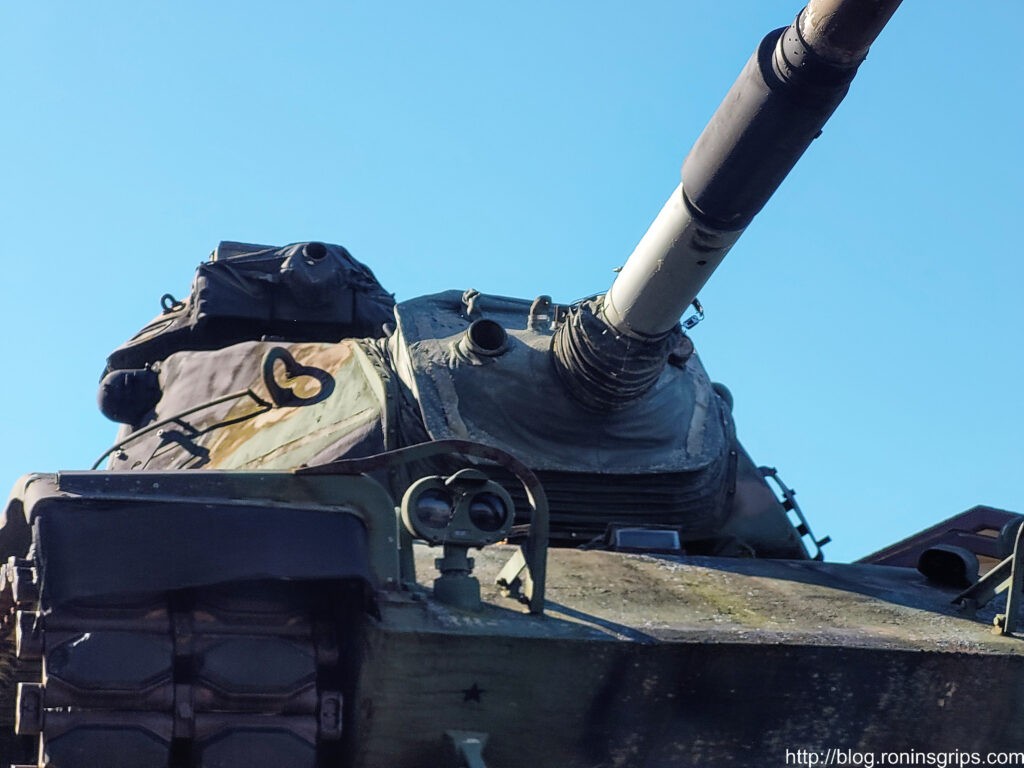
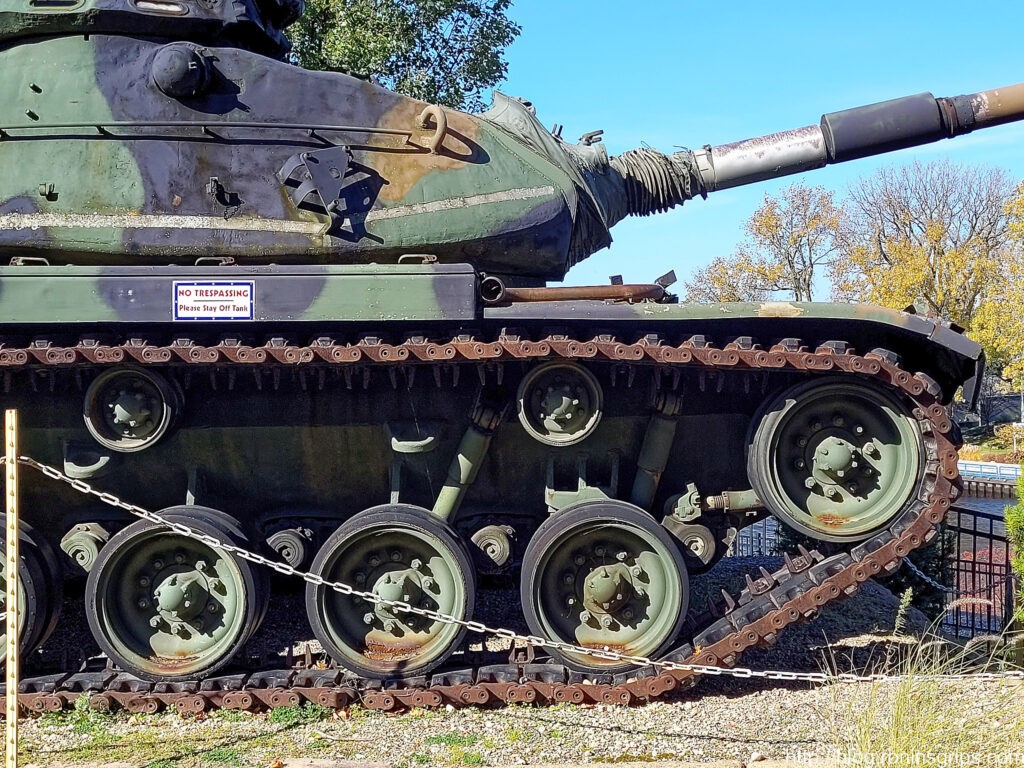
South Haven, MI, is about 40 minutes up the road from us and we’ve been there a number of times over the years. On a number of occasions we’ve driven by American Legion Post 49 and seen the M60A3 tank sitting overlooking the river. We were up there recently and I snapped a few pictures in order to assemble a post about it.
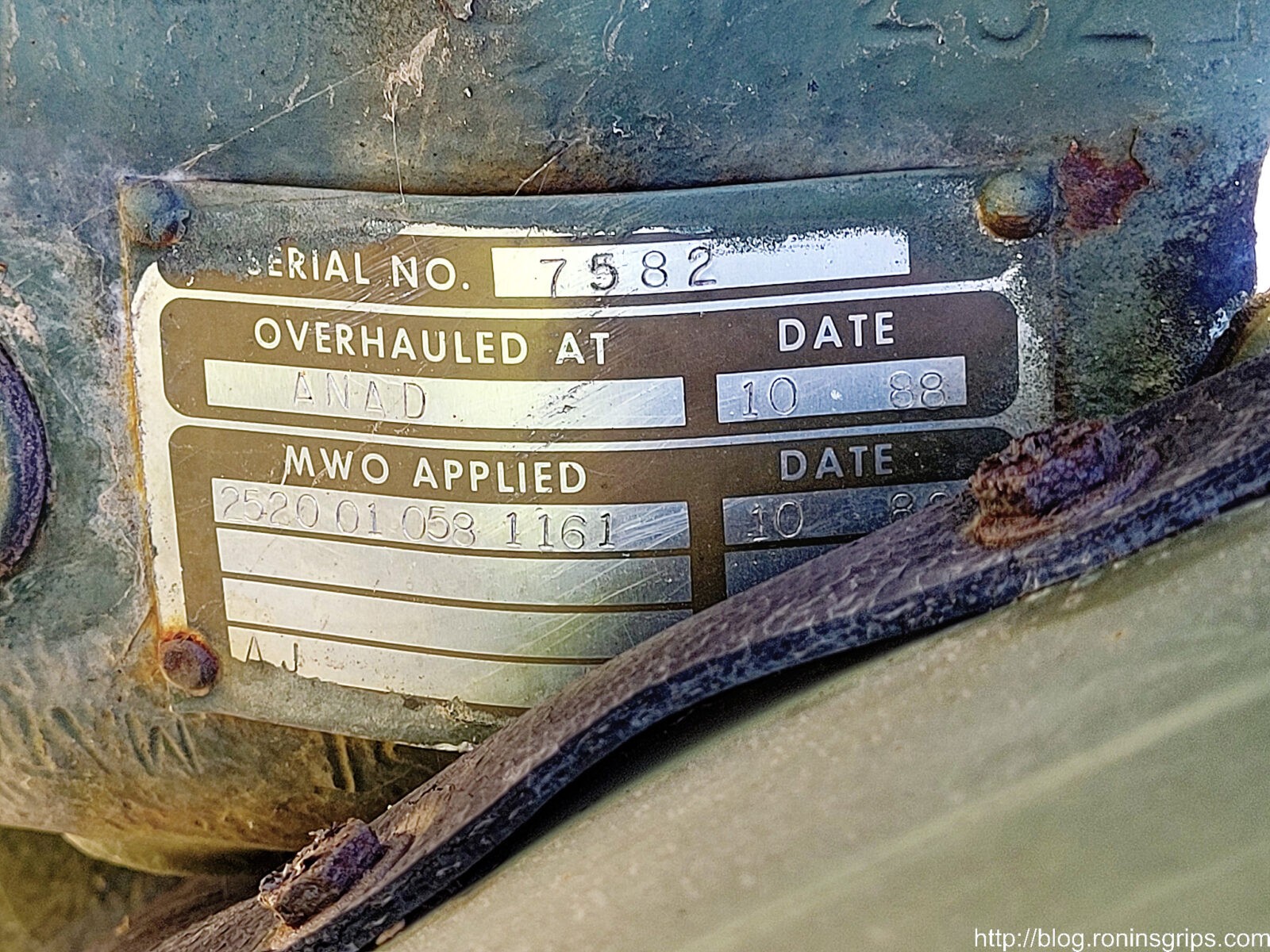
The tank is a M60A3 serial number 7582 and was overhauled at Anniston Army Depot in October 1988.
The “Tank, Combat, Full Tracked: 105mm Gun, M60” was officially adopted in March 1959 and was an evolutionary design from the M48A2 Patton though never officially considered as part of the Patton family.
The M60 tanks served as the main battle tank during the cold war with 15,000 being produced. It was first put into operational use in Europe in 1960. Chrysler started production in 1959 and then the Detroit Arsenal Tank Plat produced them from 1960-1983.
Over it’s design life, there were many upgrades as the Americans and Soviets tried to “one up” each other in terms of capabilities. M60: 1959-1962, M60A1: 1962-1980, M60A2: 1973-1975 and then the M60A3 from 1978-1983. Note there was a modernization program and one point that upgraded 5,400 older tanks to the M60A3 variant that ended in 1990.
The M60 was eventually replaced by the M1 Abrams. The US retired the M60 from front-line use after Operation Desert Storm (August 1990-February 1991). The last tanks were retired from the National Guard in 1997. The M60 still sees use in many other countries including Egypt, Turkey and Saudi Arabia.
I am not going to cover all of the history and design changes. Click here for a good Wikipedia post with that info. Instead, I am just going to list some stats I found interesting about the M60A3 specifically.
M60A3 Stats
Number produced: 1,052 new vehicles + 5,400 tanks upgraded to A3
Weight: 54.6 short tons ( 1 short ton = 2,000 pounds)
Hull length: 22 ft 9.5 inches
Gun forward length: 30 ft 6.5 inches
Width: 11 ft 11 inches
Height: 10 ft 9 inches
Crew: 4 people
Main cannon: The 105mm M68E1
Secondary Armament: .50 BMG or 7.6×51 on the commander’s cupola.
Engine: Continental AVDS-1790-2 V1 Air cooled twin turbo diesel with 750 BHP
Suspension: Torsion Bar
Transmission: GM cross drive single stage with 2 forward and 1 reverse gear ranges
Fuel capacity: 385 US Gallons
Range: 300 miles – so optimistically maybe a gallon per mile
Max speed: 30 mph on the road and 12 mph cross-country
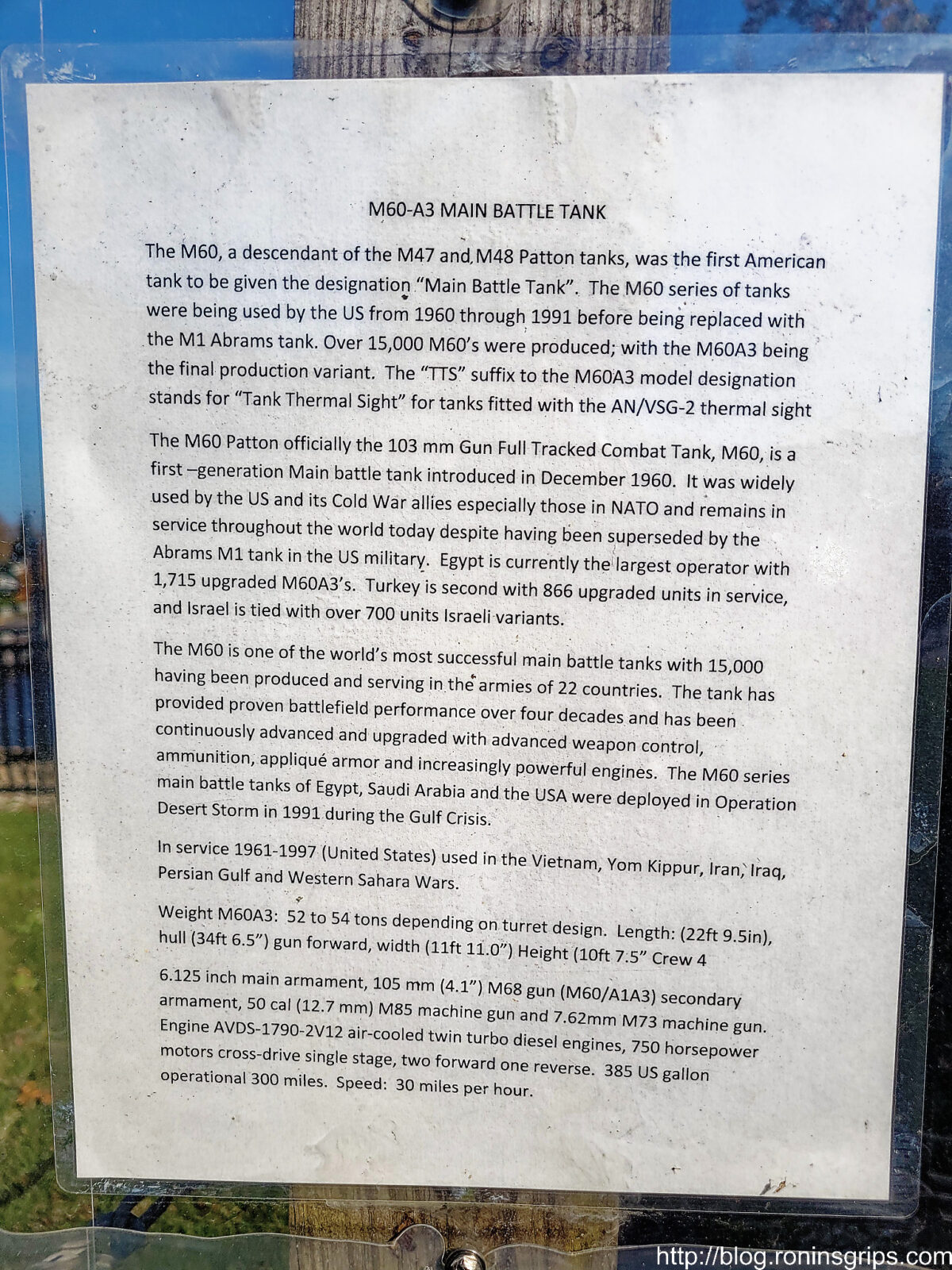
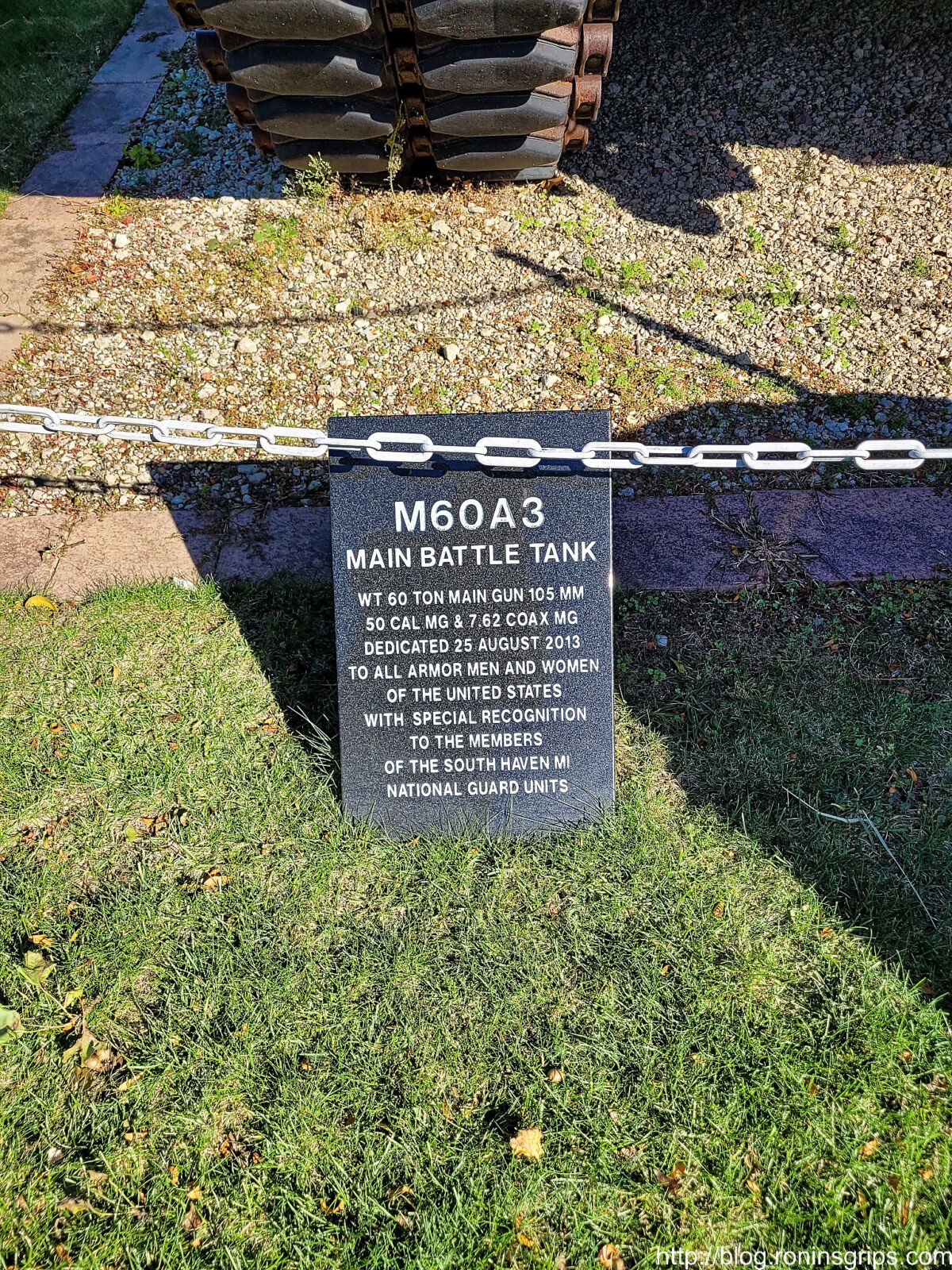
Here’s what the Post had to say about the tank
They had this summary on a fence post by the tank.
And this was on the ground.
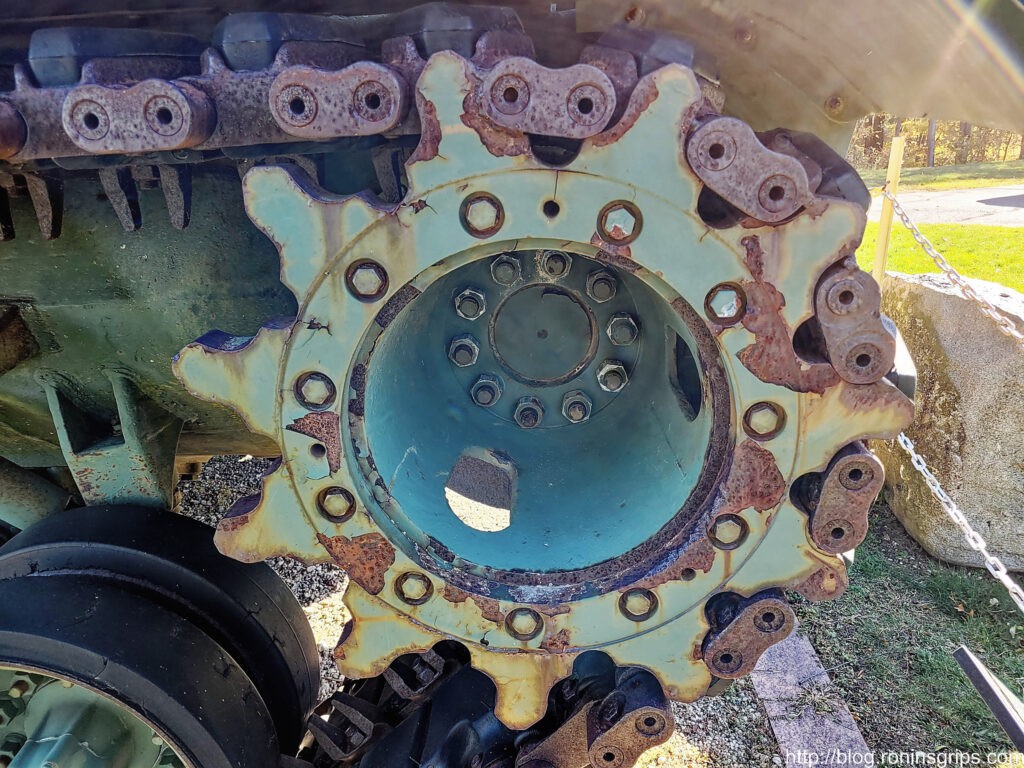
Photos of the American Legion M60A3
Summary
A big thank you to the Post setting up the tank for people to see and providing the background placard.
If you are travelling through South Haven, MI, it’s worth a quick stop the the American Legion Post to see the M60A3.
As I have written in the past, I am always fascinated my old military equipment located at American Legion Posts, VFWs, cemeteries and so forth. My wife and I have driven on US-131 a number of times over the years and seen a M4 Sherman tank right by the road but have never had the time to stop and take photos until October 2022. We were on our way home and had time to stop and take a few quick photos. Now, weeks later, I did a bit of research and compiled this post.
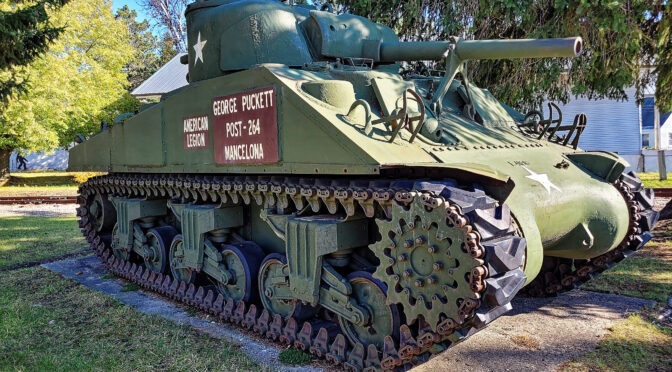
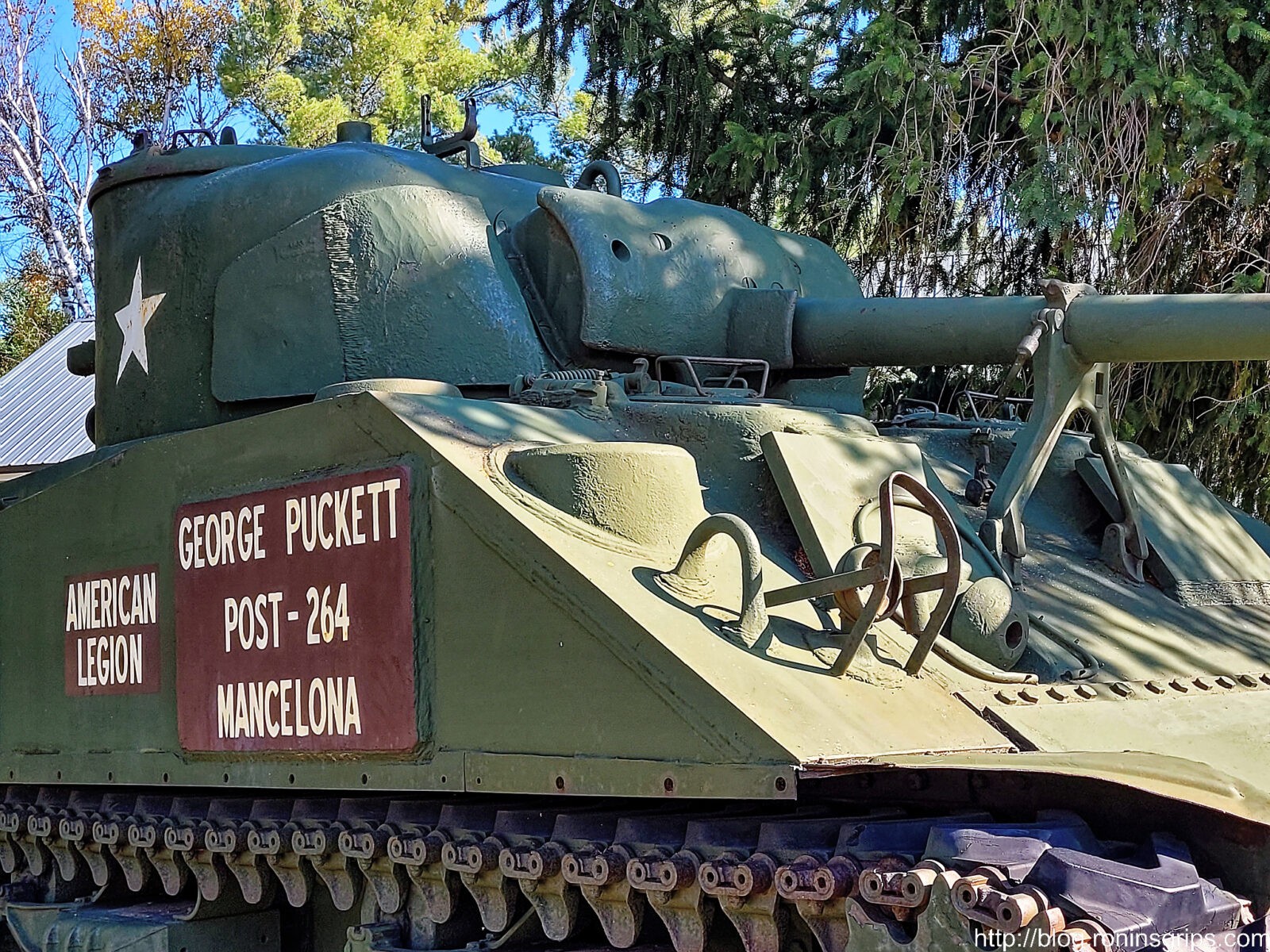
The tank is a static display for American Legion Post 264 in Mancelona, MI located on the corner of US-131 and State Street in downtown Mancelona – if you are headed North, it’s on the the right hand side of the road just before the intersection.
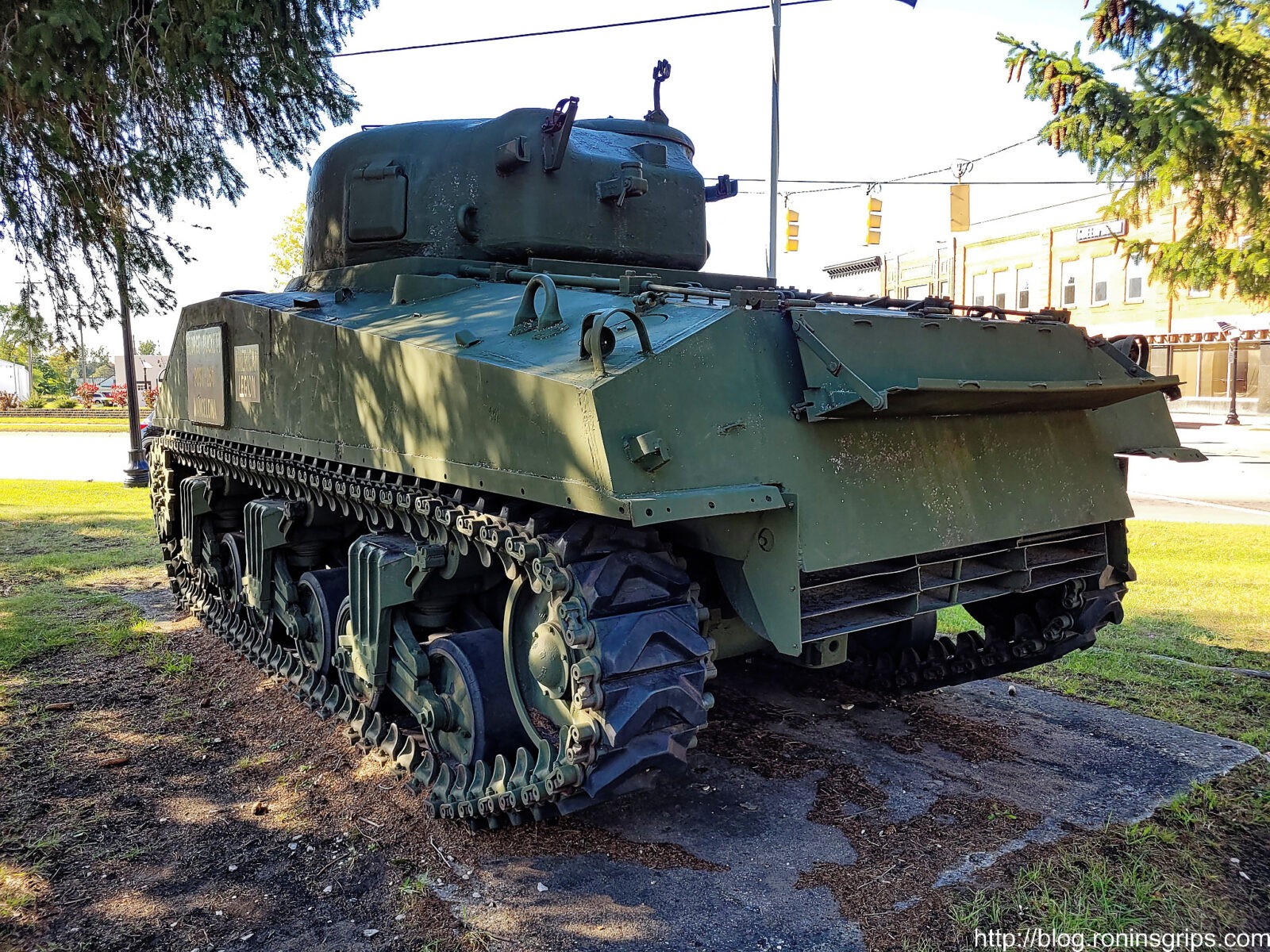
The tank is a M4A3 Sherman serial number 11755 with a 75mm cannon with a small hatch and dry storage. The smaller hatches were an earlier production design and many were kept in the US for training purposes and did not see battle.
Dry storage models had ammunition racks mounted on vulnerable positions and the rounds could catch fire. Later “wet storage” models moved the racks to the floor in less vulnerable positions and protected them with sealed chambers filled with water and anti-freeze to slow the progression of fire and allow the crew a few more seconds to escape.
The Details
To be honest, I had no idea how many variants to the M4 Sherman were made – it’s stunning actually. This Wikipedia page gives info on the tank in general and this one lists info on variants. I thought this would be a quick post to write but every time I pulled back a layer and got more details that then led to more details. I had to then dig specifically on the tank to read what others had written about it.
Production: It was one of 1,690 small hatch dry storage M4A3 Shermans made by Ford between June 1942 and September 1943. This variant had the lowest production numbers.
Serial Number: 11755
US Registration: 3053910
B&R Rebuild Stamp: 579
Engine: Ford GAA V-8 500HP – that engine is really interesting – it’s an all aluminum 1,100 cubic inch 32 valve dual overhead cam 60 degree liquid cooled engine. Everything was geared – no belts or chains – so it was actually very reliable. The design is amazing in my honest opinion.
Transmission: Synchromesh with 5 speed forward and one reverse
Max road level sustained speed: 26 mph – I got stats ranging from 21 to 30 mph on this one)
Fuel type: Gasoline, at least 80 octane
Fuel Capacity: 174 gallons
Range: From TM9-759, the manual reports 110 miles cross country or 155 miles on the highway. Note that means it’s not even getting a gallon per mile in terms of fuel economy.
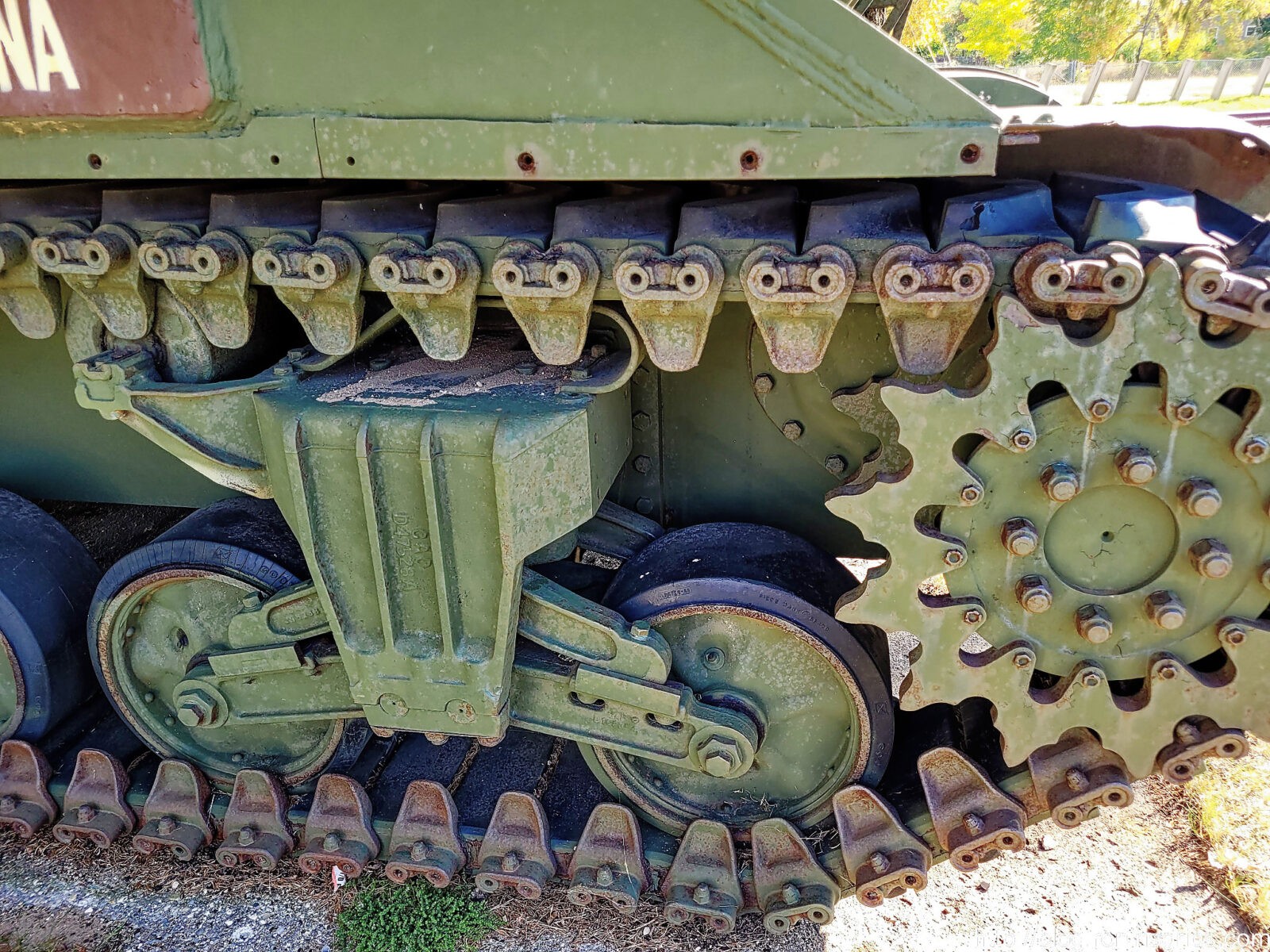
Suspension: Vertical volute spring suspension (VVSS) with three bogies per side and two wheels per bogie
Track: This tanks has the T48 track with rubber chevrons – 16.56″ wide and makes contact for 147″
Main Cannon: 75 mm (97 rounds carried)
Integral machine gun: Two .30 cal M1919A4 – one in the ball mount on the right side of the hull and one coaxial to the main 75mm cannon. (4,750 rounds carried)
Secondary machine gun on the turret: .50 Browning M2 (300 rounds carried)
Mortar: 2″ M3 mortar for smoke (12 rounds carried)
Small arms ammunition: 600 rounds of .45 ACP and
Weight: 30.3 tons
Length: 19’2″
Width: 8’7″
Height: 9′
Crew: 5
Okay, I am a gear head. The more I read about the Ford GAA engine, the more fascinated I got. Displacing 1,000 cubic inches or 18 liters, it remains the largest V8 gas engine Ford has made and it made more than 28,000 of them. It’s estimated that only 500-1,000 still exist and they are sometimes found in competition pulling tractors. Here’s a video of one running on a test platform in 2019:
Here are pages with more info just on the GAA engine:
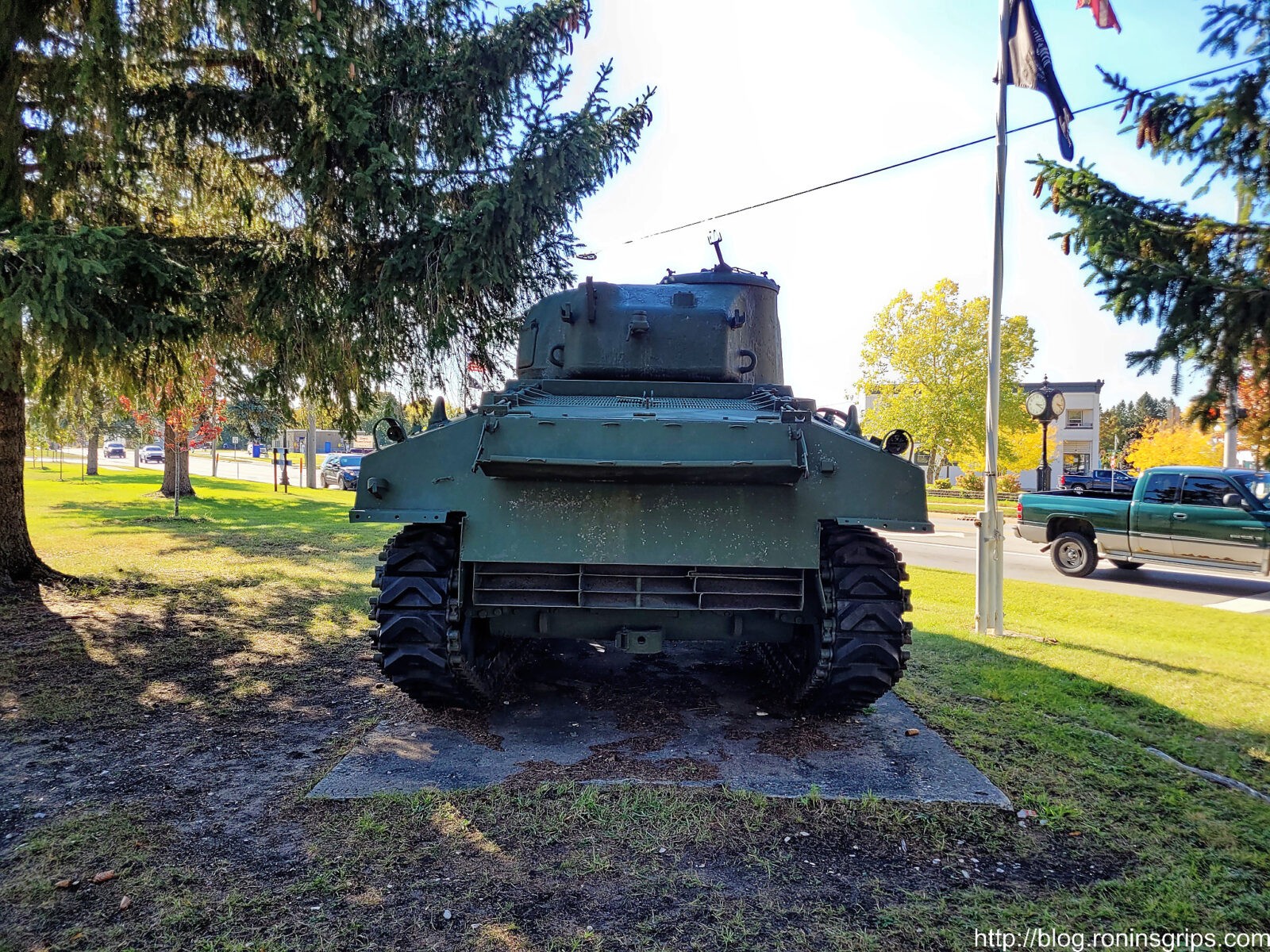
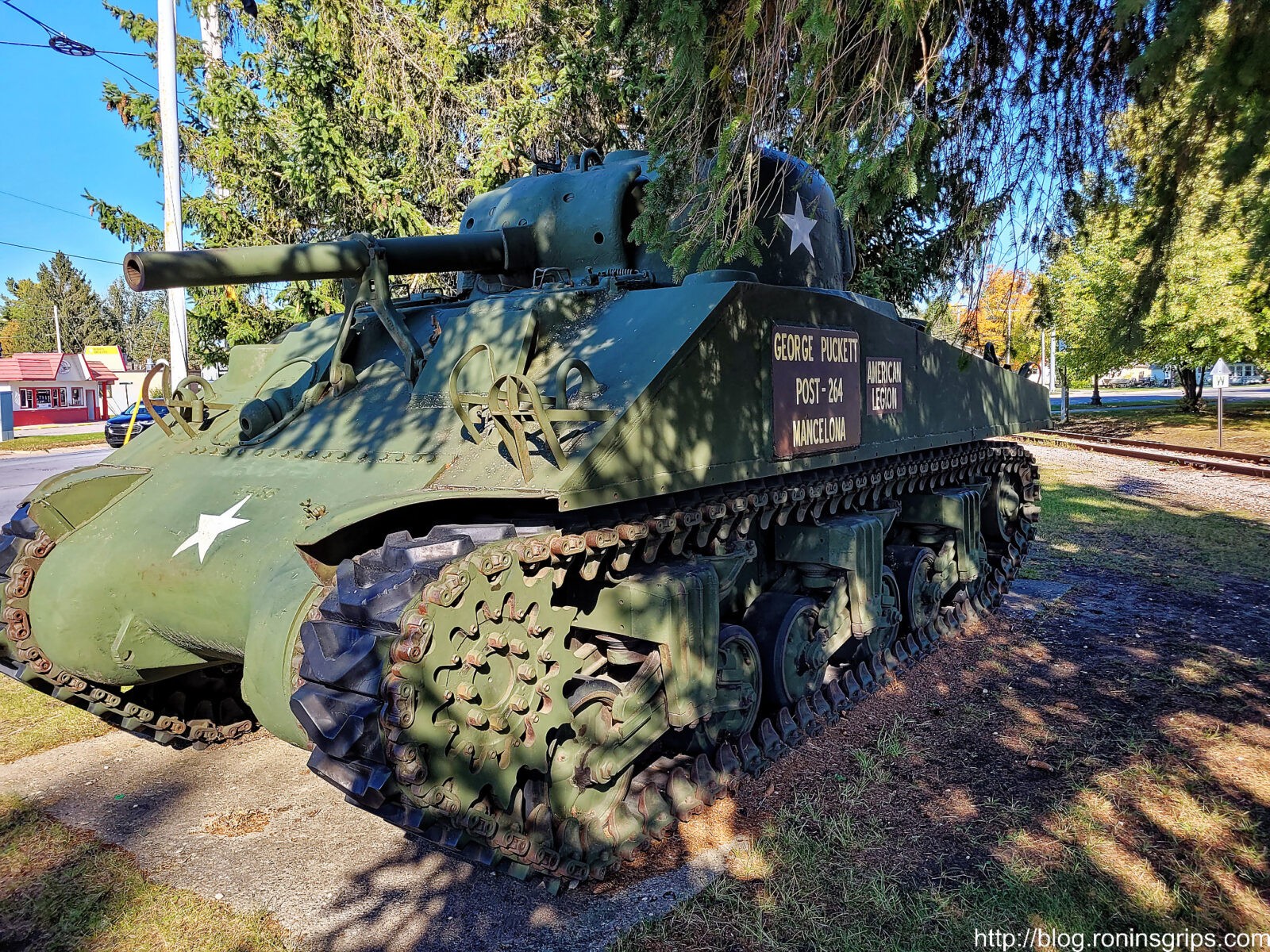
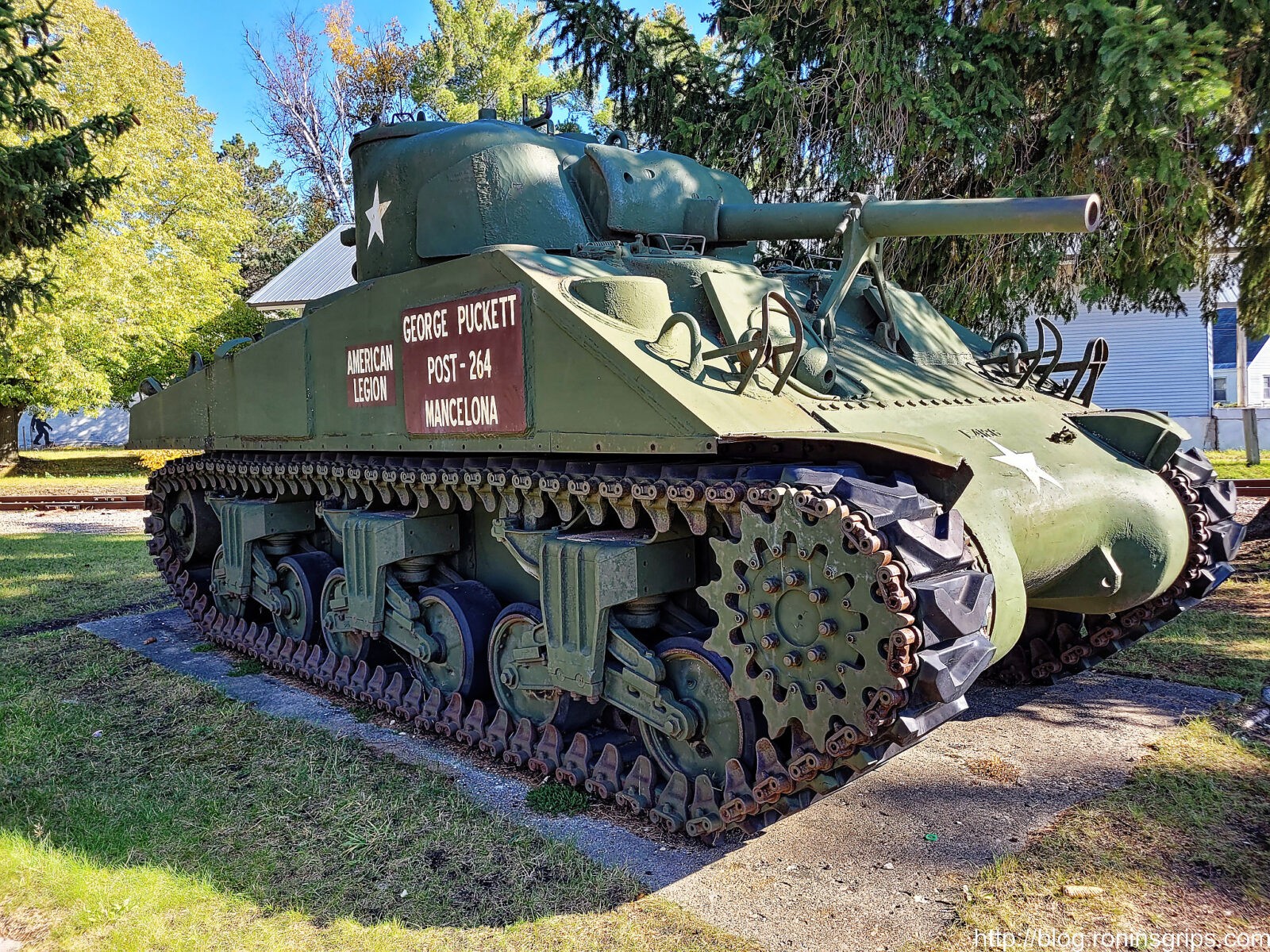
There is a nearby park with a lot that we left our van at. We then came up on the tank from behind. The American Legion post did a nice job painting it. It’s always nice to see history preserved.
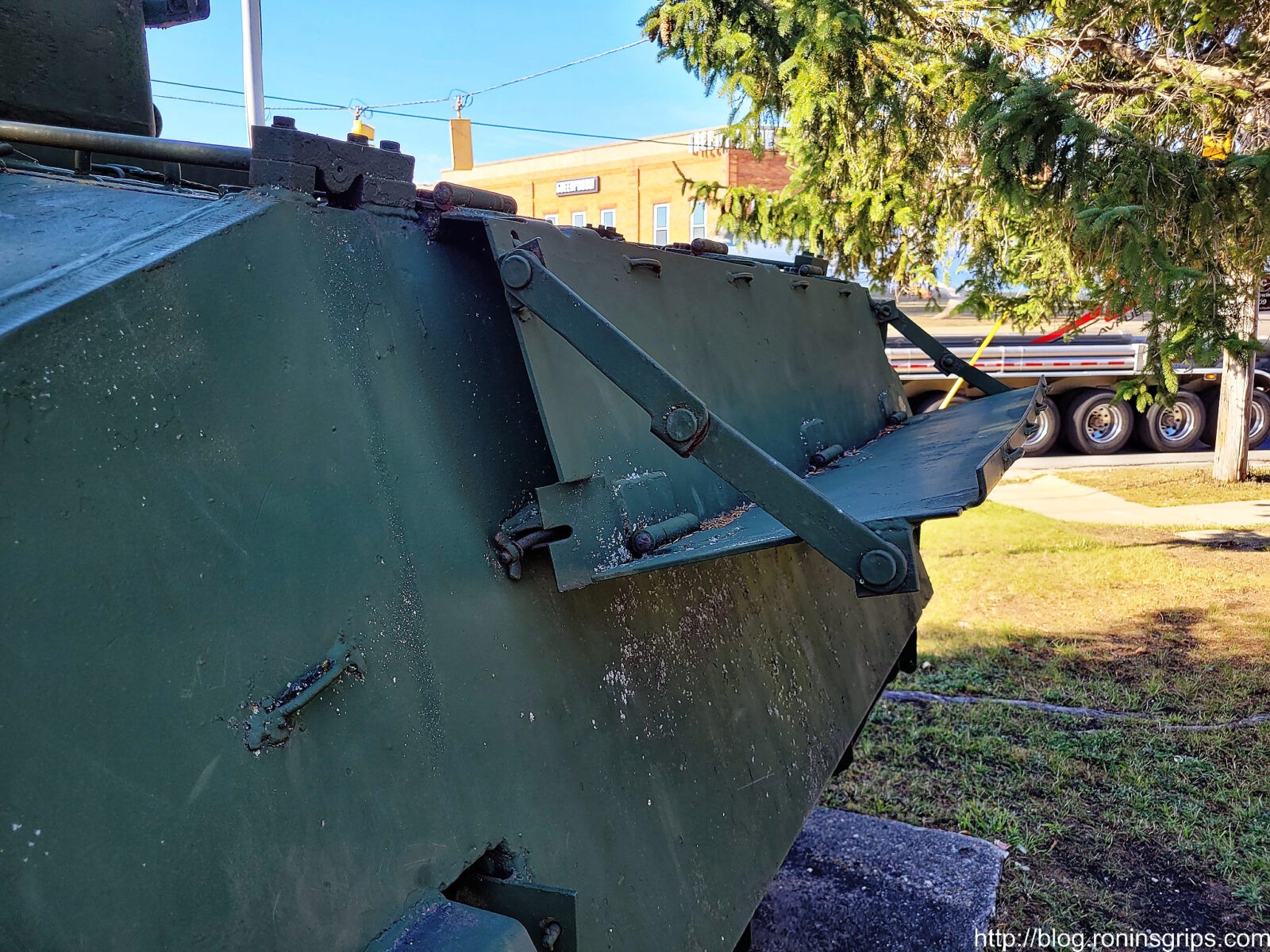
One of the things I noticed right away was that the rubber treads were in remarkably good shape. On some tanks they are worn down next to nothing. The folding blanket rack on the back is down.
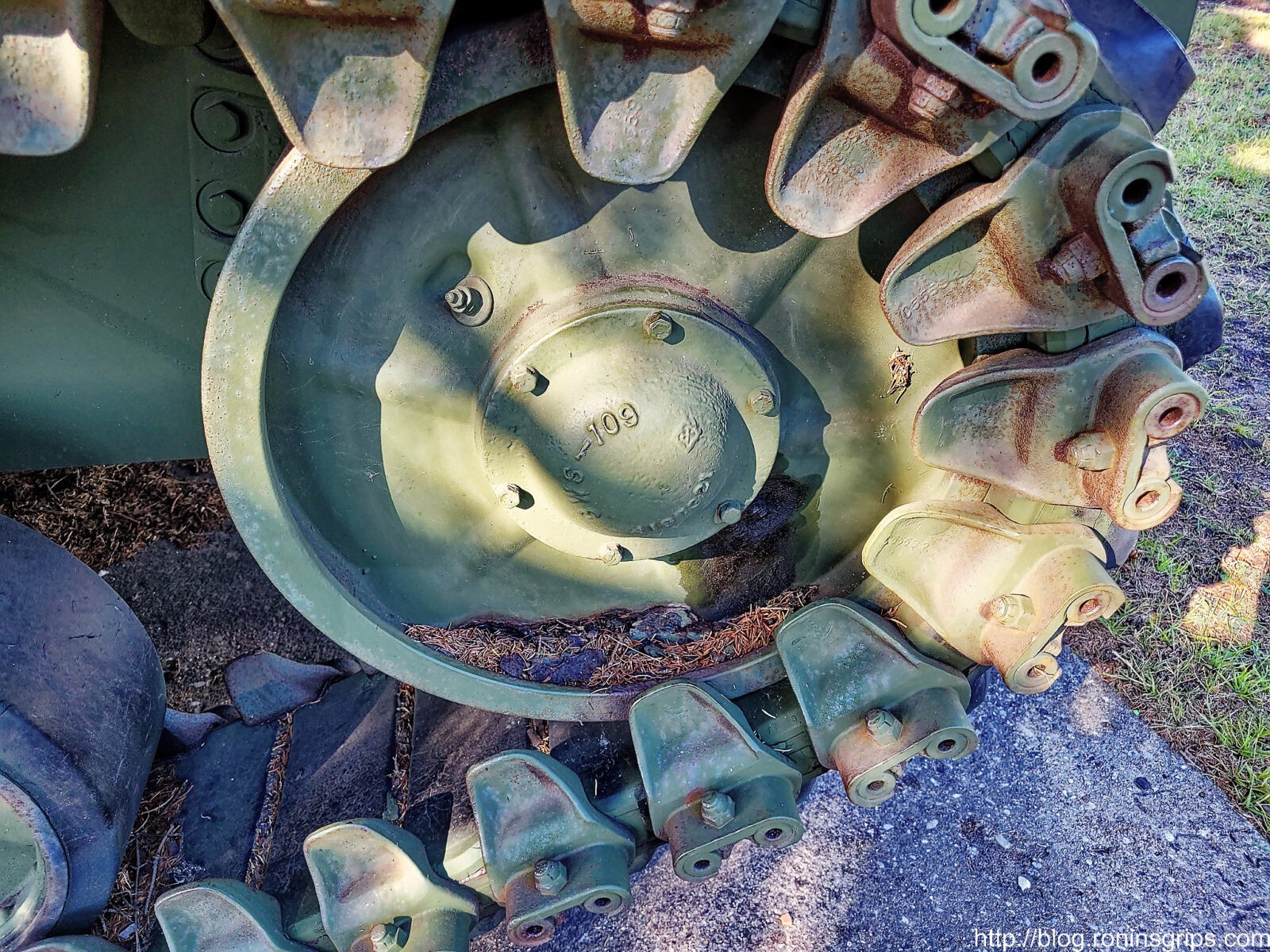
Close up of the rear left side idler wheel. You can see a grease fitting at the 10 o’clock position.
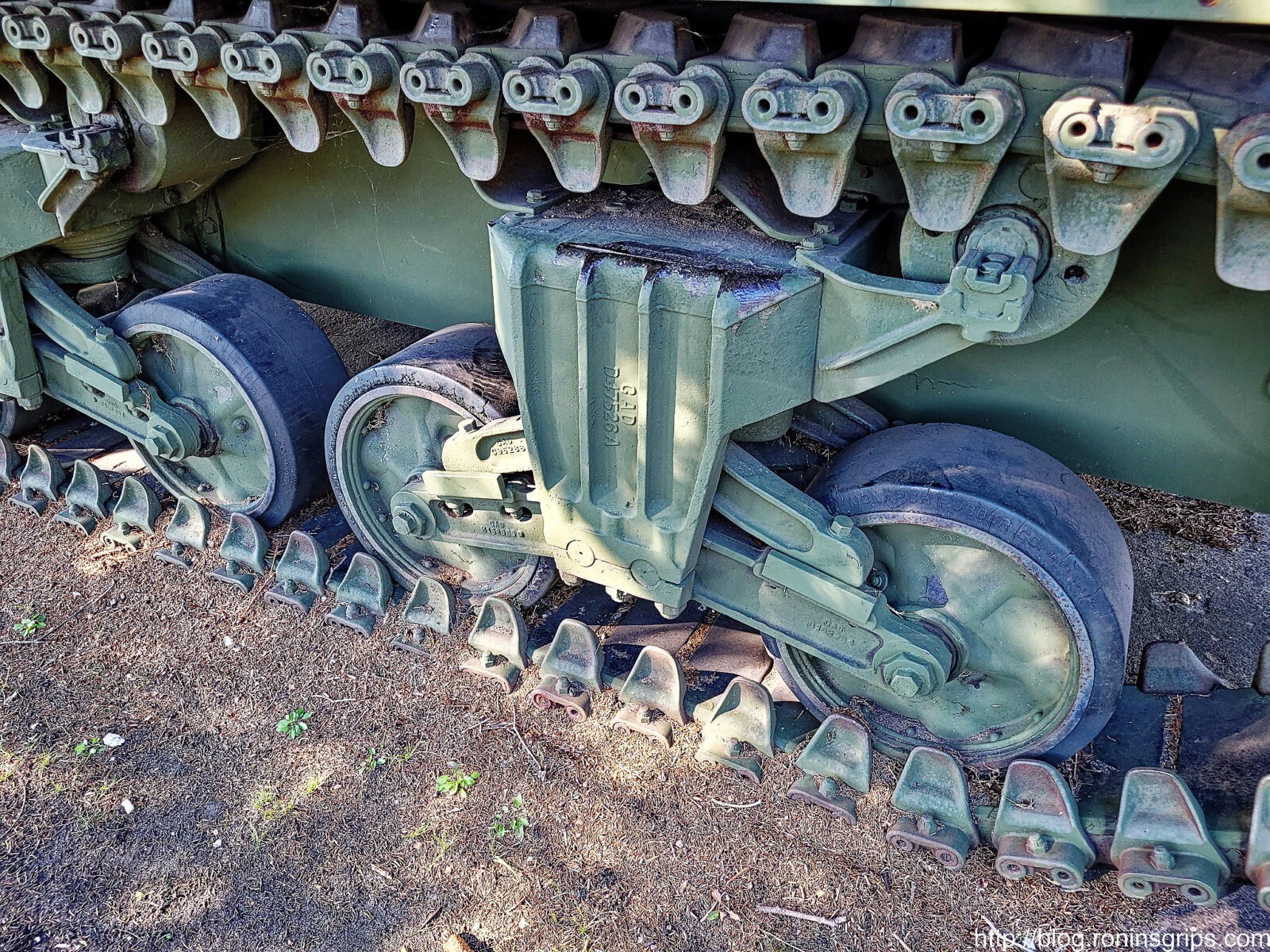
This is a photo of the rear bogie and two wheels. The Sherman M4A3 had three bogies on each side as part of its Vertical volute spring suspension (VVSS) with three bogies per side and two wheels per bogie. The bogie is the vertical part that the two wheels connect to.
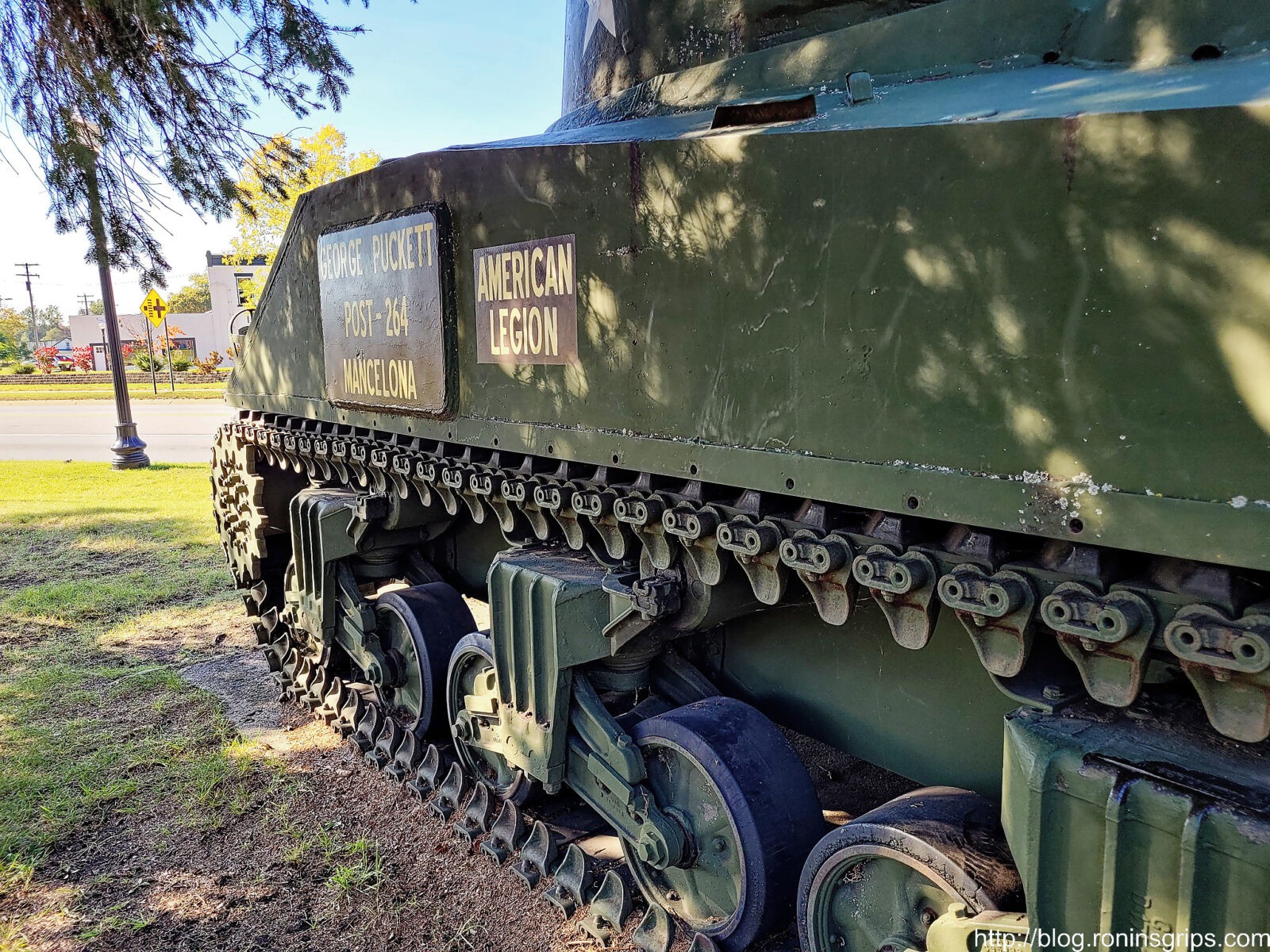
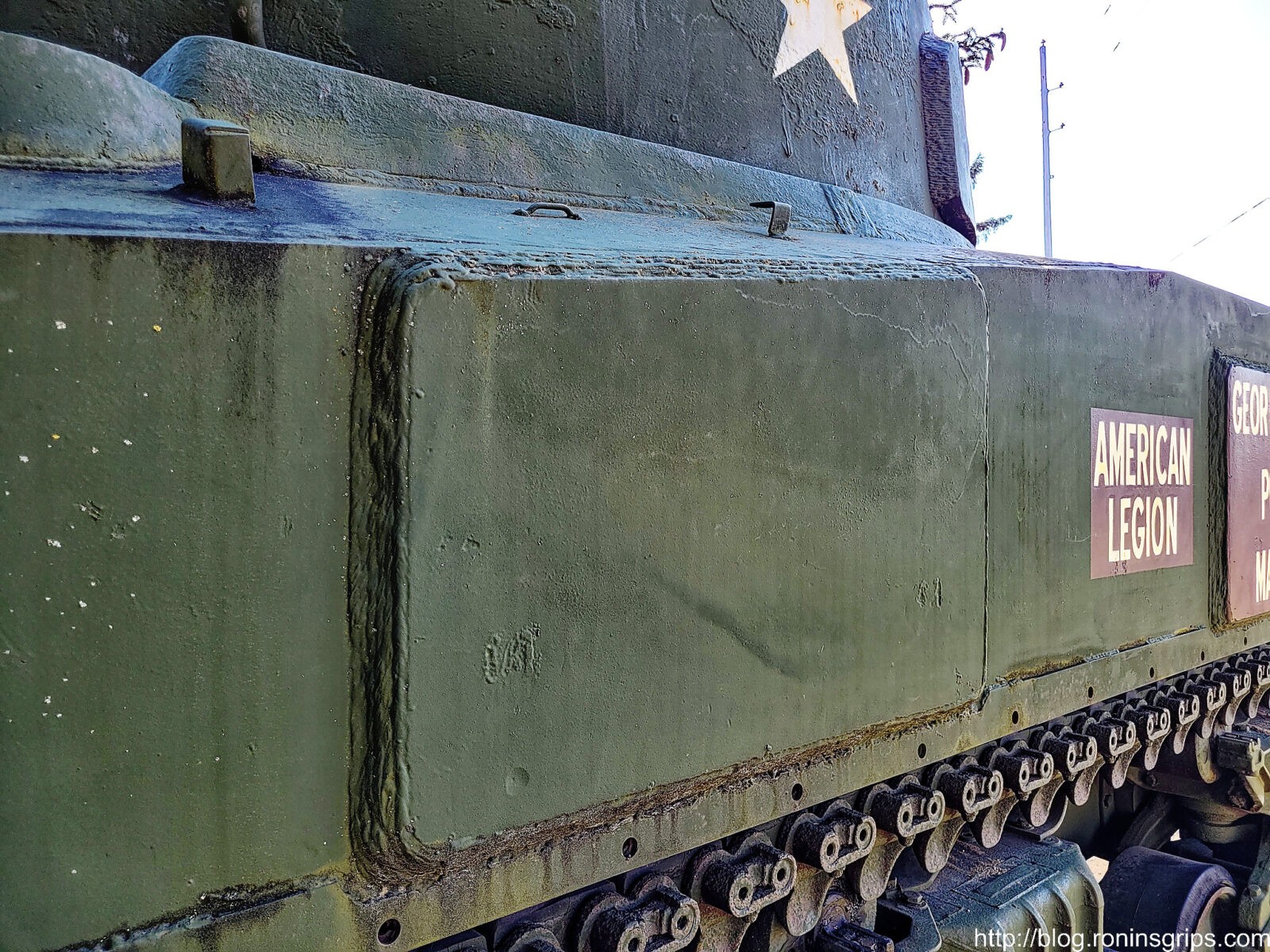
Just forward of the “American Legion” signage looks like a sign board with more text on it. That’s actually additional armor welded onto the hull.
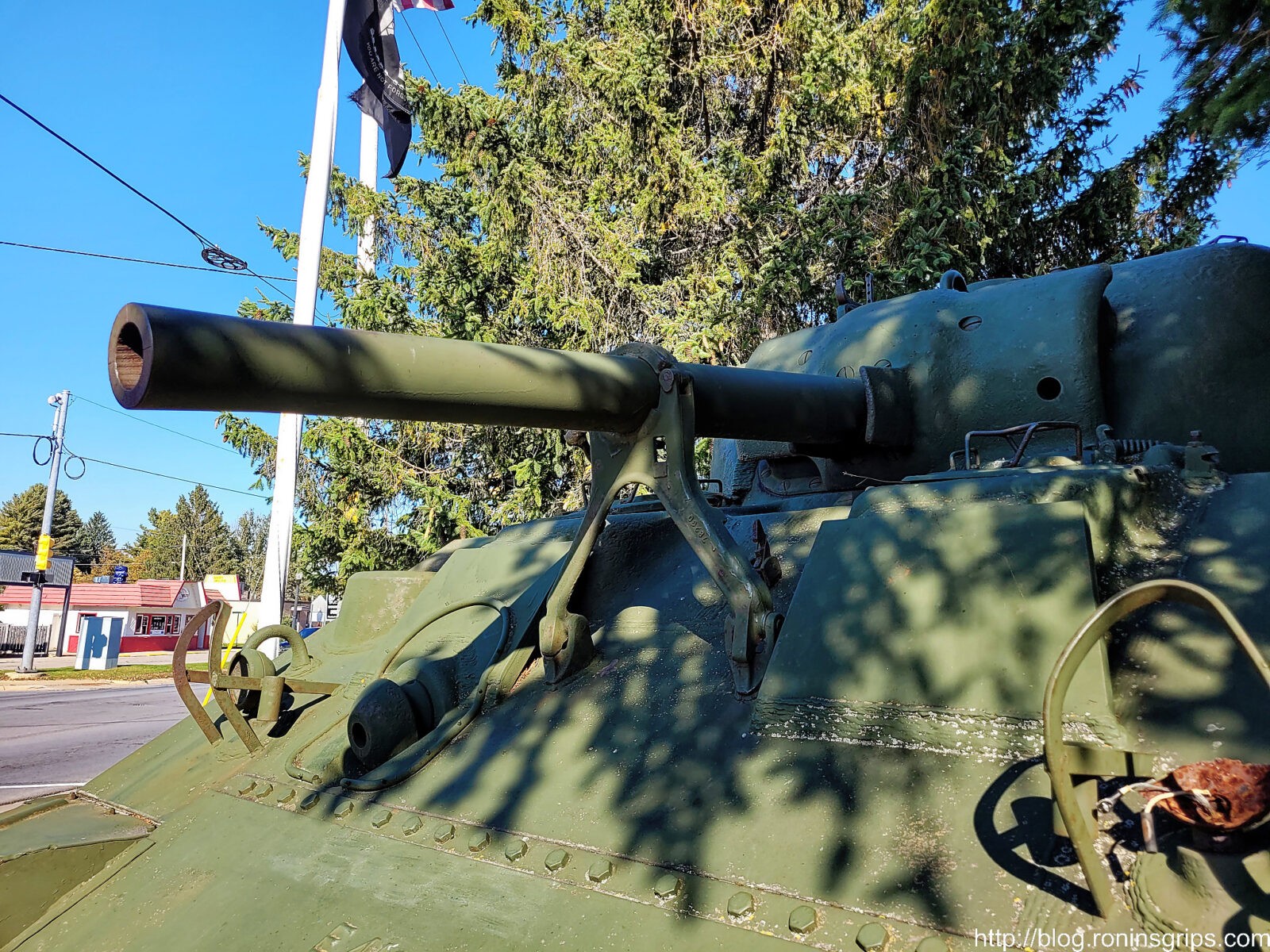
The hatch in the turret is a pistol port. You don’t see those on modern tanks 🙂 General Steel, who made the turret, stopped casting turrets with pistol ports in May of 1943 and any with them were welded shut.
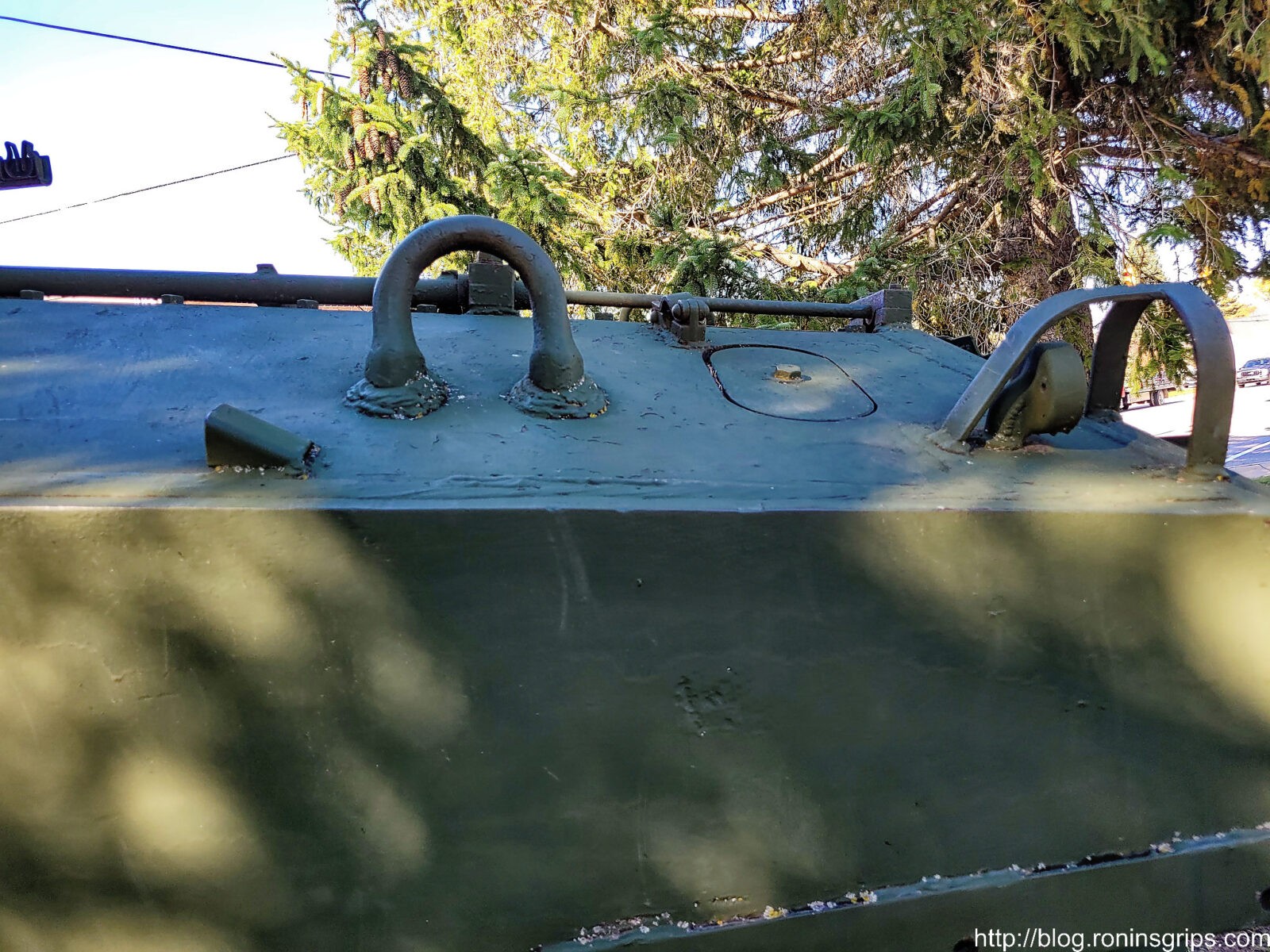
The big upside down U is a lifting eye. The hatch behind it is a cover to the grouser compartment.
This is for the blanket rolls and could have held cleaning rods, etc.
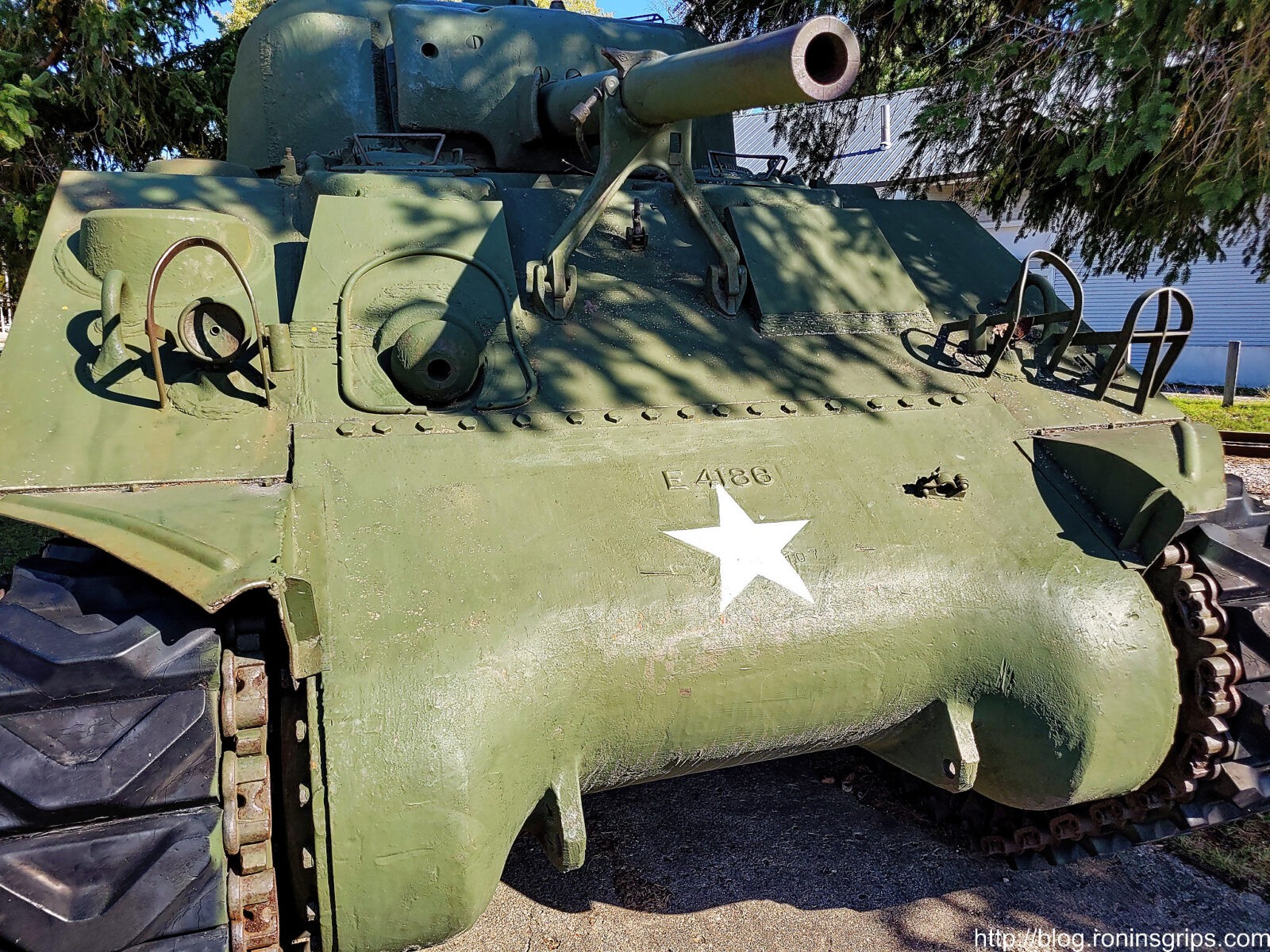
The sun and that pine tree were in just the wrong place at the wrong time so I have a ton of shadows but figured I would include the photo regardless. You can see the elaborate front sprocket.
You can see the rifling in the barrel of the 75mm cannon. 24 grooves with a 1:25.59 right hand twist. The coaxial .30 cal machine gun would have poked out of the hole to the right of the cannon. Note, the cannon is resting in it’s “travel lock”.
This shows the travel lock a little bit better. At some point – presumably during the B&R rebuild – it was upgraded to the post war single locking arm model. In WWII it would have had two “fingers” – one on each side of the barrel – that would curl around and hold it.
Looking at the front cast nose section of the tank,
7411 was cast and the -107 was stamped.
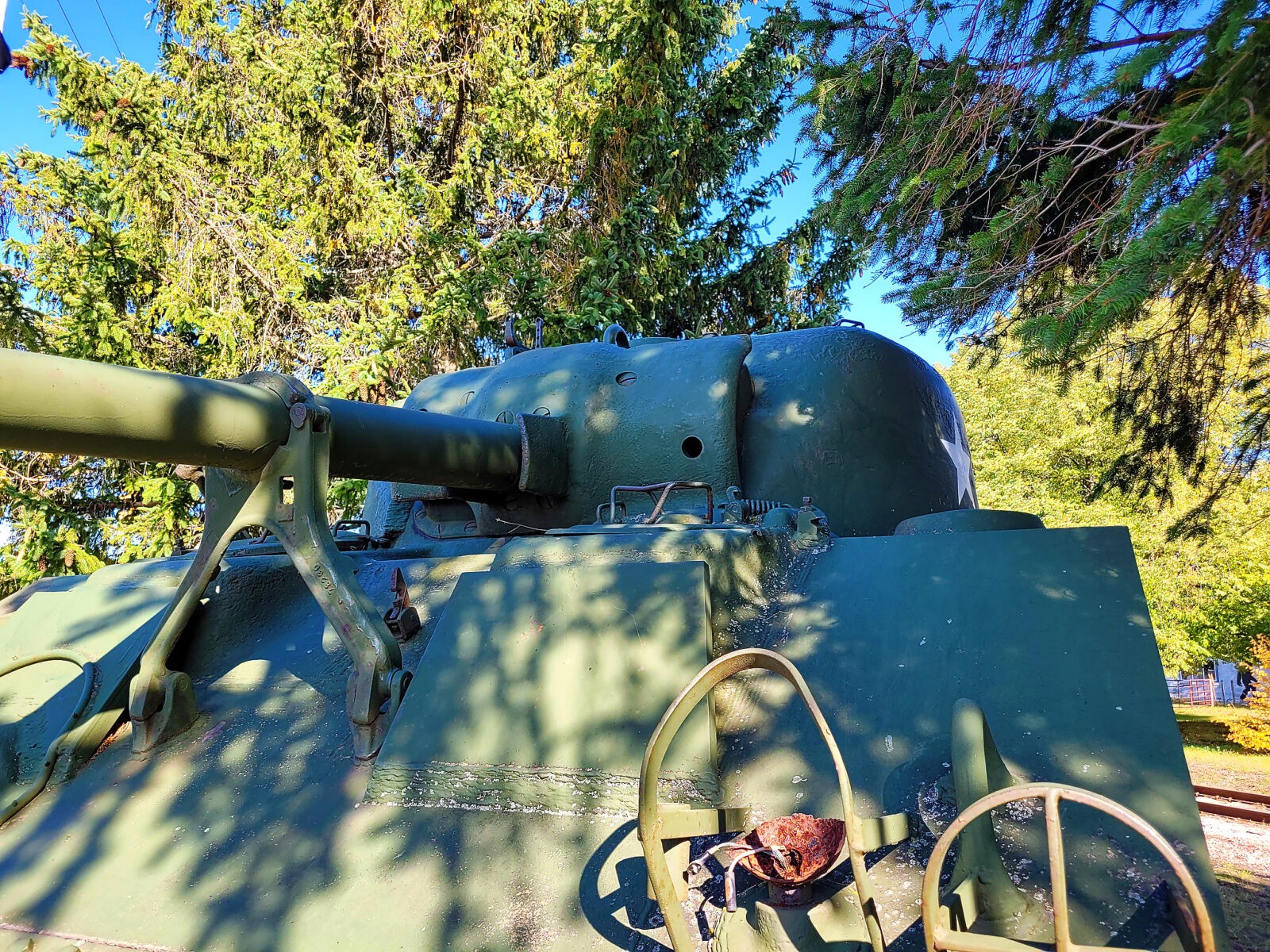
The protruding armor on the side of the turret and the sides of the hull is known as “applique armor”. It was welded in place to compensate for sections of the casting that needed to be thinner.
This is the best photo I have of the applique armor welded to the turret. The casting’s armor was thinned by 2″ internally to make room for the gunner’s controls. It’s actually two plates welded together and to the hull to compensate for the curvature of the turret.
This is the only partial close up I have of the Ford front sprocket. It’s really eye catching and unique. One of the websites mentioned that there were so many field repairs going on that it wasn’t surprising to find parts from one type of Sherman on another.
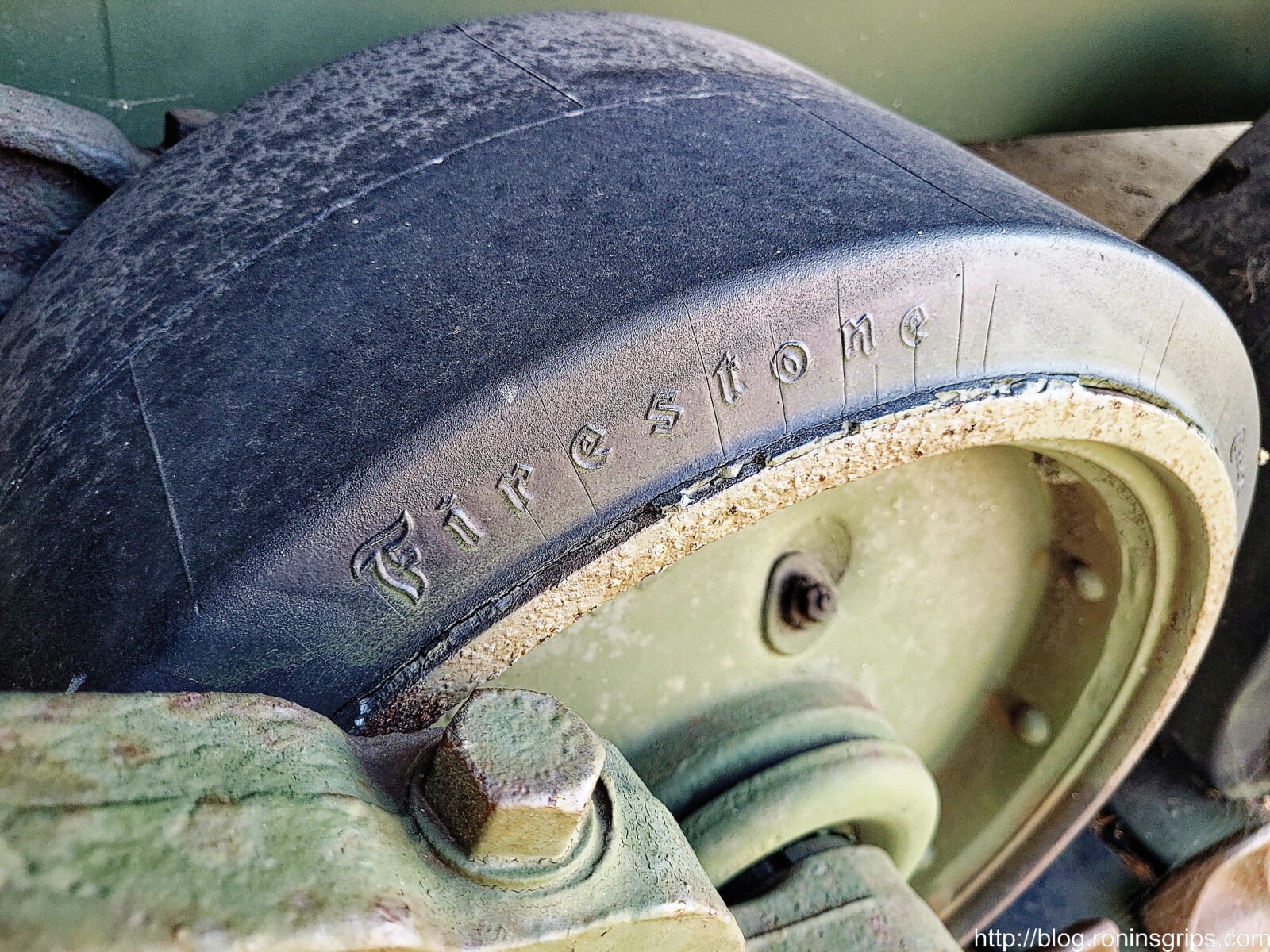
Firestone showing their brand! You can see a grease fitting as well. The lubrication guides to the Shermans are incredibly elaborate – there were many, many grease points as you can well imagine trying to keep the 30 ton tank mobile.
More applique armor.
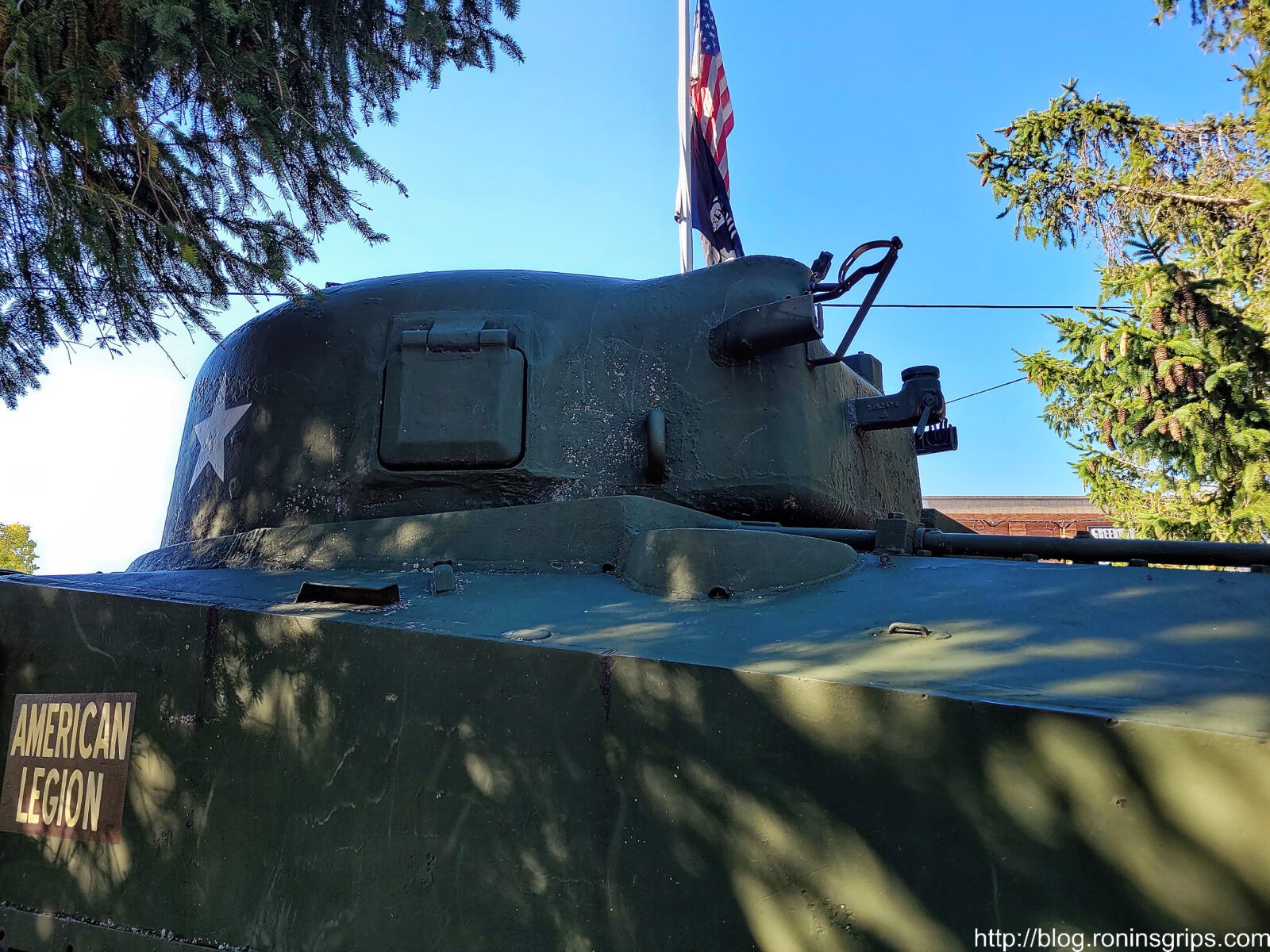
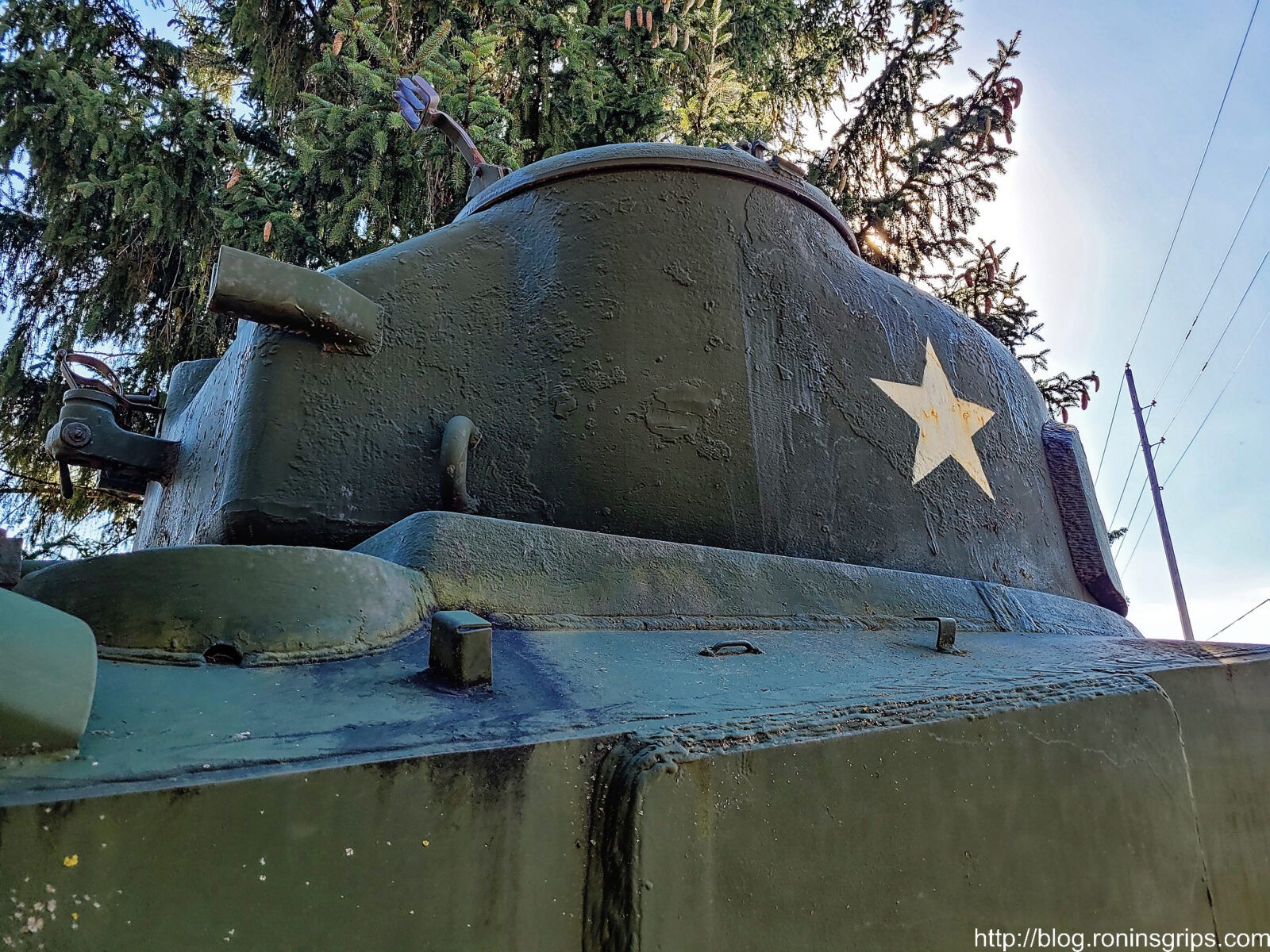
A view up at the turret.
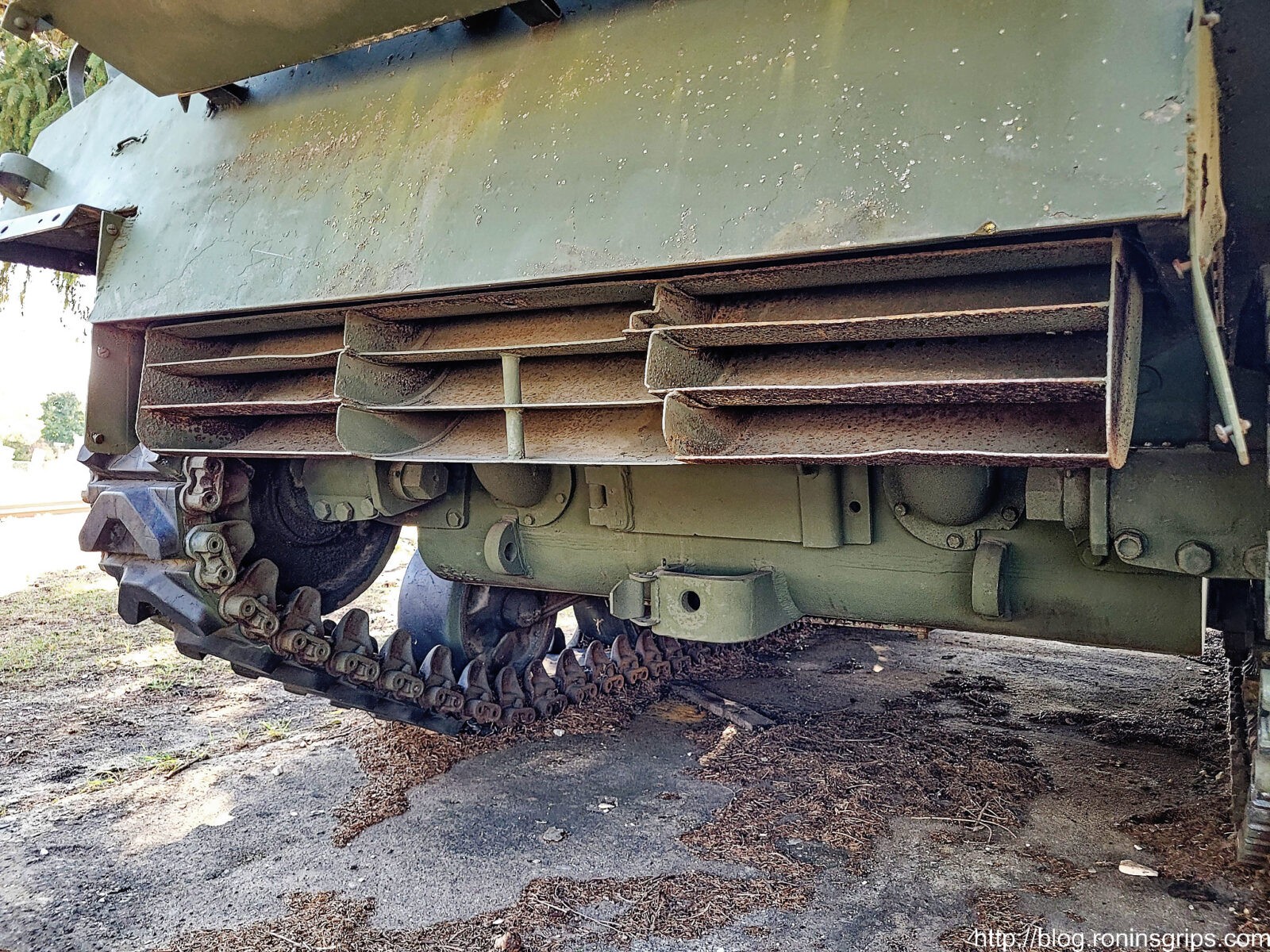
This is the exhaust deflector.
I turned around and snapped one more photo of the old tank guarding the road,
Videos of restored M4A3 Sherman tanks
When I see a piece of history, I always wonder what they looked like when they were actually running / in use. Fortunately, there are many videos of restored tanks that you can watch and here are two:
This one has some interesting coverage of the “top 10 variants” containing narration, stills and original footage:
For More Information
Folks, there is just so much history relating to the Sherman tanks that there is now way I can capture it. Below are links where you can find out a ton more:
First off, specific to the Mancelona tank, L&P Hannah took a ton of photos of it in 2014 and still have them posted online. The paint had not been refreshed at that point but what is cool is that the photographer took many photos from many angles – way more and better photos than mine. Click here to open a new tab to go to their page.
This page hosted in France has a lot of info on Ford M4A3 variants.
A gentleman named David D Jackson has assembled an amazing tribute page to the American Automobile Industry in WWII and he provides photos and a wealth of info – click here to open a tab.
This page contains a wealth of statistics on Shermans including things like armor thickness, depth of water fording, etc. It’s a treasure trove of info and you have to scroll down to the M4A3 section, Click here.
The above links reflect massive efforts by their curators to capture history before it is lost. I couldn’t have written this post without their shared works.
Summary
It was pretty neat to stop and see the tank I wish I had a ladder or something to get more angles plus I wish I took more photos but you get the general idea. I learned quite a bit while researching this post and only scratched the surface, which is why I listed all of the additional resources above.
If you are on US-131 going through Mancelona, it’s definitely worth the stop. Finally and perhaps most importantly, kudos to the members of American Legion Post 264 for keeping the tank in such good shape and sharing history with us.
I bought my 2021 Ram 2500 in September 2021. It was my first brand new truck and when I saw what the dealer was charging for oil changes, I knew there was no way I was going to have them work on my truck – I’ve always done my own work but because this may well be my one and only new truck, I knew I better do some homework.
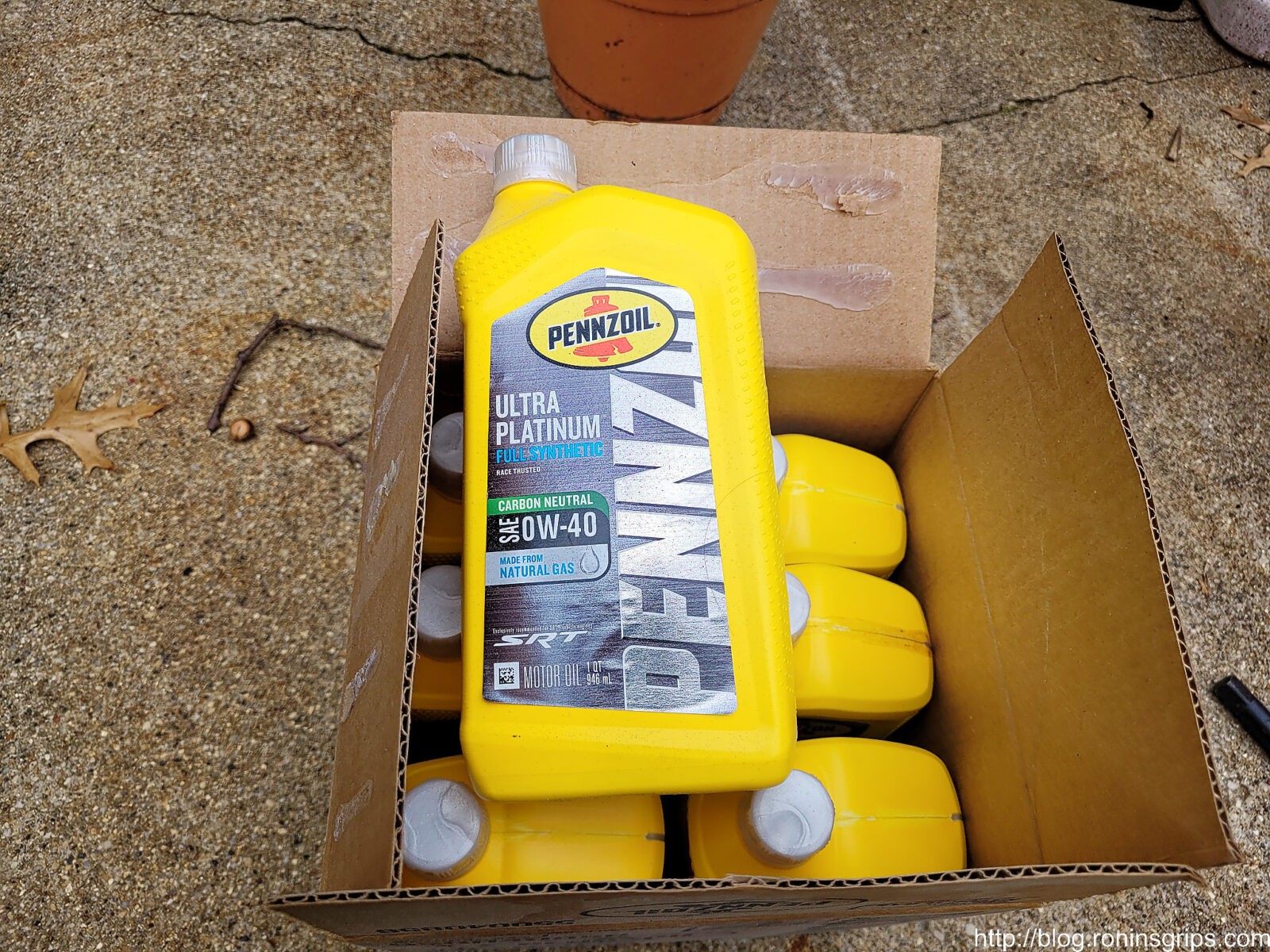
First off, I did not want to void my warranty. In talking with the dealership their recommendation was that I only use Dodge/Mopar brand oil filters and Pennzoil Platinum 0w40 engine oil plus I should keep a log of when I changed the oil, filter and with what. Okay I thought – I can do that.
This is a great example of where the Internet and the web can just drive you nuts. If you search about what oil and filter to use, you will get just a ton of search results with guys offering up their weird home brew concoctions, using different weights, brands, etc. That was all fine and dandy but I did not want to void my warranty or give a dealership some excuse to charge me because I didn’t use the approved oil.
Which filter does it use?
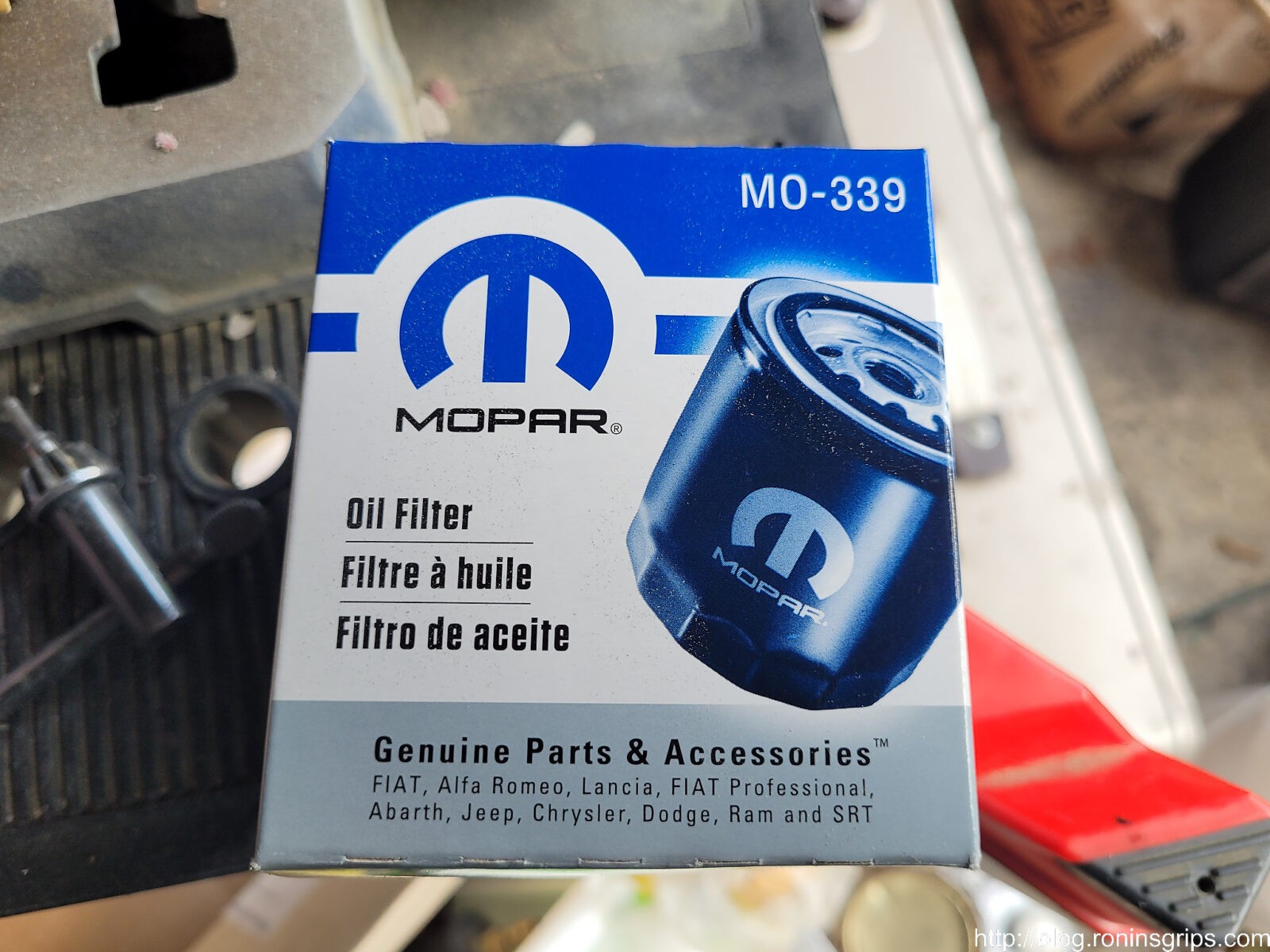
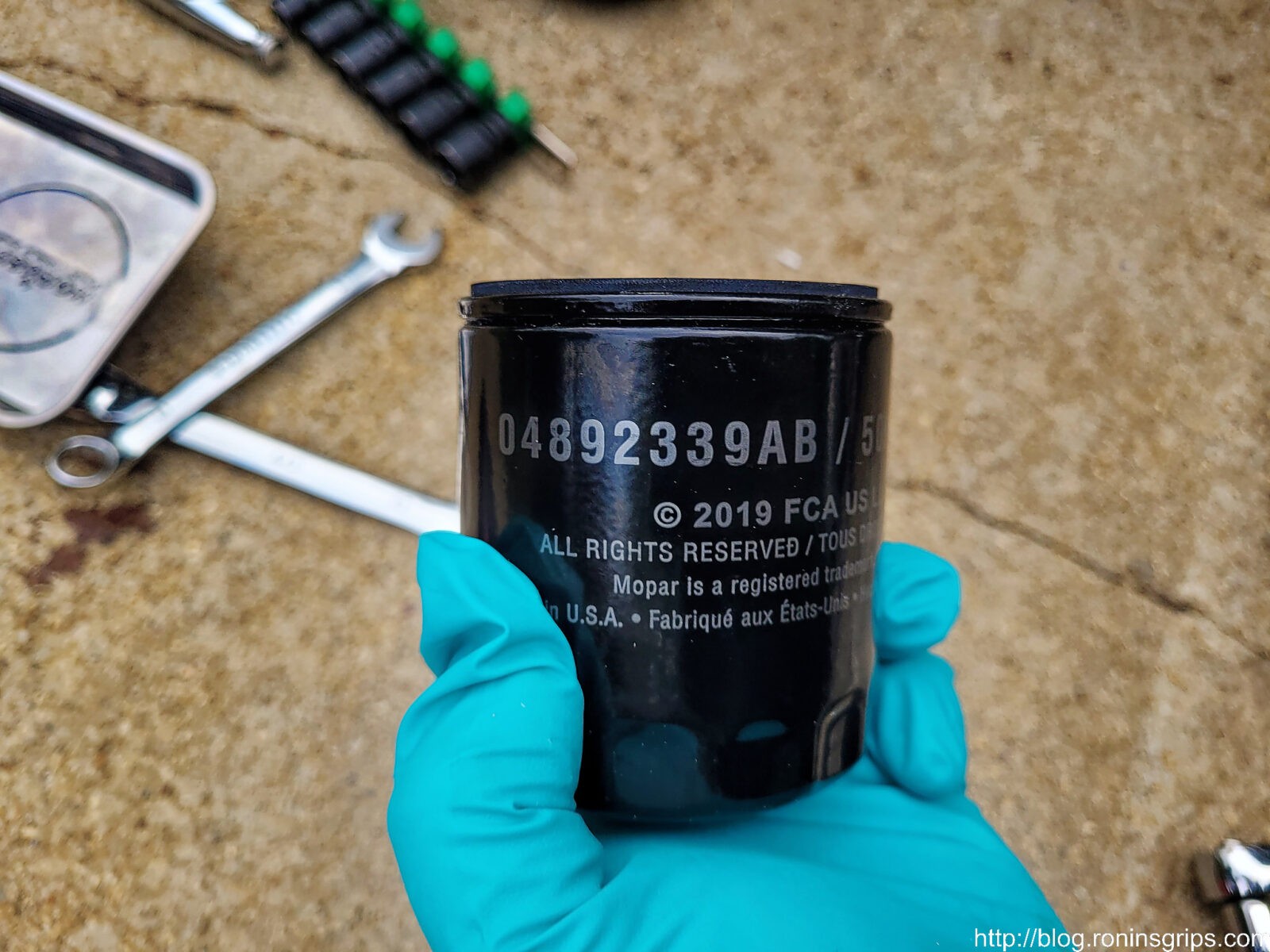
If you want to stick with factory parts to avoid warranty headaches, you need the Mopar MO-339 filter. I am using the 04892339AB but am told there is now an AC part number. Regardless of the letters, I would not be concerned if searching turned up an AA, AB or AC. The main thing is that the correct model is MO-339 and you can buy it from Amazon.
This is the correct model number – Mopar MO-339. Sure, there are other quality brands of filters out there such as Wix but my intent is to use Mopar filters until the warranty expires. Then I will move to Wix or whoever is best at that time.
FCA is Fiat Chrysler Automobiles. They are now owned by Stellantis – just FYI. The part number is 04892339AB. The last two letters reflect minor revisions to the base numeric part. For example, 04892339AA would have been a previous version of the part. Odds are it would work ok if you find it. I always go for the most current part number I can find because usually they are trying to improve/fix design issues. The AB series started in 2019. I saw an AA filter that was marked 2009-2011 and recently read there is an AC series but I have not seen it personally.
Where can you find the Pennzoil Ultra Platinum Full Synthetic 0W40 Oil?
You are going to need 7 quarts of oil if you change the filter and I always change the oil and the filter. I am used to walking into Autozone, O’Reilly’s or Walmart and buying oil. They do not carry this weird Pennzoil “Ultra Platinum Full Synthetic” 0W40 that Dodge was specifying. Apparently there were some office politics about switching to Pennzoil and to lock people into using Pennzoil plus being more likely to go to the dealership for oil changes they (I’m not entirely sure who “they” are but will blame both Dodge and Pennzoil) – they came up with this odd spec that really wasn’t required. Stuff like that irritates the hell out of me – they could have specified something else and made it easier for all of us.
My first oil change some time late last year was quite an experience. The oil filter had “factory installed” printed on it and boy, it did not want to come off. I wound up using a vise-grip type oil filter wrench to get a good enough hold to finally break the seal and spin it off.
I just did my second oil change getting ready for Winter and rotated the tires also [click here for a post about how to do that the easy way]. I figured I would take a minute and share with you where to buy the filter and oil from and hope this helps you out.
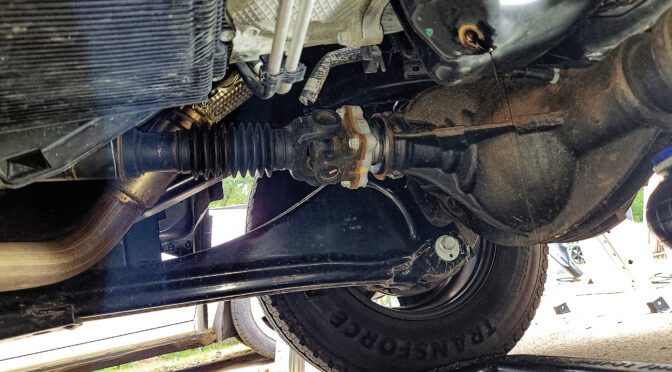
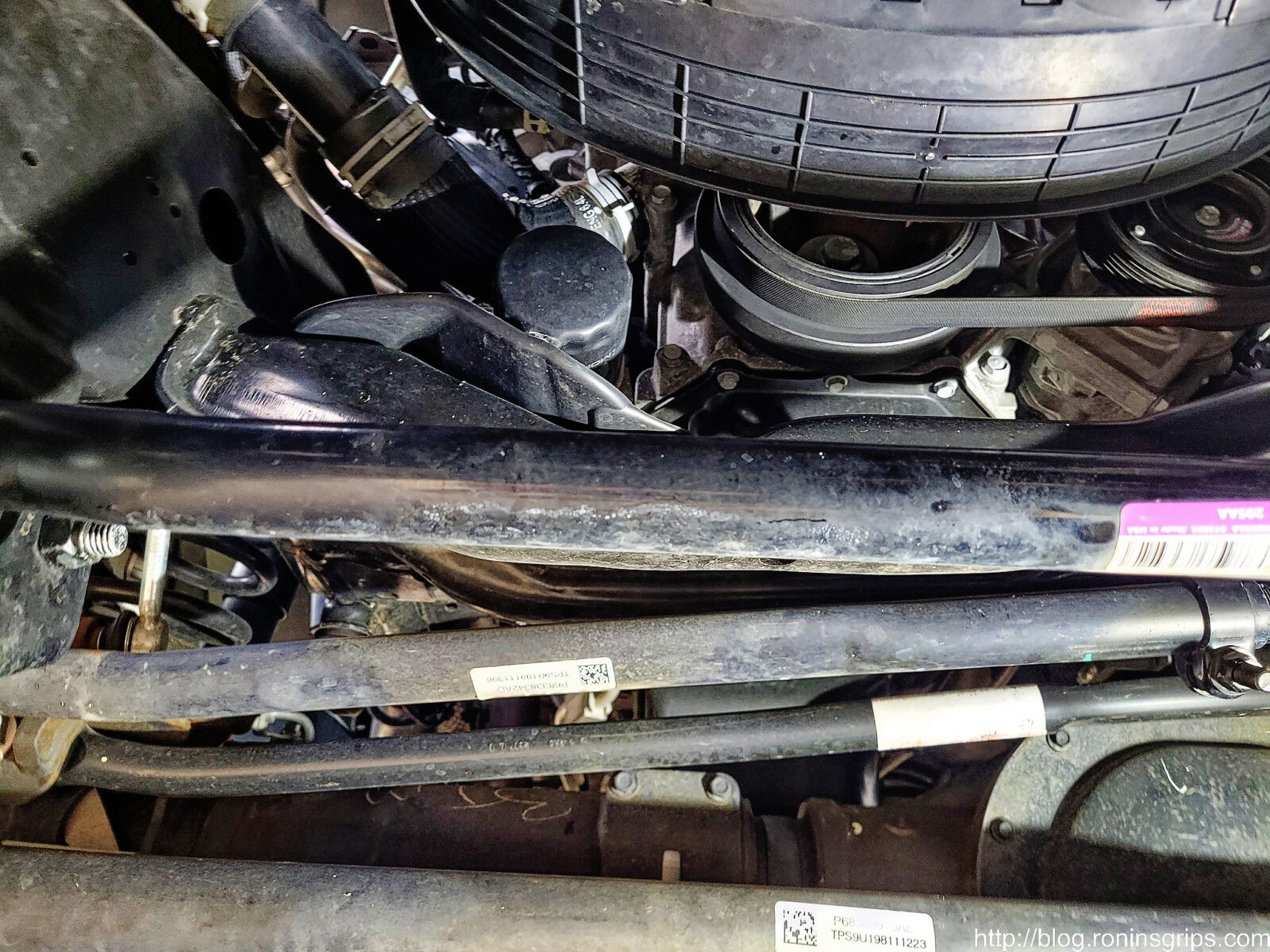
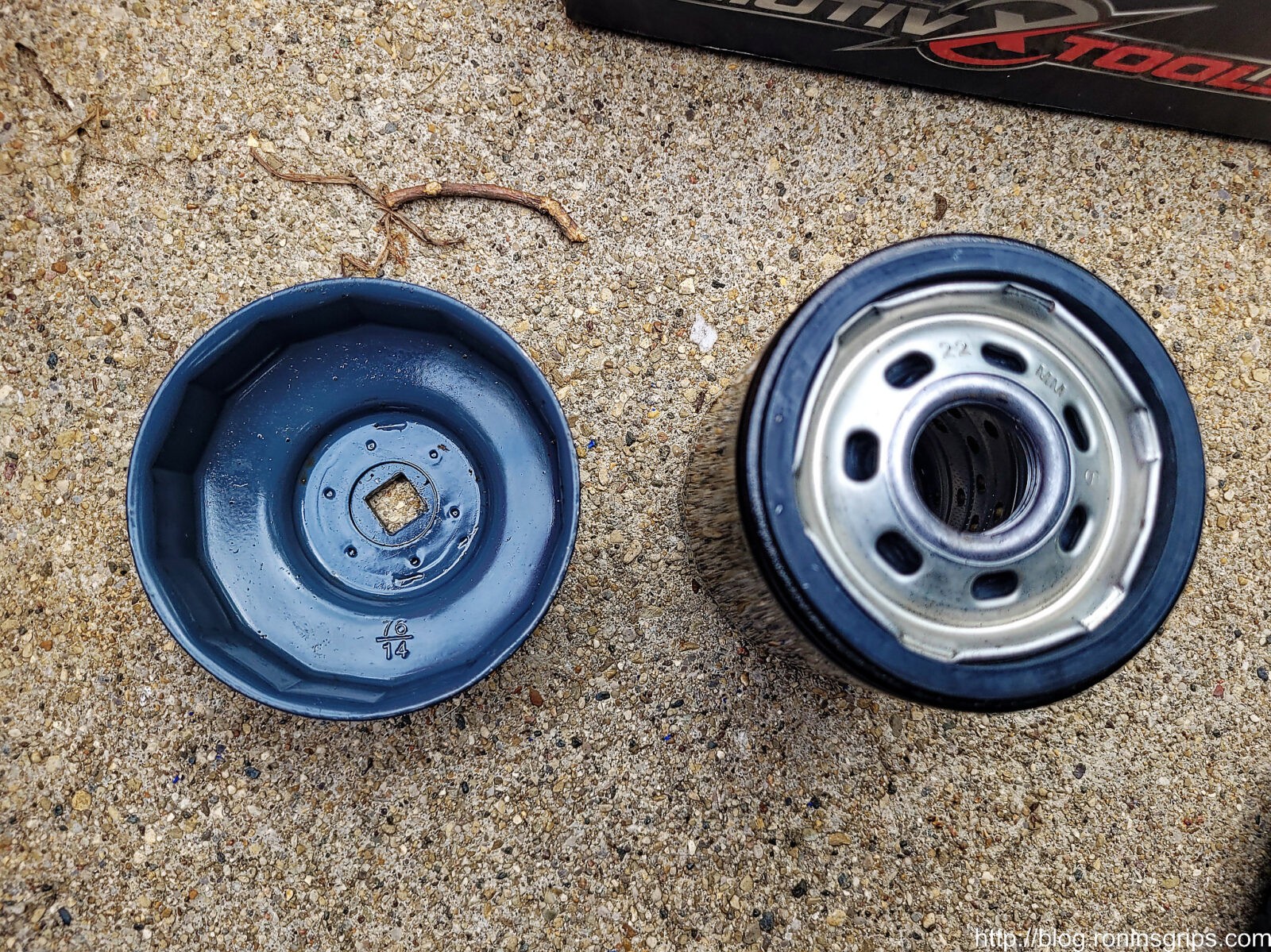
The filter is located just to the left of the bottom of the lower engine’s crank pully. An end cap filter wrench/socket makes changes really easy. For the first one, the factory installer went nuts either torquing it down or the seal stuck to the block – I’m not sure which it was but I had to really crank down with a locking oil filter wrench to get it off.
By the way, the torque spec for the oil drain plug is 20 foot pounds. Now I know some guys just feel how tight to go by hand and I did that for over 30 years but now do to nerve and muscle damage, I can’t tell how tight I am pulling so I torque to spec – totally up to you.
Note, I have to buy all of my parts – nothing here was paid for by sponsors, etc. I do make a small amount if you click on an ad and buy something but that is it. You’re getting my real opinion on stuff.
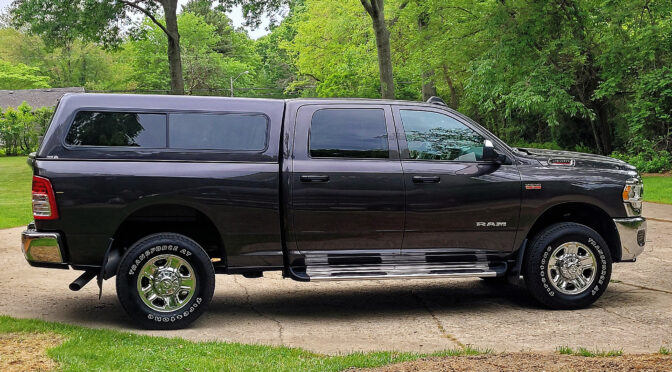
I bought a new 2021 Ram 2500 in September of 2021. It was my first heavy gasser with a 6.4L Hemi and a piece of advice a lot of guys gave me was to make sure I rotated the tires with every oil change. It sounded reasonable – it’s heavy truck and the tires need to be rotated so they will wear evenly. If you don’t do this your handling may suffer such as picking up a wobble or you may wear the tires such that they must be replaced prematurely. Ok, I was totally on board with concept but then started thinking about how heavy they probably were – I sure knew they weren’t going to be light.
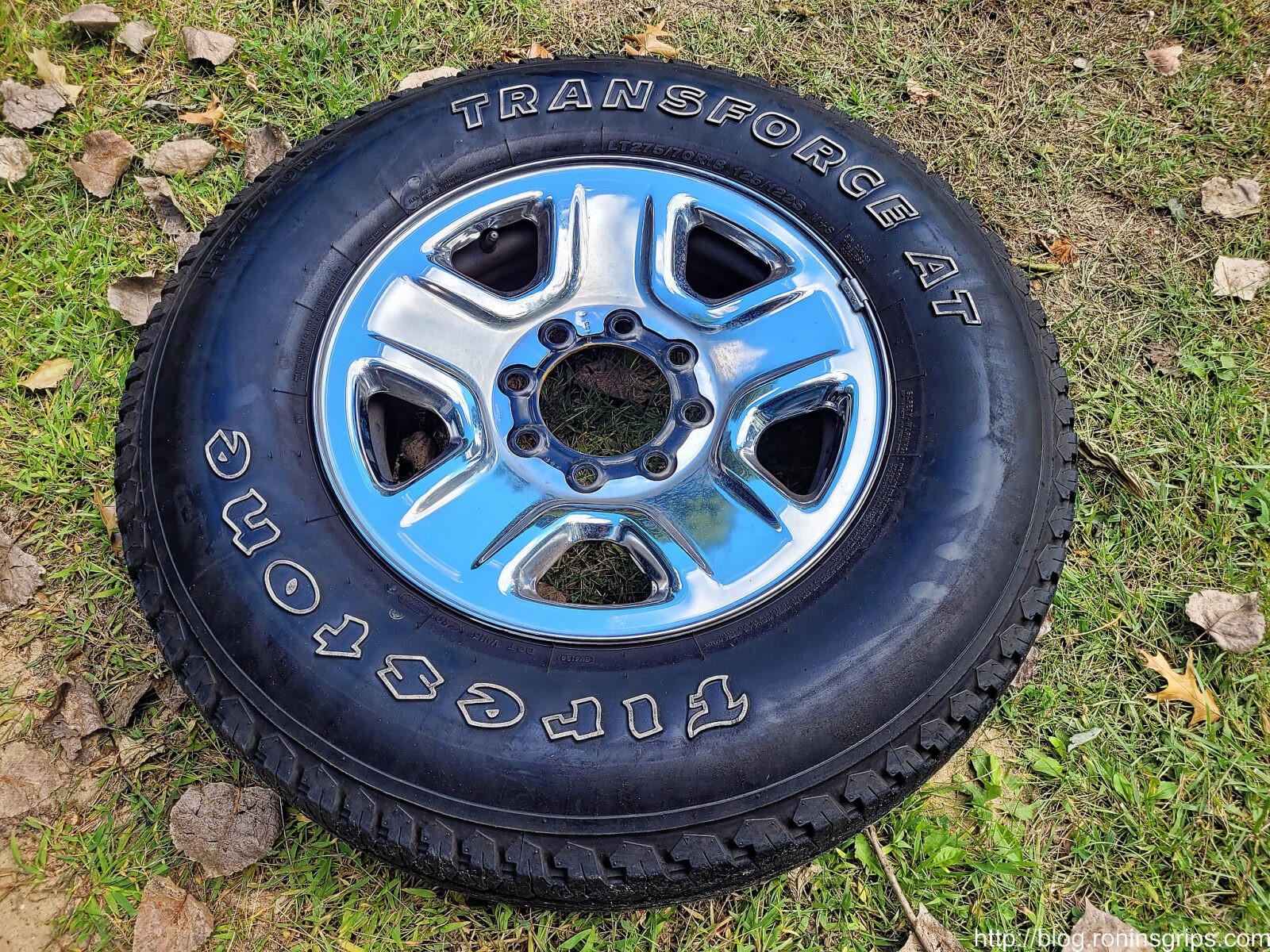
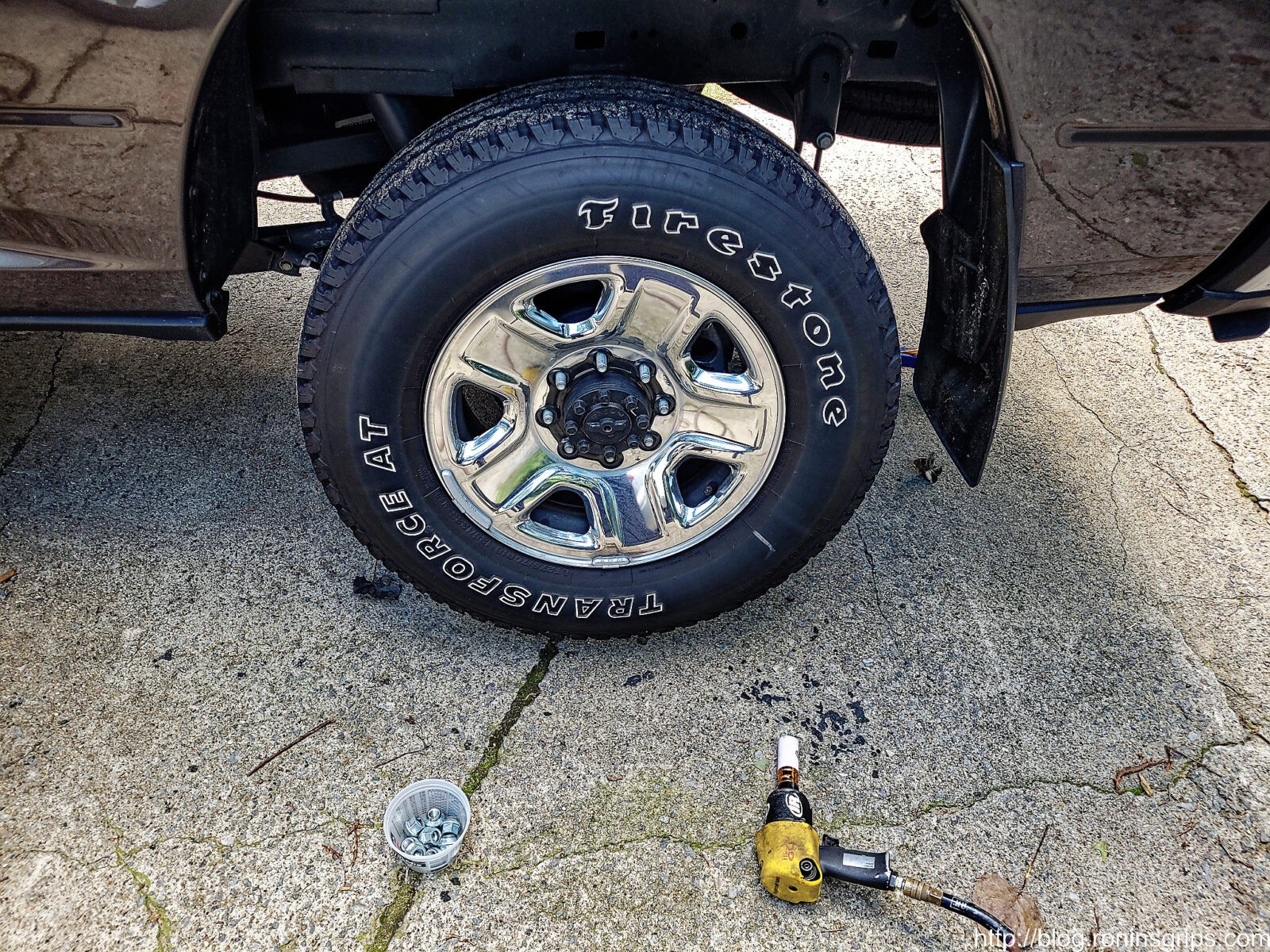
Factoid: FCA (Fiat Chrysler Automotive – who owns Dodge now – and FCA is now part of Stellantis – for those keeping track of who owns who) reports the LT275/70R18E Firestone Transforce AT tires as weighing 50.7 pounds. The 16×8 steel chrome clad wheel comes in at 45.2 pounds. Add them together and you get 95.9 pounds not including any wheel weights, TPMS, etc. So you might as well say that each weighs 96 pounds. Yeah, that’s quite a bit for me.
Weighing in close to 96 pounds, these tires are too heavy for me easily lift and hold in place when it comes time to mount them on the lugs. For you younger guys who muscle them around all day, good for you. I can’t any longer.
From years of doing stupid stuff, my back and hands are nowhere near as strong at 55 as they were in my 20s and 30s. I’ve always done my own oil changes, tire rotations repairs in general and didn’t plan to stop and pay the ridiculous prices the dealer was quoting. I knew it would be a heck of a struggle for me to lift the tires up and hold them in place while getting the first couple of lug nuts on to hold it. I needed to figure out a way I could lift the 33″ 96 pound tires up into place using mechanical advantage.
So I started by searching on the web for tire/wheel lifts and most of what turned up had to do with moving truck tires across a shop on a dolly. I wasn’t finding anything that said “use this to lift your tires up and down at the vehicle.” My next stop was the local Harbor Freight store to look at various automotive tools and jacks to get ideas. It was there that I got an idea.
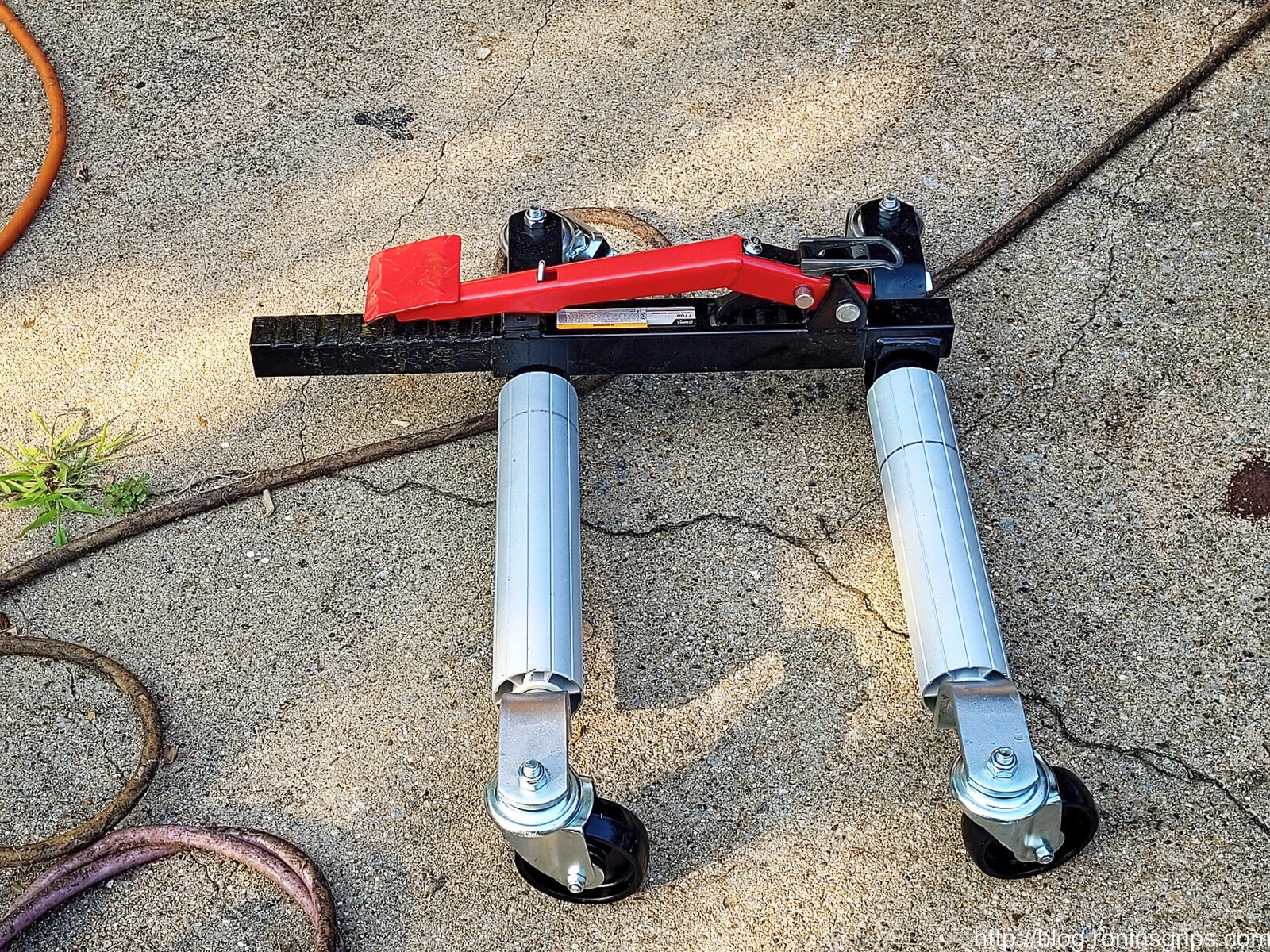
There are ratcheting vehicle dollies for garages where there is one dolly for each wheel. You pump a foot pedal and a pawl engages a notch and pushes two cylinders together under the tire. As it does this, the tire and vehicle are lifted up. You do this on all four corners. The dollies have caster wheels under them and if you have a clean concrete floor, you can then slide the vehicle all over the place to either store or work on it. One early trade name was “Gojak” and since then tons and tons of companies have made them.
Hmmm…. I could take one of those and use it to lift the tire into position and hold it as long as I could lift the tire high enough. These jacks are rated at over a 1,000 pounds and my truck’s tires were going to be far, far less than that. No, it was the height that concerned me because I needee to lift the truck high enough to remove the tires in the first place.
I didn’t particularly care for the looks of the Harbor Freight model so I did some digging and found a Sunex unit on Amazon that works in a purely mechanical manner – some hydraulic models from other brands are reported to leak.
It arrived and took just a few minutes to install the caster wheels. I did make one mistake, I was curious if it could lift one corner of the truck – the answer is a resounding “NO” and I did bend the outriggers that hold the casters slightly. I really didn’t expect it to bend but it also didn’t really hurt the unit from an intended use perspective.
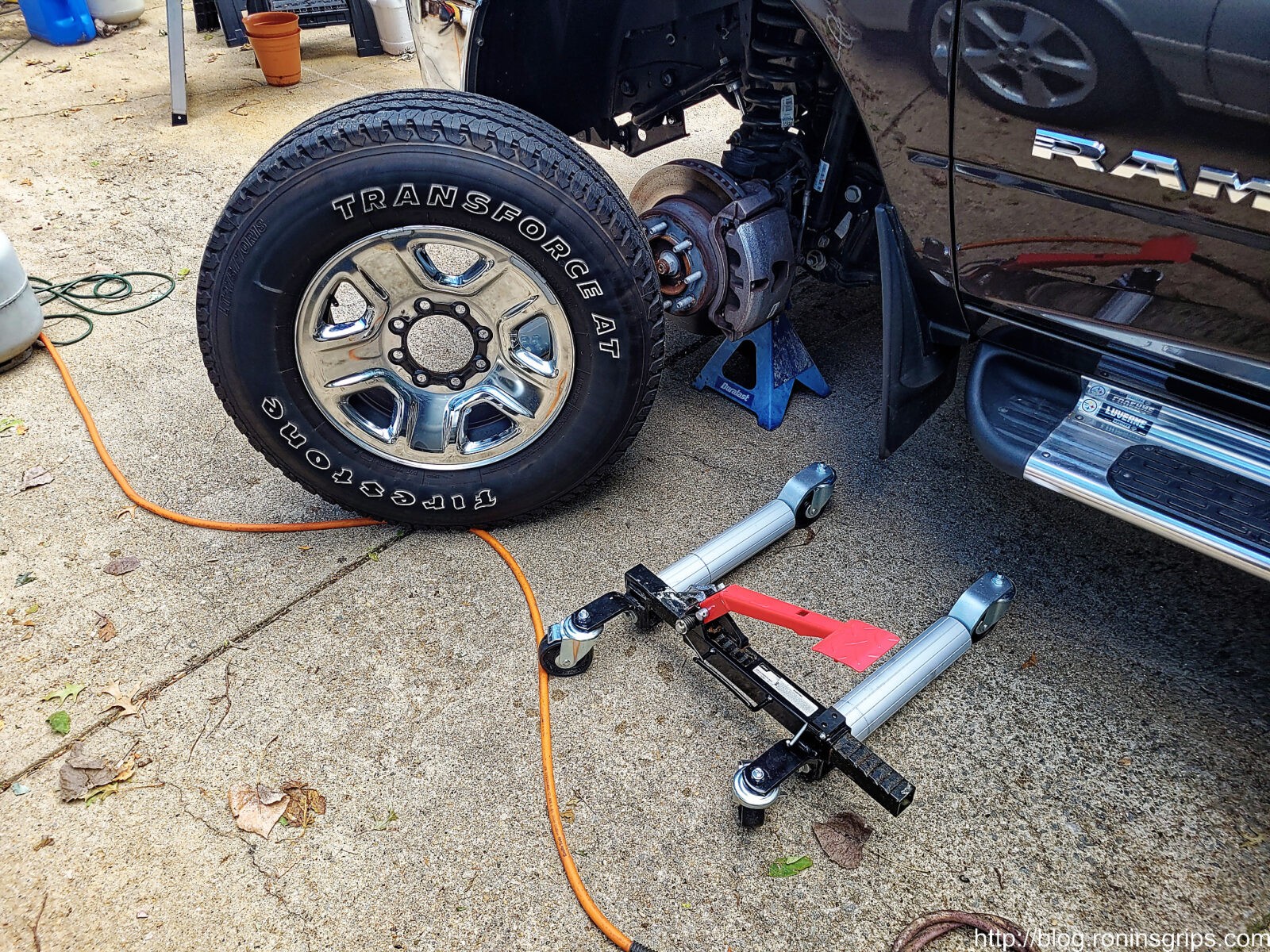
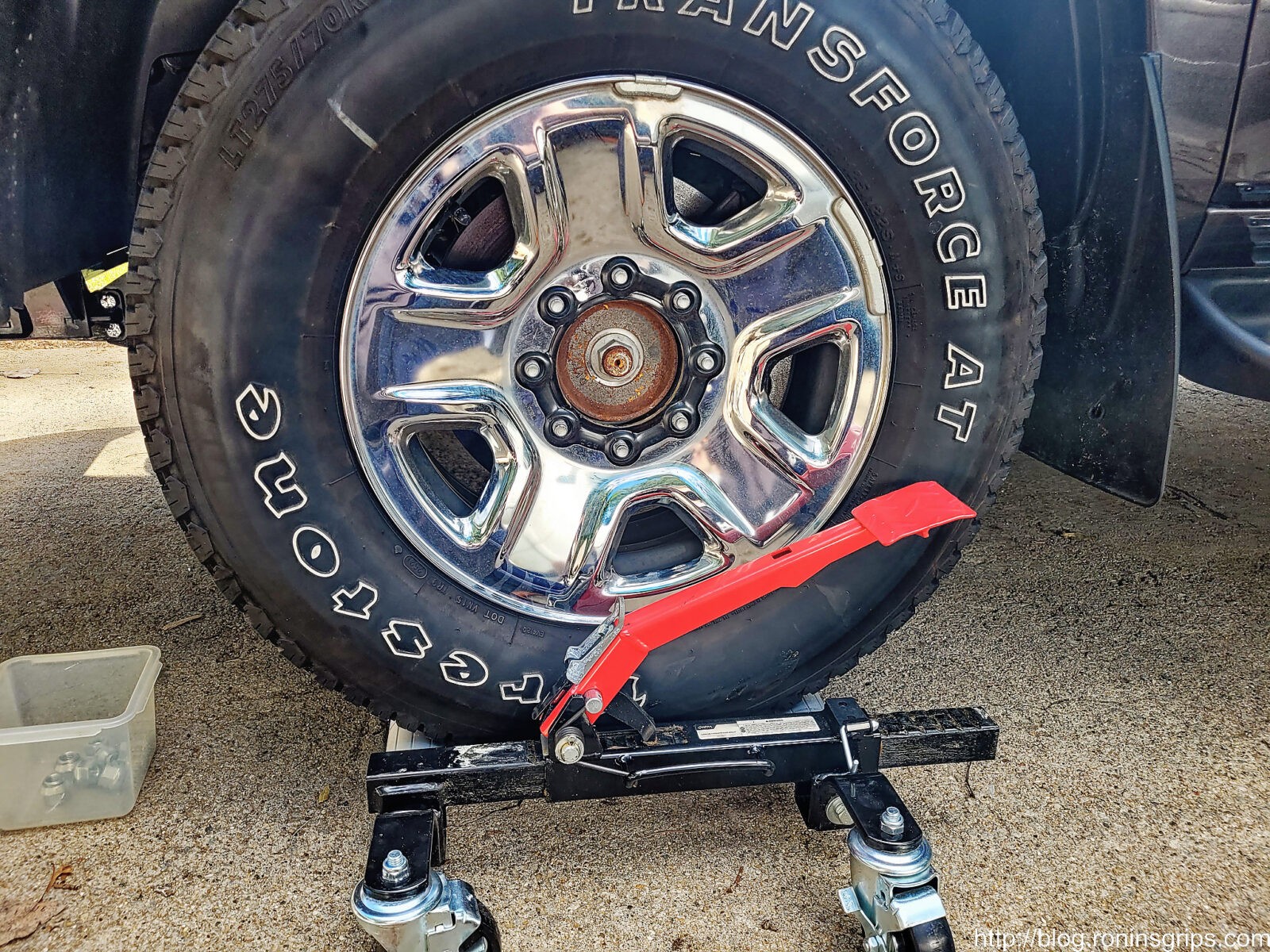
This is a Sunex model 7708 1,500 pound car dolly. I’m not really sure it can handle 1,500 pounds but it works great for lifting tires into place.
Most importantly, it worked perfect. I would roll the tire over to my truck, slide the jack in by the edges of the tire and then pump the foot lever until it was the right height. I could then install the lug nuts in an amazingly easy manner. It worked so well I did it both on my Ram 2500 and on our Highlander.
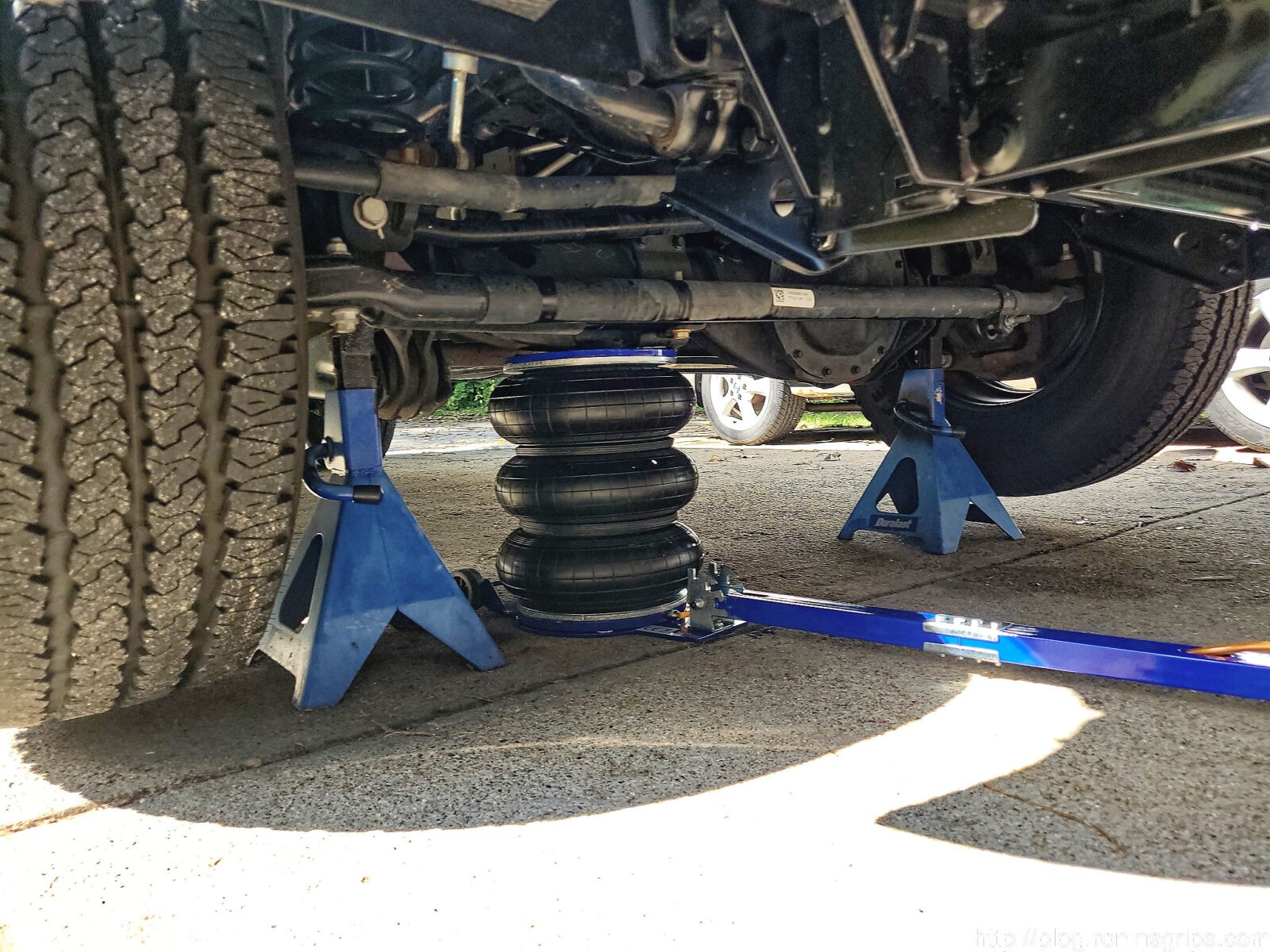
I used my Vevor 11,000 pound pneumatic jack to lift up the truck a side at a time and put 6 ton jack stands under each side of the axle. Never trust any jack to hold up a vehicle while you are working on it – especially not a heavy truck. By the way, I really like the Vevor air jack.
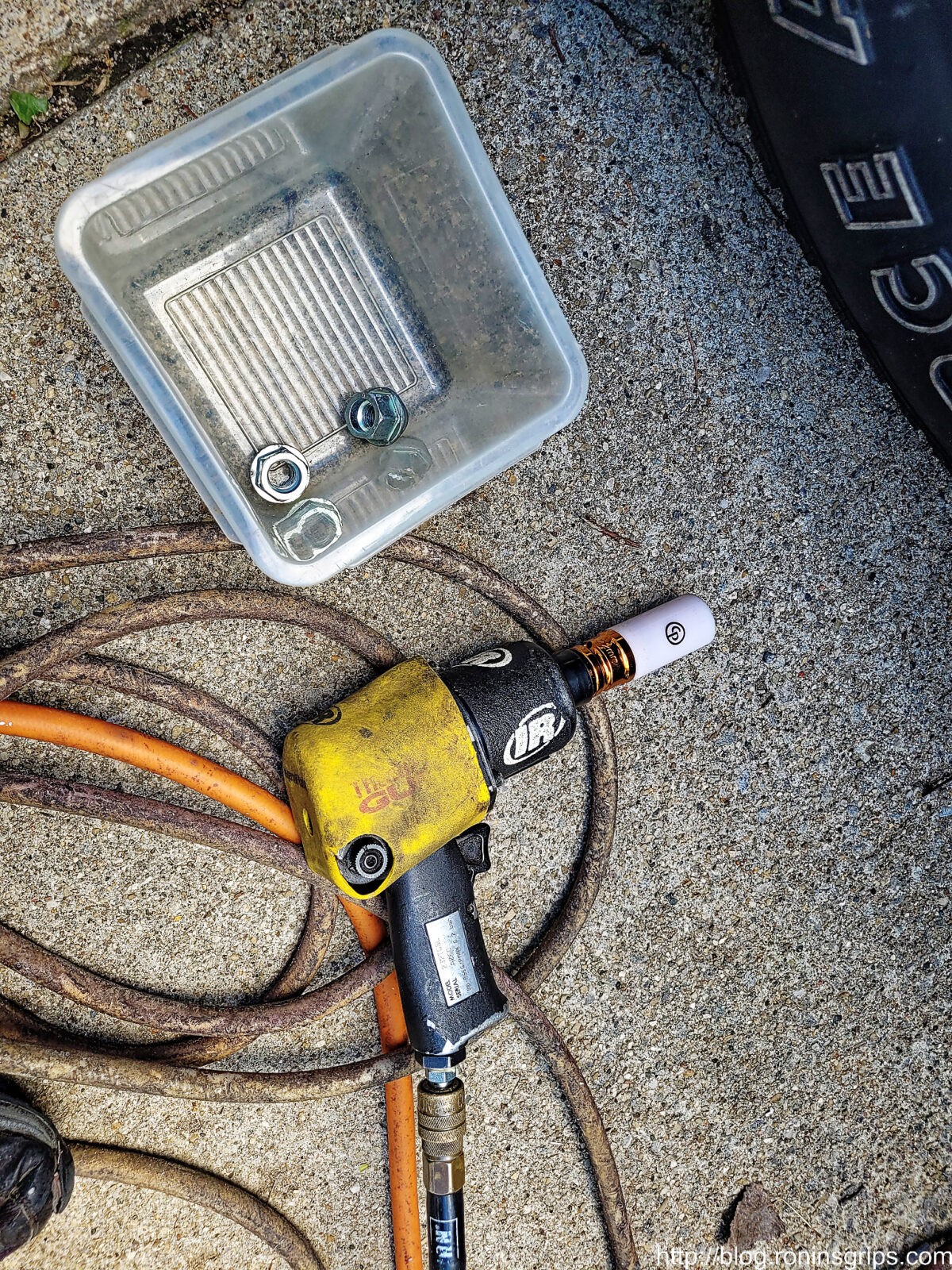
Pulling the tires off is easy – gravity is working with you. I use an IR 232TGSL Thunder Gun impact wrench that has held up remarkably well over the years- I bought it after wearing out a couple of cheap ones. I also use a Chicago Pneumatic (CP) SS4211 lug nut socket set to avoid damaging the rims. The sockets have a plastic protective sheath around them and are thin walled for tight areas.
The 2500’s lugs are 14mm and the lug nuts need a 22mm socket. What I like about the CP set is that they are color coded. This copper colored socket is 22mm and I can find it fast due to the coloring. Note, CP stands behind their products. I bought the set in 2018 and shortly after, one plastic jacket started cracking. I called customer service and they mailed me a free replacement. I’ve not had any problems since. Again, let me plug the Thunder Gun. I want to say I wore out two or three cheap impact wrenches before this one. They claim 625 ft lbs max torque in reverse and 550 ft lbs in forward. I can tell you I have busted loose some really rusted nuts with this.
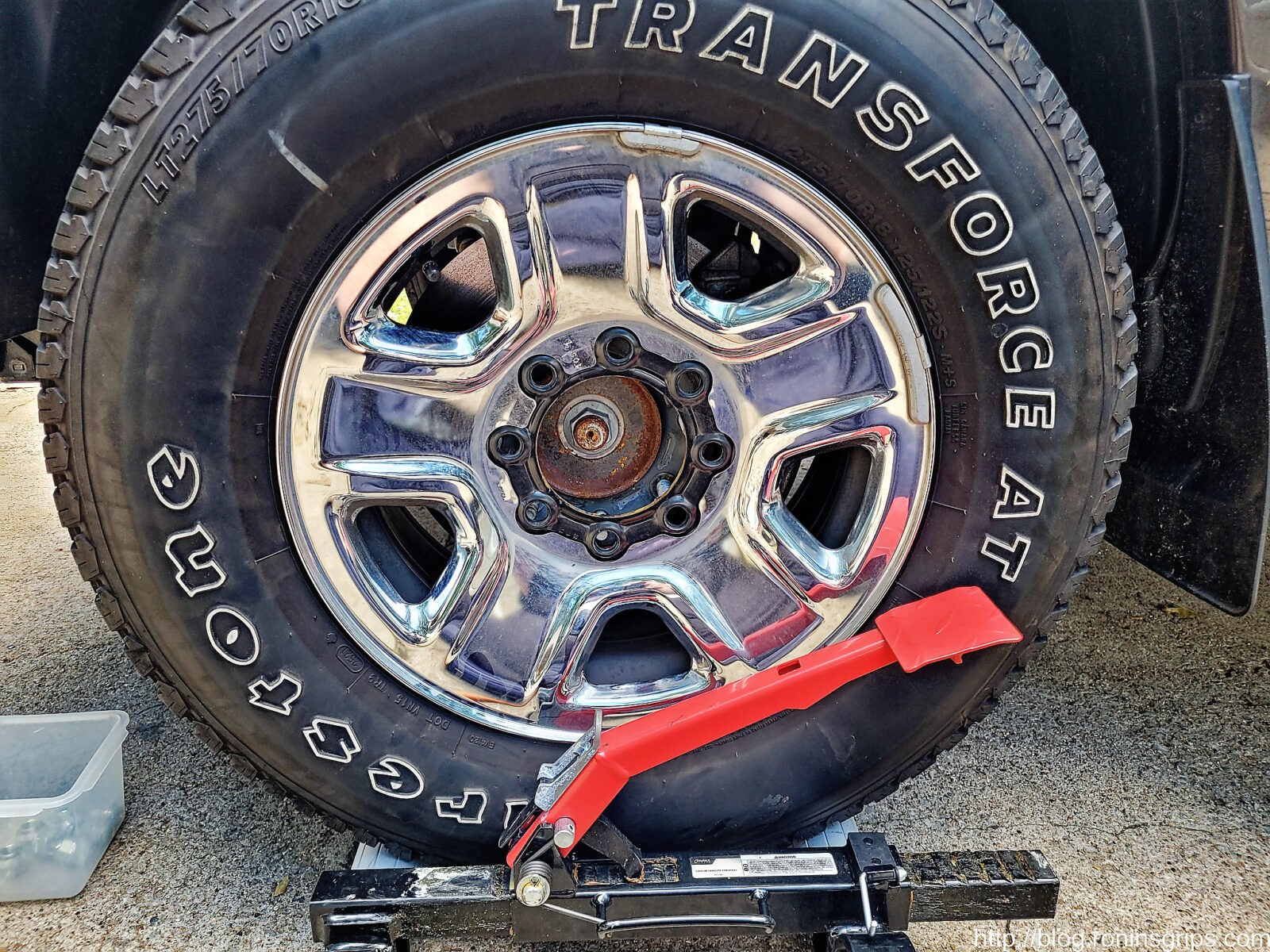
To mount the tires in their new location, I’d get the tire over in front of the hub and then slide the dolly into place to do the actual lifting. You put the silver cylinders on each side of the tire and pump the red lever (you can very easily do it by hand) to lift the tire up.
So the silver toggle on the left side of the red foot lever allows you to change whether the pawl under the lever is pushing the bar and drawing the silver cylinders together or if it moves the pawl out of the way so you can lower it.
So you use the foot pump to get the height right and then you can rotate the tire – the silver cylinders in the dolly turn so you can perfectly line up the wheel on the lugs and put on the lug nuts. Folks, it makes installing the 96 pound tires stunningly easy.
So, in hindsight after actually using the dolly, it really doesn’t take much actual lifting distance to get the tire into place. When I jack up any vehicle, I typically only lift until the tire is 2-4″ off the ground after I put the jack stands in place – so the gap between the floor and the bottom of the tire is not huge. I also realized you can go with just about any of these jacks – you don’t need super heavy duty because the weight of the tire is relatively small. Just read the review for whatever before you buy it.
Additional Details For Fifth Gen Ram 2500 Owners
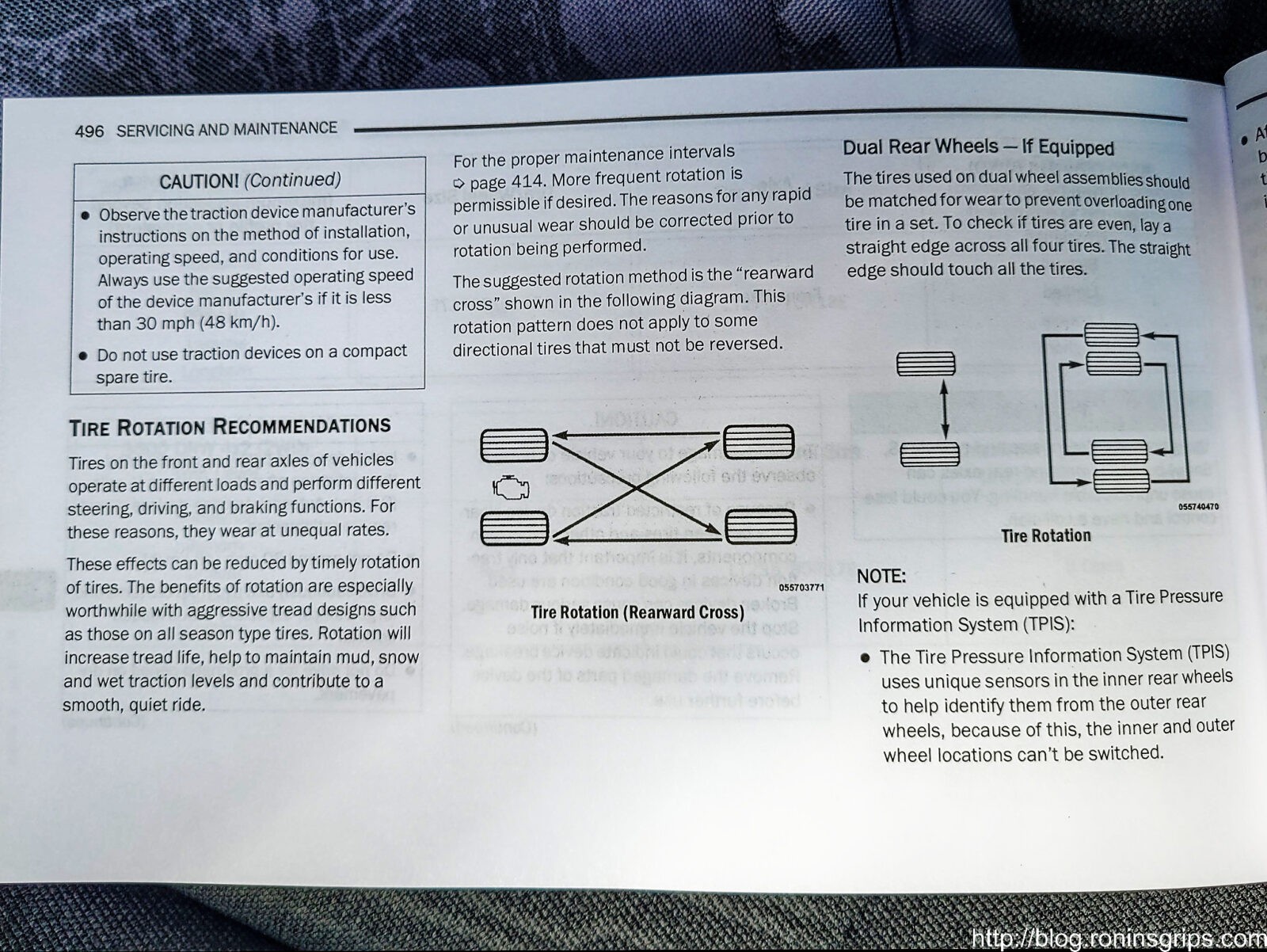
By the way, in case you are trying to find the rotation pattern, it is a reverse cross meaning the front driver’s side goes to the back passenger side. The front passenger side goes to the back driver. The two former rear tires move straight up – rear driver to front driver and rear passenger to front passenger.
Tires on the 2021 Ram 2500 move in a reverse cross pattern. Rotating them with each oil change is recommended. (Source: Photo of page 496 of the 2021 Dodge Ram 2500 Owner’s Manual)
If you are looking for the lug not torque spec, it is 130 foot pounds for cone lug nuts – mine had cone lug nuts. If you have flanged lug nots, it is 140 foot pounds.
On the topic of torquing the nuts down, I start mine by hand to avoid cross-threading the nuts and then I run them in quickly with my impact wrench using a torque limiting “torque extensions” – these extensions work with impact wrenches and twist at a predetermined torque but get weaker with time so they are great for bringing the nut down to the rim but not for setting the torque. I do the final torquing down with a 1/2″ torque wrench. Do NOT keep tightening with the impact wrench or bad things may happen such as cracking your rim.
Lastly, the Tire Pressure Monitoring System (TPMS) will learn where the tires are automatically. Note, you can’t change the minimum tire pressures for the front and rear without going to the dealer or knowing how to re-program the appropriate computer settings. At least, I can’t in my Tradesman. If you can in another model, that is something I don’t know about but count yourself lucky – I wish I could.
In Summary
The car dolly idea to do the lifting and positioning really paid off and now I can do the tire rotations safely and easily. I hope this helps you out.
2/19/23 Update: It’s still working great. This is one purchase I am very happy with.
Note, I have to buy all of my parts – nothing here was paid for by sponsors, etc. I do make a small amount if you click on an ad and buy something but that is it. You’re getting my real opinion on stuff.
Rock Island Armory (RIA) is a brand name that is owned by Armscor Global Defense located in Marakina, Philippines. Armscor obtained a license from the Philippine government in 1952 to begin making firearms. In 1980 it became Arms Corporation of the Philippines (ArmsCor) and in the mid-80s they bought the US brand “Rock Island Armory” and began exporting firearms to the US. They have invested in quality improvement and automation to create their wide variety of firearms offered today. They also have opened plants in the US – one in Stevensville, MT, and the other in Pahrumo, NV.
In March 2022, a Philippine TV crew visited the Armscor factory in Marakina and produced this nice video that focuses mainly on their 1911 production area:
The reason I wanted to share this with you is that RIA pistols do have a long history and Armscor is not some fly by night company. This is my opinion – I would describe RIA 1911 pistols as being designed, built and sold to shooters who want an acceptable 1911 without spending a fortune. They are not claiming to turn out semi-custom pistols – instead, good enough pistols at an affordable price point.
In marketing, when you are trying to hit a certain price point to attract the buyers you are after, you have to figure out the features, the materials, and process combination to get you there. Now reliability and accuracy are features also so this needs to be factored in – the pistols need to be good enough but not necessarily over the top – even though we wish they were.
Ok, but are the 9mm HC 17 round pistols “good”?
So let’s go back to the question – are they good? For the price, yes. You can’t compare them to far higher end pistols such as Stacatto or Bul – it’s simply not fair. It would be like comparing a daily-driver economy model Ford or GM car to a BMW. Yes, they are all cars but the engineering and attention to detail during manufacturing in the BMW are going to be very different. They are for different markets comprised on people with different disposable income levels and tastes – and have different price points.
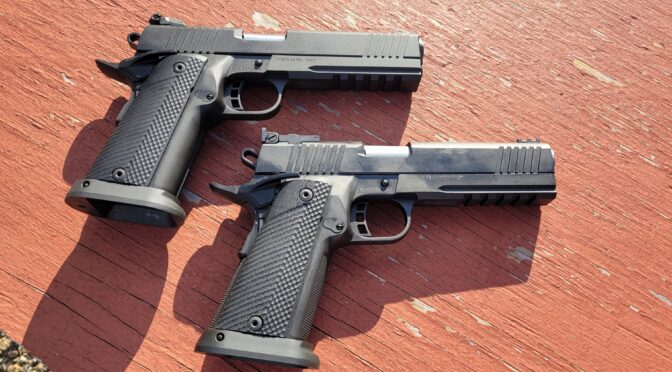
The two pistols I am discussing to be clear are the 9mm RIA A2 HC pistols – the 51679 Tac Ultra FS HC and the 56645 Pro Ultra Match HC – by the way, FS means “Full Size” and HC means “high capacity” because they hold 17 rounds in staggered magazines.
The frames and slides are made from 4140 alloy steel via CNC and they do have QA steps. The barrel seems to be pretty decent but then the price point issue begins to creap in.
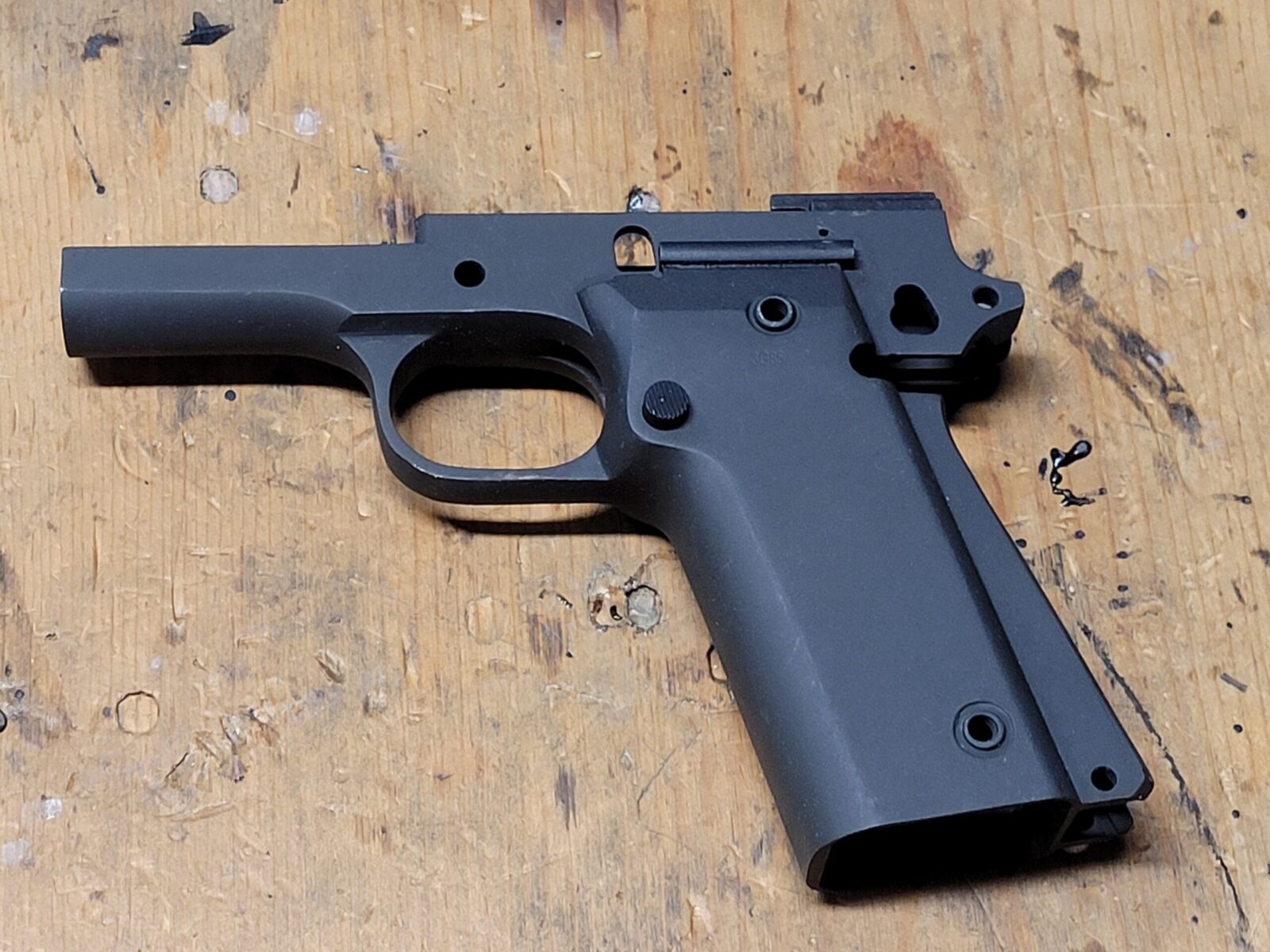
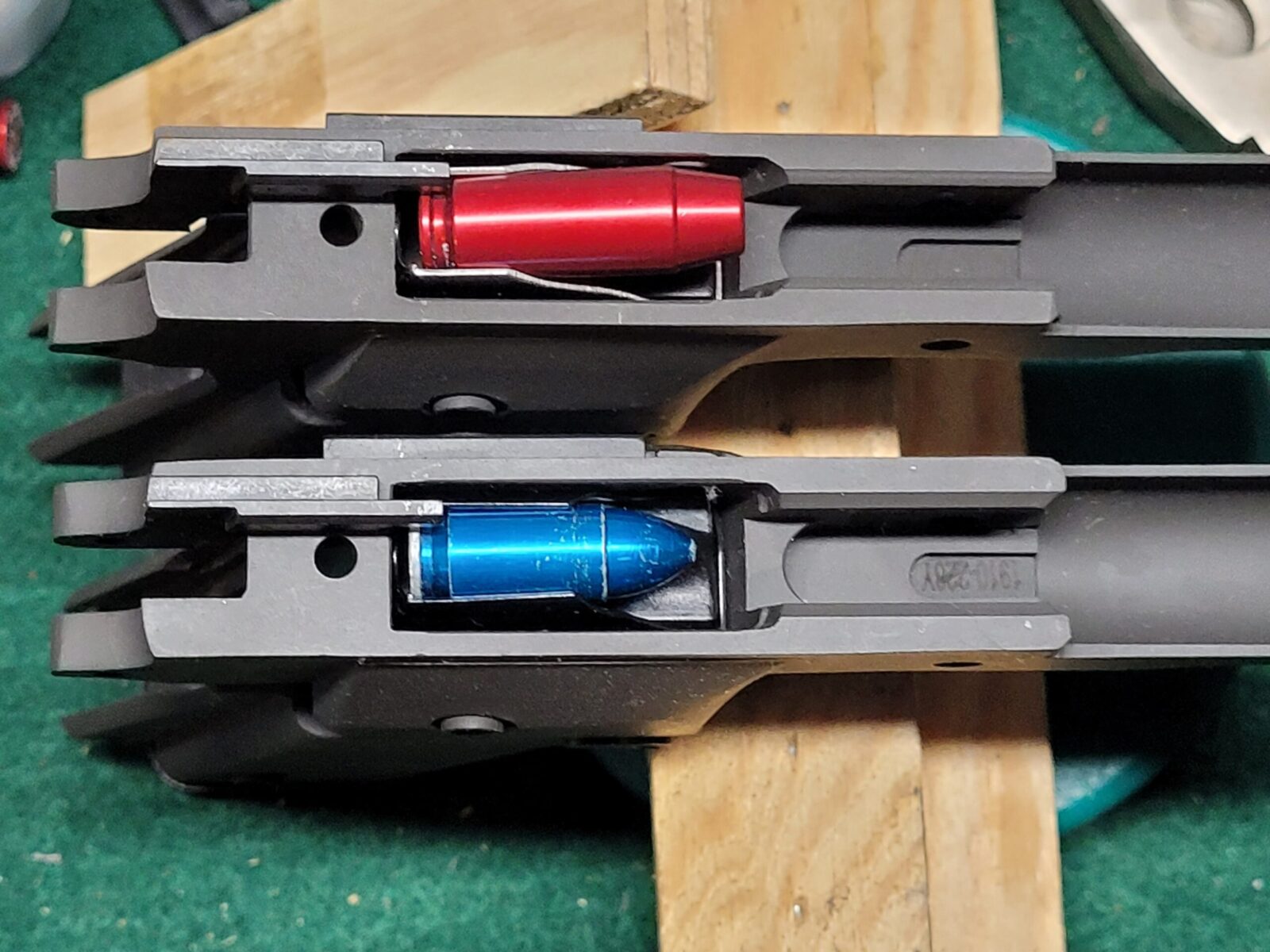
I bought four of the A2 HC 80% frames back when I was doing R&D on magazines for the 10mm/..40 S&W calibers (they use the same magazine design) and also the 9mm magazines. What not everyone knows is that these pistols also share a common frame. I installed the RIA magazine catch and ejector but they milled all of the holes and applied, as you can see, a very decent parkerized finish.
Here are two 80% frames with the top one holding a 10mm magazine and dummy red A-Zoom round. The bottom one has a 9mm magazine. The blue round is an A-zoom snap cap and I don’t use or recommend them any longer as the bullet is shaped very differently than a 115gr or 124gr FMJ round so you may think feeding will work when it doesn’t. I sure found that out the hard way.ĵ
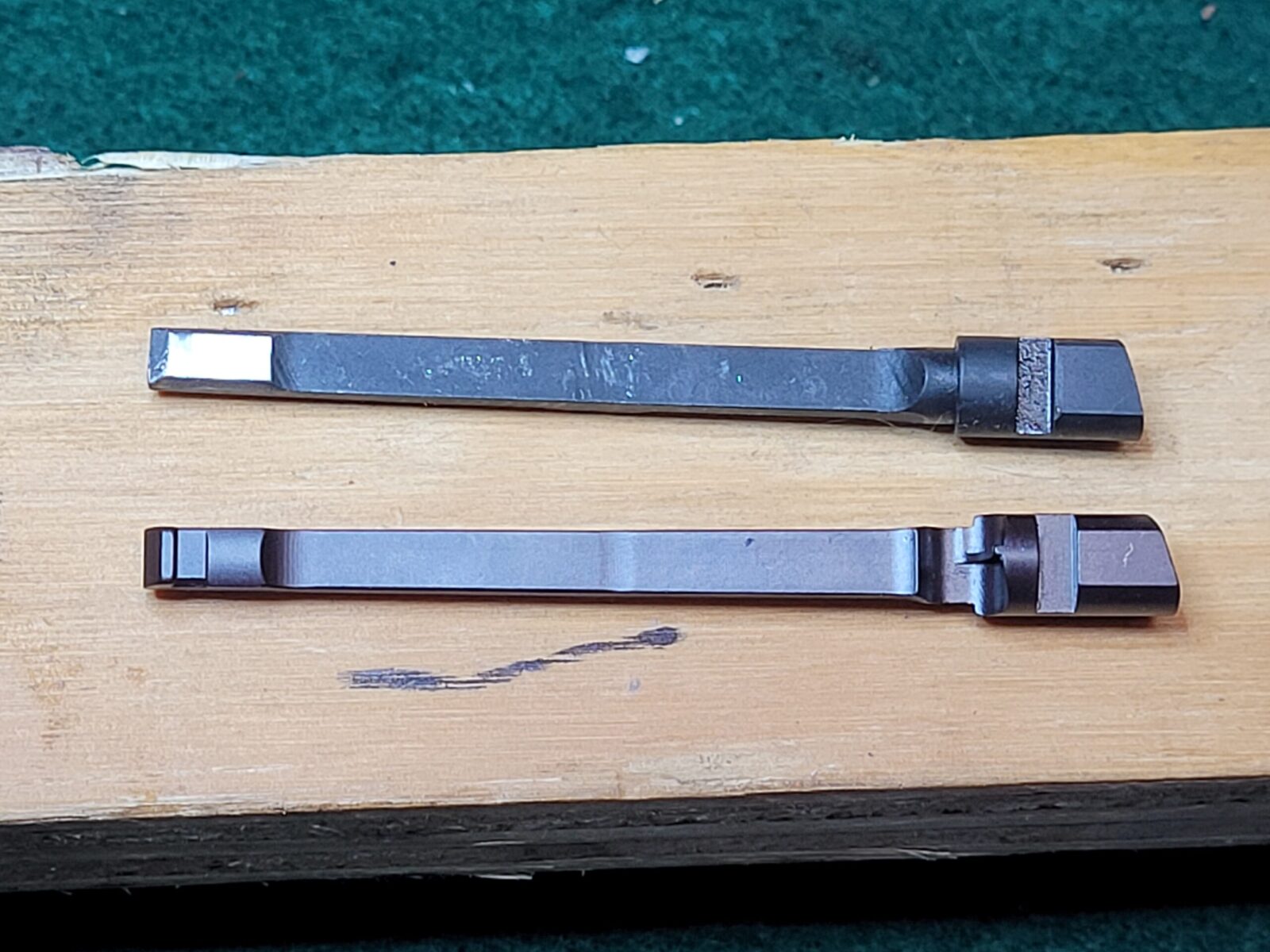
For example, to keep costs down, Armscor uses metal injection molded (MIM) parts. I know through first hand experience, the extractors are MIM and they will not have the longevity of a forged part made from tool steel such as one from Wilson Combat *but* the extractors can be replaced if you ever have a problem so it’s not like you suddenly have a boat anchor and that’s one of the beauties of 1911-style pistols – there is a huge aftermarket parts industry and tons of websites/forums out there to help you sort out what is going on not to mention 1911 gunsmiths and that Armscor has good warranty service – I’ve had to avail on it twice – one on a 6″ 10mm Big Rock and also on a 9mm Tac Ultra that had failure to extract issues … and on that one, there was something seriously wrong because just replacing the extractor didn’t work. [Click here for a post I wrote about my extractor journeys with RIA 9mms].
The top is the original Armscor extractor and the claw snapped off. The bottom is a forged tool steel Wilscon Combat. If you run into an issue, read the post I wrote and upgrade to a Wilson.
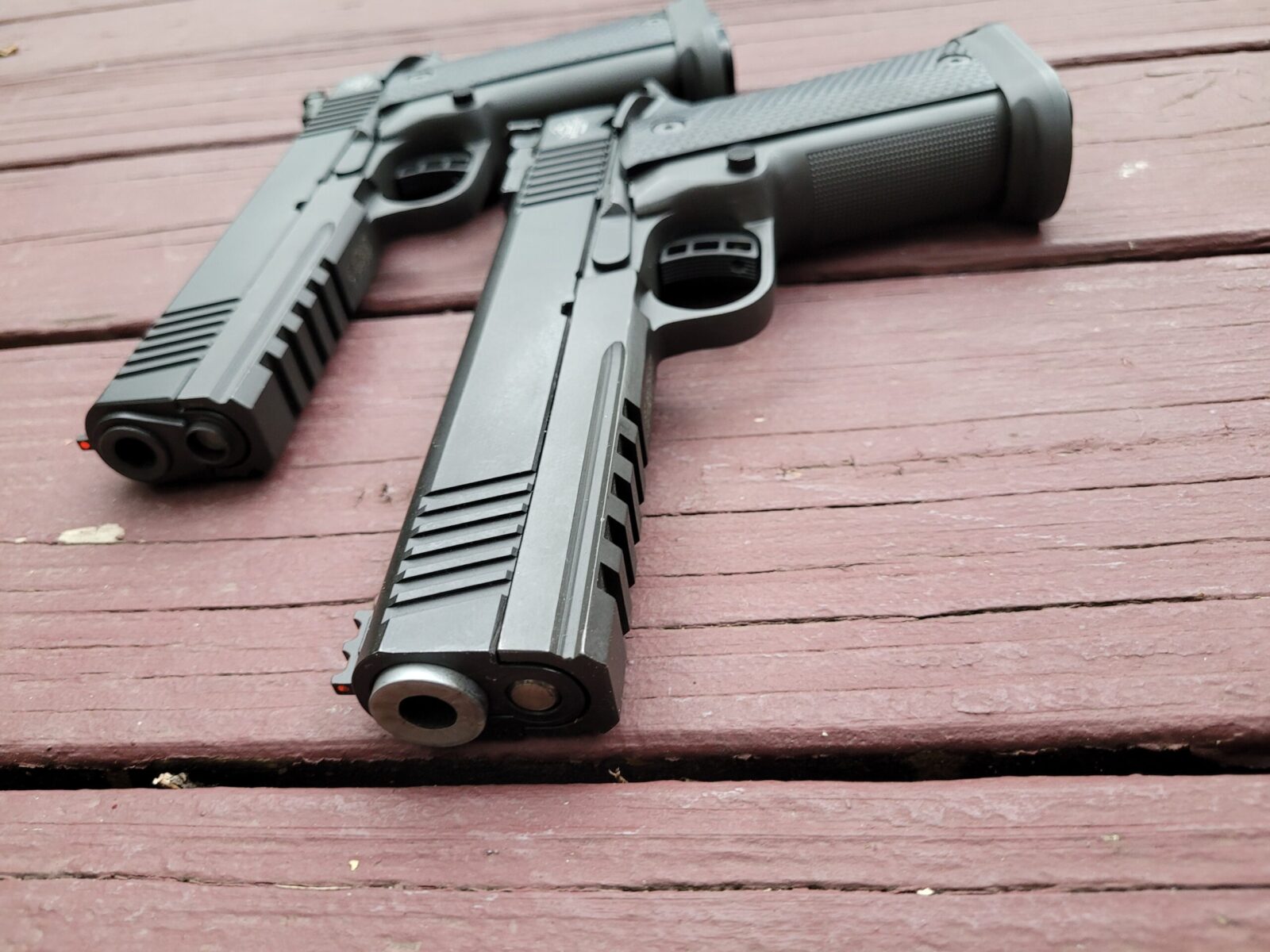
They also use a parkerized finish and its applied very nicely. There is a but coming – but parkerizing leaves a rough finish and means they need to wear in more compared to other brands that use a different finish and/or have careful polishing and tuning while parts are assembled.
Every parkerized RIA pistol that I have seen has a very nice consistent finish on it. The left pistol is the TAC and you can tell due to the bushing, normal barrel and no checkering on the grip. The right pistol is the Match. It has a bull barrel, full length guide rod and checkering on the front of the grip. The rear sights differ but you can’t see them in this photo.
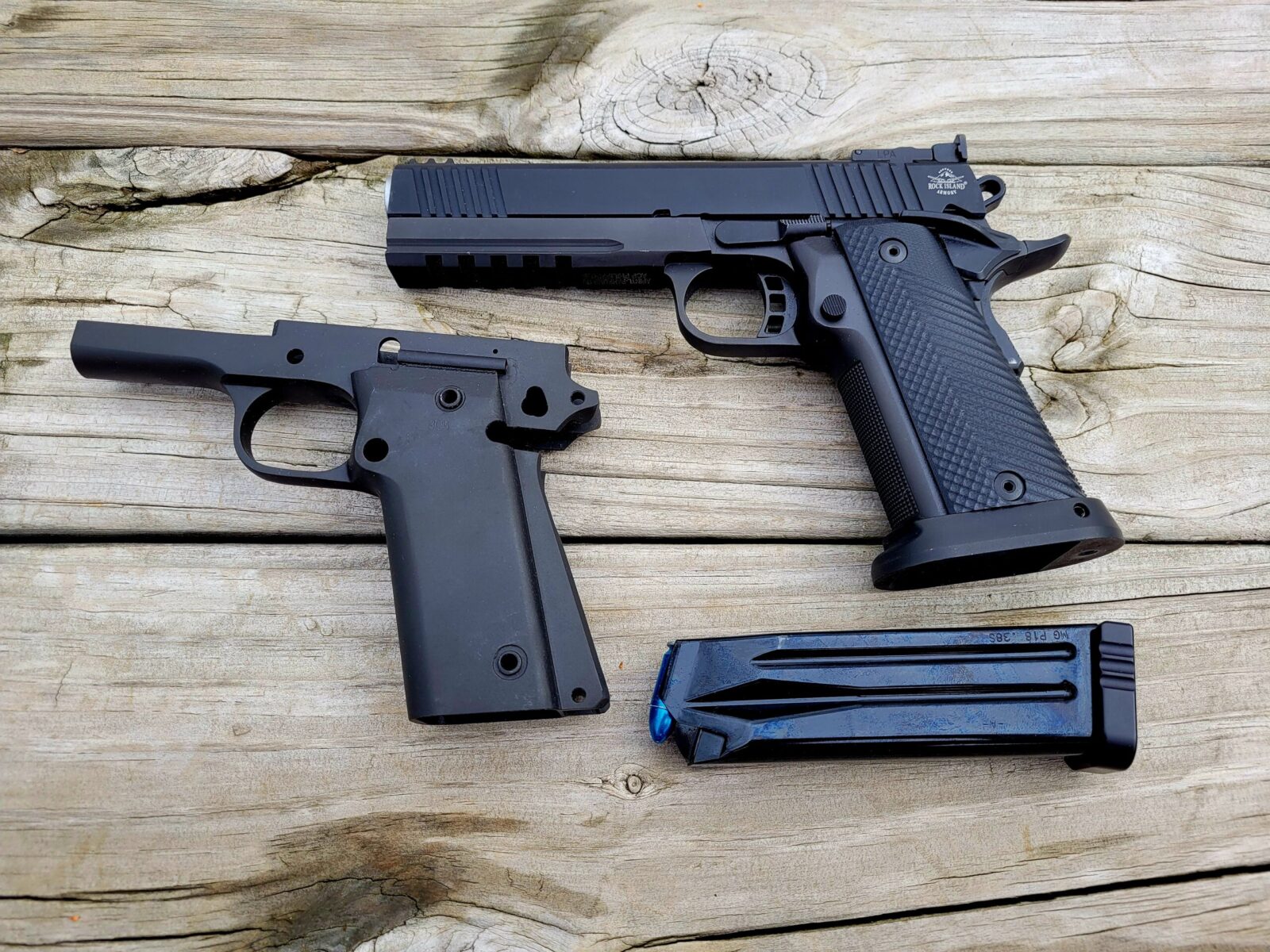
That’s an 80% frame with no modifications right next to it’s finished cousin – a 51679 Tac Ultra. Under the pistol is one of our tuned Mec-Gar P18 magazines with a Dawon +200 base plate. Click here for our 9mm RIA magazine offerings.
Conclusion
This is my way of saying they are good enough. You are buying an entry level pistol that has been on the market for many years and word would get around quickly if they were utter junk. Does the gun need wear in? Yes. Might there be issues? Yes. Do they have warranty support? Yes and they do stand behind and repair their pistols.
Would I recommend these RIA Tac Ultra FS and Pro Match Ultra HC pistols to someone looking for an entry level 17 round 9mm 1911 style pistol? You may find it odd but yes I would and I’d explain the above.
I hope this helps you out.
1/6/2023 Update: I’ve had zero problems since writing this post. Both pistols have cycled thousands of times during magazine testing (meaning rounds are cycled by hand but not actually fired) and the slides are smooth as glass. I took both to the range recently and they functioned just fine with both 115 and 124gr bulk FMJ – I think the 115gr was CCI and the 124gr was S&B if I recall right.
Note, I have to buy all of my parts – nothing here was paid for by sponsors, etc. I do make a small amount if you click on an ad and buy something but that is it. You’re getting my real opinion on stuff.
I like compact rifles but that means you have some combination of shorter stock and/or barrel. With that shorter barrel also comes trade-offs in terms of velocity because the ammunition is expecting a longer length of barrel and unburned powder exits the muzzle – often with a really cool flash. Other than shock and awe, that wasted powder isn’t turning to gas to shove the bullet down the barrel. It’s all a game of trade-offs. So, what if you don’t want to play the trade-off game?
This is where you enter the world of bullpups. A bullpup refers to any weapon where your cheak is basically resting on the action with the magazine under it. The barrel can actually be much longer now because the buttstock is gone and so you have a compact weapon with higher velocities. So what’s the catch?
Well, a lot of bullpups have a huge trigger problem. They typically use a solid linkage to take the movements you create by pulling what looks like the trigger and transfers them to the rear of the weapon where the actual trigger, disconnector are at. The result is long mushy feeling triggers …. unless you have a plan and Israel Weapon Industries (IWI) did have a plan when they designed the Tavors.
My first encounter
The first time I saw a Tavor was a number of years back. My friend, Scott Igert, who owns Michigan Gun Exchange, had one in and it caught my eye. It looked like something out of a SciFi movie and I wasn’t really sure whether I would like it or not plus it was way more than I could afford at the time. I shouldered it a few times and had Scott put it back. I read a bit about them and decided it didn’t fit into my plans … at least not then now fast forward a few years – like maybe 3-5 years.
What changed my mind? Why did I go back?
Interestingly enough, a number of things happened. First, I had learned a lot more about firearm design. Second, I’d worked a lot more with both IMI and IWI Galils in both 5.56 and 7.62×51. Third, because of the Galils I became interested in Isreaeli weapon designs in general and what drove the industry constantly towards innovation (existential threats to the state are certainly a big factor. Fourth and final, I was getting kind of jaded towards short barreled rifles excluding pistol caliber carbines. I guess I should mix in a healthy dose of curiosity across alll of those.
So, I wound up older, maybe a bit wiser and more interested in the Tavor. I could also afford one I must add, but it was still going to be a chunk of money. So, I ordered one with the intention of selling it if things didn’t work out – as Scott will tell you, I rarely hold on to firearms of any kind.
What’s up with the name?
I’ve always found why something is named what it is of interest. If you’re really into the history of words you study what is known as the etymology of a given word. Me … I’m a redneck from Southwest Michigan and am just curious where they come from so I can sound smarter than I am when drinking with friends.
Ok, “Tavor” – where did it come from? Well, you may know it’s modern English name of Mount Tabor and it romanized name from Hebrew is “Har Tavor”. It is a real mountain located in lower Galilee, Israel. According to the Hebrew Bible, a great battle was fought there between the Israelite army and the army of the Canaanite King of Hazor. It’s also considered the site of the Transfiguration of Jesus. There is so much history around Har Tavor that there is a whole wikipedia page devoted to it.
Is the Tavor X95 a new design?
Not exactly, the design team to create the Tavor began work in 1995 with Zalmen Shebs as the team lead. They wanted a rifle that could withstand sand and the elements, be accurate enough and also compact enough to be readily carried in vehicles. Of course, they wanted something better than the American M4 and the Galil had proven itself to be too heavy and large for continued use by the Israeli miliary.
By 2001 they had versions of the Tavor in trials that helped them learn better what was needed and refined the design to better handle fine sand for example. It was issued in November 2001 as the TAR-21. From 2001 to 2009 a number of refinements were made. In November 2009 the Israeli Defense Force (IDF) announced they would adopt the Tavor X95 as their standard infantry weapon.
That’s a short summary and the whole point is that it is not brand new and your not risking a bunch of money to be a guinea pig. The Tavor has seen real combat use and performed respectably. If you buy an X95, you are getting a proven weapon that has a good combination of accuracy and reliability in a variety of environments.
Ok….So what did I buy?
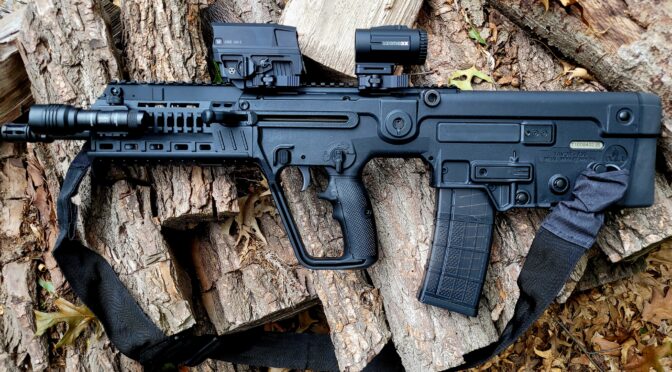
I bought a model XB16 in August 2021. This model of Tavor is black (you can also get them in flat dark earth or olive drab), is in 5.56×45 NATO, has a barrel length of 16.5″, an overall length of 26.125″ inches and weighs 7.9 pounds empty.
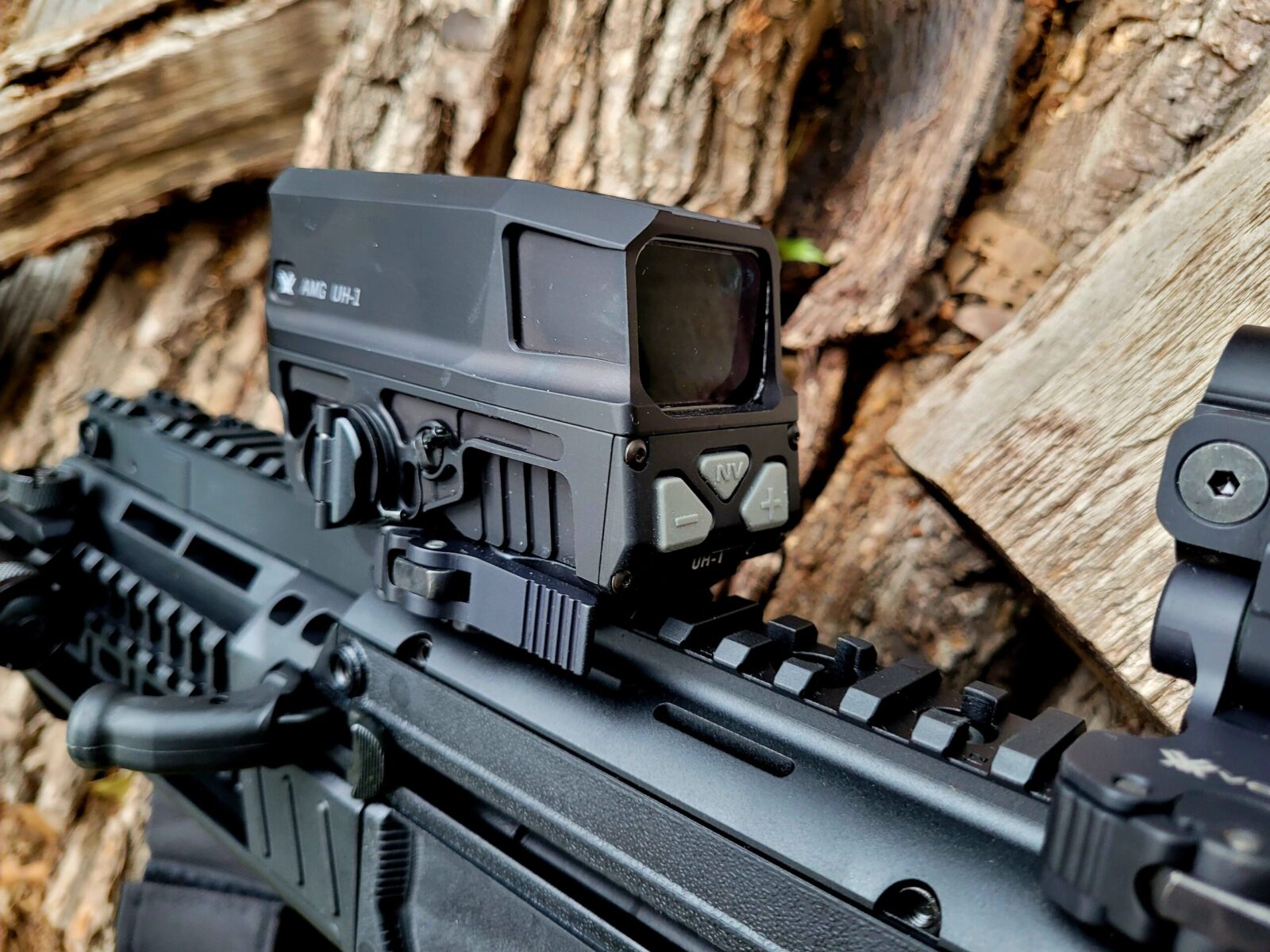
I wanted to pair it up with an optic that would excel in close quarters with rapid sight acquisition and a wide field of vision but that I could also magnify a bit if needed. I went with the Vortex UH-1 holographic sight and a 3x flip up magnifier. I had a red dot and magnifier combo on an AR many years ago and did NOT like it. The UH-1 and 3X magnifier pairing on the Tavor were made for each other. If you want speed, flip the 3X out of the way. If you want some magnification, flip it back into place.
There is only one change that I made internally. A lot of Tavor owners were removing their original trigger packs and installing either a Timney or a Gisselle. I backordered both and the Timney showed up first. Changing a trigger pack in a Tavor is super easy – it’s a modular cartridge that goes up through the bottom of the bullpup. The Timney did make a world of difference.
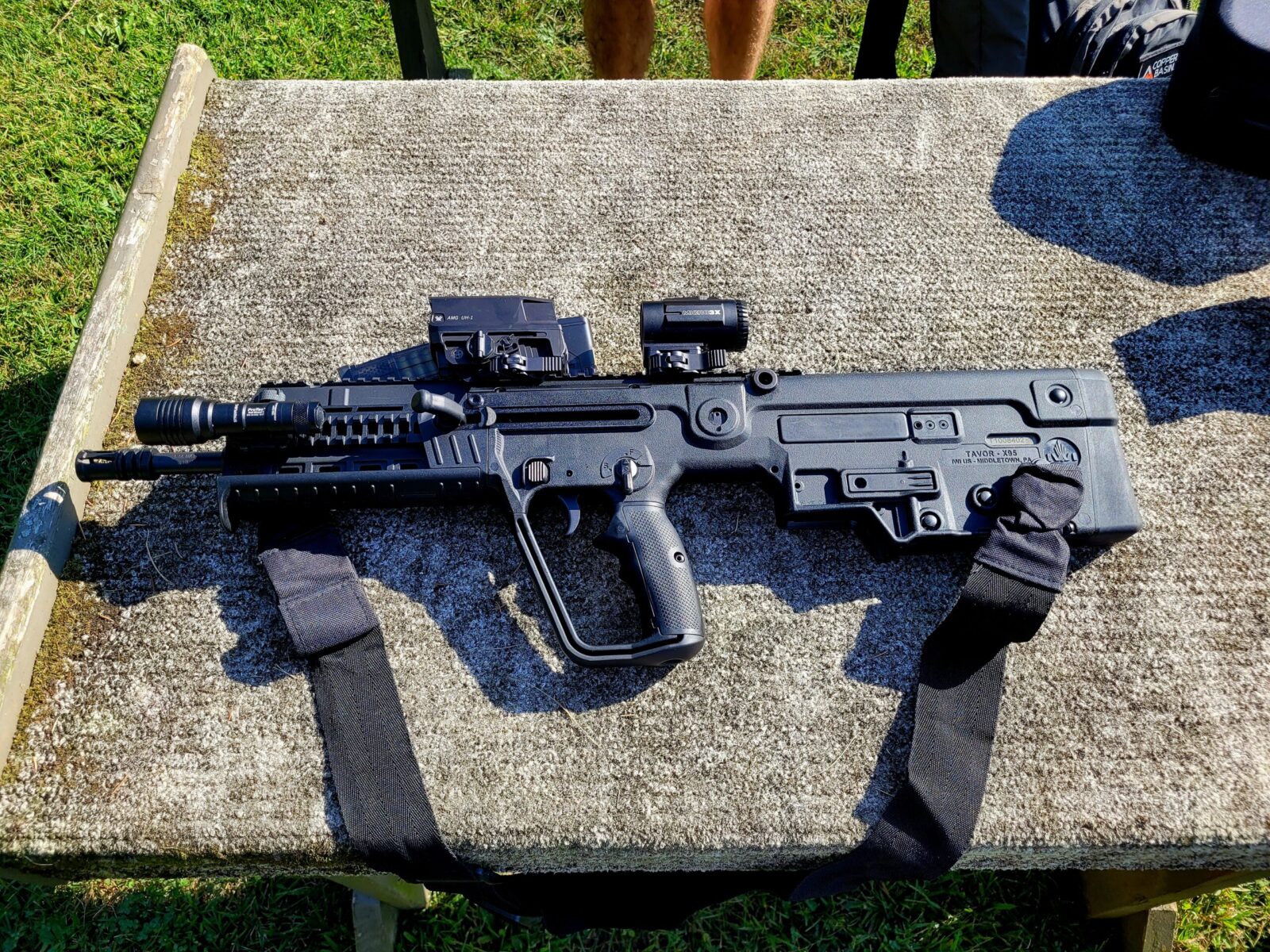
I put a Streamlight 88509 weapons light on it along with a real IDF Zahal sling. For mags, I use a combination of Magpul Pmags and Lancer Advanced Warfighter mags – I like both and just grabbed some spares.
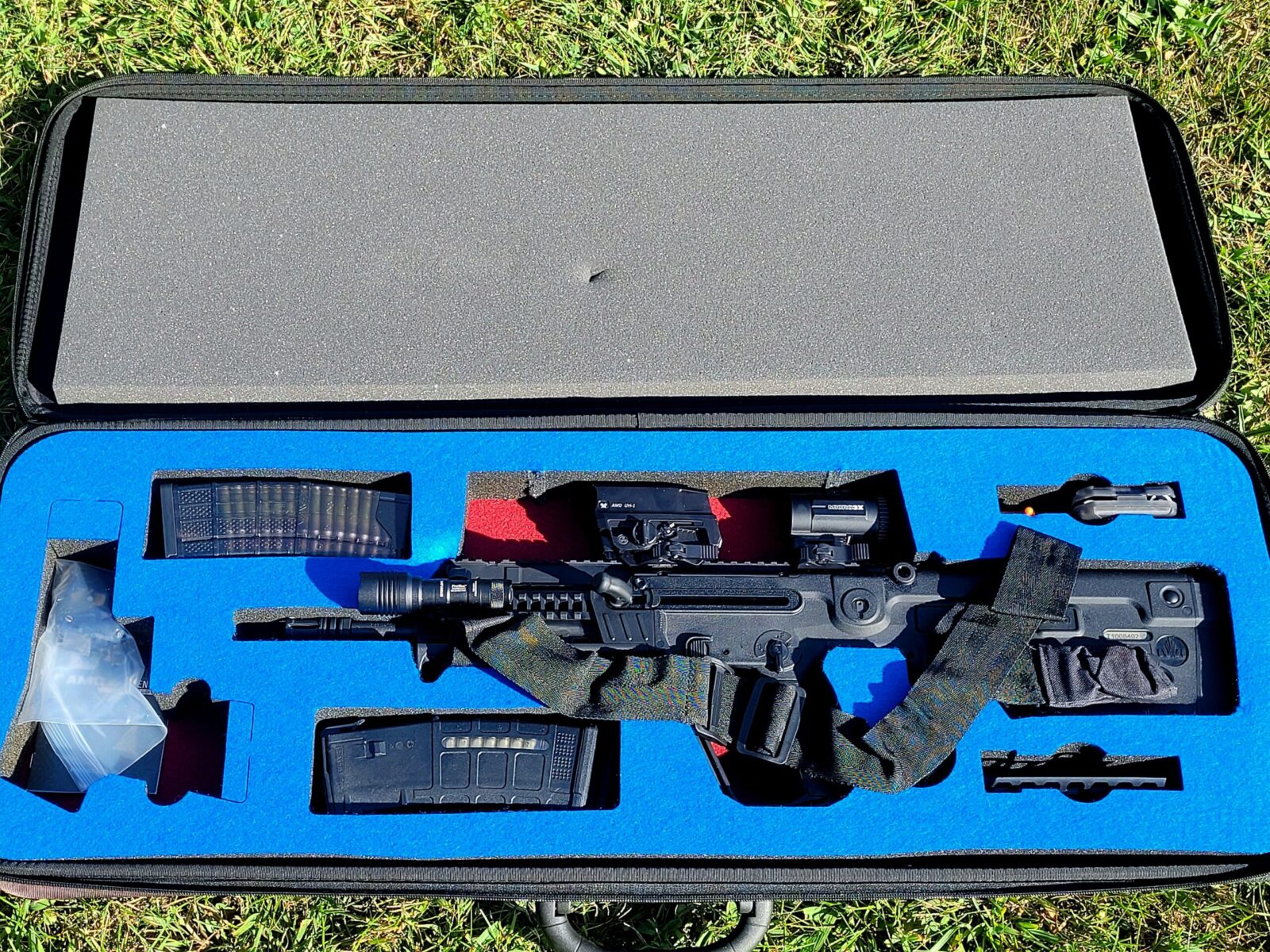
Lastly, I did go for one accessory I don’t normally buy – a fitted Peak Case. Normally I just go with some generic carrying case but decided I wanted something a little “cooler” and more protective than a softsided case. Click here to go to their page in a new tab.
By the way, the Zahal sling can be purchased off ebay from here.
Unlike some of my reviews, I don’t have a ton of unpacking and assembly photos. Why? Your’s truly misplaced/lost/deleted almost two months of digital photos and I have no idea how. What I can do though is jump ahead to the results:
The Peak case comes pre-cut for the Tavor and a handgun off to the left. I actually have the original trigger pack stored in there for Click here for their web page.
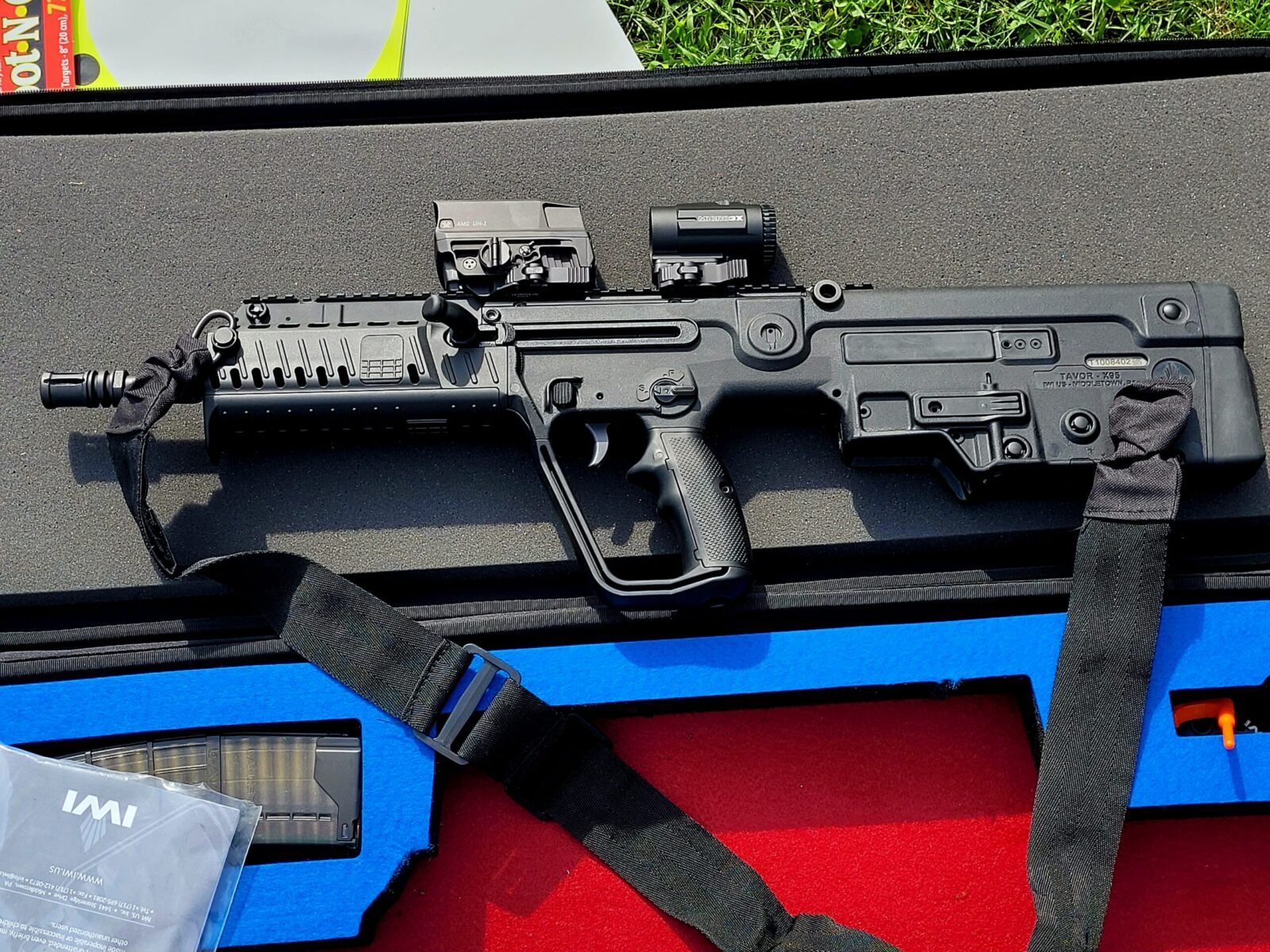
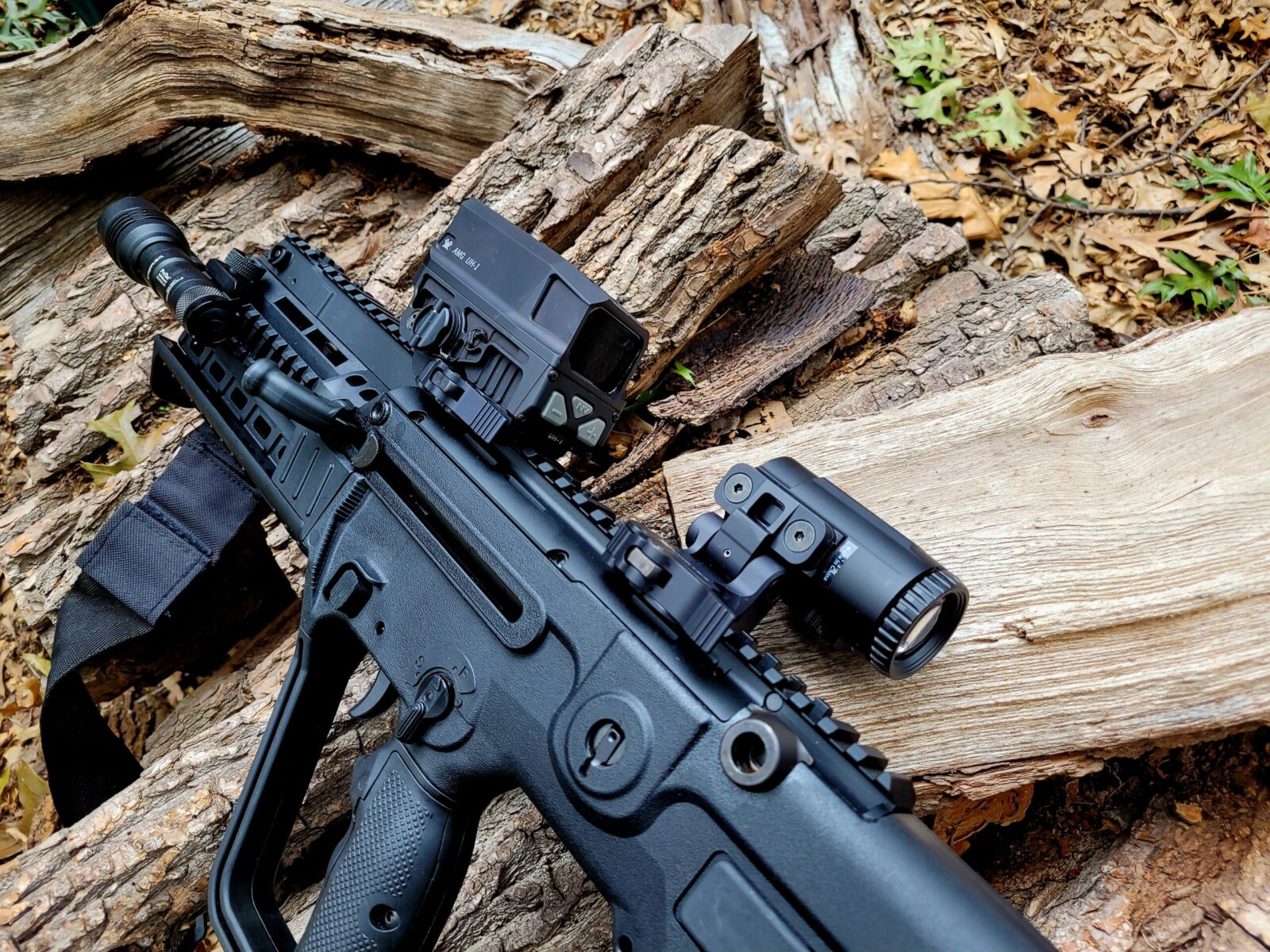
Here’s the Tavor with the Zahal sling and the Vortex optics mounted.
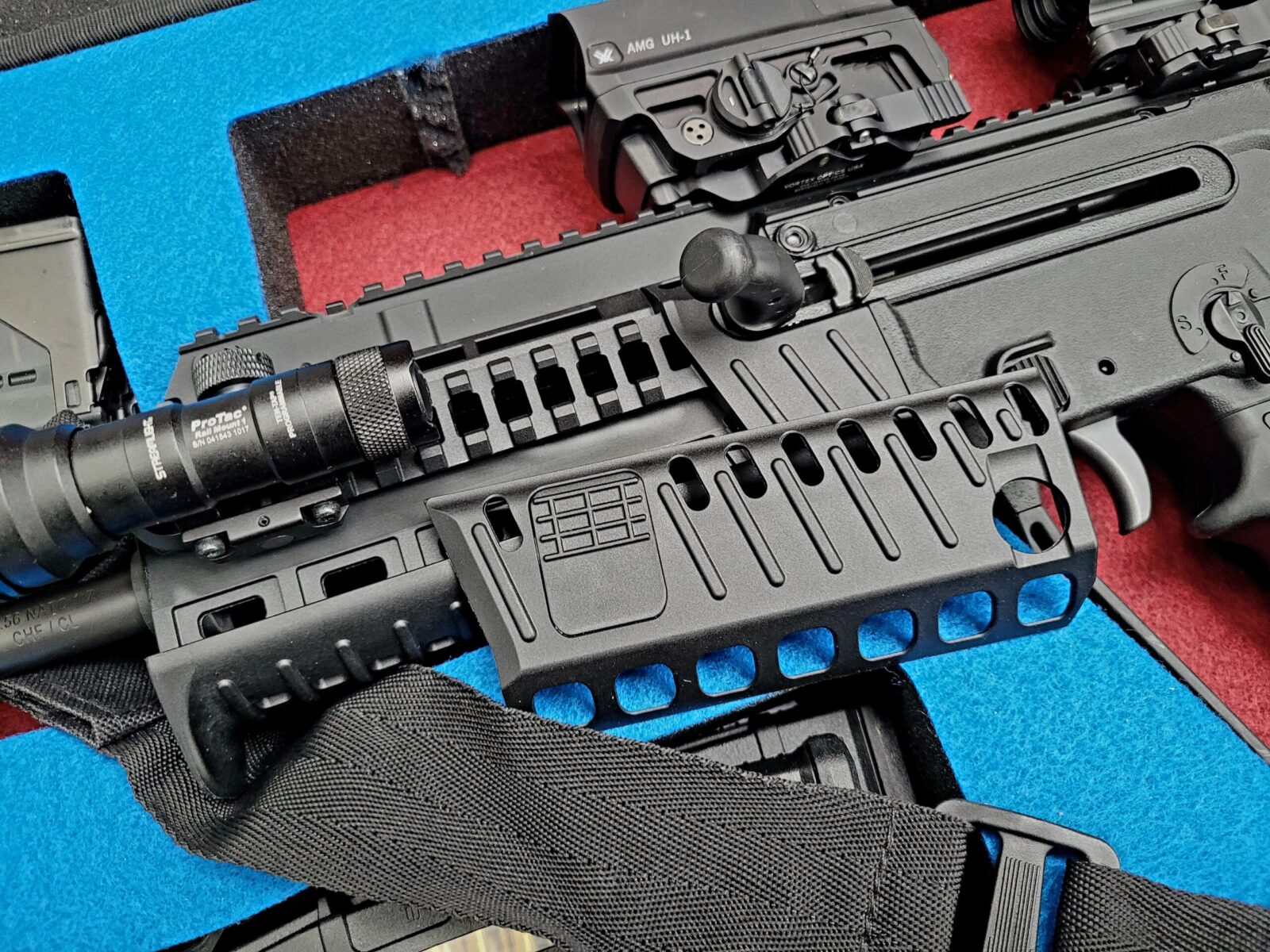
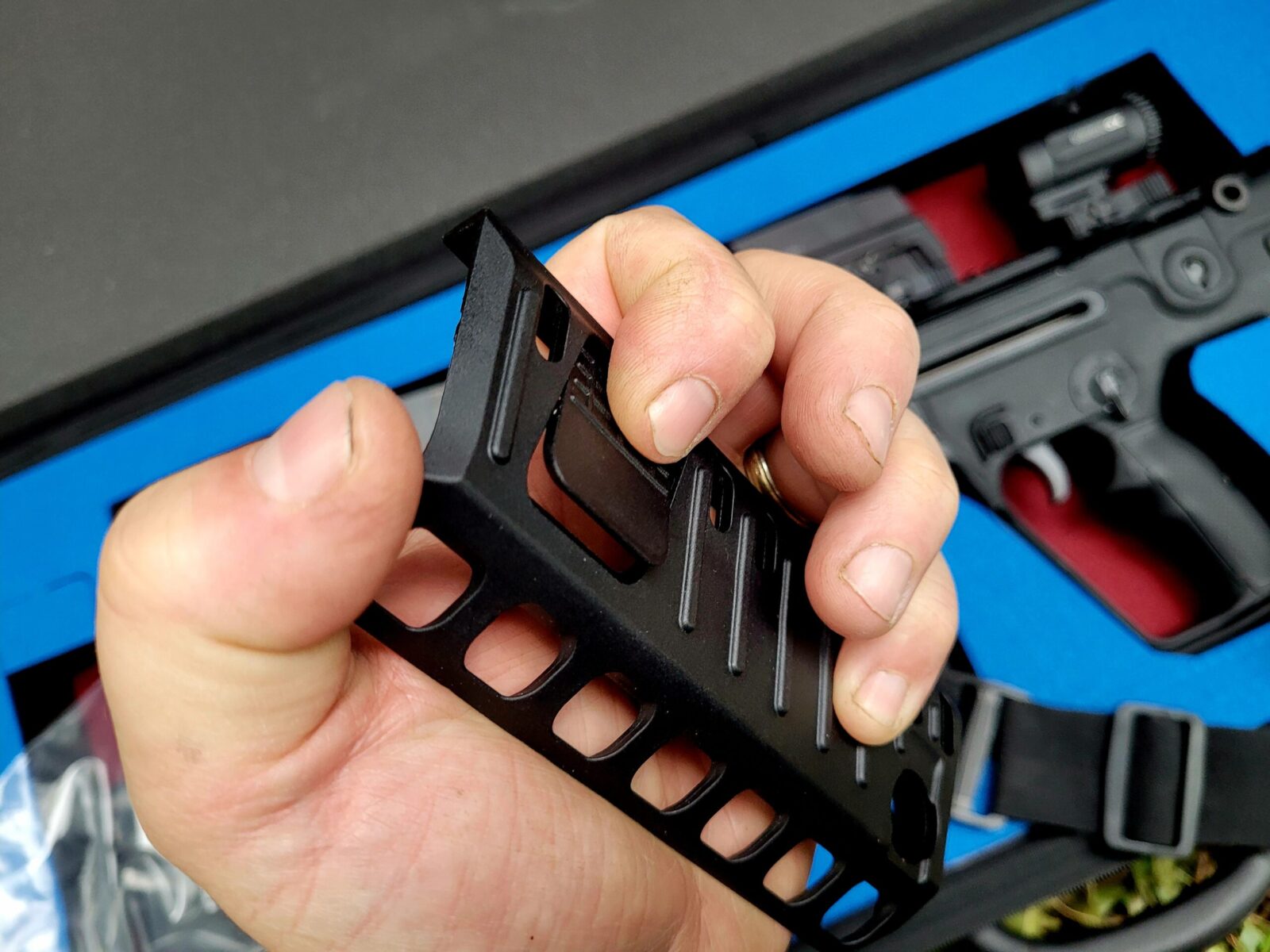
The rail covers slide off once you depress the button.
Pushing that button allows you to slide a rail cover right off.
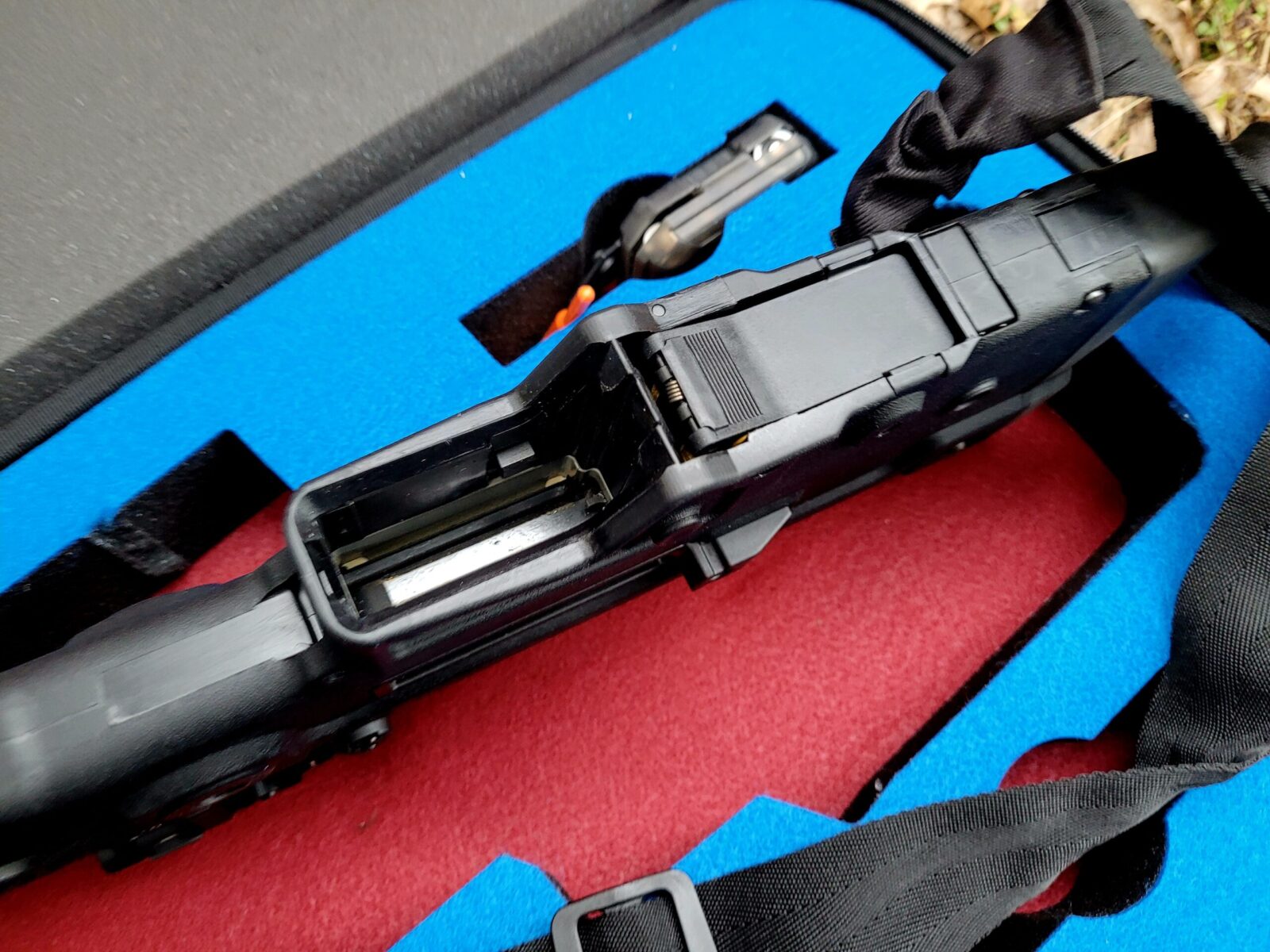
The Tavor X95 design immediately made me realize that I needed to read the manual and a couple of Youtube videosto learn how it works. In this photo, we are looking at the back bottom. You have the mag well hole and behind it is the bolt release lever for when the bolt locks open on empty.
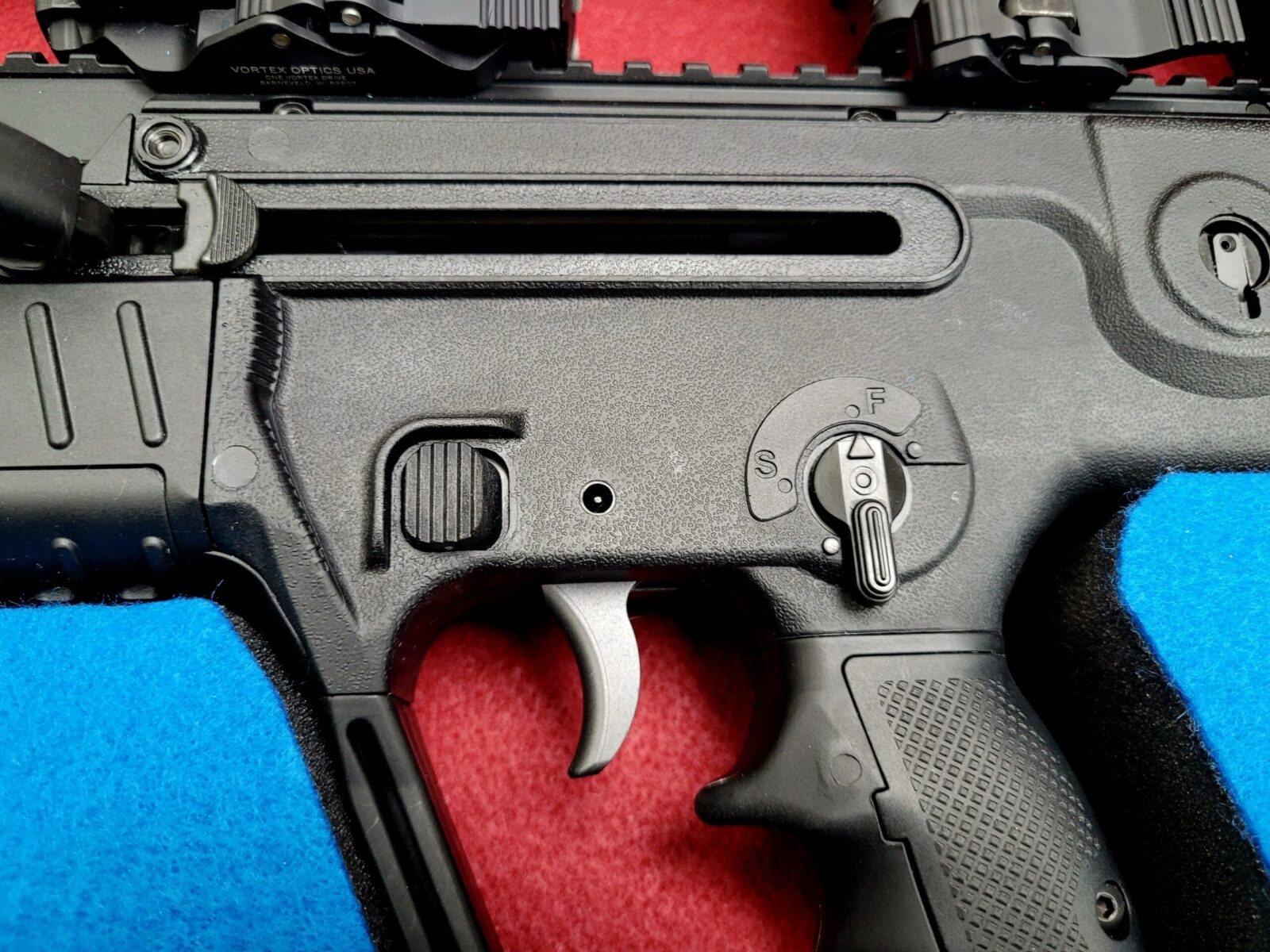
There’s the trigger with the mag release to the above left and the safety selector lever to the back right.
Combining a Vortex UH-1 with a Vortex 3x magnifier gives you a lot of versatility. When you want a wide field of view for close-in work you can flip the magnifier out of the way as shown in this photo. When you want 3x magnification, just flip ti down.
The Vortex UH-1s are great optics. This is my second and I can’t recommend them enough. Rugged, bright, easy to use, reliable and a no-nonsense fix or replace warranty – what more could you want?
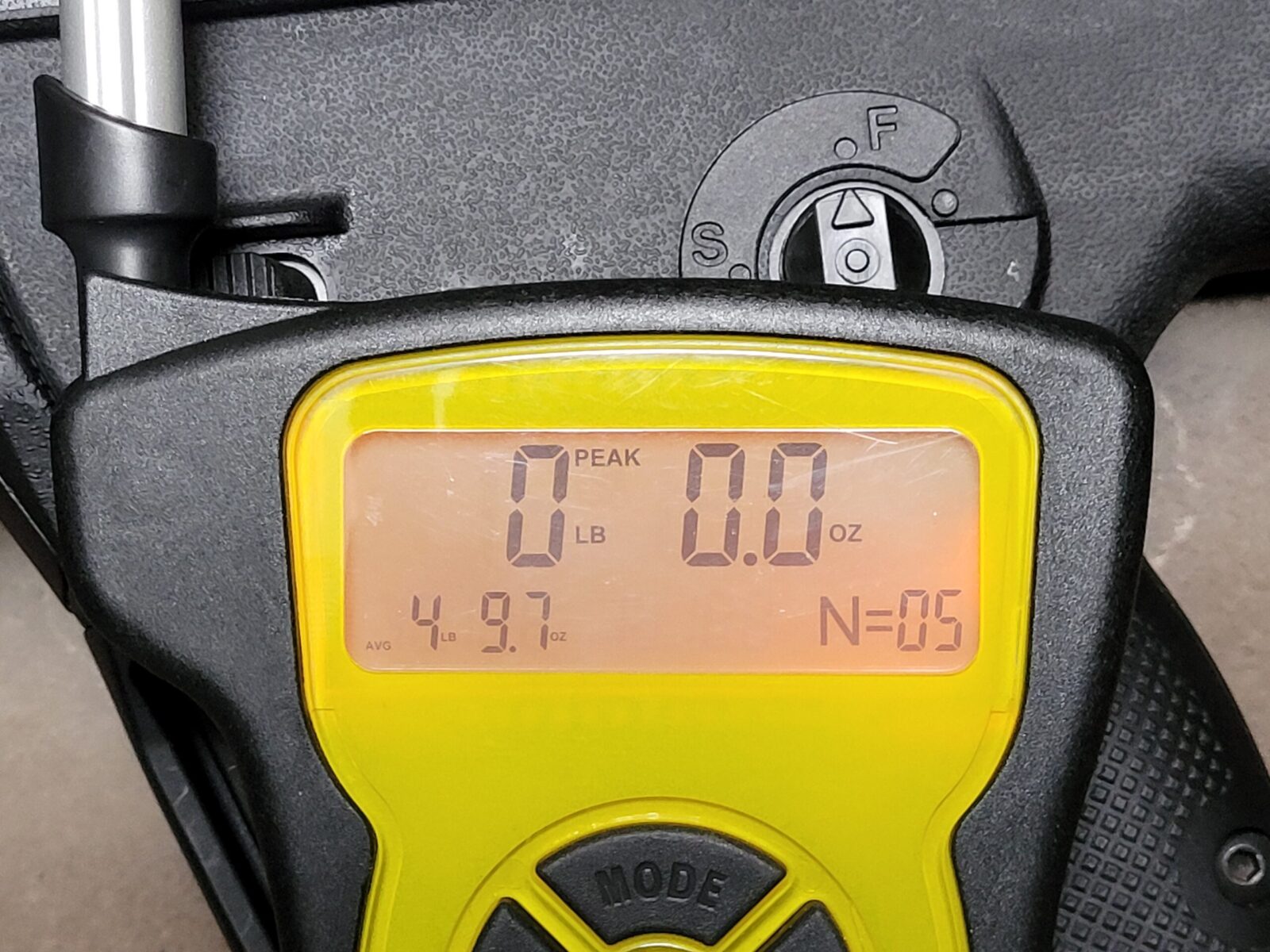
With the Timney trigger pack installed, I did 5 trigger pulls and the average pull weight was 4 pounds 9.7 ounces. The minimum pull weight was 4 pounds 3 ounces and the max was 4 pounds 15.4 ounces. One thing you tend to notice with good triggers is both a lighter and more consistent pull weight.
Preparing for the range
I’ve written about this before – do not take a new firearm straight to the range or you are going to have a lousy time. Instead, field strip it, clean & lubricate it and then cycle the action about 200 times to let the parts wear in and get to know each other – no, you don’t need to pull the trigger 200 times. It makes a world of diference with most firearms.
Range Time
We were able to take the Tavor to the range twice this summer and put about 300-400 rounds of bulk box M855 through it. The Tavor ran flawlessly – no problems feeding or ejecting. The control layout does take some getting used to – the more I use it then the more I will get used to changing magazines I’m sure.
Jim shooting the Tavor – he definitely liked it. I mentioned it in my blog post about taking the Stribog to the range that same day – Jim forgot his hat and the only spare I had in the truck was my wife’s. Nice hat Jim 🙂
Niko fire the Tavor from a number of positions and really liked it as well.
I honestly did not think I would like it but I actually do. It takes some getting used to in terms of the controls and swapping magazines but these are things that practice can overcome. Think about it, you have a 5.56×45 NATO rifle in the same form factor you would normally find a SBR or braced pistol with a much shorter barrel.
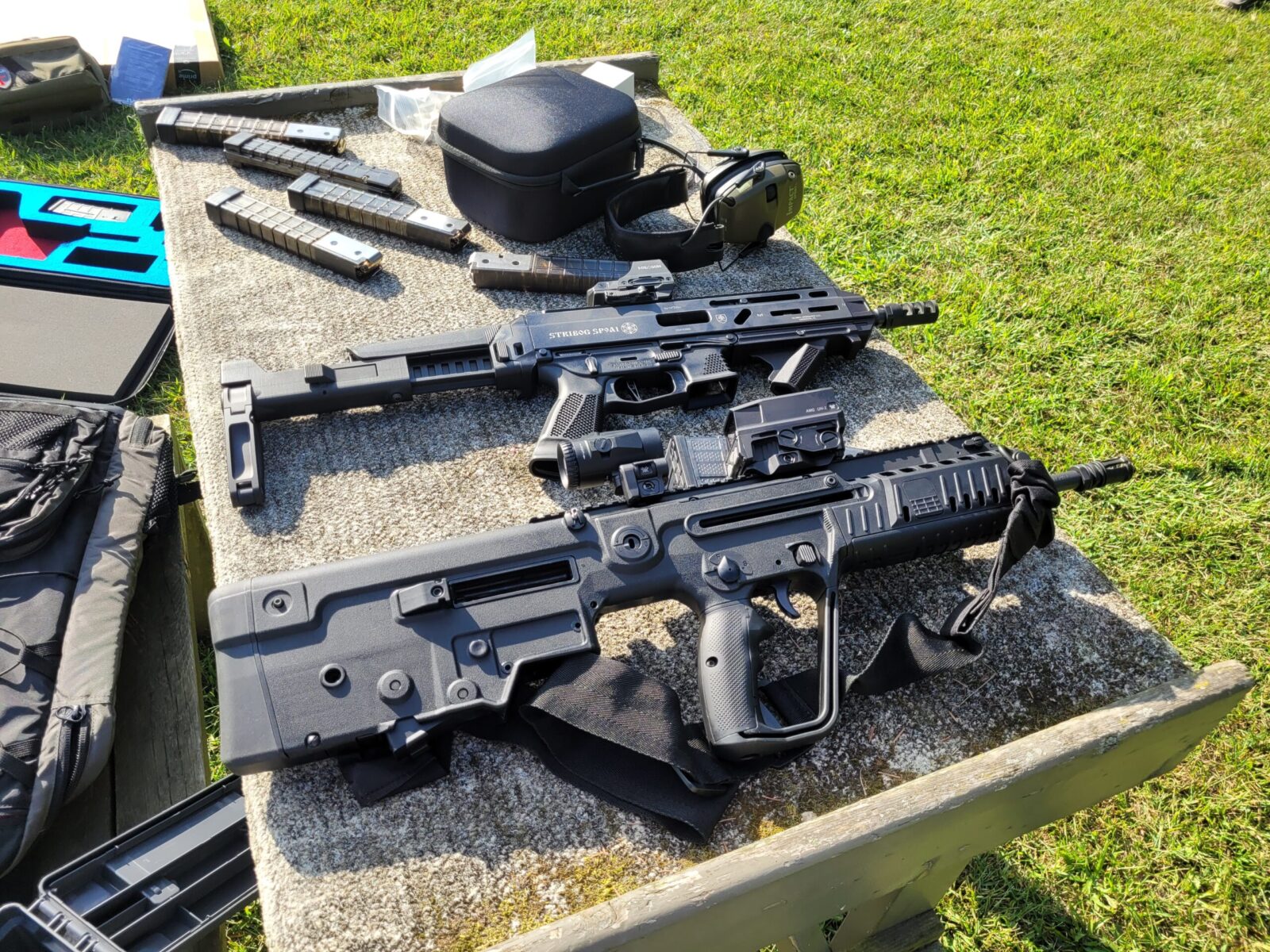
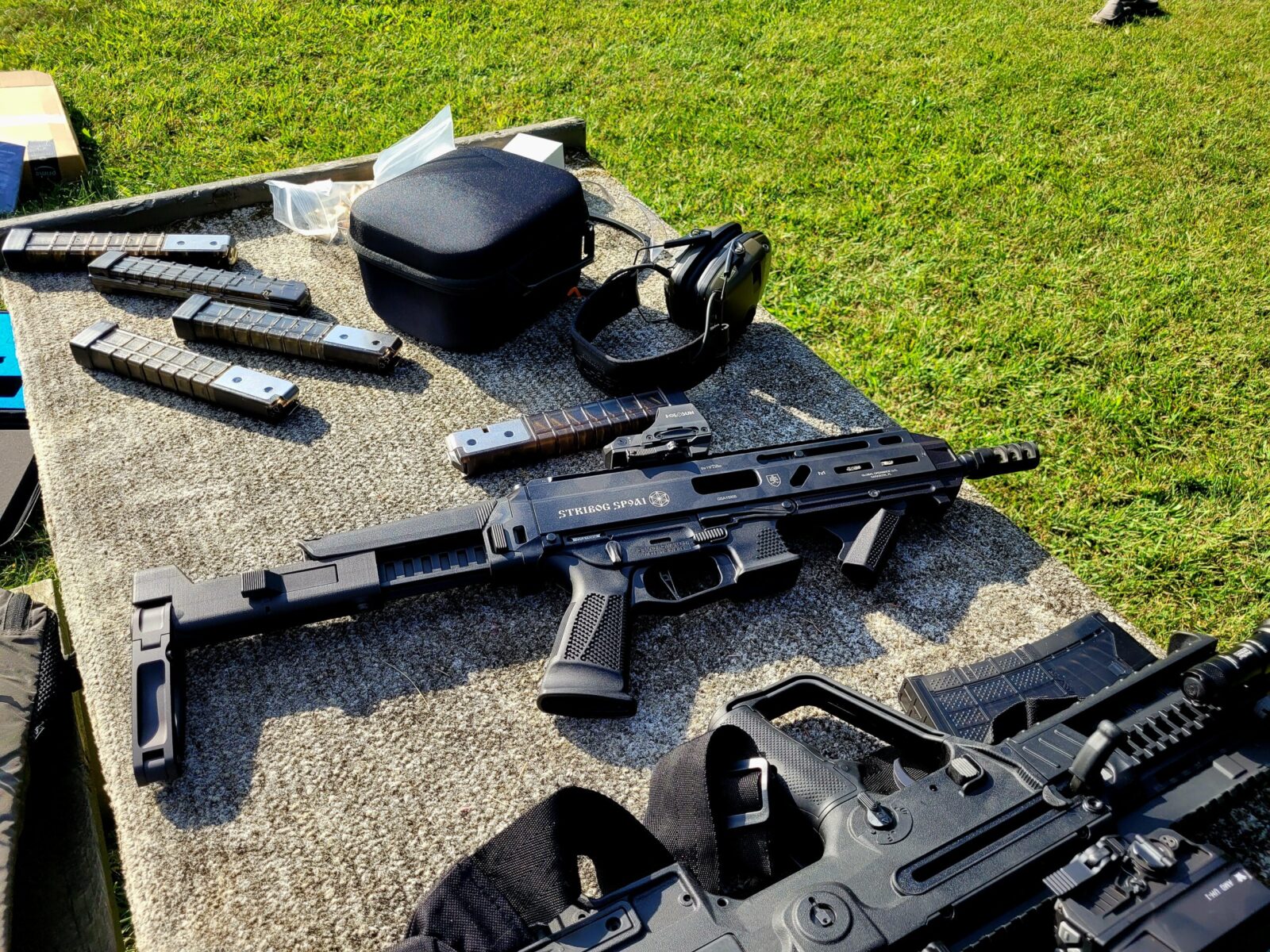
This photo highlights the advantage of a bullpup over a traditional firearms design. The weapon on top is a Grand Power Stribog SP9A1. It has a F5 Manufacturing Modular Brace, the action in the middle and then only has an 8″ barrel. The Tavor has the rear “stock” and action integrated with a 16.5″ barrel that can achieve far higher velocities from the 5.56×45 cartridge than a shorter barrel could. Yet, the over all lengths are almost identical.
We were shooting at paper targets and plates – not for accuracy – at about 10-15 yards. The Tavor just handled wonderfully. I couldn’t have been happier.
After a bunch of rounds we needed to let it cool down before putting it back in the bag.
By the way – I like the weight and rear-biased balance. Granted 5.56 does not have much recoil to begin with but the Tavor is very pleasant to shoot. Again, if you hear people mentioning it is awkward, well, bullpups in general take getting used to because the mag is so far back.
Summary
I kid you not, I really didn’t expect to like it as much as I do. It’s compact and reliable. The trigger is good enough … some day when I have time, I need to take it to the range with match ammo and see how it does but for now, I am quite happy. I’ve tried a number of different rifles this past summer but this takes first place and my IWI Galil Ace .308 takes a very close second [click here for my review of it]. The rest are all “ok” in comparison.
There are a ton of positive Tavor X95 reviews out there and now I know why. If you are on the fence about buying one, just get it 🙂
I hope this post helps you out.
Note, I have to buy all of my parts – nothing here was paid for by sponsors, etc. I do make a small amount if you click on an ad and buy something but that is it. You’re getting my real opinion on stuff.
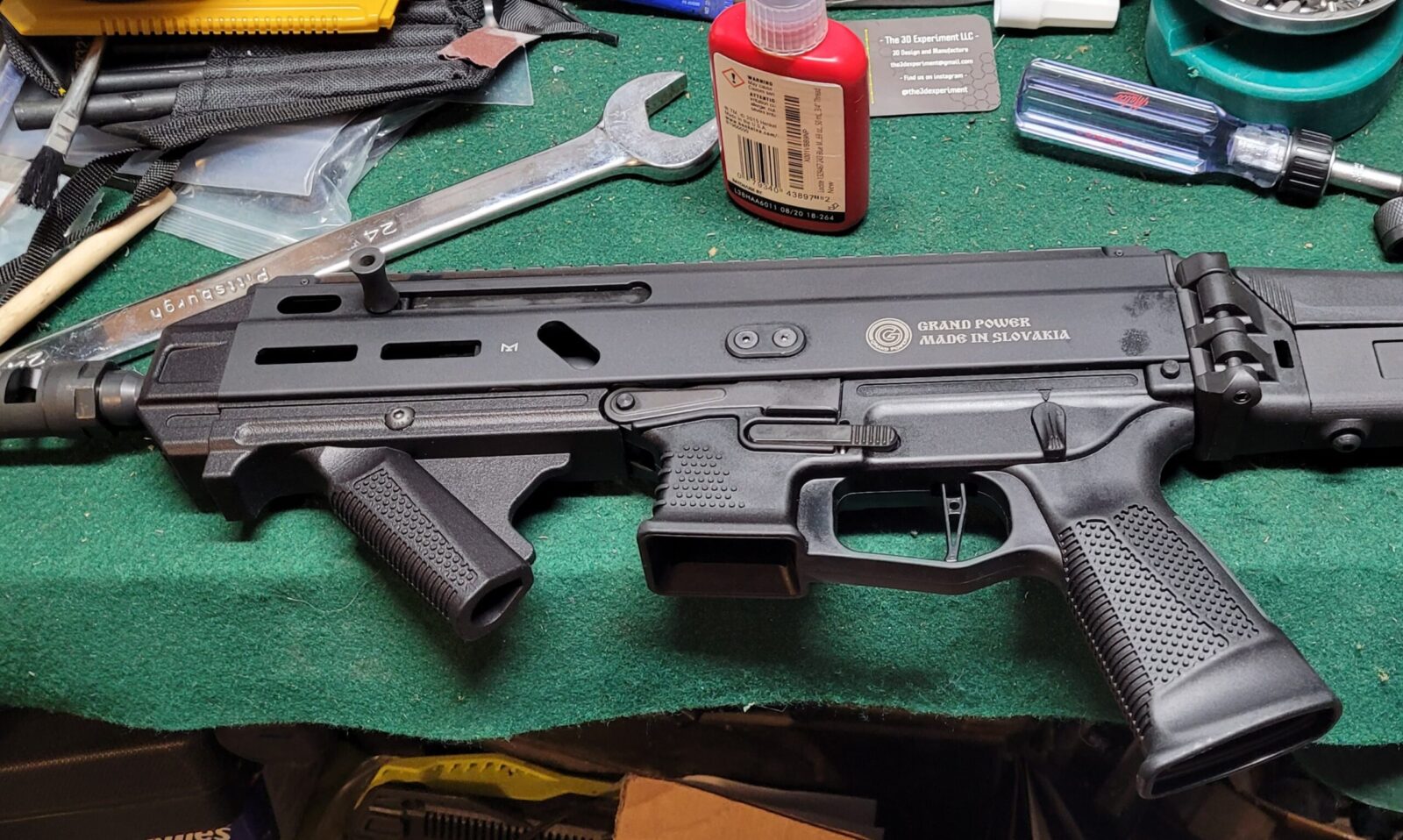
In the last post, I told you a little bit about the Stribog and the modifications I made [click here if you missed it]. I took it to the range twice over the summer and ran about 400-500 rounds through it flawlessly – really. So let’s talk about the details.
Prepping to go to the range
One thing I have learned over the years is that most semi-automatic weapons need to break in and that includes the Stribog. Never take a weapon out of the box and expect it to work. Instead, field strip the weapon, clean and oil it. After that, cycle the slide manually a few hundred times (literally) to get a jump start on the break in process.
What happens during wear-in or break-in is that surfaces that rub together – either by sliding or rotating start to have the surface smooth down. Despite what you may see, most surfaces have thousands of tiny ridges and spikes sticking up that cause friction and screw up operation. As the weapon cycles, these little edges are worn down. A decent oil or light grease can help with this as it fills in these areas and the luibricity enables the parts to slide or rotate while they are wearing in.
This is to be expected of most weapons unless you are buying a custom firearm where the builder has probably meticulously polished everything. By the way, firearms with parkerized parts need wearing in the most. On the other hand, other finishes, such as Nickel Boron, may need it less.
What’s my tip for you? If you want to have an enjoyable first range visit, clean, lube and cycle your weapon at least 200 times.
Function tested the Stribog
Just to be safe, I function tested the Stribog to make sure the fire control system was working right:
Make sure the weapon is clear
Try pulling the bolt back and let go. The spring should forefully return the bolt to the home position. If it doesn’t, take the weapon apart then clean, lube and try this again. If it still doesn’t then something is wrong and you should talk to who sold it to you, Grand Power or do some searching online – just be cautious because not everyone posting advice knows what they are talking about so be a healthy skeptic.
Cycle the bolt, pull the trigger and you should hear a click. If not, you have a problem.
Make sure the hammer is not cocked (pull the trigger if you need to – See #1). Now, pull the trigger and hold it down and cycle the bolt – you may hear or feel a light click as you release the trigger – that should be the disconnector catching the hammer so it doesn’t follow the bolt back. When you squeeze the trigger you should hear the normal click of the hammer hittin the firing pin. If the hammer isn’t getting caught, you have a problem.
Cycle the bolt, turn the safety to on and try to pull the trigger – it should have little to no movement and you should not hear the hammer hit the firing pin. If you do hear the hammer hit the firing pin – make sure you did turn the safety lever the corrrect direction and all of the way to safe. If it still fires, you have an unsafe weapon that needs to be serviced / returned for warranty repair.
Range Trips
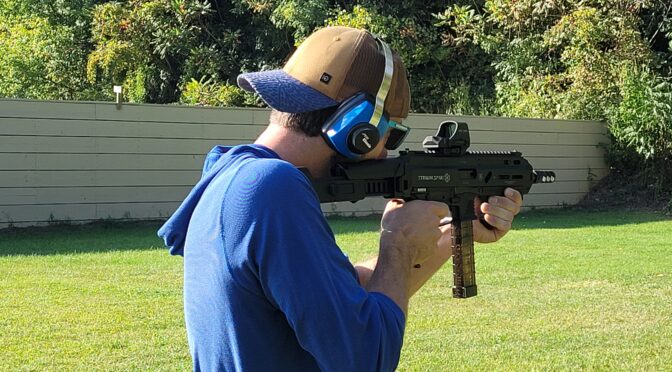
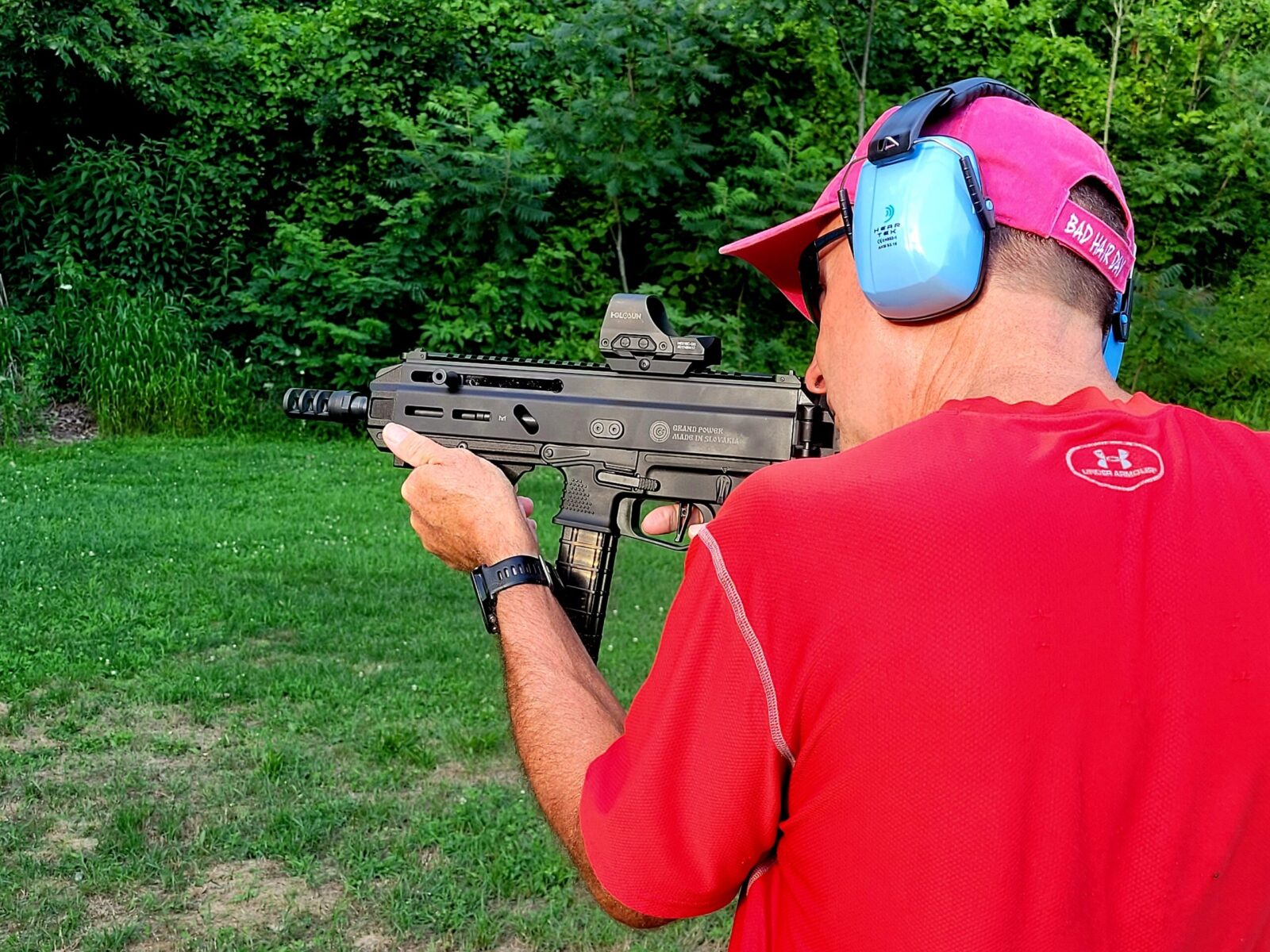
The Stribog has been to the range twice as of my writing this. The first visit was with my friend Jim and we used 124 grain S&B FMJ ammo. I like to use the 124 grain ammo during initial break in of 9mm firearms as there is a bit more recoil impulse to overcome remaining friction.
Jim putting 124gr FMJ rounds down range through the Stribog. We were both vey impressed. Ok, about the pink hat – Jim forgot his hat and it was a bright sunny day. The only spare hat in my truck was my wife’s. Sooo… Jim wore that hat and has endured good natured ribbing ever since. He’s a very good friend and a great shooter … even with a pink hat on – Hi Jim 🙂
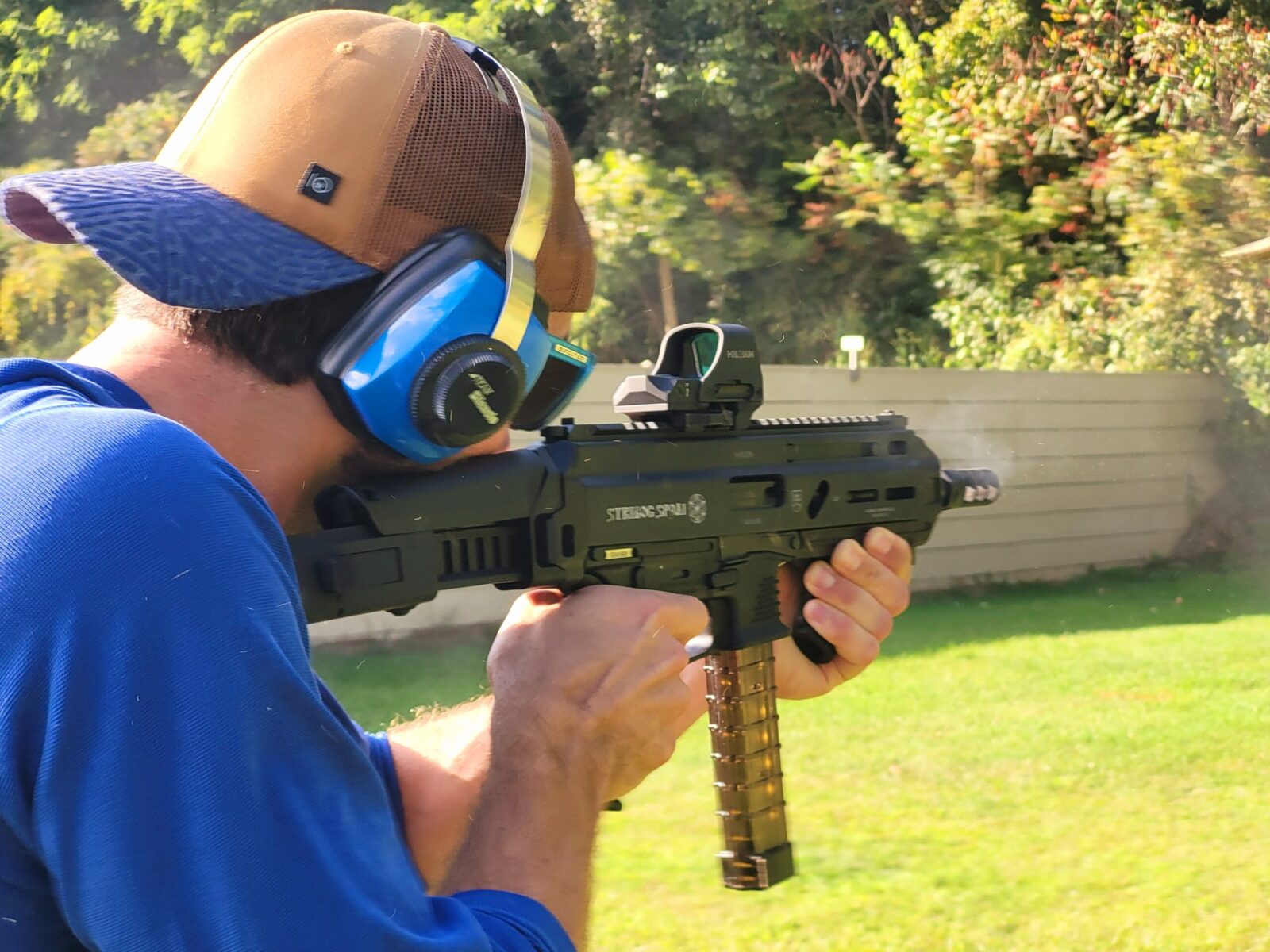
Niko is cutting loose. You can see some smoke rising from the muzzle. It was toasty from all the rounds. Niko is about 6′ 2″ tall and I’m only 5′ 8″. The adjustable brace worked really well for both of us as a result. By the way, that F5 modular brace system is incredible. I am running it on both my Stribog and CZ Scorpion Micro.
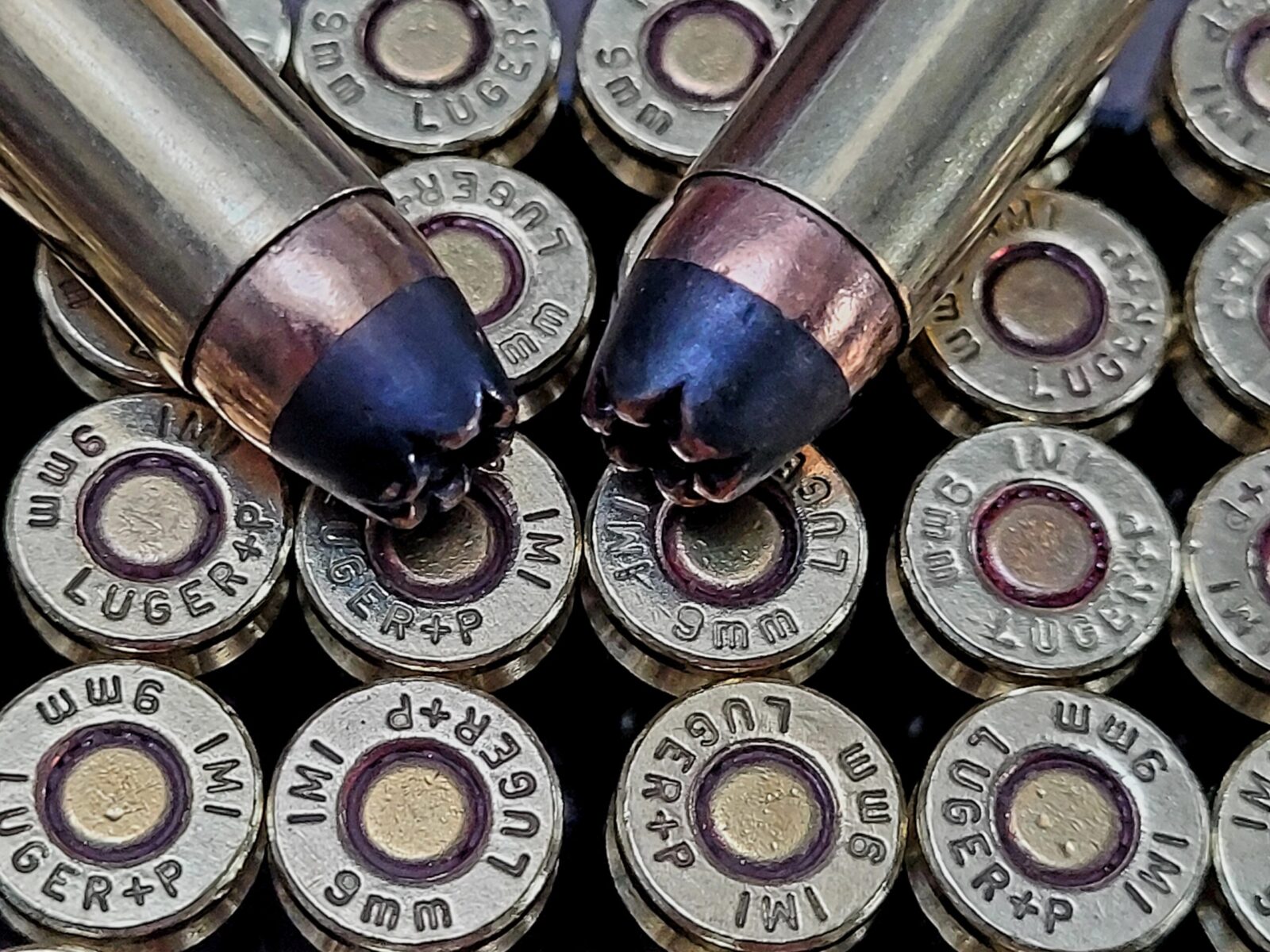
It ran great – I think we put about 90-120 rounds through it with no problems at all. In the second trip, we ran about 60 rounds of the 124 grain S&B FMJ. We then ran probably 300 rounds of 115 grain CCI Speer FMJ bulk box ammo and wrapped up with about 30 rounds of the IMI 124 grain +P black dot hollow points through it.
The IMI +P 124gr load is decent. The black paint is used to identify it is a +P load. It’s just a paint and not any form of special coating. If you read the reviews, it’s a decent HP load at the end of the day. I wish I’d brought some other HP loads to try as well. We didn’t have any issues but people have reported problems in the past with HP loads,
What was amazing was the we had zero, none, nada failures to feed (FTF) or failures to eject (FTE). I attribute this to how I break in all semi-autos before I go to the range the first time as mentioned above. It should also tell you that the Stribog is pretty well thought out and made.
The Stribog really performed great during both of its range trips. Note, we only used straight 30 round mags and none of the curved ones. I had the curved mags buried in my range bag and we simply didn’t get to them. We used mags both with and without the steel reinforcing lips and did not have anyu issues with either one.
So what else did I notice?
In both cases, we were shooting paper targets and plates at about 10-15 yards from the standing position. The combination of the Stribog, Holosun Optic and F5 modular brace proved to be excellent.
Controlling the Stribog even during rapid fire was easy. The relatively small 9mm cartridge has very little recoil to begin with and fired from the Stribog with a brake, it’s very easy to keep the muzzle on target. I’m sure the brake helped some but givent he weight of the Stribog and an 8″ barrel, it probably would have been ok without it. If nothing else, the brake looks better than the threaded muzzle protector.
The trigger is perfectly decent. It’s not a match trigger but it is one of the better factory triggers I have encountered out of the box in a pistol caliber carbine. I used my Wheeler digital trigger pull gauge to collect some test data – I carefully pulled the trigger 10 times and found that the average pull was 5 pounds 10.8 ounces. The minimum was 4 pounds 10.2 ounces and the maximum pull was 6 pounds 6.8 ounces. Not bad. There is a spring set to reduce the pull that can be bought but I don’t reallly think the pull needs to be changed given close quarter use.
By the way, I always compare triggers mentally to the worst triggers I have felt out of the box. The worst trigger award goes to H&K and clone MP5s. Yuck. I’d described those triggers as pulling a truck with no wheels through the mud. With practice you get used to them – I guess with enough practice you can get used to just about anything and they do wear in a bit – but they suck out of the box.
Moving on, I do wish the charging handle was a tad bigger to spread the load a bit more. It’s jost a tad too narrow for me but that’s just me. There is a folding charging handle option I plan to try at some point.
I do wish the charging handle was a tad thicker. See how it tapers in the middle? I do plan to upgrade to a folding charging handle in the future. The controls overall are well thought out and easy to use. The safety is just above the pistol grip, the magazine reease is above and to the front of the trigger and the slide release is immediately above the magazine release.
Summary
The Stribog really delivered. It was fun, accurate and reliable at the range. I wish I had brought some other hollow points to try but it didn’t cross my mind. I actually bought a case of the IMI +P 124gr HP rounds specifically for my PCCs if self defense was required – I really only shoot FMJ at the range.
To wrap up, I like the SP9A1 Stribog and have no hesitation recommending it to others given my experience. There is a growing aftermarket so you can customize the pistol to fit your needs.
I hope this helps you out!
Note, I have to buy all of my parts – nothing here was paid for by sponsors, etc. I do make a small amount if you click on an ad and buy something but that is it. You’re getting my real opinion on stuff.