Executive Summary
The United States handgun market is currently navigating a period of significant mechanical and structural transition, defined by a complex interplay between traditional manufacturing efficiencies and an emerging consumer preference for high-performance trigger systems. While the striker-fired mechanism remains the dominant operational architecture—accounting for approximately 72.06% of the service handgun market in 2025—the industry is witnessing a robust resurgence in hammer-fired platforms, specifically high-capacity single-action (2011) systems and modernized double-action/single-action (DA/SA) pistols. This shift is driven by a maturation of the consumer base, where experienced shooters are increasingly prioritizing trigger quality, modularity, and ergonomic refinement over the basic utilitarian simplicity that catalyzed the “polymer revolution” of the late 20th century.
From an engineering perspective, the market is moving toward a trifurcation. The first segment, intended for mass-market duty and entry-level self-defense, continues to favor the striker-fired system for its low parts count, consistent pull, and cost-effective polymer-molding production. The second segment, characterized by a rapid ascent in both competitive and professional tactical circles, is the high-capacity single-action platform, which has effectively addressed the historical round-count limitations of the 1911 while retaining its superior trigger geometry. The third segment is a revitalized DA/SA market, which appeals to a “tactical enthusiast” demographic that values the mechanical safety of a heavy first-stage trigger pull and the aesthetic craftsmanship of metal-framed firearms. As we project toward 2035, the market is expected to reach 23.5 billion dollars globally, with North America maintaining its status as the primary engine of innovation and consumption. This report provides an exhaustive technical and economic analysis of these trends, detailing the causal relationships between mechanical design, manufacturing logistics, and end-user requirements.
1. Macroeconomic and Domestic Market Environment
The global handgun market stood at a valuation of approximately 3.12 billion dollars in 2022 and has demonstrated a consistent upward trajectory, projected to reach 5.35 billion dollars by 2030 at a compound annual growth rate (CAGR) of 6.6%.1 Within this global context, North America is the undisputed leader, commanding a 43.27% share in 2022 and maintaining a dominant presence through 2025.1 The United States market, specifically, is currently undergoing a “correction” following the unprecedented demand spikes seen in 2020 and 2021, when annual sales peaked at 21.8 million units.3 In 2024, Americans purchased approximately 16.17 million firearms, representing a 3% decline from the previous year, with 2025 forecasts suggesting a further stabilization at 15.5 million units.3
Despite this cooling period, the baseline demand remains nearly double the figures observed in the early 2000s, supported by a civilian inventory estimated at over 500 million firearms.3 The diversification of the gun-owning demographic is a critical driver of this sustained volume. Women’s ownership has more than doubled since the 1990s, and Hispanic ownership has seen a 33% increase since 2017.3 Conversely, there has been a 22% decrease in reported gun ownership among adults aged 18–29, a trend that suggests the market is increasingly reliant on older, more affluent “repeat buyers” who are more likely to invest in premium hammer-fired and specialized platforms rather than entry-level utility pistols.3
1.1 Market Segmentation by Operation and Type
The handgun market is bifurcated by type into semi-automatic pistols and revolvers, with semi-automatics holding the largest share due to their widespread application in law enforcement, personal security, and shooting sports.1 In the service handgun sector, pistols accounted for 88.25% of the market in 2025, while revolvers maintained an 11.75% niche, valued for their mechanical simplicity and reliability in sensitive operations.5
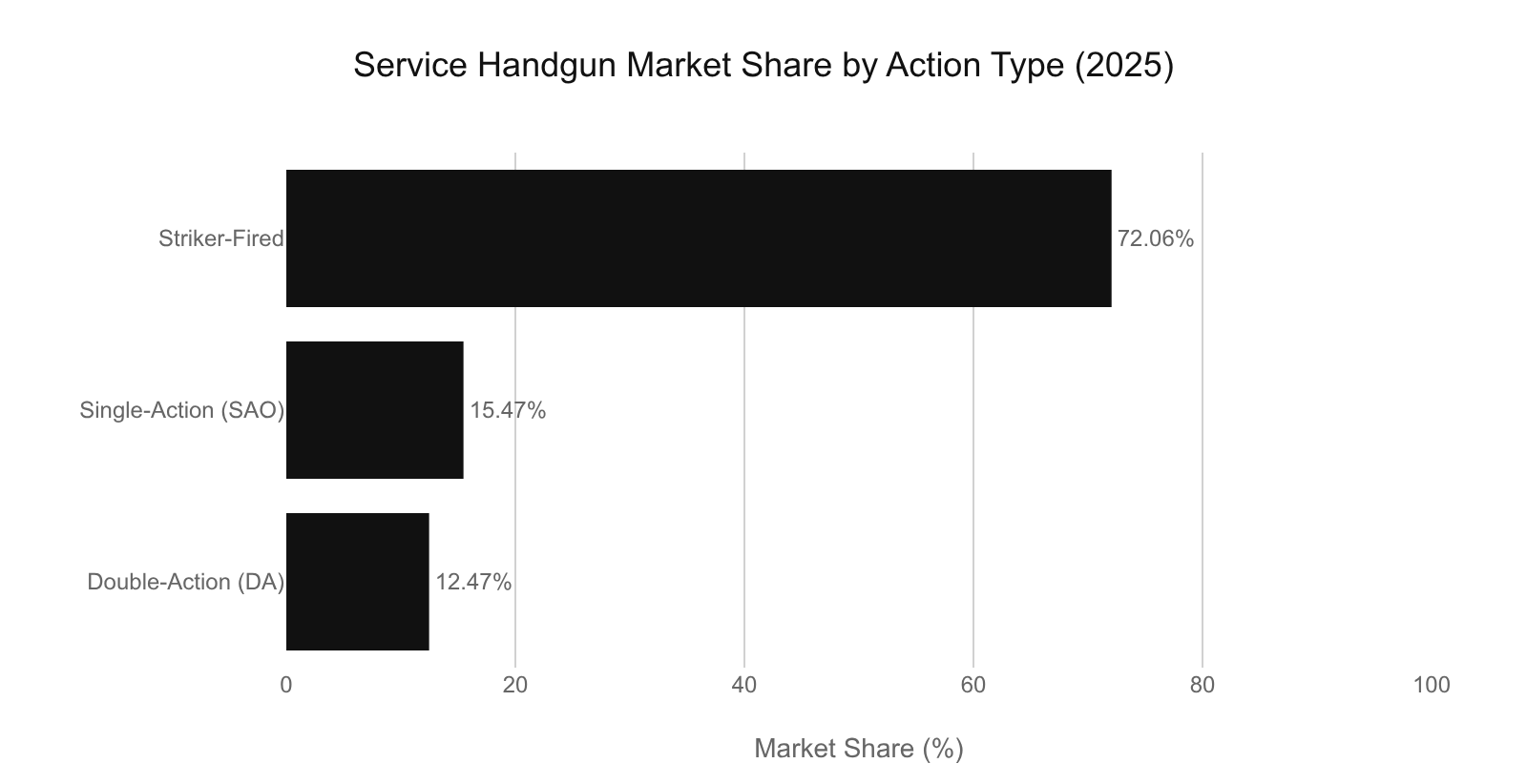
| Operation Mechanism | 2025 Market Share (Service) | Projected CAGR (2026-2031) | Primary Drivers |
| Striker-Fired | 72.06% | 6.79% | Cost, Consistency, LE Standardization |
| Single-Action (SAO) | 15.47% | 5.80% | Precision, Speed, 2011 Platform Growth |
| Double-Action (DA) | 12.47% | 4.20% | Legacy Inventory, Mechanical Safety |
(Note: Figures derived from service handgun market analysis, representing professional procurement trends.5)
The dominance of 9 mm caliber ammunition continues to reinforce the semi-automatic pistol market.
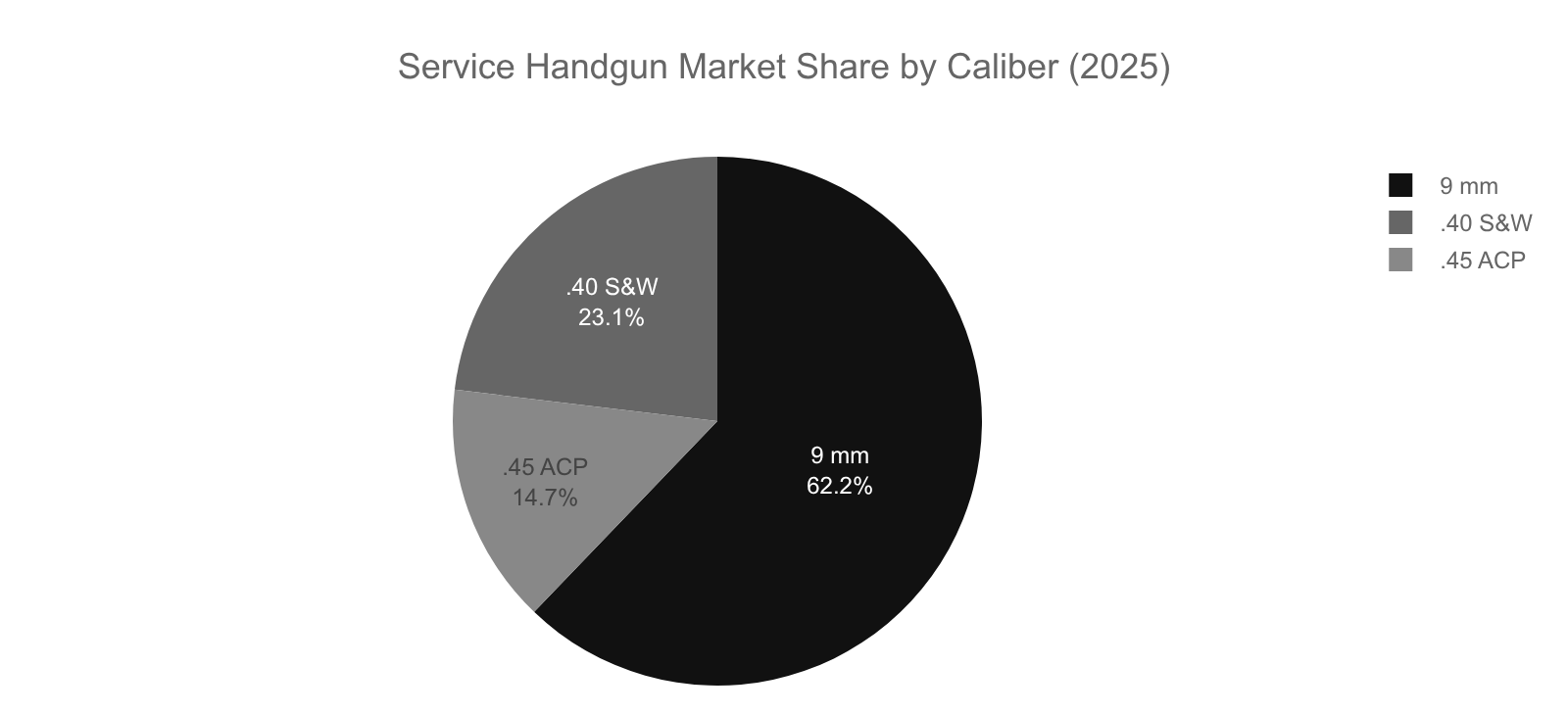
In 2025, 9 mm held a 62.17% share of the service handgun market, a position propelled by NATO standardization and significant ballistic enhancements that have overcome earlier doubts regarding its terminal performance.5 Agencies transitioning from.40 S&W to 9 mm cite the 2- to 3-round increase in magazine capacity and lower recoil as primary factors that improve officer qualification rates and field effectiveness.5
1.2 State-Level Demand Variations
The U.S. market is not geographically uniform; it is heavily influenced by local legislative environments. States like Wyoming, Montana, and Alaska lead the nation in population-adjusted sales rates, largely due to rural lifestyles and a strong tradition of hunting and self-defense.6 In 2024, Massachusetts experienced the highest year-over-year increase in gun sales at 22.5%, a spike attributed to consumer reactions to the implementation of “An Act Modernizing Firearms Laws”.6 Conversely, Washington state saw a 45.7% decrease in sales, reflecting the impact of restrictive state-level legislation on market liquidity.6 These geographic fluctuations indicate that while the national trend is toward stabilization, regional “panic buying” and legislative changes continue to create localized growth opportunities for manufacturers.
2. The Engineering Logic of Modern Pistol Actions
To understand why the market is moving toward specific actions, it is necessary to examine the mechanical advantages and engineering trade-offs of each system. The “action” of a handgun refers to the mechanism that loads, fires, and ejects cartridges.7
2.1 Striker-Fired Systems: The Efficiency Benchmark
Striker-fired pistols use a spring-loaded striker rather than a traditional hammer. When the slide is cycled, the striker is captured in a partially or fully tensioned state. Pulling the trigger completes the cocking process and releases the striker to ignite the primer.2
From an engineering perspective, striker-fired pistols are inherently simpler and cheaper to produce. They typically require fewer parts—a standard Glock contains roughly 34 components, whereas a traditional hammer-fired Beretta 92FS contains over 70.9 This reduction in complexity translates to lower production hours and a faster route to scaling manufacturing.9 Because there is no external hammer, these pistols offer a more “snag-free” profile for concealed carry and duty use.9
However, the primary drawback is the trigger feel. Because the trigger must often complete the cocking of the striker spring, the “wall” (the point of maximum resistance before the break) can feel “spongey” compared to hammer-fired systems where the trigger only has to release a sear.13
2.2 Single-Action Only (SAO): The Pursuit of Precision
In a single-action system, the trigger performs a single task: releasing the firing mechanism.14 The hammer must be cocked manually or by the cycling of the slide before the gun can fire. This allows for the shortest and lightest trigger pulls available on the market, typically ranging from 2.5 to 4.5 pounds in modern defensive and competition platforms.15
The 2011 platform represents the modern evolution of the single-action pistol. By utilizing a modular frame—separating the grip module from the metal upper frame—manufacturers can offer the precision of a 1911 trigger with the high capacity (17-26 rounds) of a modern double-stack magazine.17 This modularity also allows for extensive customization, as shooters can swap grips, triggers, and slides to meet specific ergonomic needs.18
2.3 Double-Action/Single-Action (DA/SA): The Hybrid Solution
DA/SA pistols use two distinct trigger modes. The first shot is typically a long, heavy double-action pull (7–12 pounds) that both cocks and releases the hammer.8 This serves as a mechanical safety, as the long travel and heavy weight make a negligent discharge less likely under stress.14 Subsequent shots are single-action, as the cycling slide cocks the hammer, allowing for faster, more precise follow-up shots.8
| Feature | Striker-Fired | SAO (2011) | DA/SA (CZ 75/Beretta 92) |
| Trigger Pull Consistency | Excellent (Same every time) | Excellent (Same every time) | Variable (Heavier first shot) |
| Safety Profile | Passive (Internal safeties) | Manual (Thumb safety) | Manual/Mechanical (Heavy DA) |
| Complexity | Low (Fewer parts) | Moderate | High (More components) |
| Typical Pull Weight | 5–6 lbs | 3–4 lbs | 10–12 lbs (DA) / 4–5 lbs (SA) |
(Data compiled from multiple engineering reviews of trigger mechanics.14)
3. Directional Movement of the US Market: The “Hammer-Fired Resurgence”
The central question of the market’s direction can be answered by observing the “hammer-fired resurgence” that is currently challenging striker-fired dominance. While strikers still command the largest market share, hammer-fired guns are making a “slow and deliberate comeback”.20
3.1 Why Single-Action is Growing Disproportionately
The Single-Action Only (SAO) segment, particularly the 2011 platform, is the fastest-growing niche in the high-performance market. This growth is driven by a “paradigm shift” in how consumers value trigger pull regarding accuracy. Older theories that a consistent trigger pull was the most critical factor for accuracy are being replaced by the realization that a light and crisp trigger pull allows even less-skilled shooters to achieve higher accuracy.20
The 2011’s ascent is also fueled by its popularity in popular culture, such as the John Wick franchise, and its adoption by tactical professionals.18 The Staccato P is now issued or approved by over 1,800 law enforcement agencies across the U.S., a significant milestone that has “legitimized” the platform beyond the niche of competitive shooting.18
3.2 The Modernization of DA/SA: The CZ and Beretta Pivot
The DA/SA market is not moving toward obsolescence but toward modernization. Manufacturers like CZ and Beretta have successfully revamped their legacy platforms to include “optics-ready” slides, accessory rails, and improved ergonomics.22 The CZ P09 Nocturne and the Beretta 92X are prime examples of this trend, offering the classic DA/SA mechanics in a package that competes directly with modern striker-fired pistols for features.20
A key trend in the DA/SA market is the “Langdon Tactical” or “Wilson Combat” effect—third-party engineering firms that provide high-tier internal upgrades, turning duty-grade pistols into precision instruments.22 This has created a “luxury” or “connoisseur” segment within the DA/SA market that values the mechanical complexity and craftsmanship of metal-framed hammer-fired guns.9
3.3 The Decline of Double-Action Only (DAO)
While SA and DA/SA are seeing renewed interest, the Double-Action Only (DAO) semi-automatic market is shrinking. DAO handguns, which were once popular for their safety profile, are being replaced by “partially cocked striker” systems that offer a similar level of safety with a much lighter and more manageable trigger pull.14 The only remaining stronghold for DAO is in the “pocket pistol” or “deep concealment” category, such as the KelTec P32, where the mechanical simplicity and low weight are prioritized over trigger performance.20
4. In-Depth Case Study: The 2011 Platform and the Modular Revolution
The term “2011” has transitioned from a trademarked brand (Staccato/STI) to a genericized term for any double-stack 1911-style pistol.18 This platform is currently the focal point of innovation in the US market.
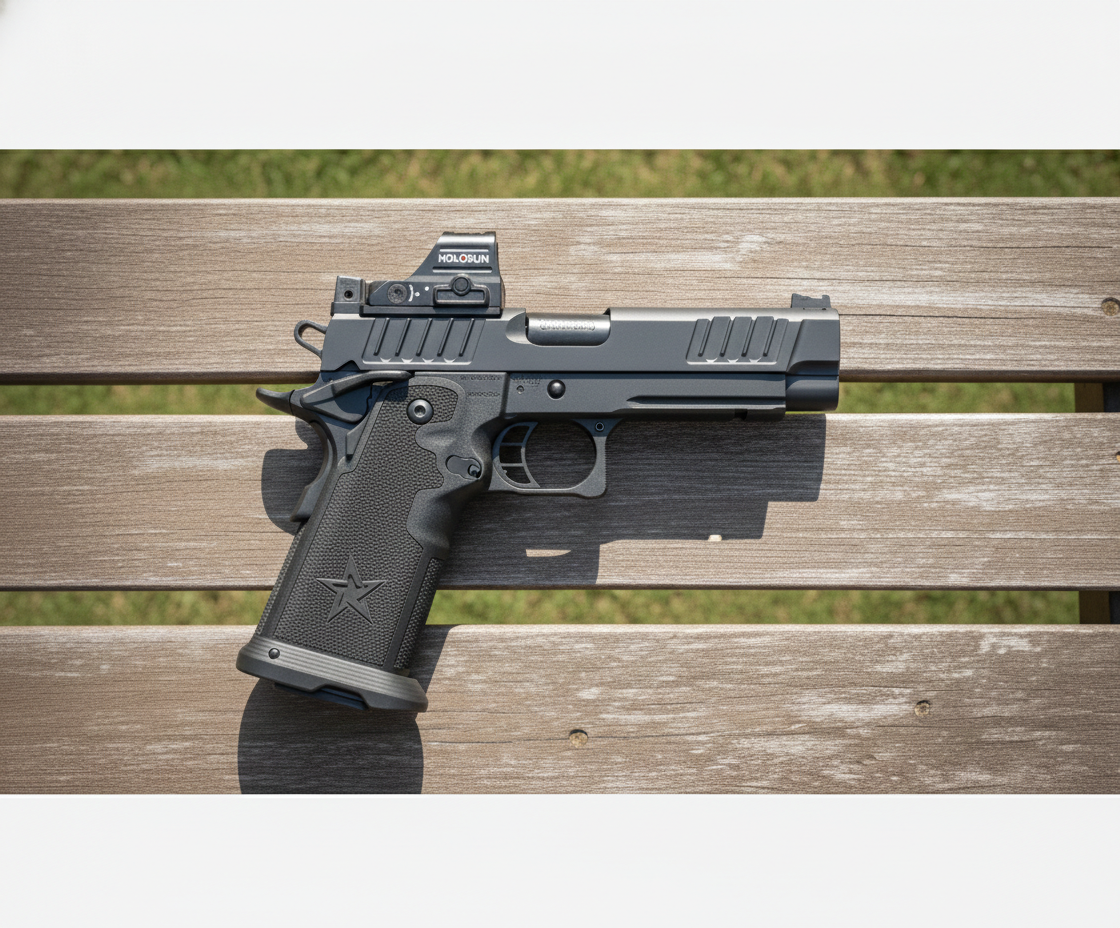
4.1 Tiered Market Segmentation of 2011s
The 2011 market has matured into three distinct tiers, allowing for broader consumer accessibility.
| Market Tier | Example Brands | Price Range | Target Audience |
| High-End/Bespoke | Atlas Gunworks, Nighthawk, Taran Tactical | $4,000–$7,000+ | Collectors, Professional Competitors |
| Mid-Tier/Duty | Staccato, Springfield Armory (Prodigy) | $1,500–$3,500 | Law Enforcement, Serious CCW |
| Value/Entry | MAC, Rock Island Armory, Girsan | $600–$1,200 | Recreational Shooters, First-time 2011 buyers |
(Data derived from market pricing and brand positioning reports.18)
4.2 Engineering Trends within the 2011 Category
- Modular Frames: The use of polymer or hybrid grip modules allows for weight reduction and customizable textures. This modularity is a “hallmark innovation” that differentiates the 2011 from the classic single-stack 1911.18
- Optics-Ready Slides: In 2025, an optics-ready slide is a mandatory feature for any 2011 intended for duty or competition. This reflects a broader market-wide shift toward red-dot sights for faster target acquisition.18
- Magazine Ecosystems: While proprietary magazines were a historical bottleneck for the platform, the emergence of the “Glock-magazine 1911” (e.g., the Platypus) represents a significant trend in merging a high-performance action with a reliable, inexpensive magazine ecosystem.18
5. Engineering Analysis: CZ 75 vs. Beretta 92 Action Systems
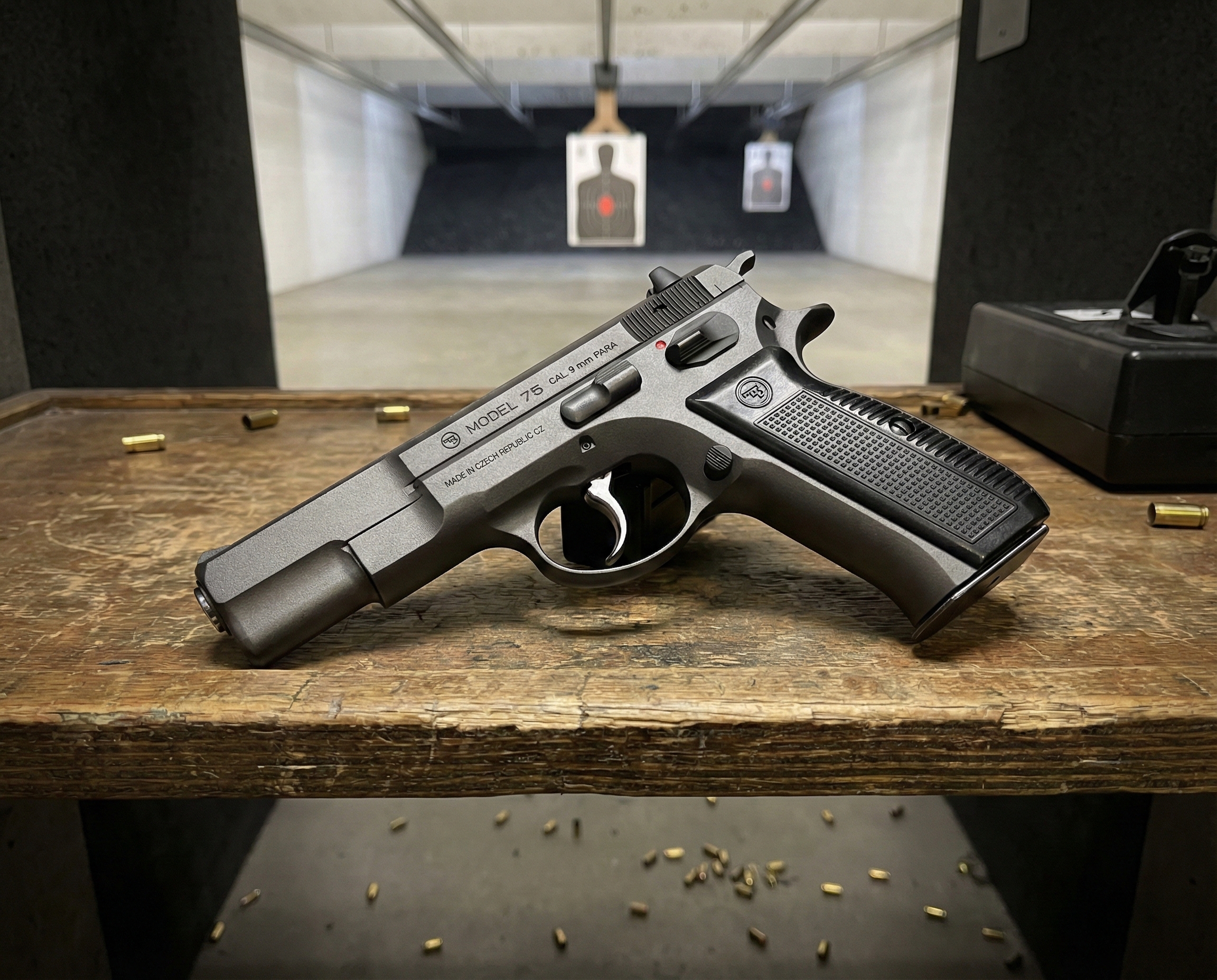
The two most prominent DA/SA platforms—the CZ 75 and the Beretta 92—provide a clear case study in divergent engineering philosophies regarding the hammer-fired action.
5.1 Slide and Rail Engineering
The CZ 75 utilizes a “slide-in-frame” design where the slide rides on internal frame rails. This engineering choice results in a tighter slide-to-frame lock-up and lowers the slide mass closer to the recoil path, which reduces felt torque and muzzle flip.22 The downside of this design is that it provides a smaller surface area for the user to grip when racking the slide.22
In contrast, the Beretta 92 features an “open-top slide” design. This heritage, derived from the Walther P38, provides superior ejection reliability because there is virtually no metal in the path of the spent casing. However, it lacks the rigid full rail engagement of the CZ 75, making the slide-to-frame fit slightly less “locked-in”.22
5.2 Barrel Lockup Mechanisms
| Feature | CZ 75 Mechanism | Beretta 92 Mechanism |
| System Type | Browning Linkless Cam | Falling Locking Block |
| Movement | Barrel tilts during cycling | Barrel remains horizontal |
| Impact | Standard, reliable design | Smoother feeding, less muzzle flip |
| Wear Factors | High durability | Locking block is a “wear item” |
(Data from mechanical engineering comparisons of DA/SA service pistols.22)
5.3 Safety and Decocking Variations
The market preference for “Condition One” (cocked and locked) carry has influenced the design of these platforms. The CZ 75B typically features a frame-mounted manual safety, allowing it to be carried like a 1911.22 The Beretta 92, conversely, traditionally uses a slide-mounted decocker/safety. In 2025, a major trend is the “G-conversion” or “decocker-only” model, which eliminates the manual safety in favor of a decocking lever that automatically returns to a fireable state, simplifying the manual of arms for duty users.22
6. Trigger Performance: A Comparative Metric Analysis
A primary reason for the shift toward SA and DA/SA is the quantifiable advantage in trigger performance, which directly correlates to shooting speed and precision.
6.1 Trigger Pull Weights by Action Type
The following chart represents the “standard” pull weight ranges across the industry in 2025.
Trigger Pull Weight Ranges (Lbs)
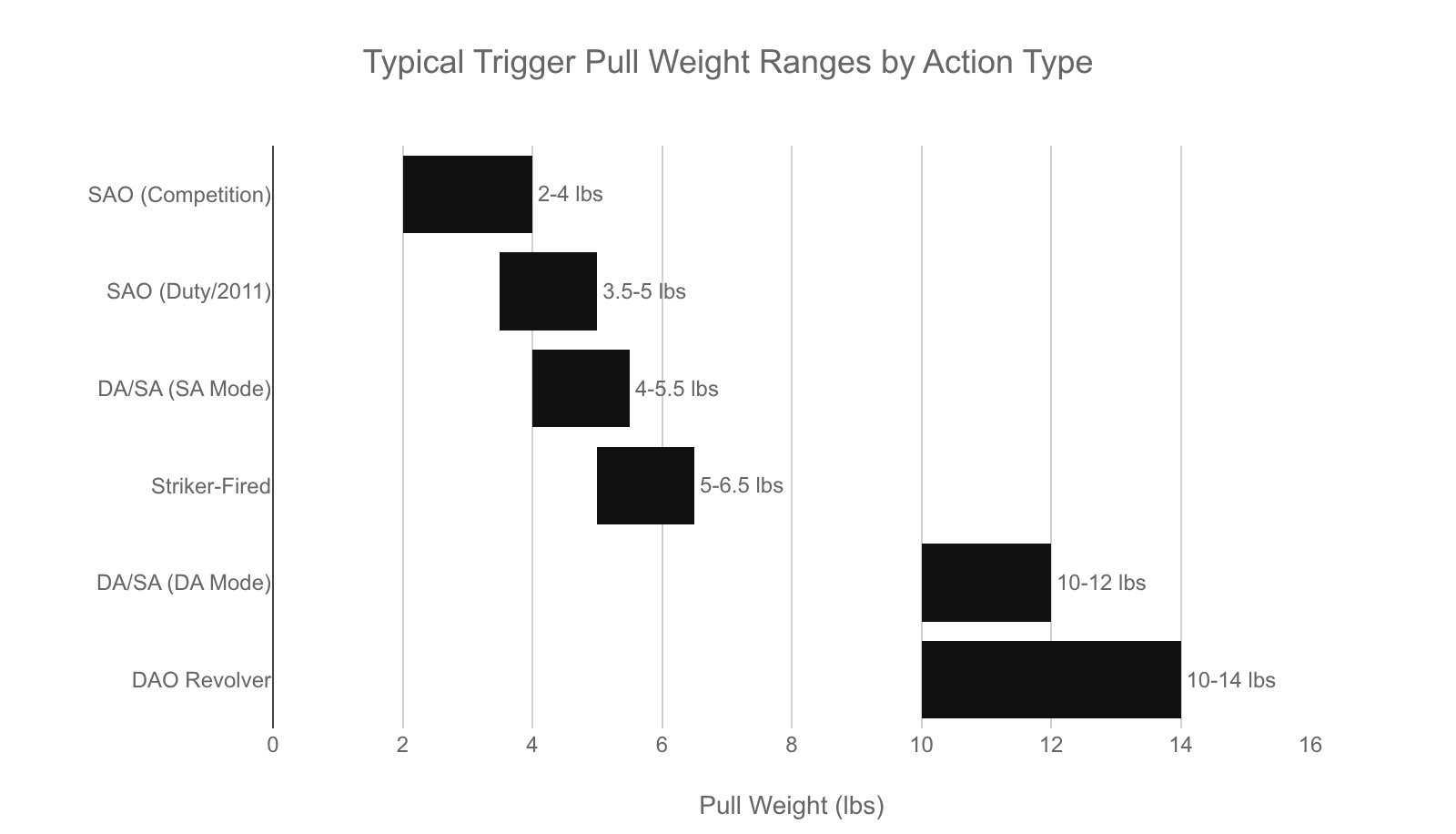
(Data labeled for typical factory specifications.15)
6.2 Trigger Reset Engineering
Reset length—the distance the trigger must move forward to re-engage the sear—is a critical metric for “split times” (the time between shots). Single-action triggers consistently outperform strikers and DA/SA systems in this regard.
- 2011/SAO: Reset length is typically 0.04 to 0.08 inches (1–2 mm).
- Modern Striker: Reset length is typically 0.12 to 0.15 inches (3–4 mm).
- Modern DA/SA (Beretta 92X): The new “Xtreme Trigger” reduces the standard reset by 40%, bringing it down to approximately 0.08 inches (2 mm).31
The mechanical advantage of a 1 mm reset in a 2011 is not merely a matter of convenience; it represents a functional leap in the shooter’s ability to “prep the trigger in recoil”.33 This technique, used by elite shooters, allows for a follow-up shot to be fired the instant the sights return to the target.34
7. Use Case Analysis: Determining Action Preference by Role
The market’s directional movement is segmented by the intended use case, with each action type excelling in specific environments.
7.1 Concealed Carry (CCW) and Defensive Use
In the CCW market, the trend is toward “Micro-Compact” pistols that offer high capacity (10–13 rounds) in a pocket-sized frame.
- Striker Dominance: The SIG P365 and Springfield Hellcat dominate this space due to their simplicity and passive safety systems.35
- The Internal Hammer Trend: A new sub-trend is the internal-hammer micro-compact, exemplified by the FN Reflex. By using an internal hammer rather than a striker, FN has created a micro-compact with a superior trigger pull and a slide that is 30% easier to rack, appealing to users with reduced hand strength.20
7.2 Home Defense and Range Training
For home defense, where concealability is not a factor, “full-size” pistols are preferred.
- DA/SA Resilience: Many homeowners prefer the DA/SA platform (e.g., CZ 75, Beretta M9A4) for the “deliberate first shot” safety. The weight of an all-metal frame (typically 30–40 oz) also helps absorb recoil, making the gun easier for all family members to operate accurately.23
- High-Capacity SAO: The “MAC 2011” and similar budget double-stacks are increasingly recommended as home defense tools because they offer the capacity of a duty gun with the shootability of a competition gun at a accessible price point.18
7.3 Competitive Shooting (USPSA/IPSC)
Competition is the “proving ground” where action trends are born. Currently, the “Carry Optics” division is dominated by the CZ Shadow 2 (DA/SA) and the Staccato XL (SAO).27 The trend here is toward heavier guns—the CZ Shadow 2 weighs 46.5 oz—to provide the flattest shooting experience possible.37
8. The Manufacturing Engineering of Pistol Actions
The movement toward striker-fired pistols was largely an “engineering-for-cost” decision. The current move back toward hammer-fired pistols is a “consumer-value” decision.
8.1 Production Cost Analysis
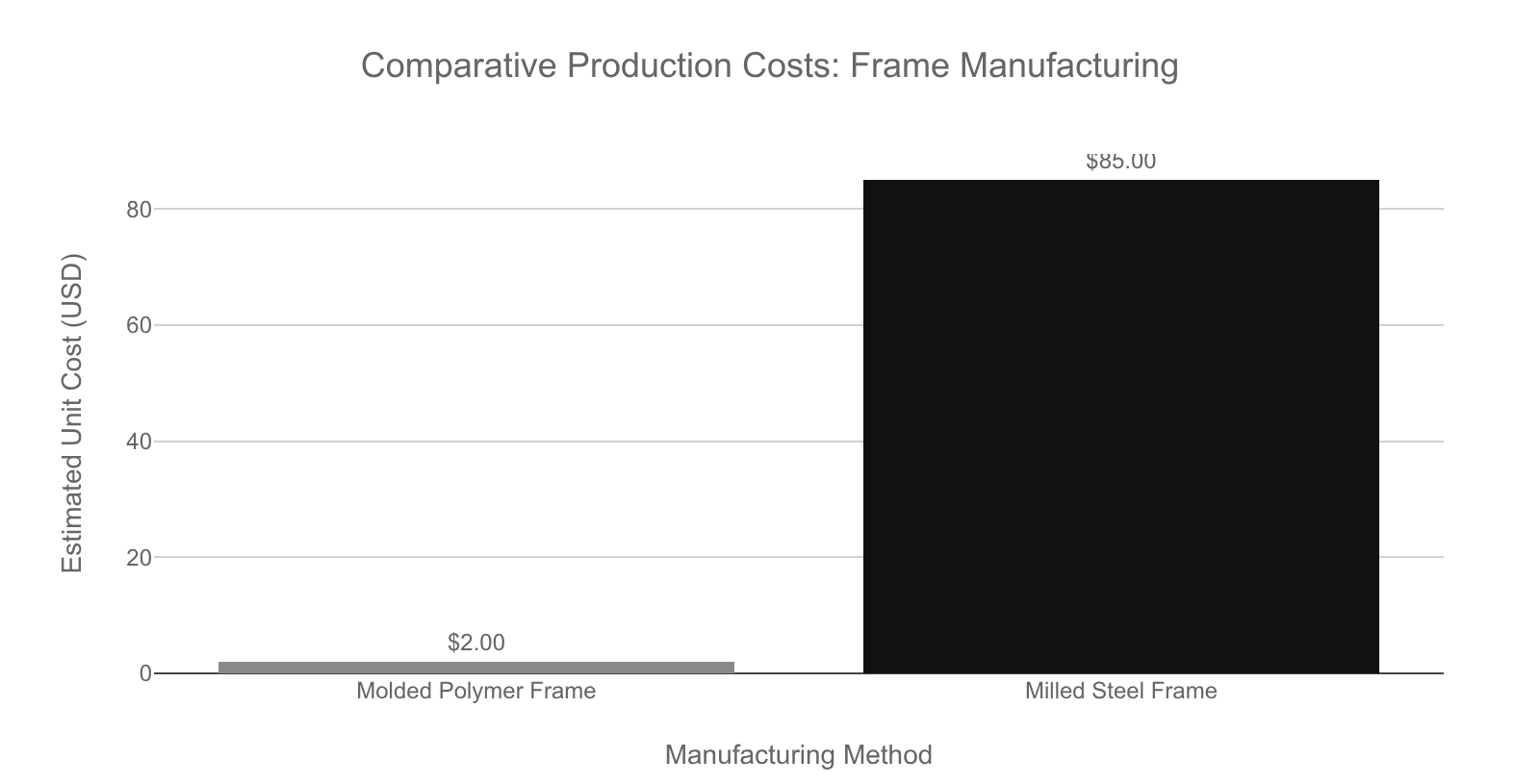
Molding a polymer frame takes minutes and costs pennies in material. Machining a steel frame from a block of raw material takes hours of CNC time and requires significant tool-wear maintenance.2 Furthermore, hammer-fired guns require more “hand-fitting” of sears and hammers to achieve a high-quality trigger pull.12
| Component | Striker (Polymer) Cost | Hammer (Steel) Cost | Engineering Impact |
| Frame | $2.00 (Molded) | $85.00+ (Milled) | Steel requires complex finishing |
| Firing System | Linear, stamped | Rotational, machined | Hammer systems have more pin-points |
| Assembly | Minutes (Drop-in) | Hours (Fitting) | Human labor is the primary cost driver |
(Relative manufacturing cost estimates based on industry production reports.12)
8.2 The “Daniel H9” as a Case Study in Action Hybridization
A notable trend in 2024–2025 is the attempt to merge the advantages of different actions. The Daniel H9 (introduced in early 2024) uses a striker-fired mechanism but utilizes a 1911-style straight-pull trigger and a very low bore axis.2 This engineering attempt to “re-invent” the striker-fired trigger is a direct response to the market’s demand for hammer-fired performance in a modern, cost-effective striker-fired package.
9. Global and Regional Trends: 2025–2035 Outlook
The global handgun market is projected to reach 4.99 billion dollars by 2032.39 While North America remains the leader, the Asia-Pacific region is the fastest-growing market, driven by increasing interest in sport shooting and modernization of law enforcement fleets.39
9.1 Technological Substitution and “Smart” Integration
A significant trend in the forecast period is the transition to “smart” handguns with biometric safety systems.39 While these have yet to achieve mainstream adoption in the U.S. civilian market, they represent a potential future direction that could favor striker-fired systems, as the linear mechanism of a striker is more easily integrated with electronic solenoids and blocking systems than the rotational mechanism of a hammer.
9.2 The Impact of Geopolitical Tensions
The Russia-Ukraine conflict and broader geopolitical tensions are forcing a “revamping” of the handgun market. Manufacturers are increasingly focused on “military-grade” durability and multi-caliber capabilities.1 This favor’s duty-proven actions like the DA/SA Beretta 92FS and the SAO Staccato P, which have demonstrated “battlefield reliability” over decades of use.22
10. Quantitative Comparison of Top Hammer-Fired Models (2025-2026)
To illustrate the market’s direction, we must examine the specific specifications of the leading hammer-fired contenders that are currently gaining market share.
| Model | Action | Caliber | Weight | Barrel Length | MSRP Category |
| CZ P09 Nocturne | DA/SA | 9mm | 29.2 oz | 4.53 in | Value/Mid |
| Staccato P | SAO | 9mm | 33.0 oz | 4.40 in | Premium |
| S&W CSX E Series | SAO | 9mm | 19.7 oz | 3.10 in | Value |
| Beretta M9A4 | DA/SA | 9mm | 33.4 oz | 4.80 in | Mid/Premium |
| FN Reflex MRD | SAO (Int) | 9mm | 18.4 oz | 3.30 in | Mid |
(Data labeled for current model-year specifications.20)
10.1 Key Engineering Observations from Model Specs
- Weight as a Feature: Even the “lightweight” hammer-fired options (like the FN Reflex at 18.4 oz) are slightly heavier than their polymer-striker counterparts. The market is increasingly viewing this extra 1–2 ounces as an acceptable trade-off for reduced recoil.20
- Slide Ergonomics: Deeper slide serrations and “easy-rack” internal hammer designs (like the Reflex and the Beretta 80X) are direct responses to the user demand for better manual control of the firearm.20
11. Conclusion: The Market’s Directional Trajectory
The U.S. pistol market is not moving toward a single action type to the exclusion of others; instead, it is undergoing a sophisticated “role-based specialization.”
Striker-fired actions remain the “utility standard”—the “Toyota Camry” of the firearms world—providing the necessary performance for mass-market duty and self-defense at a price point that reflects their manufacturing efficiency. They are not shrinking in volume, but they are losing their monopoly on the consumer’s imagination.
Single Action Only (SAO), via the 2011 platform, is the “performance leader.” It is growing disproportionately because it has successfully transitioned from a specialized racing tool to a rugged, duty-ready platform. The market movement here is toward “democratization,” as budget-friendly 2011s make this high-tier performance available to the average consumer.
Double-Action/Single-Action (DA/SA) has successfully established itself as the “enthusiast’s choice.” By modernizing legacy platforms (CZ 75, Beretta 92) with optics cuts and accessory rails, manufacturers have ensured that these designs remain relevant for users who prioritize mechanical safety and the aesthetic of all-metal construction.
The overarching trend for all action types in the 2024–2035 window is a move toward modularity, optics-integration, and ergonomic personalization. The market is increasingly “trigger-conscious,” and as manufacturing techniques like MIM (Metal Injection Molding) and advanced CNC machining continue to lower the cost of complex hammer-fired systems, the gap between “entry-level” striker performance and “premium” hammer performance will continue to drive consumer spending in the direction of the single-action and DA/SA hybrid platforms.
Please share the link on Facebook, Forums, with colleagues, etc. Your support is much appreciated and if you have any feedback, please email us in**@*********ps.com. If you’d like to request a report or order a reprint, please click here for the corresponding page to open in new tab.
Sources Used
- Handgun Market Size, Share, Trends | Growth Statistics [2030] – Fortune Business Insights, accessed February 18, 2026, https://www.fortunebusinessinsights.com/handgun-market-108876
- Handguns Market Size, Competitors, Trends & Forecast to 2030 – Research and Markets, accessed February 18, 2026, https://www.researchandmarkets.com/report/handgun-market
- American Gun Sales and Manufacturing Statistics: Industry Analysis – Alien Gear Holsters, accessed February 18, 2026, https://aliengearholsters.com/blogs/news/american-gun-sales-manufacturing-statistics
- Gun Sales Are Plummeting. Here’s Why – The Trace, accessed February 18, 2026, https://www.thetrace.org/2025/01/gun-sales-america-market-decline-data/
- Service Handgun Market – Size, Share & Manufacturers 2026 – 2031, accessed February 18, 2026, https://www.mordorintelligence.com/industry-reports/service-handgun-market
- Gun Sales in the U.S.: 2026 Statistics | SafeHome.org, accessed February 18, 2026, https://www.safehome.org/data/firearms-guns-statistics/
- Learning About the Components of a Handgun – Concealed Coalition, accessed February 18, 2026, https://my.concealedcoalition.com/components-of-a-handgun/
- The Time Is Now: Choosing Between Striker-Fired and DA/SA – Langdon Tactical, accessed February 18, 2026, https://langdontactical.com/the-time-is-now/
- TFB DEBATE CLUB: Striker-Fired Pistols Vs Hammer-Fired Pistols | thefirearmblog.com, accessed February 18, 2026, https://www.thefirearmblog.com/blog/2020/12/14/debate-club-striker-fired-hammer-fired/
- Colt 1911a1/Springfield vs Beretta 92FS vs Glock 17 gen3 : r/guns – Reddit, accessed February 18, 2026, https://www.reddit.com/r/guns/comments/1f9u4tg/colt_1911a1springfield_vs_beretta_92fs_vs_glock/
- Beretta vs Glock: A Detailed Comparison | Craft Holsters®, accessed February 18, 2026, https://www.craftholsters.com/glock/guides/beretta-vs-glock
- 7 Advantages of Striker-Fired Handguns Over Hammer-Fired Guns – Backfire, accessed February 18, 2026, https://backfire.tv/7-advantages-of-striker-fired-handguns-over-hammer-fired-guns/
- DIFFERENCES IN TRIGGERS – Stock & Barrel Gun Club, accessed February 18, 2026, https://stockandbarrel.com/differences-in-triggers/
- Modern Handgun Action Types: Breaking It Down – Inside Safariland, accessed February 18, 2026, https://inside.safariland.com/blog/modern-handgun-action-types-breaking-it-down/
- Trigger Pull Weight and Accurate Shooting | USCCA Blog, accessed February 18, 2026, https://www.usconcealedcarry.com/blog/trigger-pull-weight/
- Best 9mm Pistol for Every Use: CCW, Home Defense & Range | American Firearms, accessed February 18, 2026, https://www.americanfirearms.org/best-9mm-pistols/
- 2011 Pistols in 9mm: The Ultimate Guide to High-Capacity, Precision Shooting, accessed February 18, 2026, https://demo.data.nichq.org/vhur/01-2011-pistols-in-9mm-the-ultimate-guide-to-high-capacity-precision-shooting-6208/
- Complete 2011 Pistol (Double Stack 1911) Buyer’s Guide: Top …, accessed February 18, 2026, https://gunprime.com/blog/best-2011-pistols-the-ultimate-guide
- DA/SA vs Striker Fired – What’s the best option for you? – The Firearm Blog, accessed February 18, 2026, https://www.thefirearmblog.com/blog/2019/04/22/da-sa-vs-striker-fire-whats-the-best-option-for-you/
- 7 Best Hammer-Fired Guns: Our Picks for 2026 – Gun University, accessed February 18, 2026, https://gununiversity.com/best-hammer-fired-guns/
- Is the 2011 Pistol Good for Concealed Carry? (Double-Stack 1911) – Second Call Defense, accessed February 18, 2026, https://secondcalldefense.org/is-the-2011-pistol-good-for-concealed-carry-double-stack-1911/
- CZ 75 vs Beretta 92: Detailed Comparison of Two DA/SA Legends – Alien Gear Holsters, accessed February 18, 2026, https://aliengearholsters.com/blogs/news/cz-75-vs-beretta-92
- DA/SA Pistols: Still Relevant in 2025? – Guns – Gritr Range, accessed February 18, 2026, https://range.gritrsports.com/blog/da-sa-pistols-still-relevant/
- So wait. Why are DA/SA guns like the M9 obsolete again but 2011s aren’t? : r/Firearms, accessed February 18, 2026, https://www.reddit.com/r/Firearms/comments/1liqd60/so_wait_why_are_dasa_guns_like_the_m9_obsolete/
- The Rise of the 2011: Taking a Look at the Current 2011 Trends – Rainier Arms, accessed February 18, 2026, https://www.rainierarms.com/blog/The-Rise-of-The-2011.html
- The World of Budget 2011 and Double Stack 1911 Pistols – Inside Safariland, accessed February 18, 2026, https://inside.safariland.com/blog/the-world-of-budget-2011-and-double-stack-1911-pistols/
- The Best 2011 Pistols of 2025, Tested and Reviewed | Outdoor Life, accessed February 18, 2026, https://www.outdoorlife.com/guns/best-2011-pistols/
- CZ 75 vs Beretta 92: Comparing Two Legendary 9mm Handguns | Craft Holsters®, accessed February 18, 2026, https://www.craftholsters.com/cz/guides/75-vs-beretta-92
- Hammer guns: CZ-75 vs Beretta 92 vs 1911 – Reddit, accessed February 18, 2026, https://www.reddit.com/r/guns/comments/qf53ki/hammer_guns_cz75_vs_beretta_92_vs_1911/
- Firearms Examiner Training | Trigger Pull Measurements – NIJ.gov, accessed February 18, 2026, https://nij.ojp.gov/nij-hosted-online-training-courses/firearms-examiner-training/module-07/trigger-pull-measurements
- 92X – Beretta, accessed February 18, 2026, https://www.beretta.com/content/dam/beretta-usa/user-manuals/92X_Performance_Manual.pdf
- The New Beretta 92X Performance – Impact Guns, accessed February 18, 2026, https://www.impactguns.com/news-articles/the-new-beretta-92x-performance/
- Compared G19 and Shadow 2 rapid fire @ 7 yards today. Found out I had bad trigger reset habit on Shadow 2. I have got this gun for about 4 months now. I am still trying to figure out how to train trigger reset on Shadow 2 (CGW pro package). Any tip is much appreciated. : – Reddit, accessed February 18, 2026, https://www.reddit.com/r/CompetitionShooting/comments/y8iqe7/compared_g19_and_shadow_2_rapid_fire_7_yards/
- Tactical Tip: Trigger Reset – YouTube, accessed February 18, 2026, https://www.youtube.com/watch?v=8A6Ww0dvHuI
- Best 9mm Pistols for Concealed Carry (2025 Update) – USCCA, accessed February 18, 2026, https://www.usconcealedcarry.com/blog/which-9mm-is-best/
- Most Popular Guns in the U.S. (Updated 2025) – Ammo.com, accessed February 18, 2026, https://ammo.com/research/most-popular-guns
- Best DA/SA Pistols Every Gun Owner Needs, accessed February 18, 2026, https://www.pewpewtactical.com/best-da-sa-pistols/
- Is the ascendancy of striker fired pistols a reflection of their merit or their company’s success in the military procurement process? – Reddit, accessed February 18, 2026, https://www.reddit.com/r/WarCollege/comments/zo7sfp/is_the_ascendancy_of_striker_fired_pistols_a/
- Handgun Market Size, Opportunities, & YoY Growth Rate, 2032 – Coherent Market Insights, accessed February 18, 2026, https://www.coherentmarketinsights.com/industry-reports/handgun-market
- Handgun Market Trends, Size, Share, Forecasts By 2035, accessed February 18, 2026, https://www.marketresearchfuture.com/reports/handgun-market-38758