Executive Summary and Macroeconomic Context
The acute labor disruption that paralyzed the United States’ primary small-caliber ammunition manufacturing hub has officially concluded, but the strategic, financial, and logistical reverberations of this event will reshape the defense industrial base and the commercial firearms market for years to come. On Wednesday, May 6, 2026, approximately 1,350 highly skilled unionized production workers, represented by the International Association of Machinists and Aerospace Workers (IAM) Local 778, voted to ratify a revised four-year collective bargaining agreement with Olin Winchester, the corporate operator of the Lake City Army Ammunition Plant (LCAAP) situated in Independence, Missouri.1 Following this pivotal ratification vote, the workforce formally resumed production operations during the morning day shift on Thursday, May 7, 2026, ending a tense, month-long operational halt that began in early April.1
While the immediate resumption of operations restores the flow of critical 5.56mm, 7.62mm, and.50-caliber munitions to the United States Armed Forces, federal law enforcement agencies, and allied nations, treating the conclusion of this strike as a mere return to the status quo fundamentally misinterprets the current market dynamics. The strike at the Lake City Army Ammunition Plant exposed profound structural vulnerabilities inherent in the Department of Defense’s (DoD) historical reliance on a singular, centralized manufacturing node. Furthermore, the labor dispute occurred against a backdrop of severe macroeconomic headwinds, including global shortages of nitrocellulose, unprecedented inflationary pressures on raw metallurgical commodities such as copper and brass, and a highly volatile geopolitical landscape defined by proxy conflicts that are aggressively draining global ammunition stockpiles.5
Consequently, the resolution of the IAM Local 778 strike acts as an inflection point. For Olin Corporation, the parent company of the Winchester division, navigating the post-strike environment requires managing severely compressed profit margins through aggressive cost-cutting and immediate commercial price escalations.7 For the commercial civilian market and retail distributors, the era of promotional, deeply discounted ammunition pricing has definitively ended, giving way to a new paradigm of constrained supply and elevated baseline costs.8 Most importantly, for the Department of Defense, the realization that a localized labor dispute could throttle the military’s baseline lethality has catalyzed the rapid acceleration of a geographically separated, multi-node procurement strategy, legally codified in newly extended contract solicitations.9
This report dissects the mechanics and core drivers of the Lake City labor dispute, evaluates the compounding corporate financial pressures facing Olin Winchester, analyzes the DoD’s strategic shift toward secondary sourcing, forecasts the resulting pricing dynamics within the civilian commercial market, and assesses the escalating legislative threats to the facility’s dual-use commercial utilization model.
The Anatomy of the Labor Dispute: Root Causes and Escalation
To comprehend the future trajectory of the domestic ammunition supply chain, one must first analyze the specific labor dynamics and operational grievances that precipitated the April 2026 walkout at the Lake City facility. The manufacturing of military-grade small arms ammunition is a highly precise, technologically intensive, and strictly regulated endeavor.11 The production floor at LCAAP is dominated by complex, automated machinery that requires specialized training, deep institutional knowledge, and stringent security clearances to operate effectively and safely. Consequently, the labor pool is highly specialized; attempting to replace this workforce with temporary labor during a dispute is a logistical impossibility, granting the unionized workforce significant leverage during contract negotiations.12
The Catalyst: Systemic Fatigue and Excessive Mandatory Overtime
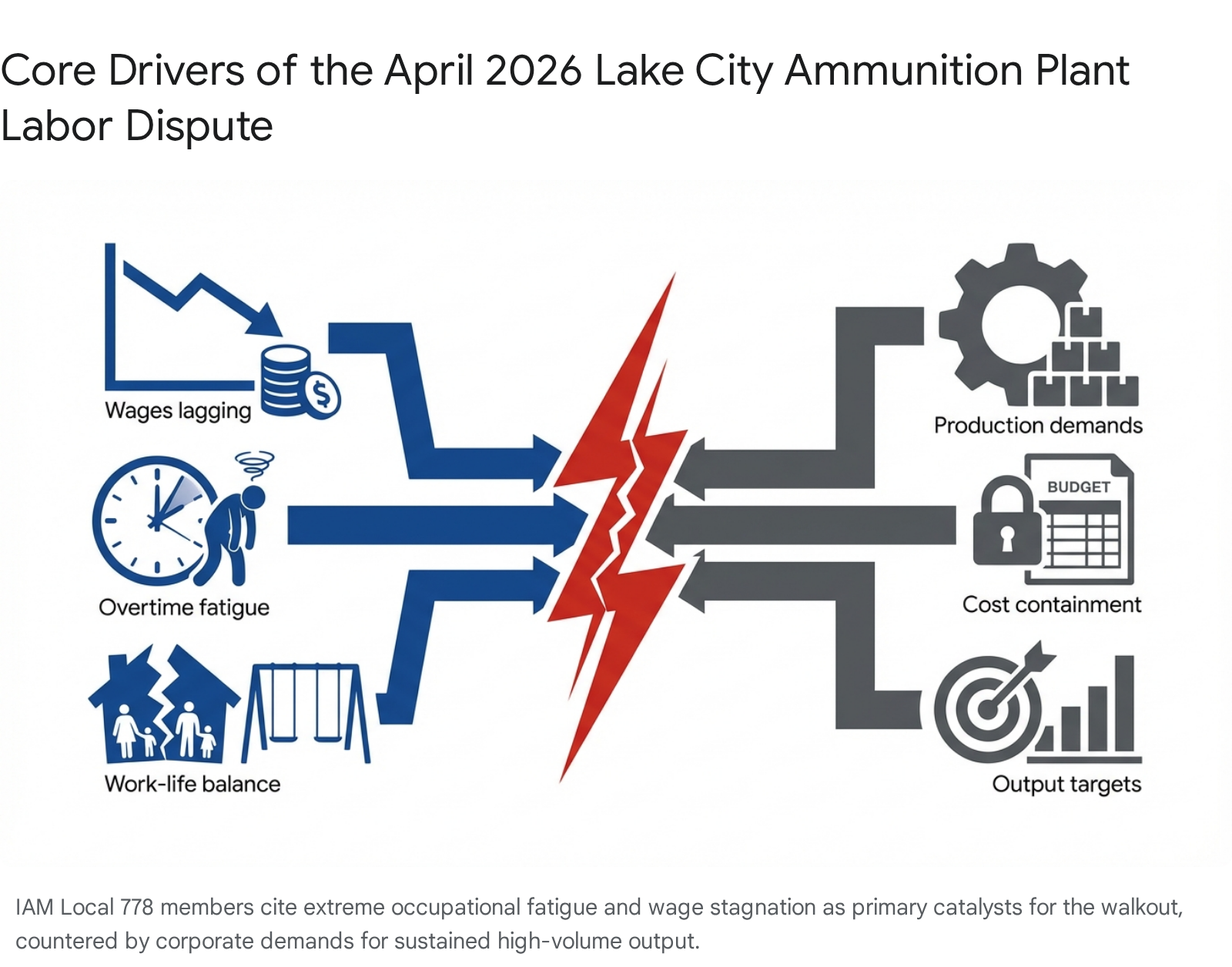
The primary grievances driving the IAM Local 778 strike were deeply rooted in the degradation of working conditions, specifically the corporate enforcement of excessive mandatory overtime. The initial walkout on April 4, 2026, followed the expiration of the previous contract at midnight and was directly fueled by workforce exhaustion.4 During the intense negotiation periods, union representatives and individual laborers consistently reported that what had initially been presented as optional overtime years prior had systematically morphed into an inescapable structural requirement. Workers were frequently subjected to grueling 60-hour workweeks merely to maintain the facility’s baseline production quotas.3
The scheduling practices implemented by management were cited as particularly draconian. Testimonies from the negotiating committee detailed instances where employees were forced into long consecutive streaks, sometimes working up to 13 days in a row without a reprieve.3 Furthermore, laborers alleged the existence of retaliatory scheduling practices, claiming that if an employee utilized their rightfully accrued Paid Time Off (PTO) or called in sick, the company would frequently penalize them by forcing them to work an alternate scheduled day off to backfill the aggressive production schedule.3
Coupled with these immense physical demands was the pressing issue of wage stagnation in a high-inflation economy. Union members argued that their base compensation scales had not kept pace with the broader economic realities of the past four years, nor did the pay reflect the immense physical and psychological toll of their labor.4 The friction over compensation was significantly amplified by the optics of Olin Corporation’s broader financial maneuvers. In the weeks leading up to the strike, IAM Local 778 Directing Business Representative Scott Brown publicly admonished Olin Winchester for prioritizing shareholder returns over workforce sustainability, pointing to the corporation’s execution of $1.35 billion in stock buybacks and a CEO compensation package approaching $10 million.4 Furthermore, the union highlighted that Olin had received over $53 million in state and local subsidies since 2001, supplemented by an additional $81 million in loans, guarantees, and public support, arguing that this level of taxpayer investment demanded fair treatment of the local workforce.14
The Trajectory of the Strike and Final Resolution
The strike timeline spanned from April 4 to May 7, 2026, concluding only after the union secured front-loaded wage increases and mandated relief from excessive 60-hour work weeks. The dispute followed a distinct trajectory of escalating pressure, defined by multiple rejected offers and increasing political intervention. Following the initial walkout on April 4, early negotiation sessions between April 6 and April 8 completely collapsed. Union leaders reported that Olin failed to produce any offer that meaningfully addressed the core issues of inflation-adjusted wages or the mandatory overtime matrix.3
By April 9, the operational impact became undeniable, with IAM sources publicly confirming that “very little production” was occurring within the massive Independence facility due to the absolute necessity of the highly trained striking operators.3 Recognizing the immediate threat to the defense industrial base, political pressure began to mount. On April 23, U.S. Representatives Emanuel Cleaver and Wesley Bell dispatched a formal, strongly worded letter to Olin CEO Kenneth Lane, urging a swift and fair resolution, explicitly citing the facility’s critical importance to national security and regional economic stability.17
Despite this pressure, the workforce demonstrated remarkable solidarity and resolve. On April 27, the membership voted to overwhelmingly reject a second contract offer from Olin management, declaring that the slight adjustments to total compensation were insufficient and failed to cure the fundamental work-life balance issues.4 It was not until May 6 that a third, highly revised agreement was finally presented and approved by the membership.1
While the union did not publicly publish the exact granular percentages of the wage adjustments, the ratified four-year collective bargaining agreement directly resolved the core impasses. The contract implemented “front-loaded” wage increases, ensuring that the workers received the most substantial financial adjustments immediately to counter compounded inflation, rather than having the raises spread thinly across the back end of the contract.3 Most critically, the agreement provided explicit, codified relief from the forced overtime scheduling matrix, fulfilling the primary operational demand of IAM Local 778.1 By successfully leveraging their irreplaceable expertise and the geopolitical necessity of their output, the Lake City workforce permanently altered the baseline labor costs of the facility.
The Economic Asymmetry: Olin Corporation’s Financial Headwinds
For Olin Corporation, the parent company operating the Winchester ammunition division, the resolution of the Lake City labor strike provides much-needed operational stability, but it occurs during a period of intense and compounding financial distress. An analysis of Olin’s corporate filings and earnings reports reveals a stark economic asymmetry between the soaring demand for military ammunition and the corporation’s ability to maintain profitability amid structural cost inflation.
First Quarter 2026 Earnings and Margin Collapse
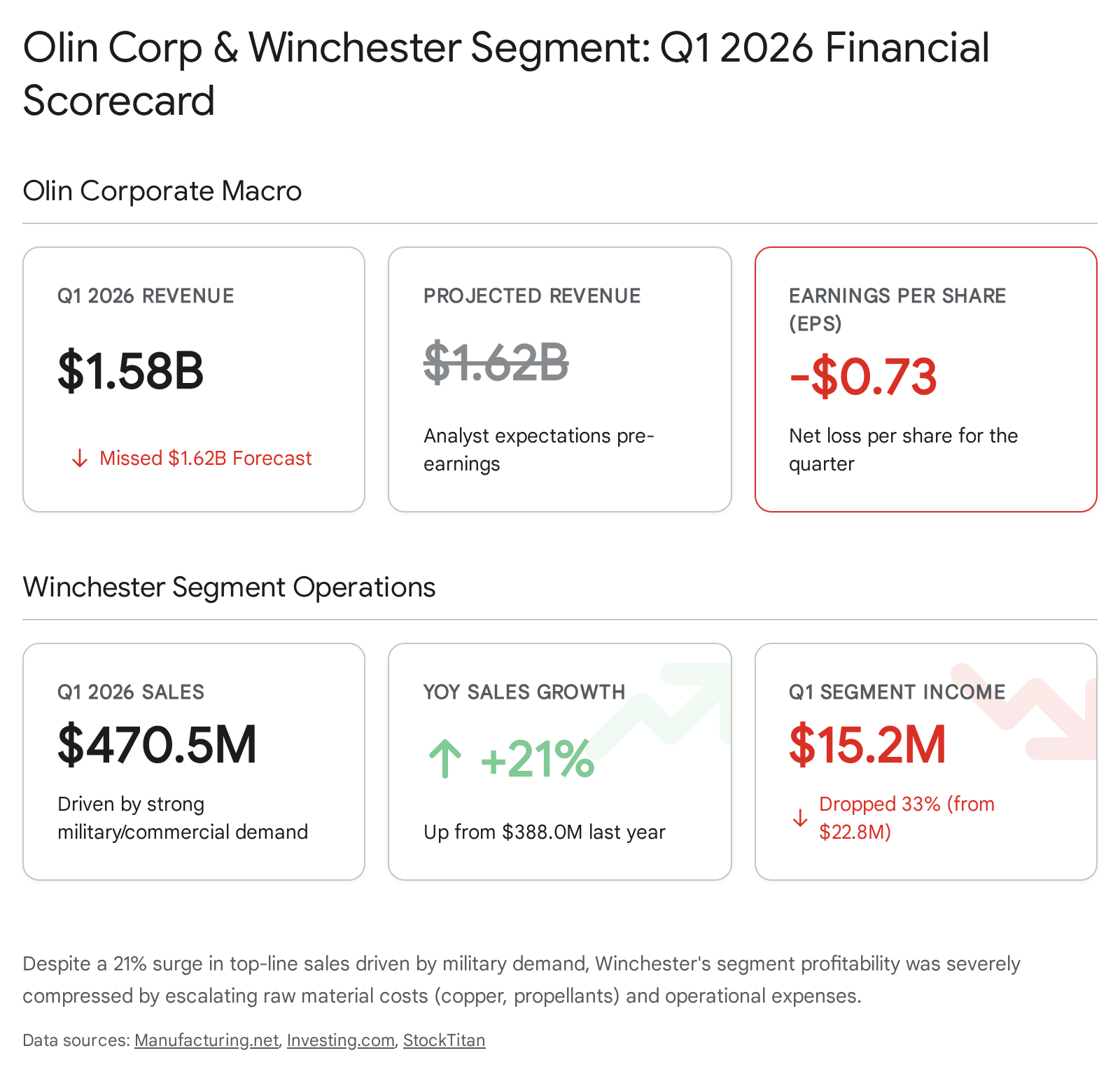
On May 8, 2026, just one day after the Lake City workforce returned to the production floor, Olin Corporation released its highly anticipated Q1 2026 earnings report.18 The financial results painted a bleak picture of a diversified chemical and manufacturing conglomerate struggling to navigate severe macroeconomic turbulence. Overall, Olin reported a steep net loss of $83.0 million, translating to an earnings per share (EPS) of -$0.73, which significantly missed Wall Street analysts’ consensus forecast of -$0.69 per share.18 Total corporate revenue for the quarter slipped by 4% to $1.58 billion, falling short of the projected $1.62 billion.18
The primary driver of this corporate loss was a deterioration in Olin’s core Chlor Alkali Products and Vinyls segment, which swung from a segment income of $78.3 million in the prior year to a loss of -$44.5 million.19This collapse was attributed to weaker global pricing, lower volumes, spiked natural gas and electrical power costs, and a substantial $36.1 million legacy litigation charge.19Furthermore, the company noted it expects to pay approximately $195.0 million in cash to Shintech throughout 2026 following an adverse verdict in a separate vinyl chloride supply dispute, severely impacting corporate liquidity.19
However, the financial dynamics within the Winchester ammunition segment were paradoxical. Driven by strong military procurement demand and early indications of commercial consumer volume recovery following a period of inventory destocking, Winchester’s top-line sales grew by an impressive 21% year-over-year, reaching $470.5 million in Q1 2026.4Yet, despite this massive surge in gross sales, Winchester’s actual segment income plummeted, falling from $22.8 million down to just $15.2 million.4
The Mechanics of Ammunition Margin Compression
This stark divergence between surging sales volume and collapsing profitability within the Winchester segment highlights the severe, structural margin compression currently afflicting the ammunition manufacturing industry. During the earnings call, management explicitly cited several converging factors driving this squeeze, noting that higher material and operating costs were rapidly eroding the segment’s earnings potential.4
First and foremost is the issue of raw material inflation. The global supply chain for foundational ammunition components is highly strained. Winchester is facing acute, sustained inflationary pressures on core commodities, specifically noting massive price hikes in copper and brass, which are essential for casing and projectile manufacturing.6 Furthermore, the market for chemical propellants is in a state of sustained crisis. Nitrocellulose, the highly volatile base ingredient required for modern smokeless powder, remains in a state of perpetual global shortage.5 This scarcity is largely driven by the massive consumption rates of artillery shell production required to supply prolonged proxy conflicts, such as the war in Ukraine. Because a single 155mm artillery shell requires vast quantities of propellant, the small-arms commercial and military markets are effectively forced to compete for the expensive “leftovers” of global nitrocellulose production.5
Secondly, elevated global energy prices, combined with complex supply chain disruptions stemming from conflicts in the Middle East—specifically noting Iranian proxy disruptions impacting global freight routes and crude oil pricing—have drastically increased the baseline overhead required to operate massive industrial facilities like Lake City.6
Finally, labor costs are permanently elevated. The new contract ratified by IAM Local 778, which includes the aforementioned front-loaded wage increases and structural adjustments to overtime scheduling, inherently raises the baseline operational expenditures for the Lake City plant moving forward.3
To combat these margin pressures and stabilize the corporation’s balance sheet, Olin CEO Kenneth Lane is aggressively executing a cost-cutting strategy that was initially established in December 2024.7The strategy targets a massive $250 million in total corporate savings by 2028. Having delivered $44 million in savings the previous year, the company is aiming to extract between $100 million and $120 million in additional savings throughout 2026.7Part of this strategy involves attempting to “right-size” Winchester’s staffing and operations to reflect normalized levels of commercial ammunition demand; however, the unique, inflexible demands of military output at LCAAP make indiscriminate personnel cuts highly dangerous to fulfillment metrics.7Looking toward the immediate future, Olin anticipates some sequential improvement, guiding investors toward an adjusted corporate EBITDA of $160 million to $200 million for Q2 2026, relying heavily on aggressive pricing actions to offset the majority of this persistent cost inflation.18
The Gravity of the Defense Industrial Base: Lake City’s Strategic Posture
To grasp why a labor strike in Missouri and corporate margin compression at Olin matter to global geopolitics, one must understand the operational gravity of the Lake City Army Ammunition Plant. The facility is not merely a regional factory; it is a central artery of the United States military-industrial complex and the undisputed backbone of America’s small-caliber ammunition supply.3
Production Capacity and Total DoD Dependency
Operated as a Government-Owned, Contractor-Operated (GOCO) facility, Lake City has been a major source of small arms ammunition for the U.S. Army and other armed services for decades, officially commencing operations in 1941.3 Currently managed by Olin Winchester under strict Joint Munitions Command oversight, LCAAP is the single largest producer of small-arms ammunition for the United States Armed Forces.14 The facility is vertically integrated, meaning it handles the entire lifecycle of ammunition creation, and specializes in the mass production of 5.56mm, 7.62mm, and.50-caliber rifle and machine-gun cartridges.4
The scale of this production is difficult to overstate. During the peak operational tempo of the post-9/11 conflicts, specifically from 2007 to 2018, the plant produced nearly 1.4 billion rounds of ammunition annually to sustain forces in Iraq and Afghanistan.23 Currently, the facility maintains a theoretical maximum capacity of approximately 1.6 billion rounds per year.25
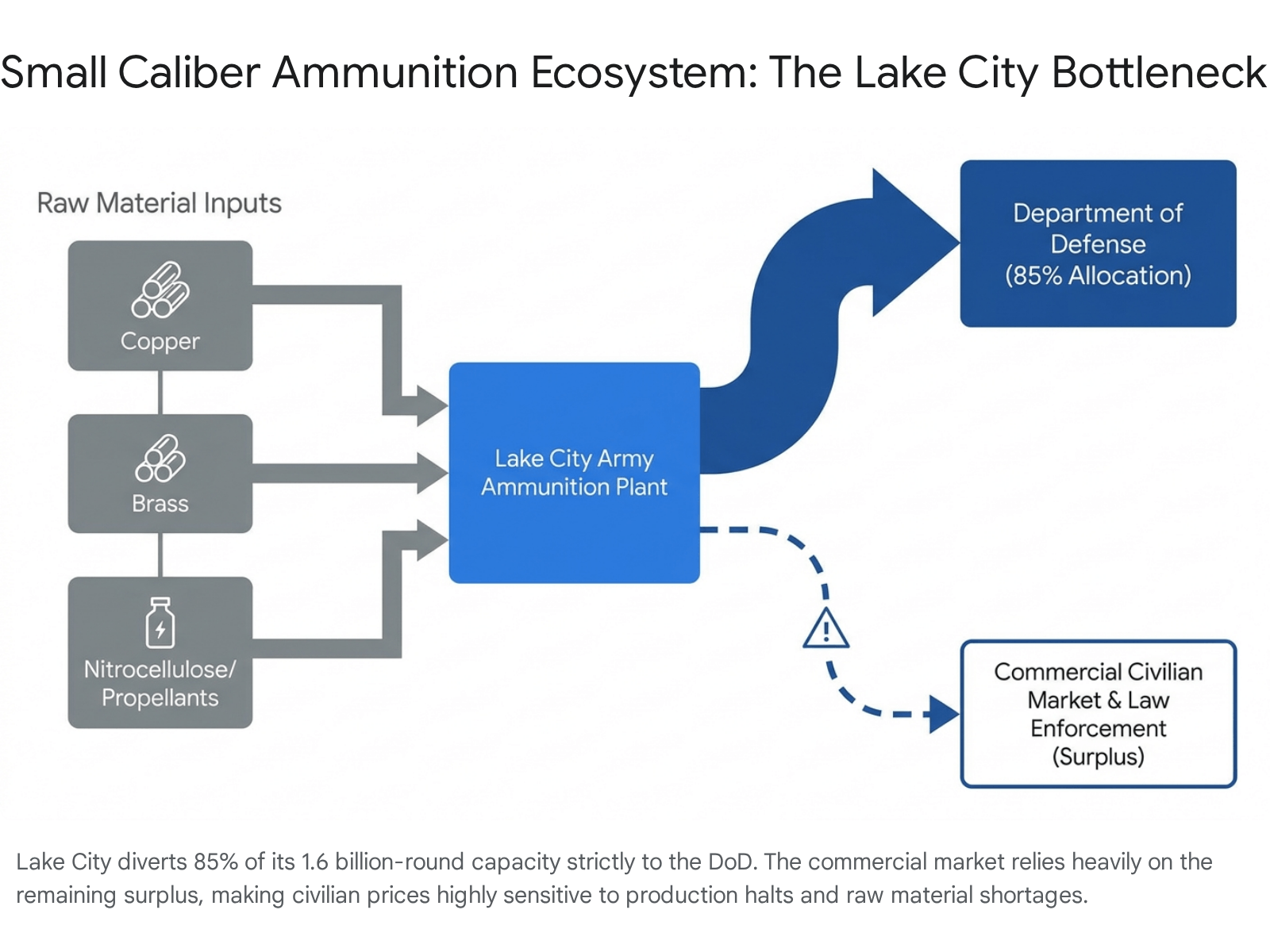
In recent years, government contracts have aggressively consumed almost the entirety of this capacity. Driven by increased training consumption—which alone exceeds 350 million rounds annually just for the U.S. Army—and heightened global readiness postures in response to near-peer threats, government orders now account for an estimated 85% of Lake City’s total production capacity.25 This high baseline of military orders shields the facility from the cyclical downturns typical of the commercial market, providing steady defense appropriations that ensure supplier revenue visibility.25 However, it also means that any disruption, such as the month-long IAM Local 778 strike, instantly threatens the baseline supply required to maintain U.S. military readiness and support critical allied nations.3
The Next Generation Squad Weapon (NGSW) Vulnerability
The labor strike occurred at a particularly sensitive and precarious juncture in the U.S. Army’s modernization timeline. The Army is currently undertaking the most significant overhaul of infantry lethality in over half a century, transitioning away from the legacy 5.56mm cartridge—which has been the standard since 1963—and embracing a new, highly advanced 6.8mm platform.25
This transition is the cornerstone of the Next Generation Squad Weapon (NGSW) program. The Army is actively fielding the new XM7 Rifle to replace the M4 carbine, and the XM250 Automatic Rifle to replace the M249 Squad Automatic Weapon.23 The new 6.8mm cartridge is specifically engineered to deliver 30% greater down-range energy, explicitly enabling the penetration of advanced, modern body armor utilized by near-peer adversaries, significantly increasing the effective range, accuracy, and overall lethality of the close combat force.3
To support this massive logistical pivot, the U.S. Army’s Joint Program Executive Office for Armaments and Ammunition (JPEO A&A) executed a $20.4 million allocation to fundamentally upgrade the Lake City facilities.25 On February 5, 2025, the Army officially broke ground on a massive, state-of-the-art 450,000-square-foot ammunition production facility entirely within the Lake City complex.3
This new, dedicated 6.8mm facility is a marvel of modern manufacturing, featuring advanced systems capable of executing all components of the new ammunition family, including cartridge case forming, projectile manufacturing, energetic loading operations, and advanced quality control testing.3 Once construction is completed by 2026 and the facility becomes fully operational by 2028, this specific building alone will possess the staggering annual production capacity of 385 million cases, 490 million projectiles, and 385 million complete load-assemble-pack operations.3
Therefore, the IAM Local 778 strike was not merely a disruption of current supply; it represented a direct, existential threat to the labor force required to execute the Army’s most critical modernization effort. The highly skilled machinists and operators currently producing 5.56mm and 7.62mm rounds are the exact same labor pool that will be required to operate the advanced machinery in the new 450,000-square-foot 6.8mm facility. A prolonged strike or a mass exodus of talent due to poor working conditions would have directly derailed the NGSW rollout timetable, impacting the combat readiness of frontline units and further delaying allied nations—such as Australia—who are closely evaluating the field data before committing to interoperable platform upgrades.23
Supply Chain Resiliency: The W519TC-25-R-0034 Second-Source Strategy
The harsh realization that a localized labor dispute involving just 1,350 workers in Independence, Missouri, could rapidly throttle the ammunition supply line for the entire U.S. military, its international allies, and federal law enforcement agencies highlighted a severe, unacceptable single-point-of-failure risk within the defense industrial base. Consequently, the Department of Defense has aggressively accelerated its strategy to permanently decouple its absolute reliance on the Lake City facility.
The Mandate for Geographic Separation
Recognizing the strategic vulnerability of centralized production, the U.S. Army Contracting Command – Rock Island (ACC-RI), acting on behalf of the Office of the Program Manager – Maneuver Ammunition Systems (OPM-MAS), actively pursued a massive Request for Proposal (RFP) designated as W519TC-25-R-0034.9 This solicitation is explicitly designed to establish a highly capable “Small Caliber Second Source supplier” to produce massive volumes of 5.56mm, 7.62mm, and Caliber.50 ammunition.9
The defining, non-negotiable stipulation of this massive procurement contract is geographic redundancy. The RFP explicitly mandates that the newly awarded supplier “is required to be geographically separated from the Lake City Army Ammunition Plant (LCAAP)”.9 This geographical separation is a direct, engineered countermeasure designed to insulate the military supply chain against localized disruptions, whether they manifest as protracted labor strikes, catastrophic natural disasters, power grid failures, or localized industrial accidents.
Structuring the Second-Source Ecosystem
The solicitation process for W519TC-25-R-0034 was highly complex, requiring multiple amendments and extensive industry consultation. Originally slated to close earlier, Amendment 0001 extended the final proposal submission deadline to February 17, 2026, allowing defense contractors additional time to review massive technical data packages and submit detailed engineering questions through the Procurement Integrated Enterprise Environment (PIEE) portal.28
The resulting award is structured as a five-year Indefinite Delivery, Indefinite Quantity (IDIQ) contract, utilizing a combination of Firm Fixed Pricing and Fixed Pricing with an Economic Price Adjustment (EPA) to account for the volatile costs of raw materials like nitrocellulose.9
The Army’s updated guidance and Q&A documents regarding this contract reveal several critical insights into their future procurement philosophy:
- Strict Domestic Sourcing Security: The Army confirmed it will absolutely not authorize the foreign sourcing of finished components outside of the United States and Canada. Critical, high-tolerance components—such as case cups, projectiles, heavy cores, and armor-piercing penetrators—must be sourced entirely within this domestic footprint. The Army explicitly banned the importation of partially finished foreign components for domestic completion, ensuring the supply chain is insulated from overseas shipping embargoes or geopolitical blackmail.28
- Calibrated Volume Adjustments: The Army refined its procurement ceilings to ensure realistic production scaling. For heavy.50 caliber ammunition, the maximum quantity was strategically reduced from 20 million down to 15 million rounds per ordering period, while establishing a Best Estimated Quantity (BEQ) of 4.5 million rounds.10 Furthermore, any quantities awarded over 10 million rounds in a single ordering period will be granted an extended delivery window of two years to prevent overwhelming the new supplier’s capacity.10
- Comprehensive Tactical Scope: The second-source contract does not merely cover basic training rounds; it requires the production of 17 distinct, highly specialized ammunition variants, classified by their Department of Defense Identification Codes (DODICs).
To understand the breadth of this secondary supply chain, one must examine the specific DODICs the Army is demanding the new facility produce. The scope ensures a comprehensive backup supply across the entire tactical spectrum of small arms.
| Caliber | DODIC | Nomenclature / Technical Description | NSN (National Stock Number) |
| 5.56mm | A059 | M855 Ball Clipped (Standard Infantry) 27 | 1305-01-155-5459 9 |
| 5.56mm | A062 | M855 Ball Linked (Light Machine Gun) 27 | 1305-01-258-8692 9 |
| 5.56mm | AB57 | M855A1 Ball Clipped (Enhanced Performance Round) 9 | 1305-01-559-3333 9 |
| 7.62mm | A131 | 4 M80 Ball / 1 M62 Tracer Linked (Medium Machine Gun) 9 | 1305-01-569-2912 9 |
| 7.62mm | AB79 | M80A1 Ball Linked (Enhanced Performance Round) 9 | 1305-01-598-5913 9 |
| .50 Caliber | A555 | M33 Ball Linked (Heavy Machine Gun) 9 | 1305-01-658-2714 9 |
| .50 Caliber | A557 | 4 Ball M33 / 1 Trace M17 Linked 9 | 1305-01-658-2580 9 |
Table 1: Representative sample of the 17 DODICs mandated under the W519TC-25-R-0034 Second-Source Contract, illustrating the tactical breadth required from the new geographically separated facility.
By aggressively executing this second-source contract, the Army aims to create a highly elastic, resilient, and multi-nodal supply web. This ensures that future shocks to the system—whether they be corporate margin collapses, raw material bottlenecks, or labor strikes in Missouri—can be absorbed seamlessly without compromising the lethality and readiness of forces deployed in active theaters.
The Commercial Market Shockwave: Pricing, Availability, and the “Shortage Loop”
For the civilian consumer, local law enforcement purchaser, and commercial firearms retailer, the macro-level machinations of DoD procurement and corporate labor disputes translate directly into retail shelf availability and pricing volatility. The Lake City strike acts as a massive force multiplier on a commercial ammunition market that is already hypersensitive to supply chain shocks.
The Symbiotic Vulnerability of the Civilian Market
The commercial ammunition market is inherently, and somewhat precariously, tethered to the output of military facilities. Despite Lake City being a government-owned facility, it is permitted to sell production overruns, canceled orders, and secondary production lots directly onto the civilian retail market.31 Historically, this symbiotic relationship has been highly beneficial for consumers; military surplus 5.56mm ammunition has historically accounted for up to 30% of the entire consumer market for.223/5.56 rifle rounds.32
However, this dynamic has shifted drastically. With government contracts now commanding a massive 85% of Lake City’s 1.6 billion-round capacity to fuel heightened training regimens and global stockpiles, the baseline availability of surplus ammunition for the commercial market has been structurally and permanently reduced.25 When a catastrophic event like the IAM Local 778 strike halts production entirely for 33 days, the immediate impact is a complete zeroing out of the excess production that would normally bleed into civilian distribution channels.31 Because the DoD holds absolute priority on all output, the commercial market is starved first and recovers last. While the mechanics of capitalism ensure that alternative domestic manufacturers will eventually attempt to spin up capacity to pick up the slack, establishing new, high-volume production lines requires immense capital expenditure and years of regulatory approval. As industry analysts succinctly note, ammunition does not just appear by magic; it requires skilled hands, hot machines, and massive raw material logistics.11
The End of Promotional Pricing
The combination of the Lake City production halt, Winchester’s severe margin compression, and the global scarcity of nitrocellulose guarantees that the recent era of promotional, heavily discounted commercial ammunition pricing is definitively over. Throughout 2024 and 2025, the post-COVID ammunition surge created a temporary glut of inventory in distribution channels, forcing manufacturers to cut prices to keep product moving.8 That inventory has now fully normalized.8 Consequently, the true, highly inflated cost of modern production is now being passed directly, and aggressively, to the consumer.8
Ammunition pricing historically follows distinct market cycles driven by crisis and stability. Prior to the pandemic anomalies of 2020, standard bulk 5.56mm pricing typically averaged roughly $0.30 per round.33 During the absolute peak of the 2021 shortage panic, average prices skyrocketed to nearly $1.00 per round, with some daily tracking averages touching $1.17 per round.33 Entering the spring of 2026, the market had stabilized, but established a “new normal” baseline, with prices stubbornly averaging between $0.45 and $0.50 per round.33
This baseline is actively shifting upward again. Major ammunition conglomerates have clearly signaled immediate, across-the-board pricing adjustments to preserve their margins. The Kinetic Group, a major player in the commercial space, announced broad price increases across their entire portfolio heading into 2026, explicitly detailing a 5-7% increase on rifle ammunition, a 7-10% increase on shotshells, and a 3-12% increase on handgun ammunition.34 Winchester itself has mirrored this strategy, announcing confirmed commercial price increases set to take effect in Q1 2026 as channel inventories normalize and raw material costs continue to bite.8 Retail analysts tracking high-volume calibers note that while broad disappearance of stock is rare, manufacturers are selectively rotating and allocating output, prioritizing higher-margin SKUs.34
The Psychology of the “Shortage Loop”
A secondary, highly volatile, and entirely unpredictable factor in commercial pricing is consumer psychology. The firearms industry operates heavily on a phenomenon known as the “shortage loop”.36 When consumers hear verified reports of military plant strikes, geopolitical conflicts draining propellant supplies, or government legislation targeting ammunition sales, a self-fulfilling prophecy of panic buying takes hold. Shooters rush to acquire bulk cases in anticipation of scarcity, which instantly empties retail shelves, artificially spikes demand velocity, and provides retailers with the immediate justification to raise prices aggressively.31
Industry observers and high-volume commercial buyers actively caution against this panic buying. They note that while supply is undeniably “tight” and prices are slowly rising in the 3-10% range due to actual material costs, the market is not experiencing the absolute black swan scarcity of 2020.31 Deliveries are occurring regularly, albeit in smaller, allocated batches. The most prudent strategy for consumers and retailers is to recognize that supply will continue to arrive in uneven cycles, and to plan acquisitions steadily to hedge against confirmed manufacturer price hikes, rather than feeding the panic cycle.8
The Legislative Siege: Political Threats to Commercial Utilization
Beyond the complex economics of labor disputes, corporate margins, and raw material supply chains, the Lake City facility finds itself at the epicenter of an intense, escalating political and legislative battle. The core of this battle debates the ethics, legality, and strategic necessity of allowing government-owned military facilities to supply the civilian commercial market.
The “Stop Militarizing Our Streets Act”
In the months leading up to and during the 2026 strike, a powerful coalition of Democratic lawmakers mounted a sustained legislative offensive against the facility’s dual-use business model. Led in the Senate by Elizabeth Warren (D-Mass.) and Andy Kim (D-N.J.), and in the House by Representatives Robert Garcia (D-Calif.) and Jamie Raskin (D-Md.), the coalition introduced sweeping federal legislation known as the “Stop Militarizing Our Streets Act”.37 This legislation seeks a total, permanent prohibition, explicitly attempting to ban defense contractors and government-owned plants—chiefly targeting Lake City—from selling any high-caliber ammunition to civilian consumers.37
The impetus for this aggressive legislative push stems from highly publicized investigations conducted by the New York Times and the International Consortium of Investigative Journalists (ICIJ). Leveraging forensic data extracted from the Bureau of Alcohol, Tobacco, Firearms and Explosives’ (ATF) National Integrated Ballistic Information Network (NIBIN), the investigations revealed alarming statistics.39 The NIBIN data indicated that nearly 30% of all 5.56mm and.223-caliber spent cartridge casings recovered by local and federal police at diverse crime scenes across the United States between 2017 and 2024 bore Lake City’s distinctive manufacturing stamps.39 Furthermore, reports highlighted that heavy, armor-penetrating.50-caliber ammunition produced at the Missouri plant had been systematically trafficked across the southern border and utilized by Mexican cartels in armed conflicts against the Mexican government.38 Proponents of the legislation argue fundamentally that American taxpayer dollars, utilized to build and subsidize military infrastructure, should not inadvertently act as a primary supply conduit for domestic mass shooters or international criminal syndicates.38
The Industrial Base Defense and the NSSF
The legislative push to terminate commercial sales from LCAAP has been met with immediate, fierce, and highly coordinated resistance from the firearms and defense industries. This resistance is primarily orchestrated by the National Shooting Sports Foundation (NSSF), the industry’s central trade association and lobbying arm.37
The industry’s defense is not rooted in commercial entitlement, but rather in the complex, cold economics of military readiness. A longstanding Department of Defense contract structure explicitly permits, and indeed relies upon, the plant maintaining peak readiness of its heavy machinery and highly skilled personnel by subsidizing its massive overhead costs through civilian commercial sales during peacetime.41
The military’s demand for small arms ammunition is inherently and violently cyclical; it spikes exponentially during active wartime engagements and plummets precipitously during periods of global stability. If Lake City is legally barred from selling its excess capacity on the commercial market during these peacetime lulls, the plant would be forced to drastically scale down operations. This scale-down would require furloughing specialized, highly trained workers—the exact IAM Local 778 machinists whose expertise is currently deemed irreplaceable—and “mothballing” incredibly expensive, sensitive automated production lines.41
The danger of this approach has historical precedent. In previous eras, when the U.S. Army abruptly needed to scale up production to sustain sudden conflicts, they found that attempting to restart mothballed machines and attempting to re-hire and re-train a dispersed, specialized labor pool created catastrophic delays in ammunition delivery to active theaters.41 Therefore, commercial sales act as a critical, self-funding strategic buffer. They keep the production lines running “hot” and the labor force employed, trained, and operating at peak capacity, ensuring the facility can instantly pivot to 100% military production the moment the Pentagon requires it, without the lag time of rebuilding a workforce.41
This critical defense industrial base argument has garnered significant support at the highest levels of the military apparatus. Secretary of the Army Christine Wormuth has previously issued stark warnings against succumbing to political pressure—such as the legal inquiries launched by New York Attorney General Letitia James—to end commercial utilization, explicitly stating it could have “potentially devastating effects on military readiness”.41
This sentiment was forcefully echoed at the state level. In early 2026, recognizing the threat to both a massive local employer and national security, the Missouri General Assembly introduced concurrent resolutions explicitly supporting the continued commercial utilization of the plant.42 The resolution formally urged the U.S. government to reject calls to end the program, recognizing that the commercial market is the exact mechanism that allows the facility to remain fully staffed and prepared to meet the sudden, violent needs of the U.S. warfighter.42 During the 2026 NSSF Congressional Fly-In, industry executives aggressively lobbied lawmakers to codify protections for this model, subsequently awarding Representative Ben Cline (R-Va.) the Legislator of the Year Award for his staunch defense of the industry’s supply chains against these legislative incursions.40
Conclusion: A Paradigm Shift in Procurement and Production
The May 7, 2026, return to the factory floor by the 1,350 members of IAM Local 778 marks the end of an acute operational crisis, but it more accurately signals the beginning of a prolonged, structural paradigm shift across the entirety of the American ammunition manufacturing sector.
For the workforce, the successful execution of the month-long strike validates the immense, irreplaceable leverage held by specialized laborers operating at the critical nexus of the defense industrial base. By successfully securing front-loaded wage increases and legally codified relief from mandatory 60-hour workweeks, the union vastly improved the quality of life for its members, but concurrently and permanently raised the baseline cost floor for domestic munitions production.3
For Olin Winchester, the corporate path forward requires exceedingly delicate financial maneuvering. Trapped in a tightening vice between rigid DoD contract pricing structures, relentlessly escalating raw material costs for copper and nitrocellulose, and now elevated labor expenditures, the corporation is forced to squeeze its own operating margins and pass all subsequent downstream costs to the commercial market in a desperate bid to maintain segment profitability.6 The era of cheap, heavily promotional commercial ammunition is functionally obsolete, replaced by a reality of tight allocation and rising MSRPs.8
For the commercial consumer and retail distributor, the strike served as a harsh reminder of the extreme fragility inherent in relying on the overruns of military facilities. With Lake City currently operating at an 85% DoD capacity allocation, and major manufacturers implementing confirmed 5-10% price hikes to survive margin compression 25, civilian shooters must accept a permanently higher baseline cost for high-volume training calibers like 5.56mm and 7.62mm, while actively resisting the psychological urge to trigger panic-induced shortage loops.31
Ultimately, the most profound and lasting impact of the Lake City strike rests with the Department of Defense. The jarring realization that the nation’s primary small-arms supply line could be severely choked by a localized labor dispute in a single midwestern town has catalyzed a fundamental, necessary redesign of overarching procurement strategy. The aggressive acceleration of the W519TC-25-R-0034 second-source contract guarantees that, within the decade, the U.S. military will decouple its absolute reliance on Independence, Missouri.9 As the Army boldly transitions toward the lethality of the 6.8mm NGSW platform and actively seeks out geographically separated, redundant production nodes, the United States ammunition supply chain is irrevocably evolving. It is transitioning away from a highly centralized, highly efficient, but critically fragile model, into a decentralized, multi-nodal, resilient, and inherently more expensive strategic ecosystem.
Please share the link on Facebook, Forums, with colleagues, etc. Your support is much appreciated and if you have any feedback, please email us in**@*********ps.com. If you’d like to request a report or order a reprint, please click here for the corresponding page to open in new tab.
Sources Used
- IAM Local 778 Members Ratify New Contract, End Strike at Olin Winchester, accessed May 17, 2026, https://www.goiam.org/news/iam-local-778-members-ratify-new-contract-end-strike-at-olin-winchester/
- Service & Solidarity Spotlight: IAM Local 778 Members Ratify New Contract at Olin Winchester, Winning Raises, Mandatory Overtime Relief | AFL-CIO, accessed May 17, 2026, https://aflcio.org/2026/5/11/service-solidarity-spotlight-iam-local-778-members-ratify-new-contract-olin-winchester
- 1350 Olin workers ratify contract, end strike at Missouri Winchester factory, accessed May 17, 2026, https://www.manufacturingdive.com/news/olin-winchester-iam-local-778-ratify-contract-lake-city-army-missouri/819503/
- Ammunition Plant Workers Ratify New Deal That Addresses ‘Countless Hours of Overtime’, accessed May 17, 2026, https://www.manufacturing.net/operations/news/22966449/ammunition-plant-workers-ratify-new-deal-that-addresses-countless-hours-of-overtime
- Far from the most concerning thing, but will war increase the price of ammo? – Reddit, accessed May 17, 2026, https://www.reddit.com/r/liberalgunowners/comments/1rhfolf/far_from_the_most_concerning_thing_but_will_war/
- Olin Corporation Q1 2026 Earnings Recap – AllInvestView, accessed May 17, 2026, https://www.allinvestview.com/earnings/OLN/q1-2026/
- Olin Winchester employees seek an improved work-life balance | Manufacturing Dive, accessed May 17, 2026, https://www.manufacturingdive.com/news/olin-winchester-iam-local-778-strike-update-independence-missouri/817761/
- Ammo Prices Rising as Costs Squeeze Manufacturers | The Boise Gun Club Handbook, accessed May 17, 2026, https://boisegunclub.com/handbook/ammo-prices-rising-as-costs-squeeze-manufacturers
- Pre-Solicitation Notice for Second Source Supplier to Produce 5.56mm, 7.62mm, and Caliber .50 Ammunition – SAM.gov, accessed May 17, 2026, https://sam.gov/opp/cf6ca6c9f54d4d02a91ccca56c6e583e/view
- Solicitation for Second Source Supplier to Produce 5.56mm, 7.62mm, and Caliber .50 Ammunition 4 – HigherGov, accessed May 17, 2026, https://www.highergov.com/contract-opportunity/solicitation-for-second-source-supplier-to-produce-w519tc-25-r-0034-o-3c1f4/
- What the Winchester Strike Means for American Ammunition Manufacturing – Detroit Ammo Co., accessed May 17, 2026, https://detroitammoco.com/blog/what-the-winchester-strike-means-for-american-ammunition-manufacturing
- IAM Local 778 Olin Winchester STRIKE F.A.Q., accessed May 17, 2026, https://local778.org/uncategorized/iam-local-778-olin-winchester-strike-questions/
- Lake City Ammo plant Strike | Shooters’ Forum, accessed May 17, 2026, https://forum.accurateshooter.com/threads/lake-city-ammo-plant-strike.4176046/
- IAM Union Demands Olin Winchester Bargain in Good Faith as Ammunition Plant Strike Enters Third Week, accessed May 17, 2026, https://www.goiam.org/news/iam-union-demands-olin-winchester-bargain-in-good-faith-as-ammunition-plant-strike-enters-third-week/
- IAM Local 778 Members Reject Management Offer, Continue Strike at Olin Winchester, accessed May 17, 2026, https://www.goiam.org/news/iam-local-778-members-reject-management-offer-continue-strike-at-olin-winchester/
- IAM Union Escalates Pressure on Military Ammo Maker Olin Winchester as Missouri Strike Raises Concerns Amid Escalating Global Conflicts, accessed May 17, 2026, https://www.goiam.org/news/imail/iam-union-escalates-pressure-on-military-ammo-maker-olin-winchester-as-missouri-strike-raises-concerns-amid-escalating-global-conflicts/
- U.S. Reps. Cleaver, Bell Urge Olin Winchester to Bargain in Good Faith with Striking IAM Union Ammo Makers at Olin Winchester, accessed May 17, 2026, https://www.goiam.org/news/u-s-reps-cleaver-bell-urge-olin-winchester-to-bargain-in-good-faith-with-striking-iam-union-ammo-makers-at-olin-winchester/
- Earnings call transcript: Olin Corporation Q1 2026 Misses Forecasts, Stock Edges Up, accessed May 17, 2026, https://www.investing.com/news/transcripts/earnings-call-transcript-olin-corporation-q1-2026-misses-forecasts-stock-edges-up-93CH-4673171
- Olin (NYSE: OLN) swings to Q1 loss as litigation and costs rise – Stock Titan, accessed May 17, 2026, https://www.stocktitan.net/sec-filings/OLN/10-q-olin-corp-quarterly-earnings-report-72d6a0be4530.html
- Olin (OLN) Q1 2026 Earnings Call Transcript | The Motley Fool, accessed May 17, 2026, https://www.fool.com/earnings/call-transcripts/2026/05/08/olin-oln-q1-2026-earnings-call-transcript/
- NATO Ammunition Market – Size, Share & Analysis – Mordor Intelligence, accessed May 17, 2026, https://www.mordorintelligence.com/industry-reports/nato-ammunition-market
- Lake City ammunition strike in Missouri enters fourth week: Why the fight against Olin Winchester requires a struggle against imperialist war, accessed May 17, 2026, https://www.wsws.org/en/articles/2026/04/27/uxdu-a27.html
- New Army ammo facility to supply millions of 6.8 mm rounds annually, accessed May 17, 2026, https://www.armytimes.com/news/your-army/2025/03/03/new-army-ammo-facility-to-supply-millions-of-68-mm-rounds-annually/
- Lake City Army Ammunition Plant (LCAAP) – Joint Munitions Command (JMC), accessed May 17, 2026, https://www.jmc.army.mil/Installations.aspx?id=LakeCity
- Small Caliber Ammunition Market – Forecast & Report | 2025 – 2031 – Mordor Intelligence, accessed May 17, 2026, https://www.mordorintelligence.com/industry-reports/small-caliber-ammunition-market
- Army breaks ground on state-of-the-art 6.8 mm ammunition production facility | Article, accessed May 17, 2026, https://www.army.mil/article/282896/army_breaks_ground_on_state_of_the_art_6_8_mm_ammunition_production_facility
- W519TC25R0034: Solicitation for Second Source Supplier to Produce 5.56mm, 7.62mm, and Caliber .50 Ammunition – PIEE, accessed May 17, 2026, https://piee.eb.mil/sol/xhtml/unauth/search/oppMgmtLink.xhtml?noticeId=W519TC25R0034¬iceType=SolicitationNotice
- U.S. Army reshapes ammunition production structure – The Defence Blog, accessed May 17, 2026, https://defence-blog.com/u-s-army-reshapes-ammunition-production-structure/
- Solicitation for Second Source Supplier to Produce 5.56mm, 7.62mm, and Caliber .50 Ammunition – SAM.gov, accessed May 17, 2026, https://sam.gov/opp/61654e1cf7ad4ed1be6709d49624be41/view
- Solicitation for Second Source Supplier to Produce 5.56mm, 7.62mm, and Caliber .50 Ammunition – SAM.gov, accessed May 17, 2026, https://sam.gov/workspace/contract/opp/e8163e6355a4478fbcb2f99742447972/view
- State of the Ammo Industry Spring 2026 – AmmoSquared Blog and Education, accessed May 17, 2026, https://blog.ammosquared.com/state-of-the-ammo-industry-spring-2026/
- RUMINT: Reports that Lake City Will Stop Selling Surplus 5.56 Ammunition, accessed May 17, 2026, https://athlonoutdoors.com/article/lake-city-stop-selling-surplus-5-56-ammunition/
- 10 Year 223 / 5.56 Ammo Price History – Ammunition Depot, accessed May 17, 2026, https://www.ammunitiondepot.com/ammo-price-history/223-556
- Ammunition in 2026: Supply Conditions, Price Pressures, and Market Signals, accessed May 17, 2026, https://blog.targetsportsusa.com/2026-ammunition-outlook-supply-pricing-availability/
- Winchester Ammo Q4 Profits Tumble on Pricing Pressures | SGB Media Online, accessed May 17, 2026, https://sgbonline.com/winchesters-q3-profits-tumble-on-ammo-pricing-pressures/
- The Powder Keg Boom: Why Are Ammo Prices Rising Again? – Inside Safariland, accessed May 17, 2026, https://inside.safariland.com/blog/the-powder-keg-boom-why-are-ammo-prices-rising-again/
- Warren Bill Targets Military Ammo Sales | The Boise Gun Club Handbook, accessed May 17, 2026, https://boisegunclub.com/handbook/warren-bill-targets-military-ammo-sales
- Lawmakers seek to stop sales to the public of ammunition made at U.S. Army plant – ICIJ, accessed May 17, 2026, https://www.icij.org/news/2026/03/lawmakers-seek-to-stop-sales-to-the-public-of-ammunition-made-at-u-s-army-plant/
- New Data Links Lake City Ammunition to Thousands of U.S. Crime Scenes, accessed May 17, 2026, https://smokinggun.org/new-data-links-lake-city-ammunition-to-thousands-of-us-crime-scenes/
- Industry Momentum Highlighted at 2026 NSSF Congressional Fly-In, accessed May 17, 2026, https://www.nssf.org/articles/industry-momentum-highlighted-at-2026-nssf-congressional-fly-in/
- NSSF Hails Bicameral Letter Protecting Lake City Army Ammunition Plant from Political Intrusion, accessed May 17, 2026, https://www.nssf.org/articles/nssf-hails-bicameral-letter-protecting-lake-city-army-ammunition-plant-from-political-intrusion/
- NSSF Applauds Missouri Resolution Supporting Commercial Utilization of Lake City Army Ammunition Plant, accessed May 17, 2026, https://www.nssf.org/articles/nssf-applauds-missouri-resolution-supporting-commercial-utilization-of-lake-city-army-ammunition-plant/