
Executive Summary & Doctrinal Thesis
The Chinese People’s Liberation Army (PLA) is currently undergoing a massive doctrinal and technological shift, moving from “informationized warfare” (信息化战争, xìnxīhuà zhànzhēng) toward a new era of “intelligentized warfare” (智能化战争, zhìnénghuà zhànzhēng). This transition marks a dialectical progression in Chinese military thought, where strategic advancement emerges from a constant interplay between objective reality and subjective initiative1. According to the Academy of Military Science (AMS / 军事科学院, Jūnshì Kēxuéyuàn), warfare has historically evolved through distinct stages defined by their primary source of power2. While the mechanized (机械化, jīxièhuà) era relied on material and energy, and the informationized (信息化, xìnxīhuà) era focused on digital networks and data, the new intelligentized era is defined by the integration of AI, quantum computing, and autonomous systems into every facet of military operations2, 3.
The core objective of this new doctrine is to achieve “decision superiority” or “command of the brain” (制脑权, zhìnǎo quán)5. By embedding AI from high-level strategy down to individual battlefield sensors, the PLA hopes to outpace enemy decision cycles and drastically compress the OODA (Observe, Orient, Decide, Act) loop5. Unlike informationized warfare, which targeted physical network nodes via “System Destruction Warfare” (体系破击战, Tǐxì Pòjī Zhàn)1, intelligentized warfare aims to actively manipulate and collapse an adversary’s cognitive processing through algorithmic dominance3. Some PLA theorists even envision this transformation culminating in “Metaverse War” (元战争, Yuán Zhànzhēng), where physical, digital, and cognitive realms merge into a single battlespace4.
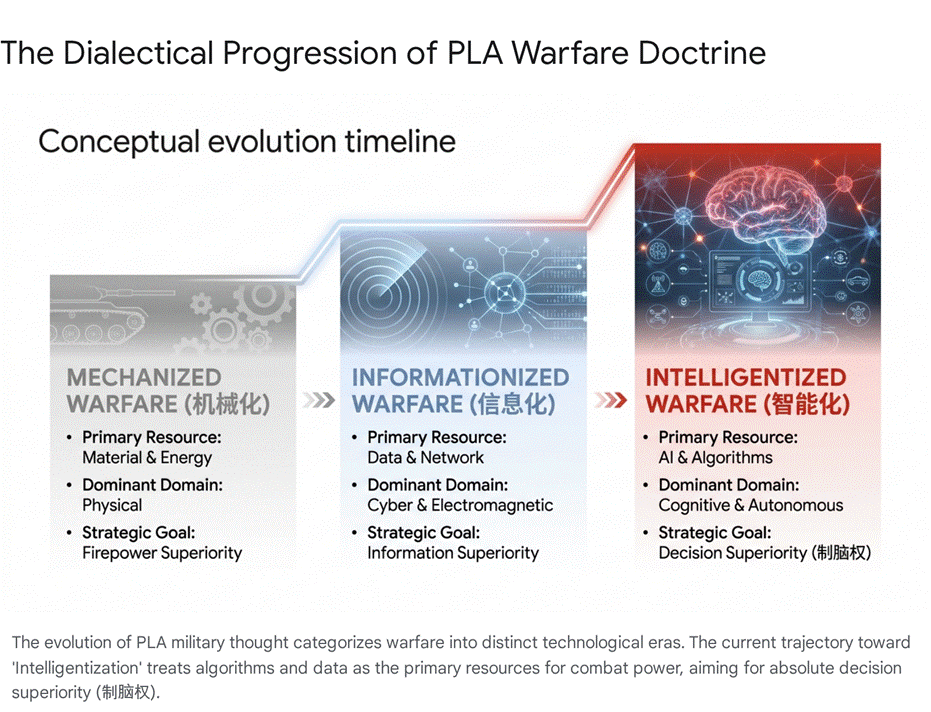
This evaluation utilizes primary and secondary OSINT sources, including technical disclosures and expert analyses from the Center for Security and Emerging Technology (CSET), to examine the operational and technological realities of the PLA’s ongoing transformation.
Doctrinal Foundations & Core Operational Concepts
System of Systems Operations & Multi-Domain Precision Warfare
The PLA views modern conflict as a competition between holistic operational systems rather than simple kinetic exchanges between platforms. This “System of Systems Operations” (体系作战, Tǐxì Zuòzhàn) framework guides how the PLA trains and organizes2. Strategic victory is achieved by building a superior network that can synchronize sensors and shooters across all domains faster than an opponent can respond2.
To support this architecture, Chairman Xi Jinping initiated a major organizational overhaul in early 2024. The legacy Strategic Support Force (战略支援部队, Zhànlüè Zhīyuán Bùduì) was dissolved to eliminate bureaucratic bottlenecks that were incompatible with the speed of AI-driven warfare2. It was replaced by three specialized arms designed to master “Multi-Domain Precision Warfare” (多域精确战, Duōyù Jīngquè Zhàn)7.
These new branches include the Aerospace Force (军事航天部队, Jūnshì Hángtiān Bùduì)11, the Cyberspace Force (网络空间部队), and the Information Support Force (信息支援部队)3. The Information Support Force acts as the “central nervous system,” ensuring real-time intelligence flows from space to terrestrial assets to create a unified operational picture3, 7. Meanwhile, the Cyberspace Force manages cyber, electronic, and psychological warfare to blind and confuse adversaries concurrently3.
Cognitive Domain Warfare & Psychological Dominance
As autonomous systems become more common, the PLA increasingly views the human mind as the ultimate battlefield vulnerability. “Cognitive Domain Warfare” (认知域作战, Rènzhīyù Zuòzhàn) involves the systemic manipulation of an enemy’s perception and societal cohesion3. The PLA seeks to influence adversary thought by degrading or manipulating the data and algorithms they rely on3.
This strategy extends to “Social Media Warfare” (社交媒体战, Shèjiāo Méitǐ Zhàn)15. In Chinese military thought, social media is an active operational space where AI-driven sentiment analysis and deepfakes are used to fracture democratic decision-making and damage morale16, 17. Achieving dominance in this domain allows the PLA to dictate an opponent’s perception of reality, potentially rendering physical resistance ineffective2.
Algorithmic Dominance & Asymmetric Attrition
To reach decision superiority, the PLA strives for “Algorithmic Dominance” (算法优势, Suànfǎ Yōushì). CNA evaluations suggest that the PLA sees future war as a clash of algorithms, where victory goes to the side with superior models and data3. If data was the fuel of the informationized era, it is now the “new oil” that powers combat intelligence3.
This concept is best illustrated by “Swarm Systems” (蜂群系统, Fēngqún Xìtǒng). Rather than matching expensive Western platforms ship-for-ship, the PLA focuses on asymmetric attrition. By using AI to coordinate massive numbers of low-cost, expendable drones, they aim to saturate and exhaust legacy defenses, clearing the way for subsequent high-end strikes12.
| Doctrinal Concept (English) | Doctrinal Concept (Chinese / Pinyin) | Operational Objective in Intelligentized Warfare |
| System of Systems Operations | 体系作战 (Tǐxì Zuòzhàn) | Seamless integration of multi-domain sensors and shooters, ensuring all military branches operate within a unified, AI-assisted operational architecture. |
| System Destruction Warfare | 体系破击战 (Tǐxì Pòjī Zhàn) | Paralyzing the adversary by kinetically and non-kinetically blinding sensors, jamming C2 nodes, and severing critical data links. |
| Multi-Domain Precision Warfare | 多域精确战 (Duōyù Jīngquè Zhàn) | AI-allocated, synchronized kinetic and non-kinetic strikes across physical, cyber, and space domains to maximize shock and disruption. |
| Cognitive Domain Warfare | 认知域作战 (Rènzhīyù Zuòzhàn) | Manipulating adversary command perception and public opinion via deepfakes, algorithmic amplification, and social media weaponization. |
| Algorithmic Dominance | 算法优势 (Suànfǎ Yōushì) | Out-processing the adversary through superior machine learning models and compute power to generate faster, optimized courses of action. |
Key Technological Pillars & Weaponization Vectors
The transition from theoretical doctrine to operational reality relies heavily on the deployment of advanced military technologies. This deployment is spearheaded by massive state-owned defense conglomerates, notably the China Electronics Technology Group Corporation (CETC / 中国电科, Zhōngguó Diànkē), the China Aerospace Science and Industry Corporation (CASIC / 中国航天科工, Zhōngguó Hángtiān Kēgōng), and the Aviation Industry Corporation of China (AVIC / 中国航空工业, Zhōngguó Hángkōng Gōngyè).
Command & Control (C2) and AI-Assisted Wargaming
Recognizing that human cognitive limits and a lack of recent combat experience are potential bottlenecks, the PLA is investing heavily in AI-enabled Decision Support Systems (AI-DSS)10. These tools are designed to compensate for rigid command structures and provide tactical assistance to the officer corps.
CSET procurement data analysis shows widespread requests for AI software capable of target allocation and intelligence fusion17. Platforms like “AlphaWar”—inspired by AlphaStar—are integrated into military education to wargame complex Taiwan scenarios22, 23. The goal is to develop “hybrid intelligence” (混合智能, hùnhé zhìnéng), where human-machine collaboration defines future battlefield supremacy18.
Autonomous Unmanned Systems & Swarms
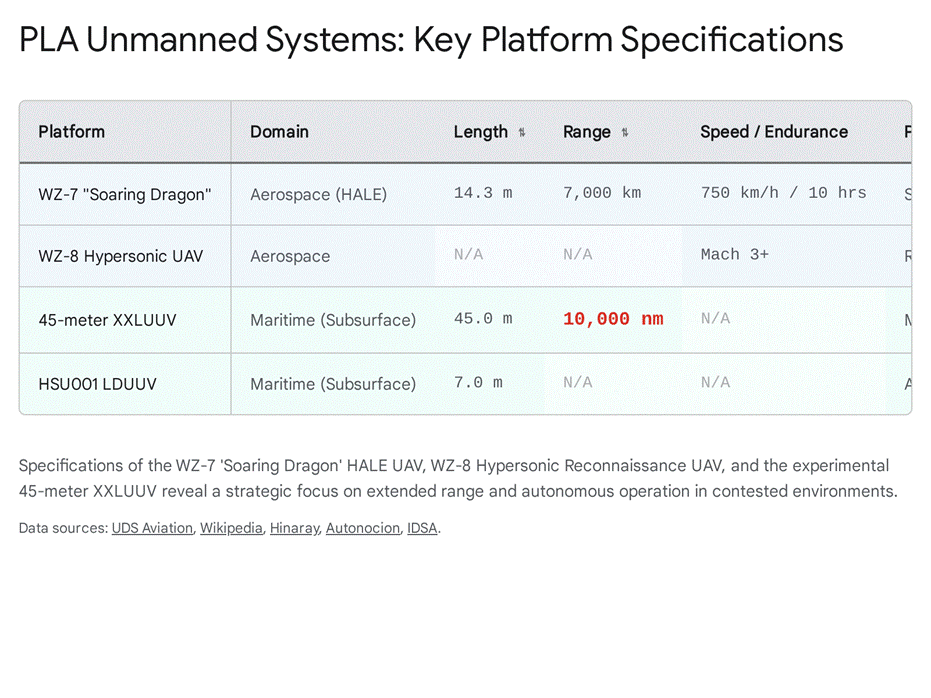
The PLA’s uncrewed platforms are rapidly transitioning from human-in-the-loop, remote-controlled Intelligence, Surveillance, and Reconnaissance (ISR) assets into highly autonomous nodes embedded within a broader kill web.
Aerospace Assets: The WZ-7 “Soaring Dragon” (翔龙, Xiánglóng) is a cornerstone of the PLA’s ISR ambitions. Operating at altitudes up to 18,000 meters with a 7,000 km range, it serves as a high-altitude sensor node for tracking adversary ships and directing ballistic missile strikes24, 25, 30. It is frequently seen patrolling contested areas like the Taiwan Strait and South China Sea25.
The WZ-8, a Mach 3+ supersonic drone, provides rapid intelligence in contested airspace, while the stealthy GJ-11 “Sharp Sword” is designed for deep strike missions31, 32.
Maritime Uncrewed Systems: The PLA Navy is aggressively fielding Extra-Large Unmanned Underwater Vehicles (XXLUUVs). Testing off Hainan Island shows 45-meter submarine drones with a 10,000 nm range, theoretically capable of reaching the US West Coast or the Panama Canal autonomously to lay mines or conduct surveillance21, 34.
At the tactical level, researchers have demonstrated autonomous swarms capable of navigating dense forests without GPS by using onboard perception algorithms, proving the maturity of networked swarming tech20.
Cyber & Electronic Warfare (EW)
AI integration has also led to “Cognitive Electronic Warfare” (认知电子战, Rènzhī Diànzǐ Zhàn). Unlike traditional EW, which relies on static pre-programmed libraries, Cognitive EW uses AI to analyze unfamiliar signals and generate custom jamming countermeasures in real-time38.
The CETC 14th and 38th Research Institutes lead this field40. Their YLC-2E radar uses intelligent algorithms to detect and track stealth aircraft by processing faint electromagnetic signatures43.
In the cyber realm, the Cyberspace Force uses AI to automate network infiltration and predict threats7. Operations are fueled by massive repositories of stolen data, such as the 2017 Equifax breach, which help the PLA train AI models to map adversary networks and target individuals39.
Hypersonic & Precision Guidance
Hypersonic Glide Vehicles (HGVs) like the DF-17 and DF-27 significantly compress an opponent’s reaction time by maneuvering unpredictably at speeds above Mach 546, 47. The DF-27, with a range up to 8,000 km, puts US assets as far away as Hawaii at risk47.
PLA research is now integrating Deep Reinforcement Learning (DRL) into these guidance systems50. This would allow a hypersonic vehicle to autonomously recognize and evade incoming interceptors in real-time, representing the cutting edge of precision warfare doctrine50.
| Advanced PLA Platform / Technology | Domain & Scope | Strategic Capability & Intelligentized Feature |
| WZ-7 “Soaring Dragon” | Aerospace / Maritime ISR | 7,000 km range HALE UAV serving as an AI-linked sensor node for anti-ship ballistic missile targeting25. |
| XXLUUV (45-meter) | Deep Sea / Littoral | Extra-large submarine drone with 10,000 nm range for autonomous mine-laying and extended acoustic ISR. |
| YLC-2E S-Band Radar | Electromagnetic / Air Defense | CETC-developed radar utilizing AI algorithms to track and target low-observable (stealth) aircraft43. |
| DF-27 Hypersonic Missile | Strategic Strike / A2AD | 5,000–8,000 km range HGV system; research indicates integration of AI (Deep Reinforcement Learning) for automated interceptor evasion49. |
Civil-Military Fusion (MCF) Ecosystem
This transformation is powered by the national strategy of Civil-Military Fusion (军民融合, Jūn-Mín Rónghé), which mandates that civilian innovation must directly benefit military modernization18.
The AI Laboratory Ecosystem & Civilian Symbiosis
Military AI research is conducted through an opaque network of state laboratories embedded within civilian universities like Tsinghua and Beihang, alongside military academies like NUDT52, 53. This allows for a steady pipeline of dual-use technology—from autonomous swarming to brain-computer interfaces—to flow directly to the CMC16, 18, 20.
These academic environments provide the PLA with immediate access to cutting-edge research in graph neural networks, computer vision, and autonomous swarming. For instance, the Swarm Robot Research Center at Zhejiang University’s State Key Laboratory develops the foundational algorithms that allow PLA drone swarms to navigate complex terrain autonomously20. Similarly, the State Key Laboratory of Cognitive Science and Learning at Beijing Normal University pursues research into brain-computer interfaces and human performance enhancement, technologies the PLA views as essential for optimizing human-machine hybrid intelligence18. Civilian AI “national champions” like iFlytek, Baidu, and SenseTime frequently collaborate with these laboratories, forming a robust pipeline that funnels commercial dual-use tech directly into CMC equipment development departments16.
Export Controls and Domestic Defense Computing Architectures
A major challenge to the PLA is the US-led export control regime on advanced semiconductors16. To counter this, China is building a sovereign AI compute stack, led by Huawei’s Ascend series of AI accelerators16.
While these chips have memory limitations compared to Nvidia, Huawei compensates with architectural innovation16. The CloudMatrix 384 cluster uses an optical interconnect to treat 384 chips as a single memory pool, delivering compute power comparable to Western flagship systems60, 62.
The pinnacle of this effort is the Huawei “CloudMatrix 384” architecture (also associated with the Atlas 950 SuperPoD). This high-density AI computing cluster stitches together 384 Ascend 910C chips using a proprietary, all-optical interconnect fabric known as UnifiedBus 2.060. This massive scale-up approach allows the entire system to function as a single, unified memory pool, facilitating the sub-microsecond latency required to train massive Mixture-of-Experts (MoE) foundation models62. The CloudMatrix 384 reportedly delivers an aggregate of 300 PFLOPS of dense BF16 compute, effectively doubling the raw throughput of Nvidia’s GB200 NVL72 rack60.
This brute-force approach consumes four times the power of equivalent Nvidia systems, but it proves the PLA can achieve frontier-level AI training without state-of-the-art lithography16. China also uses shell companies and state subsidies to ensure a resilient domestic supply chain for AI chips16, 58.
Strategic Friction, Vulnerabilities, & Organizational Bottlenecks
Despite these advances, the PLA faces significant hurdles, including immature anti-submarine warfare capabilities and a reliance on civilian ships for amphibious operations70.
Integration Friction and Talent Shortages
A major friction point is the clash between rigid, top-down command structures and the speed of AI. While the PLA wants AI decision support, political commissars are often reluctant to cede authority to algorithms3. Additionally, there is a talent shortage, as the military struggles to compete with the high salaries offered by civilian tech giants55, 69.
Furthermore, there is an acute shortage of high-end AI engineering talent within the active military cadres. Analysis of defense-affiliated hiring demonstrates that the PLA struggles to compete with the lucrative salaries offered by civilian tech titans like Tencent or Alibaba55. Consequently, the military relies heavily on civilian contractors and commercial off-the-shelf (COTS) AI solutions, whose underlying codebases may lack the rigorous hardening required for high-intensity, multi-domain combat operations69.
The AI “Black Box” and Adversarial Vulnerabilities
The most critical vulnerability is the fragility of AI itself. PLA researchers are wary of “Data Poisoning” (数据投毒, Shùjù Tóudú) and “Adversarial Attacks” (对抗性攻击, Duìkàngxìng Gōngjī)19.
Experiments show that controlling just 10% of input data can trick an AI model with 90% success19, 72. This means allied cyber units could potentially spoof sensor data to misdirect PLA strikes, making data integrity the PLA’s most vital center of gravity3, 71.
In the operational context of Multi-Domain Precision Warfare, this represents a catastrophic vulnerability. If a United States or allied cyber unit successfully injects adversarial noise or carefully crafted digital perturbations into the sensor data feeding a DF-27 hypersonic targeting algorithm, or spoils the visual imagery relayed by a WZ-7 UAV, the PLA’s autonomous kill chain could misdirect a strategic strike or falsely classify an allied destroyer as a civilian cargo vessel71. The PLA’s doctrinal assertion that data is the “new oil” inherently makes the cryptographic integrity of its data pipelines, sensor feeds, and training models its most vital—and technologically vulnerable—center of gravity3. Without absolute data security, the PLA’s pursuit of decision superiority collapses under the weight of algorithmic deception.
Comprehensive Bilingual Glossary
| Acronym / English Term | Simplified Chinese (Pinyin) | Concise Technical Definition |
| Intelligentized Warfare | 智能化战争 (Zhìnénghuà Zhànzhēng) | A stage of warfare defined by the ubiquitous application of AI, autonomy, and machine learning to achieve cognitive and algorithmic dominance. |
| Informationized Warfare | 信息化战争 (Xìnxīhuà Zhànzhēng) | A previous stage of warfare focused on digital networks, precision-guided munitions, and C4ISR integration to win local conflicts. |
| Decision Superiority / Command of the Brain | 制脑权 (Zhìnǎo Quán) | The ultimate strategic objective of controlling the cognitive domain; out-processing the enemy to dictate operational tempo and perception. |
| System of Systems Operations | 体系作战 (Tǐxì Zuòzhàn) | The doctrinal orchestration of disparate multi-domain platforms (sensors, shooters, C2) into a unified, synergistic combat network. |
| System Destruction Warfare | 体系破击战 (Tǐxì Pòjī Zhàn) | The operational theory of paralyzing an enemy by kinetically and non-kinetically degrading critical nodes in their C4ISR networks. |
| Multi-Domain Precision Warfare | 多域精确战 (Duōyù Jīngquè Zhàn) | AI-coordinated, synchronized strikes across land, sea, air, space, and cyber domains designed to overwhelm and penetrate enemy defenses. |
| Cognitive Domain Warfare | 认知域作战 (Rènzhīyù Zuòzhàn) | Operations aimed at manipulating the perception, morale, and decision-making of adversary leadership, troops, and civilian populations. |
| Social Media Warfare | 社交媒体战 (Shèjiāo Méitǐ Zhàn) | The weaponization of digital social platforms for psychological operations, algorithmic narrative shaping, and disinformation campaigns. |
| Metaverse War | 元战争 (Yuán Zhànzhēng) | A theoretical future conflict scenario blending physical, digital, and cognitive realities into a single seamless battlespace. |
| Algorithmic Dominance | 算法优势 (Suànfǎ Yōushì) | The tactical advantage gained by possessing superior machine learning models that generate faster and more accurate combat decisions. |
| Swarm Systems | 蜂群系统 (Fēngqún Xìtǒng) | Coordinated, autonomous networks of uncrewed aerial, surface, or underwater vehicles operating collaboratively to saturate defenses. |
| Cognitive Electronic Warfare | 认知电子战 (Rènzhī Diànzǐ Zhàn) | EW systems utilizing machine learning to autonomously detect, classify, and dynamically counter unknown radar or communication signals in real-time. |
| Data Poisoning | 数据投毒 (Shùjù Tóudú) | A cyber attack involving the injection of malicious data into an AI model’s training set to compromise its future decision-making capabilities. |
| Adversarial Attacks | 对抗性攻击 (Duìkàngxìng Gōngjī) | The introduction of subtle, engineered perturbations into sensor data (e.g., radar, imagery) causing an AI model to misclassify the input during inference. |
| Civil-Military Fusion | 军民融合 (Jūn-Mín Rónghé) | China’s overarching national strategy mandating the integration of civilian technological innovation with military modernization and procurement. |
| Central Military Commission | 中央军委 (Zhōngyāng Jūnwěi) | The highest national defense organization in China, commanding the PLA and setting overarching military strategy and doctrine. |
| Academy of Military Science | 军事科学院 (Jūnshì Kēxuéyuàn) | The PLA’s premier research institute responsible for developing military doctrine, strategic guidance, and advanced defense science. |
| National University of Defense Technology | 国防科技大学 (Guófáng Kējì Dàxué) | A top-tier military academy and research institution driving PLA innovations in supercomputing, artificial intelligence, and aerospace technology. |
| Information Support Force | 信息支援部队 (Xìnxī Zhīyuán Bùduì) | A newly created PLA arm responsible for managing network information systems, cross-domain data fusion, and battlefield communications. |
| Cyberspace Force | 网络空间部队 (Wǎngluò Kōngjiān Bùduì) | A newly created PLA arm consolidating cyber espionage, offensive cyber operations, electronic warfare, and psychological operations. |
| Aerospace Force | 军事航天部队 (Jūnshì Hángtiān Bùduì) | A newly created PLA arm managing space-based ISR, satellite navigation, and counter-space operations. |
| State Key Laboratory | 国家重点实验室 (Guójiā Zhòngdiǎn Shíyànshì) | Elite, state-funded research facilities often partnering with the PLA to incubate dual-use technologies like AI, hypersonics, and quantum computing. |
Please share the link on Facebook, Forums, with colleagues, etc. Your support is much appreciated and if you have any feedback, please email us in**@*********ps.com. If you’d like to request a report or order a reprint, please click here for the corresponding page to open in new tab.
Sources Used
- Finding the Right Model: The Joint Force, the People’s Liberation Army, and Information Warfare – Air University, https://www.airuniversity.af.edu/JIPA/Display/Article/3371164/finding-the-right-model-the-joint-force-the-peoples-liberation-army-and-informa/
- Systems Confrontation and System Destruction Warfare – RAND Corporation, https://www.rand.org/pubs/research_reports/RR1708.html
- The PLA and Intelligent Warfare: A Preliminary Analysis – CNA.org., https://www.cna.org/analyses/2021/10/the-pla-and-intelligent-warfare-preliminary-analysis
- The Path to China’s Intelligentized Warfare: Converging on the Metaverse Battlefield – The Cyber Defense Review, https://cyberdefensereview.army.mil/Portals/6/Documents/2024-Fall/Baughman_CDRV9N3-Fall-2024.pdf
- Theoretical, Strategic, and Operational Foundations of Intelligentized Warfare – Chinascope, https://chinascope.org/archives/40090
- Zhinǎo quán (制脑权): Assessing China’s Strategy for Cognitive Dominance and the PLA’s Battlefield Brain Program – Ronin’s Grips, https://blog.roninsgrips.com/zhinao-quan-%E5%88%B6%E8%84%91%E6%9D%83-assessing-chinas-strategy-for-cognitive-dominance-and-the-plas-battlefield-brain-program/
- Operationalizing Intelligentized Warfare: Xi Replaces the Strategic Support Force with Three New “Arms” – PLATracker, https://www.platracker.com/post/operationalizing-intelligentized-warfare-xi-replaces-the-strategic-support-force-with-three-new-ar
- Countering the Dragon: An Operational Assessment of PLA Asymmetric Land Confrontation Strategies – Ronin’s Grips, https://blog.roninsgrips.com/countering-the-dragon-an-operational-assessment-of-pla-asymmetric-land-confrontation-strategies/
- Improving U.S. Joint Force All-Source Intelligence To Counter The PLA Cyberspace Force Threat – The Cyber Defense Review, https://cyberdefensereview.army.mil/Portals/6/Documents/2026-vol11-iss3/CDR_V11_N3_Brouillard.pdf
- Learning about China’s Military AI Wish List From Open Source Supply Chain Documents, https://www.rescana.com/post/learning-about-china-s-military-ai-wish-list-from-open-source-supply-chain-documents
- China’s Space Warfare Strategy: Evolution and Implications – Ronin’s Grips, https://blog.roninsgrips.com/chinas-space-warfare-strategy-evolution-and-implications/
- How Chinese PLA Tech Firms Use AI and Tanker Ship Data to Mask Iranian Military Moves, https://moderndiplomacy.eu/2026/03/10/how-chinese-pla-tech-firms-use-ai-and-tanker-ship-data-to-mask-iranian-military-moves/
- The Chinese Cognitive Warfare Doctrine of the Three Warfares – Ronin’s Grips, https://blog.roninsgrips.com/the-chinese-cognitive-warfare-doctrine-of-the-three-warfares/
- An Analysis of Taiwan’s POWER Model for Information Resilience and Adversary Cognitive Warfare – Ronin’s Grips, https://blog.roninsgrips.com/an-analysis-of-taiwans-power-model-for-information-resilience-and-adversary-cognitive-warfare/
- PLA Social Media Warfare and the Cognitive Domain – RAND Corporation, https://www.rand.org/pubs/external_publications/EP70350.html
- Leashing Chinese AI Needs Smart Chip Controls – RAND Corporation, https://www.rand.org/pubs/commentary/2025/08/leashing-chinese-ai-needs-smart-chip-controls.html
- China’s Military AI Wish List | Center for Security and Emerging Technology – CSET, https://cset.georgetown.edu/publication/chinas-military-ai-wish-list/
- Minds at War: China’s Pursuit of Military Advantage through Cognitive Science and Biotechnology – NDU Press, https://ndupress.ndu.edu/Portals/68/Documents/prism/prism_8-3/prism_8-3_Kania_82-101.pdf
- Hijack Vertical Federated Learning Models As One Party – arXiv, https://arxiv.org/pdf/2212.00322
- The China AI and Autonomy Report – CNA.org., https://www.cna.org/our-media/newsletters/china-ai-and-autonomy-report/issue-15
- Global Developments in Sea-based Unmanned Crafts – MP-IDSA, https://www.idsa.in/system/files/jds/jds-16-4_Sanur-Sharma_04.pdf
- How China is using AI for warfare | Center for Security and Emerging Technology – CSET, https://cset.georgetown.edu/article/how-china-is-using-ai-for-warfare/
- Chinese militarys AI systems used to wargame Taiwan operations: Report | Taiwan News | Oct. 31, 2021 16:46, https://www.taiwannews.com.tw/news/4331034
- China Unveils the Naval Variant of the WZ-7 Drone, https://aljundi.ae/en/china-unveils-the-naval-variant-of-the-wz-7-drone/new-weapons/
- WZ-7 “Soaring Dragon” – UDS Aviation, https://udsaviation.com/2025/10/17/wz-7-soaring-dragon/
- Guizhou WZ-7 Soaring Dragon – Wikipedia, https://en.wikipedia.org/wiki/Guizhou_WZ-7_Soaring_Dragon
- Chinese airshow offers glimpse at military’s new drones – Defense News, https://www.defensenews.com/unmanned/2021/09/30/chinese-airshow-offers-glimpse-at-militarys-new-drones/
- China unveils WZ-7 Soaring Dragon – RQ-4 Global Hawk counterpart with 7,000km range and 750km/h speed | Gagadget.com, https://gagadget.com/en/uav/231415-china-unveils-wz-7-soaring-dragon-rq-4-global-hawk-counterpart-with-7000km-range-and-750kmh-speed/
- China’s giant WZ-7 Soaring Dragon drone with a cruising speed of 750 km/h, copying the US RQ-4 Global Hawk, has entered Taiwan’s air defence identification zone, https://gagadget.com/en/uav/285718-chinas-giant-wz-7-soaring-dragon-drone-with-a-cruising-speed-of-750-kmh-copying-the-us-rq-4-global-hawk-has-entered-t/
- China Unveils Naval Variant of WZ-7 Recon Drone, https://www.navalnews.com/naval-news/2023/03/china-unveils-naval-variant-of-wz-7-recon-drone/
- China Unveils GJ-3A Drone Triad, Linking WZ-10 and WZ-7 Sensors to PLA Rocket Force Missiles Across the Indo-Pacific – Defence Security Asia, https://defencesecurityasia.com/en/china-gj-3a-wz-10-wz-7-drone-pla-rocket-force-missile-targeting/
- 10 Best Chinese Military Drones in 2025 – Hinaray, https://hinaray.com/10-best-chinese-military-drones-in-2025/
- WZ-8 high supersonic recon drone : r/MilitaryPorn – Reddit, https://www.reddit.com/r/MilitaryPorn/comments/dbop6m/wz8_high_supersonic_recon_drone/
- China is testing underwater drones the size of submarines, 148 feet long with an estimated range of 10,000 miles, the largest ever built, and U.S. analysts say they could one day reach the West Coast – Autonocion.com, https://www.autonocion.com/us/china-underwater-drones-submarines/
- Tales from the Silent Service – Development & Deployment of Underwater Drones, https://liboatingworld.com/tales-from-the-silent-service-development-deployment-of-underwater-drones/
- The Legal Status of Unmanned Underwater Vehicles and the Implications of China’s Development of UUVs, https://indsr.org.tw/en/respublicationcon?uid=15&resid=45&pid=1279
- Full Stack: China’s Evolving Industrial Policy for AI – RAND Corporation, https://www.rand.org/pubs/perspectives/PEA4012-1.html
- 认知电子战市场规模、份额|成长[2034], https://www.fortunebusinessinsights.com/zh/cognitive-electronic-warfare-market-115785
- CHINESE PLA MEMBERS, 54th RESEARCH INSTITUTE – FBI, https://www.fbi.gov/wanted/cyber/chinese-pla-members-54th-research-institute
- New Chinese radar tech alters signals to evade tracking – Electronics360 – GlobalSpec, https://electronics360.globalspec.com/article/22765/new-chinese-radar-tech-alters-signals-to-evade-tracking
- Home – Combat Capabilities Development Command C5ISR Center, https://c5isrcenter.devcom.army.mil/
- China Reveals Origin of AEWC Radar – Defense News, https://www.defensenews.com/pentagon/2016/03/14/china-reveals-origin-of-aewc-radar/
- First-of-its-kind military radar developed – Chinadaily.com.cn, https://www.chinadaily.com.cn/a/202411/15/WS6736b5bca310f1265a1cd927.html
- Live: Exploring China’s most advanced radar systems at Airshow China – YouTube, https://www.youtube.com/watch?v=R58V6Alec5s
- The Chinese People’s Liberation Army Signals Intelligence and Cyber Reconnaissance Infrastructure – Project 2049 Institute, https://project2049.net/wp-content/uploads/2018/05/pla_third_department_sigint_cyber_stokes_lin_hsiao.pdf
- DF-17 – Missile Threat – CSIS, https://missilethreat.csis.org/missile/df-17/
- So What? Reassessing the Military Implications of Chinese Control of Taiwan, https://tnsr.org/2025/06/so-what-reassessing-the-military-implications-of-chinese-control-of-taiwan/
- 2025 Annual Report to Congress: Military and Security Developments Involving the People’s Republic of China – Department of War, https://media.defense.gov/2025/Dec/23/2003849070/-1/-1/1/ANNUAL-REPORT-TO-CONGRESS-MILITARY-AND-SECURITY-DEVELOPMENTS-INVOLVING-THE-PEOPLES-REPUBLIC-OF-CHINA-2025.PDF
- DF-27 – Missile Defense Advocacy Alliance, https://www.missiledefenseadvocacy.org/missile-threat-and-proliferation/todays-missile-threat/china/df-27/
- PRC Research on AI-Enabled “Intercept Avoid” Technologies For Hypersonic Missiles – Air University, https://www.airuniversity.af.edu/Portals/10/CASI/documents/Research/Other-Topics/2026-08-03%20PRC%20Intercept%20Avoid%20Research.pdf?ver=Ae4g6474mnz8Vw3rjBhySQ%3D%3D
- PRC Research on AI-Enabled “Intercept Avoid” Technologies For Hypersonic Missiles, https://www.airuniversity.af.edu/CASI/Display/Article/4551645/prc-research-on-ai-enabled-intercept-avoid-technologies-for-hypersonic-missiles/
- China’s Military Employment of Artificial Intelligence and Its Security Implications, https://www.iar-gwu.org/print-archive/blog-post-title-four-xgtap
- China’s Defense S&T Key Lab System 2025 Update – Air University, https://www.airuniversity.af.edu/Portals/10/CASI/documents/Research/Infrastructure/2025-10-20%20Defense%20Labs%20Directory.pdf?ver=Pf6vZK5cF_fyZiHS9Sjc2g%3D%3D
- Glenn K. Lockwood – RSSing.com, https://lockwood115.rssing.com/chan-11520640/latest.php
- Assessing China’s AI Workforce – CSET, https://cset.georgetown.edu/wp-content/uploads/CSET-Assessing-Chinas-AI-Workforce.pdf
- Testimony before the House Permanent Select Committee on Intelligence China’s Threat to American Government and Private Sector, https://docs.house.gov/meetings/IG/IG00/20180719/108561/HHRG-115-IG00-Wstate-KaniaE-20180719.pdf
- US curbs chip design software, chemicals, other shipments to China : r/RISCV – Reddit, https://www.reddit.com/r/RISCV/comments/1ky350i/us_curbs_chip_design_software_chemicals_other/
- GPU & AI Compute Intelligence | WireScreen Briefings, https://wirescreen.ai/briefings/gpu-ai-compute-intelligence
- Silicon Curtain: How US Sanctions Are Forging China’s Tech Sovereignty, https://peoplesdemocracy.in/2025/0601_pd/silicon-curtain-how-us-sanctions-are-forging-chinas-tech-sovereignty
- No Jensen, Not All Compute is Created Equal – ChinaTalk, https://www.chinatalk.media/p/no-jensen-not-all-compute-is-created/comments
- How China Caught Up on AI—and May Now Win the Future – TIME, https://time.com/7358175/china-us-ai-race/
- REPORT – Monopolizing Compute: Geopolitical Impact of Semiconductor Inflation – Debug, https://debuglies.com/2026/08/07/report-monopolizing-compute-geopolitical-impact-of-semiconductor-inflation/
- Huawei’s New Chip Strategy: A Challenge to Nvidia’s Dominance, https://www.globalbankingandfinance.com/HUAWEI-CHIPS-305557e2-c40a-4abd-9872-07c3719dc95b/
- July 2025 – IEEE ComSoc Technology Blog, https://techblog.comsoc.org/2025/07/
- Huawei / HiSilicon Spotlight — Ascend AI Chips, SMIC, China Bifurcation & Export Controls | SemiconductorX, https://semiconductorx.com/spotlight-huawei-hisilicon.html
- AI in Semiconductor Market in China | Report – IndexBox – Prices, https://www.indexbox.io/store/china-ai-in-semiconductor-market-analysis-forecast-size-trends-and-insights/
- Buy What It Can, Steal What It Must: China’s Campaign to Acquire, https://www.cord-levin-center.org/bitstreams/1f416cde-9d89-4055-9479-32203417e4d0/download
- Competing AI strategies for the US and China – Brookings Institution, https://www.brookings.edu/articles/competing-ai-strategies-for-the-us-and-china/
- The Evolution of China’s Semiconductor Industry under U.S. Export Controls, https://americanaffairsjournal.org/2024/11/the-evolution-of-chinas-semiconductor-industry-under-u-s-export-controls/
- Unmasking the PLA’s Top 10 Critical Vulnerabilities – Ronin’s Grips, https://blog.roninsgrips.com/unmasking-the-plas-top-10-critical-vulnerabilities/
- Robust Adversarial Example Detection Algorithm Based on High-Level Feature Differences, https://pmc.ncbi.nlm.nih.gov/articles/PMC11946526/
- (PDF) SPA: A poisoning attack framework for graph neural networks through searching and pairing – ResearchGate, https://www.researchgate.net/publication/388080507_SPA_A_poisoning_attack_framework_for_graph_neural_networks_through_searching_and_pairing