
1. Executive Summary
The January 20th, 2026 launch of the Glock Generation 6 pistol series represents a critical strategic pivot for the global small arms manufacturer.1 This exhaustive intelligence report provides a deep-dive analysis of the engineering modifications, market positioning, and consumer reception surrounding the Generation 6 platform. Utilizing intelligence gathered from official technical documentation, retail market data, and community feedback across prominent media channels, this document evaluates the specific impact of the platform on both the end-user and the secondary aftermarket industry.
The Generation 6 series departs from previous iterative updates by integrating features historically relegated to aftermarket custom shops directly into the original equipment manufacturer production line.2 Key engineering advancements include a proprietary A-CUT direct-mount optic system, a highly refined RTF6 ergonomic grip texture, an integrated frame thumb rest, and a factory flat-faced trigger geometry.3 These modifications systematically address long-standing consumer criticisms regarding the traditional ergonomics and optics-mounting solutions of the platform.
Consumer reception has been overwhelmingly positive regarding the ergonomic enhancements and the resulting improvements in recoil mitigation characteristics. Industry analysts and independent reviewers have validated the A-CUT system as a structurally superior alternative to the previous Modular Optic System adapter plates.5 The comprehensive nature of these factory upgrades has generated friction within the aftermarket parts sector. Because the Generation 6 utilizes new internal geometries, specifically regarding the barrel locking lugs, extractor plunger, and recoil spring assemblies, backward compatibility with Generation 5 internal components is strictly limited.4
This report concludes that the Generation 6 platform successfully modernizes the Glock ecosystem to compete against highly modular competitors. By internalizing custom features, the manufacturer has effectively captured value that previously leaked to third-party vendors. This strategy results in a product that delivers substantial aggregate cost savings to the consumer while slightly elevating the baseline retail price of the firearm.2
2. Introduction and Macro-Industry Context
2.1 The Historical Development Cycle of the Platform
Since the introduction of the original Glock 17 in 1982, the manufacturer has maintained a highly disciplined and iterative approach to product development. The company operates on an approximate eight to nine year life cycle for major generational updates.2 The initial generation established the viability of the polymer-framed, striker-fired concept. Subsequent generations introduced checkering, integrated accessory rails, interchangeable backstraps, and optimized barrel rifling.
The Generation 5 platform, introduced in 2017, brought significant changes such as the complete removal of the controversial finger grooves, the introduction of the Glock Marksman Barrel, and the implementation of an ambidextrous slide stop lever. The Generation 6 platform arrives in early 2026 under shifting global market conditions characterized by intense competition from highly modular pistol designs. While competitors have focused on modular fire control units, the Generation 6 focuses on total factory optimization.
2.2 Market Pressures and the Modular Firearm Paradigm
In recent years, the commercial and law enforcement small arms industry has experienced a paradigm shift toward modular fire control units. Several major competitors have successfully marketed platforms where the legally serialized component is a removable internal stainless steel chassis. This architecture allows the end-user to freely swap inexpensive polymer grip modules, varying slide lengths, and chamberings without purchasing a new serialized firearm.
Despite rampant industry speculation that the manufacturer might adopt a similar modular architecture for its next iteration, the Generation 6 platform retains the traditional serialized polymer frame.6 Instead of attempting to compete directly on modular chassis architecture, the engineering team chose to compete on factory refinement and immediate out-of-the-box readiness. The design philosophy of the Generation 6 is deeply rooted in providing a complete, competition-ready, and duty-ready firearm directly off the assembly line, effectively mitigating the consumer need to pursue expensive secondary modifications.
2.3 The Factory Custom Integration Strategy
The strategic intent behind the Generation 6 is explicitly driven by consumer behavior and aftermarket expenditure patterns. Official marketing materials emphasize that the ergonomics were designed based on extensive analysis of user biomechanics and hand measurements of all shapes and sizes.3 By rigorously analyzing the most common aftermarket modifications requested by military, law enforcement, and civilian consumers over the past decade, the engineering team integrated these specific features into the base model.
This holistic approach standardizes performance across the user base and ensures that absolute reliability is maintained under the original factory warranty. This is a critical consideration for institutional buyers and police departments that strictly prohibit their personnel from installing aftermarket internal modifications on duty weapons. By absorbing the custom market into the primary manufacturing process, the Generation 6 effectively creates a new baseline standard for the duty pistol segment.
3. Engineering Analysis of the Ergonomic Architecture
The most immediately apparent modifications to the Generation 6 platform reside in its redesigned polymer frame. The engineering department undertook a comprehensive overhaul of the grip architecture to systematically address historical complaints regarding the blocky and rectangular feel of previous generations.
3.1 The Development and Implementation of the RTF6 Grip Texture
The manufacturer has historically experimented with various grip textures to balance traction with user comfort. These have ranged from the highly aggressive, spike-like protrusions of the Generation 3 RTF2 pattern to the milder, flattened polygonal nubs of the Generation 4 and Generation 5 RTF4 patterns. The Generation 6 introduces the proprietary RTF6 texture, which engineers have designed as an optimized hybrid blend of previous performance patterns.4
The RTF6 texture provides a comprehensive 360-degree wrap around the entire grip module. In previous generations, smooth polymer spaces often existed between the textured side panels and the front strap. The RTF6 coverage extends significantly higher up the backstrap and side panels, effectively eliminating slippery polymer in critical handling areas.2 This expansion maximizes the friction coefficient between the user’s hand and the firearm frame. The texture is engineered to be sufficiently aggressive to maintain structural grip integrity in adverse environmental conditions, such as high humidity, heavy precipitation, or the presence of biological fluids. Concurrently, the profile of the texturing is designed to be smooth enough to prevent the snagging of clothing during concealed carry and to avoid dermal abrasion during extended training sessions.6
3.2 The Biomechanics of the Integrated Palm Swell
Previous polymer frames from the manufacturer featured relatively flat side panels, which directly contributed to a rectangular grip profile that many users found ergonomically deficient. The Generation 6 frame resolves this by introducing a distinct, contoured palm swell molded directly into the side panels of the grip.3
This swelling expands the lateral width of the grip in its center section, allowing the polymer to interface more naturally with the anatomical concavity of the human palm. This increased surface contact is a vital upgrade for recoil management. By filling the void in the user’s palm, the frame distributes rearward recoil forces much more evenly across the entire hand, thereby reducing localized point-loading on the web of the thumb. This dispersion of kinetic energy improves the shooter’s ability to manage the cyclic rate of the firearm during rapid string engagements.8
3.3 The Enlarged and Structurally Integrated Beavertail
While the Generation 4 and Generation 5 platforms offered modular backstraps that included extended beavertails, the Generation 6 features an enlarged beavertail molded directly into the core serialized frame structure.4 This permanent structural extension serves two primary biomechanical functions for the shooter.
First, the extended beavertail actively protects the soft webbing of the user’s dominant hand from slide bite, which is a painful phenomenon where the rapidly reciprocating steel slide impacts and lacerates the hand during the firing cycle.6 Second, it acts as a rigid physical index point, subconsciously encouraging the shooter to establish the highest possible grip on the firearm immediately upon drawing from a holster. Establishing a high grip is foundational to modern pistol shooting techniques because it reduces the distance between the bore axis and the user’s wrist joint. Minimizing this distance directly reduces the mechanical fulcrum effect of muzzle rise, resulting in a flatter shooting platform.
3.4 The Factory Milled Trigger Guard Undercut
A standard, highly requested aftermarket modification for previous generations involved utilizing rotary tools to meticulously remove polymer material from the base of the trigger guard where it intersects with the front strap of the grip. The manufacturer has institutionalized this custom modification by factory-milling a deep, smooth undercut into the Generation 6 trigger guard.2
This undercut provides a comfortable, recessed shelf specifically designed for the middle finger of the dominant firing hand. Operating in tandem with the enlarged beavertail, this modification allows the entire hand to sit several millimeters higher on the frame. This subtle elevation optimizes recoil leverage, reduces fatigue during prolonged shooting, and significantly improves overall weapon control by vertically aligning the support structures of the hand closer to the reciprocating mass of the slide.2
3.5 The Innovative Integrated Thumb Rest
Perhaps the most visually distinct and functionally impactful addition to the Generation 6 frame is the integrated thumb rest, colloquially referred to within the competitive shooting industry as a gas pedal. Located precisely forward of the takedown levers on both the left and right sides of the polymer frame, these textured shelves provide a dedicated index point for the thumb of the non-dominant support hand.3
By applying firm downward and inward pressure on this specialized ledge, the shooter can actively counteract the upward and rotational torque generated by the discharging projectile. This feature significantly flattens the recoil impulse and prevents the muzzle from deviating off target during the firing cycle. The inclusion of the thumb rest allows for dramatically faster acquisition of secondary sight pictures and facilitates highly precise follow-up shots under temporal stress.2
4. Engineering Analysis of Fire Control and Trigger Kinetics
Beyond the comprehensive overhaul of the polymer frame, the manufacturer has introduced critical mechanical upgrades to the fire control group. These upgrades enhance both tactile user feedback and the mechanical efficiency of the firing cycle.
4.1 The Implementation of Flat-Faced Trigger Geometry
For over four decades, the manufacturer utilized a traditional trigger shoe featuring a curved, heavily serrated, or smoothly rounded face depending on the specific model and target market. The Generation 6 marks the very first instance of the company equipping its standard duty pistols with a straight, flat-faced trigger blade directly from the factory.2
The primary biomechanical advantage of a flat-faced trigger lies in its consistent leverage profile. With a traditional curved trigger, the perceived pull weight and the length of travel can vary significantly depending on whether the user’s index finger rests near the upper fulcrum of the curve or near the bottom tip. A flat face provides a perfectly uniform vertical distance from the frame to the trigger face. This geometry ensures that the mechanical leverage applied by the index finger remains highly consistent regardless of minor variations in finger placement under stress.8
Furthermore, the straight geometry allows the sensitive pad of the trigger finger to grasp the pressure point much more securely, promoting a pure straight-to-the-rear pull. This linear movement minimizes any lateral deviation of the muzzle that can occur right at the moment the sear breaks, thereby tightening shot groupings.2 Despite this major exterior geometry change to the physical shoe, the internal Safe Action system mechanism remains entirely identical to previous iterations, strictly preserving the three independent passive drop safeties that define the platform’s legendary safety record.3
4.2 Economic Implications of the Trigger Upgrade
The inclusion of the flat-faced trigger represents a substantial cost savings for the consumer. Historically, operators seeking a refined trigger pull would routinely purchase drop-in units from premium aftermarket manufacturers such as Timney Triggers, Apex Tactical Specialties, or Larry Vickers tactical models. These aftermarket trigger assemblies consistently retail for approximately one hundred and fifty dollars. By engineering a superior flat trigger interface into the stock Generation 6 platform, the manufacturer has effectively rendered this specific aftermarket expenditure unnecessary for the vast majority of end-users.2
5. Slide Mechanics and Manipulation Surface Enhancements
Slide manipulations, encompassing critical actions such as chambering a live round, clearing complex malfunctions, or performing tactile press-checks in low-light environments, demand a highly secure grip on the steel slide. The Generation 6 features entirely redesigned manipulation surfaces to facilitate these actions.
5.1 Redesigned Forward and Rear Slide Serrations
The Generation 6 slides feature completely overhauled forward and rear serrations.4 These new serrations are cut at a steeper angle and milled significantly deeper into the steel slide than those found on the Generation 5 models.2
The increased depth of the cuts creates a much sharper, more aggressive edge for the user’s epidermis or heavy tactical gloves to bite into. The grooves are notably deeper at the top edge of the slide, providing a highly secure friction interface during high-stress manipulations. This ensures reliable manual operation even when the slide is severely fouled by lubricating oil, environmental water, or heavy carbon residue buildup.2 Similar to the trigger upgrade, professional custom shops routinely charged upwards of one hundred and seventy dollars to mill enhanced forward serrations into older slides. Integrating this feature at the factory level provides immense value to the tactical consumer.
5.2 The Enlarged Slide Stop Lever Border
Accidental activation or deactivation of the slide stop lever is a remarkably common user-induced malfunction, particularly for shooters employing a modern, high-thumbs-forward grip technique. A shooter with a very high grip may inadvertently press upward on the lever during recoil, causing the slide to lock back prematurely while live ammunition still remains in the magazine. Conversely, the shooter might press downward on the lever, preventing the slide from locking back to the rear when the magazine is finally empty.
To definitively mitigate this operational issue, the engineering team deliberately enlarged the protective polymer border, commonly referred to as fencing, surrounding the ambidextrous slide stop lever.3 This raised physical barrier creates a necessary stand-off distance between the user’s thumb and the mechanical lever. It effectively protects the control from unintentional dynamic pressure during the firing cycle while still allowing for deliberate, manual activation when a reload is required.9
6. Internal Mechanical Revisions and Engineering Physics
While the external upgrades of the Generation 6 are highly visible and heavily marketed, the platform incorporates several profound internal redesigns that fundamentally alter the cycling physics, the maintenance procedures, and the parts compatibility matrix of the pistol.
6.1 The Reversion to the Single-Stage Recoil Spring Assembly
A highly scrutinized and debated engineering decision in the Generation 6 platform is the manufacturer’s reversion to a single-stage, captive recoil spring assembly.4 To fully understand the gravity of this change, historical context regarding cartridge pressures is required.
The early generations of the platform utilized a simple single spring. During the development phase of the Generation 4 platform, the manufacturer introduced a complex dual-captive recoil spring assembly. This dual system was specifically designed to manage the sharp, high-velocity recoil impulse and accelerated slide velocities generated by the.40 Smith and Wesson cartridge, which was the dominant law enforcement caliber at the time. This heavier dual-spring architecture was subsequently carried over to the 9mm variants to streamline manufacturing and was maintained throughout the lifespan of the Generation 5.
However, the modern law enforcement and civilian defensive markets have almost entirely abandoned the.40 Smith and Wesson cartridge in favor of the 9mm Luger, driven by massive advancements in projectile terminal ballistics. For a dedicated 9mm platform operating at standard pressures, the dual-spring system is mechanically over-engineered and can induce sluggish cycling with low-powered training ammunition.
The strategic return to a single-stage spring in the Generation 6 yields a noticeably smoother, much more linear compression cycle.6 This linear resistance profile makes the slide significantly easier to rack manually for users with compromised grip strength. More importantly, it creates a highly predictable return-to-battery motion. A predictable slide return is absolutely crucial for modern shooters tracking the dot of an electronic optic during rapid, multi-shot engagements.6
6.2 The Complete Redesign of the Extractor Assembly
The extraction system has been functionally and geometrically modified to properly accommodate the new deep-cut optics mounting system. In all previous generations, the extractor depressor plunger channel ran horizontally parallel to the slide and was secured at the rear by the polymer slide cover plate.
When users sent their older slides to machine shops for aftermarket optic cuts, the right-side mounting screw hole often intersected this internal plunger channel. If the mounting screw utilized was even a fraction of a millimeter too long, it would protrude into the channel and clamp down heavily on the extractor plunger. This trapped the extractor claw, resulting in catastrophic failures to extract spent brass casings.
The Generation 6 redesign completely alters the internal geometry of the extraction assembly, entirely removing the plunger channel from the path of the optic mounting screws.6 This brilliant engineering adjustment effectively eliminates the most common cause of optic-induced weapon malfunctions. Consequently, removing the extractor for deep cleaning now requires a specific armorer’s tool inserted through a newly milled access hole located on the top of the slide, representing a slight departure from the traditional field-stripping process that armorers have memorized for decades.6
6.3 Barrel Geometry and Locking Lug Modifications
The Generation 6 utilizes a modified iteration of the highly accurate Glock Marksman Barrel introduced in the previous generation. However, critical structural changes have been made to the locking lug geometry at the base of the barrel where it dynamically interfaces with the steel locking block embedded in the polymer frame.
Because of these highly specific structural changes to the camming surfaces, Generation 6 barrels are strictly incompatible with earlier generation slides and frames.4 This proprietary lockup sequence ensures tighter factory tolerances, which theoretically enhances mechanical accuracy and barrel life. However, this proprietary design frustrates users wishing to seamlessly transfer their legacy aftermarket threaded barrels or match-grade components over to the new platform.
7. The A-CUT Optic Milling Paradigm versus Legacy Systems
The integration of miniature electro-optics on handguns has rapidly transitioned from a niche competitive shooting advantage to a standard mandatory requirement for modern duty and defensive applications. The Generation 6 platform fundamentally restructures how the manufacturer approaches optic integration, completely retiring the Modular Optic System in favor of the newly patented proprietary A-CUT system.
7.1 The Structural Limitations of the Modular Optic System
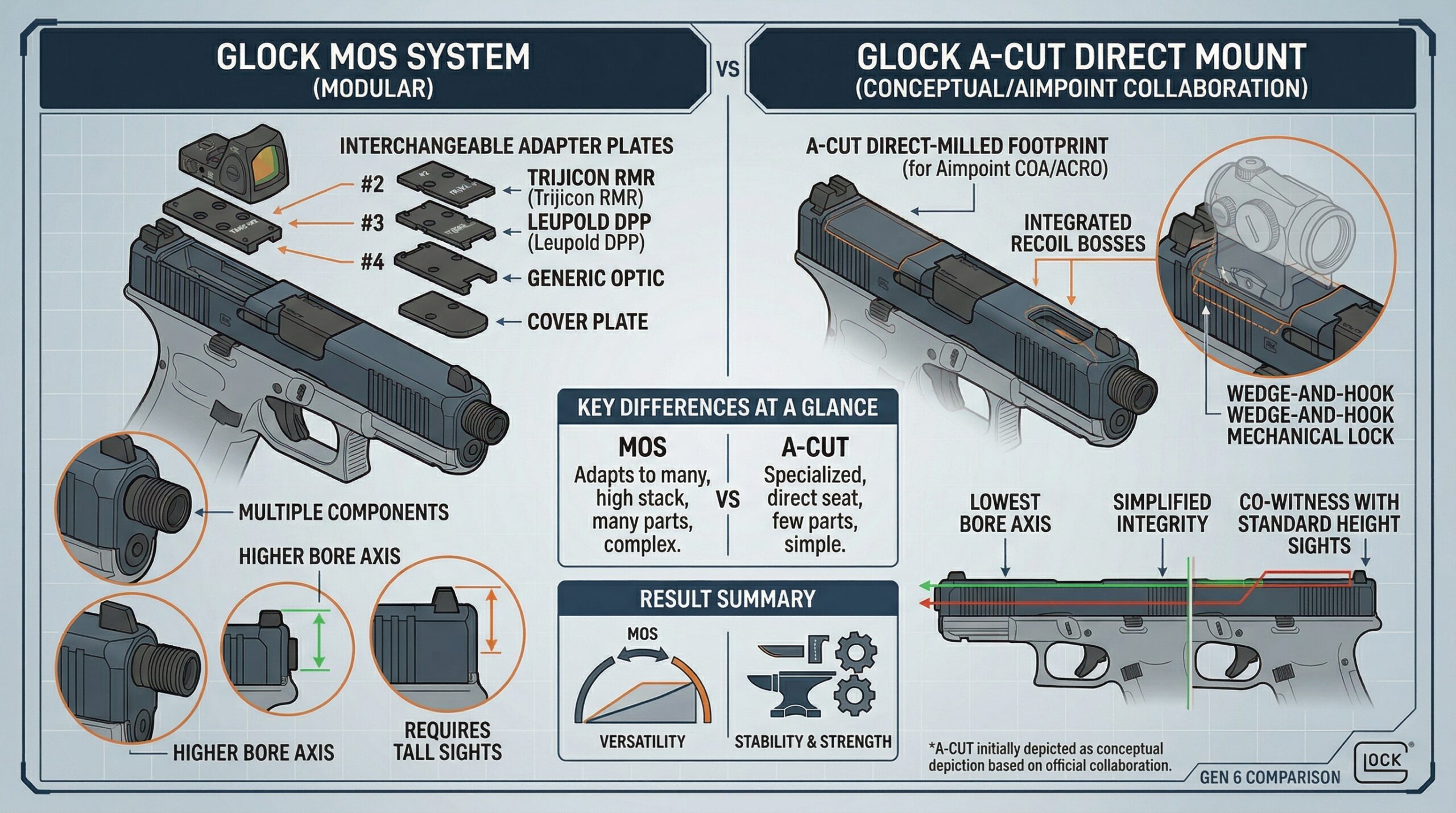
The previous Modular Optic System, heavily promoted during the Generation 4 and Generation 5 lifecycles, utilized a wide, shallow cut milled into the top of the slide. Users were required to use small screws to attach a flat steel adapter plate into this cut, and then use a second set of screws to attach their chosen optic into the adapter plate.
This modular system introduced several severe points of mechanical failure. The stacking of plates significantly increased the height of the optic above the bore axis, making it incredibly difficult to seamlessly co-witness standard height iron sights through the optic window. More critically, the system relied on extremely short, fine-threaded screws to secure relatively heavy electronic optics. The reciprocating mass of the slide, which accelerates violently and stops abruptly upon locking into battery, subjected the optic and the screws to extreme sheer forces and G-loadings. Over time, these lateral stresses often caused the small mounting screws to stretch, loosen, or cleanly shear off, resulting in the optic detaching entirely from the weapon during firing.
7.2 The Advanced Mechanics of the A-CUT Direct Mount System
The Generation 6 A-CUT system definitively resolves these structural vulnerabilities through a highly engineered direct-mount philosophy. All standard Generation 6 models are optics-ready straight out of the box, utilizing a much deeper cut milled directly into the steel slide.2 Instead of relying on thin metal adapter plates acting as the primary load-bearing mounting interface, the A-CUT system relies on the structural mass of the slide itself to absorb and distribute the sheer forces.
The system utilizes three included polymer plates to match common optic footprints such as the RMR, Shield, Delta Point, and Holosun K series.2 However, their mechanical function is entirely different from the legacy Modular Optic System plates. These advanced polymer inserts are not load-bearing structural adapters. Instead, they act primarily as structural shims and highly effective crush washers.4
When an optic is firmly mounted and torqued to specification, the metal components of the optic and the slide bite securely into the polymer shim. During the violent acceleration and sudden deceleration of the firing cycle, these specialized polymer plates flex microscopically. This flexion acts as an advanced shock absorber, dissipating kinetic energy throughout the polymer matrix. This brilliant application of materials science significantly reduces the tensile and shear stress transferred directly to the steel mounting screws, virtually eliminating the catastrophic risk of screw shearing that plagued the older models.6
Furthermore, because the A-CUT milling is significantly deeper than the legacy cuts, the optic sits deeply nested within the slide structure.5 This streamlined, low-profile geometry allows the user to achieve a perfect lower third co-witness using standard-height factory iron sights, entirely removing the necessity to purchase and install expensive, tall suppressor-height sights.11
7.3 The Aimpoint COA Strategic Partnership
In close conjunction with the rollout of the A-CUT system, the manufacturer entered into an exclusive strategic partnership with the Swedish optics manufacturer Aimpoint to produce the highly anticipated COA combo packages.13 The Aimpoint COA is a completely enclosed emitter red dot sight design, ensuring the diode is entirely sealed from environmental contaminants such as rain, mud, or lint.11
The A-CUT system utilizes a patented wedge design specifically tailored to fit the precise geometry of the COA. This wedge mechanically secures the optic and transfers rearward recoil forces directly into the dovetail of the steel slide, rather than relying purely on the vertical tension of the mounting screws.11 The COA sight itself is constructed from aerospace-grade 7075-T6 high strength aluminum, is certified submersible down to twenty-five meters, and boasts an impressive five-year constant-on battery life powered by a standard CR2032 lithium battery accessible via a side-mounted quick access tray.11 This exclusive combo package represents the absolute highest tier of the Generation 6 product offering, aimed directly at securing lucrative military contracts and equipping premium law enforcement tactical units.
8. Consumer Reception and Independent Media Analysis
To accurately gauge the overall market impact and viability of the Generation 6 platform, it is strictly necessary to analyze the immediate reception from both prominent media figures and the grassroots consumer base operating in the commercial market.
8.1 Media and Industry Analyst Feedback
Evaluations from prominent YouTube creators, firearms instructors, and tactical industry analysts have highlighted a remarkably strong consensus regarding the overall shootability of the new platform. Reviewers have consistently noted that the unique combination of the integrated gas pedal, the highly aggressive RTF6 texture, and the undercut trigger guard yields a duty pistol that is objectively easier to control during rapid fire than any previous iteration.6 The flat-faced trigger has been universally praised for massively increasing comfort during high-round-count training sessions, effectively eliminating the painful blistering phenomenon previously associated with the aggressively serrated curved trigger shoe found on older models.6
The A-CUT optic mounting system has received extensive positive coverage across the media landscape. Professional instructors have demonstrated that the significantly lower seating geometry of the optic creates a much more natural presentation when drawing from a duty holster, aligning the red dot with the user’s focal plane much more intuitively. The innovative use of polymer plates as functional shock absorbers has been widely recognized as a highly clever engineering solution to the screw-shear problem that severely plagued the earlier Modular Optic System.5
8.2 Criticisms and Controversies in the Media
Despite the overwhelming praise for the engineering upgrades, the media reception is not entirely devoid of pointed criticism. A primary, recurring point of intense contention remains the manufacturer’s steadfast insistence on shipping these premium pistols with cheap, easily damaged polymer iron sights.15 Analysts and reviewers passionately argue that at the Generation 6 price point, which sits notably higher than previous generations, durable steel sights should be the absolute minimum standard.
Furthermore, some industry analysts expressed mild disappointment that the manufacturer did not adopt a truly modular fire control unit design similar to the rapidly expanding SIG Sauer P320 or the Springfield Echelon ecosystems. Analysts correctly note that the company’s strict adherence to the monolithic, serialized polymer frame feels deeply traditional in a market segment that is rapidly pivoting toward extreme modularity and interchangeable chassis systems.6
9. Grassroots Community Sentiment and The Modder’s Dilemma
Detailed analysis of grassroots community forums, specifically the massive Reddit r/Glocks community, reveals a fascinating, bifurcated response to the Generation 6 release. The online community can generally be divided into two distinct camps regarding this release: the Original Equipment Manufacturer purists and the aftermarket modification enthusiasts.
9.1 The Perspective of the Platform Purists
For the purists, the Generation 6 is widely viewed as the absolute zenith of the platform’s development. Users who strongly prefer to keep their defensive firearms completely stock appreciate that the Generation 6 successfully resolves all historical ergonomic and mounting complaints straight from the factory floor.16 The integration of the flat trigger, the functional gas pedal, and the aggressive RTF6 stippling means these dedicated users no longer feel compelled to seek out potentially unreliable secondary market solutions to achieve optimal tactical performance.16
9.2 The Aftermarket Modification Dilemma
Conversely, the modification enthusiast community exhibits a complex phenomenon best described by analysts as the modder’s dilemma. Because the engineering team has successfully optimized so many individual components of the firearm, there is very little left for the end-user to easily upgrade.16 While this integration is objectively positive for baseline reliability and tactical performance, it severely reduces the hobbyist appeal of carefully building a highly personalized, unique firearm.
Many users on these forums who have already invested heavy financial capital into customizing their existing Generation 5 pistols view the Generation 6 as redundant for their specific use case. These users frequently state that their heavily modified firearms already possess all the premium features the stock Generation 6 offers, negating the urgent need to purchase the new model immediately.16
9.3 Parts Compatibility Breakdown
The online communities have crowdsourced extensive lists detailing exactly which parts are backwards compatible. Externally, the Generation 6 maintains excellent compatibility with existing accessories. The exterior dimensions of the frame and trigger guard are sufficiently similar to the Generation 5 that the vast majority of premium Kydex holsters fit the new pistols perfectly without requiring heat modification.6 The platform also continues to feed reliably from standard double-stack magazines, preserving the usability of the massive global inventory of existing magazines.4
Internally, community armorers have confirmed that several small parts carry over successfully. The front sight, firing pin safety, firing pin spacer sleeve, channel liner, trigger bar, connector, ejector, slide stop lever, and magazine catch remain compatible with previous generations.18 However, the major functional components, including the barrel, the entire recoil spring assembly, the proprietary extractor, and the modified slide back plate, are entirely generation-specific and cannot be swapped.18
10. Retail Landscape, Vendor Pricing, and Economic Impact
The sweeping engineering changes present in the Generation 6 platform have profound and immediate implications for the secondary firearms market, heavily affecting both parts compatibility matrices and the underlying business models of custom fabrication shops. Furthermore, the integration of premium features has resulted in a necessary upward adjustment of the platform’s primary pricing structure.
10.1 The Disruption of the Custom Shop Economy
The most significant macro-market consequence of the Generation 6 release is its severe economic impact on the aftermarket custom industry. For the past decade, a highly lucrative cottage industry has thrived globally by rectifying the platform’s perceived ergonomic and optical mounting shortcomings.
A consumer purchasing a standard Generation 5 pistol would frequently spend substantial capital to achieve the performance features now considered standard on the Generation 6. Professional polymer stippling services designed to improve grip texture typically cost consumers well over one hundred and fifty dollars. Installing a reliable aftermarket flat-faced trigger assembly demands an additional one hundred and fifty dollars. Sending a hardened steel slide to an independent machine shop for precision direct-mill optic cuts and enhanced forward cocking serrations routinely costs upwards of one hundred and seventy to two hundred dollars.2
By seamlessly integrating the RTF6 texture, the flat-faced trigger, the deep slide serrations, and the A-CUT direct milling system directly into the highly efficient manufacturing process, the company has effectively internalized approximately five hundred dollars worth of aftermarket modifications.2 While this represents an undeniable financial victory for consumer value, it constitutes a severe disruption to independent gunsmiths and specialized custom fabrication shops. Companies that relied heavily on milling slides for optic cuts or performing polymer grip reductions will be forced to rapidly pivot their business models to survive as the Generation 6 captures total market share, as the A-CUT system entirely negates the fundamental need for aftermarket milling services.
10.2 Market Pricing Analysis and Vendor Landscape
While older generations of the platform often retailed in the low to mid five-hundred dollar range, the Generation 6 carries a higher suggested retail price to accurately account for the complex manufacturing processes required for the A-CUT milling and the extensive frame enhancements.
Current retail market data indicates that the Manufacturer’s Suggested Retail Price for the standard optics-ready Generation 6 models hovers closely around seven hundred and forty-five dollars. However, standard competitive retail dynamics have quickly established a highly consistent street price averaging exactly six hundred and twenty dollars, with maximum pricing reaching approximately seven hundred dollars depending on the specific vendor inventory and the precise model variant.6
The remarkable pricing consistency observed across major national retailers indicates exceptionally strong consumer market demand and suggests strict adherence to Minimum Advertised Price policies enforced by the manufacturer. To provide a comprehensive view of the current retail environment, a detailed analysis of preferred vendors currently listing the standard Generation 6 models in stock is provided below.
| Vendor Name | Product Listed | Current Market Price | Product Link |
| Official Manufacturer | Gen 6 Information Portal | N/A | (https://gen6.glock.us/) |
| Sportsman’s Warehouse | Glock 19 Gen 6 ORS 9mm | $620.00 | (https://www.sportsmans.com/shooting-gear-gun-supplies/handguns/glock-g19-gen6-optic-ready-9mm-luger-4in-black-pistol-151-rounds/p/1983984) |
| Primary Arms | Glock 17 Gen 6 ORS 9mm | $620.00 | Primary Arms Product Page |
| KYGunCo | Glock 45 Gen 6 Crossover | $620.00 | (https://www.kygunco.com/product/glock-g45-gen6-crossover-frame-9mm-4.02-17rd-black) |
| Midway USA | Glock 19 Gen 6 ORS 9mm | $699.99 | (https://www.midwayusa.com/product/1029291148) |
| Brownells | Glock 19 Gen 6 ORS 9mm | Variable / Listed | (https://www.brownells.com/guns/handguns/semi-auto-handguns/19-gen-6-9mm-luger-semi-auto-handgun/?sku=430115174) |
The prices listed in the table above reflect the exact retail environment captured during the initial launch window and remain subject to standard supply chain and inflation fluctuations.
Despite the initial vocal consumer reaction regarding the elevated base price point compared to previous models 6, an objective and comprehensive financial analysis reveals that the Generation 6 actually represents an exceptional value proposition for the serious shooter. When factoring in the minimum five hundred dollars of integrated custom features 2, the overall aggregate cost to field a fully optimized, duty-ready, optics-ready firearm is significantly lower with the Generation 6 than with any previous iteration of the platform in the company’s long history.
11. Conclusion
The Glock Generation 6 series represents a highly calculated, meticulously engineered, and undeniably successful evolution of the world’s most ubiquitous striker-fired duty pistol platform. Rather than attempting to hastily replicate the modular chassis systems of its primary market competitors, the engineering team chose to aggressively refine the core monolithic architecture. They systematically addressed every major ergonomic and mechanical criticism levied against the previous designs by the tactical and competitive shooting communities.
The bold introduction of the advanced RTF6 texture, the highly functional integrated thumb rest, and the geometrically precise flat-faced trigger drastically improves the critical biomechanical interface between the human user and the weapon system. These enhancements result in immediately measurable improvements in recoil management, cyclic rate control, and practical accuracy under stress. Furthermore, the newly patented A-CUT optic milling system represents a massive leap forward in structural reliability. It completely corrects the severe mechanical deficiencies of the legacy adapter plate systems by successfully lowering the bore axis and permanently mitigating destructive shear stress on fragile mounting hardware.
While the strict proprietary nature of the new internal components and the resulting severe disruption to the aftermarket custom industry present minor friction points, these industry consequences are vastly outweighed by the enormous functional and financial benefits delivered directly to the end-user. By consolidating the most desirable aftermarket modifications into a single, warranty-backed factory package, the manufacturer has delivered a premium platform that drastically reduces the total overall cost of ownership while maximizing out-of-the-box tactical performance. The Generation 6 platform successfully solidifies the manufacturer’s dominant market position, virtually ensuring its continued relevance, dominance, and institutional adoption in both the global military duty sector and the civilian concealed carry markets for the foreseeable future.
Appendix: Methodology
This intelligence report was meticulously compiled utilizing a comprehensive qualitative and quantitative analysis of contemporary small arms industry data. The analytical methodology involved the rigorous synthesis of official manufacturer technical specifications, early press releases, and pending patent data regarding the Generation 6 core architecture. Granular market pricing data was extracted from a broad cross-section of primary firearms retailers to accurately establish authentic street pricing and calculate total value propositions.
Consumer reception and grassroots sentiment analysis were conducted by systematically aggregating and reviewing high-definition video evaluations from prominent, well-respected industry analysts and tactical instructors. This qualitative assessment was coupled with unstructured data mined directly from dedicated enthusiast forums to capture the authentic voice of the consumer base.
The structural analysis applied established biomechanical engineering principles to rigorously evaluate all ergonomic marketing claims. Furthermore, fundamental mechanical physics were applied to deeply assess the true validity of the structural modifications, specifically regarding recoil spring dynamic compression and optic mounting sheer force distribution. These technical findings were then carefully contextualized within the broader economic framework of the global small arms manufacturing sector and the secondary aftermarket parts industries. All selected source materials were heavily vetted for industry relevance, technical accuracy, and lack of overt promotional bias.
Note: Vendor Sources listed are not an endorsement of any given vendor. It is our software reporting a product page given the direction to list products that are between the minimum and average sales price when last scanned.
Please share the link on Facebook, Forums, with colleagues, etc. Your support is much appreciated and if you have any feedback, please email us in**@*********ps.com. If you’d like to request a report or order a reprint, please click here for the corresponding page to open in new tab.
Sources Used
- GLOCK, Inc. announces the 6th Generation of GLOCK pistols., accessed April 10, 2026, https://us.glock.com/press-release/news-page/gen6-announcement
- The Glock Gen 6 Pistols: How Glock fooled the internet, accessed April 10, 2026, https://lowreadymagazine.com/en/articles/glock-generation-6-en
- Gen6: Engineered for Precision, Reliability, Ergonomics, accessed April 10, 2026, https://gen6.glock.us/
- GLOCK Introduces the Gen 6 – The Armourers Bench, accessed April 10, 2026, https://armourersbench.com/2025/12/06/glock-introduces-the-gen-6/
- Glock Gen 6 OMS vs MOS Optics System. – YouTube, accessed April 10, 2026, https://www.youtube.com/shorts/UJbLSrOwt-c
- The NEW Glock Gen 6 Is Here! (Hands On & Live Fire!) – YouTube, accessed April 10, 2026, https://www.youtube.com/watch?v=TPYd8lUp3G8
- Gen6 – GLOCK Perfection, accessed April 10, 2026, https://eu.glock.com/en/Technology/Gen6
- Glock Introduces the Gen 6: What’s New and How It Impacts Carry Builds – Tyrant CNC, accessed April 10, 2026, https://www.tyrantcnc.com/blog/glock-introduces-the-gen-6-whats-new-and-how-it-impacts-carry-builds
- Glock Gen 6: What’s New, Why It Matters, and What It Means for Concealed Carriers, accessed April 10, 2026, https://www.tier1concealed.com/blogs/tier-1-articles/glock-gen-6-what-s-new-why-it-matters-and-what-it-means-for-concealed-carriers
- Glock Gen 6 Mounting System is less perfect than other Glock options from before? – Reddit, accessed April 10, 2026, https://www.reddit.com/r/Glocks/comments/1q4laxl/glock_gen_6_mounting_system_is_less_perfect_than/
- COA – Aimpoint, accessed April 10, 2026, https://www.aimpoint.com/coa-launch/
- Glock x Aimpoint | COA, accessed April 10, 2026, https://aimpoint.us/coa/
- GLOCK and Aimpoint cooperate and introduce new COA mini red dot sight for selected GLOCK models with innovative mounting interface | all4shooters, accessed April 10, 2026, https://www.all4shooters.com/en/shooting/pistols/on-site-report-on-the-cooperation-between-glock-and-aimpoint-coa-red-dot-sight-first-impressions-from-shooting/
- GLOCK and Aimpoint™ Combo, accessed April 10, 2026, https://eu.glock.com/en/Technology/glock-aimpoint-combo
- Glock Gen 6 – initial impressions from a competition shooter – Reddit, accessed April 10, 2026, https://www.reddit.com/r/Glocks/comments/1q1afta/glock_gen_6_initial_impressions_from_a/
- Fair question. Besides the bragging rights, what features on Glocks gen 6 is a game changer for you. – Reddit, accessed April 10, 2026, https://www.reddit.com/r/Glocks/comments/1pypyar/fair_question_besides_the_bragging_rights_what/
- Let’s Be Honest About Gen 6 : r/Glocks – Reddit, accessed April 10, 2026, https://www.reddit.com/r/Glocks/comments/1pzhnuw/lets_be_honest_about_gen_6/
- Gen 6 parts compatibility slide : r/Glocks – Reddit, accessed April 10, 2026, https://www.reddit.com/r/Glocks/comments/1pg6gro/gen_6_parts_compatibility_slide/
- Glock gen 6 and gen 5 compatibility – Reddit, accessed April 10, 2026, https://www.reddit.com/r/Glocks/comments/1qor5od/glock_gen_6_and_gen_5_compatibility/
- Glock 19 Gen 6 ORS 9mm Luger Pistol 4.02 Barrel 15+1 Round Black – MidwayUSA, accessed April 10, 2026, https://www.midwayusa.com/product/1029291148
- Glock G19 Gen6 Optic Ready 9mm Luger 4in Black Pistol – 15+1 Rounds, accessed April 10, 2026, https://www.sportsmans.com/shooting-gear-gun-supplies/handguns/glock-g19-gen6-optic-ready-9mm-luger-4in-black-pistol-151-rounds/p/1983984