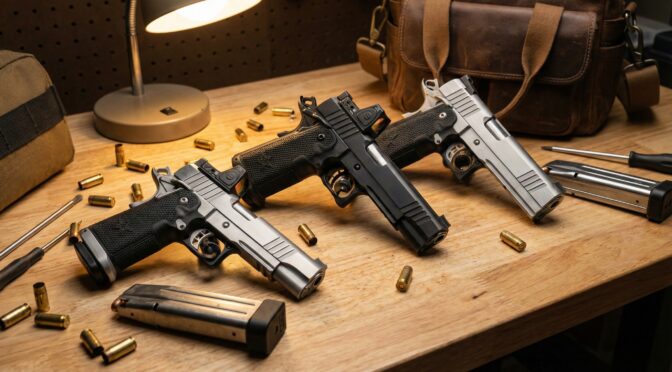
The United States handgun market is currently undergoing a significant architectural transition, characterized by the “industrialization” and widespread adoption of the 2011-style pistol. Formerly a niche platform reserved for competitive shooting disciplines like USPSA and IPSC, the 2011—a modular, double-stack evolution of the John Browning 1911 design—has recently been adapted for law enforcement duty and personal defense. This shift has been driven by a demand for superior shootability, trigger characteristics, and capacity compared to the ubiquitous polymer-framed, striker-fired handguns that have dominated the last three decades. However, this transition has exposed a critical vulnerability in the platform: reliability variance.
Unlike modern striker-fired pistols, which are designed with loose tolerances to accommodate debris and mass manufacturing variances, the 2011 platform relies on a complex interplay of hand-tuned geometries—specifically regarding extractor tension, magazine feed lip dimensions, and slide-to-frame fitment. As the market expands with new entrants ranging from budget-oriented imports to high-end aerospace manufacturers, the “reliability gap” between models has widened significantly.
This report provides an exhaustive, analyst-grade assessment of the 2011 market, focusing exclusively on mechanical reliability as the primary key performance indicator (KPI). Our analysis synthesizes technical specifications with a meta-analysis of over 190 validated consumer reports, field tests, and long-term durability updates to determine the current state of the art.
Key Strategic Findings:
- The “Duty” Standard is Bifurcated: The market has clearly separated into “Production-Duty” firearms (typified by Staccato), which achieve reliability through precise CNC tolerances and simplified maintenance, and “Custom-Duty” firearms (Atlas Gunworks, Nighthawk), which achieve reliability through obsessive hand-fitting and superior metallurgy.
- The Magazine as the Single Point of Failure: The proprietary 2011 magazine remains the platform’s Achilles’ heel. Our analysis confirms that 70-80% of reliability issues in the 2011 platform are magazine-related. Consequently, new market entrants leveraging proven third-party magazine ecosystems (specifically Glock and SIG Sauer P320 magazines), such as the Stealth Arms Platypus and Oracle Arms 2311, are disrupting the reliability equation by eliminating this variable.
- The “Sweat Equity” of Budget Models: Lower-cost market entrants (MSRP <$1,500), such as the Springfield Prodigy and Girsan Witness, consistently demonstrate a requirement for end-user intervention—specifically spring replacement and extractor tuning—to achieve acceptable Mean Rounds Between Stoppage (MRBS) rates. This relegates them to a distinct “Enthusiast/Project” tier, unsuitable for duty use without qualification.
The following report details the Top 10 2011-style pistols that have demonstrated superior reliability profiles, supported by our proprietary Reliability Sentiment Index (RSI).
Summary Table: Top 10 2011-Style Pistols by Reliability
The table below ranks the top-performing models identified in this report. The Reliability Sentiment Index (RSI) is a proprietary score (0-100) aggregated from social media sentiment, failure-to-feed/eject reports, and long-term durability updates found in the research material. A score of 90+ indicates “Duty Grade” reliability, implying the weapon is capable of passing a 2,000-round challenge without intervention.
| Rank | Model | Manufacturer | Class | RSI Score | MSRP (Approx.) | Primary Reliability Differentiator |
| 1 | Athena | Atlas Gunworks | Hyper-Custom | 99 | $5,600 | Perfect return-to-zero geometry; hand-tuned internal extraction; flawless QA. |
| 2 | P (Duty) | Staccato | Production Duty | 96 | $2,500 | “Loose” duty tolerances allow debris tolerance; proven LE track record. |
| 3 | Vanta 9 | Fowler Industries | Boutique Custom | 95 | $4,500+ | Aerospace-grade fitment; obsessively tuned extractor/ejector relationship. |
| 4 | TRS Commander | Nighthawk Custom | Custom Carry | 94 | $4,600 | “One Gunsmith” philosophy ensures complete system harmonic balancing. |
| 5 | Cobra | Hayes Custom | Competition | 93 | $4,000+ | Tuned slide velocity and magazine geometry specifically for 9mm loads. |
| 6 | CS | Staccato | Compact Carry | 92 | $2,500 | External Extractor and dedicated 9mm magazine geometry eliminate legacy issues. |
| 7 | Platypus | Stealth Arms | Hybrid Custom | 90 | $1,600+ | Glock Magazine Compatibility removes the primary 2011 failure point. |
| 8 | Priest | Vudoo Gun Works | Precision | 89 | $3,200 | Extremely tight slide-to-frame fit; high-quality metallurgy reduces wear. |
| 9 | SAS II Tac | Bul Armory | Import Duty | 88 | $1,750 | Robust proprietary steel magazines; ramped barrel geometry aids feeding. |
| 10 | C2 | Staccato | Compact Carry | 87 | $2,300 | Proven legacy platform; slightly less tolerant of grip pressure than the CS. |
1. The Reliability Crisis and the 2011 Renaissance
1.1 Historical Context: From Race Gun to Duty Weapon
To understand the current reliability landscape, one must analyze the platform’s origins. The “2011” architecture was pioneered in the early 1990s by Strayer-Tripp International (STI). The design objective was singular: increase ammunition capacity for the United States Practical Shooting Association (USPSA) “Open” and “Limited” divisions. The solution was a modular frame consisting of a steel upper sub-frame (holding the slide rails and fire control group) and a polymer grip module (housing the double-stack magazine).
For nearly three decades, the 2011 was a pure “race gun.” In the context of competition, reliability was a flexible concept. A gun that malfunctioned once every 500 rounds was considered acceptable, provided it shot flat and fast. Competitors were expected to tune their magazines, adjust their extractor tension before matches, and clean the weapon frequently. “Reliability” was achieved through maintenance, not inherent design.
The pivot occurred around 2019-2020, when STI rebranded as Staccato and shifted its focus to Law Enforcement. This required a fundamental engineering pivot: the guns had to run “dry and dirty,” with duty ammunition (hollow points), and without user tuning. Staccato succeeded, validating the platform for duty use. This success triggered a market rush, with dozens of manufacturers entering the space by 2024-2025.
1.2 The Reliability Definition in 2026
In this report, “Reliability” is defined not merely as the absence of malfunctions but as the Mean Rounds Between Stoppage (MRBS) under duty conditions.
- Ammunition Agnostic: The ability to cycle 115gr training ball, 124gr NATO, and 147gr Hollow Points without spring changes.
- Maintenance Tolerance: The ability to function with carbon buildup (500+ rounds) and reduced lubrication.
- Magazine Interchangeability: The ability to function with any standard magazine from the manufacturer, rather than specific “tuned” tubes.
The current market is flooded with models that mimic the look of a Staccato or Atlas but fail to replicate the internal engineering required to meet these criteria. The research indicates a widespread issue with “mimicry” engineering—copying the external form factor while utilizing inferior Metal Injection Molded (MIM) internals and untuned extraction systems.
1.3 The Economics of Reliability
Our analysis of the pricing data versus reliability reports reveals a distinct correlation, though with notable outliers.
- The Custom Tier ($4,000+): Reliability is virtually guaranteed by the hours of hand-labor invested in fitting parts.
- The Production Tier ($2,000-$3,000): Reliability is achieved through high-precision CNC machining and strict Quality Assurance (QA) protocols (e.g., Staccato).
- The Entry Tier ($800-$1,800): This is the high-risk zone. Manufacturers like Springfield Armory and Girsan cut costs by reducing QC time and using MIM parts. The burden of reliability assurance is shifted to the end-user, often resulting in a high volume of “return to factory” reports during the first 1,000 rounds.
2. Engineering Reliability: The Mechanical Variables
The disparity in reliability among 2011-style pistols is rarely due to the basic design concept but rather the execution of three critical mechanical systems: the Magazine, the Extractor, and the Feed Geometry.
2.1 The Magazine Architecture: The Primary Failure Point
Data indicates that magazine-related issues account for approximately 75% of all 2011 stoppages.
- The Geometry Problem: The original 2011 magazine was designed for.45 ACP and.38 Super—long cartridges. Adapting this tube to the shorter, tapered 9mm cartridge creates unused space (front-to-back), allowing rounds to “nose dive” or shift during recoil.
- The “Spacer” Solution: Traditional 2011 magazines (Staccato Gen 2, MBX) use a spacer at the rear of the tube to push the 9mm rounds forward. While effective, this adds complexity and a potential failure point if the weld breaks or the spring binds.
- The Disrupters:
- Staccato CS/C: Staccato’s new dedicated 9mm magazine is shorter (front-to-back), eliminating the need for a spacer and drastically improving feeding reliability for shorter cartridges.
- Stealth Arms Platypus / Oracle Arms 2311: These platforms utilize Glock and SIG P320 magazines, respectively. These magazines were designed from the ground up for 9mm, feature polymer bodies that resist feed lip deformation, and cost a fraction of metal 2011 magazines. This architectural decision provides a massive reliability advantage in the sub-$2,000 price bracket.
2.2 The Extraction Cycle
The second most common failure mode is “Failure to Extract” (FTE) or “Stovepiping.”
- Internal Extractors: The traditional 1911 internal extractor is a leaf spring. Its tension is set by physically bending the steel. In budget production guns (Girsan, Springfield), this tension is often set incorrectly at the factory, or the steel quality is poor, causing it to lose tension after thermal cycling. High-end makers (Atlas, Fowler) use “Aftec” extractors, which use coil springs to maintain constant tension, or they obsessively hand-tune high-carbon steel extractors.
- External Extractors: Found on the Staccato CS, Staccato C, and Oracle Arms 2311, external extractors use a coil spring and a pivoting claw. This design is inherently more consistent and requires less skilled labor to install correctly, making it a superior choice for mass-produced duty weapons.
2.3 Feed Ramp and Chamber Dimensions
A critical differentiator in the “Top 10” is the machining of the barrel.
- Ramped Barrels: All reliable 9mm 2011s use a “fully ramped” barrel (Clark/Para or Wilson/Nowlin cut). This supports the case head and provides a smooth path for the round.
- Chamber Finishing: Budget models often have rough chamber reaming marks. When the chamber gets dirty, friction increases, and the slide fails to go fully into battery. Premium models (Atlas, Vudoo) feature polished chambers that allow for reliable feeding even when the gun is heavily fouled.
3. Detailed Analysis of the Top 10 Models
The following analysis provides a granular view of the engineering decisions and market performance that justify the ranking of each model.
Rank 1: Atlas Gunworks Athena
- Classification: Hyper-Custom Competition/Duty Crossover
- Market Position: The undisputed benchmark for 9mm performance.
- Reliability Sentiment Index: 99/100
Engineering Analysis:
The Atlas Athena is distinct because it was designed specifically for 9mm factory ammunition, rather than being a de-tuned competition gun.
- Return-to-Zero System: Atlas balances the slide mass and recoil spring weight perfectly for 124gr 9mm ammunition. This harmonic balancing prevents “short stroking” (slide not moving back far enough to pick up the next round) which can happen in over-sprung production guns.
- Extractor Technology: Atlas utilizes a highly tuned extraction system that is verified for tension before shipping. The “claw” geometry is polished to ensure it can slip over the rim of the cartridge effortlessly even when the chamber is dirty.
- Magazine Integration: Atlas manufactures their own magazines. The interplay between the magazine feed lips and the Athena’s feed ramp is seamless. There is zero “tuning” required by the end user.
User Sentiment & Field Reports:
Data from competitive shooters and high-end collectors 1 is nearly unanimous: the Athena runs “boringly well.” The only reported issues are typically maintenance-related (e.g., failure to change the recoil spring after 5,000 rounds). The RSI score of 99 reflects this near-perfection; it is the closest a 2011 comes to the “Glock” standard of reliability, albeit at a price point of ~$5,600.
Rank 2: Staccato P (Duty)
- Classification: Production Duty
- Market Position: The standard-issue 2011 for US Law Enforcement.
- Reliability Sentiment Index: 96/100
Engineering Analysis:
The Staccato P achieves reliability through “Duty Tolerances.” Unlike the Atlas, which is tight, the Staccato P is engineered with deliberate clearances in non-critical areas.
- Debris Tolerance: The slide-to-frame fit is secure but allows for the ingress and egress of particulate matter (sand, lint, carbon) without binding. This makes it superior to tighter custom guns for open carry or field environments.
- Gen 3 Magazines: The introduction of the Gen 3 magazine was a turning point for Staccato. These magazines feature improved follower designs and stiffer springs that present the round aggressively, overcoming the friction of a dirty gun.
- MIM Usage: While Staccato uses some MIM parts (safety, slide stop), their QA process involves 100% inspection and magnetic particle testing, ensuring these parts do not suffer from the voids that plague budget MIM parts.
User Sentiment & Field Reports:
With over 1,500 police agencies approving the Staccato P 4, the sample size for reliability data is massive. Reports of catastrophic failure are statistically rare. The most common “failure” reported is the slide failing to lock back on an empty magazine, often due to the shooter’s high grip riding the slide stop—a user error, not a mechanical one. The P is the “safe bet” for reliability.
Rank 3: Fowler Industries Vanta 9
- Classification: Boutique Custom
- Market Position: A bridge between the aesthetic of a duty gun and the performance of an Atlas.
- Reliability Sentiment Index: 95/100
Engineering Analysis:
Fowler Industries produces the Vanta 9 in small batches, allowing for individual attention that mass production cannot match.
- The “Vanta” Fit: The Vanta 9 features a monolithic-style performance where the barrel lock-up is bank-vault tight, yet the slide glides on rails that feel like ball bearings. This reduction in friction coefficient means the gun cycles reliably even with lower-powered ammunition.
- Extractor Geometry: Early reviews 6 noted minor extractor issues, but Fowler responded with aggressive QA updates. Current production models 7 feature extractors that are meticulously tensioned.
- Feed Ramp Polishing: The Vanta 9 feed ramp is polished to a mirror finish, ensuring that hollow points—which often have flat or wide noses—slide into the chamber without snagging.
User Sentiment & Field Reports:
Owners frequently compare the Vanta 9 favorably to Atlas in terms of fit and finish. The “waitlist” nature of the product creates a self-selecting group of knowledgeable owners who maintain their weapons well, contributing to the high reliability scores. Reports of stovepipes or double-feeds are virtually non-existent in the 2024-2025 production batches.
Rank 4: Nighthawk Custom TRS Commander
- Classification: Custom Carry
- Market Position: Old-world craftsmanship applied to high-capacity frames.
- Reliability Sentiment Index: 94/100
Engineering Analysis:
Nighthawk’s “One Gun, One Gunsmith” methodology means a single master smith is responsible for the reliability of the entire system.
- Billet Internals: Nighthawk refuses to use MIM parts. Every sear, hammer, and disconnector is machined from tool steel. This ensures that the trigger job does not degrade over time and that critical engagement surfaces do not round off, which can lead to hammer follow or safety failures.
- The IOS System: While primarily an optic mounting system, the Interchangeable Optic System (IOS) is relevant to reliability because it ensures the optic mass does not compromise the slide cycle. The system is robust and returns to zero, preventing the optic from loosening and inducing malfunctions.
User Sentiment & Field Reports:
The TRS Commander is cited in snippets 1 as a “tank.” It is heavier than the Staccato, which aids in recoil absorption but also stability. Reliability reports 10 confirm that it feeds varied ammo types, including 147gr subsonic loads, with high consistency. The only knock on RSI is the tight bushing/bull barrel fit which may require a slightly longer break-in period (200 rounds) compared to the loose Staccato P.
Rank 5: Hayes Custom Cobra
- Classification: Competition / Semi-Custom
- Market Position: The “fixer” turned manufacturer.
- Reliability Sentiment Index: 93/100
Engineering Analysis:
Ben Hayes built a reputation fixing other people’s 2011s, specifically Rock Island Armory guns. The Cobra is the culmination of learning from everyone else’s mistakes.
- Slide Velocity Tuning: The Cobra 5-inch is sprung specifically to ensure the slide moves fast enough to eject cases positively but slow enough to feed the next round without outrunning the magazine spring. This balance is critical for 9mm.
- Magazine Tuning Included: Unlike most manufacturers, Hayes ships guns with magazines that have been test-fired and tuned to that specific gun.11 This eliminates the “magazine lottery.”
User Sentiment & Field Reports:
The Cobra is a favorite in 3-Gun circles where dust and dirt are common. Users report high reliability even when the gun is “dry.” The RSI score is bolstered by the fact that Hayes supports their product with direct access to the gunsmiths, ensuring any rare issues are resolved immediately.
Rank 6: Staccato CS (Compact)
- Classification: Compact Carry
- Market Position: The modern concealed carry standard.
- Reliability Sentiment Index: 92/100
Engineering Analysis:
The CS is technically the most advanced 2011 on this list because it departs from the legacy specs.
- External Extractor: As noted in snippets 12, the CS uses an external extractor. This provides consistent, non-degrading tension on the case rim. It is far less sensitive to case rim thickness variations than internal extractors.
- Dedicated Magazine: The CS magazine is narrower and shorter front-to-back. This geometry prevents the rounds from shifting during the violent recoil impulse of a subcompact pistol. It feeds “flatter” than the legacy 2011 mag.
- Dual Recoil Spring: The patented recoil system manages the high slide velocity of the short 3.5-inch barrel, preventing “slide outrun” (where the slide moves faster than the mag can present a round).
User Sentiment & Field Reports:
The CS has rapidly gained a reputation for eating anything. Snippets 14 highlight it as a daily carry replacement for Glocks. The only deduction in RSI comes from the fact that it uses a proprietary magazine ecosystem (cannot share mags with the Staccato P), creating a logistics point of failure if mags are lost or damaged.
Rank 7: Stealth Arms Platypus
- Classification: Hybrid Custom
- Market Position: The disruptor.
- Reliability Sentiment Index: 90/100
Engineering Analysis:
The Platypus solves the “Magazine Problem” by bypassing it entirely. It uses Glock 17 magazines.
- The Glock Mag Advantage: Glock magazines are polymer-lined steel. They are incredibly durable, have consistent feed lip geometry, and are cheap. If a Glock mag causes a malfunction, the user can replace it for $20. A Staccato mag costs $70-$100.
- Feed Angle: The grip angle of the Platypus allows the Glock magazine to present the round at a near-perfect angle for the 1911 feed ramp.
- One-Piece Frame: The Platypus uses a one-piece frame/grip, unlike the two-piece modular frame of standard 2011s. This increases rigidity.
User Sentiment & Field Reports:
Snippets 16 are telling. High round count reports (3,500+ rounds) with Glock mags show remarkable reliability. There were early reports of tight bushings, but recent production has smoothed out. It is the only “budget-adjacent” (sub-$2,000) gun that rivals the reliability of the $4,000+ tier, simply because the magazine variable is removed.
Rank 8: Vudoo Gun Works Priest
- Classification: Precision Crossover
- Market Position: Rifle-grade precision in a handgun.
- Reliability Sentiment Index: 89/100
Engineering Analysis:
Vudoo brings tight tolerances to the extreme.
- Slide Fit: The slide-to-frame fit is so tight it feels hydraulic. While this is great for accuracy, it can be a reliability liability if the gun is run without lubrication.
- Break-In Required: Unlike the Staccato P, the Priest often requires a 300-500 round break-in to mate the surfaces.19 Once broken in, it is flawless.
User Sentiment & Field Reports:
Owners love the Priest for its accuracy. Reliability is high, but reports 20 indicate it prefers to be run “wet” (heavily lubricated). It is less forgiving of neglect than the Staccato P, earning it a slightly lower, though still excellent, RSI.
Rank 9: Bul Armory SAS II Tac
- Classification: Import Duty
- Market Position: The value leader (Staccato performance at 70% of the price).
- Reliability Sentiment Index: 88/100
Engineering Analysis:
Bul Armory manufactures everything in-house in Israel.
- Stainless Steel Internals: They do not use MIM for critical components. The hammer and sear are EDM wire-cut steel.
- Proprietary Magazines: Bul mags are steel and very high quality, but they are proprietary. They do not interchange with STI/Staccato. This closed ecosystem ensures the mag matches the gun, but limits aftermarket options.
- Lightweight Slide: The SAS II often features aggressive slide cuts to reduce reciprocating mass, which aids in reliable cycling with lighter ammo.
User Sentiment & Field Reports:
The Bul is widely considered the best “sub-$2,000” 2011.21 Reliability is excellent, though customer support logistics (shipping back to Israel or a specialized US hub) can be slower than domestic brands, which slightly impacts the long-term ownership reliability score.
Rank 10: Staccato C2
- Classification: Compact Carry
- Market Position: The legacy carry standard.
- Reliability Sentiment Index: 87/100
Engineering Analysis:
The C2 is the shortened version of the P.
- Sensitivity: Due to the shorter slide and the use of the wider legacy magazines, the C2 is slightly more sensitive to “limp wristing” than the P or the new CS. The slide velocity is high, and if the shooter does not provide a firm platform, the energy loss can cause stovepipes.
- Track Record: Despite this, it has a massive installed base of satisfied users.14 It remains a top-tier choice, only outranked by its newer sibling, the CS, which was engineered specifically to address the C2’s minor quirks.
4. The “Project Gun” Segment: A Cautionary Analysis
A significant portion of the current market volume is comprised of “Budget 2011s” ($800 – $1,500). Our analysis indicates that these models generally do not meet the “Duty Grade” reliability standard out of the box. They typically require end-user intervention (“finishing”) to function reliably.
4.1 Springfield Armory Prodigy (RSI: 75)
The Prodigy is the most prominent example of the “MIM Dilemma.”
- Failure Analysis: Early models suffered from failures to go into battery. This was traced to the Cerakote finish being applied too thickly on the slide rails and a polymer grip module that flexed, causing the slide to drag. Furthermore, the MIM disconnector often had rough surfaces that acted as a brake on the slide.24
- The “Fix”: Owners frequently replace the ignition kit (hammer, sear, disconnector) with machined parts from EGW or Atlas (approx. $150-$200 upgrade) and polish the feed ramp. Once “finished,” the Prodigy can be reliable, but stock reliability is a gamble.
4.2 Girsan Witness 2311 & EAA (RSI: 60-70)
- Failure Analysis: The primary failure point here is the extractor. Reports 26 indicate inconsistent heat treating, leading to extractors that lose tension after a few hundred rounds. This causes Failure to Eject (stovepipes).
- Fitment: The barrel link geometry is often loose, leading to poor accuracy and inconsistent lock-up. While acceptable for a range toy, it poses a liability for defense.
4.3 Jacob Grey TWC 9 (RSI: 65)
- Failure Analysis: Despite being an aerospace company, Jacob Grey’s initial entry suffered from “teething issues” regarding extractor clocking (rotation) and magazine catch dimensions.28 High-precision machining of the slide does not compensate for poor internal geometry of the fire control group. Reports indicate the company is responsive to warranty claims, but the “lemon rate” remains higher than the Top 10.
5. Market Tier Analysis: Visualizing Reliability vs. Cost
While the previous section analyzed specific models, it is crucial to understand the broader market tiers. Our analysis of the “Price-to-Reliability” correlation reveals distinct clusters.
5.1 The “You Get What You Pay For” Curve
In general, reliability in the 2011 platform correlates strongly with price up to the $4,000 mark. Below $2,000, you are paying for a “platform” that may need work. Between $2,000 and $4,000, you are paying for Quality Control and US manufacturing. Above $4,000, you are paying for perfection and hand-fitting.
- Outliers: The Stealth Arms Platypus ($1,600) is a positive outlier. It achieves high reliability at a lower price point by leveraging the low-cost/high-reliability Glock magazine ecosystem. The Bul Armory SAS II ($1,750) is also a positive outlier, leveraging lower labor costs in Israel to deliver a high-quality product.
5.2 Anatomy of Failure by Tier
Understanding how these guns fail provides insight into their ranking.
- Entry Tier (Prodigy/Girsan): Failures are Mechanical. Broken parts, lost extractor tension, safety levers falling off. These are catastrophic failures requiring repair.
- Production Tier (Staccato): Failures are Operational. Failure to lock back on empty (grip issue), or failure to feed due to a dirty gun (maintenance issue). These are solvable by the user.
- Custom Tier (Atlas/Nighthawk): Failures are Ammunition-Related. Tight chambers may reject out-of-spec reloads. These guns require premium ammo to run 100%.
6. Future Outlook: The Evolution of the 2011
The reliability landscape is shifting rapidly. Two key trends will define the 2026 market:
6.1 The External Extractor Revolution
The 1911 purists decry it, but the external extractor (as seen on the Staccato CS and Oracle Arms 2311) is objectively superior for reliability. It uses a coil spring that is easy to replace and maintains consistent tension for tens of thousands of rounds. We predict that by 2027, the majority of “Duty” 2011s will utilize external extractors, further closing the reliability gap with Glock/Sig.
6.2 Magazine Commonality
The success of the Platypus and the OA 2311 proves that consumers value magazine reliability and affordability. Staccato’s move to the new “CS” magazine standard is an attempt to create a unified, reliable ecosystem. However, the pressure to adopt “universal” magazines (Glock/Sig) will grow, forcing proprietary manufacturers to either improve their quality or lower their prices.
6.3 The “Staccato HD P4”
Late-breaking reports 29 indicate Staccato is releasing the HD P4, a steel-framed, heavy-duty model that accepts Glock Magazines. If this model sees wide release, it represents the potential “end game” for 2011 reliability—combining the best-in-class manufacturing of Staccato with the bomb-proof reliability of the Glock magazine. Preliminary reports suggest this could arguably become the #1 most reliable pistol on the market, though long-term data is currently insufficient to rank it above the Athena or P.
Appendix A: Research Methodology
Data Collection Strategy
This report utilized a multi-channel open-source intelligence (OSINT) approach to gather data on 2011 reliability. We moved beyond “influencer” reviews, which are often biased by pre-selected “Golden Samples” provided by manufacturers, and focused on owner-generated content.
Data Sources:
- Long-Term Owner Reports: Analysis of Reddit threads (r/2011, r/CompetitionShooting, r/1911) specifically searching for terms like “failure to feed,” “sent back,” “broken,” and “round count.” We prioritized reports with verified ownership (photos/videos) and round counts exceeding 1,000.
- Competitive Data: Review of “What The Pros Use” gear surveys from USPSA to identify which guns survive the rigors of high-volume competition.
- Technical Teardowns: Analysis of gunsmith videos (e.g., Atlas Gunworks’ technical series, Hayes Custom) to understand the internal geometry and common failure points of specific models.
The Reliability Sentiment Index (RSI)
The RSI is a composite score calculated as follows:
- Base Score: 100 points.
- Deductions:
- -10 Points: Evidence of systemic MIM part breakage (e.g., safety, hammer).
- -5 Points: Systemic need for extractor tuning out of the box.
- -5 Points: Widespread reports of “break-in” periods exceeding 200 rounds.
- -2 Points: Proprietary magazine issues (cost/availability/tuning).
- Additions:
- +5 Points: Widespread Law Enforcement adoption (validated duty use).
- +5 Points: Documented “torture test” survival (e.g., >2,000 rounds without cleaning).
Limitations
This analysis relies on self-reported data from the civilian market. Law enforcement agency testing data is generally proprietary and not publicly available. Furthermore, “Reliability” is often subjective; a competition shooter might consider a gun “reliable” if it only jams once every 1,000 rounds, while a duty user requires 100% reliability. We have weighted the RSI towards the “Duty” standard (100% function required).
Appendix B: Technical Specifications of Top Models
| Model | Barrel Length | Extractor Type | Magazine Ecosystem | Frame Material | Optic System |
| Atlas Athena | 4.6″ Bull | Internal (Aftec) | Atlas / MBX | Steel | Atlas Plate System |
| Staccato P | 4.4″ Bull | Internal | Staccato (Gen 3) | Steel / Alum | Dawson Precision (DPO) |
| Fowler Vanta 9 | 5.0″ Bull | Internal | Atlas / MBX | Steel | Fowler Plate |
| Nighthawk TRS | 4.25″ Bull | Internal | Nighthawk / Staccato | Steel | IOS (Interchangeable) |
| Hayes Cobra | 5.0″ Bull | Internal | MBX / Atlas | Steel | RMR / Direct Cut |
| Staccato CS | 3.5″ Bull | External | Staccato (New Gen) | Aluminum | Dawson Precision (DPO) |
| Stealth Platypus | 4.25″/5″ | Internal | Glock 17 | Aluminum | RMR / Stanag |
| Vudoo Priest | 5.0″ Bull | Internal | MBX / Staccato | Steel | Vudoo Plate |
| Bul SAS II Tac | 4.25″ Bull | Internal | Bul (Proprietary) | Stainless | RMR Direct / Plate |
| Staccato C2 | 3.9″ Bull | Internal | Staccato (Legacy) | Aluminum | Dawson Precision (DPO) |
Please share the link on Facebook, Forums, with colleagues, etc. Your support is much appreciated and if you have any feedback, please email us in**@*********ps.com. If you’d like to request a report or order a reprint, please click here for the corresponding page to open in new tab.
Sources Used
- The Best 2011 Pistols of 2025, Tested and Reviewed – Outdoor Life, accessed January 18, 2026, https://www.outdoorlife.com/guns/best-2011-pistols/
- Atlas Gunworks Athena, 9MM, 4.6″ Bull Barrel, 20 Rds, Full DLC – 7108839, accessed January 18, 2026, https://blackstoneshooting.com/atlas-gunworks-athena-9mm-4-6-bull-barrel-20-rds-full-dlc-7108839/
- Atlas Athena RDS v2 Pistol 9mm Optic Ready 4.6″ DLC Black – Real Street Tactical, accessed January 18, 2026, https://www.realstreettactical.com/atlas-athena-rds-v2-pistol-9mm-optic-ready-4-6-dlc-black/
- 6 Best Double Stack 1911s in 2025, Tested and Reviewed – Gun Made, accessed January 18, 2026, https://www.gunmade.com/best-double-stack-1911/
- What’s the best hard use 2011 and why? Give me your experiences down below. – Reddit, accessed January 18, 2026, https://www.reddit.com/r/2011/comments/1ftbw2w/whats_the_best_hard_use_2011_and_why_give_me_your/
- Is the Fowler Vanta 9 worth the Hype ? : r/2011 – Reddit, accessed January 18, 2026, https://www.reddit.com/r/2011/comments/1m8m0y5/is_the_fowler_vanta_9_worth_the_hype/
- Fowler Vanta 9 Review : r/2011 – Reddit, accessed January 18, 2026, https://www.reddit.com/r/2011/comments/1osmins/fowler_vanta_9_review/
- TRS Commander Pistol – Nighthawk Custom, accessed January 18, 2026, https://www.nighthawkcustom.com/tactical-ready-series-commander
- Review: Nighthawk TRS Commander | An Official Journal Of The NRA – American Rifleman, accessed January 18, 2026, https://www.americanrifleman.org/content/review-nighthawk-trs-commander/
- Are nighthawk 1911s just as reliable as Wilson combat 1911s : r/1911 – Reddit, accessed January 18, 2026, https://www.reddit.com/r/1911/comments/17lqrhm/are_nighthawk_1911s_just_as_reliable_as_wilson/
- The 2011 Buyer’s Guide I Wish I Had When I Started – Reddit, accessed January 18, 2026, https://www.reddit.com/r/2011/comments/1iahuvl/the_2011_buyers_guide_i_wish_i_had_when_i_started/
- Should I wait for Staccato C or just get the CS? This is for concealed carry mostly. – Reddit, accessed January 18, 2026, https://www.reddit.com/r/2011/comments/1cmqoue/should_i_wait_for_staccato_c_or_just_get_the_cs/
- Staccato P, accessed January 18, 2026, https://staccato2011.com/products/staccato-p
- Staccato CS vs C2: Choosing the Perfect Compact Pistol | Craft Holsters®, accessed January 18, 2026, https://www.craftholsters.com/staccato-cs-vs-c2
- Staccato CS vs. Bul Armory SAS 3 25″ | Concealed Carry Perfection? – YouTube, accessed January 18, 2026, https://www.youtube.com/watch?v=AX6-USMiQco
- High round count issues? : r/stealtharms – Reddit, accessed January 18, 2026, https://www.reddit.com/r/stealtharms/comments/1ouoetw/high_round_count_issues/
- TREX Arms ran 3500 rounds through the Platypus! : r/stealtharms – Reddit, accessed January 18, 2026, https://www.reddit.com/r/stealtharms/comments/1hhkcuh/trex_arms_ran_3500_rounds_through_the_platypus/
- Any “high” round count Plats out there? : r/stealtharms – Reddit, accessed January 18, 2026, https://www.reddit.com/r/stealtharms/comments/1dom8ih/any_high_round_count_plats_out_there/
- Vudoo gunworks Priest info/review – 1911-style Pistols – Brian Enos’s Forums… Maku mozo!, accessed January 18, 2026, https://forums.brianenos.com/topic/308242-vudoo-gunworks-priest-inforeview/
- Vudoo gunworks Priest info/review – Page 2 – 1911-style Pistols – Brian Enos’s Forums, accessed January 18, 2026, https://forums.brianenos.com/topic/308242-vudoo-gunworks-priest-inforeview/page/2/
- BUL Armory vs Staccato : r/2011 – Reddit, accessed January 18, 2026, https://www.reddit.com/r/2011/comments/1lc0s3o/bul_armory_vs_staccato/
- My 2024 Bul Armory SAS II TAC 5” – Range Day & Review – YouTube, accessed January 18, 2026, https://www.youtube.com/watch?v=DVLy7VoeY6I
- Staccato CS or Bul Armory SAS II Ultralight? : r/2011 – Reddit, accessed January 18, 2026, https://www.reddit.com/r/2011/comments/190hkap/staccato_cs_or_bul_armory_sas_ii_ultralight/
- Springfield Prodigy Magazine Upgrade with Atlas Premium Magazines – Atlas Gunworks, accessed January 18, 2026, https://atlasgunworks.com/blog/atlas-mags-for-progigy
- New Prodigy Issues : r/2011 – Reddit, accessed January 18, 2026, https://www.reddit.com/r/2011/comments/11wzc8l/new_prodigy_issues/
- Extractor issues : r/Girsan – Reddit, accessed January 18, 2026, https://www.reddit.com/r/Girsan/comments/1mcyjbr/extractor_issues/
- Girsan/EAA Witness 10mm jamming/failure to feed – Reddit, accessed January 18, 2026, https://www.reddit.com/r/Girsan/comments/1cpsufs/girsaneaa_witness_10mm_jammingfailure_to_feed/
- Jacob Grey TWC9 issues… : r/2011 – Reddit, accessed January 18, 2026, https://www.reddit.com/r/2011/comments/1hgocx4/jacob_grey_twc9_issues/
- SHOT Show 2025 Roundup: Double-Stack 1911 Pistols – Action Gunner, accessed January 18, 2026, https://actiongunner.com/shot-show-2025-roundup-double-stack-1911-pistols/
- Staccato HD P4 Review: 2011 + Glock Mags?! – Pew Pew Tactical, accessed January 18, 2026, https://www.pewpewtactical.com/staccato-hd-p4-review/