
The United States Marine Corps (USMC) is undergoing the most significant structural and doctrinal shift in its modern history. Faced with the demands of great power competition and the rise of advanced Anti-Access/Area Denial (A2/AD) networks in the Indo-Pacific, the USMC is moving away from the heavy, sustained land campaigns that defined past conflicts. This modernization, which began with Force Design 2030 and has been formalized through the Ground Combat Element (GCE) 2040 framework1, is fundamentally redesigning the Marine Air-Ground Task Force (MAGTF). The goal is to build a distributed, low-signature, naval expeditionary force that is optimized for asymmetric warfare, persistent reconnaissance, and unmanned lethality while operating deep inside the weapons engagement zone (WEZ) of peer adversaries.
This analysis examines the USMC’s modernization strategy, focusing specifically on drone warfare, the integration of unmanned systems, and asymmetric combat. The evidence shows a force rapidly gaining unprecedented organic drone capabilities and sophisticated multi-domain sensing. However, this shift also reveals critical vulnerabilities in unmanned logistics2, the management of electromagnetic signatures, and the ability to defend against massed, asymmetric drone threats.
In short, the USMC is aggressively creating a highly lethal, dispersed force. To maintain the survivability and effectiveness of the Marine Littoral Regiment (MLR) and the broader GCE through 2040, defense planners must prioritize the scaling of autonomous logistics and address the severe limitations of current counter-unmanned aerial systems (C-UAS) against modern fiber-optic threats.
Strategic Context: The Imperative for Asymmetric Maneuver
The nature of modern warfare is changing rapidly. Today’s battlefield is characterized by ubiquitous multi-domain sensors, expendable autonomous systems, and highly contested electromagnetic spectrums3. Adversaries have spent years building systems to detect and target traditional U.S. assets, leading the USMC to conclude that large-scale amphibious assaults are no longer viable against a peer competitor with a mature strike regime.
The GCE 2040 framework envisions a technology-enabled future. It requires Marines to function as Stand-In Forces (SIF), persistently positioned within the adversary’s WEZ. By operating from austere, temporary, and widely dispersed locations known as Expeditionary Advanced Bases (EABs), these forces serve as forward nodes in joint kill webs, using asymmetric swarm tactics to deny the enemy freedom of maneuver across vital maritime terrain.
Material Strengths: Unmanned Lethality and Asymmetric Sensing
The USMC’s asymmetric paradigm relies heavily on radical enhancements to its organic precision strike drones and distributed multi-domain sensing. By networking small, mobile SIF units with advanced autonomous weapons, the GCE turns archipelagic geography into a lethal, overlapping defensive network.
Organic Precision Fires (OPF) and Loitering Munitions
The USMC is investing heavily in the Organic Precision Fires (OPF) program, which aims to provide beyond-line-of-sight precision strike capabilities down to the squad level, giving infantry organic drone lethality.
The OPF-Medium (OPF-M) capability utilizes the UVision Hero-120 loitering munition. Designed to engage both personnel and anti-material targets, the Hero-120 carries a 4.5-kilogram warhead, reaches up to 60 kilometers, and boasts an endurance of 60 minutes5. Beyond traditional weaponry, these loitering munitions serve as localized Intelligence, Surveillance, and Reconnaissance (ISR) assets before they strike. Their operator-in-the-loop system allows Marines to visually confirm targets via electro-optical/infrared feeds, adjust their trajectory, or even abort strikes mid-dive to limit collateral damage in complex settings5.
The USMC is also ensuring extreme modularity7 for the Hero-120 by integrating Multi-Canister Launchers (MCL) onto Long-Range Unmanned Surface Vessels (LRUSV)8. This allows the USMC to deploy autonomous drone boats loaded with up to eight Hero-120s deep into contested archipelagos, extending the strike and surveillance range of forward bases without exposing personnel5.
Additionally, the Marine Corps has begun laying the foundation for a $50 million to $75 million sustainment contract for the OPF-Light (OPF-L) program, aimed for a September 2026 fielding4. OPF-L will equip dismounted infantry squads with man-portable kamikaze drones, enabling them to engage threats asymmetrically at long ranges while remaining shielded from direct fire4.
Multi-Domain Awareness and Edge Computing
Effective lethality depends on timely, accurate targeting data. The USMC is placing dispersed, low-signature units near key maritime terrain to detect enemy movements and transmit that data into joint command-and-control (C2) networks9. These nodes use advanced AI-enabled battle management to maintain all-domain awareness while minimizing their physical and electromagnetic footprints1.
Through decentralized mesh networks and edge computing, these forward nodes provide the sensory foundation of future battles, illuminating the field for autonomous assets that operate from safer distances3. This complicates the adversary’s targeting and traps them in a constant, high-stakes game of hide-and-seek9.
Critical Vulnerabilities: Autonomous Logistics
While GCE 2040 aims for a highly lethal and dispersed force, its success depends entirely on maintaining logistics in contested environments. Tactical analysis shows that the USMC currently struggles to resupply stand-in forces under the persistent watch of peer A2/AD networks.
Unmanned Tactical Resupply Limitations
To reduce the risks associated with manned logistics convoys and aviation, the USMC is accelerating the Unmanned Logistics Systems-Air (ULS-A) program. Partnering with SURVICE Engineering, the USMC is using the Malloy Aeronautics TRV-150C drone, a Tactical Resupply Unmanned Aircraft System (TRUAS), for autonomous, last-mile logistics11.
The TRV-150C is a highly automated VTOL drone capable of carrying 120 to 150 pounds over a 9-mile combat radius at 50 knots11. While this platform, operable by two Marines, is effective for delivering medical supplies, ammunition, and batteries, it lacks the payload capacity needed to sustain heavy, persistent combat operations13.
The industry is working on super heavy-lift unmanned aircraft, like the Malloy T400 and T6 (capable of lifting 400–600 pounds), to address this gap, but mass throughput of autonomous logistics remains a major bottleneck12. Furthermore, systems like the TRV-150C depend on high-density lithium batteries; charging these at austere EABs requires tactical generators, which themselves require constant liquid fuel, creating an unresolved logistical loop in a disconnected WEZ15.
The Electromagnetic Battlefield: Signature Management vs. Persistent Surveillance
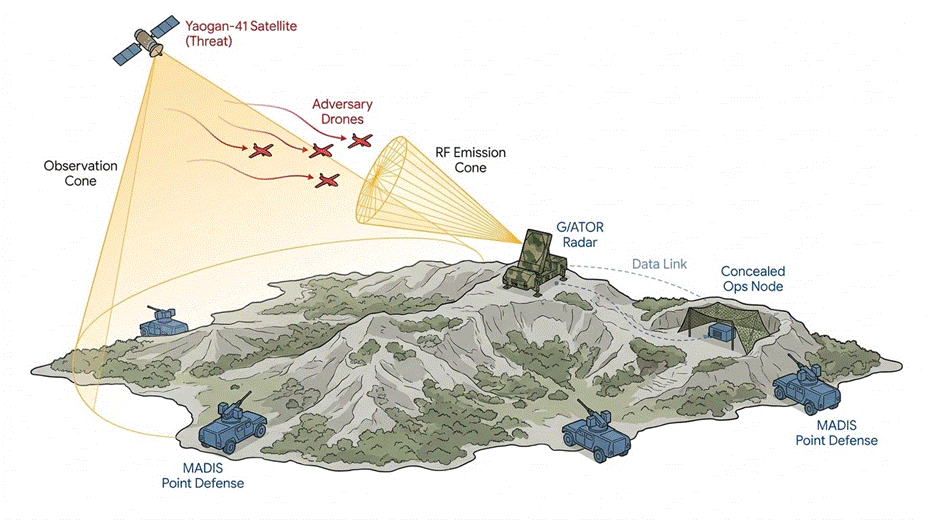
A core tenet of distributed operations is minimizing detection. However, adversaries are aggressively integrating non-kinetic spectrum operations to hunt for U.S. radio-frequency emissions3. In a battlespace saturated with autonomous drones, electromagnetic interference and bandwidth constraints pose severe threats3.
To avoid detection, the USMC is moving away from centralized cloud processing toward localized edge computing and automated data triage10. By processing intelligence at the tactical edge, Marines can operate in Denied, Degraded, Intermittent, and Limited (DDIL) environments without transmitting constant, detectable signals10. The use of Low Probability of Intercept/Low Probability of Detection (LPI/LPD) communications and ad-hoc mesh networks also ensures that even if a signal is spotted, the swarm’s communications remain resilient3.
The Evolving Drone Threat and USMC Countermeasures
The proliferation of small, lethal unmanned aerial systems (sUAS) has fundamentally changed ground combat. Experience from the war in Ukraine shows that dismounted forces are highly vulnerable to asymmetric drone attacks. The GCE 2040 framework correctly identifies this as the most immediate risk to ground maneuvers.
The Fiber-Optic Drone Dilemma
For years, the primary defense against sUAS was electronic warfare (EW), specifically, jamming the radio-frequency (RF) link between the drone and its operator16. However, forces in Ukraine and Russia have pivoted to fiber-optic-guided drones. These First-Person View (FPV) kamikaze systems trail a hair-thin fiber-optic cable (100–250 micrometers) that connects the drone directly to the operator16.
Because the video feed and controls travel through a physical channel, these drones emit no RF signal16. This makes them immune to traditional EW jamming, GPS spoofing, and cyber intrusion16. This simple innovation has made much of Western RF-jamming equipment useless against this threat, requiring a rapid shift from “soft-kill” (jamming) to “hard-kill” (kinetic destruction) or directed energy solutions16.
Kinetic Defense: MADIS and L-MADIS
For hard-kill point defense, the USMC is deploying the Marine Air Defense Integrated System (MADIS) and its expeditionary variant, L-MADIS.
The standard MADIS system consists of two tactical vehicles. The Mk1 utilizes a 4-tube Stinger missile pod and an XM914 30mm cannon for aircraft neutralization19. The Mk2 provides the sensing and C2 architecture via the RPS-42 radar, which can detect commercial drones up to 30km away, and uses an M134 Minigun for close-in, high-volume defense19.
L-MADIS is a lighter variant mounted on all-terrain vehicles. To improve its counter-drone capabilities, the USMC selected the AI-powered Bullfrog M240 autonomous weapon station by Allen Control Systems21. Weighing about 300 pounds, this robotic system turns a standard 7.62mm machine gun into an automated turret capable of firing 850 rounds per minute to detect and destroy small UAS21.
While 30mm cannons and AI-assisted targeting offer robust kinetic defense against small numbers of drones, they face an inescapable “saturation limit.” Kinetic interceptors (bullets) can be overwhelmed by massed, synchronized swarms, exhausting a vehicle’s ammunition long before the threat is neutralized22.
Directed Energy: The Epirus HAVOC High-Power Microwave
The USMC awarded Epirus an $11 million contract for the High-power Microwave Autonomous Vehicle Operational Capability (HAVOC) because kinetic defense has limits and RF jamming does not work against fiber-optic drones.
HAVOC uses solid-state, software-defined Leonidas High-Power Microwave (HPM) technology, powered by Gallium Nitride (GaN) semiconductors that provide high power density without heavy cooling systems25. Instead of jamming a signal, HAVOC fires a concentrated cone of microwave energy that physically fries the internal circuitry of any drone within its reach18.
Because HPM attacks the hardware directly, it works regardless of the drone’s guidance method18. In a December 2025 demonstration, the Leonidas platform successfully disabled a fiber-optic drone, proving it is just as effective against these as it is against RF-controlled variants26. This gives Marines a deep-magazine, one-to-many counter-swarm capability that turns ammo constraints into an electrical power requirement, shielding high-value assets from saturation attacks18.
The Replicator Initiative: Scaling Attritable Mass
To counter the massive quantitative advantage of peer adversaries, the Department of Defense (DoD) launched the Replicator initiative in August 202327. Initially led by the Defense Innovation Unit (DIU), the program aimed to field thousands of low-cost, attritable autonomous systems by August 202527. Now, two years later, Replicator has delivered hundreds of drones to warfighters and contracted thousands more, moving the military away from a reliance on exquisite platforms and toward asymmetric swarm tactics9.
With Replicator 1 reaching its milestones, the DoD announced Replicator 2 in September 202410, shifting focus to scaling counter-drone systems already in production3. For the USMC, this scaling is a strategic necessity. By fielding massed kamikaze drones (like the OPF-L) and deploying modular counter-swarm systems, the USMC is aiming for “graceful degradation,” a state where the loss of one cheap system does not fatally compromise combat effectiveness.
| System Tier | Estimated Unit Cost | Example Capability | Replicator Scaling Objective |
| Low-End UAS | ~$60,000 | Commercial-grade, short-range ISR/Strike | 10,000 units (Mass Swarm) |
| Mid-Range UAS | ~$250,000 | Military-grade OPF, hardened communications | 2,000 units (Tactical Strike) |
Strategic Recommendations: What the USMC Must Guard Against
The transition to the Ground Combat Element 2040 is essential, given the modernization of peer adversaries and the rise of asymmetric threats. To ensure survivability, leadership must guard against the following vulnerabilities:
- Guard Against Unmanned Logistical Starvation: The USMC must aggressively fund the scaling of autonomous surface vessels and heavy-lift drones capable of transporting sustained operational payloads, not just medical supplies, to keep SIF units supplied under fire.
- Guard Against the Fiber-Optic Drone Threat: The war in Ukraine has shown that RF jamming is easily bypassed. The USMC must prioritize the procurement and scaling of High-Power Microwave (HPM) systems like the Epirus HAVOC. Kinetic point defense will inevitably be overwhelmed by swarms; only directed energy provides the necessary magazine depth to protect Marines from attritable drone saturation.
Conclusion
The Ground Combat Element 2040 framework correctly recognizes that the era of uncontested American power projection is over. By embracing stand-in forces, asymmetric swarm tactics, and multi-domain awareness, the Marine Corps is building a relevant deterrent against peer aggression.
However, technological superiority does not eliminate the friction of war. The ultimate success of this force rests on unproven autonomous logistical architectures and the capacity to survive swarms of EW-immune drones. The USMC has successfully reimagined its combat power; its primary challenge over the next decade will be ensuring this modernized, drone-centric force can be sustained, defended, and commanded in the brutal realities of future combat.
Please share the link on Facebook, Forums, with colleagues, etc. Your support is much appreciated and if you have any feedback, please email us in**@*********ps.com. If you’d like to request a report or order a reprint, please click here for the corresponding page to open in new tab.
Sources Used
- Modern Day Marine 2026: Strategic Shifts, Ground Combat, https://blog.roninsgrips.com/modern-day-marine-2026-strategic-shifts-ground-combat-modernization-and-infantry-advancements/
- Optimizing Drone Sustainment for Modern Warfare – Ronin’s Grips, https://blog.roninsgrips.com/optimizing-drone-sustainment-for-modern-warfare/
- Overcoming Spectrum Challenges in Drone Warfare – Ronin’s Grips, https://blog.roninsgrips.com/overcoming-spectrum-challenges-in-drone-warfare/
- U.S. Marine Corps launches kamikaze drone program for frontline, https://www.cdi.marines.mil/News/Article/Article/4455072/us-marine-corps-launches-kamikaze-drone-program-for-frontline-units/
- Our Best Look Yet At The Marines’ New Loitering Munition Toting, https://www.twz.com/our-best-look-yet-at-the-marines-new-loitering-munition-toting-drone-boat
- US Special Operations to get Hero-120SF loitering munitions – Uvision, https://uvisionuav.com/us-special-operations-to-get-hero-120sf-loitering-munitions/
- Reforming DoD Drone Acquisitions: Overcoming Vendor Lock-In, https://blog.roninsgrips.com/reforming-dod-drone-acquisitions-overcoming-vendor-lock-in/
- USMC’s New USV to Deploy Loitering Munitions by UVision, https://www.navalnews.com/naval-news/2021/06/usmcs-new-usv-to-deploy-loitering-munitions-by-uvision/
- SITREP Military Drones – June 27, 2026 to July 4, 2026 – Ronin’s Grips, https://blog.roninsgrips.com/sitrep-military-drones-june-27-2026-to-july-4-2026/
- Revolutionizing Military Drones: The Shift to Edge Computing, https://blog.roninsgrips.com/revolutionizing-military-drones-the-shift-to-edge-computing/
- Unmanned Logistics Systems – Air – NAVAIR, https://www.navair.navy.mil/product/Unmanned-Logistics-Systems-Air
- Heavy Lift Drones Deliver the Goods – Inside Unmanned Systems, https://insideunmannedsystems.com/heavy-lift-drones-deliver-the-goods/
- Tactical Resupply Unmanned Aircraft System Demonstration, https://www.marines.mil/News/News-Display/Article/3358199/tactical-resupply-unmanned-aircraft-system-demonstration/
- Video – Tactical Resupply UAS demonstration – DVIDS, https://www.dvidshub.net/video/882502/tactical-resupply-uas-demonstration
- Battlefield Resupply Drones and Military Logistics – Drill & Defense, https://drillanddefense.com/battlefield-resupply-drones/
- Fiber-Optic Drones: The Unjammable Weapons Changing Modern, https://militarymachine.com/fiber-optic-drones-unjammable-weapons
- Fiber Optic FPV Drones Featured In Navy Electronic Warfare Exercise, https://www.twz.com/air/fiber-optic-wire-controlled-drones-featured-in-navy-electronic-warfare-exercise
- A drone trailing a spool of fiber-optic cable back to its operator emits nothing a jammer can grab, so the Marines are buying a sled-mounted weapon that fires a cone of microwave energy and scrambles everything standing inside it at once, then parking it besid, https://www.autonocion.com/us/marines-microwave-cone-fiber-drones/
- Marine Air Defense Integrated System (MADIS), https://www.missiledefenseadvocacy.org/defense-systems/marine-air-defense-integrated-system-madis/
- Counter-UAS system for U.S. Marine Corps debuts U.S. production, https://militaryembedded.com/unmanned/counter-uas/counter-uas-system-for-us-marine-corps-debuts-us-production-phase
- Marine Corps selects new robotic weapon system for L-MADIS, https://breakingdefense.com/2026/07/marine-corps-selects-new-robotic-weapon-system-for-l-madis-integration/
- New US Anti-Drone 30mm Weapons – Army M-LIDS & Marines, https://www.youtube.com/watch?v=V_jWXFFsiGo
- Epirus secures $11 million Marine Corps contract for HAVOC system, https://breakingdefense.com/2026/08/epirus-secures-11-million-marine-corps-contract-for-havoc-system/
- Marine Corps awards Epirus $11M for high-powered microwave, https://defensescoop.com/2026/08/10/marine-corps-epirus-high-powered-microwave-havoc/
- Army awards $66M contract to Epirus for microwave weapon that, https://defensescoop.com/2023/01/23/microwave-weapon/
- Epirus’ Leonidas Demonstrates Successful Use of High-Power, https://www.epirusinc.com/press-releases/epirus-leonidas-demonstrates-successful-use-of-high-power-microwave-to-defeat-fiber-optic-controlled-uas
- Replicator: A Bold New Path for DoD – CSET, https://cset.georgetown.edu/article/replicator-a-bold-new-path-for-dod/
- 2026 Defense Strategy: Autonomous Systems and Modern Warfare, https://blog.roninsgrips.com/2026-defense-strategy-autonomous-systems-and-modern-warfare/
- Replicator Drone Initiative Earns Good Grades Two Years In – MeriTalk, https://www.meritalk.com/articles/replicator-drone-initiative-earns-good-grades-two-years-in/