Category Archives: Small Arms, Tactical, Instructor & Armorer Training

Comprehensive analyses of firearms instructor development pathways, platform armorer certifications, SWAT team training, and law enforcement tactical curricula. Covers FLETC, IALEFI, and NTOA instructor frameworks, Solo Officer Rapid Deployment (SORD), CQB and breaching doctrine, Reality-Based Training (RBT), and premier US tactical training academies.

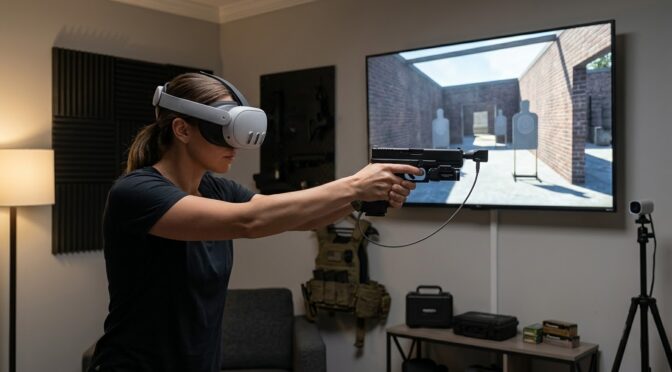
Transforming Firearms Training with VR and Auto-Reset Systems

1. Executive Summary

The integration of hardware-based, auto-resetting dry-fire systems with modern Virtual Reality (VR) marksmanship simulators represents a fundamental architectural shift in human performance training and firearms proficiency. Historically, the division between dry fire practice and live-fire validation was stark and pedagogically limited. Traditional dry fire offered mechanical isolation without environmental context or true cyclic repetition, while live fire provided necessary ballistic validation but imposed steep logistical, safety, and financial burdens. Over the past decade, and accelerating sharply through the 2025 and 2026 commercial cycles, advancements in consumer-off-the-shelf (COTS) spatial computing and drop-in mechanical trigger reset devices have effectively bridged this historical gap.

This research report evaluates the technical intersection of these two distinct technologies. It provides a detailed analysis of the specific hardware architectures that enable a practitioner, whether a civilian enthusiast, competitive shooter, or tactical professional, to utilize their actual service weapon in a simulated spatial environment, thereby bypassing the historical limitations of single-action dry fire. Devices such as the Mantis BlackbeardX for the AR-15 platform, the CoolFire Trainer for cyclic recoil simulation, and the DryFireMag for striker-fired handguns allow for sustained, multi-shot mechanical repetitions without compromising the user’s grip structure or focal plane. When paired with digital or VR environments, including Ace XR, GAIM, Virtual-Shot, and the Laser Ammo Smokeless Range, these hardware systems produce highly immersive, data-rich training loops that fundamentally alter skill acquisition.

A comprehensive financial modeling of this technological integration over a 12-month training cycle reveals profound operational expenditure (OPEX) reductions. Analyzed against the backdrop of climbing 2025–2026 ammunition prices, where bulk 5.56x45mm NATO routinely exceeds $0.50 per round and 9mm Luger hovers near $0.30 per round, the initial capital expenditure (CAPEX) for a comprehensive hardware and VR suite is demonstrably amortized within three to six months for an active shooter. The financial logic dictates that offloading high-volume mechanical repetitions to a virtual environment yields a vastly superior return on investment per trigger pull.

However, the biomechanical skill retention and the transferability of this simulated training require nuanced assessment. Empirical research, including extensive data from military simulation platforms such as the Indoor Simulated Marksmanship Trainer (ISMT) and the Engagement Skills Trainer (EST), confirms that simulator-based training yields highly positive skill transfer for foundational perceptual-motor skills. Variables such as aiming accuracy, stability of hold, target transitions, and the cleanness of the trigger break are measurably enhanced by spatial simulation. Conversely, the absence of terminal recoil and concussive blast in most VR settings creates isolated vectors for “negative transfer.” Standard simulation cannot physically replicate the psychophysiological startle response or the true cadence of cyclic recoil recovery, meaning live fire remains a strictly necessary validation tool to diagnose and correct pre-ignition recoil anticipation.

Ultimately, this analysis concludes that while VR and auto-resetting dry fire systems cannot wholly replace the necessity of live ammunition, they fundamentally optimize the required ratio of live-fire exposure. By converting the user’s environment into a constrained, data-driven biomechanical laboratory, shooters can reserve the live-fire range exclusively for high-fidelity ballistic validation, establishing a highly efficient and economically sustainable marksmanship development lifecycle.

2. The Evolution of Simulated Marksmanship and the Virtual Reality Landscape

Marksmanship simulation is deeply rooted in military training doctrines, originally developed to circumvent the immense costs and logistical constraints of live-fire ranges. For decades, platforms like the Engagement Skills Trainer (EST) and the Indoor Simulated Marksmanship Trainer (ISMT) have served as the backbone for initial entry training and deployment sustainment for the United States Army, Navy, and Marine Corps.1 These legacy systems are characterized by multi-million-dollar, projector-based arrays that require dedicated, climate-controlled facilities. They utilize heavily tethered, pneumatic weapon proxies that mimic the weight and manual of arms of standard issue rifles and sidearms but are inherently restricted to the physical dimensions of the projection screen in front of them.4 While highly effective at teaching the sequence of the shot process and establishing baseline qualification standards, these systems are fundamentally inaccessible to the broader civilian market and lack the true spatial immersion required for complex, 360-degree environmental processing.

2.1 The Transition to Consumer-Off-The-Shelf (COTS) Spatial Computing

The democratization and miniaturization of spatial computing technology define the contemporary landscape of simulated training. The release and subsequent dominance of standalone virtual reality headsets, most notably the Meta Quest architecture, including the Quest 2, Quest 3, and Quest 3S, have shifted the locus of simulation from institutional facilities to the residential and commercial environment.5 Modern VR headsets utilize inside-out optical tracking, a technology that relies on integrated cameras and inertial measurement units (IMUs) to map the user’s physical environment in real-time. This allows for six degrees of freedom (6DoF) movement without the need for external base stations or tracking towers.

This spatial awareness permits software developers to construct dynamic, 360-degree environments where targets move, react, and require complex spatial tracking by the user. Instead of standing statically before a flat screen, the user is immersed in a volumetric space where they must physically orient their body, process peripheral threats, and negotiate simulated architectural barriers. The U.S. military has recognized this shift, actively pursuing augmented and virtual reality frameworks, such as the Squad Immersive Virtual Trainer (SIVT) integrated within the Integrated Visual Augmentation System (IVAS), to overcome the dynamic occlusion problems and spatial limitations inherent in flat-screen legacy trainers.7 For the civilian and law enforcement sectors, the Meta Quest platform serves as the foundational hardware layer upon which specialized marksmanship software is deployed.5

2.2 Architectural Paradigms of Virtual Marksmanship Software

The current commercial market for digital marksmanship training is highly stratified, offering various software architectures that attempt to solve the complex problem of mapping a physical weapon into a digital space. These architectures can be categorized into four primary paradigms, each presenting distinct advantages and constraints regarding physical realism and spatial immersion.

2.2.1 Fully Immersive VR with Replica Hardware

Systems operating within this paradigm, such as Ace XR, function entirely within the virtual environment provided by the Meta Quest headset. The primary engineering challenge of fully immersive VR is tracking the user’s hands and weapon. To overcome the difficulty of reliably tracking an actual, unmodified firearm with standard VR controllers, Ace XR utilizes highly accurate, weighted replica handsets.8

These handsets are molded to replicate specific firearms, such as the Staccato 2011, the CZ Shadow 2, and the SIG Sauer P365.8 The physical VR controller (the Meta Quest right-hand unit) locks directly into the replica frame via a toolless, spring-loaded mechanism.8 The resulting assembly matches the physical weight (frequently exceeding 34 ounces) and the ergonomic balance of a loaded firearm.8 Furthermore, the handsets feature physical triggers with audible and tactile breaks and resets, engineered to replicate a standard 3.5-pound trigger pull.8 Within the headset, the software renders high-fidelity digital twins of these firearms, allowing the user to engage in over 200 stages, including dynamic 360-degree scenarios, USPSA classifiers, and fundamental skill-building exercises.8 While this paradigm offers unparalleled spatial immersion and eliminates the safety risks of using a real firearm at home, it sacrifices the exact mechanical nuances of the user’s personal, serialized service weapon.

2.2.2 Immersive VR with Actual Firearms via Controller Mounts and Bluetooth Integration

The second paradigm attempts to bridge the gap by allowing users to bring their actual firearms into the VR headset space. Historically, systems like GAIM and Clay Hunt VR utilized physical mounts clamped onto the shotgun rib, rifle stock, or accessory rail to hold a proprietary VR controller.11

However, this paradigm is rapidly advancing through Bluetooth Low Energy (BLE) integration. GAIM, for example, has partnered with DryFireMag to utilize a Bluetooth-enabled smart magazine that pairs directly with the Meta Quest headset. This setup tracks the handgun’s precise movement and registers the mechanical trigger break wirelessly, allowing users to practice with their actual serialized Glock in a 360-degree virtual space without the awkward offset weight of a clamped controller.

The critical limitation of this paradigm remains visual isolation: the user is blinded to the real world by the headset. Consequently, the software must perfectly map the physical dimensions of the real gun to the digital rendering; any discrepancy between the physical cheek weld and the virtual sight alignment breaks the simulation illusion.12

2.2.3 Augmented Screen and Phone-Mounted Systems

Applications like Virtual-Shot represent a paradigm that bypasses the VR headset entirely, favoring an augmented reality approach projected through a smartphone screen. Virtual-Shot utilizes a physical mount that attaches a standard smartphone directly to the Picatinny rail or the ocular lens of a rifle optic on the user’s actual firearm.14

Instead of relying on external cameras or Bluetooth VR controllers, Virtual-Shot utilizes the smartphone’s internal gyroscopes and accelerometers to track the weapon’s movement in physical space.15 The screen displays a virtual range superimposed over the real-world backdrop. Crucially, the system utilizes advanced real-time acoustic analytics via the phone’s microphone to detect the specific sound of the firing pin dropping during a dry fire press.14 This triggers the software to register a virtual shot, complete with calculated bullet drop and wind drift.16 This architecture is highly accessible, requires no dedicated VR hardware, and integrates seamlessly with any physical firearm but lacks the true 360-degree peripheral immersion of a headset.

2.2.4 High-Fidelity Optical Projection Systems

In stark contrast to headset-based VR, systems like Marksman ST-2 and ST-3 reject the use of immersive headsets entirely, operating on the philosophy that “a headset sits between you and your rifle, shotgun, or handgun, so you lose sight of the real weapon”.17 Marksman systems utilize highly calibrated, patented optical tracking sensors and massive projected screens to create virtual hunting and tactical environments.

These systems allow the use of real firearms with authentic trigger weights, tracking the muzzle movement at approximately 1 millisecond latency and achieving an accuracy resolution of 0.18 Minute of Angle (MOA).17 While technically superior in tracking fidelity and physical realism, as the user interacts with the real world while aiming at a digital projection, these systems represent a massive infrastructure investment, relegating them to commercial ranges, hunting schools, and high-end residential installations rather than mainstream consumer adoption.17

3. Hardware Integration: Bridging the Mechanical Gap

Regardless of the software paradigm utilized, the central biomechanical flaw of traditional dry fire training is the requirement to manually cycle the weapon’s action after every trigger press. Manually racking a slide on a pistol or pulling the charging handle on an AR-15 severely disrupts the training loop. It forces the shooter to break their established two-handed grip structure, eliminates the ability to visually track the sights through the simulated recoil recovery phase, and renders the practice of multi-shot cadences, such as target transitions, rapid double-taps, and split-time reduction, mechanically impossible.18

To effectively simulate live-fire sequences, the weapon must reset its own trigger independently and instantaneously. The firearms technology market has approached this complex engineering challenge through three distinct mechanical pathways, each tailored to specific weapon platforms and training goals.

3.1 The Mantis BlackbeardX (Direct Sear Reset via Electromagnetics)

The Mantis BlackbeardX represents a sophisticated integration of mechanical trigger reset and diagnostic telemetry, engineered specifically for the AR-15 platform. The physical system operates as a complete drop-in replacement for the weapon’s standard bolt carrier group (BCG) and charging handle, taking fewer than twenty seconds to install with no permanent modifications to the host firearm.19 The mechanical action is powered by a proprietary, rechargeable battery pack shaped like a standard 30-round AR-15 magazine, which seats into the magazine well to provide both power and physical alignment.19

Upon the break of the weapon’s hammer, the BlackbeardX utilizes a rapid-cycling electromechanical piston to strike the hammer downward, instantly resetting the sear engagement up to ten times per second.19 This high-speed reciprocation allows the user to perform rapid strings of fire without altering the internal trigger weight, creep, or break characteristics of their customized, serialized weapon.20 Because it physically interacts with the weapon’s fire control group, it provides a highly authentic tactile experience.

The system’s engineering constraints dictate its compatibility matrix. While it functions seamlessly with standard direct impingement AR-15s, MCX Rattler SBRs, and MCX-SPEAR LT variants 19, its reliance on standard hammer profiles means it is incompatible with specialized platforms such as the standard MCX-SPEAR, forced reset triggers (FRTs), super safety systems, and non-standard AR-10 frames like the Ruger SFAR or POF Rogue.19

Crucially, the “X” variant of the Blackbeard integrates the MantisX inertial measurement unit (IMU) directly into the magazine battery pack. This highly sensitive accelerometer and gyroscope array captures micro-movements of the barrel before, during, and after the trigger break, diagnosing physical deviations such as grip anticipation, improper trigger finger placement, or shoulder shrugging through a connected smartphone application.21 Furthermore, the system projects a laser pulse, available in either visible red or infrared (IR), precisely down the bore line upon each trigger break, allowing integration with camera-based digital targets like the Mantis Laser Academy, Laser Ammo’s Smokeless Range, or acoustic simulators like Virtual-Shot.20 To support modern VR simulation, the BlackbeardX can also emit a BLE trigger signal directly to VR game environments, acting as a highly realistic wireless controller.19

3.2 The DryFireMag (Spring-Tensioned Mechanical Simulation)

Unlike the BlackbeardX, which resets the actual hammer of a rifle, the DryFireMag is engineered primarily for striker-fired sidearms (e.g., Glock, SIG P320, Smith & Wesson M&P, Springfield Armory) and operates on a principle of mechanical mimicry rather than actual sear manipulation.21 The device replaces the standard pistol magazine. When inserted into an unloaded firearm, an internal spring-loaded lever interfaces directly with the weapon’s internal trigger bar or sear mechanism.24

When the user pulls the trigger, they are mechanically compressing the tension of the DryFireMag’s internal spring, rather than compressing the weapon’s actual striker spring. Upon reaching the “break” point, the internal spring mechanism slips, providing a highly tactile and audible snap that simulates the release of a firing pin.21 When the user releases finger pressure, the device instantly returns the trigger shoe to the forward, reset position.21 This creates an impressive simulation of the OEM trigger’s take-up, wall, break, and reset, with optional spring kits allowing users to tune the pull weight and pre-travel to closely match their specific concealed carry or duty weapon.21

However, because the DryFireMag isolates the trigger bar and inherently disables the forward motion of the striker or firing pin, it creates a technological conflict with standard dry-fire training lasers. Traditional laser cartridges inserted into the chamber rely on the physical impact of the firing pin to close a circuit and emit a laser pulse.19 To solve this critical integration issue, a specialized “Smart” version of the DryFireMag was developed in collaboration with Laser Ammo.22 The Smart DryFireMag utilizes an internal electronic switch that detects the mechanical trigger break and wirelessly signals a specialized SureStrike laser cartridge chambered in the barrel to emit a pulse.25 This integration enables the DryFireMag to interface seamlessly with camera-based simulators and reactive targets while maintaining the critical auto-resetting trigger feel.22 Additionally, DryFireMag has introduced peripheral simulation devices, such as the Bluetooth-connected gunSHOT BOX, which generates a 125 dB concussive sound and simulated muzzle flash upon each trigger press to artificially induce auditory stress and startle responses during dry-fire practice.24

3.3 The CoolFire Trainer (Pneumatic Recoil Simulation)

While the BlackbeardX and DryFireMag excel at resetting the trigger mechanism, they are inherently static devices; they do not generate the cyclic mass movement of a reciprocating slide or bolt. The CoolFire Trainer addresses this biomechanical deficit by utilizing compressed CO2 to simulate actual slide reciprocation and physical recoil in handguns.26

The CoolFire system requires a more involved installation than a simple magazine swap. The user must remove the live barrel and recoil spring of their host pistol and replace them with a proprietary, pneumatically sealed CoolFire barrel and a specialized recoil spring mechanism.26 The system is highly adaptable, with proprietary barrels machined to fit over 130 different pistol models across major manufacturers like Staccato, Glock, CZ, and Walther.26

When the weapon’s striker drops, it impacts a valve situated at the rear of the CoolFire barrel. This impact releases a metered burst of compressed CO2, which exerts pressure against the slide, forcing it violently rearward.27 This action cocks the striker, ejects the spent gas, and allows the recoil spring to slam the slide forward, providing a sharp, physical recoil impulse that closely mimics the cadence of live fire.26 A standard CO₂ fill directly into the barrel reservoir allows for 10 to 15 full-recoil shots.27 For higher volume training requirements, users can attach a Rapid Fill Adapter (RFA), which threads onto the muzzle, extending the weapon’s length by approximately 1.75 inches but increasing the shot capacity by an additional 40 rounds per fill.28

The CoolFire system is frequently integrated with VR and projection simulators via threaded muzzle lasers. These lasers are available in visible red for standard app-based training or infrared (IR) for advanced camera-based simulators like the Smokeless Range.28 For training applications demanding sight-tracking under physical duress, where the shooter must learn to let the red dot optic or iron sights lift in recoil and return to the visual focal plane without manually inducing a flinch, the CoolFire Trainer provides a level of biomechanical fidelity that static reset devices simply cannot match.28

3.4 Integration Constraints and Simulator Compatibility

Integrating these diverse physical hardware devices with modern VR software ecosystems is not a frictionless process. Because fully immersive VR headsets like the Meta Quest operate via spatial optical tracking of their proprietary hand controllers, bringing a physical, serialized rifle or pistol into the VR space requires specific engineering workarounds.

Early and budget-oriented systems rely on physical mounts that clamp the Meta Quest or HTC Vive controller directly to the picatinny rail or barrel of the physical weapon.12 While this hardware bridge allows the headset to track the gun’s precise orientation in 3D space, the offset weight and awkward positioning of the VR controller significantly alters the weapon’s physical balance and handling characteristics.8

Conversely, advanced modern systems bypass the physical controller entirely using Bluetooth integrations. By embedding BLE transmitters into devices like the Mantis BlackbeardX and the Smart DryFireMag, the physical trigger break is beamed directly into the VR simulation as a digital input. This evolution preserves the exact weight and ergonomics of the service weapon while flawlessly interacting with the spatial software.

4. Empirical Cost-Savings Analysis (12-Month Training Cycle)

The primary operational justification for the capital acquisition of VR simulators and auto-resetting hardware is the offset of live ammunition consumption. To quantify this utility and establish a verifiable Return on Investment (ROI), an empirical analysis of current market ammunition pricing against anticipated training volumes is required.

4.1 Ammunition Market Dynamics and Price Inflation (2025–2026)

Ammunition pricing is a highly elastic economic metric, driven by global supply chain pressures, geopolitical conflicts affecting the availability of raw materials like copper and nitrocellulose, and domestic demand cycles fueled by legislative environments.31 Extensive market tracking data spanning late 2025 into mid-2026 demonstrates a sustained and aggressive elevation in the retail cost of standard training calibers.

For 9mm Luger, the ubiquitous standard for duty sidearms and defensive handguns, bulk purchase data reveals an average cost per round (PPR) of $0.24 to $0.25 in late 2025.33 However, tracking algorithms indicate this price climbed steadily through the first quarter of 2026, reaching an average of $0.30 PPR by May 2026 across major online and brick-and-mortar retailers.33

For 5.56x45mm NATO, the standard cartridge for the AR-15 platform, the economic pressures have been substantially more severe. In late 2025, bulk pricing for 1000-round cases hovered around $0.45 to $0.49 PPR.32 By the second quarter of 2026, driven in part by scheduled wholesale price increases from major manufacturing conglomerates such as The Kinetic Group and Winchester, the average price securely breached the $0.50 threshold.34 Data from major retailers illustrates this tightening market, with bulk cases priced between $0.55 (Bereli) and $0.63 (Outdoor Limited) and specialized green-tip M855 ammunition rising to $0.66 PPR.34

4.2 Establishing Training Volume Profiles

To construct a realistic financial model for cost savings, we must establish baseline consumption profiles based on shooter demographics.

  1. The Competitor / Tactical Professional: A dedicated competitive shooter (e.g., USPSA/IPSC classifications) or a tactical professional typically fires between 400 and 600 rounds per month. This equates to an annual consumption of 5,000 to 8,000 rounds, considered the minimum required to maintain high-level, subconscious proficiency under stress.36
  2. The Proficient Enthusiast: A regular practitioner aiming to maintain baseline defensive competence, rather than elite competitive speeds, may consume roughly 2,000 to 3,000 rounds annually.36

4.3 Capital Expenditure (CAPEX) vs. Operating Expenditure (OPEX)

The initial capital required to deploy a modern virtual training environment varies depending on the selected technological architecture but generally falls within a predictable range.

  • Immersive VR Setup (Software-Heavy): A user opting for a fully immersive environment requires a Meta Quest 3 Headset (approx. $500), a dedicated Ace XR Handset modeled after their firearm ($199), and a $20 monthly subscription to the Ace XR software platform.9 Total initial year CAPEX is approximately $939.
  • High-Fidelity Hardware Setup (Hardware-Heavy): A user looking to integrate their actual service weapons might acquire a Mantis BlackbeardX system for their AR-15 (~250), alongside baseline software for systems like the Laser Ammo Smokeless Range.22 Total CAPEX is conservatively modeled at approximately $950.

To compare this CAPEX against live-fire OPEX, we model a blended monthly consumption of 250 rounds of 9mm (calculated at a conservative $0.27/rd) and 250 rounds of 5.56 NATO (calculated at $0.50/rd). Under this model, the monthly OPEX strictly for live ammunition is approximately $192.50. Annually, this totals $2,310 in raw consumable costs, a figure that critically excludes ancillary expenses such as range fees, paper targets, and the fuel/time required to travel to specialized ranges.32

4.4 Return on Investment (ROI) and Break-Even Timelines

If a shooter implements a hardware-based VR simulator, they can confidently offset a significant portion of their live-fire volume without degrading their skill level. High-level firearms instructors and master-class competitors consistently advocate for an 80/20 ratio of dry fire to live fire.36

Assuming a conservative model where live-fire consumption is reduced by 75% through the use of simulation, the shooter saves $144.37 per month in ammunition OPEX. Against an initial hardware CAPEX of $950, the investment reaches a complete break-even point in approximately 6.5 months. Over the full 12-month training cycle, the net cash savings exceed $780 in the first year alone. In subsequent years, where the CAPEX is fully amortized and no new hardware is required, the annual cash savings scale to nearly $1,732.

Financial MetricTraditional Live Fire OnlyHybrid VR / Hardware ModelVariance (Savings)
Initial CAPEX$0.00$950.00-$950.00
Monthly Ammo OPEX$192.50$48.12+$144.38
Total 12-Month Cost$2,310.00$1,527.44+$782.56
Total 24-Month Cost$4,620.00$2,104.88+$2,515.12

More critically than pure cash savings, simulation alters the volume density of practice. Because dry fire repetitions with a system like BlackbeardX carry zero marginal cost per pull, users frequently execute thousands of virtual repetitions per month. To replicate the sheer volume of trigger presses achieved in a single hour of Ace XR training on a live-fire range would cost hundreds of dollars per session. Software applications like LaserHIT have even introduced “Live Fire Value” metrics, explicitly converting structured dry fire repetitions into their real-world dollar equivalent to emphasize the massive efficiency gains of simulation.31 Therefore, the true “value” of the simulation is not merely the money saved, but the exponential increase in repetitions that the average citizen could never afford to fund with live ammunition.

5. Biomechanical Skill Retention and the Transfer of Training

The financial logic of virtual reality integration is ultimately sound only if the neuromuscular skills acquired in the virtual laboratory successfully and durably transfer to the physical reality of the live-fire range. Shooting is fundamentally a perceptual-motor task that relies on absolute physical stability, intense visual control, pressure management, and precise muscular timing.41 Analyzing the biomechanical transfer of these skills requires examining the component kinematics of marksmanship.

5.1 The Kinematics of Marksmanship and the TMM Triad

Scientific literature examining sensorimotor learning isolates the complex act of firing a weapon into highly specific kinematic processes. Foundational research on air pistol performance conducted by sports scientists (notably Olsson and Laaksonen) identifies five primary technical variables: aiming time, stability of hold, aiming accuracy, the cleanness of triggering, and the timing of triggering.41 Remarkably, statistical analysis proves that just three of these variables, stability of hold, aiming accuracy, and the precise timing of the trigger break, account for an overwhelming 75% to 78% of the total variance in human shooting performance.41

Standard dry fire practice is exceptionally effective at isolating these specific variables. Because the environment is highly constrained and entirely devoid of concussive blast, the shooter can closely observe whether their trigger press disrupts their aiming structure, allowing for micro-corrections in grip pressure.18 This adheres to the “TMM Triad” of effective training: defining the Technique, structuring the Method of practice, and utilizing Metrics to ensure quality control.41

However, traditional, static dry fire severely lacks cognitive load and spatial friction. A shooter practicing against a static paper target taped to a bedroom wall is not subjected to variable target presentation, shoot/no-shoot cognitive decision-making, or the complex biomechanics of wide target transitions. This is precisely where spatial VR platforms like Ace XR, GAIM, and InVeris provide massive biomechanical advantages over traditional methods.4

5.2 Cognitive Load and Spatial Integration in Virtual Reality

Immersive virtual reality introduces spatial urgency and cognitive processing demands that mirror combat or competitive reality. In an application like Ace XR, which digitally maps complex, multi-array USPSA stages, the user must visually locate targets across a full 360-degree plane, physically drive the weighted handset with their upper body, dynamically align the digital optic on moving targets, and press the mechanical trigger while managing the psychological tension of a running digital shot timer.8

A rigorous kinematic study published in the Journal of Cognitive Neuroscience observed naive subjects practicing in an immersive virtual marksmanship environment modeled after Olympic Trap Shooting.42 The researchers utilized spatiotemporal motion tracking to analyze the ballistic and refinement phases of the subjects’ hand movements over 350 trials. They found systematic changes in movement kinematics as training progressed; subjects rapidly transitioned from erratic, effortful micro-corrections to “longer, slower, and more precise ballistic movements” of the hands and upper body.42

This empirical data indicates that VR effectively trains the macro-kinematics of full-body orienting and target transitions in a manner that static dry fire fundamentally cannot. The neuromuscular requirement to track sights from target to target, aggressively decelerate the mass of the gun upon reaching the target, and visually confirm alignment before breaking the trigger builds highly durable, transferable neural pathways.43

5.3 Empirical Evidence of Positive Transfer to Live Fire

Military research provides the most robust, large-scale quantitative data regarding the transferability of simulator training to live-fire qualification results.

A comprehensive master’s thesis conducted at the Naval Postgraduate School (Document ADA561945) evaluated the transfer of marksmanship training for Navy watchstanders. The researchers divided thirty-four active-duty military volunteers into two groups: one utilizing the sophisticated Indoor Simulated Marksmanship Trainer (ISMT), and a control group receiving standard dry fire (Standard Naval Marksmanship Training).1 The study rigorously tracked the Mean Point of Impact (MPI), the exact distance between the registered shot and the true center of the target across multiple distances, as well as overall qualification scores on the standard Navy Handgun Qualification Course (NHQC) utilizing the Transtar II silhouette target.1

The results were revealing. While both standard dry fire and simulation improved overall qualification scores relatively equally (the simulation group improved from a baseline of 210.33 to near maximums of 240), the simulation group demonstrated a statistically significant, superior improvement in narrowing their Mean Point of Impact from baseline to live-fire compared to the control group.1 Furthermore, a secondary hypothesis testing skill retention after two- and four-week gaps found no significant degradation in scores for the simulation group, proving the durability of the virtual training.1 This suggests that the immediate, augmented feedback loop of the simulator, which displays exact strike points, trace lines, and barrel movement on the screen, refines aiming accuracy and the cleanness of triggering substantially faster and more permanently than unassisted dry fire.1

Similarly, a 2014 study conducted by the Australian Defence Force (Document ADA615318) evaluating the efficacy of simulation for M4 marksmanship training found that recruits who received additional simulator training prior to range days achieved slightly faster live-fire qualification times than the control group that proceeded directly to live fire.44 While the researchers noted the benefit was statistically “small,” it conclusively validated a positive transfer of spatial memory and mechanical familiarity from the simulation to the live M4 carbine.44 Further supporting this, a study observing high-level biathletes (Isoaho, 2023) demonstrated that dry fire volume in a laboratory setting improved standing shooting performance, particularly when the athletes utilized immediate augmented feedback devices like the Mantis systems to correct their technique in real-time.41

Technical Marksmanship VariableEfficacy of Traditional Static Dry FireEfficacy of VR / Hardware IntegrationDegree of Transferability to Live Fire
Trigger Control & IsolationExcellentExcellentVery High 18
Sight Alignment / Sight PictureHighExcellent (Dynamic sight tracking)Very High 1
Draw Stroke / PresentationExcellentHigh (Dependent on holster compatibility)Very High 18
Target Transitions & Spatial OrientingLow / ModerateExcellent (360-degree spatial tracking)High 42
Recoil Management & CadenceNoneLow (Excepting pneumatic CoolFire Trainer)Low / Risk of Negative Transfer 18

6. Managing the Deficits: Recoil Anticipation and the Risks of Negative Transfer

Despite the overwhelming positive biomechanical and financial benefits of VR and auto-resetting hardware, treating simulation as a 1-to-1 substitute for live fire is a severe pedagogical error. As noted in the foundational science of marksmanship transfer, “Dry fire and live fire solve different training problems. Dry fire acts as a constrained laboratory… Live fire acts as the exam to validate whether the isolated technical qualities survive real-world timing pressure, environmental variation, and consequence”.41

6.1 The Newtonian Physics of Recoil Anticipation

The single most significant and stubborn limitation of virtual and dry-fire training is the total absence of terminal ballistic recoil. When a live 9mm Luger or 5.56 NATO round is fired, the violent combustion of gunpowder generates a massive, concussive overpressure wave (the blast) and rapidly drives the mass of the weapon backward and upward into the shooter’s body, adhering to Newtonian physics.29

The human central nervous system naturally and violently reacts to this explosive stimulus. “Flinching,” or recoil anticipation, is a pre-ignition neuromuscular response where the shooter subconsciously pushes the gun forward, downward, or tightens their grip asymmetrically just milliseconds before the shot breaks, actively attempting to fight the anticipated explosion.46 This subconscious physical action drives the muzzle completely off-target before the bullet exits the barrel, resulting in profoundly poor accuracy (typically manifesting as impacts low and left on a paper target for right-handed shooters).49

Dry fire tools like the Mantis BlackbeardX and DryFireMag are exceptional at diagnosing gross mechanical trigger errors, but they absolutely cannot trigger or diagnose the psychophysiological startle effect because there is no concussive noise or kinetic recoil to fear.18 A shooter may possess a flawless, surgically precise trigger press in the consequence-free VR environment of Ace XR, yet completely unravel under the physical punishment and concussive force of an indoor live-fire range.41

Even advanced systems like the CoolFire Trainer, which brilliantly simulate the cyclic reciprocation of the slide, lack the auditory blast and the true terminal concussive force of live ammunition. Therefore, while it aids in sight tracking during reciprocation, it only solves half of the recoil anticipation equation.18

6.2 The Danger of Negative Transfer and Training Scars

Over-reliance on simulation without frequent, interspersed live-fire validation introduces the severe risk of “negative transfer,” often referred to in tactical communities as “training scars”.7 Negative transfer occurs when an individual builds and automates a motor pattern in a simulated environment that is actively detrimental when applied to the physical realities of a live environment.51

Common training scars developed from poor dry fire include the habit of manually racking the slide after every single shot or immediately lowering the firearm to check the target. While auto-resetting triggers effectively cure the slide-racking scar, immersive VR introduces new risks. The most common manifestation of negative transfer from VR marksmanship involves cadence and follow-up timing.

For example, when engaging multiple targets in VR using a non-recoiling handset, a shooter can rapidly transition the weapon and pull the trigger at blistering, unrealistic cadences. Because the digital gun does not physically rise in recoil, the shooter’s brain builds a rhythm based on an artificially stable, perfectly flat sight picture.18 If that same shooter attempts to replicate that exact physical rhythm on a live-fire range, the actual muzzle rise of the weapon will cause the second and third shots to miss wildly high over the target’s shoulder. The shooter has neurologically learned to outrun their physical ability to manage recoil friction.41

Military and academic studies have repeatedly warned of this specific phenomenon. Formal evaluations of the Squad Engagement Training System (SETS) and early iterations of the ISMT noted that negative transfer can occur rapidly if the feedback provided by the training aids is absent on the live-fire range, causing the shooter’s predictive mental models to collapse entirely.44 If the physics of the simulation do not perfectly match the reality of ballistics, the variance must be carefully managed and continually calibrated through live-fire exposure.50

7. Strategic Implementation and Training Lifecycle Recommendations

To maximize the massive financial ROI of hardware-based VR simulators while entirely mitigating the dangerous risks of negative transfer, practitioners must adopt a structured, highly disciplined hybrid training architecture. The integration of devices like the Mantis BlackbeardX, the DryFireMag, or fully immersive suites like Ace XR should not be viewed casually as “cheap live fire,” but rather as a distinct, specialized pedagogical phase within the TMM Triad (Technique, Method, and Metrics).18

7.1 The Virtual Laboratory vs. The Live-Fire Exam

The most scientifically sound and effective training doctrine conceptually separates the two environments, treating the VR environment exclusively as the laboratory and the live-fire range exclusively as the exam.41

Within the confines of the virtual laboratory (utilizing mechanical auto-reset tools and VR headsets), the shooter’s goal is absolute isolation of technique. The absence of terrifying recoil allows the brain to completely relax and hyper-focus on the minute visual processing of the red dot optic, the precise physical sensation of breaking the trigger wall, and the gross motor mechanics of driving the gun across a 180-degree virtual bay.41 Because the cost of failure in a simulator is literally zero dollars and zero risk of injury, the shooter can experiment with aggressive target transition speeds and visual processing limits that would be grossly unsafe or financially ruinous on a live range.

Once these foundational neurological pathways are established and smoothed out in the simulation, the shooter moves to the live-fire range to take the exam. Under this paradigm, the live-fire session is no longer used to learn how to shoot; it is used solely to validate whether the flawless techniques built in VR can actually survive the concussive blast, pressure, and punishing recoil of live 9mm or 5.56 ammunition.18

7.2 Live-Fire Validation Techniques: Skip Loading and Diagnostics

To immediately diagnose whether a shooter has developed a dangerous level of recoil anticipation that was previously hidden by their VR training, the live-fire validation session must heavily feature diagnostic drills, the most prominent being “Skip Loading” (frequently referred to as ball-and-dummy drills).52

By randomly mixing inert dummy rounds, or utilizing tools like the Type3MalfunctionRound to replicate a malfunction, with live ammunition in a single magazine at a ratio of approximately 4:1 (dummy to live), the shooter is forced to execute the trigger press without consciously knowing if the gun will violently recoil or simply click.24 When the trigger breaks on a dummy round, any pre-ignition flinch or anticipation built up during non-recoiling VR practice will instantly manifest as a highly visible, exaggerated downward thrust of the muzzle. This glaringly exposes the neuromuscular error, allowing the shooter to visually recognize the failure and consciously correct their psychological response to the blast.47

8. Conclusion

The technological synthesis of consumer-available spatial computing with robust, auto-resetting physical hardware represents the most significant advancement in individual marksmanship training of the past decade. By providing a highly interactive, spatially aware, and data-driven environment that physically reacts to user input without requiring a manual cycling of the weapon, systems like the Mantis BlackbeardX and comprehensive VR suites like Ace XR effectively democratize a level of high-fidelity simulation that was previously restricted exclusively to top-tier, well-funded military installations.

As global supply chain pressures cause ammunition costs to continue to rise steadily into late 2026, threatening to price average citizens, competitive shooters, and underfunded law enforcement departments out of the regular volume of training necessary for true proficiency, these technologies offer an empirically validated, financially sustainable alternative. Provided that end-users fundamentally understand the biomechanical limitations regarding cyclic recoil management, and provided they deliberately schedule live-fire validation exams to strictly prevent negative transfer, hardware-integrated VR stands as an unparalleled, economically superior tool for forging speed, precision, and vital cognitive adaptability in modern marksmanship.

Appendix: Methodology and Data Sources

The analytical framework and subsequent data informing this research report were systematically synthesized from a diverse cross-section of primary military research documents, commercial market financial data, and peer-reviewed biomechanical sports science studies.

  1. Military Transfer of Training Research: Core foundational findings regarding the quantitative efficacy of simulation were drawn from defense research reports archived by the Defense Technical Information Center (DTIC). Key studies analyzed include the Naval Postgraduate School’s rigorous evaluation of the Indoor Simulated Marksmanship Trainer (ISMT) versus standard dry fire (Document ADA561945) 1, and the Australian Defence Force’s detailed analysis of M4 simulator training effectiveness (Document ADA615318).44 These studies provided the necessary quantitative baselines for assessing both the positive skill acquisition and the risks of negative transfer in perceptual-motor tasks.
  2. Biomechanical and Kinematic Analysis: The assessment of human movement, visual processing, and the physiological response to recoil anticipation was deeply informed by sports science literature. Notably, studies on sensorimotor learning in immersive VR from the Journal of Cognitive Neuroscience were evaluated, alongside foundational pedagogical marksmanship theories, such as the TMM Triad, and the specific kinematic variables defining shooting performance as codified by researchers Olsson and Laaksonen.41
  3. Financial and Market Data Modeling: Operational cost analyses were modeled utilizing forward-looking market pricing from major ammunition retailers and tracking algorithms (e.g., Ammunition Depot, AmmoSquared, Ronin’s Grips, Black Basin), representing pricing indices from late 2025 through mid-2026.32 Hardware capital expenditures were sourced directly from current manufacturer specifications and retail pricing data for Mantis Tech, DryFireMag LLC, CoolFire Trainer, and Ace XR.8

Please share this post with colleagues, on forums, etc. Your support is much appreciated, and if you have any feedback, please email us in**@*********ps.com. Note, we do have affiliate links on products to make it easier for you to learn more or purchase them. We may earn a small fee on a sale if you do. This does not affect our reporting – we strive to be objective.


Sources Used

  1. A Naval Marksmanship Training Transfer Study: The Use of … – dtic.mil, accessed June 30, 2026, https://apps.dtic.mil/sti/tr/pdf/ADA561945.pdf
  2. A Training Transfer Study of the Indoor Simulated Marksmanship Trainer – DTIC, accessed June 30, 2026, https://apps.dtic.mil/sti/tr/pdf/ADA427059.pdf
  3. ENGAGEMENT SKILLS TRAINER: THE COMMANDER’S PERSPECTIVE A thesis presented to the Faculty of the U.S. Army Command and General – DTIC, accessed June 30, 2026, https://apps.dtic.mil/sti/pdfs/AD1038629.pdf
  4. Military Simulation Training – Virtual, Tactical, and Small Arms Training and Marksmanship, accessed June 30, 2026, https://www.inveristraining.com/virtual-training/military-virtual-tactical-small-arms-training-marksmanship/
  5. Frequently Asked Questions , Ace – Immersive Shooting Experience, accessed June 30, 2026, https://www.acexr.com/support/faqs
  6. Ace VR shooting simulator review | What You Need to Know, accessed June 30, 2026, https://shooting-soft.com/blog/ace
  7. Army pursuing improved realism in live and virtual training | Article, accessed June 30, 2026, https://www.army.mil/article/230567/army_pursuing_improved_realism_in_live_and_virtual_training
  8. Ace CZ Shadow 2 for Virtual Shooting – $199, accessed June 30, 2026, https://www.acexr.com/handsets/shadow2
  9. ACE XR VR Shooting : r/CAguns – Reddit, accessed June 30, 2026, https://www.reddit.com/r/CAguns/comments/1ibg3lv/ace_xr_vr_shooting/
  10. The SIG SAUER Virtual Reality Shooting Experience , Ace, accessed June 30, 2026, https://www.acexr.com/sig
  11. @gaimitg www.gaim.com – Storyblok, accessed June 30, 2026, https://a.storyblok.com/f/236846/x/210244ab37/gaim-paper-2023.pdf
  12. Clay Hunt VR – Shotgun Gaming, accessed June 30, 2026, https://www.shotgungaming.com/clayhuntvr/
  13. ClayProVR, accessed June 30, 2026, https://clayprovr.com/
  14. Virtual Shot – Virtual Shooting Simulator | Dry Fire Simulator, accessed June 30, 2026, https://virtual-shot.com/
  15. virtual shot , Gun & Gear Reviews – Firearms Insider, accessed June 30, 2026, https://www.firearmsinsider.tv/gun-gear-reviews/tag/virtual+shot
  16. dry fire , Gun & Gear Reviews – Firearms Insider, accessed June 30, 2026, https://www.firearmsinsider.tv/gun-gear-reviews/tag/dry+fire
  17. Shooting Simulator | Marksman ST3 , Home & Professional Range, accessed June 30, 2026, https://www.marksman.se/
  18. Dry Fire vs. Live Fire: What Skills Transfer the Best? – DryFireMag, accessed June 30, 2026, https://dryfiremag.com/blogs/dryfiremag-blog/dry-fire-vs-live-fire
  19. BlackbeardX: Dry Fire Laser Training System with Smart Analytics + Feedback – Mantis, accessed June 30, 2026, https://mantisx.com/products/blackbeardx-the-auto-resetting-trigger-system-with-analytics-and-smart-feedback
  20. Blackbeard: the auto reset trigger system for AR-15 – Mantis, accessed June 30, 2026, https://mantisx.com/products/blackbeard-the-auto-resetting-trigger-for-ar-15
  21. DryFireMag vs. Mantis X Sensor: Feel, Feedback & How They Work …, accessed June 30, 2026, https://dryfiremag.com/blogs/dryfiremag-blog/dryfiremag-vs-mantis
  22. Blackbeard laser target compatibility : r/MantisX – Reddit, accessed June 30, 2026, https://www.reddit.com/r/MantisX/comments/mui70l/blackbeard_laser_target_compatibility/
  23. MASTER Rifle Fundamentals AT HOME!!! ~ w/ Virtual Shot Rifle Training – YouTube, accessed June 30, 2026, https://www.youtube.com/watch?v=hiWdkCFr3LE
  24. SHOT Show 2025: Dryfire and malfunction training tools you need to see – Police1, accessed June 30, 2026, https://www.police1.com/shot-show/shot-show-2025-dryfire-and-malfunction-training-tools-you-need-to-see
  25. Training Laser Systems for Dry Fire Practice | Laser Ammo, accessed June 30, 2026, https://www.laserammo.com/store/Training-Lasers/Training-Lasers/SureStrikeMAG
  26. CoolFire Trainer | Dry Fire Training Systems With Recoil, accessed June 30, 2026, https://coolfiretrainer.com/
  27. CoolFire Trainer review | What You Need to Know – Virtual Shooting Range, accessed June 30, 2026, https://shooting-soft.com/blog/coolfiretrainer
  28. Which CoolFire Laser Is Right for You? [Red vs. IR + Muzzle vs. RFA Explained], accessed June 30, 2026, https://coolfiretrainer.com/blogs/news/which-coolfire-laser-is-right-for-you-red-vs-ir-muzzle-vs-rfa-explained
  29. How VR Gun Stocks Change Recoil Feel: Feedback Mechanics, accessed June 30, 2026, https://wieldvr.com/blogs/news/how-do-physical-gun-stocks-change-the-recoil-feel-of-vr-guns-the-mechanics-of-immersive-feedback
  30. Using Virtual Reality For Firearms Training – Lead Tech, accessed June 30, 2026, http://www.leadtech.co/using-virtual-reality-for-firearms-training/
  31. Know the AMMO Value of Your Training – LaserHIT, accessed June 30, 2026, https://www.laserhit.com/blog/2026/2/23/know-the-ammo-value-of-your-training
  32. 10 Year 223 / 5.56 Ammo Price History | Ammunition Depot, accessed June 30, 2026, https://www.ammunitiondepot.com/ammo-price-history/223-556
  33. 10-Year 9mm Ammo Price History (2016–2026) – Ammunition Depot, accessed June 30, 2026, https://www.ammunitiondepot.com/ammo-price-history/9mm
  34. Understanding Ammunition Price Hikes in 2026 – Ronin’s Grips, accessed June 30, 2026, https://blog.roninsgrips.com/understanding-ammunition-price-hikes-in-2026/
  35. Ammo Prices, 9mm Bullet Cost & Calibers – AmmoSquared, accessed June 30, 2026, https://ammosquared.com/prices
  36. What Your Annual Ammo Usage Says About You – Uncle Zo, accessed June 30, 2026, https://unclezo.com/2024/09/16/what-your-annual-ammo-usage-says-about-you/
  37. What’s your monthly round count? : r/CompetitionShooting – Reddit, accessed June 30, 2026, https://www.reddit.com/r/CompetitionShooting/comments/1l468wa/whats_your_monthly_round_count/
  38. How Much Money Can A Laser Dry-Fire System Save You? – Strikeman, accessed June 30, 2026, https://www.strikeman.io/blogs/news/how-much-money-can-a-laser-dry-fire-system-save-you
  39. ACE XR = just a game or an emmersive training tool? – Evolve-tg.shop, accessed June 30, 2026, https://www.evolve-tg.shop/blogs/news/ace-xr-just-a-game-or-an-emmersive-training-tool
  40. How Much Money Can You Save By Dry Fire Training? The Amount Is Truly | Mantis, accessed June 30, 2026, https://mantisx.com/pages/how-much-money-can-you-save-by-dry-fire-training-the-amount-is-truly-shocking
  41. Dry Fire Is Not Pretend Shooting: What Science Actually Says | ABA …, accessed June 30, 2026, https://www.abaintl.us/dry-fire-science/
  42. Sensorimotor Learning during a Marksmanship Task in Immersive Virtual Reality – PMC, accessed June 30, 2026, https://pmc.ncbi.nlm.nih.gov/articles/PMC5808129/
  43. Are Dry Fire Aids Worth It? – Uncle Zo, accessed June 30, 2026, https://unclezo.com/2023/10/31/are-dry-fire-aids-worth-it/
  44. Evaluation of the Effectiveness of Simulation for M4 … – DTIC, accessed June 30, 2026, https://apps.dtic.mil/sti/tr/pdf/ADA615318.pdf
  45. Evaluation of the Effectiveness of Simulation for M4 Marksmanship Training – ResearchGate, accessed June 30, 2026, https://www.researchgate.net/publication/354311481_Evaluation_of_the_Effectiveness_of_Simulation_for_M4_Marksmanship_Training
  46. Mastering Marksmanship Fundamentals: The Warrior-Engineer’s, accessed June 30, 2026, https://axletargets.com/blogs/news/mastering-marksmanship-fundamentals-the-warrior-engineer-s-guide-to-precision
  47. Fixing Recoil Anticipation – Army Reserve, accessed June 30, 2026, https://www.usar.army.mil/Portals/98/Documents/Marksmanship/ARM_FY22-2.pdf?ver=Gaopmh09mX11ouAnVSwKdQ%3D%3D
  48. Take Charge of Recoil, don’t let it control you… – Cajun Arms, accessed June 30, 2026, https://cajunarms.com/blog?post=take-charge-of-recoil-dont-let-it-control-you
  49. The Definitive Guide to Paper Shooting Targets: Engineering Better Marksmanship, accessed June 30, 2026, https://axletargets.com/blogs/news/the-definitive-guide-to-paper-shooting-targets-engineering-better-marksmanship
  50. Weapons Training – Grokipedia, accessed June 30, 2026, https://grokipedia.com/page/weapons_training
  51. Effects of Recoil on Rifle Marksmanship Simulator Performance – DTIC, accessed June 30, 2026, https://apps.dtic.mil/sti/tr/pdf/ADA206984.pdf
  52. Army Marksmanship History, accessed June 30, 2026, https://www.usar.army.mil/Portals/98/Documents/Marksmanship/ARM_FY21-2.pdf?ver=Bv8XCoK7lFGIVQbBv9nvkw%3D%3D
  53. Ammo Price Charts – Historical Ammunition Pricing Data | Black Basin Outdoors, accessed June 30, 2026, https://blackbasin.com/pages/ammo-prices

Top 10 US Pistol Instructor Training Programs Ranking

1.0 Executive Summary

The evaluation of advanced pistol instructor training programs within the United States requires a methodical review of curriculum standards, pedagogical frameworks, and instructor development methodologies. This report evaluates the top ten advanced pistol instructor programs based on a weighted customer and student sentiment scoring model. The data is derived from after-action reports (AARs), professional forums, and social media discourse among law enforcement, military, and credentialed civilian practitioners1.

The analysis indicates a distinct shift in the firearms training industry. While legacy programs focused primarily on static shooting metrics and rote line drills, the current leading programs emphasize adult learning modalities, diagnostic coaching, cognitive processing under stress, and legal articulation2. Programs that successfully balance high-level technical shooting standards with rigorous pedagogical development scored the highest in overall practitioner sentiment. Conversely, programs that solely test a candidate’s individual shooting ability without teaching them how to transfer that knowledge effectively tend to receive mixed feedback6.

Table 1 presents the top ten advanced pistol instructor training programs, sorted by their overall weighted sentiment score.

Table 1: Top 10 Advanced Pistol Instructor Programs by Sentiment Score

RankProgram NameProviderPositiveNeutralNegativeWeighted ScoreCost (USD)Duration
1Three-Day Firearms Instructor DevelopmentRangemaster (Tom Givens)96.0%3.0%1.0%143.5$7953 Days
2Pistol Instructor CourseDefoor Proformance Shooting95.0%4.0%1.0%142.5$7502 Days
3Advanced Pistol Instructor Training ProgramFLETC94.0%5.0%1.0%141.5Agency5 Days
4Advanced Pistol InstructorSIG Sauer Academy93.0%6.0%1.0%140.5$7352 Days
5Master Instructor Development ProgramIALEFI92.0%7.0%1.0%139.5$5053 Days
6Instructor Development CourseGunsite Academy91.0%7.0%2.0%136.0$2,1605 Days
7Firearms Instructor HandgunCentrifuge Training90.0%8.0%2.0%135.0$9005 Days
8MAG Defensive PistolMassad Ayoob Group89.0%9.0%2.0%134.0$1,0002 Days
9Advanced Handgun ClassRogers Shooting School88.0%9.0%3.0%130.5$1,4005 Days
10RDS Pistol Instructor CourseModern Samurai Project85.0%11.0%4.0%125.0$6752 Days

2.0 Program Analysis and Detailed Rankings

The following section provides a systematic analysis of the top ten training programs, sorted in descending order by their calculated sentiment ranking. Each evaluation details the program’s curriculum, evaluation standards, pedagogical focus, equipment requirements, and the contextual factors driving its sentiment score.

2.1 Rank 1: Rangemaster (Tom Givens) – Three-Day Firearms Instructor Development Course

Program URL: https://rangemaster.com

Sentiment Profile: 96.0% Positive | 3.0% Neutral | 1.0% Negative | Weighted Score: 143.5

Duration & Cost: 3 Days | $795

Ammunition Requirement: ~1,000 rounds

The Rangemaster Firearms Instructor Development Course, developed and taught by Tom Givens, is highly ranked in the industry regarding instructor development1. Givens brings over 50 years of firearms training experience to the curriculum, having personally trained more than 3,000 firearms instructors and 60,000 students10. The curriculum addresses a historical deficit in local law enforcement and civilian training: instructors who possess strong operational skills but lack a fundamental understanding of adult learning theory and proper coaching mechanisms11.

Curriculum and Pedagogical Focus The course dedicates significant classroom time to modern adult learning and teaching modalities5. The program assumes that attendees already possess competent marksmanship skills; therefore, it focuses on effective coaching techniques, hazard material abatement on the range, and the integration of low-light technology5. The live-fire curriculum is structured to systematically break down the draw stroke, presentation, and firing cycle so that instructors can diagnose student deficiencies visually.

The underlying philosophy relies on the concept that a student’s environment dictates the required speed and accuracy. Givens utilizes specific drills, such as the “Three Seconds or Less” (3SL) drill, which forces cognitive processing alongside marksmanship13. The 3SL drill involves strings of 1, 2, and 3 rounds fired from various readiness conditions at 3 and 7 yards, strictly enforced by a shot timer, alongside one-handed shooting phases5. Additionally, the Casino Drill is employed at 7 yards to force decision-making and continuous reloading under time pressure15.

Evaluation Standards Rangemaster operates with objective grading criteria. The course is not a guaranteed certification; Tom Givens reports an average washout rate of 15%9. To earn the instructor certification, candidates must achieve a minimum score of 90% on both the FBI pistol qualification and the proprietary Rangemaster qualification16. Furthermore, candidates must score 90% or higher on a written examination covering legal, physiological, and mechanical concepts16.

Sentiment Context The 96.0% positive sentiment is driven by the program’s objective grading criteria and the instructor cadre’s ability to communicate complex pedagogical concepts effectively17. Practitioners frequently cite this course as a benchmark for civilian and law enforcement defensive handgun instruction16. The neutral (3.0%) and negative sentiment (1.0%) are statistically low, reflecting isolated feedback regarding the high pressure of the qualification standards and the rigorous pace of the three-day curriculum.

2.2 Rank 2: Defoor Proformance Shooting – Pistol Instructor Course

Program URL: https://defoor-proformance-shooting.myshopify.com

Sentiment Profile: 95.0% Positive | 4.0% Neutral | 1.0% Negative | Weighted Score: 142.5

Duration & Cost: 2 Days | $750

Ammunition Requirement: ~1,000 rounds

Founded by Kyle Defoor, a former U.S. Navy SEAL and combat veteran, Defoor Proformance Shooting delivers a performance-oriented instructor curriculum1. Training an average of 1,800 students annually across military, law enforcement, and civilian sectors, the program focuses on an efficient approach to weapons manipulation and adult learning20.

Curriculum and Pedagogical Focus The Defoor methodology is distinguished by its integration of disparate skill sets into the pistol curriculum. Defoor does not treat the handgun in a vacuum; the curriculum seamlessly integrates empty-hand combatives, blade deployment templates, and immediate casualty care, including tourniquet application21. The pedagogical stance asserts that a firearm is only one tool in a continuum of force, and instructors must understand how to transition between unarmed and armed responses seamlessly21.

A core component of the instructional methodology is distance shooting. Defoor heavily utilizes the NRA B-8 target (featuring a 5.5-inch black nine-ring) set at 25 yards21. The pedagogical theory assumes that if an instructor can accurately diagnose and correct a student’s grip and sight alignment at 25 yards, those skills will translate to speed and accuracy at closer defensive distances24. Defoor teaches specific grip mechanics, emphasizing aggressive pinching with the thumb and forefinger while relaxing the bottom three fingers, and wrapping the index finger to the first joint on the trigger to maximize mechanical leverage9. Furthermore, he advocates for taking 50% of the slack out of the trigger during presentation, systematically adding weight until the shot breaks25.

Evaluation Standards Defoor’s evaluation requires candidates to demonstrate proficiency in the fundamentals before they are permitted to coach others. The course utilizes strict time standards on B-8 targets, often demanding a cold start of 10 rounds fired for score9. Reholstering safety is also an evaluation metric; instructors are taught the “feel the steel” method, maintaining index finger contact with the slide during the reholster process to mitigate negligent discharges, and pausing if any resistance is felt in the holster26.

Sentiment Context The 95.0% positive sentiment rating is driven by the immediate improvements students observe in their marksmanship, particularly at 25 yards1. Practitioners note the inclusion of functional combatives, which bridge the gap between close-proximity altercations and weapons deployment, offering a holistic view of survival9. The 4.0% neutral and 1.0% negative sentiment stems from the physical demands of the course and the rigid adherence to specific grip mechanics that may not suit all anatomical variations.

2.3 Rank 3: Federal Law Enforcement Training Centers (FLETC) – Advanced Pistol Instructor Training Program (APITP)

Program URL: https://www.fletc.gov/advanced-pistol-instructor-training-program

Sentiment Profile: 94.0% Positive | 5.0% Neutral | 1.0% Negative | Weighted Score: 141.5

Duration & Cost: 5 Days | Agency Sponsored

Ammunition Requirement: ~1,500 rounds

The Advanced Pistol Instructor Training Program (APITP) conducted by the Federal Law Enforcement Training Centers (FLETC) is a restricted instructional program available only to sworn law enforcement and active military personnel1. Hosted at primary facilities including Glynco (Georgia), Artesia (New Mexico), Charleston (South Carolina), and Cheltenham (Maryland), the APITP evaluates traditional range philosophies alongside physiologically grounded combat methodologies13.

Curriculum and Pedagogical Focus The 5-day curriculum forces existing agency firearms instructors to critically evaluate the difference between outdated administrative qualification courses and performance-based training13. The pedagogical framework relies on gun-fighting principles rather than bullseye marksmanship. Instructors are trained to teach proper body biomechanics, the modern thumbs-forward grip, committed shot trigger control, and dynamic movement13. The primary objective is to produce instructors capable of returning to their respective agencies and elevating their internal training programs to manage multi-threat engagements. Additional curriculum blocks cover advanced instructional methodologies, training aid deployment, and target analysis13.

Evaluation Standards Entry into the APITP is gated, ensuring only advanced practitioners attend. Candidates must already be certified firearms instructors for their parent agency and must have completed prerequisite courses such as the Survival Shooting Training Program (SSTP) or the Advanced Pistol Training Program (APTP)30.

The evaluation standards are strict. On the first day of training, candidates must pass a Pistol Skill Assessment30. Failure to achieve a passing score on this initial course of fire results in immediate removal from the program30. Students are required to bring their duty-issued semiautomatic pistols, duty leather/kydex gear, and a minimum of five magazines, while FLETC provides the roughly 1,500 rounds of necessary ammunition31.

Sentiment Context The program achieves a 94.0% positive sentiment score, favored by federal agents and state tactical officers who appreciate the transition from static line drills to biomechanically sound gun-fighting protocols17. The neutral (5.0%) and negative (1.0%) feedback is associated with the strict exclusivity of the program and the bureaucratic requirements for entry17.

2.4 Rank 4: SIG Sauer Academy – Advanced Pistol Instructor

Program URL: https://sigsaueracademy.com/courses/advanced-pistol-instructor

Sentiment Profile: 93.0% Positive | 6.0% Neutral | 1.0% Negative | Weighted Score: 140.5

Duration & Cost: 2 Days | $735

Ammunition Requirement: ~1,000 rounds

The SIG Sauer Academy, operating out of its primary facility in Epping, New Hampshire, and its secondary location in Volusia County, Florida, offers the Advanced Pistol Instructor course as a continuation of their foundational 40-hour Pistol Instructor program2. The course is rooted in the Academy’s “SIG (Simple is Good)” principles, which prioritize physiological simplicity over complex, multi-step motor functions2.

Curriculum and Pedagogical Focus The curriculum is an academic study of Adult Learning Theory, teaching instructor candidates how to tailor their delivery methods to resonate with diverse adult learning styles2. The program places emphasis on differentiating between performance-based mindsets (focusing on the micro-mechanics of the shot process, such as grip pressure and sight tracking) and outcome-based mindsets (focusing solely on where the bullet impacts the target)2.

Furthermore, the course integrates technology into the pedagogical framework, teaching instructors how to utilize video analysis for real-time shooter diagnostics and remediation2. The curriculum also covers the development of shooter inoculation drills, proper target scoring, and team-teaching concepts32.

Evaluation Standards SIG Sauer Academy utilizes a structured, continuous assessment model rather than relying on a single final exam. Achievement is based on cumulative performance across three distinct criteria: Technical Knowledge, Teaching Ability, and Shooting Performance2. The grading rubric is strictly defined:

  • Certificate of Achievement: Candidates must achieve at least 80% of the total score across all graded events (1,960 out of 2,450 points). This grants the three-year instructor certification2.
  • Certificate of Attendance: Candidates scoring below the 80% threshold receive attendance recognition but do not receive the instructor credential2.
  • Patch Qualification: Requires passing specific high-stress drills, specifically passing at least one of the Training Course Standards (TCSs) with a 5/6 score on demand2.

Sentiment Context With a 93.0% positive sentiment, the program is noted for its academic approach to adult learning and the modern facilities available at the SIG Experience Center1. The 6.0% neutral rating is generally attributed to the prerequisite requirements—candidates must already possess a 5-day nationally recognized instructor certification just to enroll in this 2-day advanced module2. Equipment requirements are also strict; revolvers and .22 caliber pistols are explicitly banned, and retention holsters requiring trigger finger manipulation (e.g., Blackhawk SERPA) are prohibited for safety reasons2.

2.5 Rank 5: IALEFI – Master Instructor Development Program (MIDP)

Program URL: https://www.ialefi.com

Sentiment Profile: 92.0% Positive | 7.0% Neutral | 1.0% Negative | Weighted Score: 139.5

Duration & Cost: 3 Days | $505

Ammunition Requirement: 600 – 800 rounds

The International Association of Law Enforcement Firearms Instructors (IALEFI) provides the Master Instructor Development Program (MIDP), a continuing education platform designed specifically for existing, certified law enforcement firearms instructors1. Unlike standard basic instructor courses, the MIDP is not a shooting school intended to teach fundamental marksmanship; rather, it is a pedagogical seminar focused on communication, coaching, and the psychology of lethal force application7.

Curriculum and Pedagogical Focus The MIDP spans three primary law enforcement weapon platforms: Handgun, Shotgun, and Patrol Rifle34. The core curriculum is built upon structuring training that progresses sequentially from “concepts to skills to drills,” ensuring that officers understand the underlying mechanism before performing repetitions34. Instructors are taught how to build coaching strategies that encourage natural action responses, acknowledging how the sympathetic nervous system degrades fine motor skills during a fight-or-flight response.

A component of the curriculum includes specialized low-light methodology. The program utilizes laser simulators to replicate the sudden muzzle flash of a suspect’s firearm in a dark environment, forcing the instructor candidate to teach appropriate spatial movement, cover utilization, and light discipline under simulated duress35.

Evaluation Standards The evaluation relies heavily on peer teach-backs and active range safety management. Instructors must demonstrate the ability to manage a firing line dynamically, identifying and correcting shooter performance issues in real-time7. The live-fire standard emphasizes combat accuracy at speed, utilizing shot timers to induce stress while demanding hits in the vital zones37.

Sentiment Context The MIDP carries a 92.0% positive sentiment, largely due to its accessibility for municipal department budgets and its multi-platform approach1. The neutral sentiment (7.0%) reflects the highly specific target audience; the course offers less utility for the civilian concealed carry practitioner or novice instructor, as the doctrine is strictly tailored to uniformed patrol shift operations, liability abatement, and agency policy development12.

2.6 Rank 6: Gunsite Academy – Instructor Development Course

Program URL: https://www.gunsite.com/classes/instructor-development/

Sentiment Profile: 91.0% Positive | 7.0% Neutral | 2.0% Negative | Weighted Score: 136.0

Duration & Cost: 5 Days | $2,160

Ammunition Requirement: 500 rounds

Gunsite Academy, founded by Lt. Col. Jeff Cooper in Paulden, Arizona, is widely considered the birthplace of the “Modern Technique” of the pistol38. The 5-day Instructor Development Course leverages decades of institutional knowledge to teach candidates how to instruct, evaluate, and manage students rather than simply how to shoot8.

Curriculum and Pedagogical Focus The curriculum relies on adult learning concepts, peer critiques, and the development of formal presentations both in the classroom and on the range8. A significant portion of the course is dedicated to the administrative and legal aspects of training: safely managing a dynamic range, supervising assistant instructors, and understanding the liabilities associated with use-of-force instruction41.

The pedagogical approach is hands-on, utilizing techniques such as the “exemplar drill.” In this exercise, the instructor physically presses the student’s trigger finger while the student maintains the sight picture, allowing the student to neurologically map a perfect trigger press without anticipating recoil42. The course also involves dives into presentation mechanics and safely unboxing firearms on a busy firing line43.

Evaluation Standards Candidates are placed in simulated high-stress management scenarios, commonly referred to by alumni as “The Line From Hell”43. During these exercises, candidates must act as the primary rangemaster and manage a line of simulated students who are intentionally making safety violations and marksmanship errors. The candidate is evaluated on their ability to maintain safety while diagnosing and remediating the induced errors in real-time43.

Sentiment Context The 91.0% positive sentiment is anchored in Gunsite’s historical reputation and the immersive experience provided on its 32,000-acre facility, which includes indoor shoot houses, moving targets, and outdoor simulators1. However, the $2,160 tuition cost is the highest among the top ten programs, which drives the 7.0% neutral and 2.0% negative sentiment1. Some practitioners note that the financial barrier limits accessibility for independent civilian instructors and smaller police departments.

2.7 Rank 7: Centrifuge Training – Firearms Instructor Handgun

Program URL: https://centrifugetraining.com/courses-2/firearms-instructor/

Sentiment Profile: 90.0% Positive | 8.0% Neutral | 2.0% Negative | Weighted Score: 135.0

Duration & Cost: 5 Days | $900

Ammunition Requirement: 1,500 rounds

Centrifuge Training, founded by Will Petty, is a law enforcement-driven company deeply rooted in Vehicle Close Quarters Battle (VCQB) and structure problem-solving44. The 5-day Firearms Instructor Handgun program challenges both new and veteran instructors by focusing on the “why” behind biomechanical methods and the integration of data into program design4.

Curriculum and Pedagogical Focus Centrifuge’s curriculum is data-driven and modular. The program utilizes bite-sized modules containing specific goals, detailed instructor notes, and clear desired outcomes for every drill32. This building-block approach simplifies the transition for agency armorers and trainers attempting to revamp in-service training protocols. The curriculum emphasizes risk analysis, dry fire programming, range culture, and the biomechanics of working in confined spaces32. Low-light operations using both handheld and weapon-mounted lights are also a focus.

Evaluation Standards The evaluation relies on video review, self-evaluation, and rigorous teach-backs, where instructors receive honest feedback from the Centrifuge cadre32. The live-fire requirements are physically demanding, requiring 1,500 rounds of handgun ammunition over the five days32.

Centrifuge enforces strict equipment mandates. Paddle holsters and Blackhawk SERPA holsters are explicitly banned due to safety concerns regarding the trigger-finger release mechanism during rapid, unconventional positional shooting32.

Sentiment Context Centrifuge earns a 90.0% positive sentiment for its non-dogmatic approach to problem-solving and its reliance on empirical data regarding human behavior under stress1. The 8.0% neutral and 2.0% negative sentiment is related to the physical intensity of the course and the strict equipment rules44. Centrifuge actively promotes robust gear, noting the mechanical vulnerabilities of lateral circular springs in legacy ALS systems during intense VCQB scenarios, guiding students toward more durable retention systems like US Duty Gear47.

2.8 Rank 8: Massad Ayoob Group – MAG Defensive Pistol Course

Program URL: https://massadayoobgroup.com

Sentiment Profile: 89.0% Positive | 9.0% Neutral | 2.0% Negative | Weighted Score: 134.0

Duration & Cost: 2 Days | $1,000

Ammunition Requirement: 500 rounds

The Massad Ayoob Group (MAG), led by industry pioneer Massad Ayoob and Chief Instructor David Maglio, offers the MAG Defensive Pistol Instructor modules1. This program bridges the gap between mechanical marksmanship and the deep legal realities of civilian and law enforcement use of deadly force49.

Curriculum and Pedagogical Focus The pedagogical framework of MAG relies heavily on the “CYA” doctrine, which Ayoob defines as Can You Articulate and Can You Authenticate3. The course teaches instructors how to train their students not just to survive a kinetic gunfight, but to survive the subsequent judicial review by a prosecutor. The curriculum covers the Tueller principle (reaction time vs. distance), the ability-opportunity-jeopardy (AOJ) triad, proportional force, and the phenomenon of sympathetic movement3.

The live-fire portion relies on Ayoob’s “Stressfire” techniques, adapted to manage physiological degradation. Instructors learn to teach the 5-point checklist, the Blind Swordsman drill, and specific techniques for one-handed shooting, such as making a tight fist with the support hand to increase neurological grip strength in the firing hand15.

Evaluation Standards The evaluation is split between rigorous classroom legal examinations and a strict live-fire qualification. The MAG shooting test is shot at standard speed with absolute accuracy required, demanding tight groups on an IPSC target50. Instructors, including Ayoob, shoot the pacesetter qualification in front of the students to validate the standard, often achieving perfect scores of 3003. Furthermore, candidates are taught how to meticulously document their training and maintain these records as discoverable evidence for potential courtroom defense51.

Sentiment Context The 89.0% positive sentiment reflects the legal depth provided by Ayoob, whose experience as an expert witness in use-of-force trials is extensive1. The 9.0% neutral and 2.0% negative sentiment stems from the perception that some of the physical shooting techniques (e.g., traditional Weaver stances and wedge grips) are legacy concepts compared to modern isoceles biomechanics taught by contemporary schools49.

2.9 Rank 9: Rogers Shooting School – Advanced Handgun Class

Program URL: https://rogersshootingschool.com

Sentiment Profile: 88.0% Positive | 9.0% Neutral | 3.0% Negative | Weighted Score: 130.5

Duration & Cost: 5 Days | $1,400

Ammunition Requirement: 2,500 rounds

The Rogers Shooting School, located in Ellijay, Georgia, and founded by former FBI Agent and inventor Bill Rogers, is considered a highly demanding shooting school1. With over 48 years of continuous operation, the 5-day Advanced Handgun Class focuses entirely on shifting the act of shooting from the conscious mind to the subconscious53.

Curriculum and Pedagogical Focus The pedagogical core of the Rogers system is built around human reaction time under stress. The school utilizes a proprietary pneumatic target system featuring 8-inch steel plates that are computer-controlled to rise and fall with an exposure time of only 0.5 to 0.75 seconds53. The curriculum forces the shooter to instantaneously drive the gun to the target and break the shot without conscious cognitive delay, overriding the habit of confirming a perfect sight picture53.

Furthermore, nearly 50% of the instructional time is dedicated to strictly one-handed shooting (both strong and support hand), acknowledging the reality that officers and civilians often have a hand occupied, holding a flashlight, or injured during a lethal encounter56. The instruction utilizes a relay system where shooters constantly observe and provide feedback to their bay partners, accelerating the learning curve37.

Evaluation Standards The Rogers Shooting Exam is noted for its difficulty. The test consists of 9 courses of fire out of a total of 125 points53. The targets are entirely reactive; peripheral hits or fragmentation will not drop the plate, forcing center-mass follow-through4. Students must score a 75 to pass55. The failure rate is substantial, with classes regularly seeing highly trained operators fail to achieve an “Advanced” rating53.

Sentiment Context The 88.0% positive sentiment highlights the cognitive improvements students experience; hitting 8-inch targets in half a second requires flawless grip mechanics and trigger control1. However, the program incurs 9.0% neutral and 3.0% negative sentiment due to the physical toll of firing 500 rounds per day (2,500 total over the week) and the rigid, high-stress testing environment that causes many attendees to fail the qualification outright37.

2.10 Rank 10: Modern Samurai Project – RDS Pistol Instructor Course

Program URL: https://www.modernsamuraiproject.com

Sentiment Profile: 85.0% Positive | 11.0% Neutral | 4.0% Negative | Weighted Score: 125.0

Duration & Cost: 2 Days | $675

Ammunition Requirement: ~1,000 rounds

The Modern Samurai Project (MSP), led by Scott “Jedi” Jedlinski, has been influential in the widespread adoption of Red Dot Sights (RDS) on defensive and duty pistols1. The 2-day RDS Pistol Instructor course focuses heavily on the biomechanics of visual processing and optic acquisition, bridging the gap between competition-level speed and tactical application59.

Curriculum and Pedagogical Focus MSP’s curriculum is centered around proprioception and engram development. The instruction breaks down how to use the entire dot housing as a point of reference and how to consistently find the dot upon presentation through specific drawstroke mechanics62. Jedlinski teaches alternative techniques such as the “wave grip” and drawing/dropping the optic from the 12 o’clock position to smoothly intercept the eyeline64. The course emphasizes establishing the “wall” on the trigger early in the presentation and maximizing visual processing speed during multiple target transitions63.

Evaluation Standards The evaluation culminates in the “Black Belt Standards,” a rigorous series of on-demand drills that test a shooter’s ability to perform at a high speed while maintaining combat accuracy on tight targets17. The standards are designed to prove that the instructor can perform the techniques subconsciously before attempting to teach them to a patrol officer or civilian17.

Sentiment Context MSP sits at Rank 10 with a weighted score of 125.0, characterized by a mixed sentiment profile (85.0% Positive, 11.0% Neutral, 4.0% Negative)17. The positive sentiment stems from Jedlinski’s ability to rapidly improve a student’s index and speed with a red dot sight, making the technology accessible to legacy iron-sight shooters62.

However, the higher negative and neutral sentiment is driven by critiques of the program’s pedagogical scalability. Advanced competitive shooters have noted that some techniques taught (e.g., the wave grip and pinky pressure concepts) act as crutches for beginners and must eventually be “unlearned” to reach the highest levels of performance2. Furthermore, practitioners have cited issues with high student-to-instructor ratios (e.g., 27 students with minimal assistant instructors), which dilutes the individualized coaching necessary for an instructor-level certification61.

3.0 Conclusion

The analysis of the top ten advanced pistol instructor programs reveals a rapid maturation in the firearms training industry. The highest-ranked programs—such as Rangemaster, Defoor Proformance, and FLETC—have successfully transitioned away from institutionalized, outcome-based line drills. Instead, they require instructor candidates to master adult learning modalities, human biomechanics, and continuous cognitive processing under stress.

A prominent trend across all top-tier programs is the necessary integration of Red Dot Sights (RDS), low-light problem-solving, and the legal articulation of force. Ultimately, the programs that scored best in practitioner sentiment are those that hold their candidates to objective graduation standards, ensuring that certified instructors possess both the technical mastery to demonstrate a skill on demand and the pedagogical vocabulary to teach it effectively.

Table 2: Master Summary of Advanced Pistol Instructor Programs

RankProgram NameCore Pedagogical FocusTarget AudienceDurationCost
1Rangemaster (Givens)Adult learning theory, EDC metrics, 3SL DrillLE, Civilian Trainers3 Days$795
2Defoor Proformance25-yard diagnostics, combatives integrationMil, LE, Civilians2 Days$750
3FLETC (APITP)Gun-fighting biomechanics, stress managementFederal/State LE, Mil5 DaysAgency
4SIG Sauer AcademyPerformance-based vs. Outcome-based theoryMil, LE2 Days$735
5IALEFI (MIDP)Multi-platform coaching, natural action responseLE Instructors3 Days$505
6Gunsite AcademyThe Modern Technique, range managementLE, Civilian Trainers5 Days$2,160
7Centrifuge TrainingData-driven VCQB, structured teach-backsLE, Mil5 Days$900
8Massad Ayoob GroupLegal articulation, courtroom defensibilityLE, Civilian Trainers2 Days$1,000
9Rogers Shooting SchoolSubconscious reaction, 0.5s plate exposuresMil, LE, Adv. Civilian5 Days$1,400
10Modern Samurai ProjectRDS acquisition, proprioception, visual speedLE, Civilian Trainers2 Days$675

4.0 Appendix: Methodology and Data Sources

The rankings and contextual insights provided in this report were generated using a quantitative sentiment analysis framework applied to qualitative data extracted from industry-standard sources17.

Data Sources

Data was aggregated from a wide cross-section of professional platforms to ensure a balanced, objective evaluation. Sources included:

  • Professional After Action Reports (AARs) published on tactical blogs, training review aggregates, and individual instructor websites.
  • Law enforcement and tactical discussion boards (e.g., Primary & Secondary, M4Carbine, Pistol-Forum).
  • Direct feedback, reviews, and post-course evaluations from credentialed instructors and students via localized social media clusters (e.g., Reddit r/CCW, r/CQB, r/tacticalgear).

Ranking Framework (Weighted Sentiment Score)

To establish the hierarchy presented in Table 1, a standard tactical index scoring method was applied to the raw sentiment percentages (Positive, Neutral, Negative) captured for each program. The formula is specifically designed to reward high positive sentiment while heavily penalizing negative sentiment. In the context of instructor-level training, negative sentiment typically denotes critical failures in safety protocols, curriculum validity, or instructor professionalism, making a heavier penalty necessary.

The mathematical formula used to calculate the Final Weighted Score is:

A black and white clock tower.

Programs were subsequently sorted in descending order based on the resulting numerical value to generate the authoritative Top 10 list17.


Please share this post with colleagues, on forums, etc. Your support is much appreciated, and if you have any feedback, please email us in**@*********ps.com. Note, we do have affiliate links on products to make it easier for you to learn more or purchase them. We may earn a small fee on a sale if you do. This does not affect our reporting – we strive to be objective.


Sources Used

  1. unknown_url
  2. Advanced Pistol Instructor (16 Hours) – SIG SAUER Academy, https://sigsaueracademy.com/courses/advanced-pistol-instructor
  3. AAR: MAG 20 Citizen’s Rules of Engagement – Reflex Handgun, https://reflexhandgun.com/2024/11/19/aar-mag-20-citizens-rules-of-engagement/
  4. Firearms Instructor Handgun – Centrifuge Training, https://centrifugetraining.com/courses-2/firearms-instructor/
  5. 3,2,1 at 6 – Rangemaster, https://rangemaster.com/wp-content/uploads/2024/05/2024-06-RFTS-Newsletter.pdf
  6. Recently got my pistol instructorship credentials, feel lost and and confused about next steps, https://www.reddit.com/r/liberalgunowners/comments/1qergcp/recently_got_my_pistol_instructorship_credentials/
  7. Master Instructor Development Program – IALEFI, https://www.ialefi.com/training-course-calendar/master-instructor-development-program/
  8. Instructor Development – Gunsite Academy, https://www.gunsite.com/classes/instructor-development/
  9. Has anyone gone through the NRA Pistol Instructor course? : r/CCW – Reddit, https://www.reddit.com/r/CCW/comments/ntwop9/has_anyone_gone_through_the_nra_pistol_instructor/
  10. My Credentials — The Firearms Concierge, https://www.myfirearmsconcierge.com/my-credentials
  11. Firearms Training Services – Rangemaster, https://rangemaster.com/wp-content/uploads/2017/12/2018-01_RFTS-Newsletter.pdf
  12. International Association of Law Enforcement Firearms Instructors – MemberLeap, https://www.memberleap.com/members/evr/reg_event.php?orgcode=LEFI&evid=37268235
  13. Advanced Pistol Instructor Training Program | Federal Law Enforcement Training Centers, https://www.fletc.gov/advanced-pistol-instructor-training-program
  14. august 2025 newsletter – Rangemaster, https://rangemaster.com/wp-content/uploads/2025/07/2025-07_RFTS-Newsletter.pdf
  15. MASSAD AYOOB GROUP’S LATEST OFFERING | – Backwoods Home Magazine, https://www.backwoodshome.com/blogs/MassadAyoob/massad-ayoob-groups-latest-offering/
  16. Law Enforcement Firearms Instructor Training, https://le.nra.org/law-enforcement-training/
  17. Instructor Development – SIG SAUER Academy, https://sigsaueracademy.com/instructor-development
  18. Products – Defoor Proformance Shooting, https://defoor-proformance-shooting.myshopify.com/collections/all
  19. Posts Tagged ‘Kyle Defoor’ – Soldier Systems, https://soldiersystems.net/tag/kyle-defoor/
  20. Ambassadors – Nightforce Optics, https://www.nightforceoptics.com/ambassadors/
  21. Kyle Defoor Class Report – Bravo Concealment, https://www.bravoconcealment.com/blogs/training/kyle-defoor-class-report
  22. COMBATIVE ARTS – elijahsacra, https://www.elijahsacra.com/combative-arts
  23. Rangemaster Pistol Master Test : r/CCW – Reddit, https://www.reddit.com/r/CCW/comments/1nm95p3/rangemaster_pistol_master_test/
  24. STRETCH YOUR LIMITS: DISTANCE SHOOTING – Bravo Concealment, https://www.bravoconcealment.com/blogs/training/stretch-your-limits-distance-shooting-with-handguns
  25. Dry Fire: The Un-Sexy Shortcut to Success – Bravo Concealment, https://www.bravoconcealment.com/blogs/training/dry-fire-the-un-sexy-shortcut-to-success
  26. Reholstering Your Gun – How To Stay Safe! – Bravo Concealment, https://www.bravoconcealment.com/blogs/training/reholstering-your-gun-how-to-stay-safe
  27. Training Catalog – Federal Law Enforcement Training Center (FLETC), https://www.fletc.gov/training-catalog
  28. Advanced Pistol Instructor Training Program | Federal Law Enforcement Training Centers, https://www.fletc.gov/keywords/advanced-pistol-instructor-training-program
  29. Firearms Instructor Training Program – Federal Law Enforcement Training Center (FLETC), https://www.fletc.gov/firearms-instructor-training-program
  30. Is an OWB holster necessary for training ? : r/CCW – Reddit, https://www.reddit.com/r/CCW/comments/r5zy1b/is_an_owb_holster_necessary_for_training/
  31. Specific Program Info – Federal Law Enforcement Training Center (FLETC), https://www.fletc.gov/specific-program-info-0
  32. Pistol Instructor (40 Hours) – SIG SAUER Academy, https://sigsaueracademy.com/courses/pistol-instructor
  33. Master Firearms Instructor (40 Hours) – SIG SAUER Academy, https://sigsaueracademy.com/courses/master-firearms-instructor
  34. IALEFI: Home, https://www.ialefi.com/
  35. Attending the IALEFI Master Instructor Development Course – Police1, https://www.police1.com/officer-safety/articles/attending-the-ialefi-master-instructor-development-course-v6nzd78ql0YK7jkh/
  36. Firearms Instructor Course – IALEFI, https://www.ialefi.com/training-course-calendar/firearms-instructor-course-2/
  37. Rogers Shooting School detailed review Part 2 : r/guns – Reddit, https://www.reddit.com/r/guns/comments/1h5cmr/rogers_shooting_school_detailed_review_part_2/
  38. How to Become a Shooting Coach (and Happier Person) – NRA Women, https://www.nrawomen.com/content/how-to-become-a-shooting-coach-and-happier-person
  39. Gunsite Academy – Teaching responsible, safe and effective use of small arms in self defense, https://www.gunsite.com/
  40. Instructor Classes – Gunsite Academy, https://www.gunsite.com/instructor-classes/
  41. NRA Tactical Shooting Instructor | Law Enforcement, Military, Security, https://le.nra.org/law-enforcement-training/law-enforcement-schools/tactical-shooting-instructor/
  42. Kathy Jackson’s Instructor Development Course Review | An Official Journal Of The NRA, https://www.shootingillustrated.com/content/kathy-jackson-s-instructor-development-course-review/
  43. AAR: Rangemaster Protective Pistolcraft IDC – Swift | Silent | Deadly, https://www.swiftsilentdeadly.com/blog/aar-rangemaster-protective-pistolcraft-idc
  44. The US Duty Gear case, the alternative to Safariland? – Khimaira Strategy Tactics, https://khimaira-st.com/en/blogs/articles/l-etui-d-us-duty-gear-l-alternative-au-safariland
  45. Patrol Tactics Instructor – Centrifuge Training – WSTOA, https://www.wstoa.org/wp-content/uploads/2025/01/Patrol-Tactics-Instructor-%E2%80%93-Centrifuge-Training-June-2025.pdf
  46. Courses – Centrifuge Training, https://centrifugetraining.com/courses-2/
  47. Rangemaster Shotgun Instructor Development Course Review [2023] – Primer Peak, https://www.primerpeak.com/rangemaster-shotgun-instructor-development-course-review-2023/
  48. Choosing an Instructor – ACLDN, https://armedcitizensnetwork.org/choosing-an-instructor
  49. Four Days With Massad Ayoob : r/CCW – Reddit, https://www.reddit.com/r/CCW/comments/57vktq/four_days_with_massad_ayoob/
  50. Massad Ayoob Group MAG-20 Range AAR – Notes from KR – KR Training, https://blog.krtraining.com/massad-ayoob-group-mag-20-range-aar/
  51. Armed Professional | SIG SAUER Academy, https://sigsaueracademy.com/armed-professional
  52. General Information – Rogers Shooting School, https://rogersshootingschool.com/pages/information
  53. Rogers Shooting School : r/guns – Reddit, https://www.reddit.com/r/guns/comments/1fwffm/rogers_shooting_school/
  54. Description of Classes – Rogers Shooting School, https://rogersshootingschool.com/pages/description-of-classes
  55. Detailed review of Rogers Shooting School Day 1 and 2 : r/guns – Reddit, https://www.reddit.com/r/guns/comments/1h31ml/detailed_review_of_rogers_shooting_school_day_1/
  56. Philosophy of Teaching – Rogers Shooting School, https://rogersshootingschool.com/pages/philosophy-of-teaching
  57. FAQ’s – Rogers Shooting School, https://rogersshootingschool.com/pages/faqs
  58. Testimonials – Rogers Shooting School, https://rogersshootingschool.com/pages/testimonials
  59. Brent Tucker former CAG on CAG CQB – Reddit, https://www.reddit.com/r/CQB/comments/1tqxsg5/brent_tucker_former_cag_on_cag_cqb/
  60. Companies worth taking training classes with? : r/tacticalgear – Reddit, https://www.reddit.com/r/tacticalgear/comments/10cpryp/companies_worth_taking_training_classes_with/
  61. Modern Samurai Project is a fraud? : r/Firearms – Reddit, https://www.reddit.com/r/Firearms/comments/1be477q/modern_samurai_project_is_a_fraud/
  62. I took a concealed carry course yesterday. I wanted to get your opinions of a few of the teaching points and just generally, how you all select training classes to participate in. : r/liberalgunowners – Reddit, https://www.reddit.com/r/liberalgunowners/comments/r7g0dd/i_took_a_concealed_carry_course_yesterday_i/
  63. Top 7 RDS Instructor Courses for Law Enforcement (2026) – High Threat Training Group, https://www.highthreattraining.com/rds-instructor-course-law-enforcement-comparison/
  64. Modern Samurai and USPSA : r/CompetitionShooting – Reddit, https://www.reddit.com/r/CompetitionShooting/comments/1bftaxc/modern_samurai_and_uspsa/
  65. Green Ops training : r/MDGuns – Reddit, https://www.reddit.com/r/MDGuns/comments/lvdwbw/green_ops_training/

Transforming Precision Rifle Training with .22LR

1. The Paradigm Shift in Precision Rifle Training

The landscape of precision rifle shooting has undergone a dramatic transformation over the past decade. As the competitive and tactical applications of long-range marksmanship have evolved, the physical and economic demands placed upon the shooter have increased exponentially. Centerfire cartridges engineered for extended-range precision, notably the 6.5 Creedmoor and the venerable .308 Winchester, require substantial financial investment per trigger pull. Furthermore, the accelerated barrel wear associated with high-velocity centerfire calibers limits the volume of live-fire repetitions a shooter can practically execute before requiring expensive gunsmithing services. In response to these logistical friction points, the precision shooting community has widely adopted the .22 Long Rifle ( .22LR) cartridge as a primary surrogate training tool.

Historically relegated to rudimentary marksmanship instruction and small-game hunting, the .22LR has been revitalized by the advent of premium, match-grade ammunition and highly refined firearm architectures. Modern precision rimfire training relies on a specific and highly analytical methodology. The objective is to construct a scaled-down ballistic environment where the atmospheric variables acting upon a slow, low-mass projectile at short distances perfectly mimic the variables acting upon a high-velocity, high-mass projectile at extreme distances.1 When paired with high-end platforms like the carbon-fiber-barreled Ruger 10/22 variants or precision bolt-action actions like the CZ 457, the .22LR ceases to be a recreational plinking round. Instead, it becomes a rigorous diagnostic tool that exposes flaws in a shooter’s wind reading, positional stability, and trigger control.

To fully replicate the centerfire experience, these premium rimfire barreled actions are frequently dropped into highly adjustable aftermarket chassis systems.2 By adding internal and external weights to these modular chassis, shooters can perfectly clone the exact physical weight, balance point, and length of pull of their primary centerfire competition rifles.2 The resulting hybrid platform provides an unforgiving, hyper-accurate training environment that yields maximum skill acquisition at a fraction of the operational cost. The following analysis explores the precise mechanisms, hardware, and ballistic science that make this training methodology not only viable but essential for the modern long-range marksman.

2. Ballistic Equivalency: Scaling the .22 Long Rifle Against Centerfire Titans

The core premise of precision rimfire training is built upon the mathematical concept of ballistic scaling. To truly understand the value of the .22LR as a training surrogate, one must deeply analyze its external ballistics relative to established long-range cartridges like the 6.5 Creedmoor and the .308 Winchester.3 By observing the flight characteristics of these disparate projectiles, analysts can establish direct corollaries in trajectory degradation and wind deflection.

2.1 The Centerfire Baseline: 6.5 Creedmoor and .308 Winchester

The .308 Winchester has served as the benchmark for medium-to-long-range marksmanship since its commercial introduction in 1952. Firing a 175-grain match projectile at an average muzzle velocity of 2,600 feet per second, the .308 Winchester offers highly predictable performance and excellent barrel life.3 However, it suffers from a relatively arching trajectory and significant susceptibility to wind deflection at extended ranges due to the older aerodynamic design of standard.30-caliber projectiles.3

By contrast, the 6.5 Creedmoor, introduced by Hornady in 2007, was explicitly engineered to defeat atmospheric drag and maximize hit probability at unknown distances.7 Pushing a highly aerodynamic 140-grain projectile at approximately 2,700 feet per second, the 6.5 Creedmoor features a remarkably high ballistic coefficient. This high ballistic coefficient allows the slender 6.5mm projectile to retain its velocity much more efficiently than the .308 Winchester.7 The result is a significantly flatter trajectory and roughly forty percent less wind drift at 1,000 yards when compared to the older .308 design.3

To illustrate this disparity, at 500 yards, a standard .308 Winchester load will experience over 47 inches of vertical drop and notable lateral drift in a ten-mile-per-hour crosswind.6 A 6.5 Creedmoor load under identical conditions will experience roughly 42 inches of drop and significantly less wind deflection, retaining superior kinetic energy upon impact.6 As distances stretch toward the 1,000-yard mark, the 6.5 Creedmoor completely outclasses the older .308 Winchester design in terms of raw hit probability, making it the dominant choice in modern precision rifle series competitions.4

2.2 The Rimfire Surrogate: .22LR Trajectory and Atmospheric Vulnerability

Precision rimfire training explicitly utilizes standard velocity or subsonic .22LR ammunition. High-velocity .22LR ammunition is actively avoided by precision shooters because the projectile violently destabilizes when it transitions from supersonic to subsonic speeds within the transonic zone, an event that destroys long-range accuracy. Therefore, match-grade .22LR ammunition pushes a 40-grain solid lead, round-nose bullet at a muzzle velocity ranging from 1,050 to 1,070 feet per second, keeping the bullet entirely subsonic throughout its flight path.5

Because the .22LR projectile has a low mass, low velocity, and a poor aerodynamic profile, it is highly vulnerable to gravity and wind deflection.8 The standard match .22LR bullet generates a G1 ballistic coefficient of roughly 0.130 to 0.150, which is phenomenally low compared to the 0.500 to 0.600+ ballistic coefficients seen in centerfire match bullets.8 This extreme atmospheric vulnerability is the exact mechanism that makes the .22LR a superior training tool. The ballistic degradation of the .22LR happens rapidly, forcing the shooter to make extreme scope dial adjustments and complex wind holds at distances as short as 100 to 300 yards.

Data analysis indicates a widely accepted one-third scale rule when comparing the trajectory of the .22LR to the .308 Winchester.10 A shot taken with a .22LR at 100 yards requires similar ballistic problem-solving to a .308 Winchester shot at 300 yards.10 At 200 yards, a standard 40-grain .22LR bullet will drop between 51 and 68 inches depending on localized atmospheric conditions and exact muzzle velocity.8 Furthermore, a ten-mile-per-hour full-value crosswind will deflect the .22LR bullet by nearly 19 inches at 200 yards.9 This extreme drop and drift profile means that engaging a target with a .22LR at 200 yards perfectly simulates the mathematical complexity of engaging a target with a .308 Winchester at 500 to 600 yards.8

Close-up of M92 PAP muzzle cap and detent pin installation area

When comparing the .22LR to the much flatter-shooting 6.5 Creedmoor, the scaling ratio stretches even further, moving from one-third to approximately one-fourth or one-fifth scale.1 To replicate the exact wind-reading difficulty of a 1,000-yard 6.5 Creedmoor engagement, a shooter only needs to push their .22LR out to 250 or 300 yards.1 At 300 yards, a standard velocity .22LR bullet experiences nearly 40 inches of wind drift in a basic ten-mile-per-hour crosswind.9 Attempting to center a rimfire impact on a small steel plate at 300 yards requires an absolute mastery of wind reading, mirage observation, and trigger control.10 Because the .22LR produces virtually no recoil, the shooter can easily observe their own bullet trace and impact through the optic, allowing for immediate neurological feedback and rapid self-correction without relying on a spotter.

3. High-End Semiautomatic Platforms: The Ruger 10/22 Carbon Fiber Variants

While heavy bolt-action rifles dominate the centerfire precision landscape, high-end semiautomatic rimfire platforms have secured a deeply dedicated following. This popularity is driven by their rapid follow-up shot capability and their immense value in timed competitive stages, particularly within the National Rifle League Rimfire (NRL22) division. The Ruger 10/22 is undeniably the most ubiquitous rimfire rifle in existence, boasting over eight million units sold globally since its initial release in 1964.11 However, a standard factory 10/22 is rarely capable of the sub-Minute of Angle (MOA) accuracy required for dedicated long-range precision training. To bridge this performance gap, Sturm, Ruger & Co. developed advanced factory configurations featuring specialized materials and aerospace-grade engineering.

3.1 Engineering the Carbon Fiber Tensioned Barrel

The defining technological feature of Ruger’s premium 10/22 variants is the carbon fiber tensioned barrel. Traditional precision rimfire rifles rely on heavy, solid steel bull barrels to dampen harmonic vibrations during the violent firing sequence. While effective at increasing accuracy, solid steel bull barrels shift the balance point of the rifle drastically forward, making positional shooting off barricades incredibly difficult and fatiguing.

To solve this structural limitation, Ruger engineers utilize a 16.1-inch cold hammer-forged stainless steel barrel liner that is machined incredibly thin.13 This ultra-thin steel liner is then encased within a woven carbon fiber sleeve and placed under extreme longitudinal tension using proprietary barrel nuts.13 The carbon fiber sleeve provides superior longitudinal rigidity and rapid heat dissipation compared to traditional steel, drastically reducing barrel whip and harmonic interference.14 Because carbon fiber is exceptionally low in mass, the entire barrel assembly weighs a mere fraction of a traditional bull barrel.

This drastic weight reduction in the front of the rifle allows the shooter to add strategic balance weights to the aftermarket chassis system exactly where they want the center of gravity to rest. Furthermore, these precision tensioned barrels feature a 1:16 right-hand twist rate optimized for stabilizing 40-grain match ammunition and come threaded at 1/2″-28 to easily accommodate sound suppressors or linear compensators.13

3.2 Key Models, Trigger Mechanics, and Specifications

Ruger offers several high-performance iterations of the carbon fiber 10/22. Model 32014 represents an exceptional entry-level precision platform, pairing the tensioned carbon fiber barrel with a highly textured White Speckle Black Magpul MOE X-22 polymer stock.13 This specific model weighs a remarkably light 3.5 pounds unloaded, earning the distinction of being the lightest factory 10/22 currently produced.15 It utilizes Ruger’s upgraded BX-Trigger module, which delivers a clean, consistent break at approximately 2.5 to 3.0 pounds, providing a significant operational improvement over the notoriously heavy standard factory trigger group.15

For precision shooters demanding absolute structural rigidity, Ruger offers Custom Shop configurations, such as Model 31227, that seat the carbon fiber barreled action directly into a Grey Birch aluminum chassis.13 These specialized models feature CNC-machined receivers crafted from heat-treated and stress-relieved 6061-T6511 aluminum, providing a vastly superior and more concentric mating surface for the bolt assembly compared to traditional cast receivers.17 The inclusion of an integral 30 MOA Picatinny rail allows shooters to mount high-magnification precision optics without running out of internal elevation adjustment when dialing for extreme drop at extended distances.17

Table 1: Pricing and Vendor Data for Ruger 10/22 Carbon Fiber (Model 32014)

Vendor NameProduct LinkListed Price
KYGunCohttps://www.kygunco.com/product/ruger-10-22-22lr-16-carbon-fiber$528.99
Palmetto State Armoryhttps://palmettostatearmory.com/ruger-10-22-carbon-fiber-22-lr-16-10rd-semi-auto-rifle-speckled-black-32014.html$549.99
Shooting Surplushttps://shootingsurplus.com/ruger-10-22-carbon-fiber-22-lr-16-10rd-semi-auto-rifle-speckled-black-32014/$555.00
GunMagWarehousehttps://gunmagwarehouse.com/ruger-10-22-carbon-fiber-22-lr-16-10rd-semi-auto-rifle-speckled-black-32014.html$569.99
Sportsmans Warehousehttps://www.sportsmans.com/shooting-gear-gun-supplies/rifles/ruger-1022-carbon-fiber-22-long-rifle-white-speckle-black-semi-auto-rifle-161in/p/1989869$599.99

Manufacturer URL: https://ruger.com/products/1022CarbonFiber/models.html

4. Precision Bolt-Action Platforms: The CZ 457 Series

For maximum diagnostic value in long-range training, the bolt-action rifle remains the undisputed gold standard among professionals. A bolt-action mechanism physically locks the cartridge into the chamber, entirely eliminating the slight loss of kinetic energy and the minor harmonic disruptions caused by the cycling bolt of a semiautomatic firearm. In the realm of factory-produced precision rimfire bolt-action rifles, Česká zbrojovka, universally known as CZ, dominates the global market with their highly refined CZ 457 series.19

4.1 Mechanical Superiority of the CZ 457 Architecture

The CZ 457 represents a complete modernization of CZ’s legacy 452 and 455 rimfire platforms, addressing several historical pain points for competitive shooters. The most critical mechanical upgrade for precision marksmen is the implementation of a 60-degree bolt throw.21 Traditional rimfire bolt actions often utilize a 90-degree throw, requiring the shooter to lift the bolt handle vertically before pulling it rearward to extract the spent casing. A 90-degree throw frequently causes the shooter’s hand to collide with the large ocular bells of modern, high-magnification precision riflescopes. By reducing the required rotation to a mere 60 degrees, the CZ 457 allows for the lowest possible scope mounting and facilitates incredibly fast, fluid bolt manipulation without disturbing the shooter’s delicate sight picture.21

Furthermore, the receiver of the CZ 457 has been thoughtfully slab-sided to reduce overall weight and minimize its footprint, while applying a highly durable satin nitride finish for exceptional corrosion resistance .22 It features an American-style push-to-fire safety mechanism mounted directly to the receiver, bringing the manual of arms exactly in line with popular centerfire competition actions like the Remington 700.21 The rifle utilizes a proprietary lightened striker assembly, which drastically reduces lock time, defined as the microscopic delay between the trigger breaking and the firing pin striking the rim of the cartridge.19 Faster lock time mathematically minimizes the chance of the shooter inadvertently pulling the rifle off-target during the ignition sequence.

4.2 The Varmint MTR and MATCH Chamber Technology

While standard CZ 457 models offer excellent hunting accuracy, the specialized MTR, or Match Target Rifle variants, are specifically engineered for the unforgiving demands of precision competition. The defining feature of the CZ 457 Varmint MTR, specifically SKU 02345, is its heavy, cold hammer-forged barrel equipped with a proprietary MATCH chamber.24

Standard commercial rimfire chambers are deliberately cut relatively loose to ensure reliable feeding and extraction across a massive variety of bulk ammunition types. The CZ MATCH chamber abandons this philosophy and is cut to the absolute tightest dimensional specifications allowed by the Commission Internationale Permanente, commonly known as CIP.19 This minimum-tolerance chamber physically forces the bullet to engage the rifling perfectly concentrically upon ignition, virtually eliminating any bullet deformation or yaw within the bore.

CZ officially guarantees that the MTR models are capable of shooting 15-millimeter groups at 50 meters, which equates to approximately 1 MOA accuracy, with high-quality ammunition straight out of the factory box.25 To support this mechanical accuracy, the rifle features a fully adjustable trigger mechanism, allowing the user to refine the pull weight between 1.8 and 3.4 pounds, while also independently adjusting for both pre-travel and over-travel.19

Table 2: Pricing and Vendor Data for CZ 457 Varmint MTR (SKU 02345)

Vendor NameProduct LinkListed Price
Shooting Surplushttps://shootingsurplus.com/cz-457-varmit-rifle-turkish-walnut-22lr-20-5-barrel-5rd/$706.91
KYGunCohttps://www.kygunco.com/product/cz-usa-02345-qp-qp-only-457-varmint-mtr-22-lr-20.5-5-rds$750.99
Palmetto State Armoryhttps://palmettostatearmory.com/cz-usa-cz-457-varmint-mtr-22lr-bolt-action-rifle-brown-02345.html$754.99
Primary Armshttps://www.primaryarms.com/cz-usa-457-varmint-mtr-bolt-action-rifle-22-lr-205-nitride-finish$809.99
Midway USAhttps://www.midwayusa.com/product/1020898627$859.99

Manufacturer URL: https://www.czfirearms.com/products/rimfire-rifles/cz-457-series/cz-457-mtr

5. Aftermarket Chassis Systems: Replicating Centerfire Ergonomics

A premium barreled action is only one half of the long-range training equation. To truly benefit from sub-caliber practice, the physical interface between the shooter and the rifle must be dimensionally identical to the shooter’s centerfire rig. A factory wooden or polymer stock is typically too light and lacks the complex geometric adjustments necessary for modern positional shooting. To rectify this, the precision rifle industry relies heavily on aftermarket aluminum and magnesium chassis systems.

These modular chassis systems utilize precision-machined, multi-point radial cut inlets or rigid V-block bedding architectures.2 This engineering approach dictates that the action drops directly into the metal frame without the need for traditional epoxy glass bedding, ensuring absolute rigidity and a stress-free mechanical mating. Most importantly, these chassis systems allow shooters to endlessly manipulate Length of Pull, cheek rest height, cast, and overall structural mass to perfectly mimic centerfire competition rifles, which frequently exceed 16 to 20 pounds in field conditions.

5.1 KRG Bravo Chassis

The Kinetic Research Group, widely known as KRG, provides the Bravo chassis as a highly effective blend of traditional hunting ergonomics and modern tactical modularity. Built around a full-length, highly rigid aluminum backbone that extends from the action to the extreme tip of the forend, the core of the chassis ensures zero flex under heavy bipod load.28 The aluminum skeleton is wrapped in a high-strength polymer skin, which keeps the shooter’s hands thermally insulated from extreme weather temperatures during extended field use.29

The Bravo features a tool-less cheek height adjustment system and a modular spacer system to precisely dial in the Length of Pull for shooters of all anatomical dimensions.28 The underside of the forend features standard M-LOK slots, allowing for the direct attachment of ARCA-Swiss rails or proprietary KRG spigot mounts.28 The KRG Bravo is widely recognized for offering top-tier precision features at an extremely competitive price point, making it a dominant, budget-conscious choice for Ruger 10/22 and CZ 457 dedicated trainers.33

Table 3: Pricing and Vendor Data for KRG Bravo Chassis (Ruger 10/22)

Vendor NameProduct LinkListed Price
Primary Armshttps://www.primaryarms.com/kinetic-research-group-10-22-bravo-chassis-black$269.99
Shooting Surplushttps://shootingsurplus.com/krg-bravo-chassis-ruger-10-22-black/$269.99
Berelihttps://www.bereli.com/krg-bravo-chassis-for-ruger-10-22-black/$274.99
Brownellshttps://www.brownells.com/gun-parts/rifle-parts/rifle-stocks-parts/bravo-chassis-for-ruger-1022/?sku=430115498$279.99
Midway USAhttps://www.midwayusa.com/product/1023013098$279.99

Manufacturer URL: https://kineticresearchgroup.com/product/1022bravo-chassis-rimfire/

5.2 MDT XRS Chassis System

Modular Driven Technologies, operating as MDT, designed the XRS chassis specifically for shooters who desire the tactical rigidity and accessory compatibility of a metal chassis but prefer the aesthetic and sweeping grip lines of a traditional composite rifle stock.31 The XRS is built on a massive, full-length CNC-machined 6061 aircraft-grade aluminum core, which is then secured within high-strength, textured polymer outer panels to insulate the user from environmental elements.27

A critical functional element of the MDT XRS is the generous 12-inch extended forend featuring deeply integrated M-LOK slots.27 This extended forend provides ample real estate for mounting bipods substantially further forward, increasing the physical footprint and the overall stabilization of the rifle on uneven terrain. The chassis utilizes a precision aluminum V-block bedding system to capture the action perfectly and ships with interchangeable angled and vertical over-molded grips, allowing the shooter to configure the trigger reach and hand angle to their exact anatomical specifications.27

Table 4: Pricing and Vendor Data for MDT XRS Chassis (CZ 457)

Vendor NameProduct LinkListed Price
Primary Armshttps://www.primaryarms.com/mdt-xrs-chassis-system-cz-457-black$549.95
Shooting Surplushttps://shootingsurplus.com/mdt-xrs-chassis-system-cz-457-blk/$575.00
Brownellshttps://www.brownells.com/gun-parts/rifle-parts/rifle-stocks-parts/xrs-chassis-system/?sku=100048060$599.99
Midway USAhttps://www.midwayusa.com/product/1022438761$599.99
Sportsmans Warehousehttps://www.sportsmans.com/shooting-gear-gun-supplies/gun-parts-magazines/rifle-parts/rifle-stocks/mdt-xrs-chassis-system-for-cz-457/p/1689245$599.99

Manufacturer URL: https://mdttac.com/products/xrs-chassis-system

5.3 XLR Envy Pro Chassis

The XLR Envy Pro exists at the absolute zenith of precision competition chassis engineering. Machined entirely from solid 6061 T-6 billet aluminum, the Envy Pro abandons any traditional hunting stock aesthetics in favor of pure, unadulterated mechanical advantage.36 The hallmark architectural feature of the Envy Pro is its full-length, fully integrated ARCA-Swiss and RRS dovetail rail.37 Rather than bolting an external accessory rail onto the bottom of the forend, the lower profile of the chassis itself is machined directly as an ARCA rail, allowing specialized tripods and bipods to slide infinitely along the entire bottom length of the rifle for rapid deployment and locking on complex competition barricades.38

Crucially for dedicated rimfire trainers, the Envy Pro features deep internal channels specifically designed to accept highly tunable steel and brass weights.38 A competitive shooter can insert heavy brass rods directly into the forend cavity of the chassis. When combined with external M-LOK side weights, a lightweight CZ 457 rimfire action dropped into an XLR Envy Pro can be meticulously balanced to weigh exactly the same as a 20-pound custom 6.5 Creedmoor match rifle.38 This custom tuning places the center of gravity perfectly forward of the magazine well, actively preventing the heavy rifle from rocking backward off a positional shooting bag during recoil.38

Table 5: Pricing and Vendor Data for XLR Envy Pro (CZ 457)

Vendor NameProduct LinkListed Price
Brownellshttps://www.brownells.com/gun-parts/rifle-parts/rifle-stocks-parts/xlr-envy-pro-chassis-cz-457/$1050.00
Primary Armshttps://www.primaryarms.com/xlr-industries-envy-pro-chassis-cz-457$1050.00
Shooting Surplushttps://shootingsurplus.com/xlr-envy-pro-chassis-cz-457/$1085.00
Midway USAhttps://www.midwayusa.com/product/1024567890$1099.99
Berelihttps://www.bereli.com/xlr-envy-pro-chassis-system-cz-457/$1100.00

Manufacturer URL: https://xlrindustries.com/products/envy-pro-2-chassis

6. Synthesis of Training Methodologies

The integration of premium rimfire rifles into a structured training regimen represents a highly efficient mechanism for neurological and physiological skill development. Extreme ammunition availability and vast cost disparities ensure that a shooter can execute thousands of live-fire repetitions with a .22LR for the exact same expenditure required to fire a few hundred rounds of 6.5 Creedmoor or .308 Winchester. By aggressively combining cold hammer-forged, tensioned carbon-fiber barrels from Ruger or minimum-specification MATCH chambers from CZ with hyper-adjustable aluminum chassis systems from XLR, KRG, or MDT, the physical gap between lightweight rimfire toys and heavy centerfire competition platforms is entirely erased.

Because the external ballistics of the .22LR degrade so rapidly due to low velocity and poor aerodynamic coefficients, a basic 250-yard rimfire range effectively becomes a highly technical 1,000-yard centerfire proving ground.1 The shooter is forced to execute exact mathematical holdovers, read incredibly subtle wind mirages, and maintain flawless trigger follow-through just to impact steel targets at moderate distances. By treating the .22LR not as a recreational tool, but as an unforgiving, data-driven precision instrument, shooters can fundamentally elevate their long-range capabilities, conquering wind deflection algorithms and positional stability techniques without suffering the severe logistical and financial penalties of high-caliber centerfire operations.


Note: Vendor Sources listed are not an endorsement of any given vendor. It is our software reporting a product page given the direction to list products that are between the minimum and average sales price when last scanned.


Please share this post with colleagues, on forums, etc. Your support is much appreciated, and if you have any feedback, please email us in**@*********ps.com. Note, we do have affiliate links on products to make it easier for you to learn more or purchase them. We may earn a small fee on a sale if you do. This does not affect our reporting – we strive to be objective.


Sources Used

  1. 22lr/centerfire distance equivalents | Sniper’s Hide Forum, accessed April 14, 2026, https://www.snipershide.com/shooting/threads/22lr-centerfire-distance-equivalents.6942925/
  2. 22 LR Chassis Systems for Vudoo, Tikka T1X, CZ 457, Bergara B14 – XLR Industries, accessed April 14, 2026, https://xlrindustries.com/pages/22-lr-chassis-systems
  3. 6.5 Creedmoor vs 308 Caliber Comparison by Ammo.com, accessed April 14, 2026, https://ammo.com/comparison/65-creedmoor-vs-308
  4. 6.5 Creedmoor vs. 308 Winchester – A Ballistic Comparison – Eagle Eye Ammo, accessed April 14, 2026, https://www.eagleeyeammo.com/blog/65-creedmoor-vs-308-winchester-a-ballistic-comparison/
  5. 22LR Ballistics Chart – Velocity, Drop & Ammo Data for .22 Long Rifle | M*CARBO, accessed April 14, 2026, https://www.mcarbo.com/22LR-Ballistics-Chart
  6. 6.5 Creedmoor vs .308 Winchester Ballistics Comparison – Sportsman’s Warehouse, accessed April 14, 2026, https://www.sportsmans.com/6-5-creedmoor-vs-308-winchester-cartridge
  7. 6.5 Creedmoor Ballistics Chart – Long-Range Drop & Velocity to 1000 Yards | M*CARBO, accessed April 14, 2026, https://www.mcarbo.com/6-5-creedmoor-ballistics-chart.aspx
  8. MY .22 lr to .308 win COMPARISON TABLES | Sniper’s Hide Forum, accessed April 14, 2026, https://www.snipershide.com/shooting/threads/my-22-lr-to-308-win-comparison-tables.15688/
  9. Wind Drift of All Rifle Cartridges: A handy table – Backfire, accessed April 14, 2026, https://backfire.tv/wind-deflection/
  10. Comparison to Other Calibers : r/22lr – Reddit, accessed April 14, 2026, https://www.reddit.com/r/22lr/comments/1dv3g5g/comparison_to_other_calibers/
  11. Ruger® 10/22® Autoloading Rifle, accessed April 14, 2026, https://ruger.com/products/1022/overview.html
  12. Review: Ruger 10/22 Carbon Fiber | An Official Journal Of The NRA – American Rifleman, accessed April 14, 2026, https://www.americanrifleman.org/content/review-ruger-10-22-carbon-fiber/
  13. Ruger® 10/22® Carbon Fiber Autoloading Rifle Models, accessed April 14, 2026, https://ruger.com/products/1022CarbonFiber/models.html
  14. Ruger 10/22 Carbon Fiber Tensioned Barrel – ShopRuger.com, accessed April 14, 2026, https://shopruger.com/Ruger-10_22-Carbon-Fiber-Tensioned-Barrel/productinfo/90989/
  15. Ruger Releases Ultra Lightweight 10/22 with Carbon Fiber Barrel Sleeve, accessed April 14, 2026, https://ruger.com/news/2024-12-19a.html?utm_source=rss
  16. Ruger 10/22 Carbon Fiber: The Most Accurate Semi-Auto .22? — #330 – YouTube, accessed April 14, 2026, https://www.youtube.com/watch?v=DMRJMyEiwFE
  17. Ruger® 10/22® Carbon Fiber Autoloading Rifle Model 31227, accessed April 14, 2026, https://ruger.com/products/1022CarbonFiber/specSheets/31227.html
  18. Ruger 10/22 Comp – CORE Rifle Systems, accessed April 14, 2026, https://core15rifles.com/ruger-10-22-comp/
  19. Rimfire CZ 457 – CZ Firearms, accessed April 14, 2026, https://www.czfirearms.com/en-us/products/rimfire-rifles/cz-457-series/cz-457
  20. Category – Rimfire rifles – CZ Firearms, accessed April 14, 2026, https://www.czfirearms.com/products/rimfire-rifles
  21. CZ-USA CZ 457 Varmint MTR .22lr Bolt Action Rifle, Brown – 02345 | Palmetto State Armory, accessed April 14, 2026, https://palmettostatearmory.com/cz-usa-cz-457-varmint-mtr-22lr-bolt-action-rifle-brown-02345.html
  22. CZ-USA’s 457 .22LR Chassis Rifle: Ultimate Chassis Rimfire? – Firearms News, accessed April 14, 2026, https://www.firearmsnews.com/editorial/cz-457-chassis-rimfire-22lr/504955
  23. CZ USA 457 Varmint 22 Long Rifle Black Nitride Left Hand Bolt Action Rifle – 20.5in, accessed April 14, 2026, https://www.sportsmans.com/shooting-gear-gun-supplies/rifles/cz-usa-457-varmint-22-long-rifle-black-nitride-left-hand-bolt-action-rifle-205in/p/1789693
  24. CZ 457 MTR – CZ – Česká zbrojovka a.s., accessed April 14, 2026, https://cz-usa.com/product/cz-457-varmint-mtr/
  25. CZ 457 MTR – CZ Firearms, accessed April 14, 2026, https://www.czfirearms.com/en-us/products/rimfire-rifles/cz-457-series-457-varmint-mtr
  26. CZ 457 MTR, accessed April 14, 2026, https://www.czfirearms.com/products/rimfire-rifles/cz-457-series/cz-457-mtr
  27. MDT XRS Chassis for CZ 457 Short Action — Black – Alexander’s Store, accessed April 14, 2026, https://alexandersstore.com/product/mdt-xrs-chassis-system-cz-457-blk/
  28. 10/22 Bravo Chassis – Kinetic Research Group, accessed April 14, 2026, https://kineticresearchgroup.com/product/1022bravo-chassis-rimfire/
  29. KRG Bravo 10/22 Chassis – Industry Outsider, accessed April 14, 2026, https://industryoutsider.com/krg-bravo-10-22-chassis/
  30. Kinetic Research Group Bravo Chassis Ruger 10/22 Black – MidwayUSA, accessed April 14, 2026, https://www.midwayusa.com/product/1023013098
  31. XRS Chassis System – MDT USA, accessed April 14, 2026, https://mdttac.com/products/xrs-chassis-system
  32. KRG 10/22 BRAVO CHASSIS – A&J Sporting Llc, accessed April 14, 2026, https://aandjsporting.com/krg-10-22-bravo-chassis/
  33. Bravo Chassis Rimfire – Kinetic Research Group, accessed April 14, 2026, https://kineticresearchgroup.com/product/bravo-chassis-rimfire/
  34. KINETIC RESEARCH GROUP CZ-457 BRAVO CHASSIS – Brownells, accessed April 14, 2026, https://www.brownells.com/gun-parts/rifle-parts/rifle-stocks-parts/cz-457-bravo-chassis/
  35. MDT XRS Chassis fits CZ-457 Rimfire Rifle, accessed April 14, 2026, https://eabco.com/mdt-xrs-chassis-fits-cz-457-rimfire-rifle/
  36. XLR Industries – J&A Outdoors, accessed April 14, 2026, https://jaoutdoors.com/product-category/xlr-industries/
  37. XLR ENVY PRO Rifle Chassis – YouTube, accessed April 14, 2026, https://www.youtube.com/watch?v=L483UJbDF2c
  38. XLR Envy Pro Chassis – CS Tactical, accessed April 14, 2026, https://cstactical.com/xlr-envy-pro-chassis-package/
  39. RPG Chassis System — Rapid. Precision. Gun., accessed April 14, 2026, https://victorcompanyusa.com/rpg-chassis-system-1
  40. The Best Precision Rifle Chassis- Weight Comparison – Bison Tactical, accessed April 14, 2026, https://www.bisontactical.com/2024/08/09/the-best-precision-rifle-chassis-weight-comparison/

Understanding the Bindon Aiming Concept

The evolution of small arms aiming systems represents a continuous struggle to balance the seemingly diametric requirements of rapid target acquisition at close quarters and precision engagement at extended ranges. Historically, this dichotomy forced a mechanical and physiological compromise upon the combat operator: utilize non-magnified iron sights or reflex optics to maximize speed and peripheral vision, or utilize magnified telescopic sights for precision, which inherently demanded the closure of the non-dominant eye. This monocular approach to magnified optics severely restricted the operator’s field of view, blinding them to flanking threats, non-combatants, and the broader tactical environment, thereby degrading overall battlefield situational awareness.1

The Bindon Aiming Concept (BAC) emerged as a revolutionary paradigm shift in optical engineering and combat marksmanship. By leveraging the complex neurophysiological mechanisms of human binocular vision, the BAC permits an operator to utilize a magnified, illuminated optic with both eyes open.4 During dynamic weapon movement, the brain superimposes the illuminated reticle from the magnified optic onto the clear, unmagnified image processed by the unaided eye.5 Once the weapon stabilizes on the target area, the visual cortex seamlessly transitions to the magnified view, allowing for positive target identification and precision fire.5

This comprehensive analysis examines the historical genesis of the Bindon Aiming Concept, the aerospace engineering principles that facilitated its hardware, the intricate neurophysiology of binocular rivalry and image fusion that makes the concept possible, the optomotor limitations surrounding optical phoria, and the concept’s enduring tactical relevance in an era increasingly dominated by Low Power Variable Optics (LPVOs).

Historical Genesis and Optical Engineering Lineage

To understand the mechanical and theoretical foundation of the Bindon Aiming Concept, it is necessary to examine the engineering lineage of its creator, Glyn A. J. Bindon, and the subsequent development of the Advanced Combat Optical Gunsight (ACOG). The BAC is not merely a shooting technique; it is a physiological phenomenon that was discovered as a direct consequence of a highly specific set of optical engineering decisions.

The Aerospace Pedigree of Glyn Bindon

Glyn A. J. Bindon, born in Pretoria, South Africa in 1937, immigrated to the United States in the mid-1950s, bringing with him a profound aptitude for mechanical design and fluid dynamics.7 Graduating with a degree in aeronautical engineering from Parks College in 1958, Bindon’s early career was defined by solving extreme mechanical challenges.7 His initial engineering triumph involved developing a high-capacity shock absorber for the tail hook of the U.S. Navy’s F-8U Crusader.7 This specific innovation—managing massive kinetic energy and sudden deceleration—directly enabled the aircraft’s deployment in aircraft carrier operations and laid the groundwork for Bindon’s future understanding of recoil management in small arms optics.7

Bindon’s subsequent tenure as a Cognizant Engineer at Grumman Aerospace positioned him at the forefront of the Apollo space program during the 1970s.7 In this capacity, he engineered a critical fluid dynamics valve for the lunar module. This valve successfully operated far beyond its original design parameters during the Apollo 13 crisis, showcasing Bindon’s commitment to creating failsafe mechanical systems capable of surviving extreme environments.7

Following his aerospace career, Bindon joined the Ford Motor Company as a product design engineer, applying his expertise in fluid dynamics to resolve complex diesel engine injector malfunctions for Navistar.7 This rich background in resolving extreme mechanical stresses, shock absorption, and high-tolerance engineering directly informed his approach to designing small arms sights. Bindon did not view optical sights merely as fragile glass lenses; he viewed them as ruggedized mechanical systems required to survive immense kinetic forces without failing.4

The Armson OEG and the Foundation of Occluded Aiming

The conceptual foundation for the BAC was laid in 1980 when Bindon visited his native South Africa and encountered the creator of the Armson OEG (Occluded Eye Gunsight).7 The Armson OEG was a non-magnified, completely occluded sight utilizing a tritium-illuminated red dot housed within an opaque tube.10 The operator looked into the solid tube with the dominant eye, seeing only the glowing dot against a black background, while the non-dominant eye viewed the target and the surrounding environment.11 The visual cortex then merged these two distinct visual feeds, superimposing the glowing dot onto the target perceived by the unaided eye.11

While the overarching concept of occluded eye aiming was not entirely novel—having been famously utilized via the Singlepoint sight mounted on MACV-SOG rifles during the 1970 Son Tay prison rescue raid in Vietnam—the Armson OEG introduced self-illuminating tritium, completely removing the reliance on fragile batteries and electronics.10 Recognizing the potential of this technology, Bindon formed Armson Inc. in 1981 to import these sights to the United States commercial and law enforcement markets.8 By 1985, Bindon reorganized the enterprise as Trijicon—a portmanteau of “Tritium” and “Icon” (meaning image), with the internal “iji” mimicking the three-dot tritium night sights he was concurrently developing for military and police handguns.10

The Invention of the Advanced Combat Optical Gunsight (ACOG)

Bindon recognized the inherent tactical limitations of the completely occluded eye sight: because it provided zero magnification and blocked the dominant eye’s view of the target, it was entirely unsuitable for positive target identification, threat discrimination, and precision fire at mid-to-long ranges.4 A long search was initiated to combine the incredible close-quarters speed and battery-free reliability of the Armson OEG with the long-range precision of a traditional telescopic system.5

In 1986, Bindon theorized that the internal prism mechanisms utilized in field binoculars could be successfully adapted into a ruggedized rifle scope.9 By utilizing two roof prisms instead of a traditional, lengthy series of refracting lenses, Bindon effectively “folded” the light path.9 This optical engineering breakthrough resulted in the TA01 ACOG, released in 1987. The TA01 was a 4×32 magnified optic that was vastly shorter, lighter, and more compact than conventional rifle scopes of the era.9

Drawing heavily on his aerospace engineering background, Bindon housed the prism assembly in a solid, continuous forging of 7075-T6 aluminum—the exact same aerospace-grade alloy utilized in the M16 rifle receiver.4 Bindon intentionally omitted fragile, unnecessary moving parts, such as external adjustable diopter focus rings, to ensure the optic could survive extreme battlefield abuse, bomb blasts, and drops without losing its internal zero.9

However, the true genesis of the Bindon Aiming Concept occurred when Trijicon engineers integrated highly visible, self-illuminating reticles into the magnified prism sight. Trijicon utilized radioactive Hydrogen-3 (Tritium) gas isotopes for persistent nighttime illumination.6 Subsequently, they incorporated passive, external fiber-optic light pipes that gathered ambient sunlight, automatically adjusting the reticle’s brightness to match the surrounding daytime environment perfectly.6 The introduction of this intensely bright, self-regulating, battery-free reticle inside a short-barreled, magnified optic inadvertently created the precise physical conditions required for the Bindon Aiming Concept to manifest.4 The optic was subsequently submitted to the U.S. Army Advanced Combat Rifle program in 1989, where it demonstrated unprecedented durability and effectiveness, eventually leading to widespread adoption by United States Special Operations Command in 1995 and the United States Marine Corps in 2004.9

The Neurophysiology of Binocular Vision and Image Fusion

The Bindon Aiming Concept is not a mechanical lever or an electronic switch housed within the optic itself; it is an entirely physiological phenomenon facilitated by the ACOG’s specific design characteristics—namely, fixed magnification paired with a highly contrasting, intensely illuminated reticle.4 The concept relies comprehensively on how the human visual cortex processes, filters, suppresses, and merges competing visual stimuli in real-time.5

Binocular Single Vision and Retinal Correspondence

Human vision is fundamentally binocular in nature. The anatomical positioning of the eyes on the frontal plane of the skull provides an overlapping visual field, allowing the brain to process a continuous stream of visual evidence from two slightly disparate optical sensors.4 When an individual fixates on an object in the physical environment, the visual axes of both eyes converge so that the image falls directly onto the fovea centralis—the area of highest visual acuity—of each retina.21

Normal binocular single vision is a highly complex psych-optical reflex that requires three fundamental components: clear visual axes, sensory fusion, and motor fusion.21 Sensory fusion is the neurological ability of the retino-cortical elements in the occipital lobe to take two slightly dissimilar images (caused by the lateral spatial separation of the eyes) and blend them into a single, unified percept.21 This delicate process mandates that the images fall on corresponding retinal points (within Panum’s fusional area) and be relatively similar in size, brightness, clarity, and sharpness.21

Motor fusion is the physiological mechanism by which the extraocular muscles physically align and stabilize the eyes to maintain this sensory fusion, driven continuously by subconscious vergence, fixation, and refixation reflexes.21 When these sensory and motor systems operate in perfect harmony, the visual cortex compares the micro-disparities between the two retinal images to generate stereopsis, providing the human brain with true, three-dimensional depth perception.23

Binocular vision pathway diagram: Retina, optic nerve, chiasm, visual cortex. Image fusion explained.

Dichoptic Stimulation and Binocular Rivalry

The Bindon Aiming Concept functions by intentionally and forcefully interrupting standard sensory fusion through a process known as dichoptic stimulation—presenting two vastly different, incompatible images to the left and right eyes simultaneously.24 When a shooter mounts a combat rifle equipped with a fixed 4x ACOG, the dominant eye looks directly through the optic and receives a magnified, highly restricted field of view. Simultaneously, the non-dominant eye remains open, receiving an unmagnified, wide-angle, 1x view of the surrounding environment.4

Because the images transmitted to the brain are entirely dissimilar in magnification, scale, and peripheral context, the visual cortex cannot fuse them into a single three-dimensional image.26 Unequal images present a severe physiological obstacle to fusion.21 This stark mismatch triggers a fascinating neuro-physiological response known as binocular rivalry.26

In a state of continuous, static binocular rivalry, the visual cortex struggles to resolve the conflicting data.26 Perception will alternate, seemingly at random, between the right eye’s image and the left eye’s image every few seconds.26 The observer might see the magnified view for a moment, then the unmagnified view, or experience “piecemeal rivalry” where fragmented patches of both images compete for dominance.29 During these transitions, the brain actively engages in suppressive vision, temporarily and subconsciously inhibiting the neural signals from one eye to prevent visual confusion and severe diplopia (double vision).21

The BAC Mechanism: Motion-Induced Suppression and the “Switch”

If binocular rivalry merely resulted in the brain randomly alternating between the magnified and unmagnified views, the concept would be utterly useless for combat marksmanship. The true genius of the Bindon Aiming Concept lies in how it exploits specific evolutionary traits of the visual cortex to predictably force the brain to select the correct image at the correct time. It achieves this by manipulating the brain’s acute sensitivity to motion.5

When the operator initiates a rapid, dynamic movement to acquire a target—such as swinging the rifle laterally across a room to address a close-quarters threat—the image presented to the dominant eye through the ACOG blurs violently.5 This optical blurring occurs because the 4x magnification multiplies the apparent speed of the panning motion across the optic’s focal plane, exceeding the eye’s ability to track the details.5 Concurrently, the non-dominant eye maintains a clear, stable, unmagnified view of the panning scene because it is observing the environment at a normal 1x scale.5

Confronted suddenly with one highly blurred, unusable image and one clear, stable image, the visual cortex makes an instantaneous physiological choice: it instinctively suppresses the blurred, magnified image and asserts total dominance over the clear, unmagnified image from the unaided eye.5 This automatic suppression allows the operator to maintain full peripheral vision and track the moving target seamlessly across the environment without experiencing visual disorientation.3

Crucially, however, because the ACOG’s reticle is brilliantly illuminated via ambient fiber optics and internal tritium, the reticle itself does not succumb to the motion blur affecting the background.4 It remains a sharp, high-contrast, focal point within the optic tube. The visual cortex processes this intensely bright stimulus independently of the suppressed, blurry background.4 As a result, the brain “lifts” the illuminated chevron, horseshoe, or dot from the suppressed dominant eye and superimposes it onto the clear, unmagnified scene provided by the non-dominant eye.4 The operator vividly perceives a glowing red dot floating seamlessly in their standard, 1x field of view, functioning identically to a non-magnified reflex sight.5

The critical phenomenon—often referred to as the “switch”—occurs the exact fraction of a second that the rifle’s dynamic movement ceases and the weapon settles onto the target area.5 Without the rapid panning motion, the magnified image in the dominant eye instantly comes back into sharp, high-resolution focus.5 The visual cortex, immediately recognizing the sudden availability of high-resolution, magnified detail precisely where the eyes have converged, breaks the suppression.5 The brain automatically and subconsciously “switches” dominance back to the magnified view, instantly replacing the 1x sight picture with a 4x magnified image, thereby allowing the operator to utilize the magnification for positive target identification, threat discrimination, and highly precise shot placement.5

Optomotor Limitations: Optical Phoria and POA/POI Shift

While the Bindon Aiming Concept provides a brilliant physiological workaround that permits operators to utilize magnified, mid-range optics for close-quarters engagements, it is not without significant biological limitations. The primary degradation of BAC accuracy stems from a condition known as optical phoria, which results in an unavoidable lateral shift between the weapon’s Point of Aim (POA) and the actual bullet’s Point of Impact (POI).13

The Mechanics of Dissociated Heterophoria

When both eyes look at a target naturally under normal binocular conditions, motor fusion reflexes ensure the visual axes remain perfectly parallel (for distant targets) or properly converged (for near targets).21 However, when an operator utilizes the BAC or any form of occluded eye aiming, the optic’s housing physically blocks the dominant eye from seeing the actual target in the physical space, providing it only with the illuminated reticle floating in the tube.11 This breaks the normal sensory stimulus required for motor fusion, leading the visual system into a state of dissociation.36

In the absence of a fusion stimulus to “lock” the eyes onto the exact same point in space, the extraocular muscles often fail to maintain perfect, rigid alignment.36 The occluded eye (the eye looking into the optic) will naturally relax and drift to its physiological resting muscular position.36 This latent deviation of the visual axes is clinically known as heterophoria, or simply phoria.36 Phoria manifests differently depending on the individual’s ocular anatomy:

  • Orthophoria: The eyes remain perfectly aligned despite the dissociation. This is statistically relatively rare.
  • Esophoria: The occluded eye drifts inward, converging in front of the actual target.11
  • Exophoria: The occluded eye drifts outward, diverging past the actual target.11

The Geometry of Point of Aim Shift

Because the dominant eye is looking directly at the reticle while simultaneously drifting laterally out of alignment, the brain projects the superimposed reticle onto the target at an incorrect geometric angle.11 If an operator possesses esophoria, their visual axes cross prematurely. This causes the brain to project the reticle to the side opposite of the aiming eye. Consequently, when the operator aligns this “floating” dot with the center of the target and executes a trigger press, the actual barrel of the rifle is pointed laterally away from the target, resulting in a physical miss toward the non-aiming eye’s side.11 Conversely, exophoria results in a lateral miss toward the side of the aiming eye.11

Impact of optical phoria on accuracy by engagement distance, showing deviation severity at 5, 15, and 25 yards.

The tactical reality of optical phoria is that it is strictly bound by distance. Because the muscular deviation is angular, the linear discrepancy between the point of aim and the point of impact is mathematically compounded as the distance to the target increases.34

Engagement DistancePhoria Deviation ImpactTactical Viability using continuous BAC
5 YardsAlmost zero difference between shot group and point of aim. Groups may actually tighten due to target focus.Highly Effective. Ideal for rapid CQB clearance.
15 YardsRounds begin to wander laterally off the point of aim. Grouping size remains reasonable, but shift is noticeable.Marginal. Acceptable for center-mass engagements, poor for precision.
25+ YardsSevere lateral deviation. Depending on individual phoria severity, rounds may completely miss a human-sized target.Ineffective. Operator must pause, allow the optic to settle, and utilize the magnified view.

Empirical live-fire testing confirms this angular compounding. At close-quarters distances of 5 to 10 yards, the POA/POI shift is generally negligible, allowing for rapid, combat-effective hits on man-sized targets.34 However, as the engagement pushes out to 15, 25, or 50 yards, the rounds will wander significantly off the point of aim, potentially resulting in complete misses on the vital zones of a target.34

For this reason, industry analysts and combat marksmanship instructors strictly classify the Bindon Aiming Concept as a Close Quarters Battle stopgap rather than a universal aiming solution.35 If the operator needs to engage a target at 25 yards or beyond, they must consciously pause their movement to allow the optic to settle and the brain to execute the “switch” to the magnified view, thereby overriding the phoria effect and utilizing the optic’s true mechanical zero.5

The Complication of Cross-Eye Dominance

The efficacy of the BAC is also heavily dependent on the operator mounting the rifle to the shoulder that corresponds with their dominant eye.4 If a cross-eye dominant shooter (e.g., a shooter who is right-handed but left-eye dominant) mounts the weapon on their right shoulder, the right eye looks through the optic while the dominant left eye remains open.42

In this scenario, the brain will default to processing the visual feed from the dominant left eye. Because the left eye is looking at the bare environment and not through the optic, it will not perceive the intensely illuminated reticle.20 Consequently, the brain has no bright stimulus to superimpose, causing the entire BAC effect to fail.20 To maximize the potential of the BAC, operators must first diagnose their eye dominance using standard physiological tests—such as extending the arms, forming a triangle with the index fingers and thumbs, focusing on a distant fixed object, and alternately closing each eye to observe which eye maintains the object’s alignment within the triangle.4

Cross-eye dominant operators who wish to utilize the BAC must either transition to shooting from their weak-side shoulder to properly align the optic with their dominant eye, or forcefully train the brain to suppress the naturally dominant eye, often achieved by applying translucent tape or a physical occluder to the dominant eye’s safety lens during training.20

Tactical Implementation and USMC Marksmanship Doctrine

The physiological mechanics of the Bindon Aiming Concept translate directly into distinct tactical advantages on the battlefield, fundamentally altering how modern militaries approach intermediate-range engagements, target acquisition, and situational awareness.

Situational Awareness and the OODA Loop

In combat environments, survival often dictates the speed at which an operator can cycle through the Observation-Orientation-Decision-Action (OODA) loop.32 Closing the non-dominant eye to look through a traditional, high-magnification telescopic sight immediately eliminates fifty percent of the operator’s visual field.1 This self-induced monocular tunnel vision severely degrades the initial “Observation” phase of the OODA loop, blinding the operator to flanking threats, non-combatants, and alternative targets entering the battlespace.3

By explicitly demanding a “both eyes open” posture, the BAC preserves the operator’s peripheral vision and spatial orientation.1 This capability is particularly critical in CQB and urban operations, where threats can emerge rapidly from multiple, unpredictable vectors. The operator retains the ability to scan the broader environment naturally while simultaneously possessing the immediate capacity to engage a threat the moment it is identified.3

Target Acquisition Speed and Moving Target Engagements

The dual-image processing facilitated by BAC drastically reduces the time required to initially acquire targets. In a traditional scope setup, an operator must identify a target with the naked eye, mount the rifle, and then painstakingly search through the narrow, constrained field of view of the scope to relocate the target—a process that is notoriously slow and highly susceptible to losing the target entirely in complex terrain.19

With the BAC, the operator’s unmagnified eye remains locked on the target throughout the entire mounting process.32 As the rifle is raised, the superimposed illuminated reticle is simply “dragged” onto the target area within the operator’s natural field of view.5

This specific capability makes the BAC exceptionally effective against moving targets. The United States Marine Corps has heavily integrated the BAC into its formal marksmanship doctrine. MCRP 3-01A (Rifle Marksmanship) explicitly mandates training Marines to engage threats within 200 meters utilizing the Bindon Aiming Concept, exploiting the binocular presentation for rapid target acquisition.46

Target SpeedTarget RangeRequired BAC Reticle Lead
Jogging (Approx. 6 mph)50 Meters0.5 Body Width
Jogging (Approx. 6 mph)100 Meters1.0 Body Width (11 Inches)
Running (Approx. 9 mph)100 Meters1.5 Body Widths (16.5 Inches)
Running (Approx. 9 mph)200 Meters3.0 Body Widths (33 Inches)

Data Source: USMC MCRP 3-01A Marksmanship Tables.50

As demonstrated in the doctrinal tables above, tracking a target moving laterally at 9 mph at 200 meters requires a lead of nearly three feet.50 Attempting to track such a dynamic target through a narrow, occluded 4x field of view is exceptionally difficult. Tracking it seamlessly with the naked eye while the brain automatically superimposes the reticle into the proper lead position via BAC is highly efficient and significantly increases first-round hit probability.32

Comparative Analysis: Fixed Prism BAC vs. LPVOs and Red Dots

The small arms optics landscape has evolved dramatically since the invention of the ACOG. The tactical utility of the Bindon Aiming Concept is now frequently weighed against the performance of Low Power Variable Optics (LPVOs) and modern Reflex Sights coupled with magnifiers. Each system presents distinct advantages and compromises regarding weight, mechanical complexity, and visual physiology.

The Fixed Prism and BAC vs. The Red Dot Sight

Reflex or Red Dot Sights (RDS) project an illuminated LED dot onto a non-magnifying glass window. They possess infinite eye relief, absolute zero parallax at combat ranges, and are explicitly designed for both-eyes-open shooting.3 Because the RDS offers true 1x magnification, the eyes maintain perfect motor fusion, completely eliminating the phoria-induced POA/POI shifts inherent in the BAC.3 Within 50 yards, a high-quality open-emitter or tube RDS is unequivocally the fastest and most efficient optic available.53

However, the standalone RDS becomes a severe tactical liability at extended ranges. A 1x dot provides no optical enhancement for positive target identification, threat assessment, or precision holds beyond 100 meters.54 To compensate for this, operators frequently mount “flip-to-side” 3x or 6x magnifiers behind the RDS on the receiver rail. While this solves the magnification deficit, it introduces significant weight, bulk, and mechanical complexity to the rifle platform.41 A 4x ACOG utilizing the BAC provides the fixed magnification necessary for 300 to 800-meter engagements in a highly durable, streamlined package, while still offering acceptable, albeit imperfect, CQB speed via the BAC—making it a superior general-purpose compromise for standard infantry.9

System weight comparison of modern combat optics: LPVO, red dot with magnifier, and fixed 4x prism (ACOG).

The BAC vs. Low Power Variable Optics (LPVO)

In recent years, the Low Power Variable Optic has largely supplanted the fixed-prism ACOG in many modern military and competitive marksmanship applications.9 Scopes ranging from 1-6x up to 1-10x offer a true, unmagnified 1x setting for CQB, allowing them to function very much like a red dot, while granting the user the ability to dial up to high magnification for long-range precision.52 Because a high-quality LPVO set to 1x does not magnify the image, it does not trigger the severe phoria shifts seen with the BAC; both eyes receive an unmagnified image, maintaining proper motor fusion and ocular alignment.54

Despite this, the LPVO introduces its own set of distinct physical and mechanical disadvantages. Primarily, LPVOs are substantially heavier and bulkier than fixed prism sights; a typical LPVO and rigid mount setup can exceed 24.5 ounces, compared to a 14-ounce ACOG.52 Secondly, they suffer from complex mechanical reliance. Transitioning from a 400-meter target to a sudden 10-meter threat requires the operator to physically remove their support hand from the weapon to actuate a magnification throw lever—a mechanical step that costs critical fractions of a second in a dynamic firefight.55

Furthermore, true LPVOs sacrifice optical performance at the extremes of their magnification ranges. To achieve a 1x picture through a multi-lens erecting system, the optic sacrifices light transmission and eye box diameter at higher magnifications.58 Even at 1x, the eye box (the geometric cone of light behind the optic where the eye must be placed to see the image) is significantly tighter than an open reflex sight or an ACOG, heavily penalizing shooters who mount the rifle imperfectly from unconventional or compromised barricade positions.55

By contrast, the BAC requires zero mechanical adjustment. The optic is perpetually fixed at a functional mid-range magnification, and the transition from long-range precision to CQB speed is executed entirely inside the operator’s visual cortex simply by shifting focus and tracking motion.32 This total lack of mechanical manipulation keeps both hands securely on the weapon system and ensures the optic is never caught on the “wrong” setting during a sudden, close-range ambush.

To mitigate the eye-box and phoria issues of the BAC entirely, modern operators frequently adopt a hybrid approach: maintaining a fixed-magnification prism optic and mounting a miniature red dot sight (MRDS) either offset at 45 degrees or “piggybacked” directly on top of the primary optic.9 This layered system provides the mechanical speed and both-eyes-open capability of the BAC without the physiological POA shift, though at the cost of increased height over bore and training complexity.

Strategic Implications and Final Assessment

The Bindon Aiming Concept represents a masterclass in exploiting human neurophysiology to overcome the mechanical limitations of optical engineering. By substituting fine, etched crosshairs with brilliantly illuminated, high-contrast focal points, Glyn Bindon engineered a sighting system that successfully weaponized binocular rivalry, allowing the human brain to act as an automatic, instantaneous magnification throw-lever.

While the rapid rise of the Low Power Variable Optic has provided combat operators with mechanical alternatives to the BAC, the harsh physical realities of combat—severe weight constraints, extreme environmental stress, mechanical failure, and the sheer chaos of transitioning instantly between varied engagement distances—ensure that the fixed-magnification, BAC-enabled prism sight remains a highly relevant and trusted tool. The unparalleled tactical utility of maintaining full, unoccluded peripheral situational awareness while seamlessly snapping an illuminated chevron onto a moving target at close quarters cannot be overstated.

However, operators, trainers, and analysts must thoroughly acknowledge the strict physiological boundaries of the concept. The geometric divergence caused by optical phoria dictates that the BAC is not a universally precise aiming solution, but rather an emergency transitional technique designed to deliver rapid, combat-effective hits at room-clearing distances. Proper clinical diagnosis of eye dominance, rigorous dry-fire training focused on focal-plane switching, and an understanding of personal ocular drift are mandatory for the successful employment of the Bindon Aiming Concept. Ultimately, the BAC stands as a defining, foundational innovation in the small arms industry, seamlessly marrying the physics of light with the immense processing power of the visual cortex to fundamentally enhance infantry lethality.


Please share this post with colleagues, on forums, etc. Your support is much appreciated, and if you have any feedback, please email us in**@*********ps.com. Note, we do have affiliate links on products to make it easier for you to learn more or purchase them. We may earn a small fee on a sale if you do. This does not affect our reporting – we strive to be objective.


Sources Used

  1. There’s no room for your optics to have a bad day – Police1, accessed March 20, 2026, https://www.police1.com/police-products/firearms/accessories/articles/theres-no-room-for-your-optics-to-have-a-bad-day-ybFF3CZ9EFUfJAB3/
  2. Bindon Aiming Concept (BAC) | Trijicon® – Sourcehere, accessed March 20, 2026, https://sourcehere.com/resource/6212
  3. Open or Tube Reflex Sights—Which Type of Red Dot Sight Should I Buy? – Sightmark.com, accessed March 20, 2026, https://www.sightmark.com/blogs/news/open-or-tube-reflex-sights-which-type-of-red-dot-sight-should-i-buy
  4. Bindon Aiming Concept (BAC) | Trijicon®, accessed March 20, 2026, https://www.trijicon.com/our-story/bindon-aiming-concept
  5. Bindon Aiming Concept (BAC)™ | Trijicon®, accessed March 20, 2026, https://www.trijicon.com/community/post/bindon-aiming-concept-article
  6. Technical Glossary | Trijicon®, accessed March 20, 2026, https://www.trijicon.com/support/technical-glossary
  7. Trijicon: Four decades of excellence – ProtectionWeb, accessed March 20, 2026, https://www.protectionweb.co.za/partner-content/trijicon-four-decades-of-excellence/
  8. THE ORIGINS OF TRIJICON – Latest News – ECM Technologies, accessed March 20, 2026, https://www.ecmtech.co.za/latest-news/the-origins-of-trijicon.html
  9. The History of the ACOG Sight: Design, Development & Service – Monstrum Tactical, accessed March 20, 2026, https://monstrumtactical.com/guides/the-history-of-the-acog-sight-design-development-service/
  10. Trijicon® History, accessed March 20, 2026, https://www.trijicon.com/our-story/trijicon-history
  11. Myth of Bindon or Occluded Aiming – Dry Fire Training Cards, accessed March 20, 2026, https://dryfiretrainingcards.com/blog/myth-of-bindon-or-occluded-aiming/
  12. Trijicon History: Founding, Timeline, and Milestones – Zippia, accessed March 20, 2026, https://www.zippia.com/trijicon-careers-945179/history/
  13. Primary Arms Prismatic Proliferation – Recoil Magazine, accessed March 20, 2026, https://www.recoilweb.com/primary-arms-prismatic-proliferation-164138.html
  14. Trijicon – 40 Years of Innovation – Safari Club International, accessed March 20, 2026, https://safariclub.org/trijicon-40-years-of-innovation/
  15. The Binden Aiming Concept, does it still work? – YouTube, accessed March 20, 2026, https://www.youtube.com/watch?v=7PVjbqKxVHg
  16. Trijicon ACOG®, accessed March 20, 2026, https://www.trijicon.com/uploads/product-uploads/product-downloads/PML4036-1_Rev%283%29_ACOG_Family_Spec_Sheet_single.pdf
  17. Trijicon’s ACOG – 2024 Coolest Thing Made in Michigan – MMA News, accessed March 20, 2026, https://mimfg.org/Articles/trijicons-acog-2024-coolest-thing-made-in-michigan
  18. ACOG ® 6×48 Manual – Trijicon, accessed March 20, 2026, https://www.trijicon.com/uploads/page_content/MANUAL-6X48_ACOG_6x48_Manual_Booklet.pdf
  19. Advanced Combat Optical Gunsight – Wikipedia, accessed March 20, 2026, https://en.wikipedia.org/wiki/Advanced_Combat_Optical_Gunsight
  20. ACOG ® 4×32 & 3.5×35 BAC Manual – Trijicon, accessed March 20, 2026, https://www.trijicon.com/uploads/page_content/MANUAL-4x32_3.5x35_BAC_.pdf
  21. Tutorial: Binocular Vision – Department of Ophthalmology and Visual Sciences, accessed March 20, 2026, https://webeye.ophth.uiowa.edu/eyeforum/tutorials/bhola-binocularvision.htm
  22. The role of binocular vision in the control and development of visually guided upper limb movements – PMC, accessed March 20, 2026, https://pmc.ncbi.nlm.nih.gov/articles/PMC9745875/
  23. Binocular vision – Wikipedia, accessed March 20, 2026, https://en.wikipedia.org/wiki/Binocular_vision
  24. Foundation Volume 2, Chapter 24. Binocular Vision, accessed March 20, 2026, http://www.oculist.net/downaton502/prof/ebook/duanes/pages/v8/v8c024.html
  25. RECENT UNDERSTANDING OF BINOCULAR VISION IN THE NATURAL ENVIRONMENT WITH CLINICAL IMPLICATIONS – PMC, accessed March 20, 2026, https://pmc.ncbi.nlm.nih.gov/articles/PMC8983798/
  26. Binocular rivalry – Wikipedia, accessed March 20, 2026, https://en.wikipedia.org/wiki/Binocular_rivalry
  27. ON BINOCULAR RIVALRY, accessed March 20, 2026, https://www.mpi.nl/world/materials/publications/levelt/Levelt_Binocular_Rivalry_1965.pdf
  28. Ring models of binocular rivalry and fusion – PubMed, accessed March 20, 2026, https://pubmed.ncbi.nlm.nih.gov/32363561/
  29. How to Create and Use Binocular Rivalry – PMC, accessed March 20, 2026, https://pmc.ncbi.nlm.nih.gov/articles/PMC3159595/
  30. Suppressed patterns alter vision during binocular rivalry – PubMed, accessed March 20, 2026, https://pubmed.ncbi.nlm.nih.gov/16332541/
  31. Binocular rivalry and motion perception – PubMed – NIH, accessed March 20, 2026, https://pubmed.ncbi.nlm.nih.gov/9526082/
  32. INTRODUCTION TO OBSERVATION THEORY AND NIGHT OPTICS W260007XQ STUDENT HANDOUT – Training Command, accessed March 20, 2026, https://www.trngcmd.marines.mil/Portals/207/W260007XQ%20-%20Observation%20Theory.pdf?ver=2017-01-24-161216-810
  33. Trijicon Advanced Combat Optical Gunsight (ACOG) – Police Magazine, accessed March 20, 2026, https://www.policemag.com/articles/trijicon-advanced-combat-optical-gunsight-acog
  34. Occluded Eye Aiming – Using Your Scope Like a Red Dot – Lucky Gunner, accessed March 20, 2026, https://www.luckygunner.com/lounge/occluded-eye-aiming/
  35. AR-15 Optics: Making the Best Choice for You – The Everyday Marksman, accessed March 20, 2026, https://www.everydaymarksman.co/equipment/ar-15-optics-guide/
  36. the changes in Phoria and convergence to divergence Peak Velocity ratio Are correlated – AWS, accessed March 20, 2026, http://cinotes.s3.amazonaws.com/flipped+classroom+articles/Advanced+Eye+Movements+/Eye+Therapy+Rehab/the+changes+in+Phoria+and+convergence+to+divergence+Peak+Velocity+ratio+Are+correlated.pdf
  37. Gaze-dependent phoria and vergence adaptation | JOV – ARVO Journals, accessed March 20, 2026, https://jov.arvojournals.org/article.aspx?articleid=2486760
  38. The relationship between phoria and the ratio of convergence peak velocity to divergence … – PubMed, accessed March 20, 2026, https://pubmed.ncbi.nlm.nih.gov/20335602/
  39. r/aimdownsights – What Bindon Aiming Concept (BAC) feels like – with a Trijicon TR24, accessed March 20, 2026, https://www.reddit.com/r/aimdownsights/comments/mjavax/what_bindon_aiming_concept_bac_feels_like_with_a/
  40. Does the ACOG Really Slow You Down? Part 1 – The Everyday Marksman, accessed March 20, 2026, https://www.everydaymarksman.co/equipment/acogs-vs-rds-part-1/
  41. [Optic Battle] Red Dot with Magnifier vs. Prism vs. LPVO – Pew Pew Tactical, accessed March 20, 2026, https://www.pewpewtactical.com/red-dot-magnifier-prism-lpvo/
  42. Overcoming Eye Dominance: A Down-and-Dirty Retraining Guide – Warrior Poet Society, accessed March 20, 2026, https://warriorpoetsupplyco.com/blog/overcoming-eye-dominance-a-downanddirty-retraining-guide/
  43. Archery eye dominance – Reddit, accessed March 20, 2026, https://www.reddit.com/r/Archery/comments/1f9lurj/archery_eye_dominance/
  44. Been shooting right handed for 3+ years but am left eye dominant; should I switch hands? : r/Archery – Reddit, accessed March 20, 2026, https://www.reddit.com/r/Archery/comments/18rac2p/been_shooting_right_handed_for_3_years_but_am/
  45. INTRODUCTION TO OBSERVATION THEORY AND NIGHT OPTICS B2A0221XQ/B2E0301 STUDENT HANDOUT – Training Command, accessed March 20, 2026, https://www.trngcmd.marines.mil/Portals/207/Docs/TBS/B2A0221XQ-B2E0301%20Introduction%20to%20Observation%20Theory%20and%20Night%20Optics.pdf
  46. threat identification • presentation • moving target engagement techniques, accessed March 20, 2026, https://www.trngcmd.marines.mil/Portals/207/Docs/wtbn/MPMS/0300-M16-1017_ENGAGE_MOVING_THREATS_Media.pdf?ver=2015-06-15-122248-243
  47. Target Acquisition Like the Pros – GearExpert, accessed March 20, 2026, https://www.gearexpert.com/2013/01/target-acquisition-like-the-pros.html
  48. Are Marines Using the Best Combat Optic? – U.S. Naval Institute Blog, accessed March 20, 2026, https://blog.usni.org/posts/2017/06/12/are-marines-using-the-best-combat-optic
  49. Best way to train with both eyes open – USCCA Community, accessed March 20, 2026, https://community.usconcealedcarry.com/t/best-way-to-train-with-both-eyes-open/2343
  50. INSTRUCTOR GUIDE – Training Command, accessed March 20, 2026, https://www.trngcmd.marines.mil/Portals/207/Docs/wtbn/MPMS/0300-M16-1017_ENGAGE_MOVING_THREATS.pdf?ver=2015-06-15-122009-423
  51. UNITED STATES MARINE CORPS – Training Command, accessed March 20, 2026, https://www.trngcmd.marines.mil/Portals/207/Docs/wtbn/1106%20Fundamentals%20of%20Rifle%20Marksmanship-RCO-LP-042110.doc
  52. Optics Test: LPVO vs Red Dot Sights – AmmoMan School of Guns Blog, accessed March 20, 2026, https://www.ammoman.com/blog/optics-test-lpvo-vs-red-dot-sights/
  53. Red Dot vs LPVO: What’s Best for Home Defense? – Shoot On, accessed March 20, 2026, https://shoot-on.com/red-dot-vs-lpvo-whats-best-for-home-defense/
  54. LPVO vs. Red Dot: Which is Best? – Warne Scope Mounts, accessed March 20, 2026, https://warnescopemounts.com/blog/lpvo-vs-red-dot-which-is-best/
  55. How to Choose an LPVO for CQB – GUNNR Optics, accessed March 20, 2026, https://gogunnr.com/blogs/news/how-to-choose-an-lpvo-for-cqb
  56. LPVOs vs Red Dot Optics | An Official Journal Of The NRA – Shooting Illustrated, accessed March 20, 2026, https://www.shootingillustrated.com/content/lpvos-vs-red-dot-optics/
  57. There’s no point to an lpvo with a red dot… change my mind. : r/ar15 – Reddit, accessed March 20, 2026, https://www.reddit.com/r/ar15/comments/1gh7mn7/theres_no_point_to_an_lpvo_with_a_red_dot_change/
  58. PSA: If you don’t use the 1x on an LPVO, you probably shouldn’t be using an LPVO. – Reddit, accessed March 20, 2026, https://www.reddit.com/r/tacticalgear/comments/v4cnt5/psa_if_you_dont_use_the_1x_on_an_lpvo_you/
  59. Is anyone faster up close with an LPVO than with a red dot? : r/ar15 – Reddit, accessed March 20, 2026, https://www.reddit.com/r/ar15/comments/14lnid7/is_anyone_faster_up_close_with_an_lpvo_than_with/
  60. Is there any point of putting a red dot (offset or piggyback) if I already have a LPVO that does 1x mag? : r/ar15 – Reddit, accessed March 20, 2026, https://www.reddit.com/r/ar15/comments/1mqhqv5/is_there_any_point_of_putting_a_red_dot_offset_or/

Essential Training Pathways for Tactical Instructors

Executive Summary

The transition from a highly skilled tactical operator to a proficient tactical instructor represents one of the most critical paradigm shifts within law enforcement. Mastery of physical tactics—whether in close-quarters battle, firearms precision, or defensive control—does not inherently translate to the ability to impart that knowledge to others. As law enforcement faces unprecedented scrutiny regarding the use of force, community relations, and operational transparency, the burden of organizational risk mitigation falls squarely on the shoulders of agency trainers. Therefore, the curriculum and certification pathways for tactical instructors must be rigorously structured, empirically based, and strategically tiered to separate fundamental pedagogical development from advanced command and analytical thinking.

The analysis indicates that the training requirements for tactical instructors must be bifurcated into two distinct phases: foundational development for novice instructors and advanced mastery for experienced trainers. Novice tactical instructors must prioritize the acquisition of adult learning theories, cognitive load management, and the safe implementation of reality-based training. Foundational courses such as the Federal Law Enforcement Training Centers (FLETC) Law Enforcement Instructor Training Program (LEITP) and fundamental discipline-specific certifications (e.g., Basic Firearms, Control Tactics) establish the baseline. At this stage, the primary objective is transforming an operator’s unconscious competence into conscious, articulate instruction that adheres to established legal thresholds, such as the objective reasonableness standard established in the Supreme Court case of Graham v. Connor.

Conversely, experienced tactical instructors must evolve beyond the mechanics of physical skills to understand the underlying science of human performance, tactical doctrine, and unit leadership. Advanced instructors are required to navigate the complexities of human biomechanics, perception, and memory gaps through programs like the Force Science Analyst certification. Furthermore, they must adopt advanced decision-making frameworks and tactical science principles, utilizing tools like the “Exploding Squares” and “Five Whys” methodologies. Organizations such as the National Tactical Officers Association (NTOA) and the International Association of Law Enforcement Firearms Instructors (IALEFI) provide master-level development programs that focus on tactical leadership, high-stress coaching strategies, and the mitigation of institutional liability.

The return on investment for adhering to this comprehensive framework is substantial. Data demonstrates that advanced, scenario-based training methodologies significantly increase skill retention compared to traditional classroom lectures. Furthermore, agencies that invest in master-level instructor development experience measurable reductions in excessive force litigation, officer injuries, and citizen complaints. This report details the specific courses, rationales, and scientific principles that form the mandatory educational matrix for modern United States law enforcement tactical instructors.

Level of ExperienceCategory of InstructionInstruction
NoviceFoundational PedagogyLaw Enforcement Instructor Training Program (LEITP)
NoviceLegal & LiabilityUse of Force Instructor Training Program (UOFITP)
NoviceCore Tactical DeliveryBasic Firearms Instructor / Control Tactics Instructor
NoviceExperiential LearningReality-Based Training (RBT) / Scenario Instructor
NoviceUnit OperationsBasic SWAT / Tactical Team Operations
ExperiencedHuman PerformanceForce Science Analyst Certification
ExperiencedMaster Discipline MasteryMaster Instructor Development Program (MIDP)
ExperiencedAdvanced Weapons SystemsLess Lethal, FSDD, and Chemical Agent Instructor
ExperiencedTactical CommandSWAT Team Leader / Tactical Command Development
ExperiencedAnalytical LeadershipNTOA Command College (Tactical Leadership Module)

1. The Pedagogical Imperative: Transitioning from Operator to Instructor

The foundation of any effective law enforcement training program rests on the understanding that teaching is a distinct discipline from operating. A common fallacy within law enforcement agencies is the assumption that the most proficient marksman or the most physically capable defensive tactics practitioner will naturally be the best trainer. The analysis of modern training standards reveals that without a firm grounding in pedagogy and andragogy (adult learning principles), highly skilled operators often fail to transfer their knowledge effectively to recruits or peers. Instructors who rely solely on their operational experience frequently default to rote memorization and compliance-based instruction, which fails to prepare officers for the dynamic realities of a lethal encounter.

1.1 Adult Learning and Cognitive Load Theory

Adult learning within high-stress professions requires a departure from traditional, lecture-heavy pedagogical models. Novice instructors must be trained to recognize how the human brain processes, retains, and retrieves information under stress. Cognitive Load Theory (CLT) is central to this understanding. Research demonstrates that the working memory of a police officer is severely limited when processing complex, novel tasks, particularly in environments designed to simulate lethal threats.

If a novice instructor overloads a student with too many technical micro-corrections during a high-stress scenario, the student’s cognitive capacity is breached, resulting in a failure to encode the skill into long-term memory. Foundational instructor courses teach trainers to manage intrinsic cognitive load, which is the inherent difficulty of the task, and reduce extraneous cognitive load, which consists of distractions or poor instructional design. By managing these loads, the instructor allows the student to focus entirely on the germane load, which is the actual learning and schema formation necessary for survival in the field.

1.2 Foundational Instructor Development Curriculum

To bridge the gap between operator and educator, novice tactical trainers must complete a comprehensive general instructor course before they are permitted to teach specialized tactical subjects. Programs like the Federal Law Enforcement Training Centers (FLETC) Law Enforcement Instructor Training Program (LEITP) serve as the national standard for this critical transition. The LEITP is a rigorous program that focuses explicitly on the delivery of approved curriculum rather than the creation of new tactics.

The curriculum mandates that novice instructors master student-centered learning methodologies, presentation skills, and classroom management over the course of an intensive program. A critical component of this training is the implementation of the Student Centered Feedback Model, which trains the instructor to identify feedback errors and provide corrective guidance that empowers the student to self-diagnose mistakes. By requiring students to deliver progressively longer presentations of 15, 30, and 50 minutes using agency-approved lesson plans, these programs ensure that instructors can maintain fidelity to standardized training doctrines without injecting unauthorized, localized variations—often referred to as “training scars” or “range lore”. This standardization is a crucial first step in risk mitigation, ensuring that all officers within an agency receive uniform, legally defensible instruction.

2. Core Curricula for the Novice Tactical Instructor

Once the foundational pedagogical skills are established, the novice instructor must acquire subject-matter instructor certifications. These initial tactical classes focus heavily on the mechanical, legal, and safety aspects of core law enforcement duties, ensuring that the trainer can conduct safe exercises before moving on to advanced tactical problem-solving.

2.1 Use of Force and Legal Standards Instruction

Every tactical instructor must possess an encyclopedic understanding of use-of-force case law, as they are legally responsible for teaching officers when and how to deploy violence legitimately. The FLETC Use of Force Instructor Training Program (UOFITP) is specifically designed for professionals who train agents in these principles. Novice instructors cannot merely teach an officer how to shoot; they must inextricably link the physical action to the legal justification.

The rationale for this course is rooted deep in institutional liability and constitutional law. Instructors study the Fourth Amendment standard of objective reasonableness established by the Supreme Court in Graham v. Connor, which dictates that force must be judged through the lens of a reasonable officer on the scene, rather than with the 20/20 vision of hindsight. Novice instructors learn to design training laboratories that test environmental influences on de-escalation and decision-making, ensuring that the tactical skills taught are directly tethered to constitutional limits. Furthermore, a deep understanding of Title 42 United States Code Section 1983 liability is paramount, as plaintiffs frequently cite “failure to train” as a primary driver in civil litigation against municipalities.

2.2 Control Tactics and Defensive Maneuvers

Physical skills require specialized instructional methodology. The Law Enforcement Control Tactics Instructor Training Program (LECTITP) is a physically demanding course that prepares trainers to teach arrest techniques, intermediate weapon deployment, and defense against spontaneous attacks. Instructors learn how to teach gross motor skills, which are scientifically proven to be more reliable under stress than complex fine motor skills.

The curriculum in these foundational courses covers a broad spectrum of competencies, including baton control techniques, the deployment of Oleoresin Capsicum spray, and familiarization with electronic control devices. Instructors are taught how to safely manage physical efficiency batteries and implement injury prevention strategies during academy training, which is critical considering that over half of all academy injuries occur during physical training and defensive tactics sessions. Recent trends also emphasize ground survival and control-based grappling systems, which give officers safer alternatives to strikes and reduce both suspect injury and agency liability.

2.3 Fundamentals of Tactical Firearms Instruction

Initial firearms instructor courses, such as those recognized by state Peace Officer Standards and Training (POST) commissions, the International Association of Law Enforcement Firearms Instructors (IALEFI), or the National Rifle Association (NRA) Law Enforcement Division, focus heavily on the fundamentals of marksmanship and range safety protocols. IALEFI’s foundational 44-hour Firearms Instructor Course is an interactive program where students participate directly in course presentations under the mentorship of experienced trainers.

The primary rationale for the novice firearms instructor is ensuring absolute range safety and developing the ability to diagnose fundamental shooting errors in a static environment. Instructors learn to conduct safety checks, unpack liability through court case analyses, and build courses of fire that meet state qualification standards. At this stage, the instructor is mastering the mechanics of the weapon system—pistol, rifle, and shotgun—and the basic administration of the firing line, which must be flawless before any dynamic movement or stress can be introduced into the training environment.

3. Intermediate Curricula: Bridging Tactics and Reality

The most significant evolution in modern law enforcement training is the shift from static, flat-range drills to dynamic, scenario-based exercises. However, introducing stress and simulated weapons exponentially increases the risk of training injuries and fatalities. Novice instructors transitioning to intermediate roles must learn to facilitate these environments flawlessly.

3.1 Reality-Based Training (RBT) and Scenario Instruction

A Reality-Based Training (RBT) Instructor course is a mandatory requirement for any trainer conducting force-on-force exercises. These courses instruct the trainer on the physiology of high stress, the strict protocols for “sterile” training environments, and the methodology for scenario development. A sterile environment ensures that no live weapons enter the training space, a protocol that prevents tragic training accidents that have historically plagued law enforcement agencies.

Instructors learn that the purpose of RBT is not to defeat or fail the student, but to provide critical stress inoculation. Through repeated, controlled exposures to high-pressure training, officers develop neural pathways that allow them to process complex, ambiguous situations under time constraints. Furthermore, RBT instructors are taught specific debriefing techniques that allow officers to articulate their decision-making process, cementing the learning experience.

Yugo M85/M92 dust cover pin installation: close-up of takedown pin.

3.2 Basic SWAT and Tactical Team Operations

For instructors operating within specialized tactical units, attending a Basic SWAT course is an essential intermediate step. Programs endorsed by the National Tactical Officers Association (NTOA) offer a thorough introduction to tactical principles and their practical application. This standard 40-hour course meets the NTOA Tactical Response and Operations Standard (TROS) recommendation for Tier 1 through Tier 4 classification.

Instructors participating in these programs learn essential SWAT concepts, team organization, movement tactics at the individual and element levels, and warrant service planning. The program features numerous practical training scenarios aimed at developing foundational skills so that when the instructor returns to their agency, they have a comprehensive understanding of how individual tactical skills amalgamate into a cohesive team deployment. The training ensures that instructors are fluent in the common language and standardized practices utilized by tactical teams nationwide, facilitating seamless multi-jurisdictional operations.

4. Advanced Curricula for the Experienced Tactical Instructor

As an instructor transitions from a novice to an experienced trainer, their focus must shift from how to teach a physical tactic to why a human being performed a certain way during a lethal encounter. The integration of advanced human performance science, master-level discipline mastery, and tactical medicine is critical to developing training that acknowledges biological and environmental realities.

4.1 The Science of Human Performance

The Force Science Institute (FSI) offers an advanced certification course that is widely considered a cornerstone for experienced tactical instructors and use-of-force investigators. The curriculum bridges the gap between academic biomechanics, cognitive psychology, and the chaotic realities of a street encounter.

Experienced instructors attending this course study the physiological and perceptual factors that govern split-second decisions. A primary learning objective is the deep analysis of reaction times. Training reveals that the time it takes an officer to perceive a lethal threat, make a decision, and physically respond—known as perception-reaction time—is often slower than the time it takes a suspect to initiate an attack. Understanding this biological limitation explains why well-trained officers might shoot a suspect in the back; the suspect may have turned away in the fraction of a second between the officer’s decision to fire and the mechanical discharge of the weapon.

Advanced instructors utilize Force Science training to design curricula that account for phenomena such as perceptual distortions, auditory exclusion, tunnel vision, and memory gaps. During a high-stress event, the traumatized brain does not record information like a continuous video camera; it fragments. Instructors learn that discrepancies between an officer’s statement and objective body-worn camera video evidence are frequently the result of stress-induced memory failures rather than intentional deception. By understanding the autonomic responses linked to defensive actions, instructors can tailor reality-based scenarios to better regulate an officer’s psychophysiological response and prevent them from teaching tactics that are biomechanically impossible to execute during a sudden, violent ambush.

4.2 Master Instructor Development Programs

Experienced firearms instructors must move beyond the static firing line to master dynamic combat coaching. IALEFI provides the Master Instructor Development Program (MIDP), a premier continuing education course restricted to already-certified firearms instructors. The MIDP is not a basic shooting school; it is an intensive three-day clinic focused on advanced adult learning concepts and coaching strategies for natural action responses.

Experienced instructors are required to demonstrate proficiency across all three primary law enforcement weapon systems—handgun, shotgun, and semi-automatic rifle—under highly demanding physical conditions, often expending up to 800 rounds of ammunition over the course of the training. The curriculum forces instructors to progress from isolated concepts to practical skills, and finally to dynamic drills, teaching the gunfight mindset rather than simple target marksmanship.

Similarly, the FLETC Advanced Pistol Instructor Training Program (APITP) requires instructors to critically analyze traditional methodologies and adopt modern biomechanical concepts. Instructors are taught specific techniques such as the thumbs-forward grip, committed shot trigger control, and advanced movement protocols. These skills are designed to enhance the officer’s weapon control and ability to engage multiple targets while under extreme physiological stress, elevating the agency’s training program from basic survival to dominant tactical proficiency.

4.3 Tactical Medicine Integration (TECC/TCCC)

The modern tactical instructor must seamlessly integrate medical response into tactical operations. Law enforcement specialized tactical teams deploy to high-risk operations where officers, bystanders, and suspects are at a high risk for traumatic injury. Therefore, advanced instructors must be trained in Tactical Emergency Casualty Care (TECC) or Tactical Combat Casualty Care (TCCC).

Influenced by the Department of Defense model, these programs focus on saving preventable deaths while achieving three primary goals: Treat the Casualty, Prevent Additional Casualties, and Continue the Mission. Instructors learn to civilianize these military tenets, adhering to the Hartford Consensus, which insists upon basic tactical medical training for all law enforcement officers. Experienced tactical instructors incorporate medical skill sets—such as the application of tourniquets and hemostatic gauze during the “Care Under Fire” phase—directly into their firearms and room-clearing curricula. This ensures that officers do not view tactics and medicine as separate silos, but rather as an integrated continuum of survival.

5. Specialized and Less-Lethal Capabilities

As the spectrum of force expands and public scrutiny over police use of force intensifies, experienced instructors must master less-lethal and specialized munitions. Teaching these disciplines requires a nuanced understanding of technology, physics, and highly specific legal precedents.

Advanced Weapons SystemCore Curriculum FocusPrimary Instructor Responsibility
Less Lethal Impact Munitions12ga, 37mm, and 40mm deploymentTarget isolation, kinetic energy calculation, liability
Flash Sound Diversionary DevicesOverpressure, blast radii, ignition risksSafe preparation, environmental assessment, legal limits
Chemical AgentsCS, CN, OC, and Smoke characteristicsDelivery systems, area denial, hazard decontamination

The NTOA offers master-level, train-the-trainer certifications in Less Lethal Impact Projectiles, Flash Sound Diversionary Devices (FSDD), and Chemical Agents. These intensive five-day courses cover complex deployment tactics, strict policy issues, hazard mitigation, and the physiological effects of chemical munitions on the human body.

For example, a tactical instructor teaching FSDD deployment must understand the exact blast radii, the risk of secondary fires in a structure, and the severe legal implications of utilizing diversionary devices in confined spaces occupied by non-combatants. In crowd control or barricaded suspect scenarios, the improper use of less-lethal force can be as legally devastating as lethal force, necessitating an instructor who thoroughly understands both the technological capabilities and the stringent, court-tested deployment criteria. The instructor must translate these complex technical specifications into easily understandable operational policies for the officers on the line.

6. Tactical Science, Analytical Thinking, and Command Leadership

The apex of a tactical instructor’s educational journey transitions away from the physical execution of tactics entirely, focusing instead on leadership, unit culture, analytical problem solving, and strategic management. The actions of a tactical team are invariably a reflection of the team’s leadership and the culture cultivated by its instructors.

6.1 Sound Doctrine and Tactical Principles

Pioneered heavily by military and law enforcement strategist Sid Heal, the concept of Tactical Science treats tactics not merely as a set of physical skills, but as an intuitive application of fundamental, time-tested principles. Advanced tactical instructors study texts like Sound Doctrine: A Tactical Primer, which distills centuries of military strategy into concepts directly applicable to modern law enforcement crises. Instructors learn to identify the “center of gravity” in a critical incident—the focal point of a suspect’s power or advantage—and train their officers on how to systematically dismantle it.

The curriculum also relies heavily on understanding the OODA Loop (Observe, Orient, Decide, Act) and how it dictates movement and reaction in a crisis. By teaching officers how to disrupt a suspect’s OODA loop through surprise, speed, and violence of action, instructors elevate the intellectual capacity of the tactical team.

6.2 Analytical Problem Solving: “Exploding Squares” and “Five Whys”

To teach advanced problem-solving and operational planning, expert tactical instructors employ specific analytical tools. The “Exploding Squares” technique, also known as the Lotus Blossom Technique, is a structured brainstorming model used by commanders to develop exhaustive tactical alternatives.

In a barricaded suspect scenario, for example, the instructor places the core problem—the barricade—in the center of a grid. The surrounding squares are populated with primary strategic options, such as Negotiations, Chemical Agents, Entry, and Anxiety Manipulation. The process then “explodes” outward; if “Entry” is selected, it becomes the center of a new grid, prompting sub-tactics like Explosive Breach, Covert Entry, or Limited Penetration. This methodical expansion prevents tactical tunnel vision and ensures teams train for the broadest possible spectrum of options before an incident occurs.

Yugo M85/M92 dust cover pin installation: close-up of takedown pin.

Similarly, the “Five Whys” is an iterative root-cause analysis technique used extensively during post-scenario debriefs. By repeatedly asking “Why?” after a tactical failure in a training environment, instructors bypass superficial symptoms to uncover systemic root causes. For instance, if an officer misses a critical shot, the instructor asks why, potentially discovering that the root cause was visual narrowing due to artificial time compression imposed by poorly designed scenario parameters, rather than a failure of marksmanship.

6.3 NTOA Command College and Tactical Leadership

The NTOA Sid Heal Tactical Command College is the premier certification pathway for SWAT team leaders and tactical commanders. This rigorous program utilizes a blended learning environment to expose commanders to the theoretical, ethical, and organizational elements of specialized law enforcement.

The curriculum is heavily invested in tactical leadership, requiring 186 hours of intensive coursework. Modules cover the psychological aspects of leadership, practical emotional intelligence, and managing the Corruption Continuum—the gradual erosion of ethical standards within high-stress units if left unchecked by leadership. The coursework explicitly differentiates between the concepts of management, which involves coordinating resources and schedules, and leadership, which focuses on influencing behavior and motivating personnel to act in life-threatening environments.

Advanced tactical leadership training borrows heavily from military history and corporate management models. The NTOA Command College curriculum requires students to analyze the leadership styles of historical figures and modern military commanders to derive lessons applicable to law enforcement. The curriculum incorporates studies on Lincoln on Leadership to understand executive strategies during severe crises, and It’s Your Ship by former Navy Captain D. Michael Abrashoff. Abrashoff’s methodology, which transformed the worst-performing ship in the Pacific Fleet into the best, emphasizes building self-esteem and ownership among subordinates rather than relying on drill-sergeant bullying. Tactical instructors apply these case studies to foster a culture of trust and decentralized decision-making within their units, ensuring that operators can think critically and act independently during rapidly evolving deployments.

7. The Return on Investment (ROI) and Liability Mitigation

A law enforcement agency’s investment in both novice and advanced tactical instructor development requires substantial financial and temporal resources. However, the empirical data and legal precedents unequivocally demonstrate that the Return on Investment (ROI) is realized through the drastic reduction of organizational liability, officer injuries, and costly litigation.

7.1 Statistical Reductions in Litigation and Use of Force

Law enforcement is an exceptionally high-liability profession. Historical data reveals that a disproportionate amount of civil litigation and excessive force complaints are generated by a small fraction of poorly trained or improperly supervised officers. When tactical instructors are appropriately certified to deliver modern, scenario-based, and force-science-informed training, the outcomes are quantifiably improved.

For example, studies analyzing the implementation of advanced de-escalation and tactical integration programs—such as the ICAT (Integrating Communications, Assessment, and Tactics) model—demonstrate profound impacts. Rigorous research indicates that agencies employing these advanced training matrices experience a 28 percent reduction in use-of-force incidents, a 26 percent decrease in citizen injuries, and a remarkable 36 percent reduction in officer injuries. These statistics provide a clear, empirical justification for the time and budget allocated to advanced instructor certification.

Yugo M85/M92 dust cover pin installation: close-up of takedown pin.

Furthermore, integrating disciplines such as control-based defensive tactics into standard training paradigms has shown comparable efficacy. Real-world data indicates that shifting from traditional compliance-strike models to control-focused models results in notable reductions in Taser deployments, excessive force complaints, and municipal payouts. Given that civil settlements regarding police liability can cost major municipalities hundreds of millions of dollars over a decade, the preventative fiscal value of an elite instructional cadre cannot be overstated.

7.2 Insurance Standardization and National Accreditation

The proficiency of an agency’s tactical instructors directly influences its insurability. Municipal risk pools and private liability insurers increasingly act as indirect regulators of police training. Insurers heavily subsidize and incentivize advanced training, recognizing that dynamic, reality-based training decreases the likelihood of unjustified shootings.

Agencies that employ highly certified instructors and maintain adherence to national standards—such as the NTOA Tactical Response and Operations Standard (TROS) or the International Association of Directors of Law Enforcement Standards and Training (IADLEST) National Certification Program—frequently qualify for reductions in their law enforcement liability premiums. IADLEST establishes stringent, evidence-based rubrics for instructor certification, requiring verified continuing education and peer endorsements to maintain active status. The alignment of agency training with objectively measurable, internationally recognized standards ensures that when an officer’s actions are challenged in federal court, the agency can definitively prove that the officer was trained utilizing the most advanced, scientifically valid methodologies available in the profession.

8. Conclusion

The operational environment of modern law enforcement is profoundly unforgiving. The margin for error during a critical incident is measured in fractions of a second, and the consequences of failure reverberate through the legal system, the community, and the lives of the officers involved. To navigate this landscape, the law enforcement tactical instructor cannot simply be a senior operator passing down anecdotal experience. They must be developed through a formalized, scientifically rigorous continuum.

Novice instructors must build a bedrock of adult learning theory, strict legal comprehension, and reality-based training safety protocols. Without this foundation, the transmission of tactical skills is flawed and potentially disastrous. As instructors mature, they must transcend mechanical proficiency to master Force Science, tactical doctrine, and unit leadership. By progressing through master-level certifications and command colleges, experienced instructors learn to manipulate cognitive load, execute strategic analytical planning, and forge resilient, highly capable tactical teams. Ultimately, an agency’s commitment to this extensive instructor development matrix is not merely an administrative checkbox; it is the most effective proactive measure an organization can take to ensure constitutional policing, preserve human life, and mitigate catastrophic liability.

9. Appendix: Master Data Table of Tactical Instructor Training Providers

The following table categorizes the leading training providers in the United States according to the specific educational tier and discipline required for tactical instructors.

Category of InstructionLeading Training ProviderCourse NameSynopsisLocationWebsite URL
Foundational PedagogyFLETCLaw Enforcement Instructor Training Program (LEITP) 1Provides foundational instructional skills with a focus on adult learning, presentation skills, and the delivery of approved agency curricula.Glynco, GA / Artesia, NMhttps://www.fletc.gov/law-enforcement-instructor-training-program
Foundational PedagogyTEEXBasic Instructor Development 2Introduces fundamental adult learning theory, lesson plan development, and classroom management techniques for law enforcement.Face-to-Face (Various)https://teex.org/certificate-programs/master-law-enforcement-instructor/
Legal & LiabilityFLETCUse of Force Instructor Training Program (UOFITP) 3Focuses on constitutional standards (Graham v. Connor), legal liability, and designing reality-based use of force scenarios.Glynco, GA / Cheltenham, MDhttps://www.fletc.gov/use-force-instructor-training-program
Human PerformanceForce Science InstituteForce Science Certification / Force Encounters Analysis 4A deep dive into the physiological and psychological phenomena (reaction times, memory gaps) affecting officers during deadly force encounters.Various / Nationwidehttps://events.forcescience.com/
Core Tactics (Control)FLETCLaw Enforcement Control Tactics Instructor (LECTITP) 5Physically demanding program preparing instructors to teach gross motor control tactics, intermediate weapons, and defense against attacks.Glynco, GA / Artesia, NMhttps://www.fletc.gov/law-enforcement-control-tactics-instructor-training-program
Core Tactics (Firearms)IALEFIFirearms Instructor Course 644-hour foundational course certifying instructors in range safety, marksmanship diagnosis, and liability management.Various / Nationwidehttps://www.ialefi.com/training-course-calendar/
Experiential LearningALERRTLevel 1 Active Shooter Instructor (Train-the-Trainer)Prepares instructors to safely design, implement, and evaluate dynamic force-on-force active shooter response scenarios.San Marcos, TX / Varioushttps://alerrt.org/courses/view/28120
Experiential LearningTEEXReality Based Training InstructorTeaches trainers how to safely design, implement, and evaluate high-stress, scenario-based training within their home agencies.Face-to-Face (Various)https://teex.org/class/let705/
Unit OperationsNTOABasic SWAT 740-hour introductory course focusing on tactical team movement, operational planning, and the safe execution of high-risk warrants.Various / Nationwidehttps://public.ntoa.org/default.asp?action=courseview&titleid=72
Master DisciplineIALEFIMaster Instructor Development Program (MIDP) 8Advanced continuing education for certified instructors focusing on coaching strategies, gunfight mindset, and complex live-fire drills.Various / Nationwidehttps://www.ialefi.com/training-course-calendar/master-instructor-development-program/
Master DisciplineSIG SAUER AcademyAdvanced Pistol Instructor 9A 2-day advanced course focusing on high-level shooting bio-mechanics and sophisticated instructional development.Epping, NHhttps://sigsaueracademy.com/armed-professional
Tactical MedicineFLETCBasic Tactical Medical Instructor Training Program (BTMITP) 10Equips instructors to teach civilianized Tactical Combat Casualty Care (TCCC) and Care Under Fire techniques to patrol officers.Glynco, GA / Artesia, NMhttps://www.fletc.gov/basic-tactical-medical-instructor-training-program
Tactical MedicineSTORM Training GroupTrauma Med InstructorAdvanced course developed by Special Forces medics preparing officers to teach critical hemorrhage control and airway management.Various / Minnesotahttps://stormtraininggroup.com/courses-offered/trauma-med-instructor/
Advanced WeaponsNTOALess Lethal, FSDD, Chemical Agent Instructor Certification 11A comprehensive 5-day course on the legal limits, tactical deployment, and safe instruction of impact and chemical munitions.Various / Nationwidehttps://public.ntoa.org/default.asp?action=courseview&titleid=173
Advanced WeaponsDefense Technology4-Day Less Lethal ICP Instructor Program 12Extensive curriculum covering OC Aerosols, Impact Munitions, and Chemical Agents instruction and legal considerations.Various / Nationwidehttps://defense-technology.policeoneacademy.com/
Tactical CommandNTOASWAT Team Leader Development 13Focuses on risk mitigation, legal liability, personnel management, and operational decision-making for high-risk operations.Various / Nationwidehttps://public.ntoa.org/default.asp?action=courseview&titleid=231
Tactical CommandNTOASWAT Command Decision-Making and Leadership I 15Explores contemporary SWAT issues, practical emotional intelligence, critical thinking, and the psychology of team leadership.Various / Onlinehttps://public.ntoa.org/default.asp?action=courseview&titleid=314

Please share this post with colleagues, on forums, etc. Your support is much appreciated, and if you have any feedback, please email us in**@*********ps.com. Note, we do have affiliate links on products to make it easier for you to learn more or purchase them. We may earn a small fee on a sale if you do. This does not affect our reporting – we strive to be objective.


Sources Used

  1. Law Enforcement Instructor Training Program, accessed February 22, 2026, https://www.fletc.gov/law-enforcement-instructor-training-program
  2. Master Law Enforcement Instructor – TEEX.ORG, accessed February 22, 2026, https://teex.org/certificate-programs/master-law-enforcement-instructor/
  3. Use of Force Instructor Training Program – Federal Law Enforcement Training Centers, accessed February 22, 2026, https://www.fletc.gov/use-force-instructor-training-program
  4. Force Encounters Analysis – Human Performance Training and Consulting Inc, accessed February 22, 2026, https://www.hptc-pro.com/services/force-encounters-analysis/
  5. Law Enforcement Control Tactics Instructor Training Program, accessed February 22, 2026, https://www.fletc.gov/law-enforcement-control-tactics-instructor-training-program
  6. Firearms Instructor Course – IALEFI, accessed February 22, 2026, https://www.ialefi.com/training-course-calendar/firearms-instructor-course-2/
  7. Basic SWAT – National Tactical Officers Association – NTOA Publications, accessed February 22, 2026, https://public.ntoa.org/default.asp?action=courseview&titleid=72
  8. Master Instructor Development Program – IALEFI, accessed February 22, 2026, https://www.ialefi.com/training-course-calendar/master-instructor-development-program/
  9. Armed Professional – SIG SAUER Academy, accessed February 22, 2026, https://sigsaueracademy.com/armed-professional
  10. Basic Tactical Medical Instructor Training Program, accessed February 22, 2026, https://www.fletc.gov/basic-tactical-medical-instructor-training-program
  11. National Tactical Officers Association – NTOA Training Courses, accessed February 22, 2026, https://public.ntoa.org/default.asp?action=courseview&titleid=173
  12. Welcome to Defense Technology® Training Academy, accessed February 22, 2026, https://defense-technology.policeoneacademy.com/
  13. SWAT TEAM LEADER DEVELOPMENT COURSE OVERVIEW AND …, accessed February 22, 2026, http://public.ntoa.org/AppResources/CourseDetails/231.pdf
  14. National Tactical Officers Association – NTOA Training Courses, accessed February 22, 2026, https://public.ntoa.org/default.asp?action=courseview&titleid=231
  15. NTOA Training Courses – National Tactical Officers Association, accessed February 22, 2026, https://training.ntoa.org/
  16. National Tactical Officers Association – NTOA Training Courses, accessed February 22, 2026, https://public.ntoa.org/default.asp?action=courseview&titleid=314

The Top 10 Questions New American Gun Owners Ask

The landscape of the American small arms industry has undergone a paradigm shift of unprecedented proportions between 2020 and early 2026. Data suggests that more than 26.2 million Americans became first-time gun owners during this period, a figure that rivals the entire population of the state of Florida.1 This surge, initially catalyzed by the socio-political instability of the COVID-19 pandemic and subsequent civil unrest, has evolved from a state of “panic buying” into a sustained, innovation-driven consumer market.4 Notably, the demographic profile of the modern firearm owner has diversified more in the last six years than in the previous sixty. Industry surveys indicate that 30 percent of these first-time buyers in 2024 were under the age of 30, and nearly 29 percent were women.1 Significant growth was reported among Hispanic men and women, Black men and women, and Asian American populations, signaling a decisive move away from the “pale, stale, and male” stereotype that has historically defined the sector.1

As these new segments enter the market, they bring with them a set of recurring questions that reflect a departure from traditional “fudd” lore toward a demand for technical proficiency and modern tactical theory. Small arms industry analysts now observe a critical knowledge gap that manufacturers, retailers, and trainers must address to ensure market retention and public safety. Analysis of social media discourse across platforms like Reddit and dedicated firearms forums reveals that new owners are less interested in legacy brand loyalty and more focused on the functional intersection of technology, ergonomics, and legal compliance.7 This report analyzes the top 10 most common inquiries from this new cohort, providing expert-level solutions that integrate mechanical engineering, ballistics, and pedagogical best practices.

Metric2021-2023 Performance2024-2025 Current StateShift Significance
First-Time Adult Buyers21 million 10~4 million (annual) 1Normalization to higher baseline plateau 6
NICS-Adjusted Checks70 consecutive months > 1M 514.6M (2025 Annual) 114.1 percent YOY decrease from 2024 11
Female Ownership Rate10 percent (1980 baseline) 1217-25 percent (2025) 12Rapid growth in non-traditional segments 1
AR-15 Style Rifles~20 million in circ.~24 million in circ. 10Dominant platform for modularity and HD 10
Ammunition Volume~15.5 billion rounds (FY22)~17.7 billion rounds (FY24) 13Increased focus on high-volume training 13

1. The Purchase Paradigm: Selecting the Versatile “First Firearm”

The most frequent inquiry from the new consumer base—often framed as “What should the new guy buy?”—revolves around the search for a single platform that can handle home defense, personal protection, and recreational training.7 Industry analysts observe that while the 1911 and heavy revolvers were the choices of the 20th century, the 21st-century consumer is gravitating toward the polymer-framed, striker-fired 9mm handgun as the “Gold Standard”.15 This preference is driven by the balance of terminal ballistics, magazine capacity, and manageable recoil impulse.15

For the “crossover” role, the Glock 19 remains the market leader, though it faces stiff competition from modern optics-ready platforms like the Walther PDP and the Springfield Echelon.7 Analysts suggest that a new owner should prioritize a “compact” rather than “sub-compact” or “full-size” frame initially.15 A compact frame offers a full three-finger grip for control and a longer sight radius for accuracy, yet remains concealable for most body types.15 Furthermore, the prevalence of 9mm Luger ammunition, which accounted for a plurality of the 17.7 billion rounds sold in FY2024, ensures that the new owner can afford the high-volume practice required for proficiency.13

PlatformModel TypeRecommended RoleIndustry Analyst Insight
Glock 19 (Gen 5/6)Compact StrikerUniversal CrossoverThe “utility knife” of firearms; massive aftermarket support.7
Walther PDPFull-Size/CompactPerformance/HDBest-in-class factory trigger; ergonomic texture for moisture control.17
SIG Sauer P365XLMicro-CompactDedicated Concealed CarryHigher capacity in a thinner frame; ideal for slim builds.20
Smith & Wesson M&P9 M2.0CompactDuty/Personal DefenseLow bore axis reduces muzzle rise; reliable out-of-the-box performance.18
Mossberg Maverick 88Pump-Action ShotgunBudget Home DefenseInexpensive, reliable mechanical action for those limited by handgun laws.7

2. Operationalizing the Four Universal Laws of Firearm Safety

New owners frequently express concern about the “fear of the unknown” regarding mechanical failure or accidental discharge. The industry solution is the rigorous application of the Four Universal Laws of Firearm Safety, which are designed to create a “fail-safe” system: even if one rule is broken, the others prevent a tragedy.22 Analysts emphasize that these are not merely guidelines but behavioral mandates that must be ingrained into muscle memory through repetition.22

The first law—treating every gun as if it is loaded—prevents the complacency that leads to “I thought it was empty” accidents.22 This requires a physical and visual verification (a “clearance check”) every time the weapon is handled.24 The second law of muzzle discipline involves imagining a “laser beam” or “stick” protruding from the barrel; one should never let that line cross anything they are not willing to destroy.23 Trigger discipline, the third law, addresses the physiological reality of sympathetic muscle contractions under stress—the finger must remain high on the frame and outside the trigger guard until the decision to fire is finalized.22 Finally, target identification and backstop awareness ensure the shooter accounts for the ballistic reality that bullets can penetrate multiple residential walls.22

The Four Safety Laws: Mechanism and Behavioral Outcome

RuleMechanical PurposeBehavioral Outcome
1. Treat all guns as loadedEnsures constant vigilance.22Prevents accidents during “cleaning” or “dry fire”.24
2. Muzzle DisciplineControls the direction of potential energy.24Limits injury to safe directions if a discharge occurs.22
3. Trigger DisciplineIsolates the firing mechanism.22Prevents accidental fire due to startle response.22
4. Target AwarenessPrevents collateral damage.22Ensures the bullet stops in a safe backstop.23

3. The Optics Revolution: Miniature Red Dot Sights (MRDS) vs. Iron Sights

One of the most heated debates in social media circles is whether a new shooter should “learn on irons” first or jump immediately to a red dot sight.7 Industry experts are increasingly leaning toward the red dot as the superior primary teaching tool. Traditional iron sights require the human eye to focus on the front sight while keeping the rear sight and the target blurry—a difficult cognitive task for those with aging eyes or under high stress.27 The red dot, conversely, allows for a “target-focused” shooting style; the shooter looks at the threat, and the dot is superimposed on the target in a single visual plane.27

Despite the advantages of speed and accuracy at distance, red dots introduce new complexities: battery maintenance, electronic failure, and the “learning curve” of finding the dot during a draw.27 Analysts recommend an “Absolute” or “Lower 1/3” co-witness setup, where traditional iron sights are visible through the optic’s window, providing a redundant aiming system if the electronics fail.27 It is critical, however, that the owner understands that the red dot must be zeroed independently of the iron sights—aligning the dot with the front post without a rear sight is a geometric impossibility that leads to significant vertical impact shifts.30

Sighting System Performance Metrics

FeatureIron SightsRed Dot Sights (MRDS)
Visual Planes3 (Rear, Front, Target) 291 (Target Focus) 27
Low Light SpeedSlower; requires night sights 27Superior; dot is self-illuminated 27
Accuracy (25 yds)Lower precision for novices 2715 percent more accurate on average 27
Failure ModesPhysical damage/shifting 27Battery death, fogging, electronics 27
Learning CurveLinear; requires sight alignment 28Steep initially (finding dot); flattens quickly 28

4. Concealment Mechanics: Holsters and Body Morphology

For the millions of new owners entering the concealed carry market, finding a comfortable and effective holster is often more difficult than choosing the firearm itself.31 The small arms analyst identifies “printing”—the visual outline of the gun through clothing—as the primary reason new owners stop carrying. The solution lies in matching the holster type to the user’s specific body morphology.31

Appendix carry (AIWB), which places the gun in front of the body, is the most popular modern method due to speed and ease of concealment for slim to average builds.31 However, for individuals with larger midsections, the “300th Parallel” (the area where the stomach meets the belt) presents a challenge.32 These users often find better results with strong-side carry (at the 4 o’clock position) or by using specialized tools like “claws” and “wedges”.31 A “claw” is a plastic tab that uses the belt’s tension to pull the gun’s grip closer to the ribs, while a “wedge” is a foam pad that tilts the muzzle away from the body, pushing the top of the gun into the torso for deep concealment.31

Holster Selection by Body Type and Lifecycle

Body ProfileRecommended PositionRecommended MaterialsTactical Adjustment
Slim/AthleticAppendix (AIWB) 31Kydex (Full Shell) 35Wing/Claw to rotate grip.34
Average/Curvy3-5 o’clock Hip 31Hybrid (Leather/Kydex) 35Forward cant (15 deg) to hide grip.35
Larger Abdomen2 or 10 o’clock 32Kydex with Foam Wedge 31High ride height for sitting.32
Active/Gym WearBelly Band 33Neoprene/Breathable Mesh 34Compression over-layer.31

5. Maintenance and Longevity: The Industry Cleaning Standard

A common misconception among new owners—often fueled by modern manufacturing marketing—is that high-quality firearms do not require cleaning.36 Small arms analysts emphasize that regular maintenance is not just about aesthetics but about ensuring functional reliability and preventing corrosion.36 A firearm is a mechanical system that operates under extreme pressure and heat; powder residue (fouling), moisture, and metal-on-metal friction can cause malfunctions if left unaddressed.36

The industry standard for maintenance follows a specific sequence: clearance, disassembly, cleaning, lubrication, and reassembly.39 Using specialized solvents like Hoppe’s or CLP (Clean, Lubricate, Protect) is necessary to break down carbon deposits.38 For the modern striker-fired pistol, lubrication should be applied sparingly—too much oil can attract more carbon and create a “sludge” that impedes the firing pin.39 Analysts also highlight the importance of “dry fire” checks after reassembly to ensure the trigger and safeties function correctly before returning the gun to service.38

Firearm Maintenance Kit Requirements

ComponentFunctionAnalyst Recommendation
Solvent/Carbon RemoverDissolves burnt powder residue.38Use in a well-ventilated area.39
Lubricant/OilReduces friction on moving parts.40Apply to “shiny” spots where metal meets metal.38
Cleaning Rod & JagsCleans the interior of the bore.38Pull brushes through the muzzle, not against it.39
Bronze/Nylon BrushesMechanical removal of lead/copper fouling.38Match the brush caliber exactly to the bore.38
Lint-Free PatchesWiping down surfaces and internal tracks.38Cotton is more absorbent than nylon.39

6. Secure Storage and The “Safe Room” Philosophy

New gun owners frequently struggle with the conflict between “ready access” for defense and “secure storage” for safety.42 The analyst’s approach is the “Safe Room” or “Layered Defense” philosophy. Hiding a firearm in a closet or under a mattress is universally condemned by safety experts, as these are the first locations children explore and criminals search.26

The modern solution is the quick-access vault or biometric safe, which allows an authorized user to access a loaded firearm in under three seconds while remaining impenetrable to unauthorized persons.44 For broader security, industry experts recommend storing the primary defense weapon in a “Safe Room”—a designated rally point for the family that also contains first-aid kits, communication devices, and secondary security.21 It is also standard practice to store ammunition in a separate locked container, particularly in households with children, to provide a multi-barrier defense against accidents.3

Hierarchy of Home Security and Storage

Storage TierMechanismSecurity LevelBest Application
Tier 1: Cable LockBlocks action; key access.3MinimumCompliance; transport.42
Tier 2: Biometric VaultFingerprint/Code; rapid open.44ModerateBedside defense.44
Tier 3: Residential Security Container (RSC)Multi-bolt safe; fire-rated.43HighLong-term storage of collection.45
Tier 4: Safe Room VaultMounted/Bolted in rally point.21ExtremeHolistic family protection.21

7. Action Selection: Striker-Fired vs. Hammer-Fired

A significant technical hurdle for new owners is understanding the mechanical difference between striker-fired and hammer-fired actions.46 Striker-fired pistols (e.g., Glock, M&P) utilize an internal spring-loaded firing pin that is partially cocked by the slide’s movement.47 When the trigger is pulled, it completes the cocking and releases the striker.46 This creates a consistent, moderately heavy trigger pull for every shot, making it easier for beginners to master.16

Hammer-fired pistols are more complex, offering single-action (SA), double-action (DA), or DA/SA configurations.48 In a DA/SA system, the first shot has a long, heavy trigger pull (like a revolver), while subsequent shots have a light, crisp pull.48 While hammer-fired guns allow for “second-strike” capability (pulling the trigger again on a stubborn primer) and often have higher-quality trigger breaks, they are generally considered more difficult for beginners to learn under stress due to the transition between two different trigger weights.16

Mechanical Action Comparison

Action TypeExamplesPrimary AdvantagePrimary Disadvantage
Striker-FiredGlock 19, Sig P320 17Consistent pull; simple manual of arms.47Lacks an external hammer for visual status.46
DA/SA (Hammer)Beretta 92, Sig P226 49“Safety” of a heavy first trigger pull.49Complex learning curve for trigger reset.48
Single-Action (Hammer)1911, SAO models 19Exceptional accuracy and light break.17Requires manual safety manipulation.47
DAO (Hammer/Revolver)S&W J-Frames 20Utmost simplicity; “Point and shoot”.49Heavy pull (10+ lbs) can impact accuracy.48

8. Professional Vetting: Finding the Right Instructor

The surge in new ownership has led to a corresponding surge in instructors, not all of whom are qualified to teach civilians.14 Industry analysts warn that being a former member of the military or law enforcement does not automatically make an individual a good firearms instructor for the general public.14 Civilian defensive shooting is a distinct discipline with its own legal and practical requirements.50

When vetting an instructor, the small arms analyst looks for nationally recognized certifications such as those from Rangemaster (Tom Givens), the USCCA, or the NRA.50 A quality instructor will prioritize safety above all else, have a clear, documented curriculum, and provide “homework” that students can practice at home.50 Red flags include instructors who focus on “war stories,” those who do not strictly enforce muzzle discipline on the range, and classes that are over-packed (a 1:10 instructor-to-student ratio is the industry maximum for quality).52

Instructor Vetting Criteria

  • National Certification: Verify credentials from USCCA, NRA, or master-level programs like Rangemaster Master Instructor.50
  • Student-Focused Pedagogy: Does the instructor adapt to different learning styles or enforce a “one-size-fits-all” approach? 50
  • Legal Literacy: Does the course include a comprehensive section on the local laws regarding the use of force? 50
  • Transparency: Is the instructor open about their training history and do they continue to take classes themselves? 50
  • Range Infrastructure: Does the instructor utilize a safe, dedicated range with proper backstops? 52

9. The Dry Fire Methodology: Skill Building Without Ammo

With ammunition costs remaining a factor in the “normalized” 2026 market, dry fire training has become the industry’s recommended path to proficiency.9 Dry firing is the act of practicing grip, sight alignment, trigger control, and holster draws with an empty firearm.55 Analysts note that 90 percent of handgun skill is built through dry fire, as it allows the shooter to diagnose “trigger flinch” (anticipating recoil) which is impossible to see when the gun is actually firing.9

To dry fire safely, the owner must remove all live ammunition from the room, choose a target on a reinforced backstop, and triple-check the chamber.55 Modern technology has enhanced this process; laser training systems like Mantis or Strikeman provide digital feedback on exactly where the “shot” would have hit.9 Experts suggest a routine of 5 to 20 minutes, three times a week, focusing on quality of movement rather than speed.55

Essential Dry Fire Drills for Beginners

Drill NameObjectiveProcedure
The Wall DrillTrigger isolation.58Squeeze trigger with muzzle 1-inch from a blank wall; sights must not move.59
Draw to First ShotHolster efficiency.55Clear garment, establish grip, draw, and align sights on a 1-inch target.57
Reload DrillMechanical dexterity.55Practice “emergency” (slide lock) reloads using dummy rounds.58
Target TransitionsEye-hand coordination.55Move eyes to a second target, then let the gun follow; reset trigger during movement.58

The final common inquiry concerns the actual process of acquisition and the federal background check system.15 For the 26 million new owners, the ATF Form 4473 is the primary legal encounter. This form is not a registration (in most states) but a record of transfer and a screening tool for prohibited persons.15 Small arms analysts highlight that “straw purchasing”—buying a gun for someone else—is one of the most serious federal offenses, yet many new owners unknowingly commit it when attempting to buy a gift.60

Errors on Form 4473 are common and often lead to delays or denials.60 One critical area is the drug use question: even if marijuana is legalized at the state level, the federal government still classifies it as a Schedule I substance, and any user is legally prohibited from owning a firearm.15 Furthermore, owners must be aware of “red flag” laws (Extreme Risk Protection Orders) and waiting periods, which vary by state and can affect the timeline of their first purchase.63

Critical Data Checkpoints for Form 4473

Form FieldStandard ErrorAnalyst Mitigation
Question 10(a/b)Failing to check both Ethnicity and Race.61You must provide a response to both distinct questions.61
Question 21(a)Marking “No” for a legal gift.61Mark “Yes” if you are the actual buyer for a legitimate gift.61
Question 21(f)Marijuana use confusion.61Marijuana use remains a federal disqualifier; do not lie.15
Social SecurityOmitting it due to privacy concerns.62Including the SSN prevents delays for those with common names (e.g., John Smith).62

Summary: The Future of the Small Arms Consumer

The small arms industry enters 2026 at a historic high-water mark of civilian ownership, with nearly 500 million firearms in circulation and a household ownership rate hovering around 43 percent.10 The “new normal” is a market where the consumer is more educated, more tech-savvy, and more diverse than ever before. For the analyst, the key to a stable and safe firearm culture lies in the transition from owning a tool to mastering it. The ten topics addressed in this report—from the mechanics of striker-fired actions to the behavioral discipline of the Four Safety Laws—form the foundational curriculum for this new generation of owners. As digital marketing and online sales continue to grow, the industry must ensure that safety education and professional training keep pace with the accessibility of the hardware.4

Appendix: Methodology

The findings in this report were derived from a multi-modal analysis of the firearms market spanning 2021 to 2026.

  1. Quantitative Data Analysis: NSSF-adjusted NICS background check data from the FBI was cross-referenced with U.S. firearm production reports (2004-2023) to identify longitudinal trends in sales and manufacturing volume.5
  2. Consumer Sentiment Monitoring: Qualitative data was gathered by reviewing the highest-engagement threads on consumer forums (Reddit r/guns, r/firearms, r/liberalgunowners) to categorize the “Top 10” recurring questions from new owners.7
  3. Ballistic and Mechanical Review: Technical specifications for modern handgun platforms (Glock, SIG, Walther, Springfield) were analyzed through industry trade reports and professional testing data (Field & Stream, USCCA).17
  4. Pedagogical Vetting: Training standards were sourced from nationally recognized organizations (Rangemaster, NSSF, NRA) to provide evidence-based instructional guidance.50
  5. Legal Compliance Audit: Current federal (ATF) and state regulations (RAND Navigator, traveler’s guides) were consulted to ensure all guidance regarding Form 4473 and concealed carry remained accurate for 2025-2026.60

Please share this post with colleagues, on forums, etc. Your support is much appreciated, and if you have any feedback, please email us in**@*********ps.com. Note, we do have affiliate links on products to make it easier for you to learn more or purchase them. We may earn a small fee on a sale if you do. This does not affect our reporting – we strive to be objective.


Sources Used

  1. NSSF Support for HB 2104; Firearm Safety Education Honorable Chair and Members of the Committee – Kansas Legislature, accessed February 11, 2026, https://www.kslegislature.gov/li/b2025_26/committees/ctte_h_fed_st_1/documents/testimony/20250206_03.pdf
  2. Millions More Lawful Gun Owners, Antigun State Govs. Plug Crime ‘Going Down’ – NSSF, accessed February 11, 2026, https://www.nssf.org/articles/more-lawful-gun-owners-antigun-state-govs-plug-crime-going-down/
  3. STORE YOUR FIREARMS RESPONSIBLY., accessed February 11, 2026, https://home.army.mil/knox/download_file/view/f324be57-582d-4a3e-b4f1-f3aa1cabc36a/1734
  4. 6 Marketing Trends Set To Define 2025 – Shooting Industry Magazine, accessed February 11, 2026, https://shootingindustry.com/discover/6-marketing-trends-set-to-define-2025/
  5. U.S. Firearms Industry Today Report 2025, accessed February 11, 2026, https://shootingindustry.com/discover/u-s-firearms-industry-today-report-2025/
  6. NSSF President Joe Bartozzi Talks NSSF’s 2024 Shooting Sports Participation Trends on The Dead Pair Podcast, accessed February 11, 2026, https://www.nssf.org/articles/nssfs-2024-shooting-sports-participation-trends-the-dead-pair-podcast/
  7. The $10 question: What should the new guy buy : r/liberalgunowners – Reddit, accessed February 11, 2026, https://www.reddit.com/r/liberalgunowners/comments/1qmrrbz/the_10_question_what_should_the_new_guy_buy/
  8. New Gun Owners : r/Firearms – Reddit, accessed February 11, 2026, https://www.reddit.com/r/Firearms/comments/1hwcthc/new_gun_owners/
  9. From one beginner to another: practical advice for new gun owners : r/liberalgunowners – Reddit, accessed February 11, 2026, https://www.reddit.com/r/liberalgunowners/comments/1j6pxwe/from_one_beginner_to_another_practical_advice_for/
  10. How Many Guns Are in America in 2025? The Latest Statistics You Need to Know, accessed February 11, 2026, https://freedomforallamericans.org/how-many-guns-are-in-america/
  11. NSSF: Adjusted NICS Background Checks Data Reveals Decreases for December, Q4 and 2025 – SGB Media, accessed February 11, 2026, https://sgbonline.com/nssf-adjusted-nics-background-checks-data-reveals-decreases-for-december-q4-and-2025/
  12. Firearm Ownership in America by Year: An Updated Analysis in 2025 – Legal Reader, accessed February 11, 2026, https://www.legalreader.com/firearm-ownership-in-america-by-year-an-updated-analysis-in-2025/
  13. Consumer Studies – NSSF, accessed February 11, 2026, https://www.nssf.org/research/consumer-studies/
  14. First Time Gun Owner Questions : r/Firearms – Reddit, accessed February 11, 2026, https://www.reddit.com/r/Firearms/comments/1no5ikx/first_time_gun_owner_questions/
  15. r/liberalgunowners Guide: First-Time Gun Buyer – Reddit, accessed February 11, 2026, https://www.reddit.com/r/liberalgunowners/wiki/public/guides/first-time-buyer/
  16. SA, DA, DA/SA, External Safeties…which is the right answer?! : r/armedsocialists – Reddit, accessed February 11, 2026, https://www.reddit.com/r/armedsocialists/comments/1j5ojek/sa_da_dasa_external_safetieswhich_is_the_right/
  17. Best Home Defense Gun: Shotgun vs Pistol vs Rifles – ProArmory.com, accessed February 11, 2026, https://proarmory.com/blog/reviews/best-home-defense-gun-shotgun-vs-pistol-vs-rifles/
  18. Best Handguns for Home Defense – USCCA, accessed February 11, 2026, https://www.usconcealedcarry.com/blog/best-home-defense-pistols/
  19. Six Standout Guns of 2025 | Kevin Michalowski’s Top Picks – USCCA, accessed February 11, 2026, https://www.usconcealedcarry.com/blog/favorite-guns-of-2025/
  20. Choosing the Best Concealed Gun: Accurate, Reliable & Easy-to-Carry Options – USCCA, accessed February 11, 2026, https://www.usconcealedcarry.com/blog/the-best-concealed-carry-handgun/
  21. Home Defense: Pistols vs. Shotguns vs. Rifles | NRA Family, accessed February 11, 2026, https://www.nrafamily.org/content/home-defense-pistols-vs-shotguns-vs-rifles/
  22. Firearm Safety Training: Mastering the 4 Universal Laws for Responsible Gun Handling, accessed February 11, 2026, https://www.aepscorp.com/firearm-safety-training-mastering-the-4-universal-laws-for-responsible-gun-handling/
  23. The 4 Universal Rules of Firearm Safety [A visual guide][jpg][X-Post from /r/Firearms] – Reddit, accessed February 11, 2026, https://www.reddit.com/r/guns/comments/1yyl47/the_4_universal_rules_of_firearm_safety_a_visual/
  24. 4 Primary Rules of Firearm Safety – NSSF, accessed February 11, 2026, https://www.nssf.org/articles/4-primary-rules-of-firearm-safety/
  25. Firearm Safety, accessed February 11, 2026, https://navalsafetycommand.navy.mil/off-duty/firearm-safety/
  26. A GUIDE TO RESPONSIBLE GUN OWNERSHIP, SAFE HANDLING AND SECURE STORAGE – Project Childsafe, accessed February 11, 2026, https://projectchildsafe.org/wp-content/uploads/2020/12/PCSDigitalBrochure2020.pdf
  27. Red Dot vs. Iron Sights: Which is Better? – Shooting Times, accessed February 11, 2026, https://www.shootingtimes.com/editorial/red-dot-vs-iron-sights/540081
  28. Hot Take: Iron sights are still better for learning the fundamentals of shooting than a cheap red dot. : r/liberalgunowners – Reddit, accessed February 11, 2026, https://www.reddit.com/r/liberalgunowners/comments/1qysy82/hot_take_iron_sights_are_still_better_for/
  29. Iron Sights vs Red Dot — What’s Better for Beginners? – SG SMART SHOT TIMER, accessed February 11, 2026, https://timer.shooters.global/iron-sights-or-red-dot-whats-better-for-beginners/
  30. The Truth About Co-Witnessing: Red Dot Myths Debunked – Valortec, accessed February 11, 2026, https://valortec.com/the-danger-of-attempted-co-witnessing-a-technical-and-tactical-breakdown/
  31. Concealed Carry for Every Body Type – Blue Alpha Belts, accessed February 11, 2026, https://www.bluealphabelts.com/concealed-carry-for-every-body-type/
  32. How to Choose the Best Holster and Carry Style for Your Body Type, accessed February 11, 2026, https://www.vedderholsters.com/blog/best-holster-for-your-body-type/
  33. How to Choose the Right Holster for Your Lifestyle and Comfort – Legal Heat, accessed February 11, 2026, https://www.legalheat.com/blog/how-to-choose-the-right-holster-for-your-lifestyle-and-comfort/
  34. How To Choose A Concealed Carry Holster, accessed February 11, 2026, https://aliengearholsters.com/blogs/news/first-concealed-carry-holster
  35. The Complete Guide to CC Holsters That Will Save You Money – Gritr Range, accessed February 11, 2026, https://range.gritrsports.com/blog/concealed-carry-holster-guide/
  36. NRA Gun Safety Rules | NRA Explore, accessed February 11, 2026, https://gunsafetyrules.nra.org/
  37. 11 of the Most Common Myths and Misconceptions About Firearms and Ammo, accessed February 11, 2026, https://247wallst.com/guns-and-hunting/2025/08/13/11-of-the-most-common-myths-and-misconceptions-about-firearms-and-ammo/
  38. Firearm Maintenance Made Simple: A Comprehensive Guide to Cleaning Your Gun, accessed February 11, 2026, https://ozarkarmament.com/resources/how-to-clean-your-gun-guide-to-maintaining-the-quality-of-your-gun/
  39. How to Clean Your Gun | NRA Family, accessed February 11, 2026, https://www.nrafamily.org/content/how-to-clean-your-gun/
  40. Step-By-Step Instructions to Clean Your Handgun, Rifle and Shotgun – NRA Women, accessed February 11, 2026, https://www.nrawomen.com/content/step-by-step-instructions-to-clean-your-handgun-rifle-and-shotgun
  41. Gun Safety: Cleaning & Maintenance Tips – NRA Family, accessed February 11, 2026, https://www.nrafamily.org/content/gun-safety-cleaning-maintenance-tips/
  42. project childsafe’s community-wide initiatives raise awareness on firearms safety and safe storage, accessed February 11, 2026, https://projectchildsafe.org/page/5/?tid=10246b53cc4469fdf7589fa2ccc4d6&trafficsource_id=1349&url_id=1705&offer_id=739&source=T3.6_BRH-Lookalike2&sub1=H1B1P1101&sub2=6053384663331&sub3=6053384663531&sub4=C4f-LL2&sub5=C4-BRH&orderby=date&filtering=1&filter_product_brand=2614%2C5857%2C3098%2C6904%2C7704&ebd_affid=1349&ebd_affsource=T3.6_BRH-Lookalike2&ebd_affsub=H1B1P1101&ebd_affsub2=6053384663331&ebd_affsub3=6053384663531&ebd_affsub4=C4f-LL2&ebd_affsub5=C4-BRH&ebd_urlid=1705&ebd_oid=739%2Fpage%2F2%2Fpage%2F3%2Fpage%2F3%2Fpage%2F67%2Fpage%2F3%2Fpage%2F2%2Fpage%2F2%2Fpage%2F67%2Fpage%2F3%2Fpage%2F2%2Fpage%2F3%2Fpage%2F67%2Fpage%2F2%2Fpage%2F2%2Fpage%2F67%2Fpage%2F2%2Fpage%2F67%2Fpage%2F3%2Fpage%2F3%2Fpage%2F2
  43. It’s National Gun Storage Check Week – Make Sure It’s Secure! – Project Childsafe, accessed February 11, 2026, https://projectchildsafe.org/its-national-gun-storage-check-week-make-sure-its-secure/
  44. A GUIDE TO RESPONSIBLE GUN OWNERSHIP, SAFE HANDLING AND SECURE STORAGE – NSSF, accessed February 11, 2026, https://www.nssf.org/wp-content/uploads/2024/04/PCS-GunLock-Brochure-2024.pdf
  45. Debunking Common Firearm Safety Myths: The Facts Every Gun Owner Shoul – Liberty Safe, accessed February 11, 2026, https://www.libertysafe.com/blogs/the-vault/debunking-common-firearm-safety-myths-the-facts-every-gun-owner-should-know
  46. Trigger Semantics in Today’s Duty Pistols: Striker-Fired vs. Hammer-Fired — DAO, SAO, or Something in Between – IALEFI, accessed February 11, 2026, https://www.ialefi.com/trigger-semantics/
  47. Is a Striker- or Hammer-Fired Pistol a Better Fit for You? – USCCA, accessed February 11, 2026, https://www.usconcealedcarry.com/blog/course-of-fire-is-a-striker-or-hammer-fired-pistol-a-better-fit-for-you/
  48. Hammer vs. Striker Fired Pistols – The Broad Side – Target Barn, accessed February 11, 2026, https://www.targetbarn.com/broad-side/hammer-vs-striker-fired-pistols/
  49. Single Action, Double Action, or Striker Fire for Concealed Carry – Liberty Safe, accessed February 11, 2026, https://www.libertysafe.com/blogs/the-vault/single-double-action-or-striker-fire-for-concealed-carry
  50. How to Choose a Firearms Instructor | Gun Safety & Self-Defense Training – USCCA, accessed February 11, 2026, https://www.usconcealedcarry.com/blog/how-to-find-the-right-concealed-carry-class/
  51. How to Select a Firearms Instructor, accessed February 11, 2026, https://boondocksfta.com/2025/09/how-to-select-a-firearms-instructor/
  52. How to Choose a Firearms Instructor – Trigger Pressers, accessed February 11, 2026, https://www.triggerpressers.com/articles/how-to-choose-a-firearms-instructor/
  53. Selecting the Right Firearms Instructor: Your Path to Safe and Informed Gun Ownership, accessed February 11, 2026, https://www.e3firearmsassociation.com/selecting-the-right-firearms-instructor/
  54. Finding the Right Firearms Instructor – Let’s Go Shooting, accessed February 11, 2026, https://www.letsgoshooting.org/resources/articles/new-shooters/finding-the-right-firearms-instructor/
  55. Mastering Your Marksmanship: A Guide to Dry Fire Training at Home – Michigan Pistol Academy, accessed February 11, 2026, https://michiganpistolacademy.com/firearms-blog/f/mastering-your-marksmanship-a-guide-to-dry-fire-training-at-home
  56. Getting Started with Dry Fire: An Essential Practice for Beginners – wgoaa, accessed February 11, 2026, https://www.wgoaa.org/blog/getting-started-with-dry-firing-an-essential-practice-for-beginners/
  57. Beginner’s Guide to Dry Fire Training at Home – Vedder Holsters, accessed February 11, 2026, https://www.vedderholsters.com/news-articles/beginners-guide-to-dry-fire-training-at-home/
  58. DRYFIRE DRILLS – Midwest Shooting Center, accessed February 11, 2026, https://midwestshootingcenter.com/documents/Dryfire-Support.pdf
  59. Dry-Fire Drills For Beginners – Strikeman, accessed February 11, 2026, https://www.strikeman.io/blogs/news/dry-fire-drills-for-beginners
  60. Compliance: Hints for Successfully Completing ATF Form 4473 – NSSF, accessed February 11, 2026, https://www.nssf.org/retailers/compliance-hints-successfully-completing-atf-form-4473/
  61. Mistakes and Prevention of Atf Form 4473 Errors – FFL123.com, accessed February 11, 2026, https://www.ffl123.com/mistakes-and-prevention-of-atf-form-4473-errors/
  62. Common Mistakes Made on the 4473 – Sonoran Desert Institute, accessed February 11, 2026, https://sdi.edu/2023/03/27/common-mistakes-made-on-the-4473/
  63. State Firearm Law Navigator – RAND, accessed February 11, 2026, https://www.rand.org/research/gun-policy/law-navigator.html
  64. New Firearm/Weapon Laws | State of California – Department of Justice, accessed February 11, 2026, https://oag.ca.gov/ogvp/new-firearm-law
  65. The Gun Industry Is Embracing Digital Tactics to Turn Gun Buying Into a Habit – The Trace, accessed February 11, 2026, https://www.thetrace.org/2025/11/gun-industry-online-sales-marketing-nssf/
  66. The 7 Best Handguns, Based on Extensive Testing – Field & Stream, accessed February 11, 2026, https://www.fieldandstream.com/outdoor-gear/guns/handguns/best-handguns
  67. Gun Law Guide 2025 – eBay, accessed February 11, 2026, https://www.ebay.com/itm/297111434514

Top 20 Law Enforcement Sniper Training Programs in The United States

The role of the law enforcement sniper—frequently designated as a precision rifle observer or marksman within the contemporary tactical environment—has moved beyond the traditional military scout-sniper archetype to become a highly specialized discipline requiring surgical precision, deep understanding of terminal ballistics, and the ability to operate under intense legal and public scrutiny. This report provides a comprehensive analysis of the top 20 training programs currently available in the United States, evaluated through the lens of a law enforcement analyst and tactical officer. The assessment categorizes these programs by curriculum depth—introduction, moderate, and advanced—and utilizes a data-driven methodology to rank them based on technical merit, instructor reputation, facility quality, and social media sentiment within professional tactical circles.

Executive Summary: Top 20 Law Enforcement Sniper Programs

The following summary table provides a prioritized list of the top 20 programs identified through qualitative assessment and tactical review. These rankings reflect a composite of curriculum sophistication, peer-reviewed sentiment, and operational applicability to the domestic law enforcement mandate.

RankProgram NameProvider CategoryCore Curriculum LevelTactical Rating (1-10)
1Accuracy 1stPrivateAdvanced (Technical)9.9
2Modern Day SniperPrivateProgression-Based9.8
3Tacflow AcademyPrivateAdvanced (Urban)9.6
4GTI (Govt. Training Institute)Private/InstitutionalAdvanced (High Angle)9.4
5Ridgeline DefensePrivateAdvanced (Environmental)9.3
6Sig Sauer AcademyPrivate/InstitutionalIntroduction to Advanced9.1
7Max Ordinate AcademyPrivateMission-Specific8.9
8Vortex EdgePrivateData-Driven Foundation8.7
9Sniper’s Hide / MHSAPrivateTechnical Fundamentals8.6
10Thunder RanchPrivateUrban Precision8.4
11TEEX (Texas A&M)Public/InstitutionalStandardized Basic8.2
121milRight (Terry Cross)PrivateTechnical/Mechanical8.1
13Adv. Combat Evolutions (ACE)PrivateLeadership/Unit Management8.0
14High Threat Training GroupPrivateTiered Skills7.8
15Gunsite AcademyPrivateFoundational Tactical7.7
1688 TacticalPrivateFacility/Venue Defense7.5
17Storm Training GroupPrivateBasic/Intermediate7.4
18Marksmanship Training CenterPrivateCompetitive Tactical7.2
19Singleton InternationalPrivateLegacy/Tactical7.0
20Asymmetric SolutionsPrivateIntensive Basic6.5

The Tactical Mandate: Shifting Paradigms in Sniper Training

The modern law enforcement sniper operates in an environment where the “cold bore” shot—the first shot taken from a rifle that has not been warmed by previous fire—is often the only shot they will ever take in their professional career. Unlike military engagements where suppressive fire or multiple re-engagements may be acceptable, the law enforcement context requires absolute certainty in shot placement, often at distances under 100 yards, to prevent collateral damage and ensure the immediate cessation of a threat.1 The analysis indicates that elite training providers are increasingly moving away from the traditional “basic versus advanced” dichotomy in favor of a “Skills Progression” model that treats all precision rifle tasks as professional-level competencies.2

The evolution of equipment, particularly the transition from the fixed 10-power scope to the Low Power Variable Optic (LPVO) and high-magnification precision optics with sophisticated reticles, has necessitated a more technical curriculum.4 Contemporary programs now integrate advanced weather meters like the Kestrel 5700 Elite and laser rangefinders with onboard ballistic solvers to provide real-time firing solutions.5 Furthermore, the tactical necessity for tripod-based stability has replaced the prone position as the primary engagement stance for urban SWAT operations, as urban terrain rarely affords the luxury of a clear line of sight from the ground.7

1. Accuracy 1st: The Technical Pinnacle

Accuracy 1st, led by Todd Hodnett, is widely considered the premier technical shooting academy for snipers globally. While the program maintains a heavy focus on elite military units, including USMC and SOF snipers, its “Long Range Made Easy” curriculum is highly sought after by law enforcement officers seeking to master the physics of long-range precision.8

Curriculum and Technical Focus

The Accuracy 1st curriculum is built upon a foundation of scientific ballistics and simplified wind reading. Hodnett’s methodology utilizes the “Speed Wind” formula, allowing snipers to make rapid adjustments without complex mental math.6 The program emphasizes “truing” the ballistic algorithm, which involves matching the predicted bullet drop from a solver to the actual impacts recorded at various ranges. This process utilizes Drag Scale Factoring (DSF) to account for the bullet’s behavior as it transitions through the transonic range.6

CategoryDetail
Discussion LevelExtreme; dominant topic on Sniper’s Hide and professional forums.
ContentBallistic theory, DSF, Kestrel integration, Tremor reticle mastery.
SentimentExceptionally high; viewed as the academic gold standard.
Example Commentary“Todd is the guy the military goes to when they have a problem they can’t solve with more ammo.” 9

The tactical implication of Accuracy 1st training for a law enforcement agency is the reduction of uncertainty. By mastering the environmental variables that cause misses—primarily wind and atmospheric density—an officer can provide a more reliable capability to their command element. The use of the “Whiz Wheel” and Kestrel integration ensures that the shooter and observer are using a standardized language for corrections.6

2. Modern Day Sniper (MDS): The Progressive Excellence

Modern Day Sniper, founded by Caylen Wojcik and Phil Velayo, represents a shift toward cognitive-based training.2 Their philosophy rejects the traditional constraints of “basic” classes, asserting that a student graduating from their initial training must be capable of problem-solving dynamic situations regardless of complexity.3

The Skills Clinic Model

The MDS “LE Sniper Skills Clinic” is a three-day intensive designed exclusively for professional snipers. The curriculum focuses on “Unconscious Competency,” where the mechanical fundamentals are moved to the subconscious mind to free up mental resources for decision-making under stress.10 This is achieved through a “Marksmanship Intake Evaluation” which establishes a baseline for each student before formulating a personalized improvement plan.3

CategoryDetail
Discussion LevelHigh; pervasive in podcast and modern tactical media.
ContentModern marksmanship mechanics, wobble zone management, tripod optimization.
Sentiment9.8/10; praised for the “thinking shooter” approach.
Example Commentary“The MDS clinic isn’t a shooting course; it’s a cognitive performance course that uses a rifle.” 2

The tactical officer’s takeaway from MDS is the mastery of “wobble zone management”.11 In a urban environment where a sniper may be forced into an improvised kneeling position or a tripod-supported standing position, understanding how to time the trigger press with the rifle’s natural movement is the difference between a successful hostage rescue and a catastrophic failure.10

3. Tacflow Academy: Urban Specialty and Public Venues

Tacflow Academy, which carries on the legacy of the Craft International program, specializes in mission-specific training for law enforcement snipers operating in complex environments.12 Their instructors are typically current or former operators who understand the specific Rules of Engagement (ROE) and liability concerns of domestic policing.12

Urban and Rural Specialization

Tacflow offers a “Basic Police Sniper Course” but is best known for its “Urban Sniper Response Tactics” (USRT) and “Police Sniper Response to a Public Venue” (PSRPV) programs.12 The USRT course is a 4-day intensive that moves beyond marksmanship to cover ingress and egress planning, vehicle hide construction, and covert weapon deployment from plainclothes.12

CategoryDetail
Discussion LevelHigh; cited as the go-to for major metropolitan SWAT teams.
ContentMission planning, urban hides, venue defense, tripod utilization.
Sentiment9.6/10; recognized for practical, real-world applicability.
Example Commentary“Tacflow’s public venue course is the only one that actually addresses the reality of stadium security.” 12

The analytical perspective on Tacflow highlights their focus on “performance documentation” and “SOP development”.7 In an era of high litigation, Tacflow’s training provides the defensible standards needed when a sniper is required to justify their actions in court.7 Their “crawl, walk, run” methodology ensures that skills are built progressively, culminating in high-stress, realistic scenarios.12

4. Government Training Institute (GTI): The Vertical Advantage

The Government Training Institute, located in South Carolina, offers what is perhaps the most unique physical training asset in the nation: a 135-foot, 10-story sniper tower.13 This facility allows GTI to specialize in high-angle shooting and intelligence gathering from elevated positions.

N.E.S.T. and High-Angle Training

The Non-conventional, Elevated, Sniper Training (N.E.S.T.) program is specifically designed for tactical teams that may operate in stadiums, high-rise urban areas, or other vertical environments.13 The curriculum emphasizes intelligence gathering and the confidence to make shots from extreme angles, which is a critical gap in many standard sniper programs.13

CategoryDetail
Discussion LevelModerate; highly focused within the tactical community.
ContentHigh-angle shooting, field sketching, observation, ranging.
Sentiment9.4/10; lauded for the “unmatched” facility.
Example Commentary“You can’t fake a 100-foot vertical shot. GTI is the only place we can truly test our high-angle DOPE.” 13

From a tactical standpoint, GTI’s inclusion of field sketching and observation in their advanced course (where a ghillie suit is mandatory) reinforces the sniper’s role as the “eyes and ears” of the Incident Commander.13 The analytical benefit of GTI is the “Asset Trading Program” (ATP), which allows agencies to fund training through the trade of surplus or seized equipment, making high-level training accessible to smaller departments.13

5. Ridgeline Defense: Environmental and Urban Mastery

Ridgeline Defense, operating out of a premier facility in New Hampshire, offers a “next generation” approach to sniper training.14 Their instructors leverage decades of military and law enforcement experience to provide a “world-class experience” for professional end-users.15

Mountain Rifleman and Urban Sniper

Ridgeline is noted for its “1200-yard mountain wind course” and “multi-story sniper tower”.14 Their curriculum for law enforcement includes “Urban Sniper” and “Designated Marksman Program Development”.16 They emphasize “Skill Enhancement” courses that challenge the “durability of position and fundamentals” rather than just basic instruction.16

CategoryDetail
Discussion LevelHigh; strong reputation on the East Coast and professional circles.
ContentMovement-based shooting, use of cover, technical ballistics, CQB.
Sentiment9.3/10; praised for high instructor-to-student ratios and elite facilities.
Example Commentary“Ridgeline combines the best of mountain shooting with urban tactical reality.” 14

The analytical value of Ridgeline is their “systematic approach” to adult learning.14 By integrating sports psychology and high-repetition coaching, they ensure that the tactical officer completes the course with a foundation of “decision-making confidence”.17 This is critical for officers who must distinguish between a lethal threat and a non-combatant in a fraction of a second.17

6. Sig Sauer Academy: Institutional Reliability

The Sig Sauer Academy in New Hampshire serves as one of the most prolific training centers in the country, offering a comprehensive “Police Marksman” series.1 The program is structured to lay a technical foundation for all future LE sniper missions.1

Police Marksman I and II

The “Police Marksman I (Sniper)” course is a 40-hour program focusing on tactical scoped rifle marksmanship, fieldcraft, and observation skills.1 A significant differentiator for Sig Sauer is their “individual evaluation” model; rather than meeting an “arbitrary marksmanship standard,” students are tested to determine their “optimum engagement range” based on their demonstrated proficiency.1

CategoryDetail
Discussion LevelExtreme; broadly recognized across all levels of law enforcement.
ContentCold-bore precision, minute-of-angle/milliradian math, atmospheric influences.
Sentiment9.1/10; viewed as a “must-attend” for new snipers.
Example Commentary“Sig Academy is the standard. It’s consistent, professional, and the 100-yard precision work is surgical.” 1

Tactically, Sig Sauer emphasizes “extreme close-range precision,” acknowledging that most LE sniper shots occur within 100 yards.1 This focus on surgical accuracy at short distances is balanced with an introduction to rural movement and camouflage, providing a well-rounded introductory to moderate curriculum.1

7. Max Ordinate Academy: Science-Based Mission Evolution

Max Ordinate Academy, based in Lucerne Valley, California, offers an “elite foundational” experience through its Basic Law Enforcement Officer Sniper Course.18 The program is highly mission-focused, designed to build both physical skills and the “mental attitude” necessary for dynamic operations.18

Technical Rigor and Onsite Lodging

The 5-day course is “grounded in the science of precision rifle employment,” covering optics management, recoil control, and observation.18 A unique aspect of Max Ordinate is the inclusion of onsite lodging at their Training HQ, which fosters a “total immersion” environment where students can continue to discuss tactics and theory after the range day ends.18

CategoryDetail
Discussion LevelModerate; particularly popular on the West Coast.
ContentScience of precision, optics management, stress-inoculating scenarios.
Sentiment8.9/10; highly recommended for its intense “evolutionary” approach.
Example Commentary“Max Ordinate puts as much effort into the science as the shooting. You leave understanding your gear at a cellular level.” 7

From an analytical standpoint, the “stress-inoculating scenarios” provided by Max Ordinate are essential for preparing officers for the “high-stakes missions” they will face upon graduation.18 The course concludes with a “rigorous qualification exam” to validate readiness for operational deployment, providing agencies with a clear metric of an officer’s capability.18

8. Vortex Edge: Data-Driven Performance

Vortex Edge, the training arm of Vortex Optics, utilizes a “cutting-edge” facility in Wisconsin to deliver high-quality instruction across a variety of shooting disciplines.19 Their precision rifle program is known for being exceptionally organized and data-centric.21

Progression from Intro to Long Range 3

The Vortex Edge curriculum follows a three-class progression: Intro to Long Range, Long Range 1, and Long Range 2/3.21 In the advanced levels, students validate their “gun profiles” in GeoBallistics and confirm their data out to 1,000 yards.19 The program maintains a 1:3 instructor-to-shooter ratio, ensuring constant feedback.21

CategoryDetail
Discussion LevelHigh; significant traction on social media and YouTube.
ContentChronographing, ballistic data validation, tripod techniques, hunter marksmanship.
Sentiment8.8/10; praised for being “safe, patient, and informative.”
Example Commentary“In this class, your misses matter more than your hits. They teach you to use the data to never miss again.” 19

Tactically, Vortex Edge focuses on making the shooter an “independent” long-range operator.21 For the law enforcement sniper, the “Hunter Marksmanship” course—which teaches shooting from varied positions and setups out to 500 yards—is particularly relevant for rural deployments or perimeter overwatch where the prone position is unavailable.21

9. Sniper’s Hide / MHSA: Community-Driven Technicality

Sniper’s Hide, led by Frank Galli (“Lowlight”), in partnership with Mile High Shooting Accessories (MHSA), provides a training experience that is deeply rooted in the precision rifle community’s best practices.23 Galli is a veteran of both the USMC and the modern “tactical/competition” hybrid scene, bringing a unique perspective to fundamentals.23

Precision Rifle Fundamentals

The MHSA/Sniper’s Hide course covers “Wind, Trajectory, and Fundamentals of Marksmanship” (W.T.F.).23 The training emphasizes the use of rear bags, tripod stability, and “MPH gun numbers” for wind reading.23 The content is “portable and expandable,” allowing students to continue their development long after the class.26

CategoryDetail
Discussion LevelExtreme; Sniper’s Hide is the primary online forum for this community.
ContentW.T.F. methodology, wind gradient adjustment, tripod/barricade supports.
Sentiment8.6/10; seen as the most accessible “high-level” training.
Example Commentary“Best money I’ve spent. Frank and Mike help you find your baseline and then move you way past it.” 26

The analytical take on Sniper’s Hide training is the value of “in-person explanation and critique”.26 While Galli’s online resources are vast, the physical class provides the “immersion” needed to refine fundamentals like trigger control and recoil management.25 The social media sentiment reflects a community that values Galli’s “candor and humor,” though his outspoken nature is sometimes viewed as polarizing by outsiders.25

10. Thunder Ranch: The “Fight” Mindset

Thunder Ranch, led by Clint Smith, offers a “philosophical” and practical approach to precision rifle work through its Urban Precision Rifle (UPR) course.27 The program is built on the concept that “driving a gun and fighting with one aren’t quite the same”.27

Urban Precision and Loopholes

The UPR course is a fusion of “Urban Rifle” and “Precision Rifle,” focusing on surgical hits from realistic building facades and loopholes.28 The training is nearly 75% non-prone, emphasizing movement, the use of cover, and shooting from “The Punisher” (a specialized training structure).28

CategoryDetail
Discussion LevelHigh; Clint Smith is a legendary figure in tactical training.
ContentBarricades, short-range precision, shoot-house scenarios, frangible ammo usage.
Sentiment8.4/10; students value Smith’s “politically incorrect” and logical perspective.
Example Commentary“Logic is the word that rules everything Clint does. He doesn’t care about cool gear, just the hit.” 29

Tactically, Thunder Ranch training is essential for snipers who may be embedded with an entry team or working in close proximity to suspects. The focus on frangible ammunition and “surgical shooting” through small openings prepares the officer for the chaotic realities of an urban firefight.28 Analytically, Smith’s “verbal cyclic rate” and logical justifications for every tactic provide officers with a mental framework for use-of-force decisions.29

11. TEEX: Standardized Institutional Excellence

The Texas A&M Engineering Extension Service (TEEX) provides the “Basic Sniper” course (#3324) which meets the requirements for the Texas Commission on Law Enforcement (TCOLE).30 This program is the institutional standard for Texas public servants and is characterized by its rigorous adherence to state curriculum requirements.

Standardized Basic Curriculum

The TEEX curriculum focuses on the skills needed for “active shooter, hostage rescue, or barricaded shooter situations”.30 It requires 100% attendance and a high degree of equipment standardization, including rifles capable of MOA accuracy and optics with matching MIL/MIL or MOA/MOA turrets.30

CategoryDetail
Discussion LevelModerate; primarily within the Texas LE community.
ContentTCOLE qualification, night vision/thermal usage, active threat response.
Sentiment8.2/10; respected as a reliable, accredited baseline.
Example Commentary“It’s the standard for TCOLE. No fluff, just the requirements needed to get certified.” 30

Analytical review of TEEX indicates that it is the most “legally safe” starting point for a department in Texas. By following a TCOLE-accredited program, agencies can ensure their training records are defensible. Tactically, the course introduces modern tools like Kestrel weather stations and ballistic apps on smartphones, ensuring new snipers are not being trained on “legacy” math.30

12. 1milRight (Terry Cross): Mechanical Mastery

Terry Cross, of 1milRight, is a highly respected instructor and rifle builder whose name is synonymous with mechanical precision.7 His training is often cited by long-standing snipers as the definitive source for understanding the “rifle system”.7

Focus on Rifle Mechanics and Maintenance

Cross’s training is technical and focused on “running the bolt” and the physical interaction between the shooter and the weapon system.31 He is known for identifying mechanical flaws—such as sheared bolt stop pins—that can fail during a mission if not properly maintained.31

CategoryDetail
Discussion LevelModerate; prevalent among “old-school” and highly experienced snipers.
ContentMechanical precision, weapon maintenance, technical marksmanship.
Sentiment8.1/10; viewed as the master of the “craft” of the rifle.
Example Commentary“Terry Cross is the lead instructor. Enough said. If he says your rifle has a problem, it has a problem.” 7

The tactical implication of 1milRight training is the “reliability of the system.” A sniper who understands the mechanical limits of their rifle is less likely to experience a malfunction during a high-stakes deployment. Cross’s expertise in stock 700 actions and custom builds provides a unique “technical audit” for an agency’s sniper equipment.31

13. Advanced Combat Evolutions (ACE): Leadership and Audit

Advanced Combat Evolutions, led by instructors with decades of POST-approved experience, offers a suite of courses tailored for the management of sniper units.5 Their programs are primarily focused on the California tactical community but have broader applicability for team leaders nationwide.

Unit Overview and Mission Planning

The “Sniper Unit Overview” course is a 16-hour program designed for SWAT leaders to systematically examine training, operations, and equipment.5 It addresses “liability pitfalls,” “case law review,” and “qualification standards” to protect agencies from the repercussions of a SWAT-related incident.32

CategoryDetail
Discussion LevelLow; highly specialized for leadership.
ContentTeam auditing, mission planning, liability reduction, POST certification.
Sentiment8.0/10; essential for commanders and team leaders.
Example Commentary“Sir, I just wanted to give you some feedback… I used the PowerPoint given during the course for the briefing… Commanders said it was one of the best missions I’d been a part of.” 33

From an analytical perspective, ACE is the only program that specifically addresses the “supervision” of snipers. Many teams are “underequipped, undertrained, and undersupervised”.32 ACE provides the administrative framework—including selecting, retaining, and removing personnel—that is critical for maintaining a professional unit.32

14. High Threat Tactical Group: Progressive Skills Training

High Threat Tactical Group offers a tiered approach to sniper training, developing officers from basic operations to team leadership.4 Their curriculum ensures that officers are prepared for critical engagements across diverse conditions.4

Basic, Advanced, and Team Leadership

Their “Basic Sniper Certification Course” covers foundational marksmanship and ballistics, while the “Advanced Skills Course” focuses on “tripods and unconventional positions up to 400 yards”.4 They also offer a “Designated Marksman Instructor Course” focused on LPVOs for patrol.4

CategoryDetail
Discussion LevelLow; professional/institutional focus.
ContentLPVO instruction, unconventional positions, leadership, low-light.
Sentiment7.8/10; respected for its tiered, logical progression.
Example Commentary“Grey Group provides the strategic leadership training that is often missing from the range-only schools.” 4

The tactical officer’s takeaway from High Threat Tactical Group is the “stratified” nature of their training. By separating “marksmanship” from “strategic leadership,” they ensure that senior snipers are trained not just to shoot, but to plan and manage a multi-sniper deployment.4

15. Gunsite Academy: The Jeff Cooper Legacy

Gunsite Academy, founded by Col. Jeff Cooper, is one of the oldest and most respected firearms training facilities in the world.34 Their “Precision Rifle 7” (PR-7) course is a 7-day intensive covering all techniques used to get first-round hits out to 1,000 yards.34

Foundational Precision

The Gunsite curriculum covers “zeroing, data recording, ballistics and wind reading, and observation/reporting”.34 The program is known for its rigorous standards and historical significance in the development of modern tactical doctrine.34

CategoryDetail
Discussion LevelModerate; a foundational name in the industry.
ContentFirst-round hits, data recording, ballistics, 7-day immersion.
Sentiment7.7/10; viewed as a “bucket-list” school with solid fundamentals.
Example Commentary“Gunsite is the cradle of modern shooting. PR-7 is an exhaustive look at the precision game.” 34

Analytical analysis of Gunsite points to its “holistic” approach. The 7-day format allows for a depth of instruction that 3-day or 5-day courses cannot match, particularly regarding the “mental aspects” of the scout-sniper role.34

16. 88 Tactical: Specialized Venue and Facility Defense

88 Tactical, based in Nebraska, provides a unique training environment centered around their “Signal 88” (all secure) philosophy.36 Their Tekamah facility includes a “160-acre bed and breakfast with guns,” offering a “first-class experience” for students.36

Facility Defense and Primal Defense

While88 Tactical offers a variety of handgun and carbine courses, their sniper-related training is often integrated into larger “SWAT/SRT” standard operating procedures.37 They emphasize a “family environment” and high-end hospitality alongside realistic training.36

CategoryDetail
Discussion LevelHigh; controversial on social media due to naming conventions.
ContentVenue defense, SWAT SOPs, self-defense, high-intensity scenarios.
Sentiment7.5/10; students praise the facilities/instructors, but social media is split.
Example Commentary“The facility is easily the best I’ve ever seen. Instructors were personable and genuinely cared.” 38

From a tactical perspective, 88 Tactical’s value lies in its “total package” approach. The opportunity to live, eat, and train in a single secure complex allows for deeper camaraderie and informal interaction with instructors.36 However, the analyst must note the “social media sentiment” regarding the company’s name and branding, which has been a point of intense discussion on platforms like Reddit.39 Agencies should consider this branding context when conducting public-facing deployments.

17. Storm Training Group: Evidence-Based Operations

Storm Training Group provides law enforcement agencies with “up-to-date, evidence-based training tools”.40 Their “Basic Sniper Operations Course” is designed to prepare officers to advise unit commanders on sniper capabilities within a mission.41

Basic Sniper Operations and Deadly Force

The Storm curriculum includes “rifle ballistics,” “camouflage,” and “hide sites in urban and rural settings”.41 They place a significant emphasis on “explaining circumstances that justify the use of deadly force,” integrating legal theory directly into the marksmanship training.41

CategoryDetail
Discussion LevelLow; regional focus (Minnesota/Midwest).
ContentBasic operations, deadly force justification, hide sites, Kestrel usage.
Sentiment7.4/10; valued for its practical, evidence-based approach.
Example Commentary“Storm Training gets the basics right. The focus on legal justification is exactly what we need for patrol snipers.” 41

Analytical take on Storm reflects their focus on “legally defensible, valid, and objective documentation”.42 This is a recurring theme in top-tier LE sniper training: the realization that the documentation following the shot is as important as the shot itself.

18. Marksmanship Training Center (MTC): Competitive Hybrid

The Marksmanship Training Center in Michigan serves as a hub for both recreational and professional tactical shooters.37 They host the “Michigan SWAT Challenge,” a one-day competition that focuses on SWAT/SRT standard operating procedures.37

LEO Portal and Development Courses

MTC offers “LE Basic Sniper” and “LE Advanced Sniper” courses, alongside specialized training like “Night Vision Operator” and “2 Man Clearing”.37 Their facility includes primary and secondary long-range ranges and a CQB bay.37

CategoryDetail
Discussion LevelLow; regional and competition-focused.
ContentSWAT Challenge, night vision, carbine/sniper development.
Sentiment7.2/10; appreciated for its competitive, high-intensity atmosphere.
Example Commentary“The SWAT challenge is where you find out if your team’s training actually works under pressure.” 37

Tactically, MTC provides a “stress test” for units through their competition.37 For the analyst, MTC’s “force on force” equipment rentals and marker conversion kits represent a low-cost solution for realistic training that many smaller agencies can afford.37

19. Singleton International: The Legacy Mention

Singleton International is frequently mentioned in professional discussions as a “legacy” standard for sniper training.7 While less visible on social media than Modern Day Sniper or Vortex Edge, it remains a recommendation for those looking for a “long-standing” program.7

CategoryDetail
Discussion LevelLow; legacy/historical mentions.
ContentFundamentals, traditional sniper tradecraft.
Sentiment7.0/10; respected as a solid, foundational program.
Example Commentary“If you’re in the right location, Singleton is still a great option for the basics.” 7

The tactical officer’s view on Singleton is that it provides a “proven” methodology. However, the lack of modern digital presence makes it harder to audit for “current” ballistic practices (like Kestrel/Applied Ballistics integration) compared to the top 10 programs.

20. Asymmetric Solutions: Intensive and Controversial

Asymmetric Solutions offers a “fully approved Missouri POST” 5-day, 60-hour Law Enforcement Sniper course.43 The course is extremely intensive, covering “hostage rescue engagements” and “barrier penetration”.43

CategoryDetail
Discussion LevelModerate; significant discussion on Reddit.
ContentBarrier penetration, urban tactics, night fire, 60-hour intensive.
Sentiment6.5/10; controversial due to “warrior cop” branding.
Example Commentary“They know their stuff, but the mentality is very ‘warrior’ focused, which can be a liability.” 44

Analytically, Asymmetric Solutions is a complex case. Their MO POST certification ensures technical compliance, but “critical reviewers” have noted that their “Law Enforcement” training is virtually indistinguishable from their “Military” training, which can lead to “liability pitfalls” regarding the “warrior cop” mentality in a civilian environment.45

Comparative Analysis: Private Sector vs. Military Programs

The distinction between private sector and military sniper training is critical for law enforcement agencies to understand when allocating training funds.

FeaturePrivate Sector (Top 10)Military (MASC / Scout Sniper)
AccessibilityOpen to all LEOs / some to public.Restricted to Active Duty / SOF.
Duration3 to 5 Days (Intensive).10 to 12.5 Weeks.
FocusLiability, Urban Hides, 100yd surgical.Stalking, Fieldcraft, Long Range (ELR).
StandardPOST / NTOA / ASA.SOCOM / USMC engagement standards.
CrossoverHigh; instructors are often former MIL.High; LE units “adopt” military standards.

The MARSOF Advanced Sniper Course (MASC) represents the pinnacle of military crossover, taking SOF-equivalent personnel and training them to “SOF Level I Sniper” status.46 While mostly closed to LE, the MASC curriculum—covering “loophole construction,” “aerial instruction,” and “counter sniper techniques”—often filters down into private sector schools like Tacflow or Ridgeline.46 Conversely, programs like the National Guard Winston P. Wilson Sniper Championship provide a rare venue where military and law enforcement snipers can exchange tradecraft informally.47

The analysis of current training programs points toward a future defined by three key trends:

  1. Liability-Centered Training: Programs that do not integrate “Use of Force” and “Performance Documentation” will likely lose relevance. The “Warrior Cop” mentality is increasingly viewed as a legal liability.32
  2. Technological Dependency: The use of ballistic solvers and digital weather stations is no longer “optional.” A sniper who cannot calculate or through a digital interface is considered under-trained.5
  3. Subconscious Execution: The “Modern Day Sniper” model of cognitive load management is becoming the new standard.2 The ability to perform “at your peak, automatically, even when the stakes are highest” is the ultimate goal of the modern training pipeline.11

Conclusion: Actionable Recommendations for Tactical Units

Based on the exhaustive analysis of the top 20 programs, law enforcement agencies should prioritize a “tiered development” strategy for their sniper elements. Initial certification should be sought through accredited institutional programs like TEEX or Sig Sauer Academy to ensure a defensible legal baseline.1 Intermediate development should focus on the “Skills Clinic” model provided by Modern Day Sniper or Vortex Edge to build technical and cognitive proficiency.2 Finally, advanced and specialized missions—such as stadium security or high-angle urban deployments—should be addressed through Tacflow Academy or GTI.12

The law enforcement analyst must conclude that the “best” program is not the one with the most famous instructor, but the one that aligns most closely with the agency’s specific threat environment and legal oversight requirements. The integration of “audit” programs like ACE ensures that the entire unit, from the shooter to the commander, is operating at the elite level required by the modern tactical mandate.32

Appendix: Methodology for Ranking and Evaluation

The ranking of the top 20 programs was conducted using a multi-factor weighting system designed to reflect the needs of a modern Law Enforcement Sniper Unit. The evaluation criteria were as follows:

  • Technical Merit (40%): This factor weighted programs based on their inclusion of modern ballistic science (MIL/MOA), Kestrel/ballistic solver integration, and tripod utilization. Programs rejecting the “legacy” focus on 1,000-yard prone shooting in favor of 100-400 yard urban/positional shooting scored higher.
  • Operational Defensibility (30%): Programs that explicitly integrated “Use of Force,” “Performance Documentation,” and “Legal Case Studies” received higher weights. Certification by recognized bodies like TCOLE, MO POST, or CA POST was a significant driver in this category.
  • Facility and Instructor Cadre (20%): Higher weight was given to facilities with specialized assets (e.g., GTI’s tower, Ridgeline’s mountain course) and cadres with documented experience in both military SOF and domestic LE SWAT environments.
  • Social Media and Peer Sentiment (10%): Discussion volume and qualitative sentiment from professional forums (Sniper’s Hide, /r/longrange) were analyzed to identify real-world student outcomes and reputation within the community.

The “Tactical Rating” (1-10) is a composite of these four factors, where a 10 represents a “perfect” alignment with current professional standards for the law enforcement sniper. The classification of curriculum levels (Introduction, Moderate, Advanced) was based on the complexity of tasks taught and the stated prerequisites for each course (e.g., requiring previous sniper school graduation for advanced clinics).2


Please share this post with colleagues, on forums, etc. Your support is much appreciated, and if you have any feedback, please email us in**@*********ps.com. Note, we do have affiliate links on products to make it easier for you to learn more or purchase them. We may earn a small fee on a sale if you do. This does not affect our reporting – we strive to be objective.


Sources Used

  1. Police Marksman I (Sniper) (40 Hours) – SIG SAUER Academy, accessed February 11, 2026, https://sigsaueracademy.com/courses/police-marksman-i-sniper
  2. Law Enforcement Sniper Skills Progression, accessed February 11, 2026, https://www.moderndaysniper.com/product/law-enforcement-sniper-skills-progression-clinic-2
  3. CLOSED COURSE – LE Sniper Skills Clinic – Los Angeles, California – Ticket Tailor, accessed February 11, 2026, https://www.tickettailor.com/events/moderndayrifleman/1369473
  4. Sniper & Designated Marksman Training – Grey Group LLC, accessed February 11, 2026, https://greygroupsecurity.com/sniper-training/
  5. Precision Rifle Courses – Advanced Combat Evolutions, accessed February 11, 2026, https://www.advancedcombatevolutions.com/le-sniper-courses
  6. Accuracy 1st – Long Range Made Easy Volumes 1 and 2 Including Tremor 2 Instruction DVD, accessed February 11, 2026, https://store.accuracy1st.com/products/accuracy-1st-long-range-made-easy-volumes-1-and-2-including-tremor-2-instruction-dvd
  7. Sniper School : r/CQB – Reddit, accessed February 11, 2026, https://www.reddit.com/r/CQB/comments/1couehc/sniper_school/
  8. Company – Accuracy 1st, accessed February 11, 2026, https://training.accuracy1st.com/company/
  9. Training Courses – Accuracy 1st, accessed February 11, 2026, https://training.accuracy1st.com/training/
  10. LE Sniper Skills Clinic | 3-Day Precision Training – Sniperology, accessed February 11, 2026, https://www.sniperology.com/training-courses/le-sniper-skills-clinic-modern-day-sniper
  11. Modern Day Sniper, accessed February 11, 2026, https://www.moderndaysniper.com/classes/le-sniper-skills-clinic
  12. Military Sniper Program – TACFLOW Academy, accessed February 11, 2026, https://www.tacflow.com/about-us-catalog/military-sniper-program/
  13. Sniper Training Courses – Government Training Institute, accessed February 11, 2026, https://gtitraining.org/sniper-courses/
  14. Ridgeline Defense, accessed February 11, 2026, https://manufacturing.ridgelinedefense.com/
  15. Resources – Ridgeline Defense, accessed February 11, 2026, https://manufacturing.ridgelinedefense.com/resources/
  16. Advanced Combative Pistol – Ridgeline Defense, accessed February 11, 2026, https://manufacturing.ridgelinedefense.com/advanced-combative-pistol/
  17. Critical Response Patrolman – Ridgeline Defense, accessed February 11, 2026, https://manufacturing.ridgelinedefense.com/critical-response-patrolman/
  18. LE Basic Sniper Course | Max Ordinate Academy, accessed February 11, 2026, https://www.maxordinate.com/events/le-basic-sniper-course-2026-02-09-08-00
  19. Vortex Edge: Intro to Long Range Class – Guns.com, accessed February 11, 2026, https://www.guns.com/news/2025/02/21/vortex-edge-long-range-precision-shooting-class
  20. Vortex Edge ® Courses, accessed February 11, 2026, https://vortexoptics.com/vortex-edge
  21. Vortex Long Range Shooting Class – Should You Take a Vortex Edge Class?? – YouTube, accessed February 11, 2026, https://www.youtube.com/watch?v=z_2-iBQvviE
  22. Edge Courses – Vortex Optics, accessed February 11, 2026, https://vortexoptics.com/vortex-edge-courses
  23. Sniper’s Hide Precision Rifle Fundamentals Class — Video Report « Daily Bulletin, accessed February 11, 2026, https://bulletin.accurateshooter.com/2020/08/snipers-hide-precision-rifle-fundamentals-class-video-report/
  24. MHSA Training with Lowlight and Mike at MHSA | Sniper’s Hide Forum, accessed February 11, 2026, https://www.snipershide.com/shooting/threads/mhsa-training-with-lowlight-and-mike-at-mhsa.6898585/
  25. Anyone gone through this? Thoughts and options? : r/longrange – Reddit, accessed February 11, 2026, https://www.reddit.com/r/longrange/comments/18tt2sv/anyone_gone_through_this_thoughts_and_options/
  26. Basic Precision Rifle Course w Mile High Shooting Accessories and Outdoors | Sniper’s Hide Forum, accessed February 11, 2026, https://www.snipershide.com/shooting/threads/basic-precision-rifle-course-w-mile-high-shooting-accessories-and-outdoors.7028685/
  27. Thunder Ranch is a great place to learn how to fight. I shoot a lot of comps but driving a gun and fighting with one aren’t quite the same. : r/armedsocialists – Reddit, accessed February 11, 2026, https://www.reddit.com/r/armedsocialists/comments/1n5esav/thunder_ranch_is_a_great_place_to_learn_how_to/
  28. Training Courses – Thunder Ranch Urban Precision Rfile | Sniper’s Hide Forum, accessed February 11, 2026, https://www.snipershide.com/shooting/threads/thunder-ranch-urban-precision-rfile.7028145/
  29. Precision Rifle at Thunder Ranch : TRAIN YOUR WEAK STUFF – SWAT Survival | Weapons, accessed February 11, 2026, https://www.swatmag.com/article/train-your-weak-stuff-precision-rifle-at-thunder-ranch/
  30. Basic Sniper | TEEX.ORG, accessed February 11, 2026, https://teex.org/class/let574/
  31. Remington 700 bolt stop pin | Sniper’s Hide Forum, accessed February 11, 2026, https://www.snipershide.com/shooting/threads/remington-700-bolt-stop-pin.6911269/
  32. Mission Planning – Advanced Combat Evolutions, accessed February 11, 2026, https://www.advancedcombatevolutions.com/copy-of-tactical-mission-planning-c
  33. Tactical Mission Planning Course – Advanced Combat Evolutions, accessed February 11, 2026, https://www.advancedcombatevolutions.com/copy-of-basic-sniper-page-2
  34. Asking for a recommendation for long range training course/event to bring my dad : r/longrange – Reddit, accessed February 11, 2026, https://www.reddit.com/r/longrange/comments/1hthtdk/asking_for_a_recommendation_for_long_range/
  35. Edge Instructors – Vortex Optics, accessed February 11, 2026, https://vortexoptics.com/vortex-edge/instructors
  36. 88 Tactical – Bunkers & Bullets – Recoil Magazine, accessed February 11, 2026, https://www.recoilweb.com/88-tactical-96667.html
  37. Law Enforcement Portal – Marksmanship Training Center, accessed February 11, 2026, https://www.marksmanshiptrainingcenter.com/leo_portal.html
  38. Classroom Resources – 88 Tactical, accessed February 11, 2026, https://88tactical.com/classroom-resources/
  39. 88 Tactical – I know we all *love* them but I’ve seen some billboards in my area that they’ll soon have ice skating and pickleball. Like, what the fuck are they doing? : r/Omaha – Reddit, accessed February 11, 2026, https://www.reddit.com/r/Omaha/comments/waed5e/88_tactical_i_know_we_all_love_them_but_ive_seen/
  40. Courses We Offer | Training for MN Enforcement Agencies – STORM Training Group, accessed February 11, 2026, https://stormtraininggroup.com/courses-offered/
  41. Basic Sniper Operations (10/20/25) – STORM Training Group, accessed February 11, 2026, https://stormtraininggroup.com/upcoming-courses/basic-sniper-operations-10-20-25/
  42. In-Service Training Course Registry – State of Michigan, accessed February 11, 2026, https://www.michigan.gov/mcoles/-/media/Project/Websites/mcoles/Additional-Resources/In-Service-Training-Course-Registry/Registry-Merge-07-01-25.pdf?rev=5e78ed4af2b74f13af148b1f59e553e6
  43. Law Enforcement Designated Marksman/Sniper – Asymmetric Solutions, accessed February 11, 2026, https://asymmetricsolutionsusa.com/law-enforcement/individual-officer-training/specialty-training/law-enforcement-designated-marksman-sniper/
  44. Phoney SEAL training SWAT teams? | Sniper’s Hide Forum, accessed February 11, 2026, https://www.snipershide.com/shooting/threads/phoney-seal-training-swat-teams.77969/
  45. The Procedural Justice Industrial Complex – CWSL Scholarly Commons, accessed February 11, 2026, https://scholarlycommons.law.cwsl.edu/context/fs/article/1444/viewcontent/The_Procedural_Justice_Industrial_Complex.pdf
  46. MARSOF Advanced Sniper Course – MARSOC, accessed February 11, 2026, https://www.marsoc.marines.mil/Units/Marine-Raider-Training-Center/MASC/
  47. Training Competitions – NGMTC – National Guard Bureau, accessed February 11, 2026, https://www.nationalguard.mil/NGMTC/Training/Competitions/
  48. National Guard Marksmanship Training Center – DVIDS, accessed February 11, 2026, https://www.dvidshub.net/unit/NGMTC
  49. LE Sniper Skills Clinic – San Bernardino, CA, accessed February 11, 2026, https://www.moderndaysniper.com/product/le-sniper-skills-clinic—san-bernardino-ca

Top 10 Essential Firearm Safety Rules for 2026 – A Data-Driven List

The landscape of American firearm ownership has entered a period of unprecedented demographic and technological transition as of early 2026. Data-driven analysis reveals a market characterized by a significant influx of new owners, many of whom lack traditional exposure to shooting sports through familial lineages, necessitating a more robust and formalized approach to safety instruction.1 The evolution of small arms technology, including the integration of biometric “smart” systems and advanced modular platforms, has altered the traditional interaction between the user and the tool.2 Despite these advancements, the human element remains the primary variable in the prevention of unintentional injuries. Statistical evidence from the National Safety Council and the Centers for Disease Control and Prevention (CDC) demonstrates that while accidental firearm fatalities have plummeted by 95.8 percent since 1903, a core of preventable incidents persists, primarily driven by lapses in the fundamental rules of gun handling.3 This report provides an exhaustive, industry-level review of the ten most critical safety statements, substantiated by epidemiological data, to guide instructors and owners in mitigating risk while fostering a sustainable culture of responsible use.

The Hierarchy of Safety: The Top 10 Critical Statements for 2025

The following table serves as the foundational curriculum for the modern shooter. These statements are ranked based on their efficacy in preventing the most common types of fatal and non-fatal accidents reported in federal surveillance databases such as the National Violent Death Reporting System (NVDRS) and the National Electronic Injury Surveillance System (NEISS).4

RankSafety StatementPrimary ObjectiveEstimated Annual Impact (Accidents/Injuries Preventable)
1Always keep the muzzle pointed in a safe direction.Redundancy against discharge.Prevents nearly 100% of injuries in the event of an unintended discharge.7
2Keep your finger off the trigger until ready to shoot.Preventing involuntary discharge.Targets the 21.3% of pediatric deaths caused by unintentional trigger pulls.6
3Treat every firearm as if it were loaded at all times.Eliminating hazardous assumptions.Targets the 20.5% of accidents where the shooter “thought” the gun was empty.6
4Store firearms unloaded and locked in a secure container.Preventing unauthorized access.Could prevent 1/3 of youth suicides and 85% of pediatric accidents.8
5Be sure of your target and what lies beyond it.Preventing over-penetration/misID.Targets the 37% of hunting accidents caused by misidentification.10
6Use only the correct ammunition for your firearm.Preventing catastrophic failure.Prevents 99% of “exploding gun” failures from caliber mismatch.12
7Wear hearing and eye protection at all times.Preventing sensory degradation.Prevents high-frequency hearing loss found in 50% of heavy shooters.14
8Ensure the barrel is clear of obstructions before use.Preventing structural failure.Prevents barrel bursts and shrapnel injuries from debris.7
9Never handle firearms under the influence of drugs/alcohol.Maintaining cognitive judgment.Targets the nearly 50% of 20-29 age group accidents involving impairment.16
10Maintain medical readiness and “Stop the Bleed” training.Mitigating injury severity.Prevents the 1-2% of deaths from isolated extremity hemorrhage.18

Rule 1: Always keep the muzzle pointed in a safe direction.

The mandate to maintain a safe muzzle direction is the single most important rule in the small arms industry because it acknowledges the possibility of both mechanical failure and human error. A “safe direction” is defined as an orientation where a bullet cannot strike anyone or anything not intended as a target, accounting for the penetration capabilities of modern projectiles through common residential barriers such as drywall, flooring, and ceilings.7 Muzzle discipline creates a fail-safe; if every other safety protocol is breached and the firearm discharges, the resulting impact is directed into an inert backstop rather than a human being.

The prevalence of muzzle-related accidents is most visible in social settings where firearms are “played with” or “shown” to others. Statistical clusters from the NVDRS indicate that 66.6% of unintentional firearm deaths among children and adolescents occur during these social interactions.6 In these scenarios, the primary failure is the “flagging” of others—the act of sweeping the muzzle across a person’s body. The industry estimate suggests that if muzzle discipline were universally practiced, the number of unintentional firearm fatalities in the United States could drop from the current average of approximately 526 per year to near zero.7

The complexity of this rule increases in the context of the modern 2025 home, where construction materials are often insufficient to stop high-velocity rounds. Instructors must educate new owners on “laser-rule” thinking: imagining a continuous laser beam emitting from the barrel and ensuring that beam never crosses a human target.20 This discipline is especially critical during administrative tasks such as loading, unloading, and cleaning, which account for 7.0% of pediatric unintentional deaths.6

Incident ContextPercentage of Fatal Pediatric AccidentsPrimary Safety Breach
Playing/Showing to others66.6%Muzzle flagging.6
Mistaken for a toy10.6%Failure to orient muzzle safely.6
Loading/Unloading/Cleaning7.0%Negligence during handling.6

Rule 2: Keep your finger off the trigger until ready to shoot.

Trigger discipline—keeping the index finger outside the trigger guard and indexed along the frame or slide—is the primary defense against involuntary discharges caused by physiological responses. In 2025, with the market dominance of striker-fired pistols that lack external manual safeties, this rule has become the de facto mechanical safety for millions of owners.21 The industry emphasizes that the only time a finger should touch the trigger is when the sights are on target and the decision to fire has been finalized.20

The physiological research into unintended discharges (UDs) reveals that human biology often works against safety in high-stress or routine environments. Studies on law enforcement personnel indicate that nearly 25% of UDs are the result of “muscle co-activation” or the “startle response”.24 For instance, if a person loses their balance and stumbles while holding a firearm, the natural reflex is to clench the hands. If the finger is inside the trigger guard, this clenching provides more than enough force to overcome a standard 4 to 6-pound trigger pull.24

Among the civilian population, the failure to adhere to trigger discipline is a major contributor to non-fatal injuries. The CDC notes that “unintentionally pulling the trigger” accounts for 21.3% of all unintentional firearm deaths among youth.6 For instructors, the challenge lies in breaking the “Hollywood” habit of resting the finger on the trigger, a common trait among new owners influenced by media. In the 2025 landscape, where concealed carry has expanded into new demographics, the risk of “re-holstering” accidents—where clothing or a finger snags the trigger as the gun is placed in the holster—remains a persistent cause of self-inflicted leg and foot injuries.17

Rule 3: Treat every firearm as if it were loaded at all times.

The “Load Assumption” protocol requires that every handler treat a firearm as a loaded and dangerous instrument, regardless of its perceived status. This rule is designed to counteract the psychological complacency that develops after years of handling or after receiving a firearm from another person who “claimed” it was empty.7

A critical failure point in Rule 3 occurs during the “administrative clearing” of semi-automatic firearms. New owners frequently make the mistake of cycling the slide to clear the chamber before removing the magazine. This sequence actually loads a fresh round into the chamber from the magazine, leaving the user with a “hot” gun that they believe is empty.28 NVDRS data indicates that 20.5% of fatal accidents occur specifically because the shooter “thought” the firearm was unloaded or that the safety was engaged.6

Instructors in 2025 must teach a “Physical and Visual” verification process. It is insufficient to merely look at the chamber; the user must also visually inspect the magazine well and, where possible, physically probe the chamber with a finger to ensure no brass is present.7 This is considered the mark of an experienced and safe handler. In California alone, roughly 50 unintentional deaths and 1,800 non-fatal injuries occur annually, many of which are traced back to a failure to verify the “empty” status of a firearm before cleaning or storage.16

Rule 4: Store firearms unloaded and locked in a secure container.

The most effective method for reducing firearm-related tragedies in the home is the “Triple-Secure Storage” model: storing firearms unloaded, locked, and in a location separate from ammunition.9 In 2025, secure storage is viewed not just as a safety rule, but as a critical component of community risk management. An estimated 54% of American gun owners do not lock all their firearms securely, leaving them accessible to children, unauthorized users, or potential thieves.8

The statistical argument for secure storage is undeniable. Research indicates that households that lock both firearms and ammunition have an 85 percent lower risk of unintentional firearm injuries among children compared to those that lock neither.8 Furthermore, nearly 80% of firearm suicides by minors involve a weapon owned by a family member, highlighting that “hiding” a gun is not a substitute for locking it.32

The small arms industry analyst must note that the “self-defense” argument—the idea that a lock slows down access—is being countered by 2025 technology. Modern biometric safes and RFID-enabled lockboxes allow for access in under two seconds, effectively neutralizing the conflict between readiness and safety.2 Instructors should frame secure storage as a professional obligation; the Everytown #NotAnAccident index documents over 3,500 unintentional child shootings over a ten-year period, nearly all of which were preventable through basic locking mechanisms.8

Storage HabitImpact on Child Injury RiskPopulation Estimate
Unlocked & Loaded100% Baseline Risk4.6 million children live in these homes.8
Locked Firearm Only~70% Risk Reduction~30% of owners practice this.8
Locked Firearm & Locked Ammo85% Risk ReductionRecommended “Gold Standard”.8

Rule 5: Be sure of your target and what lies beyond it.

A shooter is legally and morally responsible for every projectile that leaves the muzzle. Rule 5 mandates that a user must positively identify the target and be aware of everything in the foreground and background of the intended shot.7 This rule addresses two distinct hazards: misidentification (mistaking a person for game or a threat) and over-penetration (a bullet passing through a target or wall and striking a bystander).20

In the hunting sector, failure to identify the target is the leading cause of firearm-related injuries, accounting for 37% of accidents.10 These incidents often involve “judgmental errors” where a hunter fires at a sound or a patch of color, only to discover they have shot a fellow hunter. Furthermore, 10% of fatal hunting accidents involve a shooter “swinging on game”—following a moving animal with their firearm and failing to see another person in the line of fire.10

For home defense, Rule 5 is critical because of the high velocity of modern defensive rounds. Rifles chambered in 5.56 NATO or high-caliber handguns can easily penetrate multiple layers of drywall, potentially striking family members in adjacent rooms.20 Defensive gun use (DGU) is statistically rare, occurring in fewer than 1% of property crimes, yet when it does occur, the risk to bystanders is significant.32 Instructors emphasize the use of high-lumen weapon lights as a safety tool, ensuring that no trigger is pulled until the “threat” is clearly illuminated and verified.20

Rule 6: Use only the correct ammunition for your firearm.

Modern small arms are engineered to specific pressure tolerances and dimensional standards. Rule 6 mandates the use of only the exact caliber and type of ammunition designated by the manufacturer.7 The 2025 market sees a proliferation of calibers with similar dimensions but vastly different pressures, making this rule more vital than ever.12

The most dangerous scenario in 2025 involves the cross-loading of.300 Blackout ammunition into a 5.56 NATO rifle. Because the.300 Blackout round can physically chamber in some 5.56 barrels, a user who is not paying attention to their magazines can inadvertently fire a.30 caliber bullet through a.22 caliber bore. This results in an immediate “catastrophic failure,” where the pressure spike causes the upper receiver to explode, frequently injuring the shooter’s face and hands.12

While catastrophic mechanical failures are “exceedingly rare” when using correct ammunition (estimated at less than 1% of all AR-platform rifles), they are almost always the result of human error—either the use of “cheap,” over-pressured ammunition or caliber mismatches.12 Industry best practices require owners to mark their magazines clearly and to inspect every round before it is loaded into the firearm.12

Rule 7: Wear hearing and eye protection at all times.

Firearm safety is not limited to the prevention of immediate trauma; it also involves protecting the long-term sensory health of the shooter and bystanders. Discharge noise from a firearm (140 dB to 175 dB) is high-intensity impulse sound that causes immediate and irreversible damage to the cochlear structures of the inner ear.14

The prevalence of hearing loss among the shooting community is a significant public health issue. Data indicates that the risk of high-frequency hearing loss increases by 7% for every five years an individual has hunted without protection.15 A study of recreational shooters found that 50% of those who fired more than 1,000 rounds in their lifetime exhibited significant hearing impairment.15 Despite this, 95% of hunters report never wearing hearing protection in the field, likely due to a desire to hear ambient sounds.15

Instructors in 2025 are increasingly advocating for “Electronic Hearing Protection,” which amplifies quiet sounds while instantaneously clipping the dangerous impulse noise of a gunshot.14 Additionally, eye protection is non-negotiable; shooting glasses protect against the rare occurrence of a “ruptured case” or “pierced primer,” as well as mechanical debris like clay target chips or ejecting brass.7

Firearm TypePeak Sound Level (dB)MPE (Max Permissible Exposure)
.22 LR Rifle140 dB~1 shot unprotected.14
12 Gauge Shotgun150-165 dB0 shots (Immediate Damage).14
.308 Rifle160-175 dB0 shots (Severe Trauma).14

Rule 8: Ensure the barrel is clear of obstructions before use.

A firearm is a pressure vessel. Any obstruction in the barrel—whether it be mud, snow, a cleaning patch, or a “squib” load (a round that lacks enough powder to exit the barrel)—can lead to a catastrophic failure known as a “barrel burst”.7 Rule 8 requires handlers to inspect the bore before every shooting session and to immediately cease fire if a shot sounds “weak” or “off”.7

The mechanics of an obstruction burst are violent. When a following bullet strikes an obstruction, the gases expanding behind it have nowhere to go, causing the barrel to expand and fracture. This shrapnel poses a lethal threat to the shooter and anyone standing in the vicinity.13 In 2025, the rise of “budget” ammunition has increased the frequency of squib loads, making it imperative that new shooters know the difference between a standard recoil impulse and a malfunction.12 Instructors teach the “Stop and Strip” method: if a malfunction occurs, the shooter must strip the magazine, clear the action, and use a cleaning rod to verify the bore is clear before attempting to fire again.7

Rule 9: Never handle firearms under the influence of drugs/alcohol.

The handling of a firearm requires the same cognitive clarity as operating a motor vehicle or heavy machinery. Rule 9 prohibits the use of firearms while under the influence of any substance that alters mental or physical function.17 This includes not only alcohol but also prescription medications that list “drowsiness” or “impaired judgment” as side effects.23

The data on substance-related accidents is troubling. In the 20-29 age demographic, alcohol is suspected in nearly 50% of unintentional firearm deaths.16 Substance use leads to a catastrophic degradation of “situational awareness” and “motor control,” making a person significantly more likely to drop a weapon or violate the four fundamental rules of safety. Industry analysts suggest that sobriety is the most under-discussed safety rule, yet its violation accounts for a significant portion of the roughly 526 annual unintentional deaths recorded in the U.S..16

Rule 10: Maintain medical readiness and “Stop the Bleed” training.

The newest addition to the small arms safety hierarchy is the requirement for medical training. The industry has recognized that “safety” is not just about preventing a shot, but about surviving one should a tragedy occur.19 Rule 10 mandates that every responsible owner should be trained in trauma care, specifically the use of tourniquets and hemostatic dressings.40

Hemorrhage is the leading preventable cause of death in traumatic injuries, with uncontrolled bleeding from an arm or leg capable of causing death in as little as five minutes.19 A 2025 analysis of gunshot victims in Maryland indicated that approximately 1% of fatalities resulted from “isolated limb wounds” that would have been 100% survivable if a bystander had been trained in “Stop the Bleed” techniques.18

In the 2025 landscape, instructors are moving away from treating a trauma kit as an “extra” and are now making it a mandatory piece of range equipment.40 With over 5 million Americans trained as of 2025, the goal is for bleeding control to become as ubiquitous as CPR.40 For a new shooter, knowing how to stop a leak is as fundamental to safety as knowing how to point the gun.

Injury TypeFatality Rate (Untreated)Survivability with Intervention
Isolated Extremity WoundHigh (if arterial)~94% – 100%.18
Multi-Site TraumaExtremeVaries; increases significantly.18
Suicidal Attempt (Firearm)85% – 91%Low (High lethality method).33

The 2025 firearm market is shaped by “Digital Disruption” and shifting consumer expectations. Traditional influencers are being replaced by authentic, data-driven content creators who focus on sport and family-friendly recreation rather than purely tactical messaging.1 This shift is critical for normalizing firearm safety in mainstream contexts. Instructors must leverage this trend by incorporating technology such as Virtual Reality (VR) into their courses, allowing students to build muscle memory and “stress-test” their adherence to safety rules in a risk-free environment.2

Furthermore, the rise of “De-Influencing”—where creators critique unsafe products or practices—has created a more discerning consumer base.1 New owners are increasingly looking for “Scenario-Based Training” that goes beyond the static range, requiring instructors to be experts in situational awareness and de-escalation as well as mechanical safety.2 The ultimate goal for the 2025 instructor is to foster a “Safety-First” mindset where the owner views themselves as a professional operator of a dangerous tool, regardless of whether they are a hunter, a sport shooter, or a homeowner.1

Summary: Safety Matters To Everyone

The analysis of the 2025 small arms market makes it clear that firearm safety is an multifaceted discipline that integrates behavioral science, mechanical engineering, and emergency medicine. The “Top 10” safety statements are not merely suggestions; they are evidence-based interventions designed to prevent the roughly 43,000 non-fatal injuries and 500+ deaths that occur annually due to negligence.16

The success of the industry depends on its ability to internalize these rules. As ownership grows among diverse populations, the commitment to “Triple-Secure Storage,” “Muzzle Discipline,” and “Trigger Discipline” remains the primary barrier against a public health crisis.45 By adhering to these rules and embracing modern training standards like “Stop the Bleed,” the shooting community can ensure that the sport remains a safe, enjoyable, and responsible pursuit for future generations.7

Appendix A: Top 10 Fundamental Safety Rules (Numbered List)

The following list is provided for instructors and others to facilitate quick reference in training materials, presentations, and safety briefings.4

  1. Always keep the muzzle pointed in a safe direction.
  2. Keep your finger off the trigger until ready to shoot.
  3. Treat every firearm as if it were loaded at all times.
  4. Store firearms unloaded and locked in a secure container.
  5. Be sure of your target and what lies beyond it.
  6. Use only the correct ammunition for your firearm.
  7. Wear hearing and eye protection at all times.
  8. Ensure the barrel is clear of obstructions before use.
  9. Never handle firearms under the influence of drugs/alcohol.
  10. Maintain medical readiness and “Stop the Bleed” training.

Please feel free to share this report with interested parties and use this report and the top 10 list in your materials. I only ask that you cite this page’s address as the source.

Appendix B: Methodology and Data Synthesis

To generate this report, a multi-disciplinary analysis was performed, merging small arms industry marketing trends with federal epidemiological data. The methodology consisted of three primary stages:

  1. Rule Formulation: The “Top 10” statements were selected by aggregating the foundational safety guidelines of the National Shooting Sports Foundation (NSSF), Project ChildSafe, and the National Rifle Association (NRA). These traditional rules were then updated with 2025-specific requirements, such as medical readiness (Stop the Bleed) and digital-age storage solutions.
  2. Epidemiological Correlation: Each rule was cross-referenced with injury data from the National Violent Death Reporting System (NVDRS) and the National Electronic Injury Surveillance System (NEISS). The “importance” of each rule was determined by the frequency of accidents caused by its violation. For example, the prioritization of muzzle discipline and trigger discipline is a direct response to the 66.6% of accidents occurring during social “play” or “showing” of firearms.
  3. Future-Trend Projection: Industry trade publications and 2025 market reports were analyzed to identify how emerging technologies (AI, VR, and Smart Guns) are changing the way safety is taught and practiced. The report weights “secure storage” and “medical training” more heavily than in previous decades, reflecting the 2025 industry’s focus on pediatric safety and trauma mitigation.

The resulting analysis provides a 360-degree view of firearm safety, designed to be accessible to instructors while maintaining the rigor required for institutional and public health review.45


Please share this post with colleagues, on forums, etc. Your support is much appreciated, and if you have any feedback, please email us in**@*********ps.com. Note, we do have affiliate links on products to make it easier for you to learn more or purchase them. We may earn a small fee on a sale if you do. This does not affect our reporting – we strive to be objective.


Sources Used

  1. 6 Marketing Trends Set To Define 2025 – Shooting Industry Magazine, accessed February 11, 2026, https://shootingindustry.com/discover/6-marketing-trends-set-to-define-2025/
  2. Modern Firearms Training Trends for 2025: Skills, Tech, and Mindset, accessed February 11, 2026, https://www.e3firearmsassociation.com/modern-firearms-training-trends-for-2025-skills-tech-and-mindset-modern-firearms-training/
  3. FIREARM-RELATED – NSSF, accessed February 11, 2026, https://www.nssf.org/wp-content/uploads/2020/05/NSSF-IIR-Firearm-Related-Accident-Statistics.pdf
  4. Firearm Injury Surveillance Study, 2022 (ICPSR 39216), accessed February 11, 2026, https://www.icpsr.umich.edu/web/NACJD/studies/39216
  5. Firearm injuries in the United States – PMC – NIH, accessed February 11, 2026, https://pmc.ncbi.nlm.nih.gov/articles/PMC4700838/
  6. Unintentional Firearm Injury Deaths Among Children and Adolescents Aged 0–17 Years — National Violent Death Reporting System, United States, 2003–2021 | MMWR – CDC, accessed February 11, 2026, https://www.cdc.gov/mmwr/volumes/72/wr/mm7250a1.htm
  7. Firearm Safety – 10 Rules of Safe Gun Handling • NSSF, accessed February 11, 2026, https://www.nssf.org/safety/rules-firearms-safety/
  8. Secure Gun Storage – Everytown for Gun Safety, accessed February 11, 2026, https://www.everytown.org/solutions/responsible-gun-storage/
  9. Unload, Lock, and Separate: Secure Gun Storage Practices to Reduce Violence, accessed February 11, 2026, https://everytownresearch.org/report/unload-lock-and-separate-secure-storage-practices-to-reduce-gun-violence/
  10. Hunting Accident Statistics 2025 (Causes & Trends Per Year) – Ammo.com, accessed February 11, 2026, https://ammo.com/research/hunting-accident-statistics
  11. Most Common Hunting Accident: What To Know – Good Guys Injury Law, accessed February 11, 2026, https://christensenhymas.com/blog/most-common-hunting-accident-what-to-know/
  12. How common are AR15 catastrophic failures – Reddit, accessed February 11, 2026, https://www.reddit.com/r/ar15/comments/1gly76z/how_common_are_ar15_catastrophic_failures/
  13. Firearm malfunction – Wikipedia, accessed February 11, 2026, https://en.wikipedia.org/wiki/Firearm_malfunction
  14. Prevention of Noise-Induced Hearing Loss from Recreational Firearms – PMC, accessed February 11, 2026, https://pmc.ncbi.nlm.nih.gov/articles/PMC5634813/
  15. NHCA POSITION STATEMENT Recreational Firearm Noise – National Hearing Conservation Association, accessed February 11, 2026, https://www.hearingconservation.org/assets/docs/NHCA_position_paper_on_firea.pdf
  16. Unintentional Firearm Injury – The BulletPoints Project, accessed February 11, 2026, https://www.bulletpointsproject.org/unintentional-injury/
  17. Preventing Accidental Discharges with Concealed Carry – xinsurance, accessed February 11, 2026, https://www.xinsurance.com/blog/concealed-carry-accidental-discharge-what-to-know/
  18. Statewide Analysis Quantifies Life-Saving Potential of Stop the Bleed | ACS, accessed February 11, 2026, https://www.facs.org/media-center/press-releases/2025/statewide-analysis-quantifies-life-saving-potential-of-stop-the-bleed/
  19. Chicago’s ‘Stop the Bleed’ Kits Could Help Shooting Victims. Why Don’t More People Know About Them? – The Trace, accessed February 11, 2026, https://www.thetrace.org/2025/03/stop-bleed-kits-chicago-violence-program/
  20. 4 common mistakes beginners make when handling a gun – Gun Blast Vegas, accessed February 11, 2026, https://www.gunblast.vegas/mistakes-beginners-make-when-handling-a-gun/
  21. Sig Sauer P320 controversy: Separating fact from fiction in safety claims – Police1, accessed February 11, 2026, https://www.police1.com/firearms/sig-sauer-p320-controversy-separating-fact-from-fiction-in-safety-claims
  22. Office of Inspector General County of Los Angeles, accessed February 11, 2026, https://assets-us-01.kc-usercontent.com/0234f496-d2b7-00b6-17a4-b43e949b70a2/41818f76-4ea9-4ca2-9cb2-5fdd709d512b/Unintended%20Discharge%20Report.pdf
  23. NRA Gun Safety Rules | NRA Explore, accessed February 11, 2026, https://gunsafetyrules.nra.org/
  24. Further analysis of the unintentional discharge of firearms in law enforcement – Human Performance Training and Consulting Inc, accessed February 11, 2026, https://www.hptc-pro.com/wp-content/uploads/2018/10/Unintentional-Discharge-Science.pdf
  25. Further Analysis of the Unintentional Discharge of Firearms in Law Enforcement, accessed February 11, 2026, https://www.researchgate.net/publication/322101764_Further_Analysis_of_the_Unintentional_Discharge_of_Firearms_in_Law_Enforcement
  26. I’m confused, how likely, really is an accidental discharge while a handgun is holstered? : r/Firearms – Reddit, accessed February 11, 2026, https://www.reddit.com/r/Firearms/comments/1b6vnqs/im_confused_how_likely_really_is_an_accidental/
  27. A GUIDE TO RESPONSIBLE GUN OWNERSHIP, SAFE HANDLING AND SECURE STORAGE – Project Childsafe, accessed February 11, 2026, https://projectchildsafe.org/wp-content/uploads/2020/12/PCSDigitalBrochure2020.pdf
  28. 8 Accidental Discharge Risks According to Paul Harrell – Lockton Affinity Outdoor, accessed February 11, 2026, https://locktonaffinityoutdoor.com/blog/8-accidental-discharge-risks-according-to-paul-harrell/
  29. What Is Negligent Discharge and How to Prevent One – USCCA, accessed February 11, 2026, https://www.usconcealedcarry.com/blog/the-key-to-avoiding-a-negligent-discharge/
  30. TEN TIPS FOR FIREARM SAFETY IN YOUR HOME – Project Childsafe, accessed February 11, 2026, https://projectchildsafe.org/wp-content/uploads/2024/12/PCS_FirearmsSafety_2024_web_v3.pdf
  31. NotAnAccident Index – Everytown Research & Policy, accessed February 11, 2026, https://everytownresearch.org/maps/notanaccident/
  32. New Everytown Report Finds Defensive Gun Use is Rare and Ineffective, Debunking Gun Lobby Myth, accessed February 11, 2026, https://everytownsupportfund.org/press/new-everytown-report-finds-defensive-gun-use-is-rare-and-ineffective-debunking-gun-lobby-myth/
  33. Gun Safety and Injury Prevention – AAP, accessed February 11, 2026, https://www.aap.org/en/patient-care/gun-safety-and-injury-prevention/
  34. Disarming Fear: Debunking Myths of Defensive Gun Use | Everytown Research & Policy, accessed February 11, 2026, https://everytownresearch.org/report/disarming-fear-debunking-myths-of-defensive-gun-use/
  35. What 50 Years of Hunting Accidents Tell Us About the Dangers of the Sport – HLRBO, accessed February 11, 2026, https://www.hlrbo.com/news/fullarticle/What-50-Years-of-Hunting-Accidents-Tell-Us-About-the-Dangers-of-the-Sport
  36. Debunking the ‘Guns Make Us Safer’ Myth – Center for American Progress, accessed February 11, 2026, https://www.americanprogress.org/article/debunking-the-guns-make-us-safer-myth/
  37. Auditory risk estimates for youth target shooting – CDC Stacks, accessed February 11, 2026, https://stacks.cdc.gov/view/cdc/199749/cdc_199749_DS1.pdf
  38. Unintentional firearm injuries | Colorado Department of Public Health and Environment, accessed February 11, 2026, https://cdphe.colorado.gov/colorado-gun-violence-prevention-resource-bank/injury-and-death-involving-firearms/unintentional
  39. Unintentional Firearm Injuries Remain Prevalent Over a 12 Year Experience at a Rural Midwestern Level 1 Trauma Center – PMC, accessed February 11, 2026, https://pmc.ncbi.nlm.nih.gov/articles/PMC6047385/
  40. More Than 5 Million People Are Now Empowered To Control Bleeding | ACS, accessed February 11, 2026, https://www.facs.org/media-center/press-releases/2025/more-than-5-million-people-are-now-empowered-to-control-bleeding/
  41. Training Bystanders to Stop the Bleeding – Department of Surgery, accessed February 11, 2026, https://surgery.ucsd.edu/news-events/training-bystanders-to-stop-the-bleeding.html
  42. STOP THE BLEED training has saved lives from Sierra Leone to Connecticut | ACS, accessed February 11, 2026, https://www.facs.org/media-center/press-releases/2020/fridling-jacobs100320/
  43. Firearm Violence in the United States | Center for Gun Violence Solutions, accessed February 11, 2026, https://publichealth.jhu.edu/center-for-gun-violence-solutions/issues/gun-violence-in-the-united-states
  44. Finding common ground on firearm safety | Yale News, accessed February 11, 2026, https://news.yale.edu/2025/12/09/finding-common-ground-firearm-safety
  45. National Summit of Experts Charts Unprecedented Roadmap to Reduce Harms from Firearms in New Ways, accessed February 11, 2026, https://www.publichealth.columbia.edu/news/national-summit-experts-charts-unprecedented-roadmap-reduce-harms-firearms-new-ways
  46. Physician Involvement in Promoting Gun Safety – PMC – NIH, accessed February 11, 2026, https://pmc.ncbi.nlm.nih.gov/articles/PMC7213995/
  47. EveryShot’s 2025 Year-In-Review Report Bridges Federal Gun Violence Data Gap with … – Everytown Support Fund, accessed February 11, 2026, https://everytownsupportfund.org/press/everyshots-2025-year-in-review-report-bridges-federal-gun-violence-data-gap-with-comprehensive-ai-driven-analysis-of-38368-incidents-nationwide/
  48. Language of prevention: advancing firearm safety through health literacy – PMC, accessed February 11, 2026, https://pmc.ncbi.nlm.nih.gov/articles/PMC12315016/