Executive Summary
Across documented pre-1994 Chinese state-arsenal rifles exported to the West—including the underfolding Type 56-1 (56-1式 / commercial 56S-1), the side-folding Type 56-2 (56-2式 / commercial 56S-2), and the semi-automatic Type 56S (56S Sporter, PolyTech AKS-762 / Legend, and post-1989 MAK-90)—the pressure-bearing front barrel trunnions (枪管节套 / 前节套, barrel/front trunnion) are closed-die drop-forged and finish-machined on stamped-receiver models, or machined as a single piece into forged-steel receiver blanks on milled models1. Although internal People’s Liberation Army (PLA) factory process sheets are not publicly available, Soviet Technical Data Package (TDP) lineage, PolyTech factory specifications, and decades of Western armorer teardowns record no pre-1994 state-arsenal Chinese Type 56 AK exported to the West with an investment-cast front trunnion—setting genuine state-arsenal Chinese rifles apart from several budget U.S.-built cast-trunnion AKs that develop premature headspace growth2. By contrast, non-pressure-bearing components—including later-production barrel blocks (gas block 导气箍, front sight base 准星座, rear sight base 表尺座) and fixed-stock rear trunnions (尾座 / 后节套, rear trunnion)—shifted from early forgings and bar-stock machining to lost-wax precision investment casting (失蜡精密铸造), following Soviet Izhmash and Tula cost-reduction practices of the 1970s9. Stamped Type 56-1 and 56S-1 underfolders omit a separate heavy European AKMS rear trunnion altogether, stamping locking-lug pockets directly inward into thickened 1.5 mm slant-cut receiver walls closed by a riveted end-cap13.
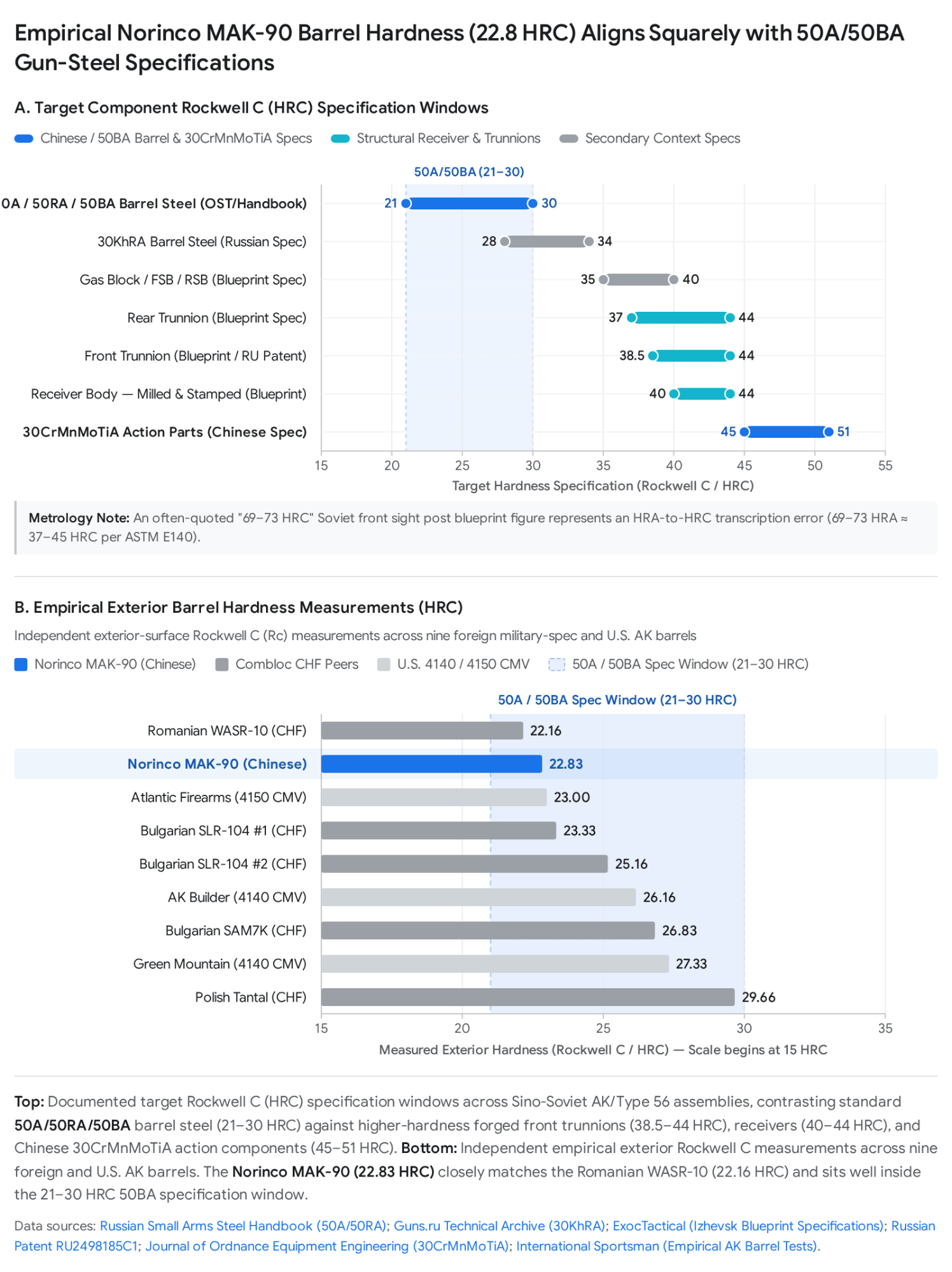
Metallurgically, the post-1960 Sino-Soviet split led China to replace nickel-, tungsten-, and alloy-intensive Soviet steels with domestic substitutes that define legacy Western-market Type 56 hardware10. Chinese metallurgists standardized on boron-microalloyed 50BA medium-carbon gun steel (GB/T 3077 / YB-481-80) for hard-chrome-lined barrels (21-30 HRC design range; empirically measured at 22.83 HRC on a Norinco MAK-90 exterior), nickel-free 30CrMnMoTiA for high-stress bolt components, and 30CrMnSiA (paired with surface shot peening) for high-impact small parts such as firing pins10. When reverse-engineering a stamped receiver without Soviet AKM blueprints, Chief Engineer Zhao Ruizhi (赵瑞之) thickened the receiver shell from the Soviet 1.0 mm standard to 1.5 mm nominal (measured at 1.45-1.60 mm on Western imports)25. That 50% gauge increase expanded fire-control pin bearing area by 1.50 times and raised out-of-plane plate bending stiffness (proportional to thickness cubed, t^3) by 3.38 times, creating a mechanical margin that offset early domestic rolling-mill variability and supported a strong long-term durability record on pre-1994 Chinese imports29.
Comparing Western sales across the United States and Europe shows clear differences in hardware lineage, metallurgy, and trunnion manufacturing. Whereas the 1994 U.S. import embargo limited the American market to Cold War-era Norinco, PolyTech, and MAK-90 rifles, European countries experienced both post-Cold War military adoption—including Finland’s purchase of roughly 100,000 hammer-spring-modified Type 56-2 reserves (7.62 RK 56 TP), Estonia’s 1992-1996 acquisitions, Malta’s 2005 Type 56-2 donation, Albania’s licensed ASh-78 / ASh-82 production, and Ukraine’s 2022-2024 fielding of intercepted Iranian-shipped Type 56-1 rifles—and ongoing civilian commercial sales through the mid-2020s32. Because national enforcement of the June 1989 EU arms embargo generally targeted military equipment rather than civilian sporting arms, European markets—led by Germany, France, Italy, Finland, Czechia, Austria, Poland, and non-EU Switzerland—continued importing legacy and 2020s new-production Norinco / Norconia rifles and pre-2015 PolyTech models alongside post-2010 budget two-pin semi-automatic lines from SDM (Sino Defense Manufacturing) and NEDI (North East Defense Industry)33.
Metallurgy, heat-treatment consistency, and trunnion construction differ noticeably on modern post-2010 European budget brands. Pre-2015 European Norinco and PolyTech imports retain legacy forged or machined construction, and civilian rifles marketed in C.I.P. member states (excluding non-member Switzerland unless routed through an EU distributor) must pass mandatory proof-house firing at PE = 444 MPa (4,440 bar, or about 64,397 psi)29. However, C.I.P. proofing verifies immediate pressure containment rather than multi-thousand-round fatigue durability51. German Federal Criminal Police Office (BKA) inspections, distributor listings, and European range reports show that NEDI switched to 6-groove barrels (departing from China’s 4-groove TDP) and solid machined billet front trunnions, with isolated reports of breech fracture and fire-control wear; meanwhile, SDM shows mixed, batch-dependent construction—with forged front trunnions reported on early units, photo-documented cast bolt carriers, Swiss forum reports of cast trunnions on newer batches, and premature fatigue failures including a damaged bolt carrier at 7,000-8,000 rounds and a broken bolt head41.
An evidence boundary applies to this analysis: internal PLA heat-treatment batch records (heating curves, quench bath chemistries, and lot-acceptance logs) for State Factories 626, 386, and 416—along with factory material specifications for modern SDM, NEDI, and 2020s commercial Norinco runs—remain unpublished in open sources, and available summaries of the declassified November 1964 U.S. Army Springfield Armory / Foreign Science and Technology Center (FSTC) exploitation report omit alloy chemistry and Rockwell hardness tables33. To ground every technical figure without guesswork, this report draws on Chinese, Russian, U.S., and European open sources anchored by four core reference pillars: (1) primary Soviet and Chinese defense metallurgical standards (OST 3-98-80, GOST 5160-70, GOST 1050-60/74, GOST 4543-71, GB/T 3077, GB/T 3079, YB-481-80, GJB 2720-96), Russian Patent RU2498185C1, and 1978/1982 Soviet small-arms repair manuals23; (2) Sergei B. Monetchikov’s History of the Russian Assault Rifle (История русского автомата, 2005)12; (3) secondary archival reviews of the 1964 Springfield Armory / FSTC Exploitation Report and Defense Intelligence Agency (DIA) Small Arms Identification and Operation Guide references (ST-HB-07-03-74 [1973] and DST 1110H-394-76 [1983])58; and (4) Western small-arms reference works—including Frank Iannamico’s AK-47: The Grim Reaper (2009/2013) and Edward C. Ezell’s The AK47 Story (1986) for variant classification and import history—paired with Garry James’s 1987 factory visit to State Factory 386 (Guns & Ammo), German BKA technical rulings (Z-337 and Z-427), Czech Proof House (ČÚZZS) listings, C.I.P. and SAAMI pressure standards, Royal Armouries study collection records, and independent Western hardness and endurance testing22.
Evolution of the Type 56 Platform and Western Export Variants
Chinese Kalashnikov metallurgy reflects three industrial phases: Soviet turnkey licensing, post-split domestic stamping and steel substitution, and separate commercial export paths in the United States and Europe. Under a 1955 Sino-Soviet defense transfer agreement, Moscow delivered 781 volumes of AK-47 Type 3 technical documentation, machinery, and advisors to State Factory 626 (国营626厂, publicly known as Qinghua Machine Factory 庆华机器厂 in Bei’an, Heilongjiang)26. Trial production succeeded in 1956, and the rifle entered PLA service as the Type 1956 7.62mm Submachine Gun (1956年式7.62mm冲锋枪, commonly shortened to 56式冲锋枪 or 56冲)26. The “submachine gun” label reflected PLA squad doctrine rather than the rifle’s operating mechanism: two Type 56 AKs replaced pistol-caliber Type 54 submachine guns per squad for close-range suppressive fire under 200 meters, while standard riflemen carried the Type 56 Semi-Automatic Rifle (56式半自动步枪, China’s SKS copy) built primarily at State Factory 296 (国营296厂, Jianshe Factory 建设厂 in Chongqing, stamped /26\ after its shortened code)10.
Early Type 56 rifles built between 1956 and the mid-1960s were milled-receiver copies of the Soviet AK-47 Type 3, initially assembled from Soviet steel and parts with Cyrillic selector markings (АВ / ОД) before adopting Chinese PLA markings—连 (Lián, full-auto) and 单 (Dān, semi-auto)—or export Pinyin letters L and D30. Factory 626 stamped military receivers with its shortened Triangle 66 (/66\) arsenal code, which led many English-language collector guides to refer to Factory 626 as “State Factory 66”70. According to published reviews of the November 1964 Springfield Armory / FSTC comparison of a Factory /66\ milled Type 56 (serial 2021164) against a circa-1954 Tula AK-47 (AA3286K), U.S. ordnance engineers confirmed close dimensional interchangeability and concluded directly: “Both weapons indicated high-quality craftsmanship. The surface microfinish of the weapon components for both rifles is comparable to U.S. military standards”58. Starting in 1965-1966, border-conflict lessons and close-combat doctrine (刺刀见红, “draw blood with the bayonet”) led to a permanently mounted folding three-fluted spike bayonet (折叠三棱刺刀, cylindrical at the rear with three longitudinal grooves and a blunt flat tip, developed from the four-edged Type 53 / Mosin-Nagant bayonet) beneath the barrel, alongside a shift from Soviet open front sight wings (护翼) to a full enclosed front sight hood (全包护圈) to reduce aiming errors at night26. (Note: Several Chinese web articles claim the Type 56 spike bayonet was hardened above 60 HRC and alloyed with arsenic92. Those claims stem from unconfirmed online folklore rather than PLA metallurgical records; hardening a slender steel spike above 60 HRC would make it prone to snapping under side loads.)
The main structural shift followed the Sino-Soviet split, which ended Soviet alloy steel deliveries and left Beijing without technical licensing or drawings for the 1959 stamped-receiver Soviet AKM25. Between 1964 and 1967, Chief Engineer Zhao Ruizhi (赵瑞之) led China’s Project 55 defense-engineering mission in Albania, where he examined Soviet-supplied AKMs in Albanian service26. Returning to China, Zhao led a domestic stamping program that entered production between 1967 and 197026. Early stamping encountered production problems: a small first batch copied the AKM rivet layout (most of which were later destroyed), and in 1969 more than 100,000 early stamped Type 56 rifles were rejected by the PLA for production defects and diverted to militia units before Zhao Ruizhi’s team corrected the process79. Standardized stamped Type 56 production differed from the Soviet AKM across multiple mechanical interfaces: a 1.5 mm stamped steel receiver, an RPK-like 1-top-2-bottom (1上2下) front trunnion rivet triangle without an RPK receiver bulge, a smooth unribbed dust cover (机匣盖), a heavier AK-47-contour barrel pressed into a narrower 19.0 mm front trunnion journal, a downward-angled AK-47 fixed buttstock, an 800-meter rear sight, a double-hook trigger omitting the AKM hammer rate-reducer (减速机构), and gas relief ports drilled in the gas tube rather than the gas block25.
Two military folding-stock models branched off this baseline. Adopted in 1963 and nicknamed the “Iron-Stock Submachine Gun” (铁把冲锋枪), the Type 56-1 (56-1式) copied the Soviet AKS-47’s underfolding metal stock for reconnaissance, airborne, artillery, and vehicle crews1. Early Type 56-1s used milled receivers before shifting to 1.5 mm stamped receivers in the late 1960s, and standard PLA issue omitted the integral spike bayonet to ease stowage98. To address the Type 56-1’s hinge loosening, three-step unfolding motion, and cold metal cheek contact in winter, Chinese designers finalized the Type 56-2 (56-2式) in 1980 (fielded in 1981)26. The Type 56-2 introduced a right-folding U-channel (П-profile) stock stamped from 1.5 mm strip steel, fitted with fiberglass/phenolic (玻璃钢, fiberglass) cheek plates—replacing early polycarbonate (聚碳酸酯) panels that developed stress cracks (自行开裂)—housing an internal spring-retained cleaning kit, reducing stock drop angle from 10° to 4° for straighter recoil alignment, reducing buttplate grooves from 11 to 5 for shooter comfort, and locking via a wedge-shaped automatic wear-compensation latch (楔形自动补偿机构)26. Standard military Type 56-2 rifles generally omitted the fixed spike bayonet, though later export configurations offered either detachable bayonet lugs or an integral folding spike40. Because the Type 81 automatic rifle entered PLA mass production in 1983 (directly borrowing the 56-2’s folding stock assembly), the Type 56-2 saw limited frontline PLA issue and became China’s primary export model26.
To reduce factory vulnerability along the northern border, China spread Type 56 manufacturing across its interior “Third-Line” (三线) defense network—most notably State Factory 386 (国营386厂, Longyan Pneumatic Tool Factory 龙岩风动工具厂, later Hualong Machinery Factory 华龙机械厂 in Longyan, Fujian; starting Type 56 AK production in 1963, fixing early 15,000-round service-life issues with Factory 626 specialists, switching to Type 56-2 in 1983, reaching 640,000 military rifles by 1988, and merging into Factory 313 in Yong’an, Fujian in the early 2000s, where Type 56-2 export production continues), State Factory 296 (国营296厂, which received Type 56 drawings from Factories 626 and 386 in 1980 and built 80,003 Type 56 and 636,830 Type 56-1 rifles through 1990), and State Factory 416 (/416\, an assembly plant seen on scarce Norinco commercial exports, though its exact provincial location is not confirmed in primary state histories)79. State factory codes ending in 6 marked small-arms plants, with triangular logos indicating military contracts and oval logos indicating commercial exports86.
Civilian imports into the United States began in 1983 through early importers Clayco Sports, GSAD (1984), and B-West (1984-1985), followed by larger shipments from state trading companies Norinco (中国北方工业公司, China North Industries Corporation) and Poly Technologies / PolyTech (保利科技) under the Type 56S (56S Sporter) and AKS-762 labels (with 5.56x45mm commercial variants marked Type 84S or AKS-223)27. Pre-1989 U.S. imports included stamped fixed-stock 56S, underfolding 56S-1 (including scarce Sile N.Y. “blue bolt” guns and commercial spiker-equipped underfolders), Bakelite side-folding 56S-2, Bakelite fixed-stock 56S-3, PolyTech AKS-762 Spikers and Galil-style sidefolders (built largely at Factories /66\ and /416\), and the PolyTech Legend (AK-47/S)—a milled-receiver Type 3 revival built at Factory (386) starting in 198785. Following President George H. W. Bush’s March 1989 import restriction on military-featured rifles, Chinese factories adapted the same core receivers, forged front trunnions, and heavy barrels into the post-ban MAK-90 (“Modified AK-1990”) with thumbhole stocks, removed bayonet lugs, and unthreaded muzzles until the 1994 U.S. import embargo ended Chinese AK imports10.
European Military Procurement, Licensed Production, and Ongoing Civilian Markets
While the 1994 U.S. embargo left American collections capped at pre-1994 Norinco and PolyTech rifles, Europe followed a different path involving Cold War factory transfers, post-Cold War military reserve purchases, and continued civilian sporting sales into the mid-2020s32.
European State Procurement, Aid, and Licensed Production: Five military channels introduced Type 56-family rifles across Europe:
- Albania (ASh-78 and ASh-82) and Balkan Spread: After the Albanian-Soviet split, China funded and equipped Albania’s state small-arms arsenal at Gramsh beginning in 1962 (where Zhao Ruizhi led Project 55 from 1964 to 1967), alongside production markings also tied to KM Poliçan37. Albania began licensed production of its stamped Type 56 derivative—the ASh-78 (Automatiku Shqiptar 78)—between 1974 and 1978, followed by the underfolding ASh-82 (Type 56-1 / AKMS copy) in 1982, continuing production until 199730. (Sub-variant naming overlaps across archives: English references commonly assign Tip-1 to the standard folding-spiker rifle, Tip-2 to an extended-barrel rifle-grenade launcher, and Tip-3 to a bipod-equipped support rifle37, whereas Albanian military lists reverse Tip-2 as the RPK-style light machine gun and Tip-3 as the grenade launcher110, and the UK Royal Armouries catalogs a 1981 650 mm grenade-spigot rifle [PR.12285] under the ASH-82 label114.) During the 1990s Yugoslav Wars and the 1997 looting of Albanian depots, both Chinese-supplied Type 56/56-1 rifles and Albanian ASh-78/ASh-82 rifles spread widely into Croatia, Bosnia and Herzegovina, Kosovo (Kosovo Liberation Army / UÇK), and Macedonia37.
- Finland (7.62 RK 56 TP): In the 1990s, the Finnish Defence Forces (Puolustusvoimat) bought approximately 100,000 Chinese Type 56-2 side-folding rifles for wartime reserve units (stored alongside East German MPi-KM / RK 72 rifles, totaling roughly 200,000 imported reserve Kalashnikovs)32. Designated 7.62 RK 56 TP (7,62 rynnäkkökivääri 56 taittoperällä, 7.62 mm assault rifle model 56 with side-folding stock) in Finnish light-weapons manuals, these rifles were modified in China with a stronger hammer spring to reliably fire Finnish military 7.62x39mm primers and remain held in long-term reserve storage98.
- Estonia (1992-1996) and Malta (2005): Newly independent Estonia began buying Kalashnikov rifles from Romania and China in 1992 (initial autumn 1992 deliveries led Estonian military historians to note that “the price of these rifles corresponded to their quality”), signing six contracts with China and Israel between December 1992 and January 1993 for Chinese automatic rifles and ammunition delivered in the first half of 1993, followed by three larger Chinese contracts (including a 1994 deal with China Jing An, with final deliveries arriving in spring 1996)39. Priced at roughly USD 120 per Chinese rifle (three times the USD 40 price of East German surplus AKs), shipments faced growing customs resistance at the Port of Rotterdam until trade ended; after Estonia shifted to Israeli IMI Galil rifles, retired Chinese M-56 and M-56-2 rifles were transferred to the volunteer Defence League (Kaitseliit)39. Separately, the Armed Forces of Malta (AFM) fielded Chinese Type 56-2 rifles donated in 2005 alongside German, Romanian, Russian, and Korean AK variants34.
- Ukraine (2022-2024): On European battlefields, Chinese Type 56-1 underfolders entered Ukrainian military service—first observed in April 2022 and expanded on April 4, 2024, when U.S. Central Command (CENTCOM) transferred over 5,000 legally seized AK-pattern rifles (including Type 56-1s intercepted by U.S. and French naval forces from Iranian IRGC vessels bound for Yemen between 2021 and 2023 and transferred via U.S. Department of Justice civil claims in December 2023) to Ukrainian forces35.
European Civilian Sporting Imports (Norinco/Norconia, PolyTech, SDM, NEDI) and Legal Rules: After the June 1989 Tiananmen Square crackdown, the European Council issued the Madrid Political Declaration of June 27, 1989, interrupting military cooperation and declaring an EU arms embargo on China42. Because that embargo functioned as a political declaration applied by individual member states—and generally targeted lethal military goods on the EU Common Military List—European countries continued allowing commercial civilian hunting and sporting firearms from China long after the 1994 U.S. cutoff43. Four commercial channels supply the European civilian market:
- Legacy and 2020s New-Production Norinco / Norconia: Norconia GmbH (Rottendorf, Germany) acted as Norinco’s European distributor46. Swiss auction catalogs (Kessler Auktionen), French national registry archives (RGA), Italian retail listings, and Finnish police auctions record ongoing sales of Norinco Type 56S, 56S-1, 56S-3, 5.56x45mm rifles (officially Type 84S, occasionally listed under Typ 56S in Europe, including units proofed at Germany’s Beschussamt München), compact Norinco Typ 56SS-1 carbines (305 mm / 12.01 in barrel), and Type 56C carbines29. Newly made semi-automatic Norinco rifles continue to be sold in Central Europe and Switzerland in the 2020s, including fixed-stock and underfolding models (the Czech Proof House ČÚZZS categorized the SEMIAUTO TYP 56 (TZP 56-1) as Category B in 2005) and new-production Norinco Typ 56-2 side-folders retailing at 13,000-13,900 CZK in Czechia, alongside factory-new select-fire Type 56-2 rifles legally bought by permitted Swiss collectors for around USD 1,00036.
- Pre-2015 PolyTech Imports: PolyTech semi-automatic rifles continued reaching Europe—especially Switzerland—through at least 2015-production runs (with remaining or secondary-market Swiss inventory listed up to 1,290 CHF), before commercial volume shifted mostly to lower-priced export brands49.
- SDM (Sino Defense Manufacturing, Beijing): Exhibited at Germany’s IWA 2015 trade show and distributed across Italy, France, Germany, Belgium, Austria, Poland, and Switzerland primarily by Italy’s Prima Armi S.r.l. (alongside German importer Horner Arms UG), SDM became the largest-volume ongoing budget Chinese AK brand in the EU33. Active models listed in German BKA ruling SO11-5164.01-Z337 (September 2015) and European retail catalogs include the AK-47 (“Chinese Series” Type 56 and “Soviet Series” AKM), AKS-47 underfolder, AK-103 / AKS-103 / AK-103T (7.62x39mm side-folders), AK-104 (319 mm compact barrel), and AKS-74 (5.56x45mm/.223 Rem underfolder), typically retailing around 595-850 EUR/CHF33.
- NEDI (North East Defense Industry Co., Ltd.): Founded in 2010 independently of Norinco and PolyTech, NEDI makes Type 56-pattern rifles (NEDI AK-47 fixed-stock and NEDI AK-47S underfolder) on contract for a Swiss arms firm and through German importer TMH Deutschland GmbH (per German BKA ruling SO23-5164.01-Z-427, August 2018), typically retailing around 595-649 CHF (around USD 883 in German listings)41.
National European laws directly shape civilian configurations. In Germany, Section 6 of the General Weapons Act Ordinance (§ 6 AWaffV) excludes military-appearing semi-automatic long guns from sport shooting (Sportschützen) whenever barrel length is under 40 cm (previously 42 cm) or cartridge case length is under 40 mm—which catches 7.62x39mm at its C.I.P. case length of 38.70 mm regardless of barrel length29. Both BKA rulings Z-337 (SDM) and Z-427 (NEDI) confirm that while these rifles are civilian Category B firearms rather than war weapons (keine Kriegswaffe), all 7.62x39mm versions are barred from sport shooting and limited primarily to licensed hunters (Jäger) and collectors (Sammler), whereas longer-case calibers (.222 Rem., .223 Rem., 6.5 Creedmoor, and .308 Win. with 42.5-52.0 cm barrels under Z-427) clear the § 6 AWaffV sport-shooting rule41. In the United Kingdom, the 1988 ban on centerfire semi-automatic rifles restricted British civilian Type 56 ownership to manually operated straight-pull conversions or EU/UK deactivated collector rifles161. By contrast, Switzerland (outside both the EU and C.I.P.), France, Italy (where SDM AK-103 models hold F.I.T.D.S. dynamic-shooting classification), Czechia, and Finland remained active civilian markets under national permit and magazine rules33.
| Market Region | Import Window & Primary Brands | Dominant Variants & Configurations | Regulatory & Proofing Framework | Key Metallurgical / QC Profile |
| United States (Commercial) | 1983-1994 (Clayco, GSAD, B-West, Norinco, PolyTech) | Pre-1989 56S, 56S-1, 56S-2, 56S-3, 84S, PolyTech Legend (milled); 1990-1994 thumbhole MAK-90 | 1989 sporting import restriction & 1994 Chinese arms import embargo; voluntary SAAMI 310 MPa (~45,000 psi) MAP (voluntary proof ~1.30-1.40x), no government proof house | State-arsenal 1.5 mm stamped & milled guns; drop-forged front trunnions; main defect risk is U.S.-made B-West soft receivers |
| Western & Central Europe (Commercial) | 1980s-Present (Norinco/Norconia, pre-2015 PolyTech, SDM via Prima Armi/Horner Arms, NEDI via TMH/Swiss partners) | Legacy & 2020s Norinco (56S, TZP 56-1, 56-2, 56SS-1, 56C); modern 2-pin SDM (AK-47, AKS-47, AK-103/104, AKS-74) & NEDI (AK-47, AK-47S) | 1989 EU Madrid embargo targets military list; Germany BKA Z-337/Z-427 & § 6 AWaffV restrict 7.62x39mm (38.70 mm case) to hunters/collectors; UK straight-pull/deact; mandatory C.I.P. 444 MPa (~64,397 psi) proof in C.I.P. states (Switzerland is non-C.I.P. unless EU-routed) | Clear generational split: pre-2015 Norinco/PolyTech retain forged/machined bolts and trunnions; NEDI uses solid milled billet trunnions & 6-groove barrels with reported breech/FCG failures; SDM shows mixed batch-dependent trunnions, cast bolt carriers, canted sights & premature carrier/bolt/safety breakages |
| Northern & Mediterranean Europe (Military) | 1990s-2005 (Norinco / state contracts) | Finland: ~100,000 7.62 RK 56 TP (Type 56-2); Estonia: 1992-1996 M-56 / M-56-2; Malta: 2005 Type 56-2 donation | State-to-state defense procurement and aid; Rotterdam customs friction curtailed Estonian trade | Finnish RK 56 TP factory-modified with stronger hammer spring for domestic primers; Estonian histories note lower build polish aligned with ~USD 120 price |
| Balkans & Eastern Europe (Licensed & Conflict) | 1974-1997 (Albania); 2022-2024 (Ukraine) | Albania: Licensed ASh-78 (Tip-1/2/3) & ASh-82 (Gramsh / Poliçan); Ukraine: Seized Iranian-shipped Type 56-1 underfolders | Chinese Project 55 tech transfer to Albania; U.S. DOJ Dec 2023 civil forfeiture & April 2024 CENTCOM transfer to Ukraine | ASh-78 copies Chinese stamped/rivet layout without magwell dimples but shows rough machining, irregular gas-block vents & faster wear; Ukraine 56-1 comes from military export stocks |
Metallurgical Foundation: Sino-Soviet Steel Substitution and Standards
Evaluating Type 56 metallurgy requires looking at how raw-material limits reshaped Soviet steel specifications. When Soviet advisors equipped Factory 626 in 1955-1956, Soviet small-arms engineering drew upon nickel-, tungsten-, and chromium-bearing structural steels (25KhNVA, 30KhN2MVA) alongside medium-carbon and boron-treated gun steels (50A, 50RA, 30KhRA) defined under OST 3-98-80, GOST 5160-70, GOST 1050-60/74, and GOST 4543-7110. Even inside the Soviet Union, Monetchikov’s archival history (История русского автомата) records that Izhmash replaced costly, scarce 25KhNVA with low-alloy chromium-boron 30KhRA (30ХРА) across nine AK parts, including the bolt group and trigger mechanism68.
China faced larger strategic-metal shortages—especially domestic shortfalls in nickel (Ni) and tungsten (W)—that became urgent once Soviet steel deliveries stopped around 196010. Chinese metallurgical institutes and Factories 296 and 626 adopted three core steel substitutions, tested first on the Type 56 SKS and later standardized across the Type 56 AK and Type 56 LMG lines10:
- Barrel Steel Substitution (50A / 50AE / 50AZ to 50BA): Replacing imported Soviet barrel steels (50A, 50AE, and low-chromium 50AZ, which carries 0.48-0.55% C and 0.15-0.35% Cr—contrary to loose media descriptions calling 50AE/50AZ high-nickel steels), China developed 50BA gun steel (50BA枪钢), a high-purity (“A”-grade, low-sulfur/phosphorus) medium-carbon steel microalloyed with trace boron governed under GB/T 3077 and China’s small-arms structural steel standard YB-481-80 (alongside military standard GJB 2720-96 for 50A steel)10. Chinese metallurgical data specify 50BA at 0.48-0.55% C, 0.17-0.37% Si, 0.50-0.80% Mn, and 0.001-0.005% B166, closely matching Soviet 50RA (50РА, which under OST 3-98-80 sets residual boron at 0.001% minimum and calculated addition at 0.0045% maximum)62. Related grade 50B under YB-481-80 specifies 0.47-0.55% C, 0.17-0.37% Si, 0.60-0.90% Mn, and 0.0005-0.0035% B24. (A popular Chinese military blog also claims roughly 0.2% selenium is added to 50B/50BA for machinability168, but selenium does not appear in GB/T 3077 or YB-481-80 composition tables and remains unconfirmed by primary steel standards23.) Trace boron collects at steel grain boundaries during oil quenching to slow soft-phase formation, providing deep hardenability without scarce nickel or heavy chromium additions62.
- Bolt and Action Substitution (30CrNi2MoVA to 30CrMnMoTiA): To produce bolts (枪机) and high-impact reciprocating parts without scarce nickel, China replaced imported 30CrNi2MoVA with nickel-free 30CrMnMoTiA (GB/T 3079-1993: 0.28-0.34% C, 0.17-0.37% Si, 0.80-1.10% Mn, 1.00-1.30% Cr, 0.20-0.30% Mo, 0.04-0.10% Ti, Ni <= 0.25%; annealed delivery hardness <= 241 HB)10. Titanium keeps the steel’s grain size fine to improve impact toughness while cutting alloy cost; in modern Chinese ordnance engineering papers, quenched-and-tempered 30CrMnMoTiA small-arms operating pistons are specified at 45-51 HRC10. (Chinese web articles often carry an OCR typo writing 30GrMnMoTiA and 30GrNi2MoVA; Chinese standard GB/T 3079 and mill catalogs confirm the chromium grades 30CrMnMoTiA and 30CrNi2MoVA10.)
- High-Impact Small Parts Substitution (25CrNiWA to 30CrMnSiA) and Shot Peening: Where original Soviet prints called for nickel-tungsten 25CrNiWA, Factory 626 adopted medium-carbon silicon-manganese-chromium alloy 30CrMnSiA (GB/T 3077, China’s equivalent to Soviet 30KhGSA: 0.28-0.34% C, 0.90-1.20% Si, 0.80-1.10% Mn, 0.80-1.10% Cr, S <= 0.025%, P <= 0.025%; minimum yield strength >= 835 MPa / 121.1 ksi, minimum tensile strength >= 1,080 MPa / 156.6 ksi, vacuum-quenched in oil from 890-900 °C in modern process specs) paired with surface shot peening (喷丸处理)20. Silicon stabilizes carbides during tempering around 250-300 °C176, while compressive surface stress from shot peening curbed early fatigue failures in impact parts such as firing pins (击针) as well as separate coiled wire springs (hammer, recoil, and extractor springs)20. (Although a compressed Chinese article groups coiled springs into the 30CrMnSiA sentence20, neither 0.25% C 25CrNiWA nor 0.30% C 30CrMnSiA is a spring-wire alloy: 30CrMnSiA replaced 25CrNiWA on impact parts like firing pins, while shot peening and heat-treat control reduced breakage across both those parts and separate high-carbon steel wire springs.)
Component-Level Metallurgy and Heat Treatment
Receivers: Milled Blanks vs. 1.5 mm Stamped Sheet Steel
Chinese Type 56 receivers (机匣, receiver) span two construction methods—milled (铣削机匣) and stamped (冲压机匣 / 冲铆机匣)—both common across Western Type 56S, PolyTech Legend, and MAK-90 imports26.
Milled Receivers (Early Type 56 / 56-1, PolyTech Legend AK-47/S, Milled MAK-90): Early military rifles from Factory 626 and commercial milled exports from State Factory 386 were machined from solid forged steel receiver blanks (机匣钢胚)1. During his 1987 inspection of Factory 386 in Longyan, Garry James watched machinists mill solid ordnance-steel receiver blocks (referred to as a “single ingot” in his article) into finished PolyTech AK-47/S receivers across 105 separate operations on manual mills, with each part hand-checked before assembly73. Specific PLA steel-grade sheets for milled Type 56 receivers are unpublished in open sources; under the transferred Soviet baseline, primary 1978 and 1982 Soviet small-arms repair manuals specify medium-carbon structural Steel 50 hardened to 37-44 HRC for receiver/structural components, while circulating secondary reproductions of Izhevsk AK-47 blueprints cite 40-44 HRC59. Because the locking shoulders, barrel socket, and guide rails form one thick forged steel block, cyclic receiver fatigue is greatly reduced. High-round-count commercial full-auto logs from Battlefield Vegas (where rental AKs regularly exceed 100,000 rounds) record no structural failures on Chinese milled receivers75.
Stamped Receivers (Late Type 56, Type 56-1, Type 56-2, Stamped 56S / MAK-90): Developing a stamped receiver without Soviet AKM tooling, Zhao Ruizhi’s team standardized on 1.5 mm nominal steel sheet (1.5mm钢板) rather than the Soviet 1.0 mm AKM shell25. Independent Western measurements sit close to this target: AK-Builder measured original Chinese MAK-90 receiver steel at 0.057 in (1.448 mm), while Western collector guides often quote 1.6 mm (0.063 in) measured over finish27. Open-source Chinese documents do not name the exact sheet-steel grade stamped on late-1960s Type 56 lines, though Chinese ordnance histories state that China’s direct stamped-receiver successor—the Type 81—used 1.5 mm No. 50 carbon steel sheet (50钢板)181. By comparison, Soviet and Russian stamped AKM shells used medium-carbon or low-alloy sheet steels (St40, St50, or 30KhGSA), with secondary Izhevsk blueprint summaries listing 40-44 HRC (39-45 HRC for spot-welded lower rails and ejectors) and Russian forum commentary noting around 40 HRC for St40 and up to 45-48 HRC for 30KhGSA shells178. An unconfirmed Western forum post attributing Type 56 stamped receivers to hardened AISI 1028 carbon steel should be treated as an informal comparison rather than a verified PLA specification185.
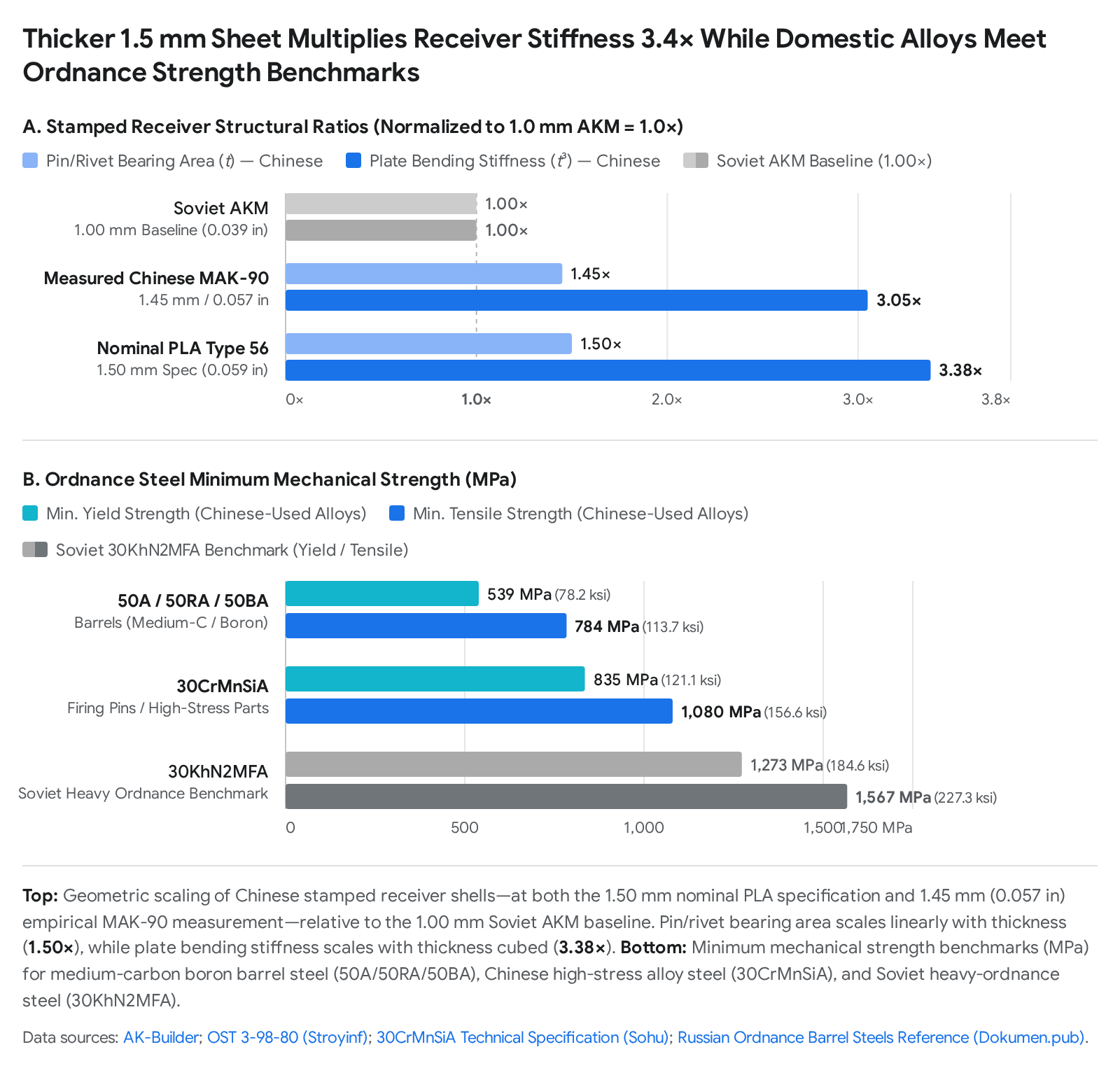
Both Chinese accounts and Western armorer reviews point to two practical engineering reasons for China’s 1.5 mm sheet choice30. First, newly built late-1960s Chinese rolling mills had less consistent sheet quality than established Soviet mills; raising wall thickness from 1.0 mm to 1.5 mm increased fire-control pin and rivet bearing area by 50% (1.50x) and raised out-of-plane plate bending stiffness (proportional to thickness cubed, t^3) by 3.38 times (exact 3.375x, or roughly 3.04 to 3.05 times at the measured 1.448 to 1.45 mm thickness), providing a mechanical buffer against batch heat-treat or steel variation29. Second, thicker sidewalls reduced receiver flex under rapid fire and offered forgiving heat-sink margins when spot-welding internal guide rails85. Authentic Chinese-made stamped receivers were properly hardened—U.S. Chinese-pattern receiver maker Childers Guns replicates factory hardness by salt-bath hardening shells to 40 HRC, matching the Soviet 37-44 HRC structural range64. Whether all Chinese factories used full salt-bath hardening or localized spot hardening around fire-control holes and ejector tips is not recorded in open-source PLA documents, though decades of service confirm adequate hardening on genuine Chinese-built shells.
U.S.-market buyers must watch for one important exception: U.S.-made B-West stamped receivers (stamped Made in USA) assembled from Chinese parts kits in the late 1980s, as distinct from genuine Chinese-built rifles imported by B-West (stamped Made in China)188. Many domestic B-West receivers were left un-heat-treated or under-hardened, causing rapid elongation (“egging”) of the hammer and trigger axis-pin holes and peening of the soft ejector tip188. No comparable soft-receiver pattern affects genuine Chinese state-factory 56S, 56S-1, 56S-2, or MAK-90 stamped receivers188.
Ongoing European Commercial “Two-Pin” Receivers (SDM, NEDI, 2020s Norinco) and Licensed Albanian Shells (ASh-78): Modern 2010s-2020s Chinese commercial rifles sold in Germany, France, Italy, Czechia, Austria, Poland, and Switzerland under the SDM, NEDI, and Norinco labels continue stamping receivers from 1.5 mm steel sheet, keeping the thicker Chinese dimensions and the same fitment incompatibility with drop-in 1.0 mm European AKM parts33. Even SDM’s AK-103S side-folder uses a 1.5 mm Chinese receiver with Chinese front-trunnion rivets, a legacy thick-stemmed bolt, and a 4.5 mm folding-stock hinge pin rather than the Russian AK-103’s 5.5 mm pin—matching China’s externally modified Type 56 export architecture rather than China’s dedicated Russian-pattern AK-103 copy (CS/LR-11)79. To meet EU and national civilian laws, modern SDM and NEDI shells are built from the ground up as “Two-Pin” semi-automatic receivers, omitting the third auto-sear axis hole, internal rail sear cuts, and bolt-carrier auto-sear trip, while using a two-position manual safety33. (Note on Distributor Errors: Several Polish retail listings describe the SDM AK-103S as having a “forged stainless steel receiver coated with chrome-molybdenum” and “sub-MOA precision”193. Those listings are inaccurate copywriting; GunsWeek evaluations, BKA Z-337, and European owner teardowns confirm a standard stamped sheet-steel receiver and standard rack-grade AK accuracy33.) By comparison, European-built licensed Albanian ASh-78 stamped receivers copied China’s rivet layout while omitting the stamped magazine-well dimples (apparently to simplify dies) and showing rough sheet-metal forming, single-rivet trigger-guard shortcuts, increased receiver flex at high round counts, and rough blued finishes in Royal Armouries inspections (PR.12283)76.
Trunnions: Cast vs. Forged Analysis Across Front and Rear Blocks
Because cast front trunnions have caused premature headspace growth and locking-lug failures in several commercial U.S.-made AKs (with independent AK Operators Union testing recording headspace failures in early Century Arms C39V2 and RAS47 rifles in as few as 3,000 rounds, alongside similar failures in early Pioneer Arms and I.O. Inc. rifles), Western buyers closely inspect whether Chinese Type 56 trunnions are cast or forged6. An accurate engineering answer separates the pressure-bearing front barrel trunnion (枪管节套 / 前节套) from the non-pressure-bearing rear stock trunnion (尾座 / 后节套), separates stamped from milled receivers, and separates pre-1994/pre-2015 state-arsenal rifles from post-2010 European commercial budget lines.
Legacy PLA and Pre-1994 Western Front Barrel Trunnions (枪管节套 / 前节套) — Drop-Forged (or Integral on Milled Receivers): Across documented pre-1994 state-arsenal stamped-receiver Type 56, Type 56-1, Type 56-2, Type 56S, and MAK-90 rifles imported to the United States and Europe, the front barrel trunnion is closed-die drop-forged (模锻) and finish-machined rather than investment-cast2. On milled Type 56/56-1 rifles, PolyTech Legends, and milled MAK-90s, there is no separate riveted trunnion; the locking shoulders and barrel socket are milled directly into the forged steel receiver blank1. Under the Soviet Technical Data Package baseline (GOST 4543), forged front trunnions used chromium alloy steel 40Kh (40Х: 0.38-0.45% C, 0.90-1.20% Cr, 0.60-0.90% Mn)—or, across Izhmash and specialized variants, 30KhRA (30ХРА), 30KhGSA, or 50A—oil-quenched and tempered (or locally austempered) to 38.5-44 HRC (stated directly in primary Russian Patent RU2498185C1 for the barrel trunnion/liner вкладыш ствола, reflected at 39-44 HRC in secondary Izhevsk summaries, with metallurgical analyses noting localized locking-shoulder hardening reaching the mid-40s to low-50s HRC over a tougher core)8. Although PLA drawings naming the exact Chinese front-trunnion alloy are unavailable in open sources, Chinese state arsenals worked within the same domestic chromium/manganese forging steel families (30CrMnSiA, 30CrMnMoTiA, 40Cr, or 50A class) hardened to a comparable ~38.5-44 HRC toughness balance8.
Two dimensional traits distinguish Chinese forged front trunnions from Warsaw Pact AKM counterparts. First, they rivet to the 1.5 mm receiver via the 1-top-2-bottom three-rivet triangle on each side26. Second, Chinese stamped front trunnions use a 19.0 mm (0.748 in) press-fit barrel journal, versus 23.0 mm (0.906 in) on Soviet/European AKMs and 22.0 mm (0.866 in) on AK-74/100 rifles8. Keeping external trunnion width around a 4.0 mm smaller bore leaves thicker forged trunnion sidewalls around the chamber socket—sharing radial hoop load and offsetting the thinner standalone radial wall of the 19 mm Chinese barrel shank (3.83 mm radial barrel wall at the 11.35 mm C.I.P. chamber base versus 5.83 mm on a 23 mm AKM barrel)29. High-round-count full-auto endurance logs from Battlefield Vegas show that while all high-mileage stamped AKs tested there (including Norinco, Saiga, and Bulgarian Arsenal rifles) eventually cracked their front trunnions and split along the upper receiver rail bend after roughly 80,000-100,000 rounds of full-auto rental firing, genuine Chinese forged front trunnions matched Warsaw Pact military durability75.
Clarifying “Cast Type 56” Open-Source Reports: Researchers examining Type 56 metallurgy frequently find collector discussions documenting cast receivers from 1970-1980 Chinese arsenals (0129, 0221, 0226)206. Those rare experimental cast receivers were Type 56 SKS carbines (56式半自动步枪), not Type 56 AK assault rifles (56式冲锋枪)206. No documented pre-1994 state-arsenal Chinese Type 56 AK sold in the West used a cast receiver or cast front trunnion2.
Ongoing European Commercial Front Trunnions, Bolts, and C.I.P. Proof Testing (Norinco, PolyTech, NEDI, SDM): Unlike pre-1994 U.S. imports—where closed-die drop-forged front trunnions were standard—modern European-market Chinese AKs fall into four distinct tiers, with undisclosed factory sourcing on newer budget lines:
- Pre-2015 European Norinco and PolyTech: Forged or machined front trunnions and bolts (and forged-and-milled single-piece receivers on milled models). Swiss dealers and owners (Waffenforum Schweiz) rank pre-2015 Norinco and PolyTech imports above newer budget lines, confirming forged bolts and machined main components on up-to-2015 PolyTech production (with slight initial bolt-lug wear stabilizing after 100 rounds and 1,000+ trouble-free rounds fired)47.
- 2020s New-Production Czech and Swiss Norinco (Type 56, TZP 56-1, Type 56-2): Czech retailers confirm stamped receivers and chrome-lined barrels, chambers, and gas pistons, but do not publish trunnion forging details40. Swiss collectors tracking 2020s factory-new Norinco returns caution that without factory documentation or destructive testing, buyers should inspect individual rifles rather than assuming identical 1980s QA36.
- NEDI (AK-47, AK-47S, 2010-Present): Solid machined billet steel front trunnions (not confirmed closed-die drop-forged, while refuting forum rumors of “cast iron”). German (X-Hunter) and Swiss (Thoron AG) distributor listings explicitly describe the barrel mount/front trunnion as machined from a solid milled piece of steel41. A Swiss owner who compared a NEDI front trunnion beside a cast-trunnion Polish Pioneer Arms rifle confirmed visible milling marks (Frässpuren) and no casting seam (Gussnaht), identifying it as machined billet47. Solid billet avoids casting voids and outperforms cheap cast trunnions, though it lacks the continuous grain flow produced by closed-die drop forging.
- SDM (AK-47, AKS-47, AK-103/104, AKS-74, 2015-Present): Contested and batch-dependent across production runs and parts. German/Austrian forum contributors (Leuchtspur) identify SDM front trunnions as forged (geschmiedet)53, and a French owner posting teardown photos of a USD 500 SDM Type 56 on Reddit observed a forged front trunnion52. In that same teardown thread, however, multiple machinists inspecting close-up photos of the SDM bolt carrier spotted a visible casting seam and cast surface texture without milling marks, identifying the carrier as cast52. Separately, Swiss shooters and gunsmiths on Waffenforum Schweiz report that while older SDM AK-47 models used a milled/forged trunnion block, newer SDM AK-47 batches reportedly switched to cast trunnions (nur gegossen), alongside Swiss reports of broken SDM trunnions, broken locking lugs, stuck firing pins, and a broken safety selector that caused an accidental discharge while on safe49. Combined with a European range report of an SDM bolt carrier failing (“shredded”) and damaging the bolt at 7,000-8,000 rounds56 and an Austrian report of an SDM bolt head breaking in two57, current budget SDM rifles show lower small-parts metallurgy and heat-treat consistency than legacy PLA rifles (whose bolts lasted roughly 80,000 rounds in Battlefield Vegas logs75). Mixed European owner experiences—ranging from 1,000-5,000+ trouble-free rounds49 to early breakages and double-firing/runaway full-auto around 200 rounds on NEDI49—reflect inconsistent batch heat treatment across multiple subcontracting Chinese plants143.
Mandatory C.I.P. Proof Testing vs. Cyclic Fatigue Durability: Commercial firearms marketed in C.I.P. member states (Germany, France, Italy, Austria, Czechia, Poland, Belgium, Finland, the UK, and others) must pass mandatory government proof-house inspection and overpressure firing—such as Germany’s Beschussamt München marks on Norinco rifles and Italian Gardone 2014 C.I.P. proof marks documented on SDM rifles in BKA ruling Z-33745. Under C.I.P. TDCC tables for 7.62x39mm, Maximum Permissible Pressure (Pmax) is 355 MPa (3,550 bar, or about 51,488 psi) and mandatory Proof Pressure (PE = 1.25 x Pmax) is 444 MPa (4,440 bar, or about 64,397 psi)29. Comparing like-for-like standards, C.I.P.’s 355 MPa service ceiling sits 14.4% above SAAMI’s 310.3 MPa (45,000 psi) Maximum Average Pressure primarily due to pressure-transducer placement and measurement methods, while C.I.P.’s 444 MPa proof load sits close to SAAMI’s voluntary centerfire proof range of 1.30-1.40 times lot mean pressure (about 58,500-63,000+ psi / 403-434+ MPa)29. The practical advantage of C.I.P. is individual government testing of each retail rifle, confirming immediate burst containment51. Two limits remain: (1) C.I.P. proofing does not verify multi-thousand-round fatigue durability of cast bolt carriers, improperly tempered bolts, or trigger components51; and (2) Switzerland is not a C.I.P. member state, so direct Swiss imports (such as Swiss-contracted NEDI shipments) do not automatically pass through a C.I.P. proof house unless routed via an EU distributor51.
Rear Stock Trunnions (尾座 / 后节套) — Variant-Specific Engineering: Because an AK rear trunnion contains no chamber pressure—only anchoring the stock and absorbing bolt-carrier rearward impact—manufacturing varies across models1:
- Type 56S (Fixed-Stock Stamped) and Straight-Cut MAK-90: Uses a riveted steel rear stock trunnion with an upper tang whose shape differs slightly from European AKM tangs, affecting aftermarket stock fit214. Matching Soviet Izhmash mil-spec practice, fixed-stock rear trunnions were forged or machined in early production and frequently precision investment cast (失蜡精密铸造) in later mass production, with secondary Soviet blueprint summaries placing target hardness at 37-44 HRC2. Because loading is compressive impact rather than breech-locking shear, a properly made investment-cast rear trunnion meets military requirements2.
- Type 56-1 / 56S-1 (Underfolder): Early milled 56-1s and PolyTech Legend Underfolders machine the stock pivot bosses directly into the forged steel receiver rear99. By contrast, Western armorer teardowns confirm that stamped Type 56-1 and 56S-1 rifles omit the separate heavy AKMS underfolder rear trunnion14. Instead, Chinese plants slant-cut the rear of the 1.5 mm receiver and stamp circular locking-lug pockets directly inward into the receiver sidewalls, closing the rear with a simplified riveted backplate (“pseudo end-cap rear trunnion”)13. The thicker 1.5 mm sidewalls serve as the locking mount for the heavier unribbed underfolder stock arms16. (Post-1989 slant-cut MAK-90 rifles used either slant-cut fixed-stock receivers or plugged underfolder shells with welded tangs for thumbhole stocks218.)
- Type 56-2 / 56S-2 (Sidefolder): Uses a dedicated hinged rear trunnion riveted into a standard fixed-stock-pattern stamped receiver via two rear rivets, engaging the right-folding 1.5 mm stamped steel stock through the spring-loaded wedge-shaped automatic wear-compensation latch (楔形自动补偿机构)26. Open-source Chinese records and Western teardowns do not confirm whether original factory Type 56-2 / 56S-2 hinged rear trunnions were closed-die forged or investment cast before finish machining, though hardened mating wedge faces are required to keep lockup tight over time. On modern European SDM AK-103S rifles, the side-folding rear trunnion copies an AK-74M/AK-103 polymer folder using a 4.5 mm hinge pin (requiring fitting for standard 1.0 mm European stock adapters)53.
Barrels: 50BA Boron Steel, Rifling Processes, and Hard Chrome Plating
The barrel (枪管, barrel) is a core mechanical strength of pre-1994 Chinese imports and a clear point of difference across post-1990s military exports and modern European commercial brands.
Steel Grade, Heat Treatment, and Empirical Hardness Audit: After exhausting early Soviet-supplied 50A / 50AE / 50AZ bar stock, Chinese factories standardized on domestic 50BA boron-alloyed medium-carbon gun steel (50BA枪钢)10. Under the comparable Soviet OST 3-98-80 standard for 50RA (50РА), barrel blanks undergo oil quenching from 840-860 °C (850 +/- 10 °C)—where trace boron ensures deep as-quenched hardenability of >= 50 HRC at the surface and >= 45 HRC at the core across a 16×16 mm section—followed by high-temperature tempering (调质处理, quench-and-high-temper) at 550-650 °C (1,022-1,202 °F) with air cooling62. This cycle develops a tough, fine tempered steel structure delivering >= 539 MPa (78.2 ksi) yield strength, >= 784 MPa (113.7 ksi) tensile strength, >= 10% elongation, and high impact toughness (KCU >= 0.588 MJ/m^2), resisting brittle fracture in freezing conditions29.
Western AK forums often quote conflicting barrel hardness figures that require careful checking. A widely copied secondary blog table of Izhevsk AK-47/AKM blueprints (ExocTactical) lists barrel hardness at 37-44 HRC—alongside two clear scale-transcription errors in the same table: Front Sight Post at “69-73 HRC” (impossible for quenched carbon/alloy steel; per ASTM E140 steel conversions, 69-73 HRA equals 37-45 HRC) and Dust Cover at “48-53 HRC” (unusually brittle chisel hardness for a thin deep-drawn sheet cover; 48-53 HRA equals roughly 77-85 HRB / 140-165 HB cold-rolled sheet steel)29. Primary Russian ordnance handbooks and OST 3-98-80 / GOST 5160-70 barrel-steel tables show the actual hardness hierarchy: medium-carbon 50A and 50RA rifle barrels are tempered to 21-30 HRC (about 217-241 HB), alloyed 30KhRA barrels sit at 28-34 HRC (269-302 HB), and heavy-duty 30KhN2MFA machine-gun/sniper barrels sit at 37-42 HRC (preliminarily 300 +/- 27 HB before localized high-frequency induction hardening at the thrust shoulder above Ac3 = 830 °C per Russian Patent RU2498185C1)21. Independent testing by AKFiles tester Mel64D reported in International Sportsman (averaging three exterior Rockwell C readings per barrel) supports this range: a Norinco MAK-90 barrel measured 22.83 HRC, closely matching a military Romanian WASR-10 cold-hammer-forged barrel (22.16 HRC) and falling inside the 21-30 HRC 50A / 50RA / 50BA design range22. As International Sportsman noted, exterior Rockwell readings capture outer work-hardening on hammer-forged barrels while leaving internal bore work-hardening on button-rifled barrels (and internal hard-chrome plating) unmeasured22.
Rifling Processes — Button Extrusion vs. Cold Hammer Forging: Standard Type 56 barrels measure 414-415 mm (16.30-16.34 in) overall (369 mm rifled bore; four right-hand lands and grooves, 1:240 mm / 1:9.45 in twist; plus a scarce Canadian-export 19 in Factory /66\ Type 56S variant and the 280 mm military QBZ-56C carbine)3. Western importer specifications—notably PolyTech Legend brochures—and U.S. collector guides widely describe Norinco and PolyTech barrels as cold hammer forged (冷精锻)3. Chinese ordnance enterprises (such as Jianshe Industry / Factory 296) did adopt radial cold hammer forging (径向冷精锻) on later rifle and machine-gun barrels, holding land-and-groove diameter tolerances within 0.04 mm227. However, Chinese factory histories of Factory 626 document an earlier nationwide baseline: while building Type 50 and Type 54 submachine guns in the 1950s, Zhao Ruizhi studied Russian technical materials and led Factory 626 to replace slow single-point broaching (拉削) with button extrusion rifling (挤压 / 挤膛), increasing throughput 120-fold before China’s Ordnance Bureau rolled the process out nationwide230. Factory 626 paired extrusion with a three-stage cycle: pre-extrusion internal bore copper plating (挤压前枪管内孔镀铜) as a solid lubricant, post-extrusion chemical copper removal (挤压后除铜), and post-extrusion stress-relief heat treatment (消除应力的热处理)230. This mirrors Soviet Izhmash practice, which button-rifled (дорнирование) AK-47 and AKM barrels through the late 1960s before switching to rotary cold hammer forging (ротационная ковка) in the early 1970s233. Because machine-tool installation dates for Factories 626, 386, and 416 are unpublished in open sources, early-to-mid Type 56 barrels were likely predominantly button-extruded, while late-1980s export production may reflect a mix of extrusion and radial cold-forging lines.
Contour, Mounting, and Hard Chrome Plating (内膛镀铬): Chinese Type 56 barrels keep a heavier AK-47-derived forward profile than thinner European AKM barrels96. Caliper measurements reported by Western AK builders midway between the gas block and front sight base record outer diameters of 0.615 in (15.62 mm) on milled MAK-90s, 0.608 in (15.44 mm) on stamped MAK-90s, and 0.601 in (15.27 mm) on stamped NHM-90s, compared with 0.584 in (14.83 mm) on Romanian AKMs and 0.580 in (14.73 mm) on Egyptian Maadis29. While early 1950s-1960s milled Type 56 barrels threaded into the receiver like Soviet Type 3 AK-47s, stamped Type 56, 56-1, 56-2, and 56S rifles—as well as late-1980s Factory 386 milled PolyTech Legends—press-fit and cross-pin the barrel into the trunnion or receiver socket97. Garry James watched Factory 386 technicians manually straighten finished barrels by eye on wheel-screw fixtures177.
Standardized PLA-spec Type 56 barrels feature electrolytic hard chrome plating (内膛镀铬) throughout the bore and chamber—adopted across the Type 56 family after early unchromed Type 56 SKS prototypes fell short of their 6,000-round service target10. Chinese defense-technical articles cite standard rifle bore chrome thicknesses of 0.03-0.05 mm (30-50 microns)237. Russian technical monographs on AK dimensional hard chroming explain the inherited electroplating process: after hot alkaline degreasing and 8-16% hydrochloric acid etching, a lead-coated steel internal anode (1/3 to 1/2 bore diameter) plates chromium at 25-30 A/dm^2 (conventional) or 100-300 A/dm^2 (forced-flow at 2-5 m/s); lower plating reach leaves groove bottoms roughly 0.02 mm (20 microns) thinner than land crests, and initial firing heat causes an irreversible 0.49% shrinkage in the chrome layer238. On PLA-grade rifles (Factory 386 veterans note a 15,000-round Type 56 service-life acceptance target102) and pre-1994 Western imports, this chrome lining effectively resisted corrosive steel-cased ammunition177. Conversely, field armorer Vladimir Onokoy documented a sharp drop in quality on low-cost post-1990s military-export Type 56-2 contracts (priced as low as USD 93-120 per select-fire rifle after the PLA moved to the Type 81 and QBZ-95), citing poorly bonded bore chrome peeling after a few hundred rounds, non-interchangeable parts, loose firing-pin retaining pins, and thin, weak extractor springs239.
Ongoing European Commercial and Military-Contract Barrel Variations: European regulatory inspections and retail specifications show clear differences across active brands:
- 2020s Czech/Swiss Norinco and Finnish RK 56 TP: New-production Czech commercial Norinco 56-2 rifles retain chrome-lined bores, chambers, and gas pistons40, matching Finland’s military-contract 7.62 RK 56 TP reserves240. Swiss collector catalogs also document compact Norinco Typ 56SS-1 carbines with 305 mm (12.01 in) barrels, Type 56C carbines (cataloged at 340 mm overall when including the long expansion-chamber muzzle booster, compared with the 280 mm bare military QBZ-56C barrel), and Type 56S-3 rifles cataloged at 430 mm29.
- SDM (AK-47, AK-103, AKS-74): European distributor specifications (GunsWeek) and German BKA ruling Z-337 verify cold-hammer-forged, chrome-lined steel barrels (415-420 mm, or 319 mm on AK-104) with standard 4-groove right-hand (4R) 1:9.45 in rifling in 7.62x39mm (matching C.I.P.’s 240 mm twist standard) and 6-groove 1:7 in rifling in 5.56x45mm29.
- NEDI (AK-47, AK-47S) — Non-Standard Rifling & Documented Breech Failure: Departing from historical PLA 4-groove barrel tooling, the German BKA physical inspection (SO23-5164.01-Z-427, August 2018) recorded 6 lands and grooves, right-hand twist (6 Züge und Felder, Rechtsdrall) on a 418 mm 7.62x39mm NEDI AK-47 barrel54. Major Swiss and German distributors (X-Hunter, Thoron AG) do not state whether NEDI barrels (415-418 mm, M14x1LH) are chrome-lined41. Notably, a Swiss NEDI owner reported a brittle fracture at the barrel breech entrance (Laufeingang)—where a piece of the barrel broke off while inserting a magazine and racking the bolt—pointing to defective bar stock or overly brittle heat treatment55.
- Albanian ASh-78: Licensed Albanian barrels measured 410-414 mm on the standard Tip-1 rifle and 650 mm (25.59 in) on the extended grenade-launching variant (with a threaded 19 mm spigot forward of the front sight base), though Albanian machining tolerances fell noticeably below Chinese state-arsenal standards37.
Barrel Blocks: Rear Sight Base, Gas Block, and Front Sight Base
The three press-fit, cross-pinned barrel assemblies—the rear sight base (表尺座), gas block (导气箍), and front sight base (准星座)—illustrate China’s shift from forged profile milling to near-net-shape precision casting.
During early Soviet-assisted production, Chinese arsenals made these barrel blocks by drop-forging followed by profile milling (先锻造再机加工) or machining directly from solid steel bar stock (棒料直接加工)9. Because machining complex sight hoods, bayonet mounts, and 45-degree gas blocks from forgings consumed heavy alloy steel and machine time, Chinese engineers—starting on Factory 296’s high-volume Type 56 SKS line and extending the process across the Type 56 AK family—switched these parts to lost-wax precision investment casting (失蜡精密铸造 / 精铸)9. Despite slightly higher initial foundry scrap rates, investment casting required finish machining only on bore press-fits, pin holes, gas ports, and sight-drum slots10. As Monetchikov documents in History of the Russian Assault Rifle, Soviet arsenals made the same shift—moving the AKM gas block (газовая камера), front sight base (основание мушки), and rear sight block (колодка прицела) to investment casting (литье по выплавляемым моделям) during the 1970s (starting around 1971 at Tula)12.
Western collectors therefore see both generations on Chinese imports. Early milled military Type 56 rifles, certain mid-1980s Norinco 56S-1 Sile imports (documented in Western guides as retaining milled steel sight and gas blocks217), and Factory 386 PolyTech Legends (whose vendor literature advertised gas blocks machined from solid forgings3) often carry forged and machined blocks. Later stamped 56S, 56S-2, and MAK-90 imports widely use precision investment-cast gas blocks, front sight bases (including integral spiker bayonet lugs), and rear sight bases—recognizable by faint mold parting lines on unmachined surfaces5. Because barrel blocks neither lock the bolt nor contain peak chamber pressure (310 MPa SAAMI MAP / 355 MPa C.I.P. Pmax at the front trunnion), investment casting creates no durability penalty when properly hardened5.
Secondary Izhevsk AK-47/AKM blueprint summaries list 35-40 HRC for the gas block, front sight base, and rear sight block (37-44 HRC for the rear sight leaf; corrected 69-73 HRA or roughly 37-45 HRC for the front sight post), while a primary 1982 Soviet AK-74 repair manual specifies 30KhRA hardened to 40-48 HRC for the front sight base29. Externally, Type 56, 56-1, 56-2, and 56S barrel blocks, barrels, and receivers were finished in hot alkaline oxide bluing (高温碱性氧化发蓝 / 烤蓝)96. Although smoother and deeper than Soviet paint-over-parkerizing, both the 1964 Springfield Armory review and PLA combat accounts from humid Lao Shan jungle deployments noted poor rust resistance in wet climates58. China later switched to black chemical-conversion phosphating (黑色磷化) on the Type 87, the 1991 QBZ-56C compact carbine, and the Type 95225. On the reciprocating group, contrary to a common internet myth claiming Type 56 bolt carriers are hard-chromed, the 1964 Springfield Armory review, Russian AK chroming monographs (confirming that only the barrel bore/chamber and gas piston rod receive hard chrome), and Western armorer teardowns confirm that standard Chinese Type 56, 56S, and MAK-90 bolt carriers are polished bare steel left “in the white”—only the blind-pinned gas piston rod is chrome-plated, while select commercial runs featured blued carriers (Clayco and scarce Sile 56S-1 imports) or parkerized finishes (advertised on certain PolyTech Legend specifications)3.
Ongoing European Commercial and Export Barrel-Block Differences: On 2010s-2020s European commercial SDM rifles, block geometry and assembly quality vary across batches. GunsWeek listed a 45-degree gas block and hooded Type 56 front sight on the 5.56x45mm AKS-74 and a 90-degree block on an early AKS-103 review sample33, yet hands-on European owner comparisons of SDM AK-103S rifles and Onokoy’s inspection of counterfeit-marked export “Chinese AK-103” clones confirm frequent reuse of legacy 45-degree sloped Type 56 gas blocks and vented gas tubes109. Exterior coatings shifted away from legacy hot bluing (still seen on select SDM models53) toward thin matte-black or glossy paint finishes that chip easily33. Across European forums, canted front sight bases, misaligned iron sights requiring extreme windage adjustment, loose gas blocks and dust covers, and overgassing rank among the most frequent assembly-QC complaints on budget SDM rifles56.
Master Metallurgical and Engineering Data Table
The table below consolidates verified metallurgical, forming, heat-treatment, and dimensional data across legacy Type 56-1, Type 56-2, and Type 56S rifles (U.S. and European pre-1994/pre-2015 state-arsenal imports) alongside ongoing European commercial brands (Norinco 2020s, NEDI, SDM), European military-contract reserves, and Albanian licensed derivatives. Where internal PLA or modern commercial factory process sheets remain unpublished, documented Chinese specifications are explicitly separated from primary Soviet TDP baselines (OST 3-98-80 / GOST / Russian patents and repair manuals), secondary blueprint summaries, European regulatory rulings (BKA, C.I.P.), and empirical field testing.
| Component / Platform Tier (Chinese / US English) | Applicable Variants | Steel Grade / Material Spec | Forming & Manufacturing Process | Heat Treatment & Hardness (HRC / HB) | Key Dimensional, Proof & Structural Notes | Evidence & Source Tier |
| Milled Receiver (铣削机匣) | Early 56, Early 56-1, PolyTech Legend (AK-47/S), Milled MAK-90 | Ordnance medium-carbon / Cr-alloy steel (PLA grade unpublished; Soviet manual baseline: Stal 50) | Solid forged steel blank machined in 105 steps (Factory 386); integral barrel socket & locking shoulders | Oil quench & temper; 1978/1982 Soviet repair manual Steel 50 baseline: 37-44 HRC (secondary Izhevsk summary: 40-44 HRC) | Heavy Type 3 contour; no separate trunnions or weld dimples; no recorded failures in Battlefield Vegas high-round-count full-auto logs | Factory 386 eyewitness inspection73; Springfield Armory 1964 review58; Soviet manuals/secondary summary59; Battlefield Vegas75 |
| Stamped Receiver (Legacy State Arsenal) (冲压机匣) | Late 56, Stamped 56-1 / 56S-1, 56-2 / 56S-2, Stamped 56S & MAK-90 | Medium-carbon / low-alloy sheet (PLA Type 81 successor: 50钢板; Soviet AKM: St40/St50/30KhGSA; unconfirmed forum claim: 1028) | Cold-stamped steel sheet with spot-welded lower rails and riveted trunnions | Hardened on genuine China-made shells (secondary Izhevsk summary: 40-44 HRC; rails 39-45 HRC; U.S. Childers replica: 40 HRC salt bath) | 1.5 mm nominal PLA spec (1.448 mm / 0.057 in measured; up to 1.6 mm over finish); 1.50x pin bearing area & 3.38x bending stiffness (3.04-3.05x at 1.448-1.45 mm) vs. 1.0 mm AKM; caveat: U.S.-made B-West receivers lacked proper heat treat | Chinese ordnance histories25; AK-Builder28; Childers / secondary summary178; B-West logs188; stiffness math29 |
| Front Trunnion (Legacy State Arsenal) (枪管节套 / 前节套) | Documented pre-1994 stamped 56, 56-1, 56-2, 56S, MAK-90 (integral on milled) | High-strength forging alloy (Soviet TDP GOST 4543: 40Kh, 30KhRA, 30KhGSA, or 50A; equivalent domestic Chinese forging steels) | Closed-die drop forged (模锻) and finish-machined; no cast front trunnions documented on pre-1994 state-arsenal Type 56 AKs | Quench & temper / localized austempering; primary RU Patent RU2498185C1: 38.5-44 HRC (localized locking faces mid-40s to low-50s HRC) | 19.0 mm (0.748 in) press-fit barrel journal (vs. 23 mm AKM); 1-top-2-bottom (1上2下) RPK-style rivets without bulge; endures ~80k-100k full-auto rds in Battlefield Vegas logs | Soviet TDP / GOST 45438; Russian Patent RU2498185C163; Western armorer & endurance logs2 |
| Rear Trunnion — Fixed Stock (固定托尾座 / 后节套) | Stamped 56, 56S, 56S-3, Straight-Cut MAK-90 | Carbon / low-alloy structural steel | Early production forged/machined; later mass production frequently precision investment cast (精铸) per Combloc mil-spec | Quench & temper; secondary Izhevsk summary: 37-44 HRC | Non-pressure-bearing; tang profile differs slightly from Euro AKMs; structurally sound when cast under compressive carrier impact | Soviet/Combloc spec verification2; secondary summary178; aftermarket fitment records214 |
| Rear Interface — Underfolder (56-1式下折叠尾座) | Stamped 56-1 / 56S-1 (integral on milled 56-1 / Legend UF) | 1.5 mm stamped receiver steel + riveted rear backplate | No separate heavy AKMS rear trunnion; locking pockets stamped directly inward into slant-cut 1.5 mm receiver walls + riveted end-cap | Heat-treated 1.5 mm receiver shell (~40-44 HRC baseline) | Distinct Chinese design enabled by 1.5 mm wall thickness; mates with heavier unribbed underfolder stock struts | Western gunsmith & teardown verification13 |
| Rear Trunnion — Sidefolder (56-2式侧折叠尾座) | Type 56-2 / 56S-2 / QBZ-56C | Structural steel trunnion + 1.5 mm stamped U-channel stock + fiberglass (玻璃钢) cheek plates | Hinged 2-rivet rear block (exact PLA forged vs. cast blank process unconfirmed in open sources) with wedge latch (楔形自动补偿机构) | Hardened locking wedge contact surfaces (secondary rear-block baseline: 37-44 HRC) | Wedge latch auto-compensates for hinge wear; 4° stock drop angle; internal cleaning kit in fiberglass panels (replaced cracking polycarbonate) | Chinese Type 56-2 engineering records26; Western teardown notes220 |
| Barrel (Legacy PLA & Pre-1994 Imports) (枪管) | Legacy 56, 56-1, 56-2, 56S, MAK-90 | Domestic 50BA boron steel (GB/T 3077 / YB-481-80: 0.48-0.55% C, 0.17-0.37% Si, 0.50-0.80% Mn, 0.001-0.005% B; related 50B 0.60-0.90% Mn, 0.0005-0.0035% B); early Soviet 50A/50AE/50AZ | Early-to-mid lines: Button extrusion (挤压) w/ pre-copper bore plating & stress-relief anneal (pioneered at Factory 626); late-1980s vendor claims: Cold hammer forged (冷精锻) | Oil quench 840-860 °C + high temper 550-650 °C (OST 3-98-80 50RA eq.); Yield >= 539 MPa, Tensile >= 784 MPa; Primary target 21-30 HRC (217-241 HB); Empirical MAK-90: 22.83 HRC | 414-415 mm length (369 mm rifled, 4-groove RH 1:240 mm); heavy forward OD (15.27-15.62 mm vs. 14.73-14.83 mm Euro AKM); 30-50 micron hard chrome bore/chamber (~20 micron thinner in grooves); late-1990s low-cost export 56-2 chrome prone to peeling | Chinese metallurgy docs10; OST 3-98-8062; Int. Sportsman HRC test22; Onokoy reports239 |
| Barrel Blocks (导气箍 GB, 准星座 FSB, 表尺座 RSB) | Legacy 56, 56-1, 56-2, 56S, MAK-90 | Medium-carbon / low-alloy steel (1982 Soviet AK-74 FSB spec: 30KhRA) | Early PLA, mid-1980s Sile 56S-1, & PolyTech Legend: Forged / bar-stock machined (锻造机加); standard later 56/56S/MAK-90: Lost-wax precision investment cast (失蜡精密铸造) | Quench & temper; 1982 Soviet AK-74 30KhRA FSB: 40-48 HRC; secondary AK-47/AKM summary: 35-40 HRC (RS leaf 37-44 HRC; corrected FS post 69-73 HRA, ~37-45 HRC) | Press-fit & cross-pinned; full enclosed front sight hood (全包护圈, open ears on Legend/early 56/Clayco); 45° gas block; hot alkaline blued (高温碱性氧化发蓝; black phosphated on 1991 QBZ-56C) | Chinese ordnance docs9; Monetchikov12; PolyTech specs3; collector guides5; AK-74 manual & ASTM audit29 |
| Operating Internals (Legacy State Arsenal) (枪机, 枪机框, 击针/簧) | Legacy 56, 56-1, 56-2, 56S, MAK-90 | Bolt: 30CrMnMoTiA (GB/T 3079: 0.28-0.34% C, 1.0-1.3% Cr, 0.8-1.1% Mn, 0.2-0.3% Mo, 0.04-0.10% Ti); High-impact parts/firing pins: 30CrMnSiA (replacing 25CrNiWA); Coiled springs: high-carbon spring wire | Drop-forged (模锻) & machined bolt/carrier; shot peening (喷丸处理) applied to 30CrMnSiA impact parts & coiled springs | Quench & temper; secondary bolt/carrier baseline: 42-50 / 42-48 HRC; Chinese 30CrMnMoTiA piston spec: 45-51 HRC; 30CrMnSiA yield >= 835 MPa, tensile >= 1,080 MPa | Bare steel “in the white” carrier on standard Type 56/56S/MAK-90 with chrome-plated gas piston (blued on Clayco/scarce Sile 56S-1; parkerized advertised on some Legends); late-1990s export 56-2 suffered weak extractor springs & loose firing-pin pins | Chinese substitution records10; Springfield Armory / RU chroming & teardowns58; Onokoy reports239 |
| European Pre-2015 Norinco & PolyTech (2015年前欧洲民用出口型) | European 56S, 56S-1, 56S-3, 56SS-1 (305 mm), 56C, 84S, Swiss 2015 PolyTech | Chinese state-arsenal steel grades (exact late commercial mill sheets unpublished) | 1.5 mm stamped (or milled) receiver; forged / machined front trunnion & bolt; chrome-lined 4-groove barrel | Military-grade heat-treat envelope; C.I.P. 444 MPa proofed in EU member states (e.g., Beschussamt München) | Highest-ranked European Chinese tier (PolyTech/Norinco > NEDI > SDM); 2015 Swiss PolyTech teardown confirmed machined non-cast internals & 1,000+ trouble-free rds | Swiss auction/dealer logs45; Norconia46 |
| European 2020s New-Production Norinco (2020年代新产欧洲民用北方工业) | Czech/Swiss factory semi-auto Type 56, TZP 56-1, Type 56-2 & Swiss FA 56-2 | Commercial/export Chinese ordnance steel (unpublished) | Stamped receiver (lisované tělo); trunnion forming method unpublished (unverified destructively on 2020s batches); integral folding bayonet | Passes C.I.P. 444 MPa proof in Czechia (ČÚZZS Cat. B); chrome-lined bore, chamber & gas piston | Retails ~13,000-13,900 CZK (Czechia) / ~USD 1,000 FA (Switzerland); collectors advise individual inspection rather than assuming identical 1980s QA | Czech Proof House ČÚZZS78; Czech retail specs40; Swiss collector reports36 |
| European NEDI (2010-Present) (东北防务工业欧洲民用型) | NEDI AK-47 (fixed), NEDI AK-47S (underfolder); BKA Z-427 multi-caliber variants | Commercial Chinese steel (unpublished; independent of Norinco/PolyTech) | 1.5 mm stamped two-pin receiver; solid machined billet steel front trunnion (Frässpuren, no casting seam); 6-groove RH (6 Züge) barrel | Inconsistent small-parts & barrel heat-treat QC; chrome lining unconfirmed in EU/Swiss listings; direct Swiss imports bypass C.I.P. unless EU-routed | Barrel 415-418 mm (M14x1LH); BKA Z-427 bars 7.62x39mm from German sport shooting (§ 6 AWaffV); reported barrel breech (Laufeingang) brittle fracture while chambering & double-fire/runaway FA at ~200 rds | German BKA Z-42754; X-Hunter / Thoron41; Waffenforum Schweiz47 |
| European SDM (2015-Present) (中防制造欧洲民用型) | AK-47 (Chinese/Soviet), AKS-47, AK-103/AKS-103/AK-103T, AK-104, AKS-74 | Commercial Chinese carbon/low-alloy steel (Polish “forged stainless / sub-MOA” retail copy is inaccurate) | 1.5 mm stamped two-pin receiver; contested trunnion (forged reported on early/standard units, Swiss reports of cast trunnions on newer batches); cast bolt carrier noted via seam inspection; 4-groove (4R) CHF chrome-lined barrel | Mandatory C.I.P. 444 MPa proof (e.g., Gardone 2014 in BKA Z-337), but inconsistent cyclic fatigue durability; thin paint or basic blued finish | Barrels 415-420 mm (319 mm on AK-104); AK-103S retains 1.5 mm shell, Chinese rivets, 45° gas block & 4.5 mm hinge pin; reported bolt carrier failure at 7-8k rds, broken bolt head, broken safety causing AD, & canted sights | German BKA Z-33748; GunsWeek33; Leuchtspur53; Waffenforum Schweiz, r/ak47, r/EuropeGuns, Pulverdampf49 |
| European Military-Contract Type 56-2 (芬兰RK 56 TP等欧洲军贸56-2式) | Finland 7.62 RK 56 TP (~100,000 units), Estonia (1992-1996), Malta (2005) | Chinese military Type 56-2 steel & fiberglass furniture package | Standard Chinese 1.5 mm stamped receiver, forged front trunnion, side-folding wedge-latch stock; Finnish contract upgraded hammer spring | Chrome-plated bore and chamber; standard Chinese military heat-treat envelope | Weight 3.9 kg; upgraded hammer spring enables reliable ignition of Finnish 7.62x39mm ammunition; Estonian histories note lower build polish on ~USD 120 contracts | Finnish Defence Forces / equipment records32; Estonian Yearbook of Military History39; MaltaToday34 |
| Albanian Licensed Derivative (ASh-78 / ASh-82) (阿尔巴尼亚仿制56式) | ASh-78 Tip-1/2/3 (1974/78-1997) & ASh-82 underfolder (1982-1997), Gramsh / Poliçan | Domestic Albanian / Chinese-transferred carbon & alloy steels | Forged and stamped construction copied from Type 56; omits stamped magwell dimples; selector marked A and 1 | Blued steel finish; rougher machining & metallurgical QC than Chinese parent rifles | Tip-1: 410-414 mm barrel, 4.19-4.2 kg, beech wood, folding spiker, no rate reducer; extended grenade-spigot model: 650 mm barrel w/ 19 mm spigot (Tip-2/3 & ASh-82 labels overlap across archives); spread into Croatia, Bosnia & Kosovo | Royal Armouries PR.12283 & PR.1228576; Childers build notes197; Forgotten Weapons112; TFB Part 230; Albanian specs111 |
Conclusion
From a firearms-engineering standpoint, Chinese Kalashnikov rifles sold in the West cannot be judged as a single uniform group across eras or export brands. Pre-1994 Chinese Type 56-1, Type 56-2, and commercial Type 56S rifles imported into the United States—alongside pre-2015 European Norinco/Norconia and PolyTech imports—reflect a practical, structurally sound adaptation of Soviet Kalashnikov metallurgy to China’s mid-century raw-material limits. State Factories 626 (/66\), 386, 416, and 296 followed the core load-path rule of Kalashnikov manufacturing: closed-die drop forging was kept on pressure-bearing front barrel trunnions and milled receivers, while lost-wax precision investment casting was limited to static barrel blocks and fixed-stock rear trunnions where uniform, non-directional cast steel satisfies military durability needs2.
Five practical engineering conclusions guide the inspection, maintenance, and evaluation of Chinese Type 56-family rifles across the United States and Europe:
- Pre-1994 U.S. Imports and Pre-2015 European Norinco/PolyTech Rifles Feature Thicker, Stiffer Receivers Than 1.0 mm AKMs: Combining a 1.5 mm stamped receiver (3.38 times the plate bending stiffness of a 1.0 mm AKM), a drop-forged 19 mm-journal front trunnion, a heavier-contour 50BA boron-steel barrel tempered into the tough 21-30 HRC range (22.83 HRC empirically measured) with 30-50 micron hard chrome bore lining, and nickel-free 30CrMnMoTiA / 30CrMnSiA action components produced a durable stamped AK platform10. Factory 386 milled PolyTech Legends and milled MAK-90s represent the most durable receivers in the series, with no receiver failures recorded past 100,000 full-auto rounds in Battlefield Vegas testing73.
- Variant-Specific Dimensions Limit European Parts Interchangeability: Armorers servicing or restoring a stamped Type 56-1 / 56S-1 must account for its inward-stamped slant-cut 1.5 mm receiver rather than expecting European AKMS rear-trunnion fitment, while Type 56-2 / 56S-2 users gain China’s self-compensating wedge-latch sidefolder mechanism14. Across stamped Chinese models—including ongoing European SDM and NEDI rifles—the thicker 1.5 mm receiver wall, narrower interior receiver width, legacy 19 mm barrel journal, and SDM’s 4.5 mm AK-103 hinge pin prevent drop-in installation of standard 1.0 mm / 23 mm / 5.5 mm European AK parts without fitting or lathe work28.
- Production Era and Receiver Origin Remain Essential Verification Checks: In the U.S. commercial market, buyers should check receiver markings to avoid U.S.-made B-West stamped receivers prone to soft pin-hole egging and ejector peening188. Outside North America, evaluators examining post-1990s military-export Type 56-2 rifles must distinguish 1980s PLA-spec rifles (and Finland’s upgraded 7.62 RK 56 TP contract) from low-cost export batches showing poor bore-chrome adhesion, thin external finishes, and weak spring temper98.
- Ongoing European Budget Models (NEDI and SDM) Differ Metallurgically from Legacy Type 56 Standards: While both NEDI and SDM retain the 1.5 mm stamped receiver shell (re-engineered into two-pin semi-automatic receivers), their internal metallurgy and forming processes differ from pre-1994 state-arsenal drop-forged uniformity. NEDI departs from legacy PLA tooling through 6-groove barrels (verified in BKA Z-427), unconfirmed chrome lining, and solid machined billet front trunnions (lacking forged grain flow), with Swiss reports of a breech fracture and 200-round fire-control runaway failures41. SDM retains 4-groove CHF chrome-lined barrels (per BKA Z-337 and GunsWeek), yet shows photo-documented cast bolt carriers, Swiss reports of newer-batch cast trunnions, and field fatigue failures (bolt carrier failure at 7,000-8,000 rounds, broken bolt head, broken safety causing an accidental discharge) alongside frequent canted sights and thin paint finishes33.
- C.I.P. Proofing Confirms Immediate Burst Strength—Not Long-Term Fatigue Durability: Mandatory C.I.P. 444 MPa (~64,397 psi) proof testing provides independent burst verification on commercial Norinco, SDM, and NEDI rifles sold inside C.I.P. Europe (noting that Switzerland is non-C.I.P. unless rifles pass through an EU C.I.P. distributor), yet cannot detect inconsistent heat treatment or cast-carrier wear that develops after several thousand rounds29. For shooters and collectors in either the United States or Europe, authenticated pre-1994 U.S.-import or pre-2015 European Norinco and PolyTech rifles sit a tier above post-2015 budget SDM and NEDI imports and rougher Albanian ASh-78 derivatives, offering documented durability comparable to Soviet and Warsaw Pact Kalashnikovs47.
Please share this post with colleagues, on forums, etc. Your support is much appreciated, and if you have any feedback, please email us in**@*********ps.com. Note, we do have affiliate links on products to make it easier for you to learn more or purchase them. We may earn a small fee on a sale if you do. This does not affect our reporting – we strive to be objective.
Photo Source
The author would like to thank a reader and friend in Europe for sharing the photos of his Norinco T56 rifle.
Sources Used
- 五六半,五六冲,AK47的故事- 第2页- 射击专辑- 北美户外俱乐部, https://www.crossna.org/thread-13762-2-1.html
- Do Norinco AK’s have milled or cast iron trunnions? : r/ak47 – Reddit, https://www.reddit.com/r/ak47/comments/hoot1q/do_norinco_aks_have_milled_or_cast_iron_trunnions/
- How do I tell if a POLYTECH is a Legend – GunBroker, https://support.gunbroker.com/hc/en-us/community/posts/33021657822619-How-do-I-tell-if-a-POLYTECH-is-a-Legend
- Best AK-47 Rifles [2026] – Pew Pew Tactical, https://www.pewpewtactical.com/best-ak-47/
- Can you spot a cast trunnion? : r/ak47 – Reddit, https://www.reddit.com/r/ak47/comments/fft4kr/can_you_spot_a_cast_trunnion/
- AK-47 Rifle Shootout: Finding the Right Kalash for You, https://www.americanfirearms.org/best-ak-47-rifles/
- Help identifying Cast vs Forged Trunnion + general quality : r/ak47, https://www.reddit.com/r/ak47/comments/1ocmsc4/help_identifying_cast_vs_forged_trunnion_general/
- https://blog.roninsgrips.com/metallurgical-and-structural-analysis-of-us-manufactured-ak-74-and-ak-100-series-trunnions-and-bolts/
- 56式半自动步枪 – 抖音百科, https://m.baike.com/wikiid/6167906919779512257
- 56式半自动步枪——〖枪炮世界〗, http://pewpewpew.work/china/rifle/1956sr/1956sr.htm
- Manufacturing process of parts on the AK – AK-47 / AK-74 | Forum, https://palmettostatearmory.com/forum/t/manufacturing-process-of-parts-on-the-ak/742
- Читать онлайн “История русского автомата” – Монетчиков С. Б., https://www.rulit.me/books/istoriya-russkogo-avtomata-read-249341-54.html
- r/ak47 – Hello from the UK! Looking for info on this Type 56 9336 but, https://www.reddit.com/r/ak47/comments/rrdrdd/hello_from_the_uk_looking_for_info_on_this_type/
- Replace stock on a Norinco 56s?? > AK Discussions > AR15.COM, https://www.ar15.com/forums/ak-47/-/64-161762/
- Converting my slant cut Mak-90 to an underfolder question – Reddit, https://www.reddit.com/r/ak47/comments/os6jx5/converting_my_slant_cut_mak90_to_an_underfolder/
- MAK90 to Double Folder conversion > AK Discussions > AR15.COM, https://www.ar15.com/forums/AK-47/MAK90-to-Double-Folder-conversion/64-164077/
- Overview of the Type 56 Assault Rifle | PDF | Ammunition – Scribd, https://www.scribd.com/document/861860643/Type-56-Assault-Rifle-Wikipedia
- 军事丨早期的56式半自动步枪,很多打不到规定的6000发便报废了, https://www.sohu.com/a/245678856_99972642
- 我们热爱的“56半”的今生今世_中华网, https://3g.china.com/act/military/62/20181025/34260508.html
- AK-47步枪在中国成了冲锋枪|机枪_手机网易网, https://www.163.com/dy/article/IR3260KQ05354ZQZ.html
- Идентификация нарезного огнестрельного оружия по следам на, https://dokumen.pub/9785969402386.html
- Rifle 101: Hammer Forged Barrels Aren’t Always Better, https://internationalsportsman.com/rifle-101-hammer-forged-barrels-arent-always-better/
- 西安16mn2a薄钢板的化学成分和牌号-聊城市丰达机械配件有限公司, http://www.sxgbpf.com/show.asp?id=18
- 【求助】圆钢的问题- 冶金矿产- 原材料- 福步外贸论坛, https://bbs.fobshanghai.com/thread-3124166-1-1.html
- QBZ-56C短步枪中国军队最后一种卡拉什尼科夫枪械 – 腾讯, https://view.inews.qq.com/a/20220330A06TQH00
- 一口气说完56式冲锋枪,你想知道的应该都在这里了 – 网易, https://www.163.com/dy/article/G8CNLA5105158C06.html
- The AK Buyer’s Guide – A Beginner’s Guide to the AK Platform, https://www.ar15.com/forums/ak-47/the-ak-buyer-s-guide-a-beginner-s-guide-to-the-ak-platform-last-updated-1oct2016/64-141256/
- Chinese MAK90 With Magwell dimples – AK-Builder, https://ak-builder.com/index1.php?dispatch=products.view&product_id=30975
- unknown_url
- https://www.thefirearmblog.com/blog/2023/02/14/chinese-aks-controversial-kalashnikov-variant-part-2-type-56-took-world/
- 1mm or 1.6mm AK reciever? | Page 2 | The High Road, https://www.thehighroad.org/index.php?threads/1mm-or-1-6mm-ak-reciever.303988/page-2
- List of equipment of the Finnish Army – Wikipedia, https://en.wikipedia.org/wiki/List_of_equipment_of_the_Finnish_Army
- SDM AKS-74 and AKS-103: a tale of two AKs | GUNSweek.com, https://gunsweek.com/en/rifles/articles/sdm-aks-74-and-aks-103-tale-two-aks
- Personnel reveal shortcomings inside Maltese armed forces, https://www.maltatoday.com.mt/news/national/88089/personnel_reveal_shortcomings_inside_maltese_armed_forces
- List of equipment of the Armed Forces of Ukraine – Wikipedia, https://en.wikipedia.org/wiki/List_of_equipment_of_the_Armed_Forces_of_Ukraine
- Factory new full auto Type 56-2 : r/ak47 – Reddit, https://www.reddit.com/r/ak47/comments/1i89mo3/factory_new_full_auto_type_562/
- ASH-78 – Wikipedia, https://en.wikipedia.org/wiki/ASH-78
- US Transfers Seized Iranian Small Arms to Ukraine, https://armourersbench.com/2024/04/13/us-transfers-seized-iranian-small-arms-to-ukraine/
- Armament of Estonia, http://publications.tlu.ee/index.php/eymh/article/download/487/370
- Norinco 56-2 “čínský kalach” cal.7,62×39 s bodákem, https://www.zbrane-olomouc.cz/norinco-56-2-cinsky-kalach-cal762x39-s-bodakem
- NEDI AK47s Series Type 56 AKS AKM Kalashnikov 7.62×39 with, https://x-hunter.de/en/nedi-ak47s-series-type-56-aks-akm-kalashnikov-7-62×39-with-under-folding-stock/3912
- Print Table – EU Sanctions Map, https://www.sanctionsmap.eu/api/v1/pdf/regime?id%255B%255D=26&include%255B%255D=lists&lang=en
- The Impact on Domestic Policy of the EU Code of Conduct on Arms, https://www.sipri.org/sites/default/files/files/PP/SIPRIPP21.pdf
- Myyntihinnat – Poliisi, https://poliisi.fi/documents/25235045/30842131/Myyntihintoja-esineitt%C3%A4in-2023-2024.xlsx/b55fe967-0709-10f6-f746-22e3f798eeea?t=1737028274007
- 55. ostschweizer – KESSLER AUKTIONEN AG, https://kesslerauktionen.ch/wp-content/uploads/2024/10/katalog55.pdf
- Firearms Trademark Index 2024 | PDF – Scribd, https://www.scribd.com/document/422833077/Trade-Mind-Ex
- https://waffenforum.ch/forum/index.php?thread/735-china-aks-sdm-nedi-richtiger-hersteller-norinco-polytech/
- POSTANSCHRIFT Bundeskriminalamt 65173 Wiesbaden, https://www.bka.de/SharedDocs/Downloads/DE/UnsereAufgaben/Aufgabenbereiche/Waffen/Feststellungsbescheide/SchussSpielzeugwaffen/150911FbZ337_SDMAK47.pdf?__blob=publicationFile&v=3
- https://waffenforum.ch/forum/index.php?thread/1846-china-ak-zu-empfehlen/
- https://puskopedija.com/ammo/762x39mm/
- Commission internationale permanente pour l’épreuve des armes à, https://en.wikipedia.org/wiki/Commission_internationale_permanente_pour_l%27%C3%A9preuve_des_armes_%C3%A0_feu_portatives
- Help me identify if my bolt carrier is cast or milled. : r/ak47 – Reddit, https://www.reddit.com/r/ak47/comments/ld7i9i/help_me_identify_if_my_bolt_carrier_is_cast_or/
- Kaufberatung HA: kein best. System -> AK-Talk – Seite 8, https://leuchtspur.eu/forum/viewtopic.php?t=3336&start=70
- Schusswaffe “NEDI AK-47” – BKA, http://www.bka.de/SharedDocs/Downloads/DE/UnsereAufgaben/Aufgabenbereiche/Waffen/Feststellungsbescheide/SchussSpielzeugwaffen/180821FbZ427_NEDI.pdf?__blob=publicationFile&v=3
- China AK zu empfehlen? – Seite 2 – Allgemein – Waffenforum Schweiz, https://waffenforum.ch/forum/index.php?thread/1846-china-ak-zu-empfehlen/&pageNo=2
- SDM AK 103T advice/experiences : r/EuropeGuns – Reddit, https://www.reddit.com/r/EuropeGuns/comments/1hsl037/sdm_ak_103t_adviceexperiences/
- Conclusio zu euren AKs (unterschiedlicher Hersteller) nach einem, https://www.pulverdampf.com/viewtopic.php?t=53838
- The US Army Always Respected the AK | WeaponsMan, https://weaponsman.com/the-us-army-always-respected-the-ak/
- И ТЕКУЩЕМУ РЕМОНТУ 5,45-мм АВТОМАТОВ КАЛАШНИКОВА, https://ukr.bulletpicker.com/pdf/%D0%98%D0%BD%D1%81%D1%82%D1%80%D1%83%D0%BA%D1%86%D0%B8%D1%8F%20%D0%BF%D0%BE%20%D1%82%D0%B5%D1%85%D0%BD%D0%B8%D1%87%D0%B5%D1%81%D0%BA%D0%BE%D0%BC%D1%83%20%D0%BE%D0%B1%D1%81%D0%BB%D0%B6%D0%B8%D0%B2%D0%B0%D0%BD%D0%B8%D1%8E%20%D0%B8%20%D1%82%D0%B5%D0%BA%D1%83%D1%89%D0%B5%D0%BC%D1%83%20%D1%80%D0%B5%D0%BC%D0%BE%D0%BD%D1%82%D1%83%205%2C45-%D0%BC%D0%BC%20%D0%90%D0%9A74%2C%20%D0%90%D0%9A%D0%A174%2C%20%D0%A0%D0%9F%D0%9A74%20%D0%B8%20%D0%A0%D0%9F%D0%9A%D0%A174%20%281982%29.pdf
- https://ia800600.us.archive.org/22/items/AK47AKMTechnicalDrawingsRussian/AK-47%20AKM%20Technical%20Drawings%2C%20Russian_text.pdf
- 30CrMnMoTiA合金钢30CrMnMoTiA钢板30CrMnMoTiA圆钢, https://www.sh-jieteng.com/page117?product_id=17082&_l=zh_TW
- ОСТ 3-98-80 Сталь конструкционная и пружинная повышенного, https://files.stroyinf.ru/Data2/1/4293776/4293776357.htm
- https://patents.google.com/patent/RU2498185C1/en
- МОДЕРНИЗИРОВАННЫЕ ПУЛЕМЕТЫ КАЛАШНИКОВА, https://ukr.bulletpicker.com/pdf/%D0%A0%D1%83%D0%BA%D0%BE%D0%B2%D0%BE%D0%B4%D1%81%D1%82%D0%B2%D0%BE%20%D0%BF%D0%BE%20%D1%81%D1%80%D0%B5%D0%B4%D0%BD%D0%B5%D0%BC%D1%83%20%D1%80%D0%B5%D0%BC%D0%BE%D0%BD%D1%82%D1%83%207%2C62%20%D0%BC%D0%BC%20%D0%BC%D0%BE%D0%B4%D0%B5%D1%80%D0%BD%D0%B8%D0%B7%D0%B8%D1%80%D0%BE%D0%B2%D0%B0%D0%BD%D0%BD%D1%8B%D0%B5%20%D0%BF%D1%83%D0%BB%D0%B5%D0%BC%D0%B5%D1%82%D1%8B%20%D0%9A%D0%B0%D0%BB%D0%B0%D1%88%D0%BD%D0%B8%D0%BA%D0%BE%D0%B2%D0%B0%20%D0%9F%D0%9A%D0%9C%2C%20%D0%9F%D0%9A%D0%9C%D0%A1%2C%20%D0%9F%D0%9A%D0%9C%D0%9D%2C%20%D0%B8%20%D0%9F%D0%9A%D0%9C%D0%A1%D0%9D%20%281978%29.pdf
- 金属粉末注射成型技术在轻武器制造上的应用 – 兵器装备工程学报, https://bzxb.cqut.edu.cn/download.aspx?type=paper&id=1009
- Читать онлайн “История русского автомата” – Монетчиков С. Б., https://www.rulit.me/books/istoriya-russkogo-avtomata-read-249341-36.html
- РАБОЧАЯ ПРОГРАММА, https://kgik1966.ru/sveden/files/B1.V.01._Muzeynaya_atributika(2).pdf
- https://tech.wikireading.ru/3931
- Small Arms Identification and Operation Guide-Eurasian Communist, https://www.scribd.com/document/117824077/Small-Arms-Identification-and-Operation-Guide-Eurasian-Communist-Countries
- Chinese AK – The Most Controversial Kalashnikov Variant. Part 1, https://www.thefirearmblog.com/blog/2023/02/08/chinese-ak-controversial-kalashnikov-variant-part-1-soviet-assistance/
- Collecting | AK47 Books, https://ak47books.com/category/collecting/
- Best AK Books for the Kalashnikov Fan! – Faktory 47, https://www.faktory47.com/blogs/kalashnikov/best-ak-books-for-the-kalashnikov-fan
- Touring a Chinese AK47 Factory – Guns and Ammo, https://www.gunsandammo.com/editorial/touring-a-chinese-ak47-factory/248445
- China’s Kalashnikovs | PDF | Bayonet | Gun Barrel – Scribd, https://www.scribd.com/document/137328237/China-s-Kalashnikovs
- AK-47 Abuse: Can WASR-10 Barrels Last 100k Round Auto Fire?, https://exoctactical.com/ak-47-abuse-wasr-10-barrel/
- Automatiku Shqiptar – Model of 1978 (ASH-78) (Kalashnikov) – 1986, https://royalarmouries.org/collection/object/object-282534
- SAAMI Z299.4 CFR 2025 Centerfire Rifle Approved 2-10-2025 – Scribd, https://www.scribd.com/document/837989589/SAAMI-Z299-4-CFR-2025-Centerfire-Rifle-Approved-2-10-2025
- ZBRANĚ ráže kat. 9 mm PA Blanc 91-07689-23 29.6.2023 C-I, https://cuzzs.gov.cz/userfiles/documents/Kategorizace_rozhodnuti/rozhodnuti_zbrane.pdf
- 央视打开福建神秘56式冲锋枪仓库,多款罕见型号亮相?, https://user.guancha.cn/main/content?id=1701565
- 北安往事|远去的中国最大步枪厂,一个中国最著名枪械品牌的没落, https://www.imharbin.com/post/30780
- 1956年式突击步枪——〖枪炮世界〗, http://pewpewpew.work/china/rifle/1956ar/1956.htm
- 56式自动步枪 – 维基百科, https://zh.wikipedia.org/zh-cn/56%E5%BC%8F%E8%87%AA%E5%8A%A8%E6%AD%A5%E6%9E%AA?useFormat=mobile
- 中国兵工之基石:国营296厂 – Bilibili, https://www.bilibili.com/opus/716138457643089922
- Weapons Identification – Small Arms Survey, https://www.smallarmssurvey.org/sites/default/files/resources/SAS-HB-06-Weapons-ID-ch3.pdf
- Norinco, AK-47S Chinese AK-47 Pre Ban Imports and Configurations, http://thechineseak-47.blogspot.com/p/norinco.html
- Chinese Type-56 AK History – Faktory 47, https://www.faktory47.com/blogs/kalashnikov/chinese-type-56
- 20 AK-47 Variants You Want to Own – Guns and Ammo, https://www.gunsandammo.com/editorial/20-ak-47-variants-around-the-world/249760
- 我军成世界最后一支使用棱形刺刀军队已发展出63式 – 新浪军事, https://mil.sina.cn/sd/2018-10-31/detail-ihnfikvc7916694.d.html?vt=4
- 1962年中国打印,解放军的56式冲锋枪为什么都不装刺刀?|轻武专栏, https://user.guancha.cn/main/content?id=775516
- 三棱军刺图片高清图集:56式三棱刺刀外形结构多角度实物图盘点, https://kuku.baidu.com/landing/tscp_doc/c9b2ee4fe8f7367d7f9a63a7c3cf3dae
- 56冲的三棱刺刀折叠在护木下会划伤手吗?现代战争还会拼 … – 搜狐, https://www.sohu.com/a/647550675_121000336
- 1965年,湘潭兵工厂一位技术员在厂里前后共亲手做了三次扎刺实验, https://m.sohu.com/a/1103298812_122576215
- 超越原型的AK47中国仿制版56式冲锋枪,到底有哪些独到之处?, https://news.qq.com/rain/a/20230819A03EEU00
- 56式三棱刺刀 – 抖音百科, https://m.baike.com/wikiid/187457563315797840
- 国产三棱军刺被称为放血王,却为何被淘汰了? – 新浪, https://k.sina.cn/article_6419481987_17ea18583001004foy.html?from=history
- Type 56 – Rambo Wiki – Fandom, https://rambo.fandom.com/wiki/Type_56
- How fucked am I? : r/ak47 – Reddit, https://www.reddit.com/r/ak47/comments/1ia8o7h/how_fucked_am_i/
- Type 56 assault rifle – Wikipedia, https://en.wikipedia.org/wiki/Type_56_assault_rifle
- Bought my first red rifle | Canadian Gun Nutz, https://www.canadiangunnutz.com/forum/threads/bought-my-first-red-rifle.1876189/
- 56-2式突击步枪——〖枪炮世界〗, http://pewpewpew.work/china/rifle/1956ar/56-2.htm
- 总产64万支军枪!来最后看一眼龙岩“兵工城”的芳华! – 华人头条, https://www.52hrtt.com/mobileview/news/G1554188035201.html?areaId=1&languageId=1
- 封存70年!央视打开福建神秘56式冲锋枪仓库,多款罕见型号亮相?, https://www.toutiao.com/article/7668518933594489378/
- http://pewpewpew.work/china/rifle/1956ar/ft56.htm
- Chinese AK: 7 Variants and What Makes Them All Different, https://skillsetmag.com/article/chinese-ak-variants/
- Norinco 84S: China Makes a 5.56mm AK Specifically for the US, https://www.youtube.com/watch?v=g6vMfqy4iTw
- Polytech Legend Milled Under-Folder AK-47S, http://thechineseak-47.blogspot.com/2016/02/poly-tech-legend-milled-under-folder.html
- MAK90 – 枪炮世界, http://pewpewpew.work/china/norinco-ex/mak90.htm
- What to do with a neutered MAK-90 slant cut with thumb hole stock?, https://www.ar15.com/forums/ak-47/what-to-do-with-a-neutered-mak-90-slant-cut-with-thumb-hole-stock-/78-170400/
- Modern Variants of Type 56 and Chinese AK 103 – The Firearm Blog, https://www.thefirearmblog.com/blog/2023/03/21/chinese-aks-controversial-kalashnikov-variant-part-4-modern-variants-type-56-chinese-ak-103/
- An Overview of the AK-47 Assault Rifle, https://bootcampmilitaryfitnessinstitute.com/2023/08/28/an-overview-of-the-ak-47-assault-rifle/
- ASH-78 – Wikipedia, https://sq.wikipedia.org/wiki/ASH-78
- ASh-78: Albania Makes the Worst AK – YouTube, https://www.youtube.com/watch?v=doA3TmxUZ2Q
- List of equipment of the Albanian Armed Forces – Wikipedia, https://en.wikipedia.org/wiki/List_of_equipment_of_the_Albanian_Armed_Forces
- Centrefire automatic rifle – ASH-82 (Kalashnikov AKM) – dated 1981, https://royalarmouries.org/collection/object/object-282536
- Fusil Type 56 – Wikipédia, https://fr.wikipedia.org/wiki/Fusil_Type_56
- AKM – Military Wiki | Fandom, https://military-history.fandom.com/wiki/AKM
- Finnish Assault Rifles – War Thunder — official forum, https://forum.warthunder.com/t/finnish-assault-rifles/227691
- File:7,62 RK 56 TP.JPG – Wikimedia Commons, https://commons.wikimedia.org/wiki/File:7,62_RK_56_TP.JPG
- Kevytasekäsikirja – Puolustusvoimat, https://puolustusvoimat.fi/documents/1948673/2258487/PEVIESTOS-Kevytasekasikirja_netti.pdf
- Kevytasekäsikirja 2019 – Puolustusvoimat, https://puolustusvoimat.fi/documents/1948673/2258487/PEVIESTOS_Kevytasek%C3%A4sikirja_2019.pdf
- Kaitseliit – Vikipeedia, https://et.wikipedia.org/wiki/Kaitseliit
- Uued käsirelvad EKV-le – Leht 185 – www.militaar.net, https://www.militaar.net/phpBB2/viewtopic.php?t=34929&start=2760
- MaltaToday previous editions – MT 8 July 2018 – Uberflip, https://maltatoday.uberflip.com/i/1002137-mt-8-july-2018/12
- France seizes Iran assault rifles, missiles heading to Yemen | AP News, https://apnews.com/article/russia-ukraine-iran-politics-united-states-government-middle-east-65b99a04a99d2504fd1123fc8e4300cc
- US supply Ukraine with intercepted weapons meant for Yemen, https://www.eurointegration.com.ua/eng/news/2024/04/9/7183406/
- US Transfers Captured Iranian Small Arms to Ukraine, https://www.thefirearmblog.com/blog/2024/04/10/us-transfers-captured-iranian-small-arms-ukraine/
- The United States transferred confiscated small arms to Ukraine, https://militarnyi.com/en/news/the-united-states-transferred-confiscated-small-arms-to-ukraine/
- List of military aid to Ukraine during the Russo-Ukrainian war, https://en.wikipedia.org/wiki/List_of_military_aid_to_Ukraine_during_the_Russo-Ukrainian_war
- China: Sustaining conflict and human rights abuses, https://www.amnesty.org/en/wp-content/uploads/2021/08/asa170302006en.pdf
- The EU Arms Embargo on China: a Swedish Perspective., https://www.foi.se/rest-api/report/FOI-R–2946–SE
- Layout 2 – Amnesty International, https://www.amnesty.org/es/wp-content/uploads/2021/06/act300112008en.pdf
- Cover – Norwegian Initiative on Small Arms Transfers, http://nisat.prio.org/misc/download.ashx?file=57522
- International Arms Transfer Law: Implementation and Accountability, https://repository.graduateinstitute.ch/record/301380/files/Dawn%20Lui_PhD%20Thesis.pdf
- 56. ostschweizer – KESSLER AUKTIONEN AG, https://kesslerauktionen.ch/wp-content/uploads/2024/04/Low_Auktion_56_final.pdf
- Katalog AUK 62 – KESSLER AUKTIONEN AG, https://kesslerauktionen.ch/wp-content/uploads/2025/11/Auk-62-Katalog.pdf
- Asehallinto ASEHUUTOKAUPPA 11.12.2024 1 2 3 4 5 6 7 8 9 10, https://poliisi.fi/documents/25235045/30842131/Asehuutokauppa-11122024-aseluettelo.pdf/37b7afc0-6232-547b-9b8b-ae00bbecc074/Asehuutokauppa-11122024-aseluettelo.pdf?t=1731408687520
- Armi usate, nuove e antiche in vendita su LaVetrinaDelleArmi, https://www.lavetrinadellearmi.it/it/annunci-armi-usate/emilia-romagna.html?zc=IT&pg=2&so=d&st=d&ps=60
- Firearm Models and Manufacturers List | PDF – Scribd, https://www.scribd.com/document/736680776/Catalogues-i-A
- Norinco Typ 56 -2, semi – AK – zbraně, https://www.akzbrane.cz/norinco-typ-56-2-semi
- Norinco 56-2 „čínský kalach“ cal.7,62×39 s bodákem | Zbraně Zábřeh, https://www.zbranezabreh.cz/produkty/norinco-56-2-cinsky-kalach-cal-762×39-s-bodakem/
- NORINCO | Categories | Zbraně Zábřeh – viaderMIS s.r.o., https://www.zbranezabreh.cz/products-category/norinco/
- NEDI, Marken – Aebi Waffen, https://www.aebiwaffen.ch/en/marken/nedi
- Chinese Underfolder AK | NEDI | Temu Polytech or faithful AK copy???, https://www.reddit.com/r/ForgottenWeapons/comments/1ppzf19/chinese_underfolder_ak_nedi_temu_polytech_or/
- Catalogue des Armes de Précision | PDF | Revolver | Fusil – Scribd, https://fr.scribd.com/document/735753514/RGA-Export-Catalogue-20221102
- Z-337, Horner Arms / Sino Defence Manufacturing, SDM AK-47, 7, https://www.bka.de/SharedDocs/Downloads/DE/UnsereAufgaben/Aufgabenbereiche/Waffen/Feststellungsbescheide/SchussSpielzeugwaffen/150911FbZ337_SDMAK47.html
- S.D.M., https://www.schuetzenland.de/SDM
- Kalaschnikow Halbautomaten Norinco WBP Rogow SDM CSA SIG, https://www.gunfactory.ch/langwaf/kalasch.htm
- S.D.M. AK-103 7.62x39mm | Prima Armi Store, https://primarmi.it/en-us/catalog/long-guns/ak-series/s-d-m-ak-103-7-62x39mm-2sdm20011
- Sdm neu kaufen – Gunfinder, https://www.gunfinder.de/lp/369046
- Type 56 price comparison 2026 – Gunfinder, https://www.gunfinder.com/lp/369630
- Z-427, NEDI / North East Defense Industries, NEDI AK-47, 7,62×39, https://www.bka.de/SharedDocs/Downloads/DE/UnsereAufgaben/Aufgabenbereiche/Waffen/Feststellungsbescheide/SchussSpielzeugwaffen/180821FbZ427_NEDI.html
- NEDI AK47S Type 56 / 16.3″ Caliber 7.62x39mm Steel Stock, https://www.thoron.ch/en/weapons/assault-rifles/ak47s-typ56-163
- Definition “Kurzwaffe” – Waffenrecht – WAFFEN-online Foren, https://forum.waffen-online.de/topic/357792-definition-kurzwaffe/
- SKS als Sportschütze… – Seite 2 – Schießsportverbände – Vereine, https://waffenforum.gun-forum.de/forum/thread/71856-sks-als-sportsch%C3%BCtze/?pageNo=2
- Vom Schießsport ausgeschlossene Waffen – Gunfinder, https://www.gunfinder.de/articles/327
- §6 AWaffV Verbot Hülsenlänge Langwaffen weniger als 40 Millimeter, https://forum.waffen-online.de/topic/476274-%C2%A76-awaffv-verbot-h%C3%BClsenl%C3%A4nge-langwaffen-weniger-als-40-millimeter/
- Abmessungen im Waffengesetz – Ein Überblick, https://ag-waffensachkunde.de/unterlagen/abmessungen-waffengesetz
- Selbstladebüchse SDM AKS-47 Sowjetunion Kal.7,62×39 mit, https://www.sar-shop.de/epages/61028398.sf/de_DE/?ObjectPath=/Shops/61028398/Products/47.112
- Selbstladebüchse S.D.M. AKS-103 im Kaliber 7,62×39 ähnlich, https://www.sar-shop.de/epages/61028398.sf/de_DE/?ObjectPath=/Shops/61028398/Products/47.105
- Sportlich Zugelassene Halbautomaten in Deutschland von 2003 bis, https://lorenzshoots.de/sportlich-zugelassene-halbautomaten-in-deutschland-von-2003-bis-heute
- AK-56 AK Type 56-2 Semi-Auto 7.62x54mmR (Mosin-Nagant) Rifle, https://www.gunstar.co.uk/ak-56-ak-type-56-2-semi-auto-7-62x54mmr-mosin-nagant-rifle/rifles/1919173
- Rifles for Sale in Thames Valley – Gunstar, https://www.gunstar.co.uk/rifles/thames-valley
- Gun Talk! – Page 2 – Spyderco Forums, https://forum.spyderco.com/viewtopic.php?t=15013&start=20
- Our Members | Drupal – CIP BOBP, https://cip-bobp.org/en/membres
- SDM AK-103 7,62X39 – Free Shot, https://www.freeshot.it/en/cal-762×39/5075-sdm-ak-103-762×39.html
- Untitled – 理化检验-物理分册, https://lhjywlfc.mat-test.com/cn/article/pdf/preview/200b763a-9c19-45c5-8ecb-9394ae54676d.pdf
- 半自动步枪零件电解酸洗及其他表面处理过程的氢脆性 – 重庆义扬机电, http://www.yiyangjd.com/news/jsjl_65782
- 高性能无缝钢管加工,添加多种稀有元素,95式步枪寿命超1.3万发, https://jmqmil.sina.cn/spider2/doc-iihnzahk5669675.d.html?vt=4
- 原创超越原型的国产轻武器标杆——56式半自动步枪 – 搜狐, https://m.sohu.com/a/1098412747_120883677
- 30CrMnMoTiA – 万国企业网, https://cn.trustexporter.com/cz287o3262770.htm
- 枪械产品活塞类零件热处理工艺, https://bzxb.cqut.edu.cn/download.aspx?type=paper&id=5058
- 西宁特殊钢股份有限公司, http://imgusr.tradekey.com/images/uploadedimages/brochures/1/5/8464970-2013123102531552c2319b0296a.pdf
- 苏联让中国生产AK47,厂长拿到图纸眼前一亮,连说几句:好枪!, https://www.163.com/dy/article/JRIVBQDU0552RJNF.html
- CN102392106A – 30CrMnSiA合金结构钢的热处理工艺, https://patents.google.com/patent/CN102392106A/zh
- https://www.sohu.com/a/788900787_121903990
- 30CrMnSiA是国产低合金超高强度钢里的”老班长”|crmnsia|合金|硬度, https://www.163.com/dy/article/L15DEDP50553K29B.html
- https://www.sohu.com/a/889249028_122315058
- Rockwell Hardness & The Secret HRC Specs For The AK-47, https://exoctactical.com/the-ak-book-of-hardness-kalashnikov-edition/
- Best AK availabe right now? > AK Discussions > AR15.COM, https://www.ar15.com/forums/ak-47/Best-AK-availabe-right-now-/64-164865/
- Milled vs. Stamped Receivers – AK-47 Buyers Guide, https://howtobuyanak47.com/2016/11/09/milled-versus-stamped-receivers/
- 【原创】中华人民共和国枪械简史, https://bbs.xineurope.com/thread-492833-1-1.html
- 中国口碑最好的步枪81式自动步枪?相比56式这些优势让人想不到!, https://www.163.com/dy/article/EETLKVO205358PWP.html
- Марки руженых сталей: что из чего изготовлено? – Guns.ru, https://forum.guns.ru/forummessage/36/944614.html
- Этот : Про работоспособность Калашникова : уголок оружейника, https://forum.guns.ru/forum_light_message_reverse/291/2383243.html
- AK flats, what kind of steel are they? | The High Road, https://www.thehighroad.org/index.php?threads/ak-flats-what-kind-of-steel-are-they.441910/
- World’s TOP 5 worst AK producers | Page 2 – The High Road, https://www.thehighroad.org/index.php?threads/worlds-top-5-worst-ak-producers.896017/page-2
- Chinese AK Receiver FFL ITEM – Childers Guns, https://www.childersguns.com/CGC-Chinese-AK-47-Receiver
- Are B-West receivered AKs that bad? > Chinese > AR15.COM, https://www.ar15.com/forums/ak-47/Are_B_West_receivered_AKs_that_bad_/78-119277/
- Help with a B West Mak90… : r/ak47 – Reddit, https://www.reddit.com/r/ak47/comments/t91555/help_with_a_b_west_mak90/
- One is none… Chinese SDM AK 103S and Izhmash Saiga MK 103, https://www.reddit.com/r/ak47/comments/m7wc85/one_is_none_chinese_sdm_ak_103s_and_izhmash_saiga/
- Chinese or Russian : r/ak47 – Reddit, https://www.reddit.com/r/ak47/comments/1vrv7p2/chinese_or_russian/
- Telescopic Butt PT-1 by Zenitco | 39bullets, https://39bullets.com/improvement/zenitco-tuning/priklad-teleskopicheskij-pt-1
- Karabin samopowtarzalny SDM AK-103 kal. 7,62×39 | GunSzop.pl, https://www.gunszop.pl/karabin-samopowtarzalny-sdm-ak-103s-kal-7-62×39-p-4955.html
- Karabin samopowtarzalny SDM AK-103S kal. 7,62×39, https://skleprajdlamysliwego.pl/karabiny/5259-karabin-sdm-ak-103s-kal-762×39-022301.html
- Karabin SDM AK-103S kal. 7,62×39 Sklep puchacz.net, https://www.puchacz.net/karabin-sdm-ak-103s-kal-7-62×39-p-9843.html
- Chinese AK-47 (S.D.M) , sry American’s. : r/guns – Reddit, https://www.reddit.com/r/guns/comments/a7w2xs/chinese_ak47_sdm_sry_americans/
- ASH-78 – Customer Build, https://akresources.childersguns.com/2024/03/ash-78-customer-build.html
- ASH-78 – Grokipedia, https://grokipedia.com/page/ash_78
- Сталь используемая при производстве Сайги, и последствия, https://forum.guns.ru/forummessage/43/408.html
- Identifying a Type 56 – Firearms History, Technology & Development, http://firearmshistory.blogspot.com/2014/01/identifying-type-56.html
- Egyptian Maadi Ak47 Guide – AR15.com, https://www.ar15.com/forums/ak-47/egyptian-maadi-ak47-guide/81-143966/
- To convert an AK or No? > Machineguns (MG) > AR15.COM, https://www.ar15.com/forums/Armory/To-convert-an-AK-or-No-/22-513365/
- Source for Chinese front trunnions? – AR15.com, https://www.ar15.com/forums/ak-47/Source_for_Chinese_front_trunnions_/78-146938/
- AK abuse (update on Page 11) > AK Discussions > AR15.COM, https://www.ar15.com/forums/ak-47/AK-abuse-update-on-Page-11-/64-159106/
- How many rounds can an AK fire before it breaks down?, https://www.thefirearmblog.com/blog/2015/06/03/how-many-rounds-can-an-ak-fire-before-it-breaks-down/
- 1971 0129 Type 56 with Cast Receiver – sks-files forum, https://sks-files.com/index.php?topic=4929.0
- SDM AK103 with PK-A Red Dot optic [2400×1350][OC] – Reddit, https://www.reddit.com/r/GunPorn/comments/4j1m4m/sdm_ak103_with_pka_red_dot_optic_2400x1350oc/
- VELOCITY AND PRESSURE DATA – SAAMI, https://saami.org/wp-content/uploads/2018/01/206.pdf
- 7.62×39 vs. 7.62×51: What’s the Difference Between These Same, https://sixguns.com/t/7-62×39-vs-7-62×51-what-s-the-difference-between-these-same-caliber-cartridges/1236
- dimidrol.khb : Винторез 7.62х39 от Молот Армз : Нарезное оружие, https://forum.guns.ru/forum_light_message_reverse/2/2434377.html
- АК-74М от Концерна Калашников – Оружейный форум, https://forum.guns.ru/forum_light_message/355/1885488.html
- Отечественное стрелковое оружие | PDF – Scribd, https://ru.scribd.com/document/550141302/%D0%9E%D1%82%D0%B5%D1%87%D0%B5%D1%81%D1%82%D0%B2%D0%B5%D0%BD%D0%BD%D0%BE%D0%B5-%D1%81%D1%82%D1%80%D0%B5%D0%BB%D0%BA%D0%BE%D0%B2%D0%BE%D0%B5-%D0%BE%D1%80%D1%83%D0%B6%D0%B8%D0%B5
- 可折叠的冲锋枪枪托- CN204268966U – Google Patents, https://patents.google.com/patent/CN204268966U/zh
- Office/Tech: 641-623-5401 – Brownells, https://www.brownells.com/userdocs/Miscellaneous/catalog2018/pdfs/71-Rifle-P154-197.pdf
- POJIEKC : АК-366 Ланкастер : Ружье глазами владельца – Guns.ru, https://forum.guns.ru/forummessage/60/1994470-m62701362.html
- A good saiga/vepr12 clone. : r/ak47 – Reddit, https://www.reddit.com/r/ak47/comments/pdjj0z/a_good_saigavepr12_clone/
- AK-47 Type 2 vs Type 3 Comparison | PDF | Firearms – Scribd, https://www.scribd.com/document/548564021/248362493-Type-2-Type-3-AK-47
- MAK 90 : r/ak47 – Reddit, https://www.reddit.com/r/ak47/comments/1r14c58/mak_90/
- Any good gunsmiths for the MAK-90? > Chinese > AR15.COM, https://www.ar15.com/forums/ak-47/-ARCHIVED-THREAD-Any-good-gunsmiths-for-the-MAK-90-/78-154027/?
- Norinco I just got : r/ak47 – Reddit, https://www.reddit.com/r/ak47/comments/1awni9k/norinco_i_just_got/
- Легированная конструкционная сталь 30ХРА / СпецМеталл, https://specmetall.su/30khra
- Сталь на современных ижевских стволах. – Guns.ru, https://forum.guns.ru/forummessage/1/107491.html
- Итак, результаты тестирования твердости стволов для АК … – VK, https://vk.ru/wall-95160982_34
- AK-47的演变过程及型号, https://mil.news.sina.com.cn/pc/2003-08-15/29/154.html
- 详解中国首款QBZ56C型短突击步枪(组图) – 新浪军事, http://mil.news.sina.com.cn/p/2007-08-28/0849461683.html?from=wap
- Picked up this Norinco NHM-90 for $250.00 : r/ak47 – Reddit, https://www.reddit.com/r/ak47/comments/crwe2f/picked_up_this_norinco_nhm90_for_25000/
- 云南西仪工业股份有限公司发行股份及支付现金购买资产并募集 … – 新浪, https://vip.stock.finance.sina.com.cn/corp/view/vCB_AllBulletinDetail.php?stockid=002265&id=8523026
- 浅谈提高某型步枪枪管射击精度和寿命的途径, https://bzxb.cqut.edu.cn/download.aspx?type=paper&id=3729
- 中国推出QJG02G系列出口型高射机枪(组图)_新浪军事, http://jczs.news.sina.com.cn/p/2006-10-19/0722405387.html
- 全景式回顾抗美援朝战争(681)功勋兵工厂,塞北枪城“北安”, https://user.guancha.cn/main/content?id=1534225
- 原创八一式马步枪的由来 – 搜狐, https://www.sohu.com/a/568690247_120904327
- 枪的结构 – Scribd, https://www.scribd.com/document/944320765/%E6%9E%AA%E7%9A%84%E7%BB%93%E6%9E%84
- Автомат Калашникова – классика огня – Энциклопедия оружия, https://weaponland.ru/publ/avtomat_kalashnikova_klassika_ognja/15-1-0-512
- Автоматы и ручные пулеметы Калашникова. Серийное, https://dokumen.pub/1nbsped-9785906200402.html
- AK-47突击步枪数据 – 新闻- 搜狐, http://news.sohu.com/20070802/n251371015.shtml
- Polytech Legend, Milled Reciever Chinese AK-47S Pre Ban Import, http://thechineseak-47.blogspot.com/2016/02/polytech-legend-milled-reciever.html
- 军器之路:M87 – 哔哩哔哩, http://www.bilibili.com/read/cv53462264/
- 6 Размерное хромирование стволов – ВикиЧтение, https://document.wikireading.ru/11122
- Chinese AKs – The Most Controversial Kalashnikov Variant. Part 3, https://www.thefirearmblog.com/blog/2023/02/16/chinese-aks-controversial-kalashnikov-variant-part-3-type-56-2-quantity-quality/
- Type 56 Assault Rifle | PDF | Firearms | Personal Weapons – Scribd, https://www.scribd.com/document/317282103/Type-56-Assault-Rifle
- 五六半,五六冲,AK47的故事- 射击专辑 – 北美户外俱乐部, https://www.crossna.org/thread-13762-1-1.html
- 从苏联图纸到中国半自动第一枪56半如何改写陆军步兵装备史 … – 网易, https://www.163.com/dy/article/L2HL821F05159GSR.html
- Разновидности автоматов АК и пулеметов РПК : История оружия, https://forum.guns.ru/forum_light_message/36/648332.html
- 【磐石】現貨|免運AKRIVA T56-1 五六式AKMS GBB 瓦斯長槍全鋼, https://www.ruten.com.tw/item/22545417706845/
- 95式步枪能够服役50年,为什么射击寿命只有短短的2小时! – 搜狐, https://www.sohu.com/a/315884848_99913295
- 87式自动步枪 – 维基百科, https://zh.wikipedia.org/zh-cn/87%E5%BC%8F%E8%87%AA%E5%8B%95%E6%AD%A5%E6%A7%8D
- 无托枪发展简述(二)——中国无托枪发展| 战术控 – GearKr旗客, http://gearkr.com/?p=60121
- Polytech Legend > AK Discussions > AR15.COM, https://www.ar15.com/forums/ak-47/polytech-legend/64-69023/
- Poly Technologies AK-47S 7.62×39 – Guns International, https://www.gunsinternational.com/guns-for-sale-online/rifles/ak-47-rifles/poly-technologies-ak-47s-7-62×39.cfm?gun_id=101608468
- Parkerize Norinco MAK-90 bolt carrier? > AK Discussions > AR15, https://ar15.com/forums/ak-47/Parkerize_Norinco_MAK_90_bolt_carrier_/64-59109/
- Der AK 47 Erfahrungs-Thread – Pulverdampf, https://www.pulverdampf.com/viewtopic.php?t=48097