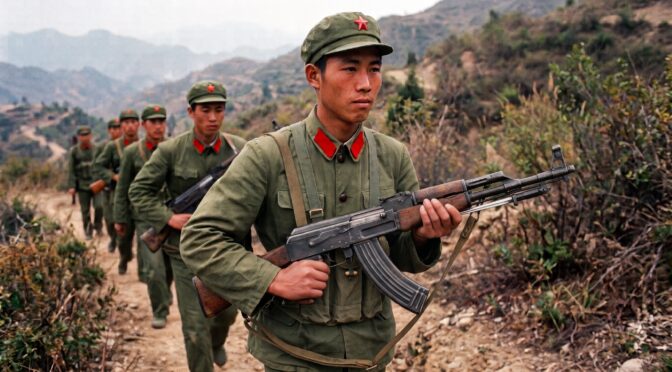
Executive Summary and Naming Boundaries
Between 1956 and the present, China and partner production facilities abroad have built an estimated 10 to 15 million Type 56 assault rifles1. Official Chinese state production totals remain undisclosed, but open-source defense estimates place the Type 56 at roughly one-fifth of the 70 million or more Kalashnikov-pattern rifles made worldwide since 19493. Rather than remaining a direct license copy of the Soviet AK-47, the Type 56 developed into a separate engineering line shaped by the Sino-Soviet split, local steel and stamping methods, and a post-Cold War shift from domestic military production to low-cost export sales6. Over seven decades, manufacturing quality rose and fell sharply: early milled and stamped rifles from the 1950s through the 1980s earned high marks from U.S. Army ordnance evaluators and commercial buyers for tight tolerances and durable construction, whereas post-1994 low-cost export batches of the Type 56-2 have shown peeling bore chrome, weak springs, and inconsistent parts fit6.
Globally, the Type 56 spread through three main channels:
- Factory Transfers, Local Assembly, and Reverse-Engineering: Chinese machinery packages, technical teams, and independent local copies led to national variants in Albania (ASh-78 and ASh-82), Iran (KL-7.62), Sudan (MAZ), Pakistan (POF PK-10), North Vietnam (TUL-1), Bangladesh (local Type 56 assembly), Myanmar (KA2-5), and Algeria (factory technology transfer)1.
- Military Reserve Purchases and Illicit Maritime Smuggling: Foreign governments bought large factory-built lots—such as Finland’s reserve purchase of roughly 100,000 modified Type 56-2 rifles—while maritime smuggling routes moved thousands of newly built Chinese Type 56-1 rifles through Iran into Yemen and Somalia1.
- Regulated Civilian Consumer Markets: National gun laws led Chinese factories to build market-specific semi-automatic models for the United States, Germany, Italy, Switzerland, Canada, New Zealand, Australia, and South Africa14.
Clear model naming is required before comparing specifications. In 1956, the People’s Liberation Army (PLA) adopted three mechanically separate 7.62x39mm squad weapons under the same “Type 56” (56式) year label, and later replaced them with the mechanically different Type 81 series7. Online pricing databases and general inventories frequently mix up these firearms23.
| Designation | Soviet / Foreign Equivalent | Operating Mechanism | Primary Role and Lineage Relationship |
| Type 56 Assault Rifle / SMG (56式冲锋枪 / 56式自动步枪) | AK-47 Type 3 (later Chinese stamped evolution) | Long-stroke gas piston, rotating bolt | Subject of this report. Initially issued in a squad submachine-gun role; standard PLA rifle through the 1980s1. |
| Type 56 Carbine (56式半自动步枪) | SKS-45 | Short-stroke gas piston, tilting bolt | Semi-automatic 10-round infantry carbine made mainly at Factory 26 (520 mm barrel, 1,020 mm OAL, 3.85 kg)22. |
| Type 56 Light Machine Gun (56式班用机枪) | RPD | Long-stroke gas piston, flapper-locked, belt-fed | Squad machine gun; shares 7.62x39mm ammunition and a 735 m/s velocity benchmark, but no mechanical parts with the Type 56 rifle7. |
| Type 81 / Bangladesh BOF BD-08 | Domestic Chinese design (licensed in Bangladesh) | Short-stroke gas piston, rotating bolt | Replaced the Type 56 in front-line PLA service during the 1980s and in the Bangladesh Army in 2008; not a Kalashnikov11. |
Formatting conventions: English-language sources alternate between Arabic (Type 56-1, Type 56-2) and Roman numerals (Type 56-I, Type 56-II); this report uses Arabic numerals throughout. China’s primary State Factory 626 (Qinghua Machinery Factory) stamped /66\ inside a triangle on its receivers and is widely called Factory 66 in Western collector and defense records7. Measurements are given in metric units first (mm, kg, m/s) with imperial equivalents (in, lb, fps) in parentheses where helpful.
Domestic Origins and PLA Engineering Evolution (1955–1991)
Soviet Technical Transfer and the Milled-Receiver Baseline (1955–Late 1960s)
The Type 56 began under mid-1950s Sino-Soviet defense agreements. Starting in August 1955, the Soviet Union supplied complete AK-47 Type 3 technical packages—recorded in Chinese factory histories as 781 volumes of engineering drawings and specifications—alongside machinery and on-site advisers1. Soviet engineer Barinov worked in China from January 6, 1956, to June 6, 1957, to establish mass production at State Factory 626 in Bei’an, Heilongjiang Province, a former Shenyang gun plant relocated northward in 1950 during the Korean War7. Operating inside cracked World War II-era Japanese brick barracks that had previously built PPS submachine guns and Tokarev pistols, Factory 626 completed its first 5,000 rifles by November 1956—assembling the first 1,000 from imported Soviet parts—before moving to a 50,000-rifle quota in 19577.
Under lead Chinese engineer Zhao Ruizhi (赵瑞之), early production followed Soviet Type 3 milled-receiver drawings closely for roughly a decade, using machined steel receivers, threaded-in barrels, and free-floating firing pins while substituting Chinese characters for Cyrillic fire-selector markings36. Initial Soviet-parts-assembled rifles and early domestic milled runs kept the Soviet open-ear front sight guard and either omitted a bayonet or used a fixed lug for a Chinese copy of the detachable Soviet 6Kh2 blade bayonet (56式扁刺)7. Official PLA technical manuals list service ballistics for the 415 mm-barrel (16.3 in) Type 56 at 710–730 m/s (2,329–2,395 fps) muzzle velocity, 600 rounds per minute (RPM) cyclic rate, 400 m effective range (275 m point-blank range), and 100 m penetration through 6 mm steel plate, 150 mm brick, 300 mm earth, or 400 mm timber, with lethal reach extending to 1.5 km26.
Independent military testing confirmed the high manufacturing standard of this early run. In November 1964, the U.S. Army’s Springfield Armory completed a comparative technical report (Comparison of 7.62-MM Assault Rifles Chinese Communist Type 56 and Soviet Model AK) evaluating a Vietnam-captured milled Type 56 beside a circa-1954 Soviet Tula AK-477. Ordnance engineers found that both rifles showed strong craftsmanship, surface finishes comparable to U.S. military standards, and tight tolerances within 0.005 to 0.013 mm (0.0002 to 0.0005 in), indicating close parts interchangeability7. Decades later, field armorers inspecting surviving early milled Factory 626 rifles in Iraq and Afghanistan still marked them in inspection logs as “M.B.” (“Milled Beauties”)7.
Russian and Chinese technical sources note one important early metallurgical limitation: some initial Type 56 production omitted chrome plating in the barrel bore, gas piston, and bolt group, which reduced corrosion resistance and shortened barrel life when firing corrosive-primed 7.62x39mm ammunition43. Chinese arsenals subsequently standardized 50BA barrel steel and flow chrome plating across the Type 56 family, making chrome-lined chambers and bores standard on later military and commercial runs31.
Doctrinal Shifts, Third Front Dispersal, and the 1965–1966 Updates
In its early years, the PLA did not issue the Type 56 as a standard rifle for every infantryman. In a typical nine-man PLA squad of the late 1950s, seven riflemen carried the semi-automatic Type 56 SKS carbine for aimed fire, while only the squad leader and assistant squad leader carried the Type 56 “submachine gun” for close-range automatic fire, replacing the Type 54 SMG1. Lessons from the 1962 Sino-Indian border conflict and Southeast Asian jungle combat led the PLA to increase the ratio of Type 56 automatic rifles inside infantry squads, though some SKS carbines remained in service for longer-range fire through the 1979 Sino-Vietnamese War26.
Field reports from the 1962 border clash also prompted the recognizable 1965–1966 Type 56 updates37:
- Fully Enclosed Circular Front Sight Hood: Soldiers under combat stress sometimes mistook the Soviet-style open side-ear sight guards for the aiming post; Chinese engineers enclosed the guard into a full circular ring with a top light and adjustment hole26.
- Integral Folding Triangular Spike Bayonet (“Spiker”): Drawing on Korean War experience where flat knife bayonets had difficulty penetrating thick winter clothing, engineers mounted an underfolding three-fluted (triangular) spike bayonet (三棱刺刀)—adapted from the Type 56 SKS hinge—directly to the Type 56 assault rifle’s front sight base8.
At the same time, worsening Sino-Soviet tensions—which escalated into the 1969 Damansky Island border clash—highlighted the exposed location of Bei’an’s Factory 626 near the Soviet border7. Under China’s “Third Front” (Sanxian) industrial dispersal program, Factory 626 transferred skilled workers and manufacturing data to several secondary plants in remote interior and southern provinces37. Early Type 56 rifles built at Fujian’s Factory 386 initially failed to reach the PLA’s 15,000-round service-life requirement until veteran Factory 626 machinists corrected the production defects37.
Chinese State Arsenal Codes and OSINT Marking Guide
Because build quality, receiver type, and export dates vary by factory, analysts and armorers use arsenal stamps and selector markings to identify rifle origin.
| Arsenal / Marking | Location and Status | Primary Production and Identification Notes |
| Factory 626 (66 in triangle) | Bei’an, Heilongjiang (Qinghua Machinery Factory); transferred to Shougang Group (1988), bankrupt/restructured 2005–200633 | Primary Type 56 blueprint factory (about 9 million total firearms built across all models); built early milled Type 56s, Type 56-1s, and major Norinco pre-1989 56S commercial exports7. |
| Factory 386 (386 in oval/circle) | Longyan, Fujian (renamed Hualong 1988, liquidated 2002; lines merged into Factory 313)37* | Started with Factory 626 technicians (circa 1963); dual-produced “Fairy” bicycles and 105-step milled receivers (PolyTech Legend, milled MAK-90/91, Norinco Hunter)37. |
| Factory 416 (416 in triangle) | Shandong (Qingdao per Small Arms Survey)60 | Main producer of stamped PolyTech AKS-762 commercial rifles (including spikers) and select Norinco SILE imports61. |
| Factory 313 (313 in oval) | Yong’an, Fujian (Fujian Ordnance Equipment Co., founded 1958; active)18 | Absorbed Factory 386 lines; produces contemporary Type 56, 56-1, and 56-2 military exports (UN traces in Niger and DRC) and modern South African civilian Type 56S rifles18. |
| Factories 26 and 36 (26 or 36 in triangle) | Chongqing (Factory 26 Jianshe) / Longyan (Factory 36 per Small Arms Survey)27 | Factory 26 was China’s primary SKS plant; both factory codes also appear on Type 56, 56-1, and 56-2 assault rifles documented in Rwanda and Central Africa66. |
| Min Shan, Ling Hua, and Jing’an | Chinese commercial and security plants67 | Built early 1983–1984 U.S. commercial imports: Clayco Sports (Min Shan, Ling Hua) and Golden State Arms Distributors (Jing’an)67. |
| Selector and Export Stamps | Receiver right and left walls2 | PLA Domestic: 56式 plus 连 (full-auto) / 单 (semi-auto). Military Export: Latin L / D (unmarked Vietnam-era aid stamped M22 without a factory triangle). Civilian Export: two-position S / F2. |
Note on archival discrepancy: A Small Arms Survey tracing working paper places Factory 36 in Longyan and Factory 386 in Shenzhen60, whereas both Garry James’s 1987 on-site factory tour and Chinese industry interviews with former Factory 626 workers locate Factory 386 in Longyan, Fujian37.
The Type 56-1 Underfolder, Chinese Stamped Receivers, and the 1969 Rejection Crisis
Although China received AKS-47 blueprints in 1955, PLA airborne and mechanized troops initially carried imported Soviet underfolders55. After Soviet assistance stopped, China declined to buy ready-made Soviet AKMS rifles with foreign currency and directed Factory 626 to begin domestic underfolder production in 1963 as the Type 56-126. Early Type 56-1 rifles used milled receivers before shifting to stamped steel in the late 1960s1. Compared with the Soviet AKMS, the stamped Type 56-1 incorporates structural simplifications enabled by China’s thicker receiver sheet: its thicker stamped steel stock arms carry fewer reinforcing ribs and detents, lock only on the left side, angle downward like the earlier AKS-47, and omit both the AKMS pistol-grip reinforcement plate and a full rear trunnion in favor of a simpler end-cap block72. While baseline military Type 56-1 rifles generally dropped the folding bayonet to make carrying easier, some military rifles documented by Small Arms Survey and Russian reference sources—as well as commercial Type 56S-1 imports—kept an underfolding spike bayonet1. Issued rapidly to front-line troops ahead of the 1979 Sino-Vietnamese War, the Type 56-1 drew PLA combat complaints for uncomfortable shoulder ergonomics and heavy stock-hinge wobble after extended service, which reduced practical accuracy37.
China’s shift from milled steel blocks to stamped-and-riveted sheet metal took place without Soviet technical support or access to the 1959 Soviet AKM blueprints8. Between 1964 and 1967, while heading China’s “Project 55” small-arms factory construction team in Albania, lead engineer Zhao Ruizhi inspected Soviet AKM rifles directly and saw the steel savings, lower cost, and reduced weight of stamped-riveted receivers26. Returning to China in 1967, Zhao led development of a Chinese stamped Type 56 receiver37.
Rather than matching the Soviet AKM’s 1.0 mm sheet metal, Chinese engineers chose 1.5 mm nominal sheet steel (often measuring 1.5–1.6 mm on commercial rifles) paired with an RPK-style staggered front-trunnion rivet layout8. Small arms analysts generally view this thicker gauge as a safety margin against uneven steel quality and heat treatment across newer Chinese factories—similar to the USSR’s early 1949 Type 1 stamping problems8. Even with thicker sheet steel, initial stamped-riveted mass production in 1969 ran into a major quality failure: severe defects caused the PLA to reject more than 100,000 early stamped Type 56 rifles, transferring those lots to militia units37. Zhao Ruizhi led an emergency metallurgy program that developed a low-silver copper-silver alloy and joining method—receiving China’s National Invention Award (Third Class) in 1983—which resolved the manufacturing defects and stabilized mass stamped production37. Unlike the Soviet military, which introduced the “AKM” name when moving to stamped receivers, China kept the “Type 56” and “Type 56-1” names across both milled and stamped runs43.
Late-Cold War Evolutions (1980–1991)
Even as the PLA began replacing the Type 56 in front-line units with the Chinese-designed short-stroke-piston Type 81 during the 1980s, state factories developed four notable late-Cold War variants of the Type 56 platform31:
- Type 56-2 Sidefolder (1980): Built chiefly for export (with limited domestic PLA artillery and airborne issue), the Type 56-2 replaced hardwood with dark orange fiberglass-reinforced phenolic resin (often called “bakelite” by collectors) handguards and pistol grip, added optional compatibility with detachable AK-47 and AKM knife bayonets (including Chinese copies of the Soviet 6Kh4 / Type 86 bayonet), and introduced a rigid right-side-folding steel buttstock that solved the Type 56-1’s hinge wobble6. Unlike Soviet AKMS and Warsaw Pact folding stocks, Chinese engineers placed a concealed cleaning kit directly inside the folding stock behind a punch-depressed retaining pin6. One documented field drawback is heat retention: shooters report that phenolic resin handguards trap firing heat and sunlight more noticeably than wood6.
- 5.56x45mm Export Rifles (Type 56-3/56-4 and Type 84 Series): China entered the 5.56x45mm NATO Kalashnikov export market ahead of Russia’s AK-10152. Open-source references show a naming overlap for the Type 56-3 and Type 56-4: some directories list them as 7.62x39mm fixed-stock and underfolding rifles fitted with Type 56-2 synthetic furniture76, while other defense references and Canadian auction listings identify them as selective-fire 5.56x45mm exports—specifically detailing a Type 56-4 underfolder with a 1:12-inch barrel twist for M193 ammunition, an underfolding spike bayonet, a barrel extending 95 mm (3.75 in) past the front sight with a flush threaded cap, and English “S” and “F” markings2. Alongside them, Norinco offered the dedicated 5.56mm Type 84 line (fixed Type 84, underfolder 84-1, sidefolder 84-2, and matte-black synthetic 84-3, 84-4, and 84-5)1.
- Type 56M Squad Automatic (Export RPK): Produced strictly for export (as the PLA adopted the Type 81 LMG), the Type 56M used a 590 mm (23.2 in) barrel, 1,035 mm (40.7 in) overall length, an RPD-style tubular bipod, and 75-round drums (5.20 kg empty with a box magazine; 5.78 kg with an empty drum; 748 m/s muzzle velocity)1. However, Chinese ordnance commentary notes a key durability trade-off: instead of forging a reinforced bulged RPK front trunnion and heavy receiver, the Type 56M uses a standard Type 56 stamped receiver and front trunnion, limiting sustained-fire life compared with a Soviet RPK37.
- QBZ-56C (Type 56C) Compact Naval Carbine (1991): As the most extensively redesigned military rifle in the Type 56 line, development began in 1988 after the PLA Navy (PLAN) found the 955 mm Type 81 too long for tight submarine and ship compartments and engineers found the Type 81’s short-stroke gas system difficult to shorten29. Rather than simply shortening a Type 56-2 barrel, designers made six coordinated mechanical changes31:
- Shortened High-Strength Receiver: Cut 20.6 mm (0.81 in) shorter, tapered along the bottom edge, and stamped from 1.2 mm high-strength alloy steel (cutting empty weight by nearly 0.9 kg / 2 lb to 2.85–2.93 kg across sources), paired with a shortened three-rib dust cover and redesigned anti-loosening latch1.
- Ballistics-Preserving 279–280 mm (11.0 in) Barrel: Longer than the Soviet AKS-74U’s 224 mm (8.8 in) barrel to retain bullet performance, fitted with a combined gas-expansion chamber and birdcage flash suppressor (limiting velocity loss to 70 m/s [230 fps]—from 720 m/s [2,362 fps] down to 650 m/s [2,132 fps], with Western wikis citing 665 m/s—while raising cyclic rate to 700 RPM and preventing bayonet attachment)1.
- Two-Position Adjustable Gas Regulator: Turned with the rim of a 7.62x39mm cartridge case between Setting “1” (normal) and Setting “2” (fouled or adverse conditions) to maintain reliable cycling with the shorter gas system31.
- Progressive Recoil Guide: Adopted the 5.8x42mm Type 87’s three-piece telescoping recoil guide rod and progressive-rate spring for smoother recoil control31.
- Saltwater Corrosion Protection: Replaced standard hot bluing with a heavy dark parkerized (phosphate) exterior coating over a chrome-plated bore, gas system, piston, bolt, and bolt carrier31.
- Compact Furniture and Sights: Paired black polymer handguards and a 15 mm (0.59 in) shorter steel-and-polymer side-folding skeleton stock with Type 81-style hooded front sights and square-hooded 100–300 m tangent rear sights31. At an estimated $300 USD unit cost (roughly three times a standard export Type 56), the QBZ-56C entered limited service with PLAN submarine and surface crews, People’s Armed Police (PAP) counter-terrorism, border, jungle anti-narcotics, and Coast Guard units, PLA Special Forces, and selected high-altitude PLA units in Tibet3.
Comparative Engineering and Metallurgical Analysis: Type 56 vs. Soviet AK-47/AKM
Because Chinese factories moved from the milled AK-47 Type 3 to stamped construction without Izhevsk’s AKM blueprints, a stamped Type 56 is a mechanical hybrid of AK-47, AKM, RPK, and local Chinese components8. Treating a stamped Type 56 as an interchangeable AKM copy is a frequent source of error in armory work and parts procurement.
| Engineering Subsystem | Chinese Stamped Type 56 (Post-1969 Pattern) | Soviet AKM (1959 Benchmark) | Operational and Logistics Impact |
| Receiver Steel and Empty Mass | 1.5 mm nominal (1.5–1.6 mm measured) stamped steel; 3.70–3.94 kg empty1 | 1.0 mm stamped steel; 3.10 kg empty (3.60 kg loaded with light-alloy mag)73 | Adds roughly 0.6–0.8 kg mass and stiffness; roughly 1.0 mm narrower interior prevents drop-in AKM stocks25. |
| Front Trunnion Rivets | Staggered RPK-style trunnion rivet pattern26 | Inline horizontal trunnion rivet pattern88 | Primary visual check separating Chinese builds from Soviet, Warsaw Pact, and Iranian rifles87. |
| Barrel Profile and Journal | Heavier AK-47-like mid-profile (15.44 mm / 0.608 in), pressed and pinned; narrower 19 mm trunnion journal72 | Slimmer mid-profile (14.73–14.83 mm / 0.580–0.584 in on clones), pressed and pinned; 23 mm journal83 | Barrels and front trunnions do not interchange between Chinese and Eastern Bloc AKM lines89. |
| Gas Relief Venting | Vent holes drilled directly in gas tube (AK-47 pattern); no upper handguard vent cuts2 | Radial vent notches moved forward to gas block2 | Installing a solid AKM gas tube on a Type 56 eliminates gas relief venting81. |
| Muzzle Interface | Usually unthreaded on military stamped runs (M14x1 LH on early milled and many commercial rifles)3 | Threaded M14x1 LH with slant muzzle compensator83 | Standard military stamped Type 56s cannot mount AKM slant brakes or blank-firing devices3. |
| Sights and Bayonet | Fully enclosed circular front hood; 800 m rear tangent; integral folding triangular spike26 | Open-ear front sight protector; 1,000 m rear tangent; detachable multipurpose knife bayonet63 | Circular hood reduces sight-ear confusion; integral spike removes the need for a separate scabbard37. |
| Top Cover, Recoil Guide, and Optics | Smooth unribbed cover; AKM dual U-shaped wire guide; no side optics plate on standard PLA runs63 | Ribbed stiffened cover; dual U-shaped wire guide; side optics rail on AKMN variants63 | Smooth cover flexes more easily; adding optics requires export rails or aftermarket mounts63. |
| Fire Control and Trigger Guard | AK-47 double-hook trigger (two receiver slots); no hammer-release retarder; 3-rivet trigger guard72 | Single-hook trigger with inertial hammer-release retarder (~600 RPM); 5-rivet trigger guard72 | Omitting the retarder increases full-auto climb; double-hook geometry gives a clean semi-auto trigger pull93. |
| Buttstock and Handguards | More angled AK-47 stock drop; solid hardwood; flat slab-sided lower handguard with front metal ferrule2 | Straighter hollowed laminated-birch stock; lower handguard with palm swells2 | Straighter AKM stock geometry reduces vertical muzzle rise during automatic bursts2. |
| Finish and Bolt Carrier | Hot-blued receiver; unfinished bright (“in the white”) or chromed carrier (blued/phosphate exceptions on some early commercial guns)31 | Black oxide or paint over phosphate; blackened lightened bolt carrier63 | Hot bluing rusts faster in humid climates without oiling; carriers omit the AKM lightening cut9. |
Six practical engineering points govern parts interchangeability, maintenance, and ballistic assessment across the Type 56 line:
- Internal Receiver Width and Stock Incompatibility: Because 1.5 mm sheet walls narrow the interior receiver cavity by about 1.0 mm compared with a 1.0 mm AKM—and Chinese rear trunnions use different rivet spacing and tang shapes—standard Eastern European wood furniture and common American polymer stocks (such as Magpul Zhukov folders) do not fit Chinese Type 56S or MAK-90 rifles without hand-fitting or Chinese-specific adapters72.
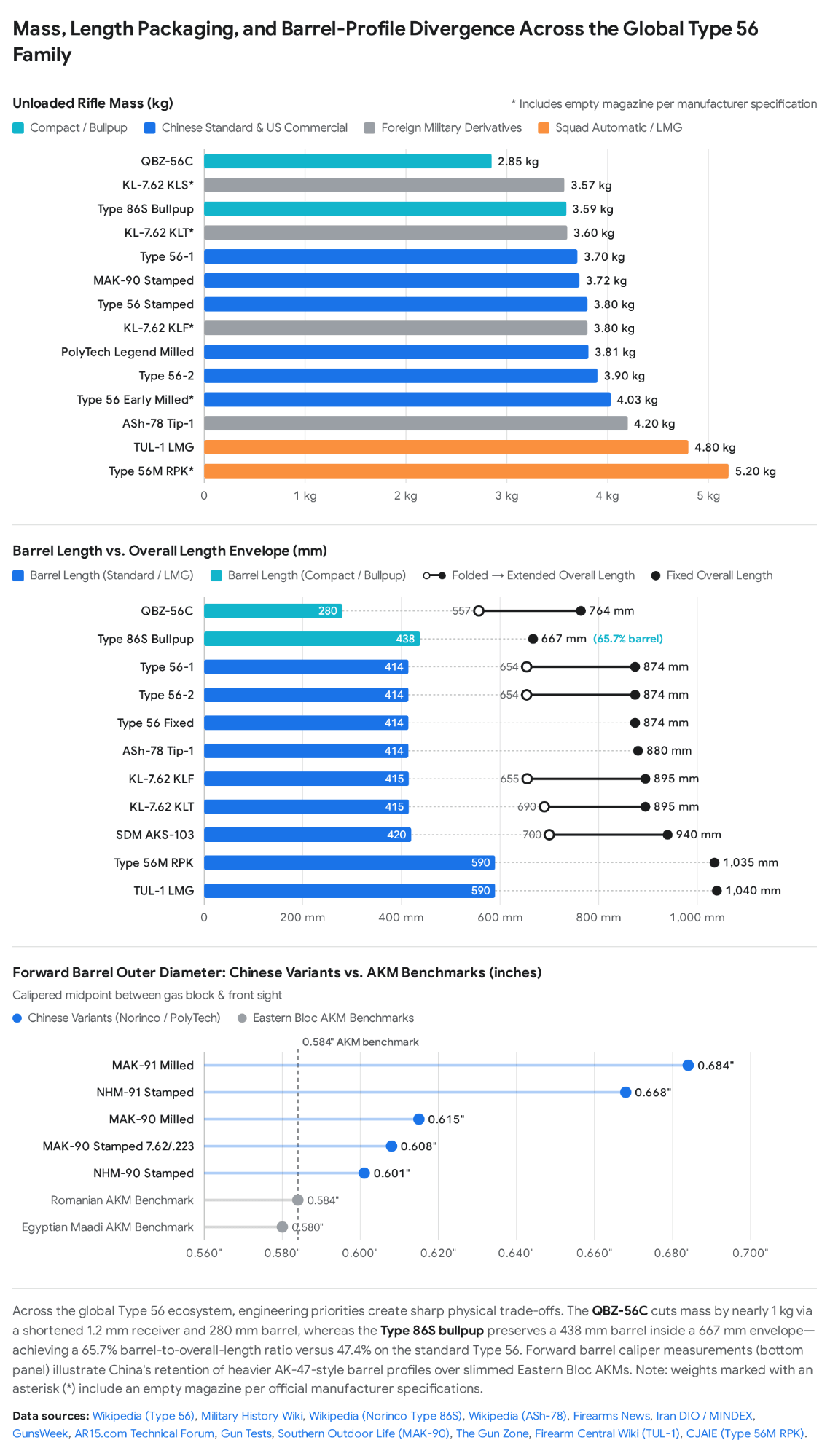
- Heavier Forward Barrel vs. Narrower 19 mm Journal: Caliper measurements midway between the gas block and front sight show consistently thicker Chinese forward barrel walls (15.44 mm / 0.608 in on stamped MAK-90s and 15.62 mm / 0.615 in on milled MAK-90s versus 14.73 mm / 0.580 in on Egyptian Maadis and 14.83 mm / 0.584 in on Romanian AKMs)59. At the rear, however, the chamber end of a Chinese barrel steps down to a narrower 19 mm barrel journal (the machined cylindrical shank pressed into the steel front trunnion block that locks the bolt) with a smaller cross-pin, compared with the 23 mm journal standard on Soviet and Romanian AKMs (or 22 mm on Bulgarian builds), preventing direct barrel swaps without lathe machining89.
- Double-Hook Trigger vs. Missing Rate Reducer: Secondary wikis often mislabel the Type 56 mechanism a “double-hook disconnector”72. Mechanically, the trigger itself carries two hooks pivoting through two slots in the receiver floor (inherited from the milled AK-47), whereas the Soviet AKM dropped one trigger hook to make room on the axis pin for an inertial hammer-release delay device (retarder) that lets the bolt carrier settle in battery92. Omitting the retarder alongside a more angled stock and unthreaded muzzle increases full-auto climb, while in civilian semi-automatic models the double-hook trigger delivers a clean factory pull (measured at 4.2 to 4.5 lb on tested PolyTech Legends)47.
- Muzzle Velocity Mix-Up (710–730 m/s vs. 735 m/s): Chinese military manuals list 710–730 m/s muzzle velocity and 600 RPM cyclic rate for the 415 mm-barrel Type 56—close to the Soviet AKM (715 m/s, 600 RPM) and independent testing benchmarks (720 m/s / 2,362 fps)26. English-language wikis commonly print 735 m/s and 650 RPM, mixing up the assault rifle’s muzzle velocity with that of China’s longer 520 mm-barrel Type 56 SKS carbine and Type 56 RPD LMG1.
- Corrosion Resistance of Hot Bluing: Outside of the parkerized QBZ-56C and matte-coated SDM exports, traditional hot-blued Chinese receivers offer lower rust resistance in humid or coastal settings than Soviet phosphate-and-paint coatings unless regularly oiled9.
- Notable Chinese Magazine Designs: Chinese flat-back (“smooth spine”) steel magazines removed the sharp rear weld ridge found on European AK magazines so they slide more smoothly from pouches, and Chinese hinged-back 75-round drum magazines open from the rear for faster loading without pushing rounds against mainspring tension105.
The multi-panel technical chart below compares unloaded mass, barrel-to-overall-length packaging ratios, and calipered forward barrel diameters across Chinese, foreign-derivative, and Eastern Bloc benchmark rifles.
Post-1994 Export Quality Decline and Modernized Export Variants
Armorer evaluations of Chinese Kalashnikovs split sharply around 1994. Three industry shifts converged in the early 1990s: the PLA ended Type 56 procurement as it transitioned to the Type 81 and later the 5.8x42mm QBZ-95 bullpup; the end of the Warsaw Pact put large stocks of inexpensive surplus Eastern European AKMs onto the world market; and the May 1994 U.S. munitions embargo closed China’s largest commercial firearms buyer, which small arms specialist Vladimir Onokoy notes had taken up to two million Chinese firearms per year6.
Already shrinking as domestic military orders dropped, Factory 626 (Qinghua / Factory 66)—which had built about 9 million firearms across its history and stopped a partial 1980s relocation to Xuchang (Factory 126)—was transferred on June 23, 1988, along with 12 other Norinco-linked plants to state-owned Shougang Group (renamed Shougang Qinghua Tool Factory) under China’s military-to-civilian conversion program35. Without U.S. rifle exports after 1989–1994, the plant entered policy bankruptcy and restructuring in 2005–2006, and its Bei’an site was later preserved as a military-industry heritage museum35.
Remaining export plants—led by Factory 313 in Yong’an, Fujian, which absorbed Factory 386’s lines after 2002—kept factories operating by cutting prices on the Type 56-26. By the late 1990s, Chinese exporters offered select-fire assault rifles for as little as $93 USD per rifle; as recently as 2017, bulk 100-rifle lots remained available directly from China at $120 USD each6.
That low price point led to major drops in metallurgical and assembly quality control. Field inspections across Somalia, Iraq, and Afghanistan documented recurring defects in late-1990s through 2020s low-cost export Type 56-2 rifles6:
- Early Chrome-Lining Peeling and Poor Accuracy: Unlike earlier Chinese rifles, low-cost modern export barrels often have thin, poorly bonded bore chrome that begins peeling after a few hundred rounds, widening shot groups beyond those of worn Romanian AKMs with loose folding stocks6.
- Loose Bolt Pins and Weak Extractor Springs: Firing pins and retaining pins often fall out of bolt assemblies during basic field stripping; in one recorded case, a loose firing pin dropped into the folding-stock hinge recess and jammed the bolt carrier6. Factory extractor springs repeatedly arrived under-tensioned—resembling weak “ballpoint pen springs”—producing extraction stoppages across several conflict regions6.
- Uphill Firing Stoppages and Maintenance Limits: Soldiers using late-production Type 56 rifles in mountain warfare reported frequent feeding and firing stoppages when shooting uphill at steep angles, leading at least one customer country to replace its Chinese AKs6. Many budget export rifles also feature non-removable front sight posts (blocking routine pin repairs), thin coatings that wear off from trigger-finger contact, and no factory guarantee of full parts interchangeability between individual guns6.
Modernized Export Configurations and Counterfeit-Marked Chinese AK-103s
Over the past decade, Norinco and affiliated exporters offered updated Type 56 configurations for budget-minded buyers seeking accessory rails. Displays at the IDEX defense show in Abu Dhabi included an updated Type 56-2 combining quad Picatinny handguards and side rail mounts with classic red wooden stocks, alongside the Type 56-1A1, which adds railed handguards and a folding AR-15-style collapsible stock88.
In conflict zones, inspections in Yemen (starting as early as 2020) and Somalia identified Chinese AK-103 lookalikes88. While China studied genuine Russian AK-103 rifles received with Sovremenny-class destroyers in the 1990s and developed a direct Chinese copy named CS/LR-11, low-cost export rifles appearing in the Red Sea and Horn of Africa are altered Type 56 rifles stamped with counterfeit Russian emblems37. Armorer inspection highlights four clear markers88:
- A fake Russian Izhmash “arrow-in-triangle” mark stamped onto the rear sight block (where Izhmash does not place factory stamps) alongside an “AK 103” rollmark.
- An older 45-degree gas block (instead of the Russian AK-103’s 90-degree gas block) paired with a thick-stemmed AKM-era bolt and traditional Chinese magazine release lever.
- Chinese staggered front-trunnion rivets, Chinese “L” and “D” export selector markings, and an 800 m rear sight marked “D.”
- Rough exterior build quality, including glossy black paint, non-standard muzzle-brake geometry, and a noticeably loose folding stock88.
Global Military Proliferation, Technology Transfers, and Foreign Derivatives
Chinese small arms exports went beyond finished rifles: Beijing transferred factory machinery and technical teams to partner nations, while unlicensed reverse-engineering, local assembly, military reserve purchases, and illicit maritime transfers distributed Type 56 designs across Asia, Africa, the Middle East, and Europe1.
Albania: The ASh-78 and ASh-82 Family
After Albania split from the Soviet Union—formally leaving the Warsaw Pact in 1968—Tirana turned to China to establish local arms manufacturing8. Starting in 1962, Chinese advisers (including Type 56 lead engineer Zhao Ruizhi from 1964 to 1967) built the Uzina Mekanike Gramsh (UM Gramsh) rifle plant in Cekin, Gramsh, linked within Albania’s state KM Poliçan weapons-and-ammunition combine (Poliçan focused mainly on ammunition, though Western reference catalogs often list both plants for rifle production)50. Local Kalashnikov manufacturing began around 1974 and standardized as the fixed-stock Automatiku Shqiptar 78 (ASh-78) and underfolding ASh-82 (patterned on the Type 56-1), running until 1997 after an early-1990s workforce reduction pause8.
The base ASh-78 Tip-1 copies the stamped Type 56 complete with folding spike bayonet and 800 m rear sight, but shows clear production shortcuts: its stamped receiver omits magazine-well dimples, uses minimal fire-selector markings (“A” for automatic, “1” for single, and no safe mark), and carries only a six-digit serial hyphenated with a two-digit production year (such as 032659-86) with no factory or country stamp53. Open-source defense catalogs disagree on sub-model labels: Martin Brayley and standard AK references list the ASh-78 Tip-2 as a heavy-barreled RPK-style squad automatic (cited in secondary wikis with barrels up to 660 mm / 26 in) and the ASh-78 Tip-3 as the rifle-grenade model84, whereas Jane’s Infantry Weapons (Jones and Ness) and Wikipedia’s ASh-78 entry reverse those two labels—defining Tip-2 as the grenade launcher and Tip-3 as a bipod-equipped modification112. Regardless of numbering, museum disassembly of the grenade-launching variant at the UK Royal Armouries documented an unusual design choice: Albanian engineers extended the barrel itself by roughly 150 mm (6 in) to match the full length of the muzzle grenade spigot, added a front gas cutoff, permanently hinged the dust cover to a redesigned rear sight block with a strengthened rear latch, and moved an SKS-style 1,000 m rear sight onto the dust cover121.
Museum assessments by the Royal Armouries and historian Ian McCollum rank the ASh-78 among the roughest factory-built Kalashnikovs ever fielded, noting crude machining, poor bluing, and heavy mass (4.20–4.30 kg on the Tip-1; secondary wiki claims of 5.2 kg for the base rifle are overstated)10. Following Albania’s 1997 civil unrest, looted military depots distributed ASh-78 rifles widely to Kosovo Liberation Army (UCK) and Bosnian fighters, and Albania later exported 30,600 surplus ASh-78 rifles to Afghanistan across 2002 and 2010 transfers8.
Iran: Evolution of the DIO KL-7.62 and Type 56-1 Maritime Smuggling
Iran plays two distinct roles in the Type 56 story, building its own evolved derivative while serving as a major maritime transfer point for factory-new Chinese Type 56-1 rifles. Open sources differ on how Iranian production started: analyst Vladimir Onokoy notes China provided small-arms manufacturing technology packages to Iran alongside Sudan and Algeria8, whereas most defense directories classify Iran’s Defense Industries Organization (DIO) KL-7.62 family (Product Code 140) as an unlicensed reverse-engineered copy of Chinese Type 56 rifles bought during the 1980–1988 Iran–Iraq War1.
Iranian KL-7.62 production evolved through three stages:
- Early Copying (1980s–1990s): Initial DIO KL-7.62 rifles closely matched wood-stocked Chinese stamped Type 56s1.
- Polymer and AKM-Hybrid Modernization: DIO later updated the line across three 415 mm-barrel, 600 RPM models—KLS (fixed stock: 890 mm, 3.57 kg with an empty 350 g magazine), KLF (underfolder: 895/655 mm, 3.80 kg), and KLT (sidefolder: 895/690 mm, 3.60 kg; 715 m/s cited in secondary defense literature)—introducing black polymer furniture, a ribbed AKM top cover, a multipurpose bayonet, Picatinny rails on newer runs, and a Russian-style inline front-trunnion rivet pattern (a reliable visual cue separating Iranian KLS/KLF rifles from Chinese builds)1.
- Gradual Replacement in Specialized Units: Within Iranian special forces and select military units, the KL-7.62 is gradually being supplemented or replaced by DIO’s S-5.56 (M16 derivative) and AK-103 / KL-133 rifles123.
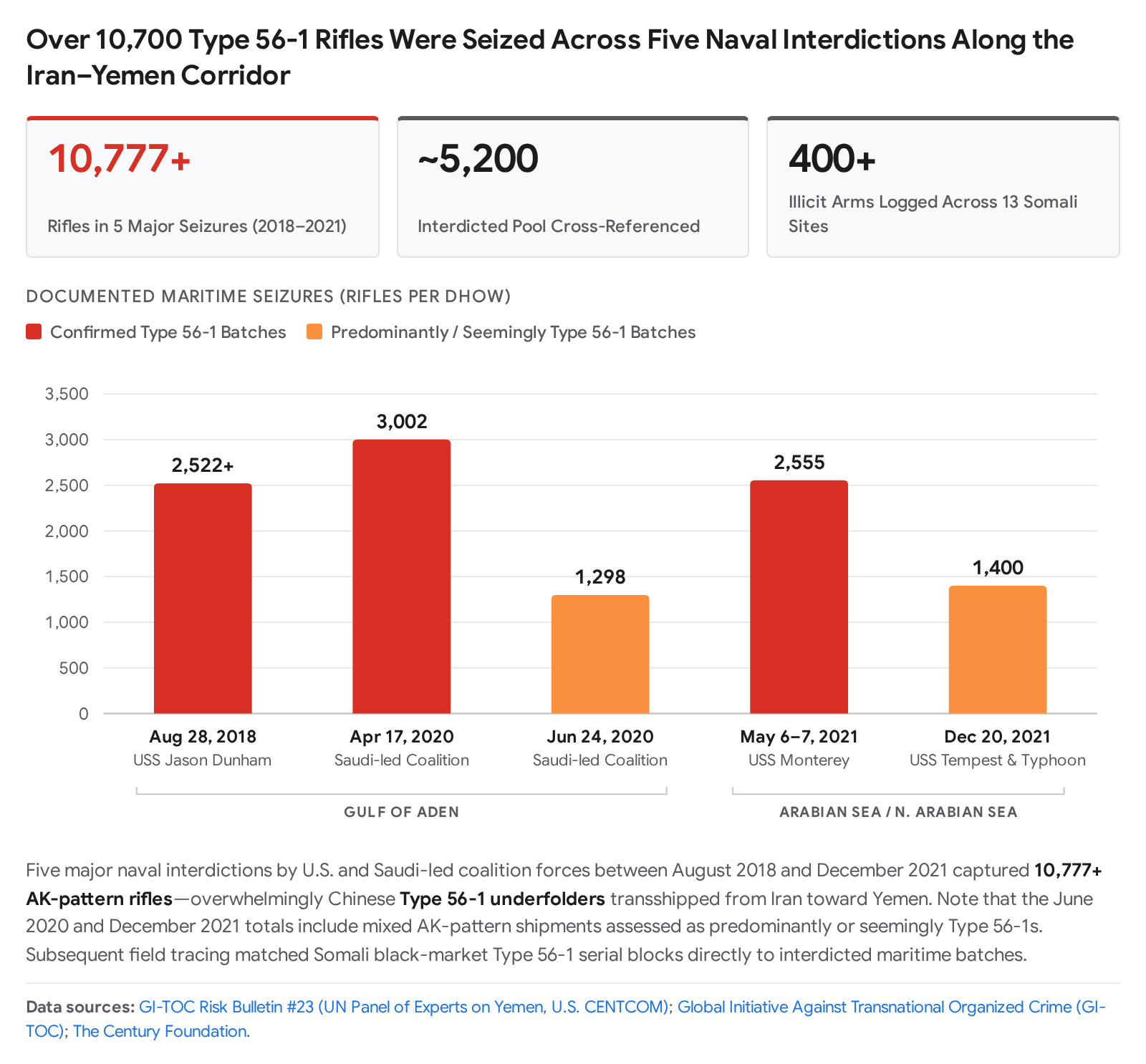
In parallel, investigations by the Global Initiative Against Transnational Organized Crime (GI-TOC), the UN Panel of Experts on Yemen, and U.S. 5th Fleet seizures document a large-scale maritime smuggling network moving factory-built Chinese Type 56-1 underfolders from Iran to Houthi forces in Yemen13. Between August 2018 and December 2021, five major U.S. and Saudi-led coalition naval seizures captured 10,777 or more AK-pattern rifles, predominantly Chinese Type 56-1s13. Because the UN arms embargo on Iran (in effect until October 2020) did not ban small arms and light weapons exports to Tehran, Iran could purchase Type 56-1 lots legally from China before smuggling them southward on stateless dhows across the Arabian Sea and Gulf of Aden13. Secondary trafficking then carried rifles from matching serial blocks across the Gulf of Aden into Puntland and southern Somalia: GI-TOC field teams logged over 400 illicit arms across 13 Somali sites and matched Somali Type 56-1 serial numbers directly against nearly 5,200 rifles seized at sea between August 2018 and May 2021—also documenting over 20 Chinese Type 56 rifles in southern Somalia with altered serial numbers made to look Russian129. The chart below summarizes those five naval seizures.
Sudan, Algeria, and Sub-Saharan African Tracing
Using Chinese-supplied machinery, Sudan’s state-run Military Industry Corporation (MIC) in Khartoum set up local production of a stamped Type 56 copy with an underfolding bayonet designated the MAZ (catalog code ACY01)1. MIC catalogs retain China’s original 1956 category name, listing the MAZ as a “7.62×39 mm Sub Machine Gun” alongside locally manufactured MAZ 7.62x39mm ammunition (710 +/- 15 m/s; maximum pressure up to 300 MPa) from Khartoum’s El Shajara Ammunition Plant132. Exact rifle dimensions and independent endurance testing for Sudanese MAZ rifles are not available in public sources, and Small Arms Survey notes that whether formal licensing agreements cover MIC’s Chinese- and Iranian-derived small arms remains unclear134. Likewise, although open-source defense analyses report Chinese small-arms factory transfers to Algeria, public specifications and quality evaluations for Algerian production are unavailable8.
Across sub-Saharan Africa, UN Panels of Experts, Conflict Armament Research (CAR), and Small Arms Survey have documented Chinese Type 56, Type 56-1, and Type 56-2 rifles bearing Factory 26, 36, 66, 386, and modern Factory 313 stamps across Sudan, South Sudan, Rwanda, Niger, the Central African Republic, and the Democratic Republic of the Congo60. In South Sudan (2011–2012), rebel groups (SSDM/A and SSLM/A) supplied by Khartoum carried Chinese Type 56-1 rifles loaded with Sudanese-made 7.62x39mm ammunition60.
Finland: The 7.62 RK 56 TP Reserve Adaptation
In 1992, seeking an affordable wartime reserve rifle compatible with the 7.62x39mm logistics of its domestic Valmet/Sako RK 62, the Finnish Defence Forces (FDF) purchased roughly 100,000 Chinese Type 56-2 side-folding rifles under the designation 7.62 RK 56 TP (taittoperä, folding stock), joining East German AKM reserves (RK 72) in a combined pool of roughly 200,000 imported reserve rifles12. To ensure reliable ignition with Finnish military 7.62x39mm ammunition, Finland specified a factory-installed replacement hammer spring fitted in China before delivery1. FDF small-arms manuals (Kevytasekäsikirja 2004 / 2019) document retention of the Type 56-2’s internal buttstock cleaning kit, standard zeroing procedures, and mounting options for optical sights, tactical lights, and lasers via external brackets139. Following reserve service, the 7.62 RK 56 TP rifles moved into long-term strategic storage1.
Pakistan: Institutional Evolution, POF PK-10, and Khyber Pass Identification
Pakistan operates one of the largest active Type 56 fleets outside China, showing a clear multi-decade progression:
- 1960s–1970s: Induction of early milled Type 56 rifles followed by stamped Type 56 and underfolding Type 56-1 rifles142.
- 1980s–2000s: Widespread issue of the side-folding Type 56-2 across the Pakistan Army, Special Service Group (SSG), Frontier Corps, Pakistan Rangers, and police—locally called an “SMG” because it succeeded Pakistan’s licensed Heckler & Koch MP52.
- 2008–Present: Local production and assembly by Pakistan Ordnance Factories (POF) of a direct Type 56-2 counterpart named the POF PK-10 rifle (formally unveiled alongside the PK-9 pistol at IDEAS 2008; occasionally mislabeled a handgun in secondary online lists), paired with extensive unit upgrades adding Picatinny rails, optics, modular stocks, and Soviet GP-25 40 mm under-barrel grenade launchers—even as Pakistan evaluates replacements including Belarus’s VSK-100 and POF’s domestic CW-3910.
Pakistan’s local craft gunmaking trade in Darra Adam Khel and the Khyber Pass also provides a practical authentication rule: while artisanal workshops routinely build soft-steel copies of Soviet AK-47s and AKMs, field armorer Vladimir Onokoy reports that they generally did not copy Chinese-character receiver stamps (56式, 连/单), making factory Chinese characters a useful indicator of genuine state-arsenal production in South and Central Asia8.
Vietnam, Bangladesh, Myanmar, and Russian/Soviet Technical Assessments
- Vietnam (Type 56 Aid to TUL-1 Evolution): During the Vietnam War, Chinese shipments—including unmarked M22 milled Type 56 export rifles—appeared more frequently in U.S. captures than Soviet AK-47s and AKMs, later leaving Chinese and Vietnamese troops using identical Type 56 rifles against one another during the 1979 Sino-Vietnamese War3. Facing shortages of Soviet RPK light machine guns, North Vietnam’s Z1 (now Z111) factory built the TUL-1 (Tự Lực, “Self-Reliance”) by combining a 590 mm barrel, RPK clubfoot stock, and RPD sights (1,040 mm OAL, 4.80 kg unloaded, 600 RPM, 745 m/s)1. Open-source timelines differ slightly on its end date: standard references date output strictly to 1970–1974 before licensed Soviet RPK tooling arrived1, whereas archival studies note pre-1974 units built on milled Chinese Type 56 receivers followed around 1974 by a smaller stamped run into the mid-1970s150. Those locally stamped TUL-1 bodies used 1.0 mm steel rather than the Soviet RPK’s 1.5 mm while weighing more and firing slower than an RPK1.
- Bangladesh (BOF Type 56 Assembly to BD-08 Evolution): Chinese assistance in the late 1960s established Bangladesh Ordnance Factories (BOF) in Gazipur, which locally assembled Type 56 assault rifles and license-built the Type 56 SKS carbine until 200611. Under a 2004–2008 modernization program, BOF shifted standard Bangladesh Army rifle output to the BD-08 (plus optics-equipped BD-08 MK-II and BD-15 LMG; 955 mm OAL, 445 mm barrel, 3.25–3.50 kg, 700 RPM, 750 m/s), a licensed variant of China’s short-stroke-piston Type 81 rather than a Type 56 Kalashnikov—though BD-08 and Type 81 rifles accept Type 56 magazines without engaging the bolt hold-open, whereas notched Type 81 magazines do not fit Type 56 rifles11. Legacy Type 56 assault rifles remain in widespread service with Bangladesh’s armed forces and Border Guard Bangladesh11.
- Myanmar (Non-State Polymer Clone): In Kachin State, the Kachin Independence Army (KIA) produces the KA2-5, a local clone of the Norinco Type 56 equipped with black polymer furniture, folding-stock options, and polymer waffle magazines (separate from the KIA’s polymer M23 clone of the Type 81)1.
- Russian and Soviet Technical Assessments: Soviet troops encountered Chinese Type 56 rifles during the 1969 border clashes and throughout the 1979–1989 Soviet–Afghan War, where Pakistan supplied Chinese small arms to the mujahideen and later the Taliban1. Soviet soldiers often reused captured Chinese canvas Type 56 chest rigs, soaking them in water to stretch the three pockets to hold six AK-74 magazines26. Technically, Russian small-arms historians and technical forums recognize early milled Type 56 workmanship while criticizing stamped export batches for unchromed early bores, looser steel-grade controls than Izhevsk standards, occasional trunnion and rivet loosening, and the 0.6–0.8 kg weight penalty of China’s 1.5 mm receiver over the 3.10 kg Soviet AKM25.
Global Consumer Markets and Regulatory Engineering
Outside military sales, the Type 56 went through a parallel series of design changes driven by civilian import rules, sporting-purpose tests, and national firearms laws.
United States (1983–1994): From $75 Imports to Post-Ban Sporters and Embargo Collectibles
Semi-automatic Type 56 rifles entered the U.S. consumer market around 1983, selling for roughly half the price of Finnish Valmets and Egyptian Maadis: AK builder Jim Fuller recalls wholesale pallet pricing near $75 per rifle and shop prices around $150 (with buyer records noting ~$325 in 1987 for milled PolyTech spikers), paired with 3–4 cent/round Chinese ammunition6. U.S. consumer models divide cleanly across the 1989 and 1994 federal import restrictions.
Pre-1989 Commercial Imports (1983–March 1989)
- Early Importers (Clayco, GSAD, B-West): Clayco Sports (1983–1984; Min Shan and Ling Hua factories) imported stamped rifles featuring safety warnings stamped on the dust cover, open-ear front sights, blued or gray-phosphate carriers, and black or green-tinted synthetic furniture67. Golden State Arms Distributors (GSAD) (1984; linked to Jing’an production) brought in minimally marked fixed-stock and underfolding rifles frequently purchased by film studios, followed by B-West in 1984–198568.
- Norinco Type 56S Series: Built mainly at Factory /66\ on 1.5 mm stamped receivers, Norinco’s line spanned fixed wood (56S), underfolder (56S-1), orange phenolic sidefolder (56S-2), fixed phenolic (56S-3), and a U.S.-only 56S Galil-style sidefolder, keeping threaded muzzles, bayonet lugs or folding spikes, and double-hook triggers1.
- PolyTech AKS-762 and the Milled Legend AK-47/S: Imported by Keng’s Firearms Specialties (Atlanta), Poly Technologies (PolyTech) built a strong reputation among U.S. buyers for consistent fit and finish62. While stamped AKS-762 rifles came largely from Factory 416 (often as spikers), the milled PolyTech Legend AK-47/S—imported only in 1988–1989 from Factory 386 in Longyan—was machined from a solid ordnance-steel ingot in 105 separate steps47. During his 1987 tour of Factory 386, Guns & Ammo editor Garry James observed interwar machine tools, manual eyeball-and-wheel barrel straightening, two-stage inspection stations, mahogany-stained chiu wood stocks, chrome-plated magazine followers, and rested 100-yard (91 m) factory groups of 95–108 mm (3.75–4.25 in)47. Mechanically, the Legend is a commercial hybrid rather than an exact Soviet Type 3 copy: alongside its milled receiver, open-ear front sight, and Type 1 bayonet lug, it uses a 19 mm pressed-and-pinned barrel, a spring-loaded firing pin, a 4.2–4.5 lb double-hook trigger, a three-rivet trigger guard, and a stamped recoil guide rod1. A scarce Legend National Match version added a longer, hand-selected, air-gauged barrel1.
- Norinco Type 84S / PolyTech AKS-223 (5.56x45mm): Built on 1.5 mm stamped receivers (416 mm / 16.4 in barrel, 3.80–3.90 kg empty, birdcage flash hider, fixed/-1/-2 and black synthetic -3/-4/-5 models), physically measured commercial 84S and 5.56mm MAK-90 barrels most often show 1:9-inch rifling twist (stabilizing 55 gr and 62 gr loads), alongside 1:12-inch twist on early M193-spec barrels2. Its main feeding limitation stems from omitting a receiver-mounted bullet guide in the front trunnion: Chinese designers used the front wall of the magazine itself as the feed ramp, forcing reliance on scarce proprietary Chinese steel 5.56mm magazines ($100+ for 30-rounders; $200+ for 40-rounders) and causing nose-diving jams with unmodified AK-74 or Bulgarian magazines169. Although fitted with a spring-loaded firing pin to prevent slam-fires (unintended ignition from firing-pin inertia on softer commercial .223 primers), owners also report occasional double-firing when light firing-pin or sear springs weaken or shift out of position172.
- Norinco Type 86S Bullpup: Developed from Norinco’s 1983 WTC-1 and WTC-2 prototypes and shown at the January 1989 SHOT Show, imports ended within weeks under the Bush import suspension (estimated U.S. imports range from 500 to 2,000 rifles)173. Built on a stamped 7.62x39mm Type 56 chassis, it placed a 438 mm (17.25 in) barrel inside a 667 mm (26.26 in) overall length weighing 3.18–3.59 kg (7.0–7.9 lb), combining a French FAMAS-style carry handle (housing a top charging handle and 100/200/300 m aperture sight), an Austrian Steyr AUG folding foregrip, and a distinctive “fish-head” flash hider173. Instead of a heavy bullpup push-rod, Chinese engineers routed a tensioned silver pull-wire along the right receiver wall to actuate the rear sear, yielding a clean trigger pull174. Although one magazine review described it as keeping the rear AK safety, primary technical references confirm Norinco removed the original rear AK safety lever on the commercial Type 86S and installed a thumb-shaped manual safety on the right side directly above the trigger guard and pistol grip173. Practical drawbacks include a short 229 mm (9.0 in) iron sight radius, right-side-only safety access, and resting the shooter’s cheek directly on a thin stamped dust cover above the bolt carrier174.
The 1989 Import Ban, Post-Ban Sporters, and the 1994 Embargo
On March 14, 1989 (expanded April 5 and finalized in the July 6, 1989 ATF Report and Recommendation on the Importability of Certain Semiautomatic Rifles under 18 U.S.C. § 925(d)(3)), the George H.W. Bush administration halted importation of 43 military-style semi-automatic rifle types that failed the statutory “sporting purposes” test (assessed on military appearance, large magazine capacity, and machine-gun lineage)19. Rifles caught in U.S. Customs warehouses were modified quickly to clear entry: pre-ban model marks (AKS-762, 84S) were milled or X’d out and electropenciled as sporters, bayonet lugs were ground off, muzzle threads were removed or capped, and underfolders were pinned or replaced179.
From 1990 through 1994, Chinese arsenals shipped compliant sporter models:
- Norinco MAK-90 (“Modified AK-1990”): Mechanically a Type 56 fitted with a one-piece wooden thumbhole stock, ground bayonet lug, unthreaded barrel, and 5-round magazine while retaining standard double-stack magazine wells (commonly retailing under $200, with an estimated 600,000 to 1,000,000 imported)46. Stamped MAK-90s (1.5–1.6 mm) arrived with both straight-cut (90-degree rear, typical of later runs with a side Norinco logo and preferred for restoration) and slant-cut (angled rear blocking standard fixed stocks) receivers, whereas milled Factory 386 MAK-90s were almost always slant-cut and require custom stocks59. Under 18 U.S.C. § 922(r)—the U.S. federal rule capping imported countable parts at 10 when assembling a rifle in non-sporting (pistol-grip and standard-stock) form—converting an unthreaded stamped MAK-90 (15 countable parts; 16 if threaded) or milled MAK-90 (14 parts, lacking a separate front trunnion; 15 if threaded) requires replacing 4 to 6 parts with U.S.-made components185.
- Norinco NHM-90 and BWK-92: Post-ban 1.5 mm stamped sporters sold in 7.62x39mm (NHM-90, 406 mm / 16 in barrel with factory M14x1 LH threads on early batches) and 5.56x45mm (NHM-90 assembled on X’d-out Factory 66 Type 84S trunnions with a 451 mm / 17.75 in barrel; BWK-92 with a 419 mm / 16.5 in barrel)179.
- Norinco NHM-91 and Milled MAK-91 (Heavy-Barrel Target Sporters): Imported by China Sports Inc., the stamped 1.5 mm NHM-91 featured a 508 mm (20.0 in; some listings note 21 in), 16.97 mm (0.668 in) mid-barrel chrome-lined heavy barrel capable of 2.0–2.5 MOA accuracy, steel front bipod, thick unvented handguards, E.C. Bishop or Boyd thumbhole stock, tack-welded muzzle nut, and—unlike standard MAK-90s—a small receiver rivet behind the magazine well on many batches blocking standard unnotched AK magazines89. Its scarcer MAK-91 (National Match) counterpart (imported by JPE of Pomona, California, in 1993) paired a milled slant-cut Factory 386 receiver with an unthreaded extra-heavy barrel measuring 17.37–17.40 mm (0.684–0.685 in) mid-barrel—the thickest measured barrel profile among common Chinese commercial AK imports—with documented factory lengths of 457–483 mm (18–19 in) on auctioned National Match rifles (up to 533 mm / 21 in in some owner accounts) and a retail weighed mass of 4.13 kg (9.10 lb)10.
- Norinco Hunter: Combined a milled Factory 386 receiver with a traditional sporting stock (508 mm / 20 in barrel, 1,030 mm OAL, 3.60 kg with an empty magazine, 730 m/s; also imported with 406 mm / 16 in barrels) to meet sporting-purpose criteria59.
On May 26, 1994, alongside China’s Most-Favored-Nation trade renewal, the Clinton administration imposed a federal munitions embargo halting imports of Chinese rifles, handguns, and ammunition (exempting only non-combat sporting shotguns, which remained importable until August 2003 Bush administration missile-proliferation sanctions targeted Norinco)203. U.S. restrictions tightened further under the September 1994 Violent Crime Control Act (which named the Type 86S for 10 years until its 2004 expiration)173, the March 18 / May 1996 Operation Dragon Fire ATF and Customs smuggling indictments involving Norinco and PolyTech representatives208, and heightened scrutiny after illegally converted Type 56S and 56S-1 rifles were used in the 1997 North Hollywood shootout1.
Germany, Western Europe, and Switzerland: Two-Pin SDM Rifles, § 6 AWaffV, and the BWT 47 Dispute
While embargoed in the United States, Chinese commercial Kalashnikovs remain widely sold across Western Europe under the SDM (Sino Defense Manufacturing) and EMEI Firearms brands—distributed by Prima Armi S.r.l. (Italy) and Horner Arms UG (Germany)—debuting broadly at the 2015 IWA trade show in Nuremberg and retailing at entry-level prices of €599 to €899 (700–800 USD typical baseline) in Germany, Italy, France, Belgium, Austria, and Switzerland14.While embargoed in the United States, Chinese commercial Kalashnikovs remain widely sold across Western Europe under the SDM (Sino Defense Manufacturing) and EMEI Firearms brands—distributed by Prima Armi S.r.l. (Italy) and Horner Arms UG (Germany)—debuting broadly at the 2015 IWA trade show in Nuremberg and retailing at entry-level prices of €599 to €899 (700–800 USD typical baseline) in Germany, Italy, France, Belgium, Austria, and Switzerland14.
Unlike converted military Type 56 rifles, modern SDM models are built from scratch on two-pin civilian receivers—omitting the third fire-control axis-pin hole, auto-sear rail cut, and carrier sear trip required for selective-fire operation88. European technical testing notes matte-black stamped receivers thicker than rival Chinese export AKs, CIP (Commission Internationale Permanente) proof-house certification (Gardone, Italy), cold-hammer-forged chrome-lined 415–420 mm barrels, and factory magazines pinned internally to 5 or 10 rounds (up to 30 where permitted) for EU Firearms Directive compliance15. SDM’s catalog has expanded from classic wood-stocked AK-47 CN Series Type 56 (419 mm / 16.5 in barrel, M14x1 LH threads, buttstock cleaning compartment) and underfolding AKS-47 rifles to Russian-styled AK-103 and AKS-103 models (90-degree gas block, 1:9.45-inch 4-groove RH barrel, left-side optics rail, 930–940 / 700 mm OAL), compact AK-104 (319 mm / 12.6 in barrel, AR-15 collapsible stock, railed handguard) and Spetsnaz Black Gen2 models, plus an AKS-74 chambered in .223 Rem / 5.56x45mm NATO (45-degree gas block, 1:7-inch 6-groove RH twist, MP40-style underfolder, tailored to Western European ammunition demand)15. European owners note solid baseline reliability for the price, but also report factory-to-factory quality variance (fixed stocks generally showing cleaner fit and finish than underfolders), consistent overgassing (excessive gas pressure driving the bolt carrier back harshly), and standard utilitarian accuracy104.
European national gun laws govern how these rifles may be purchased:
- Germany — BKA Classification and the § 6 AWaffV 40 mm Case-Length Rule: Under Federal Criminal Police Office (BKA) notice AZ SO11-5164.01-Z337 (September 11, 2015, supported by a May 29, 2015 Federal Ministry for Economic Affairs confirmation), the five 7.62x39mm SDM models covered by the ruling (AK-47, AKS-47, AK-103, AKS-103, AK-104) were cleared as non-War Weapons under the War Weapons Control Act (KWKG / KrWaffG) and placed in Category B under the Weapons Act (WaffG)15. However, the BKA excluded those five models from sport shooting (Sportschützen) under § 6 Abs. 1 Nr. 2 AWaffV (General Weapons Act Ordinance), which excludes military-appearing semi-automatic rifles whenever they have a barrel under 40 cm, a bullpup layout, or a cartridge case length under 40 mm—automatically capturing 7.62x39mm (38.7 mm case length)15. As a result, 7.62x39mm SDM Type 56 rifles in Germany are restricted to licensed hunters (Jäger, § 13 WaffG / § 15 BJagdG), collectors, and dealers15. Although .223 Rem (45 mm case) clears the 40 mm case threshold when paired with a barrel of 40 cm or longer217, German dealers note that many commercial SDM AKS-74 .223 rifles still lack positive BKA sport-shooting clearance and remain limited to hunters and collectors220.
- The German BWT 47 Legal Dispute: Illustrating the legal risk of foreign-built AK derivatives, Beitler Waffentechnik (BWT) contracted Iran (whose defense industry manufactures the Type 56-derived KL-7.62) to produce civilian semi-automatic (BWT 47) and manual straight-pull repeating (BWT 47 R) AK-47-pattern rifles1. Despite positive April 2018 BKA notices (Z-438a and Z-438b) certifying non-War-Weapon status, Germany’s Federal Court of Justice (BGH, criminal judgment 1 StR 433/18, July 23, 2019) held that because the BWT 47 could be restored to full-automatic fire using simple tools by an informed person, it remained an illegal War Weapon under § 1 Abs. 1 KrWaffG—carrying one-to-five-year prison exposure and prompting police seizures221. When the Administrative Court (VG) of Frankfurt (Oder) (Az. 3 K 967/21, September 2, 2024) subsequently ruled that BKA notices remain binding on local administrative licensing offices under the WaffG, lawful BWT 47 owners were left caught between administrative permits and criminal liability221.
- Italy, Belgium, Austria, and Switzerland: Neighboring markets allow broader civilian access. In Italy, Prima Armi sells standard SDM rifles (€599–€635) and the 319 mm-barrel SDM AK-104 (€899) under a sporting (sportiva) classification104; Belgium and Austria retail SDM AK-47S rifles at roughly €699–€800211. Unembargoed Switzerland maintains Europe’s most permissive Type 56 market, where semi-automatic Norinco, SDM, and NEDI rifles trade near 700USDnew(400 used) and licensed collectors with cantonal permits report buying factory-new select-fire Norinco Type 56-2 rifles for roughly $1,000 USD17.Italy, Belgium, Austria, and Switzerland: Neighboring markets allow broader civilian access. In Italy, Prima Armi sells standard SDM rifles (€599–€635) and the 319 mm-barrel SDM AK-104 (€899) under a sporting (sportiva) classification104; Belgium and Austria retail SDM AK-47S rifles at roughly €699–€800211. Unembargoed Switzerland maintains Europe’s most permissive Type 56 market, where semi-automatic Norinco, SDM, and NEDI rifles trade near 700USDnew(400 used) and licensed collectors with cantonal permits report buying factory-new select-fire Norinco Type 56-2 rifles for roughly $1,000 USD17.
Commonwealth Markets and South Africa
Among major Commonwealth markets reviewed in open sources, legal bans ended civilian Type 56 ownership in Canada, New Zealand, Australia, and the United Kingdom, leaving South Africa as a notable exception:
- Canada: Former Prohibited Weapons Order No. 13 (effective January 1, 1995; codified in SOR/98-462, Part 1, Item 64) prohibited the AK-47 and named Chinese variants—explicitly listing Type 56, Type 56-1, Type 56-2, Type 56-3, and Type 56-4 alongside Norinco 56, Norinco 56-1, Norinco 56-2, Norinco 84S, Norinco 84S AK, and AK Hunter20. Canadian shooters shifted to China’s mechanically different short-stroke Type 81 (T81SA, T81-1SA, T81 LMG) until Ottawa amended SOR/98-462 on December 5, 2024, prohibiting the Type 81 (Item 113) alongside 324 other models223. Following consolidated hearings on November 9–10, 2026 (files 41858–41861), the Supreme Court of Canada reserved judgment on the 2020 prohibition framework (decision expected in 2027), leaving the 2020, 2024, and 2025 federal amnesty orders active until the 90th day after the final appeal is decided230.
- New Zealand: Following the November 1990 Aramoana massacre—committed with a Norinco 84S 5.56mm rifle—the Arms Amendment Act 1992 stopped Military-Style Semi-Automatic (MSSA) imports while allowing modified “A-Category” thumbhole/sporterized Type 56S and MAK-90 rifles (capped at 7-round magazines) for nearly three decades16. After the March 2019 Christchurch attack, New Zealand prohibited most centerfire semi-automatic rifles, establishing a 2021 buyback schedule valuing Norinco 56S rifles at up to NZ$1,500 and Norinco 84/84S rifles at up to NZ$3,000238.
- Australia and the United Kingdom: Australia ended general civilian ownership of semi-automatic Norinco Type 56S and SKS rifles through its post-Port Arthur 1996 National Firearms Agreement buyback (~650,000 firearms surrendered), placing military-style centerfire semi-autos in restricted Category D (limited to official and professional pest-control uses)241. Britain’s Firearms (Amendment) Act 1988 banned centerfire semi-automatic rifles, confining UK AK-pattern target shooting to factory-built gasless straight-pull repeaters (a segment currently filled mainly by Romanian Cugir builds rather than Chinese imports)72.
- South Africa (Active Factory 313 Consumer Market): South Africa remains an active legal retail market for newly imported semi-automatic Norinco Type 56S fixed-stock and underfolding rifles from State Factory 313 (retailing around 11,000–12,500 ZAR in 2024)18. Although local forums previously speculated that oval 313 stamps indicated Bangladeshi BOF manufacture, Chinese factory histories and UN Expert Panel traces confirm Factory 313 is Fujian Ordnance Equipment Co. in Yong’an, China18. South African shooting reports offer direct evidence of modern Chinese civilian quality: owners document dependable cycling past 1,000+ rounds and light ~3–4 lb factory triggers, while side-by-side inspections against a 1960 Soviet Izhevsk AKM show rougher circular machining marks (notably on the gas-tube lever and front sight block), unthreaded muzzles on fixed-stock variants, two-position commercial selectors using the military “F” notch, and occasional canted front sights that exhaust windage adjustment63.
Global Price Differences Across Markets
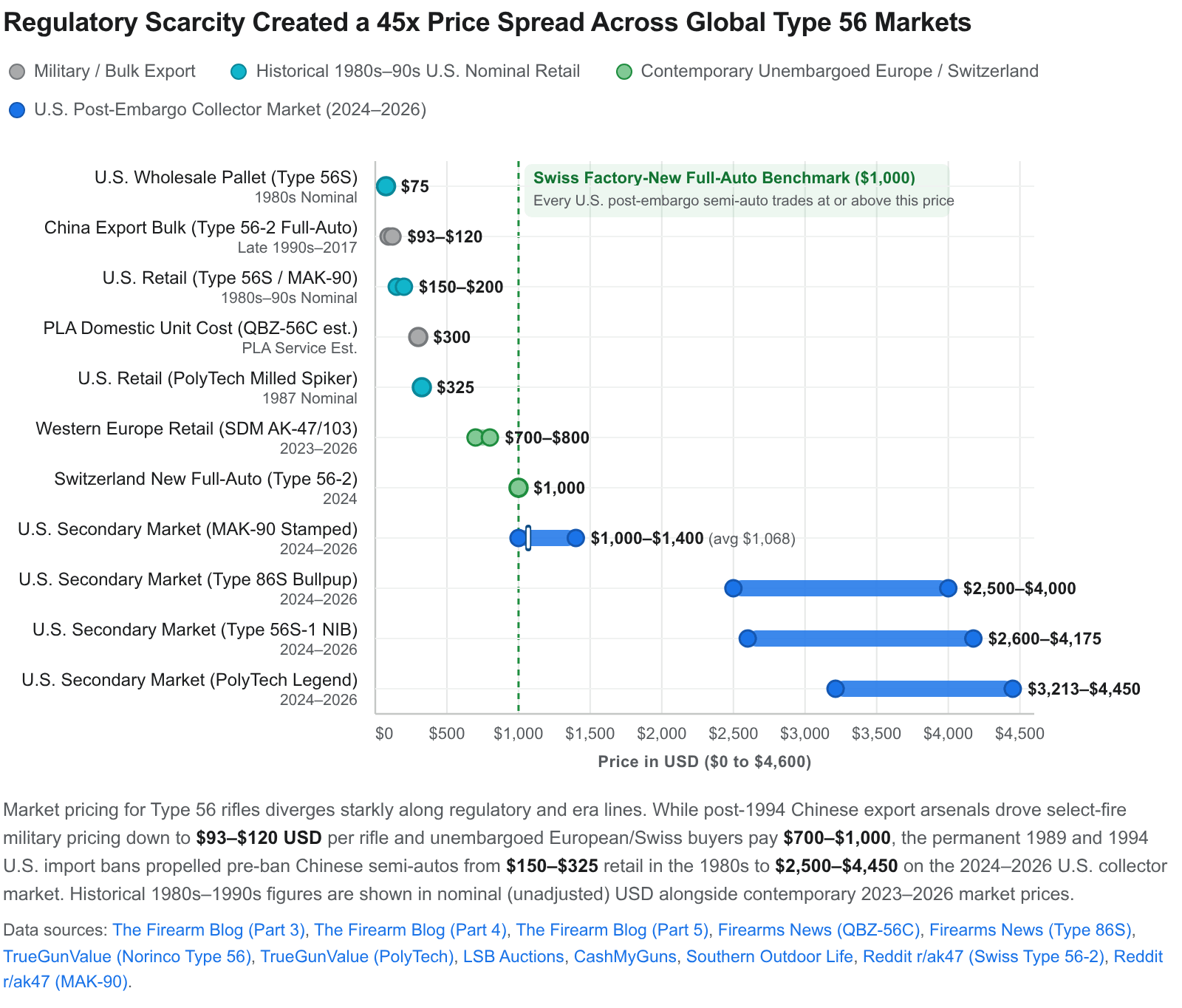
Divergent import bans and supply controls have produced a 37x to 48x global price spread (roughly 45x against a $100 export baseline) across mechanically comparable Type 56 rifles. Post-1994 Chinese export plants have sold select-fire Type 56-2 lots wholesale for 93–120 USD, and unembargoed European and Swiss markets price new semi-automatic and collector select-fire rifles between $700 and $1,000 USD6. In the permanently embargoed United States, 2024–2026 secondary-market trackers and auction sales place stamped MAK-90s at 1,000–1,400 (averaging ~$1,068), Type 86S bullpups at 2,500–4,000+, new-in-box pre-ban Type 56S-1s at 2,600–4,175, and milled PolyTech Legends at 3,213–4,45024. The chart below maps this price gap across eras and legal regimes.Divergent import bans and supply controls have produced a 37x to 48x global price spread (roughly 45x against a $100 export baseline) across mechanically comparable Type 56 rifles. Post-1994 Chinese export plants have sold select-fire Type 56-2 lots wholesale for 93–120 USD, and unembargoed European and Swiss markets price new semi-automatic and collector select-fire rifles between $700 and $1,000 USD6. In the permanently embargoed United States, 2024–2026 secondary-market trackers and auction sales place stamped MAK-90s at 1,000–1,400 (averaging ~$1,068), Type 86S bullpups at 2,500–4,000+, new-in-box pre-ban Type 56S-1s at 2,600–4,175, and milled PolyTech Legends at 3,213–4,45024. The chart below maps this price gap across eras and legal regimes.Divergent import bans and supply controls have produced a 37x to 48x global price spread (roughly 45x against a $100 export baseline) across mechanically comparable Type 56 rifles. Post-1994 Chinese export plants have sold select-fire Type 56-2 lots wholesale for 93–120 USD, and unembargoed European and Swiss markets price new semi-automatic and collector select-fire rifles between $700 and $1,000 USD6. In the permanently embargoed United States, 2024–2026 secondary-market trackers and auction sales place stamped MAK-90s at 1,000–1,400 (averaging ~$1,068), Type 86S bullpups at 2,500–4,000+, new-in-box pre-ban Type 56S-1s at 2,600–4,175, and milled PolyTech Legends at 3,213–4,45024. The chart below maps this price gap across eras and legal regimes.Divergent import bans and supply controls have produced a 37x to 48x global price spread (roughly 45x against a $100 export baseline) across mechanically comparable Type 56 rifles. Post-1994 Chinese export plants have sold select-fire Type 56-2 lots wholesale for 93–120 USD, and unembargoed European and Swiss markets price new semi-automatic and collector select-fire rifles between $700 and $1,000 USD6. In the permanently embargoed United States, 2024–2026 secondary-market trackers and auction sales place stamped MAK-90s at 1,000–1,400 (averaging ~$1,068), Type 86S bullpups at 2,500–4,000+, new-in-box pre-ban Type 56S-1s at 2,600–4,175, and milled PolyTech Legends at 3,213–4,45024. The chart below maps this price gap across eras and legal regimes.Divergent import bans and supply controls have produced a 37x to 48x global price spread (roughly 45x against a $100 export baseline) across mechanically comparable Type 56 rifles. Post-1994 Chinese export plants have sold select-fire Type 56-2 lots wholesale for 93–120 USD, and unembargoed European and Swiss markets price new semi-automatic and collector select-fire rifles between $700 and $1,000 USD6. In the permanently embargoed United States, 2024–2026 secondary-market trackers and auction sales place stamped MAK-90s at 1,000–1,400 (averaging ~$1,068), Type 86S bullpups at 2,500–4,000+, new-in-box pre-ban Type 56S-1s at 2,600–4,175, and milled PolyTech Legends at 3,213–4,45024. The chart below maps this price gap across eras and legal regimes.Divergent import bans and supply controls have produced a 37x to 48x global price spread (roughly 45x against a $100 export baseline) across mechanically comparable Type 56 rifles. Post-1994 Chinese export plants have sold select-fire Type 56-2 lots wholesale for 93–120 USD, and unembargoed European and Swiss markets price new semi-automatic and collector select-fire rifles between $700 and $1,000 USD6. In the permanently embargoed United States, 2024–2026 secondary-market trackers and auction sales place stamped MAK-90s at 1,000–1,400 (averaging ~$1,068), Type 86S bullpups at 2,500–4,000+, new-in-box pre-ban Type 56S-1s at 2,600–4,175, and milled PolyTech Legends at 3,213–4,45024. The chart below maps this price gap across eras and legal regimes.
Master Comparative Specification Matrix
The master table below compiles technical specifications, regional modifications, strengths, and documented issues across 28 Chinese military, foreign-derivative, and global consumer models in the Type 56 family. Where available primary sources do not report an exact figure, cells are marked N/R (Not Reported) rather than estimated from parent designs.
| Model / Designation | Origin, Producer, and Market | Era and Status | Role and Action | Caliber | Receiver Type and Gauge | Barrel Length | Overall Length (Ext / Fold) | Unloaded Mass | Cyclic Rate / MV | Notable Design Elements and Known Issues |
| Type 56 (Early Milled) | China (Factory 626/66, 386); PLA / Aid | 1956–late 1960s; Reserve/Export | Military Select-Fire | 7.62x39mm | Milled steel (Type 3) | 414–415 mm (16.3 in) | 869–882 mm | 4.03 kg* (4.3 kg Russian ref.) | 600 RPM (PLA) / 650 RPM (West); 710–730 m/s (PLA; 735 m/s wikis) | Strengths: Threaded barrel, detachable 6Kh2 blade before 1965–66 spike; 1964 Springfield Armory rated tolerances (0.005–0.013 mm) and finish comparable to U.S. mil-spec. Issues: First 1,000 used Soviet parts (open sight); Russian refs note some early runs lacked bore chrome1. |
| Type 56 (Stamped) | China (Factories 66, 386, 416, 313, Norinco); PLA / Global | 1967 (R&D) / 1969–present; Militia/Export | Military Select-Fire | 7.62x39mm | Stamped steel, 1.5 mm (1.5–1.6 mm) | 414–415 mm (16.3 in) | 874–882 mm | 3.80 kg | 600–650 RPM; 710–730 m/s (PLA; 735 m/s wikis) | Features: Circular front hood, folding triangular spike bayonet, RPK staggered rivets, double-hook trigger, no rate reducer, pressed/pinned barrel, unthreaded muzzle. Issues: 1969 >100k PLA rejection solved via copper-silver alloy; heavier and faster-rusting than AKM1. |
| Type 56-1 | China (Factory 66, Norinco, 313); PLA / Global | 1963–present; Active Export | Military Select-Fire | 7.62x39mm | Milled (early) / Stamped 1.5 mm | 414 mm (16.3 in) | 874 mm / 654 mm | 3.70 kg | 600–650 RPM; 710–730 m/s (PLA; 735 m/s wikis) | Features: Left-locking, downward-angled thicker stamped underfolder; simplified end-cap rear trunnion; usually omits bayonet (some keep spike). Issues: PLA 1979 combat reports cited poor ergonomics and hinge wobble; frequently smuggled via Iran to Yemen and Somalia1. |
| Type 56-2 | China (Norinco, Factory 313); Global Export | 1980–present; Major Export | Military Select-Fire | 7.62x39mm | Stamped steel, 1.5 mm | 414 mm (16.3 in) | 874 mm / 654–680 mm | 3.90–3.94 kg | 600–650 RPM; 710–730 m/s (PLA; 735 m/s wikis) | Features: Rigid right-sidefolder with internal cleaning kit, phenolic furniture, detachable bayonet option. Issues: Phenolic handguards trap heat; post-1994 93–120 export runs suffer peeling chrome, weak extractor springs, loose firing pins, uphill stoppages1. |
| Type 56-4 (5.56mm Export) | China (Norinco); Export | 1980s–1990s; Export | Military Select-Fire | 5.56x45mm NATO | Stamped steel, 1.5 mm | Extended (+95 mm / 3.75 in past FSB) | N/R (longer than 56-1) | 3.90 kg | 650 RPM; N/R | Features: 5.56mm underfolder with 1:12-in twist for M193, spike bayonet, flush threaded muzzle cap, English “S”/”F” export marks. Note: Overlaps in some directories with 7.62x39mm synthetic-furniture 56-3/56-4 listings2. |
| Type 56M (Export RPK) | China (Norinco); Export Only | 1980s–present; Export | Military LMG Select-Fire | 7.62x39mm | Stamped steel, 1.5 mm (std AK trunnion) | 590 mm (23.2 in) | 1,035 mm (40.7 in) | 5.20 kg* (5.78 kg w/ empty drum) | N/R; 748 m/s | Features: RPK-pattern LMG with RPD-style tubular bipod and 75-rd drum. Issues: Omits reinforced bulged RPK trunnion and receiver, reducing sustained-fire life vs. Soviet RPK37. |
| QBZ-56C (Type 56C) | China (PLA / Norinco); PLAN / PAP / SOF | 1991–present; Active Service | Military Compact Carbine | 7.62x39mm | Shortened (-20.6 mm) 1.2 mm high-strength stamped | 279–280 mm (11.0 in) | 764 mm / 557 mm | 2.85*–2.93 kg (6.28–6.47 lb) | 700 RPM; 650–665 m/s (2,132 fps) | Strengths: Most refined military Type 56: 2-pos shell-rim gas regulator, Type 87 progressive recoil guide, expansion/birdcage muzzle, saltwater-resistant parkerized finish, 3-rib cover, Type 81 hooded sights, 20/30-rd mags. Limit: Cannot mount bayonet; ~3x export Type 56 cost1. |
| Chinese AK-103 Clone (Export) | China (Export Arsenals; distinct from CS/LR-11); Yemen/Somalia | ~2010s–present; Conflict Zones | Military Select-Fire | 7.62x39mm | Stamped steel (Chinese staggered rivets) | N/R | N/R (Sidefolder) | N/R | N/R | Issues: Low-cost Type 56 disguised as a Russian AK-103: fake Izhmash stamp on rear sight block, 45-deg gas block, thick AKM bolt, “L”/”D” selector marks, glossy paint, loose folding stock37. |
| 7.62 RK 56 TP | China-built for Finland (FDF Reserve) | 1992–present; Strategic Reserve | Military Select-Fire | 7.62x39mm | Stamped steel, 1.5 mm | 414 mm (16.3 in) | 874 mm / 654 mm | 3.90 kg | 600–650 RPM; N/R (Finnish ammo) | Regional Mod: ~100,000 Type 56-2s built with upgraded China-installed hammer spring for Finnish 7.62x39mm ammo; keeps stock cleaning kit and supports external optic/light brackets per FDF manual1. |
| ASh-78 Tip-1 | Albania (UM Gramsh / KM Poliçan combine); Balkans / Afghanistan | ~1974/78–1997; Surplus/Export | Military Select-Fire | 7.62x39mm | Stamped steel (no magwell dimples) | 414–415 mm (16.3 in) | 870–880 mm | 4.20–4.30 kg | N/R; N/R | Features: Chinese-tooled clone with folding spike, “A”/”1” selector (no safe mark), 6-digit + 2-digit year serial. Issues: Rough machining, poor bluing, heavy mass; 30,600 exported to Afghanistan10. |
| ASh-78 Tip-2 / Tip-3 & ASh-82 | Albania (UM Gramsh / KM Poliçan combine) | 1978–1997; Surplus | Military RPK / Grenade & Underfolder | 7.62x39mm | Stamped steel (no magwell dimples) | Extended (+~150 mm spigot bbl; up to 660 mm refs); N/R (ASh-82) | N/R | N/R | N/R | Features: Conflicting OSINT Tip-2 vs. Tip-3 labels (heavy-barrel SAW vs. grenade launcher); grenade model has full-length spigot barrel, front gas cutoff, hinged top cover with SKS-style 1,000 m sight; ASh-82 is Type 56-1 underfolder84. |
| KL-7.62 (KLS / KLF / KLT) | Iran (Defense Industries Org. — DIO); Military/Proxies | 1980s–present; Active | Military Select-Fire | 7.62x39mm | Stamped steel (Russian inline rivets) | 415 mm (16.3 in) | KLS 890; KLF 895/655; KLT 895/690 mm | KLS 3.57; KLF 3.80; KLT 3.60 kg* | 600 RPM; 715 m/s | Evolution: Type 56 derivative (disputed unlicensed copy vs. tech transfer) upgraded with black polymer furniture, ribbed AKM top cover, Picatinny rails, multipurpose bayonet, and inline trunnion rivets1. |
| MAZ (ACY01) | Sudan (Military Industry Corp. — MIC); SAF / Regional | ~1990s–present; Active | Military Select-Fire | 7.62x39mm | Stamped steel (Chinese machinery) | N/R | N/R | N/R | N/R; 710 +/- 15 m/s (MAZ ammo) | Features: Built in Khartoum with underfolding bayonet; marketed as “7.62x39mm Sub Machine Gun (ACY01)”. Limit: Formal licensing status unclear; independent dimensional and endurance data unavailable131. |
| TUL-1 | North Vietnam (Z1 / Z111 Factory); PAVN | 1970–1974 (mid-1970s stamped refs); Reserve | Military LMG Select-Fire | 7.62x39mm | Milled Type 56 (pre-74) / Stamped 1.0 mm (later) | 590 mm (23.2 in) | 1,040 mm (40.9 in) | 4.80 kg | 600 RPM; 745 m/s | Features: Wartime RPK substitute using Type 56 receivers, RPK stock, and RPD sights. Issues: Later stamped receiver only 1.0 mm vs. 1.5 mm RPK; heavier and slower-firing than RPK; salvaged parts1. |
| POF PK-10 | Pakistan (Pakistan Ordnance Factories); Military/LEA | 2008–present (IDEAS 2008); Active | Military Select-Fire | 7.62x39mm | Stamped steel (Type 56-2 copy) | N/R | N/R | N/R | N/R | Evolution: Local counterpart of Type 56-2 (“SMG” in Pakistani usage); widely upgraded with Picatinny rails, optics, modular stocks, and GP-25 grenade launchers10. |
| KA2-5 | Myanmar (Kachin Independence Army); Non-State | Modern; Active Insurgent | Non-State Select-Fire | 7.62x39mm | Stamped steel (Type 56 clone) | N/R | N/R (Fixed & Folding) | N/R | N/R | Features: Local Norinco Type 56 clone fitted with black polymer furniture, folding-stock options, and polymer waffle magazines (distinct from KIA’s M23 Type 81 clone)1. |
| PolyTech Legend AK-47/S | China (Factory 386) / U.S. (KFS Atlanta) | 1988–1989; Pre-Ban Collectible | Civilian Semi-Auto | 7.62x39mm | Milled steel ingot (105 steps) | 411–419 mm (16.2–16.5 in) | 876 mm (34.5 in; UF 635 mm / 25 in folded) | 3.69–3.81 kg (8.13–8.4 lb) | Semi-Auto; N/R | Strengths: High-grade U.S. import: open front sight, Type 1 bayo lug, mahogany chiu wood, 19 mm pressed/pinned barrel, spring-loaded firing pin, 4.2–4.5 lb trigger, 3-rivet guard, chrome followers; National Match adds air-gauged barrel1. |
| Norinco Type 56S / PolyTech AKS-762 | China (Factories 66, 416, Min Shan, Ling Hua) / U.S. | 1983–1989; Pre-Ban Collectible | Civilian Semi-Auto | 7.62x39mm | Stamped steel, 1.5 mm | 414 mm (16.3 in) | 874 mm (UF/SF 654 mm folded) | 3.70–3.90 kg | Semi-Auto; N/R | Features: Fixed (56S), UF (56S-1), bakelite SF (56S-2), fixed bakelite (56S-3), U.S.-only Galil SF; Clayco (1983–84) has dust-cover warning and open sight. Issues: 1.5 mm walls and 19 mm journal limit AKM parts/stock swaps1. |
| Norinco Type 84S / PolyTech AKS-223 | China (Factories 66, 416) / U.S. & NZ | Mid-1980s–1989; Pre-Ban / NZ Banned | Civilian Semi-Auto | 5.56x45mm / .223 Rem | Stamped steel, 1.5 mm | 416 mm (16.4 in) | 874 mm (UF/SF variants) | 3.80–3.90 kg (8.5 lb) | Semi-Auto; N/R | Features: Birdcage flash hider, 1:9-in (measured commercial) or 1:12-in (early M193) twist. Issues: Omits trunnion bullet guide (mag front acts as feed ramp, requiring proprietary 100–200 mags and causing aftermarket jams); light firing-pin/sear springs can cause doubling2. |
| Norinco Type 86S Bullpup | China (Norinco) / U.S. (CSI) | 1989 (500–2,000 units); Pre-Ban | Civilian Semi-Auto Bullpup | 7.62x39mm | Stamped steel (bullpup chassis) | 438 mm (17.25 in) | 667 mm (26.26 in) | 3.18–3.59 kg (7.0–7.9 lb) | Semi-Auto; 710 m/s | Strengths: Compact 65.7% barrel-to-OAL ratio, FAMAS carry handle, AUG foregrip, fish-head flash hider, clean pull-wire trigger, thumb safety above trigger guard. Issues: Short 229 mm (9 in) sight radius, right-only safety, thin dust-cover cheek weld173. |
| Norinco MAK-90 Sporter | China (Factories 66, 386, Norinco) / U.S. | 1990–1994; Post-Ban Collectible | Civilian Semi-Auto | 7.62x39mm (rare 5.56 / 5.45) | Stamped 1.5–1.6 mm (straight/slant) or Milled 386 (slant) | 414–415 mm (16.3–16.34 in) | 892–902 mm (35.1–35.5 in) | 3.72–3.74 kg (8.2–8.25 lb*) | Semi-Auto; N/R | Regional Mod: 1989 ban compliance (thumbhole stock, ground bayo lug, unthreaded barrel, std AK magwell). Issues: Slant-cut rears and 1.5 mm walls/tang block AKM stocks; U.S. restoration requires 4–6 § 922(r) parts46. |
| Norinco NHM-90 / BWK-92 | China (Factory 66, Norinco) / U.S. | 1990–1994; Post-Ban | Civilian Semi-Auto | 7.62x39mm (NHM-90); 5.56x45mm (NHM-90, BWK-92) | Stamped steel, 1.5 mm | 406–451 mm (16–17.75 in NHM-90); 419 mm (16.5 in BWK-92) | N/R | N/R | Semi-Auto; N/R | Regional Mod: Post-ban sporters often built on X’d-out Factory 66 Type 84S trunnions; early 7.62 NHM-90s kept M14x1 LH threads; 5.56 models share Type 84S magazine limits171. |
| Norinco NHM-91 | China (Norinco) / U.S. (CSI) | 1990–1994; Post-Ban | Civilian Heavy-Bbl Semi-Auto | 7.62x39mm (rare 5.56) | Stamped steel, 1.5 mm | 508 mm (20.0 in; some listings 533 mm / 21 in) | N/R | N/R (heavier than MAK-90) | Semi-Auto; N/R | Strengths: Heavy 16.97 mm (0.668 in) chrome-lined barrel (2.0–2.5 MOA), bipod, thick unvented handguards, thumbhole stock, welded muzzle nut. Issues: Many batches include a receiver rivet blocking standard AK mags89. |
| Norinco MAK-91 (National Match) | China (Factory 386, Norinco) / U.S. (JPE Pomona) | 1991–1994; Post-Ban Collectible | Civilian Heavy-Bbl Semi-Auto | 7.62x39mm | Milled steel, slant-cut (Factory 386) | 457–483 mm (18–19 in; up to 533 mm / 21 in owner reports) | N/R | 4.13 kg (9.10 lb) | Semi-Auto; N/R | Strengths: Thickest measured Chinese commercial AK barrel contour (17.37–17.40 mm / 0.684–0.685 in mid-barrel) on a milled Factory 386 receiver, factory bipod. Issues: Unthreaded barrel, slant-cut stock constraint, heavy mass10. |
| Norinco Hunter | China (Factory 386, Norinco) / U.S. | Late 1980s–1994; Discontinued | Civilian Sporting Semi-Auto | 7.62x39mm | Milled steel (Factory 386) | 508 mm (20.0 in; also 406 mm / 16 in) | 1,030 mm (40.6 in w/ 20 in bbl) | 3.60 kg* (with empty mag) | Semi-Auto; 730 m/s | Regional Mod: Milled receiver in traditional hunting stock built to clear sporting-purpose rules; explicitly banned in Canada under SOR/98-46220. |
| Norinco Type 56S (Modern Factory 313) | China (Factory 313, Yong’an) / South Africa | ~2010s–present; Active Retail | Civilian Semi-Auto | 7.62x39mm | Stamped steel, 1.5 mm | N/R (std Type 56 pattern) | N/R (Fixed & UF) | N/R | Semi-Auto; N/R | Strengths: Reliable cycling past 1,000+ rds, light ~3–4 lb trigger, low retail cost in SA. Issues: Rougher circular machining marks vs. 1960s Izhevsk AKM, unthreaded fixed-stock muzzle, occasional canted front sights18. |
| SDM AK-47 / AKS-103 / AKS-74 (.223) | China (Sino Defense Mfg.) / Germany, Italy, EU, CH | ~2014–present; Active Retail | Civilian 2-Pin Semi-Auto | 7.62x39mm; .223/5.56 (AKS-74) | Stamped steel (thick civilian 2-pin) | 415–420 mm (AK-104: 319 mm) | AK-47: 870–890; AKS-47: 870/655; 103/74: 930–940/700; 104: 888/808 mm | N/R | Semi-Auto; N/R | Features: Non-convertible 2-pin receivers, CHF chrome barrels (1:9.45-in 7.62; 1:7-in .223), 90-deg gas block (AKS-103) vs. 45-deg (AKS-74), pinned EU mags. Legal/Issues: German BKA Z-337 bars 7.62x39mm from sport shooting (§ 6 AWaffV); overgassed, uneven QC (fixed > UF)15. |
| BWT 47 / BWT 47 R | Iran (built for Beitler Waffentechnik) / Germany | Pre-2018; Legally Prohibited (KrWaffG) | Civilian Semi-Auto & Repeater | 7.62x39mm | Stamped steel (Iranian AK-47 base) | N/R | N/R | N/R | Semi-Auto / Manual Repeater | Legal Defect: Despite April 2018 BKA notices (Z-438a/b), German Federal Court of Justice (BGH 1 StR 433/18, 2019) ruled it an illegal War Weapon due to simple full-auto convertibility, clashing with administrative courts (VG Frankfurt/Oder 2024)221. |
Note: Weights marked with an asterisk (*) include an empty magazine per official manufacturer or military manuals26. Bangladesh’s BOF BD-08 (7.62x39mm, 445 mm barrel, 955 mm OAL, 3.25–3.50 kg, 700 RPM, 750 m/s) and China’s Type 56 Carbine (SKS, 520 mm barrel, 1,020 mm OAL, 3.85 kg) are excluded from the Kalashnikov-action table above because both use distinct short-stroke gas-piston operating mechanisms11.
Practical Assessment for Industry Analysts and Engineers
Evaluating a Type 56 rifle—whether recovered in a conflict zone, logged in a naval seizure, or inspected on a gunsmith’s bench—requires checking production era, arsenal mark, and regulatory market before drawing conclusions about metallurgy or reliability. A 1958 Factory 626 milled Type 56, a 1988 Factory 386 PolyTech Legend, a 1991 PLAN QBZ-56C carbine, a 2017 $120 budget export Type 56-2, and a modern two-pin SDM AK-103 share a common silhouette and historical lineage, yet reflect materially different steel treatments, dimensional tolerances, and legal requirements6.
From a mechanical engineering standpoint, China’s post-split decision to base stamped production on 1.5 mm sheet steel, thicker forward barrel profiles, RPK-style staggered trunnion riveting, and AK-47 double-hook triggers created a stiff and durable platform—most visibly refined in the saltwater-hardened, gas-regulated QBZ-56C and the 105-step milled PolyTech Legend8. At the same time, the commercial and geopolitical pressures of the past three decades exposed clear limits: after domestic PLA quality oversight ended, ultra-low-cost export production allowed bore chrome and small-component metallurgy to decline markedly6, while Western consumer markets from Washington to Berlin, Ottawa, and Wellington demonstrated that statutory rules—case-length limits, court rulings on receiver conversion, and sporting-purpose standards—now shape the physical design of the Type 56 alongside military requirements15.
Please share this post with colleagues, on forums, etc. Your support is much appreciated, and if you have any feedback, please email us in**@*********ps.com. Note, we do have affiliate links on products to make it easier for you to learn more or purchase them. We may earn a small fee on a sale if you do. This does not affect our reporting – we strive to be objective.
Sources Used
- Type 56 assault rifle – Wikipedia, https://en.wikipedia.org/wiki/Type_56_assault_rifle
- Type 56 assault rifle – Military Wiki | Fandom, https://military-history.fandom.com/wiki/Type_56_assault_rifle
- Type 56 assault rifle, https://en-academic.com/dic.nsf/enwiki/522597
- Video: Chinese Type 56 Rifle (AK-56) | An Official Journal Of The NRA, https://www.americanrifleman.org/content/video-chinese-type-56-rifle-ak-56/
- Weapons Identification – Small Arms Survey, https://www.smallarmssurvey.org/sites/default/files/resources/SAS-HB-06-Weapons-ID-ch3.pdf
- Chinese AKs – The Most Controversial Kalashnikov Variant. Part 3, https://www.thefirearmblog.com/blog/2023/02/16/chinese-aks-controversial-kalashnikov-variant-part-3-type-56-2-quantity-quality/
- https://www.thefirearmblog.com/blog/2023/02/08/chinese-ak-controversial-kalashnikov-variant-part-1-soviet-assistance/
- https://www.thefirearmblog.com/blog/2023/02/14/chinese-aks-controversial-kalashnikov-variant-part-2-type-56-took-world/
- The US Army Always Respected the AK | WeaponsMan, https://weaponsman.com/the-us-army-always-respected-the-ak/
- Machine Guns, Assault Rifles and Semi-automatic Rifles, https://www.salw.lv/materials/catalogues/en/1.machine-guns-automatic-and-semiauto.pdf
- Bangladesh Ordnance Factories – Wikipedia, https://en.wikipedia.org/wiki/Bangladesh_Ordnance_Factories
- List of equipment of the Finnish Army – Wikipedia, https://en.wikipedia.org/wiki/List_of_equipment_of_the_Finnish_Army
- The maritime interdiction of over a thousand assault rifles en route to, https://riskbulletins.globalinitiative.net/esa-obs-023/02-maritime-interdiction-of-assault-rifles.html
- Norinco Type 88SB .223 AKS – The Chinese AK-47 Blog, http://thechineseak-47.blogspot.com/2017/01/norinco-type-88sb-223-aks.html
- https://www.bka.de/SharedDocs/Downloads/DE/UnsereAufgaben/Aufgabenbereiche/Waffen/Feststellungsbescheide/SchussSpielzeugwaffen/150911FbZ337_SDMAK47.pdf?__blob=publicationFile&v=3
- 15 shootings that changed the law: Aramoana, 1990 – AOAV, https://aoav.org.uk/2014/aramoana-1990/
- Factory new full auto Type 56-2 : r/ak47 – Reddit, https://www.reddit.com/r/ak47/comments/1i89mo3/factory_new_full_auto_type_562/
- Type 56 “Factory 313” – GunSite South Africa, https://www.gunsite.co.za/forums/showthread.php?72658-Type-56-quot-Factory-313-quot
- http://www.victorinc.com/Reference/atf_1989_report.txt
- Regulations Prescribing Certain Firearms and Other Weapons, https://laws-lois.justice.gc.ca/eng/regulations/SOR-98-462/section-sched1024336.html?txthl=g
- 56式步枪全解析:从仿制AK到经典枪族的完整科普, https://kuku.baidu.com/landing/tscp_doc/75238057047c9e12a2ce893ec6d05a2f
- 56式半自动步枪——〖枪炮世界〗, http://pewpewpew.work/china/rifle/1956sr/1956sr.htm
- SKS Rifles — Chinese Type 56, Soviet & Yugo Buyer’s Guide, https://oldsteelarsenal.com/sks-rifles-buyers-guide/
- NORINCO TYPE 56 New and Used Price, Value, & Trends 2026, https://truegunvalue.com/rifle/norinco-type-56/price-historical-value
- 56式自动步枪 – 维基百科, https://zh.wikipedia.org/zh-cn/Type_56
- 1956年式突击步枪——〖枪炮世界〗, http://pewpewpew.work/china/rifle/1956ar/1956.htm
- How to Date Your Norinco SKS: The Collector’s Production Guide, https://guncarrier.com/how-to-date-your-norinco-sks/
- 【原创】中华人民共和国枪械简史, https://bbs.xineurope.com/thread-492833-1-1.html
- BOF BD-08 Assault Rifle – Military Factory, https://www.militaryfactory.com/smallarms/detail.php?smallarms_id=1334
- Type 81 assault rifle – Gun Wiki – Fandom, https://guns.fandom.com/wiki/Type_81_assault_rifle
- China’s Last Kalashnikov: The QBZ-56C – Firearms News, https://www.firearmsnews.com/editorial/china-kalashnikov-qbz-56c/459161
- Norinco, AK-47S Chinese AK-47 Pre Ban Imports and Configurations, http://thechineseak-47.blogspot.com/p/norinco.html
- 54式手枪 – 抖音百科, https://m.baike.com/wikiid/651736231950718564
- 北安往事|远去的中国最大步枪厂,一个中国最著名枪械品牌的没落, https://www.imharbin.com/post/30780
- 曾为我国做出巨大贡献的兵工厂,为何退出历史? – 腾讯新闻, https://news.qq.com/rain/a/20250919A088VC00
- 56式冲锋枪 – 新闻- 搜狐, http://news.sohu.com/2004/03/26/56/news219615614.shtml
- 央视打开福建神秘56式冲锋枪仓库,多款罕见型号亮相?, https://user.guancha.cn/main/content?id=1701565
- Vietnam Era Chinese AK-47 Question – AR15.com, https://www.ar15.com/forums/ak-47/vietnam-era-chinese-ak-47-question/78-119206/
- AK barrels for a threaded trunnion > AK Discussions > AR15.COM, https://www.ar15.com/forums/ak-47/ak-barrels-for-a-threaded-trunnion/64-130663/
- 56式自动步枪 – 维基百科, https://zh.wikipedia.org/zh-cn/56%E5%BC%8F%E8%87%AA%E5%8A%A8%E6%AD%A5%E6%9E%AA?useFormat=mobile
- 56式冲锋枪_搜狐网, https://www.sohu.com/a/725660918_120904327
- 礼仪用枪- 抖音百科, https://m.baike.com/wikiid/621029549242142060
- Type 56 – Modern Firearms, https://modernfirearms.net/en/assault-rifles/china-assault-rifles/type-56-eng/
- Штурмовая винтовка Type 56 / Type 56S, https://www.armoury-online.ru/articles/ar/cn/type56/
- 56 半自动步枪:用国产钢与用苏联钢,真实性能差距有多大?, https://h5.ifeng.com/c/vivo/v002OpmqKkJr–k47rWnhBFZf86L9tMl8bu1sSPU1hAfO6EE__?isNews=1&showComments=0
- The AK Buyer’s Guide – A Beginner’s Guide to the AK Platform, https://www.ar15.com/forums/ak-47/the-ak-buyer-s-guide-a-beginner-s-guide-to-the-ak-platform-last-updated-1oct2016/64-141256/
- Touring a Chinese AK47 Factory – Guns and Ammo, https://www.gunsandammo.com/editorial/touring-a-chinese-ak47-factory/248445
- 军事丨早期的56式半自动步枪,很多打不到规定的6000发便报废了, https://www.sohu.com/a/245678856_99972642
- POLL : Chinese SKS Factory Codes – Canadian Gun Nutz, https://www.canadiangunnutz.com/forum/threads/poll-chinese-sks-factory-codes.30808/
- 客观评价新中国以来的军用步枪? – 网易, https://www.163.com/dy/article/J7O22PTU05354ZQZ.html
- 国产枪械—1956年式冲锋枪(图) – 轻兵器专题_新浪网, http://mil.news.sina.com.cn/pc/2003-07-30/29/27.html
- Type 56 automatic rifle – NamuWiki, https://en.namu.wiki/w/56%EC%8B%9D%20%EC%9E%90%EB%8F%99%EC%86%8C%EC%B4%9D
- Automatiku Shqiptar – Model of 1978 (ASH-78) (Kalashnikov) – 1986, https://royalarmouries.org/collection/object/object-282534
- 全国唯一枪械博物馆,位于北国枪城,生产的轻武器上过老山前线 – 搜狐, https://www.sohu.com/a/255978666_607689
- 56-1式自动步枪 – 维基百科, https://zh.wikipedia.org/zh-cn/56-1%E5%BC%8F%E8%87%AA%E5%8B%95%E6%AD%A5%E6%A7%8D
- 北国风 – 黑龙江, http://epaper.hljnews.cn/hljrb/20170417/06.pdf
- 福建神秘56式冲锋枪仓库曝光,封存70年多款罕见型号亮相|轻武器_, https://www.163.com/dy/article/L34MUG9H0556BYRN.html
- Polytech Legend Milled Under-Folder AK-47S, http://thechineseak-47.blogspot.com/2016/02/poly-tech-legend-milled-under-folder.html
- Norinco MAK-90 Model of the Kalashnikov AK-47, http://southernoutdoorlife.com/mouseguns/mak90web/mak90.htm
- Following the Thread: Arms and Ammunition Tracing in Sudan and, https://www.smallarmssurvey.org/sites/default/files/resources/HSBA-WP32-Arms-Tracing.pdf
- https://www.forgottenweapons.com/polytech-aks-the-first-wave-of-semiauto-chinese-ak-rifles/
- Polytech, Poly Technologies Keng’s Firearms Specialties, Imported, http://thechineseak-47.blogspot.com/p/polytech-poly-techknologies.html
- AKM vs T56 – GunSite South Africa, https://www.gunsite.co.za/forums/showthread.php?113283-AKM-vs-T56
- S/2024/731 Security Council – United Nations Digital Library, https://digitallibrary.un.org/record/4079905/files/S_2024_731-EN.pdf
- S/2020/482* Conseil de sécurité – Réseau Rafal, https://www.reseau-rafal.org/sites/reseau-rafal.org/files/document/Rapport%20experts%20ONU%20RDC%202020.pdf
- 1965 Type 56 Assault Rifle with 11M Serial Number – sks-files forum, https://sks-files.com/index.php?topic=2245.0
- CLAYCO AKS-7.62 Fixed Stock and Underfolder Chinese Pre Ban, http://thechineseak-47.blogspot.com/p/clayco.html
- Help identifying? : r/ak47 – Reddit, https://www.reddit.com/r/ak47/comments/1kr9a3j/help_identifying/
- An Introductory Guide to the Identification of Small Arms, Light, https://www.smallarmssurvey.org/sites/default/files/SAS-HB-06-Weapons-ID-Guide-Full.pdf
- AK-47/AK Variants | Great Multiverse Wiki – Fandom, https://greatmultiverse.fandom.com/wiki/AK-47/AK_Variants
- Chinese Type-56 AK History – Faktory 47, https://www.faktory47.com/blogs/kalashnikov/chinese-type-56
- Overview of the Type 56 Assault Rifle | PDF | Ammunition – Scribd, https://www.scribd.com/document/861860643/Type-56-Assault-Rifle-Wikipedia
- Main, https://the-chronicles-of-equestira-and-the-isle-of-berk.fandom.com/wiki/Main_Weaponry_of_the_series
- Альтернативное вооружение и техника РККА и РККФ в цикле, https://alternathistory.ru/alternativnoe-vooruzhenie-i-tehnika-rkka-i-rkkf-v-tsikle-shvejtsarets/
- 央视镜头领着观众看福建深山洞库,封存整整70年的300万支56 … – 搜狐, https://www.sohu.com/a/1098460553_121645170
- Type 56 Chinese 7.62mm Assault Rifle (China) – ARMSNET, https://armsnet.app/equipment/b2b5878b-d7de-4f6d-e96f-08de6e3c1543
- Assault Rifle of Bangladesh Army | International Military Forum – IMF, https://www.military-quotes.com/forums/threads/assault-rifle-of-bangladesh-army.91845/
- June 9 – 18 Firearms Auction – Live Auction World, https://ontario.liveauctionworld.com/auction.aspx?as=82558&mobile=0
- Light Machine Gun Type 56M (RPK)_Rifle_Weapon_Products_Jing, http://cjaie.com/content/details16_2437.html
- QBZ-56C短步枪中国军队最后一种卡拉什尼科夫枪械 – 腾讯, https://view.inews.qq.com/a/20220330A06TQH00
- MAK-90 – What works, what doesn’t? : r/ak47 – Reddit, https://www.reddit.com/r/ak47/comments/13s9sz/mak90_what_works_what_doesnt/
- Автомат (штурмовая винтовка) Type 56 – Энциклопедия оружия, https://weaponland.ru/load/avtomat_shturmovaja_vintovka_type_56/18-1-0-54
- AK-47 vs AKM: Key Differences Explained | Strip Gun Club, https://stripgunclub.com/blog/ak-47-vs-akm/
- AK-47 – Wikipedia, https://en.wikipedia.org/wiki/AK-47
- 2mm Modernized Kalashnikov: 2ifle (AKM and Gudmicsues – Scribd, https://www.scribd.com/document/906086441/The-Official-Soviet-AKM-Manual-Operating-Instructions-for-Translated-by-James-F-Gebhardt-First-Edition-Boulder-Colorado-January-1-1999
- MAK90 help : r/ak47 – Reddit, https://www.reddit.com/r/ak47/comments/iq5c1h/mak90_help/
- Difference between Russian/Soviet and Chinese AKs – Reddit, https://www.reddit.com/r/ForgottenWeapons/comments/rkuqjj/difference_between_russiansoviet_and_chinese_aks/
- Modern Variants of Type 56 and Chinese AK 103 – The Firearm Blog, https://www.thefirearmblog.com/blog/2023/03/21/chinese-aks-controversial-kalashnikov-variant-part-4-modern-variants-type-56-chinese-ak-103/
- Source for Chinese front trunnions? – AR15.com, https://www.ar15.com/forums/ak-47/Source_for_Chinese_front_trunnions_/78-146938/
- What size drill bit do you use when drilling barrel pinhole ? : r/ak47, https://www.reddit.com/r/ak47/comments/yhw4qo/what_size_drill_bit_do_you_use_when_drilling/
- To convert an AK or No? > Machineguns (MG) > AR15.COM, https://www.ar15.com/forums/Armory/To-convert-an-AK-or-No-/22-513365/
- What are the differences between AK-47, AKM, AK-56, AK-74 and, http://firearmshistory.blogspot.com/2011/02/what-are-differences-between-ak-47-akm.html
- Type 56 assault rifle – Vietnam War | Fandom, https://vietnamwar.fandom.com/wiki/Type_56_assault_rifle
- AK47 Trigger Slap | Sniper’s Hide Forum, https://www.snipershide.com/shooting/threads/ak47-trigger-slap.114669/
- DPRK’s AKs: Inside the Shadowy World of North Korean AK Rifles, https://athlonoutdoors.com/article/north-korean-ak-rifles/
- Recently inherited this Norinco MAK 90 … what do you guys know, https://www.reddit.com/r/ak47/comments/xb639y/recently_inherited_this_norinco_mak_90_what_do/
- Type 56 – Rambo Wiki – Fandom, https://rambo.fandom.com/wiki/Type_56
- Chinese AK47 Milled or Stamped? – The High Road, https://www.thehighroad.org/index.php?threads/chinese-ak47-milled-or-stamped.193667/
- New MAK-90 M4 Adapter and entire M4 Adapter Family!, https://www.jmac-customs.com/blog/new-mak90-m4-adapter-and-entire-m4-adapter-family-/
- ZHUKOV-S® Stock, Model MAG585 – Magpul, https://magpul.com/zhukov-sfoldingstock-ak47-ak74.html
- Why are Chinese Ak’s (Type 56) so different from Soviet … – Reddit, https://www.reddit.com/r/ForgottenWeapons/comments/1gr8o0n/why_are_chinese_aks_type_56_so_different_from/
- polytech legend ak-47s – Gun Tests, https://www.gun-tests.com/wp-content/uploads/2020/01/11-10-Legend.pdf
- 7.62毫米子弹全解析:从口径定义到三大主流型号科普, https://kuku.baidu.com/landing/tscp_doc/28eae441c91f05b8b5f224fa136a608f
- https://gunsweek.com/en/rifles/articles/sdm-aks-74-and-aks-103-tale-two-aks
- Chinese AK: 7 Variants and What Makes Them All Different, https://skillsetmag.com/article/chinese-ak-variants/
- 中国最大步枪厂,一个中国最著名枪械品牌的没落 – 搜狐, https://www.sohu.com/a/122669031_350855
- Factory #626 History Museum · Hidden places – Travel Crew AI, https://travelcrewai.com/explore/community/0ff64dac-f07b-434b-84fd-c606ae8e6121
- 神秘兵工启尘封–科普时报–数字报, https://digitalpaper.stdaily.com/http_www.kjrb.com/kjwzb/html/2021-08/27/content_520017.htm?div=2
- 河南神秘兵工厂建在伏牛山麓续鲁山县错失二汽 – 央广网, http://hn.cnr.cn/hngbwh/201410/t20141031_516697215.shtml
- Type 56-1A1, Norinco’s latest iteration of the Type 56 for export, https://www.reddit.com/r/ForgottenWeapons/comments/vu4rh3/type_561a1_norincos_latest_iteration_of_the_type/
- Modernized Norinco Type 56 Assault Rifle : r/ForgottenWeapons, https://www.reddit.com/r/ForgottenWeapons/comments/128nuku/modernized_norinco_type_56_assault_rifle/
- ASH-78 – Wikipedia, https://en.wikipedia.org/wiki/ASH-78
- ASH 78 – Gun Wiki – Fandom, https://guns.fandom.com/wiki/ASH_78
- Albania Authorizes State Firm KAYO to Produce Weapons and, https://thedefensepost.com/2025/11/07/albania-kayo-weapons-production/
- Albania investigates military factory intruders from Russia and, https://us.headtopics.com/news/albania-investigates-military-factory-intruders-from-russia-and-ukraine-29181724
- Ammunition factories in Albania: Law requires investments of over, https://www.voxnews.al/english/aktualitet/fabrikat-e-municioneve-ne-shqiperi-ligji-kerkon-investime-mbi-25-mln–i67525
- An Albanian ASh78-1 Kalashnikov in Kabul – The Firearm Blog, https://www.thefirearmblog.com/blog/2018/05/02/an-albanian-kalashnikov-in-kabul/
- ASH-78 – Customer Build, https://akresources.childersguns.com/2024/03/ash-78-customer-build.html
- Assault Rifles Index | PDF | Magazine (Firearms) – Scribd, https://www.scribd.com/doc/156429892/Assault-Rifles-Index
- Poland Archives – Ronin’s Grips, https://blog.roninsgrips.com/category/weapons-by-country/poland/
- Albania’s Rather Odd Grenade Launching AK – Forgotten Weapons, https://www.forgottenweapons.com/albanias-rather-odd-grenade-launching-ak/
- ASh-78: Albania Makes the Worst AK – Forgotten Weapons, https://www.forgottenweapons.com/ash-78-albania-makes-the-worst-ak/
- KL-7.62 – Gun Wiki – Fandom, https://guns.fandom.com/wiki/KL-7.62
- Small Arms – Assault Rifles – The Arkenstone – ارکنستون, http://thearkenstone.blogspot.com/2010/01/small-arms-assault-rifles.html
- https://mindex-center.ir/en/products/kl-762-mm-assault-rifle
- Type 56 Assault Rifle | PDF | Firearms | Personal Weapons – Scribd, https://www.scribd.com/document/317282103/Type-56-Assault-Rifle
- Articles – Page 2 – Silah Report, https://silahreport.com/home/articles/page/2/
- From Smugglers to Supply Chains: How Yemen’s Houthi Movement, https://tcf.org/content/report/from-smugglers-to-supply-chains-how-yemens-houthi-movement-became-a-global-threat/
- The price of civil war: A survey of Somalia’s arms markets, https://globalinitiative.net/analysis/somalia-arms-trafficking/
- https://globalinitiative.net/analysis/iran-firearms-somalia/
- Type 56 assault rifle | Gun Wiki – Fandom, https://guns.fandom.com/wiki/Type_56_assault_rifle
- Military Industry Corporation – Wikipedia, https://en.wikipedia.org/wiki/Military_Industry_Corporation
- http://mic.sd/en/home/products
- ‘Sudan’s military industry expanding’: Small Arms Survey, https://www.dabangasudan.org/en/all-news/article/sudan-s-military-industry-expanding-small-arms-survey
- Product Details | Mulitary Industry Corporation, http://mic.sd/ar/product/productDetails/44
- https://salw-guide.bicc.de/pdf/countries/193/sudan.std.en.pdf
- Finnish Assault Rifles – War Thunder — official forum, https://forum.warthunder.com/t/finnish-assault-rifles/227691
- File:7,62 RK 56 TP.JPG – Wikimedia Commons, https://commons.wikimedia.org/wiki/File:7,62_RK_56_TP.JPG
- Kevytasekäsikirja – Puolustusvoimat, https://puolustusvoimat.fi/documents/1948673/2258487/PEVIESTOS-Kevytasekasikirja_netti.pdf
- Kevytasekäsikirja 2019 – Puolustusvoimat, https://puolustusvoimat.fi/documents/1948673/2258487/PEVIESTOS_Kevytasek%C3%A4sikirja_2019.pdf
- Kevytasekäsikirja (Kvasekäsik) (2004) | PDF – Scribd, https://www.scribd.com/doc/194833154/Kevytasekasikirja-Kvasekasik-2004
- Unveiling the Battle-Tested: AK Rifles in Pakistani Military Service, https://defensetalks.com/unveiling-the-battle-tested-ak-rifles-in-pakistani-military-service/
- List of equipment of the Pakistan Army – Wikipedia, https://en.wikipedia.org/wiki/List_of_equipment_of_the_Pakistan_Army
- SMALL ARMS UPDATE: SMGPK21 project is closed Pakistan, https://pdj.quora.com/SMALL-ARMS-UPDATE-SMGPK21-project-is-closed-Pakistan-Ordinance-Factory-POF-engineer-Salman-Ali-who-recently-develope
- Analysis of possible options for Type 56/PK10 Replacement Heavily, https://pdj.quora.com/SMALL-ARMS-Analysis-of-possible-options-for-Type-56-PK10-Replacement-Heavily-modified-Type-56-PK10-In-a-previous-post
- Pakistan Ordinance Factories – POF, https://defencepk.com/forums/threads/pof-pakistan-ordinance-factories.135/
- POF launches four new products at Ideas-2008 – The Nation, https://www.nation.com.pk/29-Nov-2008/pof-launches-four-new-products-at-ideas2008?version=amp
- Khyber Pass copy – Wikipedia, https://en.wikipedia.org/wiki/Khyber_Pass_copy
- TUL-1 – FirearmCentral Wiki – Fandom, https://firearmcentral.fandom.com/wiki/TUL-1
- Vietnam’s Homegrown RPK, The TUL-1 – The Firearm Blog, https://www.thefirearmblog.com/blog/vietnams-homegrown-rpk-the-tul-1-44822368
- List of equipment of the Vietnam People’s Ground Forces – Wikipedia, https://en.wikipedia.org/wiki/List_of_equipment_of_the_Vietnam_People%27s_Ground_Forces
- Bangladesh Ordnance Factories – Military Wiki | Fandom, https://military-history.fandom.com/wiki/Bangladesh_Ordnance_Factories
- Assault rifle – Wikipedia, https://en.wikipedia.org/wiki/Assault_rifle
- KA2-5, a Norinco Type 56 copy manufactured by the Kachin … – Reddit, https://www.reddit.com/r/ForgottenWeapons/comments/1wkv5db/ka25_a_norinco_type_56_copy_manufactured_by_the/
- Category:Kachin Independence Army – Wikimedia Commons, https://commons.wikimedia.org/wiki/Category:Kachin_Independence_Army?uselang=de
- https://www.thefirearmblog.com/blog/2017/10/31/chinese-vs-russian-ak-kalashnikov-concern-media-releases-english-language-video-series/
- Alter : Разновидности автоматов АК и пулеметов РПК – Guns.ru, https://forum.guns.ru/forum_light_message_reverse/36/648332.html
- Карабин АК-12 / TR3 : Нарезное оружие – Оружейный форум, https://forum.guns.ru/forum_light_message/2/2508522.html
- https://www.thefirearmblog.com/blog/2024/06/04/chinese-aks-part-5-jim-fuller-history-china-ak-imports-usa/
- Polytech Legend, Milled Reciever Chinese AK-47S Pre Ban Import, http://thechineseak-47.blogspot.com/2016/02/polytech-legend-milled-reciever.html
- RARE Pre Ban PolyTech Legend AK-47S 7.62×39 16” AKM Milled, https://lsbauctions.com/rare-pre-ban-polytech-legend-ak-47s-7-62×39-16-akm-milled-receiver-3/
- chi-comm type 56 project parts help? > Chinese > AR15.COM, https://www.ar15.com/forums/ak-47/chi_comm_type_56_project_parts_help_/78-103697/
- Norinco / Polytech Chinese 84S-2 Red Bakelite Sidefolder .223 AK-74, http://thechineseak-47.blogspot.com/2016/02/norinco-polytech-chinese-84s-2-red.html
- Type 84S | Gun Wiki – Fandom, https://guns.fandom.com/wiki/Type_84S
- Chinese type 56 and type 84s | The High Road, https://www.thehighroad.org/index.php?threads/chinese-type-56-and-type-84s.886761/
- Norinco 84S , Any fans? | The High Road, https://www.thehighroad.org/index.php?threads/norinco-84s-any-fans.664962/
- Pre 89 Ban Chinese AK 84S-3A | Northwest Firearms, https://www.northwestfirearms.com/threads/pre-89-ban-chinese-ak-84s-3a.217910/
- Found a Norinco 84S……need help > AK Discussions > AR15.COM, https://www.ar15.com/forums/ak-47/-ARCHIVED-THREAD-Found-a-Norinco-84S–need-help/64-111014/
- Cheap Norinco 84s magazines. 5 min with a file they fit and feed like, https://www.reddit.com/r/ak47/comments/hsnz5q/cheap_norinco_84s_magazines_5_min_with_a_file/
- 5.56 Norinco, tell me about mags > Chinese > AR15.COM, https://www.ar15.com/forums/ak-47/5_56_Norinco__tell_me_about_mags/78-158092/
- Thoughts on this norinco? 5.56 : r/ak47 – Reddit, https://www.reddit.com/r/ak47/comments/puwhre/thoughts_on_this_norinco_556/
- My Norinco 84S-1 is doubling > Troubleshooting > AR15.COM, https://www.ar15.com/forums/AK-47/My-Norinco-84S-1-is-doubling/74-71127/
- Norinco Type 86S – Wikipedia, https://en.wikipedia.org/wiki/Norinco_Type_86S
- The Norinco Type 86S: China’s Rare Bullpup AK – Firearms News, https://www.firearmsnews.com/editorial/the-norinco-type-86s-bullpup-ak/360573
- Type 86s – Modern Firearms, https://modernfirearms.net/en/assault-rifles/china-assault-rifles/type-86s-eng/
- How do we feel about the Norinco 86S? : r/ak47 – Reddit, https://www.reddit.com/r/ak47/comments/1dqxhti/how_do_we_feel_about_the_norinco_86s/
- Statement of Administration Policy: H.R. 1154 – Assault Weapon, https://www.presidency.ucsb.edu/documents/statement-administration-policy-hr-1154-assault-weapon-import-control
- CRS Report for Congress, https://www.everycrsreport.com/files/20030910_RL32077_b0cf3b3b2f148475a5c1849c805bbab692516138.pdf
- Norinco NHM-90 5.56x45mm NATO Blue *HIGHLY COVETED SEMI, https://bryantridge.com/norinco-nhm-90-5-56x45mm-nato-blue-highly-coveted-semi-automatic-rifle/
- Polytech mak-90?? > Chinese > AR15.COM, https://www.ar15.com/forums/t_4_78/151561_Polytech_mak_90__.html
- Straight cut or slant cut : r/ak47 – Reddit, https://www.reddit.com/r/ak47/comments/1twqjwe/straight_cut_or_slant_cut/
- Norinco MAK-90 Value Guide | Milled Receiver … – Cash My Guns, https://www.cashmyguns.com/blog/norinco-mak-90/
- MAK 90 : r/ak47 – Reddit, https://www.reddit.com/r/ak47/comments/1r14c58/mak_90/
- How to tell difference between stamped or milled AK receiver, https://www.thehighroad.org/index.php?threads/how-to-tell-difference-between-stamped-or-milled-ak-receiver.610272/
- Mak 90 922r question. : r/ak47 – Reddit, https://www.reddit.com/r/ak47/comments/3kbmd6/mak_90_922r_question/
- Going 922r cross-eyed! Help! Norinco Mak-90 Milled – AR15.com, https://www.ar15.com/forums/t_4_64/130004_Going_922r_cross_eyed__Help__Norinco_Mak_90_Milled.html
- Ak question…better a MAK-90 or a WASR-10?? – The High Road, https://www.thehighroad.org/index.php?threads/ak-question-better-a-mak-90-or-a-wasr-10.344328/
- NORINCO BWK-92 SPORTER 5.56 NATO, https://www.lewmanarmsmanufacturing.com/cproduct/1480/norinco-bwk-92-sporter-5*56-nato
- Review: De-banned Norinco NHM-90 and MAK-90 PT. I – YouTube, https://www.youtube.com/watch?v=BzjZIOVBbKw
- Norinco NHM 91 – Wikipedia, https://en.wikipedia.org/wiki/Norinco_NHM_91
- Question: Magazine fit: Norinco AK > Chinese > AR15.COM, https://www.ar15.com/forums/ak-47/Question__Magazine_fit__Norinco_AK/78-142740/
- Norinco NHM-91 in Magpul Furniture $800 – Northwest Firearms, https://www.northwestfirearms.com/threads/norinco-nhm-91-in-magpul-furniture-800.303223/
- NHM 91 in 5.56×45 Nato – The High Road, https://www.thehighroad.org/index.php?threads/nhm-91-in-5-56×45-nato.272791/
- Norinco NHM91 7.62×39 21” Semi-Auto Rifle AKM AK-47 1992, https://lsbauctions.com/norinco-nhm91-7-62×39-21-semi-auto-rifle-akm-ak-47-1992-rouge-warfare/
- Kitting Out The Kalashnikov – Part 4, by A.D.C. The Soviet AKM, https://survivalblog.com/2020/11/08/kitting-kalashnikov-part-4-d-c/
- “++NORINCO MAK-91 7.62X39MM” | Bass Pro Shops, https://www.basspro.com/shop/ProductDisplay?urlRequestType=Base&catalogId=3074457345616676768&categoryId=3074457345616957269&productId=3074457345627254964&urlLangId=-1&langId=-1&top_category=%5BLjava.lang.String%3B%4053249276&parent_category_rn=%5BLjava.lang.String%3B%40cfbd2587&storeId=715838534
- MAK91 New and Used Price, Value, & Trends 2026, https://truegunvalue.com/rifle/mak91/price-historical-value
- Norinco MAK-91 National Match 7.62x39mm 18” Milled Semi, https://bid.lsbauctions.com/online-auctions/lock-stock-and-barrel/norinco-mak-91-national-match-7-62x39mm-18-milled-semi-automatic-rifle-pre-ban-1993-9757989
- Norinco MAK 91 AK 47 with bipod – Northwest Firearms, https://www.northwestfirearms.com/threads/norinco-mak-91-ak-47-with-bipod.88496/
- Chinese Norinco MAK-91 Pre-Ban National Match – Proxibid, https://www.proxibid.com/lotinformation/92535756/chinese-norinco-mak91-preban-national-match-762x39mm-milled-semiauto-rifle-1993-sling
- Norinco Hunter Manual – Indagini Balistiche, http://www.indaginibalistiche.it/utlities/manuali/norinco_hunter_EN.pdf
- Factory 386 Chinese Norinco Hunter AK Rifle w – My Local Gun Shop, https://mylocalgunshop.com/product/wisconsin-firearms-transfers/Rifles/factory-386-chinese-norinco-hunter-ak-rifle-w-milled-receiver-7-62x39mm
- An Updated Assessment of the Federal Assault Weapons Ban, https://www.ojp.gov/pdffiles1/nij/grants/204431.pdf
- Customs puts the Crimp on Banned Gun Parts from China – Guns.com, https://www.guns.com/news/2019/08/26/customs-puts-the-crimp-on-banned-gun-parts-from-china
- 90’s ammo ban..? – The High Road, https://www.thehighroad.org/index.php?threads/90s-ammo-ban.848559/
- S.BN. 144258 TRUT ANICH • MICHEL, LLP 2 407 North Harbor, https://michellawyers.com/wp-content/uploads/2012/06/4.8.03_Declaration-of-Dr.-Nancy-Mathiowetz………1.pdf
- “Survivors” SKS FAQ, http://www.victorinc.com/SKS-FAQ.html
- Norinco firearms is being sold in other countries | The High Road, https://www.thehighroad.org/index.php?threads/norinco-firearms-is-being-sold-in-other-countries.515577/
- Full text of “Soldier of Fortune Magazine” – Internet Archive, https://archive.org/stream/soldieroffortunemagazine/Soldier%20of%20Fortune%20%5B1998%2711%5D_djvu.txt
- Feds charge Chinese officials in gun smuggling racket – Daily Bruin, https://dailybruin.com/1996/05/23/feds-charge-chinese-officials
- First AK – SDM AK47S : r/EuropeGuns – Reddit, https://www.reddit.com/r/EuropeGuns/comments/1qtbqfo/first_ak_sdm_ak47s/
- Armi Magazine Aprile 2020 | PDF – Scribd, https://it.scribd.com/document/675433643/Armi-Magazine-Aprile-2020
- https://x-hunter.de/en/sdm-ak47-akm-kalashnikov-7-62×39-cn-series-type-56/112
- catalogo generale – Prima Armi, https://primarmi.it/content/files/images/pdf/catalogo-generale-ita.pdf
- Feststellungsbescheide Schuss- und Spielzeugwaffen – BKA, https://www.bka.de/DE/UnsereAufgaben/Deliktsbereiche/Waffen/Feststellungsbescheide/SchussSpielzeugwaffen/schussSpielzuegwaffen_node.html?gts=51250_Dokumente%253Dtitle_text_sort%252Bdesc>p=51250_Dokumente%253D12
- Umbau WUM-1 / Originalzustand bekannt? – Waffenforum | gun-forum, https://waffenforum.gun-forum.de/forum/thread/74011-umbau-wum-1-originalzustand-bekannt/
- §6 AWaffV Verbot Hülsenlänge Langwaffen weniger als 40 Millimeter, https://forum.waffen-online.de/topic/476274-%C2%A76-awaffv-verbot-h%C3%BClsenl%C3%A4nge-langwaffen-weniger-als-40-millimeter/
- Stellungnahme von pro Legal – prolegal e.V., https://prolegal.de/wp-content/uploads/2024/12/BMI-Stellungnahme-zur-Anpassung-der-AWaffV-03.12.2024.pdf
- Ausgabe 26 – Januar – Februar 2016 – Die Waffenkultur, https://waffenkultur.com/PUBLIC/Ausgaben_PDF/waffenkultur_26.pdf
- S.D.M AKS-74 von ESC GmbH aus Nattheim – VDB, https://www.vdb-waffen.de/de/waffenmarkt/fachhaendler~jagd/2579u64p_sdm-aks-74.html?s=38
- https://www.drschmitz.de/deutsches-waffenrecht/justizposse/
- BWT 47 – Der BGH ist wieder mal schlauer als alle anderen, https://www.drschmitz.de/deutsches-waffenrecht/bwt-47-der-bgh-ist-wieder-mal-schlauer-als-alle-anderen/
- Regulations Prescribing Certain Firearms and Other Weapons, https://laws-lois.justice.gc.ca/eng/regulations/sor-98-462/fulltext.html
- Regulations Prescribing Certain Firearms and Other Weapons, https://laws-lois.justice.gc.ca/eng/regulations/SOR-98-462/section-sched1024336.html?txthl=ares+ar+15
- Regulations Prescribing Certain Firearms and other Weapons, https://laws-lois.justice.gc.ca/eng/regulations/sor-98-462/20060322/P1TT3xt3.html
- СВД глазами владельца – Guns.ru, https://forum.guns.ru/forummessage/56/118223.html
- Canada’s Prohibited Firearms: Complete Ban List – Silvercore, https://www.silvercore.ca/blog/the-complete-ban-list-of-newly-prohibited-firearms-in-canada
- Type 81 assault rifle – Wikipedia, https://en.wikipedia.org/wiki/Type_81_assault_rifle
- Canada has officially banned the Type 81, the last AK style rifle we, https://www.reddit.com/r/ak47/comments/1h89y0k/canada_has_officially_banned_the_type_81_the_last/
- Prohibited Firearms Amnesty & Buyback Lawyer – Mor Fisher, https://morfisher.ca/practice-areas/prohibited-firearms-amnesty-buyback/
- Supreme Court Gun Ban Hearing: What Happened – Silvercore, https://www.silvercore.ca/blog/supreme-court-firearms-ban-hearing-what-happened
- SCC Assault-Style Firearms Challenge Explained – Mor Fisher, https://morfisher.ca/news/supreme-court-assault-style-firearms-challenge/
- FIREARMS CONTROL TO BE REVIEWED | Beehive.govt.nz, https://www.beehive.govt.nz/release/firearms-control-be-reviewed
- Gun law in New Zealand – Wikipedia, https://en.wikipedia.org/wiki/Gun_law_in_New_Zealand
- Gun Laws in NZ and Gun Violence– American asking here – Reddit, https://www.reddit.com/r/newzealand/comments/80imml/gun_laws_in_nz_and_gun_violence_american_asking/
- Arms Amendment Act 1992 | New Zealand Legislation, https://www.legislation.govt.nz/act/public/1992/95/en/latest/
- Arms Manual – New Zealand Police, https://www.police.govt.nz/sites/default/files/publications/arms-manual.pdf
- Military-style semi-automatic firearms – Wikipedia, https://en.wikipedia.org/wiki/Military-style_semi-automatic_firearms
- New Zealand bans military style semi-automatics and assault rifles, https://www.beehive.govt.nz/release/new-zealand-bans-military-style-semi-automatics-and-assault-rifles
- Prohibited Firearms Buy-Back 2021 Price List – Gazette, https://gazette.govt.nz/notice/id/2021-go53
- National Firearms Agreement – Parliamentary Education Office, https://peo.gov.au/understand-our-parliament/history-of-parliament/history-milestones/australian-parliament-history-timeline/events/national-firearms-agreement
- Gun Buy Back Scheme – Australian National Audit Office (ANAO), https://www.anao.gov.au/sites/default/files/anao_report_1997-98_25.pdf?acsf_files_redirect
- Norinco MAK-91 Specs, Calibres & Price Guide (Australia) – GunBuy, https://gunbuy.com.au/guns/norinco/norinco-mak-91
- NATIONAL FIREARMS AGREEMENT – Department of Home Affairs, https://www.homeaffairs.gov.au/criminal-justice/files/national-firearms-agreement.pdf
- Romanian AK Straight-Pull Rifle…………..(F 1152) Reserved, http://www.byswordandmusket.co.uk/fac-rifles/romanian-ak-straight-pull-rifle-f-1152/
- Norinco Type 56 Fixed Stock – Spartan Arms, https://www.spartanarms.co.za/product/norinco-type-56-fixed-stock/
- Current state of the Type 56 – GunSite South Africa, https://www.gunsite.co.za/forums/showthread.php?110884-Current-state-of-the-Type-56
- POLYTECH New and Used Price, Value, & Trends 2026, https://truegunvalue.com/rifle/polytech/price-historical-value
- Norinco MAK-90 Value 2026 | Current Prices & Worth Guide, https://www.cashmyguns.com/blog/norinco-mak-90-for-sale-current-worth-guide/
- Polytech AK-47/S Legend 7.62x39mm Cal. with Milled (Not Stamped, https://www.gunsinternational.com/guns-for-sale-online/rifles/polytech-rifles/polytech-ak-47-s-legend-7-62x39mm-cal–with-milled—40-not-stamped–41–received-semi-auto.cfm?gun_id=101522295
- Norinco Mak 90 Review – TheGunZone, https://thegunzone.com/norinco-mak-90-review/