Category Archives: Russian & Soviet Analytics

Analytic reports focusing on philosophy or doctrine related topics that influenced the design, evolution and use of small arms.

The State-Controlled Arsenal: An Analysis of Russia’s OPK and its Key Small Arms Enterprises

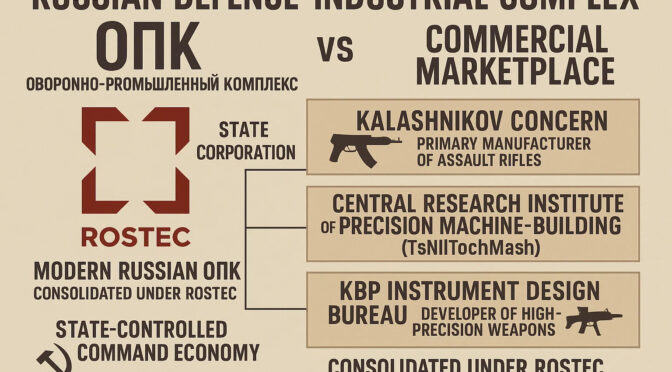
This report provides a detailed analysis of the Russian defense-industrial complex, the Оборонно-промышленный комплекс (ОПК) (Oboronno-promyshlennyy kompleks), or OPK. It contrasts this state-controlled industrial model with the competitive commercial marketplace of the United States, focusing on the central role of the State Corporation Rostec. The analysis delves into the history, structure, and specialization of three pivotal small arms enterprises under the Rostec umbrella: the Kalashnikov Concern, the primary manufacturer of assault rifles; the Central Research Institute of Precision Machine-Building (TsNIITochMash), a key research and development center; and the KBP Instrument Design Bureau, a developer of high-precision weapons.

The modern Russian OPK, consolidated under Rostec, is a direct state-engineered response to the catastrophic industrial collapse that followed the dissolution of the Soviet Union. It utilizes the structure of a modern holding company to achieve the objectives of a state-controlled command economy, prioritizing national security and strategic resilience over market-driven efficiency. This structure reveals a deliberate strategy of functional specialization, separating mass production (Kalashnikov) from advanced R&D (TsNIITochMash) and high-precision systems development (KBP). However, the recent absorption of the premier R&D institute, TsNIITochMash, by the mass-production giant Kalashnikov Concern represents a significant strategic shift, potentially subordinating long-term, revolutionary research to the incremental needs of existing product lines.

The report concludes by extracting four key lessons for the global small arms industry. First, the Russian model highlights the inherent tension between independent design bureaus and mass production plants, a dynamic that can foster innovation but also risks stifling it. Second, the creation of Rostec demonstrates strategic consolidation as a tool of state power to ensure industrial survival, a fundamentally different approach from market-driven consolidation in the West. Third, Russia’s enduring design philosophy—prioritizing reliability and simplicity—enables massive production surges but creates critical vulnerabilities in modernization, particularly given its dependence on foreign high-tech components. Finally, the Russian OPK’s current state presents a critical geopolitical trade-off: it can generate immense quantities of “good enough” military hardware for a war of attrition, but this comes at the cost of qualitative technological stagnation. This dynamic shows that while Russia may be winning the short-term production battle, it risks losing the long-term technology race, a reality with profound implications for the future global balance of military power.

Section 1: The Architecture of State Control: The OPK and Rostec State Corporation

To comprehend the contemporary Russian small arms industry, one must first understand that it does not operate within a competitive commercial marketplace akin to that of the United States. Instead, it is an integral component of a state-controlled system designed as a direct instrument of national power. This system, the Defense-Industrial Complex or OPK, is the product of a tumultuous history, shaped by the legacy of the Soviet command economy, the near-total collapse of the 1990s, and a deliberate, top-down reconsolidation in the 21st century under the state corporation Rostec.

1.1 The Soviet Legacy and Post-Soviet Evolution of the ОПК (OPK)

The foundational concept of the Russian defense industry is the Оборонно-промышленный комплекс (ОПК) (Oboronno-promyshlennyy kompleks), or Defense-Industrial Complex. The OPK is defined as the total aggregation of the nation’s scientific research institutes, testing organizations, and manufacturing enterprises that perform the development, production, storage, and deployment of military and special-purpose technology, ammunition, and materiel.1 Its origins lie in the centrally planned, administrative-command economy of the Soviet Union, a system that fundamentally prioritized military production and heavy industry over all other economic activity.2 Within this framework, vast state-owned enterprises, such as the historic arms factories in Tula and Izhevsk, and specialized design bureaus operated not as independent entities but as cogs in a machine directed by central planning agencies like Gosplan, the State Planning Committee.3

The dissolution of the Soviet Union in 1991 triggered a catastrophic collapse of this immense complex. The OPK was thrown into a “time of troubles,” hobbled by the abrupt cessation of state funding, the severing of deeply integrated supply chains, and rampant corruption.4 A significant portion of the Soviet OPK was located in newly independent states, most critically in Ukraine, which housed vital production centers for everything from tank engines to aircraft carriers.6 This industrial divorce dealt a strategic blow from which the Russian OPK has never fully recovered. Throughout the 1990s, the industry was on the brink of demise, with an estimated 6,000 companies, many of which were unprofitable, requiring continuous government subsidization simply to exist.5

During this period of profound crisis, the OPK found its “saving grace” in foreign exports.4 Key orders from nations like China, India, and Iran provided a lifeline of hard currency that staved off total collapse. This influx of export dollars gave the industry the “breathing space” it needed to survive the decade and claw back a degree of its competitive advantage.4 This experience forged a deep-seated reliance on the export market that continues to shape the strategic calculus of the Russian defense industry today.

The loss of the Ukrainian industrial base, in particular, cannot be overstated. Key strategic assets, including the Malyshev Plant in Kharkiv (a primary tank production center), the Antonov Design Bureau (creator of the world’s largest transport aircraft), and the Mykolaiv shipyards (which built the Soviet Union’s only aircraft carriers, including the Russian Navy’s current flagship, the Admiral Kuznetsov), were suddenly outside of Moscow’s control.6 This event created a permanent “phantom limb” for the Russian OPK. It was not merely a loss of physical capacity but a severing of decades-old research, development, and supply chain relationships. Russia’s subsequent and persistent struggles in sectors like large surface combatants and strategic airlifters can be traced directly to this foundational rupture. The consolidation efforts of the 2000s could patch over some of these deficiencies, but they could not recreate the integrated industrial ecosystem that was lost in 1991.

1.2 Государственная корпорация «Ростех» (Gosudarstvennaya korporatsiya “Rostekh”): The Lynchpin of the Modern OPK

By the mid-2000s, it was clear that market forces and ad-hoc state support were insufficient to reverse the OPK’s decay. In a decisive act of state intervention, the Russian government created a new entity to serve as the lynchpin of a revitalized, state-controlled defense industry. This entity is Rostec.

Established by Federal Law № 270-FZ on November 23, 2007, Rostec was created with the explicit mission to assist in the development, production, and export of high-tech industrial products for both military and civilian purposes.8 Its full official name is Государственная корпорация по содействию разработке, производству и экспорту высокотехнологичной промышленной продукции «Ростех» (Gosudarstvennaya korporatsiya po sodeystviyu razrabotke, proizvodstvu i eksportu vysokotekhnologichnoy promyshlennoy produktsii “Rostekh”), which translates to the State Corporation for the Promotion of the Development, Manufacture and Export of High Technology Products “Rostec”.10

The creation of Rostec was a state-led rescue operation. On July 10, 2008, a presidential decree transferred 443 struggling enterprises to Rostec’s control. The condition of these assets was dire: 30% were in pre-crisis or crisis condition, 28 were in bankruptcy proceedings, 17 had ceased operations entirely, and they faced a collective debt of 630 billion rubles.9 Rostec’s task was to consolidate these disparate and often failing assets, impose structural reforms, and restore them to a state of operational and financial viability.

Today, Rostec is a massive, 100% state-owned industrial conglomerate. It functions as a holding company for approximately 800 enterprises, which are organized into 15 smaller holding companies—eleven in the defense sector and four in civilian industries.11 These enterprises are spread across 60 constituent regions of the Russian Federation and employ roughly 4.5 million people, accounting for a staggering 20% of all manufacturing jobs in Russia.7

While Rostec has a stated mission to diversify the Russian economy and increase the share of civilian products in its portfolio, its core function remains the execution of the state’s military-industrial policy.11 It is the primary vehicle for fulfilling the государственный оборонный заказ (gosudarstvennyy oboronnyy zakaz), or State Defense Order (GOZ). Rostec’s holdings account for almost half of Russia’s total defense procurement, and the corporation traditionally reports a completion rate of nearly 100% for the GOZ.14 This structure is not that of a market participant but of a state ministry operating under the guise of a modern corporation. It is a hybrid model that uses the tools of capitalism—holding companies, branding, and global marketing—to achieve the objectives of a state-controlled command economy.

This central role has made Rostec and its subsidiaries primary targets for international sanctions, particularly since Russia’s annexation of Crimea in 2014 and the full-scale invasion of Ukraine in 2022.10 These sanctions have imposed asset freezes and severely limited access to Western technology, components, and financial markets. In response, the OPK has been forced to adapt through often inefficient import-substitution programs and a reliance on parallel imports of sanctioned goods through third countries.15 This has exposed critical dependencies, particularly on Western-made microelectronics, machine tools, and specialized materials, which has in turn degraded the technological sophistication of its output.16

Section 2: Pillars of Russian Small Arms: Key Enterprises Under the Rostec Umbrella

Within the vast structure of Rostec, the small arms sector is dominated by a handful of historically significant and highly specialized enterprises. These entities are not competitors in a traditional sense; rather, they form a state-managed ecosystem with distinct, complementary roles. The three most prominent pillars are the Kalashnikov Concern, the heart of mass production; TsNIITochMash, the industry’s specialized research and development brain; and the KBP Instrument Design Bureau, the master of high-precision weaponry. Their individual histories, locations, and, most importantly, their intricate relationships within the Rostec hierarchy reveal a deliberate strategy of functional specialization.


Table 1: Overview of Key Russian Small Arms Enterprises

Enterprise Name (Cyrillic, Roman, English)Founding YearPrimary LocationCore SpecializationParent Holding (within Rostec)
Концерн Калашников (Kontsern Kalashnikov), Kalashnikov Concern1807Izhevsk, Udmurt RepublicAssault rifles, combat small arms, mass productionRostec (Direct Control)
ЦНИИТочМаш (TsNIITochMash), Central Research Institute of Precision Machine-Building1944Podolsk (Klimovsk), Moscow OblastAmmunition, special-purpose weapons R&D, testingKalashnikov Concern
КБП им. академика А. Г. Шипунова (KBP im. akademika A. G. Shipunova), KBP Instrument Design Bureau1927Tula, Tula OblastHigh-precision weapons, pistols, ATGMs, air defenseHigh Precision Systems (Высокоточные комплексы)

2.1 Концерн Калашников (Kontsern Kalashnikov): The Heart of Rifle Production

The Kalashnikov Concern is arguably the most recognized brand in the global firearms industry. Its official name is Акционерное общество «Концерн Калашников» (Aktsionernoye obshchestvo “Kontsern Kalashnikov”), or Joint Stock Company “Kalashnikov Concern”.18 Until a major rebranding effort in 2013, it was known as the Izhevsk Machine-Building Plant, or ИЖМАШ (IZhMASh).18

The enterprise’s history is deeply intertwined with that of the Russian state itself. It was founded on June 10, 1807, by a decree from Tsar Alexander I, who established a new state armory in the city of Izhevsk in the Udmurt Republic.18 The location was strategically chosen for its proximity to the region’s ironworks, ensuring a ready supply of raw materials for arms production.21 For over two centuries, this factory has served as the primary supplier of small arms to the Imperial Russian Army, the Soviet Red Army, and the modern Russian Armed Forces.20

The modern Concern was formed on August 13, 2013, through the state-directed merger of two historic Izhevsk-based firearms manufacturers: the Izhmash plant and the Izhevsk Mechanical Plant (ИЖМЕХ, IZHMEKH).19 This consolidation, orchestrated by Rostec, created a single, dominant entity in the Russian small arms landscape. Today, the Kalashnikov Concern is the undisputed flagship of the industry, accounting for approximately 95% of all small arms production in Russia.23 Its product line is extensive, including the iconic Kalashnikov series of assault rifles (from the original AK-47 to the modern AK-12), the Dragunov SVD sniper rifle, the RPK light machine gun, the Saiga family of civilian rifles and shotguns, and even more complex systems like the Vikhr-1 guided anti-tank missile.20

Corporately, the Kalashnikov Concern is a direct subsidiary of the Rostec state corporation.19 Following the 2013 merger, Rostec initiated and funded a comprehensive rebranding campaign to create a more powerful and coherent global brand. This strategy consolidated the Concern’s diverse product lines under three distinct brands: “Kalashnikov” for combat weapons, “Baikal” for hunting firearms, and “Izhmash” for sporting rifles.25 This move was a clear example of Rostec employing modern marketing techniques to enhance the global competitiveness and brand value of a state-controlled strategic asset.

2.2 Центральный научно-исследовательский институт точного машиностроения (ЦНИИТочМаш): The Brains of the Operation

While Kalashnikov is the brawn of the Russian small arms industry, the Central Research Institute of Precision Machine-Building, or TsNIITochMash, is its specialized brain. Its full official name is Акционерное общество «Центральный научно-исследовательский институт точного машистроения» (Aktsionernoye obshchestvo “Tsentral’nyy nauchno-issledovatel’skiy institut tochnogo mashinostroyeniya”), or Joint Stock Company “Central Research Institute of Precision Machine-Building” (JSC “TsNIITochMash”).27

The institute was founded on May 17, 1944, during the height of the Great Patriotic War (World War II), to centralize and advance weapons research.28 It is located in the Klimovsk microdistrict of Podolsk, a city in the Moscow Oblast, placing it in close proximity to the nation’s political and military command centers.27

TsNIITochMash’s primary mission is to function as a central research, development, and testing facility for advanced and specialized military technology. It is not a mass-production factory but a scientific institute tasked with solving complex technical challenges for the Russian military and special services.30 The institute is particularly renowned for its work in specialized ammunition and the unique weapon systems designed to fire it. Its most famous creations are the 9x39mm family of subsonic, armor-piercing cartridges (the SP-5 and SP-6) and the legendary suppressed firearms developed for Spetsnaz (special forces) in the 1980s: the AS Val assault rifle and the VSS Vintorez sniper rifle.31 These weapons provided Soviet special forces with a unique capability for silent, lethal raids against protected targets. Beyond small arms, TsNIITochMash also plays a crucial role in developing control systems for precision-guided munitions, having contributed to the guidance equipment for the “Fagot,” “Konkurs,” and “Kornet” anti-tank guided missiles (ATGMs).30

The corporate relationship of TsNIITochMash is both crucial and complex. Like Kalashnikov, it is part of the Rostec state corporation.28 However, a significant organizational restructuring has placed TsNIITochMash structurally within the Kalashnikov Concern.27 This decision subordinates Russia’s premier R&D institute for special-purpose small arms and ammunition to the corporate control of its largest mass-production entity. This arrangement could theoretically streamline the transition of new technologies from the laboratory to the factory floor. However, it also creates a significant risk. The “brains” of the operation now report directly to the “factory floor.” This dynamic could potentially stifle the kind of blue-sky, revolutionary research that produced the AS Val in favor of more incremental, evolutionary projects that serve the immediate product development needs of the Kalashnikov rifle family—for instance, designing a new handguard or muzzle device for the next AK variant. This internal tension between the need for radical innovation and the demands of mass production is a critical dynamic to monitor within the Russian OPK.

2.3 Конструкторское бюро приборостроения (КБП): The Masters of Precision

The third pillar of the Russian small arms ecosystem is the KBP Instrument Design Bureau, located in the historic arms-making city of Tula. Its full name is АО «Конструкторское бюро приборостроения им. академика А. Г. Шипунова» (AO “Konstruktorskoye byuro priborostroyeniya im. akademika A. G. Shipunova”), or JSC “KBP Instrument Design Bureau named after Academician A. G. Shipunov”.32

KBP was founded on October 1, 1927, as a design organization within the legendary Tula Weapons Factory.32 The city of Tula is, along with Izhevsk, one of the foundational cradles of the Russian arms industry, with its state arsenal established by Peter the Great in 1712.34 This long heritage of design and manufacturing excellence continues to define KBP’s identity.

The key differentiator for KBP is its unwavering focus on high-precision weapon systems.32 While Kalashnikov equips the common infantryman with a robust and simple rifle, KBP develops the complex, high-technology, high-value systems that provide Russian forces with their decisive combat edge. Its specialization spans multiple domains:

  • Anti-Tank Guided Missiles (ATGMs): KBP is the designer of some of the world’s most effective ATGMs, including the 9M133 Kornet (NATO reporting name: AT-14 Spriggan) and the 9M113 Konkurs (AT-5 Spandrel).32
  • Air Defense Systems: The bureau is responsible for developing highly mobile, integrated gun-missile air defense systems like the Pantsir-S1 (SA-22 Greyhound) and its predecessor, the Tunguska-M1 (SA-19 Grison).32
  • Advanced Small Arms: In the small arms sphere, KBP focuses on innovative and specialized designs rather than mass-issue rifles. Its products include the GSh-18 pistol (known for its high-capacity magazine and powerful 9x19mm 7N31 armor-piercing round), the compact PP-2000 submachine gun, and specialized grenade launchers like the GM-94.32

KBP’s corporate structure underscores its specialized role. While it is part of the Rostec state corporation, it is pointedly not placed under the Kalashnikov Concern. Instead, KBP is a cornerstone enterprise within a different Rostec holding company: АО «НПО „Высокоточные комплексы“» (AO “NPO ‘Vysokotochnyye kompleksy'”), or JSC “High Precision Systems”.32 This places KBP in a separate corporate vertical dedicated exclusively to high-end guided weapons and complex systems. This organizational separation is a deliberate strategic choice, designed to insulate the development of costly, R&D-intensive precision weapons from the mass-production logic that governs the Kalashnikov Concern. It ensures that Russia’s high-precision capabilities are managed and developed within a dedicated ecosystem, preventing their dilution or subordination to the needs of conventional infantry arms.

Section 3: Analysis and Key Lessons for the Global Small Arms Industry

The state-controlled, centrally managed structure of the Russian OPK offers a stark contrast to the market-driven defense industrial base of the United States. Analyzing these differences, particularly through the lens of the key small arms enterprises, provides a series of crucial lessons for industry professionals, strategic analysts, and military planners worldwide. These lessons concern the fundamental trade-offs between state control and market competition, the relationship between innovation and production, and the long-term strategic consequences of a nation’s industrial philosophy.

3.1 The State-Controlled vs. Market-Driven Model: A Comparative Analysis

The Russian and American models for defense industrial production represent two fundamentally different philosophies.

The Russian Model can be characterized as a state-directed monopoly. It is dominated by massive, state-owned corporations like Rostec, within which individual enterprises hold de facto monopolies in their respective sectors. The Kalashnikov Concern’s 95% share of Russian small arms production is a prime example.25 The primary customer is the state, which dictates production targets through the State Defense Order (GOZ), and the industry’s objectives are determined by national security policy, not by consumer demand or market competition.14 The principal advantage of this model is the state’s ability to command a massive and rapid pivot to a war economy footing. Since the 2022 invasion of Ukraine, Rostec has reported exponential increases in the output of certain munitions and a near seven-fold increase in tank production.7 However, this model is historically plagued by deep-seated inefficiencies, a near-total lack of consumer choice, and a systemic vulnerability to corruption and technological stagnation due to the absence of competitive pressure.15

The U.S. Model, in contrast, is a regulated competitive market. The industrial landscape is fragmented, comprising numerous privately owned companies of varying sizes, from defense giants to small, specialized firms. These companies compete vigorously for both a large, dynamic civilian market and for government contracts.38 Government procurement is legally bound by a complex set of regulations, such as the Competition in Contracting Act (CICA), designed to promote “full and open competition” wherever possible.41 This system is intended to foster innovation, drive down costs, and improve quality through market pressure. However, the procurement process can be notoriously slow and bureaucratic, often taking 18 months or more for a new contractor to win their first contract.44 Furthermore, while highly innovative, a market-based system may not be able to scale up production for a major peer-level conflict as rapidly or as ruthlessly as a state-directed command system. A crucial feature of the U.S. ecosystem is the vast civilian market for personal defense and sporting firearms, which acts as a parallel engine of innovation and provides a financial foundation for many companies, insulating them from the cyclical nature of government procurement.45

3.2 Lesson 1: The Symbiosis and Conflict of Design Bureaus and Mass Production Plants

The historic Russian model, with its functional separation of R&D-focused design bureaus (like KBP and TsNIITochMash) from mass-production factories (like the Izhevsk plant), offers a valuable lesson. This structure allows for long-term, state-funded research to be insulated from the immediate pressures of quarterly profits and production line efficiency. This protection can foster the development of highly innovative, specialized, and even eccentric designs that might never survive a purely market-driven development process, such as the VSS Vintorez suppressed sniper rifle or the APS underwater assault rifle.31 The core lesson is that shielding pure R&D from the relentless demands of immediate production can be a powerful catalyst for breakthrough technologies.

However, the recent absorption of TsNIITochMash by the Kalashnikov Concern demonstrates the fragility of this separation. This move creates a direct conflict of interest. The R&D agenda of the institute, historically tasked with developing niche capabilities for elite units, now risks being dictated by the commercial and production priorities of a mass-market entity. The pressure to develop incremental improvements for the AK platform—a new stock, a better rail system, a more effective muzzle brake—could easily overshadow and defund the high-risk, long-term research required to create the next generation of revolutionary weapon systems. For Western defense industries, this serves as a cautionary tale, highlighting the strategic importance of maintaining truly independent R&D organizations, whether government-run like DARPA or internal corporate “skunk works,” that are not solely beholden to the immediate needs of existing production lines.

3.3 Lesson 2: Strategic Consolidation as a Tool of State Power and Industrial Survival

The creation of Rostec was not a market event; it was a deliberate act of statecraft. It demonstrated the Russian government’s conviction that its defense industrial base is a core element of national sovereignty that cannot be left to the mercy of market forces.9 The consolidation of hundreds of failing enterprises under a single state-controlled umbrella was a tool to ensure the survival of critical skills, preserve production capabilities, and reassert state control over strategic assets. The lesson for global observers is that nations who view their OPK as an indispensable strategic asset will not hesitate to use state intervention, bailouts, and forced consolidation to protect it, even if doing so creates inefficient and uncompetitive monopolies.

This approach stands in stark contrast to the Western, particularly U.S., model, where the defense industry has consolidated primarily through market-based mergers and acquisitions. While this M&A activity is subject to government regulatory approval to prevent anti-competitive practices, the process is initiated and driven by the companies themselves, based on shareholder value and market logic.48 The critical implication is that the enterprises within the Russian OPK can be commanded by the state to operate at a financial loss indefinitely to achieve national security objectives. U.S. and European defense firms, by contrast, must remain profitable to answer to their shareholders and survive in the long run. This gives the Russian state a powerful, albeit economically inefficient, tool for sustaining industrial capacity during crises.

3.4 Lesson 3: The Durability of Design Philosophy and the Challenge of Modernization

Russian small arms design is dominated by a deeply ingrained philosophy that prioritizes extreme reliability in harsh conditions, simplicity of operation and maintenance, and ease of mass production. This “Kalashnikov philosophy” is not an accident but a direct product of the Soviet experience in World War II, a conflict that demanded millions of simple, durable weapons for a mass-mobilized conscript army.47 This design ethos allows the Russian OPK to achieve incredible production surges of “good enough” weapons, a significant advantage in a protracted war of attrition where sheer numbers can overwhelm technological superiority.

This very strength, however, has become a critical weakness in the face of modern technological warfare. The OPK has consistently struggled to indigenously develop and integrate advanced technologies such as high-quality microelectronics, advanced optics, and modern composite materials.15 For decades, it compensated for this by importing these critical components from the West and Asia. The imposition of stringent international sanctions has severed this “silicon lifeline,” exposing the deep vulnerability at the heart of Russia’s modernization efforts.17 This has led to a state of “innovation stagnation,” where Russian industry is forced to produce simplified, less capable versions of its weapon systems, or even fall back on reactivating Soviet-era legacy equipment. The lesson is that a nation’s dominant design philosophy must be holistically supported by its indigenous technological and industrial base. When a disconnect emerges—when a country designs weapons that require components it cannot produce—it creates a critical vulnerability that a determined adversary can exploit.

3.5 Lesson 4: The Geopolitical Trade-off: Quantitative Surge vs. Qualitative Stagnation

The ultimate lesson from analyzing the modern Russian OPK is the stark strategic trade-off it embodies. The state-controlled model provides the Kremlin with a formidable tool: the ability to rapidly and massively increase the quantity of military hardware by directing the entirety of its industrial base towards the war effort, unconstrained by market logic or profitability.7 Reports indicate that Russia is now out-producing the combined output of the U.S. and Europe in key areas like artillery shells by a factor of nearly three to one.7

This quantitative surge, however, is being purchased at the steep price of qualitative decline and future capability. By isolating itself from global technology supply chains and prioritizing sheer volume over sophistication, the OPK is falling further behind the technological frontier.16 The industry is producing more weapons, but these are often technologically simpler and less effective than their predecessors. It is reactivating 60-year-old T-62 and even 70-year-old T-55 tanks, not churning out advanced T-90M or next-generation T-14 Armata platforms. The key lesson for Western analysts and policymakers is that measuring the strength of a defense industrial base requires looking beyond raw production numbers. A holistic assessment must also weigh the technological sophistication of the output and the long-term capacity for innovation. The Russian OPK is a live-fire demonstration that it is possible for a nation to win the production battle in the short term while simultaneously losing the technology race in the long term. This is a dangerous and unstable dynamic with profound implications for the future of warfare and the global balance of military power.


If you find this post useful, please share the link on Facebook, with your friends, etc. Your support is much appreciated and if you have any feedback, please email me at in**@*********ps.com. Please note that for links to other websites, we are only paid if there is an affiliate program such as Avantlink, Impact, Amazon and eBay and only if you purchase something. If you’d like to directly contribute towards our continued reporting, please visit our funding page.


Works cited

  1. Современное состояние оборонно-промышленного комплекса …, accessed August 20, 2025, https://cyberleninka.ru/article/n/sovremennoe-sostoyanie-oboronno-promyshlennogo-kompleksa-rossii
  2. Soviet Union Study_4 – Marines.mil, accessed August 20, 2025, https://www.marines.mil/Portals/1/Publications/Soviet%20Union%20Study_4.pdf
  3. Soviet-type economic planning – Wikipedia, accessed August 20, 2025, https://en.wikipedia.org/wiki/Soviet-type_economic_planning
  4. Phoenix from the ashes? : Russia’s defence industrial complex and its arms exports, accessed August 20, 2025, https://openresearch-repository.anu.edu.au/items/3bdd00c0-8d25-40f1-81a1-421bebf1743d
  5. Military-Industrial Complex and Sanctions Impact – Riddle Russia, accessed August 20, 2025, https://ridl.io/military-industrial-complex-and-sanctions-impact/
  6. OPK Lost: Ukraine’s Defence Industrial Base In The 21st Century – Casimir Pulaski Foundation – Fundacja im. Kazimierza Pułaskiego, accessed August 20, 2025, https://pulaski.pl/en/pulaski-policy-paper-r-johnson-opk-lost-ukraines-defence-industrial-base-in-the-21st-century-2/
  7. Arms industry of Russia – Wikipedia, accessed August 20, 2025, https://en.wikipedia.org/wiki/Arms_industry_of_Russia
  8. Rostec – RUDN University, accessed August 20, 2025, https://eng.rudn.ru/cooperation/employment-partnerships/partners/rostec/
  9. Rostec – About – History, accessed August 20, 2025, https://rostec.ru/en/about/history/
  10. State Corporation for the Promotion of the Development, Manufacture and Export of High Technology Products “Rostec” – NGO Report, accessed August 20, 2025, https://ngoreport.org/sanctions-database/state-corporation-for-the-promotion-of-the-development-manufacture-and-export-of-high-technology-products-rostec/
  11. Rostec – Wikipedia, accessed August 20, 2025, https://en.wikipedia.org/wiki/Rostec
  12. ROSTEC STATE CORPORATION – RS Trade, accessed August 20, 2025, https://www.rstradehouse.com/pr_img/1002410047/20181108/74752642/Rostec_presentation.pdf
  13. Ростех | Лучшие традиции отечественной инженерной мысли и инновации в производстве. 2025 | ВКонтакте, accessed August 20, 2025, https://vk.com/rostec_ru
  14. Rostec – Key Industries – Weapons, accessed August 20, 2025, https://rostec.ru/en/directions/weapons/
  15. Russia’s struggle to modernize its military industry | The impact of sanctions and war, and how the OPK is adapting – Chatham House, accessed August 20, 2025, https://www.chathamhouse.org/2025/07/russias-struggle-modernize-its-military-industry/impact-sanctions-and-war-and-how-opk
  16. Assessing Russian plans for military regeneration | 07 Russia’s military-industrial complex and military innovation – Chatham House, accessed August 20, 2025, https://www.chathamhouse.org/2024/07/assessing-russian-plans-military-regeneration/07-russias-military-industrial-complex-and
  17. Russia’s struggle to modernize its military industry – Chatham House, accessed August 20, 2025, https://www.chathamhouse.org/2025/07/russias-struggle-modernize-its-military-industry
  18. Kalashnikov Concern – Wikipedia, accessed August 20, 2025, https://en.wikipedia.org/wiki/Kalashnikov_Concern
  19. Media – Press releases – Kalashnikov Concern to undergo rebranding using its own funds, accessed August 20, 2025, https://rostec.ru/en/media/pressrelease/4513365/
  20. The Kalashnikov: 200 Years of Russian Guns (Not Just AK-47s) – The National Interest, accessed August 20, 2025, https://nationalinterest.org/blog/buzz/kalashnikov-200-years-russian-guns-not-just-ak-47s-164596
  21. Kalashnikov Concern: History Behind the AK Brand, accessed August 20, 2025, https://www.pewpewtactical.com/kalashnikov-history/
  22. Izhevsk Mechanical Plant – Wikipedia, accessed August 20, 2025, https://en.wikipedia.org/wiki/Izhevsk_Mechanical_Plant
  23. Группа компаний «Калашников», accessed August 20, 2025, https://kalashnikovgroup.ru
  24. Kalashnikov Group, accessed August 20, 2025, https://en.kalashnikovgroup.ru/
  25. Rostec – Media – Press releases – Kalashnikov Concern Presents a New Brand, accessed August 20, 2025, https://rostec.ru/en/media/pressrelease/4515144/
  26. Joint Stock Company Concern Kalashnikov – OpenSanctions, accessed August 20, 2025, https://www.opensanctions.org/entities/NK-nR5AXM9AVPq4pQaSPSaVam/
  27. Акционерное общество «Центральный научно …, accessed August 20, 2025, http://cniitm.ru
  28. АО “ЦНИИТОЧМАШ” | АО «ЦНИИточмаш» — Центральный научно-исследовательский институт точного машиностроения,.. 2025 | ВКонтакте, accessed August 20, 2025, https://vk.com/official_cniitm
  29. TsNIITochMash: 80 Years of Weaponmaking Art – Kalashnikov Group, accessed August 20, 2025, https://en.kalashnikovgroup.ru/news/tsniitochmash-80-years-of-weaponmaking-art
  30. TsNIITochMash – Wikipedia, accessed August 20, 2025, https://en.wikipedia.org/wiki/TsNIITochMash
  31. Russian Commandos Carry Suppressed Rifles That Can Shoot Through Body Armor | by War Is Boring – Medium, accessed August 20, 2025, https://medium.com/war-is-boring/russian-commandos-carry-suppressed-rifles-that-can-shoot-through-body-armor-15220633e421
  32. KBP Instrument Design Bureau – Wikipedia, accessed August 20, 2025, https://en.wikipedia.org/wiki/KBP_Instrument_Design_Bureau
  33. en.wikipedia.org, accessed August 20, 2025, https://en.wikipedia.org/wiki/KBP_Instrument_Design_Bureau#:~:text=5%20External%20links-,History,Central%20design%20bureau%20No%2014).
  34. Tula Arms Plant – Wikipedia, accessed August 20, 2025, https://en.wikipedia.org/wiki/Tula_Arms_Plant
  35. JOINT-STOCK COMPANY “DESIGN BUREAU OF INSTRUMENT MAKING NAMED AFTER ACADEMICIAN A. G. SHIPUNOV”, accessed August 20, 2025, https://war-sanctions.gur.gov.ua/en/rostec/1921
  36. High Precision Systems – Wikipedia, accessed August 20, 2025, https://en.wikipedia.org/wiki/High_Precision_Systems
  37. Russia and China’s Military Production Surge: Why the U.S. Military Is Alarmed, accessed August 20, 2025, https://www.aei.org/op-eds/russia-and-chinas-military-production-surge-why-the-u-s-military-is-alarmed/
  38. Small Arms Market Competitive Analysis: 2023-2028 – Stratview Research, accessed August 20, 2025, https://www.stratviewresearch.com/2962/small-arms-market.html
  39. Small Arms Market – Industry Research & Share | 2025 – 2030 – Mordor Intelligence, accessed August 20, 2025, https://www.mordorintelligence.com/industry-reports/small-arms-market
  40. North America Small Arms Market Size & Share Analysis – Industry Research Report, accessed August 20, 2025, https://www.mordorintelligence.com/industry-reports/north-america-small-arms-market
  41. Competition – ASD(A) – DPC – Contract Policy, accessed August 20, 2025, https://www.acq.osd.mil/asda/dpc/cp/policy/competition.html
  42. Part 6 – Competition Requirements | Acquisition.GOV, accessed August 20, 2025, https://www.acquisition.gov/far/part-6
  43. Guidelines For Creating and Maintaining a Competitive Environment for Supplies and Services in the Department of Defense Decembe, accessed August 20, 2025, https://www.acq.osd.mil/asda/dpc/cp/policy/docs/comp/BBP_2-0_Comp_Guidelines_Update_(3_Dec_2014).pdf
  44. Guide to working with DoD – DoD Office of Small Business Programs, accessed August 20, 2025, https://business.defense.gov/Work-with-us/Guide-to-working-with-DoD/
  45. North America Small Arms Market Size, Share, Trends & Forecast, accessed August 20, 2025, https://www.verifiedmarketresearch.com/product/north-america-small-arms-market/
  46. Small Arms Market Demand, Size, Share, Growth, industry, Outlook, accessed August 20, 2025, https://www.marketresearchfuture.com/reports/small-arms-market-7202
  47. In what areas was the Soviet Union more advanced than the West throughout the Cold War? – Reddit, accessed August 20, 2025, https://www.reddit.com/r/WarCollege/comments/ch2wm3/in_what_areas_was_the_soviet_union_more_advanced/
  48. Promoting Defense Industry Competition for National Security’s—Not Competition’s—Sake, accessed August 20, 2025, https://www.heritage.org/defense/report/promoting-defense-industry-competition-national-securitys-not-competitions-sake

The New Battlespace: Gray Zone Conflict in an Era of Great Power Competition

The primary arena for great power competition has shifted from conventional military confrontation to a persistent, multi-domain struggle in the “gray zone” between peace and war. This report provides a comprehensive analysis of the alternative forms of conflict employed by the United States, the Russian Federation, and the People’s Republic of China. It moves beyond theoretical frameworks to assess the practical application and effectiveness of economic warfare, cyber operations, information warfare, proxy conflicts, and legal warfare (“lawfare”). The analysis reveals distinct strategic approaches: the United States acts primarily as a defender of the existing international order, using its systemic advantages for targeted coercion; Russia operates as a strategic disrupter, employing asymmetric tools to generate chaos and undermine Western cohesion; and China functions as a systemic revisionist, patiently executing a long-term strategy to displace U.S. influence and reshape global norms in its favor.

The key finding of this report is that while these gray zone methods have proven effective at achieving discrete objectives and managing escalation, their long-term strategic success is mixed. Critically, they often produce significant unintended consequences that are actively reshaping the global security and economic order. The use of broad economic sanctions and tariffs, for example, has accelerated the formation of an alternative, non-Western economic bloc and spurred efforts to de-dollarize international trade. Similarly, persistent cyber and information attacks, while achieving tactical surprise and disruption, have hardened defenses and eroded the trust necessary for international cooperation. The gray zone is not a temporary state of affairs but the new, permanent battlespace where the future of the international order will be decided. Navigating this environment requires a fundamental shift in strategy from crisis response to one of perpetual, integrated competition across all instruments of national power.

Section I: The Strategic Environment: Redefining Conflict in the 21st Century

From Open War to Pervasive Competition

The 21st-century strategic landscape is defined by a distinct shift away from the paradigm of declared, conventional warfare between major powers. The overwhelming military and technological superiority of the United States and its alliance network has created a powerful disincentive for peer competitors to engage in direct armed conflict.1 Consequently, rivals such as Russia and China have adapted by developing and refining a sophisticated toolkit of alternative conflict methods. These strategies are designed to challenge the U.S.-led international order, erode its influence, and achieve significant strategic gains without crossing the unambiguous threshold of armed aggression that would trigger a conventional military response from the United States and its allies.1 This evolution does not signify an era of peace, but rather a transformation in the character of conflict to a state of persistent, pervasive competition waged across every domain of state power, from the economic and digital to the informational and legal.

Anatomy of the Gray Zone

This new era of competition is primarily conducted within a strategically ambiguous space known as the “gray zone.” The United States Special Operations Command defines this arena as “competitive interactions among and within state and non-state actors that fall between the traditional war and peace duality”.3 The central characteristic of gray zone operations is the deliberate calibration of actions to remain below the threshold of what could be legally and politically defined as a use of force warranting a conventional military response under international law (jus ad bellum).2

Ambiguity and plausible deniability are the currency of the gray zone. Actions are designed to be difficult to attribute and interpret, thereby creating confusion and sowing hesitation within an adversary’s decision-making cycle.4 This calculated ambiguity is particularly effective against democratic nations. The legal and bureaucratic structures of democracies are often optimized for a clear distinction between peace and war, making them slow to recognize and counter threats that defy this binary.3 This can lead to policy paralysis or responses that are either disproportionately escalatory or strategically insignificant, a vulnerability that actors like Russia and China consistently exploit.3 The toolkit for gray zone operations is extensive, including but not limited to information operations, political coercion, economic pressure, cyberattacks, support for proxies, and provocations by state-controlled forces.1 While many of these tactics are as old as statecraft itself, their integrated and synergistic application, amplified by modern information and communication technologies, represents a distinct evolution in the nature of conflict.1

The Hybrid Warfare Playbook

If the gray zone is the strategic arena, “hybrid warfare” is the tactical playbook used to compete within it. While not a formally defined term in international law, it is widely understood to describe the synchronized use of multiple instruments of power—military and non-military, conventional and unconventional, overt and covert—to destabilize an adversary and achieve strategic objectives.2 The objective is to create synergistic effects where the whole of the campaign is greater than the sum of its parts.2

The Russian strategic approach, often associated with Chief of the General Staff Valery Gerasimov, explicitly elevates the role of non-military means, viewing them as often more effective than armed force in achieving political and strategic goals.5 This doctrine was vividly demonstrated in the lead-up to the full-scale invasion of Ukraine, where Russia combined a massive military buildup with a sophisticated disinformation campaign, cyberattacks, economic pressure on European energy markets, and nuclear blackmail to shape the strategic environment.2

It is essential to distinguish between these two concepts: the gray zone describes the operational space where competition occurs, while hybrid warfare describes the methods employed within that space.2 Most hybrid tactics are deliberately applied in the gray zone precisely to exploit its ambiguity and avoid triggering a formal state of armed conflict as defined by international humanitarian law.3 This strategic choice is not an accident but a calculated effort to wage conflict in a manner that neutralizes the primary strengths of a conventionally superior adversary. The gray zone is, therefore, an asymmetric battlespace, deliberately crafted to turn the foundational pillars of the liberal international order—its commitment to the rule of law, open economies, and freedom of information—into exploitable vulnerabilities.

Section II: The Economic Arsenal: Geopolitics by Other Means

The US-China Tariff War: A Case Study in Economic Coercion

The economic competition between the United States and China escalated into open economic conflict in 2018, providing a clear case study in the use, effectiveness, and limitations of tariffs as a tool of modern statecraft.

Goals vs. Reality

The Trump administration initiated the trade war with a set of clearly articulated objectives: to force fundamental changes to what it termed China’s “longstanding unfair trade practices,” to halt the systemic theft of U.S. intellectual property, and to significantly reduce the large bilateral trade deficit.8 Beginning in January 2018 with tariffs on solar panels and washing machines, the conflict rapidly escalated. The U.S. imposed successive rounds of tariffs, eventually covering hundreds of billions of dollars of Chinese goods, citing Section 301 of the Trade Act of 1974 as its legal justification.8 China responded with immediate and symmetrical retaliation, targeting key U.S. exports with high political sensitivity, such as soybeans, pork, and automobiles, directly impacting the agricultural and manufacturing heartlands of the United States.8 This tit-for-tat escalation continued through 2019, culminating in a tense “Phase One” agreement in January 2020 that sought to de-escalate the conflict.8

Effectiveness Assessment: A Blunt Instrument

Despite the scale of the tariffs, the trade war largely failed to achieve its primary stated goals. The purchase commitments made by China in the Phase One deal were never fulfilled, with Beijing ultimately buying none of the additional $200 billion in U.S. exports it had pledged.8 Rigorous economic analysis has demonstrated that the economic burden of the tariffs was borne almost entirely by U.S. firms and consumers, not by Chinese exporters.11 This resulted in higher prices for a wide range of goods and was estimated to have reduced U.S. real income by $1.4 billion per month by the end of 2018.12

Furthermore, the pervasive policy uncertainty generated by the conflict had a chilling effect on global business investment and economic growth.13 Companies, unable to predict the future of the world’s most important trade relationship, delayed capital expenditures, disrupting global supply chains and slowing economic activity far beyond the borders of the two belligerents.13 The trade war thus serves as a powerful example of how broad-based tariffs function as a blunt and costly instrument, inflicting significant self-harm while yielding limited strategic gains.

Unintended Consequences

The most profound and lasting impacts of the trade war were not its intended effects but its unintended consequences. Rather than forcing a rebalancing of the U.S.-China economic relationship, the conflict accelerated a process of strategic decoupling. It compelled multinational corporations to begin the costly and complex process of diversifying their supply chains away from China, a trend that benefited manufacturing hubs in other parts of Asia, particularly Vietnam.15

Perhaps more significantly, the trade war reinforced Beijing’s conviction that it could not rely on an open, rules-based global economic system dominated by the United States. In response, China has intensified its national drive for technological self-sufficiency in critical sectors like semiconductors, a move that could, in the long term, diminish U.S. technological and economic leverage.16 By sidelining the World Trade Organization (WTO) in favor of unilateral action, the United States also weakened the very multilateral institutions it had built, encouraging a global shift toward protectionism and regional trade blocs.14

The Sanctions Regime Against Russia: Testing Economic Containment

The Western response to Russia’s 2022 full-scale invasion of Ukraine represents the most comprehensive and coordinated use of economic sanctions against a major power in modern history. This campaign serves as a critical test of the efficacy of economic containment in the 21st century.

Targeting the War Machine

The sanctions regime implemented by the United States and a broad coalition of allies was designed with a clear purpose: to cripple the Russian Federation’s ability to finance and technologically sustain its war of aggression.19 The measures were unprecedented in their scope and speed, targeting the core pillars of the Russian economy. Key actions included freezing hundreds of billions of dollars of the Russian Central Bank’s foreign reserves, disconnecting major Russian banks from the SWIFT financial messaging system, imposing a near-total ban on the export of high-technology goods like semiconductors, and implementing a novel price cap on Russian seaborne crude oil exports.21 This multi-pronged assault aimed to deny Moscow the revenue, financing, and technology essential for its military-industrial complex.20

The Limits of Efficacy and Russian Adaptation

While the sanctions have inflicted undeniable and significant damage on the Russian economy, they have failed to deliver a knockout blow or compel a change in Moscow’s strategic objectives. Estimates suggest that Russia’s GDP is now 10-12% smaller than it would have been without the invasion and subsequent sanctions.22 However, the Russian economy has proven far more resilient than initially expected.19

Moscow’s adaptation has been threefold. First, it transitioned its economy onto a full war footing, with massive increases in defense spending fueling industrial production and stimulating GDP growth, albeit in an unsustainable manner.19 Second, it proved adept at sanctions evasion. Russia successfully rerouted the majority of its energy exports from Europe to new markets in China and India, often selling at a discount but still generating substantial revenue.21 It also developed a “shadow fleet” of oil tankers operating outside of Western insurance and financial systems to circumvent the G7 price cap.22 Third, and most critically, it leveraged its partnership with China to procure essential dual-use technologies, such as microelectronics and machine tools, that were cut off by Western export controls.20

Strategic Realignment

The most significant long-term consequence of the sanctions regime has been a fundamental and likely irreversible strategic realignment of the Russian economy. Forced out of Western markets and financial systems, Moscow has dramatically deepened its economic, technological, and financial integration with China. Bilateral trade has surged to record levels, and the Chinese yuan has increasingly replaced the U.S. dollar in Russia’s trade and foreign reserves.17 This has accelerated the consolidation of a powerful Eurasian economic bloc positioned as a direct counterweight to the U.S.-led financial and trade system. The sanctions, intended to isolate Russia, have inadvertently catalyzed the creation of a more robust and resilient alternative economic architecture, thereby spurring global de-dollarization efforts and potentially weakening the long-term efficacy of U.S. financial power.19

This dynamic illustrates a central paradox of modern economic warfare: the aggressive use of systemic economic power, while effective at inflicting short-term pain, simultaneously provides a powerful incentive for adversaries to build parallel systems designed to be immune to that very power. Each application of sanctions against Russia or tariffs against China acts as a catalyst for the construction of an alternative global economic order, eroding the foundations of U.S. leverage over time.

China’s Belt and Road Initiative: Influence Through Investment

China’s Belt and Road Initiative (BRI) is a cornerstone of its foreign policy and a primary instrument of its economic statecraft. While often portrayed through a simplistic lens, its strategic function is nuanced and far-reaching.

Beyond the “Debt-Trap” Narrative

In Western strategic discourse, the BRI is frequently characterized as a form of “debt-trap diplomacy”.27 This narrative posits that China intentionally extends unsustainable loans to developing nations for large-scale infrastructure projects. When these nations inevitably default, Beijing allegedly seizes control of the strategic assets—such as ports or railways—thereby expanding its geopolitical and military footprint.27 The case of Sri Lanka’s Hambantota Port is consistently cited as the primary evidence for this strategy.27

A Nuanced Reality

A detailed examination of the Hambantota Port case, however, reveals a more complex reality that undermines the simplistic debt-trap thesis. The proposal for the port originated with the Sri Lankan government, not with Beijing, as part of a long-standing domestic development agenda.27 Furthermore, Sri Lanka’s severe debt crisis in the mid-2010s was not primarily caused by Chinese lending, but by excessive borrowing from Western-dominated international capital markets and unsustainable domestic fiscal policies.27 Chinese loans constituted a relatively small portion of Sri Lanka’s overall foreign debt.27

Crucially, the port was not seized in a debt-for-equity swap. Instead, facing a balance of payments crisis, the Sri Lankan government chose to lease a majority stake in the port’s operations to a Chinese state-owned enterprise for 99 years in exchange for $1.1 billion in hard currency.27 These funds were then used to shore up Sri Lanka’s foreign reserves and service its more pressing debts to Western creditors.27

While the debt-trap narrative is an oversimplification, it does not mean the BRI is benign. It is a powerful instrument of geoeconomic influence. By becoming the primary financier and builder of critical infrastructure across the developing world, China creates long-term economic dependencies, secures access to resources, opens new markets for its companies, and builds political goodwill that can be translated into diplomatic support on the international stage.30 The BRI allows China to systematically expand its global footprint and embed its economic and, increasingly, technological standards across Asia, Africa, and Latin America, thereby challenging the post-Cold War economic order.

Section III: The Digital Frontlines: Cyber and Electronic Warfare

The cyber domain has emerged as a central theater for great power competition, offering a low-cost, high-impact, and plausibly deniable means of projecting power and undermining adversaries. Russia and China have both developed sophisticated cyber capabilities, but they employ them in pursuit of distinct strategic objectives, reflecting their different geopolitical positions and long-term goals.

Russia’s Doctrine of Disruption

Russia’s approach to cyber warfare is fundamentally asymmetric and disruptive, designed to compensate for its relative weakness in the conventional military and economic domains. Its cyber operations prioritize psychological impact and the creation of societal chaos over permanent destruction.

This doctrine has been demonstrated through a series of high-profile operations against the United States. The cyberattacks on the Democratic National Committee (DNC) in 2015-2016 were not merely an act of espionage but an influence operation designed to disrupt the U.S. presidential election and erode public trust in the democratic process.32 The 2020 SolarWinds supply chain attack represented a new level of sophistication, compromising the networks of numerous U.S. government agencies and thousands of private sector companies by inserting malicious code into a trusted software update.34 This operation provided Russia with widespread, persistent access for espionage and potential future disruption. Similarly, the 2021 ransomware attack on Colonial Pipeline, while attributed to a criminal group, highlighted the profound vulnerability of U.S. critical infrastructure to disruptive cyberattacks, causing widespread fuel shortages along the East Coast.34

The strategic objective underpinning these actions is the generation of uncertainty and the degradation of an adversary’s will to act.37 By demonstrating the vulnerability of critical infrastructure and democratic institutions, Russia aims to create a psychological effect that far exceeds the direct technical damage, sowing division and decision-making paralysis within the target nation.37 Joint advisories from the Cybersecurity and Infrastructure Security Agency (CISA), the National Security Agency (NSA), and the Federal Bureau of Investigation (FBI) repeatedly confirm that Russian state-sponsored actors are persistently targeting U.S. critical infrastructure sectors, including energy, finance, and defense, for both espionage and disruptive purposes.38

China’s Strategy of Espionage and Exploitation

In contrast to Russia’s disruptive tactics, China’s cyber strategy is characterized by its industrial scale, persistence, and systematic focus on long-term intelligence gathering and intellectual property (IP) theft. It is not primarily a tool of chaos but a core component of China’s comprehensive national strategy to supplant the United States as the world’s leading economic and military power.

The People’s Liberation Army (PLA) maintains dedicated units, such as the infamous Unit 61398 (also known as APT1), tasked with conducting large-scale cyber espionage campaigns against foreign targets.42 These operations have successfully exfiltrated vast quantities of sensitive data from the United States. Notable examples include the systematic theft of design data for numerous advanced U.S. weapons systems, including the F-35 Joint Strike Fighter, the F-22 Raptor, and the Patriot missile system.34 This stolen IP directly fuels China’s own military modernization, allowing it to reverse-engineer and replicate advanced technologies, thereby leapfrogging decades of costly research and development and rapidly eroding America’s qualitative military edge.34

Beyond military secrets, China’s cyber espionage targets a wide array of sectors to advance its economic goals. This includes the theft of trade secrets from leading U.S. companies in industries ranging from energy to pharmaceuticals.34 The massive 2015 breach of the U.S. Office of Personnel Management (OPM), which compromised the sensitive personal data of over 21 million current and former federal employees, provided Beijing with an invaluable database for identifying, targeting, and recruiting intelligence assets for decades to come.34 Recent intelligence reports indicate a dramatic surge in Chinese cyber espionage operations, with a 150% increase in 2024 alone, highlighting the unabated intensity of this campaign.44

Effectiveness and Asymmetry

Both Russia and China have successfully weaponized the cyber domain as a highly effective asymmetric tool. It allows them to contest U.S. power and impose significant costs while operating below the threshold of armed conflict and maintaining a degree of plausible deniability.45 The difficulty of definitive, public attribution for cyberattacks creates a permissive environment for aggression, allowing state sponsors to operate with relative impunity.45

This reality reveals a critical divergence in strategic timelines. Russia’s cyber doctrine is optimized for the short term, employing disruptive attacks to achieve immediate political and psychological effects that can shape a specific crisis or event. China, in contrast, is waging a long-term, strategic campaign of attrition. Its patient, industrial-scale espionage is designed to fundamentally alter the global balance of technological, economic, and military power over the course of decades. The United States, therefore, faces a dual cyber threat: Russia’s acute, shock-and-awe style disruptions and China’s chronic, corrosive campaign of exploitation. Effectively countering these divergent threats requires distinct strategies, mindsets, and capabilities.

Section IV: The War for Minds: Information and Influence Operations

In the gray zone, the cognitive domain is a primary battlefield. The strategic manipulation of information to shape perceptions, control narratives, and undermine societal cohesion has become a central pillar of modern conflict. Russia and China, while often collaborating in this space, pursue fundamentally different long-term objectives with their information and influence operations.

Russia’s “Active Measures 2.0”

Russia’s contemporary information warfare is a direct evolution of the Soviet Union’s “active measures,” updated for the digital age.37 The core strategy is not to persuade foreign audiences of the superiority of the Russian model, but to degrade and disrupt the political systems of its adversaries from within.37

The 2016 U.S. presidential election serves as the canonical example of this doctrine in practice. The operation, directed by President Vladimir Putin, was multifaceted, combining the cyber theft of sensitive information with a sophisticated social media campaign.33 The GRU, Russia’s military intelligence agency, hacked the computer networks of the DNC and Clinton campaign officials, subsequently leaking the stolen emails through fronts like Guccifer 2.0 and platforms like WikiLeaks to generate damaging news cycles.33

Simultaneously, the St. Petersburg-based Internet Research Agency (IRA), a state-sponsored “troll farm,” created thousands of fake social media accounts to impersonate American citizens and political groups.33 The IRA’s primary tactic was not to spread pro-Russian propaganda, but to identify and inflame existing societal fault lines in the United States, particularly those related to race, gun control, immigration, and religion.50 By creating and amplifying hyper-partisan content on both the far-left (e.g., supporting Black Lives Matter) and the far-right (e.g., supporting secessionist movements), the IRA’s goal was to deepen polarization, foster distrust in institutions, suppress voter turnout among targeted demographics, and ultimately undermine faith in the American democratic process itself.50 This approach is highly effective because it acts as a social parasite, feeding on and magnifying organic divisions within an open society, making it difficult for citizens and policymakers to distinguish foreign manipulation from authentic domestic discourse.37

China’s Quest for “Discourse Power”

China’s information strategy is more systematic, ambitious, and long-term than Russia’s. It is explicitly guided by the doctrine of the “Three Warfares”: public opinion warfare (shaping public perception), psychological warfare (influencing the cognition and decision-making of adversaries), and legal warfare (using law to seize the “legal high ground”).54 The ultimate goal of this integrated strategy is to achieve what the Chinese Communist Party (CCP) calls “discourse power” (话语权).56

Discourse power is the ability to shape global norms, values, and narratives to create consensus around a new, China-led international order.56 This involves a multi-pronged effort to legitimize China’s authoritarian governance model and present it as a superior alternative to what it portrays as the chaotic and declining system of Western liberal democracy.56 The CCP pursues this goal through several mechanisms:

  • Massive Investment in State Media: Beijing has poured billions of dollars into expanding the global reach of its state-controlled media outlets, such as CGTN and Xinhua, to broadcast the CCP’s narratives directly to international audiences.54
  • United Front Work: The CCP’s United Front Work Department orchestrates a vast, global effort to co-opt and influence foreign elites, including politicians, academics, business leaders, and media figures, to advocate for China’s interests and silence criticism.54
  • Digital Dominance: China seeks to shape the global digital ecosystem by exporting its model of “cyber sovereignty,” which prioritizes state control over the free flow of information, and by promoting its own technical standards for next-generation technologies like 5G and AI.56

While Russia’s information operations are often opportunistic and focused on tactical disruption, China’s are patient, strategic, and aimed at a fundamental, long-term revision of the global information order.58 Russia seeks to burn down the existing house; China seeks to build a new one in its place, with itself as the architect.

The U.S. Response: Public Diplomacy

The primary instrument for the United States in the information domain is public diplomacy, executed largely through the U.S. Agency for Global Media (USAGM). The USAGM oversees a network of broadcasters, including Voice of America (VOA), Radio Free Europe/Radio Liberty (RFE/RL), and Radio Free Asia (RFA).60 The stated mission of these entities is to provide accurate, objective, and comprehensive news and information to audiences in countries where a free press is restricted, thereby serving as a counterweight to state propaganda and supporting the principles of freedom and democracy.60 However, the USAGM has historically faced challenges, including internal political disputes and questions regarding its strategic effectiveness in a modern, saturated, and highly fragmented digital media landscape.61

This reveals a fundamental divergence in strategic approaches. Russian information warfare is a strategy of cognitive disruption, designed to confuse, divide, and ultimately paralyze an opponent by turning its own open information environment against it. Chinese information warfare is a strategy of cognitive displacement, a long-term project aimed at methodically replacing the norms, values, and narratives of the liberal international order with its own. Countering the former requires tactical resilience and societal inoculation against division, while countering the latter requires a sustained, global competition of ideas and a compelling reaffirmation of the value of the democratic model.

Section V: Conflict by Other Means: Proxies and Lawfare

Beyond the economic and digital realms, great powers continue to engage in conflict through indirect means, leveraging third-party actors and legal frameworks to advance their interests while avoiding direct confrontation. Proxy warfare and lawfare are two prominent tools in the gray zone playbook, used to alter the strategic landscape and impose costs on adversaries without resorting to open hostilities.

The Modern Proxy War

Proxy warfare, a hallmark of the Cold War, has been adapted to the contemporary environment. States support and direct non-state or third-party state actors to wage conflict, allowing the sponsoring power to achieve strategic objectives with limited direct risk and cost.

Syria as a Microcosm

The Syrian Civil War serves as a stark example of modern, multi-layered proxy conflict. The Russian Federation intervened militarily in 2015 with the explicit goal of preserving the regime of its client, Bashar al-Assad, which was on the verge of collapse.63 This intervention was a direct pushback against U.S. and Western influence, as it placed Russian forces and their proxies, including the Wagner Group, in direct opposition to various Syrian opposition groups that were receiving support from the United States and its regional partners.63 This created a complex and dangerous battlespace where the proxies of two nuclear powers were engaged in active combat. Throughout this period, the People’s Republic of China played a crucial supporting role for Russia, using its position on the UN Security Council to provide diplomatic cover. Beijing repeatedly joined Moscow in vetoing resolutions that would have condemned or sanctioned the Assad regime, demonstrating a coordinated Sino-Russian effort to thwart Western policy objectives in the Middle East.65

Ukraine and the “Proxy Supporter” Model

The war in Ukraine represents a different but equally significant model of proxy conflict. The United States and its NATO allies are engaged in a classic proxy war, providing massive military, financial, and intelligence support to Ukraine to enable its defense against direct Russian aggression.25 A critical evolution in this conflict is the role played by China as a “proxy supporter” for Russia. While Beijing has refrained from providing large quantities of direct lethal aid, its comprehensive economic and technological support has been indispensable to sustaining Russia’s war effort.25 China has become the primary destination for sanctioned Russian energy, the main supplier of critical dual-use components like microelectronics for Russia’s military-industrial complex, and a key diplomatic partner in shielding Moscow from international condemnation.17 This support, while falling short of a formal military alliance, effectively makes China a co-belligerent in a gray-zone context. The dynamic is further complicated by North Korea’s role as a direct arms supplier to Russia, providing vast quantities of artillery shells and even troops, illustrating a multi-layered proxy network designed to sustain Russia’s war and bleed Western resources.25

China’s Lawfare in the South China Sea

“Lawfare” is the strategic use of legal processes and instruments to achieve operational or geopolitical objectives.69 China has masterfully employed lawfare in the South China Sea as a primary tool to assert its expansive territorial claims and challenge the existing international maritime order.

Challenging the International Order

China’s strategy is centered on enforcing its “nine-dash line” claim, which encompasses nearly the entire South China Sea. This claim was authoritatively invalidated in 2016 by an arbitral tribunal under the United Nations Convention on the Law of the Sea (UNCLOS), a ruling that Beijing has rejected and ignored.69 China’s lawfare is a systematic effort to create a new legal reality that conforms to its territorial ambitions.

Tactics of Creeping Jurisdiction

Beijing’s lawfare tactics are methodical and multi-faceted, designed to create a state of perpetual contestation and gradually normalize its control:

  1. Domestic Legislation as International Law: China passes domestic laws that treat the international waters of the South China Sea as its own sovereign territory. For example, its 2021 Coast Guard Law authorizes its forces to use “all necessary means,” including lethal force, against foreign vessels in waters it claims, in direct contravention of UNCLOS.70
  2. Creating “Facts on the Water”: China has engaged in a massive campaign of land reclamation, building and militarizing artificial islands on submerged reefs and shoals. These outposts serve as forward operating bases for its military, coast guard, and maritime militia, allowing it to project power and physically enforce its claims.69
  3. Reinterpreting Legal Norms: China actively seeks to redefine long-standing principles of international law. It argues that the right to “freedom of navigation” applies only to commercial vessels and does not permit foreign military activities within its claimed Exclusive Economic Zone (EEZ), a position contrary to the consensus interpretation of UNCLOS.70

This strategy of lawfare is not merely a legal or diplomatic maneuver; it is a foundational element of China’s gray zone strategy. By passing domestic laws that criminalize the lawful activities of other nations in international waters, China is attempting to create the legal and political pretext for future military action. This approach aims to reframe a potential act of aggression—such as firing on a Philippine or Vietnamese vessel—not as a violation of international law, but as a legitimate domestic law enforcement action within what it defines as its own jurisdiction. This calculated ambiguity is designed to paralyze the decision-making of adversaries and their allies, most notably the United States, thereby achieving a key objective of gray zone conflict.

Section VI: Strategic Assessment and Outlook

The preceding analysis demonstrates that the contemporary security environment is characterized by persistent, multi-domain competition in the gray zone. The United States, Russia, and China have each developed distinct doctrines and toolkits to navigate this new battlespace, with varying degrees of success and significant long-term consequences for the international order.

Comparative Analysis of National Strategies

The strategic approaches of the three major powers can be synthesized into a comparative framework that highlights their overarching goals and preferred methods across the key domains of conflict. The United States generally acts to preserve the existing international system from which it derives significant benefit, using its power for targeted enforcement and coercion. Russia, as a declining power with significant conventional limitations, acts as a disrupter, seeking to create chaos and exploit divisions to weaken its adversaries. China, as a rising and patient power, acts as a systemic revisionist, seeking to methodically build an alternative order and displace U.S. leadership over the long term.

Conflict DomainUnited States ApproachRussian ApproachChinese Approach
EconomicSystemic dominance (dollar, SWIFT), targeted sanctions, alliance-based trade pressure.Asymmetric coercion (energy), sanctions evasion, strategic pivot to China, weaponization of food/commodities.Systemic competition (BRI), supply chain dominance, technological self-sufficiency, targeted economic coercion.
CyberIntelligence gathering, offensive/defensive operations, alliance-based threat sharing.Disruption of critical infrastructure, sowing chaos, psychological impact, election interference.Industrial-scale espionage for economic/military gain, IP theft, strategic pre-positioning in critical networks (Volt Typhoon).
InformationPublic diplomacy (USAGM), countering disinformation, promoting democratic values.“Active Measures 2.0”: Exploiting and amplifying existing societal divisions, tactical disinformation.“Discourse Power”: Long-term narrative shaping, censorship, promoting authoritarian model, co-opting elites.
ProxySupport for state/non-state partners (e.g., Ukraine, Syrian opposition) to uphold international order.Direct intervention with proxies (Wagner) and state forces to prop up clients and challenge U.S. influence.Economic/military support to partners (e.g., Russia), avoiding direct military entanglement, using proxies for resource access.
LegalUpholding international law (e.g., FONOPs), use of legal frameworks for sanctions.Manipulation of legal norms, undermining international bodies, using legal pretexts for aggression.“Lawfare”: Using domestic law to rewrite international law, creating new “facts on the ground” to legitimize claims.

What Works, What Doesn’t, and Why

A critical assessment of these strategies reveals clear patterns of effectiveness and failure.

What Works:

  • Asymmetric and Low-Cost Tools: For Russia and China, gray zone tools like cyber operations, information warfare, and the use of proxies have proven highly effective. They impose significant strategic, economic, and political costs on the United States and its allies at a relatively low cost and risk to the aggressor.73 These methods are particularly potent because they are designed to exploit the inherent openness and legal constraints of democratic societies.
  • Incrementalism and Patience: China’s strategy of “creeping” aggression, particularly its lawfare and island-building campaign in the South China Sea, has been effective at changing the physical and strategic reality on the ground. By avoiding any single, dramatic action that would demand a forceful response, Beijing has incrementally advanced its position over years, achieving a significant strategic gain through a thousand small cuts.74
  • Targeted, Multilateral Coercion: For the United States, economic and diplomatic actions are most effective when they are targeted, multilateral, and leverage the collective weight of its alliance network. The initial shock of the coordinated financial sanctions against Russia demonstrated the immense power of this collective approach, even if its long-term coercive power has been blunted by Russian adaptation.19

What Doesn’t Work:

  • Broad, Unilateral Economic Pressure: The U.S.-China trade war demonstrated that broad, unilateral tariffs are a blunt instrument that often inflicts more economic pain on the imposing country than on the target, while failing to achieve its core strategic objectives and producing negative unintended consequences for the global trading system.12
  • A Purely Defensive Posture: A reactive and defensive strategy is insufficient to deter persistent gray zone aggression. Russia’s continued campaign of sabotage and subversion in Europe, despite heightened defensive measures, indicates that without the credible threat of proactive and costly consequences, adversaries will continue to operate in the gray zone with relative impunity.47
  • Building Compelling Alternative Narratives: While Russia is effective at disruptive information warfare and China is effective at censorship and control, both have largely failed to build a compelling, positive narrative that resonates with audiences in democratic nations. Their influence operations are most successful when they are parasitic on existing grievances rather than when they attempt to promote their own models.59

Recommendations for the United States

To compete more effectively in this new battlespace, the United States must adapt its strategic posture. The following recommendations are derived from the analysis in this report:

  1. Embrace Pervasive Competition: The U.S. national security apparatus must shift from a traditional crisis-response model to a posture of continuous, proactive competition across all domains. This requires institutional and cultural changes that recognize the gray zone as the primary arena of conflict.
  2. Strengthen Societal Resilience: The most effective defense against information warfare and foreign influence is a resilient society. This requires a national effort to enhance media literacy, secure critical election infrastructure, and address the deep-seated domestic social and political divisions that adversaries so effectively exploit.
  3. Integrate All Instruments of National Power: Gray zone threats are inherently multi-domain; the response must be as well. The U.S. must break down bureaucratic silos and develop a national strategy that seamlessly integrates economic, financial, intelligence, diplomatic, legal, and military tools to impose coordinated costs on adversaries.
  4. Leverage Alliances Asymmetrically: The U.S. alliance network remains its greatest asymmetric advantage. This network must be leveraged not just for conventional military deterrence, but for gray zone competition. This includes building coalitions for coordinated cyber defense, developing joint strategies for economic security and supply chain resilience, and crafting unified diplomatic and informational campaigns to counter authoritarian narratives.

Future Trajectory of Conflict

The trends identified in this report are likely to accelerate and intensify. The proliferation of advanced technologies, particularly artificial intelligence, will supercharge gray zone conflict. AI will enable the creation of hyper-personalized disinformation campaigns, deepfakes, and autonomous cyber weapons at a scale and speed that will overwhelm current defenses.58 The ongoing fragmentation of the global economic and technological landscape will create more clearly defined blocs, turning the economic domain into an even more central and contentious battlefield. The gray zone is not a passing phase of international relations. It is the new, enduring reality of great power competition, a permanent battlespace where ambiguity is the weapon, attribution is the prize, and the contest for influence is constant.


If you find this post useful, please share the link on Facebook, with your friends, etc. Your support is much appreciated and if you have any feedback, please email me at in**@*********ps.com. Please note that for links to other websites, we are only paid if there is an affiliate program such as Avantlink, Impact, Amazon and eBay and only if you purchase something. If you’d like to directly contribute towards our continued reporting, please visit our funding page.


Works cited

  1. Gray Zone Project | CSIS, accessed August 22, 2025, https://www.csis.org/programs/gray-zone-project
  2. Metaphors, Rules and War: Making Sense of Hybrid Threats and Grey Zone Conflict, accessed August 22, 2025, https://www.ejiltalk.org/metaphors-rules-and-war-making-sense-of-hybrid-threats-and-grey-zone-conflict/
  3. Grey-zone (international relations) – Wikipedia, accessed August 22, 2025, https://en.wikipedia.org/wiki/Grey-zone_(international_relations)
  4. ‘Hybrid threats’, ‘grey zones’, ‘competition’, and ‘proxies’: When is it …, accessed August 22, 2025, https://blogs.icrc.org/law-and-policy/2025/01/16/hybrid-threats-grey-zones-competition-and-proxies-when-is-it-actually-war/
  5. Hybrid Warfare: Aggression and Coercion in the Gray Zone | ASIL, accessed August 22, 2025, https://www.asil.org/insights/volume/21/issue/14/hybrid-warfare-aggression-and-coercion-gray-zone
  6. “Hybrid Warfare: How to Escape the Conceptual Gray-Zone” by …, accessed August 22, 2025, https://digitalcommons.usf.edu/jss/vol17/iss1/1/
  7. Russia’s hybrid war against the West – NATO Review, accessed August 22, 2025, https://www.nato.int/docu/review/articles/2024/04/26/russias-hybrid-war-against-the-west/index.html
  8. China–United States trade war – Wikipedia, accessed August 22, 2025, https://en.wikipedia.org/wiki/China%E2%80%93United_States_trade_war
  9. A Timeline of the U.S.-China Trade War During Trump’s Second Term – Time Magazine, accessed August 22, 2025, https://time.com/7292207/us-china-trade-war-trump-tariffs-timeline/
  10. US-China Trade War | PIIE, accessed August 22, 2025, https://www.piie.com/research/trade-investment/us-china-trade-war
  11. Trade Wars: History, Pros & Cons, and U.S.-China Example – Investopedia, accessed August 22, 2025, https://www.investopedia.com/terms/t/trade-war.asp
  12. The Impact of the 2018 Trade War on U.S. Prices and Welfare – National Bureau of Economic Research, accessed August 22, 2025, https://www.nber.org/system/files/working_papers/w25672/w25672.pdf
  13. Five Economists Explain: Impacts of the U.S.-China Trade War – NCUSCR, accessed August 22, 2025, https://www.ncuscr.org/podcast/economists-explain-trade-war/
  14. The global costs of the US-China tariff war are mounting. And the worst may be yet to come – Down To Earth, accessed August 22, 2025, https://www.downtoearth.org.in/economy/the-global-costs-of-the-us-china-tariff-war-are-mounting-and-the-worst-may-be-yet-to-come
  15. Four years into the trade war, are the US and China decoupling? | PIIE, accessed August 22, 2025, https://www.piie.com/blogs/realtime-economics/2022/four-years-trade-war-are-us-and-china-decoupling
  16. The New U.S.-China Trade War: Strategic Motives, Domestic Consequences, and Global Ramifications | Beyond the Horizon ISSG, accessed August 22, 2025, https://behorizon.org/the-new-u-s-china-trade-war-strategic-motives-domestic-consequences-and-global-ramifications/
  17. A Protracted U.S.-China Trade War Would Be a Gift to Moscow, accessed August 22, 2025, https://carnegieendowment.org/russia-eurasia/politika/2025/05/russia-china-trade-wars-opportunities?lang=en
  18. Trade War – CEPR, accessed August 22, 2025, https://cepr.org/system/files/publication-files/60137-trade_war_the_clash_of_economic_systems_threatening_global_prosperity.pdf
  19. The Economic Impact of Russia Sanctions – Congress.gov, accessed August 22, 2025, https://www.congress.gov/crs-product/IF12092
  20. How Sanctions Have Reshaped Russia’s Future – CSIS, accessed August 22, 2025, https://www.csis.org/analysis/how-sanctions-have-reshaped-russias-future
  21. Three Years of War in Ukraine: Are Sanctions Against Russia Making a Difference?, accessed August 22, 2025, https://www.cfr.org/in-brief/three-years-war-ukraine-are-sanctions-against-russia-making-difference
  22. Sanctions effectiveness: what lessons three years into the war on Ukraine?, accessed August 22, 2025, https://www.economicsobservatory.com/sanctions-effectiveness-what-lessons-three-years-into-the-war-on-ukraine
  23. US sanctions against Russia – Brookings Institution, accessed August 22, 2025, https://www.brookings.edu/collection/us-sanctions-against-russia/
  24. Sanctions and Russia’s War: Limiting Putin’s Capabilities | U.S. Department of the Treasury, accessed August 22, 2025, https://home.treasury.gov/news/featured-stories/sanctions-and-russias-war-limiting-putins-capabilities
  25. Ukraine Is Now a Proxy War for Asian Powers – RAND, accessed August 22, 2025, https://www.rand.org/pubs/commentary/2024/11/ukraine-is-now-a-proxy-war-for-asian-powers.html
  26. How the Latest Sanctions Will Impact Russia—and the World …, accessed August 22, 2025, https://carnegieendowment.org/russia-eurasia/politika/2024/06/finance-sanctions-russia-currency?lang=en
  27. Debunking the Myth of ‘Debt-trap Diplomacy’ | 4. Sri Lanka and the BRI, accessed August 22, 2025, https://www.chathamhouse.org/2020/08/debunking-myth-debt-trap-diplomacy/4-sri-lanka-and-bri
  28. China’s Debt-Trap Diplomacy in Central Asia – CACI Analyst, accessed August 22, 2025, https://www.cacianalyst.org/publications/analytical-articles/item/13823-chinas-debt-trap-diplomacy-in-central-asia.html
  29. Full article: Chinese debt trap diplomacy: reality or myth? – Taylor & Francis Online, accessed August 22, 2025, https://www.tandfonline.com/doi/full/10.1080/19480881.2023.2195280
  30. Debt Distress on the Road to “Belt and Road” – Wilson Center, accessed August 22, 2025, https://www.wilsoncenter.org/blog-post/debt-distress-road-belt-and-road
  31. Belt and Road Initiative – Wikipedia, accessed August 22, 2025, https://en.wikipedia.org/wiki/Belt_and_Road_Initiative
  32. Democratic National Committee cyber attacks – Wikipedia, accessed August 22, 2025, https://en.wikipedia.org/wiki/Democratic_National_Committee_cyber_attacks
  33. Russian interference in the 2016 United States elections – Wikipedia, accessed August 22, 2025, https://en.wikipedia.org/wiki/Russian_interference_in_the_2016_United_States_elections
  34. Cyber Clash with China (NSC) | CFR Education – Council on Foreign Relations, accessed August 22, 2025, https://education.cfr.org/learn/simulation/cyber-clash-china-nsc/background
  35. CrowdStrike Chaos Highlights Key Cyber Vulnerabilities with Software Updates | U.S. GAO, accessed August 22, 2025, https://www.gao.gov/blog/crowdstrike-chaos-highlights-key-cyber-vulnerabilities-software-updates
  36. Russian Cyber Threats to U.S. Critical Infrastructure – SecuLore, accessed August 22, 2025, https://seculore.com/resources/russian-cyber-threats-to-u-s-critical-infrastructure/
  37. Russian Cyber Information Warfare – Marine Corps University, accessed August 22, 2025, https://www.usmcu.edu/Outreach/Marine-Corps-University-Press/MCU-Journal/JAMS-vol-12-no-1/Russian-Cyber-Information-Warfare/
  38. Russia Threat Overview and Advisories | CISA, accessed August 22, 2025, https://www.cisa.gov/topics/cyber-threats-and-advisories/advanced-persistent-threats/russia
  39. Russia State-Sponsored Cyber Threat: Advisories – CISA, accessed August 22, 2025, https://www.cisa.gov/topics/cyber-threats-and-advisories/nation-state-cyber-actors/russia/publications
  40. Russian Military Cyber Actors Target US and Global Critical Infrastructure – CISA, accessed August 22, 2025, https://www.cisa.gov/news-events/cybersecurity-advisories/aa24-249a
  41. Russian Military Cyber Actors Target U.S. and Global Critical Infrastructure – Department of Defense, accessed August 22, 2025, https://media.defense.gov/2024/Sep/05/2003537870/-1/-1/0/CSA-Russian-Military-Cyber-Target-US-Global-CI.PDF
  42. Cyberwarfare and China – Wikipedia, accessed August 22, 2025, https://en.wikipedia.org/wiki/Cyberwarfare_and_China
  43. A Discussion on the Defense Department’s 2024 China Military Power Report – CSIS, accessed August 22, 2025, https://www.csis.org/analysis/discussion-defense-departments-2024-china-military-power-report
  44. Significant Cyber Incidents | Strategic Technologies Program | CSIS, accessed August 22, 2025, https://www.csis.org/programs/strategic-technologies-program/significant-cyber-incidents
  45. Cyberwarfare and the United States – Wikipedia, accessed August 22, 2025, https://en.wikipedia.org/wiki/Cyberwarfare_and_the_United_States
  46. CYBER THREATS FROM CHINA, RUSSIA, AND IRAN: PROTECTING AMERICAN CRITICAL INFRASTRUCTURE | Congress.gov, accessed August 22, 2025, https://www.congress.gov/event/113th-congress/house-event/LC801/text
  47. Russia’s Shadow War Against the West – CSIS, accessed August 22, 2025, https://www.csis.org/analysis/russias-shadow-war-against-west
  48. Background to “Assessing Russian Activities and Intentions in Recent US Elections”: The Analytic Process and Cyber Incident – DNI.gov, accessed August 22, 2025, https://www.dni.gov/files/documents/ICA_2017_01.pdf
  49. Report on the Investigation into Russian Interference in the 2016 Presidential Election – Department of Justice, accessed August 22, 2025, https://www.justice.gov/archives/sco/file/1373816/dl?inline=
  50. Fact Sheet: What We Know about Russia’s Interference Operations – German Marshall Fund, accessed August 22, 2025, https://www.gmfus.org/news/fact-sheet-what-we-know-about-russias-interference-operations
  51. The IRA and Political Polarization in the United States – DemTech, accessed August 22, 2025, https://demtech.oii.ox.ac.uk/research/posts/the-ira-and-political-polarization-in-the-united-states/
  52. New Evidence Shows How Russia’s Election Interference Has Gotten More Brazen, accessed August 22, 2025, https://www.brennancenter.org/our-work/analysis-opinion/new-evidence-shows-how-russias-election-interference-has-gotten-more
  53. What’s Old Is New Again: Cold War Lessons for Countering Disinformation, accessed August 22, 2025, https://tnsr.org/2022/09/whats-old-is-new-again-cold-war-lessons-for-countering-disinformation/
  54. To Win without Fighting – Marine Corps University, accessed August 22, 2025, https://www.usmcu.edu/Outreach/Marine-Corps-University-Press/Expeditions-with-MCUP-digital-journal/To-Win-without-Fighting/
  55. Political Warfare against Intervention Forces – Air University, accessed August 22, 2025, https://www.airuniversity.af.edu/JIPA/Display/Article/4167178/political-warfare-against-intervention-forces/
  56. CHINESE DISCOURSE POWER: AMBITIONS AND REALITY IN THE DIGITAL DOMAIN – Atlantic Council, accessed August 22, 2025, https://www.atlanticcouncil.org/wp-content/uploads/2022/11/Chinese-Discourse-Power-Ambitions-and-Reality-in-the-Digital-Domain.pdf
  57. Asked and Answered: China’s Strategy of Political Warfare – CSIS, accessed August 22, 2025, https://www.csis.org/analysis/asked-and-answered-chinas-strategy-political-warfare
  58. Chinese information operations and information warfare – Wikipedia, accessed August 22, 2025, https://en.wikipedia.org/wiki/Chinese_information_operations_and_information_warfare
  59. Sino-Russian Convergence in Foreign Information Manipulation and Interference: A Global Threat to the US and Its Allies – CEPA, accessed August 22, 2025, https://cepa.org/comprehensive-reports/sino-russian-convergence-in-foreign-information-manipulation-and-interference/
  60. United States Agency for Global Media – U.S. Government Manual, accessed August 22, 2025, https://www.usgovernmentmanual.gov/Agency?EntityId=oPpn5fYQYfM=&ParentEId=+klubNxgV0o=&EType=jY3M4CTKVHY=
  61. United States Agency for Global Media – Wikipedia, accessed August 22, 2025, https://en.wikipedia.org/wiki/United_States_Agency_for_Global_Media
  62. U.S. Agency for Global Media: Background, Governance, and Issues for Congress, accessed August 22, 2025, https://www.congress.gov/crs-product/R46968
  63. Russian intervention in the Syrian civil war – Wikipedia, accessed August 22, 2025, https://en.wikipedia.org/wiki/Russian_intervention_in_the_Syrian_civil_war
  64. Russia’s Strategic Success in Syria and the Future of Moscow’s Middle East Policy, accessed August 22, 2025, https://www.washingtoninstitute.org/policy-analysis/russias-strategic-success-syria-and-future-moscows-middle-east-policy
  65. China’s Role in the Middle East, accessed August 22, 2025, https://www.mei.edu/events/chinas-role-middle-east
  66. China’s Evolving Stance on Syria – Middle East Institute, accessed August 22, 2025, https://www.mei.edu/publications/chinas-evolving-stance-syria
  67. The potential and limitations of Russia-China cooperation in the Middle East, accessed August 22, 2025, https://www.mei.edu/publications/potential-and-limitations-russia-china-cooperation-middle-east
  68. US ambassador: China believes it is waging a proxy war through Russia – Atlantic Council, accessed August 22, 2025, https://www.atlanticcouncil.org/blogs/ukrainealert/us-ambassador-china-believes-it-is-waging-a-proxy-war-through-russia/
  69. What Has China’s Lawfare Achieved in the South China Sea? – ISEAS-Yusof Ishak Institute, accessed August 22, 2025, https://www.iseas.edu.sg/wp-content/uploads/2023/06/ISEAS_Perspective_2023_51.pdf
  70. Lawfare: China’s new gambit for global power – Universidad de Navarra, accessed August 22, 2025, https://www.unav.edu/web/global-affairs/lawfare-china-s-new-gambit-for-global-power
  71. 2023/51 “What Has China’s Lawfare Achieved in the South China Sea?” by Christian Schultheiss – ISEAS-Yusof Ishak Institute, accessed August 22, 2025, https://www.iseas.edu.sg/articles-commentaries/iseas-perspective/2023-51-what-has-chinas-lawfare-achieved-in-the-south-china-sea-by-christian-schultheiss/
  72. Chinese Lawfare in the South China Sea | Journal of Political Risk, accessed August 22, 2025, https://www.jpolrisk.com/chinese-lawfare-in-the-south-china-sea-a-threat-to-global-interdependence-and-regional-stability/
  73. Hybrid warfare – Wikipedia, accessed August 22, 2025, https://en.wikipedia.org/wiki/Hybrid_warfare
  74. The Changing Face of Conflict: What is Hybrid Warfare? – Global Security Review, accessed August 22, 2025, https://globalsecurityreview.com/hybrid-and-non-linear-warfare-systematically-erases-the-divide-between-war-peace/
  75. Russia is Winning the Global Information War | Royal United Services Institute – RUSI, accessed August 22, 2025, https://www.rusi.org/explore-our-research/publications/commentary/russia-winning-global-information-war
  76. how the US, China, and Russia are using artificial intelligence in their information warfare and influence operations – ResearchGate, accessed August 22, 2025, https://www.researchgate.net/publication/378764079_Artificial_intelligence_and_information_warfare_in_major_power_states_how_the_US_China_and_Russia_are_using_artificial_intelligence_in_their_information_warfare_and_influence_operations

From Sword and Shield to Scalpel and Algorithm: The Evolution of Russian Special Designation Forces

The evolutionary trajectory of Russian special forces is a complex narrative defined by a persistent, foundational dichotomy. From their inception in the crucible of the Bolshevik Revolution, two distinct lineages of “special purpose” units emerged and developed in parallel: one rooted in the state’s internal security apparatus and the other in the military’s external intelligence directorate. This dual-track evolution, born of different masters, mandates, and philosophies, is the single most critical factor in understanding the structure, capabilities, and employment of these forces, from the Soviet era to the present day. The political lineage prioritized regime preservation, while the military lineage focused on achieving strategic advantage in a potential conflict with external adversaries. This division created distinct organizational cultures that would shape their development for over a century, fostering rivalry and preventing the formation of a unified command structure akin to Western models.

Section 1: Genesis of the ‘Special Purpose’ Concept

The very concept of Spetsial’nogo Naznacheniya, or “special purpose,” first took shape not on a foreign battlefield, but within the chaotic interior of the nascent Soviet state. The earliest progenitors of these forces were the Chasti Osobogo Naznacheniya (Units for Special Use), established in 1918 to act as the armed fist of the Bolshevik regime against its internal enemies.1 These units were instrumental in suppressing anti-Communist movements and rebellions, most notably the Kronstadt rebellion of 1921, where they were infamously used as blocking detachments to “increase the motivation” of regular Red Army troops.1 Their operational control fell to the All-Russian Extraordinary Commission, or Cheka, the state security organ founded in 1917 with the explicit aim to investigate, arrest, and execute enemies of the revolution.2 The Cheka and its successors—the OGPU and the NKVD—thus established the first pillar of Russian special forces: an instrument of political power and internal control, the veritable “sword and shield of the Communist Party”.2 These units were defined by their loyalty to the state security apparatus, their focus on internal threats, and their role in ensuring the stability of the regime.

Concurrent with the rise of these internal security forces, a second, distinct lineage was being forged within the military. In 1918, the Red Army established its own military intelligence agency, the Main Intelligence Directorate, or GRU.3 While the Cheka looked inward, the GRU looked outward, tasked with collecting military-relevant information on foreign adversaries. During the Second World War, this mission set expanded to include direct action and unconventional warfare. The Red Army began to employ front- and army-level SPETSNAZ units for deep reconnaissance and sabotage behind German lines.5 These forces were generally divided into two types: engineer-based demolition units and intelligence-focused reconnaissance teams.5 A prime example was “Unit 9903,” formed in the summer of 1941 and subordinated to the Western Front’s intelligence staff. Composed of highly motivated Komsomol youth, athletes, and hunters, its small groups were deployed deep into the German rear during the defense of Moscow.1 Their missions were multifaceted: they attacked small German garrisons, ambushed staff vehicles to capture prisoners for interrogation (a practice known as capturing “tongues”), destroyed supply depots, and established contact with and provided assistance to local partisan movements.5 This experience established the second pillar of Russian special forces: a military tool designed for reconnaissance, sabotage, and unconventional warfare in direct support of conventional military campaigns. This military track, under the command of the General Staff, was defined by its focus on external military objectives and its integration with the broader armed forces.

Section 2: Cold War Doctrine and Structure

Following the conclusion of the Second World War, the Soviet Union demobilized most of its specialized reconnaissance and sabotage units.1 However, the dawn of the Cold War and the emergence of a new, existential threat—NATO’s tactical nuclear weapons—compelled a rapid and comprehensive reorganization of these forces. The doctrine that would define GRU Spetsnaz for the next four decades was not one of counter-insurgency or counter-terrorism, but of strategic anti-nuclear warfare. The entire structure, training regimen, and operational purpose of these revitalized units were singularly focused on their ability to infiltrate deep into Western Europe in the event of a major conflict and neutralize the very weapons that could halt a massive Warsaw Pact armored offensive across the Fulda Gap.

This strategic imperative drove the formalization of the GRU Spetsnaz structure. In 1949, the first “independent reconnaissance companies of special purpose” were formed, with the explicit mission of targeting and eliminating enemy tactical nuclear delivery systems, such as the American MGR-3 Little John battlefield support rocket.6 As the range and sophistication of NATO’s nuclear arsenal grew, so too did the reach and size of the Spetsnaz. In 1957, these companies were expanded into five battalions, and in 1962, the first Spetsnaz brigades were established.6 These brigades were designed for deep penetration operations, with a doctrinal reach of up to 750 kilometers behind enemy lines, specifically to destroy critical U.S. weapons systems like the MGM-52 Lance, MGM-29 Sergeant, and, most importantly, the MGM-31 Pershing ballistic missile.6 By the late 1970s, the GRU commanded a formidable force of reportedly 20 Spetsnaz brigades and 41 separate companies, a strategic asset poised to cripple NATO’s command, control, and nuclear capabilities in the opening hours of a war.6

While the GRU was honing its military spearhead for a potential hot war, the KGB was forging its own elite units to contend with the changing political and security landscape of the 1970s. The rise of international terrorism, exemplified by the 1972 Munich massacre, exposed a capability gap that the military-focused GRU Spetsnaz were not designed to fill. In response, KGB Chairman Yuri Andropov ordered the creation of Spetsgruppa “A,” universally known as Alpha Group, on July 28, 1974.7 Alpha was established as a dedicated, elite counter-terrorism and hostage rescue unit, a political tool for handling high-stakes domestic and international crises. In 1981, it was joined by Spetsgruppa “V,” or Vympel Group, which was conceived for a different purpose: clandestine sabotage, intelligence gathering, and “active measures” deep inside foreign territory, effectively serving as the KGB’s own foreign special operations force.7

The distinct roles of these parallel forces were occasionally brought into sharp focus. The GRU Spetsnaz conducted their first major foreign operation in August 1968, when they disguised themselves as a civilian flight crew and passengers requesting an emergency landing to seize Prague’s international airport, paving the way for the Warsaw Pact invasion of Czechoslovakia.6 The most famous—and perhaps only—major joint operation was Operation Storm-333 in December 1979. This mission to assassinate Afghan President Hafizullah Amin was a textbook example of the convergence of the two spearheads. The GRU provided the specialized military muscle in the form of the 154th Spetsnaz Detachment, the so-called “Muslim Battalion,” composed of soldiers from Soviet Central Asia who could blend in more easily. The KGB, meanwhile, provided the surgical political action teams from its Alpha and Zenit groups to lead the direct assault on the Tajbeg Palace.2 The successful operation, which triggered the decade-long Soviet-Afghan War, perfectly illustrated the division of labor: the GRU executed a complex military special operation, while the KGB conducted a high-stakes political assassination.

Section 3: The Soviet-Era Arsenal

During the Cold War, the “elite” status of Spetsnaz operators was defined more by the strategic importance of their mission and the rigor of their training than by access to a bespoke arsenal of exotic weaponry. For the most part, they were equipped with the same robust, reliable, and mass-produced small arms issued to the broader Soviet Armed Forces. The primary assault rifle was the 7.62x39mm AKM, the modernized variant of the iconic AK-47, and its folding-stock version, the AKMS, favored for its compactness by airborne and mechanized troops.12 For designated marksman duties, the standard weapon was the 7.62x54mmR Dragunov SVD, a semi-automatic rifle prized for its accuracy and reliability.12

However, the unique requirements of their clandestine mission set—reconnaissance, sabotage, and assassination deep behind enemy lines—drove early and continuous innovation in the field of suppressed weaponry. The Soviet approach to this challenge was characterized by pragmatism, focusing on adapting existing, proven platforms rather than designing entirely new systems from the ground up. This philosophy was a direct descendant of wartime expedients like the “Bramit device,” a simple but effective clip-on silencer for the Mosin-Nagant M1891/30 rifle.13

In the post-war era, this approach culminated in the development of the PBS-1 (Pribor dlya Beshumnoj Strelby – Device for Noiseless Firing) in the late 1950s.13 The PBS-1 was a large, quick-detachable suppressor designed for the AK and AKM rifles. Its use necessitated the development of specialized 7.62x39mm “US” (Umenshennaya Skorost – Reduced Velocity) ammunition. This subsonic cartridge featured a significantly heavier 12.5-gram (193-grain) bullet and a reduced powder charge to keep its velocity below the speed of sound, thus eliminating the supersonic crack of the projectile.13 The reduced energy of the “US” round was insufficient to reliably cycle the Kalashnikov’s gas-operated action. To overcome this, the PBS-1 incorporated a critical design feature: a disposable rubber wipe or baffle near the end cap. Upon firing, this wipe would temporarily seal the suppressor, trapping enough gas pressure to cycle the weapon’s action. While an ingenious solution, it was also a technical compromise; the rubber wipe had a limited service life of about 200 rounds and degraded the suppressor’s performance with each shot.13 This system, while effective for its time, highlighted the inherent limitations of simply adapting a conventional weapon for a specialized role.

In terms of personal protection, Soviet development significantly lagged behind that of its Western counterparts. Throughout much of the Cold War, the standard-issue body armor, when available at all, was the 6B2 vest. This was not true body armor in the modern sense but rather a flak jacket, analogous to the American M-69 vest from the Vietnam era. It was constructed of layers of nylon fabric and small titanium plates, designed primarily to protect the wearer from low-velocity fragmentation and shrapnel from artillery and grenades. It offered virtually no protection against rifle rounds, reflecting a doctrine that prioritized offensive mass over the survivability of the individual soldier.14 For the Spetsnaz operator of the Cold War, stealth, skill, and surprise were the primary means of survival, as their issued equipment offered little in the way of ballistic protection.

Part II: The Asymmetric Challenge (1979–2000)

The final decade of the Soviet Union and the first decade of the Russian Federation presented its special forces with two fundamentally different, yet equally formative, asymmetric conflicts. The decade-long counter-insurgency campaign in Afghanistan forced a doctrinal pivot away from the theoretical battlefields of Europe and provided a brutal, real-world laboratory for developing new tactics. Subsequently, the two wars in Chechnya plunged these forces into the crucible of high-intensity urban combat, a radically different environment that demanded further adaptation and drove a revolution in specialized weaponry. These two conflicts reshaped Spetsnaz from a force designed for a single, strategic mission against NATO into a more versatile, combat-hardened tool capable of operating across a spectrum of irregular warfare.

Section 4: Trial by Fire in Afghanistan (1979-1989)

The Soviet invasion of Afghanistan in December 1979 immediately rendered the primary Cold War doctrine of GRU Spetsnaz—strategic anti-nuclear warfare in Europe—irrelevant. The conflict demanded a rapid and painful pivot to a role for which they were not explicitly trained or equipped: counter-insurgency (COIN). On the unforgiving terrain of Afghanistan, large, conventional Soviet formations like motorized rifle divisions proved ponderous and highly vulnerable to the hit-and-run guerrilla tactics of the Mujahideen.15 In this environment, the Spetsnaz, alongside the VDV airborne troops, quickly emerged as the Soviet Union’s most effective and feared combat force. Their combination of elite training, high motivation, and tactical flexibility made them, along with Soviet attack helicopters, the two assets the Mujahideen truly respected and feared.15

The quintessential Spetsnaz mission of the war became the interdiction of Mujahideen supply lines from Pakistan and Iran. This campaign, officially designated “Operation Curtain” but more commonly known as the “Caravan War,” ran from March 1984 to April 1988 and became the defining operational experience for a generation of Spetsnaz operators.17 The tactical template was consistent and effective. During the day, Spetsnaz reconnaissance teams would be inserted by Mi-8 and Mi-24 helicopters to observe suspected caravan routes. At night, these teams, or larger ambush groups, would move to pre-selected choke points along the trails to intercept the supply columns.17 These helicopter-borne assault and ambush techniques, perfected through years of constant practice, became a core competency of modern Russian special forces. The operation achieved considerable tactical success; Soviet estimates claim that Spetsnaz units killed approximately 17,000 Mujahideen, captured 825 prisoners, and destroyed or captured 990 supply caravans over the four-year period.17

However, this tactical prowess existed within a framework of profound strategic and operational flaws, making the Spetsnaz experience in Afghanistan a classic case study in winning battles while losing the war. Despite their successes, it was estimated that Operation Curtain managed to interdict only 12-15% of the total volume of weapons and supplies flowing to the Mujahideen—a tactical annoyance, but by no means a strategic knockout blow.17 The effectiveness of individual units was consistently undermined by systemic failures. Ambushes were frequently compromised by poor operational security, particularly the excessive and rigid radio reporting procedures mandated by higher command, which allowed the Mujahideen to monitor their movements.18 The issued equipment was often woefully inadequate for the environment. Standard-issue leather army boots were heavy, uncomfortable for mountain operations, and left distinctive tracks that betrayed ambush positions.18 Even the design of armored vehicles like the BMP-1 infantry fighting vehicle, with a main gun that could not elevate high enough to engage targets on steep valley slopes, was a critical flaw the Mujahideen expertly exploited.15 This persistent disconnect between the skill and bravery of the operators on the ground and the flawed strategic direction from above was a key lesson of the conflict, demonstrating that even the most elite special forces cannot achieve strategic objectives without being integrated into a coherent, well-supported, and intelligently led campaign.

Section 5: The Urban Crucible of Chechnya (1994-2000)

If Afghanistan forged the Spetsnaz into a capable counter-insurgency force, the wars in Chechnya reforged them in the fires of high-intensity urban combat. The First Chechen War (1994-1996) began with one of the most catastrophic defeats in modern Russian military history: the New Year’s Eve 1994 assault on Grozny. The operation was a textbook example of military incompetence, characterized by a complete underestimation of the enemy, non-existent intelligence preparation, the use of ad-hoc units with no cohesion, and a total breakdown of command and control between different services.19 Russian armored columns, sent into the city without adequate infantry support, were systematically trapped and annihilated by well-prepared and highly motivated Chechen fighters who used the urban terrain to their maximum advantage.19 While Spetsnaz units were among the few formations that were properly trained and prepared for the fight, their tactical competence was an island in a sea of conventional military failure and could not salvage a fundamentally broken strategic plan.11

The lessons from this disaster were learned in blood and applied with brutal resolve in the Second Chechen War (1999-2000). The second Russian assault on Grozny was a starkly different affair. Instead of a hasty, unsupported armored thrust, the advance was preceded by a weeks-long, overwhelming air and artillery bombardment that systematically reduced large parts of the city to rubble. The operational design was to use massive, indiscriminate firepower to obliterate Chechen defensive positions, thereby minimizing casualties among Russian ground troops.19 Command and control were unified under a single military hierarchy, and coordination between air and ground forces was vastly improved.19

In this new operational context, Spetsnaz played a critical and multifaceted role. They were the tip of the spear, conducting reconnaissance to identify Chechen strongpoints for the subsequent artillery and air strikes. They led smaller, more effective assault groups in methodical, house-to-house clearing operations, replacing the disastrous large-scale maneuvers of the first war.19 This brutal urban environment honed their skills in close-quarters battle (CQB), explosive breaching, and small-unit maneuver in a complex, three-dimensional battlespace to a level unmatched by any previous experience. Furthermore, the Chechen Wars cemented the importance of a key Spetsnaz tactic for future conflicts: the cultivation and use of proxy forces. The successful employment of pro-Russian Chechen militias, often trained and advised by Spetsnaz operators, provided loyal local forces that could hold territory and conduct politically sensitive operations, allowing Russia to achieve its objectives with a smaller and more deniable footprint.3 This model of leveraging local allies would become a cornerstone of Russian operations in the 21st century.

Section 6: Weapons Forged in Conflict

The intense and varied combat environments of Afghanistan and Chechnya exposed critical capability gaps in the Spetsnaz arsenal and directly spurred a period of remarkable innovation in Russian special purpose weapons design. The pragmatic Soviet-era philosophy of simply adapting existing platforms proved insufficient for the demands of modern asymmetric warfare. This led to a paradigm shift towards the development of purpose-built, integrated weapon systems designed to solve specific tactical problems identified on the battlefield.

The most significant of these developments was the 9x39mm “revolution.” Experience in Afghanistan quickly revealed that the standard suppressed AKM firing subsonic “US” ammunition was almost completely ineffective against adversaries who were beginning to acquire even rudimentary body armor.13 This urgent operational requirement—the need to defeat protected targets stealthily at ranges beyond that of a pistol—was the direct catalyst for the “Vintorez” program at the Central Institute for Precision Machine Building (TsNII TochMash). The solution was holistic, involving the simultaneous design of a new family of ammunition and the platforms to fire it. The resulting 9x39mm cartridge was loaded with a long, heavy projectile that retained significant energy at subsonic velocities. Two primary loads were developed: the SP-5 for precision sniper work and the SP-6, which featured a hardened steel core penetrator capable of defeating military body armor at ranges of several hundred meters.13

To fire this new ammunition, two groundbreaking weapons were adopted in 1987: the VSS (Vintovka Snayperskaya Spetsialnaya – Special Sniper Rifle) and the AS Val (Avtomat Spetsialnyj – Special Assault Rifle).12 These were not merely rifles with suppressors attached; they were integrally suppressed systems designed from the ground up for clandestine operations. The VSS, with its skeletonized wooden stock and ability to mount a PSO-1 scope, provided unprecedented quiet precision, while the AS Val, with its side-folding metal stock and 20-round magazine, offered a compact and silent source of automatic fire. These weapons proved immensely popular during the Chechen Wars, where their combination of stealth and lethality was perfectly suited for the close-quarters combat of urban environments.13

The demand for compact, powerful weapons for CQB and VIP protection roles, where a full-length integral suppressor was not always necessary, led to further evolution of the 9x39mm platform. In the 1990s, the SR-3 “Vikhr” (Whirlwind) was developed. It was essentially an AS Val action stripped of its integral suppressor, resulting in an extremely compact carbine that delivered the potent, armor-piercing punch of the 9x39mm round in a package similar in size to a submachine gun.21 Alongside these specialized weapons, the Chechen conflict saw Spetsnaz operators begin to move away from standardized state-issued gear. They adopted a variety of commercially produced tactical vests, such as the M23 Pioneer and Tarzan models, and wore a mix of uniforms in patterns like VSR-93 or even foreign woodland camouflage.23 This marked the beginning of a trend towards more individualized, mission-specific loadouts, reflecting the growing professionalization and autonomy of these elite units.

Part III: The Modern Reformation (2001–2021)

The dawn of the 21st century marked a period of profound transformation for Russia’s special designation forces. The lessons learned from the brutal wars in Chechnya, combined with the analysis of high-profile domestic security failures and the observation of Western military operations, catalyzed a comprehensive reformation. This era saw the formalization of a complex, multi-agency landscape of specialized units, each with a distinct mandate. Most significantly, it witnessed the creation of the Special Operations Forces Command (KSSO), a strategic-level asset designed as a precision tool for a new era of “hybrid warfare.” This new force and its evolving doctrines were tested and refined in the annexation of Crimea and the long-running intervention in Syria, while the individual operator was technologically empowered by the long-awaited introduction of the modern Ratnik combat system.

Section 7: A Fractured Landscape and the Catalyst for Change

The collapse of the Soviet Union solidified the distribution of Spetsnaz-type units across multiple, often competing, security and defense agencies. This structure was not merely a bureaucratic artifact but a logical, if complex, specialization in response to a new and varied threat landscape where the primary dangers were no longer a NATO invasion but domestic terrorism, separatism, and rampant organized crime. By the early 2000s, this fractured landscape had crystallized into several key pillars 24:

  • Main Intelligence Directorate (GRU) Spetsnaz: Remaining under the Ministry of Defence, these military units retained their focus on traditional special operations roles: deep reconnaissance, direct action, and unconventional warfare in support of the armed forces. They are best understood as elite light infantry, analogous to a combination of the U.S. Army Rangers and Green Berets, rather than a clandestine “Tier 1” force.25
  • Federal Security Service (FSB) TsSN: The FSB’s Special Purpose Center (Tsentr Spetsial’nogo Naznacheniya) became the premier domestic counter-terrorism and special law enforcement body, inheriting the KGB’s most famous units. Directorate “A” (Alpha Group) is the nation’s primary hostage rescue and direct-action counter-terrorism unit, comparable to Germany’s GSG 9 or the FBI’s HRT.9 Directorate “V” (Vympel Group), having lost its original foreign sabotage mission, was repurposed to focus on counter-terrorism at strategic locations, particularly nuclear facilities, and other high-risk security operations.10
  • Rosgvardiya (National Guard): Officially formed in 2016 by presidential decree, the Rosgvardiya is a powerful internal security force that reports directly to the President of Russia. It consolidated various forces from the Ministry of Internal Affairs (MVD), including OMON (Otryad Mobil’nyy Osobogo Naznacheniya), a gendarmerie-type force for riot control and public security, and SOBR (Spetsial’nyy Otryad Bystrogo Reagirovaniya), elite SWAT-like units designed for high-risk arrests and combating organized crime.28
  • Foreign Intelligence Service (SVR): The SVR, Russia’s external intelligence agency, is reported to maintain its own small, highly secretive special unit known as Zaslon. Its missions are believed to include covert action, high-threat diplomatic protection, and the extraction of Russian intelligence officers from hostile environments, analogous to the CIA’s Global Response Staff.25

This specialized structure was forged in the crucible of crisis. A series of traumatic national events exposed critical weaknesses in coordination, command, and control during complex hostage situations. The 2002 Nord-Ost theatre siege in Moscow and, most devastatingly, the 2004 Beslan school hostage crisis, resulted in massive civilian casualties and were seen as tactical failures, despite the eventual neutralization of the terrorists.31 These events, coupled with the lackluster performance of the Russian military during the 2008 Russo-Georgian War, which exposed continued deficiencies in intelligence, reconnaissance, and joint operations, created an undeniable impetus for radical reform at the highest levels of the Russian state.3

Table 1: Key Russian Special Designation Forces (Post-2000)

Controlling AgencyUnit(s)Primary Role
Ministry of Defence (GU/GRU)Spetsnaz GRU BrigadesMilitary Reconnaissance, Direct Action, Unconventional Warfare
Ministry of Defence (General Staff)Special Operations Forces (SSO/KSSO)Strategic Special Operations, Political/Hybrid Warfare, Foreign Internal Defense
Federal Security Service (FSB)TsSN Directorate “A” (Alpha)Domestic Counter-Terrorism, Hostage Rescue
Federal Security Service (FSB)TsSN Directorate “V” (Vympel)Counter-Terrorism at Strategic/Nuclear Sites, Special Security Operations
National Guard (Rosgvardiya)SOBRHigh-Risk Law Enforcement, Counter-Organized Crime
National Guard (Rosgvardiya)OMONParamilitary Riot Control, Public Order, Counter-Insurgency
Foreign Intelligence Service (SVR)ZaslonEmbassy/Officer Security, Covert Action, Personnel Recovery

Section 8: The KSSO – Russia’s “Tier 1” Asset

The analysis of the failures at Beslan and the shortcomings of the 2008 Georgian campaign led the Russian leadership to a critical conclusion: they lacked a dedicated, strategic-level special operations force that could be deployed rapidly, discreetly, and decisively for politically sensitive missions under the direct control of the national command authority. The existing GRU Spetsnaz were seen as army assets, integrated into the conventional military structure, while the FSB units were primarily domestic-focused. After studying the structure and application of Western special forces, particularly the U.S. Joint Special Operations Command (JSOC), Russia embarked on creating its own equivalent.32

The process began in 2009 with the creation of a Special Operations Directorate, formed by transferring elite personnel from the GRU’s 322nd Specialist Training Center at Senezh, near Moscow.34 This process culminated in the official announcement in March 2013 by the Chief of the General Staff, Valery Gerasimov, of the establishment of the Special Operations Forces Command, or KSSO (Komandovanie Sil Spetsial’nykh Operatsii).33

The most crucial feature of the KSSO is its command structure. It is not subordinate to the GRU or any of the military service branches. Instead, it is a separate branch of the Armed Forces that reports directly to the Chief of the General Staff and, through him, to the Minister of Defence and the President.6 This deliberately flattened chain of command was a political choice, designed to create a force that could be used as a scalpel for strategic political objectives, free from the bureaucratic inertia of the traditional military. The KSSO is a much smaller and more selective organization than the broader Spetsnaz brigades, with an estimated strength of only 2,000-2,500 operators.31 Its mandate is to conduct the most complex, high-stakes, and clandestine missions, including foreign interventions, counter-proliferation, and foreign internal defense—tasks that define a “Tier 1” special operations force.25 The creation of the KSSO was the most significant evolution in Russian special forces since the Cold War, marking their transformation from a purely military tool into a primary instrument of geopolitics and statecraft in the era of hybrid warfare.

Section 9: The Hybrid Warfare Playbook in Crimea and Syria

The newly formed KSSO did not have to wait long for its operational debut, which would become the textbook example of 21st-century Russian hybrid warfare. In late February 2014, highly disciplined, well-equipped soldiers bearing no insignia appeared across Ukraine’s Crimean peninsula. These “little green men,” or “polite people” as they were dubbed in Russian media, were operators from the KSSO and other Spetsnaz units.8 Moving with speed and precision, they seized the Crimean parliament, airports, and other strategic sites, effectively neutralizing the Ukrainian military presence on the peninsula with minimal violence.35 This coup de main created a political and military fait accompli, paving the way for a hastily organized referendum and Russia’s subsequent annexation of the territory. The operation was a masterful execution of plausible deniability and political warfare, achieving a major strategic objective without a formal declaration of war. In recognition of this success, President Vladimir Putin officially designated February 27th—the day the parliament building was seized—as the Day of the Special Operations Forces.34

If Crimea was the KSSO’s flawless debut, the Russian intervention in the Syrian Civil War, beginning in September 2015, became the live-fire laboratory where the full spectrum of modern Russian special forces capabilities was tested, refined, and proven.37 The deployment in Syria was not a single-mission operation but a long-term, multi-faceted campaign where Spetsnaz (from both the KSSO and GRU) performed a wide array of critical roles.38 They acted as forward air controllers, using advanced targeting systems to guide airstrikes from the Russian Air Force and cruise missile strikes from the Navy with deadly precision.34 They served as frontline military advisors, embedded with Syrian Army units to improve their combat effectiveness, and even established and trained new proxy forces like the “ISIS Hunters” to conduct offensive operations.3 They also engaged heavily in direct action, leading assaults and playing a pivotal role in key battles such as the multiple offensives to retake the ancient city of Palmyra from ISIS and the brutal urban fighting in Aleppo.31

These operations in Crimea and Syria are the practical application of what has become known in the West as the “Gerasimov Doctrine” of hybrid or non-linear warfare. This concept emphasizes the integrated use of military and non-military tools, with a particular focus on “military means of a concealed character, including… the actions of special-operations forces,” to achieve political and strategic goals in the “grey zone” below the threshold of conventional interstate war.8 The Syrian campaign, in particular, provided an invaluable opportunity to give a new generation of Russian officers and operators combat experience, test new equipment and tactics in a real-world environment, and perfect the TTPs for integrating SOF with airpower, conventional forces, and local proxies—a core set of lessons that would shape Russia’s preparations for future expeditionary conflicts.38

Section 10: The Ratnik Revolution and the Modern Arsenal

The reformation of Russian special forces in the 21st century was not merely doctrinal and structural; it was accompanied by a long-overdue technological revolution in the equipment of the individual soldier. For decades, the Russian infantryman, including the Spetsnaz operator, lagged significantly behind his Western counterparts in terms of personal protection, communications, and night-fighting capabilities. The “Ratnik” (Warrior) program was a comprehensive, systemic effort to close this gap and create a true “soldier of the future” system.45

First seen publicly on the “little green men” in Crimea in 2014, the Ratnik system began serial deliveries to the armed forces in 2015.45 It is not a single piece of equipment but a modular, integrated suite of over 50 components. At its core are two key elements that represent a quantum leap in survivability. The 6B45 body armor vest utilizes high-protection “Granit” ceramic plates, rated under the Russian GOST system to stop multiple hits from 7.62x39mm and 7.62x54mmR rifle rounds, including armor-piercing variants.45 This is paired with the 6B47 aramid fiber helmet, a modern composite design that is lighter than previous steel models, offers superior ballistic protection, and is designed to easily integrate communications headsets and night vision devices.45

The futuristic element of Ratnik is the “Strelets” (Musketeer) command, control, and communications (C2) system. This suite provides the soldier and, critically, the squad leader with a tactical computer, GLONASS satellite navigation, and digital communications.46 It allows for real-time tracking of friendly forces on a digital map, secure voice and data messaging, and the ability to transmit images and target coordinates up the chain of command. This system transforms the infantry squad from a collection of individuals into a networked team, dramatically improving situational awareness and enabling precision fires—a fundamental shift toward network-centric warfare.46

This technological modernization extended to small arms. While the reliable AK-74M remains a workhorse, elite units began receiving the new AK-12 and AK-15 assault rifles as part of the Ratnik program.12 These rifles feature significantly improved ergonomics, a more effective muzzle brake, and, most importantly, integrated Picatinny rails for the standardized mounting of modern optics, lasers, and lights—a feature that was a major deficiency on legacy Kalashnikovs. In the realm of precision fire, the venerable SVD is being supplemented and replaced by a new generation of advanced rifles. These include the modern semi-automatic Chukavin SVCh designated marksman rifle and high-end domestic bolt-action sniper rifles from manufacturers like Lobaev Arms and Orsis, chambered in powerful long-range calibers like.338 Lapua Magnum.22 Demonstrating a new pragmatism, Russian SOF have also adopted top-tier foreign systems when a domestic equivalent was lacking, including Austrian Steyr SSG 08 sniper rifles and Glock 17 pistols.50 The outdated 9x18mm Makarov pistol has been largely phased out in frontline units in favor of more powerful 9x19mm sidearms like the domestic MP-443 Grach, while the PP-19 Vityaz-SN has become the standard modern submachine gun.12

Table 2: Comparative Evolution of Spetsnaz Small Arms

EraPrimary RifleSuppressed SystemDMR/Sniper RifleKey Technical Driver
Cold War (pre-1979)AKM (7.62x39mm)AKM + PBS-1 SuppressorSVD (7.62x54mmR)Mass Production, Standardization
Afghanistan/Late Soviet (1979-1991)AK-74 (5.45x39mm)VSS Vintorez / AS Val (9x39mm)VSS Vintorez / SVDNeed for Stealth & Armor Penetration
Chechnya/Early Post-Soviet (1992-2008)AK-74M (5.45x39mm)VSSM / AS Val-MSV-98 (7.62x54mmR)Urban CQB Requirements
Modern/Hybrid War (2009-Present)AK-12 / AK-15 (5.45/7.62mm)VSSM / AS Val-MSVCh, Orsis T-5000, Steyr SSG 08 (.338 LM)Modularity, Optics Integration, Network-Centric Ops

Table 3: Evolution of Individual Protection Systems

EraHelmetBody ArmorProtection Level
Soviet (1980s)SSh-68 (Steel)6B2 / 6B3 (Flak Vest)Fragmentation Only
Early Post-Soviet (1990s)Sfera STSh-81 (Titanium)Various commercial vests (e.g., Korund)Limited/Variable Rifle Protection
Early Modern (2000s)6B7 (Aramid-Composite)6B23 / 6B43 (General Issue Plates)Enhanced Rifle Protection
Ratnik System (2014-Present)6B47 (Aramid)6B45 (Advanced Ceramic Plates)Integrated System, Full Rifle/AP Protection

Part IV: The Future of Russian Special Forces (2022 and Beyond)

The full-scale invasion of Ukraine in February 2022 represents another pivotal, and perhaps the most challenging, inflection point in the history of Russian special forces. The nature of this high-intensity, peer-level conflict has subjected their doctrines, structures, and technologies to the most severe test they have ever faced. The initial phases of the war exposed critical flaws in their employment, while the realities of the modern, drone-saturated battlefield have created an existential crisis for the very concept of traditional special operations. In response, Russia is accelerating its push towards an unmanned and cyber-centric future, envisioning a new type of special operator for a new era of warfare.

Section 11: The Meat Grinder – Lessons from High-Intensity War in Ukraine

The opening days of the 2022 invasion were marked by the catastrophic misuse of Russia’s most elite forces. In a stark departure from their intended role as specialized reconnaissance and surgical strike assets, units from the GRU Spetsnaz and the VDV were employed as conventional shock troops, tasked with leading frontal assaults on heavily defended objectives. The disastrous helicopter assault on Hostomel Airport near Kyiv, where elements of the 45th Guards Spetsnaz Brigade were mauled by Ukrainian defenders, is a prime example of this doctrinal failure.53 This repeated use of highly trained, experienced, and difficult-to-replace special operators as assault infantry resulted in devastatingly high attrition rates, particularly within the NCO and junior officer corps that form the backbone of any professional force.54 This squandering of a strategic asset represents a significant degradation of Russia’s special operations capability that will take years, if not a decade, to reconstitute.55

This misuse may stem from a catastrophic failure of initial planning, but it could also reveal a deeper, more troubling aspect of Russian military thought: a residual Soviet-era command culture that, despite the professionalization of recent decades, still views even its most elite soldiers as ultimately expendable in pursuit of a strategic goal. This stands in stark contrast to the Western approach, which treats its SOF personnel as precious, strategic assets to be deployed with great care and preserved.

Beyond the human cost, the conflict in Ukraine has created a fundamental, perhaps existential, crisis for traditional special forces doctrine. The ubiquitous presence of thousands of reconnaissance and FPV (first-person view) attack drones by both sides has created a “transparent battlefield”.56 On this battlefield, the core tenets of special operations—stealth, surprise, and the ability to operate undetected deep behind enemy lines—have been rendered nearly obsolete. A small Spetsnaz team attempting a deep infiltration is now highly likely to be detected by a persistent drone loitering overhead, turning a clandestine mission into a desperate fight for survival. This reality forces a doctrinal reckoning for all special forces globally, but especially for Russia’s: how can SOF remain relevant when they can no longer reliably hide? In response, their roles have been forced to adapt, shifting away from deep reconnaissance and towards tasks in the immediate “grey zone,” such as directing precision drone and artillery strikes, hunting high-value targets with their own FPV drones, and conducting small-scale raids supported by overwhelming unmanned aerial support.

Section 12: The Unmanned and Cyber Frontier

The war in Ukraine has unequivocally demonstrated that the future of warfare is unmanned. After initially lagging, Russia has responded to this new reality with urgency, dramatically scaling up the production, innovation, and integration of unmanned systems.56 Russian forces now extensively use a variety of UAVs for reconnaissance, real-time artillery spotting, and direct kinetic strikes using FPV drones and Lancet loitering munitions.57 To counter Ukraine’s formidable electronic warfare (EW) capabilities, Russian engineers are rapidly developing and fielding new technologies, such as fiber-optic guided drones that are immune to jamming and “sleeper” drones that can be pre-positioned near a target in a dormant state before being activated for a surprise attack.57

Recognizing that this is a permanent paradigm shift, Russia announced in late 2024 its intention to create a new, dedicated branch within its armed forces: the Unmanned Vehicle Troops, with a target completion date of late 2025.60 This move will formalize doctrine, centralize training, and streamline procurement and development for unmanned systems across all domains—air, land, and sea. This development suggests that the future role of the Spetsnaz operator will evolve from being a direct kinetic actor to a forward “systems integrator.” They will be the highly skilled human-in-the-loop at the tactical edge, capable of commanding and coordinating a network of disparate assets: directing swarms of autonomous attack drones, deploying unmanned ground vehicles (UGVs) for reconnaissance and assault, and designating targets for long-range precision fires.62

This unmanned frontier is complemented by Russia’s formidable capabilities in cyberspace, which have become an integral tool of modern special operations. The GRU, in particular, operates some of the world’s most notorious state-sponsored cyber units, including Unit 26165 (also known as APT28 or Fancy Bear) and Unit 74455 (Sandworm).3 These units are primary instruments of hybrid warfare, conducting a spectrum of operations from espionage and election interference to disruptive and destructive cyberattacks. Their attack on the Viasat satellite communications network, which disrupted Ukrainian military command and control in the opening hours of the 2022 invasion, demonstrates the critical role of cyber warfare as a preparatory and supporting element for both special and conventional military operations.64

Section 13: Speculative Futures – Doctrine, Structure, and the ‘Sotnik’ Soldier

Despite the profound tactical lessons of the Ukraine war, current Russian military discourse suggests a reluctance to fundamentally alter pre-war strategic concepts. The prevailing view among the military elite appears to be that their failures were the result of poor execution and underestimation of Western support for Ukraine, not a flawed core doctrine.58 Consequently, their focus is not on abandoning the concept of rapid, decisive operations but on enabling it through technological overmatch. The goal is to leverage advanced technologies—next-generation unmanned systems, artificial intelligence, and sophisticated EW—to suppress enemy ISR and strike capabilities, thereby creating temporary windows of opportunity for maneuver and decisive action.58 For future special forces doctrine, this means a heavy emphasis on counter-drone and counter-ISR TTPs, as well as mastering the deployment of their own autonomous systems to seize and maintain a temporary information advantage on the battlefield. The overarching framework of the “Gerasimov Doctrine,” with its seamless integration of military and non-military tools, will almost certainly remain the guiding strategic principle.44

The physical embodiment of this future vision is the next generation of combat equipment being developed to succeed the Ratnik system. The “Sotnik” (Centurion) combat system, projected for service around 2025, is designed to create an operator who is not just a soldier, but a networked sensor-shooter platform, fully integrated with robotic systems.48 Key projected features of Sotnik, and its even more distant successor “Legioner,” include:

  • Integrated Exoskeleton: A lightweight, likely passive, exoskeleton to enhance the operator’s physical capabilities, reduce fatigue, and allow for carrying heavier loads, including more batteries and electronic systems.67
  • Advanced Protection and Concealment: Lighter and stronger composite body armor, reportedly designed to defeat.50 caliber rounds, and mine-proof footwear. The uniform will likely incorporate materials that reduce the soldier’s thermal and radar signatures, providing a degree of “invisibility” to enemy sensors.48
  • Human-Machine Teaming: The system will be fully integrated with micro-drones and other robotic platforms, with critical data and video feeds projected directly onto the operator’s helmet visor or augmented reality goggles.67
  • AI Integration: Future iterations will likely incorporate artificial intelligence to assist with target recognition, threat prioritization, and navigation.63

The race to develop and field this technology underscores the Russian military’s core conclusion from the war in Ukraine: physical toughness and traditional martial skill, while still necessary, are no longer sufficient for victory. The future battlefield will be dominated by the side that achieves technological superiority in the domains of ISR, counter-ISR, robotics, and artificial intelligence. The feasibility of mass-producing and fielding such a complex and expensive system as Sotnik remains a significant question, especially under sanctions. However, the doctrinal vector is clear. The future of Russian special operations lies in the complete fusion of the human operator with autonomous and artificially intelligent systems, transforming the Spetsnaz soldier from a warrior into the master of a robotic pack.

Conclusion

The history of Russian special designation forces is a story of continuous, often brutal, evolution, driven by the shifting demands of the state and the harsh realities of the battlefield. From their dual origins as the political enforcers of the Cheka and the military scouts of the Red Army, they have morphed and adapted through successive eras of conflict. During the Cold War, they were forged into a strategic weapon, a scalpel aimed at the nuclear heart of NATO. In the mountains of Afghanistan, they were reforged into a hardened counter-insurgency force, mastering the art of the helicopter assault. In the rubble of Grozny, they became premier urban warriors, learning the bitter lessons of close-quarters combat.

In the 21st century, under a new political leadership, they were reformed again, emerging as the deniable “little green men” of Crimea and the multi-role operators of Syria—the primary instruments of a new “hybrid” way of war. This period saw the creation of the KSSO, a true strategic asset, and the technological empowerment of the individual soldier through the Ratnik system, closing a long-standing gap with their Western counterparts.

Today, these forces face their greatest challenge yet on the transparent, drone-saturated battlefields of Ukraine. The catastrophic losses and the erosion of their traditional methods have forced another painful but necessary evolution. The future of Russian special forces is now inextricably linked to the unmanned and cyber frontiers. The Spetsnaz operator of tomorrow will be less of a clandestine saboteur and more of a forward systems integrator, a human-in-the-loop commanding swarms of autonomous drones and robotic ground systems. Their success or failure will hinge not just on their legendary toughness, but on their ability to master the technologies that will define the next generation of conflict, and on their political masters’ ability to learn the enduring lesson that even the most elite forces cannot overcome a flawed strategy. The journey from sword and shield to scalpel and algorithm is far from over; it has simply entered a new, more complex, and more lethal chapter.


If you find this post useful, please share the link on Facebook, with your friends, etc. Your support is much appreciated and if you have any feedback, please email me at in**@*********ps.com. Please note that for links to other websites, we are only paid if there is an affiliate program such as Avantlink, Impact, Amazon and eBay and only if you purchase something. If you’d like to directly contribute towards our continued reporting, please visit our funding page.


Works cited

  1. Spetsnaz – Wikipedia, accessed August 21, 2025, https://en.wikipedia.org/wiki/Spetsnaz
  2. KGB: History, Structure and Operations – Grey Dynamics, accessed August 21, 2025, https://greydynamics.com/kgb-history-structure-and-operations/
  3. Understanding Russia’s Intelligence Agencies Part 3: The GRU explained – Jeremy Fernandez, accessed August 21, 2025, https://jeremy-fernandez.medium.com/understanding-russias-intelligence-agencies-part-3-the-gru-explained-c969d2871a36
  4. GRU (Russian Federation) – Wikipedia, accessed August 21, 2025, https://en.wikipedia.org/wiki/GRU_(Russian_Federation)
  5. Soviet Front Special Purpose Troops: An Historical Perspective – DTIC, accessed August 21, 2025, https://apps.dtic.mil/sti/tr/pdf/ADA232825.pdf
  6. Spetsnaz GRU – Wikipedia, accessed August 21, 2025, https://en.wikipedia.org/wiki/Spetsnaz_GRU
  7. Russian Special Forces | What Are Spetsnaz? – SOFREP, accessed August 21, 2025, https://sofrep.com/news/russian-special-forces-what-are-spetsnaz/
  8. Spetsnaz: Operational Intelligence, Political Warfare, and Battlefield …, accessed August 21, 2025, https://www.marshallcenter.org/en/publications/security-insights/spetsnaz-operational-intelligence-political-warfare-and-battlefield-role-0
  9. Alpha Group – Wikipedia, accessed August 21, 2025, https://en.wikipedia.org/wiki/Alpha_Group
  10. FSB Vympel: Russia’s Secretive Unit – Grey Dynamics, accessed August 21, 2025, https://greydynamics.com/fsb-vympel-russias-secretive-unit/
  11. Strategic Utility of the Russian Spetsnaz – DTIC, accessed August 21, 2025, https://apps.dtic.mil/sti/tr/pdf/AD1030678.pdf
  12. Weapons of the Russian Special Forces | Navy SEALs, accessed August 21, 2025, https://navyseals.com/5283/weapons-of-the-russian-special-forces/
  13. Guns of the Spetsnaz: Specially-Designed Silenced Long Guns …, accessed August 21, 2025, https://sadefensejournal.com/guns-of-the-spetsnaz-specially-designed-silenced-long-guns/
  14. What was the reason why NATO so underestimated Soviet body armor technology? – Reddit, accessed August 21, 2025, https://www.reddit.com/r/WarCollege/comments/1bidqn6/what_was_the_reason_why_nato_so_underestimated/
  15. In what ways was the Soviet Army effective in the Soviet-Afghan War? In what ways was it ineffective? : r/AskHistorians – Reddit, accessed August 21, 2025, https://www.reddit.com/r/AskHistorians/comments/37zzth/in_what_ways_was_the_soviet_army_effective_in_the/
  16. How good were the Spetsnaz in the Soviet-Afghanistan War? – Quora, accessed August 21, 2025, https://www.quora.com/How-good-were-the-Spetsnaz-in-the-Soviet-Afghanistan-War
  17. Operation Curtain – Wikipedia, accessed August 21, 2025, https://en.wikipedia.org/wiki/Operation_Curtain
  18. The Bear Went Over the Mountain: Soviet Combat Tactics in Afghanistan, – DTIC, accessed August 21, 2025, https://apps.dtic.mil/sti/tr/pdf/ADA316729.pdf
  19. Russia’s Chechen Wars 1994-2000: Lessons from Urban … – RAND, accessed August 21, 2025, https://www.rand.org/content/dam/rand/pubs/monograph_reports/MR1289/RAND_MR1289.pdf
  20. The War in Chechnya: A Military Analysis, accessed August 21, 2025, https://ciaotest.cc.columbia.edu/olj/sa/sa_aug00bag01.html
  21. Guns of the Spetsnaz: Specially Designed CQB Rifles – Small Arms Defense Journal, accessed August 21, 2025, https://sadefensejournal.com/guns-of-the-spetsnaz-specially-designed-cqb-rifles/
  22. List of equipment of the Russian Ground Forces – Wikipedia, accessed August 21, 2025, https://en.wikipedia.org/wiki/List_of_equipment_of_the_Russian_Ground_Forces
  23. Any tips for a Chechen War-era GRU Spetsnaz kit : r/MilSim – Reddit, accessed August 21, 2025, https://www.reddit.com/r/MilSim/comments/jev01z/any_tips_for_a_chechen_warera_gru_spetsnaz_kit/
  24. Russian Special Operations Forces in Crimea and Donbas – USAWC Press, accessed August 21, 2025, https://press.armywarcollege.edu/cgi/viewcontent.cgi?article=2917&context=parameters
  25. Different roles of Russian special forces units and their US equivalents? : r/WarCollege, accessed August 21, 2025, https://www.reddit.com/r/WarCollege/comments/krtjfc/different_roles_of_russian_special_forces_units/
  26. Russian Special Forces – Russia Military Analysis – WordPress.com, accessed August 21, 2025, https://russianmilitaryanalysis.wordpress.com/2017/03/15/russian-special-forces/
  27. Unveiling the Secrets: Inside Russia’s Elite Special Forces Operation Heroes, accessed August 21, 2025, https://www.thingscope.cs.columbia.edu/russian-elite-special-forces
  28. National Guard of Russia – Wikipedia, accessed August 21, 2025, https://en.wikipedia.org/wiki/National_Guard_of_Russia
  29. SOBR – Wikipedia, accessed August 21, 2025, https://en.wikipedia.org/wiki/SOBR
  30. Rosgvardiya | OSW Centre for Eastern Studies, accessed August 21, 2025, https://www.osw.waw.pl/en/publikacje/point-view/2020-05-14/rosgvardiya
  31. The KSSO: Russia’s Special Operations Command – Grey Dynamics, accessed August 21, 2025, https://greydynamics.com/the-ksso-russias-special-operations-command/
  32. The Advent of the Russian Special Operations Command – dtic.mil, accessed August 21, 2025, https://apps.dtic.mil/sti/tr/pdf/AD1083710.pdf
  33. DEVELOPMENTS IN RUSSIAN SPECIAL OPERATIONS, accessed August 21, 2025, https://publications.gc.ca/collections/collection_2017/mdn-dnd/D4-10-21-2017-eng.pdf
  34. Special Operations Forces (Russia) – Wikipedia, accessed August 21, 2025, https://en.wikipedia.org/wiki/Special_Operations_Forces_(Russia)
  35. Conflict in Ukraine: A timeline (2014 – eve of 2022 invasion) – House of Commons Library, accessed August 21, 2025, https://commonslibrary.parliament.uk/research-briefings/cbp-9476/
  36. What to know about Crimea, the Black Sea peninsula seized by Russia from Ukraine over a decade ago, accessed August 21, 2025, https://apnews.com/article/crimea-ukraine-russia-war-putin-d6c9d21427844a0aae9253e94ea055c4
  37. Russian intervention in the Syrian civil war – Wikipedia, accessed August 21, 2025, https://en.wikipedia.org/wiki/Russian_intervention_in_the_Syrian_civil_war
  38. The Russian Military’s Lessons Learned in Syria | Institute for the Study of War, accessed August 21, 2025, https://www.understandingwar.org/report/russian-military%E2%80%99s-lessons-learned-syria
  39. The Barbarism of Hybrid Warfare | Wilson Center, accessed August 21, 2025, https://www.wilsoncenter.org/blog-post/barbarism-hybrid-warfare
  40. Insight 5-5 | Russian Hybrid War vs. Clausewitz’s “Ideal War”, accessed August 21, 2025, https://www.thekcis.org/publications/insights/insight-5-5
  41. Russian Hybrid Warfare | Institute for the Study of War, accessed August 21, 2025, https://www.understandingwar.org/report/russian-hybrid-warfare
  42. Defining HYBRID WARFARE – George C. Marshall European Center …, accessed August 21, 2025, https://www.marshallcenter.org/sites/default/files/files/2020-05/pC_V10N1_en_Wither.pdf
  43. Russia’s hybrid war against the West – NATO Review, accessed August 21, 2025, https://www.nato.int/docu/review/articles/2024/04/26/russias-hybrid-war-against-the-west/index.html
  44. Gerasimov doctrine – Wikipedia, accessed August 21, 2025, https://en.wikipedia.org/wiki/Gerasimov_doctrine
  45. Ratnik (program) – Wikipedia, accessed August 21, 2025, https://en.wikipedia.org/wiki/Ratnik_(program)
  46. ‘Ratnik’ system improving the battle space situation awareness, connectivity, survivability and combat effectiveness of Russian Army – International Defense Security & Technology, accessed August 21, 2025, https://idstch.com/military/army/ratnik-system-improving-battle-space-situation-awareness-connectivity-survivability-combat-effectiveness-russian-army/
  47. Ratnik: Russia’s Modern Warrior Program – Grey Dynamics, accessed August 21, 2025, https://greydynamics.com/ratnik-russias-modern-warrior-program/
  48. Russia’s Ratnik soldier system – Global Defence Technology | Issue 130 | December 2021, accessed August 21, 2025, https://defence.nridigital.com/global_defence_technology_dec21/ratnik_soldier_system
  49. Unveiling the History: Decoding the Secrets of Russian Army …, accessed August 21, 2025, https://thingscope.cs.columbia.edu/russian-army-helmets
  50. Some of the Kit and Equipment used by various Russian SOF units : r/SpecOpsArchive, accessed August 21, 2025, https://www.reddit.com/r/SpecOpsArchive/comments/1erx2th/some_of_the_kit_and_equipment_used_by_various/
  51. New Sniper Rifles for Russian Airborne Spetsnaz Units – Firearms News, accessed August 21, 2025, https://www.firearmsnews.com/editorial/new-sniper-rifles-for-russian-airborne-spetsnaz-units-2/78450
  52. List of modern Russian small arms and light weapons – Wikipedia, accessed August 21, 2025, https://en.wikipedia.org/wiki/List_of_modern_Russian_small_arms_and_light_weapons
  53. Question about SSO : r/SpecOpsArchive – Reddit, accessed August 21, 2025, https://www.reddit.com/r/SpecOpsArchive/comments/1ic228u/question_about_sso/
  54. SOF Should Not Be Used as Assault Troops: Lessons from the Russo-Ukraine Conflict, accessed August 21, 2025, https://irregularwarfarecenter.org/publications/insights/sof-should-not-be-used-as-assault-troops-lessons-from-the-russo-ukraine-war/
  55. Russian Armed Forces – Wikipedia, accessed August 21, 2025, https://en.wikipedia.org/wiki/Russian_Armed_Forces
  56. Has Russia’s military improved enough to take on NATO? – Al Jazeera, accessed August 21, 2025, https://www.aljazeera.com/features/2024/9/30/has-russias-military-improved-enough-to-take-on-nato
  57. Russian Drone Innovations are Likely Achieving Effects of Battlefield …, accessed August 21, 2025, https://www.understandingwar.org/backgrounder/russian-drone-innovations-are-likely-achieving-effects-battlefield-air-interdiction
  58. Russian Concepts of Future Warfare Based on Lessons from the …, accessed August 21, 2025, https://www.cna.org/analyses/2025/08/russian-concepts-of-future-warfare-based-on-lessons-from-the-ukraine-war
  59. A Perspective on Russia – Proliferated Drones – CNAS, accessed August 21, 2025, https://drones.cnas.org/reports/a-perspective-on-russia/
  60. The Evolution Of Russian Unmanned Vehicle Doctrine In Ukraine | TRADOC G2 Operational Environment Enterprise, accessed August 21, 2025, https://oe.tradoc.army.mil/product/the-evolution-of-russian-unmanned-vehicle-doctrine-in-ukraine/
  61. Russia to Form New Troops for Unmanned Systems – Defense Mirror, accessed August 21, 2025, https://www.defensemirror.com/news/38397
  62. Killing machines: how Russia and Ukraine’s race to perfect deadly pilotless drones could harm us all – The Guardian, accessed August 21, 2025, https://www.theguardian.com/world/2025/jun/25/ukraine-russia-autonomous-drones-ai
  63. Advanced military technology in Russia | 06 Military applications of …, accessed August 21, 2025, https://www.chathamhouse.org/2021/09/advanced-military-technology-russia/06-military-applications-artificial-intelligence
  64. Cyberwarfare by Russia – Wikipedia, accessed August 21, 2025, https://en.wikipedia.org/wiki/Cyberwarfare_by_Russia
  65. From Georgia to Ukraine: Seventeen Years of Russian Cyber Capabilities at War, accessed August 21, 2025, https://mwi.westpoint.edu/from-georgia-to-ukraine-seventeen-years-of-russian-cyber-capabilities-at-war/
  66. Cyber Operations in Russia’s War against Ukraine – Stiftung Wissenschaft und Politik, accessed August 21, 2025, https://www.swp-berlin.org/10.18449/2023C23/
  67. Russia: After Ratnik comes Sotnik – SPARTANAT.com, accessed August 21, 2025, https://spartanat.com/en/russland-nach-ratnik-kommt-sotnik
  68. «Сотник» – комплект боевой экипировки 3-го поколения В настоящее время на вооружении российской армии находится.. 2025 | ВКонтакте, accessed August 21, 2025, https://vk.com/wall-35933299_210118
  69. Экипировка «Легионер». Будущая замена для перспективного «Сотника», accessed August 21, 2025, https://topwar.ru/202847-jekipirovka-legioner-buduschaja-zamena-dlja-perspektivnogo-sotnika.html
  70. Иностранцы в шоке от новейшей российской боевой экипировки “Сотник” – YouTube, accessed August 21, 2025, https://www.youtube.com/watch?v=MTW-D2L96gI
  71. Искусственный интеллект в военном деле – TAdviser, accessed August 21, 2025, https://www.tadviser.ru/index.php/%D0%A1%D1%82%D0%B0%D1%82%D1%8C%D1%8F:%D0%98%D1%81%D0%BA%D1%83%D1%81%D1%81%D1%82%D0%B2%D0%B5%D0%BD%D0%BD%D1%8B%D0%B9_%D0%B8%D0%BD%D1%82%D0%B5%D0%BB%D0%BB%D0%B5%D0%BA%D1%82_%D0%B2_%D0%B2%D0%BE%D0%B5%D0%BD%D0%BD%D0%BE%D0%BC_%D0%B4%D0%B5%D0%BB%D0%B5

Overmatch vs. Mass: A Comparative Analysis of U.S. and Russian Small Arms Adoption Lifecycles

This report provides an exhaustive comparative analysis of the small arms adoption lifecycles of the United States and the Russian Federation, examining the entire process from the identification of a military need to final field deployment. The analysis reveals two fundamentally divergent philosophies rooted in distinct strategic cultures, industrial models, and historical experiences. The United States employs a market-driven, technology-focused model aimed at achieving “technological overmatch”—a decisive qualitative advantage over any potential adversary. This approach is characterized by a complex, lengthy, and expensive procurement process, managed through a competitive commercial industrial base, which yields highly advanced but costly weapon systems. Conversely, the Russian Federation utilizes a state-directed, evolution-based model that prioritizes reliability, simplicity, and mass production. This system, a legacy of its Soviet predecessor, relies on a state-controlled defense-industrial complex to produce robust, cost-effective weapons that are evolutionary upgrades of proven designs, intended to equip a large military force. The recent conflict in Ukraine has stress-tested both philosophies, highlighting the strengths and critical vulnerabilities of each. This report deconstructs the procedural steps, doctrinal underpinnings, and industrial realities of both lifecycles, offering a detailed analysis of their respective pros and cons and concluding with strategic lessons and an outlook on the future of infantry weapons in an era of rapid technological change.


Part I: The American Approach: A Market-Driven Quest for Overmatch

The United States’ approach to small arms adoption is a direct reflection of its broader national defense strategy: to deter and, if necessary, win conflicts through overwhelming technological superiority. This philosophy permeates every stage of the adoption lifecycle, from the initial definition of a requirement to the final fielding of a weapon system. The process is intricate, deliberative, and deeply integrated with a competitive commercial defense industry, creating a system that is simultaneously capable of producing world-leading technology and susceptible to significant bureaucratic and financial challenges.

Section 1. Doctrinal and Industrial Philosophy: The Pursuit of the Decisive Edge

The modern American system for developing and acquiring small arms is built upon three foundational pillars: a strategic doctrine demanding technological superiority, an industrial model reliant on the private sector, and a bureaucratic framework designed to enforce joint-service requirements.

Core Philosophy of “Technological Overmatch”

The central tenet of U.S. military modernization is the pursuit of “technological overmatch”.1 This doctrine posits that American forces must possess a decisive technological advantage to offset potential numerical inferiority and minimize casualties. In the context of small arms, this means new weapon systems are not sought as mere replacements for aging inventory; they are expected to be “leap-ahead” capabilities that provide quantifiable and significant improvements in core performance metrics such as accuracy, effective range, and terminal lethality.3 The objective is not to achieve parity with an adversary’s capabilities but to render them obsolete. This philosophy was the driving force behind the Next Generation Squad Weapon (NGSW) program, which was initiated specifically to defeat peer-adversary body armor that the existing 5.56x45mm NATO round could no longer reliably penetrate at desired engagement distances.5 The pursuit of overmatch dictates a high tolerance for complexity and cost in exchange for a decisive edge on the battlefield.

The Post-McNamara Industrial Model

The structure of the U.S. defense industrial base today is a direct legacy of policy decisions made in the mid-20th century, most notably those of Secretary of Defense Robert McNamara. His administration oversaw the closure of the government-owned and -operated armory system, exemplified by the historic Springfield Armory, which had designed and produced U.S. military small arms for nearly two centuries.6 This pivotal shift transferred the primary responsibility for weapons development and manufacturing to the private commercial sector.6

Consequently, the Department of Defense (DoD) transitioned from being a producer to a customer. The modern process involves the DoD generating detailed specifications and performance requirements, which are then distributed to industry through mechanisms like Requests for Proposal (RFPs) to solicit concepts and bids.6 This created a competitive marketplace where private firms vie for lucrative, long-term government contracts. The intended benefit of this model was to harness the dynamism and innovation of the American commercial sector, fostering a broader range of potential solutions than a state-run system could provide.6

However, this commercialization introduced a complex dynamic. The shift to a private industrial base created a vibrant ecosystem for innovation that the DoD can leverage.8 At the same time, it transformed the adoption process into an intense economic and political competition. The immense financial stakes involved—often hundreds of millions or even billions of dollars over the life of a program—incentivize extensive lobbying and political engagement by major defense contractors.6 This can lead to situations where legislators intervene to “jam up the process” to advocate for a vendor located in their state or district.6 Furthermore, the procurement cycle is notoriously long, formal, and bureaucratic, creating what is known in the industry as the “valley of death”.10 This is the perilous gap between the development of a promising prototype and the securing of a production contract, a period during which many smaller, more agile, and innovative companies often fail because they lack the financial reserves to sustain operations while navigating the protracted and costly procurement system.10 The system, therefore, inherently favors large, established defense contractors who possess the capital, institutional knowledge, and political influence required to endure the multi-year process.7 The very system designed to leverage commercial innovation can, in practice, create formidable barriers that filter for corporate endurance and political acumen as much as for pure technical merit.

Emphasis on Joint-Service Requirements

A third defining characteristic of the modern U.S. approach is the institutionalized emphasis on joint-service requirements. Historically, the different branches of the U.S. military often procured their own distinct weapon systems, leading to a proliferation of incompatible small arms and ammunition types. A congressional investigation in the 1970s, for instance, found that the U.S. Air Force alone had 25 different handguns in its inventory.11 This lack of standardization created significant logistical and interoperability challenges.

To address this, the DoD established the Joint Capabilities Integration and Development System (JCIDS), a formal process managed by the Joint Chiefs of Staff to validate military requirements from a joint-force perspective.12 The goal of JCIDS is to ensure that new systems are interoperable, non-redundant, and meet the needs of the entire force, not just a single service.13 This philosophy is further embodied in organizations like the Joint Service Small Arms Program (JSSAP), which was created to coordinate and standardize weapons procurement across the armed services, as exemplified by the XM9 program that led to the adoption of the Beretta M9 pistol.11 While often criticized for its bureaucracy, this joint-centric approach is a core element of the U.S. lifecycle, intended to maximize efficiency and operational effectiveness across the entire Department of Defense.

Section 2. The Lifecycle Framework: From Capability Gap to Fielded System

The U.S. small arms adoption lifecycle is a highly structured, multi-phase process governed by a dense framework of regulations and managed by specialized organizations. It is designed to be deliberative and exhaustive, moving a concept from an identified operational need through development, rigorous testing, and ultimately to production and fielding.

Phase 1: Requirements Generation (The JCIDS Process)

The journey of a new weapon system begins long before any hardware is built. It starts with the formal identification of a need, which is then codified and validated through the JCIDS process.

  • Triggering the Process: An adoption cycle is typically initiated by one of two primary drivers. The first is the simple aging of existing systems; firearms have a finite service life, and periodic replacement is necessary to prevent the force from fielding worn-out equipment.6 The more strategic driver, however, is the identification of an “emergent threat” or a “capability gap” where existing systems are deemed insufficient to meet future battlefield challenges.6 The NGSW program, for example, was a direct response to intelligence indicating that potential adversaries were fielding body armor capable of defeating the standard 5.56mm M4 carbine.5 This threat assessment triggers a formal requirements generation process.
  • Capabilities Based Assessment (CBA): The sponsoring military service, such as the U.S. Army, initiates the process by conducting a Capabilities Based Assessment (CBA).15 This is a formal, analytical study that identifies the operational tasks the force must be able to perform, assesses the ability of current and programmed systems to accomplish those tasks against a projected threat, and identifies any shortfalls or “gaps”.16 The CBA is the foundational document that provides the analytical justification for pursuing a new materiel solution.15
  • JCIDS Documentation and Validation: If the CBA determines that a new system is required, the sponsoring service develops an Initial Capabilities Document (ICD). The ICD formally documents the capability gap and proposes a range of potential solutions, both materiel and non-materiel (such as changes in doctrine or training).13 This document is then submitted into the JCIDS process for review and validation. It is scrutinized by the Joint Staff and various Functional Capability Boards (FCBs) before being presented to the Joint Requirements Oversight Council (JROC), which is chaired by the Vice Chairman of the Joint Chiefs of Staff.12 The JROC’s role is to validate the requirement from a joint-force perspective, ensuring it aligns with broader defense strategy and does not create redundancies.12 A validated ICD provides the authority for a program to proceed to a Milestone A decision, officially initiating the acquisition process.13
  • Critique of JCIDS: While well-intentioned, the JCIDS process is widely criticized within the defense community as a major source of delay and inefficiency. Critics argue that it is a “time-consuming, ‘low-value-added’ bureaucratic mess” that can add a minimum of two years to the development timeline.17 The process is seen as overly rigid, forcing programs to lock into technical specifications years before prototyping, which stifles innovation and makes it difficult to adapt to evolving technology or threats.17 Reports from the Government Accountability Office (GAO) have highlighted that programs rarely, if ever, complete the JCIDS validation process within the notional 103-day timeline established by the Joint Staff.18

Phase 2: Acquisition and Development (The PEO Soldier Model)

Once a requirement is validated, the program moves into the acquisition phase, managed by a dedicated Program Executive Office (PEO). For the U.S. Army, this responsibility falls to PEO Soldier.

  • Program Executive Office (PEO) Soldier: PEO Soldier is the Army’s central organization responsible for the rapid prototyping, procurement, and fielding of all equipment a soldier wears, carries, or consumes.19 Within this organization, specific small arms programs are managed by Project Manager Soldier Lethality (PM SL) and its subordinate offices, such as Product Manager, Individual Weapons (PdM IW) and Product Manager, Next Generation Weapons (PdM NGW).19 These offices are responsible for the entire lifecycle management of their assigned weapon systems, from development to divestiture.19
  • Industry Engagement and Solicitation: PM SL translates the validated requirements from the ICD into a formal solicitation for industry. This can take the form of a traditional Request for Proposal (RFP) or a more flexible instrument like a Prototype Project Opportunity Notice (PPON) issued under Other Transaction Authority (OTA).6 OTAs, in particular, have become a favored tool for accelerating development, as they are less constrained by traditional federal acquisition regulations and allow for more agile, collaborative prototyping efforts with industry.21 The solicitation will detail the Key Performance Parameters (KPPs)—the mandatory, non-negotiable performance thresholds the system must meet—as well as other desired attributes.6
  • Competitive Prototyping: A hallmark of the U.S. system is its reliance on competition to drive innovation and ensure value. For major programs, the government typically awards development contracts to multiple vendors, funding them to produce and submit prototype systems for evaluation.6 In the NGSW program, the Army down-selected three industry teams (SIG Sauer; General Dynamics/True Velocity; and Textron Systems) to participate in the final 27-month phase of prototyping and testing.3 Each team was required to deliver a complete system, including a rifle, an automatic rifle, and their unique ammunition solution.3 This competitive approach allows the government to evaluate multiple design philosophies side-by-side before committing to a single solution.

Phase 3: Testing, Evaluation, and Refinement

This phase is arguably the most critical and resource-intensive part of the U.S. lifecycle. It is a comprehensive and data-driven effort to ensure that a proposed system is not only technically sound but also operationally effective, reliable, and suitable for the soldier who will use it.

  • Rigorous Test and Evaluation (T&E) Protocol: Candidate systems are subjected to an exhaustive battery of tests designed to verify their performance against the KPPs and other requirements. This includes technical testing for accuracy, reliability, availability, and maintainability (RAM) under a wide range of environmental and operational conditions.6 For the NGSW program, this phase was immense in scale, involving the firing of over 1.5 million rounds of the new 6.8mm ammunition and the accumulation of over 20,000 hours of direct soldier testing and feedback.22 These tests are conducted at specialized facilities like the U.S. Army Combat Capabilities Development Command (DEVCOM) Armaments Center.23
  • Soldier-Centric Feedback and Iterative Design: A significant evolution in the modern U.S. T&E process is the deep integration of soldier feedback throughout development. Programs now incorporate multiple “Soldier Touch Points” (STPs), where active-duty soldiers are given prototype weapons and asked to evaluate their ergonomics, handling, and usability in realistic scenarios.22 This is augmented by more formal Expeditionary Operational Assessments (EOAs), where units test the systems in field training environments to provide data-driven analysis and direct user feedback.24 This iterative process is crucial; it allows program managers and industry designers to make “simple design changes” based on real-world input, ensuring the final product is not just a marvel of engineering but a practical and effective combat tool that has the confidence of the end-user.22 This approach directly addresses historical failures where technically impressive weapons were fielded that soldiers found difficult to use or maintain.
  • Materiel Release: Before a weapon can be officially fielded, it must receive a formal Materiel Release. This is a certification process managed by organizations like DEVCOM and the U.S. Army Test and Evaluation Command (ATEC), which confirms that the system has met all safety, performance, and supportability requirements.23 It is the final technical gate before production and deployment.

Phase 4: Production and Fielding

Following a successful T&E phase and a “down-select” decision, the program transitions to producing and delivering the new system to the force.

  • Contract Award and Production: The winning vendor is awarded a production contract, which is often structured to begin with Low-Rate Initial Production (LRIP).3 LRIP allows the manufacturer to establish and refine their production lines and quality control processes while producing a limited number of systems for further operational testing. Once these processes are proven, the DoD grants a Milestone C approval for Full-Rate Production, authorizing the manufacture of the weapon system in large quantities.
  • Phased Deployment: New small arms systems are rarely, if ever, fielded to the entire military simultaneously. The process is phased and prioritized. The first units to receive new equipment are typically high-priority, “first-to-fight” formations, such as the 82nd Airborne Division, the 101st Airborne Division, or other elements of the “close combat force”.9 From there, the system is gradually rolled out to other combat units, followed by combat support and service support units. This process can take many years, sometimes a decade or more, to complete. As a result, it is common for different units within the same service to be equipped with different generations of weapons long after a new system has been officially adopted.9
  • Full Life-Cycle Management: The adoption lifecycle does not conclude with fielding. It is a “cradle-to-grave” process that includes long-term sustainment, periodic modernization and upgrades, and eventual divestiture.25 Sustainment is managed by organizations like the Army Materiel Command (AMC) and the Tank-automotive and Armaments Command (TACOM).23 When a weapon is finally deemed obsolete or unserviceable, it is turned in to the Defense Logistics Agency (DLA) for demilitarization and disposal, completing the lifecycle.26

Section 3. Case Study: The Next Generation Squad Weapon (NGSW) Program

The NGSW program serves as the quintessential example of the modern U.S. small arms adoption lifecycle in action, embodying its philosophies, processes, and complexities.

  • The Need: The program was formally initiated in 2017, directly stemming from a congressional mandate and a series of Army studies, including the Small Arms Ammunition Configuration (SAAC) Study.3 These analyses identified a critical capability gap: the standard 5.56x45mm NATO cartridge fired by the M4 carbine and M249 SAW could not reliably defeat the advanced ceramic body armor being fielded by peer adversaries like Russia and China, particularly at ranges beyond 300 meters.5 This gap represented an unacceptable risk to the principle of technological overmatch, necessitating a revolutionary leap in infantry weapon performance.
  • The Process: The Army established ambitious requirements for a new, common system chambered in a government-specified 6.8mm projectile, intended to replace the M4, M249, and eventually the M240 machine gun.3
  • To accelerate the process, the Army utilized flexible OTA contracting, issuing a PPON that invited industry to propose integrated solutions encompassing a rifle (NGSW-R), an automatic rifle (NGSW-AR), and a novel ammunition design that could achieve the required high velocities and pressures.21
  • This competitive process resulted in the down-selection of three distinct technological approaches: SIG Sauer’s hybrid metallic-cased cartridge, True Velocity’s polymer-cased cartridge (paired with a General Dynamics/Beretta bullpup weapon), and Textron Systems’ cased-telescoped ammunition.3 This allowed the Army to test and evaluate fundamentally different solutions to the same problem.
  • Crucially, the Army ran a separate competition for the fire control system (NGSW-FC), recognizing that the optic was as important to achieving overmatch as the weapon itself. This competition was won by Vortex Optics with their XM157, a highly advanced optic integrating a laser rangefinder, ballistic computer, and environmental sensors.3 This demonstrates the modern “system-of-systems” approach, where the weapon is just one component of an integrated lethality package.
  • Over a 27-month period, the three competing systems underwent exhaustive testing and a series of Soldier Touch Points. This iterative feedback loop was critical, allowing for refinements to ergonomics, weight distribution, and user interfaces based on direct soldier input.3
  • In April 2022, after the comprehensive evaluation, the Army announced that SIG Sauer had been awarded the 10-year production contract.3
  • The Outcome: The selection of SIG Sauer’s platform resulted in the designation of the XM7 Rifle and the XM250 Automatic Rifle, firing the 6.8x51mm Common Cartridge. Paired with the XM157 Fire Control system, the NGSW represents a generational leap in the range, accuracy, and lethality of the individual soldier’s weapon.3 It is the physical embodiment of the “technological overmatch” philosophy, providing the close combat force with a capability that no other military currently possesses.

Section 4. Analysis of the U.S. Model: Strengths and Systemic Hurdles

The American small arms adoption lifecycle is a double-edged sword. Its meticulous, competitive, and soldier-focused nature produces exceptional weapon systems, but these strengths are counterbalanced by significant systemic weaknesses.

Pros:

  • Fosters Technological Innovation: The competitive, market-based model incentivizes private industry to invest heavily in research and development to gain a technological edge and win lucrative, multi-billion dollar contracts. This dynamic pushes the boundaries of what is possible in small arms design.6
  • Thoroughness and Rigor: The exhaustive T&E process, combined with the iterative feedback from Soldier Touch Points, ensures that the final product is not only technically compliant but also highly capable, reliable, and accepted by the end-user. This minimizes the risk of fielding a flawed or unpopular system.22
  • High-Performance End Product: The unwavering focus on achieving technological overmatch consistently results in weapon systems that are among the most advanced and capable in the world, providing U.S. forces with a tangible battlefield advantage.2
  • Enhanced Interoperability: Despite its bureaucratic nature, the JCIDS process enforces a joint-force perspective, promoting standardization of systems and ammunition across the DoD. This simplifies logistics, reduces training burdens, and enhances operational effectiveness in joint environments.11

Cons:

  • Bureaucratic Slowness and Protracted Timelines: The multi-layered review and approval process, particularly the JCIDS framework, is incredibly slow and cumbersome. Major acquisition programs frequently take a decade or more to move from initial concept to first unit equipped, a timeline that struggles to keep pace with the rapid evolution of threats and technology.9
  • Immense Cost: The combination of funding multiple competitive prototypes, conducting extensive and lengthy testing, and pursuing cutting-edge, often unproven, technologies makes U.S. small arms programs exceptionally expensive. These high costs can limit the total number of systems procured and place significant strain on defense budgets.29
  • Inherent Risk Aversion: The enormous cost, long timelines, and high public and political visibility of major defense acquisition programs can foster a culture of profound risk aversion within the procurement bureaucracy. This can lead to a preference for incremental improvements over truly revolutionary (but potentially higher-risk) concepts, and can stifle the adoption of innovative solutions from non-traditional defense contractors.10
  • Program Instability and Political Interference: U.S. acquisition programs are highly vulnerable to the annual congressional budget cycle. Shifting political priorities, partisan budget disputes, and the frequent use of stopgap funding measures known as Continuing Resolutions (CRs) create significant instability. This uncertainty makes long-term planning difficult for both the DoD and industry, and can lead to program delays, cancellations, or “death by a thousand cuts” as funding is slowly reduced over time.6

Part II: The Russian Approach: State-Directed Evolution of a Legacy

The Russian Federation’s methodology for small arms adoption stands in stark contrast to the American model. It is a system forged in the crucible of Soviet industrial planning and the doctrinal necessity of equipping a massive, conscript-based military. This legacy informs a philosophy that prioritizes unwavering reliability, operational simplicity, and the capacity for mass production over the pursuit of the absolute technological cutting edge. The process is centralized, top-down, and executed through a state-controlled defense industry, resulting in a lifecycle that is more direct but also more insular and path-dependent than its U.S. counterpart.

Section 1. Doctrinal and Industrial Philosophy: Reliability, Simplicity, and Mass

The Russian approach is guided by a pragmatic philosophy shaped by its unique military history and industrial structure. It is a system designed for resilience and scale, where the individual weapon is viewed as a robust tool for a vast army rather than a high-tech solution for a specialized force.

Core Philosophy of “Good Enough”

The foundational principle of Russian small arms doctrine is the production of weapons that are supremely reliable, simple to operate and maintain, and cost-effective enough to be manufactured in vast quantities.31 This “good enough” philosophy is a direct inheritance from the Soviet era, which required weapons that could be effectively used by minimally trained conscripts and could function flawlessly in the harshest environmental conditions, from the arctic cold to desert dust. While Western design often seeks to maximize performance, Russian design seeks to minimize failure. This results in a preference for proven mechanisms, generous operating tolerances, and evolutionary, rather than revolutionary, design changes. The weapon is expected to work every time, for everyone, everywhere, and this doctrinal imperative takes precedence over achieving marginal gains in accuracy or ergonomics through complex or delicate mechanisms.32

The State-Controlled Industrial Model (OPK)

Unlike the competitive commercial marketplace in the U.S., the Russian defense-industrial complex (known by the Russian acronym OPK) is dominated by large, state-owned or state-controlled corporations.33 The most prominent of these is Rostec, a state corporation that acts as a holding company for hundreds of defense and high-tech enterprises. Key small arms developers fall under this umbrella, including the iconic Kalashnikov Concern (the primary producer of assault rifles), TsNIITochMash (a central research institute specializing in ammunition and special-purpose weapons), and the KBP Instrument Design Bureau (a developer of high-precision weapons and pistols).33

These entities are not independent commercial competitors in the Western sense; they are instruments of state policy. They operate within a managed economy, often heavily subsidized by the government, with a mandate to fulfill state requirements rather than to maximize shareholder profit.33 This structure allows the Kremlin to direct industrial priorities, ramp up production to a “war economy” footing during conflicts, and sustain production lines for strategically important systems even when they are not profitable.33

The relationship between the state and these design bureaus is deeply intertwined. The success of a design bureau is measured by its ability to secure state orders and have its designs officially adopted by the military. This creates a form of competition, but it is a competition for state favor and resources within a closed system, not a competition for market share in an open one.

Centralized, Top-Down Requirements

The requirements generation process in Russia is a direct, top-down affair. The Ministry of Defence, guided by the national military doctrine, identifies a need and issues a requirement directly to one or more of the state design bureaus.37 There is no equivalent to the complex, bottom-up, consensus-building JCIDS process. The state is the sole customer and the ultimate arbiter of what is needed. These requirements are formalized within long-term State Armament Programmes (GPV), which outline modernization priorities over a decade, and are funded through annual State Defence Orders (GOZ).39 This centralized system can, in theory, be much faster and more decisive than the American process, as it bypasses inter-service debate and lengthy bureaucratic validation cycles.

This state-centric model is profoundly shaped by the legacy of its most successful product. The global success and ubiquity of the Kalashnikov rifle platform have created a powerful institutional inertia that both enables and constrains the Russian adoption system. The entire military apparatus—from training manuals and maintenance depots to the muscle memory of generations of soldiers—is built around the AK. Consequently, while Russian design bureaus have produced technologically advanced and innovative concepts over the years, such as the hyper-burst AN-94 or the balanced-recoil AEK-971, these systems have consistently failed to achieve widespread adoption.41 They have been relegated to niche roles within special forces units primarily because their increased complexity and cost were deemed unjustifiable for a mass-issue service rifle, especially when vast stockpiles of perfectly functional older AK-variants remained in reserve.42 The most recent standard-issue rifle, the AK-12, is not a revolutionary departure but a modernized AK-74, featuring ergonomic and modularity upgrades like Picatinny rails, an improved safety, and an adjustable stock.41 This path demonstrates that the Russian adoption lifecycle is less about discovering the next revolutionary rifle and more about perfecting the current one. This path-dependency ensures logistical simplicity and leverages existing industrial infrastructure, but it also risks technological stagnation when faced with an adversary willing to make a revolutionary leap, such as the U.S. adoption of an entirely new intermediate caliber with the NGSW program.

Section 2. The Lifecycle Framework: The Centrality of Design Bureaus and State Trials

The Russian adoption lifecycle is a more linear and state-controlled process than its American counterpart. It is centered on the technical expertise of the design bureaus and culminates in a rigorous, state-administered final examination known as State Trials.

Phase 1: Requirement and Design

The process begins when the Russian Ministry of Defence (MoD) identifies a need, based on its analysis of future threats and the performance of existing equipment, and issues a formal requirement.45 This requirement is then passed to the state’s primary design bureaus. Often, multiple bureaus are tasked with developing competing prototypes, fostering a degree of internal competition within the state-controlled system. For example, the competition to select a new service rifle for the Ratnik future soldier program pitted the Kalashnikov Concern’s AK-12 against the A-545, a design originating from the Degtyarev Plant.44 These bureaus have specialized areas of expertise; Kalashnikov is the leader in standard assault rifles, while TsNIITochMash focuses on specialized systems, such as silenced weapons like the VSS Vintorez and AS Val, and the development of new ammunition types.35

Phase 2: Prototyping and Internal Evaluation

Once tasked, the design bureaus begin an internal process of design, prototyping, and refinement. This is an iterative process where initial concepts are built, tested, and improved based on the results. As seen in the development of the Lebedev series of pistols, a design may go through several iterations (e.g., from PL-14 to PL-15) as flaws are identified and enhancements are made.48 During this phase, the bureaus may solicit limited feedback from elite end-users, such as Spetsnaz (special forces) or units of the Rosgvardiya (National Guard).48 A recent and prominent example of this is the testing of the new AM-17 compact assault rifle within the “special military operation zone” in Ukraine. Feedback from military personnel in an active combat environment led to direct modifications of the design, demonstrating a pragmatic approach to leveraging real-world experience to refine a weapon before it enters formal trials.50

Phase 3: State Trials and Formal Adoption

This phase is the pivotal gateway to service adoption. Once a design bureau is confident in its prototype, it is submitted for formal State Trials.

  • State Trials: These are not internal company tests but a rigorous, comprehensive evaluation conducted by the state to verify that the weapon meets all of the MoD’s established tactical and technical specifications.50 The trials are designed to push the weapon to its limits under a variety of stressful conditions, such as extreme temperatures, heavy contamination with dirt and sand, and sustained high rates of fire, to ensure it meets the Russian military’s stringent standards for durability and reliability.51 The successful completion of State Trials is the single most important milestone in the adoption process.50
  • Formal Adoption and Designation: If a weapon successfully passes State Trials, a recommendation for adoption is made to the government. The final step is the issuance of a formal government decree officially adopting the weapon into service with the Armed Forces.43 Upon adoption, the weapon is assigned an official designation by the Main Missile and Artillery Directorate (GRAU). This GRAU index (e.g., 6P70 for the AK-12) becomes its formal military identifier, distinct from its factory or design name.53

Phase 4: Production and Fielding

With the weapon officially adopted, the lifecycle moves to mass production and distribution to the armed forces.

  • Production: Production is carried out at state-owned manufacturing plants, such as the Kalashnikov facilities in Izhevsk, based on quantities and timelines specified in the annual State Defence Orders (GOZ).34 The state-controlled nature of the industry allows the government to directly manage production priorities and output volume.
  • Fielding: Similar to the U.S. model, new Russian weapon systems are typically fielded in a phased manner. The first recipients are almost always elite, high-readiness units such as the VDV (Airborne Troops), Naval Infantry, and Spetsnaz formations.9 The distribution of the Ratnik combat system followed this pattern, with these premier units being equipped first.54 However, the process of equipping the broader ground forces is often extremely slow and incomplete. Due to the immense size of the Russian military, budgetary constraints, and the existence of vast stockpiles of older but still serviceable weapons, it can take many years for a new rifle to see widespread use. It is common to see regular motorized rifle units still equipped with older AK-74s, or even mobilized personnel with obsolete weapons like the Mosin-Nagant, long after a new system like the AK-12 has been adopted.41

Section 3. Case Study: The Ratnik Combat System and the AK-12

The Ratnik (“Warrior”) program and the associated adoption of the AK-12 rifle provide a clear illustration of the modern Russian adoption lifecycle, highlighting its priorities, competitive dynamics, and ultimate preference for evolutionary pragmatism.

  • The Need: The Ratnik program was Russia’s comprehensive effort to modernize the individual soldier, analogous to Western “future soldier” programs. It was conceived as a holistic system integrating advanced body armor (6B45), helmets (6B47), and modern communication and navigation equipment (“Strelets” system).54 A critical component of this system was a new, modernized service rifle to replace the aging AK-74M.55
  • The Process: The rifle competition for the Ratnik program saw two main contenders: the Kalashnikov Concern’s AK-12, a project to thoroughly modernize the AK platform, and the A-545 from the Degtyarev Plant, which was a refined version of the earlier AEK-971 featuring a sophisticated balanced-recoil system designed to significantly reduce felt recoil and improve controllability in automatic fire.44
  • The trials were protracted. The initial version of the AK-12 was heavily criticized by the military for its cost and perceived lack of significant improvement over the AK-74M, forcing Kalashnikov to go back and extensively redesign the rifle into a more practical and cost-effective form.
  • Ultimately, the Russian MoD made a pragmatic choice that perfectly encapsulates its underlying philosophy. The redesigned AK-12, which was simpler, more familiar to the troops, and less expensive to produce, was selected as the new standard-issue rifle for general-purpose forces. In a telling compromise, the more complex and expensive A-545 was also adopted, but only in limited numbers for issuance to special forces units who could better leverage its performance advantages and manage its increased complexity.41 This dual-track adoption demonstrates a clear prioritization of cost and simplicity for the mass army, while still providing advanced capabilities to elite units.
  • The Outcome: The Ratnik system as a whole represents a significant and necessary modernization of the Russian soldier’s individual equipment. However, its small arms component, the AK-12, is a clear example of evolutionary, not revolutionary, development. It enhances the proven AK platform with modern features but does not fundamentally change its operation or capabilities in the way a new caliber would. Furthermore, the fielding of both the Ratnik gear and the AK-12 has been inconsistent. While elite units have been largely equipped, many regular and mobilized units deployed in Ukraine continue to be seen with older AK-74s, highlighting the logistical and financial challenges of modernizing such a large force.41

Section 4. Analysis of the Russian Model: Strengths and Endemic Weaknesses

The Russian state-directed adoption lifecycle possesses a unique set of advantages and disadvantages that are a direct result of its centralized structure and doctrinal priorities.

Pros:

  • Simplicity and Potential for Speed: When the state deems a program a high priority, the top-down, centralized process can be significantly faster and less bureaucratically encumbered than the multi-layered U.S. system. It eliminates the need for inter-service consensus and lengthy public contracting procedures.
  • Cost-Effectiveness and Mass Production: The focus on evolutionary upgrades of proven designs, combined with state control over pricing and production, keeps manufacturing costs relatively low. This enables the procurement of weapons in large quantities, consistent with the doctrine of equipping a mass army.52
  • Rapid Production Scaling: The state-managed “war economy” model allows the government to direct the OPK to rapidly increase production during a conflict, retooling factories and running them 24/7, unconstrained by the profit motives or market limitations that affect Western commercial firms.33
  • Exceptional Reliability: The doctrinal emphasis on simplicity and the rigorous nature of State Trials ensure that the weapons that are ultimately fielded are exceptionally durable, tolerant of abuse and neglect, and reliable in the most extreme conditions.31

Cons:

  • Stifled Innovation: The lack of genuine market competition, combined with the powerful institutional inertia of the Kalashnikov platform, creates a system that is resistant to radical innovation. The path of least resistance is to incrementally improve the existing design rather than to invest in high-risk, potentially revolutionary new concepts.42
  • Systemic Corruption: The opaque nature of the Russian defense budget and the GOZ procurement process creates significant opportunities for corruption. This can lead to the misallocation of funds, inflated costs, and compromises in the quality of materials and manufacturing, ultimately impacting the performance of the final product.39
  • Inconsistent Quality Control: While the underlying designs are famously robust, the pressures of meeting state-ordered production quotas, especially during wartime, combined with supply chain disruptions and a less-skilled workforce, can lead to significant inconsistencies in manufacturing quality and final assembly.40
  • Vulnerability to Sanctions: The Russian OPK, despite its legacy, has a critical dependence on foreign-made components, particularly in high-tech areas like microelectronics for optics and precision machine tools for advanced manufacturing. International sanctions can sever these supply chains, forcing Russian industry to simplify designs, find lower-quality domestic or third-party substitutes, or halt production of its most advanced systems altogether.40

Part III: Comparative Analysis and Future Outlook

The small arms adoption lifecycles of the United States and the Russian Federation are not merely different sets of procedures; they are reflections of fundamentally divergent approaches to warfare, industrial organization, and technological development. The U.S. system is an expensive, slow, but innovative engine designed to produce a decisive technological edge. The Russian system is a pragmatic, state-controlled machine designed to equip a massive force with reliable, familiar tools. The realities of modern, high-intensity conflict and the rapid pace of technological change are now challenging the core assumptions of both models.

Section 1. A Juxtaposition of Lifecycles: Process, Pace, and Priorities

The fundamental differences between the two systems can be most clearly understood through a direct, side-by-side comparison of their key characteristics. The following table distills the detailed analysis from the preceding sections into a concise framework, highlighting the stark contrasts in philosophy and execution that define each nation’s approach. This allows for a rapid, at-a-glance understanding of the core dichotomies that drive the two systems, such as the tension between market competition and state directive, or the pursuit of technological overmatch versus the necessity of mass production.

Feature CategoryUnited StatesRussian Federation
Primary DriverAddressing a “Capability Gap” against a peer adversary.6Fulfilling a state-defined need, often an incremental modernization of existing systems.37
Governing PhilosophyTechnological Overmatch: Seeking a decisive, qualitative edge.1Mass & Reliability: Equipping a large force with simple, robust, “good enough” weapons.31
Requirements ProcessJoint Capabilities Integration and Development System (JCIDS): Bottom-up, consensus-driven, bureaucratic.12Ministry of Defence Directive: Top-down, centralized, and direct.38
Industry ModelCompetitive Free Market: Multiple private companies bid on government contracts.6State-Directed Economy: State-owned design bureaus fulfill government orders.33
Key Decision AuthorityJoint Requirements Oversight Council (JROC) for requirements; Program Executive Office (PEO) for acquisition.12Ministry of Defence, culminating in a government decree for adoption.43
Testing PhilosophyIterative & User-Focused: Extensive lab tests plus continuous “Soldier Touch Points”.22Culminating & Verificational: Rigorous, state-controlled “State Trials” as a final exam.50
Pace & TimelineExtremely slow and protracted; often 10+ years from concept to fielding.9Can be rapid when prioritized by the state, but often slow due to funding/bureaucracy.
Typical CostExtremely high, driven by R&D, competition, and advanced technology.29Relatively low, focused on leveraging existing designs and economies of scale.52
End ResultA technologically advanced, often complex “system of systems” for select forces.3An evolutionary, robust, and familiar weapon intended for mass fielding.41

Section 2. The Impact of Modern Warfare: Lessons from Ukraine and Beyond

The ongoing war in Ukraine has served as a brutal, real-world laboratory for modern conventional warfare, providing invaluable lessons that are forcing both the U.S. and Russia to re-evaluate their doctrines, technologies, and procurement priorities.

  • The Transparent Battlefield: Perhaps the most profound lesson is the emergence of the “transparent battlefield.” The unprecedented proliferation of unmanned aerial systems (UAS)—ranging from inexpensive, commercially-derived first-person view (FPV) drones used as precision munitions to sophisticated, long-endurance intelligence, surveillance, and reconnaissance (ISR) platforms—has made it exceedingly difficult for ground forces to achieve surprise or to mass without being detected and targeted.60 This reality has immediate implications for small arms and infantry tactics. It elevates the importance of signature reduction, making effective suppressors an essential piece of equipment rather than an optional accessory, as their ability to mask a soldier’s position from acoustic detection is critical for survival.28 It also creates a new requirement for individual soldiers to be able to engage and defeat small, fast-moving aerial threats, a task for which traditional iron sights are wholly inadequate.
  • U.S. Lessons Learned: For the United States and its allies, the conflict has been a sobering reminder of the realities of industrial-scale warfare. Observers note that the U.S. military’s emphasis on maneuver warfare is being challenged by the Russian model of attritional, artillery-centric combat.60 The conflict has underscored the immense consumption rates of ammunition and equipment in a peer-level fight, calling into question the sustainability of the Western model, which often favors small quantities of expensive, “exquisite” systems over large stockpiles of more basic munitions.62 The war validates the U.S. pursuit of networked warfare and precision fires, but it also highlights a critical need for a more agile and responsive acquisition system that can rapidly field countermeasures to new threats, like the swarms of FPV drones, and for an industrial base capable of surging production to meet the demands of a protracted conflict.60
  • Russian Lessons Learned: Russia has been forced to learn and adapt under the extreme pressures of combat and international sanctions. The war has starkly exposed the endemic weaknesses in its logistics, the inconsistent quality of its mass-produced equipment, and the shortcomings of its rigid, centralized command structure.40 However, it has also demonstrated Russia’s considerable capacity for adaptation and resilience. The Russian military-industrial complex has shifted to a war footing, retooling civilian factories to mass-produce drones and simplifying weapon designs to accelerate output.60 Russian forces on the ground have adapted their tactics, learning to integrate drones directly into their artillery kill chains and adopting a brutal but effective attritional model that leverages their advantage in mass over Ukraine’s qualitative edge.60 This real-world combat experience is already feeding back into their development cycle, as evidenced by the field-testing of new systems like the AM-17 rifle in Ukraine, allowing for rapid, data-driven design refinements.50

Section 3. The Future Battlefield: Networked Lethality and Systemic Adaptation

The infantry weapon of the future will be defined less by its mechanical properties and more by its integration into a wider digital network. The trends in fire control, connectivity, and materials science are poised to trigger the most significant shift in small arms capability since the advent of the assault rifle.

  • The Rise of the Smart Weapon and Networked Sights: The future of small arms is not the rifle itself, but the rifle as a node in a networked system. The U.S. Army’s XM157 NGSW-Fire Control is the vanguard of this transformation.28 It is not merely an optic; it is an integrated combat solution. By combining a variable-power magnified optic with a laser rangefinder, a ballistic calculator, a suite of atmospheric sensors, and a digital overlay, the XM157 automatically generates a disturbed reticle that gives the soldier a precise, corrected aiming point for a target at any range.28 This technology dramatically increases the first-round hit probability for the average soldier, effectively extending their lethal range and compensating for errors in range estimation and environmental factors.
  • Connectivity, AI, and the Squad as a Sensor Network: The next logical step, already in development, is to network these smart sights. Through systems like the U.S. Army’s Integrated Visual Augmentation System (IVAS), data from an individual soldier’s sight—such as the location of a lased target—can be instantly shared across the squad and pushed to higher echelons or other assets, such as loitering munitions or artillery.28 This transforms the infantry squad into a distributed sensor-shooter network, drastically compressing the kill chain. Artificial intelligence will play an increasing role in this ecosystem, assisting with automated target detection and identification, prioritizing threats, and deconflicting engagements to prevent fratricide.63
  • Advanced Materials and Manufacturing: Concurrent advances in materials science and manufacturing will further revolutionize small arms design. The development of new alloys, polymers, and composites will enable the creation of lighter, stronger, and more durable weapons.64 Additive manufacturing, or 3D printing, holds the potential to disrupt the traditional logistics chain by allowing for the on-demand fabrication of spare parts, specialized components, or even entire weapon receivers in forward-deployed locations, significantly enhancing operational readiness and enabling rapid design iteration.6

Implications for Future Adoption Lifecycles:

  • For the United States: The “system-of-systems” approach pioneered by the NGSW program is the clear path forward. Future U.S. small arms adoptions will be less about selecting a firearm in isolation and more about acquiring a fully integrated package of weapon, ammunition, fire control, and network connectivity. The primary challenge for the U.S. will be to reform its slow, risk-averse procurement process to make it agile enough to keep pace with the rapid, software-driven evolution of electronics and AI, which have much shorter development cycles than traditional hardware.8
  • For the Russian Federation: Russia faces the significant risk of being left behind in this technological arms race. While it continues to produce excellent mechanical firearms and is developing integrated soldier systems like Ratnik, its small arms remain fundamentally analog devices. The primary challenge for Russia will be to develop and integrate advanced electro-optics and networking capabilities into its platforms without compromising its core doctrinal tenets of simplicity and reliability. This challenge is magnified by international sanctions that severely restrict its access to the Western-made high-end microelectronics and processors that are essential for developing advanced fire control systems.57

Conclusion and Strategic Recommendations

The analysis of the United States and Russian small arms adoption lifecycles reveals two systems that are logical products of their distinct strategic cultures, industrial capacities, and geopolitical realities. Neither system is inherently superior; each is optimized to achieve different objectives and possesses a unique profile of strengths and weaknesses.

The U.S. system is a complex, market-driven engine designed to produce revolutionary technological breakthroughs. Its slow, deliberative, and costly nature is a direct consequence of its ambition to achieve and maintain “technological overmatch.” The result, exemplified by the NGSW program, is a weapon system that can redefine battlefield dynamics by providing individual soldiers with an unprecedented leap in lethality. However, this system’s ponderous pace and immense expense make it vulnerable to rapidly emerging, low-cost threats and the attritional demands of high-intensity warfare.

The Russian system is a state-directed apparatus designed to sustain a massive military force with reliable, cost-effective, and familiar equipment. Its philosophy of evolutionary design, centered on the proven Kalashnikov platform, ensures logistical simplicity and the ability to produce weapons at scale. The conflict in Ukraine has demonstrated the resilience of this mass-based approach, showing that quantity has a quality all its own. However, this same system suffers from a path-dependent inertia that stifles innovation, leaving it at a growing disadvantage in a technological competition and vulnerable to supply chain disruptions for critical components.

The conflict in Ukraine offers a stark preview of future warfare, where the technological sophistication of Western-backed systems collides with the attritional resilience of Russian mass. The lessons are clear: future success will require a synthesis of both quality and quantity, of technological superiority and industrial endurance.

Based on this analysis, the following strategic recommendations are offered for the United States and its allies:

  1. Accelerate Procurement Reform for Agility: The DoD must aggressively continue efforts to streamline the acquisition process, particularly for rapidly evolving technologies like software, AI, and counter-UAS systems. Expanding the use of flexible authorities like OTAs and creating pathways for non-traditional innovators to bridge the “valley of death” are critical to ensuring that the U.S. can field new capabilities at the speed of relevance, not at the pace of bureaucracy.
  2. Invest in Scalable Industrial Capacity: The pursuit of “exquisite” overmatch capabilities must be balanced with a realistic assessment of the logistical demands of a peer-level conflict. The U.S. and its allies must invest in modernizing and expanding the industrial base to ensure it can surge production of key munitions, small arms, and spare parts. This includes securing supply chains for critical materials and re-evaluating the trade-offs between a few highly advanced systems and larger quantities of “good enough” platforms.
  3. Prioritize the Networked Soldier: The future of infantry lethality lies in the network. Investment should continue to prioritize the development and fielding of integrated systems like the NGSW and IVAS, which transform the individual soldier from an isolated shooter into a networked sensor and effector. Doctrine, training, and leader development must evolve to fully exploit the capabilities of these new systems.
  4. Maintain Vigilant Intelligence of Adversary Adaptation: Russia’s ability to adapt its industrial base and tactics under the extreme pressure of war should not be underestimated. The U.S. and its partners must maintain a continuous and detailed intelligence effort to monitor Russian technological developments, industrial adaptations, and the lessons they are incorporating from the battlefield. Understanding how an adversary leverages “good enough” technology at scale is crucial for developing effective countermeasures and avoiding strategic surprise.


If you find this post useful, please share the link on Facebook, with your friends, etc. Your support is much appreciated and if you have any feedback, please email me at in**@*********ps.com. Please note that for links to other websites, we are only paid if there is an affiliate program such as Avantlink, Impact, Amazon and eBay and only if you purchase something. If you’d like to directly contribute towards our continued reporting, please visit our funding page.


Works cited

  1. Achieved Overmatch: A Potential Future for AI in the Army, accessed August 15, 2025, https://www.armyupress.army.mil/Portals/7/military-review/Archives/English/JA-25/Achieved-Overmatch/Achieved-Overmatch-ua.pdf
  2. Project Convergence: Achieving Overmatch by Solving Joint Problems, accessed August 15, 2025, https://ndupress.ndu.edu/Media/News/News-Article-View/Article/2807194/project-convergence-achieving-overmatch-by-solving-joint-problems/
  3. Next Generation Squad Weapon – Wikipedia, accessed August 15, 2025, https://en.wikipedia.org/wiki/Next_Generation_Squad_Weapon
  4. Army Making Big Push to Update Small Arms – National Defense Magazine, accessed August 15, 2025, https://www.nationaldefensemagazine.org/articles/2022/10/28/army-making-big-push-to-update-small-arms
  5. – UNITED STATES MILITARY SMALL ARMS REQUIREMENTS – GovInfo, accessed August 15, 2025, https://www.govinfo.gov/content/pkg/CHRG-115shrg34118/html/CHRG-115shrg34118.htm
  6. What would it take for the US military to adopt a new small arms system, and what are the biggest hurdles to making that happen? – Quora, accessed August 15, 2025, https://www.quora.com/What-would-it-take-for-the-US-military-to-adopt-a-new-small-arms-system-and-what-are-the-biggest-hurdles-to-making-that-happen
  7. DOD Acquisition Processes – Clinton White House, accessed August 15, 2025, https://clintonwhitehouse5.archives.gov/pcscb/rmo_dod.html
  8. Defense Department’s Updated Procurement Process Allows Quicker Access to Private Sector AI Products – Wiley Rein LLP, accessed August 15, 2025, https://www.wiley.law/newsletter-Defense-Departments-Updated-Procurement-Process-Allows-Quicker-Access-to-Private-Sector-AI-Products
  9. How long has it taken for various militaries to roll out new equipment over the years? Who gets them first? : r/WarCollege – Reddit, accessed August 15, 2025, https://www.reddit.com/r/WarCollege/comments/10csfab/how_long_has_it_taken_for_various_militaries_to/
  10. Hearing Wrap Up: Government Procurement Process Must Modernize to Boost Defense Innovation – United States House Committee on Oversight and Accountability, accessed August 15, 2025, https://oversight.house.gov/release/hearing-wrap-up-government-procurement-process-must-modernize-to-boost-defense-innovation/
  11. Joint Service Small Arms Program – Wikipedia, accessed August 15, 2025, https://en.wikipedia.org/wiki/Joint_Service_Small_Arms_Program
  12. Defense Primer: Joint Capabilities Integration and Development …, accessed August 15, 2025, https://www.congress.gov/crs-product/IF12817
  13. Joint Capabilities Integration and Development System – Wikipedia, accessed August 15, 2025, https://en.wikipedia.org/wiki/Joint_Capabilities_Integration_and_Development_System
  14. XM17 Modular Handgun System competition – Wikipedia, accessed August 15, 2025, https://en.wikipedia.org/wiki/XM17_Modular_Handgun_System_competition
  15. Improving the JCIDS Process | www.dau.edu, accessed August 15, 2025, https://www.dau.edu/library/damag/november-december2018/improving-jcids-process
  16. DODIG-2013-131 Army Requirement to Acquire Individual Carbine Not Justified – Department of Defense, accessed August 15, 2025, https://media.defense.gov/2013/Sep/16/2001713304/-1/-1/1/DODIG-2013-131.pdf
  17. New Report: Abolish JCIDS, Replace with Bottom-Up Approach, accessed August 15, 2025, https://www.airandspaceforces.com/new-report-abolish-jcids-joint-requirements-process/
  18. GAO-22-104432, WEAPON SYSTEM REQUIREMENTS: Joint Staff Lacks Reliable Data on the Effectiveness of Its Revised Joint Approval Pr, accessed August 15, 2025, https://www.gao.gov/assets/gao-22-104432.pdf
  19. PEO Soldier – Wikipedia, accessed August 15, 2025, https://en.wikipedia.org/wiki/PEO_Soldier
  20. Project Manager Soldier Lethality (PM SL), accessed August 15, 2025, https://www.peosoldier.army.mil/Program-Offices/Project-Manager-Soldier-Lethality/
  21. Prototype Project Opportunity Notice (PPON) for Next Generation Squad Weapons (NGSW), accessed August 15, 2025, https://sam.gov/opp/e31a67310e833d2d5fcbcdc3aaa54897/view
  22. Army moving forward with Next Generation Squad Weapon program | Article, accessed August 15, 2025, https://www.army.mil/article/264799/army_moving_forward_with_next_generation_squad_weapon_program
  23. Some Background On How The Military Procures Equipment | Soldier Systems Daily, accessed August 15, 2025, https://soldiersystems.net/2025/03/20/some-background-on-how-the-military-procures-equipment/
  24. Revolutionizing operational testing: The Next Generation Squad …, accessed August 15, 2025, https://www.army.mil/article/286308/revolutionizing_operational_testing_the_next_generation_squad_weapon_expeditionary_operational_assessment
  25. Army embraces full life-cycle approach to modernizing and sustaining equipment, accessed August 15, 2025, https://www.army.mil/article/251307/army_embraces_full_life_cycle_approach_to_modernizing_and_sustaining_equipment
  26. Small Arms – DLA, accessed August 15, 2025, https://www.dla.mil/Disposition-Services/DDSR/Turn-In/Turn-In-Toolbox/Small-Arms/
  27. Joint Small Arms Technology Development Strategy for Joint Service Small Arms Science and Technology Investments – DTIC, accessed August 15, 2025, https://apps.dtic.mil/sti/tr/pdf/AD1004913.pdf
  28. Small arms sights and fire control systems developments, accessed August 15, 2025, https://euro-sd.com/2025/02/articles/42724/small_arms_sights_and_fire_control_systems/
  29. Office of the Under Secretary of Defense (Comptroller)/Chief Financial Officer Program Acquisition Cost by Weapon System March 2, accessed August 15, 2025, https://comptroller.defense.gov/Portals/45/Documents/defbudget/FY2025/FY2025_Weapons.pdf
  30. Slow and Steady is Losing the Defense Acquisition Race – Government Executive, accessed August 15, 2025, https://www.govexec.com/feature/slow-and-steady-losing-defense-acquisition-race/
  31. Rusty Weapons: Myths About Russian Small Arms | Weapons with ‪@StarskyUA‬ – YouTube, accessed August 15, 2025, https://www.youtube.com/watch?v=aewVPa9mAh8
  32. Russian Military Strategy: Core Tenets and Operational Concepts – CNA.org., accessed August 15, 2025, https://www.cna.org/reports/2021/08/Russian-Military-Strategy-Core-Tenets-and-Operational-Concepts.pdf
  33. Arms industry of Russia – Wikipedia, accessed August 15, 2025, https://en.wikipedia.org/wiki/Arms_industry_of_Russia
  34. Kalashnikov Concern – Wikipedia, accessed August 15, 2025, https://en.wikipedia.org/wiki/Kalashnikov_Concern
  35. TsNIITochMash – Wikipedia, accessed August 15, 2025, https://en.wikipedia.org/wiki/TsNIITochMash
  36. KBP Instrument Design Bureau – Wikipedia, accessed August 15, 2025, https://en.wikipedia.org/wiki/KBP_Instrument_Design_Bureau
  37. How Soviet Union designed and adopted small arms and other weapons – YouTube, accessed August 15, 2025, https://www.youtube.com/watch?v=L99pKBX6Cc8
  38. Russia’s Role as an Arms Exporter – Chatham House, accessed August 15, 2025, https://www.chathamhouse.org/sites/default/files/publications/research/2017-03-20-russia-arms-exporter-connolly-sendstad.pdf
  39. Defense Acquisition in Russia and China – RAND, accessed August 15, 2025, https://www.rand.org/content/dam/rand/pubs/research_reports/RRA100/RRA113-1/RAND_RRA113-1.pdf
  40. Russia’s struggle to modernize its military industry | Identifying the weaknesses in Russia’s military-industrial complex – Chatham House, accessed August 15, 2025, https://www.chathamhouse.org/2025/07/russias-struggle-modernize-its-military-industry/identifying-weaknesses-russias-military
  41. List of equipment of the Russian Ground Forces – Wikipedia, accessed August 15, 2025, https://en.wikipedia.org/wiki/List_of_equipment_of_the_Russian_Ground_Forces
  42. We often hear about the west, but where has Russian small arms development gone since the collapse of the USSR? – Reddit, accessed August 15, 2025, https://www.reddit.com/r/WarCollege/comments/fegp2m/we_often_hear_about_the_west_but_where_has/
  43. Kalashnikov: AK-12 Adopted by Rosgvardiya, accessed August 15, 2025, https://en.kalashnikovgroup.ru/news/kalashnikov-ak-12-adopted-by-rosgvardiya
  44. The Russian military wants to adopt this brand new Kalashnikov assault rifle, accessed August 15, 2025, https://uk.news.yahoo.com/russian-military-wants-adopt-brand-160957402.html
  45. Military doctrine of Russia – Wikipedia, accessed August 15, 2025, https://en.wikipedia.org/wiki/Military_doctrine_of_Russia
  46. Principles of Russian Military Thought | Ústav mezinárodních vztahů – Expertise to impact, accessed August 15, 2025, https://www.iir.cz/principles-of-russian-military-thought
  47. TsNIITochMash Offers Small Arms with High Export Potential – Kalashnikov Group, accessed August 15, 2025, https://en.kalashnikovgroup.ru/news/tsniitochmash-offers-small-arms-with-high-export-potential
  48. New Russian Pistols Vie for Military Adoption – Small Arms Defense …, accessed August 15, 2025, https://sadefensejournal.com/new-russian-pistols-vie-for-military-adoption/
  49. AK400, the new assault rifle model from the Kalashnikov Concern – All4Shooters.com, accessed August 15, 2025, https://www.all4shooters.com/en/shooting/pro-zone/concern-kalashnikov-ak-400-assault-rifle/
  50. Kalashnikov: AM-17 State Trials Completed – Kalashnikov Group, accessed August 15, 2025, https://en.kalashnikovgroup.ru/news/kalashnikov-am-17-state-trials-completed
  51. Adoption into service, authorization for operational use, and codification of new weapons and military equipment: The Ministry of Defence clarifies concepts and differences | MoD News, accessed August 15, 2025, https://mod.gov.ua/en/news/adoption-into-service-authorization-for-operational-use-and-codification-of-new-weapons-and-military-equipment-the-ministry-of-defence-clarifies-concepts-and-differences
  52. AKM and RPK Adopted by Army 65 Years Ago – Kalashnikov Group, accessed August 15, 2025, https://en.kalashnikovgroup.ru/news/akm-and-rpk-adopted-by-army-65-years-ago
  53. Main Missile and Artillery Directorate – Wikipedia, accessed August 15, 2025, https://en.wikipedia.org/wiki/Main_Missile_and_Artillery_Directorate
  54. ‘Ratnik’ system improving the battle space situation awareness, connectivity, survivability and combat effectiveness of Russian Army – International Defense Security & Technology, accessed August 15, 2025, https://idstch.com/military/army/ratnik-system-improving-battle-space-situation-awareness-connectivity-survivability-combat-effectiveness-russian-army/
  55. Ratnik: Russia’s Modern Warrior Program – Grey Dynamics, accessed August 15, 2025, https://greydynamics.com/ratnik-russias-modern-warrior-program/
  56. Ratnik (program) – Wikipedia, accessed August 15, 2025, https://en.wikipedia.org/wiki/Ratnik_(program)
  57. Russia’s struggle to modernize its military industry | Conclusion, accessed August 15, 2025, https://www.chathamhouse.org/2025/07/russias-struggle-modernize-its-military-industry/conclusion
  58. Corruption in the Russian Defense Sector – World Peace Foundation, accessed August 15, 2025, https://worldpeacefoundation.org/wp-content/uploads/2024/03/Russian-Defense-Corruption-Report-Beliakova-Perlo-Freeman-20180502-final.pdf
  59. The Impact of Sanctions and Alliances on Russian Military Capabilities – RUSI, accessed August 15, 2025, https://www.rusi.org/explore-our-research/publications/commentary/impact-sanctions-and-alliances-russian-military-capabilities
  60. What the US Army is learning from Russian losses in Ukraine, accessed August 15, 2025, https://taskandpurpose.com/tech-tactics/army-russia-ukraine-lessons-learned/
  61. A Long, Hard Year: Russia-Ukraine War Lessons Learned 2023 …, accessed August 15, 2025, https://publications.armywarcollege.edu/News/Display/Article/3890256/a-long-hard-year-russia-ukraine-war-lessons-learned-2023/
  62. CMV: The US is not ready for a peer/near peer war of attrition : r/changemyview – Reddit, accessed August 15, 2025, https://www.reddit.com/r/changemyview/comments/1bbmz86/cmv_the_us_is_not_ready_for_a_peernear_peer_war/
  63. The Future of the Battlefield – Office of the Director of National …, accessed August 15, 2025, https://www.dni.gov/index.php/gt2040-home/gt2040-deeper-looks/future-of-the-battlefield
  64. Advanced Materials and Manufacturing – Implications for Defence to 2040 | DST, accessed August 15, 2025, https://www.dst.defence.gov.au/publication/advanced-materials-and-manufacturing-%E2%80%93-implications-defence-2040

A Tale of Two Russian Arsenals: An Industry Analysis of Kalashnikov Concern and Molot-Oruzhie

This report provides an in-depth analysis of two of Russia’s most significant small arms manufacturers: JSC Kalashnikov Concern and Molot-Oruzhie OOO. While both are rooted in the Soviet arms production system and are globally recognized for their Kalashnikov-pattern firearms, they represent divergent models of the modern Russian defense industry.

Kalashnikov Concern stands as the flagship of the Russian arms industry, a sprawling, state-backed conglomerate that produces approximately 95% of the nation’s small arms.1 Formed from the historic Izhmash and Izhmekh arsenals, it has evolved far beyond its origins as a rifle manufacturer. Today, it is a diversified defense-technology corporation with significant holdings in shipbuilding, armor development, and, most critically, unmanned aerial systems (UAS) and loitering munitions. This strategic pivot reflects a direct alignment with the priorities of the Russian Ministry of Defence, driven by the lessons of modern conflicts. Its latest small arms, such as the AK-12 and AK-200 series, demonstrate an embrace of modern ergonomics and modularity, yet its future growth is clearly oriented toward high-technology warfare.

In contrast, Molot-Oruzhie is a legacy specialist, historically defined by its role as the sole producer of the RPK light machine gun. This specialization endowed its civilian products, the Vepr line of rifles and shotguns, with a reputation for extreme durability, built upon the RPK’s reinforced receiver and heavy barrel. However, this niche excellence proved to be a critical vulnerability. Plagued by financial instability and lacking Kalashnikov’s diversification, Molot became entirely dependent on the Western civilian market for its Vepr sales. Following the 2014 sanctions on Kalashnikov Concern, Molot briefly became the primary channel for Russian AK-pattern rifles into the United States. This prominence was short-lived. In 2017, Molot itself was sanctioned, officially for acting on behalf of Kalashnikov Concern to circumvent existing restrictions.2

This event crystallized the true nature of their relationship. In Russia’s state-controlled defense sector, Western concepts of corporate competition are subordinate to state imperatives. Molot, the smaller and financially weaker entity, was effectively used as a disposable asset to serve the strategic interests of the state and its chosen champion, Kalashnikov Concern.

Today, their futures are starkly different. Kalashnikov Concern is poised for continued growth as the primary industrial engine for the Russian military’s modernization, with a heavy focus on drones and next-generation systems. Molot-Oruzhie, cut off from international markets and with no apparent high-tech pivot, survives as a domestic supplier, producing its legacy designs for the Russian armed forces. Its independent future remains tenuous. The story of these two arsenals is a clear illustration of the primacy of state power and geopolitical strategy in shaping the Russian defense industry.

Kalashnikov Concern: The State-Sanctioned Defense Behemoth

Historical Lineage: From Imperial Arsenal to Global Concern

The entity known today as Kalashnikov Concern is not a modern creation but the inheritor of a legacy deeply embedded in Russian military history. Its origins trace back to June 10, 1807, when Emperor Alexander I decreed the establishment of a state-of-the-art firearms factory in the city of Izhevsk.1 The location was strategic, chosen for its proximity to established ironworks, ensuring a reliable supply of raw materials, and its position on the Izh River, which powered the plant’s machinery.4

From its inception, the Izhevsk arsenal was a center of innovation and mass production. Its main building, a massive four-story structure, was one of the first multi-story industrial buildings in Russia, designed for a vertical production flow where work began on the ground floor and finished arms were assembled on the top floor.1 Production ramped up quickly; within its first few years, the factory was producing thousands of newly developed No. 15 17.7mm muskets, and by 1814, in response to Napoleon’s invasion, annual output had surged to 10,000 guns and 2,500 swords.1

Throughout the 19th and early 20th centuries, the arsenal adapted to the changing technologies of warfare, producing Gartung short rifles, Phalis breech-loaders, and later, the Berdan and Mosin-Nagant bolt-action rifles that would arm the Imperial Russian Army through World War I.1 The Soviet era brought profound transformation. In 1922, the facility was reorganized, and by the 1930s, it had become the Soviet Union’s Chief Designer Bureau for small arms.4 It was here that legendary designers like Sergei Simonov and Fyodor Tokarev developed their weapons, and the plant mastered flow-line and conveyor belt production methods, churning out over 11 million Mosin-Nagant rifles during World War II.4

The post-war period marked the beginning of its most famous chapter. The factory hired a former tank mechanic, Mikhail Kalashnikov, whose design for an “automatic rifle” would become the legendary AK-47. Kalashnikov remained at the facility for the rest of his career, developing the entire family of weapons that bears his name, including the AKM, AK-74, and RPK.4 In parallel, another designer at the plant, Yevgeny Dragunov, created the iconic SVD sniper rifle.4

The final evolution came in 2013, when the Russian government, under the umbrella of the state-owned Rostec corporation, consolidated the Izhevsk Machine-Building Plant (Izhmash) with the Izhevsk Mechanical Plant (Izhmekh). This merger created the modern JSC “Kalashnikov Concern,” a unified and powerful corporate group designed to be the flagship of the Russian defense industry.1

Corporate Structure and Strategic Holdings

Kalashnikov Concern is structured not as a single company but as a corporate group or “concern,” a model analogous to Western conglomerates like Stellantis (Jeep, Chrysler, Dodge) where multiple distinct brands and companies operate under a unified management system.4 This structure gives it immense scale and a diversified portfolio that extends far beyond the Kalashnikov brand. The Concern is the dominant force in Russian small arms, accounting for approximately 95% of the country’s total production and exporting to more than 27 countries (prior to expanded sanctions).1

The ownership structure reflects its strategic importance to the Russian state. While a majority of the company (74%) is held by private investors, the state-owned defense conglomerate Rostec retains a critical 26% blocking stake, ensuring government oversight and strategic alignment.1

The group’s holdings are extensive and specialized, indicating a clear strategy of vertical integration and diversification into key defense sectors. These holdings demonstrate that Kalashnikov Concern’s identity has evolved from a firearms maker into a comprehensive defense systems provider.

Table 1: Kalashnikov Concern – Key Corporate Holdings & Specializations

Subsidiary/DivisionSpecializationSource(s)
Kalashnikov ConcernCore division for military small arms (assault rifles, sniper rifles), UAVs, guided munitions, and vehicles.5
Izhevsk Mechanical Plant (IMZ)Russia’s largest producer of pistols (Makarov, MP-443), service shotguns, and hunting/air guns under the “Baikal” brand.5
TsNIITochMashCentral research institute for small arms R&D, ammunition, and development of advanced combat equipment like the “Ratnik” soldier system.5
Research Institute of SteelSpecializes in the development of advanced armor, composite materials, and protective structures for vehicles and personnel.5
Rybinsk Shipyard / Nobel Bros.Shipbuilding and repair, producing high-speed transport and assault boats for special operations forces.5
Zala Aero / IzhBSKey divisions for the research, development, and mass production of unmanned aerial vehicles (UAVs) and loitering munitions.5
Mytishchi Machine-Building Plant (MMZ)Produces unique special-purpose tracked and wheeled chassis for military systems.5
Triada-TKOManufactures professional combat wear, body armor, and tactical gear.5
Kalashnikov AcademyA youth technology park focused on engineering education, creating a pipeline of talent for the Concern.5

This diversified structure is the foundation of the Concern’s resilience and its capacity for strategic pivots, allowing it to leverage expertise from across the defense spectrum to develop integrated systems for the modern battlefield.

Modern AK-Pattern Firearm Portfolio

While the Concern has diversified, its core identity remains rooted in the AK platform. Its modern firearms portfolio represents an evolutionary path, seeking to adapt the legendary reliability of the Kalashnikov system to the demands of 21st-century warfare and international markets.

The AK-12/AK-15: The Ratnik Standard

The AK-12 is the current pinnacle of Kalashnikov’s assault rifle development and the standard-issue service rifle for the Russian military, adopted as a key component of the “Ratnik” future soldier combat system.7 Chambered in the high-velocity 5.45x39mm cartridge, its counterpart, the AK-15, is chambered in the traditional 7.62x39mm, providing troops with a choice of caliber.7

The AK-12 represents a significant departure from previous generations in terms of ergonomics and modularity. Its most critical feature is the redesigned receiver cover, which is more rigid and features an integrated MIL-STD-1913 Picatinny rail for the stable mounting of modern optics.7 This solves a long-standing issue with traditional AK side-mounts. Other key upgrades include:

  • A free-floating handguard with Picatinny rails for mounting accessories like lights, lasers, and grips without affecting barrel harmonics.7
  • A four-position, adjustable, side-folding polymer buttstock, allowing the rifle to be adapted to different shooter sizes and body armor.7
  • An improved pistol grip with an internal storage compartment and a redesigned fire selector with an added thumb paddle for easier manipulation.7

Battlefield experience in Ukraine has driven further iterative improvements. In 2023, Kalashnikov unveiled an updated AK-12 model that addressed criticisms of the initial design, featuring a stronger handguard, improved materials, and other refinements, demonstrating a direct feedback loop between combat use and production.9

The AK-200 Series: A Modernized Platform for the Global Export Market

The AK-200 series serves as an export-focused family of rifles, acting as a technological bridge between the legacy AK-74M and the advanced AK-12.10 This series, which includes models like the AK-200, AK-203, and AK-205, was developed to offer a modernized, reliable, and cost-effective solution for international customers who may not require the full feature set of the AK-12.10

The AK-200 series incorporates many of the ergonomic and modular upgrades of the AK-12, including the adjustable folding stock, improved pistol grip, and extensive Picatinny rails on the handguard and dust cover.10 However, it is built upon the more traditional and proven AK-74M receiver and operating group. This approach likely reduces production costs and simplifies the transition for armies already familiar with the classic AK platform.

To maximize its appeal on the global market, the series is offered in all major intermediate calibers:

  • AK-200/205: 5.45x39mm
  • AK-201/202: 5.56x45mm NATO
  • AK-203/204: 7.62x39mm 12

The Saiga Platform: The Civilian AK Legacy

The Saiga family of semi-automatic rifles and shotguns represents the civilian adaptation of the Kalashnikov military action.14 Manufactured at the same Izhmash plant as their military counterparts, Saigas were marketed for hunting and sport shooting.1 To comply with U.S. import regulations, particularly Section 922(r), they were typically imported in a “sporter” configuration with features like a traditional rifle stock (often a thumbhole design), a relocated trigger group, and magazines with limited capacity.16

Despite these modifications, the core of the rifle—the Russian-made receiver, bolt, and chrome-lined, hammer-forged barrel—was authentic. This made them immensely popular among American enthusiasts, who often undertook “conversions” to restore the firearms to a more military-correct AK-style configuration with a pistol grip and standard-capacity magazines.18 This high demand underscored the desire in the civilian market for genuine Russian-made AKs.

This thriving market came to an abrupt halt in 2014 when the U.S. government imposed sanctions on Kalashnikov Concern.19 The sanctions prohibited the importation of all new Saiga firearms. Overnight, the existing supply of Saigas in the United States became finite, instantly transforming them from readily available sporting rifles into highly sought-after and increasingly valuable collector’s items.2

Table 2: Kalashnikov Concern – Modern AK-Pattern Rifle Specifications

FeatureAK-12AK-200AK-203Saiga (7.62×39 Sporter)
Caliber5.45x39mm5.45x39mm7.62x39mm7.62x39mm
Receiver Type1.0mm Stamped AK-74M Type1.0mm Stamped AK-74M Type1.0mm Stamped AK-74M Type1.0mm Stamped AK-100 Series
Barrel Length415 mm415 mm415 mm415 mm
Weight (kg, empty)3.7 kg4.1 kg4.1 kg3.6 kg
Key FeaturesStandard “Ratnik” rifle, free-float handguard, enhanced ergonomics, rigid railed dust cover.Export model based on AK-74M with modern furniture and Picatinny rails.Export model in 7.62mm with modern furniture and Picatinny rails.Civilian sporter, based on AK-103. Imports banned since 2014.
Source(s)7101114

Strategic Pivot: Beyond Small Arms

The most significant trend defining the modern Kalashnikov Concern is its aggressive, state-supported diversification into high-technology warfare systems. This strategic pivot is not merely a business decision to enter new markets; it is a direct, top-down response to the operational realities and technological demands of the war in Ukraine. The Concern’s product development roadmap now serves as a clear indicator of the Russian military’s strategic priorities.

The clearest evidence of this shift is the massive expansion of its Unmanned Aerial Vehicle (UAV) and loitering munition capabilities. Through its subsidiaries like Zala Aero and IzhBS, the Concern has dramatically scaled up production. Plans were announced to increase UAV output tenfold in 2024, with further growth projected for 2025, driven by the immense demand from the “Special Military Operation” zone.20

This includes the development and battlefield deployment of a range of loitering munitions, or “suicide drones.” Models like the KUB, KUB-2-E, and the larger KUB-10E have been showcased and proven effective in combat.21 This focus on unmanned systems demonstrates a fundamental understanding that modern conflicts are increasingly defined by precision, remote-operated, and autonomous weapons.

While this high-tech pivot is the priority, small arms development continues, albeit with a similar focus on battlefield lessons. The planned 2025 mass production of the AM-17, a lightweight, compact rifle with a polymer receiver intended to replace the venerable AKS-74U, was finalized after combat trials in Ukraine.9

Simultaneously, the Concern is broadening its industrial base into non-military sectors, such as expanding production of screw-cutting lathes and developing its high-pressure metal injection molding (MIM) technology.6 This indicates a long-term strategy to enhance Russia’s overall domestic industrial capacity, reducing reliance on foreign technology and machinery. This evolution from a pure arms maker to a diversified defense-tech conglomerate, whose R&D is dictated by the immediate needs of the state, marks Kalashnikov Concern’s new role as the primary industrial arm for implementing Russia’s adaptations to 21st-century warfare.

Molot-Oruzhie: The RPK Specialists of Vyatskiye Polyany

Historical Lineage: From Wartime Production to RPK Specialization

The history of Molot-Oruzhie is distinct from that of the Izhevsk arsenal, forged in the crucible of World War II. The Vyatskiye Polyany Machine-Building Plant was established in 1941 with the urgent task of arming the Red Army.25 Its first and most famous contribution to the war effort was serving as the main producer of the iconic PPSh-41 submachine gun, a weapon that became a symbol of the Soviet soldier.25

After the war, the plant transitioned to other products but found its defining identity in the early 1960s. When Mikhail Kalashnikov developed a light machine gun variant of his new AKM rifle, the RPK (Ruchnoy Pulemyot Kalashnikova), the Vyatskiye Polyany plant was chosen as its exclusive manufacturer. From 1961 to 1978, Molot produced the RPK for the Soviet military and its allies.25

This specialization was formative. The RPK was not simply a standard AK; it was designed as a squad automatic weapon, intended for a higher volume and greater intensity of fire. This required a fundamentally more robust construction. The manufacturing processes and engineering philosophy at Molot became centered on this principle of overbuilt durability, a characteristic that would define its products for decades to come and become the core of its brand identity.25

Corporate Status and Enduring Challenges

In stark contrast to Kalashnikov Concern’s state-backed stability and growth, Molot-Oruzhie’s recent history has been defined by corporate fragility and immense external pressures. Operating as a limited liability company (Molot-Oruzhie, OOO), the plant has faced significant financial headwinds.2 It entered bankruptcy proceedings as early as 2012, and by 2017, reports indicated it was being controlled by a bankruptcy managing company.27 In March 2017, Russian news outlets reported that the factory was officially bankrupt and would be auctioned, with Kalashnikov Concern considered the most probable buyer.28 This persistent financial weakness left it vulnerable to external pressures and state influence.

This vulnerability was compounded by international sanctions. While it initially avoided the 2014 sanctions that targeted Kalashnikov, Molot was added to the U.S. Treasury Department’s Specially Designated Nationals (SDN) list in June 2017.2 Since then, it has been targeted by a comprehensive international sanctions regime, including measures from the European Union, Canada, Switzerland, and Ukraine.29 These sanctions effectively severed its access to Western financial systems and, crucially, its export markets, which were vital for its civilian product lines.

The Vepr Platform: An RPK for the Masses

Molot’s flagship civilian product line, the Vepr (“Wild Boar”), is a direct commercial application of its military RPK manufacturing heritage.16 Marketed as high-end sporting rifles and shotguns, the Vepr’s primary selling point was its extreme durability, derived directly from the RPK design philosophy.25

The features that made the Vepr legendary among firearms enthusiasts are the same ones that defined the RPK:

  • A Heavy-Duty Receiver: Vepr rifles are built on a stamped receiver made from 1.5mm thick steel, which is 50% thicker and more reinforced than the 1.0mm receiver of a standard AKM. This provides superior rigidity and a much longer service life under heavy use.26
  • A Reinforced Front Trunnion: The front trunnion, the critical component that locks the bolt and holds the barrel, is a bulged, wider design, necessary to support the heavier barrel and withstand the stresses of sustained fire.26
  • A Heavy-Profile Barrel: Unlike the “pencil” profile barrel of a standard AKM, the Vepr features a heavy, chrome-lined, hammer-forged barrel. This adds weight but significantly improves heat dissipation and maintains accuracy during rapid firing.25

From 2015 until the 2017 sanctions, FIME Group was the exclusive importer of Vepr firearms to the United States, offering them in a wide array of popular calibers like 7.62x39mm, 5.45x39mm,.308 Winchester, and the powerful 7.62x54R, as well as shotgun gauges including 12, 20, and.410.25 The imposition of sanctions in 2017 immediately cut off this supply, making all existing Vepr firearms in the U.S. instant collector’s items and valuable heirlooms, prized for their authentic Russian RPK lineage.16

Table 3: Molot-Oruzhie – Representative Vepr Platform Variants

ModelCaliber/GaugeReceiverBarrelKey FeatureSource(s)
Vepr FM-AK47 / RPK-477.62x39mm1.5mm RPK StampedHeavy Profile, Chrome-LinedA semi-automatic clone of the classic RPK light machine gun.30
Vepr RPK-745.45x39mm1.5mm RPK StampedHeavy Profile, Chrome-LinedA semi-automatic clone of the later RPK-74 light machine gun.31
Vepr-12 Shotgun12 Gauge1.5mm RPK StampedHeavy Profile, Chrome-LinedA highly robust, magazine-fed semi-automatic shotgun popular in competition.35
Vepr Sporter (7.62x54R)7.62x54mmR1.5mm RPK StampedHeavy Profile, Chrome-LinedA designated marksman rifle (DMR) style sporter, often with a thumbhole stock.16

Current Production Focus

The comprehensive sanctions regime has forced a complete reorientation of Molot’s business model. With the lucrative Western commercial markets permanently closed, the company’s survival is now entirely dependent on securing domestic contracts from the Russian Ministry of Defence and other state law enforcement agencies.29

Official sanction documents from the EU and Switzerland explicitly identify Molot-Oruzhie as a supplier to the Russian Armed Forces, noting its production of Vepr-12 shotguns and various modifications of the RPK-74 machine gun for use in the war against Ukraine.29 This confirms its pivot from an international commercial exporter to a domestic military supplier.

Unlike Kalashnikov Concern, there is no available evidence to suggest that Molot is diversifying into high-technology sectors like UAVs, guided munitions, or advanced electronics. It appears to remain a traditional firearms manufacturer, leveraging its specialized production capabilities to fulfill a specific niche for the Russian state. This specialization, once its greatest strength in the civilian market, has now become its defining limitation, tethering its future to its past successes in heavy-duty firearm manufacturing.

A Tale of Two Arsenals: Competition, Collusion, and Geopolitics

The Pre-Sanctions Market: A Niche Competitor

Before the geopolitical shifts of 2014, Kalashnikov Concern (then primarily as Izhmash) and Molot-Oruzhie coexisted in the U.S. civilian firearms market as distinct, albeit unequal, competitors. Izhmash, with its Saiga line, offered the “standard” Russian AK experience, providing a direct, authentic link to the AK-74M and AK-100 series rifles.17 Molot, with its Vepr line, occupied a more premium niche. It catered to a discerning segment of the market willing to pay a higher price for the Vepr’s “overbuilt” RPK-based construction, which promised superior durability and robustness.28

Their relationship was not without friction. In 2006, Izhmash successfully sued Molot for patent infringement related to the manufacture of AK-type rifles. The Russian courts sided with Izhmash, ruling it was the sole legal entity to produce such firearms and ordering Molot to pay royalties and penalties. Unable to pay, Molot was reportedly forced to cede significant assets to Izhmash.19 This legal precedent established a power imbalance and gave Kalashnikov significant leverage over its smaller competitor long before sanctions entered the picture.

The Sanctions Catalyst: 2014 and 2017

The international response to Russia’s 2014 military intervention in Ukraine acted as a catalyst, fundamentally reshaping the Russian arms industry and the relationship between its two key players.

In July 2014, the Obama Administration sanctioned Kalashnikov Concern, prohibiting the importation of its products, including the popular Saiga rifles and shotguns, into the United States.19 This created a significant vacuum in the market for authentic Russian-made AKs.

This vacuum created the “Molot Gap.” As Molot was not included in the initial 2014 sanctions, it instantly became the sole remaining major source of new Russian AK-pattern firearms for the U.S. market. Its Vepr rifles, once a niche product, were thrust into the spotlight, and sales surged as it filled the void left by Saiga.3 For a brief period, Molot was the face of the Russian firearms industry in America.

This period of prominence ended abruptly on June 20, 2017, when the U.S. Treasury Department added Molot-Oruzhie to the sanctions list.2 The official justification provided was explicit and revealing. The Treasury Department stated that Molot was being designated for “acting or purporting to act for or on behalf of, directly or indirectly, Kalashnikov Concern.” It further alleged that in 2016, the already-sanctioned Kalashnikov Concern had “advised a foreign company to use Molot-Oruzhie, OOO to falsify invoices in order to circumvent U.S. and EU sanctions”.3

This official designation moved the relationship from the realm of competition to one of collusion. It suggests that Molot’s role as the sole exporter was not an independent market success but a coordinated strategy, likely directed by the state, to maintain a channel for Russian arms revenue despite the sanctions on its flagship concern. Molot’s financial weakness and prior legal subjugation to Kalashnikov would have made it highly susceptible to such pressure.

Technical Divergence: A Comparative Platform Analysis

The distinct market roles and ultimate fates of Kalashnikov and Molot are rooted in a fundamental technical divergence that dates back to the 1960s. The standard Kalashnikov rifle (like the AKM) and the Molot-produced RPK were both designed by Mikhail Kalashnikov, but for entirely different battlefield purposes. The AKM was designed as a lightweight, mobile, and cost-effective assault rifle for the individual soldier. The RPK was designed as a heavier, more durable light machine gun to provide sustained, suppressive fire for the squad. This doctrinal difference is physically manifested in their construction.

The civilian Saiga rifles produced by Kalashnikov Concern are based on the standard AKM/AK-100 series platform, while the Vepr rifles from Molot are based on the RPK platform. This makes a comparison of the AKM and RPK platforms essential to understanding the products of both companies.

Table 4: Comparative Technical Analysis – Standard AKM vs. RPK Platform

FeatureAKM Platform (Kalashnikov/Saiga)RPK Platform (Molot/Vepr)Implication / Purpose
Receiver Thickness1.0 mm Stamped Steel 411.5 mm Stamped Steel 26Mobility vs. Durability: The AKM’s lighter receiver prioritizes ease of carry for an individual soldier. The RPK’s 50% thicker receiver provides superior rigidity to prevent flexing during sustained automatic fire and offers a much longer service life.
Receiver ConstructionStandard U-shaped stamping with standard front and rear trunnions fastened by rivets.41U-shaped stamping, often with reinforcing ribs and a distinct, bulged front trunnion.26Standard Duty vs. Heavy Duty: The AKM receiver is sufficient for the firing schedule of an assault rifle. The RPK’s reinforced construction is designed to handle the increased stress and heat of a light machine gun role.
Front TrunnionStandard, non-bulged profile, adequate for a standard barrel.41Bulged, wider, and heavily reinforced to support the mass of a heavy barrel and absorb greater recoil forces.26Barrel Support: The bulged RPK trunnion is the critical interface that allows the use of a heavy barrel, preventing stress fractures and ensuring a solid lockup under continuous fire.
Barrel ProfileLightweight “pencil” profile, designed to minimize weight for the infantryman.41Heavy, thicker “bull” profile, designed to act as a heat sink and resist accuracy degradation from heat.26Heat Management: The RPK’s heavy barrel can absorb and dissipate more heat before it begins to warp or “droop,” allowing for longer bursts of fire than an AKM.
Barrel LengthStandard rifle length (approx. 415 mm) for a balance of maneuverability and velocity.41Longer LMG length (approx. 590 mm) to increase muzzle velocity, extending the effective range of the 7.62x39mm cartridge.26Effective Range: The longer barrel gives the RPK a ballistic advantage over the AKM, crucial for its role in providing fire support at greater distances.
Overall WeightLighter weight (approx. 3.1 kg empty) for individual mobility and reduced soldier fatigue.41Heavier weight (approx. 4.8 kg empty) to provide a more stable firing platform and mitigate recoil, especially when firing from the bipod.26Stability: The added mass of the RPK makes it inherently more stable and controllable during automatic fire, a key requirement for a support weapon.

This technical comparison reveals that the perceived quality difference between a Saiga and a Vepr is not a matter of one being “good” and the other “better,” but of them being built to two entirely different military specifications. The Vepr’s celebrated toughness is a direct consequence of its RPK lineage, designed for a role that Kalashnikov’s standard rifles were not.

The saga of these two companies illustrates that in Russia’s state-capitalist defense ecosystem, corporate dynamics are ultimately governed by the strategic needs of the state. Geopolitical events, not market forces, were the final arbiters of their fates. The 2014 sanctions created a strategic problem for the Kremlin, which was solved by leveraging the unsanctioned “competitor,” Molot, to fill the void. The subsequent 2017 sanctions on Molot, justified by its role in aiding Kalashnikov, confirm that their actions were not independent but part of a state-directed industrial policy. Molot, the financially weaker and more specialized entity, was ultimately a pawn sacrificed to serve the interests of Kalashnikov, the state’s primary strategic asset.

Future Trajectories and Concluding Analysis

Kalashnikov Concern’s Path Forward: The High-Tech Arsenal

The future trajectory of Kalashnikov Concern is clear, ambitious, and inextricably linked to the strategic direction of the Russian state. Its focus has decisively shifted from being merely a world-class small arms manufacturer to becoming a diversified, high-technology defense conglomerate poised to equip the Russian military for future conflicts.

The dominant theme of its forward strategy is the massive investment in and expansion of unmanned systems. The Concern is aggressively scaling its production of reconnaissance UAVs and, most notably, loitering munitions like the KUB series.20 This is not speculative R&D; it is a direct, large-scale industrial response to the proven effectiveness of these systems in the Ukraine war. The plan to increase UAV production tenfold in 2024 is a testament to this strategic realignment.20

Small arms development, while continuing, now occupies a secondary, albeit important, role. The evolution of the AK-12 and the development of next-generation platforms like the polymer-receiver AM-17 are driven by battlefield feedback, aiming to provide incremental advantages to the soldier.9 However, this is now a legacy business line, not the primary engine of strategic growth. The Concern’s market focus has also been forcibly narrowed. With Western commercial and military markets closed indefinitely by sanctions, its future lies almost exclusively with the Russian Ministry of Defence and a handful of sanctions-friendly export partners. Kalashnikov Concern is no longer a global commercial competitor in the Western sense; it is the dedicated, high-tech arsenal of the Russian Federation.

Molot-Oruzhie’s Constrained Future: The Legacy Supplier

The future for Molot-Oruzhie appears far more constrained and uncertain. Cut off from the international commercial markets that were the lifeblood of its Vepr product line, its survival now depends entirely on its utility to the Russian state as a domestic military contractor.29 Its path forward is one of survival, not strategic growth.

The dominant theme for Molot is the continued production of its legacy systems. Its role is to be a reliable supplier of the specific, robust firearms it has always specialized in—namely, RPK-based machine guns and Vepr-12 shotguns for Russian military and law enforcement units.29 There is no evidence that Molot is undertaking a high-tech pivot similar to Kalashnikov’s. Its future appears to be tied to its past, leveraging its existing expertise in traditional manufacturing to fill a specific niche in the state defense order.

Its ultimate corporate fate remains a key variable. Given its history of bankruptcy and its current status as a sanctioned entity with limited prospects for independent growth, the possibility of its full absorption by Kalashnikov Concern or another state-owned entity is high.27 Molot’s continued existence as a nominally separate company is tenuous and likely depends on its continued, albeit limited, usefulness to the state as a specialized production facility.

Final Assessment: Two Fates Intertwined with the State

The divergent paths of Kalashnikov Concern and Molot-Oruzhie offer a compelling case study in the nature of Russia’s modern, state-controlled defense industry. They represent two distinct models of a state defense enterprise, whose fates were ultimately determined not by market competition, but by strategic state interests and the powerful impact of geopolitics.

Kalashnikov Concern is the chosen national champion. It is a strategic asset that the Russian state is actively transforming from a legacy firearms maker into an integrated defense-technology powerhouse, equipped to fight the wars of the future with drones, guided munitions, and advanced systems. Its deep diversification and alignment with state priorities have ensured its stability and growth, even in the face of severe sanctions.

Molot-Oruzhie is the legacy specialist. Its historical expertise in building overbuilt, RPK-based firearms created a line of products revered by civilian enthusiasts for their quality and durability. However, this niche specialization, combined with financial instability, left it critically vulnerable. Its independent future in the global marketplace was sacrificed to serve the Kremlin’s geopolitical goals, first as a sanctions-evasion cutout and then as a casualty of expanded sanctions.

The unique technical histories of the Izhevsk and Vyatskiye Polyany arsenals gave rise to distinct and iconic firearms. But the final chapter of their respective stories was written not on the design floor or in the marketplace, but in the strategic calculus of the Kremlin and the subsequent geopolitical response from the West. Their tale is a definitive illustration of the primacy of state power in the modern Russian defense industry.


If you find this post useful, please share the link on Facebook, with your friends, etc. Your support is much appreciated and if you have any feedback, please email me at in**@*********ps.com. Please note that for links to other websites, we are only paid if there is an affiliate program such as Avantlink, Impact, Amazon and eBay and only if you purchase something. If you’d like to directly contribute towards our continued reporting, please visit our funding page.


Works cited

  1. Kalashnikov Concern – Wikipedia, accessed August 6, 2025, https://en.wikipedia.org/wiki/Kalashnikov_Concern
  2. Alert: U.S. Government Expands Ukraine Sanctions to Include Russian Firearms Manufacturer Molot-Oruzhie, OOO – Constant Contact, accessed August 6, 2025, https://myemail.constantcontact.com/Alert–U-S–Government-Expands-Ukraine-Sanctions-to-Include-Russian-Firearms-Manufacturer-Molot-Oruzhie–OOO.html?soid=1115396448343&aid=nbjqhsKOMhU
  3. Feds add Molot to list of sanctioned Russian companies – Guns.com, accessed August 6, 2025, https://www.guns.com/news/2017/06/21/feds-add-molot-to-list-of-sanctioned-russian-companies
  4. Kalashnikov Concern: History Behind the AK Brand, accessed August 6, 2025, https://www.pewpewtactical.com/kalashnikov-history/
  5. About || Kalashnikov Group, accessed August 6, 2025, https://en.kalashnikovgroup.ru/about
  6. Kalashnikov Concern – TAdviser, accessed August 6, 2025, https://tadviser.com/index.php/Company:Kalashnikov_Concern
  7. AK-12 || Kalashnikov Group, accessed August 6, 2025, https://en.kalashnikovgroup.ru/catalog/boevoe-strelkovoe-oruzhie/avtomaty/avtomat-kalashnikova-ak-12
  8. AK200: Specs || Kalashnikov Media, accessed August 6, 2025, https://en.kalashnikovgroup.ru/media/ttkh-2018/ak-200-ttkh
  9. Kalashnikov Concern to start production of replacement for AKS-74U in 2025 – Militarnyi, accessed August 6, 2025, https://militarnyi.com/en/news/kalashnikov-concern-to-start-production-of-replacement-for-aks-74u-in-2025/
  10. AK-200 || Kalashnikov Group, accessed August 6, 2025, https://en.kalashnikovgroup.ru/catalog/boevoe-strelkovoe-oruzhie/avtomaty/avtomat-kalashnikova-ak200
  11. AK-203 – Kalashnikov Group, accessed August 6, 2025, https://en.kalashnikovgroup.ru/catalog/boevoe-strelkovoe-oruzhie/avtomaty/avtomat-kalashnikova-ak203
  12. Kalashnikov rifle – Wikipedia, accessed August 6, 2025, https://en.wikipedia.org/wiki/Kalashnikov_rifle
  13. Beyond the AK-12; modern Russian Kalashnikovs in 5.56, 7.62x39mm, and 9x19mm. AK-200, AK-15, AK-19. – YouTube, accessed August 6, 2025, https://www.youtube.com/watch?v=RL-Ey70-lZI
  14. Saiga semi-automatic rifle – Wikipedia, accessed August 6, 2025, https://en.wikipedia.org/wiki/Saiga_semi-automatic_rifle
  15. Civilian products Kalashnikov, accessed August 6, 2025, https://kalashnikovgroup.ru/upload/iblock/ae2/Civilian%20Products.pdf
  16. Russian-Built AK: Molot-Oruzhie Vepr Sporter – Guns.com, accessed August 6, 2025, https://www.guns.com/news/reviews/russian-built-ak-molot-oruzhie-vepr-sporter
  17. Izhmash Saiga Russian AK Sporters In America (Imports, Variants, & Sanctions) – YouTube, accessed August 6, 2025, https://www.youtube.com/watch?v=az4pjdPB2JU
  18. Izhmash Saiga 7.62×39 16” Semi-Auto Rifle Russian AK-47 AKM Red Wood – LSB Auctions, accessed August 6, 2025, https://lsbauctions.com/izhmash-saiga-7-62×39-16-semi-auto-rifle-russian-ak-47-akm-red-wood/
  19. A Closer Look At The Molot Sanctions – The K-Var Armory, accessed August 6, 2025, https://blog.k-var.com/news/politics/closer-look-molot-sanctions/
  20. Kalashnikov Concern increases UAV production volumes – RuAviation, accessed August 6, 2025, https://ruavia.su/kalashnikov-concern-increases-uav-production-volumes/
  21. Kalashnikov Group, accessed August 6, 2025, https://en.kalashnikovgroup.ru/
  22. Kalashnikov Concern Set to Massively Expand Production of ‘Suicide Drones’ in 2025, accessed August 6, 2025, https://defencesecurityasia.com/en/kalashnikov-concern-set-to-massively-expand-production-of-suicide-drones-in-2025/
  23. Kalashnikov to Begin Mass Production of AM-17 Rifle in 2025, accessed August 6, 2025, https://en.kalashnikovgroup.ru/news/kalashnikov-to-begin-mass-production-of-am-17-rifle-in-2025
  24. Kalashnikov Concern Ramps up Civilian Products Output, accessed August 6, 2025, https://en.kalashnikovgroup.ru/news/kalashnikov-concern-ramps-up-civilian-products-output
  25. Molot – FIME Group, accessed August 6, 2025, https://fimegroup.com/molot/
  26. RPK – Wikipedia, accessed August 6, 2025, https://en.wikipedia.org/wiki/RPK
  27. Vyatskiye Polyany Machine-Building Plant – Wikipedia, accessed August 6, 2025, https://en.wikipedia.org/wiki/Vyatskiye_Polyany_Machine-Building_Plant
  28. Unexpected Collectibles: Molot VEPR Rifles | An Official Journal Of The NRA, accessed August 6, 2025, https://www.americanrifleman.org/content/unexpected-collectibles-molot-vepr-rifles/
  29. Molot-Oruzhie, OOO – OpenSanctions, accessed August 6, 2025, https://www.opensanctions.org/entities/NK-mfmGT7gfxSBpmGkk82w3EG/
  30. MOLOT VEPR FM-RPK47 7.62×39 23” Semi-Auto Rifle Russian AK-47 AKM – LSB Auctions, accessed August 6, 2025, https://lsbauctions.com/molot-vepr-fm-rpk47-7-62×39-23-semi-auto-rifle-russian-ak-47-akm-2/
  31. Molot Vepr RPK47-33 7.62x39mm Black Semi-Automatic Rifle with Folding Buttstock – K-Var, accessed August 6, 2025, https://www.k-var.com/molot-vepr-rpk47-33-762×39-ak-rifle
  32. Why No More Russian Molot VEPR AK Imports – Sanction 2017 – YouTube, accessed August 6, 2025, https://www.youtube.com/watch?v=HnXcyg7NaIA
  33. Molot VEPR RPK-47 7.62×39 23.2″ Rifle – Shark Coast Tactical, accessed August 6, 2025, https://sharkcoasttactical.com/product/molot-vepr-rpk-47-7-62×39-23-2-rifle/
  34. Molot Vepr RPK74-33 5.45x39mm Black Semi-Automatic Rifle with Folding Buttstock, accessed August 6, 2025, https://www.msrdistribution.com/vepr-rpk-47545×39-232-in-barrel-black-furniture-left-side-folding-rpk-style-buttstock-14mm-lh
  35. Vepr-12 – Wikipedia, accessed August 6, 2025, https://en.wikipedia.org/wiki/Vepr-12
  36. Vepr Shotguns – FIME Group, accessed August 6, 2025, https://fimegroup.com/shotgun/
  37. Kalashnikov USA – Wikipedia, accessed August 6, 2025, https://en.wikipedia.org/wiki/Kalashnikov_USA
  38. Molot Oruzhie | laststandonzombieisland, accessed August 6, 2025, https://laststandonzombieisland.com/tag/molot-oruzhie/
  39. Treasury Designates Individuals and Entities Involved in the Ongoing Conflict in Ukraine, accessed August 6, 2025, https://home.treasury.gov/news/press-releases/sm0114
  40. Sanctions Related to Ukraine Conflict Hit Firearms Manufacturer Molot and Their VEPR, accessed August 6, 2025, http://blog.gunlink.info/2017/06/20/sanctions-related-to-ukraine-conflict-hit-firearms-manufacturer-molot-and-their-vepr/
  41. AKM – Wikipedia, accessed August 6, 2025, https://en.wikipedia.org/wiki/AKM

Nadyozhnost’: How the Soviet Doctrine of Reliability Forged the Red Army’s Arsenal

The Western perception of Soviet and Russian weaponry has long been colored by a simplistic and often dismissive maxim: “crude but effective.” This phrase, while containing a kernel of truth, fundamentally misunderstands the sophisticated and deeply pragmatic philosophy that underpinned the design and production of the Soviet Union’s vast arsenal. The defining characteristics of Soviet arms—their ruggedness, operational simplicity, and the sheer, overwhelming numbers in which they were produced—were not the accidental byproducts of a lagging technological base. Rather, they were the deliberate and meticulously engineered outcomes of a coherent national strategy, a philosophy forged in the crucible of revolution, civil war, and the existential struggle of the Great Patriotic War.1

This report will deconstruct the Soviet military doctrine of reliability, moving beyond superficial analysis to reveal a completely integrated, self-reinforcing system where political ideology, military strategy, industrial capacity, and human factors converged. This system was built upon three interconnected pillars, concepts that were not merely engineering guidelines but strategic imperatives:

  1. Надёжность (Nadyozhnost’) – Reliability: This term signifies more than a simple absence of malfunctions. It represents an absolute, uncompromising, and predictable functionality under the worst imaginable conditions of combat and environment. It is the core virtue from which all other design considerations flow.
  2. Простота (Prostota) – Simplicity: This principle denotes a radical simplicity that permeated every aspect of a weapon’s life cycle. It encompassed ease of manufacture by a semi-skilled workforce, intuitive operation by a minimally trained conscript, and straightforward field maintenance with the most basic of tools, if any at all.
  3. Массовое производство (Massovoye proizvodstvo) – Mass Production: This was not simply an industrial goal but a central tenet of Soviet military art. The ability to achieve overwhelming numerical superiority in men and materiel at the decisive point of conflict was seen as a prerequisite for victory.

To fully comprehend the engineering of a T-34 tank or an AK-47 rifle, one must first understand the high-level military doctrine that created the demand for such weapons. This analysis will begin by examining the foundational principles of Soviet military thought, exploring how the unique nature of its strategic outlook dictated the required characteristics of its hardware. It will then trace the crystallization of this design philosophy during the brutal fighting on the Eastern Front, where theoretical doctrine was hammered into hard-won engineering wisdom. Through detailed case studies of iconic weapon systems from World War II and the Cold War, this report will demonstrate how these principles were made manifest in steel. Finally, it will follow the evolution of this doctrine into the Cold War, showing how it was perfected and ultimately became a technological path with both profound strengths and inherent limitations.

Section 1: The Doctrinal Imperative: The Nature of Soviet Warfare

The design of any nation’s military hardware is ultimately a response to a demand signal sent from its highest strategic echelons. In the Soviet Union, this signal was exceptionally clear, powerful, and all-encompassing. Soviet weapon design cannot be understood as a purely technical exercise; it was a direct and logical extension of the state’s official theory of war, the operational art of its generals, and the fundamental nature of the army it was meant to equip.

Subsection 1.1: Военная доктрина (Voyennaya doktrina) – The State’s Theory of War

In Western military thought, “doctrine” often refers to the accumulated best practices for employing forces on the battlefield. The Soviet concept of Военная доктрина (Voyennaya doktrina), or Military Doctrine, was far more profound and comprehensive. It was officially defined as “the Marxist-Leninist-based view accepted by the government on the nature of war, the use of armed forces in conflict, and the preparations of a country and its armed forces for war”.51 This was not a manual for generals but the state’s unified political and military policy, providing the moral and ideological justification for the entire defense establishment.51

This doctrine was composed of two distinct but inseparable dimensions: the socio-political and the military-technical.2

  • The Socio-Political Dimension: Formulated by the Communist Party leadership, this aspect defined the fundamental political context of any potential conflict. It addressed questions of who the likely enemies were (capitalist states) and the inherent nature of the war. According to Marxist-Leninist principles, a socialist state would never initiate a war, as the triumph of socialism over capitalism was seen as historically inevitable. Therefore, Soviet military doctrine was always framed as inherently defensive in its political character; war could only be forced upon the USSR by aggressive capitalist powers.2
  • The Military-Technical Dimension: Developed by the professional military and the General Staff, this aspect dictated how the armed forces should be structured, equipped, and employed to win such a war. In stark contrast to its “defensive” political framing, the military-technical side of the doctrine was ruthlessly and unequivocally offensive. Should war be initiated by the West, the Soviet military’s objective was to absorb the initial blow and then launch a massive, decisive, and war-winning counter-offensive aimed at the complete destruction of the enemy’s military and political capacity.2

This dual nature created a clear and demanding set of requirements for the Soviet military-industrial complex. The armed forces had to be large and resilient enough to survive a potential first strike, yet powerful and mobile enough to immediately seize the strategic initiative and carry the fight to the enemy’s territory. This necessitated a massive, well-equipped, and combat-ready defense establishment, and the doctrine served to rationalize the immense allocation of national resources required to sustain it.51

Subsection 1.2: The Principles of Deep Battle and High-Tempo Operations

The military-technical expression of Soviet doctrine was codified in a set of operational principles designed to execute the decisive counter-offensive. Evolving from the pre-war theory of “Deep Battle” (glubokiy boy), these principles emphasized shock, momentum, and mass to overwhelm and paralyze the enemy. The seven core principles of Soviet tactical doctrine were mobility, concentration of effort, surprise, combat activeness, preservation of forces, conformity of the goal, and coordination.3 Of these, two had the most direct and profound impact on weapon design.

First was the principle of Mobility and high rates of combat operations. Soviet operational art envisioned warfare as a continuous, unrelenting series of actions. The goal was to maintain constant pressure, to “crowd” the opponent, and to deny them any opportunity to establish a coherent defense, regroup, or seize the initiative. Combat was expected to continue without pause, regardless of weather, visibility, or terrain.3 This demanded a fully mechanized force, from tanks and infantry fighting vehicles to self-propelled artillery and air defense. The engineering implication was clear: every piece of equipment had to be mechanically robust enough to sustain continuous, high-intensity operations across the vast and punishing landscapes of continental Europe with minimal downtime. A technologically sophisticated tank that required frequent, complex maintenance was a liability in a doctrine that prized ceaseless forward momentum above all else.1

Second was the principle of Concentration of main efforts and creation of superiority in forces and means, a concept encapsulated by the term Массирование (Massirovanie), or “massing”.3 This was the premier method by which Soviet commanders sought to achieve victory. It was not merely about having a larger army in total, but about the ability to rapidly concentrate overwhelming combat power at a decisive point and time to shatter the enemy’s front. This required both a high degree of coordination and, most critically, a vast quantity of equipment. To achieve

massirovanie, one must first have mass. This doctrinal imperative was the primary driver behind the colossal output of the Soviet defense industry. The production of 98,300 tanks and self-propelled guns during World War II, and over 50,000 tanks in the two decades after 1965, was not industrial over-exuberance; it was the literal fulfillment of a core doctrinal requirement.4 You cannot concentrate forces you do not possess.

Subsection 1.3: The Conscript and the Commissar: The Human Factor

The final piece of the doctrinal puzzle was the human element. The Soviet military was, by design and necessity, a mass conscript army. Under the system of general conscription, all able-bodied males were drafted into service, creating a numerically vast force.6 However, the quality of this force, particularly at the individual and small-unit level, was a persistent challenge. Soviet military training, a system with deep institutional roots, often prioritized political indoctrination and rote memorization over the development of tactical initiative.7

Conscripts were trained to execute a set of simple, well-rehearsed battle drills that they could perform by instinct under the stress of combat.9 While effective for large-scale, choreographed operations directed from above, this system, combined with a historically weak NCO corps, did not cultivate the kind of adaptable, problem-solving soldier common in Western armies.9 The expectation was that units would act predictably and follow orders exactly, functioning as reliable cogs in a vast military machine.9

This reality placed a strict and non-negotiable constraint on weapon designers. Equipment had to be designed for the soldier the army had, not the soldier it might wish for. This meant weapons had to be, in the stark assessment of one observer, simple enough for an “illiterate peasant” to learn how to use and maintain.1 Complexity was the enemy. Controls had to be large, intuitive, and operable with gloved hands. Field maintenance had to be achievable with a minimum of tools and training. A firearm that required intricate disassembly procedures or delicate handling was fundamentally unsuited for the Red Army soldier and the doctrine he was trained to execute.11

The interplay between these factors created a remarkably coherent and self-reinforcing system. The state’s political-military doctrine demanded a strategy of high-tempo, mass-based offensive warfare. This strategy, in turn, required a massive conscript army to provide the necessary numbers. The practical realities of training and employing such an army created an ironclad requirement for weapons that were radically simple to operate and maintain. To equip this vast force for a brutal war of attrition, the nation’s industrial base had to be optimized for sheer quantity, which further reinforced the need for simple designs that could be fabricated quickly by a less-skilled workforce in non-specialized factories. The resulting arsenal of simple, reliable, mass-produced weapons was, therefore, the perfect toolset for a doctrine predicated on overwhelming the enemy with numbers and relentless, grinding pressure. Each element—political, military, human, and industrial—logically necessitated and reinforced the others, creating a closed loop of doctrinal and engineering logic.

Section 2: The Philosophy Forged in Fire: Lessons of the Great Patriotic War

If pre-war doctrine provided the theoretical blueprint for Soviet weaponry, the Great Patriotic War (1941-1945) was the forge in which that theory was hammered into unyielding steel. The brutal, existential struggle on the Eastern Front provided a series of harsh, undeniable lessons that transformed abstract principles into a concrete and ruthlessly pragmatic design philosophy. The concepts of reliability, simplicity, and mass production ceased to be mere preferences; they became the absolute prerequisites for national survival.

Subsection 2.1: Надёжность (Nadyozhnost’) – Absolute Reliability as the Paramount Virtue

On the Eastern Front, the environment itself was an active combatant. The biannual распу́тица (rasputitsa), or “season of bad roads,” transformed the vast, unpaved landscape into an ocean of deep, clinging mud that could paralyze entire armies. Wheeled transport became useless, and tanks with narrow tracks and high ground pressure would bog down and become easy targets.52 This was followed by the merciless Russian winter, personified as “General Winter,” where temperatures plummeting to -40°C or below could freeze the lubricants in a weapon’s action, cause improperly formulated steel to become brittle and fracture, and disable complex mechanical or hydraulic systems.13

In this context, the concept of Надёжность (Nadyozhnost’) took on a meaning far deeper than its English translation of “reliability.” It was not just about a low malfunction rate in ideal conditions. It was about guaranteed, predictable functionality in the worst imaginable circumstances. A rifle had to fire after being dropped in the mud of the rasputitsa. A tank’s engine had to start in the depths of winter. A machine gun had to cycle when caked with dust and neglected by an exhausted, freezing conscript. This is why Soviet weapons were often designed with specific environmental challenges in mind. The wide tracks of the T-34 tank were a direct answer to the mud and snow of the steppes.24 The PPSh-41 submachine gun was designed with such generous clearances that it could function even without lubricant, a critical feature when standard oils would congeal into a thick paste in the cold.13 This obsession with performance in extreme conditions became institutionalized, with Soviet and later Russian facilities dedicated to testing weapons in simulated Arctic climates, subjecting them to temperatures from -60 to +60 degrees Celsius.53 A weapon that could not pass these tests was not a weapon at all.

Subsection 2.2: Простота (Prostota) – Radical Simplicity

The German invasion of June 1941 was a catastrophe of unprecedented scale, forcing the Soviet Union to undertake a desperate and monumental industrial evacuation. Hundreds of critical factories were dismantled, loaded onto trains, and relocated east of the Ural Mountains, where they were often reassembled in open fields under punishing conditions.11 This colossal disruption, coupled with the need to rapidly expand the workforce with less-skilled labor (often women and adolescents), placed an immense premium on designs that were simple to manufacture.

The principle of Простота (Prostota), or simplicity, was therefore applied across the entire production and operational chain.

  • Simplicity of Manufacture: Soviet designers aggressively pursued methods that minimized the need for complex, time-consuming machining and highly skilled labor. They favored designs that could be built using rough casting, heavy stamping of sheet metal, and extensive welding.54 The PPSh-41 is the quintessential example. Its receiver was formed from a simple, U-shaped piece of stamped steel, and most of its components were joined by welding or riveting. This allowed it to be produced in repurposed automotive plants and other non-specialized workshops, a critical factor in achieving its massive production numbers. This stood in stark contrast to German manufacturing, which often relied on skilled craftsmen and precise machining, resulting in beautifully finished but time-consuming and expensive products.15
  • Simplicity of Operation: As dictated by the nature of the conscript army, weapons had to be foolproof. This translated into large, simple controls that were easy to manipulate with cold or gloved hands, a minimal number of firing modes, and intuitive procedures for loading and clearing the weapon.11 The safety/selector switch on the AK-47, for example, is a large, positive lever that is unambiguous in its operation, even if it is not as ergonomic as Western designs.
  • Simplicity of Maintenance: In the chaos of the Eastern Front, weapons received brutal treatment and minimal care. Designs had to accommodate this reality. Field stripping needed to be possible with few or no tools, breaking the weapon down into a small number of large, robust components that were difficult to lose in the mud or snow. The Mosin-Nagant rifle, with its simple two-piece bolt body, and the AK-47, which can be disassembled in seconds, are prime examples of this philosophy.12 The T-34’s track pins were designed without locking mechanisms; if a pin worked its way out, the crew could simply hammer it—or a new one—back into place with a sledgehammer, a crude but effective field repair.23

Subsection 2.3: Массовое производство (Massovoye proizvodstvo) – The Primacy of Mass

The war on the Eastern Front was, above all, a war of attrition. Victory would not go to the side with the most technologically advanced tank, but to the side that could put the most tanks on the field and replace its staggering losses the fastest. This made Массовое производство (Massovoye proizvodstvo) the ultimate strategic weapon. Soviet industry was mobilized on a scale that dwarfed its German rival. Between 1941 and 1945, the USSR produced 19.8 million rifles, 525.5 thousand artillery pieces, and 98,300 tanks and self-propelled guns.4 The numbers for specific systems are even more telling: over 80,000 T-34s of all variants were built, compared to just 1,347 of the formidable but complex Tiger I heavy tanks.1 Nearly 6 million PPSh-41 submachine guns were produced, more than twice the combined total of the German MP 40, American M3 “Grease Gun,” and Thompson submachine guns.

This incredible output was achieved by embracing a philosophy of “good enough.” Soviet designers understood that perfection was the enemy of the necessary. A crudely finished weld that held firm, a rough but functional bolt action, or abysmal crew ergonomics were all acceptable trade-offs if they meant a weapon worked reliably and could be produced in the colossal quantities demanded by the front.1 This relentless focus on production efficiency yielded dramatic results; the man-hours required to build a T-34 were cut by half between 1941 and 1943, and its cost was similarly reduced, earning it the nickname the “Russian Model-T”.26

This focus on quantity over individual quality created a strategic advantage that German planners, with their emphasis on technological superiority and precision engineering, failed to counter. A one-on-one comparison of a German Tiger and a Soviet T-34 reveals the Tiger’s clear tactical superiority in armor and firepower.20 However, this tactical view misses the larger operational and strategic picture. The Tiger’s complexity was a form of strategic fragility. It required a vast network of specialized suppliers, highly skilled labor, and an intensive maintenance regimen, making its production and deployment vulnerable to disruption.11 The loss of a single Tiger was a significant blow to a unit’s combat power.

The T-34, conversely, embodied a form of strategic resilience, or “anti-fragility.” Its very simplicity, often perceived as a weakness, was its greatest strength. It allowed production to be dispersed to various factories and rapidly scaled, even after the catastrophic loss of the original plants in Ukraine.26 Its design facilitated crude but effective field repairs, keeping more tanks in the fight.23 The Red Army could afford to lose T-34s at a horrific rate because it could replace them even faster. The Soviet system’s power was not in the perfection of its individual components, but in the unstoppable, overwhelming output of its entire industrial-military ecosystem. The “crudeness” was not a bug; it was a feature that enabled strategic victory.

Section 3: Case Studies in WWII Steel: Doctrine Made Manifest

The abstract principles of Soviet doctrine were given tangible form in the weapons that rolled out of the evacuated factories east of the Urals. Each design represented a series of deliberate engineering compromises, a balancing of performance, cost, and producibility dictated by the harsh realities of the war. An examination of the most iconic Soviet weapons of the era reveals not a lack of sophistication, but a different, brutally pragmatic kind of engineering genius.

Subsection 3.1: The T-34 Medium Tank – A Revolutionary Compromise

The T-34 is arguably the most influential tank design of the Second World War. It was not, however, a perfect weapon. Its genius lay not in achieving individual excellence in any one category, but in providing the best possible compromise of firepower, mobility, and protection in a package that was optimized for Массовое производство (Massovoye proizvodstvo).

Its design incorporated three revolutionary features for a medium tank of its time. First, its powerful 76.2mm main gun could defeat the armor of most German tanks in 1941.24 Second, its use of the Christie suspension system, combined with a robust V-12 diesel engine and exceptionally wide tracks, gave it superb cross-country mobility, particularly in the deep mud and snow of the Eastern Front where narrower-tracked German Panzers would bog down.24 Third, and most famously, its armor was sloped at angles up to 60 degrees. This simple geometric innovation dramatically increased the effective thickness of the armor plate without adding weight, causing many incoming anti-tank rounds to deflect harmlessly.23

Despite these strengths, the T-34 was plagued with significant flaws, especially in its early production models. The initial two-man turret was cramped and inefficient, forcing the tank commander to also act as the gunner, severely reducing his situational awareness and ability to command.11 The transmission and clutch were notoriously unreliable, requiring immense strength to operate and prone to catastrophic failure; it was said that drivers often had to use a hammer to shift gears.11 Early models also lacked radios in most tanks, forcing commanders to rely on signal flags, a disastrous handicap in fluid armored combat.23

The key to the T-34’s success was the relentless rationalization of its production. Initial manufacturing at the Kharkov factory was complex and slow.55 However, as production was dispersed to facilities like the Stalingrad Tractor Factory and Uralvagonzavod, the design was continuously simplified to speed up output. Complex welded turrets were replaced with simpler, faster-to-produce cast turrets. When rubber shortages hit, rubber-rimmed road wheels were replaced with all-steel versions. The overall fit and finish were notoriously poor, with visible weld seams and gaps between armor plates, but as long as the tank was functional, it was deemed acceptable.26 This process of simplification allowed the Soviets to produce over 80,000 T-34s, creating a numerical superiority that the Germans could never overcome.

Subsection 3.2: The PPSh-41 Submachine Gun – The People’s “Burp Gun”

If the T-34 was the symbol of Soviet mechanized might, the Pistolet-Pulemyot Shpagina model 1941, or PPSh-41, was the weapon of the common soldier. Designed by Georgy Shpagin, it was a direct response to the need for a submachine gun that was cheaper and faster to produce than its predecessor, the milled-steel PPD-40. The PPSh-41 was a masterclass in Простота (Prostota) and Массовое производство (Massovoye proizvodstvo).

Its construction was revolutionary for Soviet small arms at the time. The receiver and barrel shroud were made from stamped sheet metal, a process that was fast, cheap, and required less-skilled labor than traditional milling.54 This allowed production to be farmed out to a vast network of factories, including automotive plants that were already experts in metal stamping.54 The result was a weapon that could be produced in an astonishing 7.3 man-hours, nearly half the time required for the PPD-40.56

The weapon’s characteristics were perfectly suited to Soviet infantry doctrine. Its incredibly high rate of fire, often exceeding 900 rounds per minute, combined with a large-capacity 71-round drum magazine, provided immense firepower for close-quarters combat. It was not a weapon of precision, but of saturation. In the brutal, room-to-room fighting of Stalingrad or the massed “human wave” assaults across open ground, the PPSh-41’s ability to fill an area with lead was invaluable.31 Its simple blowback action was extremely reliable and tolerant of dirt and fouling. So effective was the “burp gun” that German soldiers on the Eastern Front, often armed with the slower-firing and more temperamental MP-40, would frequently discard their own weapons in favor of captured PPSh-41s.31

Subsection 3.3: The Mosin-Nagant M1891/30 Rifle – The Indomitable Workhorse

While the T-34 and PPSh-41 were new designs born of the war, the standard rifle of the Red Army was a relic from the Tsarist era: the Mosin-Nagant M1891/30. First adopted in 1891, the rifle was retained in service for the simple reason that it embodied the core Soviet virtues: it was rugged, chambered for a powerful cartridge (7.62x54mmR), and, most importantly, the industrial infrastructure for its mass production already existed.34

The Mosin-Nagant’s design is fundamentally simple. It features a bolt with a multi-piece body and a detachable bolt head, which simplifies manufacturing and repair compared to the one-piece bolts of rifles like the German Mauser 98k.18 The action is robust and can function despite significant abuse and neglect, a crucial attribute for a conscript army.

Much of the Mosin’s reputation for being crude and having a “sticky” action stems directly from wartime production expediency. Before the German invasion, rifles produced at the Tula and Izhevsk arsenals were of a decent, if not exceptional, quality. After 1941, however, with production quotas soaring and skilled labor scarce, all non-essential finishing and polishing steps were eliminated. The machining on rifles from 1942 and 1943 is visibly rough, with tool marks and sharp edges being common.57 The priority was not finesse but function. If the rifle could safely chamber, fire, and extract a cartridge, it was deemed fit for service and shipped to the front. While a finely-tuned Finnish M39 Mosin might be a superior rifle in every measurable way, the roughly-finished Soviet M91/30 that was available in the millions was the weapon that won the war.

MetricSoviet T-34/76 (Model 1942)German Panzer IV Ausf. HUS M4A2 Sherman
Primary Design DriverMass Production & Battlefield SufficiencyTechnical Balance & Incremental UpgradesLogistical Simplicity & Reliability
Manufacturing MethodStamping, Casting, Rough WeldingMachining, High-Quality WeldsMass Assembly Line, Casting
Armor PhilosophySloped, Uniform ThicknessFlat, Appliqué PlatesCast/Rolled, Crew Survivability Focus
Engine TypeV-2 DieselMaybach GasolineGM Twin Diesel or other variants
Suspension TypeChristieLeaf Spring BogieVertical Volute Spring (VVSS)
Crew ErgonomicsPoor (2-man turret, cramped)Good (3-man turret, commander’s cupola)Excellent (Spacious, 3-man turret)
Field MaintenanceSimple Engine, Unreliable TransmissionOver-engineered, often required depot repairExcellent, Modular, Easy to Service

This comparative analysis highlights how national doctrines and industrial capabilities directly shaped engineering outcomes. The T-34 was a product of a system that prioritized quantity and a “good enough” solution to meet the demands of a war of attrition. The Panzer IV reflects a culture that valued technical refinement and incremental improvement. The Sherman was the product of an industrial powerhouse that prized mechanical reliability and logistical ease above all else, creating a tank that was easy to mass-produce and, crucially, easy to keep running in the field.

Section 4: The Cold War Apex: Perfecting the Philosophy

The end of the Great Patriotic War did not mark the end of the Soviet design philosophy; it cemented it. The principles of reliability, simplicity, and mass production, proven in the fires of the Eastern Front, became the unquestioned dogma of the Soviet military-industrial complex for the next four decades. During the Cold War, this philosophy was refined, perfected, and embodied in a new generation of weapons that would come to dominate battlefields across the globe.

Subsection 4.1: Evolution, Not Revolution – The Principle of Incrementalism

The Soviet system of weapons acquisition, dominated by large, state-run design bureaus (konstruktorskoye byuro), was inherently conservative and favored an evolutionary approach to development.5 Rather than pursuing high-risk, “clean sheet” designs that might offer revolutionary leaps in performance but also court failure and production delays, Soviet designers focused on

incrementalism.36 This involved making cumulative product improvements to existing, proven platforms. This strategy had several advantages within the Soviet context: it minimized technical risk, shortened development times, and allowed for long, uninterrupted production runs that maximized economies of scale.35

This evolutionary path is most evident in the lineage of Soviet main battle tanks. The T-54, itself an evolution of the T-44 (which was a successor to the T-34), became the basis for a family of tanks that included the T-55, T-62, and, conceptually, the T-64 and T-72.36 While each new model incorporated significant improvements—such as smoothbore guns, composite armor, and autoloader—they retained the core design characteristics of a low silhouette, a simple and robust layout, and an emphasis on firepower and protection over crew comfort.

A key component of this incremental approach was the extensive use of standardized components. Subsystems, parts, and even entire assemblies were often shared across different weapon systems and succeeding generations.37 This practice simplified the logistical chain, reduced the training burden for maintenance personnel, and streamlined manufacturing by allowing factories to specialize in producing common parts for a wide array of end products. This systemic approach was a direct continuation of the wartime need for a massive, easily supported force capable of high-tempo operations.36

Subsection 4.2: The Avtomat Kalashnikova – Ultimate Expression of Soviet Doctrine

No single weapon better embodies the totality of the Soviet design philosophy than the Avtomat Kalashnikova, or AK-47, and its successor, the AKM. It was not a weapon born in a vacuum but the ultimate synthesis of all the hard-won lessons of the Great Patriotic War. It combined the rugged simplicity of the Mosin-Nagant, the mass-production principles of the PPSh-41, the intermediate cartridge concept of the German StG-44, and the battlefield requirements identified by the Red Army.40 It was designed from its inception to be the perfect individual weapon for the Soviet conscript.

Its legendary Надёжность (Nadyozhnost’) is not a myth58 but the result of specific, deliberate engineering choices that represent a series of brilliant trade-offs:

  1. Long-Stroke Gas Piston: Unlike the direct impingement system of the American M16 or the short-stroke piston of other designs, the AK uses a massive gas piston that is permanently affixed to the bolt carrier. When the rifle is fired, a large volume of gas is vented into the gas tube, violently driving this heavy assembly rearward. This “over-gassed” system imparts a tremendous amount of energy to the action, allowing it to power through dirt, mud, carbon fouling, and ice that would stop a more finely-tuned rifle.42
  2. Generous Clearances: The internal moving parts of the AK—the bolt carrier, bolt, and receiver rails—are designed with significant “slop” or clearance between them. This intentional looseness provides space for debris to be pushed aside rather than causing the action to bind. This is a direct trade-off against accuracy; the tight tolerances of a rifle like the M16 allow for greater consistency and precision, but make it more susceptible to fouling.42
  3. Tapered Cartridge: The 7.62x39mm M43 cartridge has a pronounced taper to its case. This shape greatly facilitates the processes of feeding from the magazine into the chamber and, even more critically, extraction of the spent casing after firing. This dramatically reduces the likelihood of a stuck case, one of the most common and difficult-to-clear rifle malfunctions.42
  4. Simplicity of Construction and Maintenance: The original AK-47 used a milled steel receiver, which was strong but time-consuming to produce. The modernized AKM, introduced in 1959, switched to a receiver made from a single piece of stamped 1 mm sheet steel, a manufacturing method pioneered with the PPSh-41. This change made the rifle lighter, cheaper, and much faster to produce.41 The rifle can be field-stripped in under a minute without any tools into a handful of large, robust parts that are easy to clean and difficult to lose.12

These characteristics made the AK platform not only the ideal weapon for the Soviet military but also the perfect firearm for export and proliferation. For the armies of developing nations, client states, and insurgent groups, the AK’s ability to function with minimal maintenance and be used effectively by poorly trained fighters made it the most sought-after weapon in the world. Its adherence to the core Soviet principles is the reason it has been produced in excess of 50 million units and remains a defining feature of global conflicts to this day.58

The very success of this electro-mechanical design philosophy, however, revealed its limitations as the nature of warfare evolved. The Soviet system, with its aversion to high-risk technological leaps and its focus on refining proven mechanical systems, produced the world’s best industrial-age weaponry. The AK-47, the PKM machine gun, and the T-72 tank are masterpieces of rugged, mechanical engineering.36 In contrast, the American design philosophy, while often resulting in more expensive and initially less reliable systems like the early M16, consistently pushed the boundaries of high technology, particularly in the fields of electronics, avionics, and sensor technology.36

As the Cold War progressed, the battlefield was increasingly dominated not by raw mechanical function but by information and precision. The ability to see first, shoot first, and hit first became paramount. In this new paradigm, the Soviet system’s relative weakness in microelectronics and advanced computing became a critical vulnerability.49 A simple, mechanically reliable T-72 with rudimentary optics was at a profound disadvantage against an American M1 Abrams equipped with advanced thermal sights and a sophisticated fire-control computer that could guarantee a first-round hit at extended ranges. The doctrine that had made the Soviet Union a military superpower in the 1950s and 1960s, based on the reliability of steel and springs, became a constraint in the 1980s as military effectiveness became increasingly dependent on the reliability of silicon chips and software.

Conclusion: The Enduring Legacy of a Pragmatic Doctrine

The Soviet doctrine of reliability, and the arsenal it produced, cannot be dismissed as merely “crude.” It was, in fact, a deeply pragmatic and brilliantly executed strategic choice, a holistic system that achieved a near-perfect alignment of military objectives with the unyielding realities of geography, industrial capacity, and human capital. It was a philosophy born not of technological limitation, but of a clear-eyed understanding of the nature of total war. Where German engineering often pursued technical perfection at the cost of producibility and field serviceability, and American design chased technological supremacy that sometimes outpaced reliability, the Soviet Union institutionalized a doctrine of sufficiency. It sought not the best possible weapon, but the best possible outcome for the war as a whole.

This philosophy recognized that in a conflict of attrition on the scale of the Eastern Front, the decisive factor is not the individual quality of a single tank or rifle, but the relentless, overwhelming pressure that can be exerted by an endless supply of equipment that is “good enough.” The T-34, the PPSh-41, and the AK-47 are not simply pieces of military hardware; they are artifacts of this unique engineering and strategic culture. They stand as testaments in steel to the idea that in the brutal calculus of modern warfare, the simple, robust weapon that can be placed in the hands of millions will ultimately triumph over the complex, perfect weapon that exists only in the thousands. The enduring legacy of Надёжность (Nadyozhnost’) is written across the battlefields of the last eighty years, a powerful reminder that the most reliable weapon is the one that is there when you need it.


If you find this post useful, please share the link on Facebook, with your friends, etc. Your support is much appreciated and if you have any feedback, please email me at in**@*********ps.com. Please note that for links to other websites, we are only paid if there is an affiliate program such as Avantlink, Impact, Amazon and eBay and only if you purchase something. If you’d like to directly contribute towards our continued reporting, please visit our funding page.


Works cited

  1. The Soviet Union’s Philosophy Of Weapons Design – Quintus Curtius, accessed July 28, 2025, https://qcurtius.com/2016/09/15/the-soviet-unions-philosophy-of-weapons-design/
  2. THE NATURE OF SOVIET MILITARY DOCTRINE (SOV 89-10037CX) – CIA, accessed July 28, 2025, https://www.cia.gov/readingroom/docs/DOC_0000499601.pdf
  3. Seven Principles of Soviet Tactical Doctrine – Marine Corps …, accessed July 28, 2025, https://www.mca-marines.org/gazette/seven-principles-of-soviet-tactical-doctrine/
  4. List of Soviet Union military equipment of World War II – Wikipedia, accessed July 28, 2025, https://en.wikipedia.org/wiki/List_of_Soviet_Union_military_equipment_of_World_War_II
  5. THE SOVIET WEAPONS INDUSTRY: AN OVERVIEW – CIA, accessed July 28, 2025, https://www.cia.gov/readingroom/docs/CIA-RDP89T01363R000200310005-3.pdf
  6. Soviet Armed Forces – Wikipedia, accessed July 28, 2025, https://en.wikipedia.org/wiki/Soviet_Armed_Forces
  7. MILITARY TRAINING IN THE SOVIET ARMY – CIA, accessed July 28, 2025, https://www.cia.gov/readingroom/docs/CIA-RDP80-00926A003100060003-0.pdf
  8. The Red Road to Victory: Soviet Combat Training 1917-1945 – UWSpace – University of Waterloo, accessed July 28, 2025, https://uwspace.uwaterloo.ca/bitstreams/cc998a45-ad55-4a6a-bf2c-3863535ff50d/download
  9. How well trained were Soviet ground units during the Cold War? : r/WarCollege – Reddit, accessed July 28, 2025, https://www.reddit.com/r/WarCollege/comments/102kksx/how_well_trained_were_soviet_ground_units_during/
  10. What was military training like for post WW2 soviet soldiers? And were segments that radically differed from or were close to the training regimes of US soldiers of the same period? – Reddit, accessed July 28, 2025, https://www.reddit.com/r/WarCollege/comments/54vujr/what_was_military_training_like_for_post_ww2/
  11. Did the Soviets excel in one area of weaponry during World War II?, accessed July 28, 2025, https://history.stackexchange.com/questions/27416/did-the-soviets-excel-in-one-area-of-weaponry-during-world-war-ii
  12. M16 vs. AK-47: Which one is actually better? – Combat Operators, accessed July 28, 2025, https://combatoperators.com/comparison/m16-vs-ak-47/
  13. I heard somewhere that Nazi guns broke due to the cold in Russia. Is that true? Also, did Russian guns break too, or did they have some special alloy or something to prevent it? – Quora, accessed July 28, 2025, https://www.quora.com/I-heard-somewhere-that-Nazi-guns-broke-due-to-the-cold-in-Russia-Is-that-true-Also-did-Russian-guns-break-too-or-did-they-have-some-special-alloy-or-something-to-prevent-it
  14. Russian Winter – Wikipedia, accessed July 28, 2025, https://en.wikipedia.org/wiki/Russian_Winter
  15. Assembly line of T-34 tanks, 1942. American style mass production was a significant advantage over Germany’s factories, which relied on skilled craftsmen and multipurpose tools rather than assembly line specialization : r/TankPorn – Reddit, accessed July 28, 2025, https://www.reddit.com/r/TankPorn/comments/m1rg22/assembly_line_of_t34_tanks_1942_american_style/
  16. A Germany-Soviet Military-Economic Comparison – Feldgrau, accessed July 28, 2025, https://www.feldgrau.com/ww2-germany-soviet-military-economic-comparison/
  17. Why was the AK-47 seen as immediately superior to the SKS? – Quora, accessed July 28, 2025, https://www.quora.com/Why-was-the-AK-47-seen-as-immediately-superior-to-the-SKS
  18. History of the Mosin Nagant Rifle – Wideners Shooting, Hunting & Gun Blog, accessed July 28, 2025, https://www.wideners.com/blog/mosin-nagant-history/
  19. The Soviet Tank That Changed the World – Popular Mechanics, accessed July 28, 2025, https://www.popularmechanics.com/military/weapons/a32439030/t-34-soviet-tank-history/
  20. The Tiger I is an all-round better tank than the T-34 of any variant. Change my fucking mind., accessed July 28, 2025, https://www.reddit.com/r/TankPorn/comments/11lj247/the_tiger_i_is_an_allround_better_tank_than_the/
  21. Why the T-34 Outperformed the Tiger Tank: WWII’s Ultimate Showdown Explained #military, accessed July 28, 2025, https://www.youtube.com/watch?v=uBZMzj_HRDg
  22. Building the Tiger Tank – The Tank Museum, accessed July 28, 2025, https://tankmuseum.org/article/building-a-tiger-tank/
  23. The T-34 Tank: A Soviet “Tractor” That Reached Berlin – Culture Frontier, accessed July 28, 2025, https://www.culturefrontier.com/t-34-tank/
  24. The T-34 Tank: The Story of Soviet Russia’s Rugged Armored Vehicle, accessed July 28, 2025, https://warfarehistorynetwork.com/article/the-t-34-tank-the-story-of-soviet-russias-rugged-armored-vehicle/
  25. T-34 – Wikipedia, accessed July 28, 2025, https://en.wikipedia.org/wiki/T-34
  26. T-34 tank – Russia in Global Perspective, accessed July 28, 2025, https://russiaglobal.omeka.fas.harvard.edu/exhibits/show/objects/politics/t34
  27. T-34 Medium Tank – Science | HowStuffWorks, accessed July 28, 2025, https://science.howstuffworks.com/t-34-medium-tank.htm
  28. Which Was Better: The Sherman Tank or Russia’s T-34? – The National Interest, accessed July 28, 2025, https://nationalinterest.org/blog/reboot/which-was-better-sherman-tank-or-russias-t-34-173354
  29. 9 Reasons Why Some Think the T-34 was a Poor Tank, accessed July 28, 2025, https://www.tankroar.com/2025/03/27/t-34/
  30. T34 vs. Sherman : r/TankPorn – Reddit, accessed July 28, 2025, https://www.reddit.com/r/TankPorn/comments/12fqvdw/t34_vs_sherman/
  31. The use of captured soviet/allied weaponry by Wehrmacht forces. : r/ww2 – Reddit, accessed July 28, 2025, https://www.reddit.com/r/ww2/comments/1fmtklv/the_use_of_captured_sovietallied_weaponry_by/
  32. Russian vs German Infantry Weapons | WWII Forums, accessed July 28, 2025, http://ww2f.com/threads/russian-vs-german-infantry-weapons.13388/
  33. PPSh-41, Thompson M1A1, or MP-40? | Page 7 | WWII Forums, accessed July 28, 2025, http://ww2f.com/threads/ppsh-41-thompson-m1a1-or-mp-40.10054/page-7
  34. Soviet Small Arms – Fire and Ice: History, accessed July 28, 2025, https://media.wfyi.org/fireandice/history/weaponry_soviet_sa.htm
  35. How did Soviet weapons become so ubiquitous? : r/AskHistorians – Reddit, accessed July 28, 2025, https://www.reddit.com/r/AskHistorians/comments/1hdaskn/how_did_soviet_weapons_become_so_ubiquitous/
  36. Soviet weapons development, accessed July 28, 2025, https://www.tandfonline.com/doi/pdf/10.1080/04597237608460380
  37. The process of Soviet weapons design | RAND, accessed July 28, 2025, https://www.rand.org/pubs/papers/P6137.html
  38. What military equipment did the Soviets have that was superior to it’s NATO counterpart?, accessed July 28, 2025, https://www.reddit.com/r/history/comments/a71emp/what_military_equipment_did_the_soviets_have_that/
  39. The Process of Soviet Weapons Design – DTIC, accessed July 28, 2025, https://apps.dtic.mil/sti/tr/pdf/ADA140629.pdf
  40. Comparison of the AK-47 and M16 – Wikipedia, accessed July 28, 2025, https://en.wikipedia.org/wiki/Comparison_of_the_AK-47_and_M16
  41. AK-47 | Definition, History, Operation, & Facts | Britannica, accessed July 28, 2025, https://www.britannica.com/technology/AK-47
  42. AK-47 – Wikipedia, accessed July 28, 2025, https://en.wikipedia.org/wiki/AK-47
  43. Soviet vs Western Small Arms : r/WarCollege – Reddit, accessed July 28, 2025, https://www.reddit.com/r/WarCollege/comments/1ckd0sm/soviet_vs_western_small_arms/
  44. How AK-47 Guns Work – Kalashnikov Weaponry Timeline – Popular Mechanics, accessed July 28, 2025, https://www.popularmechanics.com/military/weapons/a6301/anatomy-of-an-ak-47/
  45. Best Practice is a Pipe Dream: The AK47 vs M16 debate and development practice, accessed July 28, 2025, https://bsc.hks.harvard.edu/2017/01/09/best-practice-is-a-pipe-dream-the-ak47-vs-m16-debate-and-development-practice/
  46. Books on Soviet weapon design? : r/WarCollege – Reddit, accessed July 28, 2025, https://www.reddit.com/r/WarCollege/comments/yfi8l9/books_on_soviet_weapon_design/
  47. Comparisons of Soviet and U.S. Technology – RAND Corporation, accessed July 28, 2025, https://www.rand.org/content/dam/rand/pubs/reports/2009/R827.pdf
  48. A COMPARISON OF SOVIET AND US DEFENSE ACTIVITIES, 1973-87 – CIA, accessed July 28, 2025, https://www.cia.gov/readingroom/docs/DOC_0000969816.pdf
  49. By the late Cold War, how efficient was Soviet arms production when it came to the manufacturing process? : r/WarCollege – Reddit, accessed July 28, 2025, https://www.reddit.com/r/WarCollege/comments/16zb1va/by_the_late_cold_war_how_efficient_was_soviet/
  50. Soviet Vulnerabilities | Air & Space Forces Magazine, accessed July 28, 2025, https://www.airandspaceforces.com/article/0981soviet/
  51. Военная доктрина – Википедия, accessed July 28, 2025, https://ru.wikipedia.org/wiki/%D0%92%D0%BE%D0%B5%D0%BD%D0%BD%D0%B0%D1%8F_%D0%B4%D0%BE%D0%BA%D1%82%D1%80%D0%B8%D0%BD%D0%B0
  52. What were the methods used to combat rasputitsa or mud season on the WW2 eastern front for both German and Soviet forces respectively? : r/WarCollege – Reddit, accessed July 28, 2025, https://www.reddit.com/r/WarCollege/comments/xj88zd/what_were_the_methods_used_to_combat_rasputitsa/
  53. Russia revives Soviet-era lab to test weapons in Arctic climate: All you need to know, accessed July 28, 2025, https://www.hindustantimes.com/world-news/russia-revives-soviet-era-lab-to-test-weapons-in-arctic-climate-all-you-need-to-know/story-IQgpneN54wChzvxqcgNeXJ.html
  54. PPSh-41, Soviet’s first mass production weapon – LAI Publications, accessed July 28, 2025, https://www.laipublications.com/en/ppsh-41-soviets-first-mass-production-weapon/
  55. T-34: Development History – THE RUSSIAN BATTLEFIELD, accessed July 28, 2025, https://battlefield.ru/content/view/81/43/lang,en/
  56. PPSh-41 – Wikipedia, accessed July 28, 2025, https://en.wikipedia.org/wiki/PPSh-41
  57. Once again I’m asking for your help, I decided on Mosin, but which one? : r/MosinNagant – Reddit, accessed July 28, 2025, https://www.reddit.com/r/MosinNagant/comments/xtu6x7/once_again_im_asking_for_your_help_i_decided_on/
  58. Калашников. Просто о сложном – ФОНД РУССКИЙ МИР, accessed July 28, 2025, https://russkiymir.ru/publications/147926/

Top 10 Soviet Small Arms Designs Misunderstood by the West

The enduring rivalry between Soviet and American small arms design is not a simple narrative of superior versus inferior technology. Rather, it represents two profoundly different answers to the fundamental question: “What wins wars?”.1 The American answer, shaped by a doctrine of technological supremacy and faith in the highly trained professional soldier, resulted in weapons that prioritized precision, advanced materials, and ergonomic refinement. The Soviet answer, forged in the crucible of the Second World War’s Eastern Front, was one of industrial might, doctrinal pragmatism, and the resilience of a massive conscript army. This divergence in military philosophy created a chasm of understanding, leading Western analysts to frequently misinterpret calculated Soviet design choices as evidence of backwardness or “crudeness”.1

Soviet military doctrine, rooted in concepts like “Deep Battle,” envisioned a future conflict as a vast, multi-echeloned struggle of attrition where equipment would be consumed at an astronomical rate.3 In this context, the guiding principle became quantity over quality, where a weapon that was “good enough” but available in overwhelming numbers was superior to a perfect weapon that was not.2 Soviet small arms were therefore designed as tools for a nation in arms. They had to be simple enough for a peasant with minimal training to use and maintain, tough enough to survive the mud of a spring thaw or the ice of a Russian winter, and, most importantly, simple enough to be mass-produced in almost any machine shop by a largely unskilled workforce.1

Conversely, the American military evolved into an all-volunteer, professional force, where the individual soldier was a significant investment in training and expertise.8 U.S. doctrine sought technological “overmatch” to counter potential numerical disadvantages, leading to a preference for complex, often expensive, and meticulously engineered weapon systems.2 These weapons demanded rigorous maintenance and skilled operation but promised superior performance in the hands of a professional.

This philosophical divide led to frequent Western mischaracterization of Soviet designs. Features like un-ground rivets, the use of common steel instead of exotic alloys, and a general lack of crew comforts were seen not as deliberate trade-offs but as signs of a primitive industrial base.1 This perspective failed to grasp the ruthless logic at play. As the defector Victor Suvorov noted in an anecdote comparing an American and a Soviet tank, the American tank’s automatic transmission was superior in peacetime, but the Soviet manual transmission was superior in a war where advanced factories were likely to be destroyed by bombing, making complex parts impossible to mass-produce.1 The following ten examples will deconstruct this “crudeness” misconception, demonstrating how specific Soviet design features were, in hindsight, sophisticated and pragmatic solutions perfectly aligned with the USSR’s military doctrine, industrial reality, and uncompromising vision of total war.

Table 1: Comparative Design Philosophies: Soviet vs. American Small Arms

FeatureSoviet Design PhilosophyAmerican Design Philosophy
Target UserConscript with minimal trainingProfessional soldier with extensive training
Core PrincipleAbsolute reliability and ease of mass productionMaximum performance and technological superiority
ManufacturingStamped steel, simple machining, designed for unskilled labor and rapid scale-upForged alloys, precision machining, advanced materials (e.g., aluminum, polymers)
TolerancesGenerous clearances for reliability in adverse conditionsTight tolerances for enhanced accuracy
ErgonomicsDesigned for gross motor skills, use with gloves, extreme durabilityDesigned for speed, efficiency, and user comfort
MaintenanceMinimal field maintenance required; forgiving of neglectRegular, meticulous cleaning and maintenance expected
AmmunitionCartridge geometry designed to enhance mechanical reliability (e.g., tapered case)Cartridge designed to maximize ballistic performance (e.g., high velocity)
Design TrajectoryIncremental, evolutionary improvements on a proven platformRevolutionary, “clean-sheet” designs pushing the state of the art
Doctrinal GoalEquip a massive, mobilized army to win an attritional war through volume of fireEquip a professional army to win engagements through individual lethality and overmatch

The Top 10 Misunderstood Designs

1. The “Loose Tolerances” Fallacy: AK-47 Reliability Engineering

The American Misconception: Western engineers and armorers, accustomed to the precise, tight-fitting components of rifles like the M1 Garand and later the M16, viewed the rattling parts and visible gaps in the AK-47’s action as clear evidence of poor quality control and sloppy manufacturing.12 The weapon’s legendary reliability was often simplistically, and incorrectly, attributed to “loose tolerances,” implying that the parts were made inconsistently.

The Soviet Reality: Deliberate Clearances: The AK-47’s design was not based on imprecise manufacturing but on the deliberate inclusion of generous clearances between the moving parts, particularly the bolt carrier group and the receiver rails.12 This was a calculated engineering choice. These gaps created space for debris—such as mud, sand, carbon fouling, or ice—to be pushed aside by the powerful action rather than causing the weapon to jam.15 This principle was famously demonstrated in Vietnam when U.S. Army officer David Hackworth pulled a Viet Cong AK-47 from a marsh where it had been buried for a year and fired a full magazine without issue.17

This reliability is the result of a trio of interconnected design features:

  1. Generous Clearances: As noted, these spaces allow the weapon to function when heavily contaminated. The trigger group housing is also notably spacious compared to the tightly packed fire control group of an AR-15, making it far more resistant to being disabled by debris.18
  2. Long-Stroke Gas Piston: The gas piston is permanently attached to the massive bolt carrier, and the entire assembly moves as a single, heavy unit. This significant mass carries a great deal of momentum, allowing it to forcefully chamber a round and extract a spent casing, effectively powering through fouling or obstructions that would halt a lighter, more complex bolt carrier group.15
  3. Over-gassing: The system is intentionally designed to use more propellant gas than is strictly necessary to cycle the action.15 This results in a famously violent extraction and ejection cycle—energetically “yeeting” the spent case far from the weapon—but it guarantees the action has enough power to function reliably even with low-quality ammunition or in extremely fouled conditions.15

This combination came at the cost of inherent accuracy. The heavy, shifting mass of the piston and bolt carrier group makes the rifle less stable during firing than a weapon with a lighter, more refined operating system.12 However, for the Soviet doctrine of providing massed, suppressive fire by conscripts within an effective range of 300 meters, this trade-off was perfectly acceptable.24 The design brilliantly accommodated the realities of the Soviet Union’s post-war manufacturing capabilities. Achieving consistently tight tolerances across millions of rifles from dozens of factories was an immense industrial challenge.19 Kalashnikov’s design embraced this reality. The generous clearances meant that a bolt carrier from one factory would function in a receiver from another, even with minor dimensional variances. This turned a manufacturing limitation into a decisive battlefield strength, a concept American engineers, focused on the performance of a single, perfectly made rifle, failed to appreciate.

2. Stamped vs. Milled Receivers: The AKM and the Genius of Mass Production

The American Misconception: The original AK-47 featured a receiver machined from a solid block of steel, a process known as milling. In 1959, the Soviets introduced the modernized AKM, which used a receiver formed from a stamped 1 mm sheet of steel held together with rivets.23 To Western observers, this was a clear step backward. Stamped metal was associated with cheap, disposable World War II submachine guns like the American M3 “Grease Gun,” not a primary service rifle for a superpower.27 The move was widely seen as a cost-cutting measure that compromised the weapon’s strength and longevity.

The Soviet Reality: A Manufacturing Revolution: The transition to a stamped receiver was a strategic-industrial masterstroke that perfectly aligned with Soviet military doctrine. The initial milled AK-47, while durable, was slow and expensive to produce, with high rejection rates during early production runs.28 The stamped AKM receiver solved this problem, enabling production on a scale previously unimaginable.

  • Speed and Cost: Stamping a receiver takes minutes and requires relatively simple machinery, whereas milling is a time-consuming, resource-intensive process.7 This change drastically cut the cost and production time per rifle, from over 13 hours for a PPD-40 to under 6 hours for a PPSh-41, a principle perfected in the AKM.7
  • Labor and Resources: Stamping uses less-skilled labor and wastes far less raw steel than milling, which carves the final shape from a solid block. This was a critical advantage for the Soviet centrally planned economy.31
  • Weight Reduction: The stamped receiver made the AKM significantly lighter than the milled AK-47, reducing its loaded weight from approximately 4.8 kg to 3.8 kg, a substantial improvement for the foot soldier.23

The AKM’s stamped receiver was not a crude piece of metalwork. It was a sophisticated design that used a machined front trunnion—a separate steel block into which the barrel is pressed and the bolt locks—riveted into the sheet metal body. This provided the necessary strength precisely where it was needed, while allowing the rest of the receiver to be light and easy to produce. This shift was a direct reflection of the doctrinal need for rapid, massive mobilization. While Western contemporaries like the FN FAL retained heavy, forged-and-milled receivers for maximum rigidity 34, the Soviets prioritized the ability to arm a multi-million-man army in the event of a total war. The American perception of the stamped receiver as “cheap” missed the point; it was a strategic solution where the rate of production was itself a key performance metric of the weapon system.

3. The Tapered Case: 7.62x39mm Cartridge and Magazine Design

The American Misconception: American ballisticians often dismissed the Soviet 7.62x39mm cartridge as mediocre. Compared to the high-velocity, flat-shooting 5.56x45mm NATO round, the Soviet cartridge had a more pronounced, looping trajectory, limiting its effective accuracy at longer ranges.35 The distinctive curved “banana” magazine of the AK-47 was often seen as little more than a stylistic flourish.

The Soviet Reality: Designing the Cartridge for the Gun: The genius of the 7.62x39mm lies not in its long-range ballistic performance but in the physical geometry of its case, which was designed from the ground up to ensure flawless mechanical reliability in an automatic weapon.

  • Pronounced Body Taper: The cartridge case has a significant conical shape, or taper, from its base to its shoulder.35 This is not an accident; it is the key to the AK’s feeding and extraction cycle. During feeding, the cone shape acts like a funnel, guiding the round into the chamber with minimal resistance.19 During extraction, the taper means that a very slight rearward movement is enough to break the case free from the chamber walls, drastically reducing the force needed to pull it out.37 This is a massive advantage in a dirty or oversized chamber.
  • The Inevitable Curve: This pronounced taper means that when rounds are stacked, they cannot form a straight line; they naturally form an arc. The iconic curved magazine is therefore a direct mechanical necessity dictated by the shape of the ammunition it holds.24

In stark contrast, the American 5.56x45mm cartridge has a nearly straight-walled case.40 This design is more efficient in terms of case volume but makes extraction far more difficult, as a much larger surface area is in contact with the chamber walls. This is a primary reason why the AR-15’s direct impingement system is less tolerant of fouling—it lacks the raw power and mechanical advantage of the AK’s system to rip a stubborn, straight-walled case from a dirty chamber. The Americans evaluated the 7.62x39mm cartridge in isolation, focusing on its ballistics. The Soviets designed a holistic system, where the tapered case (for reliability), the curved magazine (a consequence of the case), and the powerful long-stroke piston action were three inseparable components of a single, unified design philosophy. Criticizing the cartridge’s trajectory without acknowledging how its shape enables the rifle’s legendary reliability is a fundamental misunderstanding of the design’s purpose.

4. Overwhelming Firepower: The PPSh-41’s “Wasteful” Rate of Fire

The American Misconception: With a blistering cyclic rate of 900 to 1,250 rounds per minute, the PPSh-41 submachine gun was often viewed by Western observers as an uncontrollable and inaccurate “bullet hose” that wasted ammunition.27 Compared to the more sedate rates of fire of the German MP40 (~500 rpm) or the American M3 “Grease Gun” (~450 rpm), the Soviet weapon seemed crude and undisciplined.42

The Soviet Reality: Firepower as a Doctrinal Weapon: The extremely high rate of fire was a deliberate tactical feature, born from the brutal lessons of close-quarters combat in the Winter War with Finland and the urban warfare of Stalingrad.7 The goal was not individual marksmanship but achieving immediate and overwhelming fire superiority.

  • Shock and Suppression: The psychological impact of a squad of PPSh-41s opening fire was immense. The sheer volume of lead was devastatingly effective at suppressing enemy positions, pinning defenders down and allowing Soviet assault troops to advance.43 An American infantry captain in the Korean War noted that in close-range fights, the PPSh-41 “outclassed and outgunned what we had”.41
  • Mass Production for Mass Armament: The weapon was ingeniously designed for mass production, using stamped steel parts that could be made quickly and cheaply.30 This allowed the Red Army to issue the PPSh-41 not just to specialists or NCOs, but to entire companies and even regiments, arming the common rifleman with automatic firepower on a scale unseen in other armies.1
  • The 71-Round Drum Magazine: To feed this high rate of fire, the PPSh-41 was famously issued with a 71-round drum magazine. While sometimes prone to feeding issues and slow to load, it provided the capacity needed to sustain suppressive fire during an assault without constant reloading.7

American small arms doctrine has always been heavily influenced by a tradition of individual marksmanship, where the goal is “one shot, one kill.” The PPSh-41 was not designed for this. The Soviets viewed the submachine gun as a squad-level area weapon, where the density of fire in a given area—a trench, a window, a doorway—was more important than the accuracy of any single shot. This thinking aligns with the broader Soviet doctrine of “massed fires,” which they famously applied with their Katyusha rocket artillery.2 Judging the PPSh-41 by the standards of a marksman’s rifle is to apply the wrong metric. It was a tool of shock and suppression, and by that measure, its “wasteful” rate of fire was a brilliantly effective design.

5. The Squad’s Sniper: Misunderstanding the SVD Dragunov’s DMR Role

The American Misconception: When Western intelligence first encountered the SVD Dragunov, it was immediately labeled a “sniper rifle.” Judged against American sniper systems like the bolt-action M40 or the accurized M21, the SVD seemed deficient. It was a semi-automatic with a relatively thin barrel, was only capable of about 2-3 MOA accuracy with standard ammunition, and was equipped with a simple, low-magnification 4x scope.45 Its cosmetic resemblance to the AK-47 also led many to incorrectly dismiss it as a mere “accurized AK”.45

The Soviet Reality: Inventing the Designated Marksman Rifle (DMR): The SVD was never meant to be a sniper rifle in the Western sense of a specialized, independent operator. It was, in fact, the world’s first purpose-built Designated Marksman Rifle, a tactical role that the U.S. military would not formally adopt for decades.49

  • Filling a Doctrinal Gap: The SVD was created to solve a specific problem. Standard Soviet infantry squads armed with AK-47s (7.62x39mm) were effective out to about 300 meters. Their NATO counterparts, however, were armed with full-power battle rifles like the FN FAL (7.62x51mm), which could effectively engage targets out to 600 meters.45 The SVD, chambered in the powerful 7.62x54R cartridge, was issued one per squad to provide an organic capability to counter this range disadvantage.45
  • A Squad-Level Asset: Unlike a Western sniper team that operates autonomously, the SVD-equipped marksman was an integral member of his infantry squad.45 The rifle’s light weight (for its class) and semi-automatic action were essential for the marksman to keep pace with his squad during an advance and to rapidly engage multiple targets.48
  • “Good Enough” Accuracy: The rifle’s 2-3 MOA accuracy was more than sufficient for its intended purpose: hitting man-sized targets out to 600-800 meters.46 The goal was not the extreme precision of a traditional sniper, but providing effective, rapid, long-range suppressive fire against enemy machine gunners, officers, and other high-value targets.54

The SVD is a perfect example of a weapon designed backward from a clearly defined doctrinal need. Its features, including the AK-like manual of arms for training commonality and even a bayonet lug—bizarre for a “sniper rifle” but logical for a squad member who could be engaged at close quarters—are all direct consequences of its intended role.45 The West misunderstood the SVD because it had no corresponding doctrinal category to place it in. The SVD was not a bad sniper rifle; it was a brilliant DMR that the U.S. had not yet conceived of.

6. Simple Blowback Power: The Makarov PM’s Elegant Sufficiency

The American Misconception: The Makarov PM pistol was often dismissed in the West as a crude, heavy, and underpowered copy of the German Walther PP.57 Its simple straight blowback operating mechanism was considered obsolete for a military sidearm when compared to more powerful locked-breech designs like the American Colt M1911A1. The proprietary 9x18mm Makarov cartridge was seen as a weak compromise, falling between the.380 ACP and the 9x19mm Parabellum.59

The Soviet Reality: Radical Simplicity and Reliability: The Makarov is an example in the Soviet design philosophy of achieving maximum utility through ruthless simplification.

  • Blowback Operation: The straight blowback design, where the mass of the slide and the force of the recoil spring are the only things holding the breech closed, is mechanically simple and robust. It eliminates the need for the complex locking lugs, links, or tilting barrels found in more powerful handguns, resulting in fewer parts, lower manufacturing cost, and greater inherent accuracy due to its fixed barrel.57
  • Optimized Cartridge: The 9x18mm cartridge was not a compromise but an optimization. It was engineered to be the most powerful cartridge that could be safely and reliably used in a compact, simple blowback pistol.57 Using the more powerful 9x19mm round would have required a much heavier slide or a more complex and expensive locked-breech mechanism, violating the core design principles.
  • Drastic Parts Reduction: While visually similar to the Walther PP, Nikolai Makarov’s design was radically simplified, reducing the total parts count to just 27 (excluding the magazine).57 Many parts were designed to perform multiple functions; for instance, a single flat mainspring powers the hammer, trigger, and disconnector, while its base also serves as the magazine catch.57 This is a hallmark of brilliant, cost-effective engineering.

The American military, with its M1911 heritage, has historically viewed the pistol as a serious fighting weapon.64 The Soviets, however, saw the sidearm primarily as a defensive tool for officers, vehicle crews, and police—personnel for whom the rifle was the primary weapon.65 For this role, a weapon’s low cost, ease of issue, and ability to function after years of neglect in a holster were more important than raw power or ergonomic features like a fast magazine release. The American critique of the Makarov as “underpowered” stems from applying a “fighting pistol” standard to a gun that was brilliantly designed to be a simple, reliable “appliance.”

7. “Crude” Ergonomics: AK Safety Levers and Sights for the Conscript

The American Misconception: The ergonomics of the AK platform are a frequent point of criticism from Western shooters. The safety selector is a large, stamped steel lever on the right side of the receiver that is often stiff and requires the shooter to break their firing grip to operate—a stark contrast to the small, thumb-actuated safety on an M16.26 The iron sights are a simple open notch and post, considered far less precise than the aperture or “peep” sights common on American service rifles.67

The Soviet Reality: Design for Gross Motor Skills Under Duress: These features were not design flaws but deliberate choices made with the end-user—a conscript soldier in the worst possible conditions—in mind.

  • The Safety/Selector Lever: The large size and long, deliberate throw of the AK safety lever ensure it can be operated by a soldier wearing thick winter gloves with numb fingers.18 It requires a gross motor movement, which is far more reliable under the extreme stress of combat than a control that requires fine motor skills. The lever also serves a secondary purpose as a dust cover, sealing the ejection port when in the “safe” position, a pragmatic feature that enhances the weapon’s overall reliability.38
  • The Iron Sights: The simple notch-and-post sights are extremely durable and faster to acquire at the close ranges typical of infantry combat. While less precise for long-range marksmanship, they are more than adequate for the AK’s intended effective range of around 300 meters and are easier for a poorly trained soldier to use effectively. Soviet doctrine emphasized massed suppressive fire, not individual precision, making aperture sights an unnecessary complexity.25

American small arms are designed for a professional military that invests heavily in training.9 The M16’s controls are optimized for speed and efficiency in the hands of a skilled operator. The Soviet system, however, was built around mass conscription, with training focused on simple, rote battle drills.8 The AK’s “crude” ergonomics are a direct result of designing for this “worst-case user.” The controls are large, simple, and forceful because under extreme stress, fine motor skills degrade rapidly. The Soviets were not designing a rifle for a competition shooter; they were designing a tool of war for a peasant who needed to be able to use it effectively after only a few weeks of training.

8. Chrome-Lined Barrels: A Pragmatic Solution for Corrosive Ammunition and Neglect

The American Misconception: In the American firearms community, particularly in precision shooting circles, chrome-lining a barrel is often seen as detrimental to achieving maximum accuracy. The electroplating process can be difficult to apply with perfect uniformity, potentially creating microscopic inconsistencies in the bore that can degrade precision.71 This led to the perception that the ubiquitous chrome-lining of Soviet barrels was another example of sacrificing quality for mass production.

The Soviet Reality: A Non-Negotiable Necessity: For the Soviet military, chrome-lining was not an optional feature to extend barrel life; it was an absolute requirement driven by the realities of their ammunition supply and their target user.

  • Corrosive Ammunition: For decades, the Soviet Union and its Warsaw Pact allies mass-produced billions of rounds of ammunition using Berdan primers with corrosive chemical compounds. After firing, these primers leave behind potassium chloride salts in the barrel. These salts are hygroscopic, meaning they attract moisture from the air, which leads to rapid and aggressive rusting that can destroy a barrel in a matter of days if not cleaned meticulously.72
  • The Conscript Soldier: The Soviet command could not assume that every conscript would, or even could, properly clean their rifle immediately after every firing session, especially in the midst of combat.70

The solution was to plate the bore, chamber, and gas piston with a layer of hard chrome. This created an extremely hard, corrosion-resistant surface that protected the underlying steel from the corrosive salts.1 Any minor degradation in theoretical accuracy was an insignificant price to pay for ensuring the rifle would not be rendered useless by its own ammunition and the predictable neglect of its user. The American focus on the mechanical effect of chrome-lining (on accuracy) missed that for the Soviets, it was a vital solution to a massive logistical and chemical problem. It was simpler to “immunize” the rifle against the ammunition than to re-engineer the entire ammunition production and supply chain.

9. The “Poison Bullet” Myth: Terminal Ballistics of the 5.45x39mm

The American Misconception: When the Soviet Union introduced the AK-74 rifle and its new 5.45x39mm cartridge in the 1970s, its first major combat use was in Afghanistan. The devastating wounds it inflicted on the Mujahideen led to the nickname “poison bullet” and a widespread myth in the West that the Soviets had designed an illegal projectile that tumbled or expanded in violation of the Hague Convention.76

The Soviet Reality: Engineering for Instability: The gruesome wounding effects were not the result of poison or an illegal design, but of a highly sophisticated bullet engineered to maximize terminal performance from a small-caliber projectile.

  • The 7N6 Bullet Design: The standard 5.45x39mm 7N6 projectile consists of a full metal jacket over a mild steel penetrator core. Critically, between the tip of the penetrator and the inside of the jacket nose, there is a small, hollow air pocket.77
  • Center of Gravity Manipulation: This air pocket has a profound effect on the bullet’s flight dynamics upon impact. It shifts the bullet’s center of gravity significantly toward its rear. When the bullet strikes a denser medium like soft tissue, the nose deforms slightly, and the rear-heavy design causes it to become unstable almost instantly, yawing and tumbling end-over-end.78
  • Tumbling vs. Fragmentation: This violent tumbling action transfers a massive amount of energy to the surrounding tissue, creating a much larger wound cavity than a bullet that passes straight through. Unlike the early American 5.56mm M193 round, which relied on high velocity to cause it to fragment, the 5.45mm 7N6 round typically remains intact, achieving its effect primarily through this early and violent yaw.78

The “poison bullet” myth arose from a failure to distinguish a weapon’s effect from its intent. All pointed military rifle bullets will eventually tumble in tissue; the engineering challenge is to make them do so as early as possible to maximize energy transfer within the target.80 The Soviets, unable to rely on the extreme velocities that caused the M193 to fragment, found a different engineering solution: manipulating the bullet’s center of gravity. The resulting wounds were severe and highly prone to infection in the austere medical conditions of the Afghan conflict, leading to the “poison” moniker.78 The West saw a gruesome result and assumed malicious intent, failing to recognize a clever and effective piece of terminal ballistics engineering.

10. Incrementalism vs. Revolution: The Evolutionary Path of Soviet Arms

The American Misconception: To many Western observers, Soviet small arms development appeared stagnant. The progression from the AK-47 to the AKM to the AK-74 involved changes in manufacturing and caliber, but the core operating system and layout remained virtually unchanged for half a century. This was often contrasted with the American approach of pursuing revolutionary, “clean-sheet” designs, such as the dramatic leap from the M14 battle rifle to the space-age M16 assault rifle, and was seen as a lack of innovation.10

The Soviet Reality: The Power of Evolutionary Design: The Soviet approach was a deliberate and highly effective strategy of incrementalism.10 They would establish a robust, proven platform and then introduce gradual, low-risk improvements over decades.

  • Risk Aversion: By evolving a proven design, they avoided the enormous risks and “teething problems” that often plague entirely new systems. The disastrous initial deployment of the M16 in Vietnam, where reliability issues led to American casualties, is a textbook example of the dangers of fielding a revolutionary but insufficiently tested design.15
  • Logistical and Training Simplicity: Maintaining the same basic platform simplified the entire military ecosystem. Parts commonality was high, and the manual of arms remained consistent. A soldier trained on an AKM could be handed an AK-74 and use it effectively with no new training.45
  • Manufacturing Continuity: This evolutionary path allowed the vast Soviet arms industry to use the same basic tooling and manufacturing processes for decades, refining them for efficiency rather than undertaking the massive expense of completely retooling for a new design. This was perfectly suited to a centrally planned economy.10

This misunderstanding stemmed from two different definitions of “improvement.” The American “weapons system concept” often sought revolutionary leaps in performance metrics—accuracy, weight, modularity—even if it meant a complete logistical reset and the risk of unforeseen failures.10 The Soviet approach defined improvement as a modest gain in performance with zero loss in reliability and minimal disruption to the existing industrial and training base. The Soviet evolutionary path was the ultimate expression of their risk-averse, pragmatic philosophy. They would rather field millions of very good, utterly reliable rifles than risk a battlefield debacle in the pursuit of a theoretically “perfect” one.

Conclusion: A Doctrine of Ruthless Pragmatism

The ten design features examined—from the generous clearances of the AK-47’s action to the decades-long incremental evolution of its design—were not a collection of independent, crude choices. They were the tightly interconnected facets of a single, coherent, and ruthlessly pragmatic military doctrine. The “loose” tolerances, stamped receivers, tapered cartridges, extreme rates of fire, the pioneering DMR concept, the radically simple pistols, the conscript-proof ergonomics, the mandatory chrome-lined barrels, the cleverly unstable bullets, and the evolutionary design path all trace back to the same set of core requirements.

This doctrine was forged by the Soviet Union’s unique historical experience and geopolitical worldview.1 It demanded weapons capable of arming a massive conscript army for a high-intensity, attritional war, to be produced by an industrial base that prioritized sheer scale over artisanal finesse. Every perceived flaw by Western standards was, in fact, a calculated trade-off that served this overarching strategic vision.

Ultimately, the fundamental misunderstanding can be distilled to a simple contrast in purpose. American small arms are designed for the soldier, as tools to make a highly trained professional more lethal and effective. Soviet small arms were designed for the state, as instruments to ensure the Red Army, as a massive, unified organism, would be unstoppable. Recognizing this profound difference in perspective is the key to appreciating the calculated genius behind designs once so easily dismissed as crude.


If you find this post useful, please share the link on Facebook, with your friends, etc. Your support is much appreciated and if you have any feedback, please email me at in**@*********ps.com. Please note that for links to other websites, we are only paid if there is an affiliate program such as Avantlink, Impact, Amazon and eBay and only if you purchase something. If you’d like to directly contribute towards our continued reporting, please visit our funding page.


Works cited

  1. The Soviet Union’s Philosophy Of Weapons Design | Quintus Curtius, accessed July 31, 2025, https://qcurtius.com/2016/09/15/the-soviet-unions-philosophy-of-weapons-design/
  2. The Soviet Union’s Best Weapons Could Have Killed Millions – The …, accessed July 31, 2025, https://nationalinterest.org/blog/buzz/soviet-unions-best-weapons-could-have-killed-millions-109301
  3. Deep operation – Wikipedia, accessed July 31, 2025, https://en.wikipedia.org/wiki/Deep_operation
  4. Deep Battle: Soviet Doctrine for Operational Level Warfare – Steven’s Balagan, accessed July 31, 2025, https://balagan.info/deep-battle-soviet-doctrine-for-operational-level-warfare
  5. Soviet Deep Operations Doctrine: Origins and Key Theorists – War and Civilization, accessed July 31, 2025, https://www.camrea.org/2024/09/05/soviet-deep-operations-doctrine-origins-and-key-theorists/
  6. A COMPARISON OF SOVIET AND US DEFENSE ACTIVITIES, 1973-87 – CIA, accessed July 31, 2025, https://www.cia.gov/readingroom/docs/DOC_0000969816.pdf
  7. PPSh-41 – the Gun That Saved Mother Russia – Recoil Magazine, accessed July 31, 2025, https://www.recoilweb.com/ppsh-41-the-gun-that-saved-mother-russia-104261.html
  8. How well trained were Soviet ground units during the Cold War? : r/WarCollege – Reddit, accessed July 31, 2025, https://www.reddit.com/r/WarCollege/comments/102kksx/how_well_trained_were_soviet_ground_units_during/
  9. How Do U.S. Soldiers Compare to Russian Soldiers? | by Hirok – Medium, accessed July 31, 2025, https://lifeexplore.medium.com/how-do-u-s-soldiers-compare-to-russian-soldiers-709428569354
  10. Armor Development in the Soviet Union and the United States, accessed July 31, 2025, https://www.rand.org/content/dam/rand/pubs/reports/2006/R1860.pdf
  11. Soviet weapons development, accessed July 31, 2025, https://www.tandfonline.com/doi/pdf/10.1080/04597237608460380
  12. ELI5: What makes the AK-47 one of the most reliable guns in the world? Why can’t other companies replicate this reliability? – Reddit, accessed July 31, 2025, https://www.reddit.com/r/explainlikeimfive/comments/3d54xf/eli5_what_makes_the_ak47_one_of_the_most_reliable/
  13. tolerance Specifications Impact on Reliability, accessed July 31, 2025, https://accendoreliability.com/tolerance-specifications-impact-reliability/
  14. What Makes an AK-47 So Reliable? – YouTube, accessed July 31, 2025, https://www.youtube.com/shorts/8prLU_UhGjg
  15. Soviet vs Western Small Arms : r/WarCollege – Reddit, accessed July 31, 2025, https://www.reddit.com/r/WarCollege/comments/1ckd0sm/soviet_vs_western_small_arms/
  16. How Does The Ak-47 Perform In Extreme Conditions? – GunCreed, accessed July 31, 2025, https://guncreed.com/how-does-the-ak47-perform-in-extreme-conditions/
  17. What was the impression of the AK-47/AKM when it was first encountered during the Vietnam War? : r/AskHistorians – Reddit, accessed July 31, 2025, https://www.reddit.com/r/AskHistorians/comments/28dom2/what_was_the_impression_of_the_ak47akm_when_it/
  18. Reliability of the AK-47 – the most important reasons – Zbrojownia …, accessed July 31, 2025, https://zbrojowniamodlin.pl/en/reliability-of-the-ak-47-the-most-important-reasons/
  19. What exactly makes the AK such a reliable weapon from an engineering standpoint? : r/guns – Reddit, accessed July 31, 2025, https://www.reddit.com/r/guns/comments/1dkpwwc/what_exactly_makes_the_ak_such_a_reliable_weapon/
  20. The Story of the AK-47: The World’s Most Famous and Deadliest Rifle – History Guild, accessed July 31, 2025, https://historyguild.org/the-story-of-the-ak-47-the-worlds-most-famous-and-deadliest-rifle/
  21. Here’s How America Improved upon the AK-47 – The National Interest, accessed July 31, 2025, https://nationalinterest.org/blog/reboot/heres-how-america-improved-upon-ak-47-191275/
  22. What makes an AK47 so reliable in harsh conditions and is there a way to replicate that to an AR15? : r/guns – Reddit, accessed July 31, 2025, https://www.reddit.com/r/guns/comments/1bhgjux/what_makes_an_ak47_so_reliable_in_harsh/
  23. AK-47 | Definition, History, Operation, & Facts – Britannica, accessed July 31, 2025, https://www.britannica.com/technology/AK-47
  24. The History and Legacy of 7.62x39mm Ammunition – Mark-1 Ammo, accessed July 31, 2025, https://mark1ammo.com/the-history-and-legacy-of-7-62x39mm-ammunition/
  25. We Now Know Why Russia’s AK-47 Is So Deadly – The National Interest, accessed July 31, 2025, https://nationalinterest.org/blog/buzz/we-now-know-why-russias-ak-47-so-deadly-26072/
  26. Ak 47 Technical Description – Manual | PDF | Magazine (Firearms …, accessed July 31, 2025, https://www.scribd.com/doc/38483061/Ak-47-Technical-Description-Manual
  27. PPSh-41, Thompson M1A1, or MP-40? | Page 8 | WWII Forums, accessed July 31, 2025, http://ww2f.com/threads/ppsh-41-thompson-m1a1-or-mp-40.10054/page-8
  28. AK-47 – Wikipedia, accessed July 31, 2025, https://en.wikipedia.org/wiki/AK-47
  29. How It’s Made: The AK-47 (Over 100 Million Produced!) – YouTube, accessed July 31, 2025, https://www.youtube.com/watch?v=eEU_ZqQDkd4
  30. The PPSh-41 – Soviet Reenacting, accessed July 31, 2025, https://istochnik.us/the-ppsh-41/
  31. The Soviet PPSH 41 – Small Arms Defense Journal, accessed July 31, 2025, https://sadefensejournal.com/the-soviet-ppsh-41/
  32. The Soviet PPSh 41 – Small Arms Review, accessed July 31, 2025, https://smallarmsreview.com/the-soviet-ppsh-41/
  33. Ak 47 Vs M16 – Empowering Veterans Support Network, accessed July 31, 2025, https://combatvets.socialwork.msu.edu/ak-47-vs-m16
  34. FN FAL – Wikipedia, accessed July 31, 2025, https://en.wikipedia.org/wiki/FN_FAL
  35. 5.45x39mm vs. 7.62x39mm – A Battle of Bullets – KIR Ammo, accessed July 31, 2025, https://kirammo.com/5-45x39mm-vs-7-62x39mm-a-battle-of-bullets/
  36. 5.56 vs 7.62×39 – Rifle Caliber Comparison by Ammo.com, accessed July 31, 2025, https://ammo.com/comparison/556-vs-762
  37. Best 7.62×39 Rifle Ammo for Cheap, accessed July 31, 2025, https://blackbasin.com/rifle-ammo/7.62×39/
  38. 7.62×39 and AK-47 Accuracy – Range Test Results – AmmoMan.com, accessed July 31, 2025, https://www.ammoman.com/blog/ak-47-accuracy/
  39. TIL Rifles like the AK-47 have curved magazines because their bullet cases are conical (a.k.a “tapered”) rather than cylindrical. Thus, they stack in a curve. Tapered cases have less friction with the chamber when they feed or extract. : r/todayilearned – Reddit, accessed July 31, 2025, https://www.reddit.com/r/todayilearned/comments/hjjpbq/til_rifles_like_the_ak47_have_curved_magazines/
  40. 5.56 Nato verses 7.62×39 | Forums – In Memory of Wilbur Harris 1949-2021, accessed July 31, 2025, https://benchrest.com/forum/threads/5-56-nato-verses-7-62×39.70189/
  41. PPSh-41 – Wikipedia, accessed July 31, 2025, https://en.wikipedia.org/wiki/PPSh-41
  42. For a Gun Named “Daddy” the Soviet PPsH-41 Was Not Very Friendly – The National Interest, accessed July 31, 2025, https://nationalinterest.org/blog/reboot/gun-named-daddy-soviet-ppsh-41-was-not-very-friendly-192203
  43. PPSh-41 ( Pistolet Pulemyot Shpagina obr 1941g), accessed July 31, 2025, https://www.historyofwar.org/articles/weapons_PPSh-41_submachine_gun.html
  44. PPSh-41 – Simple English Wikipedia, the free encyclopedia, accessed July 31, 2025, https://simple.wikipedia.org/wiki/PPSh-41
  45. SVD (rifle) – Wikipedia, accessed July 31, 2025, https://en.wikipedia.org/wiki/SVD_(rifle)
  46. Which designated marksman rifle gets the edge for a military combat …, accessed July 31, 2025, https://www.quora.com/Which-designated-marksman-rifle-gets-the-edge-for-a-military-combat-M21-Sniper-Weapon-System-or-Dragunov-SVD-Why
  47. What is the effect of a law which relies on false statements? – Law Stack Exchange, accessed July 31, 2025, https://law.stackexchange.com/questions/34342/what-is-the-effect-of-a-law-which-relies-on-false-statements
  48. The Dragunov SVD, the sniper rifle system of Dragunov – SilencerCo, accessed July 31, 2025, https://silencerco.com/blog/arsenal-blog-003-dragunov-svd/
  49. Designated marksman rifle – Wikipedia, accessed July 31, 2025, https://en.wikipedia.org/wiki/Designated_marksman_rifle
  50. Dragunov: The Russian designated marksman rifle, history and present, accessed July 31, 2025, https://capitalshooting.eu/dragunov-the-russian-designated-marksman-rifle-history-and-present/
  51. Designated marksman – Wikipedia, accessed July 31, 2025, https://en.wikipedia.org/wiki/Designated_marksman
  52. SVD Dragunov: The First Purpose-Built DMR – YouTube, accessed July 31, 2025, https://www.youtube.com/watch?v=-FYNd907E6A&pp=0gcJCfwAo7VqN5tD
  53. Soviet vs US Sniper Training and Employment – Firearms News, accessed July 31, 2025, https://www.firearmsnews.com/editorial/soviet-vs-us-sniper-training-employment/375299
  54. The Sniper’s Most Important Tool – Small Arms Defense Journal, accessed July 31, 2025, https://sadefensejournal.com/the-snipers-most-important-tool/
  55. Chapter 16: Marksmen and Snipers – ODIN – OE Data Integration Network, accessed July 31, 2025, https://odin.tradoc.army.mil/TC/Chapter_16:_Marksmen_and_Snipers
  56. The Dragunov Sniper Rifle (SVD) – Quintus Curtius, accessed July 31, 2025, https://qcurtius.com/2016/10/09/the-dragunov-sniper-rifle-svd/
  57. Makarov pistol – Wikipedia, accessed July 31, 2025, https://en.wikipedia.org/wiki/Makarov_pistol
  58. Makarov PM: Russia’s Warfighting ‘Walther’ – Guns.com, accessed July 31, 2025, https://www.guns.com/news/reviews/makarov-pm-russias-warfighting-walther
  59. A Geniune Look at the Historic Makarov PM 9x18mm – Firearms News, accessed July 31, 2025, https://www.firearmsnews.com/editorial/makarov-pm-9x18mm-pistol-review/452685
  60. Working systems: blowback-operated firearms – All4Shooters.com, accessed July 31, 2025, https://www.all4shooters.com/en/shooting/culture/gun-automatics-blowback-operation-maxim-popenker/
  61. Makarov PM: a technical overview – Pistols – All4Shooters.com, accessed July 31, 2025, https://www.all4shooters.com/en/shooting/pistols/makarov-pm-9x18mm-semi-automatic-pistol-technical-analysis/
  62. How a Makarov Pistol Works | Operation and Field Strip | World of Guns – YouTube, accessed July 31, 2025, https://www.youtube.com/watch?v=wwYBhP0b8GI
  63. Possibly my favorite sidearm in Siege. (PM Makarov) (repost) : r/Rainbow6 – Reddit, accessed July 31, 2025, https://www.reddit.com/r/Rainbow6/comments/5jy2wp/possibly_my_favorite_sidearm_in_siege_pm_makarov/
  64. Makarov PM: A successor of a legendary TT pistol – Combat Operators, accessed July 31, 2025, https://combatoperators.com/firearms/pistols/makarov-pm/
  65. Engineering:Makarov pistol – HandWiki, accessed July 31, 2025, https://handwiki.org/wiki/Engineering:Makarov_pistol
  66. East German Makarov Review: Go Commie, it’s Your Birthday – Hipster Tactical, accessed July 31, 2025, https://hipstertactical.com/blog/1962-east-german-makarov-review-go-shorty-its-your-birthday
  67. Comparison of the AK-47 and M16 – Wikipedia, accessed July 31, 2025, https://en.wikipedia.org/wiki/Comparison_of_the_AK-47_and_M16
  68. M16 vs. AK-47: Which one is actually better? – Combat Operators, accessed July 31, 2025, https://combatoperators.com/comparison/m16-vs-ak-47/
  69. CMV: Change my view the AK47 is a superior weapon to its M16 counterpart. – Reddit, accessed July 31, 2025, https://www.reddit.com/r/changemyview/comments/1zpj3m/cmv_change_my_view_the_ak47_is_a_superior_weapon/
  70. What was military training like for post WW2 soviet soldiers? And were segments that radically differed from or were close to the training regimes of US soldiers of the same period? – Reddit, accessed July 31, 2025, https://www.reddit.com/r/WarCollege/comments/54vujr/what_was_military_training_like_for_post_ww2/
  71. Behind The Shine Of Chrome-Lined Barrels – Gun Digest, accessed July 31, 2025, https://gundigest.com/rifles/chrome-lined-barrels
  72. CHROME LINED BARRELS – TargetTalk, accessed July 31, 2025, https://www.targettalk.org/viewtopic.php?t=59196
  73. Chrome Lined Barrels | Forums – In Memory of Wilbur Harris 1949-2021, accessed July 31, 2025, https://benchrest.com/forum/threads/chrome-lined-barrels.63370/
  74. Chrome lined barrel vs steel, questions. | Canadian Gun Nutz, accessed July 31, 2025, https://www.canadiangunnutz.com/forum/threads/chrome-lined-barrel-vs-steel-questions.966484/post-9115654
  75. SKS – Wikipedia, accessed July 31, 2025, https://en.wikipedia.org/wiki/SKS
  76. Best 5.45×39 Ammo: Ultimate AK-74 Ammunition Guide, accessed July 31, 2025, https://ammo.com/best/best-5.45×39-ammo
  77. 5.45 vs. 5.56: The Power of The Poison Pill – Guns.com, accessed July 31, 2025, https://www.guns.com/news/reviews/545-vs-556-ammunition
  78. 5.45×39mm – Wikipedia, accessed July 31, 2025, https://en.wikipedia.org/wiki/5.45%C3%9739mm
  79. 5.56×45 vs 5.45×39: What are the differences? : r/WarCollege – Reddit, accessed July 31, 2025, https://www.reddit.com/r/WarCollege/comments/a02itj/556x45_vs_545x39_what_are_the_differences/
  80. Talk:Comparison of the AK-47 and M16/Archive 1 – Wikipedia, accessed July 31, 2025, https://en.wikipedia.org/wiki/Talk%3AComparison_of_the_AK-47_and_M16/Archive_1
  81. The Process of Soviet Weapons Design – DTIC, accessed July 31, 2025, https://apps.dtic.mil/sti/tr/pdf/ADA140629.pdf
  82. From Soviet Strength to NATO Precision: The AK-47 vs. M4 Debate in Modern Conflicts, accessed July 31, 2025, https://www.republicworld.com/defence/war-games/from-soviet-strength-to-nato-precision-the-ak-47-vs-m4-debate-in-modern-conflicts

An Analyst’s Report on Soviet Military Firearm Preservatives and Their Removal: PVK vs. Cosmoline

For any collector of 20th-century military surplus firearms, the experience is a familiar one: opening a wooden crate or unwrapping a paper-and-oilcloth bundle to reveal a piece of history, entombed in a thick, sticky, amber-to-dark-brown grease. This ubiquitous substance, the bane of many an enthusiast, is the primary barrier between acquiring a historical artifact and rendering it a functional firearm.1 In the United States and the broader Western world, this preservative is almost universally known by the genericized trademark “Cosmoline.” However, when dealing with arms originating from the former Soviet Union and its client states, this term is a misnomer. The waxy preservative slathered on everything from Mosin-Nagant rifles to SKS carbines and Kalashnikov parts kits is a distinct substance, developed and standardized under a completely different system to meet a unique set of strategic and environmental challenges.

The true subject of this analysis is the primary Soviet-era long-term corrosion inhibitor, known officially as Смазка защитная ПВК (Smázka zashchítnaya PVK), which translates to “Protective Grease PVK”.3 While this is its technical designation, it is far more widely known by its colloquial name:

пушечное сало (pushechnoye salo), or “cannon lard”.3 This evocative nickname is a critical first clue to understanding the material’s context.

The term ‘salo’ holds a deep cultural significance in Russia, Ukraine, and other Slavic nations. It refers to slabs of cured pork fatback, a traditional and enduring food staple, particularly valued for its high energy content and long shelf life.6 The preservative’s thick, greasy, and often off-white to yellowish-brown appearance bore a striking resemblance to this familiar food item, leading soldiers and depot workers to adopt the practical and descriptive moniker “cannon lard.”

This act of naming military equipment after a mundane, greasy object is not unique to the Soviet experience. It reveals a fundamental aspect of soldiering culture that transcends ideology and national borders. A striking parallel can be found in the American military’s nickname for the M3 submachine gun. Due to its simple, stamped-metal construction and resemblance to a common mechanic’s tool, the M3 was almost universally dubbed the “Grease Gun”.10 In both cases—”cannon lard” and “grease gun”—the premier military powers of the Cold War independently arrived at similar colloquialisms rooted in the practical, unglamorous, and greasy realities of their equipment. This is not a mere coincidence; it reflects a shared “grunt-level” perspective, where soldiers relate to the tools of their trade not through official nomenclature but through visceral, descriptive, and often slightly pejorative terms. Understanding this parallel provides a humanizing context for the technical analysis that follows, grounding the chemistry and doctrine in the everyday language of the men who used these weapons.

Section 2: A Comparative Analysis: Soviet ПВК vs. American Cosmoline

To fully understand pushechnoye salo, it is essential to analyze its specific formulation and properties, contrasting them with the American product that has lent its name to the entire category of military preservatives. This comparison reveals two parallel yet distinct technological solutions to the common problem of long-term metal preservation.

The Soviet Standard: ГОСТ 19537-83 and Смазка ПВК

The production and quality of pushechnoye salo were governed by a strict state standard, or ГОСТ (Государственный стандарт). The primary standard for this grease was ГОСТ 19537-83, which superseded earlier versions like ГОСТ 10586-63 and ГОСТ 3005-51.3 GOST standards were mandatory benchmarks in the Soviet Union, ensuring uniformity and quality control across its vast industrial base.

Chemical Composition: According to GOST 19537-83, Смазка ПВК is a carefully formulated compound, not a simple grease. Its primary components are 4:

  • Base: A fusion of петролатум (petrolatum), a semi-solid mixture of hydrocarbons also known as petroleum jelly, and a viscous mineral oil. The specific type of petrolatum used could affect the final color, with some batches appearing light-yellow rather than the more common brown.
  • Additives: To enhance its protective properties, two key additives were introduced. The first is 5% церезин (ceresin), a refined, hard mineral wax derived from ozokerite, which increases the grease’s melting point and consistency. The second, and more critical, is the corrosion-inhibiting additive МНИ-7 (MNI-7). Technical sources identify MNI-7 as an oxidized ceresin, which improves the grease’s ability to adhere to surfaces and provides active anti-corrosion properties.

Physical Properties: The formulation of ПВК resulted in a set of physical characteristics tailored for the Soviet military’s specific needs 4:

  • Appearance: A thick, highly adhesive, sticky ointment, typically brown in color.
  • Thermal Behavior: The grease has a relatively low melting point, beginning to soften and flow at temperatures above 50°C (122°F). This property is crucial for its application, which was typically done by dipping heated parts into a molten vat of the grease. The MNI-7 additive was particularly important for improving its thixotropic properties, helping it to cling to vertical surfaces without slumping off entirely.
  • Cold Weather Performance: This is arguably the most critical feature of ПВК. While the grease becomes extremely thick and loses all mobility below 10°C (50°F), making cold application nearly impossible, it crucially retains its protective, corrosion-inhibiting film integrity down to -50°C (-58°F). At these extreme temperatures, it does not crack or flake away, ensuring the metal beneath remains sealed.
  • Water Resistance: Like all hydrocarbon-based greases, ПВК is completely insoluble in water. Its formulation provides exceptionally high water resistance, physically blocking moisture from reaching the metal surface, which is the cornerstone of its preservative capability.

The American Counterpart: MIL-C-11796C and Cosmoline

The substance known as Cosmoline has its own distinct history and specifications. It was originally developed by the chemical company Houghton International in the 1860s or 1870s, not as a rust preventive, but as a pharmaceutical product. It was used as a versatile ointment for everything from disinfecting wounds and treating veterinary ailments to promoting hair growth.12 Its transition to military use occurred when it received a government specification as a rust preventive, and it was subsequently used to protect equipment from the Spanish-American War through the Vietnam War.12

The modern standard for this type of preservative is U.S. Military Specification MIL-C-11796C, Class 3.

Chemical Composition: Chemically, Cosmoline is described as a homogenous mixture of oily and waxy long-chain, non-polar hydrocarbons. Its primary ingredient is a volatile aliphatic petroleum solvent.12 This solvent keeps the compound in a viscous, grease-like state when fresh but is designed to slowly evaporate over time, leaving behind the more solid, waxy hydrocarbon protective layer.

Physical Properties:

  • Appearance: Cosmoline is consistently brown in color, though its viscosity can vary.12
  • Thermal Behavior: It has a melting point of 45–52°C (113–126°F), remarkably similar to its Soviet counterpart, ПВК. Its flash point is 185°C (365°F).12 This similar melting range indicates that both the US and Soviet militaries arrived at a similar thermal window for a grease that was stable in most ambient conditions but could be easily liquefied with moderate heat for application and removal.

Table 1: Comparative Properties of Soviet ПВК vs. American Cosmoline

PropertySoviet Смазка ПВКAmerican Cosmoline
Official DesignationСмазка защитная ПВК (Protective Grease PVK)Preservative and Sealing Compound
Governing StandardГОСТ 19537-83 3MIL-C-11796C, Class 3 12
Colloquial Nameпушечное сало (Cannon Lard) 3Cosmoline 12
Primary Chemical BasePetrolatum and viscous mineral oil 4Long-chain, non-polar hydrocarbons 12
Key AdditivesCeresin (mineral wax), MNI-7 (oxidized ceresin) 4Aliphatic petroleum solvent (volatile) 12
ColorBrown or light-yellow 4Brown 12
Melting Point>50°C (122°F) 445–52°C (113–126°F) 12
Effective Low-Temp RangeProtects down to -50°C (-58°F) 4Not specified, but used in global conflicts
Primary ApplicationHot-dip immersionHot-dip, brushing, or spraying

Section 3: The Doctrine of Preservation: Why the Red Army Greased Everything

The ubiquitous presence of pushechnoye salo on Soviet-bloc military hardware was not a matter of simple maintenance preference. It was the direct, tangible result of a deeply ingrained military doctrine shaped by geography, history, and the existential threat of the Cold War. The grease itself is an artifact of a strategic philosophy that prioritized mass, endurance, and readiness for a conflict of unimaginable scale.

Strategic Depth and Long-Term Storage

Soviet military doctrine during the Cold War was fundamentally oriented toward preparing for a massive, protracted, and highly attritional ground war against the combined forces of NATO.15 This was not a strategy built around short, decisive conflicts, but one that anticipated a continent-spanning struggle that would require the total mobilization of the state’s resources over a long period. This doctrine of “deep operation” and continuous combat necessitated the production and storage of immense quantities of military materiel. For every tank, rifle, and artillery piece in active service, there were many more held in strategic reserve, ready to equip wave after wave of mobilized divisions.18

This created a colossal logistical challenge: millions of weapons, vehicles, and spare parts had to be preserved in a state of readiness for years, or even decades, awaiting the call to war. The primary enemy during this long wait was not a foreign power, but the slow, relentless process of corrosion. A rifle that has rusted in a depot is as useless as one destroyed in battle. Therefore, a cheap, effective, and reliable long-term preservative was not just a convenience; it was a cornerstone of Soviet strategic readiness.

Warfare in a Harsh Climate

The physical properties of Смазка ПВК were meticulously tailored to the geographic and environmental realities of the Soviet Union and its likely theaters of war. The operational landscape stretched from the humid shores of the Black Sea to the frozen tundra of the Arctic Circle. The disastrous experience of the German Wehrmacht during Operation Barbarossa served as a powerful, enduring lesson for Soviet planners. In the winter of 1941, standard German lubricants for everything from machine guns to tank engines froze solid, crippling their war machine at the gates of Moscow.19

The Soviets learned this lesson intimately. The specification that ПВК must maintain its protective integrity without cracking or flaking at temperatures down to -50°C (-58°F) was a direct response to this historical reality.4 It was a critical design requirement, ensuring that weapons pulled from a frozen Siberian depot would be protected from corrosion until they could be de-preserved and issued. This institutional focus on extreme cold-weather operations was evident in many areas of Soviet practice, such as the field-expedient technique of thinning engine oil with gasoline to start tanks and aircraft in sub-zero temperatures.20

A System, Not a Substance: The ЕСЗКС

It is crucial to understand that Смазка ПВК did not exist in a vacuum. It was one component within a vast, highly structured, and state-mandated framework known as the ЕСЗКС (Единая система защиты от коррозии и старения), or the “Unified System of Corrosion and Ageing Protection”.21 This system, codified in a library of interlocking GOST standards, governed every aspect of material preservation for the entire Soviet state, from military hardware to industrial machinery.

The existence of numerous related standards, such as ГОСТ 9.054-75, which detailed the accelerated testing methods for preservative oils and greases, and ГОСТ 10877-76, which specified a different type of preservative oil known as К-17, demonstrates the system’s depth and complexity.21 The ЕСЗКС prescribed specific types of oils, greases, inhibited papers, and polymer films for different metals, alloys, and storage conditions. It was a holistic, centrally planned approach to defeating material degradation.

This systemic approach reveals the true significance of preservation in Soviet strategic thought. The development and rigid standardization of materials like ПВК were not mundane maintenance tasks. They were a direct expression of a military doctrine predicated on winning a long war through industrial endurance and the overwhelming force of mobilized reserves. In this context, the ability to store millions of rifles for fifty years in perfect condition was as vital to national defense as the ability to manufacture new tanks. The thick, stubborn grease found on a surplus Mosin-Nagant today is, therefore, more than just gunk; it is a physical remnant of Cold War strategic planning, a monument to a philosophy that equated preservation with power.

Section 4: The Aging Process: From Viscous Grease to Hardened Shell

The effectiveness of preservatives like Смазка ПВК and Cosmoline is finite. Over decades of storage, their physical and chemical properties change, transforming them from a pliable grease into the hardened, waxy shell that collectors know well. This aging process was an understood and accepted part of long-term storage doctrine.

Mechanisms of Aging: Evaporation and Oxidation

The hardening of these preservatives is primarily driven by two chemical processes:

  • Solvent Evaporation: American Cosmoline, in particular, is formulated with a volatile aliphatic petroleum solvent.12 This solvent is designed to keep the preservative in a viscous, easily applicable state. Over time, especially with exposure to air, these volatile organic compounds (VOCs) evaporate.12 As the solvent fraction dissipates, what remains is the much harder, wax-like hydrocarbon base, which solidifies on the metal’s surface.12 This process can begin within a few years of air exposure.12
  • Oxidation: All petroleum-based lubricants, including the base oils in ПВК and Cosmoline, are susceptible to oxidation—a chemical reaction with atmospheric oxygen.50 This process is accelerated by heat and the presence of metal contaminants, which act as catalysts.50 Oxidation breaks down the lubricant’s base oil and depletes its protective additives, leading to an increase in viscosity, the formation of organic acids, and eventually sludge and varnish.51 While both preservatives contain antioxidant additives to slow this process, over many decades, oxidation contributes to the overall hardening and degradation of the protective film.50

Intended Lifespan and the Reality of Strategic Reserves

Soviet military planners, operating under a doctrine of preparing for a prolonged, attritional war, intended for their equipment to be preserved for many decades.53 The goal was not a commercial shelf life of a few years, but a strategic one that could last indefinitely until the materiel was needed.53 Evidence from recent conflicts, where Russia has pulled tanks and artillery from storage that date back to the 1960s, ’50s, or even ’40s, confirms that the intended preservation period was at least 50 to 80 years.55

While modern commercial rust preventatives often list a shelf life of 2 to 5 years, this is a guarantee for optimal performance under specified conditions.56 The actual effective lifespan of military-grade preservatives, especially when hermetically sealed away from open air, is vastly longer.12 The Soviets understood that the grease would age and harden, but this was an acceptable trade-off for multi-decade corrosion protection.53

The Challenge of Hardened Preservative: Then vs. Now

The difficulty of removing these preservatives is directly related to their age and storage conditions. This creates a significant difference between the original Raskonservatsiya process and the task facing a modern collector.

  • Ideal Timeframe (Fresh Application): When freshly applied or removed from sealed storage, both ПВК and Cosmoline are in their intended viscous, grease-like state. In this condition, the preservative can be largely removed by simply wiping it off with a rag, with minimal need for aggressive solvents.12 This is the scenario for which the simple Soviet field protocol was designed.
  • Modern Challenge (Aged Application): After decades of exposure to air, the preservative has solidified into a hard, waxy varnish.12 This hardened shell does not wipe off easily and is resistant to simple manual cleaning. It requires laborious scraping or, more effectively, the application of heat to melt the wax and chemical solvents to dissolve the hardened hydrocarbons.12 This is why modern removal methods involving heat guns, boiling water, solvents, and ultrasonic cleaners are not just for convenience—they are a necessity to overcome the chemical changes the preservative has undergone over 50+ years.

Section 5: The Official Soviet Method: Расконсервация per GOST 9.014-78

Just as the application of preservatives was rigidly standardized, so too was their removal. The official process, known as Расконсервация (Raskonservatsiya)—literally “de-preservation” or “de-mothballing”—was designed for simplicity, scalability, and execution by conscript soldiers with minimal specialized equipment. The general requirements for this process were laid out in the overarching standard ГОСТ 9.014-78, “Temporary corrosion protection of products. General requirements”.24

Reconstructing the Official Protocol

By analyzing ГОСТ 9.014-78 and related Russian-language military and technical manuals, the official field-level procedure for bringing a preserved weapon into service can be reconstructed. It was a pragmatic, multi-step process:

  • Step 1: Mechanical Removal. The first and most intuitive step was the bulk removal of the preservative. Soldiers would use dry, clean rags (ветошью) or soft paper to wipe off as much of the thick, external layer of ПВК as possible.28 This removed the majority of the material without the use of any chemicals.
  • Step 2: Solvent Application. For the thick, hardened grease that remained, especially in crevices and internal mechanisms, the use of a solvent was prescribed. The most commonly cited and widely available solvent for this task in the Soviet military was керосин (kerosene).29 The procedure did not typically involve soaking the entire weapon. Instead, a rag would be moistened with kerosene and used to wipe down the remaining preservative, dissolving it for easy removal.
  • Step 3: Degreasing and Final Wiping. After the preservative was fully removed, the surfaces were wiped down with a degreasing agent (обезжиривателем) if available, and then thoroughly wiped with a clean, dry cloth to remove any solvent residue.28 This step was critical to ensure the surface was clean and dry before re-lubrication.
  • Step 4: Re-lubrication. The final and most important step was the immediate application of a thin layer of standard-issue neutral gun oil (нейтрального оружейного масла).28 A surface freshly stripped of its heavy preservative by solvents is highly susceptible to flash rusting, so this re-application of a light, protective oil film was essential to prepare the weapon for service and protect it from short-term corrosion.

The Doctrine of “Good Enough” in Practice

The striking feature of the official Raskonservatsiya protocol is its sheer simplicity. It eschews complex chemicals, specialized heating apparatus, or electricity-dependent tools. This was not an oversight but a deliberate and intelligent design choice, reflecting a core tenet of Soviet operational philosophy: dostatochno, or sufficiency. The system was not designed to be the most elegant, the fastest, or the most forensically perfect method possible. It was designed to be the most robust, reliable, and effective method for the specific context of the Soviet military.

In a mass mobilization scenario, a procedure requiring sophisticated technology would be a logistical bottleneck and a critical point of failure. A process based on rags, kerosene, and elbow grease, however, is almost infinitely scalable. It could be performed by millions of conscripts with minimal training, in depots, rail yards, or forward assembly areas, using commonly available materials.32 The official Soviet method was the epitome of pragmatism—a “good enough” solution that guaranteed that a preserved rifle could be made ready for battle, anywhere, anytime.

Section 6: The Modern Armorer’s Guide: Top 5 Removal Methods Evaluated

While the official Soviet method was effective for its time and purpose, the modern firearms collector has access to a wider array of tools and chemicals that can make the process of Raskonservatsiya faster, easier, and more thorough. The following analysis evaluates the top five modern methods, including the heated ultrasonic technique, providing a practical guide for today’s enthusiast.

General Principles for All Methods

Before undertaking any removal process, several universal principles should be observed to ensure safety and effectiveness:

  • Full Disassembly: For a thorough cleaning, the firearm must be completely disassembled. This allows access to all surfaces, including the bore, chamber, bolt internals, trigger group, and small pins and springs where preservative can hide and cause malfunctions.33
  • Safety First: The work area must be well-ventilated, especially when using volatile solvents. Appropriate personal protective equipment (PPE), such as nitrile or other chemical-resistant gloves, is essential. When using flammable solvents like mineral spirits or kerosene, all ignition sources must be eliminated.33
  • Proper Waste Disposal: The removed grease and solvent mixture is considered hazardous waste. It should never be poured down a drain or onto the ground. It will solidify and cause blockages, and it contaminates the environment. It should be collected and disposed of in accordance with local regulations for hazardous materials.12

Method 1: Heated Ultrasonic Cleaning

This method, employed by the user who initiated this query, combines heat, water, a degreasing agent, and high-frequency sound waves to achieve a deep clean.

  • Procedure: Disassembled metal parts are placed in the wire basket of an ultrasonic cleaner. The tank is filled with hot water and a water-based degreasing solution. Common choices include Simple Green, Zep Citrus Degreaser, or specialized gun cleaning concentrates like those from Hornady or Lyman.34 A dilution ratio of 1 part degreaser to 5 or 10 parts water is typical.34 The unit’s heater is engaged, and the ultrasonic transducer is run for several cycles (e.g., 5-15 minutes each), with parts being rearranged between cycles. The heat melts the
    ПВК, while the ultrasonic cavitation creates microscopic bubbles that implode on the part’s surface, scrubbing away the liquefied grease from every corner, thread, and crevice. After cleaning, parts must be immediately and thoroughly rinsed with hot water, dried completely (compressed air is ideal), and coated with a water-displacing oil (like WD-40 or Brownell’s Water Displacing Oil) or a standard gun oil to prevent rapid flash rusting.34
  • Analysis: This is arguably the most effective, efficient, and thorough method for cleaning metal parts. Its ability to penetrate and clean internal channels, such as firing pin holes and gas ports, is unmatched by manual methods.34 It is a validation of the user’s preferred technique.
  • Caveats: This method requires a significant upfront investment in an ultrasonic cleaner of sufficient size and power; small, underpowered jewelry cleaners are not suitable.34 It is not safe for wood or most polymer parts. While generally safe for durable military finishes like bluing and parkerizing, there is some anecdotal concern that overly aggressive chemical solutions or excessive cleaning times could potentially harm delicate or worn finishes.37

Method 2: Solvent Immersion

This is a classic and highly effective chemical approach to dissolving the preservative.

  • Procedure: Disassembled metal parts are fully submerged in a bath of a suitable petroleum-based solvent. The most highly recommended and effective solvents are mineral spirits and kerosene.1 Diesel fuel and even gasoline have been used, but their high flammability and noxious fumes make them significantly more hazardous.39 For long parts like barrels and receivers, a popular and efficient setup involves using a section of PVC pipe, capped at one end and filled with solvent.1 After a period of soaking, parts are removed and scrubbed with nylon brushes to remove the softened grease. Because solvents strip all oils from the metal, a thorough post-cleaning lubrication is absolutely critical.
  • Analysis: An extremely effective method that chemically breaks down the preservative. It is less expensive in terms of initial equipment cost compared to ultrasonic cleaning.
  • Caveats: This method involves the use of flammable and volatile chemicals, requiring extreme care regarding ventilation and ignition sources. It generates a significant volume of liquid hazardous waste that must be disposed of properly. The process is inherently messy.

Method 3: Thermal Application (Non-Immersion)

This method relies on heat to melt the preservative without submerging the parts in a liquid.

  • Procedure: This technique varies for metal and wood.
  • For Metal Parts: A heat gun on a low setting or a standard hair dryer can be used to gently and evenly heat disassembled parts, causing the grease to liquefy and drip off onto a collection surface like a cardboard box or aluminum foil.33 Some users place parts on wire racks in an oven set to a low temperature (e.g., 200-250°F or ~95-120°C), with a drip pan below.40
  • For Wood Stocks: This is the premier method for removing the grease that has soaked deep into the wood grain. The stock is wrapped in absorbent material like paper towels or brown paper bags, then placed inside a black plastic trash bag. This assembly is then left in a hot environment, such as the dashboard of a car on a sunny day, or inside a homemade “hot box” constructed from a metal trash can and a low-wattage incandescent light bulb.1 The heat causes the grease to “sweat” out of the wood, where it is absorbed by the paper. The process is repeated with fresh paper until the wood no longer sweats grease.
  • Analysis: An excellent, low-cost method for removing the bulk of the preservative with minimal use of chemicals. It is the safest and most effective method for cleaning original wood stocks without damaging them.
  • Caveats: Poses a fire risk if parts are overheated with a heat gun or in an oven. Wood can be scorched or damaged if the heat is too intense or applied unevenly.32 The process can be slow and messy.

Method 4: Aqueous Immersion (Boiling Water)

This method uses the heat of boiling water to melt and separate the preservative.

  • Procedure: Disassembled metal parts are placed in a large pot or tray (a metal wallpaper tray or a section of rain gutter works well for long parts) and covered with boiling water.32 The heat melts the
    ПВК, which, being less dense than water, floats to the surface where it can be skimmed off. Adding a small amount of dish soap can help emulsify the grease. After removal from the water, the residual heat of the metal parts causes the water to evaporate very quickly, aiding in the drying process.
  • Analysis: This is a very low-cost, effective, and non-toxic method. It uses readily available materials and avoids flammable solvents.
  • Caveats: This method is only suitable for metal parts that can be safely submerged in boiling water. There is an obvious risk of burns from the hot water and steam. Immediate and thorough drying and oiling are absolutely critical, as the bare, hot, wet steel will begin to flash rust almost instantly upon exposure to air.

Method 5: Manual Cleaning with Modern Degreasers

This is the most direct, hands-on approach, relying on “elbow grease” and modern cleaning agents.

  • Procedure: This method involves physically scrubbing the preservative off using shop rags, nylon brushes, toothbrushes, Q-tips, and pipe cleaners, aided by a spray-on cleaning agent. A wide variety of products have been used successfully, including citrus-based degreasers, Simple Green, Dawn Powerwash foam, and even foaming bathroom cleaners like Scrubbing Bubbles.32 Some users employ harsher chemicals like brake cleaner, but this must be done with caution.40 The process is one of spraying, scrubbing, wiping, and repeating until the part is clean.
  • Analysis: This method requires the least specialized equipment and is well-suited for firearms with only a light coating of preservative or for targeted touch-up cleaning after an immersion method.
  • Caveats: It is by far the most labor-intensive and time-consuming method.1 It is difficult to achieve the same level of thoroughness in hard-to-reach areas compared to immersion techniques. Harsher chemicals like brake cleaner can damage wood, plastics, and some painted or delicate metal finishes.40

Table 2: Ranking of Modern Removal Methods

MethodEffectivenessSafetyCost (Initial)SpeedPrimary Application
Heated Ultrasonic Cleaning5/54/51/55/5Metal Parts
Solvent Immersion5/52/53/54/5Metal Parts
Thermal Application4/53/54/52/5Metal & Wood
Aqueous Immersion (Boiling)4/53/55/53/5Metal Parts
Manual Degreasing3/54/55/51/5Metal & Wood (Light)
Ratings are on a 1-5 scale, where 5 is highest/best.

Section 7: Conclusion and Recommendations

This analysis has deconstructed the substance colloquially known as “Cosmoline” in the context of Soviet-bloc firearms, identifying it correctly and placing it within its proper historical, chemical, and doctrinal framework. The investigation yields several key conclusions for the collector and historian.

Summary of Findings:

  • The primary long-term preservative used by the Soviet military was not Cosmoline, but a distinct substance designated Смазка ПВК, governed by ГОСТ 19537-83. Known colloquially as pushechnoye salo (“cannon lard”), it is a petrolatum-based grease fortified with ceresin wax and an oxidized ceresin corrosion inhibitor.
  • The development and widespread use of this specific preservative was a direct consequence of Soviet military doctrine. This doctrine anticipated a protracted, large-scale war, necessitating the long-term strategic storage of millions of weapons. The preservative’s exceptional performance in extreme cold was a critical requirement born from the harsh geography of the USSR and the hard-learned lessons of the Second World War.
  • Over decades, these preservatives age and harden due to the evaporation of volatile solvents and chemical oxidation. This hardening process is why modern, aggressive cleaning methods are necessary, as the original, simple field-cleaning protocols are insufficient for the solidified material found on surplus firearms today.12
  • The official Soviet removal procedure, Raskonservatsiya, was a model of pragmatic simplicity, designed for execution by conscript soldiers using common materials like rags and kerosene. Modern collectors, however, have access to a variety of more advanced and thorough techniques.

Final Verdict on the “Best” Method:

For the serious collector or armorer seeking the most thorough and efficient cleaning of disassembled metal firearm components, heated ultrasonic cleaning represents the current pinnacle of technology and effectiveness. It offers unparalleled deep-cleaning capabilities, especially for intricate parts and internal channels, validating the method preferred by the user who prompted this report.

However, no single method is universally perfect for all parts of a firearm. Therefore, the optimal strategy is often a hybrid approach:

  1. Use the Thermal Application method (e.g., the “sun and black bag” technique) to safely sweat the preservative out of the wooden stock and handguards.
  2. Use Heated Ultrasonic Cleaning for all disassembled metal parts to achieve a forensically clean state.
  3. Follow up with a meticulous manual inspection and touch-up, immediate and thorough drying, and a proper application of high-quality gun oil to all metal surfaces.

This combined methodology leverages the strengths of each technique, ensuring that a historical artifact is not only cleaned but properly conserved for its next chapter of life in the hands of a collector.

Glossary of Key Russian Terms

  • Смазка ПВК (Smázka PVK): “Protective Grease PVK.” The official designation for the primary Soviet long-term firearms preservative.
  • пушечное сало (pushechnoye salo): “Cannon Lard.” The widespread colloquial name for Смазка ПВК.
  • ГОСТ (GOST): Государственный стандарт or “State Standard.” The system of mandatory technical standards in the Soviet Union.
  • ЕСЗКС (YeSZKS): Единая система защиты от коррозии и старения or “Unified System of Corrosion and Ageing Protection.” The comprehensive state-level system for material preservation.
  • Расконсервация (Raskonservatsiya): “De-preservation” or “De-mothballing.” The process of removing preservative grease to make equipment ready for service.
  • керосин (kerosín): Kerosene. The standard field solvent used for Raskonservatsiya.


If you find this post useful, please share the link on Facebook, with your friends, etc. Your support is much appreciated and if you have any feedback, please email me at in**@*********ps.com. Please note that for links to other websites, we are only paid if there is an affiliate program such as Avantlink, Impact, Amazon and eBay and only if you purchase something. If you’d like to directly contribute towards our continued reporting, please visit our funding page.


Works cited

  1. How to Properly Remove Cosmoline from Military Surplus Firearms – Schafco, accessed July 30, 2025, https://www.originalcosmoline.com/shop/how-to-properly-remove-cosmoline-from-military-surplus-firearms/
  2. Gooey Gat Gunk Bustin’ Cosmoline Removal 101! [Guide] – YouTube, accessed July 30, 2025, https://www.youtube.com/watch?v=rK1xoB1HzeQ
  3. Смазка ПВК (пушечное сало) – Деловая сеть, accessed July 30, 2025, https://www.ds37.ru/goods/1334060/
  4. Смазка Пушечная (ПВК) ГОСТ 19537-83, accessed July 30, 2025, https://www.bnhp.ru/catalog/smazki/smazka_pushechnaya_pvk_gost_19537_83/
  5. Пушечное сало пвк гост 19537 74 купить – Яндекс Маркет, accessed July 30, 2025, https://market.yandex.ru/search?text=%D0%9F%D1%83%D1%88%D0%B5%D1%87%D0%BD%D0%BE%D0%B5%20%D1%81%D0%B0%D0%BB%D0%BE%20%D0%BF%D0%B2%D0%BA%20%D0%B3%D0%BE%D1%81%D1%82%2019537%2074%20%D0%BA%D1%83%D0%BF%D0%B8%D1%82%D1%8C
  6. Cured Pork Fat (Salo) – GastroSenses, accessed July 30, 2025, https://www.gastrosenses.com/blog/cured-pork-fat-salo/
  7. Salo – Gastro Obscura, accessed July 30, 2025, https://www.atlasobscura.com/foods/salo-pork-ukraine
  8. Salo (food) – Wikipedia, accessed July 30, 2025, https://en.wikipedia.org/wiki/Salo_(food)
  9. Ukrainian Pork Lard (Salo) Dish – Etnocook, accessed July 30, 2025, https://etnocook.com/ukrainian-pork-lard-salo-dish/
  10. M3 submachine gun – Wikipedia, accessed July 30, 2025, https://en.wikipedia.org/wiki/M3_submachine_gun
  11. The Controversial M3 Grease Gun – Warfare History Network, accessed July 30, 2025, https://warfarehistorynetwork.com/article/the-controversial-m3-grease-gun/
  12. Cosmoline – Wikipedia, accessed July 30, 2025, https://en.wikipedia.org/wiki/Cosmoline
  13. Dealing With Cosmoline – Firearms Legal Protection, accessed July 30, 2025, https://firearmslegal.com/dealing-with-cosmoline/
  14. Cosmoline Rust Preventives, RP-342 Military-Grade Sprays & More, accessed July 30, 2025, https://www.cosmolinedirect.com/
  15. Seven Principles of Soviet Tactical Doctrine – Marine Corps …, accessed July 30, 2025, https://www.mca-marines.org/gazette/seven-principles-of-soviet-tactical-doctrine/
  16. The Soviet Army: Operations and Tactics – Intelligence Resource Program, accessed July 30, 2025, https://irp.fas.org/doddir/army/fm100-2-1.pdf
  17. The Truth About the Evolution of Russian Military Doctrine – The National Interest, accessed July 30, 2025, https://nationalinterest.org/blog/buzz/truth-about-evolution-russian-military-doctrine-203327
  18. What military equipment did the Soviets have that was superior to it’s NATO counterpart?, accessed July 30, 2025, https://www.reddit.com/r/history/comments/a71emp/what_military_equipment_did_the_soviets_have_that/
  19. Operation ‘Barbarossa’ And Germany’s Failure In The Soviet Union – Imperial War Museums, accessed July 30, 2025, https://www.iwm.org.uk/history/operation-barbarossa-and-germanys-failure-in-the-soviet-union
  20. Is it true that Soviet infantry mixed kerosene with regular lubricants to allow their weapons to function in the frigid winter weather at Stalingrad, and that not doing this made the Germans’ weapons fail? – Quora, accessed July 30, 2025, https://www.quora.com/Is-it-true-that-Soviet-infantry-mixed-kerosene-with-regular-lubricants-to-allow-their-weapons-to-function-in-the-frigid-winter-weather-at-Stalingrad-and-that-not-doing-this-made-the-Germans-weapons-fail
  21. ГОСТ 9.054-75 ЕСЗКС. Консервационные масла, смазки, accessed July 30, 2025, https://online.budstandart.com/ru/catalog/doc-page.html?id_doc=97234
  22. ГОСТ 9.054-75 Единая система защиты от коррозии и старения (ЕСЗКС). Консервационные масла, смазки и ингибированные пленкообразующие нефтяные составы. Методы ускоренных испытаний защитной способности (с Изменениями N 1, 2, 3, 4), accessed July 30, 2025, https://docs.cntd.ru/document/1200015029
  23. ГОСТ 9.014-78 Единая система защиты от коррозии и старения (ЕСЗКС). Временная противокоррозионная защита изделий. Общие требования (С Изменениями N 1-6) – docs.cntd.ru, accessed July 30, 2025, https://docs.cntd.ru/document/1200004940
  24. Скачать ГОСТ 9.014-78 Единая система защиты от коррозии и старения. Временная противокоррозионная защита изделий. Общие требования – Нормативные базы ГОСТ/СП/СНиП, accessed July 30, 2025, https://files.stroyinf.ru/Index2/1/4294848/4294848788.htm
  25. ГОСТ 10877-76 Масло консервационное К-17 (с Изменениями …, accessed July 30, 2025, https://www.tdesant.ru/info/item/222
  26. ГОСТ 9.014-78. Единая система защиты от коррозии и старения. Временная противокоррозионная защита изделий. Общие требования – Интернет и Право, accessed July 30, 2025, https://internet-law.ru/gosts/gost/4681/
  27. ГОСТ 9.014-78 «Единая система защиты от коррозии и старения (ЕСЗКС). Временная противокоррозионная защита изделий. Общие требования – Параграф, accessed July 30, 2025, https://online.zakon.kz/Document/?doc_id=39708476
  28. Как чистить оружие после покупки (расконсервация): пошаговый …, accessed July 30, 2025, https://kalashnikov.market/articles/reviews/kak-chistit-oruzhie-posle-pokupki-raskonservaciya
  29. Уход за Оружием. Практические советы по чистке и смазке. – Рыболовный форум, accessed July 30, 2025, https://www.bylkov.ru/forum/67-2960-1
  30. Пушечное сало (для задувки), антикор – Автоклуб ВАЗ 2106, accessed July 30, 2025, http://vaz-2106.ru/forum/index.php?showtopic=11109&st=60
  31. Чистка и смазка гладкоствольного оружия: инструкция и материалы – ТЕМП, accessed July 30, 2025, https://tempgun.ru/blog/sovety-okhotnikam-i-strelkam/chistka-i-smazka-gladkostvolnogo-oruzhiya-instruktsiya-i-materialy/
  32. Buying my first SKS soon. Concern, cosmoline cleaning – Reddit, accessed July 30, 2025, https://www.reddit.com/r/SKS/comments/sla53m/buying_my_first_sks_soon_concern_cosmoline/
  33. What is Cosmoline and How to Remove It – Gunsmithing Journal, accessed July 30, 2025, https://kurtthegunsmith.com/what-is-cosmoline-and-how-to-remove-it/
  34. Removing Cosmoline and grease from your M1 Garand – GarandGear, accessed July 30, 2025, https://www.garandgear.com/cleaning-m1-garand-parts/
  35. Can you clean cosmoline covered parts with an ultrasonic cleaner …, accessed July 30, 2025, https://www.reddit.com/r/SKS/comments/rmkkms/can_you_clean_cosmoline_covered_parts_with_an/
  36. Best Way to Clean Your Handgun with an Ultrasonic Cleaner – YouTube, accessed July 30, 2025, https://www.youtube.com/watch?v=fHKigLYYUcA
  37. Ultrasonic cleaners : r/guns – Reddit, accessed July 30, 2025, https://www.reddit.com/r/guns/comments/mlpn8v/ultrasonic_cleaners/
  38. www.originalcosmoline.com, accessed July 30, 2025, https://www.originalcosmoline.com/shop/how-to-properly-remove-cosmoline-from-military-surplus-firearms/#:~:text=A%20lot%20of%20people%20swear,of%20the%20firearm%20and%20container.
  39. What is the best/safest way to remove cosmoline? : r/guns – Reddit, accessed July 30, 2025, https://www.reddit.com/r/guns/comments/6fwxg5/what_is_the_bestsafest_way_to_remove_cosmoline/
  40. Best way to remove cosmoline? : r/Firearms – Reddit, accessed July 30, 2025, https://www.reddit.com/r/Firearms/comments/1cliyfn/best_way_to_remove_cosmoline/
  41. PSA: Removing Cosmoline (Video) – Forgotten Weapons, accessed July 30, 2025, https://www.forgottenweapons.com/psa-removing-cosmoline-video/
  42. Cosmoline removal. WD40? – K98k Forum, accessed July 30, 2025, https://www.k98kforum.com/threads/cosmoline-removal-wd40.26241/
  43. What is the best way to get cosmoline off an old surplus rifle? – The Gun Club – Quora, accessed July 30, 2025, https://thegunclub.quora.com/What-is-the-best-way-to-get-cosmoline-off-an-old-surplus-rifle
  44. Удаление консервационной смазки : r/guns – Reddit, accessed July 30, 2025, https://www.reddit.com/r/guns/comments/7ka5kk/cosmoline_removal/?tl=ru
  45. How far do you guys go about cleaning your surplus firearms after receiving them? – Reddit, accessed July 30, 2025, https://www.reddit.com/r/milsurp/comments/pxfnrb/how_far_do_you_guys_go_about_cleaning_your/
  46. Cleaning Cosmoline off Military Surplus – Part 1 – YouTube, accessed July 30, 2025, https://www.youtube.com/watch?v=z0-D8mrE2jo
  47. Cosmoline removal | Auto Geek Online Auto Detailing Forum, accessed July 30, 2025, https://autogeekonline.net/threads/cosmoline-removal.26357/
  48. Technical Overview of Volatile Organic Compounds | US EPA, accessed July 30, 2025, https://www.epa.gov/indoor-air-quality-iaq/technical-overview-volatile-organic-compounds
  49. Systemic Exposures to Volatile Organic Compounds and Factors Influencing Susceptibility to Their Effects – Contaminated Water Supplies at Camp Lejeune – NCBI, accessed July 30, 2025, https://www.ncbi.nlm.nih.gov/books/NBK215288/
  50. Can Grease Become Oxidized? – Fluitec, accessed July 30, 2025, https://www.fluitec.com/can-grease-become-oxidized/
  51. Oxidation – The Lubricant’s Nemesis, accessed July 30, 2025, https://www.machinerylubrication.com/Read/1028/oxidation-lubricant
  52. Measuring Oil Chemistry: Nitration, Oxidation and Sulfation – Spectro Scientific, accessed July 30, 2025, https://www.spectrosci.com/knowledge-center/test-parameters/measuring-oil-chemistry-nitration-oxidation-and-sulfation
  53. During the Cold War, how long did the Soviets expect the service life of their hardware to be in a peacetime setting? : r/WarCollege – Reddit, accessed July 30, 2025, https://www.reddit.com/r/WarCollege/comments/1auejwv/during_the_cold_war_how_long_did_the_soviets/
  54. What is the average lifespan of weapons stored in a depot before they become unusable due to age or lack of maintenance? – Quora, accessed July 30, 2025, https://www.quora.com/What-is-the-average-lifespan-of-weapons-stored-in-a-depot-before-they-become-unusable-due-to-age-or-lack-of-maintenance
  55. Russia Exhausts Soviet-Era Arms Storage Bases – The Jamestown Foundation, accessed July 30, 2025, https://jamestown.org/program/russia-exhausts-soviet-era-arms-storage-bases/
  56. Cosmoline Rust-Veto 342 – Industrial Grade, accessed July 30, 2025, https://www.cosmolinedirect.com/cosmoline-rust-veto-342-industrial-grade/
  57. TECHNICAL DATA SHEET – Quaker Houghton, accessed July 30, 2025, https://home.quakerhoughton.com/technical-data-sheet-metal-protection-products/metal-protection/
  58. Cosmoline Grease 1060 Rust Preventative – Available Now + FREE DELIVERY, accessed July 30, 2025, https://www.flywheeldistribution.com/cosmoline-grease-1060/