As I get older, I remember less and less just to be candid. An old rule of thumb I was told once was to change your furnace filters when the time changes – the whole fall back, spring forward thing. The problem is two fold – #1, I eventually change them around that date and #2, the more modern filters with finer and finer filtration capabilities need to be changed more frequently – maybe every 60 days with a 1″ filter.
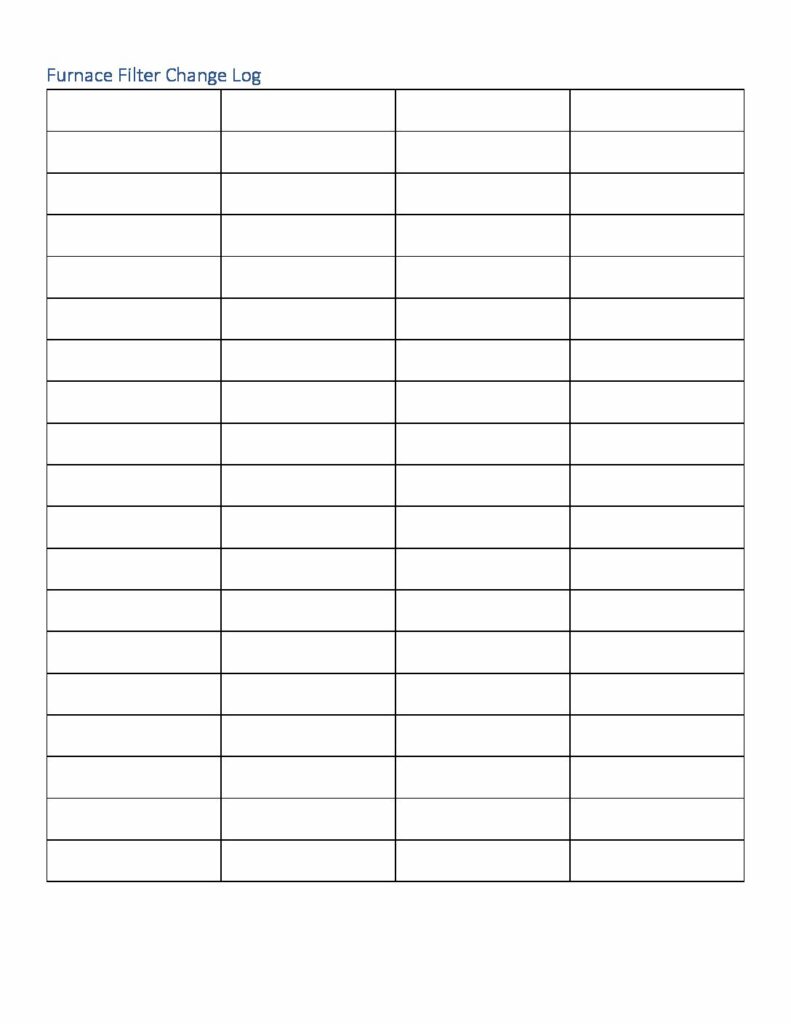
So, I created a small “change log” sheet that I taped on the side of the furnace to help me remember when I last changed them. It’s a simple thing – I just made a four column table where I could record the date I changed the filter. Done.
Here’s the PDF that you can print if you are interested.
Click on the above to open or right click to save in your browser.
I am definitely a long-time fan of Zastava rifles. I’ve owned a number of their Kalashnikov variants over the years including the M70B1, M72B1, M76, M77 and M92. When Zastava announced prior to the 2019 SHOT show that they were forming Zastava USA to handle importation instead of Century Arms, I was cautiously optimistic that we would see at least the introduction of the M91 rifle to the US market.
Zastava USA has a website and they have a PDF catalog with some great looking firearms. What caught my eye were a number of tactical models including some I didn’t expect – the M07, M12, M91 and M93 rifles.
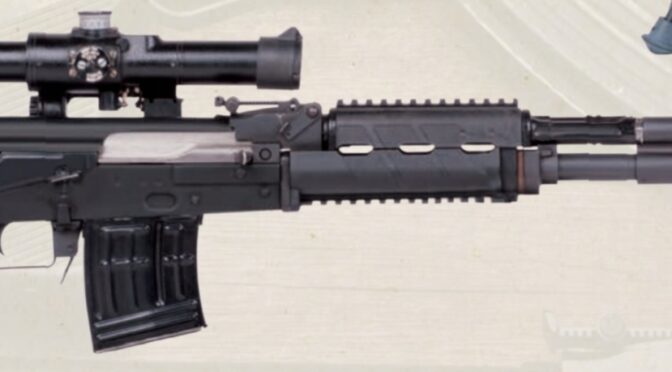
Here are some screen captures from their catalog so you can see what I am referring to:
In mid-March, I emailed them to ask about importation plans and they did confirm that both the M91 and M93 are planned for importation in “early summer” of 2019 but the manufacturer’s suggested retail price (MSRP) has not been set yet.
They did not mention the other models to be clear so I must conclude they are not planning to import them at this time.
I know a lot of us would like to see the M91 come to the US and I’m hoping they price it in an affordable manner. I would really like to see how it performs next to my M76 (8mm Mauser) and M77 (7.62×51) rifles. So, let’s keep our fingers crossed.
Folks, here are online sources for Zastava firearms including the M91 and M92:
In March, the Prime Minister of India inaugurated the Indo-Russian Rifles Pvt Ltd factory that will manufacture 75,000 of the AK-203 assault rifles. The AK-203 is the current model of the AK service rifle chambered for the 7.62×39 cartridge.
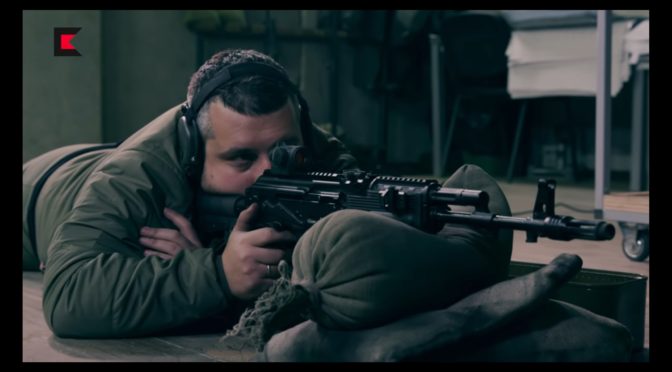
A common criticism is that AK rifles aren’t very accurate. Vladimir Onokoy, a technical advisor to the Kalashnikov Concern assembled this video to demonstrate how the 203 can accept modern optics, has a repeatable zero and can deliver acceptable accuracy at 100 meteres.
Until I watched this video, I’d only seen the very unique Hungarian AMP-69 in books. Ian McCollum did one of his impeccable reviews of this very interesting AK. He calls it the ugliest AK he’s ever seen but I think it’s pretty cool.
One of my first AKs was an AMD-65 it ran like a top. Like the Yugoslavs, the Hungarians had no issues with producing some very uniquely designed rifles based off the Kalashnikov design.
Two Rivers Arms recently built a Yugo M76 8mm designated marksman’s rifle for me. I’ve wanted one for years and it was a long but worthwhile wait until it arrived. So, once Tim called and said it was almost ready, I started reading up in earnest and watching videos as well.
That’s where Ian McCollum of Forgotten Weapons enters in. I am a fan of Ian at Forgotten Weapons and both subscribe to his Youtube channel and support him via Patreon. Ian published a video of him using a Yugo M76, or as it is formally known, a Zastava M76, in a 2-Gun match. It’s a quick fun watch to see Ian swinging around the big rifle.
I’m tuning a bunch of Yugo M76 magazines so they no longer nose dive when the bolt hold open (BHO) follower is hit from behind. It involves welding a small tab of 20 gauge sheet metal behind the follower and is straight forward – I’ll write a post about it shortly. The challenge I ran into was the need to reliably test ammunition feeding safely.
I had to add in the “safely” comment. I would tell you to never use live ammo when you are doing this kind of work because an accidental discharge could happen for a ton of reasons. There are a number of companies that make dummy rounds to enable folks to safely test their weapons. You’ll hear these rounds called things like “dummy rounds”, “snap caps”, “action proving rounds”, and probably tons of other things.
They tend to be made either from machined aluminum or from real components – such as real brass cases and jull metal jacket (FMJ) bullets – that are asssembled without powder and usually something rubbery in the primer pocket to protect the firing pin during dry firing. Assuming you are using a reputable vendor who is making the rounds to accurate dimensional specificaitons, either will work. The issue is longevity – especially in a big semi-auto rifle.
Aluminum is inherently soft. I’ve used a number of makers’ products over the years and some get chewed up real fast by heavy actions that slam rounds into the chamber with force. I’ve literally had chips/shavings of aluminum fall out after soft aluminum met hardened steel.
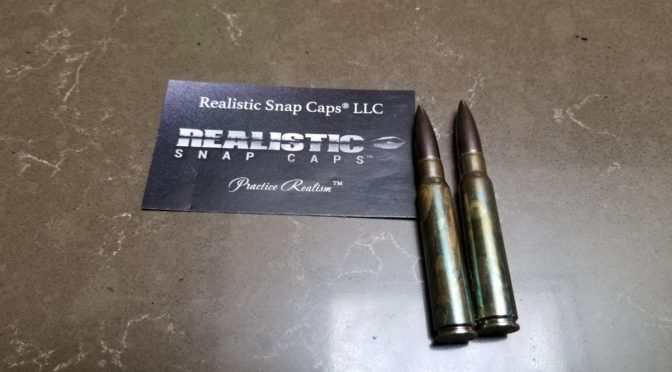
So, in order to safely test the feeding of the M76, I knew I could not go with aluminum rounds. I did some searching around and found “Realistic Snap Cap” brand and they take the route of producing an inert round (meaning not “live” because there is no powder and primer).
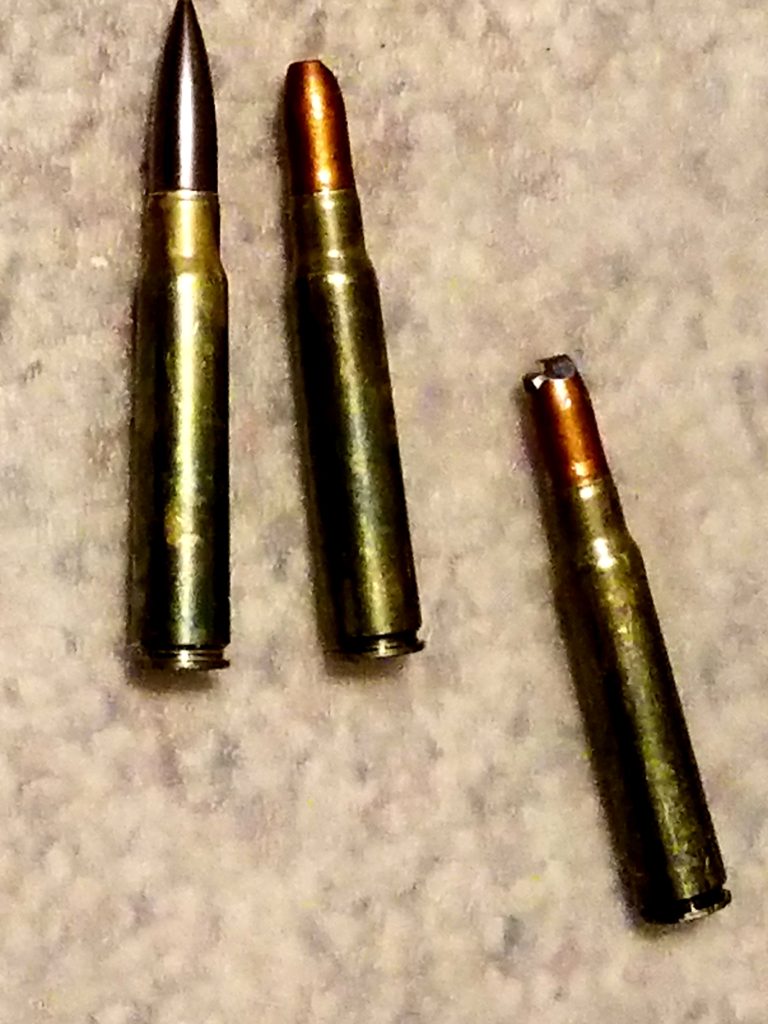
For reasons I’m not clear on, the firm makes two 8mm mauser snap caps – one with a blunted nose and one with a full size FMJ bullet that is the normal length. I did not know this when I ordered a package of five off Amazon because I mistakenly assumed the product photo shown accidentally did not show the top of the bullet.
You can see the blunt snap cap vs. a full size one. Do not use the blunt rounds to test a M76.
I really do not know why they made the blunted rounds. It might have been for people wanting to test hollow points, soft points or maybe wanting an even more positive identifier that it was a test round. Whatever the reason, they work horribly in a semi-auto M76.
I couldn’t blame the maker or Amazon because I knew better that to try a shorter than spec round that had a blunted nose vs. the curvature of a FMJ round that assists with feeding. I was too caught up in the “let’s get this done” mindset so it was my own fault.
The short rounds were made well so I did some digging and they did make a full size 8mm Mauser model described as “Advanced Tactical 8mm Mauser” that I ordered. Ok, now these work great.
They are well made and the patina is a pretty quick visual indicator that they are snap caps but never ever have live ammo anywhere near a firearm you are working on or you are risking an accident especially if you are tired.
Thanks to the right snap caps, I could then test all of the magazines and the snap caps held up great. Just be sure to get the full size snap caps and not the blunted ones if you are testing an M76.
4/3/24 I no longer see these on Amazon or eBay but there are other brands. Go with 8x57JS dummy rounds made from metals – not plastic or the M76 will beat them to death.
I have both SAE and Metric 3/4″ socket sets that come out once or twice a year when I am working on big bolts on cars and trucks. As you may know, the longer the wrench, the more torque you can apply. Back when I was younger would would slide a piece of pipe or heavy wall tube over a ratchet or breaker bar to get even more mechanical advantage. We definitely snapped some socket wrenches while doing this as we exceeeded their design specs.
You see, a ratcheting socket wrench has limits as to how much torque the mechanism can handle before something either bends or breaks. Quite often, the rathchet pawl would bend/crumple and no longer be able to engage the teeth of the gear. When that happens, we’d toss the cheap wrench.
This is why breaker bars were made by the way – they have no ratcheting mechanism and, thus, can handle more torque. There’s one problem though, there are times where you can’t get the breaker bar into position because you can’t turn the handle relative to the socket. So, what is a person to do when they need a ton of torque and a ratchet mechanism?
The short answer is to get a wrench with a long handle that is designed to handle a ton of torque. A ton of companies make socket wrenches with longer handles. I have a couple of these but what I find really handy are wrenches with extending/telescoping handles. When you are working in a relatively tight space, you may not have room for the fully extended handle or you have need to work it into position before you can open the handle.
The EZRed MR34 Wrench
So, when I need a ton of torque and mechanical advantage to help me get there (I’m at the age where I need to work smarter because my body doesn’t support harder any longer 🙂 – I break out the wrench I affectionately call “The Beast”. It is a beautifully made and chromed giant 3/4″ ratchet wrench.
The wrench is sold in the US by a firm called “EZRed” with a lifetime warranty and, like many things, is actually made in Taiwan. When you do some digging around, there are a lot of guys using this wrench for heavy equipment, farm equipment, trucks, steam pipes and more. After reading about the real world experiences with the wrench, I ordered one in.
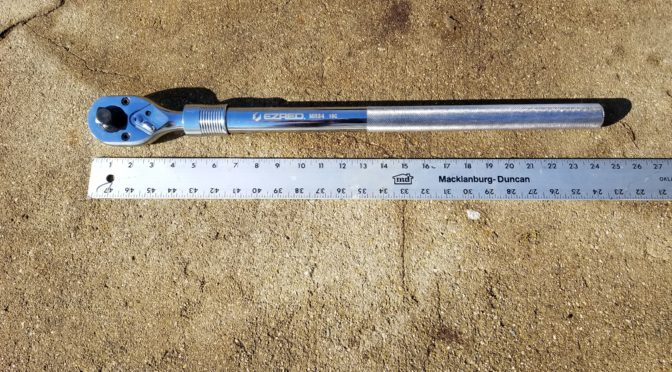
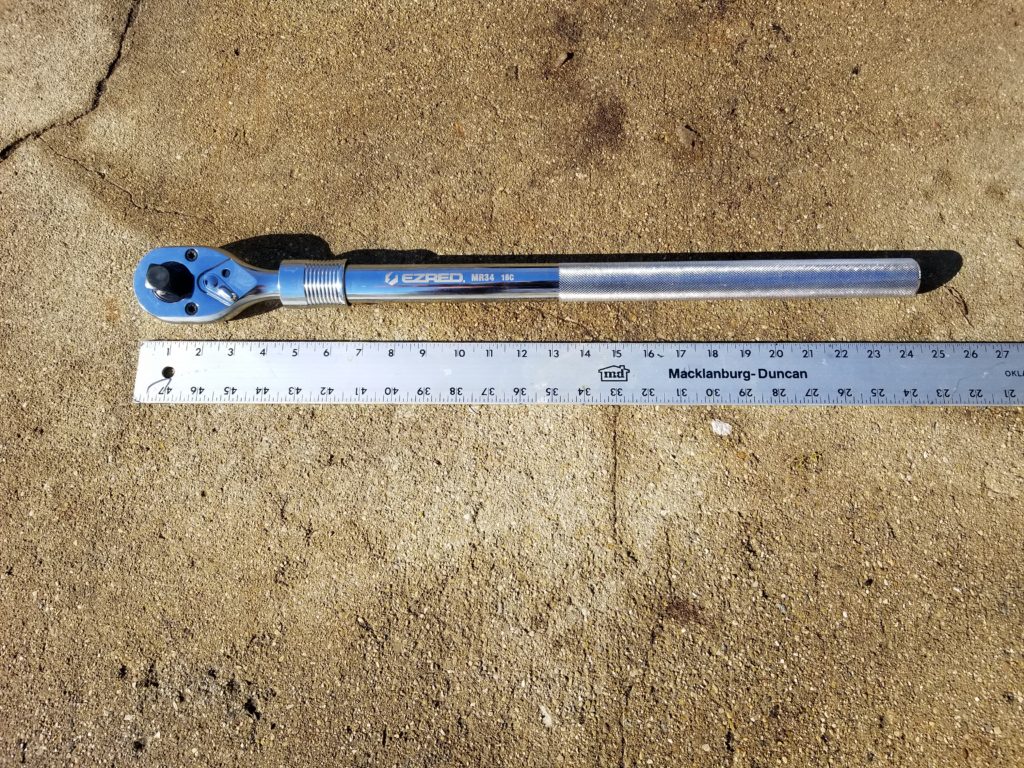
Here is the wrench closed and you can see it is about 24″ overall. Here is the MR34 fully open and about 40″ long overall.
The first things I noticed was that it’s a big wrench even without the handle extended. Next, it’s a heavy wrench and weighs in at about 8.5 pounds. I have to be honest, I don’t usually pay much attention to looks but the chrome finish is gorgeous.
Pull the collar down and a detent is released that allows the handle to telescope out. The handle then locks into position in the next available hole. The locking feature is definitely nice.
I use this for 3/4″ sockets and also have a SunEx 3/4 to 1/2″ reducer for those times I want to apply a ton of torque to a smaller bolt.
Here’s the wrench with a SunEx 3/4 to 1/2″ adapter.
So far, I am very happy with the wrench. As you can tell, I haven’t used it a ton yet but for the few quick jobs so far, it worked great.
Two Big Tips
A fellow recommended apply Blue Loctite to the head screws and grease the wrench while it was open. He was spot on – the screws were surprisingly lose. Even though they have blue thread locker on them from the factory something seems odd and guys have reported losing the screws. I really think if Ihad not followed the fellow’s advice I would have already lost mine as well – they are that loose.
The screws come out and then the head is very serviceable. You can see the two pawls and their springs plus the selector in the middle. What you don’t see is any lubricant! I must say I am a bit surprised.You can see the faceplate and the 24 tooth geared head.
So, I used a brush and lightly applied SuperLube grease to everything, reassembled the wrench and put Blue Loctite on the two head screws before tightening them down. The whole thing took maybe 10 minutes start to stop including taking the photos.
If you ever need it, the EZRed sells a rebuild kit – part number RK34.
Summary
I really like the wrench. It’s worked great so far but I really haven’t done anything super stressfulso far – just breaking some very rusty 1/2″ diameter carriagle bolts free off my plow. It’ll definitely get used this upcoming summer a lot more.
Guys, I must confess that I have a coffee addiction 🙂 As most of you know, I am into AK rifles as well. As part of that interest, I have read every biography I could find of Mikhail Timofeyevich Kalashnikov to try and better understand what led to the creation of the AK-47 and the eventual family of Kalashnikov designs.
Recently I was searching on Amazon and surprisingly found a coffee cup with a great photo of a young Kalashnikov that was tastefully done and, of courcase, had to order it. I had to wait a few weeks as it shipped from Germany.
When it arrived, I was surprised that the graphic was a different color than what the Amazon ad depicted. I thought about returning it but I do like the cup. The following shows you the cup that arrived – it is pretty cool and the color has grown on me.
My wife’s reaction was “Why did you buy another coffee cup?” To which I answered “But honey, this is Kalashnikov” at which she just turned around while shaking her head 🙂
In case you are looking for a conversation piece, check out this cup. Here’s the listing on Amazon.
7/3/2019 Update: It’s holding up just fine. It does make for a cool conversation piece when people use it. “Who is this guy?” is usually how it starts 🙂