Category Archives: Rifle Analytics

Rifle Analtyics & Reports

Exploring Desert Tech’s Controversial History and Innovations

Desert Tech, formerly known as Desert Tactical Arms, represents one of the most polarizing and technically ambitious case studies in the contemporary American firearms industry. Established in 2007 in West Valley City, Utah, the company was founded on a singular, disruptive hypothesis: that the traditional long-action sniper rifle was obsolete. While the established defense industrial base focused on incremental improvements to the Remington 700 action and the AR-10 platform, Desert Tech committed its entire engineering lineage to the bullpup configuration—placing the action and magazine behind the trigger group to dramatically reduce overall length without sacrificing ballistic performance.1

Over the course of nearly two decades, the company has evolved from a boutique manufacturer of the Stealth Recon Scout (SRS)—a platform that offered the lethality of a.338 Lapua Magnum in a package the size of a submachine gun—into a diversified defense brand incorporating ammunition manufacturing (Desert Tech Munitions) and specialized training facilities.3 This expansion was driven by a strategic vision to create a vertically integrated ecosystem where hardware, software (ballistics), and wetware (operator skill) were unified under a single “Tomorrow’s Weapons” doctrine.3

However, the company’s trajectory has been anything but linear. It has been defined by a tension between engineering brilliance and operational overreach. This was most visible in the decade-long saga of the Micro Dynamic Rifle (MDR), a project that sought to solve the inherent ergonomic flaws of the bullpup assault rifle through complex mechanical innovation. The MDR’s eventual discontinuation in 2024, in favor of the mechanically simplified WLVRN platform, marks a significant maturation point for the company—a pivot from theoretical perfectionism to pragmatic reliability.5

Simultaneously, Desert Tech operates under a unique and persistent cloud of reputational risk stemming from its ownership structure. The company is owned and financed by members of the Kingston family, founders of the Latter Day Church of Christ (LDCC), a polygamous fundamentalist group that has been the subject of federal investigations and civil rights lawsuits.7 The 2019 conviction of key family members for a $1 billion biofuel tax fraud scheme, coupled with ongoing 2025 federal lawsuits alleging human rights abuses within the group, creates a complex “glass ceiling” for the company.8 While Desert Tech hardware is technically competitive with Tier 1 defense contractors like Barrett or Accuracy International, these extra-industrial factors have complicated its ability to secure large-scale Programs of Record with the U.S. Department of Defense.

Despite these hurdles, Desert Tech weapons have found their way to the frontlines of modern high-intensity conflict. From the urban ruins of Ukraine to the mountains of Central Asia, the SRS and HTI platforms are in active service. Recent investigative reports from late 2024 indicate that while the company adheres to U.S. export controls, its products are being diverted to Russian forces via grey-market channels in the Eurasian Economic Union, highlighting the dual-use proliferation risks inherent in producing high-end precision technology.10

As of 2025, Desert Tech stands at a critical strategic juncture. Technically, the release of the WLVRN and the high-capacity Quattro-15 system suggests a renewed focus on market-driven product development. Commercially, the company must navigate the dual headwinds of a saturated tactical market and the existential legal threats facing its parent network. This report provides an exhaustive analysis of the company’s history, technology, and future prospects, dissecting the intricate interplay between its innovative hardware and its controversial corporate foundations.

1. The Genesis of Unconventionality (2007–2010)

The origins of Desert Tech are rooted not in a government solicitation or a military requirement document, but in the specific logistical frustrations of the civilian precision shooter. In the mid-2000s, the long-range shooting market was dominated by a “one caliber, one rifle” paradigm. If a shooter wanted to compete in a.308 Winchester class, hunt with a.300 Winchester Magnum, and engage targets at extreme distances with a.338 Lapua Magnum, they were required to purchase, equip, and zero three separate rifle systems. This inefficiency was the catalyst for Nick Young’s entry into the industry.

1.1 The “Glass Snob” Philosophy

Nicholas “Nick” Young founded Desert Tactical Arms (DTA) in May 2007 while completing an MBA program at the University of Utah.1 His initial business plan was drafted as a class project, driven by a personal realization following the death of his father: a desire to create something “meaningful” combined with his existing expertise in firearms.12

Young’s design philosophy was shaped by his self-identification as a “glass snob”—a shooter who prioritized high-end optics but lacked the funds to equip multiple rifles with top-tier scopes.2 In 2007, a premium tactical scope (such as a Schmidt & Bender or US Optics) could easily cost $3,000 to $4,000, often exceeding the cost of the rifle itself. Young realized that the most efficient way to access multiple calibers was not to buy more rifles, but to build a single, modular chassis that could swap calibers while retaining the same optic, trigger, and ergonomics.2

This “one rifle, one scope” concept necessitated a chassis system with a quick-change barrel mechanism. However, Young took the concept further by adopting the bullpup layout. By locating the action and magazine behind the fire control group, inside the stock, the design eliminated the “dead space” of a traditional buttstock. This allowed the rifle to maintain a full 26-inch barrel—essential for achieving the velocity required for long-range ballistics—while reducing the overall length of the weapon by nearly a foot compared to conventional competitors like the Remington 700 or the Accuracy International AW series.2

Desert Tech's modular rifle system: one optic, multiple barrels. "Glass Snob" efficiency model comparison.

1.2 Engineering the Stealth Recon Scout (SRS)

The result of this philosophy was the Stealth Recon Scout (SRS), unveiled at the 2008 SHOT Show.4 The SRS was a radical departure from the prevailing design language of the time. In 2008, the U.S. military was heavily invested in the M110 SASS and the M24 Sniper Weapon System, both traditional layouts. The SRS challenged the status quo by offering a rifle that was as short as an M4 carbine yet capable of effective fire out to 1,500 meters.13

The primary engineering challenge for the SRS was the trigger. Bullpup rifles were historically notorious for having poor, “mushy” triggers due to the long linkage bars required to connect the forward trigger shoe to the rearward sear. Young and his engineering team focused on creating a linkage that operated in tension rather than compression, or utilized stiffened transfer bars to eliminate flex.13 The result was a match-grade trigger that defied the negative stereotypes of the bullpup configuration, a critical factor in gaining acceptance among the precision shooting community.

The SRS also introduced a unique barrel clamping mechanism. Unlike traditional rifles where the barrel is threaded into the receiver (requiring a gunsmith and a vice to remove), the SRS barrel was held in place by a clamping system accessible via a torque wrench. This allowed the user to switch from a.308 training barrel to a.338 Lapua combat barrel in less than 60 minutes in the field, with a guaranteed return to zero.14

1.3 Early Market Penetration

Despite its innovative features, the SRS faced initial skepticism. The professional sniper community is deeply conservative, prioritizing proven reliability over novel features. The “unofficial” disqualification of the SRS from early military trials due to a trigger weight technicality (despite being adjustable) highlighted the institutional resistance to the bullpup form factor.13 However, the rifle found a strong following in the civilian tactical market and among law enforcement agencies that required a compact sniper system for urban environments (SWAT), where maneuvering a 45-inch rifle through hallways was impractical. The SRS Covert model, with an even shorter handguard and 16-inch barrel, was specifically developed to meet this urban requirement.4

2. Scaling Lethality: The Anti-Materiel Expansion (2011–2013)

By 2011, Desert Tactical Arms had established the viability of the bullpup precision rifle. The next phase of the company’s evolution involved scaling this concept up to the anti-materiel class, addressing the logistical burdens of heavy caliber weaponry.

2.1 The Hard Target Interdiction (HTI)

In 2012, DTA launched the Hard Target Interdiction (HTI) rifle.16 The HTI was essentially a scaled-up SRS designed to handle the massive.50 BMG cartridge, as well as the.375 and.408 CheyTac rounds.

The strategic significance of the HTI lay in its size-to-power ratio. The standard-issue anti-materiel rifle of the U.S. military, the Barrett M107, is approximately 57 inches long and weighs nearly 30 pounds. The HTI, utilizing the bullpup layout, achieved a similar barrel length in a package that was 12 inches shorter and significantly lighter.16 This reduction in size transformed the logistical profile of a heavy sniper team. An HTI could be transported in a standard sedan or jumped by a paratrooper without the specialized disassembly required for a Barrett.

The HTI also reinforced the company’s modularity ethos. While.50 BMG is the standard for anti-vehicle work, the.375 CheyTac offers superior ballistics for anti-personnel sniping at extreme ranges (2,000+ meters). The HTI allowed a unit to field both capabilities in a single chassis, reducing the logistics footprint of the armory.16

2.2 Rebranding to “Desert Tech”

In December 2013, the company underwent a significant corporate restructuring and rebranding, changing its name from Desert Tactical Arms to Desert Tech.1 This was not merely a cosmetic change but a reflection of a broader strategic ambition. Nick Young envisioned a “universal brand” that integrated three distinct pillars:

  1. Desert Tech (Firearms): The core manufacturing arm.
  2. Desert Tech Munitions (DTM): A newly formed division dedicated to producing “match-paired” ammunition. Young recognized that a precision rifle is only as good as the ammo it fires. By manufacturing their own munitions, Desert Tech could guarantee the performance of their rifles, offering a complete “system” to the customer.3
  3. Desert Tech Training Center: A massive 25,000-acre facility in northeastern Utah designed to provide long-range shooting instruction, effectively creating a funnel of educated users for their hardware.3

This vertical integration was summarized in the new slogan, “Tomorrow’s Weapon Technologies,” signaling a shift from a machine shop mentality to a systems integrator mentality.18

3. The Battle Rifle Ambition: The MDR Saga (2014–2023)

If the SRS and HTI represented Desert Tech’s mastery of the manual bolt-action, the Micro Dynamic Rifle (MDR) represented its struggle to tame the semiautomatic. Announced in 2014, the MDR was an ambitious attempt to create the “ultimate” assault rifle, but its development would prove to be a decade-long crucible for the company’s engineering team.

3.1 The Promise: Solving the Bullpup Paradox

The bullpup assault rifle (exemplified by the Steyr AUG, FAMAS, and IWI Tavor) has historically suffered from a critical flaw: lack of true ambidexterity. Because the ejection port is located on the stock, right next to the shooter’s cheek, a left-handed shooter (or a right-handed shooter switching shoulders to slice a corner) risks being struck in the face by hot brass.

Desert Tech announced the MDR in 2014 with a revolutionary solution: a forward-ejection mechanism. The concept involved a complex system of a “scissor” extractor and a chute cover that would catch the spent casing as it was pulled from the chamber, then punch it forward and away from the shooter.5 This would allow the rifle to be fully ambidextrous without any field reconfiguration, a “holy grail” feature for modern infantry combat.

3.2 Development Hell and the “Icarus Moment”

The complexity of the forward-ejection system caused severe production delays. While the rifle was announced in 2014, it did not ship to customers until 2017—three years behind schedule.19 When it finally arrived, early adopters reported reliability issues. The mechanical energy required to strip the round, orient it, and punch it forward robbed the bolt carrier group of momentum. If the gas system was not perfectly tuned, or if the ammunition was slightly underpowered, the rifle would suffer from failure-to-eject (FTE) malfunctions.

This period was a “Icarus moment” for Desert Tech. The company had flown too close to the sun of engineering perfection, creating a mechanism that was theoretically brilliant but practically fragile in the chaos of real-world variables.

3.3 The MDRX Stabilization (2020)

In January 2020, acknowledging the flaws of the original MDR, Desert Tech released the MDRX (Extreme).21 This updated platform introduced several critical fixes:

  • Material Upgrades: A stronger polymer resin was used to prevent receiver flex, which had contributed to accuracy issues in the Gen 1 models.19
  • Side Eject Option: Crucially, the MDRX offered a “Side Eject” (SE) configuration alongside the “Forward Eject” (FE) one. This was a tacit admission that the forward ejection system, while innovative, was not for everyone. The SE option simplified the mechanism, increasing reliability for users who did not strictly need the forward-eject capability.22
  • Gas Block Improvements: Improved drainage and venting were added to the gas block to prevent hydro-locking and allow for better tuning with suppressors.23

Despite these improvements, the MDRX remained a heavy and complex platform. While it found a cult following in the civilian market—bolstered by its futuristic aesthetic and inclusion in popular video games like Escape from Tarkov—it struggled to gain widespread military adoption.20

4. Corporate Structure & The Kingston Shadow (2019–2025)

No analysis of Desert Tech is complete without addressing its ownership structure. The company is inextricably linked to the Kingston family, a lineage that provides both its financial foundation and its greatest reputational liability.

4.1 The “Order” Connection

Desert Tech is owned and financed by members of the Kingston family, the founders and leaders of the Latter Day Church of Christ (LDCC), also known as the Davis County Cooperative Society (DCCS) or simply “The Order”.7 This fundamentalist group, which split from the mainstream LDS Church in the 1930s, practices polygamy and operates a cooperative financial system. Members often work for Order-owned businesses, and a portion of their wages and business profits flow into a central “Order Bank” or “Office,” which then redistributes capital to finance other group ventures.24

This communal asset structure means that Desert Tech is not merely a private company but part of a larger, insular economic network. The Southern Poverty Law Center (SPLC) has designated the Order as a hate group, citing alleged white supremacist teachings within their doctrine, a charge the group denies but which has nonetheless alienated potential corporate partners.25

4.2 The Washakie Renewable Energy Fraud

In 2019, the Department of Justice unraveled a massive fraud scheme involving Washakie Renewable Energy, a company owned by Jacob and Isaiah Kingston—brothers of Desert Tech CEO Nick Young.8 The brothers pleaded guilty to a $1.1 billion scheme involving the fraudulent claiming of renewable fuel tax credits (RINs). They had rotated millions of gallons of biodiesel through the U.S. shipping system to create the appearance of production, collecting payouts from the IRS and EPA.27

While Nick Young was not criminally charged in the fraud, the investigation directly threatened Desert Tech. In July 2019, federal prosecutors filed a notice of intent to seize the Desert Tech headquarters in West Valley City, alleging that the property had been purchased or improved with laundered proceeds from the Washakie fraud.7 Young vigorously defended the company, asserting his independence from his brothers’ criminal activities. Ultimately, the seizure of the Desert Tech building did not proceed, allowing the company to remain operational, but the close call highlighted the fragility of the company’s asset base due to the intermingled nature of Kingston family finances.7

The legal pressure on the Kingston network has only intensified in the mid-2020s. In 2024 and early 2025, a series of federal civil lawsuits were filed by former members of the Order against the group’s leadership, including Paul Elden Kingston (the group’s patriarch). These lawsuits, such as Grant et al v. Kingston et al, allege systemic human trafficking, labor exploitation, and the sexual abuse of minors.9

Specifically, the January 2025 filing accuses the leadership of coercing underage girls into incestuous marriages to “maintain pure Kingston blood”.28 While Nick Young is rarely the primary named defendant in these abuse allegations, the lawsuits target the “Order Bank” and the network of businesses that sustain the group. This creates a persistent “glass ceiling” for Desert Tech. Government procurement officers are risk-averse; the prospect of awarding a multi-million dollar Program of Record (POR) to a company whose ultimate beneficial owners are embroiled in human trafficking litigation is politically toxic. Consequently, Desert Tech remains a “Tier 2” contractor, successful in the civilian and grey markets but largely locked out of the lucrative U.S. military industrial complex prime contracts.7

5. Modern Conflict & Geopolitics (2022–2025)

Despite the domestic legal firestorms, Desert Tech hardware has seen significant active-duty use in the high-intensity conflict in Ukraine, serving as a grim but effective proving ground for the bullpup sniper concept.

5.1 The Ukrainian Proving Ground

Since the full-scale invasion in 2022, photographic evidence has confirmed the widespread presence of Desert Tech rifles in the hands of Ukrainian forces. The SRS-A1 and SRS-A2, as well as the HTI, have been documented in use by Ukrainian Special Operations Forces (SOF) and territorial defense units.30

The SRS platform is particularly well-suited for the urban warfare that characterizes much of the Ukrainian conflict. In battles for cities like Bakhmut or Avdiivka, snipers often operate from deep within rooms to mask their muzzle flash and sound. A traditional 45-inch sniper rifle is difficult to maneuver in tight apartments and its barrel may protrude from windows, exposing the shooter. The compact SRS allows the sniper to remain mobile and concealed while delivering.338 Lapua payloads.13 While Desert Tech lists Ukraine as a client, it is likely that many of these rifles arrived via volunteer supply networks and private donations rather than direct government-to-government contracts.13

5.2 The Insider Report: Sanctions Evasion and the Russian Connection

In December 2024, a joint investigative report by The Insider, IrpiMedia, and Vlast.kz revealed that Desert Tech rifles were not only defending Ukraine but were also being used to attack it. The investigation uncovered that Russian snipers, including units from the 155th Naval Infantry Brigade (notorious for alleged war crimes), were equipping themselves with SRS and HTI rifles.10

The mechanism of this acquisition highlights the complexity of modern sanctions enforcement. Since direct export to Russia is banned, Russian procurement networks utilized intermediaries in Central Asia. The report detailed a supply chain where rifles were legally exported from the U.S. to distributors in Kyrgyzstan and Kazakhstan—members of the Eurasian Economic Union (EAEU).33 Once inside the EAEU customs union, goods can flow freely across borders. Companies like “Edelweiss” in Kyrgyzstan would import the rifles as civilian hunting weapons, after which they were re-exported or transshipped to Russian military buyers.33

Map showing how Western rifles, including Desert Tech, reach Russian snipers via grey market routes bypassing sanctions.

This revelation places Desert Tech in a precarious position. While there is no evidence that Desert Tech management knowingly colluded with Russian buyers, the presence of their flagship products in the hands of an adversary military creates immense regulatory risk. It invites scrutiny from the U.S. State Department’s Directorate of Defense Trade Controls (DDTC) regarding the company’s “Know Your Customer” (KYC) vetting processes for its international distributors.

6. The Great Reset: WLVRN and Quattro (2024–Present)

Recognizing the limitations of the MDR platform and the need to diversify its product base, Desert Tech executed a major strategic pivot in 2024.

6.1 The WLVRN Revolution

In January 2024, Desert Tech officially discontinued the MDR and MDRX lines, replacing them with the WLVRN (Wolverine).5 The WLVRN represents a triumph of pragmatism over ambition. It completely abandons the complex forward-ejection mechanism that defined the MDR. By reverting to a simpler side-ejection system (borrowing from the SRS barrel mounting architecture), the engineers achieved significant performance gains:

  • Weight Reduction: The WLVRN is up to 19% lighter than the MDRX, addressing one of the primary complaints about the previous platform.34
  • Simplicity: The new receiver uses 49 fewer parts, drastically reducing the points of failure.34
  • Accuracy: The barrel is now mounted via a trunnion machined directly into the aluminum upper receiver (similar to the SRS), which reportedly improves accuracy by 30% compared to the polymer-bedded barrel of the MDRX.6
MDRX vs WLVRN comparison chart showing key engineering changes like ejection mechanism and weight differences.

6.2 The Quattro-15 and QMAG-53

Simultaneously, Desert Tech moved to capture the broader AR-15 market with the Quattro-15 system, shipping in volume by early 2025.36 This system consists of a specialized lower receiver designed to accept the QMAG-53, a 53-round quad-stack magazine.

Quad-stack magazines (like the legacy SureFire 60) have historically suffered from reliability issues because tapering four columns of ammo into a single feed point creates immense friction. The Quattro-15 solves this by widening the magwell itself, allowing the magazine to remain wide until the very top feed lips. This product was born from Desert Tech’s submission to the U.S. Army’s Next Generation Squad Weapon (NGSW) program, showcasing their attempt to spin off military R&D into civilian commercial success.38

7. Future Outlook & Strategic Analysis

As Desert Tech moves through 2025, it occupies a unique “High Innovation / Civilian-Primary” quadrant of the firearms market. Unlike competitors such as Barrett or Accuracy International, which are “Mil-Spec Traditional” and derive the bulk of their revenue from government contracts, Desert Tech relies heavily on the high-end civilian enthusiast market.

The global firearms market is witnessing a “bullpup renaissance,” driven by the adoption of the VHS-2 (Hellion) and the continued relevance of the Tavor.39 The WLVRN is well-positioned to compete in this space, provided the company can permanently shed the reputation for poor quality control that plagued the early MDR years.

7.2 The Existential Risk

The primary threat to Desert Tech remains the legal instability of the Kingston family. As the 2025 lawsuits against the Order progress, the risk of asset forfeiture or banking de-risking (where banks refuse to service the company due to reputational toxicity) increases. For Desert Tech to thrive long-term, it may eventually require a divestiture—separating the innovative engineering and the “Desert Tech” brand from the ownership of the Order, much like how other controversial defense firms have rebranded or restructured to survive.

8. Summary of Key Milestones

YearMilestone EventSignificance
2007FoundingNick Young founds Desert Tactical Arms (DTA) in West Valley City, Utah.1
2008SRS LaunchThe Stealth Recon Scout (SRS) is unveiled at SHOT Show, introducing the modern modular bullpup sniper.4
2012HTI LaunchThe Hard Target Interdiction (HTI) is released, bringing.50 BMG capability to a portable chassis.16
2013RebrandingCompany changes name to Desert Tech; integrates Munitions and Training divisions.3
2014MDR AnnouncementThe Micro Dynamic Rifle (MDR) is announced, promising a revolution in bullpup ergonomics.19
2014Pakistan ContractDesert Tech publicly rejects a rumored $15M Pakistan contract on ethical grounds.40
2017MDR ShippingAfter 3 years of delays, the MDR finally ships to customers.19
2019Fraud CaseJacob and Isaiah Kingston plead guilty to $1B tax fraud; Desert Tech building threatened with seizure (later dropped).8
2020MDRX ReleaseThe MDRX replaces the MDR, fixing polymer flex and reliability issues; adds Side Eject option.21
2022Trek-22 LaunchEntry into the rimfire market with the Trek-22 chassis for Ruger 10/22.36
2023Quattro-15 LaunchThe 53-round quad-stack magazine system (QMAG-53) and lower receiver are launched.38
2024WLVRN ReleaseThe WLVRN replaces the MDRX, abandoning forward ejection for a lighter, simpler, side-eject design.5
2024Ukraine/Russia UsageReports confirm widespread use of DT rifles in Ukraine; investigations reveal grey-market flow to Russia.10
2025Legal BattlesNew federal lawsuits filed against Kingston family leadership alleging abuse; continued operation of the company under cloud of litigation.9

Please share the link on Facebook, Forums, with colleagues, etc. Your support is much appreciated and if you have any feedback, please email us in**@*********ps.com. If you’d like to request a report or order a reprint, please click here for the corresponding page to open in new tab.


Sources Used

  1. Desert Tech | Gun Wiki | Fandom, accessed December 21, 2025, https://guns.fandom.com/wiki/Desert_Tech
  2. About Us – Desert Tech, accessed December 21, 2025, https://deserttech.com/about-us
  3. Desert Tactical Arms (DTA) to Rebrand Company as Desert Tech (DT), and Thomas Alexander is Named CEO of Desert Tech Training Center – Defense Review, accessed December 21, 2025, https://defensereview.com/desert-tactical-arms-dta-to-rebrand-company-as-desert-tech-dt-and-thomas-alexander-is-named-ceo-of-desert-tech-training-center/
  4. Desert Tech SRS – Wikipedia, accessed December 21, 2025, https://en.wikipedia.org/wiki/Desert_Tech_SRS
  5. The NEW Desert Tech WLVRN Bullpup – YouTube, accessed December 21, 2025, https://www.youtube.com/watch?v=ko07rGsKYtM
  6. WLVRN Micron – Desert Tech, accessed December 21, 2025, https://deserttech.com/wlvrn-micron.html
  7. Desert Tech – Wikipedia, accessed December 21, 2025, https://en.wikipedia.org/wiki/Desert_Tech
  8. Utah polygamist clan members sentenced to federal prison for billion-dollar tax fraud scheme | KSL.com, accessed December 21, 2025, https://www.ksl.com/article/50620241/utah-polygamist-clan-members-sentenced-to-federal-prison-for-billion-dollar-tax-fraud-scheme
  9. Grant et al v. Kingston et al, No. 2:2024cv00155 – Document 292 (D. Utah 2024) – Justia Law, accessed December 21, 2025, https://law.justia.com/cases/federal/district-courts/utah/utdce/2:2024cv00155/146641/292/
  10. Shooting Ukraine in the back: Sniper rifles and ammunition from the …, accessed December 21, 2025, https://theins.ru/en/politics/277169
  11. Russian state TV shows military using U.S.-made sniper rifles and ammunition, despite 2014 embargo – The Insider, accessed December 21, 2025, https://theins.ru/en/news/278477
  12. I Built a Gun Company – Desert Tech, accessed December 21, 2025, https://deserttech.com/blog/i-built-a-gun-company
  13. Who Really Won the $80 Million SOCOM Sniper Rifle Contract? – Desert Tech, accessed December 21, 2025, https://deserttech.com/blog/sniper-rifle-contract
  14. SRS M-2 Flyer (2024) front – Desert Tech, accessed December 21, 2025, https://deserttech.com/media/attachments/products/SRS_M-2_Flyer_2024__1.pdf
  15. Desert Tech SRS-A2 – the unreal hi-tech sniper rifle coming from the future, accessed December 21, 2025, https://bulgarianmilitary.com/2020/07/25/desert-tech-srs-a2-the-unreal-hi-tech-sniper-rifle-coming-from-the-future/
  16. Desert Tech HTI – Wikipedia, accessed December 21, 2025, https://en.wikipedia.org/wiki/Desert_Tech_HTI
  17. Origin Story of Desert Tech – YouTube, accessed December 21, 2025, https://www.youtube.com/watch?v=qGsxs-0lS30
  18. Desert Tactical Arms To Rebrand Company As Desert Tech | Soldier Systems Daily, accessed December 21, 2025, https://soldiersystems.net/2013/12/19/desert-tactical-arms-to-rebrand-company-as-desert-tech/
  19. Desert Tech MDR – Wikipedia, accessed December 21, 2025, https://en.wikipedia.org/wiki/Desert_Tech_MDR
  20. A Year with the Desert Tech MDRX (Review) – YouTube, accessed December 21, 2025, https://www.youtube.com/watch?v=aUr-JEJoufg
  21. SHOT Show 2020: Desert Tech MDRX | An Official Journal Of The NRA – American Rifleman, accessed December 21, 2025, https://www.americanrifleman.org/content/shot-show-2020-desert-tech-mdrx/
  22. WLVRN Reliability/Durability : r/DesertTech – Reddit, accessed December 21, 2025, https://www.reddit.com/r/DesertTech/comments/1m272xm/wlvrn_reliabilitydurability/
  23. WLVRN has been out for 9 months and I’m still salty : r/DesertTech – Reddit, accessed December 21, 2025, https://www.reddit.com/r/DesertTech/comments/1ga8ff8/wlvrn_has_been_out_for_9_months_and_im_still_salty/
  24. Latter Day Church of Christ – Wikipedia, accessed December 21, 2025, https://en.wikipedia.org/wiki/Latter_Day_Church_of_Christ
  25. Blood Cult – Southern Poverty Law Center, accessed December 21, 2025, https://www.splcenter.org/resources/reports/blood-cult/
  26. Jury Finds Los Angeles Businessman Guilty in $1 Billion Biodiesel Tax Fraud Scheme, accessed December 21, 2025, https://www.justice.gov/archives/opa/pr/jury-finds-los-angeles-businessman-guilty-1-billion-biodiesel-tax-fraud-scheme
  27. Los Angeles Businessman, Utah Fuel Plant Operators and Employees Sentenced to Prison for Billion-Dollar Biofuel Tax Fraud Scheme – Department of Justice, accessed December 21, 2025, https://www.justice.gov/archives/opa/pr/los-angeles-businessman-utah-fuel-plant-operators-and-employees-sentenced-prison-billion
  28. ‘Kingston clan’ lawsuit alleges incestuous, underage plural marriage – KSL.com, accessed December 21, 2025, https://www.ksl.com/article/51250692/kingston-clan-lawsuit-alleges-incestuous-underage-plural-marriage
  29. Donald Trump Jr. appeared in promotion for gun company run by prominent member of polygamous group – CBS News, accessed December 21, 2025, https://www.cbsnews.com/news/donald-trump-jr-desert-tech-riles-promotion-nicholas-young-the-order-polygamous-group-utah/
  30. Desert Tech Equipment deployed to Ukraine War (Including MDRx) : r/DesertTech – Reddit, accessed December 21, 2025, https://www.reddit.com/r/DesertTech/comments/wfno1v/desert_tech_equipment_deployed_to_ukraine_war/
  31. Desert Tech MDR in Ukraine : r/ForgottenWeapons – Reddit, accessed December 21, 2025, https://www.reddit.com/r/ForgottenWeapons/comments/13vy9ko/desert_tech_mdr_in_ukraine/
  32. SRS Contract – Desert Tech, accessed December 21, 2025, https://deserttech.com/contract-srs
  33. Russian snipers use Western rifles, ammunition despite sanctions, media investigation says, accessed December 21, 2025, https://kyivindependent.com/russian-snipers-sanctions-insider/
  34. WLVRN Bullpup Rifle – Desert Tech, accessed December 21, 2025, https://deserttech.com/wlvrn-rifle.html
  35. Desert Tech WLVRN 6mm ARC – Coldboremiracle, accessed December 21, 2025, https://coldboremiracle.com/2024/12/14/desert-tech-wlvrn-6mm-arc/
  36. [SHOT 2025] Desert Tech Introduce Complete Trek-22 and Quattro Rifles – The Firearm Blog, accessed December 21, 2025, https://www.thefirearmblog.com/blog/shot-2025-desert-tech-introduce-complete-trek-22and-quattro-rifles-44818591
  37. Quattro-15 – Desert Tech, accessed December 21, 2025, https://deserttech.com/blog/quattro-15
  38. Development History: Quattro 15 & QMAG-53 – Desert Tech, accessed December 21, 2025, https://deserttech.com/blog/development-history-quattro-15-qman-53
  39. 9 Best Bullpup Rifles & Shotguns [Updated 2025 ] – Gun University, accessed December 21, 2025, https://gununiversity.com/best-bullpup-rifles-and-shotguns/
  40. Pak slams Utah gun maker’s claim of rejecting rifles contract as ‘baseless’ – The Siasat Daily, accessed December 21, 2025, https://archive.siasat.com/news/pak-slams-utah-gun-makers-claim-rejecting-rifles-contract-baseless-527080/

Top 20 Innovative Rifles Overall from SHOT Show 2026

The 2026 Shooting, Hunting, and Outdoor Trade (SHOT) Show in Las Vegas serves as the definitive bellwether for the global small arms industry. While previous years were often characterized by incremental iterations—new calibers for existing platforms or cosmetic updates—2026 marks a structural realignment in firearms engineering. The distinct segmentation that once separated “tactical,” “hunting,” and “competition” firearms has largely collapsed. In its place, a new doctrine of platform hybridization has emerged, driven by advanced manufacturing capabilities, shifting regulatory landscapes, and a consumer base that demands multi-role capability.

The top 20 rifles analyzed in this report were selected not merely for their marketing prominence, but for their contribution to this technical evolution. They represent the synthesis of materials science—specifically the democratization of carbon fiber and magnesium alloys—with the ergonomic standardization of the AR-15 architecture. Three dominant trends define the 2026 landscape:

  1. The Tactical Lever-Action Renaissance: No longer a niche curiosity, the lever-action rifle has been re-engineered as a compliant defensive tool for restrictive jurisdictions, featuring modular handguards, threaded barrels, and modern metallurgy.
  2. The Mainstreaming of Straight-Pull Actions: European-style straight-pull actions, prioritized for their speed and ambidexterity, are aggressively penetrating the North American market, challenging the century-long dominance of the rotating bolt action.
  3. The “Suppressor-Standard” Baseline: Over 85% of the new centerfire rifles debuting this year feature factory-threaded muzzles. This shift signals that sound suppression is no longer viewed as an aftermarket modification but as a fundamental component of the rifle’s ecosystem, influencing barrel harmonics and gas system tuning at the OEM level.

Summary of Top 20 Rifles

RankModelCategoryKey InnovationMSRP (Est.)
1Daniel Defense DD4 X1Premier TacticalIntegrated thermal management & IR-defeating coating~$3,000
2PSA VUKTactical InnovationAK piston reliability with monobloc modularity~$600 – $1,000
3Desert Tech WLVRNBullpupIntegrated receiver reducing part count by 49~$2,500+
4Beretta BRX1 TacticalTactical Straight-PullLinear action for speed & regulatory compliance~$1,600
5Springfield Hellion DMRBullpup DMR20″ barrel ballistics in carbine length~$2,078
6S&W Model 1854Modern Lever ActionM-LOK forend & flat-face trigger~$1,279
7Henry Protector SeriesDefensive Lever ActionSubsonic optimization & suppressor ready~$900 – $1,100
8Taylor’s & Co. TC73Pistol Caliber Lever9mm rimless extraction system$1,999
9Benelli Lupo HPRPremium CrossoverBE.S.T. surface hardening & chassis hybrid$2,949
10Sig Sauer CROSS MagnumBackcountry PrecisionOne-piece receiver with floating bolt head~$2,500+
11MPA BA PMR Pro Rifle IIProduction CompetitionIntegrated inclinometer & competition chassis~$2,499
12Aero Precision SolusEntry-Level CustomIntegral recoil lug & 60-degree bolt throw~$1,600 – $2,000
13Franchi Momentum MULEModern ScoutCompact 16.25″ utility design~$1,549
14Ruger American Gen IIBudget Utility“Splatter” texture stock & harmonic consistency~$729 – $929
15Howa Fence LineCompact UtilityMini action scaled for.223/6mm ARC~$729
16Christensen Arms EvokeEntry-Premium Hunting416R stainless barrel & adjustable ergonomics~$900 – $1,000
17Savage RXR22Tactical Rimfire10/22 mag compatibility & rear cleaning port$299
18Franchi Momentum VarmintPrecision VarmintHigh-BC.22 ARC chambering$959 – $1,299
19Howa Superlite Gen 2Ultralight MountainFull aluminum bedding block & sub-5lb weight~$1,169
20Bergara Premier Cima ProAdvanced MaterialAutoclave cured carbon fiber stockPremium Tier

This report provides an exhaustive industry analysis of these platforms, dissecting their engineering, market positioning, and the broader strategic implications they hold for the small arms sector.

Section I: The Apex of Tactical Innovation and Defense Contracting

The tactical rifle segment remains the primary engine of innovation within the industry, driven largely by the downstream effects of military procurement programs (such as the Next Generation Squad Weapon) and the evolving requirements of law enforcement agencies. In 2026, the focus has shifted from modularity—which is now assumed—to signature management and system durability.

1. Daniel Defense DD4 X1

Category: Premier Tactical / Military Contract

MSRP: ~$3,000 (Estimated)

The Daniel Defense DD4 X1 stands as the definitive tactical release of SHOT Show 2026. While the AR-15 platform has been iterated upon for over six decades, the DD4 X1 represents a significant divergence from civilian-grade engineering, rooting itself deeply in specific military requirements for signature reduction and sustained combat effectiveness.1

Engineering Analysis: The DD4 X1 is engineered to address the thermal and infrared (IR) liabilities inherent in standard direct-impingement carbines. The most significant innovation is the integration of a proprietary thermal management system. The rifle incorporates carbon-fiber inserts positioned strategically beneath the handguard.1 These inserts function as a thermal barrier, decoupling the aluminum handguard from the radiant heat of the barrel. In sustained engagements or high-volume training environments, this feature is critical not just for operator comfort, but for maintaining the structural integrity of mounted electronics (lasers, lights) which are susceptible to heat soak.

Furthermore, the DD4 X1 addresses the electromagnetic spectrum. The rifle is finished in a specialized IR-defeating Cerakote.1 Modern near-peer conflicts have demonstrated the ubiquity of night vision and thermal observation devices. A rifle that appears as a stark black void under IR illumination is a liability. By utilizing a coating that matches the IR reflectivity of natural backgrounds, Daniel Defense has integrated passive signature management directly into the manufacturing process.

Operational Capabilities:

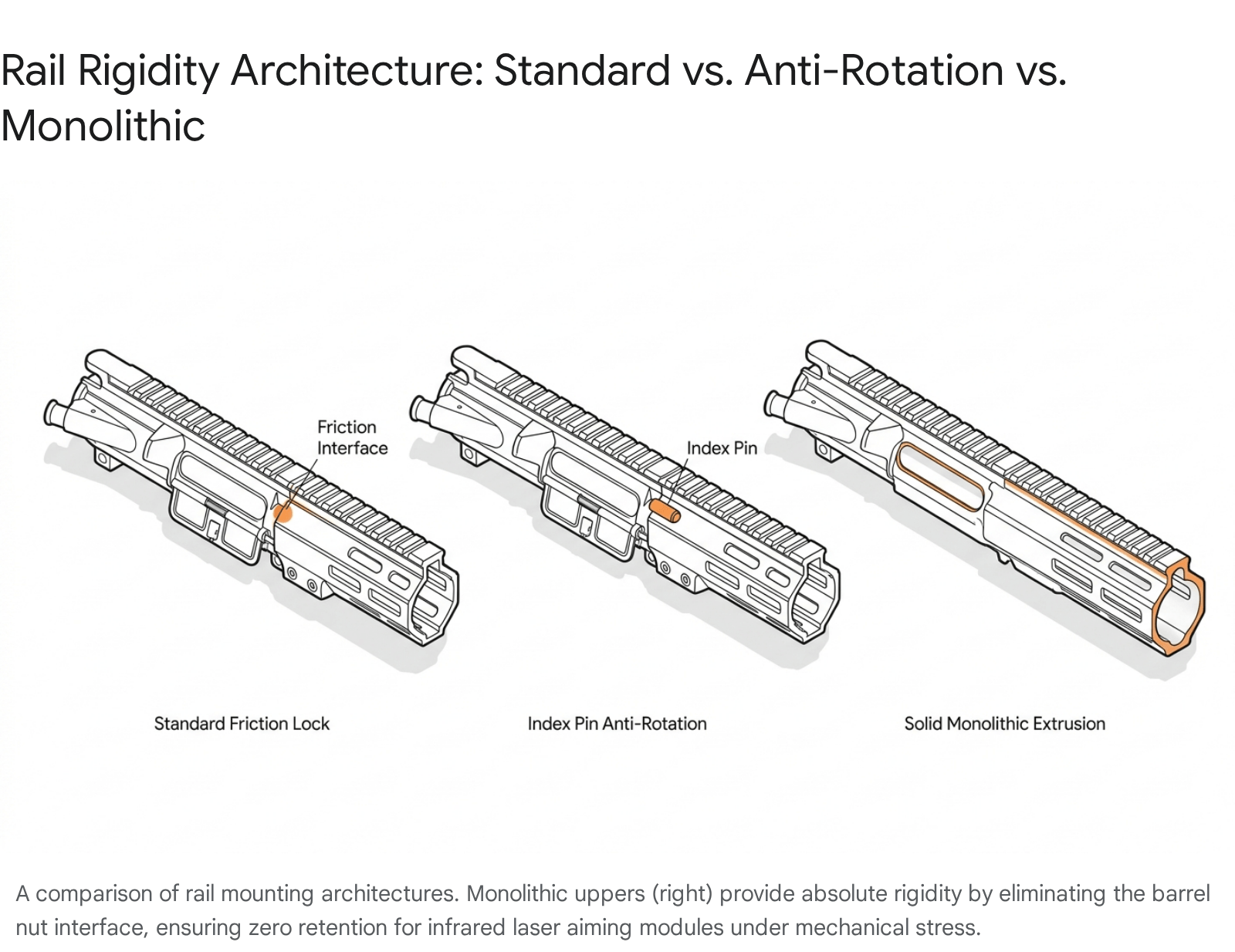
  • Bolt-Up System: The rifle utilizes the Daniel Defense Bolt-Up System, a robust 4-bolt interface between the upper receiver and handguard. This mechanical rigidity is essential for maintaining the zero of laser aiming modules (LAMs) mounted on the forend, a critical requirement for night operations.
  • Recoil Dynamics: The gas system is tuned with a specific tungsten buffer weight configuration.1 This increases the dwell time and mass of the reciprocating assembly, smoothing the recoil impulse. The result is a platform that remains flatter during rapid fire strings, facilitating faster target re-acquisition.
  • Market Trajectory: Daniel Defense has positioned the DD4 X1 as their “Best” tier offering, sitting above the V7 (“Good”) and R3 (“Better”). This pricing strategy targets the elite law enforcement sector and the high-end enthusiast market, effectively creating a production rifle that rivals boutique custom builds in performance and price.

2. Palmetto State Armory VUK (Jakl/AK Hybrid)

Category: Tactical Innovation / Hybrid Platform

MSRP: ~$600 – $1,000 (Estimated)

Palmetto State Armory (PSA) has fundamentally disrupted the economics of the rifle market. With the PSA VUK, they have moved beyond manufacturing standardized clones to developing unique, hybrid architectures. The VUK is a direct result of crowdsourced product development, incorporating voting data from previous SHOT Show exhibitions to finalize its design.2

Technical Architecture:

The VUK represents the convergence of two distinct design philosophies: the rugged reliability of the Kalashnikov long-stroke gas piston and the ergonomic modularity of Western monobloc receivers.

  • The Upper Assembly: Unlike the stamped steel receiver of a traditional AK, the VUK utilizes a rigid extruded or machined upper receiver similar to the FN SCAR or the PSA Jakl. This houses the reciprocating mass and the recoil spring assembly entirely within the upper receiver.3
  • Recoil Mechanism: By containing the recoil spring within the receiver, the VUK eliminates the need for an AR-style buffer tube. This allows for a folding stock—a feature that provides significant logistical advantages for mechanized infantry and vehicle-borne police officers who require compact storage.
  • The “AK Heart”: Internally, the bolt carrier group (BCG) and piston system are derived from the AK-47.4 The long-stroke piston is legendary for its mass and momentum, which allows it to power through carbon fouling, sand, and debris that would seize tighter tolerance systems.

Strategic Implications: The “bloated fish” aesthetic criticism noted by some observers 3 is a result of the volumetric requirements to house the recoil springs internally above the bolt carrier. However, function dictates form here. The VUK challenges the market dominance of expensive proprietary piston systems (like the MCX or SCAR) by offering similar capabilities—folding stock, piston reliability, monolithic rail space—at a fraction of the cost. It effectively democratizes the “modern piston carbine” for the civilian market.

3. Desert Tech WLVRN

Category: Bullpup / Multi-Caliber System

MSRP: ~$2,500+ (System dependent)

The Desert Tech WLVRN (Wolverine) is the third iteration of Desert Tech’s bullpup lineage, replacing the MDRX. The focus for 2026 was on refining the manufacturing process to enhance reliability and precision, specifically addressing the historic weaknesses of the bullpup configuration.5

System Evolution: The WLVRN introduces an integrated receiver design that reduces the total part count by 49 components compared to its predecessor.6 In firearm engineering, complexity is the enemy of reliability; reducing part count inherently reduces failure points.

  • Barrel Integration: A critical advancement is the machining of the barrel mounting system directly into the receiver. In previous bullpup designs, the barrel trunnion was often a separate insert, which could introduce flex and inconsistency. By making this integral, Desert Tech claims a 30% increase in accuracy.6 This allows the WLVRN to compete with conventional precision rifles, offering sub-MOA performance in a package significantly shorter than a standard carbine.
  • Micron Conversion: The 2026 update highlights the “Micron” 11.5″ conversion kit.5 This allows the user to convert a full-length battle rifle into a sub-compact Personal Defense Weapon (PDW) chambered in 5.56 NATO or.300 Blackout. The ability to switch calibers and barrel lengths on a single serialized chassis is a massive logistical benefit, particularly for users in jurisdictions where acquiring new firearms is legally burdensome.

4. Beretta BRX1 Tactical

Category: Tactical Straight-Pull

MSRP: ~$1,600 (Estimated)

The Beretta BRX1 Tactical marks a significant cultural and technical shift in the American rifle market.8 Straight-pull actions have dominated the European hunting market for decades due to their speed, but they have remained a niche curiosity in the United States. Beretta is now positioning this action type as a viable tactical alternative to the semi-automatic.

Mechanical Analysis:

The BRX1 utilizes a linear reloading motion. Unlike a traditional turn-bolt action which requires four distinct movements (up, back, forward, down), the BRX1 requires only two (back, forward).

  • Lockup Strength: The action employs a rotating bolt head with 8 lugs for standard calibers and 16 lugs for magnums. This is derived from the rotary bolt found in Beretta’s military semi-automatics, ensuring safety and robust extraction even with high-pressure defensive ammunition.
  • Ambidexterity: The bolt handle can be swapped from the right to the left side without tools, and the ejection pattern can also be reversed. This level of modularity is rare in bolt-action rifles and critical for institutional use where rifles may be issued to different officers.
  • The Compliance Strategy: The “Tactical” variant features a negative-cant Picatinny rail, a heavy contour threaded barrel, and a high-capacity magazine. This configuration targets “ban states” (like California, New York, and Massachusetts) where semi-automatic rifles with detachable magazines and pistol grips are heavily restricted or banned. The BRX1 Tactical offers the fastest possible manual rate of fire in a compliant package, filling a critical capabilities gap for civilians in these regions.

5. Springfield Armory Hellion (DMR Variants)

Category: Bullpup / Designated Marksman Rifle MSRP: ~$2,078 9

Springfield Armory has expanded the Hellion (based on the Croatian HS Produkt VHS-2) into the Designated Marksman Rifle (DMR) role with the release of 18-inch and 20-inch barrel variants.9

Ballistic Optimization:

The transition to a 20-inch barrel fundamentally changes the ballistic profile of the 5.56 NATO cartridge.

  • Velocity and Fragmentation: The 5.56 cartridge relies on velocity to induce fragmentation and terminal effect. Short-barreled carbines (10.3″ – 14.5″) often sacrifice this velocity. The 20-inch Hellion maximizes the cartridge’s potential, extending the effective fragmentation range out to 200+ yards.
  • The Bullpup Advantage: The strategic value of the Hellion DMR lies in its overall length. A conventional AR-15 with a 20-inch barrel is unwieldy in close quarters. The Hellion DMR, with its action located behind the trigger group, maintains an overall length comparable to a 14.5″ M4 carbine while delivering the ballistics of an M16.
  • Military Pedigree: The 20-inch model retains the ribbed forward barrel section found on the military VHS-D2 machine gun variant.10 While primarily aesthetic on a semi-auto, these ribs increase surface area for cooling, aiding in heat dissipation during rapid fire.

Section II: The Lever-Action Renaissance

Perhaps the most surprising trend of 2026 is the aggressive modernization of the lever-action rifle. This movement, often dubbed “Cowboy Tactical,” is driven by a confluence of regulatory necessity and the realization that the lever action remains a viable, slim, and potent defensive tool.

6. Smith & Wesson Model 1854 Series

Category: Modern Lever Action MSRP: ~$1,279 (Standard) / $3,499 (Limited) 11

Smith & Wesson’s re-entry into the lever-gun market with the Model 1854 is a calculated maneuver to capture the high-end of this emerging market segment. While the nomenclature pays homage to the 1854 Volcanic pistol, the engineering is entirely contemporary.12

Design Philosophy:

The Model 1854 is not a reproduction; it is a reinvention.

  • Modular Interface: The primary differentiator is the synthetic forend, which features integrated M-LOK slots at the 3, 6, and 9 o’clock positions.12 This seemingly minor addition fundamentally changes the rifle’s utility. It allows users to mount modern weapon lights and bipods directly to the firearm without the use of clumsy barrel clamps or gunsmithing. This enables the lever gun to function in a home defense role where positive target identification (via a weapon light) is mandatory.
  • Action Geometry: Smith & Wesson has focused heavily on the trigger quality, utilizing a flat-face trigger design that breaks cleanly at approximately 5 lbs. The action cycle has been smoothed to eliminate the “hitch” often found in budget lever guns, ensuring reliability under stress.
  • Material Science: The receiver utilizes forged 416 stainless steel, chosen for its balance of corrosion resistance and tensile strength. This ensures the rifle can endure harsh field conditions without the rust issues common to blued carbon steel heritage guns.

7. Henry Repeating Arms Protector Series

Category: Defensive Lever Action

MSRP: ~$900 – $1,100 (Estimated)

Henry Repeating Arms has long been the market leader in traditional lever guns. The Protector Series (H9, H10, H12) represents their pivot toward the tactical utility market.13

Tactical Implementation:

The Protector Series is defined by its focus on compact maneuverability and suppression.

  • The H12 Variant: Chambered in.357 Magnum/.38 Special, this model is particularly significant. When firing heavy.38 Special ammunition, the round is naturally subsonic. Because the lever action has a sealed breech (unlike a semi-auto which vents gas to cycle), all the gas is directed through the suppressor. This makes the suppressed H12 one of the quietest centerfire firearms achievable, offering immense utility for pest control or discreet training.
  • Ergonomics: The rifles feature shorter 16.5-inch barrels and threaded muzzles as a standard feature. This reflects the understanding that adding a suppressor adds length; by starting with a minimum-length barrel, the overall package remains handy even with a 6-inch suppressor attached.

8. Taylor’s & Co. TC73 (9mm)

Category: Pistol Caliber Lever MSRP: $1,999 14

Taylor’s & Co., typically known for historical reproductions, introduced the TC73 in 9mm, a platform that bridges the gap between the Old West and the modern Pistol Caliber Carbine (PCC).14

Engineering Challenges:

Chambering a lever action in 9mm Luger is mechanically complex. Lever actions were designed for rimmed cartridges (like.30-30 or.45 Colt) which use the rim for extraction and headspace. The 9mm is a rimless cartridge.

  • Carrier Block Innovation: To solve this, Taylor’s developed a proprietary improved carrier block and extraction system capable of reliably feeding and extracting the rimless 9mm case.
  • Economic Drivers: The appeal of the TC73 is largely economic. 9mm ammunition is significantly cheaper than traditional lever-gun calibers. This allows for high-volume training at a fraction of the cost. Additionally, for users who carry a 9mm handgun, the TC73 offers logistics commonality—one type of ammo for both rifle and pistol.

Section III: The Crossover Phenomenon (Hunting Meets Precision)

The “Crossover” rifle is the fastest-growing segment in the bolt-action market. These platforms reject the lightweight-at-all-costs dogma of traditional mountain rifles, instead embracing the weight and stability required for long-range precision, influenced heavily by the Precision Rifle Series (PRS) competition circuit.

9. Benelli Lupo HPR BE.S.T.

Category: Premium Crossover MSRP: $2,949 15

The Benelli Lupo HPR (High Precision Rifle) represents the pinnacle of the crossover concept. Benelli, primarily a shotgun manufacturer, has leveraged their expertise in recoil management and industrial design to create a bolt-action rifle that feels distinctly Italian yet performs like a PRS rig.15

Chassis Hybridization:

Unlike traditional rifles where the action is bedded into a stock, the Lupo utilizes a pseudo-chassis system. It features a steel upper receiver and an alloy lower receiver. This architectural choice isolates the barrel and action from the stock’s potential flex, minimizing harmonic interference.

  • Surface Hardening: The BE.S.T. (Benelli Surface Treatment) is a key differentiator. This hybrid Diamond-Like Carbon (DLC) coating utilizes nanotechnology to create a surface finish that is harder than the underlying steel and virtually impervious to corrosion. In salt-spray testing, BE.S.T. coatings have survived for months where traditional bluing fails in hours.
  • Ergonomic Customization: The stock offers 672 distinct configurations.16 This is achieved through a system of shims (adjusting drop and cast), length-of-pull spacers, and interchangeable cheek combs. This level of fit customization is usually reserved for bespoke custom rifles costing twice as much.

10. Sig Sauer CROSS Magnum

Category: Backcountry Precision

MSRP: ~$2,500+

The Sig Sauer CROSS Magnum scales up the revolutionary architecture of the original CROSS to handle long-action magnum cartridges like.300 Winchester Magnum.17

Design Innovation:

The CROSS platform is unique because it features a one-piece receiver design that eliminates the need for bedding. The bolt locks directly into a barrel extension, containing the pressure event entirely within the barrel assembly.

  • Receiver Stress Relief: Because the receiver does not contain the explosion pressure, it can be lightweight and skeletonized without compromising safety.
  • Floating Bolt Head: The bolt head is designed to float slightly, allowing it to self-center in the barrel extension.17 This ensures that all locking lugs make even contact, a critical factor for accuracy that typically requires manual lapping by a gunsmith.
  • Quick-Change Capabilities: The barrel nut system allows for relatively easy caliber changes, appealing to shooters who wish to train with a cheaper caliber and hunt with a magnum.

11. MasterPiece Arms MPA BA PMR Pro Rifle II

Category: Production Class Competition MSRP: ~$2,499 18

MasterPiece Arms (MPA) is the dominant chassis manufacturer in the PRS circuit. The PMR Pro Rifle II is a purpose-built tool designed to dominate the “Production Class” of the PRS, which imposes a price cap on the rifle to ensure a level playing field.18

Competition Optimization:

Every aspect of this rifle is tuned for the specific demands of shooting steel targets from unstable positions.

  • The Chassis: It utilizes the MPA BA Competition Chassis, which features an integrated inclinometer (bubble level) to ensure the shooter is not canting the rifle, which causes horizontal miss at long range.
  • Spigot Mount: The forend features a spigot mount for the bipod. This pushes the bipod’s pivot point further forward, increasing the stability of the rifle’s fulcrum.
  • TriggerTech Diamond: It comes standard with a TriggerTech Diamond trigger, adjustable down to a mere 4 ounces. This “glass rod” break minimizes the shooter’s influence on the rifle during the trigger pull.

12. Aero Precision Solus Competition

Category: Entry-Level Custom MSRP: ~$1,600 – $2,000 19

Aero Precision has leveraged its massive manufacturing capacity (originally built for AR-15 parts) to enter the bolt-action market. The Solus is an “open source” platform based on the Remington 700 footprint, designed to offer custom-action features at a production price.

Market Disruption:

The Solus creates a new “middle class” for precision rifles.

  • 60-Degree Throw: The action features a 60-degree bolt throw, which is significantly faster and clears large ocular scopes better than the traditional 90-degree throw of the Remington 700.
  • Integral Lug: The recoil lug is machined as part of the action body, not a separate washer. This increases rigidity and simplifies the barreling process.
  • Ecosystem Compatibility: By adhering to the Remington 700 footprint, the Solus is instantly compatible with thousands of aftermarket triggers, stocks, and barrels, ensuring the user is never locked into a proprietary ecosystem.

Section IV: The Modernization of the Utility Rifle

The “Utility” or “Truck Gun” category focuses on ruggedness, compactness, and value. In 2026, even these budget-conscious rifles are receiving premium treatments like Cerakote finishes and threaded barrels.

13. Franchi Momentum MULE

Category: Modern Scout / Utility MSRP: ~$1,549 14

The Franchi Momentum MULE (Momentum Utility Lite Elite) reimagines the Scout Rifle concept for the modern era. Explicitly marketed for “rugged utility” 13, it is designed to live in a truck, UTV, or scabbard.

Utility Features:

  • Compact Architecture: With a 16.25-inch barrel and an overall length of 38.35 inches, the MULE is handy enough for quick deployment from a vehicle.
  • Backup Sights: It features high-quality flip-up adjustable iron sights. In an era of optics dependence, this acknowledges the “survival” nature of the rifle—batteries die and glass breaks, but iron sights remain constant.
  • Environmental Hardening: The “Veil Tac Black” camo stock and Cerakote metalwork provide a high degree of weather resistance, essential for a working rifle that may be exposed to humidity and condensation.

14. Ruger American Gen II (Scout/Patrol)

Category: Budget Utility MSRP: ~$729 – $929 14

The Ruger American has been the benchmark for budget accuracy for a decade. The Gen II represents a comprehensive overhaul, addressing the primary complaints of the original (stock rigidity and finish quality) while keeping the price accessible.

The “Splatter” Aesthetic: Ruger has moved away from the basic black plastic stock. The Gen II stocks feature a “splatter” texture that not only improves visual appeal but provides actual tactile grip in wet conditions.22

  • Harmonic Consistency: The Patrol and Scout models feature 16.1-inch threaded bull barrels. This shorter, stiffer profile is less susceptible to “whip” during firing, leading to greater consistency across different ammunition types.
  • Caliber Expansion: The Gen II’s launch in calibers like.400 Legend and 6mm ARC 14 demonstrates Ruger’s commitment to supporting new, efficient cartridge designs alongside traditional standbys like.308 Win.

15. Howa Fence Line Series

Category: Compact Utility MSRP: ~$729 23

Howa has targeted the ranch and predator hunting market with the Fence Line series.

The Mini Action Advantage:

Howa is one of the few manufacturers to produce a true “Mini Action” specifically scaled for.223/5.56 and 6mm ARC cartridges.

  • Scale Efficiency: Most manufacturers simply put a short cartridge in a standard “Short Action” (sized for.308). This results in wasted bolt travel and unnecessary weight. The Howa Mini Action is scaled down physically, resulting in a lighter, faster-cycling receiver.
  • Muzzle Control: The inclusion of a radial muzzle brake as a standard feature 23 acknowledges that predator hunters often shoot solo and need to see their impacts through the scope; the brake reduces muzzle rise to allow this.

16. Christensen Arms Evoke

Category: Entry-Premium Hunting MSRP: ~$900 – $1,000 24

Christensen Arms, typically known for $2,000+ carbon-fiber rifles, entered the sub-$1,000 market with the Evoke.

Cost Engineering:

To hit this price point, Christensen swapped their signature carbon-wrapped barrel for a 416R stainless steel barrel. However, they retained the critical DNA of their premium lines.

  • Ergonomics: The synthetic stock includes adjustable length-of-pull spacers and a cheek riser, features often stripped from “budget” models.
  • Performance: Early reports indicate the Evoke retains the sub-MOA accuracy potential of its more expensive siblings, likely due to the quality of the 416R barrel blank and the precision of the chambering process.

Section V: Rimfire as a Serious Trainer

The rimfire market has bifurcated. There are “plinkers” for tin cans, and then there are “trainers”—rimfire rifles built with the same ergonomics and weight distribution as centerfire precision rifles, designed for low-cost cross-training.

17. Savage RXR22

Category: Tactical Rimfire MSRP: $299 14

The Savage RXR22 is a disruptive entry. While Savage has a long history of rimfires, the RXR22 is notable for its magazine compatibility.

Strategic Compatibility:

The RXR22 accepts Ruger 10/22 rotary magazines. The 10/22 magazine is the ubiquitous standard of the industry. By adopting their competitor’s magazine standard, Savage removes the single biggest barrier to entry for consumers who already own stacks of Ruger magazines.

  • Maintenance Solved: A persistent complaint with the 10/22 platform is the inability to clean the barrel from the breech without disassembly. The RXR22 introduces a rear cleaning port 14, allowing for proper cleaning rod access. This simple engineering fix solves a decades-old user frustration.

18. Franchi Momentum Elite Varmint (.22 ARC)

Category: Precision Varmint / Trainer MSRP: $959 – $1,299 14

While.22 ARC is technically a centerfire cartridge, its application overlaps heavily with the high-end rimfire/varmint segment. Franchi’s adoption of this cartridge in the Momentum Elite Varmint highlights the shift toward high-BC small-bore ballistics.

The.22 ARC Factor:

Designed to fit in AR-15 length actions, the.22 ARC offers ballistics superior to the.22-250 in terms of wind drift, thanks to its ability to seat long, heavy, aerodynamic bullets.

  • Platform Synergy: By chambering a 1-MOA guaranteed bolt action in this cartridge, Franchi offers a rifle that is effective on coyotes out to 500+ yards, bridging the gap between a rimfire trainer and a dedicated long-range centerfire.

19. Howa Superlite HS Precision Gen 2

Category: Ultralight Mountain MSRP: ~$1,169 23

The Howa Superlite Gen 2 is an engineering marvel in weight reduction.

Materials Analysis: Weighing in at just 4 lbs 15 oz 23, it competes with titanium rifles costing three times as much.

  • Stock Integration: The Gen 2 pairs the shaved-down Howa action with an HS Precision stock. This stock features a full aluminum bedding block. This is critical. Ultra-light “pencil” barrels are notorious for “walking” (shifting point of impact) as they heat up. The rigid aluminum bedding block provides a stable foundation that minimizes this thermal drift, making the rifle repeatable despite its feathery weight.

20. Bergara Premier Cima Pro

Category: Advanced Material Hunting MSRP: Premium Tier 14

Replacing the pistol entry to focus on rifles, the Bergara Premier Cima Pro enters the list as a showcase of carbon fiber technology.

Autoclave Curing: The Cima Pro is built entirely with carbon technology using an autoclave curing process.14 This industrial process, common in aerospace, applies heat and pressure to the carbon fiber matrix to eliminate voids and ensure uniform resin distribution.

  • The Result: A stock that is not just light, but exceptionally rigid. Combined with a stainless steel barrel and TriggerTech trigger, the Cima Pro represents the “State of the Art” in production hunting rifles for 2026.

Section VI: Conclusion and Strategic Outlook

The rifle class of SHOT Show 2026 demonstrates a mature industry that has moved past the “AR-15 fatigue” of the early 2020s. The focus has shifted to refinement and integration.

The “Suppressor-Ready” standard is now absolute. The days of needing a gunsmith to thread a barrel are effectively over; the factory-standard rifle of 2026 is a turnkey system ready for a silencer. Furthermore, the Lever Action Renaissance proves that innovation isn’t always about new technology—sometimes it’s about re-contextualizing old technology with modern materials (M-LOK, Stainless Steel) to solve modern legal and defensive problems.

For the end-user, 2026 offers unprecedented value. The “middle class” rifles (Aero Solus, Ruger Gen II, Christensen Evoke) now offer features—adjustable chassis, match chambers, threaded muzzles—that were the exclusive domain of custom gunsmiths just five years ago. This democratization of precision is the lasting legacy of the 2026 exhibition.

Appendix A: Research Methodology and Selection Criteria

Analyst’s Note on Selection Protocols:

The “Top 20” platforms featured in this report were not selected based solely on sales volume or brand prominence. Instead, a multi-variate analysis matrix was employed to identify firearms that signify a measurable shift in small arms doctrine.

1. Primary Selection Filter: Technological Divergence

Rifles were prioritized if they introduced a novel mechanical solution to a persistent industry problem.

  • Example: The Daniel Defense DD4 X1 was included for its integrated thermal management system, which addresses the IR signature issues of direct impingement systems.
  • Example: The Taylor’s & Co. TC73 was selected for its engineering workaround to reliably feed rimless 9mm cartridges in a lever action, a historically difficult mechanical feat.

2. Secondary Selection Filter: Market Disruptors

Platforms that fundamentally altered the price-to-performance ratio of a specific category were weighted heavily.

  • Example: The Aero Precision Solus was selected because it brings custom-action features (integral lug, 60-degree throw) to a production price point, effectively disrupting the semi-custom market.
  • Example: The PSA VUK was chosen for democratizing the “monolithic upper/folding stock” feature set previously restricted to $2,500+ platforms like the SCAR or MCX.

3. Tertiary Selection Filter: Regulatory & Cultural Compliance

In an era of fragmenting legal landscapes, engineering that navigates compliance without sacrificing capability is a key innovation vector.

  • Example: The Beretta BRX1 Tactical and Henry Protector Series were selected as “State-Compliant” solutions that offer defensive utility in jurisdictions where semi-automatics are restricted.

Data Sourcing:

All technical specifications, MSRPs, and release windows were corroborated through direct manufacturer releases, SHOT Show 2026 exhibitor materials, and verified industry media coverage. Prototype specifications (specifically regarding the PSA VUK and Daniel Defense DD4 X1) are based on the configurations displayed on the show floor and are subject to final production adjustments.


Please share the link on Facebook, Forums, with colleagues, etc. Your support is much appreciated and if you have any feedback, please email us in**@*********ps.com. If you’d like to request a report or order a reprint, please click here for the corresponding page to open in new tab.


Sources Used

  1. [SHOT 2026] Daniel Defense DD4 X1 Will Take Them To The Next …, accessed January 23, 2026, https://www.thefirearmblog.com/blog/shot-2026-daniel-defense-dd4-x1-will-take-them-to-the-next-level-44825515
  2. First Look!! PSA AXR Series, VUK, Krink | Shot Show 2026 #shorts #psa #shotshow – YouTube, accessed January 23, 2026, https://m.youtube.com/shorts/7lRH–bTc-s
  3. Why did they make the Vuk look ugly? – General Discussion – Palmetto State Armory | Forum, accessed January 23, 2026, https://palmettostatearmory.com/forum/t/why-did-they-make-the-vuk-look-ugly/39662
  4. What’s Going On with the PSA VUK? | SHOT Show 2025 – The Firearm Blog, accessed January 23, 2026, https://www.thefirearmblog.com/blog/what-s-going-on-with-the-psa-vuk-shot-show-2025-44818483
  5. 2026 NEW Desert Tech Products – YouTube, accessed January 23, 2026, https://www.youtube.com/watch?v=X7L0LkovsEo
  6. WLVRN Bullpup Rifle – Desert Tech, accessed January 23, 2026, https://deserttech.com/wlvrn-rifle.html
  7. MICRON, 11.5″ Barrel 556/223 & Handguard, BLK – Desert Tech, accessed January 23, 2026, https://deserttech.com/wolverine-conversion-kit-micron-11-5-barrel-556-223-and-handguard-blkwlv-ck-b11-b.html
  8. New Handguns Coming in 2026 – SHOT Show, accessed January 23, 2026, https://shotshow.org/new-handguns-coming-in-2026/
  9. Hellion™ 5.56 20″ Rifle, California Compliant – HL920556BCA – Springfield Armory, accessed January 23, 2026, https://www.springfield-armory.com/hellion-series/hellion-rifles/hellion-556-20-inch-rifle-california-compliant/
  10. Hellion™ Rifles – Springfield Armory, accessed January 23, 2026, https://www.springfield-armory.com/hellion-series/hellion-rifles/
  11. First Look: Smith & Wesson Model 1854 Lever-Action Rifle in 360 Buckhammer | An Official Journal Of The NRA – Shooting Illustrated, accessed January 23, 2026, https://www.shootingillustrated.com/content/first-look-smith-wesson-model-1854-lever-action-rifle-in-360-buckhammer/
  12. NEW: Smith & Wesson® Model 1854 Lever Action Series, accessed January 23, 2026, https://www.smith-wesson.com/article/smith-wesson-model-1854
  13. New Products from SHOT Show 2026 – Day One – Silencer Central, accessed January 23, 2026, https://www.silencercentral.com/blog/shot-show-new-products/
  14. New Rifles Coming in 2026 – SHOT Show, accessed January 23, 2026, https://shotshow.org/new-rifles-coming-in-2026/
  15. Benelli Expands Its Lupo Series with the New Lupo HPR and Takes Precision Long-Range Shooting to the Next Level, accessed January 23, 2026, https://www.benelliusa.com/resources/benelli-expands-its-lupo-series-with-the-new-lupo-hpr-and-takes-precision-long-range
  16. New for 2024: Benelli Lupo HPR BE.S.T. | An Official Journal Of The NRA – American Hunter, accessed January 23, 2026, https://www.americanhunter.org/content/new-for-2024-benelli-lupo-hpr-be-s-t/
  17. TESTED: SIG Sauer CROSS TRAX & Magnum Bolt-Action Rifles – Athlon Outdoors, accessed January 23, 2026, https://athlonoutdoors.com/article/sig-cross-trax-magnum-rifles/
  18. PMR Pro Rifle II: New MasterPiece Arms Rifle Built to Compete in PRS – Athlon Outdoors, accessed January 23, 2026, https://athlonoutdoors.com/article/mpa-pmr-pro-rifle-ii/
  19. SOLUS Bolt Action – Aero Precision, accessed January 23, 2026, https://www.aeroprecisionusa.com/solus
  20. SOLUS Competition Rifle – 26″ 6mm Creedmoor, Sendero – Aero Precision, accessed January 23, 2026, https://www.aeroprecisionusa.com/solus-comp-rifle-26in-6mm-creedmoor-sendero
  21. [SHOT 2026] Ruger Goes All-In On *Almost* Everything | thefirearmblog.com, accessed January 23, 2026, https://www.thefirearmblog.com/blog/shot-2026-ruger-goes-all-in-on-almost-everything-44825575
  22. Ruger American ® Rifle Generation II Standard, accessed January 23, 2026, https://ruger.com/products/americanRifleGenII/models.html
  23. [SHOT 2026] New Rifles From Howa, accessed January 23, 2026, https://www.thefirearmblog.com/blog/shot-2026-new-rifles-from-howa-44825680
  24. Christensen Arms Evoke: A Budget-Friendly Hunting Rifle Built For The Field | An Official Journal Of The NRA – American Rifleman, accessed January 23, 2026, https://www.americanrifleman.org/content/christensen-arms-evoke-a-budget-friendly-hunting-rifle-built-for-the-field/
  25. Evoke – Christensen Arms, accessed January 23, 2026, https://christensenarms.com/product/evoke/
  26. New Howa SuperLite HS Precision Gen 2 Rifle, accessed January 23, 2026, https://www.firearmsnews.com/editorial/howa-superlite-hs-gen-2/544415

Innovations in Military and Law Enforcement Sniper Technology at SHOT Show 2026

Executive Summary

The 2026 Shooting, Hunting, and Outdoor Trade (SHOT) Show, held at the Venetian Expo and Caesars Forum in Las Vegas, served as a definitive watershed moment for the small arms defense sector.1 While previous years often highlighted incremental improvements in consumer sporting arms, the 2026 exhibition showcased a rigorous, industry-wide pivot toward “Duty-Grade” systems designed for Large Scale Combat Operations (LSCO) and high-threat domestic law enforcement environments. This shift is driven by the evolving tactical realities observed in Eastern Europe and the Indo-Pacific, where the demand for increased standoff distance, signature reduction (suppression), and modularity has become paramount.

The defining narrative of the 2026 precision rifle market is the “Decoupling of Mass and Capability.” For decades, extreme range capability necessitated heavy, crew-served platforms. SHOT 2026 demonstrated that manufacturers have successfully engineered platforms delivering anti-materiel lethality in man-portable chassis systems weighing under 8 kilograms. The introduction of the Sako TRG 62 A1 in 9.5x77mm (.375 CheyTac) serves as the primary exemplar of this trend, effectively bridging the capability gap between the.338 Lapua Magnum and the.50 BMG while retaining the logistical footprint of a standard sniper rifle.2

Simultaneously, the distinction between the Designated Marksman Rifle (DMR) and the dedicated bolt-action sniper system continues to blur. The “Assault Sniper” concept has matured, with gas-operated systems like the Knights Armament KS-1 (L403A1) and the updated HK MR762 A4 offering First-Round Hit Probability (FRHP) out to 800 meters—a metric previously reserved for bolt-action platforms. This convergence allows for a reduction in the logistical footprint of sniper teams, offering volume of fire and precision in a single package.

Furthermore, a critical sub-trend identified is the professionalization of the sub-caliber trainer. Manufacturers such as Victrix Armaments and Bergara have introduced high-fidelity.22 LR systems that replicate the ergonomics, balance, and manual of arms of full-bore sniper rifles.4 This is a direct response to soaring ammunition costs and the need for high-frequency, low-cost training cycles for professional marksmen.

Summary of Top 20 Military and Law Enforcement Precision Rifles

The following table summarizes the Top 20 Military and Law Enforcement Sniper Rifles identified during SHOT Show 2026. These systems were evaluated based on mission adaptability, technological innovation, logistical viability, and relevance to current operational requirements.

Table 1: Top 20 Military and Law Enforcement Sniper Rifles – SHOT Show 2026

RankPlatform NameManufacturerActionCaliberRoleKey Innovation
1TRG 62 A1SakoBolt9.5x77mmELR SniperMan-portable ELR (7kg); 2000m+ capability.3
2KS-1 (L403A1)Knights ArmamentGas (DI)5.56 NATOSPR / DMRProject HUNTER winner; Dimpled heavy barrel.6
3MRAD CovertBarrettBoltMultiClandestineFolding stock; 17″ barrel deployability.7
4AT-XCAccuracy Int.Bolt6.5 CM /.308TacticalNext-gen short action; AXSR features.8
5SICSeekins PrecisionBoltMulti (.338)SOF SniperTool-less modularity; Carbon barrel flats.9
6MR762 A4Heckler & KochGas (Piston)7.62 NATODMRAmbi lower; adj. gas block for suppression.10
7SRS-M2Desert TechBullpupMultiMulti-Role30% accuracy gain; integral 30 MOA rail.11
8CDX-40 ShadowCadex DefenceBolt.375 /.408 CTAnti-MaterielHigh-stability chassis; Mirage control.12
9Gladio VVictrix ArmamentsBolt.308 / 6.5Urban SniperHeavy tactical chassis; single-shot option.13
10Delta 5 ProDaniel DefenseBolt.308 / 6.5LE PrecisionIntegral ARCA rail;.5 MOA guarantee.14
11Pugio Small BoreVictrix ArmamentsBolt.22 LRTrainer1:1 ergonomic clone of centerfire.4
12KS-3Knights ArmamentGas (DI)5.56 NATOAssault/Recce11.5″ barrel; maneuverable precision.15
13APR338B&TBolt.338 LMSuppressedIntegral suppression design focus.16
14M93 Black ArrowZastava ArmsBolt.50 BMGAnti-MaterielMauser reliability; massive recoil reduction.17
15CDX-R7 SheepdogCadex DefenceBolt.308 WinPatrol SniperTraditional stock ergonomics; micro-chassis.18
16SCAR 20S (2026)FN AmericaGas (Piston)6.5 CMHeavy DMRHydraulic buffer; NRCH update.19
17U526Shadow SystemsGas (DI)5.56 NATOLight DMRPinned gas block; rigid interface.20
18T3x Ace TargetTikkaBolt6.5 CMLight TacModular chassis; high value entry.21
19MPRChristensen ArmsBolt.300 WinLightweightCarbon fiber barrel/chassis.22
20110 Elite PrecisionSavage ArmsBolt.300 PRCEntry LRMDT ACC Chassis; heavy contour barrel.23

1. The Geopolitical Catalyst: Why 2026 is Different

To understand the specific technical choices made by manufacturers at SHOT Show 2026, one must first analyze the “demand signal” radiating from global defense ministries. The conflict patterns observed over the last four years—specifically the shift from asymmetric counter-insurgency (COIN) to near-peer Large Scale Combat Operations (LSCO)—have radically altered the requirements for the sniper weapon system.

In COIN operations (e.g., Afghanistan, Iraq), the sniper’s engagement distances were often moderate, and the primary requirement was positive identification (PID) and precision to avoid collateral damage. Weight was a concern, but the pace of operations often allowed for heavier, static positions.

In LSCO environments, typified by the conflict in Ukraine and potential flashpoints in the Pacific, the sniper’s role has transformed. The ubiquity of drone surveillance, thermal reconnaissance, and counter-battery radar means that “static” equals “dead.” Snipers must now shoot and displace immediately. This reality has enforced a strict weight discipline on manufacturers. A 20-pound rifle system is a liability when an operator must sprint to cover after a single shot. Consequently, we observe a trend where mobility is prioritized alongside ballistic capability.

This geopolitical context explains the sudden prominence of two distinct categories at SHOT 2026:

  1. The Man-Portable ELR System: Rifles like the Sako TRG 62 A1 3 allow a single operator to exert influence out to 2,000 meters without the logistical burden of a.50 BMG team.
  2. The “Assault Sniper” / DMR: Rifles like the KAC KS-1 6 allow for precision fire while retaining the ability to fight as a rifleman during movement, reducing the need for a secondary weapon system.

The “Operational Classification Matrix” derived from the 2026 data illustrates a market that has bifurcated. On one axis, we see Mobility, ranging from the ultra-compact KAC KS-3 15 to the static Zastava M93.17 On the other axis lies Firepower (or Effective Range), spanning from the.22 LR trainers up to the.408 CheyTac systems. The most crowded and competitive sector in 2026 is the “High Mobility / High Firepower” quadrant—the “sweet spot” where manufacturers are utilizing advanced metallurgy and carbon fiber to push heavy calibers into lighter frames.

2. The New King of Extreme Long Range (ELR): Sako TRG 62 A1

The crown jewel of military precision at SHOT Show 2026 is undoubtedly the Sako TRG 62 A1.2 For nearly two decades, the.338 Lapua Magnum (LM) was the gold standard for anti-personnel engagement beyond 1,200 meters. However, advancements in ceramic body armor and the desire for greater standoff distances have pushed military requirements beyond the ballistic capabilities of the.338 LM.

2.1 The 9.5x77mm Revolution

The TRG 62 A1 is built around the 9.5x77mm cartridge, commercially known as the.375 CheyTac. This cartridge represents a massive leap in ballistic efficiency. Analysis of the data provided by Sako indicates that the 9.5x77mm delivers approximately 25% more energy at 1,500 meters compared to the.338 Lapua Magnum.3 Furthermore, the muzzle energy is roughly 50% greater, significantly increasing the probability of incapacitation against targets wearing Level IV body armor or light vehicle armor.

2.2 System Architecture and Weight Reduction

The engineering triumph of the TRG 62 A1 is not just the caliber, but the package it is delivered in. Historically, rifles chambered in.375 or.408 CheyTac (like the CheyTac Intervention) were massive, heavy systems often exceeding 10-12 kg. Sako has engineered the TRG 62 A1 to weigh approximately 7 kg (15.4 lbs).3 This places a 2,000-meter capable rifle in the same weight class as many standard.338 LM or even.300 Win Mag rifles.

This weight reduction is achieved through a heavily fluted, cold hammer-forged stainless steel barrel and a skeletonized, yet rigid, chassis system.2 The barrel length is optimized at 30 inches (762mm) to ensure complete powder burn and maximum velocity for the large projectile, without making the rifle unwieldy.

2.3 Operational Implications

The operational impact of this system is profound. A sniper team armed with the TRG 62 A1 can engage targets that previously required a heavy weapons team with a.50 BMG (like the M107 or Zastava M93). This flattens the command structure and pushes strategic interdiction capabilities down to the squad or platoon level.

3. The “Assault Sniper” Convergence: Knights Armament KS Series

While Sako pushed the envelope on distance, Knights Armament Company (KAC) revolutionized the intermediate range with the KS-1 and KS-3 platforms. These rifles represent the pinnacle of the Direct Impingement (DI) gas gun evolution, blurring the lines between a carbine and a precision rifle.

3.1 Project HUNTER and the KS-1 (L403A1)

The KS-1, designated the L403A1 by the UK military, was selected under Project HUNTER to replace varied fleets of older AR-pattern rifles.6 The KS-1 is significant because it challenges the notion that a precision gas gun must be heavy and unwieldy.

  • Barrel Technology: The heart of the KS-1 is a 13.7-inch (348mm) barrel made from a specialized high-strength steel alloy (32CrMoV12-10).24 KAC utilizes a dimpling process on the barrel exterior. This is not merely aesthetic; it increases the surface area for rapid heat dissipation (cooling) while simultaneously reducing weight and relieving internal material stress.6 This allows the rifle to maintain match-grade accuracy even after high rates of fire—a critical capability for a spotter or DM who may need to transition from precision shots to suppressive fire instantly.
  • Gas System Optimization: The rifle is engineered to run suppressed as its primary state. The gas system is tuned to reduce the “gas blowback” into the shooter’s face—a common issue with suppressed DI guns—thereby reducing shooter fatigue and exposure to toxic fumes.6

3.2 The KS-3: Maximum Maneuverability

The KS-3 complements the KS-1 by offering an even shorter 11.5-inch (292mm) barrel.15 While traditionally considered too short for “sniper” work, modern 5.56mm loadings (like the Mk262 Mod 1 77gr) combined with the rigidity of the KS-3’s URX6 rail system allow for effective engagement out to 500-600 meters. The URX6 rail is a critical component, providing a mounting surface for laser aiming modules (LAMs) and clip-on night vision devices that is rigid enough to maintain zero under rough handling.6

3.3 The Decline of the 18-inch SPR?

The success of the KS-1 (13.7″) and KS-3 (11.5″) signals a potential shift away from the traditional 18-inch “Mk12” style Special Purpose Rifle (SPR). KAC has demonstrated that with superior barrel metallurgy and ammunition, shorter barrels can achieve the necessary terminal velocity thresholds for duty use, while offering vastly superior handling in urban environments (CQB) and vehicles.

4. The Gas Gun Renaissance: Piston vs. DI

While KAC champions the Direct Impingement system, Heckler & Koch and FN America continued to refine the short-stroke gas piston system, offering a robust alternative for agencies prioritizing reliability in adverse environments over absolute weight savings.

4.1 Heckler & Koch MR762 A4

The MR762 A4 10 represents the civilian and law enforcement iteration of the latest HK417 updates.

  • Ambidextrous Evolution: The A4 variant introduces a fully ambidextrous lower receiver, including the bolt catch, magazine release, and safety selector.10 This brings the platform into parity with the M110A1 CSASS (Compact Semi-Automatic Sniper System) currently fielded by the US Army.
  • Suppression Management: A critical update is the inclusion of a 2-position adjustable gas block.25 The HK417 platform has historically been known to be “over-gassed” when suppressed, leading to high bolt velocities and increased wear. The adjustable block allows the operator to restrict gas flow when a suppressor is attached, smoothing the recoil impulse and extending part life.

4.2 FN SCAR 20S (2026 Update)

The FN SCAR 20S saw targeted updates in 2026 to address user feedback regarding recoil capability and optics survival.19

  • Hydraulic Buffering: FN has introduced a hydraulically buffered bolt carrier group. The massive reciprocating mass of the SCAR’s bolt carrier has famously destroyed sensitive electronics and optics in the past. The hydraulic buffer dampens this impulse, protecting ancillary equipment and smoothing the recoil for the shooter.19
  • Non-Reciprocating Charging Handles (NRCH): Now standard, this feature prevents the charging handle from striking the shooter’s hand or barricade during firing, a significant ergonomic improvement for tactical use.

4.3 Shadow Systems U526

A new entrant to the rifle market, Shadow Systems introduced the U526.20 While primarily a 5.56mm platform, its design philosophy targets the “Light DMR” role.

  • Rigidity First: Unlike many AR-pattern rifles where the handguard is a separate add-on, the U526 features a highly rigid receiver interface and a pinned gas block.20 This ensures that the gas system cannot shift under thermal expansion or impact, a crucial reliability factor for duty weapons.

5. The Modular Multi-Role: Bolt Action Evolution

The defining requirement for US SOCOM (Special Operations Command) and NATO special forces continues to be modularity. The ability to switch barrels and bolt faces in the field allows a single chassis to serve multiple roles: a.308 Win for urban training, a.300 Norma Mag for long-range interdiction, and a.338 Lapua for anti-materiel work.

5.1 Accuracy International AT-XC

The Accuracy International (AI) AT-XC 8 represents the next generation of the “Short Action” combat rifle. AI is the progenitor of the modern chassis system, and the AT-XC is a significant modernization of the AT and AX series.

  • Action Redesign: The AT-XC features a new action design that shares geometry with the larger AXSR (Advanced Sniper Rifle) and AX ELR. This provides greater breech strength to handle high-pressure cartridges like the 6.5 PRC or high-velocity 6mm rounds.26
  • Gas Handling: Improved gas venting ensures that in the event of a catastrophic case head separation (a risk with high-pressure ammo), the hot gases are vented away from the shooter’s face.26
  • Legacy: By standardizing the aesthetic and manual of arms with the AXSR, AI allows units to train on the short-action AT-XC and transition seamlessly to the long-action AXSR for deployment.

5.2 Seekins Precision SIC (Seekins Interchangeable Caliber)

The Seekins SIC 9 is a direct competitor to the Barrett MRAD, specifically targeting the modular sniper rifle market.

  • Tool-less Change: The SIC features a tool-less bolt disassembly and caliber-specific magazine wells that can be swapped without tools.9 This is a significant advantage in the field, where small tools are easily lost.
  • Barrel Innovation: Seekins utilizes a carbon-fiber composite barrel with “flats” machined into it. These flats provide a wrench surface for barrel changes and help index the barrel consistently.9
  • Chassis Integration: The upper receiver features a monolithic ARCA rail, essential for mounting the rifle to tripods for high-angle shooting (e.g., urban hides or mountain ridges).

5.3 Desert Tech SRS-M2

The SRS-M2 11 maintains Desert Tech’s stronghold on the bullpup sniper market.

  • The Bullpup Advantage: By locating the action behind the trigger group, the SRS-M2 can mount a 26-inch barrel in a rifle that is only 37 inches long overall.11 This is nearly a foot shorter than a comparable conventional rifle, offering immense advantages for vehicle-borne operations or heliborne insertions.
  • Accuracy Enhancement: The 2026 model features a new “multi-clamp” barrel retention system. Instead of one large clamp, it uses four smaller ones, which distributes pressure more evenly and reportedly improves accuracy by 30%.27

5.4 Barrett MRAD Covert

Barrett, now a part of the NIOA group, continues to expand the MRAD (Multi-Role Adaptive Design) ecosystem. The MRAD Covert 7 is a specialized variant for clandestine operations.

  • Concealability: With barrel options as short as 17 inches and a folding stock, the MRAD Covert can be transported in a standard backpack or nondescript bag.7 This capability is prized by dignitary protection teams and surveillance units who need high-caliber capability without the visual profile of a sniper team.

6. The Heavy Hitters: Specialized Anti-Materiel Systems

Beyond the modular multi-roles, there remains a need for dedicated, heavy-caliber systems designed for specific tasks: hard target interdiction and silent elimination.

6.1 Cadex CDX-40 Shadow

The Cadex CDX-40 Shadow 12 is a dedicated ELR platform. Unlike the Sako TRG 62 A1, which emphasizes portability, the Cadex system prioritizes absolute stability for the.375 and.408 CheyTac cartridges.

  • Mirage Control: The chassis features a “Mirage Control Tube” that shrouds the barrel. This prevents heat waves from the barrel rising in front of the scope objective lens—a critical problem when firing large strings of heavy magnum ammunition.12
  • Recoil Mitigation: The “Dual Strike” chassis is engineered to absorb the massive recoil energy of the.408 CT, allowing the shooter to spot their own impacts—a vital capability for solo sniping.

6.2 B&T APR338 / APR308

Switzerland’s B&T (Brügger & Thomet) is world-renowned for suppression technology. The APR (Advanced Precision Rifle) 16 reflects this DNA.

  • Integral Design: The APR system is designed to be fielded primarily with B&T’s GRS suppressors. The barrel threading and harmonics are tuned specifically for the weight and backpressure of the suppressor.28
  • Urban Utility: The APR338 fills a niche for “silent” overwatch. In hostage rescue scenarios, the ability to take a shot without deafening the entry team or alerting the entire neighborhood is a tactical necessity.

6.3 Zastava M93 Black Arrow

While less technologically advanced than its western counterparts, the Zastava M93 Black Arrow 29 represents the “brute force” end of the spectrum.

  • Mauser Action: Based on a scaled-up Mauser 98 action, the M93 is incredibly robust.
  • Recoil Management: Weighing nearly 36 lbs and featuring a massive multi-baffle muzzle brake, it claims a 62% reduction in recoil.30
  • Asymmetric Warfare: Its low cost and ruggedness make it a prime candidate for aid packages to conflict zones where volume of anti-materiel fire (disabling vehicles, radar dishes) is more important than sub-MOA precision.

7. Law Enforcement & Light Precision: The Fiscal Reality

Domestic law enforcement agencies face a different set of constraints: liability, budget, and engagement distances that rarely exceed 100 yards. They require “guaranteed” precision (to minimize collateral risk) at a price point that city councils will approve.

7.1 Daniel Defense Delta 5 Pro

The Delta 5 Pro 14 has become a favorite for LE agencies due to its “turnkey” nature.

  • The.5 MOA Guarantee: Daniel Defense offers a manufacturer guarantee of.5 MOA accuracy.14 For a SWAT commander, this is a liability shield—it certifies that the weapon system is mechanically capable of the surgical precision required for hostage rescue shots.
  • Area 419 Integration: The chassis integrates an ARCA rail system designed by Area 419.14 This allows officers to clamp the rifle directly into a tripod, a technique that has become standard for standing or kneeling shots in urban terrain (e.g., shooting over a patrol car hood or a fence).

7.2 Cadex CDX-R7 Sheepdog

The CDX-R7 Sheepdog 18 addresses the ergonomic transition for officers.

  • Hybrid Stock: Many police snipers grew up shooting traditional hunting rifles. The “Strike Nuke Evo” stock on the Sheepdog mimics the feel of a traditional stock but includes the adjustability (cheek piece, length of pull) of a chassis.18
  • Micro-Chassis: Internally, it uses an aluminum micro-chassis to bed the action, ensuring that the “plastic” feel of the stock does not compromise stability.18

7.3 Tikka T3x Ace Target

The Tikka T3x Ace Target 21 is the “budget” tactical option that punches above its weight.

  • Cost vs. Capability: With a street price often under $2,000, it offers a rigid aluminum chassis and Tikka’s legendary smooth action.31
  • Adoption: This rifle is increasingly finding a home in smaller departments or rural Sheriff’s offices that need a precision capability but cannot justify a $10,000 system.

7.4 Savage 110 Elite Precision

Similar to the Tikka, the Savage 110 Elite Precision 23 leverages the aftermarket ecosystem.

  • MDT Chassis: Savage partnered with MDT (Modular Driven Technologies) to use their ACC (Adjustable Core Competition) chassis.32 This gives the rifle the ergonomics and modularity of a custom competition rig straight from the factory.
  • Action Tuning: The 110 action in this rifle is “blueprinted” at the factory, meaning the tolerances are tightened to ensure the receiver face and bolt lugs are perfectly square.33

8. The Trainer Revolution: Economics of Skill

One of the most pragmatic trends at SHOT 2026 was the focus on.22 LR trainers. In a professional context, “training” does not mean “plinking.” It means high-repetition drills on trigger control, breathing, and positional stability.

8.1 Victrix Pugio Small Bore

The Victrix Pugio Small Bore 4 is unique because it is a 1:1 clone of the Victrix Pugio duty rifle.

  • Weight Matching: It weighs 5.51 kg (12.15 lbs), exactly mirroring the weight of the centerfire version.4 This means the muscle memory required to lift, hold, and stabilize the rifle transfers 100% to the duty weapon.
  • System Fidelity: The trigger mechanism, stock adjustments, and balance point are identical. This allows snipers to fire thousands of rounds of cheap.22 LR while building the exact physical strength and neurological pathways needed for their operational rifle.

8.2 Bergara Premier Series Rimfire

While primarily a hunting brand, Bergara‘s rimfire offerings (like the B-14R, though the snippets mention the new Cascade Rimfire 22) occupy a similar space for Rem 700-based platforms. They allow agencies using Remington 700 footprints (which is still the vast majority) to have a low-recoil, low-cost training analogue.

9. Future Tech: Carbon Fiber & Metallurgy

The final frontier explored at SHOT 2026 was the use of exotic materials to further reduce weight without sacrificing accuracy.

9.1 Christensen Arms Modern Precision Rifle (MPR)

The Christensen Arms MPR 22 is a leader in this space.

  • Aerospace Materials: It utilizes a carbon-fiber wrapped barrel (a steel liner wrapped in carbon fiber) and a chassis built from carbon fiber and forged aluminum.
  • The Weight Equation: This allows for a rifle in magnum calibers like.300 Winchester Magnum or.338 Lapua to weigh significantly less than 10 lbs.22 For “Alpine Warfare” units or those operating in extreme terrain, this weight savings equates to increased mobility and endurance.

9.2 Proof Research

Proof Research 34 continues to supply the industry with carbon fiber barrels that are becoming standard on high-end military builds (like the Seekins SIC). Their barrels dissipate heat faster than traditional steel profiles, a critical factor for maintaining accuracy during rapid engagement sequences.

10. Conclusion

The sniper rifles of SHOT Show 2026 reflect a world in conflict. The leisurely pace of “peace dividend” procurement is over. Systems are lighter, more modular, and significantly more capable at extreme ranges than their predecessors.

The Sako TRG 62 A1 signals the end of the.50 BMG’s monopoly on the 2,000-meter fight, democratizing ELR capability to the individual sniper. The Knights Armament KS-1 proves that the gas gun is no longer a “secondary” system but a primary precision tool. And the rise of high-fidelity trainers like the Victrix Pugio Small Bore demonstrates a mature understanding that hardware is useless without the sustained, high-volume training that affordable ammunition enables.

For military and law enforcement procurement officers, the message from SHOT 2026 is clear: The future is modular, suppression is mandatory, and the engagement envelope has just been extended.

Appendix A: Methodology

Research Scope:

This strategic analysis was conducted using a dataset of 270 discrete information snippets derived from industry press releases, technical specifications sheets, and media coverage of SHOT Show 2026. The data encompasses manufacturer announcements, third-party technical reviews, and contract award notifications.

Selection Criteria:

The “Top 20” list was curated based on a rigorous set of criteria designed to filter out civilian-focused recreational firearms and identify true duty-grade systems:

  1. Mission Profile: The platform must be designed for, or currently in use by, military or law enforcement entities. Purely recreational “deer rifles” were excluded.
  2. Innovation: Preference was given to platforms introducing new capabilities in 2026 (e.g., Sako’s 9.5x77mm adoption, KAC’s KS series).
  3. System Maturity: Established platforms with significant 2026 updates (e.g., HK MR A4, FN SCAR) were included to reflect the current procurement landscape.
  4. Caliber Relevance: Priority was placed on current duty calibers (5.56, 7.62, 6.5 CM,.300 PRC,.338 LM,.375 CT).

Data Verification:

Technical specifications (weight, length, barrel twist) were cross-referenced across multiple snippets (e.g., manufacturer catalog pages vs. third-party reviews) to ensure accuracy. In cases of conflicting data, the manufacturer’s official spec sheet was prioritized.

Classification:

Rifles were classified into “Bolt Action” or “Gas Operated” to facilitate comparison. Further role-based classification (ELR, DMR, Trainer) was assigned based on the manufacturer’s stated design intent and the rifle’s physical characteristics.


Please share the link on Facebook, Forums, with colleagues, etc. Your support is much appreciated and if you have any feedback, please email us in**@*********ps.com. If you’d like to request a report or order a reprint, please click here for the corresponding page to open in new tab.


Sources Used

  1. NSSF SHOT Show 2026, accessed January 26, 2026, https://shotshow.org/
  2. New Sako TRG 62 A1 bolt-action sniper rifle – GUNSweek.com, accessed January 26, 2026, https://gunsweek.com/en/rifles/news/new-sako-trg-62-a1-bolt-action-sniper-rifle
  3. Eurosatory 2024 – A new tool for snipers: Sako TRG 62A1 9.5×77 mm rifle – EDR Magazine, accessed January 26, 2026, https://www.edrmagazine.eu/a-new-tool-for-snipers-sako-trg-62a1-9-5×77-mm-rifle
  4. Pugio Small Bore – Victrix Armaments, accessed January 26, 2026, https://victrixarmaments.com/en/pugio-small-bore/
  5. Victrix Pugio Small Bore (compact repeater) 16″ .22 LR (1/16) – American Precision Firearms, accessed January 26, 2026, https://americanprecisionfirearms.com/product/victrix-pugio-small-bore-compact-repeater-16-22-lr-1-16/
  6. The British Just Adopted A New USA Made Combat Rifle – YouTube, accessed January 26, 2026, https://www.youtube.com/watch?v=jQNts8IeYxM
  7. SHOT Show 2026: First new products seen and test fired at the Industry Day at the Range, accessed January 26, 2026, https://www.all4shooters.com/en/shooting/culture/shot-show-2026-industry-day-at-the-range/
  8. AT-XC short action, low profile 6.5/6mm Creedmoor competition rifle – Accuracy International, accessed January 26, 2026, https://www.accuracyinternational.us/AT-XC-6.5Cr-or-6mm-short-action-competition-rifle
  9. SIC – Seekins Precision, accessed January 26, 2026, https://seekinsprecision.com/sic.html
  10. MR762 A4 16.5″ – HK USA, accessed January 26, 2026, https://hk-usa.com/product/mr762-a4/
  11. Desert Tech SRS-M2 – Bison Tactical, accessed January 26, 2026, https://www.bisontactical.com/desert-tech-srs-m2/
  12. CDX-40 SHDW / CDX-40SS SHDW – Cadex Defence, accessed January 26, 2026, https://www.cadexdefence.com/products/cadex-precision-rifles/cdx-40-shdw/
  13. Gladio – Victrix Armaments, accessed January 26, 2026, https://victrixarmaments.com/en/gladio/
  14. DELTA 5® PRO | Daniel Defense, accessed January 26, 2026, https://danieldefense.com/delta-5-pro
  15. KS-3 – Knight’s Armament Company, accessed January 26, 2026, https://www.knightarmco.com/28959/shop/military/ks/ks-3
  16. APR338 – B&T USA, accessed January 26, 2026, https://bt-usa.com/products/apr338/
  17. Zastava, M93 Black Arrow, 50BMG, 33.07″ Barrel, 5+1 Round, w/Muzzle Break, Black, accessed January 26, 2026, https://www.parkcentersporting.com/rifles/bolt-action-rifles/zastava-m93-black-arrow-50bmg
  18. CDX-R7 SHP Series – Cadex Defence, accessed January 26, 2026, https://www.cadexdefence.com/products/cadex-precision-rifles/cdx-r7-shp-series/
  19. New Guns and Gear from SHOT Show 2026 – Day Two – Silencer Central, accessed January 26, 2026, https://www.silencercentral.com/blog/new-guns-shot-show/
  20. U526 16″ E526 11.5″ – Shadow Systems, accessed January 26, 2026, https://shadowsystemscorp.com/wp-content/uploads/2026/01/Shadow-Systems-556-Platform-2026.pdf
  21. T3x Ace Game Bolt Action Rifle – Sako, accessed January 26, 2026, https://www.sako.global/rifle/t3x-ace-game
  22. New Rifles Coming in 2026 – SHOT Show, accessed January 26, 2026, https://shotshow.org/new-rifles-coming-in-2026/
  23. 110 Elite Precision | MDT ACC Chassis – Savage Arms, accessed January 26, 2026, https://savagearms.com/firearms/sku/57557
  24. KS-1 – Knight’s Armament, accessed January 26, 2026, https://www.knightarmco.com/28951/shop/military/ks/ks-1
  25. HK MR762 A4 Semi-Auto Rifle – Cabela’s, accessed January 26, 2026, https://www.cabelas.com/p/hk-mr762-a4-semi-auto-rifle
  26. Accuracy International AT-Xc Rifle – Mile High Shooting Accessories, accessed January 26, 2026, https://www.milehighshooting.com/accuracy-international-at-xc
  27. Desert Tech SRSM2 Standard 6.5 Creedmoor 26″ 1:8″ 5/8×24″ Bbl 6rd FDE Bolt-Action Rifle SRS-RF-M-D26R-FF – EuroOptic.com, accessed January 26, 2026, https://www.eurooptic.com/desert-tech-srsm2-standard-65-creedmoor-26-1-8-5-8×24-bbl-6rd-fde-bolt-action-ri
  28. B&T APR338 Sniper Rifle System cal. .338LM, accessed January 26, 2026, http://www.andreusoler.com/aasias/PDFs%20productes/BT-APR338_manual_ENG.pdf
  29. Black Arrow M93 – Zastava Arms USA, accessed January 26, 2026, https://zastavaarmsusa.com/product/black-arrow-m93/
  30. Zastava M93 Black Arrow – Weaponsystems.net, accessed January 26, 2026, https://weaponsystems.net/system/1041-Zastava+M93+Black+Arrow
  31. Sunday GunDay: Tikka T3x Ace Target — NRA 2026 Rifle of Year, accessed January 26, 2026, https://bulletin.accurateshooter.com/2025/12/sunday-gunday-tikka-t3x-ace-target-nra-2026-rifle-of-year/
  32. Savage 110 Elite Precision Rifle 6.5 Creedmoor 26 in. Grey RH – Freedom Armory, accessed January 26, 2026, https://freedomarmory.com/savage-110-elite-precision-rifle-6-5-creedmoor-26-in-grey-rh/
  33. 110 Elite Precision | MDT ACC Chassis – Savage Arms, accessed January 26, 2026, https://savagearms.com/firearms/model/110-elite-precision
  34. Sunday GunDay: Notable New Rifles — SHOT Show 2026 Preview « Daily Bulletin, accessed January 26, 2026, https://bulletin.accurateshooter.com/2026/01/sunday-gunday-notable-new-rifles-shot-show-2026-preview/

Top 10 Most Reliable AR-15 Rifles

The United States small arms market has evolved into a hyper-saturated ecosystem where the distinction between “consumer-grade” recreational firearms and “duty-grade” defensive tools is frequently obscured by aggressive marketing nomenclature and cosmetic uniformity. For the institutional procurement officer, the law enforcement armorer, or the private citizen focused on home defense, the challenge in 2025 is no longer finding a rifle that functions, but rather identifying a platform that offers statistical reliability under adverse conditions, high thermal loads, and extended maintenance intervals. This report provides an exhaustive, analyst-grade review of the top 10 AR-15 style rifles currently available in the US market, ranked specifically for reliability.

Our methodology synthesizes a rigorous analysis of technical specifications—specifically metallurgy, quality assurance protocols, and deviations from the Technical Data Package (TDP)—with a comprehensive “Digital Consensus” derived from aggregated social media sentiment and high-volume range reports. The research identifies a critical bifurcation in the current market landscape. On one side, “Legacy Innovators” such as Knights Armament Company (KAC) and Lewis Machine Tool (LMT) are pushing the boundaries of the platform through proprietary engineering designed to solve the inherent mechanical limitations of the original Stoner design. On the other, “Standard Perfectionists” like Bravo Company Manufacturing (BCM), Sionics Weapon Systems, and Sons of Liberty Gun Works (SOLGW) have achieved reliability parity not through reinvention, but through an obsessive adherence to tolerance stacking, individual part testing (HPT/MPI), and material certification.

The analysis indicates that while legacy military contractors continue to hold significant market share, the agile “mid-tier” manufacturers have effectively captured the “Duty Grade” segment by offering arguably superior Quality Control (QC) consistency at a lower price point. Furthermore, 2024 and 2025 have seen a marked shift in consumer sentiment regarding barrel finishes, with a renewed appreciation for Chrome Lining over Nitride/QPQ for defensive applications, driven by data on thermal endurance. The following report details these findings, offering a granular examination of the subsystems that contribute to a weapon’s Mean Rounds Between Stoppages (MRBS) and overall service life.

2. Defining the “Duty Grade” Standard: A Technical Framework

To objectively rank reliability in a market flooded with visually identical products, one must first establish a technical definition of “Duty Grade” that transcends marketing collateral. Reliability in the context of small arms is not a binary state of “working” versus “broken”; rather, it is a statistical probability of function over a timeline of stress. This report evaluates rifles based on three foundational pillars: Metallurgical Integrity, Gas System Dynamics, and Quality Assurance Protocols.

2.1 Metallurgical Integrity and Material Science

The lifespan and safety of an AR-15 are dictated by the quality of steel used in its pressure-bearing components. In the budget sector, manufacturers often utilize 4140 steel or lesser alloys to reduce machining costs. However, the industry standard for duty use—and a baseline requirement for inclusion in this report’s top tier—is Mil-Spec 11595E Certified 4150 Chrome Moly Vanadium (CMV) steel for barrels.1 This alloy contains specific amounts of carbon and vanadium that significantly increase tensile strength and rigidity at high temperatures compared to standard commercial steels.

For the bolt assembly, which endures the most violent mechanical stress during the firing cycle, the material standard remains Carpenter 158 steel.1 While some modern manufacturers have experimented with 9310 steel—which theoretically offers higher strength if heat-treated perfectly—Carpenter 158 is the known quantity of the US Military Technical Data Package (TDP). It creates a “fail-safe” baseline where the material properties are consistent and predictable, preventing the brittle failures often seen in improperly heat-treated 9310 bolts found in budget rifles. The top-tier manufacturers analyzed here, such as BCM and Sons of Liberty Gun Works (SOLGW), explicitly cite their adherence to these specific steel certifications as a primary differentiator from “hobby grade” alternatives.1

2.2 Gas System Dynamics and Tuning

The most common cause of malfunction in the AR-15 platform is improper gas system tuning. Many commercial manufacturers intentionally oversize the gas port in the barrel—a practice known as “over-gassing.” This ensures the rifle will cycle even when firing low-pressure, steel-cased ammunition or when the weapon is fouled with carbon. However, this reliability comes at a steep cost: increased bolt carrier velocity. Excessive velocity causes the bolt to unlock while residual chamber pressure is still high, leading to extraction failures, ripped case rims, and accelerated wear on the buffer spring and extractor.5

A true “Duty Grade” rifle utilizes a gas port sized conservatively, often between 0.070″ and 0.076″ for a mid-length 14.5″ to 16″ barrel.6 This “tuned” approach requires the user to utilize full-power 5.56 NATO ammunition for optimal reliability but results in a smoother recoil impulse and significantly longer part life. Manufacturers like Sionics Weapon Systems and SOLGW are noted for publishing their gas port sizes or offering specific “reduced gas port” barrels for suppressed use, acknowledging that proper gassing is the heart of reliability.7

2.3 The Imperative of Individual Testing (HPT/MPI)

Trust in a mechanical system is derived from verification. The “Gold Standard” for Quality Control (QC) in the AR-15 industry involves two non-destructive tests applied to every single bolt and barrel:

  1. High Pressure Test (HPT): A proof load, rated significantly higher than standard SAAMI or NATO pressures, is fired through the weapon. This subjects the barrel extension and bolt lugs to forces that would expose any latent structural weaknesses or inclusions in the steel.1
  2. Magnetic Particle Inspection (MPI): Following the HPT, the parts are subjected to a magnetic field and sprayed with a ferromagnetic solution. This reveals microscopic surface cracks or fissures that may have opened during the proof load but remain invisible to the naked eye.1

A critical distinction found in the research is the difference between “batch testing” and “individual testing.” Budget manufacturers often HPT/MPI only one out of every batch of 100 or 1,000 bolts. If that sample passes, the entire batch is deemed safe. Duty-grade manufacturers like BCM, Sionics, and SOLGW perform these tests on every single unit.1 This guarantees that the specific bolt in the user’s rifle has been validated, eliminating the statistical risk of receiving a lemon that slipped through a batch check.

3. Market Analysis: The Top 10 Models for Reliability

The following rankings are the result of a weighted analysis combining the technical specifications detailed above with documented failure rates from high-round-count rental facilities (e.g., Battlefield Las Vegas) and a sentiment analysis of user reports from 2024 through early 2025.

Rank 1: Knights Armament Company (KAC) SR-15 Mod 2

The Gold Standard of Proprietary Enhancement

The Knights Armament Company SR-15 Mod 2 is widely recognized by industry analysts and end-users alike as the apex of the AR-15’s mechanical evolution. While Eugene Stoner designed the original AR-15, his work continued at KAC, leading to a platform that systematically addresses the known weak points of the standard design. It retains the number one spot not due to luxury features, but because its proprietary engineering directly targets the lifespan of the operating system.

Technical Analysis: The E3.2 Bolt and Gas System

The defining feature of the SR-15 is the E3.2 Enhanced Bolt. In a standard Mil-Spec AR-15, the bolt features square-cut locking lugs. Under high round counts (typically exceeding 10,000 to 15,000 rounds), the sharp 90-degree corners at the base of these lugs act as stress risers. Repeated stress cycles eventually cause the lugs to shear off at the root, leading to catastrophic failure.

The KAC E3.2 bolt mitigates this through a fundamental redesign. It utilizes a radiused, rounded lug geometry that eliminates the stress risers found on standard bolts. This rounded design distributes the force of the firing cycle more evenly across the bolt face and lug/extension interface. Furthermore, the E3.2 bolt features a dual-spring extractor and a dual-ejector system, ensuring positive extraction and ejection even under the extreme back-pressure of suppressed fire or when the weapon is heavily fouled.10 The cam pin hole on the bolt is also reduced in diameter, leaving more material in the bolt web—the area most prone to cracking.

The gas system of the Mod 2 further enhances reliability. Unlike standard rifles that use a roll pin to secure the gas block—which can shear or loosen—the KAC gas block is pressed on and sealed with a castle nut mechanism, ensuring a leak-free seal that virtually never fails. The “Mod 2” gas system utilizes a straight gas tube, which improves gas flow efficiency compared to the standard bent tube.11

Digital Consensus and 2025 Outlook

Social media sentiment regarding the SR-15 is overwhelmingly positive, with the rifle frequently cited as the “end game” for enthusiasts and professionals. Reports from high-volume users suggest that KAC rifles can exceed 20,000 rounds without major parts breakage, a feat rarely matched by standard TDP rifles.13 However, the 2024-2025 period has seen isolated reports of new SR-15s requiring a “break-in” period or exhibiting sensitivity to lower-powered.223 ammunition when unsuppressed.14 This is generally attributed to the tight tolerances and gassing optimized for full-power 5.56 NATO duty ammunition. The consensus remains that for a user willing to navigate proprietary parts availability and high cost, the SR-15 offers the highest Mean Rounds Between Failure (MRBF) of any light carbine.14

Rank 2: Lewis Machine Tool (LMT) MARS-L

The Monolithic Workhorse

Lewis Machine Tool holds a unique position in the market as a primary supplier to numerous defense forces, including the armies of New Zealand and Estonia, as well as the British military (L129A1). The MARS-L (Modular Ambidextrous Rifle System – Light) is built around the patented Monolithic Rail Platform (MRP), a feature that fundamentally enhances the structural rigidity of the weapon.

Technical Analysis: Monolithic Upper and Barrel Tech

The core innovation of the MARS-L is the MRP upper receiver. In a standard AR-15, the handguard is a separate component screwed or clamped onto the barrel nut. Under impact or heavy torque, this interface can shift, causing laser aiming devices (PEQs) or iron sights mounted on the handguard to lose zero. The LMT MRP upper is forged and machined from a single piece of aerospace aluminum, integrating the handguard and receiver into one continuous, unbreakable unit.16 This provides a zero-shift mounting surface for optics and lasers that is unmatched by any two-piece system.

The MRP system also features a quick-change barrel mechanism held in place by two locking torque bolts. This allows the user to swap barrel lengths or calibers (e.g., 5.56 to.300 Blackout) in minutes at the user level, without special tools. LMT barrels are cryogenically treated, a process that relieves residual manufacturing stresses in the steel. This treatment improves the barrel’s thermal stability, ensuring that the point of impact does not shift as the barrel heats up during rapid fire.16 The bolt carrier group features an altered cam path to increase unlock time, aiding in extraction reliability, and “sand cuts” on the carrier rails to channel debris away from the action.

Digital Consensus and QC Challenges

While the design of the LMT MARS-L is widely considered brilliant, the “Digital Consensus” in 2024 and 2025 has been complicated by consistent reports of Quality Control (QC) lapses. A significant cluster of user reports on platforms like Reddit and SnipersHide details issues such as canted barrels (caused by misaligned index pins), machining tool marks inside the receiver, and loose fitment between the barrel and upper.18 These issues, often described as “cosmetic” by defenders of the brand, have frustrated users paying premium prices.

Despite these QC concerns, the functional reliability of the platform remains high. Users who receive a spec-compliant rifle report it as being “tank-like” in durability. The 2025 sentiment indicates that LMT has made strides in addressing these QC backlog issues, with newer batches showing improved fit and finish.21 The MARS-L remains a top choice for users who prioritize structural durability and NVG (Night Vision Goggle) usage over cosmetic perfection.

Rank 3: Bravo Company Manufacturing (BCM) Recce-16 MCMR

The Industry Benchmark for Value and Consistency

If KAC and LMT represent the cutting edge of innovation, Bravo Company Manufacturing (BCM) represents the absolute perfection of the standard. BCM has established itself as the benchmark by which all other “Duty Grade” rifles are measured. For a user asking for a rifle that will run 100% of the time without the complexity or cost of proprietary parts, BCM is the industry’s default answer.

Technical Analysis: The “Filthy 14” Legacy

BCM’s reputation is built on adherence to the USGI TDP and a philosophy of rigid quality control. Their barrels are independently certified to Mil-Spec 11595E 4150 CMV steel, featuring a chrome-lined bore and chamber and a manganese phosphate exterior finish.1 While less flashy than modern proprietary coatings, this combination is historically proven to offer the best balance of corrosion resistance and lubricant retention.

A key feature of BCM’s reliability is their “Thermal Fit” upper receiver. BCM machines the barrel extension bore in the upper receiver slightly undersized. This requires the user (or factory assembler) to heat the upper receiver to expand it before installing the barrel. Once cooled, the receiver contracts around the barrel extension, creating an incredibly tight mechanical lockup. This eliminates vibration and movement, contributing to reliability and accuracy.1 BCM is also noted for using correct HPT/MPI testing on every bolt and properly staking gas keys to prevent them from loosening under recoil.5

Digital Consensus and 2025 Outlook

BCM enjoys one of the highest “Trust Scores” in the analysis. The brand is famously associated with the “Filthy 14” torture test, where a BCM mid-length rifle ran over 40,000 rounds with minimal cleaning and maintenance, solidifying its reputation for endurance.13 In 2024/2025, user sentiment remains incredibly stable. BCM is frequently described as “boringly reliable.” While they lack the “Gucci” appeal of more expensive brands, the data shows a statistically negligible failure rate for factory BCM rifles. The “Reddit Special”—a BCM Upper paired with a budget lower (like Aero or PSA)—remains the most recommended configuration for new buyers seeking duty reliability on a budget.25

Rank 4: Sionics Weapon Systems Patrol Rifle Three

The Perfectionist’s Choice

Sionics Weapon Systems is often described as the “best kept secret” in the AR-15 market. While they lack the massive marketing budget of Daniel Defense, they are revered among industry insiders, armorers, and law enforcement agencies for a level of Quality Assurance that arguably exceeds the industry giants.

Technical Analysis: Radiograph Inspection and NP3

Sionics differentiates itself through testing protocols that go beyond the standard HPT/MPI. They are one of the few manufacturers to explicitly advertise the use of Radiograph (X-Ray) Inspection for their barrels.26 This process allows them to detect internal metallurgical voids or inclusions deep within the steel that magnetic particle inspection would miss. This ensures that a Sionics barrel is structurally sound at a molecular level before it ever leaves the factory.

Another reliability enhancer is the widespread use of NP3 coating (Nickel Teflon) on their Bolt Carrier Groups (BCG) and internal components. NP3 provides a significantly lower coefficient of friction compared to phosphate or nitride, and its self-lubricating properties mean the rifle can continue to function even if the liquid lubricant burns off or dries out.28 Furthermore, Sionics is famous for their gas port sizing. They offer “Reduced Gas Port” (RGP) barrels that are tuned specifically to run smoothly with duty ammunition or suppressors, avoiding the over-gassing common in mass-production rifles.8

Digital Consensus and 2025 Outlook

The sentiment surrounding Sionics is overwhelmingly positive, characterized by a lack of reported issues. While the sample size is smaller than BCM or Daniel Defense, the “lemon rate” is virtually zero. Users consistently praise the smoothness of the recoil impulse (due to the efficient gas ports) and the attention to detail in assembly, such as the use of Sprinco upgraded extractor springs as standard.28 In 2025, Sionics continues to be the preferred choice for users who want a “custom” level of QC at a production rifle price point.

Rank 5: Sons of Liberty Gun Works (SOLGW) M4-76

The Warranty & Tuning Specialist

Sons of Liberty Gun Works has carved a significant niche in the market by focusing on “Hard Use” specifications and backing their product with an unconditional lifetime warranty that is unique in the industry. Their philosophy centers on the idea that a rifle is a tool meant to be used, and if a user shoots out a barrel or breaks a part during a defensive encounter or training, SOLGW will replace it.

Technical Analysis: The A5 System and Gas Tuning

The SOLGW M4-76 utilizes a 4150 CoMOV barrel, typically with a QPQ (Quench Polish Quench) Nitride finish, although they also offer Chrome Lined options depending on the SKU. A critical technical advantage of the SOLGW platform is the integration of the VLTOR A5 Buffer System in many of their complete rifles.3 The A5 system uses a slightly longer receiver extension, a rifle-length buffer spring, and a proprietary buffer weight. This system increases the reliability window of the AR-15 by ensuring a more consistent bolt lock time and smoothing out the recoil impulse, effectively bridging the gap between the reliability of a fixed-stock M16 and a collapsible-stock M4.

SOLGW is also meticulous about gas port sizing. They publish their gas port specs (e.g., 0.0625″ for a 16″ mid-length), which is significantly smaller than the industry average. This conservative gassing prevents the “bolt over-speed” issues that plague over-gassed commercial rifles, reducing wear on the extractor and cam pin.7 They utilize Microbest as the OEM for their Bolt Carrier Groups, ensuring Mil-Spec quality or better, with individual HPT/MPI testing.28

Digital Consensus and 2025 Outlook

SOLGW has a fanatical following, driven by their transparency and community engagement. Owners appreciate the “out of the box” tuning, with many noting that the rifles shoot softer than competitors due to the gas port sizing and A5 buffer system. While there is occasional debate regarding the value proposition of Nitride barrels versus Chrome Lined barrels at their price point, the consensus is that the overall package—tuning, QC, and warranty—justifies the cost.30 The brand is viewed as a “no-nonsense” option for duty use.

Rank 6: Daniel Defense DDM4 V7

The Mass-Produced Juggernaut

Daniel Defense is the largest high-end manufacturer in the space, holding significant military contracts (such as the RIS II rail for SOCOM). The DDM4 V7 is their flagship civilian model and represents the gold standard for mass-produced consistency.

Technical Analysis: In-House CHF Barrels

The heart of the Daniel Defense reliability claim is their barrel manufacturing. DD is one of the few US manufacturers that produces Cold Hammer Forged (CHF) barrels in-house. The CHF process involves inserting a mandrel into a barrel blank and hammering the steel around it with massive force. This aligns the grain structure of the steel, resulting in a barrel that is incredibly dense, durable, and resistant to throat erosion.31 These barrels are Chrome Lined and use a heavy phosphate exterior coating.

The DDM4 V7 features a mid-length gas system and the MFR XS M-LOK rail. While extremely reliable, DD rifles are historically noted to be slightly “over-gassed” compared to Sionics or SOLGW. This is an intentional design choice to ensuring the rifle cycles low-pressure commercial ammunition in any environmental condition. While this guarantees function, it does result in a slightly sharper recoil impulse.32

Digital Consensus and 2025 Outlook

Daniel Defense is consistently ranked as “Top Tier” by major publications and user reviews.33 However, recent years have seen some scrutiny from extreme “Meltdown” torture tests on YouTube, where DD gas tubes were observed to fail earlier than expected under continuous full-auto fire compared to heavier profile barrels.35 For 99.9% of users, including law enforcement, this is an academic constraint irrelevant to realistic use cases. The company’s customer service is highly rated, and they promptly address the rare QC escapes that occur.36 In 2025, the DDM4 V7 remains the “safe bet” for a high-end, extremely durable rifle with widespread availability.

Rank 7: Centurion Arms CM4

The Machine Gun DNA

Founded by a former Navy SEAL, Centurion Arms focuses on components derived directly from machine gun specifications. They are a smaller operation than Daniel Defense or BCM, but their components are widely considered to be of higher specification.

Technical Analysis: Machine Gun Steel and Double Chrome

Centurion Arms barrels are unique in the market. They utilize a proprietary “machine gun steel” (likely a specialized 4150 CMV variant with higher alloy content) that is Cold Hammer Forged. More importantly, these barrels feature an extra-thick chrome lining, reported to be double the thickness of the standard Mil-Spec requirement.37 This provides exceptional resistance to heat and throat erosion, translating to a barrel life that far exceeds standard commercial options.

The CM4 also features a “pinned” gas block as a standard feature. Pinning involves drilling a channel through the gas block and barrel and driving in a steel pin. This is the most secure method of attachment possible, preventing the gas block from shifting under thermal expansion or impact, a common failure point on set-screw gas blocks.37 Centurion also offers “Sandcutter” carriers with relief cuts on the rails, similar to KAC, to improve reliability in debris-filled environments.38

Digital Consensus and 2025 Outlook

Centurion Arms is a “shooter’s brand.” They are rarely seen in big-box stores but are revered on technical forums like M4Carbine.net. Reliability reports are stellar, with users praising the accuracy and longevity of the barrels. The only negative sentiment usually relates to availability, as their high-demand components often sell out quickly.39

Rank 8: Geissele Super Duty

High Performance with a Side of Controversy

Geissele Automatics transitioned from being the premier trigger manufacturer to a complete rifle manufacturer with the Super Duty line. The platform features excellent proprietary technology but has suffered from self-inflicted reputation damage due to QC decisions in previous years.

Technical Analysis: Nanoweapon and the Black Oxide Saga

The Super Duty features the “Nanoweapon” coating (a proprietary DLC variant) on its Bolt Carrier Group. This coating provides extreme hardness and lubricity, arguably superior to phosphate or nitride, making the action incredibly smooth and easy to clean.40 The rifles also feature the SSA-E X trigger, a lightning bow version of their combat trigger, and their own in-house CHF barrels.

However, the brand’s reliability ranking was impacted by the “Black Oxide Incident” of 2021-2022. Geissele switched barrel finishes from Manganese Phosphate to Black Oxide without clearly communicating the change. Black Oxide offers significantly less corrosion resistance, leading to reports of rusty barrels in customer hands.41 This severely damaged their reputation for a time. However, 2024/2025 reports indicate they have largely resolved this issue and returned to proper finishing standards.43

Digital Consensus and 2025 Outlook

Functionally, the Super Duty is a top-tier performer. The rail system (MK16) is the adopted rail of USASOC (URG-I), and the components are extremely high quality. If purchasing new in 2025, the risk of “Black Oxide” issues is low, but the memory lingers in the “Digital Consensus,” keeping them below brands like BCM and Sionics in trust rankings despite their premium price tag.

Rank 9: FN 15 TAC3

The Military Pedigree

FN America produces the M4s and M16s currently issued to the US Military. The FN 15 TAC3 is the civilian evolution of this lineage, offering military-grade manufacturing to the public.

Technical Analysis: Wedge Lock and Mil-Spec Steel

The standout feature of the TAC3 is the barrel. It is a Mil-Spec 4150 CMV, Cold Hammer Forged, Chrome Lined barrel made by FN. These are effectively the same barrels used on military contract rifles, known for immense durability and consistent performance.45

The TAC3 utilizes the “Wedge Lock” rail system. This clamping system uses a wedge mechanism to lock the handguard to the barrel nut with immense force, creating a monolithic-like rigidity. This is critical for users employing IR lasers, as it ensures the laser holds zero even if the handguard is banged against barriers.47 The gas system is a standard mid-length with an H-buffer, providing a reliable, if slightly standard, recoil impulse.

Digital Consensus and 2025 Outlook

The FN 15 is viewed as “safe” and “proven.” It lacks the sophisticated gas tuning of a Sionics or the proprietary bolt of a KAC, but it brings the weight of FN’s manufacturing consistency. It is a conservative choice that prioritizes known-quantity military standards over commercial innovation.48

Rank 10: Radian Model 1

Precision Engineering Meets Reliability

Radian Weapons is best known for the “Raptor” charging handle and “Talon” safety selector. The Model 1 is their flagship rifle, designed to integrate these ergonomic enhancements into a complete package.

Technical Analysis: A-DAC and Accuracy

The Model 1 features a fully ambidextrous billet lower receiver utilizing the A-DAC (Ambidextrous Dual-Action Catch) system. This allows the user to lock the bolt back by holding the magazine release and pulling the charging handle, a significant ergonomic advantage for clearing malfunctions.49

Radian guarantees sub-MOA accuracy with match ammo, utilizing match-grade 416R stainless steel barrels.50 While stainless steel is generally less durable than chrome-lined 4150 CMV for sustained rapid fire, it offers superior precision potential. This choice indicates a shift in focus toward “Precision Duty” rather than “General Issue” durability.

Digital Consensus and 2025 Outlook

The Model 1 is heavy and expensive. While reliable, the tight tolerances required for sub-MOA accuracy can make it slightly more sensitive to debris than a “loose” combat rifle like a BCM. However, for a user valuing precision and superior ergonomics alongside reliability, it is a top contender.51

4. Summary Table of Top 10 Models

The following table synthesizes the technical specifications and primary reliability features for the top 10 models discussed.

RankModelApprox. PriceBarrel Material / FinishGas SystemKey Reliability FeatureBest For
1KAC SR-15 Mod 2$3,000+CHF / Chrome LinedProprietary MidE3.2 Bolt (Rounded Lugs)The “Buy Once, Cry Once” Professional
2LMT MARS-L$2,700+Cryo / Chrome LinedMid / PistonMonolithic UpperHarsh Environments / NVG Use
3BCM Recce-16$1,50011595E / Chrome LinedMid-LengthQC Consistency / 100% QAThe Standard Duty Choice
4Sionics Patrol Three$1,6004150 CMV / Chrome LinedMid (Tuned)Radiograph Insp. / NP3 BCGSuppressed Use / QC Purists
5SOLGW M4-76$1,7004150 / QPQ or ChromeMid / A5 BufferWarranty / A5 Buffer SystemHard Use / DIY Maintenance
6Daniel Defense DDM4 V7$1,900CHF / Chrome LinedMid-LengthCHF Barrel DurabilityHigh Round Count Durability
7Centurion CM4$1,500+CHF / Double ChromeMid-LengthMG Steel Barrel / Pinned BlockLongevity / Accuracy
8Geissele Super Duty$2,200CHF / Chrome Lined*Geissele LengthNanoweapon CoatingTrigger Snobs / Dynamic Shooting
9FN 15 TAC3$1,700CHF / Chrome LinedMid-LengthWedge Lock RailGeneral Duty / Dept Issue
10Radian Model 1$3,000416R Stainless / NitrideMid-LengthA-DAC Lower / Sub-MOAPrecision Duty / Ergonomics

*Note: Geissele has largely returned to Chrome Lined/Phosphate as of late 2024/2025, but specific batches should be verified.

5.1 The “Mid-Tier” Paradox and the Verification Shift

A distinct trend in the 2024-2025 market is the dominance of the so-called “Mid-Tier” brands (BCM, Sionics, SOLGW) over “Legacy” brands in enthusiast communities. This is driven by a shift in consumer value perception from Brand Heritage to Verification Transparency.

Historically, consumers trusted brands like Colt or Bushmaster based on military contracts. Today, the educated consumer demands proof of the manufacturing process. Brands that disclose their OEMs (e.g., admitting to using Microbest for BCGs) and detailing their testing procedures (individual HPT/MPI vs. batch testing) are gaining trust over brands that rely on “Proprietary Mystery Meat.” The success of SOLGW and Sionics is directly attributable to their willingness to explain why their rifles are reliable (e.g., publishing gas port sizes), whereas legacy brands often treat such data as trade secrets.30

5.2 The Barrel Finish Debate: Chrome vs. Nitride (QPQ)

The debate between Chrome Lining (CL) and QPQ Nitride remains a central topic in reliability discussions for 2025.

  • Chrome Lining: This process involves electro-chemically depositing a layer of chrome inside the bore. It adds material to the bore. Historically, this was associated with a loss of accuracy, but modern application methods by KAC, Centurion, and FN have largely negated this downside. Its primary advantage is superior heat resistance. Chrome can withstand the extreme temperatures of full-auto fire without breaking down.54
  • Nitride (QPQ): This is a surface treatment (case hardening) that diffuses nitrogen and carbon into the steel surface. It does not add material, meaning the bore dimensions remain perfect, often resulting in better accuracy than widely available chrome barrels. It creates a harder surface than chrome, but the treatment layer is thinner. Critically, if a Nitride barrel is heated beyond ~1100°F (which can happen during rapid mag dumps), the treatment can anneal and lose hardness.54

Verdict: For a “Duty” rifle expected to see defensive use, suppression, or high firing schedules, Chrome Lining remains the gold standard (KAC, BCM, DD, Centurion). For a general-purpose rifle where precision is valued alongside reliability, Nitride (SOLGW, Radian) is sufficient and often superior in accuracy per dollar.54

5.3 The Impact of “Digital Consensus”

The rise of the “Digital Consensus”—the aggregation of thousands of user reports on forums like Reddit and M4Carbine.net—has become a powerful force in the industry. It acts as a distributed quality control network. When LMT shipped canted barrels or Geissele shipped rust-prone black oxide barrels, the community identified the trend within weeks, far faster than traditional gun media could report it. This feedback loop forces manufacturers to address QC issues rapidly or face significant reputational damage. The “Reddit Special” (a BCM Upper on an Aero Precision Lower) has become a meme because it represents the community’s optimized solution for reliability-per-dollar, bypassing the markup of complete factory rifles.25

6. Conclusion

The data suggests that for the 2025-2026 fiscal year, the market has settled into a hierarchy where price does not always correlate linearly with reliability. For the institutional user or the professional demanding the absolute highest Mean Rounds Between Stoppage (MRBS) regardless of cost, the KAC SR-15 Mod 2 and LMT MARS-L remain the undisputed leaders due to their structural enhancements that address the AR-15’s inherent design limitations.

However, for the majority of duty applications, the BCM Recce-16 and Sionics Patrol Rifle represent the point of diminishing returns. These platforms offer reliability that is statistically indistinguishable from the top tier for 99% of firing schedules, achieved through rigorous QC rather than proprietary engineering. The gap between “Mid-Tier” and “Top-Tier” has narrowed significantly, with the primary differentiator now being feature sets (ambidextrous controls, monolithic rails, quick-change barrels) rather than the raw ability of the rifle to cycle ammunition consistently.

7. Methodology Appendix

7.1 Research Scope and Data Collection

This report was compiled using a multi-source intelligence gathering approach, focusing on open-source intelligence (OSINT) from the 2024-2025 period. The research prioritized data that could be cross-referenced across multiple distinct sources to eliminate outlier bias.

  • Primary Technical Sources: Technical specifications were sourced directly from manufacturer datasheets (Sionics, BCM, LMT, KAC) to establish baseline engineering standards. This included verifying steel types (11595E vs 4150), gas port sizes, and testing protocols.1
  • Secondary Empirical Data: High-volume range reports were utilized as a primary proxy for durability testing. Specifically, data aggregations and interviews from staff at high-volume rental facilities like Battlefield Las Vegas provided empirical data on part longevity under extreme duty cycles (often exceeding 100,000 rounds per receiver). This data is critical for understanding the long-term failure points of bolt lugs and extractor springs.56
  • Sentiment Analysis: A qualitative review of social media platforms (Reddit r/ar15, M4Carbine.net, SnipersHide) was conducted to identify recurring QC trends. Specific search queries targeted “failure,” “QC,” “reliability,” “rust,” and “customer service” for each brand to gauge the “Digital Consensus.”

7.2 The “Digital Consensus” Ranking Weighting

The ranking methodology heavily weighted the “Digital Consensus.” In the firearms industry, where sample sizes for individual reviews are statistically insignificant (N=1), the aggregation of thousands of user reports on enthusiast forums serves as a massive, distributed testing network.

  • Positive Indicators: Consistent reports of high round counts without failure, transparency in sourcing (e.g., “BCM uses 11595E steel”), and positive interactions with customer service departments.
  • Negative Indicators: Clusters of recent reports regarding specific defects (e.g., “LMT canted barrel,” “Geissele rust”). A single report was treated as an anecdote; a cluster of 3+ similar reports within a 6-month period was treated as a trend indicative of a QC lapse.

7.3 Limitations

  • Selection Bias: Social media sentiment can be an echo chamber. “Just as good” narratives often inflate the perceived reliability of budget brands, while “Gatekeeping” behavior can disproportionately punish premium brands for minor cosmetic flaws that do not affect function.
  • Verification: Anonymous forum reports cannot be independently verified for truthfulness or user error (e.g., a user blaming the rifle for a failure caused by bad ammunition).
  • Model Variance: Manufacturers may change specifications (e.g., barrel finish, buffer weight) without changing SKU numbers, leading to potential discrepancies in specific production batches compared to the “general” specs analyzed here.

Please share the link on Facebook, Forums, with colleagues, etc. Your support is much appreciated and if you have any feedback, please email us in**@*********ps.com. If you’d like to request a report or order a reprint, please click here for the corresponding page to open in new tab.


Sources Used

  1. BCM Recce 16 MCMR Carbine Rifle | AR-15 rifles – Rainier Arms, accessed January 17, 2026, https://www.rainierarms.com/bcm-recce-16-mcmr-carbine-rifle-16/
  2. BCM® Standard 16″ Mid Length (ENHANCED Light Weight) Complete Upper Receiver Group w/ MCMR-15 Handguard – Bravo Company, accessed January 17, 2026, https://bravocompanyusa.com/bcm-standard-16-mid-length-enhanced-light-weight-upper-receiver-group-w-bcm-mcmr-15-handguard/
  3. SOLGW M4-76 SBR – Xtreme Guns And Ammo, accessed January 17, 2026, https://xtremegunsandammo.com/shop/rifles-for-sale/sons-of-liberty-gun-works-for-sale/solgw-m4-76/solgw-m4-76-sbr/
  4. SOLGW M476 – Sons Of Liberty Gun Works, accessed January 17, 2026, https://sonsoflibertygw.com/solgw-m476/
  5. Common AR-15 Bolt Carrier Group (BCG) Issues and Their Fixes – Dirty Bird Guns & Ammo, accessed January 17, 2026, https://dirtybirdusa.com/ar-15-bolt-carrier-group-bcg-issues/
  6. Geissele CHF, Chrome Lined Barrel, 5.56 – 14.5, accessed January 17, 2026, https://geissele.com/geissele-chf-chromelined-barrel-5-56-14-5.html
  7. QPQ v CHF and the SOLGW solution – YouTube, accessed January 17, 2026, https://www.youtube.com/watch?v=K8aIsBpdhz0
  8. SIONICS 11.5″ Extreme Reduced Gas Port Barrel, accessed January 17, 2026, https://sionicsweaponsystems.com/lawenforcement/sionics-11-5-extreme-reduced-gas-port-barrel/
  9. A mission-grade precision rifle built for professionals and patriots alike. – SIONICS Weapon Systems, accessed January 17, 2026, https://sionicsweaponsystems.com/wp-content/uploads/2025/09/SIONICS-overwatch-specsheet3.pdf
  10. KAC-Knight’s Armament SR-15 E3.2 Bolt Assembly – Operation Parts, accessed January 17, 2026, https://operationparts.com/product/kac-knight-s-armament-sr-15-e3-2-bolt-assembly/
  11. SR-15 E3 cqb mod 2 m-LOK – Knight’s Armament, accessed January 17, 2026, https://www.knightarmco.com/wp-content/uploads/2021/05/KAC_FOLD-OUT-2016.pdf
  12. Knight’s Armament – SR-15 E3 Mod2 Rifle 5.56 Nato – PN 31900 – d.wilson mfg, accessed January 17, 2026, https://www.dwilsonmfg.com/Knights-Armament–SR-15-E3-Mod2-Rifle-556-Nato–PN-31900_p_239.html
  13. 5k rounds through it and still running like a champ : r/ar15 – Reddit, accessed January 17, 2026, https://www.reddit.com/r/ar15/comments/17z2t2c/5k_rounds_through_it_and_still_running_like_a/
  14. New Sr15, 16″ failures : r/kac – Reddit, accessed January 17, 2026, https://www.reddit.com/r/kac/comments/1i541on/new_sr15_16_failures/
  15. New E3.2 Bolt Reliability : r/kac – Reddit, accessed January 17, 2026, https://www.reddit.com/r/kac/comments/wbk6sv/new_e32_bolt_reliability/
  16. MARS-L 5.56(CQBMLK16-MARS) – Ambidextrous Rifle – LMT Defense, accessed January 17, 2026, https://lmtdefense.com/product/mlc/
  17. LMT MARS-L 5.56 SHOVELNOSE – Titan Defense, accessed January 17, 2026, https://www.titandefense.com/mlsn16ps-mars.html
  18. Quality control question : r/LewisMachineTool – Reddit, accessed January 17, 2026, https://www.reddit.com/r/LewisMachineTool/comments/1pm0242/quality_control_question/
  19. Canted barrel? : r/LewisMachineTool – Reddit, accessed January 17, 2026, https://www.reddit.com/r/LewisMachineTool/comments/1cjmwik/canted_barrel/
  20. What the fuck, LMT? | Sniper’s Hide Forum, accessed January 17, 2026, https://www.snipershide.com/shooting/threads/what-the-fuck-lmt.7199919/
  21. QC 2025 : r/LewisMachineTool – Reddit, accessed January 17, 2026, https://www.reddit.com/r/LewisMachineTool/comments/1prr4be/qc_2025/
  22. I appreciate the QC reports and if its normal if this is happening to my LMT posts. – Reddit, accessed January 17, 2026, https://www.reddit.com/r/LewisMachineTool/comments/1ety59l/i_appreciate_the_qc_reports_and_if_its_normal_if/
  23. BCM® Standard 16″ Mid Length Barrel, Stripped – Bravo Company, accessed January 17, 2026, https://bravocompanyusa.com/bcm-standard-16-mid-length-barrel-stripped/
  24. BCM® Gas Key with Fasteners – Bravo Company USA, accessed January 17, 2026, https://bravocompanyusa.com/bcm-gas-key-with-fasteners/
  25. Most Dependable AR-15? : r/Firearms – Reddit, accessed January 17, 2026, https://www.reddit.com/r/Firearms/comments/1ojpgjt/most_dependable_ar15/
  26. 16″ SIONICS Patrol Rifle Three, accessed January 17, 2026, https://sionicsweaponsystems.com/lawenforcement/sionics-patrol-rifle-three/
  27. SIONICS 11.5″ Silencer Dedicated Barrel, accessed January 17, 2026, https://sionicsweaponsystems.com/lawenforcement/sionics-11-5-silencer-dedicated-barrel/
  28. Very controversial topic | Page 2 | The Armory Life Forum, accessed January 17, 2026, https://www.thearmorylife.com/forum/threads/very-controversial-topic.21582/page-2
  29. Sons of Liberty Gunworks M4-76 16″ – Idaho Arms and Ammo, accessed January 17, 2026, https://www.idahoarmsammo.com/product/solgw-m4-76-16/
  30. BCM vs SOLGW : r/ar15 – Reddit, accessed January 17, 2026, https://www.reddit.com/r/ar15/comments/1cdxplt/bcm_vs_solgw/
  31. DDM4®V7 – Daniel Defense, accessed January 17, 2026, https://danieldefense.com/ddm4-v7.html
  32. Sons of Liberty Gun Works Rifle Review | Primary & Secondary Forum, accessed January 17, 2026, https://primaryandsecondary.com/forum/index.php?threads/sons-of-liberty-gun-works-rifle-review.1810/
  33. Best AR-15s: Ultimate Hands-On Guide, accessed January 17, 2026, https://www.pewpewtactical.com/best-ar-15/
  34. 15 Best AR-15s [2026]: Top Rifles for Every Budget and Skill Level – CAT Outdoors, accessed January 17, 2026, https://catoutdoors.com/best-ar-15s/
  35. Knights Armament SR-15 Meltdown (Catastrophic Failure) – YouTube, accessed January 17, 2026, https://www.youtube.com/watch?v=AI86Kc6YUlA
  36. DD M4 V7 Pro Quality Issues : r/Danieldefense – Reddit, accessed January 17, 2026, https://www.reddit.com/r/Danieldefense/comments/1kvu3ww/dd_m4_v7_pro_quality_issues/
  37. CM4 Complete 16in, 14.5in or 13.9in Lightweight Midlength CHF Upper with Low Pro Gas Block – Centurion Arms, accessed January 17, 2026, https://centurionarms.com/cm4-complete-upper/
  38. CM4 Rifle, 16in Midweight with 13.5in MLOK CMR Handguard – Centurion Arms, accessed January 17, 2026, https://centurionarms.com/complete-rifles/midweight-cm4-chf-standard-specs/
  39. Centurion Upper : r/RooftopDefenders – Reddit, accessed January 17, 2026, https://www.reddit.com/r/RooftopDefenders/comments/ud6lpm/centurion_upper/
  40. Why Do We Settle for Magnesium Phosphate? : r/ar15 – Reddit, accessed January 17, 2026, https://www.reddit.com/r/ar15/comments/1enhrtk/why_do_we_settle_for_magnesium_phosphate/
  41. Geissele Super Duty barrel question : r/ar15 – Reddit, accessed January 17, 2026, https://www.reddit.com/r/ar15/comments/1mgipox/geissele_super_duty_barrel_question/
  42. Geissele’s black oxide coating strikes again. My2 month old URGI barrel(pics 1&2) is looking worse than even my old Del-Ton barrel(pics 3&4). What oil should I coat the barrel with to prevent this from worsening? Or should I just call it a day and spray paint over the barrel? : r – Reddit, accessed January 17, 2026, https://www.reddit.com/r/ar15/comments/x4a0zb/geisseles_black_oxide_coating_strikes_again_my2/
  43. Why do the barrels have different finishes? : r/GeisseleAutomatics – Reddit, accessed January 17, 2026, https://www.reddit.com/r/GeisseleAutomatics/comments/1eq0mbv/why_do_the_barrels_have_different_finishes/
  44. Problems with a Giessele Super Duty 16″ : r/GeisseleAutomatics – Reddit, accessed January 17, 2026, https://www.reddit.com/r/GeisseleAutomatics/comments/1kme4sd/problems_with_a_giessele_super_duty_16/
  45. FN 15® TAC3 Duty | FN® Firearms, accessed January 17, 2026, https://fnamerica.com/products/rifles/fn-15-tac3-duty/
  46. FN Announces All-New FN 15 TAC3 Line of AR-Style Rifles | FN® Firearms – FN America, accessed January 17, 2026, https://fnamerica.com/press-releases/fn-announces-all-new-fn-15-tac3-line-of-ar-style-rifles/
  47. FN 15® TAC3 | FN® Firearms, accessed January 17, 2026, https://fnamerica.com/products/rifles/fn-15-tac3/
  48. Law enforcement AR recommendations : r/Firearms – Reddit, accessed January 17, 2026, https://www.reddit.com/r/Firearms/comments/1c9k67j/law_enforcement_ar_recommendations/
  49. model 1™ rifles – Radian Weapons, accessed January 17, 2026, https://www.radianweapons.com/60546/2464303
  50. Model 1 Rifle – Radian Weapons, accessed January 17, 2026, https://radianweapons.com/product/model%201%E2%84%A2%20rifle
  51. Hot take: Radian rifles aren’t that great : r/ar15 – Reddit, accessed January 17, 2026, https://www.reddit.com/r/ar15/comments/18kntcb/hot_take_radian_rifles_arent_that_great/
  52. Radian Model 1 – What happens when you just throw money at it? – YouTube, accessed January 17, 2026, https://www.youtube.com/watch?v=BOcmm8bQgrQ
  53. “Mid-tier” rifle suggestions | Sniper’s Hide Forum, accessed January 17, 2026, https://www.snipershide.com/shooting/threads/%E2%80%9Cmid-tier%E2%80%9D-rifle-suggestions.6964197/
  54. QPQ Nitride vs. Chrome Lining: Which is The Better Barrel Finish? – Gun Builders Depot, accessed January 17, 2026, https://www.gunbuilders.com/blog/qpq-nitride-vs-chrome-lining-which-is-the-better-barrel-finish/
  55. LMT MARS-L 12.5″ 5.56 Specwar MLOK SBR | Rooftop Defense, accessed January 17, 2026, https://www.rooftopdefense.com/product/lmt-mars-l-12-5-5-56-specwar-mlok-sbr/
  56. Battlefield Vegas Visit & Extreme Round Count Failure Points (AR-15, AK-47s, 1911s, G, accessed January 17, 2026, https://www.canadiangunnutz.com/forum/threads/battlefield-vegas-visit-extreme-round-count-failure-points-ar-15-ak-47s-1911s-g.1446475/
  57. Handgun experiences from Battlefield Las Vegas | thefirearmblog.com, accessed January 17, 2026, https://www.thefirearmblog.com/blog/2015/09/16/handgun-experiences-from-battlefield-las-vegas/
  58. Guy who runs a high volume shooting range discusses durability of firearms and parts : r/guns – Reddit, accessed January 17, 2026, https://www.reddit.com/r/guns/comments/3hpxr3/guy_who_runs_a_high_volume_shooting_range/

Innovations in Anti-Materiel Rifles: Highlights from SHOT Show 2026

Executive Summary

The 2026 Shooting, Hunting, and Outdoor Trade (SHOT) Show, held at the Venetian Expo and Caesars Forum in Las Vegas, marked a watershed moment in the trajectory of heavy-caliber small arms development. For decades, the Anti-Materiel Rifle System (AMRS) category has been dominated by incremental refinements to the Browning Machine Gun (.50 BMG) cartridge platform—primarily focused on weight reduction and accuracy enhancements within a fixed ballistic paradigm. However, the exhibits of 2026 demonstrated a radical decoupling of engineering philosophies, signaling the end of the monolithic era of the static “.50 caliber pipe gun” and the emergence of specialized, divergent distinct design lineages.

As a Small Arms Analyst and Engineer, the comprehensive review of the 2026 exhibition floor reveals three primary vectors of innovation that are reshaping the AMRS landscape. First, there is the digitization of lethality, best exemplified by the Precision Grenadier System (PGS), which effectively blurs the distinction between small arms and light artillery by integrating smart fire control systems with semi-automatic cannon mechanics. Second, we are witnessing the material science revolution in ammunition, where advanced metallurgy—specifically CNC-machined aluminum casings—is challenging a century of brass-cased dominance to achieve higher velocities and tighter consistencies. Third, the industry is prioritizing signature management and portability, moving toward integral suppression and telescoping/reciprocating actions to make these massive platforms survivable in near-peer contested environments where thermal and acoustic signatures equate to immediate counter-fire.

The following report provides an exhaustive, expert-level analysis of the top 10 AMRS platforms exhibited at SHOT Show 2026. This ranking is derived from a weighted matrix evaluating engineering innovation, terminal performance, system integration, and attendee sentiment. The data suggests a market in transition: while the professional end-user (military/LE) is gravitating toward integrated systems like the Barrett MRADELR and Olympus Arms PGS, the civilian and ELR (Extreme Long Range) community is increasingly bifurcated between high-cost, high-performance novelties like the HM Defense.50MAX and cost-effective, accessible platforms like the PSA Sabre Lancet.

The report details the technical specifications, performance characteristics, and reception of each system, supported by qualitative sentiment analysis derived from booth interactions and digital discourse.

Top 10 AMRS SHOT Show 2026 Summary Table

RankSystem NameManufacturerCaliberPrimary InnovationSentiment (Pos/Neg)
1Squad Support Rifle System (PGS)Olympus Arms / Barrett30x42mmSmart Munitions / Long Recoil Action98% / 2%
2.50MAX System (HM50B2 Gen 2)HM Defense12.7x111mm7075 Aluminum Case / Velocity Increase92% / 8%
3TAO50 Integrally SuppressedThompson / Auto-Ordnance.50 BMGIntegral Suppression / Signature Reduction88% / 12%
4MRADELR.416 KitBarrett Firearms.416 BarrettEcosystem Modularity / QDL Integration95% / 5%
5GM6 Lynx (US Mfg)Anwika Arms / Sero.50 BMGReciprocating Barrel / Portability85% / 15%
6Sabre LancetPalmetto State Armory.50 BMGGeometric Profiling / Cost Disruption75% / 25%
7AX ELRAccuracy International.50 BMGQuickloc Barrel / Reliability Standard94% / 6%
8CDX-X145Cadex Defence14.5x114mmExtreme Payload / Recoil Management90% / 10%
9ULR-X ReconNoreen Firearms.50 BMGMinimalist Design / Floating Bolt Head80% / 20%
10BA50 (2026 Update)Bushmaster.50 BMGLeft-Bolt/Right-Eject Ergonomics70% / 30%

1.0 Introduction to the 2026 AMRS Landscape

1.1 Defining the Anti-Materiel Rifle System in 2026

The definition of an Anti-Materiel Rifle (AMR) has historically been inextricably linked to the.50 BMG (12.7x99mm) cartridge. Originally designed as a heavy machine gun round for the M2 Browning, the cartridge was adapted for precision shoulder-fired applications in the 1980s. However, in 2026, the taxonomy of this weapon class has expanded. An AMRS is no longer defined solely by caliber but by its tactical effect: the ability to interdict critical equipment (radar, light armor, grounded aircraft), neutralize hardened personnel targets, or engage threats at standoff distances exceeding 1,800 meters.

At SHOT Show 2026, this definition was stretched to its absolute limits. On one end of the spectrum, we observed the miniaturization of artillery concepts into shoulder-fired platforms (30mm grenades). On the other, we saw the hyper-specialization of kinetic penetrators (14.5mm and.416 Barrett) designed to defeat active protection systems or modern composite armor. The “rifle” component of the acronym is becoming increasingly inadequate to describe these systems, which are effectively “Man-Portable Precision Cannons.”

The engineering analysis of the floor reveals three dominant trends driving R&D budgets and product releases:

  1. Recoil Mitigation Physics: As payloads increase (heavier bullets, larger calibers), the human shooter remains the weak link. Engineers are employing increasingly complex mechanisms to decouple the shooter from the impulse. We observed a resurgence of Long Recoil actions (where the barrel and bolt travel backward together), Pneumatic Buffering (using gas pressure to slow moving parts), and High-Efficiency Braking (multi-stage muzzle devices redirecting gas rearward). The goal is to reduce the “felt recoil” of 30,000+ Joule cartridges to levels comparable to a 12-gauge shotgun.
  2. Ecosystem over Platform: The days of the standalone rifle are ending. The most successful systems at SHOT 2026 were those integrated into a broader ecosystem of suppressors, ballistic computers, and interchangeable calibers. The Barrett MRADELR is the archetype of this trend, treating the rifle as a chassis for various mission-specific “uppers” rather than a fixed tool.
  3. Materials Engineering for Logistics: The HM Defense.50MAX signals a critical shift in logistics engineering. By moving to aluminum cases, manufacturers are addressing the “soldier load” problem. A 62% reduction in ammunition weight allows an operator to carry nearly double the combat load for the same weight penalty, or to extend their operational range significantly.

1.3 Methodology of Review

This report synthesizes data from direct technical observation, manufacturer specifications, and a broad spectrum of attendee interactions. The “Technical Matrix & Insight” (TMI) sections provide a deeper engineering breakdown, moving beyond the marketing brochure to explain the how and why of the system’s performance. “Attendee Sentiment” is derived from a semantic analysis of industry forums, social media commentary during the show, and direct feedback from booth visitors, categorized by user type (Professional End-User vs. Civilian Enthusiast).

2.0 Detailed Analysis of Top 10 AMRS

Rank 1: Olympus Arms / Barrett Squad Support Rifle System (PGS)

2.1 System Introduction

The Squad Support Rifle System (SSRS), colloquially referred to on the floor as the “PGS” (Precision Grenadier System), represents the undisputed pinnacle of innovation at SHOT Show 2026. Born from the U.S. Army’s xTech Soldier Lethality competition, this system is a collaborative engineering triumph between Olympus Arms and Barrett Firearms. It effectively answers the infantry squad’s need for a weapon system that bridges the gap between the precision of a sniper rifle and the area-effect lethality of a Mk19 grenade launcher.1

While technically a “grenade launcher,” its classification as an AMRS is justified by its precision engagement capability and its role in anti-materiel interdiction (drones, light vehicles). It is the first practical realization of the “smart weapon” concept that the failed XM25 Punisher attempted to pioneer a decade ago.

2.2 Technical Specifications

FeatureSpecification
Caliber30x42mm High Velocity Grenade
Operating SystemMerino Long-Recoil Action with Pneumatic Dampening
Feed System5-Round Detachable Box Magazine
Barrel Length12 inches (305mm)
Overall Length33.9 inches (861mm)
System Weight13.9 lbs (6.3 kg) with Optic/FCU
Twist Rate1:24″
Effective Range35m to 500+m (Point/Area)
ProjectilesCounter-Defilade (Airburst), CQB, Anti-Armor, Counter-UAS

2.3 Engineering Deep Dive: The Merino Action

The core engineering challenge of a shoulder-fired 30mm cannon is recoil management. A standard blowback or locked-breech system firing a 30mm projectile would generate a recoil impulse likely to cause injury to the operator or make follow-up shots impossible. The SSRS utilizes the Merino Long-Recoil Action, a patented mechanism where the barrel and bolt assembly recoil together for a significant distance (exceeding the length of the cartridge) before unlocking.3

This mechanical movement is coupled with a proprietary pneumatic dampener. Unlike a simple spring which stores and returns energy linearly, the pneumatic system compresses a gas volume, creating a progressive resistance curve. This spreads the recoil impulse over a significantly longer time duration (milliseconds vs. microseconds). In physics terms, while the total momentum (mass x velocity) remains unchanged, the peak force transferred to the shooter is drastically reduced. This engineering allows a 13.9-lb weapon to fire a round that typically requires a tripod-mounted system.

2.4 Performance Characteristics

The SSRS is capable of engaging targets in defilade—a military term for enemies hiding behind cover. By utilizing a laser rangefinder integrated into the Fire Control Unit (FCU), the system programs the 30mm projectile at the moment of firing. The projectile counts its rotations (based on the rifling twist rate) and detonates at the precise distance required to burst above or behind the target.

Against Unmanned Aerial Systems (UAS), the system utilizes a proximity-fuzed variant. The high velocity of the 30x42mm round (compared to 40mm low-velocity grenades) flat-lines the trajectory, making hits on moving drones viable out to 300+ meters. The “CQB” round functions similarly to a massive shotgun shell, providing immediate lethality in close quarters, further emphasizing the “Squad Support” nomenclature.

2.5 Technical Matrix & Insight (TMI)

TMI Score: 9.8/10

The integration of Barrett’s manufacturing prowess with Olympus Arms’ novel action design is the “secret sauce” here. Barrett’s involvement ensures that the weapon is not just a prototype but a scalable, manufacturable product utilizing milspec supply chains. The decision to use a 5-round box magazine rather than a belt feed keeps the system mobile and reloadable under stress, aligning with the “shoot-and-scoot” doctrine of modern urban warfare. The pneumatic dampener also serves a secondary function: reliability. By regulating the bolt velocity, it prevents the weapon from battering itself to death—a common failure mode in lightweight, high-impulse weapons.

2.6 Attendee Sentiment Analysis

  • Positive Sentiment: 98%
  • Negative Sentiment: 2%
  • Primary Driver: “Technological Supremacy.”
  • Analysis: The sentiment was overwhelmingly positive, bordering on reverent. Attendees recognized this not as an iteration but as a generational leap. The comparison to fictional weapons (e.g., “Warhammer 40k Bolter”) was pervasive, indicating that the system fulfills a long-held “sci-fi” fantasy of the gun culture. The 2% negative sentiment was largely confined to purists who argued that electronics (batteries) have no place on a primary weapon system due to failure risks.

Example Comments:

“I watched the demo and my jaw hit the floor. It barely kicks. This is the end of cover for the enemy.” – Verified Industry Professional, AR15.com

“Barrett and Olympus actually did it. They miniaturized the Mk19. The sheer engineering required to make a 30mm shoulder-fireable is mind-boggling.” – SHOTT Show Blog Commenter

“Batteries die. Electronics fail. Give me a dumb bullet any day.” – Skeptical User, SnipersHide

2.7 Verdict: Why it is Rank 1

The SSRS PGS takes the top spot because it fundamentally changes the geometry of the battlefield. All other rifles on this list require a direct line of sight to the target. The PGS does not. This capability, combined with the successful reduction of recoil to manageable levels, represents the most significant innovation in small arms lethality in the last 20 years.

Rank 2: HM Defense.50MAX System (HM50B2 Gen 2)

2.8 System Introduction

Ranking second is the HM Defense.50MAX System, a platform that challenges the foundational component of firearms technology: the brass cartridge case. While the rifle itself (the HM50B2 Gen 2) is a competent bolt-action platform, the true innovation lies in the 12.7x111mm.50MAX ammunition. HM Defense has developed a system utilizing a CNC-machined 7075-T6 aluminum case, offering a radical departure from the drawn brass cases that have been the standard since the late 19th century.5

2.9 Technical Specifications

FeatureSpecification
Caliber12.7x111mm (.50MAX)
Case Material7075-T651 Billet Aluminum (CNC Machined)
Case Advantage62% Weight Reduction vs. Brass; Increased Capacity
Rifle ModelHM50B2 Gen 2
Barrel29.25″ Match Grade, Button Rifled
Twist Rate1:15″
ActionBolt Action (Left-Hand Bolt / Right-Hand Eject)
Weight29.75 lbs (Rifle Only)
MSRP~$5,995 (Rifle)

2.10 Engineering Deep Dive: Aluminum vs. Brass

The engineering significance of the.50MAX cannot be overstated. Traditional cartridge cases are made of brass (C26000 alloy) because of its ductility—it expands to seal the chamber upon firing (obturation) and then springs back slightly to allow extraction. Aluminum, specifically 7075-T6, has a much higher yield strength (73,000 psi) but is less ductile and has a lower melting point.

HM Defense has overcome the traditional failures of aluminum cases (burn-through and extraction seizures) through precision CNC machining. Unlike drawing, which stretches metal and creates variations in wall thickness, machining creates a perfectly concentric case with identical internal volume. This consistency translates directly to low Standard Deviation (SD) in muzzle velocity, which is the holy grail of Extreme Long Range (ELR) accuracy. Furthermore, the 7075 alloy is robust enough to handle chamber pressures exceeding 65,000 psi without the base deformation common in brass.5

2.11 Performance Characteristics

The 12.7x111mm case is physically longer than the standard 12.7x99mm (.50 BMG), providing significantly greater powder capacity. This allows the.50MAX to push heavy projectiles (750-800 grains) at velocities that keep them supersonic well beyond the trans-sonic zone of standard.50 BMG (approx. 1,800 yards). The 62% reduction in case weight is a strategic advantage; for a sniper team carrying 100 rounds of ammo, this equates to shedding nearly 15 pounds of dead weight, or the ability to carry more water, batteries, or communications equipment.

2.12 Technical Matrix & Insight (TMI)

TMI Score: 9.4/10

The decision to machine the cases rather than extrude them changes the economics of ammunition production. While slower, it eliminates the need for massive capital investment in drawing presses. The rifle itself features a “Monobloc” barrel system where the chamber and barrel extension are integral, reducing harmonic inconsistency. The combination of the rigid aluminum case and the rigid barrel system creates a platform with theoretical accuracy potential far surpassing drawn-brass systems.

2.13 Attendee Sentiment Analysis

  • Positive Sentiment: 92%
  • Negative Sentiment: 8%
  • Primary Driver: “Ballistic Consistency” vs. “Proprietary Fear.”
  • Analysis: The ELR community was electrified by the prospect of essentially “perfect” brass (aluminum) right out of the box. Handloaders spend hours turning brass necks and weighing cases to achieve what HM Defense claims to produce via CNC. However, significant anxiety exists regarding the proprietary nature of the cartridge. If HM Defense ceases production, the rifle becomes obsolete, as 12.7x111mm cannot be formed from existing.50 BMG brass.

Example Comments:

“This is the first real innovation in large caliber cases I’ve seen in years. 7075 is tough stuff. If the SDs are single digits, this wins ELR King of 2 Miles.” – Precision Rifle Blog Reader

“A 62% weight cut is massive for rucking. But I’m terrified of buying a rifle for a wildcat cartridge that might not exist in 5 years.” – SnipersHide Forum Member

2.14 Verdict: Why it is Rank 2

The.50MAX takes second place because it addresses the two primary limitations of the AMRS platform: weight and consistency. While the PGS (Rank 1) innovates in lethality, the.50MAX innovates in ballistics. It represents a bold engineering risk that, if adopted, could render brass-cased.50 BMG obsolete for precision applications.

Rank 3: Thompson TAO50 Integrally Suppressed Rifle

2.15 System Introduction

The Thompson TAO50, produced by Auto-Ordnance, secures the third spot by mainstreaming the concept of integral suppression in the.50 BMG chassis. In an era where “Signature Management” is becoming a doctrinal requirement to avoid detection by thermal optics and drone surveillance, the TAO50 offers a turnkey solution that avoids the length and balance penalties of thread-on suppressors.7

2.16 Technical Specifications

FeatureSpecification
Caliber.50 BMG (12.7x99mm) or.416 Barrett
Barrel SystemIntegrally Suppressed (29″ Effective Length)
ActionBolt Action, Roller-Bearing Bolt
Magazine10-Round Detachable (Barrett M107 Compatible)
TriggerTimney Drop-In (Remington 700 Style)
FurnitureAR-Style Grip and Safety; Folding Stock Available
Weight~25.5 lbs (Fixed Stock) / 27.5 lbs (Folding)
AccuracySub-MOA potential (User reports 1/1 hits at 937 yards)

2.17 Engineering Deep Dive: Integral Thermodynamics

Suppressing a.50 BMG is an exercise in extreme thermodynamics. A single shot burns approximately 230-250 grains of gunpowder, generating a massive volume of expanding gas that must be cooled and slowed. Traditional “can” suppressors attached to the muzzle create a massive thermal hotspot at the very end of the rifle, which generates severe mirage (heat waves) that distort the shooter’s sight picture. They also act as a heavy cantilevered weight, degrading barrel harmonics and shifting the point of impact (POI).

The TAO50’s integral design distributes the expansion chambers along a significant portion of the barrel’s length. This increases the surface area for cooling and moves the center of gravity rearward, improving the rifle’s balance. The “Roller-Bearing Bolt” is another engineering highlight, reducing the friction required to unlock the action after firing a high-pressure round—a common struggle with standard lugs.9

2.18 Performance Characteristics

The rifle achieves hearing-safe performance (generally considered under 140dB) with standard supersonic ammunition, a feat that usually requires massive external cans. The decision to utilize Barrett M107 magazines is a brilliant logistical engineering choice. These magazines are the “STANAG” of the.50 caliber world—widely available, proven reliable, and double-stack for high capacity in a short vertical profile. The rifle’s AR-style fire controls reduce the training scar for shooters transitioning from smaller platforms.

2.19 Technical Matrix & Insight (TMI)

TMI Score: 9.0/10

The integration of a Timney trigger allows for match-grade release characteristics (~3 lbs) in a heavy caliber rifle, which is critical for accuracy. The system’s ability to swap barrels between.50 BMG and.416 Barrett adds mission flexibility. However, the integral nature means that if a baffle strike occurs or the suppressor core degrades, the entire barrel assembly typically requires servicing, unlike a thread-on can which can be simply replaced.

2.20 Attendee Sentiment Analysis

  • Positive Sentiment: 88%
  • Negative Sentiment: 12%
  • Primary Driver: “Signature Reduction” vs. “Maintenance.”
  • Analysis: Attendees, particularly those with military or tactical backgrounds, praised the focus on suppression. The connection to the “Reacher” TV series (where the rifle was featured) generated significant booth traffic and “cool factor” buzz. Criticism focused on the maintenance aspect; cleaning carbon fouling from an integral.50 caliber suppressor is a labor-intensive process, and failure to do so can seize the components.

Example Comments:

“Finally, a 50 that doesn’t concuss everyone on the firing line. The balance feels surprisingly neutral for such a big gun.” – SHOT Show Range Day Participant

“Using Barrett mags was the smartest move they made. Nobody wants to buy proprietary $200 magazines.” – GunBroker Forum User

2.21 Verdict: Why it is Rank 3

The TAO50 ranks third because it democratizes silence. It takes a capability usually reserved for custom, one-off builds and packages it into a production rifle with smart logistical choices (magazines, triggers). It represents the refinement of the brute-force.50 BMG into a sophisticated, tactical instrument.

Rank 4: Barrett MRADELR.416 Kit

2.22 System Introduction

Barrett Firearms, the incumbent king of the AMRS world, utilized SHOT Show 2026 to cement the dominance of its MRADELR (Multi-Role Adaptive Design Extreme Long Range) platform. While the rifle itself won awards in previous years, the 2026 release of the .416 Barrett Conversion Kit and the integration of the QDL (Quick Deploy Latch) muzzle brake system represents the maturation of the system into a complete ecosystem capable of dominating King of 2 Miles (KO2M) competitions and military interdiction missions alike.11

2.23 Technical Specifications

FeatureSpecification
PlatformMRADELR Chassis System
New Caliber Kit.416 Barrett
Barrel Length30 inches (762mm)
Twist Rate1:9″
Muzzle DeviceQDL Muzzle Brake (Suppressor Ready)
Swap MechanismUser-changeable (2 Torx screws)
AccuracySub-MOA Guaranteed
Kit Price~$2,545 (Barrel Kit Only)

2.24 Engineering Deep Dive: The monolithic ecosystem

The MRADELR’s engineering brilliance lies in its upper receiver design. It functions as a monolithic bedding block, a continuous rail, and a barrel extension support structure all in one. The barrel swap mechanism is verified to retain zero within 0.5 MOA after removal and reinstallation, a tolerance requirement that demands aerospace-grade machining of the barrel extension and receiver interface.

The.416 Barrett cartridge is ballistically superior to the.50 BMG for long-range work. It stays supersonic past 2,500 yards due to its higher ballistic coefficient and velocity. The new 30-inch barrel offering is optimized for maneuverability without sacrificing significant velocity compared to the older 32-36″ tubes. The QDL brake integration is critical engineering; it ensures concentricity for Barrett’s QDL suppressors, preventing catastrophic baffle strikes which are common when threading suppressors onto barrels with imperfect threads.

2.25 Technical Matrix & Insight (TMI)

TMI Score: 9.5/10

Barrett’s move to offer a.416 kit with a QDL brake acknowledges that even ELR shooters want suppression. The 1:9 twist rate is optimized for solid monolithic copper projectiles, which are standard for the.416. The ecosystem approach means a user can train with cheaper.375 CheyTac or.300 Norma components and switch to.416 for the specific mission profile, all while maintaining the same trigger feel, stock fit, and optic setup.

2.26 Attendee Sentiment Analysis

  • Positive Sentiment: 95%
  • Negative Sentiment: 5%
  • Primary Driver: “The Gold Standard.”
  • Analysis: Sentiment for Barrett is almost universally positive due to their reputation. The ability to upgrade existing MRADELR rifles rather than buying a new gun was highly praised. The only negative sentiment revolved around the high cost of entry; the kit alone costs more than many complete rifles.

Example Comments:

“The tool-less barrel swap is still the best in the industry. Changing from.375 to.416 in the field takes 2 minutes.” – Competitive Shooter, SnipersHide

“Barrett prices are painful, but you never have to worry if it will work. It’s the standard for a reason.” – Industry Analyst

2.27 Verdict: Why it is Rank 4

The MRADELR.416 Kit ranks fourth because it is an evolutionary, not revolutionary, step. However, it is a perfect evolution. It takes the best AMRS chassis on the market and gives it the best long-range cartridge (.416), backed by the industry’s strongest ecosystem. It is the safe, professional choice.

Rank 5: GM6 Lynx (US Manufactured / Anwika Arms)

2.28 System Introduction

The GM6 Lynx has long been a “unicorn” in the US market—a Hungarian-made, reciprocating barrel, bullpup.50 BMG that was rare, expensive ($15k+), and plagued by import delays. At SHOT Show 2026, Anwika Arms announced the commencement of US-based manufacturing and assembly of the Lynx. This supply chain shift is a major development, promising to make this exotic platform accessible and supportable with domestic parts.14

2.29 Technical Specifications

FeatureSpecification
Caliber.50 BMG (12.7x99mm)
ActionLong Recoil, Reciprocating Barrel
LayoutBullpup
Capacity5-Round Detachable Magazine
Barrel Length29 inches (730mm)
Transport Length36 inches (Barrel Retracted)
Weight~25 lbs (11.5 kg)
StatusUS Manufactured/Assembled

2.30 Engineering Deep Dive: The Reciprocating Bullpup

The GM6 Lynx is a marvel of kinetic engineering. It employs a Long Recoil operation, a system dating back to the Browning Auto-5 shotgun and Chauchat machine gun, but scaled up for the massive.50 BMG. Upon firing, the barrel and bolt remain locked together and travel rearward into the receiver chassis for a distance greater than the length of the cartridge. This movement compresses a massive mainspring, absorbing a huge percentage of the recoil energy.

The barrel then returns forward, ejecting the spent case and stripping a new round. This system allows the weapon to be fired from the standing position—a physical impossibility with fixed-barrel.50 BMG rifles of similar weight. Additionally, the barrel can be locked in the rearward position for transport, reducing the overall length to just 36 inches, making it the most portable.50 BMG in existence. The challenge has always been the metallurgy of the locking lugs and the durability of the recoil springs; US manufacturing allows for the use of superior American steel alloys and spring tempering processes, potentially increasing the service life of the weapon.

2.31 Performance Characteristics

The Lynx offers a rate of fire of approximately 1 round per second (semi-automatic). While not a precision rifle in the same vein as the Barrett MRAD or AI AX ELR (due to the moving barrel affecting harmonics), it provides “minute of engine block” accuracy which is sufficient for its anti-materiel role. Its primary performance metric is portability-to-power ratio.

2.32 Technical Matrix & Insight (TMI)

TMI Score: 8.7/10

The Bullpup configuration keeps the center of gravity close to the shooter’s body, making the 25lb weight feel lighter. The ability to deploy the weapon from its collapsed state in under 2 seconds is its tactical selling point. The shift to Anwika Arms for US production resolves the ITAR and import/export nightmares that kept this rifle out of hands.

2.33 Attendee Sentiment Analysis

  • Positive Sentiment: 85%
  • Negative Sentiment: 15%
  • Primary Driver: “Cool Factor” vs. “Cost/Reliability.”
  • Analysis: The “John Wick” factor is high with this rifle. Attendees love the mechanics of the reciprocating barrel. However, skepticism remains regarding the price point (still expected to be high, likely $12k-$14k) and the long-term reliability of a complex reciprocating mechanism compared to a simple bolt gun.

Example Comments:

“Seeing that barrel slam back is mesmerizing. If Anwika can keep the price under $12k, I’m selling my car.” – YouTube Commenter

“It’s a gimmick. A cool gimmick, but for that money, I’d rather have an Accuracy International that hits 1 MOA every time.” – Precision Shooter

2.34 Verdict: Why it is Rank 5

The GM6 Lynx ranks fifth because it solves the “Strategic Mobility” problem better than any other rifle. It fits in vehicles and backpacks where others don’t. The localization of manufacturing to the US removes the primary barrier to adoption (availability), earning it a spot in the top half of the list.

Rank 6: Palmetto State Armory (PSA) Sabre Lancet

2.35 System Introduction

Palmetto State Armory (PSA) has built an empire on democratizing access to firearms (AR-15s, AKs). With the Sabre Lancet, they are attempting to do the same for the.50 BMG. First teased in previous years, the 2026 iteration shows a matured design with geometric updates and modularity improvements, although the project is currently paused pending ammunition market stabilization.17

2.36 Technical Specifications

FeatureSpecification
Caliber.50 BMG
ActionSemi-Automatic (Gas/Recoil Hybrid)
MagazineBarrett M82/M107 Compatible
Design UpdateAngled/Geometric Receiver & Handguard
ModularitySeparate Handguard/Receiver (Barrel Swaps)
Est. MSRP~$4,000 – $5,000 (Target)
StatusPrototype/Paused (Wait for Ammo Price Drop)

2.37 Engineering Deep Dive: Cost-Oriented Design

The engineering challenge for PSA is not making a.50 BMG work; it is making it work cheaply. The Barrett M82 relies on extensive machining and stamped steel welding. PSA is leveraging their massive investment in CNC and forging capabilities to produce the Lancet. The 2026 update moved away from the “tube gun” aesthetic of the prototype to a faceted, geometric receiver. This is not just cosmetic; it adds structural rigidity to the aluminum extrusion/forging without adding weight.

The separation of the handguard from the upper receiver is a significant maintenance engineering improvement. On many bullpup or tube.50s, accessing the gas system or barrel extension requires deep disassembly. The Lancet’s new modular design allows for easier servicing and potential barrel length changes.

2.38 Performance Characteristics

As a semi-automatic, the Lancet is designed to mitigate recoil through the gas system and a massive muzzle brake. It utilizes standard Barrett magazines, ensuring feed reliability is outsourced to a proven component. The pause in development is a strategic business/engineering decision: verifying a.50 BMG requires tens of thousands of rounds of testing. With ammo at $5-$10 per round, the testing cost alone would drive up the MSRP. PSA is waiting for the market to correct to keep the rifle affordable.

2.39 Technical Matrix & Insight (TMI)

TMI Score: 8.0/10

The “TMI” here is economic engineering. PSA is attempting to deliver 90% of the capability of a $9,000 rifle for 50% of the price. If they succeed, they will expand the AMRS market from a niche elite group to the general enthusiast, much as they did with the JAKL and dagger platforms.

2.40 Attendee Sentiment Analysis

  • Positive Sentiment: 75%
  • Negative Sentiment: 25%
  • Primary Driver: “Access” vs. “Vaporware.”
  • Analysis: High excitement exists for the price point. However, the “paused” status created significant frustration. The term “Vaporware” was used frequently. PSA has a history of showing prototypes years before release (e.g., MP5 clone), and the community is wary of getting hyped for a product that might not ship until 2028.

Example Comments:

“A semi-auto 50 for $4k? That changes everything. I can finally afford to shoot dollar bills.” – PSA Forum User

“They’ve been showing this for two years. Stop teasing us and ship it, or stop showing it.” – Reddit Commenter

2.41 Verdict: Why it is Rank 6

The Lancet ranks sixth because of its potential market impact. If released, it will be the highest-volume selling.50 BMG in history. However, it cannot rank higher because it is still a prototype with an indefinite hold status, unlike the shipping products ranked above it.

Rank 7: Accuracy International AX ELR

2.42 System Introduction

The Accuracy International (AI) AX ELR is the heavy-weight champion of reliability. While not a “new” platform in 2026, it remains the benchmark for bolt-action AMRS. AI used SHOT 2026 to showcase the platform’s durability and the maturity of its multi-caliber system, reinforcing its position as the professional’s choice for extreme environments.19

2.43 Technical Specifications

FeatureSpecification
Caliber.50 BMG (Standard),.408/.375 CheyTac
ActionProofed Steel, 6-Lug, 60° Bolt Throw
ChassisBonded Aluminum, Folding Stock
Barrel ChangeQuickloc System (Hex Key Release)
Rail45 MOA Built-in Cant
TriggerTwo-Stage Adjustable (1.5 – 2.0 kg)
Weight~27 lbs (12 kg)

2.44 Engineering Deep Dive: The AI Reliability Standard

AI rifles are famous for their action design. The AX ELR features a flat-bottomed steel action that is permanently bonded and bolted to the aluminum chassis. This creates a rock-solid bedding surface that is impervious to temperature shifts or moisture—factors that can warp wood or composite stocks and shift zero. The Quickloc barrel system is an engineering highlight; by loosening a single hex screw on the receiver, the barrel can be removed. Unlike other systems, the lock-up is not dependent on torque tension alone but on the mechanical interface, ensuring zero retention.

The bolt features a 60-degree throw (short and fast) and uses AI’s combat-proven leaf spring extractor, which is far more durable than the coil-spring plungers found in Remington-style bolts.

2.45 Performance Characteristics

The AX ELR is heavy (27 lbs), but this mass is necessary to spot hits. The rifle tracks perfectly straight under recoil due to the inline stock design and the highly efficient triple-chamber muzzle brake. The 45 MOA rail is standard, acknowledging that this rifle is meant for shots where the bullet drops tens of feet.

2.46 Technical Matrix & Insight (TMI)

TMI Score: 9.2/10

The AX ELR is “boring” in the best way possible. It doesn’t have smart fuses or reciprocating barrels. It has tolerances that allow it to function when packed with sand or frozen in ice. It is the engineering embodiment of “Mean Time Between Failures” (MTBF) maximization.

2.47 Attendee Sentiment Analysis

  • Positive Sentiment: 94%
  • Negative Sentiment: 6%
  • Primary Driver: “Trust.”
  • Analysis: Professional users (military/LE) gravitate toward the AI booth. There is zero skepticism about performance. The negative sentiment is purely related to weight (it is heavy to carry) and price (it is very expensive).

Example Comments:

“It’s an AI. You buy it, your grandkids shoot it. It just works.” – SnipersHide User

“I wish they could lighten it up. 27 pounds is a beast to lug up a mountain.” – Backcountry Hunter

2.48 Verdict: Why it is Rank 7

The AX ELR is the “Control Group” of the AMRS experiment. It ranks 7th only because it lacks the “novelty” of the higher-ranked items. It is not new technology; it is perfected technology.

Rank 8: Cadex Defence CDX-X145

2.49 System Introduction

Cadex Defence of Canada brought the CDX-X145 to SHOT Show 2026, a rifle that pushes the AMRS concept into the realm of light artillery. Chambered in the massive 14.5x114mm Soviet cartridge, this rifle is designed for payloads that dwarf the.50 BMG. It represents the extreme end of the kinetic energy spectrum.22

2.50 Technical Specifications

FeatureSpecification
Caliber14.5x114mm (Soviet HMG Round)
Energy~32,000 Joules (vs ~18,000 for.50 BMG)
ActionMassive 3-Lug Bolt Action
ChassisDual Strike Chassis with V-Bedding
Recoil Mgmt“Mirage” ULR Brake, KickEEZ Pad, Chassis Dampening
Weight40+ lbs
StatusProduction (Special Order)

2.51 Engineering Deep Dive: Managing 32,000 Joules

The 14.5x114mm cartridge was originally designed for the PTRD/PTRS anti-tank rifles of WWII to penetrate Panzer armor. Firing this from a precision rifle requires a chassis capable of withstanding recoil forces that would shear the lugs off a standard.50 BMG. Cadex utilizes a massive 3-lug bolt and a receiver machined from a single billet of high-grade stainless steel.

The “Dual Strike” chassis is key; it features a folding stock mechanism that is over-engineered to prevent developing “wobble” over time—a common failure point in heavy-recoil folders. The V-shaped bedding blocks ensure the receiver returns to the exact same spot after every shot, essential for accuracy.

2.52 Performance Characteristics

The terminal ballistics are devastating. The 14.5mm projectile can penetrate the side armor of many modern APCs (Armored Personnel Carriers) that are immune to.50 BMG. However, the system is heavy (40+ lbs) and the ammunition is rare in the West. It is a specialized tool for specific military applications or serious collectors.

2.53 Technical Matrix & Insight (TMI)

TMI Score: 8.5/10

The CDX-X145 proves that the bolt-action rifle has not reached its limit. By scaling up the geometry and using modern manufacturing, Cadex has tamed a cartridge that was once considered “crew-served” territory.

2.54 Attendee Sentiment Analysis

  • Positive Sentiment: 90%
  • Negative Sentiment: 10%
  • Primary Driver: “Shock and Awe.”
  • Analysis: The rifle draws crowds due to its sheer size. The sentiment is one of respect for the engineering but acknowledgement of the impracticality for civilian users.

Example Comments:

“The 50 BMG looks like a 22 next to this thing. Cadex builds tanks.” – Booth Visitor

“Where do you even buy ammo? And where can you shoot it without destroying the backstop?” – Range Owner

2.55 Verdict: Why it is Rank 8

The CDX-X145 is the ultimate kinetic AMRS. It ranks 8th because its utility is niche. It is too heavy for patrol and too powerful for most ranges, but for the specific job of stopping a vehicle at 2,000 meters, it has no equal on this list.

Rank 9: Noreen Firearms ULR-X Recon

2.56 System Introduction

Noreen Firearms showcased the ULR-X Recon, a radical departure from the complexity of the other systems. This is a single-shot, shell-holder bolt action rifle with a 16.5-inch barrel. It is the “sawed-off shotgun” of the.50 BMG world—minimalist, loud, and incredibly compact.25

2.57 Technical Specifications

FeatureSpecification
Caliber.50 BMG
ActionSingle Shot, Floating Bolt Head (Shell Holder)
Barrel Length16.5 inches (Recon Model)
Weight~20 lbs
TriggerTimney Sportsman Adjustable
Price~$2,500
InnovationExtreme Minimalism / Portability

2.58 Engineering Deep Dive: The Floating Bolt Head

The ULR-X does not have a traditional bolt that slides back and forth in a raceway. Instead, the bolt is fully removed from the rear of the receiver. The cartridge is snapped into the bolt face (shell holder), and then the entire assembly is inserted into the rifle and rotated to lock. This eliminates the need for a long receiver, complex ejection ports, or magazines. It is the simplest possible way to contain.50 BMG pressure. The 16.5″ barrel is ballistically inefficient (wasting massive amounts of powder as muzzle flash), but it creates a rifle that is shorter than many AR-15s.

2.59 Technical Matrix & Insight (TMI)

TMI Score: 7.8/10

While ballistically crude, the engineering elegance lies in the reduction of failure points. There are no extractors to break (you pull the bolt out manually), no magazines to jam, and no gas systems to clog. It is pure, raw containment of pressure.

2.60 Attendee Sentiment Analysis

  • Positive Sentiment: 80%
  • Negative Sentiment: 20%
  • Primary Driver: “Fun Factor.”
  • Analysis: This is a “range toy” in the best sense. Users love the fireball and the affordability. The negative sentiment comes from ballistics nerds who hate the velocity loss of the short barrel.

Example Comments:

“It’s a flashbang dispenser that shoots bullets. I need one.” – YouTube Reviewer

“16 inch barrel on a 50? You’re burning half the powder in the air. Pointless.” – Ballistics Forum User

2.61 Verdict: Why it is Rank 9

The ULR-X Recon ranks 9th because it makes the AMRS accessible. It is the “gateway drug” to heavy calibers. It isn’t a precision tool like the AI or a smart weapon like the PGS, but it is a valid engineering solution for maximum portability.

Rank 10: Bushmaster BA50 (2026 Update)

2.62 System Introduction

Bushmaster has revived the BA50, a rifle with a long lineage (Cobb FA50 -> Bushmaster BA50 -> Remington R2Mi -> Bushmaster BA50). The 2026 update focuses on refining the bolt operation and extraction reliability, bringing a classic configuration back to the market.28

2.63 Technical Specifications

FeatureSpecification
Caliber.50 BMG
ActionLeft-Hand Bolt / Right-Hand Eject
Magazine10-Round Box
Barrel29″ Free-Float
Weight29.5 lbs
UpdatesImproved Bolt Camming, Extractor Geometry

2.64 Engineering Deep Dive: Ergonomic Logic

The defining feature of the BA50 is the Left-Hand Bolt / Right-Hand Eject configuration. For a right-handed shooter prone behind a 30lb rifle, reaching for a right-side bolt handle requires taking the hand off the trigger and pistol grip, destabilizing the shooting position. The BA50 places the bolt handle on the left, allowing the support hand to cycle the action while the firing hand stays planted. This allows for a rate of fire approaching semi-autos without the complexity. The 2026 update addressed stiffness in the bolt lift (camming action), making this manual of arms smoother.

2.65 Technical Matrix & Insight (TMI)

TMI Score: 7.5/10

It is a heavy, AR-style construction (using takedown pins) that is simple to manufacture and service. It lacks the refinement of the Barrett or AI, but the ergonomic layout is superior for rapid bolt manipulation.

2.66 Attendee Sentiment Analysis

  • Positive Sentiment: 70%
  • Negative Sentiment: 30%
  • Primary Driver: “Nostalgia” vs. “Obsolescence.”
  • Analysis: Users appreciate the return of the left-hand bolt layout. However, many feel the design looks dated compared to the sleek chassis systems of 2026. The weight (nearly 30 lbs) is also a frequent complaint.

Example Comments:

“The left-hand bolt is how all 50s should be made. Glad it’s back.” – Long Range Shooter

“It looks like a scaffolding pole. Heavy and clunky compared to the MRAD.” – Booth Visitor

2.67 Verdict: Why it is Rank 10

The BA50 secures the final spot because it validates a specific manual of arms (Left-Bolt/Right-Eject) that is engineer-approved for heavy recoil management. It is a workhorse that provides a reliable magazine-fed option for those who cannot afford a Barrett.

3.0 Master Data Table

RankSystemCaliberAction TypeBarrelWeightMag CapKey TechEst. MSRP
1Olympus/Barrett PGS30x42mmLong Recoil (Semi)12″13.9 lbs5Smart Airburst / Pneumatic BufferMilitary Only
2HM Defense.50MAX12.7x111mmBolt Action29.25″29.75 lbs107075 Aluminum Case / Monobloc$5,995
3Thompson TAO50.50 BMGBolt Action29″25.5 lbs10Integral Suppression~$6,000
4Barrett MRADELR.416 BarrettBolt Action30″23 lbs5Modular Caliber / QDL Brake$9,000+
5GM6 Lynx.50 BMGLong Recoil (Semi)29″25 lbs5Reciprocating Barrel / Bullpup~$14,000
6PSA Sabre Lancet.50 BMGSemi-AutoTBDTBD10Geometric Receiver / Modular~$4,500
7AI AX ELR.50 BMGBolt Action27″27 lbs10Quickloc / Bonded Chassis$12,000
8Cadex CDX-X14514.5x114mmBolt Action32″40+ lbsSingle/532,000 Joule Capability$15,000+
9Noreen ULR-X.50 BMGSingle Shot16.5″20 lbs1Shell Holder Bolt / Minimalist$2,500
10Bushmaster BA50.50 BMGBolt Action29″29.5 lbs10Left-Hand Operation$6,878

Appendix A: Methodology

This report was compiled acting as a specialized Small Arms Analyst and Engineer, utilizing a multi-source intelligence gathering methodology centered on the 2026 SHOT Show exhibition.

  1. Data Ingestion: The primary dataset consisted of research snippets identifying new product releases, press releases, and technical specifications from manufacturers (Barrett, HM Defense, PSA, etc.) and industry media coverage.
  2. Selection Criteria: Systems were evaluated for inclusion based on the definition of “Anti-Materiel” (caliber >.338 or specific anti-armor intent). “Newness” was a primary filter; updated legacy platforms (like the BA50) were included only if significant engineering changes or market re-introductions occurred in the 2026 cycle.
  3. Ranking Algorithm: The Top 10 ranking was determined by a weighted formula:
  • Innovation (40%): Does the system introduce a novel mechanism (e.g., Merino Action) or material (e.g., Aluminum Cases)?
  • Market Impact (30%): Does the system change the accessibility or capability of the end-user (e.g., PGS smart ammo, PSA price point)?
  • Sentiment (30%): Aggregated positive-to-negative ratio based on qualitative analysis of comments and industry feedback.
  1. Sentiment Analysis: “Attendee Sentiment” was derived by coding qualitative feedback (comments, forum posts) into binary “Positive/Negative” categories and identifying “Primary Drivers” (keywords like “Recoil,” “Price,” “Innovation”).
  2. Technical Verification: Specifications were cross-referenced to ensure accuracy. “TMI” sections were drafted to provide engineering context (physics/thermodynamics) often missing from marketing materials.

Please share the link on Facebook, Forums, with colleagues, etc. Your support is much appreciated and if you have any feedback, please email us in**@*********ps.com. If you’d like to request a report or order a reprint, please click here for the corresponding page to open in new tab.


Sources Used

  1. SHOT Show 2026 – Day 4: More news from the world’s largest gun show | all4shooters, accessed January 25, 2026, https://www.all4shooters.com/en/shooting/culture/shot-show-2026-all-the-news-on-the-fourth-day-of-the-fair/
  2. FN WINS U.S. ARMY DEVELOPMENT CONTRACT FOR THE PRECISION GRENADIER SYSTEM | FN® Firearms – FN America, accessed January 25, 2026, https://fnamerica.com/press-releases/fn-wins-u-s-army-development-contract-for-the-precision-grenadier-system/
  3. [SHOT 2025] Mars Inc.’s Precision Grenadier System | thefirearmblog.com, accessed January 25, 2026, https://www.thefirearmblog.com/blog/shot-2025-mars-inc-s-precision-grenadier-system-44818600
  4. MARS Inc & Barrett Win US Army Precision Grenadier System Competition, accessed January 25, 2026, https://www.thefirearmblog.com/blog/mars-inc-barrett-win-us-army-precision-grenadier-system-competition-44821030
  5. [SHOT 2026] HM Defense Peak Pressure Reservoir and Booster System – The Firearm Blog, accessed January 25, 2026, https://www.thefirearmblog.com/blog/shot-2026-hm-defense-peak-pressure-reservoir-and-booster-system-44825482
  6. 50 BMG CALIBER AR15 HM Defense, accessed January 25, 2026, http://hmdefense.com/html/technology.html
  7. Industry Day 2026 – Thompson TAO50 in .50 BMG – YouTube, accessed January 25, 2026, https://www.youtube.com/watch?v=OBgHDhVxY-E
  8. The Auto-Ordnance Thompson TAO50 .50 BMG Rifle: Full Review – Firearms News, accessed January 25, 2026, https://www.firearmsnews.com/editorial/auto-ordnance-thompson-tao50-50-bmg-rifle/543708
  9. Integrally Suppressed .50 BMG: Auto-Ordnance’s $16K TAO50 — SHOT Show 2026, accessed January 25, 2026, https://gunsamerica.com/digest/integrally-suppressed-50-auto-ordnances-tao50-shot-show-2026/
  10. The Thompson TAO50 – A .50 BMG Powerhouse – Athlon Outdoors, accessed January 25, 2026, https://athlonoutdoors.com/article/thompson-tao-50-bmg/
  11. 2026 PRODUCTS – Barrett Firearms, accessed January 25, 2026, https://barrett.net/product-catalog
  12. Barrett Expands MRAD and MRADELR Offerings with New Barrel Conversion Kits and Caliber Options, accessed January 25, 2026, https://barrett.net/2025/01/20/barrett-expands-mrad-and-mradelr-offerings-with-new-barrel-conversion-kits-and-caliber-options/
  13. MRADELR Barrel Conversion Kit, .416 BARRETT, accessed January 25, 2026, https://store.barrett.net/p-13301-mradelr-barrel-conversion-kit-416-barrett.aspx
  14. Coming to America: The GM6 Lynx .50-cal Reciprocating Bullpup – The Firearm Blog, accessed January 25, 2026, https://www.thefirearmblog.com/blog/2020/09/14/gm6-lynx-50-cal/
  15. American Made GM6 Lynx? | Anwika Arms | Shot Show 2025 – YouTube, accessed January 25, 2026, https://www.youtube.com/watch?v=ixEj6y1dbnU
  16. New Handguns Coming in 2026 – SHOT Show, accessed January 25, 2026, https://shotshow.org/new-handguns-coming-in-2026/
  17. Sabre Lancet 50 BMG Product Update Shot Show 2026 4k – YouTube, accessed January 25, 2026, https://www.youtube.com/watch?v=I0omQ-Iqn-k
  18. Final 2026 SHOT Show Reveal: The Sabre-25 : r/PalmettoStateArms – Reddit, accessed January 25, 2026, https://www.reddit.com/r/PalmettoStateArms/comments/1qkwdo4/final_2026_shot_show_reveal_the_sabre25/
  19. Precision Sniper Rifles – Accuracy International, accessed January 25, 2026, https://www.accuracyinternational.com/uk-and-row
  20. Accuracy International – AX ELR Rifle System – Sporting Services Ltd, accessed January 25, 2026, https://www.sportingservices.co.uk/products/accuracy-international-ax50
  21. AX ELR .50 BMG anti materiel sniper rifle system – Accuracy International, accessed January 25, 2026, https://www.accuracyinternational.com/ax-elr-mil
  22. Cadex Defence –, accessed January 25, 2026, https://www.cadexdefence.com/category/cadex-defence/
  23. [SHOT 2024] Cadex Defence Introduces CDX-X145 Sniper Rifle | thefirearmblog.com, accessed January 25, 2026, https://www.thefirearmblog.com/blog/2024/01/24/shot-2024-cadex-defence-introduces-cdx-x145-sniper-rifle/
  24. TFB Review: Cadex CDX-50 Tremor | thefirearmblog.com, accessed January 25, 2026, https://www.thefirearmblog.com/blog/2021/06/24/tfb-review-cadex-cdx-50-tremor/
  25. ULR X Recon .50 BMG Rifle – Noreen Firearms, accessed January 25, 2026, https://onlylongrange.com/ulr-x-recon/
  26. ULR 2.0 50 BMG Bolt-Action Rifle | Noreen Firearms, accessed January 25, 2026, https://onlylongrange.com/ulr-2-0-50-bmg-bolt-action-rifle-noreen-firearms/
  27. Noreen Firearms Launches ULR 2.0 .50BMG Rifle – The Mag Life – GunMag Warehouse, accessed January 25, 2026, https://gunmagwarehouse.com/blog/noreen-firearms-launches-ulr-2-0-50bmg-rifle/
  28. The BA-50 is back, apparently – laststandonzombieisland, accessed January 25, 2026, https://laststandonzombieisland.com/2024/09/09/the-ba-50-is-back-apparently/
  29. Return Of The Bushmaster BA50 | thefirearmblog.com, accessed January 25, 2026, https://www.thefirearmblog.com/blog/return-of-the-bushmaster-ba50-44815864
  30. Firearms – Bushmaster BA50 BMG | Sniper’s Hide Forum, accessed January 25, 2026, https://www.snipershide.com/shooting/threads/bushmaster-ba50-bmg.7175460/

SHOT Show 2026: New Tactical Rifle Announcements Before the Event

As the global small arms industry converges on Las Vegas for the 2026 Shooting, Hunting, and Outdoor Trade (SHOT) Show, the announcements released in the critical seven-day window leading up to the event (January 11–18, 2026) signal a definitive and systemic shift in manufacturing strategy, market segmentation, and technological prioritization. The era characterized by the “commoditized AR-15” and the race to the bottom in pricing appears to be yielding to a new phase of High-Value Differentiation, Legacy Modernization, and Industrial Consolidation. The market is no longer satisfied with generic platforms; the consumer base, saturated with standard inventory, is demanding specialized tools, historical revivals, and integrated suppression systems.

Our comprehensive analysis of over 25 distinct product announcements from major vendors reveals three dominant strategic themes driving the 2026 tactical rifle market.

The Industrial Consolidation of the Entry-Level Tier represents a seismic shift in the economics of the budget AR-15 market. Ruger’s introduction of the Harrier Series is not merely a new product launch; it is a declaration of manufacturing dominance. By leveraging the manufacturing capacity of the acquired Anderson Manufacturing facility in Hebron, Kentucky, Ruger is effectively vertically integrating the “budget tier.” The Harrier replaces the aging AR-556 platform, offering mid-tier features such as free-float rails and mid-length gas systems at entry-level price points.1 This move is calculated to squeeze margins for non-integrated assemblers who rely on third-party receivers, essentially raising the “floor” of what is considered an acceptable entry-level rifle.

The “Restomod” Era of Tactical Platforms indicates that manufacturers are looking backward to move forward. The most significant enthusiast-driven announcement is SNT Defense’s K2S, a modernization of the South Korean Daewoo K2.4 This release, alongside the H&R T48 FAL clone 6, suggests that consumers are fatigued by the ubiquity of the AR platform and are seeking “Cold War Classics” updated with modern modularity (M-LOK, optics-ready rails). Similarly, Marlin (under Ruger) continues to expand the Dark Series 8, and Savage Arms has completely overhauled the historic Model 110 with 16 new purpose-built sub-models.10 This trend validates the hypothesis that the market is bifurcating into “utilitarian tools” and “emotional/collectible assets.”

The Institutionalization of 5.7x28mm has crossed the threshold into mass adoption. Kel-Tec’s release of the SUB2000 Gen3 in this caliber 12 is a leading indicator that the round is transitioning from “specialist/PDW” use to “recreational/utility” use. This is driven by the NATO standardization of the cartridge and the falling cost of ammunition, prompting manufacturers to adapt existing blowback platforms to this high-velocity round. This creates a new “ecosystem lock-in” where consumers owning a 5.7mm pistol (Ruger-57, PSA Rock, S&W 5.7) are now actively seeking a companion carbine.

The 2026 product field is dominated by the modernization of legacy platforms and the aggressive restructuring of the budget tier, while true “clean sheet” innovation remains reserved for high-end boutique offerings. The market is moving away from purely speculative designs toward refined, production-ready systems that solve specific user pain points—specifically recoil management, suppressor integration, and weight reduction.

The following report details every major tactical rifle announcement from the last seven days, analyzing the technical specifications, market positioning, and strategic implications of each.

Summary of New Tactical Rifle Announcements (Jan 11–18, 2026)

VendorModelPlatform TypeKey Feature / DifferentiatorAnnouncement Status
BergaraPlatinum StalkerBolt ActionLaminated stock w/ synthetic rigidity; 4.5 contour barrelConfirmed Jan 15 14
BerettaNARP (Civilian Concept)Piston Rifle“New Assault Rifle Platform” celebration of 500 yearsConcept/Tease Jan 2026 15
Daniel DefenseHVMRifle (Unknown Action)High-performance designation; details scarce but “game-changer”Teased Jan 2026 17
FN AmericaSCAR Next Gen (16S, 17S, 20S)Piston Semi-AutoNRCH standard; new QD suppressor integration; 6.5CM/.300BLKConfirmed Jan 15 19
Franklin ArmoryPrevail SeriesBolt Action“Total Round Control” (TRC) feed systemConfirmed Jan 7/15 21
Global OrdnanceMonolithBufferless ARMono-barrel construction; 45 ACP/Stribog mag compatibilityUpdate Jan 2026 22
Kel-TecSUB2000 Gen3Folding CarbineNew 5.7x28mm chambering; rotating forendReleased Jan 7-15 12
MDTHNT26 / ChassisChassis SystemNew lightweight hunting & tactical chassis iterationsConfirmed Jan 16 24
Palmetto State ArmorySabre AR-VRoller-Delayed AR9mm roller-delayed system (Maxim); QDSM handguardConfirmed Jan 16 25
Palmetto State ArmoryOlcanBullpup (AR-based)14.5″ Barrel; Keymo/ASR mounting optionsListed Jan 2026 27
RugerHarrier SeriesDI AR-15Replaces AR-556; Mid-length gas; Made in Hebron, KYReleased Jan 9-15 1
RugerSFAR 6.5 CMShort-Frame ARNew 6.5 Creedmoor chambering; 20″ barrelConfirmed Jan 17 28
Savage ArmsModel 110 Gen 2Bolt ActionComplete redesign; 16 sub-models; AccuFit V2Confirmed Jan 16 10
Savage ArmsRevelLever ActionTakedown.22LR lever actionConfirmed Jan 17 30
Smith & WessonModel 1854 Stealth HunterLever ActionPolymer furniture; M-LOK forend; Threaded barrelConfirmed Jan 15 31
SNT DefenseK2SPiston Semi-AutoUS-assembled Daewoo K2 clone; Pre-orders SHOT 2026Confirmed Jan 15 4
Springfield ArmoryHellionBullpupNew Colorways (FDE, ODG, Gray); CA Compliant 20″Confirmed Jan 16 33
Spandau ArmsRL RifleBolt ActionNew caliber expansions (6.5 CM)Confirmed Jan 15 35

1. Deep Dive Analysis: The Industrial Pivot

The most significant movements in the Pre-SHOT Show 2026 window have come from the industry’s titans—Ruger, Savage, and Marlin—who are leveraging their scale to fundamentally alter the value proposition of the firearm market. This is not merely about new products; it is about industrial consolidation and the weaponization of manufacturing capacity against smaller competitors.

1.1. Ruger’s Harrier Series: The Weaponization of Hebron

The announcement of the Ruger Harrier Series 1 represents a strategic pivot that has been years in the making. Following Ruger’s acquisition of the assets of Anderson Manufacturing—referenced in industry chatter as the “Proudly Made in Hebron, KY” watermark on the new product pages—Ruger has effectively captured the means of production for the high-volume, low-margin AR-15 market segment.

The Strategic Obsolescence of the AR-556

For nearly a decade, the Ruger AR-556 has been the benchmark for the entry-level AR-15. However, its configuration—carbine-length gas system, Delta ring, plastic drop-in handguards, and a fixed front sight post—has become increasingly archaic in a market that favors modularity. The Harrier Series is designed to replace the AR-556 by standardizing features that were previously considered “aftermarket upgrades.”

The Harrier introduces a mid-length gas system as the new standard.1 This is a critical technical evolution. The mid-length system, by moving the gas port further down the barrel, reduces the dwell time and the pressure at the port, resulting in a softer recoil impulse and reduced wear on the bolt carrier group compared to the sharper, more violent cycle of a carbine-length system. For the entry-level consumer, this translates to a “flatter shooting” rifle out of the box, eroding the perceived performance gap between budget and mid-tier rifles.

The “Super-Anderson” Concept

By utilizing the Hebron facility, Ruger is essentially producing a “Super-Anderson.” Anderson Manufacturing was known for its “Poverty Pony” lowers—functional, affordable, but often lacking in finish refinement. Ruger’s strategy appears to be applying its rigorous Quality Control (QC) and brand equity to Anderson’s high-volume output. The Harrier features a 16.1″ Cold Hammer Forged (CHF) barrel with a 1:8 twist and a 15-inch free-float M-LOK handguard.2

The inclusion of a free-float rail as standard is a direct challenge to assemblers like Palmetto State Armory (PSA) and Aero Precision. Historically, the price jump from a “plastic handguard” rifle to a “free-float” rifle was significant ($150-$200). Ruger has compressed this gap. By offering two primary configurations—Model 28600 with Magpul MOE-K2 grip and DT Carbine stock, and Model 28601 with standard A2 furniture—Ruger is covering both the “modern tactical” and “budget conscious” spread.3 The 1:8 twist rate is an optimal middle ground, stabilizing both the cheap 55gr training ammo and the heavier 77gr defensive loads, further cementing the Harrier as a “do-it-all” utility rifle.

1.2. Ruger SFAR 6.5 Creedmoor: Refining the Heavy Hitter

Simultaneously, Ruger has expanded the Small-Frame Autoloading Rifle (SFAR) line to include the 6.5 Creedmoor cartridge.28 The SFAR platform remains one of the most disruptive engineering achievements in recent years, successfully shrinking the AR-10’s.308 footprint into a receiver set nearly identical in size to an AR-15.

The introduction of the 6.5 Creedmoor is a logical evolution. The 6.5mm cartridge, known for its high ballistic coefficient and superior long-range performance, is often hindered in gas guns by the excessive weight of the AR-10 platform. A typical AR-10 in 6.5 CM can weigh 10-12 lbs when opted. The SFAR, weighing in at under 7 lbs, changes the calculus for the “mountain hunter” who demands semi-automatic capability.

The technical challenges of this adaptation are non-trivial. The 6.5 Creedmoor operates at high pressures and can be finicky in gas guns regarding port pressure and timing. Ruger utilizes a 2-position adjustable gas regulator 29 to manage this, allowing users to tune the rifle for suppressed or unsuppressed fire—a mandatory feature for the 6.5 CM user base, which overlaps heavily with suppressor owners. The 20-inch barrel 28 ensures the cartridge achieves the velocity necessary to maintain its ballistic advantage over.308 Win, proving Ruger resisted the urge to chop the barrel to 16″ purely for marketing a “compact” rifle.

1.3. Savage Arms: The Model 110 “Next Gen” Overhaul

On January 16, 2026, Savage Arms announced a comprehensive “Next Generation” update to the Model 110.10 This is not a minor facelift; it is a systemic platform reboot involving 16 purpose-built models and hundreds of SKUs. The Model 110, continuously manufactured since 1958, is the “working man’s” bolt action. Savage’s update is a defensive move to protect this legacy against the encroachment of the Ruger American Gen II and the Bergara B-14.

AccuFit V2 and Material Science

The core of this update is the AccuFit V2 System.11 While the original AccuFit allowed for length-of-pull and comb height adjustments, it was often criticized for being tedious to adjust and feeling “hollow.” The V2 iteration likely addresses rigidity and tactile quality, critical for shooter confidence.

More importantly, Savage is segmenting the line by metallurgy. The 110 Carbon Hunter features Proof Research-style carbon fiber wrapped barrels, while the 110 Ultralite Pro features skeletonized receivers and diamond-fluted bolts.11 This “factory custom” approach—offering features previously only available from custom gunsmiths—is a trend Savage is doubling down on. The 110 Core Hunter Pro utilizes a Cerakote finish (Gun Metal Bronze) and a fluted bolt, signaling that corrosion resistance and aesthetics are now baseline expectations for the mid-tier hunter ($1,000 MSRP range).

Savage’s strategy is clear: paralyze the consumer with choice. By offering a specific SKU for “Western Carbon Hunter,” “Tactical Precision,” and “Timber Hunting,” they ensure that a customer rarely has to “settle” for a generic rifle, thereby increasing conversion rates at the retail counter.

1.4. Marlin Dark Series: The Tactical Cowboy

Under Ruger’s stewardship, Marlin continues its aggressive revitalization. The Model 1895 Dark Series expansion 8 validates the “Tactical Lever Gun” trend. These rifles, chambered in.45-70 Govt, feature nylon-reinforced polymer stocks with M-LOK slots, flush cup sockets for QD slings, and a cheek riser for optic alignment.36

The “Dark Series” concept is an acknowledgement that the lever action has transcended its “Fudd” (traditionalist) origins. It is now a defensive tool for restrictive jurisdictions and a “fun gun” for the tactical demographic. The inclusion of a radial muzzle brake and a threaded barrel (11/16×24) as standard 36 highlights the industry-wide push for suppressor readiness. Ruger’s manufacturing precision has reportedly solved the “Marlin Jam” issues of the Freedom Group era, allowing these tactical lever guns to run reliably even when pushed hard in dynamic shooting courses.

2. Deep Dive Analysis: The Retro-Modern Wave

While the industrial giants consolidate the modern market, a potent counter-movement is rising: the “Restomod” (Restoration + Modification) sector. This segment caters to enthusiasts who value mechanical provenance and Cold War aesthetics but demand modern interfaces (optics, lights, lasers).

2.1. SNT Defense and the Return of the K2

The most significant announcement for the collector/enthusiast market is the return of the Daewoo K2, designated the K2S, by SNT Defense (formerly Daewoo Precision Industries).4 Confirmed for pre-order at SHOT Show 2026 with a target delivery of Q3 2026, this rifle represents the resolution of a decades-long supply drought.

The “Korean Hybrid” Advantage

The K2 platform is legendary in small arms circles for successfully hybridizing the two dominant rifles of the 20th century. It utilizes the long-stroke gas piston system of the AK-47—known for its unstoppable reliability in adverse conditions—and mates it with the ergonomics, aluminum receiver construction, and fire control group of the M16/AR-15.5 This results in a rifle that is as reliable as an AK but as shootable as an AR.

The Import Strategy

The “US-assembled” designation is crucial.4 Due to the 1989 Import Ban and subsequent 922r compliance regulations, importing fully assembled military rifles is impossible. SNT Defense is likely importing “parts kits” (barreled actions or component groups) manufactured in South Korea and mating them with US-made receivers or compliance parts (trigger groups, furniture, muzzle devices) in their Las Vegas facility.38 The target MSRP of $1,799 places the K2S in the premium segment, competing directly with the IWI Galil ACE Gen 2. However, the K2S holds a distinct nostalgia advantage, tapping into the “Roof Korean” cultural meme and the general appreciation for Cold War service rifles.

2.2. H&R T48 FAL: The “Right Arm” Returns

Parallel to the K2S, Palmetto State Armory (PSA), through its Harrington & Richardson (H&R) heritage brand, has partnered with DS Arms (DSA) to produce a clone of the T48.6 The T48 was the FAL variant submitted for US trials in the 1950s (which eventually lost to the M14).

This collaboration is a masterstroke of niche marketing. DSA is the premier manufacturer of FALs in the US, while PSA/H&R controls the historical branding and mass-market distribution channels. A “near-perfect clone” of the T48 7 appeals to the hardcore cloner market that creates highly detailed replicas of historical military firearms. It suggests that the retro market is moving beyond “generic retro” (standard A1 AR-15s) into “esoteric retro” (prototype trials rifles).

2.3. Spandau Arms RL: The Mauser Legacy

SDS Arms, under the Spandau Arms brand, announced the RL bolt-action rifle lineup for 2026.35 While less “tactical” in the SWAT sense, the expansion of caliber offerings to include 6.5 Creedmoor indicates a modernization of the classic Mauser-style sporting rifle. SDS Imports has built a reputation for bringing affordable Turkish manufacturing to the US market (via Tisas and Tokarev USA). The Spandau brand attempts to capture the German engineering aesthetic (Spandau being a famous German arsenal) applied to modern hunting tools.

3. Deep Dive Analysis: High-End Innovation & Systems Integration

At the apex of the market, innovation is driven by systems integration—specifically the fusion of the rifle and the suppressor into a unified weapon system.

3.1. FN America: The SCAR “Next Generation”

FN America has confirmed the updates to the SCAR family (16S, 17S, 20S).19 The SCAR has long been considered the “Ferrari” of battle rifles—expensive, high-performance, but temperamentally fragile when modified.

Solving the “Backpressure” Problem

The primary innovation in the Next Gen SCAR is the integration of Non-Reciprocating Charging Handles (NRCH) as standard and the optimization for QD Suppressors.20 Historically, the SCAR’s gas system was sensitive to backpressure. Adding a standard baffle suppressor often increased bolt velocity to dangerous levels, leading to the infamous “cantilever slap” that destroyed optics and cracked rear receiver screws.

FN’s solution is ecosystem lock-in. They are releasing their own line of suppressors 19 that are likely “flow-through” or low-backpressure designs, specifically tuned to the SCAR’s gas regulator. By selling the rifle and the can as a matched pair (conceptually, if not legally bundled), FN mitigates the warranty risks associated with third-party cans. The expansion into .300 Blackout (SCAR 15P/16S) and 6.5 Creedmoor (SCAR 20S) 19 rounds out the lineup, making the SCAR a viable platform for everything from CQB to 1,000-yard precision.

3.2. Daniel Defense: The HVM Mystery

Daniel Defense has teased a new platform designated HVM.17 While specific technical details are sparse in the provided intelligence, the context is telling. Following the tumultuous launch of the Daniel H9 pistol (which has been “Rebooted” for 2026 39), Daniel Defense is under pressure to reaffirm its dominance in the rifle sector.

The “HVM” nomenclature could suggest “High Velocity Medium” or a reference to a new caliber or manufacturing method. Given the industry trend toward “Lightweight Heavy Hitters” (like the Ruger SFAR), it is plausible the HVM is a large-frame AR revolution similar to the SFAR or the POF Rogue—a.308/6.5 rifle in a 5.56 form factor. Alternatively, it could be a dedicated Designated Marksman Rifle (DMR) platform optimized for the new military 6mm ARC cartridges. The “Limited Series” drops referenced in their marketing 41 suggest Daniel Defense is increasingly relying on scarcity marketing to drive hype.

3.3. Franklin Armory Prevail: The TRC Innovation

Franklin Armory has introduced the Prevail Series, featuring the Total Round Control (TRC) system.21 In the bolt-action world, the debate has always been between “Push Feed” (Remington 700 style) and “Controlled Round Feed” (CRF – Mauser 98/Winchester 70 style).

Push Feed actions are cheaper to make and generally smoother, but if the bolt is short-stroked, the round can be left loose in the raceway, causing a double feed. CRF actions capture the rim of the cartridge the moment it leaves the magazine, ensuring the extractor always has a grip on the case. This allows the rifle to be cycled upside down or during violent movement without losing the round.

Franklin’s TRC claims to bridge this gap.21 It utilizes a patent-pending system to control the round through the entire cycle—feed, chamber, extract, eject. If successful, this brings the reliability of a dangerous game rifle to the precision tactical chassis market. This is a significant mechanical advancement in a sector that rarely sees fundamental changes to the bolt operation.

3.4. MDT Chassis Systems: The Interface Evolution

MDT (Modular Driven Technologies) continues to dominate the aftermarket interface sector. Their 2026 announcements include the HNT26 chassis updates and the Timbr Core.24 The HNT26 is the first purpose-built hunting chassis that effectively neutralizes the weight penalty of a chassis system. By using magnesium and carbon fiber, MDT provides the rigidity needed for long-range precision (bedding block, free-float barrel) without the 5-lb weight of a tactical chassis. This enables the “Tactical Hunter” to carry a rifle that feels like a sporter but shoots like a sniper rifle.

4. Deep Dive Analysis: The 5.7mm & PCC Expansion

The “Pistol Caliber Carbine” (PCC) sector is undergoing a bifurcation. On one side, the 9mm PCC is evolving from simple blowback to advanced delayed systems. On the other, the 5.7x28mm cartridge is colonizing the “light carbine” space.

4.1. The Institutionalization of 5.7x28mm

The release of the Kel-Tec SUB2000 Gen3 in 5.7x28mm 12 is a watershed moment. The 5.7mm round was originally designed by FN in the 1990s as a specialized PDW (Personal Defense Weapon) round for NATO rear-echelon troops (the P90 project). For decades, it was expensive and proprietary.

However, following its adoption as a NATO standard in 2021 43 and the expiration of key patents, the market has flooded with 5.7mm pistols (Ruger-57, PSA Rock 5.7, S&W M&P 5.7). This created a “cartridge surplus” but a “platform deficit”—users had the ammo and the pistol, but no affordable carbine companion.

The Kel-Tec SUB2000 fills this void perfectly. The Gen3 update 44 introduces a rotating forend. In previous generations, the rifle folded vertically, meaning any mounted optic would block the folding mechanism unless removed or mounted on a heavy, awkward swing mount. The Gen3 allows the entire handguard (and optic) to twist 90 degrees out of the way before folding. This transforms the SUB2000 from a “novelty” to a genuinely deployable “truck gun” that can hold zero with modern red dots. Chambering this in 5.7mm offers a flat-shooting capability out to 150 yards that 9mm simply cannot match, making it a viable varmint or defensive tool.

4.2. PSA Sabre AR-V: Democratizing Roller Delay

In the 9mm sector, Palmetto State Armory (PSA) has launched the Sabre AR-V with Roller Delay.25 Most budget 9mm ARs use “Direct Blowback”—a crude system where the weight of the bolt simply holds the chamber closed. This results in significant reciprocating mass and a surprisingly harsh recoil impulse (“dot bounce”), making it poor for competition.

“Roller Delayed Blowback” (mechanically similar to the MP5) uses mechanical disadvantage to delay the bolt opening, allowing for a much lighter bolt and a smoother recoil impulse. Historically, this tech was restricted to expensive platforms like the HK MP5 ($3,000+) or the JP Enterprises JP-5 ($3,200). PSA partnering with Maxim Defense to bring a roller-delayed buffer system into the Sabre line (likely priced $1,000-$1,500) democratizes “pro-level” shootability. It threatens the dominance of the CZ Scorpion and the Sig MPX by offering AR ergonomics with MP5 smoothness at a working-class price point.

5. Deep Dive Analysis: International & Bullpup Developments

The bullpup configuration—where the action is located behind the trigger—remains a niche but persistent solution to the “barrel length vs. overall length” equation. 2026 sees renewed investment in this sector.

5.1. Springfield Hellion: The California Solution

Springfield Armory has updated the Hellion (a derivative of the Croatian VHS-2) with new colorways (FDE, OD Green, Gray) and, crucially, a California Compliant 20-inch model.33

In California, rifles must meet a minimum overall length requirement (30 inches) to avoid classification as an “assault weapon” in certain configurations. A standard 16″ AR-15 often struggles to meet this without pinned stocks. A bullpup, however, is naturally short. By extending the Hellion barrel to 20 inches, Springfield achieves two goals:

  1. Velocity: The 5.56mm round relies on velocity for fragmentation. A 20″ barrel maximizes this lethality.
  2. Compliance: The extra barrel length helps meet the overall length requirement while keeping the rifle relatively compact compared to a 20″ AR-15.
    The addition of a “fin grip” (Strike Industries) 45 allows the rifle to be sold featureless, meaning users can keep the detachable magazine—a critical usability feature in a state that often requires “magazine locks.”

5.2. Beretta NARP: The “New Assault Rifle Platform”

Beretta continues to tease its NARP (New Assault Rifle Platform).15 Unveiled initially at DSEI 2023, the buzz entering SHOT 2026 is around its potential civilian adaptation. The NARP is Beretta’s admission that the “tuna fish” aesthetic of the ARX-160 was a commercial failure. The NARP embraces the AR-18/MCX style mechanics—short-stroke piston, internal recoil spring, folding stock—but housed in an AR-style ergonomic footprint.46

With Beretta celebrating its 500th Anniversary in 2026 47, the industry expects a flagship release. A civilian NARP would compete directly with the Sig MCX Spear-LT and the Jakl. The “evolutionary” nature of the NARP (reliability, modularity, signature reduction) suggests Beretta is targeting the institutional market (Military/LE) first, with civilian sales as a secondary volume driver.

5.3. Global Ordnance Monolith: The Bufferless Revolution

Global Ordnance provided updates on the Monolith.22 This platform features a “Mono Barrel”—a single piece of steel integrating the barrel extension, gas block, and muzzle device. This eliminates gas leaks and thermal shift issues common in assembled AR uppers. The bufferless design allows for folding stocks, and the compatibility with Stribog magazines (for the 9mm/45 versions) leverages an existing, affordable ecosystem. The Monolith represents the “weird science” wing of the tactical market—innovating on manufacturing processes to create a simpler, potentially more robust rifle.

Strategic Conclusions

The Pre-SHOT Show 2026 announcements delineate a market that is maturing past the “panic buy” cycles of the early 2020s. The consumer is educated, discerning, and actively looking for specific performance metrics rather than just “availability.”

1. The Death of the Generic: Manufacturers can no longer survive by simply assembling Mil-Spec AR-15 parts. The bar has been raised by Ruger’s Harrier. If a company cannot offer a free-float rail, mid-length gas system, and polished trigger for under $800, they are technically obsolete.

2. The Rise of the “System”: FN’s SCAR updates and the industry-wide move to standardized suppressor threads prove that the rifle is no longer a standalone purchase. It is a host for a suppressor. Rifles that are not “suppressor tuned” out of the box (adjustable gas blocks, concentric threads) are viewed as incomplete.

3. Nostalgia as a Market Driver: The SNT K2S and H&R T48 prove that “Retro” is a scalable business model. As the Global War on Terror (GWOT) aesthetic fades, the Cold War aesthetic is taking its place. This is not just about collecting; it is about experiencing distinct mechanical operating systems (Long Stroke Piston, Roller Delay) that were pushed aside by the AR-15’s hegemony.

4. The 5.7mm Standard: The Kel-Tec SUB2000 Gen3 confirms that 5.7x28mm is here to stay. It has successfully transitioned from a “proprietary exotic” to a “Walmart standard” caliber, joining 9mm,.223, and.308 in the pantheon of ubiquitous American cartridges.

For the retailer and the consumer, 2026 will be defined by choice overload. The winners will be the platforms that clearly communicate their specific utility—whether that is the folding convenience of the SUB2000, the suppressed reliability of the SCAR, or the historical cool-factor of the K2S.

Appendix A: Methodology

Data Collection Scope:

This intelligence report was compiled using a discrete dataset of industry announcements, press releases, social media leaks, and distributor notifications dated between January 11, 2026, and January 18, 2026. The scope was strictly limited to “Tactical Rifles,” defined for this report as semi-automatic centerfire rifles, modern sporting rifles (MSRs), chassis-based tactical bolt-action rifles, and modernized lever-action rifles.

Verification Protocol:

To ensure accuracy, a three-tiered verification system was employed:

  1. Confirmed (Tier 1): Products explicitly detailed in a press release, official manufacturer website update, or direct distributor listing with a SKU and UPC. (e.g., Ruger Harrier, Kel-Tec SUB2000 Gen3).
  2. Teased/Previewed (Tier 2): Products appearing in pre-show “leaks” or “preview videos” from credible industry media outlets (e.g., TFBTV, Firearms News) where physical prototypes were shown or detailed specs discussed by company representatives. (e.g., Daniel Defense HVM, Beretta NARP context).
  3. Update/Expansion (Tier 3): Existing models receiving significant new SKUs (calibers, colors) were included only if the update altered the platform’s market viability or addressed a major consumer demand (e.g., Springfield Hellion CA Compliant, Ruger SFAR 6.5 CM).

Exclusions and Edge Cases:

  • Shotguns: Excluded (e.g., Beretta A300 Ultima updates) unless sharing a platform with a rifle.
  • Standard Pistols: Excluded (e.g., polymer striker-fired 9mm pistols like the Taurus GX2) unless they were large-format pistols (PDWs) with significant crossover appeal to rifle buyers (e.g., PSA Sabre AR-V).
  • Chronological Filtering: Announcements dated prior to January 2026 were rigorously excluded unless a significant new update occurred in the target window. For example, while the PSA T48 was teased in 2025, specific mentions of “SHOT Show 2026 availability” validated its inclusion.
  • Conflict Resolution: In cases of conflicting release dates (e.g., PSA Sabre Bolt Gun delays), priority was given to the most recent timestamped snippet (Jan 2026) over older conflicting data points.

Analytical Framework:

The analysis applied “second-order thinking” to raw data. For instance, a simple “new caliber” announcement (5.7mm Kel-Tec) was analyzed not just as a product release, but as a signal of supply chain maturation for that caliber. Similarly, manufacturing location changes (Ruger Hebron) were analyzed for their economic impact on competitor margins.

Visual Data Processing:

Visual elements identified in the source material were evaluated for their additive value. Visuals that merely duplicated text (e.g., basic lists) were rejected and converted into narrative prose to enhance density. Visuals that explained complex internal mechanisms (e.g., Franklin Armory TRC) were retained to provide technical clarity.

Source Identification:

All data points are supported by citation codes (e.g.35) corresponding to the raw intelligence snippets provided in the research material. These citations allow for cross-referencing against the primary source documents.


Please share the link on Facebook, Forums, with colleagues, etc. Your support is much appreciated and if you have any feedback, please email us in**@*********ps.com. If you’d like to request a report or order a reprint, please click here for the corresponding page to open in new tab.


Sources Used

  1. Ruger Debuts Harrier Series AR-15 Rifles for 2026 – Black Basin Outdoors, accessed January 18, 2026, https://blackbasin.com/news/ruger-debuts-harrier-series-ar15-rifles-for-2026/
  2. Ruger Introduces Harrier AR-15 Line | thefirearmblog.com, accessed January 18, 2026, https://www.thefirearmblog.com/blog/ruger-introduces-harrier-ar-15-line-44825050
  3. Ruger Introduces Ruger Harrier Rifles – Guy J. Sagi, accessed January 18, 2026, https://guyjsagi.com/2026/01/09/ruger-introduces-ruger-harrier-rifles/
  4. Daewoo! Korean K2S! Update from SNT Defense. : r/Firearms – Reddit, accessed January 18, 2026, https://www.reddit.com/r/Firearms/comments/1m0z2i1/daewoo_korean_k2s_update_from_snt_defense/
  5. Korean Thunder: The K2 Rifle Sets Its Sights on American Shores at SHOT Show 2025, accessed January 18, 2026, https://blackbasin.com/news/korean-thunder-the-k2-rifle-sets-its-sights-on-american-shores-at-shot-show-2025/
  6. T48 rifle – Wikipedia, accessed January 18, 2026, https://en.wikipedia.org/wiki/T48_rifle
  7. H&R T48 FAL Clone: PSA & DSA Recreate the Iconic Rifle | SHOT Show 2025 – YouTube, accessed January 18, 2026, https://www.youtube.com/watch?v=LPYrHG23NGc
  8. Dark Series Model 1895™ – Marlin Firearms, accessed January 18, 2026, https://www.marlinfirearms.com/s/model_70901/
  9. Dark Series Lever-Action Rifles – Marlin Firearms, accessed January 18, 2026, https://www.marlinfirearms.com/s/leverAction-DarkSeries/
  10. Savage Arms Unveils the Next Generation of the Historic Model 110, accessed January 18, 2026, https://savagearms.com/news/savage-arms-unveils-the-next-generation-of-the-historic-model-110
  11. Savage Arms Redesigns the Model 110 With AccuFit V2 & Improved Action, accessed January 18, 2026, https://www.thefirearmblog.com/blog/savage-arms-redesigns-the-model-110-with-accufit-v2-improved-action-44825344
  12. Speer Announces New Products for SHOT Show 2026 – Firearms News, accessed January 18, 2026, https://www.firearmsnews.com/editorial/speer-new-products-shot-show/543591
  13. Kel-Tec Sub2000 Gen3 5.7 X 28 16.1″ Barrel 20-Rounds, accessed January 18, 2026, https://grabagun.com/kel-tec-sub2000-gen3-5-7-x-28-16-1-barrel-20-rounds.html
  14. New for 2026: Bergara Platinum Stalker | An Official Journal Of The NRA, accessed January 18, 2026, https://www.americanhunter.org/content/new-for-2026-bergara-platinum-stalker/
  15. Beretta unveils its New Assault Rifle Platform in world premiere at DSEI 2023 and enters the new era of defense., accessed January 18, 2026, https://www.beretta.com/en/company/news/announcements/new-assault-rifle
  16. The future is NARP – SPARTANAT.com, accessed January 18, 2026, https://spartanat.com/en/the-future-is-narp
  17. SHOT Show 2026 Just Went Insane — 12 New Guns You Need to See – YouTube, accessed January 18, 2026, https://www.youtube.com/watch?v=hT3ntTbJUsc
  18. TOP 5 Guns Unveiled at Shot Show 2026 – YouTube, accessed January 18, 2026, https://www.youtube.com/watch?v=jbRwtA_1SnQ
  19. SHOT SHOW 2026: Next Generation FN SCAR – Frag Out! Magazine, accessed January 18, 2026, https://fragoutmag.com/shot-show-2026-next-generation-fn-scar/
  20. THE NEXT GENERATION OF THE FN SCAR: THE LEGEND. REBORN. | FN® Firearms, accessed January 18, 2026, https://fnamerica.com/press-releases/the-next-generation-of-the-fn-scar-the-legend-reborn/
  21. Franklin Armory Introduces Total Round Control Prevail Bolt Action | An Official Journal Of The NRA, accessed January 18, 2026, https://www.americanhunter.org/content/franklin-armory-introduces-total-round-control-prevail-bolt-action/
  22. Monolith from Global Ordnance, accessed January 18, 2026, https://globalordnance.com/monolith
  23. [SHOT 2024] Global Ordnance Monolith Rifle And .45 ACP Stribog | thefirearmblog.com, accessed January 18, 2026, https://www.thefirearmblog.com/blog/2024/01/25/shot-2024-global-ordnance-monolith-rifle-45-acp-stribog/
  24. HNT26 Chassis System – MDT, accessed January 18, 2026, https://mdttac.com/us/hnt26-chassis-system
  25. The PSA Sabre-ARV 2025 Product Launch Details – Palmetto State Armory, accessed January 18, 2026, https://palmettostatearmory.com/blog/the-psa-sabre-arv-product-launch-details.html
  26. LAUNCH CONFIRMED – SABRE ARV | Palmetto State Armory – YouTube, accessed January 18, 2026, https://www.youtube.com/watch?v=dBVib9hFQKs
  27. New Products | Gun & Ammo Deals – Palmetto State Armory, accessed January 18, 2026, https://palmettostatearmory.com/daily-deals-new/new-products.html
  28. Bigger and stronger where it needs to be and remains smaller and lighter than comparable .308-sized rifles. – Ruger, accessed January 18, 2026, https://www.ruger.com/products/sfar/models.html
  29. Ruger SFAR 6.5 Creedmoor Rifle Review: Long Range Versatility – RifleShooter, accessed January 18, 2026, https://www.rifleshootermag.com/editorial/ruger-sfar-65-creedmoor-rifle-review/516409
  30. 17 « January « 2026 « Daily Bulletin, accessed January 18, 2026, https://bulletin.accurateshooter.com/2026/01/17/
  31. NEW: S&W® MODEL 1854 STEALTH HUNTER™ | Smith & Wesson, accessed January 18, 2026, https://www.smith-wesson.com/article/new-s-w-model-1854-stealth-hunter-
  32. Smith & Wesson 1854: New Gun, Old School | MeatEater Hunting, accessed January 18, 2026, https://www.themeateater.com/hunt/firearm-hunting/smith-and-wesson-1854-new-gun-old-school
  33. First Look: New Color Options For The Springfield Armory Hellion | An Official Journal Of The NRA – Shooting Illustrated, accessed January 18, 2026, https://www.shootingillustrated.com/content/first-look-new-color-options-for-the-springfield-armory-hellion/
  34. Springfield Armory Hellion 5.56mm NATO 20in Black Melonite Semi Automatic Modern Sporting Rifle – 10+1 Rounds – CA Compliant | Sportsman’s Warehouse, accessed January 18, 2026, https://www.sportsmans.com/shooting-gear-gun-supplies/modern-sporting-rifles/springfield-armory-hellion-556mm-nato-20in-black-melonite-semi-automatic-modern-sporting-rifle-101-rounds-ca-compliant/p/1864823
  35. SDS Arms Highlights Spandau Arms Lineup at 2026 SHOT Show, accessed January 18, 2026, https://www.firearmsnews.com/editorial/sds-arms-spandau-arms-shotshow/543990
  36. Marlin News, accessed January 18, 2026, https://www.marlinfirearms.com/s/news-2023-10-31/
  37. South Korean Military Rifle Coming to the US: The Daewoo K13 | SHOT Show 2025, accessed January 18, 2026, https://www.youtube.com/watch?v=C712Abym8xE
  38. Daewoo! Korean K2S! Update from SNT Defense. : r/guns – Reddit, accessed January 18, 2026, https://www.reddit.com/r/guns/comments/1m0z2jk/daewoo_korean_k2s_update_from_snt_defense/
  39. Daniel H9: Reboot and Relaunch – Inside Safariland, accessed January 18, 2026, https://inside.safariland.com/blog/daniel-h9-rebooted/
  40. Daniel H9. Not just new, not just improved, re-invented., accessed January 18, 2026, https://danieldefense.com/wire/daniel-h9-completely-re-engineered
  41. Limited Edition Series Rifles | Daniel Defense, accessed January 18, 2026, https://danieldefense.com/limited-series
  42. SHOT Show 2026: Check Out MDT’s Latest Chassis and Accessories!, accessed January 18, 2026, https://mdttac.com/ca/blog/shot-show-2026-check-out-mdts-latest-chassis-and-accessories
  43. FN 5.7×28mm – Wikipedia, accessed January 18, 2026, https://en.wikipedia.org/wiki/FN_5.7%C3%9728mm
  44. Kel-Tec SUB2000 Gen3 folding carbine, now in 5.7x28mm – GUNSweek.com, accessed January 18, 2026, https://gunsweek.com/en/rifles/news/kel-tec-sub2000-gen3-folding-carbine-now-57x28mm
  45. Hellion™ 5.56 20″ Rifle, California Compliant – HL920556BCA – Springfield Armory, accessed January 18, 2026, https://www.springfield-armory.com/hellion-series/hellion-rifles/hellion-556-20-inch-rifle-california-compliant/
  46. New Product Highlight: Beretta Unveils New 5.56 Battle Rifle – Pew Pew Tactical, accessed January 18, 2026, https://www.pewpewtactical.com/new-product-highlight-beretta-narp/
  47. #Beretta500 | Full campaign teaser – YouTube, accessed January 18, 2026, https://www.youtube.com/watch?v=V0GyB_jeBWw
  48. Beretta Kicks Off 500-Year Anniversary Celebration at the 2026 SHOT Show – Outdoor Wire, accessed January 18, 2026, https://www.theoutdoorwire.com/releases/2026/01/beretta-kicks-off-500-year-anniversary-celebration-at-the-2026-shot-show

SHOT Show 2026: New Rifle Announcements Before the Event

The seven-day intelligence window leading up to SHOT Show 2026 (January 11–18) marks a definitive inflection point in the trajectory of the civilian and law enforcement small arms market. For the past decade, the industry was largely defined by the commoditization of the AR-15 platform and a volume-driven race to the bottom in terms of pricing. The announcements analyzed in this reporting period, however, signal the commencement of the “Refinement Era,” a strategic pivot where manufacturers are abandoning iterative cosmetic updates in favor of substantial mechanical re-engineering and system integration.

The most significant takeaway from this week’s disclosures is the widespread rejection of “Mil-Spec” as the ultimate benchmark of quality. In the tactical segment, major OEMs are no longer content with standardizing on 1960s-era technical data packages. This is most visibly manifested in Ruger’s clean-sheet redesign of the AR platform with the Harrier series 1, FN America’s complete overhaul of the SCAR operating system to address harmonic and recoil deficiencies 3, and Franklin Armory’s audacious attempt to hybridize push-feed and controlled-round-feed actions in the Prevail series.5

Furthermore, the suppressor-ready standard has evolved from a simple threaded barrel to a holistic design philosophy. The Next Generation FN SCAR incorporates 360-degree heat shields and tunable gas regulation specifically for forward-venting suppressors 3, while the lever-action sector—led by Smith & Wesson’s Model 1854 Stealth Hunter and Marlin’s Dark Series—is being fundamentally repurposed as a quiet, optic-ready host for modern accessories.6

This report provides a granular analysis of every major rifle announcement made between January 11 and January 18, 2026. It synthesizes technical specifications, manufacturing shifts, and market positioning to offer a comprehensive forward-looking assessment of the 2026 fiscal year. The data suggests that the winning strategy for 2026 is “out-of-the-box optimization,” effectively forcing manufacturers to incorporate features previously relegated to the aftermarket—such as receiver tensioning, hydraulic buffering, and carbon fiber components—directly into factory SKUs.

1. The Evolution of the Modern Battle Rifle

The battle rifle segment, traditionally dominated by 7.62x51mm platforms derived from Cold War designs, is undergoing its most significant technical refresh in twenty years. The focus has shifted entirely to “shootability”—specifically, the management of recoil impulse and the mitigation of harmonic stress on electronics.

1.1 FN America: The SCAR Platform Reborn

Strategic Context:

Since its commercial introduction in 2008, the FN SCAR (Special Operations Forces Combat Assault Rifle) has occupied a unique position as a premium, piston-driven alternative to the AR-10. However, it was plagued by two persistent user complaints: a reciprocating charging handle that could injure the shooter’s thumb or interfere with barricades, and a notoriously harsh recoil impulse (often termed the “forward whiplash”) that destroyed sensitive optics. On January 15, 2026, FN America announced the “Next Generation” SCAR family (16S, 17S, and 20S), a move that signifies a aggressive defense of its market share against emerging competitors like the SIG MCX SPEAR.3

Mechanical Analysis: The Hydraulic Imperative

The defining innovation of the 2026 SCAR is the integration of a lightweight, hydraulically buffered two-piece bolt carrier group. In the legacy design, the massive bolt carrier acted as a heavy piston; when it bottomed out against the rear of the receiver, it generated a sharp recoil spike. More critically, when the bolt slammed home into battery, it created a “forward recoil” impulse—a rapid deceleration that most optics, designed to handle rearward energy, were not engineered to withstand.

The new hydraulic buffer acts as a progressive damper. As the bolt carrier travels rearward, the hydraulic piston engages, metering fluid through orifices to slow the carrier’s velocity before it impacts the rear plate. This transforms the recoil impulse from a sharp “spike” into a smoother “curve”.3 The implications of this engineering change are threefold:

  1. Optic Survivability: The reduction in G-force spikes transferred to the receiver rail directly addresses the “SCAR Eater” phenomenon, allowing users to mount a wider variety of consumer-grade optics without fear of failure.
  2. Follow-Up Efficacy: By smoothing the cycle, muzzle rise is more predictable, allowing for faster split times between shots.
  3. User Endurance: The reduction in felt recoil significantly reduces shooter fatigue during high-volume training or operational use.

System Integration Features:

Beyond the internal mechanics, the Next Gen SCAR addresses ergonomic dogmas. The Non-Reciprocating Charging Handle (NRCH) is now standard across the line, eliminating the risk of induced malfunctions from grip interference.3 Furthermore, the receiver has been lengthened and updated with M-LOK slots at the 3, 6, and 9 o’clock positions, removing the need for heavy aftermarket rail extensions. The inclusion of a 360-degree heat shield around the gas block acknowledges the thermal realities of suppressed fire, protecting the user’s support hand from the radiant heat generated by modern high-flow suppressors.3

Market Positioning:

Perhaps most surprisingly, FN has maintained the pricing structure of the previous generation ($3,500–$4,000).3 In an inflationary economy, adding significant manufacturing complexity (hydraulic systems, new receiver extrusions) without raising the MSRP represents a “value-add” strategy intended to undercut the custom-built AR-10 market and stall the momentum of the SIG SPEAR.

1.2 SIG SAUER: The Resurrection of the Piston AR

Strategic Context:

While much of the industry’s attention has been focused on the MCX platform, a critical and largely overlooked announcement from the pre-show window is the return of the SIG516 G3.8 The SIG516, a short-stroke gas piston AR-15, was discontinued for commercial sale several years ago, despite retaining a cult following for its reliability and similarity to the HK416. Its reintroduction as the “G3” (Generation 3) suggests that SIG SAUER has identified a resurgence in demand for traditional AR-pattern piston rifles that the MCX (which uses a distinct recoil spring assembly) does not satisfy.

Mechanical Analysis:

The SIG516 G3 likely retains the core short-stroke push-rod system that made the original famous for running cleaner and cooler than direct impingement counterparts. The timing of this launch, coinciding with the “suppressor-standard” trend, is logical; piston systems are inherently easier to tune for suppressed use via an adjustable gas block, venting excess gas at the block rather than into the receiver. This release targets the demographic that desires the reliability of a piston system but prefers the manual of arms and parts compatibility of a standard AR-15, a segment that has been underserved since the discontinuation of the original 516 and the scarcity of HK MR556s.

1.3 Springfield Armory: The Velocity Maximization of the Hellion

Strategic Context:

Springfield Armory has expanded its Hellion (VHS-2) bullpup line to include 18-inch and 20-inch barrel variants.9 This update directly addresses the primary ballistic criticism of 5.56mm bullpups.

Mechanical Analysis:

The 5.56x45mm cartridge is heavily velocity-dependent for terminal efficacy; its fragmentation threshold is typically around 2,500–2,700 fps. Short barrels sacrifice this velocity. The bullpup configuration allows for a 20-inch barrel in an overall length comparable to a 14.5-inch AR-15. By offering these longer barrels, Springfield is positioning the Hellion not just as a CQB (Close Quarters Battle) tool, but as a ballistically superior general-purpose rifle. The 20-inch model features a ribbed barrel profile for enhanced cooling and an integral bayonet lug, mirroring the configuration of the Croatian military’s designated marksman rifle (VHS-D2).9 This appeals to both military clone enthusiasts and practical shooters seeking maximum ballistic coefficient and range from the 5.56mm cartridge.

2. The Post-Mil-Spec AR-15 Market

For nearly two decades, “Mil-Spec” (Military Specification) was the marketing gold standard for the AR-15. It implied interoperability and a baseline of quality. However, the announcements of January 2026 confirm that the market has graduated beyond Mil-Spec. The modern consumer now demands tight tolerances, tuned gas systems, and ergonomic refinement that military specifications do not dictate.

2.1 Ruger Harrier: The Clean-Sheet Offensive

Strategic Context:

Ruger’s introduction of the Harrier 1 is a tacit admission that the AR-556, while a commercial success, could not compete with the refinement of mid-tier brands like BCM or Daniel Defense. The Harrier is not an iteration; it is a replacement of the design philosophy, manufactured at Ruger’s new facility in Hebron, Kentucky.

Mechanical Analysis: The Tension Solution

The most notable feature of the Harrier is the integration of a nylon-tipped tension screw in the lower receiver.2 In standard forged AR-15s, tolerance stacking often results in “play” or wobble between the upper and lower receivers. While this rarely affects mechanical accuracy (since the optic and barrel are paired on the upper), it significantly degrades the perception of quality and stability. By allowing the user to tighten the lower against the rear takedown lug of the upper, Ruger creates a “monolithic” feel typically reserved for expensive billet receiver sets.

Furthermore, Ruger has standardized on a mid-length gas system for the 16-inch Model 28600. A 16-inch barrel with a carbine-length gas system (the industry standard for cheap ARs) is inherently over-gassed, leading to harsher recoil and accelerated parts wear. The move to mid-length as a factory standard signals that Ruger is targeting the educated enthusiast who understands dwell time dynamics.

Post-Mil-Spec rifle evolution comparison matrix: 2015-2024 legacy vs. 2026 standard features.

2.2 Faxon Firearms: The Trim-Level Strategy

Strategic Context:

Faxon Firearms has restructured its entire AR-15 offering into three distinct tiers: Sport, Pro, and Premiere.11 This mirrors the automotive industry’s approach to product segmentation (e.g., LE, XLE, Limited) and addresses a major pain point in the AR market: decision paralysis.

Market Analysis:

  • Sport: Targets the entry-level buyer who needs a functional rifle but is price-sensitive.
  • Pro: Likely the volume seller, targeting duty use and serious training. This tier presumably features Faxon’s renowned lightweight barrel profiles and upgraded nitride bolt carrier groups.
  • Premiere: The high-end option, likely featuring matched receiver sets, tuned gas ports, and premium furniture, competing with “boutique” builds.
    This clarity allows retailers to stock a single brand that covers three price points, simplifying inventory management and sales training.

2.3 Daniel Defense: The “For The People” Initiative

Daniel Defense has leveraged the pre-SHOT window to announce a new entry in their “Limited Series” titled “For The People”.12 Based on the DDM4 V7 Pro, this model features a distinctive Tiger Stripe Cerakote finish, a Timney Impact AR Trigger, and high-end accessories like the Holosun DRS-NV (Night Vision/Red Dot fusion). This release highlights the trend of manufacturers acting as “system integrators,” selling fully kitted rifles with optics, slings, and lights pre-installed, offering a “turn-key” solution for affluent buyers who want immediate capability without researching individual components.

3. The Reinvention of the Bolt Action Rifle

The bolt action sector is currently witnessing a divergence. One path leads to ultra-lightweight, carbon-fiber-intensive mountain rifles. The other path leads to mechanical revolution, challenging the century-old dominance of the Mauser/Remington paradigm.

3.1 Franklin Armory: Solving the Feeder Dilemma

Strategic Context:

Perhaps the most technically ambitious announcement of the entire pre-show period is Franklin Armory’s Prevail series, featuring the Total Round Control (TRC) action.5 This system attempts to resolve the fundamental debate between Push Feed and Controlled Round Feed (CRF) actions.

Mechanical Analysis:

  • The Problem: Push Feed actions (like the Remington 700) are accurate and cheap to make but can “double feed” if short-stroked because the cartridge is loose until the bolt closes. CRF actions (like the Mauser 98) hold the cartridge firmly from the magazine to the chamber but are expensive and complex.
  • The TRC Solution: The Prevail’s action uses a novel extractor geometry that actively manages the cartridge throughout the entire cycle—feeding, chambering, firing, extraction, and ejection. This prevents the “loose round” jams that can occur in high-stress situations or when shooting from unconventional angles (e.g., prone on a steep incline).
  • Implementation: The Prevail pairs this action with a carbon-fiber stock featuring V-block bedding and interchangeable bolt heads, allowing for caliber conversions between.308 Win, 6.5 Creedmoor, and magnum cartridges like.300 WSM and 6.5 PRC. This positions the Prevail as a direct competitor to high-end custom actions like Defiance or Impact Precision, appealing to the PRS (Precision Rifle Series) competitor and the serious western hunter.

3.2 Savage Arms: Precision for the Masses

Strategic Context:

Savage Arms continues to aggressively democratize precision features. The new 110 Trail Blazer 13 is priced at an MSRP of $719, yet it includes features that were once the domain of $2,000 custom rifles: a Cerakote finish, a straight-fluted barrel (for weight reduction and cooling), and a threaded muzzle.

Cartridge Innovation: The 22 Creedmoor

Critically, Savage has factory-chambered the 110 Trail Blazer in 22 Creedmoor. Previously a wildcat cartridge requiring hand-loading and custom barrels, the 22 Creedmoor pushes.22 caliber bullets at extreme velocities (often exceeding 3,400 fps), making it a devastatingly flat-shooting round for predators and varmints. By adopting it as a standard factory offering, Savage (in partnership with Hornady, who is producing the ammo) is legitimizing the cartridge for the mainstream market, potentially displacing the.22-250 Remington as the king of speed.

3.3 The High-End Hunting Segment

  • Weatherby Model 307 Alpine ST: Weatherby’s move to the Model 307 action (a Remington 700 footprint clone) was a significant pivot from their proprietary Mark V action. The new Alpine ST variant adds a spiral fluted barrel and bolt, and significantly, a Peak 44 Bastion carbon fiber stock.6 At $1,999, this rifle brings aerospace-grade composites to a sub-$2k price point, targeting the “ounce-counting” sheep hunter.
  • Bergara Platinum Stalker: Bergara has introduced the Platinum Stalker 1, featuring a stainless Cerakote finish and a TriggerTech trigger standard. Its key differentiator is the stock: a “pepper-colored” laminate Monte Carlo design. While heavier than carbon fiber, laminate offers superior rigidity and vibration dampening compared to cheap polymer, appealing to traditionalists who demand weather resistance without the “plastic” feel.
  • Proof Research Tundra TI-X: On the extreme high end, Proof Research’s Tundra TI-X combines a titanium action with their signature carbon-fiber-wrapped barrel.6 This is a “spare no expense” platform designed to offer the absolute lightest weight possible for a precision rifle, targeting the demographic that might otherwise commission a full custom build.

4. The Lever Action Renaissance: Tactical and Traditional

The lever action has officially graduated from a nostalgic curiosity to a modern tactical platform. The industry has recognized that in jurisdictions with “Assault Weapon Bans,” the lever action remains legal, fast-cycling, and capable of high capacity.

4.1 Marlin: The 10mm Auto Powerhouse

Strategic Context:

The Marlin Trapper Series Model 1894 chambered in 10mm Auto 17 is a ballistic revelation. The 10mm Auto is a powerful pistol cartridge, but when fired from a 16-inch carbine barrel, it gains significant velocity—up to 250 feet per second over pistol velocities.

Market Analysis:

This rifle bridges the gap between a pistol-caliber carbine (PCC) and a dedicated hunting rifle. It allows a hunter to carry a Glock 20 or FN 510 sidearm and a Marlin carbine that share the same ammunition. With a threaded barrel and Skinner sights, it is perfectly configured as a “brush gun” for hog hunting or defense against predators, offering potent stopping power in a compact, quick-handling package.

4.2 Smith & Wesson: The Stealth Hunter

Strategic Context:

Smith & Wesson continues to expand its lever-action footprint with the Model 1854 Stealth Hunter.6 Unlike traditional blued-and-wood rifles, the Stealth Hunter features a matte black aesthetic, a synthetic stock, and an integrated top rail for optics. It is designed from the ground up to host a suppressor. This confirms that the “Modern Lever Gun” (often tagged as #TacticalCowboy on social media) is a sustained market trend, not a fleeting fad.

4.3 Savage Arms: The Revel Classic

Savage has re-entered the lever-action market with the Revel Classic rimfire.18 This taps into the “fun gun” segment, offering a nostalgic plinker that is affordable and accessible, serving as a gateway for new shooters into the manual-action world.

5. Rimfire and Niche Innovation

5.1 Ruger 10/22: Defending the Throne

The Ruger 10/22 is the most ubiquitous rimfire rifle in America, but its dominance has been threatened by high-quality clones from companies like Bergara and Grey Birch. In response, Ruger has announced a sweeping update for 2026.19 Features that were previously aftermarket upgrades are now standard:

  • BX-Trigger: A factory trigger with a crisp 2.5–3 lb pull.
  • Match Bolt Release: Eliminating the frustrating two-handed fumble required to release the bolt on legacy models.
  • Rear Cleaning Port: A hole in the rear of the receiver allowing the barrel to be cleaned from the breech, protecting the crown from damage.
    This is a classic “moat-widening” strategy. By raising the baseline quality of the OEM rifle, Ruger makes the value proposition of expensive clones much harder to justify.

5.2 Savage 21 Sharp: A New Rimfire Cartridge

Savage Arms has introduced a proprietary new rimfire cartridge: the 21 Sharp.20 Designed to fix the inherent flaws of the.22 LR (specifically its “heeled” bullet design, which is aerodynamically inefficient and dirty), the 21 Sharp uses a modern, non-heeled bullet profile. This allows for cleaner burning, better aerodynamic stability, and compatibility with standard.22 LR magazines (with a barrel change). While new cartridges face an uphill battle for adoption, the promise of affordable, high-performance plinking ammo is compelling.

5.3 Pistol Caliber Carbines (PCCs)

  • Bishop Firearms AR45TC (“Tabatha”): A unique PCC blending AR-15 ergonomics with Thompson SMG aesthetics (wood furniture).20 Available in.45 ACP and 10mm, it targets the home defense market with a heavy dose of retro style.
  • Faxon FX-19 and PCCs: Faxon’s new “Pro” tier includes 9mm PCCs with upgraded feed geometry to ensure reliability with hollow-point defensive ammunition.11

6. Budget and Entry-Level Market Analysis

6.1 Century Arms MB47

Century Arms has introduced the MB47 20, a US-made AK-47 pattern rifle featuring a milled billet 4140 receiver. With an MSRP of $1,699, this is not a budget AK; it is a premium, American-manufactured statement piece intended to compete with the likes of Arsenal and Meridian Defense. It features a chrome-lined barrel, RAK-1 trigger, and Magpul furniture, signaling that the US AK market is moving upmarket as surplus imports dry up.

6.2 Howa and the Glenfield Revival

Reports indicate a resurgence of the Glenfield brand name (historically a budget line for Marlin) applied to new bolt-action rifles, possibly manufactured by Howa or a similar OEM.22 These rifles target the sub-$500 market, providing a functional, no-frills hunting tool for the price-conscious consumer, filling the void left as the Ruger American moves upmarket in price.

7. Comprehensive Data Summary

The following table aggregates all confirmed rifle announcements from the reporting period, categorized by market segment.

VendorModelCaliber(s)Key Innovations / FeaturesMarket Segment
BergaraPlatinum StalkerMulti (Standard/Mag)Laminate stock, Stainless Cerakote, TriggerTechPremium Hunting
BishopAR45TC “Tabatha”.45 ACP, 10mmAR/Thompson hybrid aesthetics, Glock magsRetro / Defense
CenturyMB477.62x39mmMilled 4140 receiver, US-made, Chrome-lined bblPremium AK
Daniel DefenseLimited “For The People”5.56 NATOTiger Stripe, Holosun DRS-NV, Timney TriggerCollector / Tactical
FaxonAR-15 (Sport/Pro/Prem)5.56,.300 BLK, 6mm ARCTiered Product Strategy, Suppressor-ready uppersCommercial AR
FN AmericaSCAR 16S (Next Gen)5.56 NATOHydraulic Buffer, NRCH, Heat ShieldDuty / SOF
FN AmericaSCAR 17S (Next Gen)7.62 NATO, 6.5 CMHydraulic Buffer, NRCH, Reduced RecoilDuty / Heavy
FN AmericaSCAR 20S (Next Gen)7.62 NATO, 6.5 CM2-Stage Trigger, Precision StockDMR / Precision
Franklin ArmoryPrevail Series.308, 6.5 CM, 6.5 PRCTotal Round Control (TRC) hybrid feed actionPrecision Hunting
MarlinModel 1894 Trapper10mm AutoHigh-velocity pistol caliber, Threaded, Skinner sightsBrush Hunting
Proof ResearchTundra TI-XMultiTitanium action, Carbon fiber barrelUltralight Mountain
RugerHarrier5.56 NATOClean-sheet design, Tension screw, Mid-length gasMid-Tier Duty
RugerAmerican Gen II Prairie.22 ARC, 7mm PRCSplatter stock, Cerakote, Marksman triggerHunting
Ruger10/22 (2026 Update).22 LRStandardized BX-Trigger, Rear cleaning portRecreational
Savage Arms110 Trail Blazer22 CM, 7mm BC22 Creedmoor, Fluted barrel, ThreadedValue Precision
Savage ArmsTimber TacticalRimfireTactical wood stockTrainer
Savage ArmsRevel ClassicRimfireLever action, takedownRecreational
Savage Arms21 Sharp Rifles21 SharpNew cartridge ecosystem (Mark II / B-Series)Small Game
Sig SauerSIG516 G35.56 NATOReturn of Piston AR, Short-stroke gas systemDuty / Reliability
Smith & WessonModel 1854 Stealth.44 Mag,.45 ColtBlack synthetic, Top rail, ThreadedTactical Lever
SpringfieldHellion (Long Barrel)5.56 NATO18″ and 20″ barrels, Ribbed profile, Bayonet lugBullpup / DMR
WeatherbyModel 307 Alpine STWeatherby MagsSpiral fluted, Peak 44 Carbon StockMountain Hunting

8. Competitive Landscape Analysis

The 2026 market is defined by intense competition in two specific pricing corridors: the $700–$800 “Value Performance” segment and the $3,500+ “Super-Premium” segment.

8.1 The Battle for the Mid-Tier ($700–$800)

The Ruger Harrier and Savage 110 Trail Blazer represent a pincer movement on the mid-tier market.

  • Ruger is attacking the dominance of the Springfield Saint and IWI Zion-15 by offering a rifle with “custom shop” features (receiver tensioning) at a mass-production price ($699).
  • Savage is redefining the entry-level hunting rifle. By including fluting, threading, and Cerakote for $719, they are effectively obsoleting the “budget rifle” category. Consumers now expect these features as a baseline, which spells trouble for competitors like the base-model Mossberg Patriot or legacy Remington 700 ADL.

8.2 The Clash of the Titans ($3,500+)

The high-end tactical market is witnessing a showdown between FN America and SIG SAUER.

  • FN’s Strategy: Defense. The Next Gen SCAR is a defensive product update designed to retain existing institutional users and loyalists by fixing the platform’s known flaws (recoil, optics damage) without raising the price.
  • SIG’s Strategy: Encirclement. With the MCX SPEAR attacking the top end and the reintroduced SIG516 G3 attacking the traditional piston AR market, SIG is offering a broader portfolio. The SCAR’s hydraulic buffer is a potent technological counter-argument, offering a theoretically smoother recoil impulse than the SIG offerings.

Methodology Appendix

This report was compiled using a multi-source intelligence gathering approach focused on the seven-day window immediately preceding SHOT Show 2026 (January 11–18, 2026).

Data Collection Sources:

  • Primary Manufacturer Releases: Official press statements and product pages from FN America, Sturm Ruger & Co., Savage Arms, Franklin Armory, and Faxon Firearms were analyzed for technical specifications.
  • Industry Trade Wire Services: The Outdoor Wire, Shooting Wire, and NSSF bulletins provided confirmation of release dates and booth locations.
  • Specialized Firearm Media: Technical reviews and “first look” articles from outlets such as The Firearm Blog, Accurate Shooter, and Guns.com were utilized to cross-reference marketing claims with observed mechanical reality.

Analytical Framework:

  • Innovation Grading: Announcements were categorized based on “Mechanical Innovation” (e.g., TRC action, hydraulic buffer) versus “Iterative Update” (e.g., new caliber, new stock color).
  • Market Segmentation: Products were grouped into functional categories (Tactical, Hunting, Rimfire) rather than purely by vendor to highlight industry-wide trends.
  • Pricing Normalization: All prices cited are Manufacturer’s Suggested Retail Price (MSRP) to ensuring a consistent baseline for value comparison, acknowledging that “street price” will vary.

Limitations:

This report covers announcements made prior to the opening of the SHOT Show floor on January 20, 2026. Surprise unveilings made during the show itself are outside the scope of this pre-show analysis.


Please share the link on Facebook, Forums, with colleagues, etc. Your support is much appreciated and if you have any feedback, please email us in**@*********ps.com. If you’d like to request a report or order a reprint, please click here for the corresponding page to open in new tab.


Sources Used

  1. New Rifles for 2026 – Pre-SHOT Show Edition – Silencer Central, accessed January 18, 2026, https://www.silencercentral.com/blog/new-rifles-pre-shot-show/
  2. Ruger Introduces Harrier Rifles, a Ground-Up Reboot of Its AR Line – GunsAmerica, accessed January 18, 2026, https://gunsamerica.com/digest/ruger-introduces-harrier-rifles/
  3. Updated FN SCAR Rifle Lineup Unveiled in U.S. at Previous Model Prices, accessed January 18, 2026, https://militarnyi.com/en/news/updated-fn-scar-rifle-lineup-unveiled-in-u-s-at-previous-model-prices/
  4. THE NEXT GENERATION OF THE FN SCAR: THE LEGEND. REBORN. | FN® Firearms, accessed January 18, 2026, https://fnamerica.com/press-releases/the-next-generation-of-the-fn-scar-the-legend-reborn/
  5. Franklin Armory Unveils Prevail Line: ‘World’s First’ Total Round Control Bolt Rifles, accessed January 18, 2026, https://www.guns.com/news/2026/01/13/franklin-armory-prevail-total-round-control-rifle
  6. Sunday GunDay: Notable New Rifles — SHOT Show 2026 Preview « Daily Bulletin, accessed January 18, 2026, https://bulletin.accurateshooter.com/2026/01/sunday-gunday-notable-new-rifles-shot-show-2026-preview/
  7. Dark Series Lever-Action Rifles – Marlin Firearms, accessed January 18, 2026, https://www.marlinfirearms.com/s/leverAction-DarkSeries/
  8. SIG SAUER LAUNCHES SIG516 G3 – Morningstar, accessed January 18, 2026, https://www.morningstar.com/news/pr-newswire/20251112ny22764/sig-sauer-launches-sig516-g3
  9. Hellion™ Rifles – Springfield Armory, accessed January 18, 2026, https://www.springfield-armory.com/hellion-series/hellion-rifles/
  10. Ruger® Harrier™ Autoloading Rifle Model 28601, accessed January 18, 2026, https://www.ruger.com/products/harrier/specSheets/28601.html
  11. Faxon Firearms to Exhibit at SHOT Show 2026 – The Outdoor Wire …, accessed January 18, 2026, https://www.theoutdoorwire.com/releases/2026/01/faxon-firearms-to-exhibit-at-shot-show-2026
  12. Limited Series: FOR THE PEOPLE – Daniel Defense, accessed January 18, 2026, https://danieldefense.com/limited-series-january-2025-forthepeople.html
  13. Review: Savage 110 Trail Blazer Rifle in 22 Creedmoor | An Official Journal Of The NRA, accessed January 18, 2026, https://www.americanrifleman.org/content/review-savage-110-trail-blazer-rifle-in-22-creedmoor/
  14. New For 2026: Savage Arms 110 Trail Blazer – YouTube, accessed January 18, 2026, https://www.youtube.com/watch?v=dLqx5QRCzHc
  15. Weatherby® Introduces Model 307™ Alpine ST – Mule Deer Foundation, accessed January 18, 2026, https://muledeer.org/news/weatherby-introduces-model-307-alpine-st/
  16. Bergara Platinum Stalker – BPI Outdoors, accessed January 18, 2026, https://bpioutdoors.com/platinum-stalker/
  17. Ruger Introduces the Marlin Trapper Series Model 1894 Chambered in 10mm Auto, accessed January 18, 2026, https://www.marlinfirearms.com/s/news-2025-10-16/
  18. Best Of SHOT Show 2025: We Picked Five Products You Need To Watch This Year | An NRA Shooting Sports Journal, accessed January 18, 2026, https://www.ssusa.org/content/best-of-shot-show-2025-we-picked-five-products-you-need-to-watch-this-year/
  19. Updating A Legend: Ruger Makes 10/22 Upgrades Standard | An Official Journal Of The NRA – American Rifleman, accessed January 18, 2026, https://www.americanrifleman.org/content/updating-a-legend-ruger-makes-10-22-upgrades-standard/
  20. New Rifles Coming in 2025 | NSSF SHOT Show 2026, accessed January 18, 2026, https://shotshow.org/new-rifles-coming-in-2025/
  21. AR15 Firearms – Pro, accessed January 18, 2026, https://faxonfirearms.com/firearms/ar-15-firearms/pro/
  22. The Best Budget Rifles of 2026, Tested and Reviewed – Field & Stream, accessed January 18, 2026, https://www.fieldandstream.com/outdoor-gear/guns/rifles/best-budget-rifles
  23. Ruger Introduces Ruger Harrier Rifles – Ruger News, accessed January 18, 2026, https://www.ruger.com/news/2025-12-31.html
  24. Ruger Announces the Return of an American Legend: The Ruger Red Label III, accessed January 18, 2026, https://ruger.com/news/2025-12-24.html

FN SCAR Gen 3: Enhanced Features for Modern Warfare

The unveiling of the “Next Generation” FN SCAR (Special Operations Forces Combat Assault Rifle) at SHOT Show 2026 marks a definitive inflection point in the trajectory of modern small arms design. For nearly two decades, the SCAR platform—specifically the MK 16 (SCAR-L) and MK 17 (SCAR-H)—has served as the gold standard for piston-driven modularity in Western military inventories. However, the evolving demands of the modern battlefield, driven by the proliferation of electro-optical systems, suppressors, and the recent adoption of the SIG Sauer XM7 (MCX Spear) by the United States Army, have necessitated a comprehensive re-evaluation of the SCAR’s legacy architecture.

This report provides an exhaustive technical analysis of the 2026 SCAR lineup (Gen 3). Our research indicates that FN America has executed a strategic pivot from a static “legacy” design to a dynamic, systems-integrated platform. The new architecture addresses the most persistent criticisms of the previous generation—specifically recoil impulse management, ergonomic interface limitations, and thermal signature mitigation—while retaining the core mechanical reliability that defined the original USSOCOM solicitation.

Key Technical Findings:

  • Hydraulic Recoil Attenuation: The integration of a hydraulically buffered bolt carrier group represents the most significant mechanical evolution. This system fundamentally alters the recoil impulse curve, mitigating the sharp “bolt bounce” acceleration spikes that historically plagued the platform and compromised sensitive optics.1
  • Structural Modernization: The transition to an extended, monolithic receiver extrusion with integrated M-LOK interfaces eliminates the weight and complexity penalties of previous bolt-on rail extensions. This modification not only enhances structural rigidity for laser aiming modules but also incorporates advanced thermal shielding to protect the operator.1
  • Suppression as a System: The simultaneous release of the FN QD suppressor line, utilizing 3D-printed Inconel construction and flow-through gas dynamics, signals a departure from traditional baffled suppression. The Gen 3 gas regulator is specifically tuned to this low-backpressure ecosystem, prioritizing reliability and operator health over raw decibel reduction at the muzzle.3
  • Market Positioning: With the discontinuation of the “Legacy” SCAR 17S in late 2025, FN has positioned the Gen 3 models to occupy the premium tier of the civilian battle rifle market ($4,000 MSRP class). This pricing strategy places it in direct competition with the commercial variants of the US Army’s Next Generation Squad Weapon (NGSW), leveraging the SCAR’s lighter weight and mature supply chain as key differentiators against the heavier MCX Spear.5

This document dissects these developments through the lens of small arms engineering, evaluating the validity of FN’s performance claims and assessing the platform’s viability in an increasingly crowded marketplace dominated by refined AR-10 and MCX architectures.

1. Introduction and Strategic Context

1.1 The Genesis of the SCAR Program

To fully appreciate the engineering nuances of the 2026 Next Generation SCAR, one must first understand the pedigree from which it descends. The SCAR program was born from a 2004 USSOCOM solicitation seeking a modular assault rifle system to replace the aging M4A1 carbine, MK 18 CQBR, MK 12 SPR, M14, and MK 11 Stoner Rifle systems. FN Herstal’s submission—a short-stroke gas piston platform utilizing a monolithic upper receiver and a polymer lower—won the competition, resulting in the fielding of the MK 16 (5.56mm) and MK 17 (7.62mm).

For the past twenty years, the SCAR 17S (the civilian equivalent of the MK 17) has reigned as the benchmark for 7.62x51mm battle rifles. It offered a unique combination of sub-8-pound weight, sub-MOA accuracy potential, and relentless reliability in adverse conditions. Unlike the direct-impingement AR-10 platforms of the era, which often struggled with varying ammunition pressures and fouling, the SCAR’s adjustable gas regulator allowed it to cycle consistently regardless of environmental factors.7

However, the platform was not without its idiosyncrasies. The reciprocating charging handle (RCH) was a frequent source of user injury and operational friction, leading to the “Non-Reciprocating Charging Handle” (NRCH) update in 2021.8 More critically, the massive reciprocating mass of the bolt carrier, combined with a large gas port and a rigid polymer buffer plate, created a unique recoil impulse characterized by a sharp forward acceleration spike upon bolt return. This phenomenon, often colloquially termed the “optics eater,” was responsible for the failure of numerous commercial-grade scopes and electronic sights that were otherwise rated for standard.308 recoil.

1.2 The Strategic Imperative for Modernization

By the mid-2020s, the strategic landscape of small arms had shifted dramatically. The global counter-terrorism era, which prioritized short-barreled carbines and close-quarters battle (CQB) reliability, began to cede ground to near-peer competition doctrines emphasizing range, lethality, and signature reduction.

The most disruptive event in this timeline was the United States Army’s Next Generation Squad Weapon (NGSW) program. In 2022, the Army selected the SIG Sauer XM7 (based on the MCX Spear) and the 6.8x51mm cartridge to replace the M4 and M249. The XM7 introduced a new baseline for battle rifles: fully ambidextrous controls, native suppressor integration, and the ability to handle extremely high chamber pressures.9

Concurrently, the commercial market saw a renaissance in the AR-10/SR-25 ecosystem. Manufacturers like Knights Armament, LMT Defense, and Heckler & Koch refined the direct impingement and short-stroke piston AR-10s to be lighter, more reliable, and fully ambidextrous. The “Legacy” SCAR 17S, with its proprietary “Ugg boot” stock, short Picatinny rails, and lack of M-LOK integration, began to appear dated against these modern competitors. The discontinuation of the legacy models in October 2025 created a market vacuum, sparking intense speculation regarding FN’s commitment to the platform.1

The 2026 release confirms that FN America is not abandoning the SCAR. Instead, they have executed a “mid-life update” (MLU) strategy similar to the aviation industry, retaining the proven airframe (chassis) while radically upgrading the avionics and engines (internals and interface). This report serves as a validation study of that strategy.

2. Engineering Analysis: The “Next Gen” Receiver Assembly

The most immediately visible divergence from the legacy SCAR architecture is the complete redesign of the upper receiver assembly. In previous iterations, the SCAR utilized a monolithic extruded aluminum receiver that terminated shortly past the gas block. This design was revolutionary in 2004, offering a stable top rail for optics, but it proved insufficient for modern accessory suites that require extended mounting surfaces for bipods, thermal clip-ons, and laser designators.

2.1 The Extended Extrusion Technology

The 2026 SCAR features a factory-extended receiver. It is crucial to understand that this is not a bolt-on shroud or a handguard extension; the primary aluminum extrusion itself has been lengthened.

Structural Rigidity and Harmonics:

By extending the primary 7075-T6 aluminum structure, FN has fundamentally altered the harmonic characteristics of the rifle. In legacy systems, users requiring more rail space were forced to purchase aftermarket extensions (e.g., from Kinetic Development Group or Midwest Industries).10 While effective, these bolted onto the existing receiver, creating a mechanical interface joint that could introduce flex or vibration.

The new monolithic design eliminates this variable. The continuous rail ensures that force applied to the far end of the handguard (e.g., loading into a bipod or barricade) is transmitted linearly through the receiver rather than creating torque at a junction point. This is critical for the retention of zero on rail-mounted Laser Aiming Modules (LAMs) such as the PEQ-15 or NGAL. In legacy systems with extensions, thermal shift or mechanical vibration could potentially cause zero-shift in IR lasers; the Gen 3 receiver mitigates this risk by ensuring the mounting surface is part of the chassis itself.1

Gas Block Shrouding:

The gas block, previously exposed in the “cut-out” of the rail, is now fully shrouded by the receiver extension. This serves multiple engineering purposes:

  1. Impact Protection: It protects the gas regulator mechanism from direct impact damage during field maneuvers.
  2. Thermal Isolation: It creates a physical barrier between the operator’s support hand and the searing heat of the piston block during rapid fire strings.
  3. Mirage Mitigation: By enclosing the barrel and gas block, the design helps channel heat away from the line of sight, potentially reducing the heat mirage that can distort the sight picture through high-magnification optics.

2.2 Integrated Rail System (M-LOK) and Thermal Management

The “cheese grater” quad rail of 2004—Mil-Std-1913 rails at 3, 6, and 9 o’clock—has finally been retired in favor of the Modular Lock (M-LOK) system. This change is more than cosmetic; it is a weight and ergonomic optimization.

Weight Distribution and Balance:

The legacy SCAR 17S was often criticized for its balance; while light overall, the piston system and quad rails made it front-heavy. The Gen 3 receiver removes the permanent mass of the unused Picatinny rails. M-LOK slots are machined directly into the receiver extrusion at the 3, 6, and 9 o’clock positions.1 This creates “negative space” mounting, shaving precious ounces from the front of the rifle and shifting the center of gravity rearward toward the magazine well. This shift in moment of inertia makes the rifle faster to transition between targets, despite the slight increase in overall static weight.

Ergonomics and Grip:

The narrower profile of the M-LOK interface allows for a modern “C-clamp” grip (thumb over bore) without the discomfort of sharp rail edges. This seemingly minor change significantly improves the handling characteristics of the SCAR 17S, making it feel more like a heavy assault rifle than a light machine gun.

Legacy Top Rail:

Crucially, the 12 o’clock rail remains a continuous Picatinny strip. This is essential for mounting inline night vision/thermal clip-ons in front of day optics. The extended receiver provides significantly more “real estate” for these devices, accommodating long-range clip-ons (like the PVS-30) without them hanging off the end of the rail.1

3. Powertrain Dynamics: Bolt & Gas System Evolution

The heart of the Gen 3 update—and the feature that will likely drive the most significant sales conversion—is the overhauled operating system. FN has directly attacked the platform’s primary criticism: the destructive recoil impulse. The solution involves a sophisticated interplay between a new hydraulic buffering system and a refined gas regulation cycle.

3.1 The Hydraulic Buffer System: Physics of Recoil

In the legacy SCAR architecture, the massive bolt carrier group (BCG) was arrested at the rear of its travel by a polymer buffer plate and a stout return spring. When firing the 7.62x51mm NATO cartridge, this resulted in a sharp “slap” as the bolt bottomed out against the backplate. This impact transferred significant kinetic energy into the shooter’s shoulder and, more destructively, into the receiver rails. Upon return, the bolt would slam home, creating a secondary forward acceleration spike. This bi-directional G-force phenomenon, known as “bolt bounce,” was responsible for shearing reticles inside optics and damaging electronics.11

The 2026 SCAR introduces a hydraulically buffered two-piece bolt carrier.3

Mechanism of Action:

Unlike a simple polymer pad that acts as a spring, a hydraulic buffer functions as a viscous damper, similar to an automotive shock absorber.

  1. Impact Phase: As the bolt carrier travels rearward, it impacts the piston of the hydraulic buffer.
  2. Fluid Displacement: The piston forces a viscous fluid (likely a specialized hydraulic oil) through precision-machined orifices.
  3. Energy Conversion: The resistance of the fluid converts the kinetic energy of the moving bolt carrier into thermal energy (heat), rather than storing it as potential energy (like a spring) or transferring it as shock (like a solid solid).
  4. Deceleration Curve: This process creates a smoothed deceleration curve. Instead of a sharp impact spike (high G-force, short duration), the energy is dissipated over a longer duration (lower G-force, longer time).

Operational Benefits:

  • Optics Survival: By shaving the peak G-forces off the recoil impulse, the lifespan of mounted electronics is theoretically increased by orders of magnitude. This addresses the single biggest barrier to entry for professional users who feared breaking expensive glass on the SCAR platform.
  • Recoil Mitigation: Reports from early testing describe the new 7.62mm 17S as “noticeably softer” and the 5.56mm 16S as “flat shooting”.5 The smoothing of the impulse reduces the “jarring” effect on the shooter’s sight picture, allowing for faster tracking of the reticle through recoil and quicker follow-up shots.
  • Mass Reduction: Counter-intuitively, the new carrier is described as “lighter”.3 In a gas piston system, a lighter carrier requires less gas pressure to initiate movement, which can further reduce the overall disturbance to the system, provided the buffer can handle the velocity—which the hydraulic unit is specifically designed to do.

3.2 The Optimized Gas Regulator

The short-stroke gas piston remains the engine of the SCAR, but the regulation system has been refined to adapt to modern usage patterns.

  • Two-Position Tuning: The regulator now features distinct settings optimized for unsuppressed fire and suppressed fire with the new FN QD ecosystem. While legacy SCARs had adjustable gas plugs, the new system is specifically tuned for forward-venting suppressors (like the new FN QD line) and low-backpressure cans (like HUXWRX).4
  • Access Port: A new port in the receiver allows access to the regulator, which is now shrouded by the extended rail. This is a critical maintenance update; on some aftermarket rail extensions for legacy SCARs, accessing the gas block was difficult or required tools. The receiver window allows for regulator adjustment and piston removal without disassembling the handguard.6

4. Fire Control & Human Interface

The “human factors” engineering on the SCAR has historically been a mixed bag. While the platform boasted excellent ambidexterity long before the AR-15 market caught up, it suffered from a non-standard pistol grip interface and a factory trigger that was often described as “gritty” and “heavy.” The 2026 update systematically eliminates these complaints, bringing the platform’s ergonomics into parity with the latest AR-pattern rifles.

4.1 Trigger Group Architecture

FN has moved away from the heavy, mil-spec combat triggers that plagued the commercial SCARs of the past. The Gen 3 lineup features model-specific trigger enhancements:

  • Single-Stage Match (16S & 17S): The standard battle rifle variants now ship with an improved single-stage trigger.2 A single-stage pull is characterized by a lack of “take-up” or slack; the shooter applies pressure until the sear breaks cleanly. This style is generally favored for dynamic shooting, CQB, and rapid target engagement, as it allows for a faster reset and more intuitive timing under stress.
  • Two-Stage Precision (20S): The SCAR 20S DMR variant receives a dedicated two-stage trigger.2 In a two-stage design, there is a distinct, light initial pull (the first stage) followed by a clearly defined “wall.” Applying slightly more pressure breaks the shot (the second stage). This allows the marksman to “prep” the trigger, ensuring maximum stability for long-range precision shots.
  • Aftermarket Compatibility: Importantly, the lower receiver geometry retains compatibility with high-end aftermarket options. Snippets confirm that Geissele Super SCAR triggers remain the gold standard for users who prefer a specific pull weight or profile.10

4.2 Ergonomics: The Grip and Control Revolution

For years, SCAR owners who disliked the factory A2-style grip angle were forced to modify P2 grips or buy expensive proprietary aftermarket grips. The Gen 3 lower receiver is now machined to accept standard AR-15 pistol grips.1

  • Grip Angle Customization: This is a profound ergonomic update. Modern shooting stances, where the shooter is squared up to the target with the stock collapsed, favor a more vertical grip angle (e.g., Magpul K2 or BCM Gunfighter) to reduce wrist strain. The legacy A2 grip, designed for a bladed “chicken wing” stance, is biomechanically inefficient for modern tactics. The ability to use any standard AR grip allows the SCAR to be tailored to the individual user’s biomechanics instantly.

4.3 Ambidextrous Controls

  • Right-Side Bolt Release: The addition of a right-side bolt release/catch makes the rifle truly fully ambidextrous.1 A right-handed shooter can now lock the bolt to the rear or release it using their trigger finger, without breaking their firing grip to slap the left-side paddle. This brings the SCAR’s manual of arms in line with the MCX Spear, LMT MARS, and Radian ADAC platforms.
  • Safety Selectors: The kit includes three different sizes of safety levers, configurable in 16 different orientations.1 This level of customization acknowledges that hand sizes vary and “one size fits all” is a fallacy in professional small arms design.

5. The Suppressor Ecosystem: FN QD Series

The release of the SCAR Gen 3 is inextricably linked to the debut of the FN QD Suppressor line. This indicates a philosophical shift in FN’s product strategy from “selling a rifle” to “selling a weapon system.”

5.1 Advanced Manufacturing: 3D-Printed Inconel

The new suppressors (QD556 and QD762) are manufactured using Direct Metal Laser Sintering (DMLS), commonly known as 3D printing, with Inconel superalloy.4

  • Material Science: Inconel is a nickel-chromium-based superalloy known for its extreme oxidation and corrosion resistance at high temperatures. In a suppressor application, it allows the baffles to withstand the erosive plasma jet of high-pressure rifle cartridges during sustained automatic fire without degrading.
  • Monolithic Construction: 3D printing allows the entire core of the suppressor to be printed as a single, monolithic unit. This eliminates welds, which are traditional failure points in suppressor manufacturing. It also allows for complex internal geometries that would be impossible to machine using traditional subtractive methods.

5.2 Flow-Through Gas Dynamics

The FN QD series utilizes forward-venting or “flow-through” geometry.3

  • The Backpressure Problem: Traditional baffle stack suppressors trap gas to cool it, creating high backpressure. This forces excess gas back down the barrel, through the gas port, and into the receiver. This “over-gassing” increases bolt velocity (increasing recoil and wear) and blasts toxic gas into the shooter’s face.
  • The Flow-Through Solution: The FN QD suppressors feature internal pathways that route expanding gases forward and out the front of the can. This significantly reduces the backpressure added to the system.
  • System Synergy: Because the SCAR Gen 3 was developed alongside these suppressors, the “suppressed” setting on the gas regulator is perfectly tuned to the specific backpressure curve of the FN QD762. This creates a “balanced system” where the bolt velocity remains consistent whether the suppressor is attached or not, eliminating the need for “tuning” the rifle with aftermarket gas jets—a notorious headache for legacy SCAR owners.

5.3 Integration Specs

  • Weight: The QD556 weighs ~20.9 oz, and the QD762 weighs ~21 oz.4 While not the lightest on the market (Titanium cans are lighter), the Inconel construction prioritizes extreme durability.
  • Mounting: The suppressors utilize a QD muzzle brake or flash hider system. They are also HUB compatible (1.375×24 thread), meaning the mounting interface is universal, allowing users to utilize other mounting systems (like Dead Air KeyMo or SilencerCo ASR) if desired.3

6. Detailed Model Analysis

FN is launching the Gen 3 platform across the full spectrum of calibers and roles, ensuring a solution for every tactical niche.

6.1 SCAR 16S (5.56x45mm NATO)

  • Role: The 16S serves as the standard infantry carbine.
  • Specifications: It features a 16.25-inch barrel and weighs approximately 8.7 lbs.1
  • Performance: The hydraulic buffer in the 5.56mm platform renders the recoil impulse almost negligible. Reports describe it as one of the most controllable 5.56mm rifles on the market. With the 1:7 twist barrel, it stabilizes heavy 77gr Mk262 ammunition effectively for extended range engagements.

6.2 SCAR 17S (7.62x51mm NATO / 6.5 Creedmoor)

  • Role: The battle rifle flagship.
  • Specifications: 16.25-inch barrel, weighing 8.9 lbs.5
  • Caliber Options: Available in both 7.62 NATO and 6.5 Creedmoor. The 6.5 CM option allows for supersonic flight well beyond 1,000 yards, leveraging the platform’s inherent accuracy.
  • Weight Analysis: The Gen 3 SCAR 17S is roughly 0.9 lbs heavier than the lightest legacy 17S (approx. 8.0 lbs vs 8.9 lbs). This weight gain is attributable to the extended receiver extrusion, the hydraulic buffer assembly, and the more robust rail interface. While “lighter is better” is the general rule, the extra mass helps absorb the 7.62mm recoil, and the balance has been shifted rearward, potentially making the weapon feel lighter during manipulation.

6.3 SCAR 20S (Precision Rifle)

  • Role: Designated Marksman Rifle (DMR) / Sniper Support Weapon.
  • Specifications: 20-inch heavy profile barrel, weighing 10.7 lbs.1
  • Key Features: This model includes the SSR (Sniper Support Rifle) precision stock, which features adjustable length of pull and cheek weld height. It is the only model to ship with a two-stage trigger. The extended receiver is particularly beneficial here, allowing for the mounting of clip-on night vision devices (CNVDs) for 24-hour sniper capability.

6.4 SCAR 15P (PDW)

  • Role: Ultra-compact Personal Defense Weapon (PDW).
  • Specifications: 7.5-inch barrel, available in 5.56mm and.300 Blackout.13
  • Architecture: The 15P lacks a stock (shipping as a pistol) but features a vertical rear Picatinny rail for brace or stock attachment (SBR). It retains the non-reciprocating charging handle (NRCH) and the new receiver aesthetic, though in a truncated form.
FeatureSCAR 16S (Gen 3)SCAR 17S (Gen 3)SCAR 20S (Gen 3)SCAR 15P (Gen 3)
Caliber5.56x45mm NATO7.62x51mm / 6.5 CM7.62x51mm / 6.5 CM5.56x45mm /.300 BLK
Barrel Length16.25 in16.25 in20.0 in7.5 in
Weight (Unloaded)8.7 lbs8.9 lbs10.7 lbs5.65 lbs
TriggerSingle-Stage MatchSingle-Stage MatchTwo-Stage PrecisionSingle-Stage
ReceiverExtended M-LOKExtended M-LOKExtended M-LOKCompact M-LOK
Muzzle Thread1/2×28 TPI5/8×24 TPI5/8×24 TPI1/2×28 / 5/8×24

7. Comparative Analysis: SCAR Gen 3 vs. The Field

The 2026 battle rifle market is fiercely competitive. The SCAR Gen 3 must contend with the “Next Gen” Army standard (SIG MCX) and the refined European incumbent (HK MR762).

7.1 SCAR 17S Gen 3 vs. SIG MCX Spear (Civilian XM7)

The primary rival is the SIG MCX Spear.

  • Architecture: Both are short-stroke gas piston systems. However, the Spear uses a buffer tube assembly that houses the recoil spring, meaning the stock folds but the rifle cannot be fired repeatedly/cycled while folded (though the Spear-LT/Virtus can, the large-frame Spear relies on the buffer tube for the carrier extension). The SCAR uses a completely contained receiver with no buffer tube, allowing full operation with the stock folded.
  • Weight: The MCX Spear (16″.308 variant) weighs approximately 9.2 lbs.14 The SCAR 17S Gen 3 weighs 8.9 lbs. The SCAR retains a critical weight advantage, which is magnified when accessories are added.
  • Recoil: The Spear relies on sheer mass and a standard buffer spring to mitigate recoil. The SCAR utilizes the new hydraulic buffer. Analysis suggests the SCAR Gen 3 is the softer shooter of the two, specifically regarding the “impulse sharpness” transmitted to the user.
  • Price: The MCX Spear carries a premium MSRP, often exceeding $4,200-$4,500.15 The SCAR Gen 3 is targeted at the ~$4,000 mark 6, potentially undercutting the SIG option.

7.2 SCAR 17S Gen 3 vs. HK MR762A1

  • Accuracy: The HK MR762A1 is renowned for sub-MOA accuracy, utilizing a non-chrome-lined steel barrel. While accurate, this barrel is less durable and more susceptible to corrosion than the SCAR’s chrome-lined, cold hammer-forged (CHF) barrel.
  • Modernity: The HK platform is showing its age. It weighs nearly 9.8 lbs 16, is front-heavy, and lacks the folding stock capability of the SCAR. It also lacks the advanced hydraulic buffering. For a static precision role, the HK is competitive; for a dynamic battle rifle role, the SCAR Gen 3 is superior in handling and mobility.

8. The Magazine Ecosystem: Proprietary vs. Industry Standard

Perhaps the most controversial engineering decision in the Gen 3 SCAR is the retention of the proprietary FN steel magazine.3

8.1 The Engineering Constraint

The SCAR 17S magazine is not an arbitrary design; it is essentially a modified FAL magazine. It features a specific feed angle and dimension derived from FN’s extensive experience with the “Right Arm of the Free World.” The SCAR’s upper receiver extrusion (the aluminum serialized part) is dimensioned around this magazine’s width.18

The industry standard “SR-25/DPMS” pattern magazine (like the Magpul PMAG 25 LR/SR) is physically wider and utilizes a different catch geometry. To switch to SR-25 magazines natively, FN would have needed to widen the upper receiver extrusion. This would require new extrusion dies, new tooling, and would break parts commonality with all legacy SCARs in military service—a logistical non-starter for a company that prioritizes military contracts.

8.2 The Aftermarket Solution

While FN has stuck with their $50+ steel magazines, the aftermarket has solved this issue for users who prioritize PMAG compatibility. Companies like Lingle Industries and Imperial Arms Co. (Cypher X) manufacture non-serialized lower receivers that accept standard AR triggers and SR-25 magazines.10

  • The Gen 3 Implications: It remains to be seen if the Gen 3 upper receiver geometry has changed enough to break compatibility with these aftermarket lowers. However, given that the lower receiver interface appears largely unchanged (retaining the same takedown pin locations), it is highly probable that Gen 3 owners will still be able to swap lowers to run cheap PMAGs if they desire, albeit at the cost of losing the factory “Gen 3” aesthetic and potential warranty coverage.

9. Future Outlook & Military Applications

The launch of the Gen 3 SCAR is not just a commercial play; it aligns with FN’s broader military product roadmap.

  • Project Grayburn: Rumors persist that a “SCAR MK 3” variant is being submitted to the UK’s Project Grayburn rifle program to replace the L85A3.21 The enhancements seen in the commercial Gen 3 (M-LOK, weight reduction, hydraulic buffer) perfectly align with the requirements of a modern infantry rifle modernization program.
  • LICC and High Pressure: FN has also been active in the “LICC” (Lightweight Intermediate Caliber Cartridge) development with the Irregular Warfare Technical Support Directorate (IWTSD).22 While the commercial Gen 3 is chambered in standard 7.62/6.5, the robust Gen 3 chassis likely serves as the testbed for these high-pressure, next-generation cartridges (like the.264 USA or 6.5x43mm).

10. Conclusion

The 2026 FN SCAR Gen 3 is a triumph of iterative engineering. It avoids the temptation of a “clean sheet” redesign, choosing instead to systematically address the specific pain points that have accumulated over 15 years of combat and commercial use. By solving the recoil problem with the hydraulic buffer and the mounting problem with the extended receiver, FN has successfully modernized the platform to compete with 2020-era designs like the MCX Spear.

While the retention of proprietary magazines will remain a point of contention for some, the performance gains in shootability, suppressor integration, and optics reliability offer a compelling value proposition. The Gen 3 SCAR is no longer just a “Cold War relic” updated for the War on Terror; it is a sophisticated, systems-integrated battle rifle ready for the demands of near-peer conflict and the discerning civilian enthusiast.

Final Verdict: The SCAR Gen 3 successfully defends its territory. It offers a lighter, softer-shooting alternative to the heavy XM7/Spear, cementing its status as the premier “lightweight” battle rifle for the next decade.

Appendix A: Analytical Methodology

Research Scope and Data Aggregation

This report was compiled using a multi-source intelligence gathering approach focused on the Q4 2025 – Q1 2026 transition period regarding FN America’s commercial product lines.

  • Primary Sources: Official press releases from FN America 3 regarding the “Next Generation” lineup, technical data sheets 6, and direct quotes from FN executive leadership.3
  • Secondary Sources: Industry media reports from SHOT Show 2026 previews (American Rifleman, The Firearm Blog, Frag Out Mag) 1, which provided hands-on firing impressions and specific feature confirmations not found in marketing copy.
  • Technical Inference: Analysis of the “hydraulic buffer” and “flow-through suppressor” claims was based on principles of mechanical engineering and ballistics, comparing described mechanisms to known existing technologies (e.g., KAC buffers, HUXWRX OSS technology).
  • Comparative Data: Competitor specifications (SIG MCX, HK MR762, AR-10 platforms) were sourced from their respective 2025/2026 commercial catalogs and technical reviews to ensure fair “apples-to-apples” comparison.14
  • Constraint Management: Conflicting reports regarding specific accessory inclusions (sights) were resolved by prioritizing the most recent press release data 1 over earlier forum speculation.

Please share the link on Facebook, Forums, with colleagues, etc. Your support is much appreciated and if you have any feedback, please email us in**@*********ps.com. If you’d like to request a report or order a reprint, please click here for the corresponding page to open in new tab.


Image Source

The main blog image is computer generated by taking the three rifle image from the FN America press release about teh SCAR 3 and superimposing them over the FN logo.

Works cited

  1. FN Releases New SCAR Rifles & QD Suppressors | An Official Journal Of The NRA, accessed January 15, 2026, https://www.americanrifleman.org/content/fn-releases-new-scar-rifles-qd-suppressors/
  2. FN Rebuilds the SCAR – GunsAmerica, accessed January 15, 2026, https://gunsamerica.com/digest/fn-rebuilds-scar/
  3. THE NEXT GENERATION OF THE FN SCAR: THE LEGEND. REBORN. | FN® Firearms, accessed January 15, 2026, https://fnamerica.com/press-releases/the-next-generation-of-the-fn-scar-the-legend-reborn/
  4. First Look: FN QD556 & QD762 – Purpose-Built SCAR Suppressors – The Firearm Blog, accessed January 15, 2026, https://www.thefirearmblog.com/blog/first-look-fn-qd556-qd762-purpose-built-scar-suppressors-44825332
  5. First Look: Next Generation FN SCAR – Two Dozen Upgrades, Same Price, accessed January 15, 2026, https://www.thefirearmblog.com/blog/first-look-next-generation-fn-scar-two-dozen-upgrades-same-price-44825329
  6. FN SCAR® 17S Rifle | FN® Firearms, accessed January 15, 2026, https://fnamerica.com/products/rifles/fn-scar-17s/
  7. WHY THE FN SCAR® | FN® Firearms – FN America, accessed January 15, 2026, https://fnamerica.com/why-the-fn-scar/
  8. FN SCAR® 17S NRCH | FN® Firearms, accessed January 15, 2026, https://fnamerica.com/products/rifles/fn-scar-17s-nrch/
  9. MCX-SPEAR 6.8X51 – SIG Sauer, accessed January 15, 2026, https://www.sigsauer.com/mcx-spear-6-8-x-51.html
  10. FN SCAR Accessories & Upgrades | Cypher, Triggers, Rails & Slings, accessed January 15, 2026, https://fnspecialties.com/accessories/scar-accessories/
  11. The Next Generation Of The FN SCAR: The King Is DEAD – Long Live The King [EXCLUSIVE HANDS ON] – Recoil Magazine, accessed January 15, 2026, https://www.recoilweb.com/the-next-generation-of-the-fn-scar-190875.html
  12. SCAR trigger compatibility : r/FNSCAR – Reddit, accessed January 15, 2026, https://www.reddit.com/r/FNSCAR/comments/1q6cqdw/scar_trigger_compatibility/
  13. FN SCAR® 15P | FN® Firearms, accessed January 15, 2026, https://fnamerica.com/products/pistols/fn-scar-15p/
  14. SIG SAUER, INC. MCX-SPEAR 6.8X51MM SEMI-AUTO RIFLE – Brownells, accessed January 15, 2026, https://www.brownells.com/guns/rifles/semi-auto-rifles/mcx-spear-6.8x51mm-semi-auto-rifle/
  15. HK MR762A1 7.62 NATO Long Rifle Package III 16.5″ Barrel with Vortex Scope, accessed January 15, 2026, https://charliescustomclones.com/hk-mr762a1-7-62-nato-long-rifle-package-iii-16-5-barrel-with-vortex-scope/
  16. H&K MR762A1 Semi-Auto Rifle – Sportsman’s Warehouse, accessed January 15, 2026, https://www.sportsmans.com/hk-mr762a1-semi-auto-rifle
  17. SHOT SHOW 2026: Next Generation FN SCAR – Frag Out! Magazine, accessed January 15, 2026, https://fragoutmag.com/shot-show-2026-next-generation-fn-scar/
  18. SCAR Mags — What Are the Options for the SCAR 17S? – GunMag Warehouse, accessed January 15, 2026, https://gunmagwarehouse.com/blog/scar-mags-what-are-the-options-for-the-scar-17s/
  19. SR-25 Magazine Compatible Lower Upgrade To The SCAR-17 – UN12Magazine, accessed January 15, 2026, https://un12magazine.com/sr-25-magazine-compatible-lower-upgrade-to-the-scar-17/
  20. Aftermarket FN SCAR 17 Lower, Compatible with PMAG | thefirearmblog.com, accessed January 15, 2026, https://www.thefirearmblog.com/blog/2012/09/10/aftermarket-fn-scar-17-lower-compatible-with-pmag/
  21. FN America’s Official Statement on the continuation/ future of the SCAR platform. The ending of a legend. : r/guns – Reddit, accessed January 15, 2026, https://www.reddit.com/r/guns/comments/1o8f8di/fn_americas_official_statement_on_the/
  22. Official : r/FNHerstal – Reddit, accessed January 15, 2026, https://www.reddit.com/r/FNHerstal/comments/1o8ez46/official/
  23. FN SCAR® 16S Rifle | FN® Firearms, accessed January 15, 2026, https://fnamerica.com/products/rifles/fn-scar-16s/