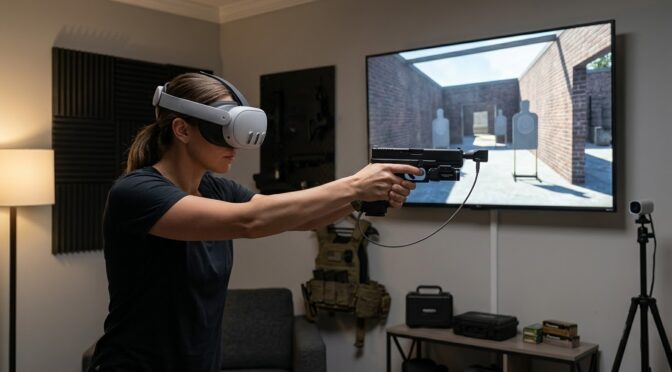
1. Executive Summary
The integration of hardware-based, auto-resetting dry-fire systems with modern Virtual Reality (VR) marksmanship simulators represents a fundamental architectural shift in human performance training and firearms proficiency. Historically, the division between dry fire practice and live-fire validation was stark and pedagogically limited. Traditional dry fire offered mechanical isolation without environmental context or true cyclic repetition, while live fire provided necessary ballistic validation but imposed steep logistical, safety, and financial burdens. Over the past decade, and accelerating sharply through the 2025 and 2026 commercial cycles, advancements in consumer-off-the-shelf (COTS) spatial computing and drop-in mechanical trigger reset devices have effectively bridged this historical gap.
This research report evaluates the technical intersection of these two distinct technologies. It provides a detailed analysis of the specific hardware architectures that enable a practitioner, whether a civilian enthusiast, competitive shooter, or tactical professional, to utilize their actual service weapon in a simulated spatial environment, thereby bypassing the historical limitations of single-action dry fire. Devices such as the Mantis BlackbeardX for the AR-15 platform, the CoolFire Trainer for cyclic recoil simulation, and the DryFireMag for striker-fired handguns allow for sustained, multi-shot mechanical repetitions without compromising the user’s grip structure or focal plane. When paired with digital or VR environments, including Ace XR, GAIM, Virtual-Shot, and the Laser Ammo Smokeless Range, these hardware systems produce highly immersive, data-rich training loops that fundamentally alter skill acquisition.
A comprehensive financial modeling of this technological integration over a 12-month training cycle reveals profound operational expenditure (OPEX) reductions. Analyzed against the backdrop of climbing 2025–2026 ammunition prices, where bulk 5.56x45mm NATO routinely exceeds $0.50 per round and 9mm Luger hovers near $0.30 per round, the initial capital expenditure (CAPEX) for a comprehensive hardware and VR suite is demonstrably amortized within three to six months for an active shooter. The financial logic dictates that offloading high-volume mechanical repetitions to a virtual environment yields a vastly superior return on investment per trigger pull.
However, the biomechanical skill retention and the transferability of this simulated training require nuanced assessment. Empirical research, including extensive data from military simulation platforms such as the Indoor Simulated Marksmanship Trainer (ISMT) and the Engagement Skills Trainer (EST), confirms that simulator-based training yields highly positive skill transfer for foundational perceptual-motor skills. Variables such as aiming accuracy, stability of hold, target transitions, and the cleanness of the trigger break are measurably enhanced by spatial simulation. Conversely, the absence of terminal recoil and concussive blast in most VR settings creates isolated vectors for “negative transfer.” Standard simulation cannot physically replicate the psychophysiological startle response or the true cadence of cyclic recoil recovery, meaning live fire remains a strictly necessary validation tool to diagnose and correct pre-ignition recoil anticipation.
Ultimately, this analysis concludes that while VR and auto-resetting dry fire systems cannot wholly replace the necessity of live ammunition, they fundamentally optimize the required ratio of live-fire exposure. By converting the user’s environment into a constrained, data-driven biomechanical laboratory, shooters can reserve the live-fire range exclusively for high-fidelity ballistic validation, establishing a highly efficient and economically sustainable marksmanship development lifecycle.
2. The Evolution of Simulated Marksmanship and the Virtual Reality Landscape
Marksmanship simulation is deeply rooted in military training doctrines, originally developed to circumvent the immense costs and logistical constraints of live-fire ranges. For decades, platforms like the Engagement Skills Trainer (EST) and the Indoor Simulated Marksmanship Trainer (ISMT) have served as the backbone for initial entry training and deployment sustainment for the United States Army, Navy, and Marine Corps.1 These legacy systems are characterized by multi-million-dollar, projector-based arrays that require dedicated, climate-controlled facilities. They utilize heavily tethered, pneumatic weapon proxies that mimic the weight and manual of arms of standard issue rifles and sidearms but are inherently restricted to the physical dimensions of the projection screen in front of them.4 While highly effective at teaching the sequence of the shot process and establishing baseline qualification standards, these systems are fundamentally inaccessible to the broader civilian market and lack the true spatial immersion required for complex, 360-degree environmental processing.
2.1 The Transition to Consumer-Off-The-Shelf (COTS) Spatial Computing
The democratization and miniaturization of spatial computing technology define the contemporary landscape of simulated training. The release and subsequent dominance of standalone virtual reality headsets, most notably the Meta Quest architecture, including the Quest 2, Quest 3, and Quest 3S, have shifted the locus of simulation from institutional facilities to the residential and commercial environment.5 Modern VR headsets utilize inside-out optical tracking, a technology that relies on integrated cameras and inertial measurement units (IMUs) to map the user’s physical environment in real-time. This allows for six degrees of freedom (6DoF) movement without the need for external base stations or tracking towers.
This spatial awareness permits software developers to construct dynamic, 360-degree environments where targets move, react, and require complex spatial tracking by the user. Instead of standing statically before a flat screen, the user is immersed in a volumetric space where they must physically orient their body, process peripheral threats, and negotiate simulated architectural barriers. The U.S. military has recognized this shift, actively pursuing augmented and virtual reality frameworks, such as the Squad Immersive Virtual Trainer (SIVT) integrated within the Integrated Visual Augmentation System (IVAS), to overcome the dynamic occlusion problems and spatial limitations inherent in flat-screen legacy trainers.7 For the civilian and law enforcement sectors, the Meta Quest platform serves as the foundational hardware layer upon which specialized marksmanship software is deployed.5
2.2 Architectural Paradigms of Virtual Marksmanship Software
The current commercial market for digital marksmanship training is highly stratified, offering various software architectures that attempt to solve the complex problem of mapping a physical weapon into a digital space. These architectures can be categorized into four primary paradigms, each presenting distinct advantages and constraints regarding physical realism and spatial immersion.
2.2.1 Fully Immersive VR with Replica Hardware
Systems operating within this paradigm, such as Ace XR, function entirely within the virtual environment provided by the Meta Quest headset. The primary engineering challenge of fully immersive VR is tracking the user’s hands and weapon. To overcome the difficulty of reliably tracking an actual, unmodified firearm with standard VR controllers, Ace XR utilizes highly accurate, weighted replica handsets.8
These handsets are molded to replicate specific firearms, such as the Staccato 2011, the CZ Shadow 2, and the SIG Sauer P365.8 The physical VR controller (the Meta Quest right-hand unit) locks directly into the replica frame via a toolless, spring-loaded mechanism.8 The resulting assembly matches the physical weight (frequently exceeding 34 ounces) and the ergonomic balance of a loaded firearm.8 Furthermore, the handsets feature physical triggers with audible and tactile breaks and resets, engineered to replicate a standard 3.5-pound trigger pull.8 Within the headset, the software renders high-fidelity digital twins of these firearms, allowing the user to engage in over 200 stages, including dynamic 360-degree scenarios, USPSA classifiers, and fundamental skill-building exercises.8 While this paradigm offers unparalleled spatial immersion and eliminates the safety risks of using a real firearm at home, it sacrifices the exact mechanical nuances of the user’s personal, serialized service weapon.
2.2.2 Immersive VR with Actual Firearms via Controller Mounts and Bluetooth Integration
The second paradigm attempts to bridge the gap by allowing users to bring their actual firearms into the VR headset space. Historically, systems like GAIM and Clay Hunt VR utilized physical mounts clamped onto the shotgun rib, rifle stock, or accessory rail to hold a proprietary VR controller.11
However, this paradigm is rapidly advancing through Bluetooth Low Energy (BLE) integration. GAIM, for example, has partnered with DryFireMag to utilize a Bluetooth-enabled smart magazine that pairs directly with the Meta Quest headset. This setup tracks the handgun’s precise movement and registers the mechanical trigger break wirelessly, allowing users to practice with their actual serialized Glock in a 360-degree virtual space without the awkward offset weight of a clamped controller.
The critical limitation of this paradigm remains visual isolation: the user is blinded to the real world by the headset. Consequently, the software must perfectly map the physical dimensions of the real gun to the digital rendering; any discrepancy between the physical cheek weld and the virtual sight alignment breaks the simulation illusion.12
2.2.3 Augmented Screen and Phone-Mounted Systems
Applications like Virtual-Shot represent a paradigm that bypasses the VR headset entirely, favoring an augmented reality approach projected through a smartphone screen. Virtual-Shot utilizes a physical mount that attaches a standard smartphone directly to the Picatinny rail or the ocular lens of a rifle optic on the user’s actual firearm.14
Instead of relying on external cameras or Bluetooth VR controllers, Virtual-Shot utilizes the smartphone’s internal gyroscopes and accelerometers to track the weapon’s movement in physical space.15 The screen displays a virtual range superimposed over the real-world backdrop. Crucially, the system utilizes advanced real-time acoustic analytics via the phone’s microphone to detect the specific sound of the firing pin dropping during a dry fire press.14 This triggers the software to register a virtual shot, complete with calculated bullet drop and wind drift.16 This architecture is highly accessible, requires no dedicated VR hardware, and integrates seamlessly with any physical firearm but lacks the true 360-degree peripheral immersion of a headset.
2.2.4 High-Fidelity Optical Projection Systems
In stark contrast to headset-based VR, systems like Marksman ST-2 and ST-3 reject the use of immersive headsets entirely, operating on the philosophy that “a headset sits between you and your rifle, shotgun, or handgun, so you lose sight of the real weapon”.17 Marksman systems utilize highly calibrated, patented optical tracking sensors and massive projected screens to create virtual hunting and tactical environments.
These systems allow the use of real firearms with authentic trigger weights, tracking the muzzle movement at approximately 1 millisecond latency and achieving an accuracy resolution of 0.18 Minute of Angle (MOA).17 While technically superior in tracking fidelity and physical realism, as the user interacts with the real world while aiming at a digital projection, these systems represent a massive infrastructure investment, relegating them to commercial ranges, hunting schools, and high-end residential installations rather than mainstream consumer adoption.17
3. Hardware Integration: Bridging the Mechanical Gap
Regardless of the software paradigm utilized, the central biomechanical flaw of traditional dry fire training is the requirement to manually cycle the weapon’s action after every trigger press. Manually racking a slide on a pistol or pulling the charging handle on an AR-15 severely disrupts the training loop. It forces the shooter to break their established two-handed grip structure, eliminates the ability to visually track the sights through the simulated recoil recovery phase, and renders the practice of multi-shot cadences, such as target transitions, rapid double-taps, and split-time reduction, mechanically impossible.18
To effectively simulate live-fire sequences, the weapon must reset its own trigger independently and instantaneously. The firearms technology market has approached this complex engineering challenge through three distinct mechanical pathways, each tailored to specific weapon platforms and training goals.
3.1 The Mantis BlackbeardX (Direct Sear Reset via Electromagnetics)
The Mantis BlackbeardX represents a sophisticated integration of mechanical trigger reset and diagnostic telemetry, engineered specifically for the AR-15 platform. The physical system operates as a complete drop-in replacement for the weapon’s standard bolt carrier group (BCG) and charging handle, taking fewer than twenty seconds to install with no permanent modifications to the host firearm.19 The mechanical action is powered by a proprietary, rechargeable battery pack shaped like a standard 30-round AR-15 magazine, which seats into the magazine well to provide both power and physical alignment.19
Upon the break of the weapon’s hammer, the BlackbeardX utilizes a rapid-cycling electromechanical piston to strike the hammer downward, instantly resetting the sear engagement up to ten times per second.19 This high-speed reciprocation allows the user to perform rapid strings of fire without altering the internal trigger weight, creep, or break characteristics of their customized, serialized weapon.20 Because it physically interacts with the weapon’s fire control group, it provides a highly authentic tactile experience.
The system’s engineering constraints dictate its compatibility matrix. While it functions seamlessly with standard direct impingement AR-15s, MCX Rattler SBRs, and MCX-SPEAR LT variants 19, its reliance on standard hammer profiles means it is incompatible with specialized platforms such as the standard MCX-SPEAR, forced reset triggers (FRTs), super safety systems, and non-standard AR-10 frames like the Ruger SFAR or POF Rogue.19
Crucially, the “X” variant of the Blackbeard integrates the MantisX inertial measurement unit (IMU) directly into the magazine battery pack. This highly sensitive accelerometer and gyroscope array captures micro-movements of the barrel before, during, and after the trigger break, diagnosing physical deviations such as grip anticipation, improper trigger finger placement, or shoulder shrugging through a connected smartphone application.21 Furthermore, the system projects a laser pulse, available in either visible red or infrared (IR), precisely down the bore line upon each trigger break, allowing integration with camera-based digital targets like the Mantis Laser Academy, Laser Ammo’s Smokeless Range, or acoustic simulators like Virtual-Shot.20 To support modern VR simulation, the BlackbeardX can also emit a BLE trigger signal directly to VR game environments, acting as a highly realistic wireless controller.19
3.2 The DryFireMag (Spring-Tensioned Mechanical Simulation)
Unlike the BlackbeardX, which resets the actual hammer of a rifle, the DryFireMag is engineered primarily for striker-fired sidearms (e.g., Glock, SIG P320, Smith & Wesson M&P, Springfield Armory) and operates on a principle of mechanical mimicry rather than actual sear manipulation.21 The device replaces the standard pistol magazine. When inserted into an unloaded firearm, an internal spring-loaded lever interfaces directly with the weapon’s internal trigger bar or sear mechanism.24
When the user pulls the trigger, they are mechanically compressing the tension of the DryFireMag’s internal spring, rather than compressing the weapon’s actual striker spring. Upon reaching the “break” point, the internal spring mechanism slips, providing a highly tactile and audible snap that simulates the release of a firing pin.21 When the user releases finger pressure, the device instantly returns the trigger shoe to the forward, reset position.21 This creates an impressive simulation of the OEM trigger’s take-up, wall, break, and reset, with optional spring kits allowing users to tune the pull weight and pre-travel to closely match their specific concealed carry or duty weapon.21
However, because the DryFireMag isolates the trigger bar and inherently disables the forward motion of the striker or firing pin, it creates a technological conflict with standard dry-fire training lasers. Traditional laser cartridges inserted into the chamber rely on the physical impact of the firing pin to close a circuit and emit a laser pulse.19 To solve this critical integration issue, a specialized “Smart” version of the DryFireMag was developed in collaboration with Laser Ammo.22 The Smart DryFireMag utilizes an internal electronic switch that detects the mechanical trigger break and wirelessly signals a specialized SureStrike laser cartridge chambered in the barrel to emit a pulse.25 This integration enables the DryFireMag to interface seamlessly with camera-based simulators and reactive targets while maintaining the critical auto-resetting trigger feel.22 Additionally, DryFireMag has introduced peripheral simulation devices, such as the Bluetooth-connected gunSHOT BOX, which generates a 125 dB concussive sound and simulated muzzle flash upon each trigger press to artificially induce auditory stress and startle responses during dry-fire practice.24
3.3 The CoolFire Trainer (Pneumatic Recoil Simulation)
While the BlackbeardX and DryFireMag excel at resetting the trigger mechanism, they are inherently static devices; they do not generate the cyclic mass movement of a reciprocating slide or bolt. The CoolFire Trainer addresses this biomechanical deficit by utilizing compressed CO2 to simulate actual slide reciprocation and physical recoil in handguns.26
The CoolFire system requires a more involved installation than a simple magazine swap. The user must remove the live barrel and recoil spring of their host pistol and replace them with a proprietary, pneumatically sealed CoolFire barrel and a specialized recoil spring mechanism.26 The system is highly adaptable, with proprietary barrels machined to fit over 130 different pistol models across major manufacturers like Staccato, Glock, CZ, and Walther.26
When the weapon’s striker drops, it impacts a valve situated at the rear of the CoolFire barrel. This impact releases a metered burst of compressed CO2, which exerts pressure against the slide, forcing it violently rearward.27 This action cocks the striker, ejects the spent gas, and allows the recoil spring to slam the slide forward, providing a sharp, physical recoil impulse that closely mimics the cadence of live fire.26 A standard CO₂ fill directly into the barrel reservoir allows for 10 to 15 full-recoil shots.27 For higher volume training requirements, users can attach a Rapid Fill Adapter (RFA), which threads onto the muzzle, extending the weapon’s length by approximately 1.75 inches but increasing the shot capacity by an additional 40 rounds per fill.28
The CoolFire system is frequently integrated with VR and projection simulators via threaded muzzle lasers. These lasers are available in visible red for standard app-based training or infrared (IR) for advanced camera-based simulators like the Smokeless Range.28 For training applications demanding sight-tracking under physical duress, where the shooter must learn to let the red dot optic or iron sights lift in recoil and return to the visual focal plane without manually inducing a flinch, the CoolFire Trainer provides a level of biomechanical fidelity that static reset devices simply cannot match.28
3.4 Integration Constraints and Simulator Compatibility
Integrating these diverse physical hardware devices with modern VR software ecosystems is not a frictionless process. Because fully immersive VR headsets like the Meta Quest operate via spatial optical tracking of their proprietary hand controllers, bringing a physical, serialized rifle or pistol into the VR space requires specific engineering workarounds.
Early and budget-oriented systems rely on physical mounts that clamp the Meta Quest or HTC Vive controller directly to the picatinny rail or barrel of the physical weapon.12 While this hardware bridge allows the headset to track the gun’s precise orientation in 3D space, the offset weight and awkward positioning of the VR controller significantly alters the weapon’s physical balance and handling characteristics.8
Conversely, advanced modern systems bypass the physical controller entirely using Bluetooth integrations. By embedding BLE transmitters into devices like the Mantis BlackbeardX and the Smart DryFireMag, the physical trigger break is beamed directly into the VR simulation as a digital input. This evolution preserves the exact weight and ergonomics of the service weapon while flawlessly interacting with the spatial software.
4. Empirical Cost-Savings Analysis (12-Month Training Cycle)
The primary operational justification for the capital acquisition of VR simulators and auto-resetting hardware is the offset of live ammunition consumption. To quantify this utility and establish a verifiable Return on Investment (ROI), an empirical analysis of current market ammunition pricing against anticipated training volumes is required.
4.1 Ammunition Market Dynamics and Price Inflation (2025–2026)
Ammunition pricing is a highly elastic economic metric, driven by global supply chain pressures, geopolitical conflicts affecting the availability of raw materials like copper and nitrocellulose, and domestic demand cycles fueled by legislative environments.31 Extensive market tracking data spanning late 2025 into mid-2026 demonstrates a sustained and aggressive elevation in the retail cost of standard training calibers.
For 9mm Luger, the ubiquitous standard for duty sidearms and defensive handguns, bulk purchase data reveals an average cost per round (PPR) of $0.24 to $0.25 in late 2025.33 However, tracking algorithms indicate this price climbed steadily through the first quarter of 2026, reaching an average of $0.30 PPR by May 2026 across major online and brick-and-mortar retailers.33
For 5.56x45mm NATO, the standard cartridge for the AR-15 platform, the economic pressures have been substantially more severe. In late 2025, bulk pricing for 1000-round cases hovered around $0.45 to $0.49 PPR.32 By the second quarter of 2026, driven in part by scheduled wholesale price increases from major manufacturing conglomerates such as The Kinetic Group and Winchester, the average price securely breached the $0.50 threshold.34 Data from major retailers illustrates this tightening market, with bulk cases priced between $0.55 (Bereli) and $0.63 (Outdoor Limited) and specialized green-tip M855 ammunition rising to $0.66 PPR.34
4.2 Establishing Training Volume Profiles
To construct a realistic financial model for cost savings, we must establish baseline consumption profiles based on shooter demographics.
- The Competitor / Tactical Professional: A dedicated competitive shooter (e.g., USPSA/IPSC classifications) or a tactical professional typically fires between 400 and 600 rounds per month. This equates to an annual consumption of 5,000 to 8,000 rounds, considered the minimum required to maintain high-level, subconscious proficiency under stress.36
- The Proficient Enthusiast: A regular practitioner aiming to maintain baseline defensive competence, rather than elite competitive speeds, may consume roughly 2,000 to 3,000 rounds annually.36
4.3 Capital Expenditure (CAPEX) vs. Operating Expenditure (OPEX)
The initial capital required to deploy a modern virtual training environment varies depending on the selected technological architecture but generally falls within a predictable range.
- Immersive VR Setup (Software-Heavy): A user opting for a fully immersive environment requires a Meta Quest 3 Headset (approx. $500), a dedicated Ace XR Handset modeled after their firearm ($199), and a $20 monthly subscription to the Ace XR software platform.9 Total initial year CAPEX is approximately $939.
- High-Fidelity Hardware Setup (Hardware-Heavy): A user looking to integrate their actual service weapons might acquire a Mantis BlackbeardX system for their AR-15 (
~250), alongside baseline software for systems like the Laser Ammo Smokeless Range.22 Total CAPEX is conservatively modeled at approximately $950.
To compare this CAPEX against live-fire OPEX, we model a blended monthly consumption of 250 rounds of 9mm (calculated at a conservative $0.27/rd) and 250 rounds of 5.56 NATO (calculated at $0.50/rd). Under this model, the monthly OPEX strictly for live ammunition is approximately $192.50. Annually, this totals $2,310 in raw consumable costs, a figure that critically excludes ancillary expenses such as range fees, paper targets, and the fuel/time required to travel to specialized ranges.32
4.4 Return on Investment (ROI) and Break-Even Timelines
If a shooter implements a hardware-based VR simulator, they can confidently offset a significant portion of their live-fire volume without degrading their skill level. High-level firearms instructors and master-class competitors consistently advocate for an 80/20 ratio of dry fire to live fire.36
Assuming a conservative model where live-fire consumption is reduced by 75% through the use of simulation, the shooter saves $144.37 per month in ammunition OPEX. Against an initial hardware CAPEX of $950, the investment reaches a complete break-even point in approximately 6.5 months. Over the full 12-month training cycle, the net cash savings exceed $780 in the first year alone. In subsequent years, where the CAPEX is fully amortized and no new hardware is required, the annual cash savings scale to nearly $1,732.
| Financial Metric | Traditional Live Fire Only | Hybrid VR / Hardware Model | Variance (Savings) |
| Initial CAPEX | $0.00 | $950.00 | -$950.00 |
| Monthly Ammo OPEX | $192.50 | $48.12 | +$144.38 |
| Total 12-Month Cost | $2,310.00 | $1,527.44 | +$782.56 |
| Total 24-Month Cost | $4,620.00 | $2,104.88 | +$2,515.12 |
More critically than pure cash savings, simulation alters the volume density of practice. Because dry fire repetitions with a system like BlackbeardX carry zero marginal cost per pull, users frequently execute thousands of virtual repetitions per month. To replicate the sheer volume of trigger presses achieved in a single hour of Ace XR training on a live-fire range would cost hundreds of dollars per session. Software applications like LaserHIT have even introduced “Live Fire Value” metrics, explicitly converting structured dry fire repetitions into their real-world dollar equivalent to emphasize the massive efficiency gains of simulation.31 Therefore, the true “value” of the simulation is not merely the money saved, but the exponential increase in repetitions that the average citizen could never afford to fund with live ammunition.
5. Biomechanical Skill Retention and the Transfer of Training
The financial logic of virtual reality integration is ultimately sound only if the neuromuscular skills acquired in the virtual laboratory successfully and durably transfer to the physical reality of the live-fire range. Shooting is fundamentally a perceptual-motor task that relies on absolute physical stability, intense visual control, pressure management, and precise muscular timing.41 Analyzing the biomechanical transfer of these skills requires examining the component kinematics of marksmanship.
5.1 The Kinematics of Marksmanship and the TMM Triad
Scientific literature examining sensorimotor learning isolates the complex act of firing a weapon into highly specific kinematic processes. Foundational research on air pistol performance conducted by sports scientists (notably Olsson and Laaksonen) identifies five primary technical variables: aiming time, stability of hold, aiming accuracy, the cleanness of triggering, and the timing of triggering.41 Remarkably, statistical analysis proves that just three of these variables, stability of hold, aiming accuracy, and the precise timing of the trigger break, account for an overwhelming 75% to 78% of the total variance in human shooting performance.41
Standard dry fire practice is exceptionally effective at isolating these specific variables. Because the environment is highly constrained and entirely devoid of concussive blast, the shooter can closely observe whether their trigger press disrupts their aiming structure, allowing for micro-corrections in grip pressure.18 This adheres to the “TMM Triad” of effective training: defining the Technique, structuring the Method of practice, and utilizing Metrics to ensure quality control.41
However, traditional, static dry fire severely lacks cognitive load and spatial friction. A shooter practicing against a static paper target taped to a bedroom wall is not subjected to variable target presentation, shoot/no-shoot cognitive decision-making, or the complex biomechanics of wide target transitions. This is precisely where spatial VR platforms like Ace XR, GAIM, and InVeris provide massive biomechanical advantages over traditional methods.4
5.2 Cognitive Load and Spatial Integration in Virtual Reality
Immersive virtual reality introduces spatial urgency and cognitive processing demands that mirror combat or competitive reality. In an application like Ace XR, which digitally maps complex, multi-array USPSA stages, the user must visually locate targets across a full 360-degree plane, physically drive the weighted handset with their upper body, dynamically align the digital optic on moving targets, and press the mechanical trigger while managing the psychological tension of a running digital shot timer.8
A rigorous kinematic study published in the Journal of Cognitive Neuroscience observed naive subjects practicing in an immersive virtual marksmanship environment modeled after Olympic Trap Shooting.42 The researchers utilized spatiotemporal motion tracking to analyze the ballistic and refinement phases of the subjects’ hand movements over 350 trials. They found systematic changes in movement kinematics as training progressed; subjects rapidly transitioned from erratic, effortful micro-corrections to “longer, slower, and more precise ballistic movements” of the hands and upper body.42
This empirical data indicates that VR effectively trains the macro-kinematics of full-body orienting and target transitions in a manner that static dry fire fundamentally cannot. The neuromuscular requirement to track sights from target to target, aggressively decelerate the mass of the gun upon reaching the target, and visually confirm alignment before breaking the trigger builds highly durable, transferable neural pathways.43
5.3 Empirical Evidence of Positive Transfer to Live Fire
Military research provides the most robust, large-scale quantitative data regarding the transferability of simulator training to live-fire qualification results.
A comprehensive master’s thesis conducted at the Naval Postgraduate School (Document ADA561945) evaluated the transfer of marksmanship training for Navy watchstanders. The researchers divided thirty-four active-duty military volunteers into two groups: one utilizing the sophisticated Indoor Simulated Marksmanship Trainer (ISMT), and a control group receiving standard dry fire (Standard Naval Marksmanship Training).1 The study rigorously tracked the Mean Point of Impact (MPI), the exact distance between the registered shot and the true center of the target across multiple distances, as well as overall qualification scores on the standard Navy Handgun Qualification Course (NHQC) utilizing the Transtar II silhouette target.1
The results were revealing. While both standard dry fire and simulation improved overall qualification scores relatively equally (the simulation group improved from a baseline of 210.33 to near maximums of 240), the simulation group demonstrated a statistically significant, superior improvement in narrowing their Mean Point of Impact from baseline to live-fire compared to the control group.1 Furthermore, a secondary hypothesis testing skill retention after two- and four-week gaps found no significant degradation in scores for the simulation group, proving the durability of the virtual training.1 This suggests that the immediate, augmented feedback loop of the simulator, which displays exact strike points, trace lines, and barrel movement on the screen, refines aiming accuracy and the cleanness of triggering substantially faster and more permanently than unassisted dry fire.1
Similarly, a 2014 study conducted by the Australian Defence Force (Document ADA615318) evaluating the efficacy of simulation for M4 marksmanship training found that recruits who received additional simulator training prior to range days achieved slightly faster live-fire qualification times than the control group that proceeded directly to live fire.44 While the researchers noted the benefit was statistically “small,” it conclusively validated a positive transfer of spatial memory and mechanical familiarity from the simulation to the live M4 carbine.44 Further supporting this, a study observing high-level biathletes (Isoaho, 2023) demonstrated that dry fire volume in a laboratory setting improved standing shooting performance, particularly when the athletes utilized immediate augmented feedback devices like the Mantis systems to correct their technique in real-time.41
| Technical Marksmanship Variable | Efficacy of Traditional Static Dry Fire | Efficacy of VR / Hardware Integration | Degree of Transferability to Live Fire |
| Trigger Control & Isolation | Excellent | Excellent | Very High 18 |
| Sight Alignment / Sight Picture | High | Excellent (Dynamic sight tracking) | Very High 1 |
| Draw Stroke / Presentation | Excellent | High (Dependent on holster compatibility) | Very High 18 |
| Target Transitions & Spatial Orienting | Low / Moderate | Excellent (360-degree spatial tracking) | High 42 |
| Recoil Management & Cadence | None | Low (Excepting pneumatic CoolFire Trainer) | Low / Risk of Negative Transfer 18 |
6. Managing the Deficits: Recoil Anticipation and the Risks of Negative Transfer
Despite the overwhelming positive biomechanical and financial benefits of VR and auto-resetting hardware, treating simulation as a 1-to-1 substitute for live fire is a severe pedagogical error. As noted in the foundational science of marksmanship transfer, “Dry fire and live fire solve different training problems. Dry fire acts as a constrained laboratory… Live fire acts as the exam to validate whether the isolated technical qualities survive real-world timing pressure, environmental variation, and consequence”.41
6.1 The Newtonian Physics of Recoil Anticipation
The single most significant and stubborn limitation of virtual and dry-fire training is the total absence of terminal ballistic recoil. When a live 9mm Luger or 5.56 NATO round is fired, the violent combustion of gunpowder generates a massive, concussive overpressure wave (the blast) and rapidly drives the mass of the weapon backward and upward into the shooter’s body, adhering to Newtonian physics.29
The human central nervous system naturally and violently reacts to this explosive stimulus. “Flinching,” or recoil anticipation, is a pre-ignition neuromuscular response where the shooter subconsciously pushes the gun forward, downward, or tightens their grip asymmetrically just milliseconds before the shot breaks, actively attempting to fight the anticipated explosion.46 This subconscious physical action drives the muzzle completely off-target before the bullet exits the barrel, resulting in profoundly poor accuracy (typically manifesting as impacts low and left on a paper target for right-handed shooters).49
Dry fire tools like the Mantis BlackbeardX and DryFireMag are exceptional at diagnosing gross mechanical trigger errors, but they absolutely cannot trigger or diagnose the psychophysiological startle effect because there is no concussive noise or kinetic recoil to fear.18 A shooter may possess a flawless, surgically precise trigger press in the consequence-free VR environment of Ace XR, yet completely unravel under the physical punishment and concussive force of an indoor live-fire range.41
Even advanced systems like the CoolFire Trainer, which brilliantly simulate the cyclic reciprocation of the slide, lack the auditory blast and the true terminal concussive force of live ammunition. Therefore, while it aids in sight tracking during reciprocation, it only solves half of the recoil anticipation equation.18
6.2 The Danger of Negative Transfer and Training Scars
Over-reliance on simulation without frequent, interspersed live-fire validation introduces the severe risk of “negative transfer,” often referred to in tactical communities as “training scars”.7 Negative transfer occurs when an individual builds and automates a motor pattern in a simulated environment that is actively detrimental when applied to the physical realities of a live environment.51
Common training scars developed from poor dry fire include the habit of manually racking the slide after every single shot or immediately lowering the firearm to check the target. While auto-resetting triggers effectively cure the slide-racking scar, immersive VR introduces new risks. The most common manifestation of negative transfer from VR marksmanship involves cadence and follow-up timing.
For example, when engaging multiple targets in VR using a non-recoiling handset, a shooter can rapidly transition the weapon and pull the trigger at blistering, unrealistic cadences. Because the digital gun does not physically rise in recoil, the shooter’s brain builds a rhythm based on an artificially stable, perfectly flat sight picture.18 If that same shooter attempts to replicate that exact physical rhythm on a live-fire range, the actual muzzle rise of the weapon will cause the second and third shots to miss wildly high over the target’s shoulder. The shooter has neurologically learned to outrun their physical ability to manage recoil friction.41
Military and academic studies have repeatedly warned of this specific phenomenon. Formal evaluations of the Squad Engagement Training System (SETS) and early iterations of the ISMT noted that negative transfer can occur rapidly if the feedback provided by the training aids is absent on the live-fire range, causing the shooter’s predictive mental models to collapse entirely.44 If the physics of the simulation do not perfectly match the reality of ballistics, the variance must be carefully managed and continually calibrated through live-fire exposure.50
7. Strategic Implementation and Training Lifecycle Recommendations
To maximize the massive financial ROI of hardware-based VR simulators while entirely mitigating the dangerous risks of negative transfer, practitioners must adopt a structured, highly disciplined hybrid training architecture. The integration of devices like the Mantis BlackbeardX, the DryFireMag, or fully immersive suites like Ace XR should not be viewed casually as “cheap live fire,” but rather as a distinct, specialized pedagogical phase within the TMM Triad (Technique, Method, and Metrics).18
7.1 The Virtual Laboratory vs. The Live-Fire Exam
The most scientifically sound and effective training doctrine conceptually separates the two environments, treating the VR environment exclusively as the laboratory and the live-fire range exclusively as the exam.41
Within the confines of the virtual laboratory (utilizing mechanical auto-reset tools and VR headsets), the shooter’s goal is absolute isolation of technique. The absence of terrifying recoil allows the brain to completely relax and hyper-focus on the minute visual processing of the red dot optic, the precise physical sensation of breaking the trigger wall, and the gross motor mechanics of driving the gun across a 180-degree virtual bay.41 Because the cost of failure in a simulator is literally zero dollars and zero risk of injury, the shooter can experiment with aggressive target transition speeds and visual processing limits that would be grossly unsafe or financially ruinous on a live range.
Once these foundational neurological pathways are established and smoothed out in the simulation, the shooter moves to the live-fire range to take the exam. Under this paradigm, the live-fire session is no longer used to learn how to shoot; it is used solely to validate whether the flawless techniques built in VR can actually survive the concussive blast, pressure, and punishing recoil of live 9mm or 5.56 ammunition.18
7.2 Live-Fire Validation Techniques: Skip Loading and Diagnostics
To immediately diagnose whether a shooter has developed a dangerous level of recoil anticipation that was previously hidden by their VR training, the live-fire validation session must heavily feature diagnostic drills, the most prominent being “Skip Loading” (frequently referred to as ball-and-dummy drills).52
By randomly mixing inert dummy rounds, or utilizing tools like the Type3MalfunctionRound to replicate a malfunction, with live ammunition in a single magazine at a ratio of approximately 4:1 (dummy to live), the shooter is forced to execute the trigger press without consciously knowing if the gun will violently recoil or simply click.24 When the trigger breaks on a dummy round, any pre-ignition flinch or anticipation built up during non-recoiling VR practice will instantly manifest as a highly visible, exaggerated downward thrust of the muzzle. This glaringly exposes the neuromuscular error, allowing the shooter to visually recognize the failure and consciously correct their psychological response to the blast.47
8. Conclusion
The technological synthesis of consumer-available spatial computing with robust, auto-resetting physical hardware represents the most significant advancement in individual marksmanship training of the past decade. By providing a highly interactive, spatially aware, and data-driven environment that physically reacts to user input without requiring a manual cycling of the weapon, systems like the Mantis BlackbeardX and comprehensive VR suites like Ace XR effectively democratize a level of high-fidelity simulation that was previously restricted exclusively to top-tier, well-funded military installations.
As global supply chain pressures cause ammunition costs to continue to rise steadily into late 2026, threatening to price average citizens, competitive shooters, and underfunded law enforcement departments out of the regular volume of training necessary for true proficiency, these technologies offer an empirically validated, financially sustainable alternative. Provided that end-users fundamentally understand the biomechanical limitations regarding cyclic recoil management, and provided they deliberately schedule live-fire validation exams to strictly prevent negative transfer, hardware-integrated VR stands as an unparalleled, economically superior tool for forging speed, precision, and vital cognitive adaptability in modern marksmanship.
Appendix: Methodology and Data Sources
The analytical framework and subsequent data informing this research report were systematically synthesized from a diverse cross-section of primary military research documents, commercial market financial data, and peer-reviewed biomechanical sports science studies.
- Military Transfer of Training Research: Core foundational findings regarding the quantitative efficacy of simulation were drawn from defense research reports archived by the Defense Technical Information Center (DTIC). Key studies analyzed include the Naval Postgraduate School’s rigorous evaluation of the Indoor Simulated Marksmanship Trainer (ISMT) versus standard dry fire (Document ADA561945) 1, and the Australian Defence Force’s detailed analysis of M4 simulator training effectiveness (Document ADA615318).44 These studies provided the necessary quantitative baselines for assessing both the positive skill acquisition and the risks of negative transfer in perceptual-motor tasks.
- Biomechanical and Kinematic Analysis: The assessment of human movement, visual processing, and the physiological response to recoil anticipation was deeply informed by sports science literature. Notably, studies on sensorimotor learning in immersive VR from the Journal of Cognitive Neuroscience were evaluated, alongside foundational pedagogical marksmanship theories, such as the TMM Triad, and the specific kinematic variables defining shooting performance as codified by researchers Olsson and Laaksonen.41
- Financial and Market Data Modeling: Operational cost analyses were modeled utilizing forward-looking market pricing from major ammunition retailers and tracking algorithms (e.g., Ammunition Depot, AmmoSquared, Ronin’s Grips, Black Basin), representing pricing indices from late 2025 through mid-2026.32 Hardware capital expenditures were sourced directly from current manufacturer specifications and retail pricing data for Mantis Tech, DryFireMag LLC, CoolFire Trainer, and Ace XR.8
Please share the link on Facebook, Forums, with colleagues, etc. Your support is much appreciated and if you have any feedback, please email us in**@*********ps.com. If you’d like to request a report or order a reprint, please click here for the corresponding page to open in new tab.
Sources Used
- A Naval Marksmanship Training Transfer Study: The Use of … – dtic.mil, accessed June 30, 2026, https://apps.dtic.mil/sti/tr/pdf/ADA561945.pdf
- A Training Transfer Study of the Indoor Simulated Marksmanship Trainer – DTIC, accessed June 30, 2026, https://apps.dtic.mil/sti/tr/pdf/ADA427059.pdf
- ENGAGEMENT SKILLS TRAINER: THE COMMANDER’S PERSPECTIVE A thesis presented to the Faculty of the U.S. Army Command and General – DTIC, accessed June 30, 2026, https://apps.dtic.mil/sti/pdfs/AD1038629.pdf
- Military Simulation Training – Virtual, Tactical, and Small Arms Training and Marksmanship, accessed June 30, 2026, https://www.inveristraining.com/virtual-training/military-virtual-tactical-small-arms-training-marksmanship/
- Frequently Asked Questions , Ace – Immersive Shooting Experience, accessed June 30, 2026, https://www.acexr.com/support/faqs
- Ace VR shooting simulator review | What You Need to Know, accessed June 30, 2026, https://shooting-soft.com/blog/ace
- Army pursuing improved realism in live and virtual training | Article, accessed June 30, 2026, https://www.army.mil/article/230567/army_pursuing_improved_realism_in_live_and_virtual_training
- Ace CZ Shadow 2 for Virtual Shooting – $199, accessed June 30, 2026, https://www.acexr.com/handsets/shadow2
- ACE XR VR Shooting : r/CAguns – Reddit, accessed June 30, 2026, https://www.reddit.com/r/CAguns/comments/1ibg3lv/ace_xr_vr_shooting/
- The SIG SAUER Virtual Reality Shooting Experience , Ace, accessed June 30, 2026, https://www.acexr.com/sig
- @gaimitg www.gaim.com – Storyblok, accessed June 30, 2026, https://a.storyblok.com/f/236846/x/210244ab37/gaim-paper-2023.pdf
- Clay Hunt VR – Shotgun Gaming, accessed June 30, 2026, https://www.shotgungaming.com/clayhuntvr/
- ClayProVR, accessed June 30, 2026, https://clayprovr.com/
- Virtual Shot – Virtual Shooting Simulator | Dry Fire Simulator, accessed June 30, 2026, https://virtual-shot.com/
- virtual shot , Gun & Gear Reviews – Firearms Insider, accessed June 30, 2026, https://www.firearmsinsider.tv/gun-gear-reviews/tag/virtual+shot
- dry fire , Gun & Gear Reviews – Firearms Insider, accessed June 30, 2026, https://www.firearmsinsider.tv/gun-gear-reviews/tag/dry+fire
- Shooting Simulator | Marksman ST3 , Home & Professional Range, accessed June 30, 2026, https://www.marksman.se/
- Dry Fire vs. Live Fire: What Skills Transfer the Best? – DryFireMag, accessed June 30, 2026, https://dryfiremag.com/blogs/dryfiremag-blog/dry-fire-vs-live-fire
- BlackbeardX: Dry Fire Laser Training System with Smart Analytics + Feedback – Mantis, accessed June 30, 2026, https://mantisx.com/products/blackbeardx-the-auto-resetting-trigger-system-with-analytics-and-smart-feedback
- Blackbeard: the auto reset trigger system for AR-15 – Mantis, accessed June 30, 2026, https://mantisx.com/products/blackbeard-the-auto-resetting-trigger-for-ar-15
- DryFireMag vs. Mantis X Sensor: Feel, Feedback & How They Work …, accessed June 30, 2026, https://dryfiremag.com/blogs/dryfiremag-blog/dryfiremag-vs-mantis
- Blackbeard laser target compatibility : r/MantisX – Reddit, accessed June 30, 2026, https://www.reddit.com/r/MantisX/comments/mui70l/blackbeard_laser_target_compatibility/
- MASTER Rifle Fundamentals AT HOME!!! ~ w/ Virtual Shot Rifle Training – YouTube, accessed June 30, 2026, https://www.youtube.com/watch?v=hiWdkCFr3LE
- SHOT Show 2025: Dryfire and malfunction training tools you need to see – Police1, accessed June 30, 2026, https://www.police1.com/shot-show/shot-show-2025-dryfire-and-malfunction-training-tools-you-need-to-see
- Training Laser Systems for Dry Fire Practice | Laser Ammo, accessed June 30, 2026, https://www.laserammo.com/store/Training-Lasers/Training-Lasers/SureStrikeMAG
- CoolFire Trainer | Dry Fire Training Systems With Recoil, accessed June 30, 2026, https://coolfiretrainer.com/
- CoolFire Trainer review | What You Need to Know – Virtual Shooting Range, accessed June 30, 2026, https://shooting-soft.com/blog/coolfiretrainer
- Which CoolFire Laser Is Right for You? [Red vs. IR + Muzzle vs. RFA Explained], accessed June 30, 2026, https://coolfiretrainer.com/blogs/news/which-coolfire-laser-is-right-for-you-red-vs-ir-muzzle-vs-rfa-explained
- How VR Gun Stocks Change Recoil Feel: Feedback Mechanics, accessed June 30, 2026, https://wieldvr.com/blogs/news/how-do-physical-gun-stocks-change-the-recoil-feel-of-vr-guns-the-mechanics-of-immersive-feedback
- Using Virtual Reality For Firearms Training – Lead Tech, accessed June 30, 2026, http://www.leadtech.co/using-virtual-reality-for-firearms-training/
- Know the AMMO Value of Your Training – LaserHIT, accessed June 30, 2026, https://www.laserhit.com/blog/2026/2/23/know-the-ammo-value-of-your-training
- 10 Year 223 / 5.56 Ammo Price History | Ammunition Depot, accessed June 30, 2026, https://www.ammunitiondepot.com/ammo-price-history/223-556
- 10-Year 9mm Ammo Price History (2016–2026) – Ammunition Depot, accessed June 30, 2026, https://www.ammunitiondepot.com/ammo-price-history/9mm
- Understanding Ammunition Price Hikes in 2026 – Ronin’s Grips, accessed June 30, 2026, https://blog.roninsgrips.com/understanding-ammunition-price-hikes-in-2026/
- Ammo Prices, 9mm Bullet Cost & Calibers – AmmoSquared, accessed June 30, 2026, https://ammosquared.com/prices
- What Your Annual Ammo Usage Says About You – Uncle Zo, accessed June 30, 2026, https://unclezo.com/2024/09/16/what-your-annual-ammo-usage-says-about-you/
- What’s your monthly round count? : r/CompetitionShooting – Reddit, accessed June 30, 2026, https://www.reddit.com/r/CompetitionShooting/comments/1l468wa/whats_your_monthly_round_count/
- How Much Money Can A Laser Dry-Fire System Save You? – Strikeman, accessed June 30, 2026, https://www.strikeman.io/blogs/news/how-much-money-can-a-laser-dry-fire-system-save-you
- ACE XR = just a game or an emmersive training tool? – Evolve-tg.shop, accessed June 30, 2026, https://www.evolve-tg.shop/blogs/news/ace-xr-just-a-game-or-an-emmersive-training-tool
- How Much Money Can You Save By Dry Fire Training? The Amount Is Truly | Mantis, accessed June 30, 2026, https://mantisx.com/pages/how-much-money-can-you-save-by-dry-fire-training-the-amount-is-truly-shocking
- Dry Fire Is Not Pretend Shooting: What Science Actually Says | ABA …, accessed June 30, 2026, https://www.abaintl.us/dry-fire-science/
- Sensorimotor Learning during a Marksmanship Task in Immersive Virtual Reality – PMC, accessed June 30, 2026, https://pmc.ncbi.nlm.nih.gov/articles/PMC5808129/
- Are Dry Fire Aids Worth It? – Uncle Zo, accessed June 30, 2026, https://unclezo.com/2023/10/31/are-dry-fire-aids-worth-it/
- Evaluation of the Effectiveness of Simulation for M4 … – DTIC, accessed June 30, 2026, https://apps.dtic.mil/sti/tr/pdf/ADA615318.pdf
- Evaluation of the Effectiveness of Simulation for M4 Marksmanship Training – ResearchGate, accessed June 30, 2026, https://www.researchgate.net/publication/354311481_Evaluation_of_the_Effectiveness_of_Simulation_for_M4_Marksmanship_Training
- Mastering Marksmanship Fundamentals: The Warrior-Engineer’s, accessed June 30, 2026, https://axletargets.com/blogs/news/mastering-marksmanship-fundamentals-the-warrior-engineer-s-guide-to-precision
- Fixing Recoil Anticipation – Army Reserve, accessed June 30, 2026, https://www.usar.army.mil/Portals/98/Documents/Marksmanship/ARM_FY22-2.pdf?ver=Gaopmh09mX11ouAnVSwKdQ%3D%3D
- Take Charge of Recoil, don’t let it control you… – Cajun Arms, accessed June 30, 2026, https://cajunarms.com/blog?post=take-charge-of-recoil-dont-let-it-control-you
- The Definitive Guide to Paper Shooting Targets: Engineering Better Marksmanship, accessed June 30, 2026, https://axletargets.com/blogs/news/the-definitive-guide-to-paper-shooting-targets-engineering-better-marksmanship
- Weapons Training – Grokipedia, accessed June 30, 2026, https://grokipedia.com/page/weapons_training
- Effects of Recoil on Rifle Marksmanship Simulator Performance – DTIC, accessed June 30, 2026, https://apps.dtic.mil/sti/tr/pdf/ADA206984.pdf
- Army Marksmanship History, accessed June 30, 2026, https://www.usar.army.mil/Portals/98/Documents/Marksmanship/ARM_FY21-2.pdf?ver=Bv8XCoK7lFGIVQbBv9nvkw%3D%3D
- Ammo Price Charts – Historical Ammunition Pricing Data | Black Basin Outdoors, accessed June 30, 2026, https://blackbasin.com/pages/ammo-prices