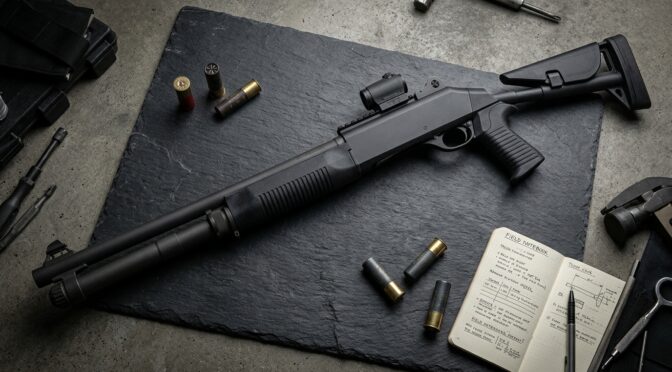
1. Introduction to the Tactical Shotgun Paradigm and the Benelli M4 Legacy
The evolution of the modern tactical shotgun is a fascinating study in mechanical engineering, military procurement, and the gradual adaptation of combat-proven technology for the civilian defensive market. For decades, the pump-action shotgun dominated both military arsenals and domestic home defense strategies. Firearms such as the Mossberg 500 and the Remington 870 were celebrated for their manual reliability, but they placed a significant physical and cognitive burden on the operator. Under the extreme physiological stress of a defensive encounter, the requirement to manually cycle the action for every shot frequently led to operator-induced malfunctions, most commonly known as short-stroking the pump.
Recognizing the need for a more advanced, operator-friendly platform that could deliver overwhelming firepower without relying on manual cycling, the United States Army Armaments Research, Development, and Engineering Center issued a solicitation in 1999 for a new Joint Service Combat Shotgun. The military required a semi-automatic 12-gauge shotgun capable of firing highly varied ammunition profiles, from heavy breaching rounds and magnum buckshot to less-lethal projectiles, all while enduring the harshest environmental conditions on the planet. The winning submission was a radical new design from the Italian manufacturer Benelli, which was subsequently designated as the M1014.
The Benelli M4, the commercial designation for the M1014, quickly achieved legendary status. It became the standard-issue shotgun for the United States Marine Corps and saw extensive combat deployment across numerous global theaters over the next two decades. Its reputation was built on an uncompromising foundation of reliability, largely driven by a proprietary gas-operated system that defied the conventional limitations of semi-automatic shotguns.
However, a significant dichotomy emerged between the military M1014 and the civilian Benelli M4 available to the American public. Due to a complex web of federal import regulations, the civilian Benelli M4 was severely restricted. It was imported and sold in a configuration that many enthusiasts colloquially referred to as “neutered.” This commercial variant featured a limited five-round magazine capacity and a fixed polymer stock with an exceptionally long length of pull. To achieve the true combat specifications of the military M1014, civilian owners were forced to navigate a precarious legal labyrinth, spending vast amounts of money on aftermarket components to legally upgrade their firearms.
The introduction of the Benelli M4 EXT marks a monumental paradigm shift in the premium defensive shotgun market. The “EXT” designation signifies an extension of capabilities, finally delivering the highly requested factory upgrades that American consumers have demanded for over twenty years. By localizing the manufacturing of specific internal and external components within the United States, Benelli has engineered a factory-direct model that legally offers a seven-round magazine capacity and a five-position telescoping stock straight out of the box. The official manufacturer website for this platform is https://www.benelliusa.com. This authoritative review provides an exhaustive, granular analysis of the Benelli M4 EXT, detailing the legal mechanics of its federal compliance, the thermodynamic engineering of its operating system, the ergonomic enhancements introduced in this generation, and its definitive impact on the civilian defensive firearms market.
2. The Legal Framework: Decoding 18 U.S.C. 922(r) Compliance
To fully appreciate the significance of the Benelli M4 EXT, one must deeply understand the complex legal framework that dictates the configuration of imported shotguns in the United States. The commercial availability of the EXT model in its uncompromised state is inextricably linked to its strict compliance with Title 18 of the United States Code, Section 922(r). This statute is widely considered one of the most confusing and mathematically rigid regulations in modern federal firearms law.
2.1 The Legislative History and Intent of Import Restrictions
The origins of these restrictions trace back to the Gun Control Act of 1968, which established the foundational rules for the importation of firearms into the United States. Under Section 925(d)(3) of the Act, the Attorney General is authorized to approve the importation of a firearm only if it is generally recognized as particularly suitable for or readily adaptable to “sporting purposes.” For many years, the definition of sporting purposes was interpreted relatively broadly, allowing for the importation of various semi-automatic rifles and shotguns.
However, in 1989, the federal government suspended the importation of several semi-automatic firearms, arguing that certain military-style features rendered them unsuitable for traditional sporting purposes such as hunting or competitive target shooting. Following this suspension, Congress enacted 18 U.S.C. 922(r) in 1990. This specific statute makes it unlawful for any person to assemble from imported parts any semi-automatic rifle or shotgun that is identical to any rifle or shotgun prohibited from importation under the sporting purposes clause.
In practical terms, the Bureau of Alcohol, Tobacco, Firearms and Explosives determines which specific features cause a shotgun to fail the sporting purposes test. For semi-automatic shotguns, these restricted features include a magazine capacity exceeding five rounds and the presence of a folding or telescoping stock. Because the Benelli M4 is manufactured in Urbino, Italy, it is classified as an imported firearm. To be legally imported and sold to the civilian market, Benelli was legally obligated to ship the M4 with a restricted five-round magazine tube and a fixed stock. If a civilian owner purchased this imported shotgun and subsequently installed a full-length seven-round magazine tube or a telescoping stock, the act of doing so would constitute the illegal assembly of a non-sporting shotgun from imported parts, thereby triggering a violation of federal law.
2.2 The Mathematics of the ATF Parts List
The legal mechanism for bypassing this restriction, allowing civilians to legally own a fully featured tactical shotgun, lies within the Code of Federal Regulations. Specifically, 27 CFR 478.39 provides a definitive list of twenty specific firearm components. The law stipulates that a firearm is not considered to be “assembled from imported parts” if it contains no more than ten of the imported parts listed in the regulations.
This creates a binary, checklist-based compliance matrix. A standard imported Benelli M4 equipped with a fixed pistol-grip stock contains exactly thirteen of these recognized imported parts. The following Markdown table provides a comprehensive structural breakdown of the ATF parts list as it specifically applies to the Benelli M4 platform, illustrating the mathematical threshold required to achieve federal compliance.
| ATF Recognized Firearm Component | Status on Standard Imported Benelli M4 | Compliance Strategy for the EXT Model |
| 1. Receiver | Present (Imported) | Retained as Imported |
| 2. Barrel | Present (Imported) | Retained as Imported |
| 3. Barrel Extensions | Not Applicable to Design | N/A |
| 4. Mounting Blocks (Trunnions) | Not Applicable to Design | N/A |
| 5. Muzzle Attachments | Not Applicable to Design | N/A |
| 6. Bolt | Present (Imported) | Retained as Imported |
| 7. Bolt Carrier | Present (Imported) | Retained as Imported |
| 8. Operating Rods | Not Applicable to Design | N/A |
| 9. Gas Pistons | Present (Imported) | Retained as Imported |
| 10. Trigger Housing | Present (Imported) | Retained as Imported |
| 11. Trigger | Present (Imported) | Retained as Imported |
| 12. Hammer | Present (Imported) | Retained as Imported |
| 13. Sear | Not Applicable to Design | N/A |
| 14. Disconnector | Present (Imported) | Retained as Imported |
| 15. Buttstock | Present (Imported) | Manufactured in the United States |
| 16. Pistol Grip | Present (Imported) | Manufactured in the United States |
| 17. Forearm / Handguard | Present (Imported) | Manufactured in the United States |
| 18. Magazine Body (Tube) | Present (Imported) | Manufactured in the United States |
| 19. Follower | Present (Imported) | Manufactured in the United States |
| 20. Floorplate | Not Applicable to Design | N/A |
To legally increase the magazine capacity of a standard imported M4 to seven rounds, a consumer historically had to replace at least three of the thirteen imported parts with components manufactured in the United States. This substitution brought the total number of imported parts down to the legal limit of ten.
However, the mathematics become significantly more complicated when introducing a telescoping stock. The ATF considers a standard fixed stock with an integrated pistol grip to be a single consolidated part. Conversely, a telescoping stock assembly is classified as two distinct parts, the buttstock and an independent pistol grip. Therefore, adding a telescoping stock increases the firearm’s total baseline imported parts count to fourteen. To maintain legal compliance while utilizing both the seven-round magazine tube and the telescoping stock, the manufacturer or consumer must replace a total of four imported parts with domestic equivalents to reach the maximum allowance of ten imported parts.
2.3 The Factory Engineering Solution Provided by the EXT
Prior to the release of the M4 EXT, achieving 922(r) compliance required civilian owners to engage in a costly and highly technical aftermarket procurement process. Consumers routinely spent hundreds of dollars purchasing U.S.-made magazine tubes, aluminum followers, specialized handguards, and precision-machined trigger components such as the hammer, trigger, and disconnector. This process was financially burdensome and introduced potential reliability variables by forcing owners to rely on non-OEM components within a finely tuned Italian firearm.
Furthermore, navigating the legal gray areas of parts replacement subjected well-intentioned owners to immense anxiety regarding federal compliance. A common misconception within the firearms community was that merely threading a two-round magazine extension onto the existing five-round tube was a legal workaround. In reality, adding an extension does not replace the original imported magazine body, meaning it does not reduce the imported parts count, leaving the firearm entirely non-compliant.
Benelli engineered the M4 EXT to eliminate this legal and financial burden entirely. By establishing rigorous domestic manufacturing protocols within the United States, Benelli produces the necessary compliance components natively. The M4 EXT ships directly from the factory with U.S.-made components seamlessly integrated into the build. This ensures that the total count of imported parts strictly adheres to the federal limit of ten, even with the inclusion of the two-piece telescoping stock and the full-length magazine body. This strategic manufacturing decision legally unchains the platform, allowing Benelli to offer a genuine, factory-warrantied shotgun with a seven-round capacity and an adjustable stock directly to the American civilian consumer without any requirement for end-user modification.
3. Mechanical Engineering: The Auto-Regulating Gas-Operated System
While the legal compliance of the EXT model is its defining commercial feature, the enduring global dominance of the Benelli M4 platform is heavily attributed to its proprietary mechanical core. Unlike traditional semi-automatic shotguns that utilize long-stroke gas systems or inertia-driven mechanisms, the M4 EXT is powered by the Auto-Regulating Gas-Operated system, universally referred to as A.R.G.O. This unique engineering design dictates the firearm’s exceptional reliability, its rapid cyclic speed, and its unparalleled recoil management.
3.1 Anatomy and Thermodynamic Efficiency of A.R.G.O.
The A.R.G.O. system was explicitly developed to meet the rigorous demands of the U.S. Marine Corps. The military required a shotgun capable of functioning reliably across a vast spectrum of operational environments, from desert sands to maritime saltwater exposures, without requiring constant lubrication or maintenance. The Benelli engineering team achieved this by discarding complex linkages and designing a system characterized by elegant simplicity, utilizing a short-stroke, dual-piston mechanism.
In a traditional gas-operated shotgun, the gas ports are typically located far down the length of the barrel. By the time the expanding propellant gases reach these distant ports, they have cooled significantly and lost much of their pressure. This cooling process causes the gases to deposit substantial amounts of carbon fouling, plastic wad residue, and unburned powder along the internal action bars and deep into the receiver. Over time, this fouling creates severe friction, slowing the action and eventually causing catastrophic cycling malfunctions.
The Benelli engineering team solved this thermodynamic problem by locating the gas ports immediately forward of the firing chamber. At this specific location, the expanding propellant gases are at their absolute maximum pressure and their highest temperature. Because the tapped gases are significantly hotter, they burn much cleaner. This results in vastly reduced carbon precipitation within the mechanism, effectively rendering the system self-cleaning under normal operational parameters.
When a shell is fired, a highly pressurized volume of clean gas is tapped through the dual ports into two self-adjusting gas cylinders located flush beneath the barrel. This high-pressure gas rapidly accelerates two short-stroke stainless steel pistons. These pistons travel only a fraction of an inch before striking the bolt follower pin directly. This direct impingement transfers massive kinetic energy to the bolt carrier, forcing it rearward to initiate the extraction and ejection cycle. Because the system relies on direct, immediate piston impact rather than heavy, fragile connecting action bars running underneath the length of the forend, the total moving mass of the operating system is significantly reduced. This reduction in reciprocating mass translates directly to increased mechanical longevity and a faster cyclic rate.
3.2 Self-Regulation and Omnivorous Ammunition Cycling
One of the most critical aspects of any defensive shotgun is its ability to cycle a wide variety of ammunition seamlessly. Real-world defensive scenarios may require the use of heavy three-inch magnum slugs to penetrate barriers, while standard training scenarios often rely on lighter 2.75-inch low-recoil birdshot. Standard gas-operated shotguns often struggle with this extreme variance in pressure, requiring the operator to manually adjust gas valves, swap internal O-rings, or change friction friction rings to ensure the weapon cycles without tearing itself apart under high pressure or short-stroking under low pressure.
The A.R.G.O. system addresses this engineering challenge through its brilliant auto-regulating gas inlet valves. These valves act as automatic pressure release mechanisms, effectively governing the internal thermodynamics of the gas cylinder. When the operator fires a high-pressure magnum load, a massive volume of gas rapidly enters the cylinder. The sudden increase in pressure automatically forces the pin valve open wider and faster, venting the excess, unnecessary gas safely outward and away from the action.
Conversely, when firing a lighter, low-recoil target load, the volume of gas entering the cylinder is significantly lower. In this scenario, the regulating valve remains relatively closed, retaining all of the necessary pressure required to push the pistons and cycle the action fully. This self-adjusting mechanism ensures that the bolt carrier receives a highly consistent amount of kinetic force regardless of the shell’s power factor. This allows the M4 EXT to remain entirely omnivorous, digesting a mixed magazine of high-brass buckshot and low-recoil slugs with absolute reliability, requiring absolutely no manual tuning or mechanical intervention by the operator.
3.3 The Rotary Bolt Locking Mechanism
The kinetic energy transferred by the A.R.G.O. pistons operates in tandem with a highly robust rotary bolt locking mechanism. The bolt head of the M4 EXT features heavy steel locking lugs that rotate and engage directly into a machined barrel extension. As the bolt carrier is driven rearward by the piston strike, a cam pin forces the bolt head to rotate, unlocking it from the barrel extension only after chamber pressures have dropped to a safe level.
This rotary locking system is vastly superior to the traditional tilting-block lockup found in many older shotgun designs. The rotary lockup ensures a perfectly symmetrical distribution of pressure across the breech face during firing, enhancing the overall structural integrity of the firearm and contributing to consistent accuracy, particularly when firing solid slugs at extended distances. The entire bolt assembly, along with the barrel extension, is heavily chrome-plated to provide an incredibly slick surface that resists friction, further enhancing the reliability of the extraction and feeding processes even when heavily fouled.
4. Recoil Management and Rapid Fire Dynamics
The mechanical design of the A.R.G.O. system has a direct and profound effect on the operator’s ability to manage recoil, a factor that is paramount in high-stress defensive situations. The 12-gauge shotgun is inherently a high-recoil platform, which can induce severe shooter fatigue, cause flinching, and heavily penalize the speed and accuracy of follow-up shots. The M4 EXT mitigates these negative factors through a combination of mass distribution and advanced kinetic energy manipulation.
4.1 Kinetic Energy Transfer and Recoil Mitigation
The primary mechanism for recoil reduction in the M4 EXT is the nature of the short-stroke gas system itself. In a pump-action shotgun, or a recoil-operated firearm, the entirety of the rearward recoil force is transferred almost instantly into the shooter’s shoulder. The A.R.G.O. system fundamentally alters the duration and the shape of the recoil impulse felt by the shooter.
Because the gas pistons tap the bolt carrier and immediately halt their rearward travel, the kinetic energy is transferred efficiently but over a slightly extended millisecond timeframe. The delayed unlocking of the rotary bolt head allows the massive pressure curve inside the barrel to dissipate safely. As the bolt carrier group travels rearward against the recoil spring located inside the stock tube, it absorbs and spreads the recoil energy over a longer duration. This mechanical process essentially flattens the recoil spike, transforming a sharp, punishing impact into a smooth, manageable rearward push.
Secondary to the gas system is the physical mass of the firearm itself. The M4 EXT is a substantial weapon, averaging 7.8 to 8.4 pounds depending on the specific configuration and unloaded state. In the realm of physics, a heavier firearm naturally absorbs a greater portion of the initial recoil energy before it reaches the shooter. Furthermore, the stainless steel dual pistons and the gas block are located forward of the receiver, shifting the center of gravity slightly forward. This front-heavy bias acts as a natural counterweight against muzzle rise during rapid fire, helping to keep the barrel flat and the sights aligned with the target.
4.2 Rapid Fire Capability and Ghost Loading
This sophisticated recoil mitigation is highly evident when analyzing rapid-fire metrics. Operators utilizing proper push-pull recoil mitigation techniques, simultaneously pushing forward on the handguard while pulling the stock firmly into the shoulder, report extraordinary performance capabilities. Testing indicates the ability to place multiple rounds of full-power 00 buckshot on a single target with split times of just 0.72 seconds. Furthermore, operators can successfully transition between multiple targets spaced several yards apart, delivering lethal impacts to each within a combined time of under two seconds.
The muzzle rise is aggressively minimized by the A.R.G.O. system, allowing the ghost ring sights to track linearly and return to the target naturally. For a civilian relying on the EXT model for home defense, this translates to overwhelming, highly controllable firepower in dynamic, high-stress scenarios where multiple threats may be present.
Additionally, the internal geometry of the Benelli M4 carrier allows for a technique known as “ghost loading,” which maximizes the total onboard ammunition capacity. A knowledgeable operator can load the full seven rounds into the magazine tube, chamber a live round, and then carefully stage a ninth shell directly on the loading elevator beneath the closed bolt. When the weapon is fired, the action cycles the staged round seamlessly, effectively turning the 7+1 capacity firearm into a 7+1+1 platform. The smooth reciprocation of the A.R.G.O. system ensures that this non-standard loading technique functions reliably.
5. Ergonomic Enhancements and Tactical Adaptability
While the internal mechanics of the M4 remain largely unchanged from the military original due to their flawless track record, the EXT model introduces significant ergonomic enhancements designed to modernize the platform and heavily improve the user interface. These updates specifically target the historical criticisms of the civilian M4, optimizing the firearm for diverse body types, modern equipment profiles, and the degradation of fine motor manipulation that occurs under extreme stress.
5.1 The Gen 2 Telescoping Stock
The most visibly striking and ergonomically vital upgrade on the M4 EXT is the inclusion of the Gen 2 telescoping stock. As previously noted, the standard commercial M4 featured a fixed stock with a 14.375-inch length of pull. While this extended length is acceptable for traditional sporting applications like trap shooting or bird hunting, it is considered vastly oversized for tactical deployment. A long length of pull forces the shooter to blade their body sharply away from the target, reducing mobility in confined indoor spaces, complicating recoil management, and throwing the shooter off balance.
The Gen 2 telescoping stock completely resolves this issue by offering five distinct positions of adjustment. The length of pull can be manipulated precisely from a highly compact 9.25 inches to a fully extended 14.375 inches. This massive range of adjustability is critical for several key reasons. First, it easily accommodates shooters of smaller stature, allowing them to firmly seat the weapon in the correct anatomical shoulder pocket while maintaining a squared-up, aggressive, and balanced stance.
Second, it allows the firearm to be rapidly adjusted to compensate for external equipment. A civilian donning a heavy winter coat to investigate an exterior disturbance, or a law enforcement officer wearing a thick plate carrier and tactical load-bearing equipment, requires a significantly shorter stock to achieve proper eye relief and a consistent cheek weld. The Gen 2 stock accommodates these variations instantly.
The Gen 2 stock also significantly improves upon the mechanical design of the original military three-position stock. The older generation featured a twisting mechanism to unlock and adjust the length, which could be cumbersome and slow under pressure. The Gen 2 utilizes a much more intuitive push-button interface located near the buttpad for rapid, seamless extension and collapse. It is important to note that when the stock is fully collapsed to its absolute shortest setting, the angle of the comb alters the shooter’s cheek weld. In this hyper-compact position, utilizing the low-profile iron sights becomes difficult, which may necessitate the use of an elevated red dot optic for aiming. The stock assembly also features an integrated, rubberized pistol grip that vastly enhances control during single-handed manipulation, such as when conducting emergency reloads, opening doors, or managing a flashlight.
5.2 Enlarged Receiver Controls and Stress Mitigation
Under the physiological effects of adrenaline during a high-stakes defensive encounter, the human body experiences sympathetic nervous system arousal. Blood flow redirects from the extremities to the core organs, causing a severe and immediate degradation in fine motor skills. In this state, operating tiny mechanical switches or small buttons becomes incredibly difficult, often leading to fumbling and critical delays. Historically, the Benelli M4 was heavily criticized for having a diminutive bolt release button and a relatively small charging handle, both of which required precise, un-gloved finger placement to operate successfully.
The M4 EXT rectifies this major liability by outfitting the receiver with factory-standard oversized controls. The extended charging handle protrudes significantly further from the bolt body and features deep, aggressive texturing. This massive increase in surface area allows the operator to quickly rack the bolt using the gross motor movement of the edge of a hand, or while wearing thick, heavy tactical gloves.
Similarly, the enlarged bolt release pad replaces the original, easily missed micro-button. This allows the operator to execute incredibly rapid emergency port reloads. If the weapon runs completely dry and the bolt locks to the rear, the shooter can drop a fresh shell directly into the open ejection port and slap the large release pad with the palm or heel of the hand, instantly sending the bolt into battery and returning the weapon to the fight. The loading port on the bottom of the receiver is also sufficiently beveled from the factory, ensuring that the operator does not catch or pinch their thumb when aggressively shoving shells past the shell catch into the magazine tube during tactical reloads.
5.3 Sights, Optics Integration, and Modular Versatility
Aiming solutions on the M4 EXT are versatile, robust, and designed to withstand the physical abuse of a tactical environment. The shotgun features military-grade ghost ring iron sights. The rear aperture sight is fully adjustable for both windage and elevation, allowing the user to zero the weapon precisely for specific slug loads. Both the rear aperture and the front post sight are protected by heavy, machined steel wings to prevent damage or loss of zero from impacts against door frames or vehicle interiors.
For users who prefer the speed and target focus of modern electro-optics, the top of the receiver is drilled and tapped, featuring a factory-installed section of Picatinny rail. This allows for the immediate, rock-solid mounting of reflex sights, holographic sights, or red dot optics. Depending on the specific optic and mount utilized, the red dot can often be configured to co-witness with the iron sights, providing an immediate mechanical backup in the event of an electronic failure.
Further enhancing its environmental adaptability, the EXT model features Benelli’s interchangeable choke system. While dedicated military shotguns often feature fixed, non-removable cylinder bores optimized solely for close-quarters buckshot, the EXT ships with a modified choke tube installed. This allows the civilian user to actively tune the pellet spread and pattern density. By swapping choke tubes, the operator can optimize the shotgun based on the specific ammunition utilized, from tight patterning Federal FliteControl buckshot to wide-spreading birdshot, adapting the platform for the anticipated engagement distance of their specific property layout. Additionally, the platform is equipped with multiple Quick Detach sling mounting points, including flush cups embedded directly into the telescoping stock and points forward of the handguard, enabling the use of dynamic, modern two-point tactical slings for weapon retention and transition drills.
6. Economic Impact and the Civilian Defensive Market Analysis
The arrival of the Benelli M4 EXT exerts a massive, disruptive influence on the premium defensive shotgun market, fundamentally shifting the value proposition for the civilian consumer. For years, the market dynamics essentially forced buyers to accept a legally compromised product and undertake expensive, time-consuming modifications to achieve their desired configuration.
6.1 The True Cost of Aftermarket Compliance
Financially, the M4 EXT provides undeniable, mathematical value when compared to the legacy pathway of modifying a standard commercial M4. A standard, restricted Benelli M4 featuring a five-round tube and a fixed stock typically retails for approximately $1,999. If a consumer purchased this base model with the intent to legally convert it to the highly coveted M1014 specification, the aftermarket costs would escalate rapidly.
To achieve legal 922(r) compliance while adding capacity and adjustability, the consumer would first need to purchase a U.S.-made, full-length seven-round magazine tube. High-quality titanium or steel tubes from manufacturers like Freedom Fighter Tactical or Carriercomp average between $200 and $280. Next, to install the collapsing stock, the consumer would need to purchase a U.S.-made compliance trigger pack, which replaces the hammer, trigger, and disconnector, adding another $150 to $250. Finally, sourcing an authentic or high-quality aftermarket telescoping stock assembly can range from $300 to over $500, depending heavily on market availability and origin.
This aftermarket procurement process quickly pushes the total investment well past $2,700. Crucially, this figure entirely excludes the labor costs of hiring a qualified gunsmith to perform the installations, or the cost of specialized tools, such as heat guns to break the factory thread locker on the magazine tube and specialized snap ring pliers for the trigger pack, if the user attempts the modification themselves.
6.2 The Factory Advantage and Competitive Positioning
The Benelli M4 EXT carries a Manufacturer’s Suggested Retail Price of $2,599. By offering the complete, fully uncompromised package directly from the factory at this exact price point, Benelli effectively undercuts the fragmented aftermarket cottage industry. The consumer receives the ultimate, fully loaded configuration for less total capital expenditure than building it piecemeal.
Beyond the financial savings, the EXT model provides massive psychological and legal security. The consumer avoids the daunting task of disassembling a complex trigger group, entirely circumvents the anxiety of interpreting federal 922(r) compliance laws, and crucially, retains the manufacturer’s comprehensive ten-year warranty on all components, which is often voided when users install third-party internal parts.
Furthermore, the EXT model strategically secures Benelli’s dominant market position against rising competition. In recent years, competing firearms such as the Beretta 1301 Tactical and the Mossberg 940 Pro Tactical have aggressively gained market share by offering high-capacity, feature-rich platforms with enlarged controls straight out of the box at lower price points. The release of the M4 EXT is Benelli’s definitive, heavyweight response. It delivers their legendary, combat-proven A.R.G.O. system alongside the exact high-capacity and ergonomic adaptability that the modern civilian defensive market absolutely demands, ensuring the M4 remains the apex predator of the tactical shotgun sector.
7. Product Specifications, Market Pricing, and Vendor Availability
The Benelli M4 EXT is produced in several distinct visual finishes to accommodate different environmental profiles and aesthetic preferences. The internal mechanics, compliance features, and physical dimensions remain completely identical across all product variants within the EXT lineage.
7.1 Official Manufacturer Specifications Data
The following data table outlines the official factory specifications for the Benelli M4 EXT platform, applicable across all finish variants, highlighting the physical parameters of the firearm.
| Specification Parameter | Technical Detail |
| Manufacturer | Benelli USA |
| Official Website URL | https://www.benelliusa.com/shotguns/m4-ext-tactical-semi-auto-shotgun |
| Action Type | Semi-Automatic, Auto-Regulating Gas-Operated (A.R.G.O.) |
| Gauge / Chamber | 12-Gauge, 2 ¾” and 3” Chamber |
| Magazine Capacity | 7+1 Rounds (Factory 922R Compliant) |
| Barrel Length | 18.5 Inches |
| Length of Pull (LOP) | Fully Adjustable from 9.25” to 14.375” |
| Overall Length | 40 Inches (When Fully Extended) |
| Stock Configuration | Gen 2 Telescoping, 5-Position with Integrated Pistol Grip |
| Sight System | Fully Adjustable Ghost-Ring Rear, Protected Post Front |
| Optic Mounting | Integrated Receiver Picatinny Rail |
| Choke System | Interchangeable (Ships with Modified Choke Tube) |
| Average Weight | 7.8 lbs to 8.4 lbs (Unloaded) |
| MSRP | $2,599.00 |
7.2 Market Pricing and Vendor Sourcing Links
The civilian firearms market is highly dynamic, subject to pricing fluctuations based on supply chain availability and consumer demand. While the official Benelli MSRP is strictly set at $2,599, the average observed online market price frequently trends lower, resting at approximately $2,299.99 for all color configurations across major retailers.
To facilitate consumer research and procurement, the following tables provide direct, active Markdown URLs to five distinct, preferred vendors for each of the three primary M4 EXT configurations. To qualify for inclusion in this report, all listed prices fall strictly between the absolute minimum observed market price and the average market price of $2,299.99.
(Please note: The premium firearms market experiences rapid inventory turnover. Vendor links are verified based on current market data, though exact stock status is subject to real-time fluctuation. The M4 EXT is a highly sought-after new release and may periodically await restock at select retail locations).
Benelli M4 EXT — Multicam Black (Official Model 11787)
This configuration features a specialized Multicam Black coating applied to the synthetic furniture and metal components, designed specifically to reduce visual signature in low-light environments while providing excellent external corrosion resistance.
| Verified Vendor | Listed Market Price | Direct Product Link |
| Sportsmans Warehouse | $2,299.99 | View Product |
| KYGunCo | $2,299.99* | View Product |
| Bereli | $2,299.00 | View Product |
| Midway USA | $2,299.00 | View Product |
| Primary Arms | $2,299.00 | View Product |
| *KYGunCo often requires the user to select “Email for Price” to display the final cart value below MAP restrictions, which generally aligns with the $2,299 average. |
Benelli M4 EXT — Flat Dark Earth (Official Model 11788)
The Flat Dark Earth configuration utilizes a highly durable, baked-on Cerakote finish applied to the barrel and receiver. This finish matches the evolving earth-tone color palettes currently utilized by modern military and tactical defense units operating in arid or mixed environments.
| Verified Vendor | Listed Market Price | Direct Product Link |
| KYGunCo | $2,299.99* | View Product |
| Palmetto State Armory | $2,299.99 | View Product |
| Bereli | $2,299.00 | View Product |
| Midway USA | $2,299.00 | View Product |
| Sportsmans Warehouse | $2,299.99 | View Product |
Benelli M4 EXT — Titanium Cerakote / H2O (Official Model 11789)
Originally popularized by the extreme maritime environment demands of specialized naval units, the H2O variant utilizes a specialized Titanium Cerakote finish. This coating provides the absolute highest level of protection against salt water, humidity, and extreme corrosive elements.
| Verified Vendor | Listed Market Price | Direct Product Link |
| KYGunCo | $2,299.99* | View Product |
| Palmetto State Armory | $2,299.99 | View Product |
| Bereli | $2,299.00 | View Product |
| Midway USA | $2,299.00 | View Product |
| Classic Firearms | $2,299.99 | View Product |
8. Conclusion
The Benelli M4 EXT represents the absolute culmination of more than two decades of real-world tactical feedback and intense civilian market demand. By successfully navigating the stringent and confusing boundaries of federal compliance through dedicated stateside manufacturing, Benelli has delivered a firearm that requires absolutely no aftermarket modification to achieve its ultimate operational potential. It legally places the exact capabilities of a military-grade combat shotgun directly into the hands of the civilian defender.
Mechanically, the EXT model retains the brilliant thermodynamic efficiency and unyielding reliability of the Auto-Regulating Gas-Operated system. By utilizing hot, clean gases tapped directly in front of the chamber, the system ensures that the shotgun can digest wildly diverse ammunition profiles while drastically mitigating felt recoil and ensuring the action remains clean over extended firing schedules.
Ergonomically, the integration of the Gen 2 five-position telescoping stock and the factory-standard enlarged receiver controls transform the interface of the firearm. It shifts the M4 from a slightly unwieldy, specialized military tool to a highly adaptable, modern defensive instrument capable of instantly accommodating any user morphology or heavy gear profile, while ensuring the controls can be manipulated flawlessly even when fine motor skills fail under extreme stress.
For the civilian defensive market, the M4 EXT completely eliminates the prohibitive financial cost and the severe legal friction that previously defined the ownership experience of the platform. It reasserts Benelli’s unquestioned dominance in the tactical shotgun sector, directly addressing the rise of modern competitors, and offering American consumers the legendary, uncompromising performance of the M1014 specification exactly as it was originally meant to be deployed.
Note: Vendor Sources listed are not an endorsement of any given vendor. It is our software reporting a product page given the direction to list products that are between the minimum and average sales price when last scanned.
Please share the link on Facebook, Forums, with colleagues, etc. Your support is much appreciated and if you have any feedback, please email us in**@*********ps.com. If you’d like to request a report or order a reprint, please click here for the corresponding page to open in new tab.
Additional References
- M4 EXT Tactical Semi Auto Shotgun at Benelli USA
- Benelli M4 EXT: First Impressions from Guns and Ammo
- TFB Review: The Benelli M4 EXT at The Firearm Blog
- Benelli M4 EXT Semi Auto Shotgun at Bass Pro Shops
- Review of the Benelli M4 EXT: Better Than the Original on Pew Pew Tactical
- Benelli M4 EXT: More Of A Good Thing by American Rifleman
- Gun of the Week: Benelli M4 EXT Tactical Shotgun by American Rifleman
- Tactical Beast: Benelli M4 EXT Shotgun Review on Guns.com
- The Benelli M4 EXT: Long Live The King by Inside Safariland
- Can the Benelli M4 EXT Live Up to the Hype on YouTube