The story of Arsenal is a 147-year saga of industrial evolution, mirroring the geopolitical shifts of its native Bulgaria. From its inception as a state-run armory dedicated to national defense to its modern incarnation as a privatized, global defense exporter, each chapter of its history has forged the core competencies that define its market position today.
1.1 The Foundation Era (1878-1948): Forging a Nation’s Sword
The company’s origins are inextricably linked to the birth of modern Bulgaria. Following the nation’s liberation, the “Artillery Arsenal of Rousse” was established by decree in 1878, tasked with the critical mission of equipping the newly formed Bulgarian army.1 This founding narrative—a legacy intertwined with national sovereignty—remains a cornerstone of the company’s identity. Initially managed by Russian officers, the factory came under Bulgarian leadership in 1884.1
Recognizing the strategic vulnerabilities of a border city, the arsenal was relocated to the capital, Sofia, in 1891.1 A more significant move occurred in 1924 when, for strategic considerations, the entire operation was transferred to the centrally located city of Kazanlak in the “Valley of the Roses”.1 Renamed the “State Military Factory,” this Kazanlak facility, which celebrated its centennial in 2024, became the heart of Bulgaria’s defense industry.1 During this period, the factory’s mandate expanded significantly. Beyond producing rifles and ammunition, it developed a broad industrial base by manufacturing complex materiel such as gas masks, various artillery powders, and even its first lathes and milling machines, laying the groundwork for future diversification.1
1.2 The Warsaw Pact Years (1948-1989): Mastering the Kalashnikov
The onset of the Cold War brought the most transformative period in the company’s history. In 1948, the factory was fully nationalized, placed under the Ministry of Industry, and designated with the sterile, numeric title “Factory 10”.1 This marked its formal integration into the vast industrial complex of the Soviet-led Warsaw Pact.
The pivotal moment arrived between 1956 and 1958 when Factory 10 commenced production of the Kalashnikov assault rifle, with the first complete unit manufactured in 1958.1 Initially, these rifles were assembled from parts kits imported from the Soviet Union. However, leveraging its established industrial expertise, the factory quickly mastered the intricate manufacturing processes. By the mid-1960s, Factory 10 was engaged in the full, licensed production of its own Kalashnikovs, including the fixed-stock AKK and the folding-stock AKKS, built to Soviet technical specifications.2
To conceal the scale of its military activities, the enterprise was renamed the “Friedrich Engels Machine Building Plant” in 1964, a deliberately civilian-sounding moniker.1 Under this guise, the facility expanded into a massive conglomerate of seven independent factories. In a remarkable display of its diverse manufacturing capabilities, it even undertook the assembly of “Bulgar Renault-8” automobiles in 1966.1 This era of immense growth saw the production of the one-millionth Kalashnikov in 1982 and the successful transition to manufacturing the next-generation 5.45x39mm AK-74 platform and its associated ammunition.1
1.3 The Post-Soviet Pivot (1990-Present): A Capitalist Arsenal
The collapse of the Soviet Union and the dissolution of the People’s Republic of Bulgaria necessitated a radical reinvention. In 1991, the sprawling state-owned enterprise underwent its most critical business transition, privatizing as a joint-stock company and adopting its modern name: “Arsenal JSCo”.1
With diminished domestic military requirements, the newly independent company aggressively pivoted toward the global export market. Management recognized the immense commercial potential of its products and began a strategic modernization of its portfolio. The military-grade AKs were updated and rebranded as the “AR” series for export, while new semi-automatic lines, designated “SA” and “SLR,” were developed specifically for the lucrative Western civilian markets.2
Demonstrating remarkable strategic agility, Arsenal quickly adapted to new market demands. It began producing firearms in popular NATO calibers, such as 5.56x45mm and 7.62x51mm, and secured crucial NATO AQAP 2110 and ISO 9001 quality certifications.1 This move was essential to position Arsenal not as a mere surplus dealer, but as a reliable, modern supplier to Western nations and consumers. Furthermore, the company leveraged its deep institutional knowledge by establishing an engineering division dedicated to “know-how” transfers, helping other countries establish their own arms manufacturing capabilities.1
The premium market position that Arsenal enjoys today is not a recent marketing invention but the direct commercialization of its historical trajectory. The company’s identity was forged over a century of operating under stringent state and military-alliance standards, where absolute reliability and adherence to technical data packages were paramount, far outweighing concerns of commercial cost-cutting. This history cultivated a deep reservoir of institutional knowledge in metallurgy and the complex, capital-intensive processes of forging and milling steel. When Arsenal privatized, it did not need to create a reputation for quality from scratch; it simply had to leverage its existing, proven military-grade capabilities. The marketing of “hot-die hammer forged” receivers is not just branding jargon; it is the commercial expression of the company’s core historical identity. This allows Arsenal to command a premium price because it is selling a civilian-legal version of a product built to a military standard that most commercial-first competitors cannot easily or economically replicate. This legacy is its single greatest strategic asset.
Section II: Penetrating the American Market: Strategy, Execution, and Branding
Arsenal’s success in the United States is a case study in strategic vertical integration, savvy navigation of complex regulations, and masterful brand positioning. The company built a formidable presence by controlling its supply chain and cultivating a narrative of uncompromising quality that resonates with the most discerning segment of the firearms market.
2.1 The U.S. Bridgehead: The Arsenal, Inc. / K-Var Corporate Symbiosis
The architecture of Arsenal’s U.S. operations is a tightly integrated triumvirate. At the top is Arsenal AD in Kazanlak, Bulgaria, the primary manufacturer of the core components and firearms.3 The critical link is Arsenal, Inc., based in Las Vegas, Nevada, which serves as the exclusive licensed U.S. importer and, crucially, a manufacturer in its own right.7 The third pillar is K-Var Corp., the premier online retailer and distributor for Arsenal products.10
This is not a conventional, arms-length business relationship. Public records indicate that Arsenal, Inc. and K-Var Corp. share a physical address in Las Vegas and key leadership, with Vartan Barsoumian identified as the CEO of both entities.7 This vertically integrated structure provides immense strategic advantages. It ensures absolute control over branding and messaging from the factory floor to the final point of sale. It also allows for the careful management of product flow and pricing, minimizing channel conflict and reinforcing the brand’s premium status. This tight control over the supply chain has led to a market reputation, and some consumer complaints, of creating artificial scarcity to drive demand and prices higher.14
2.2 Navigating the Regulatory Gauntlet: Turning Law into Opportunity
Arsenal’s entry into the U.S. market coincided with a period of intense regulation, namely the 1994 Federal Assault Weapons Ban. The company’s initial imports, such as the SA-93 rifle and the SLR-95, were “sporterized” to comply with the law, featuring thumbhole stocks, no bayonet lugs, and unthreaded barrels.2
The true key to their long-term success, however, was mastering U.S. Code 922(r). This regulation restricts the assembly of a semi-automatic rifle from more than 10 specified imported parts. Here, Arsenal, Inc.’s legal status as a U.S. manufacturer became its most powerful tool.8 The business model involves importing rifles from Bulgaria in a compliant, “sporter” configuration. Then, at the Las Vegas facility, these rifles are remanufactured using high-quality, U.S.-made components—such as trigger groups, pistol grips, and buttstocks—to legally reconfigure them into the military-style firearms that American consumers demand.9 This process transformed a regulatory burden into a core part of their value proposition. They are not merely importing a finished good; they are performing the final, critical manufacturing and quality control steps on U.S. soil, a fact they leverage to assure customers of both compliance and quality.9
2.3 Forging a Premium Brand: The “Gold Standard” Narrative
Arsenal’s marketing strategy deliberately focuses on its superior and historically proven manufacturing processes. The brand’s messaging heavily emphasizes the hot-die hammer forging and subsequent multi-hour milling of its SAM series receivers from solid steel billets.9 This is relentlessly positioned as a significant upgrade over the more common, faster, and less expensive method of using stamped sheet steel receivers. This narrative directly connects Arsenal’s products to the legendary durability of early milled Soviet AK-47s, reinforcing claims of “unequalled strength, precision and durability”.17
The brand consistently and effectively links its civilian products to their authentic Bulgarian military counterparts, such as noting that the civilian SAM5 is based on the military’s AR-M1 rifle.19 This narrative of possessing an “authentic battle rifle” built to last for generations justifies the high price point and strongly appeals to serious enthusiasts and collectors.9 By consciously targeting the high end of the market—the “die-hard enthusiasts and collectors” who want “the absolute best” 20—Arsenal has largely ceded the budget segment to competitors. This focused strategy has been instrumental in cementing its widespread reputation as the “gold standard” for production AK-style rifles in the U.S..21
2.4 The “Circle 10” Ecosystem: A Case Study in Component Branding
A prime example of Arsenal’s marketing acumen is the branding of its “Circle 10” magazines. The “Circle 10” stamp is the factory marking of Arsenal AD in Bulgaria, and it adorns their iconic polymer “waffle” pattern magazines.23 These magazines are marketed unequivocally as “inarguably the finest AK magazines in the world”.23 This claim is substantiated with references to their military-grade bona fides, such as passing 100% of military drop tests and featuring steel reinforcements in the feed lips, locking lugs, and front and back straps of the magazine body.23
By successfully branding a single, critical component as the undisputed best-in-class, Arsenal creates a powerful “halo effect” for its entire product line. A consumer who is convinced that the Circle 10 is the most reliable magazine available is logically predisposed to trust the quality and reliability of the rifle it is designed for. The magazine becomes a tangible, affordable symbol of the entire brand’s commitment to military-grade durability, reinforcing the premium narrative and justifying the higher cost of the complete firearm system.
Section III: U.S. Civilian Product Portfolio Analysis
Arsenal’s product portfolio in the United States is a masterclass in strategic market segmentation. The offerings are clearly delineated to capture distinct consumer profiles within the premium segment of the AK market. The company effectively uses its milled receiver (SAM series) and stamped receiver (SLR series) lines to bracket the high-end, forcing competitors to either compete on price at the low end or attempt to match Arsenal’s unique heritage and manufacturing claims.
A note for media professionals: Arsenal, Inc. maintains a media kit available via a Dropbox link on its official website.25 This resource contains high-resolution product images, detailed specification sheets, and corporate logos. This entity should not be confused with “Frankford Arsenal,” an unrelated American company that specializes in ammunition reloading equipment and accessories.26
3.1 The Milled Receiver Line (SAM Series): The Bedrock of Quality
The SAM (Semi-Automatic Milled) series represents Arsenal’s flagship offering, built around the heavily marketed hot-die hammer-forged and milled receivers. These firearms are the embodiment of the brand’s “built-to-last” philosophy and target the most discerning buyers.
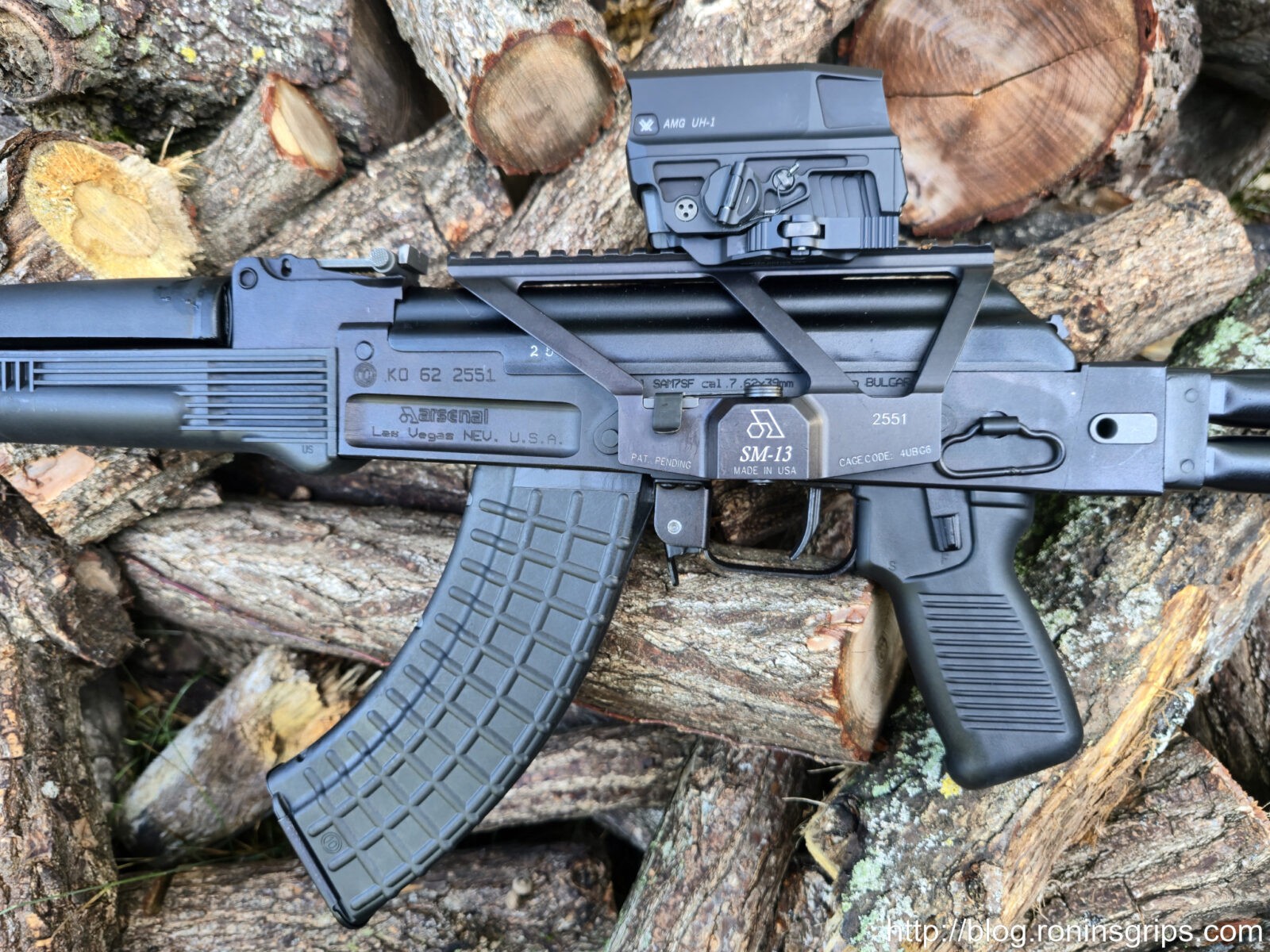
A closer view of the milled receiver and the Arsenal SM-13 side rail optics mount that does center over the bore.
3.1.1 Arsenal SAM7R (7.62x39mm Rifle)
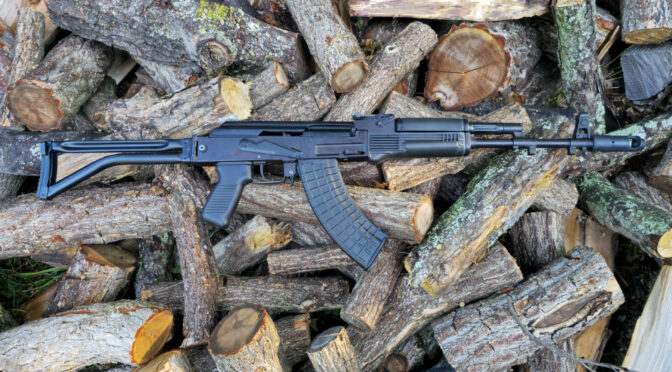
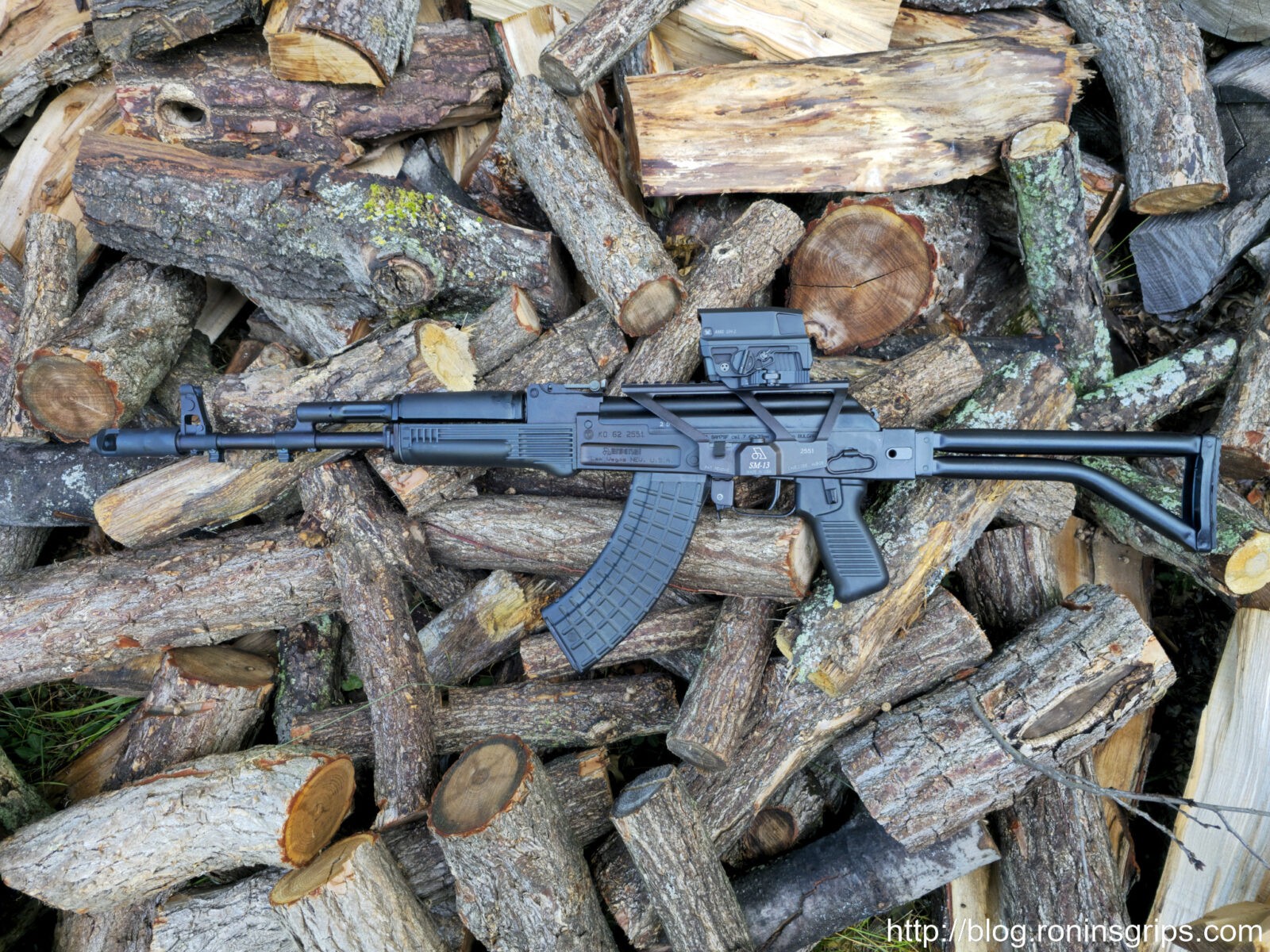
The SAM7R is the quintessential Arsenal rifle and the bedrock of its reputation in the U.S. It features a 16.3-inch cold hammer-forged, chrome-lined barrel and the signature milled receiver, both produced in Bulgaria. Imported by Arsenal, Inc. in Las Vegas, it is configured for 922(r) compliance with high-quality U.S. parts. It is often equipped with the FIME Group Enhanced Fire Control Group, which provides a smoother, lighter trigger pull than standard AK triggers.9 The platform is available in numerous configurations, including the classic fixed stock (SAM7R) and a robust side-folding stock variant (SAM7SF).17
Table 1: Arsenal SAM7R At-a-Glance
Feature
Specification
Caliber
7.62x39mm
Receiver
Hot-Die Hammer-Forged Milled
Barrel
16.3″ Cold Hammer-Forged, Chrome-Lined
Weight
Approx. 8.0 lbs
Price Range (USD)
$1,600 – $2,400 (Varies by configuration and market conditions) 17
Customer Sentiment
Pros: Widely praised for phenomenal durability, with users describing it as “indestructible” and able to “last two lifetimes.” The action is exceptionally smooth, and the rifle is noted for being soft-shooting for its caliber. Reliability is a key selling point, with reports of thousands of rounds fired with zero failures. It is frequently cited by reviewers and owners as the “best AK ever built” or the “gold standard”.9
Cons: The most common complaints are its very high price point and significant weight compared to stamped-receiver AKs. The factory paint finish is a frequent point of criticism, often described as “Weber grill paint” that is prone to flaking and not up to the standard of a rifle in its price class. The milled receiver design also limits compatibility with the vast aftermarket of stocks and handguards designed for stamped AKMs.21
This is the author’s SAM7SF (Side Folder) with a Vortex AMG UH-1 Holographic Sight. The rifle came in the SAM7SF-86 package with a hard case, optics mount, 1-10 round mag, 1-30 round mag and a few accessories – sling, oil bottle and cleaning kit.
3.1.2 Arsenal SAM5 (5.56x45mm Rifle)
The SAM5 is Arsenal’s answer for the U.S. consumer who desires the premium milled receiver construction but prefers the ballistics, lower recoil, and widespread availability of the 5.56x45mm NATO cartridge. It shares the same robust forged and milled build quality as the SAM7R but is specifically engineered for the 5.56mm round, featuring a 1:7″ barrel twist rate ideal for stabilizing a wide range of modern.223 and 5.56mm projectiles.33
Pros: Successfully combines the revered SAM7 build quality with a caliber that is immensely popular in the U.S. market. It is often described as a “go-to rifle” and is highly collectible. Owners praise its simple, streamlined design and high reliability.19
Cons: It shares the same primary drawbacks as the SAM7R: a high price tag, heavy weight, and the potential for finish complaints. As with many 5.56mm AK variants, magazine compatibility and availability can be more of a concern compared to the ubiquitous AR-15 platform.
3.1.3 Arsenal SAM7K (7.62x39mm Pistol)
The SAM7K is a compact pistol variant built on the same formidable milled receiver as the SAM7 rifle, but with a much shorter barrel, typically 8.5 inches. It is marketed as a premium, high-end personal defense weapon.38 A critical point of differentiation for consumers is the configuration of the rear trunnion, which dictates how a pistol brace or, if registered as a Short-Barreled Rifle (SBR), a stock can be attached. For example, the SAM7K-44 model features a rear Picatinny rail for easy mounting, while the SAM7K-34 model has a quick-detach sling port, which presents more of a challenge for accessory attachment.14
Table 3: Arsenal SAM7K At-a-Glance
Feature
Specification
Caliber
7.62x39mm
Receiver
Hot-Die Hammer-Forged Milled
Barrel
8.5″ Cold Hammer-Forged, Chrome-Lined
Weight
Approx. 5.9 lbs
Price Range (USD)
$1,700 – $2,100+14
Customer Sentiment
Pros: Heralded for its extreme durability, with some users claiming it is the “most durable AK made.” It is considered a top-tier AK pistol with a very smooth action.14
Cons: The price is considered exceptionally high, even for a premium AK pistol. It is very heavy and noticeably front-heavy, making it unwieldy to shoot without a stabilizing brace or stock. The variation in rear trunnion designs between models has been a source of frustration for consumers seeking to customize their firearm.14
3.2 The Stamped Receiver Line (SLR Series): The Accessible Workhorse
The SLR (Self-Loading Rifle) series utilizes a more conventional, high-quality stamped steel receiver. This construction method is less expensive and results in a lighter firearm, offering a more accessible entry point into the Arsenal ecosystem without sacrificing core quality features like the hammer-forged, chrome-lined barrel.
3.2.1 Arsenal SLR-107R (7.62x39mm Rifle)
The SLR-107R is Arsenal’s most prominent stamped receiver offering. It is built around a 1mm stamped Bulgarian receiver and features the same 16.25-inch cold hammer-forged, chrome-lined barrel found in its premium cousins.16 In the U.S. market, it is positioned as a significant quality upgrade from entry-level imported AKs (like the Romanian WASR-10) and represents a top-tier “workhorse” option for serious shooters.42
Table 4: Arsenal SLR-107R At-a-Glance
Feature
Specification
Caliber
7.62x39mm
Receiver
1mm Stamped Steel
Barrel
16.25″ Cold Hammer-Forged, Chrome-Lined
Weight
Approx. 7.3 lbs
Price Range (USD)
$1,500 – $2,000 (Historically available for less, but market prices have risen) 42
Customer Sentiment
Pros: Praised for its excellent quality for a stamped rifle, offering a lighter and more affordable alternative to the SAM7R. Fit and finish are generally very good, with straight sights being a common positive note compared to lower-tier imports. Owners often feel it is “worth the extra money” over cheaper options due to its smooth shooting characteristics and overall reliability.16
Cons: It still carries a premium price for a stamped AK. The paint finish can suffer from cosmetic scratches and imperfections out of the box. Some users have reported that the magazine wells can be excessively tight, requiring minor fitting to accept certain types of surplus or polymer magazines.16
Historically, Arsenal has also imported other highly regarded SLR models, such as the SLR-104 in 5.45x39mm (an AK-74 pattern rifle) and the SLR-106 in 5.56x45mm. Though often discontinued or released in limited batches, these rifles are highly sought after on the secondary market and have significantly contributed to the brand’s reputation for quality across multiple calibers.7
Conclusion
The transformation of Arsenal from a Bulgarian state armory into a dominant force in the premium segment of the U.S. civilian firearms market is a testament to a multifaceted and expertly executed long-term strategy. The analysis reveals that the company’s success is not attributable to a single factor but to the synergistic interplay of historical legacy, vertical business integration, astute regulatory navigation, and disciplined brand management.
Key Findings Synthesized:
Legacy as a Strategic Asset: Arsenal’s century-plus history as a military manufacturer under strict state and Warsaw Pact standards endowed it with an institutional mastery of robust, high-cost manufacturing processes like hammer-forging and milling. This history is not merely a talking point; it is the fundamental basis of its value proposition, allowing the company to market a level of authenticity and durability that is difficult and costly for commercially-focused competitors to replicate.
Vertically Integrated Market Control: The symbiotic relationship between Arsenal AD in Bulgaria, the importer/manufacturer Arsenal, Inc. in Las Vegas, and the primary retailer K-Var Corp. creates a tightly controlled channel from factory to consumer. This structure enables precise control over branding, pricing, and supply, which has been instrumental in establishing and maintaining the brand’s premium status.
Branding Discipline and Market Segmentation: Arsenal has successfully cultivated a “gold standard” reputation by relentlessly focusing its marketing on its superior manufacturing methods and military heritage. It has deliberately avoided the high-volume, low-margin budget market, instead segmenting the premium niche with its “super-premium” milled SAM series for collectors and its “premium workhorse” stamped SLR series for serious enthusiasts. This strategy maximizes its addressable market within its chosen high-margin space.
Turning Regulation into Opportunity: The company demonstrated exceptional business acumen by turning the complex requirements of U.S. firearms law, particularly 922(r), into a core part of its business model. By performing final manufacturing and quality control in the U.S., Arsenal, Inc. not only ensures compliance but also adds tangible value and reinforces its commitment to the American market.
In conclusion, Arsenal’s formula for success is clear: it sells a product whose quality is rooted in a genuine military-industrial past, controls the narrative and supply through a vertically integrated U.S. operation, and targets a specific, high-value consumer willing to pay a premium for perceived authenticity and durability. This disciplined approach has allowed the Kazanlak colossus to not only survive the fall of the Iron Curtain but to thrive, establishing itself as a benchmark for quality in the world’s most competitive civilian firearms market.
If you find this post useful, please share the link on Facebook, with your friends, etc. Your support is much appreciated and if you have any feedback, please email me at in**@*********ps.com. Please note that for links to other websites, we are only paid if there is an affiliate program such as Avantlink, Impact, Amazon and eBay and only if you purchase something. If you’d like to directly contribute towards our continued reporting, please visit our funding page.
Arsenal, Inc. > Arsenal, US manufacturer and importer of SAM7, SLR Series, Circle 10 magazines, parts, and accessories for AK-47/74 type Rifles., accessed July 23, 2025, https://www.arsenalinc.com/
The United States personal defense firearms market in the third quarter of 2025 remains unequivocally dominated by pistols chambered in 9mm Luger. This cartridge’s balance of manageable recoil, sufficient terminal performance with modern ammunition, and high-capacity potential has solidified its position as the de facto standard for concealed carry (CCW), home defense, and professional duty use. The market has matured significantly, moving beyond foundational debates over caliber and reliability to a more nuanced landscape where consumer sentiment and purchasing decisions are driven by ergonomics, trigger quality, and advanced feature integration.
This report identifies several key technological trends that have transitioned from emerging novelties to established industry standards. Optics-ready slides are now a baseline expectation across all market segments, from deep-concealment micro-compacts to full-size duty pistols. The market is further evolving toward direct-mount optic systems that offer lower sight height and enhanced durability, signaling a new phase of red dot integration.1 Concurrently, factory-integrated compensators have become a prominent feature in the high-capacity micro-compact class, effectively blurring the lines between traditional size categories by offering compact-level shootability in a concealable package.3 Furthermore, the influence of modular, chassis-based firearm systems, pioneered by SIG Sauer and now challenged by competitors like Springfield Armory, is fundamentally reshaping product development and consumer expectations around adaptability and long-term value.4
The competitive landscape is characterized by the entrenched duopoly of SIG Sauer and Glock, who continue to command significant market share through brand loyalty and extensive product ecosystems. However, fierce competition from Smith & Wesson and Springfield Armory, who have demonstrated significant innovation in ergonomics and feature sets, is eroding this dominance. Value-oriented manufacturers such as Canik and Taurus have also secured a substantial foothold by offering feature-rich pistols at highly competitive price points, challenging the traditional price-to-performance ratio.1
The principal findings of this analysis indicate a market that has reached a new level of maturity. While absolute reliability is now a non-negotiable baseline expectation for any serious contender, the key differentiators driving positive consumer sentiment are more refined. Pistols that offer superior ergonomics, best-in-class trigger characteristics, and enhanced shootability are consistently ranked highest in public perception. Premium offerings from Staccato, with their 2011-style single-action triggers, and innovative striker-fired designs like the Walther PDP and the new HK CC9, garner exceptionally high positive sentiment, demonstrating that a growing segment of the market is willing to pay a premium for a superior shooting experience. Conversely, pistols that fail to innovate beyond legacy designs, particularly in ergonomics and trigger quality, face increasingly negative sentiment, regardless of their historical reputation for reliability.
2.0 The Modern 9mm Self-Defense Market: An Analytical Framework
To conduct a meaningful sentiment analysis, it is imperative to first establish a clear and consistent analytical framework. The modern 9mm pistol market is not a monolith; it is a highly segmented and technically nuanced environment. This section defines the key technical classifications, primary use-case segments, and the methodology used to derive the sentiment data presented in this report.
2.1 Defining the Battlefield: Key Technical Distinctions
Consumer and expert discussions are framed by a common lexicon of technical specifications that define a pistol’s intended role and performance characteristics. Understanding these distinctions is fundamental to interpreting market sentiment.
2.1.1 Form Factor & Classification
While manufacturers may use proprietary marketing terms, the market generally adheres to a classification system based on barrel length, overall size, and grip dimensions. These classes directly correlate to a pistol’s concealability and shootability.7
Micro-Compact: This category, largely defined and popularized by the SIG Sauer P365, represents the current pinnacle of concealed carry design. These pistols are characterized by barrel lengths typically under 3.5 inches, a slide width of approximately 1 inch, and a height under 4.5 inches.6 Their defining feature is a “stack-and-a-half” magazine design that allows for capacities of 10+1 rounds or more in a frame that was previously limited to single-stack capacities of 6-8 rounds.10 Key examples include the SIG Sauer P365, Springfield Armory Hellcat, and Smith & Wesson M&P Shield Plus.
Subcompact: This class often overlaps with micro-compacts but traditionally referred to double-stack pistols with a shortened grip frame, such as the Glock 26.7 While still relevant, the term has been somewhat superseded by the more specific “micro-compact” designation for the newest generation of slim, high-capacity pistols. Barrel lengths are typically in the 3 to 3.5-inch range.8
Compact: Widely considered the most versatile size class, compact pistols serve as a benchmark for balancing concealability with shootability. They typically feature barrel lengths between 3.5 and 4.5 inches and a grip that allows for a full, three-finger hold for most users.8 This class is epitomized by the Glock 19, which remains the standard against which all other compact pistols are measured. They are a popular choice for both concealed carry and home defense.15
Full-Size: Also known as “duty” or “service” pistols, this class prioritizes maximum performance over concealability. With barrel lengths exceeding 4.5 inches, full-size frames, and magazine capacities often reaching 17 rounds or more, these pistols offer the highest degree of shootability, recoil control, and sight radius.13 They are the preferred choice for law enforcement, military, competitive shooting, and home defense applications.7 Examples include the Glock 17, Springfield Echelon, and Beretta 92FS.
2.1.2 Operating Mechanisms
The internal action of a pistol is a core technical distinction that profoundly influences trigger feel, manual of arms, and user preference. The market is dominated by two primary systems.18
Striker-Fired: The prevailing mechanism in the modern market, utilized by Glock, SIG Sauer (P320/P365), Smith & Wesson (M&P), Springfield Armory (Hellcat/Echelon), Walther (PDP), and many others. In this system, a spring-loaded firing pin (the “striker”) is partially or fully cocked when the slide is cycled. The trigger pull completes the cocking motion (if necessary) and releases the striker to fire the round.20 This design results in a consistent trigger pull for every shot, simplifies the manual of arms, and is conducive to lightweight polymer frame construction, making it highly popular for defensive use.19
Hammer-Fired: The more traditional design, where an external or internal hammer strikes a separate firing pin. These actions are further subdivided:
Double-Action/Single-Action (DA/SA): Found in pistols like the Beretta 92FS and CZ 75, this system features a long, heavy first trigger pull (the double-action) that both cocks and releases the hammer. Subsequent shots are single-action, with a much shorter, lighter trigger pull, as the slide’s reciprocation cocks the hammer automatically.18 Proponents value the added safety of the heavy first pull, while critics dislike the DA-to-SA transition.
Single-Action Only (SAO): The hammer must be manually cocked for the first shot (typically by racking the slide) and is automatically cocked for subsequent shots. This system, famously used in the 1911 and its modern 2011 derivatives like Staccato pistols, allows for an exceptionally light, crisp, and short trigger pull, which is widely considered the gold standard for pure shootability.22
Double-Action Only (DAO): Every trigger pull is a long, heavy double-action pull. While offering consistency, the heavy pull is often seen as a detriment to accuracy and speed compared to modern striker-fired systems.18 The new FN Reflex notably uses an internal hammer in a single-action configuration, a unique offering in the micro-compact space.25
2.1.3 The New Standard: Core Feature Expectations
By Q3 2025, several features have become so prevalent that their absence is now a notable point of criticism in consumer sentiment. These are no longer premium add-ons but are considered core components of a competitive modern defensive pistol.4
Optics-Ready Slides: The ability to mount a miniature red dot sight (MRDS) is now a default feature on virtually all new self-defense pistol models.4 The market has advanced to the point where the quality of the mounting system is a key differentiator. Systems like Springfield’s Variable Interface System (VIS) and Glock’s collaboration with Aimpoint for the A-CUT direct-mount footprint represent the next evolution, offering a lower sight axis and eliminating the need for failure-prone adapter plates.1
Accessory Rails: A standardized Picatinny-style rail (MIL-STD-1913) on the dust cover is a mandatory feature for any pistol marketed for home defense or duty use, as it allows for the attachment of weapon-mounted lights and lasers.4 The inclusion of rails on an increasing number of compact and even micro-compact pistols reflects a market that values versatility.6
Enhanced Ergonomics: Generic, “one-size-fits-all” grips are no longer acceptable. Market leaders offer a high degree of user customization through features like interchangeable backstraps and side panels (a feature perfected by the HK VP9).4 Furthermore, advanced grip texturing that provides a secure hold without being overly abrasive (such as Springfield’s “Adaptive Grip Texture” on the Hellcat and Echelon) and thoughtfully designed undercuts on the trigger guard are now critical factors that heavily influence perceptions of shootability and overall quality.2
2.2 Primary Use-Case Segmentation
The market can be effectively divided into three primary segments based on the end-user’s intended application. These segments have distinct priorities that shape design choices and consumer preferences.31
Deep Concealment / Everyday Carry (CCW): This segment prioritizes concealability above all else. Key metrics are size, width, weight, and the capacity-to-size ratio.16 The micro-compact class, led by pistols like the SIG P365 family, Springfield Hellcat, and S&W Shield Plus, was created specifically to serve this user, who requires a firearm that can be carried comfortably and discreetly for extended periods under a variety of clothing.1
Home / General Defense: In this scenario, concealability is not a primary concern, allowing the user to prioritize shootability. This segment favors compact and full-size pistols that offer a larger grip for better recoil control, higher magazine capacity, and an accessory rail for mounting a weapon light, which is critical for positive target identification in low-light environments.16 The Glock 19, Walther PDP, and Springfield Echelon are prime examples of pistols that excel in this role.1
Duty / Professional Use: This segment demands the highest standards of reliability, durability, and performance under adverse conditions. It is dominated by full-size and large compact pistols that have a proven track record of performance.17 While historically the domain of pistols like the Glock 17 and Beretta 92FS, this segment is increasingly adopting modular, optics-ready platforms like the SIG P320 and Springfield Echelon, which offer greater adaptability for agencies and individual officers.5
2.3 Sentiment Analysis Methodology
The findings in this report are based on a proprietary sentiment analysis methodology designed to provide a nuanced and accurate representation of market perception.
Data Aggregation: The analysis synthesizes qualitative and quantitative data from a broad spectrum of Q3 2025 sources. These include professional media outlets with structured testing protocols (e.g., Outdoor Life, Gun Tests), high-traffic digital publications known for detailed reviews (e.g., Gun University, Pew Pew Tactical), influential user-generated content (e.g., YouTube reviewers, Reddit and firearm-specific forum discussions), and market indicators such as “best-seller” lists.
Total Mentions Index: To accurately reflect a pistol’s market relevance, this report utilizes a “Total Mentions Index.” This is a weighted metric, not a simple raw count of mentions. A comprehensive, multi-thousand-word review in a major publication is assigned a significantly higher weight than a brief mention in a list or a short forum comment. This approach prioritizes the depth and influence of the discussion, providing a more insightful measure of a firearm’s impact on the market conversation.
Sentiment Scoring: Each substantive mention of a pistol is analyzed and categorized as Positive, Negative, or Neutral.
Positive: Assigned for explicit praise of specific attributes, such as “excellent trigger,” “flawless reliability,” “superb ergonomics,” or “great value.”
Negative: Assigned for explicit criticism, such as “mushy trigger,” “reliability issues,” “uncomfortable grip,” or “overpriced.”
Neutral: Assigned for objective statements of fact, such as specifications (e.g., “barrel length is 4.0 inches”) or feature descriptions without a value judgment. The final sentiment score is presented as a percentage breakdown of these categories, offering a clear, quantitative snapshot of public and expert opinion.
3.0 Segment Leaders & Performance Analysis
Applying the established framework, this section provides a detailed analysis of the leading pistols within each market segment, synthesizing sentiment data to identify key strengths, weaknesses, and competitive positioning.
3.1 Deep Concealment / CCW Segment
The micro-compact category, born from the market’s demand for higher capacity in a concealable package, has become the most dynamic and competitive segment. The initial arms race over round count has given way to a more sophisticated battle over shootability and ergonomics.
SIG Sauer P365 Family (P365, XL, XMacro): The P365 series continues to be the benchmark for the micro-compact class. Its introduction in 2018 fundamentally altered market expectations, and its influence is still felt in 2025.6 Positive sentiment is overwhelmingly centered on its revolutionary capacity-to-size ratio, which remains best-in-class.1 The modularity of its serialized Fire Control Unit (FCU) is another major driver of positive sentiment, allowing users to swap grip modules, slides, and barrels to create customized configurations.4 Ergonomics are frequently praised, with many users finding the grip comfortable and easy to control for its size.35 While early production models were plagued by reliability concerns (e.g., striker drag, trigger spring failures), the consensus is that these issues have been largely resolved in models produced after 2020.37 However, the memory of these early problems persists and contributes to a small but consistent stream of negative sentiment. The P365 XMacro variant has been particularly well-received, with its integrated compensator and 17+1 capacity praised for delivering compact-pistol shootability in a slim, carry-friendly profile.24
Springfield Armory Hellcat & Hellcat Pro: As a direct competitor to the P365, the Hellcat has carved out a significant market share. Highly positive sentiment is directed at its standard features, particularly the excellent “U-Dot” sights, which combine a tritium front dot with a U-notch rear for rapid acquisition.10 The “Adaptive Grip Texture” is another lauded feature, providing a secure hold under recoil without being overly abrasive against skin or clothing during concealed carry.39 The Hellcat’s base capacity of 11+1 is also noted as a competitive advantage over the standard P365’s 10+1.10 The Hellcat Pro model, with its slightly longer slide and grip, is praised for its enhanced balance and shootability, making it a strong contender against the P365 XL and XMacro.24 Negative sentiment, though less frequent, typically focuses on a trigger that is perceived as heavier and less refined than the P365’s, and a subjective feeling of a “snappier” recoil impulse.10
Smith & Wesson M&P Shield Plus: Building on the legacy of the original Shield, the Shield Plus is a dominant force in the segment. Its most lauded feature is its flat-faced trigger, which receives exceptionally high praise across the board as one of the best factory triggers in a micro-compact pistol.6 This, combined with what many users describe as superior ergonomics and a more natural grip angle, results in very high positive sentiment regarding its shootability.45 Its reliability is considered unquestionable, leveraging the proven M&P platform.45 The primary sources of negative sentiment are the lack of a standard accessory rail on most models, which limits options for weapon-mounted lights, and a grip that some users with larger hands find to be too slim, even with the extended magazine.45
Glock 43X MOS: The Glock 43X maintains a strong market position, primarily due to Glock’s unparalleled reputation for reliability and the platform’s simplicity.3 Positive sentiment focuses on its slim, comfortable frame, which many find more ergonomic than Glock’s traditional double-stack designs, and its balanced handling characteristics.3 The vast aftermarket ecosystem for Glock pistols is another significant advantage, allowing for endless customization.50 However, it faces consistent negative sentiment regarding its stock 10+1 capacity, which lags behind the standard set by SIG, Springfield, and S&W (though reliable 15-round aftermarket magazines are available).28 Furthermore, its stock polymer sights and notoriously mediocre trigger are frequent points of criticism when compared to the more refined offerings from competitors.50
The intense competition in this segment, sparked by the P365, has led to a rapid maturation of the product category. What began as a race to maximize round count in the smallest possible package has evolved. By 2025, features like optics cuts, high-visibility night sights, and capacities exceeding 10 rounds are no longer differentiators but baseline requirements. The market has shifted focus toward the nuances of the user experience. Manufacturers are now competing on the quality of the trigger pull, the texture and angle of the grip, and the effectiveness of recoil mitigation systems like integrated compensators. The recent entries of the hammer-fired FN Reflex and the premium HK CC9 into this crowded space underscore that the segment remains highly lucrative.3 However, new products must offer a distinctly superior shooting experience or a unique value proposition to capture market share from the established leaders.
3.2 Home / General Defense Segment
This segment is the heart of the 9mm market, where compact and full-size pistols offer a blend of capacity, shootability, and versatility. Reliability is paramount, but ergonomics and trigger performance are the primary drivers of enthusiast sentiment.
Glock 19 Gen 5 MOS / Glock 45 MOS: The Glock 19 remains the quintessential “do-it-all” pistol, and its sentiment reflects this status. Positive sentiment is overwhelmingly rooted in its legendary, “boring” reliability and the simplicity of its design.50 The vastness of its aftermarket support is unmatched, allowing users to configure the pistol for any conceivable role.51 The Gen 5 updates, specifically the removal of the polarizing finger grooves and the introduction of a slightly improved trigger and the Glock Marksman Barrel, have been well-received and addressed long-standing criticisms.53 Negative sentiment is equally consistent, targeting the “blocky” and uninspired ergonomics, a trigger that, while improved, still lags behind the competition, and the continued use of basic polymer sights on a premium-priced pistol.50 The Glock 45, which pairs a G19 slide with a full-size G17 frame, receives particularly high praise for its excellent balance and enhanced shootability, with many considering it the best-handling pistol in Glock’s lineup.1
Walther PDP / PDP Pro: The Walther PDP has established itself as a top-tier contender, generating exceptionally high positive sentiment, particularly among discerning shooters. The pistol’s “Performance Duty Trigger” is frequently cited as the best factory striker-fired trigger available, praised for its light take-up, crisp break, and short, tactile reset.56 Its ergonomics are also lauded as “superlative,” with a grip texture and angle that users find both comfortable and extremely effective for recoil control.56 The PDP Pro model, which includes a threaded barrel and Walther’s upgraded Dynamic Performance Trigger, further solidifies its position as a premium, performance-oriented option.57 The most common point of negative feedback is a perception of a slightly higher bore axis compared to Glock, which some shooters feel results in marginally more muzzle flip, though this is often dismissed as a non-issue by a majority of users.60
Springfield Armory Echelon: As a recent market entrant, the Echelon has made a significant positive impact. Sentiment is overwhelmingly favorable regarding its two key innovations: the modular Central Operating Group (COG) chassis system and the revolutionary Variable Interface System (VIS) for optics mounting.1 The VIS, which allows for the direct mounting of over 30 different optics without adapter plates, is seen as a major technological advancement and a significant competitive advantage.5 Ergonomics are another strong point, with the interchangeable grip modules and textured “gas pedal” index points receiving high praise for enhancing control.2 The trigger is considered a massive improvement over the previous XD line and is competitive with the best in the striker-fired class.5 The primary source of negative sentiment comes from user reports of a “break-in period” where some pistols experienced initial reliability issues like failures to extract, though these issues appear to resolve after several hundred rounds.62
Heckler & Koch VP9: The VP9 continues to be a fan favorite, with its reputation built on what is widely considered best-in-class ergonomics.1 The ability to customize the grip with three sizes of both backstraps and side panels allows for a near-perfect fit for a wide range of hand sizes, a feature that generates consistently high praise.63 While its trigger was once the benchmark for striker-fired pistols, the market consensus is that it has been surpassed by newer designs like the Walther PDP, though it is still regarded as very good.30 Reliability is held in high esteem, consistent with HK’s duty-grade reputation.64 The paddle-style magazine release remains a polarizing feature; it is beloved by its proponents for its ambidexterity and safety but is a significant point of negative sentiment for those accustomed to a traditional push-button release.30
Beretta 92FS / M9 Series: A classic, all-metal, hammer-fired design with a loyal following. Positive sentiment for the 92FS is rooted in its proven reliability, exceptionally soft-shooting recoil impulse (a result of its weight and rotating block locking system), and smooth DA/SA trigger.66 It is often described as inherently accurate and a pleasure to shoot at the range.67 Negative sentiment is almost entirely directed at its dated design. It is criticized for being excessively large and heavy for its 15-round capacity, and its ergonomics, particularly the wide grip and slide-mounted safety/decocker, are considered cumbersome by modern standards.67
3.3 Duty / Professional Use Segment
This segment, while sharing many top models with the Home Defense category, places an even greater emphasis on proven durability and flawless reliability under extreme conditions.
The Glock 17, 19, and 45 platforms remain the undisputed leaders in this space. Their decades-long service history with law enforcement agencies worldwide provides a level of institutional trust that is difficult for competitors to overcome.17 The platform’s simplicity and robustness are its greatest assets in a duty role.
The Springfield Echelon is strategically positioned to be a major disruptor in this segment. Its design incorporates features directly aimed at the duty market, such as its robust COG chassis, advanced VIS optics system that simplifies armorer duties, and ergonomics built for control during high-stress scenarios.1 It directly competes with the SIG P320 for agency contracts that prioritize modularity.
The Staccato P4 represents a new, premium tier for duty pistols. It generates exceptionally high positive sentiment among expert users for its unparalleled shootability, which combines the speed of a modern pistol with the precision of a 1911-style single-action trigger.3 The decision to engineer the P4 to accept Glock-pattern magazines is a strategic masterstroke, dramatically reducing the logistical and financial barriers for agencies and individual officers to adopt the platform.3 The only significant negative sentiment relates to its substantial price premium over polymer-framed competitors and isolated user reports of the thumb safety being unintentionally engaged with certain grip styles.72
A fundamental shift is occurring in how pistols are designed and procured for professional use. The success of the SIG P320’s modular Fire Control Unit (FCU) demonstrated the value of a “pistol system” over a traditional, monolithic firearm. An agency or individual invests in a serialized chassis, around which they can build multiple configurations by swapping grip modules, slides, and barrels. Springfield’s Echelon, with its Central Operating Group (COG), is a direct and compelling response to this model.2 This trend creates powerful brand ecosystems, encouraging long-term loyalty and offering users unprecedented adaptability. The strong positive sentiment surrounding these modular platforms indicates that this is not a passing fad but a new paradigm in firearm design.4 This development exerts pressure on manufacturers of traditional pistols, forcing them to offer a wider variety of factory configurations (like Glock’s G45 and G49 models) to mimic the flexibility that chassis-based systems provide inherently.
4.0 Comparative Sentiment & Performance Matrix: Top 20 Pistols of Q3 2025
The following table presents a comprehensive data analysis of the top 20 9mm self-defense pistols on the U.S. market as of Q3 2025. The data is synthesized from an extensive review of professional publications, user forums, and market indicators. The table is sorted in descending order by the ‘Sentiment (% Positive)’ metric to highlight the models currently receiving the most favorable market reception.
Rank
Brand
Model
Class/Action
Total Mentions Index
Sentiment (% Pos/Neg/Neu)
Reliability Summary
Ergonomics & Shootability Summary
Primary Use Case
1
Staccato
P4
Full-Size / SAO Hammer-Fired
85
98 / 2 / 0
Considered exceptionally reliable; ran flawlessly in multiple tests. Adopts Glock-pattern magazines, enhancing reliability and compatibility.3
Superlative shootability and ergonomics. Praised for its smooth recoil impulse and world-class 2011 trigger. Some users note the thumb safety can be unintentionally engaged.71
Duty / Home Defense
2
Walther
PDP Pro
Compact / Striker-Fired
88
97 / 3 / 0
Regarded as extremely reliable, with users reporting thousands of rounds without malfunctions. Built to duty-grade standards.56
Best-in-class ergonomics and trigger. The Dynamic Performance Trigger is lauded as the top factory striker trigger. Grip texture is aggressive and effective.57
Home Defense / Duty / Competition
3
HK
CC9
Micro-Compact / Striker-Fired
70
96 / 4 / 0
Praised for traditional HK reliability and meeting NATO standards. No significant issues reported in initial reviews.3
Outstanding ergonomics for its class, with a comfortable and controllable grip. Radiused design minimizes snagging for concealed carry.3
Deep Concealment / CCW
4
Springfield
Echelon
Full-Size / Striker-Fired
92
95 / 5 / 0
Generally reliable, though some users report a “break-in period” with initial malfunctions that resolve after several hundred rounds.61
Excellent ergonomics with modular grips and “gas pedal” texture. Lauded for its flat-shooting characteristics and a top-tier trigger for a striker-fired gun.1
Home Defense / Duty
5
Staccato
C
Compact / SAO Hammer-Fired
78
94 / 6 / 0
Highly reliable with new V3 magazines and external extractor. One early jam noted during break-in, but flawless afterward.75
Excellent 1911/2011 ergonomics in a compact package. Redesigned grip is slimmer and fits more hand sizes. Superb trigger enhances shootability.75
CCW / Home Defense
6
Beretta
PX4 Storm Compact Carry 2
Compact / DA/SA Hammer-Fired
65
93 / 7 / 0
Legendary reliability. Rotating barrel action is known for smooth cycling and functioning under adverse conditions.79
Very soft-shooting due to rotating barrel. LTT-tuned trigger is excellent. Can feel “chunky” or wide for a compact pistol.3
CCW / Home Defense
7
Smith & Wesson
M&P9 Shield Plus
Micro-Compact / Striker-Fired
95
92 / 6 / 2
Considered extremely reliable, building on the proven M&P platform. No significant widespread issues reported.6
Excellent ergonomics and a best-in-class flat-faced trigger make it very shootable. Grip may be too small for large hands; lacks an accessory rail.6
Deep Concealment / CCW
8
Kimber
KDS9c
Compact / SAO Hammer-Fired
60
91 / 9 / 0
Generally reliable, though one failure to feed was noted during a 150-round test, suggesting a potential break-in period is needed.82
Excellent 1911-style ergonomics with a lightweight aluminum frame. Trigger is exceptionally crisp and light (3-4 lbs), enhancing accuracy significantly.23
CCW / Home Defense
9
Staccato
CS
Subcompact / SAO Hammer-Fired
82
90 / 10 / 0
Extremely reliable; designed from the ground up for EDC. No malfunctions reported in extensive testing. New magazine design is robust.85
Excellent ergonomics with a slimmer grip than other 2011s. Recoil is manageable but noticeably “snappier” than larger Staccato models.88
Deep Concealment / CCW
10
HK
VP9
Full-Size / Striker-Fired
89
89 / 9 / 2
Considered extremely reliable, in line with HK’s reputation for building robust, duty-grade firearms.1
Best-in-class ergonomics due to highly customizable grip panels. Trigger is very good but no longer considered the market leader. Paddle mag release is polarizing.4
Home Defense / Duty
11
SIG Sauer
P365 XMacro
Micro-Compact / Striker-Fired
98
88 / 10 / 2
Current models are highly reliable. Early P365 issues are largely resolved but still factor into some negative sentiment.24
Excellent ergonomics. Integrated compensator makes it shoot as well as a larger compact pistol, a major positive. High 17+1 capacity is a key feature.24
CCW / Home Defense
12
CZ
P-10 C
Compact / Striker-Fired
75
87 / 11 / 2
Very reliable; users report flawless performance through thousands of rounds and in competition settings.90
Excellent ergonomics with a natural grip angle. Trigger is better than Glock’s. Aggressive grip texture can be abrasive for concealed carry.91
CCW / Home Defense
13
Springfield
Hellcat Pro
Micro-Compact / Striker-Fired
93
86 / 12 / 2
Highly reliable with no significant widespread issues reported. A proven and trusted platform.24
Excellent “Adaptive Grip Texture” and “U-Dot” sights. Balances concealability and shootability well. Trigger is heavier than some rivals.3
CCW / Home Defense
14
Glock
G45 MOS
Crossover / Striker-Fired
90
85 / 10 / 5
Legendary Glock reliability. Considered a benchmark for dependability in a duty or defensive role.1
Praised for excellent balance and handling (G19 slide/G17 frame). Gen 5 grip without finger grooves is a major plus. Still has “blocky” Glock feel.1
Home Defense / Duty
15
FN
Reflex
Micro-Compact / SAO Hammer-Fired
72
84 / 14 / 2
Generally reliable, though some users report fussiness with 115gr ammunition, preferring 124gr or heavier loads.26
Excellent trigger for a micro-compact (light and crisp SAO). Ergonomics are good, but some find the recoil impulse “snappy”.24
Deep Concealment / CCW
16
SIG Sauer
P365 / P365X
Micro-Compact / Striker-Fired
100
83 / 15 / 2
Current production models are very reliable. The memory of early production issues (2018-2019) still generates negative sentiment.35
Groundbreaking ergonomics and capacity-to-size ratio. Modular FCU allows for extensive customization. Can be “snappy” to shoot.1
Deep Concealment / CCW
17
Glock
G19 Gen 5 MOS
Compact / Striker-Fired
97
82 / 13 / 5
The industry standard for reliability. Will cycle virtually any ammunition under any conditions.50
Ergonomics improved with Gen 5 (no finger grooves), but still considered “blocky.” Trigger is mediocre and sights are plastic, frequent points of criticism.50
CCW / Home Defense / Duty
18
Canik
TP9 Elite SC
Subcompact / Striker-Fired
79
80 / 18 / 2
Generally reliable, though some users report a break-in period is required and potential pickiness with certain ammunition types.97
Excellent trigger, often cited as the best in its price class. Ergonomics are good but the pistol is wider and heavier than direct competitors.24
CCW / Home Defense
19
Beretta
92FS / M9
Full-Size / DA/SA Hammer-Fired
68
78 / 20 / 2
Legendary reliability due to its open-slide design and robust construction. One of the most proven platforms in history.67
Very soft-shooting and accurate. Ergonomics are dated; the grip is large and the slide-mounted safety is widely criticized as being poorly located.66
Home Defense / Duty
20
Taurus
G3C
Compact / SA Striker-Fired
76
75 / 22 / 3
Generally considered reliable for the price, a significant improvement over older Taurus models. Some isolated issues reported.1
Ergonomics are serviceable with decent grip texture. Trigger has a long take-up but a unique restrike capability. Offers incredible value.101
CCW / Budget Home Defense
5.0 Market Trajectory & Strategic Imperatives
The 9mm self-defense pistol market of Q3 2025 is defined by intense competition and a highly educated consumer base. The analysis of market sentiment and technological adoption reveals several key trajectories that will shape the industry’s future, leading to specific strategic recommendations for manufacturers and clear purchasing guidance for consumers.
5.1 Future Outlook: Key Market Trajectories
Maturation of the Micro-Compact Segment: The period of explosive, revolutionary growth in the micro-compact segment has concluded. The market has now entered a phase of refinement and incremental improvement. Having established high capacity (10+ rounds) and an optics-ready slide as the baseline, manufacturers are now competing on the nuances of shootability. The integration of features like compensators (e.g., Springfield Hellcat Pro Comp, SIG P365 XMacro) to tame recoil is a clear indicator of this trend.3 Future success in this segment will be determined not by who can add one more round to a magazine, but by who can deliver the most controllable and ergonomic shooting experience in the slimmest possible package.
Optics Integration as the Universal Standard: The market has moved past the question of if a pistol should be optics-ready to how it should be. The use of multiple adapter plates is increasingly viewed as a cumbersome and potentially less reliable solution. Direct-mount systems, such as Springfield’s VIS on the Echelon and Glock’s A-CUT for the Aimpoint COA, are setting a new standard for excellence.1 These systems allow the optic to sit lower on the slide, facilitating co-witnessing with standard-height iron sights and providing a more robust mounting interface. This technological progression will exert significant pressure on manufacturers to abandon complex plate systems in favor of more elegant, integrated solutions.
The Rise of the Chassis System: The commercial and institutional success of the SIG P320 and P365, built around a removable, serialized Fire Control Unit (FCU), has validated the modular pistol concept. The strong market entry of the Springfield Echelon with its Central Operating Group (COG) confirms that this is a major strategic direction for the industry.4 This approach transforms the purchase from a single firearm into an investment in a versatile “system.” It creates a powerful ecosystem that fosters brand loyalty while offering consumers and agencies unprecedented flexibility to adapt a single serialized firearm to multiple roles. This places immense pressure on manufacturers with traditional, monolithic frame designs to innovate or risk being perceived as technologically dated.
The “Glock Magazine Ecosystem”: The decision by Staccato, a premium 2011 manufacturer, to design its new duty-focused P4 pistol around the ubiquitous Glock magazine pattern is a development with profound market implications.3 This move acknowledges the Glock magazine as a de facto industry standard and drastically lowers the barrier to entry for individuals and agencies already invested in that ecosystem. This may signal a broader trend where other high-end or niche manufacturers adopt common magazine patterns (Glock or SIG P320) to broaden their appeal and leverage the existing market infrastructure, rather than forcing consumers to invest in expensive proprietary magazines.
5.2 Strategic Recommendations for Manufacturers
For Market Leaders (Glock, SIG Sauer): Complacency is the greatest threat. While your market position is strong, competitors are consistently winning on specific points of sentiment. For Glock, the data is unequivocal: the market desires a better factory trigger and non-plastic sights out of the box. While your reputation for reliability is your core strength, the continued reliance on these subpar components is the primary source of negative sentiment and the main driver of the vast aftermarket that exists to “fix” your pistols. For SIG Sauer, continue to leverage the modularity of the FCU as a key strategic advantage. The P365 and P320 ecosystems are powerful tools for customer retention. Focus on refining trigger feel and continuing to innovate with new grip and slide configurations that address emerging market niches.
For Challengers (Smith & Wesson, Springfield Armory): Continue to press your advantages in innovation. For Springfield, the VIS optics system is a significant technical achievement and a key marketing differentiator that should be heavily promoted. The positive ergonomic feedback on the Echelon and Hellcat platforms should be a central part of your brand identity. For Smith & Wesson, the excellent trigger and ergonomics of the M&P Shield Plus have generated immense goodwill. A key strategic imperative should be to integrate an accessory rail into all defensive models of the Shield Plus to address the most significant piece of negative feedback and achieve feature parity with competitors.
For Value Brands (Canik, Taurus): You have successfully captured a significant market share by offering compelling features at an aggressive price point. The next strategic phase is to solidify brand reputation. For Canik, you have already made significant strides; sentiment frequently highlights your excellent triggers and reliability in the same breath as your value proposition.1 Continue this trajectory. For Taurus, the primary challenge remains overcoming a legacy of perceived quality control issues. The positive reception of the G3C and G3X demonstrates a clear path forward.24 The strategic imperative is relentless consistency in manufacturing and quality control to build the institutional trust that turns a budget purchase into a confident recommendation.
5.3 Purchasing Guidance for Consumers
New Shooters: The primary considerations should be ease of use, manageable recoil, and good ergonomics to build a strong foundation of skills. Models specifically designed for ease of operation, like the Smith & Wesson M&P9 Shield EZ, are highly recommended for their easy-to-rack slides.1 The HK VP9 is also an excellent choice due to its supremely comfortable and customizable grip, which can be tailored to fit the user’s hand perfectly.1 A versatile compact pistol like the Glock 19 or Walther PDP Compact provides an ideal platform for learning, with manageable recoil and a size that is effective for both range practice and potential home defense.
Experienced Concealed Carriers: The decision matrix for this user involves a critical trade-off between ultimate concealability and optimal shootability. For those prioritizing deep concealment and minimal printing, the standard SIG Sauer P365, Springfield Hellcat, or S&W M&P Shield Plus remain top-tier choices, offering proven reliability and high capacity in a very small footprint. For carriers willing to accommodate a slightly larger frame in exchange for significantly improved recoil control and handling, the “micro-compact plus” category is the clear winner. The SIG Sauer P365 XMacro and Springfield Hellcat Pro are premier options that offer near-compact performance and are capable of serving double duty as a home defense firearm.24
Home Defense-Focused Individuals: In a home defense scenario, concealability is irrelevant, so the focus should be on maximizing shootability, capacity, and the ability to mount accessories. A full-size or large compact pistol is the ideal choice. The Springfield Echelon, Walther PDP Full-Size, and Glock 45 stand out as premier modern options, all offering high capacity, excellent ergonomics, and integral accessory rails for mounting a high-quality weapon-mounted light—an essential tool for target identification.1 For those who prefer a hammer-fired action and the softest possible recoil impulse, the all-steel Beretta 92FS remains a formidable and proven choice for this role.66
If you find this post useful, please share the link on Facebook, with your friends, etc. Your support is much appreciated and if you have any feedback, please email me at in**@*********ps.com. Please note that for links to other websites, we are only paid if there is an affiliate program such as Avantlink, Impact, Amazon and eBay and only if you purchase something. If you’d like to directly contribute towards our continued reporting, please visit our funding page.
The commercial market for precision-grade .223 Remington and 5.56x45mm NATO ammunition has evolved into a highly segmented and technically sophisticated ecosystem. Once dominated by a few legacy offerings, the landscape is now defined by intense competition across distinct performance tiers, catering to the specialized demands of competitive shooters and long-range enthusiasts. The market’s premium segment is commanded by established brands such as Federal, Black Hills, Hornady, and Nosler, whose products serve as the benchmark for accuracy and consistency.1 Central to this space is the Sierra MatchKing (SMK) projectile, particularly in its 69-grain and 77-grain variants, which remains the quintessential bullet against which all competitors are measured, largely due to its association with the military’s highly successful Mk 262 cartridge.1
Two principal trends are shaping the industry’s trajectory. First is the relentless pursuit of superior external ballistics, primarily through the development of projectiles with higher ballistic coefficients (BC). This is exemplified by the market adoption of polymer-tipped bullets like the Hornady ELD-M (Extremely Low Drag – Match) and Sierra Tipped MatchKing (TMK), which offer flatter trajectories and reduced wind deflection at extended ranges.1 Second is the consumer’s increasingly stringent demand for exceptional lot-to-lot consistency. This is quantified through chronograph data, where low velocity Standard Deviation (SD) and Extreme Spread (ES) have become critical differentiators, separating premium match offerings from their budget-tier counterparts.6
This report’s sentiment analysis of the top 30 commercial loads reveals a nuanced market. Federal’s Gold Medal Match line, particularly the 77gr SMK load, continues to hold its “gold standard” reputation for unparalleled factory consistency, commanding widespread loyalty among serious competitors.9 Concurrently, value-oriented brands, most notably Palmetto State Armory’s AAC line, have aggressively captured market share for training and entry-level competition. This has been achieved despite documented velocity inconsistencies, indicating a strong market appetite for affordable, ballistically-similar practice ammunition.6 At the highest end of the performance spectrum, a niche but influential group of shooters in Precision Rifle Series (PRS) and Designated Marksman Rifle (DMR) disciplines are driving demand for boutique and specialized loads featuring the heaviest-for-caliber, highest-BC projectiles that can still function within the constraints of an AR-15 magazine.4
Foundational Technical Principles for Precision
Chamber and Cartridge Nuances: .223 Rem vs. 5.56 NATO vs. .223 Wylde
A fundamental understanding of rifle chamber specifications is non-negotiable for any shooter seeking to maximize the performance and safety of match-grade ammunition. The designations .223 Remington, 5.56x45mm NATO, and .223 Wylde refer to the dimensions of the chamber cut into the barrel, not merely the ammunition itself.13
.223 Remington (SAAMI): Standardized by the Sporting Arms and Ammunition Manufacturers’ Institute (SAAMI), the.223 Remington chamber is characterized by a shorter leade (the distance from the case mouth to where the rifling begins) and tighter overall dimensions. This design is optimized for accuracy with commercial.223 Remington ammunition. However, it is not designed to accommodate the potentially higher pressures generated by military-specification 5.56 NATO ammunition. Firing 5.56 NATO cartridges in a true .223 Remington chamber can cause a dangerous pressure spike, potentially leading to catastrophic firearm failure.13
5.56x45mm NATO: The military standard chamber features a longer leade and marginally looser dimensions. This configuration is engineered to ensure reliable feeding and extraction of higher-pressure military ammunition (such as M193 and M855) under a wide range of environmental and operational conditions, including high rates of fire. While this design prioritizes reliability, the more generous tolerances can result in a slight reduction in maximum potential accuracy when compared to a tighter match chamber.13
.223 Wylde: Developed by gunsmith Bill Wylde, this hybrid chamber represents an elegant engineering solution to the .223/5.56 dilemma. It incorporates the tighter freebore diameter of the .223 Remington chamber for enhanced accuracy potential, particularly with heavy match bullets. Crucially, it also uses the longer leade angle and body dimensions of the 5.56 NATO chamber, allowing it to safely fire both .223 Remington and high-pressure 5.56 NATO ammunition.13 This “best of both worlds” design has made the .223 Wylde chamber the de facto standard for precision-oriented AR-15s and custom rifle builds.14 The proliferation of this chamber is a direct enabler of the modern high-performance ammunition market, as it provides a safe and accurate platform for manufacturers to develop their most advanced, high-pressure match loads without compromise.
The Role of Barrel Twist Rate in Projectile Stability
The rate of twist of a barrel’s rifling is a critical factor that determines its ability to gyroscopically stabilize a projectile in flight. For the long, heavy, high-BC bullets that define the match-grade market, selecting an appropriate twist rate is essential for achieving accuracy.
1:9 Twist: Commonly found in older or more budget-focused rifles, a 1-in-9-inch twist rate is generally sufficient for stabilizing bullets up to approximately 69 grains. It is often considered marginal or entirely inadequate for the 75-grain and heavier projectiles that are required for serious long-range competition, as it may fail to impart enough spin for them to remain stable, resulting in keyholing and poor accuracy.19
1:8 Twist: This has become a highly versatile and popular choice for modern sporting rifles. A 1-in-8-inch twist is capable of stabilizing the vast majority of commercially available match projectiles, including the ubiquitous 77gr Sierra MatchKing. It represents a “sweet spot” that offers excellent performance with heavier bullets while still shooting lighter projectiles well, making it ideal for general-purpose precision builds.2
1:7 Twist: The current U.S. military standard, the 1-in-7-inch twist was adopted to stabilize very long projectiles like the M856 tracer round. For competitive shooters, it is the preferred choice for wringing maximum performance out of the heaviest available bullets (80 grains and above), ensuring complete stability across all atmospheric conditions and altitudes.2
The barrel twist rate effectively functions as a market gatekeeper, defining a shooter’s access to different tiers of ammunition performance. A rifle with a 1:9 twist barrel physically limits the user to the Service Rifle and Entry-Level Precision segments. In contrast, an investment in a 1:7 or 1:8 twist barrel signals an intent to engage in long-range shooting, making that consumer the prime demographic for ammunition manufacturers’ most advanced and premium offerings.
Market Segmentation & Analytical Framework
Match Ammunition Sub-Segments
The precision .223/5.56 market is best understood as three distinct sub-segments, each with unique performance requirements and consumer expectations.
Service Rifle Competition: This is the most established segment, with its parameters defined by the rules of governing bodies like the Civilian Marksmanship Program (CMP) and the National Rifle Association (NRA) for High Power Rifle competition.25 Ammunition in this category must deliver exceptional accuracy and flawless reliability in AR-15 platforms out to 600 yards. The dominant projectiles are traditional Open Tip Match (OTM) or Hollow Point Boat Tail (HPBT) designs, with the 69gr and 77gr Sierra MatchKing being the archetypal choices.2
Long-Range / PRS Style: This is the most technically advanced and rapidly evolving segment, driven by the demands of disciplines like the Precision Rifle Series (PRS) and various DMR-style matches.6 These factory loads are engineered to extract the maximum possible ballistic performance from the cartridge. They feature the heaviest-for-caliber projectiles (75gr, 77gr, 80gr, 85gr, and even heavier) that prioritize the highest possible BC. The goal is to minimize wind deflection and retain velocity at extreme ranges (600 to over 1,000 yards).5 Polymer-tipped bullets are common in this segment for their ability to improve BC and create a more uniform meplat compared to traditional OTMs.6
Entry-Level Precision / “Budget Match”: This segment is a critical gateway for shooters transitioning from inexpensive, bulk full metal jacket (FMJ) training ammunition to the world of precision shooting.32 Brands such as AAC, Prvi Partizan (PPU), IMI, and Hornady’s Frontier line offer ammunition loaded with match-style projectiles at a significantly lower cost per round than premium offerings.6 The primary compromise is typically a lower degree of lot-to-lot consistency, which manifests as higher velocity SD and ES figures.11
Sentiment Analysis Methodology
This report employs a qualitative and quantitative technical sentiment analysis, distinct from a general market survey. The methodology is designed to capture the nuanced perspectives of expert-level consumers for whom performance is the paramount concern.
Source Prioritization: The analysis heavily prioritizes data from niche, expert-driven online communities where technical performance is the core of the discourse. Primary sources include dedicated forums such as AccurateShooter.com, specialized subreddits like r/longrange and r/CompetitionShooting, and detailed user reviews on retail websites that provide quantitative performance data (e.g., measured group sizes, chronograph results).3 General reviews lacking specific data are assigned minimal weight.
“Total Mentions Index”: This proprietary metric is not a simple count of brand mentions. It is a weighted index that reflects the substance and depth of the discussion. A single, detailed forum thread containing chronograph data, group size measurements, and performance analysis at multiple distances is weighted more heavily than hundreds of superficial “this ammo is good” comments.
Sentiment Scoring (% Pos/Neg/Neu):
Positive: Attributed to reports of consistent sub-Minute of Angle (sub-MOA) accuracy, low velocity SD (typically under 15 feet per second) and ES (under 35 fps), reliable performance at extended range, and a strong value proposition for the performance delivered.
Negative: Attributed to reports of inconsistent accuracy, high velocity SD/ES, pressure-related issues (e.g., blown or flattened primers), significant point-of-impact (POI) shifts between production lots, or a failure to stabilize in appropriate twist-rate barrels.
Neutral: Attributed to general inquiries, mentions lacking specific performance data, or discussions where performance is described as merely “acceptable” or “adequate” but not exceptional.
Ammunition Performance Analysis by Sub-Segment
Service Rifle Competition: The Established Standards
This segment is dominated by loads that have built a long-standing reputation for accuracy and reliability under the pressures of formal competition.
Federal Gold Medal Match 77gr Sierra MatchKing (SMK): Universally regarded as the benchmark for factory-loaded precision ammunition. Consumer sentiment is overwhelmingly positive, citing its exceptional lot-to-lot consistency, low velocity SD/ES, and its inherent ability to produce sub-MOA groups from quality rifles.9 For competitors who do not handload, it is frequently the default choice for important matches.3 Negative sentiment is virtually nonexistent, with its premium price being the only recurring point of discussion.
Black Hills Ammunition 77gr SMK / Mk 262 Clones: This load carries a legendary status stemming from its military adoption as the Mk 262 cartridge, which set a new standard for accuracy from the M16 platform.41 Sentiment is exceptionally positive, and it is often mentioned in the same breath as Federal Gold Medal Match as the pinnacle of factory 5.56 ammunition.2 The Tipped MatchKing (TMK) variant is noted for its slightly higher BC and enhanced terminal performance, making it popular for both competition and defensive applications.31
IMI Razor Core 77gr SMK: Frequently discussed as a high-quality and more accessible alternative to the top-tier American brands.6 When shooters receive a good lot, performance is reported to be excellent, with users noting consistent 3/4 MOA accuracy and reliable performance out to 600 yards.44 However, sentiment is mixed due to reports of significant lot-to-lot inconsistency, including failures to fire and noticeable velocity variations that affect vertical dispersion at range.39
Federal Gold Medal Match 69gr SMK: The lighter-weight counterpart to the 77gr load, this ammunition is the standard for excellence at 200 and 300-yard stages of competition. It is lauded for its extreme accuracy and is an ideal choice for rifles with 1:9 twist barrels that may struggle to stabilize heavier 77gr bullets.2 Its primary disadvantage is a lower BC, which makes it more susceptible to wind drift at the 600-yard line compared to its heavier stablemate.21
ADI World Class / Australian Outback 69gr SMK: This load is highly praised for its accuracy, with users reporting performance that rivals or exceeds their own handloads.46 Its unique and highly valued feature is the use of “Ballistic Temperature Independence” (BTI) powder. This proprietary propellant provides remarkably stable velocities across extreme temperature shifts, a critical advantage for competitors traveling to national matches in varying climates.46
Long-Range / PRS Style: Pushing the Ballistic Envelope
This segment is characterized by innovation, with manufacturers leveraging advanced projectile designs to maximize the long-range potential of the .223/5.56 platform.
Hornady MATCH / Superformance 73gr & 75gr ELD-M: These loads represent the cutting edge of high-BC, polymer-tipped bullet technology designed for AR-15s. The 73gr ELD-M is specifically engineered to offer the highest BC possible within the constraints of standard AR magazine length (COAL of 2.260 inches).1 The longer 75gr ELD-M projectile, due to its secant ogive, must be seated to an overall length that often exceeds magazine limits, relegating it primarily to single-loading in bolt-action rifles or specific service rifle disciplines.24 User sentiment is positive regarding their superior trajectory and wind performance, though they can be more sensitive to seating depth and rifle-specific tuning.
Berger 77gr OTM Tactical: This ammunition has earned a stellar reputation among the most discerning shooters. It utilizes Berger’s renowned J4 Precision Jackets, which are held to exceptionally tight concentricity tolerances, resulting in outstanding consistency and accuracy.23 User reviews frequently report single-digit velocity SDs and describe the ammunition as “lights out accurate,” placing it in direct competition with the best offerings from Federal and Black Hills.40
Nosler Custom Competition 77gr: Widely praised in the shooting community as an excellent balance of high performance and value. This load consistently delivers accuracy on par with the more expensive Sierra MatchKing loads but at a more competitive price point.47 The most common critique is that the open tips of the bullets (meplats) exhibit less uniformity than those from Berger or Sierra, though experienced shooters note this has little to no effect on performance as seating dies index on the bullet’s ogive, not its tip.50
Vantage Research 85gr RDF: A boutique, ultra-high-performance load that represents the current pinnacle of factory ammunition for the AR-15 platform. It features a very heavy, high-BC Nosler RDF bullet loaded to function at magazine length. While niche, user reports are exceptionally positive, highlighting excellent velocity consistency (SD of 8 fps reported) and a noticeable advantage in energy on target at extended distances compared to 77gr loads.6
Barnes Precision Match 85gr Match Burner: Another heavy-for-caliber offering designed to fit standard magazines. It is praised for its excellent accuracy and ability to resist wind drift but requires a fast 1:8 or, preferably, 1:7 twist barrel to ensure proper stabilization.2
Entry-Level Precision / “Budget Match”: The Gateway Loads
This segment’s value is not in winning national championships, but in enabling high-volume, affordable practice with ammunition that is ballistically similar to premium competition loads.
AAC 77gr OTM / SMK: This offering from Palmetto State Armory has been a market disruptor, frequently cited as the go-to choice for local DMR matches and training due to its extremely low cost per round.6 The accuracy potential is respectable, with many users achieving 1 to 1.5 MOA groups.12 However, this load carries the most significant negative sentiment regarding consistency. Multiple independent tests have reported very high velocity SD and ES figures (SDs from 16.7 to 48 fps, and ES over 57 fps), and early production lots were associated with primer issues.11
Prvi Partizan (PPU) 75gr Match: A long-standing favorite in the budget category. It is consistently praised for delivering surprisingly good accuracy—often in the 1 to 1.5 MOA range—for its price.36 The brass is also considered to be of good quality and is desirable for reloading. It is one of the most frequently recommended starting points for shooters looking to improve their accuracy without incurring the cost of premium ammunition.36
Hornady Frontier 75gr BTHP Match: Marketed as a more affordable match load, users report good accuracy and value.54 The brand’s reputation was initially hampered by reports of over-pressure rounds in early production runs, but recent consumer sentiment indicates these quality control issues have been resolved, and it is now considered a reliable option for training.55
The table below is sorted by the positive sentiment percentage in descending order.
Comprehensive Performance and Sentiment Data Table
The following table is ranked by positive sentiment based on the posts analyzed. Note the Total Mentions Index does factor in so a high percent positive with a low Total Mentions Index means the ammo scored really well but there were relatively fewer discussions about it.
Rank
Brand
Load Designation
Caliber
Projectile
Total Mentions Index
Sentiment (% Pos/Neg/Neu)
Consistency Summary (Velocity)
Accuracy Summary (Grouping)
Primary Use Case
1
Vantage Research
85gr RDF Pre-Tuned
.223 Rem
85gr Nosler RDF
25
98/0/2
Excellent (SD of 8 reported)
Sub-MOA, proven at 500+ yds
Long-Range / PRS Style
2
Federal
Gold Medal Match 77gr SMK
.223 Rem
77gr Sierra MatchKing BTHP
100
96/1/3
Excellent (Industry benchmark for low SD/ES)
Consistently Sub-MOA
Service Rifle / Long-Range
3
Berger
77gr OTM Tactical
.223 Rem
77gr Berger OTM
60
95/1/4
Excellent (Single-digit SDs reported)
“Lights out” accurate, Sub-MOA
Long-Range / PRS Style
4
Black Hills
77gr TMK
5.56 NATO
77gr Sierra Tipped MatchKing
85
94/2/4
Excellent (Low SD/ES)
Consistently Sub-MOA
Service Rifle / Long-Range
5
Black Hills
Mk 262 Mod 1-C (77gr SMK)
5.56 NATO
77gr Sierra MatchKing OTM
90
93/2/5
Excellent (Low SD/ES)
Consistently Sub-MOA
Service Rifle / Long-Range
6
ADI World Class
69gr Sierra MatchKing
.223 Rem
69gr Sierra MatchKing HPBT
40
92/3/5
Excellent (BTI powder for temp stability)
Sub-MOA, rivals handloads
Service Rifle Competition
7
Gorilla Ammunition
77gr Sierra MatchKing
.223 Rem
77gr Sierra MatchKing BTHP
35
91/2/7
Very Good (Low SD/ES implied by user accuracy)
Sub-MOA (0.25-0.75 MOA reported)
Service Rifle / Long-Range
8
Nosler
Custom Competition 77gr
.223 Rem
77gr Nosler CC BTHP
65
90/4/6
Very Good (Considered highly consistent)
Sub-MOA to 1 MOA
Service Rifle / Long-Range
9
Federal
Gold Medal Match 69gr SMK
.223 Rem
69gr Sierra MatchKing BTHP
75
89/2/9
Excellent (Low SD/ES)
Consistently Sub-MOA
Service Rifle Competition
10
Remington
Premier Match 77gr SMK
.223 Rem
77gr Sierra MatchKing BTHP
50
88/5/7
Good to Very Good
Sub-MOA capable
Service Rifle / Long-Range
11
Hornady
MATCH 73gr ELD-M
.223 Rem
73gr Hornady ELD-M
55
87/6/7
Good to Very Good (Can be rifle-specific)
Sub-MOA capable
Long-Range / PRS Style
12
Fiocchi
Exacta 77gr SMK
.223 Rem
77gr Sierra MatchKing HPBT
45
86/10/4
Mixed (Some reports of lot inconsistency)
Sub-MOA capable, but variable
Service Rifle / Budget Match
13
SIG Sauer
Elite Match 77gr OTM
.223 Rem
77gr Sierra MatchKing OTM
30
85/5/10
Good (Based on published ballistics)
1 MOA capable
Service Rifle / Long-Range
14
Winchester
Match 69gr SMK
.223 Rem
69gr Sierra MatchKing HPBT
40
84/8/8
Good
Sub-MOA to 1 MOA
Service Rifle Competition
15
PMC
X-TAC Match 77gr OTM
.223 Rem
77gr OTM (Sierra)
50
82/8/10
Good (SD of 8.5 reported in one test)
Sub-MOA to 1 MOA
Entry-Level / Budget Match
16
IMI
Razor Core 77gr SMK
5.56 NATO
77gr Sierra MatchKing OTM
70
75/15/10
Mixed (Reports of inconsistent lots)
Sub-MOA to 1.5 MOA
Service Rifle / Budget Match
17
Hornady
Frontier 75gr BTHP Match
5.56 NATO
75gr Hornady BTHP
60
70/20/10
Fair to Good (Early QC issues reported)
1-1.5 MOA
Entry-Level / Budget Match
18
Prvi Partizan (PPU)
Match 75gr HPBT
.223 Rem
75gr HPBT
65
68/12/20
Fair to Good (Generally consistent for price)
1-1.5 MOA
Entry-Level / Budget Match
19
Hornady
Black 75gr BTHP
.223 Rem
75gr Hornady BTHP
45
65/15/20
Fair to Good
1-1.5 MOA
Entry-Level Precision
20
American Eagle
75gr OTM
.223 Rem
75gr OTM
20
60/20/20
Fair (Considered training-grade consistency)
1.5-2.5 MOA
Entry-Level Precision
21
AAC (PSA)
75gr BTHP Match
5.56 NATO
75gr BTHP
55
55/30/15
Fair to Poor (Some good lots, some poor)
1.5 MOA capable
Entry-Level / Budget Match
22
AAC (PSA)
77gr OTM (Non-SMK)
5.56 NATO
77gr OTM
80
40/45/15
Poor (High SD/ES widely reported)
1.3-2.3 MOA
Entry-Level / Budget Match
23
Federal
Fusion MSR 62gr
.223 Rem
62gr Bonded SP
15
N/A
Good (Designed for MSR reliability)
1-2 MOA (Hunting Accuracy)
Hunting / Defensive
24
Speer
Gold Dot 75gr
.223 Rem
75gr Bonded SP
15
N/A
Good (Designed for defensive use)
1-2 MOA (Defensive Accuracy)
Hunting / Defensive
25
Barnes
VOR-TX 70gr TSX
5.56 NATO
70gr TSX BT
10
N/A
Good (Monolithic consistency)
0.5-1.5 MOA (Hunting Accuracy)
Hunting / Defensive
26
Hornady
Superformance 75gr BTHP
.223 Rem
75gr Hornady BTHP
25
35/50/15
Poor to Fair (Inconsistent reports)
Variable (Sub-MOA to >2 MOA)
Long-Range (Velocity Focus)
27
Wolf Gold
75gr BTHP
.223 Rem
75gr BTHP
10
N/A
Fair (Generally reliable)
1.5-2.5 MOA
Entry-Level Precision
28
Atomic Ammunition
77gr TMK
.223 Rem
77gr Sierra Tipped MatchKing
5
N/A
N/A
N/A
Service Rifle / Long-Range
29
Copper Creek
77gr Sierra Matchking
.223 Rem
77gr Sierra MatchKing BTHP
5
N/A
Excellent (Custom handload quality)
Sub-MOA
Service Rifle / Long-Range
30
Southwest Ammunition
77gr SMK
5.56 NATO
77gr Sierra MatchKing OTM
5
N/A
Very Good (Mk 262 clone)
Sub-MOA
Service Rifle / Long-Range
Market Outlook & Strategic Conclusions
Future Trends Shaping the Market
The competitive landscape for factory match ammunition will continue to be defined by technological advancement and manufacturing excellence.
Projectile Innovation: The primary vector for performance gains will remain bullet design. The market trend toward higher BCs will persist, with manufacturers exploring advanced ogive geometries, polymer tips, and monolithic copper or zinc-core designs to gain a competitive edge in wind deflection and energy retention.5 It is probable that more offerings in the 80 to 90-grain class will emerge as engineers devise novel ways to create long, heavy projectiles that remain stable and can function within the geometric constraints of the AR-15 platform.
Manufacturing Consistency as a Brand Pillar: As the accuracy potential between projectiles from top-tier manufacturers converges, lot-to-lot consistency will become the paramount brand differentiator. Ammunition producers that invest in state-of-the-art quality control processes capable of delivering single-digit velocity SDs will command a premium price and foster intense brand loyalty among serious competitors, for whom predictability is non-negotiable.8
Influence of Military Developments: The U.S. military’s adoption of the 6.8mm cartridge will redirect significant defense R&D and production capacity.59 However, the enormous and enduring civilian market for .223/5.56 ensures that innovation in this space will continue. Furthermore, technologies perfected for the new military cartridge, such as advanced temperature-stable propellants or novel case materials, will likely trickle down and influence the next generation of commercial 5.56 match ammunition.57
The Evolving Factory vs. Handloading Dynamic
The long-held doctrine that handloading is the exclusive path to ultimate precision is being fundamentally challenged by the quality of modern factory ammunition.60 Premium factory offerings from brands like Federal and Berger, along with custom loaders such as Copper Creek, now provide a level of performance that is on par with, or even superior to, what many amateur handloaders can achieve without a significant investment in specialized equipment and time.62
This shift is causing a bifurcation in the consumer base. The practice of handloading is evolving from a necessity for performance into a specialized pursuit for “Optimizers”—shooters who derive satisfaction from the process of perfectly tuning a load to their individual rifle.65 For a growing segment of competitive “Performers,” however, time is a more critical resource than the final hundredth of an MOA. These consumers are willing to pay a premium for factory ammunition that delivers 99% of the potential performance with zero time investment at the loading bench.60 This creates a robust and sustainable market for high-end factory match ammunition that is driven not by cost savings, but by the purchase of time and guaranteed consistency.
Strategic Recommendations for the Competitive Shooter
Based on this analysis, the following strategic recommendations can be made for shooters competing in various disciplines:
For National-Level Service Rifle / F-TR: In these disciplines, consistency is paramount. The top choices remain Federal Gold Medal Match 77gr SMK and Black Hills 77gr SMK/TMK. For competitors who frequently shoot in locations with wide temperature variations, the ADI Outback 69gr SMK with its BTI powder offers a quantifiable advantage in velocity stability.
For PRS / DMR / Long-Range Gas Gun: The primary objective is to maximize ballistic coefficient. Berger 77gr OTM Tactical, Hornady MATCH 73gr ELD-M, and the ultra-premium Vantage Research 85gr RDF are the leading contenders. It is essential to test these top-tier loads in a specific rifle system to determine which provides the best combination of accuracy and low velocity variance.
For Local Club Matches & High-Volume Training: The “Budget Match” segment provides exceptional value. AAC 77gr OTM and Prvi Partizan (PPU) 75gr Match offer the best performance-per-dollar for practicing fundamentals like wind calls and positional shooting. A highly effective strategy is to conduct the bulk of training with these more affordable loads, then confirm zeros and gather data with a limited quantity of the premium “match” load prior to a competition.
The “No-Compromise” Recommendation: For the shooter seeking the single best all-around factory load that delivers top-tier performance across multiple disciplines, the choice is Federal Gold Medal Match 77gr Sierra MatchKing. Its unparalleled and decades-long reputation for lot-to-lot consistency translates directly to less time spent re-zeroing and more confidence on the firing line—the ultimate strategic advantage in any competitive endeavor.9
If you find this post useful, please share the link on Facebook, with your friends, etc. Your support is much appreciated and if you have any feedback, please email me at in**@*********ps.com. Please note that for links to other websites, we are only paid if there is an affiliate program such as Avantlink, Impact, Amazon and eBay and only if you purchase something. If you’d like to directly contribute towards our continued reporting, please visit our funding page.
In the landscape of 21st-century international security, Special Operations Forces (SOF) have evolved from niche, clandestine assets into primary instruments of national power and foreign policy. Their utility spans the entire spectrum of conflict, from high-intensity conventional warfare to asymmetric counter-terrorism, counter-insurgency, and the ambiguous challenges of “grey zone” competition. These elite units, characterized by their rigorous selection, advanced training, specialized equipment, and operational autonomy, provide national leaders with a range of scalable, precise, and often discreet military options.
This report provides a comparative assessment of the primary special operations and national-level counter-terrorism units of six key nations: Australia, Canada, France, Germany, the United Kingdom, and the United States. The analysis is based on a comprehensive review of authoritative, open-source intelligence, including official government and military publications, and reputable defense analysis.
It is critical to acknowledge the inherent secrecy that surrounds these organizations. Information regarding precise personnel strength, specific operational deployments, and the full scope of their capabilities is subject to deliberate and stringent operational security (OPSEC) measures. The figures and details presented herein represent the most reliable available estimates and should be understood within this context. This operational ambiguity is not a limitation of the analysis but a fundamental characteristic of the global SOF environment.
Section I: Commonwealth & Anglosphere Special Operations
The special operations forces of Australia, Canada, and the United Kingdom share a deeply integrated military history and doctrine. This common heritage, largely derived from British models established during the Second World War, has resulted in a shared operational philosophy, similar organizational structures, and a high degree of interoperability. These forces represent a distinct and highly effective subset of the global SOF community.
Chapter 1: Australia
The Australian Defence Force (ADF) maintains a robust and highly respected special operations capability under a unified command structure. This structure reflects a modern approach to SOF organization, emphasizing specialization and integration to address a wide range of national security threats.
Overview of Special Operations Command (SOCOMD)
Established on 5 May 2003, Australia’s Special Operations Command (SOCOMD) is the unified command responsible for all of the Australian Army’s special forces units.1 It is modeled on equivalent commands in the United States and the United Kingdom and holds a status equivalent to Australia’s Fleet, Forces, and Air Commands, a clear indicator of the strategic importance the ADF places on its special operations capabilities.1 Headquartered in Bungendore, SOCOMD’s core operational units include the Special Air Service Regiment (SASR) and the 1st and 2nd Commando Regiments. These are supported by integral enabling units, including the Special Operations Engineer Regiment (SOER), the Special Operations Logistics Squadron (SOLS), and the 171st Special Operations Aviation Squadron, which provides dedicated rotary-wing support.2
Unit: 2nd Commando Regiment (2CDO)
The 2nd Commando Regiment (2CDO) is a key component of SOCOMD’s direct action and counter-terrorism capabilities.
Mission Profile
As a large-scale direct action (DA) unit, 2CDO is tasked with conducting strategic strike, domestic counter-terrorism, and overseas special recovery operations.4 The regiment’s role is doctrinally distinct from that of the SASR, focusing on larger, more overt missions characterized by speed and overwhelming firepower.5 It is designed to bridge the gap between conventional infantry operations and the more clandestine activities of other SOF units.4 In its domestic capacity, 2CDO provides the Tactical Assault Group (East) (TAG-East), a high-readiness force responsible for responding to major terrorist incidents on Australia’s eastern seaboard.4 The regiment has been heavily engaged in numerous conflicts, with deployments to East Timor, Afghanistan, and Iraq as part of Operation Slipper, Operation Catalyst, and Operation Okra.4
Personnel Strength
The 2nd Commando Regiment is a battalion-equivalent unit with an estimated strength of approximately 700 personnel.4 This size allows it to generate and sustain multiple company-sized commando elements for concurrent operations.
Small Arms Inventory
The regiment’s arsenal is tailored to its direct-action mission set, emphasizing firepower, reliability, and modularity.
Primary Carbines/Rifles: The standard-issue carbine is the Colt M4A1, which is designated as the M4A5 in Australian service.6 The Heckler & Koch HK416 is also in use, particularly for close protection and counter-terrorism roles.4 The Knight’s Armament SR-25 serves as a designated marksman rifle (DMR).4
Pistols: Operators are typically issued the Browning Hi-Power or the Heckler & Koch USP Tactical sidearm.4
Submachine Guns/Personal Defense Weapons (PDWs): In a significant modernization effort, the venerable Heckler & Koch MP5 submachine gun has been replaced by the SIG Sauer MCX Rattler, chambered in .300 Blackout. This change reflects a global SOF trend towards calibers that offer superior ballistic performance against modern body armor, especially out of short-barreled platforms.4
Sniper/Anti-Materiel Rifles: For precision engagement at extended ranges, the regiment employs the Blaser R93 Tactical 2, Accuracy International AW50F, and the Barrett M82A1.4
Support Weapons: 2CDO fields a comprehensive suite of support weapons, including the FN Minimi Para and FN Maximi light machine guns, the FN MAG58 general-purpose machine gun, M72 LAW and M3 MAAWS anti-armor weapons, the FGM-148 Javelin anti-tank guided missile, the M2-QCB .50 BMG heavy machine gun, and the Mk 47 Striker automatic grenade launcher.4 This extensive inventory underscores the unit’s capacity for high-intensity direct action missions.
Unit: Special Air Service Regiment (SASR)
The Special Air Service Regiment is Australia’s premier special mission unit, tracing its lineage and ethos directly from the British 22 SAS.
Mission Profile
The SASR specializes in special reconnaissance (SR) and direct action, with a doctrinal emphasis on operating in small, clandestine patrols of five to six operators deep within hostile territory.2 Its primary mission is to conduct long-range reconnaissance and intelligence gathering, seeking to evade rather than confront enemy forces.2 Insertion methods are varied and include helicopter, static-line and free-fall parachute, vehicle, and maritime methods such as small boats, kayaks, and submarines.2 The SASR also holds the primary domestic counter-terrorism responsibility for Western Australia, forming the core of the Tactical Assault Group (West) (TAG-West).8
Personnel Strength
The precise strength of the SASR is classified. However, authoritative open-source estimates place its total size at between 500 and 700 personnel, a figure that includes both operators and a substantial number of support and command staff.8 The regiment is organized into a headquarters and several sabre squadrons, each of which is further divided into specialized troops focusing on different insertion methods: Water Troop, Free-Fall Troop, and Vehicle Mounted Troop.9
Small Arms Inventory
The SASR’s armory is diverse, providing operators with a wide selection of weapons to tailor to specific mission requirements.
Primary Carbines/Rifles: While the general-issue ADF rifle is the F88 Austeyr, SASR operators almost exclusively use AR-15 pattern carbines, including the Colt M4A1 (designated M4A5), the Heckler & Koch HK416, and the shorter MK18 CQBR for close-quarters battle.6
Pistols: Standard sidearms include the Heckler & Koch USP SD (suppressed), the Glock 19, and the legacy Browning L9A1 Hi-Power.8
Submachine Guns/PDWs: The Heckler & Koch MP5 series remains in the inventory in multiple variants (MP5K, MP5A3, MP5SD3), alongside the newer SIG Sauer MCX.8
Sniper/Designated Marksman Rifles: The SASR employs a wide range of precision rifles, including the Blaser R93 Tactical 2 in .338 Lapua Magnum, the SR-98 (an Australian-licensed variant of the Accuracy International Arctic Warfare), the Heckler & Koch HK417, the Knight’s Armament SR-25, and the Mk 14 Enhanced Battle Rifle.6
Anti-Materiel Rifles: For engaging hard targets, the regiment uses the Barrett M82A2 and the Accuracy International AW50F, both chambered in .50 BMG.6
Machine Guns: Support weapons include the FN Minimi (specifically the Para variant with a shortened barrel), the Mk48 Maximi, and the FN MAG 58.6
The organizational structure of Australian SOF demonstrates a clear and deliberate mission dichotomy between the SASR and the 2nd Commando Regiment. This model of specialization avoids mission overlap and enhances proficiency across the special operations spectrum. The research explicitly contrasts the SASR’s focus on small-team, clandestine reconnaissance with 2CDO’s role in large-scale direct action.2 This division of labor is not an accident of history but a designed structure, with the Commando Regiments having been formed specifically to “complement” the SASR.4 This allows the SASR to maintain its core, high-value skills in intelligence gathering without being burdened by larger-scale DA missions, which require different logistics, training, and force structures. In turn, 2CDO can focus on the complex planning and execution of company-level raids and assaults. This specialization allows Australia to project two distinct types of special operations power, maximizing the effectiveness of its relatively small but highly funded SOF contingent.12 This model mirrors the broader US SOF approach of having distinct units for special reconnaissance and large-scale direct action.
Chapter 2: Canada
The Canadian Armed Forces consolidated their elite units under the Canadian Special Operations Forces Command (CANSOFCOM), creating a fully integrated and self-sufficient joint command. This structure provides the Government of Canada with a versatile and agile tool for addressing national security challenges at home and abroad.
Overview of Canadian Special Operations Forces Command (CANSOFCOM)
Established on 1 February 2006, CANSOFCOM is a high-readiness organization that provides the Chief of the Defence Staff with agile, multi-mission special operations forces.13 The command is comprised of five distinct units: the premier counter-terrorism unit, Joint Task Force 2 (JTF2); the versatile Canadian Special Operations Regiment (CSOR); the specialized Canadian Joint Incident Response Unit (CJIRU); the dedicated 427 Special Operations Aviation Squadron (427 SOAS); and the Canadian Special Operations Training Centre (CSOTC).15 The total strength of the command is estimated to be approximately 2,500 personnel.14
Unit: 427 Special Operations Aviation Squadron (427 SOAS)
As the dedicated aviation element of CANSOFCOM, 427 SOAS provides critical mobility and fire support for Canada’s special operators.
Mission Profile
The primary mission of 427 SOAS is to provide dedicated special operations aviation support to all CANSOFCOM units for both domestic and international operations.15 It is considered the Canadian equivalent of the U.S. Army’s 160th Special Operations Aviation Regiment (SOAR).19 The squadron is highly proficient in covert insertion and extraction techniques, including fast-roping, rappelling, and low-hover maneuvers in a variety of environments.19 The squadron is internally structured with flights specializing in international missions and others focusing on domestic counter-terrorism support.20
Personnel Strength
The squadron is composed of approximately 250 personnel, including aircrew, maintenance, and support staff.21
Aircraft and Armament
427 SOAS operates a fleet of tactical helicopters and surveillance aircraft.
Helicopters: The primary aircraft is the Bell CH-146 Griffon, a versatile utility tactical helicopter.18
Fixed-Wing: The squadron also operates the Beechcraft Super King Air (CE-145C Vigilance), likely used for intelligence, surveillance, and reconnaissance (ISR) missions.18
Armament: The aircraft can be armed with crew-served machine guns to provide limited direct fire support during missions.19
Unit: Canadian Joint Incident Response Unit (CJIRU)
CJIRU provides CANSOFCOM with a unique and highly specialized capability to operate in contaminated environments.
Mission Profile
CJIRU is a high-readiness unit that provides a rapid and effective Chemical, Biological, Radiological, and Nuclear (CBRN) response capability for special operations missions.15 Its primary focus is on the detection, identification, and mitigation of CBRN threats, rather than just decontamination.22 For domestic incidents, CJIRU operates in close cooperation with the Royal Canadian Mounted Police (RCMP) and the Public Health Agency of Canada (PHAC) as part of Canada’s national CBRNE response team.19
Personnel Strength
The unit is officially described as being company-sized.23 The exact number of personnel is classified, but it is known to be composed of specialists from over 30 different military trades.23
Small Arms and Equipment
While not a direct-action assault unit, CJIRU personnel are SOF-qualified and trained. They carry standard CANSOFCOM carbines and sidearms for personal protection. Their specialized equipment is the core of their capability and includes advanced protective clothing, portable chemical and radiological detectors, and remote-controlled mobile sensors for operating in hazardous environments.25
Unit: Canadian Special Operations Regiment (CSOR)
CSOR is the workhorse of CANSOFCOM, providing a flexible and scalable special forces capability across the entire spectrum of conflict.
Mission Profile
CSOR is a versatile, battalion-sized Tier 2 special forces unit capable of conducting a wide range of missions. Its primary doctrinal tasks are Direct Action (DA), Special Reconnaissance (SR), and Special Warfare, which includes foreign internal defense and unconventional warfare.19 The regiment is designed to be a multi-dimensional force that can be deployed rapidly into austere environments, either as part of a larger task force or independently.15
Personnel Strength
The unit is officially designated as battalion-sized, though a specific personnel number is not publicly available.29 It is organized into three Direct Action Companies, one Special Forces Company, and one Support Company.27
Small Arms Inventory
CSOR operators use a range of robust and reliable weapon systems, with a strong emphasis on Colt Canada products.
Primary Carbines/Rifles: The standard-issue weapons are the Colt Canada C7A2 assault rifle and the C8A3 carbine, which are Canadian-produced and improved variants of the M16 and M4 platforms, respectively.27
Pistols: Operators carry the legacy Browning 9mm Hi-Power and the SIG Sauer P226.27 It is highly probable that the unit will adopt the new Canadian Armed Forces standard sidearm, the SIG Sauer P320 (designated C22).31
Submachine Guns: The Heckler & Koch MP5 is used for close-quarters engagements.27
Shotguns: The Remington 870P is used for breaching and close-quarters combat.27
Sniper/Designated Marksman Rifles: The recently adopted C20 Designated Marksman Rifle, another Colt Canada product, is replacing C8 carbines in the precision fire role within infantry sections.31
Unit: Joint Task Force 2 (JTF2)
JTF2 is Canada’s national mission force and the most secretive component of CANSOFCOM, tasked with the nation’s most sensitive and critical operations.
Mission Profile
JTF2 is Canada’s premier Tier 1 Special Mission Unit, with its primary and most well-known mandate being counter-terrorism and hostage rescue, both in Canada and abroad.19 Its full range of missions is highly classified but is known to include direct action, special reconnaissance, and sensitive site exploitation.33 JTF2 operates at a level of skill and secrecy comparable to the U.S. 1st SFOD-D (Delta Force) and the British 22 SAS.19
Personnel Strength
The unit’s size is one of its most closely guarded secrets. Unofficial open-source estimates from several years ago suggested a strength of approximately 250 operators, but this figure is unconfirmed and does not account for the extensive support structure required for a Tier 1 unit. The true number is likely higher and subject to change based on operational demands.34
Small Arms Inventory
While specific loadouts are classified, analysis of available information points to a selection of high-end, specialized weapon systems.
Primary Carbines/Rifles: Operators are known to use the Colt Canada C8 carbine platform, likely in a highly customized configuration distinct from the standard CSOR model.36 The Heckler & Koch HK416 is also reportedly in use, a common choice among Western Tier 1 units.36
Submachine Guns/PDWs: The Heckler & Koch MP7 is reportedly used, valued for its compact size and armor-piercing capability.36 The HK MP5 was historically used in the counter-terrorism role.32
Sniper Rifles: JTF2 is renowned for its sniping capability, famously employing the McMillan TAC-50 .50 BMG rifle, designated as the C15 Long-Range Sniper Weapon (LRSW). A JTF2 sniper used this rifle to set the world record for the longest confirmed combat kill at a distance of 3,540 meters in Iraq.33 The unit also uses sniper systems chambered in .338 Lapua Magnum.38
The structure of CANSOFCOM represents a comprehensive, self-contained SOF ecosystem. The command’s design, which includes dedicated aviation (427 SOAS) and CBRN (CJIRU) capabilities, allows it to operate with a high degree of autonomy. This integrated structure is not a random collection of units but a deliberately constructed “system of systems.” 427 SOAS exists to provide “precision lift to special forces missions,” directly enabling JTF2 and CSOR.15 CJIRU provides a niche but critical capability—CBRN response—that is integrated directly into SOF mission planning.14 This means CANSOFCOM does not have to rely on conventional forces for critical support in specialized aviation or CBRN scenarios, which could otherwise compromise speed, security, and tactical effectiveness. It can generate and deploy a complete Special Operations Task Force (SOTF) with all necessary components under a single, unified command. This organizational model provides the Canadian government with a highly versatile and rapidly deployable strategic asset, demonstrating a sophisticated understanding of modern special operations, where success depends as much on specialized enablers as it does on the primary assault elements.
Chapter 3: France
France maintains a diverse and highly capable array of special operations forces, distributed across its armed services and its national gendarmerie. These units are coordinated under the Commandement des Opérations Spéciales (COS) for military operations, with police and gendarmerie units handling domestic crises.
Overview of Special Operations Command (COS)
Established in 1992 following the Gulf War, the Commandement des Opérations Spéciales (COS) is the joint staff responsible for overseeing and coordinating the special forces of the French Army, Navy, and Air and Space Force.39 Placed under the direct authority of the Chief of the Defence Staff, COS brings all military SOF under a single operational command, ensuring unity of effort for missions abroad.40 The total authorized strength of COS is approximately 4,400 personnel.40
Unit: Air Parachute Commando No. 10 (CPA 10)
CPA 10 is the primary special operations unit of the French Air and Space Force, specializing in airfield seizure and fire support.
Mission Profile
As part of the Air and Space Force Special Forces Brigade (BFSA), CPA 10 is tasked with direct action, counter-terrorism, and special reconnaissance.40 Its core competencies include the seizure and control of airfields, combat search and rescue (CSAR), and the guidance of air strikes as Joint Terminal Attack Controllers (JTACs).39
Personnel Strength
The exact personnel strength of CPA 10 is not publicly disclosed, but as a key component of the 4,400-strong COS, it is likely a unit of several hundred operators.
Small Arms Inventory
CPA 10 operators use a range of standardized French SOF weapons, tailored for their specific missions.
Primary Carbines/Rifles: The standard rifle is the Heckler & Koch HK416A5.41 Some operators also use the SIG Sauer MCX VIRTUS and the SIG Sauer SG 553 (particularly by combat divers).41
Pistols: The standard sidearm is the Glock 17.41
Sniper/Designated Marksman Rifles: Marksmen use the HK417, while dedicated snipers employ the Sako TRG-42 in .338 Lapua Magnum and the Cadex CDX-40 Shadow in .408 CheyTac.41
Support Weapons: The unit has access to the FN Minimi light machine gun and vehicle-mounted Dillon Aero M134D Miniguns.41
Unit: Commandos Marine
The Commandos Marine are the special operations forces of the French Navy, renowned for their maritime expertise and combat prowess.
Mission Profile
Operating under the Maritime Force of the Marine Riflemen and Commandos (FORFUSCO), the Commandos Marine conduct special operations at sea, from the sea, and on land.45 Their missions include direct action, hostage rescue, counter-terrorism, underwater operations, and intelligence collection.45 The force is composed of seven distinct commando units, each with a specialized role 46:
Commando Hubert: The Tier 1 unit of the force, specializing in underwater action, combat diving, and maritime counter-terrorism. Only the most experienced operators from other commando units can join.45
Commandos Jaubert and Trépel: Specialize in direct action, assault at sea, and close-quarters battle.45
Commandos de Montfort and de Penfentenyo: Focus on special reconnaissance, intelligence operations, and long-range fire support (sniping and JTACs).45
Commando Kieffer: Provides specialized support, including C3I (Command, Control, Communications, and Intelligence), combat dogs, CBRN defense, and electronic warfare.45
Commando Ponchardier: The operational support unit, responsible for logistics and specialized watercraft.45
Personnel Strength
The total authorized strength of the Commandos Marine was 721 personnel in 2017.46 Most units are composed of approximately 90 men, with Commando Ponchardier being larger at around 160 personnel.45
Small Arms Inventory
The Commandos Marine utilize a range of high-end firearms suitable for maritime and land-based operations.
Primary Carbines/Rifles: The standard assault rifle is the Heckler & Koch HK416.45 The FAMAS is retained for training purposes only.46
Pistols: Sidearms include the Heckler & Koch USP, Glock 17, and the PAMAS G1 (a French-licensed Beretta 92).46
Submachine Guns: The Heckler & Koch MP5 is used for close-quarters battle.46
Sniper/Designated Marksman Rifles: The HK417 is used as a DMR, while the Sako TRG-42 and Barrett M107A1 are employed for long-range precision and anti-materiel roles.41
Unit: National Gendarmerie Intervention Group (GIGN)
The GIGN is an elite police tactical unit of the French National Gendarmerie, renowned for its expertise in hostage rescue and counter-terrorism.
Mission Profile
The GIGN’s primary missions are counter-terrorism and hostage rescue.47 It is one of the most experienced units of its kind in the world, having conducted over 1,800 missions and rescued more than 600 hostages.47 Its operational jurisdiction is both national and international, and it is tasked with responding to the most extreme acts of violence and terrorism.48
Personnel Strength
The GIGN has a total strength of approximately 380-400 personnel, including operators, support staff, and negotiators.48
Small Arms Inventory
The GIGN has access to a vast and diverse arsenal, allowing operators to select the optimal weapon for any given scenario.
Pistols: While the Glock 17 is widely used, the GIGN is famous for its traditional use of the Manurhin MR 73 revolver, a highly accurate and powerful .357 Magnum sidearm prized for its reliability and stopping power.49
Submachine Guns: A wide variety of SMGs are used, including the Heckler & Koch MP5 (in numerous variants), HK MP7, and FN P90.48
Assault Rifles: The unit employs numerous modern assault rifles, including the HK416, FN SCAR, SIG MCX, and the CZ BREN 2.48
Shotguns: Various shotguns are used for breaching and close-quarters combat, such as the Remington 870, Benelli M4, and the Franchi SPAS-12.48
Sniper Rifles: Precision rifles include the Accuracy International Arctic Warfare (in .308 and .338 calibers) and the PGM Hécate II .50 BMG anti-materiel rifle.48
Unit: RAID
RAID is the elite police tactical unit of the French National Police, serving as the counterpart to the GIGN.
Mission Profile
RAID stands for Recherche, Assistance, Intervention, Dissuasion (Search, Assistance, Intervention, Deterrence). Its missions are similar to the GIGN, focusing on law enforcement, counter-terrorism, hostage rescue, and combating serious organized crime.52 RAID primarily operates in urban areas, which fall under the jurisdiction of the National Police, while the Gendarmerie’s GIGN typically covers rural and smaller urban areas.53
Personnel Strength
Following the integration of regional police intervention groups (GIPN) in 2015, the total strength of RAID is approximately 450-500 personnel.52
Small Arms Inventory
RAID’s armament is largely similar to that of the GIGN, reflecting their overlapping mission sets. They use a wide range of modern firearms, including:
Assault Rifles and SMGs: Heckler & Koch HK416, HK G36, and MP5.53
Support Weapons:FN Minimi light machine guns and 66mm LAW anti-tank weapons have been seen in demonstrations, indicating a capability for high-intensity engagements.54
Chapter 4: Germany
Germany’s special operations capabilities are divided between its military, the Bundeswehr, and its federal police, the Bundespolizei. This division reflects Germany’s post-WWII constitutional framework, which strictly separates military and domestic law enforcement roles.
Unit: GSG 9 der Bundespolizei (GSG 9)
GSG 9 (Grenzschutzgruppe 9, or Border Guard Group 9) is the elite police tactical unit of the German Federal Police.
Mission Profile
GSG 9 was formed in 1972 in direct response to the Munich massacre at the Olympic Games, which highlighted the need for a dedicated, professional counter-terrorism and hostage rescue unit.55 Its primary roles are law enforcement and counter-terrorism, including hostage rescue, responding to kidnapping and extortion, and combating serious organized crime.57 While it is a police unit, GSG 9 can be authorized to operate internationally to rescue German citizens or protect German interests, such as embassies.57
Personnel Strength
GSG 9 is composed of approximately 400 highly trained police officers.57 The unit is divided into several operational components:
GSG 9/1: The primary land-based counter-terrorism and assault group.56
GSG 9/2: Specializes in maritime operations, such as assaults on ships and oil platforms.56
GSG 9/3: Specializes in airborne operations, including parachute and helicopter insertions.56
Small Arms Inventory
GSG 9 is equipped to the highest standards, with a notable preference for weapons from German manufacturers like Heckler & Koch.
Pistols: The primary sidearms are the Glock 17 and Glock 19. The Heckler & Koch USP Tactical is also used.56
Submachine Guns: The Heckler & Koch MP5 is the quintessential GSG 9 weapon and is used in numerous configurations. The more modern HK MP7A1 is also in service.56
Assault Rifles: A wide variety of rifles are used, including the HK416 (designated G95K), HK G36, FN SCAR, and Steyr AUG A3.56
Sniper Rifles: Precision rifles include the Heckler & Koch PSG1 and the AMP Technical Services DSR-1.56
Shotguns: The Remington 870 is used for breaching and close-quarters engagements.56
Unit: Kommando Spezialkräfte (KSK)
The KSK is the German Army’s elite special forces unit, formed to provide Germany with a capability for offensive special operations abroad.
Mission Profile
Established in 1996, the KSK is a brigade-level unit tasked with conducting covert operations, capturing or killing high-value targets, direct action, special reconnaissance, and hostage rescue from hostile areas.55 Its missions are exclusively outside of Germany, in accordance with German law. The KSK has been heavily involved in operations in the Balkans and Afghanistan.60
Personnel Strength
The KSK is a brigade-level unit with a total strength of approximately 1,500 soldiers, though the majority of these serve in support and enabling roles. The number of active operators is significantly smaller.55 The operational forces are organized into four commando companies and a special commando company, with each platoon specializing in an insertion method (land, air, amphibious) or a specific skillset (reconnaissance/sniping, mountain/arctic).55
Small Arms Inventory
The KSK’s arsenal reflects its role as a premier military SOF unit, with an emphasis on cutting-edge Heckler & Koch weapons.
Primary Carbines/Rifles: The KSK’s standard assault rifle is the Heckler & Koch HK416A7, designated the G95K, which replaced the HK G36.61 The HK417, designated G27, is used as a battle rifle/DMR.62
Pistols: The unit uses the HK P30 and HK P12 (a .45 ACP version of the USP).62 Recently, the Walther PDP (designated P14) was adopted as the new standard sidearm for both KSK and KSM.64
Submachine Guns: The HK MP5 in various configurations and the HK MP7A1 are both in service.62
Sniper Rifles: The Haenel RS9 (designated G29) and the Barrett M107A1 (designated G82) are the primary sniper systems.60
Support Weapons: The KSK uses the HK MG4 and HK MG5 machine guns, as well as the Dynamit Nobel Defence RGW 90 anti-structure munition.65
Unit: Kommando Spezialkräfte Marine (KSM)
The KSM, also known as the Kampfschwimmer (Combat Swimmers), is the German Navy’s special operations force and the oldest special unit in the Bundeswehr.
Mission Profile
Founded in 2014 from the pre-existing combat swimmer company, the KSM is the maritime component of Germany’s special forces.55 Their primary missions include special operations in maritime and littoral environments, such as reconnaissance, direct action against ships and coastal targets, underwater demolition, and hostage rescue.67 Despite their maritime focus, approximately 80% of their operations are conducted on land.67
Personnel Strength
The KSM is a smaller unit than the KSK. As of 2023, an initiative was announced to double the unit’s size to 600 personnel by 2025, though the majority of this increase will be in support staff, not operators.67 The operational element is the Commando Frogmen Company, which is divided into several small teams.55
Small Arms Inventory
The KSM’s weapons are selected for durability in maritime environments and often overlap with those of the KSK.
Primary Carbines/Rifles: The KSM uses the HK G36K and has also adopted the HK416A7 (G95K) alongside the KSK.65 The HK417 (G27) is used as a battle rifle.65
Pistols: Standard sidearms include the HK USP and Glock 17 (P9A1).62 They are also adopting the new Walther PDP (P14).64 The specialized HK P11 underwater pistol is also in the inventory.62
Submachine Guns: The HK MP5 (including suppressed SD variants) and the HK MP7A2 are used.65
Sniper Rifles: The KSM uses the Haenel RS9 (G29) and the Barrett M107A1 (G82).65
Machine Guns: The HK MG4 and HK MG5 are the standard light and general-purpose machine guns.67
Chapter 4: United Kingdom
The United Kingdom possesses one of the world’s most comprehensive and respected special operations communities, organized under the United Kingdom Special Forces (UKSF) directorate. This structure provides a layered and highly specialized capability, with clear delineations of roles between its component units.
Overview of United Kingdom Special Forces (UKSF)
UKSF is a directorate of the Ministry of Defence that commands the UK’s primary special forces units. Its components include the Special Air Service (SAS), the Special Boat Service (SBS), the Special Reconnaissance Regiment (SRR), the Special Forces Support Group (SFSG), the 18 (UKSF) Signal Regiment, and the Joint Special Forces Aviation Wing (JSFAW).69 This integrated structure ensures centralized command and control over all of the UK’s special operations assets, from Tier 1 direct action units to their dedicated support and reconnaissance elements.
Unit: 22 Special Air Service (22 SAS)
The 22nd Special Air Service Regiment is the regular army component of the SAS and one of the most renowned special forces units in the world.
Mission Profile
The roles of 22 SAS are extensive and include counter-terrorism, hostage rescue, direct action, and special reconnaissance.69 The unit is famous for its skills in covert surveillance, close-combat fighting, and its pioneering role in modern counter-terrorism tactics, exemplified by the 1980 Iranian Embassy siege.72 The SAS operates globally, often deep behind enemy lines, and has served as the model for numerous other nations’ special forces units.
Personnel Strength
The regiment’s active-duty strength is estimated to be between 400 and 600 personnel.71 It is organized into four operational Sabre Squadrons (A, B, D, and G), each with approximately 65 members. Each squadron is further divided into four troops, which specialize in different insertion methods and operational environments: Boat troop, Air troop, Mobility troop, and Mountain troop.71
Small Arms Inventory
The SAS has access to a wide and varied arsenal, prioritizing performance and reliability over standardization with general-purpose forces.
Primary Carbines/Rifles: The primary weapon is the Colt Canada C8 carbine, designated L119A1/A2 in British service.73 They also use other platforms such as the Heckler & Koch HK416.74
Pistols: The standard sidearm is the Glock 17 (designated L131A1), which replaced the long-serving SIG Sauer P226.75
Submachine Guns: The Heckler & Koch MP5 in various configurations remains a key weapon, particularly for the domestic counter-terrorism role due to its accuracy and control in close quarters.74
Sniper/Anti-Materiel Rifles: The primary long-range sniper rifle is the Accuracy International Arctic Warfare (AW) chambered in .338 Lapua Magnum, designated L115A3. For anti-materiel tasks, the AW50F (designated L121A1) chambered in .50 BMG is used.74 The HK417 serves as a designated marksman rifle.74
Unit: Special Boat Service (SBS)
The SBS is the Royal Navy’s special forces unit, operating on a level equivalent to the SAS and specializing in maritime operations.
Mission Profile
The SBS is the UK’s naval special forces unit, specializing in maritime special operations. Its core tasks include Maritime Counter-Terrorism (MCT), amphibious reconnaissance, direct action on coastal and maritime targets, anti-shipping tasks, and underwater sabotage.77 While the SBS has a maritime focus, its operators are fully capable of operating on land and conduct many of the same missions as the SAS, with whom they share a joint selection process.69
Personnel Strength
The SBS is a smaller unit than the SAS, estimated to be a single regiment of approximately 100-200 operators. It is organized into four operational squadrons: C, X, M, and Z.79
Small Arms Inventory
The SBS uses much of the same equipment as the SAS, a reflection of their close operational relationship and shared procurement through UKSF.80
Primary Carbines/Rifles: The standard carbine is the Colt Canada C8, designated L119A2.78
Pistols: The SIG Sauer P226 and Glock 17/19 are the standard sidearms.78
Submachine Guns: The Heckler & Koch MP5A3 is used for close-quarters battle, particularly in the MCT role.78
Specialized Weapons: Reflecting their unique maritime role, the SBS has specialized weapons in its inventory, such as the Heckler & Koch P11 underwater pistol.80
Unit: Special Forces Support Group (SFSG)
The SFSG was created to provide a dedicated, high-readiness support element for UKSF’s Tier 1 units.
Mission Profile
Formed on 3 April 2006, the SFSG is a high-readiness infantry battalion whose primary role is to provide direct support to SAS and SBS operations.81 Its tasks include acting as a quick reaction force (QRF), establishing cordons and security for Tier 1 operations, providing heavy weapon support, and conducting diversionary attacks.81 The SFSG is considered a Tier 2 unit, and its existence allows Tier 1 assets like the SAS and SBS to focus exclusively on their most complex and sensitive tasks.82
Personnel Strength
The SFSG is a battalion-sized unit, with credible estimates placing its strength between 600 and 800 personnel.81 It is a tri-service unit formed around the 1st Battalion, The Parachute Regiment (1 PARA), and includes an integrated company from the Royal Marines and a flight from the RAF Regiment.81
Small Arms Inventory
The SFSG is equipped as an elite light infantry unit, with weapons that are interoperable with the rest of UKSF.
Primary Carbines/Rifles: SFSG operators primarily use the Colt Canada C8 carbine, designated L119A1/A2, aligning their primary weapon system with the SAS and SBS.83 They have also been photographed with specially configured L85A2 rifles.85
Pistols: The standard sidearms are the SIG Sauer P226 and the Glock 17.83
Support Weapons: As a support-focused unit, the SFSG fields a wide array of heavy weapons, including the General Purpose Machine Gun (GPMG), Heavy Machine Gun (HMG), Grenade Machine Gun (GMG), and the Javelin anti-tank guided missile.81
Unit: Special Reconnaissance Regiment (SRR)
The SRR is the newest and most clandestine component of UKSF, providing a dedicated intelligence and surveillance capability.
Mission Profile
Formed on 6 April 2005, the SRR’s primary mission is to conduct specialist covert surveillance and reconnaissance.86 The unit specializes in close target reconnaissance (CTR) and intelligence gathering, often operating in plain clothes and employing advanced electronic surveillance techniques to provide “eyes-on” intelligence for SAS and SBS missions.86 The SRR was formed by absorbing the 14th Intelligence Company (“The Det”), which had extensive experience in Northern Ireland.87 The regiment recruits from all branches of the UK military and is notable for including women in its operational roles.87
Personnel Strength
The unit’s size is highly classified, with public estimates varying widely. Reports suggest a strength ranging from a company of 150 operatives to a larger regiment of 500-600 personnel.86
Small Arms Inventory
SRR operators use a range of concealable and standard UKSF weapons that can be tailored to their low-visibility mission profile.
Carbines: The Colt Canada C8 (L119A1/A2) is a likely primary weapon for overt operations. For covert work, more compact weapons like the M6A2 UCIW (Ultra Compact Individual Weapon) and Heckler & Koch G36 variants are used.75
Pistols: The primary sidearm is the Glock 17/19 (designated L131A1/L132A1), which is well-suited for concealed carry.75
The structure of UKSF represents a mature and highly specialized ecosystem that clearly delineates roles between direct action (SAS/SBS), specialized reconnaissance (SRR), and robust support (SFSG). The creation of the SRR in 2005 and the SFSG in 2006 were not arbitrary developments; they were specific, strategic responses to the demands of the post-9/11 security environment.81 The SRR was explicitly formed to relieve the SAS and SBS of the dedicated surveillance role, a task for which they were often used but which diverted them from other core missions.86 Similarly, the SFSG was created to provide the dedicated infantry support that had previously been assembled on an ad-hoc basis, a lesson learned from complex operations in Sierra Leone and Afghanistan.82 This evolution shows a deliberate shift from a model based on two primary Tier 1 units to a multi-layered system. In this system, the SRR provides the “find” capability, the SAS/SBS provide the “fix” and “finish” capabilities, and the SFSG provides the “support” and “sustain” capabilities. This layered approach allows for greater operational efficiency and effectiveness. Tier 1 operators can focus exclusively on the most complex and sensitive tasks, confident that dedicated specialists are handling precursor surveillance and that a powerful, integrated support force is available if needed. This structure is a hallmark of a highly evolved and well-resourced SOF command.
Chapter 5: United States
The United States possesses the largest, most well-funded, and most diverse special operations community in the world, organized under the unified United States Special Operations Command (USSOCOM). USSOCOM includes component commands from all branches of the armed forces and contains a wide array of units with highly specialized roles.
Overview of United States Special Operations Command (USSOCOM)
USSOCOM is a unified combatant command that oversees the various special operations component commands of the Army, Marine Corps, Navy, and Air Force. It includes the U.S. Army Special Operations Command (USASOC), Naval Special Warfare Command (NSWC), Air Force Special Operations Command (AFSOC), and Marine Corps Forces Special Operations Command (MARSOC).88 A sub-unified command, the Joint Special Operations Command (JSOC), controls the nation’s premier Special Mission Units (SMUs) tasked with the most sensitive counter-terrorism and special operations missions.88
Unit: 1st Special Forces Operational Detachment-Delta (1st SFOD-D) / Delta Force
Commonly known as Delta Force, this unit is the U.S. Army’s premier Special Mission Unit and a component of JSOC.
Mission Profile
Delta Force’s primary mission is counter-terrorism, including hostage rescue and the capture or elimination of high-value targets.90 Its responsibilities also include direct action, special reconnaissance, and close protection of high-level officials.90 The unit is highly secretive, and its operators are masters of a wide range of skills, including sniping, close-quarters combat (CQB), explosive breaching, and advanced surveillance techniques. Delta Force is considered a “Tier One” unit, on par with the U.S. Navy’s DEVGRU.90
Personnel Strength
The exact size of Delta Force is classified. It is known to be organized into several assault squadrons (A, B, C, D), a reconnaissance/sniper squadron (G Squadron), and an aviation squadron (E Squadron).89 The total number of operators is estimated to be in the high hundreds, supported by a much larger contingent of logistical and intelligence personnel.
Small Arms Inventory
Delta Force operators have access to a wide variety of advanced and customized weapon systems and are often involved in their development.
Primary Carbines/Rifles: The primary carbine is the Heckler & Koch HK416, a weapon the unit helped develop to improve upon the M4A1 platform.91 They also use the SIG Sauer MCX.91
Pistols: For many years, the unit famously used highly customized Colt M1911A1 pistols in .45 ACP.92 In recent years, there has been a widespread shift to the Glock 19 and other Glock models in 9mm.91
Battle Rifles/DMRs: The FN SCAR-H (Mk 17) is used for its hard-hitting 7.62×51mm NATO round.91
Sniper Rifles: Delta snipers use a range of precision rifles, including the M110 SASS and advanced systems like the Barrett MRAD (Mk 22 ASR), which offers multi-caliber capability.91
Unit: 24th Special Tactics Squadron (24th STS)
The 24th STS is the U.S. Air Force’s Tier 1 Special Mission Unit, providing specialized air-to-ground expertise to JSOC.
Mission Profile
The 24th STS is not a traditional direct-action unit; instead, its primary mission is to provide special tactics support to other SMUs like Delta Force and DEVGRU.95 This includes airfield reconnaissance and control, personnel recovery, advanced battlefield medical care, and, most critically, Joint Terminal Attack Control (JTAC) for precision air strikes.95 The squadron is composed of elite Combat Controllers (CCTs), Pararescuemen (PJs), and Special Reconnaissance (SR) airmen.96
Personnel Strength
The 24th Special Operations Wing, the parent command of the 24th STS, has an authorized strength of 1,580 personnel.97 The 24th STS itself is a smaller component of this, but its operators are typically attached in small teams to other JSOC units, giving it a very high operational tempo.95
Small Arms Inventory
24th STS operators often use the same weapons as the units they are embedded with to maintain commonality and blend in.
Primary Carbines/Rifles: Operators typically use the M4A1 and its variants, such as the MK18 CQBR. When attached to other units, they will use the host unit’s primary weapon, such as the HK416.95
Designated Marksman Rifles: For long-range observation and fire support, they use DMRs like the MK 20 Mod 0 (a sniper variant of the SCAR-H) and the SR-25/M110.95
Specialized Equipment: The most critical “weapon” for a 24th STS operator is their communications equipment, such as the PRC-152 and PRC-117G radios, which they use to coordinate air traffic and call in air strikes.95
Unit: 75th Ranger Regiment
The 75th Ranger Regiment is the U.S. Army’s premier large-scale direct action raid force.
Mission Profile
The Rangers are a lethal, agile, and flexible force specializing in complex joint special operations missions.98 Their core capabilities include airborne and air assault operations, airfield seizures, destroying strategic facilities, and capturing or killing high-value targets.98 While fully capable of unilateral operations, the Rangers often provide direct support to Tier 1 units like Delta Force, acting as a larger, overwhelming assault or security force.99
Personnel Strength
The 75th Ranger Regiment has an authorized strength of 3,623 personnel, including military and civilian staff.100 It is organized into a regimental headquarters, three Ranger Battalions (1st, 2nd, and 3rd), and a Regimental Special Troops Battalion that includes a reconnaissance company (RRC) and military intelligence assets.98 Each of the three primary Ranger battalions is approximately 600 men strong.99
Small Arms Inventory
The Rangers are equipped with a robust and comprehensive set of weapons designed for high-intensity direct action.
Primary Carbines/Rifles: The standard carbine is the M4A1. The regiment was also an early adopter of the FN SCAR-L (Mk 16) and SCAR-H (Mk 17) weapon systems.101
Pistols: The Glock 19 is widely used, alongside the legacy M9 Beretta.101
Machine Guns: The Rangers employ a range of machine guns, including the Mk 46 (a special operations variant of the M249 SAW), the Mk 48 (7.62×51mm), and the M240.101
Sniper/Designated Marksman Rifles: The MK 12 SPR and MK11 Mod 0 (SR-25) are used for precision fire. Bolt-action sniper rifles include the M24 SWS and the M107 .50 BMG rifle.101
Support Weapons: Ranger platoons have integral mortar sections equipped with 60mm M224 mortars, and they employ a range of anti-tank weapons, including the M136 AT4, the Carl Gustaf M3 MAAWS (RAWS), and the FGM-148 Javelin.101
Unit: Marine Raider Regiment (MARSOC)
The Marine Raider Regiment is the primary combat component of the U.S. Marine Corps Forces Special Operations Command (MARSOC).
Mission Profile
The Marine Raiders are trained for a variety of missions, with a particular emphasis on direct action, special reconnaissance, and foreign internal defense.102 As a Marine unit, they retain a strong amphibious capability and are expected to operate effectively in littoral environments. Their core tasks also include unconventional warfare, counter-terrorism, and security force assistance.103
Personnel Strength
The Marine Raider Regiment has an authorized strength of 1,512 personnel.102 The regiment consists of a headquarters company and three Marine Raider Battalions. Each battalion contains four Marine Special Operations Companies (MSOCs), and each MSOC is composed of four 14-man Marine Special Operations Teams (MSOTs).103
Small Arms Inventory
Marine Raiders use a combination of USSOCOM-standard weapons and Marine Corps-specific systems.
Pistols: The Glock 19 has become the standard sidearm, replacing the customized Colt M1911 pistols that were a hallmark of Marine elite units.104
Primary Carbines/Rifles: The M4A1 and the MK18 CQBR are standard issue.104
Battle Rifles/DMRs: Raiders use the FN SCAR-H (Mk 17) and the M110 SASS for long-range engagements.104
Support Weapons: The Raiders are supported by a full range of machine guns and anti-armor weapons common to USSOCOM.
Unit: Naval Special Warfare Development Group (DEVGRU) / SEAL Team 6
Commonly known as SEAL Team Six, DEVGRU is the U.S. Navy’s Tier 1 Special Mission Unit, operating under JSOC.
Mission Profile
DEVGRU’s primary missions are counter-terrorism, special reconnaissance, and close protection.105 The unit has a strong specialization in Maritime Counter-Terrorism (MCT), including hostage rescue on ships and oil platforms, but it is equally capable of operating on land and has been a central component of JSOC operations in Afghanistan, Iraq, and other global hotspots.105
Personnel Strength
In 2014, DEVGRU had an authorized strength of 1,787 personnel, which includes 1,342 military and 445 civilian personnel.106 The unit is organized into four operational assault squadrons (Red, Blue, Gold, Silver), a reconnaissance and surveillance squadron (Black Squadron), a mobility/transportation squadron (Gray Squadron), and a selection/training squadron (Green Squadron).89 Each assault squadron is composed of approximately 50 operators.105
Small Arms Inventory
DEVGRU operators have access to some of the most advanced and customized weapons in the U.S. inventory.
Primary Carbines/Rifles: The Heckler & Koch HK416 is a primary weapon. The unit also makes extensive use of custom-built AR-15 platforms, such as those from Noveske Rifleworks, and the Colt Mk 18 CQBR.106
Pistols: The SIG Sauer P226 (Mk 25) has been a long-serving sidearm, but the Glock 19 is also widely used. The Heckler & Koch HK45CT (Mk 24 Mod 0) is used for those who prefer a .45 ACP pistol.106
Submachine Guns/PDWs: The Heckler & Koch MP7 is a key weapon for DEVGRU, particularly for dog handlers and in roles where a compact, armor-piercing weapon is required.107 The SIG Sauer MCX in its Low Visibility Assault Weapon (LVAW) configuration is also used.107
Sniper Rifles: DEVGRU snipers use a range of precision rifles, including the Knight’s Armament SR-25 (Mk 11), the Remington 700-based Mk 13 Mod 5 in .300 Winchester Magnum, and anti-materiel rifles like the McMillan TAC-50 (Mk 15).106
Unit: Navy SEALs (Sea, Air, and Land Teams)
The U.S. Navy SEALs are the Navy’s primary special operations force, renowned for their exceptional capabilities in maritime and direct action missions.
Mission Profile
The core missions of the Navy SEALs include direct action, special reconnaissance, counter-terrorism, and foreign internal defense.109 While they are masters of maritime environments and underwater operations, they are trained and equipped to operate in any environment, including desert, jungle, and arctic conditions.109
Personnel Strength
There are eight active-duty SEAL Teams (1, 2, 3, 4, 5, 7, 8, and 10). Each team consists of a headquarters element and three 40-man Task Units. Each Task Unit is further divided into two 16-man SEAL platoons, which are the primary fighting elements.109 This structure results in a total force of several thousand operators.
Small Arms Inventory
SEALs use a wide range of USSOCOM-standard weapons, with an emphasis on systems suitable for maritime use.
Primary Carbines/Rifles: The M4A1 carbine and the shorter MK18 CQBR are the primary weapons used by SEAL operators.110
Battle Rifles/DMRs: The FN SCAR-H (Mk 17) and the Mk 14 Mod 0 Enhanced Battle Rifle provide powerful 7.62×51mm NATO capability.110
Pistols: The standard sidearm is the SIG Sauer P226R, with the HK45CT also available in .45 ACP.110
Machine Guns: The Mk 46 Mod 0 (5.56mm) and Mk 48 Mod 0 (7.62mm) are specialized light machine guns designed for SOF use.110
Sniper Rifles: SEAL snipers use a variety of systems, including the MK 12 SPR (5.56mm), SR-25 (Mk 11), the Mk 13 (.300 Win Mag), and the Mk 15 (.50 BMG).110
Unit: US Army Special Forces (Green Berets)
The U.S. Army Special Forces, famously known as the Green Berets, are the military’s premier force for unconventional warfare and foreign internal defense.
Mission Profile
While capable of direct action and special reconnaissance, the primary and unique mission of the Green Berets is unconventional warfare (UW)—training, advising, and leading foreign guerrilla and resistance forces.112 Their other core task is Foreign Internal Defense (FID), where they train and advise the military and police forces of allied nations to help them maintain their own security.113 This focus on working “by, with, and through” partner forces makes them a critical tool for U.S. foreign policy and indirect approaches to conflict.
Personnel Strength
The U.S. Army has five active-duty Special Forces Groups (1st, 3rd, 5th, 7th, 10th) and two Army National Guard groups (19th, 20th).89 Each group is composed of four battalions, and each battalion contains three companies. The basic operational unit is the 12-man Operational Detachment-Alpha (ODA), or “A-Team”.112 With this structure, the total number of Special Forces soldiers is in the thousands.
Small Arms Inventory
Green Berets use a wide array of USSOCOM weapons, as well as non-standard foreign weapons that they must be proficient with to train partner forces.
Primary Carbines/Rifles: The M4A1 and its SOPMOD variants are standard. The FN SCAR-H (Mk 17) is also widely used for its greater range and power.113
Pistols: The Glock 19 is now the primary sidearm, replacing the M9 Beretta.115
Machine Guns: The Mk 46, Mk 48, and M240 machine guns are all used.113
Sniper Rifles: The M110 SASS is the standard semi-automatic sniper system, with the bolt-action M24 SWS and M2010 ESR also in use.113
Section II: Synthesis and Comparative Analysis
A comparative analysis of the special operations forces of these six nations reveals significant trends in mission sets, a notable convergence in armaments, and distinct divergences in organizational philosophy and scale.
Trends in Mission Sets
Across all nations studied, there is a universal requirement for a high-end, national-level counter-terrorism capability, typically resident in a Tier 1 or Special Mission Unit (e.g., JTF2, SAS, GIGN, Delta Force, DEVGRU). These units represent the strategic apex of each nation’s SOF, tasked with the most critical and politically sensitive missions. Concurrently, there is a clear global trend of SOF moving beyond traditional direct action and special reconnaissance. The increasing importance of Foreign Internal Defense (FID) and Unconventional Warfare (UW), as exemplified by the core missions of the U.S. Green Berets and Canada’s CSOR, reflects a strategic shift towards competition through and with partner forces.28 This “indirect approach” allows nations to project influence and achieve security objectives with a smaller, more discreet footprint than conventional military deployments.
Convergence in Armaments
The global SOF community functions as a distinct and highly influential market and innovation ecosystem for small arms, leading to a remarkable convergence of platforms among elite allied units. The near-ubiquitous adoption of AR-15/M4-pattern carbines—particularly the Heckler & Koch HK416 and its derivatives like the Colt Canada C8—and Glock-pattern pistols is a primary example of this phenomenon.
This convergence is not coincidental but is driven by a powerful feedback loop. Elite units, such as the U.S. Army’s Delta Force, often collaborate directly with manufacturers to address specific operational shortcomings of existing platforms, leading to the development of new systems like the HK416.92 Once this Tier 1 unit proves the weapon’s superior reliability and performance in the most demanding combat environments, it is rapidly adopted by other elite units globally who seek the same operational advantages. This was seen with the adoption of the HK416 by DEVGRU, Germany’s KSK, and France’s COS, among others.42 This process creates a cycle where Tier 1 units drive innovation, the wider SOF community adopts these proven systems to enhance performance and ensure interoperability with key allies, and manufacturers focus their research and development on this lucrative and influential market segment. This trend leads to a rapid proliferation of best-in-class technology across allied SOF but also creates a highly competitive environment where small advantages in weapon performance can be critical. Observing the adoption of a new platform by a unit like Delta Force can therefore serve as a leading indicator of future procurement trends across NATO and allied special operations forces.
Divergence in Organizational Philosophy and Scale
While commonalities exist, significant divergences in organizational philosophy and scale are apparent. The most striking contrast is the sheer size, budget, and scope of the United States Special Operations Command (USSOCOM) compared to the more constrained but highly specialized commands in nations like Australia and Canada. USSOCOM functions as a de facto fourth branch of the U.S. military, with tens of thousands of personnel and a vast array of organic assets. In contrast, commands like Australia’s SOCOMD and Canada’s CANSOFCOM, while highly effective, are structured to provide a more focused set of capabilities tailored to their respective national strategies and resources.
Another key divergence lies in the approach to law enforcement versus military SOF roles. France and Germany maintain a strict legal and operational separation between their police/gendarmerie tactical units (GIGN/RAID and GSG 9) and their military special forces (COS and KSK/KSM).53 The police units are primarily responsible for domestic incidents, while the military units are mandated for overseas operations. This contrasts with the Anglosphere model (U.S., UK, Australia, Canada), where military SOF units like the SAS, SASR, and Delta Force are often dual-tasked with both overseas military missions and the primary domestic counter-terrorism response, a reflection of different legal frameworks and historical developments.
Conclusion
The special operations forces of the nations examined in this report represent the pinnacle of modern military and police capabilities. While each nation has developed a unique SOF structure tailored to its strategic culture, resources, and legal framework, several overarching conclusions can be drawn. First, the strategic utility of SOF is universally recognized, leading to significant investment and the creation of integrated, joint command structures. Second, there is a clear trend towards mission specialization, with distinct units or commands optimized for direct action, special reconnaissance, and influence operations. Third, the globalized nature of the defense industry and the close operational relationships between allied units have led to a significant convergence in elite weapon systems, creating a de facto “gold standard” for SOF armaments. Finally, the scale and scope of these forces vary dramatically, from the global reach of USSOCOM to the more regionally focused but equally proficient commands of smaller nations. Understanding these nuances is essential for any accurate assessment of the contemporary global security environment.
Summary Table of Special Operations Forces
Country
Unit Name
Branch
Unit Type
Primary Mission Types
Estimated Personnel Strength
Key Small Arms
Australia
2nd Commando Regiment (2CDO)
Army
Special Forces
Direct Action, Counter-Terrorism, Special Recovery
Approx. 700
M4A5 Carbine, HK416, SIG MCX Rattler
Australia
Special Air Service Regiment (SASR)
Army
Special Mission Unit
Special Reconnaissance, Counter-Terrorism, Direct Action
500-700
HK416, M4A5 Carbine, MK18 CQBR, Glock 19
Canada
427 Special Operations Aviation Squadron (SOAS)
Air Force
Aviation Support
SOF Aviation Support, Insertion/Extraction
Approx. 250
CH-146 Griffon, CE-145C Vigilance
Canada
Canadian Joint Incident Response Unit (CJIRU)
Joint
CBRN Response
CBRN Support for SOF
Classified (Company-sized)
Standard CANSOFCOM Carbines/Pistols
Canada
Canadian Special Operations Regiment (CSOR)
Joint
Special Forces
Direct Action, Special Reconnaissance, Special Warfare
Classified (Battalion-sized)
Colt Canada C8 Carbine, SIG P226/P320
Canada
Joint Task Force 2 (JTF2)
Joint
Special Mission Unit
Counter-Terrorism, Hostage Rescue, Direct Action
Classified (Approx. 250+ operators)
Colt Canada C8, HK416, McMillan TAC-50
France
Air Parachute Commando No. 10 (CPA 10)
Air Force
Special Forces
Direct Action, Airfield Seizure, JTAC
Classified
HK416A5, SIG MCX, Glock 17
France
Commandos Marine
Navy
Special Forces
Maritime Counter-Terrorism, Direct Action, Amphibious Ops
Approx. 721
HK416, HK USP, Glock 17
France
National Gendarmerie Intervention Group (GIGN)
Gendarmerie
Police Tactical Unit
Counter-Terrorism, Hostage Rescue
Approx. 380-400
HK416, Manurhin MR 73, MP5
France
RAID
National Police
Police Tactical Unit
Counter-Terrorism, Hostage Rescue, Law Enforcement
Approx. 450-500
HK416, HK G36, Glock series
Germany
GSG 9 der Bundespolizei (GSG 9)
Federal Police
Police Tactical Unit
Counter-Terrorism, Hostage Rescue, Law Enforcement
Approx. 400
HK416, MP5, MP7, Glock 17
Germany
Kommando Spezialkräfte (KSK)
Army
Special Forces
Direct Action, Special Reconnaissance, Hostage Rescue
Approx. 1,500 (total)
HK416A7 (G95K), Walther PDP (P14), MP7
Germany
Kommando Spezialkräfte Marine (KSM)
Navy
Special Forces
Maritime Special Operations, Direct Action
Approx. 600 (planned)
HK416A7 (G95K), HK G36K, Walther PDP (P14)
United Kingdom
22 Special Air Service (22 SAS)
Army
Special Mission Unit
Counter-Terrorism, Direct Action, Special Reconnaissance
400-600
L119A2 Carbine, HK416, Glock 17 (L131A1)
United Kingdom
Special Boat Service (SBS)
Navy
Special Mission Unit
Maritime Counter-Terrorism, Direct Action, Amphibious Ops
100-200
L119A2 Carbine, Glock 17, MP5
United Kingdom
Special Forces Support Group (SFSG)
Tri-Service
Support Group
SOF Support, Quick Reaction Force, Direct Action
600-800
L119A2 Carbine, Glock 17, GPMG
United Kingdom
Special Reconnaissance Regiment (SRR)
Army
Special Forces
Covert Surveillance, Special Reconnaissance
150-600
L119A2 Carbine, Glock 17/19, various concealable weapons
United States
1st SFOD-D (Delta Force)
Army
Special Mission Unit
Counter-Terrorism, Hostage Rescue, Direct Action
Classified
HK416, Glock 19, Mk 22 ASR
United States
24th Special Tactics Squadron (24th STS)
Air Force
Special Mission Unit
JTAC, Personnel Recovery, Airfield Control
Classified (part of 1,580-person wing)
M4A1, HK416, PRC-152/117G Radios
United States
75th Ranger Regiment
Army
Special Operations
Large-Scale Direct Action, Airfield Seizure
Approx. 3,623
M4A1, FN SCAR (Mk 16/17), Mk 48 MG
United States
Marine Raider Regiment (MARSOC)
Marine Corps
Special Operations
Direct Action, Special Reconnaissance, Foreign Internal Defense
Approx. 1,512
M4A1, MK18 CQBR, Glock 19
United States
Navy SEALs
Navy
Special Operations
Direct Action, Special Reconnaissance, Unconventional Warfare
Classified (8 Teams)
M4A1, MK18 CQBR, Mk 17, SIG P226R
United States
DEVGRU (SEAL Team 6)
Navy
Special Mission Unit
Maritime Counter-Terrorism, Hostage Rescue, Direct Action
Approx. 1,787
HK416, Noveske Carbines, MP7, Glock 19
United States
US Army Special Forces (Green Berets)
Army
Special Forces
Unconventional Warfare, Foreign Internal Defense, Special Reconnaissance
Classified (7 Groups)
M4A1, Mk 17, Glock 19
If you find this post useful, please share the link on Facebook, with your friends, etc. Your support is much appreciated and if you have any feedback, please email me at in**@*********ps.com. Please note that for links to other websites, we are only paid if there is an affiliate program such as Avantlink, Impact, Amazon and eBay and only if you purchase something. If you’d like to directly contribute towards our continued reporting, please visit our funding page.
Germany’s Special Forces Just Picked THIS Walther Pistol: The CEO Explains It All | EnforceTac 2025 – YouTube, accessed August 22, 2025, https://www.youtube.com/watch?v=IDcJ8-8V4LM
The U.S. commercial market for 5.56x45mm NATO and .223 Remington ammunition is fundamentally shaped and driven by the unparalleled popularity of the AR-15 platform. This analysis reveals a market sharply divided between two consumer philosophies: high-volume, cost-conscious purchasing for training and recreational use, and performance-at-any-cost purchasing for specialized applications like personal defense and competition shooting.
Legacy manufacturers, primarily Federal and Winchester through their operational control of the Lake City Army Ammunition Plant (LCAAP), command the high-volume training segment. Their M193 and M855 offerings serve as the market’s bedrock. In the premium echelons of duty and match ammunition, specialized brands such as Black Hills Ammunition, Hornady, and Speer have cultivated dominant positions, built on reputations for superior quality control, innovation, and consistent performance.
Key performance trends are evident across these segments. The training market is characterized by the ongoing debate between M193 (55gr FMJ) and M855 (62gr “green tip”) loads. Consumer sentiment analysis indicates a clear preference for M193, which is perceived as more accurate due to its homogeneous lead core, more effective on soft targets, and free from the range restrictions often imposed on M855’s steel penetrator projectile. The most significant trend in the premium market is the proliferation of heavy-for-caliber Open Tip Match (OTM) projectiles (e.g., 69gr, 75gr, 77gr), a direct commercial adoption of the U.S. military’s highly successful MK 262 cartridge program.
Our principal findings from consumer sentiment analysis underscore that reliability is the single most critical factor for consumers across all market segments. Ammunition loads associated with inconsistent cycling, hard primers, or poor quality control are met with swift and severe negative feedback. A new “value match” category is emerging, pioneered by brands like AAC, which offers 77gr OTM loads at price points that challenge traditional training ammunition, thereby blurring the lines between practice and performance. In the defensive ammunition segment, there is a discernible shift in sentiment away from traditional jacketed hollow-points and towards advanced barrier-blind projectiles, such as bonded soft points and monolithic copper bullets, which offer more predictable and consistent terminal performance through common obstacles.
Market Landscape & Methodology
Technical Distinctions: .223 Remington vs. 5.56x45mm NATO
While the .223 Remington and 5.56x45mm NATO cartridges share identical external case dimensions, they are not fully interchangeable due to critical differences in chamber specifications and pressure considerations.1 Understanding these distinctions is paramount for ensuring firearm safety and performance.
Chamber Geometry and the Leade
The primary physical difference between the two is the geometry of the rifle chamber’s “leade” (or throat), the unrifled section of the barrel bore located just forward of the cartridge case mouth.1
5.56x45mm NATO Chamber: Features a longer leade, approximately 0.125 inches longer than its.223 counterpart.1 This design is intended to provide a greater initial volume for propellant gases to expand into, which helps manage pressure and ensures reliable feeding and extraction under adverse military conditions with a wide variety of ammunition lots.1
.223 Remington Chamber: Conforms to Sporting Arms and Ammunition Manufacturers’ Institute (SAAMI) specifications, which call for a much shorter and tighter leade.3 This design minimizes the distance the bullet “jumps” before engaging the rifling, a characteristic that is generally conducive to greater accuracy.1
Pressure Ratings and Measurement Methods
A common point of confusion is the perception that 5.56 NATO is simply a “hotter” or “higher pressure” round. While true in effect, the reality is more nuanced and relates to the interaction between the cartridge and the chamber. SAAMI specifies a maximum average pressure for .223 Remington of approximately 55,000 psi.4 Military and NATO specifications for 5.56x45mm often cite pressures up to 62,000 psi.3 A critical factor is that these organizations use different pressure measurement methodologies (e.g., SAAMI vs. ATO/EPVAT/CIP) and measure at different points on the case, making a direct comparison of the numbers misleading.2 When measured by the same standard, the specified pressures are very similar.6
The actual safety risk emerges when a 5.56 NATO cartridge is fired in a SAAMI-spec .223 Remington chamber. The 5.56 round, often loaded with a projectile profile intended for the longer leade, is forced to engage the rifling much earlier in the shorter .223 chamber. This dramatically reduces the initial volume for gas expansion, causing a sudden and potentially dangerous pressure spike that can exceed 70,000 psi.3
Safety and Interchangeability Rules
Based on these technical realities, the following guidelines are universally accepted:
Firing .223 Remington in a 5.56 NATO Chamber: This is considered safe. The generous leade of the 5.56 chamber easily accommodates the.223 round. A minor potential decrease in accuracy may occur due to the longer bullet jump.1 In some short-barreled rifles (SBRs), the lower pressure of certain commercial .223 loads may not provide enough gas impulse to reliably cycle the action.4
Firing 5.56 NATO in a .223 Remington Chamber: This is not recommended and is considered unsafe. The potential for a severe pressure spike can cause signs of overpressure such as flattened or blown primers, difficult case extraction, damage to the firearm, and potential injury to the shooter.1
The.223 Wylde Hybrid Chamber
To address this interchangeability issue, Illinois gunsmith Bill Wylde developed the.223 Wylde chamber. This hybrid design incorporates the external dimensions and leade angle of the 5.56 NATO chamber (ensuring safety with military-pressure ammunition) with the tighter 0.2240-inch freebore diameter of the.223 Remington chamber (enhancing accuracy potential).11 The.223 Wylde chamber can safely and accurately fire both ammunition types, representing a “best of both worlds” engineering solution that has become extremely popular in the civilian market.11
Market Segments
The market for this caliber family can be broken down into four primary segments based on consumer intent and product design.
High-Volume Training/Range Use: This segment is characterized by extreme price sensitivity and is the largest by volume. Ammunition is typically Full Metal Jacket (FMJ) in 55-grain (M193 clones) or 62-grain (M855/SS109 clones). The primary consumer demand is for reliable cycling at the lowest possible cost per round for practice and proficiency training.15
Duty & Personal/Home Defense: In this segment, terminal performance is the paramount concern, with cost being a secondary consideration. Consumers seek ammunition designed for maximum effectiveness against soft targets, often with an emphasis on “barrier-blind” performance (i.e., the ability to retain effectiveness after passing through common materials like drywall or auto glass). Projectile types include bonded soft points (SP), advanced jacketed hollow-points (JHP), and Open Tip Match (OTM) bullets specifically engineered for defensive applications.17
Precision & Match Competition: This segment is defined by the pursuit of maximum accuracy and consistency. Ammunition features heavy-for-caliber projectiles (typically 69gr, 75gr, 77gr, and heavier) with high ballistic coefficients (BC) to minimize wind drift and retain velocity at long range. Lot-to-lot consistency and low velocity standard deviation are critical metrics for these consumers.20
Specialized Use: This is a catch-all category for niche applications. It includes Varmint/Predator Hunting, which utilizes lightweight, high-velocity projectiles designed for rapid, explosive expansion on small game.22 It also includes less common categories such as Subsonic ammunition for use with suppressors and Lead-Free ammunition for hunting in restricted zones or use at environmentally conscious ranges.20
Sentiment Analysis Methodology
This report’s sentiment analysis is a qualitative and quantitative synthesis of data from major online retailers, dedicated enthusiast forums, social media platforms, and independent video reviews. The “Total Mentions Index” is a proprietary weighted metric (scaled 1-100) and not a raw count of product mentions. This index prioritizes substantive discussions, detailed performance reviews, and recurring expert recommendations over simple product listings. A high index score signifies that a product is a central part of the market conversation, influencing purchasing decisions and setting performance benchmarks.
Sentiment is classified as Positive (Pos), Negative (Neg), or Neutral (Neu).
Positive sentiment is assigned based on explicit praise for reliability (flawless cycling, consistent primer ignition), accuracy (tight groups, low velocity deviation), and perceived value.
Negative sentiment is assigned based on reports of malfunctions (failures to feed/eject), poor accuracy, inconsistent performance, or a poor cost-to-performance ratio.
Neutral sentiment captures objective technical inquiries or product mentions lacking a clear positive or negative judgment.
Ammunition Analysis by Market Segment
High-Volume Training/Range Use
This segment constitutes the bedrock of the 5.56/.223 market, fueled by the vast number of AR-15 owners in the United States. The central dynamic within this category is the choice between M193 and M855 specification ammunition.
M193 (55gr FMJ): Consumer sentiment strongly favors M193-style ammunition for general training. It is consistently reported to be more accurate than M855, a characteristic attributed to its simple and homogeneous lead-antimony core and copper jacket construction. The bi-metal steel/lead core of the M855 can suffer from minor concentricity issues, leading to wider groups.26 Furthermore, M193 is noted for its superior terminal ballistics on soft targets at ranges under 100 yards, where its high velocity causes the projectile to yaw and fragment reliably.27 A crucial logistical advantage is that M193 is permitted at nearly all shooting ranges.
M855/SS109 (62gr FMJ “Green Tip”): This load is valued for its military pedigree and its enhanced capability to penetrate light barriers due to its 7-grain steel penetrator tip.29 However, it is also the subject of significant negative sentiment. It is widely criticized for inconsistent accuracy and for its tendency to pass through un-barriered soft targets with minimal yaw or fragmentation, resulting in poor terminal performance.26 The most significant drawback cited by consumers is that the steel core makes the projectile magnetic, leading to its prohibition at many indoor ranges and on most steel targets due to the risk of ricochet, fire, and target damage.28
This market segment is dominated by a few key players:
Federal American Eagle (XM193/XM855): Widely considered the benchmark for U.S.-made training ammunition. The “XM” prefix indicates the ammunition was produced at the Lake City Army Ammunition Plant but did not meet a specific, often minor, military contract requirement, rendering it for commercial sale.28 For civilian purposes, it is regarded as first-quality ammunition. Consumer sentiment is overwhelmingly positive, citing excellent reliability and consistency.32
Winchester USA “White Box” (M193/M855): Since Winchester assumed the operating contract for the Lake City plant in 2020, its offerings are functionally analogous to Federal’s.34 Sentiment is broadly positive, with high marks for reliability, though some users perceive it as burning “dirtier” than competitors. Its ubiquitous presence in brick-and-mortar retail stores ensures a high level of market discussion.36
PMC (X-TAC M193/X-TAC M855): This South Korean import enjoys an exceptionally strong reputation. Consumer feedback frequently praises PMC X-TAC for being cleaner, more accurate, and more consistent than many domestic bulk offerings, often at a similar or lower price point.38 Its high reliability makes it a top choice for stockpiling.40
IMI Systems (M193/M855): Ammunition from Israel Military Industries is highly respected for its adherence to true military specifications. It is lauded for high velocity and features like sealed primers and case mouths, which are ideal for long-term storage.42 Some users note that it runs “hotter” and dirtier than commercial loads, a trait often viewed positively by those seeking authentic mil-spec performance.41
Wolf Gold (55gr FMJ): An outlier in the market, Wolf Gold is a brass-cased, boxer-primed ammunition manufactured in Taiwan. It has developed a loyal following due to its exceptional value, with users consistently reporting accuracy and reliability that rivals or exceeds more expensive brands.44 Its main drawback is inconsistent availability.
Steel-Cased Ammunition (Tula, Wolf, Barnaul): These Russian-made brands occupy the market’s budget floor. Consumer sentiment is sharply polarized. Proponents praise the extremely low cost, which enables high-volume training that would otherwise be prohibitive.46 Detractors cite a litany of issues, including inconsistent power levels, poor accuracy, and a tendency for lacquer or polymer coatings to cause stuck cases in hot chambers, leading to increased extractor wear.31
Duty & Personal/Home Defense
In this segment, reliability and terminal performance are non-negotiable, and consumers willingly pay a significant premium for ammunition that meets these criteria. The trend is moving toward projectiles that offer consistent, predictable performance through a variety of intermediate barriers.
Speer Gold Dot (55gr, 62gr, 75gr SP): The Gold Dot line is a law enforcement and civilian benchmark. Its core technology is the Uni-Cor process, which bonds the lead core to the copper jacket, preventing separation and ensuring high weight retention even after penetrating barriers like auto glass and drywall.50 This makes it an excellent “barrier-blind” choice. Sentiment is overwhelmingly positive, with users praising its accuracy, reliability, and proven terminal performance.51 It is specifically noted for reliable function in SBRs.50
Hornady Critical Defense (55gr, 73gr FTX): This line is designed specifically for the civilian self-defense market. It uses the FTX (Flex Tip) bullet, which incorporates a polymer tip to prevent the hollow point from clogging with material (like heavy clothing) and to initiate expansion.52 The design prioritizes rapid expansion and limits penetration to mitigate the risk of over-penetration in a home environment, a key selling point for many consumers.53
Federal Fusion MSR (62gr SP): Part of Federal’s Modern Sporting Rifle (MSR) line, this load also uses a molecularly fused (bonded) jacket and core. It is highly regarded for its accuracy and devastating performance on medium game like hogs and deer, which translates directly to confidence for defensive use.55 User reviews are consistently excellent, citing both accuracy and terminal effectiveness.57
Barnes VOR-TX (55gr, 62gr, 70gr TSX): This line uses the all-copper Triple-Shock X (TSX) projectile. As a monolithic bullet, it cannot suffer from core-jacket separation. It is renowned for deep penetration, near 100% weight retention, and large, consistent expansion into four sharp petals.58 It is a top choice for hunting medium game and for defensive scenarios where defeating intermediate barriers is a concern.60
Black Hills (50gr & 62gr TSX): Black Hills loads the highly respected Barnes TSX bullet in several configurations. The brand’s reputation for meticulous quality control and consistency elevates these loads to a top-tier status for users who demand the absolute best in reliability and performance.20
Precision & Match Competition
This segment is dominated by heavy-for-caliber OTM projectiles, with the 77-grain Sierra MatchKing (SMK) being the de facto standard, largely due to the success of the military’s MK 262 cartridge.
Black Hills MK 262 MOD 1-C (77gr SMK or TMK): This is the civilian-available version of the legendary military cartridge and is considered the gold standard for precision 5.56 ammunition. It is loaded to 5.56 NATO pressures and is renowned for its exceptional accuracy, consistency, and effective terminal performance, making it a dual-use match and defensive round.20 Black Hills’ reputation for quality is second to none.63
IMI Razor Core (77gr SMK): A direct competitor to Black Hills’ MK 262, this Israeli-made load also uses the 77gr Sierra MatchKing and is loaded to 5.56 pressures. It has gained a very strong following for offering near-identical performance to Black Hills at a significantly lower price point. It is praised for its high velocity and accuracy.21 Some users have reported minor consistency issues between lots, but overall sentiment is extremely positive.67
Nosler Match Grade Custom Competition (69gr, 77gr HPBT): Nosler’s match ammunition is highly respected for its accuracy and consistency, often rivaling hand loads. The 77gr Custom Competition load is a top performer, delivering sub-MOA groups in capable rifles.20 It is loaded to.223 Remington pressures, making it a safe option for tighter match chambers.71
Federal Gold Medal (69gr, 77gr SMK): Federal’s Gold Medal line has a long-standing reputation for excellence in the precision shooting world. Loaded with the Sierra MatchKing bullet, it is known for superb accuracy and consistency.20 It is often a benchmark for factory match ammunition performance.74
AAC (75gr BTHP, 77gr OTM): A market disruptor from Palmetto State Armory’s ammunition division. AAC’s 77gr OTM load has garnered significant positive attention for providing excellent match-grade accuracy at a price point that is often only slightly higher than M193 training ammunition.20 This has created a new “value match” category, with users reporting repeatable 1.5 MOA (or better) 10-shot groups, making it an outstanding choice for training and competition on a budget.78
Specialized Use
Varmint/Predator Hunting: This category is dominated by lightweight, high-velocity, polymer-tipped projectiles designed for explosive fragmentation.
Hornady V-MAX (loaded by Hornady, Fiocchi, Freedom Munitions): The 53gr and 55gr V-MAX bullets are legendary for their accuracy and dramatic terminal effect on small game.24
Nosler Varmageddon (55gr Tipped): A direct competitor to the V-MAX, lauded for its accuracy and violent expansion.80
Winchester Varmint X (40gr, 55gr Polymer Tip): Praised for high velocity and massive energy transfer on impact.83
Federal American Eagle Varmint & Predator (50gr JHP): A well-regarded and affordable option known for high velocity and reliable performance.86
Subsonic: A very small niche for the 5.56/.223 platform. Standard AR-15s are gas-operated and will not cycle with the low pressures of subsonic ammunition without significant modification (e.g., adjustable gas blocks, modified buffer systems). These loads are typically used in bolt-action or specialized rifles. Brands like Atomic Ammunition and Beck Ammunition cater to this market with heavy-for-caliber projectiles (e.g., 77gr).25 For most users seeking a subsonic AR platform, 300 Blackout is a far more practical choice.90
Lead-Free: Driven by hunting regulations in certain states and range rules, lead-free options are growing in popularity. The Barnes TSX bullet is the market leader, but other options like Nosler’s E-Tip and Freedom Munitions’ Zinc-Core FMJ are also available.20
Comprehensive Data Analysis Table
The following table presents a comprehensive analysis of the top 50 commercial 5.56 NATO and.223 Remington loads, based on the methodology described. The table is sorted by the positive sentiment percentage in descending order to highlight the loads that have the most favorable reviews in the US consumer market.
Rank
Brand
Load Designation
Caliber
Projectile
Total Mentions Index
Sentiment (% Pos/Neg/Neu)
Reliability Summary
Accuracy Summary
Primary Use Case
1
Black Hills
MK 262 MOD 1-C
5.56 NATO
77gr OTM Sierra MatchKing
88
99/0/1
Exceptional; military-grade QC
Gold standard; sub-MOA capable
Precision/Match
2
Speer
Gold Dot LE Duty
.223 Rem
62gr Bonded SP
85
98/1/1
Flawless; trusted by LE
Excellent; often sub-MOA
Duty/Defense
3
Barnes
VOR-TX
5.56 NATO
70gr TSX BT
79
98/1/1
Exceptional; monolithic design
Very high; often sub-MOA
Duty/Defense
4
Nosler
Match Grade Custom Comp
.223 Rem
77gr HPBT
82
97/1/2
Flawless; premium components
Match-grade; sub-MOA capable
Precision/Match
5
Federal
Gold Medal
.223 Rem
69gr Sierra MatchKing BTHP
86
96/2/2
Exceptional; benchmark standard
Match-grade; sub-MOA capable
Precision/Match
6
IMI
Razor Core
5.56 NATO
77gr OTM Sierra MatchKing
84
95/3/2
Very reliable; mil-spec primers
Excellent; near MK 262 performance
Precision/Match
7
AAC
77gr OTM
5.56 NATO
77gr OTM
75
95/2/3
Very reliable; praised for consistency
Very good; 1-1.5 MOA capable
Precision/Match
8
Speer
Gold Dot LE Duty
.223 Rem
55gr Bonded SP
81
95/2/3
Flawless; trusted by LE
Excellent; optimized for SBRs
Duty/Defense
9
Federal
Fusion MSR
.223 Rem
62gr Bonded SP
83
94/2/4
Exceptional; no reported issues
Very high; often sub-MOA
Duty/Defense
10
Hornady
Critical Defense
.223 Rem
73gr FTX
80
94/3/3
Very reliable; nickel-plated cases
Very high; excellent terminal perf.
Duty/Defense
11
PMC
X-TAC M193
5.56 NATO
55gr FMJBT
95
93/2/5
Exceptional; often cited as flawless
Very good for FMJ; 1.5-2.5 MOA
High-Volume Training
12
Wolf Gold
.223 Rem
55gr FMJ
78
92/3/5
Very reliable; cult following
Excellent for price; 1.5-2.5 MOA
High-Volume Training
13
IMI
M193
5.56 NATO
55gr FMJ
91
91/4/5
Very reliable; sealed primers
Good; true mil-spec velocity
High-Volume Training
14
Fiocchi
Varmint (V-MAX)
.223 Rem
50gr Polymer Tip
68
91/5/4
Reliable; some velocity variance
Excellent; often sub-MOA
Varmint Hunting
15
Federal
American Eagle XM193
5.56 NATO
55gr FMJ
100
90/4/6
Very reliable; market benchmark
Good for FMJ; 2-3 MOA
High-Volume Training
16
Nosler
Varmageddon
.223 Rem
55gr Tipped
65
90/4/6
Very reliable
Excellent; highly destructive
Varmint Hunting
17
Winchester
M193 “White Box”
5.56 NATO
55gr FMJ
98
88/6/6
Generally reliable; some QC issues
Acceptable for training; 2-4 MOA
High-Volume Training
18
PMC
X-TAC M855
5.56 NATO
62gr LAP
89
87/7/6
Exceptional reliability
Fair; typical M855 accuracy (3-4 MOA)
High-Volume Training
19
Hornady
Frontier M193
5.56 NATO
55gr FMJ
80
86/8/6
Generally good; early lots had issues
Good for FMJ; 2-3 MOA
High-Volume Training
20
Federal
American Eagle Varmint
.223 Rem
50gr JHP
70
85/7/8
Reliable
Very good; praised for consistency
Varmint Hunting
21
Fiocchi
Range Dynamics
.223 Rem
55gr FMJBT
82
84/9/7
Generally reliable; rare QC issue
Good for price; 2-3 MOA
High-Volume Training
22
Sellier & Bellot
M193
5.56 NATO
55gr FMJ
76
83/8/9
Reliable; clean burning
Good for FMJ; 2-3 MOA
High-Volume Training
23
Remington
UMC
.223 Rem
55gr FMJ
85
82/10/8
Generally reliable; praised by users
Acceptable for training; 2-4 MOA
High-Volume Training
24
Prvi Partizan
M193
5.56 NATO
55gr FMJBT
74
81/11/8
Generally reliable
Acceptable for training; 2-4 MOA
High-Volume Training
25
Geco
.223 Rem
55gr FMJ
69
80/12/8
Generally reliable; some bad lots
Good for price; 1.5-2.5 MOA reported
High-Volume Training
26
Winchester
Varmint X
.223 Rem
55gr Polymer Tip
71
79/15/6
Mostly reliable; some QC complaints
Very good when consistent
Varmint Hunting
27
IMI
M855
5.56 NATO
62gr SS109
83
78/14/8
Very reliable
Fair; typical M855 accuracy (3-4 MOA)
High-Volume Training
28
Federal
American Eagle XM855
5.56 NATO
62gr LAP
96
77/15/8
Very reliable
Fair; typical M855 accuracy (3-4 MOA)
High-Volume Training
29
Winchester
M855 “White Box”
5.56 NATO
62gr LAP
97
75/17/8
Generally reliable; some QC issues
Fair; typical M855 accuracy (3-4 MOA)
High-Volume Training
30
Federal
Power-Shok
.223 Rem
64gr SP
72
74/16/10
Reliable
Good for hunting
Specialized Use
31
Sellier & Bellot
M855/SS109
5.56 NATO
62gr FMJ
73
72/18/10
Reliable
Fair; typical M855 accuracy (3-4 MOA)
High-Volume Training
32
Hornady
Black
5.56 NATO
75gr Interlock HD SBR
77
70/20/10
Reliable
Good; optimized for SBRs
Duty/Defense
33
Magtech
M193
5.56 NATO
55gr FMJ
75
68/22/10
Generally reliable
Acceptable; 2-4 MOA
High-Volume Training
34
Armscor
.223 Rem
55gr FMJ
70
65/25/10
Mixed reports; some QC issues
Inconsistent
High-Volume Training
35
Underwood
Controlled Chaos
.223 Rem
55gr Monolithic
60
64/26/10
Reliable
Good
Duty/Defense
36
Barnaul
.223 Rem
62gr FMJ
67
62/28/10
Mixed; lacquer can cause stuck cases
Inconsistent
High-Volume Training
37
Wolf
Polyformance
.223 Rem
55gr FMJ
72
60/30/10
Mixed; polymer coating preferred
Inconsistent
High-Volume Training
38
Tula
.223 Rem
55gr FMJ
74
55/35/10
Frequent FTEs reported; underpowered
Poor
High-Volume Training
39
Winchester
USA Forged
.223 Rem
55gr FMJ
63
45/45/10
Polarizing; many report FTE/FTF
Poor to fair
High-Volume Training
40
Black Hills
.223 Rem
69gr Sierra MatchKing
80
99/0/1
Exceptional
Match-grade; sub-MOA capable
Precision/Match
41
Hornady
TAP SBR
5.56 NATO
75gr T2
81
98/1/1
Exceptional
Excellent; optimized for SBRs
Duty/Defense
42
Black Hills
5.56 NATO
62gr Barnes TSX
76
98/1/1
Exceptional
Excellent
Duty/Defense
43
Federal
Trophy Bonded Tip
5.56 NATO
62gr Bonded SP
75
97/1/2
Exceptional
Excellent
Duty/Defense
44
Hornady
ELD Match
.223 Rem
73gr
80
96/2/2
Exceptional
Match-grade
Precision/Match
45
Winchester
Match
.223 Rem
69gr Sierra MatchKing BTHP
78
95/3/2
Very reliable
Very good; sub-MOA capable
Precision/Match
46
Remington
Premier Match
.223 Rem
77gr Sierra MatchKing
77
94/3/3
Very reliable
Very good; sub-MOA capable
Precision/Match
47
PMC
Bronze
.223 Rem
55gr FMJBT
90
89/5/6
Very reliable; noted as underpowered
Good for price; 2-3 MOA
High-Volume Training
48
Hornady
Varmint Express
.223 Rem
55gr V-MAX
73
88/6/6
Very reliable
Excellent; often sub-MOA
Varmint Hunting
49
Speer
Lawman
.223 Rem
55gr TMJ
79
87/7/6
Very reliable
Good for training
High-Volume Training
50
Winchester
Deer Season XP
.223 Rem
64gr Extreme Point
70
85/8/7
Reliable
Good for hunting
Specialized Use
Market Outlook & Strategic Conclusions
Competitive Dynamics
The market exhibits a clear stratification. Legacy brands like Federal, Winchester, and Remington leverage immense production capacity and brand recognition, particularly through the Lake City plant, to dominate the high-volume training sector.20 Their business model is one of scale. In contrast, specialized manufacturers such as Black Hills, Hornady, Speer, and Barnes have built their market share on innovation and a reputation for uncompromising quality in the premium defense and match segments.64 They compete on performance, not price.
A significant disruptive force is the emergence of high-quality “house brands,” most notably Palmetto State Armory’s AAC line. By offering ammunition with near-match-grade performance, such as 77gr OTM loads, at price points that are only marginally higher than traditional M193 training rounds, they are effectively creating a new “value performance” category.20 This trend applies pressure from two directions: it challenges the value proposition of high-end training ammo and simultaneously lowers the barrier to entry for consumers interested in high-performance match ammunition.
The Lake City Effect: Market Stabilizer and Political Fulcrum
The commercial sale of ammunition from the government-owned, contractor-operated Lake City Army Ammunition Plant is the single most important variable in the U.S. training ammunition market.93 This arrangement provides a massive, steady supply of high-quality, brass-cased M193 and M855 that anchors the market, effectively setting the price ceiling for domestically produced training ammunition.35 The system creates a symbiotic relationship: the U.S. military maintains a “warm” production base capable of surging to meet wartime demand without taxpayers shouldering the full cost of its upkeep, while the civilian market benefits from affordable, mil-spec-quality ammunition.93
This unique public-private partnership, however, also renders the market vulnerable. The plant’s commercial output has become a target for political action, with some lawmakers calling for the cessation of civilian sales, citing the use of Lake City-marked ammunition in high-profile crimes.96 This situation reveals a critical vulnerability. The supply and price foundation of the largest market segment is subject not only to market forces but to political and executive action. Any significant disruption to LCAAP’s commercial sales would trigger an immediate and severe supply shock. The price of all brass-cased training ammunition would likely increase dramatically, forcing the market to become heavily reliant on foreign producers like PMC and IMI. This makes the entire AR-15 training ecosystem fundamentally fragile, exposed to a single point of political failure—a risk not as acutely present in other ammunition markets.
Consumer Behavior: Bifurcated Spending and Proactive Stockpiling
The modern ammunition consumer is increasingly sophisticated, exhibiting a logical pattern of bifurcated spending. For training and practice, where the primary goal is skill development through repetition, consumers are highly price-sensitive and seek the lowest possible cost-per-round that still offers acceptable reliability.16 For applications where terminal performance is critical—defense, hunting, or competition—the same consumer will readily pay a premium of 300-500% or more per round for ammunition with a proven record of effectiveness and consistency.17
A major driver of purchasing behavior is stockpiling, which is motivated by anxieties over the future political climate, potential regulatory changes, and supply chain fragility.98 This behavior leads to cyclical periods of “panic buying,” which create significant volatility in both price and availability, further reinforcing the desire to maintain a personal reserve.
Final Recommendations for the End User
Ammunition selection should be tailored to the specific firearm and its intended application.
For the 16″ General Purpose Carbine (1:7 or 1:9 Twist):
Training: PMC X-TAC M193, IMI M193, and Federal XM193 offer the best balance of performance, reliability, and value. Wolf Gold 55gr is an excellent choice when available.
Defense: Speer Gold Dot 62gr, Hornady Critical Defense 73gr, or Federal Fusion MSR 62gr are top-tier choices, offering excellent terminal performance and barrier-blind capabilities optimized for standard carbine velocities.
For Short-Barreled Rifles (SBRs) & Pistols (<14.5″ barrel):
Training: To ensure reliable cycling, use full-power 5.56 NATO loads such as PMC X-TAC M193 or IMI M193. Lower-pressure.223 loads can sometimes cause function issues in SBRs with shorter gas systems.4
Defense: Prioritize loads designed to expand reliably at the lower velocities produced by short barrels. Barnes VOR-TX 70gr TSX and Speer Gold Dot 75gr are outstanding choices. Heavy OTM loads like Black Hills 77gr TMK or Nosler 77gr Custom Competition also demonstrate excellent terminal performance at reduced SBR velocities.
For Special Purpose/Designated Marksman Rifles (SPR/DMR, 18″+ barrel):
Training/Competition: These platforms are ideal for heavy OTM ammunition. Black Hills MK 262 remains the benchmark for absolute precision. For a high-value alternative that delivers nearly identical performance, AAC 77gr OTM and IMI 77gr Razor Core are highly recommended. Federal Gold Medal 69gr and 77gr Sierra MatchKing loads are also top-tier factory options.
If you find this post useful, please share the link on Facebook, with your friends, etc. Your support is much appreciated and if you have any feedback, please email me at in**@*********ps.com. Please note that for links to other websites, we are only paid if there is an affiliate program such as Avantlink, Impact, Amazon and eBay and only if you purchase something. If you’d like to directly contribute towards our continued reporting, please visit our funding page.
The concept of the Special Weapons and Tactics (SWAT) team was not a proactive innovation born from strategic foresight. Instead, it was a necessary, and at times desperate, reaction to a series of profound societal and tactical crises that overwhelmed the capabilities of conventional American law enforcement in the mid-20th century. The 1960s presented a confluence of threats—widespread civil unrest, politically motivated violence, and a new breed of heavily armed criminals—that existing police doctrine, training, and equipment were fundamentally unprepared to address. The evolution of SWAT is, therefore, a direct reflection of the failures of the preceding paradigm. This analysis will establish the specific operational deficiencies of 1960s-era policing and detail the initial engineering, tactical, and organizational solutions that defined the first generation of these specialized units.
Section 1.1: The Tipping Point – A Society in Turmoil
To understand the genesis of SWAT, one must first comprehend the socio-political environment from which it emerged. The 1960s in the United States was a decade of profound and often violent transformation, characterized by a level of domestic instability not seen in generations.1 The era was defined by the collision of powerful social movements and a political establishment struggling to respond. The Civil Rights movement, employing tactics like sit-ins, freedom rides, and mass protest marches, challenged the deeply entrenched structures of segregation, leading to landmark legislation but also intense and often violent backlash.3 Simultaneously, the escalating Vietnam War fueled a massive anti-war movement, leading to widespread protests, draft card burnings, and clashes with authorities.4
This period of social upheaval gave rise to a counterculture that rejected mainstream norms and, in some cases, militant political groups willing to use violence to achieve their aims.3 Organizations such as the Black Panther Party and the Symbionese Liberation Army (SLA) adopted paramilitary structures and ideologies, viewing themselves as urban guerrillas in a struggle against the state.6 This volatile mix was further ignited by a series of high-profile political assassinations and widespread urban riots, most notably in the Watts neighborhood of Los Angeles in 1965, which created a pervasive sense of crisis.3
In this climate, the concept of “law and order” became a powerful political theme, championed by figures like Richard Nixon, who promised to restore stability in the face of what was perceived as growing chaos.1 This political environment created a mandate for law enforcement to develop more robust capabilities. Police departments found themselves confronting challenges that bore little resemblance to routine crime. They faced not just individual criminals, but large, agitated crowds and, in some cases, organized, guerrilla-trained militants prepared for armed confrontation.6 Conventional police tactics, designed for patrol and investigation, were wholly inadequate for these new forms of conflict, which more closely resembled low-intensity urban insurgency.6 This created an urgent, undeniable demand for a new type of police response: one that was more organized, more disciplined, and more heavily armed than anything that had come before.
Section 1.2: Foundational Failures – The Watts Riots and the Texas Tower
Two specific events in the mid-1960s served as catastrophic proof-of-concept failures for conventional policing, graphically illustrating the capability gaps that the SWAT concept would be designed to fill. These incidents were not merely tragic; they were tactical crucibles that exposed the fundamental inadequacies of police equipment, training, and command and control when faced with large-scale disorder or a determined, well-armed individual.
The Watts Riots (1965)
The Watts Rebellion, which erupted in August 1965 following a contentious traffic stop, raged for six days, resulting in 34 deaths, over 1,000 injuries, and approximately $40 million in property damage.9 From a tactical perspective, the response of the Los Angeles Police Department (LAPD) was a case study in failure. The department, organized around the individual patrol officer and small detective units, was structurally incapable of managing large-scale, decentralized civil unrest.9
The challenges were immediate and overwhelming. Officers faced sniper fire, thrown projectiles, and mob violence from multiple directions simultaneously.6 Then-Inspector Daryl Gates, who led part of the LAPD response, would later write that police did not face a single mob, but “people attacking from all directions”.6 The conventional response of dispatching more patrol cars to the scene proved ineffective; it simply fed more isolated and vulnerable units into a chaotic, non-linear battlespace.13 The situation escalated to the point that nearly 14,000 California National Guard troops were required to restore order, a clear admission that the situation had exceeded the capabilities of civilian law enforcement.10 The key tactical lessons were stark: a lack of centralized command and control on the ground, inadequate equipment for crowd control and self-protection in a riot environment, and a complete inability to effectively counter sniper fire.8 The experience seared into the minds of LAPD leadership, including Chief William H. Parker and Gates, the realization that simply increasing the number of officers was a futile gesture without specialized training, appropriate equipment, and a coherent tactical doctrine for such events.8
The Texas Tower Shooting (1966)
One year after the Watts Riots, on August 1, 1966, a former Marine sharpshooter named Charles Whitman ascended the observation deck of the University of Texas clock tower in Austin and began a 96-minute reign of terror.16 Armed with a Remington 700 rifle in 6mm Remington, an M1 carbine, and other firearms, Whitman killed 15 people and wounded 31 others.16 This incident became the archetypal “active sniper” scenario that would directly inform the creation of SWAT.6
The police response was a study in tactical and technical impotence.20 Officers arriving on the scene were armed primarily with standard-issue.38 Special revolvers and a few 12-gauge shotguns.16 These weapons were completely out-ranged by Whitman’s high-powered rifle and were ballistically incapable of providing effective suppressive fire against his fortified position 28 floors up.18 This created a critical firepower gap, rendering the officers on the ground helpless spectators to the carnage, unable to rescue the wounded or neutralize the threat.18
The tactical response was equally deficient. There was no established protocol for such an event. Communications were chaotic, with overwhelmed phone lines and inconsistent radio coverage.20 No central command post was established to coordinate the response; as Austin’s Chief of Police later admitted, “it all depended on independent action by officers”.21 This ad-hoc approach resulted in a scattered and disjointed effort. The situation was so dire that a 40-year-old civilian and retired Air Force tail gunner, Allen Crum, had to be deputized on the spot and armed with a rifle to assist the small group of officers who eventually made their way into the tower.16 The final assault that killed Whitman was a heroic but largely improvised act by a handful of officers and Crum, not the result of a planned tactical operation.17 The Texas Tower shooting was a brutal lesson in the limitations of conventional policing, highlighting an urgent need for a dedicated, trained, and properly equipped unit capable of executing a coordinated tactical plan to neutralize a well-armed, fortified adversary.
Section 1.3: The SWAT Concept Materializes
The manifest failures of conventional policing in the face of the new threats of the 1960s created a vacuum that a new concept was destined to fill. While the Los Angeles Police Department would become the most famous proponent of the SWAT model, the idea of a specialized, heavily armed police unit emerged almost simultaneously in another major American city facing its own unique challenges.
Philadelphia PD (1964)
The first unit to bear the “SWAT” acronym was established by the Philadelphia Police Department in 1964.6 This 100-man specialized unit was not formed in response to riots or snipers, but to counter an alarming spike in violent bank robberies.6 The purpose of this unit was to react with speed and overwhelming force to robberies in progress. The doctrine was simple: deploy a large number of specially trained officers possessing a significant amount of firepower to decisively end the threat.6 This approach proved effective and was soon adapted to resolve other incidents involving heavily armed criminals, establishing a crucial precedent for the SWAT model of tactical response.6
LAPD (1967)
Despite Philadelphia’s earlier initiative, it was the LAPD that developed and popularized the SWAT concept, making it a national phenomenon.23 Drawing directly from the hard-learned lessons of Watts and the Texas Tower, the LAPD’s effort was championed by Inspector Daryl Gates.6 The core idea, however, is credited to Officer John Nelson, a U.S. Marine Corps veteran who envisioned a small, highly disciplined unit that could use special weapons and tactics to manage critical incidents while minimizing casualties.6 Gates, having witnessed the chaos of Watts firsthand, recognized the value of Nelson’s concept and used his rank and influence to push it through a resistant departmental bureaucracy.8
The naming of the unit itself revealed an early and acute awareness of the public relations challenges inherent in creating a more militarized police force. Gates’s preferred acronym, SWAT, originally stood for “Special Weapons Attack Team”.6 His superior, Deputy Chief Edward M. Davis, rejected the term “Attack” as too aggressive and politically unpalatable, approving instead the now-standard “Special Weapons and Tactics”.6 This seemingly minor semantic change underscored the fine line the department was trying to walk between developing a necessary tactical capability and avoiding the appearance of creating an occupying army.
Initial Mission and Structure
The first LAPD SWAT unit was officially formed in 1967 as “D” Platoon of the elite Metropolitan Division.18 It initially consisted of 60 volunteer officers, all with prior military experience, organized into fifteen four-man teams.6 This small-team structure was a deliberate choice, designed to foster cohesion, discipline, and the ability to execute coordinated tactical movements, a direct counterpoint to the disorganized response seen during the Watts Riots.
The unit’s initial mission profile was explicitly defined by the crises that had necessitated its creation: responding to sniper incidents, managing barricaded suspects, providing dignitary protection during a volatile political climate, and serving as a disciplined security force during periods of civil unrest.6 The concept was quickly put to the test in a series of high-profile deployments that cemented its reputation and served as proof-of-concept operations for a national audience. These included a four-hour gun battle with members of the Black Panther Party at their Los Angeles headquarters in 1969, during which over 5,000 rounds were fired, and a televised 1974 shootout with the heavily armed Symbionese Liberation Army (SLA).6 These events, while controversial, effectively demonstrated the unit’s capabilities and justified its existence in the eyes of many, leading to the rapid proliferation of the SWAT model in police departments across the country.
Section 1.4: The Armory of the Originals (c. 1967-1979)
The tactical superiority of the first SWAT teams was not based solely on training and organization; it was fundamentally rooted in a deliberate and revolutionary upgrade in firepower. The selection of weapons was a direct engineering response to the demonstrated failures of standard-issue police firearms. The core principle was to close the capability gaps exposed in events like the Texas Tower shooting by equipping a select group of officers with weapons that provided superior range, accuracy, penetration, and volume of fire. This created a clear tactical overmatch against anticipated threats.
Sidearms
The standard American police sidearm of the era was a six-shot revolver chambered in.38 Special, such as the Smith & Wesson Model 10 or the Colt Official Police.29 While reliable, the.38 Special cartridge, particularly with the round-nose lead ammunition common at the time, offered poor terminal ballistics and was known for its inadequate “stopping power.” Early SWAT operators, many of whom were combat veterans, recognized this deficiency. They quickly moved to adopt the Colt M1911A1 semi-automatic pistol chambered in.45 ACP.33 The engineering rationale for this choice was clear: the larger, heavier.45 ACP projectile was a proven man-stopper in military conflicts, and the semi-automatic platform offered a higher capacity (7+1 rounds versus 6) and significantly faster reloading times compared to a revolver. Due to severe budgetary constraints in the early years, these pistols were often not department-issued; operators frequently used their personally owned weapons or were issued M1911s from the department’s confiscated property division.33
Primary Weapons
The most significant leap in capability came with the adoption of shoulder-fired weapons.
Rifles: The decision to equip teams with semi-automatic rifles chambered in a.223-caliber high-velocity cartridge was a radical departure from policing norms. Early LAPD SWAT teams were armed with some of the first commercially available Colt AR-15 models, such as the Model 601 and the SP1.6 This choice was driven by the need to accurately engage targets beyond handgun range, defeat light cover such as car doors or wooden walls, and provide a volume of suppressive fire that was impossible to achieve with revolvers or shotguns. The AR-15 platform was ideal for the urban tactical environment; it was lightweight, its ergonomics were excellent, and its light recoil impulse made it highly controllable during rapid fire.38
Shotguns: The 12-gauge pump-action shotgun was retained as a critical tool for close-quarters engagements. Models like the Ithaca 37, popular with the LAPD, and the Remington 870 were valued for the immense terminal effect of a load of 00 buckshot at close range and their versatility as a ballistic breaching tool for forcing entry through locked doors.30 The Ithaca 37 was particularly notable for its bottom-ejection design, which made it fully ambidextrous.41
Precision Rifles
The lesson of the Texas Tower—that a single rifleman could dominate a tactical area—was not lost on the architects of SWAT. The inclusion of a dedicated precision marksman, or sniper, was a core component of the concept from the beginning. The LAPD’s selection of a bolt-action rifle chambered in.243 Winchester, likely a Winchester Model 70 or a Remington Model 700, was an exceptionally astute engineering choice for the urban environment.6
Compared to contemporary military sniper calibers like.30-06 Springfield or 7.62x51mm NATO, the.243 Winchester offered several distinct ballistic advantages for a police sniper. Its lighter bullet weight resulted in a much higher muzzle velocity and a significantly flatter trajectory, which simplified aiming and reduced the margin of error in range estimation—a critical factor in fast-moving urban scenarios.48 The cartridge also produced substantially less recoil, allowing for faster follow-up shots and better observation of the bullet’s impact through the scope. Furthermore, the lighter, faster.243 projectile posed less of a risk of over-penetration through walls and other structures after striking a target, a vital safety consideration in a densely populated area.48 While it lacked the extreme long-range energy of military calibers, it delivered more than sufficient terminal performance for the sub-200-yard engagement distances typical of police operations.46
Body Armor
The protective equipment of the first SWAT operators was rudimentary. Most had access only to surplus military M1952 nylon “flak jackets”.51 These vests were designed to stop low-velocity fragmentation from explosives and were not rated to stop rifle rounds; their effectiveness against even handgun rounds was limited.51 The concept of ballistic body armor was still in its infancy. The true catalyst for the adoption of modern body armor was the 1974 shootout with the Symbionese Liberation Army. The SLA’s use of automatic weapons against officers highlighted the urgent need for better protection.6 This tactical necessity coincided perfectly with a technological breakthrough: the commercialization of DuPont’s Kevlar aramid fiber in the early to mid-1970s.52 Kevlar enabled the production of lightweight, concealable soft body armor that could reliably defeat common handgun and shotgun threats, and the National Institute of Justice (NIJ) began establishing performance standards for this new generation of protective equipment around 1978.53 This marked the beginning of the modern era of personal ballistic protection for law enforcement.
The stark contrast in capabilities between a standard patrol officer and a member of one of these new tactical units is best illustrated through a direct comparison of their issued equipment.
Role
Weapon System
Caliber
Muzzle Velocity (Approx. fps)
Muzzle Energy (Approx. ft-lbs)
Capacity
Effective Range (Approx. yards)
Standard Patrol (Sidearm)
S&W Model 10
.38 Special (158gr LRN)
755
200
6
50
Standard Patrol (Long Gun)
Ithaca 37 (18″ bbl)
12-Gauge (00 Buck)
1,325
1,600
4+1
40
SWAT Operator (Sidearm)
Colt M1911A1
.45 ACP (230gr FMJ)
830
352
7+1
50
SWAT Operator (Primary)
Colt AR-15 SP1 (20″ bbl)
.223 Rem (55gr M193)
3,240
1,282
20
400
SWAT Sniper
Winchester Model 70
.243 Win (100gr SP)
2,960
1,945
5
600+
Table 1: Comparative Firepower Analysis: Standard Patrol vs. Early LAPD SWAT (c. 1970)
This data-driven comparison makes the rationale for SWAT’s creation undeniable from a technical standpoint. The SWAT operator possessed a sidearm with superior terminal ballistics and faster reload capability. More importantly, their primary weapon out-ranged a patrol officer’s shotgun by a factor of ten and offered a capacity four times greater. The sniper component introduced a precision engagement capability at ranges previously unimaginable in law enforcement. This was not an incremental improvement; it was a quantum leap in tactical capability, institutionalizing a schism between the generalist patrol officer and the specialist tactical operator. This act marked the first formal step in normalizing the concept that certain domestic law enforcement challenges required a military-grade technological and tactical solution, a precedent that would profoundly shape the future of American policing.
Part II: Expansion and Codification – The War on Drugs and the Rise of CQB (1980s-1990s)
The 1980s and 1990s marked the most transformative period in the history of SWAT. The “War on Drugs” provided a new, expansive mandate that shifted the primary mission of tactical teams from a reactive force, held in reserve for rare emergencies, to a proactive instrument used for routine warrant service. This fundamental change in mission drove the proliferation of SWAT teams into smaller jurisdictions and spurred the development of specialized tactics and equipment tailored for a new operational environment: close-quarters battle (CQB). This era saw the codification of “dynamic entry” as a doctrine and the ascendancy of the Heckler & Koch MP5 submachine gun as the iconic weapon of the tactical operator. The period concluded with two watershed events—the North Hollywood shootout and the Columbine High School massacre—that would once again force a radical re-evaluation of law enforcement equipment, doctrine, and the very definition of a tactical response.
Section 2.1: The New Mandate – High-Risk Warrant Service
The political and public response to the rise of crack cocaine in the 1980s was the single most significant driver of SWAT expansion. Fueled by intense media coverage and political rhetoric from the Reagan administration, a moral panic swept the nation, framing drug use not as a public health issue but as a threat to national security.56 This led to the passage of sweeping legislation, such as the Anti-Drug Abuse Act of 1986, which allocated billions of dollars to law enforcement and established harsh mandatory minimum sentences for drug offenses.56
This “War on Drugs” fundamentally altered the mission of police tactical units. Federal programs began funneling money and surplus military equipment to local police departments specifically for counter-drug activities.6 SWAT teams, with their specialized training and superior firepower, were seen as the ideal tool for confronting potentially armed and dangerous drug traffickers in fortified locations, or “crack houses”.62
Consequently, the primary role of SWAT shifted from responding to hostage situations or barricaded gunmen to proactively executing high-risk narcotics search warrants.22 This change in mission led to an explosion in both the number of teams and the frequency of their deployments. While in the 1970s, paramilitary police raids numbered in the hundreds annually, by the early 1980s that number had climbed to 3,000 per year. By 1996, SWAT teams were conducting an estimated 30,000 raids annually.6 A 2005 study found that nearly 80% of the 50,000 annual SWAT deployments were to serve search warrants, most often for narcotics.6 This “mission creep” transformed SWAT from a rarely seen unit of last resort into a frequently used tool of drug enforcement.
Section 2.2: The Science of Entry – The Rise of Dynamic Tactics
The new mission of raiding fortified drug houses demanded a new tactical doctrine. The slow, deliberate “surround and call out” methods used for barricaded suspects were deemed unsuitable for situations where suspects might destroy evidence or arm themselves if given warning. In its place, “dynamic entry” became the standard operating procedure.67
The core principles of this doctrine were speed, surprise, and what military tacticians call “violence of action”—an application of overwhelming force intended to shock, disorient, and intimidate subjects into immediate compliance.68 The goal was to secure the location and its occupants so quickly that they had no opportunity to resist or dispose of contraband.67
A typical dynamic entry involved a meticulously planned, split-second sequence of events. A team of six to eight operators would form a “stack” at the primary entry point of the target location.67 On command, the door would be breached using a battering ram, specialized shotgun rounds, or even small explosive charges.69 Immediately following the breach, operators would often deploy distraction devices, commonly known as “flashbangs” (such as percussion or stinger grenades), which produce a blinding flash and a deafening explosion to disorient anyone inside.69 The team would then flow rapidly into the structure, with each operator assigned a specific area of responsibility, moving quickly to dominate rooms and secure any individuals encountered.67
This aggressive tactic was often predicated on obtaining a “no-knock” warrant from a judge. This legal instrument provided an exception to the Fourth Amendment’s “knock-and-announce” rule, allowing police to force entry without prior notification. The justification was typically based on the assertion that announcing their presence would place officers in danger or lead to the immediate destruction of evidence.68 The widespread use of no-knock warrants and dynamic entry tactics became the defining characteristic of SWAT operations during the War on Drugs.
Section 2.3: The Weapons of the Era – Precision and Controllability
The shift in mission to dynamic entry created a new set of engineering requirements for SWAT weaponry. While the AR-15 was excellent for external engagements, its powerful 5.56mm round was often considered excessive for indoor use, with significant concerns about over-penetration through interior walls and the potential for hitting bystanders or other officers. The ideal weapon for CQB needed to be compact for maneuverability in tight hallways, highly controllable in full-automatic fire to engage multiple threats quickly, and exceptionally accurate for the precision shots required in a cluttered environment that might contain non-combatants.
2.3.1 Engineering the Ideal CQB Weapon: The Heckler & Koch MP5
The weapon that perfectly met these requirements was the Heckler & Koch MP5 submachine gun.71 Developed in West Germany in the 1960s and chambered in 9x19mm Parabellum, the MP5 became the quintessential SWAT firearm of the 1980s and 90s. Its technical superiority over other submachine guns of the era stemmed from its unique and sophisticated operating mechanism: a roller-delayed blowback system adapted from the H&K G3 battle rifle.71
Unlike simpler, less expensive straight-blowback SMGs (which use a heavy bolt and spring to manage recoil), the MP5’s system uses rollers to lock the bolt at the moment of firing. This mechanism allows the pressure in the chamber to drop to safe levels before the bolt begins to cycle, resulting in a much smoother action with significantly less felt recoil and muzzle climb.71 Furthermore, the MP5 fires from a closed bolt, meaning a round is already chambered and the bolt is stationary when the trigger is pulled. This is in contrast to many other SMGs that fire from an open bolt (where the bolt slams forward, strips a round, and fires it all in one motion). The closed-bolt design gives the MP5 the first-shot accuracy of a rifle, a critical advantage for the precise, deliberate shots often required in law enforcement tactical situations.76 This combination of controllability in automatic fire and surgical precision in semi-automatic made it the unparalleled tool for CQB. Its global reputation was cemented in 1980 when the British Special Air Service (SAS) famously used MP5s during the televised raid to end the Iranian Embassy siege in London, making it the weapon of choice for elite tactical units worldwide.74
2.3.2 Equipment Modernization
This era also saw a significant professionalization of the operator’s personal equipment. While early teams often wore simple military surplus gear, the 1980s and 90s saw the rise of a dedicated tactical gear industry.
Body Armor: The routine use of concealable Kevlar soft body armor (rated NIJ Level II or IIIA to stop most handgun rounds) became standard.52 For tactical operations, operators wore external vests, often in olive drab or black nylon, over their uniforms.78 These vests featured pouches for magazines and equipment and could accept hard armor “trauma plates,” initially made of steel and later of lighter ceramic composites, to provide protection against rifle rounds over the vital chest area.79
Breaching Tools and Shields: The tools of dynamic entry became standardized. Heavy steel battering rams, Halligan bars (a versatile prying tool), and hydraulic door spreaders became common.69 Heavy ballistic shields, capable of stopping handgun and shotgun rounds, were increasingly used by the lead officers on an entry team to provide mobile cover as they moved down hallways.22
Section 2.4: Watershed Moments – North Hollywood and Columbine
As SWAT teams perfected the art of the indoor, close-quarters fight, two events at the end of the 20th century brutally demonstrated that the nature of the threat was evolving faster than mainstream police doctrine and equipment. These incidents served as violent, public correctives, forcing a nationwide shift in both technology and tactics.
2.4.1 The North Hollywood Shootout (1997)
On February 28, 1997, two bank robbers, Larry Phillips Jr. and Emil Mătăsăreanu, armed with illegally modified, fully automatic rifles (including Norinco Type 56s and a Bushmaster XM-15) and protected by heavy body armor, engaged LAPD officers in a 44-minute gun battle after a botched robbery.81 The responding patrol officers, armed with their standard-issue Beretta 92FS 9mm pistols and.38 Special revolvers, found their rounds were ballistically incapable of penetrating the robbers’ body armor.81 Their shotgun slugs were similarly ineffective at any significant distance. The robbers, firing hundreds of rounds from high-capacity drum magazines, had complete fire superiority, disabling patrol cars and wounding numerous officers and civilians with ease.81
The incident, broadcast live on television, was a tactical inflection point.82 It graphically revealed that a critical firepower gap had emerged, but this time it was the police who were catastrophically outgunned. The event triggered an immediate and widespread recognition that patrol officers needed access to rifle-caliber weapons. In the aftermath, the LAPD and departments across the country began issuing semi-automatic AR-15-style carbines to patrol sergeants and placing them in patrol vehicles, decentralizing rifle firepower from a SWAT-only asset to a general-issue tool.81 For SWAT teams, the shootout signaled the obsolescence of the pistol-caliber submachine gun as a primary weapon system. While perfect for unarmored targets in CQB, its inability to defeat modern body armor was now a proven and fatal liability.74
2.4.2 The Columbine High School Massacre (1999)
If North Hollywood exposed a failure of equipment, the massacre at Columbine High School on April 20, 1999, exposed a catastrophic failure of doctrine.85 When two students began their attack, the first responding law enforcement officers did exactly what they had been trained to do for decades: they established a perimeter to contain the threat, reported what they saw, and waited for the specialized SWAT team to arrive and handle the situation.86
This passive “contain and wait” strategy, while logical for a traditional barricaded suspect, proved disastrous in an active shooter scenario where the goal of the perpetrators was not negotiation but mass murder. The delay in making entry allowed the killers to move through the school for nearly an hour, murdering 12 students and a teacher before taking their own lives just as a SWAT team was preparing to assault their position in the library.86
The impact on police tactics was immediate and profound. The “contain and wait” paradigm was shattered overnight, replaced by the doctrine of “Immediate Action Rapid Deployment” (IARD).85 This new national standard dictated that the first one to four officers arriving on the scene of an active shooter event must form an ad-hoc team, bypass the wounded, and move immediately toward the sound of gunfire to neutralize the threat.23 This was a fundamental shift in responsibility. The duty to make a tactical entry and stop a killer was no longer the exclusive domain of the elite, specialized SWAT team; it was now the primary responsibility of any and every patrol officer who arrived on the scene. Columbine effectively blurred the lines between patrol and tactical response, forcing the beginning of a process to train and equip every officer to be the first wave of a tactical intervention.
The focus on the MP5 for the specific problem of drug raids created a specialized capability that left law enforcement vulnerable in other areas. While SWAT teams were mastering the indoor, close-quarters fight with pistol-caliber weapons, the threat landscape was changing. The North Hollywood shootout proved that patrol officers were critically unprepared for criminals armed with military-grade rifles and body armor. The officers’ 9mm handguns were useless, and even a responding SWAT team’s primary weapon, the MP5, would have been largely ineffective against the robbers’ armor. This event demonstrated that the very specialization that made SWAT effective in drug raids had created a new capability gap against a different kind of high-level threat. This realization directly triggered the re-arming of patrol officers with rifles and began the process of phasing out the submachine gun as SWAT’s primary weapon in favor of more powerful and versatile rifle-caliber carbines. The era of the 1990s thus ended with a paradox: the normalization of SWAT for routine warrants had led to a highly refined but niche set of tactics and equipment, while the shock of Columbine forced the decentralization of those tactical responsibilities, proving that the concept of a “special” team as the sole answer to an active threat was fatally flawed.
Part III: The Modern Era – Counter-Terrorism and Technological Dominance (Post-9/11)
The terrorist attacks of September 11, 2001, served as another powerful catalyst in the evolution of American SWAT teams, arguably completing their transformation into the heavily equipped, technologically advanced units seen today. The post-9/11 era introduced a new primary mission—homeland security and counter-terrorism—which unlocked unprecedented streams of federal funding and accelerated the transfer of military technology to local law enforcement. This infusion of resources allowed departments to acquire the advanced weaponry and armored vehicles that the tactical lessons of the late 1990s had already proven necessary. The result is the contemporary SWAT operator: a highly trained individual equipped with rifle-rated body armor, a modular carbine, and an array of sophisticated electronics, supported by armored vehicles and robotic systems. This evolution, however, has not been without controversy, sparking a vigorous and ongoing national debate about the militarization of domestic policing.
Section 3.1: The Homeland Security Infusion
In the aftermath of the 9/11 attacks, domestic security was radically redefined. The newly formed Department of Homeland Security (DHS) began to distribute billions of dollars to state and local agencies through grant programs, most notably the Homeland Security Grant Program (HSGP) and the Urban Area Security Initiative (UASI).89 The explicit purpose of this funding was to enhance the capabilities of first responders, including police tactical teams, to prevent and respond to acts of terrorism.93 For SWAT teams, this meant access to funding for advanced equipment, training, and planning that far exceeded municipal budgets.94
Simultaneously, the existing Department of Defense (DoD) Excess Property Program, commonly known as the 1033 Program, was supercharged with a new counter-terrorism emphasis.35 This program allows the DoD to transfer surplus military equipment to law enforcement agencies for free or at a steep discount.100 Post-9/11, and especially as the wars in Iraq and Afghanistan wound down, the program became a primary conduit for moving military-grade hardware into the hands of local police. This included not just M16/M4 rifles and advanced optics, but also heavy equipment such as Mine-Resistant Ambush Protected (MRAP) vehicles, which were designed to withstand improvised explosive devices (IEDs) on foreign battlefields.100
The confluence of DHS grant funding and the 1033 Program created a powerful logistical and financial accelerant. The tactical need for patrol rifles and armored vehicles, so starkly demonstrated at the North Hollywood shootout, could now be met on a massive scale. The counter-terrorism mission provided the perfect justification for acquiring dual-use equipment that was equally applicable to high-risk law enforcement scenarios.
Section 3.2: The Contemporary Operator’s Loadout
The modern SWAT operator’s equipment represents the culmination of over 50 years of tactical evolution and technological advancement. Each component of the loadout is a direct response to a previously identified capability gap, resulting in a highly integrated system designed for lethality, protection, and information dominance.
3.2.1 The End of the SMG: The Primacy of the 5.56mm Carbine
The lessons of North Hollywood, combined with the realities of modern armored threats, led to the near-universal replacement of the 9mm MP5 with short-barreled, 5.56x45mm NATO carbines based on the AR-15 platform.109 Prominent examples include the Colt M4 Commando, the Heckler & Koch HK416 (which uses a more reliable short-stroke gas piston system), the SIG Sauer MCX, and most recently, Geissele Automatics’ Super Duty rifles, which were adopted by LAPD SWAT.110
The technical rationale for this shift is compelling. The 5.56mm cartridge offers vastly superior performance against modern hard body armor (such as NIJ Level III and IV ceramic plates) and intermediate barriers like vehicle doors and masonry, which pistol-caliber rounds cannot reliably defeat.77 Furthermore, advances in ammunition design, such as bonded soft points and fragmenting open-tip match rounds, have largely mitigated the initial concerns about over-penetration in urban environments that led to the adoption of the MP5. The inherent modularity of the AR-15 platform is another key advantage, allowing for the simple and secure mounting of a wide array of accessories, including red dot optics, magnified scopes, tactical lights, and infrared laser aiming modules, making it a far more versatile system than the MP5.112
3.2.2 The Armored Fist: Lenco BearCats and MRAPs
The armored vehicle is a defining feature of the modern SWAT team. The most common purpose-built vehicle is the Lenco BearCat, a tactical armored vehicle constructed on a commercial Ford F-550 heavy-duty truck chassis.109 The BearCat is designed from the ground up for law enforcement roles, providing ballistic protection against high-powered rifle rounds and serving as an “armored rescue vehicle” to transport operators into a hot zone or evacuate civilians and wounded personnel.114
In addition to purpose-built vehicles, many departments have acquired much heavier, military-surplus MRAPs through the 1033 program.100 Vehicles like the Navistar MaxxPro and BAE Caiman feature V-shaped hulls and armor packages designed to defeat IEDs, offering a level of protection far exceeding that of the BearCat.118 While their size and weight can be a liability in tight urban environments, they provide an unparalleled level of ballistic and blast protection for the team. These vehicles serve as mobile strongpoints, allowing teams to safely approach a hostile location, provide a protected platform for observation and negotiation, and breach structures if necessary.
3.2.3 The All-Seeing Eye: ISR and Force Multipliers
Modern tactical operations are heavily information-driven. The ability to gather real-time intelligence, surveillance, and reconnaissance (ISR) is a critical force multiplier that can dictate the outcome of an operation before a single officer makes entry.
Advanced Optics: Standard equipment for the modern operator includes non-magnified red dot sights (e.g., Aimpoint, EOTech) for fast, close-quarters target acquisition, and Low Power Variable Optics (LPVOs) that can be adjusted from 1x to 6x or 8x magnification, allowing a single carbine to be used effectively from point-blank range out to several hundred meters. Thermal and night vision devices, both weapon-mounted and helmet-mounted, are now ubiquitous, giving teams the ability to operate in complete darkness.121
Robotics and Unmanned Systems: The use of unmanned systems has revolutionized tactical operations. Small, throwable or tracked ground robots are routinely used to provide video reconnaissance inside structures, search for suspects, deliver a negotiation telephone, or deploy chemical agents, all without exposing an officer to direct threat.80 Small Unmanned Aerial Systems (sUAS), or drones, provide an invaluable “eye in the sky,” allowing commanders to see the entire tactical picture, track suspect movements on rooftops or in backyards, and maintain situational awareness in a way that was previously impossible.125
3.2.4 Personal Protective Equipment (PPE)
The modern operator’s personal gear is a fully integrated system. It begins with a high-cut ballistic helmet, typically made of advanced composite materials, designed to defeat handgun rounds and fragmentation.80 The high-cut design allows for the seamless integration of electronic, noise-canceling communication headsets. The primary protection is a plate carrier vest, which holds front, back, and sometimes side hard armor plates.121 These are typically NIJ Level IV ceramic composite plates, engineered to defeat multiple hits from armor-piercing rifle rounds.129 The entire system is covered in MOLLE webbing, allowing for the modular attachment of magazine pouches, medical kits, and other essential gear.80
Equipment Category
c. 1974 (SLA Era)
c. 1994 (Drug War Era)
c. 2024 (Modern Era)
Primary Weapon
Colt AR-15 (Model SP1)
Heckler & Koch MP5
M4-style Carbine (e.g., HK416, Geissele Super Duty)
Sidearm
Colt M1911A1 (.45 ACP)
Beretta 92FS / SIG P226 (9mm)
Glock 17/19 / Staccato 2011 (9mm)
Body Armor
Surplus M1952 Flak Vest
Kevlar Soft Vest (Level IIIA) w/ Steel Trauma Plate
Table 2: SWAT Operator Loadout Evolution: 1974 vs. 1994 vs. 2024
Section 3.3: The Militarization Debate – An Objective Analysis
The profound evolution in SWAT capabilities has fueled an intense and often polarized debate over the “militarization” of American policing.132
The Controversy
Critics, including civil liberties organizations like the ACLU, argue that the widespread proliferation of military-grade hardware and tactics has led to a dangerous blurring of the lines between soldier and police officer.133 The core of the argument is that equipment and tactics designed for a battlefield are being inappropriately applied to domestic law enforcement. Studies have shown that the vast majority of SWAT deployments are not for the rare hostage, active shooter, or terrorist scenarios used to justify their existence, but for serving routine drug warrants.138 This practice, critics contend, disproportionately targets communities of color, erodes public trust, leads to unnecessary property destruction, and creates a higher risk of violence and civilian casualties in what should be standard police work.108 The image of police in full combat gear deploying from an armored vehicle to raid a home for a suspected non-violent drug offense is seen as fundamentally at odds with the principles of policing by consent.138
The Justification
From the perspective of law enforcement, the adoption of this equipment is a necessary and responsible measure to ensure officer safety and effectively counter modern threats.134 Proponents argue that criminals and potential terrorists have access to high-powered weaponry and body armor, and that it would be a dereliction of duty not to equip officers to meet and overcome that level of threat.139 Events like the North Hollywood shootout are cited as definitive proof that conventional police equipment is inadequate for certain high-risk encounters. Armored vehicles are presented not as offensive weapons, but as defensive tools that allow for the safe rescue of civilians and officers who are pinned down by gunfire.114 From this viewpoint, the equipment is not about militarization, but about providing officers with the protection and capabilities needed to resolve dangerous situations with the minimum loss of life. The debate hinges on a fundamental disagreement: whether the routine use of these tools for warrant service constitutes a prudent safety measure or a dangerous overreach of police power.
The post-9/11 era did not, in itself, create the need for more advanced SWAT equipment. The tactical lessons of the late 1990s, particularly the North Hollywood shootout, had already made a compelling case for patrol rifles and armored vehicles. However, municipal budgets remained a significant barrier to widespread acquisition. The 9/11 attacks changed the political and financial calculus entirely. The new mission of homeland security provided both the overriding justification and the massive federal funding streams necessary to acquire this equipment on an unprecedented scale. Thus, the DHS grants and the 1033 program acted as a powerful accelerant, allowing police departments nationwide to finally procure the hardware that the tactical realities of the preceding decade had already demanded. This technological leap has, in turn, created a new tactical tension. While teams are more equipped for overwhelming physical force than ever before, the simultaneous rise of ISR technologies like drones and robots is providing them with more tools to avoid using it, shifting the tactical emphasis from “dynamic entry” to “remote assessment.”
Part IV: The Horizon – The Future of Tactical Operations
Projecting the future of law enforcement tactical operations requires an extrapolation of current technological, social, and doctrinal trends. The evolution of SWAT has always been driven by a reaction to new threats and the adoption of new technologies. The future will be no different. The coming decades will likely see a continued integration of advanced technology, driven by the dual imperatives of increasing tactical effectiveness and responding to intense social and political pressure for greater accountability and de-escalation. The future SWAT operator may be less of a “door-kicker” and more of a “systems manager,” leveraging a network of robotic and non-lethal tools to achieve “information dominance” over a tactical environment before committing to physical entry.
Section 4.1: The Robotic Partner – The Rise of Autonomous Systems
The integration of unmanned systems into SWAT operations is already underway, but its current application is largely limited to intelligence, surveillance, and reconnaissance (ISR).124 The next evolutionary step will involve these platforms taking on more active and autonomous roles, further removing human officers from the immediate point of danger.
Future Projection: Ground robots will evolve from simple camera platforms to multi-function tactical tools. Future systems will be capable of autonomously navigating complex indoor environments, breaching doors, deploying chemical agents, or delivering non-lethal munitions to disorient or incapacitate suspects.126 Drones will likely be equipped with less-lethal payloads, such as deployable Conducted Electrical Weapon (TASER) probes or targeted chemical irritant sprays, allowing for the incapacitation of a non-compliant but non-lethal threat from a safe standoff distance.127
AI Integration: The most significant leap will come from the integration of artificial intelligence and machine learning.140 AI-driven systems will be able to autonomously map a building’s interior, identify potential threats versus non-combatants, and feed this processed data directly to an operator’s heads-up display.140 This will allow for vastly improved situational awareness. However, this trend will also force law enforcement to confront the complex legal and ethical questions surrounding lethal autonomous weapons (LAWs), as the line between a remotely operated system and one that can make its own engagement decisions becomes increasingly blurred.144
Section 4.2: The Evolution of Force Application – Beyond Ballistics
While firearms will remain a necessary component of the tactical toolkit, the future will likely see a significant investment in and deployment of advanced, non-lethal technologies, particularly Directed Energy Weapons (DEWs).146 These systems offer the potential for a more finely graduated application of force, providing options between verbal commands and kinetic munitions.
Future Projection:
Acoustic Hailing Devices (AHDs): Currently used for long-range communication, future AHDs will be more compact and scalable. They will be used not only to issue clear commands to barricaded subjects from a safe distance but can also be focused to emit disorienting, though non-damaging, sound waves to gain compliance or create a tactical advantage.148
Active Denial Systems (ADS): Military research into millimeter-wave technology will likely be scaled down for law enforcement use.147 A vehicle-mounted or even man-portable system could project a focused beam of energy that creates an intense, intolerable heating sensation on a subject’s skin without causing burns or permanent injury. This would be a powerful tool for area denial, forcing a subject to move from a position of cover without resorting to lethal force.147
Pulsed Energy Projectiles (PEPs): This technology uses a laser to create a small plasma burst on a target, generating a stunning shockwave and an electromagnetic pulse that affects nerve cells, causing pain and disorientation without penetration.149
The development of these technologies is driven by the need to de-escalate volatile situations and provide commanders with more options, reducing the likelihood of a deadly force encounter.146
Section 4.3: The Future Operator – A Synthesis of Tactician and Technician
The convergence of these technologies will fundamentally alter the role of the individual SWAT operator and the tactical doctrine of the team as a whole.
Projection: The primary skillset of the future operator will expand beyond marksmanship and physical prowess to include technical proficiency in managing a suite of unmanned systems and interpreting complex data streams.150 The operator will become a “systems manager,” whose most critical task is to deploy and synthesize information from a network of sensors, drones, and robots to build a complete, real-time model of the tactical environment before taking physical action.
Tactical Doctrine: The current default tactic for many high-risk warrants, “dynamic entry,” may become a tactic of last resort. The new standard could become “robotic reconnaissance and remote clear.” A team would first deploy unmanned systems to thoroughly search and map a structure, identify occupants, and attempt to gain compliance through remote communication or the application of non-lethal payloads. Human operators would only make a physical entry after the situation has been fully assessed and the threat level significantly mitigated by technology.
The Human Element: Despite these technological advancements, the need for a core team of highly trained, physically fit, and mentally resilient human operators will remain indispensable.150 Technology will provide unprecedented levels of information and new tools for force application, but it cannot replace the human judgment, ethical reasoning, and decisive action required to make the final, life-or-death decisions in a crisis. The future of SWAT is not one of robotic replacement, but of human-machine teaming.
The intense public and political scrutiny of SWAT tactics, particularly the use of dynamic entry for drug warrants, is creating a powerful demand for less-lethal and lower-risk tactical solutions. This social pressure, more than a purely tactical requirement, will likely be the primary driver for the adoption of advanced robotics and non-lethal directed energy weapons. These technologies offer a potential path to resolving the central dilemma of modern SWAT: how to safely and effectively neutralize high-risk threats while minimizing force and reducing the risk of harm to officers, suspects, and the public. This trend suggests a future where the primary goal of a tactical operation shifts from overwhelming a target with physical force to achieving “information dominance.” The team that can see, hear, and understand everything happening within a crisis location before a single officer crosses the threshold will have the greatest chance of achieving a successful resolution without violence. This would represent the ultimate evolution of the SWAT concept, transforming the core competency of the team from the application of aggression to the management of information and the art of remote, non-lethal intervention.
This report provides a comprehensive analysis of the top ten precision rifle systems currently in service with United States law enforcement agencies at the federal, state, and local levels. The ranking is determined through a qualitative assessment of frequency of use, based on documented agency adoptions, prevalence in industry literature, and influence within the tactical community. The foundational tool for the American police sniper remains the bolt-action rifle chambered in .308 Winchester, a market segment long dominated by the Remington Model 700 platform and its derivatives. Its incumbency, supported by a vast ecosystem of training and aftermarket components, ensures its continued prevalence across a wide spectrum of departments.
However, the analysis reveals a significant and accelerating evolution in law enforcement precision rifle doctrine and procurement. This evolution is driven by the changing nature of tactical scenarios, which increasingly demand greater operational flexibility. Two primary trends define this shift. First is the growing adoption of high-precision semi-automatic platforms, such as variants of the AR-10 and the FN SCAR, to fill a Designated Marksman Rifle (DMR) role. These systems offer the ability to rapidly engage multiple targets, a critical capability in active threat and complex attack scenarios. Second is the move by elite tactical units toward modular, multi-caliber weapon systems, exemplified by the Barrett MRAD and advanced Accuracy International platforms. These rifles provide the ability to change calibers in the field, allowing a single weapon system to be optimized for missions ranging from traditional anti-personnel engagements to anti-materiel and extended-range overwatch roles.
This doctrinal evolution is mirrored by advancements in critical sub-systems. Ammunition selection has shifted from a singular focus on pure accuracy to a more balanced consideration of terminal performance and the ability to defeat intermediate barriers like automotive glass. Concurrently, optical systems have become a primary driver of capability, with advanced variable-power, first focal plane scopes from manufacturers like Leupold, Nightforce, and Schmidt & Bender now considered mission-essential equipment. These trends indicate a clear divergence between the standard-issue systems of typical agencies and the highly specialized, multi-role platforms being fielded by the nation’s premier tactical teams.
Section 1: Top 10 Precision Rifles in U.S. Law Enforcement Service (Ranked by Frequency of Use)
The following section details the ten most prevalent precision rifle systems in service with U.S. law enforcement. The ranking is based on a weighted analysis of market saturation, longevity, and adoption by influential agencies.
1. Remington Model 700 Police (700P / PSS)
The Remington Model 700, particularly in its Police (700P) and Police Sniper Special (PSS) configurations, is the undisputed bedrock of American law enforcement sniping. Its position as the most frequently encountered precision rifle is the result of decades of market dominance, establishing a logistical and training footprint that remains unmatched. For a significant period, the Remington 700 was the default choice for a vast majority of agencies establishing a sniper capability, a status cemented by the fact that “almost every bolt-action sniper rifle in use in US law enforcement today uses the Remington action”.1
The rationale for its widespread adoption is rooted in a combination of proven performance and economic accessibility. The platform gained a reputation for delivering sub-Minute of Angle (MOA) accuracy directly from the factory, providing a level of precision that was more than adequate for the vast majority of law enforcement scenarios.2 This out-of-the-box capability, combined with a price point significantly lower than dedicated European military rifles, made it the most logical and defensible procurement decision for thousands of budget-conscious municipal, county, and state agencies.2 The rifle’s action also served as the foundation for the U.S. Army’s M24 and the U.S. Marine Corps’ M40 sniper rifles, lending it an unparalleled degree of credibility and battlefield-proven reliability that translated directly to the law enforcement market.1
The enduring presence of the Model 700 is not solely due to its initial purchase by agencies. Its action footprint became the de facto industry standard, creating a self-perpetuating cycle of relevance. This standardization fostered a massive and diverse aftermarket for components, including stocks, chassis systems, triggers, and scope mounts. Consequently, agencies with aging but functional 700P rifles can execute modernization programs—upgrading stocks, triggers, and adding detachable magazine systems—for a fraction of the cost of procuring entirely new rifle systems. This economic reality ensures the Remington 700 will remain a fixture in police armories for the foreseeable future, even as more advanced platforms gain market share.
Technical Specifications
Action: Remington Model 700 short-action, cylindrical receiver with a push-feed mechanism and dual-opposed forward locking lugs.2
Barrel: Heavy contour carbon steel barrel, typically 26 inches in the standard 700P model and 20 inches in the Light Tactical Rifle (LTR) variant. The 1:12″ rifling twist rate is optimized for stabilizing the ubiquitous 168-grain.308 Winchester match bullet.2
Stock: The defining feature of the police models is the H-S Precision composite stock. It incorporates a full-length aluminum bedding block, which provides a rigid and stable platform for the action, enhancing accuracy and consistency by eliminating flex found in less robust stocks.2
Trigger: Historically equipped with a standard Remington factory trigger, all newly manufactured Model 700 Police rifles now come from the factory with a high-quality, single-stage Timney Elite Hunter Curved Trigger pre-installed.4
Feed System: The traditional configuration is a 4-round internal box magazine with a hinged floorplate for unloading.2
Caliber, Ammunition, and Optics
Primary Caliber: The platform is overwhelmingly chambered in .308 Winchester (7.62x51mm NATO), which remains the most popular police sniper caliber.1
Common Ammunition: The historical standard for accuracy has been the Federal Gold Medal Match 168gr Sierra MatchKing (SMK) boat-tail hollow point (BTHP).5 For duty use, where terminal performance and barrier penetration are critical, the Hornady 168gr A-MAX or ELD Match Tactical Application Police (TAP) Precision loads are a premier choice.7
Common Optics: The Leupold Mark 4 series of scopes, particularly the 3.5-10x40mm and 4.5-14x50mm Long Range/Tactical (LR/T) models, have been the historical standard optic paired with the 700P for decades.1 These are typically mounted with Harris bipods.2
Sample Agency Use: Due to its ubiquity, the Remington 700P and its variants are in service with thousands of law enforcement agencies. Documented users include various U.S. Border Patrol units, the Cambridge Police Department (MA), and numerous international police forces, including the Royal Canadian Mounted Police (RCMP).3
2. GA Precision Custom Rifles (FBI HRT Rifle)
While the factory Remington 700P serves the needs of the majority of law enforcement, the nation’s most elite tactical units require a level of performance and customization that exceeds standard production capabilities. This demand created a market for high-end, custom-built rifles, a segment where G.A. Precision (GAP) has established itself as a dominant force. The GA Precision FBI HRT Rifle represents the apex of the customized Remington 700 platform and holds the #2 position in this ranking due to its adoption by the most influential tactical units in the United States, including the FBI’s Hostage Rescue Team (HRT) and SWAT teams.9
The procurement choices of these premier federal units have a profound “halo effect” on the broader law enforcement community. State and local agencies often look to the equipment standards of teams like the FBI HRT as a benchmark for their own modernization and acquisition programs. The selection of a GA Precision rifle by these units serves as an unequivocal endorsement of the platform’s superior accuracy, reliability, and ergonomic design, solidifying its status as a top-tier tactical tool. These rifles are not mass-produced; they are meticulously hand-built by skilled gunsmiths using superior, non-factory components to achieve a guaranteed accuracy standard of 3/8 MOA or better—a level of precision far exceeding that of a standard-issue rifle.11
This divergence in procurement highlights a key reality in the law enforcement market: a split between “standard issue” and “elite tier” equipment. While a factory rifle is sufficient for the typical mission profile of a municipal SWAT team, the no-fail operational mandate and more substantial budgets of federal counter-terrorism units necessitate investment in custom-built systems that push the boundaries of the platform’s capabilities.12
Technical Specifications
Action: GA Precision Templar V3 short action. While based on the Remington 700 footprint for compatibility with stocks and triggers, the Templar is a custom-machined action with tighter tolerances, a more robust integral recoil lug, and superior materials, resulting in a smoother, more consistent, and more durable foundation for the rifle.11
Barrel: A 22-inch Bartlein cut-rifled barrel with an M24/M40 contour. It features 5R rifling and a faster 1:10″ twist rate, a combination specifically chosen to optimize performance with heavier, higher ballistic coefficient 175-grain match bullets.11
Stock: McMillan A3 adjustable fiberglass tactical stock. This stock is renowned for its rigidity and ergonomic excellence, featuring an adjustable cheek piece to ensure perfect shooter-to-optic alignment.11
Trigger: TriggerTech Primary, a high-performance, single-stage trigger with a crisp break and zero creep, considered one of the best aftermarket triggers available.11
Feed System: Badger Ordnance M5 Detachable Box Magazine (DBM) system. This critical upgrade replaces the 700’s internal magazine with a system that accepts 5 or 10-round AICS-pattern magazines, dramatically increasing the speed of reloads.11
Caliber, Ammunition, and Optics
Primary Caliber: .308 Winchester. The 1:10″ barrel twist is specifically optimized for heavier projectiles, making the 175-grain bullet the preferred choice for its superior long-range ballistic performance compared to the 168-grain standard.
Common Ammunition: Federal Gold Medal Match 175gr Sierra MatchKing is the benchmark load for this platform. Other high-performance loads, such as Black Hills 175gr Tipped MatchKing, are also likely choices for their combination of accuracy and terminal effectiveness.13
Common Optics: Elite units pair these rifles with the highest tier of tactical optics available. The Schmidt & Bender PM II series, particularly the 5-25×56 model, is a common and appropriate choice, renowned for its unparalleled optical clarity, mechanical precision, and durability.14 These are mounted in robust systems like Badger Ordnance rings.
Sample Agency Use: Documented users include the FBI Hostage Rescue Team (HRT), FBI regional SWAT Teams, the Bureau of Alcohol, Tobacco, Firearms and Explosives Special Response Team (ATF SRT), Chicago Police Department SWAT, and the Illinois State Police HRT.9
3. Accuracy International AW / AT / AX Series
Accuracy International (AI) rifles occupy a unique and highly respected position in the U.S. law enforcement market. As the premier European import, these British-made rifles are adopted by agencies and tactical teams that prioritize absolute ruggedness and reliability, often above cost considerations. Their #3 ranking is secured by a sterling reputation forged in military service worldwide and subsequent adoption by numerous well-funded state and major metropolitan SWAT teams.
The core design philosophy of an AI rifle is what sets it apart. Unlike traditional rifles where the action is bedded into a separate stock, the AI action is permanently bonded with epoxy and bolted directly to a full-length aluminum chassis.14 This creates a single, monolithic unit of exceptional strength and rigidity, impervious to the warping and environmental instability that can affect lesser stocks. This design ensures that the rifle’s zero and accuracy remain consistent under the harshest conditions, a critical requirement for a duty weapon.
The AI family of rifles has evolved to meet modern tactical demands. The original Arctic Warfare (AW) and its law enforcement-specific variant, the Arctic Warfare Police (AWP), established the brand’s presence.14 More recent models like the Accuracy Tactical (AT) and the advanced, modular AX series have introduced features such as quick-change barrels and enhanced ergonomics, keeping the platform at the cutting edge of precision rifle technology.17 The adoption of these modular, multi-caliber systems by some agencies signifies a broadening of the police sniper’s role beyond traditional anti-personnel engagements to include overwatch and anti-materiel tasks.
Technical Specifications
Action: Accuracy International proprietary bolt-action, featuring a robust six-lug bolt with a short 60-degree throw for rapid cycling. The action is permanently bonded and bolted to the chassis.14
Barrel: Match-grade, free-floating stainless steel barrel. Newer models like the AT-X feature the Quickloc quick-release barrel system, allowing the user to change barrels and calibers in minutes with a single hex key.18
Chassis/Stock: The signature feature is the one-piece aluminum chassis with polymer stock panels (often in green or black). Many models, including the AWF (Arctic Warfare Folding) and AT-X, feature a highly durable side-folding stock that reduces the rifle’s overall length for transport and deployment in confined spaces.14
Trigger: A proprietary and world-renowned two-stage trigger, adjustable for pull weight.18
Feed System: A highly reliable 10-round, double-stack detachable box magazine is standard for.308 Winchester models.14
Caliber, Ammunition, and Optics
Primary Caliber: .308 Winchester remains the most common chambering for law enforcement models like the AWP and AT.14
Other Calibers: Modern modular platforms like the AXMC are specifically designed for multi-caliber capability, allowing users to switch between.308 Winchester,.300 Winchester Magnum, and.338 Lapua Magnum. This flexibility is increasingly sought by law enforcement for engaging targets at extended ranges or for anti-vehicle applications.14
Common Ammunition: These high-performance rifles are paired with premium match-grade ammunition, such as Federal Gold Medal Match or Black Hills Match, in either 168-grain or 175-grain loads.
Common Optics: Accuracy International actively promotes and often pairs its rifles with Schmidt & Bender PM II series telescopic sights. This combination is considered the gold standard by many tactical professionals due to the exceptional quality of both the rifle and the optic.14
Sample Agency Use: The DeKalb County (Georgia) Police Department SWAT utilizes the modular Accuracy International AXMC rifle.17 While comprehensive lists of U.S. users are not publicly available, the rifles are actively marketed to the LE community and are used by numerous international police forces, such as the Italian Carabinieri and the South African Police Service Special Task Force.14
4. AR-10 Platform Variants (LaRue, Daniel Defense, etc.)
The semi-automatic AR-10 platform, chambered in 7.62x51mm NATO, represents one of the most significant tactical shifts in law enforcement precision marksmanship in recent years. Rapidly gaining adoption, these rifles are filling the critical “Designated Marksman Rifle” (DMR) role, bridging the capability gap between the standard 5.56mm patrol carbine and the traditional bolt-action sniper rifle. Its #4 ranking reflects this strong and growing trend among a wide range of agencies, from local SWAT teams to major metropolitan departments.
The primary rationale for the AR-10’s adoption is twofold. First, it offers a significantly higher rate of fire and faster follow-up shots compared to a bolt-action rifle. This is a crucial advantage in dynamic scenarios involving multiple threats or moving targets, situations where a sniper operating a bolt-action would be at a distinct disadvantage.20 Second, the platform shares its core ergonomics and manual of arms with the ubiquitous AR-15 patrol rifle. This commonality dramatically simplifies training, allowing officers already proficient with the AR-15 to transition to the more powerful DMR with a much shorter learning curve.21
This adoption is not about replacing the specialized sniper, but rather about creating a new, intermediate capability. The DMR concept, proven extensively by the U.S. military in urban combat, equips a designated marksman within a patrol or tactical element with a rifle capable of delivering more precise fire at greater distances and with more authority than a standard patrol rifle.21 This allows the team to effectively engage threats behind light cover, such as vehicle doors or standard construction materials, which a 5.56mm round may not reliably defeat.
Technical Specifications (General Platform)
Action: Semi-automatic, typically utilizing either a direct impingement gas system or a short-stroke gas piston system.
Barrel: Free-floated, match-grade barrels are standard, with lengths typically ranging from 16 to 20 inches to balance maneuverability with ballistic performance.20
Chassis/Stock: Standard AR-10/SR-25 pattern upper and lower receivers, often featuring modern M-LOK or Picatinny free-float handguards and adjustable carbine or fixed precision stocks.
Trigger: High-quality, two-stage match triggers, such as the Geissele Automatics series or the LaRue Tactical MBT, are essential for achieving the required level of precision.22
Feed System: Standardized SR-25 pattern detachable box magazines, typically with a 10 or 20-round capacity, are used. Magpul PMAGs are a common choice.22
Caliber, Ammunition, and Optics
Primary Caliber: .308 Winchester / 7.62x51mm NATO is the standard for this platform in law enforcement.21
Common Ammunition: While standard match ammunition can be used, manufacturers like Hornady have developed specialized loads, such as the 168gr ELD Match TAP AR, which use propellants optimized for the gas systems of semi-automatic rifles to ensure reliable cycling and consistent performance.23
Common Optics: Variable-power optics are the preferred choice. For a dedicated sniper/observer role, mid-range scopes like the Nightforce ATACR 4-16x42mm or Leupold Mark 5HD 2-10x30mm are ideal.24 For a more patrol-focused DMR, a high-quality Low Power Variable Optic (LPVO) like the Steiner P4Xi 1-4×24 provides both close-quarters speed and medium-range precision.26
Sample Agency Use: The Los Angeles Police Department (LAPD) SWAT has been documented using AR-10 sniper rifles during training.27 The Texas Rangers are issued a similar 7.62mm battle rifle platform from LaRue Tactical.28
5. FN SCAR 20S (MK 20 SSR)
The FN SCAR 20S is a premium, semi-automatic precision rifle that represents the civilian and law enforcement evolution of the MK 20 Sniper Support Rifle (SSR) developed for United States Special Operations Command (SOCOM).29 Its adoption is primarily by well-funded agencies that prioritize the platform’s legendary reliability, derived from its short-stroke gas piston operating system, and its exceptional out-of-the-box accuracy. It competes directly with high-end, custom AR-10 platforms for the law enforcement DMR and semi-automatic sniper system roles.
The key advantages of the SCAR 20S stem directly from its military design requirements. Its short-stroke gas piston action is famously reliable in adverse conditions and runs cleaner than direct impingement systems. A crucial feature for a precision platform is its monolithic upper receiver, where the handguard and receiver are a single, continuous piece of aluminum.31 This design ensures that there is no flex or shift between the receiver and the handguard, providing an exceptionally stable mounting platform and guaranteeing that rail-mounted accessories, such as clip-on night vision or thermal devices, remain perfectly aligned with the primary day optic.30
Furthermore, the SCAR 20S incorporates features specifically beneficial for tactical use, such as an adjustable gas block with settings for suppressed and unsuppressed firing, which is critical for maintaining reliability and mitigating gas blowback when using a suppressor.30 While its higher price point limits its widespread adoption compared to AR-10 variants, its proven military pedigree and specialized features make it a desirable choice for agencies seeking the highest level of performance in a semi-automatic platform.
Technical Specifications
Action: Short-stroke gas piston, semi-automatic.31
Barrel: A 20-inch, cold hammer-forged, chrome-lined, and free-floating heavy contour barrel, designed for longevity and sustained accuracy.30
Receiver: A hard-anodized, monolithic aluminum upper receiver with a full-length MIL-STD-1913 rail at the 12 o’clock position.31
Trigger: Equipped from the factory with a premium two-stage match trigger, the Geissele “Super SCAR,” which is highly regarded for its crisp break and consistent pull.30
Stock: A precision-adjustable stock allowing for fine-tuning of both length of pull and cheek rest height to accommodate different shooters and equipment, such as body armor.30
Operating Controls: Features fully ambidextrous controls, including the safety lever and magazine release, as well as dual, non-reciprocating charging handles that can be swapped to either side of the receiver.31
Caliber, Ammunition, and Optics
Primary Calibers: The SCAR 20S is offered in both 7.62x51mm NATO and 6.5 Creedmoor, giving agencies a choice between the proven duty cartridge and a modern, high-ballistic-coefficient round.31
Common Ammunition: To realize its full accuracy potential, the rifle must be paired with high-quality, factory match-grade ammunition such as Federal Gold Medal Match or Hornady ELD Match.
Common Optics: The rifle’s long-range capabilities warrant a high-magnification, variable-power scope. Suitable choices include the Nightforce ATACR 5-25x56mm or the Leupold Mark 5HD 5-25x56mm, which offer the optical quality and adjustment range needed to engage targets at the effective limits of the cartridge.
Sample Agency Use: While specific U.S. law enforcement agencies are not named in the provided materials, FN America explicitly markets the SCAR 20S for “law enforcement applications,” confirming its availability and intended use in this sector.31 Its SOCOM heritage makes it a logical choice for specialized state or federal tactical teams.
6. Barrett MRAD
The Barrett MRAD (Multi-role Adaptive Design) is the definitive example of the modern, modular, multi-caliber precision rifle system. Its development was driven by a United States Special Operations Command (USSOCOM) requirement for a Precision Sniper Rifle (PSR), a competition that spurred significant innovation in the industry.33 The MRAD’s subsequent adoption by USSOCOM as the MK22 Advanced Sniper Rifle (ASR) has bestowed upon it an unparalleled level of credibility, which has directly translated into interest from the law enforcement community.33
For law enforcement, the MRAD’s primary appeal is its transformative flexibility. The core of the system is a user-changeable barrel that allows an operator to switch calibers in the field in under two minutes, using only a single Torx wrench.33 This capability fundamentally changes the role of the police sniper. An agency can issue a single rifle system that can be configured as a.308 Winchester for standard urban operations, then rapidly converted to a.300 Winchester Magnum or.338 Lapua Magnum for long-range overwatch at a special event or for anti-materiel/anti-vehicle applications.17
This modularity provides significant economic and logistical advantages. Instead of purchasing, maintaining, and training on multiple, separate rifle systems for different roles, an agency can invest in a single chassis and acquire caliber conversion kits at a much lower cost.17 This allows departments to field a wider range of capabilities—from anti-personnel to anti-vehicle—without the corresponding increase in armory clutter and maintenance burden. Barrett actively supports law enforcement adoption by offering dedicated armorer’s courses for police personnel.35
Technical Specifications
Action: A proprietary bolt-action design featuring a unique polymer bolt guide that acts as a dust cover, protecting the action from debris and ensuring smooth operation.33
Barrel: A user-interchangeable, fluted barrel system. Loosening two Torx screws in the receiver allows the barrel to be removed from the front of the monolithic handguard.33
Chassis/Stock: A monolithic aluminum upper receiver/handguard with a side-folding stock that is fully adjustable for length of pull and cheek rest height via a single push-button.33 When folded, the stock securely captures the bolt handle for transport.
Feed System: Utilizes a 10-round, polymer detachable box magazine.33
Trigger: An adjustable, match-grade trigger module that can be removed for cleaning without major disassembly.
Caliber, Ammunition, and Optics
Primary LE Calibers: The system’s strength is its multi-caliber nature. The most relevant calibers for law enforcement are.308 Winchester,.300 Winchester Magnum, and.338 Lapua Magnum.17
Common Ammunition: Premium, match-grade ammunition appropriate for each specific caliber is required to leverage the system’s precision.
Common Optics: The military MK22 variant is issued with a Leupold Mark 5HD 5-25x56mm scope, making this an excellent and likely pairing for law enforcement users seeking a military-spec configuration.33 The continuous top rail also facilitates the use of in-line night vision and thermal clip-on devices.
Sample Agency Use: The MRAD is used by the snipers of the Beredskapstroppen Delta unit of the Norwegian Police.33 Its prominent feature in U.S.-based law enforcement training courses and the availability of LE-specific armorer training confirm its adoption by specialized U.S. SWAT teams.17
7. Savage Arms 110 / 10 Law Enforcement Series
Savage Arms has successfully carved out a substantial portion of the law enforcement market by adhering to a simple but powerful value proposition: delivering exceptional accuracy at a highly competitive price. For many departments, particularly smaller municipal agencies and county sheriff’s offices with constrained budgets, the Savage 10 (short action) and 110 (long action) Law Enforcement series rifles represent the most accessible path to a high-performance precision rifle capability.
The company’s success is built on several key factory-installed features that typically require costly aftermarket upgrades on other platforms. The most notable of these is the user-adjustable AccuTrigger, which allows an officer or armorer to easily set a light, crisp trigger pull without the need for a gunsmith.37 More recent models, like the 110 Tactical, also feature the AccuStock system, which incorporates an aluminum chassis embedded within the polymer stock, and the AccuFit system, which provides adjustable length of pull and comb height spacers.39
By integrating these features at the factory, Savage provides a rifle that is ready for duty use “out of the box,” saving agencies the additional expense and logistical effort of sourcing and installing aftermarket components. While they may lack the prestige of custom-builds or the battlefield-proven reputation of Accuracy International, the Savage LE series rifles provide a level of practical accuracy and functionality that meets or exceeds the requirements for the vast majority of police sniper operations, making them a smart and defensible choice for a wide range of departments.39 The company explicitly designates these models with an “LE” code and markets them to this community.37
Technical Specifications
Action: Savage Model 10 (short action for.308 Win) or Model 110 (long action for magnum calibers) bolt-action.37
Barrel: A heavy, free-floating, button-rifled barrel. Savage utilizes a distinctive barrel nut system that allows for extremely precise headspacing at the factory and simplifies barrel replacement.38
Stock: Varies significantly by model. Options range from the basic black synthetic stock on the 10FP, to the fully adjustable Choate or McMillan stocks on specialized variants, to the modern monolithic chassis on the 110 BA Stealth, and the innovative AccuStock on the 110 Tactical.38
Trigger: The Savage AccuTrigger is a standard feature. It is a user-adjustable, two-stage design with an integrated safety blade that allows for a pull weight as low as 1.5 pounds.37
Feed System: Older models like the 10FP used a 4-round internal box magazine, while modern tactical variants like the 110 BA and 110 Tactical utilize AICS-pattern 5, 6, or 10-round detachable box magazines.37
Caliber, Ammunition, and Optics
Primary Calibers:.308 Winchester is the most common. Other available calibers in the LE series include.300 Winchester Magnum and.338 Lapua Magnum.37
Common Ammunition: Standard.308 Winchester match-grade loads from Federal, Hornady, or Black Hills.
Common Optics: These rifles are often paired with high-value, performance-oriented optics such as the Vortex Viper PST Gen II series or select models from Nightforce and Leupold. A factory package model, the 10FPXP, was sold complete with a Leupold 3.5-10x40mm scope.38
Sample Agency Use: While specific U.S. agencies are not listed in the research, the explicit “Law Enforcement” series designation and targeted marketing confirm their widespread use in this sector across the country.39
8. Tikka T3x TACT A1
The Tikka T3x TACT A1 has emerged as a formidable competitor in the mid-tier precision rifle market, earning a stellar reputation for delivering performance and features that rival more expensive custom rifles. Produced by the Finnish manufacturer Sako, the TACT A1 was specifically developed to meet the demanding requirements of military and law enforcement users, building on the legacy of earlier Tikka tactical rifles used by units like the French Police and Gendarmerie.45
Its primary appeal lies in its combination of exceptional out-of-the-box accuracy and one of the smoothest factory bolt actions in the industry.47 This refinement, often compared to the feel of a custom action, allows for faster and more consistent cycling of the bolt from a firing position. The rifle is built on a modern, modular aluminum chassis system that provides a rigid, stable platform and a high degree of user-configurability.48
For law enforcement agencies, the T3x TACT A1 offers a compelling package. It provides the accuracy and reliability expected of a duty sniper rifle, packaged in a modern, ergonomic chassis with features like a folding stock and M-LOK compatibility, all at a price point that is highly competitive with other factory tactical rifles. It directly challenges established models from Remington and Savage, often winning favor with shooters and armorers for its superior fit, finish, and action quality.48
Technical Specifications
Action: Tikka T3x two-lug bolt action with a 70-degree bolt lift. The bolt body is often Teflon-coated for exceptionally smooth and reliable operation.48
Barrel: A cold hammer-forged, medium-contour barrel, ensuring accuracy and long service life. Standard lengths are 20 or 24 inches for the.308 Winchester and 6.5 Creedmoor models, with a threaded muzzle (5/8×24) for the attachment of suppressors or muzzle brakes.48
Chassis/Stock: A rigid aluminum chassis with a side-folding, fully adjustable stock (comb height and LOP via spacers). The forend is an AR-style design with M-LOK attachment points, and the chassis is compatible with most AR-15 pistol grips.48
Trigger: A high-quality, two-stage trigger that is user-adjustable for pull weight, typically between 2 and 4 pounds.48
Feed System: Feeds from a durable, 10-round, steel detachable box magazine.48
Caliber, Ammunition, and Optics
Primary Calibers: Available in.308 Winchester and 6.5 Creedmoor, with the latter gaining popularity for its superior long-range ballistics.48
Common Ammunition: High-quality match ammunition is required to take advantage of the rifle’s inherent precision.
Common Optics: The integrated Picatinny rail allows for the mounting of a wide variety of tactical scopes. Mid-to-high-tier variable power optics from manufacturers like Nightforce, Vortex, and Leupold are common pairings.
Sample Agency Use: While its predecessors were adopted by French law enforcement, specific U.S. agency users are not detailed in the provided materials.46 However, its design intent and targeted marketing confirm its place and growing popularity within the U.S. law enforcement community.45
9. H-S Precision Pro-Series 2000 HTR
The H-S Precision Pro-Series 2000 Heavy Tactical Rifle (HTR) is a semi-custom precision rifle that earns its place on this list due to its high-profile adoption by one of the world’s premier law enforcement units: the FBI Hostage Rescue Team.51 While not as widespread as the Remington 700 or as modular as an AI chassis rifle, the HTR’s selection by the FBI lends it immense credibility and speaks to its exceptional accuracy and quality.
H-S Precision is a well-respected manufacturer known for producing both complete rifle systems and the high-quality composite stocks used on other popular LE rifles, including the Remington 700P.2 The HTR is the company’s flagship tactical rifle, built entirely in-house in the USA.53 It was originally designed for military and law enforcement applications, and its reputation for reliability and sub-MOA accuracy was the basis for securing contracts with elite agencies.54
For an agency like the FBI, which can select any platform it desires, the choice of the HTR indicates that the rifle meets the most stringent standards for performance. It represents a step up from a standard factory rifle, offering a degree of hand-fitting and component quality that places it in the semi-custom category, competing with brands like GA Precision for elite agency contracts.
Technical Specifications
Action: H-S Precision Pro-Series 2000 proprietary bolt action, available in short and long action configurations.
Barrel: A proprietary, cut-rifled, fluted stainless steel barrel. H-S Precision manufactures its own barrels to ensure quality control.53
Stock: The signature H-S Precision composite tactical stock, featuring a full-length aluminum bedding block for maximum stability. The stock is fully adjustable for both cheek piece height and length of pull.53
Trigger: H-S Precision adjustable trigger, typically set to around 3 pounds from the factory.54
Feed System: Utilizes an H-S Precision proprietary detachable magazine box feeding system with a center-feed design for reliability.53
Caliber, Ammunition, and Optics
Primary Calibers: The FBI’s rifles are chambered in.308 Winchester.51 The platform is also available in magnum calibers up to.338 Lapua Magnum, a version of which is used by the Israel Defense Forces.52
Common Ammunition: Paired exclusively with match-grade ammunition, such as Federal Gold Medal Match 168gr or 175gr loads.
Common Optics: An elite user like the FBI would pair this rifle with top-tier optics. While not specified, likely choices would include the Leupold Mark 5HD, Nightforce ATACR, or Schmidt & Bender PM II series scopes.
Sample Agency Use: The primary and most notable user is the FBI Hostage Rescue Team (HRT) and FBI regional SWAT teams.51
10. Sako TRG M10
The Sako TRG M10 is a state-of-the-art, multi-caliber sniper system that secures its position on this list through its recent, high-profile adoption by the New York Police Department’s Emergency Service Unit (ESU).56 While its overall deployment numbers in the U.S. are currently low, the selection of this advanced platform by one of the largest and most respected law enforcement agencies in the world is a significant development and a strong indicator of future procurement trends.
Born from the needs of U.S. special operations forces, the TRG M10 is a ground-up, modular design that allows the user to quickly change calibers between.308 Winchester,.300 Winchester Magnum, and.338 Lapua Magnum.57 This capability provides a tactical unit like the NYPD ESU with unprecedented operational flexibility from a single weapon system. The rifle can be configured with a shorter.308 barrel for typical urban engagements and then reconfigured with a.338 Lapua Magnum barrel and bolt for long-range overwatch or anti-materiel roles.59
The adoption of the TRG M10 by the NYPD signifies a clear commitment to the modular, multi-role sniper concept previously embraced by military special operations. It demonstrates that major metropolitan agencies are now planning for a wider spectrum of threats that require capabilities beyond what a traditional, single-caliber sniper rifle can provide. The TRG M10’s placement on this list, while based on a single major adoption, reflects the outsized influence of the NYPD’s procurement decisions on the national law enforcement landscape.
Technical Specifications
Action: Sako TRG, bolt-action, manually operated.
Barrel: Cold hammer-forged stainless steel barrel with a quick-change system. Barrels, bolts, and magazines are marked with tactile indicators to allow for caliber identification in low light.57
Chassis/Stock: A fully modular chassis with a side-folding, fully adjustable stock. The forend features M-LOK attachment points for accessories.59
Trigger: A robust and precise two-stage trigger that is fully adjustable for both pull-weight and position.57
Feed System: High-capacity detachable box magazines that are specific to each caliber group. Capacity is 11 rounds for.308 Win, 8 rounds for.300 Win Mag, and 7 rounds for.338 Lapua Mag.59
Common Ammunition: Premium match-grade ammunition for each respective caliber is required to meet the platform’s sub-MOA accuracy guarantee.
Common Optics: Not specified in the procurement announcement, but a high-end agency like NYPD ESU would pair these rifles with top-tier optics capable of handling the recoil of magnum cartridges and providing the adjustment range for long-distance shooting, such as the Schmidt & Bender PM II or Nightforce ATACR.
Sample Agency Use: New York Police Department (NYPD) Emergency Service Unit (ESU).56
Section 2: Analysis of Key Sub-Systems and Procurement Trends
The selection of a precision rifle is only one component of a complete weapon system. The ammunition it fires and the optic through which it is aimed are equally critical to its operational effectiveness. Evolving threats and tactical requirements have driven significant advancements and doctrinal shifts in both of these areas.
Ammunition Doctrine: The Balance of Precision and Performance
The choice of ammunition for a law enforcement precision rifle is a critical decision that reflects an agency’s core tactical doctrine. For many years, the primary selection criterion was pure accuracy, leading to the widespread adoption of open-tip match (OTM) or boat-tail hollow point (BTHP) bullets, such as the 168-grain Sierra MatchKing found in Federal’s Gold Medal Match line.5 This ammunition is capable of extraordinary precision and is the benchmark against which rifle accuracy is often measured.62
However, experience in real-world tactical scenarios revealed the limitations of these match projectiles. While exceptionally accurate in open air, they were found to perform poorly after striking intermediate barriers, particularly automotive glass. The fragile jackets of match hollow points often cause the bullet to fragment or deflect unpredictably upon impact with glass, drastically reducing its ability to neutralize a threat inside a vehicle.61 This created a dangerous capability gap for tactical teams confronting threats in or around vehicles.
This realization led to the development of specialized law enforcement ammunition designed to balance the need for accuracy with the requirement for superior terminal performance and barrier penetration. Ammunition lines like Hornady’s TAP Precision, featuring polymer-tipped A-MAX or ELD Match bullets, were engineered to provide controlled expansion in soft tissue while maintaining greater integrity when passing through barriers.7 Similarly, bonded soft-point bullets, like those developed into the Federal Tactical line, were found to offer excellent weight retention and minimal deflection after penetrating glass.61 The modern LE sniper’s ammunition loadout is therefore a deliberate compromise, moving away from the single-minded pursuit of the smallest possible group size toward a more versatile projectile capable of performing reliably in the complex urban environment.
Optical Systems: The Force Multiplier
The telescopic sight is arguably the single most important component of the modern precision rifle system. Its evolution has been a primary driver of the enhanced capabilities of today’s law enforcement sniper. The historical standard, often a fixed-power scope like the Leupold 10x42mm M3A used on the original M24 SWS, has been almost entirely superseded by advanced, variable-power optics.8
Today’s premier tactical scopes, from manufacturers such as Leupold (Mark 5HD), Nightforce (ATACR), and Schmidt & Bender (PM II), are sophisticated instruments that are as critical to mission success as the rifle itself.15 The most significant advancement has been the widespread adoption of first focal plane (FFP) reticles. In an FFP scope, the reticle’s subtensions (the hash marks used for range estimation and holdovers) are accurate at every magnification setting. This allows a sniper to use their reticle for immediate elevation and windage holds without having to dial the turrets or be locked into a single magnification, a critical advantage in time-sensitive situations.36
Other mission-essential features now considered standard on high-end tactical optics include ZeroStop elevation turrets that provide a hard stop at the rifle’s zero, preventing the user from getting lost by a full revolution on the dial; locking turrets to prevent inadvertent adjustments; and integrated, daylight-bright reticle illumination for use in low-light conditions or against dark targets.36 The cost of these advanced optical systems can often equal or exceed the cost of the rifle they are mounted on, a fact that underscores their importance.1 Agencies are willing to make this substantial investment because these features are not luxuries; they are force multipliers that directly increase first-round hit probability, enhance situational awareness, and reduce the potential for error under stress.
The Tactical Shift: The Rise of Modular & Semi-Automatic Platforms
The landscape of law enforcement tactical operations is undergoing a fundamental shift, moving beyond the traditional model of a static sniper providing overwatch for a hostage rescue. The rise of active shooter events, complex coordinated attacks, and vehicle-borne threats has created a demand for precision rifle platforms that offer greater flexibility and speed than the classic.308 bolt-action. This has led to the increasing adoption of two classes of advanced weapon systems: semi-automatic DMRs and modular, multi-caliber bolt-action rifles.
The semi-automatic rifle, typified by AR-10 variants and the FN SCAR 20S, addresses the need for speed and volume of fire. In an urban tactical environment, a sniper may be called upon to engage multiple threats in rapid succession or to provide suppressive precision fire for a moving assault team. A semi-automatic platform allows the sniper to accomplish this without breaking their position to manually cycle a bolt, enabling significantly faster follow-up shots and target transitions.20 This allows the sniper to function more effectively as an integrated member of a dynamic entry team, rather than being limited to a static overwatch position.
Concurrently, the adoption of modular, multi-caliber systems like the Barrett MRAD, Accuracy International AXMC, and Sako TRG M10 addresses the need for greater capability. These platforms allow a single rifle to be adapted to the specific threats of a given mission.17 An agency can deploy the rifle in.308 Winchester for a standard warrant service, but if tasked with providing overwatch at a large public venue or confronting a threat involving a vehicle, the team’s armorer can quickly convert the rifle to a more powerful magnum caliber like.338 Lapua Magnum. This provides the team with a critical anti-materiel capability without the significant cost and logistical burden of fielding and maintaining a separate, dedicated.338 or.50 BMG rifle.17 This trend is creating a two-tiered structure within law enforcement, where specialized federal and major metropolitan teams equipped with these advanced systems possess a level of operational flexibility far exceeding that of smaller agencies still equipped with traditional, single-caliber rifles.
Section 3: Consolidated Findings and Strategic Outlook
The analysis of precision rifle systems in U.S. law enforcement reveals a market in a state of dynamic transition. The.308 Winchester bolt-action rifle, with the Remington 700 platform as its long-standing archetype, remains the most prevalent system and the established standard for general-issue police sniper rifles. Its continued dominance is assured by a massive installed base, deep-rooted training methodologies, and a robust aftermarket that allows for cost-effective modernization. For a majority of state and local agencies, this platform continues to provide a reliable and sufficient level of performance for their most common mission profiles.
However, the “tip of the spear” of law enforcement tactical operations is now defined by a decisive shift toward more advanced and versatile platforms. This strategic evolution is a direct response to a more complex threat environment. The adoption of semi-automatic platforms is driven by the need for rapid engagement capability in dynamic, multi-threat scenarios. Simultaneously, the procurement of modular, multi-caliber systems by elite units reflects a broadening of the sniper’s role to include anti-materiel and extended-range interdiction. These trends, while most pronounced at the federal and major metropolitan levels, are creating a new benchmark for tactical capability.
The strategic outlook suggests a continued, albeit gradual, proliferation of these advanced technologies throughout the law enforcement community. As legacy systems like the first-generation Remington 700s reach the end of their service lives, agencies will increasingly look to replace them with more modern systems. While budget constraints will remain a significant factor, the proven advantages of modularity and semi-automatic function, combined with increasingly competitive pricing from manufacturers like Savage and Tikka, will make these next-generation platforms an ever more attractive option. The future of the American police sniper will be characterized by a more diverse and capable arsenal, tailored to meet a wider spectrum of tactical challenges.
Summary of Top 10 U.S. Law Enforcement Precision Rifles
Rank
Rifle System
Action Type
Primary Caliber(s)
Common Duty Ammunition
Common Optics
Sample Agency Users
1
Remington Model 700P / PSS
Bolt-Action, Push-Feed
.308 Winchester
Hornady 168gr TAP; Federal 168gr GMM
Leupold Mark 4 LR/T
U.S. Border Patrol, Thousands of State/Local Depts.
2
GA Precision FBI HRT Rifle
Bolt-Action, Custom 700-footprint
.308 Winchester
Federal 175gr GMM; Black Hills 175gr TMK
Schmidt & Bender PM II
FBI HRT, FBI SWAT, ATF SRT, Chicago PD SWAT
3
Accuracy International AW/AT/AX
Bolt-Action, Proprietary Chassis
.308 Win,.300 WM,.338 LM
Federal GMM; Hornady Match
Schmidt & Bender PM II
DeKalb County (GA) PD, Various State/Local SWAT
4
AR-10 Platform Variants
Semi-Automatic, Gas-Operated
.308 Winchester
Hornady 168gr TAP AR
Leupold Mk 5HD; Nightforce ATACR
LAPD SWAT, Texas Rangers
5
FN SCAR 20S (MK 20 SSR)
Semi-Automatic, Gas Piston
7.62x51mm NATO; 6.5 Creedmoor
Federal GMM; Hornady ELD Match
Nightforce ATACR; Leupold Mk 5HD
Specialized Federal/State Teams
6
Barrett MRAD (MK22)
Bolt-Action, Multi-Caliber
.308 Win,.300 NM,.338 NM
Match-grade per caliber
Leupold Mark 5HD
Specialized Federal/State/Local SWAT
7
Savage 10/110 LE Series
Bolt-Action, Push-Feed
.308 Win,.300 WM,.338 LM
Federal GMM; Hornady Match
Vortex Viper PST; Leupold
Various County/Municipal Depts.
8
Tikka T3x TACT A1
Bolt-Action, Push-Feed
.308 Winchester; 6.5 Creedmoor
Federal GMM; Hornady Match
Nightforce SHV; Vortex Viper PST
Various State/Local SWAT
9
H-S Precision Pro-Series 2000 HTR
Bolt-Action, Proprietary
.308 Winchester
Federal 175gr GMM
Leupold Mark 5HD
FBI HRT
10
Sako TRG M10
Bolt-Action, Multi-Caliber
.308 Win,.300 WM,.338 LM
Match-grade per caliber
Schmidt & Bender PM II; Nightforce ATACR
NYPD ESU
Appendix: Report Methodology
Data Sourcing
The analysis and conclusions presented in this report are derived from the comprehensive review of open-source intelligence (OSINT). Sources include specialized law enforcement and firearms industry publications (e.g., Police1, Guns & Ammo), official manufacturer websites and product specification sheets targeted at the law enforcement market, publicly available government documents (such as training course outlines from the Los Angeles Police Department), and press releases announcing major agency procurements (such as the New York Police Department’s adoption of the Sako TRG M10). Anecdotal information from law enforcement-centric online forums and social media was used as a tertiary, corroborating source to gauge user sentiment and real-world application.
Ranking Methodology
The ranking of the top ten precision rifles is a qualitative, weighted assessment based on the convergence of several key factors, as a comprehensive, quantitative national database of law enforcement firearm inventories does not exist in the public domain. The ranking was determined by the following criteria:
Prevalence in Authoritative Literature: The frequency with which a specific platform is cited as a “standard,” “common,” or “benchmark” system in reputable industry and law enforcement publications was a primary factor. The repeated identification of the Remington 700 as the foundational system is a key example.1
Longevity and Market Saturation: Systems with a decades-long history of production and procurement for law enforcement are presumed to have a wider and more deeply entrenched distribution across a greater number of agencies.
High-Profile Adoptions: The documented adoption of a specific rifle system by major federal agencies (FBI, ATF) or large, influential metropolitan departments (NYPD, LAPD) was given significant weight. These agencies’ procurement decisions often serve as a bellwether for the broader law enforcement community.
Manufacturer Focus and Marketing: The degree to which a manufacturer develops, designates, and markets specific variants for the law enforcement sector (e.g., Savage “LE” Series, Accuracy International “AT-X LE”) was considered an indicator of its market penetration and acceptance.
Limitations
This report is an expert analysis based on the best available open-source information. It must be acknowledged that without access to proprietary national procurement data or a comprehensive survey of all U.S. law enforcement agencies, any ranking is necessarily an estimate. The list of “Sample Agency Users” for each platform is intended to be illustrative of documented users and is not exhaustive. Thousands of agencies do not publicize their specific equipment inventories, and the exact number of any single platform in service cannot be definitively stated.
If you find this post useful, please share the link on Facebook, with your friends, etc. Your support is much appreciated and if you have any feedback, please email me at in**@*********ps.com. Please note that for links to other websites, we are only paid if there is an affiliate program such as Avantlink, Impact, Amazon and eBay and only if you purchase something. If you’d like to directly contribute towards our continued reporting, please visit our funding page.
The price of a rifle scope is not an arbitrary figure but a direct reflection of a complex matrix of engineering decisions, material science, manufacturing precision, and rigorous quality control. To the uninitiated, the chasm between a $150 hobbyist optic and a $4,000 professional instrument appears inexplicable. However, a rifle scope is a system of interconnected systems—optical and mechanical—where compromises in any single area create cascading effects on overall performance, reliability, and durability. The central question for any serious practitioner is not simply “How much does it cost?” but rather, “What performance and reliability am I purchasing at this price point?”
This report deconstructs the key design differences that separate economy optics from their professional-grade counterparts. The analysis will first dissect the optical system, exploring how the quality of glass and lens coatings translates directly into the clarity and brightness of the image. It will then examine the mechanical soul of the scope, focusing on the construction, materials, and internal mechanisms that ensure an optic holds its zero and adjusts with unfailing precision. Finally, the report will explore critical user-interface features like reticles and focal planes before synthesizing this technical information into a practical five-tier market analysis. This framework is designed to help the end-user understand precisely what changes from one price tier to the next, ultimately providing a nuanced answer to the guiding question: Is the premium price worth the investment?
The Science of Sight – Optical System Disparities
The optical train is the heart of any rifle scope. Its performance dictates the quality of the visual information delivered to the shooter’s eye. The disparities in price between economy and professional scopes are most immediately apparent here, rooted in the fundamental physics of light and the materials used to control it.
The Heart of the Optic: Glass Quality and Lens Design
The term “glass” is not monolithic; its performance is defined by its ability to manage the visible light spectrum. Standard optical glass, found in budget scopes, bends different colors (wavelengths) of light at slightly different angles. This phenomenon, known as chromatic aberration, manifests as “color fringing”—a purple or greenish halo around high-contrast edges, which makes the image appear fuzzy or “hairy”.1 This single factor is a primary differentiator between tiers, as it directly degrades sharpness, resolution, and color fidelity.
To combat this, manufacturers employ advanced glass types that become more prevalent as the price increases:
Extra-Low Dispersion (ED) Glass: This glass incorporates compounds like calcium fluoride to significantly reduce chromatic aberration by focusing more wavelengths of light onto the same focal plane.3 The result is a visibly crisper, more defined image with truer color reproduction. ED glass is a key feature that begins to appear in mid-tier optics and is a standard component in premium models.1
High Definition (HD) Glass: While often used as a marketing term, in reputable brands “HD” signifies a complete optical system—including specific lens elements and coatings—engineered to deliver superior resolution and clarity.4 It is less about a single material and more about the system’s holistic performance. However, some lower-end brands may use the “HD” label without incorporating true ED elements, making it a less reliable indicator of quality in budget tiers.1
Apochromatic (APO) / Fluoride Lenses: Representing the pinnacle of optical glass, apochromatic systems use multiple lens elements, including fluorite, to focus three primary wavelengths of light (red, green, and blue) onto the same plane.1 This virtually eliminates chromatic aberration, providing the highest possible level of color correction and image fidelity. This technology is typically reserved for “Alpha Tier” optics from manufacturers like Tangent Theta, Zeiss, and Swarovski.6
The sourcing of these materials is also a critical cost driver. The highest quality raw glass often originates from renowned manufacturers such as Schott in Germany.2 Consequently, the country of origin for both the glass and the final optic assembly—ranging from China and the Philippines for budget and mid-tier scopes to Japan, the USA, and Europe for premium models—is a strong correlate of optical quality and price.8
Maximizing Light: The Critical Role of Lens Coatings
An equally critical, though less visible, component of optical performance is the application of lens coatings. Every time light passes through an uncoated air-to-glass surface, approximately 4-5% is lost to reflection and scatter.11 In a complex scope with a dozen or more lenses, this can result in over half the available light being lost before it reaches the shooter’s eye, leading to a dim, low-contrast image with significant internal glare.12
Anti-reflection (AR) coatings are microscopic layers of metallic compounds like magnesium fluoride (MgF2) or silicon dioxide (SiO2) applied to lens surfaces to minimize this loss.11 The quality and extent of these coatings are a clear, tangible differentiator across price tiers:
Coated: A single AR layer on at least one lens surface. This is the most basic level, found only in Tier 1 optics.14
Fully Coated: A single AR layer on all air-to-glass surfaces. A marginal improvement, still characteristic of budget scopes.12
Multi-Coated: Multiple layers of AR coatings on at least one surface. This is common in Tier 2 and lower Tier 3 optics.14
Fully Multi-Coated (FMC): Multiple layers of AR coatings on all air-to-glass surfaces. This is the minimum standard for any serious-use optic (Tier 3 and up). An FMC system can increase light transmission to over 95%, dramatically improving brightness and image quality.11
Beyond AR coatings, premium optics feature specialized external coatings. Hydrophobic and oleophobic layers (such as Zeiss’s LotuTec or Vortex’s ArmorTek) are applied to the exterior objective and ocular lenses.12 These coatings repel water, oil, fingerprints, and dirt, ensuring a clear sight picture in rain, snow, or other adverse conditions—a functional advantage typically found only in higher-tier scopes.11
The Image Chain: Synthesizing Optical Performance
The combination of glass quality and coatings determines the final performance of the optical system, which can be measured by several key metrics:
Light Transmission: This is the total percentage of ambient light that successfully travels through the scope to the user’s eye. Higher transmission is critical for low-light situations, such as hunting at dawn or dusk, and is a primary justification for investing in a premium scope.18 A high-end scope can effectively “buy” a shooter several extra minutes of legal shooting light compared to a budget model.19
Resolution and Clarity: This refers to the scope’s ability to render fine detail. It is a direct result of the quality of the glass and the precision of the lens grinding and polishing processes.2
Contrast and Color Fidelity: High-quality glass and coatings reduce internal glare and correct for chromatic aberration, resulting in a high-contrast image with vibrant, true-to-life colors.1
Edge-to-Edge Clarity: In cheaper scopes, the image is often sharp only in the center, becoming blurry, distorted, or dim towards the edges. Premium optics are engineered to maintain a flat, sharp, and clear image across the entire field of view, even at maximum magnification.2
While the law of diminishing returns applies to optics, its effects are often misunderstood. The visual difference between a $200 scope and a $1,000 scope is dramatic and immediately obvious to any user. The improvement from a $2,000 scope to a $4,000 scope is more subtle, revealing its value only at the margins of performance—identifying a target through heavy mirage, resolving details in near-darkness, or reducing eye fatigue during extended observation sessions.20 The initial price jump buys fundamental technologies like ED glass and fully multi-coated lenses. The subsequent leaps in price pay for the perfection of the system: the finest apochromatic glass, proprietary coating formulas optimized for specific wavelengths, and obsessive levels of polishing and internal baffling to control stray light.13 This perfection is precisely what professional competitors and operators require to gain a critical edge.7
Furthermore, optical quality is a chain that is only as strong as its weakest link. A manufacturer can use a premium ED glass element, but if it is paired with inferior coatings or housed in a body that is not properly designed to mitigate internal reflections, the potential of that expensive glass is wasted. The price of an alpha-tier scope from a brand like Zero Compromise Optics or Tangent Theta is not just for the raw materials, but for the systems engineering expertise required to ensure every component in the optical train is optimized to work in concert.7 This holistic design philosophy is a significant hidden factor that justifies the cost beyond a simple bill of materials.
The Mechanical Soul – Construction, Durability, and Precision
While optical quality determines what a shooter can see, the mechanical system determines whether the scope can be trusted. This is the unseen soul of the instrument, encompassing its physical construction and internal mechanisms. These components ensure the scope holds zero under recoil, adjusts predictably, and survives the rigors of field use. It is in the mechanical systems where the most critical differences between a hobbyist scope and a professional tool are found.
The Foundation: Main Tube Construction and Materials
The main tube, or housing, is the chassis of the scope. Its construction is fundamental to the instrument’s overall strength and integrity.
One-Piece vs. Multi-Piece Tube: Professional-grade scopes are almost universally machined from a single, solid billet of aluminum, a process that creates a “one-piece tube”.22 While more expensive, this method yields a stronger, more rigid, and inherently more waterproof housing by eliminating the joints and potential failure points present in cheaper, multi-piece tubes, which are assembled from several sections.25
Material Science: The choice of aluminum alloy is a key indicator of design intent.
6061-T6 Aluminum: Often marketed as “aircraft-grade,” this is a common and cost-effective alloy that provides adequate strength for many mid-tier scopes.27
7075-T6 Aluminum: This is a significantly stronger and more corrosion-resistant alloy. Its use is a hallmark of high-end, durable optics, as it is more difficult and expensive to machine, which contributes to the final cost.30
Tube Diameter: The diameter of the main tube (typically 1 inch, 30 mm, or 34 mm) is a mechanical, not an optical, consideration. A larger tube diameter does not inherently transmit more light. Its primary benefits are providing a greater internal range for elevation and windage adjustment—critical for long-range shooting—and allowing for a stronger, more rigid tube structure.33 34 mm tubes have become the standard for professional long-range tactical scopes due to the vast adjustment travel they permit.7
The Engine of Accuracy: Turret Mechanics and the Erector System
The turret and erector system is the engine that drives a scope’s precision. The erector system is an internal tube assembly that houses the magnifying lenses and, in First Focal Plane scopes, the reticle.35 When a turret knob is turned, a finely threaded screw pushes this erector tube against an opposing spring system, shifting the point of aim.35 The quality of these components dictates the scope’s accuracy.
Mechanical Precision and “Feel”: The difference between a “mushy” budget turret and the “crisp, tactile, audible” clicks of a premium scope is a direct indicator of the precision of its internal mechanics.39
Budget Scopes often use softer metals like brass for internal clicker mechanisms and simple, weak leaf springs.41 This can lead to backlash (a delay between turning the turret and the reticle moving), inconsistent adjustment values, and a failure of the erector system to settle in the same place, causing a wandering zero. The old shooter’s trick of “tapping the turret” after an adjustment was a crude workaround for this very mechanical deficiency.41
Premium Scopes employ precisely machined, hardened steel or stainless steel components for the click mechanism, paired with robust and consistent coil or multi-spring systems.37 This engineering ensures that each click corresponds to an exact and, crucially, repeatable amount of erector tube movement.
Tracking and Repeatability: These are arguably the most important mechanical functions of a precision scope. “Tracking” is the ability of the adjustments to be true to their markings—for example, dialing 10 MILs of elevation must move the point of impact exactly 10 MILs on the target.41 “Repeatability” is the ability to dial a large adjustment (e.g., for an 800-yard shot) and then return the turret precisely to the original zero without any shift. This is a primary failure point in cheaper optics and a non-negotiable requirement for professional ones.2
Zero Stop Mechanisms: This is a mechanical feature, typically on the elevation turret, that provides a hard stop when returning to the user’s established zero distance.44 It allows a shooter to quickly and confidently return to their zero by feel, without looking at the turret or counting clicks, which is invaluable in high-stress or low-light situations.46 This feature, implemented via shim, clutch, or locking ring systems, begins to appear in Tier 3 scopes and is standard in Tiers 4 and 5.46
Reliability Under Fire: Environmental Sealing and Recoil Hardening
A professional scope must function flawlessly regardless of the environment or the recoil of the rifle.
Waterproofing and Fog-proofing: True environmental sealing is a multi-step process. Waterproofing is achieved with O-ring seals at all potential ingress points.23 Fog-proofing is accomplished by purging the atmospheric air (which contains moisture) from the scope body and backfilling it with a dry, inert gas like Nitrogen or Argon.16 Argon, having a larger molecule size, is less prone to leaking over time and is often used in higher-end optics.
Quality Control and Durability Testing: Premium manufacturers subject their designs to a battery of brutal, often destructive, quality control tests that simulate a lifetime of hard use. These protocols include recoil/shock tests that simulate thousands of rounds from heavy-recoiling calibers (often exceeding 1,000 G’s of force), drop tests onto concrete, extreme temperature cycling to test seal integrity, and submersion tests.49 This exhaustive testing is a significant, yet hidden, cost baked into the price of a professional-grade optic.
While optical clarity is immediately perceptible, it is the unseen mechanical reliability that truly separates a range toy from a duty-grade instrument. A scope that cannot hold zero or track predictably is functionally useless, regardless of how clear its glass may be. The high cost of premium scopes is heavily influenced by the use of superior materials like 7075-T6 aluminum and hardened steel internals, more complex and robust manufacturing processes like one-piece tube machining, and exhaustive quality control. The end user is not just paying for a clearer image; they are paying for the certainty that their point of aim will equal their point of impact, every single time, under any conceivable condition. This absolute reliability is the core value proposition of a professional scope.
A powerful indicator of this designed-in durability is a company’s warranty policy. Brands like Vortex, Athlon, and Leupold are famous for offering unconditional, no-fault lifetime warranties.19 This is not merely a marketing strategy but a financial calculation based on the expected failure rate of their products. A company cannot afford to offer such a warranty on a product with a high failure rate. The existence of these policies on mid-tier scopes indicates a high degree of confidence in their mechanical engineering for their intended price point. For the highest-tier scopes from brands like Nightforce, the reputation for durability is so legendary that the warranty is almost secondary.7 Conversely, the limited or non-existent warranties on the cheapest Tier 1 scopes are a tacit admission that the products are not designed for long-term, hard use. The warranty is a direct signal of the manufacturer’s own confidence in their product’s mechanical soul.
The User Interface – Reticles and Focal Planes
The user interface of a scope consists of the features the shooter interacts with directly to aim and make adjustments. The design and construction of the reticle, along with its placement within the optical system (the focal plane), have a profound impact on usability and are tailored to specific shooting applications.
The Point of Aim: Reticle Construction and Design
The reticle is the aiming reference within the scope. Its construction has evolved significantly, and the method used is a strong indicator of an optic’s quality and intended purpose.
Wire Reticles: This is the traditional method, where a very fine metal wire (typically platinum or tungsten) is stretched across an aperture inside the scope to form a crosshair.53 Historically, materials like horsehair or even spider silk were used.19
Pros: Inexpensive to produce and creates minimal obstruction to the light passing through the scope.53
Cons: Wire reticles are inherently fragile and can break or shift under heavy recoil or a hard impact. Their design is also limited to simple crosshairs; they cannot support complex patterns with “floating” elements needed for advanced holdovers.53 They are found almost exclusively in Tier 1 and some Tier 2 scopes.
Etched-Glass Reticles: This is the modern standard for all quality optics. The reticle pattern is precision laser-etched onto a thin, optically perfect piece of glass that is placed within the scope’s optical system.19
Pros: This method is supremely durable—the reticle cannot break unless the glass itself is shattered. It allows for infinitely complex and precise designs, such as the “Christmas Tree” style holdover reticles (e.g., Horus TREMOR or Vortex EBR-7D) used for long-range shooting.7 It also enables the creation of much finer lines for more precise aiming.55
Cons: Etched reticles are more expensive to manufacture. The process requires a pristine, dust-free internal assembly environment, as any speck of debris on the reticle glass becomes highly visible to the user.55
Illuminated Reticles: Most modern etched reticles can be illuminated for better visibility in low light or against dark targets. This is typically done by projecting light from an LED onto the etched pattern. More advanced systems, often found in Low Power Variable Optics (LPVOs), use fiber optic wire to channel light to a specific aiming point, creating a “red dot bright” dot that is highly visible even in bright daylight for rapid target acquisition.53
A Tale of Two Planes: FFP vs. SFP Explained
The focal plane describes where the reticle is placed within the scope’s erector system. This placement determines how the reticle behaves as magnification is changed and is perhaps the most significant feature distinguishing scopes for different applications.
Second Focal Plane (SFP): The reticle is placed behind the magnification lens assembly, closer to the eyepiece.
Function: The reticle appears to stay the same size to the shooter’s eye, regardless of the magnification setting. The target grows and shrinks behind a static crosshair.60
Implication: Because the reticle size is fixed while the target image size changes, the reticle’s subtensions (the measurement value of its hash marks in MOA or MILs) are only accurate at one specific magnification, which is typically the highest power setting.60 Using the holdover marks at any other magnification will result in a miss, as the values will be incorrect.64
Use Case: SFP is ideal for many hunters who prefer a bold, easy-to-see reticle at low power for use in thick cover, and who will only use the highest magnification for a deliberate, long-range shot where the reticle is now accurate. It is also less expensive and easier to manufacture, making it common in lower-cost optics.60
First Focal Plane (FFP): The reticle is placed in front of the magnification lens assembly.
Function: The reticle appears to grow and shrink in size along with the target as the shooter changes magnification. It maintains the same size relative to the target at all times.60
Implication: The reticle’s subtensions are accurate and usable as a measurement tool at any magnification setting.60 A 1 MIL hold is a 1 MIL hold whether the scope is on 5x or 25x power.
Use Case: FFP is the undisputed standard for precision long-range, tactical, and competitive shooting. In these disciplines, shooters must be able to make rapid and accurate holdovers for wind and elevation at various distances and magnification levels, which only an FFP reticle allows.7
The choice of focal plane serves as a litmus test for a scope’s intended application. The presence of an FFP reticle is a strong signal that the optic is designed for serious precision work where the reticle must function as a constant measuring device. This is confirmed by data from professional competitions like the Precision Rifle Series (PRS), where FFP scopes are used almost universally.7 In these dynamic events, a shooter might need to engage targets at various distances and magnifications within a single stage, making FFP a necessity. Conversely, SFP scopes are generally geared towards traditional hunting or simpler applications where a constant, highly visible reticle is prioritized over measurement capability across the zoom range.63
Interestingly, at the highest levels of professional shooting, reticle design philosophy is beginning to diverge. While complex “Christmas Tree” reticles that provide a dense grid of holdover points are popular, a counter-movement among some elite competitors favors simpler, more open reticle designs. Top PRS shooters have noted that a cluttered reticle can make it more difficult to spot bullet trace and see impacts, which is critical for making rapid follow-up shot corrections.7 They argue that most competitive stages can be managed by dialing elevation and using the main horizontal stadia for wind holds, rendering the complex “tree” unnecessary. This reveals that at the peak of the sport, the “best” reticle is not always the one with the most features, but the one that best facilitates a specific shooter’s process. Premium brands cater to this by offering multiple advanced reticle options within the same flagship scope models.7
Deconstructing the Market – A Five-Tier Analysis of Rifle Scopes
Synthesizing the technical attributes of optical and mechanical systems allows for the creation of a practical, price-based framework for understanding the rifle scope market. Each tier represents a distinct level of engineering, material quality, and intended application. The following table provides an at-a-glance summary of the key differentiators across these tiers.
Tier
Price Range
Optical Characteristics
Mechanical Characteristics
Primary Application
Representative Brands/Models
1
Under $200
Standard glass; “Coated” or “Fully Coated” lenses; significant chromatic aberration; poor low-light performance.
Multi-piece tube; wire reticle; SFP only; mushy, unreliable turrets; will not hold zero on centerfire rifles.
Airsoft,.22LR plinking, casual use on low-recoil platforms.
Elite professional use, top-tier competition where the final % of performance matters.
Schmidt & Bender PM II, Tangent Theta, Zero Compromise Optic (ZCO), Kahles K-series.7
Tier 1: The Hobbyist Grade (Under $200)
Scopes in this tier are fundamentally designed for casual use on platforms with little to no recoil, such as airsoft replicas or.22LR plinking rifles.66 Optically, they utilize basic glass with minimal coatings, resulting in significant chromatic aberration, poor performance in anything but bright daylight, and noticeable image distortion at the edges.2 Mechanically, they are characterized by multi-piece tube construction, simple wire reticles, and turret adjustments that are mushy, inconsistent, and unreliable. They cannot be trusted to hold zero on a centerfire rifle and lack any meaningful environmental sealing.2 While functional for their intended purpose, they represent a complete compromise in every aspect of design and manufacturing. Representative brands include CVLIFE, Monstrum, and Feyachi.27
Tier 2: The Entry-Level Workhorse ($200 – $500)
This tier represents the true starting point for a reliable hunting or general-purpose rifle scope. These optics offer a dramatic improvement over Tier 1 and are suitable for most hunters engaging targets at moderate ranges with standard calibers. Optically, “Fully Multi-Coated” lenses become common, providing respectable light transmission and clarity for daylight use.19 Mechanically, one-piece tubes and etched-glass reticles (typically simple duplex or BDC patterns in the Second Focal Plane) become standard. The turrets are generally capped (“set and forget”) and offer more positive clicks, though they are not designed for frequent dialing.20 Basic waterproofing and fog-proofing are expected at this level. This tier offers the best value for the majority of hunters and recreational shooters who need a dependable optic without advanced features. Examples include the Vortex Diamondback, Leupold VX-Freedom, and Bushnell Banner series.51
Tier 3: The Enthusiast’s Choice ($500 – $1,200)
This price bracket is widely considered the “sweet spot” for value, offering a disproportionately high feature set for the cost.21 It is the point of entry for serious enthusiasts, aspiring competitors, and hunters looking for higher performance and long-range capability. Optically, Extra-Low Dispersion (ED) glass elements are introduced, leading to a significant improvement in image clarity and color fidelity.2 Mechanically, these scopes are built for more demanding use. First Focal Plane (FFP) reticles become a common option, and turret systems become far more sophisticated. Exposed, tactile turrets with reliable tracking, robust zero stops, and side parallax adjustment are key features that define this tier.18 Manufacturing for many flagship models in this category often moves from China to facilities in the Philippines or Japan, indicating a higher level of quality control.9 This tier provides a large percentage of the performance of premium scopes at a fraction of the price and is the ideal starting point for serious long-range shooting. Notable models include the Vortex Viper PST Gen II and the Athlon Midas BTR.51
Tier 4: The Professional Standard ($1,200 – $2,500)
These are duty-grade, professional instruments built for uncompromising reliability and performance under the harshest conditions. They are the standard for military and law enforcement operators, as well as serious competitive shooters who cannot tolerate equipment failure. Optically, they feature high-grade ED or HD glass systems and proprietary, high-performance lens coatings that deliver elite-level light transmission and flare mitigation.7 Mechanically, they are defined by extreme durability. Robust one-piece tubes, often 34mm in diameter and machined from 7075-T6 aluminum, are the norm. Their turret systems are engineered for flawless, perfectly repeatable tracking over thousands of cycles.7 At this tier, the price buys near-perfect mechanical certainty and excellent optical performance. While the law of diminishing returns on pure optical quality becomes more apparent compared to Tier 3, the investment in mechanical infallibility is paramount. Examples include the Leupold Mark 5HD, Vortex Razor HD Gen II, and Nightforce NX8.7
Tier 5: The Alpha Tier ($2,500+)
This tier represents the pinnacle of riflescope technology, where optics are built with little to no compromise on materials, design, or manufacturing precision. They are intended for users who demand the absolute best optical performance and mechanical perfection available. Optically, they feature the finest systems available, often utilizing apochromatic or fluoride lenses sourced from elite glassmakers like Germany’s Schott, paired with the most advanced proprietary coatings.2 This results in unparalleled image fidelity, particularly in the most challenging lighting conditions. Mechanically, these scopes feature over-engineered systems with legendary durability and tracking that is considered the benchmark for the industry. Manufacturing is concentrated in countries with long-standing reputations for elite optical engineering, such as Germany, Austria, and Japan.7 These scopes offer the final few percentage points of optical and mechanical perfection at a significant premium. For the most demanding professionals and competitors, this small edge can be the difference between success and failure. This tier is defined by brands like Schmidt & Bender, Tangent Theta, Zero Compromise Optic (ZCO), and Kahles.7
Synthesis and Conclusion – Is the Price Worth It?
The value of a rifle scope is not an absolute measure but is directly proportional to the demands of the user’s application. The substantial price differences across the market are justified by tangible, performance-driven disparities in optical science, mechanical engineering, and material quality. The answer to whether a premium scope is “worth it” depends entirely on the shooter’s specific needs and the consequences of equipment failure.
For the Casual Hunter and Plinker, a Tier 2 scope ($200 – $500) offers the best return on investment. An optic in this range provides reliable zero-holding on common hunting calibers and optics that are sufficiently clear for ethical shots at typical hunting distances. It delivers dependable performance without the expense of advanced long-range features that the user will likely never need.19
For the Serious Enthusiast and Long-Range Beginner, Tier 3 ($500 – $1,200) is the undisputed king of value. This tier provides access to the critical features required for learning and practicing long-range shooting: First Focal Plane reticles, reliable and repeatable turrets, zero stops, and ED glass. An investment here allows a shooter to grow their skills without being fundamentally limited by their equipment, offering a clear pathway to advanced marksmanship.21
For the Professional and Hard-Use Competitor, the investment in a Tier 4 or Tier 5 scope is absolutely justified. For those whose livelihood, mission success, or competitive standing depends on their equipment, the cost is an insurance policy against mechanical failure. These scopes provide the optical and mechanical consistency required to perform at the highest level, where even the smallest equipment-induced error can have significant consequences.7 The price purchases not just performance, but confidence and certainty.
Ultimately, while a high price tag does not automatically guarantee a flawless optic, there is an undeniable and direct correlation between cost and the quality of engineering, materials, and reliability. By understanding what those dollars buy at each tier, the serious practitioner can align their investment with their specific requirements, ensuring they acquire a tool that is perfectly suited to their task.
If you find this post useful, please share the link on Facebook, with your friends, etc. Your support is much appreciated and if you have any feedback, please email me at in**@*********ps.com. Please note that for links to other websites, we are only paid if there is an affiliate program such as Avantlink, Impact, Amazon and eBay and only if you purchase something. If you’d like to directly contribute towards our continued reporting, please visit our funding page.