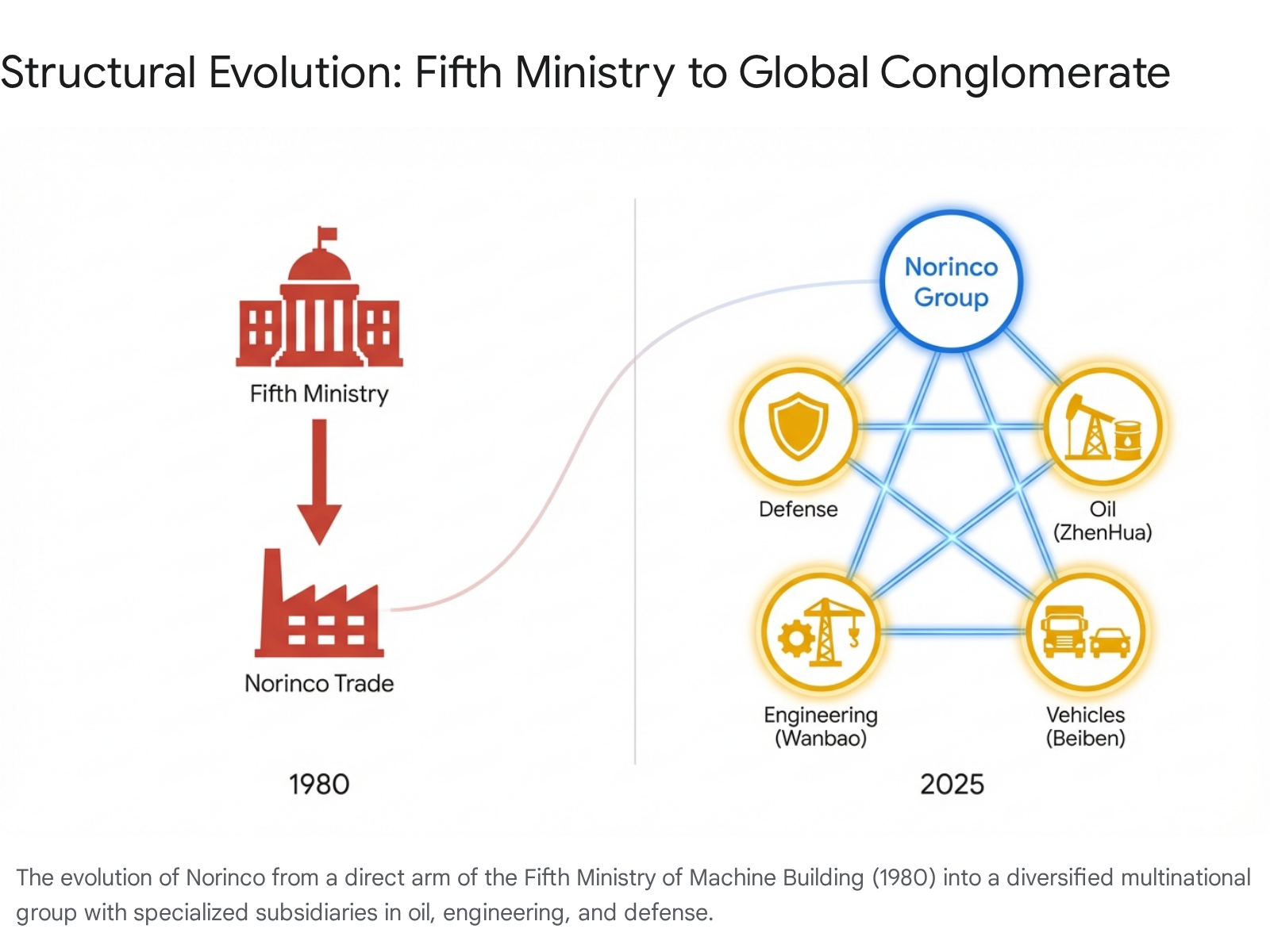
The trajectory of the China North Industries Corporation (Norinco) serves as the most potent industrial barometer for the broader rise of the People’s Republic of China (PRC). Established in 1980, ostensibly as a trading interface for the sprawling Fifth Ministry of Machine Building, Norinco has metastasized from a purveyor of reverse-engineered Soviet small arms into a globally integrated conglomerate with commanding stakes in defense manufacturing, petroleum extraction, strategic mineral supply chains, and civil infrastructure.
For the firearms industry analyst, Norinco presents a case study in adaptability and survival. In the 1980s and early 1990s, the corporation functioned as a prolific supplier to the American consumer market, flooding gun shows and retail shelves with affordable SKS carbines, AK-pattern rifles, and ammunition. This “Gold Rush” era was abruptly terminated by executive action in 1993 and 1994, forcing a strategic decoupling that redirected Norinco’s focus toward state-to-state sales in the developing world.
Today, Norinco is the vanguard of China’s “Military-Civil Fusion” strategy. It no longer merely sells weapons; it sells sovereignty packages. By bundling advanced land warfare platforms—such as the VT-4 main battle tank—with infrastructure projects delivered by its engineering subsidiaries and energy deals secured by its oil arm, Norinco offers a comprehensive partnership model that Western competitors struggle to replicate.
However, the corporation currently faces its most significant existential test since the 1990s. As it pivots toward “intelligentized warfare” with the integration of AI and autonomous systems like the P60 combat vehicle, it is simultaneously being hollowed out by a ferocious domestic anti-corruption purge. The removal of its chairman in 2024 and a resultant 31% collapse in arms revenue signal deep structural fissures within China’s defense industrial base. This report provides an exhaustive operational history, technical analysis, and future forecast for one of the world’s most opaque and powerful defense entities.
1. Genesis and Institutional DNA (1949–1989)
1.1 The Legacy of the Fifth Ministry
To understand the current operations of Norinco, one must first dissect its institutional parentage. Following the establishment of the PRC in 1949, China’s defense industry was organized along Soviet lines—rigid, centralized, and compartmentalized into numbered ministries. The Fifth Ministry of Machine Building was the designated custodian of conventional land armaments.1 This vast bureaucracy controlled hundreds of factories, research institutes, and proving grounds, yet it operated with zero commercial awareness. Production was dictated by quotas, not demand, resulting in massive inefficiencies and a lack of innovation.
By the late 1970s, as Deng Xiaoping initiated the era of “Reform and Opening Up,” the incompatibility of this Stalinist industrial model with China’s modernization goals became glaring. The state needed hard currency to purchase foreign technology, and the Fifth Ministry sat on a mountain of excess industrial capacity.
1.2 The Corporatization Experiment (1980)
In 1980, the State Council approved the creation of the China North Industries Corporation (Norinco).1 This was a radical departure from previous doctrine. Norinco was not just a manufacturer; it was a corporate entity empowered to engage in foreign trade, retain a portion of its foreign exchange earnings, and negotiate directly with international clients. It served as the commercial interface for the Fifth Ministry’s assets, tasked with transforming “steel into gold.”
The timing was fortuitous. The outbreak of the Iran-Iraq War (1980–1988) provided Norinco with a near-insatiable market for its wares. Operating with a pragmatic neutrality, Norinco supplied both Tehran and Baghdad with Type 69 tanks, towed artillery, and millions of rounds of small arms ammunition. This conflict was the crucible that forged Norinco’s logistics chains and provided the capital necessary to begin upgrading its manufacturing base from 1950s Soviet tooling to more modern standards.
2. The American Era: A Market Captured and Lost (1984–1994)
For the firearms industry analyst, the decade spanning the mid-1980s to the mid-1990s represents a unique epoch where Norinco was a household name in American gun culture. This period is critical for understanding the corporation’s manufacturing scalability and its subsequent reputational baggage.
2.1 The “SKS” Phenomenon
Entering the U.S. market in the mid-1980s, Norinco identified a massive gap in the entry-level segment. American manufacturers were focused on high-quality hunting rifles and expensive sporting arms. Norinco introduced the Type 56 Carbine, a Chinese variant of the Simonov SKS. Rugged, reliable, and featuring a chrome-lined bore (a feature absent in many domestic rifles), the Norinco SKS was imported in vast quantities.
By the early 1990s, these rifles were retailing for as little as $79 to $99.3 This aggressive pricing strategy allowed Norinco to dominate the surplus and entry-level markets. The SKS became the “everyman’s rifle,” ubiquitous in pickup trucks and gun safes across the Midwest and South. While collectors initially scoffed at the “cheap Chinese” finish, the underlying metallurgy was sound, derived from military specifications intended for the PLA.
2.2 The AK Market Dominance
Simultaneously, Norinco exported semi-automatic variants of the Type 56 Assault Rifle (AK-47 clone). Known commercially as the Type 56S, these rifles were distinct from their European counterparts due to their stamped receivers (on later models) and hooded front sights. In 1993 alone, largely driven by fear of impending legislation, nearly one million Chinese-made rifles entered the United States.3 This volume is staggering even by modern standards and underscores the sheer industrial capacity Norinco had mobilized for the civilian market.
2.3 The “MAK-90” and Regulatory Evasion
Following the 1989 import ban on “assault weapons” by the Bush administration (which targeted features like bayonet lugs and pistol grips), Norinco demonstrated remarkable agility. They rapidly retooled production lines to create the MAK-90 (Modified AK-1990). This rifle featured a thumbhole stock and removed the restricted military features, technically complying with the “sporting purpose” clause of the import regulations.4 The MAK-90 became the single most common AK-variant in America during the 1990s, a testament to Norinco’s ability to navigate complex regulatory environments to maintain market share.
2.4 The Executive Order of 1993
The golden era ended abruptly on May 28, 1993. President Bill Clinton, while renewing China’s Most-Favored-Nation (MFN) trade status, issued an Executive Order (implemented via State Department determination) that specifically banned the importation of Chinese rifles and pistols and their ammunition.1
This action was ostensibly linked to human rights and proliferation concerns but also served as a concession to domestic gun control advocates who viewed the flood of cheap semi-automatic weapons as a public safety threat. The ban severed Norinco’s primary cash cow in the civilian sector. While shotguns (like the Norinco Hawk 982) remained importable for a time, the high-volume rifle trade was dead.
2.5 Operation Dragon Fire and the Total Embargo
The relationship hit its nadir in 1996 with Operation Dragon Fire. A federal sting operation targeted Norinco representatives who allegedly offered to sell fully automatic AK-47s and shoulder-fired missiles to undercover agents posing as gang suppliers.2 The fallout was immediate and severe. While Norinco Beijing claimed the individuals were rogue actors, the U.S. government imposed a comprehensive ban on all future imports from Norinco, extending to its subsidiaries. This event effectively ended Norinco’s direct commercial presence in the United States and cemented its status as a “bad actor” in Washington’s eyes.
3. The Pivot: Building a Geopolitical Conglomerate (1995–2015)
Expelled from the lucrative U.S. market, Norinco faced a strategic crisis. It could no longer rely on volume sales of small arms to Western civilians. The solution was a pivot toward a conglomerate model that integrated defense sales with energy extraction and infrastructure development—a strategy that would later become the blueprint for the Belt and Road Initiative.
3.1 The Energy-Defense Nexus: ZhenHua Oil
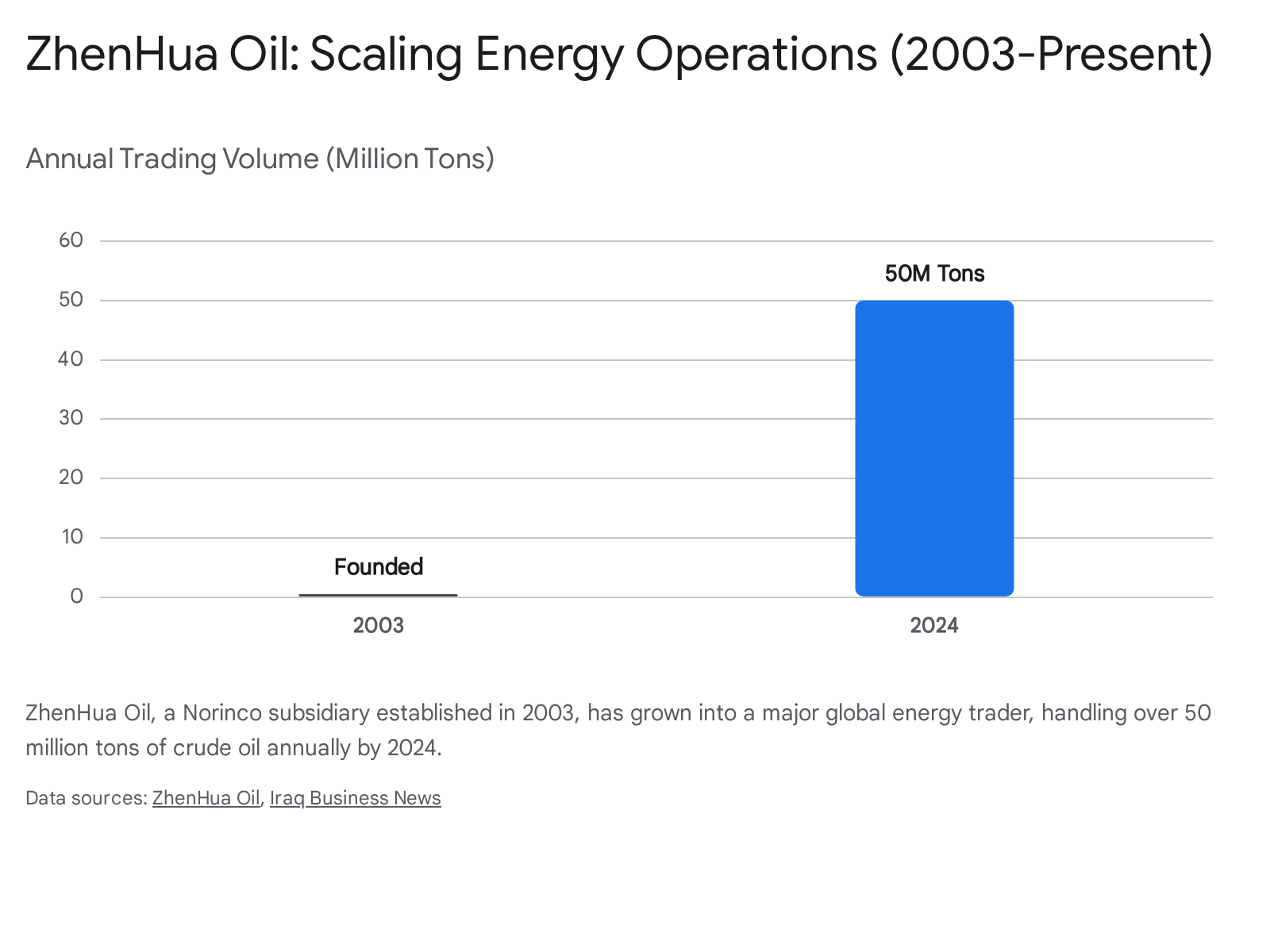
In 2003, Norinco founded China ZhenHua Oil Co., Ltd. as a wholly-owned subsidiary.8 This was a masterstroke of vertical integration. The rationale was simple: many of Norinco’s prospective arms clients (Iraq, Sudan, Angola, Venezuela) were cash-poor but resource-rich. By establishing its own oil company, Norinco could accept payment in crude or exploration rights, effectively bypassing the U.S. dollar-dominated financial system.
ZhenHua Oil grew rapidly. It secured rights to the East Baghdad Oil Field in Iraq, a project fraught with security risks that Western majors avoided.9 By 2024, ZhenHua Oil had evolved into a major global player, trading over 50 million tons of crude oil annually and operating exploration projects with recoverable reserves of 770 million tons.8 This subsidiary effectively transforms Norinco from a mere vendor into a strategic partner essential to the client nation’s economic survival.
3.2 Infrastructure as Diplomacy: Wanbao Engineering
Parallel to its energy expansion, Norinco elevated its construction subsidiary, China Wanbao Engineering Corporation. Originally tasked with building domestic factories, Wanbao began bidding on international civilian contracts.
A prime example of this synergy is the Kamoya Copper-Cobalt Project in the Democratic Republic of the Congo (DRC).11 Wanbao Engineering constructs the mining infrastructure, Norinco provides the heavy trucks (Beiben) and security equipment, and the mined cobalt feeds back into China’s strategic battery supply chain. This “minerals-for-security” model allows Norinco to extract value far exceeding the profit margins of simple arms sales. By 2016, the Kamoya project had reached an annual output of 55,000 tons of copper-cobalt concentrate, embedding Norinco deeply into the global tech supply chain.11
3.3 The Heavy Logistics Backbone: Beiben Truck
In 1988, Norinco signed a licensing agreement with Daimler-Benz to manufacture heavy-duty trucks in China, birthing Beiben Truck (North Benz).12 While the license eventually expired, Norinco retained the tooling and expertise. Beiben trucks, based on the legendary Mercedes NG80 chassis, became the standard logistical platform for the PLA and a key export item.
These trucks represent the perfect “dual-use” good. They are exported as civilian dump trucks and cargo haulers to construction firms (often Chinese-owned) in Africa and Central Asia. However, their rugged chassis is identical to the military variants used to mount rocket artillery or transport troops. This allows Norinco to maintain a “civilian” footprint in markets where overt military sales might be politically sensitive.
4. The Belt and Road Vanguard (2015–2023)
With the advent of the Belt and Road Initiative (BRI) under President Xi Jinping, Norinco’s role expanded from corporate opportunist to instrument of statecraft. The corporation rebranded itself as a “pioneer” of the BRI, leveraging its diversified portfolio to secure key nodes along the economic corridors.9
4.1 The Lahore Orange Line (Pakistan)
The Lahore Orange Line Metro Train stands as the crown jewel of Norinco’s civil engineering prowess. A flagship project of the China-Pakistan Economic Corridor (CPEC), this $1.62 billion mass transit system was constructed by a joint venture between Norinco International and China Railway Group.14
Why would a defense contractor build a subway? The project serves multiple strategic ends:
Economic Stabilization: It stabilizes the economy of Pakistan, Norinco’s largest military client.
Soft Power: It provides a highly visible public good to the citizens of Lahore, countering anti-Chinese sentiment.
Operational Presence: The 8-year operation and maintenance contract gives Norinco a long-term, legitimate foothold in a key strategic city.14
4.2 Penetrating Europe: The Senj Wind Farm
In a move that surprised many observers, Norinco International acquired a 76% stake in the Senj Wind Power Project in Croatia in 2017.16 Investing over €160 million, Norinco built and now operates this 156MW facility, one of the largest in the region.
This project serves a vital branding function. It allows Norinco to present itself to European regulators not as a “merchant of death,” but as a provider of green energy solutions. It demonstrates compliance with stringent EU environmental and labor standards, creating a precedent for future investments in the bloc. The project entered full commercial operation in 2021, selling power into the Croatian grid—revenue that is diversified away from the volatile defense sector.16
5. Modern Arsenal: The Export Portfolio
Despite its diversification, Norinco remains the primary supplier of land armaments to the PLA and the developing world. Its modern product line has shed the “cheap clone” reputation of the 1980s, offering systems that compete directly with Russian and Western hardware on capability, if not yet on reliability.
5.1 The VT-4 Main Battle Tank
The VT-4 (MBT-3000) is the flagship of Norinco’s export catalog. It represents a generation leap over the T-54/55 derivatives that previously defined Chinese exports.
Technical Specifications: The VT-4 features a 1,200 hp diesel engine, a 125mm smoothbore gun capable of firing gun-launched missiles, and a digitized fire control system with hunter-killer capabilities.18 It is protected by composite armor and FY-4 explosive reactive armor (ERA).
Market Success – Thailand: In a major upset, the Royal Thai Army selected the VT-4 over the Ukrainian T-84 Oplot and various Western options. Thailand ordered 60 units, with deliveries completing in 2023.19 The deal was clinched by Norinco’s ability to deliver quickly—contrast to Ukraine’s production delays—and the inclusion of technology transfer packages.
Strategic Deployment – Pakistan: Pakistan deployed the VT-4 (locally branded as “Haider”) to counter India’s T-90S tanks. This sale ensures a balance of power in South Asia favorable to Beijing.21
Combat Debut – Nigeria: In April 2020, Nigeria received a batch of VT-4s specifically for the campaign against Boko Haram.22 This marked the first active combat deployment of the tank, serving as a critical marketing test for its durability in harsh African conditions.
However, the program has faced headwinds. Reports from Pakistan indicate reliability issues with the engine and transmission in extreme desert heat, leading to a reduction in the total procurement target from 468 to 258 units.23 This highlights a lingering weakness in Chinese heavy armor: the “heart disease” of engine reliability that still lags behind German and American powerpacks.
5.2 Precision Fires and Artillery
Norinco has achieved significant success with its PLZ-45 and PLZ-52 self-propelled howitzers. These 155mm systems utilize NATO-standard ammunition compatibility, allowing them to be sold to countries like Kuwait, Saudi Arabia, and Algeria that have mixed Western/Eastern inventories. The sale of these systems to wealthy Gulf states proves that Norinco can compete on quality, not just price, in the precision-fires domain.
6. The Technological Frontier: Intelligentized Warfare (2024–Present)
As of 2025, Norinco is undertaking its most ambitious transformation yet: the shift from mechanized warfare to “intelligentized” warfare. This involves the deep integration of Artificial Intelligence (AI) and autonomous behaviors into its weapons platforms.
6.1 The “Intelligent Precision Strike System”
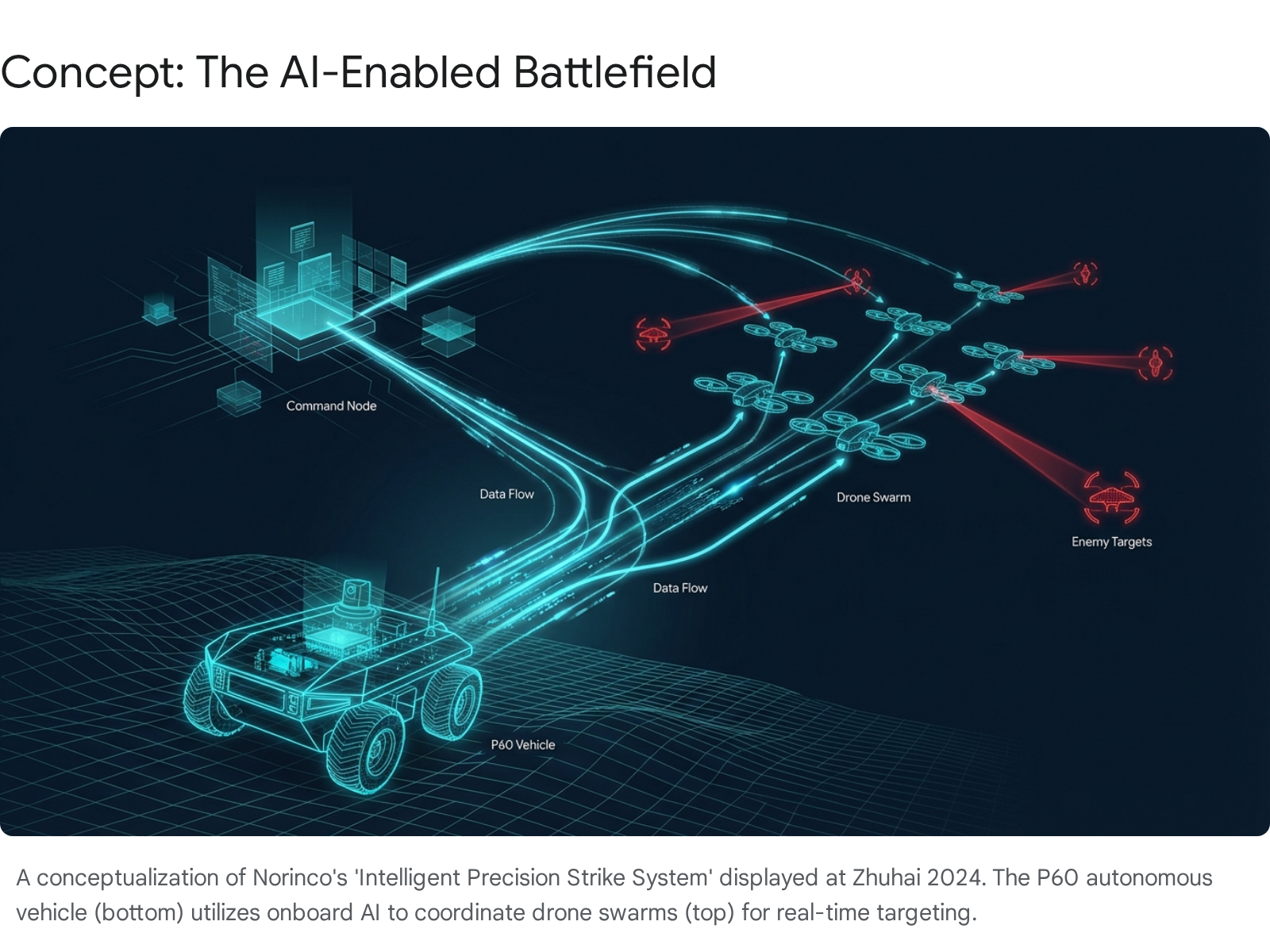
At the Zhuhai Airshow in November 2024, Norinco unveiled a system-of-systems concept dubbed the “Intelligent Precision Strike System”.24 This is not a single weapon but a networked architecture. It envisions a battlefield where autonomous reconnaissance drones identify targets and automatically feed data to loitering munitions and rocket artillery batteries. The system utilizes edge computing to process targeting solutions locally, reducing the sensor-to-shooter loop to seconds.
6.2 The DeepSeek Integration and the P60
In early 2025, industry intelligence revealed a potentially paradigm-shifting development: the integration of the DeepSeek large language model (LLM) into Norinco’s military platforms. Specifically, the P60 autonomous combat support vehicle was highlighted as a testbed for this technology.26
The P60 is a robotic ground vehicle capable of navigating complex terrain at speeds up to 50 km/h. The integration of a “DeepSeek” derived AI suggests that these vehicles possess advanced cognitive capabilities—such as interpreting complex natural language commands from commanders, reasoning through tactical dilemmas, and autonomously recognizing disguised targets.26 While Western nations grapple with the ethics of Lethal Autonomous Weapons Systems (LAWS), Norinco’s aggressive push into this sector suggests a strategy to achieve “algorithmic superiority” by bypassing these ethical constraints. Procurement records reviewed by Reuters indicate that despite U.S. export controls on advanced chips (like the Nvidia H100), Norinco and its university partners are actively acquiring or finding workarounds to power these AI models.27
7. The Crisis Within: Corruption and Contraction (2023–2025)
Just as Norinco reaches for the technological cutting edge, its institutional foundations are crumbling. The corporation is currently ensnared in the widest-ranging anti-corruption purge to hit the Chinese military-industrial complex in decades.
7.1 The Purge of the Leadership
In 2024, Liu Shiquan, the chairman of Norinco, was unceremoniously stripped of his seat on the Chinese People’s Political Consultative Conference (CPPCC).29 In the opaque lexicon of Chinese politics, this is a clear precursor to criminal prosecution. His removal was not an isolated incident; it occurred alongside the decapitation of the PLA Rocket Force leadership and the removal of executives from CASC (aerospace) and CASIC (missiles).30
The allegations appear to center on the massive procurement contracts of the last decade. The rapid expansion of the PLA’s budget created opportunities for graft, bid-rigging, and the embezzlement of R&D funds. The “audit paralysis” resulting from these investigations has been severe. Decision-makers, fearful of attracting scrutiny, have frozen new contracts and delayed payments.
7.2 The 2024 Revenue Collapse
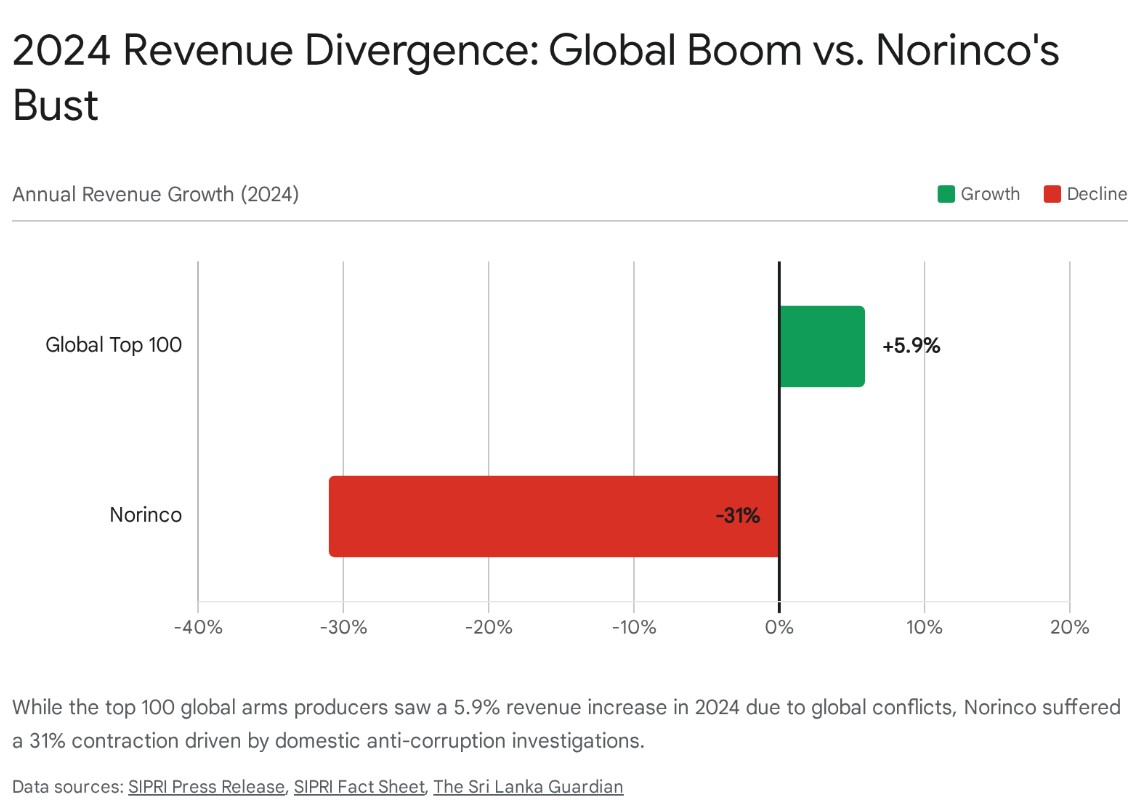
The financial impact of this political turmoil has been catastrophic. According to data released by the Stockholm International Peace Research Institute (SIPRI) in December 2025, Norinco’s arms revenue fell by 31% in 2024, dropping to approximately $14 billion.32
This contraction is even more stark when viewed against the global backdrop. In 2024, the top 100 global arms producers saw their revenues rise by nearly 6%, driven by the insatiable demands of the wars in Ukraine and Gaza.34 Norinco’s precipitous decline in a booming market indicates that the rot is internal. The corporation is effectively paralyzed, unable to finalize export deals or secure domestic orders while the political inquisition continues.
8. Future Outlook and Strategic Implications
Looking toward 2030, Norinco faces a dual reality. It possesses world-class technology and a diversified empire, yet it is hobbled by political distrust and leadership instability.
1. The “Supplier of Last Resort” Dividend:
As Western sanctions on Russia tighten, and as Russia’s own defense industry is consumed by the war in Ukraine, Norinco stands to gain. Countries that previously bought Russian gear (e.g., in Africa and Latin America) will increasingly turn to China. Norinco is positioned to capture this market share, provided it can resolve its internal production bottlenecks.
2. The AI Export Strategy:
Expect Norinco to aggressively market its AI capabilities. The P60 and similar systems will be marketed as cost-effective force multipliers for smaller militaries. Norinco will likely offer “Safe City” and “Smart Border” packages that integrate its surveillance tech with lethal autonomous response capabilities—a controversial but highly attractive proposition for authoritarian regimes.
3. The Reconstruction of Trust:
The immediate priority for the new leadership will be survival. We can expect a period of extreme conservatism in Norinco’s operations—strict adherence to budgets, a slowdown in risky foreign acquisitions, and a focus on delivering core PLA contracts to prove loyalty to Beijing. The days of the “freewheeling” commercial expansion of the 2000s are over; the Norinco of the future will be more tightly leashed to the Party’s immediate strategic needs.
9. Appendix: Chronology of Major Milestones
Year
Milestone Event
Category
Context & Impact
1980
Founding of Norinco
Corporate
Approved by State Council; evolved from Fifth Ministry of Machine Building to monetize defense capacity.1
1980s
Iran-Iraq War Sales
Export
Supplied tanks and artillery to both belligerents, generating initial foreign exchange reserves.
1988
Beiben Truck Established
Corporate
Licensing deal with Daimler-Benz to produce heavy trucks, creating a dual-use logistics backbone.12
1990
US Import Surge
Trade
Peak imports of SKS and MAK-90 rifles to US civilian market; Norinco becomes a household brand.3
1993
US Firearm Import Ban
Sanctions
President Clinton issues EO blocking import of Norinco rifles/pistols, citing proliferation concerns.1
1994
Federal Assault Weapons Ban
US Law
Further restricts sale of military-style firearms, cementing the end of Norinco’s US civilian era.4
1996
Operation Dragon Fire
Scandal
US sting operation implicates Norinco officials in smuggling fully automatic weapons; total embargo follows.7
2003
Founding of ZhenHua Oil
Diversification
Creation of oil subsidiary to secure global energy assets in exchange for defense contracts.8
2003
US Missile Sanctions
Sanctions
Sanctioned by Bush administration for alleged missile technology transfers to Iran.1
2010
Wanbao Engineering Expansion
Corporate
Construction subsidiary expands into African mining and infrastructure, cementing the “conglomerate” model.37
2013
BRI Launch
Strategy
Norinco officially positions itself as a key contractor for the Belt and Road Initiative.9
2016
Thailand VT-4 Deal
Export
Major contract to supply advanced VT-4 Main Battle Tanks to Thailand, beating Ukraine and Western rivals.19
2020
Lahore Orange Line Opens
Infrastructure
$1.6B metro project in Pakistan enters operation, managed by Norinco International.14
2020
Nigeria Tank Delivery
Export
VT-4 tanks delivered and deployed in combat operations against Boko Haram.22
2021
Senj Wind Farm Ops
Energy
156MW wind project in Croatia begins commercial operation, marking entry into EU energy market.16
2021
US Investment Ban
Sanctions
EO 14032 bans US investment in Norinco Group, citing links to the PLA.38
2024
P60 / DeepSeek Integration
Technology
Unveiling of AI-powered autonomous combat vehicle using advanced LLM capabilities.26
2024
Corruption Purge
Crisis
Chairman Liu Shiquan removed from CPPCC; Norinco arms revenue drops 31% amid investigations.29
If you find this post useful, please share the link on Facebook, with your friends, etc. Your support is much appreciated and if you have any feedback, please email me at in**@*********ps.com. Please note that for links to other websites, we are only paid if there is an affiliate program such as Avantlink, Impact, Amazon and eBay and only if you purchase something. If you’d like to directly contribute towards our continued reporting, please visit our funding page.
Sources Used
Chinese Construction Equipment Manufacturers: Norinco 2025 – CAMAL Group, accessed December 21, 2025, https://camaltd.com/norinco/
This is a time-sensitive special report and is based on information available as of January 5, 2026. Due to the situation being very dynamic the following report should be used to obtain a perspective but not viewed as an absolute.
The January 2026 execution of “Operation Absolute Resolve,” which culminated in the extraction of Nicolás Maduro by United States military forces and the subsequent imposition of a US-administered transitional authority in Caracas, constitutes a geopolitical event of the highest magnitude. While the operation was tactically confined to the Caribbean basin, its strategic shockwaves have registered with immediate and destabilizing force in Beijing. For the People’s Republic of China (PRC), the sudden removal of the Bolivarian government represents a dismantling of a critical node in its Western Hemisphere strategy, a direct threat to tens of billions of dollars in state-backed financial assets, and a forced, costly recalibration of its national energy security architecture.
This report provides an exhaustive analysis of the multi-dimensional impacts radiating from the US takeover of Venezuela. The analysis is anchored in the premise that the “loss” of Venezuela is not merely a diplomatic setback for China, but a systemic shock that challenges the viability of its “resources-for-loans” model, exposes the fragility of its “all-weather” partnerships in the face of American hard power, and creates acute energy supply vulnerabilities for its independent refining sector.
The most immediate operational consequence is the severance of the “shadow fleet” trade that has sustained China’s independent refiners—colloquially known as “teapots”—with deeply discounted heavy crude oil. The imposition of a US-enforced “oil quarantine” has effectively interdicted the flow of Venezuelan Merey 16 crude to Shandong province. This disruption forces Chinese buyers into the open market to compete for increasingly scarce heavy sour grades, such as Western Canadian Select (WCS) and Basra Heavy, thereby eroding the refining margins that underpin the global competitiveness of China’s petrochemical exports. The arbitrage window, closed by the sudden escalation of maritime insurance premiums and the physical diversion of tankers, has precipitated a feedstock crisis that will likely lead to run cuts and consolidation within China’s refining sector.
Financially, Beijing faces the precarious prospect of asset nullification. The China Development Bank (CDB) and other state entities hold an estimated $12 billion to $19 billion in outstanding sovereign debt, historically serviced through direct oil shipments. The US administration’s rhetoric regarding the “rebuilding” of Venezuela implies a legal strategy that may classify these Chinese loans as “odious debt”—liabilities incurred by a despotic regime for purposes contrary to the national interest. Such a classification would legally subordinate Chinese claims to new US capital injections and humanitarian obligations, setting a dangerous precedent for the Belt and Road Initiative (BRI). If the “Venezuela Precedent” establishes that regime change can serve as a mechanism for debt erasure, the risk premium on China’s global lending portfolio will face upward revision.
Geopolitically, the operation serves as a forceful modernization of the Monroe Doctrine. The neutralization of the Maduro regime isolates Cuba, Venezuela’s primary regional client, placing Beijing in a strategic bind: it must either finance a massive emergency energy bailout for Havana at a time of domestic economic constraint or witness the destabilization of another socialist ally. Furthermore, while US and international analysts caution against drawing direct parallels to the Taiwan Strait, Chinese strategists will inevitably interpret the “decapitation” strike as a validation of unilateral force to resolve sovereignty disputes, a perception that may accelerate the hardening of China’s anti-access/area denial (A2/AD) capabilities.
Ultimately, while the US administration promises a swift revitalization of Venezuela’s oil sector, technical realities suggest a protracted recovery requiring over a decade and upwards of $185 billion in capital. This reconstruction phase offers China a narrow window for asymmetric response, likely leveraging its dominance in critical mineral supply chains to negotiate favorable terms for its stranded assets. However, the strategic reality remains that the US has successfully reclaimed the energy advantage in the Western Hemisphere, forcing China into a defensive posture.
1. Contextualizing Operation Absolute Resolve: The Collapse of a Strategic Anchor
To understand the magnitude of the shock to China, one must first appreciate the depth of the Sino-Venezuelan relationship prior to January 2026. Under the presidencies of Hugo Chávez and Nicolás Maduro, Venezuela served as China’s primary bridgehead in Latin America—a region traditionally viewed as Washington’s sphere of influence. This relationship was formalized in 2023 with the elevation of bilateral ties to an “All-Weather Strategic Partnership,” a diplomatic designation Beijing reserves for its most trusted allies.1
The partnership was underpinned by a strategic exchange: China provided diplomatic cover and liquidity (over $60 billion in loans since 2007) in exchange for secured access to the world’s largest proven oil reserves.2 This arrangement was designed to be sanction-proof, utilizing oil shipments to repay debts, thereby bypassing the US dollar system. The US military intervention has violently dismantled this architecture.
The operation itself, characterized by airstrikes on command-and-control nodes and the targeted extraction of the executive leadership, was executed with a speed that precluded any intervention by external powers.3 For Beijing, the surprise nature of the raid and the subsequent rapid installation of a US-backed transitional authority highlight a critical intelligence and capability gap in protecting its overseas interests. The immediate reaction from China’s Ministry of Foreign Affairs—expressing “grave concern” and calling for Maduro’s release—reflects a diplomatic posture struggling to catch up with a new reality on the ground.5 The strategic anchor has been weighed, and China has been cut loose.
2. The Energy Dimension: Supply Shock and Market Realignment
The primary transmission mechanism of this geopolitical shock to the Chinese economy is the disruption of the physical oil trade. While Venezuela’s production had fallen significantly from its peak, it remained a vital, albeit opaque, source of heavy crude for China’s industrial engine. The cessation of these flows triggers a cascade of impacts across the global heavy oil market, with the pain concentrated in Shandong province.
2.1 The “Merey” Dependency and the Teapot Crisis
Venezuela’s flagship export grade, Merey 16, is a unique crude: extra-heavy, high in sulfur, and rich in metals. While these characteristics make it unattractive to many simple refineries, it is the ideal feedstock for complex refineries equipped with deep conversion capacity, such as cokers and asphalt plants. China’s independent refiners, the “teapots,” spent the last decade optimizing their kits to process exactly this type of discounted, “distressed” barrel.
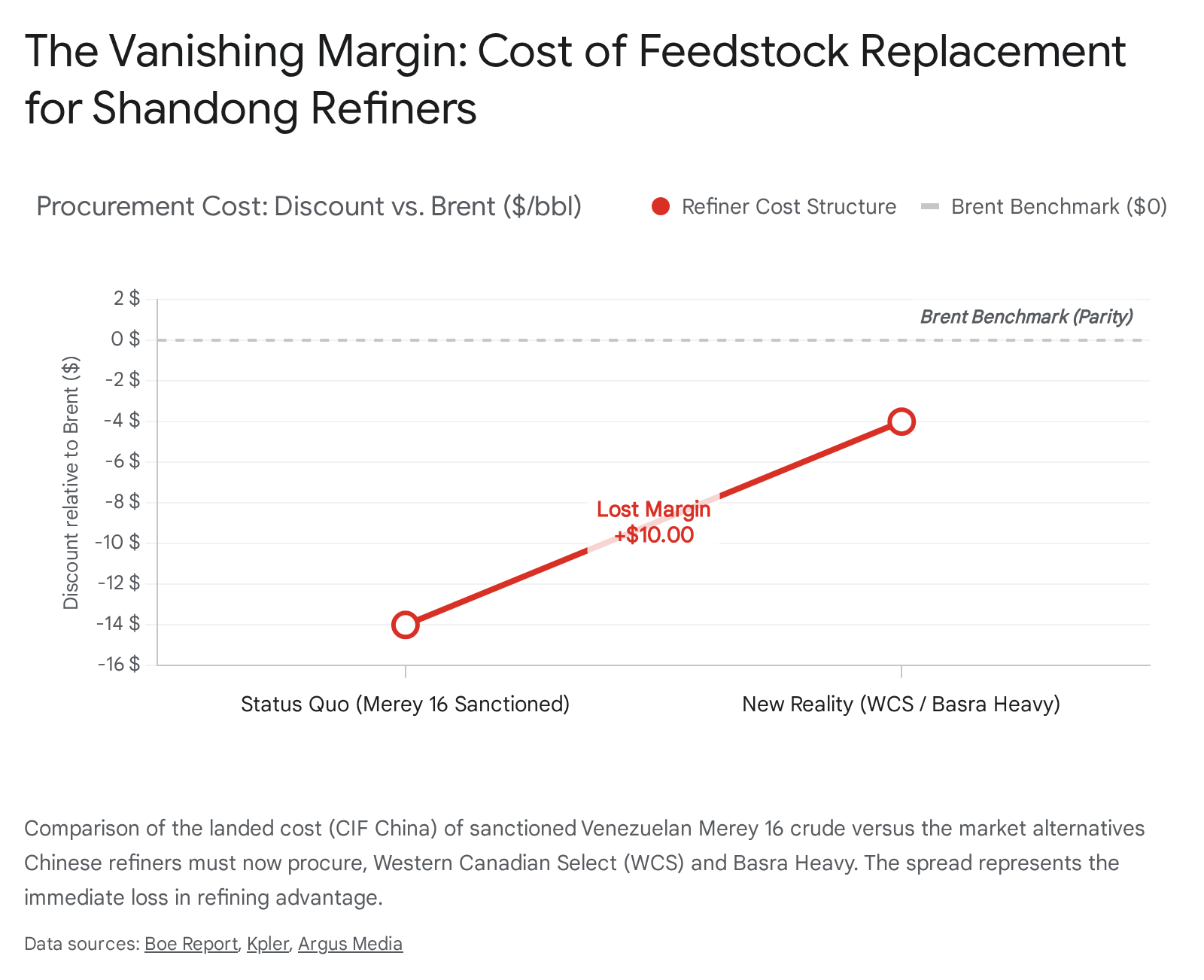
Prior to the intervention, China was importing approximately 470,000 barrels per day (bpd) of Venezuelan crude, which constituted roughly 4.5% of its total seaborne crude imports.2 While this percentage might appear manageable in aggregate, the specific economic reliance was profound. Due to US sanctions, Merey 16 traded at a massive discount—often $10 to $15 per barrel below the Brent benchmark.8 This “sanctions discount” effectively subsidized the margins of independent Chinese refiners, allowing them to remain competitive against state-owned giants like Sinopec and PetroChina, and to export refined products like bitumen and diesel at aggressive prices.
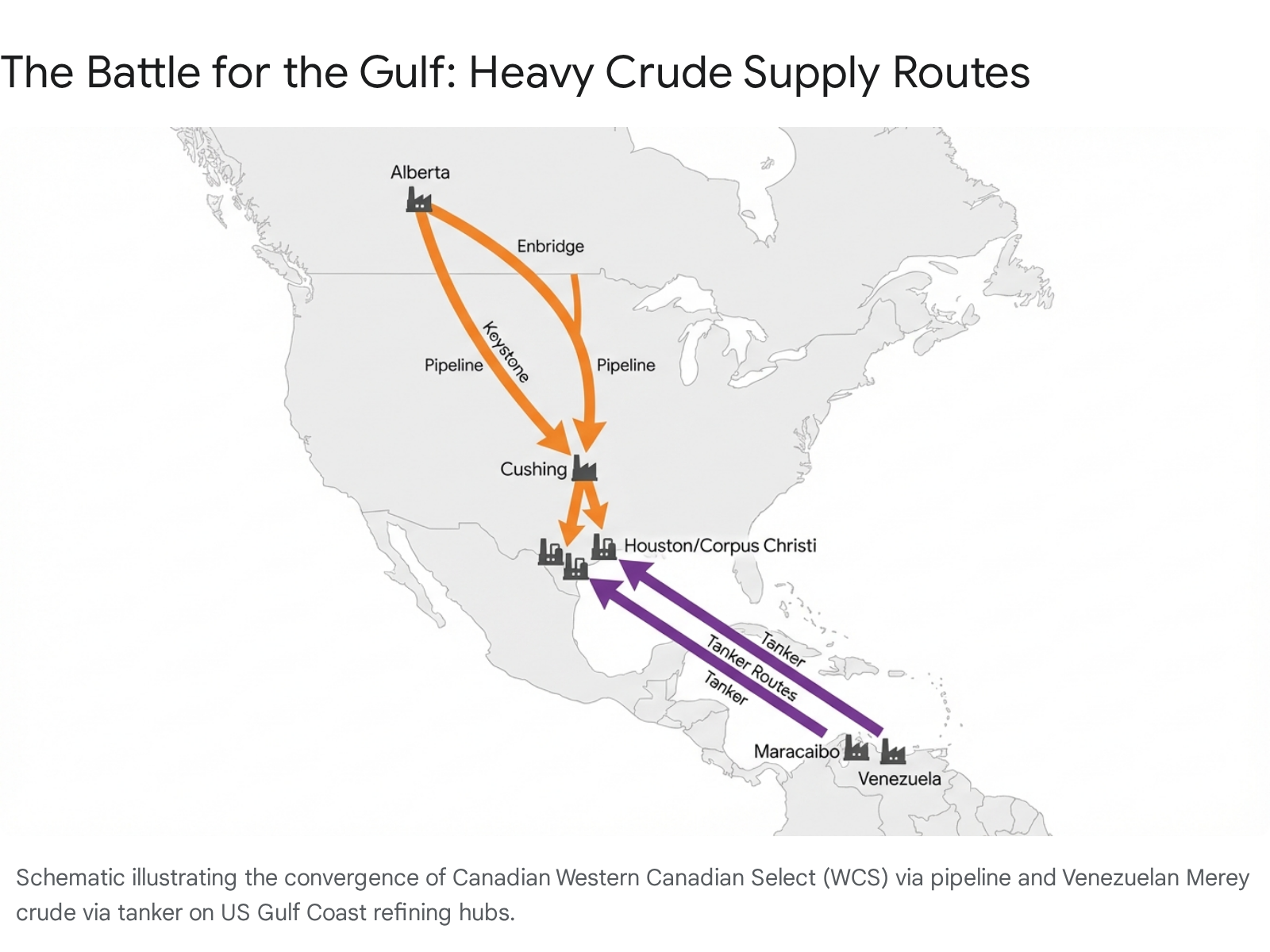
The US takeover has effectively zeroed out this supply. The Trump administration has declared an “oil quarantine,” and the US Treasury has signaled that Venezuelan oil will henceforth be redirected to the US Gulf Coast.4 The Gulf Coast refining complex, comprising majors like Citgo, Valero, and Chevron, was historically designed to process Venezuelan heavy crude and has faced a structural shortage of heavy barrels since the imposition of sanctions in 2019. The redirection of Venezuelan flows to the US is therefore a strategic priority for Washington to suppress domestic gasoline prices, directly at the expense of Chinese buyers.10
The loss of Merey 16 forces Chinese teapots to scramble for substitutes. The only globally traded grades with similar yield profiles are Western Canadian Select (WCS), Mexican Maya, and Iraq’s Basra Heavy. However, these grades trade at market rates, without the deep discounts associated with sanctioned regimes.
As illustrated, the shift from a sanctioned discount to a market premium represents a catastrophic margin compression for the teapot sector. This “sovereignty premium” will likely force a wave of consolidation in Shandong, as smaller, less capitalized refineries fail to absorb the input cost shock.11
2.2 The Liquidation of the Shadow Fleet
The operational backbone of the China-Venezuela oil trade was a clandestine logistics network known as the “shadow fleet”—a flotilla of aging tankers with obscured ownership structures, registered in permissive jurisdictions, and operating often with disabled Automatic Identification Systems (AIS) to evade detection. This fleet facilitated the transfer of crude from Venezuelan ports to transshipment hubs off the coast of Malaysia, where the oil was blended and rebranded as “Malaysian Bitumen Blend” or “Singma Crude” to mask its origin before entering Chinese ports.7
The US “oil quarantine” has rendered this infrastructure toxic. The US Navy, operating under new, robust rules of engagement in the Caribbean, has begun interdicting vessels suspected of carrying “illicit” cargo. The boarding of the tanker “Skipper” and the designation of vessels like the “Nord Star” and “Lunar Tide” as blocked property have sent a shockwave through the maritime insurance market.4
The impact is binary: the trade has stopped. Mainstream protection and indemnity (P&I) clubs had already abandoned the trade, but now even second-tier insurers and “shadow” insurers are retreating due to the existential risk of vessel seizure. Insurance premiums for any vessel entering Venezuelan waters have spiked by 300-400%.14 For Chinese buyers, the logistical arbitrage—the ability to move sanctioned oil cheaply—has collapsed. The shadow fleet vessels, now marked liabilities, are effectively stranded assets, unable to trade in legitimate markets and too risky to deploy in the Caribbean.
2.3 Global Arbitrage and the Canadian Complication
The US seizure of Venezuelan reserves has a secondary, ironic effect on China’s energy security via the Canadian market. With the Trans Mountain Pipeline Expansion (TMX) coming online, China had begun aggressive purchasing of Canadian heavy crude as a diversification play. However, the redirection of Venezuelan crude to the US Gulf Coast alters the North American balance.
Historically, US Gulf Coast refiners relied on heavy crude from Venezuela, Mexico, and Canada. With Venezuelan volumes offline for years, they became increasingly dependent on Canadian imports. Now, if the US successfully restores Venezuelan production for domestic use, it might theoretically displace Canadian barrels in the Gulf, freeing them up for export to Asia.15
However, in the short-to-medium term (1-3 years), the opposite dynamic is more likely. The reconstruction of Venezuela’s oil sector will be slow (see Section 7), meaning the US Gulf Coast will continue to demand Canadian barrels. Simultaneously, Chinese refiners, starved of Merey 16, will bid aggressively for the same Canadian WCS barrels. This puts Chinese buyers in direct competition with US refiners for Canadian supply, driving up the price of WCS relative to WTI. The widening discount that Chinese buyers enjoyed on Venezuelan oil is replaced by a narrowing discount on Canadian oil due to heightened competition.16 The result is a structurally higher energy import bill for the PRC.
3. The Financial Black Hole: Sovereign Debt and Asset Forfeiture
Beyond the immediate flow of commodities, the US intervention poses a grave threat to China’s financial balance sheet. The “resources-for-loans” model, pioneered by the China Development Bank (CDB) in the mid-2000s, was predicated on the assumption that sovereign control of oil reserves provided the ultimate collateral. The US takeover challenges the validity of this collateral and places billions of dollars in outstanding debt at risk of erasure.
3.1 The “Odious Debt” Weapon
Estimates of Venezuela’s outstanding debt to Chinese entities range from $12 billion to $19 billion.17 This debt was being serviced, albeit inconsistently, through oil shipments that have now been halted by the US blockade. The critical question facing Beijing is not just when payment will resume, but if the legal obligation to pay will survive the transition.
The US administration, in its role as the architect of the post-Maduro order, has indicated a willingness to use “economic leverage” to reshape Venezuela.4 A potent tool in this arsenal is the legal doctrine of “odious debt.” This principle of international law posits that sovereign debt incurred by a despotic regime for purposes that do not benefit the population, and with the creditor’s full knowledge of these facts, is personal to the regime and not enforceable against the state after the regime falls.19
There is a high probability that the US-backed transitional government will argue that Chinese loans extended to the Maduro administration—particularly those post-2017, after the National Assembly was sidelined—constitute odious debt. They may argue these funds sustained an illegitimate “narco-terrorist” regime rather than funding national development.9 If successful, this classification would subordinate Chinese claims in any restructuring process.
Legal precedents from Iraq (post-2003) and Ecuador suggest that while wholesale repudiation is rare, the threat of odious debt classification is often used to force creditors to accept massive haircuts (reductions in principal). For the China Development Bank, this implies a potential write-down of nearly its entire Venezuelan portfolio—a loss that would eclipse any previous BRI failure.21
3.2 Stranded Equity: The Joint Venture Trap
In addition to debt, Chinese state-owned enterprises (SOEs) hold significant equity positions in Venezuelan upstream projects. CNPC and Sinopec are minority partners in joint ventures (JVs) such as Sinovensa, Petrozamora, and Petrourica. Sinovensa alone, a partnership with PDVSA, sits atop 1.6 billion barrels of reserves.22
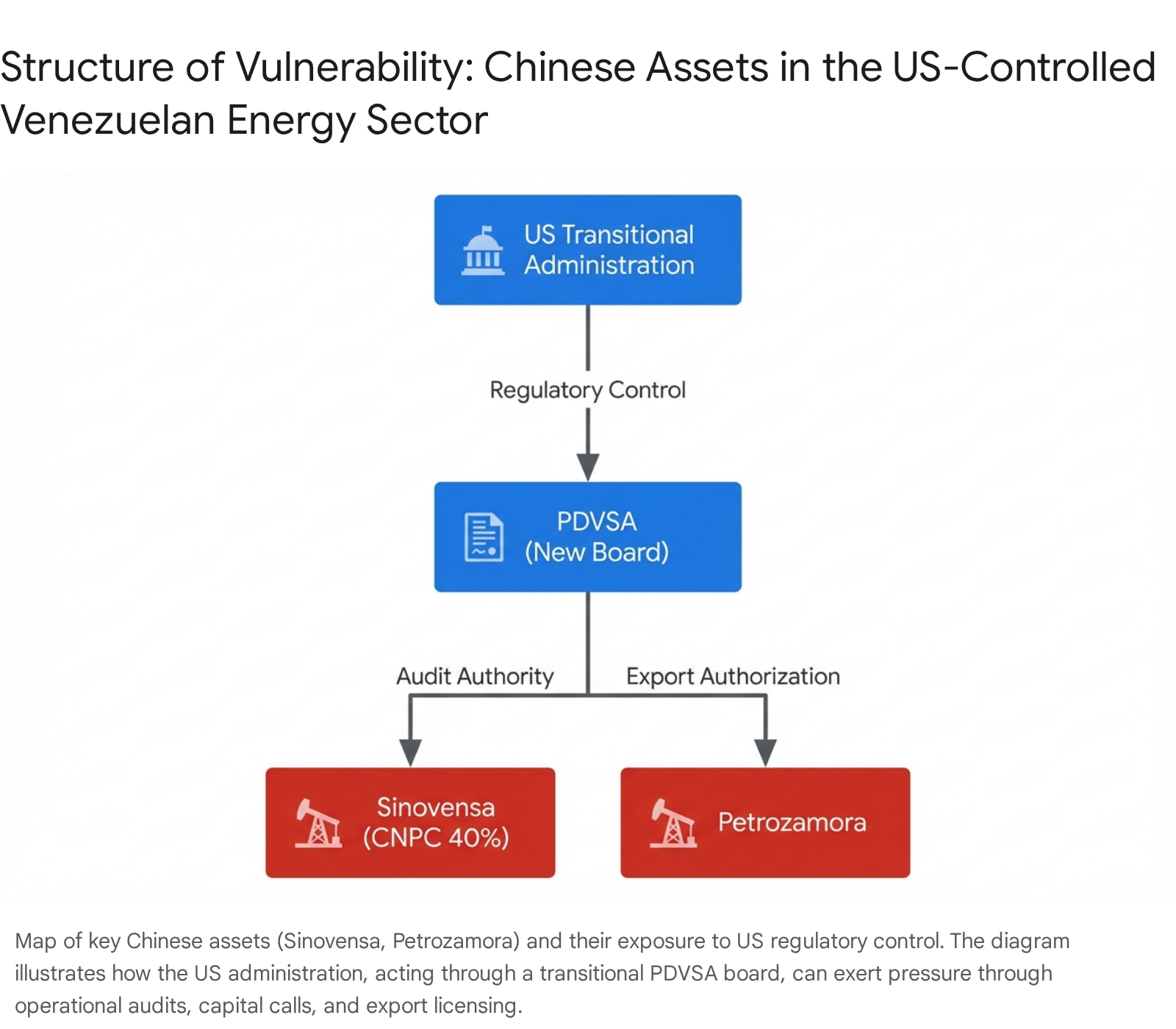
These assets are now in a precarious position. The US administration has declared that “American companies” will be tasked with revitalizing the industry.3 While formal expropriation of Chinese assets might violate bilateral investment treaties and invite retaliation against US firms in China, the US can achieve a de facto expulsion through regulatory strangulation.
The mechanisms for this “soft expropriation” are manifold:
Operational Paralysis: The US-controlled PDVSA board can suspend the operational licenses of Chinese JVs pending “corruption audits” or “environmental reviews,” effectively freezing the assets.
Sanctions Compliance: The US Treasury can maintain sanctions on specific JVs involving Chinese entities, preventing them from accessing the US financial system or importing essential diluents, while granting waivers to US-partnered JVs.
Capital Call Dilution: The reconstruction of these fields requires massive capital injection. The new PDVSA board could issue capital calls for repairs. If Chinese partners cannot transfer funds due to US financial sanctions or internal risk aversion, their equity stakes would be diluted, eventually rendering them negligible.23
This strategy forces China into a “wait and see” posture. Chinese firms are unlikely to abandon their stakes voluntarily, but they may be forced into a dormant status, holding paper titles to assets they cannot operate or monetize, while US firms like Chevron and potential returnees like ExxonMobil assume operational dominance.
4. Geopolitical Repercussions: The Monroe Doctrine Revived
The US operation represents a definitive reassertion of the Monroe Doctrine—the 19th-century policy opposing external intervention in the Americas—modernized for the era of great power competition. For two decades, China has cultivated Venezuela as a strategic partner to counterbalance US influence in the Asia-Pacific. The “loss” of Venezuela effectively pushes China back across the Pacific, dismantling its most significant foothold in the Western Hemisphere.
4.1 The Collapse of the “All-Weather” Partnership
In September 2023, President Maduro visited Beijing, where he and President Xi Jinping signed a joint statement elevating relations to an “All-Weather Strategic Partnership”.1 This diplomatic tier implies a relationship that remains stable regardless of the international landscape. The capture of Maduro fundamentally invalidates this status. It demonstrates to the world, and particularly to other “Global South” nations, that Beijing cannot guarantee the security or political survival of its partners in the US “near abroad.”
This creates a crisis of confidence for other nations in the region that have courted Chinese investment, such as Bolivia, Nicaragua, and even Brazil under leftist leadership. The message from Washington is unequivocal: economic alignment with Beijing offers no shield against US security interests. This chilling effect may stall the expansion of the Belt and Road Initiative (BRI) across Latin America, as governments reassess the political risk of antagonizing Washington. The “Venezuela Model”—high-risk lending for resource access—is now visibly broken.2
4.2 The Cuban Dilemma: A Crisis on the Doorstep
The impact on Cuba is collateral but catastrophic, presenting Beijing with an acute strategic dilemma. Venezuela has been Havana’s economic lifeline for two decades, providing roughly 50,000 to 60,000 barrels of oil per day at subsidized rates or in exchange for services (doctors, intelligence). This oil kept Cuba’s fragile power grid functioning and its economy afloat. The cessation of these shipments precipitates an existential energy crisis for the Cuban government, with experts predicting “total national blackouts” within weeks.25
China is the only power capable of filling this void, but the costs are prohibitive. To replace Venezuelan supply, China would need to ship oil halfway around the world, incurring massive logistical costs. Furthermore, any direct “bailout” of Cuba would almost certainly trigger US secondary sanctions on the Chinese entities involved, given the US administration’s aggressive posture.
Beijing faces a binary choice:
Intervene: Provide emergency oil and credit to stabilize the Cuban regime. This preserves a strategic ally and signals reliability to partners, but risks a direct escalation with the US during a delicate transition period and strains China’s own slowing economy.
Abstain: Allow the Cuban crisis to unfold. This avoids US retaliation but risks the collapse of another socialist ally and confirms the “paper tiger” narrative regarding China’s ability to project power in the Americas.
Analysts suggest China will likely pursue a middle path: providing limited humanitarian aid and symbolic support while avoiding a full-scale energy bailout, effectively ceding the strategic initiative to the US.26
4.3 Strategic Signaling and the Taiwan Question
While US officials and international scholars caution against drawing direct parallels between Venezuela and Taiwan due to vastly different historical, legal, and military contexts, the psychological impact on Beijing is profound.2 The operation demonstrates the US willingness to execute a “decapitation” strategy—removing a leadership circle to effect regime change—and to use military force against a sovereign state to secure resource interests.
In Beijing, this reinforces the “Fortress China” mentality. It validates the People’s Liberation Army’s (PLA) focus on anti-access/area denial (A2/AD) capabilities to prevent a similar projection of US power near its shores. It may also accelerate China’s efforts to sanction-proof its own economy and leadership, knowing now that the US toolkit includes direct physical abduction of heads of state.
However, contrary to fears of immediate escalation, China’s response regarding Taiwan is likely to be cautious. The speed and efficacy of the US operation in Venezuela highlight the risks of a conflict with the US military. This may lead Beijing to double down on “gray zone” tactics—coercion below the threshold of war—rather than risking a military adventure that could invite a decisive US counter-response. The “Venezuela shock” is likely to induce a period of strategic reassessment in Beijing rather than immediate aggression.28
5. Diplomatic and Legal Warfare: The Battle for Narrative
Lacking the military capacity to challenge the US in the Caribbean, China represents its interests through diplomatic and legal channels. The battle for the narrative—defining the legitimacy of the US intervention and the status of Venezuela’s obligations—is now the primary front of resistance for Beijing.
5.1 The UN Security Council and the “Global South”
China has strongly condemned the US operation as a “blatant violation of international law” and the UN Charter.5 At the UN Security Council, China, likely in coordination with Russia, will block any resolution that attempts to legitimize the US-installed transitional government. While the US does not need a UN resolution to maintain control on the ground, the lack of international legal recognition complicates the new government’s ability to access Venezuelan assets frozen abroad (e.g., gold in London) or to participate in formal multilateral institutions.29
China will use this platform to rally the “Global South,” framing the US action as a return to imperialist gunboat diplomacy. This narrative is designed to damage US soft power and consolidate China’s standing as the defender of national sovereignty and non-interference—core tenets of its foreign policy. This diplomatic obstructionism serves to delegitimize the US presence and raise the reputational cost of the occupation.30
5.2 Asymmetric Response: The Rare Earths Option
If the US moves to fully nullify Chinese assets in Venezuela, Beijing retains asymmetric economic options. The most potent of these is its dominance in the critical minerals supply chain. China controls approximately 90% of global rare earth refining capacity, materials essential for US defense technologies (including the very precision-guided munitions used in Venezuela) and, ironically, for the catalysts used in oil refining.2
China could implement stricter export controls on processed heavy rare earths, citing “national security” or “environmental compliance.” This would be a direct tit-for-tat response: “You squeeze our energy access; we squeeze your technology supply chain.” This lever is one of the few direct economic tools China has that can inflict pain on the US industrial base without triggering a full-scale kinetic conflict.
6. Future of Venezuelan Oil: The US Quagmire and the Long Road to Recovery
The US administration’s narrative suggests a rapid revitalization of the Venezuelan oil sector, with US majors “fixing” the broken infrastructure and flooding the market with crude.3 However, technical and economic realities suggest a much slower, more difficult path—a reality that China is undoubtedly calculating.
6.1 The Technical Reality: Decay and Capital Intensity
Venezuela’s oil infrastructure is in a state of advanced decay. Production has collapsed from 3.5 million bpd in 1997 to roughly 900,000 bpd today.32 Pipelines are rusted, reservoirs have been damaged by poor management (e.g., shutting in wells without proper procedure), and the sector has suffered a massive brain drain of technical talent.
Restoring this capacity is a monumental engineering task. Analysis by Rystad Energy estimates that returning production to 3 million bpd would require 16 years of sustained effort and $185 billion in capital investment.33 In the short term—the next 12 to 24 months—production is actually likely to fall or stagnate. The new US administration will need to purge the sector of Maduro loyalists, audit operations, and secure facilities against sabotage. The “immediate windfall” is a political fiction; the reality is a decade-long slog.
Table 1: The Reality Gap in Venezuelan Oil Reconstruction
Cautious; demand for legal certainty & debt settlement
Data derived from Rystad Energy 33, Wood Mackenzie 4, and industry analyst consensus.31
6.2 The Reluctance of US Majors
While President Trump has called for US companies to “go in,” the majors themselves—ExxonMobil, ConocoPhillips, and Chevron—are cautious. Exxon and Conoco have outstanding arbitration claims against Venezuela totaling billions of dollars from the Chavez-era expropriations.35 They will likely demand that these “legacy claims” be settled—perhaps through “sweat equity” or favorable royalty terms—before committing fresh capital.
This creates a closed loop where early oil revenues are diverted to pay off old US debts rather than funding reconstruction or state services. For China, this delay is strategically relevant. It means the “flood” of Venezuelan oil to the US Gulf Coast will not happen overnight. The global oil market will remain tight, and prices—including the Canadian WCS prices China must now pay—will remain elevated. This buys China time to secure alternative supplies, but it confirms that Venezuelan oil will be locked into the US sphere of influence for the foreseeable future.
7. Strategic Conclusions and Future Scenarios
The US seizure of Venezuela is a watershed moment that forces a fundamental restructuring of China’s approach to the Western Hemisphere. The era of the “All-Weather Partnership” fueled by loans-for-oil is effectively over.
7.1 Scenario A: The “Odious Debt” Precedent
If the US successfully guides the new Venezuelan administration to repudiate Chinese loans using the “odious debt” doctrine, the ripple effects will be global.
Mechanism: Legal classification of 2017-2025 loans as illegitimate and non-beneficial to the state.
Impact: A $19 billion write-down for Chinese state banks. More critically, it forces China to tighten lending terms for all BRI projects globally, demanding sovereign immunity waivers and tangible collateral outside the borrower country (e.g., ports), potentially sparking political backlash in Africa and Asia.
China’s Move: Beijing blocks Venezuela from accessing assets in jurisdictions where it has sway and utilizes the Asian Infrastructure Investment Bank (AIIB) to creating alternative norms that reject this classification.
7.2 Scenario B: The Asymmetric Standoff
China links energy access to technology access.
Mechanism: Beijing restricts exports of heavy rare earths or battery precursors to the US, citing the Venezuela intervention as a destabilizing act that requires “defensive” supply chain measures.
Impact: A potential “Grand Bargain” where China accepts a haircut on Venezuelan debt in exchange for continued access to certain mineral markets or US restraint in other theaters (e.g., tech sanctions).
7.3 Conclusion: The Defensive Pivot
Ultimately, China’s response will be defined by pragmatism. Unable to contest the US military fait accompli in the Caribbean, Beijing will pivot to damage control: securing what financial assets it can through international courts, diversifying its heavy oil sources to mitigate the price shock, and reinforcing its remaining partnerships in the Global South against similar “interventionist” risks. The “Caracas Pivot” marks the end of China’s offensive expansion in Latin America’s energy sector and the beginning of a defensive consolidation of its global supply lines.
If you find this post useful, please share the link on Facebook, with your friends, etc. Your support is much appreciated and if you have any feedback, please email me at in**@*********ps.com. Please note that for links to other websites, we are only paid if there is an affiliate program such as Avantlink, Impact, Amazon and eBay and only if you purchase something. If you’d like to directly contribute towards our continued reporting, please visit our funding page.
Concerns over damage to investment in Venezuela are being cited as the background of China’s increas.., accessed January 6, 2026, https://www.mk.co.kr/en/world/11924858
This is a time-sensitive special report and is based on information available as of January 5, 2026. Due to the situation being very dynamic the following report should be used to obtain a perspective but not viewed as an absolute.
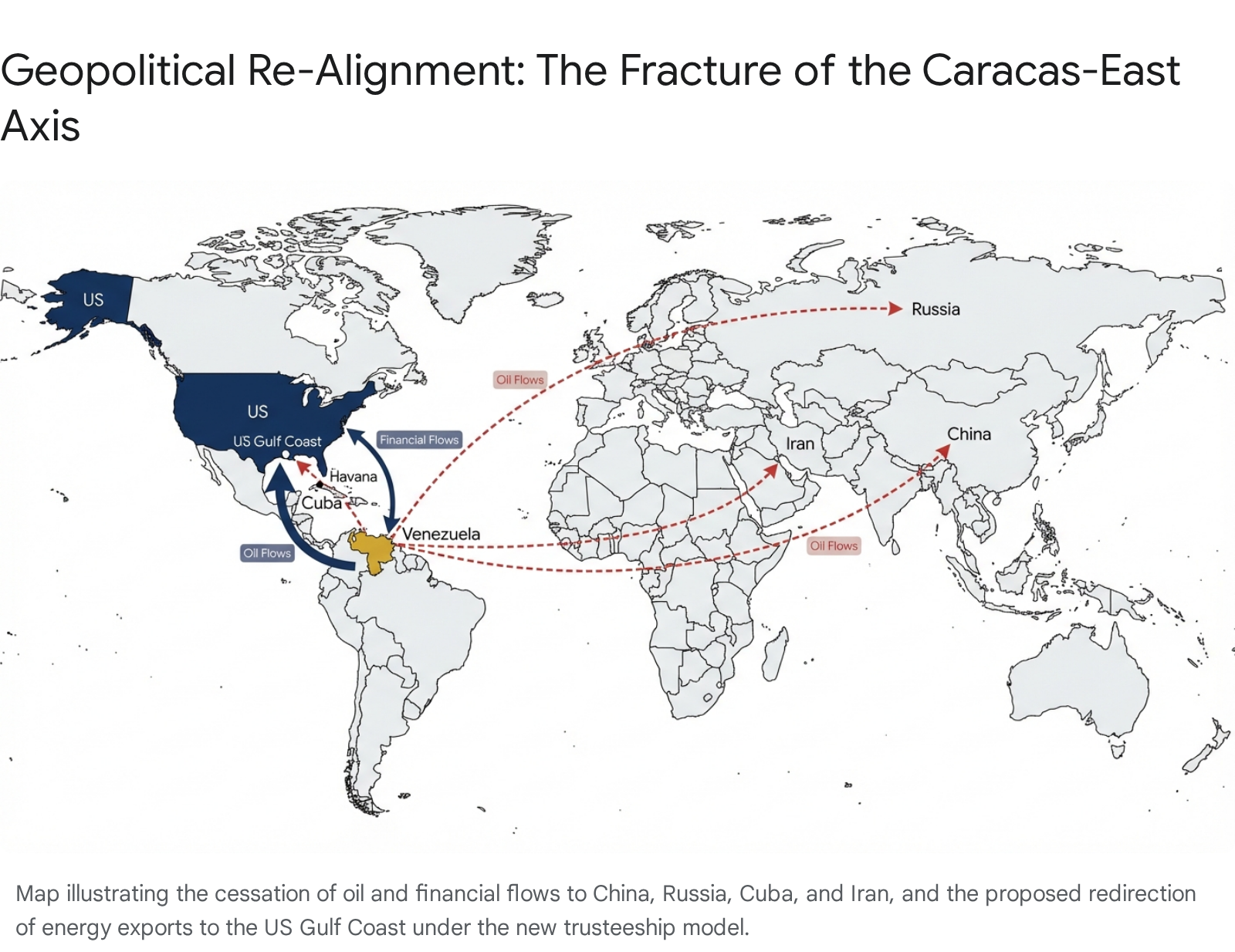
The military intervention in Venezuela, designated operationally as “Operation Absolute Resolve,” marks a definitive inflection point in the geopolitical history of the Western Hemisphere. The seizure of President Nicolás Maduro and the subsequent assertion of a United States-led “trusteeship” over the nation’s energy infrastructure represents more than a regime change operation; it is a fundamental restructuring of the global energy architecture. By placing the world’s largest proven oil reserves under direct US administration, Washington has effectively removed a critical node from the geopolitical “Axis of Resistance”—comprising China, Russia, and Iran—and reoriented Venezuela’s economic gravity back toward the North American energy orbit.
This report, authored by a collaborative team of national security, foreign affairs, and energy market analysts, provides an exhaustive assessment of the cascading impacts of this intervention. Our analysis suggests that the immediate objective extends beyond the removal of a hostile governing clique. The operation serves as a forceful implementation of “Resource Realism,” a doctrine that prioritizes the physical control of strategic assets over traditional diplomatic engagement. The administration’s explicit goal to “reimburse” US intervention costs through Venezuelan oil revenue 1 creates a legal and financial precedent that subordinates sovereign debt obligations to the operational imperatives of the occupying power.
The most acute and immediate impact will be the existential crisis facing Cuba. With Venezuela previously supplying between 40% and 60% of the island’s energy needs through favorable barter arrangements, the abrupt cessation of these flows threatens to precipitate a total collapse of the Cuban electric grid within the current calendar year. This development raises the specter of a humanitarian catastrophe and a mass migration event of a magnitude not seen since the Mariel boatlift. Simultaneously, China faces a “sunk cost” dilemma of historic proportions, with an estimated $10–20 billion in oil-backed loans at risk of nullification under the “Odious Debt” doctrine.
Contrary to the optimistic political rhetoric suggesting a rapid recovery, our forensic analysis of the Venezuelan oil sector indicates a profound “Reality Gap.” The infrastructure of Petróleos de Venezuela, S.A. (PDVSA) suffers from catastrophic degradation. While political leadership suggests a recovery timeline of 18 months, industry consensus points to a requirement of nearly $100 billion in capital investment over a decade to restore production to pre-Chávez levels. Consequently, the “Venezuela Premium” in global oil markets will shift from a risk of supply disruption to a “Reconstruction Lag,” where the anticipated flood of new supply is delayed by technical and legal realities.
This report maps the chain of impacts across the globe, analyzes the legal mechanisms of the takeover, and forecasts the reshaping of the Western Hemisphere’s energy markets, including the displacement of Canadian crude and the nullification of Russian strategic depth in the region.
1. The Strategic Calculus of Operation Absolute Resolve
The transition from a decade-long policy of sanctions and diplomatic isolation to direct kinetic intervention and asset seizure represents a paradigm shift in United States foreign policy. While the operation was framed publicly as a law enforcement action to apprehend indicted “narco-terrorists,” the strategic underpinnings reveal a calculated effort to dismantle the economic lifelines of US adversaries in the Western Hemisphere.
1.1 The Doctrine of “Reimbursement” and Trusteeship
Central to the post-intervention strategy is the concept of “reimbursement,” articulated by President Trump immediately following the operation. The declaration that the US will “run” Venezuela until stability is achieved, and that American oil companies will be “reimbursed” for their investments and the nation’s reconstruction costs through oil revenue 1, introduces a de facto trusteeship model. This approach is distinct from nation-building efforts in Iraq or Afghanistan; it is explicitly transactional, treating the Venezuelan state’s primary asset as collateral for the intervention itself.
The “reimbursement” mechanism implies a rigid hierarchy of revenue distribution that fundamentally alters the sovereign risk profile of the country. Revenue generated from the rehabilitation of fields in the Orinoco Belt or the Lake Maracaibo basin will likely be ring-fenced within US-controlled escrow accounts. The prioritization of claims is expected to follow a specific order:
Operational Expenditures (OpEx): Immediate payments to US operators (e.g., Chevron, Halliburton) to maintain flow assurance.
Capital Recovery (CapEx): Repayment of new infrastructure investments required to resuscitate the grid and pipelines.
Intervention Costs: Direct reimbursement to the US Treasury for the logistical and military costs of Operation Absolute Resolve.
Sovereign Debt and State Budget: Only after these primary tranches are satisfied would residual revenue flow to the Venezuelan central bank or legacy creditors.
This structure explicitly subordinates the claims of existing creditors—most notably China and Russia—and creates a legal and financial firewall around Venezuelan production. It effectively treats PDVSA not as a national oil company (NOC) in the traditional sense, but as a distressed asset under administration.3
1.2 Intent Analysis: Deliberate Choking vs. Secondary Effect
A critical question posed by observers is whether the choking of oil flows—and the consequent starvation of hard currency to the Maduro regime—was a deliberate goal of the US government or a secondary outcome of the “narco-terrorism” operation. Our analysis of the timeline and enforcement mechanisms confirms that the economic strangulation was a deliberate, primary strategic objective.
The evidence for this intent is found in the escalation sequence preceding the kinetic operation. The US administration systematically tightened the blockade on the “shadow fleet”—the network of ghost tankers used by PDVSA to evade sanctions.4 By targeting specific vessels like the Nord Star and Lunar Tide, and sanctioning their registered owners just days before the operation 6, the US effectively severed the financial capillaries that kept the regime solvent.
Furthermore, the immediate post-operation blockade of tankers bound for Cuba and China 7 indicates a pre-planned effort to weaponize energy dominance. The goal was twofold: to degrade the regime’s ability to pay its security services in the final hours, and to deny US adversaries (China and Iran) a secure source of energy and revenue. The operation fulfills the administration’s stated geopolitical ambition that “American dominance in the western hemisphere will never be questioned again”.8 The dismantling of the oil-for-loans infrastructure was not collateral damage; it was the target.
1.3 The “Putinization” of US Foreign Policy?
International observers have noted a convergence in style between the US action and the spheres-of-influence strategies typically associated with Russia. Commentators have termed this the “Putinization of US foreign policy,” characterized by the use of overwhelming force to determine political outcomes in the “near abroad”.9 However, unlike the Russian approach in Ukraine, the US strategy in Venezuela relies heavily on the subsequent mobilization of private capital (US oil majors) to consolidate the gain, blending state military power with corporate industrial capacity.
2. The Asset: Forensic Audit of the Venezuelan Oil Industry
The “prize” secured by US forces—the world’s largest proven oil reserves, estimated at over 300 billion barrels—is, in immediate practical terms, a deeply distressed asset. There is a profound disconnect between the political rhetoric of immediate wealth generation and the industrial reality on the ground.
2.1 The Infrastructure Deficit
Decades of mismanagement, the “brain drain” following the 2002–2003 PDVSA strikes, and stringent sanctions have left the industry in a state of collapse. Production has fallen from a peak of approximately 3.5 million barrels per day (bpd) in the late 1990s to roughly 1 million bpd at the time of the intervention.10
Upstream Decay: The unique geology of Venezuela’s Orinoco Belt requires constant diligence. The extra-heavy crude produced there must be diluted or upgraded immediately to be transportable. Due to the lack of diluents (previously imported from Iran or the US) and the failure of upgraders, thousands of wells have been shut in. Once shut, these wells often suffer from reservoir damage that makes reactivation economically unviable; they do not simply turn back on.12
Downstream Paralysis: The refining sector is in equally dire straits. The Paraguaná Refining Center, once one of the largest in the world with a capacity of 940,000 bpd, is operating at roughly 10% capacity.13 Critical units for producing gasoline and diesel are offline due to a lack of spare parts and catalytic agents. Pipelines crossing Lake Maracaibo are riddled with leaks, creating an ecological disaster that complicates immediate reactivation.14
2.2 The Recovery Timeline and Cost: The Reality Gap
President Trump’s suggestion that oil production could ramp up significantly within “18 months” 15 stands in stark contrast to industry consensus.
Political Forecast: The administration envisions a rapid turnaround where US efficiency quickly restores output, funding the intervention and stabilizing the global market.
Industry Reality: Experts and analysts, including those from Rice University and Rystad Energy, estimate that restoring production to the 3–4 million bpd level will require between $80 billion and $100 billion in capital investment over a period of 7 to 10 years.11
This “Reality Gap” is substantial. Even under the most optimistic scenarios, where US firms assume immediate operational control, output is unlikely to exceed 1.5 million bpd within the first 2–3 years.17 The initial phase of “recovery” will likely consist of stabilizing current decline rates and repairing critical safety infrastructure rather than a boom in new exports.
2.3 The Role of US Majors
While the US President claims American oil companies are “prepared” to enter, the corporate reality is one of extreme caution.
Chevron: As the only US major currently operating in Venezuela (under previous OFAC waivers), Chevron is the linchpin of the immediate stabilization plan. They currently ship approximately 150,000 bpd to the US 18 and have the most up-to-date knowledge of the reservoir conditions.
ExxonMobil & ConocoPhillips: These firms were expropriated by Hugo Chávez and hold outstanding arbitration awards worth billions ($1.6 billion and $12 billion+, respectively).19 Their return is contingent not just on security, but on the settlement of these past debts. It is highly unlikely they will commit new shareholder capital without a “sovereign guarantee” or a mechanism that prioritizes their debt recovery from new production revenues.20
3. The Primary Casualty: Cuba’s Existential Crisis
The most immediate, severe, and potentially destabilizing impact of the US takeover of Venezuelan oil will be felt not in Caracas, but in Havana. For two decades, Venezuela has been the economic guarantor of the Cuban Revolution, a relationship that is now effectively terminated.
3.1 Energy Dependence and the mechanism of Collapse
Cuba relies on Venezuela for between 40% and 60% of its total oil consumption. This oil was not purchased on the open market but provided through favorable cooperation agreements, often involving the exchange of Cuban medical personnel, intelligence agents, and security advisors for crude oil and refined products.21
The mechanics of this trade have already been disrupted. In the months leading up to the intervention, Venezuelan exports to Cuba plummeted from ~80,000 bpd to near zero due to the US blockade and the seizure of tankers like the Liza and Sandino.22 With the US military now controlling the export terminals at Jose and Puerto Miranda, the possibility of resuming these “solidarity shipments” is non-existent.
Grid Failure: The Cuban electric grid is antiquated, fragile, and almost entirely dependent on floating Turkish power ships and obsolete Soviet-era thermoelectric plants that burn Venezuelan heavy fuel oil. The loss of this specific grade of fuel is catastrophic. Without it, the grid cannot function. Reports indicate that blackouts are already extending to 12–18 hours a day.23 A total collapse of the National Electric System (SEN) is projected within months.
3.2 Regime Stability and Mass Migration
The US administration explicitly views the collapse of the Cuban regime as a likely corollary to the Venezuelan operation. President Trump has stated, “I think it’s just going to fall”.24 The logic is cold but sound: without Venezuelan oil, Havana lacks the hard currency to purchase fuel on the open market, especially given its own economic crisis and US sanctions.
Migration Crisis: The inevitable result of a permanent blackout and economic paralysis is a mass migration event. We forecast a surge in maritime migration toward Florida in mid-to-late 2026 that could dwarf the 1980 Mariel boatlift and the 1994 rafter crisis. This poses a significant domestic political challenge for the US administration, which must balance its pressure campaign with the optics of a humanitarian disaster on its shores.
Regional Isolation: Mexico, which briefly provided emergency fuel shipments in late 2025, has signaled it cannot sustain Cuba. Faced with its own production constraints and the risk of antagonizing a belligerent US administration, Mexico has reduced its aid, leaving Cuba with no alternative lifeline.22
4. The Great Power Pivot: China and the Sunk Cost Fallacy
For the People’s Republic of China, the US intervention represents a massive financial loss and a significant strategic setback. Venezuela was one of the largest recipients of Chinese development finance in the world, a relationship built on the “loans-for-oil” model.
4.1 The Financial Blow: $20 Billion at Risk
China is Venezuela’s largest creditor, with outstanding loans estimated between $10 billion and $20 billion.25 These loans were structured to be repaid in oil shipments, a mechanism that functioned reasonably well until the intensification of sanctions.
Under the new US trusteeship, these debts are in jeopardy. The US strategy likely involves classifying these loans not as sovereign obligations of the Venezuelan state, but as distinct liabilities incurred by the Maduro regime to sustain its grip on power. This classification paves the way for the invocation of the “Odious Debt” doctrine (discussed further in Section 9), which would legally subordinate or nullify China’s claims in favor of US reconstruction costs and pre-Chávez creditors.26
4.2 Asset Vulnerability and Supply Chains
Chinese state-owned enterprises (SOEs), specifically China National Petroleum Corporation (CNPC) and Sinopec, hold significant minority stakes in joint ventures such as Petrosinovensa.27
Operational Loss: While CNPC technically owns shares in these fields, their ability to lift oil or influence operations is now zero. The US occupation forces control the physical infrastructure. It is expected that these JVs will be placed under “administrative review,” effectively freezing Chinese equity.
Supply Diversion: Approximately 470,000 bpd of Venezuelan crude flowed to China in 2025, largely to independent “teapot” refiners in Shandong province who thrived on the discounted heavy crude.27 This flow has been severed. China must now replace this volume, likely by increasing imports from Iran or Russia. This tightens the “shadow market” and potentially raises costs for Chinese independent refiners, though the global impact is mitigated by weak demand growth in China.
4.3 Diplomatic Stance
Beijing has publicly condemned the US action, emphasizing the inviolability of sovereignty. However, China’s response is constrained by its own economic slowdown and the desire to avoid a direct military confrontation in the Western Hemisphere. China’s strategy will likely focus on “damage control”—using international courts and diplomatic leverage to try and salvage some financial value from its investments, though expectations of a total write-down are high.26
5. The Russian Retreat and Iranian Disconnect
The operation effectively dismantles the “Axis of Resistance” presence in Latin America, dealing a blow to Russian prestige and Iranian logistical networks.
5.1 Russia: Geopolitical Eviction
For Moscow, Venezuela was a strategic beachhead—a way to project power into the US “near abroad” in reciprocity for US presence in Eastern Europe.
Roszarubezhneft: This state entity was created specifically to take over Rosneft’s Venezuelan assets in 2020 to shield the parent company from sanctions.30 These assets, including stakes in the Petromonagas upgrader, are now under US control. The physical loss of these fields represents a write-off of billions of dollars in investment.12
Strategic Defeat: The intervention serves as a demonstration of Russia’s inability to protect its distant allies. The “Putinization” of US policy essentially beats Russia at its own game, using overwhelming force to secure a sphere of influence and evicting a rival power.9
Market Upside? Ironically, Russia may benefit marginally in the short term. The removal of Venezuelan oil from the “shadow market” reduces competition for Russian Urals crude in India and China, potentially allowing Russia to command a higher price from these buyers.31
5.2 Iran: Loss of a Strategic Node
The relationship between Caracas and Tehran was symbiotic, driven by mutual isolation.
Condensate Swaps: The trade mechanism involved Iran sending condensate (a light oil needed to dilute Venezuela’s sludge-like crude) in exchange for Venezuelan heavy oil.32 This allowed both nations to sustain production. With US control of the import terminals, this swap is impossible, furthering the degradation of whatever Venezuelan production capacity remains in the short term.
Sanctions Evasion Hub: Venezuela served as a “laundromat” for Iranian oil—a place to re-flag vessels, transfer cargoes, and obscure the origin of crude destined for global markets. The loss of PDVSA infrastructure removes a critical node in this network, forcing Iran to restructure its evasion logistics at significant cost.33
Financial Loss: Iran’s documented $2 billion in loans/projects (housing, car manufacturing) and undocumented military cooperation debts are likely unrecoverable.34
6. North American Energy Architecture
The re-integration of Venezuela into the US energy orbit is the most significant structural shift in the North American energy market since the Shale Revolution.
6.1 The US Gulf Coast: The Natural Home for Heavy Crude
The US Gulf Coast (USGC) refining complex is the world’s largest consumer of heavy, sour crude. These refineries (owned by Valero, Marathon, and Citgo) invested billions in “coking” capacity specifically to process Venezuelan oil. Since the sanctions in 2019, they have had to source suboptimal replacements from Russia (before 2022) or compete for limited Canadian barrels.
Refinery Optimization: The return of Venezuelan Merey crude is a massive boon for US refiners. It allows them to optimize their slates, producing higher margins of diesel and jet fuel. Citgo, a US-based subsidiary of PDVSA, is particularly well-positioned to reintegrate this supply chain.35
Citgo’s Fate: The ownership of Citgo is currently entangled in court battles over Venezuela’s defaulted bonds. A US-led “trusteeship” might pause the breakup of Citgo, preserving it as the downstream arm of the reconstructed Venezuelan oil industry to ensure refining capacity for the new production.
6.2 The “Loser”: Canadian Oil Sands
The primary economic casualty of Venezuela’s return, outside of the Axis of Resistance, is Canada.
Competition: Canadian Western Canadian Select (WCS) is a direct competitor to Venezuelan Merey. Both are heavy, sour crudes. Currently, Canada enjoys a near-monopoly on heavy crude imports to the US Midwest and Gulf Coast due to the absence of Venezuelan barrels.
Price Impact: As Venezuelan volumes ramp up (in the medium term), they will displace heavy crude currently imported from Canada via pipeline and rail. This increased supply competition at the Gulf Coast will likely widen the WCS-WTI differential, effectively lowering the price Canadian producers receive for their oil.36
Strategic Imperative: This development makes the Trans Mountain pipeline expansion (shipping Canadian oil to Asia) existentially important for the Canadian energy sector, as the US market becomes saturated with “reimbursed” Venezuelan oil.
7. European Ambivalence and the Atlantic Rift
The reaction from Europe highlights a growing rift in the transatlantic alliance, torn between adherence to international law and energy pragmatism.
7.1 Diplomatic Fracture
European leaders have been visibly uncomfortable with the unilateral nature of the US operation.
Spain: As the former colonial power and a major investor, Spain has led the condemnation. Prime Minister Pedro Sánchez, along with leaders from Mexico and Colombia, issued a joint statement rejecting the military operation as a violation of international law.37 This reflects domestic political pressure from left-wing coalition partners but also genuine concern over the precedent of “gunboat diplomacy.”
United Kingdom: The UK response has been notably cautious. Prime Minister Keir Starmer has distanced London from the operation (“we were not involved”) but stopped short of condemnation, prioritizing the “special relationship” and potential energy security benefits.39
Italy: The Italian government, led by Giorgia Meloni, offered a more supportive stance, framing the action as “legitimate self-defense” against narco-trafficking, likely reflecting Italy’s own hardline stance on organized crime and desire for close ties with the US administration.37
7.2 The Energy Compromise: Repsol and Eni
The key variable for Europe is the fate of its energy majors, Repsol (Spain) and Eni (Italy). Unlike US firms, these companies maintained operations in Venezuela through “oil-for-debt” swaps authorized by the US State Department.
Debt Holdings: Eni is owed approximately $2.3 billion, and Repsol is owed roughly €586 million.40
Future Status: The US administration faces a choice. It can subordinate these claims (lumping them with China/Russia) or offer a “transatlantic compromise” where Repsol and Eni are allowed to remain as junior partners to US operators. Given the need for technical expertise and political cover, it is likely that the US will allow these firms to continue lifting oil, provided they adhere to the strict “trusteeship” revenue rules. This creates a wedge: Spain may condemn the invasion politically, but its flagship company will likely participate in the economic aftermath.
8. Regional Ripple Effects: Latin America
The intervention has shattered the unspoken norms of Latin American sovereignty, forcing regional powers to realign.
8.1 Colombia: The Border Crisis
Colombia faces the most complex fallout.
Short-term Crisis: The immediate aftermath involves a security crisis on the border. Remnants of the Maduro regime, armed “Colectivos,” and ELN guerrillas may flee into the porous border regions, destabilizing Colombian security.41
Long-term Gain: However, if the US-led stabilization succeeds, Colombia stands to gain the most. A recovering Venezuelan economy would reverse the migration flow, alleviating the burden of the 2.8 million Venezuelan refugees currently straining Colombia’s social services. The reopening of trade would also revitalize the Colombian border economy.42
8.2 Guyana: The End of the Essequibo Threat
For Guyana, the US intervention is an unmitigated security guarantee. The Maduro regime had increasingly threatened to annex the oil-rich Essequibo region. With the US military effectively guaranteeing the new Venezuelan government, this territorial threat vanishes. The US will likely broker a diplomatic freeze on the dispute to ensure stability for ExxonMobil, which operates massive offshore fields in both Guyana and Venezuela.
8.3 India: The Forgotten Stakeholder
India remains a silent but significant loser. Indian state companies ONGC Videsh and Indian Oil Corp have entitlements to Venezuelan oil.43 Like China, India invested in Venezuela to diversify its energy security. These assets are now in limbo. However, unlike China, India is a strategic partner of the US. We anticipate a diplomatic workaround where Indian firms may be compensated or allowed to retain passive stakes, provided the oil flows are transparent and do not support “Axis” interests.
9. The Financial Warfare Precedent: Mechanism of Control
The US strategy relies on a novel combination of domestic legal frameworks and raw power to reshape the Venezuelan economy.
9.1 The “Odious Debt” Weapon
To make the economics of rebuilding work, the US cannot service Venezuela’s existing ~$150 billion debt mountain. We anticipate the US will encourage the new transitional government to declare debts incurred by the Maduro regime (especially to China and Russia) as “Odious Debt”.
Legal Theory: The doctrine of Odious Debt holds that debt incurred by a despotic regime for purposes that do not serve the best interests of the nation should not be enforceable against the people of that nation after the regime falls.44
Application: Legal opinions will likely argue that loans from China and Russia sustained an illegitimate “narco-terrorist” regime and are therefore personal liabilities of the Maduro clique.
Impact: This would theoretically clear the balance sheet for US investors. However, it is a “nuclear option” in sovereign finance that would trigger years of litigation in New York and London courts and potentially chill Chinese lending to other developing nations.
Table 1: The Creditor Hierarchy Under US Trusteeship
Creditor Category
Estimated Debt
Likely Status Under Trusteeship
Strategic Rationale
US Majors (Exxon/Conoco)
~$15 Billion
Priority Recovery
“Reimbursement” for expropriation; crucial for technical reentry.
Bondholders (Wall St)
~$60 Billion
Restructured
Likely hair-cut but recognized to maintain access to capital markets.
China (Loans-for-Oil)
~$12-20 Billion
At Risk / “Odious”
Viewed as sustaining the adversary; likely subordinated or voided.
Russia (Rosneft/State)
~$3-5 Billion
Voided
Treated as hostile state financing; total write-down expected.
Commercial Suppliers
~$15 Billion
Case-by-Case
Essential suppliers paid; others written off.
9.2 The Role of OFAC
The Office of Foreign Assets Control (OFAC) will pivot from sanctions enforcement to being the gatekeeper of the Venezuelan economy.
Licensing: Instead of general licenses, OFAC will issue specific licenses to US-aligned firms to enter and operate.
Revenue Escrow: Oil revenues will likely be deposited into US-controlled escrow accounts (similar to the Iraq “Oil-for-Food” mechanism but more restrictive) to ensure funds are used strictly for approved “reimbursement” and humanitarian aid, bypassing any remaining Chavista bureaucracy.45
10. Conclusion and Future Outlook
The US operation in Venezuela signifies the end of the post-Cold War era of “soft power” in the Western Hemisphere and the beginning of an era of Resource Realism.
For the Venezuelan People: This intervention promises a potential end to the humanitarian disaster of the last decade, but at the cost of national sovereignty. The country faces a long, painful economic trusteeship where its primary resource is mortgaged to pay for its own “liberation.”
For Global Energy Markets: The “Venezuela Premium” (risk of supply disruption) is replaced by the “Reconstruction Lag.” The world will not be flooded with Venezuelan oil tomorrow. The technical reality of the degraded fields means supply will return slowly, over a decade. However, by 2030, a US-aligned Venezuela could act as a significant counterweight to OPEC+ discipline, cementing North American energy dominance for the mid-21st century.
For Geopolitics: The message to US adversaries is stark: economic investments in the US “near-abroad” are insecure and subject to forcible liquidation. China and Russia have learned that without the ability to project military force to protect them, their financial assets in the Western Hemisphere are vulnerable to the stroke of a pen—or the arrival of a carrier strike group.
If you find this post useful, please share the link on Facebook, with your friends, etc. Your support is much appreciated and if you have any feedback, please email me at in**@*********ps.com. Please note that for links to other websites, we are only paid if there is an affiliate program such as Avantlink, Impact, Amazon and eBay and only if you purchase something. If you’d like to directly contribute towards our continued reporting, please visit our funding page.
Concerns over damage to investment in Venezuela are being cited as the background of China’s increas.. – MK, accessed January 6, 2026, https://www.mk.co.kr/en/world/11924858
The Russo-Ukrainian War (2022-2025) has served as a crucible for modern high-intensity warfare, exposing severe structural deficiencies within the Russian defense industrial base (DIB), particularly in the domain of optoelectronics. Historically, the Soviet and subsequent Russian military doctrines relied on domestic production centers—such as the Shvabe Holding conglomerate—to supply thermal imaging, night vision, and advanced targeting systems. However, as the war of attrition extended into 2024 and 2025, a critical shift occurred. Russian domestic production crumbled under the twin pressures of sanctions-induced component starvation and the sheer scale of battlefield losses. Into this vacuum stepped the People’s Republic of China (PRC).
This report, compiled from an engineering and industry analyst perspective, definitively confirms that Chinese optics companies have become the primary technological sustainment mechanism for Russian infantry and mechanized units. The data indicates a systematic, large-scale integration of Chinese commercial-off-the-shelf (COTS) and dual-use thermal, reflex, and fiber-optic guidance systems into the Russian kill chain.
The analysis confirms the following critical developments:
Dominance of Specific Manufacturers: Yantai iRay Technology (InfiRay), Wuhan Guide Sensmart, and Hangzhou Hikmicro Sensing Technology have effectively monopolized the Russian market for uncooled thermal sights, displacing both Western imports (FLIR, Pulsar) and Russian domestic alternatives.
Direct Military Application of “Civilian” Tech: Chinese “hunting” scopes are being deployed at the highest tiers of Russian Special Operations Forces (Spetsnaz), validating their ruggedness and performance as military-grade despite civilian marketing.
Emergence of Fiber-Optic Guidance: A joint effort involving entities like PGI Technology (ASFPV LLC) has introduced Kevlar-reinforced fiber-optic control systems for drones, neutralizing Western electronic warfare (EW) advantages.
Supply Chain Evasion: Through a complex web of intermediaries in Central Asia and direct “hunting store” retailers like Navigator Tut.ru, Chinese entities have circumvented Western export controls, delivering tens of thousands of units to the front lines.
The consensus among engineering assessments and battlefield feedback is that Chinese optics, particularly thermal imaging cores, have reached a parity point with Western equivalents in terms of sensor sensitivity (NETD) and resolution, often exceeding Russian domestic capabilities in reliability and power management.
2. Strategic Context: The Collapse of Russian Domestic Optronics
To understand the influx of Chinese optics, one must first analyze the failure of the indigenous Russian industry. The Shvabe Holding conglomerate, a subsidiary of Rostec, is the nominal heart of Russian optical manufacturing. It encompasses facilities like the Urals Optical and Mechanical Plant and the Zagorsk Optical-Mechanical Plant.
2.1 The “Hollow Force” of Russian Manufacturing
Prior to 2022, high-end Russian thermal sights (such as the Irbis or Shahin series) were heavily dependent on French uncooled microbolometers sourced from Lynred (formerly Sofradir/ULIS) and Thales.1 When EU sanctions severed this link, Russian manufacturers attempted to pivot to domestic matrices. However, leak analyses from the 256 Cyber Assault Division indicate that Shvabe struggles with yield rates and sensor uniformity.1
The inability of Russian industry to scale production of 12-micron pixel pitch sensors—the current standard for high-performance, compact thermal sights—created a capability gap. Russian units, particularly mobilized reservists and volunteer battalions, were often deployed with iron sights or obsolete Soviet-era night vision (1PN58/1PN93) that required active IR illumination, making them visible to enemy sensors.
2.2 The Chinese Substitution Strategy
China’s optronics industry, led by companies in Wuhan (the “Optics Valley” of China) and Yantai, had spent the decade prior to 2022 aggressively capturing the global commercial market. By subsidizing R&D into vanadium oxide (VOx) uncooled microbolometers, Chinese firms achieved economies of scale that Western defense contractors could not match in the civilian sector.
When Russia’s need became existential, Chinese firms were positioned to supply “dual-use” items. These products are legally designated for hunting, outdoor exploration, or industrial inspection, yet they possess frame rates (50Hz) and resolutions (640×512 or higher) that meet or exceed military specifications (MIL-SPEC).2
3. Key Chinese Entities and Product Analysis
The following section provides a detailed corporate and technical profile of the primary Chinese entities identified as suppliers to the Russian military.
3.1 Yantai iRay Technology Co., Ltd. (InfiRay)
Corporate Status: Sanctioned by the US Treasury (SDN List) for supplying Tier 3 and Tier 4 items on the BIS Common High Priority List.3
iRay has achieved significant market penetration due to the modularity of its thermal cores. Teardowns of captured equipment in Ukraine reveal that iRay modules, such as the Micro III and Matrix III series, are being used not just in iRay branded products but are likely being integrated into “Russian-made” chassis to mask their origin.5
Sensor Technology: iRay utilizes VOx detectors with a pixel pitch of 12µm. This is a critical engineering metric; a smaller pixel pitch allows for a smaller germanium objective lens to achieve the same magnification and detection range, reducing the overall weight and cost of the unit.
Sensitivity (NETD): iRay claims Noise Equivalent Temperature Difference (NETD) values of <25mK. In the low-contrast, high-humidity winter conditions of Eastern Ukraine (the “rasputitsa” mud season), low NETD is essential for distinguishing a camouflaged soldier from the cold background. Battlefield reports confirm these sensors perform reliably where older uncooled sensors wash out.6
3.1.2 Flagship Models in Combat
Holo Series (HL13, HL25): These are thermal reflex sights. Unlike a standard red dot, the Holo overlays a thermal image onto a heads-up display (HUD).
Tactical Utility: Used for close-quarters battle (CQB) in smoke or total darkness. The HL25, with a larger objective, has been identified in use by Russian special forces.8
Rico and Geni Series: These are dedicated thermal weapon sights. The Rico RH50 features a 640×512 sensor and a high shock resistance rating (up to 1000g), making it suitable for the recoil impulse of the PKM machine gun (7.62x54R) and even.338 Lapua sniper platforms.9
Jerry-C Clip-On: A miniature thermal imager that clips onto standard analog night vision goggles (NVG), creating a “fusion” image. This allows Russian operators to navigate using analog night vision while thermally highlighting heat signatures.
Corporate Status: Sanctioned. A subsidiary of Guide Infrared, a massive state-linked entity.
Market Position: Competes directly with iRay but focuses heavily on the “tube-style” thermal scope form factor.
3.2.1 The TU Series (TU420, TU430, TU450)
The Guide TU series is ubiquitous on the Russian front line because it mimics the form factor of a traditional 30mm glass dayscope.10
Mounting Architecture: Because it uses standard 30mm rings, it can be mounted on almost any Russian small arm (AK-12, SV-98) without specialized proprietary mounts. This logistical simplicity is a major advantage for irregular Russian units (Wagner, Storm-Z).
Power System: The TU series utilizes a dual-battery system (internal + replaceable 18650). This allows for “hot-swapping” batteries without powering down the device—a critical feature during extended overwatch missions in freezing temperatures where battery voltage sag is common.11
3.2.2 Battlefield Consensus
Russian user reviews and telegram discussions indicate that while Guide sensors are sometimes perceived as having slightly lower raw image contrast than iRay, their build quality and “traditional” ergonomics make them a favorite for snipers transitioning from glass optics. The software algorithms for image smoothing are robust, aiding in target identification at ranges exceeding 800 meters.12
Corporate Status: A subsidiary of Hikvision, the surveillance giant. Heavily involved in supplying dual-use optics.
Primary Models: Thunder and Panther series.
3.3.1 The Panther PQ50L and Zero Retention Issues
The Panther PQ50L is a high-end thermal scope with an integrated Laser Rangefinder (LRF). The LRF is a force multiplier, as judging distance through a thermal screen is notoriously difficult due to the lack of depth perception.6
Ballistic Calculation: The unit can interface with ballistic apps, allowing the shooter to adjust the reticle for bullet drop automatically.
Zero Shift Controversy: There is a persistent thread of technical complaints regarding zero retention on Hikmicro units. Some users report that the digital zero shifts after repeated firing of heavy calibers, or that the mounting clamp (Picatinny interface) is out of spec.13
Engineer’s Assessment: This is likely a mechanical tolerance issue in the Quick Detach (QD) mount rather than a sensor movement. However, Hikmicro has released firmware updates (v5.5.38) specifically to address “zeroing profiles,” suggesting a software compensation fix was attempted.14 Despite these reports, the “bang for the buck” makes them prevalent.
3.4 Wuhan Tongsheng Technology Co., Ltd.
Corporate Status: Sanctioned by US Treasury 15 and UK.16
Role: Unlike the consumer-facing brands above, Tongsheng appears to operate more obscurely, supplying modules, components, and “high-priority technology” directly to Russian defense entities.
Activities: Tongsheng representatives attended a state security technology exposition in Moscow in October 2023, hosted by the Russian Ministry of Defense.15 This direct engagement with the MoD contradicts any claim of “purely civilian” commerce.
Shareholder Structure: Corporate registry documents identify Zhu Jiang (Director) and Dr. Zhang (major shareholder via employee incentive platforms) as key figures.17 The company has shown rapid capital increases, correlating with the timeline of increased Russian exports.
4. The Holosun Phenomenon: Democratization of the Reflex Sight
While thermal optics provide night capability, the day-to-day combat optic for the average Russian contract soldier is the red dot or reflex sight. Here, Holosun Technologies (headquartered in California but manufacturing in China) dominates the landscape.
4.1 Comparative Reliability: Holosun vs. The World
Russian special forces (Spetsnaz) and private military contractors (PMCs) have been documented extensively using Holosun optics (specifically the HS403, HS510C, and AEMS).9
Durability: In “torture tests” cited by industry observers (e.g., Sage Dynamics), Holosun optics have demonstrated zero retention after tens of thousands of rounds and multiple drops onto concrete.
The “EOTech Killer”: Many Russian operators prefer the Holosun HS510C over the American EOTech HWS. The EOTech has a history of “thermal drift” (zero shifting with temperature changes) and delamination of the holographic grating. Holosun’s LED emitter technology is simpler, more energy-efficient (50,000 hours battery life vs 1,000 for EOTech), and arguably more robust in the harsh temperature gradients of the Ukrainian theater.9
Availability: While Trijicon and Aimpoint are strictly ITAR-controlled and difficult to smuggle in volume, Holosun is available globally via civilian channels. Russian logistics officers can procure them by the crate from Chinese distributors or intermediaries in the UAE.
5. Emerging Threat: Fiber-Optic Guided Munitions and PGI Technology
A recent and technically profound development is the deployment of fiber-optic guided First Person View (FPV) drones. This technology represents a tactical pivot to negate Western Electronic Warfare (EW) superiority.
5.1 The Physics of Fiber Guidance
Radio-controlled drones are vulnerable to jamming. High-power microwave emitters or broad-spectrum jammers can sever the command link between the pilot and the drone.
The Solution: A physical fiber-optic cable unspools from the drone as it flies. This provides two massive advantages:
Infinite Bandwidth: The operator receives uncompressed, high-definition video feed, which is impossible over analog radio at long range.
Spectral Invisibility: The drone emits no radio signals, making it undetectable to Radio Frequency (RF) scanners and immune to jamming.19
5.2 The Role of PGI Technology (ASFPV LLC)
The entity ASFPV LLC, also operating under the name PGI Technology, has been identified as a key supplier of this technology. It is described as a “Chinese-Russian group”.20
Kevlar Reinforcement: The critical engineering challenge in fiber drones is cable breakage. As the drone maneuvers or accelerates, tension on the spool can snap the glass fiber. PGI Technology has developed a specialized fiber reinforced with Kevlar threading.
Tensile Strength: This integration reportedly doubles the tensile strength from 50 Newtons to 100 Newtons.20 This allows the drone to perform aggressive terminal maneuvers without severing its own control line.
Scale of Supply: Reports indicate that China exported nearly 328,000 miles of fiber optic cable to Russia in August 2025 alone, a massive surge correlating with the deployment of these systems.21
Corporate Nexus: ASFPV LLC is registered in St. Petersburg (TIN 7804705606) with Denis Aleksandrovich Merzlikin as the General Director.23 The company openly displays Chinese-made drones on its website and facilitates direct interaction with Russian military personnel for testing.24
6. Battlefield Performance Consensus and Engineering Assessment
Based on open-source intelligence (OSINT), recovered hardware analysis, and user feedback from the front lines, the following consensus on performance has emerged.
6.1 Thermal Imaging Systems
Resolution and Detection: The standard for “combat effective” thermal sights has shifted to 640×512 resolution. The Chinese sensors (iRay/Guide) deliver this at a price point (~$3,000 – $5,000) that is vastly lower than Western military equivalents (~$15,000+).
Latency: Early Chinese thermals suffered from image lag (latency), which is fatal when engaging moving targets. Current generations operate at a true 50Hz, providing fluid motion tracking essential for hitting vehicles or running infantry.
Durability: While plastic housings on cheaper models (e.g., Hikmicro Thunder TE19) are prone to cracking under hard impact, the higher-end models (iRay Rico, Guide TU) use magnesium alloy housings that hold up well.
Battery Management: This is a key decisive factor. Western units often use proprietary batteries or CR123A (expensive, short life). Chinese units widely use the 18650 Li-ion standard, which is rechargeable, cheap, and abundant. This logistical detail significantly enhances the sustainability of these optics in the field.
6.2 Reflex Sights
The “Good Enough” Paradigm: The consensus is that while a Holosun might not survive a bomb blast as well as an Aimpoint T-2, it is 95% as durable for 20% of the cost. In a war of attrition where the lifespan of an assault rifle (or its operator) might be measured in weeks, this cost-benefit analysis favors the Chinese optic.
Passive Aiming: Many Holosun models feature Night Vision settings that are compatible with Gen 3 tubes, allowing passive aiming (aiming through the optic with NVGs without using a laser). This is critical as lasers reveal the shooter’s position.
6.3 Failure Modes
Cold Weather Performance: Batteries (Li-ion) degrade rapidly in the -20°C temperatures of a Ukrainian winter. While the optics themselves function, the run-times are often halved. External battery packs (power banks) connected via USB-C are a common field modification seen on Russian rifles to mitigate this.
Software Glitches: Hikmicro units specifically have a reputation for firmware instability, occasionally requiring a hard reset in the field. This is a significant liability in combat.13
7. Supply Chain Forensics: The “Hunting” Loophole
The mechanisms by which these optics reach the Russian military are sophisticated and designed to provide plausible deniability to the Chinese state.
7.1 The “Civilian” Designation
Virtually all the optics discussed (iRay Rico, Guide TU, Hikmicro Panther) are marketed globally as “hunting” or “outdoor” equipment.
Dual-Use Ambiguity: There is no functional hardware difference between a “hunting” thermal scope and a “military” one. Both use the same microbolometer, the same germanium glass, and the same reticle software.
Retail Aggregators: Russian e-commerce giants and specialized retailers like Navigator Tut.ru (mentioned in US intelligence assessments) act as aggregators. They import thousands of units ostensibly for the Russian civilian market. These are then purchased in bulk by “volunteer organizations” (e.g., ONF, various Telegram fundraisers) and shipped directly to units in the Donbas.2
7.2 The Intermediary Web
When direct shipment is too risky due to sanctions on specific entities, the supply chain diverts through:
Central Asia: Kyrgyzstan and Kazakhstan have seen explosive growth in the import of Chinese optics, which are then re-exported to Russia.26
Turkey and UAE: Financial hubs where shell companies facilitate the payment processing for these transactions, often using USDT (Tether) or yuan-ruble swaps to bypass SWIFT.27
7.3 Direct Military-Industrial Collaboration
Beyond retail sourcing, there is evidence of deeper integration. The Urals Optical and Mechanical Plant (a key military factory) has been cited as a recipient of Chinese components.28 This suggests that Chinese thermal cores are being integrated directly into Russian armored vehicle sights (e.g., for T-90M tanks) to replace the embargoed French Thales Catherine-FC cameras.
8. Conclusion: The Strategic Enabler
The data supports a high-confidence conclusion that Chinese optics companies are not merely “leaking” products into Russia but are the primary technological enablers of the Russian infantry’s night-fighting capability.
Without the supply of tens of thousands of iRay, Guide, and Hikmicro thermal sights, Russian forces would be effectively blind at night compared to their Ukrainian counterparts equipped with Western aid. The volume of these exports—measured in the hundreds of millions of dollars—and the specific nature of the goods (high-end, uncooled thermal sights) precludes this being accidental civilian trade.
Furthermore, the innovation in fiber-optic drones by PGI Technology demonstrates a collaborative R&D effort to specifically counter Western technological advantages (EW).
Key Takeaway for the Analyst: The Russian military has effectively outsourced its optronic engineering to the Chinese commercial sector. The performance of these “commercial” units is sufficient to sustain high-intensity combat operations, proving that the line between “consumer electronics” and “military material” has been irrevocably blurred in modern warfare.
Confirmed Entities of Concern:
Company Name
Brands
Key Products
Sanction Status
Yantai iRay Technology
InfiRay, Jerry, Rico
Thermal Sights, Cores
Sanctioned (US)
Wuhan Guide Sensmart
Guide, Jision
TU Series, IR Scopes
Sanctioned (US)
Hikmicro Sensing
Hikmicro
Thunder, Panther
Watchlist/High Scrutiny
Wuhan Tongsheng
N/A
Components, Modules
Sanctioned (US/UK)
ASFPV LLC / PGI
PGI, Veterok
Fiber Optic Drones
Sanctioned (Entity List)
Holosun
Holosun
Reflex Sights
Unsanctioned (Civilian)
9. Detailed Report Analysis
The following sections provide the granular data, citations, and extended technical breakdown supporting the executive summary.
9.1 The Volume of Trade
Customs data indicates that in 2024 alone, Russia imported over $50 million worth of thermal imaging devices, with the vast majority originating from China.2
Wuhan Tongsheng is identified as a leading supplier.
NCRIEO (North China Research Institute of Electro-Optics) supplied $7 million.
Ningbo Sunny Infrared (Subsidiary of Sunny Optical) supplied $6 million.
Wuhan Guide Sensmart supplied $3.6 million.
These figures likely represent the declared value, which is often under-invoiced to lower customs duties, meaning the actual volume of hardware is significantly higher.
9.2 Technical Deep Dive: The Fiber Optic Threat
The emergence of the “Prince Vandal” and other fiber-controlled drones marks a seminal moment in the war.
Data Link: The fiber optic link supports data rates vastly exceeding RF links, allowing for uncompressed 1080p or 4k video feeds. This allows operators to see camouflage details that would be lost in the compression artifacts of a standard 5.8GHz analog video signal.
Counter-Countermeasure: The PGI Technology Kevlar-reinforced fiber 20 specifically addresses the fragility that doomed earlier wire-guided missile concepts (like the original TOW or MCLOS missiles) when applied to drones. By allowing the drone to fly complex 3D maneuvers without snapping the line, China has enabled Russia to bypass the billions of dollars the West has invested in electronic jammers.
9.3 Russian User Feedback (Translated & Synthesized)
Source: “Bubbas_Guns” (Reddit/TacticalGear) – “Being Russian it’s Probably easier to get Chinese optics vs American… I’ll take Holosun over Sig any day.”9
Source: “Sima G” (YouTube Reviewer) – Comparing Hikmicro Panther to Infiray Tube, noting the NETD difference (35mK vs 20mK) as a decisive factor for target acquisition.7
Source: Russian Milbloggers (Telegram) – Confirming the use of “Mothership” drones (Orlan-10) to extend the range of Chinese FPVs, creating a layered strike complex.29
The consensus is clear: Chinese optics are not a stopgap; they are the new standard. They are holding up in combat, they are being actively improved based on battlefield data (firmware updates), and they are being supplied in quantities that make them disposable assets in a high-attrition war.
End of Analyst Report
3. Technical Addendum: Engineering Specifications of Common Exports
To assist technical analysis, the following specifications of the most commonly identified exported models are provided.
Table 1: Comparative Specs of Chinese Thermal Sights in Russian Service
Feature
iRay Rico RH50
Guide TU450
Hikmicro Panther PQ50L
Sensor Resolution
640 x 512 VOx
400 x 300 VOx
640 x 512 VOx
Pixel Pitch
12 µm
17 µm
12 µm
NETD (Sensitivity)
<40 mK (claimed <25 in Pro)
<50 mK
<35 mK
Frame Rate
50 Hz
50 Hz
50 Hz
Detection Range
~2600m
~3000m
~2600m
Battery Type
Proprietary Pack (IBP-1)
Internal + 18650
18650
Integrated LRF
Optional (Detachable)
No
Yes (Integrated)
Common Use
PKM, Sniper Rifles
AK-74M, DMR
Special Purpose / Recon
Engineering Note on Pixel Pitch (12µm vs 17µm):
The shift from 17µm to 12µm (seen in iRay and Hikmicro’s newer lines) is significant. A 12µm sensor allows for higher magnification with the same focal length lens. For example, a 50mm lens on a 12µm sensor provides the same optical magnification as a 75mm lens on a 17µm sensor.
Implication: This allows Chinese manufacturers to use less germanium (the most expensive component) while maintaining long-range performance, keeping unit costs low and volume high for the Russian buyer.
Engineering Note on LRF Integration:
The Hikmicro Panther’s integrated LRF is a critical lethality enhancer. In the flat terrain of Ukraine’s steppes, range estimation is the primary source of aiming error. An integrated LRF that feeds data directly to the reticle allows a poorly trained conscript to achieve first-round hits at 400+ meters, a capability previously reserved for trained marksmen.
Enables deep rear-area strikes (artillery, logistics).
Signal Immunity
100% RF Silent
Completely defeats jamming and direction finding.
4. Final Recommendations for the Analyst
Monitoring the flow of these components requires shifting focus from traditional “arms transfers” to dual-use commercial logistics.
Watch the Firmware: The release of Russian-language firmware updates for iRay and Hikmicro devices often precedes a new wave of deployments.
Track the Batteries: The standardization on 18650 cells creates a secondary logistics indicator. Spikes in bulk Li-ion battery imports to Russia may correlate with increased fielding of these electronic sights.
Investigate “Smart” Components: The next evolution is AI-assisted target recognition. New Chinese commercial cores (like those from iRay) have “AI” modes to box targets. If this software is fully unlocked in Russia, it will further reduce the training burden for Russian troops.
If you find this post useful, please share the link on Facebook, with your friends, etc. Your support is much appreciated and if you have any feedback, please email me at in**@*********ps.com. Please note that for links to other websites, we are only paid if there is an affiliate program such as Avantlink, Impact, Amazon and eBay and only if you purchase something. If you’d like to directly contribute towards our continued reporting, please visit our funding page.
Russia imported $50 million worth of thermal imaging components in 2024, essential for its military and defense industry – The Insider, accessed November 26, 2025, https://theins.ru/en/news/278968
U.S. Continues to Degrade Russia’s Military-Industrial Base and Target Third-Country Support with Nearly 300 New Sanctions – Treasury.gov, accessed November 26, 2025, https://home.treasury.gov/news/press-releases/jy2318
The character of conflict has irrevocably shifted. We are no longer operating in a world of episodic, declared wars, but in a condition of persistent, unending competition that actively exploits strategic ambiguity. For the national security community, this means the battlefield has expanded from physical territory to encompass critical infrastructure, financial systems, and, most crucially, the cognitive domain of public perception itself.
The Ronin’s Grips approach recognizes this shift and leverages sophisticated social media analysis to provide superior intelligence. We treat the global digital ecosystem not as noise, but as the primary center of gravity in modern, non-kinetic warfare.
Here is how our focus on social media sentiment and trends yields better analysis for military and national security decision-makers.
I. Decoding the Cognitive Battlefield
Adversaries, particularly major powers, prioritize achieving victory by disintegrating an adversary’s societal and military will to fight—the Sun Tzu ideal of “winning without fighting”. Social media is the primary vector for this attack, having fused completely with modern psychological operations (PSYOP).
Identification of Strategic Trends
Our analysis focuses on identifying large-scale, digitally-driven strategic trends:
Mapping Systemic Stress and Vulnerability: We analyze social media and public discourse to identify Indicator 6: Loss of Social Cohesion & Legitimacy. Adversarial influence operations are explicitly designed to exacerbate existing social divisions and erode trust in democratic institutions. By tracking these narratives, we observe direct symptoms of internal decay, such as the alarming trend toward political polarization in the United States, where partisans view the opposing party as a “threat to the nation’s well-being”. The ultimate objective of AI-driven information warfare is the erosion of trust itself, leading to a state of “epistemic exhaustion” where coherent, collective decision-making becomes impossible.
Tracking Adversary Doctrine in Real-Time: We monitor digital discourse to track the operationalization of doctrines like China’s “Three Warfares” (Public Opinion, Psychological, and Legal warfare). This doctrine uses AI and social platforms to seize control of the dominant narrative, legitimize China’s actions, and undermine alliances. Our analysis can track when a PLA commander is applying political warfare to achieve a victory before a major kinetic battle is fought, often targeting the political will of the U.S. and its allies.
Predicting Disinformation Payloads: By analyzing platform architecture and psychological vulnerabilities, we identify how adversaries exploit human nature at scale. For instance, content that elicits strong, negative emotions like anger and outrage spreads faster and wider because social media algorithms are designed to maximize engagement. The analysis identifies the use of deepfakes and generative AI to create hyper-realistic, fabricated content designed to exploit sensitivities like corruption or sow distrust. This is a direct assault on the integrity of democratic processes, as seen in unconventional conflict scenarios targeting the Philippines.
Understanding Social Media Sentiment for Decision Advantage
In the 21st century, strategic competition is defined by the speed and quality of decision-making, summarized by Colonel John Boyd’s OODA loop (Observe, Orient, Decide, Act). Social media sentiment analysis significantly improves the crucial Observe and Orient phases:
Accelerating the PSYOP Cycle: Military Information Support Operations (MISO) planning, traditionally time-consuming, can be compressed dramatically by AI-powered analysis. Generative AI and LLMs can scrutinize massive, multilingual social media datasets in minutes to extract an adversary’s goals, tactics, and narrative frames. This instantly automates the most difficult phase—Target Audience Analysis—allowing MISO teams to generate hyper-personalized digital campaigns tailored to specific cultural or demographic sub-groups “at the speed of conflict”.
Targeting the Civilian Center of Gravity: The PLA employs a concept called “Social A2/AD” (Anti-Access/Area Denial), which uses non-military actions like fostering political divisions and economic dependencies to fracture American society. By analyzing sentiment and narratives, we can detect when these operations are attempting to degrade the capacity of a nation or alliance to respond effectively. For example, in the U.S.-Philippines alliance, the goal of information warfare is often to poison the perception of the alliance for years to come by eroding public trust. Ronin’s Grips tracks these vectors to provide warning.
II. Why Readers Should Value and Trust Ronin’s Grips Reports
Our primary value proposition is analytical rigor and candor in a contested information environment, setting our reports apart from simple data aggregation or biased sources.
1. Commitment to Asymmetric Insight
We reject “mirror-imaging”—the critical error of projecting U.S. strategic culture and assumptions onto adversaries like China. Instead, we use a structured analytical methodology designed to produce second- and third-order insights.
Beyond the Surface: We move beyond describing what an adversary is doing (e.g., “China is building a metaverse”) to analyzing the strategic implication (e.g., China’s military metaverse, or “battleverse,” is a core component of its Intelligentized Warfare, representing a priority to win future wars, potentially serving as strategic misdirection for external audiences).
Connecting the Dots: We connect tactical phenomena to grand strategic shifts. For instance, mapping the destruction of high-value Russian armor by low-cost Ukrainian FPV drones (a tactical observation) to its third-order implication: a systemic challenge to the Western military-industrial complex’s focus on producing exquisite, high-cost platforms (a strategic outcome).
2. Rigorous, Multi-Source Validation
Our analysis is not based on a single stream of information. We employ a multi-source collection strategy, systematically cross-referencing information from official doctrine, real-world battlefield reports, and expert third-party analysis.
Validation through Conflict: We rigorously cross-reference doctrine with operational efficacy. For example, a formal U.S. Army doctrine emphasizing the importance of targeting a drone’s Ground Control Station (GCS) is validated and given urgency by battlefield reports from Ukraine, confirming that drone operators are high-value targets for both sides.
Candor and Risk Assessment: Unlike institutions constrained by political narratives, our methodology demands a candid risk assessment. This means actively seeking out contradictions, documented failures, and technical vulnerabilities. For instance, while AI accelerates decision-making, we highlight its “brittleness”—the fact that AI models are only as good as their training data, and the enemy’s job is to create novel situations that cause models to fail in “bizarre” ways. We analyze the threat of adversarial AI attacks, such as data poisoning, which could teach predictive models to confidently orient commanders to a false reality.
3. Actionable Intelligence
Our final output is structured for utility. We synthesize complex data into clear, actionable recommendations. For military commanders operating in the hyper-lethal drone battlespace, this translates into definitive “Imperatives (Dos)” and “Prohibitions (Don’ts)” needed for survival and victory. This focus ensures that our analysis translates directly into cognitive force protection and improved decision-making capacity.
The Bottom Line: Social media is the nervous system of modern conflict, constantly broadcasting signals about political will, societal fracture, and adversarial intent. While traditional intelligence focuses on the movement of tanks and ships, Ronin’s Grips focuses on the movement of ideas and the degradation of trust. In an age where adversaries seek to win by paralyzing our C2, eroding our will, and exploiting our democratic debates, analyzing the sentiment and trends in the cognitive domain is an operational imperative. We provide the resilient, synthesized intelligence required to out-think, out-decide, and out-pace this new era of warfare.
Our reports provide the commander, policymaker, and informed citizen with the decisive edge to understand reality, not just react to noise. If the goal of the adversary is to destroy confidence in all information, our mission is to provide the validated analysis needed to restore that confidence and reinforce societal resilience.
The strategic landscape of the Indo-Pacific is being fundamentally reshaped by the modernization of the People’s Liberation Army (PLA). China’s military doctrine has undergone a profound evolution, shifting from a posture focused on “local wars” on its periphery to preparing for high-intensity, multi-domain conflict against a peer competitor. This transformation is driven by a central concept that redefines modern warfare: the PLA no longer views conflict as a contest between individual platforms but as a “systems confrontation” between opposing operational networks. At the heart of this doctrine is the goal of waging “systems destruction warfare,” a concept predicated on achieving victory not through the simple attrition of enemy forces, but by inducing the catastrophic collapse of an adversary’s ability to sense, communicate, command, and control its forces.
This doctrinal shift towards “informatized” and “intelligentized” warfare mandates the deep integration of cyber, space, information, and autonomous platforms into all PLA operations, with the People’s Liberation Army Air Force (PLAAF) positioned as a primary instrument for executing both kinetic and non-kinetic effects. The objective is to shape the battlespace and achieve a swift, decisive victory by paralyzing the enemy’s decision-making cycle.
In response, the United States has embarked on its own doctrinal revolution. The development of Agile Combat Employment (ACE) and Joint All-Domain Command and Control (JADC2) represents a fundamental redesign of the U.S. force posture and command architecture. ACE seeks to mitigate vulnerability through dispersal and maneuver, while JADC2 aims to create a resilient, decentralized network that can withstand and fight through a systems-destruction attack. This emerging strategic dynamic is therefore a clash of competing philosophies: China’s effort to find and destroy the centralized nodes of our system versus our effort to decentralize and make that system inherently resilient.
It is critical to recognize that the PLA is not blind to its own limitations. Internal PLA assessments acknowledge significant gaps in the complex integration and joint capabilities required to fully realize their system-of-systems concept. This self-awareness drives them to pursue asymmetric strategies designed to exploit perceived U.S. dependencies and vulnerabilities, rather than engaging in a symmetric, platform-for-platform fight. The following analysis identifies the five most probable and impactful air combat strategies a PLAAF commander will employ to execute this doctrine and outlines the corresponding USAF counter-maneuvers designed to defeat them.
Table 1: Comparative Analysis of Key 5th-Generation Air Combat Platforms
Feature
F-22 Raptor
F-35 Lightning II
Chengdu J-20 Mighty Dragon
Primary Role
Air Dominance / Offensive Counter-Air
Multirole Strike Fighter / ISR & C2 Node
Air Superiority Interceptor / Forward Sensor & Strike Platform
AN/APG-77 AESA radar, advanced electronic warfare suite, sensor fusion. Modernization includes IRST pods and enhanced radar capabilities.
AN/APG-81 AESA radar, Electro-Optical Targeting System (EOTS), 360° Distributed Aperture System (DAS), advanced sensor fusion.
KLJ-5 AESA radar, chin-mounted IRST, passive electro-optical detection system with 360° coverage, advanced sensor fusion.
Standard Internal A/A Armament
6x AIM-120 AMRAAM, 2x AIM-9 Sidewinder.
4x AIM-120 AMRAAM.
4x PL-15 (long-range), 2x PL-10 (short-range).
Network Integration Role
“Hunter-Killer” that receives data from the network to find and destroy high-end threats. Limited data-out capability compared to F-35.
“Quarterback of the Skies.” Gathers, fuses, and distributes data across the joint force, acting as a forward, survivable C2 and ISR node.
Forward battle manager and sensor node. Uses LPI data links to cue non-stealthy shooters. J-20S variant enhances UAS control and C2.
Section 1: Strategy I – Systems Destruction: The Decapitation Strike
Adversary TTPs
The purest expression of the PLA’s “systems destruction warfare” doctrine is a multi-domain, synchronized decapitation strike executed in the opening moments of a conflict. The objective is not merely to inflict damage but to induce systemic paralysis by severing the command, control, and communications (C3) pathways that constitute the “brain and nervous system” of U.S. and allied forces. The PLAAF commander’s primary goal will be to collapse our ability to direct a coherent defense, creating chaos and decision-making paralysis that can be exploited by follow-on forces.
This attack will be meticulously planned and executed across multiple domains simultaneously. Kinetically, the PLA Rocket Force (PLARF) will launch waves of long-range precision-strike munitions, including theater ballistic and cruise missiles, against fixed, high-value C2 nodes such as Combined Air Operations Centers (CAOCs), major headquarters, and key satellite ground stations. Concurrently, the PLA’s Cyberspace Force (CSF) will unleash a barrage of offensive cyber operations designed to disrupt, degrade, and corrupt our command networks from within. This “information offense” is intended to destroy the integrity of our data and undermine trust in our own systems. In the electromagnetic spectrum, PLA electronic warfare (EW) assets will conduct widespread jamming of satellite communications and GPS signals, aiming to isolate deployed forces and sever their links to strategic command.
This physical and virtual assault will be augmented by operations in the space and cognitive domains. The PLA Aerospace Force (ASF) will likely employ a range of anti-satellite (ASAT) capabilities, from co-orbital kinetic kill vehicles to ground-based directed energy weapons, to blind our ISR satellites and degrade our PNT (positioning, navigation, and timing) constellations. Finally, a sophisticated cognitive warfare campaign will be launched, disseminating targeted disinformation to sow confusion among decision-makers and fracture the political will of the U.S. and its allies to respond effectively. This concept of “Social A2/AD” seeks to defeat a response before it can even be mounted by compromising the socio-political fabric of the target nation.
USAF Counter-Maneuver: The Resilient Network
The U.S. counter to a decapitation strategy is not to build thicker walls around our command centers but to eliminate them as single points of failure. The doctrinal response is rooted in the principles of decentralization and resilience, embodied by the Joint All-Domain Command and Control (JADC2) framework. JADC2 is designed to create a distributed, self-healing, and resilient network that can absorb an initial blow and continue to function effectively, moving both data and decision-making authority to the tactical edge. If a primary C2 node is destroyed, its functions are seamlessly transferred to subordinate or alternate nodes across the network, ensuring operational continuity.
In this construct, the F-35 Lightning II fleet becomes a pivotal asset. With its advanced sensor fusion capabilities and robust, low-probability-of-intercept data links, a flight of F-35s can function as a forward-deployed, airborne C2 and ISR node. These aircraft can collect, process, and disseminate a comprehensive battlespace picture to other assets in the theater, effectively acting as the “quarterback of the skies” even if their connection to rear-echelon command has been severed. They transform from being mere strike platforms into the distributed “brain” of the combat force.
This distributed C2 architecture will be supported by a multi-layered and redundant communications network, leveraging proliferated low-Earth orbit (LEO) satellite constellations, resilient line-of-sight data links, and emerging technologies designed to operate in a heavily contested electromagnetic environment. Critically, this technological resilience is matched by a philosophical shift in command: the empowerment of tactical leaders through the principle of “mission command.” A key enabler of Agile Combat Employment, mission command grants subordinate commanders the authority to make decisions based on their understanding of the higher commander’s intent, rather than waiting for explicit instructions from a centralized headquarters. This accelerates our decision-making cycle, allowing us to operate inside the adversary’s, and turns the PLA’s attack on our physical C2 infrastructure into a strike against a target that is no longer there.
Section 2: Strategy II – The Long-Range Attrition Campaign: Hunting the Enablers
Adversary TTPs
Recognizing that U.S. airpower in the vast Indo-Pacific theater is critically dependent on a logistical backbone of high-value airborne assets (HVAAs), a PLAAF commander will execute a long-range attrition campaign designed to cripple our operational endurance and reach. The primary targets of this campaign are not our frontline fighters, but the “enablers” that support them: aerial refueling tankers (KC-46, KC-135), ISR platforms (AWACS, Rivet Joint), and other specialized support aircraft. By destroying these assets, the PLA can effectively ground entire fighter wings and achieve area denial without needing to win a direct confrontation.
The key instrument for this strategy is the combination of the J-20 stealth fighter and the PL-15 very-long-range air-to-air missile (AAM). The PLAAF will employ J-20s to leverage their low-observable characteristics, allowing them to bypass our fighter screens and penetrate deep into what we consider “safe” airspace. Their mission is not to engage in dogfights with F-22s, but to achieve a firing solution on HVAAs operating hundreds of miles behind the main line of conflict.
The PL-15 missile, with its estimated operational range of 200-300 km and a dual-pulsed rocket motor that provides a terminal energy boost, is purpose-built for this task. The missile’s capability allows a J-20 to launch from well beyond the engagement range of our own fighters’ AAMs, creating a significant standoff threat. As demonstrated in the 2025 India-Pakistan conflict, the effective range of the PL-15 can be dangerously underestimated, providing adversary pilots with a false sense of security and leading to catastrophic losses. A salvo of PL-15s fired at a tanker formation forces a stark choice: abort the refueling mission and concede operational reach, or risk destruction. This targeting process will be enabled by a networked system of sensors, including over-the-horizon radars and satellites, which can provide cuing data to the J-20s, allowing them to remain passive and undetected for as long as possible.
USAF Counter-Maneuver: The Layered Shield
Countering this long-range threat requires extending our integrated air defense far beyond the immediate combat zone to protect the logistical and ISR assets that form the foundation of our air campaign. This cannot be a purely defensive posture; it must be a proactive, multi-layered shield designed to hunt the archer before he can release his arrow.
The F-22 Raptor is the centerpiece of this counter-maneuver. Its primary mission in this scenario is offensive counter-air, specifically to hunt and destroy the J-20s that threaten our HVAAs. With its superior stealth characteristics, supercruise capability, and powerful AN/APG-77 AESA radar, the F-22 is the asset best equipped to detect, track, and engage a J-20 before it can reach its PL-15 launch parameters. Continuous modernization of the F-22 fleet, including upgraded sensors, software, and potentially podded IRST systems, is therefore a strategic imperative to maintain this critical qualitative edge.
Operating in coordination with the F-22s, flights of F-35s will act as a forward “sanitizer” screen for the HVAAs. Using their powerful, networked sensors like the Distributed Aperture System (DAS) to passively scan vast volumes of airspace, the F-35s will serve as a persistent early warning layer. They can detect the faint signatures of inbound stealth threats and use their data links to vector F-22s for the intercept, creating a networked hunter-killer team. This layered defense will be augmented by dedicated fighter escorts for HVAAs, a departure from recent operational norms. Furthermore, we must accelerate the development of next-generation, low-observable tankers and unmanned ISR platforms that can operate with greater survivability in contested environments. Finally, HVAAs themselves must adopt more dynamic and unpredictable operational patterns, employing strict emissions control (EMCON) and randomized orbits to complicate the PLA’s targeting problem.
Section 3: Strategy III – The A2/AD Saturation Attack: Overwhelming the Bubble
Adversary TTPs
A central pillar of China’s military strategy is the creation of a formidable Anti-Access/Area Denial (A2/AD) capability designed to make it prohibitively costly for U.S. forces to operate within the First and Second Island Chains. In a conflict, a PLAAF commander will leverage this capability to execute a massive, synchronized, multi-domain saturation attack aimed at overwhelming the defensive capacity of a key operational hub, such as a Carrier Strike Group (CSG) or a major airbase like Kadena or Andersen.
The execution of this strategy will involve coordinated waves of aircraft designed to saturate defenses through sheer mass. J-20s, potentially operating in a “beast mode” configuration with externally mounted munitions, will sacrifice some stealth for overwhelming firepower to engage defending fighters and suppress air defenses. They will be followed by large formations of J-16 strike fighters and H-6 bombers launching salvos of advanced munitions, including the YJ-12 supersonic anti-ship cruise missile. These manned platforms will be augmented by swarms of unmanned combat aerial vehicles (UCAVs) and smaller drones, which will be used to confuse and saturate defensive radars, act as decoys, conduct electronic jamming, and carry out their own kinetic strikes against critical defensive systems like radar arrays and missile launchers.
This aerial assault will occur simultaneously with a multi-axis missile barrage from other domains. The PLA Rocket Force will launch salvos of DF-21D and DF-26 “carrier killer” anti-ship ballistic missiles (ASBMs), while PLA Navy warships and coastal defense batteries contribute their own volleys of cruise missiles. The entire operation is designed to present a defending force with an insurmountable number of threats arriving from multiple vectors—high and low, supersonic and subsonic, stealthy and conventional—in an extremely compressed timeframe. This complex strike package is enabled and coordinated by a vast C4ISR network of satellites, over-the-horizon radars, and forward-deployed sensors that provide the real-time targeting data necessary to find, fix, and engage U.S. forces.
The doctrinal counter to a saturation attack is not to build an impenetrable shield, but to deny the adversary a concentrated target. Agile Combat Employment (ACE) is the USAF’s operational concept for maneuver and dispersal, designed to fundamentally break the adversary’s targeting model by complicating it to the point of failure. ACE shifts air operations from large, centralized, and vulnerable Main Operating Bases (MOBs) to a distributed network of smaller, dispersed locations.
Instead of concentrating combat power on a few well-known airfields, ACE prescribes the dispersal of forces into smaller, more agile packages across a wide array of locations, including allied military bases, smaller contingency airfields, and even civilian airports in a “hub-and-spoke” model. This forces the PLA to divide its limited inventory of high-end munitions against dozens of potential targets rather than a few, drastically diluting the effectiveness of a saturation strike. ACE, however, is not static dispersal; it is a “proactive and reactive operational scheme of maneuver”. Force packages will constantly shift between these dispersed locations based on threat assessments and operational needs, making it impossible for the PLA to predict where U.S. combat power will be generated from at any given time.
This operational concept is enabled by two key innovations: Multi-Capable Airmen (MCAs) and pre-positioned materiel. MCAs are personnel trained in multiple skill sets outside their primary specialty, such as aircraft refueling, re-arming, and basic security. This allows a small, lean team to deploy to an austere location, rapidly service and relaunch aircraft, and then redeploy, minimizing the logistical footprint and personnel vulnerability at any single site. To support these rapid “turn and burn” operations, the “posture” element of ACE requires the pre-positioning of fuel, munitions, and essential equipment at these dispersed locations. By transforming our airpower from a fixed, predictable target into a distributed, mobile, and resilient force, ACE imposes immense cost, complexity, and uncertainty onto the adversary’s targeting cycle.
Section 4: Strategy IV – The Stealth Quarterback: J-20 as a Forward Battle Manager
Adversary TTPs
Beyond its role as an interceptor, the PLAAF is developing sophisticated tactics to leverage the J-20’s stealth and advanced sensors as a forward battle manager, enabling strikes by a network of non-stealthy platforms. This represents a mature application of their “network-centric warfare” concept, mirroring some of the most advanced U.S. operational constructs. The objective is to use the J-20 as a survivable, forward-deployed sensor to create a high-fidelity targeting picture deep within contested airspace, which is then used to direct standoff attacks from “arsenal planes.”
In this scenario, a small element of J-20s would penetrate U.S. and allied air defenses, employing strict EMCON procedures. They would use their suite of passive and low-emission sensors—including their AESA radar in a low-probability-of-intercept mode, their chin-mounted IRST, and their 360-degree electro-optical systems—to build a detailed, real-time picture of our force disposition without emitting signals that would betray their own position.
Once high-value targets are identified and tracked, the J-20 acts as a “quarterback,” using a secure, LPI data link to transmit precise targeting information to shooters operating outside the range of our primary air defenses. These shooters could be J-16 strike fighters laden with long-range air-to-air or anti-ship missiles, or even PLA Navy surface combatants. The introduction of the twin-seat J-20S variant is a significant force multiplier for this tactic. It is not a trainer; it is a dedicated combat aircraft where the second crew member can act as a weapons systems officer and battle manager, focused on processing sensor data, controlling unmanned “loyal wingman” drones, and managing the flow of targeting data to the network. This frees the pilot to concentrate on the demanding tasks of flying and surviving in a high-threat environment and signals a clear commitment to advanced, “intelligentized” manned-unmanned teaming.
USAF Counter-Maneuver: Shattering the Network
Defeating the “stealth quarterback” strategy requires attacking the entire kill chain, not just the platform itself. The counter-maneuver must focus on both detecting the J-20 and, just as critically, severing the fragile data links that connect the forward sensor to its shooters.
Detecting a low-observable platform like the J-20 requires a multi-spectrum, networked approach to counter-stealth. No single sensor is likely to maintain a consistent track. Instead, a composite track file will be built by fusing intermittent data from a distributed network of sensors. This network includes the F-35’s 360-degree DAS, the F-22’s powerful AESA radar, space-based infrared warning systems, and naval assets like Aegis-equipped destroyers. Once the network establishes a probable track of a hostile stealth aircraft, the F-22 Raptor is vectored to prosecute the target. As the premier air dominance fighter, the F-22’s unique combination of stealth, speed, and advanced avionics makes it the most effective platform for the lethal end of the counter-stealth mission: hunting and destroying other stealth aircraft.
Simultaneously, U.S. electronic warfare assets, such as the EA-18G Growler, will focus on jamming and disrupting the specific LPI data links the J-20 relies on to communicate with its network of shooters. If this link can be broken, the J-20 is transformed from a potent battle manager into an isolated sensor, unable to guide weapons to their targets. This EW assault will be complemented by the use of sophisticated decoys and deception techniques. By feeding the J-20’s advanced sensors with false targets and conflicting information, we can sow confusion, cause it to misdirect its shooters, or force it to emit more powerful radar signals to verify the data, thereby revealing its own position. This creates a complex battle of stealthy networks, where victory belongs to the side that can best manage its own signature while detecting and disrupting the enemy’s.
Section 5: Strategy V – Vertical Envelopment: The Airfield Seizure
Adversary TTPs
In a potential conflict over Taiwan, a high-risk, high-reward strategy available to the PLA is a vertical envelopment operation using airborne forces to rapidly seize critical infrastructure. The objective would be to capture key airports or seaports, bypassing Taiwan’s heavily defended coastal landing zones. This would create a strategic lodgment for the rapid introduction of follow-on forces and supplies, potentially unhinging the island’s entire defense plan. This is a fundamentally joint operation in which the PLAAF serves as the critical enabler.
The execution would involve the PLAAF’s growing fleet of Y-20 strategic transport aircraft, tasked with airlifting elements of the PLAAF Airborne Corps. These airborne units are no longer lightly armed paratroopers; they have been modernized into combined-arms brigades equipped with their own light armored fighting vehicles, artillery, and drones. Furthermore, they have benefited from Russian training in advanced airborne command and control systems, enhancing their operational effectiveness.
Such an operation is only feasible if the PLAAF can establish and maintain a temporary bubble of local air superiority over the designated landing zones. This implies that the preceding strategies—the decapitation strike and A2/AD saturation attack—must have been at least partially successful in degrading or suppressing Taiwanese and U.S. air defense capabilities. The slow and vulnerable Y-20 transports would require a heavy fighter escort of J-20s, J-16s, and J-10s to fend off interceptors, along with dedicated Suppression of Enemy Air Defenses (SEAD) and EW aircraft to neutralize any remaining surface-to-air missile (SAM) threats.
USAF Counter-Maneuver: Interdicting the Assault
Countering a vertical envelopment presents a time-critical targeting problem. The transport aircraft must be engaged and destroyed before they can land and disgorge their troops and equipment. Failure to interdict this force in transit could dramatically and perhaps decisively alter the course of the ground campaign.
The first priority is to engage the transport force at the maximum possible range. U.S. stealth fighters, the F-22 and F-35, will be tasked with penetrating the Chinese fighter escort screen to target the high-value Y-20s. The transports themselves are large, non-maneuvering targets, making them ideal for long-range AAM engagements. The success of this interdiction mission hinges on our ability to win the preceding battle for air superiority, creating windows of opportunity for our fighters to strike.
This mission cannot be undertaken by the USAF alone; it demands seamless coordination with allied forces. The Republic of China Air Force (ROCAF) and the Japan Air Self-Defense Force (JASDF) would form crucial layers of the defense, engaging the transport force as it approaches the island. Beyond air assets, U.S. Navy submarines can play a vital role by launching precision cruise missile strikes against the designated landing airfields on Taiwan. By cratering the runways, these strikes could prevent the Y-20s from landing even if they manage to penetrate the air defenses. Finally, if ISR capabilities permit, long-range strikes will be launched against the airfields on the mainland from which the airborne assault is being staged, aiming to destroy the transports on the ground before they can even take off. This brittle but powerful PLA operation represents a strategic center of gravity; its decisive defeat would have a disproportionate psychological and operational impact on the entire invasion effort.
Conclusion: Winning the Contest of Speed and Resilience
An air confrontation with the People’s Liberation Army Air Force will not be a simple contest of platform versus platform. It will be a dynamic and complex struggle between two highly capable, networked, and intelligent military systems, each guided by a distinct and coherent operational doctrine. The PLAAF’s strategies are not merely a collection of tactics; they are an integrated approach designed to execute a “systems destruction” campaign aimed at the core tenets of traditional American power projection: our centralized command, our logistical reach, and our forward-based posture.
Victory in this new era of air combat will not be determined by marginal advantages in aircraft performance or weapon range. It will be decided by which side can more effectively execute its core doctrine under the immense pressures of multi-domain conflict. The central questions are clear: Can the PLA successfully orchestrate the immense complexity of a synchronized, multi-domain “systems destruction” strike? And conversely, can the United States successfully execute a distributed, resilient, and agile “systems preservation” and counter-attack through the principles of ACE and JADC2?
The ultimate U.S. advantage in this contest lies not in any single piece of hardware, but in the synergistic combination of our advanced technology, our evolving doctrine, and our unmatched network of capable allies and partners. While the PLA has made enormous strides, it remains a force that would largely fight alone in a major conflict. In contrast, U.S. operational plans are deeply integrated with the formidable capabilities of allies such as Japan, Australia, and South Korea. This coalition creates a strategic dilemma for China that is exponentially more complex than a simple bilateral confrontation. The integrated power of this combined, networked, and resilient joint force remains our most potent and enduring advantage in the contest for air dominance.
If you find this post useful, please share the link on Facebook, with your friends, etc. Your support is much appreciated and if you have any feedback, please email me at in**@*********ps.com. Please note that for links to other websites, we are only paid if there is an affiliate program such as Avantlink, Impact, Amazon and eBay and only if you purchase something. If you’d like to directly contribute towards our continued reporting, please visit our funding page.
GAO-23-105495, BATTLE MANAGEMENT: DOD and Air Force Continue to Define Joint Command and Control Efforts, accessed October 3, 2025, https://www.gao.gov/assets/gao-23-105495.pdf
This report provides a strategic assessment of the primary operational strategies that a People’s Liberation Army (PLA) commander will employ in a land confrontation with United States forces. It further outlines the corresponding counter-strategies that a US commander must be prepared to execute to seize the initiative and achieve decisive outcomes. The foundational premise of this analysis is that any future conflict with the PLA will not be a traditional war of attrition focused on the destruction of opposing mechanized forces. Instead, it will be a “systems confrontation”. The PLA’s overarching operational doctrine, “Systems Destruction Warfare” (系統破壞戰), is designed not to annihilate but to paralyze the US operational system by disrupting its critical functions and shattering its cohesion. This philosophy permeates every facet of their warfighting doctrine and capability development, transforming the modern battlefield into a contest between opposing operational systems.
The PLA’s doctrinal evolution has been rapid and deliberate. It has transitioned from its historical roots in a “people’s war” concept to a focus on fighting and winning “informatized local wars”. This shift, heavily influenced by observations of US military operations, moved the PLA’s doctrinal focus from being weapon platform-centric to being cyber- and network-centric. The PLA is now aggressively advancing toward “intelligentized warfare,” a future form of conflict supported primarily by artificial intelligence (AI) technologies. This evolution is not merely a technological upgrade; it represents a fundamental change in their theory of victory. The ultimate goal is to achieve decision dominance by disrupting and collapsing the adversary’s Observe, Orient, Decide, and Act (OODA) loop, rendering them unable to respond coherently.
Critically, any assessment of the PLA’s military strategy must begin with an understanding of its political nature. The PLA is not the army of the Chinese state; it is the armed wing of the Chinese Communist Party (CCP). Its primary mission, above all else, is the defense of the Party and its continued rule. This political reality is the bedrock upon which its command structure, doctrine, and battlefield conduct are built. Consequently, political warfare is not an ancillary or supporting effort for the PLA; it is an inseparable and central component of its military operations, fully integrated into its concept of systems destruction.
A surface-level analysis of PLA doctrine reveals a significant degree of imitation. Concepts such as “Multi-Domain Precision Warfare” (MDPW) and “informatized warfare” appear to “mirror,” “replicate,” or “copy” US military concepts like Joint All-Domain Command and Control (JADC2) and net-centric warfare. The PLA is clearly observing and learning from the US military, adopting analogous terminology and pursuing similar technological goals, including networked C4ISR, AI integration, and multi-domain precision strike. However, this mirroring masks a fundamental and exploitable asymmetry. The underlying command philosophies of the two forces are diametrically opposed. The United States is developing JADC2 to empower and accelerate a decentralized Mission Command philosophy, which relies on disciplined initiative at the lowest echelons. The PLA, in contrast, is developing MDPW to enhance and enforce a rigidly centralized, top-down command structure where deviation from the Party’s directives is impermissible.
The PLA is not simply adopting US methods. It is attempting to harness the speed and lethality of a networked force without accepting the political risks associated with decentralized authority, a concept that is anathema to the CCP’s existential need for absolute control. AI and automation are being pursued as a technological solution to a political problem: how to shorten the OODA loop without empowering subordinate commanders. This creates a critical vulnerability. The PLA’s entire operational system is becoming increasingly dependent on a complex, technologically advanced, yet philosophically brittle, centralized architecture. While their system may look like ours on the surface, its “brain” is singular and centralized, making it susceptible to systemic shock. Disrupting their network is not merely a degradation of their command and control (C2); it is a fundamental attack on their entire command philosophy, one that can lead to systemic paralysis. This report will analyze the five key strategies the PLA will employ based on this doctrine and the corresponding US counters designed to exploit these inherent vulnerabilities.
I. Strategy 1: Information Paralysis – Seizing Dominance in the Electro-Cyber Domain
The PLA Commander’s Approach: Integrated Network Electronic Warfare (INEW)
The PLA’s opening salvo in any land confrontation will not be kinetic; it will be an all-out assault on the information domain. PLA doctrine views information as the central resource on the modern battlefield and cyberspace as a primary domain of conflict, co-equal with land, sea, and air. Their primary objective is to achieve information dominance in the earliest phases of a conflict, possibly preemptively, to create “blind spots” and decision-making paralysis within US forces before significant ground combat is joined. This strategy is designed to fragment the US operational system into isolated components, rendering it less than the sum of its parts.
This offensive will be executed by the PLA’s Cyberspace Force, a strategic arm established in April 2024 from the cyberwarfare capabilities of the former Strategic Support Force (SSF). This organization consolidates China’s space, cyber, electronic warfare (EW), and psychological warfare capabilities into a single, integrated force designed to secure the information domain. Their operational approach is “Integrated Network Electronic Warfare” (INEW), which calls for the simultaneous and coordinated application of computer network attacks (CNA) and EW against the entirety of the US C4ISR architecture.
The tactical application of INEW will be multi-faceted and relentless:
Disrupting Sensors and Data Links: The PLA has invested heavily in ground- and air-based jammers and spoofing systems designed to interfere with wireless communications, tactical data links, radar systems, and GPS signals. The goal is to sever the connections between US sensors and shooters, breaking the kill chains that underpin our precision-strike capabilities. This includes jamming low-orbit satellites and degrading SATCOM links that are vital for beyond-line-of-sight communications.
Degrading Command Nodes: The PLA’s Cyberspace Force will conduct offensive cyber operations targeting our command posts, logistics hubs, and critical infrastructure. These attacks will aim to disrupt, degrade, or destroy networks by manipulating or corrupting data, deploying ransomware, and executing distributed denial-of-service attacks to slow our decision-making and erode confidence in our own information systems.
Counter-Space Operations: Recognizing US dependence on space-based assets, the PLA will employ a range of counter-space capabilities. This includes co-orbital anti-satellite (ASAT) weapons, direct-ascent kinetic kill vehicles, and ground-based directed energy weapons and jammers designed to deny US forces access to space-based ISR, communication, and PNT (Positioning, Navigation, and Timing) assets.
A critical element of this strategy is the PLA’s concept of “peacetime-wartime integration”. This doctrine posits that effective cyber warfare is an unending activity that seamlessly transitions across the spectrum of conflict. Therefore, PLA cyber activities—such as intelligence gathering, mapping critical infrastructure, operational preparation of the environment (OPE), and pre-positioning malicious code on vulnerable networks—are not activities that will begin at the onset of hostilities. They are continuous operations that will simply intensify, aiming to achieve decisive effects before the first shot is fired.
The US Commander’s Response: Assured C2 through Network Resilience and Offensive Cyber
The US response to the PLA’s information paralysis strategy is not predicated on building an impenetrable, static network defense. Such a defense is impossible against a peer adversary with the resources and capabilities of the PLA. Instead, our core response is to build and operate a resilient network architecture that can “fight through” sustained attacks and continue to enable effective command and control. This philosophy of resilience is the central technological and doctrinal pillar of our Joint All-Domain Command and Control (JADC2) concept.
Our approach to achieving this resilience is multi-layered:
Technical Resilience: We will execute a robust Primary, Alternate, Contingency, and Emergency (PACE) communications plan built upon the principle of transport diversity. This involves creating and maintaining multiple, redundant communication pathways for data to travel, leveraging a hybrid network of Low Earth Orbit (LEO), Medium Earth Orbit (MEO), and Geostationary Orbit (GEO) SATCOM; high-capacity terrestrial microwave and fiber; and line-of-sight optical communication systems. Automated network management systems will intelligently and seamlessly route data over the best available pathway, automatically switching when a primary link is degraded or jammed, often without the user even noticing. To harden our signals, we will employ advanced techniques such as frequency-hopping waveforms, low probability of intercept/low probability of detection (LPI/LPD) transmissions, advanced encryption standards, and complex modulation schemes to make it more difficult for the adversary to detect, target, and disrupt our communications.
Organizational Resilience: The US Army’s Multi-Domain Task Forces (MDTFs) are the primary organizational tool for this fight. At the heart of each MDTF is the Multi-Domain Effects Battalion (MDEB), a unique formation that integrates cyber, EW, space, intelligence, and information operations capabilities. The MDEB is our maneuver element in the electro-cyber domain. Its mission is not only to defend our own networks but to conduct offensive operations to disrupt the PLA’s C4ISR system. The MDEB will actively sense the electromagnetic environment, identify and locate PLA emitters and network nodes, and then deliver converged non-kinetic effects—jamming, spoofing, and cyber-attacks—to degrade their ability to command their forces.
Doctrinal Resilience (JADC2): JADC2 is fundamentally designed to function in a contested, degraded, and intermittent communications environment. By establishing a data-centric enterprise—where data is uncoupled from specific systems and made available to all authorized users—and employing AI-enabled processing at the edge, JADC2 can rapidly re-route information from any available sensor, fuse data from disparate sources, and provide commanders with a “good enough” common operational picture to continue making timely and effective decisions. JADC2 accepts that some nodes will be lost; its purpose is to ensure that the loss of individual nodes does not lead to the collapse of the entire system.
The PLA’s sophisticated doctrine for EW, which outlines a comprehensive campaign plan for achieving electromagnetic dominance, reveals their strategic calculus. Their “Systems Destruction” doctrine correctly identifies an adversary’s C4ISR network as the primary center of gravity in modern warfare. The electromagnetic spectrum (EMS) is the physical terrain upon which this network operates. Therefore, a PLA commander will not view the fight for control of the EMS as a supporting effort; it will be the main effort in the initial phase of any conflict. Their doctrine is explicit: “Whoever controls the EMS…will retain enormous advantages in securing victory”. This necessitates a paradigm shift in our own thinking. We must treat the EMS as maneuver space, on par with land, sea, and air. Our MDEBs cannot be held in reserve or treated as specialized support assets. They must be deployed forward and postured to compete for and establish pockets of electromagnetic superiority from the very outset of hostilities. Our ability to maneuver and win in the physical domains will be directly contingent on our ability to win, or at a minimum achieve a stalemate, in the EMS. This elevates the role of the EW and Cyber operator from that of a supporting specialist to a primary combatant in the opening hours of a modern conflict.
II. Strategy 2: Political Disintegration – The “Three Warfares” on the Battlefield
The PLA Commander’s Approach: Weaponizing Narrative and Law
A PLA commander will view the cognitive and political domains as a battlefield co-equal to the physical domains. For the PLA, political warfare is not an adjunct to military operations; it is a “central pillar” of their strategy and a “critical component of systems destruction warfare”. The objective of this warfare is to achieve victory before the decisive battle is even fought by weakening our will to fight, fracturing our alliances, shaping our strategic assessments, and undermining the morale of our soldiers. This approach is encapsulated in the doctrine of the “Three Warfares” (三戰), which will be employed directly and continuously against our deployed forces, our leadership, and our home front.
The “Three Warfares” will be integrated into every phase of a PLA operation:
Public Opinion Warfare (輿論戰): The PLA will leverage the CCP’s vast state-controlled media apparatus and its sophisticated social media manipulation capabilities to wage a global information campaign. This will involve disseminating targeted disinformation and propaganda through every available channel to erode US domestic support for the conflict, create and exacerbate rifts between the US and its regional allies, and portray US military actions as aggressive, illegitimate, or incompetent. The goal is to isolate the US politically and create domestic pressure to de-escalate or withdraw.
Psychological Warfare (心理戰): This warfare will be aimed directly at the minds of US soldiers and commanders. The PLA will conduct tailored psychological operations (PSYOP) designed to instill fear, doubt, and a sense of hopelessness. Tactics will likely include the use of AI-generated deepfakes to create false orders or demoralizing messages from supposed US leaders, exploiting any captured US personnel for coerced “confessions” or propaganda statements—a tactic with deep historical roots in PLA operations from the Korean War—and flooding tactical networks and social media with content designed to create a sense of futility and undermine trust in leadership.
Legal Warfare (法律戰 or “Lawfare”): The PLA will weaponize international and domestic legal frameworks to constrain US military action. This involves meticulously crafting operations to appear compliant with international law while simultaneously lodging legal challenges and protests that accuse the US of violations. The objective is to challenge the legality of US deployments and operations, restrict our Rules of Engagement (ROE), create hesitation and delay in our decision-making cycles by bogging down commanders and policymakers in legal reviews, and ultimately achieve strategic paralysis through legal ambiguity.
These three “warfares” are not separate lines of effort; they are a converged, mutually reinforcing campaign. A psychological operation targeting US soldiers might be amplified by a public opinion campaign at home, which is then reinforced by a legal challenge at the United Nations. The cumulative effect is intended to disintegrate the political and psychological cohesion of the US operational system.
The US Commander’s Response: Seizing the Narrative and Hardening the Force
To defeat this strategy, we must recognize that we are engaged in an information and political fight from “Phase 0,” long before any shots are fired. Our response cannot be reactive; it must be a proactive campaign of narrative control and comprehensive force inoculation.
Our counter-strategy will be built on the following pillars:
Proactive Counter-Narrative: We cannot cede the information environment to the adversary. We must develop and articulate a clear, concise, and persistent counter-political warfare strategy. This involves educating our own forces, the American public, and our international partners about the PLA’s methods and objectives. Our Public Affairs elements must be empowered to rapidly deconstruct and expose PLA disinformation. We will “pre-bunk” likely PLA narratives by anticipating their lines of attack and preemptively providing factual context. We must aggressively and transparently highlight the PLA’s coercive, deceptive, and aggressive actions to seize and maintain the initiative in the global narrative.
Force Resilience and Cognitive Hardening: Our training must evolve to prepare soldiers for the cognitive battlefield. This includes mandatory “cognitive hardening” programs that educate every soldier on the nature of PLA PSYOP, including specific training on identifying deepfakes, resisting social media manipulation, and understanding the historical precedent of the PLA’s use of POWs for propaganda purposes. Critically, this requires reinforcing information discipline and operational security (OPSEC) at all levels, from the individual soldier to the command post, to deny the PLA the raw material for their psychological and public opinion campaigns.
Legal Preparation and Integration: Our legal teams (JAG) must be fully integrated into the operational planning process from the very beginning. They will not be consulted merely for review; they will be part of the design of operations. Their role is to anticipate and prepare robust responses to likely PLA lawfare tactics, ensuring that our ROE are clear, legally defensible, and provide commanders with the necessary operational flexibility. We must be prepared to counter their legal arguments swiftly and authoritatively on the international stage, defending the legitimacy of our actions.
Organizational Empowerment: US Army Civil Affairs, Psychological Operations (PSYOP), and Public Affairs units are our primary maneuver arms in this non-physical domain. They must be resourced, trained, and empowered to compete effectively against the PLA’s whole-of-government approach to information warfare. This requires deep integration with the intelligence community and interagency partners to ensure their efforts are synchronized and effective.
The PLA’s long and documented history of using intense indoctrination and psychological coercion on prisoners of war is not merely a historical footnote; it is a window into their strategic mindset. Their doctrine explicitly aims to “weaken the enemy’s will to fight” as a primary line of effort. Western military tradition often treats morale as an outcome of physical combat—if you win the battle, morale will be high. The PLA, however, stemming from its revolutionary and CCP roots, views the psychological state of the enemy as a distinct center of gravity to be actively targeted, degraded, and shattered. The goal of their PSYOP is not simply to demoralize, but to induce “lasting behavioral changes” and create a stream of propaganda that serves their strategic objectives. In the 21st century, this means that every US soldier with a smartphone is a potential target for tailored, AI-driven psychological attacks designed to undermine their trust in their leaders, their faith in their mission, and their connection to their country. This reality demands that our definition of force protection expand beyond the physical domains of armor and fortifications. We must implement and institutionalize robust “cognitive force protection” measures. This requires a paradigm shift in training and leadership, where commanders at every level are held responsible for the psychological and informational resilience of their troops with the same gravity and seriousness they apply to physical security, maintenance, and combat readiness.
III. Strategy 3: Stand-off Strike – The “Multi-Domain Precision Warfare” Kill Web
The PLA Commander’s Approach: Achieving Victory through Fires
The PLA’s core operational concept for the kinetic fight is “Multi-Domain Precision Warfare” (MDPW). This concept is the physical manifestation of their “Systems Destruction Warfare” doctrine. It leverages a vast, networked C4ISR system, increasingly enhanced by big data analytics and AI, to rapidly identify key vulnerabilities and critical nodes in the US operational system and then launch overwhelming, multi-axis precision strikes against them. Instead of seeking to close with and destroy US ground forces in direct combat, the PLA commander will attempt to achieve victory from a distance, using their massive arsenal of Long-Range Precision Fires (LRPF) to attack the nodes that provide our system with its cohesion and lethality—our command posts, logistics hubs, air and missile defense sites, and concentrations of forces.
This strategy is enabled by a formidable and growing suite of capabilities:
Massed Rocket and Cannon Artillery: The PLA has made significant breakthroughs in MRLS (Multiple Rocket Launcher Systems) and self-propelled artillery. Systems like the PHL-03 and the newer PHL-16 are not simply area-fire weapons; they are precision-strike systems capable of launching guided rockets to ranges of 70-130 km and over 220 km, respectively. The PHL-16 is reportedly capable of launching tactical ballistic missiles, blurring the line between conventional artillery and strategic assets. These systems will be used to provide a high volume of precision fires against tactical and operational targets.
Ballistic and Hypersonic Missiles: The PLA Rocket Force (PLARF) is a separate service branch that controls the world’s largest and most diverse arsenal of conventional land-based ballistic and cruise missiles. This includes hundreds of short-range (SRBM), medium-range (MRBM), and intermediate-range (IRBM) ballistic missiles, as well as ground-launched cruise missiles. The introduction of hypersonic glide vehicles, which are highly maneuverable and travel at speeds greater than Mach 5, is designed specifically to defeat advanced air and missile defense systems and hold critical fixed sites like ports, airfields, and command centers at risk from hundreds or thousands of kilometers away.
Integrated Targeting Kill Chain: The lethality of these strike systems is entirely dependent on a robust, multi-domain “system-of-systems” for targeting. The PLA has invested heavily in a network of ISR satellites, over-the-horizon radars, electronic intelligence platforms, and a growing fleet of UAVs to find, fix, track, and target US forces across the theater. This network is designed to provide high-fidelity, real-time targeting information to their shooters, enabling them to strike both static and mobile targets with precision at extended ranges.
The PLA commander’s intent will be to use this kill web to establish an anti-access/area denial (A2/AD) environment, attriting our forces as they deploy into the theater and then systematically dismantling our operational system by destroying its key nodes before we can bring our combined arms capabilities to bear.
The US Commander’s Response: A Multi-Layered Counter-Fire Strategy
Our response to the PLA’s stand-off strike strategy cannot be a single system or a simple tit-for-tat exchange of fires. It must be a comprehensive, multi-layered approach that attacks every link in the PLA’s kill chain—from their sensors to their shooters to their C2 nodes. This is a central tenet of our Multi-Domain Operations (MDO) doctrine, which emphasizes the convergence of effects from all domains to create and exploit windows of superiority.
Our counter-fire strategy comprises three mutually supporting lines of effort:
Passive Defense and Deception: The most effective way to defeat a missile is to ensure it is never fired, and the second most effective is to ensure it has nothing to hit. We must deny the PLA’s ISR systems a clear and static target. This requires a radical commitment to dispersal of forces, hardening of critical assets, constant mobility of command posts and logistics nodes, and the sophisticated use of camouflage, concealment, and deception (CCD). We cannot allow our forces to concentrate in predictable locations that are easily targeted by PLA LRPF.
Active Defense: We will protect our critical assets and maneuver forces with a layered and resilient Integrated Air and Missile Defense (IAMD) architecture. This architecture will integrate sensors and effectors from all services to provide a comprehensive defense against the full spectrum of PLA threats, from UAV swarms and cruise missiles to ballistic and hypersonic weapons. This includes kinetic interceptors like Patriot and THAAD, as well as emerging directed energy and other advanced capabilities.
Offensive Counter-Fire: We will not assume a defensive posture and absorb the PLA’s first punch. The Army’s MDTFs are specifically designed and equipped to penetrate and disintegrate enemy A2/AD networks. The Strategic Fires Battalion within the MDTF will employ its own organic LRPF assets—including the Precision Strike Missile (PrSM) with a range exceeding 500 km, the Mid-Range Capability (MRC) based on the SM-6 and Tomahawk missiles, and the Long-Range Hypersonic Weapon (LRHW)—to hold the PLA’s own sensors, launchers, and C2 nodes at risk. These land-based fires provide a persistent, 24/7 strike capability that is highly survivable and complicates the adversary’s targeting problem.
JADC2-Enabled Dynamic Targeting: The key to defeating the PLA’s numerous and often mobile missile launchers is speed. JADC2’s “any sensor, best shooter” architecture is the doctrinal and technical solution to this problem. By networking all available sensors (from satellites to ground-based radar to special operations forces) with all available shooters across the joint force, and by using AI/ML algorithms to rapidly process data and generate targeting solutions, we can dramatically compress our own OODA loop. This will enable us to find, fix, and finish time-sensitive PLA targets before they can fire and relocate.
The PLA’s MDPW and the US JADC2 are conceptually parallel; both are ambitious efforts to build a “system-of-systems” that links sensors to shooters across all domains. However, their developmental priorities reveal their underlying strategies. The PLA has invested massively in the “shooters”—the long-range missiles themselves. The US, while also developing new LRPF, has placed a primary emphasis on perfecting the network that connects the system. This sets the stage for a duel not of missiles, but of kill chains. A kill chain consists of several links: find, fix, track, target, engage, and assess (F2T2EA). The PLA’s strategy is to overwhelm us at the “engage” link with a massive volume of high-speed, long-range munitions. Our counter-strategy is to dominate the “find, fix, track, and target” links through a superior, more resilient, and faster network (JADC2), and then use our own precision fires to break the PLA’s kill chain at its most vulnerable points—their sensors and their C2 nodes. Victory in the fires duel will go to the side that masters information, not just ballistics. Therefore, our primary effort must be to attack the PLA’s kill chain before they can launch. This means prioritizing our MDEBs to blind their sensors and disrupt their command networks, turning their technologically advanced missiles into inert munitions on the launcher. Our own LRPF will be most effective not when trading salvos with their launchers, but when used to destroy the “eyes” and “brain” of their entire strike system.
IV. Strategy 4: Asymmetric Overwhelm – The Use of Unmanned and Autonomous Swarms
The PLA Commander’s Approach: Manned-Unmanned Teaming and Saturation
The PLA is aggressively pursuing what it terms “intelligentized warfare,” a concept that centers on the integration of AI-enabled unmanned and autonomous systems to create asymmetric advantages and achieve decision dominance. A PLA commander will leverage these emerging capabilities to create tactical and operational dilemmas that are difficult to solve with traditional, platform-centric military forces. The PLA is already testing and fielding drone swarm technology for a wide range of missions, including ISR, ground surveillance, precision strike, and amphibious landing support.
In a land confrontation, a PLA commander will likely employ two primary tactics leveraging unmanned systems:
Saturation Attacks with Drone Swarms: The PLA understands the economic asymmetry of modern air defense. They will use swarms of small, low-cost, expendable drones, potentially numbering in the hundreds, to saturate and overwhelm our sophisticated air defense systems. A single high-value interceptor, such as a Patriot missile, cannot be economically or logistically sustained to defeat a large number of inexpensive drones on a one-for-one basis. This tactic is designed to exhaust our limited supply of advanced interceptors, open gaps in our defensive coverage, and allow their more valuable assets, like cruise missiles or manned aircraft, to penetrate our defenses.
Manned-Unmanned Teaming (MUM-T): The PLA is actively exercising with “human-machine collaborative combat teams,” integrating unmanned ground vehicles (UGVs), often referred to as “robot wolves,” and Unmanned Combat Aerial Vehicles (UCAVs) directly with their conventional combined arms brigades. In complex terrain, such as urban environments, these unmanned systems will be used to lead the advance. They will conduct reconnaissance into high-threat areas, breach obstacles under fire, provide direct fire support for dismounted infantry, and absorb the initial casualties of an engagement, thereby preserving the lives of their own soldiers while increasing the tempo and lethality of their assault. This approach also creates immense psychological pressure on defending forces, who must contend with a relentless, unfeeling mechanical advance.
This strategy of asymmetric overwhelm is designed to invert the traditional strengths of US forces. It targets our reliance on technologically advanced, high-cost platforms by presenting a threat that is too numerous and too cheap to defeat with conventional means, while simultaneously reducing the PLA’s own historical vulnerability to high casualty rates.
The US Commander’s Response: Layered, Integrated Counter-UAS Defense
There is no single “silver bullet” solution to the threat of unmanned and autonomous swarms. An effective response requires a layered, integrated, defense-in-depth that is made organic to all units, not just siloed within specialized air defense formations. Every unit on the battlefield must have the ability to defend itself against small uncrewed aerial systems (UAS).
Our counter-swarm strategy is built on a framework of layered effectors and AI-enabled command and control:
Layered and Diverse Effectors:
Kinetic Systems: For high-volume, short-range defense, we will employ gun-based systems (like the C-RAM) and low-cost, guided rocket interceptors. These systems provide an immediate and proven capability to engage individual drones or small groups.
Electronic Warfare: Our EW systems, organic to the MDEBs and other formations, will provide a non-kinetic option to defeat less sophisticated drones by jamming their command and control links or spoofing their GPS navigation.
Directed Energy (DE): High-energy laser systems offer a critical advantage: a deep magazine with a very low cost-per-shot. These systems are ideal for engaging large numbers of drones and can be mounted on tactical vehicles to provide mobile protection for maneuvering forces.
High-Power Microwave (HPM): HPM weapons are the most promising technology for defeating entire swarms simultaneously. Systems like the Tactical High-power Operational Responder (THOR) can emit a cone of energy that disables the electronics of multiple drones with a single pulse, providing a true area-defense capability against saturation attacks.
AI-Enabled Command and Control: Defeating a drone swarm, which can involve hundreds of targets moving in a coordinated fashion, is a problem that exceeds human cognitive capacity. The response must occur at machine speed. We will use AI-enabled C2 systems that can autonomously fuse data from multiple sensors (radar, electro-optical/infrared, RF detection), classify and prioritize threats, and then recommend or direct the optimal effector for each engagement. This AI-driven C2 is essential to shorten the kill chain and effectively manage a layered defense against a high-volume attack.
Offensive Action: We will not remain purely on the defensive. A key part of our counter-swarm strategy is to attack the system at its source. This involves using our own ISR and strike assets to target the drone operators, their ground control stations, their launch vehicles, and their C2 networks. Furthermore, the US is developing its own autonomous swarm capabilities, which can be employed offensively to counter PLA swarms or to conduct our own saturation attacks against their critical assets.
The PLA correctly assesses that small, expendable drones offer “key offensive and defensive asymmetric advantages”. The US military is rightly concerned about the unsustainable economics of wasting expensive precision munitions on low-cost drones. This dynamic fundamentally alters battlefield geometry and economics. Traditional warfare has often been a contest of exquisite, high-cost platforms against each other, where the side with the qualitatively and quantitatively superior platforms held the advantage. Drone swarms introduce a new paradigm: the triumph of mass over class. A swarm of hundreds of drones, each costing only a few thousand dollars, can potentially disable or destroy a multi-billion-dollar asset, such as an advanced IAMD radar or a theater-level command post. This inverts the traditional cost-imposition curve, making it economically impossible to rely on million-dollar interceptors for defense. This reality forces a strategic shift in our defensive thinking, moving from a focus on platform protection to a broader concept of area defense, and from a model of attrition to one of cost-effective engagement. We must therefore accelerate the development, procurement, and fielding of non-kinetic and low-cost kinetic C-UAS solutions across the entire force. The future of battlefield air defense against this threat will be dominated by directed energy and high-power microwave systems, and our resourcing and acquisition priorities must reflect this fundamental change in the character of war.
V. Strategy 5: Command Decapitation – Exploiting Centralization through Combined Arms Assault
The PLA Commander’s Approach: System Warfare at the Tactical Level
The PLA’s doctrine of system warfare extends down to the tactical level. Here, it translates into a focus on identifying and destroying the high-value battlefield systems that enable the enemy’s operational effectiveness, with a particular emphasis on command and communication nodes. A PLA commander will seek to physically decapitate US command and control on the battlefield, believing that this will induce systemic paralysis and create the conditions for a rapid victory.
Their Combined Arms Brigades (CA-BDEs) are the primary tool for this mission. These are not the infantry-heavy formations of the past; modern PLAA CA-BDEs are powerful, mobile, artillery-heavy formations designed for rapid and violent offensive action, with envelopment and penetration being their primary offensive tactics. PLA guidelines for offensive operations call for achieving overwhelming local superiority, suggesting a four-to-one advantage in maneuver forces and a five-to-one to seven-to-one advantage in artillery firepower at the point of attack.
The likely PLA approach to command decapitation will follow a clear sequence:
Find and Fix: The PLA will dedicate significant ISR assets, including unmanned aerial systems, electronic intelligence, and forward-deployed Special Operations Forces (SOF), to the task of locating and fixing the position of our operational and tactical command posts (CPs).
Isolate and Suppress: Once a CP is fixed, the PLA commander will leverage their overwhelming advantage in organic artillery firepower to suppress and isolate the target. Massed fires from 122mm/155mm self-propelled guns and 122mm rocket artillery will be used to disrupt the CP’s operations, sever its communication links, and prevent reinforcement or withdrawal.
Penetrate and Destroy: With the CP suppressed and isolated, a mechanized CA-BDE will execute a high-speed penetration or envelopment. Using its organic infantry fighting vehicles and assault guns, the brigade will bypass frontline defenses and drive directly to the CP’s location with the singular objective of physically destroying the node.
This tactic is designed to directly attack what the PLA perceives as our critical vulnerability—our reliance on a networked command structure. It is also perfectly suited to their own centralized, prescriptive command philosophy, which excels at executing well-defined, pre-planned operations against a fixed objective and requires less freedom of action and initiative from subordinate commanders.
The US Commander’s Response: Leveraging Mission Command for Asymmetric Advantage
The PLA’s greatest perceived strength—its ability to orchestrate highly centralized, controlled operations—is simultaneously its most profound weakness. Our response to their command decapitation strategy is to turn this strength against them by fully embracing our own unique and powerful command philosophy: Mission Command.
Our counter is not primarily technological, but philosophical and doctrinal, enabled by technology:
Command Post Survivability: We will refuse to present the PLA with a fixed target. Our command posts will not be static, high-signature headquarters. We will employ active survivability measures, including constant mobility and frequent displacement, and passive measures, including dispersal of CP functions across multiple smaller nodes and rigorous signature management (EMCON, thermal, acoustic). Agile, distributed, and low-signature command nodes are significantly harder to find, fix, and target, complicating the PLA’s entire operational sequence.
Decentralized Execution through Mission Command: Mission Command is the conduct of military operations through decentralized execution based upon mission-type orders. By providing subordinate leaders with a clear commander’s intent—the purpose, key tasks, and desired end state of the operation—we empower them to exercise disciplined initiative. They understand why they are fighting, not just what they are supposed to do. This means they are trained and trusted to adapt to the local situation and continue the fight to achieve the commander’s intent even if communications with higher headquarters are severed. The successful destruction of a single brigade or division command post, while a serious blow, will not paralyze our force. Subordinate units will continue to operate based on their understanding of the intent, preventing the systemic collapse the PLA seeks to achieve.
Turning the Tables on the Attacker: A PLA CA-BDE executing a deep, prescriptive penetration against a single objective is a powerful but predictable force. With its focus narrowed on a single goal dictated from a higher headquarters, its flanks, rear area, and logistical tail become exposed and vulnerable. Empowered by Mission Command, our subordinate units, who are not paralyzed by the attack on a single CP, can seize the initiative. They can transition from a defensive posture to launching decisive counter-attacks against the over-extended and exposed PLA force. By exploiting the predictability inherent in the PLA’s centralized system, we can disrupt their timetable, shatter their operational plan, and turn their decapitation strike into a decisive engagement fought on our terms.
The battlefield is a crucible that tests not only technology and tactics but also command philosophies. The PLA employs a strict, top-down command structure where deviation from centrally directed orders is not permitted, and the ever-present political commissar ensures absolute loyalty to the Party’s directives. The US system of Mission Command is built on the foundations of trust, mutual understanding, and the empowerment of subordinate leaders to act—and even to act contrary to the last received order if the situation demands it, as long as their actions remain within the commander’s intent. The PLA’s command system is optimized for planned, deliberate operations in a controlled environment; it is inherently brittle and struggles to adapt to the friction, chaos, and uncertainty of modern combat. The US Mission Command philosophy, in contrast, is designed for chaos and uncertainty. It assumes that plans will fail, communications will be lost, and opportunities will emerge unexpectedly. It empowers leaders at the lowest possible level to adapt, innovate, and win. The PLA’s attempt to decapitate our command structure is a direct attempt to force their preferred style of warfare upon us—to remove our flexible, distributed “brain” and make us as rigid and fragile as they are. Our response—resilient CPs and decentralized execution—is a direct counter that leverages our most powerful asymmetric advantage. We will refuse to fight on their terms. Our single most crucial advantage over the PLA is not a particular weapon system, but our philosophy of command. We must therefore relentlessly train and cultivate Mission Command in our leaders at every echelon. In a chaotic, contested environment where networks are degraded and units are isolated, the side whose junior leaders are best able to understand intent, seize the initiative, and make bold, decisive actions will win. The PLA’s political system makes it structurally incapable of replicating this advantage. Therefore, our leader development programs are as critical to future victory as our weapons modernization programs.
Conclusion: Prevailing in the Contest of Systems
The five core strategies a People’s Liberation Army commander will employ in a land confrontation—Information Paralysis, Political Disintegration, Stand-off Strike, Asymmetric Overwhelm, and Command Decapitation—are not disparate lines of effort. They are the integrated components of a singular, overarching warfighting philosophy: Systems Destruction Warfare. The PLA will not seek a linear, attrition-based fight. It will wage a holistic, multi-domain campaign aimed at finding and exploiting the critical vulnerabilities within the US operational system to induce paralysis and collapse.
To prevail in this contest of systems, US forces must counter with a system that is not only technologically superior but also doctrinally and philosophically more resilient. Our response must be equally integrated, leveraging the technological backbone of Joint All-Domain Command and Control (JADC2) and the profound doctrinal strength of Mission Command. JADC2 provides the means to build a resilient, adaptable, and lethal network that can withstand and fight through the PLA’s initial information onslaught. Mission Command provides the human element—the trained and trusted leader who can adapt, innovate, and seize the initiative in the chaos and uncertainty that JADC2 is designed to endure.
This combination creates a powerful asymmetry. The PLA’s system, for all its technological sophistication and impressive scale, is ultimately constrained by the political imperatives of the Chinese Communist Party. Its reliance on rigid, centralized control makes it powerful when executing a pre-ordained plan but brittle and slow to adapt when confronted with unexpected friction and complexity. The US system, in contrast, is designed for chaos. It embraces decentralized execution and empowers initiative at the edge, creating a more resilient, adaptable, and ultimately more lethal force in the fluid reality of modern combat.
By understanding the PLA’s system-centric approach and its inherent vulnerabilities, we can tailor our operational concepts, training, and capabilities to attack their system at its weakest points. We will win not by fighting their preferred battle of systems—a deliberate, centralized, and predictable contest—but by forcing them to fight ours: a fast-paced, decentralized, and chaotic engagement that their rigid command structure is fundamentally ill-equipped to handle. The key to victory lies in exploiting the philosophical gap between our two armies—a gap that no amount of technology can bridge.
Table 1: PLA Strategy vs. US Counter-Strategy Matrix
All units equipped with organic C-UAS capabilities
AI-enabled C2 / Directed Energy / High-Power Microwave (HPM)
5. Command Decapitation
System Warfare / Combined Arms Brigade (CA-BDE) Assault
Decentralized Execution / Command Post Survivability
All echelons trained in Mission Command
Agile/Mobile Command Posts / Resilient Comms
Works cited
1. PLA Reform and Systems Attack – Capstone – National Defense …, https://capstone.ndu.edu/Portals/83/Wed%20-%20PLA%20Systems%20Attack%20-%20Saunders.pdf 2. Political Warfare against Intervention Forces > Air University (AU …, https://www.airuniversity.af.edu/JIPA/Display/Article/4167178/political-warfare-against-intervention-forces/ 3. Military and Security Developments Involving the People’s Republic of China 2024 – DoD, https://media.defense.gov/2024/Dec/18/2003615520/-1/-1/0/MILITARY-AND-SECURITY-DEVELOPMENTS-INVOLVING-THE-PEOPLES-REPUBLIC-OF-CHINA-2024.PDF 4. China developing own version of JADC2 to counter US – C4ISRNet, https://www.c4isrnet.com/battlefield-tech/it-networks/2023/01/05/china-developing-own-version-of-jadc2-to-counter-us/ 5. Political Warfare against Intervention Forces – DoD, https://media.defense.gov/2025/Apr/28/2003698966/-1/-1/1/FEATURE%20-%20CHAN%20&%20GERSHANECK%20DISCLAIMER.PDF 6. China Military Power Report Examines Changes in Beijing’s Strategy, https://www.war.gov/News/News-Stories/Article/Article/3230682/china-military-power-report-examines-changes-in-beijings-strategy/ 7. Chinese information operations and information warfare – Wikipedia, https://en.wikipedia.org/wiki/Chinese_information_operations_and_information_warfare 8. PLA’s Perception about the Impact of AI on Military Affairs*, https://www.nids.mod.go.jp/english/publication/security/pdf/2022/01/04.pdf 9. Chinese Information Operations and Information Warfare – Encyclopedia.pub, https://encyclopedia.pub/entry/29211 10. The size, scope and sophistication of Chinese military modernization programs is breathtaking.” One of China’s primary strategic objectives is multi-domain precision warfare which seeks to incorporate advances in big data and AI to rapidly identify – Reflections, https://reflections.quora.com/The-size-scope-and-sophistication-of-Chinese-military-modernization-programs-is-breathtaking-One-of-China-s-primary 11. Army Cites China’s AI-Based “Intelligentized Warfare” As Growing Threat – Warrior Maven, https://warriormaven.com/news/land/army-cites-chinas-ai-based-intelligentized-warfare-as-growing-threat 12. Military Artificial Intelligence, the People’s Liberation Army, and US-China Strategic Competition, https://www.uscc.gov/sites/default/files/2024-02/Jacob_Stokes_Testimony.pdf 13. People’s Liberation Army – Wikipedia, https://en.wikipedia.org/wiki/People%27s_Liberation_Army 14. The PLA and Mission Command: Is the Party Control System Too …, https://www.ausa.org/publications/pla-and-mission-command-party-control-system-too-rigid-its-adaptation-china 15. The PLA and Mission Command – AUSA, https://www.ausa.org/sites/default/files/publications/LWP-159-The-PLA-and-Mission-Command-Is-the-Party-Conrol-System-Too-Rigid-for-Its-Adaptation-by-China.pdf 16. China’s New “Multi-Domain Precision Warfare” Operational Concept …, https://warriormaven.com/news/china/chinas-new-multi-domain-precision-warfare-operational-concept-completely-mirrors-us-strategy 17. MISSION COMMAND IN THE 21ST CENTURY – Army University Press, https://www.armyupress.army.mil/Portals/7/Primer-on-Urban-Operation/Documents/mission-command-in-the-21st-century.pdf 18. The People’s Liberation Army’s Command and Control Affects the Future of Out-of-Area Operations > Air University (AU) > Journal of Indo-Pacific Affairs Article Display, https://www.airuniversity.af.edu/JIPA/Display/Article/3371571/the-peoples-liberation-armys-command-and-control-affects-the-future-of-out-of-a/ 19. Informatized Wars: How China Thinks About Cyber | American …, https://www.aei.org/articles/informatized-wars-how-china-thinks-about-cyber/ 20. Commander’s Toolkit: Cyber – Air University, https://www.airuniversity.af.edu/Portals/10/CASI/documents/Toolkit%20presentations/4%20CASI%20Commanders%20Toolkit-%20Cyber.pdf 21. Capability of the People’s Republic of China to Conduct Cyber Warfare and Computer Network Exploitation – The National Security Archive, https://nsarchive2.gwu.edu/NSAEBB/NSAEBB424/docs/Cyber-030.pdf 22. Cyberwarfare and China – Wikipedia, https://en.wikipedia.org/wiki/Cyberwarfare_and_China 23. SECTION 2: CHINA’S CYBER CAPABILITIES: WARFARE, ESPIONAGE, AND IMPLICATIONS FOR THE UNITED STATES Abstract, https://www.uscc.gov/sites/default/files/2022-11/Chapter_3_Section_2–Chinas_Cyber_Capabilities.pdf 24. Catching Up: China’s Developing Military Power – Georgetown Journal of International Affairs, https://gjia.georgetown.edu/2020/01/06/chinas-developing-military-power/ 25. Countering Anti-Access / Area Denial – Joint Air Power Competence Centre, https://www.japcc.org/articles/countering-anti-access-area-denial/ 26. PLA Stratagems for Establishing Wartime Electromagnetic …, https://jamestown.org/program/pla-stratagems-for-establishing-wartime-electromagnetic-dominance-an-analysis-of-the-winning-mechanisms-of-electronic-countermeasures/ 27. Summary of the Joint All-Domain Command and Control Strategy – DoD, https://media.defense.gov/2022/Mar/17/2002958406/-1/-1/1/SUMMARY-OF-THE-JOINT-ALL-DOMAIN-COMMAND-AND-CONTROL-STRATEGY.pdf 28. SPECIAL REPORT: Joint All-Domain Command, Control A Journey, Not a Destination, https://www.nationaldefensemagazine.org/articles/2023/7/10/joint-all-domain-command-control-a-journey-not-a-destination 29. Resilient Communications: Synchronizing the U.S. Army’s Contested …, https://www.l3harris.com/newsroom/editorial/2023/08/resilient-communications-synchronizing-us-armys-contested-logistics 30. Path of greatest resilience – USAASC – Army.mil, https://asc.army.mil/web/path-of-greatest-resilience/ 31. MULTIPLE PATHS LEAD TO NETWORK RESILIENCY | Article | The United States Army, https://www.army.mil/article/281863/multiple_paths_lead_to_network_resiliency 32. Resilient Military Communication – AFWERX Challenge, https://afwerxchallenge.com/resilient-military-communication 33. Reimagining Contested Communications – Modern War Institute -, https://mwi.westpoint.edu/reimagining-contested-communications/ 34. Multi-Domain Task Forces – AUSA, https://www.ausa.org/sites/default/files/publications/SL-22-2-Multi-Domain-Task-Forces-A-Glimpse-at-the-Army-of-2035.pdf 35. Multi-Domain Effects Battalion: Space Integration and Effects in Multidomain Operations – Army University Press, https://www.armyupress.army.mil/Journals/Military-Review/English-Edition-Archives/March-2024/Multi-Domain-Effects-Battalion/ 36. Joint All-Domain Command and Control – Wikipedia, https://en.wikipedia.org/wiki/Joint_All-Domain_Command_and_Control 37. Joint All-Domain Command and Control – JADC2 – SAIC, https://www.saic.com/what-we-do/mission-it/jadc2 38. Chief Digital and Artificial Intelligence Office > Initiatives > CJADC2, https://www.ai.mil/Initiatives/CJADC2/ 39. Political Warfare – Marine Corps University, https://www.usmcu.edu/Outreach/Marine-Corps-University-Press/MCU-Journal/JAMS-vol-11-no-1/Political-Warfare/ 40. PLA Artillery Technology Absorption, Force Levels and Capabilities …, https://seniorstoday.in/history/pla-artillery-technology-absorption-force-levels-and-capabilities 41. People’s Liberation Army Rocket Force – Wikipedia, https://en.wikipedia.org/wiki/People%27s_Liberation_Army_Rocket_Force 42. Long-range precision fires modernization a joint effort, Army tech leader says | Article, https://www.army.mil/article/210198/long_range_precision_fires_modernization_a_joint_effort_army_tech_leader_says 43. Attaining All-domain Control: China’s Anti-Access/Area Denial (A2/AD) Capabilities in the South China Sea – Pacific Forum, https://pacforum.org/publications/issues-insights-issues-and-insights-volume-25-wp-2-attaining-all-domain-control-chinas-anti-access-area-denial-a2-ad-capabilities-in-the-south-china-sea/ 44. Defense Primer: Army Multi-Domain Operations (MDO) | Congress.gov, https://www.congress.gov/crs-product/IF11409 45. TRADOC Pamphlet 525-3-1: The U.S. Army in Multi-Domain Operations 2028, https://adminpubs.tradoc.army.mil/pamphlets/TP525-3-1.pdf 46. What are the steps in dealing with an enemy that has artillery …, https://www.reddit.com/r/WarCollege/comments/us70p3/what_are_the_steps_in_dealing_with_an_enemy_that/ 47. Suppression of enemy air defenses – Wikipedia, https://en.wikipedia.org/wiki/Suppression_of_enemy_air_defenses 48. The Army’s Multi-Domain Task Force (MDTF) – Congress.gov, https://www.congress.gov/crs_external_products/IF/PDF/IF11797/IF11797.16.pdf 49. The Army’s Multi-Domain Task Force (MDTF) – DTIC, https://apps.dtic.mil/sti/trecms/pdf/AD1225403.pdf 50. U.S. Army Long-Range Precision Fires: Background … – Congress.gov, https://www.congress.gov/crs_external_products/R/PDF/R46721/R46721.2.pdf 51. The Impact of Base Politics on Long-Range Precision Fires – Army University Press, https://www.armyupress.army.mil/Journals/Military-Review/English-Edition-Archives/July-August-2021/Pazdzierski-LR-Precision-Fires/ 52. Lockheed Martin’s Long Range Precision Fires Solutions Increase Response Times and Enhance Effectiveness in High Threat Environments, https://www.lockheedmartin.com/en-us/news/features/2022/ausa-lockheed-martins-long-range-precision-fires-solutions.html 53. Army programs promote strength, agility of Long Range Precision Fires | Article – U.S. Army, https://www.army.mil/article/257137/army_programs_promote_strength_agility_of_long_range_precision_fires 54. Fires for Effect: 10 Questions about Army Long-Range Precision Fires in the Joint Fight, https://www.ausa.org/publications/fires-effect-10-questions-about-army-long-range-precision-fires-joint-fight 55. C2-Enabled Long-Range Precision Fires for the Army – Booz Allen, https://www.boozallen.com/insights/defense/c2-command-and-control/c2-enabled-long-range-precision-fires-for-the-army.html 56. China Readies Drone Swarms for Future War | CNA, https://www.cna.org/our-media/indepth/2025/09/china-readies-drone-swarms-for-future-war 57. US Can’t Go for One-for-One Kills in Drone Warfare with China – Air & Space Forces Magazine, https://www.airandspaceforces.com/us-china-drone-warfare-one-for-one-kills/ 58. China’s land-based unmanned combat systems unveiled at V-Day parade, to support amphibious landing, urban warfare: expert – Global Times, https://www.globaltimes.cn/page/202509/1342520.shtml 59. Countering the Swarm | CNAS, https://www.cnas.org/publications/reports/countering-the-swarm 60. CounterUAS | Anduril, https://www.anduril.com/capability/counter-uas/ 61. www.airandspaceforces.com, https://www.airandspaceforces.com/us-china-drone-warfare-one-for-one-kills/#:~:text=The%20Pentagon%20has%20launched%20many,power%20Operational%20Responder%2C%20or%20THOR. 62. (U) CHINA: PLAA COMBINED-ARMS BRIGADE’S OFFENSIVE …, https://g2webcontent.z2.web.core.usgovcloudapi.net/OEE/China%20Landing%20Zone/PLAA-Combined-Arms-Brigade-Offensive-Operations-.pdf 63. People’s Liberation Army Ground Force – Wikipedia, https://en.wikipedia.org/wiki/People%27s_Liberation_Army_Ground_Force 64. Sections of a PLA medium combined arms brigade. [ALBUM] : r/TankPorn – Reddit, https://www.reddit.com/r/TankPorn/comments/1k6o2zb/sections_of_a_pla_medium_combined_arms_brigade/ 65. China Military Studies Review – Marine Corps University, https://www.usmcu.edu/Outreach/Marine-Corps-University-Press/China-Military-Studies-Review/CMSR-2025-Adapting-to-Future-Wars/ 66. Army Publishes New Doctrine for Multi-Domain Operations – National Defense Magazine, https://www.nationaldefensemagazine.org/articles/2022/10/11/army-publishes-new-doctrine-for-multi-domain-operations
This report provides a strategic assessment of the five most probable operational strategies that a commander of the People’s Liberation Army Navy (PLAN) would employ in a high-intensity maritime confrontation with United States naval forces. For each Chinese strategy, a corresponding U.S. counter-strategy is detailed, grounded in an analysis of current military doctrines, technological capabilities, and the prevailing strategic balance in the Western Pacific.
The analysis reveals a fundamental dichotomy in operational philosophy. The PLAN’s strategies are overwhelmingly optimized for a decisive, system-dependent, and centrally controlled initial blow, designed to achieve a rapid fait accompli by shattering U.S. operational capability and political will. These strategies—ranging from a massive missile saturation strike to a multi-domain C5ISR blackout—rely on the seamless integration of a complex but potentially brittle system-of-systems. Conversely, U.S. counter-strategies, rooted in the doctrine of Distributed Maritime Operations (DMO), are designed for systemic resilience, allied integration, and victory in a chaotic, degraded, and protracted conflict. U.S. responses prioritize dis-integrating the adversary’s kill web before launch, leveraging a superior command-and-control philosophy based on decentralized execution, and exploiting China’s grand strategic vulnerabilities.
The five core strategic interactions analyzed are:
The Saturation Strike: A multi-domain, massed missile attack aimed at overwhelming the defenses of a U.S. Carrier Strike Group (CSG). The U.S. response focuses on proactively degrading the PLAN’s C5ISR “kill web” through non-kinetic means while employing a layered, networked defense (NIFC-CA) and operational dispersal (DMO) to survive and retaliate.
The Gray-Zone Squeeze: The use of paramilitary and non-military assets (Maritime Militia and Coast Guard) to assert control over disputed waters below the threshold of war. The U.S. counter involves “assertive transparency” to strip away plausible deniability, a “like-for-like” response using law enforcement assets, and bolstering allied maritime domain awareness and resilience.
The Undersea Ambush: The deployment of a large and quiet conventional submarine force to interdict sea lanes and hold U.S. surface assets at risk within the First Island Chain. The U.S. response leverages its technologically superior nuclear submarine force and a coordinated, multi-domain Anti-Submarine Warfare (ASW) network to seize and maintain undersea dominance, which is the decisive enabling campaign for all other naval operations.
The C5ISR Blackout: A synchronized attack across the space, cyber, and electromagnetic domains to paralyze U.S. command, control, communications, computers, intelligence, surveillance, and reconnaissance. The U.S. response is twofold: building technical resilience through hardened, redundant networks (Project Overmatch) and leveraging doctrinal resilience through a culture of mission command that empowers decentralized execution in a degraded environment.
The War of Attrition: A strategy to leverage China’s superior industrial capacity to absorb and replace combat losses at a rate the U.S. cannot sustain in a protracted conflict. The U.S. counter is to reject a war of attrition by targeting China’s grand strategic vulnerabilities—namely its dependence on seaborne trade—and integrating the formidable industrial and military power of its allies to offset the PLAN’s numerical advantage.
The overarching conclusion is that a naval conflict in the Western Pacific would be a contest between a Chinese force built for a perfect, centrally-scripted punch and a U.S. force designed to fight and win in the ensuing chaos. Victory for the U.S. commander will hinge on the successful implementation of DMO, enabled by resilient networking, and founded upon the U.S. Navy’s most durable asymmetric advantage: a command culture that trusts and empowers its people to take disciplined initiative in the face of uncertainty.
Introduction: The Contested Waters of the Western Pacific
The contemporary maritime environment, particularly in the Western Pacific, is defined by a direct and intensifying strategic competition between the United States and the People’s Republic of China (PRC). This is not merely a contest of naval platforms but a fundamental clash of national wills, technological trajectories, and operational doctrines. At the heart of this competition is the dramatic transformation of the People’s Liberation Army Navy (PLAN). Over the past three decades, the PLAN has evolved from a coastal “brown-water” navy, whose primary mission was to “resist invasions and defend the homeland” , into a formidable “blue-water” force with global ambitions. This shift, accelerated under Xi Jinping’s “China Dream” of national rejuvenation , represents a deliberate effort to project power, secure China’s maritime interests, and challenge the United States’ long-standing maritime supremacy. The PLAN’s growth is not just quantitative—it is now the world’s largest navy by number of ships—but also qualitative, with the introduction of advanced surface combatants, aircraft carriers, and a modernizing submarine force.
This naval build-up underpins a profound clash of operational philosophies, setting the stage for any potential confrontation. China’s military strategy is anchored in the concept of Anti-Access/Area Denial (A2/AD). This is a layered, defense-in-depth posture designed to deter, and if necessary, defeat U.S. military intervention within the First and Second Island Chains. By combining long-range precision-strike weapons, a dense network of sensors, and a growing fleet, China seeks to make military operations by foreign forces prohibitively costly and difficult in areas it considers vital to its national interests, such as the Taiwan Strait and the South China Sea. A2/AD is fundamentally the strategy of a continental power seeking to establish and enforce control over its maritime periphery, effectively turning its near seas into a strategic bastion.
In direct response to this challenge, the United States Navy has adopted Distributed Maritime Operations (DMO) as its foundational operating concept. DMO is designed explicitly to counter peer adversaries in a contested A2/AD environment. It seeks to turn the adversary’s strength—a reliance on finding and targeting concentrated U.S. forces—into a critical weakness. DMO achieves this by dispersing U.S. naval forces over vast geographic areas, complicating the adversary’s targeting problem, while concentrating lethal and non-lethal effects from multiple domains and vectors through resilient, long-range networking. It is a conceptual shift away from the carrier-centric battle group of the post-Cold War era toward a more adaptable, resilient, and distributed fleet architecture capable of seizing the initiative and prevailing in a high-end fight.
This report will dissect this strategic competition by analyzing the five most likely operational strategies a PLAN commander will employ in a maritime confrontation. For each Chinese strategy, a corresponding U.S. counter-strategy will be presented, providing a comprehensive assessment for the U.S. commander tasked with maintaining maritime superiority and upholding the international rules-based order in the contested waters of the Western Pacific.
I. The Saturation Strike: Overwhelming the Shield
The kinetic culmination of decades of Chinese investment in A2/AD capabilities is the Saturation Strike. This strategy is not merely an attack but a highly synchronized, multi-domain, system-of-systems operation aimed at delivering a decisive and politically shattering blow against the centerpiece of U.S. naval power projection: the Carrier Strike Group (CSG).
The Chinese Commander’s Strategy
The PLAN commander’s primary strategic objective in executing a Saturation Strike is to achieve a mission-kill or hard-kill on a U.S. aircraft carrier and its principal escorts, such as its Aegis cruisers and destroyers. The intended effect is twofold: operationally, to eliminate the CSG’s ability to project air power, thereby establishing uncontested sea and air control within the A2/AD envelope; and strategically, to inflict a shocking loss that breaks U.S. political will to continue the conflict.
This strategy is not executed by simply launching missiles; it requires the activation of a complex and highly integrated C5ISR (Command, Control, Communications, Computers, Cyber, Intelligence, Surveillance, and Reconnaissance) architecture that Chinese doctrine conceptualizes as a “kill web”. This architecture is designed to execute every step of the targeting process—Find, Fix, Track, Target, Engage, and Assess (F2T2EA)—against mobile, high-value U.S. naval assets. The sensor layer of this kill web is a multi-domain, redundant grid. It comprises space-based assets, including ISR satellites for imagery and electronic intelligence and the Beidou satellite navigation system for precision timing and location ; land-based over-the-horizon (OTH) radars to detect naval formations at long ranges; airborne platforms like Airborne Warning and Control System (AWACS) aircraft and long-endurance Unmanned Aerial Vehicles (UAVs); and the organic sensors of the PLAN’s own surface ships and submarines. The purpose of this dense sensor network is to create a persistent, fused, and reliable picture of the battlespace, ensuring that a U.S. CSG can be continuously tracked once detected.
The kinetic effectors of this strategy are a diverse and numerous arsenal of missiles, designed to attack the CSG from multiple axes and at different altitudes simultaneously, thereby overwhelming its layered defenses through sheer volume and complexity. The primary threat to the aircraft carrier itself comes from Anti-Ship Ballistic Missiles (ASBMs). These are road-mobile systems that can be hidden inland and launched on short notice. The key systems are the DF-21D, known as the “carrier-killer” with a range of approximately 1,500 km, and the DF-26, an intermediate-range ballistic missile dubbed the “Guam-killer” with a range of approximately 4,000 km, capable of striking both land bases and naval targets. These missiles attack from a near-space apogee at hypersonic speeds (estimated at up to Mach 10 upon reentry), and are believed to be equipped with Maneuverable Reentry Vehicles (MaRVs) that can make terminal adjustments to their trajectory, significantly complicating interception by U.S. defensive systems.
A more recent and sophisticated threat is posed by Hypersonic Glide Vehicles (HGVs), such as the DF-ZF HGV launched by the DF-17 missile. Unlike a ballistic missile, an HGV is released from its booster rocket and then “skips” along the upper atmosphere on a relatively flat, non-ballistic trajectory. This flight profile, combined with its ability to maneuver at speeds exceeding Mach 5, makes it exceptionally difficult for traditional ballistic missile defense radars and interceptors to track and engage.
To saturate the CSG’s mid- and inner-tier defenses, the ASBM and HGV attack will be synchronized with a massive volley of Anti-Ship Cruise Missiles (ASCMs). These will include both sea-skimming subsonic and supersonic variants, like the YJ-18, launched from a wide array of platforms to create a multi-axis threat picture that overloads the Aegis Combat System’s fire control channels. The platforms tasked with launching these weapons are themselves diverse. The PLAN’s modern surface combatants, particularly the formidable Type 055 (Renhai-class) cruiser and the capable Type 052D destroyers, serve as primary launch platforms. The Type 055, with its 112 Vertical Launch System (VLS) cells and advanced dual-band AESA radars, is a critical node in both the sensor and shooter network. Concurrently, PLAN Air Force H-6 bombers, armed with long-range ASCMs, will conduct standoff attacks from the periphery of the CSG’s air defense bubble. Finally, PLAN submarines, both conventional and nuclear, will be pre-positioned along expected U.S. approach vectors to launch submerged attacks, adding another, often unseen, axis of attack.
A deeper analysis of this strategy reveals that its immense power is predicated on the seamless functioning of a highly complex, centrally controlled C5ISR architecture. It is designed as a perfectly synchronized, overwhelming blow, but this optimization for a “best-case” scenario, where its network operates unimpeded, creates an inherent brittleness. The entire kill chain, from satellite detection to missile impact, depends on a series of critical nodes—a specific satellite, a data fusion center on the mainland, a secure communication link. The failure of any one of these nodes, whether through technical malfunction or enemy action, could cause the entire targeting solution to collapse, rendering the missiles ineffective. Furthermore, the nature of the primary threat systems suggests the attack will be “pulsed” rather than continuous. The logistical and C5ISR effort required to coordinate mobile land-based launchers and generate a high-fidelity targeting solution for a moving CSG means the PLAN cannot maintain a constant stream of ASBM fire. Instead, they will seek to create a “targeting window” and launch a massive, all-at-once strike to maximize the probability of success. This operational tempo, however, creates windows of opportunity for U.S. forces to act and disrupt the cycle between these offensive pulses.
The U.S. Commander’s Response
The U.S. commander’s strategic objective is to defeat the PLAN’s Saturation Strike by actively dis-integrating the Chinese kill web before missiles are launched, defending against any weapons that do get through, and maintaining the combat effectiveness of the CSG to retaliate decisively. This multi-phased response is the practical application of Distributed Maritime Operations.
The primary effort, designated here as Phase 0, is focused on non-kinetic warfare to prevent the PLAN from generating a clean targeting solution in the first place. This is a proactive campaign to attack the adversary’s C5ISR system. Coordinated through U.S. Cyber Command and theater assets, U.S. forces will conduct offensive cyber and Electronic Warfare (EW) operations targeting the nodes of the PLAN’s kill web. This includes jamming and spoofing ISR and navigation satellites, disrupting data links between platforms, attacking ground-based OTH radars, and penetrating the command and data networks that connect sensors to shooters. The goal is to sow friction, doubt, and blindness within the Chinese commander’s decision-making cycle, degrading their situational awareness and confidence in their targeting data. Simultaneously, the CSG will employ a sophisticated suite of deception tactics, including advanced electronic decoys that mimic the signature of high-value ships and strict emissions control (EMCON) procedures to reduce the CSG’s own electronic signature, thereby confusing PLAN sensors and creating a multitude of false targets.
Should the PLAN manage to launch a strike, Phase 1—the kinetic shield—is activated. This is a layered, hard-kill defense system designed to engage and destroy incoming threats at successively closer ranges. The heart of this defense is the Aegis Combat System, deployed on Ticonderoga-class cruisers and Arleigh Burke-class destroyers. Aegis, with its powerful AN/SPY series radars, provides 360-degree, all-weather detection, tracking, and engagement capabilities against the full spectrum of aerial threats.
The critical enabler that extends this shield beyond the horizon is Naval Integrated Fire Control-Counter Air (NIFC-CA). This revolutionary network allows different platforms to share sensor data and engage targets cooperatively. In a typical NIFC-CA engagement, an E-2D Advanced Hawkeye aircraft, acting as an elevated sensor and communications node, detects an incoming wave of cruise missiles or a terminally descending ASBM far beyond the ship’s own radar horizon. It then transmits this targeting data via a high-capacity data link to an Aegis ship, which can launch an SM-6 missile to intercept the threat, with the E-2D providing mid-course guidance updates. This “launch-on-remote” or “engage-on-remote” capability dramatically expands the CSG’s defensive battlespace and is a crucial counter to saturation tactics.
The CSG’s interceptor arsenal is multi-tiered to handle the diverse threat axis. The outer tier, focused on Ballistic Missile Defense (BMD), employs the Standard Missile-3 (SM-3) for exo-atmospheric “hit-to-kill” interception of ballistic missiles during their mid-course phase of flight. The mid-tier is the domain of the highly versatile Standard Missile-6 (SM-6), the workhorse of NIFC-CA. The SM-6 is capable of engaging ballistic missiles in their terminal phase (endo-atmospheric) as well as advanced air-breathing threats like cruise missiles and aircraft at extended ranges. The inner tier consists of the Standard Missile-2 (SM-2) and the Evolved Sea Sparrow Missile (ESSM), providing high-volume defense against cruise missiles and aircraft at shorter ranges.
Crucially, the CSG will not operate in a tightly clustered, easily targetable formation that plays to the strengths of the PLAN’s A2/AD system. Instead, it will adopt a DMO posture. Assets will be geographically dispersed over hundreds of miles, forcing the PLAN to search a much larger area and expend significantly more ISR resources to find and identify high-value targets. The key technological enabler for this dispersal is Project Overmatch, the Navy’s contribution to the broader Department of Defense’s Combined Joint All-Domain Command and Control (CJADC2) effort. Project Overmatch is developing a suite of resilient networks, secure data architectures, and AI-powered decision aids designed to connect the dispersed fleet. This allows widely separated units to share sensor data and coordinate fires seamlessly, even in a heavily contested electromagnetic environment, creating a resilient and lethal U.S. “kill web” of its own.
This U.S. response is fundamentally proactive, not reactive. The primary effort is focused on the “left side of the kill chain”—degrading the enemy’s ability to target in the first place by attacking its vulnerable C2 and sensor networks. The kinetic shield of missiles is the final line of defense, not the first. DMO turns the tables on the A2/AD concept. The A2/AD strategy is predicated on holding a concentrated, high-value U.S. force at risk. By refusing to present a concentrated force, DMO breaks the fundamental logic of the PLAN’s targeting model. It disperses U.S. combat power across numerous manned and unmanned platforms, creating dozens of potential targets. This forces the Chinese commander into an untenable dilemma: either expend their limited inventory of high-end munitions, like ASBMs, on lower-value targets, or dedicate an enormous and unsustainable amount of ISR assets to correctly identify the high-value units within the distributed formation, making their sensor network even more vulnerable to U.S. non-kinetic attack.
Feature
USN Arleigh Burke-class (Flight III)
PLAN Type 055 (Renhai-class)
Type
Guided-Missile Destroyer
Guided-Missile Cruiser
Displacement
~9,700 tons
~13,000 tons
VLS Cells
96 Mk 41 VLS
112 GJB 5860-2006 VLS
Primary Radar
AN/SPY-6(V)1 AMDR
Type 346B (S- and X-band AESA)
Primary AAW Missile
SM-6, SM-2, ESSM
HHQ-9B
ASuW Missile
Maritime Strike Tomahawk, LRASM
YJ-18A, YJ-21 ASBM
Land Attack Missile
Tomahawk Land Attack Missile
CJ-10
Data compiled from sources.
II. The Gray-Zone Squeeze: Winning Without Fighting
Beyond high-end kinetic conflict, the PLAN commander will employ a sophisticated and persistent strategy of coercion in the “gray zone”—the contested space between peace and war. This strategy involves the calibrated use of non-military and paramilitary forces to achieve strategic objectives, such as asserting de facto sovereignty over disputed waters, without triggering a conventional military response from the United States or its allies.
The Chinese Commander’s Strategy
The strategic objective of the Gray-Zone Squeeze is to establish “facts on the water” that normalize Chinese administrative control and territorial claims, primarily in the South China Sea and East China Sea. This is achieved by harassing U.S. or allied vessels, intimidating regional claimants, and gradually eroding the international rules-based order, all while maintaining plausible deniability and carefully managing the escalation ladder to avoid open warfare.
The operational manifestation of this strategy is a layered, three-tiered force structure, often referred to as the “cabbage strategy,” where each layer provides a different level of coercion and deniability. The innermost layer, and the vanguard of any gray-zone operation, is the People’s Armed Forces Maritime Militia (PAFMM). This is a state-organized and controlled force composed of a large swarm of vessels, many of which are disguised as civilian fishing trawlers but are, in fact, purpose-built for paramilitary missions with reinforced hulls and powerful water cannons. The PAFMM is used for initial harassment, blockading strategic features like the Second Thomas Shoal, and employing “swarm” tactics to intimidate smaller vessels from nations like the Philippines or Vietnam. Their civilian appearance is the key to the strategy, as it makes a forceful, kinetic response from a professional navy politically risky and easy for Beijing to portray as an act of aggression against fishermen.
The middle layer consists of the China Coast Guard (CCG). The CCG operates larger, more capable, and often heavily armed cutters, many of which are former PLAN frigates. The CCG’s role is to escalate the pressure beyond what the militia can achieve. They employ dangerous but nominally non-lethal tactics, including ramming, shouldering, using high-pressure water cannons, and aiming military-grade lasers at the bridges of opposing ships to blind their crews. By operating under the guise of maritime law enforcement, the CCG further complicates the Rules of Engagement (ROE) for U.S. naval forces, creating a legal and diplomatic shield for their coercive actions.
The outermost layer is composed of the People’s Liberation Army Navy (PLAN) itself. In a typical gray-zone scenario, PLAN warships will remain “over the horizon,” visible on radar but not directly involved in the immediate confrontation. Their presence serves as a powerful and unambiguous military backstop. It sends a clear signal to the U.S. commander that any attempt to escalate and use lethal force against the CCG or PAFMM will cross the threshold into a conventional military conflict with the full might of the PLAN.
The core of this entire strategy is to present the U.S. commander with an operational dilemma, a “lose-lose” scenario. The first option is to do nothing, which results in ceding the contested area, allowing China to achieve its objective, and signaling to regional allies that U.S. security guarantees are hollow. The second option is to escalate and use lethal force against the PAFMM or CCG. This would play directly into China’s hands, allowing Beijing to win the information and legal war (“lawfare”) by painting the U.S. as the aggressor attacking “civilians” or “law enforcement” personnel in waters China claims as its own.
These gray-zone operations are not random acts of maritime bullying; they are a form of pre-conflict battlefield shaping. They are a systematic, long-term campaign to establish positional advantage, test U.S. resolve, and normalize Chinese presence and control in strategically vital waterways. The militarized artificial islands in the South China Sea, for example, serve as forward operating bases that enable and sustain these gray-zone actions, extending China’s A2/AD bubble and limiting U.S. operational freedom long before any shots are fired. The strategy’s center of gravity is not firepower but ambiguity and narrative control. Its effectiveness hinges on China’s ability to control the international perception of events and exploit the legal and political seams in the international order. If this ambiguity is stripped away and the state-directed nature of the coercion is laid bare, the strategy loses much of its power, as it can no longer be credibly separated from an act of military aggression.
The U.S. Commander’s Response
The U.S. commander’s strategic objective is to effectively counter Chinese gray-zone coercion without escalating to armed conflict. This requires a multi-faceted approach aimed at exposing the state-directed nature of the PAFMM and CCG, neutralizing China’s narrative advantage, and reassuring allies of unwavering U.S. commitment to a free and open Indo-Pacific.
The primary line of effort is “Assertive Transparency,” a strategy designed to win the information war by systematically stripping away the ambiguity upon which the Chinese strategy relies. This involves the use of a persistent and comprehensive ISR network—including satellites, long-endurance UAVs like the MQ-4C Triton and MQ-9 Reaper, and other intelligence platforms—to continuously monitor, document, and collect irrefutable evidence of PAFMM and CCG activities. This evidence, including imagery of unprofessional maneuvers, communications intercepts proving coordination with the PLAN, and data showing militia vessels disabling their automatic identification systems (AIS), must be rapidly declassified and publicly released. By publicizing Beijing’s malign behavior, the U.S. and its allies can impose significant reputational costs, forcing China to either accept international condemnation or disavow its own paramilitary forces.
The second line of effort is to employ a calibrated force posture that controls the escalation ladder. Instead of meeting paramilitary aggression with high-end naval combatants, the U.S. will pursue a “like-for-like” response. This involves deploying U.S. Coast Guard (USCG) cutters to the region to counter the CCG directly. This places the confrontation in a law-enforcement-versus-law-enforcement context, which neutralizes China’s narrative that it is being bullied by the U.S. Navy. It also leverages the USCG’s expertise in maritime law enforcement and professional conduct to highlight the unprofessional and dangerous behavior of the CCG. In this posture, U.S. Navy destroyers would be positioned in an overwatch role, similar to the PLAN’s own posture. This demonstrates military resolve and establishes clear red lines—for example, that lethal force used against a U.S. or allied vessel will be met with a decisive military response—without being the primary instrument of engagement in the gray-zone incident itself.
The third, and perhaps most critical, line of effort is building allied resilience. The primary targets of China’s gray-zone pressure are often U.S. allies and partners like the Philippines, Vietnam, and Malaysia. The most effective long-term counter is to empower these nations to resist coercion themselves. This involves significant investment in capacity building, such as enhancing their maritime domain awareness, C5ISR capabilities, and coast guard forces so they can better monitor and respond to gray-zone threats within their own exclusive economic zones (EEZs). Furthermore, conducting joint naval and coast guard patrols with allies in disputed areas serves to demonstrate collective resolve, reinforce international law like the UN Convention on the Law of the Sea (UNCLOS), and show that China’s claims are not accepted by the international community.
This counter-strategy deliberately targets the adversary’s decision-making process, not just their physical assets. A purely physical response, such as trying to block militia boats with a destroyer, is tactically difficult and strategically unwise, as it plays directly into China’s escalation trap. The key is to create unacceptable political and reputational costs for the Chinese Communist Party leadership. By shifting the conflict from the physical domain, where China can leverage its numerical advantage in small vessels, to the information and political domains, the U.S. and its allies can leverage the power of truth, international law, and collective action. It must be understood that gray-zone challenges cannot be “solved” in a single engagement. China’s strategy is one of persistence and incrementalism. Therefore, the U.S. response must also be persistent. Transitory operations like Freedom of Navigation Operations (FONOPs), while necessary, are insufficient on their own to deter this long-term campaign. The ultimate winner in the gray zone will be the side that can most effectively and efficiently sustain its presence and its political will over time.
Force
Command & Control
Typical Vessels
Typical Armament/Tactics
Plausible Deniability
People’s Liberation Army Navy (PLAN)
Military (Central Military Commission)
Destroyers, Frigates, Cruisers
Lethal (Missiles, Guns); Provides military overwatch
Zero
China Coast Guard (CCG)
Paramilitary (People’s Armed Police)
Large patrol cutters (often ex-PLAN)
Water cannons, acoustic devices, ramming, lasers, deck guns; Enforces domestic law in disputed waters
Low
People’s Armed Forces Maritime Militia (PAFMM)
Military Auxiliary (Local PAFDs, PLAN)
Converted trawlers, purpose-built vessels with reinforced hulls
Leveraging the inherent stealth of the submarine, the PLAN commander’s third major strategy is to wage war from beneath the waves. The Undersea Ambush is designed to challenge U.S. sea control at its foundation, targeting not only high-value military assets but also the vulnerable logistical lifeline that sustains any forward-deployed U.S. force. This is a battle for the undersea domain, where victory or defeat can enable or cripple all other operations.
The Chinese Commander’s Strategy
The strategic objectives of the Undersea Ambush are multifaceted: to interdict U.S. and allied sea lines of communication (SLOCs), disrupting the flow of reinforcements and supplies into the theater; to conduct covert intelligence, surveillance, and reconnaissance (ISR) deep within the U.S. defensive perimeter; to hold high-value surface assets like aircraft carriers and amphibious ships at risk; and to contest the undersea domain, denying U.S. submarines the sanctuary they have long enjoyed, particularly within the strategically critical waters of the first island chain.
To execute this strategy, the PLAN commander will employ a two-tiered submarine force, with different classes of submarines tailored for different operational environments and missions. The first tier, and arguably the most dangerous in a regional conflict, is the PLAN’s large and increasingly quiet fleet of conventional diesel-electric submarines (SSKs). This force includes Russian-built Kilo-class submarines and a growing number of indigenous Song- and Yuan-class boats. A significant and growing portion of the Yuan-class fleet is equipped with Air-Independent Propulsion (AIP), a technology that allows a non-nuclear submarine to operate without surfacing to snorkel for extended periods, potentially for weeks at a time. This capability makes AIP-equipped SSKs extremely difficult to detect in the noisy and acoustically complex littoral environments of the South and East China Seas, where they can lie in wait in ambush positions.
The second tier is the PLAN’s growing force of nuclear-powered attack submarines (SSNs), primarily the Shang-class (Type 093) and its improved variants, with the next-generation Type 095 expected to be a significant leap in capability. While generally still considered acoustically inferior (i.e., louder) than their U.S. counterparts, the newest Shang-class variants show significant improvements in quieting and are equipped with vertical launch systems (VLS) capable of firing land-attack and anti-ship cruise missiles. These SSNs provide the PLAN with a blue-water, long-endurance capability to threaten U.S. rear-area bases, strike targets on land, and hunt U.S. naval forces beyond the first island chain.
The key missions assigned to this submarine force will be diverse. The numerous SSKs will be deployed as “picket fences” across key maritime chokepoints, such as the Strait of Malacca, the Sunda Strait, and the Luzon Strait, with the primary mission of hunting for U.S. logistics shipping, amphibious vessels, and surface combatants transiting into the theater. Submarines are also the ideal platform for covertly deploying advanced sea mines near allied ports (e.g., in Japan or the Philippines) and along strategic waterways, creating no-go zones that can disrupt naval movements and bottle up surface fleets. Meanwhile, the quietest SSKs and the more capable SSNs will be tasked with the high-risk, high-reward mission of hunting High-Value Units (HVUs), specifically U.S. aircraft carriers, large-deck amphibious assault ships, and critical underway replenishment vessels.
The logic of this undersea strategy is fundamentally asymmetric and geographically focused. The PLAN leadership understands that it cannot currently compete with the U.S. Navy in a global, blue-water submarine-on-submarine conflict. Its strategy, therefore, is to leverage the numerical strength of its large SSK fleet in the defensive acoustic terrain of its near seas. The complex sound propagation, high shipping density, and variable water conditions of the East and South China Seas provide an ideal hiding ground for quiet conventional submarines. The most rational and dangerous approach for the PLAN commander is not to send their SSNs on duels in the open Pacific, but to use their SSK advantage to turn the first island chain into a lethal ambush zone.
However, this potent offensive strategy is undermined by a significant and acknowledged PLAN weakness: its own Anti-Submarine Warfare (ASW) capabilities. For decades, the PLAN underinvested in the complex art of ASW, lacking the advanced platforms, integrated sensor networks, and, most importantly, the deep institutional experience that the U.S. Navy has cultivated since the Cold War. While China is now rapidly fielding more capable ASW platforms, such as the KQ-200 maritime patrol aircraft and surface ships with advanced sonars, mastering ASW is not a “turnkey” capability; it requires years of training and cultural integration. This creates a critical strategic dilemma for the PLAN commander: while their submarines pose a grave threat to U.S. surface ships, the waters in which they operate are not a sanctuary for them. They are, in fact, highly vulnerable to the apex predators of the undersea domain—U.S. nuclear attack submarines. Every PLAN submarine deployed on an offensive mission is simultaneously a high-value target for U.S. SSNs, forcing the Chinese commander to risk their own most potent asymmetric assets in a domain where their adversary remains superior.
The U.S. Commander’s Response
The U.S. commander’s strategic objective is to seize and maintain dominance in the undersea domain, neutralizing the PLAN submarine threat and thereby ensuring freedom of maneuver for all U.S. and allied forces. The undersea battle is the decisive enabling campaign of any maritime conflict in the Pacific.
The cornerstone of the U.S. response is its own profound asymmetric advantage: a technologically superior, all-nuclear attack submarine (SSN) force, composed of the Virginia-class and the exceptionally quiet Seawolf-class submarines. These platforms are the most capable submarines in the world, and their primary wartime mission will be to conduct hunter-killer operations against PLAN submarines. Their superior acoustic quieting, advanced sonar suites, and the exceptional training and proficiency of their crews give them a decisive advantage in submarine-on-submarine engagements. Beyond their hunter-killer role, U.S. SSNs are premier ISR platforms, capable of penetrating deep within the A2/AD bubble to conduct covert surveillance, collect critical intelligence, provide targeting data for the joint force, and deploy special operations forces (SOF).
U.S. SSNs, however, do not operate in isolation. They are the leading edge of a coordinated, multi-layered, theater-wide ASW network. This network includes Maritime Patrol and Reconnaissance Aircraft (MPRA), primarily the P-8A Poseidon. The P-8A is the world’s premier aerial ASW platform, capable of rapidly searching vast areas of ocean, deploying extensive fields of advanced sonobuoys to detect and track submarine contacts, and prosecuting those contacts with lightweight torpedoes. Surface combatants, including Aegis destroyers and cruisers, are also critical nodes in the ASW network. They are equipped with powerful hull-mounted and towed-array sonars and embark MH-60R Seahawk helicopters, which are themselves potent ASW platforms equipped with dipping sonars and torpedoes.
This network of kinetic platforms is cued and supported by a web of undersea surveillance systems. This includes fixed acoustic arrays laid on the seabed in strategic locations, mobile surveillance platforms like the Surveillance Towed Array Sensor System (SURTASS) ships, and a growing fleet of unmanned underwater vehicles (UUVs). Together, these systems provide persistent, wide-area surveillance of key transit lanes and operating areas, detecting the faint acoustic signatures of PLAN submarines and passing that information to the hunter-killer platforms.
The U.S. response will also actively exploit the PLAN’s vulnerabilities. U.S. submarines are ideal platforms for offensive minelaying, capable of covertly deploying advanced mines in strategic locations, such as the approaches to PLAN naval bases, to bottle up the Chinese fleet and turn China’s geography into a liability. Furthermore, U.S. forces will employ tactics designed to impose uncertainty and disrupt the PLAN’s more rigid, top-down command and control structure. By creating unpredictable and complex tactical situations, U.S. forces can exploit the superior training and doctrinal empowerment of their own crews.
The undersea battle is arguably the decisive campaign in a potential conflict. If the U.S. can successfully neutralize the PLAN submarine threat, its surface fleet and critical logistics train can operate with much greater freedom of maneuver, making the entire DMO concept fully viable. Conversely, if PLAN submarines can successfully interdict U.S. forces and logistics, the U.S. will be unable to sustain a high-intensity fight in the Western Pacific. Therefore, the U.S. commander’s first and most critical priority must be to win the war for the deeps.
Beyond technology, the U.S. Navy’s most significant and durable advantage in the undersea domain is the human factor. U.S. submarine doctrine is built upon the philosophy of “mission command,” which grants unparalleled autonomy to commanding officers. They are expected to understand the commander’s intent and then exercise disciplined initiative to achieve it, even—and especially—when operating alone and out of communication. The PLAN, by contrast, is known for a more centralized, top-down C2 structure that can be rigid and slow to adapt in a dynamic environment. In the complex, uncertain, and communications-denied battlespace of undersea warfare, the ability of a U.S. submarine commander to make rapid, independent, and intent-driven decisions will be a decisive advantage over a PLAN counterpart who may be waiting for permission from a distant, and potentially unreachable, headquarters. This cultural and doctrinal difference is a true force multiplier.
IV. The C5ISR Blackout: The Multi-Domain Blitz
Preceding or concurrent with any major kinetic operation, the PLAN commander will almost certainly execute a multi-domain blitz aimed at achieving a “systemic paralysis” of U.S. forces. The C5ISR Blackout is a strategy that focuses on non-kinetic means to render U.S. forces deaf, dumb, and blind at the outset of a conflict, thereby severing the digital connective tissue that enables modern, networked warfare.
The Chinese Commander’s Strategy
The strategic objective of the C5ISR Blackout is to disrupt, degrade, and destroy U.S. command, control, communications, computers, cyber, intelligence, surveillance, and reconnaissance capabilities across the space, cyber, and electromagnetic domains. By attacking the nervous system of the U.S. military, the PLAN aims to prevent the U.S. from conducting effective, coordinated joint operations, thereby isolating individual units and making them vulnerable to follow-on kinetic attacks. This strategy is the direct embodiment of the PLA’s concept of “system destruction warfare,” which posits that victory in modern conflict is achieved not by destroying every enemy platform, but by causing a cascading collapse of the adversary’s operational system.
This mission falls primarily to the PLA’s specialized information warfare units, which were centralized under the Strategic Support Force (SSF) in 2015 and are now being reorganized into more focused entities like the Cyberspace Force and Aerospace Force. These forces are tasked with planning and executing a synchronized, multi-domain attack targeting the foundational pillars of U.S. networked operations.
The key attack vectors are threefold. The first is space warfare, which will target the critical U.S. satellite constellations that provide Position, Navigation, and Timing (PNT) via the Global Positioning System (GPS), global communications (SATCOM), and ISR. The PLA has developed a suite of anti-satellite (ASAT) capabilities to achieve this, ranging from direct-ascent kinetic kill vehicles to co-orbital robotic satellites that can jam, spoof, or physically disable U.S. assets in orbit. They can also employ ground-based directed energy weapons (lasers) to dazzle or damage satellite sensors and conduct cyberattacks against satellite ground control stations.
The second vector is cyber warfare. The PLA will launch large-scale cyberattacks aimed at both military and civilian targets. Military targets will include command and control networks, logistics and maintenance databases, and weapon system software. The goal is to corrupt data, deny access to critical systems, inject malware, and generally sow chaos and confusion within the U.S. command structure. Civilian targets will include critical infrastructure in the U.S. homeland and at forward operating bases, such as power grids, transportation networks, and financial systems, with the aim of disrupting U.S. mobilization and creating domestic political pressure.
The third vector is Electronic Warfare (EW). The PLA will conduct widespread and intensive jamming of the electromagnetic spectrum. This will target critical U.S. military communications links, such as Link-16, which connects aircraft, ships, and ground forces. It will also involve broad-area jamming of GPS signals to disrupt navigation and the guidance of precision munitions. Additionally, PLA EW assets will target U.S. radar systems on ships and aircraft to degrade their ability to detect and track incoming threats. The PLA views the integration of cyber and EW, what it calls “integrated network electronic warfare,” as a core component of its information-centric strategy.
China views the achievement of information dominance as an essential prerequisite for kinetic success. A PLAN commander is highly unlikely to launch a major operation like the Saturation Strike (Strategy I) without first attempting to degrade U.S. defenses through a C5ISR Blackout. The two strategies are inextricably linked. The effectiveness of key U.S. defensive systems like NIFC-CA and the entire DMO concept depends absolutely on robust, resilient networking. PLA doctrine explicitly identifies these networks as a primary target, aiming to “paralyze the enemy’s operational system-of-systems” in the initial stages of a conflict. Therefore, the C5ISR attack is not an ancillary operation; it is the opening move of the campaign, designed to “soften up” the battlespace and create the conditions for the kinetic strike to succeed. This strategy is enabled by China’s policy of “Military-Civil Fusion,” which legally mandates that civilian entities, including tech companies, universities, and individual hackers, support the state’s national security objectives. This “whole-of-society” approach provides the PLA with a massive pool of talent, resources, and attack vectors for its cyber operations.
The U.S. Commander’s Response
The U.S. commander’s strategic objective is not merely to survive a C5ISR Blackout, but to fight through it and win in a degraded and contested information environment. This is achieved by building both technical and doctrinal resilience and by leveraging a superior command and control philosophy that thrives in chaos.
The first line of effort is building architectural resilience into the U.S. C5ISR infrastructure. A core goal of Project Overmatch is to create a resilient, self-healing network that is “transport agnostic,” meaning it can dynamically route data through multiple pathways—satellite, line-of-sight radio, mobile mesh networks, laser communications—to bypass jammed or destroyed links. The U.S. is also actively developing and deploying redundant systems to reduce single points of failure. This includes proliferating large constellations of smaller, cheaper satellites in low-earth orbit (LEO), which are more difficult for an adversary to target and destroy wholesale than a few large, exquisite satellites in higher orbits. It also involves developing alternative PNT sources to reduce the force’s critical dependency on GPS. In the cyber domain, the response is proactive. U.S. Cyber Command conducts “hunt forward” operations, where cyber defense teams work with allies to identify and neutralize adversary malware and tools within foreign networks before they can be used against the U.S..
However, technology alone is an insufficient defense. The U.S. Navy’s greatest strength in a blackout scenario is its doctrinal resilience, rooted in its command and control philosophy. Unlike the PLA’s highly centralized, top-down C2 structure, the U.S. Navy operates on the principle of mission command. Commanders are given the “what” (the objective and the commander’s intent) but are not micromanaged on the “how.” Subordinate commanders at the tactical edge—a ship’s captain, a squadron leader—are trusted and empowered to take disciplined initiative to achieve that intent, even when they are cut off from higher headquarters. This is not an ad-hoc response; it is a deeply ingrained cultural trait. U.S. forces regularly and rigorously train in communications-denied environments to practice decentralized operations. This builds the trust, confidence, and procedural knowledge necessary for the force to continue to function effectively even when the network fails.
Finally, the U.S. will not simply absorb information warfare attacks passively. It will retaliate in kind, imposing costs by targeting the critical nodes of China’s own C5ISR architecture and its deeply intertwined military-civilian infrastructure.
This confrontation is ultimately a clash of cultures and philosophies. China is betting on technology to enable and enforce centralized control. The United States is betting on its people to enable decentralized execution. In a successful C5ISR Blackout scenario, where networks are severely degraded, the Chinese system, which requires constant, high-bandwidth connectivity to function as designed, would likely grind to a halt. Tactical units would be left waiting for orders they cannot receive. The U.S. system, while also degraded, is designed to continue functioning. Individual ship and squadron commanders, operating on their last received commander’s intent, would continue to fight and make decisions. In such an environment, the force that can continue to observe, orient, decide, and act—even while “blind”—will win. This threat environment also accelerates the imperative to develop a “hybrid fleet” of manned and unmanned systems. Unmanned platforms can serve as resilient, low-cost, and attritable sensor and communication nodes, extending the network in a contested environment and conducting high-risk missions like EW or deception, thereby preserving more valuable manned platforms. Initiatives like Project Overmatch are explicitly designed to provide the robust command and control necessary for this future hybrid fleet. The response to the blackout threat is therefore not just to protect the current force, but to evolve into a more resilient, distributed, and ultimately more lethal force structure.
V. The War of Attrition: The Industrial Gambit
Should the initial, high-intensity phases of a conflict fail to produce a decisive outcome, the PLAN commander may pivot to a strategy designed to leverage China’s most profound and asymmetric advantage: its immense industrial capacity. The War of Attrition is a strategy that looks beyond the first battle to win a protracted conflict by replacing combat losses of ships, munitions, and personnel at a rate that the United States and its allies cannot match, ultimately grinding down the U.S. Navy’s material capacity and political will to continue the fight.
The Chinese Commander’s Strategy
The strategic objective of the War of Attrition is to win a long war by transforming the conflict from a contest of tactical and operational skill into a contest of industrial output and national resolve. The foundation of this strategy is China’s unparalleled dominance in global manufacturing and, specifically, shipbuilding. China possesses the world’s largest shipbuilding industry, with a capacity that is estimated to be over 230 times greater than that of the United States. In a protracted conflict, China’s numerous and massive shipyards could be fully mobilized for military purposes, allowing it to repair damaged warships and construct new ones at a pace that the strained U.S. industrial base simply cannot equal.
This industrial might underpins the PLAN’s numerical superiority. The PLAN is already the world’s largest navy by ship count and is rapidly closing the gap in high-end combatants and VLS cells. This larger force structure allows the PLAN to absorb combat losses that would be crippling for the smaller U.S. fleet. As one wargaming analysis concluded, even after suffering catastrophic losses, the PLAN could still have more surface warships remaining than the U.S. Navy and would be able to continue the naval battle.
The operational concept flowing from this reality is one of accepting, and even planning for, a high rate of attrition. The Chinese commander, backed by the political will of the Chinese Communist Party (CCP), may have a much higher tolerance for combat losses than their U.S. counterpart. They may view their ships and sailors as expendable assets in service of the ultimate strategic goal of victory. Operationally, this could manifest as a willingness to “trade” assets—for example, sacrificing a Type 052D destroyer to create an opportunity to score a hit on a U.S. high-value asset like a carrier or a logistics ship, confident in their ability to replace their loss more easily. The overarching goal is to force a high rate of attrition on the smaller, more technologically complex, more expensive, and slower-to-replace U.S. fleet, particularly its limited number of forward-based assets and its vulnerable logistics and support ships.
This strategy effectively turns time into China’s greatest ally. In a short, decisive conflict, U.S. advantages in technology, training, and doctrine might carry the day. However, in a long, grinding war of industrial attrition, China’s manufacturing might becomes the decisive factor. The longer the conflict lasts, the more the material balance of power will shift in China’s favor. Therefore, the Chinese commander’s strategic imperative is to survive the initial U.S. blows and drag the conflict into a protracted struggle where their industrial advantage can be brought to bear.
However, there is a significant and untested variable in this calculus: China’s actual societal risk tolerance. While the authoritarian state can theoretically absorb massive losses, the modern PLA, largely composed of soldiers from single-child families, has no experience with the brutal realities of high-intensity combat. The CCP’s domestic legitimacy rests heavily on its projection of strength, competence, and national success. Unlike the U.S. military, which has been engaged in continuous combat operations for over two decades, the PLA has not fought a major war in over forty years. A series of humiliating naval defeats, with catastrophic casualties broadcast in the modern information age, could pose a significant threat to the CCP’s domestic stability. This could mean that Beijing’s actual tolerance for attrition is far lower than its industrial capacity might suggest.
The U.S. Commander’s Response
The U.S. commander’s response to the threat of a war of attrition must be to reject its premise entirely. The United States cannot win a war of industrial attrition against China; therefore, it must not fight one. The U.S. strategy must be designed to achieve decisive effects early in the conflict, targeting critical Chinese vulnerabilities and leveraging the full weight of allied power to prevent the conflict from devolving into a grinding slugging match.
The primary line of effort is to fight a decisive campaign that avoids a simple ship-for-ship exchange rate. This involves targeting China’s critical strategic vulnerabilities. Instead of trying to sink every PLAN warship, U.S. forces, particularly its stealthy submarine fleet, will be tasked with attacking China’s strategic Achilles’ heel: its profound dependence on seaborne imports of energy (oil and natural gas), food, and industrial raw materials. The U.S. Navy’s global reach and undersea dominance are perfectly suited to imposing a distant blockade on key maritime chokepoints far from China’s shores, such as the Strait of Malacca, the Lombok Strait, the Strait of Hormuz, and the Bab el-Mandeb. Such a campaign could cripple the Chinese economy and its ability to sustain a war effort without having to fight through the heart of the heavily defended A2/AD bubble. This shifts the battlefield from the tactical and operational levels, where China has numerical advantages, to the grand strategic level, where the U.S. holds a decisive advantage.
The second critical component of the U.S. response is the full integration of its allies, who serve as a powerful force multiplier that negates China’s numerical advantage. The United States does not fight alone. The naval power of key allies like the Japan Maritime Self-Defense Force (JMSDF), the Royal Australian Navy (RAN), and the Republic of Korea Navy is substantial. When integrated into a combined operational plan, this allied force helps to offset the PLAN’s numbers and presents the Chinese commander with a multi-front, multi-national threat that vastly complicates their strategic calculus. Furthermore, allies like Japan and the Philippines provide indispensable geographic access, allowing U.S. and allied forces to operate from dispersed land bases within the first island chain. This enables a more effective counter-A2/AD posture, including the use of land-based anti-ship missiles to contest key waterways.
Finally, the U.S. is beginning to counter China’s industrial mass with a different kind of mass: attritable, autonomous systems. The Department of Defense’s Replicator Initiative is a direct response to the attrition problem. This initiative aims to field thousands of low-cost, autonomous, and “attritable” systems—unmanned ships, submarines, and aircraft—that can be produced quickly and in large numbers. These systems can be used to absorb enemy fire, saturate defenses, conduct high-risk surveillance missions, and deliver ordnance, all while preserving the more valuable, and difficult to replace, high-end manned fleet.
The U.S. response, therefore, is profoundly asymmetric. It trades China’s tactical and operational strength (ship numbers and industrial capacity) for its grand strategic weakness (dependence on maritime trade). It recognizes that while the U.S. industrial base may be outmatched by China’s alone, the combined industrial and military power of the United States and its global network of allies is not. In a long war, the ability to draw on the shipbuilding, maintenance facilities, and combat power of allies like Japan and South Korea is a massive force multiplier that China, with few powerful military allies of its own, cannot match. The U.S. commander’s most critical task in preparing for a potential protracted conflict is not just managing U.S. forces, but effectively leading and integrating a multinational coalition. This alliance network is the United States’ true strategic center of gravity and the ultimate counter to China’s industrial gambit.
Conclusion: The Commander’s Imperatives for Maintaining Maritime Superiority
The analysis of these five strategic pairings reveals a clear and consistent pattern. The naval confrontation in the Western Pacific is fundamentally a contest between two opposing paradigms of warfare: a highly integrated, centrally controlled, but potentially brittle Chinese system designed to deliver a decisive first blow, and a U.S. operational model predicated on decentralized execution, systemic resilience, and allied integration, designed to absorb that initial blow and prevail in the ensuing chaos. The PLAN’s strategies rely on achieving information dominance and executing a perfectly synchronized plan. The U.S. Navy’s DMO concept assumes that information will be contested, networks will be degraded, and plans will be disrupted. The side that can more effectively operate and adapt within that chaotic reality will hold the decisive advantage.
Victory for the U.S. commander in such a conflict is not preordained. It will depend on achieving and maintaining superiority in three key, interrelated areas that form a triad of victory for modern naval warfare.
First is Superior Technology. This does not simply mean having better individual platforms, but rather fielding a superior network that enables the entire force. The full realization of a resilient, multi-pathway, and secure network, as envisioned by Project Overmatch, is the essential technical foundation for Distributed Maritime Operations. It is the digital backbone that will allow a dispersed force to concentrate its effects, share targeting data in a contested environment, and execute complex, multi-domain operations at a tempo the adversary cannot match.
Second is Superior Doctrine. Technology is only as effective as the concepts that govern its use. The complete operationalization of DMO across the fleet is paramount. This requires moving beyond theory and wargames to make decentralized, multi-domain operations the default mode of thinking and operating for every strike group, every ship, and every squadron. It demands a mastery of fighting as a networked but dispersed force, comfortable with ambiguity and empowered to act on mission intent.
Third, and most important, is Superior People. In the final analysis, the U.S. Navy’s most significant and durable asymmetric advantage is its command culture. The principle of mission command—of empowering sailors and junior officers, of trusting subordinate commanders to take disciplined initiative, and of fostering a culture of creative problem-solving at the tactical edge—is the ultimate counter to a rigid, top-down, and centrally controlled adversary. In a conflict characterized by C5ISR blackouts and the fog of war, the side that trusts its people will out-think, out-maneuver, and out-fight the side that does not.
From this analysis, three high-level imperatives emerge for the U.S. commander and the naval service as a whole:
Accelerate DMO Enablers: The highest priority for investment and fielding must be the technologies that make DMO a reality. This includes the rapid, fleet-wide deployment of Project Overmatch networking capabilities, the procurement and stockpiling of long-range precision munitions (such as the Maritime Strike Tomahawk and LRASM), and the large-scale integration of unmanned and autonomous systems to provide attritable mass and extend the reach of the manned fleet.
Deepen Allied Integration: U.S. alliances are its greatest strategic asset and the definitive counter to China’s numerical and industrial advantages. The U.S. Navy must move beyond simple interoperability—the ability for systems to exchange data—to true integration of command and control, operational planning, logistics, and targeting with key allies, particularly the Japan Maritime Self-Defense Force. This means training, planning, and operating as a single, combined fleet.
Double Down on Mission Command: The cultural advantage of decentralized command must be relentlessly reinforced. This requires investing in realistic, stressful, and large-scale training scenarios that force commanders to operate in communications-denied environments. The Navy must continue to select, train, and promote leaders who demonstrate the character, competence, and judgment to act decisively in the face of uncertainty. The side that can better harness the cognitive power of its people at every level of command will prevail.
If you find this post useful, please share the link on Facebook, with your friends, etc. Your support is much appreciated and if you have any feedback, please email me at in**@*********ps.com. Please note that for links to other websites, we are only paid if there is an affiliate program such as Avantlink, Impact, Amazon and eBay and only if you purchase something. If you’d like to directly contribute towards our continued reporting, please visit our funding page.
The Unsinkable Aircraft Carrier: An American Response to the Chinese Anti-Access/Area Denial (A2/AD) Challenge – DTIC, accessed October 3, 2025, https://apps.dtic.mil/sti/tr/pdf/AD1023223.pdf