Category Archives: Law Enforcement

Law enforcement topics at the local, state and federal levels.

Understanding Officer Mental Exhaustion in Modern Policing

The operational landscape of modern law enforcement has fundamentally shifted, evolving into a highly complex, hyper-vigilant environment defined by relentless operational tempo, sophisticated threat matrices, and unprecedented levels of public, legal, and administrative scrutiny. For organizations like Ronin’s Grips—a data-driven intelligence resource providing analytical reporting on tactical programs, law enforcement procurement, and human performance 1—analyzing the internal architecture of the human operator is just as critical as evaluating external hardware. Amidst the external pressures of the policing profession lies a critical, yet frequently overlooked, internal vulnerability: the physiological and cognitive collapse of the frontline patrol officer. Data synthesized from the 2026 operational environment paints a stark portrait of a profession operating at the bleeding edge of human endurance, routinely pushing personnel past the point of biological failure.

The finding that 57% of patrol officers finish their shifts mentally exhausted is not merely an occupational grievance or a metric of low morale; it is a profound tactical liability.2 Mental exhaustion of this magnitude jeopardizes situational awareness, escalates the probability of fatal tactical errors, and accelerates the deterioration of an officer’s long-term survivability in the field. When officers are deployed in a continuous, compounding state of depletion, the foundational systems required for threat assessment and survival are systematically dismantled.

This exhaustive analysis dissects the hidden, compounding costs of the modern patrol shift. By bridging advanced neurobiology, cognitive science, cardiovascular physiology, and empirical tactical data, the following report examines how the structural reality of back-to-back dispatching and the systematic eradication of inter-call recovery time degrades the architecture of the human brain. When officers are denied the biological necessity of autonomic reset, the resulting physiological state—characterized by chronic sympathetic arousal and acute executive depletion—creates a compounding vector for operational failure. The downstream effects are measurable and severe: degraded use-of-force decision-making, elevated rates of lethal motor vehicle collisions, and a physiological “dual-hit” vulnerability that precipitates sudden cardiac death.

The Anatomy of Shift Exhaustion: A Data-Driven Reality

To comprehend the sheer magnitude of the physiological and cognitive crisis facing modern law enforcement, one must first examine the empirical realities of the patrol environment as it exists today. Polling and demographic data from the 2026 “What Cops Want” survey, encompassing 1,777 active-duty professionals, reveal a structural framework in which the fundamental biological requirements for human cognitive recovery are entirely absent.2 The modern patrol shift operates on a deficit model, demanding continuous cognitive output while providing zero physiological input in the form of rest.

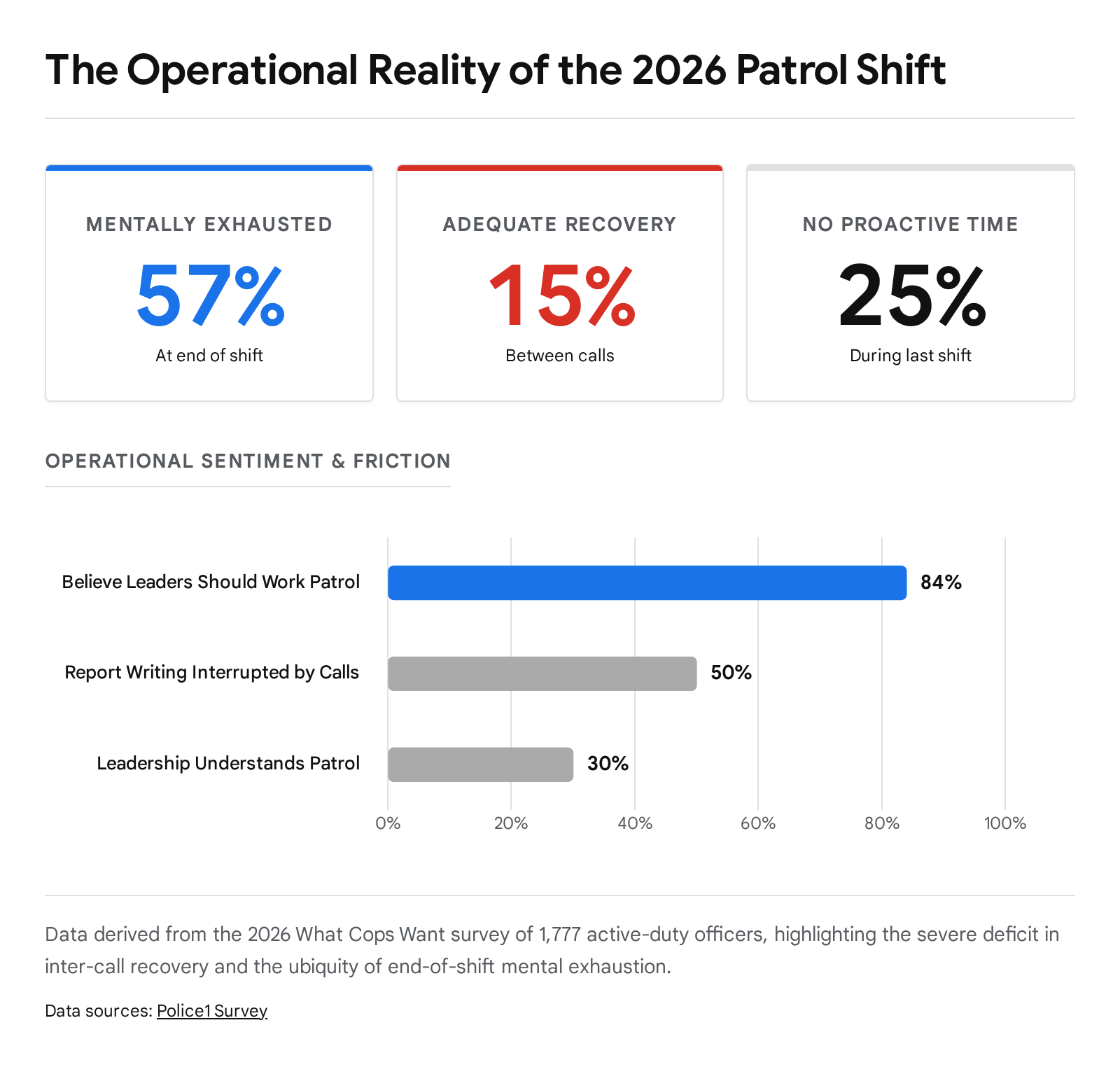
According to this exhaustive industry polling, a staggering 85% of officers report operating in an environment where they are denied adequate time to recover after stressful or physically demanding calls, as only 15% indicate they actually receive this necessary downtime.2 This chronic lack of an inter-call recovery buffer dictates that the vast majority of personnel transition directly from high-stress, adrenaline-fueled encounters—such as violent domestic disputes, high-speed pursuits, or foot chases—to the next dispatch without the requisite period of physiological normalization. Consequently, 57% of officers finish their shifts in a state of severe mental exhaustion, a condition that severely compromises their ability to perform their duties safely and effectively.2

Metric CategoryPercentage of Officers ReportingOperational Implication
End-of-Shift Mental Exhaustion57%Severe degradation of prefrontal cortex functioning, leading to impaired judgment, delayed reaction times, and heightened emotional reactivity.2
Inadequate Recovery Time85%Chronic sympathetic nervous system dominance, preventing cortisol clearance and accelerating the onset of allostatic load and cardiovascular strain.2
Interrupted Report WritingOver 50%Forced cognitive context-switching, rapid depletion of executive functioning resources, and heightened decision fatigue throughout the shift.2
Zero Proactive Policing Time25%Operational posture reduced to pure reaction; inability to engage in strategic deterrence, leading to a feeling of inefficacy and loss of tactical control.2
Leadership Disconnect84%Erosion of institutional trust; 84% of officers demand leaders periodically work a patrol shift to comprehend the compounding fatigue, while only 30% believe leaders currently understand it.2

This mental exhaustion does not occur in a vacuum; it is actively compounded by administrative burdens, staffing shortages, and the fragmentation of attention. Over half of the active patrol force indicates that their report writing and administrative duties are frequently or always interrupted by new calls for service.2 This constant interruption forces the human brain to continuously engage in context-switching, a highly taxing cognitive process that rapidly depletes metabolic resources in the prefrontal cortex, stripping the officer of the mental bandwidth required for complex problem-solving.
operational reality of the 205 patrol

Furthermore, the operational reality of “single crewing”—where officers are forced to patrol without a partner due to severe staffing deficits—exponentially exacerbates this fatigue. Officers subjected to frequent single crewing bear the absolute entirety of the cognitive load for situational awareness, navigation, radio communication, and threat assessment. Data proves that this heightened vulnerability translates directly to increased danger; single-crewed officers are statistically over 100% more likely to be verbally insulted, verbally threatened, and physically attacked during their shifts compared to double-crewed units.3

The systemic nature of this fatigue crisis is further exacerbated by structural resource deficits, which leave officers completely unsupported. A National Institute of Health (NIH) study demonstrated that smaller police departments experience a significantly higher suicide rate than larger departments, a disparity likely driven by the lack of available mental health assistance, increased workload, and high community visibility.4 While high-risk occupations such as commercial aviation and maritime transportation have universally adopted biometric fatigue monitoring and dynamic risk mitigation strategies 5, conventional law enforcement remains largely tethered to antiquated, endurance-based operational models that ignore the biological limits of the human operator.6

The compounding nature of this specific environment dictates that officers are not simply experiencing acute, transient tiredness; they are accumulating massive sleep debt and profound cognitive depletion that carries over from one shift to the next, year after year. This relentless operational tempo fundamentally alters the neurochemical balance and structural connectivity of the brain, degrading the very physiological systems required for survival, ethical policing, and effective force application in high-stakes encounters.

The Neurobiology of the “Back-to-Back” Call Environment

To accurately comprehend why mental exhaustion degrades tactical performance to such a severe degree, the analysis must shift from external dispatch metrics to the internal neurobiological architecture governing threat response and executive functioning. The human brain, despite its immense capabilities, is not evolutionarily designed to sustain high levels of acute stress without subsequent, proportional periods of downregulation and recovery. When a police officer responds to a critical incident, the autonomic nervous system (ANS) shifts dramatically and instantaneously into sympathetic dominance—the physiological state commonly understood as the “fight, flight, or freeze” response.7

The Amygdala, the Limbic System, and Neural Hijacking

During a stressful or threatening encounter, the limbic system takes immediate precedence over conscious thought. The amygdala acts as the brain’s primary emotional radar, rapidly assessing the threat value of incoming sensory information—often processing danger milliseconds before the conscious mind is even aware of it.7 Upon detecting a threat, the amygdala triggers the hypothalamus, which floods the bloodstream with catecholamines (adrenaline and noradrenaline) and cortisol.7 This initiates powerful autonomic responses: heart rate spikes, pupils dilate to broaden the field of vision, and muscular tension increases to prepare for explosive physical action.7

Simultaneously, the hippocampus rapidly searches for past encounters similar to the current threat, amplifying the sense of danger based on prior trauma or experience, while the Anterior Cingulate Cortex (ACC) spikes in activity.7 This entire cascade is a vital survival adaptation designed to keep the organism alive in the face of immediate physical danger.

However, this massive mobilization of biological resources comes at a steep cognitive cost. Under acute stress, the amygdala effectively bypasses the slower, highly rational, and analytical pathways of the brain in a neurobiological phenomenon known as “neural hijacking”.7 Concurrently, the prefrontal cortex (PFC)—the highly evolved region of the brain responsible for critical thinking, executive functioning, impulse control, problem-solving, and complex, nuanced decision-making—is actively suppressed.8 Cortisol prevents the amygdala from relaxing, and when the amygdala is locked in full activation mode, it cuts off the flow of information to the prefrontal cortex.8 The officer is kept on extreme high alert, stripped of the cognitive apparatus required to consider mitigating information, formulate long-term plans, or exercise fine impulse control.8

In a biologically healthy operational cycle, the resolution of the physical threat would be followed by a commensurate period of rest. This recovery window allows the parasympathetic nervous system (the “rest and digest” branch of the ANS) to engage, clear the residual cortisol, lower the heart rate, and restore baseline metabolic functioning to the prefrontal cortex. In the modern patrol environment, however, this crucial recovery window is systematically eliminated. The mere 15% of officers who report having adequate recovery time are the extreme exception; the vast majority are immediately dispatched to subsequent calls, forcing their neurobiology to remain suspended in a state of synthetic, cortisol-driven arousal.2

Allostatic Load and the Shrinking Window of Tolerance

When the human body is repeatedly subjected to sympathetic arousal without adequate parasympathetic recovery, the physiological result is elevated “allostatic load”.9 Allostatic load refers directly to the cumulative, physical wear and tear on biological systems resulting from chronic, unmitigated stress system activation.9 Every single traumatic exposure and rapid transition from boredom to terror adds a measurable, physical weight to this systemic load.9

As the allostatic load increases over months and years of a patrol career, the body’s regulatory systems begin to break down, manifesting psychologically as a severely narrowed “window of tolerance”.9 When chronically exhausted, officers are relentlessly pushed out of this optimal window and begin to oscillate violently between states of hyperarousal (extreme hypervigilance and reactive hostility) and hypoarousal (emotional numbness and dissociation).9

The architecture of the brain literally alters its network connectivity in response to this chronic load. Neuroimaging studies of individuals with high occupational trauma show structural hyperactivity in the default mode network (DMN) and the salience network, leading directly to amygdala and insula hyperreactivity, alongside systemic hypoactivity in the ventromedial prefrontal cortex (vmPFC).10 This depletion of metabolic resources in the dorsolateral prefrontal cortex (dlPFC)—the executor of rational control—means the officer physically lacks the neurotransmitter flux required to suppress impulsive responses or interpret nuanced environmental cues accurately.11

Cognitive Depletion, Decision Fatigue, and the SIDI Model

The operational intersection of high allostatic load, sleep debt, and continuous prefrontal cortex suppression manifests most dangerously in the realm of tactical decision-making and the application of lethal force. High-stress environments demand “shared cognition” and implicit, rules-based procedural knowledge, which allows highly trained officers to bypass slow memory retrieval and act decisively in fractions of a second.12 However, severe fatigue forcefully degrades these very cognitive functions, specifically targeting attention, spatial perception, pattern recognition, and action/reaction time.13

The Architecture of Decision Fatigue

Throughout a standard patrol shift, officers are forced to make hundreds of decisions, drawing from a strictly finite cognitive resource pool and resulting in profound decision fatigue.14 Decision fatigue is rooted in the dynamic interplay of metabolic resource allocation; as the shift progresses, the brain’s physical ability to evaluate options degrades.11 Science dictates that officers just starting their shifts possess a significantly higher capacity for sound, rational decision-making than those who have been on duty for several hours.15 Reduced processing speed and impaired executive functioning cement decision fatigue as a structural failure of the brain’s capacity, not a time management issue.16

This biological vulnerability is ironically compounded by modern administrative attempts to regulate police behavior. “Policy inflation”—the proliferation of excessively detailed or poorly structured operating procedures—creates severe cognitive collision.17 When exhausted officers are confronted with highly complex use-of-force continuums during a rapidly unfolding physical confrontation, the required cognitive load vastly exceeds their depleted processing capacity.17 This dynamic invites extreme decision fatigue, forcing the exhausted brain to abandon policy entirely in favor of primitive, survival-based heuristics.17

The Stress Induced Deliberation-to-Intuition (SIDI) Model

To understand how officers react when their executive functioning is depleted by fatigue and overwhelmed by policy complexity, neuroscience offers the “Stress Induced Deliberation-to-Intuition” (SIDI) model.18 Under the SIDI model, researchers propose that high levels of stress and fatigue elicit a hard switch from the brain’s slow, demanding analytic reasoning system to fast, effortless, intuitive processes.18

When the stakes are highest, the fatigued brain abandons goal-directed choices, becomes incapable of adjusting initial judgments based on new information, and relies entirely on unexamined innate responses generated by subcortical reactive emotion areas.18 The stress heavily influences the arbitration between the emotional responses of the amygdala and the deliberative processes of the prefrontal cortex, effectively severing the connection.18
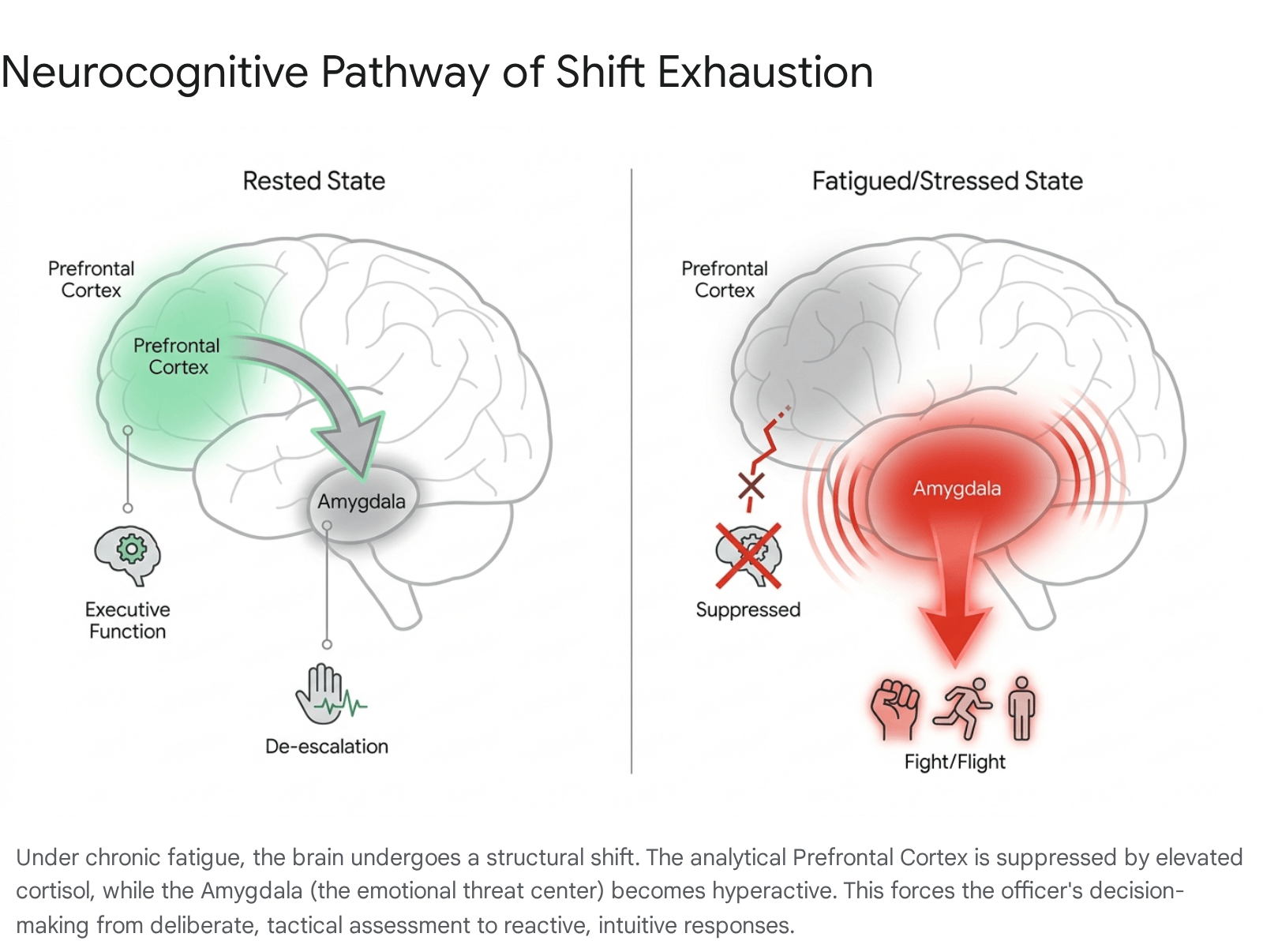
Diagram illustrating neurocognitive pathway of shift

In a practical tactical setting, this neurobiological switch is devastating. Without mental clarity, the officer is left with only raw survival instincts, defaulting to either an immediate, potentially excessive application of physical force, or a highly dangerous state of “freezing”.14 If an officer is confronted with an active aggressor and is in a state of profound decision fatigue, the possibility of the officer taking no action at all—freezing because the brain cannot compute the policy matrix—becomes statistically likely, resulting in catastrophic injury or death for the officer.14

Degradation of Tactical Decision-Making and Lethal Force Errors

The correlation between compounding fatigue and severely degraded use-of-force execution is heavily documented in clinical law enforcement studies. Groundbreaking research by David Blake (MSc, a retired police officer) and Dr. Edward Cumella (a professor of psychology) directly addressed the profound impact of sleep deprivation and fatigue on officers’ performance within deadly-force situations.19

The Blake and Cumella Fatigue Studies

Testing 53 active-duty police officers over the course of a week, the researchers meticulously tracked the participants’ total time awake (TTA), sleep quality, shift schedules, and consecutive days worked.19 The officers were then subjected to rigorous, simulated shoot/don’t shoot scenarios utilizing imagery of potential targets classified into three categories: clear “shoot” responses, clear “don’t shoot” responses, and highly ambiguous scenarios.19

The empirical findings present a severe warning regarding current operational tempos. High levels of fatigue—specifically driven by greater total time awake, poor subjective sleep quality, consecutive days worked, and the execution of disruptive night or swing shifts—strongly and negatively correlated with impaired decision-making and significantly slowed reaction times.19

Critically, Blake and Cumella noted that these cognitive failures occurred most frequently when officers were faced with the more difficult, highly nuanced decisions within the “don’t shoot” or ambiguous scenarios.19 When an officer is presented with a clear lethal threat, the amygdala correctly identifies it and initiates survival responses. However, when the scenario is ambiguous—such as a suspect reaching into a waistband for a dark object—the brain requires the analytical processing power of the prefrontal cortex to decipher contextual clues.19 When the prefrontal cortex is exhausted by a 57% exhaustion rate and 85% lack of recovery time, the ability to process ambiguity collapses.2

Furthermore, the study conclusively demonstrated that fatigue effects compound throughout the workday, with officers’ reaction times increasing consistently from their pre-shift assessments to their post-shift assessments.20 This means an officer responding to a high-risk call at hour eleven of a shift is physiologically operating with severe tactical latency, placing both the officer and the public in extreme peril.

Postural Freezing and the Illusion of Shared Cognition

Further compounding the danger, high spatial and temporal variability is observed in fatigued officers responding to identical tactical scenarios.12 A comprehensive study analyzing the behavioral responses of 42 officers to a live-acted assailant scenario revealed extensive variability in movement patterns, final positioning, and weapon responses.12 The researchers found that the officers’ prior training and years of experience did not positively impact their responses during the threat.12 Instead, longer hours awake and lower reported rest directly constrained their visual search patterns and negated the effects of their training, proving they could not utilize “shared cognition” due to fatigue.12

Neuroimaging studies utilizing fMRI on police recruits provide further context to this phenomenon. Preparation for shooting decisions under the threat of shock is associated with intense midbrain activity, specifically in the periaqueductal gray (PAG), and PAG-amygdala connectivity.21 This network is deeply associated with postural freezing as the brain rapidly attempts to process the threat.21 The switch from this freezing state to overt defensive action requires the medial prefrontal cortex (mPFC) to override the amygdala.21 If the mPFC is offline due to exhaustion, the officer remains locked in the freezing response.

The Physical Manifestations: Motor Vehicle Collisions and Lethality

While the degradation of tactical decision-making captures immense attention, the physical toll of the compounding patrol shift manifests most lethally in motor vehicle operations. Motor vehicle collisions account for nearly 9% of all police officer injuries nationwide and remain a leading cause of accidental on-duty deaths year after year.22 Officers frequently spend half their total shift inside their vehicles, frequently required to multi-task by operating mobile data terminals, reading dispatch screens, and utilizing cell phones while navigating complex roadways.22 When this intense, divided-attention environment is combined with the reality that 57% of the force is mentally exhausted 2, the patrol vehicle transforms into a highly dangerous kinetic weapon.

The Blood Alcohol Content (BAC) Equivalency of Fatigue

Transportation and occupational health research directly equates extreme fatigue to alcohol intoxication. A human being awake for 17 to 19 hours exhibits cognitive and motor impairment directly comparable to a Blood Alcohol Content (BAC) of 0.05.23 At 24 hours awake, the impairment equates to a BAC of 0.10, well beyond the legal limit for operating a motor vehicle.23

The specific metrics associated with this sleep debt are catastrophic for high-speed driving:

Impairment MetricDegradation at 17-19 Hours AwakeDegradation at 24 Hours Awake
Reaction Time SpeedDecreased by 9%Decreased by 16% 23
Dual Task SpeedDecreased by 10%Decreased by 20% 23
Hand-Eye CoordinationDecreased by 10%(Data extrapolates severe drop) 23
Reaction Time AccuracyDecreased by 225%Decreased by 680% 23

These impairment metrics synthesize into a terrifying probability matrix: officers who have been awake for more than 20 hours are up to 63 times more likely to be involved in a motor vehicle collision than a rested counterpart.23

The Ubiquity of the Danger and the 10-Year Veteran Anomaly

Data highlights the absolute ubiquity of this danger across the profession. A comprehensive survey revealed that 85% of officers admit to driving their patrol vehicles while drowsy, and a deeply concerning 39% admit to having actually fallen asleep at the wheel while on duty.24 Furthermore, 56% of officers report getting less than 6.5 hours of sleep daily.24 Analysis of collision timing reveals that 41.6% of crashes occur between 0000 and 0759 hours, aligning perfectly with the deepest troughs of the human circadian rhythm.24 Additionally, in fatality accidents, 42.4% of officers were not wearing seatbelts, leading to a 15.1% total ejection rate.24

Intriguingly, demographic analysis reveals a counter-intuitive anomaly regarding the officers most at risk. In law enforcement, the officers most at risk of dying in a motor vehicle collision are not inexperienced rookies, but rather officers in their mid-30s possessing approximately 10 years of policing experience.22 This anomaly suggests a lethal intersection of psychology and physiology. Officers with a decade of experience have accumulated a massive, unresolved allostatic load and chronic sleep debt, while simultaneously developing a deeply ingrained sense of invincibility that overrides their conscious risk-assessment capabilities.22

Sudden Cardiac Death and the “Dual-Hit” Vulnerability

Beyond the immediate kinetic dangers, the compounding patrol shift exacts a silent and frequently lethal toll on the officer’s cardiovascular system. Police officers represent an exceptionally high-risk group for Sudden Cardiac Death (SCD).25 Cardiology researchers have elucidated a distinct “dual-hit model” that links the unique stressors of the modern patrol shift directly to SCD, demonstrating that it is rarely a random genetic event.25

Under this model, the chronic stress of the job—the continuous, unresolved sympathetic arousal—acts as the first hit. It progressively disrupts cardiovascular homeostasis (via autonomic imbalance, myocardial electrophysiological instability, endothelial dysfunction, and systemic inflammation), fundamentally remodeling the architecture of the officer’s heart and creating a highly vulnerable substrate.25 The mental exhaustion reported by 57% of the force is therefore a direct warning sign of profound underlying cardiovascular vulnerability.2 When the acute operational trigger (the second hit, such as sudden high-intensity physical exertion) occurs, the weakened cardiovascular system simply shorts out, resulting in a fatal arrhythmia.25

Advanced Biomarkers and Real-Time Monitoring: The Role of HRV

The primary administrative challenge in mitigating the hidden costs of the patrol shift has historically been the inability to objectively measure fatigue in real-time. Heart Rate Variability (HRV)—the physiological measure of the specific variation in time between consecutive heartbeats—has emerged as the premier, non-invasive biomarker for assessing an officer’s resilience and allostatic load.26 HRV directly mirrors the dynamic, real-time balance between the sympathetic and parasympathetic branches of the ANS.27

A consistently high HRV indicates a highly resilient autonomic nervous system, while a consistently low HRV is a clinical indicator of heightened stress levels and homeostatic disturbance.27 While an acute operational stressor appropriately precipitates a temporary decrease in HRV 28, repeated exposure to potentially psychologically traumatic events (PPTEs) without adequate inter-call recovery leads to a permanently exhausted autonomic response and chronically depressed HRV.28 Crucially, HRV monitoring serves as an accurate diagnostic tool; individuals suffering from PTSD almost universally exhibit severely depressed HRV.27 By utilizing biometric wearables to track HRV daily, command staff can objectively identify specific officers whose autonomic systems are failing under the load.

Tactical Recovery Interventions: Reversing the Damage

Acknowledging the severe cognitive and physiological degradation intrinsic to the modern shift requires the immediate implementation of evidence-based, tactical recovery interventions aimed at the deliberate, manual stimulation of the parasympathetic nervous system.

Autonomic Override via Tactical Breathing

The most immediate, field-expedient method for an officer to forcefully shift their nervous system back to a balanced state is through highly controlled respiratory protocols.29 Deep, diaphragmatic breathing techniques mechanically stimulate the vagus nerve, which commands an immediate physiological response: a rapid decrease in heart rate, lowered blood pressure, and a cessation of stress hormone secretion.29 This mechanical process effectively “re-boots” the prefrontal cortex.8

“Box breathing” (also known as tactical breathing)—a specific pattern involving equal counts of inhalation, breath retention, exhalation, and a post-exhale empty-lung pause (most commonly a 4-4-4-4 second cadence)—has been widely adopted by military special operations units and is highly applicable to law enforcement.30 Initiating the breath through the nose is particularly critical, as it is directly linked to the release of nitric oxide, which promotes vasodilation.31

Implementing a brief box breathing protocol immediately after clearing a high-stress call provides an engineered “tactical pause” that manually clears the chemical remnants of the acute stress response, preventing the trauma from compounding into the next dispatch.29

Structured Cardiovascular Remodeling

Mitigating the long-term, systemic risk of Sudden Cardiac Death requires actively reversing the physical remodeling of the heart. Structured physical exercise acts as a targeted, multi-level modulator for the cardiovascular system.32 Evidence-based exercise prescriptions restore autonomic rebalancing, act as a powerful systemic anti-inflammatory, and directly improve endothelial integrity.32 By enhancing the body’s stress recovery capabilities, targeted high-intensity exercise protocols directly reduce the cumulative allostatic load, modifying the vulnerable cardiovascular substrate so that it can successfully withstand the massive adrenaline dump of an operational trigger.32

Institutional Evolution: Fatigue Risk Management Systems (FRMS)

The traditional model of managing police fatigue relies almost exclusively on simplistic, compliance-based restrictions regarding consecutive hours worked.5 This legacy model is dangerously inadequate because it fails to account for sleep quality or the compounding neurobiological nature of the back-to-back call environment.6

High-risk, zero-fail sectors such as commercial aviation have long recognized that hours-compliance is insufficient and rely heavily on Fatigue Risk Management Systems (FRMS).6 An FRMS is a formalized, dynamic, data-driven set of management practices designed to systematically identify and actively mitigate fatigue-related safety risks.5 Integrated directly into an organization’s broader Safety Management System, an FRMS utilizes advanced biomathematical models to proactively predict periods of high fatigue risk across the force.33

Implementing an FRMS is a tactical necessity that requires moving beyond subjective self-reporting to utilize anonymized biometric data, adopting forward-rotating schedules optimized for sleep hygiene, and establishing strict dispatch protocols that mandate biologically necessary buffer periods for autonomic downregulation. With 84% of officers stating agency leadership needs to periodically work a patrol shift to truly understand these compounding realities 2, transitioning from an endurance-based culture to a highly analytical risk-management culture via FRMS bridges this dangerous operational disconnect.

Conclusions and Strategic Directives

The exhaustive data surrounding the modern patrol shift reveals a systemic, catastrophic failure to respect the biological and neurological limits of the human operator. When 57% of a tactical force finishes daily operations in a state of severe mental exhaustion, and 85% are denied the basic physiological requirement of recovery time, the organization exists in a state of extreme, constant vulnerability.2 The systematic eradication of inter-call recovery time creates a compounding cycle of autonomic dysregulation, characterized by a hyperactive amygdala, a chronically suppressed prefrontal cortex, and a steadily accumulating allostatic load.

Neurobiological exhaustion physically degrades the brain’s capacity for complex decision-making, drastically elevating the probability of fatal errors in ambiguous, lethal-force encounters.19 Furthermore, operational sleep debt induces impairment levels exceeding legal intoxication, transforming routine vehicle operation into highly lethal endeavors 23, while remodeling the officer’s cardiovascular system to be uniquely susceptible to Sudden Cardiac Death.25

Strategic imperatives for the modern force must include:

  • The Institutionalization of Tactical Recovery: Agencies must mandate and rigorously train vagal nerve stimulation techniques, specifically box breathing, to act as forced, non-negotiable “tactical pauses” between calls.30
  • Biometric Monitoring as Standard Issue: Deploying HRV tracking wearables to establish baseline autonomic health across the force, allowing leadership to objectively identify personnel approaching operational failure or clinical PTSD.27
  • The Adoption of FRMS: Discarding purely hours-based compliance models in favor of dynamic Fatigue Risk Management Systems utilizing biomathematical forecasting to mandate true inter-call recovery periods.5
  • Eradication of Policy Inflation: Reversing the administrative trend of excessively complex operational policies to ensure that an officer’s depleted prefrontal cortex is not further burdened by bureaucratic collision during split-second incidents.17

The modernization of law enforcement strategy can no longer be limited solely to the acquisition of advanced hardware. The true tactical imperative lies in defending and optimizing the neurobiological architecture of the human operator.


Please share this post with colleagues, on forums, etc. Your support is much appreciated, and if you have any feedback, please email us in**@*********ps.com. If you’d like to request a report or order a reprint, please click here for the corresponding page to open in new tab.


Sources Used

  1. Ronin’s Grips | Firearms Analytics & Intelligence Reports | Connecticut – Boise Gun Club, accessed June 25, 2026, https://boisegunclub.com/connecticut/directory/blog-20
  2. What Cops Want in 2026: The reality of patrol – Police1, accessed June 25, 2026, https://www.police1.com/what-cops-want/what-cops-want-in-2026-the-reality-of-patrol
  3. 2016 Police Officer Welfare, Demand, and Capacity Survey Inferential Results, accessed June 25, 2026, https://polfed.org/media/14062/pfew-inferential-results-report-27-12-17-v10-002.pdf
  4. Officer Safety and Wellness Backgrounder | MN.gov, accessed June 25, 2026, https://assets.dps.mn.gov/files/ca/officer-safety-and-wellness-backgrounder.pdf
  5. AC 120-103A – Fatigue Risk Management Systems for Aviation Safety – FAA, accessed June 25, 2026, https://www.faa.gov/regulations_policies/advisory_circulars/index.cfm/go/document.information/documentid/1021088
  6. Developing Tools for Fatigue Risk Management in First Responders – safte-fast, accessed June 25, 2026, https://www.saftefast.com/safte-fast-blog/developing-tools-for-fatigue-risk-management-in-first-responders
  7. The Limbic System Deep Dive: How Does This Relate to Successful Proactive Policing?, accessed June 25, 2026, https://bluetogold.com/the-limbic-system-deep-dive-how-does-this-relate-to-successful-proactive-policing/
  8. What threat does to the brain – American Police Beat Magazine, accessed June 25, 2026, https://apbweb.com/2023/09/what-threat-does-to-the-brain/
  9. The Window of Tolerance in First Responders: Managing Hyperarousal and Shutdown, accessed June 25, 2026, https://balancedmindofny.com/blog/window-of-tolerance-in-first-responders/
  10. Cumulative trauma, neural circuits, and burnout: an integrative model of healthcare worker post-traumatic stress syndromes – PMC, accessed June 25, 2026, https://pmc.ncbi.nlm.nih.gov/articles/PMC12997488/
  11. Neurobiological Exhaustion: Metabolic and Network Mechanisms of Decision Fatigue, accessed June 25, 2026, https://gc-bs.org/articles/neurobiological-exhaustion-metabolic-and-network-mechanisms-of-decision-fatigue/
  12. Full article: Assessing between-officer variability in responses to a live-acted deadly force encounter as a window to the effectiveness of training and experience – Taylor & Francis, accessed June 25, 2026, https://www.tandfonline.com/doi/full/10.1080/00140139.2023.2278416
  13. Factoring Fatigue into Police Deadly Force Encounters: Decision-Making and Reaction Times – Human Performance Training and Consulting Inc, accessed June 25, 2026, https://www.hptc-pro.com/wp-content/uploads/2014/01/Fatigue-David-Blake.pdf
  14. Decision Fatigue and Why It Should Be Understood by Law Enforcement Leadership: Can Science Provide Insight into How Officers Make Decisions? – Police Chief Magazine, accessed June 25, 2026, https://www.policechiefmagazine.org/decision-fatigue/
  15. Do cops have too many tools on their belts? – Police1, accessed June 25, 2026, https://www.police1.com/officer-safety/articles/do-cops-have-too-many-tools-on-their-belts-plEoIDNnPG6NrTYu/
  16. The Precision of Capacity and Why Decision Fatigue is Not a Time, accessed June 25, 2026, https://www.brainzmagazine.com/post/the-precision-of-capacity-and-why-decision-fatigue-is-not-a-time-problem
  17. Designing policies for real-world policing: From compliance to cognitive accessibility, accessed June 25, 2026, https://www.police1.com/law-enforcement-policies/designing-policies-for-real-world-policing-from-compliance-to-cognitive-accessibility
  18. Stress potentiates decision biases: A stress induced deliberation-to-intuition (SIDI) model, accessed June 25, 2026, https://pmc.ncbi.nlm.nih.gov/articles/PMC5146206/
  19. How lack of sleep may cause deadly police errors – Police1, accessed June 25, 2026, https://www.police1.com/officer-safety/articles/how-lack-of-sleep-may-cause-deadly-police-errors-GBdpITo4dm1hhlZU/
  20. (PDF) Factoring Fatigue into Police Deadly Force Encounters …, accessed June 25, 2026, https://www.researchgate.net/publication/284553924_Factoring_Fatigue_into_Police_Deadly_Force_Encounters_Decision-Making_and_Reaction_Times
  21. Neural Dynamics of Shooting Decisions and the Switch from Freeze to Fight – PMC, accessed June 25, 2026, https://pmc.ncbi.nlm.nih.gov/articles/PMC6414631/
  22. UNDERSTANDING AND REDUCING RCMP MOTOR VEHICLE COLLISIONS – UFV, accessed June 25, 2026, https://www.ufv.ca/media/assets/criminal-justice-research/Police-Motor-Vehicle-Crash-Report.pdf
  23. The Role of Law Enforcement Culture in Officer Safety During Driving and Roadway Operations – National Policing Institute, accessed June 25, 2026, https://www.policinginstitute.org/wp-content/uploads/2024/03/NLERSP-Roadway-Safety-Culture-Issue-Brief_web-FINAL.pdf
  24. Officer Roadside Safety Program Student Handout Materials, accessed June 25, 2026, https://nleomf.org/wp-content/uploads/2022/09/Master-Handout-05-22-16.pdf
  25. Occupational stress, cardiovascular vulnerability and sudden cardiac death in police officers: mechanisms and the protective role of structured exercise – Frontiers, accessed June 25, 2026, https://www.frontiersin.org/journals/public-health/articles/10.3389/fpubh.2026.1838794/full
  26. Trends in Daily Heart Rate Variability Fluctuations Are Associated with Longitudinal Changes in Stress and Somatisation in Police Officers – PMC, accessed June 25, 2026, https://pmc.ncbi.nlm.nih.gov/articles/PMC8776208/
  27. The Role of HRV in Enhancing Police Officers’ Resilience Against PTSD – Biostrap, accessed June 25, 2026, https://biostrap.com/academy/enhancing-police-officers-resilience-hrv-monitoring-combating-ptsd/
  28. Cardioautonomic lability assessed by heart rate variability changes in Royal Canadian Mounted Police cadets during the cadet training program – Frontiers, accessed June 25, 2026, https://www.frontiersin.org/journals/psychology/articles/10.3389/fpsyg.2023.1144783/full
  29. 3 effective breathwork techniques for first responders (and when to use them) – EMS1, accessed June 25, 2026, https://www.ems1.com/wellness-week/3-effective-breathwork-techniques-for-first-responders-and-when-to-use-them
  30. Box Breathing: How It Works and Why It’s So Effective | Neurosity, accessed June 25, 2026, https://neurosity.co/guides/box-breathing-how-it-works
  31. Unload your backpack: 8 strategies to improve police health, wellness and resilience, accessed June 25, 2026, https://www.police1.com/wellness-week/unload-your-backpack-8-strategies-to-improve-police-health-wellness-and-resilience
  32. Occupational stress, cardiovascular vulnerability and sudden cardiac death in police officers – Frontiers, accessed June 25, 2026, https://www.frontiersin.org/journals/public-health/articles/10.3389/fpubh.2026.1838794/pdf
  33. 5. Fatigue Risk Management Systems | Office of Rail and Road – ORR, accessed June 25, 2026, https://www.orr.gov.uk/managing-rail-staff-fatigue/5-fatigue-risk-management-systems
Bridging the Command-Frontline Disconnect in Law Enforcement

1. Introduction: The State of the Law Enforcement Profession in 2026

The institution of American law enforcement has arrived at a profound and existential inflection point in the year 2026. Agencies across the nation are facing a confluence of unprecedented internal and external pressures that fundamentally threaten their core functional capacities, manifesting most visibly in a deepening, systemic workforce crisis. This crisis is characterized by hemorrhaging retention rates, a precipitously shrinking pipeline of qualified applicants, and the mass exodus of seasoned, mid-career professionals who represent the tactical and institutional backbone of the profession.1 While the prevailing public and political narratives often attribute this exodus to compensation disparities, intense public scrutiny, the rise of specialized oversight commissions, or the inherent physical dangers of the occupation, rigorous organizational behavior analysis reveals a far more insidious, structural catalyst. The primary driver of the current retention crisis is a profound leadership deficit—specifically, an expanding and severe disconnect between executive command structures and frontline patrol operations.2

In 2026, the law enforcement profession is grappling with the total collapse of outdated organizational structures. Traditional hierarchical models, which are essentially vestiges of the Industrial Revolution designed for rigid compliance rather than dynamic problem-solving, are comprehensively failing to accommodate the psychological, tactical, and social complexities of twenty-first-century policing.4 As an inevitable consequence of these archaic frameworks, executive leadership often becomes structurally and culturally shielded from the authentic voices and operational realities of the frontline personnel they command.5 This structural shielding has generated a cascading sequence of organizational failures that compound upon one another. These failures include the severe misalignment of Key Performance Indicators (KPIs), the suffocating expansion of administrative burdens placed upon first-line supervisors, the erosion of authentic field leadership presence, and the cultivation of a deeply risk-averse culture defined by tactical hesitation and the pervasive fear of administrative betrayal.2

The consequences of this executive-patrol divide extend far beyond internal morale surveys or localized grumbling in the precinct locker room. When executive leadership relies on socially distanced, compliance-driven management models rather than engaged, field-based leadership, the operational readiness and tactical efficacy of the entire agency are fundamentally compromised.8 Frontline officers, feeling utterly abandoned by their command staff and subjected to extreme, adversarial internal scrutiny, are experiencing unparalleled levels of burnout, moral injury, and psychological fatigue.2 This exhaustive strategic report, prepared for the readership of blog.roninsgrips.com, will deconstruct the anatomy of the command-frontline disconnect. It will explore how misaligned metrics, administrative bloat, and organizational betrayal have accelerated officer burnout and compromised tactical readiness. Furthermore, it will outline the strategic, evidence-based imperatives required to bridge this divide, restore organizational trust, and stabilize the workforce before the institutional knowledge drain becomes irreversible.

2. The Enduring Divide: Reuss-Ianni’s “Two Cultures” in the Digital Age

To accurately diagnose the current schism within modern police organizations, it is necessary to examine the foundational organizational sociology of law enforcement. In 1983, researcher Elizabeth Reuss-Ianni introduced a seminal theoretical framework known as the “Two Cultures of Policing,” positing that modern police departments are not monolithic entities with a unified ethos, but rather are deeply divided into two distinct, and often fiercely competing, cultural spheres: “Street Cop Culture” and “Management Cop Culture”.10 Over four decades later, this framework remains the most accurate diagnostic tool for understanding the 2026 retention crisis, as the divide has not only persisted but has exponentially widened.

The Taxonomy of the Two Cultures

Street Cop Culture operates exclusively at the precinct, sector, and patrol level. It is characterized by high group loyalty, an entrenched “us-versus-them” mentality developed in direct response to a perceived hostile external environment, and a heavy reliance on informal, experience-based decision-making rather than rigid procedural manuals.11 The solidarity within this street-level culture is paramount for physical and psychological survival in unpredictable, high-stress, and often violent operational environments. It is a culture built on the fundamental premise of “having each other’s six” when the system fails.2

Conversely, Management Cop Culture is rooted in the executive, administrative, and political echelons of the department. This culture is bureaucratically juxtaposed to the street level. It prioritizes rationalization, strict policy compliance, statistical performance metrics, public relations, and the delicate navigation of municipal politics.10 Reuss-Ianni observed that the loyalties of the “bosses” naturally and inevitably gravitate toward the social and political networks of municipal management—mayors, city councils, civilian oversight boards—rather than to the men and women on the street. This misalignment of loyalty causes a sharp division with grave consequences for departmental cohesion, as the two cultures pursue fundamentally different objectives.10

The Exacerbation of the Divide in the Modern Context

While Reuss-Ianni identified this phenomenon in the early 1980s, the digital transformation of policing, coupled with the socio-political upheaval of the early 2020s, has exponentially widened this divide into a chasm. The advent of pandemic-era policing normalized “socially distanced” forms of leadership, which drastically decreased the frequency of positive, organic, face-to-face interactions between frontline officers and their commanders.8 These distanced management protocols severed the few remaining relational bridges between the Street Cop and the Management Cop.

Furthermore, as individuals ascend the ranks within modern agencies, they become increasingly disconnected from street-level realities, transitioning fully into the Management Cop paradigm.9 Executives are frequently tasked with implementing sweeping reform legislation, consent decrees, and massive policy overhauls dictated by external political bodies. However, frontline officers become highly skeptical—and passively resistant—when new operational directives are authored by civilians, academics, or senior police leaders who have not actively patrolled a sector or engaged in a use-of-force incident in over a decade.5

The cultural mandate of Street Cop loyalty fundamentally clashes with the Management Cop mandate of institutional risk mitigation. When management prioritizes appeasing external political pressures or media narratives over supporting the tactical realities of the frontline, the Street Cop Culture perceives this not merely as poor management, but as a fundamental and unforgivable breach of loyalty. This perceived breach catalyzes the development of a deeply entrenched, adversarial “them” (command staff) and “us” (frontline officers) mentality, which serves as the psychological bedrock for the current retention crisis, driving officers to seek employment in agencies where the divide is less pronounced, or to leave the profession entirely.3

3. Goodhart’s Law and the Severe Misalignment of Key Performance Indicators (KPIs)

The schism between Management Cops and Street Cops is operationalized and enforced most visibly through the deployment of performance metrics. Modern police administration has been heavily influenced by data-driven management models, most notably CompStat and its various derivative systems.15 While these systems were initially designed in the 1990s to increase accountability, identify crime trends, and optimize resource allocation, their current application in many agencies serves as a textbook manifestation of Goodhart’s Law, resulting in the systemic distortion of police work.

The Mechanism of Goodhart’s Law in Modern Policing

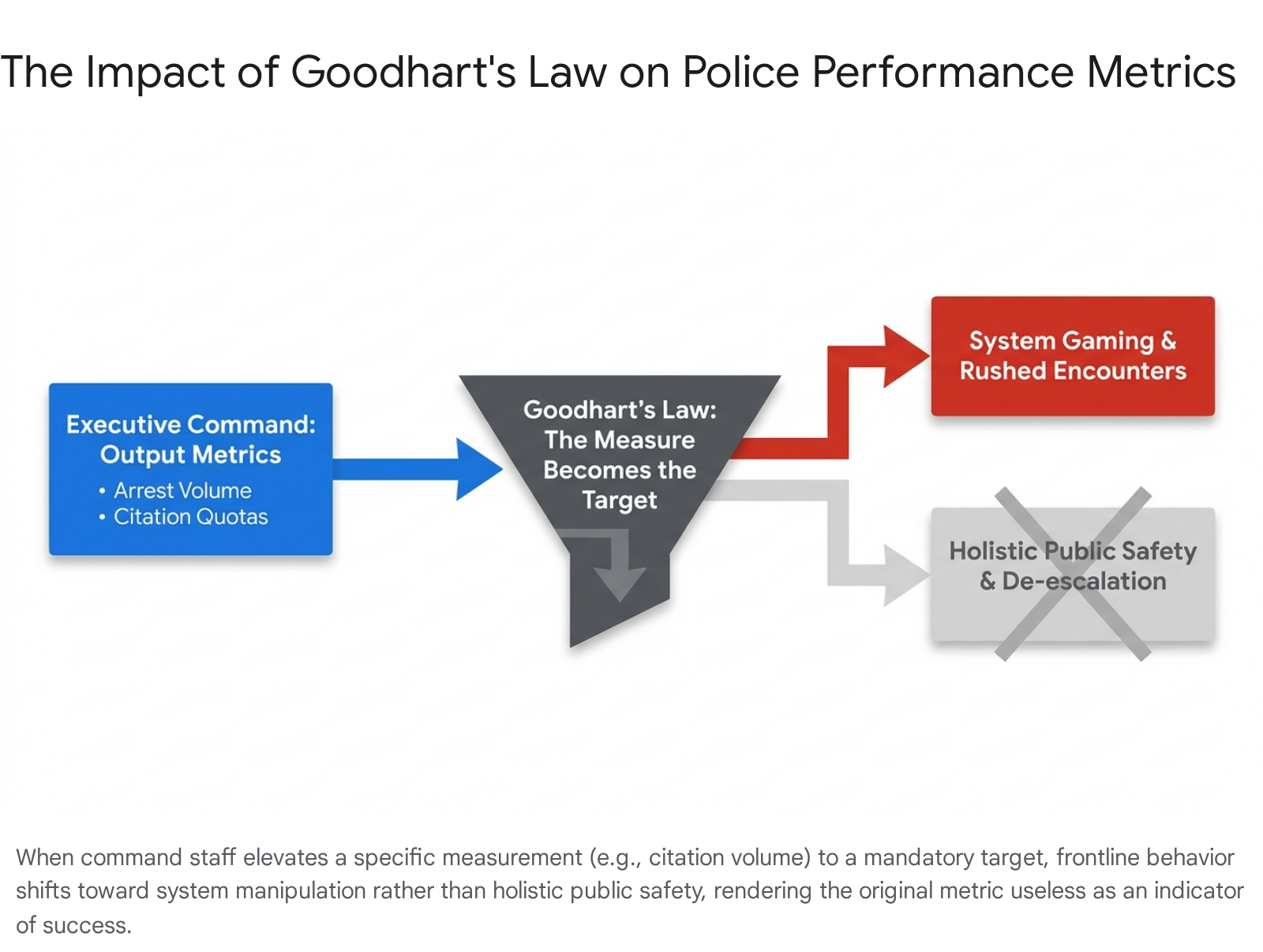
Coined by British economist Charles Goodhart, the law stipulates a fundamental truth of organizational behavior: “When a measure becomes a target, it ceases to be a good measure”.16 This principle warns organizations of the inherent risks of relying on misaligned Key Performance Indicators (KPIs) that prioritize quantifiable, easily tracked metrics over meaningful, holistic outcomes.17

In the law enforcement context, when executive command mandates strict targets for specific, easily measurable outputs—such as the number of traffic citations issued, pedestrian stops conducted, field interview cards submitted, or arbitrary arrest quotas—these metrics become the sole focus of organizational behavior. Officers, adapting to the pressure of the Management Cop Culture and seeking to avoid punitive administrative action for “low productivity,” begin to optimize their behavior to satisfy the spreadsheet rather than to enhance public safety.16 The metric, originally intended to measure proactive police work, becomes a quota that incentivizes system gaming.

The Unintended Consequences of Rigid Metrics

This hyper-focus on quantitative targets produces severe unintended consequences that directly compromise tactical readiness and community relations. For example, focusing solely on minimizing call-response times or maximizing call clearance rates pressures frontline officers to rush complex, volatile engagements. This manufactured urgency limits the time available for crucial de-escalation protocols, thorough investigations, and meaningful community engagement, ultimately leading to unresolved issues, higher recidivism, unnecessary uses of force, and degraded public trust.17

Furthermore, misaligned KPIs are deeply demoralizing for the frontline patrol officer. When an officer’s professional worth, career trajectory, and specialized unit transfer prospects are reduced to a numerical output that lacks qualitative context, the inherent value of their public service is marginalized. The vast majority of officers enter the profession to do impactful police work—taking dangerous, violent offenders off the street, solving complex local problems, and protecting vulnerable populations. When command staff evaluates them based on a misaligned scorecard that rewards high-volume, low-impact enforcement (e.g., writing dozens of minor equipment violations) over low-volume, high-impact work (e.g., conducting a weeks-long investigation into a local narcotics distributor), it creates a profound sense of cognitive dissonance and accelerates burnout.16 The system treats officers as interchangeable variables in a data set rather than autonomous professionals exercising critical discretion.

Goodhart's Law impact on police performance metrics

The CompStat model, while theoretically capable of supporting community policing, often devolves into a punitive forum where precinct commanders are berated over minor statistical fluctuations. This pressure flows directly down the chain of command, resulting in sergeants demanding raw numbers from their squads simply to survive the next executive briefing.15 This dynamic perfectly encapsulates the Management Cop Culture’s triumph over the Street Cop Culture’s operational reality, sacrificing long-term community trust for short-term statistical compliance.

4. The Administrative Anchor: Pulling Supervisors Off the Street

The strength, resilience, and operational discipline of any law enforcement organization rest squarely on its first-line supervisors, primarily individuals holding the rank of Sergeant. Sergeants represent the critical translation layer between executive policy formulation and street-level tactical execution. They are tasked with translating abstract directives into practical action, setting the tone during crises, modeling leadership under extreme pressure, and ensuring immediate, on-the-ground accountability.19 However, the current command-frontline disconnect is severely exacerbated by the rapidly evolving nature of the Sergeant’s role, which has been fundamentally altered by an overwhelming, systemic influx of administrative burdens.

The Paradox of Managerial Leadership at the Frontline

Academic research into the everyday practices of police supervisors reveals a striking and highly problematic paradox: while frontline supervisors define themselves and their professional responsibilities in terms of “leadership,” the actual activities they perform are overwhelmingly classified as “management work”.20 Agencies everywhere, struggling with budget constraints and civilian staffing shortages, are asking more from fewer supervisors, stretching them dangerously thin across multiple sectors. Sergeants are increasingly tasked with managing larger spans of control while juggling a crushing administrative load that acts as an anchor, physically keeping them off the street and confined to a desk inside the precinct.19 Recent data confirms the severity of this administrative bloat, revealing that more than three hours per shift—approximately 40% of the workday—gets swallowed by paperwork. Furthermore, a national survey indicated that 38% of police officers spend two to four hours per shift on administrative tasks, with another 16% spending more than half their entire shift on paperwork.

When sergeants are transformed by organizational design into administrators rather than tactical leaders, the entire organizational structure fractures at its most critical stress point. The consequences are predictable, immediate, and severe: interpersonal communication degrades, tactical oversight during complex incidents vanishes, accountability for minor infractions fades, and squad morale plummets.19 Officers in the field quickly realize that their primary leader is absent, replaced by a digital signature on a digital report.

The Body-Worn Camera Paradox and the Auditing Burden

A primary, and highly contemporary, contributor to this administrative anchor is the widespread implementation of transparency technologies, most notably Body-Worn Cameras (BWCs). While BWCs are invaluable, necessary tools for public accountability, civil liability protection, and evidence gathering, the logistical and administrative requirements surrounding data storage, management, and routine auditing are staggering and largely fall upon the shoulders of the first-line supervisor.21

Agencies, driven by the risk-mitigation imperatives of the Management Cop Culture, are frequently requiring sergeants to routinely review and audit hours of BWC footage to ensure policy compliance, check for uniform violations, and identify training needs.22 The time investment required for this oversight is massive and unsustainable. For instance, the redaction and detailed review process can consume up to one hour of administrative staff or supervisory time for every ten minutes of video recording.22 While this auditing function satisfies the risk-mitigation desires of executive command and municipal oversight bodies, it directly and unavoidably cannibalizes the time sergeants have to be physically present in the field alongside their personnel. The supervisor is effectively sidelined, auditing past behavior rather than leading current operations.

Command Presence vs. Command Being Present

The nature of law enforcement demands a strong “command presence”—projecting authority, control, and fearlessness to establish order in chaotic environments.24 However, the administrative demands placed on supervisors prevent a more vital organizational concept: command being present.

Officers consistently report in extensive national surveys that visible, engaged, and communicative leadership is directly linked to higher morale, enhanced psychological safety, and safer tactical operations.19 Officers fundamentally need to see their leadership aligned with the realities of street-level policing. When command staff and immediate supervisors remain physically and emotionally distant—relying on email directives, digital dashboards, or infrequent, highly formalized briefings—it breeds profound feelings of isolation and abandonment among the patrol force.25 The most effective strategy for improving morale within a fractured department is strong, consistent leadership engagement through regular roll call visits, authentic open-door policies, and active participation in field operations where appropriate.25 When administrative burdens prevent this engagement, the leadership vacuum on the street is quickly filled by cynicism, degraded standards, and tactical hesitation.

5. Tactical Hesitation: The Weaponization of Administrative Fear

As the physical, emotional, and cultural distance between executive command and the frontline grows, it profoundly impacts the physiological and psychological responses of officers in high-stress, volatile situations. The command disconnect manifests operationally as “tactical hesitation”—a highly dangerous phenomenon where officers delay, alter, or completely avoid necessary lawful action due to overwhelming anxiety regarding the subsequent administrative and public fallout.6

The Mechanics of Conditioned Hesitation

When a human being—including a highly trained police officer—is faced with a violent, non-compliant, or potentially lethal threat, human physiology dictates a rapid subconscious response categorized into five distinct reactions: fight, flight, freeze, posture, or submit.27 Without a doubt, fear in and of itself can cause performance failure, leading to the “freezing” response. However, in the 2026 policing environment, this paralysis is increasingly not driven by a fear for the officer’s physical safety or a lack of tactical proficiency; rather, it is a “conditioned hesitation” engineered by a hyper-critical, unsupportive administrative environment. The primary driver of this hesitation is the profound fear of litigation, relentless internal affairs investigations, public crucifixion without agency defense, and the potential loss of career, freedom, and pension.6

In an era defined by viral social media outrage and immediate public condemnation based on fragmented video clips, officers are acutely aware that any use-of-force incident—no matter how legally justified or tactically sound—will be subjected to intense, microscopic, frame-by-frame review by individuals who were not present, who have never worn a badge, and who possess the ultimate luxury of hindsight.2 When the prevailing agency culture is heavily focused on strict compliance and punitive action rather than coaching, support, and the understanding of human performance limitations under stress, officers deeply internalize this threat.

The Dilution of Battlefield Initiative

Deviating from perfectly scripted standard procedures—even when such deviation is operationally necessary to secure a rapidly escalating and chaotic scene—inevitably subjects the officer to a rigorous conduct-based analysis that dilutes critical battlefield aggressiveness and initiative.26 The result is the rise of “defensive policing.” In a defensive policing paradigm, risk avoidance supersedes proactive public safety. Officers may choose to disengage from suspicious activity, delay physical intervention until an assault is fully underway, or avoid high-crime areas entirely to minimize their statistical exposure to a use-of-force incident. This hesitation endangers the officer, their partners, and the vulnerable community members who rely on proactive intervention.

Attempting to Address the Hesitancy Through Training

Resolving tactical hesitation requires a sophisticated, multi-pronged approach. Agencies have attempted to address this through modernized training frameworks, such as the National Decision Model (NDM) utilized in the United Kingdom, or Modern Police Compliance Control Tactics (MPCCT).29 These models provide officers with structured, reality-based frameworks for force application, emphasizing continuous risk assessment, de-escalation, and simple, effective control tactics designed to gain verbal and physical compliance while upholding constitutional rights.29

However, tactical training alone is fundamentally insufficient to cure conditioned hesitation. If the hesitancy stems from political, administrative, or legal scrutiny rather than a lack of physical confidence, the solution requires a massive cultural shift at the executive level. Executive command must engage in continuous, open communication to build understanding and proactively reassure personnel that lawful, proportionate actions will be vigorously and publicly defended by the agency, regardless of the immediate political optics.28 Without this assurance, the finest tactical training in the world will be overridden by the survival instinct to avoid administrative destruction.

6. The Anatomy of Betrayal: Moral Injury in the Ranks

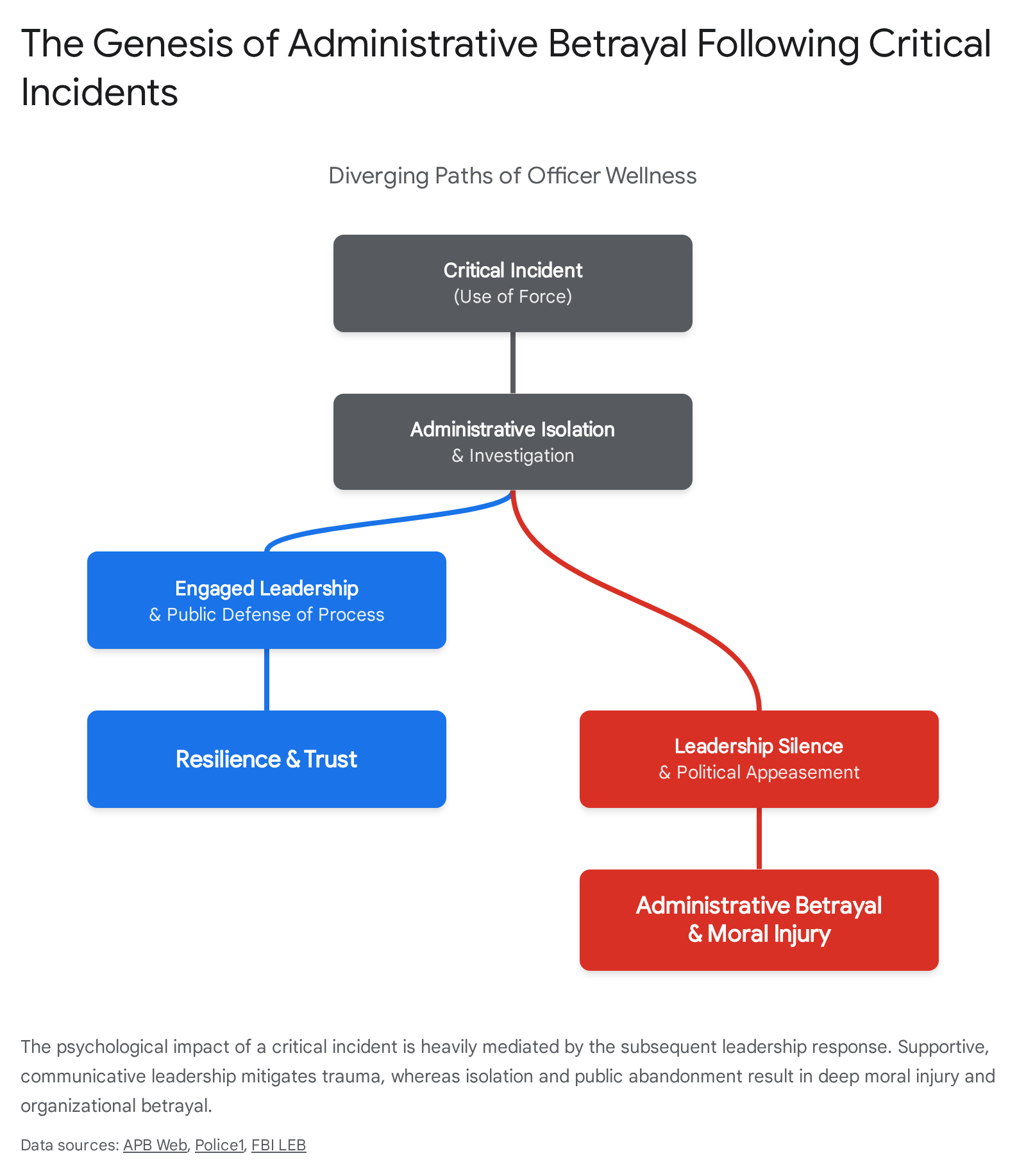
The fear of administrative reprisal is intimately linked to a deeper, more insidious psychological trauma currently ravaging the law enforcement profession: Organizational Betrayal. This concept represents the profound emotional and psychological devastation that occurs when an officer perceives that their agency’s leadership—the very institution that demanded their sacrifice—has abandoned them during their greatest time of need.2

Defining Organizational and Administrative Betrayal

Introduced to the psychological lexicon by researcher Jennifer Freyd, “organizational betrayal” (frequently referred to interchangeably as institutional betrayal) describes the specific wrongdoings committed by an institution against the individuals who rely upon it for support, safety, and operational backing.2 In the specific context of law enforcement, this phenomenon is often termed “administrative betrayal,” representing both deliberate acts of commission and cowardly acts of omission by superior officers, particularly the Chief Executive or Sheriff.7

While police officers are rigorously trained in the academy to endure critical incidents, extreme violence, and the chaotic, traumatic nature of the street, they are rarely equipped to survive the prolonged internal aftermath of these events.2 Following a lethal-force encounter, an in-custody death, or a highly publicized critical incident, officers are immediately subjected to extreme internal scrutiny, relentless “Monday morning quarterbacking,” and physical isolation pending the outcome of multi-jurisdictional investigations.2 This distance from co-workers and the sudden removal from the camaraderie of the profession when placed on official administrative leave serves to severely compound the trauma of the incident itself.

The Trauma of Leadership Silence

The deepest, most enduring trauma often stems not from the operational hazard or the threat to the officer’s physical life, but from the silence, distancing, or outright hostility of leadership in the immediate aftermath. When a critical incident captures national media attention, the involved officer is legally and administratively gagged, utterly lacking a public voice to defend their actions, provide context, or explain their state of mind.31 In these highly volatile moments, executive leaders are the only viable bridge between the officer and the public narrative.

When leadership courts the press, issues premature condemnations to appease political pressure, or simply remains silent in the face of rampant misinformation, they commit a profound administrative betrayal.31 In many jurisdictions, police officers feel they are subjected to the same hostile treatment and lack of understanding that Vietnam veterans faced upon their return, viewed as guilty by default by segments of the community even in the total absence of evidence.31 This perceived abandonment by command staff shatters the foundational law enforcement ethos of brotherhood, sisterhood, and “having each other’s six”.2 The failure of leaders to assert and hold a firm boundary demanding a fair, just, and impartial process inflicts severe moral injury upon the officer.31

Diagram illustrating the process of a political campaign

The psychological toll of this betrayal is devastating and long-lasting. Officers report that organizational betrayal leads to deep bitterness, suppressed emotions, feelings of profound hopelessness, and an erosion of trust that reverberates far beyond the individual, poisoning the culture of the entire agency.2 This moral fatigue not only accelerates burnout but directly impairs an officer’s ability to engage compassionately and patiently with the public, thereby actively undermining the very procedural justice and community policing initiatives that the executive command claims to champion.32

7. The Silent Killer: Organizational vs. Operational Stress

The cumulative, unmitigated effect of misaligned KPIs, suffocating bureaucracy, tactical hesitation, and the ever-present threat of administrative betrayal culminates in a highly toxic environment that generates massive amounts of organizational stress. While police recruits enter the academy fully expecting to face operational dangers—responding to violent incidents, navigating high-speed pursuits, managing traumatic crime scenes, and dealing with human suffering—they are wholly unprepared for the crushing stress originating from within the agency itself.33

The Dominance of Organizational Stressors

Extensive, longitudinal research conducted by experts in police psychology, such as Dr. Karen Amendola at the National Policing Institute, highlights a startling and counter-intuitive reality: organizational stressors have a significantly greater negative impact on officer health, daily performance, and long-term well-being than the operational dangers inherent to the street.33

Operational stress is generally episodic, predictable in its unpredictability, and somewhat mitigated by intense tactical training, specialized equipment, and peer support networks. When an officer survives a shootout, the trauma is acknowledged, understood, and treated. Conversely, organizational stress is insidious, ongoing, systemic, and cumulative.33 It stems from factors largely within the direct control of law enforcement leaders, yet it is rarely acknowledged or treated with the same urgency as physical trauma.

To understand the disparity, it is crucial to delineate the core components of organizational stress as identified by researchers 33:

Stressor CategoryManifestation in the Law Enforcement EnvironmentImpact on Officer Wellness
Toxic Culture & Internal PoliticsFavoritism in promotions, punitive leadership styles, and an environment that fosters mistrust and backstabbing over collaboration.2Erodes unit cohesion, destroys trust in the chain of command, and generates chronic anxiety regarding career stability.
Ineffective SupervisionA lack of clear guidance, inconsistent application of discipline (e.g., punishing one officer while ignoring another for the same infraction), or unfair treatment.33Breeds deep resentment, cynicism, and a feeling that the system is fundamentally rigged against the frontline worker.
Policy InstabilityConstantly changing, reactive policies imposed from the top down without frontline input, practical consideration, or adequate training.5Creates “gotcha” environments where officers feel it is impossible to comply with contradictory or poorly communicated directives.
Workforce ManagementMandatory overtime, extended shifts causing extreme fatigue, and arbitrary shift or unit reassignments made without officer input or consideration for family life.33Destroys work-life balance, leads to sleep deprivation, increases the likelihood of critical errors in the field, and strains marriages.

Because these stressors are generated by the organization itself, officers often feel completely powerless to combat them. They cannot arrest a bad policy, nor can they tactically de-escalate a toxic captain. This profound lack of control, compounded by the failure of executive leaders to acknowledge or address these internal hazards (often because the leaders themselves are the source of the stress), leads to severe psychological distress, sleep disturbances, cardiovascular issues, and eventual burnout.34 Decades of empirical data confirm that poor supervision, lack of recognition, and internal friction destroy police careers far more effectively and consistently than violent encounters on the street.33

8. The 2026 Retention Crisis: Analyzing the Hemorrhage

The convergence of these systemic failures—the cultural schism, misaligned metrics, administrative overload, tactical hesitation, moral injury, and chronic organizational stress—has precipitated a historic and potentially irreversible retention and recruitment crisis in 2026. The pipeline of new applicants remains critically strained due to generational shifts in career preferences, a strong labor market in other sectors, and a perpetually hostile socio-political climate surrounding policing.1 The nationwide impact is staggering: from 2020 to 2025, the number of police officers across the nation dropped by 5.2 percent, with smaller agencies (fewer than 50 officers) seeing a 60 percent rise in resignations compared to 2019. However, while recruitment is a challenge, the far more pressing operational threat is the sheer inability to retain experienced, seasoned officers.

The Illusion of Financial Motivation

It is a common, comforting misconception among municipal leaders, city managers, and even some police executives that officers are leaving the profession primarily for better financial compensation or sign-on bonuses in neighboring jurisdictions. While competitive pay and benefits are always relevant factors, deep qualitative data indicates a remarkably different reality: officers are leaving because of poor leadership, lack of support, and toxic organizational climates.3 Officers who desire a positive workplace culture where they feel valued, supported, and heard will actively seek employment in other agencies, or abandon the law enforcement profession entirely, to escape the pervasive sense of hopelessness generated by executive disconnect and administrative betrayal.3 They are not fleeing the danger of the job; they are fleeing their own command staff.

The Catastrophic “Brain Drain” Phenomenon

According to a comprehensive late 2024 survey conducted by the International Association of Chiefs of Police (IACP), which encompassed 1,158 agencies nationwide, the demographic reality is stark. Nearly 18% of commissioned personnel were eligible for immediate retirement, with projections indicating a rise to a staggering 24% by early 2025.46 This mass exodus represents a catastrophic “brain drain” of vital institutional knowledge.

Departments are rapidly losing the veteran officers who serve as the true cultural compass of the agency. These are the officers who act as informal leaders, mentor raw junior personnel, possess the emotional intelligence to navigate complex high-stakes incidents without resorting to force, and hold deep, irreplaceable, decades-long relationships with community members.1 As these veterans leave, those who remain are stretched far beyond their physical and mental limits to cover the staffing gaps, creating a vicious, self-perpetuating cycle of fatigue, mandatory overtime, and further resignations.1 The loss of these veterans cannot be replaced by simply pushing more recruits through a 19-week academy.36

The Autopsy vs. Preventative Medicine: Exit and Stay Interviews

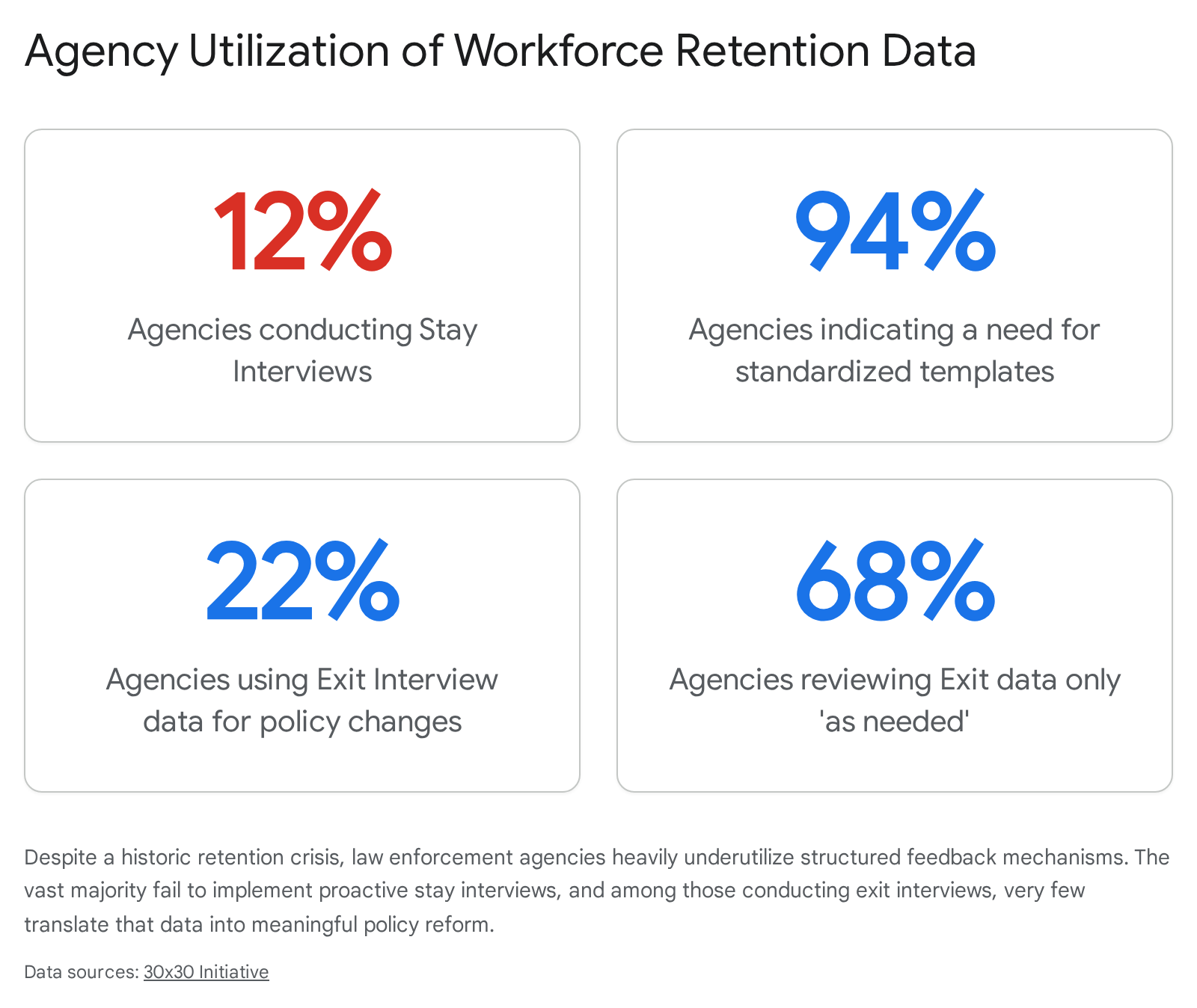
Despite the severity of the turnover crisis, law enforcement agencies remain remarkably reactive rather than proactive in their workforce management strategies. They are attempting to treat a hemorrhage with a post-mortem exam. Research from the 30×30 Initiative reveals profound, systemic deficiencies in how police agencies gather and utilize employee retention data.37

Agencies generally rely on exit interviews to understand why personnel are leaving. However, exit interviews act merely as organizational autopsies—they only tell you why the patient died, they do not save the patient. The data indicates that only 22% of agencies actually use exit interview data to inform concrete policy changes, and 57% of respondents were unsure if the interviews ever led to any actionable improvements whatsoever.37 Most concerningly, 71% of agencies that fail to conduct exit interviews cite a simple lack of standardized tools or procedures as the primary barrier, indicating a massive failure of HR infrastructure within policing.37

Conversely, “stay interviews”—structured, proactive conversations with current, high-performing employees to understand why they continue to serve and what specific factors could be improved—act as preventative medicine.38 They provide proactive insights into organizational culture, satisfaction with command staff, and potential flight risks long before the officer decides to resign.39 Yet, the adoption rate of this crucial, low-cost tool is alarmingly low across the profession.

Graphic showing the percentage of law enforcement officers

To fully grasp the magnitude of this failure in workforce intelligence gathering, consider the specific findings from the 30×30 Initiative regarding agency practices 37:

Metric / PracticeExit Interviews (Reactive)Stay Interviews (Proactive)Implication for Agency Command
Overall PrevalenceWidely assumed standard, yet 71% of non-participating agencies lack tools to execute them.Only 12% of agencies conduct them.Command is almost entirely blind to the motivations of their current workforce.
Data UtilizationOnly 22% use data for policy changes; 68% review data only “as needed.”47% of the few agencies conducting them use the data to inform practices.Even when data on toxic leadership is collected, executive command rarely acts upon it to enact systemic change.
Core Topics CoveredReasons for leaving, grievances.Perceptions of culture (79%), satisfaction with leadership (68%).Stay interviews directly target the command disconnect, yet are ignored by 88% of the profession.

By failing to engage in open, structured dialogue with the personnel who have not yet left, executives remain willfully blind to the internal friction driving the exodus.41 They continue to manage based on assumptions rather than data, further alienating the Street Cop Culture.

9. Strategic Imperatives: Bridging the Disconnect in 2026

The survival, efficacy, and legitimacy of law enforcement agencies in the coming decade depend entirely on the willingness of executive command to acknowledge their own complicity in the current crisis and systematically dismantle the barriers separating the Management Cop from the Street Cop. Addressing this crisis requires a fundamental paradigm shift away from bureaucracy, risk-aversion, and compliance-driven metrics toward engaged, emotionally intelligent leadership and the restoration of organizational trust.24

Redefining Leadership, Accountability, and Emotional Intelligence

Executives must fundamentally redefine what effective leadership looks like within their ranks, moving away from the authoritarian models of the past. Accountability and morale are not diametrically opposed concepts requiring a trade-off; they are deeply interconnected partners in organizational health.42 When leadership leans too heavily on punitive discipline without providing context, training, or support, it breeds resentment and tactical hesitation. Conversely, when standards slip in an attempt to buy cheap morale, organizational integrity fails. Effective supervisors utilize accountability to build structure and psychological safety, shifting their paradigm from post-incident criticism to proactive, pre-incident coaching.42

To achieve this, agencies must prioritize the rigorous assessment and continuous development of Emotional Intelligence (EQ) in their command staff and promotional candidates. The difference between adequate, bureaucratic managers and transformational, effective leaders lies precisely in their capacity to demonstrate self-awareness, regulate emotional responses, and handle complex interpersonal relationships judiciously and empathetically.24 Leaders must be trained not just in tactical deployment, ICS command, or budget management, but in the highly nuanced psychological realities of managing human beings who are operating under chronic, severe stress.

Dismantling the Administrative Anchor

To restore the vital, stabilizing presence of first-line supervisors in the field, executives must ruthlessly audit and eliminate non-essential administrative burdens. The primary operational goal must be to create supervisors who have the bandwidth to manage people, not just process paperwork.19

This requires aggressive technological and procedural innovation. If BWC auditing is consuming massive amounts of supervisory time, agencies must invest in AI-driven redaction technologies, permanently delegate administrative review to civilian professional staff, or fundamentally revise review thresholds to require manual supervisory auditing only for critical incidents, flagged encounters, or specific training interventions.22 Freeing the Sergeant from the desk is the first non-negotiable step in re-establishing a visible, supportive command presence on the street that officers can actually see and interact with.

Confronting Organizational Betrayal with Trauma-Informed Leadership

To mitigate the devastating effects of organizational betrayal and moral injury, agencies must adopt trauma-informed leadership practices. This begins with how an agency communicates during a crisis. Executive leaders must have the courage to stand as a buffer between their officers and the immediate rush to public judgment.31

While leaders absolutely cannot pre-judge an ongoing investigation or cover up genuine misconduct, they must publicly assert and vigorously defend a boundary that demands a fair, impartial, and evidence-based process for the involved officer, refusing to sacrifice their personnel for cheap political capital.31 Furthermore, internal administrative policies must be comprehensively reviewed to ensure that the necessary isolation of an officer post-incident is handled with profound psychological care. Officers must be provided with immediate, confidential access to culturally competent mental health professionals and vetted peer support teams, rather than being treated immediately as a criminal liability to the city.2 Clinical care following a critical incident must be biologically grounded and administered by providers who intimately understand the unique ethos, traditions, and risks of the law enforcement profession.44 Some agencies are finding success in utilizing trauma-informed chaplains to address the specific moral injuries resulting from these incidents.32

Institutionalizing Proactive Workforce Engagement

Finally, agencies must institutionalize continuous, structured, and protected feedback mechanisms. The implementation of Stay Interviews must transition from a niche HR concept to a standard operational procedure mandated by the Chief Executive.40 To be effective, agencies must ensure these sessions are conducted in a psychologically safe space, potentially utilizing independent officers with similar experiences to foster authentic dialogue without the fear of retaliation or judgment.40 By systematically identifying and actively solving the organizational stressors that drive burnout—whether that is a toxic middle manager, a cumbersome and redundant reporting system, or an unpredictable scheduling matrix that destroys family life—leadership demonstrates that they are not just listening, but acting.2

Furthermore, frontline officers must be given a legitimate seat at the table when creating new operational policies. The era of the ivory tower policy is over. Ensuring that the personnel who actually execute the directives on the street have direct input into their creation bridges the cultural gap, reveals unintended consequences before implementation, and signals a profound level of professional respect.5 Getting closest to the problem means empowering the people closest to the problem.

10. Conclusion

The severe, systemic disconnect between police executive command and frontline patrol operations in 2026 is not a mere failure of internal communication; it is a profound structural, cultural, and psychological crisis that threatens the very viability of the law enforcement profession in the United States. The historical divide between the Street Cop and the Management Cop, identified by Reuss-Ianni over forty years ago, has been inadvertently weaponized by a modern policing environment obsessed with misaligned statistical metrics, suffocating administrative requirements, and a defensive, risk-averse posture that routinely sacrifices frontline support for political expediency.

When the Management Cop Culture isolates itself completely from the gritty, unpredictable realities of the street, the result is exactly what the profession is currently experiencing: a workforce paralyzed by conditioned hesitation, devastated by organizational betrayal, and crushed by entirely preventable internal organizational stress. The ensuing retention crisis cannot be bought off with sign-on bonuses, relaxed grooming standards, or marginally elevated pay scales. It can only be resolved through a radical, uncompromising recommitment to authentic, courageous leadership.

Law enforcement executives must step out from behind the veil of data dashboards, endless Zoom meetings, and digital directives to re-engage with the human element of policing. By dismantling administrative anchors, aligning performance metrics with holistic public safety outcomes rather than arbitrary quotas, and acting as steadfast, vocal advocates for their personnel during crises, command staff can begin the arduous process of repairing shattered trust. Bridging this disconnect is no longer an aspirational goal for modern police administration; it is the absolute, non-negotiable prerequisite for organizational survival in the latter half of this decade.


Please share this post with colleagues, on forums, etc. Your support is much appreciated, and if you have any feedback, please email us in**@*********ps.com. If you’d like to request a report or order a reprint, please click here for the corresponding page to open in new tab.


Sources Used

  1. Six Trends to Watch in American Policing in 2026, accessed June 25, 2026, https://www.policinginstitute.org/infocus/six-trends-to-watch-in-american-policing-in-2026/
  2. Betrayed from within – American Police Beat Magazine, accessed June 25, 2026, https://apbweb.com/2025/11/betrayed-from-within/
  3. Cops aren’t leaving law enforcement for money — they’re leaving because of poor leadership – Police1, accessed June 25, 2026, https://www.police1.com/chiefs-sheriffs/cops-arent-leaving-law-enforcement-for-money-theyre-leaving-because-of-poor-leadership
  4. The Thin Blue Line: Confronting Contemporary Leadership Challenges – McAfee Institute, accessed June 25, 2026, https://www.mcafeeinstitute.com/blog/modern-leadership-challenges-in-law-enforcement
  5. Understanding the Disconnect Between Police Leaders and Frontline Officers – PA Times, accessed June 25, 2026, https://patimes.org/understanding-the-disconnect-between-police-leaders-and-frontline-officers/
  6. Combating Conditioned Hesitation – Office of Justice Programs, accessed June 25, 2026, https://www.ojp.gov/ncjrs/virtual-library/abstracts/combating-conditioned-hesitation
  7. Betrayal: The Hidden Driver of PTSD for Cops – Psychology Today, accessed June 25, 2026, https://www.psychologytoday.com/us/blog/cop-doc/201806/betrayal-the-hidden-driver-of-ptsd-for-cops
  8. Policing the pandemic: Frontline officers’ perspectives on organisational justice – PMC, accessed June 25, 2026, https://pmc.ncbi.nlm.nih.gov/articles/PMC9629051/
  9. Crisis point: A wake-up call for police leaders on officers’ mental health and wellness, accessed June 25, 2026, https://www.police1.com/what-cops-want/crisis-point-a-wake-up-call-for-police-leaders-on-officers-mental-health-and-wellness
  10. Two Cultures of Policing: Street Cops and Management Cops – 1st Editio – Routledge, accessed June 25, 2026, https://www.routledge.com/Two-Cultures-of-Policing-Street-Cops-and-Management-Cops/Reuss-Ianni/p/book/9781560006541
  11. Taking stock: Toward a richer understanding of police culture, accessed June 25, 2026, https://static.spokanecity.org/documents/bcc/committees/police-leadership-advisory-committee/resources/paolini-review-of-police-culture.pdf
  12. response pieces to global impunity how police culture shapes use of lethal force – Digital Commons @ Georgia Law, accessed June 25, 2026, https://digitalcommons.law.uga.edu/cgi/viewcontent.cgi?article=2509&context=gjicl
  13. The general intervention model of policing: a narrative review of the literature – PMC, accessed June 25, 2026, https://pmc.ncbi.nlm.nih.gov/articles/PMC12320052/
  14. Two Cultures of Policing: Street Cops and Management Cops|Paperback – Barnes & Noble, accessed June 25, 2026, https://www.barnesandnoble.com/w/two-cultures-of-policing-elizabeth-reuss-ianni/1111371784
  15. Compstat and Community Policing: Are They Compatible? – COPS Office, accessed June 25, 2026, https://cops.usdoj.gov/pdf/workshops/thursday/WillisMastrofski.pdf
  16. What is Goodhart’s Law? – Splunk, accessed June 25, 2026, https://www.splunk.com/en_us/blog/learn/goodharts-law.html
  17. Avoid the Pitfalls of Goodhart’s Law: How ACT Aligns KPIs for Success, accessed June 25, 2026, https://www.acttoday.com/blog/goodharts-law-kpi-alignment-success/
  18. The use of metrics management systems in U.S. policing (such as CompStat) leads to increases in minor arrests, no decreases in serious crime, and substantial data manipulation (police reclassify serious crimes so they do not get counted). – Reddit, accessed June 25, 2026, https://www.reddit.com/r/science/comments/q26v07/the_use_of_metrics_management_systems_in_us/
  19. Lexipol Connect 2025: The frontline factor in law enforcement leadership – Police1, accessed June 25, 2026, https://www.police1.com/leadership/intel-brief-the-frontline-factor
  20. Revaluing management work in leadership: the frontline supervisor perspective | Policing: An International Journal – Emerald Insight, accessed June 25, 2026, https://www.emerald.com/pijpsm/article/48/4/716/1255418/Revaluing-management-work-in-leadership-the
  21. Police Officer Body-Worn Cameras: Assessing the Evidence – Agency Portal, accessed June 25, 2026, https://portal.cops.usdoj.gov/resourcecenter/content.ashx/cops-p289-pub.pdf
  22. Cost and Benefits Of Body-Worn Camera Deployments – Police Executive Research Forum (PERF), accessed June 25, 2026, https://www.policeforum.org/assets/BWCCostBenefit.pdf
  23. With Body Worn Cameras, NOPD is Improving Officer Transparency, Accountability, accessed June 25, 2026, https://nopdnews.com/post/april-2016/our-beat-with-body-worn-cameras,-nopd-is-improvin/
  24. Leadership Spotlight: Redefining Leadership Presence | FBI: Law Enforcement Bulletin, accessed June 25, 2026, https://leb.fbi.gov/spotlights/leadership-spotlight-redefining-leadership-presence
  25. How Police Departments Can Boost Officer Morale and Retention – CityGov, accessed June 25, 2026, https://www.citygov.com/article/how-police-departments-can-boost-officer-morale-and-retention
  26. Belligerent Targeting and the Invalidity of a Least Harmful Means Rule, accessed June 25, 2026, https://digital-commons.usnwc.edu/cgi/viewcontent.cgi?article=1023&context=ils
  27. Combating Conditioned Hesitation – Police Magazine, accessed June 25, 2026, https://www.policemag.com/articles/combating-conditioned-hesitation
  28. Deadly hesitancy: A three-pronged approach to resolving this officer safety issue – Police1, accessed June 25, 2026, https://www.police1.com/police-training/articles/deadly-hesitancy-a-three-pronged-approach-to-resolving-this-officer-safety-issue-ifnV1vMrbKQAeFPN/
  29. Modern Force Tactics for Safer Policing – UOF – Police Chief Magazine, accessed June 25, 2026, https://www.policechiefmagazine.org/modern-force-tactics-safer-policing/
  30. Guiding Principles On Use of Force – Police Executive Research Forum (PERF), accessed June 25, 2026, https://www.policeforum.org/assets/30%20guiding%20principles.pdf
  31. Administrative betrayal: Why the silence of leaders is the greatest trauma for many LEOs, accessed June 25, 2026, https://www.police1.com/what-cops-want/administrative-betrayal-why-the-silence-of-leaders-is-the-greatest-trauma-for-many-leos
  32. Officer Wellness Spotlight: Addressing Moral Injury Using Trauma …, accessed June 25, 2026, https://leb.fbi.gov/spotlights/officer-wellness-spotlight-addressing-moral-injury-using-trauma-informed-chaplains
  33. Harmful Organizational Stress in Policing: Can It Be Prevented or …, accessed June 25, 2026, https://www.policinginstitute.org/onpolicing/harmful-organizational-stress-in-policing-can-it-be-prevented-or-reduced/
  34. Organizational Stress and Officer Wellness – Justice Clearinghouse, accessed June 25, 2026, https://www.justiceclearinghouse.com/resource/organizational-stress-and-officer-wellness/
  35. Adverse Impacts of Organizational Stress on Officer Health and Wellness: Causes, Correlates, and Mitigation – National Policing Institute, accessed June 25, 2026, https://www.policinginstitute.org/projects/adverse-impacts-of-organizational-stress-on-officer-health-and-wellness-causes-correlates-and-mitigation/
  36. Full article: Explaining police officer intentions to leave their career field – Taylor & Francis, accessed June 25, 2026, https://www.tandfonline.com/doi/full/10.1080/0735648X.2025.2475182
  37. Stay & Exit Interview Survey Findings -30×30 Agencies, accessed June 25, 2026, https://30x30initiative.org/wp-content/uploads/2025/02/30×30-Exit-Stay-Interview-Findings_RETAINS_Feb-2025.pdf
  38. Recruitment and Retention Challenges for Pennsylvania Police, Corrections, and Prosecutors – JOINT STATE GOVERNMENT COMMISSION, accessed June 25, 2026, https://jsg.legis.state.pa.us/resources/documents/ftp/publications/2026-06-23%20Final%20Report%20(SR94)%20Recruitment%20and%20Retention%20of%20Law%20Enforcement%206.23.26.pdf
  39. Using Stay Interviews to Spot Red Flags and Boost Retention – SHRM, accessed June 25, 2026, https://www.shrm.org/topics-tools/flagships/hr-daily/using-stay-interviews-to-spot-red-flags-and-boost-retention
  40. Stay interviews for staff and officer retention | College of Policing, accessed June 25, 2026, https://www.college.police.uk/support-forces/practices/stay-interviews-staff-and-officer-retention
  41. Addressing police turnover: Challenges, strategies, and future research directions, accessed June 25, 2026, https://www.rti.org/rti-press-publication/addressing-police-turnover-challenges-strategies-future-research-directions
  42. Balancing Accountability and Morale in Policing – Command Presence Training, accessed June 25, 2026, https://www.commandpresence.net/blogs/police-leadership-accountability-and-morale
  43. Free Online Documents – Police Executive Research Forum (PERF), accessed June 25, 2026, https://www.policeforum.org/free-online-documents
  44. Behind the Badge – Peace Officers Research Association of California, accessed June 25, 2026, https://porac.org/article/behind-the-badge/
  45. Building a Diverse Workforce in Law Enforcement – National Policing Institute, accessed June 25, 2026, https://www.policinginstitute.org/onpolicing/building-a-diverse-workforce-in-law-enforcement/
  46. The State of Police Recruitment and Retention: A Continuing Concern – Lexipol, accessed June 25, 2026, https://www.lexipol.com/resources/blog/the-state-of-police-recruitment-and-retention-a-continuing-concern/

The 1997 North Hollywood Shootout: A Tactical and Strategic Analysis

1. Executive Summary

On February 28, 1997, the operational protocols of American municipal law enforcement encountered a severe structural stress test during an event that fundamentally altered modern policing doctrines. Over the course of a 44-minute engagement in the North Hollywood neighborhood of Los Angeles, California, two heavily armed and armored perpetrators confronted the Los Angeles Police Department (LAPD).1 The incident, commonly referred to as the North Hollywood Shootout, originated as an armed robbery at a Bank of America branch and rapidly devolved into a high-intensity urban firefight.1 By the conclusion of the confrontation, the combatants had exchanged approximately 2,000 rounds of ammunition, averaging an anomalous rate of one discharged round every two seconds.1

The engagement resulted in twenty casualties, including twelve sworn police officers and eight civilians, alongside the fatalities of both perpetrators.1 The tactical anomaly of the event was not merely the duration of the firefight, but the stark asymmetry in ballistic capabilities and protective equipment between the suspects and the responding law enforcement personnel.2 Responding patrol officers, equipped under the prevailing law enforcement doctrines of the late twentieth century, carried 9mm semi-automatic pistols,.38 Special revolvers, and 12-gauge pump-action shotguns.2 They found themselves entirely outranged and outgunned by adversaries wielding illegally modified, fully automatic assault rifles chambered in high-velocity calibers, supported by high-capacity drum magazines and armor-piercing ammunition.1

Furthermore, the suspects utilized extensive, custom-fabricated body armor that successfully neutralized standard police small arms fire, granting the perpetrators relative tactical superiority and severely suppressing the initial law enforcement response.2 The failure of standard pistol rounds to penetrate the suspects’ defenses forced LAPD officers to employ unconventional tactical solutions, including the battlefield requisition of civilian firearms from a local dealer and the commandeering of an armored transport vehicle for medical evacuations.5

This report provides an analytical review of the North Hollywood Shootout. It examines the historical antecedents of the perpetrators, detailing their operational methodology and tactical planning. The analysis provides a chronological breakdown of the incident, mapping the failure of traditional perimeter containment doctrines and the subsequent battle of attrition. It further investigates the casualty profile, the emergency medical extraction protocols employed under hostile fire, and the complex legal proceedings that followed. Ultimately, this report outlines the profound doctrinal shifts catalyzed by the event, most notably the universal adoption of the semi-automatic patrol rifle, the evolution of active shooter response protocols, and the acceleration of law enforcement militarization through federal surplus initiatives such as the Department of Defense 1033 Program.2

2. Historical Antecedents and Suspect Profiles

Understanding the tactical severity of the North Hollywood Shootout requires a detailed examination of the suspects’ operational history. The event was not a spontaneous act of violence but the culmination of years of escalating criminal activity, meticulous logistical preparation, and a demonstrated reliance on kinetic force.

2.1 The Criminal Trajectory of the “High Incident Bandits”

The perpetrators, Larry Eugene Phillips Jr., 26, and Decebal Ștefan Emilian “Emil” Mătăsăreanu, 30, operated as a highly coordinated criminal partnership.9 Mătăsăreanu, a 283-pound native of Romania who had previously suffered traumatic brain injuries resulting in seizures, and Phillips, characterized by investigators as the primary tactical planner, bonded over a shared interest in weightlifting and high-powered weaponry.2 Law enforcement analysts and investigators had previously classified the pair as the “High Incident Bandits” due to the extreme weaponry, aggressive entry tactics, and body armor utilized in their preceding operations.1 Furthermore, investigators later noted the suspects maintained a strong fixation on the 1995 action film Heat, which features a prolonged, heavy-caliber shootout between bank robbers and law enforcement in Los Angeles.

The suspects’ progression toward the 1997 shootout is marked by several key encounters with law enforcement. In October 1993, the pair was arrested following a traffic stop in Glendale, California, during which officers discovered a significant cache of semi-automatic rifles, handguns, thousands of rounds of ammunition, and body armor in their vehicle.1 Following their release, a significant portion of their seized property was returned to them, with the exception of the confiscated firearms and explosive materials.1

This legal setback did not deter their operations. On June 14, 1995, Phillips and Mătăsăreanu executed a highly violent ambush on a Brink’s armored transport vehicle in Winnetka, California.1 During this tactical ambush, they utilized assault rifles to overpower the transport crew, resulting in the murder of guard Herman Cook and the severe wounding of another guard.1 The success of this operation emboldened the pair. In May 1996, they executed simultaneous or rapid-succession armed robberies of two Bank of America branches in the San Fernando Valley region of Los Angeles, exfiltrating with approximately $1.5 million in stolen currency.1 These prior operations provided the suspects with the necessary capital and operational confidence to further upgrade their arsenals and refine their tactical execution for future targets.

2.2 Operational Planning and Target Selection

The selection of the Bank of America branch located at 6600 Laurel Canyon Boulevard in North Hollywood was the result of extensive reconnaissance and logistical calculation. The perpetrators specifically targeted the bank on the morning of Friday, February 28, 1997, accurately assessing that the vault would contain upwards of $750,000 to accommodate the localized weekend payroll and cash distribution requirements.2

To optimize their operational window, Phillips and Mătăsăreanu utilized radio frequency scanners to actively monitor LAPD dispatch channels.11 This electronic surveillance allowed them to calculate the expected police response times for a standard “211 in progress” (the California penal code designation for armed robbery) dispatch call.11 Their operational blueprint dictated entering the bank, securing the currency, and exfiltrating the premises before standard municipal patrol units could establish a viable containment perimeter.

However, their primary contingency plan relied on brute-force suppression. If their timeline was disrupted and they were confronted by law enforcement, they intended to utilize overwhelming automatic fire and heavy body armor to break through any police cordon.2 The suspects did not plan for a hostage barricade situation; their strategic intent was purely focused on asset acquisition and mobile exfiltration through the application of superior firepower.

3. The Asymmetry of Armament and Ballistic Profiles

The defining characteristic of the North Hollywood Shootout was the severe asymmetry of force between the combatants. The suspects deployed theater-of-war armament within a civilian urban environment, encountering a municipal police force that was equipped strictly for standard peace-keeping and routine criminal apprehension.

3.1 The Suspect Arsenal and Modifications

The perpetrators transported an arsenal of legally purchased, yet illegally modified, firearms and high-capacity magazines to the target location. Their collective armament consisted of nearly 4,000 rounds of ammunition, a significant portion of which featured steel-core, armor-piercing projectiles specifically designed to defeat vehicle engine blocks and standard law enforcement soft body armor.2

The weapons inventory utilized by the suspects was extensive and highly specialized for sustained combat 1:

PerpetratorPrimary Weapon SystemsSecondary Weapon SystemsAmmunition Feed Devices
Larry Phillips Jr.Norinco Type 56S (modified to full auto)

Norinco Type 56 S1 (modified to full auto)
Heckler & Koch HK91

Beretta 92FS Inox
75 to 100-round drum magazines

30-round box magazines
Emil MătăsăreanuBushmaster XM-15 E2S Dissipator (modified to full auto, M16A1 handguard)

Norinco Type 56
N/A100-round Beta-C dual-drum magazines

30-round box magazines

The suspects illicitly modified the civilian semi-automatic Norinco and Bushmaster rifles to function as fully automatic weapons, bypassing the mechanical sear disconnectors to allow continuous fire.1 Furthermore, the utilization of 75- to 100-round drum magazines and Beta-C dual-drum magazines drastically reduced the necessity to perform manual reloads. This logistical advantage allowed them to maintain a nearly continuous wall of high-volume suppressive fire, effectively neutralizing the standard police tactic of moving or returning fire during a suspect’s reloading sequence.1

3.2 Defensive Systems: Suspect Body Armor

Standard issue police firearms were rendered strategically obsolete by the perpetrators’ defensive preparations. Both men wore roughly 40 pounds of custom-fabricated, heavy body armor.4 They assembled and stitched together multiple layers of cut-up Kevlar, specifically reinforcing the material over their vital organs, torsos, and limbs to create a ballistic shield.2

This commando-style coverage spanned from their necks to their feet, effectively encapsulating them in a ballistic cocoon that standard municipal pistol ammunition simply could not penetrate.4 While the suspects did not wear ballistic helmets—utilizing standard ski masks instead to obscure their identities—their torso and limb armor successfully absorbed hundreds of direct impacts without yielding or degrading to the point of failure.14

3.3 Law Enforcement Weaponry and Range Limitations

In stark contrast to the suspects’ militarized loadout, the LAPD patrol officers arriving on the scene carried standard issue equipment characteristic of late-twentieth-century policing doctrines. The primary sidearms distributed to the patrol force were 9mm semi-automatic pistols, specifically the Beretta 92FS, alongside older.38 Special revolvers.2 Field supervisors and select units had access to 12-gauge pump-action shotguns housed within their patrol vehicles.3

The tactical disparity was most evident in the effective combat range of the respective weapon systems. The effective range of a standard 9mm pistol in a high-stress combat scenario is generally limited to 50 yards.3 A 12-gauge shotgun loaded with standard 00 buckshot or rifled slugs is practically effective up to roughly 100 yards.3 The suspects’ assault rifles, however, maintained an effective combat range of over 300 yards.3 This disparity allowed the perpetrators to dictate the geometry of the engagement, engaging officers well beyond the effective range of the police return fire and creating a localized zone of absolute tactical dominance.

Bar chart showing the number of police officers in

3.4 Terminal Ballistics and Kinetic Reality

The mathematical and physical realities of terminal ballistics dictated the early phases of the shootout. Kinetic energy, a primary determinant of a projectile’s armor-penetrating capability, is a function of both the mass of the bullet and its velocity. A standard 9mm pistol projectile possesses relatively low mass and lower velocity compared to an intermediate rifle cartridge, yielding insufficient kinetic energy to compromise layered Kevlar.4

When officers fired upon Phillips and Mătăsăreanu, the kinetic energy of the 9mm rounds was safely absorbed and dispersed by the suspects’ heavy armor.4 Witnesses and officers on the scene reported observing police bullets physically ricocheting or bouncing off the suspects, who absorbed multiple kinetic impacts without suffering structural skeletal damage, hydrostatic shock, or incapacitation.4

Conversely, the suspects’ 7.62x39mm and 5.56x45mm rifle rounds traveled at velocities easily exceeding 2,300 to 3,000 feet per second. These rounds carried immense kinetic energy, effortlessly penetrating the thin sheet metal of police cruisers, cinderblock walls, residential structures, and the unarmored bodies of the responding officers.3 The failure of law enforcement vehicles to provide adequate ballistic cover exposed officers to lethal secondary fragmentation and direct impacts, rendering traditional police vehicle-based containment tactics entirely ineffective.

4. Chronological Analysis of the Tactical Engagement

The 44-minute engagement can be dissected into distinct tactical phases, illustrating the breakdown of initial police containment protocols, the ensuing battle of attrition, and the eventual re-establishment of law enforcement superiority through the injection of superior hardware and specialized personnel.

4.1 Phase One: Initiation and Loss of the Element of Surprise (09:16 – 09:20)

At approximately 9:16 a.m. PST, Phillips and Mătăsăreanu breached the Bank of America branch.12 To immediately assert control over the civilian occupants and announce their intent, the robbers discharged rounds from their fully automatic rifles into the ceiling of the bank lobby.12

By sheer coincidence, LAPD Officers Loren Farrell and Martin Perello were driving past the bank exactly as the heavily armed men entered the premises.12 Observing the tactical intrusion, the officers immediately broadcast a “211 in progress” code over the police radio network and reported that shots had been fired.12 This rapid identification derailed the suspects’ meticulously calculated timeline. Because the preliminary police perimeter was established prior to their exit from the bank, the perpetrators lost the critical element of surprise.15

The officers’ immediate containment plan, however, was complicated by the deafening sound of continuous automatic gunfire echoing from within the bank structure.15 The volume of fire indicated that standard response protocols would likely be insufficient, prompting a citywide tactical alert that eventually drew over 300 law enforcement officers to the scene.1 Officer John Caprarelli, who had been operating a radar gun monitoring traffic speeds nearby, was among the numerous personnel who abandoned their routine duties to respond to the frantic radio broadcasts.16

4.2 Phase Two: The Breach and Suppression Tactics (09:20 – 09:30)

Upon exiting the bank, Phillips encountered the converging LAPD perimeter. Realizing the scale of the police response and the failure of their exfiltration timeline, a startled Phillips raised his modified AK-47 style assault rifle and sprayed a continuous 180-degree arc of suppressive fire across the parking lot and surrounding intersections.15

This single action dictated the operational tempo for the remainder of the battle. The suspects employed aggressive, sustained automatic fire to “fix” the police officers in place, effectively pinning them behind inadequate cover—such as patrol car doors and trees—that offered visual concealment but minimal to zero ballistic protection against rifle-caliber ammunition.17 The sheer volume and velocity of the fire prevented the officers from executing any coordinated tactical movements or flanking maneuvers. During this phase, numerous officers and civilians sustained gunshot wounds from armor-piercing rounds tearing through the urban environment.1 The suspects maintained a calm, methodical demeanor, slowly advancing and firing short, controlled bursts or long suppressive strings to keep the police force entirely immobilized.

4.3 Phase Three: The B&B Sales Civilian Re-Armament (09:30 – 09:40)

Recognizing that standard sidearms were completely ineffective against the armored suspects and that the distance of the engagement precluded effective shotgun deployment, the LAPD encountered a critical command crisis. Frustrated and outgunned, field personnel realized they were fighting a militarized force without the requisite tools. In an unprecedented operational deviation, several LAPD officers broke off from the perimeter and drove to a nearby civilian firearms dealer, B&B Gun Sales, located in North Hollywood.2

The officers rushed the commercial storefront, informing the management that they were fighting a heavily armed force resembling an army and desperately required high-powered, patrol-level rifles.3 The store management and employees immediately opened their warehouse inventory to the desperate officers. Employees and officers rapidly loaded half a dozen patrol cars with approximately $8,000 worth of hardware.3

The requisitioned civilian arsenal included six semi-automatic rifles (primarily AR-15 variants), two high-capacity semi-automatic shotguns, and approximately 4,000 rounds of high-velocity ammunition.3 Returning to the scene with these weapons, the officers were finally equipped to return accurate fire at extended ranges, though the simultaneous arrival of LAPD SWAT operators ultimately provided the definitive rifle fire that turned the tide of the battle.1

4.4 Phase Four: SWAT Arrival and Mobile Exfiltration (09:42 – 09:50)

At approximately 9:42 a.m., 18 minutes after the first shots were fired and the situation had devolved into a static battle of attrition, the LAPD Metropolitan Division SWAT team arrived on the scene.1 The team, consisting of elite operators including Donnie Anderson, Steve Gomez, Peter Weireter, and Rick Massa, had been engaged in an exercise run when the tactical alert was issued.1 Foregoing the time required to fully dress in tactical uniforms, the operators responded directly in their running shoes and physical training shorts, donning their heavy ballistic armor plates directly over their athletic wear.1 Armed with standard-issue, specialized AR-15s, SWAT integrated into the chaotic perimeter, bringing highly disciplined, accurate, armor-penetrating return fire to bear against the suspects.1

Simultaneously, the suspects attempted to break the containment. Mătăsăreanu entered the driver’s seat of their getaway vehicle, slowly maneuvering it out of the bank parking lot.12 Phillips opted to remain on foot, using the moving vehicle as rolling cover while methodically walking alongside it and laying down heavy suppressing fire against the police lines.12

4.5 Phase Five: Culmination and Resolution (09:50 – 10:01)

The tactical coordination between the two suspects faltered as Phillips separated from the vehicle, attempting to engage multiple targets simultaneously. Heavily engaged by SWAT operators and regular patrol officers, Phillips sustained a gunshot wound to the arm.16 He attempted to reposition behind a parked civilian semi-truck to clear a mechanical malfunction in his weapon or to reload.16 Subjected to highly accurate return fire that finally penetrated the unarmored gaps in his protection, Phillips sustained a total of 11 gunshot wounds.1 Surrounded and severely compromised, the engagement for Phillips culminated in a self-inflicted gunshot wound to the chin.1 Simultaneously, an LAPD rifle round struck Phillips, severing his spine.1

Mătăsăreanu continued to drive the heavily damaged getaway car down the street before its tires and engine block were completely disabled by concentrated police fire. Abandoning the immobilized vehicle, he attempted to hijack a passing civilian pickup truck to continue his exfiltration.1 However, SWAT operators quickly closed the distance, utilizing the concept of forced movement to aggressively press the suspect.4 Mătăsăreanu was subjected to intense, concentrated fire targeting the unprotected areas of his lower legs beneath his custom body armor. He sustained 29 gunshot wounds, primarily to his lower extremities, and collapsed onto the pavement.1 Mătăsăreanu succumbed to excessive blood loss at the scene, ending the 44-minute engagement at 10:01 a.m..1

Screenshot of a text description related to the North

5. Casualty Profile and Emergency Medical Extraction

The sheer volume of fire—estimated at a combined 2,000 rounds—created an environment of extreme peril that severely complicated standard emergency medical service (EMS) responses.1 The engagement zone was transformed into a lethal area where movement without heavy ballistic protection resulted in immediate injury.

5.1 Analysis of Personnel Casualties

Despite the devastating firepower deployed by the suspects, the incident concluded without any police or civilian fatalities, a statistical anomaly attributed largely to the perpetrators’ reliance on suppressive rather than aimed fire, and the protective actions of the responding officers. However, twenty individuals suffered varying degrees of traumatic injury.1 For their extraordinary bravery under fire, 18 LAPD officers were subsequently awarded the Medal of Valor and honored by President Bill Clinton.10

Twelve LAPD officers were wounded, sustaining hits from high-velocity rounds or secondary shrapnel generated by bullet impacts on concrete and metal. Sergeant Larry “Dean” Haynes sustained gunshot wounds to the shoulder and legs.1 Officer Martin Whitfield suffered severe, life-threatening injuries, being shot four times across his left arm, right femur, and chest.1 Other wounded officers included Conrado Torrez, James Zboravan, William “John” Krulac, Tracey Angeles, Stuart Guy, Earl Valladares, Ed Brentlinger, William Lantz, John Goodman, David Grimes, and Manuel Valladares.1

Eight civilians were also injured during the crossfire. Individuals such as Mildred Nolte, Juan Villigrana, Javier Orozco, Barry Golding, Tracy Fisher, Michael Horen, Jose Haro, and William Marr sustained injuries ranging from direct gunshot wounds to lacerations from flying glass and concrete fragments.1

The response of the outgunned patrol officers was defined by a commitment to mutual survival. For instance, Officer James Zboravan, who had graduated from the police academy merely two months prior to the incident, utilized his own unarmored body and standard soft ballistic vest to physically shield other officers from the barrage of machine-gun fire.2 Zboravan sustained four gunshot wounds to his lower body during this protective action before managing to leap through an exploding glass doorway to secure cover.1

5.2 Tactical Medical Extraction Under Fire

Standard municipal EMS protocols strictly prohibit unarmed ambulance crews from entering an active “hot zone” where gunfire is ongoing. Because Phillips and Mătăsăreanu possessed weapons capable of shooting through the thin exterior of standard municipal ambulances, paramedics were forced to stage outside the perimeter.8 This protocol left critically wounded officers, such as Officer Whitfield, and civilians trapped and bleeding in the street with no immediate access to trauma care.8

To solve this critical extraction crisis, SWAT officers resorted to improvised armored mobility. The officers commandeered a civilian armored transport vehicle—a reinforced money truck—driven by civilians Hector Quevedo and David Campbell.1 LAPD personnel utilized the heavy ballistic plating of the truck as mobile cover, instructing the drivers to navigate directly into the kill zone. The officers used the vehicle to physically shield the wounded, scoop them from the pavement into the back of the truck, and transport them safely to the medical triage staging areas outside the perimeter.1

6. Legal Proceedings and Ethical Considerations

The aftermath of the shootout triggered a complex legal and ethical debate regarding the duty of care owed by law enforcement to an incapacitated threat following a lethal engagement.

6.1 The Mătăsăreanu Civil Rights Lawsuit

Emil Mătăsăreanu sustained 29 gunshot wounds during his final confrontation with SWAT operators, primarily to the lower extremities, incapacitating him but not killing him instantly.1 He ultimately died from severe physical trauma and excessive blood loss roughly an hour after his initial capture and restraint.1

A civil rights lawsuit was subsequently filed in federal court under 42 U.S.C. § 1983 by Valeria Nicolescu Matasareanu on behalf of Mătăsăreanu’s two young children.9 The lawsuit named the City of Los Angeles, former LAPD Chief Willie Williams, and specific officers present at the scene, including retired Detective James Vojtecky and Officer John Futrell.18 The plaintiffs alleged that the LAPD exhibited deliberate indifference to human life, intentionally delaying the arrival of medical personnel and allowing the suspect to bleed to death in the street as a form of extrajudicial punishment.9

6.2 Legal Defense and Resolution

The defense countered these allegations by focusing on the operational realities of the chaotic scene. They argued that the surrounding neighborhood remained an un-cleared, active combat zone. The area was filled with unexploded ordnance, discarded weapons, and the persistent, unverified threat of a potential third suspect or booby traps.19 Under these conditions, officers argued it was tactically unsound and a violation of protocol to bring unarmed paramedics into the immediate vicinity until the area was definitively secured.19 Officer Zboravan also testified that it took roughly 30 minutes for him and Detective Krulac to receive medical attention, demonstrating that the delay was systemic due to the combat environment, rather than a malicious action directed solely at the suspect.20

The trial, held in 2000, resulted in a deadlocked jury, and the judge subsequently declared a mistrial.19 While the plaintiffs initially intended to retry the case, the lawsuit was eventually dismissed with prejudice later that year, ending the protracted legal battle.

7. Evolution of Tactical Response and Incident Command

The hardware deficiencies exposed during the shootout were matched by equally critical failures in operational philosophy. The North Hollywood Shootout instigated a foundational overhaul of law enforcement tactical psychology, incident command protocols, and standard operating procedures.

7.1 The Shift from Containment to Rapid Deployment

Prior to 1997, standard police training for high-risk, heavily armed encounters was based primarily on the concepts of containment and isolation. Officers were trained to establish a secure perimeter, evacuate civilians, and hold their positions, waiting for specialized SWAT units to arrive, mobilize, and neutralize the threat.21 This protocol was deemed appropriate for traditional hostage barricade situations where time was considered an asset.21

The North Hollywood incident demonstrated that heavily armored, highly aggressive suspects intending to inflict maximum damage would not passively accept containment. Phillips and Mătăsăreanu proved that standard patrol officers could no longer afford to wait; they had to possess the training and capability to “stand and fight” independently during high-intensity firefights.4 Tactical training for patrol personnel transitioned away from static marksmanship toward integrated dynamic movements, emphasizing the “Communicate, Move, Shoot” doctrine.4 This paradigm required officers to utilize covering fire, bounding overwatch, and aggressive forced movement to close the distance and neutralize threats.

This doctrinal pivot served as the immediate precursor to modern Rapid Deployment protocols. While the 1999 Columbine High School massacre is widely cited as the definitive catalyst for active shooter training, the fundamental tactical philosophy—the necessity for swift and immediate intervention by the first responding patrol officers to prevent death or great bodily injury—was birthed in the parking lots of North Hollywood.2

7.2 Historical Lineage and the “7 C’s” of Incident Coordination

The shootout belongs to a historical continuum of localized tragedies that forced systemic changes in policing. It mirrored the lessons of the 1970 Newhall shooting, which revolutionized reality-based training, the 1980 Norco shootout, which first introduced the debate over patrol rifles, and the 1986 Miami FBI shootout, which altered ballistic standards and survival mindsets.13

However, the chaos of the 44-minute engagement in North Hollywood, exacerbated by the simultaneous response of over 300 officers from various jurisdictions, revealed critical specific flaws in interagency communication and command integration.1 Radio frequencies were instantly overwhelmed by the sheer volume of overlapping transmissions, leading to localized command vacuums, confusion, and delayed situational awareness.24

In post-action analyses, law enforcement strategists encapsulated the required structural changes into the “7 C’s” of incident response to ensure better coordination in future mass-casualty events 24:

The 7 C’s of Law Enforcement ResponseStrategic Tactical Application
CommunicationEnsuring clear, unjammed, and continuous information flow via encrypted digital radio systems and prioritized dispatch channels.
CollaborationFacilitating seamless tactical integration across multiple responding municipal, county, and state agencies.
CoordinationSynchronizing the movements of hundreds of autonomous units to prevent friendly fire and crossfire scenarios.
Contingency PlanningTraining for high-impact, low-probability events, such as encountering suspects utilizing heavy body armor or military ordnance.
CommandEstablishing a rigid, easily identifiable incident command structure on the ground amidst chaotic, dynamic engagements.
ControlAsserting physical dominance over the perimeter, the suspect, and the flow of civilian traffic in the engagement zone.
CooperationFostering mutual aid agreements and standardizing active shooter response protocols across geographic boundaries.

These structural frameworks forced police departments nationwide to invest heavily in upgraded, redundant dispatch technologies and standardized incident command systems.24

8. Hardware Modernization and the Rise of the Patrol Rifle

The North Hollywood Shootout is widely recognized by analysts as the definitive conclusion of the “Revolver and Shotgun” era of urban policing.4 The profound vulnerability exhibited by the LAPD on national television served as a catalyst for a sweeping, national overhaul of patrol arsenals.

8.1 The Integration of the AR-15 Platform

Prior to 1997, semi-automatic rifles were strictly the purview of specialized tactical units. The average patrol officer was expected to handle routine crime with a 9mm or.38 caliber sidearm. However, the shootout proved that organized criminals possessed the means and intent to acquire military-grade weapons and body armor, necessitating an equal or superior response capability from first responders.17

In the immediate aftermath, law enforcement agencies initiated massive procurement programs to issue 5.56x45mm (.223 Remington) semi-automatic rifles to standard patrol units.4 The intermediate 5.56mm cartridge was selected for specific ballistic advantages: it possessed the velocity required to penetrate standard soft body armor, extended an officer’s effective engagement range out to 300 yards, and exhibited lower risks of over-penetration through building materials compared to heavy pistol rounds or shotgun slugs.4

8.2 The Evolution of Rifle Ergonomics and Accessories

The integration of the patrol rifle evolved rapidly over the subsequent decades, shifting from rudimentary military surplus designs to highly specialized tactical systems tailored for law enforcement environments.4

  • Carbines over Full-Length Rifles: Early adoptions included standard, fixed-stock 20-inch barrel rifles (such as the M16 style). These were quickly abandoned in favor of the M4-style carbine configuration, utilizing 16-inch barrels with adjustable stocks. The carbine format proved significantly more viable for rapid deployment from the cramped confines of a patrol car and for Close Quarters Battle within indoor environments.4
  • Optics and Sighting Systems: Initially equipped with standard iron sights mounted on carrying handles, modern patrol rifles transitioned heavily to electronic, red-dot optic systems. These sighting devices allow for vastly superior target acquisition speed in dynamic, low-light, and high-stress scenarios. Standard backup iron sights are maintained concurrently for mechanical redundancy.4
  • Modularity and Rails: Standard two-piece plastic handguards were replaced with modular quad rails and Picatinny systems. These structural additions allow officers to equip mission-critical accessories such as high-lumen weapon lights, vertical foregrips, and advanced tactical sling mounts.4
  • Operating Systems: To increase reliability under harsh field conditions, many departments adopted piston-driven AR systems, which redirect carbon fouling and hot gases away from the receiver chamber, ensuring cleaner operation compared to traditional direct gas impingement systems.4

8.3 Secondary Armament and Vehicle Armor Upgrades

The demand for superior stopping power extended beyond long guns. Four days after the shootout, the Los Angeles Board of Police Commissioners authorized immediate field testing for larger-caliber.45 ACP semi-automatic pistols to replace or supplement the standard 9mm platforms.4

Furthermore, recognizing the extreme vulnerability of patrol vehicles, which offered zero ballistic protection against rifle fire and failed to provide adequate cover for pinned officers in North Hollywood, police departments began structural retrofitting programs. Agencies initiated the installation of bullet-resistant Kevlar plating directly into the door panels of standard patrol cruisers, transforming them into viable mobile cover platforms.10

Evolution of police patrol manual for tactical analysis

9. Strategic Implications and the Law Enforcement Militarization Debate

While the immediate tactical lessons of the shootout were universally acknowledged within the law enforcement community, the long-term strategic and societal impacts proved vastly more complex. The visual of American police officers outgunned by body-armored criminals on live national television altered the political consensus regarding the arming of domestic police forces.1

9.1 The Pentagon 1033 Program and Rapid Procurement

The most direct and immediate mechanism for upgrading law enforcement firepower without straining municipal budgets was the rapid expansion of the Department of Defense (DoD) 1033 Program. This federal initiative permits the transfer of surplus military equipment to civilian law enforcement agencies.28

In the direct aftermath of the North Hollywood Shootout, the LAPD heavily leveraged the 1033 Program. Under the administration of Chief Willie Williams, the department acquired approximately 1,680 M16 assault rifles from the Pentagon, closing the firepower gap that had been exposed.10 The program also authorized the transfer of heavy armored vehicles with tracks, weaponized platforms, grenade launchers, and high-caliber ammunition to domestic police departments.28

9.2 The Ongoing Societal and Political Debate

The North Hollywood Shootout became the definitive historical reference point used by police administrators to justify the continuous acquisition of Mine-Resistant Ambush Protected (MRAP) vehicles and heavily armored rescue transports.8 Proponents consistently argued that such vehicles were an operational necessity; the inability of unarmed paramedics to reach bleeding officers in North Hollywood definitively proved that standard police cruisers were insufficient for crisis extraction or perimeter establishment against rifle fire.8

However, this rapid, federally subsidized acquisition of military hardware sparked an enduring national debate regarding the militarization of police. Critics and sociologists argued that outfitting domestic police with surplus military gear inherently blurs the critical line between a civilian police force and an occupying military presence.28

Investigations into the 1033 Program later revealed that the system suffered from systemic oversight failures. For instance, the Pentagon continued to approve the transfer of M16 assault rifles to the LAPD even while the department was under the watch of a federal monitor resulting from a Justice Department investigation into civil rights violations.30 Similar situations occurred in jurisdictions like Warren, Ohio, raising concerns about the lack of communication between federal defense suppliers and domestic justice regulators.30 Furthermore, audit reports indicated that numerous police departments lost track of issued military equipment, raising security concerns about fully automatic weapons entering the black market.32 In response to public pressure against militarization, some municipal leaders, such as the mayor of Davis, California, opted to return their acquired MRAPs to the government as a symbolic gesture against the trend.8

Despite these controversies, the operational specter of the North Hollywood Shootout remains a powerful justification for maintaining robust tactical arsenals within domestic policing.8 The enduring fear of encountering another heavily armored, deeply entrenched threat equipped with military-grade hardware continues to drive procurement strategies, training doctrines, and tactical philosophies across the United States.

10. Conclusion

The North Hollywood Shootout stands as a definitive watershed event in the history of American municipal policing. When Larry Phillips Jr. and Emil Mătăsăreanu emerged from the Bank of America clad in custom Kevlar and armed with fully automatic assault rifles, they instantly rendered decades of standard law enforcement doctrine obsolete. The ensuing 44 minutes of chaotic gunfire exposed the fatal limitations of the police revolver and the shotgun, the inadequacy of standard perimeter containment tactics against an aggressive mobile threat, and the deadly consequences of interagency communication bottlenecks.

Yet, the legacy of the shootout is largely defined by rapid, systemic adaptation. The actions of the outgunned officers on Laurel Canyon Boulevard catalyzed the immediate modernization of the police arsenal, directly resulting in the universal adoption of the patrol rifle and the integration of advanced vehicle armor. Furthermore, the incident forced a psychological shift in tactical response, demanding that standard patrol officers possess the training and equipment to act as immediate, aggressive intervention forces rather than passive perimeter guards. The event’s profound impact on modern law enforcement and culture was later dramatized in the 2003 film 44 Minutes: The North Hollywood Shoot-Out 33, and the 18 responding officers were honored with the Medal of Valor by President Bill Clinton.10 While the subsequent militarization of police forces via federal surplus initiatives remains a subject of intense societal debate, the tactical imperatives born from February 28, 1997, are undeniable, ensuring that law enforcement agencies continuously adapt to meet the evolving capabilities of modern criminal threats.


Please share this post with colleagues, on forums, etc. Your support is much appreciated, and if you have any feedback, please email us in**@*********ps.com. If you’d like to request a report or order a reprint, please click here for the corresponding page to open in new tab.


Sources Used

  1. North Hollywood shootout – Wikipedia, accessed June 19, 2026, https://en.wikipedia.org/wiki/North_Hollywood_shootout
  2. How the North Hollywood shootout changed policing – Police1, accessed June 19, 2026, https://www.police1.com/police-products/body-armor/articles/how-the-north-hollywood-shootout-changed-policing-9eDfyRUJOR0FiYNt/
  3. Outmatched Police Made Run To Gun Shop – The Spokesman-Review, accessed June 19, 2026, https://www.spokesman.com/stories/1997/mar/01/outmatched-police-made-run-to-gun-shop/
  4. How the North Hollywood Shootout Changed Patrol Arsenals …, accessed June 19, 2026, https://www.policemag.com/articles/how-the-north-hollywood-shootout-changed-patrol-arsenals
  5. accessed June 19, 2026, https://mtntough.com/blogs/mtntough-blog/lights-camera-gun-fight-the-north-hollywood-shootout-part-ii#:~:text=They%20ran%20to%20B%26B%20Sales,to%20re%2Dengage%20more%20effectively.
  6. Who Ya Gonna Call? Various Types and Applications of Armored Rescue Vehicles, accessed June 19, 2026, https://policeandsecuritynews.com/2019/01/14/who-ya-gonna-call-various-types-and-applications-of-armored-rescue-vehicles/
  7. The 1033 Program and Police Militarization – The Policing Project, accessed June 19, 2026, https://www.policingproject.org/1033
  8. Why police agencies are well served by the 1033 Program – Police1, accessed June 19, 2026, https://www.police1.com/officer-safety/articles/why-police-agencies-are-well-served-by-the-1033-program-RRF7j3XO6xdkf5Zm/
  9. 20 years after the North Hollywood shootout, echoes of the terror remain, accessed June 19, 2026, https://lapd.com/article/20-years-after-north-hollywood-shootout-echoes-terror-remain
  10. Armored Assailants: The North Hollywood Shootout and Killdozer both create millions of dollars of damage | Episode 5, accessed June 19, 2026, https://thesquonkandthehag.com/2022/08/18/ep-5-armored-assailants-the-north-hollywood-shootout-and-killdozer-both-creates-millions-of-dollars-of-damage/
  11. Officers Remember 1997 North Hollywood Shootout – PBS SoCal, accessed June 19, 2026, https://www.pbssocal.org/shows/socal-connected/officers-remember-1997-north-hollywood-shootout
  12. Timeline of Terror: How the infamous North Hollywood shootout unfolded 20 years ago |, accessed June 19, 2026, https://projects.ocregister.com/north-hollywood-shootout/
  13. Questions of Preparedness: A Spring of Tragedy for Law Enforcement, accessed June 19, 2026, https://domesticpreparedness.com/articles/questions-of-preparedness-a-spring-of-tragedy-for-law-enforcement/
  14. Due to the large number of injuries, rounds fired, weapons used, and overall length of the shootout, The North Hollywood Shootout is regarded as one of the most intense gun battles in U.S. police history. : r/wikipedia – Reddit, accessed June 19, 2026, https://www.reddit.com/r/wikipedia/comments/kc2xn9/due_to_the_large_number_of_injuries_rounds_fired/
  15. WHEN GREEN AND BLUE COLLIDE: THE RELATIVE SUPERIORITY THEORY AND LAW ENFORCEMENT INCIDENTS, accessed June 19, 2026, https://www.hsdl.org/c/view?docid=831046
  16. Lights, Camera, Gun Fight: The North Hollywood Shootout – Part 2 – mtntough, accessed June 19, 2026, https://mtntough.com/blogs/mtntough-blog/lights-camera-gun-fight-the-north-hollywood-shootout-part-ii
  17. 1997 shootout revisited – LA Times e-newspaper, accessed June 19, 2026, https://enewspaper.latimes.com/infinity/article_popover_share.aspx?guid=a239c467-8bb6-45cd-a0c1-573bd057fba1
  18. MATASAREANU v. WILLIAMS | No. CV 97-6531-CAS(RC). | C.D. Cal. – CaseMine, accessed June 19, 2026, https://www.casemine.com/judgement/us/59148051add7b04934470e07
  19. Jury Unsure If Cops Let Shooter Die – CBS News, accessed June 19, 2026, https://www.cbsnews.com/news/jury-unsure-if-cops-let-shooter-die/
  20. North Hollywood Shootout: Baptism of Fire – Police Magazine, accessed June 19, 2026, https://www.policemag.com/articles/north-hollywood-shootout-baptism-of-fire
  21. The Police Response to Active Shooter Incidents, accessed June 19, 2026, https://www.policeforum.org/assets/docs/Critical_Issues_Series/the%20police%20response%20to%20active%20shooter%20incidents%202014.pdf
  22. Active Shooter Response & Tactics – Public Intelligence, accessed June 19, 2026, https://info.publicintelligence.net/LAactiveshootertactics.pdf
  23. Learning from the Past | Police Magazine, accessed June 19, 2026, https://www.policemag.com/articles/learning-from-the-past
  24. Remembering the North Hollywood Shootout: A Turning Point in …, accessed June 19, 2026, https://lampkinfoundation.org/white-papers/north-hollywood-shootout-turning-point-policing/
  25. An Evolution – The Birth of the Modern Patrol Rifle – Athlon Outdoors, accessed June 19, 2026, https://athlonoutdoors.com/article/the-evolution-of-the-patrol-rifle/
  26. The Evolution of the American Police Patrol Rifle – UN12Magazine, accessed June 19, 2026, https://un12magazine.com/the-evolution-of-the-american-police-patrol-rifle/
  27. The North Hollywood Shootout (1997) : r/history – Reddit, accessed June 19, 2026, https://www.reddit.com/r/history/comments/1hlqplc/the_north_hollywood_shootout_1997/
  28. Police Militarization in America: A Negative or Positive Trend? – AMU Edge, accessed June 19, 2026, https://amuedge.com/police-militarization-in-america-a-negative-or-positive-trend-2/
  29. Former LAPD Chief Willie L. Williams Dies at 72 NR16139jh – LAPD Online, accessed June 19, 2026, https://www.lapdonline.org/newsroom/former-lapd-chief-willie-l-williams-dies-at-72-nr16139jh/
  30. Pentagon program allows police departments censured for civil rights violations to get military gear | US news | The Guardian, accessed June 19, 2026, https://www.theguardian.com/world/2014/sep/22/pentagon-police-military-gear-civil-rights-justice-department
  31. Law Enforcements Socially Constructed Perception of Violence and its Influence on Police Militarization – DTIC, accessed June 19, 2026, https://apps.dtic.mil/sti/trecms/pdf/AD1008954.pdf
  32. Police Departments Have Lost Military Equipment Issued by Pentagon | The Takeaway, accessed June 19, 2026, https://www.wnycstudios.org/podcasts/takeaway/segments/police-departments-have-lost-equipment-issued-pentagon
  33. 44 Minutes: The North Hollywood Shoot-Out – Wikipedia, accessed June 19, 2026, https://en.wikipedia.org/wiki/44_Minutes:_The_North_Hollywood_Shoot-Out