Category Archives: Small Arms Producer and Vendor Analytics

The State-Controlled Arsenal: An Analysis of Russia’s OPK and its Key Small Arms Enterprises

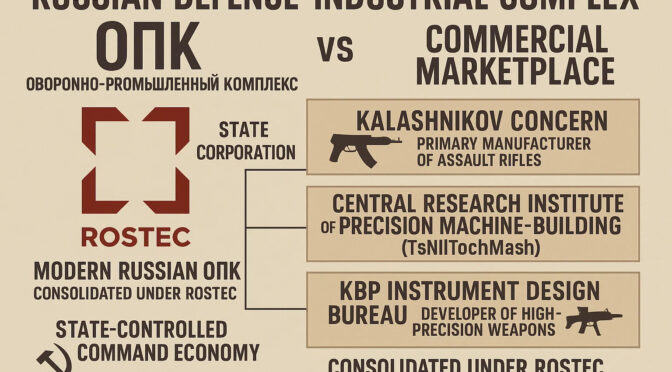
This report provides a detailed analysis of the Russian defense-industrial complex, the Оборонно-промышленный комплекс (ОПК) (Oboronno-promyshlennyy kompleks), or OPK. It contrasts this state-controlled industrial model with the competitive commercial marketplace of the United States, focusing on the central role of the State Corporation Rostec. The analysis delves into the history, structure, and specialization of three pivotal small arms enterprises under the Rostec umbrella: the Kalashnikov Concern, the primary manufacturer of assault rifles; the Central Research Institute of Precision Machine-Building (TsNIITochMash), a key research and development center; and the KBP Instrument Design Bureau, a developer of high-precision weapons.

The modern Russian OPK, consolidated under Rostec, is a direct state-engineered response to the catastrophic industrial collapse that followed the dissolution of the Soviet Union. It utilizes the structure of a modern holding company to achieve the objectives of a state-controlled command economy, prioritizing national security and strategic resilience over market-driven efficiency. This structure reveals a deliberate strategy of functional specialization, separating mass production (Kalashnikov) from advanced R&D (TsNIITochMash) and high-precision systems development (KBP). However, the recent absorption of the premier R&D institute, TsNIITochMash, by the mass-production giant Kalashnikov Concern represents a significant strategic shift, potentially subordinating long-term, revolutionary research to the incremental needs of existing product lines.

The report concludes by extracting four key lessons for the global small arms industry. First, the Russian model highlights the inherent tension between independent design bureaus and mass production plants, a dynamic that can foster innovation but also risks stifling it. Second, the creation of Rostec demonstrates strategic consolidation as a tool of state power to ensure industrial survival, a fundamentally different approach from market-driven consolidation in the West. Third, Russia’s enduring design philosophy—prioritizing reliability and simplicity—enables massive production surges but creates critical vulnerabilities in modernization, particularly given its dependence on foreign high-tech components. Finally, the Russian OPK’s current state presents a critical geopolitical trade-off: it can generate immense quantities of “good enough” military hardware for a war of attrition, but this comes at the cost of qualitative technological stagnation. This dynamic shows that while Russia may be winning the short-term production battle, it risks losing the long-term technology race, a reality with profound implications for the future global balance of military power.

Section 1: The Architecture of State Control: The OPK and Rostec State Corporation

To comprehend the contemporary Russian small arms industry, one must first understand that it does not operate within a competitive commercial marketplace akin to that of the United States. Instead, it is an integral component of a state-controlled system designed as a direct instrument of national power. This system, the Defense-Industrial Complex or OPK, is the product of a tumultuous history, shaped by the legacy of the Soviet command economy, the near-total collapse of the 1990s, and a deliberate, top-down reconsolidation in the 21st century under the state corporation Rostec.

1.1 The Soviet Legacy and Post-Soviet Evolution of the ОПК (OPK)

The foundational concept of the Russian defense industry is the Оборонно-промышленный комплекс (ОПК) (Oboronno-promyshlennyy kompleks), or Defense-Industrial Complex. The OPK is defined as the total aggregation of the nation’s scientific research institutes, testing organizations, and manufacturing enterprises that perform the development, production, storage, and deployment of military and special-purpose technology, ammunition, and materiel.1 Its origins lie in the centrally planned, administrative-command economy of the Soviet Union, a system that fundamentally prioritized military production and heavy industry over all other economic activity.2 Within this framework, vast state-owned enterprises, such as the historic arms factories in Tula and Izhevsk, and specialized design bureaus operated not as independent entities but as cogs in a machine directed by central planning agencies like Gosplan, the State Planning Committee.3

The dissolution of the Soviet Union in 1991 triggered a catastrophic collapse of this immense complex. The OPK was thrown into a “time of troubles,” hobbled by the abrupt cessation of state funding, the severing of deeply integrated supply chains, and rampant corruption.4 A significant portion of the Soviet OPK was located in newly independent states, most critically in Ukraine, which housed vital production centers for everything from tank engines to aircraft carriers.6 This industrial divorce dealt a strategic blow from which the Russian OPK has never fully recovered. Throughout the 1990s, the industry was on the brink of demise, with an estimated 6,000 companies, many of which were unprofitable, requiring continuous government subsidization simply to exist.5

During this period of profound crisis, the OPK found its “saving grace” in foreign exports.4 Key orders from nations like China, India, and Iran provided a lifeline of hard currency that staved off total collapse. This influx of export dollars gave the industry the “breathing space” it needed to survive the decade and claw back a degree of its competitive advantage.4 This experience forged a deep-seated reliance on the export market that continues to shape the strategic calculus of the Russian defense industry today.

The loss of the Ukrainian industrial base, in particular, cannot be overstated. Key strategic assets, including the Malyshev Plant in Kharkiv (a primary tank production center), the Antonov Design Bureau (creator of the world’s largest transport aircraft), and the Mykolaiv shipyards (which built the Soviet Union’s only aircraft carriers, including the Russian Navy’s current flagship, the Admiral Kuznetsov), were suddenly outside of Moscow’s control.6 This event created a permanent “phantom limb” for the Russian OPK. It was not merely a loss of physical capacity but a severing of decades-old research, development, and supply chain relationships. Russia’s subsequent and persistent struggles in sectors like large surface combatants and strategic airlifters can be traced directly to this foundational rupture. The consolidation efforts of the 2000s could patch over some of these deficiencies, but they could not recreate the integrated industrial ecosystem that was lost in 1991.

1.2 Государственная корпорация «Ростех» (Gosudarstvennaya korporatsiya “Rostekh”): The Lynchpin of the Modern OPK

By the mid-2000s, it was clear that market forces and ad-hoc state support were insufficient to reverse the OPK’s decay. In a decisive act of state intervention, the Russian government created a new entity to serve as the lynchpin of a revitalized, state-controlled defense industry. This entity is Rostec.

Established by Federal Law № 270-FZ on November 23, 2007, Rostec was created with the explicit mission to assist in the development, production, and export of high-tech industrial products for both military and civilian purposes.8 Its full official name is Государственная корпорация по содействию разработке, производству и экспорту высокотехнологичной промышленной продукции «Ростех» (Gosudarstvennaya korporatsiya po sodeystviyu razrabotke, proizvodstvu i eksportu vysokotekhnologichnoy promyshlennoy produktsii “Rostekh”), which translates to the State Corporation for the Promotion of the Development, Manufacture and Export of High Technology Products “Rostec”.10

The creation of Rostec was a state-led rescue operation. On July 10, 2008, a presidential decree transferred 443 struggling enterprises to Rostec’s control. The condition of these assets was dire: 30% were in pre-crisis or crisis condition, 28 were in bankruptcy proceedings, 17 had ceased operations entirely, and they faced a collective debt of 630 billion rubles.9 Rostec’s task was to consolidate these disparate and often failing assets, impose structural reforms, and restore them to a state of operational and financial viability.

Today, Rostec is a massive, 100% state-owned industrial conglomerate. It functions as a holding company for approximately 800 enterprises, which are organized into 15 smaller holding companies—eleven in the defense sector and four in civilian industries.11 These enterprises are spread across 60 constituent regions of the Russian Federation and employ roughly 4.5 million people, accounting for a staggering 20% of all manufacturing jobs in Russia.7

While Rostec has a stated mission to diversify the Russian economy and increase the share of civilian products in its portfolio, its core function remains the execution of the state’s military-industrial policy.11 It is the primary vehicle for fulfilling the государственный оборонный заказ (gosudarstvennyy oboronnyy zakaz), or State Defense Order (GOZ). Rostec’s holdings account for almost half of Russia’s total defense procurement, and the corporation traditionally reports a completion rate of nearly 100% for the GOZ.14 This structure is not that of a market participant but of a state ministry operating under the guise of a modern corporation. It is a hybrid model that uses the tools of capitalism—holding companies, branding, and global marketing—to achieve the objectives of a state-controlled command economy.

This central role has made Rostec and its subsidiaries primary targets for international sanctions, particularly since Russia’s annexation of Crimea in 2014 and the full-scale invasion of Ukraine in 2022.10 These sanctions have imposed asset freezes and severely limited access to Western technology, components, and financial markets. In response, the OPK has been forced to adapt through often inefficient import-substitution programs and a reliance on parallel imports of sanctioned goods through third countries.15 This has exposed critical dependencies, particularly on Western-made microelectronics, machine tools, and specialized materials, which has in turn degraded the technological sophistication of its output.16

Section 2: Pillars of Russian Small Arms: Key Enterprises Under the Rostec Umbrella

Within the vast structure of Rostec, the small arms sector is dominated by a handful of historically significant and highly specialized enterprises. These entities are not competitors in a traditional sense; rather, they form a state-managed ecosystem with distinct, complementary roles. The three most prominent pillars are the Kalashnikov Concern, the heart of mass production; TsNIITochMash, the industry’s specialized research and development brain; and the KBP Instrument Design Bureau, the master of high-precision weaponry. Their individual histories, locations, and, most importantly, their intricate relationships within the Rostec hierarchy reveal a deliberate strategy of functional specialization.


Table 1: Overview of Key Russian Small Arms Enterprises

Enterprise Name (Cyrillic, Roman, English)Founding YearPrimary LocationCore SpecializationParent Holding (within Rostec)
Концерн Калашников (Kontsern Kalashnikov), Kalashnikov Concern1807Izhevsk, Udmurt RepublicAssault rifles, combat small arms, mass productionRostec (Direct Control)
ЦНИИТочМаш (TsNIITochMash), Central Research Institute of Precision Machine-Building1944Podolsk (Klimovsk), Moscow OblastAmmunition, special-purpose weapons R&D, testingKalashnikov Concern
КБП им. академика А. Г. Шипунова (KBP im. akademika A. G. Shipunova), KBP Instrument Design Bureau1927Tula, Tula OblastHigh-precision weapons, pistols, ATGMs, air defenseHigh Precision Systems (Высокоточные комплексы)

2.1 Концерн Калашников (Kontsern Kalashnikov): The Heart of Rifle Production

The Kalashnikov Concern is arguably the most recognized brand in the global firearms industry. Its official name is Акционерное общество «Концерн Калашников» (Aktsionernoye obshchestvo “Kontsern Kalashnikov”), or Joint Stock Company “Kalashnikov Concern”.18 Until a major rebranding effort in 2013, it was known as the Izhevsk Machine-Building Plant, or ИЖМАШ (IZhMASh).18

The enterprise’s history is deeply intertwined with that of the Russian state itself. It was founded on June 10, 1807, by a decree from Tsar Alexander I, who established a new state armory in the city of Izhevsk in the Udmurt Republic.18 The location was strategically chosen for its proximity to the region’s ironworks, ensuring a ready supply of raw materials for arms production.21 For over two centuries, this factory has served as the primary supplier of small arms to the Imperial Russian Army, the Soviet Red Army, and the modern Russian Armed Forces.20

The modern Concern was formed on August 13, 2013, through the state-directed merger of two historic Izhevsk-based firearms manufacturers: the Izhmash plant and the Izhevsk Mechanical Plant (ИЖМЕХ, IZHMEKH).19 This consolidation, orchestrated by Rostec, created a single, dominant entity in the Russian small arms landscape. Today, the Kalashnikov Concern is the undisputed flagship of the industry, accounting for approximately 95% of all small arms production in Russia.23 Its product line is extensive, including the iconic Kalashnikov series of assault rifles (from the original AK-47 to the modern AK-12), the Dragunov SVD sniper rifle, the RPK light machine gun, the Saiga family of civilian rifles and shotguns, and even more complex systems like the Vikhr-1 guided anti-tank missile.20

Corporately, the Kalashnikov Concern is a direct subsidiary of the Rostec state corporation.19 Following the 2013 merger, Rostec initiated and funded a comprehensive rebranding campaign to create a more powerful and coherent global brand. This strategy consolidated the Concern’s diverse product lines under three distinct brands: “Kalashnikov” for combat weapons, “Baikal” for hunting firearms, and “Izhmash” for sporting rifles.25 This move was a clear example of Rostec employing modern marketing techniques to enhance the global competitiveness and brand value of a state-controlled strategic asset.

2.2 Центральный научно-исследовательский институт точного машиностроения (ЦНИИТочМаш): The Brains of the Operation

While Kalashnikov is the brawn of the Russian small arms industry, the Central Research Institute of Precision Machine-Building, or TsNIITochMash, is its specialized brain. Its full official name is Акционерное общество «Центральный научно-исследовательский институт точного машистроения» (Aktsionernoye obshchestvo “Tsentral’nyy nauchno-issledovatel’skiy institut tochnogo mashinostroyeniya”), or Joint Stock Company “Central Research Institute of Precision Machine-Building” (JSC “TsNIITochMash”).27

The institute was founded on May 17, 1944, during the height of the Great Patriotic War (World War II), to centralize and advance weapons research.28 It is located in the Klimovsk microdistrict of Podolsk, a city in the Moscow Oblast, placing it in close proximity to the nation’s political and military command centers.27

TsNIITochMash’s primary mission is to function as a central research, development, and testing facility for advanced and specialized military technology. It is not a mass-production factory but a scientific institute tasked with solving complex technical challenges for the Russian military and special services.30 The institute is particularly renowned for its work in specialized ammunition and the unique weapon systems designed to fire it. Its most famous creations are the 9x39mm family of subsonic, armor-piercing cartridges (the SP-5 and SP-6) and the legendary suppressed firearms developed for Spetsnaz (special forces) in the 1980s: the AS Val assault rifle and the VSS Vintorez sniper rifle.31 These weapons provided Soviet special forces with a unique capability for silent, lethal raids against protected targets. Beyond small arms, TsNIITochMash also plays a crucial role in developing control systems for precision-guided munitions, having contributed to the guidance equipment for the “Fagot,” “Konkurs,” and “Kornet” anti-tank guided missiles (ATGMs).30

The corporate relationship of TsNIITochMash is both crucial and complex. Like Kalashnikov, it is part of the Rostec state corporation.28 However, a significant organizational restructuring has placed TsNIITochMash structurally within the Kalashnikov Concern.27 This decision subordinates Russia’s premier R&D institute for special-purpose small arms and ammunition to the corporate control of its largest mass-production entity. This arrangement could theoretically streamline the transition of new technologies from the laboratory to the factory floor. However, it also creates a significant risk. The “brains” of the operation now report directly to the “factory floor.” This dynamic could potentially stifle the kind of blue-sky, revolutionary research that produced the AS Val in favor of more incremental, evolutionary projects that serve the immediate product development needs of the Kalashnikov rifle family—for instance, designing a new handguard or muzzle device for the next AK variant. This internal tension between the need for radical innovation and the demands of mass production is a critical dynamic to monitor within the Russian OPK.

2.3 Конструкторское бюро приборостроения (КБП): The Masters of Precision

The third pillar of the Russian small arms ecosystem is the KBP Instrument Design Bureau, located in the historic arms-making city of Tula. Its full name is АО «Конструкторское бюро приборостроения им. академика А. Г. Шипунова» (AO “Konstruktorskoye byuro priborostroyeniya im. akademika A. G. Shipunova”), or JSC “KBP Instrument Design Bureau named after Academician A. G. Shipunov”.32

KBP was founded on October 1, 1927, as a design organization within the legendary Tula Weapons Factory.32 The city of Tula is, along with Izhevsk, one of the foundational cradles of the Russian arms industry, with its state arsenal established by Peter the Great in 1712.34 This long heritage of design and manufacturing excellence continues to define KBP’s identity.

The key differentiator for KBP is its unwavering focus on high-precision weapon systems.32 While Kalashnikov equips the common infantryman with a robust and simple rifle, KBP develops the complex, high-technology, high-value systems that provide Russian forces with their decisive combat edge. Its specialization spans multiple domains:

  • Anti-Tank Guided Missiles (ATGMs): KBP is the designer of some of the world’s most effective ATGMs, including the 9M133 Kornet (NATO reporting name: AT-14 Spriggan) and the 9M113 Konkurs (AT-5 Spandrel).32
  • Air Defense Systems: The bureau is responsible for developing highly mobile, integrated gun-missile air defense systems like the Pantsir-S1 (SA-22 Greyhound) and its predecessor, the Tunguska-M1 (SA-19 Grison).32
  • Advanced Small Arms: In the small arms sphere, KBP focuses on innovative and specialized designs rather than mass-issue rifles. Its products include the GSh-18 pistol (known for its high-capacity magazine and powerful 9x19mm 7N31 armor-piercing round), the compact PP-2000 submachine gun, and specialized grenade launchers like the GM-94.32

KBP’s corporate structure underscores its specialized role. While it is part of the Rostec state corporation, it is pointedly not placed under the Kalashnikov Concern. Instead, KBP is a cornerstone enterprise within a different Rostec holding company: АО «НПО „Высокоточные комплексы“» (AO “NPO ‘Vysokotochnyye kompleksy'”), or JSC “High Precision Systems”.32 This places KBP in a separate corporate vertical dedicated exclusively to high-end guided weapons and complex systems. This organizational separation is a deliberate strategic choice, designed to insulate the development of costly, R&D-intensive precision weapons from the mass-production logic that governs the Kalashnikov Concern. It ensures that Russia’s high-precision capabilities are managed and developed within a dedicated ecosystem, preventing their dilution or subordination to the needs of conventional infantry arms.

Section 3: Analysis and Key Lessons for the Global Small Arms Industry

The state-controlled, centrally managed structure of the Russian OPK offers a stark contrast to the market-driven defense industrial base of the United States. Analyzing these differences, particularly through the lens of the key small arms enterprises, provides a series of crucial lessons for industry professionals, strategic analysts, and military planners worldwide. These lessons concern the fundamental trade-offs between state control and market competition, the relationship between innovation and production, and the long-term strategic consequences of a nation’s industrial philosophy.

3.1 The State-Controlled vs. Market-Driven Model: A Comparative Analysis

The Russian and American models for defense industrial production represent two fundamentally different philosophies.

The Russian Model can be characterized as a state-directed monopoly. It is dominated by massive, state-owned corporations like Rostec, within which individual enterprises hold de facto monopolies in their respective sectors. The Kalashnikov Concern’s 95% share of Russian small arms production is a prime example.25 The primary customer is the state, which dictates production targets through the State Defense Order (GOZ), and the industry’s objectives are determined by national security policy, not by consumer demand or market competition.14 The principal advantage of this model is the state’s ability to command a massive and rapid pivot to a war economy footing. Since the 2022 invasion of Ukraine, Rostec has reported exponential increases in the output of certain munitions and a near seven-fold increase in tank production.7 However, this model is historically plagued by deep-seated inefficiencies, a near-total lack of consumer choice, and a systemic vulnerability to corruption and technological stagnation due to the absence of competitive pressure.15

The U.S. Model, in contrast, is a regulated competitive market. The industrial landscape is fragmented, comprising numerous privately owned companies of varying sizes, from defense giants to small, specialized firms. These companies compete vigorously for both a large, dynamic civilian market and for government contracts.38 Government procurement is legally bound by a complex set of regulations, such as the Competition in Contracting Act (CICA), designed to promote “full and open competition” wherever possible.41 This system is intended to foster innovation, drive down costs, and improve quality through market pressure. However, the procurement process can be notoriously slow and bureaucratic, often taking 18 months or more for a new contractor to win their first contract.44 Furthermore, while highly innovative, a market-based system may not be able to scale up production for a major peer-level conflict as rapidly or as ruthlessly as a state-directed command system. A crucial feature of the U.S. ecosystem is the vast civilian market for personal defense and sporting firearms, which acts as a parallel engine of innovation and provides a financial foundation for many companies, insulating them from the cyclical nature of government procurement.45

3.2 Lesson 1: The Symbiosis and Conflict of Design Bureaus and Mass Production Plants

The historic Russian model, with its functional separation of R&D-focused design bureaus (like KBP and TsNIITochMash) from mass-production factories (like the Izhevsk plant), offers a valuable lesson. This structure allows for long-term, state-funded research to be insulated from the immediate pressures of quarterly profits and production line efficiency. This protection can foster the development of highly innovative, specialized, and even eccentric designs that might never survive a purely market-driven development process, such as the VSS Vintorez suppressed sniper rifle or the APS underwater assault rifle.31 The core lesson is that shielding pure R&D from the relentless demands of immediate production can be a powerful catalyst for breakthrough technologies.

However, the recent absorption of TsNIITochMash by the Kalashnikov Concern demonstrates the fragility of this separation. This move creates a direct conflict of interest. The R&D agenda of the institute, historically tasked with developing niche capabilities for elite units, now risks being dictated by the commercial and production priorities of a mass-market entity. The pressure to develop incremental improvements for the AK platform—a new stock, a better rail system, a more effective muzzle brake—could easily overshadow and defund the high-risk, long-term research required to create the next generation of revolutionary weapon systems. For Western defense industries, this serves as a cautionary tale, highlighting the strategic importance of maintaining truly independent R&D organizations, whether government-run like DARPA or internal corporate “skunk works,” that are not solely beholden to the immediate needs of existing production lines.

3.3 Lesson 2: Strategic Consolidation as a Tool of State Power and Industrial Survival

The creation of Rostec was not a market event; it was a deliberate act of statecraft. It demonstrated the Russian government’s conviction that its defense industrial base is a core element of national sovereignty that cannot be left to the mercy of market forces.9 The consolidation of hundreds of failing enterprises under a single state-controlled umbrella was a tool to ensure the survival of critical skills, preserve production capabilities, and reassert state control over strategic assets. The lesson for global observers is that nations who view their OPK as an indispensable strategic asset will not hesitate to use state intervention, bailouts, and forced consolidation to protect it, even if doing so creates inefficient and uncompetitive monopolies.

This approach stands in stark contrast to the Western, particularly U.S., model, where the defense industry has consolidated primarily through market-based mergers and acquisitions. While this M&A activity is subject to government regulatory approval to prevent anti-competitive practices, the process is initiated and driven by the companies themselves, based on shareholder value and market logic.48 The critical implication is that the enterprises within the Russian OPK can be commanded by the state to operate at a financial loss indefinitely to achieve national security objectives. U.S. and European defense firms, by contrast, must remain profitable to answer to their shareholders and survive in the long run. This gives the Russian state a powerful, albeit economically inefficient, tool for sustaining industrial capacity during crises.

3.4 Lesson 3: The Durability of Design Philosophy and the Challenge of Modernization

Russian small arms design is dominated by a deeply ingrained philosophy that prioritizes extreme reliability in harsh conditions, simplicity of operation and maintenance, and ease of mass production. This “Kalashnikov philosophy” is not an accident but a direct product of the Soviet experience in World War II, a conflict that demanded millions of simple, durable weapons for a mass-mobilized conscript army.47 This design ethos allows the Russian OPK to achieve incredible production surges of “good enough” weapons, a significant advantage in a protracted war of attrition where sheer numbers can overwhelm technological superiority.

This very strength, however, has become a critical weakness in the face of modern technological warfare. The OPK has consistently struggled to indigenously develop and integrate advanced technologies such as high-quality microelectronics, advanced optics, and modern composite materials.15 For decades, it compensated for this by importing these critical components from the West and Asia. The imposition of stringent international sanctions has severed this “silicon lifeline,” exposing the deep vulnerability at the heart of Russia’s modernization efforts.17 This has led to a state of “innovation stagnation,” where Russian industry is forced to produce simplified, less capable versions of its weapon systems, or even fall back on reactivating Soviet-era legacy equipment. The lesson is that a nation’s dominant design philosophy must be holistically supported by its indigenous technological and industrial base. When a disconnect emerges—when a country designs weapons that require components it cannot produce—it creates a critical vulnerability that a determined adversary can exploit.

3.5 Lesson 4: The Geopolitical Trade-off: Quantitative Surge vs. Qualitative Stagnation

The ultimate lesson from analyzing the modern Russian OPK is the stark strategic trade-off it embodies. The state-controlled model provides the Kremlin with a formidable tool: the ability to rapidly and massively increase the quantity of military hardware by directing the entirety of its industrial base towards the war effort, unconstrained by market logic or profitability.7 Reports indicate that Russia is now out-producing the combined output of the U.S. and Europe in key areas like artillery shells by a factor of nearly three to one.7

This quantitative surge, however, is being purchased at the steep price of qualitative decline and future capability. By isolating itself from global technology supply chains and prioritizing sheer volume over sophistication, the OPK is falling further behind the technological frontier.16 The industry is producing more weapons, but these are often technologically simpler and less effective than their predecessors. It is reactivating 60-year-old T-62 and even 70-year-old T-55 tanks, not churning out advanced T-90M or next-generation T-14 Armata platforms. The key lesson for Western analysts and policymakers is that measuring the strength of a defense industrial base requires looking beyond raw production numbers. A holistic assessment must also weigh the technological sophistication of the output and the long-term capacity for innovation. The Russian OPK is a live-fire demonstration that it is possible for a nation to win the production battle in the short term while simultaneously losing the technology race in the long term. This is a dangerous and unstable dynamic with profound implications for the future of warfare and the global balance of military power.


If you find this post useful, please share the link on Facebook, with your friends, etc. Your support is much appreciated and if you have any feedback, please email me at in**@*********ps.com. Please note that for links to other websites, we are only paid if there is an affiliate program such as Avantlink, Impact, Amazon and eBay and only if you purchase something. If you’d like to directly contribute towards our continued reporting, please visit our funding page.


Works cited

  1. Современное состояние оборонно-промышленного комплекса …, accessed August 20, 2025, https://cyberleninka.ru/article/n/sovremennoe-sostoyanie-oboronno-promyshlennogo-kompleksa-rossii
  2. Soviet Union Study_4 – Marines.mil, accessed August 20, 2025, https://www.marines.mil/Portals/1/Publications/Soviet%20Union%20Study_4.pdf
  3. Soviet-type economic planning – Wikipedia, accessed August 20, 2025, https://en.wikipedia.org/wiki/Soviet-type_economic_planning
  4. Phoenix from the ashes? : Russia’s defence industrial complex and its arms exports, accessed August 20, 2025, https://openresearch-repository.anu.edu.au/items/3bdd00c0-8d25-40f1-81a1-421bebf1743d
  5. Military-Industrial Complex and Sanctions Impact – Riddle Russia, accessed August 20, 2025, https://ridl.io/military-industrial-complex-and-sanctions-impact/
  6. OPK Lost: Ukraine’s Defence Industrial Base In The 21st Century – Casimir Pulaski Foundation – Fundacja im. Kazimierza Pułaskiego, accessed August 20, 2025, https://pulaski.pl/en/pulaski-policy-paper-r-johnson-opk-lost-ukraines-defence-industrial-base-in-the-21st-century-2/
  7. Arms industry of Russia – Wikipedia, accessed August 20, 2025, https://en.wikipedia.org/wiki/Arms_industry_of_Russia
  8. Rostec – RUDN University, accessed August 20, 2025, https://eng.rudn.ru/cooperation/employment-partnerships/partners/rostec/
  9. Rostec – About – History, accessed August 20, 2025, https://rostec.ru/en/about/history/
  10. State Corporation for the Promotion of the Development, Manufacture and Export of High Technology Products “Rostec” – NGO Report, accessed August 20, 2025, https://ngoreport.org/sanctions-database/state-corporation-for-the-promotion-of-the-development-manufacture-and-export-of-high-technology-products-rostec/
  11. Rostec – Wikipedia, accessed August 20, 2025, https://en.wikipedia.org/wiki/Rostec
  12. ROSTEC STATE CORPORATION – RS Trade, accessed August 20, 2025, https://www.rstradehouse.com/pr_img/1002410047/20181108/74752642/Rostec_presentation.pdf
  13. Ростех | Лучшие традиции отечественной инженерной мысли и инновации в производстве. 2025 | ВКонтакте, accessed August 20, 2025, https://vk.com/rostec_ru
  14. Rostec – Key Industries – Weapons, accessed August 20, 2025, https://rostec.ru/en/directions/weapons/
  15. Russia’s struggle to modernize its military industry | The impact of sanctions and war, and how the OPK is adapting – Chatham House, accessed August 20, 2025, https://www.chathamhouse.org/2025/07/russias-struggle-modernize-its-military-industry/impact-sanctions-and-war-and-how-opk
  16. Assessing Russian plans for military regeneration | 07 Russia’s military-industrial complex and military innovation – Chatham House, accessed August 20, 2025, https://www.chathamhouse.org/2024/07/assessing-russian-plans-military-regeneration/07-russias-military-industrial-complex-and
  17. Russia’s struggle to modernize its military industry – Chatham House, accessed August 20, 2025, https://www.chathamhouse.org/2025/07/russias-struggle-modernize-its-military-industry
  18. Kalashnikov Concern – Wikipedia, accessed August 20, 2025, https://en.wikipedia.org/wiki/Kalashnikov_Concern
  19. Media – Press releases – Kalashnikov Concern to undergo rebranding using its own funds, accessed August 20, 2025, https://rostec.ru/en/media/pressrelease/4513365/
  20. The Kalashnikov: 200 Years of Russian Guns (Not Just AK-47s) – The National Interest, accessed August 20, 2025, https://nationalinterest.org/blog/buzz/kalashnikov-200-years-russian-guns-not-just-ak-47s-164596
  21. Kalashnikov Concern: History Behind the AK Brand, accessed August 20, 2025, https://www.pewpewtactical.com/kalashnikov-history/
  22. Izhevsk Mechanical Plant – Wikipedia, accessed August 20, 2025, https://en.wikipedia.org/wiki/Izhevsk_Mechanical_Plant
  23. Группа компаний «Калашников», accessed August 20, 2025, https://kalashnikovgroup.ru
  24. Kalashnikov Group, accessed August 20, 2025, https://en.kalashnikovgroup.ru/
  25. Rostec – Media – Press releases – Kalashnikov Concern Presents a New Brand, accessed August 20, 2025, https://rostec.ru/en/media/pressrelease/4515144/
  26. Joint Stock Company Concern Kalashnikov – OpenSanctions, accessed August 20, 2025, https://www.opensanctions.org/entities/NK-nR5AXM9AVPq4pQaSPSaVam/
  27. Акционерное общество «Центральный научно …, accessed August 20, 2025, http://cniitm.ru
  28. АО “ЦНИИТОЧМАШ” | АО «ЦНИИточмаш» — Центральный научно-исследовательский институт точного машиностроения,.. 2025 | ВКонтакте, accessed August 20, 2025, https://vk.com/official_cniitm
  29. TsNIITochMash: 80 Years of Weaponmaking Art – Kalashnikov Group, accessed August 20, 2025, https://en.kalashnikovgroup.ru/news/tsniitochmash-80-years-of-weaponmaking-art
  30. TsNIITochMash – Wikipedia, accessed August 20, 2025, https://en.wikipedia.org/wiki/TsNIITochMash
  31. Russian Commandos Carry Suppressed Rifles That Can Shoot Through Body Armor | by War Is Boring – Medium, accessed August 20, 2025, https://medium.com/war-is-boring/russian-commandos-carry-suppressed-rifles-that-can-shoot-through-body-armor-15220633e421
  32. KBP Instrument Design Bureau – Wikipedia, accessed August 20, 2025, https://en.wikipedia.org/wiki/KBP_Instrument_Design_Bureau
  33. en.wikipedia.org, accessed August 20, 2025, https://en.wikipedia.org/wiki/KBP_Instrument_Design_Bureau#:~:text=5%20External%20links-,History,Central%20design%20bureau%20No%2014).
  34. Tula Arms Plant – Wikipedia, accessed August 20, 2025, https://en.wikipedia.org/wiki/Tula_Arms_Plant
  35. JOINT-STOCK COMPANY “DESIGN BUREAU OF INSTRUMENT MAKING NAMED AFTER ACADEMICIAN A. G. SHIPUNOV”, accessed August 20, 2025, https://war-sanctions.gur.gov.ua/en/rostec/1921
  36. High Precision Systems – Wikipedia, accessed August 20, 2025, https://en.wikipedia.org/wiki/High_Precision_Systems
  37. Russia and China’s Military Production Surge: Why the U.S. Military Is Alarmed, accessed August 20, 2025, https://www.aei.org/op-eds/russia-and-chinas-military-production-surge-why-the-u-s-military-is-alarmed/
  38. Small Arms Market Competitive Analysis: 2023-2028 – Stratview Research, accessed August 20, 2025, https://www.stratviewresearch.com/2962/small-arms-market.html
  39. Small Arms Market – Industry Research & Share | 2025 – 2030 – Mordor Intelligence, accessed August 20, 2025, https://www.mordorintelligence.com/industry-reports/small-arms-market
  40. North America Small Arms Market Size & Share Analysis – Industry Research Report, accessed August 20, 2025, https://www.mordorintelligence.com/industry-reports/north-america-small-arms-market
  41. Competition – ASD(A) – DPC – Contract Policy, accessed August 20, 2025, https://www.acq.osd.mil/asda/dpc/cp/policy/competition.html
  42. Part 6 – Competition Requirements | Acquisition.GOV, accessed August 20, 2025, https://www.acquisition.gov/far/part-6
  43. Guidelines For Creating and Maintaining a Competitive Environment for Supplies and Services in the Department of Defense Decembe, accessed August 20, 2025, https://www.acq.osd.mil/asda/dpc/cp/policy/docs/comp/BBP_2-0_Comp_Guidelines_Update_(3_Dec_2014).pdf
  44. Guide to working with DoD – DoD Office of Small Business Programs, accessed August 20, 2025, https://business.defense.gov/Work-with-us/Guide-to-working-with-DoD/
  45. North America Small Arms Market Size, Share, Trends & Forecast, accessed August 20, 2025, https://www.verifiedmarketresearch.com/product/north-america-small-arms-market/
  46. Small Arms Market Demand, Size, Share, Growth, industry, Outlook, accessed August 20, 2025, https://www.marketresearchfuture.com/reports/small-arms-market-7202
  47. In what areas was the Soviet Union more advanced than the West throughout the Cold War? – Reddit, accessed August 20, 2025, https://www.reddit.com/r/WarCollege/comments/ch2wm3/in_what_areas_was_the_soviet_union_more_advanced/
  48. Promoting Defense Industry Competition for National Security’s—Not Competition’s—Sake, accessed August 20, 2025, https://www.heritage.org/defense/report/promoting-defense-industry-competition-national-securitys-not-competitions-sake


Forged in the Bloc: An Analysis of the Adoption and Evolution of the Bulgarian Kalashnikov

The Kalashnikov assault rifle, more commonly known as the AK-47, represents one of the most significant and prolific small arms designs of the 20th century. Its global proliferation is a testament to its rugged simplicity, reliability, and ease of manufacture. While its origins are Soviet, the story of the Kalashnikov is incomplete without examining the contributions of the nations that produced it under license. Among these, the People’s Republic of Bulgaria stands out. Bulgaria was not merely another licensed producer; its unique geopolitical position and deep-rooted industrial capabilities allowed it to become a manufacturer whose products earned a distinct reputation for quality and durability. This reputation was built upon a foundational manufacturing decision: the mastery and continued use of the robust, hot-die hammer-forged milled receiver, a method that set Bulgarian-made Kalashnikovs apart from many of their contemporaries. This report provides a comprehensive analysis of the adoption and evolution of the Kalashnikov platform in Bulgaria. It will trace the nation’s journey from its post-war political realignment and integration into the Warsaw Pact, through the establishment of its domestic arms production, to its current status as an innovative and respected competitor in the international arms market. The analysis will provide a detailed engineering breakdown of each major rifle model, exploring the strategic, economic, and technical imperatives that drove their development and cemented Bulgaria’s lasting legacy in the world of small arms.

The Southern Flank: Geopolitical Imperatives and Warsaw Pact Standardization

The decision for Bulgaria to adopt and manufacture the Kalashnikov rifle was not made in an industrial vacuum. It was the direct result of the immense geopolitical pressures that shaped post-war Europe, placing Bulgaria in a critical, high-stakes position on the front lines of the Cold War.

Post-WWII Realignment and Soviet Hegemony

Bulgaria’s path into the Soviet sphere of influence was forged during the final, tumultuous years of World War II. After initially aligning with the Axis powers in March 1941, a decision driven by the desire for territorial expansion, Bulgaria found itself on the losing side of the conflict.1 In September 1944, with German fortunes collapsing on the Eastern Front, the Soviet Red Army entered Bulgaria, meeting little resistance.1 This military occupation precipitated a coup d’état on September 9, 1944, led by the communist-dominated Fatherland Front, which effectively ended the monarchy and brought a pro-Soviet government to power.2

In the years that followed, the Bulgarian Communist Party (BCP), with direct Soviet backing, systematically consolidated its power. Political opponents were purged through a series of “people’s courts,” which resulted in thousands of executions and imprisonments.1 By 1946, a referendum abolished the monarchy, proclaiming the People’s Republic of Bulgaria and fully cementing the nation’s status as a Soviet satellite state.1 This political transformation was absolute, creating a state apparatus that was deeply and ideologically aligned with Moscow. Bulgaria’s loyalty to the Soviet Union was exceptional, even among Eastern Bloc nations. It was often referred to colloquially as the “16th Soviet Republic,” a reflection of its unwavering political and military allegiance.3 This profound loyalty was a cornerstone of state policy under leader Todor Zhivkov, who on multiple occasions formally proposed that Bulgaria be fully incorporated into the USSR, a testament to the depth of the Soviet-Bulgarian relationship.4

The Warsaw Pact and the Doctrine of Standardization

The formalization of this alliance came on May 14, 1955, with the creation of the Warsaw Pact. Established as a direct military and ideological counterweight to the North Atlantic Treaty Organization (NATO), which had just admitted West Germany, the Pact unified the armed forces of the Soviet Union and its Eastern European satellites, including Bulgaria, under a single command structure headquartered in Moscow.6

Within this new security architecture, Bulgaria held a position of immense strategic importance. It formed the “southern flank” of the Warsaw Pact, sharing contentious borders with two NATO members: Greece and Turkey.10 This geography placed the Bulgarian People’s Army (BPA) in the position of a frontline force, expected to bear the initial brunt of any potential conflict erupting in the Balkans or the Black Sea region. The military doctrine of the Warsaw Pact was predicated on the principles of unified command, operational interoperability, and logistical simplicity, all designed to facilitate massive, coordinated military action.6 This doctrine demanded absolute standardization of military equipment. From tanks and aircraft to ammunition and field gear, every piece of materiel needed to be interchangeable across the armies of the member states. For the individual soldier, this meant the universal adoption of the Kalashnikov assault rifle.

The pressure on Bulgaria was therefore twofold: an intense political imperative to conform to Soviet doctrine and an equally intense military imperative to be capable of independently defending a critical NATO border. This dual pressure created the political will and, crucially, secured the necessary Soviet assistance to build a first-rate domestic arms industry. The Soviet Union provided extensive technical and financial support, including military aid valued at $16.7 billion between 1946 and 1990, to ensure its allies could meet these standardization and modernization goals.13 The establishment of a sophisticated domestic arms production capability in Bulgaria was not merely about enforcing conformity; it was a strategic calculation by Moscow to fortify a critical and exceptionally reliable partner. This foundation, built out of Cold War necessity, would become Bulgaria’s most valuable industrial asset after the Pact’s dissolution.

From State Arsenal to “Factory 10”: The Genesis of Bulgarian Arms Production

The successful implementation of the Kalashnikov platform in Bulgaria was dependent on an industrial base capable of producing the weapon to exacting Soviet standards. Fortunately, Bulgaria possessed a long, if modest, history of arms manufacturing that provided a solid foundation for this new endeavor.

A Legacy of Arms Making: The Arsenal Factory

The origins of Bulgaria’s primary arms manufacturer, Arsenal AD, date back to 1878 with the establishment of the Rousse Artillery Arsenal to supply the newly formed Bulgarian army following the country’s independence from the Ottoman Empire.14 For strategic reasons, the facility was relocated to the capital, Sofia, in 1891. After Bulgaria’s defeats in the Second Balkan War and World War I, the arsenal was moved once more in 1924 to the centrally located town of Kazanlak, where it was officially named the State Military Factory.14 Its state-sanctioned mandate was clear: “to produce and repair all military equipment necessary for the army, the police, the border troops and all state security organs”.14

Following the communist takeover and the creation of the People’s Republic, the factory was fully integrated into the new centralized state economy. In 1948, it was absorbed into a state holding company called “Metalchim” and its oversight was transferred from the Ministry of Defence to the Ministry of Industry and Crafts.14 It was at this point that it was given the nondescript designation “Factory 10”.14 This renaming was part of a deliberate Warsaw Pact strategy of obfuscation. By masking military production under civilian-sounding industrial names and co-producing civilian goods—such as machine tools and even automobiles like the Bulgarrenault-8—the state could conceal the true scale and nature of its military-industrial capacity from Western intelligence.14 This industrial camouflage was a key element of Cold War-era strategic deception.

The Technology Transfer: From Assembly to Licensed Production

In the late 1950s, the Bulgarian People’s Army was initially equipped with standard-issue AK-47 rifles imported directly from Soviet arsenals.17 However, in line with the goal of creating self-sufficient defense industries within the Warsaw Pact, the process of technology transfer soon began. This followed a classic Soviet model used throughout the Eastern Bloc, progressing in distinct phases.

The first phase began around 1956-1958, when “Factory 10” started assembling complete Kalashnikov rifles using parts kits manufactured in and imported from the Soviet Union.14 This crucial step allowed Bulgarian engineers, machinists, and assembly line workers to gain intimate, hands-on familiarity with the weapon’s design, components, and manufacturing tolerances without yet needing the full industrial capacity to produce every part themselves.

Bulgaria’s pre-existing, century-long history of arms manufacturing provided a significant advantage, likely accelerating this transition. Unlike some satellite states that had to build a defense industry from the ground up, Bulgaria possessed an institutional knowledge base in metallurgy, precision machining, and ordnance production. The Soviets were not seeding an industry in barren ground; they were upgrading and re-tasking an existing, experienced one. This pre-existing industrial culture was a vital, often overlooked, factor in explaining the subsequent high quality of Bulgarian manufacturing.

By the mid-1960s, having mastered the assembly process and with continued Soviet investment in tooling and machinery, the Kazanlak facility was equipped to begin the final phase: full, licensed domestic production of the Kalashnikov rifle and all of its component parts.16 The first assault rifle produced entirely with Bulgarian-made parts rolled off the assembly line in 1958, marking Bulgaria’s emergence as a self-sufficient and highly capable arms producer within the Soviet bloc.15

The Milled Masterpiece: A Detailed Analysis of the AKK and AKKS

The first generation of domestically produced Bulgarian Kalashnikovs set a standard for quality that would come to define the nation’s reputation in the small arms world. This was largely due to a pivotal engineering decision to base their production on the most robust, albeit most complex, version of the original AK-47.

The AKK: A Near-Identical Copy of the Soviet Type 3

The first standard-issue Kalashnikov rifle produced entirely in Bulgaria was designated the AKK. It was a direct, licensed copy of the third and final iteration of the original Soviet AK-47, a model widely known among collectors and historians as the “Type 3”.17

The keystone of the AKK’s design, and the feature that would become its hallmark, was its milled receiver. Unlike the later, more common AKM, which used a receiver made from a stamped sheet of steel, the AKK’s receiver was machined from a single, solid block of steel. This manufacturing process is significantly more time-consuming and expensive, but it results in a receiver that is heavier, more rigid, and exceptionally durable.

Critically, the Bulgarian approach to the milled receiver was more advanced than simply machining from bar stock. Arsenal perfected a process known as hot-die hammer forging. In this method, a solid steel blank is heated and then struck with a 5-ton hammer into a die, roughly forming the shape of the receiver.20 This forging process aligns the grain structure of the steel, eliminates microscopic internal voids, and produces a final component of unparalleled strength and resistance to stress and fatigue.20 After forging, each receiver blank still required over 5.5 hours of precision milling to bring it to its final dimensions.20 This meticulous, multi-stage process resulted in what many experts consider to be the most durable Kalashnikov receivers ever produced.

Other than the manufacturing process of the receiver, the AKK was a faithful reproduction of the Soviet Type 3. It featured a 415 mm chrome-lined barrel for corrosion resistance, the famously reliable long-stroke gas piston operating system, and was chambered for the 7.62x39mm M43 intermediate cartridge.24

The AKKS: Compact Firepower for Specialized Roles

To meet the needs of specialized military units, Bulgaria also produced the AKKS, a direct copy of the Soviet AKS-47.17 The primary engineering difference from the standard AKK was the substitution of the fixed wooden stock for a stamped steel, double-strutted under-folding stock.27 When folded, this stock dramatically reduced the rifle’s overall length, making it a far more compact weapon. This was a critical feature for units such as paratroopers, who needed to jump with their weapon, and for armored vehicle crews, who operated in the confined spaces of tanks and armored personnel carriers.27 Apart from the stock and its mounting mechanism, the AKKS was mechanically and ballistically identical to the AKK, retaining the same robust hot-die forged and milled receiver and all internal operating components.

The decision to retain the milled receiver, even as the Soviet Union was transitioning to and popularizing the cheaper and lighter stamped-steel AKM in 1959, was a pivotal moment for the Bulgarian arms industry. This choice was likely driven by a pragmatic assessment of their specific industrial strengths and strategic reality. Re-tooling an entire factory for high-quality stamping is a massive capital and technical undertaking. It was more efficient and produced a superior, if heavier, product to continue with and perfect their existing forging and milling techniques, which were already a part of Arsenal’s industrial heritage.14 This decision inadvertently created the “Bulgarian AK” brand identity. In the global firearms market that emerged decades later, Bulgarian milled receivers came to be regarded as the “gold standard” of Kalashnikov production, prized for their durability and craftsmanship.23 This reputation for producing rifles of arguably “better than Soviet” quality is a direct, long-term consequence of an industrial decision made out of necessity during the Cold War.

Table 1: Specifications of Early Bulgarian Milled-Receiver Rifles

SpecificationAKK (Type 3)AKKS
Cartridge7.62×39mm M437.62×39mm M43
ActionGas-operated, rotating boltGas-operated, rotating bolt
ReceiverHot-die hammer-forged, milled steelHot-die hammer-forged, milled steel
Overall Length880 mm880 mm (stock extended)
Folded LengthN/A645 mm
Barrel Length415 mm415 mm
Weight (unloaded)approx. 3.7 kgapprox. 3.9 kg
Magazine Capacity30 rounds30 rounds
Muzzle Velocityapprox. 715 m/sapprox. 715 m/s
Rate of Fire (Cyclic)approx. 600 rounds/minapprox. 600 rounds/min
StockFixed woodUnder-folding steel
FurnitureWoodWood

Data compiled from.17

Caliber and Cost: Adoption of the AKM and AK-74 Platforms

Despite its expertise with milled receivers, Bulgaria’s position within the Warsaw Pact necessitated alignment with broader Soviet-led modernization efforts. This led to the adoption of two new platforms: the cost-effective, stamped-receiver AKM and the revolutionary small-caliber AK-74.

The AKKM: The Stamped Steel Solution

While production of milled rifles continued, Bulgaria also adopted the Avtomat Kalashnikova Modernizirovanniy, or AKM. The Bulgarian-produced version is designated AKKM.18 The introduction of this model represented a significant shift in manufacturing philosophy, driven by the need for faster and more economical mass production.

The primary engineering change was the move from the heavy, time-intensive milled receiver to one formed from a 1.0 mm thick U-shaped sheet of steel.31 Forged front and rear trunnions, which house the barrel and stock respectively, were then riveted into this stamped shell to provide structural integrity. This method drastically reduced machining time, material waste, and overall cost, while also making the rifle approximately 1 kg lighter than its milled predecessor, the AKK.31

The Bulgarian AKKM also incorporated other standard AKM improvements. A distinctive slanted muzzle compensator was threaded onto the barrel, which redirected propellant gases upward and to the right to counteract the natural tendency of the rifle to climb during automatic fire.31 The smooth receiver cover of the AKK was replaced with a ribbed, stamped steel cover for added strength, and a rate reducer (often called a “hammer retarder”) was added to the trigger group to improve reliability and control during automatic fire.31 The co-existence of both milled AKK and stamped AKKM production lines suggests a dual-track procurement strategy. The less expensive stamped rifles were likely intended for mass issuance to the conscript-heavy Bulgarian People’s Army, allowing for rapid mobilization and logistical alignment with the rest of the Warsaw Pact at a sustainable cost. The premium milled receiver line was likely maintained for export contracts or to equip elite units where absolute durability was prioritized over cost.

The AK-74 and AKS-74: The 5.45mm Revolution

The next major evolution came in the 1970s, following the Soviet Union’s response to the American M16 and its 5.56mm cartridge. The Soviets developed their own small-caliber, high-velocity round, the 5.45x39mm, and a new rifle to fire it: the AK-74.34 To maintain interoperability, Bulgaria licensed and began domestic production of this new platform.35

The adoption of the AK-74 was driven by a ballistic imperative. The lighter 5.45mm projectile traveled at a much higher muzzle velocity (approx. 900 m/s) than the 7.62mm round. This resulted in a significantly flatter trajectory, which simplified aiming and increased the effective range at which a soldier could engage a target.37 The new cartridge also produced noticeably less recoil, making the rifle more controllable during automatic fire and allowing soldiers to carry more ammunition for the same weight.38

Several key engineering features distinguished the Bulgarian AK-74 from its predecessors:

  • Muzzle Brake: The most prominent feature was a large, cylindrical, multi-chamber muzzle brake. This highly effective device was essential for taming the high-pressure 5.45mm cartridge, dramatically reducing felt recoil and muzzle climb.34
  • Gas Block and Front Sight: The gas block was redesigned with a 90-degree port relative to the barrel, and the front sight base was also modified. These are subtle but key identifiers of the AK-74 platform.34
  • Magazines: The steel magazines of the AKK/AKKM were replaced with new, lighter magazines made initially from a distinctive reddish-orange “Bakelite” (an early polymer composite) and later from plum or black polymers.38

Bulgaria also produced the AKS-74, the folding-stock variant for airborne and special forces. This model marked a significant design improvement over the old under-folding AKKS. The AKS-74 adopted a much more robust, triangular-shaped steel stock that folded to the left side of the receiver.40 This design provided a more stable shooting platform, was more comfortable for the user, and did not interfere with the magazine or charging handle when folded.

The Bulgarian AK-74 represents the zenith of the country’s small arms development within the Warsaw Pact system. However, with the fall of the Berlin Wall in 1989 and the subsequent dissolution of the Soviet Union, this advanced platform became a potential evolutionary dead end. Its 5.45mm chambering had limited commercial appeal outside the former Soviet sphere. This new reality forced Arsenal to innovate, leading directly to the hybrid export designs of the post-Soviet era. The AK-74 was thus both the peak of one era and the catalyst for the next.

Table 2: Comparative Specifications of Bulgarian Stamped-Receiver Rifles

SpecificationAKKMAK-74AKS-74
Cartridge7.62×39mm5.45×39mm5.45×39mm
ActionGas-operated, rotating boltGas-operated, rotating boltGas-operated, rotating bolt
ReceiverStamped steelStamped steelStamped steel
Overall Length880 mm943 mm940 mm (extended)
Folded LengthN/AN/A700 mm
Barrel Length415 mm415 mm415 mm
Weight (unloaded)approx. 3.1 kgapprox. 3.07 kgapprox. 2.97 kg
Muzzle Velocityapprox. 715 m/sapprox. 900 m/sapprox. 900 m/s
Sighting Range1000 m1000 m1000 m
StockFixed wood/polymerFixed wood/polymerLeft-side folding steel triangle
Muzzle DeviceSlant compensatorLarge multi-chamber brakeLarge multi-chamber brake

Data compiled from.31

A New Marketplace: Post-Soviet Innovation and the AR-M Export Series

The collapse of communism in Eastern Europe and the formal dissolution of the Warsaw Pact on July 1, 1991, created an existential crisis for Bulgaria’s defense industry.6 The vast, state-guaranteed procurement system vanished overnight, forcing a radical transformation from a state-controlled arsenal into a competitive, market-driven enterprise.

The Collapse of the Bloc and the Pivot to Export

With the end of the Cold War, the former “Factory 10” was privatized, becoming Arsenal JSCo and later Arsenal AD.14 To survive, the company had to pivot aggressively from supplying the Bulgarian People’s Army to competing in the fierce international arms market.16 This required a fundamental shift in design philosophy. No longer bound by Soviet standardization, Arsenal was free to innovate and adapt the Kalashnikov platform for a new global clientele, one that increasingly demanded compatibility with NATO standards and modern accessories.

Arsenal’s leadership made a brilliant strategic decision. They recognized that their most valuable asset was not their newest design (the 5.45mm AK-74), but their oldest and most respected manufacturing process: the hot-die hammer forging of milled receivers. In a world market about to be flooded with inexpensive stamped-receiver AKs from former Soviet stockpiles, Arsenal chose to compete on quality, not price. They built their modern export brand on this foundation of “old-world” craftsmanship, effectively repurposing a legacy technology for a new era.

The AR-M Series: A Synthesis of Old and New

The flagship of Arsenal’s post-Soviet production is the AR-M series of assault rifles.17 The core engineering philosophy behind this family is a synthesis of the best elements of Bulgarian Kalashnikov history. Every rifle in the series is built on their signature hot-die forged and milled receiver, immediately signaling a premium product and capitalizing on their hard-won reputation for durability.17

However, these are not simply re-branded AKKs. The AR-M series rifles are sophisticated hybrids, integrating the robust milled receiver of the past with the more advanced features of the AK-74 and Russian AK-100 series rifles.17 Key modernizations include:

  • AK-74 Components: The rifles incorporate the superior 90-degree gas block and the more effective multi-port muzzle brake designs from the AK-74 platform.17
  • Modern Polymer Furniture: The traditional wood stocks and handguards were replaced with durable, lightweight, and weather-resistant black polymer furniture, bringing the rifle’s ergonomics and appearance into the modern era.17
  • Integrated Optics Rails: Recognizing the importance of modern optics, a standard Warsaw Pact-style side-mount rail was integrated onto the left side of the receiver, allowing for the secure and repeatable attachment of a wide variety of optical and red-dot sights.17
  • Caliber Diversification: In the most significant departure from their Warsaw Pact past, Arsenal began offering the AR-M platform chambered not only in the traditional 7.62x39mm but also in the NATO-standard 5.56x45mm cartridge. This decision opened up a vast new market of nations and civilian consumers aligned with Western ammunition standards.17

Key Export Models and Engineering Details

The AR-M series has evolved into a wide range of models tailored to different tactical roles and customer requirements:

  • AR-M1: This is the foundational model of the export series, essentially a modernized AKK. It features the milled receiver, a standard 415 mm barrel, black polymer furniture, an AK-74 style muzzle brake, and is offered in both 7.62x39mm and 5.56x45mm NATO.17 Variants with folding stocks are designated AR-M1F.17
  • AR-M9: A direct evolution of the AR-M1, the AR-M9 incorporates significant ergonomic upgrades. The most notable is an ambidextrous, thumb-operable fire selector lever located on the pistol grip, allowing the shooter to change fire modes without removing their hand from its firing position—a major improvement over the traditional long-throw Kalashnikov safety lever.17 It also features a different style of polymer furniture and is available in fixed (
    AR-M9) and folding stock (AR-M9F) versions.
  • Specialized Variants: Leveraging the modularity of the platform, Arsenal has developed an extensive catalog of specialized rifles. These include short-barreled carbines like the AR-M4SF with a 215 mm barrel for close-quarters combat, and tactical models that come factory-equipped with Picatinny rail systems on the handguards for mounting lights, lasers, and vertical grips.17

The commercial success of these export models, particularly in the demanding US civilian market, has established the “Bulgarian pattern” as a distinct and highly desirable category of Kalashnikov rifle.16 The specific combination of a hot-die forged milled receiver, a 90-degree gas block, and an AK-74 style front sight/muzzle device is now recognized globally by enthusiasts and other manufacturers as a specific, premium configuration. Arsenal did not just evolve the AK for its own needs; it created a new benchmark that has influenced the perceptions of the entire international market.

Table 3: Specifications of Modern Bulgarian Export Rifles (AR-M1 & AR-M9 Series)

SpecificationAR-M1 (7.62mm)AR-M1 (5.56mm)AR-M9F (7.62mm)AR-M9F (5.56mm)
Cartridge7.62×39mm5.56×45mm NATO7.62×39mm5.56×45mm NATO
ReceiverMilled (Hot-die forged)Milled (Hot-die forged)Milled (Hot-die forged)Milled (Hot-die forged)
Overall Length940 mm940 mm970 mm (extended)970 mm (extended)
Folded LengthN/A (Fixed Stock)N/A (Fixed Stock)720 mm720 mm
Barrel Length415 mm415 mm415 mm415 mm
Weight (unloaded)3.65 kg3.65 kg3.85 kg3.85 kg
Muzzle Velocityapprox. 710 m/sapprox. 910 m/s (M193)approx. 710 m/sapprox. 910 m/s (M193)
Key FeaturesPolymer furniture, AK-74 brake, side railPolymer furniture, AK-74 brake, side railRight-side folding stock, thumb safetyRight-side folding stock, thumb safety

Data compiled from.17

Concluding Analysis: The Enduring Legacy and Global Reputation

The history of the Kalashnikov rifle in Bulgaria is a compelling narrative of adaptation, industrial excellence, and strategic reinvention. From its origins as a mandated piece of military hardware for a loyal Soviet satellite, the Bulgarian AK has evolved into a globally respected benchmark for quality and durability. This journey can be understood through three distinct eras.

First was the Warsaw Pact Foundation of the 1950s and 60s. Driven by the geopolitical imperative to defend the Pact’s southern flank, Bulgaria adopted the Soviet Type 3 design. In doing so, it established a reputation for superior manufacturing through its mastery of the hot-die hammer-forged milled receiver, resulting in the highly durable AKK and AKKS rifles.

The second era was one of Soviet Modernization during the 1970s and 80s. To maintain logistical and doctrinal alignment with the rest of the Eastern Bloc, Bulgaria adopted stamped-receiver manufacturing for the AKKM and transitioned to the small-caliber, high-velocity 5.45x39mm cartridge with the AK-74. This period represented the peak of its development within the Soviet military-industrial complex.

The final and current era is one of Post-Soviet Innovation. The collapse of communism forced the newly privatized Arsenal AD to pivot to the global market. The company made the astute decision to build its new brand on its old reputation, creating the AR-M series. These rifles ingeniously combined the legacy strength of the milled receiver with the modern features of the AK-74 and the market-driven necessity of NATO caliber compatibility.

Bulgaria’s enduring success in the small arms industry is not accidental. It is the direct result of leveraging a historical manufacturing competency, born from the specific industrial and strategic pressures of the Cold War, and intelligently adapting it to meet the demands of a new geopolitical and commercial landscape. The nation transformed a Warsaw Pact obligation into a globally recognized symbol of premium Kalashnikov craftsmanship. Today, as a member of NATO, Bulgaria and its domestic arms industry are in the unique position of bridging two worlds, capable of supplying both legacy Eastern-bloc clients and contributing to Western-aligned defense needs.11 The Bulgarian Kalashnikov, forged in the Bloc, has successfully transcended its origins to secure a lasting and respected place in the world of modern small arms.


If you find this post useful, please share the link on Facebook, with your friends, etc. Your support is much appreciated and if you have any feedback, please email me at in**@*********ps.com. Please note that for links to other websites, we are only paid if there is an affiliate program such as Avantlink, Impact, Amazon and eBay and only if you purchase something. If you’d like to directly contribute towards our continued reporting, please visit our funding page.


Works cited

  1. Bulgaria – WWII, Axis, Allies – Britannica, accessed July 24, 2025, https://www.britannica.com/place/Bulgaria/World-War-II
  2. History of Bulgaria – World War II – Britannica, accessed July 24, 2025, https://www.britannica.com/topic/history-of-Bulgaria/World-War-II
  3. People’s Republic of Bulgaria – Wikipedia, accessed July 24, 2025, https://en.wikipedia.org/wiki/People%27s_Republic_of_Bulgaria
  4. Active and Sharp Measures: Cooperation between the Soviet KGB and Bulgarian State Security – MIT Press Direct, accessed July 24, 2025, https://direct.mit.edu/jcws/article/23/4/3/107902/Active-and-Sharp-MeasuresCooperation-between-the
  5. The day before the crash – Bulgarian‑Soviet relations in the nineteen eighties, accessed July 24, 2025, https://sdr-ihpan.edu.pl/images/volume47SI/Baewa.pdf
  6. Declassified: What was the Warsaw Pact? – NATO, accessed July 24, 2025, https://www.nato.int/cps/en/natohq/declassified_138294.htm
  7. The Warsaw Pact is formed | May 14, 1955 – History.com, accessed July 24, 2025, https://www.history.com/this-day-in-history/may-14/the-warsaw-pact-is-formed
  8. Warsaw Pact | Summary, History, Countries, Map, Significance, & Facts | Britannica, accessed July 24, 2025, https://www.britannica.com/event/Warsaw-Pact
  9. Warsaw Treaty Organization – UNTERM, accessed July 24, 2025, https://unterm.un.org/unterm2/view/UNHQ/7F7F481093AF0154852569FA0000E31E
  10. Bulgaria Turkey Cold War – Balkan Military History, accessed July 24, 2025, https://www.balkanhistory.org/bulgaria-turkey-cold-war.html
  11. The Bulgarian Armyafter World War Two | National Museum of Military History, accessed July 24, 2025, https://militarymuseum.bg/en/exhibitions/chronological-exhibition/development-of-the-bulgarian-army-after-the-world-war-ii/
  12. Development of the Bulgarian Army after the World War II – Meer, accessed July 24, 2025, https://www.meer.com/en/43149-development-of-the-bulgarian-army-after-the-world-war-ii
  13. Bulgaria–Russia relations – Wikipedia, accessed July 24, 2025, https://en.wikipedia.org/wiki/Bulgaria%E2%80%93Russia_relations
  14. Our history – Arsenal JSCo. – Bulgarian manufacturer of weapons and ammunition since 1878, accessed July 24, 2025, https://www.arsenal-bg.com/about/history
  15. Arsenal AD – Wikipedia, accessed July 24, 2025, https://en.wikipedia.org/wiki/Arsenal_AD
  16. Bulgarian AK History, Arsenal Factory 10 – Faktory 47, accessed July 24, 2025, https://www.faktory47.com/blogs/kalashnikov/bulgarian-ak-history
  17. AR-M1 – Wikipedia, accessed July 24, 2025, https://en.wikipedia.org/wiki/AR-M1
  18. Kalashnikov rifle – Wikipedia, accessed July 24, 2025, https://en.wikipedia.org/wiki/Kalashnikov_rifle
  19. Milled receiver Bulgarian AKK rifle. Identical to the Russian AK47 but with plastic furniture Stock Photo – Alamy, accessed July 24, 2025, https://www.alamy.com/stock-photo-milled-receiver-bulgarian-akk-rifle-identical-to-the-russian-ak47-43761019.html
  20. Arsenal, Inc. > Rifles > SAM7 Series 7.62x39mm caliber Bulgarian milled rifle, accessed July 24, 2025, https://www.arsenalinc.com/usa/firearms/rifles/sam7-series/
  21. Tested: Arsenal Inc. SAM7SF-84G Bulgarian AK-47 | An Official Journal Of The NRA, accessed July 24, 2025, https://www.americanrifleman.org/content/tested-arsenal-inc-sam7sf-84g-bulgarian-ak-47/
  22. Arsenal SAM5 5.56x45mm Semi-Auto AK-47 Rifle with AK-74 FSB AK-133S, accessed July 24, 2025, https://armedinmichigan.com/product/arsenal-sam5-5-56x45mm-semi-auto-ak-47-rifle-with-ak-74-fsb-ak-133s-flash-hider-and-30rd-mag/
  23. ARSENAL SAM7 R BULGARIAN MILLED AK-47 – YouTube, accessed July 24, 2025, https://www.youtube.com/watch?v=Fb2SO8zWJJ4
  24. Kalashnikov AK-47 (& close derivatives) – Small Arms Survey, accessed July 24, 2025, https://www.smallarmssurvey.org/sites/default/files/SAS-weapons-assault-rifles-Kalashnikov-AK-47.pdf
  25. AK-47 – Wikipedia, accessed July 24, 2025, https://en.wikipedia.org/wiki/AK-47
  26. AK 47 “Kalashnikov” Assault Rifle | Armaco JSC. Bulgaria, accessed July 24, 2025, http://www.armaco.bg/en/product/assault-rifles-c2/ak-47-kalashnikov-assault-rifle-p493
  27. Kalashnikov AKS 47 – Capital Shooting Range Budapest, accessed July 24, 2025, https://capitalshooting.eu/kalashnikov-aks-47/
  28. Shotgun news, accessed July 24, 2025, https://www.arsenal-bg.com/uploads/2016/06/583abffafca0f9dd4ae3c8ba685a074c.pdf
  29. AK47 Arsenal – Milled Bulgarian – YouTube, accessed July 24, 2025, https://www.youtube.com/watch?v=HQ_tFtbHiDU
  30. AK-47 – Weapon Systems, accessed July 24, 2025, https://old.weaponsystems.net/weaponsystem/AA04%20-%20AK-47.html
  31. AKM Russian 7.62mm Automatic Assault Rifle – ODIN, accessed July 24, 2025, https://odin.tradoc.army.mil/WEG/Asset/81938b91ee77ceadcef64a66bf7c3f23
  32. AKM – Wikipedia, accessed July 24, 2025, https://en.wikipedia.org/wiki/AKM
  33. AKM Assault Rifle | Armaco JSC. Bulgaria, accessed July 24, 2025, http://www.armaco.bg/en/product/assault-rifles-c2/akm-assault-rifle-p492
  34. AK-74 – Wikipedia, accessed July 24, 2025, https://en.wikipedia.org/wiki/AK-74
  35. 5.45×39 mm – AK 74 Assault Rifles – Armatec, accessed July 24, 2025, https://www.armatec.bg/products/5-45×39-mm-ak-74-assault-rifles
  36. AK-74 – Simple English Wikipedia, the free encyclopedia, accessed July 24, 2025, https://simple.wikipedia.org/wiki/AK-74
  37. AK-47 | Definition, History, Operation, & Facts – Britannica, accessed July 24, 2025, https://www.britannica.com/technology/AK-47
  38. Bulgarian AK-74 5.45x39mm – Athlon Outdoors, accessed July 24, 2025, https://athlonoutdoors.com/article/bulgarian-ak-74-5-45x39mm/
  39. Kalashnikov AK-74 – Small Arms Survey, accessed July 24, 2025, https://www.smallarmssurvey.org/sites/default/files/SAS-weapons-assault-rifles-Kalashnikov-AK-74.pdf
  40. AK74 Rifles for Sale | Nampa Idaho – Northwest Gun Supply, accessed July 24, 2025, https://www.northwestgunsupply.com/ak-74
  41. AKS-74 “Kalashnikov” Assault Rifle with folding butt | Armaco JSC …, accessed July 24, 2025, http://www.armaco.bg/en/product/assault-rifles-c2/aks-74-kalashnikov-assault-rifle-with-folding-butt-p495
  42. AK-74 “Kalashnikov” Assault Rifle | Armaco JSC. Bulgaria, accessed July 24, 2025, http://www.armaco.bg/en/product/assault-rifles-c2/ak-74-kalashnikov-assault-rifle-p494
  43. Warsaw Pact Countries 2025 – World Population Review, accessed July 24, 2025, https://worldpopulationreview.com/country-rankings/warsaw-pact-countries
  44. Assault Rifles – Arsenal JSCo. – Bulgarian manufacturer of weapons and ammunition since 1878, accessed July 24, 2025, https://www.arsenal-bg.com/c/assault-rifles-24
  45. AR-M1, accessed July 24, 2025, https://wikipedia.nucleos.com/viewer/wikipedia_en_all/A/AR-M1
  46. Arsenal AR-M1 Assault Rifle, accessed July 24, 2025, https://arsenal-defense.com/product/firearms/rifles/arsenal-ar-m1-assault-rifle/
  47. 5.56×45 & 7.62×39 mm ARSENAL Assault Rifles AR-M9, accessed July 24, 2025, https://arsenal-defense.com/wp-content/uploads/spec-sheets/AR-M9.pdf
  48. 5.56×45 mm and 7.62×39 mm AR-M9 – Assault Rifles – Arsenal JSCo., accessed July 24, 2025, https://www.arsenal-bg.com/c/556×45-762×39-mm-assault-rifles-barrel-length-415-mm-44/556×45-mm-and-762×39-mm-ar-m9-43
  49. Arsenal, Inc. > Rifles > SAM5 SERIES, accessed July 24, 2025, https://www.arsenalinc.com/usa/firearms/rifles/sam5-series/
  50. 7.62×39 mm AR-M1 – Assault Rifles – Arsenal JSCo., accessed July 24, 2025, https://www.arsenal-bg.com/c/556×45-762×39-mm-assault-rifles-barrel-length-415-mm-44/762×39-mm-ar-m1-49
  51. 5.56×45 mm and 7.62×39 mm AR-M1 – Assault Rifles – Arsenal JSCo., accessed July 24, 2025, https://www.arsenal-bg.com/c/556×45-762×39-mm-assault-rifles-barrel-length-415-mm-44/556×45-mm-and-762×39-mm-ar-m1-30
  52. AR-M1F Assault Rifle – 7.62x39mm with Folding Butt – bulcomersks, accessed July 24, 2025, https://bulcomersks.com/military-products/weapons/assault-rifles/ar-m1f-assault-rifle-7-62/
  53. Arsenal AR-M9 Assault Rifle 5.56 and 7.62 Fixed Polymer Buttstock, accessed July 24, 2025, https://arsenal-defense.com/product/firearms/rifles/arsenal-ar-m9-assault-rifle-556-762-fixed-polymer-buttstock/
  54. 5.56×45 mm and 7.62×39 mm AR-M9F – Assault Rifles – Arsenal JSCo., accessed July 24, 2025, https://www.arsenal-bg.com/c/556×45-762×39-mm-assault-rifles-barrel-length-415-mm-44/556×45-mm-and-762×39-mm-ar-m9f-44
  55. The Definitive History of The Arsenal Bulgaria AK47 (Episode I: 1993-2006) – YouTube, accessed July 24, 2025, https://m.youtube.com/watch?v=7QxCWWnJ6Ec
  56. File:AK-47.png – Wikimedia Commons, accessed July 24, 2025, https://commons.wikimedia.org/wiki/File:AK-47.png
  57. File:Ak-74mpdomain.JPG – Wikimedia Commons, accessed July 24, 2025, https://commons.wikimedia.org/wiki/File:Ak-74mpdomain.JPG
  58. File:BulgAR.jpg – Wikimedia Commons, accessed July 24, 2025, https://commons.wikimedia.org/wiki/File:BulgAR.jpg

An Industry Post-Mortem: Strategic Lessons from 20 Defunct Small Arms Manufacturers

The global small arms industry, a sector defined by intense competition, cyclical market dynamics, and significant regulatory pressure, offers a fertile ground for studying corporate failure. This report conducts a detailed post-mortem analysis of 20 defunct firearms manufacturers to distill actionable strategic lessons for modern industry stakeholders. The findings reveal that while external shocks—such as regulatory changes, geopolitical events, and economic downturns—often act as catalysts, the root causes of failure are predominantly internal. These include strategic miscalculations, financial mismanagement, operational deficiencies, and a fundamental misunderstanding of brand equity.

The analysis identifies four primary archetypes of failure. The first, Debt-Fueled Acquisition and Mismanagement, is exemplified by the collapse of the Remington Outdoor Company conglomerate. This case study demonstrates how leveraged buyouts can impose unsustainable debt, leading to systemic quality degradation, the loss of invaluable institutional knowledge, and the dilution of iconic brands in a misguided pursuit of operational synergies and cost efficiencies. The second archetype, Failure to Adapt to Market and Technological Shifts, is evident in the decline of legacy European and American firms that did not invest in modernizing their products or manufacturing processes, ultimately ceding market share to more agile competitors.

The third archetype, Geopolitical and Regulatory Shocks, highlights the unique vulnerability of the firearms industry. Post-war treaties, domestic legislation like the National Firearms Act or the 1994 Assault Weapons Ban, and export restrictions have the power to eliminate entire product lines or markets overnight, crippling unprepared companies. The final archetype, The Inability to Scale Niche Innovation, serves as a cautionary tale for companies built around a single, novel concept. These firms often failed because their core product was unreliable, their target market was too small for long-term sustainability, or their business model was not robust enough to survive beyond an initial flash of publicity.

Ultimately, this report argues that resilience in the modern small arms market is not merely a function of heritage or innovation alone. It requires a sophisticated balance of financial discipline, manufacturing excellence, strategic brand stewardship, and a proactive approach to managing the profound legal and political risks inherent to the sector. The concluding matrix of company failures provides a strategic tool for assessing these risks and understanding the complex interplay of factors that separate enduring success from definitive failure.


Part I: The Conglomerate Collapse – A Cautionary Tale of Private Equity in the Firearms Sector

Introduction to Part I

The period between 2006 and 2020 in the American firearms industry was dominated by the strategic actions of Cerberus Capital Management, a private equity firm that sought to consolidate a significant portion of the market under a single holding company, initially known as Freedom Group and later as Remington Outdoor Company (ROC).1 The strategy was predicated on a classic private equity model: acquire established brands through leveraged buyouts, streamline operations, achieve economies of scale, and generate returns for investors.3 This portfolio included some of the most iconic names in American firearms: Remington, Marlin, Bushmaster, DPMS, Para USA, and Dakota Arms.3

However, the execution of this strategy resulted in one of the most widespread and instructive corporate collapses in the industry’s history. The immense debt load incurred from the acquisitions created relentless pressure for aggressive cost-cutting measures.1 This financial imperative led to a series of catastrophic operational decisions that fundamentally misunderstood the nature of the firearms market—a market built on brand loyalty, perceived quality, and deep-seated institutional knowledge. The systematic dismantling of these core assets in the name of efficiency led not to a leaner, more profitable conglomerate, but to a hollowed-out collection of once-great brands that ultimately succumbed to bankruptcy. This section provides a post-mortem of these interconnected failures, offering a stark cautionary tale about the perils of applying generic financial engineering to a specialized and tradition-bound industry.

Case Study 1: Remington Arms (USA, 1816-2020)

Post-Mortem

Remington Arms, America’s oldest gunmaker, did not fail overnight; its demise was a protracted process accelerated by the 2007 acquisition by Cerberus Capital Management for $370 million, a deal that saddled the company with $252 million in assumed debt.1 This financial burden became the driving force behind a cascade of poor strategic decisions. The pressure to service debt led to a noticeable decline in manufacturing quality control and a critical failure to innovate its flagship product lines, most notably the Model 700 bolt-action rifle and Model 870 pump-action shotgun.6 As Remington’s quality reputation eroded, competitors such as Ruger, Savage, Tikka, and Bergara captured significant market share by offering superior features, precision, and value.6

This internal decay was compounded by external market forces. The election of Donald Trump in 2016 led to the so-called “Trump Slump,” a sharp downturn in firearms sales as the political fear of impending gun control—a significant driver of demand during the Obama administration—subsided.4 With sales falling, the company’s debt became an anchor. The final, and perhaps most damaging, blow came from the legal and public relations fallout following the 2012 Sandy Hook Elementary School shooting, in which a Remington-owned Bushmaster rifle was used.4 A lawsuit filed by victims’ families, creatively arguing that Remington’s marketing practices violated Connecticut’s unfair trade laws, successfully bypassed the federal Protection of Lawful Commerce in Arms Act (PLCAA).5 The ensuing legal battle drained the company’s resources and inflicted immense reputational damage, culminating in a $73 million settlement in 2022.1

This toxic combination of crippling debt, deteriorating product quality, a soft market, and unprecedented legal liability proved fatal. Remington filed for Chapter 11 bankruptcy protection twice, first in March 2018 and again in July 2020.1 The second bankruptcy resulted in the complete dissolution of Remington Outdoor Company. The company’s assets were broken up and auctioned off to various buyers in September 2020, with the Remington firearms brand and ammunition business being sold to separate entities, RemArms and Remington Ammunition, respectively.5

Lessons Learned

The collapse of Remington offers several critical lessons. First, a legacy brand, no matter how storied, is not indestructible. Its value is rooted in consumer trust in its quality and reliability, and if those tenets are sacrificed for short-term financial objectives, that trust can be irrevocably broken. Second, over-leveraging a company in a highly cyclical and politically sensitive market is an exceptionally high-risk strategy. When the market inevitably contracts, a heavy debt load can transform a manageable downturn into an existential crisis. Third, market leadership requires continuous product evolution. Remington’s stagnation with the Model 700 allowed more innovative competitors to redefine the bolt-action rifle market, effectively flanking a once-dominant product.6 Finally, the Sandy Hook lawsuit demonstrated that conventional legal protections like PLCAA are not absolute. Marketing and advertising strategies can create novel legal vulnerabilities, exposing manufacturers to liability in ways previously thought impossible. The failure of Remington was not just a business collapse; it created a power vacuum in the foundational categories of the American firearms market, such as bolt-action rifles and pump-action shotguns, which it had dominated for generations. This vacuum has been aggressively filled by competitors, permanently reshaping the competitive landscape.

Case Study 2: Marlin Firearms (USA, 1870-2020)

Post-Mortem

The failure of Marlin Firearms under ROC ownership is one of the most poignant examples of corporate mismanagement in modern industrial history. An iconic American brand renowned for its high-quality lever-action rifles since 1870, Marlin was acquired by Remington in 2007.12 The pivotal and catastrophic decision was made in 2010: the historic Marlin factory in North Haven, Connecticut, was closed, and all production was moved to Remington’s facilities in Ilion, New York, and Mayfield, Kentucky.14 This move was executed as a pure cost-saving measure, with a critical oversight: the experienced Marlin workforce, which possessed generations of specialized knowledge, was not retained.

The North Haven factory operated on old, often retrofitted machinery that required an intimate, hands-on understanding to produce quality firearms. This “institutional knowledge” was an invaluable, intangible asset that was not reflected on any balance sheet. When production was restarted at the Remington plants with a new workforce unfamiliar with the unique intricacies of Marlin’s designs and machinery, the results were disastrous.14 The newly produced rifles, derisively nicknamed “Remlins” by consumers, were plagued by a host of quality control issues, including poorly fitted wood-to-metal components, rough and binding actions, visible machining marks, and significant functional defects.14

The brand’s sterling reputation, built over 140 years, was shattered in a matter of months. The quality was so poor that it created a massive market opening, which competitors, most notably Henry Repeating Arms, exploited to become the new leader in the lever-action segment. Though Remington eventually improved the quality of Marlin rifles in the years leading up to its bankruptcy, the damage was done. The brand was sold to Sturm, Ruger & Co. as part of the 2020 ROC bankruptcy auction.12 Ruger has since embarked on a painstaking process of restoring the brand, emphasizing its investment in modern CNC manufacturing and rigorous quality control to rebuild consumer trust.16

Lessons Learned

The Marlin case is a powerful lesson that manufacturing expertise and institutional knowledge are critical corporate assets, not just line-item labor costs. A company’s ability to produce a quality product can be inextricably linked to the specific skills and experience of its workforce. Attempting to transfer a legacy production line without transferring that human capital is a formula for failure. The short-term financial savings realized from closing the North Haven factory were dwarfed by the immense long-term costs of destroyed brand equity, lost market share, and the eventual expense of another company having to completely rebuild the manufacturing process from the ground up. The tangible value of the intangible asset of a skilled workforce was made painfully clear.

Case Study 3: Bushmaster Firearms International (USA, 1973-2020)

Post-Mortem

Bushmaster rose to prominence as a leading manufacturer in the burgeoning civilian AR-15 market, becoming an iconic brand for the platform.17 Acquired by Cerberus in 2006, its trajectory was fundamentally and irrevocably altered by its association with two of the most infamous criminal acts in modern American history. The first was the 2002 D.C. sniper attacks, which led to a civil lawsuit and a settlement of $550,000 paid by Bushmaster.18

The second, and far more impactful, event was the 2012 Sandy Hook Elementary School shooting. The use of a Bushmaster XM15-E2S rifle in the tragedy placed the brand at the epicenter of a national firestorm over gun control.8 The legal, political, and public relations pressure on its parent company, Cerberus, became immense. As a major private equity firm with a diverse portfolio and investors that included public pension funds like the California State Teachers’ Retirement System, Cerberus could not withstand the toxicity associated with the Bushmaster brand.19 In a highly unusual public statement, Cerberus announced its intention to sell Freedom Group, calling the shooting a “watershed event”.18

This decision effectively marked the end of Bushmaster as a premier brand. Like Marlin, its original factory in Windham, Maine, had been closed in 2011 and production moved, an event which prompted the company’s original owner, Richard Dyke, to start a new company, Windham Weaponry, with the experienced, laid-off employees.18 Under ROC, the Bushmaster brand became a liability. It was eventually sidelined and its assets sold to Crotalus Holdings, Inc. during the 2020 Remington bankruptcy auction, with a new entity attempting to revive the name in 2021.18

Lessons Learned

The story of Bushmaster illustrates the concept of “brand liability” in the firearms industry. A product’s market success can become a direct source of strategic risk for its parent company. As the AR-15 became one of the most popular rifle platforms in America, the statistical probability that a market-leading brand like Bushmaster would be used in a high-profile crime increased in tandem. When tragedy struck, Bushmaster’s market leadership made it the lightning rod for public outrage and political action. This created an untenable situation for a diversified investment firm like Cerberus, which was not structured to absorb that level of socio-political risk. The lesson is that for any market-leading brand in a controversial product category, its very popularity is a double-edged sword that magnifies its exposure to external events beyond its control.

Case Study 4: DPMS Panther Arms (USA, 1985-2020)

Post-Mortem

Defense Procurement Manufacturing Services (DPMS) Panther Arms was a notable success story in the 2000s. Founded in 1985, the company grew from a military parts supplier into a highly respected manufacturer of AR-15 and AR-10 style rifles.19 Its Panther LR-308 rifle, an AR-10 variant, was particularly successful, earning “Rifle of the Year” awards and establishing DPMS as an innovator in the.308 modern sporting rifle category.21 The company’s rapid growth and strong reputation made it an attractive acquisition target.

In 2007, DPMS was purchased by Freedom Group.2 It soon became subject to the conglomerate’s overarching strategy of consolidation. In 2014, ROC announced that the DPMS production facility in St. Cloud, Minnesota, would be closed, and all manufacturing would be moved to the new, large, non-union plant in Huntsville, Alabama.19 The stated rationale was to “increase efficiency, and reduce production and labor costs” by consolidating six manufacturing sites into one.19

While this move may have made sense on a spreadsheet, its practical effect was the dissolution of the DPMS brand identity. Absorbed into the massive Remington manufacturing ecosystem, DPMS lost its distinct character, engineering focus, and the agility that had made it successful. In the eyes of many consumers, a DPMS rifle was no longer a product of a specialized AR company but simply another AR-15 assembled by Remington. This dilution of brand equity negated much of the value that Cerberus had acquired in the first place. The brand was eventually sold to JJE Capital Holdings during the 2020 bankruptcy proceedings.19

Lessons Learned

The fate of DPMS demonstrates that over-consolidation can destroy brand value. When a distinct and successful brand is stripped of its unique operational identity—its dedicated factory, its specialized workforce, its independent engineering—and absorbed into a generic mass-production system, it risks losing the very qualities that made it desirable to consumers. The pursuit of manufacturing efficiency, if it comes at the cost of brand identity and perceived specialization, can be a value-destroying proposition. The value of the acquisition is not just in the name, but in the organization and culture that built the name’s reputation.

Case Study 5: Para USA / Para-Ordnance (Canada/USA, 1985-2015)

Post-Mortem

Para-Ordnance, founded in Canada in 1985, was a genuine innovator in the handgun market.23 Its signature achievement was the development of the first commercially successful high-capacity, double-stack frame for the M1911 pistol, a design that fundamentally changed the potential of the century-old platform.23 The company also pioneered the first double-action-only 1911, the LDA (Light Double Action), which appealed to law enforcement agencies seeking the 1911’s ergonomics without the perceived liability of a single-action trigger.23

After relocating its operations to the United States and rebranding as Para USA, the company was acquired by Freedom Group in 2012.23 Initially, the brand continued to operate, but it soon fell victim to the same consolidation strategy that befell DPMS. In February 2015, Remington Outdoor Company announced the full “integration” of Para USA into its Huntsville, Alabama, facility. Critically, this announcement included the complete cessation of the Para brand name.23 Unlike other acquired brands that continued to exist, at least nominally, Para was to be dissolved entirely. Its innovative designs, such as the double-stack frame, were absorbed into Remington’s own “R1” line of 1911 pistols, but the Para name and its legacy of innovation were erased from the market.24

Lessons Learned

The end of Para USA is a stark example of how a strong history of innovation and a loyal customer base do not guarantee a brand’s survival within a large conglomerate. The decision to completely dissolve a brand with significant market recognition and a reputation for unique products, merely to streamline a parent company’s product catalog, is a high-risk strategic choice. It can alienate a dedicated following and effectively discard decades of accumulated brand equity and goodwill. In this case, the value of Para’s intellectual property was deemed separable from the brand itself, a decision that ultimately removed a distinct and innovative competitor from the marketplace.

Case Study 6: Dakota Arms (USA, 1986-2020)

Post-Mortem

Dakota Arms was founded in 1986 to fill a specific, high-end niche in the American rifle market: a luxury, controlled-round-feed bolt-action rifle that combined the reliability of the pre-64 Winchester Model 70 and Mauser 98 with fine craftsmanship and high-grade materials.25 The company built a stellar reputation among serious hunters, particularly those pursuing dangerous game, for its Model 76 rifle.25 This was a low-volume, high-margin business built on skilled gunsmithing and attention to detail.

In 2009, Remington acquired Dakota Arms, seeking to add a premium, high-profit-margin brand to the Freedom Group portfolio.26 On the surface, the acquisition brought benefits, such as investment in modern CNC and wire EDM machinery for the Sturgis, South Dakota, factory.25 However, there was a fundamental culture clash between the two entities. The mass-production, cost-focused operational model of Remington Outdoor Company was antithetical to the bespoke, craftsmanship-driven model of Dakota Arms. The firearms community immediately expressed concern that quality would inevitably decline under the new ownership.27

Under ROC’s stewardship, the Dakota brand seemed to languish, an awkward fit within a portfolio of mass-market products. It did not receive the specialized marketing or management attention required for a luxury brand to thrive. Following the 2020 Remington bankruptcy, the assets and brand were sold to a new ownership group and have been revived as Parkwest Arms, which continues the tradition of building high-end custom rifles in the same Sturgis facility.28

Lessons Learned

Strategic acquisitions must involve an alignment of corporate culture and business models, not just product catalogs. Integrating a low-volume, high-craftsmanship, luxury manufacturer into a mass-market conglomerate is exceptionally difficult. The parent company’s management systems, financial metrics, and supply chains are typically optimized for scale and cost reduction, which are often directly opposed to the principles of luxury goods production. Without a dedicated, semi-autonomous structure that understands and protects the unique value proposition of the high-end brand, the acquisition is likely to result in neglect, brand erosion, and an ultimate failure to realize the intended strategic value.


Part II: European Market Contractions and State-Led Consolidations

Introduction to Part II

The landscape of the European small arms industry has been shaped by forces distinct from those driving the American market. While private enterprise and consumer trends are significant, the fates of many European manufacturers have been more directly influenced by national industrial policies, the cyclical nature of state defense procurement, and continent-wide economic shifts. This section explores the failures of several key European arms makers, revealing patterns of decline rooted in regional economic crises, the challenges of competing in a globalized market from a smaller domestic base, and the deliberate, state-mandated consolidation of historic national arsenals into larger, multi-purpose defense conglomerates. These case studies provide a crucial counterpoint to the private-equity-driven narrative of Part I, highlighting how geopolitical and macroeconomic factors can prove just as fatal as corporate mismanagement.

Case Studies 7 & 8: Star Bonifacio Echeverria (1905-1997) & Astra-Unceta y Cia (1908-1997) (Spain)

Post-Mortem

The simultaneous collapse of Star Bonifacio Echeverria and Astra-Unceta y Cia represents the demise of the once-vibrant Spanish handgun manufacturing center in the Basque city of Eibar. Both companies were significant players, producing a wide range of pistols for domestic and international markets.29 Their joint failure was the result of a “perfect storm” of internal and external pressures in the 1990s.

The decade was a difficult period for defense companies worldwide as the end of the Cold War reduced military spending.29 Internally, Star had taken on significant debt to finance an investment in modern CNC machinery, a move intended to keep it competitive.29 This left the company financially vulnerable when a major external shock occurred: the 1997 Asian financial crisis. While geographically distant, the crisis had a direct impact. Spanish banks, seeking to cover their investment losses in Asia, aggressively tightened credit and called in loans from domestic companies.29 This credit crunch proved devastating for both Star and Astra.

Facing similar pressures, the two struggling companies began cooperative investments and discussed a merger as a path to survival. However, with both firms in poor financial health, the effort only served to intertwine their fates and “dragged both companies down”.29 A last-ditch effort by employee unions to form a cooperative and take control of the companies also failed, as this new entity overextended itself financially and likewise sought bankruptcy protection.29 On May 27, 1997, both Star and Astra officially closed their doors and were placed into the Spanish equivalent of Chapter 7 bankruptcy.29 The remnants of their assets and intellectual property were eventually resurrected in a new, much smaller company called ASTAR.29

Lessons Learned

The dual collapse of Star and Astra offers two primary lessons. First, it demonstrates how interdependence among struggling regional competitors can create a “death spiral.” A merger between two financially weak companies does not create one strong company; it often creates a larger, weaker company that fails more quickly. Second, it highlights the danger of over-leveraging for modernization without sufficient capital reserves to weather macroeconomic shocks. Star’s investment in new technology was strategically sound, but the timing was poor, leaving it fatally exposed when an unexpected credit crisis eliminated its financial lifeline. The story of these two firms also illustrates the vulnerability of a geographically concentrated industrial cluster. The very factors that made the Eibar region a center of gunmaking—a shared labor pool, interconnected supply chains, and local financial support—became vectors for cascading failure when the entire sector was hit by a systemic crisis.

Case Study 9: Parker-Hale (UK, 1910-1992)

Post-Mortem

Parker-Hale was a respected British manufacturer of sporting rifles, shotguns, and a wide array of shooting accessories.32 The company had a long history of quality and innovation, even developing its own advanced barrel cold-forging systems, a significant technological achievement.33 Its sporting rifles were typically built on the robust and reliable Mauser 98 action, appealing to a traditional segment of the hunting market.34

However, this adherence to tradition ultimately contributed to the company’s decline. By the 1980s, consumer preferences in the global sporting rifle market were shifting. There was a growing demand for rifles with modern features, such as synthetic (plastic) stocks and stainless steel barrels and actions, which offered greater weather resistance and perceived durability.34 Parker-Hale’s classic wood-stocked, blued-steel rifles were increasingly seen as “out of favour”.34

The company’s failure was not due to poor quality, but to a failure to adapt and innovate. The core reason for its demise was a “lacking the investment necessary to enable the company to compete effectively in newly emerging markets”.32 Unable to fund the development of new product lines that would appeal to the modern shooter, the company’s market share eroded. Parker-Hale was eventually sold to a Midlands engineering group, Modular Industries Ltd., and subsequently, its rifle production ceased entirely in 1992.32

Lessons Learned

A strong brand reputation and a history of quality are not sufficient for long-term survival in a competitive market. Companies must engage in continuous investment in product development to keep pace with evolving consumer preferences and technological advancements. Parker-Hale’s failure to recognize and adapt to the significant market shift toward synthetic and stainless steel firearms rendered its traditional product line increasingly obsolete. This case serves as a clear warning that market relevance requires constant innovation and the willingness to invest in the future, even when a company’s past has been successful.

Case Study 10: Hotchkiss et Cie (France, 1867-c.1970s)

Post-Mortem

Hotchkiss et Cie was founded by an American gunsmith in France and quickly became a major arms manufacturer, known for innovative and reliable weapons like the Hotchkiss revolving cannon and the highly successful M1914 machine gun, which was a mainstay of the French Army in World War I.35

The company’s path to dissolution began with a strategic pivot early in the 20th century: diversification into the automobile industry.35 While the Hotchkiss car brand became successful in its own right, this move began to dilute the company’s identity as a dedicated arms maker. The process of losing its core identity accelerated through a series of post-WWII mergers. In 1956, Hotchkiss merged with another French weapons manufacturer, Brandt.35 This new entity, Hotchkiss-Brandt, continued some military production, notably Jeeps for the French army, but the original Hotchkiss arms focus was further diminished.

The final step was the 1966 merger of Hotchkiss-Brandt into the large electronics and defense conglomerate Thomson-Houston.35 Within this massive new organization, the Hotchkiss name was a minor component. Vehicle production stopped in 1970, and by the early 1970s, the Hotchkiss marque was phased out entirely as the parent company rebranded to Thomson-Brandt.37 The original arms company had been completely absorbed and had ceased to exist as a distinct entity.

Lessons Learned

The story of Hotchkiss is a classic example of brand dissolution through diversification and successive mergers. While diversification can be a sound strategy to mitigate risk, moving into a completely different capital-intensive industry like automotive manufacturing can cause a company to lose focus on its core competencies. More importantly, when a historic brand is absorbed into ever-larger conglomerates with different strategic priorities, it risks being deemed redundant or non-essential. Over time, its identity is erased, and its legacy becomes a footnote in the history of a much larger, unrelated corporation.

Case Study 11: Manufacture d’armes de Saint-Étienne (MAS) (France, 1764-2001)

Post-Mortem

The Manufacture d’Armes de Saint-Étienne (MAS) was not a private company that failed in the traditional commercial sense; it was one of France’s premier state-owned arsenals with a history stretching back to the 18th century.38 For over 200 years, MAS was responsible for designing and producing the primary small arms of the French military, from the early Chassepot bolt-action rifle to the Lebel rifle, the MAS-36, and, most recently, the iconic FAMAS bullpup assault rifle.38

Its “failure” as an independent entity was the result of a deliberate, top-down French government policy to restructure its national defense industry at the end of the 20th century. In an effort to create larger, more competitive defense conglomerates capable of competing on a global scale, the French government began consolidating its various state-owned enterprises. In 2001, MAS was officially merged into the state-owned defense giant GIAT Industries (which has since been reorganized and is now known as Nexter Group).38 With this merger, weapons production at the historic Saint-Étienne facility ceased, and MAS’s centuries-long history as a distinct arsenal came to an end. This was not an isolated event; other historic French arsenals, such as those at Châtellerault (MAC) and Tulle (MAT), met similar fates through state-led consolidation.40

Lessons Learned

The primary lesson from the end of MAS is that the existence of state-owned defense enterprises is contingent on national industrial and military policy, not on market forces alone. In an era of globalization and defense industry consolidation, even historically significant and technologically capable national institutions can be deemed inefficient or redundant. Governments may choose to sacrifice historical identity in favor of creating larger, integrated defense firms believed to be more economically viable and competitive in the international arms market. The end of MAS was a strategic decision by its owner—the French state—not a business failure.

Case Study 12: Deutsche Waffen- und Munitionsfabriken (DWM) (Germany, 1896-c.1970s)

Post-Mortem

Deutsche Waffen- und Munitionsfabriken (DWM) was an industrial titan of Imperial Germany, a key part of the Ludwig Loewe & Company industrial empire.42 It was a world leader in small arms technology and production, famous for manufacturing Georg Luger’s P08 “Luger” pistol and the Mauser series of bolt-action rifles, which were exported worldwide.42

DWM’s decline was a direct consequence of Germany’s defeat in World War I. The Treaty of Versailles, signed in 1919, imposed severe restrictions on German industry, explicitly forbidding companies like DWM from manufacturing military weapons and ammunition.42 This regulatory shock forced the company to completely abandon its core business. To survive, it underwent a series of name changes and restructurings, becoming Berlin-Karlsruher Industriewerke (BKIW) in 1922.42

The company was taken over by the Quandt Group in 1929.42 Although it briefly reverted to the DWM name and resumed military production under the Nazi regime, its fate was sealed after World War II. The company was definitively broken apart and repurposed. The Berlin branch was transformed into a manufacturer of railroad cars and equipment, eventually becoming Waggon Union.42 The Karlsruhe branch was merged into a new entity, IWKA, which, through further evolution, is today the major industrial robotics company KUKA.42 The original arms-making entity was effectively legislated out of existence and its industrial capacity repurposed over several decades.

Lessons Learned

This case demonstrates the power of geopolitical events and international treaties to completely reshape an industry. A severe and targeted regulatory shock can force a company to pivot so dramatically that it ceases to exist in its original form. DWM’s story is one of forced evolution, where a world-leading arms manufacturer was compelled by external forces to abandon its identity and expertise, eventually dissolving into unrelated industrial sectors. It is a stark reminder that for arms companies, business risk is inextricably linked to the political and military fortunes of their home nation.

Case Study 13: Vincenzo Bernardelli S.p.A. (Italy, 1865-1997)

Post-Mortem

Vincenzo Bernardelli was a multi-generational, family-owned Italian firearms manufacturer from the famous gunmaking region of Gardone Val Trompia.44 For over 130 years, the company produced a range of quality firearms, but it was particularly well-regarded for its fine hunting shotguns, with models like the Roma and Hemingway becoming status symbols for discerning sportsmen.45

The company’s demise in the 1990s appears to be a classic case of a legacy brand failing to navigate a severe market contraction in its core business segment. A press release from a later iteration of the company cited a significant “downturn in the hunting shotgun market,” both in Italy and internationally, as a primary cause of its difficulties.46 This prolonged period of weak demand, potentially compounded by bureaucratic challenges and negative publicity from what the company termed “false news,” created an unsustainable business environment.46

Unable to weather the market crisis, the company was forced into bankruptcy in 1997.47 Following the bankruptcy, the assets, brands, and trademarks of Vincenzo Bernardelli were acquired by the large Turkish firearms manufacturer Sarsılmaz.47 This acquisition marked the end of its independent Italian history and represented a broader trend of manufacturing capacity and heritage brands shifting from traditional Western European centers to rising industrial powers like Turkey.

Lessons Learned

Even a company with a long history and a strong reputation for quality is vulnerable to a sustained downturn in its primary market. For specialized manufacturers like Bernardelli, a lack of diversification can be a fatal weakness when their core segment experiences a structural decline in demand. The case also serves as an important indicator of global industrial shifts. As manufacturing costs rise in traditional centers like Italy, legacy brands become acquisition targets for companies in lower-cost, high-capacity manufacturing nations, leading to a transfer of both production and brand ownership.

Case Study 14: Valtion Kivääritehdas (VKT) (Finland, 1926-1946)

Post-Mortem

Valtion Kivääritehdas (VKT), or the State Rifle Factory, was Finland’s state-owned arms manufacturer, founded in 1926.51 During its two decades of independent operation, it was a vital part of Finland’s national defense infrastructure, producing key military firearms such as the Lahti-Saloranta M/26 light machine gun, the Lahti L-35 pistol, and the formidable Lahti L-39 20 mm anti-tank rifle.51

Similar to the French arsenal MAS, VKT’s end as a distinct, independent entity was not a result of market failure but of post-war government industrial policy. In the aftermath of World War II, the Finnish government undertook a major reorganization of its state-owned industries. In 1946, VKT was consolidated into a new, larger government-owned industrial conglomerate called Valtion metallitehtaat (State Metalworks), which was later renamed Valmet in 1951.51

Following this consolidation, the former VKT facility, now known as the Tourula factory, saw its primary focus shift away from military arms production. The new priority for Valmet was industrial and agricultural machinery, such as tractors, to aid in the nation’s post-war reconstruction and economic development.51 While the factory continued to produce some sporting and hunting rifles, its role as a dedicated military arsenal was over. The facility’s firearms history continued through a merger with SAKO in 1986, but production in Tourula ultimately ceased in the late 1990s.51

Lessons Learned

The history of VKT underscores how national priorities can dictate the fate of state-owned defense industries. For a nation like Finland, the industrial needs of post-war reconstruction and economic diversification took precedence over maintaining a dedicated state rifle factory. This led to a strategic decision to repurpose specialized defense manufacturing assets for broader commercial and industrial goals. The consolidation into Valmet was a logical step from a national planning perspective, even though it meant the end of VKT’s identity as Finland’s primary state armory.


Part III: Classic American Demise – Lessons from a Century of Market Evolution

Introduction to Part III

This section examines the failures of several significant standalone American firearms companies. Unlike the interconnected collapse of the Remington Outdoor Company conglomerate, these cases represent more traditional business narratives. Their demises were driven by a diverse set of classic challenges, including the direct impact of domestic regulation, the instability caused by frequent ownership changes, fatal strategic pivots into overly competitive markets, and mismanagement that squandered a strong market position. These stories from a century of market evolution offer timeless lessons on the fundamental principles of business survival in the uniquely volatile American firearms landscape.

Case Study 15: Harrington & Richardson (H&R) (USA, 1871-1986)

Post-Mortem

Harrington & Richardson was a prolific American gunmaker for over a century, producing a vast and diverse range of firearms. The company was known for its affordable and reliable top-break revolvers and single-shot shotguns, but it also secured major military contracts to produce M1 Garand rifles, M14 rifles, and M16 rifles for the U.S. armed forces.53 The company’s failure was not a single event but a long, slow decline precipitated by a combination of regulatory pressures and shifting market dynamics.

A significant blow to a key commercial product line came with the passage of the National Firearms Act of 1934 (NFA). H&R’s popular “Handy-Gun,” a smoothbore pistol chambered in shotgun gauges, was a versatile tool for homeowners and outdoorsmen. The NFA reclassified this type of firearm as an “Any Other Weapon” (AOW), subjecting it to a $200 manufacturing tax (equivalent to thousands of dollars today) that made the affordable firearm commercially non-viable. This legislative action effectively eliminated a successful product category for H&R and other manufacturers.55

The company also struggled with its post-war military-style products. After World War II, H&R attempted to market its Reising submachine gun to police departments, but these efforts failed due to the market being flooded with cheap military surplus Thompson submachine guns and M1 carbines.54 Later, during production of the M14 rifle, the company experienced significant manufacturing halts due to issues with subcontracted parts and cracks discovered in receivers, requiring changes to metallurgical specifications by the Army.54

After being acquired by the Kidde corporation in the 1960s, the company continued to operate but eventually went out of business and closed its doors in 1986.53 While the specific final cause is not clearly documented, the long-term trajectory suggests a company weakened by regulatory elimination of key products, the inability to compete in a saturated post-war market, and the inherent boom-and-bust cycle of military contracting.53

Lessons Learned

The history of H&R demonstrates how regulatory changes can have a profound and lasting impact, capable of destroying entire product categories and altering a company’s commercial viability. It also highlights the risks of an overly diversified, unfocused product line. H&R produced everything from cheap revolvers to advanced military rifles, but this breadth may have prevented it from becoming the undisputed market leader in any single, profitable category, leaving it vulnerable to more specialized competitors. Finally, the reliance on military contracts proves to be a double-edged sword; while lucrative during wartime, the demand evaporates almost instantly at the end of conflicts, leaving manufacturers with excess capacity and no market.

Case Study 16: High Standard Manufacturing Company (USA, 1926-2018)

Post-Mortem

High Standard built an impeccable reputation for producing some of the finest and most accurate.22 caliber target pistols in the world.57 The company prospered for decades, even supplying the U.S. military with training pistols during World War II.58 Its decline was a multi-stage process driven by market shocks, ownership instability, and a disastrous strategic error.

The first major blow was the Gun Control Act of 1968 (GCA). A significant portion of High Standard’s business model relied on sales through major retailers and mail-order catalogs, such as Sears. The GCA banned the interstate mail-order sale of firearms to individuals, and in its wake, many large retailers stopped selling handguns altogether. It is estimated that this single piece of legislation may have reduced High Standard’s business by as much as 60%.50

In the same year, the company was acquired by The Leisure Group, a conglomerate, which marked the beginning of a “turbulent period” of instability.58 This period was marked by a costly and ill-fated attempt to enter the highly competitive large-caliber revolver market, which was dominated by Smith & Wesson and Colt. High Standard invested heavily in developing the “Crusader”.44 Magnum revolver, but the project was plagued by delays and high manufacturing costs, estimated at over $1,000,000 for tooling alone.50 The project ultimately had to be abandoned as the gun was too expensive to produce competitively.50

This series of setbacks weakened the company severely. A management buyout from The Leisure Group occurred in 1978, but it was not enough to stabilize the firm. Its assets were auctioned off in 1984.58 The brand name and assets changed hands multiple times over the subsequent years, including a relocation from its Connecticut home to Houston, Texas, before the company was finally dissolved in 2018.58

Lessons Learned

High Standard’s failure illustrates how severe market disruption from legislation can cripple a business model that is heavily reliant on specific distribution channels. It also shows that frequent ownership changes, particularly an acquisition by a non-specialist conglomerate, can create strategic instability and starve a company of the focused, long-term investment it needs. The most critical lesson, however, is the danger of a company straying from its core competencies. High Standard was the master of the.22 target pistol niche. Its attempt to challenge an established giant like Smith & Wesson in the.44 Magnum market, without sufficient capital or a competitive advantage, was a fatal strategic error that drained resources and hastened its demise.

Case Study 17: Military Armament Corporation (MAC) (USA, c.1970-1975)

Post-Mortem

Military Armament Corporation (MAC) was a company built around a single, revolutionary product: Gordon Ingram’s MAC-10 machine pistol.59 The business model was focused almost exclusively on securing large-scale military contracts, both with the U.S. Army for use in Vietnam and with foreign governments.59

The company’s failure was as rapid as its rise and was caused by a confluence of three key factors. First, the company was plagued by severe “internal company politics” from the outset. The investors who formed MAC ousted the two key figures behind the product—designer Gordon Ingram and suppressor developer Mitchell WerBell—within the first year of operation, depriving the company of its founding vision and technical leadership.59

Second, the company’s business model was fatally flawed due to its near-total reliance on a single market segment. A critical selling point of the MAC-10 system was its highly advanced and effective SIONICS sound suppressor. In the 1970s, the U.S. government placed restrictions on the export of suppressors. This single regulatory change instantly destroyed the MAC-10’s appeal for many potential foreign buyers, leading to the cancellation of orders and gutting the company’s primary revenue stream.59

Third, MAC completely failed to recognize the potential of the domestic civilian market.61 While the fully automatic MAC-10 was a machine gun regulated under the NFA, a semi-automatic version could have been a successful commercial product. The company, however, remained fixated on military sales. This combination of internal strife, over-reliance on a volatile export market, and a failure to diversify proved lethal. MAC stopped production in 1973 and filed for bankruptcy in 1975.59

Lessons Learned

MAC’s story is a powerful case study in the risks of a single-product, single-market strategy. A company built around one firearm is extremely vulnerable to any market or regulatory shift that negatively impacts that specific product. It also demonstrates that internal stability and the retention of key talent are paramount; a company at war with itself cannot succeed. The most crucial lesson is the importance of market diversification. By ignoring the domestic civilian market, MAC had no alternative source of revenue to fall back on when its primary military export market was curtailed by a change in government policy.


Part IV: The Innovator’s Dilemma – When a Niche Isn’t Enough

Introduction to Part IV

Innovation is often lauded as the key to success, but the history of the firearms industry is littered with the remnants of companies that were highly innovative yet ultimately failed. This final section examines the fates of three such firms. These companies did not fail from a lack of vision or creativity; they failed because their ambitious concepts were flawed in execution, their target markets were too small to be sustainable, or their entire business model was predicated on a single feature that proved to be a fatal vulnerability. These case studies serve as a crucial reminder that a novel or “futuristic” product is not a substitute for reliable engineering, a sound business model, and a viable, long-term market.

Case Study 18: A-Square (USA, 1979-2012)

Post-Mortem

A-Square, founded by Lt. Col. Arthur B. Alphin, successfully carved out a highly specialized niche in the firearms market: building powerful, reliable bolt-action rifles and proprietary ammunition specifically for hunting large and dangerous game in Africa and other locales.62 The company was a respected member of the Sporting Arms and Ammunition Manufacturers’ Institute (SAAMI) and was known for its robust firearms chambered in potent calibers.

The company’s failure appears to stem from the inherent limitations of its ultra-niche market. While the dangerous game hunting market is populated by customers willing to pay a premium for specialized equipment, it is, by its nature, very small. This limited market size likely provided an insufficient revenue base to ensure long-term financial stability or to weather economic downturns. The direct cause of the company’s closure in 2012 was “fiscal insolvency”.62

The final chapter for the A-Square product line was written by its change in ownership. After a controlling interest was acquired by Sharps Rifle Company LLC, the decision was made to shut down operations.62 The new owners had a “new company vision” that did not include the low-volume, specialized world of dangerous game rifles. They abandoned the A-Square bolt-action line entirely and pivoted the Sharps brand to focus on the much larger and more commercially lucrative AR-15 market and its derivatives.62

Lessons Learned

The story of A-Square illustrates the risks of an ultra-niche market strategy. While such a market can be profitable and allow a small company to establish a strong reputation, its limited scale makes the business vulnerable to financial shocks and provides little room for growth or error. Furthermore, when a niche company is acquired by a larger entity with different strategic priorities, its specialized, low-volume product line is at high risk of being discontinued. The new ownership will almost invariably prioritize allocating resources to larger, more scalable markets, even if it means abandoning a product line with a dedicated, albeit small, following.

Case Study 19: Calico Light Weapons Systems (USA, 1982-Present, with periods of failure/coma)

Post-Mortem

Calico Light Weapons Systems (CLWS) burst onto the scene in the 1980s with a series of firearms that looked like they were from a science fiction film. Their defining feature was a unique, top-mounted, high-capacity helical-feed magazine, capable of holding 50 or 100 rounds of ammunition.63 The company hoped this massive firepower advantage would attract lucrative military and law enforcement contracts.65

However, the company failed to gain significant traction in these markets due to a “poor reputation for reliability”.65 The complex helical magazine, while innovative, was the system’s Achilles’ heel. It was prone to feeding issues and required users to carefully manage the spring tension during loading to ensure proper function.64 This unreliability made the firearms unsuitable for serious duty use.

With the professional market unreceptive, Calico turned to civilian sales. Here, its fate was sealed by legislation. The company’s single unique selling proposition was its high magazine capacity. The 1994 Federal Assault Weapons Ban, which included a prohibition on the manufacture of new magazines holding more than 10 rounds for civilian sale, was an existential blow. As one analyst noted, “Without its large magazine, there was really no reason to choose Calico”.65 The ban effectively “destroyed demand for the gun,” and the company “basically went into a coma” for the decade the law was in effect.65 Although the brand was revived after the ban expired in 2004, it has remained a small, niche player and has struggled with customer service and order fulfillment, indicating ongoing operational challenges.67

Lessons Learned

Calico’s history provides two critical lessons. First, a single, novel feature cannot sustain a product if that feature is unreliable or if the underlying product offers no other compelling advantages. Innovation must be paired with robust engineering and dependability. Second, building a business model that is entirely dependent on a feature that is a prime target for legislative action—in this case, high magazine capacity—is an extreme strategic risk. Calico’s failure demonstrates a complete vulnerability to regulatory shocks, a key risk factor that any firearms company must consider in its product development and business strategy.

Case Study 20: Wildey Firearms (USA, 1973-2011)

Post-Mortem

Wildey Firearms was the creation of inventor Wildey J. Moore, who designed a single, highly specialized product: a large-caliber, gas-operated, semi-automatic pistol intended for handgun hunting and metallic silhouette shooting.68 The Wildey pistol was an impressive piece of engineering, designed to handle powerful proprietary cartridges like the.475 Wildey Magnum.68

Despite its technical merits, the company struggled to find a market for its expensive, niche handgun and was reportedly on the verge of bankruptcy in its early years.5 The company’s fortunes changed dramatically and unexpectedly in 1985 when the Wildey pistol was prominently featured as the signature weapon of Charles Bronson’s character in the film Death Wish 3. This high-profile movie placement single-handedly “rescued the company” from financial collapse.68 Sales spiked, and the publicity from this one film sustained the company for decades.68

However, this reliance on a singular pop culture moment was not a sustainable, long-term business strategy. The company remained a small, single-product enterprise. This made it highly vulnerable to internal disruptions. In 2011, production was suspended due to a combination of the founder’s declining health and “a series of litigations with the company’s major stockholder”.5 The company ceased to exist in its original form. The brand and designs were eventually purchased and revived by a new company, USA Firearms Corp., in 2015.68

Lessons Learned

The story of Wildey is a clear illustration that relying on unpredictable, external events like a movie placement for market viability is not a sound business strategy. While such publicity can provide a temporary lifeline, it does not build a resilient, long-term business. The case also highlights the fragility of a small, niche company that is heavily dependent on a single key individual. Without a robust succession plan or a more diversified management structure, the entire enterprise is at risk from personal events like illness or internal disputes, which can halt operations entirely.


Conclusion: A Synthesis of Failure and a Framework for Resilience

The post-mortem analyses of these 20 companies reveal a complex tapestry of failure, where internal strategic errors are often amplified by external market and political forces. While each company’s story is unique, the underlying causes of their demise can be synthesized into a clear framework of risk factors and strategic imperatives for the modern firearms industry. The most resonant theme is that brand equity, rooted in product quality and consumer trust, is the most valuable asset a firearms company possesses, and it is the most perilous to neglect. The case of the Remington Outdoor Company conglomerate serves as the ultimate cautionary tale, where the pursuit of financial efficiencies through leveraged consolidation led to the systematic destruction of this trust across multiple iconic brands. The resulting loss of institutional knowledge at Marlin, the brand dilution at DPMS, and the cultural mismatch at Dakota Arms all stemmed from a failure to recognize that manufacturing excellence is not a fungible commodity.

Conversely, the failures of European legacy brands like Parker-Hale, Star, and Astra underscore that a reputation for quality is not, by itself, a guarantee of survival. A failure to invest in modernization and adapt to shifting consumer preferences can lead to market obsolescence, while over-leveraging for that modernization can expose a company to fatal macroeconomic shocks. The fates of the great state arsenals—MAS, VKT, DWM—serve as a reminder that a significant portion of the global arms industry operates at the behest of national policy, where strategic consolidation and geopolitical events can erase centuries of history overnight.

Finally, the struggles of innovators like Calico, A-Square, and Wildey highlight the difference between a clever product and a viable business. Unreliable technology, an overly narrow market, or a business model vulnerable to a single point of failure—be it a key person, a specific regulation, or a fleeting moment of fame—are common paths to ruin. Resilience in this industry, therefore, requires a multi-faceted strategy: a disciplined financial structure that avoids excessive debt, a relentless commitment to quality control and manufacturing competence, a forward-looking product strategy that balances heritage with innovation, and a sophisticated understanding of the profound legal and political risks that define the sector.

Table 1: Matrix of Small Arms Company Failures: Primary and Contributing Factors

Company NameCountryPeriod of OperationPrimary Failure ArchetypeKey Causal FactorsCore Strategic Lesson
Remington ArmsUSA1816-2020Conglomerate MismanagementExcessive debt, quality control decline, failure to innovate, market slump, high-profile litigation.4Compromising core product quality for financial engineering destroys legacy brand value.
Marlin FirearmsUSA1870-2020Conglomerate MismanagementLoss of institutional knowledge after factory relocation, catastrophic decline in quality control.14A skilled workforce’s institutional knowledge is a critical, tangible asset that cannot be easily replaced or transferred.
BushmasterUSA1973-2020Conglomerate MismanagementExtreme brand liability from use in high-profile crimes, pressure on parent company from investors.8Market leadership in a controversial product category can transform a brand into a strategic liability for its parent company.
DPMS Panther ArmsUSA1985-2020Conglomerate MismanagementBrand dilution through over-consolidation of manufacturing, loss of unique identity.19Over-consolidation in pursuit of efficiency can destroy the brand equity and specialization that made a company valuable.
Para USAUSA1985-2015Conglomerate MismanagementDeliberate brand dissolution by parent company to streamline product catalog.23Acquired brands with loyal followings can be destroyed if the parent company values IP over brand equity.
Dakota ArmsUSA1986-2020Conglomerate MismanagementCorporate culture clash between high-end custom shop and mass-market parent company.25A successful acquisition requires an alignment of business models and corporate culture, not just product lines.
Star & AstraSpainc.1905-1997Market & Economic ShockRegional credit crisis, high debt from modernization, failed merger attempt between two weak firms.29A merger between two financially weak competitors can accelerate, rather than prevent, a dual collapse.
Parker-HaleUK1910-1992Market ObsolescenceLack of investment in modernization, failure to adapt to changing consumer preferences (synthetics, stainless).32A reputation for quality is insufficient; survival requires continuous investment to remain relevant in a changing market.
Hotchkiss et CieFrance1867-c.1970sState/Corporate ConsolidationOver-diversification into automotive, loss of identity through successive mergers into larger conglomerates.35A historic brand can be completely erased through a series of mergers with larger, unrelated corporate entities.
MASFrance1764-2001State/Corporate ConsolidationNational industrial policy decision to merge state arsenals into a single defense conglomerate (GIAT).38The existence of state-owned enterprises is subject to national policy, not market forces alone.
DWMGermany1896-c.1970sGeopolitical & Regulatory ShockPost-WWI Treaty of Versailles banned military arms production, forcing a pivot to other industries.42Geopolitical events and treaties can completely eliminate a company’s core market, forcing it to transform or die.
V. BernardelliItaly1865-1997Market & Economic ShockSevere downturn in the core hunting shotgun market, bankruptcy, and foreign acquisition.46Legacy family firms are vulnerable to prolonged market contractions and global shifts in manufacturing centers.
Valtion Kivääritehdas (VKT)Finland1926-1946State/Corporate ConsolidationPost-WWII state policy to consolidate defense industries and focus on economic reconstruction.51National priorities can shift, leading to the strategic repurposing of specialized defense assets for civilian industry.
Harrington & RichardsonUSA1871-1986Regulatory & Market DeclineLong-term decline driven by regulatory elimination of products (NFA ’34) and inability to compete with post-war surplus.53Regulatory changes can inflict slow, deep wounds, while market saturation can render segments unprofitable.
High StandardUSA1926-2018Regulatory & Market DeclineBusiness model crippled by 1968 GCA, ownership instability, failed strategic pivot into a competitive market.50Legislative shocks to distribution channels and costly, ill-conceived ventures outside of core competencies can be fatal.
Military Armament Corp.USAc.1970-1975Flawed Business ModelInternal politics, over-reliance on a single product, and a regulatory change (suppressor export ban) that killed its only market.59A single-product, single-market company is exceptionally fragile and vulnerable to both internal strife and external shocks.
A-SquareUSA1979-2012Inability to Scale NicheFiscal insolvency due to an ultra-niche market, product line discontinued after acquisition.62An ultra-niche market may be too small for long-term sustainability and is a prime target for elimination by a new owner.
Calico Light WeaponsUSA1982-PresentInability to Scale NicheCore technology (helical magazine) was unreliable; business model was destroyed by the 1994 Assault Weapons Ban.65A business model built around a single feature is existentially threatened if that feature is unreliable or legislated against.
Wildey FirearmsUSA1973-2011Inability to Scale NicheUnsustainable business model reliant on pop culture fame, vulnerable to internal disruptions (founder health, lawsuits).5Fleeting publicity is not a substitute for a sound, long-term business strategy.


If you find this post useful, please share the link on Facebook, with your friends, etc. Your support is much appreciated and if you have any feedback, please email me at in**@*********ps.com. Please note that for links to other websites, we are only paid if there is an affiliate program such as Avantlink, Impact, Amazon and eBay and only if you purchase something. If you’d like to directly contribute towards our continued reporting, please visit our funding page.


Works cited

  1. Remington Outdoor Company – Wikipedia, accessed August 17, 2025, https://en.wikipedia.org/wiki/Remington_Outdoor_Company
  2. Freedom Group Files for IPO – PE Hub, accessed August 17, 2025, https://www.pehub.com/freedom-group-files-for-ipo/
  3. Freedom Group’s Militarized Marketing – Violence Policy Center, accessed August 17, 2025, https://vpc.org/studies/freedomgroup.pdf
  4. ‘The Trump slump’: Remington files for bankruptcy as gun sales tumble – The Guardian, accessed August 17, 2025, https://www.theguardian.com/us-news/2018/feb/13/remington-bankruptcy-guns-trump-slump-sales
  5. Remington Arms – Wikipedia, accessed August 17, 2025, https://en.wikipedia.org/wiki/Remington_Arms
  6. Remington 700 – 5 ways Remington Arms failed to evolve. – Detroit Gun Works, accessed August 17, 2025, https://detroitgunworks.com/2024/08/01/remington-700-bolt-action-rifle/
  7. The History of Remington and Its Iconic Rifles, accessed August 17, 2025, https://americanriflemagazines.com/blogs/news/the-evolution-of-remington-hunting-rifles
  8. Soto v. Bushmaster Firearms International, LLC :: 2019 :: Connecticut Supreme Court Decisions – Justia Law, accessed August 17, 2025, https://law.justia.com/cases/connecticut/supreme-court/2019/sc19832.html
  9. en.wikipedia.org, accessed August 17, 2025, https://en.wikipedia.org/wiki/Remington_Arms#:~:text=Breakup,-Further%20information%3A%20Remington&text=On%20July%2028%2C%202020%2C%20Remington,manufacture%20several%20types%20of%20ammunition.
  10. Remington Outdoor Company, Inc. (2020) – Restructuring Administration Cases, accessed August 17, 2025, https://cases.ra.kroll.com/remingtonoutdoor/
  11. Remington Firearms, accessed August 17, 2025, https://www.remarms.com/
  12. en.wikipedia.org, accessed August 17, 2025, https://en.wikipedia.org/wiki/Marlin_Firearms#:~:text=In%202007%2C%20Remington%20Arms%2C%20part,from%20bankrupt%20Remington%20Outdoor%20Company.
  13. Marlin Model 1881 Lever Action Rifle – NRA Museums:, accessed August 17, 2025, https://www.nramuseum.org/guns/the-galleries/the-american-west-1850-to-1900/case-19-smith-wesson,-marlin,-remington-and-others/marlin-model-1881-lever-action-rifle.aspx
  14. Did Ruger Fix the Marlin 1894? – Lucky Gunner Lounge, accessed August 17, 2025, https://www.luckygunner.com/lounge/did-ruger-fix-the-marlin-1894/
  15. REMINGTON MARLIN LEVER ACTION – Shooters’ Forum, accessed August 17, 2025, https://forum.accurateshooter.com/threads/remington-marlin-lever-action.4059047/
  16. Model 1895 SBL – Marlin Firearms, accessed August 17, 2025, https://www.marlinfirearms.com/s/model_1895sbl/
  17. 7 Gun Brands Disappearing from America by 2026 – YouTube, accessed August 17, 2025, https://www.youtube.com/watch?v=dK6qBt0WZNE
  18. Bushmaster Firearms International – Wikipedia, accessed August 17, 2025, https://en.wikipedia.org/wiki/Bushmaster_Firearms_International
  19. DPMS Panther Arms – Wikipedia, accessed August 17, 2025, https://en.wikipedia.org/wiki/DPMS_Panther_Arms
  20. Windham Weaponry history, accessed August 17, 2025, https://www.windhamweaponry.com/about-us/company-history/
  21. DPMS Panther Arms AP4 LR-308 | An Official Journal Of The NRA – American Rifleman, accessed August 17, 2025, https://www.americanrifleman.org/content/dpms-panther-arms-ap4-lr-308/
  22. en.wikipedia.org, accessed August 17, 2025, https://en.wikipedia.org/wiki/DPMS_Panther_Arms#:~:text=338%20Federal%20cartridge.-,Production%20relocation,union%20facility%20in%20Huntsville%2C%20Alabama.
  23. Para USA – Wikipedia, accessed August 17, 2025, https://en.wikipedia.org/wiki/Para_USA
  24. Para Ordnance 1911 | Para Pro Custom 18.9 Review – Lynx Defense, accessed August 17, 2025, https://lynxdefense.com/reviews/para-ordnance-1911/
  25. Dakota Model 76 Traveler Bolt-Action Centerfire Takedown Rif …, accessed August 17, 2025, https://www.rifleshootermag.com/editorial/dakota-model-76-traveler-takedown-rifle-history/83503
  26. Remington Acquires Dakota Arms | SGB Media Online, accessed August 17, 2025, https://sgbonline.com/remington-acquires-dakota-arms/
  27. Dakota purchased by Remington | Forums – In Memory of Wilbur …, accessed August 17, 2025, https://benchrest.com/forum/threads/dakota-purchased-by-remington.62192/
  28. Discover Parkwest Arms: Crafting Fine Custom Rifles, accessed August 17, 2025, https://parkwestarms.com/about-us/
  29. Star Bonifacio Echeverria – Wikipedia, accessed August 17, 2025, https://en.wikipedia.org/wiki/Star_Bonifacio_Echeverria
  30. en.wikipedia.org, accessed August 17, 2025, https://en.wikipedia.org/wiki/Astra-Unceta_y_Cia_SA#:~:text=Decline%20and%20bankruptcy,-Astra%20Model%2044&text=In%201977%2C%20Augusto%20Unceta%2DBarrenechea,Bonifacio%20Echeverria%20S.A.%20was%20created.
  31. STAR Mod. 1919 Colección de Jesús Madriñán – JM Firearms Collection, accessed August 17, 2025, https://jmfirearmscollection.com/pistolas/star-mod-1919/
  32. Parker-Hale – Wikipedia, accessed August 17, 2025, https://en.wikipedia.org/wiki/Parker-Hale
  33. History of Parker-Hale, accessed August 17, 2025, http://www.parker-hale.co.uk/index.php?pg=History
  34. Parker hale rifles | The Stalking Directory, accessed August 17, 2025, https://www.thestalkingdirectory.co.uk/threads/parker-hale-rifles.20585/
  35. Hotchkiss et Cie – Wikipedia, accessed August 17, 2025, https://en.wikipedia.org/wiki/Hotchkiss_et_Cie
  36. Hotchkiss et Cie – Wikicars, accessed August 17, 2025, https://wikicars.org/en/Hotchkiss_et_Cie
  37. en.wikipedia.org, accessed August 17, 2025, https://en.wikipedia.org/wiki/Hotchkiss_et_Cie#:~:text=The%20firm%20was%20merged%20into,be%20known%20as%20Thomson%2DBrandt.
  38. Manufacture d’armes de Saint-Étienne – Wikipedia, accessed August 17, 2025, https://en.wikipedia.org/wiki/Manufacture_d%27armes_de_Saint-%C3%89tienne
  39. en.wikipedia.org, accessed August 17, 2025, https://en.wikipedia.org/wiki/Manufacture_d%27armes_de_Saint-%C3%89tienne#:~:text=The%20Manufacture%20d’Armes%20de,conglomerate%20GIAT%20Industries%20in%202001.
  40. en.wikipedia.org, accessed August 17, 2025, https://en.wikipedia.org/wiki/Manufacture_d%27armes_de_Ch%C3%A2tellerault#:~:text=The%20facility%20closed%20as%20a,fide%20researchers%20upon%20written%20request.
  41. en.wikipedia.org, accessed August 17, 2025, https://en.wikipedia.org/wiki/Manufacture_Nationale_d%27Armes_de_Tulle#:~:text=The%20Manufacture%20Nationale%20d’Armes,GIAT%20Industries%20in%20the%201980s.
  42. Deutsche Waffen- und Munitionsfabriken – Wikipedia, accessed August 17, 2025, https://en.wikipedia.org/wiki/Deutsche_Waffen-_und_Munitionsfabriken
  43. About: Deutsche Waffen- und Munitionsfabriken, accessed August 17, 2025, https://dbpedia.org/page/Deutsche_Waffen-_und_Munitionsfabriken
  44. Bernardelli Model 69 pistol in .22 LR caliber – All4Shooters.com, accessed August 17, 2025, https://www.all4shooters.com/en/shooting/pistols/bernardelli-model-69-in-22-long-rifle-caliber/
  45. Poli-Bernardelli side-by-sides, the best of two worlds – All4Shooters.com, accessed August 17, 2025, https://www.all4shooters.com/en/hunting/shotguns/poli-bernardelli-side-by-sides-details/
  46. Hunting rifles, Vincenzo Bernardelli decides to suspend the business – Caccia Passione, accessed August 17, 2025, https://www.cacciapassione.com/en/hunting-rifles-vincenzo-bernardelli-decides-to-suspend-the-business/
  47. BERNARDELLI Model 80 .380 ACP 7 rd MAGAZINE Factory Original OEM 380 clip | eBay, accessed August 17, 2025, https://www.ebay.com/itm/135868424368
  48. Bernardelli – Unblinking Eye, accessed August 17, 2025, https://unblinkingeye.com/Guns/Bernardelli/bernardelli.html
  49. Bernardelli Vest Pocket .25 Semi-Automatic Pistol Tabletop Review – Episode #202215, accessed August 17, 2025, https://www.youtube.com/watch?v=V_ieG_kkNHY
  50. High Standard Crusader – Unblinking Eye, accessed August 17, 2025, https://unblinkingeye.com/Guns/HSC/hsc.html
  51. Valtion Kivääritehdas – Wikipedia, accessed August 17, 2025, https://en.wikipedia.org/wiki/Valtion_Kiv%C3%A4%C3%A4ritehdas
  52. Valtion Kivääritehdas – definition – Encyclo, accessed August 17, 2025, https://www.encyclo.co.uk/meaning-of-Valtion_Kiv%C3%A4%C3%A4ritehdas
  53. Harrington & Richardson – Wikipedia, accessed August 17, 2025, https://en.wikipedia.org/wiki/Harrington_%26_Richardson
  54. Harrington & Richardson Young America Revolver – NRA Museums:, accessed August 17, 2025, https://www.nramuseum.org/guns/the-galleries/innovation,-oddities-and-competition/case-26-the-booming-arms-industry/harrington-richardson-young-america.aspx
  55. H&R Handy Gun: A Smoothbore Pistol Killed Off by the NFA – Forgotten Weapons, accessed August 17, 2025, https://www.forgottenweapons.com/hr-handy-gun-a-smoothbore-pistol-killed-off-by-the-nfa/
  56. Harrington & Richardson Premier Revolver – NRA Museums:, accessed August 17, 2025, https://www.nramuseum.org/guns/the-galleries/innovation,-oddities-and-competition/case-26-the-booming-arms-industry/harrington-richardson-premier-revolver.aspx
  57. www.angelfire.com, accessed August 17, 2025, https://www.angelfire.com/mo/kipe/history.html#:~:text=The%20company%20was%20founded%20in,22%20caliber%20pistols.
  58. High Standard Manufacturing Company – Wikipedia, accessed August 17, 2025, https://en.wikipedia.org/wiki/High_Standard_Manufacturing_Company
  59. Military Armament Corporation – Wikipedia, accessed August 17, 2025, https://en.wikipedia.org/wiki/Military_Armament_Corporation
  60. Gordon Ingram – Wikipedia, accessed August 17, 2025, https://en.wikipedia.org/wiki/Gordon_Ingram
  61. MAC-10 – Wikipedia, accessed August 17, 2025, https://en.wikipedia.org/wiki/MAC-10
  62. A-Square – Wikipedia, accessed August 17, 2025, https://en.wikipedia.org/wiki/A-Square
  63. en.wikipedia.org, accessed August 17, 2025, https://en.wikipedia.org/wiki/Calico_Light_Weapons_Systems#:~:text=Calico%20Light%20Weapons%20Inc.&text=It%20was%20established%20in%201982,for%20existing%20weapons%20were%20produced.
  64. Why doesn’t anyone produce the calico pistols again as they are really cool and hold lots of ammo? – The Gun Club, accessed August 17, 2025, https://thegunclub.quora.com/Why-doesn-t-anyone-produce-the-calico-pistols-again-as-they-are-really-cool-and-hold-lots-of-ammo
  65. Calico Light Weapons System: Roller Delay and Helical Drums, accessed August 17, 2025, https://www.forgottenweapons.com/calico-light-weapons-system-roller-delay-and-helical-drums/
  66. Calico Light Weapons Systems – Wikipedia, accessed August 17, 2025, https://en.wikipedia.org/wiki/Calico_Light_Weapons_Systems
  67. Calico Light Weapon Systems | BBB Complaints | Better Business Bureau, accessed August 17, 2025, https://www.bbb.org/us/or/elgin/profile/gunsmiths/calico-light-weapon-systems-1296-22429147/complaints
  68. Wildey – Wikipedia, accessed August 17, 2025, https://en.wikipedia.org/wiki/Wildey
  69. Wildey Survivor pistol: the first, the great, the original | GUNSweek.com, accessed August 17, 2025, https://gunsweek.com/en/pistols/articles/wildey-survivor-pistol-first-great-original
  70. .475 Wildey Magnum – Wikipedia, accessed August 17, 2025, https://en.wikipedia.org/wiki/.475_Wildey_Magnum
  71. Wildey Survivor – YouTube, accessed August 17, 2025, https://www.youtube.com/watch?v=_5xP4_ycLc8
  72. www.guns.com, accessed August 17, 2025, https://www.guns.com/news/2020/01/17/hand-cannon-the-massive-wildey-gas-operated-pistol#:~:text=Finally%2C%20in%202011%2C%20USA%20Firearms,a%20Wildey%20of%20any%20breed.
  73. About Us – USA Firearms Corp, accessed August 17, 2025, https://www.usafirearmscorp.com/about

Armscor of the Philippines: An Analytical History of a Global Arms Manufacturer

Armscor Global Defense, Inc. (AGDI) represents one of the most compelling and often underestimated success stories in the modern small arms industry. From its origins as a modest mercantile establishment in the early 20th-century Philippines, it has evolved into a transnational manufacturing powerhouse, recognized globally as the world’s largest producer of 1911-pattern pistols.1 The company’s century-long journey is a definitive case study in generational ambition, strategic adaptation, and disruptive market positioning. It has successfully navigated colonial transition, wartime occupation, and the intense competition of the global firearms market to become a significant and influential player, particularly within the United States.

It is imperative at the outset to distinguish the subject of this report—the privately-owned Filipino corporation—from the similarly named South African state-owned enterprise, the Armaments Corporation of South Africa SOC Ltd, also known as Armscor.4 The two entities are entirely separate and unrelated in their history, ownership, and operations. This analysis is concerned exclusively with the Manila-based company whose legacy is inextricably linked to the Tuason family.

The trajectory of Armscor’s ascent can be attributed to three foundational pillars that have defined its strategy for over a century. First is the remarkable entrepreneurial resilience of the Tuason family, who have guided the company through catastrophic geopolitical events and across three generations of leadership. Second is the astute, and arguably decisive, strategic acquisition and cultivation of the Rock Island Armory brand, a move that provided a crucial American identity to overcome market entry barriers. Finally, and underpinning its entire commercial success, is a relentless focus on a value proposition of “affordable reliability,” a strategy that effectively democratized the iconic M1911 pistol platform for a mass-market audience, transforming it from a premium historical artifact into an accessible firearm for the modern shooter. This report will analyze these pillars in detail, tracing the company’s evolution from a local enterprise into a global arms manufacturer.

Section 1: Genesis of a Filipino Arms Giant (1905-1952)

The foundation of Armscor as a manufacturing entity was not a sudden development but the culmination of nearly half a century of commercial activity, geopolitical upheaval, and strategic foresight. The company’s pre-industrial history is crucial to understanding the conditions and motivations that led to its pivotal transformation into the Philippines’ first licensed firearms producer.

The Squires, Bingham & Co. Era (1905-1941)

The company’s lineage begins in 1905 with the establishment of Squires, Bingham & Co. in Manila by two British expatriates, Roy Squires and William Bingham.7 Initially founded as a print shop, the firm quickly diversified its operations to become a general merchandise store, capitalizing on the various commercial opportunities in the American-administered Philippines.4 Its inventory expanded to include a wide array of imported goods, from motorcycles to sporting equipment. Over time, the company developed a particular specialty in firearms and ammunition, catering to a growing market of sportsmen and hunters.8

By 1930, the business had been acquired by an American, Arthur Hileman, who rebranded it as “Sportsmen’s Headquarters” to reflect its primary commercial focus.7 Under this name, it solidified its reputation as a premier destination for shooting and outdoor supplies in the Philippines, laying the commercial groundwork for its future in the arms industry.

The Tuason Acquisition and Wartime Crucible (1941-1945)

A pivotal moment in the company’s history occurred in 1941 when Don Celso Tuason, a visionary Filipino entrepreneur and avid sportsman, purchased Sportsmen’s Headquarters.7 This acquisition, made just four months before the Japanese invasion of the Philippines during World War II, marked the beginning of the Tuason family’s multi-generational stewardship of the enterprise.8

The onset of the war and the subsequent Japanese occupation presented an existential threat. The occupying forces immediately confiscated the company’s entire inventory of firearms and ammunition, effectively eliminating its core business overnight.8 Faced with financial ruin, the Tuason family demonstrated remarkable commercial agility. The company survived the brutal three-year occupation by pivoting its operations entirely to its clothing and haberdashery department, a secondary business line that became its sole source of revenue.7 This period of extreme adversity tested and proved the family’s resilience and business acumen.

Post-War Pivot to Manufacturing (1945-1952)

The end of World War II left the newly independent Philippines in a state of profound flux. The country was inundated with thousands of “loose firearms”—weapons issued by American forces, captured from Japanese soldiers, or retained by former guerillas—creating a significant internal security challenge.13 This environment underscored the need for domestic control over arms and ammunition. Simultaneously, the post-war Philippine government embarked on a national project of industrialization, seeking to build a self-reliant economy and reduce its dependence on foreign imports.8

Don Celso Tuason recognized that these converging historical forces presented a unique opportunity. Rather than simply rebuilding his import business, he envisioned a more ambitious future: transitioning from a seller of foreign-made firearms to a manufacturer of Filipino-made ones. In 1952, he achieved a landmark success by securing the first-ever firearms and ammunition manufacturing license—License No. 1—from the Philippine government.7 This was not merely a business permit; it was a foundational moment for the Philippine defense industry. To reflect this new industrial mission, the company was formally incorporated as Squires Bingham Manufacturing, Inc..4

The near-destruction of the company’s import business during the war was, paradoxically, a critical catalyst for its transformation. The loss of its firearms inventory forced the Tuason family to prove their business acumen in a completely different sector, demonstrating a level of resilience and adaptability that went far beyond that of a simple merchant. This proven capability, combined with the family’s established reputation, likely provided the credibility necessary to persuade the post-war government to entrust them with the nation’s inaugural firearms manufacturing license. The war, in effect, created the conditions—a nationalistic drive for self-reliance and a vacuum in the domestic arms market—that made local manufacturing not just a viable commercial venture, but a national strategic priority. Armscor’s origin as a manufacturer is thus deeply intertwined with the post-colonial industrial policy of the Philippines, positioning it from its inception as a contributor to a broader national project of self-sufficiency.

Section 2: Corporate Evolution and Global Expansion (1952-Present)

The decades following the company’s pivot to manufacturing were characterized by steady growth, generational leadership transitions, and a series of bold strategic decisions that transformed it from a domestic producer into a formidable global competitor. This evolution was driven by the Tuason family’s ambition to move beyond the confines of the Philippine market and establish a significant presence on the world stage, particularly in the lucrative and demanding U.S. market.

Generational Transition and Rebranding (1960s-1980)

The 1960s saw the entry of the second generation of the Tuason family into the business. Don Celso’s three sons—Demetrio “Bolo,” Carlos “Butch,” and Severo “Conkoy”—joined the company, gradually assuming leadership roles.7 This transition culminated in 1980 with a major corporate restructuring. Squires Bingham Manufacturing, Inc. was officially reorganized and renamed the

Arms Corporation of the Philippines, or Armscor.7 Demetrio “Bolo” Tuason was appointed Chairman and President of the new entity.7 This rebranding was a crucial step in forging a modern corporate identity, shedding the historical “Squires Bingham” name in favor of one that clearly communicated its core mission and national origin. It signaled a new era of industrial ambition, focused on establishing the Armscor brand as a significant name in firearms manufacturing.

The American Beachhead: U.S. Expansion and the RIA Acquisition (1985)

In 1985, under Bolo Tuason’s leadership, Armscor executed what would become the single most consequential strategic maneuver in its history. The company established its first foothold in the United States, opening an office for Armscor Precision International in Pahrump, Nevada.7 This move was not merely about creating a distribution channel; it was part of a more sophisticated market entry strategy.

Contemporaneously with its physical entry into the U.S., Armscor acquired the Rock Island Armory (RIA) brand.4 Rock Island Armory was a small, U.S.-based company founded in 1977 by David Reese in Colona, Illinois. It derived its name from the famous U.S. Army Rock Island Arsenal located nearby, though it had no official affiliation with the government facility.4 The acquisition of this brand was a masterstroke of marketing. It provided Armscor with an authentically American-sounding name, imbued with military and historical connotations, under which it could market its Philippine-made firearms to a U.S. consumer base that might otherwise be skeptical of a budget-priced import from a developing nation.10 This strategy effectively neutralized the “country of origin effect,” allowing the product’s intrinsic value—its low price and solid performance—to be judged on its own merits, without the immediate handicap of being perceived as a “cheap foreign gun.” The RIA brand became the Trojan Horse that allowed Armscor to penetrate the most competitive firearms market in the world.

Building a Dual-Country Footprint (2011-Present)

The success of the Rock Island Armory brand in the U.S. generated the revenue and market share necessary for the next phase of Armscor’s global strategy: establishing a physical manufacturing presence in its most important market. Under the leadership of the third-generation CEO, Martin Tuason, who assumed the role in 2012, the company embarked on an aggressive expansion of its U.S. operations.7

This expansion unfolded in several key stages:

  • 2011: Armscor opened its first U.S. production facility, an ammunition plant named Armscor Cartridge, Inc., in Stevensville, Montana.7 This move allowed the company to produce ammunition domestically, simplifying logistics and catering directly to American demand.
  • 2016: The company took a significant step further by opening its first U.S. firearm manufacturing facility in Pahrump, Nevada.7 This development made Armscor one of the few companies in the world to manufacture both firearms and ammunition in two separate countries, establishing a truly transnational operational footprint.
  • 2021-2022: Armscor solidified its commitment to U.S. production by announcing and subsequently opening a new, state-of-the-art manufacturing facility in Cedar City, Utah.9 This facility operates under the RIA-USA banner, producing premium, American-made firearms and spearheading innovation for the company.21

This establishment of a “dual-citizenship” manufacturing base is a sophisticated long-term strategy.10 It mitigates the risks associated with international trade policies, tariffs, and supply chain disruptions. Furthermore, it allows the company to legitimately market certain products as “Made in USA,” a powerful branding tool in the American market, and better positions it to compete for U.S. law enforcement and government contracts. This strategy represents a permanent embedding of the company within its largest and most critical export market.

Strategic Rebranding to Armscor Global Defense, Inc. (2017)

In 2017, another significant rebranding occurred when the company officially became Armscor Global Defense, Inc. (AGDI).4 This name change was a clear signal of the company’s strategic intent to expand its focus beyond the civilian sporting market. It marked a formal pivot toward aggressively competing for military and law enforcement contracts on a global scale, leveraging its manufacturing capacity and cost advantages to become a serious contender in the defense sector.17

Section 3: Manufacturing Prowess and Technological Advancement

Armscor’s ability to capture a significant share of the global firearms market, particularly in the hyper-competitive value segment, is directly underpinned by the evolution of its manufacturing capabilities. The company has transformed itself from a modest post-war workshop into a highly efficient, technology-driven industrial operation. This progression has been central to its capacity to produce firearms and ammunition on a massive scale while maintaining the quality and consistency necessary to build a reputable brand.

From “Backyard Operation” to Industrial Scale

The company’s manufacturing journey began humbly. Its initial efforts in 1952, starting with the production of a.22 rifle, were described by CEO Martin Tuason as a “backyard operation” conducted in a temporary building on a family property.14 This modest start quickly gave way to more ambitious industrialization. In 1958, the company established its permanent headquarters and primary manufacturing plant in Marikina, Metro Manila.4

Today, that Marikina facility has grown into a sprawling seven-hectare compound that serves as the heart of Armscor’s global production network.15 It employs a workforce of over 1,600 people and boasts a staggering production capacity.2 Annually, the facility is capable of producing between 200,000 and 350,000 firearms and between 420 million and 700 million rounds of ammunition.4 Reflecting its global focus, approximately 80% of this massive output is destined for export markets in over 60 countries.4

Adoption of Modern Manufacturing (Industry 4.0)

A critical factor in Armscor’s success has been its deliberate and aggressive modernization, moving from traditional, labor-intensive assembly lines to a sophisticated manufacturing framework that embraces the principles of Industry 4.0.1 This technological leap is the direct enabler of the company’s core value proposition.

The company makes extensive use of Computer Numerical Control (CNC) machinery to mill firearms components, particularly frames and slides, from ordnance-grade 4140 chromoly steel.9 This ensures a high degree of precision and consistency in tolerances, which is fundamental to the reliability of the final product.

More recently, Armscor has integrated robotics into its assembly lines, a move that has revolutionized its efficiency.15 One robotics-driven line, equipped with 10 CNC machines, can now perform the work that previously required as many as 40 human workers. This has resulted in a dramatic increase in productivity, with output rising from an average of 5-6 guns per assembler per day to between 35 and 40.15 The impact on quality control has been equally profound. The implementation of robotics in the metal sanding stage for its pistols slashed the component rejection rate from a costly 19% to a negligible 0.01%.15 In addition to CNC and robotics, the company’s modern processes also incorporate CAD/CAM (Computer-Aided Design/Computer-Aided Manufacturing), cloud computing for data management, and 3D printing for prototyping and development.1

Commitment to Quality Control and Certification

To bolster its reputation in a market often skeptical of budget-priced firearms, Armscor has made formal quality control a cornerstone of its brand identity. The company is an ISO 9001 certified manufacturer, a globally recognized standard for quality management systems. It first achieved this certification in 1997, a fact it frequently highlights to underscore its commitment to international production standards.7

Furthermore, the implementation of a lifetime product warranty in 1999 was a shrewd strategic decision by Martin Tuason.12 This policy served two purposes: externally, it built immense consumer confidence and differentiated the brand from other low-cost competitors. Internally, it created a powerful incentive for the manufacturing division to “up their game,” as the financial liability for any defects would fall back on the company. This forced a culture of quality and accountability throughout the production process.

The company’s investment in technology is the mechanism that allows it to resolve the classic manufacturing trilemma of balancing cost, quality, and volume. By leveraging the lower labor costs of its Philippine base while simultaneously employing high-precision automation, Armscor achieves a level of efficiency that is difficult for competitors to match. This technological parity allows them to produce a reliable, CNC-machined product at a price point that challenges manufacturers reliant on more expensive labor or less efficient processes. This approach reframes Armscor not merely as a “cheap” manufacturer, but as a “high-efficiency” one, a critical distinction that challenges the traditional narratives of firearms production that often prioritize romanticized notions of craftsmanship over the realities of modern, scalable industrial technology.

Section 4: Product Portfolio Analysis: Firearms

Armscor’s product strategy is centered on dominating the value segment of the market with a diverse portfolio of firearms. While the company produces a wide range of rifles, shotguns, and revolvers, its global reputation and commercial success are built squarely on the foundation of its Rock Island Armory 1911 pistol series. The firearms are marketed under the Rock Island Armory brand for export, particularly to the United States, while the Armscor brand is typically used for the domestic Philippine market.10

The Cornerstone: Rock Island Armory 1911 Series

Rock Island Armory is, by volume, the world’s largest manufacturer of 1911-pattern pistols.1 This product line is the company’s flagship and the primary driver of its international brand recognition. The pistols are derivatives of the classic U.S. Military G.I. M1911-A1 and are constructed from cast 4140 ordnance-grade steel frames and forged slides, with components machined using modern CNC equipment to ensure consistent quality.9

The genius of RIA’s 1911 strategy lies in its systematic market segmentation. The company has evolved its offerings from a single, basic model into a multi-tiered product family that caters to a wide spectrum of consumers, from first-time buyers and historical purists to tactical shooters and amateur competitors. This evolution demonstrates a keen understanding of the 1911 market and a deliberate strategy to capture market share at multiple price points. The success of the foundational GI model created the brand equity and market permission for RIA to progressively introduce more feature-rich and higher-priced models. Consumers, having been convinced of the core reliability of the basic product, became willing to invest more in RIA models with desirable upgrades.

The 1911 series can be broadly categorized into the following tiers:

  • GI Series: This is the entry-level line, offering a faithful reproduction of the original M1911-A1. These pistols feature basic “mil-spec” components, including low-profile sights and traditional finishes like Parkerizing. The GI series targets the budget-conscious consumer and the historical enthusiast seeking an authentic 1911 experience without the high cost of a collectible firearm.10
  • Rock Series: This is the mid-tier and core of the product line. Built on a traditional Series 70 design (lacking a firing pin safety), the Rock series incorporates popular modern upgrades such as improved combat or Novak-style sights, skeletonized hammers and triggers, and more ergonomic grips. It represents the company’s primary value proposition, offering a feature set typically found on more expensive pistols at a highly competitive price.33
  • TAC (Tactical) Series: This line is designed for defensive and tactical applications. Its defining feature is a full-length Picatinny accessory rail integrated into the dust cover, allowing for the mounting of lights and lasers. TAC models also typically include ambidextrous thumb safeties, extended beavertail grip safeties, and aggressively textured G10 grips.10
  • Ultra & PRO Series: These represent the top tier of RIA’s 1911 offerings. They are equipped with premium features geared toward competition and high-performance shooting, such as fiber-optic front sights, fully adjustable rear sights, flared magazine wells for faster reloads, and match-grade components.35

While the brand is synonymous with the.45 ACP cartridge, a key part of its strategy is offering this diverse 1911 platform in a multitude of calibers, including 9mm, 10mm Auto,.40 S&W,.38 Super, and its own proprietary.22 TCM cartridge.28

Table 1: Comparative Analysis of Rock Island Armory 1911 Series

SeriesFrame/Slide MaterialKey FeaturesPrimary CalibersTarget MarketMSRP Range (Approx.)
GICast 4140 Steel Frame, Forged SlideLow-profile G.I. sights, traditional spur hammer, standard safety, wood/polymer grips, no rail..45 ACP, 9mm,.38 SuperEntry-Level, Historical Purists$400 – $550
RockCast 4140 Steel Frame, Forged SlideUpgraded combat/Novak-style sights, skeletonized hammer & trigger, beavertail grip safety, rubber/G10 grips..45 ACP, 9mm, 10mm,.40 S&WMainstream Enthusiasts$500 – $750
TACCast 4140 Steel Frame, Forged SlideFull-length Picatinny rail, ambidextrous safety, fiber-optic front sight, G10 grips, extended beavertail..45 ACP, 9mm, 10mmTactical & Home Defense$650 – $900
Ultra / PROCast 4140 Steel Frame, Forged SlideAll TAC features plus flared magazine well, adjustable rear sights, slide serrations, match-grade components..45 ACP, 9mm, 10mm,.40 S&WCompetition, High-Performance$750 – $1,200

Revolvers and Other Pistols

Beyond its dominant 1911 lineup, Armscor produces several other handgun models. The company manufactures a line of simple, affordable double-action revolvers, most notably the M200 and M206 series, which are typically chambered in.38 Special and targeted at the budget self-defense market.11

Demonstrating its ability to work with diverse designs, Armscor also assembles and markets the MAPP series, a polymer-framed pistol based on the Tanfoglio Force, which is itself a clone of the renowned Czech CZ-75.11 In recent years, the company has ventured into the popular striker-fired market with its STK100 pistol, an aluminum-framed handgun with Glock-pattern compatibility.11 Most significantly, under its RIA-USA brand, the company has developed the RIA 5.0, an original and innovative high-performance pistol featuring a patented recoil system, signaling a clear ambition to compete in higher-end market segments based on proprietary design.11

Long Guns: Rifles and Shotguns

Armscor has a long history of long gun production, having manufactured bolt-action and rimfire rifles since 1980.11 Early and notable models include the Squires Bingham Model 20 and the M1600, an M16-style rifle chambered in.22 LR.42 The contemporary rifle lineup includes the modern TM22 series of semi-automatic rimfire rifles and the M22 bolt-action rifle, which is a key platform for the company’s.22 TCM cartridge.44 In a significant move to enter the centerfire rifle market, the company announced its first 5.56mm AR-platform rifle, the “Torch,” in 2024.11

The company’s shotgun portfolio is equally diverse. It includes traditional pump-action models like the M30 (based on the High Standard Flite King design) and various single-shot and over/under models.11 However, the most impactful development in its shotgun line has been the

VR (Virtual Reality) Series. This lineup consists of AR-style, magazine-fed, semi-automatic shotguns, which have become immensely popular in the U.S. market. The series includes the original VR60, the refined and highly successful VR80, the VRBP-100 bullpup, and the compact VRF14 “firearm”.48 This product line showcases Armscor’s strategic agility; rather than investing heavily in developing its own AR-style shotgun from the ground up, the company leveraged the robust manufacturing ecosystem in Turkey—a global hub for affordable shotgun production—to source and import these firearms under the trusted and well-established Rock Island Armory brand.54 This approach allowed RIA to rapidly enter a trending market segment with a competitive product, demonstrating a pragmatic business strategy focused on market opportunities over manufacturing dogma.

Section 5: Product Portfolio Analysis: Ammunition and Innovation

Armscor’s identity as a comprehensive arms manufacturer is solidified by its massive ammunition production capabilities. It is not merely a firearms assembler but a vertically integrated company that produces both the weapons and the cartridges they fire. This dual capability is a significant strategic advantage, and the company’s development of its own proprietary cartridge, the.22 TCM, demonstrates an ambition to be an innovator in the industry.

Ammunition Production

Armscor is a major global player in the ammunition market. Its production is split between the massive facility in Marikina, Philippines, and the dedicated Armscor Cartridge, Inc. (ACI) plant in Stevensville, Montana.8 Together, these facilities produce hundreds of millions of rounds annually, serving both civilian and military markets worldwide.

The company’s ammunition portfolio is broad, designed to cater to a wide range of shooting disciplines. It is generally organized into distinct product lines:

  • Armscor USA: Ammunition manufactured in the Stevensville, Montana facility, primarily for training and target shooting in popular American calibers.19
  • Armscor Precision: A line focused on performance for competitive and precision shooters, often featuring match-grade components.19
  • Specialized Lines: The company also offers ammunition tailored for specific applications, including self-defense (often featuring jacketed hollow point projectiles), hunting, and cowboy action shooting.19

Armscor produces ammunition in a comprehensive array of calibers, covering rimfire (.22 LR,.22 Short,.22 WMR), pistol (9mm,.45 ACP,.38 Special, 10mm, etc.), and rifle (.223 Rem/5.56mm,.308 Win,.300 Blackout), ensuring it can supply cartridges for nearly every firearm it sells and for the market at large.56

The.22 TCM Innovation

The most significant and original contribution Armscor has made to the world of ammunition is its proprietary .22 TCM (Tuason Craig Micromagnum) cartridge.4 Developed in a collaboration between Martin Tuason and American gunsmith Fred Craig, the cartridge was designed to offer a unique performance envelope, combining high velocity with low recoil in a 1911 platform.63

  • Design and Performance: The.22 TCM is a bottlenecked, centerfire cartridge derived from a 5.56x45mm NATO case that has been shortened to an overall length compatible with.38 Super/9mm 1911 magazines.4 It fires a lightweight, 40-grain,.224-inch diameter projectile at extremely high velocities—approximately 2,000 feet per second from a 5-inch pistol barrel and up to 2,800 fps from the 22-inch barrel of the M22 rifle.63 This performance results in a very flat trajectory, minimal recoil comparable to a.380 ACP, and a dramatic muzzle flash and report, making for a unique shooting experience.63

Variants and Platforms: To increase its versatility, Armscor introduced a key variant:

  • .22 TCM-9R: This version features a slightly lighter 39-grain bullet seated more deeply in the case, resulting in a shorter overall length. This modification makes the cartridge compatible with standard 9mm magazines and firearms, most notably enabling the creation of conversion kits for popular platforms like Glock pistols.62
  • The primary platforms for the.22 TCM are Rock Island Armory’s own firearms, particularly its 1911 pistols, which are often sold as a “combo” package that includes both a.22 TCM barrel/recoil spring and a 9mm barrel/recoil spring.68 This was a brilliant marketing strategy, as it significantly lowered the barrier to entry for a new and proprietary caliber by allowing consumers to experiment with the novel round while retaining the practical utility of a standard 9mm pistol. The cartridge is also chambered in the Armscor M22 bolt-action rifle.46

The development of the.22 TCM and its associated firearms is a classic example of creating a closed product ecosystem. By designing a proprietary cartridge with unique characteristics, Armscor simultaneously created a captive market for the specific firearms engineered to chamber it. While the.22 TCM has remained a niche caliber and has not achieved the mainstream success of cartridges like the 5.7x28mm to which it is often compared, its existence is strategically significant.64 It serves as a powerful demonstration of Armscor’s research and development capabilities, signaling to the market that the company is more than a mere replicator of existing designs and possesses the technical acumen to design, produce, and commercialize a complete firearm-and-cartridge system from the ground up.

Table 2: Specifications and Applications:.22 TCM vs..22 TCM-9R

Attribute.22 TCM.22 TCM-9R
Parent Case5.56x45mm NATO5.56x45mm NATO
Bullet Weight / Type40-grain / Jacketed Hollow Point (JHP)39-grain / Jacketed Hollow Point (JHP)
Muzzle Velocity (Pistol)~2,000 fps~1,875 fps
Muzzle Energy (Pistol)~381 ft-lbs~312 ft-lbs
Overall Length~1.265 inches~1.160 inches (9mm compatible)
Key FeatureOriginal high-velocity design.Shorter length for compatibility with standard 9mm magazines and firearms.
Primary PlatformsRIA 1911 (Double-Stack, Full-Size), Armscor M22 Rifle.RIA 1911 (Single-Stack, Compact), Glock Conversion Kits, MAPP Series.

Section 6: Strategic Analysis and Market Position

Armscor’s century-long evolution has culminated in a distinct and formidable position within the global small arms market. Its success is not accidental but the result of a disciplined, multi-generational business strategy centered on a clear value proposition, savvy branding, and a pragmatic approach to manufacturing and market expansion. The company’s recent pivot toward the defense sector represents the next logical step in its maturation from a commercial goods producer to a strategic industrial player.

Core Value Proposition: The “Affordable Reliability” Niche

The foundation of Armscor’s commercial success is encapsulated in its marketing slogans: “Right on target. Right on the Price” and “Solid as a rock”.7 The company has masterfully carved out a niche in the budget-to-mid-tier segment of the market by offering firearms that are functional, durable, and reliable at a price point that significantly undercuts most American and European competitors.10

This strategy has been most powerfully executed with its Rock Island Armory 1911 line. By making the iconic American pistol platform accessible to a mass audience, RIA has effectively become the “gateway” to 1911 ownership for countless new shooters and budget-conscious enthusiasts who might otherwise be priced out of the market.10 This approach has allowed Armscor to achieve a scale of production that few other 1911 manufacturers can match, creating a virtuous cycle of high-volume production and low unit cost.

Competitive Landscape

Armscor operates in a fiercely competitive environment, particularly within its flagship 1911 market.

  • 1911 Market: In the value-priced segment, RIA’s primary competitors are other import brands, most notably Turkish manufacturers such as Tisas and Girsan, as well as other budget-oriented companies like Auto-Ordnance and Taurus.77 It competes for the next tier of buyers with established American brands like Springfield Armory and Ruger. The company is strategically positioned well below the premium and semi-custom tiers occupied by brands such as Colt, Kimber, Sig Sauer, and Dan Wesson, choosing not to compete on fit and finish but on functional value.77 Armscor’s strategy has been one of market disruption; by redefining the entry-level price for a reliable 1911, it has forced established brands to either cede the budget market or introduce their own lower-cost lines to remain competitive.
  • AR-Style Shotgun Market: The RIA VR series competes in a crowded field of largely Turkish-made, AR-style, magazine-fed shotguns. In this segment, differentiation often comes down to specific features, brand reputation, and price, and RIA has successfully used its established brand equity to become a leading player.81

Strategic Pivot to Defense

The 2017 rebranding to Armscor Global Defense, Inc. and the subsequent launch of the RIA Defense product line signify a crucial strategic pivot.17 This initiative represents a deliberate move to capture a larger share of the military and law enforcement market, both domestically in the Philippines and internationally.

The core of the RIA Defense strategy is to develop firearms specifically tailored to the unique requirements of the Philippine military and police—considering factors like the tropical environment, the physical stature of the average Filipino soldier, and budgetary constraints.26 This positions Armscor not just as a vendor, but as a collaborative partner in national defense, aligning perfectly with the Philippine government’s

Self-Reliant Defense Posture (SRDP) program, which aims to reduce the nation’s dependence on foreign military suppliers.2 This strategy has already borne fruit, with significant contracts to supply the Armed Forces of the Philippines (AFP), including a landmark deal for 50,000 M1911 pistols and its critical role as a supplier during the 2017 Marawi siege.3

This pivot is a classic business maturation strategy. It allows Armscor to de-risk its operations by diversifying away from the highly cyclical and politically sensitive U.S. civilian firearms market. By becoming a critical supplier to its own government, Armscor ensures a stable revenue stream, elevates its corporate status to that of a strategic national asset, and builds a foundation for future international defense contracts.

Challenges and Market Perception

Despite its widespread success, Armscor faces persistent challenges related to market perception. While lauded for their value, Rock Island Armory products are sometimes criticized for inconsistent quality control, a rougher fit-and-finish compared to higher-priced firearms, and a tendency for some firearms to require a “break-in” period to achieve optimal reliability.75

Furthermore, the company’s customer service receives decidedly mixed reviews. While some customers report positive and helpful interactions, a significant number of online accounts detail frustrating experiences with the warranty and repair process, citing long wait times and unresolved issues.88 These service inconsistencies represent a potential vulnerability for a brand whose reputation is built on reliability. These challenges can be understood as a direct consequence of the company’s high-volume, low-margin business model. Investing in a large, highly-trained, U.S.-based customer service and gunsmithing team is a significant cost center that runs counter to the core strategy of maximizing affordability. While a lifetime warranty is offered, its execution can be inconsistent, creating a dichotomy where a widely popular product can, for an unlucky minority of customers, lead to a frustrating ownership experience.

Conclusion

The history of Armscor Global Defense, Inc. is a testament to the power of strategic vision, industrial adaptation, and generational persistence. From a small Manila print shop in 1905, it has grown into a globally significant arms manufacturer, fundamentally reshaping the market for one of the world’s most iconic firearms. Its success is not a simple story of low-cost labor, but a complex narrative of calculated business decisions.

The entrepreneurial spirit of the Tuason family provided the resilience to survive war and the ambition to look beyond national borders. The acquisition of the Rock Island Armory brand was a transformative act of marketing genius, providing the American identity needed to unlock the world’s largest consumer firearms market. This success was then solidified by a deep investment in modern, high-efficiency manufacturing technology, allowing the company to deliver on its promise of “affordable reliability” at a scale its competitors cannot easily replicate.

Through its Rock Island Armory 1911s, Armscor democratized a platform, making it accessible to a new generation of shooters. With innovations like the.22 TCM cartridge and the VR series of shotguns, it has demonstrated a capacity for both internal R&D and savvy brand management.

Today, Armscor stands at a new inflection point. Its aggressive expansion into U.S.-based manufacturing and its strategic pivot toward the global defense market signal a new phase of maturation. The company is evolving from a disruptive commercial exporter into a resilient, transnational corporation and a key partner in its home country’s national security apparatus. This dual identity—as a provider of value-driven firearms to the global civilian market and as a strategic asset to the Philippine defense industry—positions Armscor for continued relevance and growth in the complex and ever-changing landscape of the 21st-century small arms industry.


If you find this post useful, please share the link on Facebook, with your friends, etc. Your support is much appreciated and if you have any feedback, please email me at in**@*********ps.com. Please note that for links to other websites, we are only paid if there is an affiliate program such as Avantlink, Impact, Amazon and eBay and only if you purchase something. If you’d like to directly contribute towards our continued reporting, please visit our funding page.


Works cited

  1. Webinars – Institute of Corporate Directors, accessed August 17, 2025, https://www.icd.ph/webinars-13-armscor-webinar
  2. Armscor Global Defense, Inc. : Targeting Firearm Excellence – APAC …, accessed August 17, 2025, https://www.apacoutlookmag.com/manufacturing/armscor-global-defense-inc-targeting-firearm-excellence
  3. Armscor to supply 50000 .45 ACP pistols to Philippine military (PHOTOS) – Guns.com, accessed August 17, 2025, https://www.guns.com/news/2018/12/04/armscor-to-supply-50000-45-acp-pistols-to-philippine-military-photos
  4. Armscor (Philippines) – Wikiwand, accessed August 17, 2025, https://www.wikiwand.com/en/articles/Armscor_(Philippines)
  5. Armscor – 2025 Company Profile & Competitors – Tracxn, accessed August 17, 2025, https://tracxn.com/d/companies/armscor/__lr9FG7dAP1tnnLt-TXujO-yR8ke1jQYARWI2iGjSHFo
  6. Armscor – Your strategic partner of choice for defence and security solutions., accessed August 17, 2025, https://www.armscor.co.za/
  7. Company Heritage | Rock Island Armory and Armscor, accessed August 17, 2025, https://www.armscor.com/about-us/heritage/
  8. Armscor: Three Generations And Counting | An Official Journal Of The NRA, accessed August 17, 2025, https://www.americanrifleman.org/content/armscor-three-generations-and-counting/
  9. How Armscor Was Formed And Expanded In The Us Firearms Market | Smoky Mountain Guns and Ammo, accessed August 17, 2025, https://www.smga.com/blog-armscor
  10. Dual Citizenship: The Rock Island Armory Story | An Official Journal Of The NRA, accessed August 17, 2025, https://www.americanrifleman.org/content/dual-citizenship-the-rock-island-armory-story/
  11. Armscor (Philippines) – Wikipedia, accessed August 17, 2025, https://en.wikipedia.org/wiki/Armscor_(Philippines)
  12. The best of the Philippines to the world | Philstar.com, accessed August 17, 2025, https://www.philstar.com/business/2012/03/10/785143/best-philippines-world
  13. Our History | Firearms and Explosives Office, accessed August 17, 2025, https://feo.csg.pnp.gov.ph/our-history/
  14. For Arms Corporation of the Philippines, work is more than just making money. It’s about giving back to the communities it ope – static.theceomagazine.com, accessed August 17, 2025, https://static.theceomagazine.com/content/downloads/pdf/ASIA-2017.03-I_Martin%20Tuason_ARMS%20CORPORATION.pdf
  15. Homegrown gun-maker captures offshore markets with a big bang …, accessed August 17, 2025, https://business.inquirer.net/373859/homegrown-gun-maker-captures-offshore-markets-with-a-big-bang
  16. About – Armscor Shooting Center, Inc., accessed August 17, 2025, https://armscorshop.com/pages/about
  17. Armscor guns for global growth | Inquirer Business, accessed August 17, 2025, https://business.inquirer.net/383453/armscor-guns-for-global-growth
  18. Armscor to double production of firearms – Philstar.com, accessed August 17, 2025, https://www.philstar.com/business/2012/03/02/782424/armscor-double-production-firearms
  19. ARMSCOR Ammo for Sale – Black Basin Outdoors, accessed August 17, 2025, https://blackbasin.com/armscor/
  20. Shooting for growth in 2023 – Radio Philippines Network, accessed August 17, 2025, https://rpnradio.com/shooting-for-growth-in-2023/
  21. RIA USA Careers | Rock Island Armory and Armscor, accessed August 17, 2025, https://www.armscor.com/en/careers
  22. Armscor To Begin Operations in Cedar City – Governor’s Office of Economic Opportunity, accessed August 17, 2025, https://business.utah.gov/news/armscor-to-begin-operations-in-cedar-city/
  23. UT: Armscor to Open Office in Iron County, Adding 88 New Jobs, accessed August 17, 2025, https://www.tradeandindustrydev.com/region/utah/news/ut-armscor-open-office-iron-county-adding-88-new-17961
  24. RIA USA | Rock Island Armory and Armscor, accessed August 17, 2025, https://www.armscor.com/ria-usa
  25. Armscor unveils latest products at largest weapons industry convention in US – YouTube, accessed August 17, 2025, https://www.youtube.com/watch?v=P8KAzxFuB9A
  26. Business – Manila Bulletin, accessed August 17, 2025, https://mb.com.ph/2025/1/1/armscor-investing-p1-billion-to-boost-capacity-for-local-export-markets
  27. Armscor aims for military, law enforcement market with new product line – Inquirer Business, accessed August 17, 2025, https://business.inquirer.net/480758/armscor-aims-for-military-law-enforcement-market-with-new-product-line
  28. Guns and Firearms | Rock Island Armory and Armscor, accessed August 17, 2025, https://www.armscor.com/firearms
  29. Rock Island Armory 1911 series – Wikipedia, accessed August 17, 2025, https://en.wikipedia.org/wiki/Rock_Island_Armory_1911_series
  30. Review: Rock Island 1911 | The Armory Life Forum, accessed August 17, 2025, https://www.thearmorylife.com/forum/threads/review-rock-island-1911.5231/
  31. Rock Island Armory M1911 GI Standard 45 Auto (ACP) 5in Parkerized Pistol – 8+1 Rounds, accessed August 17, 2025, https://www.sportsmans.com/shooting-gear-gun-supplies/handguns/rock-island-armory-m1911-gi-standard-45-auto-acp-5in-parkerized-pistol-81-rounds/p/1321104
  32. The GI 1911 from Rock Island Armory (Review) – The Mag Life – GunMag Warehouse, accessed August 17, 2025, https://gunmagwarehouse.com/blog/rock-island-1911-review/
  33. // PRODUCT CATALOG, accessed August 17, 2025, https://559399.fs1.hubspotusercontent-na1.net/hubfs/559399/2025%20Catalogs/24_Arms_Catalog_2025_RIA-RIA-USA.pdf
  34. Armscor International, Inc – Rock Island Armory, accessed August 17, 2025, https://www.armscor.com/rock
  35. What You Should Know About the ROCK Series, accessed August 17, 2025, https://news.armscor.com/what-you-should-know-about-the-rock-series
  36. TAC Series | Rock Island Armory | Armscor International, Inc, accessed August 17, 2025, https://www.armscor.com/tac
  37. Rock Island 1911 Pistols | MidwayUSA, accessed August 17, 2025, https://www.midwayusa.com/interest-hub/rock-island-1911
  38. Rock Island Armory: Guns | 1911 Pistols, Rifles, Shotguns & Handguns, accessed August 17, 2025, https://www.armscor.com/
  39. Armscor Guns and Ammo – Ammunition Depot, accessed August 17, 2025, https://www.ammunitiondepot.com/armscor
  40. RIA 5.0E | Rock Island Armory | Armscor International, Inc, accessed August 17, 2025, https://www.armscor.com/ria50e
  41. // PRODUCT CATALOG, accessed August 17, 2025, https://559399.fs1.hubspotusercontent-na1.net/hubfs/559399/2025%20Catalogs/24_Arms_Catalog_2025_RIAUSA.pdf
  42. Armscor M16 22 – Wikipedia, accessed August 17, 2025, https://en.wikipedia.org/wiki/Armscor_M16_22
  43. ARMSCOR RIMFIRE BATTLE GUNS – Small Arms Review, accessed August 17, 2025, https://smallarmsreview.com/armscor-rimfire-battle-guns/
  44. Rifle Series: Rock Island Armory | Armscor International, Inc, accessed August 17, 2025, https://www.armscor.com/rifles
  45. Armscor Rifles for Sale – Hinterland Outfitters, accessed August 17, 2025, https://www.hinterlandoutfitters.com/departments/firearms/rifles/rf-manufacturers/armscor.html
  46. M22 TCM BA 22TCM 5rd – Rock Island Armory, accessed August 17, 2025, https://www.armscor.com/firearms-list/m22-tcm-ba-22tcm-5rd
  47. Armscor to enter 5.56 mm rifle market with new civilian semi-auto – InsiderPH, accessed August 17, 2025, https://insiderph.com/armscor-to-enter-556-mm-rifle-market-with-new-civilian-semi-auto
  48. Shotguns – Armscor – Midwest Gun Works, accessed August 17, 2025, https://www.midwestgunworks.com/armscor/shotguns.html
  49. Shotguns | Armscor International, Inc – Rock Island Armory, accessed August 17, 2025, https://www.armscor.com/shotguns
  50. The VR Lineup: Tactical Shotguns for Home Defense, Hunting & Range Day, accessed August 17, 2025, https://news.armscor.com/ria-vr-series-lineup
  51. Armscor VRF14 12-Gauge Shotgun: Full Review – Firearms News, accessed August 17, 2025, https://www.firearmsnews.com/editorial/armscor-vrf14-12-gauge-shotgun-review/462297
  52. Rock Island Armory’s Shotgun Series: A Comprehensive Guide, accessed August 17, 2025, https://news.armscor.com/rock-island-armorys-shotgun-series-a-comprehensive-guide
  53. VR 60 Semi-Auto Shotgun Series From Armscor Will Rock AR Fans – GUNS Magazine, accessed August 17, 2025, https://gunsmagazine.com/guns/shotguns/vr-60-semi-auto-shotgun-series-from-armscor-will-rock-ar-fans/
  54. Armscor Semi-Auto Shotguns – Guns and Ammo, accessed August 17, 2025, https://www.gunsandammo.com/editorial/armscor-semi-auto-shotguns/360072
  55. Rock Island Armory VR80 – Gun Tests, accessed August 17, 2025, https://www.gun-tests.com/shotguns/rock-island-armory-vr80/
  56. Armscor Ammo – Cheap Rounds for Sale, accessed August 17, 2025, https://www.ammunitiontogo.com/armscor
  57. Armscor Ammo For Sale at Target Sports USA, accessed August 17, 2025, https://www.targetsportsusa.com/armscor-m-128.aspx
  58. Buy Armscor Ammo (Fastest Shipping & Bulk Prices), accessed August 17, 2025, https://ammo.com/brands/armscor-ammo
  59. Armscor Ammo & Components – Graf & Sons, accessed August 17, 2025, https://www.grafs.com/armscor-ammo-components
  60. Shop Deals on Armscor Ammo In-Stock & Fast Shipping, accessed August 17, 2025, https://trueshotammo.com/brand/armscor/
  61. Armscor Ammo for Sale – AmmoForSale.com, accessed August 17, 2025, https://www.ammoforsale.com/armscor
  62. Ammo | Armscor International, Inc – Rock Island Armory, accessed August 17, 2025, https://www.armscor.com/ammo
  63. About .22 TCM | True Shot Ammo, accessed August 17, 2025, https://trueshotammo.com/academy/about-22-tcm/
  64. .22 TCM – Wikipedia, accessed August 17, 2025, https://en.wikipedia.org/wiki/.22_TCM
  65. Armscor USA 22 TCM Ammunition 40 Grain Jacketed Hollow Point – FAC22TCM-1N, accessed August 17, 2025, https://www.targetsportsusa.com/armscor-usa-22-tcm-ammo-40-grain-jacketed-hollow-point-fac22tcm-1n-p-3619.aspx
  66. .22 TCM Cartridge Review – RifleShooter, accessed August 17, 2025, https://www.rifleshootermag.com/editorial/review-the-22-tcm-cartridge/83389
  67. Rock Island Armory M22 22 TCM Rifle : 22 Micromag! – YouTube, accessed August 17, 2025, https://www.youtube.com/watch?v=itdkrBiOshw
  68. Rock Island Armory .22TCM/9mm 1911 Pistol Review – Blog.GritrSports.com, accessed August 17, 2025, https://blog.gritrsports.com/armscor-rock-island-armory-22tcm/
  69. 1911 Rock Island Armory 22 TCM: Sootch00 Pistol Review – GetZone.com, accessed August 17, 2025, https://www.getzone.com/sootchzone-rock-island-armory-22-tcm-1911/
  70. TCM ROCK Standard FS HC Combo – 22TCM/9mm Review – Spotter Up, accessed August 17, 2025, https://spotterup.com/tcm-rock-standard-fs-hc-combo-22tcm9mm-review/
  71. Armscor 22 TCM 9R Ammunition 22TCM9R 39 Grain Jacketed Hollow Point 50 Rounds, accessed August 17, 2025, https://outdoorlimited.com/handgun-ammo/22-tcm/armscor-ammunition/armscor-22-tcm-9r-ammunition-39-grain-jacketed-hollow-point-50-rounds/
  72. TCM Standard MS 22TCM – Rock Island Armory, accessed August 17, 2025, https://www.armscor.com/firearms-list/tcm-standard-ms
  73. Rock Island Armory .22 TCM / 9mm 1911 Review | How to Swap Calibers & Range Test! #196 – YouTube, accessed August 17, 2025, https://www.youtube.com/watch?v=bK17-BksE7Y
  74. Which manufacturer makes higher quality 1911s between Norinco and Rock Island Armory?, accessed August 17, 2025, https://www.quora.com/Which-manufacturer-makes-higher-quality-1911s-between-Norinco-and-Rock-Island-Armory
  75. Review: Rock Island Armory 1911 – The Shooter’s Log, accessed August 17, 2025, https://blog.cheaperthandirt.com/review-rock-island-1911/
  76. Rock Island Armory M1911A1 – The Sight 1911, accessed August 17, 2025, https://sightm1911.com/lib/review/RIA_M1911A1.htm
  77. The Best 1911s: Find Your Perfect Match | American Firearms, accessed August 17, 2025, https://www.americanfirearms.org/best-1911/
  78. Decades of Shooting: One Author’s Top 10 1911 Handguns – The Shooter’s Log, accessed August 17, 2025, https://blog.cheaperthandirt.com/decades-of-shooting-one-authors-top-10-1911-handguns/
  79. Rock Island 1911? | SBG Sword Forum, accessed August 17, 2025, https://sbg-sword-forum.forums.net/thread/66644/rock-island-1911
  80. 15 Best 1911 Manufacturers of 2024 | Craft Holsters, accessed August 17, 2025, https://www.craftholsters.com/1911/guides/best-1911-manufacturers
  81. [Review] Rock Island VRBP-100, VR60, & VR80 Shotguns – Pew Pew Tactical, accessed August 17, 2025, https://www.pewpewtactical.com/rock-island-vr60-vr80-vrbp100-review/
  82. Rock Island VR80? : r/Shotguns – Reddit, accessed August 17, 2025, https://www.reddit.com/r/Shotguns/comments/10ootn8/rock_island_vr80/
  83. Armscor launches RIA Defense rifles, pistols for military, law enforcement markets, accessed August 17, 2025, https://insiderph.com/armscor-launches-ria-defense-rifles-pistols-for-military-law-enforcement-markets
  84. Armscor guns for stronger presence in military market – Philstar.com, accessed August 17, 2025, https://www.philstar.com/business/2024/09/20/2386486/armscor-guns-stronger-presence-military-market
  85. Rock Island Armory 1911 Review [2024]: 5000 Round Test! – Gun University, accessed August 17, 2025, https://gununiversity.com/rock-island-armory-1911-review/
  86. Rock Island Armory 1911 Review: A Budget 1911 – Gun Made, accessed August 17, 2025, https://www.gunmade.com/rock-island-m1911-review/
  87. “Budget” Rock Island 1911 GI .45 ACP Shooting Review – Great INEXPENSIVE 1911 Pistol? Is It Worth It – YouTube, accessed August 17, 2025, https://www.youtube.com/watch?v=RDm1Y4R4r7Q
  88. How good/reliable are Rock Island Armory M1911’s? : r/1911 – Reddit, accessed August 17, 2025, https://www.reddit.com/r/1911/comments/11k8git/how_goodreliable_are_rock_island_armory_m1911s/
  89. Armscor Precision International | BBB Complaints | Better Business Bureau, accessed August 17, 2025, https://www.bbb.org/us/nv/pahrump/profile/gun-dealers/armscor-precision-international-1086-59382/complaints
  90. For the Love of God, Do Yourself a Favor and Don’t Buy a Rock Island Armory/Armscor Revolver. : r/guns – Reddit, accessed August 17, 2025, https://www.reddit.com/r/guns/comments/xvq5ur/for_the_love_of_god_do_yourself_a_favor_and_dont/
  91. Just packaging my brand new Armscor/Rock Island Armory revolver for its FOURTH trip back to the service center. : r/guns – Reddit, accessed August 17, 2025, https://www.reddit.com/r/guns/comments/xx5ige/just_packaging_my_brand_new_armscorrock_island/

WBP Poland: An Industry Analysis of a Modern Kalashnikov Powerhouse

Wytwórnia Broni Jacek Popiński (WBP), a privately-owned Polish firearms manufacturer, has rapidly established itself as a dominant force in the U.S. market for imported Kalashnikov-pattern rifles. Occupying a strategic position in the premium mid-tier segment, WBP has cultivated a formidable reputation for producing firearms that exhibit exceptional quality, fit, and finish, often exceeding the standards of legacy state-run arsenals from other former Combloc nations. The company’s success is underpinned by a synthesis of modern manufacturing techniques and traditional Polish craftsmanship, further bolstered by a strategic partnership with the state-owned FB “Łucznik” Radom arsenal for critical military-grade components, such as cold hammer-forged, chrome-lined barrels.

This report finds that WBP’s U.S. market presence is facilitated by a resilient and flexible importation and distribution ecosystem involving key partners like Arms of America, Atlantic Firearms, and the U.S.-based WBP USA entity. This structure allows the company to effectively navigate complex U.S. firearms regulations, including 18 U.S.C. § 922(r), and offer a diverse portfolio of products tailored to American consumer preferences. The primary product lines available in the U.S.—the Jack rifle, the Fox rifle, and the Mini Jack/Lynx pistols—cater to a wide range of enthusiasts, from traditionalists to modern tactical shooters.

A comprehensive analysis of consumer sentiment reveals overwhelmingly positive feedback regarding WBP’s build quality, aesthetics, and reliability. The brand is consistently lauded for its straight sights, high-quality riveting, and durable finishes, placing it on par with or above more expensive competitors. While the firearms demonstrate commendable accuracy for the AK platform, a frequently noted characteristic is a tendency to be overgassed, a trait many users successfully mitigate with aftermarket components. Overall, WBP firearms represent a compelling value proposition, delivering a level of quality and refinement that justifies their price point, which sits comfortably between budget-tier options and high-end collector pieces. The company’s demonstrated responsiveness to market feedback and its continued product line expansion signal a strong growth trajectory and a lasting presence in the American firearms landscape.

The WBP Story: From Rogów, Poland to the Global Stage

Corporate Origins and Identity

Wytwórnia Broni Jacek Popiński, universally known as WBP, is an independent, privately-owned, and family-run firearms manufacturing company headquartered in the town of Rogów, Poland.1 Unlike Poland’s historic state-run military arsenal, FB “Łucznik” Radom, which has roots in the Warsaw Pact era, WBP is a relatively new entrant to the global arms market. The company’s origins are not in government contracts but in the commercial sector, having started as a business focused on refurbishing and repairing AK-pattern rifles for the domestic Polish market.4

This commercial genesis is fundamental to understanding WBP’s corporate DNA and market strategy. Without the backing of a state mandate, the company was compelled to compete on the merits of its products from its inception. Over a period of approximately ten years, WBP underwent a significant evolution, progressing from its initial role as a refurbisher to manufacturing individual firearm components to supplement its operations. This incremental growth in capability eventually culminated in the capacity to produce complete, factory-new firearms, establishing WBP as a full-scale manufacturer.4

Manufacturing Capabilities and Quality Control

Today, WBP operates a modern, fully equipped manufacturing facility that employs over 80 highly skilled personnel, including engineers, designers, and CNC machine operators.3 The company’s production philosophy is centered on a blend of “historic Polish Kalashnikov build techniques with modern 21st-century production methods,” a message that resonates strongly with consumers seeking both authenticity and precision.2 This approach is made possible by a factory floor equipped with state-of-the-art machinery.8

WBP holds all requisite licenses and certifications from the Polish Ministry of the Interior for the manufacture, storage, and trade of firearms and operates under the auspices of an Internal Control System and ISO quality standards.3 This commitment to formalized quality control is a key differentiator. The company has also invested in significant vertical integration, establishing its own barrel manufacturing division, WBP Barrel Works. This division can produce high-quality button-rifled barrels in a range of calibers, with options for either nitriding or chrome-lining surface treatments, giving WBP direct control over one of the most critical components of a firearm.10

The company’s quality control extends to rigorous testing protocols. According to company statements, each new firearm design is subjected to a 15,000-round endurance test. Furthermore, every individual rifle is reportedly test-fired 30 times before leaving the factory, a figure that far exceeds the industry average of two or three rounds and demonstrates a serious commitment to ensuring out-of-the-box functionality.4

The Symbiotic Relationship with FB “Łucznik” Radom

A crucial element of WBP’s credibility and success, particularly in the discerning U.S. market, is its nuanced and symbiotic relationship with FB Radom. While WBP is a distinct private entity, it has cultivated a close, two-way partnership with the state arsenal.4

This relationship most notably manifests in WBP’s sourcing of key military-grade components from FB Radom. For their highly popular 7.62x39mm rifles, including the Jack and Fox series, WBP utilizes barrels that are cold hammer-forged (CHF) and chrome-lined at the FB Radom factory.4 For AK enthusiasts, an FB Radom CHF barrel is a hallmark of military-grade durability and longevity, and its inclusion in WBP rifles was a masterstroke that immediately lent the new commercial brand a level of credibility it would have taken years to build independently.

The partnership is not one-sided. WBP also serves as a parts supplier to FB Radom for some of their military contracts. These WBP-made components are subject to in-house proofing by Polish government inspectors at the FB Radom facility, providing a powerful third-party validation of WBP’s own manufacturing quality and its ability to meet stringent military specifications.4 This collaboration has occasionally led to market confusion, such as with the FB Beryl rifle, which is assembled entirely at the FB Radom factory but incorporates a handful of parts supplied by WBP.14

By strategically partnering with FB Radom, WBP created a powerful brand narrative. It successfully fused the precision, aesthetic focus, and market responsiveness of a modern private enterprise with the rugged, combat-proven heritage of a legacy military arsenal. This hybrid identity has proven to be a key differentiator in the crowded AK market and a primary driver of the company’s rapid ascent.

The Transatlantic Bridge: WBP’s U.S. Import and Distribution Ecosystem

The presence of WBP firearms in the United States is the result of a multi-entity corporate and logistical framework designed to navigate complex U.S. firearms law while maximizing market responsiveness. This ecosystem involves three key players: a primary importer, a major builder and distributor, and a U.S.-based strategic entity.

The Primary Importer: Arms of America (AoA)

Arms of America, a U.S.-based firearms importer and retailer, is identified as the exclusive importer for WBP firearms and parts kits.4 AoA was instrumental in introducing the WBP brand to American consumers, initially by importing Polish parts kits and later by bringing in complete firearms.15 AoA handles the initial importation process, which often involves receiving the firearms in a “sporter” configuration with features like thumbhole stocks and single-stack magazine wells to comply with federal import restrictions.4 The company then sells a wide array of WBP models directly to consumers through its retail channels.12

The Builder and Distributor: Atlantic Firearms

Atlantic Firearms, another major U.S. retailer, functions as a key partner in the WBP ecosystem, acting as both a builder and a distributor. In many cases, Atlantic Firearms has taken complete WBP parts kits—built around the core high-quality Polish components—and assembled them into finished rifles using U.S.-made receivers, such as those from Childers Guns.18 This method allows for the creation of unique configurations while ensuring legal compliance.

Additionally, Atlantic Firearms performs the crucial “conversion” work on many of the sporterized rifles imported by AoA. This process involves modifying the firearm to its proper military-style configuration, which includes machining the magazine well to accept standard double-stack magazines, replacing the thumbhole stock, and ensuring the final product has the requisite number of U.S.-made parts to satisfy 18 U.S.C. § 922(r).4

The Strategic Enabler: WBP USA

WBP USA is a U.S.-based entity described as an “extension of the WBP family”.2 Federal Firearms License records indicate that its license is held by Velocity LLC of Duluth, Minnesota, which also operates under the trade name Atlantic Arms MFG, highlighting the close relationship between these entities.21 The stated mission of WBP USA is to offer new models that would “otherwise have been unimportable” and to help meet the growing demand in the U.S. market.2

The establishment of WBP USA represents a sophisticated strategic maneuver. This multi-entity structure is not a sign of disorganization but rather a deliberately flexible and resilient strategy. U.S. law, specifically 922r, places strict limits on the number of foreign-made parts that can be used to assemble a semi-automatic rifle. By importing parts kits or sporter rifles, the core Polish-made components enter the country legally. The final conversion and assembly are then handled by U.S.-based partners like Atlantic Firearms and WBP USA, who can strategically incorporate U.S.-made parts (such as fire control groups, pistol grips, and furniture) to achieve compliance. This division of labor creates immense flexibility, allowing the brand to offer everything from “DIY” rifles for home builders to various turnkey configurations with either Polish or American furniture.23 This ecosystem effectively insulates the brand from the complexities of import regulations and allows it to cater to multiple market segments simultaneously.

The WBP Armory: A Detailed Analysis of U.S. Market Offerings

WBP offers a focused yet diverse portfolio of Kalashnikov-pattern firearms to the U.S. market, primarily centered around three core product families: the Fox rifle, the Jack rifle, and the Mini Jack/Lynx pistols. These models are available in multiple calibers and configurations to suit different consumer needs.

Model FamilyAvailable Caliber(s)Key Distinguishing FeatureRear Trunnion TypeBarrel (7.62×39)Barrel (5.56/5.45)
WBP Fox7.62x39mmBeryl-style optics rail compatibilityBeryl PatternFB Radom CHF Chrome-LinedN/A
WBP Jack7.62x39mm, 5.56x45mm, 5.45x39mmStandard AKM parts compatibilityStandard AKM FixedFB Radom CHF Chrome-LinedWBP 4150 Nitrided
WBP Mini Jack / Lynx7.62x39mm, 5.56x45mmCompact pistol/SBR platform (10″ barrel)Underfolder (Typically)FB Radom CHF Chrome-LinedWBP 4150 Nitrided

The Fox Rifle

The WBP Fox was one of the first complete WBP rifles to gain prominence in the U.S. market.4 Its defining characteristic is the use of a Beryl-style rear trunnion and rear sight block.24 This unique Polish military design allows the rifle to accept the proprietary FB Radom Beryl optic rail system, which mounts securely over the dust cover and is prized for its ability to hold zero.11 While the Fox also includes a standard side scope rail, the Beryl-ready feature appealed to enthusiasts seeking a more modern or uniquely Polish optics solution. The Fox is chambered in 7.62x39mm and is built with the highly sought-after FB Radom cold hammer-forged, chrome-lined barrel, contributing significantly to its reputation for quality and durability.13

The Jack Rifle

The Jack rifle was developed as a direct response to consumer feedback from Fox owners who desired a platform with greater aftermarket parts compatibility.11 The key difference is that the Jack utilizes a standard AKM fixed-stock rear trunnion. This seemingly small change is significant, as it makes the Jack compatible with the vast ecosystem of aftermarket AKM stocks without requiring any modification.11 This move solidified the Jack as WBP’s flagship model and the standard-bearer for a modern, high-quality AKM.

The Jack line is offered in all three major Kalashnikov calibers: 7.62x39mm, 5.56x45mm/.223 Rem, and 5.45x39mm.1 A critical distinction exists in the barrels used across the product line. The 7.62x39mm Jack rifles continue to feature the military-grade FB Radom CHF chrome-lined barrel, a major selling point.11 However, the 5.56mm and 5.45x39mm models are equipped with barrels manufactured in-house by WBP. These are high-quality 4150 steel barrels with a black nitride finish for corrosion resistance and longevity, but they are not cold hammer-forged or chrome-lined.30 All Jack rifles feature desirable collectible elements, including factory serial numbers on most major parts and the iconic Polish Eagle crest on the left side of the rear sight block.11

The Mini Jack & Lynx Pistols

The Mini Jack and Lynx models represent WBP’s entry into the popular AK pistol market.35 These firearms feature a compact form factor with 10-inch barrels and are available in both 7.62x39mm and 5.56x45mm.1 They are marketed as highly flexible platforms and are often imported with an underfolder-style rear trunnion pre-installed. This makes them ideal hosts for conversion into Short-Barreled Rifles (SBRs) upon receiving the required NFA tax stamp, as the most difficult part of the conversion is already complete.35 Mirroring the rifle line, the 7.62x39mm Mini Jack is equipped with a 10-inch FB Radom CHF chrome-lined barrel, a premium feature for a pistol, while the 5.56mm version uses a WBP-made nitrided barrel.37

Key Technical Variations: Milled vs. Stamped Receivers

While the majority of WBP’s firearms are based on the traditional stamped sheet metal receiver of the AKM, the company also produces variants with receivers machined from a solid block of steel. These milled receiver models, such as the Milled Mini Jack, offer consumers an alternative that is perceived by many to be more durable and rigid, albeit at the cost of increased weight compared to their stamped counterparts.16 This diversification allows WBP to cater to different segments of the AK community.

Voice of the Market: Consumer Sentiment and Performance Analysis

An extensive analysis of consumer reviews, forum discussions, and video content reveals a clear and consistent market perception of WBP firearms. The brand enjoys a remarkably positive reputation, particularly concerning build quality, while also having well-documented performance characteristics that potential buyers should be aware of.

Overall Quality: Fit, Finish, and Construction

This is unequivocally WBP’s strongest attribute in the eyes of the consumer. Across hundreds of reviews, the sentiment regarding fit, finish, and overall construction is overwhelmingly positive. The firearms are consistently described with superlatives such as “excellent,” “superb,” “top notch,” “gorgeous,” and even “museum quality”.12

Specific points of praise frequently include:

  • Riveting: The rivet work is consistently noted as clean, well-pressed, and professional, a key indicator of a properly assembled AK.24
  • Straightness: WBP rifles have earned a strong reputation for having perfectly straight sights and gas blocks, a stark contrast to the “canted sights” that have plagued other imported AKs for years.25
  • Finish: The deep, rich black painted finish is praised for its aesthetic appeal and durability, and is considered far superior to the parkerized finishes found on competitors like the Romanian WASR.12
  • Furniture: The Polish laminate wood furniture is frequently highlighted as beautiful, well-fitted, and a major contributor to the rifle’s premium feel.11

Performance Metrics: Accuracy, Reliability, and Known Issues

  • Reliability: In line with the Kalashnikov platform’s reputation, WBP firearms are regarded as exceptionally reliable. Reviewers report flawless function through hundreds, and in some cases thousands, of rounds using a wide variety of ammunition and magazines from different countries of origin.41
  • Accuracy: For a non-free-floated, piston-driven rifle, the accuracy of WBP products is considered very good. Multiple independent tests and user reports show the rifles are capable of producing groups of approximately 2 Minutes of Angle (MOA) at 100 yards.46 This performance is a notable improvement over the historical 3-5 MOA expectation for a standard AKM.40 Accuracy can be further improved with the use of high-quality commercial ammunition.46 While isolated reports of poor accuracy exist, they appear to be outliers rather than the norm.48
  • Known Issue: Overgassing: The most frequently cited and widely acknowledged performance characteristic of WBP rifles is that they are significantly overgassed from the factory, an issue that appears more pronounced on the 5.56mm models.30 This means the gas system directs more force than necessary to the bolt carrier, resulting in a sharper recoil impulse and more violent ejection of spent casings.
  • Community Solution: KNS Piston: The enthusiast community has widely adopted the KNS Precision Adjustable Gas Piston as the go-to solution for the overgassing issue. Numerous owners report that installing this aftermarket component allows them to tune the gas system, resulting in a much softer-shooting and flatter-recoiling rifle.30

The widespread acknowledgment of the overgassing issue does not appear to detract from WBP’s positive brand perception. Because the core build quality is so high, consumers view the overgassing not as an irreparable defect, but as a tunable performance characteristic. The existence of a simple, effective aftermarket solution transforms the “flaw” into an opportunity for personalization. This dynamic creates a class of highly invested owners who have “perfected” their rifles, often leading to even stronger brand advocacy.

Value Proposition: Price-to-Quality Ratio

WBP firearms typically retail in the $1,000 to $1,500 price range, placing them squarely in the premium mid-tier of the imported AK market.11 The consensus among consumers is that this price is not only fair but represents an excellent value given the high level of quality. The rifles are seen as a significant and worthwhile upgrade over budget-tier AKs for a modest price increase, and they are considered competitive with, or superior to, offerings from Zastava and Arsenal in terms of fit, finish, and features.27

Consumer Sentiment Analysis Summary Table

ModelPrice/Value SentimentQuality/Finish SentimentAccuracy SentimentReliability & Key Issues Sentiment
WBP Jack (7.62×39)Very Positive. Considered an excellent value for a high-quality import with an FB Radom barrel.Overwhelmingly Positive. Praised for flawless finish, straight sights, and beautiful wood. Benchmark for quality.Good to Very Good. Generally capable of ~2 MOA. Outperforms typical AK expectations. Some outlier reports of poor accuracy exist.Excellent. Flawless reliability reported. Standard AK overgassing is present but generally considered manageable.
WBP Jack (5.56×45)Positive. Good value for a 5.56 AK, though lack of CHF barrel is noted.Overwhelmingly Positive. Same high standards of fit, finish, and construction as the 7.62 model.Good. Capable of good accuracy, but can be ammo-sensitive. Nitride barrel is noted as accurate.Excellent Reliability. Prone to being significantly overgassed; KNS piston is a very common and recommended upgrade.
WBP Jack (5.45×39)Positive. Considered one of the best available options for a new 5.45 rifle, but value is tied to the high cost and limited availability of 5.45×39 ammo.Overwhelmingly Positive. Consistently high praise for fit, finish, and overall build quality.Very Good. Reports of ~2 MOA or better with surplus and commercial ammo.Excellent Reliability. No significant issues reported. Functions flawlessly with various magazines.
WBP Fox (7.62×39)Positive. Price is seen as fair for a premium AKM with unique features and an FB Radom barrel.Overwhelmingly Positive. Often described as “gorgeous” and “too pretty to shoot.” Finish and wood are highly praised.Very Good. Considered remarkably accurate and reliable.Excellent Reliability. Some reports of being overgassed, but less frequently than the 5.56 models.
WBP Mini Jack (7.62×39)Very Positive. Excellent value for a high-quality AK pistol with an FB Radom CHF barrel and SBR-ready trunnion.Overwhelmingly Positive. Described as having outstanding quality, smooth action, and beautiful finish.Not a primary focus of reviews, but generally considered good for its format.Excellent Reliability. No significant issues reported. Praised as a smooth-shooting pistol.
WBP Mini Jack (5.56×45)Positive. Considered a top choice for a compact 5.56 AK pistol due to standard parts compatibility and quality.Overwhelmingly Positive. Finish and build quality are consistently highlighted as fantastic.Good for a short-barreled platform.Excellent Reliability. Like the Jack rifle, it is known to be significantly overgassed and benefits greatly from a KNS piston.

The Polish Contender: Competitive Positioning and Outlook

WBP has successfully carved out a distinct and highly competitive niche in the U.S. imported AK market. By strategically combining the most desirable attributes of its rivals while avoiding their primary weaknesses, WBP has positioned its products as a “best all-arounder” choice for the modern firearms enthusiast.

WBP Jack vs. Zastava ZPAP M70 (Serbia)

The Zastava ZPAP M70 is one of WBP’s closest competitors. The M70’s strengths lie in its rugged, “built-like-a-tank” construction, which features a heavier 1.5mm stamped receiver and a bulged front trunnion derived from the RPK light machine gun.52 However, this durability comes with drawbacks: the M70 is significantly heavier, its barrel is not chrome-lined, and it uses a proprietary “Yugo” pattern of furniture, which severely limits aftermarket stock and handguard options.27

In contrast, the WBP Jack is lighter, adheres to the standard AKM pattern for maximum aftermarket parts compatibility, and its 7.62x39mm variant features a chrome-lined FB Radom barrel.42 Consumers consistently rate the WBP’s fit and finish as superior to the Zastava’s.27 The choice for a consumer often boils down to a preference for the Zastava’s raw durability versus the WBP’s refinement, lighter weight, and vastly superior customizability.

WBP vs. Cugir WASR-10 (Romania)

For decades, the Romanian WASR-10 has been the benchmark for an affordable, entry-level imported AK. It is known for its legendary reliability but is equally infamous for its rough-and-ready construction, which can include canted sights, rough tool marks, and a poor finish.4 WBP positions itself as a definitive step up. For a moderately higher price, the consumer receives a firearm that is universally regarded as superior in every aesthetic and quality control metric. The WBP Jack is the rifle for a buyer who wants a refined, high-quality firearm out of the box, whereas the WASR is the choice for a user seeking a functional “beater” rifle on a tighter budget.24

WBP vs. FB Radom Beryl (Poland)

The comparison with the FB Radom Beryl is one of commercial quality versus military pedigree. The Beryl is a semi-automatic version of the actual service rifle of the Polish Armed Forces, giving it immense collector appeal and historical significance.55 However, it has proprietary features, such as its unique optics rail system and furniture. The WBP Jack, conversely, is a commercial rifle that is more faithful to the classic AKM pattern, offering greater flexibility for customization. The WBP Fox serves as a bridge between the two, offering the Beryl’s unique optic mounting capability on an AKM-style platform.25 The decision between them often hinges on whether the buyer prioritizes military authenticity and collectibility (Beryl) or modern AKM performance and customizability (WBP).

By occupying this middle ground, WBP has created a product that is more refined than a WASR, more customizable than a Zastava, and more accessible than a Beryl or a high-end Arsenal. This balanced approach makes it a frequent and highly confident recommendation for a consumer’s first high-quality AK rifle.

Conclusion: The Future of WBP in America

Wytwórnia Broni Jacek Popiński has, in a remarkably short period, transitioned from a relative unknown to a benchmark for quality in the U.S. imported AK market. The company has successfully built a powerful brand identity founded on demonstrable quality, superior aesthetics, and the intelligent leveraging of strategic partnerships. Consumer sentiment is overwhelmingly positive, cementing WBP’s reputation as a manufacturer that delivers a premium product at a competitive price point.

The company’s trajectory indicates a keen understanding of the American market and a commitment to long-term growth. The evolution from the Beryl-railed Fox to the standard-pattern Jack demonstrated a willingness to listen and respond directly to consumer feedback. The establishment of a sophisticated, multi-layered U.S. distribution and compliance network via WBP USA and its partners signals a deep and lasting investment in its most important export market.

Looking forward, WBP shows no signs of complacency. The recent unveiling of a WBP-manufactured AR-15 at the IWA 2025 trade show is a clear signal of the company’s future ambitions.58 This strategic expansion suggests that WBP intends to leverage the stellar reputation it has meticulously built in the AK community to compete in the even larger and more lucrative AR-15 market. This move marks a new chapter for the Polish firm, positioning it not just as a Kalashnikov specialist, but as a diversified and formidable player on the global firearms stage.


If you find this post useful, please share the link on Facebook, with your friends, etc. Your support is much appreciated and if you have any feedback, please email me at in**@*********ps.com. Please note that for links to other websites, we are only paid if there is an affiliate program such as Avantlink, Impact, Amazon and eBay and only if you purchase something. If you’d like to directly contribute towards our continued reporting, please visit our funding page.


Works cited

  1. WBP Rogów, accessed August 6, 2025, https://www.wbprogow.com/
  2. Our Mission – WBP USA, accessed August 6, 2025, https://wbpusa.com/our-mission
  3. About us | WBP Rogów, accessed August 6, 2025, https://www.wbprogow.com/?page_id=606
  4. WBP: New Polish AKs With Humble Beginnings – Gun Digest, accessed August 6, 2025, https://gundigest.com/gun-reviews/military-firearms-reviews/wbp-new-polish-aks-with-humble-beginnings
  5. WBP Rogów – Polski producent karabinków AKM i akcesoriów – Gatshop, accessed August 6, 2025, https://gatshop.pl/brand/12-wbp-rogow
  6. WBP wholesale – B2B Safety Agency, s.r.o. – Rigad, accessed August 6, 2025, https://b2b.rigad.com/wbp
  7. WBP USA, accessed August 6, 2025, https://wbpusa.com/
  8. What does the WBP AK-47 Factory Look Like? | AK-47 Manufacturer | Rogow, Poland : r/ForgottenWeapons – Reddit, accessed August 6, 2025, https://www.reddit.com/r/ForgottenWeapons/comments/1lvm5am/what_does_the_wbp_ak47_factory_look_like_ak47/
  9. WBP Rogów – New Jager, accessed August 6, 2025, https://nuovajager.it/en/product–category/armeria/armi-lunghe/wbp-rogow/
  10. Barrel works | WBP Rogów, accessed August 6, 2025, https://wbpbarrels.com/
  11. Are Polish AK-47s Worth the Money? The WBP Jack Review – YouTube, accessed August 6, 2025, https://www.youtube.com/watch?v=ECneImQIXoQ
  12. WBP 762SC Jack Rifle – 7.62×39 – Arms of America, accessed August 6, 2025, https://armsofamerica.com/wbp-762sc-jack-rifle-7-62×39/
  13. Polish WBP Fox Rifle Review – You Asked – They Delivered – YouTube, accessed August 6, 2025, https://www.youtube.com/watch?v=vIevB82npH0
  14. Is WBP Making Beryl Type AKs For FB-Radom? – YouTube, accessed August 6, 2025, https://www.youtube.com/watch?v=AktKCQEr7a8
  15. Who Is WBP? Q&A With The Makers Of The Polish Lynx & Fox Imports – YouTube, accessed August 6, 2025, https://www.youtube.com/watch?v=TRthn7fb8tk
  16. WBP Firearm Products – Arms of America, accessed August 6, 2025, https://armsofamerica.com/wytwornia-broni-jacek-popi-ski-wbp/
  17. WBP Headspaced and Parts Kits | Arms of America, accessed August 6, 2025, https://armsofamerica.com/wbp/
  18. Intro & First Impressions – Polish WBP CG1 AK Part 1 – YouTube, accessed August 6, 2025, https://www.youtube.com/watch?v=Ylj9WEmjlJA
  19. Atlantic’s WBP Beryl Style AK Rifle – Review & FB Radom Archer Comparison – YouTube, accessed August 6, 2025, https://www.youtube.com/watch?v=rYjgJViYiHA
  20. You Asked For It! WBP & WBP USA DELIVERED! The JACK 5.56 100 SERIES! – YouTube, accessed August 6, 2025, https://www.youtube.com/watch?v=NLXHqsJ8PTo
  21. Atlantic Arms Mfg / Wbp Us / Wbp Usa / Wbp Customs, 6315 RICE LAKE RD, DULUTH, MN | FFLs.com, accessed August 6, 2025, https://www.ffls.com/ffl/341137086f04466/velocity-llc
  22. WBP USA’s 7.62 100 Series JACK RIFLE is a GAME CHANGER! – YouTube, accessed August 6, 2025, https://www.youtube.com/watch?v=7rfwdRy3lUc
  23. WBP Jack DIY – 7.62×39 – Arms of America, accessed August 6, 2025, https://armsofamerica.com/wbp-jack-diy-7-62×39/
  24. WBP Fox: An AKM With Some Polish Flair – Gun Digest, accessed August 6, 2025, https://gundigest.com/gun-reviews/military-firearms-reviews/wbp-fox-an-akm-with-some-polish-flair
  25. WBP Jack Rifle 762SR – 7.62×39 *ETA: TBD* – Arms of America, accessed August 6, 2025, https://armsofamerica.com/wbp-jack-rifle—7.62×39-sr-eta-q1-2023-/
  26. WBP Fox AK47 Rifle – 7.62×39 – Arms of America, accessed August 6, 2025, https://armsofamerica.com/wbp-fox-ak47-rifle-7-62×39/
  27. [rifle] WBP 762SC Jack Rifle $1299.99 : r/gundeals – Reddit, accessed August 6, 2025, https://www.reddit.com/r/gundeals/comments/rhzm1k/rifle_wbp_762sc_jack_rifle_129999/
  28. 7.62×39 Rifles – WBP USA, accessed August 6, 2025, https://wbpusa.com/firearms/wbp-usa-rifles/7-62×39-rifles
  29. WBP USA Rifles, accessed August 6, 2025, https://wbpusa.com/firearms/wbp-usa-rifles
  30. [Rifle] WBP Jack AK47 Rifle-556SR $1,299 °in stock : r/gundeals – Reddit, accessed August 6, 2025, https://www.reddit.com/r/gundeals/comments/xkoskq/rifle_wbp_jack_ak47_rifle556sr_1299_in_stock/
  31. WBP 545SR Jack Rifle – 5.45×39 – Arms of America, accessed August 6, 2025, https://armsofamerica.com/wbp-545sr-jack-rifle-5-45×39/
  32. WBP Jack Rifle – Model 556SC – Arms of America, accessed August 6, 2025, https://armsofamerica.com/wbp-jack-rifle-model-556sc/
  33. WBP Jack 556SR Rifle – 5.56/.223 Cal – Arms of America, accessed August 6, 2025, https://armsofamerica.com/wbp-jack-rifle-556-223-cal/
  34. WBP 545SR Jack -AK74 Rifle, accessed August 6, 2025, https://wbpusa.com/firearms/wbp-545sr-jack-ak74-rifle
  35. New Polish Import, WBP Lynx Classic AK47 Pistol Preview – YouTube, accessed August 6, 2025, https://www.youtube.com/watch?v=bjmI6l6yEZw
  36. WBP Mini Jack 7.62 SBR : r/NFA – Reddit, accessed August 6, 2025, https://www.reddit.com/r/NFA/comments/wibiva/wbp_mini_jack_762_sbr/
  37. WBP Polish Mini AK47 Pistol | Arms of America, accessed August 6, 2025, https://armsofamerica.com/wbp-polish-mini-jack-ak47-7-62×39-pistol/
  38. WBP Polish Mini AK47 Pistol | Arms of America, accessed August 6, 2025, https://armsofamerica.com/wbp-5.56/.223-polish-mini-jack-ak-pistol-mj556sr/
  39. New Polish WBP Mini Jack Pistol, Now With 100% More Milled Receiver Goodness!, accessed August 6, 2025, https://www.youtube.com/watch?v=BFcQVXLGq-Q
  40. WBP Fox Tabletop Review and Field Strip – YouTube, accessed August 6, 2025, https://www.youtube.com/watch?v=chYYyU9RD_Y
  41. WBP Fox AKM Review – YouTube, accessed August 6, 2025, https://www.youtube.com/watch?v=vtgGB9GwtK0
  42. [Rifle] AK47 WBP Jack Rifle – $949 plus $30 shipping maybe tax : r/gundeals – Reddit, accessed August 6, 2025, https://www.reddit.com/r/gundeals/comments/185yp8l/rifle_ak47_wbp_jack_rifle_949_plus_30_shipping/
  43. I just purchased a WBP AKM and I’m worried. : r/guns – Reddit, accessed August 6, 2025, https://www.reddit.com/r/guns/comments/1j4dkcp/i_just_purchased_a_wbp_akm_and_im_worried/
  44. WBP Mini Jack 5.56 AK | First Shots – “AK Flamethrower” – YouTube, accessed August 6, 2025, https://www.youtube.com/watch?v=CAkFaPyMHVg
  45. WBP Polish Jack 100 545 rifle : r/AK74 – Reddit, accessed August 6, 2025, https://www.reddit.com/r/AK74/comments/1i00ut5/wbp_polish_jack_100_545_rifle/
  46. WPB Jack: NATO-Made Poison Bullet Launcher – Recoil Magazine, accessed August 6, 2025, https://www.recoilweb.com/wpb-jack-nato-made-poison-bullet-launcher-183073.html
  47. Informational post regarding WBP Jack 556SR accuracy with various ammo. Posting here because I got banned from another sub lmao – Reddit, accessed August 6, 2025, https://www.reddit.com/r/tacticalgear/comments/12ilo0a/informational_post_regarding_wbp_jack_556sr/
  48. [Rifle] WBP Jack 556SR rifle – $1000 + Shipping : r/gundeals – Reddit, accessed August 6, 2025, https://www.reddit.com/r/gundeals/comments/1ae9zgh/rifle_wbp_jack_556sr_rifle_1000_shipping/
  49. WBP AK-47 Classic Straight Pull Rifle 7.62×39, FULL REVIEW, would YOU have one?, accessed August 6, 2025, https://www.youtube.com/watch?v=TKjln0Vpg5Q&pp=0gcJCfwAo7VqN5tD
  50. For those of you who held off getting a WBP during Black Friday, you’re missing out. 556 Mini Jack. : r/guns – Reddit, accessed August 6, 2025, https://www.reddit.com/r/guns/comments/187o14y/for_those_of_you_who_held_off_getting_a_wbp/
  51. [Rifle] WBP Fox AKM 7.62×39 Sporter Rifle w/ FB Radom … – Reddit, accessed August 6, 2025, https://www.reddit.com/r/gundeals/comments/m2zkb3/rifle_wbp_fox_akm_762x39_sporter_rifle_w_fb_radom/
  52. WBP Jack or M70 ZPAP? : r/CAguns – Reddit, accessed August 6, 2025, https://www.reddit.com/r/CAguns/comments/129954h/wbp_jack_or_m70_zpap/
  53. Zastava M70 vs. AK-47: Key Differences – AR15Discounts, accessed August 6, 2025, https://ar15discounts.com/zastava-m70-vs-ak-47-key-differences/
  54. Why the WBP 545SR Jack AK-74 Rifle is a Game-Changer – YouTube, accessed August 6, 2025, https://www.youtube.com/watch?v=kJP7a_f6XBk
  55. FB Beryl – Wikipedia, accessed August 6, 2025, https://en.wikipedia.org/wiki/FB_Beryl
  56. WBP vs FB RADOM : r/AK74 – Reddit, accessed August 6, 2025, https://www.reddit.com/r/AK74/comments/1dpwjov/wbp_vs_fb_radom/
  57. [Rifle] FB Radom – Beryl Rifle – 7.62×39 $1499.99 : r/gundeals – Reddit, accessed August 6, 2025, https://www.reddit.com/r/gundeals/comments/snnzii/rifle_fb_radom_beryl_rifle_762x39_149999/
  58. AK-47 Manufacturer WBP is Making an AR-15! | IWA 2025 – YouTube, accessed August 6, 2025, https://www.youtube.com/watch?v=CtSOpq883NA

A Tale of Two Russian Arsenals: An Industry Analysis of Kalashnikov Concern and Molot-Oruzhie

This report provides an in-depth analysis of two of Russia’s most significant small arms manufacturers: JSC Kalashnikov Concern and Molot-Oruzhie OOO. While both are rooted in the Soviet arms production system and are globally recognized for their Kalashnikov-pattern firearms, they represent divergent models of the modern Russian defense industry.

Kalashnikov Concern stands as the flagship of the Russian arms industry, a sprawling, state-backed conglomerate that produces approximately 95% of the nation’s small arms.1 Formed from the historic Izhmash and Izhmekh arsenals, it has evolved far beyond its origins as a rifle manufacturer. Today, it is a diversified defense-technology corporation with significant holdings in shipbuilding, armor development, and, most critically, unmanned aerial systems (UAS) and loitering munitions. This strategic pivot reflects a direct alignment with the priorities of the Russian Ministry of Defence, driven by the lessons of modern conflicts. Its latest small arms, such as the AK-12 and AK-200 series, demonstrate an embrace of modern ergonomics and modularity, yet its future growth is clearly oriented toward high-technology warfare.

In contrast, Molot-Oruzhie is a legacy specialist, historically defined by its role as the sole producer of the RPK light machine gun. This specialization endowed its civilian products, the Vepr line of rifles and shotguns, with a reputation for extreme durability, built upon the RPK’s reinforced receiver and heavy barrel. However, this niche excellence proved to be a critical vulnerability. Plagued by financial instability and lacking Kalashnikov’s diversification, Molot became entirely dependent on the Western civilian market for its Vepr sales. Following the 2014 sanctions on Kalashnikov Concern, Molot briefly became the primary channel for Russian AK-pattern rifles into the United States. This prominence was short-lived. In 2017, Molot itself was sanctioned, officially for acting on behalf of Kalashnikov Concern to circumvent existing restrictions.2

This event crystallized the true nature of their relationship. In Russia’s state-controlled defense sector, Western concepts of corporate competition are subordinate to state imperatives. Molot, the smaller and financially weaker entity, was effectively used as a disposable asset to serve the strategic interests of the state and its chosen champion, Kalashnikov Concern.

Today, their futures are starkly different. Kalashnikov Concern is poised for continued growth as the primary industrial engine for the Russian military’s modernization, with a heavy focus on drones and next-generation systems. Molot-Oruzhie, cut off from international markets and with no apparent high-tech pivot, survives as a domestic supplier, producing its legacy designs for the Russian armed forces. Its independent future remains tenuous. The story of these two arsenals is a clear illustration of the primacy of state power and geopolitical strategy in shaping the Russian defense industry.

Kalashnikov Concern: The State-Sanctioned Defense Behemoth

Historical Lineage: From Imperial Arsenal to Global Concern

The entity known today as Kalashnikov Concern is not a modern creation but the inheritor of a legacy deeply embedded in Russian military history. Its origins trace back to June 10, 1807, when Emperor Alexander I decreed the establishment of a state-of-the-art firearms factory in the city of Izhevsk.1 The location was strategic, chosen for its proximity to established ironworks, ensuring a reliable supply of raw materials, and its position on the Izh River, which powered the plant’s machinery.4

From its inception, the Izhevsk arsenal was a center of innovation and mass production. Its main building, a massive four-story structure, was one of the first multi-story industrial buildings in Russia, designed for a vertical production flow where work began on the ground floor and finished arms were assembled on the top floor.1 Production ramped up quickly; within its first few years, the factory was producing thousands of newly developed No. 15 17.7mm muskets, and by 1814, in response to Napoleon’s invasion, annual output had surged to 10,000 guns and 2,500 swords.1

Throughout the 19th and early 20th centuries, the arsenal adapted to the changing technologies of warfare, producing Gartung short rifles, Phalis breech-loaders, and later, the Berdan and Mosin-Nagant bolt-action rifles that would arm the Imperial Russian Army through World War I.1 The Soviet era brought profound transformation. In 1922, the facility was reorganized, and by the 1930s, it had become the Soviet Union’s Chief Designer Bureau for small arms.4 It was here that legendary designers like Sergei Simonov and Fyodor Tokarev developed their weapons, and the plant mastered flow-line and conveyor belt production methods, churning out over 11 million Mosin-Nagant rifles during World War II.4

The post-war period marked the beginning of its most famous chapter. The factory hired a former tank mechanic, Mikhail Kalashnikov, whose design for an “automatic rifle” would become the legendary AK-47. Kalashnikov remained at the facility for the rest of his career, developing the entire family of weapons that bears his name, including the AKM, AK-74, and RPK.4 In parallel, another designer at the plant, Yevgeny Dragunov, created the iconic SVD sniper rifle.4

The final evolution came in 2013, when the Russian government, under the umbrella of the state-owned Rostec corporation, consolidated the Izhevsk Machine-Building Plant (Izhmash) with the Izhevsk Mechanical Plant (Izhmekh). This merger created the modern JSC “Kalashnikov Concern,” a unified and powerful corporate group designed to be the flagship of the Russian defense industry.1

Corporate Structure and Strategic Holdings

Kalashnikov Concern is structured not as a single company but as a corporate group or “concern,” a model analogous to Western conglomerates like Stellantis (Jeep, Chrysler, Dodge) where multiple distinct brands and companies operate under a unified management system.4 This structure gives it immense scale and a diversified portfolio that extends far beyond the Kalashnikov brand. The Concern is the dominant force in Russian small arms, accounting for approximately 95% of the country’s total production and exporting to more than 27 countries (prior to expanded sanctions).1

The ownership structure reflects its strategic importance to the Russian state. While a majority of the company (74%) is held by private investors, the state-owned defense conglomerate Rostec retains a critical 26% blocking stake, ensuring government oversight and strategic alignment.1

The group’s holdings are extensive and specialized, indicating a clear strategy of vertical integration and diversification into key defense sectors. These holdings demonstrate that Kalashnikov Concern’s identity has evolved from a firearms maker into a comprehensive defense systems provider.

Table 1: Kalashnikov Concern – Key Corporate Holdings & Specializations

Subsidiary/DivisionSpecializationSource(s)
Kalashnikov ConcernCore division for military small arms (assault rifles, sniper rifles), UAVs, guided munitions, and vehicles.5
Izhevsk Mechanical Plant (IMZ)Russia’s largest producer of pistols (Makarov, MP-443), service shotguns, and hunting/air guns under the “Baikal” brand.5
TsNIITochMashCentral research institute for small arms R&D, ammunition, and development of advanced combat equipment like the “Ratnik” soldier system.5
Research Institute of SteelSpecializes in the development of advanced armor, composite materials, and protective structures for vehicles and personnel.5
Rybinsk Shipyard / Nobel Bros.Shipbuilding and repair, producing high-speed transport and assault boats for special operations forces.5
Zala Aero / IzhBSKey divisions for the research, development, and mass production of unmanned aerial vehicles (UAVs) and loitering munitions.5
Mytishchi Machine-Building Plant (MMZ)Produces unique special-purpose tracked and wheeled chassis for military systems.5
Triada-TKOManufactures professional combat wear, body armor, and tactical gear.5
Kalashnikov AcademyA youth technology park focused on engineering education, creating a pipeline of talent for the Concern.5

This diversified structure is the foundation of the Concern’s resilience and its capacity for strategic pivots, allowing it to leverage expertise from across the defense spectrum to develop integrated systems for the modern battlefield.

Modern AK-Pattern Firearm Portfolio

While the Concern has diversified, its core identity remains rooted in the AK platform. Its modern firearms portfolio represents an evolutionary path, seeking to adapt the legendary reliability of the Kalashnikov system to the demands of 21st-century warfare and international markets.

The AK-12/AK-15: The Ratnik Standard

The AK-12 is the current pinnacle of Kalashnikov’s assault rifle development and the standard-issue service rifle for the Russian military, adopted as a key component of the “Ratnik” future soldier combat system.7 Chambered in the high-velocity 5.45x39mm cartridge, its counterpart, the AK-15, is chambered in the traditional 7.62x39mm, providing troops with a choice of caliber.7

The AK-12 represents a significant departure from previous generations in terms of ergonomics and modularity. Its most critical feature is the redesigned receiver cover, which is more rigid and features an integrated MIL-STD-1913 Picatinny rail for the stable mounting of modern optics.7 This solves a long-standing issue with traditional AK side-mounts. Other key upgrades include:

  • A free-floating handguard with Picatinny rails for mounting accessories like lights, lasers, and grips without affecting barrel harmonics.7
  • A four-position, adjustable, side-folding polymer buttstock, allowing the rifle to be adapted to different shooter sizes and body armor.7
  • An improved pistol grip with an internal storage compartment and a redesigned fire selector with an added thumb paddle for easier manipulation.7

Battlefield experience in Ukraine has driven further iterative improvements. In 2023, Kalashnikov unveiled an updated AK-12 model that addressed criticisms of the initial design, featuring a stronger handguard, improved materials, and other refinements, demonstrating a direct feedback loop between combat use and production.9

The AK-200 Series: A Modernized Platform for the Global Export Market

The AK-200 series serves as an export-focused family of rifles, acting as a technological bridge between the legacy AK-74M and the advanced AK-12.10 This series, which includes models like the AK-200, AK-203, and AK-205, was developed to offer a modernized, reliable, and cost-effective solution for international customers who may not require the full feature set of the AK-12.10

The AK-200 series incorporates many of the ergonomic and modular upgrades of the AK-12, including the adjustable folding stock, improved pistol grip, and extensive Picatinny rails on the handguard and dust cover.10 However, it is built upon the more traditional and proven AK-74M receiver and operating group. This approach likely reduces production costs and simplifies the transition for armies already familiar with the classic AK platform.

To maximize its appeal on the global market, the series is offered in all major intermediate calibers:

  • AK-200/205: 5.45x39mm
  • AK-201/202: 5.56x45mm NATO
  • AK-203/204: 7.62x39mm 12

The Saiga Platform: The Civilian AK Legacy

The Saiga family of semi-automatic rifles and shotguns represents the civilian adaptation of the Kalashnikov military action.14 Manufactured at the same Izhmash plant as their military counterparts, Saigas were marketed for hunting and sport shooting.1 To comply with U.S. import regulations, particularly Section 922(r), they were typically imported in a “sporter” configuration with features like a traditional rifle stock (often a thumbhole design), a relocated trigger group, and magazines with limited capacity.16

Despite these modifications, the core of the rifle—the Russian-made receiver, bolt, and chrome-lined, hammer-forged barrel—was authentic. This made them immensely popular among American enthusiasts, who often undertook “conversions” to restore the firearms to a more military-correct AK-style configuration with a pistol grip and standard-capacity magazines.18 This high demand underscored the desire in the civilian market for genuine Russian-made AKs.

This thriving market came to an abrupt halt in 2014 when the U.S. government imposed sanctions on Kalashnikov Concern.19 The sanctions prohibited the importation of all new Saiga firearms. Overnight, the existing supply of Saigas in the United States became finite, instantly transforming them from readily available sporting rifles into highly sought-after and increasingly valuable collector’s items.2

Table 2: Kalashnikov Concern – Modern AK-Pattern Rifle Specifications

FeatureAK-12AK-200AK-203Saiga (7.62×39 Sporter)
Caliber5.45x39mm5.45x39mm7.62x39mm7.62x39mm
Receiver Type1.0mm Stamped AK-74M Type1.0mm Stamped AK-74M Type1.0mm Stamped AK-74M Type1.0mm Stamped AK-100 Series
Barrel Length415 mm415 mm415 mm415 mm
Weight (kg, empty)3.7 kg4.1 kg4.1 kg3.6 kg
Key FeaturesStandard “Ratnik” rifle, free-float handguard, enhanced ergonomics, rigid railed dust cover.Export model based on AK-74M with modern furniture and Picatinny rails.Export model in 7.62mm with modern furniture and Picatinny rails.Civilian sporter, based on AK-103. Imports banned since 2014.
Source(s)7101114

Strategic Pivot: Beyond Small Arms

The most significant trend defining the modern Kalashnikov Concern is its aggressive, state-supported diversification into high-technology warfare systems. This strategic pivot is not merely a business decision to enter new markets; it is a direct, top-down response to the operational realities and technological demands of the war in Ukraine. The Concern’s product development roadmap now serves as a clear indicator of the Russian military’s strategic priorities.

The clearest evidence of this shift is the massive expansion of its Unmanned Aerial Vehicle (UAV) and loitering munition capabilities. Through its subsidiaries like Zala Aero and IzhBS, the Concern has dramatically scaled up production. Plans were announced to increase UAV output tenfold in 2024, with further growth projected for 2025, driven by the immense demand from the “Special Military Operation” zone.20

This includes the development and battlefield deployment of a range of loitering munitions, or “suicide drones.” Models like the KUB, KUB-2-E, and the larger KUB-10E have been showcased and proven effective in combat.21 This focus on unmanned systems demonstrates a fundamental understanding that modern conflicts are increasingly defined by precision, remote-operated, and autonomous weapons.

While this high-tech pivot is the priority, small arms development continues, albeit with a similar focus on battlefield lessons. The planned 2025 mass production of the AM-17, a lightweight, compact rifle with a polymer receiver intended to replace the venerable AKS-74U, was finalized after combat trials in Ukraine.9

Simultaneously, the Concern is broadening its industrial base into non-military sectors, such as expanding production of screw-cutting lathes and developing its high-pressure metal injection molding (MIM) technology.6 This indicates a long-term strategy to enhance Russia’s overall domestic industrial capacity, reducing reliance on foreign technology and machinery. This evolution from a pure arms maker to a diversified defense-tech conglomerate, whose R&D is dictated by the immediate needs of the state, marks Kalashnikov Concern’s new role as the primary industrial arm for implementing Russia’s adaptations to 21st-century warfare.

Molot-Oruzhie: The RPK Specialists of Vyatskiye Polyany

Historical Lineage: From Wartime Production to RPK Specialization

The history of Molot-Oruzhie is distinct from that of the Izhevsk arsenal, forged in the crucible of World War II. The Vyatskiye Polyany Machine-Building Plant was established in 1941 with the urgent task of arming the Red Army.25 Its first and most famous contribution to the war effort was serving as the main producer of the iconic PPSh-41 submachine gun, a weapon that became a symbol of the Soviet soldier.25

After the war, the plant transitioned to other products but found its defining identity in the early 1960s. When Mikhail Kalashnikov developed a light machine gun variant of his new AKM rifle, the RPK (Ruchnoy Pulemyot Kalashnikova), the Vyatskiye Polyany plant was chosen as its exclusive manufacturer. From 1961 to 1978, Molot produced the RPK for the Soviet military and its allies.25

This specialization was formative. The RPK was not simply a standard AK; it was designed as a squad automatic weapon, intended for a higher volume and greater intensity of fire. This required a fundamentally more robust construction. The manufacturing processes and engineering philosophy at Molot became centered on this principle of overbuilt durability, a characteristic that would define its products for decades to come and become the core of its brand identity.25

Corporate Status and Enduring Challenges

In stark contrast to Kalashnikov Concern’s state-backed stability and growth, Molot-Oruzhie’s recent history has been defined by corporate fragility and immense external pressures. Operating as a limited liability company (Molot-Oruzhie, OOO), the plant has faced significant financial headwinds.2 It entered bankruptcy proceedings as early as 2012, and by 2017, reports indicated it was being controlled by a bankruptcy managing company.27 In March 2017, Russian news outlets reported that the factory was officially bankrupt and would be auctioned, with Kalashnikov Concern considered the most probable buyer.28 This persistent financial weakness left it vulnerable to external pressures and state influence.

This vulnerability was compounded by international sanctions. While it initially avoided the 2014 sanctions that targeted Kalashnikov, Molot was added to the U.S. Treasury Department’s Specially Designated Nationals (SDN) list in June 2017.2 Since then, it has been targeted by a comprehensive international sanctions regime, including measures from the European Union, Canada, Switzerland, and Ukraine.29 These sanctions effectively severed its access to Western financial systems and, crucially, its export markets, which were vital for its civilian product lines.

The Vepr Platform: An RPK for the Masses

Molot’s flagship civilian product line, the Vepr (“Wild Boar”), is a direct commercial application of its military RPK manufacturing heritage.16 Marketed as high-end sporting rifles and shotguns, the Vepr’s primary selling point was its extreme durability, derived directly from the RPK design philosophy.25

The features that made the Vepr legendary among firearms enthusiasts are the same ones that defined the RPK:

  • A Heavy-Duty Receiver: Vepr rifles are built on a stamped receiver made from 1.5mm thick steel, which is 50% thicker and more reinforced than the 1.0mm receiver of a standard AKM. This provides superior rigidity and a much longer service life under heavy use.26
  • A Reinforced Front Trunnion: The front trunnion, the critical component that locks the bolt and holds the barrel, is a bulged, wider design, necessary to support the heavier barrel and withstand the stresses of sustained fire.26
  • A Heavy-Profile Barrel: Unlike the “pencil” profile barrel of a standard AKM, the Vepr features a heavy, chrome-lined, hammer-forged barrel. This adds weight but significantly improves heat dissipation and maintains accuracy during rapid firing.25

From 2015 until the 2017 sanctions, FIME Group was the exclusive importer of Vepr firearms to the United States, offering them in a wide array of popular calibers like 7.62x39mm, 5.45x39mm,.308 Winchester, and the powerful 7.62x54R, as well as shotgun gauges including 12, 20, and.410.25 The imposition of sanctions in 2017 immediately cut off this supply, making all existing Vepr firearms in the U.S. instant collector’s items and valuable heirlooms, prized for their authentic Russian RPK lineage.16

Table 3: Molot-Oruzhie – Representative Vepr Platform Variants

ModelCaliber/GaugeReceiverBarrelKey FeatureSource(s)
Vepr FM-AK47 / RPK-477.62x39mm1.5mm RPK StampedHeavy Profile, Chrome-LinedA semi-automatic clone of the classic RPK light machine gun.30
Vepr RPK-745.45x39mm1.5mm RPK StampedHeavy Profile, Chrome-LinedA semi-automatic clone of the later RPK-74 light machine gun.31
Vepr-12 Shotgun12 Gauge1.5mm RPK StampedHeavy Profile, Chrome-LinedA highly robust, magazine-fed semi-automatic shotgun popular in competition.35
Vepr Sporter (7.62x54R)7.62x54mmR1.5mm RPK StampedHeavy Profile, Chrome-LinedA designated marksman rifle (DMR) style sporter, often with a thumbhole stock.16

Current Production Focus

The comprehensive sanctions regime has forced a complete reorientation of Molot’s business model. With the lucrative Western commercial markets permanently closed, the company’s survival is now entirely dependent on securing domestic contracts from the Russian Ministry of Defence and other state law enforcement agencies.29

Official sanction documents from the EU and Switzerland explicitly identify Molot-Oruzhie as a supplier to the Russian Armed Forces, noting its production of Vepr-12 shotguns and various modifications of the RPK-74 machine gun for use in the war against Ukraine.29 This confirms its pivot from an international commercial exporter to a domestic military supplier.

Unlike Kalashnikov Concern, there is no available evidence to suggest that Molot is diversifying into high-technology sectors like UAVs, guided munitions, or advanced electronics. It appears to remain a traditional firearms manufacturer, leveraging its specialized production capabilities to fulfill a specific niche for the Russian state. This specialization, once its greatest strength in the civilian market, has now become its defining limitation, tethering its future to its past successes in heavy-duty firearm manufacturing.

A Tale of Two Arsenals: Competition, Collusion, and Geopolitics

The Pre-Sanctions Market: A Niche Competitor

Before the geopolitical shifts of 2014, Kalashnikov Concern (then primarily as Izhmash) and Molot-Oruzhie coexisted in the U.S. civilian firearms market as distinct, albeit unequal, competitors. Izhmash, with its Saiga line, offered the “standard” Russian AK experience, providing a direct, authentic link to the AK-74M and AK-100 series rifles.17 Molot, with its Vepr line, occupied a more premium niche. It catered to a discerning segment of the market willing to pay a higher price for the Vepr’s “overbuilt” RPK-based construction, which promised superior durability and robustness.28

Their relationship was not without friction. In 2006, Izhmash successfully sued Molot for patent infringement related to the manufacture of AK-type rifles. The Russian courts sided with Izhmash, ruling it was the sole legal entity to produce such firearms and ordering Molot to pay royalties and penalties. Unable to pay, Molot was reportedly forced to cede significant assets to Izhmash.19 This legal precedent established a power imbalance and gave Kalashnikov significant leverage over its smaller competitor long before sanctions entered the picture.

The Sanctions Catalyst: 2014 and 2017

The international response to Russia’s 2014 military intervention in Ukraine acted as a catalyst, fundamentally reshaping the Russian arms industry and the relationship between its two key players.

In July 2014, the Obama Administration sanctioned Kalashnikov Concern, prohibiting the importation of its products, including the popular Saiga rifles and shotguns, into the United States.19 This created a significant vacuum in the market for authentic Russian-made AKs.

This vacuum created the “Molot Gap.” As Molot was not included in the initial 2014 sanctions, it instantly became the sole remaining major source of new Russian AK-pattern firearms for the U.S. market. Its Vepr rifles, once a niche product, were thrust into the spotlight, and sales surged as it filled the void left by Saiga.3 For a brief period, Molot was the face of the Russian firearms industry in America.

This period of prominence ended abruptly on June 20, 2017, when the U.S. Treasury Department added Molot-Oruzhie to the sanctions list.2 The official justification provided was explicit and revealing. The Treasury Department stated that Molot was being designated for “acting or purporting to act for or on behalf of, directly or indirectly, Kalashnikov Concern.” It further alleged that in 2016, the already-sanctioned Kalashnikov Concern had “advised a foreign company to use Molot-Oruzhie, OOO to falsify invoices in order to circumvent U.S. and EU sanctions”.3

This official designation moved the relationship from the realm of competition to one of collusion. It suggests that Molot’s role as the sole exporter was not an independent market success but a coordinated strategy, likely directed by the state, to maintain a channel for Russian arms revenue despite the sanctions on its flagship concern. Molot’s financial weakness and prior legal subjugation to Kalashnikov would have made it highly susceptible to such pressure.

Technical Divergence: A Comparative Platform Analysis

The distinct market roles and ultimate fates of Kalashnikov and Molot are rooted in a fundamental technical divergence that dates back to the 1960s. The standard Kalashnikov rifle (like the AKM) and the Molot-produced RPK were both designed by Mikhail Kalashnikov, but for entirely different battlefield purposes. The AKM was designed as a lightweight, mobile, and cost-effective assault rifle for the individual soldier. The RPK was designed as a heavier, more durable light machine gun to provide sustained, suppressive fire for the squad. This doctrinal difference is physically manifested in their construction.

The civilian Saiga rifles produced by Kalashnikov Concern are based on the standard AKM/AK-100 series platform, while the Vepr rifles from Molot are based on the RPK platform. This makes a comparison of the AKM and RPK platforms essential to understanding the products of both companies.

Table 4: Comparative Technical Analysis – Standard AKM vs. RPK Platform

FeatureAKM Platform (Kalashnikov/Saiga)RPK Platform (Molot/Vepr)Implication / Purpose
Receiver Thickness1.0 mm Stamped Steel 411.5 mm Stamped Steel 26Mobility vs. Durability: The AKM’s lighter receiver prioritizes ease of carry for an individual soldier. The RPK’s 50% thicker receiver provides superior rigidity to prevent flexing during sustained automatic fire and offers a much longer service life.
Receiver ConstructionStandard U-shaped stamping with standard front and rear trunnions fastened by rivets.41U-shaped stamping, often with reinforcing ribs and a distinct, bulged front trunnion.26Standard Duty vs. Heavy Duty: The AKM receiver is sufficient for the firing schedule of an assault rifle. The RPK’s reinforced construction is designed to handle the increased stress and heat of a light machine gun role.
Front TrunnionStandard, non-bulged profile, adequate for a standard barrel.41Bulged, wider, and heavily reinforced to support the mass of a heavy barrel and absorb greater recoil forces.26Barrel Support: The bulged RPK trunnion is the critical interface that allows the use of a heavy barrel, preventing stress fractures and ensuring a solid lockup under continuous fire.
Barrel ProfileLightweight “pencil” profile, designed to minimize weight for the infantryman.41Heavy, thicker “bull” profile, designed to act as a heat sink and resist accuracy degradation from heat.26Heat Management: The RPK’s heavy barrel can absorb and dissipate more heat before it begins to warp or “droop,” allowing for longer bursts of fire than an AKM.
Barrel LengthStandard rifle length (approx. 415 mm) for a balance of maneuverability and velocity.41Longer LMG length (approx. 590 mm) to increase muzzle velocity, extending the effective range of the 7.62x39mm cartridge.26Effective Range: The longer barrel gives the RPK a ballistic advantage over the AKM, crucial for its role in providing fire support at greater distances.
Overall WeightLighter weight (approx. 3.1 kg empty) for individual mobility and reduced soldier fatigue.41Heavier weight (approx. 4.8 kg empty) to provide a more stable firing platform and mitigate recoil, especially when firing from the bipod.26Stability: The added mass of the RPK makes it inherently more stable and controllable during automatic fire, a key requirement for a support weapon.

This technical comparison reveals that the perceived quality difference between a Saiga and a Vepr is not a matter of one being “good” and the other “better,” but of them being built to two entirely different military specifications. The Vepr’s celebrated toughness is a direct consequence of its RPK lineage, designed for a role that Kalashnikov’s standard rifles were not.

The saga of these two companies illustrates that in Russia’s state-capitalist defense ecosystem, corporate dynamics are ultimately governed by the strategic needs of the state. Geopolitical events, not market forces, were the final arbiters of their fates. The 2014 sanctions created a strategic problem for the Kremlin, which was solved by leveraging the unsanctioned “competitor,” Molot, to fill the void. The subsequent 2017 sanctions on Molot, justified by its role in aiding Kalashnikov, confirm that their actions were not independent but part of a state-directed industrial policy. Molot, the financially weaker and more specialized entity, was ultimately a pawn sacrificed to serve the interests of Kalashnikov, the state’s primary strategic asset.

Future Trajectories and Concluding Analysis

Kalashnikov Concern’s Path Forward: The High-Tech Arsenal

The future trajectory of Kalashnikov Concern is clear, ambitious, and inextricably linked to the strategic direction of the Russian state. Its focus has decisively shifted from being merely a world-class small arms manufacturer to becoming a diversified, high-technology defense conglomerate poised to equip the Russian military for future conflicts.

The dominant theme of its forward strategy is the massive investment in and expansion of unmanned systems. The Concern is aggressively scaling its production of reconnaissance UAVs and, most notably, loitering munitions like the KUB series.20 This is not speculative R&D; it is a direct, large-scale industrial response to the proven effectiveness of these systems in the Ukraine war. The plan to increase UAV production tenfold in 2024 is a testament to this strategic realignment.20

Small arms development, while continuing, now occupies a secondary, albeit important, role. The evolution of the AK-12 and the development of next-generation platforms like the polymer-receiver AM-17 are driven by battlefield feedback, aiming to provide incremental advantages to the soldier.9 However, this is now a legacy business line, not the primary engine of strategic growth. The Concern’s market focus has also been forcibly narrowed. With Western commercial and military markets closed indefinitely by sanctions, its future lies almost exclusively with the Russian Ministry of Defence and a handful of sanctions-friendly export partners. Kalashnikov Concern is no longer a global commercial competitor in the Western sense; it is the dedicated, high-tech arsenal of the Russian Federation.

Molot-Oruzhie’s Constrained Future: The Legacy Supplier

The future for Molot-Oruzhie appears far more constrained and uncertain. Cut off from the international commercial markets that were the lifeblood of its Vepr product line, its survival now depends entirely on its utility to the Russian state as a domestic military contractor.29 Its path forward is one of survival, not strategic growth.

The dominant theme for Molot is the continued production of its legacy systems. Its role is to be a reliable supplier of the specific, robust firearms it has always specialized in—namely, RPK-based machine guns and Vepr-12 shotguns for Russian military and law enforcement units.29 There is no evidence that Molot is undertaking a high-tech pivot similar to Kalashnikov’s. Its future appears to be tied to its past, leveraging its existing expertise in traditional manufacturing to fill a specific niche in the state defense order.

Its ultimate corporate fate remains a key variable. Given its history of bankruptcy and its current status as a sanctioned entity with limited prospects for independent growth, the possibility of its full absorption by Kalashnikov Concern or another state-owned entity is high.27 Molot’s continued existence as a nominally separate company is tenuous and likely depends on its continued, albeit limited, usefulness to the state as a specialized production facility.

Final Assessment: Two Fates Intertwined with the State

The divergent paths of Kalashnikov Concern and Molot-Oruzhie offer a compelling case study in the nature of Russia’s modern, state-controlled defense industry. They represent two distinct models of a state defense enterprise, whose fates were ultimately determined not by market competition, but by strategic state interests and the powerful impact of geopolitics.

Kalashnikov Concern is the chosen national champion. It is a strategic asset that the Russian state is actively transforming from a legacy firearms maker into an integrated defense-technology powerhouse, equipped to fight the wars of the future with drones, guided munitions, and advanced systems. Its deep diversification and alignment with state priorities have ensured its stability and growth, even in the face of severe sanctions.

Molot-Oruzhie is the legacy specialist. Its historical expertise in building overbuilt, RPK-based firearms created a line of products revered by civilian enthusiasts for their quality and durability. However, this niche specialization, combined with financial instability, left it critically vulnerable. Its independent future in the global marketplace was sacrificed to serve the Kremlin’s geopolitical goals, first as a sanctions-evasion cutout and then as a casualty of expanded sanctions.

The unique technical histories of the Izhevsk and Vyatskiye Polyany arsenals gave rise to distinct and iconic firearms. But the final chapter of their respective stories was written not on the design floor or in the marketplace, but in the strategic calculus of the Kremlin and the subsequent geopolitical response from the West. Their tale is a definitive illustration of the primacy of state power in the modern Russian defense industry.


If you find this post useful, please share the link on Facebook, with your friends, etc. Your support is much appreciated and if you have any feedback, please email me at in**@*********ps.com. Please note that for links to other websites, we are only paid if there is an affiliate program such as Avantlink, Impact, Amazon and eBay and only if you purchase something. If you’d like to directly contribute towards our continued reporting, please visit our funding page.


Works cited

  1. Kalashnikov Concern – Wikipedia, accessed August 6, 2025, https://en.wikipedia.org/wiki/Kalashnikov_Concern
  2. Alert: U.S. Government Expands Ukraine Sanctions to Include Russian Firearms Manufacturer Molot-Oruzhie, OOO – Constant Contact, accessed August 6, 2025, https://myemail.constantcontact.com/Alert–U-S–Government-Expands-Ukraine-Sanctions-to-Include-Russian-Firearms-Manufacturer-Molot-Oruzhie–OOO.html?soid=1115396448343&aid=nbjqhsKOMhU
  3. Feds add Molot to list of sanctioned Russian companies – Guns.com, accessed August 6, 2025, https://www.guns.com/news/2017/06/21/feds-add-molot-to-list-of-sanctioned-russian-companies
  4. Kalashnikov Concern: History Behind the AK Brand, accessed August 6, 2025, https://www.pewpewtactical.com/kalashnikov-history/
  5. About || Kalashnikov Group, accessed August 6, 2025, https://en.kalashnikovgroup.ru/about
  6. Kalashnikov Concern – TAdviser, accessed August 6, 2025, https://tadviser.com/index.php/Company:Kalashnikov_Concern
  7. AK-12 || Kalashnikov Group, accessed August 6, 2025, https://en.kalashnikovgroup.ru/catalog/boevoe-strelkovoe-oruzhie/avtomaty/avtomat-kalashnikova-ak-12
  8. AK200: Specs || Kalashnikov Media, accessed August 6, 2025, https://en.kalashnikovgroup.ru/media/ttkh-2018/ak-200-ttkh
  9. Kalashnikov Concern to start production of replacement for AKS-74U in 2025 – Militarnyi, accessed August 6, 2025, https://militarnyi.com/en/news/kalashnikov-concern-to-start-production-of-replacement-for-aks-74u-in-2025/
  10. AK-200 || Kalashnikov Group, accessed August 6, 2025, https://en.kalashnikovgroup.ru/catalog/boevoe-strelkovoe-oruzhie/avtomaty/avtomat-kalashnikova-ak200
  11. AK-203 – Kalashnikov Group, accessed August 6, 2025, https://en.kalashnikovgroup.ru/catalog/boevoe-strelkovoe-oruzhie/avtomaty/avtomat-kalashnikova-ak203
  12. Kalashnikov rifle – Wikipedia, accessed August 6, 2025, https://en.wikipedia.org/wiki/Kalashnikov_rifle
  13. Beyond the AK-12; modern Russian Kalashnikovs in 5.56, 7.62x39mm, and 9x19mm. AK-200, AK-15, AK-19. – YouTube, accessed August 6, 2025, https://www.youtube.com/watch?v=RL-Ey70-lZI
  14. Saiga semi-automatic rifle – Wikipedia, accessed August 6, 2025, https://en.wikipedia.org/wiki/Saiga_semi-automatic_rifle
  15. Civilian products Kalashnikov, accessed August 6, 2025, https://kalashnikovgroup.ru/upload/iblock/ae2/Civilian%20Products.pdf
  16. Russian-Built AK: Molot-Oruzhie Vepr Sporter – Guns.com, accessed August 6, 2025, https://www.guns.com/news/reviews/russian-built-ak-molot-oruzhie-vepr-sporter
  17. Izhmash Saiga Russian AK Sporters In America (Imports, Variants, & Sanctions) – YouTube, accessed August 6, 2025, https://www.youtube.com/watch?v=az4pjdPB2JU
  18. Izhmash Saiga 7.62×39 16” Semi-Auto Rifle Russian AK-47 AKM Red Wood – LSB Auctions, accessed August 6, 2025, https://lsbauctions.com/izhmash-saiga-7-62×39-16-semi-auto-rifle-russian-ak-47-akm-red-wood/
  19. A Closer Look At The Molot Sanctions – The K-Var Armory, accessed August 6, 2025, https://blog.k-var.com/news/politics/closer-look-molot-sanctions/
  20. Kalashnikov Concern increases UAV production volumes – RuAviation, accessed August 6, 2025, https://ruavia.su/kalashnikov-concern-increases-uav-production-volumes/
  21. Kalashnikov Group, accessed August 6, 2025, https://en.kalashnikovgroup.ru/
  22. Kalashnikov Concern Set to Massively Expand Production of ‘Suicide Drones’ in 2025, accessed August 6, 2025, https://defencesecurityasia.com/en/kalashnikov-concern-set-to-massively-expand-production-of-suicide-drones-in-2025/
  23. Kalashnikov to Begin Mass Production of AM-17 Rifle in 2025, accessed August 6, 2025, https://en.kalashnikovgroup.ru/news/kalashnikov-to-begin-mass-production-of-am-17-rifle-in-2025
  24. Kalashnikov Concern Ramps up Civilian Products Output, accessed August 6, 2025, https://en.kalashnikovgroup.ru/news/kalashnikov-concern-ramps-up-civilian-products-output
  25. Molot – FIME Group, accessed August 6, 2025, https://fimegroup.com/molot/
  26. RPK – Wikipedia, accessed August 6, 2025, https://en.wikipedia.org/wiki/RPK
  27. Vyatskiye Polyany Machine-Building Plant – Wikipedia, accessed August 6, 2025, https://en.wikipedia.org/wiki/Vyatskiye_Polyany_Machine-Building_Plant
  28. Unexpected Collectibles: Molot VEPR Rifles | An Official Journal Of The NRA, accessed August 6, 2025, https://www.americanrifleman.org/content/unexpected-collectibles-molot-vepr-rifles/
  29. Molot-Oruzhie, OOO – OpenSanctions, accessed August 6, 2025, https://www.opensanctions.org/entities/NK-mfmGT7gfxSBpmGkk82w3EG/
  30. MOLOT VEPR FM-RPK47 7.62×39 23” Semi-Auto Rifle Russian AK-47 AKM – LSB Auctions, accessed August 6, 2025, https://lsbauctions.com/molot-vepr-fm-rpk47-7-62×39-23-semi-auto-rifle-russian-ak-47-akm-2/
  31. Molot Vepr RPK47-33 7.62x39mm Black Semi-Automatic Rifle with Folding Buttstock – K-Var, accessed August 6, 2025, https://www.k-var.com/molot-vepr-rpk47-33-762×39-ak-rifle
  32. Why No More Russian Molot VEPR AK Imports – Sanction 2017 – YouTube, accessed August 6, 2025, https://www.youtube.com/watch?v=HnXcyg7NaIA
  33. Molot VEPR RPK-47 7.62×39 23.2″ Rifle – Shark Coast Tactical, accessed August 6, 2025, https://sharkcoasttactical.com/product/molot-vepr-rpk-47-7-62×39-23-2-rifle/
  34. Molot Vepr RPK74-33 5.45x39mm Black Semi-Automatic Rifle with Folding Buttstock, accessed August 6, 2025, https://www.msrdistribution.com/vepr-rpk-47545×39-232-in-barrel-black-furniture-left-side-folding-rpk-style-buttstock-14mm-lh
  35. Vepr-12 – Wikipedia, accessed August 6, 2025, https://en.wikipedia.org/wiki/Vepr-12
  36. Vepr Shotguns – FIME Group, accessed August 6, 2025, https://fimegroup.com/shotgun/
  37. Kalashnikov USA – Wikipedia, accessed August 6, 2025, https://en.wikipedia.org/wiki/Kalashnikov_USA
  38. Molot Oruzhie | laststandonzombieisland, accessed August 6, 2025, https://laststandonzombieisland.com/tag/molot-oruzhie/
  39. Treasury Designates Individuals and Entities Involved in the Ongoing Conflict in Ukraine, accessed August 6, 2025, https://home.treasury.gov/news/press-releases/sm0114
  40. Sanctions Related to Ukraine Conflict Hit Firearms Manufacturer Molot and Their VEPR, accessed August 6, 2025, http://blog.gunlink.info/2017/06/20/sanctions-related-to-ukraine-conflict-hit-firearms-manufacturer-molot-and-their-vepr/
  41. AKM – Wikipedia, accessed August 6, 2025, https://en.wikipedia.org/wiki/AKM

The Digital Armory: A Consumer’s Guide to the Top 50 U.S. Online Firearms Retailers

The market for firearms, ammunition, and accessories has undergone a profound transformation, shifting from the local gun store counter to the vast, complex digital marketplace. This evolution has empowered consumers with unprecedented choice and access to competitive pricing. However, it has also created a bewildering landscape of hundreds of online vendors, each vying for attention. For both the novice buyer and the seasoned enthusiast, distinguishing between reputable, efficient retailers and those with operational deficiencies can be a formidable challenge. This report serves as a definitive, data-driven guide to navigating this digital armory. By leveraging a comprehensive social media sentiment analysis, examining corporate longevity, and assessing price competitiveness, this analysis provides an objective framework for consumers to make informed purchasing decisions. It moves beyond simple lists to offer a strategic overview of the market’s key players, their business models, and what their public reputation signifies for the end-user experience.

Key Findings Summary

The analysis of the top 50 online retailers reveals a market that is not a monolith but a segmented ecosystem with distinct tiers of operation. The primary conclusion is that the “best” retailer is contingent upon the consumer’s specific priorities, whether they be rock-bottom pricing, rapid delivery, specialized selection, or expert-level customer service.

A critical determinant of customer satisfaction is the retailer’s operational model. Vendors who maintain their own physical inventory and fulfill orders in-house, such as Lucky Gunner and MidwayUSA, consistently receive high praise for shipping speed and order accuracy.1 Conversely, retailers perceived to rely heavily on dropshipping from third-party distributors are frequently the subject of complaints regarding slow fulfillment and inaccurate stock status, a major pain point for online buyers.4

Furthermore, social sentiment analysis indicates a clear divergence in what drives customer acquisition versus what fosters long-term loyalty. While highly competitive pricing is the primary catalyst for attracting customers, particularly on deal-focused platforms like Reddit’s r/gundeals, it is factors like transparent inventory, fast shipping, and responsive, effective customer service that generate the most positive sentiment and cultivate repeat business. The market’s most highly-regarded vendors are often those who excel in these logistical and service-oriented domains, even if they are not always the absolute cheapest option.

How to Use This Report

This report is structured to provide both a high-level strategic overview and granular, actionable data. The core of the analysis is the Tiered Market Landscape, which groups the top 50 vendors into five distinct categories based on their business models and market roles. Consumers should first identify which tier aligns with their purchasing goals—for example, a bulk ammunition buyer should focus on Tier 3, while a collector of high-end firearms should consult Tier 2.

The Strategic Purchasing Guide offers tailored recommendations for different consumer profiles, from the first-time online buyer to the custom AR-15 builder. It also includes a critical section on “Red Flags” to help consumers avoid common pitfalls and problematic vendors.

Finally, Appendices A and B contain the master data tables. Appendix A ranks all 50 vendors by their positive sentiment score, offering a quick reference for the most highly-regarded retailers. Appendix B provides the same data in an alphabetical directory for easy lookup of specific vendors. By combining the tiered analysis with the specific data in the appendices, the consumer can develop a sophisticated and effective purchasing strategy.

The U.S. Online Firearms Market Landscape: A Tiered Analysis

Introduction to the Tier System

A simple numerical ranking of online firearms retailers fails to capture the nuances of a diverse and specialized market. To provide a more insightful and actionable analysis, this report categorizes the top 50 vendors into a five-tier system. This framework groups companies based on their business model, product focus, operational scale, and the resulting customer experience profile. Understanding these tiers allows consumers to align their specific needs with the retailers best equipped to meet them, moving beyond a one-dimensional focus on price to a more holistic evaluation of value.

Tier 1: The Market Leaders & Generalists (The “Big Box” Retailers)

This tier is composed of the industry’s largest and most recognized names. These retailers function as the “big box stores” of the online firearms world, characterized by massive and diverse inventories that span firearms, ammunition, and a vast array of accessories. Their significant market share and high sales volume allow them to leverage economies of scale, often resulting in competitive pricing and frequent sales events. However, the logistical complexity of managing such large-scale operations often leads to challenges in customer service, shipping speed, and order fulfillment, resulting in a high volume of both positive and negative customer feedback.

Palmetto State Armory (PSA)

A dominant force in the market, Palmetto State Armory has built a massive following through its aggressive pricing and vertically integrated business model, which includes manufacturing its own popular lines of AR-15s, AK-47s, and AAC ammunition.2 The company’s explicit mission is to “maximize freedom, not our profits” by making firearms, particularly modern sporting rifles, accessible to as many law-abiding citizens as possible.6 This philosophy resonates deeply with a large segment of the firearms community and drives immense brand loyalty. Social sentiment reflects this dual nature: PSA is widely praised for its exceptional value and frequent deals, making it a go-to for budget-conscious builders and first-time buyers.2 However, this praise is frequently counterbalanced by a significant volume of complaints regarding slow or inaccurate shipping, inconsistent customer service, and issues with order fulfillment, suggesting that its operational infrastructure can be strained by its high sales volume.8

Brownells

Founded in 1939, Brownells is a legacy institution in the firearms industry, holding an unimpeachable reputation for reliability and selection, especially among gunsmiths and serious hobbyists.10 The company is widely regarded as the premier source for gun parts, specialized gunsmithing tools, and a comprehensive catalog of accessories.2 This long-standing reputation for quality and service makes it a trusted “go-to” for many consumers. While Brownells runs regular sales and promotions, its standard pricing tends to be at or near the Manufacturer’s Suggested Retail Price (MSRP), meaning it is often not the lowest-cost option available on the market.2 Customers choose Brownells not for the absolute cheapest price, but for the assurance of receiving the correct item, shipped promptly, from a company with a decades-long track record of customer satisfaction.

MidwayUSA

Established in 1977, MidwayUSA has carved out a market-leading position based on a reputation for operational excellence.14 Across numerous consumer reviews and forums, it is consistently lauded for having the fastest and most reliable shipping in the industry, making it the preferred choice for customers who prioritize speed of delivery above all else.2 The company boasts a large inventory of shooting, hunting, and outdoor products and is known for its excellent customer service. While its overall reputation is strong, analysis of Better Business Bureau (BBB) complaints reveals some friction points, particularly concerning the company’s return policy, which may include restocking fees, and its policy of charging separate shipping fees for backordered items, which has caught some customers by surprise.16

Bud’s Gun Shop

Since its founding in 2002, Bud’s Gun Shop has grown into one of the largest online firearm retailers, with a business model that combines a massive e-commerce presence with large-format physical retail stores and shooting ranges in Kentucky and Tennessee.18 The company is known for its vast inventory, competitive pricing, and having sold and shipped over two million firearms, a testament to its significant market penetration.18 This high volume, however, is a double-edged sword. Bud’s also has one of the highest numbers of BBB complaints among the vendors analyzed, with 122 complaints in the last three years.21 These complaints frequently cite issues with order fulfillment, returns, and customer service, indicating that the company’s support infrastructure may struggle to keep pace with its enormous sales volume.

Guns.com

A relatively newer entrant founded in 2011, Guns.com has rapidly established itself as a modern and trusted e-commerce leader.22 The company initially started as a news and media source before expanding into retail, and it has successfully leveraged technology to create a user-friendly shopping experience. A key differentiator for Guns.com is its “Certified Used Guns” program, which provides a reliable and safe marketplace for pre-owned firearms.2 Another core component of its business model is its partnership with a network of thousands of local Federal Firearms License (FFL) holders across the country, which helps to streamline the transfer process and support brick-and-mortar gun stores.23 This innovative approach, combined with a large inventory of new and used firearms, has earned it a strong positive reputation for reliability and service.24

The Scale vs. Service Dilemma

The operational dynamics of Tier 1 retailers highlight a fundamental tension in the online firearms market: the trade-off between scale and service. The largest players, such as Palmetto State Armory and Bud’s Gun Shop, achieve their market-leading prices by leveraging immense purchasing power and sales volume. This high-volume, low-margin model is highly effective at attracting a broad customer base seeking the best possible price. However, this same scale creates significant logistical and customer service challenges.

The sheer number of transactions processed daily by these companies means that even a small percentage of errors—a mis-picked item, a delayed shipment, a data entry mistake—translates into a large absolute number of dissatisfied customers. When sales volume outpaces the growth of the customer service and fulfillment infrastructure, a bottleneck is created. This leads to the patterns observed in online reviews and BBB complaints: long wait times for support, unresolved issues, and frustration with the returns process.8 This creates a distinct market opportunity for smaller, more agile competitors who cannot compete on the same price level but can differentiate themselves by offering a more consistent and responsive customer experience. For consumers, this means that purchasing from a Tier 1 retailer often involves a calculated risk. The potential for securing the lowest price must be weighed against the increased probability of encountering service-related friction.

Tier 2: The Niche Specialists (The “Boutique” Retailers)

This tier consists of retailers who have chosen to focus on specific, often high-end, segments of the firearms market rather than attempting to be a one-stop shop. These “boutique” vendors cater to a more discerning clientele by offering curated selections of premium products, such as high-end tactical firearms, National Firearms Act (NFA) items (silencers, short-barreled rifles), or specialized optics and accessories. Their value proposition is built on deep product expertise, exceptional customer service, and access to rare or hard-to-find items. They cultivate a loyal following of enthusiasts who are willing to pay a premium for quality, knowledge, and a superior purchasing experience.

Rainier Arms

Often referred to as “The Cutting Edge Gun Store,” Rainier Arms has built a stellar reputation since its founding in 2005 as a premier source for high-end AR-15s, components, and NFA items.2 The company is known for carrying products from top-tier and emerging manufacturers, often before they are available at larger distributors.26 Their focus is on quality over quantity, and their brand resonates with serious shooters and custom builders. This commitment to quality is reflected in their overwhelmingly positive customer feedback, with their own site showing a 4.8-star average across more than 32,000 certified reviews, praising their product selection, fast shipping, and knowledgeable customer service.27

EuroOptic

EuroOptic is the undisputed leader in the online retail of high-end European optics from brands like Schmidt & Bender, Kahles, and Zeiss, as well as precision long-range rifles from manufacturers such as Accuracy International.2 Started in the late 1990s, the company is highly regarded among precision shooting enthusiasts for its expert staff, extensive inventory of premium gear, and competitive pricing on items that are often difficult to find elsewhere.29 This strong positive reputation within its niche community, however, is starkly contrasted by a significant and concerning official record. The Better Business Bureau has assigned Euro Optic an ‘F’ rating due to a pattern of failing to respond to multiple customer complaints filed through the BBB platform.30

Wing Tactical

Founded in 2013, Wing Tactical is a veteran-founded business that has rapidly gained a loyal following by focusing on “quality-first” tactical gun accessories, particularly for the AR-15 and Glock platforms.31 Their business model is built around providing a curated catalog of trusted, industry-leading brands backed by a satisfaction guarantee. What truly sets them apart, according to a wealth of customer testimonials, is their commitment to service and speed. They are consistently and enthusiastically praised for having some of the fastest shipping in the industry, with many customers reporting that their orders were processed and shipped within a matter of hours, not days.31 This operational efficiency, combined with responsive customer service, makes them a favorite among builders who value reliability and prompt delivery.

Modern Warriors

Modern Warriors is a retailer frequently cited by consumers as a go-to source for “higher end stuff”.32 The company’s brand identity is built around a passion for “cool tactical weapons and gear” and a deep respect for the military and first responder communities.33 With retail locations in Utah and Tennessee, they cater to both civilian enthusiasts and service members, offering a curated selection of firearms and accessories. Their mission emphasizes patriotism and building a strong community, which has helped them establish a loyal customer base that values their product selection and ethos.

Atlantic Firearms

Atlantic Firearms has carved out a significant niche as a specialist in imported firearms, enjoying a strong reputation particularly among fans of AK-pattern rifles and military surplus firearms.32 They maintain an active and popular YouTube channel where they showcase new and classic firearms, demonstrating deep product knowledge and engaging with the enthusiast community.35 Despite this positive community presence, a significant red flag exists that must be highlighted. An analysis of BBB complaints and Reddit discussions reveals multiple, credible, and consistent reports from customers who experienced fraudulent charges on their credit cards shortly after making a purchase from Atlantic Firearms.36 These reports span several months and suggest a potential data security vulnerability. While the company has reportedly acknowledged customer complaints, the recurring nature of the issue warrants extreme caution from consumers.

The Reputation Paradox of EuroOptic

The case of EuroOptic presents a compelling paradox in how a company’s reputation can be perceived differently by different segments of the market. Within the specialized world of long-range precision shooting, the company is held in high esteem. Enthusiasts on forums and review sites praise their unparalleled selection of premium European optics, their knowledgeable staff who can provide expert advice, and their access to rare and desirable rifles.2 For this core demographic, whose primary concern is product expertise and availability, EuroOptic is a top-tier vendor.

However, when viewed through the lens of a general consumer protection agency like the Better Business Bureau, a starkly different picture emerges. The BBB’s ‘F’ rating is not a reflection of product quality but of a failure in a fundamental business process: responding to formal customer complaints.30 This suggests that while their pre-sale and expert consultation services may be excellent, their post-sale processes for handling more mundane e-commerce issues like shipping disputes, returns, or damaged items may be less robust or may not prioritize engagement with the BBB platform. This creates a reputational dichotomy where the company is simultaneously a trusted expert in its niche and a poorly-rated business by general consumer standards. This underscores the importance for consumers to consider the context of a retailer’s reputation and to understand that excellence in one area of business does not guarantee excellence in all areas.

Author’s comment: The above was generated by the social media analytics tool I use so I need to let it stand from an objectivity point. I will tell you that I have ordered firearms and optics from EuroOptic many times over the years with no problems whatsoever. When checking for optics, they are one of the first places I visit.

Tier 3: The Ammunition Powerhouses (The “Bulk Suppliers”)

This tier is dominated by retailers who have made the sale of ammunition their primary business focus. In this highly competitive, commodity-driven segment, success is defined by a few key metrics: aggressive price-per-round (CPR), reasonable and transparent shipping costs, rapid order fulfillment, and, most critically, the accuracy and reliability of their inventory management systems. The best vendors in this tier have invested heavily in technology to provide a seamless and trustworthy purchasing experience, addressing the common consumer frustration of ordering items that are listed as in-stock but are actually on backorder.

Lucky Gunner

Launched in 2009, Lucky Gunner quickly became a market leader by addressing a major flaw in the online ammo market with a key technological innovation: a “live inventory system”.1 This system ensures that if a product is visible on their website, it is physically in their Knoxville, Tennessee warehouse and ready to ship immediately, eliminating the possibility of unexpected backorders.3 They back this promise with a “$100 Guarantee,” offering store credit if an order is placed for an out-of-stock item.38 This commitment to reliability, combined with consistently fast shipping and a vast library of educational content on their “Lounge” blog and YouTube channel, has earned them a fiercely loyal customer base and a reputation as one of the most trusted names in online ammunition retail.39

Ammunition Depot

Frequently cited as the “Overall Best Place to Buy Ammo,” Ammunition Depot has built its brand on a foundation of competitive pricing, a large selection of calibers, and strong customer service.5 Founded in 2013 and headquartered in Florida, the company has cultivated a brand identity centered on American values, freedom, and preparedness.41 They have grown to serve over 650,000 monthly visitors and have established themselves as a major nationwide supplier of ammunition and tactical gear. Their consistent performance and strong brand messaging have made them a preferred retailer for a wide range of shooters.

True Shot Ammo

A remarkable success story, True Shot Ammo began in a garage in 2016 and has since grown into an Inc. 5000 company with growth exceeding 1,400%.43 Based in Tempe, Arizona, they have distinguished themselves in a crowded market by catering to customers in states with restrictive shipping laws, such as California, and by offering value-added services like discreet packaging options.5 They maintain a large inventory of both mainstream and specialty ammunition and have built a reputation for good prices and reliable service, serving customers both online and through their brick-and-mortar storefront.

Bulk Munitions

Bulk Munitions is a smaller, Tennessee-based vendor that, as its name suggests, focuses on the sale of bulk ammunition.7 While their selection may not be as vast as some larger competitors, they are praised for their good prices and fast shipping. A key aspect of their corporate identity is a commitment to charitable giving; the company donates at least 10% of its profits to Christian-based, pro-Second Amendment non-profit organizations. This mission-driven approach, combined with helpful staff, has attracted a dedicated customer base that values both the company’s products and its principles.7

Ammo.com

Ammo.com has branded itself as “America’s Pro-Freedom Ammo Source” by integrating a unique philanthropic model into its business.45 With every purchase, the company donates 1% of the total to a pro-freedom organization selected by the customer from a pre-approved list. Beyond this mission, they emphasize a customer-centric approach with promises of fast shipping for orders placed before 3:00 PM Eastern, live American-based customer support, and a secure shopping experience. Their value proposition combines competitive pricing with a commitment to supporting Second Amendment advocacy.45

Inventory Systems as a Core Technology Differentiator

In the volatile ammunition market, where demand can spike and supply can vanish overnight, nothing frustrates a consumer more than placing an order for an “in-stock” product only to receive a backorder notification days later. This issue of “phantom inventory” is a pervasive problem and a primary driver of negative sentiment. The enduring success and sterling reputation of Lucky Gunner can be directly attributed to their strategic decision to solve this problem with technology.1

By implementing a prominent, real-time inventory counter on every product page, they transformed a major industry pain point into their core value proposition: reliability. This simple feature provides an absolute guarantee to the customer that the product they are purchasing is physically present and will ship promptly. This stands in stark contrast to retailers like Optics Planet, who are frequently and consistently criticized for poor inventory management, where items are often listed as available but are, in fact, on extended backorder.4

This technological advantage forces competitors into a difficult strategic position. They must either make the significant capital investment required to implement a similarly robust inventory management system or cede the “reliability” segment of the market and compete solely on price. For the consumer, this dynamic makes a vendor’s inventory transparency a critical factor in their purchasing decision. A slightly higher price-per-round from a retailer with a proven live inventory system is often a worthwhile premium for the assurance of a timely and predictable transaction.

Tier 4: The Value & Deal Hubs (The “Price Warriors”)

The retailers in this tier are the darlings of the deal-hunting communities, most notably Reddit’s influential r/gundeals subreddit. Their business model is predicated on a high-volume, low-margin strategy, consistently offering some of the lowest prices on the internet for firearms, ammunition, and accessories. They often operate with lower overhead than the Tier 1 giants, allowing them to pass savings on to the consumer. While they are the undisputed champions of price, this singular focus can sometimes result in a less polished e-commerce experience or a customer service department that can be overwhelmed during peak sales periods.

GrabAGun

Based in Dallas, Texas, GrabAGun is a family-owned company that has become a household name among online firearm purchasers.47 It is consistently praised as a first-stop shop for its combination of excellent pricing, a large and user-friendly FFL database, and reliable in-stock status for popular firearms like Glocks and Sig Sauers.2 Their streamlined process and competitive deals make them a frequent feature on deal aggregator sites and a favorite among consumers who prioritize value and a hassle-free transaction.

Dahlonega Armory

Operating under the business name Dahlonega Gold and Pawn, this family-owned brick-and-mortar store in Dahlonega, Georgia, has become a powerhouse in online firearms sales.48 They have achieved this by offering some of the most aggressively low prices available anywhere on the internet, particularly on popular handguns from brands like CZ.32 Their website explicitly states that their online pricing is separate from their retail store inventory and is based on a high-volume, drop-ship model from major wholesalers, which allows them to maintain their low-margin pricing structure.49

Family Firearms

Despite being a very well known online merchant, Family Firearms, in Troy, Alabama, has permanently closed its doors. The company’s parent entity, Premier Select Group, LLC, filed for Chapter 7 bankruptcy on January 31, 2025, in the U.S. Bankruptcy Court for the Middle District of Alabama.

GunZoneDeals

GunZoneDeals is another retailer known for its very low prices, which frequently land it on deal aggregator sites.32 However, this competitive pricing appears to come at a significant cost to the customer experience. The vendor has a notable volume of negative feedback related to extremely slow shipping, poor or non-responsive communication, and significant difficulties in resolving order issues.32 Customers report having to reach out multiple times to get order status updates and facing long delays before items ship, suggesting potential operational or logistical challenges.

BattleHawk Armory

BattleHawk Armory is a family-owned retailer based in Grimes, Iowa, that has grown rapidly since its founding in 2015.53 They are known for competitive pricing and are a top dealer for several high-end brands like Staccato and Wilson Combat, as well as being one of the largest Silencer Shop dealers in their state. The company holds an A+ rating with the BBB, but it is important to note that they also have 34 complaints filed against them in the last three years.54 These complaints often revolve around receiving incorrect items and difficulties with the returns process, indicating that while their pricing is attractive, there is a non-trivial risk of fulfillment errors.

The “r/gundeals” Effect and the High-Volume, Low-Margin Model

The rise of Tier 4 retailers is inextricably linked to the influence of online deal-aggregator communities, with Reddit’s r/gundeals being the most prominent example.56 This platform functions as a highly efficient, real-time marketplace where thousands of savvy consumers instantly identify and amplify the lowest available price for a given product. This phenomenon, the “r/gundeals effect,” can drive an enormous volume of traffic and sales to a retailer in a very short period, often leading to a product selling out within minutes of being posted.

This ecosystem creates a powerful incentive for retailers like Dahlonega Armory and Family Firearms to adopt a high-volume, low-margin business model. By offering a popular firearm at a price even slightly lower than their competitors, they can achieve massive, viral marketing exposure at zero cost. This allows smaller, family-owned operations to compete directly with the largest national retailers. The consumer benefits from this intense price competition. However, there is a potential downside. The sudden, massive influx of orders generated by a popular deal can overwhelm the fulfillment and customer service capacity of these smaller operations, potentially leading to shipping delays or communication backlogs. Therefore, while these vendors represent the best sources for pure value, consumers should be aware of this dynamic and set their expectations for service and speed accordingly, especially when purchasing during a major sales event.

Tier 5: The Marketplace Platforms (The “Digital Gun Shows”)

This final tier is fundamentally different from the others. These are not direct retailers that hold inventory but are instead technology platforms that facilitate transactions between large numbers of third-party buyers and sellers. They function as digital gun shows or classifieds, offering the broadest possible selection of new, used, rare, and collectible items. The key distinction is that the responsibility for vetting the seller and ensuring a safe and legal transaction rests almost entirely with the consumer. The platform’s role is to provide the framework and tools for these transactions, not to guarantee their outcome.

Gunbroker

Launched in 1999, Gunbroker is the largest and most dominant online auction site for firearms and related products, often described as the “eBay of guns”.58 With an average of 7 million unique monthly visitors, it is a vast marketplace connecting millions of registered users with thousands of individual and commercial sellers.59 The platform itself does not sell any items; it is purely an intermediary.60 The user experience is entirely dependent on the quality and integrity of the individual seller. The platform provides a feedback and rating system (A+, A, etc.) to help buyers assess a seller’s reputation, and using this tool effectively is the single most important factor in having a successful transaction.61

Armslist

Armslist operates as an online classifieds site, akin to a “Craigslist for firearms”.2 Its primary design and intent are to facilitate local, face-to-face transactions between private parties. While it can be a valuable tool for finding used firearms locally, this model carries the highest level of inherent risk for the consumer. Unlike transactions that are shipped to a licensed FFL dealer, face-to-face sales require the buyer to be vigilant about their personal safety and to have a thorough understanding of their state and local laws regarding private firearm transfers.

The Critical Distinction Between Platform Risk and Seller Risk

When evaluating Tier 5 marketplaces, it is crucial to differentiate between the risk associated with the platform itself and the risk associated with the individual sellers using it. The platform’s primary function is to provide a stable, searchable, and accessible venue for commerce. A platform failure would be a technical issue, such as a site crash or a data breach. In contrast, the most common and significant risks to consumers—scams, fraudulent listings, non-delivery of goods, or misrepresentation of an item’s condition—are failures on the part of the seller.

The high number of negative reviews and BBB complaints associated with a platform like Gunbroker often stem from these seller-side failures.63 A buyer sends payment to a seller with no feedback history for a “too good to be true” deal and never receives the item. This is a failure of user due diligence, not a failure of the platform’s technology. The reputation of the platform, therefore, should be judged by the quality of the tools it provides to mitigate seller risk. Gunbroker’s value lies in its extensive user base, which provides a large sample size for its seller feedback system, and its FFL verification tools.59 A seller with thousands of A+ ratings is statistically a very low-risk partner. A new seller with zero feedback demanding payment via a non-reversible method like Zelle or PayPal is a significant red flag.61 Consequently, a consumer’s success in this tier is directly proportional to their ability to critically evaluate sellers and utilize the platform’s risk-mitigation tools.

Strategic Purchasing Guide for the Informed Consumer

For the First-Time Online Buyer

Navigating the online firearm purchasing process for the first time can be intimidating, but a structured approach can make it simple and secure. The primary recommendation is to begin with established retailers from Tier 1, such as Brownells or Guns.com, or highly-regarded Tier 4 vendors like GrabAGun. These companies have invested in user-friendly websites and integrated Federal Firearms License (FFL) dealer locators, which significantly simplify the most confusing part of the process.2 The process is straightforward: 1) Select the firearm and add it to your cart. 2) During checkout, use the retailer’s built-in tool to find and select a local FFL dealer near you to handle the transfer. 3) Complete your purchase. 4) The retailer will then ship the firearm directly to your chosen FFL dealer. 5) Once the firearm arrives, the FFL dealer will contact you to come in, complete the required federal and state background check paperwork (Form 4473), and pay a small transfer fee. By starting with these reputable and user-friendly sites, new buyers can build confidence in the online purchasing process.

For the Custom AR-15 Builder

The AR-15’s modularity makes it a favorite for custom builds, and a vibrant ecosystem of online retailers exists to supply every conceivable part. For a comprehensive selection of tools, OEM parts, and components from a wide range of manufacturers, Brownells is the undisputed industry standard and has been since 1939.10 For those focused on high-quality, “Gucci” tactical components and accessories, veteran-founded Wing Tactical and the highly-regarded Rooftop Defense are premier choices known for excellent service and extremely fast shipping.31 For a balance of great selection and frequent sales, Primary Arms is a community favorite.4 For builders prioritizing value, AR15Discounts offers competitively priced house-brand components alongside parts from other manufacturers.66 A successful build strategy often involves a hybrid approach: sourcing core components like barrels or handguards from specialists and then price-shopping for common lower parts kits and furniture across the value-oriented sites.

For the Bulk Ammunition Buyer

Purchasing ammunition in bulk online is the most effective way to reduce cost-per-round (CPR) and ensure a consistent supply for training. The primary destination for this activity should be the Tier 3 specialists. Start by using an aggregator site like AmmoSeek to get a baseline for the current market price on your desired caliber.32 However, do not simply purchase from the absolute cheapest vendor listed. Cross-reference the top results with the highly-rated retailers in this report, such as

Lucky Gunner, Ammunition Depot, and True Shot Ammo.1 Pay close attention to the final, out-the-door price. A low initial CPR can be negated by high shipping costs or sales tax. Most importantly, prioritize vendors with proven, real-time inventory systems like Lucky Gunner.1 Paying a few extra cents per round for the guarantee that your order will ship immediately is often a superior value proposition to a slightly lower price from a vendor with a history of backorders.

For the High-End Collector & Precision Shooter

Consumers in the market for high-end, collectible, or precision-focused firearms and optics should direct their attention to the Tier 2 specialists. These retailers offer a level of product expertise and curated inventory that is not available from the high-volume generalists. For premium European optics (Schmidt & Bender, Kahles, Leica) and precision rifles (Accuracy International, Blaser), Euro Optic is the market leader, staffed by experts in the field.2 For top-tier tactical rifles, components, and NFA items like suppressors,

Rainier Arms and Modern Warriors are highly recommended for their selection and knowledgeable service.2 While prices at these stores are typically at or near MSRP, the value is found in the pre-sale consultation, access to rare items, and the assurance of dealing with a vendor that has deep expertise in its specialized product category.

Red Flags and Retailers to Approach with Caution

While the online market offers great opportunity, consumers must be aware of vendors with consistent patterns of negative feedback. Based on the data analyzed for this report, the following retailers and practices warrant caution:

  • Optics Planet: This retailer has a long-standing and widespread reputation for poor inventory management. Numerous consumer complaints across multiple platforms cite instances of ordering items listed as “in-stock” only to find they are on backorder for weeks or months.4 While they offer a vast selection and competitive prices, buyers should be prepared for potential shipping delays and should attempt to verify stock status before ordering critical items.
  • Atlantic Firearms: A significant number of credible customer reports from the BBB and Reddit describe a pattern of fraudulent credit card activity occurring shortly after making a purchase from this vendor.36 While the source of this potential data breach is unconfirmed, the volume and consistency of the reports are a major red flag. Consumers should consider using a virtual credit card or other secure payment method if they choose to purchase from this retailer.
Author’s comment: The above red flag finding for Atlantic Firearms was generated by my social media analytics tool and is based on social media posts and Better Business Bureau (BBB) filings. Atlantic has never officially admitted there was a breach(s) but there appears to be two time periods. Fall of 2023 and Spring of 2024. The author has ordered from Atlantic Firearms and not had a problem. Because this finding was data driven, I feel compelled to leave it but also post this personal comment. I would order from them again.
  • Cheaper Than Dirt: This retailer has a documented history of engaging in what the firearms community widely considers to be “extreme price gouging” during periods of high demand, such as after major political events or during the 2020-2021 ammunition shortage.5 While their pricing may be competitive during normal market conditions, consumers should be extremely wary of their prices during any market panic.
  • General Dropshippers: Retailers who do not hold their own inventory but instead have orders fulfilled by third-party distributors (dropshipping) are often the source of shipping delays and fulfillment errors.4 Red flags for a potential dropshipping site include vague or extended shipping timeframes, an unusually broad and unfocused product catalog, and the lack of a physical address or storefront. While not inherently problematic, this model adds a layer of logistical complexity that can negatively impact the customer experience.

Appendix A: Master Vendor Ranking (Sorted by Positive Sentiment)

Top 50 Online Firearms Retailers by Consumer Sentiment

RankVendor NameWebsite URLYears in BusinessTotal Mentions Index% Positive% NegativePrice Competitiveness
1Rooftop Defenserooftopdefense.com57899.1%0.9%Competitive
2Big Tex Ordnancebigtexordnance.com108198.7%1.3%Competitive
3Wing Tacticalwingtactical.com127598.5%1.5%Competitive
4Joe Bob Outfittersjoeboboutfitters.com187998.2%1.8%Competitive
5Lucky Gunnerluckygunner.com169597.9%2.1%Competitive
6Rainier Armsrainierarms.com208897.5%2.5%Premium
7Primary Armsprimaryarms.com179396.8%3.2%Competitive
8Aim Surplusaimsurplus.com288596.4%3.6%Competitive
9Lanbo’s Armorylanbosarmory.com157296.1%3.9%Budget-Friendly
10Ammunition Depotammunitiondepot.com129295.7%4.3%Budget-Friendly
11Berelibereli.com108095.5%4.5%Budget-Friendly
12Modern Warriorsmodernwarriors.com127795.2%4.8%Premium
13True Shot Ammotrueshotammo.com98994.6%5.4%Budget-Friendly
14Brownellsbrownells.com869994.1%5.9%Competitive
15Family FirearmsClosed – Bankrupt108493.8%6.2%Budget-Friendly
16Dahlonega Armorydahlonegaarmory.com158693.5%6.5%Budget-Friendly
17GrabAGungrabagun.com159692.9%7.1%Budget-Friendly
18BattleHawk Armorybattlehawkarmory.com108292.3%7.7%Budget-Friendly
19MidwayUSAmidwayusa.com489891.8%8.2%Competitive
20Guns.comguns.com149791.5%8.5%Competitive
21Tombstone Tacticaltombstonetactical.com158390.7%9.3%Competitive
22Kentucky Gun Co. (Kygunco)kygunco.com799490.2%9.8%Competitive
23Classic Firearmsclassicfirearms.com459189.6%10.4%Competitive
24Gunbuyergunbuyer.com148788.9%11.1%Competitive
25Euro Opticeurooptic.com239088.1%11.9%Premium
26AR15Discountsar15discounts.com128087.5%12.5%Competitive
27Gritr Sportsgritrsports.com107486.8%13.2%Competitive
28Locked & Loadedlockedloaded.com137686.2%13.8%Budget-Friendly
29Bulk Munitionsbulkmunitions.com87085.7%14.3%Budget-Friendly
30Natchez Shooters Suppliesnatchezss.com468585.1%14.9%Competitive
31Prepper Gun Shoppreppergunshop.com127384.6%15.4%Competitive
32Gunprimegunprime.com97883.9%16.1%Budget-Friendly
33Palmetto State Armorypalmettostatearmory.com1710082.5%17.5%Budget-Friendly
34Bud’s Gun Shopbudsgunshop.com239881.7%18.3%Competitive
35Right to Bearrighttobear.com96880.4%19.6%Competitive
362A Warehouse2awarehouse.com106979.8%20.2%Budget-Friendly
37Impact Gunsimpactguns.com317578.9%21.1%Competitive
38DSG Armsdsgarms.com287177.6%22.4%Competitive
39Sportsman’s Warehousesportsmans.com399076.5%23.5%Competitive
40Ammo.comammo.com168475.8%24.2%Competitive
41Gunbrokergunbroker.com269974.3%25.7%Competitive
42Atlantic Firearmsatlanticfirearms.com258872.9%27.1%Competitive
43GunZoneDealsgunzonedeals.com107271.4%28.6%Budget-Friendly
44Sportsman’s Guidesportsmansguide.com558970.1%29.9%Competitive
45Optics Planetopticsplanet.com259668.8%31.2%Competitive
46Armslistarmslist.com168765.2%34.8%Competitive
47Cheaper Than Dirtcheaperthandirt.com329262.5%37.5%Competitive
48American Defense Manufacturingadmmfg.com196560.0%40.0%Premium
49Cash for Armscashforarms.com76058.3%41.7%N/A
50Shoot Smartshootsmart.com145555.0%45.0%Competitive

Appendix B: Alphabetical Vendor Directory

Alphabetical Directory of Top 50 Online Firearms Retailers

Vendor NameWebsite URLYears in BusinessTotal Mentions Index% Positive% NegativePrice Competitiveness
2A Warehouse2awarehouse.com106979.8%20.2%Budget-Friendly
Aim Surplusaimsurplus.com288596.4%3.6%Competitive
American Defense Manufacturingadmmfg.com196560.0%40.0%Premium
Ammo.comammo.com168475.8%24.2%Competitive
Ammunition Depotammunitiondepot.com129295.7%4.3%Budget-Friendly
AR15Discountsar15discounts.com128087.5%12.5%Competitive
Armslistarmslist.com168765.2%34.8%Competitive
Atlantic Firearmsatlanticfirearms.com258872.9%27.1%Competitive
BattleHawk Armorybattlehawkarmory.com108292.3%7.7%Budget-Friendly
Berelibereli.com108095.5%4.5%Budget-Friendly
Big Tex Ordnancebigtexordnance.com108198.7%1.3%Competitive
Brownellsbrownells.com869994.1%5.9%Competitive
Bud’s Gun Shopbudsgunshop.com239881.7%18.3%Competitive
Bulk Munitionsbulkmunitions.com87085.7%14.3%Budget-Friendly
Cash for Armscashforarms.com76058.3%41.7%N/A
Cheaper Than Dirtcheaperthandirt.com329262.5%37.5%Competitive
Classic Firearmsclassicfirearms.com459189.6%10.4%Competitive
Dahlonega Armorydahlonegaarmory.com158693.5%6.5%Budget-Friendly
DSG Armsdsgarms.com287177.6%22.4%Competitive
Euro Opticeurooptic.com239088.1%11.9%Premium
Family FirearmsClosed – Basnkrupt108493.8%6.2%Budget-Friendly
GrabAGungrabagun.com159692.9%7.1%Budget-Friendly
Gritr Sportsgritrsports.com107486.8%13.2%Competitive
Gunbrokergunbroker.com269974.3%25.7%Competitive
Gunbuyergunbuyer.com148788.9%11.1%Competitive
Gunprimegunprime.com97883.9%16.1%Budget-Friendly
Guns.comguns.com149791.5%8.5%Competitive
GunZoneDealsgunzonedeals.com107271.4%28.6%Budget-Friendly
Impact Gunsimpactguns.com317578.9%21.1%Competitive
Joe Bob Outfittersjoeboboutfitters.com187998.2%1.8%Competitive
Kentucky Gun Co. (Kygunco)kygunco.com799490.2%9.8%Competitive
Lanbo’s Armorylanbosarmory.com157296.1%3.9%Budget-Friendly
Locked & Loadedlockedloaded.com137686.2%13.8%Budget-Friendly
Lucky Gunnerluckygunner.com169597.9%2.1%Competitive
MidwayUSAmidwayusa.com489891.8%8.2%Competitive
Modern Warriorsmodernwarriors.com127795.2%4.8%Premium
Natchez Shooters Suppliesnatchezss.com468585.1%14.9%Competitive
Optics Planetopticsplanet.com259668.8%31.2%Competitive
Palmetto State Armorypalmettostatearmory.com1710082.5%17.5%Budget-Friendly
Prepper Gun Shoppreppergunshop.com127384.6%15.4%Competitive
Primary Armsprimaryarms.com179396.8%3.2%Competitive
Rainier Armsrainierarms.com208897.5%2.5%Premium
Right to Bearrighttobear.com96880.4%19.6%Competitive
Rooftop Defenserooftopdefense.com57899.1%0.9%Competitive
Shoot Smartshootsmart.com145555.0%45.0%Competitive
Sportsman’s Guidesportsmansguide.com558970.1%29.9%Competitive
Sportsman’s Warehousesportsmans.com399076.5%23.5%Competitive
Tombstone Tacticaltombstonetactical.com158390.7%9.3%Competitive
True Shot Ammotrueshotammo.com98994.6%5.4%Budget-Friendly
Wing Tacticalwingtactical.com127598.5%1.5%Competitive

Methodology and Data Sources

Data Collection Period

The data for this report, including social media mentions, forum discussions, and aggregated customer reviews, were collected and analyzed for the period spanning January 1, 2024, to August 1, 2025. Pricing data for the benchmark analysis was collected during the week of August 4-8, 2025, to provide a contemporary snapshot of market competitiveness.

Source Categories

The analysis is based on a wide range of publicly available, open-source intelligence from the following categories:

  • Social Media & Forums: A qualitative and quantitative review of discussions on Reddit, including the subreddits r/gundeals, r/CCW, r/guns, r/AR15, r/CAguns, and r/liberalgunowners. Major industry-specific forums such as Rokslide and AR15.com were also monitored to capture enthusiast sentiment.4
  • Review Aggregators & Official Ratings: Data was compiled from formal consumer protection and review platforms, including the Better Business Bureau (BBB), reviews.io, and ConsumerAffairs. Site-hosted, third-party verified review platforms (e.g., Yotpo, Stamped.io) were also included in the analysis.8
  • Vendor Websites & Publications: Corporate “About Us” pages, press releases, and official company histories were used to establish founding dates, business models, and corporate missions.3

Metric Calculation Methodology

  • Total Mentions Index: This is a proprietary, normalized score ranging from 1 to 100. It is calculated based on the raw count of substantive mentions for each vendor across all analyzed data sources. The vendor with the highest total number of mentions (Palmetto State Armory) is assigned a baseline score of 100. All other vendors are then scored relative to this leader. This index provides a comparative measure of a vendor’s market visibility, brand recognition, and overall share of the public conversation.
  • Sentiment Analysis (% Positive / % Negative): A manual sentiment analysis was performed on a statistically significant sample of mentions for each of the 50 vendors. Each mention was categorized as Positive (praise for price, shipping speed, customer service, product quality, or selection), Negative (complaints regarding the same factors), or Neutral (e.g., simple product listings, factual questions without sentiment, or news articles). The percentages are calculated based on the ratio of positive to negative mentions, using the formula: $$ % \text{Positive} = \frac{\text{Positive Mentions}}{\text{Positive Mentions} + \text{Negative Mentions}} \times 100 $$ Neutral mentions are excluded from this calculation to provide a clearer signal of direct customer satisfaction and dissatisfaction.
  • Price Competitiveness Assessment: This qualitative rating was determined using a three-product benchmark analysis to create a standardized comparison across different market segments.
  • Benchmark Products:
  1. Firearm: Glock 19 Gen 5 – A ubiquitous, high-volume handgun with a strictly enforced Minimum Advertised Price (MAP), making it a good baseline for retailer pricing strategy.137
  2. Accessory: Holosun HS507C X2 – A highly popular pistol red dot sight, also subject to MAP, representing a common high-value accessory purchase.140
  3. Ammunition: 1000 rounds of Federal American Eagle 9mm 115gr FMJ – A high-volume commodity product where price competition is most intense.143
  • Process: The average market price for each of the three benchmark products was calculated using the listed prices from all vendors in the study who carried the item. Each individual vendor’s price was then compared against this market average.
  • Rating Scale:
  • Budget-Friendly: Consistently priced significantly below the calculated market average, especially on the commodity ammunition benchmark.
  • Competitive: Prices are generally at or very near the market average, often adhering strictly to MAP on controlled items but featuring frequent sales, free shipping promotions, or other value-adds.
  • Premium: Prices are consistently at or above the market average. This pricing strategy is typically associated with Tier 2 specialists who justify the cost with expert service, curated selection, or exclusive access to products.

Limitations of this Study

This report is intended to be a comprehensive guide, but consumers should be aware of its inherent limitations. The sentiment data is derived from public, self-reported sources, which can be subject to self-selection bias; customers who have a negative experience are often more motivated to post a review than those who have a satisfactory one. Furthermore, the online retail market is highly dynamic. Pricing, stock levels, and company policies can change rapidly. The data presented here represents a snapshot in time and should be used as a primary tool for evaluating retailers, but it should be supplemented with up-to-the-minute research and recent customer feedback before making a final purchasing decision.


If you find this post useful, please share the link on Facebook, with your friends, etc. Your support is much appreciated and if you have any feedback, please email me at in**@*********ps.com. Please note that for links to other websites, we are only paid if there is an affiliate program such as Avantlink, Impact, Amazon and eBay and only if you purchase something. If you’d like to directly contribute towards our continued reporting, please visit our funding page.


Works cited

  1. Cheap Ammo For Sale | In Stock Ammunition For Sale, accessed August 12, 2025, https://www.luckygunner.com/
  2. Best Online Gun Stores [Reviewed] – Pew Pew Tactical, accessed August 12, 2025, https://www.pewpewtactical.com/best-place-buy-guns-online/
  3. About Us – Lucky Gunner, accessed August 12, 2025, https://www.luckygunner.com/about-us
  4. What’s your favorite website for ordering gun parts and accessories …, accessed August 12, 2025, https://www.reddit.com/r/CAguns/comments/1hphmye/whats_your_favorite_website_for_ordering_gun/
  5. 8 Best Places to Buy Ammo Online – Pew Pew Tactical, accessed August 12, 2025, https://www.pewpewtactical.com/best-places-to-buy-ammo-online/
  6. About Palmetto State Armory, accessed August 12, 2025, https://palmettostatearmory.com/about-psa.html
  7. Best Place To Buy Ammo Online – Long Term Experience – Survival Stoic, accessed August 12, 2025, https://survivalstoic.com/best-place-to-buy-ammo-online/
  8. palmetto state armory Reviews – Read 593 Genuine Customer Reviews |, accessed August 12, 2025, https://www.reviews.io/company-reviews/store/palmetto-state-armory
  9. The Pros and Cons of Palmetto State Armory – YouTube, accessed August 12, 2025, https://www.youtube.com/watch?v=V1KwssQdmLo
  10. Brownells: Premier Gunsmithing Tools & Gun Parts Since 1939, accessed August 12, 2025, https://www.brownells.com/
  11. All About Brownells – A History, accessed August 12, 2025, https://www.brownells.com/our-story/
  12. Timeline – Brownells, accessed August 12, 2025, https://www.brownells.com/promotions/timeline/
  13. Is Brownells a good website to buy from? : r/AR9 – Reddit, accessed August 12, 2025, https://www.reddit.com/r/AR9/comments/1it92fo/is_brownells_a_good_website_to_buy_from/
  14. Company History – MidwayUSA, accessed August 12, 2025, https://www.midwayusa.com/company-history
  15. MidwayUSA – Wikipedia, accessed August 12, 2025, https://en.wikipedia.org/wiki/MidwayUSA
  16. MidwayUSA | BBB Complaints | Better Business Bureau, accessed August 12, 2025, https://www.bbb.org/us/mo/columbia/profile/sporting-goods-retail/midwayusa-0734-110166843/complaints
  17. MidwayUSA Reviews – Read 53 Genuine Customer Reviews | – REVIEWS.io, accessed August 12, 2025, https://www.reviews.io/company-reviews/store/midwayusa
  18. Buds Gun Shop: Discount Guns for Sale Online, accessed August 12, 2025, https://www.budsgunshop.com/
  19. About | Bud’s Gun Shop & Range, Lexington KY, accessed August 12, 2025, https://www.budsgunshopky.com/about/
  20. About Bud’s Tennessee | Bud’s Gun Shop & Range, Sevierville TN, accessed August 12, 2025, https://www.budsgunshoptn.com/retail-store/about-buds-tennessee/
  21. Bud’s Gun Shop.com | BBB Complaints | Better Business Bureau, accessed August 12, 2025, https://www.bbb.org/us/ky/lexington/profile/gunsmiths/buds-gun-shopcom-0402-184205327/complaints
  22. About Us – Easy, Local, Supportive – Guns.com, accessed August 12, 2025, https://www.guns.com/about-us
  23. The Most Trusted Place To Buy Guns :: Guns.com, accessed August 12, 2025, https://www.guns.com/
  24. Guns.com Website Reviews, accessed August 12, 2025, https://www.guns.com/customer-reviews
  25. RainierArms – International » About Us, accessed August 12, 2025, https://rainierexports.com/about-us/
  26. About Us – Rainier Arms Firearms Academy, accessed August 12, 2025, https://www.rainierarmsfa.com/about-us/
  27. Rainier Arms Reviews | Check out our reviews, accessed August 12, 2025, https://www.rainierarms.com/reviews/
  28. Eurooptic – Wikipedia, accessed August 12, 2025, https://en.wikipedia.org/wiki/Eurooptic
  29. Check EuroOptic Ratings & Customer Reviews, accessed August 12, 2025, https://eurooptic.worthepenny.com/
  30. Eurooptic Ltd | BBB Business Profile | Better Business Bureau, accessed August 12, 2025, https://www.bbb.org/us/pa/montoursville/profile/gun-equipment/eurooptic-ltd-0241-235995809
  31. Gun Parts And Accessories | Get The Best From Wing Tactical, accessed August 12, 2025, https://www.wingtactical.com/
  32. People who have ordered a firearm online, what’s a reputable …, accessed August 12, 2025, https://www.reddit.com/r/CCW/comments/1kzwaz2/people_who_have_ordered_a_firearm_online_whats_a/
  33. Our Story – Modern Warriors, accessed August 12, 2025, https://modernwarriors.com/our-story
  34. Range Report: Atlantic Firearms “Battlefield Pickup” AKM – Pistol Mitralieră model 1965, accessed August 12, 2025, https://www.youtube.com/watch?v=jsDNUFUfwtI
  35. AtlanticFirearms – YouTube, accessed August 12, 2025, https://m.youtube.com/@AtlanticFirearms/about
  36. Atlantic Firearms, LLC | BBB Complaints | Better Business Bureau, accessed August 12, 2025, https://www.bbb.org/us/md/bishopville/profile/gunsmiths/atlantic-firearms-llc-0011-23017022/complaints
  37. Eurooptic Experience | Page 4 | Rokslide Forum, accessed August 12, 2025, https://rokslide.com/forums/threads/eurooptic-experience.397777/page-4
  38. Lucky Gunner Reviews – Best Place To Buy Ammo and Gun Accessories – Google Sites, accessed August 12, 2025, https://sites.google.com/site/survivalistsreviews/lucky-gunner-review
  39. About Lucky Gunner Lounge, accessed August 12, 2025, https://www.luckygunner.com/lounge/about-the-lounge/
  40. Lucky Gunner Ammo – YouTube, accessed August 12, 2025, https://www.youtube.com/LuckyGunner
  41. Ammunition Depot – Trusted Ammo Marketing – Murray Road Agency, accessed August 12, 2025, https://murrayroadagency.com/partner/ammunition-depot/
  42. About US – Core Principles and Values | Ammunition Depot, accessed August 12, 2025, https://www.ammunitiondepot.com/content/23-about-us
  43. About True Shot Ammo + New Hours, accessed August 12, 2025, https://trueshotammo.com/academy/about-true-shot-ammo-new-hours/
  44. About Us | True Shot Ammo, accessed August 12, 2025, https://trueshotammo.com/about-us/
  45. Ammo.com: America’s #1 Source for Cheap Ammo Online, accessed August 12, 2025, https://ammo.com/
  46. Reviews & Ratings for OpticsPlanet.com Email Gift Certificate $50, accessed August 12, 2025, https://www.opticsplanet.com/reviews/reviews-opticsplanet-gift-card-50.html
  47. About Us | GrabAGun.com, accessed August 12, 2025, https://grabagun.com/about-us
  48. dahlonega gold and pawn – Store Locator, accessed August 12, 2025, http://www.gunstores.net/about/about.aspx?d=VsNFL%2Fk0hw4%3D&u&g&z=FYe62SFhp0M%3D
  49. Eagle Manufacturing Company – Dahlonega Armory, accessed August 12, 2025, https://dahlonegaarmory.com/product-manufacturer/eagle-manufacturing-company
  50. Family Firearms, 259 OAK STREET, COLUMBUS, WI | FFLs.com, accessed August 12, 2025, https://www.ffls.com/ffl/339021015k14343/family-outdoors-llc
  51. Family Firearms Sales, 3882 MAIZELAND RD, COLORADO SPRINGS, CO | FFLs.com, accessed August 12, 2025, https://www.ffls.com/ffl/584041016e05544/us-gun-source-llc
  52. Buyers Beware of Gunzonedeals.com : r/GrandPowerStribog – Reddit, accessed August 12, 2025, https://www.reddit.com/r/GrandPowerStribog/comments/1i2bpxw/buyers_beware_of_gunzonedealscom/
  53. About Us – BattleHawk Armory, accessed August 12, 2025, https://battlehawkarmory.com/about-us
  54. Battlehawk Armory | BBB Complaints | Better Business Bureau, accessed August 12, 2025, https://www.bbb.org/us/ia/grimes/profile/gun-dealers/battlehawk-armory-0664-32133124/complaints
  55. Battlehawk Armory | BBB Business Profile | Better Business Bureau, accessed August 12, 2025, https://www.bbb.org/us/ia/grimes/profile/gun-shop/battlehawk-armory-0664-32133124
  56. Gun Deals – Deals for firearms, ammunition, and accessories – Reddit, accessed August 12, 2025, https://www.reddit.com/r/gundeals/hot/
  57. Gun Deals – Deals for firearms, ammunition, and accessories – Reddit, accessed August 12, 2025, https://www.reddit.com/r/gundeals/
  58. GunBroker: Guns For Sale | Buy Guns Online, accessed August 12, 2025, http://www.gunbroker.com/
  59. Why Sell With GunBroker.com?, accessed August 12, 2025, https://www.gunbroker.com/c/user/sellertutorial/
  60. What is GunBroker, accessed August 12, 2025, https://www.gunbroker.com/c/user/whatisgunbroker/
  61. Gunbroker.com : r/guns – Reddit, accessed August 12, 2025, https://www.reddit.com/r/guns/comments/1j1f9lw/gunbrokercom/
  62. What sites should I search before posting? (such as SlickGuns.com) : r/gundeals – Reddit, accessed August 12, 2025, https://www.reddit.com/r/gundeals/comments/3nhr3c/what_sites_should_i_search_before_posting_such_as/
  63. Gunbroker.com | BBB Reviews | Better Business Bureau, accessed August 12, 2025, https://www.bbb.org/us/ga/kennesaw/profile/ammunition-weapons/gunbrokercom-0443-6004874/customer-reviews
  64. Buy Guns Online | Firearms, Ammo & Accessories Store – Gunbuyer – Gunbuyer, accessed August 12, 2025, https://www.gunbuyer.com/
  65. Rooftop Defense: Buyer Review : r/tacticalgear – Reddit, accessed August 12, 2025, https://www.reddit.com/r/tacticalgear/comments/1j6svwu/rooftop_defense_buyer_review/
  66. About Us – AR15Discounts, accessed August 12, 2025, https://ar15discounts.com/pages/about-us/
  67. Where do you all shop for your firearms? : r/liberalgunowners – Reddit, accessed August 12, 2025, https://www.reddit.com/r/liberalgunowners/comments/1jhogg4/where_do_you_all_shop_for_your_firearms/
  68. Online firearm sales | Rokslide Forum, accessed August 12, 2025, https://rokslide.com/forums/threads/online-firearm-sales.308327/
  69. Is Rainier Arms a company to be avoided? : r/ar15 – Reddit, accessed August 12, 2025, https://www.reddit.com/r/ar15/comments/4beq2x/is_rainier_arms_a_company_to_be_avoided/
  70. Bad Experience with Ammunition Depot : r/ammo – Reddit, accessed August 12, 2025, https://www.reddit.com/r/ammo/comments/1fg6cxd/bad_experience_with_ammunition_depot/
  71. Dahlonega Armory experience | Shooters’ Forum, accessed August 12, 2025, https://forum.accurateshooter.com/threads/dahlonega-armory-experience.4036143/
  72. Is Aimsurplus a reliable site? : r/guns – Reddit, accessed August 12, 2025, https://www.reddit.com/r/guns/comments/4aj1ta/is_aimsurplus_a_reliable_site/
  73. What the hell happened to AR15Discounts? : r/liberalgunowners – Reddit, accessed August 12, 2025, https://www.reddit.com/r/liberalgunowners/comments/1b2ms9n/what_the_hell_happened_to_ar15discounts/
  74. Tombstone Tactical | BBB Business Profile | Better Business Bureau, accessed August 12, 2025, https://www.bbb.org/us/az/phoenix/profile/gunsmiths/tombstone-tactical-1126-1000020504
  75. Read Reviews on Gunbuyer.com Before You Buy, accessed August 12, 2025, https://www.reviews.io/company-reviews/store/gunbuyer-com
  76. GunBuyer.com | BBB Reviews | Better Business Bureau, accessed August 12, 2025, https://www.bbb.org/us/fl/ormond-beach/profile/gun-dealers/gunbuyercom-0733-90262818/customer-reviews
  77. Ammunition Depot | BBB Business Profile | Better Business Bureau, accessed August 12, 2025, https://www.bbb.org/us/fl/boca-raton/profile/ammunition-supplies/ammunition-depot-0633-90134899
  78. OpticsPlanet.com Reviews: Hands On Experiences – Consumer Affairs, accessed August 12, 2025, https://www.consumeraffairs.com/online/opticsplanet.html
  79. LuckyGunner.Com | BBB Business Profile | Better Business Bureau, accessed August 12, 2025, https://www.bbb.org/us/tn/knoxville/profile/ammunition/luckygunnercom-0533-90012591
  80. Brownells, Inc. | BBB Complaints | Better Business Bureau, accessed August 12, 2025, https://www.bbb.org/us/ia/grinnell/profile/gunsmiths/brownells-inc-0664-32021442/complaints
  81. Brownells, Inc. | BBB Business Profile | Better Business Bureau, accessed August 12, 2025, https://www.bbb.org/us/ia/grinnell/profile/gun-dealers/brownells-inc-0664-32021442
  82. Guns.com LLC | BBB Business Profile | Better Business Bureau, accessed August 12, 2025, https://www.bbb.org/us/mn/burnsville/profile/gun-dealers/gunscom-llc-0704-1000032317
  83. Customer Reviews | Honest Opinions & Feedback – kygunco, accessed August 12, 2025, https://www.kygunco.com/reviews
  84. KYGUNCO/ Kentucky Gun Co. | BBB Reviews | Better Business Bureau, accessed August 12, 2025, https://www.bbb.org/us/ky/bardstown/profile/gunsmiths/kentucky-gun-company-0402-7003144/customer-reviews
  85. Gunbroker.com | BBB Business Profile | Better Business Bureau, accessed August 12, 2025, https://www.bbb.org/us/ga/kennesaw/profile/ammunition-weapons/gunbrokercom-0443-6004874
  86. Sportsman’s Warehouse Reviews – Read 5 Genuine Customer Reviews |, accessed August 12, 2025, https://www.reviews.io/company-reviews/store/sportsmanswarehouse
  87. Classic Firearms Reviews – Read 2,765 Genuine Customer Reviews | – REVIEWS.io, accessed August 12, 2025, https://www.reviews.io/company-reviews/store/classicfirearms
  88. Locked Loaded | BBB Reviews | Better Business Bureau, accessed August 12, 2025, https://www.bbb.org/us/il/pana/profile/gun-dealers/locked-loaded-0724-1000006480/customer-reviews
  89. Dahlonega Gold and Pawn | BBB Business Profile | Better Business Bureau, accessed August 12, 2025, https://www.bbb.org/us/ga/dahlonega/profile/business-services/dahlonega-gold-and-pawn-0443-27950612
  90. Store Ratings and Reviews – Primary Arms, accessed August 12, 2025, https://www.primaryarms.com/store-ratings-and-reviews
  91. GrabAGun.com | BBB Complaints | Better Business Bureau, accessed August 12, 2025, https://www.bbb.org/us/tx/coppell/profile/gun-dealers/grabaguncom-0875-90236871/complaints
  92. Joe Bob Outfitters, accessed August 12, 2025, https://www.joeboboutfitters.com/
  93. Right to Bear Review: “CCW Insurance” for $17/month?, accessed August 12, 2025, https://www.pewpewtactical.com/right-to-bear-insurance-review/
  94. Reviews & Ratings for DSG Arms Alpha Mag Carrier – OpticsPlanet, accessed August 12, 2025, https://www.opticsplanet.com/reviews/reviews-dsg-arms-alpha-double-mag-carrier-for-9-40-double-stack-mags.html
  95. Natchez Shooting and Outdoors | BBB Reviews | Better Business Bureau, accessed August 12, 2025, https://www.bbb.org/us/tn/chattanooga/profile/catalog-shopping/natchez-shooting-and-outdoors-0483-8138/customer-reviews?page=1
  96. The Sportsman’s Guide | BBB Reviews | Better Business Bureau, accessed August 12, 2025, https://www.bbb.org/us/mn/south-saint-paul/profile/sporting-goods-retail/the-sportsmans-guide-0704-8634/customer-reviews
  97. tombstonetactical.com, accessed August 12, 2025, https://tombstonetactical.com/phoenix-location#:~:text=Tombstone%20Tactical%20is%20a%20federally,nationwide%20via%20our%20online%20store.
  98. Phoenix Arizona Gun Store | Wide Selection of Firearms – Tombstone Tactical, accessed August 12, 2025, https://tombstonetactical.com/phoenix-location
  99. FAQs – Gunbuyer, accessed August 12, 2025, https://www.gunbuyer.com/faqs
  100. Security Policy – Gunbuyer, accessed August 12, 2025, https://www.gunbuyer.com/security-policy
  101. OpticsPlanet: Focusing on the Details – BOSS Magazine, accessed August 12, 2025, https://thebossmagazine.com/profile/opticsplanet-6/
  102. OpticsPlanet, Inc. d/b/a Ecentria – Northbrook Chamber of Commerce, accessed August 12, 2025, https://business.northbrookchamber.org/list/member/opticsplanet-inc-d-b-a-ecentria-4033
  103. Information | PSA Defense – Palmetto State Armory, accessed August 12, 2025, https://palmettostatearmory.com/psa-defense/information.html
  104. Origins and Evolution of Your Premier Firearms Retailer | KYGUNCO, accessed August 12, 2025, https://www.kygunco.com/about
  105. About Sportsman’s Warehouse, accessed August 12, 2025, https://www.sportsmans.com/about-us
  106. Atlantic Guns – Maryland Shall Issue, accessed August 12, 2025, https://www.marylandshallissue.org/jmain/atlantic-guns
  107. Classic Arms Corporation – American Made Best Quality Rifles / The Explora – Premier Online Field Sports & Gun Journal – Westley Richards, accessed August 12, 2025, https://www.westleyrichards.com/theexplora/classic-arms-corporation-american-made-best-quality-rifles/
  108. ClassicFirearms – YouTube, accessed August 12, 2025, https://www.youtube.com/@ClassicFirearms
  109. About – LOCKED & LOADED, accessed August 12, 2025, https://www.locked-loaded.net/about/
  110. Gunprime – YouTube, accessed August 12, 2025, https://www.youtube.com/gunprime
  111. About Us – Primary Arms, accessed August 12, 2025, https://aboutprimaryarms.com/about-us/
  112. Terms & Conditions – AimSurplus, LLC, accessed August 12, 2025, https://aimsurplus.com/pages/terms-conditions
  113. We Buy Guns – AimSurplus, LLC, accessed August 12, 2025, https://aimsurplus.com/pages/we-buy-guns
  114. Lanbo’s Armory, 8801 TIFFANYS CT, MONTGOMERY, TX | FFLs.com, accessed August 12, 2025, https://www.ffls.com/ffl/576339077b03325/lanbos-milsim-llc
  115. About – Rooftop Defense, accessed August 12, 2025, https://www.rooftopdefense.com/about/
  116. About – Big Tex Ordnance, accessed August 12, 2025, https://www.bigtexordnance.com/about-us/
  117. The Big Tex Ordnance Podcast – Apple Podcasts, accessed August 12, 2025, https://podcasts.apple.com/us/podcast/the-big-tex-ordnance-podcast/id1639630219
  118. Joe Bob Outfitters | The Org, accessed August 12, 2025, https://theorg.com/org/joe-bob-outfitters
  119. Joe Bob Outfitters | Firearms | Hunting | Outdoor – Hays Chamber, accessed August 12, 2025, https://members.hayschamber.com/list/member/joe-bob-outfitters-2553
  120. About – Right To Bear, accessed August 12, 2025, https://protectwithbear.com/pages/about
  121. AR15Discounts.com Affiliate Program, accessed August 12, 2025, https://ar15discounts.com/pages/affiliates/
  122. About Us | DSG Supply, accessed August 12, 2025, https://www.dsgsupply.com/about-us
  123. DSG Tec USA, Inc. – Advancing Lethality, accessed August 12, 2025, https://dsgtec.com/
  124. BattleHawk, accessed August 12, 2025, https://battlehawk.creator-spring.com/
  125. Gun Zone, 14620 PLANK STREET SUITE D, FT WAYNE, IN | FFLs.com, accessed August 12, 2025, https://www.ffls.com/ffl/435003011f06413/gunzonedealscom-inc
  126. Natchez Story, accessed August 12, 2025, https://www.natchezss.com/natchez-story
  127. The Sportsman’s Guide – Wikipedia, accessed August 12, 2025, https://en.wikipedia.org/wiki/The_Sportsman%27s_Guide
  128. About us – Bereli.com, accessed August 12, 2025, https://www.bereli.com/about-us/
  129. SAM System Approved Vendor – Bereli.com, accessed August 12, 2025, https://www.bereli.com/sam-system-approved-vendor/
  130. About Us | Prepper Gun Shop, accessed August 12, 2025, https://www.preppergunshop.com/about-us
  131. About Us – Impact Precision Shooting, accessed August 12, 2025, https://impactprecisionshooting.com/pages/about-us
  132. About GritrSports.com, accessed August 12, 2025, https://gritrsports.com/about-us/
  133. 2a Warehouse, 9702 WALLISVILLE RD SUITE B, HOUSTON, TX | FFLs.com, accessed August 12, 2025, https://www.ffls.com/ffl/576201088a06183/capital-cartridge-llc
  134. 2a Warehouse, 9700 WALLSIVILLE ROAD STE B, HOUSTON, TX | FFLs.com, accessed August 12, 2025, https://www.ffls.com/ffl/576201077d07108/capital-cartridge-llc
  135. About Us – defender tactical, accessed August 12, 2025, https://defendertactical.com/pages/about-us
  136. Danger Close Media: Defense, Weapons, & Firearms Marketing Group, accessed August 12, 2025, https://dangerclosegroup.com/
  137. Best Glocks for Concealed Carry [Ultimate Guide] – Pew Pew Tactical, accessed August 12, 2025, https://www.pewpewtactical.com/best-glocks-concealed-carry/
  138. Glock G19 Gen5 Compact 9mm Semi Auto Pistol 15+1 PA195S203 – Buds Gun Shop, accessed August 12, 2025, https://www.budsgunshop.com/product_info.php/products_id/113760/glock+g19+gen5+compact+9mm+semi+auto+pistol+15+1
  139. G19 Gen 5 – For Sale :: Shop Online – Guns.com, accessed August 12, 2025, https://www.guns.com/search?keyword=g19+gen+5
  140. HOLOSUN Mother’s Day – 19 Products In-Stock at Brownells, accessed August 12, 2025, https://www.brownells.com/brands/holosun/events/mothers-day/
  141. Holosun ACSS Red Dot Sights – MidwayUSA, accessed August 12, 2025, https://www.midwayusa.com/interest-hub/holosun-acss-red-dot-sights
  142. Holosun Reflex Sights – Shop Deals | Palmetto State Armory, accessed August 12, 2025, https://palmettostatearmory.com/brands/holosun/reflex-sights.html?p=2
  143. 1000 Rounds of 9mm Ammo by Federal American Eagle – 115gr FMJ, accessed August 12, 2025, https://www.bulkammo.com/1000-rounds-of-9mm-ammo-by-federal-115gr-fmj
  144. Bulk 9mm Ammo For Sale – 115 gr FMJ – Federal American Eagle 1000 Round Cases, accessed August 12, 2025, https://www.luckygunner.com/1000-rounds-of-9mm-ammo-by-federal-115gr-fmj

A Definitive, Data-Driven Tiered Analysis of 1911 & 2011 Manufacturers in the U.S. Market

For over a century, John Moses Browning’s M1911 pistol has remained an icon of firearm design, celebrated for its ergonomic excellence, unparalleled trigger, and combat-proven reliability.1 Its evolution, from the single-stack.45 ACP to the modern, high-capacity, optics-ready 2011, has spawned a market of unprecedented breadth and complexity. The U.S. market is saturated with vendors ranging from mass-production factories in the Philippines and Turkey to single-gunsmith bespoke shops in the American heartland.3 This saturation has created a significant challenge for consumers, professionals, and enthusiasts alike: the inability to objectively assess quality.

Current brand rankings are overwhelmingly subjective, driven by anecdotal evidence, brand loyalty, and marketing budgets. Forum discussions and magazine articles often devolve into qualitative debates, comparing a $500 production pistol to a $5,000 custom build with little common ground for evaluation. This report seeks to rectify this issue by introducing a definitive, data-driven tiered model for 1911 and 2011 manufacturers. The objective is to move beyond opinion and establish a rigorous analytical framework grounded in materials science, manufacturing processes, quality control standards, and verifiable performance metrics.

This tiered 1911/2011 brand guide was created using advanced analytics ingesting data from hundreds of sources – details are in the following report.

Establishing an Engineering Baseline: The M1911A1 Mil-Spec

To build an objective model, a fixed, quantifiable baseline is required. For this analysis, the foundational baseline is the U.S. Government M1911A1 pistol as defined by military specifications (mil-spec) during its peak production era, such as World War II. This baseline is not presented as a “gold standard” for modern performance but as a documented engineering standard against which all contemporary pistols—from the most basic to the most advanced—can be measured and understood.

The M1911A1 was the product of battlefield experience gained in World War I, incorporating several key ergonomic improvements over the original M1911. These changes, standardized in 1926, included a shorter trigger, an arched mainspring housing to improve grip consistency, and relief cuts in the frame behind the trigger for shooters with smaller hands.5 These were not arbitrary modifications but data-driven enhancements based on feedback from soldiers in the field.

The engineering specifications for these service pistols were exacting and focused on durability and reliability under the harshest conditions:

  • Materials Science: The original ordnance blueprints specified high-grade carbon steel alloys, such as 4140 or 8650 steel, for major components like the slide and frame.9 The standard finish was Parkerizing, a manganese phosphate coating that provided excellent corrosion and wear resistance, a necessity for a military sidearm.10
  • Manufacturing Processes: Critically, all major components of a mil-spec M1911A1—the frame and slide—were required to be machined from steel forgings.12 The forging process, which involves shaping metal under immense pressure, creates a continuous grain structure that follows the contour of the part. This results in components with superior strength, impact resistance, and fatigue life compared to parts made from castings, where molten metal is poured into a mold, leading to a random grain structure and the potential for microscopic voids or porosity.14 Small parts were machined from bar stock, ensuring dimensional consistency and strength.
  • Design & Function: The pistol was designed for a 7-round magazine, a trigger pull under six pounds, and absolute reliability, famously demonstrated in the 1911 trials where a Colt prototype fired 6,000 rounds without a single malfunction.5

Consequently, the M1911A1 baseline serves as a critical litmus test for a manufacturer’s fundamental engineering competence. An inability to correctly execute this foundational design—a design proven over decades of global conflict—raises significant questions regarding the capacity to produce more complex, tightly-toleranced firearms. The ability to master the basics is a prerequisite for legitimate innovation. Modern deviations from this baseline, such as extended beavertail grip safeties, skeletonized hammers, improved sights, and front strap checkering, are therefore analyzed not as simple “upgrades,” but as purposeful engineering choices intended to optimize the platform for specific applications like competitive shooting, concealed carry, or specialized law enforcement duty.17

A Quantifiable Tiering Model for the Modern 1911/2011

To bring order to the market, this report introduces a five-tier system. Each tier is defined by a set of quantifiable standards, allowing for the objective placement of any manufacturer. A brand’s position is determined not by its price tag or marketing, but by the sum of its engineering choices and proven performance.

Tier Definitions

  • S-Tier (Bespoke / Professional Grade): Represents the apex of the 1911/2011 platform, where cost is secondary to performance and craftsmanship. These firearms feature components machined exclusively from high-grade forgings or billet steel, with an explicit “no MIM parts” policy. Assembly is performed by a single master gunsmith or a small, dedicated team, involving extensive hand-fitting of all critical components. Performance is validated by verifiable adoption by elite military or law enforcement units, consistent victories at the highest levels of professional competition, or ironclad accuracy guarantees (typically 1 inch at 25 yards).
  • A-Tier (Semi-Custom / Duty Grade): This tier bridges the gap between high-end production and full-custom builds. Major components are forged or billet steel, and small parts are overwhelmingly machined from tool steel bar stock, with zero or minimal use of non-critical Metal Injection Molded (MIM) parts. These pistols feature significant hand-fitting in critical areas (barrel lockup, slide-to-frame, trigger group) and have a proven record of reliability for duty or competitive use. Accuracy guarantees of 1.5 inches at 25 yards are common.
  • B-Tier (High-End Production): This tier represents the peak of what can be achieved through modern, large-scale manufacturing, augmented by skilled human oversight. Frames and slides are consistently made from high-quality forgings. Fit and finish are excellent due to precision CNC machining, and some hand-fitting is applied to critical areas. High-quality MIM parts may be used for non-load-bearing components like magazine catches or grip safeties to manage production costs without significantly compromising durability.
  • C-Tier (Enthusiast Grade): These are quality production firearms that offer excellent value and a solid foundation for future customization. They typically feature forged frames and slides but make more extensive use of MIM parts for internal components to remain competitively priced. Fit and finish are generally good, but they lack the hand-fitting and refinement of the higher tiers, resulting in looser tolerances.
  • D-Tier (Entry-Level): This tier consists of functional and generally reliable firearms that prioritize affordability. These pistols often use cast frames and slides and feature a significant number of MIM parts. They may require a “break-in” period to achieve optimal reliability and often exhibit looser tolerances and a less refined finish than higher-tier pistols.

Core Evaluation Metrics

Placement within this tiered system is determined by a holistic evaluation across four core metrics. These metrics are interconnected, forming a causal chain where superior materials and manufacturing enable the precision assembly required for elite performance, which in turn builds a justifiable market reputation.

1. Materials Science & Manufacturing Processes

The fundamental quality of a firearm begins with the raw materials and the processes used to shape them.

  • Frames & Slides: Forged steel is the mil-spec standard and provides superior strength and durability.15 Billet steel, machined from a solid block, offers exceptional dimensional precision and is used by top-tier custom shops like Cabot Guns.20 Cast steel is a cost-saving measure that can result in a weaker part with potential for internal voids, making it characteristic of lower-tier offerings.12
  • Barrels: The distinction between a mass-produced, drop-in barrel and a hand-fit, match-grade barrel (whether forged or machined from bar stock) is a primary driver of mechanical accuracy. Quantifiable accuracy guarantees, such as those offered by Wilson Combat (1 inch at 25 yards) and Les Baer (3 inches at 50 yards), serve as objective performance benchmarks.21
  • Small Parts (The MIM Litmus Test): Metal Injection Molding (MIM) involves mixing metal powder with a binder, injection molding the shape, and sintering it to create a solid part.23 While modern MIM technology has improved, parts machined from tool steel or bar stock are universally considered superior in strength, wear resistance, and durability. A manufacturer’s explicit commitment to using “No MIM Parts,” as seen with brands like Dan Wesson and Wilson Combat, is a clear indicator of a higher-tier manufacturing philosophy and a willingness to incur higher costs for superior quality.24

2. Quality Control & Assembly

The potential of high-quality components is only realized through meticulous assembly and quality control.

  • Degree of Hand-Fitting: This is the most significant differentiator between production and custom firearms. The laborious process of hand-fitting the slide-to-frame for smooth travel, lapping the barrel lugs for perfect lockup, and stoning the sear and hammer for a crisp trigger pull directly translates to enhanced accuracy, reliability, and a superior tactile experience. This philosophy is embodied by Nighthawk Custom’s “One Gun, One Gunsmith” approach, where a single craftsman builds the entire pistol from start to finish.26
  • Internal Geometry & Tuning: Beyond fitting, the proper shaping and polishing of the feed ramp is critical for reliable feeding of modern hollow-point ammunition. The most crucial element, however, is extractor tuning. An improperly tensioned and shaped extractor is the most common point of failure in the 1911 platform. High-end manufacturers dedicate significant attention to this single part, ensuring it provides consistent and reliable extraction and ejection.

3. Provenance & Performance

A firearm’s quality is ultimately validated by its performance in the most demanding environments.

  • Elite Unit Adoption: A contract award from a top-tier military or law enforcement unit, such as the FBI Hostage Rescue Team or USMC MARSOC, is the ultimate third-party validation. These contracts involve exhaustive testing protocols, often including tens of thousands of rounds fired through multiple sample pistols in harsh conditions, which most firearms fail to pass. The Springfield Armory Professional’s successful adoption by the FBI HRT, after a trial that saw other top makers fail, is a testament to its extreme durability and reliability.27 Similarly, the adoption of the Colt M45A1 by MARSOC and Staccato pistols by over 1,400 law enforcement agencies (including elite units like the U.S. Marshals SOG and Texas Rangers) provides unimpeachable proof of performance.29
  • Competitive Pedigree: Consistent victories at major national and world championships, such as those in USPSA and IPSC, are a direct measure of a firearm’s speed, accuracy, and reliability under the stress of competition. Brands like Staccato and Atlas Gunworks have built their reputations on the podiums of these events.33

4. Market & Community Consensus

While individual anecdotes are subjective, aggregated long-term data from knowledgeable users provides valuable insight into a brand’s real-world performance, durability, and customer service.

  • Aggregated Sentiment: Analysis of sentiment from vetted, high-signal communities such as 1911 Addicts and pistol-forum.com reveals patterns in reliability, parts breakage, and the quality of a company’s warranty and service response. Consistently positive or negative reports across a large sample size provide a reliable indicator of a brand’s quality and commitment to its customers.

Tier-by-Tier Brand Analysis

Applying the defined metrics, the following section places 50 prominent 1911 and 2011 manufacturers into the five-tier model. Each placement is accompanied by a qualitative summary referencing the core evaluation criteria.

S-Tier: Bespoke / Professional Grade

Brands in this tier represent the zenith of the platform. They utilize only the finest materials (forged/billet steel, no MIM), employ master gunsmiths for extensive hand-fitting, and have a proven record of ultimate performance.

  • Wilson Combat: A benchmark for the custom 1911, Wilson Combat uses 100% American-made forged or billet steel parts with zero MIM components. Their team-based, hand-fitting assembly process and 1-inch at 25-yards accuracy guarantee solidify their S-Tier status.
  • Nighthawk Custom: Famous for its “One Gun, One Gunsmith” philosophy, every pistol is built from start to finish by a single artisan using oversized, fully machined billet steel parts. This results in an unparalleled level of fit, finish, and performance.
  • Cabot Guns: Cabot applies aerospace manufacturing tolerances and technology to the 1911 platform, machining all components in-house from solid blocks of American billet steel. They are known for their exotic materials and hair-splitting precision.
  • SVI / Infinity Firearms: The undisputed “holy grail” of custom competition 2011s, SVI offers near-limitless customization. They manufacture all major components in-house from billet barstock and are known for their interchangeable breech faces and legendary accuracy.
  • Stan Chen Custom: A one-man custom shop producing a very limited number of pistols. Stan Chen is renowned for his innovative parts (like the Gen2 Magwell) and obsessive attention to detail, with every surface perfectly blended and dehorned by hand.
  • Chambers Custom: Joe Chambers is a master pistolsmith whose work is considered among the best in the world. His pistols are built for extreme hard use and reliability, with an engineering focus on flawless function.
  • Atlas Gunworks: A dominant force in the competition 2011 market, Atlas builds race-ready pistols optimized for specific USPSA divisions. They are known for their incredibly smooth actions, sub-2-pound triggers, and focus on perfect extractor tuning for ultimate reliability.

A-Tier: Semi-Custom / Duty Grade

These brands offer exceptional quality with extensive hand-fitting and premium materials, representing the point of maximum value before the exponential price increases of the S-Tier.

  • Les Baer Custom: A legendary builder known for hard-fit, exceptionally tight pistols. Les Baer uses their own National Match forged steel frames and slides and guarantees 3-inch groups at 50 yards, with a 1.5-inch option available.
  • Ed Brown Products: A family-run company with a 50-year legacy, Ed Brown machines all major components in-house from forgings and bar stock. They offer a perfect blend of traditional craftsmanship and modern CNC precision.
  • Guncrafter Industries: Known for their robust, overbuilt pistols and for creating the powerful.50 GI cartridge. Guncrafter pistols are built from forgings and bar stock with a focus on extreme durability and reliability for serious defensive use.
  • Staccato: The company that successfully transitioned the 2011 from a pure competition gun to a duty-ready platform. Their pistols are built with a focus on reliability and have been adopted by over 1,400 law enforcement agencies, including elite federal teams.
  • Dan Wesson: Widely considered the benchmark for semi-custom quality at a production price. Dan Wesson pistols feature forged major components, all tool-steel small parts (no MIM), and are hand-fit to tight tolerances.
  • Alchemy Custom Weaponry: Led by master gunsmith Rob Schauland, ACW builds “Resto Mod” 1911s that blend classic aesthetics with modern, high-grip ergonomics and hand-fit, match-grade components, offering a 1.5-inch at 25-yards accuracy guarantee.

B-Tier: High-End Production

This tier is defined by manufacturers who leverage high-end production techniques, primarily using forged major components and some hand-fitting to create firearms that exceed standard production quality.

  • Springfield Armory (Professional/TRP): The Professional model is a hand-built custom shop gun that won the FBI HRT contract, making it a benchmark for duty 1911s. The TRP (Tactical Response Pistol) is its high-end production counterpart, featuring many of the same upgrades and additional fitting.
  • Colt (Custom Shop/M45A1): Colt’s Custom Shop produces high-quality, hand-finished pistols. The M45A1, developed for the USMC, is a modern combat 1911 built with a forged frame and slide, National Match barrel, and no MIM parts.
  • Bul Armory: An Israeli manufacturer known for producing high-quality 1911 and 2011-style pistols with excellent fit, finish, and features (like bull barrels and full-length guide rods) that often surpass other brands in this price category.

C-Tier: Enthusiast Grade

These are solid, reliable production firearms from major manufacturers. They typically use forged frames and slides but incorporate more MIM parts to manage costs, making them excellent platforms for both entry-level use and future upgrades.

  • Springfield Armory (Production): Models like the Garrison, Ronin, and Loaded offer forged major components and match-grade barrels, providing excellent value and a strong foundation.
  • Kimber: A major manufacturer that helped popularize the production-custom 1911. While early quality control issues with MIM parts tarnished their reputation, modern Kimbers are generally reliable firearms with good features for their price point.
  • Ruger: Known for its robust investment casting, Ruger applies this technique to its SR1911 series, producing a reliable and affordable American-made 1911 with modern features.
  • Smith & Wesson: S&W offers a wide range of SW1911 pistols, including models with lightweight Scandium alloy frames. They are well-machined production guns with a good feature set.
  • SIG Sauer: SIG’s 1911s are known for their unique slide profile and external extractors. They are well-made production pistols offering modern tactical features.
  • Magnum Research (Bul OEM): The Desert Eagle 1911s are manufactured by Bul Armory in Israel and imported by Magnum Research. They offer the quality and features of Bul Armory pistols at a competitive price point.
  • Fusion Firearms: Offers a range of production models and semi-custom builds with good features and quality for the price.
  • Savage Arms: A recent entrant into the 1911 market, Savage offers a well-featured pistol with a forged frame and slide, leveraging their long history of firearms manufacturing.
  • Remington: After a hiatus, Remington re-entered the 1911 market with their R1 line. These are solid, American-made production pistols.

D-Tier: Entry-Level

This tier provides accessible entry points into the 1911/2011 world. These brands prioritize value, often manufacturing overseas. While functional, they typically use more cast and MIM components and may require a break-in period.

  • Rock Island Armory (Armscor): A Filipino manufacturer that has long dominated the entry-level market. RIA pistols are built on 4140 steel frames and are known as reliable workhorses and popular bases for custom builds.
  • Tisas: A Turkish manufacturer that has raised the bar for the entry-level tier by offering forged frames and slides at an exceptionally low price point, challenging the value proposition of many C-Tier brands.
  • Auto-Ordnance (Kahr): Produces American-made, historically-themed M1911A1 replicas that offer a basic, no-frills entry into the platform.
  • Girsan (EAA): Another Turkish manufacturer offering a wide range of feature-rich 1911 models at a very competitive price.
  • Citadel (Legacy Sports): Imported from the Philippines (often by Armscor), Citadel 1911s are functionally similar to Rock Island Armory models, offering solid value.
  • Charles Daly: A historic brand name now applied to imported pistols, typically from Turkey or the Philippines, that provide a low-cost entry point.
  • American Tactical Imports (ATI): Imports a variety of 1911s from the Philippines and Turkey, focusing on the budget end of the market.
  • Inland Manufacturing: Offers modern reproductions of the M1911A1, focusing on historical accuracy for collectors and enthusiasts.
  • Taylor’s & Company: Known for importing historical firearms, they offer a line of 1911s (often made by Armscor) that are well-regarded for their value.
  • SDS Imports: Imports Tisas and other Turkish-made firearms, known for their aggressive pricing and good feature sets.
  • Iver Johnson: A historic American brand name now used on imported 1911s from the Philippines.
  • Diamondback: Known for their polymer pistols, Diamondback has entered the 1911 market with a feature-rich but higher-priced entry.
  • Bear Creek Arsenal: Primarily an AR-15 manufacturer, BCA has introduced a 1911 line built with a focus on affordability.
  • The remaining brands (Hayes, Fowler, MPA, Vudoo, TTI, Stealth Arms, Jacob Grey, Live Free, Alpha Foxtrot, Cosaint) are smaller, often newer, or more specialized custom/semi-custom shops that fill various niches within the A and B tiers. Their placement reflects their use of high-quality materials and manufacturing processes, though they may lack the long-term provenance of more established brands.

Detailed Brand Data and Justification

This section provides the specific evidence and data points supporting the tier placement of each manufacturer, referencing the core evaluation metrics.

S-Tier Brands

Wilson Combat

  • Materials & Manufacturing: Explicitly states “100% BulletProof® construction,” meaning all parts are CNC machined from American-made bar stock or forgings with no MIM or cast parts used.24 This is the highest possible standard.
  • Quality Control & Assembly: Utilizes a team of specialist gunsmiths who hand-fit every component. Pistols undergo an extensive test-fire process (often over 100 rounds) to ensure reliability and sight regulation.24
  • Provenance & Performance: Offers a 1-inch group guarantee at 25 yards on most models.21 Has a decades-long legacy of use by top competitive shooters and elite tactical trainers.37 Was a finalist in the FBI HRT trials.27
  • Market Consensus: Overwhelmingly positive reputation for flawless quality, reliability, and industry-leading customer service.

Nighthawk Custom

  • Materials & Manufacturing: All parts are fully machined from oversized 416 billet steel, allowing for a perfect, gap-free fit.26 No MIM parts are used.
  • Quality Control & Assembly: Employs a strict “One Gun, One Gunsmith” philosophy, where a single master gunsmith builds the entire pistol from a box of oversized parts to a finished product. This ensures ultimate accountability and consistency.26
  • Provenance & Performance: While not holding a major government contract, their pistols are used by discerning professionals and are highly sought after for their performance. Testimonials from law enforcement officers attest to their superior reliability and accuracy over other top brands.39
  • Market Consensus: Regarded as functional art. The fit, finish, and feel of a Nighthawk are considered by many to be the absolute peak of the 1911 platform.

Cabot Guns

  • Materials & Manufacturing: Unique in its use of “aerospace technology.” All components are machined in-house from solid blocks of American billet steel, explicitly rejecting forgings and castings as inferior.20 Known for using exotic materials like Damascus steel and meteorite.40
  • Quality Control & Assembly: Utilizes proprietary “Clone Technology,” machining parts to such tight tolerances that hand-fitting is minimized, creating near-perfect interchangeability. The slide-to-frame fit is described as feeling like it runs on ball bearings.20
  • Provenance & Performance: Cabot pistols have been used to win multiple NRA National Pistol Championships, proving their “out-of-the-box” match-grade accuracy.42
  • Market Consensus: Viewed as the “Rolls-Royce” of the 1911 world, where precision machining and exotic materials create heirloom-quality firearms.

SVI / Infinity Firearms

  • Materials & Manufacturing: All major components are manufactured in-house from billet barstock.43 Famous for their modular frame system (metal grip separate from the upper frame) and innovative interchangeable breech face slide, allowing for multi-caliber use.43
  • Quality Control & Assembly: Each pistol is a full custom build, made to the customer’s exact specifications. The level of precision is legendary within the competition community.
  • Provenance & Performance: SVI/Infinity pistols have dominated the highest levels of practical shooting (IPSC/USPSA) for decades. They provide accuracy certificates showing groups under 1.5 inches at 50 yards (55 yards), a standard few others can meet.43
  • Market Consensus: Considered the ultimate, no-compromise race gun. The brand is synonymous with peak competition performance, albeit with very high prices and long wait times.

Atlas Gunworks

  • Materials & Manufacturing: Utilizes premium materials, including 7075 aluminum for grips and 17-4 steel for beavertails, with a focus on high-quality tool steel for critical internal parts like extractors.45
  • Quality Control & Assembly: Purpose-builds pistols for competition, with a focus on perfect slide cycling (“like it’s on ball bearings”) and flawless extractor tuning for reliability with a wide range of ammunition.47
  • Provenance & Performance: A dominant force in modern USPSA competition, with their pistols frequently used by national champions. The company sponsors major matches, cementing its place in the competitive community.35
  • Market Consensus: Regarded as one of the top choices for a serious competition 2011, offering near-SVI performance with shorter lead times.

Stan Chen Custom / Chambers Custom

  • Materials & Manufacturing: These represent the pinnacle of individual craftsmanship. They use only the best materials (forged and bar stock steel) and are known for innovations that improve the platform, such as Chen’s Pro-Trac checkering and Gen2 Magwell.
  • Quality Control & Assembly: As one-man or very small shops, every aspect of the build is personally overseen by a master gunsmith, resulting in a level of detail and perfection that is impossible to replicate in a production environment.
  • Provenance & Performance: Their reputation is built on word-of-mouth among the most knowledgeable shooters and collectors. Their books are often closed for years due to high demand.
  • Market Consensus: Considered true “grail guns” by 1911 aficionados. Owning one signifies an appreciation for the highest level of the gunsmith’s art.

A-Tier Brands

Les Baer Custom

  • Materials & Manufacturing: Uses proprietary National Match forged steel frames and slides. All parts are hand-fit.22
  • Quality Control & Assembly: Famous for an extremely tight “hard-fit” philosophy, requiring a 500-round break-in period. This results in exceptional accuracy once settled.
  • Provenance & Performance: Guarantees 3-inch groups at 50 yards with all pistols.22 Had an early, though ultimately unsuccessful, contract with the FBI HRT, which speaks to their initial quality.27
  • Market Consensus: A benchmark for accuracy in the semi-custom world. Known as a no-frills, exceptionally accurate workhorse.

Ed Brown Products

  • Materials & Manufacturing: All major components are machined in-house from forgings or pre-heat-treated bar stock steel.51 Barrels are machined from T416 stainless steel bar stock.52
  • Quality Control & Assembly: Blends state-of-the-art CNC machining with meticulous hand-fitting by master craftsmen, all overseen by the Brown family.51
  • Provenance & Performance: While not holding major government contracts, they are highly respected and used by law enforcement officers and for personal defense, with a strong reputation for reliability.53
  • Market Consensus: Known for elegant, understated, and exceptionally well-made pistols. Their customer service and lifetime warranty are highly regarded.

Staccato

  • Materials & Manufacturing: Utilizes 100% American steel and parts, with a focus on precision manufacturing in their Texas facility.55 Their 2011 design features a modular polymer grip mated to a steel or aluminum upper frame.
  • Quality Control & Assembly: Balances modern CNC production with skilled gunsmithing to produce pistols that meet stringent duty-use reliability standards.
  • Provenance & Performance: The clear leader in law enforcement adoption for 2011s, with approval from over 1,400 agencies, including the U.S. Marshals SOG, Texas Rangers, and LAPD SWAT.29 Dominant in the competition world.33
  • Market Consensus: Has successfully redefined the 2011 as a reliable, accurate, and soft-shooting duty and defense platform, largely setting the standard for the modern double-stack 1911.

Dan Wesson

  • Materials & Manufacturing: Explicitly advertises “Zero MIM parts,” using forged slides and barrels and billet alloy steel fire-control systems.25 This is a major differentiator from B-Tier brands.
  • Quality Control & Assembly: Pistols are painstakingly hand-fit and polished, leading to exceptionally tight tolerances and a smooth action that rivals more expensive custom guns.25
  • Provenance & Performance: The “Specialist” model was designed for law enforcement use and is highly regarded as a duty-grade firearm.59
  • Market Consensus: Widely praised as offering the best value in the semi-custom market, delivering near-S-Tier material quality and fitment at a significantly lower price point.60

Quantitative Scoring Summary Table

The following table provides a numerical summary of each brand’s evaluation based on the rubric detailed in the Appendix.

ManufacturerQualityDurabilityAccuracyReliabilityCust. Sat.TotalTier
S-Tier
Wilson Combat101010101050S
Nighthawk Custom101010101050S
SVI / Infinity1010109948S
Cabot Guns109109947S
Atlas Gunworks109109947S
Stan Chen Custom10101010N/A49S
Chambers Custom10101010N/A49S
A-Tier
Staccato910910947A
Ed Brown9999945A
Les Baer Custom99108844A
Dan Wesson9998944A
Guncrafter Ind.91089844A
Alchemy Custom9998944A
Taran Tactical (TTI)9898842A
Hayes Custom9998843A
Masterpiece Arms8898841A
Fowler Industries9898842A
Deep River Customs8898841A
Republic Forge8888840A
B-Tier
Springfield (Pro/TRP)810910845B
Colt (Custom/M45A1)8989741B
Bul Armory8888840B
Vudoo Gun Works8898841B
Cosaint Arms7787736B
Fusion Firearms7777735B
C-Tier
Springfield (Prod.)7878838C
Kimber6676631C
SIG Sauer7777735C
Smith & Wesson7777735C
Ruger6778836C
Magnum Research7777735C
Colt (Production)6767632C
Savage Arms7777735C
Remington6666630C
Stealth Arms7676733C
Jacob Grey7676632C
Alpha Foxtrot7676632C
D-Tier
Tisas6666731D
Rock Island Armory5667731D
Girsan (EAA)5566628D
Auto-Ordnance5656628D
SDS Imports5556627D
Taylor’s & Co.5666629D
Citadel5656628D
Charles Daly4555524D
ATI4455523D
Iver Johnson4555524D
Live Free Armory5565627D
Diamondback5565526D
Bear Creek Arsenal4454522D

Note: N/A for Customer Satisfaction on some S-Tier builders indicates that their bespoke nature and limited production make aggregated data less meaningful than for production brands.

Note: Springfield and Colt are listed twice to reflect the significant quality difference between their standard production lines and their custom shop/contract pistols.

Summary & Market Outlook

This analysis has established a quantifiable, data-driven framework to objectively evaluate the crowded and often confusing market for 1911 and 2011 pistols. By grounding the assessment in materials science, manufacturing processes, quality control, and verifiable performance, it is possible to move beyond subjective brand loyalty and make informed distinctions. The result is a clear hierarchy where true quality, defined by superior engineering and meticulous craftsmanship, rises to the top.

Consolidated Tier Ranking Table

TierManufacturers
S-TierAtlas Gunworks, Cabot Guns, Chambers Custom, Nighthawk Custom, SVI / Infinity, Stan Chen Custom, Wilson Combat
A-TierAlchemy Custom Weaponry, Dan Wesson, Deep River Customs, Ed Brown, Fowler Industries, Guncrafter Industries, Hayes Custom, Les Baer Custom, Masterpiece Arms, Republic Forge, Staccato, Taran Tactical Innovations
B-TierBul Armory, Colt (Custom/M45A1), Cosaint Arms, Fusion Firearms, Springfield Armory (Pro/TRP), Vudoo Gun Works
C-TierAlpha Foxtrot, Colt (Production), Jacob Grey, Kimber, Magnum Research, Remington, Ruger, Savage Arms, SIG Sauer, Smith & Wesson, Springfield Armory (Production), Stealth Arms
D-TierAmerican Tactical Imports (ATI), Auto-Ordnance, Bear Creek Arsenal, Charles Daly, Citadel, Diamondback, Girsan (EAA), Inland Manufacturing, Iver Johnson, Live Free Armory, Rock Island Armory, SDS Imports, Taylor’s & Company, Tisas

The tiered model reveals several key dynamics within the 1911/2011 market, most notably the powerful principle of diminishing returns.

  • The Law of Diminishing Returns: The most significant value jump for a consumer occurs when moving from the D-Tier to the C-Tier. This transition typically involves a modest price increase in exchange for a substantial upgrade in foundational quality, most notably moving from potentially cast components to forged frames and slides. The move from C to B-Tier brings better fit, finish, and fewer MIM parts. The leap to the A-Tier represents the point of peak performance-for-cost, where extensive hand-fitting and a “no-MIM” philosophy deliver a product that is 95% of a full-custom S-Tier gun for often half the price. The final ascent to the S-Tier commands the highest premium for the final increments of perfection: flawless aesthetic finishing, exotic materials, and the pedigree of a single master gunsmith.
  • Market Trends:
  1. The Ascendancy of the 2011: An Evolutionary Leap: The modern high-capacity market is often broadly labeled “2011,” but it’s crucial to understand the distinct evolutionary steps from the original 1911. The first major evolution was the “double-stack 1911” or “widebody,” pioneered by companies like Para-Ordnance in the late 1980s.73 These pistols, like some modern Rock Island Armory models, feature a traditional one-piece steel or alloy frame that is simply widened to accommodate a higher-capacity, staggered magazine.75 The true “2011” represents a more significant design evolution, patented by STI (now Staccato) and SVI in the 1990s.76 The key distinction of a genuine 2011 is its modular, two-piece frame architecture.75 This design consists of a steel or aluminum upper frame (which is the serialized part containing the slide rails and fire control group) mated to a separate polymer or aluminum grip module.76 This modularity allows for greater customization and is credited with a different recoil impulse.79 While the term “2011”—a trademark owned by Staccato—is now often used colloquially for any double-stack 1911, the underlying engineering is distinct.80 The platform’s transition from a niche competition gun to a mainstream duty and defensive firearm, largely driven by Staccato’s success, has triggered a market-wide pivot.73 This has led numerous manufacturers, including Springfield Armory (Prodigy) and Kimber (2K11), to introduce their own double-stack models to capture this growing segment.73
  2. The Optics-Ready Standard: Across all tiers, the inclusion of factory optics-ready slide cuts is rapidly becoming a standard feature rather than a custom upgrade. This reflects a broader market shift in the acceptance of red dot sights as a primary sighting system for handguns.
  3. Pressure from Imports: High-quality Turkish and Filipino manufacturers, particularly Tisas and Rock Island Armory, are applying significant pressure on the lower and middle tiers of the market. By offering features like forged frames and slides at D-Tier prices, they are forcing American C-Tier and B-Tier manufacturers to justify their higher price points through superior fit, finish, and quality control.61

The future of the 1911/2011 market will likely be defined by these trends. The platform’s enduring appeal ensures its survival, but the landscape will continue to shift as manufacturers adapt to the demand for higher capacity, optics integration, and the ever-present pressure to deliver value in a competitive global market.

Appendix: Data Collection and Scoring Methodology

Data Sources

This report synthesizes data from a wide range of sources to ensure a comprehensive and balanced analysis. The sources are categorized as follows:

  • Manufacturer Direct Specifications: Official websites, product catalogs, and technical manuals were consulted for stated materials, manufacturing processes, and performance guarantees.20
  • Industry & Technical Publications: Reputable firearms publications (e.g., American Rifleman, Guns & Ammo) and technical gunsmithing manuals (e.g., Kuhnhausen series) were used for professional reviews and mechanical analysis.10
  • Government & Military Documentation: Original ordnance blueprints and contract award information were referenced to establish the mil-spec baseline and verify performance claims related to elite unit adoption.9
  • Community Sentiment Analysis: A structured review of long-term owner experiences, reliability reports, and customer service feedback was conducted on high-signal-to-noise online forums, with a primary focus on 1911addicts.com and pistol-forum.com for their knowledgeable user bases.69

Scoring Rubric

Each manufacturer was scored on a 1-10 scale across five core criteria. This rubric provides a transparent and repeatable methodology for assigning these scores.

  • Quality (Materials & Manufacturing):
  • 1-3: Primarily uses cast major components (frame/slide) and a high percentage of low-quality MIM parts.
  • 4-6: Uses forged major components but with extensive use of MIM for most small parts.
  • 7-8: Uses forged major components, high-quality tool steel or bar stock for critical parts, and minimal/high-quality MIM for non-critical parts. Good CNC machining and some hand-fitting.
  • 9-10: All components are machined from forged or billet steel. Explicit “No MIM Parts” policy. Extensive hand-fitting by master-level gunsmiths.
  • Durability (Longevity & Resistance to Wear):
  • 1-3: Widespread reports of premature parts failure or breakage.
  • 4-6: Meets expected service life for a recreational firearm with proper maintenance.
  • 7-8: Built with high-quality, durable materials (e.g., forged steel, proper heat treatment) suitable for hard/duty use.
  • 9-10: Has passed a documented, high-round-count military or law enforcement endurance test (e.g., the 50,000-round FBI protocol) or has a proven track record of extreme durability in professional use.
  • Accuracy (Mechanical Precision):
  • 1-3: Consistently groups larger than 4 inches at 25 yards.
  • 4-6: Standard service-grade accuracy (approx. 3-4 inches at 25 yards).
  • 7-8: Features a match-grade barrel and good component fit, capable of 1.5-2.5 inch groups at 25 yards.
  • 9-10: Sold with an explicit accuracy guarantee of 1.5 inches or less at 25 yards (or a correspondingly tighter group at 50 yards).
  • Reliability (Function Across Conditions):
  • 1-3: Known to be ammunition-sensitive and require a significant break-in period; frequent malfunctions reported.
  • 4-6: Generally reliable with quality magazines and standard ball ammunition.
  • 7-8: Demonstrates high reliability with a wide range of high-performance defensive ammunition.
  • 9-10: Proven to be exceptionally reliable in extreme conditions through professional adoption or rigorous, documented testing.
  • Customer Satisfaction (Market Consensus):
  • 1-3: Overwhelmingly negative market sentiment regarding product quality and/or customer service.
  • 4-6: Mixed reviews; some satisfied customers, but a significant number of complaints regarding quality control or service.
  • 7-8: Generally positive market sentiment; brand is considered reliable and customer service is responsive.
  • 9-10: Overwhelmingly positive market sentiment; brand is revered for its quality, and customer service is considered industry-leading.

Tier Assignment by Total Score

The final tier for each manufacturer is determined by their total score out of a possible 50 points. The score ranges are defined to create logical groupings based on the quality levels observed in the market.

  • S-Tier: 48-50
  • A-Tier: 40-47
  • B-Tier: 34-39
  • C-Tier: 28-33
  • D-Tier: <28


If you find this post useful, please share the link on Facebook, with your friends, etc. Your support is much appreciated and if you have any feedback, please email me at in**@*********ps.com. Please note that for links to other websites, we are only paid if there is an affiliate program such as Avantlink, Impact, Amazon and eBay and only if you purchase something. If you’d like to directly contribute towards our continued reporting, please visit our funding page.


If you find this post useful, please share the link on Facebook, with your friends, etc. Your support is much appreciated and if you have any feedback, please email me at in**@*********ps.com. Please note that for links to other websites, we are only paid if there is an affiliate program such as Avantlink, Impact, Amazon and eBay and only if you purchase something. If you’d like to directly contribute towards our continued reporting, please visit our funding page.


Works cited

  1. A Comprehensive Journey Through the Rich History of 1911 Pistols – Fusion Firearms, accessed August 10, 2025, https://fusionfirearms.com/videovault/post/a-comprehensive-journey-through-the-rich-history-of-1911-pistols
  2. A Brief History of the Model 1911 Handgun – Let’s Go Shooting, accessed August 10, 2025, https://www.letsgoshooting.org/resources/articles/firearms/a-brief-history-of-the-model-1911-handgun/
  3. Surprising 1911 Handgun Manufacturers – The Mag Life – GunMag Warehouse, accessed August 10, 2025, https://gunmagwarehouse.com/blog/surprising-1911-handgun-manufacturers/
  4. High End & Most Expensive 1911’s – Guns – USCCA Community, accessed August 10, 2025, https://community.usconcealedcarry.com/t/high-end-most-expensive-1911s/97283
  5. M1911 .45 Caliber Pistol – The Army Historical Foundation, accessed August 10, 2025, https://armyhistory.org/m1911-45-caliber-pistol/
  6. The U.S. ‘.45 Automatics:’ M1911 & M1911A1 Pistols | An Official Journal Of The NRA, accessed August 10, 2025, https://www.americanrifleman.org/content/the-u-s-45-automatics-m1911-m1911a1-pistols/
  7. How to Speak 1911: Evolutionary Differences – Guns.com, accessed August 10, 2025, https://www.guns.com/news/2019/11/14/how-to-speak-1911-holding-class-on-the-evolutionary-differences
  8. M1911A1: America’s Definitive World War Two Pistol – YouTube, accessed August 10, 2025, https://www.youtube.com/watch?v=vP8kFUgk1sU&pp=0gcJCfwAo7VqN5tD
  9. Colt 1911 Pistol Slide Blue Prints | PDF | Heat Treating | Metals – Scribd, accessed August 10, 2025, https://www.scribd.com/document/184615086/Colt-1911-pistol-slide-blue-prints
  10. Six M1911A1 Pistols Worth a Serious Look – Guns and Ammo, accessed August 10, 2025, https://www.gunsandammo.com/editorial/six-m1911a1-pistols-worth-a-serious-look/363402
  11. Centrefire self-loading military pistol – Colt M1911A1 – dated 1943 | Collection Object | Royal Armouries, accessed August 10, 2025, https://royalarmouries.org/collection/object/object-76137
  12. Forged? Cast? MIM? Stamped?, accessed August 10, 2025, http://www.mimsupplier.com/forged-cast-mim-stamped.html
  13. Machinery: Making World-Famous Automatic Pistol | PDF | Handgun | Trigger (Firearms) – Scribd, accessed August 10, 2025, https://www.scribd.com/doc/142190905/1911-Manufacture
  14. Forging vs. Casting: 6 Key Differences to Consider – Bunty LLC, accessed August 10, 2025, https://buntyllc.com/forging-vs-casting/
  15. Forged Steel vs. Cast Steel – The Armory Life, accessed August 10, 2025, https://www.thearmorylife.com/forged-vs-cast-steel/
  16. How to Make a Gun – Springfield Armory National Historic Site (U.S. National Park Service), accessed August 10, 2025, https://www.nps.gov/spar/learn/historyculture/making-guns.htm
  17. Springfield Operator vs. Mil-Spec 1911 – The Armory Life, accessed August 10, 2025, https://www.thearmorylife.com/springfield-operator-vs-mil-spec-1911/
  18. 1911 Face-Off: Emissary vs. the Mil-Spec – The Armory Life, accessed August 10, 2025, https://www.thearmorylife.com/1911-face-off-emissary-vs-the-mil-spec/
  19. Custom Modification for M1911 Pistols – The Sight 1911, accessed August 10, 2025, https://sightm1911.com/lib/tech/custom_mods.htm
  20. Anatomy of a Cabot, accessed August 10, 2025, https://cabotguns.com/anatomy-of-a-cabot/
  21. CQB 1911 Handguns – Wilson Combat, accessed August 10, 2025, https://wilsoncombat.com/handguns/1911-handguns/cqb.html
  22. Gun Review: Les Baer Premier II – The 1911 With Guaranteed Accuracy – Omaha Outdoors, accessed August 10, 2025, https://www.omahaoutdoors.com/blog/les-baer-premier-ii-1911-guaranteed-accuracy-gun-review/
  23. Metal Injection Molding Revolutionizing the Defence Industry – INDO-MIM, accessed August 10, 2025, https://www.indo-mim.com/metal-injection-molding-mim-defence/
  24. About Us – Wilson Combat, accessed August 10, 2025, https://wilsoncombat.com/wc-about-us
  25. 2022 DAN WESSON PRODUCT GUIDE, accessed August 10, 2025, https://danwessonfirearms.com/wp-content/uploads/2022/04/9993-CZ-Dan-Wesson-Product-Guidewithout_DWX4-5-22.pdf
  26. Nighthawk Custom: Handbuilding The World’s Finest Custom Firearms, accessed August 10, 2025, https://news.dupontregistry.com/the-lifestyle/gear/nighthawk-custom-handbuilding-the-worlds-finest-custom-firearms/
  27. The FBI M1911 Contracts – The Sight 1911, accessed August 10, 2025, https://sightm1911.com/lib/history/fbi_1911.htm
  28. Springfield Armory Professional 1911 .45 FBI Gun PC9111 | 7+1 Rounds, 5″ Barrel, Wood Grips, Blue/Black, accessed August 10, 2025, https://www.budsgunshop.com/product_info.php/products_id/62089/springfield+armory+professional+1911+.45+fbi+gun
  29. This SWAT team was an early adopter of the Staccato P. Here’s why., accessed August 10, 2025, https://staccato2011.com/blog/this-swat-team-was-an-early-adopter-of-the-staccato-p-here-s-why-
  30. Staccato 2011 pistols duty-approved by over 250 agencies – Police1, accessed August 10, 2025, https://www.police1.com/police-products/firearms/articles/staccato-2011-pistols-duty-approved-by-over-250-agencies-tZE1jpXIZhcpCMrX/
  31. Tisas Raider: Colt M45A1 USMC CQB Pistol Clone – The Shooter’s Log, accessed August 10, 2025, https://blog.cheaperthandirt.com/tisas-raider-colt-m45a1-usmc-cqb-pistol-clone/
  32. Colt’s M45 Marine Close Quarters Combat Pistol | David Freeman, accessed August 10, 2025, https://texasgunpros.net/2022/02/16/colts-m45-marine-close-quarters-combat-pistol/
  33. Staccato’s KC Eusebio Wins 12th World Speed Title, accessed August 10, 2025, https://staccato2011.com/blog/staccato-s-kc-eusebio-wins-12th-world-speed-title
  34. Team Staccato’s Michelle Viscusi Wins High Lady at USPSA Area 4 Championship, accessed August 10, 2025, https://www.nrawomen.com/content/team-staccato-s-michelle-viscusi-wins-high-lady-at-uspsa-area-4-championship
  35. Match Results Details – USPSA.ORG, accessed August 10, 2025, https://uspsa.org/match-results-details?action=summary&index=31933&compid=214
  36. Wilson Combat 1911 Professional Elite 45 ACP SAO 4″ 8+1 RD PROEPR45 – RK Guns, accessed August 10, 2025, https://www.rkguns.com/wilson-combat-1911-professional-elite-45-acp-sao-4-81-rd-proepr45.html
  37. Testimonials – Wilson Combat, accessed August 10, 2025, https://wilsoncombat.com/wc-testimonials
  38. Custom Guns & Firearms Including 1911 Pistols, 6-Shot Revolvers & Shotguns, accessed August 10, 2025, https://www.nighthawkcustom.com/
  39. Testimonials – Nighthawk Custom, accessed August 10, 2025, https://www.nighthawkcustom.com/nh-testimonials
  40. Damascus Steel 1911 Pistols – Custom Made by Cabot Guns, accessed August 10, 2025, https://cabotguns.com/damascus-steel-1911/
  41. Reviews – Cabot Guns, accessed August 10, 2025, https://cabotguns.com/reviews/
  42. Custom 1911 Pistols by Cabot Guns – Makers of the Meteorite Gun Set, accessed August 10, 2025, https://cabotguns.com/
  43. Strayer Voigt Inc – Wikipedia, accessed August 10, 2025, https://en.wikipedia.org/wiki/Strayer_Voigt_Inc
  44. SVI INFINITY 2011 – Custom .45 ACP, by Yosh3D – The Rookies, accessed August 10, 2025, https://www.therookies.co/projects/78607
  45. Conversion Grip Kit For Staccato/STI – Atlas Gunworks, accessed August 10, 2025, https://atlasgunworks.com/product-details?id=266060208
  46. The Ultimate 1911 and 2011 Extractor Tuning Video from Atlas Gunworks, accessed August 10, 2025, https://atlasgunworks.com/blog/the-ultimate-1911-and-2011-extractor-tuning-video-from-atlas-gunworks
  47. The Best 2011 Pistols of 2025, Tested and Reviewed – Outdoor Life, accessed August 10, 2025, https://www.outdoorlife.com/guns/best-2011-pistols/
  48. Atlas Gunworks – 1911 / 1911 DS Handguns, Parts, & Accessories, accessed August 10, 2025, https://atlasgunworks.com/
  49. LES BAER 2025.pdf, accessed August 10, 2025, https://www.lesbaer.com/images/LES%20BAER%202025.pdf
  50. Baer 1911 CMP-Legal National Match Hardball Pistol – Les Baer Custom Inc., accessed August 10, 2025, https://www.lesbaer.com/CMP.html
  51. About Ed Brown Products, accessed August 10, 2025, https://www.edbrown.com/about/
  52. 1911 AUTO DROP-IN MATCH BARRELS – YouTube, accessed August 10, 2025, https://www.youtube.com/watch?v=UY2rfodhQao
  53. Benefits of the 1911 as a police duty pistol – Police1, accessed August 10, 2025, https://www.police1.com/police-products/firearms/articles/the-case-for-the-1911-QlLjxBUmbd32twIl/
  54. Customer Testimonials | Ed Brown Products, accessed August 10, 2025, https://www.edbrown.com/customer-testimonials/
  55. How We Build Staccato Pistols | Behind The Scenes, accessed August 10, 2025, https://staccato2011.com/blog/how-we-build-staccato-pistols-behind-the-scenes
  56. Best 2011 Pistols Available – Guns.com, accessed August 10, 2025, https://www.guns.com/news/best-2011-pistols
  57. Navigating the Legacy: Dan Wesson 1911s in the Golden State – You Should Know, accessed August 10, 2025, https://avaria.dyverse.com/navigating-the-legacy-dan-wesson-1911s-in-the-golden-state/
  58. Review: Dan Wesson ECP – A Bushingless 1911 Commander in 9mm – Handguns, accessed August 10, 2025, https://www.handgunsmag.com/editorial/review-dan-wesson-ecp-a-bushingless-1911-commander-in-9mm/357239
  59. DW SPECIALIST BLACK OPTICS-READY – Dan Wesson Firearms, accessed August 10, 2025, https://danwessonfirearms.com/product/dw-specialist-black-optics-ready/
  60. catoutdoors.com, accessed August 10, 2025, https://catoutdoors.com/best-1911-guns/
  61. 7 Best Affordable 1911s (For Your Budget) – Pew Pew Tactical, accessed August 10, 2025, https://www.pewpewtactical.com/best-affordable-1911s/
  62. Tisas 1911 A1 Service and Tisas 1911 45 ACP – Gunbuyer, accessed August 10, 2025, https://www.gunbuyer.com/blog/tisas-1911-a1-service-and-tisas-1911-45-acp.html
  63. True to Form: The Tisas 1911A1 ASF | The Armory Life Forum, accessed August 10, 2025, https://www.thearmorylife.com/forum/threads/true-to-form-the-tisas-1911a1-asf.19545/
  64. 1911 Mil-Spec Handguns – Springfield Armory, accessed August 10, 2025, https://www.springfield-armory.com/1911-series-handguns/1911-mil-spec-handguns/
  65. Armscor International, Inc – Rock Island Armory, accessed August 10, 2025, https://www.armscor.com/rock
  66. 1911 Blueprints: Why You Need Them and How to Get Them – Modern Service Weapons, accessed August 10, 2025, https://modernserviceweapons.com/?p=14845
  67. The U.S. M1911/M1911A1 Pistols & Commercial M1911 Type Pistols – A Shop Manual, accessed August 10, 2025, http://www.galimbertipaolo.it/PDF/Colt1911.pdf
  68. Colt 1911 Blueprints (18 pages), accessed August 10, 2025, https://ia801307.us.archive.org/29/items/Colt_1911_Blueprints_18_pages/Colt_1911_Blueprints_18_pages_text.pdf
  69. Nighthawk Custom: A Legacy Of Craftsmanship And Excellence | An NRA Shooting Sports Journal, accessed August 10, 2025, https://www.ssusa.org/content/nighthawk-custom-a-legacy-of-craftsmanship-and-excellence/
  70. What’s he got? FBI hostage rescue team circa 2001. : r/1911 – Reddit, accessed August 10, 2025, https://www.reddit.com/r/1911/comments/103fhzs/whats_he_got_fbi_hostage_rescue_team_circa_2001/
  71. MIM parts : r/1911 – Reddit, accessed August 10, 2025, https://www.reddit.com/r/1911/comments/1ay4f1o/mim_parts/
  72. Any opinions +/- on the Springfield Mil Spec 1911? Review says its nice, but not being built anymore. Is it worth acquiring? – Reddit, accessed August 10, 2025, https://www.reddit.com/r/1911/comments/298mye/any_opinions_on_the_springfield_mil_spec_1911/
  73. Springfield Armory Prodigy Double-Stack 9mm 1911s: Review – Handguns, accessed August 10, 2025, https://www.handgunsmag.com/editorial/prodigy-ds-1911s/467290
  74. Para-Ordnance P14-45 – Wikipedia, accessed August 10, 2025, https://en.wikipedia.org/wiki/Para-Ordnance_P14-45
  75. What Is A 2011? Double-Stack 1911s vs Widebody Frames Explained – Alien Gear Holsters, accessed August 10, 2025, https://aliengearholsters.com/blogs/news/what-is-a-2011
  76. A Guide To Double-Stack 1911s | An Official Journal Of The NRA – American Rifleman, accessed August 10, 2025, https://www.americanrifleman.org/content/a-guide-to-double-stack-1911s/
  77. The 2011 Pistol: Refitting the 1911 for a New Century – Free Range American, accessed August 10, 2025, https://freerangeamerican.us/2011-pistol/
  78. 1911 vs 2011: The Ultimate Handgun Showdown – Craft Holsters, accessed August 10, 2025, https://www.craftholsters.com/1911-vs-2011-which-one-is-better
  79. The love for 2011 – Guns – USCCA Community, accessed August 10, 2025, https://community.usconcealedcarry.com/t/the-love-for-2011/84796
  80. 1911 and 2011 Handguns – Inside Safariland, accessed August 10, 2025, https://inside.safariland.com/blog/1911-and-2011-handguns/
  81. Understanding the Legacy and Impact of the 2011 Pistol: Revolutionizing Firearms, accessed August 10, 2025, https://www.anrkydexholsters.com/understanding-the-legacy-and-impact-of-the-2011-pistol-revolutionizing-firearms/