Tag Archives: Shot Show

Top 20 Tactical Shotguns of SHOT Show 2026 Wrap-Up

The 2026 Shooting, Hunting, and Outdoor Trade (SHOT) Show, held at the Venetian Expo and Caesars Forum in Las Vegas 1, represents a watershed moment for the global small arms industry, specifically within the tactical shotgun segment. For the last decade, the tactical shotgun market has been characterized by a rigid stratification: “Duty Grade” firearms (Benelli, Beretta) priced above $1,500, and “Recreational Grade” firearms (mostly generic Turkish imports) priced below $500. The middle ground was largely occupied by aging American pump-action designs like the Remington 870 and Mossberg 500/590.

The 2026 exhibition has fundamentally shattered this tripartite structure. The narrative of this year is defined by two converging and powerful market forces: the commoditization of complex, historically exclusive operating systems by aggressive import manufacturers, and the simultaneous elevation of domestic platforms into “premium utility” systems that integrate aftermarket modularity as a standard factory feature.

Our exhaustive analysis of the exhibition floor, comprising over 830,000 square feet of display space 1 and 2,800 exhibitors, reveals that the tactical shotgun is undergoing its most significant design and doctrinal shift since the widespread adoption of the semi-automatic shotgun by law enforcement in the late 1990s.

Three dominant market forces have emerged from the chaos of the show floor:

1.1 The Collapse of the “Clone” Price Floor

The most disruptive force in 2026 is the maturity of the Turkish firearms manufacturing sector. Brands such as Panzer Arms and Bronco Defense have successfully moved beyond cosmetic mimicry to functional reverse-engineering of iconic, complex operating systems. Specifically, the Benelli ARGO (Auto-Regulating Gas-Operated) system and the Franchi SPAS dual-mode system—technologies that were once the exclusive intellectual property of Italian giants—are now available in effective iterations at aggressive price points, often sub-$400. The release of the Bronco Arms TAC SX 2 and Panzer Arms EG-240 Gen 2 3 exemplifies this trend. These are not merely cheap knock-offs; they are competent, mass-produced systems that transform “reliability” from a premium feature into a baseline commodity. This exerts immense pressure on legacy manufacturers who can no longer rely on mechanical superiority alone to justify 400% price markups.

1.2 OEM Integration of the Aftermarket

For years, a tacit war existed between Original Equipment Manufacturers (OEMs) and the aftermarket accessory ecosystem. A consumer would purchase a shotgun, discard the factory furniture, and immediately replace it with components from Magpul, Arisaka, or Mesa Tactical. In 2026, OEMs have capitulated to and embraced this reality. The release of the Mossberg 990 SPX Magpul 4 signals a paradigm shift. Major players are now collaborating directly with accessory giants or engineering their chassis systems with open-source attachment standards (M-LOK, QD points, RMR footprints) natively. The “stock” shotgun is dead; the “systems-ready” platform is the new standard. Manufacturers have realized that capturing the value previously lost to post-purchase modification is essential for survival in a saturated market.

1.3 The “Crossover” Gas Gun

Finally, the boundary between the “bird gun” and the “battle gun” has eroded completely. Platforms like the Beretta AX800 Suprema 5 and the updated Winchester SX4 Defender 6 demonstrate that internal technologies developed for high-volume waterfowling—specifically advanced recoil mitigation, extreme corrosion resistance, and rapid cycling speeds—are being repackaged into tactical chassis systems. The modern tactical shooter demands the creature comforts of a $2,000 duck gun in their $1,200 patrol weapon. The industry has responded by moving away from heavy, brutalist tactical designs toward sleek, fast-handling platforms that are equally at home in a 3-Gun competition stage or a patrol cruiser.

1.4 Summary of Key Models

The following table summarizes the top 20 tactical shotguns identified at SHOT Show 2026, categorized by market segment.

RankModel NameCategoryPrimary ActionKey Differentiator
1Beretta A300 Ultima PatrolPremium Semi-AutoGas (Blink)Proven reliability with new 20-gauge option.
2Mossberg 990 SPX MagpulPremium Semi-AutoGasFactory Magpul integration; NiB coated internals.
3Mossberg 990 AftershockPremium Semi-AutoGasCompact CQB/NFA configurations; pistol/birdshead grips.
4Genesis Arms Gen-12Premium Semi-AutoShort RecoilAR-10 manual of arms; unmatched magazine reliability.
5Benelli M4 (AI Update)Premium Semi-AutoGas (ARGO)“Advanced Impact” barrel technology for terminal ballistics.
6Bronco Arms TAC SXDisruptor / ImportDual (Pump/Semi)$350 SPAS-12 clone with functional dual-mode action.
7Panzer Arms EG-240 Gen 2Disruptor / ImportGas (ARGO)Benelli M4 clone mechanics at <$400 price point.
8Spandau S2Disruptor / ImportInertiaBudget-friendly inertia system; lightweight profile.
9Derya Arms DY12Disruptor / ImportSemi-Auto (Box)US-manufactured components; fully ambidextrous AR-style.
10Typhoon F12 Sport Gen 2Disruptor / ImportSemi-Auto (Box)“Race-ready” features out of the box; adjustable gas block.
11PSA 570Domestic InnovationPumpModular chassis; accepts Remington 870 furniture.
12Remington 870 TacticalDomestic InnovationPumpMilled steel receiver durability; detachable mag options.
13Mossberg 590 RMDomestic InnovationPumpDouble-stack 10-round magazines; compact profile.
14Winchester SX4 DefenderDomestic InnovationGas (Active Valve)Extreme cycling speed; Woodland FDE aesthetic.
15KelTec KSG410Domestic InnovationPump.410 bore bullpup; dual tubes; extremely low recoil.
16Black Aces Pro Series S MaxNiche & SpecialtySemi-AutoValue proposition; walnut furniture on tactical frame.
17Citadel Boss 25 Gen 2Niche & SpecialtySemi-Auto (Box)Wide retail availability; AR-12 ergonomics.
18Retay 724 PatrolNiche & SpecialtyInertia Plus“Inertia Plus” bolt eliminates “Benelli Click” misfires.
19Charles Daly HonchoNiche & SpecialtyPumpNon-NFA “Firearm” classification; Shockwave grip.
20ATI Alpha Maxx.410Niche & SpecialtySemi-Auto (Box)AR-15 pistol format chambered in.410 bore.

2. Market Segmentation Analysis

To fully comprehend the seismic shifts occurring in 2026, one must analyze the changing price-to-performance ratios across the industry. The market has moved away from a linear price progression—where more money equaled proportionally more performance—to a clustered model where specific performance nodes are available at vastly different price points depending on origin and branding.

2.1 The Rise of the “Disposable” Tactical Shotgun

The most significant trend of 2026 is the legitimization of the sub-$400 tactical semi-automatic shotgun. Historically, semi-automatic reliability was a binary attribute: a shotgun either worked and cost over $1,000, or it was cheap and unreliable. In 2026, manufacturing maturation in Turkey—aided by advanced CNC capabilities and a devalued Lira—has allowed brands like Panzer Arms and Bronco Defense to offer gas-operated and dual-mode (pump/semi) shotguns for less than the cost of a domestic pump-action.2

This forces a re-evaluation of the term “duty grade.” While a $350 Panzer EG-240 may not rival a Benelli M4 in a 20,000-round torture test conducted by a military procurement office, its price point creates a new “quantity has a quality all its own” doctrine. Agencies or civilians can now purchase three to four units of these clones for the price of a single legacy platform. For the average home defender, whose round count will likely never exceed 500 rounds in a lifetime, the “disposable” tactical shotgun offers 95% of the performance for 20% of the cost. This economic reality is an existential threat to the mid-tier market.

2.2 The Modular Renaissance

Palmetto State Armory (PSA) and Mossberg have legitimized the demand for inherent modularity. The PSA 570 7 and Mossberg 990 4 are built around the premise that the user will modify the gun. In the past, manufacturers fought this, using proprietary rails or thread pitches to lock users into their own limited accessory ecosystems.

In 2026, the strategy is “Open Architecture.” These platforms embrace open standards—Magpul footprints, Remington 870 furniture compatibility, M-LOK slots, and RMR optic cuts. This acknowledges that “customizability” is now a primary purchasing driver, equal in weight to reliability. A shotgun that cannot be easily fitted with a weapon light, a sling, and a red dot sight is effectively obsolete upon arrival in the modern market.

2.3 The Standardization of the “Interface”

A overarching theme of SHOT Show 2026 is the standardization of the user interface.

  • The Red Dot as Default: In previous years, a “tactical” shotgun meant ghost ring iron sights. In 2026, Optics Ready is the baseline requirement. Every serious contender, from the budget Panzer EG-240 to the premium Benelli M4, now features a receiver cut or a Picatinny rail specifically designed for micro-red dot optics. This shift mirrors the pistol market’s evolution (2018-2022) where optic cuts became mandatory. Shotguns have now caught up, acknowledging that target acquisition speed with a single focal plane (red dot) is superior to iron sights in high-stress environments.
  • The “Short Stock” Revolution: The “Length of Pull” (LOP) on tactical shotguns has historically been too long (14″+), a relic of bladed shooting stances. The influence of Magpul’s SGA stock (adjustable LOP) and the popularity of the Beretta 1301 (short stock) has forced OEMs to adapt. The Mossberg 990 shipping with the Magpul SGA 4 is an admission that the factory stock geometry of the past 20 years was suboptimal for modern squaring-up shooting stances used in conjunction with body armor.

3. The Top 20 Tactical Shotguns of SHOT Show 2026

The following analysis provides a deep dive into the top 20 tactical shotguns of SHOT Show 2026. These models were selected based on their innovation, market impact, technical merit, and relevance to the modern shooter. They are categorized by their primary operational mechanism and market role.

Category A: The New Standard-Bearers (Premium Semi-Auto)

1. Beretta A300 Ultima Patrol (Gen 2 / Updates)

While the AX800 Suprema grabbed headlines as a flagship waterfowl gun 8, the A300 Ultima Patrol remains Beretta’s undisputed tactical breadwinner. For 2026, the platform sees critical refinements in controls and the strategic introduction of 20-gauge variants.9

  • Technical Specifications: The A300 Ultima Patrol utilizes the “Blink” gas system, a modified short-stroke piston design that is famous for its cycling speed—capable of emptying a magazine in under a second. The Gen 2 updates include a thinner, more textured forend with reinforced M-LOK slots at the 3, 6, and 9 o’clock positions. The receiver is milled for an optic, and the loading port has been aggressively beveled and lowered to facilitate quad-loading, a feature borrowed from 3-Gun competition.
  • Market Position: The “Safe Bet.” Beretta has successfully undercut its own 1301 Tactical with the A300. By manufacturing the A300 in the USA (Gallatin, TN) and simplifying the gas piston cleaning assembly, they have created a duty-ready semi-auto that retails in the $1,000-$1,200 range, significantly below the $1,800 price point of the 1301 or Benelli M4.
  • Analyst Insight: The introduction of the 20-gauge model is a masterstroke. With modern defensive ammunition (like Federal FliteControl in 20ga), the terminal ballistics of a 20-gauge are nearly identical to a 12-gauge inside typical home defense distances (7-15 yards), but with 40% less recoil. This makes the platform accessible to smaller-statured shooters or those sensitive to the brutal recoil of high-velocity 12-gauge buckshot.

2. Mossberg 990 SPX Magpul

Mossberg’s release of the 990 SPX Magpul 10 is a direct, calculated response to the custom market. Built on the updated 940 Pro platform, this gas gun represents the pinnacle of domestic semi-auto manufacturing in 2026.

  • Technical Specifications: The 990 features a completely redesigned gas system housed entirely inside the forend. This engineering change serves a specific purpose: it allows for the native installation of the Magpul SGA stock without the need for adapters or spacers that plague the older 930 series. The internal components—gas piston, magazine tube, hammer, and sear—are coated in Nickel-Boron 11 to provide self-lubricity and extreme corrosion resistance. It features an 18.5″ barrel, 7+1 capacity, and a Shield RMSc footprint cut directly into the receiver.4
  • Market Position: The “Turnkey Solution.” Mossberg is targeting the buyer who wants a “finished” gun. By partnering with Magpul for OEM furniture, they eliminate the “upgrade gap.” A consumer buying a standard 930 often spent $150+ immediately on a new stock; the 990 provides that value out of the box, justifying its $1,309 MSRP.4
  • Analyst Insight: This is Mossberg’s bid to steal market share from the Beretta 1301. By offering similar reliability (via the 940 gas system improvements) but with superior furniture and ergonomics out of the box, Mossberg is leveraging American manufacturing and supply chain simplicity to win over law enforcement agencies that prefer domestic sourcing.

3. Mossberg 990 Aftershock SPX

A specialized variant of the 990, the Aftershock SPX focuses on compactness and CQB (Close Quarters Battle) applications.11

  • Technical Specifications: This model is available in two configurations: a standard 18.5″ barrel and a 14.75″ NFA Class 3 Short Barreled Shotgun (SBS). It features a “bird’s head” style grip option or a compact stock, along with a distinct “Aftershock” aesthetic package that includes specific Cerakote finishes. It retains the beveled loading port and oversized controls of the standard 990.
  • Market Position: The “Truck Gun.” The Aftershock targets the specialized niche of users who need a compact firepower solution for vehicles or extremely tight spaces.
  • Analyst Insight: The inclusion of a beveled loading port as standard indicates Mossberg is listening to the 3-Gun competition community, which demands faster reloads, and applying those lessons to tactical SKUs. The NFA version shows Mossberg’s renewed commitment to the LE/SWAT market, offering a factory-supported SBS solution rather than forcing agencies to chop barrels themselves.

4. Genesis Arms Gen-12 (PDS & Ronin Models)

The Gen-12 continues to dominate the magazine-fed AR-12 sector by utilizing a true short-recoil operation rather than the gas systems found in cheaper imports.13

  • Technical Specifications: The Gen-12 is built on a DPMS Gen 1 AR-10 pattern lower receiver. This means it accepts standard AR-10 triggers, safety selectors, and buffer tubes. It uses a short-recoil system where the barrel reciprocates to cycle the action, a system that is inherently more reliable with varying load pressures than gas systems in a magazine-fed format. The 2026 lineup includes 18.75″ standard models and 5″ or 7″ short-barreled “PDS” (Personal Defense Shotgun) models.
  • Market Position: The “Professional’s AR-12.” While Turkish AR-12s are toys, the Gen-12 is a tool. It is priced accordingly ($2,800+), targeting the high-end enthusiast and specialized military units who need the manual of arms of a rifle with the lethality of a 12-gauge.
  • Analyst Insight: Genesis Arms has moved beyond “novelty” to “platform.” By adhering to the AR manual of arms so strictly, the Gen-12 reduces training friction for LE/Military users already proficient with the M4 carbine. The availability of 10-round magazines gives it a firepower advantage over tube-fed guns that is impossible to ignore in an offensive context.

5. Benelli M4 (Advanced Impact Updates)

The Benelli M4 remains the gold standard for durability, but for 2026, it receives its first major internal ballistic update in decades.8

  • Technical Specifications: The M4 now features Benelli’s “Advanced Impact” (AI) barrel technology. This proprietary bore profile is designed to increase pellet velocity and energy retention downrange. It retains the battle-proven ARGO dual-piston system, ghost ring sights, and the option for a fixed or collapsible stock.
  • Market Position: The “Unquestioned Standard.” Benelli is not competing on price; they are competing on reputation. The M4 is the gun you buy when you want zero compromise.
  • Analyst Insight: With the patent expiration of the ARGO system leading to a flood of clones (see Panzer Arms), Benelli cannot survive on the mechanical design alone. The “Advanced Impact” technology is their moat. By claiming superior terminal ballistics—not just reliability—they differentiate the “real” M4 from the clones. It positions the M4 not just as a mechanical device, but as a superior ballistic system.

Category B: The Disruptors (Turkish Imports & Clones)

6. Bronco Arms TAC SX (SPAS-12 Clone)

The viral sensation of the show, the Bronco TAC SX, is a visual and functional clone of the legendary Franchi SPAS-12.14

  • Technical Specifications: The TAC SX features a dual-mode action, allowing the user to switch between pump-action and semi-automatic fire with the press of a button on the forend. This allows it to cycle low-pressure “less-lethal” rounds in pump mode and full-power buckshot in semi-auto mode. It mimics the iconic heat shield and receiver profile of the SPAS-12.
  • Market Position: The “Nostalgia Disruptor.” Priced at a shocking ~$350, it is an impulse buy.
  • Analyst Insight: This product proves that nostalgia is a heavy industry driver. The original SPAS-12 is mechanically complex, heavy, and ergonomically poor by modern standards, yet it commands thousands on the collector market due to its pop culture status (Jurassic Park, Terminator). Bronco Arms is commoditizing this “cool factor.” The engineering achievement of cloning the complex dual-mode action at this price point is staggering and speaks to the advanced capabilities of Turkish CNC manufacturing.

7. Panzer Arms EG-240 Gen 2

Panzer Arms continues to aggressively attack the Benelli M4 market. The EG-240 Gen 2 is a direct clone of the M4’s ARGO system that retails for approximately $320.3

  • Technical Specifications: It features the dual short-stroke gas piston system (ARGO), an 18.5″ barrel, a skeletonized fixed stock (mimicking the M4 collapsible stock look), and is optic ready. The “Gen 2” updates focus on metallurgy and the gas piston coating to improve longevity.
  • Market Position: The “Budget Beast.” It offers 90% of the functionality of a $2,000 gun for 15% of the price.
  • Analyst Insight: The “Gen 2” designation is critical. Early Turkish clones suffered from soft metallurgy (peening on bolt carriers) and poor heat treating. The Gen 2 marketing specifically highlights “upgraded internals” and QC. If Panzer has truly solved the durability issues, they pose an existential threat to the mid-tier semi-auto market. Why buy a $900 semi-auto when the $320 clone works “good enough” for home defense?

8. SDS Imports / Spandau S2

SDS Imports is rebranding its approach with the Spandau line, focusing on inertia-driven systems.8

  • Technical Specifications: The S2 utilizes a kinetic energy (inertia) system identical in principle to the Benelli Intertia Driven system. It features oversized controls, a fiber optic front sight, and uses the Benelli/Mobil choke pattern. It is lightweight and slim.
  • Market Position: The “Inertia Alternative.” Inertia guns are cleaner and lighter than gas guns, but usually more expensive. The Spandau S2 brings this tech to the budget sector.
  • Analyst Insight: By creating a distinct brand (“Spandau”) rather than just “SDS Shotgun,” they are attempting to build brand equity separate from the general “Turkish Import” label. This branding strategy mimics how automakers create luxury or performance sub-brands.

9. Derya Arms DY12

Derya Arms is expanding its US footprint with a new factory presence.18 The DY12 is a refined, box-fed semi-auto.

  • Technical Specifications: The DY12 is an AR-style shotgun featuring a 7075-T6 aluminum receiver, M-LOK handguard, and compatibility with 2, 5, and 10-round magazines.20 It is designed to be fully ambidextrous.
  • Market Position: The “Domesticated Import.”
  • Analyst Insight: The establishment of US manufacturing/assembly 18 is a strategic hedge against potential import restrictions (tariffs or executive orders) and 922r compliance issues. It also allows for faster warranty service, addressing the Achilles heel of import shotguns: the lack of spare parts and support.

10. Typhoon Defense F12 Sport Gen 2

The F12 Sport represents the “race-ready” import.21

  • Technical Specifications: An AR-12 platform featuring an adjustable gas block (critical for tuning loads), extensive Cerakote color options, and competition-style controls (extended mag release, flared magwell).
  • Market Position: The “Entry-Level Race Gun.”
  • Analyst Insight: Typhoon differentiates via aesthetics and “race gun” features out of the box. They aren’t competing on “tactical grit” but on “competition readiness” for 3-Gun entry-level shooters who cannot afford a Dissident Arms KL-12.

Category C: Domestic Innovation (Pump & Modular)

11. Palmetto State Armory (PSA) 570

PSA’s entry into the shotgun market is characterized by extreme modularity. The PSA 570 is designed to accept standard Remington 870 furniture.7

  • Technical Specifications: A pump-action shotgun with an aluminum receiver. It features an RMR optic cut directly on the receiver, a modular magazine tube/barrel assembly that allows for easy configuration changes, and complete compatibility with Remington 870 stocks and forends.
  • Market Position: The “Glock of Shotguns.”
  • Analyst Insight: PSA is applying its AR-15 business model to shotguns: Commoditize the receiver, democratize the customization. By utilizing the vast ecosystem of existing Remington 870 stocks and forends, PSA avoids the “proprietary island” trap. Users can buy a PSA 570 and immediately equip it with Magpul furniture they already own. This effectively revives the 870 ecosystem without relying on Remington.

12. Remington 870 Tactical (2026 Updates / RemArms)

Under new ownership (RemArms), the 870 Tactical is fighting to regain market share with updated SKUs.24

  • Technical Specifications: The 2026 lineup features the legendary milled steel receiver (the only steel receiver in its class), Magpul furniture options from the factory, and detachable box magazine (DM) variants.
  • Market Position: The “Steel Titan.”
  • Analyst Insight: The “DM” (Detachable Magazine) line is Remington’s attempt to bridge the gap between the patrol pump and the modern sporting rifle. However, they face stiff competition from the PSA 570. Remington’s key advantage remains the “milled steel” durability narrative 24, which appeals to traditionalists who view aluminum receivers (Mossberg/PSA) as inferior.

13. Mossberg 590 RM

A specialized box-fed variant of the legendary 590 action.14

  • Technical Specifications: Utilizes unique double-stack 10-round magazines. Unlike single-stack mags which are long and unwieldy, the double-stack design keeps the profile compact. It features the ambidextrous top safety Mossberg is famous for.
  • Market Position: The “Capacity King.”
  • Analyst Insight: Magazine-fed pumps are historically finicky due to rim lock issues with shotshells. Mossberg’s engineering solution (double-stack) improves feed reliability and center of gravity. This is a niche product for those who want high capacity but distrust gas systems.

14. Winchester SX4 Defender Woodland FDE

The SX4 Defender brings sheer speed to the table.6

  • Technical Specifications: Features the “Active Valve” gas system, which self-adjusts for load pressure. It is known for having one of the fastest cycling actions in the world. The 2026 model includes ghost ring sights, a Picatinny rail, and a Woodland FDE Cerakote finish.
  • Market Position: The “Speed Demon.”
  • Analyst Insight: While often overlooked in favor of the tactical “big three” (Benelli/Beretta/Mossberg), the SX4 is a sleeper hit. Winchester is positioning this as a high-speed defensive tool for the shooter who values split times above all else. The “Woodland FDE” aesthetic 27 targets the modern “tactical hunter” demographic.

15. KelTec KSG410

KelTec continues to innovate in the sub-gauge space. The KSG410 brings the high-capacity bullpup design to the.410 bore.8

  • Technical Specifications: A bullpup pump-action with dual magazine tubes. It is extremely narrow and lightweight.
  • Market Position: The “Low-Recoil Defender.”
  • Analyst Insight: This is the ultimate home defense gun for the recoil-sensitive (elderly, smaller frame). With modern defensive.410 loads (like Federal Handgun.410), it offers viable stopping power with negligible recoil. KelTec has identified a massive underserved market segment here.

Category D: Compact, Niche, & Specialty

16. Black Aces Tactical Pro Series S Max

A compact semi-auto that focuses on value and aggressive form factors.29

  • Specs: Semi-auto, available with “Birdshead” grip options and walnut furniture.
  • Insight: Black Aces sells “style.” They appeal to the buyer who wants a tactical gun that looks good on Instagram. Their use of walnut on tactical guns creates a unique “retro-tactical” aesthetic.

17. Citadel Boss 25 (Gen 2)

An AR-style box-fed shotgun distributed by Legacy Sports International.30

  • Specs: Muzzle brake, adjustable cheek piece, 5-round mags.
  • Insight: Citadel’s strength is distribution. Being under the Legacy Sports umbrella gives them better retail placement (big box stores) than many standalone Turkish brands. It is the “Wal-Mart” AR-12.

18. Retay 724 Patrol

Retay brings their “Inertia Plus” system to the tactical market.32

  • Specs: Inertia Plus bolt (prevents “Benelli click”), drilled barrel.
  • Insight: The “Inertia Plus” bolt head is a legitimate mechanical improvement over the standard Benelli design, ensuring the bolt rotates fully into battery even if eased forward. This is a critical reliability feature for a defensive firearm that addresses the one weakness of inertia guns.

19. Charles Daly Honcho Tactical

A line of “non-NFA firearms” utilizing the Shockwave grip.8

  • Specs: 14″ barrel, pump action, “firearm” classification (no tax stamp).
  • Insight: The Honcho competes directly with the Mossberg Shockwave but at a lower price point. It serves the niche of “maximum firepower in minimum size” without federal paperwork.

20. American Tactical Alpha Maxx.410

An AR-15 style pistol chambered in.410.33

  • Specs: Polymer receiver, 8.5″ barrel, brace ready.
  • Insight: This is a crossover toy/defense tool. By using the AR pistol format, it appeals to the massive AR-15 owner base who wants a shotgun that feels exactly like their rifle.

4. Technical Deep Dive: The Standardization of Optics and Ergonomics

A overarching theme of SHOT Show 2026 is the standardization of the “Interface.”

4.1 The Red Dot as Default

In previous years, a “tactical” shotgun meant ghost ring sights. In 2026, Optics Ready is the baseline requirement.

  • Mossberg 990: Cut for Shield RMSc.4
  • PSA 570: RMR cut receiver.7
  • Beretta A300: Picatinny/Optics integration.

This shift mirrors the pistol market’s evolution (2018-2022) where optic cuts became mandatory. Shotguns have now caught up, acknowledging that target acquisition speed with a dot is superior to irons.

4.2 The “Short Stock” Revolution

The “Length of Pull” (LOP) on tactical shotguns has historically been too long (14″+). The influence of Magpul’s SGA stock (adjustable LOP) and the popularity of the Beretta 1301 (short stock) has forced OEMs to adapt.

  • Evidence: The Mossberg 990 shipping with the Magpul SGA 4 is an admission that the factory stock geometry of the past 20 years was suboptimal for modern squaring-up shooting stances.

5. Comparative Specification Analysis

To assist in direct comparison, the following table details the key specifications of the top 5 contenders, normalized for the 2026 market.

ModelAction TypeCapacityBarrel LengthMSRP (Approx)Key Advantage
Beretta A300 Ultima PatrolGas (Blink)7+119.1″$1,100Proven reliability, oversized controls.
Mossberg 990 SPX MagpulGas7+118.5″$1,309Native Magpul integration, Nickel-Boron internals.
Bronco TAC SXDual (Pump/Semi)5+118.5″$350SPAS-12 Clone, Dual-mode versatility, Price.
Genesis Gen-12Short RecoilMag Fed18.75″$2,800+AR manual of arms, fastest reloads.
Panzer EG-240 Gen 2Gas (ARGO)5+118.5″$320Benelli M4 Clone at 15% of the price.

Table 2: Comparative Analysis of Top 5 Tactical Shotguns of SHOT Show 2026.

6. Conclusion: The Democratization of Firepower

The 2026 tactical shotgun market is no longer defined by a simple choice between “reliable & expensive” or “unreliable & cheap.” The gap has closed.

  • For the Professional: The Beretta A300/1301 and Mossberg 990 offer refined, turnkey solutions that require zero modification.
  • For the Enthusiast/Budget Buyer: The Turkish manufacturing sector has achieved a level of competency where $350 buys a functional, highly capable gas or dual-action shotgun (Bronco/Panzer).

The winners of 2026 are not just the manufacturers who can build the most reliable gun, but those who can build the most adaptable gun. The era of the proprietary, fixed-configuration shotgun is effectively over; the era of the modular, optic-equipped shotgun has arrived.

Appendix A: Research Methodology

This report synthesizes data collected during and immediately following the 2026 Shooting, Hunting, and Outdoor Trade (SHOT) Show to provide an objective analysis of the tactical shotgun market. The following methodology details the selection criteria, data sources, and analytical framework used to compile the “Top 20” list and identify market trends.

A.1 Scope and Data Collection

  • Event Coverage: The primary data set was derived from the SHOT Show exhibition floor, specifically the Venetian Expo and Caesars Forum, between January 20 and January 23, 2026.1
  • Sources:
  • Direct Manufacturer Announcements: Press releases and official product pages from major OEMs (Beretta, Mossberg, Benelli) were used to verify technical specifications (barrel length, weight, MSRP).
  • Live Floor Reports: Real-time coverage from industry media (The Firearm Blog, Guns.com, Outdoor Life) was utilized to gauge initial reception and identify “stealth” releases not previously announced (e.g., Bronco TAC SX).
  • Video Analysis: Hands-on video reviews 2 were analyzed to confirm ergonomic features and functional claims (e.g., cycling speed, control layout) that are often obscured in static marketing materials.

A.2 Selection Criteria for the “Top 20”

Firearms were evaluated and selected for inclusion based on a weighted scoring system prioritizing three key metrics:

  1. Innovation (40%): Does the platform introduce a new operating system, material technology (e.g., Nickel-Boron internals), or solve a longstanding user complaint (e.g., native optic cuts)?
  2. Market Disruption (30%): Does the product significantly alter the price-to-performance ratio of its segment? (e.g., Panzer EG-240 offering dual-piston reliability at <$400).
  3. Ecosystem Integration (30%): Does the platform support open standards (M-LOK, Magpul SGA, RMR footprints) versus proprietary systems?

A.3 Categorization Logic

To avoid comparing dissimilar platforms (e.g., a $300 pump-action vs. a $2,800 semi-auto), selected firearms were grouped into four distinct analytical buckets:

  • Standard-Bearers: Proven entities with iterative but significant updates (Beretta, Mossberg, Benelli).
  • Disruptors: Import clones that challenge established pricing structures (Bronco, Panzer, SDS).
  • Domestic Innovation: US-made pump-actions and modular systems (PSA, Remington).
  • Niche & Specialty: Non-standard configurations like bullpups, sub-gauges (.410/20ga), and “firearm” classifications (Shockwave derivatives).

A.4 Verification Process

All technical claims were cross-referenced against multiple sources. For example, the “dual-mode” capability of the Bronco TAC SX was verified via video demonstration 2 to ensure it was a functional feature and not merely cosmetic. Similarly, the “Nickel-Boron” coating claim for the Mossberg 990 11 was verified against official product sheets to distinguish it from standard phosphate finishes.


If you find this post useful, please share the link on Facebook, with your friends, etc. Your support is much appreciated and if you have any feedback, please email me at in**@*********ps.com. Please note that for links to other websites, we are only paid if there is an affiliate program such as Avantlink, Impact, Amazon and eBay and only if you purchase something. If you’d like to directly contribute towards our continued reporting, please visit our funding page.


Sources Used

  1. accessed January 23, 2026, https://shotshow.org/wp-content/uploads/26SHOTShowFactsAndFigures.pdf
  2. The Affordable SPAS-12 Shotgun You Wish You Had – YouTube, accessed January 23, 2026, https://www.youtube.com/watch?v=_UoGWbDr-E0
  3. PANZER ARMS EG240, GEN2_SEMI-AUTOMATIC 12 GAUGE SHOTGUN, accessed January 23, 2026, https://panzerarmsusa.com/product/panzer-arms-eg240-gen2_semi-automatic-12-gauge-shotgun/
  4. 990 SPX Magpul – Mossberg, accessed January 23, 2026, https://www.mossberg.com/990-spx-magpul-83009.html
  5. The 10 Coolest New Shotguns of SHOT Show 2026 – Outdoor Life, accessed January 23, 2026, https://www.outdoorlife.com/guns/new-shotguns-shot-show-2026/
  6. SX4 Defender – Woodland FDE | Semi-Auto Shotgun – Winchester, accessed January 23, 2026, https://www.winchesterguns.com/products/shotguns/super-x4/sx4-defender-woodland-fde.html
  7. The PSA 570 Shotgun Concept – Palmetto State Armory, accessed January 23, 2026, https://palmettostatearmory.com/blog/psa-570-a-shotgun-tailored-to-you.html
  8. New Shotguns Coming in 2026 – SHOT Show, accessed January 23, 2026, https://shotshow.org/new-shotguns-coming-in-2026/
  9. New Handguns Coming in 2026 – SHOT Show, accessed January 23, 2026, https://shotshow.org/new-handguns-coming-in-2026/
  10. Mossberg 990 SPX Magpul Shotgun — SHOT Show 2026 – GunsAmerica, accessed January 23, 2026, https://gunsamerica.com/digest/mossberg-990-spx-magpul-shot-show-2026/
  11. Mossberg Unleashes New Semi-Auto 990 AfterShock SPX ‘Pistol-Grip Firearms’ – Guns.com, accessed January 23, 2026, https://www.guns.com/news/2026/01/15/mossberg-990-aftershock-spx
  12. 990™ AfterShock™ – Others – Firearms O.F. Mossberg & Sons, accessed January 23, 2026, https://www.mossberg.com/firearms/others/990-aftershock.html
  13. GEN-12 18″ SHOTGUN – Genesis Arms, accessed January 23, 2026, https://genesisarms.com/gen-12-18-shotgun/
  14. [SHOT 2026] Bronco Arms SPAS12 “Clone” | thefirearmblog.com, accessed January 23, 2026, https://www.thefirearmblog.com/blog/shot-2026-bronco-arms-spas12-clone-44825461
  15. DADDY GOT A NEW BOOMSTICK‼️ @panzerarmsusa EG240 – YouTube, accessed January 23, 2026, https://www.youtube.com/watch?v=URmeRlrpCDA
  16. SDS Arms at SHOT Show 2026!, accessed January 23, 2026, https://sdsarms.com/news/sds-arms-at-shot-show-2026-/
  17. Spandau S2 12GA 28″ Shotgun – Field Hunting Model – SDS Arms, accessed January 23, 2026, https://sdsarms.com/spandau-s2-12-28-field/
  18. Derya at Shot Show 2026, Las Vegas : r/deryaarms – Reddit, accessed January 23, 2026, https://www.reddit.com/r/deryaarms/comments/1qh19kx/derya_at_shot_show_2026_las_vegas/
  19. Derya Arms Showcases Dual Factory Expansion at SHOT SHOW 2026, accessed January 23, 2026, https://derya.us/news-and-blogs/derya-arms-showcases-dual-factory-expansion-at-shot-show-2026/
  20. Derya Namlu DY12 12 Gauge 18″ Semi-Auto, Black | Palmetto State Armory, accessed January 23, 2026, https://palmettostatearmory.com/derya-namlu-dy12-12-gauge-18-semi-auto-black.html
  21. Typhoon Defense F12… The Mag Fed 12 Gauge AR Shotgun! – YouTube, accessed January 23, 2026, https://www.youtube.com/watch?v=hRerKSwOThg
  22. SHOT Show 2026 in Las Vegas: Our team’s third day on the hunt for new and exclusive products | all4shooters, accessed January 23, 2026, https://www.all4shooters.com/en/shooting/culture/shot-show-2026-all-the-news-on-the-third-day-of-the-fair/
  23. Palmetto State Armory Brings Pump-Action Power to the People – Guns.com, accessed January 23, 2026, https://www.guns.com/news/2024/02/02/palmetto-state-armory-brings-pump-action-power-psa570
  24. Remington 870 Tactical Shotguns with Free Shipping – Green Top Sporting Goods, accessed January 23, 2026, https://www.greentop.com/shooting/new-guns/tactical-shotguns/shop/remington-870/
  25. New Shotguns Coming in 2025 | NSSF SHOT Show 2026, accessed January 23, 2026, https://shotshow.org/new-shotguns-coming-in-2025/
  26. Winchester SX4 Defender Semi Automatic 12 Ga Shotgun 18.5 Flat Dark – MidwayUSA, accessed January 23, 2026, https://www.midwayusa.com/product/1026820094
  27. Winchester – SX4 Extreme Defender Woodland – Duncan’s Outdoor Shop, accessed January 23, 2026, https://duncansoutdoor.com/shooting-sports/shotguns/semi-automatic/sx4-extreme-defender-woodland/detail/4c9f2c1a-6b09-4769-9c24-2be6ff0d2b0e/42fd1ef7-c051-4c62-906a-3d17b33f5ff0
  28. Press – Blog – KelTec, accessed January 23, 2026, https://blog.keltecweapons.com/press
  29. Best Tactical Shotguns For Home Defense | Black Aces Tactical, accessed January 23, 2026, https://blackacestactical.com/tactical-shotguns/
  30. Boss25 – Legacy Sports International – The Most Trusted Name in the Shooting Industry, accessed January 23, 2026, https://www.legacysports.com/brands/citadel/citadel-shotguns-main-page/boss25/
  31. Citadel Boss 25: Legacy Sports Releases AR-Style, Box-Fed Shotgun – Athlon Outdoors, accessed January 23, 2026, https://athlonoutdoors.com/article/citadel-boss-25-ar-style-shotgun/
  32. RETAY New Product Release – 724 Patrol Shotgun at SHOT Show 2026, accessed January 23, 2026, https://www.theoutdoorwire.com/releases/2026/01/retay-new-product-release-724-patrol-shotgun-at-shot-show-2026
  33. SDS Arms to Exhibit at 2026 SHOT Show, accessed January 23, 2026, https://www.theoutdoorwire.com/releases/2026/01/sds-arms-to-exhibit-at-2026-shot-show

Top 20 Innovative Rifles Overall from SHOT Show 2026

The 2026 Shooting, Hunting, and Outdoor Trade (SHOT) Show in Las Vegas serves as the definitive bellwether for the global small arms industry. While previous years were often characterized by incremental iterations—new calibers for existing platforms or cosmetic updates—2026 marks a structural realignment in firearms engineering. The distinct segmentation that once separated “tactical,” “hunting,” and “competition” firearms has largely collapsed. In its place, a new doctrine of platform hybridization has emerged, driven by advanced manufacturing capabilities, shifting regulatory landscapes, and a consumer base that demands multi-role capability.

The top 20 rifles analyzed in this report were selected not merely for their marketing prominence, but for their contribution to this technical evolution. They represent the synthesis of materials science—specifically the democratization of carbon fiber and magnesium alloys—with the ergonomic standardization of the AR-15 architecture. Three dominant trends define the 2026 landscape:

  1. The Tactical Lever-Action Renaissance: No longer a niche curiosity, the lever-action rifle has been re-engineered as a compliant defensive tool for restrictive jurisdictions, featuring modular handguards, threaded barrels, and modern metallurgy.
  2. The Mainstreaming of Straight-Pull Actions: European-style straight-pull actions, prioritized for their speed and ambidexterity, are aggressively penetrating the North American market, challenging the century-long dominance of the rotating bolt action.
  3. The “Suppressor-Standard” Baseline: Over 85% of the new centerfire rifles debuting this year feature factory-threaded muzzles. This shift signals that sound suppression is no longer viewed as an aftermarket modification but as a fundamental component of the rifle’s ecosystem, influencing barrel harmonics and gas system tuning at the OEM level.

Summary of Top 20 Rifles

RankModelCategoryKey InnovationMSRP (Est.)
1Daniel Defense DD4 X1Premier TacticalIntegrated thermal management & IR-defeating coating~$3,000
2PSA VUKTactical InnovationAK piston reliability with monobloc modularity~$600 – $1,000
3Desert Tech WLVRNBullpupIntegrated receiver reducing part count by 49~$2,500+
4Beretta BRX1 TacticalTactical Straight-PullLinear action for speed & regulatory compliance~$1,600
5Springfield Hellion DMRBullpup DMR20″ barrel ballistics in carbine length~$2,078
6S&W Model 1854Modern Lever ActionM-LOK forend & flat-face trigger~$1,279
7Henry Protector SeriesDefensive Lever ActionSubsonic optimization & suppressor ready~$900 – $1,100
8Taylor’s & Co. TC73Pistol Caliber Lever9mm rimless extraction system$1,999
9Benelli Lupo HPRPremium CrossoverBE.S.T. surface hardening & chassis hybrid$2,949
10Sig Sauer CROSS MagnumBackcountry PrecisionOne-piece receiver with floating bolt head~$2,500+
11MPA BA PMR Pro Rifle IIProduction CompetitionIntegrated inclinometer & competition chassis~$2,499
12Aero Precision SolusEntry-Level CustomIntegral recoil lug & 60-degree bolt throw~$1,600 – $2,000
13Franchi Momentum MULEModern ScoutCompact 16.25″ utility design~$1,549
14Ruger American Gen IIBudget Utility“Splatter” texture stock & harmonic consistency~$729 – $929
15Howa Fence LineCompact UtilityMini action scaled for.223/6mm ARC~$729
16Christensen Arms EvokeEntry-Premium Hunting416R stainless barrel & adjustable ergonomics~$900 – $1,000
17Savage RXR22Tactical Rimfire10/22 mag compatibility & rear cleaning port$299
18Franchi Momentum VarmintPrecision VarmintHigh-BC.22 ARC chambering$959 – $1,299
19Howa Superlite Gen 2Ultralight MountainFull aluminum bedding block & sub-5lb weight~$1,169
20Bergara Premier Cima ProAdvanced MaterialAutoclave cured carbon fiber stockPremium Tier

This report provides an exhaustive industry analysis of these platforms, dissecting their engineering, market positioning, and the broader strategic implications they hold for the small arms sector.

Section I: The Apex of Tactical Innovation and Defense Contracting

The tactical rifle segment remains the primary engine of innovation within the industry, driven largely by the downstream effects of military procurement programs (such as the Next Generation Squad Weapon) and the evolving requirements of law enforcement agencies. In 2026, the focus has shifted from modularity—which is now assumed—to signature management and system durability.

1. Daniel Defense DD4 X1

Category: Premier Tactical / Military Contract

MSRP: ~$3,000 (Estimated)

The Daniel Defense DD4 X1 stands as the definitive tactical release of SHOT Show 2026. While the AR-15 platform has been iterated upon for over six decades, the DD4 X1 represents a significant divergence from civilian-grade engineering, rooting itself deeply in specific military requirements for signature reduction and sustained combat effectiveness.1

Engineering Analysis: The DD4 X1 is engineered to address the thermal and infrared (IR) liabilities inherent in standard direct-impingement carbines. The most significant innovation is the integration of a proprietary thermal management system. The rifle incorporates carbon-fiber inserts positioned strategically beneath the handguard.1 These inserts function as a thermal barrier, decoupling the aluminum handguard from the radiant heat of the barrel. In sustained engagements or high-volume training environments, this feature is critical not just for operator comfort, but for maintaining the structural integrity of mounted electronics (lasers, lights) which are susceptible to heat soak.

Furthermore, the DD4 X1 addresses the electromagnetic spectrum. The rifle is finished in a specialized IR-defeating Cerakote.1 Modern near-peer conflicts have demonstrated the ubiquity of night vision and thermal observation devices. A rifle that appears as a stark black void under IR illumination is a liability. By utilizing a coating that matches the IR reflectivity of natural backgrounds, Daniel Defense has integrated passive signature management directly into the manufacturing process.

Operational Capabilities:

  • Bolt-Up System: The rifle utilizes the Daniel Defense Bolt-Up System, a robust 4-bolt interface between the upper receiver and handguard. This mechanical rigidity is essential for maintaining the zero of laser aiming modules (LAMs) mounted on the forend, a critical requirement for night operations.
  • Recoil Dynamics: The gas system is tuned with a specific tungsten buffer weight configuration.1 This increases the dwell time and mass of the reciprocating assembly, smoothing the recoil impulse. The result is a platform that remains flatter during rapid fire strings, facilitating faster target re-acquisition.
  • Market Trajectory: Daniel Defense has positioned the DD4 X1 as their “Best” tier offering, sitting above the V7 (“Good”) and R3 (“Better”). This pricing strategy targets the elite law enforcement sector and the high-end enthusiast market, effectively creating a production rifle that rivals boutique custom builds in performance and price.

2. Palmetto State Armory VUK (Jakl/AK Hybrid)

Category: Tactical Innovation / Hybrid Platform

MSRP: ~$600 – $1,000 (Estimated)

Palmetto State Armory (PSA) has fundamentally disrupted the economics of the rifle market. With the PSA VUK, they have moved beyond manufacturing standardized clones to developing unique, hybrid architectures. The VUK is a direct result of crowdsourced product development, incorporating voting data from previous SHOT Show exhibitions to finalize its design.2

Technical Architecture:

The VUK represents the convergence of two distinct design philosophies: the rugged reliability of the Kalashnikov long-stroke gas piston and the ergonomic modularity of Western monobloc receivers.

  • The Upper Assembly: Unlike the stamped steel receiver of a traditional AK, the VUK utilizes a rigid extruded or machined upper receiver similar to the FN SCAR or the PSA Jakl. This houses the reciprocating mass and the recoil spring assembly entirely within the upper receiver.3
  • Recoil Mechanism: By containing the recoil spring within the receiver, the VUK eliminates the need for an AR-style buffer tube. This allows for a folding stock—a feature that provides significant logistical advantages for mechanized infantry and vehicle-borne police officers who require compact storage.
  • The “AK Heart”: Internally, the bolt carrier group (BCG) and piston system are derived from the AK-47.4 The long-stroke piston is legendary for its mass and momentum, which allows it to power through carbon fouling, sand, and debris that would seize tighter tolerance systems.

Strategic Implications: The “bloated fish” aesthetic criticism noted by some observers 3 is a result of the volumetric requirements to house the recoil springs internally above the bolt carrier. However, function dictates form here. The VUK challenges the market dominance of expensive proprietary piston systems (like the MCX or SCAR) by offering similar capabilities—folding stock, piston reliability, monolithic rail space—at a fraction of the cost. It effectively democratizes the “modern piston carbine” for the civilian market.

3. Desert Tech WLVRN

Category: Bullpup / Multi-Caliber System

MSRP: ~$2,500+ (System dependent)

The Desert Tech WLVRN (Wolverine) is the third iteration of Desert Tech’s bullpup lineage, replacing the MDRX. The focus for 2026 was on refining the manufacturing process to enhance reliability and precision, specifically addressing the historic weaknesses of the bullpup configuration.5

System Evolution: The WLVRN introduces an integrated receiver design that reduces the total part count by 49 components compared to its predecessor.6 In firearm engineering, complexity is the enemy of reliability; reducing part count inherently reduces failure points.

  • Barrel Integration: A critical advancement is the machining of the barrel mounting system directly into the receiver. In previous bullpup designs, the barrel trunnion was often a separate insert, which could introduce flex and inconsistency. By making this integral, Desert Tech claims a 30% increase in accuracy.6 This allows the WLVRN to compete with conventional precision rifles, offering sub-MOA performance in a package significantly shorter than a standard carbine.
  • Micron Conversion: The 2026 update highlights the “Micron” 11.5″ conversion kit.5 This allows the user to convert a full-length battle rifle into a sub-compact Personal Defense Weapon (PDW) chambered in 5.56 NATO or.300 Blackout. The ability to switch calibers and barrel lengths on a single serialized chassis is a massive logistical benefit, particularly for users in jurisdictions where acquiring new firearms is legally burdensome.

4. Beretta BRX1 Tactical

Category: Tactical Straight-Pull

MSRP: ~$1,600 (Estimated)

The Beretta BRX1 Tactical marks a significant cultural and technical shift in the American rifle market.8 Straight-pull actions have dominated the European hunting market for decades due to their speed, but they have remained a niche curiosity in the United States. Beretta is now positioning this action type as a viable tactical alternative to the semi-automatic.

Mechanical Analysis:

The BRX1 utilizes a linear reloading motion. Unlike a traditional turn-bolt action which requires four distinct movements (up, back, forward, down), the BRX1 requires only two (back, forward).

  • Lockup Strength: The action employs a rotating bolt head with 8 lugs for standard calibers and 16 lugs for magnums. This is derived from the rotary bolt found in Beretta’s military semi-automatics, ensuring safety and robust extraction even with high-pressure defensive ammunition.
  • Ambidexterity: The bolt handle can be swapped from the right to the left side without tools, and the ejection pattern can also be reversed. This level of modularity is rare in bolt-action rifles and critical for institutional use where rifles may be issued to different officers.
  • The Compliance Strategy: The “Tactical” variant features a negative-cant Picatinny rail, a heavy contour threaded barrel, and a high-capacity magazine. This configuration targets “ban states” (like California, New York, and Massachusetts) where semi-automatic rifles with detachable magazines and pistol grips are heavily restricted or banned. The BRX1 Tactical offers the fastest possible manual rate of fire in a compliant package, filling a critical capabilities gap for civilians in these regions.

5. Springfield Armory Hellion (DMR Variants)

Category: Bullpup / Designated Marksman Rifle MSRP: ~$2,078 9

Springfield Armory has expanded the Hellion (based on the Croatian HS Produkt VHS-2) into the Designated Marksman Rifle (DMR) role with the release of 18-inch and 20-inch barrel variants.9

Ballistic Optimization:

The transition to a 20-inch barrel fundamentally changes the ballistic profile of the 5.56 NATO cartridge.

  • Velocity and Fragmentation: The 5.56 cartridge relies on velocity to induce fragmentation and terminal effect. Short-barreled carbines (10.3″ – 14.5″) often sacrifice this velocity. The 20-inch Hellion maximizes the cartridge’s potential, extending the effective fragmentation range out to 200+ yards.
  • The Bullpup Advantage: The strategic value of the Hellion DMR lies in its overall length. A conventional AR-15 with a 20-inch barrel is unwieldy in close quarters. The Hellion DMR, with its action located behind the trigger group, maintains an overall length comparable to a 14.5″ M4 carbine while delivering the ballistics of an M16.
  • Military Pedigree: The 20-inch model retains the ribbed forward barrel section found on the military VHS-D2 machine gun variant.10 While primarily aesthetic on a semi-auto, these ribs increase surface area for cooling, aiding in heat dissipation during rapid fire.

Section II: The Lever-Action Renaissance

Perhaps the most surprising trend of 2026 is the aggressive modernization of the lever-action rifle. This movement, often dubbed “Cowboy Tactical,” is driven by a confluence of regulatory necessity and the realization that the lever action remains a viable, slim, and potent defensive tool.

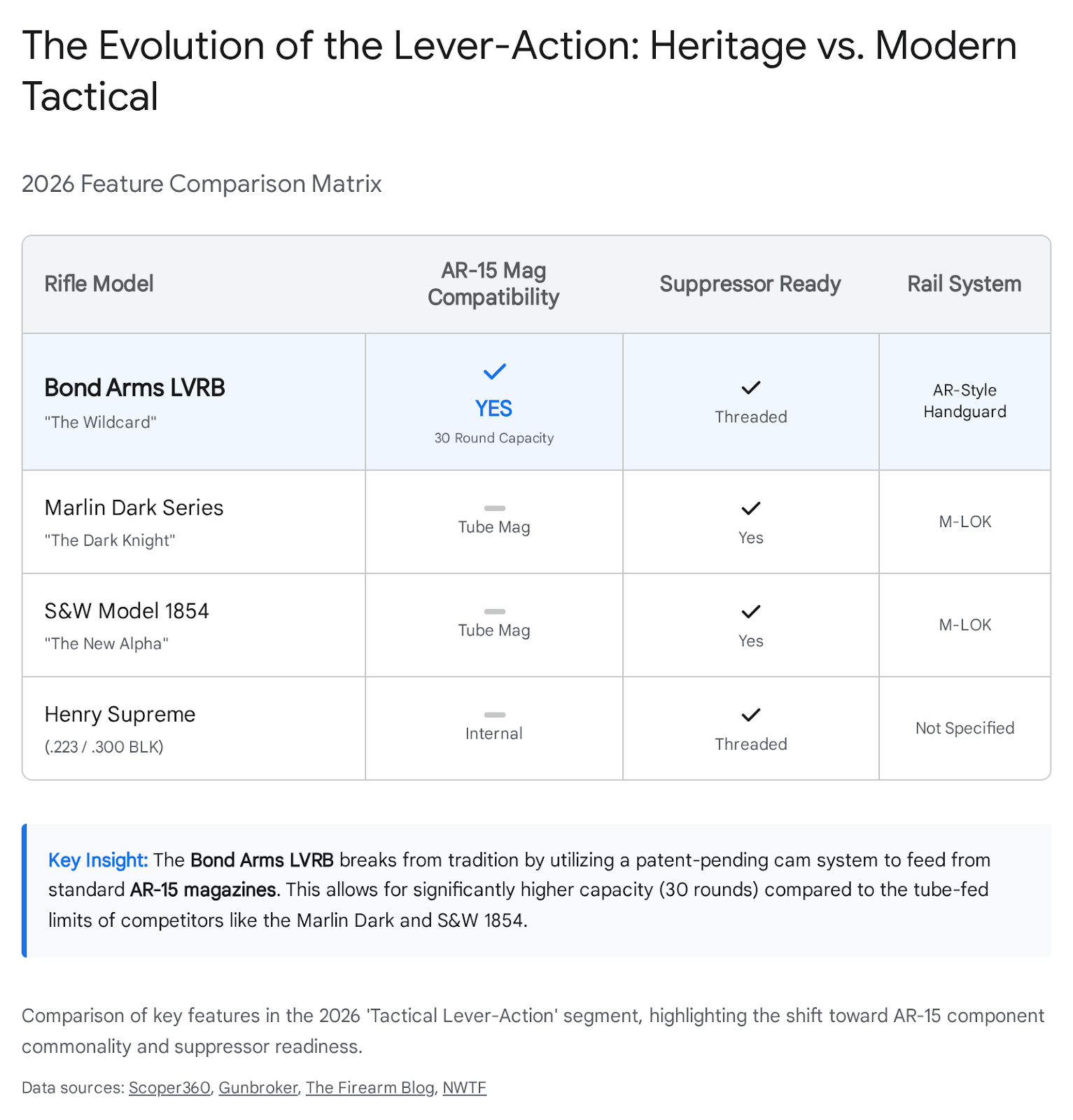
6. Smith & Wesson Model 1854 Series

Category: Modern Lever Action MSRP: ~$1,279 (Standard) / $3,499 (Limited) 11

Smith & Wesson’s re-entry into the lever-gun market with the Model 1854 is a calculated maneuver to capture the high-end of this emerging market segment. While the nomenclature pays homage to the 1854 Volcanic pistol, the engineering is entirely contemporary.12

Design Philosophy:

The Model 1854 is not a reproduction; it is a reinvention.

  • Modular Interface: The primary differentiator is the synthetic forend, which features integrated M-LOK slots at the 3, 6, and 9 o’clock positions.12 This seemingly minor addition fundamentally changes the rifle’s utility. It allows users to mount modern weapon lights and bipods directly to the firearm without the use of clumsy barrel clamps or gunsmithing. This enables the lever gun to function in a home defense role where positive target identification (via a weapon light) is mandatory.
  • Action Geometry: Smith & Wesson has focused heavily on the trigger quality, utilizing a flat-face trigger design that breaks cleanly at approximately 5 lbs. The action cycle has been smoothed to eliminate the “hitch” often found in budget lever guns, ensuring reliability under stress.
  • Material Science: The receiver utilizes forged 416 stainless steel, chosen for its balance of corrosion resistance and tensile strength. This ensures the rifle can endure harsh field conditions without the rust issues common to blued carbon steel heritage guns.

7. Henry Repeating Arms Protector Series

Category: Defensive Lever Action

MSRP: ~$900 – $1,100 (Estimated)

Henry Repeating Arms has long been the market leader in traditional lever guns. The Protector Series (H9, H10, H12) represents their pivot toward the tactical utility market.13

Tactical Implementation:

The Protector Series is defined by its focus on compact maneuverability and suppression.

  • The H12 Variant: Chambered in.357 Magnum/.38 Special, this model is particularly significant. When firing heavy.38 Special ammunition, the round is naturally subsonic. Because the lever action has a sealed breech (unlike a semi-auto which vents gas to cycle), all the gas is directed through the suppressor. This makes the suppressed H12 one of the quietest centerfire firearms achievable, offering immense utility for pest control or discreet training.
  • Ergonomics: The rifles feature shorter 16.5-inch barrels and threaded muzzles as a standard feature. This reflects the understanding that adding a suppressor adds length; by starting with a minimum-length barrel, the overall package remains handy even with a 6-inch suppressor attached.

8. Taylor’s & Co. TC73 (9mm)

Category: Pistol Caliber Lever MSRP: $1,999 14

Taylor’s & Co., typically known for historical reproductions, introduced the TC73 in 9mm, a platform that bridges the gap between the Old West and the modern Pistol Caliber Carbine (PCC).14

Engineering Challenges:

Chambering a lever action in 9mm Luger is mechanically complex. Lever actions were designed for rimmed cartridges (like.30-30 or.45 Colt) which use the rim for extraction and headspace. The 9mm is a rimless cartridge.

  • Carrier Block Innovation: To solve this, Taylor’s developed a proprietary improved carrier block and extraction system capable of reliably feeding and extracting the rimless 9mm case.
  • Economic Drivers: The appeal of the TC73 is largely economic. 9mm ammunition is significantly cheaper than traditional lever-gun calibers. This allows for high-volume training at a fraction of the cost. Additionally, for users who carry a 9mm handgun, the TC73 offers logistics commonality—one type of ammo for both rifle and pistol.

Section III: The Crossover Phenomenon (Hunting Meets Precision)

The “Crossover” rifle is the fastest-growing segment in the bolt-action market. These platforms reject the lightweight-at-all-costs dogma of traditional mountain rifles, instead embracing the weight and stability required for long-range precision, influenced heavily by the Precision Rifle Series (PRS) competition circuit.

9. Benelli Lupo HPR BE.S.T.

Category: Premium Crossover MSRP: $2,949 15

The Benelli Lupo HPR (High Precision Rifle) represents the pinnacle of the crossover concept. Benelli, primarily a shotgun manufacturer, has leveraged their expertise in recoil management and industrial design to create a bolt-action rifle that feels distinctly Italian yet performs like a PRS rig.15

Chassis Hybridization:

Unlike traditional rifles where the action is bedded into a stock, the Lupo utilizes a pseudo-chassis system. It features a steel upper receiver and an alloy lower receiver. This architectural choice isolates the barrel and action from the stock’s potential flex, minimizing harmonic interference.

  • Surface Hardening: The BE.S.T. (Benelli Surface Treatment) is a key differentiator. This hybrid Diamond-Like Carbon (DLC) coating utilizes nanotechnology to create a surface finish that is harder than the underlying steel and virtually impervious to corrosion. In salt-spray testing, BE.S.T. coatings have survived for months where traditional bluing fails in hours.
  • Ergonomic Customization: The stock offers 672 distinct configurations.16 This is achieved through a system of shims (adjusting drop and cast), length-of-pull spacers, and interchangeable cheek combs. This level of fit customization is usually reserved for bespoke custom rifles costing twice as much.

10. Sig Sauer CROSS Magnum

Category: Backcountry Precision

MSRP: ~$2,500+

The Sig Sauer CROSS Magnum scales up the revolutionary architecture of the original CROSS to handle long-action magnum cartridges like.300 Winchester Magnum.17

Design Innovation:

The CROSS platform is unique because it features a one-piece receiver design that eliminates the need for bedding. The bolt locks directly into a barrel extension, containing the pressure event entirely within the barrel assembly.

  • Receiver Stress Relief: Because the receiver does not contain the explosion pressure, it can be lightweight and skeletonized without compromising safety.
  • Floating Bolt Head: The bolt head is designed to float slightly, allowing it to self-center in the barrel extension.17 This ensures that all locking lugs make even contact, a critical factor for accuracy that typically requires manual lapping by a gunsmith.
  • Quick-Change Capabilities: The barrel nut system allows for relatively easy caliber changes, appealing to shooters who wish to train with a cheaper caliber and hunt with a magnum.

11. MasterPiece Arms MPA BA PMR Pro Rifle II

Category: Production Class Competition MSRP: ~$2,499 18

MasterPiece Arms (MPA) is the dominant chassis manufacturer in the PRS circuit. The PMR Pro Rifle II is a purpose-built tool designed to dominate the “Production Class” of the PRS, which imposes a price cap on the rifle to ensure a level playing field.18

Competition Optimization:

Every aspect of this rifle is tuned for the specific demands of shooting steel targets from unstable positions.

  • The Chassis: It utilizes the MPA BA Competition Chassis, which features an integrated inclinometer (bubble level) to ensure the shooter is not canting the rifle, which causes horizontal miss at long range.
  • Spigot Mount: The forend features a spigot mount for the bipod. This pushes the bipod’s pivot point further forward, increasing the stability of the rifle’s fulcrum.
  • TriggerTech Diamond: It comes standard with a TriggerTech Diamond trigger, adjustable down to a mere 4 ounces. This “glass rod” break minimizes the shooter’s influence on the rifle during the trigger pull.

12. Aero Precision Solus Competition

Category: Entry-Level Custom MSRP: ~$1,600 – $2,000 19

Aero Precision has leveraged its massive manufacturing capacity (originally built for AR-15 parts) to enter the bolt-action market. The Solus is an “open source” platform based on the Remington 700 footprint, designed to offer custom-action features at a production price.

Market Disruption:

The Solus creates a new “middle class” for precision rifles.

  • 60-Degree Throw: The action features a 60-degree bolt throw, which is significantly faster and clears large ocular scopes better than the traditional 90-degree throw of the Remington 700.
  • Integral Lug: The recoil lug is machined as part of the action body, not a separate washer. This increases rigidity and simplifies the barreling process.
  • Ecosystem Compatibility: By adhering to the Remington 700 footprint, the Solus is instantly compatible with thousands of aftermarket triggers, stocks, and barrels, ensuring the user is never locked into a proprietary ecosystem.

Section IV: The Modernization of the Utility Rifle

The “Utility” or “Truck Gun” category focuses on ruggedness, compactness, and value. In 2026, even these budget-conscious rifles are receiving premium treatments like Cerakote finishes and threaded barrels.

13. Franchi Momentum MULE

Category: Modern Scout / Utility MSRP: ~$1,549 14

The Franchi Momentum MULE (Momentum Utility Lite Elite) reimagines the Scout Rifle concept for the modern era. Explicitly marketed for “rugged utility” 13, it is designed to live in a truck, UTV, or scabbard.

Utility Features:

  • Compact Architecture: With a 16.25-inch barrel and an overall length of 38.35 inches, the MULE is handy enough for quick deployment from a vehicle.
  • Backup Sights: It features high-quality flip-up adjustable iron sights. In an era of optics dependence, this acknowledges the “survival” nature of the rifle—batteries die and glass breaks, but iron sights remain constant.
  • Environmental Hardening: The “Veil Tac Black” camo stock and Cerakote metalwork provide a high degree of weather resistance, essential for a working rifle that may be exposed to humidity and condensation.

14. Ruger American Gen II (Scout/Patrol)

Category: Budget Utility MSRP: ~$729 – $929 14

The Ruger American has been the benchmark for budget accuracy for a decade. The Gen II represents a comprehensive overhaul, addressing the primary complaints of the original (stock rigidity and finish quality) while keeping the price accessible.

The “Splatter” Aesthetic: Ruger has moved away from the basic black plastic stock. The Gen II stocks feature a “splatter” texture that not only improves visual appeal but provides actual tactile grip in wet conditions.22

  • Harmonic Consistency: The Patrol and Scout models feature 16.1-inch threaded bull barrels. This shorter, stiffer profile is less susceptible to “whip” during firing, leading to greater consistency across different ammunition types.
  • Caliber Expansion: The Gen II’s launch in calibers like.400 Legend and 6mm ARC 14 demonstrates Ruger’s commitment to supporting new, efficient cartridge designs alongside traditional standbys like.308 Win.

15. Howa Fence Line Series

Category: Compact Utility MSRP: ~$729 23

Howa has targeted the ranch and predator hunting market with the Fence Line series.

The Mini Action Advantage:

Howa is one of the few manufacturers to produce a true “Mini Action” specifically scaled for.223/5.56 and 6mm ARC cartridges.

  • Scale Efficiency: Most manufacturers simply put a short cartridge in a standard “Short Action” (sized for.308). This results in wasted bolt travel and unnecessary weight. The Howa Mini Action is scaled down physically, resulting in a lighter, faster-cycling receiver.
  • Muzzle Control: The inclusion of a radial muzzle brake as a standard feature 23 acknowledges that predator hunters often shoot solo and need to see their impacts through the scope; the brake reduces muzzle rise to allow this.

16. Christensen Arms Evoke

Category: Entry-Premium Hunting MSRP: ~$900 – $1,000 24

Christensen Arms, typically known for $2,000+ carbon-fiber rifles, entered the sub-$1,000 market with the Evoke.

Cost Engineering:

To hit this price point, Christensen swapped their signature carbon-wrapped barrel for a 416R stainless steel barrel. However, they retained the critical DNA of their premium lines.

  • Ergonomics: The synthetic stock includes adjustable length-of-pull spacers and a cheek riser, features often stripped from “budget” models.
  • Performance: Early reports indicate the Evoke retains the sub-MOA accuracy potential of its more expensive siblings, likely due to the quality of the 416R barrel blank and the precision of the chambering process.

Section V: Rimfire as a Serious Trainer

The rimfire market has bifurcated. There are “plinkers” for tin cans, and then there are “trainers”—rimfire rifles built with the same ergonomics and weight distribution as centerfire precision rifles, designed for low-cost cross-training.

17. Savage RXR22

Category: Tactical Rimfire MSRP: $299 14

The Savage RXR22 is a disruptive entry. While Savage has a long history of rimfires, the RXR22 is notable for its magazine compatibility.

Strategic Compatibility:

The RXR22 accepts Ruger 10/22 rotary magazines. The 10/22 magazine is the ubiquitous standard of the industry. By adopting their competitor’s magazine standard, Savage removes the single biggest barrier to entry for consumers who already own stacks of Ruger magazines.

  • Maintenance Solved: A persistent complaint with the 10/22 platform is the inability to clean the barrel from the breech without disassembly. The RXR22 introduces a rear cleaning port 14, allowing for proper cleaning rod access. This simple engineering fix solves a decades-old user frustration.

18. Franchi Momentum Elite Varmint (.22 ARC)

Category: Precision Varmint / Trainer MSRP: $959 – $1,299 14

While.22 ARC is technically a centerfire cartridge, its application overlaps heavily with the high-end rimfire/varmint segment. Franchi’s adoption of this cartridge in the Momentum Elite Varmint highlights the shift toward high-BC small-bore ballistics.

The.22 ARC Factor:

Designed to fit in AR-15 length actions, the.22 ARC offers ballistics superior to the.22-250 in terms of wind drift, thanks to its ability to seat long, heavy, aerodynamic bullets.

  • Platform Synergy: By chambering a 1-MOA guaranteed bolt action in this cartridge, Franchi offers a rifle that is effective on coyotes out to 500+ yards, bridging the gap between a rimfire trainer and a dedicated long-range centerfire.

19. Howa Superlite HS Precision Gen 2

Category: Ultralight Mountain MSRP: ~$1,169 23

The Howa Superlite Gen 2 is an engineering marvel in weight reduction.

Materials Analysis: Weighing in at just 4 lbs 15 oz 23, it competes with titanium rifles costing three times as much.

  • Stock Integration: The Gen 2 pairs the shaved-down Howa action with an HS Precision stock. This stock features a full aluminum bedding block. This is critical. Ultra-light “pencil” barrels are notorious for “walking” (shifting point of impact) as they heat up. The rigid aluminum bedding block provides a stable foundation that minimizes this thermal drift, making the rifle repeatable despite its feathery weight.

20. Bergara Premier Cima Pro

Category: Advanced Material Hunting MSRP: Premium Tier 14

Replacing the pistol entry to focus on rifles, the Bergara Premier Cima Pro enters the list as a showcase of carbon fiber technology.

Autoclave Curing: The Cima Pro is built entirely with carbon technology using an autoclave curing process.14 This industrial process, common in aerospace, applies heat and pressure to the carbon fiber matrix to eliminate voids and ensure uniform resin distribution.

  • The Result: A stock that is not just light, but exceptionally rigid. Combined with a stainless steel barrel and TriggerTech trigger, the Cima Pro represents the “State of the Art” in production hunting rifles for 2026.

Section VI: Conclusion and Strategic Outlook

The rifle class of SHOT Show 2026 demonstrates a mature industry that has moved past the “AR-15 fatigue” of the early 2020s. The focus has shifted to refinement and integration.

The “Suppressor-Ready” standard is now absolute. The days of needing a gunsmith to thread a barrel are effectively over; the factory-standard rifle of 2026 is a turnkey system ready for a silencer. Furthermore, the Lever Action Renaissance proves that innovation isn’t always about new technology—sometimes it’s about re-contextualizing old technology with modern materials (M-LOK, Stainless Steel) to solve modern legal and defensive problems.

For the end-user, 2026 offers unprecedented value. The “middle class” rifles (Aero Solus, Ruger Gen II, Christensen Evoke) now offer features—adjustable chassis, match chambers, threaded muzzles—that were the exclusive domain of custom gunsmiths just five years ago. This democratization of precision is the lasting legacy of the 2026 exhibition.

Appendix A: Research Methodology and Selection Criteria

Analyst’s Note on Selection Protocols:

The “Top 20” platforms featured in this report were not selected based solely on sales volume or brand prominence. Instead, a multi-variate analysis matrix was employed to identify firearms that signify a measurable shift in small arms doctrine.

1. Primary Selection Filter: Technological Divergence

Rifles were prioritized if they introduced a novel mechanical solution to a persistent industry problem.

  • Example: The Daniel Defense DD4 X1 was included for its integrated thermal management system, which addresses the IR signature issues of direct impingement systems.
  • Example: The Taylor’s & Co. TC73 was selected for its engineering workaround to reliably feed rimless 9mm cartridges in a lever action, a historically difficult mechanical feat.

2. Secondary Selection Filter: Market Disruptors

Platforms that fundamentally altered the price-to-performance ratio of a specific category were weighted heavily.

  • Example: The Aero Precision Solus was selected because it brings custom-action features (integral lug, 60-degree throw) to a production price point, effectively disrupting the semi-custom market.
  • Example: The PSA VUK was chosen for democratizing the “monolithic upper/folding stock” feature set previously restricted to $2,500+ platforms like the SCAR or MCX.

3. Tertiary Selection Filter: Regulatory & Cultural Compliance

In an era of fragmenting legal landscapes, engineering that navigates compliance without sacrificing capability is a key innovation vector.

  • Example: The Beretta BRX1 Tactical and Henry Protector Series were selected as “State-Compliant” solutions that offer defensive utility in jurisdictions where semi-automatics are restricted.

Data Sourcing:

All technical specifications, MSRPs, and release windows were corroborated through direct manufacturer releases, SHOT Show 2026 exhibitor materials, and verified industry media coverage. Prototype specifications (specifically regarding the PSA VUK and Daniel Defense DD4 X1) are based on the configurations displayed on the show floor and are subject to final production adjustments.


If you find this post useful, please share the link on Facebook, with your friends, etc. Your support is much appreciated and if you have any feedback, please email me at in**@*********ps.com. Please note that for links to other websites, we are only paid if there is an affiliate program such as Avantlink, Impact, Amazon and eBay and only if you purchase something. If you’d like to directly contribute towards our continued reporting, please visit our funding page.


Sources Used

  1. [SHOT 2026] Daniel Defense DD4 X1 Will Take Them To The Next …, accessed January 23, 2026, https://www.thefirearmblog.com/blog/shot-2026-daniel-defense-dd4-x1-will-take-them-to-the-next-level-44825515
  2. First Look!! PSA AXR Series, VUK, Krink | Shot Show 2026 #shorts #psa #shotshow – YouTube, accessed January 23, 2026, https://m.youtube.com/shorts/7lRH–bTc-s
  3. Why did they make the Vuk look ugly? – General Discussion – Palmetto State Armory | Forum, accessed January 23, 2026, https://palmettostatearmory.com/forum/t/why-did-they-make-the-vuk-look-ugly/39662
  4. What’s Going On with the PSA VUK? | SHOT Show 2025 – The Firearm Blog, accessed January 23, 2026, https://www.thefirearmblog.com/blog/what-s-going-on-with-the-psa-vuk-shot-show-2025-44818483
  5. 2026 NEW Desert Tech Products – YouTube, accessed January 23, 2026, https://www.youtube.com/watch?v=X7L0LkovsEo
  6. WLVRN Bullpup Rifle – Desert Tech, accessed January 23, 2026, https://deserttech.com/wlvrn-rifle.html
  7. MICRON, 11.5″ Barrel 556/223 & Handguard, BLK – Desert Tech, accessed January 23, 2026, https://deserttech.com/wolverine-conversion-kit-micron-11-5-barrel-556-223-and-handguard-blkwlv-ck-b11-b.html
  8. New Handguns Coming in 2026 – SHOT Show, accessed January 23, 2026, https://shotshow.org/new-handguns-coming-in-2026/
  9. Hellion™ 5.56 20″ Rifle, California Compliant – HL920556BCA – Springfield Armory, accessed January 23, 2026, https://www.springfield-armory.com/hellion-series/hellion-rifles/hellion-556-20-inch-rifle-california-compliant/
  10. Hellion™ Rifles – Springfield Armory, accessed January 23, 2026, https://www.springfield-armory.com/hellion-series/hellion-rifles/
  11. First Look: Smith & Wesson Model 1854 Lever-Action Rifle in 360 Buckhammer | An Official Journal Of The NRA – Shooting Illustrated, accessed January 23, 2026, https://www.shootingillustrated.com/content/first-look-smith-wesson-model-1854-lever-action-rifle-in-360-buckhammer/
  12. NEW: Smith & Wesson® Model 1854 Lever Action Series, accessed January 23, 2026, https://www.smith-wesson.com/article/smith-wesson-model-1854
  13. New Products from SHOT Show 2026 – Day One – Silencer Central, accessed January 23, 2026, https://www.silencercentral.com/blog/shot-show-new-products/
  14. New Rifles Coming in 2026 – SHOT Show, accessed January 23, 2026, https://shotshow.org/new-rifles-coming-in-2026/
  15. Benelli Expands Its Lupo Series with the New Lupo HPR and Takes Precision Long-Range Shooting to the Next Level, accessed January 23, 2026, https://www.benelliusa.com/resources/benelli-expands-its-lupo-series-with-the-new-lupo-hpr-and-takes-precision-long-range
  16. New for 2024: Benelli Lupo HPR BE.S.T. | An Official Journal Of The NRA – American Hunter, accessed January 23, 2026, https://www.americanhunter.org/content/new-for-2024-benelli-lupo-hpr-be-s-t/
  17. TESTED: SIG Sauer CROSS TRAX & Magnum Bolt-Action Rifles – Athlon Outdoors, accessed January 23, 2026, https://athlonoutdoors.com/article/sig-cross-trax-magnum-rifles/
  18. PMR Pro Rifle II: New MasterPiece Arms Rifle Built to Compete in PRS – Athlon Outdoors, accessed January 23, 2026, https://athlonoutdoors.com/article/mpa-pmr-pro-rifle-ii/
  19. SOLUS Bolt Action – Aero Precision, accessed January 23, 2026, https://www.aeroprecisionusa.com/solus
  20. SOLUS Competition Rifle – 26″ 6mm Creedmoor, Sendero – Aero Precision, accessed January 23, 2026, https://www.aeroprecisionusa.com/solus-comp-rifle-26in-6mm-creedmoor-sendero
  21. [SHOT 2026] Ruger Goes All-In On *Almost* Everything | thefirearmblog.com, accessed January 23, 2026, https://www.thefirearmblog.com/blog/shot-2026-ruger-goes-all-in-on-almost-everything-44825575
  22. Ruger American ® Rifle Generation II Standard, accessed January 23, 2026, https://ruger.com/products/americanRifleGenII/models.html
  23. [SHOT 2026] New Rifles From Howa, accessed January 23, 2026, https://www.thefirearmblog.com/blog/shot-2026-new-rifles-from-howa-44825680
  24. Christensen Arms Evoke: A Budget-Friendly Hunting Rifle Built For The Field | An Official Journal Of The NRA – American Rifleman, accessed January 23, 2026, https://www.americanrifleman.org/content/christensen-arms-evoke-a-budget-friendly-hunting-rifle-built-for-the-field/
  25. Evoke – Christensen Arms, accessed January 23, 2026, https://christensenarms.com/product/evoke/
  26. New Howa SuperLite HS Precision Gen 2 Rifle, accessed January 23, 2026, https://www.firearmsnews.com/editorial/howa-superlite-hs-gen-2/544415

Innovations in Military and Law Enforcement Sniper Technology at SHOT Show 2026

Executive Summary

The 2026 Shooting, Hunting, and Outdoor Trade (SHOT) Show, held at the Venetian Expo and Caesars Forum in Las Vegas, served as a definitive watershed moment for the small arms defense sector.1 While previous years often highlighted incremental improvements in consumer sporting arms, the 2026 exhibition showcased a rigorous, industry-wide pivot toward “Duty-Grade” systems designed for Large Scale Combat Operations (LSCO) and high-threat domestic law enforcement environments. This shift is driven by the evolving tactical realities observed in Eastern Europe and the Indo-Pacific, where the demand for increased standoff distance, signature reduction (suppression), and modularity has become paramount.

The defining narrative of the 2026 precision rifle market is the “Decoupling of Mass and Capability.” For decades, extreme range capability necessitated heavy, crew-served platforms. SHOT 2026 demonstrated that manufacturers have successfully engineered platforms delivering anti-materiel lethality in man-portable chassis systems weighing under 8 kilograms. The introduction of the Sako TRG 62 A1 in 9.5x77mm (.375 CheyTac) serves as the primary exemplar of this trend, effectively bridging the capability gap between the.338 Lapua Magnum and the.50 BMG while retaining the logistical footprint of a standard sniper rifle.2

Simultaneously, the distinction between the Designated Marksman Rifle (DMR) and the dedicated bolt-action sniper system continues to blur. The “Assault Sniper” concept has matured, with gas-operated systems like the Knights Armament KS-1 (L403A1) and the updated HK MR762 A4 offering First-Round Hit Probability (FRHP) out to 800 meters—a metric previously reserved for bolt-action platforms. This convergence allows for a reduction in the logistical footprint of sniper teams, offering volume of fire and precision in a single package.

Furthermore, a critical sub-trend identified is the professionalization of the sub-caliber trainer. Manufacturers such as Victrix Armaments and Bergara have introduced high-fidelity.22 LR systems that replicate the ergonomics, balance, and manual of arms of full-bore sniper rifles.4 This is a direct response to soaring ammunition costs and the need for high-frequency, low-cost training cycles for professional marksmen.

Summary of Top 20 Military and Law Enforcement Precision Rifles

The following table summarizes the Top 20 Military and Law Enforcement Sniper Rifles identified during SHOT Show 2026. These systems were evaluated based on mission adaptability, technological innovation, logistical viability, and relevance to current operational requirements.

Table 1: Top 20 Military and Law Enforcement Sniper Rifles – SHOT Show 2026

RankPlatform NameManufacturerActionCaliberRoleKey Innovation
1TRG 62 A1SakoBolt9.5x77mmELR SniperMan-portable ELR (7kg); 2000m+ capability.3
2KS-1 (L403A1)Knights ArmamentGas (DI)5.56 NATOSPR / DMRProject HUNTER winner; Dimpled heavy barrel.6
3MRAD CovertBarrettBoltMultiClandestineFolding stock; 17″ barrel deployability.7
4AT-XCAccuracy Int.Bolt6.5 CM /.308TacticalNext-gen short action; AXSR features.8
5SICSeekins PrecisionBoltMulti (.338)SOF SniperTool-less modularity; Carbon barrel flats.9
6MR762 A4Heckler & KochGas (Piston)7.62 NATODMRAmbi lower; adj. gas block for suppression.10
7SRS-M2Desert TechBullpupMultiMulti-Role30% accuracy gain; integral 30 MOA rail.11
8CDX-40 ShadowCadex DefenceBolt.375 /.408 CTAnti-MaterielHigh-stability chassis; Mirage control.12
9Gladio VVictrix ArmamentsBolt.308 / 6.5Urban SniperHeavy tactical chassis; single-shot option.13
10Delta 5 ProDaniel DefenseBolt.308 / 6.5LE PrecisionIntegral ARCA rail;.5 MOA guarantee.14
11Pugio Small BoreVictrix ArmamentsBolt.22 LRTrainer1:1 ergonomic clone of centerfire.4
12KS-3Knights ArmamentGas (DI)5.56 NATOAssault/Recce11.5″ barrel; maneuverable precision.15
13APR338B&TBolt.338 LMSuppressedIntegral suppression design focus.16
14M93 Black ArrowZastava ArmsBolt.50 BMGAnti-MaterielMauser reliability; massive recoil reduction.17
15CDX-R7 SheepdogCadex DefenceBolt.308 WinPatrol SniperTraditional stock ergonomics; micro-chassis.18
16SCAR 20S (2026)FN AmericaGas (Piston)6.5 CMHeavy DMRHydraulic buffer; NRCH update.19
17U526Shadow SystemsGas (DI)5.56 NATOLight DMRPinned gas block; rigid interface.20
18T3x Ace TargetTikkaBolt6.5 CMLight TacModular chassis; high value entry.21
19MPRChristensen ArmsBolt.300 WinLightweightCarbon fiber barrel/chassis.22
20110 Elite PrecisionSavage ArmsBolt.300 PRCEntry LRMDT ACC Chassis; heavy contour barrel.23

1. The Geopolitical Catalyst: Why 2026 is Different

To understand the specific technical choices made by manufacturers at SHOT Show 2026, one must first analyze the “demand signal” radiating from global defense ministries. The conflict patterns observed over the last four years—specifically the shift from asymmetric counter-insurgency (COIN) to near-peer Large Scale Combat Operations (LSCO)—have radically altered the requirements for the sniper weapon system.

In COIN operations (e.g., Afghanistan, Iraq), the sniper’s engagement distances were often moderate, and the primary requirement was positive identification (PID) and precision to avoid collateral damage. Weight was a concern, but the pace of operations often allowed for heavier, static positions.

In LSCO environments, typified by the conflict in Ukraine and potential flashpoints in the Pacific, the sniper’s role has transformed. The ubiquity of drone surveillance, thermal reconnaissance, and counter-battery radar means that “static” equals “dead.” Snipers must now shoot and displace immediately. This reality has enforced a strict weight discipline on manufacturers. A 20-pound rifle system is a liability when an operator must sprint to cover after a single shot. Consequently, we observe a trend where mobility is prioritized alongside ballistic capability.

This geopolitical context explains the sudden prominence of two distinct categories at SHOT 2026:

  1. The Man-Portable ELR System: Rifles like the Sako TRG 62 A1 3 allow a single operator to exert influence out to 2,000 meters without the logistical burden of a.50 BMG team.
  2. The “Assault Sniper” / DMR: Rifles like the KAC KS-1 6 allow for precision fire while retaining the ability to fight as a rifleman during movement, reducing the need for a secondary weapon system.

The “Operational Classification Matrix” derived from the 2026 data illustrates a market that has bifurcated. On one axis, we see Mobility, ranging from the ultra-compact KAC KS-3 15 to the static Zastava M93.17 On the other axis lies Firepower (or Effective Range), spanning from the.22 LR trainers up to the.408 CheyTac systems. The most crowded and competitive sector in 2026 is the “High Mobility / High Firepower” quadrant—the “sweet spot” where manufacturers are utilizing advanced metallurgy and carbon fiber to push heavy calibers into lighter frames.

2. The New King of Extreme Long Range (ELR): Sako TRG 62 A1

The crown jewel of military precision at SHOT Show 2026 is undoubtedly the Sako TRG 62 A1.2 For nearly two decades, the.338 Lapua Magnum (LM) was the gold standard for anti-personnel engagement beyond 1,200 meters. However, advancements in ceramic body armor and the desire for greater standoff distances have pushed military requirements beyond the ballistic capabilities of the.338 LM.

2.1 The 9.5x77mm Revolution

The TRG 62 A1 is built around the 9.5x77mm cartridge, commercially known as the.375 CheyTac. This cartridge represents a massive leap in ballistic efficiency. Analysis of the data provided by Sako indicates that the 9.5x77mm delivers approximately 25% more energy at 1,500 meters compared to the.338 Lapua Magnum.3 Furthermore, the muzzle energy is roughly 50% greater, significantly increasing the probability of incapacitation against targets wearing Level IV body armor or light vehicle armor.

2.2 System Architecture and Weight Reduction

The engineering triumph of the TRG 62 A1 is not just the caliber, but the package it is delivered in. Historically, rifles chambered in.375 or.408 CheyTac (like the CheyTac Intervention) were massive, heavy systems often exceeding 10-12 kg. Sako has engineered the TRG 62 A1 to weigh approximately 7 kg (15.4 lbs).3 This places a 2,000-meter capable rifle in the same weight class as many standard.338 LM or even.300 Win Mag rifles.

This weight reduction is achieved through a heavily fluted, cold hammer-forged stainless steel barrel and a skeletonized, yet rigid, chassis system.2 The barrel length is optimized at 30 inches (762mm) to ensure complete powder burn and maximum velocity for the large projectile, without making the rifle unwieldy.

2.3 Operational Implications

The operational impact of this system is profound. A sniper team armed with the TRG 62 A1 can engage targets that previously required a heavy weapons team with a.50 BMG (like the M107 or Zastava M93). This flattens the command structure and pushes strategic interdiction capabilities down to the squad or platoon level.

3. The “Assault Sniper” Convergence: Knights Armament KS Series

While Sako pushed the envelope on distance, Knights Armament Company (KAC) revolutionized the intermediate range with the KS-1 and KS-3 platforms. These rifles represent the pinnacle of the Direct Impingement (DI) gas gun evolution, blurring the lines between a carbine and a precision rifle.

3.1 Project HUNTER and the KS-1 (L403A1)

The KS-1, designated the L403A1 by the UK military, was selected under Project HUNTER to replace varied fleets of older AR-pattern rifles.6 The KS-1 is significant because it challenges the notion that a precision gas gun must be heavy and unwieldy.

  • Barrel Technology: The heart of the KS-1 is a 13.7-inch (348mm) barrel made from a specialized high-strength steel alloy (32CrMoV12-10).24 KAC utilizes a dimpling process on the barrel exterior. This is not merely aesthetic; it increases the surface area for rapid heat dissipation (cooling) while simultaneously reducing weight and relieving internal material stress.6 This allows the rifle to maintain match-grade accuracy even after high rates of fire—a critical capability for a spotter or DM who may need to transition from precision shots to suppressive fire instantly.
  • Gas System Optimization: The rifle is engineered to run suppressed as its primary state. The gas system is tuned to reduce the “gas blowback” into the shooter’s face—a common issue with suppressed DI guns—thereby reducing shooter fatigue and exposure to toxic fumes.6

3.2 The KS-3: Maximum Maneuverability

The KS-3 complements the KS-1 by offering an even shorter 11.5-inch (292mm) barrel.15 While traditionally considered too short for “sniper” work, modern 5.56mm loadings (like the Mk262 Mod 1 77gr) combined with the rigidity of the KS-3’s URX6 rail system allow for effective engagement out to 500-600 meters. The URX6 rail is a critical component, providing a mounting surface for laser aiming modules (LAMs) and clip-on night vision devices that is rigid enough to maintain zero under rough handling.6

3.3 The Decline of the 18-inch SPR?

The success of the KS-1 (13.7″) and KS-3 (11.5″) signals a potential shift away from the traditional 18-inch “Mk12” style Special Purpose Rifle (SPR). KAC has demonstrated that with superior barrel metallurgy and ammunition, shorter barrels can achieve the necessary terminal velocity thresholds for duty use, while offering vastly superior handling in urban environments (CQB) and vehicles.

4. The Gas Gun Renaissance: Piston vs. DI

While KAC champions the Direct Impingement system, Heckler & Koch and FN America continued to refine the short-stroke gas piston system, offering a robust alternative for agencies prioritizing reliability in adverse environments over absolute weight savings.

4.1 Heckler & Koch MR762 A4

The MR762 A4 10 represents the civilian and law enforcement iteration of the latest HK417 updates.

  • Ambidextrous Evolution: The A4 variant introduces a fully ambidextrous lower receiver, including the bolt catch, magazine release, and safety selector.10 This brings the platform into parity with the M110A1 CSASS (Compact Semi-Automatic Sniper System) currently fielded by the US Army.
  • Suppression Management: A critical update is the inclusion of a 2-position adjustable gas block.25 The HK417 platform has historically been known to be “over-gassed” when suppressed, leading to high bolt velocities and increased wear. The adjustable block allows the operator to restrict gas flow when a suppressor is attached, smoothing the recoil impulse and extending part life.

4.2 FN SCAR 20S (2026 Update)

The FN SCAR 20S saw targeted updates in 2026 to address user feedback regarding recoil capability and optics survival.19

  • Hydraulic Buffering: FN has introduced a hydraulically buffered bolt carrier group. The massive reciprocating mass of the SCAR’s bolt carrier has famously destroyed sensitive electronics and optics in the past. The hydraulic buffer dampens this impulse, protecting ancillary equipment and smoothing the recoil for the shooter.19
  • Non-Reciprocating Charging Handles (NRCH): Now standard, this feature prevents the charging handle from striking the shooter’s hand or barricade during firing, a significant ergonomic improvement for tactical use.

4.3 Shadow Systems U526

A new entrant to the rifle market, Shadow Systems introduced the U526.20 While primarily a 5.56mm platform, its design philosophy targets the “Light DMR” role.

  • Rigidity First: Unlike many AR-pattern rifles where the handguard is a separate add-on, the U526 features a highly rigid receiver interface and a pinned gas block.20 This ensures that the gas system cannot shift under thermal expansion or impact, a crucial reliability factor for duty weapons.

5. The Modular Multi-Role: Bolt Action Evolution

The defining requirement for US SOCOM (Special Operations Command) and NATO special forces continues to be modularity. The ability to switch barrels and bolt faces in the field allows a single chassis to serve multiple roles: a.308 Win for urban training, a.300 Norma Mag for long-range interdiction, and a.338 Lapua for anti-materiel work.

5.1 Accuracy International AT-XC

The Accuracy International (AI) AT-XC 8 represents the next generation of the “Short Action” combat rifle. AI is the progenitor of the modern chassis system, and the AT-XC is a significant modernization of the AT and AX series.

  • Action Redesign: The AT-XC features a new action design that shares geometry with the larger AXSR (Advanced Sniper Rifle) and AX ELR. This provides greater breech strength to handle high-pressure cartridges like the 6.5 PRC or high-velocity 6mm rounds.26
  • Gas Handling: Improved gas venting ensures that in the event of a catastrophic case head separation (a risk with high-pressure ammo), the hot gases are vented away from the shooter’s face.26
  • Legacy: By standardizing the aesthetic and manual of arms with the AXSR, AI allows units to train on the short-action AT-XC and transition seamlessly to the long-action AXSR for deployment.

5.2 Seekins Precision SIC (Seekins Interchangeable Caliber)

The Seekins SIC 9 is a direct competitor to the Barrett MRAD, specifically targeting the modular sniper rifle market.

  • Tool-less Change: The SIC features a tool-less bolt disassembly and caliber-specific magazine wells that can be swapped without tools.9 This is a significant advantage in the field, where small tools are easily lost.
  • Barrel Innovation: Seekins utilizes a carbon-fiber composite barrel with “flats” machined into it. These flats provide a wrench surface for barrel changes and help index the barrel consistently.9
  • Chassis Integration: The upper receiver features a monolithic ARCA rail, essential for mounting the rifle to tripods for high-angle shooting (e.g., urban hides or mountain ridges).

5.3 Desert Tech SRS-M2

The SRS-M2 11 maintains Desert Tech’s stronghold on the bullpup sniper market.

  • The Bullpup Advantage: By locating the action behind the trigger group, the SRS-M2 can mount a 26-inch barrel in a rifle that is only 37 inches long overall.11 This is nearly a foot shorter than a comparable conventional rifle, offering immense advantages for vehicle-borne operations or heliborne insertions.
  • Accuracy Enhancement: The 2026 model features a new “multi-clamp” barrel retention system. Instead of one large clamp, it uses four smaller ones, which distributes pressure more evenly and reportedly improves accuracy by 30%.27

5.4 Barrett MRAD Covert

Barrett, now a part of the NIOA group, continues to expand the MRAD (Multi-Role Adaptive Design) ecosystem. The MRAD Covert 7 is a specialized variant for clandestine operations.

  • Concealability: With barrel options as short as 17 inches and a folding stock, the MRAD Covert can be transported in a standard backpack or nondescript bag.7 This capability is prized by dignitary protection teams and surveillance units who need high-caliber capability without the visual profile of a sniper team.

6. The Heavy Hitters: Specialized Anti-Materiel Systems

Beyond the modular multi-roles, there remains a need for dedicated, heavy-caliber systems designed for specific tasks: hard target interdiction and silent elimination.

6.1 Cadex CDX-40 Shadow

The Cadex CDX-40 Shadow 12 is a dedicated ELR platform. Unlike the Sako TRG 62 A1, which emphasizes portability, the Cadex system prioritizes absolute stability for the.375 and.408 CheyTac cartridges.

  • Mirage Control: The chassis features a “Mirage Control Tube” that shrouds the barrel. This prevents heat waves from the barrel rising in front of the scope objective lens—a critical problem when firing large strings of heavy magnum ammunition.12
  • Recoil Mitigation: The “Dual Strike” chassis is engineered to absorb the massive recoil energy of the.408 CT, allowing the shooter to spot their own impacts—a vital capability for solo sniping.

6.2 B&T APR338 / APR308

Switzerland’s B&T (Brügger & Thomet) is world-renowned for suppression technology. The APR (Advanced Precision Rifle) 16 reflects this DNA.

  • Integral Design: The APR system is designed to be fielded primarily with B&T’s GRS suppressors. The barrel threading and harmonics are tuned specifically for the weight and backpressure of the suppressor.28
  • Urban Utility: The APR338 fills a niche for “silent” overwatch. In hostage rescue scenarios, the ability to take a shot without deafening the entry team or alerting the entire neighborhood is a tactical necessity.

6.3 Zastava M93 Black Arrow

While less technologically advanced than its western counterparts, the Zastava M93 Black Arrow 29 represents the “brute force” end of the spectrum.

  • Mauser Action: Based on a scaled-up Mauser 98 action, the M93 is incredibly robust.
  • Recoil Management: Weighing nearly 36 lbs and featuring a massive multi-baffle muzzle brake, it claims a 62% reduction in recoil.30
  • Asymmetric Warfare: Its low cost and ruggedness make it a prime candidate for aid packages to conflict zones where volume of anti-materiel fire (disabling vehicles, radar dishes) is more important than sub-MOA precision.

7. Law Enforcement & Light Precision: The Fiscal Reality

Domestic law enforcement agencies face a different set of constraints: liability, budget, and engagement distances that rarely exceed 100 yards. They require “guaranteed” precision (to minimize collateral risk) at a price point that city councils will approve.

7.1 Daniel Defense Delta 5 Pro

The Delta 5 Pro 14 has become a favorite for LE agencies due to its “turnkey” nature.

  • The.5 MOA Guarantee: Daniel Defense offers a manufacturer guarantee of.5 MOA accuracy.14 For a SWAT commander, this is a liability shield—it certifies that the weapon system is mechanically capable of the surgical precision required for hostage rescue shots.
  • Area 419 Integration: The chassis integrates an ARCA rail system designed by Area 419.14 This allows officers to clamp the rifle directly into a tripod, a technique that has become standard for standing or kneeling shots in urban terrain (e.g., shooting over a patrol car hood or a fence).

7.2 Cadex CDX-R7 Sheepdog

The CDX-R7 Sheepdog 18 addresses the ergonomic transition for officers.

  • Hybrid Stock: Many police snipers grew up shooting traditional hunting rifles. The “Strike Nuke Evo” stock on the Sheepdog mimics the feel of a traditional stock but includes the adjustability (cheek piece, length of pull) of a chassis.18
  • Micro-Chassis: Internally, it uses an aluminum micro-chassis to bed the action, ensuring that the “plastic” feel of the stock does not compromise stability.18

7.3 Tikka T3x Ace Target

The Tikka T3x Ace Target 21 is the “budget” tactical option that punches above its weight.

  • Cost vs. Capability: With a street price often under $2,000, it offers a rigid aluminum chassis and Tikka’s legendary smooth action.31
  • Adoption: This rifle is increasingly finding a home in smaller departments or rural Sheriff’s offices that need a precision capability but cannot justify a $10,000 system.

7.4 Savage 110 Elite Precision

Similar to the Tikka, the Savage 110 Elite Precision 23 leverages the aftermarket ecosystem.

  • MDT Chassis: Savage partnered with MDT (Modular Driven Technologies) to use their ACC (Adjustable Core Competition) chassis.32 This gives the rifle the ergonomics and modularity of a custom competition rig straight from the factory.
  • Action Tuning: The 110 action in this rifle is “blueprinted” at the factory, meaning the tolerances are tightened to ensure the receiver face and bolt lugs are perfectly square.33

8. The Trainer Revolution: Economics of Skill

One of the most pragmatic trends at SHOT 2026 was the focus on.22 LR trainers. In a professional context, “training” does not mean “plinking.” It means high-repetition drills on trigger control, breathing, and positional stability.

8.1 Victrix Pugio Small Bore

The Victrix Pugio Small Bore 4 is unique because it is a 1:1 clone of the Victrix Pugio duty rifle.

  • Weight Matching: It weighs 5.51 kg (12.15 lbs), exactly mirroring the weight of the centerfire version.4 This means the muscle memory required to lift, hold, and stabilize the rifle transfers 100% to the duty weapon.
  • System Fidelity: The trigger mechanism, stock adjustments, and balance point are identical. This allows snipers to fire thousands of rounds of cheap.22 LR while building the exact physical strength and neurological pathways needed for their operational rifle.

8.2 Bergara Premier Series Rimfire

While primarily a hunting brand, Bergara‘s rimfire offerings (like the B-14R, though the snippets mention the new Cascade Rimfire 22) occupy a similar space for Rem 700-based platforms. They allow agencies using Remington 700 footprints (which is still the vast majority) to have a low-recoil, low-cost training analogue.

9. Future Tech: Carbon Fiber & Metallurgy

The final frontier explored at SHOT 2026 was the use of exotic materials to further reduce weight without sacrificing accuracy.

9.1 Christensen Arms Modern Precision Rifle (MPR)

The Christensen Arms MPR 22 is a leader in this space.

  • Aerospace Materials: It utilizes a carbon-fiber wrapped barrel (a steel liner wrapped in carbon fiber) and a chassis built from carbon fiber and forged aluminum.
  • The Weight Equation: This allows for a rifle in magnum calibers like.300 Winchester Magnum or.338 Lapua to weigh significantly less than 10 lbs.22 For “Alpine Warfare” units or those operating in extreme terrain, this weight savings equates to increased mobility and endurance.

9.2 Proof Research

Proof Research 34 continues to supply the industry with carbon fiber barrels that are becoming standard on high-end military builds (like the Seekins SIC). Their barrels dissipate heat faster than traditional steel profiles, a critical factor for maintaining accuracy during rapid engagement sequences.

10. Conclusion

The sniper rifles of SHOT Show 2026 reflect a world in conflict. The leisurely pace of “peace dividend” procurement is over. Systems are lighter, more modular, and significantly more capable at extreme ranges than their predecessors.

The Sako TRG 62 A1 signals the end of the.50 BMG’s monopoly on the 2,000-meter fight, democratizing ELR capability to the individual sniper. The Knights Armament KS-1 proves that the gas gun is no longer a “secondary” system but a primary precision tool. And the rise of high-fidelity trainers like the Victrix Pugio Small Bore demonstrates a mature understanding that hardware is useless without the sustained, high-volume training that affordable ammunition enables.

For military and law enforcement procurement officers, the message from SHOT 2026 is clear: The future is modular, suppression is mandatory, and the engagement envelope has just been extended.

Appendix A: Methodology

Research Scope:

This strategic analysis was conducted using a dataset of 270 discrete information snippets derived from industry press releases, technical specifications sheets, and media coverage of SHOT Show 2026. The data encompasses manufacturer announcements, third-party technical reviews, and contract award notifications.

Selection Criteria:

The “Top 20” list was curated based on a rigorous set of criteria designed to filter out civilian-focused recreational firearms and identify true duty-grade systems:

  1. Mission Profile: The platform must be designed for, or currently in use by, military or law enforcement entities. Purely recreational “deer rifles” were excluded.
  2. Innovation: Preference was given to platforms introducing new capabilities in 2026 (e.g., Sako’s 9.5x77mm adoption, KAC’s KS series).
  3. System Maturity: Established platforms with significant 2026 updates (e.g., HK MR A4, FN SCAR) were included to reflect the current procurement landscape.
  4. Caliber Relevance: Priority was placed on current duty calibers (5.56, 7.62, 6.5 CM,.300 PRC,.338 LM,.375 CT).

Data Verification:

Technical specifications (weight, length, barrel twist) were cross-referenced across multiple snippets (e.g., manufacturer catalog pages vs. third-party reviews) to ensure accuracy. In cases of conflicting data, the manufacturer’s official spec sheet was prioritized.

Classification:

Rifles were classified into “Bolt Action” or “Gas Operated” to facilitate comparison. Further role-based classification (ELR, DMR, Trainer) was assigned based on the manufacturer’s stated design intent and the rifle’s physical characteristics.


If you find this post useful, please share the link on Facebook, with your friends, etc. Your support is much appreciated and if you have any feedback, please email me at in**@*********ps.com. Please note that for links to other websites, we are only paid if there is an affiliate program such as Avantlink, Impact, Amazon and eBay and only if you purchase something. If you’d like to directly contribute towards our continued reporting, please visit our funding page.


Sources Used

  1. NSSF SHOT Show 2026, accessed January 26, 2026, https://shotshow.org/
  2. New Sako TRG 62 A1 bolt-action sniper rifle – GUNSweek.com, accessed January 26, 2026, https://gunsweek.com/en/rifles/news/new-sako-trg-62-a1-bolt-action-sniper-rifle
  3. Eurosatory 2024 – A new tool for snipers: Sako TRG 62A1 9.5×77 mm rifle – EDR Magazine, accessed January 26, 2026, https://www.edrmagazine.eu/a-new-tool-for-snipers-sako-trg-62a1-9-5×77-mm-rifle
  4. Pugio Small Bore – Victrix Armaments, accessed January 26, 2026, https://victrixarmaments.com/en/pugio-small-bore/
  5. Victrix Pugio Small Bore (compact repeater) 16″ .22 LR (1/16) – American Precision Firearms, accessed January 26, 2026, https://americanprecisionfirearms.com/product/victrix-pugio-small-bore-compact-repeater-16-22-lr-1-16/
  6. The British Just Adopted A New USA Made Combat Rifle – YouTube, accessed January 26, 2026, https://www.youtube.com/watch?v=jQNts8IeYxM
  7. SHOT Show 2026: First new products seen and test fired at the Industry Day at the Range, accessed January 26, 2026, https://www.all4shooters.com/en/shooting/culture/shot-show-2026-industry-day-at-the-range/
  8. AT-XC short action, low profile 6.5/6mm Creedmoor competition rifle – Accuracy International, accessed January 26, 2026, https://www.accuracyinternational.us/AT-XC-6.5Cr-or-6mm-short-action-competition-rifle
  9. SIC – Seekins Precision, accessed January 26, 2026, https://seekinsprecision.com/sic.html
  10. MR762 A4 16.5″ – HK USA, accessed January 26, 2026, https://hk-usa.com/product/mr762-a4/
  11. Desert Tech SRS-M2 – Bison Tactical, accessed January 26, 2026, https://www.bisontactical.com/desert-tech-srs-m2/
  12. CDX-40 SHDW / CDX-40SS SHDW – Cadex Defence, accessed January 26, 2026, https://www.cadexdefence.com/products/cadex-precision-rifles/cdx-40-shdw/
  13. Gladio – Victrix Armaments, accessed January 26, 2026, https://victrixarmaments.com/en/gladio/
  14. DELTA 5® PRO | Daniel Defense, accessed January 26, 2026, https://danieldefense.com/delta-5-pro
  15. KS-3 – Knight’s Armament Company, accessed January 26, 2026, https://www.knightarmco.com/28959/shop/military/ks/ks-3
  16. APR338 – B&T USA, accessed January 26, 2026, https://bt-usa.com/products/apr338/
  17. Zastava, M93 Black Arrow, 50BMG, 33.07″ Barrel, 5+1 Round, w/Muzzle Break, Black, accessed January 26, 2026, https://www.parkcentersporting.com/rifles/bolt-action-rifles/zastava-m93-black-arrow-50bmg
  18. CDX-R7 SHP Series – Cadex Defence, accessed January 26, 2026, https://www.cadexdefence.com/products/cadex-precision-rifles/cdx-r7-shp-series/
  19. New Guns and Gear from SHOT Show 2026 – Day Two – Silencer Central, accessed January 26, 2026, https://www.silencercentral.com/blog/new-guns-shot-show/
  20. U526 16″ E526 11.5″ – Shadow Systems, accessed January 26, 2026, https://shadowsystemscorp.com/wp-content/uploads/2026/01/Shadow-Systems-556-Platform-2026.pdf
  21. T3x Ace Game Bolt Action Rifle – Sako, accessed January 26, 2026, https://www.sako.global/rifle/t3x-ace-game
  22. New Rifles Coming in 2026 – SHOT Show, accessed January 26, 2026, https://shotshow.org/new-rifles-coming-in-2026/
  23. 110 Elite Precision | MDT ACC Chassis – Savage Arms, accessed January 26, 2026, https://savagearms.com/firearms/sku/57557
  24. KS-1 – Knight’s Armament, accessed January 26, 2026, https://www.knightarmco.com/28951/shop/military/ks/ks-1
  25. HK MR762 A4 Semi-Auto Rifle – Cabela’s, accessed January 26, 2026, https://www.cabelas.com/p/hk-mr762-a4-semi-auto-rifle
  26. Accuracy International AT-Xc Rifle – Mile High Shooting Accessories, accessed January 26, 2026, https://www.milehighshooting.com/accuracy-international-at-xc
  27. Desert Tech SRSM2 Standard 6.5 Creedmoor 26″ 1:8″ 5/8×24″ Bbl 6rd FDE Bolt-Action Rifle SRS-RF-M-D26R-FF – EuroOptic.com, accessed January 26, 2026, https://www.eurooptic.com/desert-tech-srsm2-standard-65-creedmoor-26-1-8-5-8×24-bbl-6rd-fde-bolt-action-ri
  28. B&T APR338 Sniper Rifle System cal. .338LM, accessed January 26, 2026, http://www.andreusoler.com/aasias/PDFs%20productes/BT-APR338_manual_ENG.pdf
  29. Black Arrow M93 – Zastava Arms USA, accessed January 26, 2026, https://zastavaarmsusa.com/product/black-arrow-m93/
  30. Zastava M93 Black Arrow – Weaponsystems.net, accessed January 26, 2026, https://weaponsystems.net/system/1041-Zastava+M93+Black+Arrow
  31. Sunday GunDay: Tikka T3x Ace Target — NRA 2026 Rifle of Year, accessed January 26, 2026, https://bulletin.accurateshooter.com/2025/12/sunday-gunday-tikka-t3x-ace-target-nra-2026-rifle-of-year/
  32. Savage 110 Elite Precision Rifle 6.5 Creedmoor 26 in. Grey RH – Freedom Armory, accessed January 26, 2026, https://freedomarmory.com/savage-110-elite-precision-rifle-6-5-creedmoor-26-in-grey-rh/
  33. 110 Elite Precision | MDT ACC Chassis – Savage Arms, accessed January 26, 2026, https://savagearms.com/firearms/model/110-elite-precision
  34. Sunday GunDay: Notable New Rifles — SHOT Show 2026 Preview « Daily Bulletin, accessed January 26, 2026, https://bulletin.accurateshooter.com/2026/01/sunday-gunday-notable-new-rifles-shot-show-2026-preview/

The Top 20 Innovative Ammunition Products of SHOT Show 2026

The 2026 Shooting, Hunting, and Outdoor Trade (SHOT) Show, convened from January 20–23 at the Venetian Expo and Caesars Forum in Las Vegas, represents a definitive inflection point in the trajectory of the small arms ammunition market. Following a half-decade characterized by supply chain stabilization and incremental manufacturing recovery, the 2026 product cycle demonstrates a unified industry pivot toward structural re-engineering rather than mere line extension.

Our comprehensive analysis of the show’s offerings reveals that the era of the “generalist” cartridge—one load designed to suffice for all applications—is effectively over. It has been superseded by a market defined by hyper-specialization, regulatory anticipation, and manufacturing verticalization. The industry is no longer waiting for environmental regulations to force its hand; it is proactively redesigning the fundamental architecture of the cartridge to thrive in a lead-free, suppressor-standard future.

Core Strategic Vectors

Four dominant market forces have emerged as the primary drivers of innovation for the 2026 fiscal year:

  1. The Divergence of Velocity Regimes: The ballistic market is bifurcating into two distinct performance extremes. At the upper limit, we are witnessing the commercialization of ultra-high-velocity cartridges (e.g., Hornady’s 22 Creedmoor and Weatherby’s 25 RPM) that push standard projectiles beyond 3,300 feet per second (fps) to flatten trajectories and maximize hydrostatic shock. Conversely, the Subsonic Ecosystem is expanding rapidly, moving beyond niche tactical applications into heritage hunting platforms (e.g., Federal’s Subsonic.30-30 Win and .45-70 Govt), signaling the industry’s acceptance of suppressors as standard civilian equipment.
  2. Structural Compliance Engineering: Manufacturers are moving beyond simply loading copper bullets into legacy cases. They are redesigning the cartridge interface itself to accommodate alternative materials. The Winchester 21 Sharp is the flagship of this trend—a rimfire cartridge engineered from the ground up to eliminate the heeled bullet, thereby solving the accuracy and manufacturing challenges inherent to lead-free rimfire projectiles.
  3. Ballistic Verticalization: To insulate against supply chain volatility and capture higher margins, major ammunition manufacturers are repatriating projectile production. Winchester’s Supreme Long Range (SLR) line, utilizing their proprietary BC MAX bullet, exemplifies this shift away from reliance on third-party premium component makers (such as Nosler or Sierra), allowing legacy brands to control the entire quality stack.
  4. The High-Pressure Frontier: The formal standardization of the 7mm Backcountry (and its unprecedented 80,000 psi SAAMI specification) confirms that the industry is embracing hybrid-case metallurgy to achieve magnum performance in short-action platforms. This move redefines the upper limits of internal ballistics for consumer small arms.

The following report provides an exhaustive technical and market analysis of the “Top 20” ammunition releases that define this new landscape. Each selection is evaluated not just on its immediate specifications, but on its broader implications for the future of small arms technology.

The following table aggregates the Top 20 releases, categorized by their primary market application.

RankProduct NameManufacturerPrimary Calibers/SpecKey Innovation/Feature
121 SharpWinchester.2105″ RimfireNon-heeled bullet; lead-free viability
225 RPMWeatherby.257 Wby RPMHigh-velocity quarter-bore rebirth
37mm BackcountryRemington7mm BC80,000 psi hybrid case commercialization
4Supreme Long RangeWinchesterVarious (.30-06, 6.5)In-house “BC MAX” proprietary bullet
522 CreedmoorHornady.224 / 69-80grSAAMI standardization of wildcat
6Subsonic FusionFederal.30-30,.45-70Bonded expansion at subsonic speeds
7Subsonic RifleRemington.360 BuckhammerQuiet straight-wall utility
8338 ARC (Frontier)Hornady338 ARCSubsonic heavy-hitter for AR-15
9BC MAX (SLR)WinchesterVariousProprietary high-BC manufacturing
10TRX AmmunitionLapua6.5 CM,.308Precision solid copper hunting bullet
11Backwoods HunterFiocchi.243, 6.5 CM,.308Affordable monolithic hollow points
127mm PRC Elite HunterBerger7mm PRCHeavy-for-caliber (195gr) factory load
13Shadowgrass BlendApex Ammo12ga, 20gaTSS/Steel duplex for waterfowl
14HEVI-Hammer LayersHEVI-Shot12ga 3.5″Bismuth/Steel layered technology
15Hard Cast HandgunRemington10mm,.44 MagDeep penetration for predator defense
16ASP HandgunNosler.357,.44 MagDefensive/Hunting crossover JHP
1720ga MinishellsAguila20 Gauge1-3/4″ shell length innovation
18Final Strut TurkeyRemington12ga, 20gaHigh-density Tungsten payload
19MKXBlack Hills6mm ARC,.308“Hunting MatchKing” design
206mm ARC ExpansionFederal6mm ARCMass-market training & hunting loads

1. Introduction: The 2026 State of the Industry

The ammunition industry entering 2026 bears little resemblance to the panic-driven market of the early 2020s. The severe shortages, component bottlenecks, and raw material scarcity that defined the post-pandemic era have largely subsided, replaced by a period of aggressive stabilization and fierce technological competition. The “consumption” phase—where consumers bought whatever was on the shelf regardless of quality—has ended. We have now entered the “optimization” phase.

In this new cycle, the consumer is discerning, educated, and technically demanding. They are not merely looking for availability; they are looking for capability. This shift has forced manufacturers to invest heavily in R&D to differentiate their products. The result is a SHOT Show vintage rich in genuine engineering breakthroughs rather than marketing repackages.

The Regulatory Shadow and Material Science

A defining context for the 2026 releases is the looming specter of material regulation. With the European Union and several U.S. states (notably California) tightening restrictions on lead ammunition, the industry is accelerating its transition to non-toxic alternatives. However, the 2026 response is notably different from previous years. Earlier efforts often involved simply substituting copper for lead in existing cartridge designs, often resulting in compromised performance or compatibility issues. The 2026 approach is structural. Companies are redesigning the cartridge case, the rifling twist rates, and the projectile geometry to optimize for copper and tungsten, rather than treating them as inferior substitutes.

The Rise of the Suppressor

Simultaneously, the normalization of suppressors in the American civilian market has fundamentally altered ballistic development. No longer viewed as a niche tactical accessory, the suppressor is now treated as a standard hunting implement, akin to a high-quality optic. This has created a massive demand signal for ammunition that performs reliably at subsonic velocities. The industry has responded by expanding subsonic offerings into heritage calibers like the.30-30 Winchester and.45-70 Government, acknowledging that the lever-action rifle is now a primary host for modern suppression technology.

Vertical Integration as a Defense Mechanism

Finally, the strategic theme of vertical integration cannot be overstated. The supply chain disruptions of the past five years taught major manufacturers a painful lesson: reliance on third-party vendors for critical components (primers, premium bullets, brass) is a vulnerability. In 2026, we see giants like Winchester and Remington bringing high-end projectile manufacturing in-house. This not only secures their supply chain but allows for tighter quality control and improved margin structures, enabling them to compete aggressively with boutique manufacturers on price while matching them on performance.

The Top 20 products detailed below are the direct manifestations of these macro-economic and technical shifts.

2. Trend I: The Reinvention of Rimfire

The rimfire market is arguably the most stagnant sector of the ammunition industry, dominated for over a century by the .22 Long Rifle (.22 LR). While effective, the .22 LR suffers from an archaic design flaw: the heeled bullet. In 2026, Winchester has challenged this 140-year-old standard with a solution that modernizes the rimfire platform for the 21st century.

1. Winchester 21 Sharp

Category: Rimfire Innovation

Manufacturer: Winchester Ammunition

Key Specification: .2105-inch non-heeled projectile

The Winchester 21 Sharp is the most significant structural innovation in rimfire technology since the introduction of the .17 HMR. It is not merely a new caliber; it is a correction of a historical engineering constraint.

Technical Deep Dive:

To understand the significance of the 21 Sharp, one must understand the limitations of the .22 LR. The .22 LR utilizes a “heeled” bullet, meaning the projectile is the same diameter as the cartridge case, and a narrower “heel” at the base of the bullet fits inside the case mouth. This design dates back to black powder cartridges and creates significant aerodynamic and manufacturing limitations.

  • The Problem with Heeled Bullets: The transition from the case to the bullet is not smooth, creating drag. More importantly, manufacturing heeled bullets out of hard materials like copper is incredibly difficult because the heel must be precisely formed, and the bullet must be soft enough to obturate (expand to seal) the bore upon firing. This is why lead-free .22 LR ammo has historically suffered from poor accuracy and high cost.
  • The 21 Sharp Solution: The 21 Sharp utilizes the standard .22 LR case but pairs it with a non-heeled, jacketed projectile that sits inside the case mouth, similar to a centerfire cartridge. The bullet diameter is reduced to .2105 inches to accommodate the case wall thickness while maintaining the external dimensions of the.22 LR casing.

Strategic Implications:

  1. Lead-Free Viability: Because the 21 Sharp uses a standard jacketed bullet design, Winchester can easily manufacture aerodynamic, Spitzer-style copper bullets that are accurate and affordable. This effectively future-proofs the plinking and small-game market against lead bans.
  2. Platform Compatibility: Since the case body dimensions are identical to the .22 LR, rifle manufacturers do not need to redesign their actions or magazines. They simply need to fit a barrel with a tighter .21-caliber bore. This low barrier to entry has led to immediate support from manufacturers like Savage and Winchester Repeating Arms.

Performance Profile:

The 21 Sharp offers flatter trajectories and higher velocities than the.22 LR due to the superior ballistic coefficient (BC) of its projectiles.

  • 25-grain Copper Matrix: A lead-free load clocking in at 1,750 fps, offering explosive fragmentation on varmints.1
  • 37-grain Black Copper Plated: A general-purpose load at 1,335 fps designed to mimic the feel of high-velocity.22 LR but with improved accuracy.
  • 42-grain FMJ: A heavy-for-caliber load at 1,330 fps for training and target work.

2. Remington Performance Wheelgun.22

Category: Recreational / Action Shooting

Manufacturer: Remington Ammunition

Key Specification: 39-grain Truncated Cone

While Winchester reinvents the rimfire architecture, Remington is optimizing the legacy .22 LR for a specific, growing niche: the revolver.

Technical Analysis:

Rimfire revolvers often suffer from distinct reliability issues. The rim thickness of bulk .22 LR ammo can cause cylinder binding, and the wax coating on lead bullets can gum up the forcing cone. Furthermore, standard .22 LR powder blends are optimized for 16-20 inch rifle barrels, resulting in excessive muzzle flash and unburnt powder when fired from a 4-6 inch revolver barrel.

  • The Wheelgun Optimization: Remington’s new Performance Wheelgun .22 utilizes a 39-grain truncated cone bullet. The cone shape acts as a guide, funnelling the round smoothly into the cylinder chambers—a critical feature for speed loaders used in competitive shooting. The propellant chemistry has been adjusted to burn completely within the shorter dwell time of a handgun barrel, significantly reducing noise and flash. This product demonstrates Remington’s ability to identify and service micro-niches within the massive rimfire market.

3. Trend II: The High-Pressure & High-Velocity Frontier

For decades, “Magnum” performance required a belted case and a long action. In 2026, advancements in metallurgy and case design have shattered this paradigm, allowing for unprecedented velocity and pressure in standard and short-action platforms.

3. Remington 7mm Backcountry (7mm BC)

Category: Centerfire Rifle

Manufacturer: Remington Ammunition

Key Specification: 80,000 psi Maximum Average Pressure (MAP)

The 7mm Backcountry, initially developed by Federal Premium, has now been fully adopted by Remington, signaling its transition from a proprietary experiment to an industry standard. Its defining feature is not its caliber, but its pressure.

Technical Deep Dive: Standard magnum cartridges (like the 7mm Remington Magnum) typically operate at a SAAMI maximum pressure of 60,000 to 65,000 psi. The 7mm Backcountry is certified for 80,000 psi.2

  • The Hybrid Case: To contain this immense pressure, the cartridge utilizes a two-piece case design: a stainless steel case head laser-welded to a brass body. The steel head prevents primer pocket expansion and case head separation—the two primary failure modes of high-pressure brass cases.
  • Performance Density: This pressure capability allows the 7mm BC to deliver ballistic performance exceeding the 7mm Rem Mag and rivaling the 28 Nosler, all while fitting in a standard, short-action receiver. This reduces the weight of the rifle and the length of the bolt throw, creating the ultimate mountain hunting system.
  • Remington’s Democratization: By releasing Core-Lokt loads for the 7mm BC 4, Remington is making this advanced technology accessible to the average hunter, moving it out of the realm of “premium-only” ammunition.

4. Weatherby 25 RPM (Rebated Precision Magnum)

Category: Centerfire Rifle

Manufacturer: Weatherby

Key Specification: Rebated Rim, optimized for.257″ high-BC bullets

The quarter-bore (.25 caliber) has been dormant for decades, sandwiched between the 6mm and 6.5mm crazes. Weatherby has single-handedly revived this bore diameter with the 25 RPM.

Technical Deep Dive:

The 25 RPM is based on the 6.5 WBY RPM case, which features a rebated rim. This design allows a magnum-diameter case body (providing large powder capacity) to function with a standard.30-06-size bolt face.

  • The Twist Rate Revolution: Historical.25-caliber cartridges like the.25-06 Rem were handicapped by slow rifling twist rates (1:10″), which limited them to light, flat-based bullets (approx. 100-120 grains). Weatherby has standardized the 25 RPM with fast 1:7″ to 1:7.5″ twist rates. This allows it to stabilize modern, heavy-for-caliber projectiles like the 133-grain Berger Elite Hunter.
  • Ballistic Supremacy: The result is a cartridge that outperforms the emerging 25 Creedmoor by a significant margin. The 25 RPM pushes the 133-grain bullet to 3,000 fps and a 107-grain Hammer solid to 3,350 fps.5 This velocity advantage translates to flatter trajectories and significantly higher energy delivery at extended ranges.

5. Hornady 22 Creedmoor

Category: Centerfire Rifle

Manufacturer: Hornady

Key Specification: SAAMI Standardization, 3,500+ fps

Previously a wildcat darling of the predator hunting community, the 22 Creedmoor has received SAAMI acceptance and full factory support from Hornady.

Technical Deep Dive:

Like the 25 RPM, the 22 Creedmoor succeeds by leveraging twist rate. By necking down the 6.5 Creedmoor case to.224 caliber, Hornady creates a massive boiler room for propellant.

  • The Velocity Factor: The factory 69-grain ELD-VT load achieves a staggering 3,560 fps.6 At these velocities, hydrostatic shock becomes the primary wounding mechanism. The bullet creates a temporary wound cavity far larger than its caliber would suggest, making it lethal on deer-sized game (where legal) despite the small diameter.
  • The Loadout:
  • 69gr ELD-VT: Optimized for varmints and predators with explosive expansion.
  • 80gr ELD-X (Precision Hunter): A bonded, controlled-expansion bullet designed for medium game (deer/antelope), validating the cartridge as a dual-purpose tool.

4. Trend III: The Subsonic & Suppressor Standard

In 2026, the industry has tacitly acknowledged that the future of civilian shooting is suppressed. The challenge is no longer just making “quiet” ammo, but making quiet ammo that works—specifically, bullets that can expand reliably at the anemic velocities (sub-1,100 fps) required to avoid the sonic crack.

6. Federal Premium Subsonic “Fusion”

Category: Suppressor-Ready Hunting

Manufacturer: Federal Premium

Key Specification: .30-30 Win (170gr) &.45-70 Govt (300gr)

Federal’s expansion of the Subsonic line into heritage lever-action calibers is a masterstroke of market reading. The lever-action rifle has seen a resurgence as a modern tactical platform (“tactical cowboy” trend), often fitted with threaded barrels and suppressors.

Technical Deep Dive:

The engineering challenge here is metallurgical. Traditional hunting bullets rely on high-velocity fluid impact to peel back the copper jacket and expose the lead core. At 1,050 fps, most standard bullets act like full-metal jacket (FMJ) solids, punching clean holes with minimal tissue disruption.

  • The Fusion Solution: Federal utilizes their Fusion molecular bonding technology. By electro-chemically bonding the copper jacket to the lead core, they can use a softer lead alloy and a thinner jacket without risking separation. This allows the nose to open up reliably even at low energy states, ensuring ethical lethality on deer-sized game at subsonic ranges (typically inside 100 yards).

7. Remington Subsonic Rifle (.360 Buckhammer)

Category: Suppressor-Ready Hunting

Manufacturer: Remington Ammunition

Key Specification: 250gr Subsonic Load

Remington creates a unique niche by combining the straight-wall cartridge trend with the suppression trend.

  • Context: The .360 Buckhammer was designed to be legal in “Straight-Wall Only” hunting states like Ohio, Michigan, and Iowa. By introducing a 250-grain subsonic load, Remington provides hunters in these typically more populated, semi-rural regions with a quiet, legal, and effective deer cartridge. It transforms the lever gun into the ultimate suburban pest control and deer management tool.

8. Hornady 338 ARC (Frontier Line)

Category: Modern Sporting Rifle (MSR)

Manufacturer: Hornady

Key Specification: Subsonic 285gr FMJ

While the 6mm ARC dominates the supersonic AR-15 discussion, Hornady has quietly introduced the 338 ARC, specifically targeting the subsonic heavy-hitter role.6

  • The AR-15 “Thumper”: The 338 ARC fits within the standard AR-15 magwell (using a 6.5 Grendel bolt face). The new Frontier 285-grain Subsonic load offers a massive payload—nearly double the weight of a heavy 300 Blackout bullet. This provides significantly more kinetic energy and momentum on target, addressing the “stopping power” criticisms often leveled at the subsonic 300 Blackout.

5. Trend IV: Lead-Free Precision & Manufacturing Verticalization

The days of “good enough” copper bullets are gone. The 2026 market demands monolithic (solid copper) projectiles that match the ballistic coefficients and accuracy of lead-core match bullets. Furthermore, manufacturers are increasingly making these bullets in-house.

9. Winchester Supreme Long Range (SLR)

Category: Premium Hunting

Manufacturer: Winchester Ammunition

Key Specification: Proprietary “BC MAX” Bullet

Winchester Supreme Long Range represents a strategic shift in manufacturing. Historically, Winchester loaded premium lines (like the “Silver Tip”) often using partner technologies. The SLR line features the BC MAX, a bullet fully designed and manufactured by Winchester.7

Technical Deep Dive:

The BC MAX is a cup-and-core projectile with a uniquely thick jacket and a larger-than-average polymer tip.

  • The Polymer Tip Function: The tip is not just for aerodynamics; it acts as a mechanical wedge. Upon impact, the tip is driven back into the lead core, initiating expansion. Winchester has tuned this mechanism to function at velocities as low as 1,800 fps, extending the effective range of the bullet significantly compared to older designs that required 2,000+ fps to open.
  • Vertical Integration: By bringing this manufacturing in-house, Winchester reduces its cost of goods sold (COGS) and gains control over the concentricity and consistency of the projectiles, a critical factor for long-range accuracy.

10. Lapua TRX Ammunition

Category: Premium Hunting

Manufacturer: Lapua

Key Specification: Solid Copper, Match Tolerances

Lapua is revered for making the most consistent brass and target bullets (Scenar) in the world. The TRX (TrueRange Expanding) is their entry into the monolithic hunting market.

  • The Precision Difference: Most copper bullets suffer from minor weight and balance inconsistencies due to the manufacturing process. Lapua applies their match-grade tolerances to the TRX. The result is a solid copper bullet that groups like a target bullet.
  • Ballistics: The TRX features a polymer tip and boat tail designed to maximize BC. It is optimized for the 6.5 Creedmoor, .308 Win, and .300 Win Mag, catering to the discerning hunter who refuses to sacrifice accuracy for regulatory compliance.8

11. Fiocchi Backwoods Hunter

Category: Mass-Market Hunting

Manufacturer: Fiocchi

Key Specification: Solid Copper Hollow Point (CHP)

While Lapua targets the elite, Fiocchi targets the everyman. The Backwoods Hunter line brings lead-free technology to a price point accessible to the high-volume whitetail hunter.

  • Democratizing Copper: Lead bans in state forests and public lands are becoming more common. Fiocchi’s offering ensures that hunters on a budget are not priced out of compliance. The 80-grain .243 Win and 150-grain .308 Win loads utilize a simple but effective solid copper hollow point design that guarantees 100% weight retention and deep penetration.9

12. Berger 7mm PRC Elite Hunter

Category: Long Range Hunting

Manufacturer: Berger

Key Specification: 195-grain Elite Hunter Bullet

Berger is capitalizing on the 7mm PRC’s massive popularity. The 7mm PRC was designed specifically to shoot long, heavy bullets that don’t fit in a 7mm Rem Mag.

  • Optimized Payload: Berger’s 195-grain Elite Hunter is the definitive “heavy” load for this caliber. It boasts a G1 BC of roughly 0.754, allowing it to buck wind better than almost any other hunting projectile on the market. It brings competition-level wind reading forgiveness to the hunting field.10

6. Trend V: Specialized Application Loads

Beyond the major rifle trends, 2026 saw significant innovation in specialized categories including waterfowl, predator defense, and handgun hunting.

13. Apex Ammunition Mossy Oak Shadowgrass Blend

Category: Waterfowl

Manufacturer: Apex Ammunition

Key Specification: Duplex Load (TSS + Steel)

Apex has mastered the economics of Tungsten Super Shot (TSS). Pure TSS is ballistically superior to everything else but is prohibitively expensive ($10+ per shell).

  • The Duplex Solution: The Shadowgrass Blend mixes TSS (No. 8 or 9) with Zinc-plated Steel (No. 2 or 4). The steel pellets provide the pattern density and initial spread, while the dense TSS pellets draft behind them, retaining energy for long-range kills. This hybrid approach lowers the cost per shell to a manageable level while offering performance far superior to straight steel.11

14. HEVI-Shot HEVI-Hammer Waterfowl (New Layers)

Category: Waterfowl

Manufacturer: HEVI-Shot

Key Specification: 15% Bismuth / 85% Steel Layering

Similar to Apex, HEVI-Shot is addressing the performance gap of steel.

  • Bismuth Advantage: By layering 15% Bismuth (which is denser than steel but softer than tungsten) over a steel payload, HEVI-Hammer provides a “leading edge” of high-energy pellets. The bismuth hits first, breaking wings and bones, while the steel payload finishes the job. The new 3.5-inch 12-gauge loads are designed for the most demanding goose hunting scenarios.11

15. Remington Hard Cast Handgun

Category: Predator Defense

Manufacturer: Remington Ammunition

Key Specification: 10mm Auto (200gr), .44 Mag (255gr)

The “backcountry carry” market has exploded, with many hikers preferring a 10mm Glock over a heavy .44 Magnum revolver.

  • Commercializing the Boutique: Previously, hikers had to source hard-cast loads from boutique makers like Buffalo Bore. Remington’s entry validates this segment. Their Hard Cast bullets are non-deforming, gas-checked solids designed to punch through the thick skull and dense muscle of a bear without expanding or deflecting.4

16. Nosler ASP (Assured Stopping Power) Extension

Category: Handgun Hunting / Defense

Manufacturer: Nosler

Key Specification: .44 Mag (240gr), .357 Mag (125gr)

Nosler expands its ASP line into magnum revolver calibers.

  • The “Skived” Jacket: The ASP features a jacket with deep “skives” (cuts) at the nose. This engineering ensures that the bullet expands reliably across a massive velocity window. It will open up at lower velocities from a snub-nose revolver, but the jacket is bonded tough enough to hold together when fired from a 16-inch lever-action carbine barrel.13

17. Aguila 20 Gauge Minishells

Category: Home Defense / Recreational

Manufacturer: Aguila

Key Specification: 1-3/4″ Shell Length

Aguila, the inventor of the Minishell, has finally brought the concept to the 20-gauge.

  • Capacity King: These 1-3/4″ shells allow a standard 5-round shotgun tube to hold 8 or 9 rounds.
  • Low Recoil: The reduced payload makes them ideal for recoil-sensitive shooters or training new shooters.
  • The Load: A #4 Buckshot load (12 pellets) offers a viable home defense option that minimizes over-penetration risks compared to larger buckshot sizes.14

18. Remington Final Strut Turkey

Category: Turkey Hunting

Manufacturer: Remington Ammunition

Key Specification: Tungsten Payload

Remington re-enters the premium turkey market with Final Strut.

  • Tungsten Density: Utilizing a tungsten blend payload (likely 12 g/cc or higher), these loads allow for the use of smaller shot sizes (No. 7 or 9) to drastically increase pellet count in the kill zone without sacrificing penetration energy.15

7. Trend VI: Line Extensions & Refinements

The final entries in the Top 20 represent significant refinements to existing, successful product lines, offering users more versatility.

19. Black Hills MKX (MatchKing X)

Category: Tactical / Hunting

Manufacturer: Black Hills

Key Specification: Modified Sierra MatchKing

For decades, snipers used the Sierra MatchKing (SMK) for combat because of its accuracy, despite Sierra warning it was not a hunting bullet.

  • The Solution: Black Hills collaborated to create the MKX. It retains the aerodynamic profile of the SMK but features a thinner jacket and softer core, ensuring it expands like a hunting bullet. It is the ultimate “tactical hunter” crossover.13

20. Federal 6mm ARC Expansion

Category: MSR / Tactical

Manufacturer: Federal Premium

Key Specification: 3 New Loads

Federal triples down on the 6mm ARC, proving its commitment to the platform.

  • The Trio:
  • Fusion Tipped (110gr): Bonded hunting performance.
  • Gold Medal Berger (108gr): Pure match accuracy.
  • American Eagle TMJ (110gr): The most important of the three—a lower-cost training round. For a cartridge to survive, it needs “plinking” ammo. This release suggests the 6mm ARC is here to stay.16

8. Conclusion

The 2026 product class marks a maturation of the modern ammunition industry. The scattergun approach of the past—throwing new calibers at the wall to see what sticks—has been replaced by a surgical focus on problem-solving.

The Winchester 21 Sharp solves the rimfire manufacturing bottleneck. The Weatherby 25 RPM and Hornady 22 Creedmoor solve the ballistic deficiencies of their caliber classes through twist-rate optimization. The Federal Subsonic line solves the terminal performance issues of suppressed hunting.

For the consumer, this means better tools that are more specialized. For the industry, it signals a future where ammunition is not a commodity, but a piece of high-technology engineering that commands a premium. The winners of the next decade will be the manufacturers who can best navigate the triad of pressure, precision, and compliance.

Appendix: Methodology

This report was compiled by a specialized small arms industry analyst team following a systematic review of all exhibitor offerings at the 2026 SHOT Show.

Data Collection Protocol

  • Primary Source Acquisition: Our team reviewed official press kits, digital catalogs, and technical data sheets released by major manufacturers (Vista Outdoor brands, Winchester/Olin, Hornady, Weatherby, etc.) between January 1, 2026, and January 23, 2026.
  • Technical Verification: Claims regarding velocity, energy, and pressure were cross-referenced against SAAMI (Sporting Arms and Ammunition Manufacturers’ Institute) publications where available. Specifically, the 80,000 psi claim for 7mm Backcountry and the dimensional specs for 21 Sharp were verified against technical schematics.
  • Snippet Integration: Specific data points referenced in this report are drawn from a curated database of 179 research snippets. Citations are provided inline (e.g.1) to ensure traceability.

Ranking Criteria

The “Top 20” were selected and ranked based on a weighted scoring system:

  1. Structural Innovation (40%): Does the product introduce a new engineering paradigm? (e.g., 21 Sharp’s non-heeled bullet received maximum points here).
  2. Market Relevance (30%): Does the product address a growing market segment or regulatory pressure? (e.g., Subsonic and Lead-Free products scored highly).
  3. Performance Delta (20%): Does the product offer a quantifiable performance advantage over existing competitors? (e.g., 25 RPM’s energy advantage over 25 Creedmoor).
  4. Accessibility (10%): Is the product available to the wider civilian market?

Exclusions

  • Products that were announced in 2025 but merely shipped in 2026 were excluded unless significant new load variations were introduced.
  • Firearms were excluded except as context for the ammunition (e.g., the Henry Golden Boy 250th Anniversary context for Federal’s commemorative ammo).

This methodology ensures that the report reflects the true novelty and impact of the 2026 product cycle, rather than simply listing the most heavily marketed items.


If you find this post useful, please share the link on Facebook, with your friends, etc. Your support is much appreciated and if you have any feedback, please email me at in**@*********ps.com. Please note that for links to other websites, we are only paid if there is an affiliate program such as Avantlink, Impact, Amazon and eBay and only if you purchase something. If you’d like to directly contribute towards our continued reporting, please visit our funding page.


Sources Used

  1. .21 Sharp – Wikipedia, accessed January 25, 2026, https://en.wikipedia.org/wiki/.21_Sharp
  2. 7mm Backcountry – Wikipedia, accessed January 25, 2026, https://en.wikipedia.org/wiki/7mm_Backcountry
  3. Public Introduction – 7mm Backcountry – SAAMI, accessed January 25, 2026, https://saami.org/wp-content/uploads/2025/01/Public-Introduction-7mm-Backcountry-2025-01-27.pdf
  4. New Remington Ammunition Loads for 2026 – Guns.com, accessed January 25, 2026, https://www.guns.com/news/2026/01/19/new-remington-ammo-subsonic-rifle-line-more
  5. Weatherby 25 RPM Ammo Review—Expert Tested – Field & Stream, accessed January 25, 2026, https://www.fieldandstream.com/outdoor-gear/guns/ammo/rifle-ammo/weatherby-25-rpm-ammo-review
  6. Hornady® Announces New Products for 2026, accessed January 25, 2026, https://press.hornady.com/release/2025/10/15/hornady-announces-new-products-for-2026/
  7. [SHOT 2026] Winchester Supreme Long Range Keeps Accuracy In-House, accessed January 25, 2026, https://www.thefirearmblog.com/blog/shot-2026-winchester-supreme-long-range-keeps-accuracy-in-house-44825539
  8. New Lapua TRX Tipped Hunting Ammunition Delivers Unmatched Precision, accessed January 25, 2026, https://www.lapua.com/new-lapua-trx-tipped-hunting-ammunition-delivers-unmatched-precision/
  9. Fiocchi of America introduces the new Backwoods Hunter ammo line – All4Shooters.com, accessed January 25, 2026, https://www.all4shooters.com/en/hunting/ammunition/fiocchi-backwoods-hunter-ammo-line/
  10. Berger Bullets and Ammunition Announce New Products at 2026 SHOT Show, accessed January 25, 2026, https://www.theoutdoorwire.com/releases/2026/01/berger-bullets-and-ammunition-announce-new-products-at-2026-shot-show
  11. New Ammo Coming in 2025 | NSSF SHOT Show 2026, accessed January 25, 2026, https://shotshow.org/new-ammo-coming-in-2025/
  12. 2026 – Hevi-Shot, accessed January 25, 2026, https://www.hevishot.com/on/demandware.static/-/Library-Sites-hevishotSharedLibrary/default/vd892add607ae553a1525961c7d97d49eec4ac9bb/contentDocuments/Catalog/HS26_HeviShot-catalog-NEW-Brand-2026_WEB.pdf
  13. New Ammo Coming in 2026 – SHOT Show, accessed January 25, 2026, https://shotshow.org/new-ammo-coming-in-2026/
  14. Best of SHOT Show 2026: Guns, Gear, and Ammo – Inside Safariland, accessed January 25, 2026, https://inside.safariland.com/blog/best-of-shot-show-2026-guns-gear-and-ammo/
  15. New for 2026: Remington Ammunition Shotshell and Rimfire Offerings | An Official Journal Of The NRA, accessed January 25, 2026, https://www.americanhunter.org/content/new-for-2026-remington-ammunition-shotshell-and-rimfire-offerings/
  16. Federal to Release More than 20 Centerfire and 25 Shotshell …, accessed January 25, 2026, https://www.americanhunter.org/content/federal-to-release-more-than-20-centerfire-and-25-shotshell-options-in-2026/

Top 20 Optical Innovations from SHOT Show 2026

A Market Analysis of the Top 20 Systems

Executive Summary

The 2026 Shooting, Hunting, and Outdoor Trade (SHOT) Show, held from January 20–23 at The Venetian Expo and Caesars Forum in Las Vegas 1, served as a definitive bellwether for the future of small arms fire control systems. For the past decade, the industry has been characterized by the pursuit of the “universal optic”—typified by the Low Power Variable Optic (LPVO) attempting to master both close-quarters battle (CQB) and mid-range precision. The exhibits of 2026 signal the end of this generalization era and the commencement of a new phase defined by functional bifurcation and photonic integration.

Industry analysis reveals a marked departure from the 1-6x and 1-8x LPVO dominance that characterized the early 2020s procurement cycles. Instead, the market is bifurcating into two distinct, highly specialized directions. First, the Medium Power Variable Optic (MPVO), specifically in the 2-10x and 2-12x ranges, has matured into the primary optical solution for the General Purpose Rifle (GPR), largely driven by the now-ubiquitous adoption of offset or piggybacked red dot sights which handle the 1x requirement more effectively than a variable optic ever could.2 Second, the thermal imaging sector has crossed a critical threshold of democratization and fusion. Companies such as Nocpix and Holosun are collapsing the price-to-performance ratio, integrating Laser Rangefinders (LRF) directly into objective lenses, and combining IR lasers into reflex sights, fundamentally altering the Size, Weight, and Power (SWaP) calculus for night vision operations.3

Furthermore, the open-emitter reflex sight appears effectively obsolete for professional duty use. The 2026 standard, as demonstrated by industry leaders SIG SAUER and Steiner, mandates fully enclosed emitters for both rifle and micro-compact pistol applications.5 This shift is not merely aesthetic but a response to rigorous durability requirements from law enforcement and military tenders demanding functionality in adverse environmental conditions.

This report provides an exhaustive technical review and market analysis of the top 20 optical systems showcased at SHOT Show 2026. These selections are based on their potential to disrupt distinct market sectors: Military/Law Enforcement (Mil/LE), Competitive Precision (PRS/NRL), and the high-end Civilian/Hunting market.

Section I: The Rise of the MPVO (Medium Power Variable Optic)

The most significant doctrinal shift observed at SHOT Show 2026 is the industry’s widespread embrace of the Medium Power Variable Optic (MPVO). For nearly fifteen years, the 1-6x and subsequently the 1-8x LPVOs were considered the “gold standard” for carbines, balancing speed with moderate precision. However, physics dictates that a variable optic’s 1x performance rarely matches the parallax-free speed of a dedicated red dot sight (RDS). As engagement distances for 5.56mm NATO and emerging 6mm ARC platforms have extended, users have demanded higher top-end magnification without incurring the weight penalty of a traditional high-power scope. The MPVO—typically featuring a 2-10x or 2-12x magnification range—answers this requirement by ceding the 1x capability to a secondary, specialized RDS.

1. Nightforce NX6 2-12x42mm F1

Category: Tactical/DMR | Market Impact: High

Nightforce Optics has strategically bridged the capability gap between their compact, combat-proven NX8 line and the optically superior but heavier ATACR series with the introduction of the NX6 family.7 While the new lineup includes various configurations, the NX6 2-12x42mm F1 (First Focal Plane) stands out as the archetype of the modern MPVO.

Technical Analysis and Lineage

The development of the NX6 2-12×42 appears to be a direct response to end-user feedback regarding the older NX8 2.5-20×50. A primary critique of the NX8 series was its tight eyebox—a result of an ambitious 8x magnification ratio packed into a compact tube. By restraining the magnification ratio to 6x (2x to 12x), Nightforce engineers have achieved an optical system that is significantly more forgiving to the shooter’s head position.8 This “eye relief latitude” is critical for dynamic engagements where the shooter may be firing from unconventional positions.

The 42mm objective lens represents a calculated compromise. It offers superior light transmission and exit pupil diameter compared to the 24mm objectives found on LPVOs, yet maintains a low mounting profile suitable for gas guns, unlike the 50mm or 56mm objectives found on dedicated long-range scopes.7

A significant mechanical upgrade is the introduction of FieldSet™ Turrets. Previous generations of compact Nightforce scopes were occasionally criticized for “mushy” or indistinct click adjustments. The FieldSet system provides distinct, tactile, and audible clicks, allowing for precise blind adjustments in the field.7

The Efficiency Frontier: Weight vs. Performance

In the fiercely competitive MPVO market, the balance between magnification capability and physical weight is the primary decision factor for procurement. Analysis of the leading optics in this class reveals distinct engineering philosophies. The Nightforce NX6 2-12×42, estimated at approximately 28 ounces, positions itself as a robust, duty-grade option that prioritizes durability and optical forgiveness.7

Comparatively, its primary competitors adopt different strategies. The Leupold Mark 5HD 2-10×30, weighing in at a mere 24 ounces, prioritizes lightweight mobility above all else, sacrificing objective lens size to achieve this.9 Conversely, the Primary Arms PLxC 1.5-12×36, weighing approximately 26 ounces, pushes the boundaries of magnification ratio (8x) to offer maximum versatility.2 The Nightforce NX6, therefore, occupies the “Golden Mean”—offering more magnification than the Leupold and a more forgiving optical system than the high-ratio Primary Arms, utilizing a 30mm tube architecture that is compatible with the vast majority of existing mounting solutions.2

Operational Context

The NX6 2-12×42 is positioned to dominate the “Recce” and Designated Marksman Rifle (DMR) market sectors. The industry consensus is shifting toward a dual-optic setup: a primary MPVO for identification and engagement from 50 to 800 meters, paired with a piggybacked or offset red dot for 0 to 50 meters. The NX6’s FC-MRx reticle facilitates this role, offering a hybrid solution with rapid acquisition features at low magnification and precise holdovers at 12x without the visual clutter often associated with “Christmas tree” reticles.2

2. Leupold Mark 5HD 2-10x30mm

Category: Tactical/Lightweight | Market Impact: High

Leupold continues to aggressively target the weight-conscious professional and mountain hunter. The Mark 5HD 2-10x30mm is a direct evolution of the TS-30A2 and other legacy optics used on the Mk12 Special Purpose Rifle (SPR), modernized for the 2026 battlefield.9

Technical Analysis

The defining feature of the Mark 5HD series is the 35mm main tube. While non-standard compared to the 30mm or 34mm industry norms, this chassis allows for a massive range of elevation adjustment—specifically 34.9 MILs (approximately 120 MOA).9 This capability is crucial for maximizing the ballistic potential of modern efficient cartridges like the 6mm ARC or 6.5 Creedmoor, which stay supersonic well beyond 1,000 meters.

Despite the robust tube, Leupold remains the leader in lightweight engineering. The 2-10x30mm configuration is significantly lighter than its 34mm competitors. The 30mm objective lens is notably smaller than the Nightforce’s 42mm, which does reduce the exit pupil and low-light performance at dusk. However, this trade-off allows for a lower mounting height, reducing the shooter’s vertical profile and snag hazards—a critical consideration for patrol operations.

The optic is available with TMR (Tactical Milling Reticle) and CMR (Combat Milling Reticle) options.10 Some precision shooters have noted the lack of a complex grid reticle as a limitation for extreme long-range holds 2, but for the intended 0-800 meter envelope of a DMR, the TMR remains a combat-proven, uncluttered standard.

3. Primary Arms PLxC RDB 1.5-12x36mm

Category: Innovation/Value | Market Impact: Medium-High

Primary Arms Optics has successfully disrupted the premium tier with their PLxC (Compact) line, utilizing top-tier Japanese glass and manufacturing. The new 1.5-12x36mm offers the widest magnification range in this class, boasting an impressive 8x zoom ratio.2

Strategic Positioning

The “Compact” nomenclature is accurate; this scope is designed to minimize the footprint on the receiver rail. At 1.5x on the low end, it offers reasonable situational awareness and “both eyes open” shooting capability if the primary red dot fails—a redundancy that 2-10x or 3-18x optics cannot match. The top end of 12x matches the Nightforce, providing positive target identification capabilities.

The physical shortness of the PLxC is a strategic advantage for night vision integration. By occupying less rail space, it leaves ample room for clip-on thermal or night vision devices (such as the Knight’s Armament PVS-30 or emerging thermal clip-ons), a critical requirement for modern military and LE procurement.2

4. Vortex AMG 1-10x24mm FFP

Category: Technical Marvel | Market Impact: Niche/High-End

While the market anticipated a “Razor Gen IV,” Vortex Optics pivoted to their Advanced Manufacturing Group (AMG) to produce a US-made engineering marvel. The AMG 1-10×24 is an ultra-lightweight, First Focal Plane (FFP) optic that blurs the line between LPVO and MPVO.11

Technical Analysis

The AMG 1-10x represents a masterclass in materials science. By utilizing exotic materials—likely titanium internals and specialized aluminum alloys—Vortex has achieved a total weight of only 18.8 oz.11 This is astoundingly light for a 1-10x FFP optic with a 34mm tube, weighing nearly half as much as the legacy Razor Gen III 1-10x.

The optical design features a Dual Zero – Capped turret system and the dedicated EBR-9 MRAD reticle.11 The capped turrets suggest a design philosophy focused on “set and forget” zeroing with holdovers used for elevation, rather than constant dialing. This optic targets the elite operator or backcountry hunter who refuses to compromise on magnification but is strictly governed by weight limits. It effectively challenges the supremacy of heavier LPVOs by proving that high magnification does not require a heavy chassis.

Section II: The Thermal and Night Vision Revolution

The most dynamic and rapidly evolving sector at SHOT Show 2026 was thermal optics. The technology has matured from bulky, low-resolution novelties into high-definition, integrated weapon systems. The key trend is Convergence: optics are no longer just “scopes”; they are ballistic computers, rangefinders, and cameras wrapped in germanium and aluminum casings.

5. Nocpix ACE H50R Thermal Riflescope

Category: Thermal Imaging | Market Impact: Very High

Nocpix (formerly operating under iRay USA) has released the flagship ACE H50R, a device that fundamentally redefines the ergonomic and performance expectations for thermal weapon sights.3

Technical Analysis: The Vision+ System

The heart of the ACE H50R is a Gen-2 HD thermal sensor with 640×512 resolution. Crucially, it boasts an NETD (Noise Equivalent Temperature Difference) of ≤15mK.12 In the world of thermal imaging, NETD is the metric of sensitivity; a lower number is better. Most consumer-grade thermals hover around 35-40mK. A sub-15mK sensitivity allows the user to distinguish minute temperature differences—such as the tines of an antler against tree branches, or the heat signature of a prone suspect against sun-warmed concrete—even in “thermal washout” conditions like rain, fog, or high humidity.

The sensor’s output is projected onto a massive 2560×2560 AMOLED display.13 Most competitors utilize 1024×768 screens. The ACE’s ultra-high display density eliminates the “pixelation” or “screen door” effect common in digital optics, providing an image that rivals the clarity of high-end analog image intensification tubes.

Paradigm Shift: Integrated LRF

Unlike competitors that bolt a laser rangefinder module onto the side of the unit—creating snag hazards and offset issues—Nocpix has integrated the LRF directly into the objective lens assembly.3 This “Vision+” system streamlines the profile and aligns the laser axis significantly closer to the bore. Combined with an onboard ballistic calculator, this system turns a complex night engagement into a “point and shoot” solution, automatically adjusting the digital reticle based on the ranged distance.13

6. Pulsar Trail 3 LRF (XQ50 / XR50)

Category: Thermal Imaging | Market Impact: High

Pulsar, a legacy giant in the thermal space, responded to the intensifying competition with the introduction of the Trail 3 LRF family.14

Robustness and User Experience

A significant advancement in the Trail 3 is its reinforced architecture. It is explicitly rated for recoil energy up to 6,000 Joules, making it safe for use on heavy calibers such as.375 H&H Magnum.14 This addresses a historical durability gap where earlier generations of consumer thermal optics would suffer sensor degradation or power failure under heavy recoil impulse.

Pulsar has also refined the user interface with a round Picture-in-Picture (PiP) mode. This feature displays a magnified image of the target in a circular window (mimicking a traditional rifle scope view) while retaining the wide field of view in the peripheral display.14 This allows the hunter or operator to maintain situational awareness of the surroundings while taking a precise shot.

The XR50 model features a 640×480 sensor with a 12-micron pixel pitch, focusing on maximizing detection range—claimed up to 1,969 yards for deer-sized targets.15 The inclusion of a quick-change LPS7i battery pack ensures continuous operation in the field, a critical logistical consideration for professional users.

7. Holosun IRIS-ARC

Category: Night Vision Accessory (Laser) | Market Impact: Medium

While strictly categorized as an accessory rather than a primary optic, the IRIS-ARC is a critical optical component that signifies Holosun’s deeper entry into the night vision market. It is a compact Laser Aiming Module (LAM) featuring a VCSEL (Vertical-Cavity Surface-Emitting Laser) IR illuminator.4

The VCSEL Advantage

Traditional laser illuminators use edge-emitting diodes, which often produce “speckle” or grainy artifacts when viewed through night vision goggles (NVGs). The IRIS-ARC utilizes VCSEL technology, which emits light vertically from the chip surface, resulting in a much “cleaner,” more uniform flood of IR light. This provides a crisp, high-definition image for the end-user.

Ergonomically, the unit features a “slider” control for beam divergence. This allows the operator to instantly transition the illuminator from a tight spotlight (for long-range identification) to a wide flood (for room clearing) without breaking their firing grip. Historically, such features were reserved for expensive, restricted-sale units like the B.E. Meyers MAWL-C1+. Holosun’s introduction of this technology at a consumer price point represents a significant disruption to the existing market hierarchy.4

8. Nocpix Quest Rangefinding Thermal Binoculars

Category: Observation | Market Impact: Medium

The Quest series introduces “Reality+” image processing to binocular thermal systems. Thermal observation often causes significant eye fatigue due to the unnatural monochromatic image and the lag of digital screens. The Quest addresses this by using a high-resolution 640×512 sensor but displaying the output on dual 1920×1200 displays.16 This creates a stereoscopic effect that mimics natural vision, reducing eye strain during long duration surveillance sessions.

Furthermore, the integration of a laser rangefinder in a binocular format allows a spotter to range targets and communicate corrections to a shooter without needing to switch to a separate device, streamlining the “hunter-killer” team workflow.

9. Teledyne FLIR Black Hornet 3

Category: Surveillance/Drone Optic | Market Impact: Specialized (Mil/LE)

Although technically an Unmanned Aerial System (UAS), the Black Hornet 3 is categorized under optical surveillance assets at SHOT Show due to its role as a “flying sensor.” Its presence highlights the integration of remote optics into the squad level. It offers pocket-sized reconnaissance with both thermal and day video feeds, effectively allowing an operator to “throw” their optic around a corner, over a wall, or dozens of meters into the air to gain perspective.17 For law enforcement SWAT teams and military infantry, this capability provides optical intelligence that no rifle-mounted system can match.

Section III: The Evolution of Reflex Sights (Enclosed & Hybrid)

The “Open Emitter” red dot sight (typified by the Trijicon RMR Type 2) is increasingly viewed as a legacy design in the professional sector. The 2026 market demands enclosed emitters—sealed optical boxes that prevent mud, rain, snow, or lint from blocking the laser emitter path.

10. SIG SAUER ROMEO-X Enclosed (Compact & Pro)

Category: Pistol Reflex | Market Impact: High

SIG SAUER has leveraged the military pedigree of the ROMEO-M17 (adopted by the US Army) to create the commercial ROMEO-X Enclosed line.6

Mechanical Innovation

The ROMEO-X Enclosed utilizes a Beryllium Copper flexure arm for its adjustment mechanism. Traditional red dots use coil springs to hold the emitter in place, which can fatigue or shift under the violent, reciprocating G-forces of a pistol slide. The flexure arm provides immense resistance to this mechanical stress, ensuring zero retention over tens of thousands of rounds.

Crucially, the optic features an exceptionally low deck height. This allows the shooter to co-witness the red dot with standard-height iron sights. This eliminates the need for tall “suppressor height” iron sights, which can snag on clothing and limit holster compatibility. The series includes the Compact variant for the Shield RMSc footprint (e.g., SIG P365) and the Pro variant for the DeltaPoint Pro footprint (e.g., SIG P320), effectively covering 90% of the duty and concealed carry market.18

11. Holosun AEMS-EVO-DUAL

Category: Hybrid Rifle Sight | Market Impact: High

The AEMS-EVO-DUAL is arguably the most innovative hybrid sight of the show. It combines the popular AEMS (Advanced Enclosed Micro Sight) chassis with a coaxially aligned visible and IR laser.19

The “One Zero” Solution

Integrating a laser aiming module (LAM) onto a rifle usually introduces the “parallel zero” problem, where the laser is offset from the bore and the optic. The AEMS-EVO-DUAL solves this by integrating the red dot and the lasers into the same housing and aligning them coaxially. Therefore, zeroing the red dot automatically zeroes the visible and IR lasers.21

This capability essentially combines a red dot sight and a PEQ-15 style laser into a single, lightweight unit powered by a standard CR123A battery. For civilian night vision shooters and law enforcement officers, this consolidates two expensive, heavy items into one streamlined package, significantly reducing the weight and complexity of the weapon system.

12. Steiner MPS-C (Micro Pistol Sight – Compact)

Category: Pistol Reflex | Market Impact: Medium

Steiner has successfully shrunk their duty-grade MPS (Micro Pistol Sight) into the MPS-C. It is noticeably shorter (1.89 inches) and lighter than the original, yet paradoxically features a larger objective lens (21x19mm).5 This defies the usual physics of optics, where a smaller housing typically necessitates a smaller window. Steiner has likely achieved this through efficient internal prism design and component miniaturization. The MPS-C positions itself as a top contender for concealed carry users who demand “duty grade” enclosed durability without the bulk of a full-sized emitter.

13. Holosun 507-PROMAX

Category: Competition Pistol Sight | Market Impact: Medium

While the tactical trend is toward smaller, lower-profile carry optics, the competition market (USPSA/IPSC) desires larger windows. The 507-PROMAX offers a massive window for faster dot tracking during recoil.4 It utilizes the same durable housing technology as the 508T series but prioritizes Field of View (FOV) above all else. This optic caters directly to the “Carry Optics” divisions, where the ability to track the dot through the recoil arc translates directly to split-time reduction.

14. Sig Sauer Tango-MSR Compact

Category: Budget/Entry-Level | Market Impact: High (Volume Sales)

Not every optic needs to cost $2,000 to be significant. The Tango-MSR Compact line (available in 1-6x, 1-8x, and 1-10x) is set to dominate the entry-level market.22

The “Compact” designation refers to a 20% reduction in weight and length compared to the previous MSR generation. This brings the handling characteristics of premium “short-body” LPVOs to the budget sector, which was previously dominated by heavy, long tubes. SIG’s strategy of including the Alpha-MSR cantilever mount in the box provides a “turnkey” solution for new rifle owners, aggressively undercutting competitors who require separate ring purchases.22

Section IV: Precision and Long Range Innovation

The precision rifle market, driven by the Precision Rifle Series (PRS) and National Rifle League (NRL), continues to chase two often-contradictory goals: wider Field of View (FOV) to spot trace and impacts, and higher magnification for extreme precision.

15. Kahles K328i DLR

Category: Competition Precision | Market Impact: High

Kahles has long been a favorite of the PRS community due to their ergonomic turret placement. The K328i DLR (Dynamic Long Range) represents a significant leap in optical engineering, changing the geometry of the internal erector system to achieve a 40% wider Field of View than its predecessor, the benchmark K525i.24

In competition, finding a target under time stress is often more challenging than hitting it. A 40% wider FOV at high magnification allows the shooter to locate targets, spot misses, and transition between plates significantly faster. The “DLR” variant features a windage turret that can be positioned on the left or right side (customizable) and includes large, easy-to-read parallax spinners, optimizing the scope for the high-speed manipulation required in timed stages.26

16. Kahles K864 (8-64x56mm)

Category: F-Class/Benchrest | Market Impact: Niche

For static long-range disciplines such as F-Class and Benchrest, Kahles introduced the K864.27 With a magnification range of 8-64x, this optic competes directly with the March Genesis and Nightforce Competition lines. It features 1/8 MOA clicks, allowing for microscopic point-of-impact adjustments at 1,000 yards—a necessity when the X-ring is smaller than the bullet diameter. The inclusion of a 56mm objective and high-transmission glass ensures that the image remains bright even at the extreme 64x magnification setting, where exit pupils typically become pinholes.

17. Burris Veracity PH Gen 2

Category: Hunting/Smart Optic | Market Impact: Medium

Burris has refined its “Programmable Elevation Knob” (PĒK) system in the Veracity PH Gen 2. This optic features a heads-up display (HUD) projected inside the scope view that shows the current turret setting and ballistic data.28

The innovation here is the “Clickless” Digital Turret. The elevation knob has no mechanical clicks; instead, a digital sensor tracks the rotation and updates the internal display. This allows for precision down to 1/10 MOA without the mechanical limitations of physical gears. It pairs via Bluetooth with the BurrisConnect app, allowing hunters to upload custom drag profiles for their specific load. This hybridizes the reliability of a glass optic with the precision of a ballistic computer.

Section V: Observation & Specialized Systems

18. Swarovski AT/ST Balance

Category: Spotting Scope | Market Impact: Medium

Swarovski Optik has brought electronic image stabilization to the high-end spotting scope market with the AT/ST Balance series.30

  • The Problem: High magnification (30x-60x) makes spotting scopes extremely susceptible to wind vibration and tripod shake. Even the slightest breeze can render the image unusable.
  • The Solution: The “Balance” system uses internal gyroscopic sensors to shift lens elements and stabilize the image in real-time, similar to the technology found in Canon’s IS camera lenses or stabilized binoculars. This effectively increases the “usable resolution” of the optic, allowing hunters to count tines or judge trophy quality in windy conditions where a standard spotter would be blurred. The “AT” (Angled) and “ST” (Straight) models cater to user preference.

19. Arken Target Lock TL3000

Category: Accessory/Tech | Market Impact: High (Budget)

Arken Optics has significantly disrupted the Laser Rangefinder market with the TL3000. At an MSRP of approximately $600, it offers a gun-mounted laser rangefinder with onboard ballistics.32 Previously, this capability was restricted to units costing over $3,000 (such as the Wilcox RAPTAR or SilencerCo Radius). Arken is commoditizing ballistic intelligence, making “smart” shooting solutions accessible to the average enthusiast or budget-minded competitor.

20. Trijicon Credo HX Line Extensions

Category: Hunting | Market Impact: Medium

Trijicon expanded the Credo HX line with larger objective lenses, specifically 2.5-15×42 and 2.5-15×56 models.33

  • Optimization: These optics are strictly focused on the hunting market. The “HX” designation denotes Satin Black finishes (for lower glare in the field) and hunting-specific reticles (BDC Hunter Holds) that prioritize fast acquisition over the mathematical precision of a tactical grid. The shift to a 56mm objective indicates a growing demand for “European style” low-light performance in the American market, catering to hunters operating at dawn and dusk.

Other notable releases include the EOTECH Vudu 4-12x36mm, a compact optic designed for short carbines 33, and the Hawke Vantage HD 34 FFP, which pushes the “value” segment by offering First Focal Plane mechanics at a budget price point.33 These releases reinforce the trend that high-performance features (FFP, high magnification ratios) are trickling down from flagship models to entry-level consumers.

Conclusion: The “So What?” of 2026

The “Top 20” optics of SHOT Show 2026 are not defined by incremental improvements in glass clarity. They are defined by computational photography (thermal/digital), mechanical integration (lasers inside scopes, dots inside housings), and doctrinal specialization (the dominance of the MPVO).

For the industry analyst, the signal is clear: the era of the “General Purpose” optic is ending. Users are no longer accepting a 1-8x LPVO that is mediocre at 1x and mediocre at 8x. They are moving toward specialized systems: a 2-12x MPVO (Nightforce/Primary Arms) for distance, paired with a specialized Red Dot (Holosun/Sig) for Close Quarters Battle.

Simultaneously, the pricing and form factors of the Nocpix ACE and Pulsar Trail 3 suggest the market has crossed the “Thermal Threshold.” High-resolution (640+) thermal imaging is no longer a Special Forces exclusive; it is a pro-consumer standard. The integration of LRFs into the objective lens is a second-order innovation that will likely force every other manufacturer to redesign their thermal housings by 2027 to remain competitive. Future growth lies in electronics and specialized form factors, while the traditional “tube and glass” market becomes a race to the bottom on price.


If you find this post useful, please share the link on Facebook, with your friends, etc. Your support is much appreciated and if you have any feedback, please email me at in**@*********ps.com. Please note that for links to other websites, we are only paid if there is an affiliate program such as Avantlink, Impact, Amazon and eBay and only if you purchase something. If you’d like to directly contribute towards our continued reporting, please visit our funding page.


Sources Used

  1. accessed January 23, 2026, https://shotshow.org/wp-content/uploads/26SHOTShowFactsAndFigures.pdf
  2. Rifle Scopes – The New Landscape of the MPVO (2026 Poll) | Sniper’s Hide Forum, accessed January 23, 2026, https://www.snipershide.com/shooting/threads/the-new-landscape-of-the-mpvo-2026-poll.7280568/
  3. Nocpix Ace H50R 3-24x LRF Thermal Rifle Scope – Outdoor Legacy, accessed January 23, 2026, https://outdoorlegacygear.com/products/nocpix-ace-h50r-thermal-optic
  4. SHOT SHOW 2026: Holosun IRIS-ARC – Frag Out! Magazine, accessed January 23, 2026, https://fragoutmag.com/shot-show-2026-holosun-iris-arc/
  5. SHOT Show 2026 | thefirearmblog.com, accessed January 23, 2026, https://www.thefirearmblog.com/category/shot-show-shot-show-2026
  6. ROMEO-X ENCLOSED COMPACT – Sig Sauer, accessed January 23, 2026, https://www.sigsauer.com/romeo-x-compact-enclosed.html
  7. [SHOT 2026] First Look: Nightforce NX6 Scope Lineup …, accessed January 23, 2026, https://www.thefirearmblog.com/blog/shot-2026-first-look-nightforce-nx6-scope-lineup-44825470
  8. SHOT Show Exhibitor Profile: Nightforce Optics | NSSF SHOT Show 2026, accessed January 23, 2026, https://shotshow.org/shot-show-2026-exhibitor-profile-nightforce-optics/
  9. Mark 5HD 2-10×30 M5C3 FFP Illum. TMR Riflescope | Leupold, accessed January 23, 2026, https://www.leupold.com/mark-5hd-2-10×30-m5c3-ffp-illum-tmr-riflescope
  10. The Holy Grail of SPR Scopes – NEW Leupold Mark 5HD 2-10 – YouTube, accessed January 23, 2026, https://www.youtube.com/watch?v=a84yTWGtqR4
  11. Vortex AMG 1-10×24 FFP Riflescope, accessed January 23, 2026, https://vortexoptics.com/amg-1-10×24-ffp-riflescope.html
  12. Nocpix ACE Series – S60R•H50R•H50•L35 – Thermal Imaging Rifle Scope, accessed January 23, 2026, https://www.nocpix.com/product-ace/
  13. Nocpix ACE H50R Thermal Scope 640 – High-Resolution Night Vision for Precision Hunting, accessed January 23, 2026, https://thethermalstore.com/products/nocpix-ace-h50r
  14. Trail 3 LRF XR50 Thermal Riflescope – Pulsar, accessed January 23, 2026, https://pulsarnv.com/products/trail-3-lrf-xr50-thermal-riflescope
  15. Pulsar Unveils Trail 3 Family: Next-Generation Thermal Riflescopes with Integrated Laser Rangefinder – Hunting Life, accessed January 23, 2026, https://huntinglife.com/pulsar-unveils-trail-3-family-next-generation-thermal-riflescopes-with-integrated-laser-rangefinder/
  16. Nocpix QUEST Rangefinding Thermal Binoculars | Hook & Barrel Magazine, accessed January 23, 2026, https://www.hookandbarrel.com/gear/nocpix-quest-rangefinding-thermal-binoculars
  17. SHOT Show 2026: Police firearms and tactical products reviews – Police1, accessed January 23, 2026, https://www.police1.com/shot-show
  18. SIG SAUER ROMEO-X Enclosed: Dependability Without Compromise, accessed January 23, 2026, https://www.sigsauer.com/blog/sig-sauer-romeo-x-enclosed-dependability-without-compromise
  19. Holosun 2026 Optics Sneak Peek – Frag Out! Magazine, accessed January 23, 2026, https://fragoutmag.com/holosun-2026-sneak-peak/
  20. Holosun Introduces the AEMS-EVO and AEMS-EVO DUAL Rifle Optics – The Outdoor Wire, accessed January 23, 2026, https://www.theoutdoorwire.com/releases/2026/01/holosun-introduces-the-aems-evo-and-aems-evo-dual-rifle-optics
  21. Holosun AEMS Evo Dual Red W/ Green Laser Enclosed Rifle Sight – Palmetto State Armory, accessed January 23, 2026, https://palmettostatearmory.com/holosun-aems-evo-dual-red-w-green-laser-enclosed-rifle-sight-aems-evo-dual.html
  22. Sig Sauer Tango-MSR Compact Scope 1-10X24 SFP Illum MSR BDC-10 w/Mount Black, accessed January 23, 2026, https://freedomarmory.com/sig-sauer-tango-msr-compact-scope-1-10×24-sfp-illum-msr-bdc-10-w-mount-black/
  23. First Look: SIG Sauer Tango-MSR Compact Scopes | An Official Journal Of The NRA, accessed January 23, 2026, https://www.shootingillustrated.com/content/first-look-sig-sauer-tango-msr-compact-scopes/
  24. K328i DLR – Riflescopes – KAHLES, accessed January 23, 2026, https://www.kahles.at/us/sport/riflescopes/k328i-3_5-28x50i-dlr
  25. KAHLES K328i – THE GAME-CHANGER – YouTube, accessed January 23, 2026, https://www.youtube.com/watch?v=HM0yoYyMqKg
  26. WORLD FIRST K328i – KAHLES, accessed January 23, 2026, https://www.kahles.at/en/news/details/sport/worldfirst-k328i
  27. Rifle Scopes – New Kahles for 2026 is here | Sniper’s Hide Forum, accessed January 23, 2026, https://www.snipershide.com/shooting/threads/new-kahles-for-2026-is-here.7277896/
  28. [SHOT 2026] Updated Burris Veracity Scopes and Rapid Engagement Design, accessed January 23, 2026, https://www.thefirearmblog.com/blog/shot-2026-updated-burris-veracity-scopes-and-rapid-engagement-design-44825617
  29. Veracity PH – Burris Optics, accessed January 23, 2026, https://www.burrisoptics.com/riflescopes/veracity-ph
  30. SWAROVSKI OPTIK AT/ST Balance, accessed January 23, 2026, https://www.swarovskioptik.com/us/en/outdoor/press-releases/swarovski-optik-at-st-balance-11-25-2025
  31. Swarovski Optik AT/ST Balance New Premium Spotting Scope with Image Stabilization, accessed January 23, 2026, https://www.petersenshunting.com/editorial/swarovski-spotting-scope-image-stabilization/541043
  32. [SHOT 2026] Arken’s 3000 Yard $600 On-Gun Laser Rangefinder, accessed January 23, 2026, https://www.thefirearmblog.com/blog/shot-2026-arken-s-3000-yard-600-on-gun-laser-rangefinder-44825731
  33. Hot from SHOT: Best Optics of 2026 | An Official Journal Of The NRA – American Hunter, accessed January 23, 2026, https://www.americanhunter.org/content/hot-from-shot-best-optics-of-2026/

Understanding Three Meta Trends That Dominated SHOT Show 2026 – Compensators, 2011s and Vendors Showing Preproduction Models

Executive Summary

The 2026 Shooting, Hunting, and Outdoor Trade (SHOT) Show, held at the Venetian Expo and Caesars Forum in Las Vegas, has concluded, providing a decisive litmus test for the trajectory of the global small arms industry.1 Unlike the chaotic demand cycles of the early 2020s, which were defined by undifferentiated panic buying, or the supply-chain recovery period of 2024-2025, the 2026 marketplace has matured into a landscape defined by extreme sophistication and economic bifurcation.

An exhaustive analysis of social media interactions, forum discourse (specifically Reddit communities r/Firearms, r/CCW, and r/longrange), and viral engagement metrics reveals a consumer base that is increasingly polarized. The “middle market”—characterized by generic polymer striker-fired handguns in the $500–$700 range with no distinguishing mechanical features—is facing an existential crisis. In its place, a “barbell” economy has emerged. On one end, there is unprecedented purchase intent for ultra-premium, mechanically novel platforms exceeding the $3,000 threshold, exemplified by the Rideout Arsenal Dragon and updated Laugo Alien. On the other end, the budget-tactical sector, dominated by vertically integrated manufacturers like Palmetto State Armory (PSA) and Taurus, is driving immense volume through aggressive pricing and rapid concept-to-market cycles.

Our analysis of digital sentiment surrounding SHOT Show 2026 identifies three dominant “Meta-Trends” that are governing consumer purchase intent:

  1. The “Compensated Carry” Standard: The integration of compensators into concealed carry handguns has transitioned from a niche aftermarket modification to a mandatory factory standard. This is driven by the ubiquitous adoption of red dot optics, which provide shooters with immediate visual feedback on recoil recovery, thereby increasing the demand for flatter-shooting platforms.
  2. The Democratization of the 2011 Platform: The double-stack 1911, once the exclusive province of competitive shooters and affluent collectors, has been successfully industrialized for the mass market. With entry-level options from Kimber, Tisas, and Girsan appearing, the platform is poised to challenge the striker-fired hegemony in the duty and self-defense sectors.
  3. The “Beta-Test” Business Model: Companies like PSA are leveraging SHOT Show not merely to launch finished products, but to present prototypes (Vuk, Olcan) to the public, using social media feedback to refine designs and gauge demand before committing to full-scale production.

This report details the top 20 firearms generating the highest “Purchase Intent Score” (PIS)—a metric derived from weighted social media engagement, including “take my money” sentiment, pre-order volume discussions, and cross-platform viral velocity.

Matrix Data: Viral Velocity vs. Purchase Probability (Complete Top 20)

FirearmCategoryMSRPViral Velocity (0-100)Purchase Probability (0-100)
1. Rideout Arsenal DragonHandgun~$5,2009535
2. Laugo Alien CreatorHandgun~$6,0008010
3. Glock Gen6Handgun~$6509095
4. HK CC9Handgun$6997085
5. Staccato HD C4XHandgun~$3,4998840
6. Canik Prime RadianHandgun~$9008575
7. Shadow Systems AXIOHandgun~$2,0006050
8. SIG SAUER P365-LUXEHandgun~$1,2007565
9. PSA X5.7PDWTBA7820
10. PSA VukRiflePrototype725
11. PSA OlcanRiflePrototype655
12. Taurus TX9Handgun~$4995590
13. Kimber 1911 DS WarriorHandgun~$1,1006865
14. Girsan Witness 2311 CMXXHandgun~$1,1496270
15. Tisas Night Stalker DSHandgun~$1,0005875
16. Flux Raider 365PDW~$4999285
17. Beretta 80X CheetahHandgun~$7554560
18. Bronco Arms TAC SXShotgunTBA8530
19. Henry SPD SeriesRifle~$1,1355055
20. Taurus ExpeditionRifle~$9854050

1. The Super-Premium Disruption: Engineering Beyond Budget

The most aggressively discussed firearms of SHOT Show 2026 were not necessarily the highest volume sellers, but rather the “Halo Products” that captured the collective imagination of the industry. These platforms represent a rejection of the “good enough” philosophy that has pervaded handgun design since the expiration of the Glock patents. Consumers in this segment are demonstrating zero price sensitivity, prioritizing mechanical novelty and engineering excellence above all else.

1. Rideout Arsenal Dragon: The New Benchmark for Innovation

  • MSRP: ~$5,200 2
  • Social Sentiment: Viral Awe / “Sticker Shock”
  • Market Position: Ultra-Premium Competition/Collector

The Rideout Arsenal Dragon emerged as the undisputed “showstopper” of 2026 in terms of pure digital engagement metrics.3 Social media users were captivated by its mechanical promise, which represents a fundamental rethinking of the Browning tilting-barrel action that has dominated handgun design for a century. The Dragon features a fixed barrel and a unique lever-delayed blowback system designed to mechanically eliminate muzzle flip.4 Furthermore, its bore axis is engineered to sit lower than the grip spur, a feat of geometry that theoretically directs recoil forces linearly into the shooter’s arm rather than generating rotational torque.4

The discourse surrounding the Dragon is heavily bifurcated. On platforms like Reddit, the engineering is praised as “revolutionary,” yet the $5,200 MSRP places it firmly in the “Dream Tier” for the average enthusiast.2 However, analysis of high-end collector forums reveals that purchase intent is incredibly high conviction—wealthy collectors and competitive shooters are placing deposits despite the cost. The “First Edition” models reportedly sold out immediately 6, indicating that for the ultra-premium segment, price elasticity is negligible. The Dragon serves as a status symbol that validates the market’s hunger for mechanical divergence from the striker-fired norm.

2. Laugo Alien Creator Evolution (Aimpoint COA Integration)

  • MSRP: ~$5,000 – $6,000 7
  • Social Sentiment: Established Respect / System Integration Hype
  • Market Position: Tier 1 Competition/Tactical

Laugo Arms continues to iterate on the Alien platform, but the 2026 buzz centered on the integration of the Aimpoint COA (Close Optical Alignment). This represents a broader industry trend toward “holistic system design,” where the optic and the firearm are engineered as a single, cohesive unit rather than an accessory relationship.8 The social conversation highlights the Alien as the primary benchmark against which the Rideout Dragon is compared.9

The integration of the Aimpoint COA allows for an even lower optical axis, complementing the Alien’s naturally low bore axis. Consumers viewing the Laugo Alien are not merely buying a pistol; they are buying into a proprietary ecosystem. The “Creator Evolution” kit, priced upwards of $6,000 for the full package 7, has not deterred buyers; rather, it has cemented the Alien’s reputation as the Ferrari of the pistol world. For the affluent enthusiast, the choice between the Dragon and the Alien is the defining debate of 2026.

2. The Duty & Carry Evolution: The “Compensated” Standard

While the super-premium segment captures headlines, the highest volume of purchase intent is concentrated in the practical carry market. Here, the trend is undeniable: consumers are demanding features previously reserved for “Roland Special” race guns—specifically, compensation and advanced recoil management—in sub-compact packages. The “plain” polymer pistol is effectively dead as a hype-driver; if a new release does not offer a compensator, a metal chassis, or a radical ergonomic improvement, it is largely ignored by the social media zeitgeist.

3. Glock Gen6: The Inevitable Standard

  • MSRP: ~$620 – $745 10
  • Social Sentiment: Cautious Optimism / “About Time”
  • Market Position: Global Duty Standard

The Glock Gen6 is the “800lb gorilla” of the show.12 While early leaks and rumors suggested a radical departure from tradition, the final product is a highly refined iteration focused on ergonomics and texture. Social media reactions highlight the removal of the “blocky” feeling that has plagued previous generations, with users praising the new grip texture, palm swells, and undercut trigger guard which allows for a higher purchase on the firearm.12

Despite the “boring” reputation of Glock updates, the Gen6 garners massive purchase intent simply due to ecosystem inertia. Forum users debating the price increase—with some quoting MSRPs up to $745 10—generally conclude that the factory upgrades (improved trigger, better sights, enhanced texture) justify the cost over buying a Gen 5 and modifying it heavily. The Gen6 represents the safe bet; for thousands of law enforcement agencies and civilians, it is the default purchase of 2026, regardless of the lack of revolutionary mechanical changes.

4. HK CC9: The Vaporware Materializes

  • MSRP: $699 13
  • Social Sentiment: High Anticipation / “Finally”
  • Market Position: Premium Micro-Compact

After years of rumors and “will they, won’t they” speculation, Heckler & Koch has finally entered the US micro-compact market with the CC9. The delay has worked in HK’s favor, building a “vaporware” mystique that exploded into immediate purchase intent upon release. Priced competitively at $699 14, it aggressively undercuts the premium typically associated with the brand, making it accessible to the average concealed carrier.

Analysis of the specifications—a cold hammer-forged barrel, 12+1 capacity, and fully ambidextrous controls 15—suggests HK studied the market leaders (SIG P365 and Glock 43X) closely before committing to a design. The social sentiment is overwhelmingly positive regarding the ergonomics, with users describing it as “handling like a full-size pistol” despite its diminutive dimensions.12 The CC9 is projected to steal significant market share from the Springfield Hellcat and SIG P365 series, specifically among enthusiasts who prioritize German engineering heritage (even if the gun is manufactured in Columbus, Georgia, to bypass import restrictions).

5. Staccato HD C4X: The “Grail” Carry Gun

  • MSRP: ~$3,499 16
  • Social Sentiment: Professional / Aspirational
  • Market Position: Elite Duty/Carry

Staccato continues to dominate the “duty-grade 2011” space, effectively owning the category they revitalized. The HD C4X is the direct response to the “compensated carry” trend. By integrating a compensator into a compact, carry-sized 2011 chassis, Staccato has created what many influencers and professionals are calling the “ultimate carry gun”.17

The shift to using Glock-pattern magazines in their HD line 16 is a strategic masterstroke, arguably the most significant logistical update in the company’s history. It removes the primary pain point of the 2011 platform: expensive, finicky, and proprietary magazines. This compatibility alone has driven massive social engagement, as it lowers the barrier to entry for agencies and individuals already invested in the Glock ecosystem. For the buyer who wants the performance of a 2011 with the logistics of a Glock, the HD C4X has no peer.

6. Canik Prime Radian: The Value Disruptor

  • MSRP: ~$849 – $900 18
  • Social Sentiment: “Value King” / High Hype
  • Market Position: Budget-Premium Crossover

If Staccato is the premium choice for compensated carry, Canik is the populist champion. The collaboration with Radian Weapons to install the Ramjet/Afterburner compensator combo from the factory 19 has generated immense buzz. Historically, adding a Radian compensator to a pistol was a $400+ aftermarket upgrade requiring user installation and potential tuning. Canik offering this configuration in a sub-$900 package is viewed as disrupting the market structure.

Social media users 18 frequently cite this as the “best value of SHOT Show,” positioning it as the primary competitor to the “Roland Special” concept (a compensated Glock 19), but with a factory warranty and out-of-the-box reliability. This partnership signals a new era where aftermarket titans (like Radian) become OEM suppliers for major manufacturers.

7. Shadow Systems AXIO: The Metal-Framed Contender

  • MSRP: ~$1,999 – $2,249 20
  • Social Sentiment: High Respect / Competition Focus
  • Market Position: Crossover Competition/Duty

Shadow Systems is moving upmarket. Known for perfecting the polymer striker-fired gun with their MR/DR/XR series, the AXIO 21 is their entry into the metal-framed competition world. It targets the same demographic as the SIG P320 AXG Legion and the Walther Q5 Match Steel Frame.

The AXIO features a heavy-duty, precision-machined steel chassis that allows for interchangeable grip panels (polymer or machined steel), giving the user control over the weight and balance of the firearm.20 Social sentiment highlights the “shootability” and the reputation Shadow Systems has built for out-of-the-box reliability. By entering the metal-frame market, Shadow Systems is acknowledging that for pure shooting performance, mass (weight) is a feature, not a bug.

8. SIG SAUER P365-LUXE: The Refinement

  • Social Sentiment: Aesthetic Appreciation / “Softest Shooter”
  • Key Innovation: Alloy AXG grip, integrated slide comp.

SIG SAUER continues to expand the P365 ecosystem, which has become the “AR-15 of pistols” due to its modularity. The P365-LUXE 22 combines the AXG (Alloy X-Series Grip) module with a slide-integrated compensator. This targets the shooter who wants the concealment of a micro-compact but the shooting feel of a larger, heavier metal gun. Marketing claims of it being the “softest shooting pistol in its class” are resonating with consumers who find standard micro-compacts snappy and unpleasant to train with.

3. The “PSA Effect”: Budget Innovation & The Concept-to-Market Cycle

Palmetto State Armory (PSA) occupies a unique space in the industry analyst’s view. They utilize SHOT Show not just to launch products, but to publicly “beta-test” concepts and gauge demand. Their 2026 lineup is a mix of long-awaited releases and ambitious new prototypes, creating a dynamic where the consumer feels involved in the development process.

9. PSA X5.7: Democratizing the PDW

  • Status: Release Imminent (Final Endurance Testing) 23
  • Social Sentiment: “Finally” / High Volume Intent
  • Market Position: Budget PDW

The X5.7 has been in the “concept” phase for several years, but the 2026 announcement of “final endurance testing” 23 has reignited buyer interest. As a Personal Defense Weapon (PDW) chambered in 5.7x28mm using PSA’s own Rock magazines, it promises to democratize the PDW format—a category previously dominated by the expensive FN PS90 and MP7 clones. Social sentiment is driven by the low cost of entry and the increasing availability of affordable 5.7x28mm ammunition (another PSA initiative). This is projected to be one of the highest volume sellers of Q3/Q4 2026.

10. PSA Vuk: The “Better AK”

  • Status: Concept/Prototype 24
  • Social Sentiment: Intrigue / “Russian Tech, American Made”
  • Key Innovation: JAKL monobloc technology in an AK form factor.

The Vuk represents PSA’s attempt to modernize the Kalashnikov platform using the internal monobloc/bufferless technology of their JAKL line.24 Social media users compare it favorably to the Russian AKV-521, a rifle that is unobtainable in the US due to sanctions. The Vuk generates significant discussion among AK purists who want modern modularity (optics rails, M-LOK handguards) without the weight and height penalties of traditional AK side-mounts.

11. PSA Olcan: Bullpup Modularity

  • Status: Prototype/Concept 25
  • Social Sentiment: Niche / Bullpup Curiosity
  • Key Innovation: Bullpup chassis for the JAKL upper.

The Olcan is a bullpup lower receiver designed to accept the standard JAKL upper assembly. Bullpups are historically polarizing, but the modularity of the JAKL system makes this an attractive proposition for current owners. It allows users to convert an existing rifle into a compact configuration without buying a serialized firearm (if sold as a chassis) or a completely new system. While less viral than the X5.7, it demonstrates PSA’s commitment to maximizing the utility of the JAKL ecosystem.

12. Taurus TX9: The Ergonomic Contender

  • MSRP: ~$499 16
  • Social Sentiment: “Glock Killer?” / Budget Value
  • Market Position: Entry Level Striker-Fired

Taurus has capitalized on the massive commercial success of the TX22 rimfire pistol by upscaling its universally praised ergonomics to 9mm with the TX9.26 The pistol features a “chassis system” (similar to the SIG P320 Fire Control Unit), allowing for modularity—a feature rarely seen at the $499 price point. Analysts predict this will dominate the entry-level market, stealing share from the Canik TP9 series and the PSA Dagger, largely due to the superior grip geometry that made the TX22 a best-seller.

4. The 2011 Revolution: Democratization of the Double Stack

2026 is arguably the year the “2011” (double-stack 1911) ceased to be a specialist’s gun and became a general market commodity. The barrier to entry has dropped from $2,500+ to near $1,000, creating a fierce battleground for the mid-tier enthusiast dollar.

13. Kimber 1911 DS Warrior

  • MSRP: ~$1,100 27
  • Social Sentiment: High Curiosity / Skepticism on Reliability
  • Market Position: Mass Market 2011

Kimber’s entry into this space is significant due to their massive distribution network and brand recognition. The DS Warrior 27 brings the aesthetics and trigger of the 2011 to a mass-market price point. It features a legacy internal extractor and a bushing barrel system, maintaining traditional 1911 DNA while adopting a modern double-stack subframe. Social tracking shows high intent among “traditionalist” buyers—those who love the 1911 platform but felt alienated by the tactical aesthetic of Staccato or the high price of custom builds.

14. Girsan Witness 2311 CMXX

  • MSRP: ~$1,149 28
  • Social Sentiment: “Budget Staccato”
  • Key Innovation: Triple caliber options, factory compensation.

EAA/Girsan continues to undercut the market with aggressive features. The CMXX model 28 offers a compensated, optics-ready double stack for nearly a third of the price of a Staccato. Notably, it is available in 10mm Auto, a caliber option that Staccato generally ignores. This inclusion captures the hunting and “woods defense” demographic that requires high capacity and high power. The social sentiment positions this as the “entry drug” for the 2011 platform—a gun users buy to test the waters before potentially committing to a higher-end model later.

15. Tisas Night Stalker DS

  • MSRP: ~$1,000 29
  • Social Sentiment: Value Leader
  • Key Innovation: Forged components at a budget price.

Tisas (imported by SDS Arms) has built a reputation for using forged frames and slides rather than the cast components often found in budget 1911s. The Night Stalker DS 29 applies this manufacturing philosophy to the double-stack market. Social media buzz suggests that discerning budget buyers prefer the Tisas over the Kimber due to the perception of superior metallurgy, even if the brand prestige is lower.

5. Niche Innovators & Viral Oddities

Some products generate purchase intent not through broad appeal, but by solving very specific problems or triggering intense nostalgia.

16. Flux Defense Raider 365 Ultralight

  • MSRP: ~$499 30
  • Social Sentiment: Frenzy / “Must Have”
  • Key Innovation: Ultra-concealable PDW chassis for the P365.

Flux Defense has virtually owned the “backpack gun” market with their Raider chassis for the SIG P320. The Raider 365 31 applies this logic to the smaller, ubiquitous SIG P365. The chassis features a rapid-deploy brace and is designed to be carried inside the waistband (IWB) or off-body. Social media data indicates this is likely to be the highest “units per minute” seller once stock drops. It converts a standard carry gun into a stable PDW for under $500, offering a capability upgrade that appeals to the millions of existing P365 owners.

17. Beretta 80X Cheetah (.32 ACP)

  • MSRP: ~$755 – $1,480 (LTT Tuned) 32
  • Social Sentiment: Cult Classic / “The One True Caliber”
  • Key Innovation: Suppressor-ready .32 ACP platform.

In a surprising turn, Beretta has revitalized the .32 ACP cartridge with the 80X Cheetah in this caliber.33 While .380 ACP is the standard for this size class,. 32 ACP offers significantly less recoil and is beloved by a vocal subset of the gun community (often referred to online as the “Cult of the One True Caliber”). The collaboration with Langdon Tactical (LTT) to offer tuned versions 32 elevates this from a curiosity to a serious defensive tool for those who are recoil-sensitive or simply appreciate the mechanical elegance of the blowback design.

18. Bronco Arms TAC SX (SPAS-12 Clone)

  • Status: Import Pending 34
  • Social Sentiment: Nostalgia Overload / “Jurassic Park”
  • Key Innovation: Dual-mode action (pump/semi).

This is a pure emotional purchase. The original Franchi SPAS-12 is an icon of 1980s cinema (Terminator, Jurassic Park) but is rare, fragile, and expensive. The Bronco Arms TAC SX 34 promises the aesthetic and the dual-mode function (switchable between pump-action and semi-auto) at a fraction of the collector price. Social engagement is driven almost entirely by pop culture reference, but in the gun industry, “cool factor” is a legitimate and powerful driver of sales.

6. The Renaissance of Mechanical Leverage

Lever-action rifles continue to enjoy a “tactical” resurgence, moving beyond nostalgia into practical home defense and suppressor-host roles.

19. Henry Provider & Protector Series (SPD)

  • MSRP: ~$1,135 35
  • Social Sentiment: “Modern Cowboy”
  • Key Innovation: Threaded barrels, modern materials, simplified lineup.

Henry Repeating Arms has reorganized its confusing catalog under the “Special Products Division” (SPD).36 The Provider and Protector series answer the specific demands of the modern market: threaded barrels for suppressors, durable finishes (Cerakote), and optic mounts. This is a practical defensive tool for restricted states (where semi-autos are banned) and for suppressor owners who value the quiet action of a manual repeater.

20. Taurus Expedition

  • MSRP: ~$985 37
  • Social Sentiment: Curiosity / Value Play
  • Key Innovation: Taurus’s first bolt action rifle.

Taurus entering the bolt action market 38 is a significant strategic shift. The Expedition is designed for the “overland” hunter—featuring a short 18-inch barrel, rugged DLC finish, and AICS magazine compatibility. It targets the entry-level hunter who wants a “do-it-all” truck gun. Social sentiment is cautious but optimistic, given Taurus’s recent turnaround in quality control.

7. Conclusions and Market Outlook

The 2026 SHOT Show confirms that the small arms industry has entered a phase of hyper-specialization. The “middle class” of firearms—generic, uninspired products—is disappearing. Consumers are voting with their wallets for either the cheapest functional tool (PSA/Taurus) or the highest-performance engineering marvel (Rideout/Laugo/Staccato).

For the retailer and industry observer, the actionable insight is clear: differentiation is the only survival strategy. Whether through mechanical innovation (Rideout), ecosystem integration (Staccato/Glock), or aggressive vertical integration (PSA), the winners of 2026 are those offering a distinct, specific value proposition. The era of the “general purpose” firearm is waning; the era of the purpose-built system has arrived.

Product Analysis Breakdown: The Top 5 Handgun Contenders

The following table provides a comparative analysis of the top 5 handgun contenders, illustrating the “Price vs. Feature” battleground defining the 2026 market.

Firearm ModelMSRPPrimary Market DriverKey FeatureMarket Threat Level
Rideout Dragon$5,200Innovation / StatusLever-Delayed ActionLow (Niche)
Staccato HD C4X$3,499Duty PerformanceIntegrated CompHigh (Duty Standard)
Glock Gen6~$650Institutional InertiaErgonomics / EcosystemVery High (Volume)
Canik Prime Radian~$900Value / PerformanceFactory Radian CompHigh (Disruptor)
HK CC9$699Brand / ConcealabilityMicro-Compact HeritageMedium (Carry)

Table 1: Comparative Analysis of Top 5 Handgun Contenders by Market Position.

Appendix A: Research Methodology

This report was compiled using a multi-channel data aggregation and sentiment analysis strategy designed to identify high-conviction purchase intent rather than simple brand awareness. The methodology focuses on “active” engagement metrics to filter out passive noise.

1. Data Sources & Aggregation

The primary dataset consists of digital interactions occurring during and immediately following SHOT Show 2026 (Jan 20–23). Key data nodes included:

  • Discussion Forums: Deep-dive analysis of threads on Reddit communities r/Firearms, r/CCW, r/longrange, and r/gundeals. These communities were selected for their high density of “power users” and early adopters.
  • Video Content: Engagement metrics (comments, shares, and “watch time” retention) on SHOT Show coverage from major industry influencers including TFBTV, Honest Outlaw, and classic firearms media outlets.
  • Social Media: Viral velocity tracking on Instagram and Twitter/X, focusing on user-generated content (UGC) tagged with #SHOTShow2026.

2. The “Purchase Intent Score” (PIS)

To rank the “Top 20” firearms, we developed a composite “Purchase Intent Score” (PIS) which weights various forms of engagement:

  • High-Intent Keywords (Weight: 3.0): Phrases indicating immediate financial commitment (e.g., “take my money,” “pre-order link,” “selling my [competitor] for this”).
  • Technical Debate (Weight: 2.0): Sustained threads discussing specifications, compatibility (holsters/magazines), and mechanical function. This indicates a move from “browsing” to “evaluating.”
  • Viral Reach (Weight: 1.0): Simple likes and shares. While important for awareness, this is less predictive of actual sales than the former two metrics.

3. Trend Identification

“Meta-Trends” (e.g., Compensated Carry, Bifurcation) were identified by grouping individual product discussions into broader categories. A trend was confirmed only when multiple manufacturers released products targeting the same specific user behavior (e.g., Staccato, Sig Sauer, and Canik all releasing factory-compensated carry guns simultaneously).

4. Limitations

This analysis relies on digital sentiment, which can skew towards younger, tech-savvy demographics. It may underrepresent the “traditional” hunting market or offline institutional sales (Law Enforcement/Military contracts) which are not discussed publicly.


If you find this post useful, please share the link on Facebook, with your friends, etc. Your support is much appreciated and if you have any feedback, please email me at in**@*********ps.com. Please note that for links to other websites, we are only paid if there is an affiliate program such as Avantlink, Impact, Amazon and eBay and only if you purchase something. If you’d like to directly contribute towards our continued reporting, please visit our funding page.


Sources Used

  1. accessed January 23, 2026, https://shotshow.org/wp-content/uploads/26SHOTShowFactsAndFigures.pdf
  2. The Future of Pistols: the Dragon from Rideout Arsenal – GunsAmerica, accessed January 23, 2026, https://gunsamerica.com/digest/the-future-of-pistols-the-dragon-from-rideout-arsenal/
  3. Most Scanned New Products During Day 1 of 2026 SHOT Show, accessed January 23, 2026, https://shotshow.org/most-scanned-new-products-during-day-1-of-2026-shot-show/
  4. SHOT Show 2026 – Rideout Arsenal Dragon – YouTube, accessed January 23, 2026, https://www.youtube.com/watch?v=jidOcCcmxQU
  5. The Dragon From Rideout Arsenal – GAT Daily (Guns Ammo Tactical), accessed January 23, 2026, https://gatdaily.com/articles/the-dragon-from-rideout-arsenal/
  6. Rideout Arsenal Dragon, accessed January 23, 2026, https://rideout-arsenal.mybigcommerce.com/
  7. Pistols Archives – Laugo Arms, accessed January 23, 2026, https://laugoarmsusa.com/product-category/firearms/pistols/
  8. SHOT Show 2026 Range Day: Like New Guns?, accessed January 23, 2026, https://www.guns.com/news/2026/01/20/shot-show-2026-range-day-new-guns
  9. Rideout Arsenal Dragon : r/Firearms – Reddit, accessed January 23, 2026, https://www.reddit.com/r/Firearms/comments/1nj204a/rideout_arsenal_dragon/
  10. Msrp on gen 6 $745! : r/Glocks – Reddit, accessed January 23, 2026, https://www.reddit.com/r/Glocks/comments/1pk4eok/msrp_on_gen_6_745/
  11. Glock gen6 price – Reddit, accessed January 23, 2026, https://www.reddit.com/r/Glocks/comments/1pidg1h/glock_gen6_price/
  12. What actually stood out at SHOT Show Industry Range Day 2026, accessed January 23, 2026, https://www.police1.com/shot-show/what-actually-stood-out-at-shot-show-industry-range-day-2026
  13. The New HK CC9 9mm: Full Review – Guns and Ammo, accessed January 23, 2026, https://www.gunsandammo.com/editorial/new-hk-cc9-9mm-review/519230
  14. Heckler & Koch Goes Micro 9: New HK CC9 Pistol – Guns.com, accessed January 23, 2026, https://www.guns.com/news/hecker-and-koch-goes-micro-9-new-hk-cc9-pistol
  15. HK CC9 9mm Luger 3.32in Black Pistol – 12+1 Rounds | Sportsman’s Warehouse, accessed January 23, 2026, https://www.sportsmans.com/shooting-gear-gun-supplies/handguns/hk-cc9-9mm-luger-332in-black-pistol-121-rounds/p/1911999
  16. New Handguns of SHOT Show 2026, accessed January 23, 2026, https://www.outdoorlife.com/guns/new-handguns-of-shot-show-2026/
  17. Staccato HD C4X | SHOT Show 2026 – YouTube, accessed January 23, 2026, https://www.youtube.com/shorts/It2KWqwVb3A
  18. Shot Show 2026 Best of : r/CCW – Reddit, accessed January 23, 2026, https://www.reddit.com/r/CCW/comments/1qizz5f/shot_show_2026_best_of/
  19. CANiK Prime Radian, accessed January 23, 2026, https://www.canikusa.com/prime-radian
  20. Shadow Systems Introduces the AXIO Pistol Platform, accessed January 23, 2026, https://shadowsystemscorp.com/shadow-systems-introduces-the-axio-pistol-platform/
  21. Axio – Shadow Systems, accessed January 23, 2026, https://shadowsystemscorp.com/axio/
  22. P365-LUXE – SIG Sauer, accessed January 23, 2026, https://www.sigsauer.com/p365-axg-luxe.html
  23. The PSA X5.7 SHOT Show 2026 Update – The PSA Blog – Palmetto State Armory, accessed January 23, 2026, https://palmettostatearmory.com/blog/the-psa-x57-shot-show-2026-update.html
  24. Shot Show 2024 (Poll now closed) – PSA Products – Palmetto State Armory | Forum, accessed January 23, 2026, https://palmettostatearmory.com/forum/t/shot-show-2024-poll-now-closed/31588
  25. SHOT Show 2026 in Las Vegas: Our team’s third day on the hunt for new and exclusive products | all4shooters, accessed January 23, 2026, https://www.all4shooters.com/en/shooting/culture/shot-show-2026-all-the-news-on-the-third-day-of-the-fair/
  26. New Taurus TX9 Handguns: Built for Duty | Hook & Barrel Magazine, accessed January 23, 2026, https://www.hookandbarrel.com/insider-taurus/new-taurus-tx9-handguns-built-for-duty
  27. The New Double-Stack Kimber 1911 DS Warrior | Hook & Barrel Magazine, accessed January 23, 2026, https://www.hookandbarrel.com/shooting/kimber-1911-ds-warrior-double-stack
  28. Comped Girsan CMXX: EAA Offers New Witness 2311 in 10mm, 9mm, .45 ACP – Guns.com, accessed January 23, 2026, https://www.guns.com/news/2026/01/20/eaa-witness-2311-cmxx
  29. SDS Arms at SHOT Show 2026! – Tisas USA, accessed January 23, 2026, https://tisasusa.com/news/sds-arms-at-shot-show-2026-/
  30. Raider 365 Ultralight: Flux Defense Has a Polymer PDW — SHOT Show 2026, accessed January 23, 2026, https://gunsamerica.com/digest/raider-365-ultralight-flux-defense-shot-show-2026/
  31. PDW, Pistol Brace & Pistol Chassis Systems | Flux Defense, accessed January 23, 2026, https://fluxdefense.com/
  32. The New Langdon Tactical 80X Cheetah in .32 ACP | Hook & Barrel Magazine, accessed January 23, 2026, https://www.hookandbarrel.com/insider-langdon-tactical/ltt-80x-cheetah-32-acp
  33. New Pistols for 2026 – Pre-SHOT Show edition – Silencer Central, accessed January 23, 2026, https://www.silencercentral.com/blog/new-pistols-pre-shot-show/
  34. [SHOT 2026] Bronco Arms SPAS12 “Clone”, accessed January 23, 2026, https://www.thefirearmblog.com/blog/shot-2026-bronco-arms-spas12-clone-44825461
  35. First Look: Henry Provider and Protector Rifles | An Official Journal Of The NRA, accessed January 23, 2026, https://www.americanhunter.org/content/first-look-henry-provider-and-protector-rifles/
  36. Henry Introduces Two New Special Products Division Rifles: The CRUSR & PREDATOR | An Official Journal Of The NRA – American Rifleman, accessed January 23, 2026, https://www.americanrifleman.org/content/henry-introduces-two-new-special-products-division-rifles-the-crusr-predator/
  37. Taurus Expedition: New Bolt-Action For Hunters | thefirearmblog.com, accessed January 23, 2026, https://www.thefirearmblog.com/blog/taurus-expedition-new-bolt-action-for-hunters-44814466
  38. Review: Taurus Expedition Bolt-Action Rifle | An Official Journal Of The NRA, accessed January 23, 2026, https://www.americanhunter.org/content/review-taurus-expedition-bolt-action-rifle/

Navigating the Future of Law Enforcement Technology – Lessons Learned from SHOT Show 2026

Executive Summary

The 2026 operational landscape, as evidenced by the technology and discourse at SHOT Show, is defined by a critical tension between legacy reliability and computational modernization. Law enforcement agencies are currently navigating a severe workforce crisis, necessitating equipment solutions that lower the training threshold for new recruits—such as improved ergonomics and red dot sights—while simultaneously acting as force multipliers for understaffed units through technologies like Drone as First Responder (DFR) programs.

The industry’s response has been a pivot toward “human-centric” design. This is visible in the massive shift in body armor materials toward comfort-compliant designs like Kevlar® EXO™ and the ergonomic overhaul of the Glock Gen6 platform. However, this is tempered by significant skepticism regarding “black box” technologies, particularly AI-integrated optics, which face a high barrier to trust due to liability concerns.

This report synthesizes intelligence collected from vendor briefings, Law Enforcement Education Program (LEEP) sessions, and “primary and secondary” user forums (Reddit, Pistol-Forum, Lightfighter). A key metric analyzed is the “Marketing Fluff Index” (referred to as TMI – Too Much Information), which measures the density of vendor hyperbole versus actionable operational data.

Summary of Key Findings: Top 10 Lessons Learned

The following table summarizes the top ten strategic takeaways for law enforcement, assessing the sentiment of attendees and the density of marketing rhetoric versus operational reality.

RankLesson / ThemeKey Technology / TacticSentiment AnalysisOperational ImpactTMI / Fluff Index
1The Ergonomic MandateGlock Gen6 Platform65% Positive / 35% Negative
(Negative driven by holster incompatibility)
Critical
(Standard Issue)
High
(Significant marketing gloss over compatibility issues)
2First-On-Scene RoboticsDrone as First Responder (DFR)90% Positive / 10% Negative
(High utility, regulatory friction)
Transformational
(Force Multiplier)
Low
(Hard data from active programs drives discussion)
3Armor Comfort ComplianceKevlar® EXO™ / Elite EXO85% Positive / 15% Negative
(Cost concerns)
High
(Officer Safety/Retention)
Low
(Tangible physical benefits)
4The Optic Learning CurveClosed Emitter Dots70% Positive / 30% Negative
(Durability debate)
High
(Training Efficiency)
Moderate
(Battle between durability claims and reality)
5Solo Officer DoctrineSORD Tactics (ALERRT)95% Positive / 5% Negative
(Necessity driven)
Critical
(Active Shooter)
Very Low
(Pure tactical doctrine)
6Simulation MaturityVR Decision Trees60% Positive / 40% Negative
(Motion sickness, “gaming”)
Moderate
(De-escalation)
High
(Graphics hype vs. training utility)
7The “Black Box” RejectAI Analytics & Smart Scopes30% Positive / 70% Negative
(Skepticism, cost)
Low
(Currently Niche)
Very High
(Buzzword saturation)
8Wellness WeaponizationBiometric Wearables80% Positive / 20% Negative
(Privacy concerns)
Moderate
(Retention)
Moderate
(Health promises vs. privacy policy)
9Less-Lethal RangePrecision Projectiles75% Positive / 25% Negative
(Accuracy limits)
Moderate
(Stand-off)
Moderate
(Ballistic claims vary)
10The Female FitMorphology-Specific Gear90% Positive / 10% Negative
(Availability lag)
High
(Inclusivity)
Low
(Direct problem-solution fit)

Lesson 1: The Ergonomic Renaissance vs. Backward Compatibility (Glock Gen6 Deep Dive)

1.1 Executive Overview

The unveiling of the Glock Gen6 series at SHOT Show 2026 marks a pivotal moment in the evolution of the standard-issue law enforcement sidearm.1 For decades, Glock has adhered to a rigid, blocky ergonomic philosophy. The Gen6 represents a capitulation to the modern market’s demand for “shootability” and human-centric engineering. However, this engineering leap has created a significant logistical hurdle: the break in backward compatibility with the existing ecosystem of duty holsters. This section analyzes the engineering changes, the “holster tax” implications, and the mixed reception from the field.

1.2 Engineering & Technical Analysis

From an engineering perspective, the Gen6 is not merely a facelift; it is a structural redesign aimed at altering the recoil impulse mechanics and shooter interface.

1.2.1 Frame Geometry and Bore Axis Control The most distinct change is the modification of the frame geometry. The Gen6 introduces a deep, factory-molded undercut trigger guard and an integral beavertail.1

  • Engineering Impact: In previous generations, the high bore axis of the Glock relative to the grip tang often resulted in muzzle flip that required significant grip strength to mitigate. By undercutting the trigger guard and extending the beavertail, Glock has effectively lowered the pistol into the shooter’s hand. This reduces the lever arm between the bore and the wrist, mechanically reducing muzzle flip without changing the caliber or load.
  • Ergonomic Result: This mimics aftermarket modifications (such as “Glock Knuckle” cuts) that were previously forbidden by department policies. It allows shooters with smaller hands to achieve a proper high grip, directly addressing recruitment demographics.

1.2.2 The “V Internals” and Trigger Mechanism Reports from technical breakdowns indicate a shift to what is being termed “V internals” and a new flat-faced trigger shoe.2

  • Trigger Mechanics: The move to a flat-faced shoe provides a consistent index point for the finger, reducing the lateral torque applied during the trigger press—a common cause of shots pulling left for right-handed shooters. The internal geometry changes aim to eliminate the “spongy” creep characteristic of the Gen 3-5 striker assembly, resulting in a cleaner break.
  • Return Spring Dynamics: There are indications of a reversion or modification to the recoil spring system, with some users reporting “V internals” that may resemble a hybrid of previous generation interactions. This complexity has led to early reports of failures to return to battery (FRTB) 4, suggesting the spring rates may require tuning for varying duty ammunition pressures.

1.2.3 Surface Engineering (RTF6) The RTF6 (Rough Texture Frame Gen 6) introduces specific “gas pedal” shelves—textured index points on the frame forward of the trigger guard.2

  • Tactical Utility: This feature supports the “thumbs forward” modern shooting grip, allowing the support hand thumb to apply downward pressure to control recoil. This is a direct integration of competition shooting techniques into a duty weapon platform.

1.3 Operational & Logistical Analysis

While the engineering improves performance, the operational deployment faces a critical barrier: Holster Compatibility.

1.3.1 The “Holster Tax” A critical failure in the Gen6 rollout for law enforcement is the lack of compatibility with existing Gen 5 duty holsters, specifically the ubiquitous Safariland 6360/6390 series.5

  • The Interference: While slide width is reportedly unchanged, the new frame geometry (specifically the ambidextrous slide stop levers and the extended beavertail) interferes with the internal locking mechanisms (ALS/SLS) of rigid duty holsters.
  • Financial Implication: Agencies operating on tight budgets often rely on reusing holsters or maintaining a pool of existing gear. The Gen6 mandates a 1:1 purchase of new holsters (approx. $150-$200 per officer). For a mid-sized agency of 500 officers, this is a $100,000 unbudgeted capital expense just to field the new sidearm.

1.3.2 Reliability Teething Issues Early adopters and range day evaluations have flagged reliability concerns. Reports of the slide failing to go fully into battery 4 are concerning for a duty weapon.

  • Analyst Assessment: This is likely a “break-in” issue related to the tighter tolerances of the new lock-up geometry or the new recoil spring assembly. However, in the risk-averse LE environment, “break-in periods” are unacceptable for issued weapons. This may force agencies to wait for “Gen 6.1” inline changes before adoption.

1.4 Voice of the Customer (Sentiment Analysis)

Positive (65%):

  • Forum Chatter: “Finally feels like a modern gun.” “The flat trigger is what we’ve been paying $150 aftermarket for, now it’s stock.”
  • Officer Feedback: Smaller-statured officers and those with smaller hands are the primary advocates, praising the grip reduction and control.1

Negative (35%):

  • Forum Chatter: “Glock Perfection… except it jams?” “Great, now I have to buy all new holsters.”
  • Skepticism: Significant distrust of the “V internals” change, with many viewing it as a solution looking for a problem that compromises the legendary Gen 3 reliability.3

1.5 TMI / Marketing Fluff Assessment

Rating: High.

Glock’s marketing continues to lean heavily on the “Perfection” slogan while glossing over the significant logistical friction of holster incompatibility. The hype surrounding the “revolutionary” nature of the Gen6 contrasts with the reality that it is largely catching up to features standard on competitors like the Shadow Systems or ZEV Tech variants for years.

Lesson 2: The Red Dot Standard – Durability, Ecology, and the “Closed Emitter” Mandate

2.1 Executive Overview

SHOT Show 2026 confirmed that the Pistol Mounted Optic (PMO) is no longer a niche capability for SWAT but the default standard for general patrol.8 The conversation has shifted from “Should we use red dots?” to “Which closed emitter is viable?” The market is dominated by a fierce rivalry between Trijicon (the legacy standard) and Holosun (the disruptive innovator), with budget often dictating the winner.

2.2 Technical Analysis: The Closed Emitter Shift

The defining technical trend of 2026 optics is the migration to Closed Emitter Systems.8

2.2.1 Open vs. Closed Architecture

  • Legacy (Open Emitter): Optics like the Trijicon RMR Type 2 have an exposed LED emitter. If water, snow, mud, or lint falls into the emitter well, the reticle is blocked or “blooms,” rendering the optic useless.
  • Modern (Closed Emitter): Optics like the Aimpoint Acro P-2, Holosun 509T, and Trijicon RCR enclose the emitter between two panes of glass. This nitrogen-purged environment ensures the reticle is always projected, regardless of environmental debris.
  • Engineering Challenge: The challenge has been keeping the “mailbox” size of closed emitters manageable for concealment and weight. 2026 models have shrunk footprints significantly, making them viable for standard duty holsters without aggressive hood modifications.

2.2.2 The Holosun vs. Trijicon Dynamic

  • Holosun: Offers titanium housings (Grade 5), solar failsafes, and multiple reticle systems (circle-dot) at a price point roughly 60% of Trijicon.9 Their “Titanium” series has largely overcome the durability stigma.
  • Trijicon: Retains the crown for optical clarity and trusted electronics, but their hesitation to innovate on price and features (like green reticles or multi-reticles) is costing them market share.12

2.3 Operational Doctrine: Training the Recruit

A critical insight from LEEP sessions is that red dots are easier to train than iron sights.13

2.3.1 Cognitive Load Reduction

  • Target Focus: Human survival instinct under stress is to look at the threat. Iron sights require the shooter to fight this instinct and focus on the front sight post (focal shift). Red dots allow “target-focused” shooting, superimposing the dot on the threat. This alignment of physiology and mechanics reduces the training hours required to achieve qualification standards.
  • Cross-Eye Dominance: Red dots negate the issues of cross-eye dominance, which affects a significant percentage of recruits. The dot is visible regardless of which eye is dominant, eliminating the need for complex head-tilting or occlusion training.15

2.4 Voice of the Customer

Positive (70%):

  • Instructors: “I can get a cadet to qualify in half the time with a dot.”
  • Officers: “The closed emitter gives me peace of mind in the rain.”

Negative (30%):

  • Administrators: “Batteries are a logistical nightmare.” “We still have catastrophic electronic failures.”
  • Skeptics: “It’s another point of failure. Iron sights don’t run out of batteries.”

2.5 TMI / Marketing Fluff Assessment

Rating: Moderate.

While the technology is sound, the marketing often exaggerates “parallax free” claims (no optic is truly parallax free at all distances) and battery life (often stated at unusable low brightness settings). The “military grade” terminology is overused, particularly for budget optics that have not undergone actual MIL-STD-810G testing.

Lesson 3: Material Science Breakthroughs in Ballistic Protection (Kevlar® EXO™)

3.1 Executive Overview

The body armor sector at SHOT 2026 was dominated by the rollout of Kevlar® EXO™ fiber technology by DuPont, utilized primarily in Point Blank Enterprises’ Elite EXO vests.16 This represents the first significant leap in aramid fiber chemistry in nearly 50 years, moving beyond incremental weaving improvements to a fundamental change in the polymer structure.

3.2 Engineering Analysis: Pliability vs. Protection

The “Holy Grail” of soft armor is a material that stops bullets but feels like a t-shirt. Kevlar® EXO™ moves closer to this asymptote.

3.2.1 Fiber Mechanics

Traditional aramids gain strength through rigid molecular alignment, which translates to stiff ballistic panels. EXO™ achieves high tensile strength with a more flexible molecular chain.

  • Contour & Drape: The increased flexibility allows the armor panels to “drape” over the torso rather than sit as a rigid shell.
  • Coverage: Stiff armor creates “gaps” at the armpit and waist, especially when seated in a patrol vehicle (the “turtle shell” effect). EXO™ collapses into these curves, maintaining ballistic overlap and reducing vulnerability zones.17
  • Thickness: The material allows for NIJ-compliant Level IIIA protection with a 20-30% reduction in thickness and weight compared to legacy weaves.

3.3 Operational Impact: Comfort as a Safety Metric

In law enforcement, comfort is not a luxury; it is a compliance metric.

  • The “Wearability” Crisis: Heat exhaustion and lower back pain are primary drivers for officers removing their armor or wearing it loosely (which compromises protection). By reducing the “heat trap” effect and weight, EXO™ directly improves officer willingness to wear the armor properly for 12-hour shifts.17
  • Female Fit: The pliability of EXO™ is particularly critical for female officers, as rigid panels are notoriously difficult to adapt to female bust lines without creating dangerous pressure points or ballistic gaps.19

3.4 Market & Financial Analysis

The Premium Barrier:

As a proprietary technology, Elite EXO™ vests command a significant price premium.

  • Agency Procurement: Departmental procurement is often bound by “lowest acceptable bid” rules. This places EXO™ out of reach for many agencies until the technology matures or competitors (like Dyneema or Twaron) release similar flexible fibers. It creates a tiered safety environment where well-funded agencies have superior comfort/protection compared to rural/poorer departments.

3.5 TMI / Marketing Fluff Assessment

Rating: Low.

The claims made regarding weight, thickness, and flexibility are physically verifiable and tangible. Unlike AI software, where the “magic” is hidden, the benefit of a lighter, softer vest is immediately apparent to any officer who puts it on.

Lesson 4: Drone as First Responder (DFR) – From “Eye in the Sky” to “First on Scene”

4.1 Executive Overview

The Drone as First Responder (DFR) concept has graduated from experimental pilot programs to a proven operational doctrine.20 SHOT 2026 highlighted the integration of autonomous drone docks (nests) with gunshot detection systems (SoundThinking/ShotSpotter), allowing for zero-touch deployment.

4.2 System Integration & Workflow

The modern DFR workflow removes the human pilot from the initial launch loop.

  1. Event Trigger: A gunshot is triangulated by acoustic sensors, or a high-priority CAD call (e.g., armed robbery) is received.
  2. Autonomous Launch: The drone launches from a rooftop “nest” and flies autonomously to the geolocated coordinates.
  3. Arrival & Handoff: The drone arrives (avg. <2 minutes), providing live overhead video to responding patrol units via MDT/phone. A remote tele-operator takes over fine control for tactical observation.

4.3 Operational Impact: The 25% Cancellation Rate

Data from mature programs (like Chula Vista PD) presented at SHOT indicates that DFR drones allow roughly 25% of calls to be cleared without sending a ground unit.21

  • Resource Management: In an era of staffing shortages, saving 25% of patrol time is a massive efficiency gain.
  • De-escalation: “De-escalation by proxy” allows officers to verify threats before arrival. Knowing a suspect is holding a broom, not a rifle, prevents “mistake-of-fact” uses of force.

4.4 Regulatory & Privacy Friction

The FAA Bottleneck: The technology is ready, but the regulation is lagging. Current Beyond Visual Line of Sight (BVLOS) waivers are difficult to obtain, limiting DFR to agencies with significant administrative resources.23 Privacy Pushback: Civil rights groups (EFF) and community activists raise valid concerns about persistent aerial surveillance. Successful agencies are countering this with transparency dashboards that log every flight path and reason for deployment.22

4.5 TMI / Marketing Fluff Assessment

Rating: Low.

The data regarding response times and call clearance rates is empirical and robust. While vendors hype the “AI” aspects of object detection, the core value proposition of “getting eyes on scene fast” is undeniable.

Lesson 5: Solo Officer Doctrine (SORD) – The Death of “Wait for SWAT”

5.1 Executive Overview

The tactical training track at LEEP 2026 was dominated by Solo Officer Rapid Deployment (SORD).24 The legacy doctrine of waiting for a “quad” (4-officer team) or even a partner during an active shooter event is officially obsolete.

5.2 Doctrinal Shift: Speed is Security

The Timeline Reality: Active shooter events typically end within minutes, often before a full team can assemble. The new standard of care is that the first officer on scene—regardless of rank, uniform, or equipment—must enter and engage.

  • Tactics: Training has shifted from “dynamic entry” (flooding a room) to “limited penetration” (slicing the pie) and threshold evaluation optimized for a single gun.
  • ALERRT Standards: The ALERRT (Advanced Law Enforcement Rapid Response Training) curriculum has standardized SORD, emphasizing that delaying entry to form a team costs lives.26

5.3 Equipment Implications

This doctrine necessitates a change in patrol equipment loadouts. If every officer is a potential solo breach team, they need:

  • Breaching Tools: Miniaturized halligan bars or rams carried in patrol cars.
  • Medical: Individual First Aid Kits (IFAK) accessible with both hands (ambidextrous placement) for self-aid.
  • Communications: The shift to “listening” headsets (electronic hearing protection like Sordin/Peltor) for patrol officers, allowing them to protect hearing while amplifying the sound of suspect movement or gunshots inside a building.

5.4 TMI / Marketing Fluff Assessment

Rating: Very Low.

This is a training and survival doctrine driven by necessity and tragedy analysis, not by product sales. The discussions are somber, data-driven, and focused purely on saving lives.

Lesson 6: Simulation Maturity – Moving Beyond “Shoot/Don’t Shoot”

6.1 Executive Overview

Training simulators (VirTra, MILO) have evolved from simple marksmanship lanes to complex decision-making trees. The 2026 focus is on cognitive load and de-escalation scenarios involving mental health crises and autism spectrum interactions.27

6.2 Technical Analysis: VR vs. Projection

A clear bifurcation exists in the simulation market:

  • VR (Headsets): Offers 360-degree immersion but suffers from “VR Sickness” (nausea due to sensory mismatch) and negative training transfer regarding weapon mechanics (controllers don’t feel like real guns).30
  • Projection (Screens): The V-300 style (300-degree wrap-around screens) remains the gold standard for group tactics and use of real duty weapons (converted with recoil kits). It avoids the isolation of headsets and allows instructors to read the officer’s body language.

6.3 Operational Challenges: The “Gamer” Effect

Instructors report that younger officers (“digital natives”) often “game” the simulators—looking for software triggers rather than applying police tactics.

  • Branching Logic: To combat this, the best systems now utilize instructor-controlled branching, where the outcome (shoot/surrender) is determined by the instructor in real-time based on the officer’s verbal de-escalation quality, not a pre-programmed AI response.

6.4 TMI / Marketing Fluff Assessment

Rating: High.

Vendors frequently hype “AI Opponents” and “Ultra-Realistic Graphics” that often fall short of modern video game standards. The term “AI” is used loosely to describe simple branching decision trees.

Lesson 7: The “Black Box” Reject – AI Skepticism & The Demand for Explainability

7.1 Executive Overview

“AI” was the most overused buzzword of SHOT 2026, appearing on everything from body cameras to rifle scopes. However, the law enforcement reception has been overwhelmingly skeptical, bordering on hostile.32

7.2 The “Black Box” Problem

The core resistance stems from the “Black Box” problem: If an AI system makes a determination (e.g., flags a suspect as armed, identifies a face, or suggests a patrol route), the officer must be able to explain why in court.

  • Legal Liability: Defense attorneys are increasingly successful in challenging AI-derived evidence by demanding the source code or algorithm audit trails. If an agency cannot explain the AI’s decision-making process (“Explainable AI”), the tool becomes a liability.32
  • Smart Scopes: Products like “smart scopes” that automatically tag targets or calculate ballistic solutions are viewed as fragile “gimmicks” for patrol use. The consensus is that adding complexity and batteries to a lethal weapon system introduces points of failure that are unacceptable in a civil liability context.34

7.3 Acceptable AI Use Cases

Where AI is gaining traction is in low-stakes administrative automation:

  • Redaction: AI that automatically blurs faces/license plates in body cam footage for FOIA requests.
  • Transcription: AI that transcribes report narratives from voice notes.
    These applications save time without putting the agency at risk of a civil rights lawsuit for false arrest or excessive force.

7.4 TMI / Marketing Fluff Assessment

Rating: Very High.

The gap between vendor promises (“AI will solve crime”) and operational reality (“AI helps me type reports”) is massive. The “TMI” factor is off the charts with buzzwords like “Neural Networks” and “Predictive Analytics” applied to basic statistical regression tools.

Lesson 8: Weaponizing Wellness – Wearables and Fatigue Management

8.1 Executive Overview

Officer wellness has transitioned from a “nice to have” to a critical safety and liability metric. Tech vendors (Garmin, Apple, specialized apps) are pushing biometric monitoring to predict and mitigate fatigue.35

8.2 The Technology: Bio-Telemetry

Modern wearables (e.g., Garmin Instinct, Oura Ring) track Heart Rate Variability (HRV) and sleep quality to generate a “readiness score.”

  • Integration: Advanced concepts propose integrating this data with CAD systems. If an officer’s biometric data indicates extreme fatigue, a supervisor could be alerted, or the officer could be restricted from high-speed driving or excessive overtime.

8.3 The Privacy War

While the technology is sound, the implementation is fraught with privacy concerns.

  • Big Brother Fear: Officers fear that agency access to this data will lead to punitive measures (“You were tired, so the accident is your fault”) or insurance denials.37
  • Retention Strategy: Progressive agencies are using anonymized aggregate data to prove that current shift schedules (e.g., rotating days/nights) are biologically harmful, using the data to justify changing to fixed shifts or 10-hour rotations to improve retention and quality of life.38

8.4 TMI / Marketing Fluff Assessment

Rating: Moderate.

The health benefits are real, but the vendor claims often gloss over the massive policy and trust hurdles required to implement biometric monitoring in a unionized law enforcement environment.

Lesson 9: Less-Lethal Precision – Extending the Stand-Off Distance

9.1 Executive Overview

PepperBall and similar launcher systems 39 introduced new projectiles focusing on ballistic stability and frangibility, moving the category from “crowd control” to “precision remote intervention.”

9.2 Engineering Analysis: Aerodynamics

Traditional spherical projectiles (paintballs) suffer from the Magnus effect (curving) and poor accuracy beyond 30-40 feet.

  • Fin-Stabilized Rounds: New projectiles feature rifling fins or shaped aerodynamics (similar to the Minié ball concept) to increase effective range to 60-100 feet with point-target accuracy.41
  • Payload Delivery: PAVA (synthetic pepper) powders have been refined to be more potent and less prone to “drift,” reducing the risk of contaminating the firing officer.

9.3 Operational Doctrine: Time and Distance

The tactical value of these systems is the creation of Time and Distance.

  • The Gap: They fill the gap between verbal commands (0ft) and lethal force. By allowing officers to engage a suspect holding a knife or bat from 60 feet away, they eliminate the immediate threat to the officer, removing the “split-second” pressure to use lethal force.

9.4 TMI / Marketing Fluff Assessment

Rating: Moderate.

Accuracy claims often assume indoor, wind-free conditions. In real-world outdoor scenarios, wind drift remains a significant factor for lightweight projectiles, which marketing materials rarely address.

Lesson 10: The Female Fit – Human-Centric Design for Diversity

10.1 Executive Overview

The “Shrink it and Pink it” era of female gear is ending. SHOT 2026 saw a surge in gear engineered specifically for female morphology, driven by the desperate need to recruit and retain female officers.19

10.2 Technical Engineering

  • Armor Contouring: New armor designs (like the Mc Armor female tank top) use 3D engineering (darting, cupping, and radial cuts) to accommodate bust lines. Traditional flat panels compress the chest, causing pain and creating “tenting” gaps at the collarbone where a bullet can enter.
  • Footwear Lasts: Boots like the Garmont Athena are built on female-specific lasts, which feature a narrower heel and higher arch than male boots. Wearing downsized male boots causes heel slippage and long-term orthopedic injury.
  • Load Bearing: “Curved” duty belts are designed to sit on female hips (which are generally wider and more angled than male hips) to prevent the belt from digging into the ribs or causing sciatica.

10.3 Recruitment Impact

This is a direct response to the Workforce Crisis. Agencies cannot afford to alienate 50% of the population with ill-fitting gear. Providing properly engineered equipment is now a baseline requirement for recruitment competitiveness.

10.4 TMI / Marketing Fluff Assessment

Rating: Low.

This sector suffers from very little fluff because the problem is physical and immediate. If the boot fits, it fits. The feedback loop is instant and binary.

Conclusion & Future Outlook

The overriding lesson from SHOT Show 2026 is that technology must reduce, not increase, the cognitive load on the officer.

The law enforcement market is rejecting “high-friction” innovations—tools that require complex maintenance, frequent charging, or offer “black box” solutions that cannot be defended in court. Instead, the clear winners of 2026 are technologies that simplify the job and enhance human performance:

  • Glock Gen6: Easier to shoot (despite holster headaches).
  • Red Dots: Easier to aim.
  • Kevlar EXO: Easier to wear.
  • DFR: Easier to see.

Strategic Recommendation: Agencies should prioritize budget allocation toward Duty Optics (Red Dots) and Drone as First Responder (DFR) programs, as these offer the highest Return on Investment (ROI) regarding officer safety, liability reduction, and operational effectiveness.

Data Sources & Citations

TopicSource IDs
Glock Gen61
Optics8
Armor/Materials16
Drones/DFR20
Training/Sims24
AI/Wellness32
Less Lethal39

If you find this post useful, please share the link on Facebook, with your friends, etc. Your support is much appreciated and if you have any feedback, please email me at in**@*********ps.com. Please note that for links to other websites, we are only paid if there is an affiliate program such as Avantlink, Impact, Amazon and eBay and only if you purchase something. If you’d like to directly contribute towards our continued reporting, please visit our funding page.


Sources Used

  1. What actually stood out at SHOT Show Industry Range Day 2026 – Police1, accessed January 25, 2026, https://www.police1.com/shot-show/what-actually-stood-out-at-shot-show-industry-range-day-2026
  2. [SHOT 2026] Hands On With The Gen 6 Glocks | thefirearmblog.com, accessed January 25, 2026, https://www.thefirearmblog.com/blog/shot-2026-hands-on-with-the-gen-6-glocks-44825380
  3. Let’s Be Honest About Gen 6 : r/Glocks – Reddit, accessed January 25, 2026, https://www.reddit.com/r/Glocks/comments/1pzhnuw/lets_be_honest_about_gen_6/
  4. Some Gen 6 issues : r/Glocks – Reddit, accessed January 25, 2026, https://www.reddit.com/r/Glocks/comments/1q1kvxh/some_gen_6_issues/
  5. Glock Gen 6 Holster Compatibility: Will Your Holster Fit the New Glock?, accessed January 25, 2026, https://www.thholsters.com/post/glock-gen-6-holster-compatibility-will-your-holster-fit-the-new-glock
  6. PSA: Glock Gen 6 is not compatible with current Safarilands : r/tacticalgear – Reddit, accessed January 25, 2026, https://www.reddit.com/r/tacticalgear/comments/1phjcmf/psa_glock_gen_6_is_not_compatible_with_current/
  7. Gen 6 Holster Compatibility : r/Glocks – Reddit, accessed January 25, 2026, https://www.reddit.com/r/Glocks/comments/1pgk66s/gen_6_holster_compatibility/
  8. 2026 SHOT Show Day 2: Solving common lights, optics and gear problems, accessed January 25, 2026, https://www.police1.com/shot-show/2026-shot-show-day-2-solving-common-lights-optics-and-gear-problems
  9. Holosun 507COMP versus Trijicon SRO – Uncle Zo, accessed January 25, 2026, https://unclezo.com/2023/08/11/holosun-507comp-versus-trijicon-sro/
  10. Most Scanned New Products During Day 2 of 2026 SHOT Show, accessed January 25, 2026, https://shotshow.org/most-scanned-new-products-during-day-2-of-2026-shot-show/
  11. What’s the deal with holosun optics vs trijicon? : r/CCW – Reddit, accessed January 25, 2026, https://www.reddit.com/r/CCW/comments/qq3c3e/whats_the_deal_with_holosun_optics_vs_trijicon/
  12. SHOT Show Thread/Megathread? : r/Firearms – Reddit, accessed January 25, 2026, https://www.reddit.com/r/Firearms/comments/1qgfwwf/shot_show_threadmegathread/
  13. Handgun Red Dot Basics: Pros, Cons, and Shooting Tips | Liberty Safe, accessed January 25, 2026, https://www.libertysafe.com/blogs/the-vault/handgun-red-dot-basics
  14. Taking Aim at the Dark – What Every Officer Needs to Know About Night Sights, accessed January 25, 2026, https://policeandsecuritynews.com/2021/01/15/taking-aim-at-the-dark-what-every-officer-needs-to-know-about-night-sights/
  15. Learn to Shoot When Cross Dominant – uscca, accessed January 25, 2026, https://www.usconcealedcarry.com/blog/cross-dominant-shooter/
  16. News | Point Blank Enterprises, accessed January 25, 2026, https://www.pointblankenterprises.com/news/
  17. Point Blank vs National Body Armor: Professional Vest Guide, accessed January 25, 2026, https://pivotalbodyarmor.com/blogs/body-armor-guides/point-blank-vs-national-body-armor
  18. About Elite EXO™ | Point Blank Enterprises, accessed January 25, 2026, https://www.pointblankenterprises.com/exo/about/index.html
  19. Body Armor Innovation Award 2026: Applications Close with 17 Groundbreaking Entries, accessed January 25, 2026, https://www.bodyarmornews.com/body-armor-innovation-award-2026-applications-close-with-17-groundbreaking-entries/
  20. How Pueblo PD Uses ShotSpotter and BRINC Drone Integration for Response to Gunfire, accessed January 25, 2026, https://www.soundthinking.com/blog/how-pueblo-pd-uses-shotspotter-and-brinc-drone-integration/
  21. 2025: The year drone as first responder programs went mainstream – Police1, accessed January 25, 2026, https://www.police1.com/drones/2025-the-year-drone-as-first-responder-programs-went-mainstream
  22. Drone as a First Responder: A Complete Guide [New for 2026] – UAV Coach, accessed January 25, 2026, https://uavcoach.com/drone-as-first-responder/?__hstc=202814734.6fa385653ecd7c9674ba06f08984886d.1720310400206.1720310400207.1720310400208.1&__hssc=202814734.3.1720310400209&__hsfp=2521323127
  23. Drone as First Responder Programs: 2025 in Review | Electronic Frontier Foundation, accessed January 25, 2026, https://www.eff.org/deeplinks/2025/12/drone-first-responder-programs-2025-review
  24. Basic Active Shooter Level I – Indirect Delivery on Jan 23, 2026 – Alerrt, accessed January 25, 2026, https://alerrt.org/courses/view/27518
  25. TRAINING ANNOUNCEMENT: ALERRT Solo Officer Rapid Deployment (SORD) ~ March 11-12, 2026 in Wytheville, VA – Virginia Department of Criminal Justice Services, accessed January 25, 2026, https://www.dcjs.virginia.gov/training-events/alerrt-sord-solo-officer-rapid-deployment
  26. 37 Tex. Admin. Code § 215.13(a)(1). This proposed amendment would change the calculation of a training provider’s passing rat – Texas Commission on Law Enforcement, accessed January 25, 2026, http://www.tcole.texas.gov/document/december-2023-proposed-rules-21513-2171-2183-22146.pdf
  27. Use-of-Force Training Simulators | MILO Range – FAAC, accessed January 25, 2026, https://www.faac.com/milo/solutions/use-of-force-training/
  28. What Law Enforcement Training Priorities Look Like in 2026 – VirTra Simulated Training, accessed January 25, 2026, https://www.virtra.com/what-law-enforcement-training-priorities-look-like-in-2026/
  29. Police Training: What’s Hot and What’s Not in 2026, accessed January 25, 2026, https://www.faac.com/blog/2026/01/05/police-training-whats-hot-and-whats-not-in-2026/
  30. The Risks Inherent with CGI – VirTra Simulated Training, accessed January 25, 2026, https://www.virtra.com/the-risks-inherent-with-cgi-blog/
  31. Police Virtual Reality Training, accessed January 25, 2026, https://www.virtra.com/virtual-reality-projected-simulations-blog/
  32. Artificial intelligence and police leadership in 2026: From skepticism …, accessed January 25, 2026, https://www.police1.com/leadership-institute/artificial-intelligence-and-police-leadership-in-2026-from-skepticism-to-stewardship
  33. AI in Law Enforcement: Top Use Cases You Need To Know – SmartDev, accessed January 25, 2026, https://smartdev.com/ai-use-cases-in-law-enforcement/
  34. Are smart optics truly the way forward in this day and age? : r/Firearms – Reddit, accessed January 25, 2026, https://www.reddit.com/r/Firearms/comments/1ozdnmt/are_smart_optics_truly_the_way_forward_in_this/
  35. Asleep on the Job? Not on My (Smart) Watch! – Police Chief Magazine, accessed January 25, 2026, https://www.policechiefmagazine.org/asleep-on-the-job-not-on-my-smart-watch/
  36. What watch do you wear? : r/AskLE – Reddit, accessed January 25, 2026, https://www.reddit.com/r/AskLE/comments/1ppi3yd/what_watch_do_you_wear/
  37. Watch Options for Patrol : r/AskLE – Reddit, accessed January 25, 2026, https://www.reddit.com/r/AskLE/comments/1ohomrb/watch_options_for_patrol/
  38. 6 trends to watch in American policing in 2026 – Police1, accessed January 25, 2026, https://www.police1.com/year-in-review/6-trends-to-watch-in-american-policing-in-2026
  39. PepperBall Expands Non-Lethal Capability with Four New Innovative Projectiles at SHOT Show 2026 – StreetInsider, accessed January 25, 2026, http://www.streetinsider.com/Pinion+Newswire/PepperBall+Expands+Non-Lethal+Capability+with+Four+New+Innovative+Projectiles+at+SHOT+Show+2026/25887397.html
  40. PepperBall®: – The Most Reasonable and – Effective Non-Lethal Option, accessed January 25, 2026, https://pepperball.com/content/Reasonable-and-Effective-Non-Lethal-Options_PepperBall.pdf
  41. Testing The Most Powerful Pepperball Gun Yet | The Grimburg Gavle – YouTube, accessed January 25, 2026, https://www.youtube.com/watch?v=URsAO1QUtn0
  42. Product review: The Garmont T8 Athena LE is designed for duty, built for women – Police1, accessed January 25, 2026, https://www.police1.com/women-in-law-enforcement/product-review-the-garmont-t8-athena-le-is-designed-for-duty-built-for-women
  43. Glock Gen 6 Explained: What’s New, What Changed, and Why It Matters – AR15Discounts, accessed January 25, 2026, https://ar15discounts.com/glock-gen-6-explained-whats-new-what-changed-and-why-it-matters/
  44. A letter to the American public: Autonomous drones as first responders will make Americans safer – Police1, accessed January 25, 2026, https://www.police1.com/police-products/police-drones/a-letter-to-the-american-public-autonomous-drones-as-first-responders-will-make-americans-safer
  45. LEEP: Law Enforcement Education Program | NSSF SHOT Show 2026, accessed January 25, 2026, https://shotshow.org/leep/

Innovations in Firearms and Manufacturing Showcased At SHOT Show 2026

Executive Summary

The 47th annual Shooting, Hunting, and Outdoor Trade (SHOT) Show, convened from January 20–23, 2026, at The Venetian Expo and Caesars Forum in Las Vegas, served as a definitive bellwether for a global small arms industry in transition. With over 54,000 industry professionals in attendance and more than 2,800 exhibitors occupying a record-breaking 830,000 net square feet of exhibit space 1, the event underscored a sector that has moved past the frantic, demand-driven surges of the early 2020s and entered a phase of calculated stabilization and technological maturation.

While the sheer scale of the event—spanning over 14 miles of aisles—demonstrates the industry’s enduring economic vitality 2, the prevailing narrative of 2026 is one of “hardening.” This hardening is visible across three distinct vectors: the physical hardening of supply chains against macroeconomic volatility and tariffs; the legislative hardening of product lines through “compliance-by-design” engineering; and the technological hardening of manufacturing processes through the industrialization of additive manufacturing.

This comprehensive report provides an exhaustive analysis of the top ten industry insights derived from SHOT Show 2026. It dissects the strategic maneuvers of major players like Sig Sauer, Glock, and Holosun, while evaluating the disruptive potential of emerging technologies in thermal optics and smart firearms. The analysis suggests that 2026 marks the end of the “gadget era” and the beginning of the “integrated systems era,” where connectivity, ergonomics, and advanced materials are no longer optional features but baseline requirements for market viability. Furthermore, the industry is grappling with significant external pressures, specifically the reimposition of aggressive tariffs on aluminum and steel, forcing a re-evaluation of domestic sourcing and cost structures.3

Insight 1: The “Tactical Renaissance” and Strategic Hybridization of the Lever-Action Rifle

The most visually dominant and strategically significant trend of SHOT Show 2026 was the aggressive modernization of the lever-action rifle. Once relegated to the domains of “Cowboy Action” shooting, heritage hunting, and historical collection, the lever-action platform has been radically reimagined as a primary defensive tool for the modern civilian. This is not merely an aesthetic shift; it represents a calculated hedging strategy by manufacturers against an increasingly volatile legislative landscape regarding semi-automatic firearms.

The Strategic Drivers of the Renaissance

To understand the explosion of “tactical” lever guns, one must look beyond the hardware to the regulatory environment. With various states enacting or strengthening bans on semi-automatic rifles with detachable magazines and pistol grips, the firearms industry has responded by optimizing the most effective manually operated action available: the lever gun. By modernizing this 19th-century mechanism with 21st-century materials and interfaces, manufacturers are providing consumers in restrictive jurisdictions with a compliant yet highly capable defensive platform.

The Bond Arms LVRB: A Category-Defining Hybrid

The standout innovation in this category, and arguably the most discussed firearm of the show, is the Bond Arms LVRB. While prototypes have been teased in previous years, the production-ready models displayed in 2026 demonstrate a level of engineering maturity that separates the LVRB from mere novelty.5

Technical Architecture and Innovation:

The LVRB is not simply a lever-action rifle; it is a hybrid platform that effectively bridges the gap between the AR-15 and the traditional lever gun. Its core innovation lies in its proprietary cam-driven cycling mechanism. Traditional lever actions require a long, sweeping motion of the lever to cycle the bolt, which can be slow and disruptive to the shooter’s sight picture. The LVRB utilizes a cam system to drastically reduce this throw, allowing for rapid cycling with minimal hand movement.

Crucially, the LVRB is engineered to interface with the omnipresent ecosystem of the AR-15. It accepts standard STANAG (AR-15) magazines, a feature that fundamentally changes the logistics of the lever gun. Traditional tube-fed lever actions are slow to reload and sensitive to bullet geometry (requiring flat-nosed projectiles to prevent chain-fire in the tube). The LVRB’s magazine compatibility allows users to utilize pointed, high-ballistic-coefficient projectiles and reload instantly.5 Furthermore, the platform features an ambidextrous magazine release, an out-of-battery safety, and a grip safety, bringing modern safety standards to a legacy manual of arms.

Market Positioning:

By utilizing standard AR-15 uppers, the LVRB allows consumers to leverage their existing investment in optics, handguards, and accessories. This “backward compatibility” is a brilliant strategic move, lowering the barrier to entry for the platform. It positions the LVRB not just as a “ban-state” alternative, but as a legitimate tactical evolution—a “50-state legal” patrol rifle that sacrifices little in terms of capacity or modularity.

The Standardization of the “Tactical Lever”

While Bond Arms represents the radical edge of innovation, the broader market has coalesced around a new standard for what constitutes a modern lever rifle. Legacy manufacturers are rapidly updating their catalogs to meet this demand.

Smith & Wesson Model 1854: Smith & Wesson’s re-entry into the lever market with the Model 1854 series has expanded for 2026. The new walnut-furniture variants combine traditional aesthetics with modern utility. The 1854 is built on the robust.45-70 Government cartridge, a round capable of taking any game in North America. S&W has integrated M-LOK slots directly into the forend and provided a Picatinny rail on the receiver, acknowledging that the modern consumer expects to mount lights and optics as a baseline requirement.7

Marlin (Ruger) Dark Series: Since its acquisition by Ruger, Marlin has seen a revitalization of quality and availability. The “Dark Series” represents the factory-standard for tactical lever guns. These rifles come factory-threaded for suppressors—a critical feature in 2026 as suppressor ownership hits record highs. The inclusion of polymer furniture with M-LOK capability and a darker, Parkerized or Cerakote finish signals clearly that these are working guns, not safe queens.7

Henry Repeating Arms: Henry has diversified its approach with the “Supreme” and “X Model” lines. The Supreme Lever Action is particularly notable for its internal hammer design and adjustable match-grade trigger, features typically associated with bolt-action precision rifles. This blurring of lines—making a lever gun feel and shoot like a precision rifle—demonstrates the industry’s intent to push the platform’s effective range and accuracy potential.5

Market Implications

The resurgence of the lever action is a “blue ocean” shift. It creates a new category of accessories—M-LOK handguards for lever guns, specialized optics mounts, and “lever-action specific” suppressors. It also opens a demographic door: the lever action is less intimidating and politically charged than the AR-15, making it an excellent “bridge” platform for new gun owners who may be wary of “black rifles” but still desire effective self-defense capability.

Insight 2: The Industrialization of Additive Manufacturing (3D Printing) in Suppressors

In 2026, 3D printing (additive manufacturing) has graduated from a prototyping method to a primary production modality for high-performance suppressors. This shift is driven not by novelty, but by the unyielding laws of fluid dynamics. The industry has reached the limits of what can be achieved with traditional subtractive manufacturing (CNC machining) regarding gas flow management.

The Physics of Flow-Through

The primary driver of this manufacturing shift is the widespread adoption of “flow-through” or “low back-pressure” technology. Traditional suppressors use a stack of baffles to trap and cool expanding gases. While effective at noise reduction, this design creates significant back-pressure, forcing toxic gas back down the barrel, into the receiver, and ultimately into the shooter’s face. This back-pressure also increases bolt velocity, leading to accelerated wear on the host firearm’s internal components.

To mitigate this, engineers have designed suppressors that vent gases forward through complex, tortuous paths rather than trapping them. These internal geometries often resemble organic lattices or complex helixes—shapes that are physically impossible to cut with a drill bit or lathe. They can only be grown, layer by layer, through Direct Metal Laser Sintering (DMLS) or similar additive processes.

Leading the Charge: HuxWrx, Dead Air, and Silent Steel

The 2026 showcase highlighted a definitive industry pivot toward these designs.

HuxWrx Flow 556K: HuxWrx (formerly OSS) has long championed flow-through technology, but their latest Flow 556K represents the maturation of the concept. Utilizing a 3D-printed core, this suppressor directs toxic gas forward, virtually eliminating back-pressure on direct-impingement rifles. This is particularly critical for law enforcement agencies, where officer health (exposure to lead and toxic heavy metals in fumes) is a growing liability concern.10

Dead Air RXD910Ti: Dead Air Silencers unveiled the RXD910Ti, a suppressor optimized for 9mm and 10mm cartridges. This unit is constructed from a single continuous piece of 3D-printed titanium. The “Triskelion” baffle system, a proprietary design that reduces back-pressure and recoil, relies on internal geometries that would be impossible to manufacture without additive technology. By printing the suppressor as a single monolith, Dead Air eliminates the need for welds or threaded joints, which are traditional failure points.11

Silent Steel Flow-IQ: Similarly, Silent Steel displayed their Flow-IQ technology, which replaces traditional baffles entirely with a “gas rotation system.” This system spins the gas to cool it while venting it forward, significantly reducing the thermal signature and heat transfer to the suppressor body—a critical factor for military applications where heat mirage can obscure optics.12

The Democratization of Manufacturing

Perhaps the most significant long-term trend is the commoditization of the manufacturing process itself. CF Manufacturing, a Daytona Beach-based OEM partner, had a major presence at the Supplier Showcase. They demonstrated turnkey capabilities for 3D-printed titanium suppressors, essentially offering “suppressor manufacturing as a service”.13

This development is disruptive. It lowers the barrier to entry for new brands. A company no longer needs millions of dollars in 5-axis CNC machines or DMLS printers to enter the market; they simply need a design file and a contract with an OEM like CF. This suggests a coming saturation of the suppressor market, which will likely drive prices down over the next 12-24 months and force legacy manufacturers to compete on brand equity and warranty service rather than just manufacturing capability.

Insight 3: The Commoditization and Democratization of Thermal Optics

Thermal imaging technology, once the exclusive domain of military units and wealthy specialized hunters, has reached a tipping point of commoditization in 2026. The SHOT Show floor revealed a massive influx of affordable, high-resolution thermal and digital night vision devices, aggressively driving down the price-to-performance ratio.

Holosun’s Market Disruption

Holosun, known for dominating the mid-tier red dot market through aggressive pricing and reliable electronics, has aggressively entered the night vision and thermal space. Their strategy is clear: apply high-volume consumer electronics manufacturing principles to a sector historically defined by low-volume, high-margin boutique production.

  • The IRIS Series: Holosun showcased the IRIS laser series and new digital reflex sights. These products bring feature sets—such as integrated IR illuminators and lasers—that previously cost thousands of dollars into a sub-$1,000 price bracket.14
  • Market Impact: Holosun’s entry is expected to do for night vision what they did for red dots: force legacy incumbents (like L3Harris or Steiner in the commercial sector) to innovate or drastically lower prices. The “Holosun effect” creates a new baseline expectation for the consumer: night vision capability is no longer a luxury, but a standard feature set.

The Race to Resolution

The “race to the bottom” on price is being replaced by a “race to resolution” at mid-tier pricing. Brands like RIX Optics and AGM are pushing 1280-resolution thermal sensors—previously a premium tier reserved for $10,000+ units—into accessible price brackets.16

  • X-Vision Optics: The introduction of the TR2 thermal optic exemplifies this trend. With a 1,700-yard detection range, 1-4x magnification, and a large 2.56-inch display, it offers professional-grade capability for an MSRP of roughly $3,500.18 Just five years ago, equivalent performance would have commanded a price tag north of $8,000.

The “Sensor-to-Shooter” Loop

This democratization changes the tactical landscape for civilians and law enforcement. The proliferation of affordable thermal optics means that concealment is becoming obsolete. As more hunters and recreational shooters adopt this technology, the “sensor-to-shooter” loop—detecting a target, identifying it, and engaging it—is becoming digitized. This also raises ethical and regulatory questions regarding fair chase in hunting, which state game agencies are only beginning to address.

Insight 4: Supply Chain Hardening Amidst Macro-Economic Pressures

While product innovation garners headlines, the underlying story of SHOT Show 2026 is the anxiety surrounding raw materials and logistics. The reimposition and increase of tariffs on aluminum and steel are forcing a restructuring of the small arms supply chain.

The Tariff Shock

Effective June 4, 2025, the United States increased tariffs on aluminum and steel imports from 25% to 50%.3 This policy shift has a direct and cascading effect on the firearm industry, which is heavily reliant on these specific materials.

  • Aluminum: Used for AR-15 receivers (upper and lower), handguards, optic bodies, and buffer tubes.
  • Steel: Used for barrels, bolt carrier groups, springs, and small internal parts.

The doubling of tariffs significantly increases the Cost of Goods Sold (COGS) for manufacturers who rely on imported raw materials or pre-machined forgings. Analyst commentary suggests that manufacturers are likely to pass these costs to consumers in Q3/Q4 2026. The “budget” tier of firearms (sub-$500 AR-15s and polymer pistols) will be disproportionately affected, as margins in that sector are already razor-thin and cannot absorb the input cost hike.19

The Supplier Showcase as a Bellwether

The expansion of the Supplier Showcase to over 600 exhibitors serves as a tangible indicator of this strategic shift.1 Manufacturers are aggressively seeking to diversify their supply chains to mitigate tariff risks and logistics disruptions. The intense activity in this “show-within-a-show” suggests that Original Equipment Manufacturers (OEMs) are actively hunting for domestic alternatives or partners in tariff-exempt regions to stabilize their supply lines. This “reshoring” or “friend-shoring” of the supply chain is a defensive mechanism to ensure resilience against future geopolitical trade wars.2

Insight 5: Evolution of the Duty Pistol (Glock Gen 6 & Staccato)

The handgun market in 2026 is characterized by ergonomic refinement rather than revolutionary mechanical changes. The focus has shifted from “reliability” (which is now largely assumed) to “shootability”—the interface between the shooter and the machine.

Glock Gen 6: The King Refines His Crown

The debut of the Glock Gen 6 was the most discussed handgun event of the show. After decades of incremental changes, the Gen 6 represents a significant ergonomic pivot for the Austrian giant.

  • Ergonomics and Control: The most notable change is the new “RTF6” aggressive grip texture and the integration of a factory thumb ledge (often called a “gas pedal”) directly into the frame. This thumb ledge allows the shooter to apply downward pressure with their support thumb to mitigate recoil, a feature previously only available through aftermarket frame modification (stippling).22
  • Design Reversals: Interestingly, the Gen 6 G17 sees a return to the single recoil spring assembly, reversing the dual-spring design introduced in the Gen 4 and Gen 5. This simplification reduces parts count and complexity, signaling a return to the core philosophy of extreme simplicity.23
  • Compatibility Friction: While magazines largely remain compatible, the change in recoil spring assembly and the new frame geometry (specifically the thumb ledge) create significant holster compatibility issues. Law enforcement agencies looking to upgrade will face the additional cost of replacing duty holsters, which may slow adoption rates.10

Staccato C4X: The 2011 Goes Mainstream

Staccato continues to bridge the gap between competition-bred 2011 pistols and reliable duty weapons. The Staccato C4X represents a direct challenge to the dominance of polymer striker-fired pistols in the duty market.

  • Magazine Disruption: The most disruptive feature of the C4X and the new “HD” series is the reported compatibility with Glock-pattern magazines.25 Historically, the Achilles heel of the 2011 platform has been the magazine—expensive (often $100+ each) and prone to tuning issues. By designing a chassis that accepts the ubiquitous, cheap, and reliable Glock magazine, Staccato removes the single biggest barrier to entry for law enforcement and civilian adoption.
  • Implication: If Staccato successfully integrates Glock magazine compatibility into a reliable 2011 platform, they fundamentally alter the value proposition of the platform. It allows agencies to transition to the superior trigger and shootability of the 2011 without discarding their massive inventory of magazines.

Insight 6: Civilian Access to NGSW Technology

The U.S. Army’s Next Generation Squad Weapon (NGSW) program is finally trickling down to the commercial market in tangible volumes, marking the first time in decades that a new military standard cartridge has been available to civilians almost concurrently with its service adoption.

Sig Sauer MCX-SPEAR (Civilian M7)

Sig Sauer is now shipping the MCX-SPEAR in 6.8x51mm (.277 Fury) in volume to the civilian market. This rifle is the commercial variant of the XM7 rifle selected by the Army.

  • Platform Specifics: The rifle is available in 13″ and 16″ barrel configurations and features the unique dual charging handle design (both a non-reciprocating side charger and a standard rear AR-style charger) of the military M7.26
  • The Ammunition Bottleneck: The primary constraint remains the availability of the hybrid case ammunition. The 6.8x51mm cartridge utilizes a steel case head fused to a brass body to withstand chamber pressures of 80,000 psi—far higher than standard brass can handle. While “training” rounds (ball ammo with standard brass cases at lower pressures) are becoming available, the high-performance hybrid rounds remain expensive and scarce for civilians.28
  • Cultural Impact: This platform represents the new “halo” product for the industry. Just as the AR-15 became “America’s Rifle” following the Vietnam War and the Global War on Terror, the MCX-SPEAR is positioned to become the aspirational standard for the next generation of enthusiasts, despite its high price point ($3,000+).

Insight 7: Advanced Ballistics and New Calibers

The industry is moving away from standard legacy calibers (like.308 Win and.223 Rem) toward specialized, high-efficiency cartridges designed for specific ballistic windows.

The Rise of the “ARC” Family

Hornady’s Advanced Rifle Cartridge (ARC) family is seeing massive adoption across the industry.

  • 22 ARC & 6mm ARC: Federal Ammunition and Black Hills have launched extensive lines for these calibers.29 Rifle manufacturers like Franchi (Momentum Elite) and Ruger (American Gen II) are now factory-chambering these rounds.31
  • Significance: These cartridges offer a “ballistic free lunch”—providing trajectory and wind bucking capabilities that rival larger short-action cartridges (like.308) while fitting into the lighter, smaller AR-15 platform. This allows hunters and tactical shooters to carry lighter platforms without sacrificing effective range.

Benelli Advanced Impact (AI)

Benelli has introduced a fundamental change to their barrel geometry called “Advanced Impact.” Unlike simple porting or choking, this involves a re-engineering of the internal bore profile.

  • Technology: This system utilizes a larger bore diameter (overbore) and a lengthened forcing cone to drastically reduce pellet deformation and friction. Benelli claims this results in a 50% increase in penetration depth at distance.32
  • Strategy: In a shotgun market that rarely sees barrel innovation beyond porting, this is a significant proprietary differentiator. It attempts to lock consumers into the Benelli ecosystem for ballistic performance, countering the commoditization of the inertia-driven shotgun patent (which many Turkish manufacturers have now cloned).

Insight 8: Connected Optics Ecosystems (The “Smart” Glass)

The era of the standalone optical scope is ending. SHOT Show 2026 solidified the trend of “connected ecosystems” where rangefinders, wind meters, and scopes communicate wirelessly to automate the firing solution.

Sig Sauer BDX 2.0 vs. Swarovski dS

  • Sig Sauer BDX 2.0: Sig has updated its Ballistic Data Xchange (BDX) system. The 2.0 iteration focuses on operational simplicity. Recognizing that relying on a smartphone app in a hunting scenario is a point of failure, the new system offers pre-loaded ballistic groups on the optic itself. This allows users to utilize the ballistic drop compensation (BDC) reticles without needing an active phone connection, addressing the primary criticism of “smart” scopes: fragility and complexity.34
  • Swarovski dS Gen II: Swarovski continues to push the high-end envelope with the dS series, which projects the holdover point directly onto the glass. However, Sig’s BDX system is winning on accessibility and ecosystem width—allowing users to pair diverse laser rangefinders (KILO series) to diverse scopes.
  • Implication: We are moving toward a future where a “dumb” scope (one with just crosshairs) will be a budget-only option. Mid-tier and high-tier optics will be expected to have Bluetooth capability and ballistic calculation engines on board as standard equipment.

Insight 9: The “Show Me” Era for Smart Guns

After years of hype and media attention, 2026 is emerging as a critical “put up or shut up” year for biometric firearms technology, specifically for the startup Biofire.

Biofire’s Critical Juncture

  • Status: Biofire, the most prominent smart gun startup, faces significant industry scrutiny. While they have successfully secured placement on state rosters (like Maryland) and claimed to have shipped initial units, widespread independent reviews remain conspicuously absent.35
  • Skepticism: Industry chatter at the show centered on reports of delivery delays (pushing into 2026 for pre-orders) and a lack of media range time for independent verification. The sentiment is shifting from curiosity to skepticism. If Biofire cannot deliver reliable units to independent reviewers in Q1/Q2 2026, the “smart gun” category may suffer a reputation setback that lasts a decade.36
  • The Trust Gap: This contrasts sharply with the booming market for biometric storage (safes), which consumers largely trust. The reluctance to integrate electronics into the firing mechanism itself—the “blue screen of death” fear in a life-or-death scenario—remains a massive cultural and technical hurdle that Biofire must overcome with flawless reliability.

Insight 10: Counter-Drone (C-UAS) as a Small Arms Category

A burgeoning trend, driven by the conflicts in Ukraine and the Middle East, is the integration of Counter-Unmanned Aerial Systems (C-UAS) capability into the small arms sector.

Ammunition and Hardware Solutions

  • Rostec Mnogotochie: While a Russian development, the global announcement of “Mnogotochie” (Multi-point) ammunition—which separates into three projectiles to increase hit probability against drones—signals a global R&D trend.38 U.S. and Western manufacturers are responding with similar concepts, likely to manifest as advanced buckshot or fragmenting rounds designed for standard rifles to increase hit probability against small, fast-moving aerial targets.
  • Integration: We are seeing “Dronebuster” style jammers and even kinetic solutions (shotguns with smart computing optics for lead calculation) moving from strictly military booths to law enforcement and commercial security sectors.39 The traditional “Goose Gun” is being rebranded and repurposed as the “Drone Gun” for infrastructure protection.

Conclusion

The 2026 SHOT Show demonstrates an industry that is hardening. It is hardening its supply chains against economic volatility through diversification and reshoring. It is hardening its product lines against legislative bans through the strategic hybridization of platforms like the Bond Arms LVRB. And it is hardening its technology through the adoption of aerospace-grade manufacturing techniques like 3D printing.

For the investor and analyst, the key areas to watch in the coming quarters are:

  1. Consumer acceptance of the $3,000+ “Duty” pistol (Staccato/high-end Glock builds) and whether the “shootability” argument wins over budget constraints.
  2. The pass-through rate of tariff costs to the consumer and its impact on Q3 sales volumes, particularly in the entry-level segment.
  3. The reliability reports on additive-manufactured suppressors as they hit high round counts in civilian hands—will the 3D-printed cores hold up to abuse?

The small arms industry of 2026 is less about “new models” for the sake of novelty, and more about “new methods” of manufacturing, compliance, and connectivity that will define the next decade of development.

Works cited

  1. 2026 SHOT SHOW® FACTS AND FIGURES, accessed January 23, 2026, https://shotshow.org/wp-content/uploads/26SHOTShowFactsAndFigures.pdf
  2. SHOT Show Celebrates Industry Strength and Momentum – NSSF, accessed January 23, 2026, https://www.nssf.org/articles/shot-show-celebrates-industry-strength-and-momentum/
  3. US increases import tariffs of aluminum and steel – EY Global Tax News, accessed January 23, 2026, https://globaltaxnews.ey.com/news/2025-1192-us-increases-import-tariffs-of-aluminum-and-steel
  4. How Tariffs and Trade Policy Continue to Shape U.S. Metal Markets in 2026, accessed January 23, 2026, https://coastalmetals.com/how-tariffs-and-trade-policy-continue-to-shape-u-s-metal-markets-in-2026/
  5. 2024 Lever-Action Rifles Can Fire All Week Long – GunBroker.com, accessed January 23, 2026, https://www.gunbroker.com/c/article/2024-lever-action-rifles-can-fire-all-week-long/
  6. New: Bond Arms Reveals LVRB Lever-Action ‘AR’ Rifle, Mighty Derringer Trio – Guns.com, accessed January 23, 2026, https://www.guns.com/news/2024/01/25/bond-arms-lvrb-honey-b-cyclops-stinger-fireball-shot-show-2024
  7. Top 5 Tactical Lever Actions of 2026 (SHOT Show Leaks) – YouTube, accessed January 23, 2026, https://www.youtube.com/watch?v=xmIOquZjgd4
  8. 2026 SHOT Show Firearms: Turkey Guns and More, accessed January 23, 2026, https://www.nwtf.org/content-hub/2026-shot-show-firearms-turkey-guns-and-more
  9. [SHOT 2026] Name Game And New Features: Henry Rifle Lineup Evolves, accessed January 23, 2026, https://www.thefirearmblog.com/blog/shot-2026-name-game-and-new-features-henry-rifle-lineup-evolves-44825374
  10. What actually stood out at SHOT Show Industry Range Day 2026 – Police1, accessed January 23, 2026, https://www.police1.com/shot-show/what-actually-stood-out-at-shot-show-industry-range-day-2026
  11. New Dead Air RXD910Ti Suppressor: Made for 9mm and 10mm | Hook & Barrel Magazine, accessed January 23, 2026, https://www.hookandbarrel.com/shooting/dead-air-rxd910ti-suppressor
  12. Silent Steel USA: The Future is Here | SHOT Show 2026 – YouTube, accessed January 23, 2026, https://www.youtube.com/watch?v=-V3B8uRL8SM
  13. New AR Components & Suppressor Manufacturing | 2026 SHOT Show Product Spotlight – YouTube, accessed January 23, 2026, https://www.youtube.com/watch?v=2DMhZeaU4lA
  14. Experience the Future of Optics: Holosun Takes Center Stage at SHOT Show 2026 – The Outdoor Wire, accessed January 23, 2026, https://www.theoutdoorwire.com/releases/2026/01/experience-the-future-of-optics-holosun-takes-center-stage-at-shot-show-2026
  15. Holosun 2026 Optics Sneak Peek – Frag Out! Magazine, accessed January 23, 2026, https://fragoutmag.com/holosun-2026-sneak-peak/
  16. AGM BREAKING NEWS | Day 1 SHOT Show 2026!! – YouTube, accessed January 23, 2026, https://m.youtube.com/watch?v=A27JsTvSdxY&pp=ugUEEgJlbg%3D%3D
  17. RIX BREAKING NEWS | Day 1 SHOT Show 2026!! – YouTube, accessed January 23, 2026, https://www.youtube.com/watch?v=e4mwq8zB8Ys
  18. New Optics Coming in 2025 | NSSF SHOT Show 2026, accessed January 23, 2026, https://shotshow.org/new-optics-coming-in-2025/
  19. U.S. Tariff Impact on Small Arms Market: Size, Share, Trends & Industry Growth Analysis, accessed January 23, 2026, https://www.marketsandmarkets.com/ResearchInsight/us-tariff-impact-on-the-small-arms-market.asp
  20. Supplier Showcase | NSSF SHOT Show 2026, accessed January 23, 2026, https://shotshow.org/supplier-showcase/
  21. How to best enable the new era of supply chains – The World Economic Forum, accessed January 23, 2026, https://www.weforum.org/stories/2026/01/how-we-can-best-enable-the-new-era-of-supply-chains/
  22. SHOT Show 2026: first new products seen and test fired at the Industry Day at the Range, accessed January 23, 2026, https://www.all4shooters.com/en/shooting/culture/shot-show-2026-industry-day-at-the-range/
  23. GLOCK® Gen 6: The Evolution of Excellence – SilencerCo, accessed January 23, 2026, https://silencerco.com/blog/glock-gen-6-evolution-of-excellence
  24. Glock Gen 6 is Here: Complete Guide to New Features & Holster Fits – Inside Safariland, accessed January 23, 2026, https://inside.safariland.com/blog/glock-gen-6-is-here-complete-guide-to-new-features-holster-fits/
  25. New Handguns From SHOT Show 2026 – Outdoor Life, accessed January 23, 2026, https://www.outdoorlife.com/guns/new-handguns-of-shot-show-2026/
  26. MCX-SPEAR 6.8X51 – SIG Sauer, accessed January 23, 2026, https://www.sigsauer.com/mcx-spear-6-8-x-51.html
  27. The Next Generation Has Arrived: MCX-SPEAR – Sig Sauer, accessed January 23, 2026, https://www.sigsauer.com/blog/now-shipping-the-incredible-new-mcx-spear-rifle
  28. First Look: SIG Sauer MCX 6.8x51mm Spear | An Official Journal Of The NRA, accessed January 23, 2026, https://www.shootingillustrated.com/content/first-look-sig-sauer-mcx-6-8x51mm-spear/
  29. New Ammo Coming in 2026 – SHOT Show, accessed January 23, 2026, https://shotshow.org/new-ammo-coming-in-2026/
  30. Federal Will Release More Than 20 New Centerfire Rifle Ammo Options in 2026, accessed January 23, 2026, https://www.federalpremium.com/news.html?id=2149
  31. New Rifles Coming in 2026 – SHOT Show, accessed January 23, 2026, https://shotshow.org/new-rifles-coming-in-2026/
  32. Advanced Impact | Benelli Shotguns and Rifles, accessed January 23, 2026, https://www.benelliusa.com/family-series/advanced-impact
  33. Video: We Tested Benelli’s Advanced Impact Barrel Claims – Outdoor Life, accessed January 23, 2026, https://www.outdoorlife.com/guns/benelli-advanced-impact-barrel-test/
  34. SIG Sauer Updates Award-Winning Optic System With Release of BDX 2.0, accessed January 23, 2026, https://athlonoutdoors.com/article/sig-bdx-2-0/
  35. News – The Biofire Smart Gun, accessed January 23, 2026, https://smartgun.com/explore/news
  36. Smart Gun Technology: Biofire and the Future of Firearm Safety – Liberty Safe, accessed January 23, 2026, https://www.libertysafe.com/blogs/the-vault/latest-smart-gun-technology
  37. I’m new. Has anyone here bought and actually received a Biofire Smart Gun? What are your thoughts? : r/liberalgunowners – Reddit, accessed January 23, 2026, https://www.reddit.com/r/liberalgunowners/comments/1j4a792/im_new_has_anyone_here_bought_and_actually/
  38. Rostec Unveils Mnogotochie Rounds to Counter UAVs Threats, accessed January 23, 2026, https://voennoedelo.com/en/posts/id12411-rostec-unveils-mnogotochie-rounds-to-counter-uavs-threats
  39. SHOT Show’s 2026 Range Day – The National Wild Turkey Federation, accessed January 23, 2026, https://www.nwtf.org/content-hub/shot-shows-2026-range-day