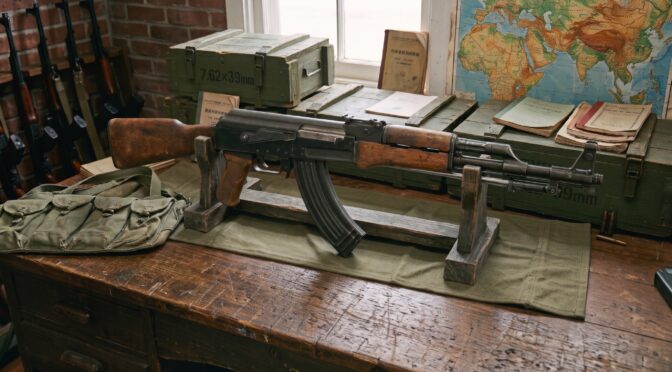
Executive Summary
The milled-receiver Chinese Type 56 Assault Rifle (1956年式冲锋枪, 1956-nián shì chōngfēngqiāng, literally “Type 1956 Submachine Gun,” commonly called 56冲, 56 Chōng, and widely known abroad as 56式自动步枪, Type 56 Automatic Rifle) spans multiple production periods across China’s state-owned ordnance factories (国营兵工厂)1. Manufacture started in 1955–1956 from a complete Soviet AK-47 Type 3 (АК-47 тип 3) technical data package (TDP) transferred to State Factory 626 (国营626厂, triangle /66\ mark) in Heilongjiang Province3. Approved for batch production in November 1956 and formally designated in January 1957, the earliest milled Type 56 rifles followed Soviet GOST steel grades, machining tolerances, and heat-treatment schedules3. After the Sino-Soviet split in the early 1960s ended Soviet steel deliveries, China replaced imported high-nickel alloys with boron-treated 50BA gun steel (50BA枪钢) for barrels and nickel-free 30CrMnMoTiA alloy steel for bolts (枪机) and bolt carriers (枪机框) across the Type 56 rifle family9.
Across its three main steel assemblies, the milled Type 56 uses distinct alloy and hardness targets suited to each part’s loads:
- Milled Receiver (铣削机匣): Machined from forged steel blanks or solid bar stock (105 machining steps at State Factory 386), milled receivers fall into two mechanical designs4. Early military Type 56 rifles and sanitized M22/M24 exports use the Soviet M26x1.5 threaded breech (螺纹连接) torqued against the barrel shoulder without a barrel cross-pin2. By contrast, 1985–1994 commercial milled exports from State Factory 386 (国营386厂, Longyan, Fujian—including pre-1989 PolyTech Legend and NM47 rifles and post-1989 milled MAK-90, MAK-91, and Hunter sporters) use a smooth 19.25 mm (0.7579 in) press-fit and cross-pinned (压装加销) breech joint4. Confirmed Russian structural data (30KhRA, 30KhGSA, hardened Steel 50), US 4140 milled receiver specs, and a modern Chinese GJB 2720-1996 40Cr small-arms case study place structural receiver hardness in the 37–48 HRC range20. Factory 386 military milled rifles were built to a 15,000-round service-life requirement, exceeding the 10,000-round rating of stamped Type 56 rifles that experienced locking-shoulder root cracks in their front trunnions31.
- Barrel (枪管): Measuring 415 mm (16.34 in) long (414 mm in some Western tables) with a thicker outside profile than the European AKM (16 mm gas-block and 15 mm front-sight journals versus 15 mm and 14.5 mm), the barrel uses 50A carbon steel or boron-treated 50BA steel (0.0005–0.0035% B, held below 0.0030% to prevent grain-boundary embrittlement)3. Oil-quenched at 840–850 °C and high-tempered at 520–600 °C to a tough tempered sorbite core of 21–32 HRC (25–30 HRC typical), the 19.25 mm press-fit chamber relies on the surrounding milled receiver ring to share hoop stress under 310–355 MPa service pressures and 444 MPa proof loads29. Bore and chamber wear resistance comes from flow electro-chrome plating (流动镀铬) measuring about 25–35 micrometers (800–1,000 HV) followed by 150–300 °C hydrogen-relief baking and lead lapping29.
- Barrel Blocks (枪管组件): The rear sight block (表尺座), gas block (导气箍), and front sight base (准星座) shifted from drop-forged or bar-machined medium-carbon steel (35/45 or 40Cr class) to lost-wax precision investment castings (失蜡精密铸造) pressed onto the barrel with tighter interference fits (0.076–0.152 mm / 0.003–0.006 in, compared to 0.076–0.102 mm on European AKMs) and locked with steel pins9.
Two evidence limits apply to open-source metallurgical study of the milled Type 56. First, no declassified blueprint from Factory 626 or Factory 386 specifying alloy grades and HRC ranges by part, and no peer-reviewed XRF or OES chemical test on an original milled Type 56 receiver, is publicly available7. Public summaries of the declassified November 1964 US Army Springfield Armory / Foreign Science and Technology Center (FSTC) report confirm matching dimensions and US-grade surface finish relative to a Soviet AK-47, but do not release alloy test numbers or Rockwell readings7. Second, common Western “Soviet blueprint hardness charts” and Chinese military web articles contain documented errors—including reading Rockwell A (HRA) values as Rockwell C (HRC) on sight posts and dust covers, mislabeling Soviet steels as US 4130/4140/4150, citing non-GOST “50AE/50AZ” grades, and claiming >60 HRC for the Type 56 spike bayonet9. Combining Chinese military and industrial standards (YB-481-80, GJB 2720-1996, GB/T 699, GB/T 3077, WJ 535-82), Russian ordnance references (GOST/OST 3-38-80), US technical intelligence summaries, and field armorer reports yields a verified baseline across milled Type 56 variants7.
Model Clarification and Evolution of the Milled Type 56
Distinguishing the Three Type 56 (56式) Models
Open-source discussions often mix up three separate 7.62×39 mm firearms adopted by China in 1956 under the shared “Type 56” (56式) name, all guided by chief engineer Zhao Ruizhi (赵瑞之)3:
- Type 56 Submachine Gun / Assault Rifle (1956年式冲锋枪 / 56冲): Licensed version of the Soviet AK-47 Type 3 with a milled receiver, later redesigned in China with a 1.5 mm stamped receiver3. This firearm is the focus of this report.
- Type 56 Semi-Automatic Rifle (56式半自动步枪 / 56半): Licensed version of the Soviet Simonov SKS carbine, produced mainly with milled receivers at Factory 296 (/26\, Jianshe Arsenal, Chongqing), along with limited stamped (0138) and cast (0129, 0221, 0226b) experimental receivers built at minor arsenals from 1970 to 19803.
- Type 56 Squad Light Machine Gun (56式班用轻机枪): Licensed version of the Soviet belt-fed Degtyarev RPD3.
Metallurgical histories of the Type 56 SKS still inform study of the Type 56 assault rifle because Chinese ordnance records confirm that domestic 50BA barrel steel, nickel-free 30CrMnMoTiA bolt steel, flow electro-chrome plating, and lost-wax investment casting for sight and gas blocks were adopted across all three Type 56 firearms9. However, SKS-specific trials—such as experimental cast receivers—do not apply to factory-made Type 56 assault rifles4.
Soviet Technology Transfer and Factory 626 Military Milled Production (1955–1968)
Chinese AK production started in 1955 when the Soviet Union licensed the milled AK-47 Type 3 to China, providing engineering drawings, tolerance calculations, heat-treatment rules, process sheets, tooling, and factory machines1. According to declassified accounts by Soviet advisor Barinov—who worked from January 6, 1956, to June 6, 1957, at State Factory 626 (国营626厂, triangle /66\ mark) in Beian, Heilongjiang Province (黑龙江北安)—the plant operated inside converted World War II Japanese barracks that had previously manufactured PPS submachine guns and Tokarev pistols5.
Factory 626 records report that full production of the forged-receiver Type 56 required 3,075 operations (3075道工序), 3,959 gauges, and 963 machines, aided by initial Soviet deliveries of 400 parts kits, 5,000 receiver blanks, and 10,000 bolt carriers8. Following joint ministerial and ordnance inspection, Factory 626 received batch-production approval on November 2, 1956, and the Ordnance Department formally named the rifle the 1956年式7.62mm冲锋枪 on January 3, 19578. Barinov’s diary records 5,000 initial rifles finished by November 1956—the first 1,000 assembled from Soviet components identifiable by open-ear front sights—ahead of a 50,000-rifle quota in 19575. Its designation as a “submachine gun” (冲锋枪) matched 1950s People’s Liberation Army (PLA) squad organization: seven riflemen in a nine-man squad carried the semi-automatic Type 56 SKS for aimed fire, while the squad leader and deputy carried the Type 56 冲锋枪 for close-range automatic fire3.
Early milled Type 56 rifles closely followed the Soviet Type 3 design, weighing 4.03 kg with an empty magazine (Chinese histories also cite 4.3 kg empty for early milled builds), with a smooth heavy dust cover, M26x1.5 threaded breech, M14x1 LH threaded muzzle with protective nut, solid hardwood furniture (楸木, qiūmù / chiu wood) instead of Soviet laminated birch, and Chinese fire-selector markings reading 连 (Lián, full-auto) and 单 (Dān, semi-auto)3. Rear tangent sights were graduated 1–8 (100–800 m), commonly replacing the Soviet Cyrillic П battle-zero setting with Pinyin D (定, dìng) on Factory 626 military and pre-ban Norinco 56S rifles, though some batches omitted the battle-zero mark60.
Field experience in the 1962 Sino-Indian Border War (对印自卫反击战) demonstrated the Type 56’s clear firepower advantage over bolt-action Lee-Enfield rifles, prompting the PLA to gradually replace semi-automatic rifles in frontline squads—a shift completed by the 1979 Sino-Vietnamese War (对越自卫还击战)3. During early-to-mid-1960s milled production, China standardized the fully enclosed circular front sight hood (全包护圈式准星)5. In January 1963, Factory 626 designed the downward-folding metal-stock Type 56-1 (56-1式冲锋枪, modeled on the Soviet AKS and approved October 10, 1963), initially built on forged/milled receivers3. In 1965, Factory 626 added the permanently hinged under-folding three-flute spike bayonet (折叠式三棱刺刀) to fixed-stock Type 56 rifles, matching the 1965 adoption of the spike bayonet on the Type 56 SKS8.
Sino-Soviet Split, Material Localization, and the Shift to Stamped Receivers
The political break between Beijing and Moscow in the early 1960s ended Soviet technical assistance and steel deliveries just after the USSR adopted the 1.0 mm stamped AKM in 1959, leaving China without the Soviet AKM technical data package5. Between 1964 and 1967, Zhao Ruizhi led a technical team in North Vietnam where Chinese engineers examined Soviet AKM stamping methods, aided by AKM sample rifles provided by Albania3.
China developed its own stamped-and-riveted receiver (冲铆机匣) Type 56, entering PLA series production around 1967–196966. Rather than copying the Soviet 1.0 mm sheet-metal receiver, Chinese engineers specified 1.5 mm sheet steel (1.5毫米钢板) with an RPK-style front trunnion rivet pattern54. This thicker sheet metal helped offset variability in domestic steel quality while keeping internal clearances compatible with milled-era bolt-carrier and trigger parts without extra stamping ribs59. Chinese ordnance records note that switching to stamped-riveted receivers introduced a fatigue limit: stamped Type 56 rifles were rated for 10,000 rounds (寿命定为10,000发), and even that target proved hard to maintain because fatigue cracks regularly formed at the root of the front trunnion locking shoulder (节套闭锁肩根部出现裂纹)—compared with the 15,000-round military life standard achieved by milled Factory 386 rifles31. Military stamped Type 56 rifles also removed muzzle threads while keeping milled-era parts such as the smooth dust cover, vented gas tube, and double-hook trigger without an AKM hammer rate reducer71.
Multi-Factory Milled Production and Commercial Exports (1980s–1994)
Although the PLA began replacing the Type 56 with the Type 81 (81式自动步枪, adopted 1981–1983 and completing PLA transition by 1999) and later the QBZ-95 and QBZ-191, China kept milled-receiver machinery active across several state arsenals for export and commercial trade3:
- State Factory 386 (国营386厂, stamped 386 inside a circle or oval): Located in Longyan, Fujian Province (福建龙岩), originally founded as the State-Owned Longyan Pneumatic Tool Factory (国营龙岩风动工具厂) and renamed State-Owned Hualong Machinery Plant (国营华龙机械厂) on November 1, 198813. (A Western arms-tracing chart reproducing Jenzen-Jones [2013] placed Factory 386 in Shenzhen, conflicting with primary Fujian factory histories14.) Factory 386 began Type 56 SKS trials in 1960, started milled Type 56 SMG production in 1963, corrected early production defects to pass the 15,000-round military endurance test, reached a peak output of 90,000 rifles per year in 1983 (640,000 military rifles through 1988), and began commercial milled semi-automatic exports in 198714.
- State Factory 296 (国营296厂, triangle /26\ stamp, Jianshe Arsenal, Chongqing): Best known as China’s main milled Type 56 SKS factory, Factory 296 received Type 56 SMG production packages from Factories 626 and 386 in 1980; collectors document 1980s export milled Type 56-1 underfolders carrying /26\ markings6.
- State Factory 416 (国营416厂, triangle /416\ stamp) & State Factory 356 (国营356厂, triangle /36\ stamp): Factory 416 built “P”-series PolyTech and Norinco commercial rifles (matching standard Norinco export specs, whereas Factory 386 “C”-series PolyTech rifles added upgrades such as spring-loaded firing pins and milled receivers) along with military Type 56 rifles documented in Afghanistan6. Western tracing charts link /416\ to Qingdao, whereas Chinese defense-industry records assign the 国营416厂 code to inland plants (including Yunnan Anning Machinery Plant and Yongchuan across different ministries), leaving the exact city of the small-arms /416\ plant unconfirmed in open sources74. Factory 356 (/36\) is also recorded as an AK producer, while master blueprint plant Factory 626 trained 252 specialists for 13 Third Front factories and supplied tooling to 24 plants6.
After the United States granted China Most-Favored-Nation trade status in 1980, state export companies Norinco (中国北方工业公司, China North Industries Corporation) and Poly Technologies / PolyTech (保利科技有限公司) marketed semi-automatic rifles built by these state arsenals to Western buyers from about 1983 until the 1994 US executive ban on importing Chinese rifled firearms4. US import rules split Factory 386’s milled commercial catalog into two periods:
- Pre-1989 Milled Exports: Led by the PolyTech AK-47/S “Legend” (fixed stock, underfolder, and the 20–21 in heavy-barrel NM47 National Match model with optional left-side optic rail, bipod, and threaded muzzle) alongside select milled Factory 386 Norinco Type 56S rifles4. These models featured glossy hot bluing, chrome-lined bores, chromed bolts and carriers, and open-ear Type 1 bayonet front sights on the Legend series21.
- Post-1989 Milled Sporters (1990–1994): To meet the 1989 US import ban on military features (separate pistol grips, bayonet lugs, muzzle threads, folding stocks), Factory 386 built milled versions of the thumbhole-stock MAK-90, the long-barrel bipod MAK-91, and the redesigned Norinco / PolyTech Hunter (called 386型 in Chinese histories)4. The Hunter used a modified milled receiver ((386) oval stamp), 16 in or 20 in chrome-lined barrel, single-piece checkered wood stock, factory drilled-and-tapped left receiver wall for scope mounts, and three documented rear-sight layouts (100/200 yd flip sights, 100/300 m flip sights, or cover-mounted sights)4.
Mechanically, Factory 386’s commercial milled receivers represent a hybrid design: instead of keeping the M26x1.5 threaded breech of 1956–1960s military rifles, PolyTech Legend and milled MAK-90 receivers were bored smooth to accept a 19.25 mm (0.7579 in) Chinese press-fit and cross-pinned barrel (commonly referred to as 19 mm by US builders), unifying barrel blanks with stamped Type 56 production while retaining a solid machined receiver20.
Global Military Exports, Licensed Foreign Plants, and Craft Copies
With total output commonly estimated at 10–15 million rifles, the Type 56 is one of the most widely exported Kalashnikov variants85. Global specimens divide into five distinct streams:
- Sanitized Cold War Military Exports (M22 and M24): Supplied in large quantities to North Vietnam and armed groups across Africa and the Middle East, M22 (fixed stock) and M24 (underfolder) milled rifles omitted Chinese factory triangles and used Latin L (full-auto) and D (semi-auto) selector marks as deniable aid (matching M21 SKS carbines and M20 Tokarev pistols)8. Their core metallurgy and M26x1.5 threaded breeches matched early Factory 626 PLA milled rifles, though they usually lacked folding spike bayonets16. Genuine Chinese milled and stamped Type 56 rifles remain in service globally—notably milled “Spiker” rifles used by Pakistan Police and modified rifles used by Pakistan’s Special Services Group (SSG)—alongside documented use in Iraq, Syria, Afghanistan, Somalia, Sudan, South Sudan, Yemen, Sri Lanka, Uganda, the Democratic Republic of Congo, Albania, Ukraine, Croatia, Kosovo, and Thailand1.
- Non-US Commercial and Allied Exports: Outside the United States, Norinco Type 56 and 56S rifles entered Canada (later classed as prohibited firearms), South Africa (where shooters note higher build quality on early milled rifles than on later stamped imports), New Zealand, and Western Europe, where Chinese AKs have been sold in France under SDM (“Sino Defence Manufacturing,” Beijing) and informally tested in Germany, while illicitly trafficked milled Type 56 rifles have appeared in European security incidents107. For Finland, China produced the 7.62 RK 56 TP, a modified stamped Type 56-2 fitted with a different hammer spring to reliably ignite Finnish 7.62×39 mm primers112.
- Licensed Foreign Production Plants: China exported turnkey Type 56 factories to Albania (UM Gramsh, producing the ASH-78 / Automatiku Shqiptar model 56 from about 1974 into the early 1990s, as well as milled Type 56 SKS carbines from 1967 to 1978), Bangladesh (Bangladesh Ordnance Factories, licensed Type 56 assault rifles), Iran (KL-7.62 by DIO, later updated as KLS/KLF), Sudan (MAZ by Military Industry Corporation), and Algeria59. Unlicensed regional derivatives also appeared, including North Vietnam’s 1.0 mm stamped TUL-1 (1970–1974) and Myanmar’s KA2-5112. For metallurgical identification, these licensed foreign plants primarily produced stamped-receiver Type 56 rifles rather than milled Type 56 AKs59.
- Post-1994 Low-Cost Export Decline: After PLA orders ended, the 1994 US ban closed commercial US sales, post-Soviet surplus flooded world markets, and Factory 626 was transferred to Shougang Group (首钢庆华工具厂) in June 1988 before going bankrupt in 2006, remaining Chinese export plants dropped wholesale prices to USD 93 to 120 per rifle8. Field armorers inspecting late-1990s and newer stamped side-folding Type 56-2 (56-2式) and look-alike “Chinese AK-103” exports (built with 45-degree gas blocks and Chinese rivet patterns) documented major quality failures: bore chrome flaking off after a few hundred rounds, wide shot groups, stoppages when firing uphill, non-removable front sight posts, weak extractor springs, loose firing-pin retaining pins, easily worn surface finishes, and lost parts interchangeability116.
- Unlicensed Craft Milled Copies (Darra Adam Khel / Khyber Pass): Small workshops in northwestern Pakistan build hand-milled and “faux-stamped” milled Type 56 copies from weak, unhardened mild or scrap steel prone to rapid wear and headspace stretch118. Because local craftsmen rarely stamped accurate Chinese characters, authentic 连/单 receiver markings served as a practical field check in Afghanistan and Pakistan to verify factory Chinese steel59.
Metallurgical Standards Guide and Source Audit
Chinese (YB/GJB/GB), Soviet (GOST/OST), and US (AISI/SAE) Steel Equivalents
Evaluating milled Type 56 steels requires comparing three national systems: Soviet GOST / OST standards transferred in 1955–1956, domestic Chinese YB / GJB / GB standards adopted after the Sino-Soviet split, and US AISI/SAE steels used as modern aftermarket benchmarks12.
Russian small-arms materials literature reports that Kalashnikov rifles and machine guns use 15 steel grades across all subassemblies27. Soviet AK-47/AKM replacement-parts drawings cite GOST 1050-60 and GOST 380-60 carbon steels120; OST 3-38-80 covers high-quality carbon and boron-treated barrel steels (50A, 50RA)51; and GOST 4543 covers alloy structural grades—including chromium-boron 30KhRA (30ХРА), chromium structural 40Kh (40Х), chromium-silicon-manganese 30KhGSA (30ХГСА), and chromium-nickel-molybdenum-vanadium 30KhN2MFA (30ХН2МФА)27. Cut off from Soviet nickel-bearing steels in the early 1960s, China standardized domestic light-weapon steels under Ministry of Metallurgy standard YB-481-80 (50B gun steel) and National Military Standard GJB 2720-1996 (Specification for Structural Steel Bars for Light Weapons, 《轻武器用结构钢钢棒规范》, covering hot-rolled, forged, and cold-drawn bars up to 200 mm, verified in open records for 50A, 40Cr, and 30CrMnMoTiA, and revised as GJB 2720A-2019), alongside general national standards GB/T 699 (carbon steel) and GB/T 3077 (alloy steel)9.
China’s domestic steel substitution can be compared quantitatively using the International Institute of Welding Carbon Equivalent (CE_IIW), an index of base hardenability calculated strictly from intentional alloying nominal midpoints (excluding residual impurity limits across all standards for a fair comparison):
CE_IIW = C + Mn/6 + (Cr + Mo + V)/5 + (Ni + Cu)/15
(where each chemical symbol represents its nominal intentional weight percentage)
Applying this formula consistently across Chinese, Soviet, and US standards—separating Chinese 50BA (YB-481-80) from Soviet 50RA (OST 3-38-80) and including 0.10–0.18% V (nominal 0.14%) for GOST 4543 30KhN2MFA—clarifies China’s alloy trade-offs35.
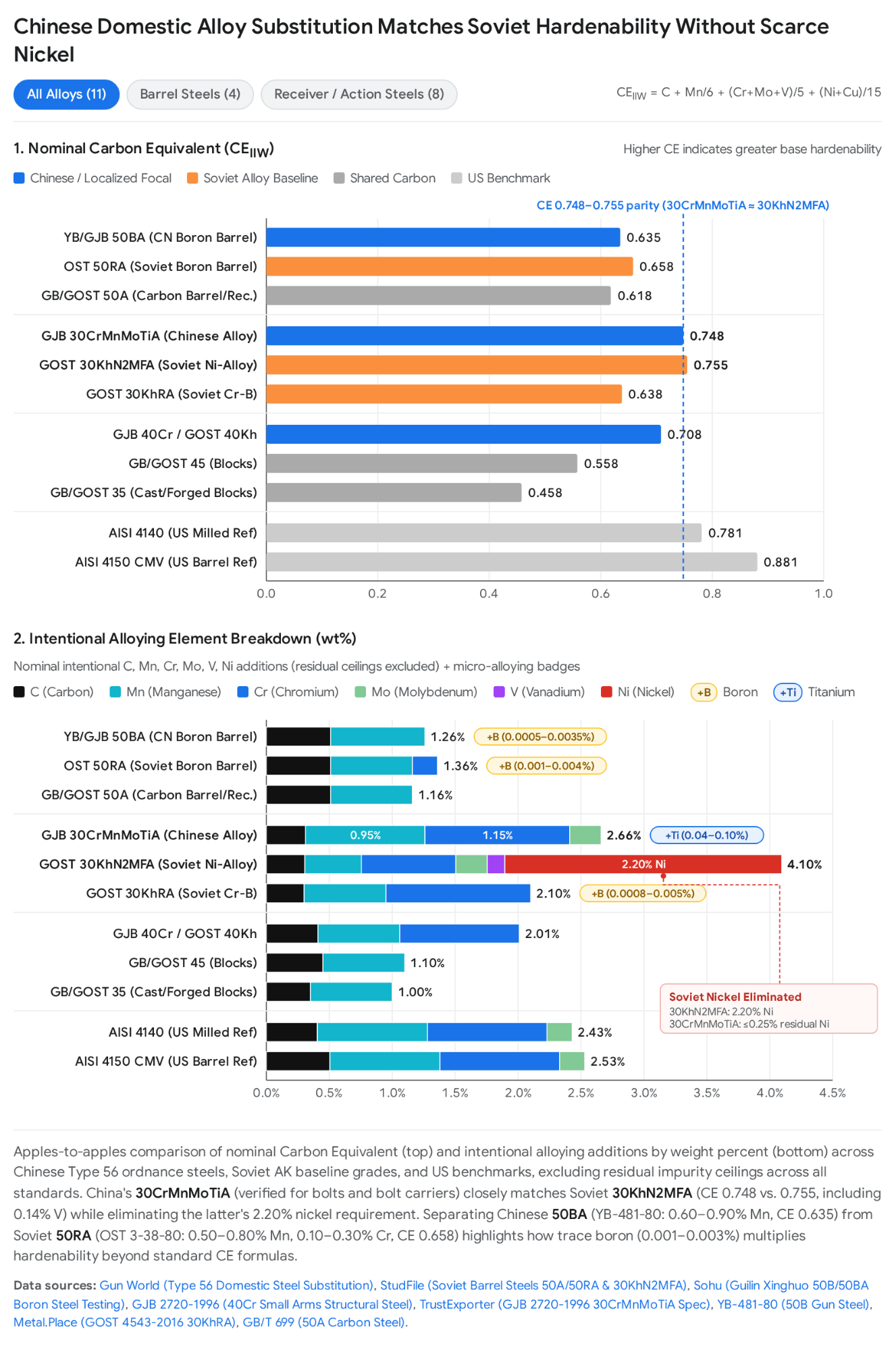
Two main metallurgical findings stand out from this comparison:
- Matching Hardenability Without Nickel: Chinese 30CrMnMoTiA nearly matches the intentional-alloy CE_IIW of Soviet 30KhN2MFA (0.748 versus 0.755) while eliminating 2.00–2.40% nickel (holding nickel to a <= 0.25% residual limit)12. Chinese metallurgists achieved comparable oil-quench hardenability and toughness for bolts and bolt carriers using domestically available manganese (0.80–1.10%), chromium (1.00–1.30%), molybdenum (0.20–0.30%), and grain-refining titanium (0.04–0.10%)12.
- Hardenability Gain From Trace Boron: Standard CE_IIW equations do not include boron. Comparing Chinese 50BA (CE_IIW = 0.635, using 0.60–0.90% Mn without specified Cr), Soviet 50RA (CE_IIW = 0.658, using 0.50–0.80% Mn and 0.10–0.30% Cr), and Soviet 30KhRA (CE_IIW = 0.638) shows boron’s strong hardenability effect: adding 0.001–0.003% boron increases hardenability about as much as 0.6% Mn, 0.7% Cr, 0.5% Mo, or 1.5% Ni, enabling clean oil through-hardening without costly alloy elements34.
Source Audit of Secondary Hardness Tables and Popular Myths
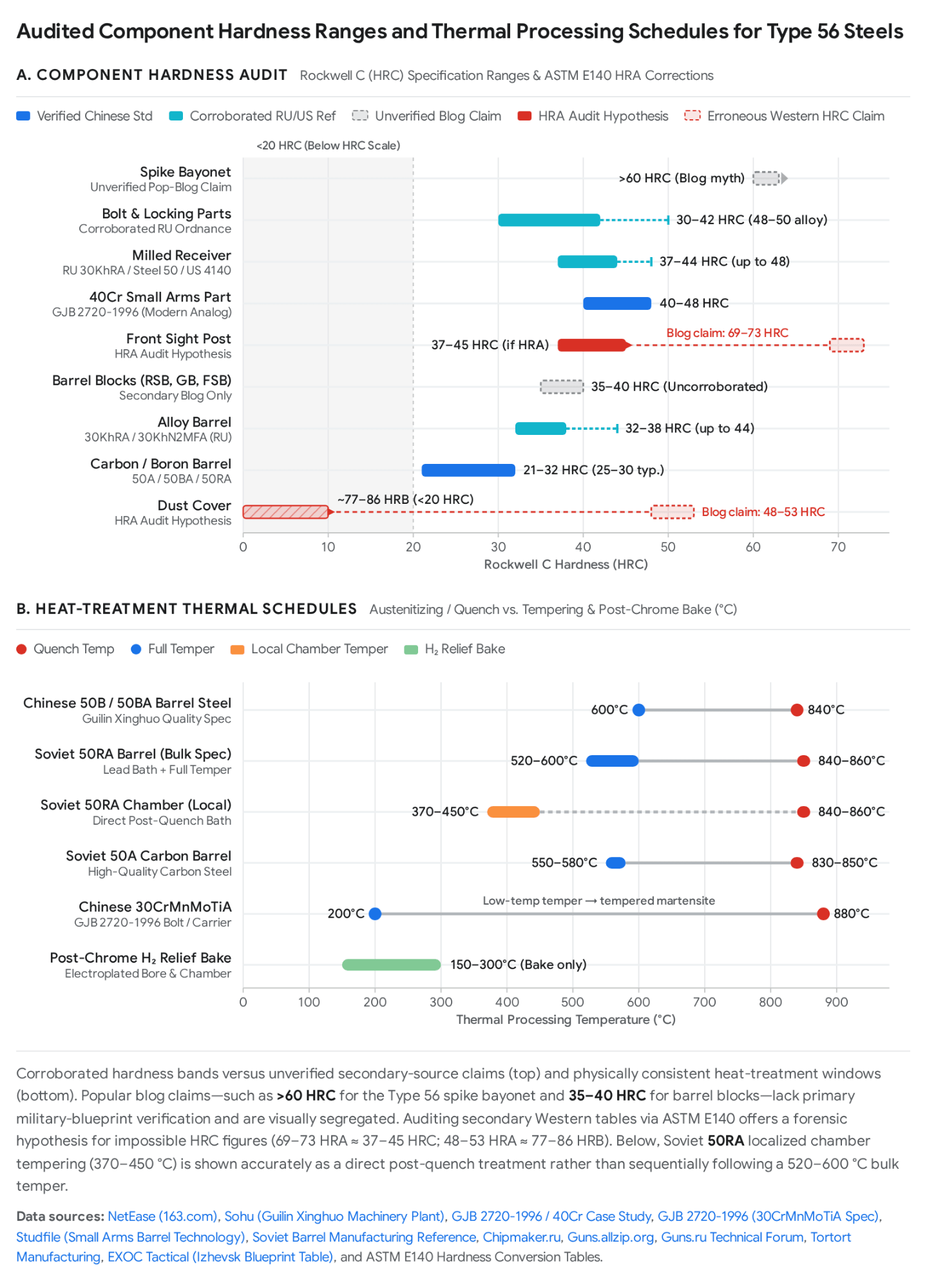
Public Type 56 references contain several repeated factual mistakes from secondary blogs. One widely linked US blog (Exoc Tactical), claiming direct transcription from Izhevsk AK-47/AKM blueprints, contains multiple documented errors: it describes all Soviet AK steels as US 4130/4140/4150 chrome-moly steel, falsely states that bolts and front trunnions are “cold-hammer-forged,” mixes separate stamped AKM trunnions with milled AK-47 receivers, assigns 37–44 HRC to all AK-47/AKM barrels (conflicting with Russian 50A/50RA standards), and lists physically impossible Rockwell C values of 69–73 HRC for front sight posts and 48–53 HRC for stamped dust covers50.
Checking these claims against ASTM E140 hardness conversions and primary Russian and Chinese standards separates verified specifications from unconfirmed claims37:
- Confirmed Core Ranges: Primary Russian and Chinese technical references independently confirm 21–32 HRC (25–30 HRC typical) for tempered sorbite 50A/50BA/50RA rifle barrels25; 32–38 HRC (up to 37–44 HRC) for alloyed Russian barrels (30KhRA/30KhN2MFA)25; 37–48 HRC for structural receivers and locking housings (Russian 30KhRA 37–48 HRC, 30KhGSA 39–41 HRC, hardened Steel 50 37–44 HRC, US 4140 milled receivers 41–45 HRC, and a modern Chinese GJB 2720-1996 40Cr small-arms study at 40–48 HRC)20; and 30–42 HRC (carburized carbon/boron steel) to 48–50 HRC (25Kh2N4MA) for bolts (40 HRC for bolt stems)29.
- HRA-to-HRC Scale Hypothesis: No structural firearm steel reaches 69–73 HRC (high-speed cutting steels like R18 top out near 67 HRC133), and a thin stamped dust cover hardened to 48–53 HRC would crack under normal impacts. Because Soviet drawings often test thin or small parts on the Rockwell A (HRA, 60 kgf diamond) scale, a likely explanation is that the blog’s figures were misread from HRA: under ASTM E140, 69–73 HRA converts to 37–45 HRC (reasonable for a sight post), and 48–53 HRA converts to ~77–86 HRB (~140–168 HBW, typical of cold-rolled sheet steel)37. Without verified Izhevsk drawing scans, these remain forensic conversions of secondary numbers rather than confirmed factory specs.
- Unconfirmed Secondary Claims: Both the blog’s 35–40 HRC range for barrel blocks (RSB, GB, FSB) and popular Chinese web claims of >60 HRC for the Type 56 spike bayonet lack primary military-standard support and are marked separately below48.
Receiver Metallurgy, Breech Design, and Heat Treatment (铣削机匣)
Forged and Billet Machining and Breech Interfaces (M26x1.5 vs. 19.25 mm)
The Type 56 milled receiver (铣削机匣, xǐxuē jīxiá; Russian фрезерованная ствольная коробка) combines the barrel socket, bolt-locking recesses (闭锁肩), bolt-carrier guide rails (导轨), fixed ejector (抛壳挺), magazine well (弹匣井), trigger housing, and rear stock tangs in one machined steel body2. Unlike stamped Type 56 and AKM receivers—where a separate forged front trunnion (枪管节套) is riveted into thin sheet metal—the milled receiver directly carries axial bolt thrust and chamber radial pressure2.
In Soviet production, the Type 2 receiver (1951–1957) was machined from a solid drop forging (цельная поковка), while the lighter Type 3 receiver (from 1954–1955, with angled side lightening cuts) was machined from forged blanks or solid bar stock60. Chinese and US accounts confirm that Factory 626 and Factory 386 machined Type 56 receivers from forged steel blanks (锻造机匣) or solid steel blocks4. During his 1987 tour of Factory 386, writer Garry James reported that finishing one commercial milled AK-47/S receiver took 105 machining steps on mostly manual machine tools13. For industrial comparison, modern US billet-milled 4140 AK receivers cut a 15 lb (6.8 kg) steel block down to 1.8–2.0 lb (0.82–0.91 kg) finished weight—removing more than 85% of the starting steel as scrap—which shows the cost and material pressure behind China’s late-1960s shift to stamped receivers3.
Engineers examining milled Type 56 receivers must identify which of two barrel-breech joints is present:
- Early Military and Sanitized M22/M24 Threaded Breech (1956–late 1960s): Copied from the Soviet Type 3 TDP, the front receiver ring is internally threaded M26x1.5 (Soviet engineers had widened the thread pitch from 1.0 mm to 1.5 mm to increase joint strength)15. The threaded barrel screws into the receiver and is torqued tightly against its shoulder—headspaced and timed via shoulder machining, shims, or final chamber reaming—without a transverse barrel pin2.
- Commercial Factory 386 Press-Fit and Pinned Breech (1985–1994): Documented on PolyTech Legend and milled Norinco MAK-90 receivers, Factory 386 replaced breech threads with a smooth cylindrical socket sized for a 19.25 mm (0.7579 in) Chinese press-fit barrel retained by a transverse steel pin (压装加销)20. Compared to standard European 23.00 mm (0.9055 in) press-in AKM barrels, the narrower 19.25 mm Chinese journal leaves thicker steel walls around the milled receiver’s front ring20. While European AKMs use a 7.0 mm (0.2756–0.277 in) hardened barrel pin, a US builder measuring a Chinese MAK-90 barrel pin recorded 6.2 mm (~0.244 in), indicating Chinese press-fit pins may not interchange with European 7.0 mm pins (though no published factory drawing confirms whether all Chinese milled and stamped press-fit rifles share the 6.2 mm pin)146.
Alloy Selection, Pre-Machining Hardness, Heat Treatment, and Distortion Control
Because no declassified Factory 626 or Factory 386 drawing publishes an exact receiver steel grade or heat-treatment sheet, metallurgical reconstruction compares Soviet TDP baselines with Chinese military and national bar-steel standards (GJB 2720-1996, GB/T 699, GB/T 3077). Russian ordnance references list 50A (with Soviet Steel 50 hardened parts documented at 37–44 HRC30), boron-treated 50RA, and chromium-boron 30KhRA (GOST 4543) for Soviet receivers and trunnions, alongside 30KhN2MFA and carburized 12KhN3A in specialized builds27. Russian ordnance sources place 30KhRA structural and locking parts at 37–44 HRC up to 45–48 HRC (43–47 HRC in peer-reviewed Russian SPV data) and 30KhGSA receiver references at 39–41 HRC25.
During 1956–1960, Factory 626 machined Soviet-supplied receiver blanks and steel stock8. After domestic steel localization, Chinese records confirm broad use of 50A/50BA across Type 56 steel components and standardize 40Cr (GJB 2720-1996: 0.37–0.45% C, 0.50–0.80% Mn, 0.17–0.37% Si, 0.80–1.10% Cr, P/S <= 0.030%) as a core light-weapon structural alloy bar steel9. Primary Chinese technical specifications verify nickel-free 30CrMnMoTiA (GJB 2720-1996, oil-quenched at 880 °C and air-tempered at 200 °C to tensile strength >= 1,520 MPa, yield strength >= 1,325 MPa, and impact energy Akv >= 47 J or >= 58.75 J/cm^2) specifically for bolts (枪机) and bolt carriers (枪机框), not for milled receivers (机匣)9.
Before 105-step machining, bar and forged blanks must be delivered in a soft annealed state: Chinese standards specify <= 207 HB annealed (<= 241 HB untreated) for GB/T 699 Steel 50, <= 197 HB annealed for GB/T 699 Steel 45, <= 207 HB spheroidized pearlite anneal for GB/T 3077 40Cr, and <= 241 HB annealed or high-tempered delivery hardness for GJB 2720-1996 30CrMnMoTiA12.
Heat-treating a thin-walled, asymmetric U-channel milled receiver creates high quench distortion (淬火变形) risk because the thin side rails cool much faster than the thick forward locking bridge—the same warpage issue that led Izhmash to abandon early 1948 stamped receivers for milled construction26. Small-arms manufacturers manage this risk through three methods:
- Pre-Finish Quench-and-Temper (调质后精加工): Bulk-hardening and tempering rough-machined forgings before final broaching and reaming of locking recesses, carrier rails, and barrel sockets—similar to modern US 4140 billet-milled practice (41–45 HRC; 43 HRC on Tortort milled Type 56 receivers, with barrel journals reamed after heat treatment)20.
- Localized Hardening (局部淬火): Concentrating higher hardness (~40–46 HRC) at locking shoulders, bolt-carrier rails, ejector tip, and trigger-pin holes while leaving outer sidewalls slightly tougher against impact and low-temperature shock (modern PLA small-arms standards, such as for the QBZ-95, specify operation down to -45 °C)157.
- Modern Chinese Isothermal Distortion-Control Analog: Although not documented as 1956–1994 Type 56 factory procedure, a peer-reviewed Chinese case study under GJB 2720-1996 documents lower bainite isothermal quenching (下贝氏体等温淬火) on fully machined, asymmetric, uneven-walled 40Cr small-arms parts requiring 40–48 HRC without post-heat-treat machining allowance, achieving dimensional stability, high impact toughness, and surface compressive stress26.
Surface Finishing (WJ 535-82), Corrosion Resistance, and the “Soft Receiver” Debate
Military and commercial milled Type 56 receivers were typically finished with hot alkaline chemical bluing / black oxide (碱性化学氧化 / 发蓝), standardized under Chinese Weaponry Industry Standard WJ 535-82 (Technical Conditions for Alkaline Chemical Oxidation of Steel Parts, 《钢铁零件碱性化学氧化技术条件》, using hot sodium hydroxide oxidizing baths)52. While visually glossy on polished Factory 386 commercial rifles, alkaline bluing provides weak moisture and salt-spray protection compared to Soviet chemical phosphating and chromating overcoated with BF-4/Nigrosine lacquer or VMA-5194E enamel, or the dark phosphating (黑色磷化处理) China later used on the naval QBZ-56C27. The 1964 Springfield Armory evaluation noted that little original rust bluing remained on either the captured Factory 626 Type 56 or the 1954 Tula AK-47, and that both rifles left their bolts and carriers unfinished7. Collectors also document plum or purplish coloring on some Factory 386 PolyTech MAK-90 and NM47 receivers and hammers—a common effect of hot-salt bluing interacting with alloy composition, harder tempered steel, or bath-temperature drift23.
US firearms forums occasionally cite anecdotal claims that Chinese milled receivers test softer than Eastern European milled receivers: two posters reported Rockwell-testing Chinese steel and pre-1989 PolyTech Legend receivers and judging them softer than European rifles, though neither recorded numerical HRC readings164. Three documented facts put these unverified reports in context:
- US B-West Receiver Confusion: Much “soft Chinese AK” reputation traces to B-West rifles assembled in the United States on US-made receivers (serial prefixes 989 and 999) paired with Chinese parts kits; those US receivers lacked proper heat treatment on the guide rails and axis-pin holes and failed after moderate use, whereas Chinese-imported B-West receivers (BWA–BWD prefixes) performed reliably85.
- Test Location and Steel Baseline: Testing an outer sidewall of a selectively hardened or medium-carbon (50A/50BA) receiver produces lower readings than testing a uniformly through-hardened US 4140 billet receiver (43 HRC)20.
- Endurance Record: Factory 386 engineering recollections document that milled PLA Type 56 rifles were required to pass a 15,000-round military endurance standard (higher than both the 10,000-round stamped PLA rating and the conservative 6,000-round rating printed in commercial Norinco MAK-90 manuals)31. Open armorer records show no widespread pattern of locking-recess setback or receiver cracking on genuine Factory 626 or Factory 386 milled Type 56 rifles—unlike the documented soft-bolt headspace stretch seen on some commercial Norinco M14S rifles164.
Barrel Metallurgy, Chamber Stress, Heat Treatment, and Chrome Plating (枪管)
Alloy Transition: Soviet 50A/50RA to Chinese 50BA Boron Gun Steel
The milled Type 56 barrel (枪管, qiāngguǎn; Russian ствол) measures 415 mm (16.34 in) overall (414 mm in some Western listings), keeping the Soviet 7.62×39 mm four-groove 240 mm (1:9.45 in) right-hand rifling while using a thicker external profile than the European AKM2.
Initial Factory 626 production followed the transferred Soviet AK-47 barrel TDP using medium-carbon 50A (Сталь 50А) and boron-treated 50RA (50РА, OST 3-38-80: 0.47–0.55% C, 0.17–0.37% Si, 0.50–0.80% Mn, 0.10–0.30% Cr, <= 0.30% Ni, 0.001–0.004% B, P/S <= 0.025%, Cu <= 0.20%)39. Several secondary Chinese web histories claim early Type 56 barrels used imported high-Cr/Ni Soviet steels named “50AE” and “50AZ”9; however, neither 50AE nor 50AZ appears in verified Soviet GOST/OST small-arms standards, and those same secondary articles contain spelling errors such as 30GrNi2MoVA for 30CrNi2MoVA9. Those labels should be treated as unverified secondary copying errors rather than established Soviet alloys.
After Soviet steel shipments stopped, China developed domestic 50BA gun steel (50BA枪钢), based on Ministry of Metallurgy light-weapons standard YB-481-80 (50B: 0.47–0.55% C, 0.17–0.37% Si, 0.60–0.90% Mn, 0.0005–0.0035% B), where the A suffix marks superior-quality (高级优质) steel with tighter phosphorus and sulfur limits than standard GB/T 699 <= 0.035%9. Functionally similar to Soviet 50RA—using higher manganese (0.60–0.90%) without Soviet 50RA’s 0.10–0.30% chromium range—50BA became the standard barrel steel across the Type 56 SKS, Type 56 Assault Rifle, and Type 56 LMG9.
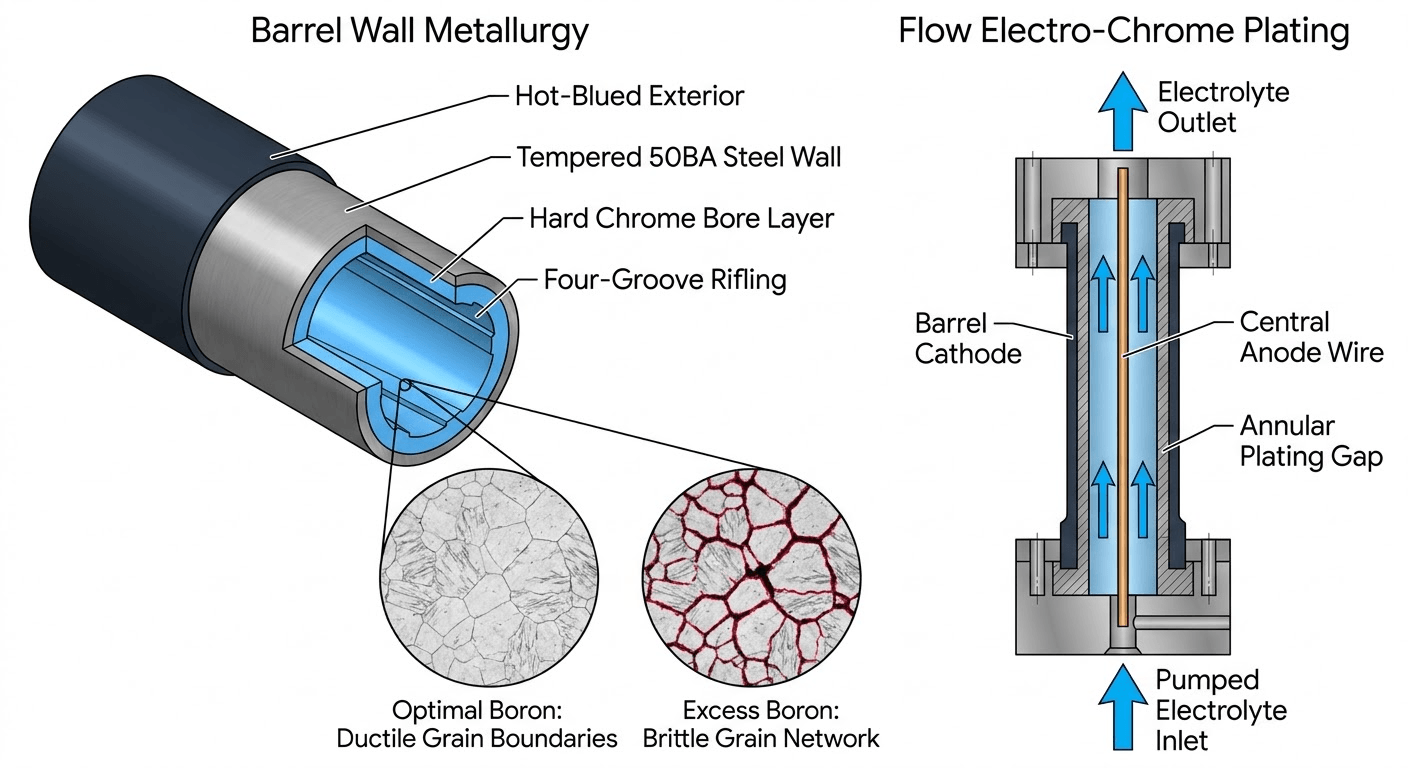
Tight boron control is critical for 50BA toughness. Dissolved boron collects along austenite grain boundaries during cooling, lowering boundary energy and delaying ferrite and upper bainite formation so oil quenching produces uniform martensite through the barrel wall34. Because boron solubility in austenite at normal quenching temperatures is only 0.001–0.002%, total boron above 0.003% precipitates a continuous brittle boron-carbide network, Fe23(C,B)6, along austenite grain boundaries—causing boron embrittlement (硼脆, péngcuì) and a sharp drop in impact toughness34. Statistical testing at Fushun Steel Plant (抚顺钢厂), Kunming Steel Plant (昆明钢厂), and acceptance testing at the former Guilin Xinghuo Machinery Plant (广西桂林星火机械厂) confirmed this cutoff: across all Guilin Xinghuo 50B/50BA heats kept below 0.0030% B (oil-quenched at 840 °C, tempered at 600 °C), impact toughness reached 9.4–14.1 kgf*m/cm^2 (92.2–138.3 J/cm^2), well above the Chinese specification minimum of >= 5 kgf*m/cm^2 (>= 49.0 J/cm^2)34. Across Chinese and Russian ordnance standards, 50A/50BA barrel minimums require yield strength >= 539–550 MPa (55 kgf/mm^2), tensile strength 784–981 MPa (80–100 kgf/mm^2), elongation >= 8–10%, reduction of area >= 40%, and GJB 2720-96 50A impact toughness >= 38.75 J/cm^2 (Soviet 50RA KCU >= 60 J/cm^2)25.
Chamber Pressure and Thick-Walled Cylinder Load Sharing
Comparing barrel yield strength against 7.62×39 mm chamber pressures shows how the milled receiver reinforces the breech. Standard 7.62×39 mm cartridges (11.35 mm case base, tapering from ~11.15 mm just forward of the solid case web to 10.07 mm at the shoulder) are rated to a SAAMI Maximum Average Pressure (MAP) of 310.3 MPa (45,010 psi), a C.I.P. maximum piezo pressure (Pmax) of 355.0 MPa (51,490 psi), and a C.I.P. proof pressure of 444 MPa (125% of C.I.P. Pmax)40.
Under Lamé thick-walled cylinder mechanics (plane-stress inner-wall approximation with radial stress = -P), the inner-wall hoop stress multiplier k, peak tangential hoop stress, and von Mises equivalent stress for an unsupported steel tube of outer radius r_o and inner chamber radius r_i are:
k = (r_o^2 + r_i^2) / (r_o^2 – r_i^2)
hoop stress = P * k
von Mises stress = sqrt(hoop stress^2 + hoop stress * P + P^2)
Evaluating each milled Type 56 chamber cross-section without external receiver support highlights the structural difference between threaded and press-fit breeches36:
- Factory 386 Press-Fit Breech Journal Alone (19.25 mm / 0.7579 in OD at 11.15 mm rear case body; 4.05 mm wall, k = 2.01): Without receiver backing, SAAMI 310.3 MPa would impose 624 MPa hoop stress (824 MPa von Mises), C.I.P. 355.0 MPa would impose 713 MPa hoop (943 MPa von Mises), and 443.8 MPa proof pressure would impose 892 MPa hoop (1,178 MPa von Mises)20. Those stresses exceed both the 539 MPa specification yield floor and a typical ~700 MPa yield strength for 28–30 HRC tempered 50BA steel (SF = 0.74–0.85 at service pressures; 0.59 at proof)37.
- Threaded Breech Minor Diameter (24.16 mm root of M26x1.5 at 11.15 mm rear case body; 6.50 mm wall, k = 1.54): Unsupported inner-wall stress is substantially lower—478 MPa hoop (688 MPa von Mises, SF = 1.02 against 700 MPa typical yield) at SAAMI 310.3 MPa and 547 MPa hoop (787 MPa von Mises) at C.I.P. 355.0 MPa—before accounting for thread engagement inside the receiver ring18.
- Forward Chamber Step (22.95 mm / 0.903 in OD at 10.07 mm shoulder; 6.44 mm wall, k = 1.48): Forward of the receiver, where the cartridge case narrows toward the shoulder, unsupported inner-wall stress drops to 458 MPa hoop (670 MPa von Mises, SF = 1.05 against 700 MPa typical yield) at SAAMI 310.3 MPa and 524 MPa hoop (766 MPa von Mises) at C.I.P. 355.0 MPa (further aided by the steel cartridge case and adjacent receiver backing)36.
This stress balance explains why Factory 386 could safely reduce the press-fit breech journal from 23.00 mm (European AKM) to 19.25 mm: the 21–32 HRC 50BA chamber wall sits tightly pressed inside a thick, harder (~37–48 HRC) milled receiver ring that acts as a composite pressure jacket sharing radial expansion loads37.
Thermal Processing Schedules and Rifling Fabrication Timeline
To resist brittle fracture under sustained fire and pressure spikes, milled Type 56 barrels are quenched and high-tempered (调质处理, tiáozhì chǔlǐ) to a fine tempered sorbite (回火索氏体) core at 21–32 HRC (25–30 HRC typical; 28–30 HRC commonly cited for AK-47 50A barrels)25.
Under Soviet 50A/50RA barrel procedures and Chinese 50BA plant schedules, heat treatment involves two separate tempering paths that are not performed sequentially34:
- Lead-Bath Heating and Simultaneous ID/OD Oil Quenching: Annealed barrel blanks (<= 207 HB for GB/T 699 Steel 5053) are rapidly heated (~4 minutes for AK blanks) in electrically heated molten lead crucibles (铅浴加热 / свинцовая ванна) covered with floating charcoal to limit oxidation, reaching 850 +/- 10 °C (830–850 °C for Soviet 50A; 840 °C in Guilin Xinghuo 50BA tests)34. Blanks are quenched in fixtures circulating 60–90 °C oil simultaneously along the outside and through the bore to limit bending39.
- Bulk High-Temperature Tempering vs. Direct Post-Quench Local Chamber Tempering: For uniform toughness along the full barrel, quenched blanks undergo bulk tempering at 520–600 °C (550–580 °C for Soviet 50A; 600 °C in Chinese 50BA plant testing) followed by air cooling34. Where higher chamber strength is specified under Russian barrel technology, primary textbooks direct that directly after quenching (После закалки) the chamber zone is tempered locally in a molten lead or nitrate salt bath at 370–450 °C39. Because heating to 370–450 °C after a 520–600 °C temper cannot raise hardness or strength (and risks temper embrittlement), 370–450 °C chamber tempering is strictly a direct post-quench differential treatment39.
Manufacturing timelines also clarify a common collector assumption about rifling methods. Although Western forums often claim Chinese Type 56 barrels are cold-hammer-forged180, Russian firearms-manufacturing histories confirm that Soviet factories did not replace button rifling (дорнирование) with rotary cold hammer forging (ротационная ковка) until the early 1970s—well after the 1955–1956 TDP transfer and 1960 Sino-Soviet split183. Similarly, Chinese military-industrial histories link China’s adoption of radial cold-forged barrels (精锻枪管 / 径向冷精锻, swaging unhardened blanks over a tungsten-carbide mandrel prior to heat treatment) to China’s 1980s small-caliber Type 87 and QBZ-95 programs39. Early 1956–1960s milled Type 56 barrels were therefore produced by cut, broached, or button-rifling methods rather than cold hammer forging; whether late-1980s/1990s Factory 386 commercial barrels ever switched to cold forging is not confirmed in public records without metallographic testing. Separately, technical observers report a mid-1960s Chinese chamber update that slightly rounded the sharp chamber shoulder to extend reamer life and improve chrome adhesion65.
Flow Electro-Chrome Plating (流动镀铬), Hydrogen Relief, and Export Quality Divergence
Because PLA and Warsaw Pact 7.62×39 mm service ammunition used corrosive primers, internal hard-chrome plating (内膛电镀硬铬) was necessary for barrel service life; early unchromed Chinese Type 56 SKS barrels frequently wore out before reaching their 6,000-round target2. Alongside 50BA barrel steel, Chinese arsenals adopted flow electro-chrome plating (流动镀铬, liúdòng dùgè; Russian струйное хромирование) for both the rifled bore (线膛) and chamber (弹膛)9.
Under Soviet and Chinese small-arms plating procedures, sorted bores undergo alkaline degreasing, acid etching, and rinsing before preheated electrolyte (150 g/L CrO3 and 1.5 g/L H2SO4 at 50–60 °C) is pumped through the bore (cathode) around a centered 2.5 mm coated steel anode wire (for 7.62 mm caliber) at 30–35 A/dm^2 current density39. Centering the anode is critical: an off-center anode produces uneven chrome thickness, requiring reverse-polarity stripping and re-plating39. After plating, barrels are rinsed, neutralized in a 5–8% aqueous Na2CO3 bath at ~50 °C, baked at 150–300 °C (去氢处理, hydrogen relief, using lower temperatures for thinner layers) to drive out trapped hydrogen and avoid embrittlement, and polished via abrasive lead lapping (свинцевание / шустование, using an abrasive-charged lead slug about 10 calibers long)39.
Russian metallurgical sources specify 25–35 micrometers (0.025–0.035 mm) chrome thickness for rifle bores (within a Chinese 20–50 micrometers industrial barrel range and a 40–150 micrometers Soviet textbook span covering calibers up through 30 mm automatic cannons; modern Chinese precision-barrel research also examines 15 micrometers thin layers)29. Ordnance hard chrome reaches 800–1,000 HV microhardness (specialized multi-pass Chinese ordnance patents cite 1,000 HV), enabling well-plated early milled and pre-1994 Factory 386 commercial barrels to exceed 10,000 rounds while maintaining service accuracy43. Globally, plating quality diverges sharply by era: early milled rifles and Factory 386 commercial imports typically show durable bright chrome (with Modern Firearms noting only some early or specialized unchromed Type 56 runs33), whereas late-1990s and newer budget export Type 56-2 rifles (USD 93–120 wholesale) inspected in conflict zones display chrome lining that peels off after only a few hundred shots—a classic result of poor bore preparation, bath contamination, or skipped hydrogen-relief baking116.
Barrel Blocks Metallurgy, Press-Fit Tolerances, and Bayonet Hardware (枪管组件)
Transition from Drop Forging to Lost-Wax Precision Investment Casting (失蜡精密铸造)
Three external steel blocks mount along the milled Type 56 barrel: the Rear Sight Block (表尺座, Biǎochǐ zuò; Russian колодка прицела), the Gas Block (导气箍, Dǎoqì gū; Russian газовая камера), and the Front Sight Base (准星座, Zhǔnxīng zuò; Russian основание мушки)9.
During early milled Type 56 and M22 production (1956 to the mid-1960s), all three blocks followed the Soviet AK-47 Type 3 TDP via closed-die drop forging and machining (先锻造再机加工成型) or machining directly from solid steel bar (用棒料直接加工), giving dense wrought grain flow at higher labor and material cost9. Although Chinese factory records mention early precision-casting trials for Type 56 SMG parts in 1957193, broad conversion of sight bases and gas blocks to lost-wax precision investment casting (失蜡精密铸造 / 熔模精密铸造) occurred from the late 1960s into the 1970s across the Type 56 family, closely matching Izhmash’s early-1970s move to investment-cast (точное литье по выплавляемым моделям) AKM/AK-74 barrel blocks9. Investment casting formed complex sight hoods, sling loops, and bayonet collars close to final shape, limiting machining to barrel-journal bores, pin holes, gas passages, and sight slots; unmachined matte fillets and faint mold seams distinguish cast blocks from early wrought forgings9.
Alloy Selection, Heat-Treatment Baselines, and Journal Press-Fit Tolerances
No declassified Factory 626 or Factory 386 blueprint gives the exact steel designations or HRC limits for the rear sight block, gas block, or front sight base. Comparing Soviet AK-47/AKM replacement-parts drawings (GOST 1050-60 and GOST 380-60 carbon steels), Russian muzzle-assembly steel practice (45 and 40Kh), and Chinese firearms-manufacturing texts mentioning 45 steel (45号钢) and precision-cast steel gun parts points to medium-carbon structural steels (35/45 wrought or cast equivalents, or 40Cr where higher impact toughness is needed)120.
Under standard Chinese GB/T 699 baselines for 45 carbon structural steel, normalizing at 850–870 °C gives 170–217 HBS, while conventional quench-and-temper (840 +/- 10 °C water quench and 600 +/- 10 °C air temper) produces 220–250 HB (~20–25 HRC, tensile strength >= 600 MPa, yield strength >= 355 MPa, elongation >= 16%, impact >= 39 J); GB/T 3077 40Cr quenched at 830–850 °C and high-tempered reaches ~30–35 HRC (tensile strength >= 980 MPa, yield strength >= 785 MPa)150. Although one secondary Western blog lists 35–40 HRC for all three barrel blocks and 37–44 HRC for the rear sight leaf50, no primary Russian or Chinese blueprint confirms those figures, and normalized or moderately tempered medium-carbon blocks may run softer to preserve hoop ductility.
Hoop ductility matters especially on Chinese Type 56 barrels because Chinese barrel journals are wider and pressed with up to 50% tighter interference fits than European AKMs36:
- Handguard Retainer Journal: 0.691 in (17.55 mm) Chinese versus 0.671 in (17.04 mm) European AKM36.
- Gas Block Journal: 0.634 in (16 mm nominal) with 0.003–0.006 in (0.076–0.152 mm) press-fit interference, versus 0.594 in (15 mm nominal) and 0.003–0.004 in (0.076–0.102 mm) on European AKMs36.
- Front Sight Base Journal: 0.594 in (15 mm nominal) with 0.003–0.006 in (0.076–0.152 mm) press-fit interference, versus 0.575 in (14.5 mm nominal) and 0.003–0.004 in (0.076–0.102 mm) on European AKMs36.
- Retaining Cross-Pins (固定销 / штифты): Pressed blocks are pinned in place with solid steel pins (typically two pins per block on Type 56 assemblies; standard AK-pattern references use 3.0 mm [0.1181 in] hardened pins for gas blocks and front sight bases, while Chinese rifle technical texts note 4.0 mm [0.1575 in] barrel-assembly pins)37.
Over-hardened or brittle cast blocks pressed onto a 0.152 mm interference journal and cross-drilled for retaining pins would risk radial cracking, explaining why moderate, ductile heat treatment suits these components.
Component-Specific Notes: Rear Sight Block, Gas Block, Front Sight Base, and Spike Bayonet
- Rear Sight Block (表尺座): Holds the tangent rear sight leaf (100–800 m, commonly marked 1–8 plus Pinyin D battle-zero notch on authentic Factory 626 milled Type 56 and pre-ban Norinco 56S rifles) and anchors the upper handguard/gas-tube lever61. Finished in WJ 535-82 hot alkaline bluing52.
- Gas Block (导气箍): Keeps the AK-47 Type 3 45-degree gas port layout (US AK-builder charts list ~295.3 mm / 11.625 in from the breech for 45-degree 7.62×39 mm ports, and technical observers report a mid-1960s Chinese gas-port diameter adjustment for domestic powder, though no Chinese factory port-diameter drawing is public)36. It retains the front sling swivel on the gas block and places pressure-relief vents on the gas tube (活塞筒) rather than on the gas block itself2. Standard military and naval (QBZ-56C) rifles pair a hard-chromed gas piston with corrosion-protected gas passages, though Modern Firearms notes that some Type 56 batches lacked chrome plating in the gas-system area, increasing internal pitting when corrosive ammunition was used33.
- Front Sight Base (准星座): Standard Chinese Type 56 rifles use the fully enclosed circular front sight hood (全包护圈), except the initial ~1,000 Soviet-parts 1956 rifles, commercial Factory 386 PolyTech Legends (open-ear Type 1 bayonet mount), and 1983–1984 Clayco imports5. On post-1994 low-cost export rifles, Onokoy documented non-removable front sight posts that cannot be serviced with standard pin replacement116.
- Folding Three-Flute Spike Bayonet (折叠式三棱刺刀): Standardized on milled and stamped “Spiker” Type 56 rifles by Factory 626 in 1965, pivoting from a heavy lug built into the underside of the front sight base8. Popular Chinese military web articles frequently claim the forged alloy-steel blade exceeds 60 HRC (60HRC以上)48; however, no Chinese military standard (GJB/WJ) confirms this number, and hardening a slender ~310–380 mm combat bayonet above 60 HRC is metallurgically doubtful because lateral bending or bone impact would break it (for comparison, verified military bayonets such as the US M9 specify 53–58 HRC)206.
Master Data Tables and Bilingual Glossary
Table 1: Master Metallurgical and Heat-Treatment Data Table
Source codes in the right column separate verified standards from unconfirmed claims: [CN-Std] = verified Chinese military/industrial standard (YB/GJB/GB/WJ) or Chinese plant test data; [SU-TDP] = confirmed Soviet/Russian ordnance standard (GOST/OST/textbook); [US-OSINT] = US Army exploitation summaries, aftermarket benchmarks, or armorer field reports; [Unverified Blog] = unconfirmed secondary web claim without primary blueprint support.
| Component (中文 / Russian) | Primary Steel Grade(s) & Standards | Nominal Chemistry (wt%) | Pre-Machining & Forming Route | Heat-Treatment Schedule (热处理工艺) | Target / Verified Hardness & Mechanical Specs | Surface Finish / Coating | Source Basis & Engineering Notes |
| Milled Receiver (铣削机匣 / Фрезерованная ствольная коробка) | Early PLA: Soviet TDP 50A / 30KhRA (GOST 1050/4543) Localized CN: 50A/50BA or 40Cr (GJB 2720-1996) US Ref: AISI 4140 | 30KhRA: 0.27–0.33 C, 0.5–0.8 Mn, 1.0–1.3 Cr, 0.0008–0.005 B 40Cr: 0.37–0.45 C, 0.5–0.8 Mn, 0.8–1.1 Cr, P/S <=0.030 | Annealed delivery (<=207 HB for 50 and 40Cr); forged blank or solid block (~105 steps at Factory 386). Early PLA/M22: M26x1.5 threaded (no pin). Factory 386 comm.: 19.25 mm press-fit & pinned | Bulk or selective Q&T at locking shoulders/rails; modern GJB 2720 40Cr lower-bainite isothermal quench (下贝氏体等温淬火) is a modern CN distortion-control analog | Confirmed Structural Band: 37–48 HRC (RU 30KhRA 37–48, 30KhGSA 39–41, Steel 50 37–44; US 4140 ref 41–45; modern CN 40Cr analog 40–48; secondary blog 40–44) Note: Factory 386 milled PLA life target: 15,000 rds | Hot alkaline chemical bluing (碱性化学氧化 / WJ 535-82); weak rust barrier; occasional plum tint on Factory 386 builds | [SU-TDP] [CN-Std] [US-OSINT] No declassified CN factory HRC drawing is public13 |
| Barrel (枪管 / Ствол) 415 mm length, 4-groove 1:240 mm RH | Early: 50A (GOST 1050) / 50RA (OST 3-38-80) Localized CN: 50BA boron gun steel (YB-481-80 50B base + Grade A) | 50B/50BA (YB-481-80): 0.47–0.55 C, 0.17–0.37 Si, 0.60–0.90 Mn, 0.0005–0.0035 B (held <0.0030%; CE_IIW 0.635) 50RA: 0.50–0.80 Mn, 0.10–0.30 Cr, 0.001–0.004 B (CE_IIW 0.658) | Annealed bar (<=207 HB for 50); drilled, cut/broached/button-rifled (дорнирование) on 1956–1960s milled builds (not CHF; USSR rotary CHF began early 1970s, China 精锻 1980s), lead-lapped | CN 50BA: 840 °C oil quench + 600 °C temper SU 50RA: Lead bath 850 +/- 10 °C (~4 min), ID/OD oil quench (60–90 °C oil) -> 520–600 °C bulk air temper OR direct post-quench 370–450 °C local chamber bath temper | Core: Tempered sorbite 21–32 HRC (25–30 HRC typ.) UTS: 784–981 MPa Yield: >=539–550 MPa Elongation: >=8–10%, RA: >=40% Impact: 92.2–138.3 J/cm^2 at B <0.0030% (CN spec >=49.0 J/cm^2; GJB 2720 50A >=38.75 J/cm^2) | Bore/Chamber: Flow electro-chrome (流动镀铬), 25–35 um, 800–1,000 HV, 150–300 °C H2 bake + lead lap Exterior: Hot blued (WJ 535-82) | [CN-Std] [SU-TDP] [US-OSINT] 19.25 mm breech relies on milled receiver ring for hoop support; post-1994 budget exports suffer flaking chrome; “50AE/50AZ” unverified in GOST9 |
| Bolt & Bolt Carrier (枪机与枪机框 / Затвор и затворная рама) (Locking Interface Ref) | Early: Soviet 30KhN2MFA / 50A / 30KhRA Localized CN: 30CrMnMoTiA (GJB 2720-1996, nickel-free) | 30CrMnMoTiA: 0.28–0.34 C, 0.17–0.37 Si, 0.80–1.10 Mn, 1.00–1.30 Cr, 0.20–0.30 Mo, 0.04–0.10 Ti, Ni/Cu <=0.25, P/S <=0.025 (CE_IIW 0.748 vs 30KhN2MFA 0.755 w/ 0.14 V) | Annealed bar (<=241 HB); closed-die drop forging (模锻) and finish machining | CN 30CrMnMoTiA: 880 °C oil quench + 200 °C low-temp air temper (fine tempered martensite) | Confirmed RU Refs: 30–42 HRC (carbon/boron carburized bolt), 48–50 HRC (25Kh2N4MA), 40 HRC (stem); secondary blog 42–50 HRC 30CrMnMoTiA: UTS >=1,520 MPa, Yield >=1,325 MPa, Akv >=47 J (>=58.75 J/cm^2) | Early 1956–1964: unfinished steel; Standard Type 56: hard-chrome carrier & piston (select commercial runs blued) | [CN-Std] [SU-TDP] [US-OSINT] Primary CN texts verify 30CrMnMoTiA for bolts & carriers, not milled receivers7 |
| Rear Sight Block (表尺座 / Колодка прицела) | Inferred medium-carbon structural steel (GOST 1050 repair class / GB/T 699 35/45 wrought or cast; 40Cr class) | GB 45 ~0.45 C, 0.65 Mn (CE_IIW 0.558); GB 35 ~0.35 C, 0.65 Mn (CE_IIW 0.458) (Exact CN arsenal grade unpublished) | Early Milled: Drop-forged or bar-machined Late 1960s+: Lost-wax precision investment cast (失蜡精密铸造), finish-bored | Normalized (850–870 °C, 170–217 HBS for 45) or Q&T (220–250 HB std 45) for hoop ductility | Unconfirmed Secondary Blog Only: 35–40 HRC (Block); 37–44 HRC (Sight Leaf); no primary RU/CN blueprint verification | Hot alkaline chemical bluing (WJ 535-82) | [CN-Std] [Unverified Blog] Interference press-fit (过盈配合) + retaining pin (4.0 mm CN rifle ref); tangent leaf 1–8 + D9 |
| Gas Block (导气箍 / Газовая камера) 45-deg port; vents on gas tube | Inferred medium-carbon structural steel (GOST 1050 repair class / GB/T 699 35/45 wrought or cast; 40Cr class) | Same inferred medium-carbon / low-alloy class (Exact CN arsenal grade unpublished) | Early Milled: Drop-forged / bar-machined Late 1960s+: Lost-wax precision investment cast (失蜡精密铸造) | Normalized or moderately tempered to endure 0.076–0.152 mm interference press-fit hoop tension & thermal cycling | Unconfirmed Secondary Blog Only: 35–40 HRC; no primary RU/CN blueprint verification | Exterior: Hot alkaline blued Interior: Chrome-plated on standard/naval specs, omitted on some Type 56 runs | [CN-Std] [Unverified Blog] 16 mm (0.634 in) journal, 0.003–0.006 in interference + cross-pins (3.0 mm std AK ref)9 |
| Front Sight Base (准星座 / Основание мушки) Enclosed hood; optional spiker lug | Inferred medium-carbon structural steel (GOST 1050 / GB 35/45 wrought or cast) Sight Post: Hardened carbon/alloy steel | Same inferred medium-carbon class (Exact CN arsenal grade unpublished) | Early Milled: Drop-forged / bar-machined Late 1960s+: Lost-wax precision investment cast (失蜡精密铸造) | Normalized or moderately tempered; sight post hardened & tempered | Unconfirmed Secondary Blog Only: 35–40 HRC (Base) Sight Post (Forensic Hypothesis): Blog’s 69–73 HRC likely misread 69–73 HRA = 37–45 HRC | Hot alkaline bluing (WJ 535-82) | [CN-Std] [Unverified Blog] 15 mm (0.594 in) journal, 0.003–0.006 in interference + two retaining pins; non-removable posts on late budget exports9 |
| Folding Spike Bayonet (折叠式三棱刺刀) | Forged alloy steel (合金钢锻压) | Medium/high-carbon alloy steel (Exact alloy unpublished) | Closed-die hot forging (锻压) + three-flute grinding | Hardened & tempered for combat toughness (exact schedule unpublished) | Unconfirmed Pop-Blog Claim: >60 HRC (implausible/brittle for a ~310–380 mm combat blade; cf. US M9 at 53–58 HRC) | Matte chrome/white or blued finish (not standardized in open specs) | [Unverified Blog] Standardized by Factory 626 in 1965 alongside Type 56 SKS conversion8 |
| Dust Cover (机匣盖 / Крышка ствольной коробки) (Audit Ref) | Cold-rolled low-carbon sheet steel (GOST 1050/380 class; smooth heavy AK-47 profile) | Low-carbon deep-drawing sheet steel | Stamped (冲压) heavy-gauge smooth dome (no AKM ribs) | Unhardened / stress-relieved cold-rolled sheet | Forensic Hypothesis: Blog’s 48–53 HRC likely misread 48–53 HRA = ~77–86 HRB (~140–168 HBW) | Hot alkaline bluing (WJ 535-82) | [Unverified Blog] [US-OSINT] ASTM E140 audit explains physically impossible “48–53 HRC” blog entry37 |
Table 2: Dimensional and Press-Fit Interface Comparison (Milled Type 56 vs. European AKM)
| Structural Interface / Feature | Early Milled Type 56 / M22 (Factory 626, 1956–1960s) | Commercial Milled Type 56 (Factory 386, 1985–1994) | European Stamped AKM Benchmark | Engineering & Metallurgical Implication |
| Barrel-to-Receiver Breech Joint | M26x1.5 threaded (24.16 mm root minor dia.; 22.95 mm / 0.903 in forward chamber OD); no barrel pin | Smooth 19.25 mm (0.7579 in) press-fit + transverse pin (6.2 mm measured on one MAK-90 specimen) | Smooth 23.00 mm (0.9055 in) press-fit (0.076–0.102 mm fit) + 7.0 mm pin | Narrower 19.25 mm Chinese journal preserves a thick milled receiver ring around the 50BA chamber16 |
| Handguard Retainer Journal OD | 17.55 mm (0.691 in) Chinese pattern | 17.55 mm (0.691 in) | 17.04 mm (0.671 in) | Heavier Chinese barrel contour requires Chinese-sized handguard hardware36 |
| Gas Block Journal OD & Fit | 16 mm nom. (0.634 in); 0.076–0.152 mm (0.003–0.006 in) press fit | 16 mm nom. (0.634 in); 0.076–0.152 mm (0.003–0.006 in) press fit | 15 mm nom. (0.594 in); 0.076–0.102 mm (0.003–0.004 in) press fit | Up to 50% tighter interference raises block hoop tension; requires ductile cast/forged block heat treatment36 |
| Front Sight Base Journal OD & Fit | 15 mm nom. (0.594 in); 0.076–0.152 mm (0.003–0.006 in) press fit | 15 mm nom. (0.594 in); 0.076–0.152 mm (0.003–0.006 in) press fit | 14.5 mm nom. (0.575 in); 0.076–0.102 mm (0.003–0.004 in) press fit | Thicker muzzle contour increases stiffness under bayonet loads36 |
| Gas Port & Vent Geometry | 45-deg port (~295.3 mm builder ref from breech); relief vents on gas tube | 45-deg port; relief vents on gas tube (omitted on some Legend heat guards) | 45-deg port (early AKM); relief vents relocated to gas block | Legacy Type 3 gas venting retained across milled & stamped Type 56 rifles2 |
| Muzzle Threading | M14x1 LH threaded with protective nut | Threaded (pre-1989 Legend/NM47) or unthreaded (post-1989 MAK-90/Hunter) | M14x1 LH with slant compensator | Military stamped PLA Type 56s dropped threads; commercial exports varied by import law2 |
Table 3: Global Variant, Arsenal, and Regional Metallurgical Comparison Matrix
| Variant / Market | Factory / Origin | Receiver Construction & Breech | Barrel & Chrome-Lining Quality | Barrel Blocks & Finish | Metallurgical / Field Assessment |
| Early PLA Military Milled Type 56 / 56-1 (1956–1968) | Factory 626 (/66\, Beian, Heilongjiang) & Factory 386 (from 1963, Longyan) | Milled forged Type 3; M26x1.5 threaded breech (no barrel pin); 连/单 selector; 1–8 + D rear sight | 50A -> 50BA; cut/broached/button-rifled; thick bright chrome bore & chamber; threaded muzzle | Forged/machined blocks (early) -> investment cast (late); 1965 spike bayonet; hot blued (WJ 535-82) | High military workmanship; Factory 386 milled military life 15,000 rds; 1964 Springfield Armory confirmed near-identical Soviet dimensions & US-grade microfinish; weak rust bluing5 |
| Sanitized M22 / M24 Cold War Military Exports (1960s–1970s) | Factory 626 / State Arsenals (Vietnam, MENA, Africa) | Milled forged Type 3 (M22 fixed, M24 underfolder); M26x1.5 threaded (no pin); sanitized (no triangle); L/D selector | 50A/50BA chrome-lined; threaded muzzle w/ nut; Type 1 bayonet lug (usually no spiker) | Forged/machined blocks; hot blued | Core metallurgy matches early PLA milled rifles; built as deniable Cold War aid8 |
| Commercial Milled Exports: Pre-1989 (Legend, NM47, 56S) & Post-1989 (MAK-90/91, Hunter) (1985–1994) | Factory 386 ((386), Longyan; primary milled) + Factory 26 (limited 56-1) & Factory 416 (primarily stamped “P”-series) | Solid forged/billet milled (~105 steps); 19.25 mm press-fit & pinned (Legend/MAK-90); redesigned milled chassis on Hunter (386型) | Heavy-contour 50BA, tightly pressed; bright chrome bore, chamber, piston & carrier; 20–21 in barrels on NM47/MAK-91/Hunter | Machined or late precision-cast blocks; glossy hot bluing (occasional plum tint on receiver/hammer); open-ear Type 1 FSB on Legend | High commercial finish & accuracy; unverified forum tests report softer sidewalls than Euro milled AKs, but no widespread cracking or headspace failures4 |
| Non-US Commercial & Allied Exports (Europe SDM, Finland RK 56 TP, Canada, S. Africa, NZ) | Multi-factory Norinco / PolyTech / SDM Beijing channels | Early milled 56S (pre-ban Canada/S. Africa/NZ, illicit EU) & modern stamped Type 56/56-2 (SDM France, Finnish RK 56 TP) | Early milled runs match pre-1994 chrome quality; Finnish RK 56 TP fitted with modified hammer spring for Finnish 7.62×39 primers | Standard Type 56 blocks; hot blued or export dark finishes | Wide era-dependent spread: early milled exports praised for durability; later stamped commercial runs track post-1994 export QC107 |
| Late Budget Military Exports (56-2 / “Chinese AK-103”) (Late 1990s–Present) | Residual export plants (Factory 626 transferred to Shougang 1988, bankrupted 2006; Africa, MENA, South Asia) | Primarily 1.5 mm stamped-riveted (rare milled); USD 93–120 wholesale pricing | Lower-QC barrels; chrome peels/flakes after a few hundred rounds; poor grouping accuracy | Investment-cast blocks; non-removable sight posts; fragile finish; soft extractor springs & loose firing-pin retaining pins | Major post-1994 QC decline driven by low export pricing; parts interchangeability no longer guaranteed8 |
| Foreign Licensed Tech-Transfer Plants (Albania ASH-78, Bangladesh BOF, Iran KL-7.62, Sudan MAZ, Algeria) | UM Gramsh (Albania), BOF (Bangladesh), DIO (Iran), MIC (Sudan), Algerian arsenals | Primarily stamped-riveted Type 56 AK clones (not milled Type 56 AKs; Gramsh built milled Type 56 SKS 1967–1978); cf. NVN 1.0 mm TUL-1 & Myanmar KA2-5 | Localized chrome-lined or domestic steel barrels built on transferred Chinese tooling | Investment-cast or locally forged blocks; localized bluing/paint | Serviceable state-arsenal clones; metallurgical consistency reflects host-country steelmaking quality59 |
| Khyber Pass / Darra Craft Milled Copies (NW Pakistan / Afghanistan) | Unlicensed cottage workshops (Darra Adam Khel) | Hand-milled or “faux-stamped” milled receivers; copied foreign markings (rarely 连/单) | Unlined or crudely rifled mild/scrap steel barrels | Soft machined/cast mild steel; crude bluing/paint | Safety hazard: weak, unhardened mild steel prone to rapid headspace stretch, peening, and failure59 |
Table 4: Bilingual Small-Arms Metallurgical Glossary (中英轻武器冶金专业术语对照表)
| Simplified Chinese (简体中文) | Pinyin | US English Engineering Translation | Technical Context in Milled Type 56 |
| 1956年式冲锋枪 / 56冲 | 1956-nián shì chōngfēngqiāng | Type 1956 Submachine Gun (Assault Rifle) | Official PLA name for the Chinese AK-47/AKM series3 |
| 铣削机匣 / 锻造机匣 | Xǐxuē jīxiá / Duànzào jīxiá | Milled Receiver / Forged Receiver | Solid machined steel receiver of early military & Factory 386 commercial rifles3 |
| 冲铆机匣 | Chōngmǎo jīxiá | Stamped-and-Riveted Receiver | Post-1967 1.5 mm sheet-metal receiver with separate front trunnion31 |
| 枪管节套 / 闭锁肩 | Qiāngguǎn jiétào / Bìsuǒ jiān | Front Barrel Trunnion / Locking Shoulder | Crack-initiation site (节套闭锁肩根部裂纹) limiting stamped Type 56 life to 10,000 rds31 |
| 50BA枪钢 | 50BA qiānggāng | 50BA Boron Gun-Barrel Steel | Domestic Chinese YB-481-80 medium-carbon boron barrel steel9 |
| 硼脆 | Péngcuì | Boron Embrittlement | Drop in impact toughness above 0.003% B from grain-boundary boron carbides34 |
| 调质处理 / 回火索氏体 | Tiáozhì chǔlǐ / Huíhuǒ suǒshìtǐ | Quench-and-High-Temper / Tempered Sorbite | Barrel core heat treatment yielding 21–32 HRC burst-resistant toughness34 |
| 下贝氏体等温淬火 | Xià bèishìtǐ děngwēn cuìhuǒ | Lower Bainite Isothermal Quenching | Modern GJB 2720-1996 40Cr distortion-control heat treatment (40–48 HRC)26 |
| 流动镀铬 / 去氢处理 | Liúdòng dùgè / Qùqīng chǔlǐ | Flow Electro-Chrome Plating / Hydrogen Relief | Bore/chamber chroming (25–35 um, 800–1,000 HV) + 150–300 °C bake39 |
| 失蜡精密铸造 / 熔模铸造 | Shīlà jīngmì zhùzào | Lost-Wax Precision Investment Casting | Late-1960s/1970s casting method for sight bases (表尺座, 准星座) and gas block (导气箍)9 |
| 过盈配合 / 固定销 | Guòyíng pèihé / Gùdìng xiāo | Interference Press-Fit / Retaining Cross-Pin | Barrel-block mounting (0.076–0.152 mm interference) locked by solid steel pins36 |
| 碱性化学氧化 (发蓝) / 黑色磷化 | Jiǎnxìng huàxué yǎnghuà / Hēisè línhuà | Hot Alkaline Chemical Bluing / Black Phosphating | Standard WJ 535-82 Type 56 bluing versus naval QBZ-56C phosphate finish52 |
| 折叠式三棱刺刀 | Zhédié shì sānléng cìdāo | Folding Three-Flute Spike Bayonet | Standardized in 1965 by Factory 626; hinged beneath the front sight base8 |
Conclusion
From a metallurgical perspective, the milled Chinese Type 56 demonstrates practical industrial adaptation under material shortages. Early milled rifles made at State Factory 626 (国营626厂) matched Soviet Tula and Izhevsk AK-47 Type 3 originals in dimensional accuracy and critical surface finish—as recorded in the November 1964 US Army Springfield Armory evaluation—before Chinese metallurgists responded to the 1960 Soviet steel cutoff by introducing boron-treated 50BA gun steel for barrels and nickel-free 30CrMnMoTiA alloy steel for bolts and bolt carriers under YB-481-80 and GJB 2720-19967.
Three practical guidelines should direct engineers, forensic examiners, and armorers evaluating milled Type 56 rifles:
- Identify the Breech Generation and Load Path: Early 1956–1960s Factory 626 military Type 56 and sanitized M22/M24 rifles pair forged barrel blocks and cut/broached/button-rifled barrels with an M26x1.5 threaded breech without a barrel pin, whereas 1985–1994 Factory 386 commercial milled rifles (PolyTech Legend, NM47, milled MAK-90/MAK-91, Hunter) pair heavier-journal barrels with a smooth 19.25 mm press-fit and cross-pinned breech8. Both solid milled receivers provide needed radial containment over the 21–32 HRC 50BA chamber wall—supporting Factory 386’s 15,000-round military life standard and avoiding the front-trunnion locking-shoulder root cracks documented on 10,000-round stamped Type 56 receivers31.
- Verify Hardness Claims, Boron Limits, and Thermal Sequences Against Primary Standards: Analysts should filter out secondary tables that confuse Soviet HRA callouts (69–73 HRA sight posts, 48–53 HRA dust covers) with HRC, distinguish unconfirmed blog numbers (35–40 HRC barrel blocks, >60 HRC spike bayonets) from verified standards, and note that 370–450 °C local chamber tempering is a direct post-quench treatment rather than a step after 520–600 °C bulk tempering37. Manufacturing origin strongly predicts service durability: early Factory 626 military rifles and pre-1994 Factory 386 commercial rifles reflect tight boron control (< 0.0030% B) and durable 800–1,000 HV bore chrome, whereas post-1994 low-cost exports and Pakistani craft milled copies suffer from peeling chrome or unhardened mild steel34.
- Close Open-Source Gaps With Non-Destructive Testing (NDT): Because no declassified Factory 626 or Factory 386 drawing publishes local versus bulk HRC limits for milled Type 56 receivers or exact steel grades for individual barrel blocks, definitive evaluation of a specific rifle requires calibrated portable spectroscopy (XRF or LIBS) paired with ultrasonic or micro-Vickers hardness testing across both outer receiver walls and internal locking shoulders.
Please share this post with colleagues, on forums, etc. Your support is much appreciated, and if you have any feedback, please email us in**@*********ps.com. Note, we do have affiliate links on products to make it easier for you to learn more or purchase them. We may earn a small fee on a sale if you do. This does not affect our reporting – we strive to be objective.
Sources Used
- Chinese Type-56 AK History – Faktory 47, https://www.faktory47.com/blogs/kalashnikov/chinese-type-56
- AKM – Wikipedia, https://en.wikipedia.org/wiki/AKM
- 1956年式突击步枪——〖枪炮世界〗, http://pewpewpew.work/china/rifle/1956ar/1956.htm
- https://history.ifeng.com/c/8PsfXaD9eHg
- https://www.thefirearmblog.com/blog/2023/02/08/chinese-ak-controversial-kalashnikov-variant-part-1-soviet-assistance/
- http://pewpewpew.work/russain/kalash/manual/markings.htm
- The US Army Always Respected the AK | WeaponsMan, https://weaponsman.com/the-us-army-always-respected-the-ak/
- 曾为我国做出巨大贡献的兵工厂,为何退出历史? – 腾讯新闻, https://news.qq.com/rain/a/20250919A088VC00
- 56式半自动步枪——〖枪炮世界〗, http://pewpewpew.work/china/rifle/1956sr/1956sr.htm
- 我们热爱的“56半”的今生今世_中华网, https://3g.china.com/act/military/62/20181025/34260508.html
- 五六半,五六冲,AK47的故事- 射击专辑 – 北美户外俱乐部, https://www.crossna.org/thread-13762-1-1.html
- 30CrMnMoTiA – 万国企业网, https://cn.trustexporter.com/cz287o3262770.htm
- Viet Cong’s Secret Weapon: The AK-47 in Vietnam – The Armory Life, https://www.thearmorylife.com/ak-47-in-vietnam/
- 总产64万支军枪!来最后看一眼龙岩“兵工城”的芳华! – 华人头条, https://www.52hrtt.com/mobileview/news/G1554188035201.html?areaId=1&languageId=1
- Первый в династии: последние штрихи в «портрете» АК-47, https://lastday.club/pervyj-v-dinastii-poslednie-shtrihi-v-portrete-ak-47/
- TORTORT MFG- 100% Complete Milled Polish/Russian/Bulgarian, https://armsofamerica.com/tortort-mfg-100-complete-milled-polish-russian-bulgarian-fixed-stock-type-3-threaded-barrel-option/
- milled receiver how 2 > Build It Yourself > AR15.COM, https://www.ar15.com/forums/ak-47/milled-receiver-how-2/51-70208/
- 100% Complete Milled Chinese Type 56 Underfolder, https://tortort.com/products/100-complete-milled-type56
- 100% Complete Milled Chinese Type 56 – Tortort Manufacturing, https://tortort.com/products/100-complete-milled-type-56-fixed-stock
- 100% Complete Milled Chinese Fixed AK Receiver, https://tortort.com/products/100-complete-milled-chinese-fixed-ak-receiver
- Polytech Legend, Milled Reciever Chinese AK-47S Pre Ban Import, http://thechineseak-47.blogspot.com/2016/02/polytech-legend-milled-reciever.html
- Vietnam Era Chinese AK-47 Question – AR15.com, https://www.ar15.com/forums/ak-47/vietnam-era-chinese-ak-47-question/78-119206/
- RARE PreBan PolyTech AK47/S National Match Legend NM47 7.62, https://lsbauctions.com/rare-preban-polytech-ak47-s-national-match-legend-nm47-7-62×39-21-akm/
- Factory 386 Chinese Norinco Hunter AK Rifle w/ Milled Receiver, https://www.wistransfers.com/product/factory-386-chinese-norinco-hunter-ak-rifle-w-milled-receiver-7.62x39mm
- Идентификация нарезного огнестрельного оружия по следам на, https://dokumen.pub/9785969402386.html
- 40Cr钢少无畸变热处理技术研究, https://indtechcase.jgcm.ac.cn/article/pdf/first/d2388c77-4c17-46a2-9860-810e11bf9d69.pdf
- Материалы, применяемые для производства современных, https://cyberleninka.ru/article/n/materialy-primenyaemye-dlya-proizvodstva-sovremennyh-obraztsov-spv-i-sposoby-ih-zaschity
- Цевье, Левый взвод, улучшения УСМ и Рычаг сброса магазина+, https://forum.guns.ru/forummessage/2/1997045.html
- https://forum.guns.ru/forummessage/36/944614.html
- И ТЕКУЩЕМУ РЕМОНТУ 5,45-мм АВТОМАТОВ КАЛАШНИКОВА, https://ukr.bulletpicker.com/pdf/%D0%98%D0%BD%D1%81%D1%82%D1%80%D1%83%D0%BA%D1%86%D0%B8%D1%8F%20%D0%BF%D0%BE%20%D1%82%D0%B5%D1%85%D0%BD%D0%B8%D1%87%D0%B5%D1%81%D0%BA%D0%BE%D0%BC%D1%83%20%D0%BE%D0%B1%D1%81%D0%BB%D0%B6%D0%B8%D0%B2%D0%B0%D0%BD%D0%B8%D1%8E%20%D0%B8%20%D1%82%D0%B5%D0%BA%D1%83%D1%89%D0%B5%D0%BC%D1%83%20%D1%80%D0%B5%D0%BC%D0%BE%D0%BD%D1%82%D1%83%205%2C45-%D0%BC%D0%BC%20%D0%90%D0%9A74%2C%20%D0%90%D0%9A%D0%A174%2C%20%D0%A0%D0%9F%D0%9A74%20%D0%B8%20%D0%A0%D0%9F%D0%9A%D0%A174%20%281982%29.pdf
- 81式自动步枪——〖枪炮世界〗, http://pewpewpew.work/china/rifle/1981/81.htm
- 封存70年!央视打开福建神秘56式冲锋枪仓库,多款罕见型号亮相?, https://news.qq.com/rain/a/20260729A08J5B00
- Type 56 – Modern Firearms, https://modernfirearms.net/en/assault-rifles/china-assault-rifles/type-56-eng/
- https://www.sohu.com/a/398366352_766672
- 【求助】圆钢的问题- 冶金矿产- 原材料- 福步外贸论坛, https://bbs.fobshanghai.com/thread-3124166-1-1.html
- AK Barrel and Receiver Dimensions | PDF – Scribd, https://www.scribd.com/document/531376941/AK-Barrel-Dimensions
- unknown_url
- Точный ствол снайперской винтовки. – Металлический форум, https://www.chipmaker.ru/topic/138069/
- § 13.2 Сферодвижная штамповка., https://studfile.net/preview/14938125/page:15/
- 7.62×39mm – Military Wiki | Fandom, https://military-history.fandom.com/wiki/7.62%C3%9739mm
- Can an AK-47 fire an M16 bullet? – Quora, https://www.quora.com/Can-an-AK-47-fire-an-M16-bullet
- 军事丨早期的56式半自动步枪,很多打不到规定的6000发便报废了, https://www.sohu.com/a/245678856_99972642
- CN1707215A – 镶嵌加工法自坚高强度复合膛线技术方案, https://patents.google.com/patent/CN1707215A/zh
- 什么是黑色氧化精矿? – LS Manufacturing, https://www.lsrpf.com/zh-Hans/blog/what-is-black-oxide-concentrate
- 从苏联图纸到中国半自动第一枪56半如何改写陆军步兵装备史 … – 网易, https://www.163.com/dy/article/L2HL821F05159GSR.html
- 56式半自动步枪 – 抖音百科, https://m.baike.com/wikiid/6167906919779512257
- http://www.smallarmsoftheworld.com/content/pdf/R00413.pdf
- 超越原型的AK47中国仿制版56式冲锋枪,到底有哪些独到之处? – 网易, https://www.163.com/dy/article/ICGGGH2G052384RH.html
- 超越原型的AK47中国仿制版56式冲锋枪,到底有哪些独到之处?, https://news.qq.com/rain/a/20230819A03EEU00
- https://exoctactical.com/the-ak-book-of-hardness-kalashnikov-edition/
- Специализированное материаловедение, https://klgtu.ru/vikon/sveden/files/viw/UMP_po_Specializirovannomu_materialovedeniyu(1).pdf
- MX-409常温发黑剂 – 常温磷化液, https://tjmxkj.com/show/?83-83-78.html
- GBT 699-2015 | PDF – Scribd, https://www.scribd.com/document/687360053/GBT-699-2015
- 56式自动步枪 – 维基百科, https://zh.wikipedia.org/zh-cn/Type_56
- 1971 0129 Type 56 with Cast Receiver – sks-files forum, https://sks-files.com/index.php?topic=4929.0
- Chinese-Type SKS Rifle 56 7.62x39mm – Athlon Outdoors, https://athlonoutdoors.com/article/chinese-type-sks-rifle-56-7-62x39mm-2/
- SKS Rifles — Chinese Type 56, Soviet & Yugo Buyer’s Guide, https://oldsteelarsenal.com/sks-rifles-buyers-guide/
- 1965年,湘潭兵工厂一位技术员在厂里前后共亲手做了三次扎刺实验, https://m.sohu.com/a/1103298812_122576215
- https://www.thefirearmblog.com/blog/2023/02/14/chinese-aks-controversial-kalashnikov-variant-part-2-type-56-took-world/
- AK-47 – Wikipedia, https://en.wikipedia.org/wiki/AK-47
- FULLY TRANSFERABLE, VIETNAM ERA, CHINESE TYPE 56, https://www.poulinauctions.com/2026/07/19/fully-transferable-vietnam-era-chinese-type-56-spiker-ak-47-variant-with-milled-receiver/
- RARE PreBan Norinco 56S Chinese AK-47 AKM 7.62×39 16” Type, https://lsbauctions.com/rare-preban-norinco-56s-chinese-ak-47-akm-7-62×39-16-type-56-early-import/
- 56式冲锋枪全解析:与AK-47有何区别?参数、型号与服役史, https://kuku.baidu.com/landing/tscp_doc/1a3c86bcc8ee5ae8a5e8d67521806578
- 56式自動步槍- 維基百科,自由的百科全書, https://zh.wikipedia.org/zh-tw/56%E5%BC%8F%E8%87%AA%E5%8B%95%E6%AD%A5%E6%A7%8D
- Why are Chinese Ak’s (Type 56) so different from Soviet … – Reddit, https://www.reddit.com/r/ForgottenWeapons/comments/1gr8o0n/why_are_chinese_aks_type_56_so_different_from/
- 央视打开福建神秘56式冲锋枪仓库,多款罕见型号亮相?, https://user.guancha.cn/main/content?id=1701565
- Question about AKs Used in Vietnam – AR15.com, https://www.ar15.com/forums/ak-47/question-about-aks-used-in-vietnam/64-171206/
- 中国自研第一款短突击步枪源自AK47却默默无闻 – 军事, https://mil.ifeng.com/c/8waQGTHts88
- Did you see a noticeable difference in Chinese or other countries, https://www.quora.com/Did-you-see-a-noticeable-difference-in-Chinese-or-other-countries-made-AK47s-vs-Russian-made
- My theory on why the Chinese went with 1.5 mm receivers., https://www.ar15.com/forums/ak-47/my-theory-on-why-the-chinese-went-with-1-5mm-receivers-/64-170676/
- My grandfather in Vietnam with an AK from a captured Vietcong soilder, https://www.reddit.com/r/ak47/comments/ink0gd/my_grandfather_in_vietnam_with_an_ak_from_a/
- Type 56 – Rambo Wiki – Fandom, https://rambo.fandom.com/wiki/Type_56
- A bit of History about Yunker & Cybergun co2 bb ‘AK47’ air rifles, https://airgunforums.co.uk/threads/a-bit-of-history-about-yunker-cybergun-co2-bb-ak47-air-rifles.75072/page-25
- Following the Thread: Arms and Ammunition Tracing in Sudan and, https://www.smallarmssurvey.org/sites/default/files/resources/HSBA-WP32-Arms-Tracing.pdf
- Identify the AK : r/ak47 – Reddit, https://www.reddit.com/r/ak47/comments/1g80cc5/identify_the_ak/
- 中国兵工之基石:国营296厂 – Bilibili, https://www.bilibili.com/opus/716138457643089922
- PolyTech – WipedOut, http://chicom47.com/Pics/PolyTech/PolyTech.htm
- BIG MAK ATTACK!!! post your chinese AKs!!! (Page 15 of 15), https://www.ar15.com/forums/t_4_78/75214_BIG-MAK-ATTACK–post-your-chinese-AKs-.html&page=15
- Norinco, AK-47S Chinese AK-47 Pre Ban Imports and Configurations, http://thechineseak-47.blogspot.com/p/norinco.html
- 对越反击战,我军匕首Vs越军匕首 – 今日头条, https://www.toutiao.com/article/7597044825254380082/
- 中國軍工廠代號大全- 軍事圖書館| – SSKYN, http://www.sskyn.com/thread-57233-1-1.html
- http://pewpewpew.work/china/rifle/1956ar/ft56.htm
- AKs In The USA: The Current State of the American AK Platform, https://www.nra.org/news/aks-in-the-usa-the-current-state-of-the-american-ak-platform
- What about the semi-auto AKs manufactured by PolyTech? They, https://www.quora.com/What-about-the-semi-auto-AKs-manufactured-by-PolyTech-They-have-a-milled-steel-receiver-Also-a-few-M-14-semi-autos-were-imported-from-PolyTech-They-have-an-excellent-reputation
- Chinese AK: 7 Variants and What Makes Them All Different, https://skillsetmag.com/article/chinese-ak-variants/
- Rare Polytech Ak-47/S National Match Semi-Auto Rifle – Auctions, https://live.amoskeagauction.com/lot-details/index/catalog/110/lot/72233/Rare-Polytech-Ak-47-S-National-Match-Semi-Auto-Rifle
- Lot Detail – (M) CHINESE POLYTECH LEGEND SERIES AK-47S, https://auctions.morphyauctions.com/lot-502161.aspx
- PolyTech Legend National Match , NIB – Guns International, https://www.gunsinternational.com/guns-for-sale-online/rifles/polytech-rifles/polytech-legend-national-match—nib.cfm?gun_id=102832973
- AK-47 and AKM Guide: Military Patterns and U.S. Import Variants, https://naguns.com/mil-surp-guides/ak-47-akm-rifle-guide-import-variants/
- Pre-Ban 1991 Norinco Polytech Hunter AK Rifle 7.62×39 Caliber, https://www.gunsinternational.com/guns-for-sale-online/rifles/norinco-rifles/pre-ban-1991-norinco-polytech-hunter-ak-rifle-7-62×39-caliber—–unfired-and-like-new-in-box——.cfm?gun_id=101081689
- Norinco 386 Hunter AK47 7.62×39 – Northwest Firearms, https://www.northwestfirearms.com/threads/norinco-386-hunter-ak47-7-62×39.475493/
- NORINCO HUNTER AK PATTERN SEMI-AUTOMATIC RIFLE, https://bid.poulinauctions.com/NORINCO-HUNTER-AK-PATTERN-SEMI-AUTOMATIC-RIFLE_i52151028
- What to do with Mini 30 and Norinco Hunter? – Palmetto State Armory, https://palmettostatearmory.com/forum/t/what-to-do-with-mini-30-and-norinco-hunter/42100
- How fucked am I? : r/ak47 – Reddit, https://www.reddit.com/r/ak47/comments/1ia8o7h/how_fucked_am_i/
- chi-comm type 56 project parts help? > Chinese > AR15.COM, https://www.ar15.com/forums/ak-47/chi_comm_type_56_project_parts_help_/78-103697/
- Chinese type 56 milled parts kit on tortort rcvr : r/ak47 – Reddit, https://www.reddit.com/r/ak47/comments/1uzvihd/chinese_type_56_milled_parts_kit_on_tortort_rcvr/
- Type 56 Assault Rifle | PDF | Firearms | Personal Weapons – Scribd, https://www.scribd.com/document/317282103/Type-56-Assault-Rifle
- 20 AK-47 Variants You Want to Own – Guns and Ammo, https://www.gunsandammo.com/editorial/20-ak-47-variants-around-the-world/249760
- 1965 Type 56 Assault Rifle with 11M Serial Number – sks-files forum, https://sks-files.com/index.php?topic=2245.0
- The Kalashnikovs That Armed Vietnam – The Firearm Blog, https://www.thefirearmblog.com/blog/the-kalashnikovs-that-armed-vietnam-44822605
- China’s Kalashnikovs | PDF | Bayonet | Gun Barrel – Scribd, https://www.scribd.com/document/137328237/China-s-Kalashnikovs
- AK-47/AK Variants | Great Multiverse Wiki – Fandom, https://greatmultiverse.fandom.com/wiki/AK-47/AK_Variants
- S/2022/50 Security Council – United Nations Digital Library, https://digitallibrary.un.org/record/3956342/files/S_2022_50-EN.pdf
- Ideas-for-Change-and-Reforms-in-Police.pdf, https://pakistan.accountabilitylab.org/wp-content/uploads/2023/09/Ideas-for-Change-and-Reforms-in-Police.pdf
- An Introductory Guide to the Identification of Small Arms, Light, https://www.smallarmssurvey.org/sites/default/files/SAS-HB-06-Weapons-ID-Guide-Full.pdf
- Tag: Zastava M70 – The Armourers Bench, https://armourersbench.com/tag/zastava-m70/
- Chinese Underfolder AK | NEDI | Temu Polytech or faithful AK copy???, https://www.reddit.com/r/ForgottenWeapons/comments/1ppzf19/chinese_underfolder_ak_nedi_temu_polytech_or/
- Norinco Type 56 1st variant (AK47 type 3 copy), 7,62 mm … – YouTube, https://www.youtube.com/watch?v=iYTJkYYTctU
- Gun of the Month – Norinco Type 56-S (AK-47 / AKM copy) – YouTube, https://www.youtube.com/watch?v=pI2sO9uOYno
- how to tell the difference between norinco type 56 and russian ak, https://www.gunsite.co.za/forums/showthread.php?15364-how-to-tell-the-difference-between-norinco-type-56-and-russian-ak
- New Zealand’s Specialist Firearms Auction House Viewing 8.00am, http://www.gunauction.co.nz/catalogues/51.pdf
- Type 56 assault rifle – Wikipedia, https://en.wikipedia.org/wiki/Type_56_assault_rifle
- Type 56 assault rifle – Military Wiki | Fandom, https://military-history.fandom.com/wiki/Type_56_assault_rifle
- Raifal gempur Jenis-56 – Wikipedia Bahasa Melayu, ensiklopedia, https://ms.wikipedia.org/wiki/Raifal_gempur_Jenis-56
- SKS – Wikipedia, https://en.wikipedia.org/wiki/SKS
- Chinese AKs – The Most Controversial Kalashnikov Variant. Part 3, https://www.thefirearmblog.com/blog/2023/02/16/chinese-aks-controversial-kalashnikov-variant-part-3-type-56-2-quantity-quality/
- Modern Variants of Type 56 and Chinese AK 103 – The Firearm Blog, https://www.thefirearmblog.com/blog/2023/03/21/chinese-aks-controversial-kalashnikov-variant-part-4-modern-variants-type-56-chinese-ak-103/
- Khyber Pass copy – Wikipedia, https://en.wikipedia.org/wiki/Khyber_Pass_copy
- What kind of AK is this? : r/ak47 – Reddit, https://www.reddit.com/r/ak47/comments/14p99d4/what_kind_of_ak_is_this/
- https://ia800600.us.archive.org/22/items/AK47AKMTechnicalDrawingsRussian/AK-47%20AKM%20Technical%20Drawings%2C%20Russian_text.pdf
- Сталь 30ХРА: характеристики, расшифровка, химический состав, https://metal.place/ru/wiki/30khra/
- Сталь 30хн2мфа.Характеристики. Купить круг 30XH2M ГОСТ, https://www.profprokat.ru/content/view/238/
- 金属粉末注射成型技术在轻武器制造上的应用 – 兵器装备工程学报, https://bzxb.cqut.edu.cn/download.aspx?type=paper&id=1009
- GJB 2720A-2019, https://i7.antpedia.com/standard/files/pdfs_ora/20230907/GJB%202720A-2019.pdf
- 50#钢板深度解析:高碳优质碳素板热处理要点、性能边界和与45, https://www.sohu.com/a/1093748311_121898132
- P20与40Cr模具钢对比介绍, http://www.p20.org.cn/m/p20/chanpin/570.html
- Сталь 30ХР: характеристики, расшифровка, химический состав, https://metal.place/ru/wiki/30khr/
- Сталь 30ХН2МФА / Auremo, https://auremo.org/materials/d-stal-30hn2mfa.html
- Сталь марки 30ХН2МФА в Благовещенске – МеталлЭнергоХолдинг, https://blagoveshchensk.metatorg.ru/marki-stali-i-splavy/stal_konstruktcionnaya/stal_konstruktsionnaya_legirovannaya/stal_konstruktsionnaya_legirovannaya_30khn2mfa/
- стволы от АК – Оружейный архив, https://guns.allzip.org/topic/51/309244.html
- Sharps Bros. MB47 Milled AK Receiver 7.62×39 – Midwest Gun Works, https://www.midwestgunworks.com/page/mgwi/prod/sbak01
- Lancaster AK 47 Quality > AK Discussions > AR15.COM, https://www.ar15.com/forums/ak-47/-/64-131217/
- HunterPro40 : Ножевые байки : Холодное оружие – Guns.ru, https://forum.guns.ru/forum_light_message_reverse/5/266058.html
- Чем отличается советский «Калашников» от китайского, https://russian7.ru/post/chem-otlichaetsya-sovetskiy-kalashnik/
- An Overview of the AK-47 Assault Rifle, https://bootcampmilitaryfitnessinstitute.com/2023/08/28/an-overview-of-the-ak-47-assault-rifle/
- Sharps Bros MB74 5.45x39mm Milled AK Receiver – The Firearm Blog, https://www.thefirearmblog.com/blog/2019/03/25/sharps-bros-mb74-5-45x39mm-milled-ak-receiver/
- Sharps Bros., MB47, Milled AK 47 Stripped Receiver, Semi, https://www.jimsgunwarehouse.com/lower-receivers/lower-receivers/shrps-md47-1913-mlld-ak-rcver-762×39850869008729
- Оружейный журнал “Калашников”, https://www.kalashnikov.ru/medialibrary/c06/008_013.pdf
- Type 3 AKS Underfolder Milled Receiver- Tortort Manufacturing, https://atlanticfirearms.com/type-3-aks-underfolder-milled-receiver-tortort-manufacturing
- Type 3 Fixed AK 47 Milled Receiver- Tortort Manufacturing, https://www.hotmilitarysupplies.com/product/type-3-fixed-ak-47-milled-receiver-tortort-manufacturing/
- Milled Chinese Type 56 Barrel Assembly, Populated, Folding, https://www.apexgunparts.com/chinese-ak47-milled-barrel-folderbayo.html
- Arsenal SA/SAS M7 Classic – UPDATED w/ pics on pg.2 – > AK, https://www.ar15.com/forums/ak-47/Arsenal_SA_SAS_M7_Classic___UPDATED_w__pics_on_pg_2__/64-130544/
- AK-47 Barrel change | The High Road, https://www.thehighroad.org/index.php?threads/ak-47-barrel-change.93241/
- Milled Type 3 Barrel Receiver : r/ak47 – Reddit, https://www.reddit.com/r/ak47/comments/1q8lml2/milled_type_3_barrel_receiver/?tl=hi-latn
- Source for Chinese front trunnions? – AR15.com, https://www.ar15.com/forums/ak-47/Source_for_Chinese_front_trunnions_/78-146938/
- AKM Barrel Pin – AK-Builder, https://ak-builder.com/index1.php?dispatch=products.view&product_id=29782
- Replacing barrel pin on Mak 90 > Build It Yourself > AR15.COM, https://www.ar15.com/forums/ak-47/Replacing-barrel-pin-on-Mak-90/51-163764/
- MDM : Сайга Мк-03 : Винтовка глазами владельца, http://forum.guns.ru/forummessage/56/295734-m37413111.html
- Сталь используемая при производстве Сайги, и последствия, https://forum.guns.ru/forummessage/43/408.html
- 45钢- 抖音百科, https://m.baike.com/wikiid/3577476393581529752
- 钢合金指南 – Zintilon, https://www.zintilon.com/zh-CN/blog/steel-alloy-guide/
- 50号钢 – 钢铁百科, https://baike.mysteel.com/doc/view/78740.html
- GBT 699-1999 优质碳素结构钢 – Scribd, https://www.scribd.com/document/696202192/GBT-699-1999-%E4%BC%98%E8%B4%A8%E7%A2%B3%E7%B4%A0%E7%BB%93%E6%9E%84%E9%92%A2
- Автомат Калашникова АК-47 АК (СССР), http://modernfirearms.net/ru/avtomaty-shturmovye-vintovki/rossija-avtomaty-i-shturmovye-vintovki/ak-akm/
- Мемуары ]– Калашников М.Т. Записки конструктора-оружейника, https://militera.lib.ru/memo/russian/kalashnikov_mt/08.html
- Закрывая тему Калашников vs Schmeisser. А заодно и Мосин vs, https://cycyron.livejournal.com/6597032.html
- QBZ95枪族——〖枪炮世界〗, http://pewpewpew.work/china/rifle/qbz95/qbz95family.htm
- all this talk of heat treating is more confusing then CT’s new AWB, https://ar15.com/forums/AK-47/all-this-talk-of-heat-treating-is-more-confusing-then-CT-s-new-AWB-/51-149482/
- 客观评价新中国以来的军用步枪? – 网易, https://www.163.com/dy/article/J7O22PTU05354ZQZ.html
- 不锈钢可以发黑吗-紧固云, https://wap.fastencloud.com/community/answerDetail-qid_36777-qtype_0.html
- China’s Last Kalashnikov: The QBZ-56C – Firearms News, https://www.firearmsnews.com/editorial/china-kalashnikov-qbz-56c/459161
- 详解中国首款QBZ56C型短突击步枪(组图) – 新浪军事, http://mil.news.sina.com.cn/p/2007-08-28/0849461683.html?from=wap
- r/ak47 on Reddit: So I bought this Polytech Side folder at Auction, https://www.reddit.com/r/ak47/comments/1iczyez/so_i_bought_this_polytech_side_folder_at_auction/
- Polytech Legend? > AK Discussions > AR15.COM, https://www.ar15.com/forums/ak-47/polytech-legend-/64-66295/
- Ordered a type 56 from Palmetto State Armory (Page 2 of 3), https://www.ar15.com/forums/t_1_5/2452166_Ordered-a-type-56-from-Palmetto-State-Armory.html&page=2
- Polytech M14 – The FAL Files, https://www.falfiles.com/threads/polytech-m14.119745/
- Автомат Калашникова АК-47 / АКС-47 — характеристики, ТТХ, https://www.armoury-online.ru/articles/ar/ru/ak-47/
- 朝鲜战场的国产“波波沙”,昙花一现的功臣,火力超过美军冲锋枪 – 网易, https://www.163.com/dy/article/JBOO66G605354ZQZ.html
- 原创超越原型的国产轻武器标杆——56式半自动步枪 – 搜狐, https://m.sohu.com/a/1098412747_120883677
- Untitled – 理化检验-物理分册, https://lhjywlfc.mat-test.com/cn/article/pdf/preview/200b763a-9c19-45c5-8ecb-9394ae54676d.pdf
- 西安16mn2a薄钢板的化学成分和牌号-聊城市丰达机械配件有限公司, http://www.sxgbpf.com/show.asp?id=18
- 50A是什么钢 – 爱采购寻源宝典, https://b2bwiki.baidu.com/article/d0r5j71ftjstjkqmum80
- 第五十一章設計武器裝備四-電子帝國傳奇-台灣小說網手機閱讀, https://www.xsw.tw/book/245517/42513346.html
- 7.62×39mm – Wikipedia, https://en.wikipedia.org/wiki/7.62%C3%9739mm
- 7 62×39mm | PDF | Cartridge (Firearms) – Scribd, https://www.scribd.com/document/364544347/7-62-39mm
- 7 62×39mm | PDF | Pistol And Rifle Cartridges | Firearms – Scribd, https://www.scribd.com/document/317439542/7-62-39mm
- Помповое ружьё Билла Холмса и альтернативная конструкция, https://samlib.ru/img/a/andrianow_i_j/pump_gun_bill_holmes/pompowoeruzhxebillaholmsaialxternatiwa.pdf
- Заметки об огнестрельном оружии Питер Дж. Кокалис – bnti.ru, http://www.bnti.ru/dbtexts/ipks/old/analmat/guns.pdf
- Проектирование и технология изготовления деформирующего, https://dokumen.pub/5cc43273688fe14cf68070e317781763.html
- 越战/朝鲜战争期间,美国士兵用俄制AK47替换他们的枪支有多普遍?, https://www.reddit.com/r/history/comments/503gwa/how_common_was_it_for_american_soldiers_to_swap/?tl=zh-hans
- Most easily supported transferable MG > Machineguns (MG) > AR15, https://www.ar15.com/forums/topic.html?b=6&f=22&t=479734&tl=-&r=4819413&qte=1&fvx=1
- Gun recommendations? : r/NYguns – Reddit, https://www.reddit.com/r/NYguns/comments/rq1usf/gun_recommendations/
- Автомат Калашникова – классика огня – Энциклопедия оружия, https://weaponland.ru/publ/avtomat_kalashnikova_klassika_ognja/15-1-0-512
- 87式自动步枪 – 维基百科, https://zh.wikipedia.org/zh-cn/87%E5%BC%8F%E8%87%AA%E5%8B%95%E6%AD%A5%E6%A7%8D
- 枪管钢材解析:镀铬有时候反而不好,炸膛也和膛压关系不大 – 网易, https://www.163.com/dy/article/K73NHRFB0515X2R9.html
- 云南西仪工业股份有限公司发行股份及支付现金购买资产并募集 … – 新浪, https://vip.stock.finance.sina.com.cn/corp/view/vCB_AllBulletinDetail.php?stockid=002265&id=8523026
- 无托枪发展简述(二)——中国无托枪发展| 战术控 – GearKr旗客, http://gearkr.com/?p=60121
- ОРУЖИЕ ГРАНИЦЫ | ЗЕЛЁНОЕ БРАТСТВО – ВКонтакте, https://vk.ru/topic-87338787_37189455
- 机匣选型与采购:从结构差异到成本控制的实战要点, https://b2bwiki.baidu.com/article/aw_5e77c29468ab86fe08e069053f7aeff0
- 浅谈提高某型步枪枪管射击精度和寿命的途径, https://bzxb.cqut.edu.cn/download.aspx?type=paper&id=3729
- ОГНЕВАЯ ПОДГОТОВКА – Казанский федеральный университет, https://kpfu.ru/staff_files/F_691071092/Ognevaya_podgotovka.pdf
- What Norinco AK is this? Any estimations of value? : r/ak47 – Reddit, https://www.reddit.com/r/ak47/comments/ee80lc/what_norinco_ak_is_this_any_estimations_of_value/
- 赵瑞之- 抖音百科, https://m.baike.com/wikiid/7861372310703957597
- Читать онлайн “История русского автомата” – Монетчиков С. Б., https://www.rulit.me/books/istoriya-russkogo-avtomata-read-249341-54.html
- Калашников. – Наzад v ГСВГ, https://nazadvgsvg.ru/viewtopic.php?id=927
- 2026年枪炮制造人员专项题库答案与解释-20261112210500.docx, https://m.book118.com/html/2026/1112/6120104153012241.shtm
- ДТК Пламегаситель “ФЕДЕРАЛ”-03 (кл. 5.45-5.56) увеличенная, https://xn--74-6kc4bm.xn--p1ai/catalog/zapchasti_zip/dtk_plamegasitel_federal_03_kl_5_45_5_56_uvelichennaya_gazovaya_kamera_kal_5_45_5_56_tula/
- ДТК «Брат Z / Генерация 2» на автомат АК 47 (АКМ) / 7.62 и, https://arma72.com/product/dtk-brat-z-generatsiya-2-na-avtomat-ak-47-akm-762-i-modifikatsii
- 加工精密铸钢件- 工业品百科 – 爱采购寻源宝典 – 百度, https://b2bwiki.baidu.com/encyclopedic/precision-cast-steel-parts
- 钢与铁的参数分水岭:从成分、力学性能到选型规格对照, https://b2bwiki.baidu.com/article/aw_655ab65ecc5eaa8628f0eeb855b91df2?fid=402980866
- 步枪科技知识(下) | PDF – Scribd, https://www.scribd.com/document/999169236/%E6%AD%A5%E6%9E%AA%E7%A7%91%E6%8A%80%E7%9F%A5%E8%AF%86-%E4%B8%8B
- 4mm Retainer pin for rear sight block – AK-Builder, https://ak-builder.com/index1.php?dispatch=products.view&product_id=30329
- My First rifle – MAK 90 : r/guns – Reddit, https://www.reddit.com/r/guns/comments/1adty2/my_first_rifle_mak_90/
- QBZ-56C短步枪中国军队最后一种卡拉什尼科夫枪械 – 腾讯, https://view.inews.qq.com/a/20220330A06TQH00
- Автоматы и ручные пулеметы Калашникова. Серийное, https://dokumen.pub/1nbsped-9785906200402.html
- 九九式飞行员伞兵叨- 冷兵刃物-世界正品名刀, https://www.lengbingx.net/goods.php?id=20393
- 从老式棱刺到现代多功能匕首,65式伞兵刀凭颜值稳居军迷心中榜首, https://www.sohu.com/a/1099401372_122993442
- 世界著名4大军用刺刀第2把最粗犷第3把最“毒” – 网易, https://www.163.com/dy/article/GROEBSI505159GSR.html