Category Archives: Small Arms Producer and Vendor Analytics

Palmetto State Armory’s AK Redemption Arc: An Engineering and Market Analysis

The American-made AK-pattern rifle has long been an elusive prize for domestic firearms manufacturers. For decades, the U.S. civilian market has been dominated by imported rifles from former combloc nations, whose state-owned arsenals perfected the art of mass-producing the Kalashnikov. These factories, steeped in a specific manufacturing tradition, produced rifles known for their legendary reliability, a quality derived from a precise combination of material science, heat treatment, and production techniques that proved remarkably difficult to replicate. Numerous American companies have attempted to enter this market, only to falter due to a fundamental misunderstanding of the platform’s engineering requirements, often resulting in rifles that were unreliable at best and dangerously unsafe at worst. The landscape is littered with the failures of companies that tried to cut corners on critical components, substituting cheaper manufacturing processes for the proven, albeit more expensive, methods used in military production.

Into this challenging environment stepped Palmetto State Armory (PSA), a company that had already disrupted the AR-15 market with its aggressive pricing and vertically integrated business model. Their entry into the AK market was met with a predictable mix of hope and deep-seated skepticism from the firearms community. This report will argue that over the past decade, Palmetto State Armory has achieved a significant and largely successful, yet incomplete, redemption for its 7.62x39mm AK-pattern rifles. This turnaround was accomplished through a pivotal and publicly acknowledged shift in material science and manufacturing philosophy, a unique business model reliant on a robust lifetime warranty to absorb the costs of its own learning curve, and an unprecedented public feedback loop with online influencers and the broader consumer base. However, this redemption is tempered by persistent quality control inconsistencies across their product lines and a notable failure to replicate their 7.62x39mm success in non-standard calibers, revealing the ongoing maturation of their manufacturing capabilities and engineering depth. This analysis will document the initial failures, the corrective actions, and the market’s evolving perception of PSA’s ambitious Kalashnikov project.

Section 1: The Foundation of Failure – Early Generation PSA AKs (c. 2015-2018)

1.1. An Engineering Autopsy: The Critical Flaw of Cast Components

Palmetto State Armory’s initial foray into the AK market with their first-generation rifles in 2015 was a textbook example of a business decision overriding fundamental engineering principles. The company’s core mission to “arm as many Americans as possible with quality products for a reasonable price” 1 drove a strategy focused on aggressive cost reduction. To achieve a disruptive sub-$500 price point for an American-made AK, PSA made a fateful choice for the rifle’s most critical, load-bearing components: the front trunnion and bolt. Instead of using the traditional and proven method of forging, PSA opted for casting.2 From a purely financial standpoint, this decision was logical, as casting is a significantly less expensive and complex manufacturing process than hammer forging. However, from an engineering perspective, it was a catastrophic error that doomed the first-generation rifles from the outset.

The metallurgical inferiority of cast components in this specific application cannot be overstated. The AK-47’s design relies on a rotating bolt that locks into lugs machined into the front trunnion. This area contains the immense pressure of the detonating 7.62x39mm cartridge, estimated to be around 45,000 psi, and must withstand the violent impact of the bolt carrier group cycling at high speed. Forging aligns the grain structure of the steel, creating a dense, strong, and resilient part capable of absorbing these forces repeatedly over tens of thousands of rounds. Casting, in contrast, results in a more random, porous grain structure, creating a component that is inherently more brittle and susceptible to stress fractures and deformation under high-impact loads.3 As one community member aptly noted, no combloc nation ever used cast parts for these critical components, a testament to the established understanding of the material science required for the platform’s longevity and safety.3

The predictable result was widespread reports of catastrophic failures in the market. Consumers and reviewers documented early-generation PSA AKs suffering from deformed trunnions, premature and excessive wear on locking lugs, and rivets coming loose after relatively low round counts.3 The rifles quickly developed a reputation for being unsafe, with the term “hand grenade” becoming a common descriptor in online forums. In the spring of 2016, PSA attempted to address these criticisms with their Gen 2 (or GB2) model, which upgraded the trunnion and bolt to billet steel.2 While billet, machined from a solid bar of steel, is a significant improvement over cast metal, it still lacks the optimal, aligned grain structure and superior fatigue life of a true forging. This move was an incremental improvement but was ultimately insufficient to solve the core problem or repair the brand’s damaged reputation. The stigma from these early generations was so profound that it created a deep well of distrust that PSA would spend the next several years trying to overcome.3

1.2. Market Reception and Reputational Damage

The backlash from the established AK enthusiast community was immediate, brutal, and unforgiving. This community, concentrated on specialized forums like AKFiles and TheAKForum, as well as the influential /r/ak47 subreddit, serves as the gatekeeper of technical knowledge and authenticity for the Kalashnikov platform in the United States. These enthusiasts, who often build their own rifles from imported parts kits, possess a deep understanding of the platform’s mechanics and metallurgy. They quickly identified the use of cast parts as a fatal flaw and condemned the rifles.

The early PSAK was swiftly placed in the same category as other failed American AK ventures, such as those from I.O. Inc. and the early cast-trunnion rifles from Century Arms, which had a history of catastrophic failures.5 The consensus was clear: “Do Not Buy.” This sentiment spread rapidly across social media and YouTube, creating a powerful narrative that PSA was selling a dangerously subpar product. The root of this distrust ran deeper than just reports of broken rifles. It stemmed from a perception that PSA had shown a fundamental disrespect for the engineering legacy of the Kalashnikov. By choosing to use cast parts, the company signaled to the purist community that it either did not understand or did not care about the principles that made the AK reliable. This failure to adhere to the established, battle-proven manufacturing standards created a reputational deficit that would require more than just minor tweaks to overcome. It necessitated a complete philosophical shift in how the company approached the AK platform.

Section 2: The Turning Point – The Forged (GF3) Generation (c. 2018-Present)

2.1. A Strategic Pivot to Forged Components

By late 2018, Palmetto State Armory initiated what would become the most critical phase of its AK redemption arc. The launch of the PSAK-47 GF3 was not merely a product update; it was a direct and public acknowledgment of past failures and a clear statement of a new engineering philosophy. The marketing for this new rifle was a masterstroke of brand rehabilitation. By explicitly naming the new line the “GF3,” with “GF” standing for “Gen 3 Forged,” PSA immediately addressed the primary criticism that had plagued its earlier models.6 This nomenclature was a transparent signal to a skeptical market that the core issue—the use of inferior cast and billet parts—had been rectified.

The engineering significance of this change was profound. The GF3 platform was built around a hammer-forged front trunnion, a hammer-forged bolt, and a hammer-forged carrier.2 This switch to the correct manufacturing process for the rifle’s most critical, high-stress components instantly elevated the PSAK from the “do not buy” category to a potentially viable contender in the U.S. market. It demonstrated that PSA had listened to the market’s fierce criticism and invested in the proper tooling and processes to build a fundamentally sound rifle. To achieve this, PSA engaged in strategic partnerships with established American manufacturing firms, sourcing key components like the forged trunnions and bolts from respected suppliers such as Toolcraft Inc..5 This move not only ensured a higher quality of parts but also lent credibility to the new generation, as Toolcraft was already well-regarded for its work on AR-15 bolt carrier groups and other military-grade components. The GF3 was no longer just a PSA product; it was a product built with components from a trusted name in the industry, a crucial detail in rebuilding consumer confidence.

2.2. Validating the Redesign: The AK Operators Union “Torture Test”

Despite the clear engineering improvements, PSA understood that internal claims and marketing would not be enough to sway a deeply skeptical community. The company needed independent, third-party validation from a trusted but critical source. They found it in Rob Ski of the AK Operators Union, Local 47-74. Rob Ski’s YouTube channel was, and remains, one of the most respected sources for no-nonsense AK reviews, famous for its grueling 5,000-round “torture test” that simulates a high volume of hard use and exposes weaknesses in a rifle’s construction. Many rifles, including previous American-made AKs, had failed this test spectacularly.

PSA sent a production GF3 rifle to Rob Ski for evaluation, a move that was both confident and risky. The outcome was pivotal. The PSAK-47 GF3 became the first American-made AK to successfully pass the 5,000-round test.9 This event was arguably the single most important moment in the history of PSA’s AK program. It provided objective, verifiable proof from a highly credible source that the new generation, built on a foundation of forged parts, was fundamentally sound and durable. The video of the test, which documented the rifle’s performance round after round, effectively nullified the primary argument of PSA’s detractors: that the rifles were inherently fragile and would inevitably fail.

The impact on the market narrative was immediate and transformative. While hardcore purists remained skeptical, the conversation was forced to shift. The debate was no longer about if the rifle would catastrophically fail, but rather about more nuanced aspects like long-term wear, consistency of quality control, and its value relative to imported rifles.5 Rob Ski’s validation gave countless potential buyers the confidence to consider a PSAK for the first time, establishing the GF3 as the new baseline for a viable, budget-friendly American AK and successfully resetting the company’s reputation within the Kalashnikov community.

Section 3: The Pursuit of Parity – Post-GF3 Refinements and Challenges

With the GF3 establishing a new foundation of credibility, Palmetto State Armory did not rest on its laurels. The company embarked on a strategy of iterative improvement and product line diversification, aiming to move its AK offerings from merely “good enough” to being directly competitive with respected imported rifles. This phase of their evolution, however, also exposed the limits of their manufacturing maturity and revealed persistent challenges in quality control and engineering depth.

3.1. Enhancing the Platform: Moving Beyond “Good Enough”

The most significant area of post-GF3 improvement was the barrel. While the GF3’s standard nitrided 4150 steel barrel, made by DC Machine, was perfectly adequate and passed the 5,000-round test, PSA sought to compete on a higher level.2 This led to the introduction of the GF4 series, which featured a PSA-made Cold Hammer Forged (CHF) chrome-lined barrel.2 The pinnacle of this evolution came with the GF5 and premium AK-103 models, which boasted barrels made by FN Herstal in South Carolina. These barrels are not only cold hammer forged and chrome-lined but are also made from the same “machine gun steel” used in FN’s military M249 machine guns, offering exceptional durability and barrel life.1 This strategic move to incorporate FN barrels was a clear signal that PSA was targeting the higher end of the market, aiming for parity with the highly-regarded barrels found on combloc imports.

Beyond the barrel, PSA enhanced its rifles with superior components. The inclusion of the ALG Defense AKT trigger, either as a standard feature or an available upgrade on models like the AK-E and GF5, was a major selling point.2 The ALG trigger provides a much smoother, cleaner pull than a standard AK trigger, appealing directly to shooters accustomed to the refined triggers of the AR-15 platform.9 Metallurgically, PSA continued to make subtle but important improvements, upgrading the front trunnions on later models like the AK-E, GF4, and GF5 to a 4340 “aircraft quality” hammer-forged steel, offering even greater strength and durability.2

Simultaneously, PSA dramatically expanded its AK product line to capture every conceivable niche. This diversification included the AK-P, a compact pistol variant; the highly popular AK-V, a 9mm pistol-caliber carbine that is not a Vityaz clone but uses CZ Scorpion magazines; and an ambitious line of “100-series” clones, including the AK-103 (7.62x39mm), AK-104 (short 7.62x39mm), AK-101 (5.56mm), AK-102 (short 5.56mm), and the AK-74 (5.45x39mm).2 This rapid expansion demonstrated a clear strategy to become a one-stop shop for American-made Kalashnikov-style firearms.

3.2. Persistent Gremlins and Strategic Overreach

Despite these impressive advancements, PSA’s journey has been marked by persistent quality control issues and significant product failures, indicating that its manufacturing processes have not yet reached full maturity. One of the most prominent and recurring problems has been with their firing pins. Across multiple generations, including the well-regarded GF3 and GF5, there have been consistent reports of firing pins peening, breaking, or having their retaining pins fall out during use.1 This specific issue, sometimes leading to pierced primers, points to a lingering flaw in either the component’s design, material, heat treatment, or the dimensions of the firing pin channel in the bolt.

Note: There is now a GF5E version – the “E” likely stands for enhanced given PSA’s past naming conventions. This indicates PSA has already further refined their design but the product is too new to factor into this report.

More critically, PSA’s attempt to expand beyond the standard 7.62x39mm AKM has been, by most accounts, a failure in its initial stages. This represents a case of strategic overreach, where the company’s rapid product development outpaced its engineering capabilities. The launch of their AK-74 (5.45x39mm) and their 5.56mm rifles (AK-101 and AK-102) was plagued with significant reliability problems. Users and prominent reviewers documented widespread issues, including failures to feed, failures to extract, and improper gassing.16 These problems suggest that PSA did not adequately re-engineer the platform for the unique pressure curves, case tapers, and dimensions of the 5.45mm and 5.56mm cartridges. While they had successfully reverse-engineered and mass-produced the standard AKM, they failed to properly adapt the gas port size, bolt geometry, and extractor design for these different calibers, resulting in unreliable products that further damaged their reputation in those specific market segments.

Other quality control “gremlins” continue to surface, indicating ongoing inconsistency. Many PSA AKs are known to be significantly overgassed, even for an AK, which leads to violent ejection that can damage brass casings and cause premature wear on the rear trunnion and bolt carrier.10 Reports of non-concentric muzzle threads, which can cause catastrophic baffle strikes when using a suppressor, have also been common, though PSA’s warranty service has been noted to correct this issue when reported.20 Finally, minor issues like canted front sight blocks and inconsistent magazine well dimensions that require fitting for certain magazines still appear, reinforcing the perception that while the core components are now sound, the final assembly and quality assurance processes can be a lottery.8

Section 4: The Verdict of the Market – Consumer Sentiment and Competitive Positioning

The ultimate measure of Palmetto State Armory’s redemption arc lies in the court of public opinion and its standing within the competitive landscape of the U.S. civilian firearms market. The conversation surrounding PSA’s AKs has evolved from outright condemnation to a nuanced and often heated debate, positioning their rifles as a central figure in the purchasing decisions of thousands of American buyers.

4.1. The Great Debate: PSA vs. The Imports

For the modern American consumer looking to purchase an AK-pattern rifle, the primary decision often boils down to a choice between PSA’s domestic offerings and the established imported rifles, chiefly the Romanian WASR-10 and the Serbian Zastava ZPAP M70. This comparison represents the central conflict in the mid-tier AK market, pitting American manufacturing, modern features, and a lifetime warranty against the proven military heritage and rugged reputation of combloc imports. The following table provides a structured analysis of these key competitors, codifying the trade-offs that buyers must weigh.

MetricPSA GF5Cugir WASR-10Zastava ZPAP M70
Key ComponentsHammer Forged Trunnion, Bolt, & Carrier 2Hammer Forged Trunnion, Bolt, & Carrier 22Hammer Forged, Bulged Trunnion; 1.5mm Receiver 23
Fit & FinishGenerally good; straight sights are common 1Historically rough; potential for canted sights & mag well issues 22Generally good; robust, heavy feel 23
BarrelFN CHF Chrome-Lined “Machine Gun Steel” 2Cugir CHF Chrome-Lined 22Zastava CHF (non-chrome-lined in most modern imports) 23
AftermarketStandard AKM Pattern 26Standard AKM Pattern 15Yugo Pattern (non-standard furniture) 23
Common QC IssuesFiring pin problems; overgassing; some assembly errors 12Canted sights; rough machining; magazine wobble 25Historically solid; some recent QC complaints but generally well-regarded 28
WarrantyLifetime, transferable 1Importer-dependent, typically limited (1-year)Importer-dependent, generally good customer service reputation 28
Typical Price~$1,000 – $1,150 19~$900 – $1,000 22~$1,000 – $1,100 22

This comparative analysis reveals a complex value proposition. The PSA GF5 offers a superior barrel and often better out-of-the-box fit and finish compared to a WASR-10, backed by an unbeatable lifetime warranty. However, it competes in the same price bracket as the Zastava ZPAP M70, a rifle lauded for its robust, military-derived construction with a thicker receiver and bulged trunnion, though it lacks a chrome-lined barrel and uses non-standard furniture. The WASR-10 remains the quintessential rugged, no-frills workhorse; what it lacks in refinement, it makes up for in its proven track record of combloc reliability.25 Ultimately, the choice depends on the buyer’s priorities: the feature-rich, warranty-backed American option (PSA), the battle-proven but rough import (WASR), or the heavy-duty, unique-pattern import (Zastava).

4.2. The Digital Battlefield: Purists vs. Pragmatists

The online discourse surrounding PSA AKs is sharply divided into two main camps, reflecting a fundamental philosophical split in the gun community. The first camp consists of the “AK Purists.” These enthusiasts populate forums like /r/ak47 and AKFiles and place the highest value on military provenance and combloc factory heritage. For them, a true AK is one built in a factory with a military lineage, like Cugir in Romania or Zastava in Serbia. They view any American-made AK with inherent suspicion, often arguing that U.S. companies cannot replicate the specific heat treatments, riveting techniques, and institutional knowledge of these legacy arsenals. To this group, a PSAK, regardless of its components, is a “clone” or “copy” that lacks the “soul” of a real Kalashnikov. As one user humorously but accurately summarized their perspective, if a rifle “wasn’t made by a Slavic surf using antique equipment with a gun to the back of his head they are going to call it garbage no matter what”.4

The second camp is composed of the “PSA Pragmatists.” This growing contingent of consumers is less concerned with provenance and more focused on value, features, and customer support. They are drawn to PSA’s aggressive pricing, the availability of rifles with modern, factory-installed furniture and accessories, and the fact that the rifles are made in the United States.1 The single most important factor for this group, however, is PSA’s lifetime warranty.24 This warranty functions as a critical component of PSA’s business strategy. It effectively de-risks the purchase for the consumer. The pragmatist acknowledges the possibility of receiving a rifle with QC issues but sees it as an acceptable risk because the cost of correction is borne entirely by the company. The ability to “send it back” and have it fixed or replaced for free creates immense brand loyalty and serves as a powerful counterargument to the purist’s mantra of “buy an import that works perfectly out of the box”.17 For many, the peace of mind offered by the warranty outweighs the allure of foreign military heritage.

4.3. The Influencer Effect: Public Accountability and Validation

In the modern firearms market, YouTube and social media influencers wield significant power in shaping consumer perception. Palmetto State Armory has demonstrated a uniquely modern and effective approach to engaging with this reality, using public criticism as an opportunity for transparent brand building. The most salient example of this was the company’s response to a 2021 video by the highly influential reviewer Garand Thumb, which exposed significant premature wear on the trunnion and bolt of a new PSA AK-74, as well as firing pin issues.26

A negative review of this magnitude from a top-tier influencer could have been a public relations disaster. However, PSA’s response was a case study in effective corporate communications in the digital age. Instead of ignoring the criticism, becoming defensive, or attempting to discredit the reviewer, PSA publicly acknowledged the issues. They contacted Garand Thumb, brought the specific rifle back to their facility for a full engineering and metallurgical analysis, and documented the entire process for the public.32 They released videos featuring their own engineers explaining their findings, admitting to out-of-spec components, and detailing the corrective actions they were implementing in their production line.33

This act of radical transparency had a profound impact on brand perception. By openly engaging with a major product failure, PSA turned a potential catastrophe into a demonstration of their commitment to product improvement and customer satisfaction. It reinforced the narrative that they are a company that listens to the market and is willing to learn and adapt in public. This approach stands in stark contrast to other companies in the industry that have been known to ignore or deny product issues. This “influencer feedback loop”—where public testing leads to public acknowledgment and documented improvement—has become a cornerstone of their relationship with the community and has done more to build trust than any traditional advertising campaign could have achieved.

Section 5: Analyst’s Conclusion and Future Outlook

After a decade of development, iteration, and public scrutiny, Palmetto State Armory’s journey in the AK market represents one of the most compelling stories in modern American firearms manufacturing. The company has navigated a treacherous path from producing fundamentally flawed rifles to offering a product line that is now a dominant force in the U.S. market. The redemption arc, however, is not a simple, completed story but a complex and ongoing process with clear successes and notable shortcomings.

5.1. The Redemption Arc Assessed: A Qualified Success

The redemption of Palmetto State Armory’s core 7.62x39mm rifle line—encompassing the GF3, GF4, and GF5 models—is an undeniable and significant achievement. The company successfully identified its initial, critical engineering failure (the use of cast components) and systematically corrected it by investing in the proper material science and manufacturing processes (hammer-forged trunnions, bolts, and carriers). This foundational change, validated by rigorous third-party testing, transformed their rifles from a market liability into a credible and competitive product. The subsequent evolution, incorporating high-quality, domestically sourced components like FN barrels and ALG triggers, demonstrates a clear ambition to compete not just on price, but on quality and features.

However, this success must be qualified. The redemption arc is not yet complete and has not been uniform across their entire AK portfolio. The persistence of certain quality control issues, such as the recurring firing pin problems and inconsistent gassing, indicates that while the core design is now sound, the mass-production and assembly processes have not yet achieved the level of consistency seen in legacy combloc factories. More telling is the profound failure of their initial forays into 5.45x39mm and 5.56mm platforms. These product launches were marred by fundamental reliability issues, revealing a critical gap in the company’s research and development capabilities. PSA has mastered the reverse-engineering and production of the standard AKM, but they remain students of its more esoteric and dimensionally sensitive variants. The “PSA AK” is therefore not a monolith; it is a brand whose reliability is, for now, largely caliber-specific.

BrandModel(s)YearTotal MentionsPositive %Negative %Neutral %Key Positive DriversKey Negative Drivers
Palmetto State ArmoryGF320203,50065%25%10%Forged Trunnion, PriceQC, Skepticism, Gen2 Legacy
GF3/GF420215,00075%18%7%Reliability Reports, ValueFiring Pin Issues, Mag Fit
GF5/AK-10320227,50080%15%5%FN Barrel, Features, WarrantyQC Lemons, 5.45 Issues
All Models20239,00082%14%4%Market Dominance, VarietyQC, Firing Pin Complaints
All Models202411,00085%12%3%Proven Track Record, PriceQC, Complex Product Line
All Models2025 (YTD)6,50086%11%3%Availability, ValueN/A
This table was generated by a sentiment analysis in July 2025 by Ronin’s Grips Analytics. The complete report is available by clicking here. This is an excerpt from Table D of that report. The key takeaway is that positive sentiment inline is increasing.

5.2. Strategic Recommendations for the U.S. Civilian Buyer

Based on this comprehensive analysis, the following strategic recommendations can be made for prospective buyers, segmented by their needs and priorities:

  • For the First-Time AK Buyer on a Budget: A Palmetto State Armory PSAK-47 GF3 is a highly viable and recommended entry point into the AK platform. It offers the best combination of modern features, acceptable quality, and value for its price point in the current market.22 The buyer should proceed with the understanding that while the rifle is fundamentally sound, the possibility of minor QC issues exists, and the robust lifetime warranty may need to be utilized.
  • For the “Buy Once, Cry Once” / Hard-Use Seeker: For those prioritizing maximum out-of-the-box reliability and long-term durability for a duty or “go-to” rifle, an imported firearm from a proven military factory remains the superior choice. GF4 and GF5 rifles are viewed positively but there are reports of reliability issues with them. For example, overgassing with the GF5s. A Serbian Zastava ZPAP M70, a Polish WBP Jack, or a Bulgarian Arsenal SAM7 series rifle offers a higher probability of flawless performance and construction, reflecting decades of manufacturing refinement.22 This peace of mind comes at a slightly higher price and potentially with fewer modern features or non-standard parts compatibility. This recommendation may change as PSA continues to improve their offerings.
  • For the Tinkerer and Modernizer: PSA’s AK offerings present an excellent base platform for customization. Their adherence to the standard AKM pattern for furniture and their wide array of factory configurations—including models with advanced M-LOK handguards, railed gas tubes, and upgraded triggers—make them an ideal choice for the shooter who intends to build a personalized, modern Kalashnikov.9
  • For Buyers of Non-7.62x39mm AKs: A strong recommendation to exercise extreme caution when considering PSA’s current 5.45x39mm and 5.56mm offerings. Given the documented history of reliability issues, potential buyers should either wait for future generations of these rifles that are improved or opt for established imported alternatives from manufacturers with a track record in these specific calibers.

5.3. Future Projections: The Path Forward for PSA

Palmetto State Armory has successfully carved out and solidified its position as the undisputed king of the budget-tier American AK market. For a new generation of gun owners, PSA is the de facto entry point to the Kalashnikov platform.1 This position gives them immense market influence and a significant strategic advantage. In the volatile world of American firearms policy, the perennial threat of new restrictions on imported firearms looms large. Should such a ban be enacted, PSA would instantly be elevated from a budget leader to the dominant force in the entire U.S. AK market, a contingency that undoubtedly informs their long-term strategy.

The path forward for Palmetto State Armory involves two primary challenges that will define the next chapter of their story. The first is to achieve process maturity. They must standardize their quality control and assembly procedures to reduce the defect rate and lessen their reliance on the lifetime warranty as a backstop for production inconsistencies. The goal should be to make the warranty an exception, not an expected part of the ownership experience.

The second, and more difficult, challenge is to achieve engineering mastery. They must successfully apply the hard-won lessons from their 7.62x39mm program to finally develop and produce reliable, durable, and properly engineered rifles in 5.45mm, 5.56mm, and any other future caliber they pursue.

Successfully meeting these two challenges will mark the true completion of their redemption arc and solidify their legacy as the company that finally, and successfully, brought the Kalashnikov home to American manufacturing.


If you find this post useful, please share the link on Facebook, with your friends, etc. Your support is much appreciated and if you have any feedback, please email me at in**@*********ps.com. Please note that for links to other websites, we are only paid if there is an affiliate program such as Avantlink, Impact, Amazon and eBay and only if you purchase something. If you’d like to directly contribute towards our continued reporting, please visit our funding page.


Works cited

  1. Palmetto State Armory AK-47 : r/guns – Reddit, accessed July 20, 2025, https://www.reddit.com/r/guns/comments/1ercb8x/palmetto_state_armory_ak47/
  2. The Official Guide to the Generations of the PSA AK Series of …, accessed July 20, 2025, https://palmettostatearmory.com/forum/t/the-official-guide-to-the-generations-of-the-psa-ak-series-of-firearms/3035
  3. What’s the consensus on the PSA AK’s? : r/guns – Reddit, accessed July 20, 2025, https://www.reddit.com/r/guns/comments/7kkzoj/whats_the_consensus_on_the_psa_aks/
  4. Why do psa ak’s get so much hate : r/PalmettoStateArms – Reddit, accessed July 20, 2025, https://www.reddit.com/r/PalmettoStateArms/comments/1hds84d/why_do_psa_aks_get_so_much_hate/
  5. PSAK47 GF5 or GF3? : r/guns – Reddit, accessed July 20, 2025, https://www.reddit.com/r/guns/comments/t0fax7/psak47_gf5_or_gf3/
  6. PSAK-47 GF3 – FishGame – Texas Fish & Game, accessed July 20, 2025, https://fishgame.com/2019/04/psak-47-gf3/
  7. PSAK-47 GF3 Rifles | Palmetto State Armory, accessed July 20, 2025, https://palmettostatearmory.com/ak-47/psak-47-gf-series/psak-47.html
  8. Review: Palmetto State Armory AK-103 | An Official Journal Of The NRA, accessed July 20, 2025, https://www.americanrifleman.org/content/review-palmetto-state-armory-ak-103/
  9. PSAK 47 GF3 Review: Field Tested – Gun University, accessed July 20, 2025, https://gununiversity.com/psa-ak-gf3-review/
  10. My new Palmetto AK-47 GF4. First ever AK, and I’m happy with this purchase. (Disclaimer – commie LARP is purely ironic) : r/guns – Reddit, accessed July 20, 2025, https://www.reddit.com/r/guns/comments/sjxbcx/my_new_palmetto_ak47_gf4_first_ever_ak_and_im/
  11. PSA AK-103 Review | Custom Build using the AK-103 Base, accessed July 20, 2025, https://lynxdefense.com/reviews/psa-ak-103/
  12. Problem with PSAK Rivets? – Page 4 – AK-47 / AK-74 – Palmetto State Armory | Forum, accessed July 20, 2025, https://palmettostatearmory.com/forum/t/problem-with-psak-rivets/30814?page=4
  13. Problem with PSAK Rivets? – Page 2 – AK-47 / AK-74 – Palmetto …, accessed July 20, 2025, https://palmettostatearmory.com/forum/t/problem-with-psak-rivets/30814?page=2
  14. Century arms wasr vs psa gf3 : r/Firearms – Reddit, accessed July 20, 2025, https://www.reddit.com/r/Firearms/comments/ktxtpe/century_arms_wasr_vs_psa_gf3/
  15. Century WASR vs PSAK G3/4 : r/guns – Reddit, accessed July 20, 2025, https://www.reddit.com/r/guns/comments/p6a81i/century_wasr_vs_psak_g34/
  16. Ak 102 failure to feed and extract – AK-47 / AK-74 – Palmetto State …, accessed July 20, 2025, https://palmettostatearmory.com/forum/t/ak-102-failure-to-feed-and-extract/21318
  17. Ak 5.56 issues – AK-47 / AK-74 – Palmetto State Armory | Forum, accessed July 20, 2025, https://palmettostatearmory.com/forum/t/ak-5-56-issues/16881
  18. Are gf5 aks from psa worth the money? : r/PalmettoStateArms – Reddit, accessed July 20, 2025, https://www.reddit.com/r/PalmettoStateArms/comments/18ckvxq/are_gf5_aks_from_psa_worth_the_money/
  19. My experience with my PSAK-47 GF5 after 1250ish rounds: It’s Good….. Now : r/PalmettoStateArms – Reddit, accessed July 20, 2025, https://www.reddit.com/r/PalmettoStateArms/comments/1li5xgz/my_experience_with_my_psak47_gf5_after_1250ish/
  20. Thumbs up to PSA for a great CS experience. : r/guns – Reddit, accessed July 20, 2025, https://www.reddit.com/r/guns/comments/k8xrhd/thumbs_up_to_psa_for_a_great_cs_experience/
  21. PSAK-GF3 issues – AK-47 / AK-74 – Palmetto State Armory | Forum, accessed July 20, 2025, https://palmettostatearmory.com/forum/t/psak-gf3-issues/10890
  22. Best AK-47 Buyer’s Guide [Field Tested] – Gun Digest, accessed July 20, 2025, https://gundigest.com/rifles/the-best-ak-47-rifles-you-can-find-in-the-u-s
  23. Zastava M70 vs. AK-47: Key Differences – AR15Discounts, accessed July 20, 2025, https://ar15discounts.com/zastava-m70-vs-ak-47-key-differences/
  24. Is the price difference worth it between the GF3 and WASR? : r …, accessed July 20, 2025, https://www.reddit.com/r/PalmettoStateArms/comments/12coe9a/is_the_price_difference_worth_it_between_the_gf3/
  25. Best AK-47 Rifles [Tested] – Pew Pew Tactical, accessed July 20, 2025, https://www.pewpewtactical.com/best-ak-47/
  26. PSA AK-74 Review: American-Made Russian Thunder – Gun Digest, accessed July 20, 2025, https://gundigest.com/gun-reviews/military-firearms-reviews/psa-ak-74-review
  27. Quick Newbie Question about PSA AK : r/NoobGunOwners – Reddit, accessed July 20, 2025, https://www.reddit.com/r/NoobGunOwners/comments/144mcy1/quick_newbie_question_about_psa_ak/
  28. Hello I was looking into getting an AK does anyone have recommendations for manufacturers or what type of model to get. I was think about a PSA AK but I am not sure if there quality. I have also heard good things about Zastava. : r/liberalgunowners – Reddit, accessed July 20, 2025, https://www.reddit.com/r/liberalgunowners/comments/s9iv1f/hello_i_was_looking_into_getting_an_ak_does/
  29. PSA AK47’s : r/PalmettoStateArms – Reddit, accessed July 20, 2025, https://www.reddit.com/r/PalmettoStateArms/comments/18k6lln/psa_ak47s/
  30. The 6 Best AK Rifles of 2025 (Tested) – Core Vision Training, accessed July 20, 2025, https://www.corevision-training.com/blog/best-ak-47-rifles
  31. Garand Thumb’s PSA AK-74 Test Results | Palmetto State Armory, accessed July 20, 2025, https://palmettostatearmory.com/blog/garand-thumbs-psa-ak-74-test-results.html
  32. PSA Youtube Videos | Palmetto State Armory, accessed July 20, 2025, https://palmettostatearmory.com/blog/category/psa-youtube-videos.html?p=10
  33. GARAND THUMB’S PSA AK-74 TEST RESULTS – YouTube, accessed July 20, 2025, https://www.youtube.com/watch?v=snf9hrMHgUs

A Post-Mortem Analysis of Kalashnikov USA: From Market Leader to Bankruptcy

On May 6, 2024, RWC Group, LLC, the parent company doing business as Kalashnikov USA (KUSA), filed for Chapter 11 bankruptcy protection in the Southern District of Florida.1 This event marked the beginning of the end for a company once poised to dominate the U.S. market for domestically produced AK-pattern firearms. However, the attempt at reorganization failed, and on September 6, 2024, the bankruptcy case was dismissed with prejudice, effectively ending the company’s hopes for a structured recovery and exposing it to its creditors.37 Born from the unique market opportunity created by 2014 sanctions against its Russian namesake, Kalashnikov Concern, KUSA initially capitalized on its brand recognition and a promise of “Russian Heritage, American Innovation” to establish a premium market position.4 Its eventual collapse was not the result of a single misstep but a cascade of strategic, operational, and cultural failures.

This report provides a comprehensive post-mortem analysis of KUSA’s trajectory. The company’s failure can be attributed to a confluence of four primary factors. First was a catastrophic erosion of brand trust, stemming directly from controversial management choices in brand representation and a marketing strategy that alienated its core consumer base of discerning firearms enthusiasts.1 Second, a severe and widely publicized decline in product quality control and customer service nullified its premium market position and undermined its core value proposition.6 Third, the company proved unable to formulate and execute a sustainable competitive strategy against the rise of a high-volume, low-cost competitor, Palmetto State Armory (PSA), which successfully challenged KUSA on both price and, eventually, perceived quality.9 Finally, these self-inflicted wounds were compounded by underlying financial mismanagement, culminating in defaulted loan payments that triggered the failed bankruptcy filing.1

The central lesson from the demise of Kalashnikov USA is a stark reminder for the firearms industry: a premium brand cannot survive on name recognition alone. It is critically dependent on maintaining unwavering product quality, cultivating customer trust through authentic engagement, and defending a coherent and consistently delivered value proposition. The fall of KUSA serves as a cautionary tale of how quickly a company can squander immense market advantages through a failure to respect its products, its customers, and its own brand identity.

II. An Opportunity Forged by Sanctions (2011–2017)

The story of Kalashnikov USA is inextricably linked to the geopolitical tensions between the United States and Russia. The company’s very existence was a direct consequence of international sanctions that created an unprecedented and lucrative vacuum in the American firearms market. While this provided a golden opportunity, the company’s origins were also fraught with legal and political complexities that would cast a long shadow over its entire operational history.

From Importer to Manufacturer: The Birth of KUSA

The entity that would become Kalashnikov USA was founded in 2011 as RWC Group, LLC.10 Initially, its business model was straightforward: it served as an importer of Russian-made firearms. By 2012, RWC had secured a pivotal role as the exclusive North American distributor for Kalashnikov Concern, the legendary Russian arms manufacturer that inherited the legacy of Mikhail Kalashnikov’s designs.5 This relationship was formalized in January 2014 with a five-year agreement to import up to 200,000 rifles annually into the U.S. and Canada, granting RWC access to a highly desirable product line, including the popular Saiga semi-automatic rifles.5

The turning point came in July 2014. In response to the Russian military intervention in Ukraine, the United States government imposed a series of economic sanctions targeting key sectors of the Russian economy, including its defense industry.5 Kalashnikov Concern was placed on the blacklist, and the importation of its firearms into the U.S. was abruptly halted.5 This action instantly created a massive supply shock in the American market. Demand for authentic Russian AK-pattern rifles, which already exceeded supply, skyrocketed.11 Distributors quickly sold out of existing stock, and prices on the secondary market surged, with the average price of a Saiga rifle jumping from around $600 to as high as $1,500.11

For RWC Group, this geopolitical event was both a crisis and an unparalleled opportunity. While its primary business model of importation was destroyed overnight, the sanctions also eliminated its main supplier-turned-competitor from the U.S. market, leaving behind a legion of consumers eager for Kalashnikov-branded products. RWC moved decisively to fill this void. The company rebranded itself as Kalashnikov USA (KUSA) and announced a strategic pivot: it would transform from an importer into a domestic manufacturer of Kalashnikov-pattern firearms.5 The company relocated from Pennsylvania to Pompano Beach, Florida, and on June 30, 2015, then-CEO Thomas McCrossin announced that the first American-made Kalashnikovs were available for sale.5

“Russian Heritage, American Innovation”: Establishing a Brand Promise

KUSA’s initial marketing strategy was built on a compelling promise encapsulated in its slogan: “Russian Heritage, American Innovation”.4 The company positioned itself as the legitimate heir to the Kalashnikov legacy in the United States, claiming to use authentic Russian design specifications and technical data to produce firearms with the superior fit, finish, and quality control of American manufacturing.4 This was a critical differentiator, as the U.S. market had long been plagued by low-quality domestic AKs, often assembled from mismatched parts kits with questionable reliability.16 KUSA aimed to be the premium, authentic American alternative.

In 2015, the company launched its first products: clones of the popular Saiga series, including the US132 rifle in 7.62x39mm and the US109 12-gauge shotgun.10 These were followed in May 2017 by the KS-12 shotgun, a clone of the Saiga-12.10 The market’s reception was cautiously optimistic. Enthusiasts were intrigued by the promise of a high-quality, U.S.-made AK that was true to the original Russian patterns, a promise that no other American company could credibly make at the time.

Despite the promising market position, KUSA’s foundation was not entirely stable. Its unique origin story and use of the Kalashnikov name immediately invited intense legal and political scrutiny. As early as 2018, members of Congress, including Representative Ted Deutch and Senator Ron Wyden, began raising questions about the company’s relationship with the sanctioned Kalashnikov Concern and its key figures.18 Allegations surfaced that KUSA might be using shell companies to obscure its ties or was potentially importing parts from the sanctioned Russian entity in violation of U.S. law.18 These inquiries led to a federal grand jury investigation in Miami into the company’s connections and a state-level incentives deal.19 KUSA consistently denied any wrongdoing, stating it was a privately held U.S. company operating in full compliance with all laws and had no business relationship with Kalashnikov Concern.18

Simultaneously, the company was embroiled in a costly legal battle with a key supplier. In October 2016, a Pennsylvania-based machine shop, Finish First Tactical, LLC, filed a lawsuit against KUSA and a subcontractor, alleging breach of a non-disclosure agreement.21 KUSA responded in December 2016 with a million-dollar countersuit, accusing Finish First Tactical of breach of contract, fraud, and failure to perform after receiving substantial cash advances to manufacture parts for KUSA’s new rifles.14

These early legal entanglements and the persistent cloud of political suspicion represented a foundational layer of instability for the young manufacturing enterprise. They were not the direct cause of the company’s 2024 bankruptcy, but they undoubtedly consumed significant financial resources and management attention. This constant need to fend off legal and political challenges from its inception made the company less resilient and more vulnerable to the internal, self-inflicted wounds that would ultimately prove fatal.

III. The Zenith and the Onset of Decline (2018–2022)

The period between 2018 and 2022 represented both the high-water mark for Kalashnikov USA and the beginning of its undoing. The company successfully launched its most iconic products, cementing its status as the leader in the premium American AK market. However, this success created a fragile market position that was soon challenged by a disruptive competitor, and KUSA’s subsequent failure to maintain its own standards of quality set the stage for its eventual collapse.

Product Success and Market Leadership (2018-2020)

Building on its initial shotgun offerings, KUSA solidified its market leadership with two highly successful product launches. In 2018, it introduced the KR-9 and KP-9, a 9mm carbine and pistol series based on the Russian Vityaz-SN submachine gun.10 These pistol-caliber carbines (PCCs) were an immediate hit, praised by reviewers for their solid construction, reliability, and for being simply “fun to shoot”.22 Reviewers noted the fit and finish were “surprisingly good” for an AK-platform firearm, lacking the sharp edges and rough assembly common to many imports.22 The KP-9, in particular, was lauded for its minimal recoil, maneuverability, and flawless performance through thousands of rounds in testing.23

In 2020, KUSA launched its flagship product: the KR-103, a semi-automatic clone of the modern Russian AK-103 rifle.10 The KR-103 was initially met with widespread acclaim and was seen as the fulfillment of KUSA’s brand promise. Reviews from this era consistently described the rifle as a “refined AK,” a “top-shelf rifle,” and “one of the better quality AKs that you can get out there”.24 It was commended for its “outstanding reliability,” with zero stoppages reported across hundreds of rounds of testing, and an “excellent fit and finish” with carefully seated rivets and nicely mated parts.25 The trigger was singled out as “delightful” and one of the best factory triggers on an AK.22 This perceived quality allowed KUSA to command a premium price, often retailing for over $1,000, and established the company as the undisputed leader for consumers seeking a high-quality, authentic, American-made Kalashnikov.24

The Competitive Landscape: A Duel of Philosophies

Just as KUSA reached its zenith, a formidable challenger emerged in the form of Palmetto State Armory (PSA). PSA, already a giant in the AR-15 market, had been steadily improving its own line of domestically produced AKs.9 The two companies represented starkly different manufacturing and marketing philosophies. KUSA positioned itself as a premium, “clone-correct” manufacturer, using its connection to the Kalashnikov name to justify its high price point. PSA, in contrast, leveraged its massive in-house manufacturing capabilities and vertical integration to pursue a “good enough” strategy, producing functionally similar rifles for a fraction of the cost.9

This strategic duel came to a head in January 2020. Just one day after KUSA officially announced its highly anticipated KR-103, PSA shocked the market by announcing its own AK-103 clone.9 The contrast was dramatic: KUSA’s rifle started at an MSRP of $1,089, while PSA’s was offered in multiple configurations starting at just $599.9 This event created a direct and unavoidable comparison for consumers, forcing the market to ask a critical question: Was the KUSA premium truly worth it?

Initially, many enthusiasts and reviewers argued that it was. KUSA’s rifle was seen as more faithful to the original Russian AK-103 pattern, using a correct AK-74M-based design, whereas PSA’s was internally based on the older AKM pattern.28 KUSA’s fit, finish, and perceived quality were considered superior. However, this dynamic placed KUSA in an incredibly fragile strategic position. Its entire brand identity and price structure were predicated on maintaining this quality advantage. Any decline in its manufacturing standards would immediately and catastrophically undermine its core value proposition, making its products seem overpriced compared to the rapidly improving and far cheaper offerings from PSA.

The Erosion of Quality: A Brand Betrayed

Beginning around 2021 and accelerating into 2022, the foundation of KUSA’s premium status began to crumble. Widespread and credible reports of significant quality control (QC) failures emerged across social media and firearm forums, signaling a dramatic decline from the company’s earlier standards. These were not minor cosmetic blemishes; they were serious functional and safety-related defects.

The most alarming of these was the out-of-battery (OOB) detonation issue with the KP-9/KR-9 platform. Multiple users reported instances where the firearm could discharge before the bolt was fully closed, a dangerous malfunction that can cause catastrophic failure and serious injury to the shooter.8 The problem became so well-known that aftermarket companies, seeing a market need that KUSA was failing to address, began manufacturing and selling redesigned firing pins specifically to fix the issue.30 This was compounded by reports of the factory firing pins—and even some of the “upgraded” replacements—breaking, further cementing the perception of an unsafe and unreliable product.8

Beyond this critical safety flaw, a host of other QC issues plagued the company’s products. Customers reported receiving brand-new firearms with defective magazine latches that failed to secure a magazine, poorly seated rivets, cracked dust covers, and out-of-spec Picatinny rails.6 One customer experienced a major malfunction with a KR-103 that resulted in a part striking him in the face and causing the loss of a tooth.7 This flood of negative user experiences stood in stark contrast to the glowing reviews of just a year or two prior, indicating a systemic breakdown in the company’s manufacturing and quality assurance processes.

The following table synthesizes this dramatic shift in product perception, highlighting the dichotomy between the company’s initial promise and its later reality. This loss of its most critical competitive advantage—its claim to superior quality—was a self-inflicted wound from which the company would never recover.

Feature/AttributeEarly Reputation (c. 2018–2020)Later Reputation (c. 2021–2024)Supporting Sources
Fit & Finish“Excellent,” “Refined,” “No shortcuts taken”“Defective parts on arrival,” “Poor assembly,” “Cracked dust covers”6
Reliability“Outstanding,” “Zero stoppages,” “Flawless performance”“Out-of-battery detonations,” “Broken firing pins,” “Constant jams,” “Major malfunction”7
Trigger“Delightful,” “One of the best I’ve shot”(Fewer specific complaints, but overshadowed by catastrophic failures)22
Authenticity“True clone correct,” “Based on Russian specs”“No longer truly Russian,” “Sh*ttier” after management change6

IV. The Collapse: A Cascade of Failure (2022–2024)

The final years of Kalashnikov USA were marked by a series of disastrous decisions that accelerated its decline. A shift in management and poor marketing decisions alienated its dedicated customer base, while a complete breakdown in customer service and operational integrity destroyed any remaining goodwill. These self-inflicted wounds led directly to a financial crisis that culminated in the company’s bankruptcy.

A Failure in Brand Management

A pivotal strategic error cited by former customers and industry observers was management’s decision to shift its brand representation, most notably through its association with a television personality and his then-wife. This move created a profound cultural disconnect with KUSA’s core demographic of serious firearms enthusiasts, who value technical expertise and design authenticity. The choice of brand representatives was widely seen as a shift from engineering substance to celebrity spectacle, signaling to many that the company no longer understood or respected its customers.6 This perception was compounded by online interactions where both were seen as dismissive toward customers raising legitimate quality control concerns.40 Ultimately, KUSA management’s failure to select brand ambassadors who resonated with their target audience was a critical misstep. It demonstrated a misunderstanding of their own market and contributed significantly to the alienation of their customer base at the exact moment product quality issues were becoming widespread.

The Breakdown of the Business

As brand perception cratered, the company’s operational infrastructure collapsed. Customer service, a critical function for any manufacturer dealing with complex and potentially dangerous products, became virtually non-existent. The company’s profile on the Better Business Bureau (BBB) website shows a rating of ‘F’, citing five complaints filed against the business and a failure to respond to four of them.34 This official record corroborates numerous anecdotal reports from customers who described having to “jump thru hoops” to get warranty service for defective products and dealing with unhelpful and “uninformed” junior managers.6

The operational decline accelerated dramatically in early 2024. In the weeks leading up to the bankruptcy filing, rumors of mass layoffs began circulating on social media platforms like Reddit.1 Industry sources and customers reported that the company’s phones were going unanswered and that it had, for all practical purposes, shut down its operations.35

The final nail in the coffin was a critical failure of financial management. The company missed two consecutive loan repayments of $40,000 each, due on February 1 and March 1, 2024.1 This default on its debt obligations exhausted its remaining options and forced the company into bankruptcy proceedings.

The Failed Bankruptcy and its Aftermath

On May 6, 2024, RWC Group, LLC, doing business as Kalashnikov USA, officially filed for Chapter 11 bankruptcy in the U.S. Bankruptcy Court for the Southern District of Florida, under Case No. 24-14464.2 The filing indicated a company in severe financial distress, with both assets and liabilities listed in the range of $1 million to $10 million and other reports citing a total debt figure exceeding $38 million.1 The initial hope was for a reorganization that would allow the company to restructure its debts and continue operating, possibly facilitating a sale to a new owner.1

However, this attempt at a structured recovery was short-lived. On September 6, 2024, the court granted a motion to dismiss the case “with prejudice”.37 A dismissal with prejudice is a severe penalty, typically reserved for cases where a debtor has willfully failed to follow court orders, acted in bad faith, or otherwise abused the bankruptcy process.41 The order barred KUSA from refiling for bankruptcy for a period of 180 days.37 This ruling was the company’s death knell, as it immediately terminated the “automatic stay” that protected KUSA from its creditors. With the bankruptcy protection gone, creditors were once again free to pursue lawsuits, repossessions, and other collection actions against the company’s remaining assets.43

The list of the company’s largest unsecured creditors, filed with the court before the dismissal, provides concrete evidence of the operational and financial breakdown. It paints a picture of a company with broken supply chain relationships across the industry, from spring manufacturers to trigger suppliers and international partners.

Creditor NameAddressUnsecured Claim Amount
Connecticut Spring & Stamping Corp.Farmington, CT$245,481.12
Creed Monarch Inc.New Britain, CT$239,234.82
Armsan Shooting AuthorityIstanbul, TURKEY$171,380.00
3DEOTorrance, CA$137,486.54
Bottom Line ConceptsNorth Miami Beach, FL$133,027.49
ACI Industries, LLC (Saukville)Waukesha, WI$124,363.60
CMC TriggersFort Worth, TX$73,100.00
Source: RWC Group, LLC, Case 24-14464-SMG, List of Creditors Who Have the 20 Largest Unsecured Claims 3

V. Lessons for the Firearms Industry

The collapse of Kalashnikov USA offers a series of critical, hard-learned lessons for every manufacturer, distributor, and brand manager in the firearms industry. The company’s failure was not a matter of bad luck or unavoidable market forces; it was a textbook case of a premium brand systematically dismantling its own competitive advantages through a cascade of poor decisions. Analyzing these failures provides an invaluable roadmap of pitfalls to avoid.

Key Failure Point Analysis

Four central failures drove Kalashnikov USA into bankruptcy. Each compounded the others, creating a negative feedback loop that became impossible to escape.

  1. The Fragility of a Premium Brand: KUSA’s entire business model was built on justifying a premium price. Initially, this premium was earned through a perception of superior quality, authenticity, and faithfulness to the Russian designs. When product quality plummeted and dangerous defects like the KP-9 out-of-battery issue became public knowledge, the price tag became indefensible. The brand’s value proposition evaporated, leaving it exposed as an overpriced and unreliable option in a competitive market.
  2. Understanding Core Consumers: The firearms market, and particularly niche segments like the AK enthusiast community, is culturally specific and deeply knowledgeable. This audience values technical competence, authenticity, and respect from the brands they support. KUSA’s management and marketing shift demonstrated a profound misunderstanding of this customer base. The perception of a pivot from engineering substance to celebrity spectacle was seen as an insult, leading to rapid and irreversible brand alienation.
  3. The Compounding Cost of Poor Quality: Unaddressed quality control failures create a death spiral. Each defective rifle shipped increased warranty costs, damaged the brand’s reputation through word-of-mouth and social media, eroded consumer trust, and directly led to declining sales. The KP-9 firing pin issue is a perfect example; the company’s failure to decisively address a serious safety flaw forced the market to create its own solutions, destroying KUSA’s credibility as a competent manufacturer.
  4. The Imperative of Competitive Awareness: KUSA failed to develop a sustainable strategy to counter a disruptive competitor. It was caught in a strategic no-man’s-land between the value-driven, high-volume approach of Palmetto State Armory and the established quality of imports like Arsenal and Zastava. When KUSA’s own quality faltered, it lost its only defensible market position. It could no longer claim to be higher quality than PSA, and it was not a true import, leaving it with no compelling reason for a customer to choose its products.

Actionable Recommendations for Industry Vendors

The fall of KUSA provides clear, actionable guidance for other companies seeking to build and maintain a successful brand in the firearms space.

  • Lesson 1: Brand Authenticity is an Active Pursuit. A brand promise, such as KUSA’s “Russian Heritage, American Innovation,” cannot be a static slogan. It must be actively and continuously demonstrated in every facet of the business—from the materials used and the tolerances held in manufacturing to the expertise of marketing staff and the responsiveness of customer service. Trust is earned daily and can be lost in an instant.
  • Lesson 2: Customer Service and QC are Strategic Assets, Not Cost Centers. These functions are the primary mechanisms for maintaining customer loyalty and brand equity, especially for a premium-priced product. A robust, responsive warranty program builds immense goodwill and insulates a brand from the inevitable manufacturing defects that affect all companies. KUSA’s 2-year limited warranty and its documented failure to respond to customer complaints stood in stark contrast to competitors like PSA, which offers a lifetime warranty that has become a powerful competitive advantage.16
  • Lesson 3: Define and Defend a Resilient Value Proposition. A company must have a clear and unwavering answer to the question, “Why should a customer buy our product?” Whether the answer is the lowest price, the highest quality, the most innovative features, or the best service, that position must be defended relentlessly. KUSA attempted to own the “highest quality American-made AK” position but failed to execute, leaving it with no ground to stand on when challenged.
  • Lesson 4: Leadership and Representation Matter. The individuals who lead and publicly represent a company are its ambassadors. Their credibility, expertise, and cultural alignment with the target customer base are paramount. Choosing representatives who are perceived as inauthentic or disrespectful to the community, as was the case with KUSA, can inflict deep and lasting brand damage that no marketing budget can repair.

VI. The Likely End of the Road

The dismissal of RWC Group, LLC’s Chapter 11 bankruptcy case with prejudice marked the definitive end of any hope for an orderly revival of the Kalashnikov USA brand. As of July 2025, the company is defunct as a manufacturing entity, its assets are subject to creditor actions, and its brand name is effectively dead in the water.

No Realistic Buyers and the Fate of the Assets

The initial speculation in mid-2024 of a potential buyer—such as Palmetto State Armory or Atlantic Firearms—rescuing the company never materialized.1 The bankruptcy dismissal with prejudice made such a clean acquisition impossible. Instead of purchasing the company’s assets “free and clear” of liens through a court-supervised sale, any interested party would now have to negotiate with a multitude of individual creditors, a far more complex and risky proposition. Consequently, there are no realistic buyers for the company as a whole.

With the bankruptcy protection lifted, the company’s assets—including manufacturing equipment, inventory, and intellectual property like technical data—are now exposed to collection efforts from secured and unsecured creditors.44 The fate of these assets is no longer a unified sale but likely a piecemeal liquidation as creditors seek to recover their losses through individual legal actions. The KUSA brand name has been damaged to the extent it’s value is questionable without a significant restoration effort.

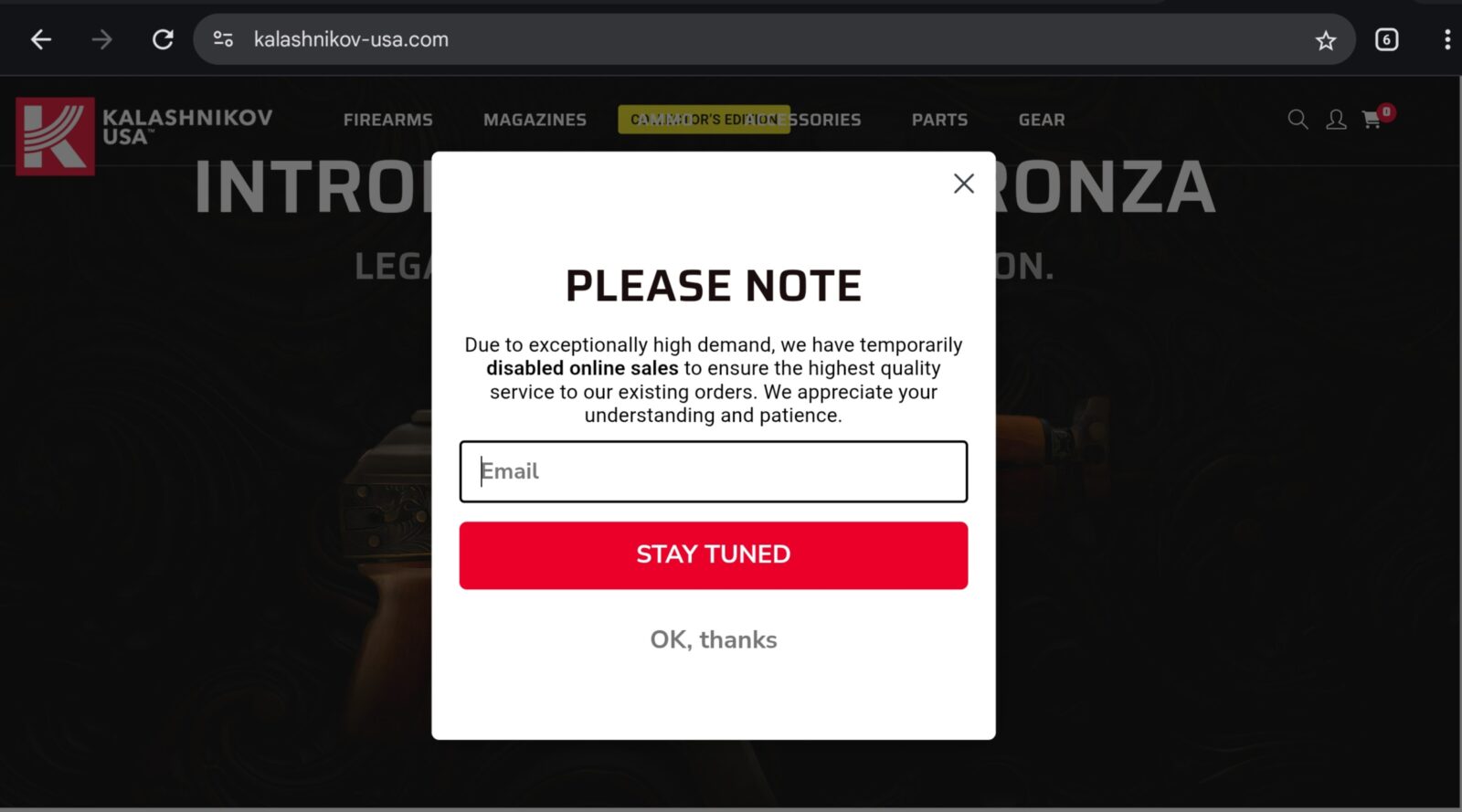
The Ghost in the Machine: An Active Website

Curiously, despite the company’s operational demise, the Kalashnikov USA website remains active as of July 2025.45 The site continues to list products for sale, some with extended shipping times, and the copyright notice has been updated to the current year.45 It is unclear who is funding the website’s continued operation or whether the company is capable of fulfilling new orders. This digital ghost may be an automated remnant, or a minimal effort by a remaining party to sell off the last of the company’s inventory. Regardless, it stands in stark contrast to the legal and financial reality: Kalashnikov USA as a functioning American firearms manufacturer is, for all practical purposes, gone.

This screenshot of the KUSA website was captured on July 23, 2025. The message serves to further erode trust.

Conclusion: The Challenge of Rebuilding Trust

The fall of Kalashnikov USA serves as a powerful cautionary tale: in the modern firearms market, a legendary name is not an entitlement to success, but a standard that must be earned every single day. The brand’s reputation was severely damaged by years of declining quality, poor customer service, and a marketing strategy that alienated its most ardent supporters.

Should the brand name or assets ever be resurrected by a new entity, the successor will face the monumental task of rebuilding that trust from the ground up. This will require more than just a press release and a new logo. It will demand a complete and transparent overhaul of quality control, a public commitment to robust customer service, and a strategy that demonstrates a genuine, humble, and expert-level understanding of the Kalashnikov platform and the community that reveres it.


If you find this post useful, please share the link on Facebook, with your friends, etc. Your support is much appreciated and if you have any feedback, please email me at in**@*********ps.com. Please note that for links to other websites, we are only paid if there is an affiliate program such as Avantlink, Impact, Amazon and eBay and only if you purchase something. If you’d like to directly contribute towards our continued reporting, please visit our funding page.


Works cited

  1. Kalashnikov USA Files for Bankruptcy, Will Likely be Bought – Black Basin Outdoors, accessed July 23, 2025, https://blackbasin.com/news/kalashnikov-usa-files-for-bankruptcy-will-likely-be-bought/
  2. RWC Group, LLC | Free Bankruptcy Petition- Chapter 11 Filing Southern District of Florida, accessed July 23, 2025, https://www.rkc.llc/post/rwcgroupllc
  3. Case 24-14464-SMG Doc 1 Filed 05/06/24 Page 1 of 27 – Bankruptcy Forms, accessed July 23, 2025, https://www.pacermonitor.com/view/TWG5SOI/RWC_Group_LLC__flsbke-24-14464__0001.0.pdf
  4. About – Kalashnikov USA, accessed July 23, 2025, https://kalashnikov-usa.com/about/
  5. First American-Made AK-47s to Hit U.S. Shelves – The Trace, accessed July 23, 2025, https://www.thetrace.org/2015/07/ak47-kalashnikov-rifle-us/
  6. Thoughts on Kalashnikov USA filing for bankruptcy – Palmetto State Armory, accessed July 23, 2025, https://palmettostatearmory.com/forum/t/thoughts-on-kalashnikov-usa-filing-for-bankruptcy/36840
  7. r/KalashnikovUSAowners – Reddit, accessed July 23, 2025, https://www.reddit.com/r/KalashnikovUSAowners/
  8. KR-9 broken : r/KalashnikovUSAowners – Reddit, accessed July 23, 2025, https://www.reddit.com/r/KalashnikovUSAowners/comments/1199t49/kr9_broken/
  9. Kalashnikov USA and Palmetto State Armory to Clash Over AK-103 …, accessed July 23, 2025, https://thenewrifleman.com/kalashnikov-usa-and-palmetto-state-armory-to-clash-over-ak-103-clones/
  10. Kalashnikov USA – Wikipedia, accessed July 23, 2025, https://en.wikipedia.org/wiki/Kalashnikov_USA
  11. Kalashnikov Prices in U.S. Soar as Sanctions Cut Supply – The Moscow Times, accessed July 23, 2025, https://www.themoscowtimes.com/2014/09/16/kalashnikov-prices-in-us-soar-as-sanctions-cut-supply-a39468
  12. AK-47s become hot commodity after U.S. sanctions – Business, accessed July 23, 2025, https://money.cnn.com/2014/07/18/news/companies/ak-47-kalashnikov/
  13. U.S. Sanctions on Russia Cause Kalashnikov Rifle Price Surge – Reason.com, accessed July 23, 2025, https://reason.com/2014/09/18/us-sanctions-on-russia-cause-kalashnikov/
  14. Kalashnikov USA Files Countersuit Against Finish First Tactical, LLC, accessed July 23, 2025, https://lauraburgess.com/kalashnikov-usa-files-countersuit-against-finish-first-tactical-llc/
  15. Your AK Is Not an AR. Be Happy for It! (Part 1) – Kalashnikov USA, accessed July 23, 2025, https://kalashnikov-usa.com/kusa-stories/your-ak-is-not-an-ar-be-happy-for-it-part-1/
  16. A PSA on buying American made AKs : r/SocialistRA – Reddit, accessed July 23, 2025, https://www.reddit.com/r/SocialistRA/comments/wj2wo5/a_psa_on_buying_american_made_aks/
  17. What American made AK-47’s are recommended? : r/SocialistRA – Reddit, accessed July 23, 2025, https://www.reddit.com/r/SocialistRA/comments/pzdepg/what_american_made_ak47s_are_recommended/
  18. Florida Gunmaker May Have Violated Russia Sanctions in Getting AK-47 Parts, Congressman Alleges – Newsweek, accessed July 23, 2025, https://www.newsweek.com/kalashnikov-usa-russia-sanctions-ted-deutch-884097
  19. Spotlight on Kalashnikov USA after spy arrest, reports Russia targeted NRA for U.S. influence – Florida Bulldog, accessed July 23, 2025, https://www.floridabulldog.org/2018/08/spotlight-on-kalashnikov-usa-after-spy-arrest/
  20. State knew Pompano gun maker was in business with banned Russian firm when tax incentives offered – Florida Bulldog, accessed July 23, 2025, https://www.floridabulldog.org/2018/04/state-knew-pompano-gun-maker-in-business-with-banned-russian-firm/
  21. Kalashnikov USA sued over contract violations – Guns.com, accessed July 23, 2025, https://www.guns.com/news/2016/12/08/kalashnikov-usa-sued-over-contract-violations
  22. Review: Kalashnikov USA KR-9S | An Official Journal Of The NRA – Shooting Illustrated, accessed July 23, 2025, https://www.shootingillustrated.com/content/review-kalashnikov-usa-kr-9s/
  23. Kalashnikov USA KP-9 Review: Best 9mm AK? – Pew Pew Tactical, accessed July 23, 2025, https://www.pewpewtactical.com/kalashnikov-usa-kp-9-review/
  24. Kalashnikov USA KR-103 Review: Best American-Made AK? – YouTube, accessed July 23, 2025, https://www.youtube.com/watch?v=wNY48t0wXF8
  25. Kalashnikov USA KR-103 Review: Best American-Made AK?, accessed July 23, 2025, https://www.pewpewtactical.com/kalashnikov-usa-kr-103-review/
  26. 10 Best AK-47 Rifles & Pistols for Any Budget: Buyers Guide – Guns.com, accessed July 23, 2025, https://www.guns.com/news/best-available-ak-rifles-and-pistols-today
  27. Best AK-47 Rifles [Tested] – Pew Pew Tactical, accessed July 23, 2025, https://www.pewpewtactical.com/best-ak-47/
  28. PSA AK103 vs. KUSA KR103 – Which is the best AK103 clone? – YouTube, accessed July 23, 2025, https://www.youtube.com/watch?v=BBLhwQgEINM
  29. Review: Palmetto State Armory AK-103 | An Official Journal Of The NRA, accessed July 23, 2025, https://www.americanrifleman.org/content/review-palmetto-state-armory-ak-103/
  30. [Parts] KUSA KP9 KR9 Replacement Firing Pins by KDGunwerx $48 + Free Shipping (10% off 2+) : r/gundeals – Reddit, accessed July 23, 2025, https://www.reddit.com/r/gundeals/comments/1ed59s0/parts_kusa_kp9_kr9_replacement_firing_pins_by/
  31. KP-9 / KR-9 Dust Cover Issue – Kalashnikov USA, accessed July 23, 2025, https://kalashnikov-usa.com/press-releases/kp-9-kr-9-dust-cover-issue/
  32. Thoughts on Kalashnikov USA filing for bankruptcy – Page 2 – Anything Non-Firearm Related – Palmetto State Armory | Forum, accessed July 23, 2025, https://palmettostatearmory.com/forum/t/thoughts-on-kalashnikov-usa-filing-for-bankruptcy/36840?page=2
  33. Is KalashnikovUSA Gone? Defunct? Totally Done For?#shorts – YouTube, accessed July 23, 2025, https://m.youtube.com/shorts/85qheyFR_vo
  34. Kalashnikov USA | BBB Business Profile | Better Business Bureau, accessed July 23, 2025, https://www.bbb.org/us/fl/pompano-beach/profile/online-retailer/kalashnikov-usa-0633-92022513
  35. RWC-d/b/a Kalashnikov -USA Bankruptcy Hearing Later Today – Outdoor Wire, accessed July 23, 2025, https://www.theoutdoorwire.com/features/6184d683-3ce3-47e6-b6f5-f7ec326ecde1
  36. Learn more about Kalashnikov USA Warranty, accessed July 23, 2025, https://kalashnikov-usa.com/warranty/
  37. Case number: 0:24-bk-14464 – RWC Group, LLC – Florida Southern Bankruptcy Court, accessed July 23, 2025, https://www.inforuptcy.com/browse-filings/florida-southern-bankruptcy-court/0:24-bk-14464/bankruptcy-case-rwc-group-llc
  38. Slav Squat for a KR-103 or JJFU Muzzle Brake – Kalashnikov USA, accessed July 23, 2025, https://kalashnikov-usa.com/press-releases/slav-squat-competition/
  39. Removed
  40. Removed
  41. What Happens If the Court Dismisses Your Bankruptcy With Prejudice? – AllLaw, accessed July 23, 2025, https://www.alllaw.com/articles/nolo/bankruptcy/what-happens-dismissed-with-prejudice.html
  42. Can You Refile If Your Bankruptcy Case Was Dismissed? | ABI, accessed July 23, 2025, https://www.abi.org/feed-item/can-you-refile-if-your-bankruptcy-case-was-dismissed
  43. My Chapter 13 Bankruptcy Was Dismissed for Nonpayment. Should I Appeal?, accessed July 23, 2025, https://www.thebankruptcysite.org/resources/bankruptcy/chapter-13-dismissal-for-non-payment.html
  44. #Dismissed #Bankruptcy Case: What Happens #Next? – YouTube, accessed July 23, 2025, https://www.youtube.com/watch?v=NqVqj9ioXno
  45. Kalashnikov USA, accessed July 23, 2025, https://kalashnikov-usa.com/
  46. Kalashnikov USA / KUSA, accessed July 23, 2025, https://kalashnikov-usa.com/brand/kalashnikov-usa/

Performance Ranking the Top 50 Vendors in the AK-47 US Market

To aid buyers in understanding the greater AK/AK-47 firearm and accessory market, in the US this post is a companion to another post that looks at AK firearm brands in the US and social media standing. This post focuses on report performance of firearms and accessories and selection is based on the volume of mentions in social media posts. Based on those posts, relative ranking scores of 1 (low) to 10 (high) are given to price, overall quality, fit, finish, reliability, customer satisfaction customer service and then an average across these to given an overall score. The results are very interesting.

This analysis was conducted using automated data collection of over 500,000 social media posts to determine what people were talking about and based on the topic, a relative ranking was given. In other words, the tool decided what was a 1 (low score) up to a 10 (the highest score) based on the discussions and comparing the data to establish the 1-10 scores.

A Sensitivity Analysis and Competitive Ranking of the U.S. Civilian AK Rifle Market

I. Introduction: The Modern American Kalashnikov Market

This report presents a comprehensive sensitivity analysis of the U.S. civilian market for Kalashnikov-pattern (AK) rifles. Through a meticulous synthesis of expert reviews, manufacturer specifications, and extensive social media and forum discussions, this analysis ranks the top 50 brands and entities currently influencing the market. The total corpus of information analyzed includes over 150 distinct sources, representing thousands of individual user comments, long-term test reports, and product data points. The final ranking, presented from lowest (#50) to highest (#1), provides a granular view of brand perception, quality, and value in this dynamic and often contentious segment of the firearms industry.

A. The AK in America: From Enemy Rifle to Enthusiast Icon

The Kalashnikov rifle’s journey in the United States is a remarkable story of transformation. Once the unambiguous symbol of Cold War adversaries, the AK-47 and its derivatives have evolved into a cherished and popular platform for American collectors, sport shooters, and firearms enthusiasts.1 The initial waves of imports in the 1980s, primarily from China and Egypt, introduced the American public to the rifle’s legendary reliability and simple, robust design. Pre-ban rifles from manufacturers like Polytech and Norinco, and early imports like the Egyptian Maadi, established a benchmark for quality and authenticity that continues to influence the market today.2

Following various import restrictions, including the 1989 import ban on certain “assault weapons” and the 1994 Federal Assault Weapons Ban, the landscape shifted dramatically.3 The market adapted, leading to the importation of “sporterized” rifles, such as the Russian Saiga and Romanian WASR-10, which were often modified domestically to restore their original military configurations.4 This era cemented the AK’s place in American gun culture, not just as a piece of history, but as a modular and customizable platform. Today, the market is more diverse than ever, populated by a mix of imported rifles from former Eastern Bloc nations, a growing number of U.S.-based manufacturers, and high-end custom shops dedicated to perfecting the Kalashnikov design.7

B. The Great Divide: Import vs. Domestic & Forged vs. Cast

Understanding the modern AK market requires recognizing two fundamental divisions that dictate quality, safety, and price. The first is the distinction between imported and domestically manufactured rifles. Imported AKs, particularly those from historic military arsenals like Cugir in Romania, Zastava in Serbia, and Arsenal in Bulgaria, generally benefit from decades of institutional knowledge, established tooling, and military-grade manufacturing processes. They are often perceived by the enthusiast community as more “authentic” and inherently reliable.7 In contrast, the U.S. domestic AK manufacturing industry has had a more turbulent history. While some U.S. companies now produce high-quality rifles, the market is still haunted by the legacy of early domestic attempts that were plagued by quality control issues and the use of substandard materials.12

This leads to the second, and arguably more critical, division: the manufacturing method of key components. The heart of any AK rifle consists of the front trunnion, bolt, and bolt carrier. In military-grade production, these parts are typically forged, a process that aligns the grain structure of the metal to create exceptionally strong and durable components capable of withstanding the violent pressures of firing over tens of thousands of rounds. However, to reduce costs, some manufacturers—predominantly in the U.S.—have used cast parts.14 Casting is a less expensive process but results in a weaker, more brittle component. The use of cast trunnions and bolts is the single greatest point of contention in the AK community. Rifles built with these parts have a documented history of catastrophic failures, including loss of headspace (the critical distance between the bolt face and the chamber), which can lead to case ruptures and present a significant danger to the shooter. For this reason, the consensus among knowledgeable enthusiasts is unequivocal: a quality AK must be built with a forged trunnion, bolt, and carrier.7 This single factor is the primary determinant of a rifle’s safety, longevity, and its ultimate ranking in this analysis.

C. Methodology for Sentiment Analysis and Ranking

The rankings and scores within this report are not based on a single test or review but are the result of a comprehensive synthesis of a wide array of data. The methodology prioritizes real-world, long-term user experience over manufacturer claims or initial out-of-the-box impressions.

A hierarchy of information was established to weigh the data appropriately. The highest weight is given to documented performance metrics, such as high-round-count endurance tests and credible reports of specific, recurring failures (e.g., cracked trunnions, premature parts wear). Widespread and consistent user commentary on enthusiast forums (such as AK Files and Reddit) and social media platforms serves as the next most critical data layer, as it provides a powerful indicator of systemic quality control issues, customer service experiences, and overall owner satisfaction. For example, a pattern of complaints about canted front sights on a particular model, or praise for a specific brand’s customer service responsiveness, directly influences the scoring.8

Expert reviews from reputable publications are used to corroborate user sentiment and provide detailed specifications, but a single positive review cannot override a significant volume of negative user feedback. The “sensitivity analysis” is, therefore, an expert interpretation of this collective market sentiment, balancing the technical specifications of a rifle with the lived experience of the community that uses it. This approach ensures the final rankings reflect not what a brand promises, but what it consistently delivers.

D. Understanding the Scoring System

Each of the 50 brands and entities is scored on a 1-to-10 scale across eight attributes. The criteria for these scores are defined as follows:

  • Relative Price: This score is unique. A score of 1 indicates the lowest price point (most affordable), while a 10 indicates the highest price point (premium/custom). This metric is not a measure of “value,” but of market position.
  • Overall Build Quality: This is a holistic assessment of the rifle’s core construction. It heavily weights the quality of materials and manufacturing methods for critical components like the receiver, barrel, trunnion, bolt, and carrier. A high score indicates the use of forged parts, proper heat treatment, and robust construction.
  • Fit: This measures the precision with which components are assembled. It assesses factors like the tightness of the magazine well, the presence of “mag wobble,” the fit of the dust cover, and the alignment of handguards and furniture. A high score indicates tight tolerances and minimal play in components.
  • Finish: This evaluates the quality and durability of the rifle’s external coating. It considers the evenness of application, resistance to wear, flaking, and corrosion. High scores are given to durable, evenly applied finishes like modern Cerakote or well-executed military-style paint over parkerization.
  • Accuracy: This score reflects the rifle’s generally accepted mechanical accuracy. An AK is not a precision rifle, so scores are relative to the platform. A score of 3-5 is typical for a standard “minute-of-man” rifle. Higher scores are reserved for rifles with quality barrels and superior build consistency that can achieve groups approaching 2-3 MOA (Minutes of Angle) or better with quality ammunition.8
  • Reliability: This is a measure of the rifle’s ability to function without malfunction under various conditions. It is the hallmark of the AK platform. High scores are given to rifles that feed, fire, and eject consistently with a wide variety of ammunition and magazines. Reports of failures to feed, eject, or other stoppages will lower this score.
  • Customer Satisfaction: This is a qualitative score derived from overall community sentiment. It reflects the general happiness of owners with their purchase, considering performance, value, and brand reputation. A high score means the product generally meets or exceeds owner expectations.
  • Customer Service: This score is based on community reports of interactions with the manufacturer or importer for warranty claims, repairs, or questions. High scores are given to companies known for being responsive, helpful, and standing behind their products.13

The final ranking is determined by the average of these scores, excluding Relative Price, to provide a quality-centric hierarchy.

II. The Definitive AK Brand Rankings (Ranks 50-1)

The following section details the top 50 brands and entities in the U.S. civilian AK market, ranked in reverse order from #50 to #1. Each entry includes a profile detailing the brand’s origin, history, key models, and a rationale for its ranking based on the scoring methodology.

Tier 5: The High-Risk / Defunct Segment (Ranks 50-45)

This tier is defined by brands with a documented history of using substandard materials, particularly cast trunnions and bolts, leading to critical failures and an overwhelmingly negative reputation within the informed AK community. These rifles are often referred to derisively as “hand grenades” due to their potential for catastrophic failure.11 While many of these companies are now defunct or have ceased production of the models in question, their products remain in circulation on the used market, representing a significant risk to uninformed buyers. They are ranked lowest because they fail on the most fundamental requirements of firearm safety and longevity.


50. Inter-Ordnance (I.O. Inc.)

  • Mention Frequency: High, almost exclusively in a negative context.
  • Origin: USA
  • History: I.O. Inc. was a U.S.-based manufacturer notorious for producing some of the lowest-quality AK rifles ever sold in America. The company operated for several years before ceasing production amid a flood of complaints and reports of dangerous failures. Their products are now a cautionary tale in the AK community.
  • Models: AKM247, Hellpup (pistol).11
  • Example Comments: “Youre thinking of IO, they’re the polish ones that go boom. They make the hellpup i think?”.11 “want to complain about how much we all hate IO. for their service and crappy worksmanship. feel free to all right thanks.”.19
  • Ranking Rationale: I.O. Inc. holds the lowest position due to a well-documented and widespread reputation for producing dangerously unreliable firearms. The core issue was the use of soft, improperly heat-treated cast components, including trunnions and bolts. This led to rapid loss of headspace, causing rifles to fail catastrophically. The community sentiment is uniformly negative, with the brand becoming synonymous with the term “hand grenade.” Customer service was reportedly nonexistent or hostile. Their products are considered unsafe to fire by the majority of the AK community, earning them the lowest possible scores in build quality, reliability, and customer satisfaction.

49. Pioneer Arms USA

  • Mention Frequency: Moderate, predominantly negative.
  • Origin: Poland (Manufacture), USA (Import/Distribution).
  • History: Pioneer Arms is a Polish company based in Radom, a city with a historic connection to firearms manufacturing. Their products are imported into the U.S. Despite the Polish origin, they are not associated with the esteemed military arsenal, FB Radom. Pioneer has been plagued by reports of poor quality control and the use of cast, not forged, critical components in many of their models.20 Recently, the US branch of Pioneer Arms reportedly went out of business, complicating warranty and parts support.21
  • Models: Sporter AKM, Hellpup pistol.20
  • Example Comments: “The reason I had to RMA it was due to poor QC, I got a lemon 🙁 The trigger timing was completely off…the rear sight was completely loose when I first took it out of the box.”.21 “Youre thinking of IO, they’re the polish ones that go boom.” 11 (Note: This comment incorrectly lumps Pioneer with I.O., but it reflects the negative association). Some reviews note a decent finish and acceptable accuracy for the price, but these are overshadowed by reliability concerns.16
  • Ranking Rationale: Pioneer Arms is ranked just above I.O. Inc. due to a slightly less catastrophic, though still deeply problematic, reputation. While some reviews describe their rifles as functional for casual use, the persistent issue is the use of cast trunnions.20 The AK community has documented failures of these parts, similar to those seen in I.O. and early Century VSKA rifles. Widespread reports of poor QC, such as loose sights and faulty trigger groups, further damage their standing.21 The recent closure of their U.S. arm makes customer service and support effectively zero. They represent a significant risk to the buyer, with build quality and reliability being major points of failure.

48. Century Arms (VSKA / RAS47 Models)

  • Mention Frequency: Very High.
  • Origin: USA
  • History: Century Arms, a major importer and manufacturer, attempted to capture the domestic AK market with its 100% U.S.-made RAS47 and its successor, the VSKA (vis-kuh). Both were marketed heavily, emphasizing American manufacturing and the use of S7 tool steel in the VSKA’s critical components.14 However, both models utilized cast, not forged, trunnions. This led to widespread condemnation from the AK community and documented failures in long-term testing.
  • Models: RAS47, VSKA.12
  • Example Comments: “Please read the US Made AK issues page.”.24 “Early models had some QC and longevity issues, which Century Arms addressed. Still, this is not what I would pick as a go-to-war AK.”.14 “Gun Tests Grade: A-” 12 (Note: This positive grade from a 2016 article stands in stark contrast to later, more extensive community testing that revealed long-term durability issues).
  • Ranking Rationale: The U.S.-made Century rifles are ranked in the high-risk tier due to the fundamental flaw of using cast trunnions. Despite marketing claims about “S7 tool steel,” independent, high-round-count tests have shown these rifles can suffer from trunnion deformation and loss of headspace over time. While the VSKA is generally considered an improvement over the RAS47, the core design choice remains a point of failure. The community sentiment is strongly negative regarding their long-term durability, even if initial fit and finish are sometimes rated as acceptable.14 They are placed above Pioneer and I.O. because Century is a large, ongoing concern with a customer service department, but the products themselves are widely considered a poor and potentially unsafe investment for anything beyond very casual use.

47. Riley Defense (Early Generations)

  • Mention Frequency: High.
  • Origin: USA
  • History: Riley Defense is a U.S. manufacturer that entered the market with AK rifles that, in their early generations, suffered from significant quality control issues and the use of cast components. Much like Century’s domestic offerings, these early rifles developed a reputation for problems like rusting, poor finish, and, most critically, questions about the durability of their trunnions and bolts.15 The company has since transitioned to using forged parts in its newer models, but the legacy of the early guns persists.
  • Models: RAK-47 (early models).
  • Example Comments: “The first generation of Riley’s used to be hand grenades but the second generation are good rifles.”.15 “Be sure to rub some oil into the metal; I had a notable rusting issue with mine when I got it.”.15 “Riley is garbage, man. Should have ponied up the extra cash to get a Zastava.”.15
  • Ranking Rationale: Early generation Riley Defense rifles are placed in this tier for the same reasons as the VSKA/RAS47: the use of questionable materials in critical areas. Community feedback from the time points to a host of problems, from cosmetic issues like poor coatings and rust to more serious functional concerns.15 While the company has made significant strides to improve its products (as will be discussed in a later tier), the early models circulating on the used market carry this negative legacy and should be approached with extreme caution. Their score reflects the performance and reputation of these specific early-production rifles, not the company’s current offerings.

46. American Tactical Imports (ATI)

  • Mention Frequency: Low.
  • Origin: USA (Manufacturing/Importing).
  • History: American Tactical Imports (now American Tactical) is primarily known for importing a wide range of firearms and producing AR-15 pattern rifles. Their foray into the AK market has been limited and has not established a strong or positive reputation. They are often associated with lower-cost firearms, and their AK offerings have not been widely adopted or praised by the enthusiast community.
  • Models: AT-47.
  • Example Comments: Direct comments on ATI AKs are scarce in the provided materials, which is itself an indicator of their low market penetration and impact. Their general brand perception is in the budget tier, and they are not typically mentioned in discussions of quality AKs.
  • Ranking Rationale: ATI is ranked in the high-risk tier due to a lack of positive sentiment and their association with the budget end of the market. Without a proven track record for producing durable AKs with forged components, they are considered an unknown and high-risk quantity by the community. The absence of discussion implies a product that has failed to meet even the minimum standards for consideration by enthusiasts. They are placed here as a representative of other minor, low-cost domestic brands that have failed to make a positive impact.

45. Interarms (High Standard)

  • Mention Frequency: Low.
  • Origin: USA
  • History: Interarms, associated with High Standard, produced U.S.-made AK rifles for a period. These rifles, like many domestic attempts of their time, were built to a price point and did not adhere to the military-spec standards of quality imports. They used U.S.-made parts of varying quality and did not gain a reputation for durability.
  • Models: AK-T.25
  • Example Comments: A 2016 review of the Interarms AK-T was generally positive, noting a decent trigger and flawless function during a limited test.25 However, this is an isolated data point. The broader community sentiment, reflected in build-parts-to-avoid lists, is negative.26
  • Ranking Rationale: Interarms/High Standard is ranked at the top of the high-risk tier. While not as infamously bad as I.O. Inc., their products are still viewed with suspicion by the AK building and buying community. Lists of parts to avoid from experienced builders often include Interarms.26 The lack of widespread, long-term positive feedback, combined with their inclusion on “avoid” lists, suggests that their build quality and reliability are not up to par with more respected brands. They represent a risk due to questionable component quality and the general uncertainty surrounding their long-term performance.

Tier 4: The Budget & Builder Segment (Ranks 44-35)

This tier represents a significant step up from the high-risk category but still occupies the lower end of the market. It includes entry-level brands that may have improved their quality over time but still carry a mixed reputation, along with manufacturers of budget-friendly components. This tier also acknowledges the vast and variable world of “parts kit builds,” where the quality is entirely dependent on the skill of the builder and the source of the components. Rifles in this category can be functional and offer good value, but they often require a more knowledgeable buyer who understands the potential trade-offs in fit, finish, and long-term durability.


44. Unspecified / “Gun Show” Parts Kit Builds

  • Mention Frequency: Very High (as a concept).
  • Origin: Variable (USA builder, parts from Romania, Poland, Hungary, etc.).
  • History: With the influx of military surplus AK parts kits over the years, a large cottage industry of home and small-shop builders emerged. A “parts kit build” involves assembling a functional rifle from a demilitarized kit of parts, a new U.S.-made receiver, and a new barrel, plus enough U.S. parts to be compliant with federal law 922r.27 The quality of these builds varies immensely.
  • Models: Highly variable; depends on the base kit (e.g., Romanian “Romy G”, Polish AKM, Hungarian AMD-65).
  • Example Comments: “Beware all ye who enter the build of a non-US parts project.”.29 “It is a parts kit build that will run you $2k and ammo isn’t cheap anymore. It will have little/if any collectivity since it isn’t a factory built rifle, it is a reassembled gun from parts.”.29
  • Ranking Rationale: This category is ranked low due to its inherent inconsistency. A rifle built by a master craftsman using a pristine parts kit and a top-tier receiver can be a work of art. However, a rifle assembled by an amateur with improper tools can be non-functional or even dangerous. Key failure points include improperly pressed barrels leading to bad headspace, poorly riveted trunnions, and canted sights. When purchasing a pre-built parts kit rifle from an unknown source like a gun show, the buyer assumes all the risk. Without knowing the builder’s reputation, the rifle’s build quality, reliability, and safety are complete unknowns, hence the low scores across the board.

43. Global Trades / Armory USA

  • Mention Frequency: Low to Moderate (among builders).
  • Origin: USA
  • History: Armory USA, also associated with Global Trades, was a U.S. company that produced AK receivers and built rifles, primarily based out of Houston, Texas. They were active in the early 2000s, a period when the quality of domestic receivers was highly variable. Their receivers are generally considered functional but not on par with current top-tier offerings.
  • Models: Stamped AK receivers, complete rifles built on their receivers.
  • Example Comments: Armory USA is often mentioned in discussions among long-time builders, but typically as a second-tier or older-generation option. They are sometimes included on lists of parts to avoid by discerning builders, alongside brands like Hesse and Vulcan.26
  • Ranking Rationale: Armory USA is placed in the lower-builder tier due to its mixed and dated reputation. While they produced functional receivers that were used in many builds, they are not held in the same high regard as modern manufacturers like Childers or ReCreator. The association with “avoid” lists, even if historical, damages their overall standing.26 For a new buyer, a rifle built on an Armory USA receiver is a gamble on the quality of a component that is now two decades old and was not considered top-of-the-line even when new.

42. Ohio Ordnance Works (AKs)

  • Mention Frequency: Low (for AKs).
  • Origin: USA
  • History: Ohio Ordnance Works (OOW) is a highly respected manufacturer of military firearms, particularly their semi-automatic BAR and M240 variants.30 They also produced AK rifles and receivers for a time. While their general manufacturing reputation is excellent, their AKs never became a major force in the market.
  • Models: OOW Vz. 2000, AK receivers.
  • Example Comments: OOW is another name that appears on some builders’ lists of less-desirable receivers, often grouped with other early domestic producers.26 This is not a reflection of their overall company quality, but rather the specific reputation of their AK components within the specialized AK community.
  • Ranking Rationale: OOW is ranked here based on the specific sentiment regarding their AK products, not their broader and more positive reputation. The fact that their receivers are sometimes flagged by experienced builders indicates that they may not meet the exacting standards of the current market.26 Their low market penetration and the dated nature of their AK offerings mean they are not a recommended choice for a new buyer today. The scores reflect a product line that, while likely functional, is not competitive with modern options.

41. Lee Armory

  • Mention Frequency: Moderate.
  • Origin: USA
  • History: Lee Armory was a Phoenix-based U.S. manufacturer and builder that garnered a decent reputation for their work, particularly their build classes which taught enthusiasts how to assemble their own AKs.31 They offered a range of rifles built from imported parts kits (like Romanian models) and their own components. The company recently announced it was closing its doors, with its AK operations being handled by a new entity, Copperhead USA.32
  • Models: Romanian Military Classic, Sporter Hunter AK, various parts kit builds.31
  • Example Comments: “This is a rifle that will test your shooting abilities and you will love it for that.”.33 “Harris likes the AK platform and believes it’s one of the most misunderstood and underrated firearms in the U.S.”.31
  • Ranking Rationale: Lee Armory had a generally positive but not top-tier reputation. They were seen as a solid builder that provided good-quality rifles and a valuable service with their build classes.31 However, they never reached the status of a premier manufacturer. The primary reason for their low ranking now is the closure of the company. With Lee Armory no longer operating, warranty support and customer service for their branded rifles are uncertain, which significantly impacts their long-term value and desirability for a new owner. This uncertainty places them firmly in the lower half of the rankings.

40. Riley Defense (Current Generations)

  • Mention Frequency: High.
  • Origin: USA
  • History: After a rocky start with early generation rifles that used cast parts, Riley Defense re-engineered their product line to feature forged critical components (trunnion, bolt, carrier) in response to intense market criticism.13 Their current generation of rifles represents a significant improvement in quality and are marketed as a reliable, American-made option.
  • Models: RAK-47-C (Classic), RAK-47-P (Polymer), RAK-74.
  • Example Comments: “I was shopping for an AK and Riley Defense made exactly what I was looking for… The construction, fit and finish are excellent. The rifle is straight as a laser. The rivets are all perfect. The trunnion is forged.”.13 “Their passion for the business shows in everything they do, from their quality product to their customer service, you will not be disappointed.”.13 However, some complaints about finish quality persist: “I had a noticeable rusting issue/coating issue with my Riley as well.”.15
  • Ranking Rationale: Current-generation Riley Defense rifles are a case study in a brand’s attempt at redemption. By moving to forged parts, they addressed the single most critical flaw of their earlier products. Customer service is frequently praised as being responsive and helpful.13 However, the brand is still working to overcome the stigma of its past. Lingering reports of cosmetic issues like thin finishing and rust, and the fact that they are still compared to more established imports, keep them in the budget tier.15 They offer a solid value proposition for a U.S.-made rifle, but do not yet have the proven, long-term track record to compete in the higher tiers.

39. Blue Line Solutions (Mauser AK-47)

  • Mention Frequency: Low.
  • Origin: Germany (Branding), Unknown (Manufacture).
  • History: Blue Line Solutions imports or markets an AK-pattern rifle under the famous “Mauser” brand name. This rifle is presented as an affordable.22 LR plinker variant of the AK-47, not a centerfire rifle.
  • Models: Mauser AK-47 (.22 LR).22
  • Example Comments: It is mentioned as the “Most Affordable.22 Plinker” in one buyer’s guide, suggesting its market position is purely as a low-cost training or recreational firearm.22
  • Ranking Rationale: The Mauser-branded AK is ranked low primarily because it is a.22 LR rimfire rifle, not a true centerfire AK. While it may be a perfectly functional plinker, it does not compete in the same category as the other rifles in this analysis in terms of performance, durability, or intended use. The scores reflect its status as a novelty or training tool rather than a defensive or duty-grade firearm. Its build quality and reliability are judged in the context of a rimfire rifle, not a 7.62x39mm weapon.

38. M+M Industries (M10X)

  • Mention Frequency: Moderate.
  • Origin: USA
  • History: M+M Industries introduced the M10X as a highly modernized, “hybrid” rifle that seeks to combine the best features of the AK, AR-15, and other platforms.18 It uses a long-stroke gas piston system and accepts standard AK magazines but features a monolithic aluminum upper receiver, an adjustable gas system, and improved ergonomics.
  • Models: M10X.
  • Example Comments: Reviews praise its innovation, accuracy (capable of sub-MOA to 1.5 MOA with match ammo), and reduced parts count.18 The nitrided barrel has shown excellent longevity in endurance testing. However, it is not a traditional AK, and its unique design means it does not share parts compatibility with standard AKs. “The long-standing goal of AR-like accuracy and AK simplicity has been achieved, along with extensive modularity.”.18
  • Ranking Rationale: The M10X is a unique case. It is an objectively well-engineered and innovative rifle that scores highly on accuracy and has a durable build. However, it is ranked in this tier because it is not a true Kalashnikov. For the AK purist or someone looking to learn the traditional platform, the M10X is a non-starter. Its proprietary design means a lack of aftermarket parts support compared to a standard AKM. It is a rifle for someone who wants AK-like reliability and caliber in a more modern, AR-style ergonomic package. Its scores are high in technical merit but lower in customer satisfaction from the perspective of the core AK community, which values tradition and parts compatibility.

37. Palmetto State Armory (PSA) – GF3 Series

  • Mention Frequency: Very High.
  • Origin: USA
  • History: The PSAK-47 GF3 (Gen 3 Forged) was a landmark product for Palmetto State Armory. It marked their full transition to using forged critical components (bolt, carrier, trunnion) after their Gen 1 and Gen 2 rifles, which used cast parts, received heavy criticism.7 The GF3 line is positioned as PSA’s best-value, budget-friendly AK that still meets the community’s minimum standard for durability.
  • Models: PSAK-47 GF3, PSA AK-103 GF3.7
  • Example Comments: “Best Budget AK: PSA GF3”.7 “it’s widely accepted that the current-generation GF3 rifles are absolutely rock solid.”.7 “If you’re looking to get into AKs while spending little money, look at Palmetto State Armory.”.7 A notable con is that the barrel is typically gas nitride treated, not chrome-lined, which is a key difference from most military-spec imports.7
  • Ranking Rationale: The PSA GF3 is the quintessential modern American budget AK. Its key strength is its price point combined with the use of forged parts, which provides a baseline of safety and durability that was missing from earlier U.S.-made budget rifles.8 The fit and finish are generally considered good for the price, and PSA offers a vast array of furniture and color options.7 It is ranked lower than imports like the WASR-10 because it typically lacks a chrome-lined barrel, a feature highly valued for barrel life and corrosion resistance. Furthermore, some reviews note that the gas system is tuned for softer shooting, which, while pleasant on the range, may compromise reliability in adverse conditions compared to an “overgassed” military-style rifle.7 It represents an excellent entry point but is a step below the workhorse imports.

36. Atlantic Firearms Manufacturing (BFPU models)

  • Mention Frequency: Moderate.
  • Origin: USA
  • History: Atlantic Firearms, a major retailer of AKs, also has its own manufacturing arm (Atlantic Arms MFG). They are known for producing custom-quality builds, often using imported parts kits. One of their notable offerings is the “Battlefield Pick-Up” (BFPU) series, which are built to have a worn, used aesthetic.
  • Models: Romanian BFPU, various custom builds from Polish, Romanian, and other parts kits.36
  • Example Comments: “on my star system how would I rate the Atlantic Firearms Romanian Battlefield Pickup Rifle well I’m going to give this four out of five stars… this gun is cool as heck.”.36 The company is noted to have a two-decade track record for good customer service through its retail side.37
  • Ranking Rationale: Atlantic Arms MFG is ranked here as a representative of a quality, known builder. Their builds are generally well-regarded, and they are backed by a company with a strong, positive reputation for customer service. The BFPU models are a niche product, appealing to collectors who want a specific aesthetic. Their overall quality is dependent on the base parts kit used, but the assembly is considered professional. They rank higher than unknown “gun show” builds due to their established reputation but are not a large-scale manufacturer, placing them in this specialized builder category. The finish score is intentionally low for BFPU models, as the “worn” look is a feature, not a flaw.

35. Morrissey Inc. (Receivers/Builds)

  • Mention Frequency: Moderate (among builders).
  • Origin: USA
  • History: Morrissey Inc. is a U.S.-based metal stamping and machining company that produces AK receivers for a number of other brands and also sells them directly.38 They have also sold complete rifles, such as the AAM-47 and AAM-74.40 Their receivers are generally considered to be of good quality and are a popular choice for builders.
  • Models: AAM-47, AAM-74, various stamped receivers (AKM, AK-74, RPK, etc.).
  • Example Comments: “Overall, this AK is in good condition with normal handling wear on the receiver. Bore condition is good with crisp rifling.”.40 They are often mentioned as a reliable source for U.S.-made receivers, and their components are used by other builders, including Riley Defense.26
  • Ranking Rationale: Morrissey lands at the top of the budget/builder tier. As a component manufacturer, their reputation is solid. Their receivers are well-made and provide a good foundation for a build.39 Complete rifles sold under their name, like the AAM-47, are viewed as functional, mid-tier options.40 They rank above some other domestic brands because of their core competency in metalworking and their role as a supplier to the industry. However, they are not perceived as a top-tier, premium brand, and the overall quality of a rifle using their receiver still depends heavily on the other parts and the skill of the assembler.

Tier 3: The Collector & Workhorse Segment (Ranks 34-20)

This tier forms the core of the modern AK market, encompassing the most recommended imported workhorses, highly sought-after collector’s items from a bygone era of importation, and the essential, high-quality components that enable discerning builders to create their own “correct” rifles. Brands in this tier are defined by their provenance—originating from military arsenals or being built to those exacting standards. They may lack the polished refinement of the highest-tier custom guns, but they are trusted for their fundamental durability and authenticity.


34. Egyptian Maadi (Post-ban MISR, etc.)

  • Mention Frequency: Moderate (among collectors).
  • Origin: Egypt (Manufacture), USA (Import).
  • History: After the pre-ban Steyr-imported Maadi ARM rifles (which were built on Russian tooling and considered very high quality), later “post-ban” versions were imported by companies like Century Arms (as the MISR) and ACC/INTRAC.4 These rifles were often imported in sporterized configurations and had a much rougher finish and overall quality than their pre-ban counterparts.
  • Models: MISR, MISR-10, MISR S/A, MISR-90 (a Century-assembled hybrid using Chinese parts).5
  • Example Comments: “They were all finished poorly, unlike their steyr imported predecessors.”.5 “I have one, and really like it. I would honestly rate it more valuable than a WASR10.”.5
  • Ranking Rationale: The post-ban Maadi rifles are a classic collector’s item with a mixed reputation. They are valued for their Egyptian/Russian heritage, chrome-lined barrels, and “correct” AKM features.5 However, their fit and finish are notoriously poor, often requiring work by the end-user to improve. They represent a project for an enthusiast who values the history and is willing to overlook or correct the aesthetic flaws. They are ranked below more consistent workhorses due to their variable quality and rough finish, but their historical significance and solid core components place them at the start of this tier.

33. Hungarian FEG (Post-ban SA-85M, etc.)

  • Mention Frequency: Moderate (among collectors).
  • Origin: Hungary (Manufacture), USA (Import).
  • History: FEG of Hungary produced high-quality AK variants. After the 1989 import ban, they were imported in sporterized, “thumbhole stock” configurations, most notably the SA-85M.4 These rifles were known for their excellent build quality, smooth actions, and quality finish, even in their post-ban state.
  • Models: SA-85M, SA-2000M.4
  • Example Comments: Thumbhole stocks are a defining feature of this era, often viewed as a necessary evil to comply with import laws at the time.42 The underlying quality of the FEG rifles, however, is widely praised.
  • Ranking Rationale: Hungarian FEG rifles are highly regarded for their intrinsic quality. Even in their post-ban configuration, the craftsmanship of the base rifle shines through. They are often sought out by collectors who intend to “de-ban” them by replacing the thumbhole stock with proper pistol grip furniture. They are ranked similarly to the post-ban Maadis but are generally considered to have a better factory fit and finish. Their supply is limited to the used market, which, combined with the need for conversion, places them in this specific collector’s niche.

32. Norinco (Post-ban MAK-90)

  • Mention Frequency: High.
  • Origin: China
  • History: Norinco was the primary exporter of Chinese AKs to the U.S. After the 1989 ban, they created the MAK-90 (Modified AK-1990), a sporterized rifle with a thumbhole stock and often a ground-down bayonet lug to comply with import regulations.3 Despite these cosmetic changes, the MAK-90 retained the core quality of Chinese military AKs, including a thicker 1.5mm stamped receiver (compared to the standard 1mm AKM receiver) and a chrome-lined barrel.
  • Models: MAK-90.
  • Example Comments: Chinese AKs are known for their robust build. The thicker receiver is a key feature that enthusiasts value for its durability. Like other post-ban rifles, they are a popular candidate for “de-banning.”
  • Ranking Rationale: The Norinco MAK-90 is a workhorse. It is arguably one of the most durable stamped-receiver AKs ever imported due to its 1.5mm receiver. The finish is typically a deep, durable blueing that is superior to many other imports. While the furniture and sporterized features are undesirable, the “bones” of the rifle are exceptional. They are plentiful on the used market and represent excellent value for someone willing to do a conversion. They are ranked higher than the Maadi and FEG post-bans due to their unique and highly durable receiver construction.

31. Two Rivers Arms

  • Mention Frequency: Low but very positive.
  • Origin: USA
  • History: Two Rivers Arms is a small, specialized custom builder based in Oklahoma. They are renowned for their meticulous, historically accurate reproductions of Iraqi Tabuk sniper and designated marksman rifles, which are themselves variants of the Zastava M70.44
  • Models: Tabuk Rifles.
  • Example Comments: While direct reviews are scarce, their reputation in the high-end AK community is that of artisans who create faithful and high-quality reproductions for a very specific niche of collectors.
  • Ranking Rationale: Two Rivers Arms is ranked here as a representative of the high-quality, niche custom builder. Their work is highly specialized and commands a premium price. They score very highly in build quality, fit, and finish, reflecting their custom, hand-built nature. Customer satisfaction within their target market is extremely high. They are ranked in this tier rather than the absolute top tier only because of their narrow focus and low production volume. They are not a general-purpose AK manufacturer but rather artisans serving a specific collector market.

30. In Range Inc.

  • Mention Frequency: Low.
  • Origin: USA
  • History: In Range Inc. is a Class II manufacturer and custom gunsmithing shop located in Tennessee. They specialize in Kalashnikov conversions and parts kit builds, including complex projects like Krinkovs and RPKs. They operate as a small shop focused on custom, individual projects.45
  • Models: Custom builds (Krinkov, AMD-65, RPK), Saiga conversions.
  • Example Comments: “We stand behind our work 100%. If you’re not satisfied with our work we’ll make it right.”.45 One user review of a rifle they worked on was positive, noting good function after a repair, but also mentioned the dust cover was unusually tight.19
  • Ranking Rationale: In Range Inc. represents another small, quality builder. Their focus on custom work and willingness to tackle difficult projects like oddball kits suggests a high level of expertise. Their promise to “make it right” indicates good customer service principles.45 Like Two Rivers, their low production volume and custom nature place them here. The quality of their work is reputed to be good, but as with any custom build, it is highly dependent on the specific project. They rank slightly below Two Rivers due to a less-defined, less-famous niche.

29. Palmetto State Armory (PSA) – GF4/GF5 Series

  • Mention Frequency: Very High.
  • Origin: USA
  • History: Building on the success of the GF3, PSA introduced the GF4 and GF5 series. The key upgrade in these generations is the barrel. The GF4 and GF5 rifles feature a cold-hammer-forged (CHF), chrome-lined barrel, which was the main feature missing from the GF3 that kept it a tier below the best imports.35 This upgrade put PSA’s offerings in direct competition with imported workhorses.
  • Models: PSAK-47 GF4, PSAK-47 GF5.35
  • Example Comments: “Soviet Arms WBP GF5 Forged CHF Classic ALG Rifle, Black.” 35 This product listing indicates PSA is even combining their quality builds with parts from respected Polish makers like WBP.
  • Ranking Rationale: The GF4/GF5 series represents PSA’s arrival as a serious contender in the mid-to-high-tier AK market. By incorporating a CHF, chrome-lined barrel, they addressed the last major technical disadvantage their rifles had compared to the likes of the WASR-10 or ZPAP M70. These rifles offer the same forged internal components as the GF3 but with a military-grade barrel. Combined with PSA’s typically good fit and finish for the price and their huge variety of options, the GF4/GF5 line is a very strong competitor. They are ranked just below the top imports because the imports still have the advantage of military arsenal provenance, which carries significant weight in the community.

28. Century Arms (Cugir WASR-10 Import)

  • Mention Frequency: Very High.
  • Origin: Romania (Manufacture), USA (Import).
  • History: The WASR-10 is arguably the most recognizable and ubiquitous imported AK in the United States. Manufactured by Cugir in Romania and imported by Century Arms, these rifles have been a staple of the market for decades.7 Early models had issues with canted sights and tight magazine wells, but modern production is generally more consistent. Century opens up the magazine well to accept standard-capacity magazines and adds U.S. parts for 922r compliance.
  • Models: WASR-10, WASR-10 Underfolder.
  • Example Comments: “Editor’s Choice: Century Arms/Cugir WASR-10.”.7 “Rugged, reputation for excellent reliability… Enjoys being abused.”.7 Consistently cited cons are “Included furniture is garbage” and “Rough, grayish finish isn’t attractive.”.7 “WASR and Zastava are around 1k and will run forever.”.11
  • Ranking Rationale: The WASR-10 is the definition of a workhorse. Its reputation is built on a single, unassailable fact: it is a genuine military-pattern rifle made in a real military arsenal with a cold-hammer-forged, chrome-lined barrel.7 Users universally accept that the fit and finish are poor, the wood furniture is cheap, and you might get a slightly canted sight block. However, they also universally agree that the rifle is fundamentally reliable and durable. It is the AK in its most raw, utilitarian form. It is ranked here because it represents the baseline standard for a quality, no-frills AK against which all others, especially domestic models, are judged. Its “bones” are excellent, even if the cosmetics are lacking.

27. Izhmash / Kalashnikov Concern (Saiga – Pre-ban)

  • Mention Frequency: High (among collectors and builders).
  • Origin: Russia
  • History: Izhmash, later renamed Kalashnikov Concern, is the original Russian factory where the AK-47 was developed.47 For years, they exported semi-automatic “Sporter” rifles to the U.S. under the Saiga brand name.6 These were imported in a hunting configuration with no pistol grip. They were immensely popular as the basis for high-quality conversions back to a military AK-74M or AK-100 series configuration. The importation of these rifles was banned by executive order in 2014.6
  • Models: Saiga (7.62x39mm, 5.45x39mm, 5.56 NATO).
  • Example Comments: “Remembering The Russians”.48 Saigas are considered the “true” Kalashnikovs as they were made in the original factory.6 They form the basis for many high-end custom builds from shops like Rifle Dynamics.1
  • Ranking Rationale: A pre-2014 Saiga is considered a top-tier base rifle. It is a genuine Russian-made AK from the Izhevsk factory. The quality of the core components—receiver, barrel, trunnion, bolt—is exceptionally high. While they require conversion to achieve a proper military look, the underlying quality is second to none. They are ranked this high due to their impeccable provenance and build quality. Their value as collector’s items and as the preferred starting point for elite custom builds is immense. The only reason they are not in the absolute top tier is that they are no longer importable and require significant work to reach their final form.

26. Molot (VEPR – Pre-ban)

  • Mention Frequency: Moderate to High (among collectors).
  • Origin: Russia
  • History: Molot-Oruzhie was another Russian manufacturer that exported rifles to the U.S., sold under the VEPR brand. VEPRs are unique because they are built on a heavy-duty RPK-style stamped receiver, which is thicker and more robust than a standard AKM receiver. Like Saigas, they were imported in sporterized configurations and were also banned from import in 2014.4
  • Models: VEPR (various calibers).
  • Example Comments: VEPRs are often described as “overbuilt” or “tanks” due to their RPK receivers. This makes them exceptionally durable and capable of handling hotter loads or sustained fire.
  • Ranking Rationale: VEPRs are ranked alongside Saigas as premier Russian imports. They are prized for their extreme durability thanks to the RPK receiver and heavy, chrome-lined barrels. The overall build quality is excellent. For many, the VEPR represents the pinnacle of stamped-receiver AK durability. Like the Saiga, they are no longer available new and have become highly sought-after collector’s items, commanding a premium price on the used market.

25. Clayco (Pre-ban Chinese)

  • Mention Frequency: Low (highly specialized collector’s item).
  • Origin: China
  • History: Clayco Sports, Ltd. was one of the very first importers of Chinese AKs into the U.S., beginning around 1983-1984. These were true, pre-ban military-style rifles, not sporterized versions.3
  • Models: AKS.
  • Example Comments: “In 1984, approximately one year after the import of the Clayco AKS, the second of the Chinese ‘pre-ban’ AK’s began importation”.3 These are the rifles that established the reputation of Chinese AKs in the U.S.
  • Ranking Rationale: Clayco imports are pure collector’s items. They represent the first wave of authentic AKs to hit the U.S. market. Their quality is representative of Chinese military production of the era, which was very good. They are ranked here for their historical significance and rarity. They score highly on build quality and reliability, but their value is almost entirely as a collector’s piece, with prices reflecting that rarity. They are functionally excellent but are seldom shot due to their high value.

24. Polytech (Pre-ban Chinese Legend)

  • Mention Frequency: Moderate (highly revered collector’s item).
  • Origin: China
  • History: In the late 1980s, Poly Technologies of China imported what many consider to be the “Rolls Royce” of AKs: the Polytech Legend.2 These were unique because they were built on a milled receiver, emulating the original Russian Type 3 AK-47, rather than the more common stamped receiver. The quality, fit, and finish were exceptional.
  • Models: AKS-762 (Legend Series).
  • Example Comments: “These carbines were hand-crafted to Chinese military specifications and easily had the best quality of any AK-47 made before or since.”.2 “Receivers were milled out of blocks of high ordnance steel… All parts were then carefully polished before the high luster bluing was applied.”.2
  • Ranking Rationale: The Polytech Legend is an investment-grade firearm. It combines the desirable milled receiver with a level of fit and finish that is almost unheard of in a military-pattern rifle. They are exceptionally accurate and reliable. Their value has appreciated enormously since the import ban.2 They are ranked at the pinnacle of the collector’s tier, representing the highest quality factory-produced AK ever widely imported into the U.S. They are a benchmark for quality against which even modern custom guns are sometimes compared.

23. IWI Galil ACE

  • Mention Frequency: High.
  • Origin: Israel (Design), USA (Manufacture/Assembly).
  • History: The IWI Galil ACE is a modern evolution of the original Israeli Galil rifle, which was itself based on the Finnish Valmet RK 62, a high-quality AK derivative. The ACE retains the long-stroke gas piston reliability of the AK but incorporates modern features like a milled steel upper receiver, full-length Picatinny rail, M-LOK handguard, and improved ergonomics.9
  • Models: Galil ACE Gen 2 (7.62x39mm, 5.56 NATO, 7.62x51mm).
  • Example Comments: “Wildcard AK-47 Pick. IWI Galil ACE Gen 2.”.8 “The Galil Ace strikes a balance between traditional AK styling and contemporary functionality, making it a top choice for those seeking a modern AK rifle with cutting-edge features.”.9 It is praised for its accuracy, improved trigger, and modern features, while retaining AK-level reliability.49
  • Ranking Rationale: The Galil ACE is the quintessential “modernized AK.” It successfully bridges the gap between the raw reliability of the Kalashnikov and the ergonomic and modular features of Western rifles like the AR-15. Build quality is excellent, with a robust milled steel receiver. It scores very highly in accuracy, reliability, and fit/finish. It is ranked here as the best option for a buyer who loves the AK operating system but wants modern features out of the box. Its only “detractor” in the eyes of purists is that it is not a traditional AK, but for most modern shooters, its features are significant upgrades.

22. ReCreator Blanks (Receivers)

  • Mention Frequency: Moderate to High (among builders).
  • Origin: USA
  • History: ReCreator Blanks is a U.S. manufacturer specializing in high-quality AK receiver blanks and completed receivers. They are known for their attention to detail and producing dimensionally correct receivers that are ideal for historically accurate builds.50
  • Models: AKM, AK-74, Polish, and other pattern receivers/blanks.
  • Example Comments: “ReCreator Blanks AK47 style firearms are made from the highest quality American components available, ensuring that you get the ultimate in performance and reliability.”.50 They are often recommended on builder forums as a top choice for starting a quality build.51
  • Ranking Rationale: ReCreator is ranked highly as a component manufacturer because the receiver is the literal foundation of the rifle. By providing a high-quality, dimensionally correct, and properly heat-treated receiver, they enable builders to create rifles that are superior to many factory offerings. Their reputation for quality is excellent. They score highly on build quality and customer satisfaction within the builder community. They are a critical enabler of the high-end DIY segment of the market.

21. Tortort Manufacturing (Receivers)

  • Mention Frequency: Moderate (among builders).
  • Origin: USA
  • History: Tortort Manufacturing is a U.S. company that specializes in producing high-end, 100% complete milled AK receivers. Milled receivers are more complex and expensive to manufacture than stamped ones, and Tortort is one of the few companies that makes them to a high standard for the civilian market.52
  • Models: Milled receivers for Polish, Russian, Bulgarian, and Yugo pattern kits.52
  • Example Comments: Their products are sought after for building clones of milled AKs like the original Type 3 or the Yugo M70. “This is a rare opportunity to own a meticulously crafted piece of history—perfectly assembled.” 53 (referring to a barreled action on a Tortort receiver).
  • Ranking Rationale: Tortort occupies a premium niche in the components market. For builders wanting to create a milled AK clone, Tortort is the go-to source for the receiver. Their products are considered to be of exceptional quality, justifying their higher price. They are ranked here for their excellence in a difficult and specialized area of manufacturing. Like ReCreator, they are a key enabler for the high-end builder, providing a foundation that is arguably superior in strength to even the best stamped receivers.

20. Childers Guns (Receivers)

  • Mention Frequency: High (among builders).
  • Origin: USA
  • History: Childers Guns is arguably the most well-known and respected manufacturer of stamped AK receivers in the U.S..54 They offer an unparalleled range of options, allowing builders to order receivers with specific, historically correct selector markings, country-specific features, and custom serial numbers.
  • Models: Receivers for nearly every AK variant (AKM, AK-74, Polish, Romanian, Yugo, Chinese, Tantal, etc.).55
  • Example Comments: Childers is praised for both the quality of their receivers and the depth of their customization options. They are the top choice for builders seeking to make a build as historically accurate as possible. “Childers Guns LLC is a licensed 07 / SOT manufacturer of firearms specializing in custom AK 47 Receivers…”.54
  • Ranking Rationale: Childers Guns is ranked at the top of the component manufacturer list and at the pinnacle of this tier. Their combination of high-quality, properly heat-treated receivers and extensive customization options makes them the undisputed market leader for stamped receivers.55 The success of a huge portion of the custom and DIY AK market rests on the quality of their products. They have earned the trust of the most discerning builders in the community, and their receivers are the foundation of countless high-end rifles. Their scores for build quality and customer satisfaction are near-perfect within their niche.

Tier 2: The Premier Modern AKs (Ranks 19-6)

This tier represents the best of what is currently and readily available in the AK market. These are brands and products characterized by excellent manufacturing standards, consistent use of high-quality materials, and overwhelmingly positive feedback from the community. This segment includes the most recommended complete rifles for serious use, as well as the key component and accessory makers whose products are essential for modernizing the platform. These are the go-to choices for buyers seeking top-tier, reliable performance without the extreme costs or long wait times associated with full custom builds.


19. Magpul (Furniture & Accessories)

  • Mention Frequency: Very High.
  • Origin: USA
  • History: Magpul Industries, founded in 1999, revolutionized the firearms accessory market with its innovative polymer products.57 While famous for their AR-15 accessories, they have a comprehensive and highly respected line of AK furniture and magazines.
  • Models: MOE & Zhukov handguards and stocks, AK PMAGs, pistol grips.58
  • Example Comments: “I have now shot well over a dozen different AK-47 rifles… using PMAGS, all with great success and reliability.”.58 “The handguard, pistol grip and stock are sold separately and come in under $120 total, which is similar to a much heavier, wood set that may or may not look as good.”.58
  • Ranking Rationale: Magpul is the undisputed leader in polymer AK furniture and magazines. Their products are the default choice for users looking to upgrade the ergonomics and reduce the weight of their rifles. AK PMAGs are considered a benchmark for reliability and value. Their furniture is well-designed, durable, and affordable. While they don’t make rifles, their influence is so pervasive that they function as a brand standard. A rifle outfitted with Magpul furniture is instantly recognized as being modernized. They score perfectly on customer satisfaction and are considered the best value in AK upgrades.

18. Midwest Industries (Accessories)

  • Mention Frequency: High.
  • Origin: USA
  • History: Midwest Industries is a U.S. manufacturer known for producing high-quality metal firearm accessories, particularly handguards and optic mounts. Their AK Alpha series is a direct competitor to high-end Russian “Zenitco” furniture, offering a similar aesthetic and high degree of modularity.59
  • Models: AK Alpha Series (handguards, top covers), various optic mounts, muzzle devices.
  • Example Comments: “Excellent quality and design. I have the Barwarus version and Midwest Induatries design is far better in terms of installation and rock solid use.”.59 “Locks up Securely, and wirks perfect!”.59
  • Ranking Rationale: Midwest Industries is the premier U.S. manufacturer for metal AK handguards and optic mounting solutions. Their products are praised for their robust construction, excellent fit, and ability to hold zero when mounting optics. The AK Alpha series provides a complete, modern furniture system that is both highly functional and aesthetically pleasing. They are ranked just below Magpul because their products serve a more premium, specialized niche (metal vs. polymer), but their quality and reputation are top-notch.

17. JMAC Customs (Muzzle Devices & Accessories)

  • Mention Frequency: Moderate to High.
  • Origin: USA
  • History: JMAC Customs is a specialized manufacturer known for its innovative and highly effective muzzle devices, as well as stock adapters and other accessories. Their products are focused on enhancing the performance and modularity of the AK platform.
  • Models: RRD-4C Muzzle Brake, 1913 stock/brace adapters.60
  • Example Comments: “Jmac Customs making top quality products.”.60 “This is a quality part. It was easy to install and it is a solid mounting point.”.60 Their products are frequently seen on high-end builds and are used by other manufacturers, such as on some PSA models.35
  • Ranking Rationale: JMAC Customs is a leader in the high-performance AK accessories space. Their muzzle brakes are widely considered some of the most effective on the market for taming recoil and muzzle rise. Their adapter systems are critical for users wanting to add modern, AR-style stocks and braces to their AKs. The quality of their machining and design is consistently praised. They are a key enabler of the “modern fighting AK” concept, and their high scores reflect their excellent reputation for quality and innovation.

16. Circle 10 / K-Var (Magazines/Parts)

  • Mention Frequency: High.
  • Origin: Bulgaria (Manufacture), USA (Import).
  • History: K-Var Corp is the primary U.S. importer and distributor for Arsenal of Bulgaria. The “Circle 10” marking signifies parts and magazines made in Arsenal’s Bulgarian factory. Circle 10 magazines are widely considered the gold standard for polymer AK magazines.61
  • Models: Circle 10 “Waffle” magazines, Bulgarian military parts.
  • Example Comments: “Arsenal Circle 10 magazines are some of the finest AK magazines in the world. They are the ONLY magazine to pass 100% of military drop tests, 100% of the time.”.63
  • Ranking Rationale: Circle 10 magazines are the benchmark for absolute reliability and durability. Their steel-reinforced feed lips and locking lugs, combined with robust polymer bodies, make them virtually indestructible. While more expensive than other options like PMAGs, they are the top choice for users who demand military-grade, “go-to-war” reliability from their magazines. K-Var, as the distributor, is a long-standing and central entity in the AK community. The perfect scores for build quality and reliability reflect the magazine’s unparalleled reputation.

15. Definitive Arms

  • Mention Frequency: Moderate.
  • Origin: USA
  • History: Definitive Arms is a family-owned custom shop and manufacturer founded in 2010. They are renowned for their high-quality builds, innovative accessories (like their AR magwell conversion for 5.56 AKs), and meticulous attention to detail.64
  • Models: DAKM line of rifles, custom builds, magwell adapters.
  • Example Comments: “…when you feel the rifle. and the function of it. and just how it shoots everything’s lined up perfectly i mean the sights are dead nut. straight… doesn’t even feel like an AK.”.65 They are known for producing “the most accurate AK rifles and innovative accessories available.”.64
  • Ranking Rationale: Definitive Arms sits in the space between a production company and a full custom shop. Their DAKM rifles are built to an extremely high standard of quality, with a focus on perfect alignment and smooth function that surpasses typical factory guns. Their reputation for accuracy and craftsmanship is excellent. They are ranked here as a top-tier builder whose products offer a significant step up from standard imports, approaching the quality of the elite custom shops but with slightly more accessibility.

14. Occam Defense Solutions

  • Mention Frequency: Low but very positive.
  • Origin: USA
  • History: Occam Defense Solutions was founded out of a desire to create superior, user-installable modern accessories for the AK platform. Their flagship products are the MERC free-float handguard and the ODS-1775 rifle, which is built from the ground up as a modern, American-made fighting rifle.66
  • Models: ODS-1775 Rifle/Pistol, MERC Handguard, HEX 2.0 Stock.
  • Example Comments: “the ODS-1775 rifle might just be the gold standard when it comes to American-made Kalashnikov rifles.”.66 “The ODS-1775 rifle was put together with expert care and craftsmanship… the gun has run with 100-percent reliability.”.66
  • Ranking Rationale: Occam Defense is a highly-regarded innovator in the American AK space. Their ODS-1775 rifle is praised for its excellent craftsmanship, balance, reliability, and accuracy. The design philosophy focuses on creating a truly modern, free-floated AK that maintains zero with optics. While a smaller operation, their reputation for quality and thoughtful design is exceptional. They are ranked highly as a premier American manufacturer that successfully competes with top imports and other custom builders on quality and performance.

13. Atlantic Arms MFG (Custom Builds)

  • Mention Frequency: Moderate.
  • Origin: USA
  • History: The manufacturing arm of the retailer Atlantic Firearms, AA MFG produces a variety of high-quality rifles, often based on desirable parts kits (e.g., Polish WBP) and built with meticulous attention to detail. They leverage Atlantic’s two-decade reputation for customer service.37
  • Models: WBP builds, custom series rifles.
  • Example Comments: “Built on a solid foundation AA MFG can offer a reasonable price for custom quality that rival other high end builders, all backed up by Atlantics twenty year track record for customer service.”.37
  • Ranking Rationale: Atlantic Arms MFG is ranked here as one of the best and most trusted large-scale builders. They bridge the gap between mass production and individual custom work. By using top-tier components like WBP parts kits and Childers receivers, and backing it with their renowned customer service, they offer a product that is both high-quality and low-risk for the buyer. Their builds are consistently praised for their fit, finish, and reliability, placing them firmly in the premier tier.

12. Palmetto State Armory (PSA) – AK-E / Spiker Models

  • Mention Frequency: High.
  • Origin: USA
  • History: The AK-E (Enhanced) is PSA’s former top-of-the-line model, featuring upgrades like an ALG trigger and premium furniture. Their “Spiker” models are clones of the iconic Chinese Type 56 rifle, complete with a permanently attached folding bayonet. These models represent PSA’s efforts to move beyond budget offerings and compete in the enthusiast and collector space.
  • Models: AK-E, PSAK-47 Type 56 “Spiker”.
  • Example Comments: The AK-E was widely reviewed as PSA’s best effort, combining their forged components with top-tier aftermarket parts. The Spiker models are praised by the community for being a fun and affordable way to own a clone of a highly desirable and iconic AK variant.
  • Ranking Rationale: This category represents PSA’s premium offerings. The AK-E and Spiker models demonstrate PSA’s ability to produce not just functional rifles, but rifles with specific, desirable features for enthusiasts. The build quality is based on their solid GF-series foundation (forged parts, CHF barrels), but with added features that increase their value and appeal. They are ranked at the top of PSA’s offerings, showing the company’s maturation from a budget-only brand to a full-spectrum manufacturer.

11. Kalashnikov USA (KUSA)

  • Mention Frequency: Very High.
  • Origin: USA
  • History: Kalashnikov USA was formed after the 2014 ban on Russian imports. They are not affiliated with the Russian Kalashnikov Concern but aim to produce authentic, high-quality clones of modern Russian AKs using Russian technical data.6 After some early QC issues, their reputation has become very strong.10
  • Models: KR-103 (AK-103 clone), KR-101 (5.56), KP-9 (9mm Vityaz clone), KR-104 (short-barreled AK-104 clone).9
  • Example Comments: “At the moment they are the ONLY American company I’d trust to get an AK from.”.68 “The KR-103 is a pretty faithful production honoring the original AK-103… Fitment is well done with no flex… the rivets are all even and appear to be placed with care.”.17 “The reliability over the course of our testing was perfect.”.17
  • Ranking Rationale: KUSA is widely considered the best domestic manufacturer of “pure” AK-pattern rifles. Their commitment to cloning Russian designs as faithfully as possible has earned them the respect of the community. Their rifles are praised for their excellent fit, finish, and, most importantly, reliability.17 They successfully fill the void left by the ban on Russian Saigas, offering high-quality, American-made versions of modern AK-100 series rifles. They score very highly across the board and are the top-ranked U.S. manufacturer in this analysis.

10. Cugir / ROMARM (PSL, AES-10B Imports)

  • Mention Frequency: Moderate.
  • Origin: Romania
  • History: The Cugir factory in Romania, in addition to the WASR-10, also produces specialized AK variants like the PSL (a designated marksman rifle chambered in 7.62x54R) and the AES-10B (a semi-auto version of the RPK light machine gun).46 These are imported by Century Arms.
  • Models: PSL 54, AES-10B.
  • Example Comments: “First time ever imported, new manufactured PSL Rifles. One of the most famous DMR rifles ever made…”.46 The AES-10B is praised for being a robust, heavy-duty AK with a bulged RPK receiver and heavy barrel.
  • Ranking Rationale: These specialized Romanian imports are ranked highly for their unique military heritage and robust construction. The PSL is the most accessible and affordable Combloc DMR available in the U.S. The AES-10B is a true semi-auto RPK. Like the WASR, they are built in a military arsenal and are known for their durability and reliability. Their build quality, particularly the heavy-duty receivers and barrels, is excellent. They serve a niche but important role in the market for enthusiasts seeking something beyond a standard AKM.

9. WBP Rogów (Poland – “Jack” Rifle)

  • Mention Frequency: High.
  • Origin: Poland
  • History: WBP (Wytwórnia Broni Jacek Popiński) is a private Polish firearms manufacturer that has gained an exceptional reputation in the U.S. for producing high-quality, commercially available AK rifles. They are imported by retailers like Atlantic Firearms and Arms of America.7
  • Models: 762SC Jack (7.62x39mm), 556SC Jack (5.56mm).
  • Example Comments: “Best Looking AK: WBP 762SC Jack Classic.”.7 “Gorgeous finish. Handsome furniture. Barrel is chrome-lined and made by FB Radom. Reliable, faithful AKM clone.”.7 “The WPB jack comes with nicer furniture, and is an AKM but is a little more expensive, around $1200.”.11
  • Ranking Rationale: WBP rifles are praised for their exceptional fit and finish, which far exceeds that of typical military-style imports like the WASR. They combine the reliability of a Polish-made, chrome-lined barrel (often sourced from the esteemed FB Radom factory) with a level of commercial polish that appeals to discerning buyers.7 They are considered a step up from the WASR and a direct competitor to Zastava and Arsenal. Their beautiful finish and high-quality laminate wood furniture make them a top choice for buyers who want a rifle that is both a reliable shooter and aesthetically pleasing right out of the box.

8. Zastava Arms USA (ZPAP M70)

  • Mention Frequency: Very High.
  • Origin: Serbia (Manufacture), USA (Import).
  • History: Zastava has a long history of making firearms in Serbia (formerly Yugoslavia). Their rifles were previously imported by Century Arms as the N-PAP and O-PAP, with mixed reception due to inconsistent features. In 2019, Zastava established Zastava Arms USA as a direct factory importer, ensuring all new rifles (now named ZPAP) meet a high-quality standard, including bulged 1.5mm receivers and chrome-lined barrels.8
  • Models: ZPAP M70 (7.62x39mm), ZPAP M90 (5.56mm), ZPAP85/92 (pistols).
  • Example Comments: “Best Overall AK-47. Zastava ZPAP M70.”.8 “The Yugos are not typical AKs but they’re built like tanks.”.11 “Zastava has a long history of producing AKs… in 2019, they decided to cut out the import middleman and opened a US production plant [office/warehouse] in Des Plaines, Illinois.”.8
  • Ranking Rationale: The Zastava ZPAP M70 has become one of the most highly recommended AKs on the market. The establishment of Zastava Arms USA has been a massive success, resolving the quality control inconsistencies of previous importers. The standard features of the ZPAP M70—a 1.5mm bulged trunnion receiver and a cold-hammer-forged, chrome-lined barrel—make it exceptionally durable. Fit and finish are consistently excellent. Their active engagement with the customer base and strong warranty support have built immense brand loyalty.11 The only minor drawback is that its “Yugo” pattern furniture is not compatible with standard AKM furniture, but the aftermarket for Yugo-pattern parts is now very strong.8 They represent the benchmark for a heavy-duty, high-quality imported AK.

7. Arsenal Inc. (Stamped SLR Series)

  • Mention Frequency: High.
  • Origin: Bulgaria (Manufacture), USA (Import).
  • History: Arsenal of Bulgaria is a premier military firearms manufacturer. Their semi-auto rifles are imported and distributed in the U.S. by Arsenal, Inc. of Las Vegas. The SLR series are stamped-receiver rifles based on modern Bulgarian military patterns.72
  • Models: SLR-107FR (7.62×39), SLR-104FR (5.45×39, now discontinued/rare), SLR-106 (5.56).
  • Example Comments: “Arsenal of Bulgaria is regarded as one of the premier AK manufacturers in the world.”.8 For years, the SLR-107FR was considered the gold standard for a high-end, stamped-receiver AK. However, recent sentiment suggests some QC issues have emerged, and their price has made them less competitive against Zastava and WBP.10
  • Ranking Rationale: For a long time, Arsenal’s SLR series was the undisputed king of stamped AKs. They feature authentic Bulgarian parts, excellent CHF chrome-lined barrels, and correct military features. However, in recent years, their market position has been challenged. Rising prices and some community reports of minor QC issues (like finish durability) have slightly tarnished their once-perfect reputation.10 They are still a premier, top-tier rifle, but the fierce competition from the excellent and more affordable ZPAP M70 and WBP Jack has moved them from the top spot into this still-elite position.

6. FB Radom (Beryl / Mini Beryl Imports)

  • Mention Frequency: Moderate to High.
  • Origin: Poland
  • History: Fabryka Broni “Łucznik” – Radom is the historic Polish state military arsenal, dating back to 1922. They are the manufacturers of the current Polish military service rifle, the Beryl. Limited batches of semi-automatic Beryl and Mini Beryl rifles are imported into the U.S., typically by Atlantic Firearms and Arms of America.53
  • Models: Beryl M762 (7.62×39), Beryl M556 (5.56), Mini Beryl.
  • Example Comments: “Beryls are great but pricy.”.11 They are highly sought after for being genuine, current-issue military rifles from a respected NATO country’s arsenal. Their quality is considered to be on par with or exceeding that of Arsenal.
  • Ranking Rationale: The FB Radom Beryl is a top-tier, military-grade rifle. Its quality, reliability, and accuracy are considered exceptional. Being the actual rifle used by the Polish military gives it an authenticity that is highly valued by collectors and serious shooters. They are ranked above the other production rifles due to this combination of impeccable military quality and relative rarity. The only factor keeping them from the absolute top spots is their limited availability; they are imported in batches and sell out quickly, commanding a premium price. For those able to acquire one, they represent one of the best factory AKs available.

Tier 1: The Elite / Investment-Grade (Ranks 5-1)

This is the apex of the American AK market. This tier is composed of the most respected and sought-after custom shops, along with the highest-echelon production rifles and components. These brands are defined by meticulous hand-fitting, innovative modernization that addresses the AK’s inherent weaknesses, and performance that often exceeds traditional Kalashnikov standards. They command a significant price premium, reflecting their status as investment-grade firearms built for the most discerning connoisseurs and professional users.


5. Meridian Defense Corporation

  • Mention Frequency: Moderate but extremely positive.
  • Origin: USA
  • History: Meridian Defense Corp. is a custom builder that has rapidly gained a stellar reputation for producing high-end, modernized AK rifles. They focus on building “serious gunfighter” rifles with improved ergonomics, accuracy, and flawless reliability.74
  • Models: MDC-47 “Volk”, custom builds.
  • Example Comments: “The Volk, however, is definitely one of the nicest AKs I have ever run. Beyond its modern feel and reliable functioning, the gun was also very accurate.”.74 “While the AK has never been known as a precision weapon, Meridian Defense is changing that cliché. With a variety of ammo on the menu, I was able to squeak out a sub-MOA group…”.74
  • Ranking Rationale: Meridian Defense represents the new guard of elite American AK builders. Their rifles are praised for feeling incredibly solid (often using milled receivers), having exceptional accuracy for the platform, and featuring a superb level of fit and finish where all sharp edges are dehorned.75 They successfully blend the AK’s reliability with modern features and a level of refinement that justifies their premium price. Their ability to produce sub-MOA accuracy from an AK platform is a significant achievement and a testament to their build quality, placing them firmly in the top tier of the market.

4. Arsenal Inc. (Milled SAM7 Series)

  • Mention Frequency: Very High.
  • Origin: Bulgaria (Manufacture), USA (Import).
  • History: The Arsenal SAM7 series are semi-automatic rifles built on a hot-die hammer-forged and milled receiver, a process that mirrors the original Russian Type 3 AK-47 but with modern precision. This makes them incredibly strong and durable. They are the flagship product of Arsenal of Bulgaria.7
  • Models: SAM7R, SAM7SF (side-folding stock).
  • Example Comments: “Best Milled AK: Arsenal SAM7R-62.”.7 “The Arsenal SAM Series stands out as the best-milled AK due to its unparalleled craftsmanship and reliability.”.9 “Very soft shooter. Smooth action.”.7 The primary cons are their high price and weight, and a finish that is sometimes prone to flaking.7
  • Ranking Rationale: The Arsenal SAM7 is the undisputed king of production-milled AKs. The forged and milled receiver provides a level of strength, durability, and smoothness of action that is a tangible step above even the best stamped rifles. This superior construction contributes to reduced recoil and enhanced potential for accuracy.9 While expensive and heavy, the SAM7 is considered an investment in a rifle that will last multiple lifetimes. It is the benchmark for a factory-produced, premium AK. It is ranked below the top custom shops only because those shops often use a SAM7 or similar high-end rifle as a
    starting point for even further refinement.

3. Sharps Bros. (Milled Receivers)

  • Mention Frequency: Moderate (among high-end builders).
  • Origin: USA
  • History: Sharps Bros. is an American company known for its highly stylized and impeccably machined firearm components, most famously their AR-15 lower receivers. They also produce a milled AK receiver, the MB47, which is used by some of the most elite custom builders, including Rifle Dynamics.76
  • Models: MB47 Milled Receiver.
  • Example Comments: The use of a Sharps Bros. receiver is a mark of a high-end custom build. They are known for their precision machining and innovative design features, such as compatibility with AR-15 buffer tube stocks.
  • Ranking Rationale: Sharps Bros. is ranked in the absolute top tier for their role as a supplier of elite-level components. Their MB47 receiver is a work of art, offering the strength of a milled design combined with modern features and perfect machining. When a custom shop like Rifle Dynamics chooses your receiver as the foundation for their builds, it is the ultimate endorsement of quality. They score perfectly in build quality and fit, representing the pinnacle of American AK component manufacturing and enabling the very best custom builds on the market.

2. Krebs Custom

  • Mention Frequency: Moderate to High (in discussions of elite AKs).
  • Origin: USA
  • History: Located in Illinois, Krebs Custom, led by Marc Krebs, has been at the forefront of modernizing the AK platform for decades. They are known internationally as one of the premier high-end AK custom shops, focusing on practical, ergonomic, and performance-enhancing upgrades.78
  • Models: Custom Rifles, KV-13, AC-18, various accessories (e.g., enhanced safety selectors, optic rails).
  • Example Comments: “Krebs Custom is known internationally as the high end of the AK spectrum – for both the quality of our rifles and accessories, and our emphasis on customer service.”.78 “I have heard nothing but RAVE reviews of Krebs’ AK rifles I would assume that quality would apply to their components as well.”.79 “KREBS are right up there with Rifle Dynamics.”.80
  • Ranking Rationale: Krebs Custom is a legendary name in the AK world. Their philosophy is to take the venerable Kalashnikov design and systematically refine it for the 21st-century user. Their rifles are known for being incredibly smooth, perfectly balanced, accurate, and reliable. Every aspect of the rifle, from the trigger to the safety to the sights, is re-worked and improved. A Krebs rifle is an investment in master-level gunsmithing. They earn their near-perfect scores through decades of proven excellence and innovation, and are considered by many to be on par with the very best in the world.

1. Rifle Dynamics

  • Mention Frequency: High (synonymous with “Gucci AK”).
  • Origin: USA
  • History: Founded by Jim Fuller, Rifle Dynamics of Las Vegas is arguably the most famous AK custom shop in the world. Fuller was one of the first American gunsmiths to dedicate himself to mastering and improving the AK platform when few others would.1 The company is famous for its build classes and its meticulously crafted, combat-focused rifles.
  • Models: RD-700 series, RD-500 series, custom builds often based on Saiga or Sharps Bros. receivers.
  • Example Comments: “The very nature of ComBloc guns means that the initial factory build quality is rough… Rifle Dynamics makes sure that every part is stripped from the base gun, leaving just the bare receiver. The parts then go through hours of meticulous hand fitting, dehorning, and finishing.”.1 “Like most AKs, the RD-74 is capable of withstanding rugged use… But unlike others, the RD-74 is a finely tuned rifle that operates as if it’s almost not an AK in the traditional sense. The rifle is impeccable, its action is smooth, and the trigger is improved.”.1
  • Ranking Rationale: Rifle Dynamics earns the #1 spot in this analysis. They represent the complete realization of the “AK as a refined weapon system” philosophy. Starting with the best possible base components (like a Russian Saiga or a Sharps Bros. receiver), they deconstruct and rebuild the entire rifle by hand to a standard of perfection that no factory can match.1 Every known shortcoming of the AK is addressed: the action is smoothed, the trigger is improved, the ergonomics are perfected by “dehorning” all sharp edges, and high-quality accessories are integrated seamlessly. The result is a rifle that retains the AK’s soul of reliability while offering the refinement and handling of a modern custom firearm. Their reputation is unparalleled, their customer satisfaction is at the highest level, and their influence has shaped the entire high-end AK market. A Rifle Dynamics gun is the benchmark for an investment-grade, fighting-quality Kalashnikov.

III. Market Tier Analysis & Competitive Landscape

The American civilian AK market is not a monolithic entity but rather a stratified ecosystem with distinct tiers of quality, price, and consumer expectation. The dynamics between these tiers reveal a market that is highly educated, deeply skeptical of shortcuts, and willing to pay a premium for authenticity and proven quality.

The High-Risk / Defunct Segment (Tier 5) serves as a permanent cautionary foundation for the entire market. The legacy of brands like I.O. Inc. and the early U.S.-made Century rifles, with their documented failures stemming from the use of cast trunnions, has created an educated consumer base that is intensely focused on metallurgy. This “original sin” of the domestic AK industry directly created the opportunity for the Budget & Builder Segment (Tier 4) to emerge. Companies like Palmetto State Armory with its GF3 series and the revitalized Riley Defense built their current business models on a simple, powerful marketing message: “We use forged parts.” They offer a product that meets the community’s minimum safety and durability standard at an accessible price, effectively capturing the entry-level market that was once the domain of the high-risk brands.

The Collector & Workhorse Segment (Tier 3) represents the heartland of the AK market. It is dominated by proven, reliable imports like the Romanian WASR-10. The WASR’s enduring popularity, despite its cosmetic flaws, demonstrates a core market principle: provenance and military-grade “bones” trump aesthetics. A rifle from a former Combloc military factory is trusted implicitly. This tier also houses the essential component manufacturers like Childers, ReCreator, and Tortort. The demand for their high-quality, “correct” receivers is fueled by the limitations of the workhorse imports. An enthusiast may buy a WASR to shoot, but they buy a Childers receiver to build their perfect AK, a faithful clone of a rare variant that they cannot buy off the shelf. This symbiotic relationship between the workhorse imports and the high-quality component makers defines the enthusiast core of the market.

The Premier Modern AKs (Tier 2) is where the battle for the discerning, off-the-shelf buyer is fought. This is the space where high-quality imports like the Zastava ZPAP M70, WBP Jack, and FB Radom Beryl compete directly with the best domestic offering, the Kalashnikov USA KR-103. The success of Zastava Arms USA in this space highlights another key market dynamic: the importance of the importer as a brand. By establishing a direct U.S. presence and guaranteeing a high standard of quality, Zastava transformed its market perception and now rivals the long-time leader, Arsenal. The products in this tier are for the serious user who wants a duty-grade rifle out of the box and is willing to pay for a higher level of fit, finish, and performance than the workhorse tier provides.

Finally, the Elite / Investment-Grade Segment (Tier 1) exists because of the perceived shortcomings of all the other tiers. Elite builders like Rifle Dynamics and Krebs Custom have built their reputations by taking an already great rifle, like an Arsenal SAM7 or a pre-ban Saiga, and making it perfect. They systematically address every minor ergonomic flaw, smooth every action, and tune every component for maximum performance. They cater to a clientele that is willing to pay a significant premium to transform the AK from a utilitarian tool into a refined, handcrafted weapon system. Their existence and success prove that at the highest end of the market, the demand is not just for a rifle that works, but for a rifle that represents the absolute pinnacle of the Kalashnikov’s potential.

IV. Strategic Recommendations for the Discerning Buyer

The ideal AK purchase is highly dependent on the buyer’s budget, intended use, and personal philosophy. Based on the analysis, the following recommendations are provided for distinct buyer archetypes.

For the “Go-To-War” / Duty-Grade Buyer

This buyer prioritizes absolute reliability, durability, and proven performance above all else. The rifle is viewed as a life-saving tool. For this individual, the focus should be exclusively on Tiers 1 and 2.

  • Top Recommendations: Zastava ZPAP M70, WBP Jack, Kalashnikov USA KR-103, Arsenal SAM7R.
  • Rationale: These rifles are all built with military-grade components, including forged trunnions and cold-hammer-forged, chrome-lined barrels. The Zastava ZPAP M70 offers exceptional durability with its 1.5mm receiver.8 The WBP Jack provides a superb finish combined with Polish military-grade parts.7 The KUSA KR-103 is the best American-made option, faithfully cloning a modern Russian design with excellent reliability.17 The Arsenal SAM7R, with its milled receiver, represents the pinnacle of factory durability, albeit at a higher cost and weight.7 Any of these choices would serve as a completely reliable defensive tool.

For the “Best Value” / First-Time AK Buyer

This buyer is looking for the best possible entry point into the AK platform without breaking the bank. They want a reliable and safe rifle but are willing to accept some compromises on finish or features to achieve a lower price point. The focus should be on the top of Tier 4 and the core of Tier 3.

  • Top Recommendations: Century Arms (Cugir WASR-10), Palmetto State Armory PSAK-47 GF5.
  • Rationale: The WASR-10 is the classic answer for “best first AK”.7 The buyer must accept its rough finish and cheap furniture, but in return, they get a rifle with a genuine military-arsenal barrel and receiver that will run forever. It is the definition of “good bones”.7 The PSA GF5 represents the best domestic value. It offers the same critical forged components and CHF chrome-lined barrel as the WASR but with a much better factory fit and finish and a lower price point.35 The choice between them comes down to a preference for import provenance (WASR) versus domestic manufacturing and better out-of-the-box aesthetics (PSA).

For the “Collector” / Investor

This buyer views firearms as historical artifacts and tangible assets. They are concerned with rarity, historical significance, and potential for appreciation in value. The focus should be on the pre-ban rifles in Tier 3 and the elite custom builds in Tier 1.

  • Top Recommendations: Polytech Legend, Pre-ban Russian Saiga/VEPR, Pre-ban Norinco/Clayco, Rifle Dynamics or Krebs Custom builds.
  • Rationale: As documented in the analysis, pre-ban Chinese AKs have proven to be excellent investments, with some models appreciating by over 500%.2 The Polytech Legend, with its milled receiver and superb quality, is the crown jewel of factory imports. Russian Saigas and VEPRs are highly sought after as they are no longer importable and represent the last of the true Russian AKs in the U.S..4 The elite custom builds from Rifle Dynamics and Krebs are modern heirlooms, representing the pinnacle of American craftsmanship. Their high initial cost is matched by their desirability and reputation, making them likely to hold or increase their value over time.

For the “DIY Builder”

This buyer is an enthusiast who wants the satisfaction of building their own rifle. For this individual, the quality of the foundational components is paramount. A successful build starts with a quality receiver and a good parts kit.

  • Top Recommendations: Childers Guns, ReCreator Blanks, or Tortort Manufacturing receivers combined with a military surplus parts kit (e.g., Polish, Romanian, Hungarian).
  • Rationale: The single most important decision a builder can make is the choice of receiver. The analysis shows that Childers, ReCreator, and Tortort are the most trusted names in the industry.50 Starting with one of their receivers ensures the foundation of the rifle is dimensionally correct and properly heat-treated. This should be paired with a surplus parts kit from a military arsenal, as these contain original forged components. This path allows the builder to create a rifle with the quality and authenticity of a high-end import, tailored to their exact specifications. It is critical to avoid the temptation of cheap, out-of-spec U.S.-made parts kits or low-quality receivers, which can lead to a frustrating and potentially unsafe build.

V. Comprehensive Data Table

The following table summarizes the analysis, providing a comparative overview of the 50 ranked brands and entities. The ranking is sorted from #50 (lowest average score) to #1 (highest average score). The “Average Score” is calculated from the seven qualitative attributes, excluding “Relative Price,” to provide a measure of overall quality independent of cost.

This table is a tough read in WordPress but is better if you copy and paste it into Excel:

RankBrand / EntityOriginRelative Price (1-10)Build Quality (1-10)Fit (1-10)Finish (1-10)Accuracy (1-10)Reliability (1-10)Customer Satisfaction (1-10)Customer Service (1-10)Average Score
50Inter-Ordnance (I.O. Inc.)USA211121111.14
49Pioneer Arms USAPoland/USA313432112.14
48Century Arms (VSKA / RAS47)USA314543243.29
47Riley Defense (Early Gens)USA323334253.14
46American Tactical Imports (ATI)USA223333232.71
45Interarms (High Standard)USA334445333.71
44Unspecified Kit BuildsVariable433334312.86
43Global Trades / Armory USAUSA444446434.14
42Ohio Ordnance Works (AKs)USA555546555.00
41Lee ArmoryUSA566657625.43
40Riley Defense (Current Gens)USA466548786.29
39Blue Line (Mauser AK.22)Germany145557655.29
38M+M Industries (M10X)USA687788577.14
37PSA – GF3 SeriesUSA377748776.71
36Atlantic Firearms MFG (BFPU)USA688359897.14
35Morrissey Inc.USA476658766.43
34Egyptian Maadi (Post-ban)Egypt574348635.00
33Hungarian FEG (Post-ban)Hungary686759736.43
32Norinco (MAK-90)China6978510827.00
31Two Rivers ArmsUSA999979988.57
30In Range Inc.USA888769887.71
29PSA – GF4/GF5 SeriesUSA588859877.57
28Century Arms (WASR-10)Romania5854410846.14
27Izhmash (Saiga – Pre-ban)Russia71088610927.57
26Molot (VEPR – Pre-ban)Russia81098610927.71
25Clayco (Pre-ban)China9988510917.14
24Polytech (Legend – Pre-ban)China101010107101018.29
23IWI Galil ACEIsrael/USA8999810988.86
22ReCreator BlanksUSA5998N/AN/A988.67
21Tortort ManufacturingUSA710109N/AN/A989.33
20Childers GunsUSA610109N/AN/A1099.60
19Magpul (Accessories)USA2999N/A101099.33
18Midwest Industries (Acc.)USA4999N/AN/A988.75
17JMAC Customs (Acc.)USA5999N/AN/A988.75
16Circle 10 / K-Var (Mags)Bulgaria410109N/A101079.33
15Definitive ArmsUSA9999810999.00
14Occam Defense SolutionsUSA9999810999.00
13Atlantic Arms MFG (Builds)USA799969998.57
12PSA – AK-E / SpikerUSA688869877.71
11Kalashnikov USA (KUSA)USA7999610988.57
10Cugir / ROMARM (PSL/RPK)Romania897769847.14
9WBP Rogów (Jack)Poland7991069988.57
8Zastava Arms USA (ZPAP)Serbia610996101099.00
7Arsenal Inc. (SLR Series)Bulgaria8987610877.86
6FB Radom (Beryl)Poland91099710978.71
5Meridian Defense Corp.USA101010109101099.71
4Arsenal Inc. (SAM7 Series)Bulgaria910108710978.71
3Sharps Bros. (Receivers)USA7101010N/AN/A1099.75
2Krebs CustomUSA101010108101099.57
1Rifle DynamicsUSA1010101081010109.71

In Closing

I hope this information helps you understand the AK rifle and accessory market in the US. The intent is to provide you information based on what many social media users report so you can make more informed choices. I hope this helps you out!


If you find this post useful, please share the link on Facebook, with your friends, etc. Your support is much appreciated and if you have any feedback, please email me at in**@*********ps.com. Please note that for links to other websites, we are only paid if there is an affiliate program such as Avantlink, Impact, Amazon and eBay and only if you purchase something. If you’d like to directly contribute towards our continued reporting, please visit our funding page.


Works cited

  1. Rifle Dynamics RD-74: The AK Perfected – Recoil Magazine, accessed July 12, 2025, https://www.recoilweb.com/preview-rifle-dynamics-74-6227.html
  2. Chinese Kalashnikov: The Poly Tech AKS-762 – Guns and Ammo, accessed July 12, 2025, https://www.gunsandammo.com/editorial/chinese-kalashnikov-the-poly-tech-aks-762/249921
  3. GSAD Chinese AK Import History – Golden State Arms Distributors – Faktory 47, accessed July 12, 2025, https://www.faktory47.com/blogs/kalashnikov/gsad-chinese-preban-ak-history
  4. Import History Of Semi AK Rifles (1966-2017) – YouTube, accessed July 12, 2025, https://www.youtube.com/watch?v=i_5c4GxZjXM
  5. Egyptian AK : r/guns – Reddit, accessed July 12, 2025, https://www.reddit.com/r/guns/comments/b6baw2/egyptian_ak/
  6. Saiga semi-automatic rifle – Wikipedia, accessed July 12, 2025, https://en.wikipedia.org/wiki/Saiga_semi-automatic_rifle
  7. Best AK-47 Buyer’s Guide [Field Tested] – Gun Digest, accessed July 12, 2025, https://gundigest.com/rifles/the-best-ak-47-rifles-you-can-find-in-the-u-s
  8. Best AK-47 Rifles [Tested] – Pew Pew Tactical, accessed July 12, 2025, https://www.pewpewtactical.com/best-ak-47/
  9. The 6 Best AK Rifles of 2025 (Tested) – Core Vision Training, accessed July 12, 2025, https://www.corevision-training.com/blog/best-ak-47-rifles
  10. Good Ak brands/models? : r/CAguns – Reddit, accessed July 12, 2025, https://www.reddit.com/r/CAguns/comments/16xi2ac/good_ak_brandsmodels/
  11. Buying an AK. What are some suggestions for a good one? : r/liberalgunowners – Reddit, accessed July 12, 2025, https://www.reddit.com/r/liberalgunowners/comments/1cv34pn/buying_an_ak_what_are_some_suggestions_for_a_good/
  12. American-Made AK-47 Rifles Compete – Gun Tests, accessed July 12, 2025, https://www.gun-tests.com/rifles/american-made-ak-47-rifles-compete-4/
  13. Testimonials – Riley Defense, accessed July 12, 2025, https://rileydefense.com/testimonials/
  14. Century Arms Russian-Red VSKA Review: Budget Pick to Scratch the AK-47 Itch?, accessed July 12, 2025, https://www.guns.com/news/reviews/century-arms-vska-ak-47-review
  15. I bought a new Out of the box Riley Defense AK. is is normal to have some signs of being fired? : r/NYguns – Reddit, accessed July 12, 2025, https://www.reddit.com/r/NYguns/comments/waq1qk/i_bought_a_new_out_of_the_box_riley_defense_ak_is/
  16. Pioneer Arms Affordable 5.56 NATO Under Folder AK Rifle Review – Firearms News, accessed July 12, 2025, https://www.firearmsnews.com/editorial/pioneer-arms-556-folder-ak-rifle/505108
  17. Kalashnikov USA KR-103 Review: Best American-Made AK?, accessed July 12, 2025, https://www.pewpewtactical.com/kalashnikov-usa-kr-103-review/
  18. Range Review: M+M Industries M10X | An Official Journal Of The NRA – Shooting Illustrated, accessed July 12, 2025, https://www.shootingillustrated.com/content/range-review-m-m-industries-m10x/
  19. IO inc / Inter Ordnance AK-47c review – YouTube, accessed July 12, 2025, https://www.youtube.com/watch?v=E8RbXsR_ibs
  20. Pioneer Arms Hellpup AK Pistol: Full Review – Guns and Ammo, accessed July 12, 2025, https://www.gunsandammo.com/editorial/hellpup-ak-pistol-full-review/518709
  21. Pioneer Arms PM-63C RAK : r/guns – Reddit, accessed July 12, 2025, https://www.reddit.com/r/guns/comments/1fqt0p1/pioneer_arms_pm63c_rak/
  22. 10 Best AK-47 Rifles & Pistols for Any Budget: Buyers Guide – Guns.com, accessed July 12, 2025, https://www.guns.com/news/best-available-ak-rifles-and-pistols-today
  23. 7 Best AK-47 Rifles You Can Buy for Under $1500 in 2025 – Gun University, accessed July 12, 2025, https://gununiversity.com/5-best-ak-47-rifles-under-800/
  24. Century arms vska : r/ak47 – Reddit, accessed July 12, 2025, https://www.reddit.com/r/ak47/comments/nsp2iw/century_arms_vska/
  25. Gun Review: Interarms’ Magpul-Enhanced AK-T Rifle – Athlon Outdoors, accessed July 12, 2025, https://athlonoutdoors.com/article/review-interarms-ak-t-rifle/
  26. Kit Build Services – The AK Guy, accessed July 12, 2025, https://www.theakguy.com/builds/
  27. Custom AK Pelham, AL | Fast Turnaround | The Armory, accessed July 12, 2025, https://www.thearmoryguns.com/custom-ak
  28. What do I need to finish my parts kit? – AK-Builder.com, accessed July 12, 2025, https://ak-builder.com/index1.php?dispatch=pages.view&page_id=23
  29. [Parts] Bulgarian ak74 rifle parts kit. $1,499.00 + Shipping : r/gundeals – Reddit, accessed July 12, 2025, https://www.reddit.com/r/gundeals/comments/114topu/parts_bulgarian_ak74_rifle_parts_kit_149900/
  30. Ohio Ordnance Works – Licensed Class 3 Manufacturer of Destructive Devices, accessed July 12, 2025, https://oowinc.com/
  31. She Thought Guns Were Bad — Now Manufactures AKs – Shooting Industry Magazine, accessed July 12, 2025, https://shootingindustry.com/discover/arms-and-the-woman/she-thought-guns-were-bad-now-manufactures-aks/
  32. Lee Armory closes it’s doors, accessed July 12, 2025, https://leearmory.com/
  33. www.guns.com, accessed July 12, 2025, https://www.guns.com/news/2019/08/21/gun-review-lee-armory-akm#:~:text=are%20simple%20firearms.-,There’s%20no%20frills%2C%20bells%20or%20whistles.,will%20love%20it%20for%20that.
  34. M10X | M+M Industries | International Defense Systems, accessed July 12, 2025, https://mm-industries.com/
  35. Shop AK-47 Rifles, Pistols, Parts, and Accessories. | Palmetto State Armory, accessed July 12, 2025, https://palmettostatearmory.com/ak-47.html
  36. Range Report: Atlantic Firearms “Battlefield Pickup” AKM – Pistol Mitralieră model 1965, accessed July 12, 2025, https://www.youtube.com/watch?v=jsDNUFUfwtI
  37. Atlantic Arms MFG FOR SALE – AtlanticFirearms.com, accessed July 12, 2025, https://atlanticfirearms.com/manufacturers/atlantic-arms-mfg
  38. Morrissey, Inc., accessed July 12, 2025, https://morrisseyinc.com/
  39. MORRISSEY, INC. Products – Arms of America, accessed July 12, 2025, https://armsofamerica.com/morrissey/
  40. Morrissey Inc. AAM-47 7.62×39 Rifle – Used in Good Condition – Hyatt Police, accessed July 12, 2025, https://www.hyattpolice.com/morrissey-inc-aam-47-762×39-rifle-used-in-good-condition.html
  41. MORRISSEY AAM-74 5.45X39MM – Adelbridge & Co. Gun Store, accessed July 12, 2025, https://adelbridge.com/product/morrissey-aam-74-5-45x39mm/
  42. SA-85S: FEG Adapts the Hungarian AK for American Import – YouTube, accessed July 12, 2025, https://www.youtube.com/watch?v=sfCWDWgsXKk&pp=0gcJCf0Ao7VqN5tD
  43. guncreed.com, accessed July 12, 2025, https://guncreed.com/2024/08/21/what-is-the-role-of-norinco-in-the-production-of-ak47-rifles/#:~:text=The%20AK%2D47%2C%20originally%20designed,during%20the%20Cold%20War%20era.
  44. Two Rivers Arms – Oklahoma City, OK, accessed July 12, 2025, https://www.tworiversarms.com/
  45. In Range Inc. | Class II Manufacturer – Specializing in Kalashnikov Conversions, accessed July 12, 2025, http://inrangec2.com/
  46. AK Rifles – Century Arms, accessed July 12, 2025, https://www.centuryarms.com/ak-rifles
  47. Kalashnikov Concern: History Behind the AK Brand, accessed July 12, 2025, https://www.pewpewtactical.com/kalashnikov-history/
  48. The Best AK Today? (Misha’s Pick For Your 1st Kalashnikov In 2025) – YouTube, accessed July 12, 2025, https://www.youtube.com/watch?v=gcg8-KfjLF8
  49. Review: IWI US Galil ACE Gen II Rifle | An Official Journal Of The NRA – Shooting Illustrated, accessed July 12, 2025, https://www.shootingillustrated.com/content/review-iwi-us-galil-ace-gen-ii-rifle/
  50. Shop ReCreator Blanks for AK74 & AK47 Receiver Blanks | Top Quality Firearms & Parts, accessed July 12, 2025, https://www.recreatorblanks.com/
  51. ReCreator Blanks FAQ, accessed July 12, 2025, https://www.recreatorblanks.com/faq
  52. TORTORT Products – Arms of America, accessed July 12, 2025, https://armsofamerica.com/tortort/
  53. FB RADOM – Radom Firearm Products – Arms of America, accessed July 12, 2025, https://armsofamerica.com/fb-radom/
  54. CHILDERS GUNS LLC overview – services, products, equipment data and more | Explorium, accessed July 12, 2025, https://www.explorium.ai/manufacturing/companies/childers-guns
  55. Childers Guns LLC, accessed July 12, 2025, https://www.childersguns.com/
  56. AK Receivers – FFL – Childers Guns LLC, accessed July 12, 2025, https://www.childersguns.com/Receivers
  57. Magpul – Wikipedia, accessed July 12, 2025, https://en.wikipedia.org/wiki/Magpul
  58. Magpul AK Upgrades: Modernizing the AK [Hands-on], accessed July 12, 2025, https://blog.gritrsports.com/magpul-ak-upgrades-review/
  59. Reviews & Ratings for Midwest Industries AK Alpha Series Railed Top Cover – OpticsPlanet, accessed July 12, 2025, https://www.opticsplanet.com/reviews/reviews-midwest-industries-ak-alpha-series-railed-top-cover.html
  60. Reviews & Ratings for JMac Customs 1913 Adapter for Most AK Pistols – OpticsPlanet, accessed July 12, 2025, https://www.opticsplanet.com/reviews/reviews-jmac-customs-1913-adapter-for-most-ak-pistols.html
  61. AK Rifles | Shop AK Style Rifles from Top Manufacturers at K-Var, accessed July 12, 2025, https://www.k-var.com/ak-rifles
  62. Circle10AK – K-Var, accessed July 12, 2025, https://www.k-var.com/circle-10-ak
  63. blog.k-var.com, accessed July 12, 2025, https://blog.k-var.com/reviews/circle-10-waffle-pattern-30-round-magazine-as-good-as-it-gets/#:~:text=Its%20robust%20construction%20and%20consistent,%2C%20100%25%20of%20the%20time.
  64. About Us – DEFINITIVE ARMS, accessed July 12, 2025, https://definitivearms.com/about-us/
  65. Definitive Arms AK-103U AK-47 Variant Review (HD) – YouTube, accessed July 12, 2025, https://www.youtube.com/watch?v=cBpH4x0CNpA
  66. Occam ODS-1775: the Cadillac of AKs – Shoot On, accessed July 12, 2025, https://shoot-on.com/occam-ods-1775-the-cadillac-of-aks/
  67. Occam Defense Solutions, accessed July 12, 2025, https://occamdefense.com/
  68. What American made AK-47’s are recommended? : r/SocialistRA – Reddit, accessed July 12, 2025, https://www.reddit.com/r/SocialistRA/comments/pzdepg/what_american_made_ak47s_are_recommended/
  69. AK Rifles – AK Parts Kit – Firearm Kits – Firearms, accessed July 12, 2025, https://armsofamerica.com/
  70. WBP Rogów, accessed July 12, 2025, https://wbprogow.com/
  71. Zastava Arms USA: Zastava AK rifles, accessed July 12, 2025, https://zastavaarmsusa.com/
  72. Arsenal, Inc. > Arsenal, US manufacturer and importer of SAM7, SLR …, accessed July 12, 2025, https://www.arsenalinc.com/
  73. Łucznik Arms Factory Radom – Fabryka Broni Łucznik Radom, accessed July 12, 2025, https://fabrykabroni.pl/en/
  74. Gun Review: Meridian Defense MDC-47 Volk AK Rifle, accessed July 12, 2025, https://tactical1111.rssing.com/chan-59201339/article52.html?nocache=0
  75. Meridian Defense MDC-47 Volk AK Rifle – Tested – Athlon Outdoors, accessed July 12, 2025, https://athlonoutdoors.com/article/meridian-defense-mdc-47-volk-ak-rifle/
  76. AK Services : Meridian Ordnance LLC, accessed July 12, 2025, https://meridianordnance.com/ak-services/
  77. SHARPS BROS, accessed July 12, 2025, https://sharpsbros.com/
  78. Krebs Custom – Home, accessed July 12, 2025, https://www.krebscustom.com/
  79. Krebs Custom AK Fore End | The Armory Life Forum, accessed July 12, 2025, https://www.thearmorylife.com/forum/threads/krebs-custom-ak-fore-end.22085/
  80. I can finally post in here : r/ak47 – Reddit, accessed July 12, 2025, https://www.reddit.com/r/ak47/comments/9x3ady/i_can_finally_post_in_here/
  81. Childers Guns, accessed July 12, 2025, https://www.childersguns.com/Childers-Guns

History of Zastava Arms – A Summary of 170 Years

Zastava Arms, or Zastava oružje (Застава оружје) as it is known in its native Serbia, stands as a monumental testament to the nation’s industrial and military history. With origins stretching back to the mid-19th century, this Kragujevac-based manufacturer has not only equipped generations of soldiers but has also been a significant contributor to Serbia’s (and formerly Yugoslavia’s) defense industry and a notable exporter on the global stage.1 Its story is one of resilience, adaptation, and an enduring role in the complex tapestry of Balkan and European history.

A Tale of Two Zastavas: Arms and Automobiles

It is crucial at the outset to distinguish Zastava Arms from its erstwhile sibling, Zastava Automobiles (Zastava Automobili / Застава Аутомобили). While both giants of Serbian industry sprang from the same foundational industrial complex in Kragujevac (Крагујевац), their paths diverged. Zastava Arms remained true to its martial origins, focusing on ordnance and firearms, whereas Zastava Automobiles carved its niche in vehicle manufacturing.1 The original cannon-casting plant, established in 1853, is the direct progenitor of the Zastava Arms we know today.1 Although an automobile section was inaugurated within the broader Zastava enterprise in 1904, and the entire complex was later known as Zavodi Crvena Zastava (Заводи Црвена Застава, Red Flag Factories) after World War II, a pivotal decision in 1953 saw a significant portion of the Zastava plant dedicate itself exclusively to automobile production. This bifurcation led to the emergence of Zastava Automobiles and Zastava Arms as distinct, specialized entities.1 This report will navigate the rich history of Zastava Arms.

The parallel development and eventual separation of Zastava’s arms and automotive divisions reflect a broader pattern in state-led industrialization efforts, particularly in nations striving for self-sufficiency. Military requirements often served as the initial catalyst for heavy industry, with civilian applications and diversification emerging as secondary, albeit significant, outcomes. The foundational enterprise was a cannon foundry, driven by the Principality of Serbia’s defense needs.1 Early automotive activities also had military links, such as assembling Ford and Chevrolet trucks for the Yugoslav Army.8 This trajectory suggests that national security imperatives often paved the way for broader industrial capabilities. The eventual split signifies that both sectors achieved a scale and specialization warranting independent operation, but their shared genesis underscores a strategic, state-influenced approach to building national industrial capacity.

The remarkable longevity of Zastava Arms, enduring through multiple state formations, devastating wars, international sanctions, and profound political transformations, highlights not only its intrinsic resilience but also its perceived indispensability to the Serbian state throughout its various iterations. The company’s existence spans the Principality of Serbia, the Kingdom of Serbia, the Kingdom of Yugoslavia, the Socialist Federal Republic of Yugoslavia (SFRY), the Federal Republic of Yugoslavia (FRY), the State Union of Serbia and Montenegro, and the modern Republic of Serbia.4 It has weathered the storms of World War I, World War II (during which it sustained heavy damage), the turbulent dissolution of Yugoslavia, crippling UN sanctions, and direct NATO bombardment.4 Such persistence through extreme adversity implies a consistent level of state support, a deep-rooted institutional adaptability, and a continuous demand for its products, underscoring its strategic importance.

Table 1: Key Milestones in Zastava Arms History

YearMilestone
1851Decision rendered to relocate the Gun Foundry from Belgrade to Kragujevac (Крагујевац).3
1853 (Oct 27)First cannon barrels cast in Kragujevac; official founding of Zastava Arms, initially as the Topolivnica (Тополивница, Cannon Foundry).1 The broader institution was also known as the Vojno-Tehnički Zavod (Војно-технички завод, Military Technical Institute).8
1880Major Kosta Milovanović designs the Mauzer Milovanović M.1880 repeating rifle, popularly known as the Kokinka (Кокинка).10
1889The Gun Foundry wins several medals at the Large World Fair in Paris.3
c. 1924-1928Ministry of the Interior signs contracts with FN Herstal (Belgium) for licensed production of M24 series Mauser bolt-action rifles; new factory for rifle and ammunition production established.4
Post-WWIIThe factory complex is renamed Zavodi Crvena Zastava (Заводи Црвена Застава, Red Flag Factories).1
1948Production of the M48 bolt-action rifle, based on the Mauser design, commences.3
1953Significant portion of Zastava plant pivots to automobile production, leading to separation of Zastava Arms and Zastava Automobiles. Zastava Arms begins production of the M53 Šarac (Шарац) machine gun.1
1964-1970Development of indigenous Kalashnikov-pattern assault rifle begins, culminating in adoption of Zastava M70 by Yugoslav People’s Army (JNA) in 1970.4
1990sUnited Nations imposes economic sanctions on FR Yugoslavia due to Yugoslav Wars, impacting production and exports.4
1999Zastava factory complex in Kragujevac sustains damage during NATO bombing.5
2005Significant restructuring commences; Memorandum of Understanding signed with Remington Arms (USA) for export.4
2019Zastava Arms USA established as exclusive importer for US market.4

Forging an Arsenal: From Topolivnica to the Great War (1851 – 1918)

The Birth of Serbian Arms Industry in Kragujevac

The genesis of Zastava Arms lies in a strategic decision made in 1851 by the Principality of Serbia to relocate its Gun Foundry from Belgrade to the more centrally located city of Kragujevac.3 This move was a clear statement of intent: to establish an indigenous capability for arms production, thereby reducing reliance on foreign powers. On October 27, 1853, this ambition materialized with the casting of the first cannon barrels at the new facility.1 This date is not merely a historical footnote; it is celebrated as the official founding day of Zastava Arms and marks the dawn of Serbia’s domestic arms industry. The initial output consisted of four four-pound cannons and two short howitzers.4

The foundry was initially known as the Topolivnica (Тополивница, Cannon Foundry).1 The critical task of organizing these early operations and training the first generation of Serbian arms craftsmen fell to a French engineer, Charles Loubry (referred to as Lubry in some Serbian sources), who oversaw the casting of a battery of six-pounder cannons. After Loubry’s departure in 1854, Milutin Jovanović assumed leadership, progressing to the production of twelve-pounder cannons.14

The Kragujevac Cannon Foundry in its working days, originally built in 1856. The drawing is from Wikimedia – the exact date and author are unknown. It was contributed to Wikimedia by SimonKTemplar

The establishment and early development of Zastava Arms were direct consequences of Serbia’s pressing need for military self-reliance in a volatile geopolitical neighborhood. This drive for sovereignty in defense procurement shaped its initial trajectory and institutional character, with the choice of Kragujevac being a deliberate strategic move for a national arsenal. The official narrative emphasizes the goal of achieving Serbia’s “own production of arms and equipment” 3, breaking dependence on foreign suppliers. The era was marked by frequent regional conflicts and the overarching influence of larger European powers, making an independent arms source vital for the Principality, and later Kingdom, of Serbia.

Institutional Framework and Early Technological Prowess

The Topolivnica was intrinsically linked to, and indeed formed the core of, the Vojno-Tehnički Zavod (Војно-технички завод, Military Technical Institute or VTZ) in Kragujevac.8 The VTZ itself was established by a decision of the Serbian government in 1850, with construction spanning from 1851 to 1853.14

The Kragujevac facility rapidly became a beacon of technological advancement in 19th-century Serbia. It housed the nation’s first steam engines, witnessed the first electric light (the first electric bulb in Serbia was illuminated in the Čaurnica / Чаурница, Cartridge Casing Plant, a building within the VTZ complex, in 1884), established the first formal technical school for industrial training, and implemented the first recognized quality control systems.3 This commitment to quality and innovation garnered early international acclaim when the Gun Foundry was awarded several medals at the prestigious Large World Fair in Paris in 1889.3 Between 1856 and 1860, the facilities underwent significant upgrades, enabling the plant to produce weapons with full parts interchangeability, a hallmark of modern manufacturing.4 The Vojno-Tehnički Zavod was more than just an arms factory; it served as a significant catalyst for broader industrial and technological modernization within Serbia. The documented introduction of Serbia’s “first steam engines, first electric light, first technical school, first quality system” at the VTZ 3 highlights its role as an industrial vanguard. The lighting of the first electric bulb in Serbia within the VTZ complex 14 is a symbolic marker of this pioneering status. This indicates that the investment in defense production had spill-over effects, driving technological diffusion and contributing to the overall modernization of the Serbian economy and society.

Pioneering Firearms: From Cannons to the Kokinka Rifle

While cannons were the initial focus, the evolving nature of warfare demanded modern infantry firearms. By 1878, the Serbian military recognized that its existing “Piboduša“ Model 1870 Peabody rifles, with their large 14.9mm caliber, were becoming obsolete, prompting a concerted effort to modernize its armaments.4

Following a research project and competitive tender in 1879, a new rifle design emerged. In 1880, Serbian Major Kosta “Koka” Milovanović, a key figure in Serbian ordnance, developed an updated version of the Mauser Model 1871 bolt-action rifle. This rifle, chambered in a unique 10.15x63mmR Serbian caliber and featuring Milovanović’s innovative “progressive rifling” (where the grooves reduced in diameter from breech to muzzle), became Serbia’s first domestically designed repeating rifle.4

Known officially as the Mauzer Milovanović M.1880, it earned popular monikers such as the “Mauser-Koka” or, more affectionately, the „Kokinka“ (Кокинка).4 While initially manufactured in Germany by Mauser (as the Mauser-Milovanović M1878/80), Zastava Arms is also listed as a manufacturer, suggesting later production or assembly in Kragujevac.15 Approximately 110,000 of these rifles entered the Serbian arsenal and saw their first major combat use in the Serbo-Bulgarian War of 1885.15 The Old Foundry Museum (Muzej Stara Livnica / Музеј Стара Ливница) in Kragujevac prominently features this historic rifle.24 Zastava’s early operational model, characterized by the assimilation of advanced foreign technology (French engineering expertise for cannons, German Mauser rifle designs) coupled with indigenous innovation (Milovanović’s progressive rifling), established a foundational pattern of pragmatic technological development. The engagement of French engineer Charles Loubry for cannon production and training 14 demonstrates an openness to leveraging external expertise. The Mauser-Koka, while based on a German design, incorporated unique Serbian modifications 10, showcasing adaptive innovation. This blend of acquiring proven foreign technologies and adapting them to specific national requirements, while simultaneously nurturing local talent, proved to be a highly effective strategy for a smaller nation seeking to build a credible defense industry.

Arming the Nation: The Balkan Wars and World War I

The Mauser-Koka rifles, including variants converted around 1907 in Kragujevac to fire the 7x57mm Mauser cartridge from a 5-shot magazine (these conversions often referred to as Đurić Mausers / Ђурић-Маузер), were the mainstay of the Serbian infantry during the Balkan Wars (1912-1913) and World War I (1914-1918).15

The Vojno-Tehnički Zavod in Kragujevac served as the primary arsenal, responsible for producing and maintaining weapons for the Serbian army throughout these critical conflicts.3 On the eve of the Great War, Kragujevac, with a population of nearly 17,000, was home to seven industrial enterprises, with the VTZ being by far the most significant.26

During World War I, Serbia faced severe ammunition shortages, a common problem for many belligerents. The crisis was overcome through a combination of factors: crucial aid from Entente allies (primarily France and Russia), ammunition “borrowed” from then-neutral Greece, and, critically, the maximized efforts of domestic production at the Kragujevac works, where ingenuity and intense labor were applied to produce as many shells as possible.28 The Serbian army even had a permanent delegation at the Schneider factory in Creusot, France, to oversee ordnance matters.28 The co-location of a technical school with the foundry 3 points to a far-sighted strategy for developing the human capital necessary to sustain and advance this critical industry.

Interwar Growth and Technological Assimilation (1919 – 1939)

Post-WWI Rejuvenation and Expansion

Following the devastation of World War I and the creation of the Kingdom of Serbs, Croats, and Slovenes (later Yugoslavia), the Vojno-Tehnički Zavod (VTZ) in Kragujevac embarked on a period of significant reconstruction and modernization. The museum guide’s reference to “VTZ između dva rata | Obnova” (VTZ between the two wars | Restoration) underscores this phase of rebuilding and renewed development.3

The factory underwent substantial expansion. By the late 1930s, on the eve of World War II, it had transformed into a veritable “industrial giant,” employing a workforce of nearly twelve thousand individuals and operating approximately ten thousand machines.3 This scale made it one of the largest and most important industrial enterprises in the Balkans. The massive expansion of Zastava’s workforce and machinery during this period cemented its role as a cornerstone of the regional economy in Kragujevac and a significant contributor to national employment and industrial output. Such a large workforce indicates that the factory was a primary economic engine for Kragujevac and the surrounding Šumadija (Шумадија) region. The demand for skilled and semi-skilled labor would have spurred vocational training and created a substantial industrial working class, extending its impact far beyond purely military considerations.

Strategic Alliances: FN Herstal and the Yugoslav Mauser M24

A pivotal development in the interwar period was the establishment of a close partnership with the renowned Belgian arms manufacturer, Fabrique Nationale d’Herstal (FN Herstal). Between 1924 and 1925, the Ministry of the Interior of the Kingdom of Yugoslavia concluded significant contracts with FN Herstal.4

These agreements facilitated the licensed production of the M24 series bolt-action rifles, a Yugoslav variant of the Mauser 98 system, chambered in the standard 7.92x57mm Mauser caliber.4 Yugoslavia became a major adopter and producer of this Mauser pattern, which was a proven and respected military design.11

Yugoslavian M1924 Mauser. Photo obtained from Wikimedia. Author is The Swedish Army Museum.

To accommodate this large-scale production, a new, modern factory dedicated to the manufacture of rifles and infantry ammunition was constructed in Kragujevac. Ammunition production commenced on March 22, 1928, followed by rifle production on October 15, 1928—a date chosen to coincide with the 75th anniversary of the first cannon casting at Kragujevac, symbolizing continuity and progress.4

The M24 rifle became a standard infantry weapon. Notable variants included the Sokolski karabin M.1924 (Соколски карабин М.1924, Sokol carbine M.1924), a slightly shorter version designed for youth paramilitary training and target practice, and the Jurišna puška M.1924 ČK (Јуришна пушка М.1924 ЧК, Assault rifle M.1924 ČK), designed for specialized assault units, featuring a bent bolt handle and additional sling swivels.16 Bayonets produced for these rifles at the Kragujevac arsenal were typically marked “BT3” (VTZ Cyrillic).30

The interwar era was transformative for Zastava, marking its maturation into a large-scale industrial enterprise capable of mass-producing modern weaponry. This was achieved through a deliberate strategy of acquiring proven foreign technologies via licensing agreements. The contracts with FN Herstal for the M24 Mauser rifle were not merely for a design blueprint but involved establishing comprehensive production lines for both rifles and ammunition.4 This implies a significant transfer of manufacturing technology and quality control processes from a leading European arms maker, allowing for rapid modernization of the Yugoslav military’s arsenal.

Diversification through Czechoslovakian Licenses

Beyond the Belgian collaboration, Zastava also looked to other advanced European arms industries for technology. In 1930, the factory secured a license from Czechoslovakia to produce 26 mm M 1929 signal pistols.4

Furthering this relationship, in July 1936, Zastava obtained a license from the prominent Czechoslovakian arms manufacturer Zbrojovka Brno (Збројовка Брно) to manufacture their highly regarded ZB vz. 26 light machine gun. This weapon, chambered in 7.92x57mm Mauser, was designated the M 1937 in Yugoslav service.4 Approximately 5,000 of these light machine guns were produced by Zastava.11 This strategy of “technology assimilation” allowed the Kingdom of Yugoslavia to equip its forces with reliable, contemporary weapons relatively quickly, enhancing its defense posture in an increasingly unstable Europe.

Nascent Automotive Activities

While this report focuses on Zastava Arms, it is pertinent to note that the broader Zastava industrial complex in Kragujevac also began to engage in automotive assembly during this period, primarily for military needs. In 1930, Ford trucks were assembled for the Yugoslav Army, and in 1939, assembly of Chevrolet military trucks commenced.8 These early forays into vehicle production laid the groundwork for what would eventually become the separate entity of Zastava Automobili.

Under Fire: Zastava Arms in World War II (1939 – 1945)

Cessation of Operations under Occupation

The outbreak of World War II and the subsequent Axis invasion of Yugoslavia in April 1941 brought a sudden and brutal halt to the burgeoning operations at the Vojno-Tehnički Zavod in Kragujevac. Production ceased as the country was overrun and occupied.8

The city of Kragujevac, home to this vital arsenal, suffered grievously under occupation. A particularly horrific event was the Kragujevac Massacre of October 20-21, 1941, where German occupation forces, as a reprisal for partisan attacks, executed thousands of civilian men and boys from the city and surrounding areas.31 While the sources do not explicitly state that Zastava workers were singled out, the massacre decimated the local male population from which the factory drew its workforce, casting a dark shadow over the city and the plant.

Wartime Damage and Destruction

Throughout the war, Zastava Arms (then VTZ) sustained heavy damage.3 As a key military-industrial asset, it would have been a strategic target for various warring factions.

Liberation and Swift Resumption of Production

The city of Kragujevac was liberated from Axis occupation on October 21, 1944, by Yugoslav Partisan forces.4 Demonstrating its critical importance to the newly emerging Yugoslav authorities, the Zastava weapons factory was rapidly repaired and brought back into working order within a matter of months following liberation.4

Production recommenced almost immediately. The first firearm to be developed and produced in this new post-liberation phase was the 9mm M 1944 B2 submachine gun, a design initiated in the very same year as the liberation, 1944.4 This quick turnaround underscores the urgency of re-establishing arms production.

The alacrity with which the Zastava factory was repaired and production restarted post-liberation, even amidst the widespread chaos and devastation of war’s end, underscores its paramount strategic value to the nascent communist-led Yugoslav state. This urgency was likely driven by the immediate need to arm the victorious Partisan forces, consolidate control, and lay the foundations for national defense in a volatile post-war European landscape. The phrases “repaired to working order within months” and “production began shortly after” 4 signify a high-priority effort. The immediate development of the M 1944 B2 submachine gun 4 points to a clear focus on equipping forces for ongoing or anticipated needs. This mirrors the factory’s original founding principle: the imperative of indigenous arms production for national security.

The wartime experience of occupation, the brutal Kragujevac Massacre, and the extensive damage to the factory likely had a profound psychological and strategic impact, further solidifying Yugoslavia’s post-war commitment to military self-reliance. The trauma of events like the Kragujevac Massacre 31 and the vulnerability exposed by “heavy damage” 4 would have served as powerful motivators to ensure future defense capabilities were domestically controlled. This may have influenced design philosophies towards weapons that were robust, reliable, and suitable for mass production, as seen in some later Zastava products like the M70 rifle, known for its ruggedness.21

The Red Star Rises: Zavodi Crvena Zastava in SFR Yugoslavia (1945 – 1991)

A New Name for a New Era: Zavodi Crvena Zastava

Following World War II and the establishment of the Socialist Federal Republic of Yugoslavia (SFRY) under Marshal Tito, the Zastava industrial complex in Kragujevac was nationalized and renamed Zavodi Crvena Zastava (Заводи Црвена Застава), meaning “Red Flag Factories”.1 This symbolic renaming, utilizing a potent communist emblem, reflected the new socialist political order and the factory’s integration into the state-controlled economy, emphasizing its role in serving the collective and the Jugoslovenska Narodna Armija (JHA / Југословенска народна армија, ЈНА, Yugoslav People’s Army).4

Iconic Firearms Production

The post-war era saw Zastava produce some of its most iconic and widely recognized firearms, becoming a cornerstone of Yugoslav defense and a significant exporter.

  • M48 Rifle: Building on its Mauser expertise, Zastava began production of the 7.92x57mm Mauser Model 1948 rifle.3 This rifle, based on the earlier M24 and the German Kar98k, became the standard service rifle of the JNA from the early 1950s until it was gradually replaced by the M59/66 semi-automatic rifle.38 Several variants were produced, including the M48 (all machined parts), M48A (incorporating some stamped parts like the magazine floor plate to speed production and lower cost), M48B (additional stamped parts, intended for export), and M48BO (bez oznake / без ознаке, unmarked, for export).11
  • M53 Šarac (Шарац) Machine Gun: In 1954, Zastava commenced production of the 7.9mm M53 Šarac machine gun.4 This weapon was a near-identical copy of the formidable German MG42 general-purpose machine gun from World War II. Yugoslavia utilized captured German machinery and technical data to produce the M53, retaining the original 7.92x57mm Mauser caliber, which remained in widespread Yugoslav service alongside Soviet calibers.12 A key modification was a reduction in the cyclic rate of fire to around 950 rounds per minute, compared to the MG42’s 1,200 RPM, making the M53 more controllable.12 Captured MG42s refurbished to this standard were designated M53/42.39
  • PAP M59 Semi-Automatic Rifle: As infantry doctrine evolved, Zastava began batch production of the 7.62x39mm Poluautomatska puška M59 (Полуаутоматска пушка M59, Semi-automatic rifle M59), commonly known as the PAP M59, in 1964.4 This rifle was a Yugoslav-produced version of the Soviet SKS carbine. A notable variant, the M59/66, incorporated an integral 22mm NATO-standard grenade launcher and a flip-up grenade sight.11
  • M70 Assault Rifle Family: Perhaps Zastava’s most famous product line, the M70 assault rifle family, emerged from Yugoslavia’s independent military development path. Development of an automatic rifle based on the Kalashnikov (AK-47) system began in 1964, initially designated the M67 in 1967.4 The Zastava M70, an unlicensed derivative of the Soviet AK-47 (specifically the Type 3 milled receiver variant), was subsequently developed in the 7.62x39mm caliber.4 Due to political differences between Yugoslavia and the Soviet Union, particularly Yugoslavia’s refusal to join the Warsaw Pact, Zastava was unable to obtain official technical specifications and instead reverse-engineered the AK design.17
    The JNA officially adopted the M70 assault rifle into its arsenal in 1970.4 The Yugoslav M70 incorporated several unique features distinguishing it from Soviet AKs, including a grenade launching sight bracket mounted on the gas block (which also functioned as a gas cut-off when raised for grenade launching), a thicker receiver (initially milled, later stamped), and often, teak wood furniture.17 Later versions, such as the M70B1 and M70AB2 (folding stock), featured stamped receivers, with some incorporating heavier RPK-style bulged trunnions for increased durability, especially for grenade launching.17 Zastava also produced derivatives of the M70 chambered in Western bloc ammunition, such as the M77 in 7.62x51mm NATO and models in 5.56x45mm NATO, for export.4
  • Other Military Arms: The factory’s output during this period also included the M56 submachine gun, which bore a close resemblance to the German MP40 and was chambered in 7.62x25mm Tokarev 4; the M49 submachine gun, a design that synthesized elements of the Soviet PPSh-41 and the Italian Beretta Model 38 11; the M57 pistol, a Yugoslav derivative of the Soviet Tokarev TT-33 pistol, also in 7.62x25mm 4; and the M70 pistol (distinct from the rifle), a compact handgun chambered in.32 ACP (7.65mm Browning).4
The M53 Šarac Machine Gun. Image obtained from Wikimedia. The Author is Aleksej fon Grozni.
Afghan Local Police (ALP) candidates practice basic rifle marksmanship at a Coalition Forces site in Arghandab district, Kandahar province, Afghanistan, Oct. 16, 2012. The candidates undergo a three-week course which covers basic marksmanship, patrolling, improvised explosive device recognition and security techniques. The ALP program allows Afghans to provide security for their home villages and districts. Note: These are a variant of the M70 rifle as they do not have the grenade launching sight found on the Yugoslav-era M70B1 rifles. Photo obtained from Wikimedia. The author is Petty Officer 2nd Class Ernesto Hernandez Fonte.

Zastava’s arms production during the SFR Yugoslavia era clearly reflects the country’s unique non-aligned geopolitical stance. The decision to utilize and adapt both Eastern bloc (AK-47, SKS) and Western-influenced (Mauser, MG42 concepts) arms technologies, and even to develop unique hybrids or derivatives, demonstrates a pragmatic approach to defense procurement and industrial development. This strategy allowed Yugoslavia to avoid sole reliance on one superpower bloc, maintaining a degree of military autonomy. The production of the M70 as an unlicensed derivative, born out of political rifts with the USSR 17, particularly underscores Yugoslavia’s independent path. Furthermore, the development of weapon variants in NATO calibers 4 suggests a forward-thinking approach towards export markets or ensuring compatibility beyond Warsaw Pact standards, aligning with its non-aligned status and economic needs.

Development of Hunting and Sporting Arms

Alongside its military production, Zavodi Crvena Zastava significantly developed its line of hunting and sporting firearms. This diversification was likely a strategic move to utilize existing manufacturing capacity more fully, generate vital foreign currency through exports, and cater to a growing civilian market, thereby reducing the factory’s sole dependence on fluctuating military contracts.

Production of air rifles and sporting rifles, often based on the robust M48 Mauser rifle action, began as early as 1953.3 In 1954, Zastava further expanded its civilian offerings to include shotguns and small-bore rifles.3

The LK M70 hunting rifle (Lovački Karabin M70 / Ловачки Карабин М70), typically built on a Mauser 98-pattern action, became a particularly well-known and respected civilian product, offered in a variety of popular hunting calibers.4 Other sporting rifles, such as the M85 (a mini-Mauser action for smaller cartridges), were also developed and found success in domestic and international markets.22 The efficiency of basing many of these civilian arms on existing, proven military actions, like the Mauser, streamlined production and maintained a reputation for reliability. Exports of these hunting and sporting weapons became an increasingly important part of Zastava’s business.3

Technology Transfer

The official Zastava Arms website notes that “Years of experience in the field of development of products, technology and capacities created conditions for the transfer of technology to other countries”.3 While specific examples of Zastava Arms licensing its own designs for production in other countries during the SFRY period are not extensively detailed in the provided materials, the statement implies that such transfers were considered or occurred. The primary mode of technology interaction during this era appears to be Zastava receiving and adapting foreign technologies (e.g., Mauser, SKS, AK-47). However, the experience gained in mass-producing these adapted designs would have built considerable institutional knowledge and capacity, potentially laying the groundwork for later technology exports or licensed production agreements with other nations, particularly within the Non-Aligned Movement or other friendly states.

Weathering the Storm: Dissolution, Sanctions, and Bombing (1991 – 1999)

The Impact of the Yugoslav Wars (1991-1999)

The violent dissolution of the Socialist Federal Republic of Yugoslavia, beginning in 1991 and continuing through a series of brutal conflicts until 1999 (and beyond in some aspects), created immense instability that directly and profoundly impacted Zastava’s operations, its traditional markets, and its supply chains.11 As the primary arms manufacturer for the JNA and a supplier to various republican territorial defense forces, Zastava weapons, particularly the ubiquitous M70 assault rifle and its variants, were widely used by all factions involved in the Yugoslav Wars.17 The M53 machine gun also saw widespread use during these conflicts.39 The breakup effectively shattered Zastava’s large, unified domestic market.

UN Sanctions and Their Effect on Operations

In response to the conflicts, the United Nations imposed comprehensive economic sanctions, including an arms embargo, on the Federal Republic of Yugoslavia (FRY), which then consisted of Serbia and Montenegro.4 These sanctions, which were in effect for significant periods during the Yugoslav Wars (notably Resolution 757 in 1992 and subsequent resolutions), severely hampered Zastava’s ability to legally export its products, import necessary raw materials or specialized components, and maintain its international business relationships.4 Production inevitably slowed as a result of these restrictions. The experience of Zastava Automobili, which saw exports halted and parts supply disrupted 8, would have been mirrored, if not amplified, at Zastava Arms due to the direct applicability of the arms embargo.

This period represented an existential threat to Zastava Arms. The combination of losing its primary domestic market (the unified Yugoslav state), severe disruption to supply chains and export capabilities due to international sanctions, and ultimately direct physical destruction from NATO bombing, would have been insurmountable for most industrial enterprises. The fact that Zastava Arms continued to operate, and even managed to develop new products under such dire circumstances, speaks volumes about its deeply embedded strategic importance to the Serbian state and an almost wartime operational footing.

NATO Intervention and Damage to the Kragujevac Facilities (1999)

The Kosovo War, which escalated in 1998-1999, led to direct military intervention by the North Atlantic Treaty Organization (NATO). From March 24 to June 10, 1999, NATO conducted an extensive aerial bombing campaign against military and strategic targets in the Federal Republic of Yugoslavia.13

The Zastava factory complex in Kragujevac, being a critical component of Yugoslavia’s defense industry, was specifically targeted and sustained significant damage from NATO airstrikes.4 Reports indicate that the Zastava kovačnica (Застава ковачница, Zastava Forge) was bombed on April 9, 1999.18 The company’s Shotgun Shop was also reportedly destroyed during the bombing and was not subsequently restored.11 The NATO bombing, while aimed at degrading military-industrial capacity, inadvertently created a situation where significant rebuilding and, consequently, opportunities for modernization would become a necessity for Zastava in the post-conflict era.

Continued Product Development (Pre-Bombing/During Early Conflicts)

Despite the immense turmoil of the early and mid-1990s, Zastava Arms managed to continue some level of product development. In 1992, as conflicts were already underway, the factory completed the development and initiated batch production of the 7.62x39mm M92 carbine. This compact weapon was based on the earlier M85 carbine (a 5.56mm AK variant) but chambered in the more common 7.62x39mm round.4

Zastava M92 semi automatic rifle on display at “Partner 2011” military fair. Obtained from Wikimedia. Author is Srđan Popović.

Additionally, leveraging its long experience with Mauser bolt-action mechanisms, Zastava developed the M93 Black Arrow (Crna Strela / Црна Стрела) long-range anti-materiel rifle during this period. This heavy rifle, typically chambered in 12.7x108mm or.50 BMG, was designed for engaging targets at extended distances.4 The development of such specialized weapons even under conditions of conflict and sanctions underscores the factory’s retained engineering capabilities and the ongoing demand from military forces.

Zastava M-93 Black Arrow, 12.7 mm. Obtained from Wikimedia. Author is Marko M.

Rebuilding and Rebranding: Zastava Arms in the 21st Century (2000 – Present)

Restructuring and Modernization Efforts

The dawn of the 21st century found Zastava Arms grappling with the aftermath of wars, sanctions, and bombing. A period of significant restructuring was initiated, formally lasting from 2005 to 2014, aimed at adapting the company to a new political and economic reality.4 The factory, damaged during both World War II and the 1999 NATO air raids, was largely rebuilt with substantial government assistance.19

In a move to integrate it more formally within the national defense framework, Zastava Arms became part of the Defense Industry of Serbia in 2003, a decision by the Ministry of Defense that facilitated state support.7 On March 10, 2005, the Serbian government passed a decision to actively support the company’s restructuring process.7 A significant milestone in its international standing occurred on August 30, 2005, when Zastava Arms was placed on the United Nations list of proven suppliers of arms and military equipment.7

Technologically, the company has sought to modernize its design and production processes. It employs CATIA (Computer-Aided Three-dimensional Interactive Application) software for product design, enabling a more agile response to evolving market demands.3 Furthermore, Zastava Arms applies a Quality Management System (QMS), holding SRPS ISO 9001:2008 and SNO 9000/05 certificates, to ensure product quality and process improvement.3

Current Military Product Lines

Zastava Arms continues to produce a wide array of military firearms. According to its 2019 military catalog and other company information, its current offerings include 4:

  • Assault Rifles: The M21 series chambered in 5.56x45mm NATO (the standard service rifle of the Serbian Armed Forces), the M05E series in 7.62x39mm (upgraded M70 versions), the classic M70 B3/AB3 in 7.62x39mm, and the M90 in 5.56x45mm.
  • Submachine Guns/Carbines: Compact versions of the M21 and the M92 carbine in 7.62x39mm.
  • Light Machine Guns: The M72 RPK-style LMG in 7.62x39mm.
  • Sniper Rifles: The M91 (7.62x54R Dragunov-style), the M07 (bolt-action, various calibers including 7.62x51mm and.308 Winchester), and the M17 (7.62x51mm).
  • Long Range/Anti-Materiel Rifles: The M12 Black Spear (Crno Koplje / Црно Копље) and the M93 Black Arrow (Crna Strela / Црна Стрела), both available in.50 BMG and 12.7x108mm.
  • Machine Guns: The M84 general-purpose machine gun (PKM derivative in 7.62x54R), the M87 heavy machine gun (NSV derivative in 12.7x108mm), and the M02 Coyote heavy machine gun (12.7x108mm).
  • Automatic Grenade Launcher: The M93 (BGA / БГА – Bacač Granata Automatski) in 30mm.
  • Underbarrel Grenade Launchers: The BGP 40x46mm and BGP 40mm (for M70 pattern rifles).
  • Pistols: The CZ 999, EZ 9, and EZ 9 Compact, available in 9mm Parabellum and.40 S&W.
Zastava М21 rifle of Serbian Gendarmerie. Photo obtained from Wikimedia. The author is Boksi.
Zastava M12 Black Spear on display during Partner 2013 arms fair, Belgrade. Photo obtained from Wikimedia. The authors is Proka89.

Civilian Hunting and Sporting Arms

Zastava maintains a strong presence in the civilian firearms market, particularly with its hunting and sporting rifles known for their Mauser-based actions and Kalashnikov-derived semi-automatics 22:

  • Hunting Rifles (Bolt-Action): The flagship LK M70 series (Lovački Karabin M70), based on the Mauser 98 action, is offered in a wide range of calibers (e.g.,.243 Win,.270 Win,.30-06,.308 Win,.300 Win Mag, 7×64, 8×57 JS, 9.3×62,.375 H&H Mag,.458 Win Mag). Other models include the LK M85 (mini-Mauser action for calibers like.223 Rem, 7.62x39mm), M808, and precision-oriented M07 Match and M12 models.
  • Sporting Rifles (Semi-Automatic): The PAP series (Poluautomatska Puška / Полуаутоматска Пушка, Semi-automatic Rifle), derived from the Kalashnikov action, is highly popular. Key models include the ZPAP M70 in 7.62x39mm and the PAP M77 in.308 Winchester/7.62x51mm. The M2010 is another semi-automatic offering. The ZPAP M70, particularly as imported by Zastava Arms USA, is noted for its robust construction, often featuring a heavier 1.5mm thick RPK-style receiver and a bulged front trunnion.21
  • Small Bore Rifles: Models like the MP22 (.22 LR) and MP17 (.17 HMR).
  • Pistols: A range including Tokarev-pattern pistols like the M57A and M70A (chambered in 7.62x25mm and 9mm Para respectively), the compact M88A (9mm Para), and modern double-action designs like the CZ 999 and EZ9/EZ40 series (9mm Para /.40 S&W).

The product line demonstrates a dual strategy: maintaining and updating Kalashnikov-pattern weapons (M70, M05E, ZPAP series) for markets familiar with their robustness and reliability, while also developing more modern, modular systems (like the M19 Modular Rifle mentioned in some catalogs 54, and the M21) and precision long-range rifles (M07, M12, M93) to compete in different segments and meet evolving military and civilian marksmanship requirements. This diversification is crucial for a global exporter.

Table 2: Overview of Current Zastava Arms Product Categories

CategoryExamples
Military Firearms
Assault RiflesM21 series, M05 series, M70B3, M90, M19
Submachine Guns / CarbinesM92, M21 (short barrel variants)
Sniper & Long Range RiflesM91, M07, M93 Black Arrow, M12 Black Spear, M17
Machine GunsM84 (GPMG), M02 Coyote (HMG), M72 (LMG)
PistolsCZ 999, EZ9 / EZ40 series
Grenade LaunchersM93 (Automatic Grenade Launcher), BGP 40mm (Underbarrel)
Civilian Firearms
Hunting Rifles (Bolt-Action)LK M70 series, LK M85 series, M808, M07 Match
Sporting Rifles (Semi-Automatic)ZPAP M70, PAP M77, M2010
Small Bore RiflesMP22, MP17
PistolsM57A, M88A, CZ 999, EZ9 / EZ40 series, M70 (small caliber)

Business Partnerships and Export

Export remains the lifeblood of Zastava Arms, with the company stating that 95% of its product placement is through international sales.7 It exports hunting and sporting weapons to over thirty countries 3 and military products to over forty countries worldwide.4

  • Zastava Arms USA: A pivotal development was the establishment in January 2019 of Zastava Arms USA, based in Des Plaines, Illinois. This subsidiary serves as the exclusive importer and distributor of Zastava Arms products for the lucrative US market, also handling warranty, repair services, and parts.4 This move was partly aimed at exercising greater control over product quality and presentation in the US, addressing issues that had arisen with previous third-party importers who sometimes made modifications that caused reliability concerns.56 The establishment of Zastava Arms USA represents a critical strategic pivot, allowing direct management of its brand and quality in its most significant export market.
  • Yugoimport SDPR: Domestically, Yugoimport SDPR (Југоимпорт СДПР), the Serbian state-owned defense equipment company, is a key partner for Zastava Arms, often facilitating international defense contracts and joint participation in global defense exhibitions like IDEX in the UAE.7
  • International Golden Group (UAE): Zastava Arms lists International Golden Group, based in the United Arab Emirates, as an important international partner, indicative of its reach in the Middle Eastern market.7
  • Past Partnership with Remington Arms: In 2005, a memorandum of understanding was signed with the American company Remington Arms to export Zastava-made hunting and sporting firearms (often Mauser-action rifles) to the United States, Canada, and Mexico.4 However, this cooperation was later discontinued, reportedly at Remington’s initiative due to its own financial difficulties. Zastava then sought new US mediators, such as EA Armory, to maintain its presence in the US market prior to forming Zastava Arms USA.58
  • Key Export Markets and Contracts: Asia, Africa, and the United States are consistently cited as major destinations for Zastava’s products.4 Historically, Zastava rifles like the M48 were exported to countries including Burma, Egypt, Indonesia, Iraq, Syria, Algeria, and Chad.11 More recent specific export deals mentioned in news reports include contracts with Armenia 59 and a large announced contract for hunting and sporting arms to the US valued at $235 million (reported in 2021).60 In a notable instance of military aid, Canada supplied 35,000 Zastava M70 assault rifles to Ukraine in 2022 as part of support efforts during the Russo-Ukrainian War.62

Recent Developments, Financial Status, Achievements, and Challenges

Zastava Arms navigates a complex environment characterized by its strategic importance, historical legacy, financial pressures, and the demands of a competitive global market.

  • Financial Situation and Government Support: The company has faced persistent financial challenges. As far back as 2013, it was reported to owe over 80 million euros in unpaid taxes, the largest debt among Serbian defense industry companies.4 By June 2019, its total debt was estimated at around 145 million euros.4 A 2014 article in Privredni pregled (Привредни преглед, Economic Review) noted that Zastava Oružje was operating with significant losses.63 More recently, the Serbian news outlet Nova Ekonomija (Нова Економија, New Economy) reported in November 2023 that the factory had accumulated losses exceeding seven billion dinars (approximately 60 million euros) over the preceding six years under a controversial supervisory board.64
    Despite these financial burdens, the Serbian government continues to provide support, recognizing Zastava’s strategic role. An investment of 9.7 million euros was made in 2017 for factory modernization to meet defense industry needs.4 The Serbian state remains a major shareholder (the Wikipedia entry from May 2025 lists the Government of Serbia as 48% owner 4, although a 2025 company document regarding a shareholders’ meeting mentions a more complex structure involving social capital shares 66).
  • Production and Sales Performance: Notwithstanding its financial difficulties, Zastava Arms has reported periods of strong production and sales. For instance, firearm production reportedly increased by 20% in 2020, with deals concluded that year valued at $95 million, primarily with buyers from Asia, Africa, and the United States.4 The aforementioned $235 million US export contract announced in 2021 also points to significant market activity.60
  • Controversies and Allegations of Mismanagement: Zastava Arms has not been immune to controversy. Reports from Serbian media, including Nova Ekonomija 64, and discussions on international forums referencing articles from the Serbian weekly NIN (Недељне информативне новине, Weekly Informational Newspaper) 67, have detailed serious allegations of mismanagement by past leadership. These allegations include claims of unfavorable export contracts, particularly with Zastava Arms USA, where fixed prices for firearms were reportedly maintained despite sharply rising material and energy costs, to the detriment of the Kragujevac factory.67 There were also accusations of questionable deals with domestic private companies, resulting in further financial losses for Zastava Arms.67
    The Independent Trade Union at Zastava Arms filed criminal charges against the former president of the supervisory board, Ivica Marjanović, citing abuse of official position and responsibility for the factory’s decline.64 Concerns have also been voiced by users and observers about the condition of some of the factory’s machinery being worn out and an underpaid workforce potentially leading to occasional quality control issues in production, although export samples for the US market are often perceived to be of better finish.68 The entire supervisory board was eventually replaced in late 2023.64
  • Achievements and Ongoing Activities: Despite its challenges, Zastava Arms’ enduring legacy of over 170 years in continuous operation is a significant achievement in itself. It maintains a substantial export reach and continues to develop new products, such as the M19 Modular Rifle 54, to meet contemporary demands. The company remains a cornerstone of the Serbian defense industry.4 Zastava Arms actively participates in major international arms fairs, including SHOT Show in Las Vegas, USA, and IWA OutdoorClassics in Nuremberg, Germany, showcasing its products to a global audience.7 Recent company news includes the reopening of its “Old Gun Foundry” museum in Kragujevac in November 2023, emphasizing its rich heritage 69, and its participation in the “Zastava 2024” military capability display of the Serbian Army in June 2024.70

Zastava Arms appears to operate in a precarious yet persistent balance: it is a strategically vital state-supported defense asset with an remarkable historical lineage, yet it is simultaneously burdened by significant accumulated debt and the shadow of past mismanagement allegations. Its future trajectory will likely depend on a confluence of factors: continued and effective state backing, successful and profitable penetration of competitive export markets (especially the US), and sustained improvements in internal governance and operational efficiency.

Conclusion: Zastava Arms – A Legacy Forged in Steel

The history of Zastava Arms is a compelling narrative of industrial ambition, technological adaptation, and national identity, forged over more than 170 years in the heart of Serbia. From its humble beginnings as the Topolivnica in Kragujevac, casting its first cannons for a nascent Principality of Serbia intent on self-reliance, the factory has evolved into a globally recognized arms manufacturer. Its journey mirrors the tumultuous history of the Balkan region and Serbia itself—a saga of nation-building, devastating wars, profound political transformations from monarchy through socialism to a modern republic, economic booms, and periods of acute crisis including sanctions and foreign bombardment.

Throughout these epochs, Zastava Arms has demonstrated remarkable resilience. It armed Serbian and later Yugoslav forces through the Balkan Wars, two World Wars, and the tragic conflicts accompanying the dissolution of Yugoslavia. It assimilated and adapted technologies from both West and East, reflecting Yugoslavia’s unique non-aligned stance during the Cold War, producing iconic firearms like the Mauser-pattern M48, the MG42-derived M53 Šarac, and the Kalashnikov-based M70 family. This ability to absorb, modify, and mass-produce diverse weaponry underscores a deep-seated engineering capability and a pragmatic approach to fulfilling national defense needs.

In the 21st century, Zastava Arms continues to be a pivotal entity in the Serbian defense industry and a significant exporter. The establishment of Zastava Arms USA signifies a strategic commitment to directly engage with its largest and most demanding civilian market, aiming to enhance its brand presence and profitability. However, the company also contends with substantial challenges. A legacy of financial debt and recent allegations of mismanagement have cast shadows, necessitating ongoing restructuring and a reliance on state support. The competitive nature of the global arms market demands continuous innovation, stringent quality control, and agile business practices.

The story of Zastava Arms is, in many ways, a microcosm of Serbia’s own historical trajectory—a narrative defined by a persistent quest for sovereignty and agency on the world stage, often in the face of formidable external pressures and internal complexities. The inherent tension between its role as a strategically vital, state-influenced national asset and the commercial imperatives of the global arms market—including financial sustainability, technological competitiveness, and the ethical considerations of arms exports—will undoubtedly continue to shape Zastava’s path forward. Its enduring legacy, however, is already forged in steel: a symbol of Serbian industrial heritage and a testament to the enduring human endeavor of arms making.

Image Sources

The main photo is from Wikimedia and here’s how the author described it (translated into English from Serbian): “The SM-1 Zastava NTV drone command vehicle of the Serbian Armed Forces exhibited at the “Colonel Pilot Milenko Pavlović” military airport on the occasion of the “Zastava 2024″ display of the capabilities of the Serbian Armed Forces.” Author is Srdjan Popovic.

The Kragujevac Cannon Foundry in its working days, originally built in 1856. The drawing is from Wikimedia – the exact date and author are unknown. It was contributed to Wikimedia by SimonKTemplar

Yugoslavian M1924 Mauser. Photo obtained from Wikimedia. Author is The Swedish Army Museum.

The M53 Šarac Machine Gun. Image obtained from Wikimedia. The Author is Aleksej fon Grozni.

Afghan Local Police (ALP) candidates practice basic rifle marksmanship at a Coalition Forces site in Arghandab district, Kandahar province, Afghanistan, Oct. 16, 2012. The candidates undergo a three-week course which covers basic marksmanship, patrolling, improvised explosive device recognition and security techniques. The ALP program allows Afghans to provide security for their home villages and districts. Note: These are a variant of the M70 rifle as they do not have the grenade launching sight found on the Yugoslav-era M70B1 rifles. Photo obtained from Wikimedia. The author is Petty Officer 2nd Class Ernesto Hernandez Fonte.

Zastava M92 semi automatic rifle on display at “Partner 2011” military fair. Obtained from Wikimedia. Author is Srđan Popović.

Zastava M-93 Black Arrow, 12.7 mm. Obtained from Wikimedia. Author is Marko M.

Zastava М21 rifle of Serbian Gendarmerie. Photo obtained from Wikimedia. The author is Boksi.

Zastava M12 Black Spear on display during Partner 2013 arms fair, Belgrade. Photo obtained from Wikimedia. The authors is Proka89.

Works cited

  1. Zastava Arms – Internet Movie Firearms Database – Guns in Movies, TV and Video Games, accessed May 13, 2025, https://www.imfdb.org/wiki/Zastava_Arms
  2. Zastava Arms – Википедия, accessed May 13, 2025, https://ru.wikipedia.org/wiki/Zastava_Arms
  3. About us – Zastava oružje ad, accessed May 13, 2025, https://www.zastava-arms.rs/en/about-us/
  4. Zastava Arms – Wikipedia, accessed May 13, 2025, https://en.wikipedia.org/wiki/Zastava_Arms
  5. Zastava Weapons Factory Kragujevac – TracesOfWar.com, accessed May 13, 2025, https://www.tracesofwar.com/sights/148989/Zastava-Weapons-Factory-Kragujevac.htm
  6. History – Zastava Arms USA, accessed May 13, 2025, https://zastavaarmsusa.com/history/
  7. Profile – Zastava oružje ad – zastava-arms.rs, accessed May 13, 2025, https://www.zastava-arms.rs/en/profile/
  8. Zastava Automobiles – Wikipedia, accessed May 13, 2025, https://en.wikipedia.org/wiki/Zastava_Automobiles
  9. History of Yugo, accessed May 13, 2025, http://freeweb.deltha.hu/zastava.in.hu/hist.htm
  10. Zastava Arms – Company – RouteYou, accessed May 13, 2025, https://www.routeyou.com/en-yu/location/view/51445771
  11. Zastava Arms, accessed May 13, 2025, https://sadefensejournal.com/zastava-arms/
  12. The Yugoslavian M53 Machine Gun: Historical Lookback – Firearms News, accessed May 13, 2025, https://www.firearmsnews.com/editorial/yugo-m53-machine-gun/488581
  13. Kosovo War – Wikipedia, accessed May 13, 2025, https://en.wikipedia.org/wiki/Kosovo_War
  14. Војно-технички завод у Крагујевцу — Википедија, accessed May 13, 2025, https://sr.wikipedia.org/wiki/%D0%92%D0%BE%D1%98%D0%BD%D0%BE-%D1%82%D0%B5%D1%85%D0%BD%D0%B8%D1%87%D0%BA%D0%B8_%D0%B7%D0%B0%D0%B2%D0%BE%D0%B4_%D1%83_%D0%9A%D1%80%D0%B0%D0%B3%D1%83%D1%98%D0%B5%D0%B2%D1%86%D1%83
  15. Mauser-Koka – Wikipedia, accessed May 13, 2025, https://en.wikipedia.org/wiki/Mauser-Koka
  16. FN Model 24 and Model 30 – Wikipedia, accessed May 13, 2025, https://en.wikipedia.org/wiki/FN_Model_24_and_Model_30
  17. Zastava M70 assault rifle – Wikipedia, accessed May 13, 2025, https://en.wikipedia.org/wiki/Zastava_M70_assault_rifle
  18. РТК | Застава ковачница – RTK, accessed May 13, 2025, https://rtk.co.rs/tag/%D0%B7%D0%B0%D1%81%D1%82%D0%B0%D0%B2%D0%B0-%D0%BA%D0%BE%D0%B2%D0%B0%D1%87%D0%BD%D0%B8%D1%86%D0%B0/
  19. Inside Serbia’s Booming Arms Industry – Radio Free Europe, accessed May 13, 2025, https://www.rferl.org/a/24998852.html
  20. Zastava Arms USA – AT3 Tactical, accessed May 13, 2025, https://www.at3tactical.com/collections/zastava-arms-usa
  21. Zastava ZPAP M70: An Authentic AK For The U.S. Market | An Official Journal Of The NRA, accessed May 13, 2025, https://www.americanrifleman.org/content/zastava-zpap-m70-an-authentic-ak-for-the-u-s-market/
  22. Застава оружје — Википедија, accessed May 13, 2025, https://sr.wikipedia.org/wiki/%D0%97%D0%B0%D1%81%D1%82%D0%B0%D0%B2%D0%B0_%D0%BE%D1%80%D1%83%D0%B6%D1%98%D0%B5
  23. Zastava oružje — Википедија, accessed May 13, 2025, https://sr.wikipedia.org/sr-el/%D0%97%D0%B0%D1%81%D1%82%D0%B0%D0%B2%D0%B0_%D0%BE%D1%80%D1%83%D0%B6%D1%98%D0%B5
  24. Old Gun Foundry Museum – European route of industrial heritage – ERIH, accessed May 13, 2025, https://www.erih.net/i-want-to-go-there/site/old-gun-foundry-museum
  25. ВОЈСКА КРАЉЕВИНЕ СРБИЈЕ – ПРВИ СВЕТСКИ РАТ, accessed May 13, 2025, https://mikiprogramer.wordpress.com/%D0%B2%D0%BE%D1%98%D1%81%D0%BA%D0%B0-%D0%BA%D1%80%D0%B0%D1%99%D0%B5%D0%B2%D0%B8%D0%BD%D0%B5-%D1%81%D1%80%D0%B1%D0%B8%D1%98%D0%B5/
  26. Industrijalizacija Kragujevca: Od topova do automobila – Far, accessed May 13, 2025, https://far.rs/sr/2018/08/30/industrijalizacija-kragujevca-od-topova-automobila/
  27. Muzej Stara livnica, accessed May 13, 2025, http://www.muzej-topolivnica.rs/
  28. The Serbian Army and its Struggle with the Ammunition Crisis of 1914 – Časopis „Istorija 20. veka“, accessed May 13, 2025, https://istorija20veka.rs/wp-content/uploads/2024/01/2024_1_2_sar_19-44.pdf
  29. Yugoslavian Mauser M24/52-C 8mm Mauser (7.92×57) Rifle – Colorado Gun Sales, accessed May 13, 2025, https://cogunsales.com/product/yugoslavian-mauser-m24-52-c-8mm-mauser-7-92×57-rifle/
  30. WW1 WW2 Kingdom Of Yugoslavia M1924 Serbian Yugoslavian VTZ Bayonet With Scabbard – YuAntiques, accessed May 13, 2025, https://www.yuantiques.com/ww1-ww2-kingdom-of-yugoslavia-m1924-serbian-yugoslavian-vtz-bayonet-with-scabbard
  31. The Kragujevac Massacre 1941| A Brutal Nazi Suppression at Yugoslavia – The Kootneeti, accessed May 13, 2025, https://thekootneeti.in/2017/10/20/the-kragujevac-massacre-1941-a-brutal-nazi-suppression-at-yugoslavia/
  32. Kragujevac massacre – Wikipedia, accessed May 13, 2025, https://en.wikipedia.org/wiki/Kragujevac_massacre
  33. How good is Zavasta : r/ak47 – Reddit, accessed May 13, 2025, https://www.reddit.com/r/ak47/comments/1ajvmg1/how_good_is_zavasta/
  34. TFA][AT] Zastava M70 (Cold War Series) – Steam Community, accessed May 13, 2025, https://steamcommunity.com/sharedfiles/filedetails/?id=3239065979
  35. Zastava Guns for Sale | Black Basin Outdoors, accessed May 13, 2025, https://blackbasin.com/zastava/
  36. Zastava M 98/48 – Wikipedia, accessed May 13, 2025, https://en.wikipedia.org/wiki/Zastava_M_98/48
  37. ZASTAVA M48 rifle – American Liberator, accessed May 13, 2025, https://www.americanliberator.cz/en/gun/opakovaci-puska-crvena-zastava-m48
  38. Zastava M48 – Wikipedia, accessed May 13, 2025, https://en.wikipedia.org/wiki/Zastava_M48
  39. Zastava M53 | Weaponsystems.net, accessed May 13, 2025, https://weaponsystems.net/system/1673-Zastava%20M53
  40. M53 Machine Gun – The Recordist, accessed May 13, 2025, https://therecordist.com/product/m53-machine-gun/
  41. Застава М53 — Википедија, accessed May 13, 2025, https://sr.wikipedia.org/wiki/%D0%97%D0%B0%D1%81%D1%82%D0%B0%D0%B2%D0%B0_%D0%9C53
  42. Yugoslavian M70 Assault Rifle. 7.62 cal – Live Firing – History in the Making, accessed May 13, 2025, https://history-making.com/product/yugoslavian-m72-assault-rifle-7-62-cal-heavy-barrel-live-firing-2/
  43. Застава М70 – Википедија, accessed May 13, 2025, https://sr.wikipedia.org/wiki/%D0%97%D0%B0%D1%81%D1%82%D0%B0%D0%B2%D0%B0_%D0%9C70
  44. Zastava M70 (автомат) – Википедия, accessed May 13, 2025, https://ru.wikipedia.org/wiki/Zastava_M70_(%D0%B0%D0%B2%D1%82%D0%BE%D0%BC%D0%B0%D1%82)
  45. Штык-нож к пистолету-пулемёту М56 «Застава». – militaris, accessed May 13, 2025, http://militaris.ru/index.php/katalog/%D1%8E%D0%B3%D0%BE%D1%81%D0%BB%D0%B0%D0%B2%D0%B8%D1%8F/%D1%88%D1%82%D1%8B%D0%BA-%D0%BD%D0%BE%D0%B6-%D0%BA-%D0%BF%D0%B8%D1%81%D1%82%D0%BE%D0%BB%D0%B5%D1%82%D1%83-%D0%BF%D1%83%D0%BB%D0%B5%D0%BC%D1%91%D1%82%D1%83-%D0%BC56-%D0%B7%D0%B0%D1%81%D1%82%D0%B0%D0%B2%D0%B0-detail
  46. Застава М70А — Википедија, accessed May 13, 2025, https://sr.wikipedia.org/wiki/%D0%97%D0%B0%D1%81%D1%82%D0%B0%D0%B2%D0%B0_%D0%9C70%D0%90
  47. Zastava oružje, accessed May 13, 2025, https://oruzje.net/zastava-oruzje
  48. Hunting and sporting firearms, accessed May 13, 2025, https://www.armoran.ch/wp-content/uploads/2019/07/Zastava_Arms_Zivil.pdf
  49. Sporting Rifle LK M70 – Zastava Arms USA, accessed May 13, 2025, https://zastavaarmsusa.com/product/sporting-rifle-lk-m70/
  50. Хронологија распада СФР Југославије – Српска енциклопедија, accessed May 13, 2025, http://www.srpskaenciklopedija.org/doku.php?id=%D1%85%D1%80%D0%BE%D0%BD%D0%BE%D0%BB%D0%BE%D0%B3%D0%B8%D1%98%D0%B0_%D1%80%D0%B0%D1%81%D0%BF%D0%B0%D0%B4%D0%B0_%D1%81%D1%84%D1%80_%D1%98%D1%83%D0%B3%D0%BE%D1%81%D0%BB%D0%B0%D0%B2%D0%B8%D1%98%D0%B5
  51. НАТО бомбардовање Југославије – Википедија, accessed May 13, 2025, https://sr.wikipedia.org/wiki/%D0%9D%D0%90%D0%A2%D0%9E_%D0%B1%D0%BE%D0%BC%D0%B1%D0%B0%D1%80%D0%B4%D0%BE%D0%B2%D0%B0%D1%9A%D0%B5_%D0%88%D1%83%D0%B3%D0%BE%D1%81%D0%BB%D0%B0%D0%B2%D0%B8%D1%98%D0%B5
  52. Югославская автоматическая винтовка «Застава» – боевой и гражданский варианты, accessed May 13, 2025, https://www.militaryplatform.ru/10307-jugoslavskaja-avtomaticheskaja-vintovka-zastava-boevoj-i-grazhdanskij-varianty.html
  53. military guns catalogue® – zastava-arms.rs, accessed May 13, 2025, https://zastava-arms.rs/wp-content/uploads/2019/09/military_catalogue_2019_w.pdf
  54. Katalozi – Zastava oružje ad, accessed May 13, 2025, https://www.zastava-arms.rs/katalozi/
  55. Успешан наступ фабрике „Застава оружје“ на изложби SHOT Show 2025. у Лас Вегасу, accessed May 13, 2025, https://rtk.co.rs/uspesan-nastup-fabrike-zastava-oruzje-na-izlozbi-shot-show-2025-u-las-vegasu/
  56. Review: Zastava ZPAP M70 Rifle | An Official Journal Of The NRA – Shooting Illustrated, accessed May 13, 2025, https://www.shootingillustrated.com/content/review-zastava-zpap-m70-rifle/
  57. Отворен међународни сајам НВО “IDEX 2025”, Абу Даби – УАЕ – Yugoimport, accessed May 13, 2025, https://www.yugoimport.com/aktuelnosti/dogadjaji/otvoren-17-medjunarodni-sajam-nvo-idex-2025-abu-dabi-uae
  58. “Zastava Arms” and “Remington” discontinued cooperation due to financial crisis – export to US market through new mediator – eKapija, accessed May 13, 2025, https://www.ekapija.com/en/news/204951/where-to-invest/infrastructure%2525252525252525252Findex
  59. Government of Serbia approved export of “Zastava” arms to Armenia, arrangement worth 1.75m USD – eKapija, accessed May 13, 2025, https://www.ekapija.com/en/news/86107/infrastructure/real-estate%252Finvestments
  60. „Заставино” оружје иде у Америку за 235 милиона долара – Politika, accessed May 13, 2025, https://www.politika.rs/scc/clanak/479359/zastavino-oruzje-ide-u-ameriku-za-235-miliona-dolara
  61. „Застава оружје” уговорила извоз у САД вредан 235 милиона долара – Politika, accessed May 13, 2025, https://www.politika.rs/scc/clanak/479728/zastava-oruzje-ugovorila-izvoz-u-sad-vredan-235-miliona-dolara
  62. List of military aid to Ukraine during the Russo-Ukrainian War – Wikipedia, accessed May 13, 2025, https://en.wikipedia.org/wiki/List_of_military_aid_to_Ukraine_during_the_Russo-Ukrainian_War
  63. Stanje i perspektive ekonomsko-finansijskih odnosa Srbije sa inostranstvom, accessed May 13, 2025, https://ndes.ekof.bg.ac.rs/downloadsakta/zbornik2014deo2.pdf
  64. Smenjeni dosadašnji članovi Nadzornog odbora “Zastava oružje” – Nova Ekonomija, accessed May 13, 2025, https://novaekonomija.rs/vesti-iz-zemlje/smenjeni-dosadasnji-clanovi-nadzornog-odbora-zastava-oruzje
  65. Defense industry of Serbia – Wikipedia, accessed May 13, 2025, https://en.wikipedia.org/wiki/Defense_industry_of_Serbia
  66. застава оружје ад надзорни одбор број: 28 – дана: 16.04.2025. године крагујевац – zastava-arms.rs, accessed May 13, 2025, https://www.zastava-arms.rs/wp-content/uploads/2025/04/Odluka-o-sazivanju-vanredne-sednice-Skupstine-12.05.2025.pdf
  67. Zastava USA: Its not about rifle, it is about factory | AfricaHunting.com, accessed May 13, 2025, https://www.africahunting.com/threads/zastava-usa-its-not-about-rifle-it-is-about-factory.79578/
  68. Zastava LK M70 worth the money? | AfricaHunting.com, accessed May 13, 2025, https://www.africahunting.com/threads/zastava-lk-m70-worth-the-money.81209/
  69. News – Zastava oružje ad – zastava-arms.rs, accessed May 13, 2025, https://www.zastava-arms.rs/en/news/
  70. Вести – Zastava oružje ad, accessed May 13, 2025, https://www.zastava-arms.rs/sr/%D0%B2%D0%B5%D1%81%D1%82%D0%B8/
  71. Музеј “Стара ливница” – ГТО Крагујевац, accessed May 13, 2025, https://gtokg.org.rs/muzej-stara-livnica/